EP0898436A2 - Dynamische Kanalzuteilung in einem Makro- / Mikrozellensystem - Google Patents
Dynamische Kanalzuteilung in einem Makro- / Mikrozellensystem Download PDFInfo
- Publication number
- EP0898436A2 EP0898436A2 EP98306187A EP98306187A EP0898436A2 EP 0898436 A2 EP0898436 A2 EP 0898436A2 EP 98306187 A EP98306187 A EP 98306187A EP 98306187 A EP98306187 A EP 98306187A EP 0898436 A2 EP0898436 A2 EP 0898436A2
- Authority
- EP
- European Patent Office
- Prior art keywords
- channels
- macrocells
- underlay
- overlay
- cells
- Prior art date
- Legal status (The legal status is an assumption and is not a legal conclusion. Google has not performed a legal analysis and makes no representation as to the accuracy of the status listed.)
- Withdrawn
Links
- 230000007717 exclusion Effects 0.000 claims abstract description 123
- 238000000034 method Methods 0.000 claims abstract description 30
- 238000004891 communication Methods 0.000 claims description 20
- 230000011664 signaling Effects 0.000 claims 3
- 230000015556 catabolic process Effects 0.000 abstract description 5
- 238000006731 degradation reaction Methods 0.000 abstract description 5
- 230000009897 systematic effect Effects 0.000 abstract description 3
- 238000013461 design Methods 0.000 description 9
- 238000009826 distribution Methods 0.000 description 7
- 238000001228 spectrum Methods 0.000 description 7
- 230000001413 cellular effect Effects 0.000 description 6
- 230000006870 function Effects 0.000 description 6
- 238000013459 approach Methods 0.000 description 4
- 230000008901 benefit Effects 0.000 description 4
- 238000010586 diagram Methods 0.000 description 2
- 230000000694 effects Effects 0.000 description 2
- 238000009472 formulation Methods 0.000 description 2
- 230000002452 interceptive effect Effects 0.000 description 2
- 239000000203 mixture Substances 0.000 description 2
- 230000008450 motivation Effects 0.000 description 2
- 238000012856 packing Methods 0.000 description 2
- 230000004044 response Effects 0.000 description 2
- 238000005204 segregation Methods 0.000 description 2
- 230000003595 spectral effect Effects 0.000 description 2
- 230000009885 systemic effect Effects 0.000 description 2
- 230000003044 adaptive effect Effects 0.000 description 1
- 230000003139 buffering effect Effects 0.000 description 1
- 230000001419 dependent effect Effects 0.000 description 1
- 230000002708 enhancing effect Effects 0.000 description 1
- 230000007613 environmental effect Effects 0.000 description 1
- 230000002349 favourable effect Effects 0.000 description 1
- 230000006872 improvement Effects 0.000 description 1
- 238000011835 investigation Methods 0.000 description 1
- 238000013507 mapping Methods 0.000 description 1
- 230000002265 prevention Effects 0.000 description 1
- 230000008569 process Effects 0.000 description 1
- 230000008707 rearrangement Effects 0.000 description 1
- 238000004088 simulation Methods 0.000 description 1
Images




Classifications
-
- H—ELECTRICITY
- H04—ELECTRIC COMMUNICATION TECHNIQUE
- H04W—WIRELESS COMMUNICATION NETWORKS
- H04W16/00—Network planning, e.g. coverage or traffic planning tools; Network deployment, e.g. resource partitioning or cells structures
- H04W16/02—Resource partitioning among network components, e.g. reuse partitioning
- H04W16/10—Dynamic resource partitioning
-
- H—ELECTRICITY
- H04—ELECTRIC COMMUNICATION TECHNIQUE
- H04W—WIRELESS COMMUNICATION NETWORKS
- H04W16/00—Network planning, e.g. coverage or traffic planning tools; Network deployment, e.g. resource partitioning or cells structures
- H04W16/14—Spectrum sharing arrangements between different networks
-
- H—ELECTRICITY
- H04—ELECTRIC COMMUNICATION TECHNIQUE
- H04W—WIRELESS COMMUNICATION NETWORKS
- H04W28/00—Network traffic management; Network resource management
- H04W28/16—Central resource management; Negotiation of resources or communication parameters, e.g. negotiating bandwidth or QoS [Quality of Service]
Definitions
- This invention relates generally to wireless systems and, more specifically, to an apparatus for and method of providing Dynamic Channel Assignment (DCA) for macrocellular systems which facilitates the coexistence of embedded autonomous microcellular environments.
- DCA Dynamic Channel Assignment
- An indoor mobile environment popping up within a cell or at the boundaries common to two or more cells has plenty of spectrum for utilization without mutual interference with the outdoor mobile conversations. With proper settings of power levels and the choice of frequencies for indoor cells the two systems can be set for interference free operation .
- Dynamic Channel Assignment has been shown to be a promising technique in enhancing the spectral utilization in the wireless communication systems. For example, see the articles by Chih-Lin I. and P. Chao, "Local Packing-Distributed Dynamic Channel Allocation at Cellular Base Station,” Proc. GLOBCOM 1993 and “Local Packing-Distributed Dynamic Channel Allocation with Cosite Adjacent Channel Constraints,” Proc. IEEE PIMRC 1994 and the article by M. Haleem, K. Cheung, and J. Chuang, "Aggressive Fuzzy Distributed Dynamic Channel Assignment for PCS, " Proc. ICUPC ⁇ 95, pp. 76.
- apparatus and a method enables a predetermined number of channels to be excluded from one or more macrocells of the overlay system which overlap one or more cells of the underlay system.
- This allows the excluded channels to be allocated to the autonomous underlay system or allow those channels to be scanned and seized by the underlay system.
- the predetermined number of channels to be excluded are selected randomly and distributively in the one or more macrocells of the overlay system so as to statistically satisfy both where P is any set of mutually adjacent three cells, and where ⁇ is the null set and where ⁇ is a set of cells belonging to a universal cluster, the universal cluster being the minimal set of clustered cells with no common exclusion channels.
- DCA may be 1) centrally controlled by a centralized access controller, 2) distributively controlled by base stations of the one or more macrocells which overlap the one or more cells of the underlay system, or 3) provided by having the underlay system scan to determine the predefined number of channels that have been excluded from the overlay system.
- each item or block of each figure has a reference designation associated therewith, the first number of which refers to the figure in which that item is first located (e.g., 110 is located in FIG. 1).
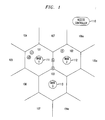
- Fig. 1 Shown in Fig. 1 is an illustrative idealized layout of a wireless communication system in which the present invention may be utilized. While the cell layout is shown as a regular hexagonal grid, for illustration and analysis purposes, it should be understood that in actuality the layout need not be regular and the cells can be any shape and need not be uniform in size. The size and shape of the cells are typically determined by geographic and other environmental factors. As an example, use of 7-cell frequency reuse as reference, cells identified by different numbers (e.g., 101-107) are members of the same cluster set and must be served by different sets of channel frequencies to avoid interference problems. Cells of other cluster sets may use the same sets of channel frequencies. Thus, cell 106a may use the same frequency set as cell 106. Each cell includes a base station (e.g., Basel, 111) for controlling communications to a plurality of mobile stations or users (e.g., U1 and U2) within its cell.
- Basel e.g., Basel, 111
- one or more cells may include underlay microcellular systems located entirely within " a ", at a boundary common to two neighboring cells " b " or at a corner common to three mutually adjacent cells " c ". These microcells also utilize sets of the frequency channels for communications between mobile users both within and outside of the microcell.
- the group of hexagonal cells will also be referred to as overlay macrocellular and/or outdoor systems and the underlay microcells referred to as a microcellular and/or indoor systems.
- a centralized access controller 110 is utilized to provide our technique of Dynamic Channel Assignment (Co-Existence DCA or CE-DCA) among macrocells of each cluster set (e.g., macrocells 101-103) of the overlay macrocellular systems to facilitate the coexistence of embedded autonomous underlay microcellular systems (a, b, and c).
- the Co-existence of the two types of systems without excessive mutual interference is achieved through systematic exclusion of predefined subsets of the universal channel set from the dynamic assignment to the macrocells.
- the sets of channels so excluded results in a guaranteed number of channels available to an embedded autonomous microcellular system (e.g., an indoor system).
- exclusion is done with minimal DCA performance degradation in the macrocellular systems (typically an outdoor system).
- FIG. 2 Shown in Fig. 2 is an illustrative block diagram suitable to represent a base station, e.g.,111, and an access controller 110.
- a modulated signal carrier signal is received at antenna 201 and is processed by receiver 202 under control of processor 203 and stored programs in memory 204.
- the transmitter 205 transmits a modulated signal carrier signal via antenna 211 under control of processor 203.
- the transmitter 205 and receiver 202 of the base station function to send/receive mobile station communication signals as well as control signals.
- the transmitter 205 and receiver 202 of the access controller 110 functions to send/receive control signals to/from the base stations.
- base station 111 also communicates with and operates under control of the centralized access controller 110 of Fig. 1 which controls channel allocation functions for the overlay system.
- centralized access controller 110 receives a request a request from an embedded autonomous underlay system for a predetermined number of communication channels.
- the centralized access controller 110 excludes a predetermined number of channels from use by one or more macrocells of the overlay system which overlap one or more cells of the underlay system.
- the excluded channels may be selected to deterministically meet only one of a group of requirements including (1) satisfying both equations 1 (EQ 1) and 2 (EQ 2), (2) violating EQ 1 and satisfying EQ 2; and (3) satisfying EQ 1 and violating EQ 2. Thereafter the base station for each of the one or more macrocells are signaled to exclude the excluded channels.
- the base station 111 processor 203 is then responsive to commands from access controller 110 to assign and exclude frequency channels to mobile users within its cell 101.
- the centralized access controller 110 also sends an assignment signal to the requesting underlay system identifying that the frequency channels excluded from the macrocells are to be allocated to the underlay system for communications.
- none of the base stations 111-113 operate under control of access controller 110 for channel allocation functions, but rather communicates with each other to coordinate channel allocations and channel exclusions.
- the operation begins when one or more of the base stations of the overlay system receives a broadcast request from an embedded autonomous underlay system for a predetermined number of communication channels.
- the receiving base station(s) determines, in conjunction with other base stations of the one or more macrocells of the overlay system, which overlap one or more cells of the embedded autonomous underlay system, which predetermined number of channels should be excluded by those macrocells. Again, the excluded channels are selected so as to deterministically meet one of the previous described group of requirements.
- a random exclusion techniques rather than a deterministic technique, as described in a later paragraph, is utilized for defining channel exclusion.
- These random embodiments may operate in either a centralized manner, where the access controller 110 controls channel exclusion or in a distributed manner where the base stations together determine the channels to be excluded.
- the operation for both the centralized and distributed random embodiments operate in a similar manner to the previously described centralized and distributed deterministic embodiments.
- excluded channels are selected so as to statistically satisfy both EQ1 and EQ2.
- processor 203 is arranged to provide the standard access control functions for the underlay macrocellular system of Fig. 1 and in addition, if required, may be arranged to provide any of the enhanced CE-DCA functions to facilitate the coexistence of embedded autonomous microcellular systems as described above.
- our invention describes a unique technique for excluding subset of channels, in each macrocell of the overlay system, from the universal set of channels, U.
- CE-DCA the search for channel exclusion patterns to minimize capacity loss in the overlay macrocellular system while maximizing the quantity of channels acquired by the underlay microcellular system.
- Such an exclusion pattern should provide sufficient amount of channels to an underlay microcellular system wherever they are located, within the overlay macrocellular system.
- the set of channels available to each underlay microcellular system are the ones never utilized by its nearby overlay macrocells which may otherwise cause mutual interference.
- the above objective can be achieved by excluding channel sets in those macrocells in the neighborhood of the underlay microcellular system.
- the intersection of those exclusion sets ought to be large enough to provide the required amount of channels to the underlay microcellular environment.
- an indoor wireless environment may pop up within a cell (" a " of Fig. 1), or at a boundary common to two or more cells (" b “ or " c " of Fig. 1).
- a microcell can exist in no more than 3 mutually adjacent cells, depicted as c in Figure 1. (In practice, a microcell may sometimes overlap with more than 3 macrocells coverage areas.)
- E i be the set of channels excluded in macrocell i when executing DCA
- N min be the minimum number of channels required for an indoor mobile environment (e.g., c of Fig. 1), then the requirement is, where P is the set of cells that can cause mutual interference to the underlay microcellular system.
- P is the set of cells that can cause mutual interference to the underlay microcellular system.
- a microcellular system may be located at three types of locations, labeled as a, b, and c.
- the number of channels available to the microcells with each CE-DCA depends on the type of location they are, while a minimum of N min channels must be guaranteed by the CE-DCA in the worst case location (i.e. at c).
- 3 in this description and extensions to layout with different
- CE-DCA computed tomography
- the statistic method is designed to preserve one of the advantages conventional DCAs offer, namely, no frequency planning in any form.
- Each cell independently and randomly picks an exclusion set E i from the universal channel set, U. All channels in U are chosen with uniform probability. In this case, the requirements posed by equation (1) is satisfied only in the statistical sense.
- should be sufficiently large to result in N min channels available to the microcells with required level of confidence.
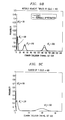
- Fig. 9 shows typical size distributions, for various
- the first two sets of distributions indicate the amount of channels available to a microcellular system overlapping with two and three macrocells respectively. Note that the mean is sufficiently large to provide channels for the underlay microcellular systems while the standard deviation is favorably small to maintain a high confidence level in channel availability.
- the third distribution shows the degree to which
- the base station in each cell of Fig. 1 independently determines which channel frequencies will be allocated to the microcell and, hence, won't be used for DCA.
- the inverse-FCA, 6-Min, 3-Min, and 2-Min exclusion methods are planned systemic channel exclusions where the base stations of Fig. 1 do not independently determine which channels are to be allocated to the microcell and excluded from DCA in the macrocells.
- the access controller 110 of Fig. 1 may centrally control the planned channel exclusion for each of the cells and communicate the information to each base station.
- the base stations may communicate with each other to decide among themselves as to systemic channel exclusions.
- equation (1) dictates that
- the simplest method is to exclude a unique set with N min channels from all the macrocells so that the set is available to serve the indoor systems at any location.
- ⁇ in this case, thus it's spectral utilization is inefficient.
- the CE-DCA performance in the outdoor system is simply that of the baseline conventional DCA algorithm with the truncated U . This capacity loss may not be acceptable by the outdoor service provider especially if some of the indoor systems are operated by independent parties.
- the 2-Min Exclusion scheme provides us with a great value for
- cluster size
- cluster size
- Fig. 3 shows the topology for a "6-Min exclusion" pattern with minimum universal cluster size of 4. As shown in Fig.
- This design can accommodate a much larger value of N min for a given universal channel set size, compared to the 6-Min Exdusion; specifically, it only requires
- all the clusters of 4 cells and 5 cells with certain shapes and orientations are allowed access to an the channels in U, not every clusters of 5 cells has that property (such as the shaded one). Any cluster of 6 cells such as A is able to use U.
- 6, just like in 2-Min Exclusion. With greater
- 6-Min is the only one that minimizes
- An additional drawback of 6-Min is that it requires a large span of the channel set. In search of techniques to improve the performance and reduce this span, we come up with a Finite Projective Plane (FPP) based exclusion scheme which not only cut down the span from 18 N min to 14 N min but also improves the performance significantly.
- FPP Finite Projective Plane
- the FPP Exclusion is similar to 6-Min in that
- 6 N min , yet it is very different in its selection of E i .
- the method of exclusion set selection in this scheme stems from the theory of finite projective planes [ for example, see the article by Yoshihiko Akaiwa and Hidehiro Andoh, "Channel Segregation - A Self-Organized Dynamic Channel Allocation Method: Application to TDMA/FDMA Microcellular System, " IEEE J. Sel. Areas in Comm., Vol. 11, No.6, Aug. 1993, pp. 949-954; and the article by Albert, A. A., and Sandler, R., "An Introduction to Finite Projective Planes," Holt, Rinehart, and Winston, New York, 1968.].
- FPP FPP
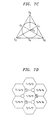
- a FPP of order-q consists of q 2 + q +1 points and that many lines. Any line is incident with q +1 points and any point is incident with q +1 lines.
- FPP The simplest example of FPP is the FPP of order 1, which is represented by the 3 lines and 3 points of a triangle.
- Figs. a and 7b show examples of FPP of orders 1 and 2, respectively.
- FPP has been used to design new FCA schemes with improved frequency reuse efficiency [for example, see the article by Ueberberg, J., "Interactive Theorem Proving and Finite Projective Planes, " Proc., Int. Conf. AISMC-3, '96 , pp. 240-257.].
- CE-DCA which leads to an efficient co-exclusion channel cell layout.
- the procedure is to be repeated with a different set of 7 channel sets to provide common exclusions for the remaining triplets.
- This pattern is repeated with a 7 cell re-exclusion pattern. Note that only three of the six cell-triplets of interest in Fig. 7d achieve common exclusion due to the fact that each points (channel set) in this FPP of order 2 (7-cell cluster) is incident (shared) by only three lines (cells) and that each line (cell), including the circle (center cell), contains only three points (channels).
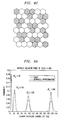
- Fig. 8a The resultant exclusion pattern is shown in Fig. 8a.
- the FPP exclusion is achieved with 14 channel sets of size N min .
- Each corner of a hexagon is assigned an exclusion set chosen from the set of channel sets ⁇ a ,..., g, a',..., g' ⁇ .
- the exclusion set so assigned to a corner is excluded in all three cells with the corner in common. This pattern ensures a reuse cluster size of 4 and has an exclusion set size of 6Nmin per cell.
- the exclusion scheme is derived from the finite projective plane concept.
- the FPP exclusion scheme proves to offer a far superior traffic performance to that of 6-Min exclusion. Since the two schemes have identical
- the Figs. 8b and 8c show, respectively, the co-exclusion channel cell pattern (shaded) in 6-Min and FPP exclusion schemes.
- CE-DCA Co-Existence DCA
- CE-DCA algorithms Key factors governing the relative performance of CE-DCA algorithms in outdoor/macrocellular systems are: the size of the exclusion set per macrocell, the size of the universal cluster, and the layout of co-exclusion channel cells. The first one is largely dictated by the minimally required number of available channels in the microcells. The second and third, on the other hand, varies with the type of the exclusion algorithms. The quantity of spectrum acquired by a microcell is dictated by the type of algorithm as well as the relative position of the microcellular system within the macrocellular environment
- CE-DCA with common exclusion is overshadowed by its poor performance, except when the microcells needs only a very small number of channels.
- 2-Min was found to be characterized with optimal exclusion set size per macrocell of twice the minimum requirement. As expected, this algorithm is found to show excellent performance.
- CE-DCA with 6-Min exclusion provides the smallest universal cluster size and pretty good performance, with the caveat that its' universal set size must be at least 18 times of the number of channels the microcells need.
- CE-DCA with FPP based exclusion appears to be the most efficient approach. If the microcellular systems are reasonably small in radius in comparison with the macrocells, as would be true in most of the cases of interest, we recommend the CE-DCA with random exclusion. Random CE-DCA also preserves the advantage of not requiring global frequency planning.
- CE-DCAs are possible with the use of channel segregation techniques where each channel is assigned a priority factor for assignment in each microcell. Such factors are updated following an adaptive procedure, leading to improved DCA performance on overlay macrocellular system while leaving stationary channels for the utilization of underlay microcellular systems.
- On the side of statistical approach there is a possibility for performance improvement by intelligently choosing probability distributions during the selection of exclusion channel sets, instead of selecting them according to an equal probability assumption.
- the choice of such probability distribution should ensure common exclusion channel set sizes for adjacent pairs and triplets of cells, matching with the placement probabilities of a microcellular system, leading to optimized expected amount of channels for the microcells.
- the choice of selection probabilities should take into consideration, the effects on overlay macrocells. Such a strategy would have complexities falling between purely random schemes and fully deterministic schemes in terms of the amount of coordination and autonomy.
Landscapes
- Engineering & Computer Science (AREA)
- Computer Networks & Wireless Communication (AREA)
- Signal Processing (AREA)
- Mobile Radio Communication Systems (AREA)
- Patch Boards (AREA)
Applications Claiming Priority (2)
| Application Number | Priority Date | Filing Date | Title |
|---|---|---|---|
| US08/911,693 US6055432A (en) | 1997-08-15 | 1997-08-15 | Dynamic channel allocation in macrocells with random exclusion for allowing underlaying autonomous microcells |
| US911693 | 1997-08-15 |
Publications (2)
| Publication Number | Publication Date |
|---|---|
| EP0898436A2 true EP0898436A2 (de) | 1999-02-24 |
| EP0898436A3 EP0898436A3 (de) | 2000-03-01 |
Family
ID=25430704
Family Applications (1)
| Application Number | Title | Priority Date | Filing Date |
|---|---|---|---|
| EP98306187A Withdrawn EP0898436A3 (de) | 1997-08-15 | 1998-08-04 | Dynamische Kanalzuteilung in einem Makro- / Mikrozellensystem |
Country Status (4)
| Country | Link |
|---|---|
| US (1) | US6055432A (de) |
| EP (1) | EP0898436A3 (de) |
| JP (1) | JPH11136746A (de) |
| CA (1) | CA2243802A1 (de) |
Cited By (2)
| Publication number | Priority date | Publication date | Assignee | Title |
|---|---|---|---|---|
| WO2009044620A1 (ja) * | 2007-10-01 | 2009-04-09 | Nec Corporation | 無線通信システム、無線通信方法、基地局、移動局、基地局の制御方法、移動局の制御方法及び制御プログラム |
| CN103581933A (zh) * | 2012-08-08 | 2014-02-12 | 电信科学技术研究院 | 一种小区管理的方法、系统和设备 |
Families Citing this family (37)
| Publication number | Priority date | Publication date | Assignee | Title |
|---|---|---|---|---|
| US6895245B2 (en) | 1998-03-06 | 2005-05-17 | Telefonaktiebolaget Lm Ericssion(Publ) | Telecommunications interexchange measurement transfer |
| EP1143749B1 (de) * | 1998-12-23 | 2005-03-09 | Telecommunication Laboratories, Chunghwa Telecom Co., Ltd. | Fuzzy kanalzuweisungskontroller der dienstqualitäten zusichert |
| KR100313760B1 (ko) | 1999-11-10 | 2001-11-17 | 박종섭 | 이동통신 시스템내 확장 통화권역 기지국에서의 동적 채널할당방법 |
| US8670390B2 (en) | 2000-11-22 | 2014-03-11 | Genghiscomm Holdings, LLC | Cooperative beam-forming in wireless networks |
| GB2370452B (en) * | 2000-12-19 | 2004-10-20 | Inmarsat Ltd | Communication method and apparatus |
| US6985731B1 (en) | 2001-04-02 | 2006-01-10 | Bellsouth Intellectual Property Corporation | Location defined control of cellular system |
| US9893774B2 (en) | 2001-04-26 | 2018-02-13 | Genghiscomm Holdings, LLC | Cloud radio access network |
| US9819449B2 (en) | 2002-05-14 | 2017-11-14 | Genghiscomm Holdings, LLC | Cooperative subspace demultiplexing in content delivery networks |
| US10355720B2 (en) | 2001-04-26 | 2019-07-16 | Genghiscomm Holdings, LLC | Distributed software-defined radio |
| US10425135B2 (en) | 2001-04-26 | 2019-09-24 | Genghiscomm Holdings, LLC | Coordinated multipoint systems |
| US10931338B2 (en) | 2001-04-26 | 2021-02-23 | Genghiscomm Holdings, LLC | Coordinated multipoint systems |
| US20030068975A1 (en) * | 2001-08-06 | 2003-04-10 | The Research Foundation Of Suny | Integrated cellular and ad hoc relaying system |
| GB0119391D0 (en) * | 2001-08-09 | 2001-10-03 | Koninkl Philips Electronics Nv | Handover in cellular radio systems |
| US10200227B2 (en) | 2002-05-14 | 2019-02-05 | Genghiscomm Holdings, LLC | Pre-coding in multi-user MIMO |
| US9628231B2 (en) | 2002-05-14 | 2017-04-18 | Genghiscomm Holdings, LLC | Spreading and precoding in OFDM |
| US9136931B2 (en) * | 2002-05-14 | 2015-09-15 | Genghiscomm Holdings, LLC | Cooperative wireless networks |
| US10644916B1 (en) | 2002-05-14 | 2020-05-05 | Genghiscomm Holdings, LLC | Spreading and precoding in OFDM |
| US10142082B1 (en) | 2002-05-14 | 2018-11-27 | Genghiscomm Holdings, LLC | Pre-coding in OFDM |
| US7302278B2 (en) * | 2003-07-03 | 2007-11-27 | Rotani, Inc. | Method and apparatus for high throughput multiple radio sectorized wireless cell |
| US9585023B2 (en) * | 2003-10-30 | 2017-02-28 | Qualcomm Incorporated | Layered reuse for a wireless communication system |
| US8526963B2 (en) * | 2003-10-30 | 2013-09-03 | Qualcomm Incorporated | Restrictive reuse for a wireless communication system |
| US8059589B2 (en) * | 2004-06-09 | 2011-11-15 | Qualcomm Incorporated | Dynamic restrictive reuse scheduler |
| US8032145B2 (en) | 2004-07-23 | 2011-10-04 | Qualcomm Incorporated | Restrictive reuse set management algorithm for equal grade of service on FL transmission |
| US11431386B1 (en) | 2004-08-02 | 2022-08-30 | Genghiscomm Holdings, LLC | Transmit pre-coding |
| US11184037B1 (en) | 2004-08-02 | 2021-11-23 | Genghiscomm Holdings, LLC | Demodulating and decoding carrier interferometry signals |
| US11552737B1 (en) | 2004-08-02 | 2023-01-10 | Genghiscomm Holdings, LLC | Cooperative MIMO |
| US7548752B2 (en) * | 2004-12-22 | 2009-06-16 | Qualcomm Incorporated | Feedback to support restrictive reuse |
| US8040815B2 (en) * | 2007-11-28 | 2011-10-18 | Motorola Solutions, Inc. | Spectrum coordination controller |
| ES2531634T3 (es) * | 2008-09-17 | 2015-03-18 | Koninklijke Philips N.V. | Procedimiento de comunicación en una red, dispositivo de comunicación y sistema asociado |
| US12224860B1 (en) | 2014-01-30 | 2025-02-11 | Genghiscomm Holdings, LLC | Linear coding in decentralized networks |
| US10243773B1 (en) | 2017-06-30 | 2019-03-26 | Genghiscomm Holdings, LLC | Efficient peak-to-average-power reduction for OFDM and MIMO-OFDM |
| US10637705B1 (en) | 2017-05-25 | 2020-04-28 | Genghiscomm Holdings, LLC | Peak-to-average-power reduction for OFDM multiple access |
| US11917604B2 (en) | 2019-01-25 | 2024-02-27 | Tybalt, Llc | Orthogonal multiple access and non-orthogonal multiple access |
| US12206535B1 (en) | 2018-06-17 | 2025-01-21 | Tybalt, Llc | Artificial neural networks in wireless communication systems |
| US11343823B2 (en) | 2020-08-16 | 2022-05-24 | Tybalt, Llc | Orthogonal multiple access and non-orthogonal multiple access |
| EP3915236A4 (de) | 2019-01-25 | 2023-05-24 | Genghiscomm Holdings, LLC | Orthogonaler mehrfachzugriff und nicht-orthogonaler mehrfachzugrif |
| WO2020242898A1 (en) | 2019-05-26 | 2020-12-03 | Genghiscomm Holdings, LLC | Non-orthogonal multiple access |
Family Cites Families (1)
| Publication number | Priority date | Publication date | Assignee | Title |
|---|---|---|---|---|
| US5956643A (en) * | 1994-01-13 | 1999-09-21 | Lucent Technologies Inc. | Apparatus and method for adaptive dynamic channel assignment in wireless communication networks |
-
1997
- 1997-08-15 US US08/911,693 patent/US6055432A/en not_active Expired - Lifetime
-
1998
- 1998-07-23 CA CA002243802A patent/CA2243802A1/en not_active Abandoned
- 1998-08-04 EP EP98306187A patent/EP0898436A3/de not_active Withdrawn
- 1998-08-11 JP JP10227339A patent/JPH11136746A/ja active Pending
Non-Patent Citations (2)
| Title |
|---|
| ABDUL-HALEEM M ET AL: "AGGRESSIVE FUZZY DISTRIBUTED DYNAMIC CHANNEL ASSIGNMENT ALGORITHM" PROCEEDINGS OF THE INTERNATIONAL CONFERENCE ON COMMUNICATIONS (ICC),US,NEW YORK, IEEE,18 June 1995 (1995-06-18), page 423-427 XP000533022 ISBN: 0-7803-2487-0 * |
| CHIH-LIN I ET AL: "CO-EXISTENCE DCA: DYNAMIC CHANNEL ALLOCATIONS ALLOWING UNDERLAYING AUTONOMOUS MICROCELLS" IEEE VEHICULAR TECHNOLOGY CONFERENCE,US,NEW YORK, IEEE, vol. CONF. 47, 4 May 1997 (1997-05-04), page 1455-1459 XP000738603 ISBN: 0-7803-3660-7 * |
Cited By (6)
| Publication number | Priority date | Publication date | Assignee | Title |
|---|---|---|---|---|
| WO2009044620A1 (ja) * | 2007-10-01 | 2009-04-09 | Nec Corporation | 無線通信システム、無線通信方法、基地局、移動局、基地局の制御方法、移動局の制御方法及び制御プログラム |
| US8731576B2 (en) | 2007-10-01 | 2014-05-20 | Nec Corporation | Wireless communication system, wireless communication method, base station, mobile station, base station control method, mobile station control method, and control program |
| US9942882B2 (en) | 2007-10-01 | 2018-04-10 | Nec Corporation | Wireless communication system, wireless communication method, base station, mobile station, base station control method, mobile station control method, and control program |
| CN103581933A (zh) * | 2012-08-08 | 2014-02-12 | 电信科学技术研究院 | 一种小区管理的方法、系统和设备 |
| WO2014023177A1 (zh) * | 2012-08-08 | 2014-02-13 | 电信科学技术研究院 | 一种小区管理的方法、系统和设备 |
| US9408195B2 (en) | 2012-08-08 | 2016-08-02 | China Academy Of Telecommunications Technology | Method, system and device for cell management |
Also Published As
| Publication number | Publication date |
|---|---|
| EP0898436A3 (de) | 2000-03-01 |
| JPH11136746A (ja) | 1999-05-21 |
| CA2243802A1 (en) | 1999-02-15 |
| US6055432A (en) | 2000-04-25 |
Similar Documents
| Publication | Publication Date | Title |
|---|---|---|
| EP0898436A2 (de) | Dynamische Kanalzuteilung in einem Makro- / Mikrozellensystem | |
| US6047190A (en) | Dynamic channel allocation in macrocells with deterministic exclusion for allowing underlaying autonomous microcells | |
| JP4589287B2 (ja) | パワー制御と有向チャネル割当てを併用して隣接チャネル干渉の管理を行なうためのシステムおよび方法 | |
| US7366517B2 (en) | Cellular radio network reusing frequencies | |
| Salgado-Galicia et al. | A narrowband approach to efficient PCS spectrum sharing through decentralized DCA access policies | |
| US6549782B2 (en) | Radio communications systems | |
| RU2197791C2 (ru) | Автоматическое планирование каналов управления в системах с адаптивным распределением каналов | |
| US6002935A (en) | Wireless communications cellular architecture for improving communications resource allocation | |
| KR100411675B1 (ko) | 채널화된셀룰러시스템에서인접채널간섭관리방법 | |
| US6553234B1 (en) | Method of frequency reuse in a fixed access wireless network | |
| US5649292A (en) | Obtaining improved frequency reuse in wireless communication systems | |
| CN102685752B (zh) | 用于控制无线网络间共存的方法,装置和计算机程序 | |
| US7477914B2 (en) | Real-time spectrum management to increase frequency reuse | |
| US6405044B1 (en) | Cellular communications system | |
| JP2878456B2 (ja) | セルラ無線システム | |
| KR101915132B1 (ko) | 상호공존 네트워크 내에서 마스터 cm 선출 방법 | |
| Salgado et al. | Spectrum sharing through dynamic channel assignment for open access to personal communications services | |
| CN110505696A (zh) | 一种波束分配方法、装置、设备及计算机存储介质 | |
| Jordan | Resource allocation in wireless networks | |
| US20040008654A1 (en) | Method for operating a cellular time division multiple access communication system | |
| Basloom et al. | Resource allocation using graph coloring for dense cellular networks | |
| US20050107047A1 (en) | Base station for a telecommunication system | |
| Abdulhamid et al. | Performance of automatic frequency planning and optimization algorithmfor cellular networks | |
| MXPA98006572A (es) | Asignacion de canal dinamica en macroceldas, conexclusion aleatoria para permitir microceldas autonomas subyacentes | |
| MXPA98006616A (en) | Allocation of dynamic channel in macroceldas with exclusion determinista to enable autonomous microclasses subyacen |
Legal Events
| Date | Code | Title | Description |
|---|---|---|---|
| PUAI | Public reference made under article 153(3) epc to a published international application that has entered the european phase |
Free format text: ORIGINAL CODE: 0009012 |
|
| AK | Designated contracting states |
Kind code of ref document: A2 Designated state(s): AT BE CH CY DE DK ES FI FR GB GR IE IT LI LU MC NL PT SE |
|
| AX | Request for extension of the european patent |
Free format text: AL;LT;LV;MK;RO;SI |
|
| PUAL | Search report despatched |
Free format text: ORIGINAL CODE: 0009013 |
|
| AK | Designated contracting states |
Kind code of ref document: A3 Designated state(s): AT BE CH CY DE DK ES FI FR GB GR IE IT LI LU MC NL PT SE |
|
| AX | Request for extension of the european patent |
Free format text: AL;LT;LV;MK;RO;SI |
|
| AKX | Designation fees paid | ||
| STAA | Information on the status of an ep patent application or granted ep patent |
Free format text: STATUS: THE APPLICATION IS DEEMED TO BE WITHDRAWN |
|
| 18D | Application deemed to be withdrawn |
Effective date: 20000902 |