EP0891966B1 - Method for industrial purification of capsaicin - Google Patents
Method for industrial purification of capsaicin Download PDFInfo
- Publication number
- EP0891966B1 EP0891966B1 EP98113227A EP98113227A EP0891966B1 EP 0891966 B1 EP0891966 B1 EP 0891966B1 EP 98113227 A EP98113227 A EP 98113227A EP 98113227 A EP98113227 A EP 98113227A EP 0891966 B1 EP0891966 B1 EP 0891966B1
- Authority
- EP
- European Patent Office
- Prior art keywords
- capsaicin
- silver
- weight
- solution
- capsinoids
- Prior art date
- Legal status (The legal status is an assumption and is not a legal conclusion. Google has not performed a legal analysis and makes no representation as to the accuracy of the status listed.)
- Expired - Lifetime
Links
- YKPUWZUDDOIDPM-SOFGYWHQSA-N capsaicin Chemical compound COC1=CC(CNC(=O)CCCC\C=C\C(C)C)=CC=C1O YKPUWZUDDOIDPM-SOFGYWHQSA-N 0.000 title claims description 161
- 229960002504 capsaicin Drugs 0.000 title claims description 80
- 235000017663 capsaicin Nutrition 0.000 title claims description 80
- 238000000034 method Methods 0.000 title claims description 16
- 238000000746 purification Methods 0.000 title claims description 10
- SQGYOTSLMSWVJD-UHFFFAOYSA-N silver(1+) nitrate Chemical compound [Ag+].[O-]N(=O)=O SQGYOTSLMSWVJD-UHFFFAOYSA-N 0.000 claims description 38
- 239000000243 solution Substances 0.000 claims description 28
- XLYOFNOQVPJJNP-UHFFFAOYSA-N water Substances O XLYOFNOQVPJJNP-UHFFFAOYSA-N 0.000 claims description 27
- 229910052709 silver Inorganic materials 0.000 claims description 26
- 239000004332 silver Substances 0.000 claims description 26
- 239000002904 solvent Substances 0.000 claims description 21
- 229910001961 silver nitrate Inorganic materials 0.000 claims description 19
- 230000002209 hydrophobic effect Effects 0.000 claims description 10
- 229940100890 silver compound Drugs 0.000 claims description 7
- 150000003379 silver compounds Chemical class 0.000 claims description 7
- 239000003929 acidic solution Substances 0.000 claims description 6
- 239000007864 aqueous solution Substances 0.000 claims description 6
- RBWNDBNSJFCLBZ-UHFFFAOYSA-N 7-methyl-5,6,7,8-tetrahydro-3h-[1]benzothiolo[2,3-d]pyrimidine-4-thione Chemical compound N1=CNC(=S)C2=C1SC1=C2CCC(C)C1 RBWNDBNSJFCLBZ-UHFFFAOYSA-N 0.000 claims description 3
- CQLFBEKRDQMJLZ-UHFFFAOYSA-M silver acetate Chemical compound [Ag+].CC([O-])=O CQLFBEKRDQMJLZ-UHFFFAOYSA-M 0.000 claims description 3
- 229940071536 silver acetate Drugs 0.000 claims description 3
- SDLBJIZEEMKQKY-UHFFFAOYSA-M silver chlorate Chemical compound [Ag+].[O-]Cl(=O)=O SDLBJIZEEMKQKY-UHFFFAOYSA-M 0.000 claims description 3
- YPNVIBVEFVRZPJ-UHFFFAOYSA-L silver sulfate Chemical compound [Ag+].[Ag+].[O-]S([O-])(=O)=O YPNVIBVEFVRZPJ-UHFFFAOYSA-L 0.000 claims description 3
- 229910000367 silver sulfate Inorganic materials 0.000 claims description 3
- YMWUJEATGCHHMB-UHFFFAOYSA-N Dichloromethane Chemical compound ClCCl YMWUJEATGCHHMB-UHFFFAOYSA-N 0.000 description 57
- 239000010410 layer Substances 0.000 description 36
- CSCPPACGZOOCGX-UHFFFAOYSA-N Acetone Chemical compound CC(C)=O CSCPPACGZOOCGX-UHFFFAOYSA-N 0.000 description 12
- OKKJLVBELUTLKV-UHFFFAOYSA-N Methanol Chemical compound OC OKKJLVBELUTLKV-UHFFFAOYSA-N 0.000 description 12
- YXFVVABEGXRONW-UHFFFAOYSA-N Toluene Chemical compound CC1=CC=CC=C1 YXFVVABEGXRONW-UHFFFAOYSA-N 0.000 description 12
- VLKZOEOYAKHREP-UHFFFAOYSA-N n-Hexane Chemical compound CCCCCC VLKZOEOYAKHREP-UHFFFAOYSA-N 0.000 description 12
- KFZMGEQAYNKOFK-UHFFFAOYSA-N Isopropanol Chemical compound CC(C)O KFZMGEQAYNKOFK-UHFFFAOYSA-N 0.000 description 11
- VQEONGKQWIFHMN-UHFFFAOYSA-N Nordihydrocapsaicin Chemical compound COC1=CC(CNC(=O)CCCCCC(C)C)=CC=C1O VQEONGKQWIFHMN-UHFFFAOYSA-N 0.000 description 11
- 239000013078 crystal Substances 0.000 description 9
- 238000003756 stirring Methods 0.000 description 9
- VEXZGXHMUGYJMC-UHFFFAOYSA-N Hydrochloric acid Chemical compound Cl VEXZGXHMUGYJMC-UHFFFAOYSA-N 0.000 description 8
- ZAFNJMIOTHYJRJ-UHFFFAOYSA-N Diisopropyl ether Chemical group CC(C)OC(C)C ZAFNJMIOTHYJRJ-UHFFFAOYSA-N 0.000 description 7
- 238000004128 high performance liquid chromatography Methods 0.000 description 7
- QTBSBXVTEAMEQO-UHFFFAOYSA-N Acetic acid Chemical compound CC(O)=O QTBSBXVTEAMEQO-UHFFFAOYSA-N 0.000 description 6
- WEVYAHXRMPXWCK-UHFFFAOYSA-N Acetonitrile Chemical compound CC#N WEVYAHXRMPXWCK-UHFFFAOYSA-N 0.000 description 6
- LFQSCWFLJHTTHZ-UHFFFAOYSA-N Ethanol Chemical compound CCO LFQSCWFLJHTTHZ-UHFFFAOYSA-N 0.000 description 6
- NBIIXXVUZAFLBC-UHFFFAOYSA-N Phosphoric acid Chemical compound OP(O)(O)=O NBIIXXVUZAFLBC-UHFFFAOYSA-N 0.000 description 6
- 239000007787 solid Substances 0.000 description 6
- RTZKZFJDLAIYFH-UHFFFAOYSA-N Diethyl ether Chemical compound CCOCC RTZKZFJDLAIYFH-UHFFFAOYSA-N 0.000 description 5
- FAPWRFPIFSIZLT-UHFFFAOYSA-M Sodium chloride Chemical compound [Na+].[Cl-] FAPWRFPIFSIZLT-UHFFFAOYSA-M 0.000 description 5
- -1 Decanylvanillylamide Chemical compound 0.000 description 4
- CTQNGGLPUBDAKN-UHFFFAOYSA-N O-Xylene Chemical compound CC1=CC=CC=C1C CTQNGGLPUBDAKN-UHFFFAOYSA-N 0.000 description 4
- HEDRZPFGACZZDS-MICDWDOJSA-N Trichloro(2H)methane Chemical compound [2H]C(Cl)(Cl)Cl HEDRZPFGACZZDS-MICDWDOJSA-N 0.000 description 4
- XJQPQKLURWNAAH-UHFFFAOYSA-N dihydrocapsaicin Chemical compound COC1=CC(CNC(=O)CCCCCCC(C)C)=CC=C1O XJQPQKLURWNAAH-UHFFFAOYSA-N 0.000 description 4
- RBCYRZPENADQGZ-UHFFFAOYSA-N dihydrocapsaicin Natural products COC1=CC(COC(=O)CCCCCCC(C)C)=CC=C1O RBCYRZPENADQGZ-UHFFFAOYSA-N 0.000 description 4
- JKIHLSTUOQHAFF-UHFFFAOYSA-N homocapsaicin Natural products COC1=CC(CNC(=O)CCCCCC=CC(C)C)=CC=C1O JKIHLSTUOQHAFF-UHFFFAOYSA-N 0.000 description 4
- MLJGZARGNROKAC-VQHVLOKHSA-N homocapsaicin Chemical compound CCC(C)\C=C\CCCCC(=O)NCC1=CC=C(O)C(OC)=C1 MLJGZARGNROKAC-VQHVLOKHSA-N 0.000 description 4
- JZNZUOZRIWOBGG-UHFFFAOYSA-N homocapsaicin-II Natural products COC1=CC(CNC(=O)CCCCC=CCC(C)C)=CC=C1O JZNZUOZRIWOBGG-UHFFFAOYSA-N 0.000 description 4
- RGOVYLWUIBMPGK-UHFFFAOYSA-N nonanoic acid vanillylamide Natural products CCCCCCCCC(=O)NCC1=CC=C(O)C(OC)=C1 RGOVYLWUIBMPGK-UHFFFAOYSA-N 0.000 description 4
- 239000008096 xylene Substances 0.000 description 4
- 229910000147 aluminium phosphate Inorganic materials 0.000 description 3
- 238000004440 column chromatography Methods 0.000 description 3
- MTHSVFCYNBDYFN-UHFFFAOYSA-N diethylene glycol Chemical compound OCCOCCO MTHSVFCYNBDYFN-UHFFFAOYSA-N 0.000 description 3
- 239000012044 organic layer Substances 0.000 description 3
- 239000003208 petroleum Substances 0.000 description 3
- 125000001997 phenyl group Chemical group [H]C1=C([H])C([H])=C(*)C([H])=C1[H] 0.000 description 3
- 229940098465 tincture Drugs 0.000 description 3
- OKTJSMMVPCPJKN-UHFFFAOYSA-N Carbon Chemical compound [C] OKTJSMMVPCPJKN-UHFFFAOYSA-N 0.000 description 2
- HEDRZPFGACZZDS-UHFFFAOYSA-N Chloroform Chemical compound ClC(Cl)Cl HEDRZPFGACZZDS-UHFFFAOYSA-N 0.000 description 2
- XEKOWRVHYACXOJ-UHFFFAOYSA-N Ethyl acetate Natural products CCOC(C)=O XEKOWRVHYACXOJ-UHFFFAOYSA-N 0.000 description 2
- GRYLNZFGIOXLOG-UHFFFAOYSA-N Nitric acid Chemical compound O[N+]([O-])=O GRYLNZFGIOXLOG-UHFFFAOYSA-N 0.000 description 2
- JUJWROOIHBZHMG-UHFFFAOYSA-N Pyridine Chemical compound C1=CC=NC=C1 JUJWROOIHBZHMG-UHFFFAOYSA-N 0.000 description 2
- QAOWNCQODCNURD-UHFFFAOYSA-N Sulfuric acid Chemical compound OS(O)(=O)=O QAOWNCQODCNURD-UHFFFAOYSA-N 0.000 description 2
- 239000002253 acid Substances 0.000 description 2
- 239000003814 drug Substances 0.000 description 2
- 235000013399 edible fruits Nutrition 0.000 description 2
- 230000002496 gastric effect Effects 0.000 description 2
- 238000011068 loading method Methods 0.000 description 2
- 238000002156 mixing Methods 0.000 description 2
- 238000012986 modification Methods 0.000 description 2
- 230000004048 modification Effects 0.000 description 2
- 229910017604 nitric acid Inorganic materials 0.000 description 2
- 239000012488 sample solution Substances 0.000 description 2
- 230000028327 secretion Effects 0.000 description 2
- 238000001644 13C nuclear magnetic resonance spectroscopy Methods 0.000 description 1
- 238000005160 1H NMR spectroscopy Methods 0.000 description 1
- UHOVQNZJYSORNB-UHFFFAOYSA-N Benzene Chemical compound C1=CC=CC=C1 UHOVQNZJYSORNB-UHFFFAOYSA-N 0.000 description 1
- VYPSYNLAJGMNEJ-UHFFFAOYSA-N Silicium dioxide Chemical compound O=[Si]=O VYPSYNLAJGMNEJ-UHFFFAOYSA-N 0.000 description 1
- BQCADISMDOOEFD-UHFFFAOYSA-N Silver Chemical compound [Ag] BQCADISMDOOEFD-UHFFFAOYSA-N 0.000 description 1
- 241000208292 Solanaceae Species 0.000 description 1
- 239000012670 alkaline solution Substances 0.000 description 1
- 230000000202 analgesic effect Effects 0.000 description 1
- 238000010171 animal model Methods 0.000 description 1
- 230000015572 biosynthetic process Effects 0.000 description 1
- 210000004204 blood vessel Anatomy 0.000 description 1
- 238000004587 chromatography analysis Methods 0.000 description 1
- 238000007796 conventional method Methods 0.000 description 1
- 230000029087 digestion Effects 0.000 description 1
- 238000001035 drying Methods 0.000 description 1
- 239000003480 eluent Substances 0.000 description 1
- 238000002474 experimental method Methods 0.000 description 1
- 239000012535 impurity Substances 0.000 description 1
- 125000000956 methoxy group Chemical group [H]C([H])([H])O* 0.000 description 1
- 210000004400 mucous membrane Anatomy 0.000 description 1
- 229930014626 natural product Natural products 0.000 description 1
- FBUKVWPVBMHYJY-UHFFFAOYSA-M nonanoate Chemical compound CCCCCCCCC([O-])=O FBUKVWPVBMHYJY-UHFFFAOYSA-M 0.000 description 1
- 239000002674 ointment Substances 0.000 description 1
- 239000002244 precipitate Substances 0.000 description 1
- UMJSCPRVCHMLSP-UHFFFAOYSA-N pyridine Natural products COC1=CC=CN=C1 UMJSCPRVCHMLSP-UHFFFAOYSA-N 0.000 description 1
- 238000004451 qualitative analysis Methods 0.000 description 1
- 238000004445 quantitative analysis Methods 0.000 description 1
- 239000002994 raw material Substances 0.000 description 1
- 238000001953 recrystallisation Methods 0.000 description 1
- 230000011514 reflex Effects 0.000 description 1
- 230000000241 respiratory effect Effects 0.000 description 1
- 239000012047 saturated solution Substances 0.000 description 1
- 239000000741 silica gel Substances 0.000 description 1
- 229910002027 silica gel Inorganic materials 0.000 description 1
- 239000011780 sodium chloride Substances 0.000 description 1
- 239000007858 starting material Substances 0.000 description 1
- 230000004936 stimulating effect Effects 0.000 description 1
- 239000000126 substance Substances 0.000 description 1
- 210000001835 viscera Anatomy 0.000 description 1
Images

Classifications
-
- C—CHEMISTRY; METALLURGY
- C07—ORGANIC CHEMISTRY
- C07C—ACYCLIC OR CARBOCYCLIC COMPOUNDS
- C07C231/00—Preparation of carboxylic acid amides
- C07C231/22—Separation; Purification; Stabilisation; Use of additives
- C07C231/24—Separation; Purification
Definitions
- Capsaicin is included in fruits of Capsium annuum Linne or its variety, solanaceae, in an amount of about 0.2 % by weight of the fruits.
- Capsium annuum is adopted in the Pharmacopeia of Japan and when a tincture or a solution of Capsaicin is put on certain area of skin, mucous membrane or a dog's ear, blood vessels of the area are expanded and the area is congested.
- Capsaicin a main component of Capsium annuum, appears to have strong and stimulative effectiveness on receptors of circulatory and respiratory reflex.
- Capsium annuum or Capsaicin promotes digestion and its small amount promotes salivary and gastric secretion, however its large amount suppresses the salivary and gastric secretion.
- the tincture of Capsium annuum is used as a local stimulant and may be incorporated in external remedies such as plasters, solutions or ointments.
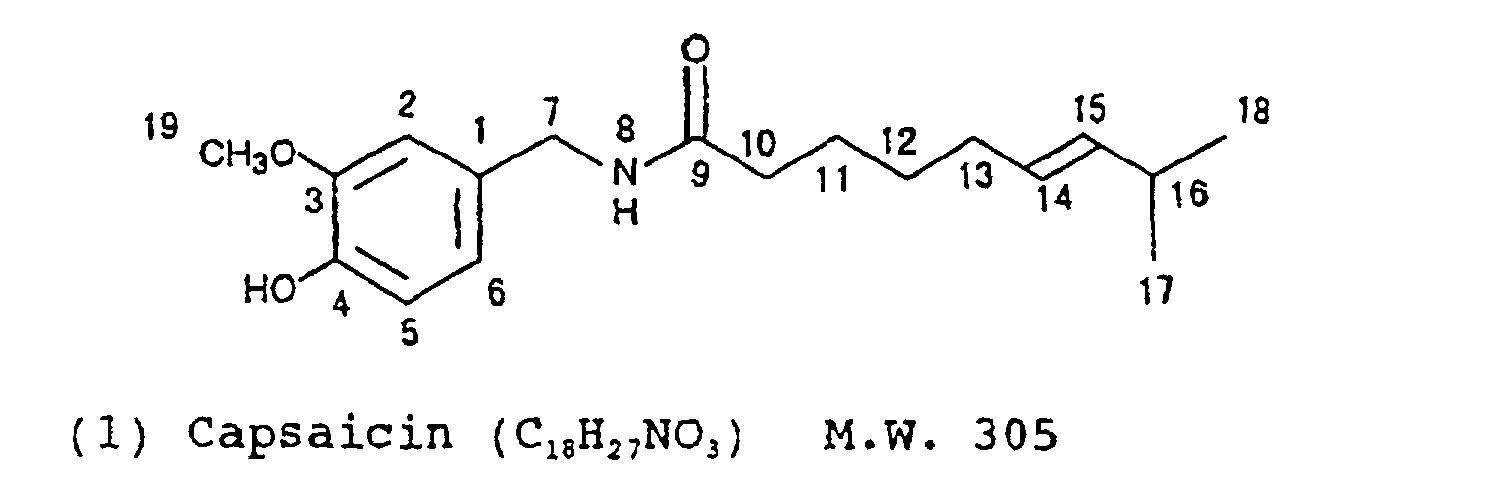
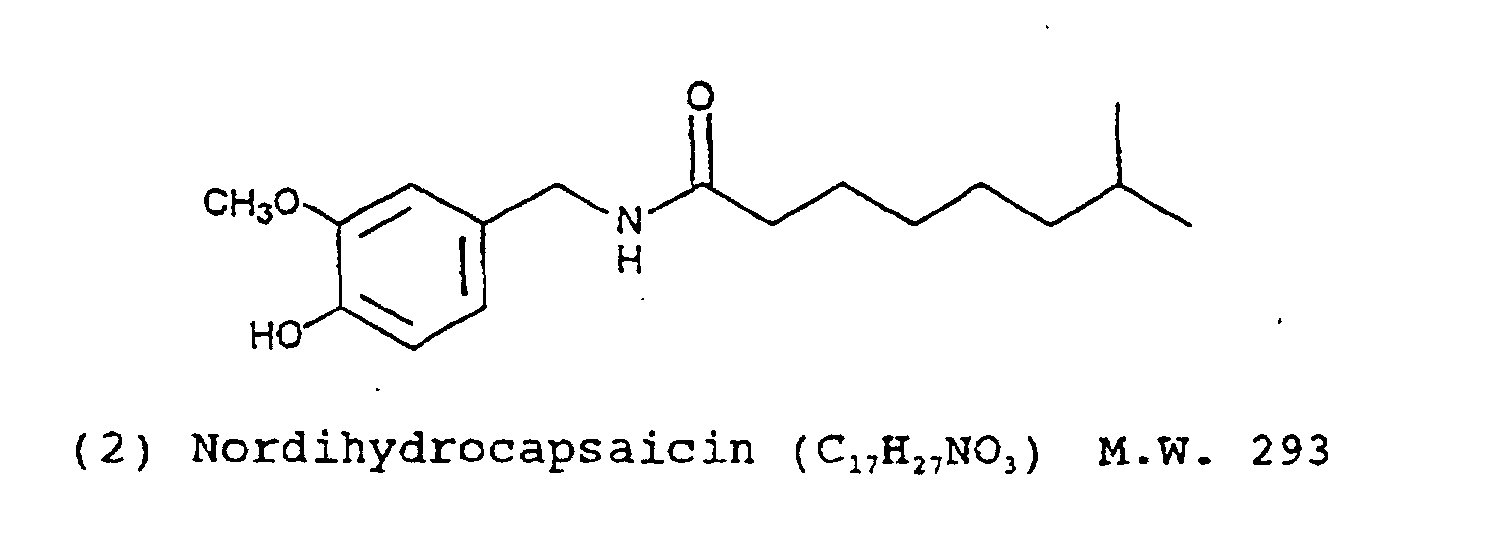
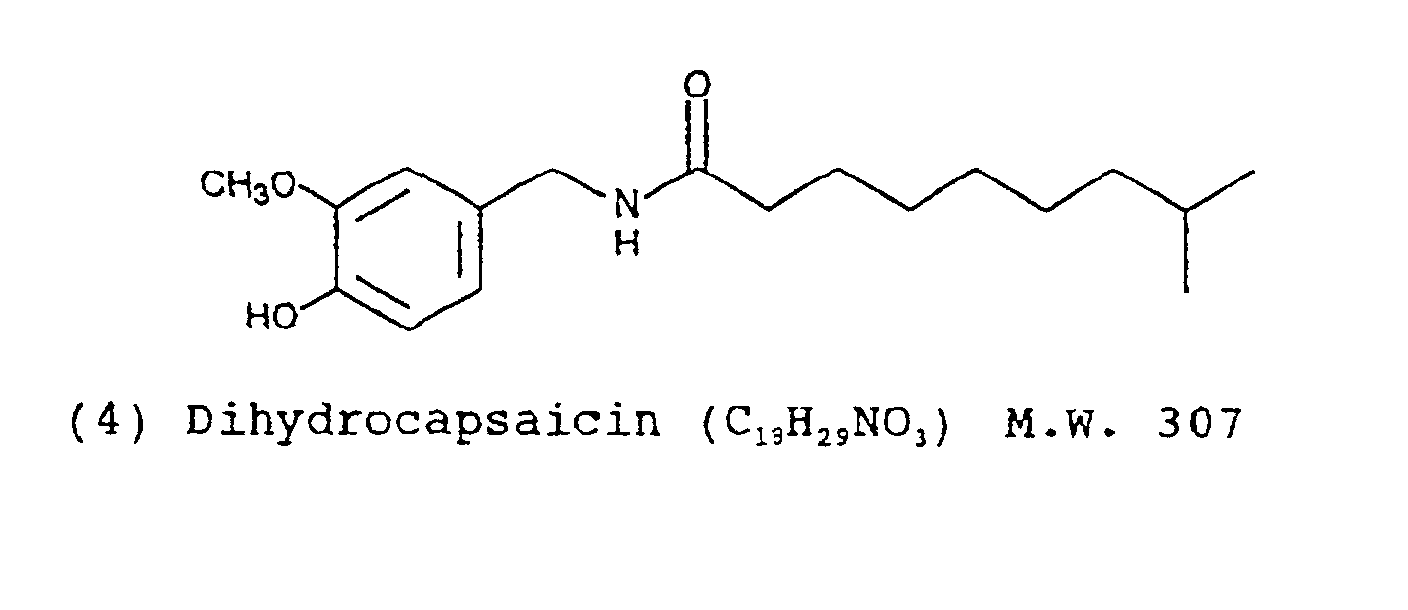
- capsaicin on the market includes capsinoids of the following chemical structures, (1) Capsaicin (60 to 65 % by weight), (2) Nordihydrocapsaicin, (3) Nonylvanillylamide, (4) Dihydrocapsaicin, (5) Decanylvanillylamide and (6) Homocapsaicin.
- a total amount of capsinoids in the commercial capsaicin is more than 95 % by weight and a main component of the commercial capsaicin, Capsaicin, is about 60 to about 65 % by weight.
- Capsaicin have been conventionally isolated and purified by repeatedly subjecting crude capsaicin to several kinds of a large column (ODS, Phenyl, silica gel, etc.) of high performance liquid chromatography.
- capsaicin 60 to 65 % by weight as a purity of Capsaicin
- 300 ml of 70 % methanol 30 g of commercial capsaicin (60 to 65 % by weight as a purity of Capsaicin) is dissolved in 300 ml of 70 % methanol.
- the resulting solution is treated to decolor by stirring with 3 g of activated charcoal 1 hour and filtered to give a solid.
- the solid is dissolved in 300 ml of 70 % alcohol to give a sample solution in a final concentration of 10 % by weight of the solid.
- the sample solution is subjected to ODS column (10 cm in diameter and 50 cm in length) of high performance liquid chromatography (HPLC) to obtain fractions. Fractions including predominantly Capsaicin are collected and concentrated to give about 15 g as solid.
- HPLC high performance liquid chromatography
- aqueous 70 % alcohol solution in a final concentration of 5 % by weight of the solid is prepared and the aqueous alcohol is subjected a Phenyl column (20 cm in diameter and 100 cm in length). Fractions including predominantly Capsaicin are collected and concentrated to give a residue. The residue is dissolved in an alkaline solution, and then acetic acid is added thereto and precipitate. The obtained crystals are rinsed and dried to give 5.4 g of Capsaicin in a purity of more than 98 % by weight and an yield based on commercial capsaicin is 18 % by weight.
- Capsaicin According to a conventional method for purification of Capsaicin, it is difficult to remove impurities such as Nordihdrocapsaicin, Vanylamide nonylate and the like which are analogous to Capsaicin.
- impurities such as Nordihdrocapsaicin, Vanylamide nonylate and the like which are analogous to Capsaicin.
- an amount of Capsaicin obtained by one purification procedure is several gram order and it also depends on an amount of column-. loading, usually, the column-loading amount is small, therefore, in order to obtain a large amount of Capsaicin, it is necessary to repeat the purification procedure or enlarge a column scale. Therefore, there is a limitation in the purification of Capsaicin in industrial scale and also it takes long time to obtain Capsaicin in a large quantity.
- the object of the invention is to remove drawbacks as described above and to provide a method for purification of Capsaicin in high purity, which is expensive and used as a raw material of a medicinal drug, by purifying promptly and also in large quantity, which comprises contacting capsinoids containing Capsaicin in a hydrophilic solvent with a silver compound selected from the group consisting of silver nitrate, silver chlorate, silver perchlorate, silver acetate and silver sulfate in an aqueous solution to form a Capsaicin-silver complex which is soluble in water to separate a water layer including the Capsaicin-silver complex, followed by treating the water layer including a Capsaicin-silver complex with a hydrophobic solvent which hardly dissolves the Capsaicin-silver complex, treating again the water layer with another hydrophobic solvent which is capable of dissolving the Capsaicin-silver complex to form a solution and treating the formed solution with acidic solution to give Cap
- a purification process of the invention is characterized that after contacting capsinoids containing Capsaicin in a hydrophilic solvent with a silver compound in an aqueous solution to form a Capsaicin-silver complex, an aqueous layer including the Capsaicin-silver complex is extracted with a hydrophobic solvent which hardly dissolves the Capsaicin-silver complex, and then with a hydrophobic solvent which is capable of dissolving the Capsaicin-silver complex, the resultant hydrophobic solvent including the Capsaicin-silver complex is treated by an aqueous acidic solution to obtain Capsaicin in high purity.
- Capsaicin 1 part by weight of Capsaicin in capsinoids dissolved in a hydrophilic solvent is contacted with an aqueous solution of 3 to 20 parts by weight of a silver nitrate.
- the main component, Capsaicin 60 to 65 % by weight
- the main component, Capsaicin may be isolated and purified from commercial capsaicin including 95 % % by weight of total capsinoids (i.e. the components of capsinoids are Capsaicin, Nordihydrocapsaicin, Nonylvanillylamide, Dihydrocapsaicin, Decanylvanillylamide, Homocapsaicin, etc.).
- Purified Capsaicin may be used as a starting material of a medicinal drug, for example, analgestic.
- Capsinoid means Capsaicin or its analogues. Specific examples of the analogues are Nordihydrocapsaicin, Nonylvanillylamide, Dihydrocapsaicin, Decanylvanillylamide, Homocapsaicin, etc.
- the hydrophilic solvent herein may be any hydrophilic solvent which is capable of dissolving Capsaicin, and it may be acetone, methanol, ethanol, isopropyl alcohol, preferably, acetone.
- the amount of the hydrophilic solvent relation to capsinoids is not limited, preferably, 0.25 to 2 parts by weight for 1 part by weight of capsinoids, more preferably, 0.5 to 1.5 parts by weight.
- the silver compound to form a Capsaicin-silver complex may include silver nitrate, silver chlorate, silver perchlorate, silver acetate and silver sulfate, preferably silver nitrate.
- silver nitrate is used hereafter as the silver compound.
- Silver nitrate in relation to 1 part by weight of Capsaicin is 3 to 20 parts by weight, preferably 4 to 10 parts by weight, more preferably 5 to 7 parts by weight, the most preferably about 6 parts by weight.
- Commercial capsaicin includes 60 to 65 % by weight of Capsaicin, and therefore, based on commercial capsaicin, silver nitrate per 1 part by weight of commercial capsaicin is 2 to 12 parts by weight.
- Concentration of a silver nitrate solution is preferably 60 to 90 % (w/v), more preferably 70 to 80 % (w/v), the most preferably about 75 % (w/v).
- the hydrophilic solution with capsinoids is contacted the silver nitrate solution preferably at 5 to 60 °C, more preferably 10 to 40 °C, most preferably 15 to 25 °C, preferably at pH 6 to 10, more preferably pH 6 to 8, most preferably pH 7.5.
- a period for contact of the capsinoids with silver nitrate may be any period in which Capsaicin-silver complex can be formed, and therefore, is not limited.
- the Capsaicin-silver complex may be formed 1 to 4 hours.
- hydrophobic solvent which can hardly dissolves Capsaicin, hexane, petroleum ether, petroleum benzin and the like may be exemplified.
- a hydrophobic solvent which is capable of dissolving Capsaicin includes methylene chloride, ether, isopropyl alcohol, ethyl acetate, chloroform and the like, preferably methylene chloride.
- an acid in the acidic solution includes hydrochloric acid, nitric acid, acetic acid, sulfuric acid, phosphoric acid, preferably hydrochloric acid. Concentration of the acidic solution may be about 1 N.
- high purity herein means a purity of more than 98 % by weight.
- a process for purification of the present invention is illustrated as follows:
- Capsinoids for example, commercial capsaicin includes 60 to 65 % by weight of Capsaicin
- a hydrophilic solvent which is capable of dissolving Capsaicin (for example, acetone)
- a solution of silver nitrate which has been previously prepared for example, silver nitrate is dissolved in water of 4 to 6 times as much as weight of commercial capsaicin
- Stirring is stopped and the solution is allowed to stand to form two layers, an upper layer of a water insoluble part and a lower layer of a water soluble part.
- the lower layer of the water soluble part is treated to remove fat with a hydrophobic solvent which can hardly dissolve the Capsaicin-silver complex, for example, hexane, followed by shaking with a solvent (0.1 volume to a volume equivalent of the lower layer) which can dissolve Capsaicin-silver complex, for example, methylene chloride.
- a solvent 0.1 volume to a volume equivalent of the lower layer
- Capsaicin-silver complex for example, methylene chloride organic layer is separated.
- Capsaicin has partly liberated from the Capsaicin-silver complex at this stage.
- the organic layer is shaken with an acidic solution of about 1 N (for example, a hydrochloric acid solution), further with a sodium chloride saturated solution to remove acid.
- the organic layer is concentrated to give a residue which is repeatedly recrystallized from toluene, xylene, acetonitrile, diethylene glycol, pyridine, ether, isopropyl ether or the like, preferably toluene and/or xylene.
- the recrystallization is repeatedly 1 to 5 times, preferably 3 times to filter off crystals, Capsaicin in high purity.
- Capsaicin including 63.5 % by weight of Capsaicin (476.5 g as Capsaicin), 750 g was dissolved into the same amount of acetone followed by mixing a solution of silver nitrate previously prepared (2900 g of silver nitrate was dissolved in 3900 ml of water) under stirring pH 7.5 at 18 °C for 3 hours to form a Capsaicin-silver complex. Stirring was stopped and the solution was allowed to stand and then a water layer (about 5 L) was separated. Hexane (about 5 L) was added to the water layer followed by shaking. The water layer was again separated and 2.5 mL of dichloromethane was added thereto followed by shaking to separate a dichloromethane layer (i).
- Capsaicin including 63.5 % by weight of Capsaicin (476.5 g as Capsaicin), 750 g was dissolved into the same amount of isopropyl alcohol and mixed with a solution of silver nitrate previously prepared (2900 g of silver nitrate was dissolved in 3900 ml of water) under stirring pH 7.5 at 18 °C for 2.5 hours to form Capsaicin-silver complex. Stirring was stopped and the solution was allowed to stand and then a lower water layer (about 5 L) was separated. Petroleum ether (about 5 L) was added to the water layer followed by shaking.
- the isopropyl ether layer was concentrated to give a residue, which was recrystallized from 1 L of xylene and crystals were filtered off. The crystals were precipitated from toluene followed by drying to give 135 g of dried Capsaicin of high purity (more than 98 %) and an yield is 18 % based on commercial capsaicin.
- Capsaicin including 60 to 65 % by weight of Capsaicin (476.5 g as Capsaicin), 750 g was dissolved into the same amount of methanol followed by mixing a solution of silver nitrate previously prepared (6400 g of silver nitrate was dissolved in 30 L of water) to contact under stirring at pH 7.5 at 20 °C for 3 hours to form a Capsaicin-silver complex. stirring was stopped and the solution was allowed to stand and then a lower water layer (about 29 L) was separated. Hexane 10 L was added to the water layer followed by shaking. The water layer was again separated and 5 L of dichloromethane was added thereto followed by shaking and a dichloromethane layer (i) was separated.
Landscapes
- Chemical & Material Sciences (AREA)
- Organic Chemistry (AREA)
- Organic Low-Molecular-Weight Compounds And Preparation Thereof (AREA)
Description
- Capsaicin is included in fruits of Capsium annuum Linne or its variety, solanaceae, in an amount of about 0.2 % by weight of the fruits. Capsium annuum is adopted in the Pharmacopeia of Japan and when a tincture or a solution of Capsaicin is put on certain area of skin, mucous membrane or a dog's ear, blood vessels of the area are expanded and the area is congested. Capsaicin, a main component of Capsium annuum, appears to have strong and stimulative effectiveness on receptors of circulatory and respiratory reflex. In experiments of internal organs removed from humans or experimental animals, a tincture of Capsium annuum or Capsaicin promotes digestion and its small amount promotes salivary and gastric secretion, however its large amount suppresses the salivary and gastric secretion. The tincture of Capsium annuum is used as a local stimulant and may be incorporated in external remedies such as plasters, solutions or ointments.
- So-called capsaicin on the market, referred to hereinafter as commercial capsaicin, includes capsinoids of the following chemical structures, (1) Capsaicin (60 to 65 % by weight), (2) Nordihydrocapsaicin, (3) Nonylvanillylamide, (4) Dihydrocapsaicin, (5) Decanylvanillylamide and (6) Homocapsaicin. A total amount of capsinoids in the commercial capsaicin is more than 95 % by weight and a main component of the commercial capsaicin, Capsaicin, is about 60 to about 65 % by weight.



- Capsaicin have been conventionally isolated and purified by repeatedly subjecting crude capsaicin to several kinds of a large column (ODS, Phenyl, silica gel, etc.) of high performance liquid chromatography.
- For example, 30 g of commercial capsaicin (60 to 65 % by weight as a purity of Capsaicin) is dissolved in 300 ml of 70 % methanol. The resulting solution is treated to decolor by stirring with 3 g of activated
charcoal 1 hour and filtered to give a solid. The solid is dissolved in 300 ml of 70 % alcohol to give a sample solution in a final concentration of 10 % by weight of the solid. The sample solution is subjected to ODS column (10 cm in diameter and 50 cm in length) of high performance liquid chromatography (HPLC) to obtain fractions. Fractions including predominantly Capsaicin are collected and concentrated to give about 15 g as solid. Using the solid, 300 ml of aqueous 70 % alcohol solution in a final concentration of 5 % by weight of the solid is prepared and the aqueous alcohol is subjected a Phenyl column (20 cm in diameter and 100 cm in length). Fractions including predominantly Capsaicin are collected and concentrated to give a residue. The residue is dissolved in an alkaline solution, and then acetic acid is added thereto and precipitate. The obtained crystals are rinsed and dried to give 5.4 g of Capsaicin in a purity of more than 98 % by weight and an yield based on commercial capsaicin is 18 % by weight. - While in ordre to isolate Nordihydrocapsaicin having a peak near to Capsaicin's peak in HPLC and column chromatography, a method is known from the Journal of Natural Products, Volume 58 (12), 1925-1928, (1995), which comprises previously forming a silver complex and then subjecting to HPLC or column chromatography. However, the method is directed to qualitative and quantitative analysis and uses column chromatography.
- And therefore, a method directed to an industrial purification without subjecting to chromatography has not been known as a method for preparing Capsaicin in a high purity in a large scale.
- According to a conventional method for purification of Capsaicin, it is difficult to remove impurities such as Nordihdrocapsaicin, Vanylamide nonylate and the like which are analogous to Capsaicin. In addition, since an amount of Capsaicin obtained by one purification procedure is several gram order and it also depends on an amount of column-. loading, usually, the column-loading amount is small, therefore, in order to obtain a large amount of Capsaicin, it is necessary to repeat the purification procedure or enlarge a column scale. Therefore, there is a limitation in the purification of Capsaicin in industrial scale and also it takes long time to obtain Capsaicin in a large quantity.
- The object of the invention is to remove drawbacks as described above and to provide a method for purification of Capsaicin in high purity, which is expensive and used as a raw material of a medicinal drug, by purifying promptly and also in large quantity, which comprises contacting capsinoids containing Capsaicin in a hydrophilic solvent with a silver compound selected from the group consisting of silver nitrate, silver chlorate, silver perchlorate, silver acetate and silver sulfate in an aqueous solution to form a Capsaicin-silver complex which is soluble in water to separate a water layer including the Capsaicin-silver complex, followed by treating the water layer including a Capsaicin-silver complex with a hydrophobic solvent which hardly dissolves the Capsaicin-silver complex, treating again the water layer with another hydrophobic solvent which is capable of dissolving the Capsaicin-silver complex to form a solution and treating the formed solution with acidic solution to give Capsaicin in high purity.
- According to the method, a large quantity of Capsaicin in high purity can be obtained at one operation procedure.
- Further scope of applicability of the present invention will become apparent from the detailed description given hereinafter. However, it should be understood that the detailed description and specific examples, while indicating preferred embodiments of the invention, are given by way of illustration only, since various changes and modifications within the spirit and scope of the invention will become apparent to those skilled in the art from this detailed description.
-
- Figure 1 shows a HPLC chart of commercial capsaicin.
- Figure 2 shows purified Capsaicin obtained by the method of the present invention. (1)...Capsaicin, (2)...Nordihydrocapsaicin, (3)...Nonylvanillylamide,(4)...Dihydrocapsaicin (5)...Decanylvanillylamide (6)...Homocapsaicin
-
- A purification process of the invention is characterized that after contacting capsinoids containing Capsaicin in a hydrophilic solvent with a silver compound in an aqueous solution to form a Capsaicin-silver complex, an aqueous layer including the Capsaicin-silver complex is extracted with a hydrophobic solvent which hardly dissolves the Capsaicin-silver complex, and then with a hydrophobic solvent which is capable of dissolving the Capsaicin-silver complex, the resultant hydrophobic solvent including the Capsaicin-silver complex is treated by an aqueous acidic solution to obtain Capsaicin in high purity.
- More specifically, 1 part by weight of Capsaicin in capsinoids dissolved in a hydrophilic solvent is contacted with an aqueous solution of 3 to 20 parts by weight of a silver nitrate. According to the method of the present invention, for example, the main component, Capsaicin (60 to 65 % by weight), may be isolated and purified from commercial capsaicin including 95 % % by weight of total capsinoids (i.e. the components of capsinoids are Capsaicin, Nordihydrocapsaicin, Nonylvanillylamide, Dihydrocapsaicin, Decanylvanillylamide, Homocapsaicin, etc.). Purified Capsaicin may be used as a starting material of a medicinal drug, for example, analgestic.
- The term "capsinoid" means Capsaicin or its analogues. Specific examples of the analogues are Nordihydrocapsaicin, Nonylvanillylamide, Dihydrocapsaicin, Decanylvanillylamide, Homocapsaicin, etc.
- The hydrophilic solvent herein may be any hydrophilic solvent which is capable of dissolving Capsaicin, and it may be acetone, methanol, ethanol, isopropyl alcohol, preferably, acetone.
- The amount of the hydrophilic solvent relation to capsinoids is not limited, preferably, 0.25 to 2 parts by weight for 1 part by weight of capsinoids, more preferably, 0.5 to 1.5 parts by weight.
- The silver compound to form a Capsaicin-silver complex may include silver nitrate, silver chlorate, silver perchlorate, silver acetate and silver sulfate, preferably silver nitrate. For simplification of description, silver nitrate is used hereafter as the silver compound.
- Silver nitrate in relation to 1 part by weight of Capsaicin is 3 to 20 parts by weight, preferably 4 to 10 parts by weight, more preferably 5 to 7 parts by weight, the most preferably about 6 parts by weight.
- Commercial capsaicin includes 60 to 65 % by weight of Capsaicin, and therefore, based on commercial capsaicin, silver nitrate per 1 part by weight of commercial capsaicin is 2 to 12 parts by weight.
- Concentration of a silver nitrate solution is preferably 60 to 90 % (w/v), more preferably 70 to 80 % (w/v), the most preferably about 75 % (w/v).
- The hydrophilic solution with capsinoids is contacted the silver nitrate solution preferably at 5 to 60 °C, more preferably 10 to 40 °C, most preferably 15 to 25 °C, preferably at
pH 6 to 10, more preferablypH 6 to 8, most preferably pH 7.5. A period for contact of the capsinoids with silver nitrate may be any period in which Capsaicin-silver complex can be formed, and therefore, is not limited. The Capsaicin-silver complex may be formed 1 to 4 hours. - As a hydrophobic solvent which can hardly dissolves Capsaicin, hexane, petroleum ether, petroleum benzin and the like may be exemplified.
- A hydrophobic solvent which is capable of dissolving Capsaicin includes methylene chloride, ether, isopropyl alcohol, ethyl acetate, chloroform and the like, preferably methylene chloride.
- Examples of an acid in the acidic solution includes hydrochloric acid, nitric acid, acetic acid, sulfuric acid, phosphoric acid, preferably hydrochloric acid. Concentration of the acidic solution may be about 1 N.
- "high purity" herein means a purity of more than 98 % by weight.
- A process for purification of the present invention is illustrated as follows:
- Capsinoids (for example, commercial capsaicin includes 60 to 65 % by weight of Capsaicin) are dissolved into the same amount of a hydrophilic solvent which is capable of dissolving Capsaicin (for example, acetone), and mixed with a solution of silver nitrate which has been previously prepared (for example, silver nitrate is dissolved in water of 4 to 6 times as much as weight of commercial capsaicin) under stirring for 1 to 4 hours (Formation of a Capsaicin-silver complex). Stirring is stopped and the solution is allowed to stand to form two layers, an upper layer of a water insoluble part and a lower layer of a water soluble part.
- The lower layer of the water soluble part is treated to remove fat with a hydrophobic solvent which can hardly dissolve the Capsaicin-silver complex, for example, hexane, followed by shaking with a solvent (0.1 volume to a volume equivalent of the lower layer) which can dissolve Capsaicin-silver complex, for example, methylene chloride. The methylene chloride organic layer is separated. Incidentally, Capsaicin has partly liberated from the Capsaicin-silver complex at this stage.
- The organic layer is shaken with an acidic solution of about 1 N (for example, a hydrochloric acid solution), further with a sodium chloride saturated solution to remove acid. The organic layer is concentrated to give a residue which is repeatedly recrystallized from toluene, xylene, acetonitrile, diethylene glycol, pyridine, ether, isopropyl ether or the like, preferably toluene and/or xylene. The recrystallization is repeatedly 1 to 5 times, preferably 3 times to filter off crystals, Capsaicin in high purity.
-
- C18H27NO3 (MW: 305)
- Property: white needle crystals
- M.P.: 65.5°C
- Purity: more than 98 % by weight
-
-
- Measured Wavelength: 280 nm
- Column: Phenyl (5 µ: 4.6 X 250 mm)
- Temperature: 40 °C
- Eluent: acetonitrile - aqueous 0.1 % phosphoric acid solution (= 37 : 63)
- Current velocity: 1.0 ml/min.
-
- The purity of Casaicin and Capinoids herein were measured under the conditions of HPLC as described above.
IR(KBr) γ cm-1: 3320(OH), 2960(CH), 1690(C=O), 1610(arom C=C)
UV λ max nm(log ε): (MeOH)227(3.91), 280(3.43)
1H-NMR(CDCl3): 0.94(6H, d, J=6.8Hz, 17, 18-H), 1.26-1.75(4H, m, 11, 12-H), 1.82-2.01(2H, m, 13-H), 2.20(2H, t, J=7.5Hz, 10-H), 2.09-2.28(1H, m, 16-H), 3.87(3H, s, OCH3), 4.35(2H, d, J=5.5Hz, 7-H), 5.35(2H, m, 14, 15-H), 5.65(2H, br s, NH, OH), 6.76(1H, dd, J=7.7Hz, 2.2Hz, H-6), 6.81(1H, d, J=2.2Hz, H-2), 6.89(1H, d, J=7.7Hz, H-5)
13C-NMR(CDCl3): 22.7(C-17, C-18), 25.3(C-11), 29.3(C-12), 31.0(C-16), 32.2(C-13), 36.7(C-10), 43.6(C-7), 56.0(C-19), 110.9(C-2), 114.6(C-5), 120.9(C-6), 126.6(C-14), 130.5(C-1), 138.2(C-15), 145.4(C-4), 146.9(C-3), 172.9(C-9) - Commercial capsaicin including 63.5 % by weight of Capsaicin (476.5 g as Capsaicin), 750 g was dissolved into the same amount of acetone followed by mixing a solution of silver nitrate previously prepared (2900 g of silver nitrate was dissolved in 3900 ml of water) under stirring pH 7.5 at 18 °C for 3 hours to form a Capsaicin-silver complex. Stirring was stopped and the solution was allowed to stand and then a water layer (about 5 L) was separated. Hexane (about 5 L) was added to the water layer followed by shaking. The water layer was again separated and 2.5 mL of dichloromethane was added thereto followed by shaking to separate a dichloromethane layer (i). Again to the water layer, 1.25 mL of dichloromethane was added followed by shaking to separate a dichloromethane layer (ii). Two dichloro-methane layers (i) and (ii) are collected together and concentrated to a volume of 1.25 L. To the dichloromethane layer, 1.25 mL of 1 N hydrochloric acid solution was added followed by shaking, this procedure was repeated three times and finally 1.25 mL of saturated sodium chloride solution was added to the dichloromethane layer followed by shaking. The dichloromethane solution was concentrated to give a residue, which was two times recrystallized from 1 L of xylene, and crystals were filtered off.
- The crystals were dried to give 150 g of Capsaicin in high purity (more than 98 %), and an yield is 20 % based on commercial capsaicin.
- Commercial capsaicin including 63.5 % by weight of Capsaicin (476.5 g as Capsaicin), 750 g was dissolved into the same amount of isopropyl alcohol and mixed with a solution of silver nitrate previously prepared (2900 g of silver nitrate was dissolved in 3900 ml of water) under stirring pH 7.5 at 18 °C for 2.5 hours to form Capsaicin-silver complex. Stirring was stopped and the solution was allowed to stand and then a lower water layer (about 5 L) was separated. Petroleum ether (about 5 L) was added to the water layer followed by shaking. The water layer was again separated and 2.5 mL of isopropyl alcohol was added thereto followed by shaking and an isopropyl ether layer (i) was separated. Again to the water layer, 1.25 mL of isopropyl ether was added followed by shaking and an isopropyl ether layer (ii) was separated. Two isopropyl ether layers (i) and (ii) are collected together and concentrated to a volume of 1.25 L. To the isopropyl ether layer, 1.25 mL of 1 N phosphoric acid solution was added followed by shaking, this procedure was repeated three times, and finally 1.25 mL of excessively saturated sodium chloride solution was added thereto followed by shaking. The isopropyl ether layer was concentrated to give a residue, which was recrystallized from 1 L of xylene and crystals were filtered off. The crystals were precipitated from toluene followed by drying to give 135 g of dried Capsaicin of high purity (more than 98 %) and an yield is 18 % based on commercial capsaicin.
- Commercial capsaicin including 60 to 65 % by weight of Capsaicin (476.5 g as Capsaicin), 750 g was dissolved into the same amount of methanol followed by mixing a solution of silver nitrate previously prepared (6400 g of silver nitrate was dissolved in 30 L of water) to contact under stirring at pH 7.5 at 20 °C for 3 hours to form a Capsaicin-silver complex. stirring was stopped and the solution was allowed to stand and then a lower water layer (about 29 L) was separated. Hexane 10 L was added to the water layer followed by shaking. The water layer was again separated and 5 L of dichloromethane was added thereto followed by shaking and a dichloromethane layer (i) was separated. Again to the water layer, 1.25 mL of dichloromethane was added followed by shaking and a dichloromethane layer (ii) was separated. Two dichloromethane layers (i) and (ii) are collected together and concentrated to 1 L. To the dichloromethane layer, 1 L of 1 N nitric acid solution was added followed by shaking and finally 0.8 L of saturated sodium chloride solution was added thereto followed by shaking. The dichloromethane layer was concentrated to give a residue, which was two times recrystallized from 500 mL of toluene and crystals were filtered off. The crystals were dried to give 113 g of Capsaicin in high purity (more than 98 %), and an yield is 15 % based on commercial capsaicin.
- The invention being thus described, it will be obvious that the same may be varied in many ways. Such variations are not to be regarded as a departure from the spirit and scope of the invention, and all such modifications as would be obvious to one those skilled in the art are intended to be included within scope of the following claims.
Claims (3)
- A method for industrial purification of Capsaicin which comprises contacting capsinoids containing Capsaicin in a hydrophilic solvent with a silver compound selected from the group consisting of silver nitrate, silver chlorate, silver perchlorate, silver acetate and silver sulfate in an aqueous solution to form a Capsaicin-silver complex which is soluble in water to separate a water layer including the Capsaicin-silver complex, followed by treating the water layer including a Capsaicin-silver complex with a hydrophobic solvent which hardly dissolves the Capsaicin-silver complex, treating again the water layer with another hydrophobic solvent which is capable of dissolving the Capsaicin-silver complex to form a solution and treating the formed solution with acidic solution to give Capsaicin in high purity.
- The method according to Claim 1 wherein capsinoids containing a Capsaicin in a hydrophilic solvent is contacted with 3 to 20 parts by weight of said silver compound in relation to 1 part by weight of Capsaicin in an aqueous solution.
- The method according to Claim 1 wherein capsinoids contain commercial capsaicin containing 60 to 65 % by weight of Capsaicin in a hydrophilic solvent and being contacted with 2 to 12 parts by weight of said silver compound in relation to 1 part by weight of the commercial capsaicin in an aqueous solution.
Applications Claiming Priority (3)
| Application Number | Priority Date | Filing Date | Title |
|---|---|---|---|
| JP19376097 | 1997-07-18 | ||
| JP193760/97 | 1997-07-18 | ||
| JP09193760A JP3133708B2 (en) | 1997-07-18 | 1997-07-18 | Industrial purification method of capsaicin |
Publications (3)
| Publication Number | Publication Date |
|---|---|
| EP0891966A2 EP0891966A2 (en) | 1999-01-20 |
| EP0891966A3 EP0891966A3 (en) | 2000-04-12 |
| EP0891966B1 true EP0891966B1 (en) | 2003-04-16 |
Family
ID=16313360
Family Applications (1)
| Application Number | Title | Priority Date | Filing Date |
|---|---|---|---|
| EP98113227A Expired - Lifetime EP0891966B1 (en) | 1997-07-18 | 1998-07-16 | Method for industrial purification of capsaicin |
Country Status (4)
| Country | Link |
|---|---|
| US (1) | US5955631A (en) |
| EP (1) | EP0891966B1 (en) |
| JP (1) | JP3133708B2 (en) |
| DE (1) | DE69813397T2 (en) |
Cited By (1)
| Publication number | Priority date | Publication date | Assignee | Title |
|---|---|---|---|---|
| CN102432489A (en) * | 2011-11-29 | 2012-05-02 | 山东轻工业学院 | Method for preparing capsaicin and dihydrocapsaicin monomers |
Families Citing this family (13)
| Publication number | Priority date | Publication date | Assignee | Title |
|---|---|---|---|---|
| JP4637377B2 (en) * | 2001-02-01 | 2011-02-23 | 長谷川香料株式会社 | Extraction method of capsaicinoid-like substance from pepper |
| US20030012828A1 (en) * | 2001-07-13 | 2003-01-16 | Joe Ajrulahi | Topical medicine and process and apparatus for making same |
| CN1293043C (en) * | 2002-08-20 | 2007-01-03 | 中国科学院广州地球化学研究所 | Method for producing high-purity capsaicin by using capsicine as raw material |
| EA008705B1 (en) * | 2003-04-08 | 2007-06-29 | Алгоркс Фармасьютикалз, Инк. | OBTAINING AND CLEANING SYNTHETIC CAPSAICIN |
| CN100406432C (en) * | 2005-01-18 | 2008-07-30 | 天津科技大学 | Method for extracting capsaicin crystals from capsicum |
| ES2353399T3 (en) * | 2005-04-01 | 2011-03-01 | Neurogesx, Inc. | CAPSAICINOID OILS AND METHODS TO OBTAIN AND USE THEM. |
| JP4981375B2 (en) * | 2006-07-12 | 2012-07-18 | 秀樹 山本 | Method for extracting and separating capsinoid compounds from chili and chili extract |
| CN100348574C (en) * | 2006-09-08 | 2007-11-14 | 山东省科学院生物研究所 | Method for preparing purified capsicine of monomer |
| CN101200433B (en) * | 2007-11-08 | 2010-04-07 | 山东省分析测试中心 | Method for preparing high-purity capsaicin monomer |
| CN101619028B (en) * | 2009-06-17 | 2012-06-27 | 张鹏 | Method for preparing capsicine monomer |
| CN103739511A (en) * | 2013-12-20 | 2014-04-23 | 白城艾高食品有限公司 | Method for extracting capsaicin |
| CN106946730B (en) * | 2017-03-27 | 2019-02-22 | 北京理工大学 | A kind of method for recovering stimulating component OC from tear gas propellant and its waste liquid |
| CN109180517B (en) * | 2018-10-11 | 2021-10-26 | 许昌学院 | Method for preparing high-purity white solid capsaicin |
-
1997
- 1997-07-18 JP JP09193760A patent/JP3133708B2/en not_active Expired - Fee Related
-
1998
- 1998-07-16 EP EP98113227A patent/EP0891966B1/en not_active Expired - Lifetime
- 1998-07-16 US US09/116,453 patent/US5955631A/en not_active Expired - Lifetime
- 1998-07-16 DE DE69813397T patent/DE69813397T2/en not_active Expired - Fee Related
Cited By (2)
| Publication number | Priority date | Publication date | Assignee | Title |
|---|---|---|---|---|
| CN102432489A (en) * | 2011-11-29 | 2012-05-02 | 山东轻工业学院 | Method for preparing capsaicin and dihydrocapsaicin monomers |
| CN102432489B (en) * | 2011-11-29 | 2014-02-26 | 山东轻工业学院 | A kind of method for preparing capsaicin and dihydrocapsaicin monomer |
Also Published As
| Publication number | Publication date |
|---|---|
| DE69813397T2 (en) | 2004-03-04 |
| US5955631A (en) | 1999-09-21 |
| EP0891966A2 (en) | 1999-01-20 |
| EP0891966A3 (en) | 2000-04-12 |
| DE69813397D1 (en) | 2003-05-22 |
| JPH1135538A (en) | 1999-02-09 |
| JP3133708B2 (en) | 2001-02-13 |
Similar Documents
| Publication | Publication Date | Title |
|---|---|---|
| US5955631A (en) | Method for industrial purification of capsaicin | |
| DE69131775T2 (en) | Process for the preparation of water-soluble camptothecin analogs, and the compounds 10-hydroxy-11-C (1-6) -alkoxycamptothecin | |
| DE69929173T2 (en) | THERAPEUTIC COMPOUNDS | |
| DE602004009943T2 (en) | 9,10-ALPHA, ALPHA-OH-TAXANANALOGA AND METHOD FOR THE PRODUCTION THEREOF | |
| DE3505555A1 (en) | NEW OLIGOPEPTIDYLARGININOL DERIVATIVES AND THEIR HOMOLOGOLOGY, METHOD FOR THE PRODUCTION THEREOF, THE USE THEREOF AND MEANS CONTAINING THEM | |
| JPH0434999B2 (en) | ||
| DE2808111A1 (en) | NEW DIPEPTIDE DERIVATIVES AND THEIR USE FOR MEASURING ENZYMATIC ACTIVITY | |
| EP0012640B1 (en) | Process for the purification of chenodesoxycholic acid and products obtained by this process | |
| DE1620147B1 (en) | Process for the production of berbin derivatives | |
| CN102659638A (en) | Synthetic method of leonurine | |
| DE1260466B (en) | Process for the preparation of 17-oxo-D-homo-5alpha or 17-oxo-D-homo-5alpha, 13alpha-18-acids or their methyl esters | |
| DE602004006533T2 (en) | PROCESS FOR THE PREPARATION OF 7-ETHYL-10-HYDROXYCAMPTOTHECIN | |
| US4198344A (en) | Process for the preparation of polyhydroxylated steroids, lysergol and ergolinic alkaloids | |
| US3920663A (en) | Method for the extraction of lysergol and ergot alkaloids from plants of the ipomoea genus | |
| DE2659048A1 (en) | Inositol phosphatide ester derivs. - with antilipaemic, anti-atherosclerotic, platelet aggregation reducing and peripheral blood flow increasing activity | |
| FR2742155A1 (en) | USE OF HETEROAROMATIC AND TRICYCLIC DERIVATIVES OF 1,4-DIHYDRO-1,4-DIOXONAPHTHALENE, NOVEL COMPOUNDS OBTAINED AND THEIR USE IN THERAPEUTICS | |
| AT390063B (en) | METHOD FOR PRODUCING NEW IMIDAZOCHINOXALINES AND THEIR SALTS | |
| CA1140111A (en) | PROCESS FOR PREPARING A NEW DERIVATIVE OF (20S) 3.alpha.-/(AMINO-ACETYL) AMINO/5.alpha.- PREGNAN-20-O1 AND THE SALTS THEREOF | |
| KR810000931B1 (en) | How to Extract Aristolokine | |
| DE1445626A1 (en) | Process for the extraction of alkaloids | |
| JP2788427B2 (en) | Purification method of quinic acid | |
| DE1620147C (en) | Process for the production of berbin derivatives | |
| AT202712B (en) | Process for the extraction of alkaloids | |
| US3130230A (en) | Ruscopine and ruscopeine | |
| DE574657C (en) | Process for the production of optically right-handed phenylaethylhydantoin |
Legal Events
| Date | Code | Title | Description |
|---|---|---|---|
| PUAI | Public reference made under article 153(3) epc to a published international application that has entered the european phase |
Free format text: ORIGINAL CODE: 0009012 |
|
| AK | Designated contracting states |
Kind code of ref document: A2 Designated state(s): DE FR GB IT |
|
| AX | Request for extension of the european patent |
Free format text: AL;LT;LV;MK;RO;SI |
|
| PUAL | Search report despatched |
Free format text: ORIGINAL CODE: 0009013 |
|
| RIC1 | Information provided on ipc code assigned before grant |
Free format text: 7C 07C 231/24 A, 7C 07C 233/20 B, 7C 07C 231/22 B |
|
| AK | Designated contracting states |
Kind code of ref document: A3 Designated state(s): AT BE CH CY DE DK ES FI FR GB GR IE IT LI LU MC NL PT SE |
|
| AX | Request for extension of the european patent |
Free format text: AL;LT;LV;MK;RO;SI |
|
| 17P | Request for examination filed |
Effective date: 20000918 |
|
| AKX | Designation fees paid |
Free format text: DE FR GB IT |
|
| 17Q | First examination report despatched |
Effective date: 20010906 |
|
| GRAH | Despatch of communication of intention to grant a patent |
Free format text: ORIGINAL CODE: EPIDOS IGRA |
|
| GRAH | Despatch of communication of intention to grant a patent |
Free format text: ORIGINAL CODE: EPIDOS IGRA |
|
| GRAA | (expected) grant |
Free format text: ORIGINAL CODE: 0009210 |
|
| AK | Designated contracting states |
Designated state(s): DE FR GB IT |
|
| REG | Reference to a national code |
Ref country code: GB Ref legal event code: FG4D |
|
| REF | Corresponds to: |
Ref document number: 69813397 Country of ref document: DE Date of ref document: 20030522 Kind code of ref document: P |
|
| PGFP | Annual fee paid to national office [announced via postgrant information from national office to epo] |
Ref country code: GB Payment date: 20030530 Year of fee payment: 6 |
|
| PGFP | Annual fee paid to national office [announced via postgrant information from national office to epo] |
Ref country code: FR Payment date: 20030619 Year of fee payment: 6 |
|
| PGFP | Annual fee paid to national office [announced via postgrant information from national office to epo] |
Ref country code: DE Payment date: 20030827 Year of fee payment: 6 |
|
| ET | Fr: translation filed | ||
| PLBE | No opposition filed within time limit |
Free format text: ORIGINAL CODE: 0009261 |
|
| STAA | Information on the status of an ep patent application or granted ep patent |
Free format text: STATUS: NO OPPOSITION FILED WITHIN TIME LIMIT |
|
| 26N | No opposition filed |
Effective date: 20040119 |
|
| PG25 | Lapsed in a contracting state [announced via postgrant information from national office to epo] |
Ref country code: GB Free format text: LAPSE BECAUSE OF NON-PAYMENT OF DUE FEES Effective date: 20040716 |
|
| PG25 | Lapsed in a contracting state [announced via postgrant information from national office to epo] |
Ref country code: DE Free format text: LAPSE BECAUSE OF NON-PAYMENT OF DUE FEES Effective date: 20050201 |
|
| GBPC | Gb: european patent ceased through non-payment of renewal fee |
Effective date: 20040716 |
|
| PG25 | Lapsed in a contracting state [announced via postgrant information from national office to epo] |
Ref country code: FR Free format text: LAPSE BECAUSE OF NON-PAYMENT OF DUE FEES Effective date: 20050429 |
|
| REG | Reference to a national code |
Ref country code: FR Ref legal event code: ST |
|
| PG25 | Lapsed in a contracting state [announced via postgrant information from national office to epo] |
Ref country code: IT Free format text: LAPSE BECAUSE OF NON-PAYMENT OF DUE FEES;WARNING: LAPSES OF ITALIAN PATENTS WITH EFFECTIVE DATE BEFORE 2007 MAY HAVE OCCURRED AT ANY TIME BEFORE 2007. THE CORRECT EFFECTIVE DATE MAY BE DIFFERENT FROM THE ONE RECORDED. Effective date: 20050716 |