EP0889879B1 - Butadiene derivatives and process for preparing thereof - Google Patents
Butadiene derivatives and process for preparing thereof Download PDFInfo
- Publication number
- EP0889879B1 EP0889879B1 EP97914545A EP97914545A EP0889879B1 EP 0889879 B1 EP0889879 B1 EP 0889879B1 EP 97914545 A EP97914545 A EP 97914545A EP 97914545 A EP97914545 A EP 97914545A EP 0889879 B1 EP0889879 B1 EP 0889879B1
- Authority
- EP
- European Patent Office
- Prior art keywords
- group
- substituted
- ring
- alkyl
- pyridyl
- Prior art date
- Legal status (The legal status is an assumption and is not a legal conclusion. Google has not performed a legal analysis and makes no representation as to the accuracy of the status listed.)
- Expired - Lifetime
Links
- 0 C*(*I)=C(C=CC=C1)C1=C Chemical compound C*(*I)=C(C=CC=C1)C1=C 0.000 description 1
Classifications
-
- C—CHEMISTRY; METALLURGY
- C07—ORGANIC CHEMISTRY
- C07D—HETEROCYCLIC COMPOUNDS
- C07D207/00—Heterocyclic compounds containing five-membered rings not condensed with other rings, with one nitrogen atom as the only ring hetero atom
- C07D207/02—Heterocyclic compounds containing five-membered rings not condensed with other rings, with one nitrogen atom as the only ring hetero atom with only hydrogen or carbon atoms directly attached to the ring nitrogen atom
-
- A—HUMAN NECESSITIES
- A61—MEDICAL OR VETERINARY SCIENCE; HYGIENE
- A61P—SPECIFIC THERAPEUTIC ACTIVITY OF CHEMICAL COMPOUNDS OR MEDICINAL PREPARATIONS
- A61P7/00—Drugs for disorders of the blood or the extracellular fluid
- A61P7/02—Antithrombotic agents; Anticoagulants; Platelet aggregation inhibitors
-
- C—CHEMISTRY; METALLURGY
- C07—ORGANIC CHEMISTRY
- C07C—ACYCLIC OR CARBOCYCLIC COMPOUNDS
- C07C235/00—Carboxylic acid amides, the carbon skeleton of the acid part being further substituted by oxygen atoms
- C07C235/02—Carboxylic acid amides, the carbon skeleton of the acid part being further substituted by oxygen atoms having carbon atoms of carboxamide groups bound to acyclic carbon atoms and singly-bound oxygen atoms bound to the same carbon skeleton
- C07C235/32—Carboxylic acid amides, the carbon skeleton of the acid part being further substituted by oxygen atoms having carbon atoms of carboxamide groups bound to acyclic carbon atoms and singly-bound oxygen atoms bound to the same carbon skeleton the carbon skeleton containing six-membered aromatic rings
- C07C235/34—Carboxylic acid amides, the carbon skeleton of the acid part being further substituted by oxygen atoms having carbon atoms of carboxamide groups bound to acyclic carbon atoms and singly-bound oxygen atoms bound to the same carbon skeleton the carbon skeleton containing six-membered aromatic rings having the nitrogen atoms of the carboxamide groups bound to hydrogen atoms or to acyclic carbon atoms
-
- C—CHEMISTRY; METALLURGY
- C07—ORGANIC CHEMISTRY
- C07C—ACYCLIC OR CARBOCYCLIC COMPOUNDS
- C07C69/00—Esters of carboxylic acids; Esters of carbonic or haloformic acids
- C07C69/66—Esters of carboxylic acids having esterified carboxylic groups bound to acyclic carbon atoms and having any of the groups OH, O—metal, —CHO, keto, ether, acyloxy, groups, groups, or in the acid moiety
- C07C69/73—Esters of carboxylic acids having esterified carboxylic groups bound to acyclic carbon atoms and having any of the groups OH, O—metal, —CHO, keto, ether, acyloxy, groups, groups, or in the acid moiety of unsaturated acids
- C07C69/734—Ethers
-
- C—CHEMISTRY; METALLURGY
- C07—ORGANIC CHEMISTRY
- C07D—HETEROCYCLIC COMPOUNDS
- C07D207/00—Heterocyclic compounds containing five-membered rings not condensed with other rings, with one nitrogen atom as the only ring hetero atom
-
- C—CHEMISTRY; METALLURGY
- C07—ORGANIC CHEMISTRY
- C07D—HETEROCYCLIC COMPOUNDS
- C07D211/00—Heterocyclic compounds containing hydrogenated pyridine rings, not condensed with other rings
- C07D211/04—Heterocyclic compounds containing hydrogenated pyridine rings, not condensed with other rings with only hydrogen or carbon atoms directly attached to the ring nitrogen atom
- C07D211/06—Heterocyclic compounds containing hydrogenated pyridine rings, not condensed with other rings with only hydrogen or carbon atoms directly attached to the ring nitrogen atom having no double bonds between ring members or between ring members and non-ring members
- C07D211/36—Heterocyclic compounds containing hydrogenated pyridine rings, not condensed with other rings with only hydrogen or carbon atoms directly attached to the ring nitrogen atom having no double bonds between ring members or between ring members and non-ring members with hetero atoms or with carbon atoms having three bonds to hetero atoms with at the most one bond to halogen, e.g. ester or nitrile radicals, directly attached to ring carbon atoms
- C07D211/56—Nitrogen atoms
- C07D211/58—Nitrogen atoms attached in position 4
-
- C—CHEMISTRY; METALLURGY
- C07—ORGANIC CHEMISTRY
- C07D—HETEROCYCLIC COMPOUNDS
- C07D213/00—Heterocyclic compounds containing six-membered rings, not condensed with other rings, with one nitrogen atom as the only ring hetero atom and three or more double bonds between ring members or between ring members and non-ring members
- C07D213/02—Heterocyclic compounds containing six-membered rings, not condensed with other rings, with one nitrogen atom as the only ring hetero atom and three or more double bonds between ring members or between ring members and non-ring members having three double bonds between ring members or between ring members and non-ring members
- C07D213/04—Heterocyclic compounds containing six-membered rings, not condensed with other rings, with one nitrogen atom as the only ring hetero atom and three or more double bonds between ring members or between ring members and non-ring members having three double bonds between ring members or between ring members and non-ring members having no bond between the ring nitrogen atom and a non-ring member or having only hydrogen or carbon atoms directly attached to the ring nitrogen atom
- C07D213/24—Heterocyclic compounds containing six-membered rings, not condensed with other rings, with one nitrogen atom as the only ring hetero atom and three or more double bonds between ring members or between ring members and non-ring members having three double bonds between ring members or between ring members and non-ring members having no bond between the ring nitrogen atom and a non-ring member or having only hydrogen or carbon atoms directly attached to the ring nitrogen atom with substituted hydrocarbon radicals attached to ring carbon atoms
- C07D213/26—Radicals substituted by halogen atoms or nitro radicals
-
- C—CHEMISTRY; METALLURGY
- C07—ORGANIC CHEMISTRY
- C07D—HETEROCYCLIC COMPOUNDS
- C07D213/00—Heterocyclic compounds containing six-membered rings, not condensed with other rings, with one nitrogen atom as the only ring hetero atom and three or more double bonds between ring members or between ring members and non-ring members
- C07D213/02—Heterocyclic compounds containing six-membered rings, not condensed with other rings, with one nitrogen atom as the only ring hetero atom and three or more double bonds between ring members or between ring members and non-ring members having three double bonds between ring members or between ring members and non-ring members
- C07D213/04—Heterocyclic compounds containing six-membered rings, not condensed with other rings, with one nitrogen atom as the only ring hetero atom and three or more double bonds between ring members or between ring members and non-ring members having three double bonds between ring members or between ring members and non-ring members having no bond between the ring nitrogen atom and a non-ring member or having only hydrogen or carbon atoms directly attached to the ring nitrogen atom
- C07D213/24—Heterocyclic compounds containing six-membered rings, not condensed with other rings, with one nitrogen atom as the only ring hetero atom and three or more double bonds between ring members or between ring members and non-ring members having three double bonds between ring members or between ring members and non-ring members having no bond between the ring nitrogen atom and a non-ring member or having only hydrogen or carbon atoms directly attached to the ring nitrogen atom with substituted hydrocarbon radicals attached to ring carbon atoms
- C07D213/36—Radicals substituted by singly-bound nitrogen atoms
- C07D213/40—Acylated substituent nitrogen atom
-
- C—CHEMISTRY; METALLURGY
- C07—ORGANIC CHEMISTRY
- C07D—HETEROCYCLIC COMPOUNDS
- C07D213/00—Heterocyclic compounds containing six-membered rings, not condensed with other rings, with one nitrogen atom as the only ring hetero atom and three or more double bonds between ring members or between ring members and non-ring members
- C07D213/02—Heterocyclic compounds containing six-membered rings, not condensed with other rings, with one nitrogen atom as the only ring hetero atom and three or more double bonds between ring members or between ring members and non-ring members having three double bonds between ring members or between ring members and non-ring members
- C07D213/04—Heterocyclic compounds containing six-membered rings, not condensed with other rings, with one nitrogen atom as the only ring hetero atom and three or more double bonds between ring members or between ring members and non-ring members having three double bonds between ring members or between ring members and non-ring members having no bond between the ring nitrogen atom and a non-ring member or having only hydrogen or carbon atoms directly attached to the ring nitrogen atom
- C07D213/24—Heterocyclic compounds containing six-membered rings, not condensed with other rings, with one nitrogen atom as the only ring hetero atom and three or more double bonds between ring members or between ring members and non-ring members having three double bonds between ring members or between ring members and non-ring members having no bond between the ring nitrogen atom and a non-ring member or having only hydrogen or carbon atoms directly attached to the ring nitrogen atom with substituted hydrocarbon radicals attached to ring carbon atoms
- C07D213/54—Radicals substituted by carbon atoms having three bonds to hetero atoms with at the most one bond to halogen, e.g. ester or nitrile radicals
- C07D213/55—Acids; Esters
-
- C—CHEMISTRY; METALLURGY
- C07—ORGANIC CHEMISTRY
- C07D—HETEROCYCLIC COMPOUNDS
- C07D213/00—Heterocyclic compounds containing six-membered rings, not condensed with other rings, with one nitrogen atom as the only ring hetero atom and three or more double bonds between ring members or between ring members and non-ring members
- C07D213/02—Heterocyclic compounds containing six-membered rings, not condensed with other rings, with one nitrogen atom as the only ring hetero atom and three or more double bonds between ring members or between ring members and non-ring members having three double bonds between ring members or between ring members and non-ring members
- C07D213/04—Heterocyclic compounds containing six-membered rings, not condensed with other rings, with one nitrogen atom as the only ring hetero atom and three or more double bonds between ring members or between ring members and non-ring members having three double bonds between ring members or between ring members and non-ring members having no bond between the ring nitrogen atom and a non-ring member or having only hydrogen or carbon atoms directly attached to the ring nitrogen atom
- C07D213/24—Heterocyclic compounds containing six-membered rings, not condensed with other rings, with one nitrogen atom as the only ring hetero atom and three or more double bonds between ring members or between ring members and non-ring members having three double bonds between ring members or between ring members and non-ring members having no bond between the ring nitrogen atom and a non-ring member or having only hydrogen or carbon atoms directly attached to the ring nitrogen atom with substituted hydrocarbon radicals attached to ring carbon atoms
- C07D213/54—Radicals substituted by carbon atoms having three bonds to hetero atoms with at the most one bond to halogen, e.g. ester or nitrile radicals
- C07D213/56—Amides
-
- C—CHEMISTRY; METALLURGY
- C07—ORGANIC CHEMISTRY
- C07D—HETEROCYCLIC COMPOUNDS
- C07D213/00—Heterocyclic compounds containing six-membered rings, not condensed with other rings, with one nitrogen atom as the only ring hetero atom and three or more double bonds between ring members or between ring members and non-ring members
- C07D213/02—Heterocyclic compounds containing six-membered rings, not condensed with other rings, with one nitrogen atom as the only ring hetero atom and three or more double bonds between ring members or between ring members and non-ring members having three double bonds between ring members or between ring members and non-ring members
- C07D213/04—Heterocyclic compounds containing six-membered rings, not condensed with other rings, with one nitrogen atom as the only ring hetero atom and three or more double bonds between ring members or between ring members and non-ring members having three double bonds between ring members or between ring members and non-ring members having no bond between the ring nitrogen atom and a non-ring member or having only hydrogen or carbon atoms directly attached to the ring nitrogen atom
- C07D213/60—Heterocyclic compounds containing six-membered rings, not condensed with other rings, with one nitrogen atom as the only ring hetero atom and three or more double bonds between ring members or between ring members and non-ring members having three double bonds between ring members or between ring members and non-ring members having no bond between the ring nitrogen atom and a non-ring member or having only hydrogen or carbon atoms directly attached to the ring nitrogen atom with hetero atoms or with carbon atoms having three bonds to hetero atoms with at the most one bond to halogen, e.g. ester or nitrile radicals, directly attached to ring carbon atoms
- C07D213/72—Nitrogen atoms
- C07D213/75—Amino or imino radicals, acylated by carboxylic or carbonic acids, or by sulfur or nitrogen analogues thereof, e.g. carbamates
-
- C—CHEMISTRY; METALLURGY
- C07—ORGANIC CHEMISTRY
- C07D—HETEROCYCLIC COMPOUNDS
- C07D213/00—Heterocyclic compounds containing six-membered rings, not condensed with other rings, with one nitrogen atom as the only ring hetero atom and three or more double bonds between ring members or between ring members and non-ring members
- C07D213/02—Heterocyclic compounds containing six-membered rings, not condensed with other rings, with one nitrogen atom as the only ring hetero atom and three or more double bonds between ring members or between ring members and non-ring members having three double bonds between ring members or between ring members and non-ring members
- C07D213/89—Heterocyclic compounds containing six-membered rings, not condensed with other rings, with one nitrogen atom as the only ring hetero atom and three or more double bonds between ring members or between ring members and non-ring members having three double bonds between ring members or between ring members and non-ring members with hetero atoms directly attached to the ring nitrogen atom
-
- C—CHEMISTRY; METALLURGY
- C07—ORGANIC CHEMISTRY
- C07D—HETEROCYCLIC COMPOUNDS
- C07D231/00—Heterocyclic compounds containing 1,2-diazole or hydrogenated 1,2-diazole rings
- C07D231/02—Heterocyclic compounds containing 1,2-diazole or hydrogenated 1,2-diazole rings not condensed with other rings
- C07D231/10—Heterocyclic compounds containing 1,2-diazole or hydrogenated 1,2-diazole rings not condensed with other rings having two or three double bonds between ring members or between ring members and non-ring members
- C07D231/12—Heterocyclic compounds containing 1,2-diazole or hydrogenated 1,2-diazole rings not condensed with other rings having two or three double bonds between ring members or between ring members and non-ring members with only hydrogen atoms, hydrocarbon or substituted hydrocarbon radicals, directly attached to ring carbon atoms
-
- C—CHEMISTRY; METALLURGY
- C07—ORGANIC CHEMISTRY
- C07D—HETEROCYCLIC COMPOUNDS
- C07D231/00—Heterocyclic compounds containing 1,2-diazole or hydrogenated 1,2-diazole rings
- C07D231/02—Heterocyclic compounds containing 1,2-diazole or hydrogenated 1,2-diazole rings not condensed with other rings
- C07D231/10—Heterocyclic compounds containing 1,2-diazole or hydrogenated 1,2-diazole rings not condensed with other rings having two or three double bonds between ring members or between ring members and non-ring members
- C07D231/14—Heterocyclic compounds containing 1,2-diazole or hydrogenated 1,2-diazole rings not condensed with other rings having two or three double bonds between ring members or between ring members and non-ring members with hetero atoms or with carbon atoms having three bonds to hetero atoms with at the most one bond to halogen, e.g. ester or nitrile radicals, directly attached to ring carbon atoms
- C07D231/38—Nitrogen atoms
-
- C—CHEMISTRY; METALLURGY
- C07—ORGANIC CHEMISTRY
- C07D—HETEROCYCLIC COMPOUNDS
- C07D231/00—Heterocyclic compounds containing 1,2-diazole or hydrogenated 1,2-diazole rings
- C07D231/02—Heterocyclic compounds containing 1,2-diazole or hydrogenated 1,2-diazole rings not condensed with other rings
- C07D231/10—Heterocyclic compounds containing 1,2-diazole or hydrogenated 1,2-diazole rings not condensed with other rings having two or three double bonds between ring members or between ring members and non-ring members
- C07D231/14—Heterocyclic compounds containing 1,2-diazole or hydrogenated 1,2-diazole rings not condensed with other rings having two or three double bonds between ring members or between ring members and non-ring members with hetero atoms or with carbon atoms having three bonds to hetero atoms with at the most one bond to halogen, e.g. ester or nitrile radicals, directly attached to ring carbon atoms
- C07D231/38—Nitrogen atoms
- C07D231/40—Acylated on said nitrogen atom
-
- C—CHEMISTRY; METALLURGY
- C07—ORGANIC CHEMISTRY
- C07D—HETEROCYCLIC COMPOUNDS
- C07D233/00—Heterocyclic compounds containing 1,3-diazole or hydrogenated 1,3-diazole rings, not condensed with other rings
- C07D233/54—Heterocyclic compounds containing 1,3-diazole or hydrogenated 1,3-diazole rings, not condensed with other rings having two double bonds between ring members or between ring members and non-ring members
- C07D233/56—Heterocyclic compounds containing 1,3-diazole or hydrogenated 1,3-diazole rings, not condensed with other rings having two double bonds between ring members or between ring members and non-ring members with only hydrogen atoms or radicals containing only hydrogen and carbon atoms, attached to ring carbon atoms
-
- C—CHEMISTRY; METALLURGY
- C07—ORGANIC CHEMISTRY
- C07D—HETEROCYCLIC COMPOUNDS
- C07D239/00—Heterocyclic compounds containing 1,3-diazine or hydrogenated 1,3-diazine rings
- C07D239/02—Heterocyclic compounds containing 1,3-diazine or hydrogenated 1,3-diazine rings not condensed with other rings
- C07D239/24—Heterocyclic compounds containing 1,3-diazine or hydrogenated 1,3-diazine rings not condensed with other rings having three or more double bonds between ring members or between ring members and non-ring members
- C07D239/28—Heterocyclic compounds containing 1,3-diazine or hydrogenated 1,3-diazine rings not condensed with other rings having three or more double bonds between ring members or between ring members and non-ring members with hetero atoms or with carbon atoms having three bonds to hetero atoms with at the most one bond to halogen, directly attached to ring carbon atoms
- C07D239/32—One oxygen, sulfur or nitrogen atom
- C07D239/42—One nitrogen atom
-
- C—CHEMISTRY; METALLURGY
- C07—ORGANIC CHEMISTRY
- C07D—HETEROCYCLIC COMPOUNDS
- C07D249/00—Heterocyclic compounds containing five-membered rings having three nitrogen atoms as the only ring hetero atoms
- C07D249/02—Heterocyclic compounds containing five-membered rings having three nitrogen atoms as the only ring hetero atoms not condensed with other rings
- C07D249/08—1,2,4-Triazoles; Hydrogenated 1,2,4-triazoles
-
- C—CHEMISTRY; METALLURGY
- C07—ORGANIC CHEMISTRY
- C07D—HETEROCYCLIC COMPOUNDS
- C07D261/00—Heterocyclic compounds containing 1,2-oxazole or hydrogenated 1,2-oxazole rings
- C07D261/02—Heterocyclic compounds containing 1,2-oxazole or hydrogenated 1,2-oxazole rings not condensed with other rings
- C07D261/06—Heterocyclic compounds containing 1,2-oxazole or hydrogenated 1,2-oxazole rings not condensed with other rings having two or more double bonds between ring members or between ring members and non-ring members
- C07D261/10—Heterocyclic compounds containing 1,2-oxazole or hydrogenated 1,2-oxazole rings not condensed with other rings having two or more double bonds between ring members or between ring members and non-ring members with hetero atoms or with carbon atoms having three bonds to hetero atoms with at the most one bond to halogen, e.g. ester or nitrile radicals, directly attached to ring carbon atoms
- C07D261/14—Nitrogen atoms
-
- C—CHEMISTRY; METALLURGY
- C07—ORGANIC CHEMISTRY
- C07D—HETEROCYCLIC COMPOUNDS
- C07D317/00—Heterocyclic compounds containing five-membered rings having two oxygen atoms as the only ring hetero atoms
- C07D317/08—Heterocyclic compounds containing five-membered rings having two oxygen atoms as the only ring hetero atoms having the hetero atoms in positions 1 and 3
- C07D317/44—Heterocyclic compounds containing five-membered rings having two oxygen atoms as the only ring hetero atoms having the hetero atoms in positions 1 and 3 ortho- or peri-condensed with carbocyclic rings or ring systems
- C07D317/46—Heterocyclic compounds containing five-membered rings having two oxygen atoms as the only ring hetero atoms having the hetero atoms in positions 1 and 3 ortho- or peri-condensed with carbocyclic rings or ring systems condensed with one six-membered ring
- C07D317/48—Methylenedioxybenzenes or hydrogenated methylenedioxybenzenes, unsubstituted on the hetero ring
- C07D317/50—Methylenedioxybenzenes or hydrogenated methylenedioxybenzenes, unsubstituted on the hetero ring with only hydrogen atoms, hydrocarbon or substituted hydrocarbon radicals, directly attached to atoms of the carbocyclic ring
- C07D317/60—Radicals substituted by carbon atoms having three bonds to hetero atoms with at the most one bond to halogen, e.g. ester or nitrile radicals
-
- C—CHEMISTRY; METALLURGY
- C07—ORGANIC CHEMISTRY
- C07D—HETEROCYCLIC COMPOUNDS
- C07D401/00—Heterocyclic compounds containing two or more hetero rings, having nitrogen atoms as the only ring hetero atoms, at least one ring being a six-membered ring with only one nitrogen atom
- C07D401/02—Heterocyclic compounds containing two or more hetero rings, having nitrogen atoms as the only ring hetero atoms, at least one ring being a six-membered ring with only one nitrogen atom containing two hetero rings
- C07D401/06—Heterocyclic compounds containing two or more hetero rings, having nitrogen atoms as the only ring hetero atoms, at least one ring being a six-membered ring with only one nitrogen atom containing two hetero rings linked by a carbon chain containing only aliphatic carbon atoms
-
- C—CHEMISTRY; METALLURGY
- C07—ORGANIC CHEMISTRY
- C07D—HETEROCYCLIC COMPOUNDS
- C07D405/00—Heterocyclic compounds containing both one or more hetero rings having oxygen atoms as the only ring hetero atoms, and one or more rings having nitrogen as the only ring hetero atom
- C07D405/02—Heterocyclic compounds containing both one or more hetero rings having oxygen atoms as the only ring hetero atoms, and one or more rings having nitrogen as the only ring hetero atom containing two hetero rings
- C07D405/12—Heterocyclic compounds containing both one or more hetero rings having oxygen atoms as the only ring hetero atoms, and one or more rings having nitrogen as the only ring hetero atom containing two hetero rings linked by a chain containing hetero atoms as chain links
-
- C—CHEMISTRY; METALLURGY
- C07—ORGANIC CHEMISTRY
- C07C—ACYCLIC OR CARBOCYCLIC COMPOUNDS
- C07C2601/00—Systems containing only non-condensed rings
- C07C2601/06—Systems containing only non-condensed rings with a five-membered ring
- C07C2601/08—Systems containing only non-condensed rings with a five-membered ring the ring being saturated
Definitions
- the present invention relates to a novel butadiene derivative and a novel pyrrolidine derivative, both having excellent activity for inhibiting the activity or production of type 1 plasminogen activator inhibitor (PAI-1) in living body and being useful as an antithrombotic agent, and processes for preparing the same.
- PAI-1 type 1 plasminogen activator inhibitor
- Thrombus means the blood coagulation condition in the heart and the blood vessels of the living body, and by which the blood vessels are narrowed or occlused, and then, the circulation disorder is led in the tissues being dominated by said blood vessel, and the onset of necrosis or edema occurs in these tissues.
- various arterial and thrombotic diseases are caused such as myocardial infarction, intra-atrial thrombus in atrial fibrillation, arterial sclerosis, angina pectoris, stroke, pulmonary infarction, deep venous thrombus (DVT), disseminated intravascular coagulation syndrome (DIC), diabetic complications, restenosis after percutanous transluminal coronary angioplasty (PTCA), etc.
- thrombus Various factors are considered to participate in the formation of thrombus, for example, the change in the conditions of the blood vessel wall, the change in the blood flow speed, and the change in the components of the plasma.
- the components of thrombus are, for example, platelets, erythrocytes, leukocytes, fibrin, etc.
- the fibrinolysis is secondarily activated in the living body in order to lyse microthrombus being formed in the living body.
- plasminogen inactive precursor
- active plasmin a protease existing mainly in the plasma
- PA tissue plasminogen activator
- u-PA urokinase plasminogen activator
- PAI Type 1 plasminogen activator inhibitor
- the activity of the fibrinolysis is determined by the valance between the amount of PA, and the PAI-1, both secreted from the vascular endothelial cells, and the increase or decrease in the PAI-1 production in cells, or the change in the activity of PAI-1 molecule per se immediately affect the fibrinolysis in the blood.
- EP-A-563798 discloses as an antithrombotic agent 3-[(E)-benzylidene]-4-[(E)-3,4,5-trimethoxybenzylidene]-2,5-pyrrolidinedione and (E)-2-[(E)-3,4,5-trimethoxybenzylidene]-3-carboxy-4-phenyl-3-butenoic acid methyl ester, but these compounds also have some deficits such as less bioavailability, less safety as a medicament, and stability thereof, for example, (1) low solubility in water, (2) easily metabolized in the liver, (3) toxicity against in the liver and chromosome, etc.
- An object of the present invention is to provide novel butadiene derivatives and novel pyrrolidine derivatives having no drawback of the above-mentioned conventional antithrombotic agents, which can be administered either orally or parenterally and show an excellent antithrombotic activity.
- Another object of the present invention is to provide a process for preparing these compounds.
- the present inventors have intensively studied and have found a novel butadiene derivative and a novel pyrrolidine derivative showing excellent antithrombotic activities by inhibiting the production of PAI-1, and finally have accomplished the present invention.
- the present invention relates to a butadiene derivative of the formula (1-a): wherein Ring A is a benzene ring substituted by one to three groups selected from a C 1-6 alkyl group, a C 1-20 alkoxy group, a C 3-10 cyeloalkyloxy group, a nitro group, a hydroxy group, a dimethylamino group, and a halogen atom,
- the present invention also provides an amidobutadiene derivative of the formula (1-b): wherein Ring A is a benzene ring substituted by one to three groups selected from a C 1-6 alkyl group, a C 1-20 alkoxy group, a C 3-10 cycloalkyloxy group, a nitro group, a hydroxy group, a dimethylamino group, and a halogen atom.
- Ring A is a benzene ring substituted by two or three groups selected from a C 1-6 alkoxy group
- Ring B is a pyridine ring, a benzene ring, or a C 1-4 alkylenedioxy-substituted benzene ring
- the group: -COR 33 is a C 2-7 alkoxycarbonyl group.
- Ring A is a benzene ring substituted by two or three a methoxy groups
- R 1 is a methyl group
- the group: -COR 33 is a methoxycarbonyl group
- the group: -COR 43 is a carbamoyl group which may optionally be substituted by a group selected from a pyridylmethyl group, a 2-aminopyridyl group, a pyridyl group, a 1-oxopyridyl group, a 4-methylpiperazinyl group, a 4-methyl-4-oxopiperazinyl group, a 1-methylpiperidyl group, a 5-methylisoxazolyl group, a 3-pyrazolyl group, a 1,3,4-triazolyl group, a 1-oxopyridylmethyl group, a dimethylaminoethyl group, a hydroxyethyl group, and a dimethylamino group.
- the present invention further provides a pyrrolidine derivative of the formula (2): wherein Ring A is a benzene ring which may optionally be substituted by one to three groups selected from a C 1-6 alkyl group, a C 1-20 alkoxy group, a C 3-10 cycloalkyloxy group, a nitro group, a hydroxy group, a dimethylamino group, and a halogen atom,
- Ring A is a benzene ring substituted by two or three groups selected from C 1-20 alkoxy group
- Ring B is a pyridine ring, a benzene ring, or a C 1-4 alkylenedioxy-substituted benzene ring.
- Ring A is a benzene ring substituted by two or three methoxy groups
- R 1 is a methyl group
- R 5 is a hydrogen atom, a pyridylmethyl group, a dimethylaminoethyl group, a hydroxyethyl group, a dimethylamino group, or a 4-methylpiperazinyl group.
- the lower alkyl group is methyl, ethyl, propyl, butyl, etc.
- the alkoxy group is a lower alkoxy group (e.g. methoxy, ethoxy, butoxy, etc.), a lower alkylenedioxy group (e.g. methylenedioxy, etc.), a cycloalkyloxy group (e.g. cyclopropyloxy, cyclopentyloxy, cyclohexyloxy, etc.), and methoxy and cyclopentyloxy are preferable.
- the halogen atom is fluorine, chlorine, bromine, iodine, etc., and chlorine is preferable.
- the C 1-6 alkoxy group on the benzene ring for Ring B is methoxy, ethoxy, propyloxy, butoxy, etc., and methoxy is preferable.
- the C 1-4 alkylenedioxy group on the benzene ring for Ring B is methylenedioxy, ethylenedioxy, etc., and the di-C 1-6 alkylamino group is dimethylamino, diethylamino, etc.
- the C 1-6 alkyl group for R 1 and R 2 is methyl, ethyl, propyl, isopropyl, butyl, etc., and methyl is preferable.
- the group: -COR 32 , and the group: -COR 33 is an esterified carboxyl group, and said ester residue includes a C 1-6 alkyl group (e.g. methyl, ethyl, isopropyl, propyl, butyl, etc.) or a C 1-6 alkoxy-substituted C 1-6 alkyl group (e.g. methoxymethyl, 2-methoxyethyl, etc.) and methyl, isopropyl and 2-methoxyethyl are preferable, especially methyl is most preferable.
- a C 1-6 alkyl group e.g. methyl, ethyl, isopropyl, propyl, butyl, etc.
- C 1-6 alkoxy-substituted C 1-6 alkyl group e.g. methoxymethyl, 2-methoxyethyl, etc.
- isopropyl and 2-methoxyethyl are preferable, especially
- the more preferable compounds (1-a), (1-b) and (2) are compounds of the formulae (1-a), (1-b) and (2) wherein Ring A is a benzene ring substituted by two or three groups selected from a methoxy group, a cyclopentyloxy group, a nitro group, a hydroxy group, a dimethylamino group and a chlorine atom, and R 1 is a methyl group.
- the most preferable compounds (1-b) are compounds of the formula (1-b) wherein a group: -COR 33 is a methoxycarbonyl group, an isopropyloxycarbonyl group or a 2-methoxyethoxycarbonyl group, a group: -COR 43 is an unsubstituted carbamoyl group or a carbamoyl group substituted by one group selected from a pyridylmethyl group, a 2-aminopyridyl group, a pyridyl group, a 1-oxopyridyl group, a 4-methylpiperazinyl group, a 4-methyl-4-oxopiperazinyl group, a 1-methylpiperidyl group, a 5-methylisoxazolyl group, a 3-pyrazolyl group, a 1,3,4-triazolyl group, a 1-oxopyridylmethyl group, a dimethylaminoethyl group, a hydroxye
- the most preferable compounds (2) are compounds of the formula (2) wherein R 5 is a hydrogen atom, a pyridylmethyl group, a dimethylaminoethyl group, a hydroxyethyl group, a dimethylamino group, or a 4-methylpiperazinyl group.
- the desired compounds (1-a), (1-b) and (2) of the present invention have four stereoisomers based on two double bonds thereof, respectively, and also have optical isomers based on an asymmetric carbon atom thereof, but the present invention also includes these isomers and a mixture thereof as well.
- preferable isomers are ones having a trans(E)-configuration based on the double bond binding to Ring B, and among these isomers, more preferable isomers are ones having a cis(Z)-configuration based on the double bond binding to Ring A.
- preferable compounds are the compounds (1-b) and (2), and among these compounds, more preferable compounds are the compounds (1-b).
- the desired compounds (1-a), (1-b) and (2) of the present invention may be used in clinical use either in the free from or in the form of a pharmaceutically acceptable salt thereof.
- the pharmaceutically acceptable salt includes, for example, salts with an inorganic acid (e.g. hydrochloride, sulfate, hydrobromide, etc.), salts with an organic acid (e.g. acetate, fumarate, oxalate, methanesulfonate, etc.).
- an inorganic acid e.g. hydrochloride, sulfate, hydrobromide, etc.
- an organic acid e.g. acetate, fumarate, oxalate, methanesulfonate, etc.
- these compounds may be used in the form of a basic salt thereof such as an alkali metal salt (e.g. sodium salt, potassium salt, etc.) or an alkaline earth metal salt (e.g. calcium salt, etc.).
- the desired compounds (1-a), (1-b) and (2) of the present invention and a pharmaceutically acceptable salt thereof may be administered either orally or parenterally, and administered in the form of a pharmaceutical preparation such as tablets, granules, capsules, powders, injections, inhalants, etc.
- the dosage of the desired compounds (1-a), (1-b) and (2) of the present invention and a pharmaceutically acceptable salt thereof may vary depending on the administration route, the ages, weights and conditions of the patients, or severity of diseases to be cured, but it is usually in the range of about 0.1 to 100 mg/kg/day in the case of oral administration. In the case of parenteral administration, it is in the range of about 0.01 to 10 mg/kg/day.
- the desired compound (1-a) of the present invention may be prepared by treating a diester compound of the formula (4): wherein Ring A, Ring B, the configuration based on the double bond binding to Ring B, the configuration based on the double bond binding to Ring A, R 1 and R 2 are the same as defined above, and a group: -COR 31 and a group: -COR 41 are the same or different and each are an esterified carboxyl group, with an acid or a base, if necessary, followed by converting the product into a pharmaceutically acceptable salt thereof.
- the desired compound (1-b) of the present invention may be prepared by reacting a compound (1-a) wherein Ring A, Ring B, the configuration based on the double bond binding to Ring B, the configuration based on the double bond binding to Ring A, R 1 and R 2 are the same as defined above, the group: -COR 32 is a carboxyl group which is esterified, and the group: - COR 42 is a carboxyl group, or a salt thereof, with a compound of the formula (5): H-R 40 wherein R 40 is an amino group which may optionally be substituted by a group selected from a pyridyl group, an oxo-substituted pyridyl group, an amino-substituted pyridyl group, a C 1-6 alkoxy-substituted pyridyl group, a C 1-6 alkyl-substituted piperidyl group, a C 1-6 alkyl-substituted piperaziny
- the desired compound (2) of the present invention may be prepared by subjecting a compound of the formula (1-c): wherein Ring A, Ring B, the configuration based on the double bond binding to Ring B, the configuration based on the double bond binding to Ring A, R 1 and R 2 are the same as defined above, the group: -COR 34 is a carboxyl group which may optionally be esterified, wherein the ester residue includes a C 1-6 alkyl group or a C 1-6 alkoxy-substituted C 1-6 alkyl group, and the group: -COR 44 is a carbamoyl group which may optionally be substituted by a group selected from a pyridyl-substituted C 1-6 alkyl group, a di-C 1-6 alkylamino-C 1-6 alkyl group, a hydroxy-C 1-6 alkyl group, a di-C 1-6 alkylamino group, or a C 1-6 alkyl-substituted piperaziny
- the desired compound (2) wherein R 5 is a substituted or unsubstituted alkyl group, a substituted or unsubstituted amino group, or a substituted or unsubstituted nitrogen-containing heterocyclic group may be prepared by reacting a compound of the formula (2-a): wherein Ring A, Ring B, the configuration based on the double bond binding to Ring B, the configuration based on the double bond binding to Ring A, R 1 and R 2 are the same as defined above, or a salt thereof, with a compound of the formula (3): R 5 -X wherein R 5 is the same as defined above excepting hydrogen atom, and X is a reactive residue, if necessary, followed by converting the product into a pharmaceutically acceptable salt thereof.
- the treatment of the diester compound (4) with an acid or a base is carried out in a suitable solvent or without a solvent.
- the solvent may be any inert solvent which does not disturb the reaction, for example, organic solvents such as ethylene glycol, N,N-dimethylformamide, hexamethylphosphoramide, benzene, tetrahydrofuran, dioxane, toluene, ethyl acetate, a lower alcohol (methanol, ethanol, etc.), dichloromethane, 1,2-dichloroethane, chloroform, carbon tetrachloride, 1,3-dimethyl-2-imidazolidinone, diethyl ether, dimethoxyethane, dimethyl sulfoxide, carbon disulfide, acetone, etc., or a mixture of these solvents and water.
- organic solvents such as ethylene glycol, N,N-dimethylformamide, hexamethylphosphoramide, benzene, tetrahydrofuran, dioxane, toluene, ethyl acetate,
- the base includes, for example, an alkali metal, an alkali metal hydroxide, an alkali metal hydride, an alkali metal alkoxide, an alkali metal alkyl amide (e.g. lithium diisopropyl amide (LDA). etc.), a lower alkyl alkali metal (e.g. n-butyl lithium, etc.), or an organic amine such as a tri-lower alkylamine, 1,8-diazabicyclo[5.4.0]undeca-7-ene, etc.
- the acid includes either a conventional protonic acid or a conventional Lewis acid.
- the reaction is preferably carried out under cooling or with heating, for example, at a temperature between -60°C and 150°C, preferably at a temperature between 15°C and a boiling point of the solvent to be used.
- the condensation reaction between the compound (1-a) or a salt thereof and the compound (5) is carried out in the presence of a dehydrating agent in a suitable solvent.
- the dehydrating agent includes, for example, 1,3-dicyclohexylcarbodiimide (DCC), carbonyl diimidazole (CDI), etc.
- DCC 1,3-dicyclohexylcarbodiimide
- CDI carbonyl diimidazole
- the salt of the compound (1-a) may be a conventional salt such as a salt with an alkali metal or alkaline earth metal, etc. These salts may preferably be converted in advance into a free compound and then used in the reaction with the compound (5).
- the condensation reaction between a reactive derivative of the compound (1-a) and the compound (5) is carried out in the presence of an acid acceptor in a suitable solvent.
- the reactive derivative may be any conventional ones which are suitable for the acid-amide bond producing reaction, for example, acid halides, mixed acid anhydrides, active esters, etc.
- the acid acceptor includes, for example, alkali metal hydroxides, alkali metal carbonates, alkali metal hydrogen carbonates, trialkylamines, N,N-dialkylanilines, pyridine, etc.
- the solvent includes, for example, dichloromethane, chloroform, 1,2-dichloroethane, diethyl ether, tetrahydrofuran, dioxane, N,N-dimethylformaimde, dimethyl sulfoxide, toluene, benzene, etc.
- the compound (5) is used in an amount of 1 to 3 moles, preferably in an amount of 1.1 to 1.3 mole, to 1 mole of the compound (1-a), a salt thereof, or a reactive derivative thereof.
- the intramolecular cyclization reaction of the compound (1-c) is preferably carried out in the presence of a base or an acid in a suitable solvent or without a solvent.
- the solvent may be any inert solvent which does not disturb the reaction, for example, organic solvents such as ethylene glycol, N,N-dimethylformamide, hexamethylphosphoramide, benzene, tetrahydrofuran, dioxane, toluene, ethyl acetate, a lower alcohol (e.g.
- the base includes, for example, an alkali metal, an alkali metal hydroxide, an alkali metal hydride, an alkali metal alkoxide, an alkali metal alkyl amide (e.g. lithium diisopropyl amide (LDA). etc.), a lower alkyl alkali metal (e.g. n-butyl lithium, etc.), or an organic amine such as a tri-lower alkylamine, 1,8-diazabicyclo[5.4.0]undeca-7-ene, etc.
- the acid includes a conventional protonic acid or a conventional Lewis acid.
- the reaction is carried out under cooling or with heating, for example, at a temperature between -60°C and 150°C, preferably at a temperature between 15°C and a boiling point of the solvent to be used.
- the condensation reaction between the compound (2-a) or a salt thereof and the compound (3) is carried out in the presence of an acid acceptor in a suitable solvent.
- the salt of the compound (2-a) is, for example, an alkali metal salt, etc.
- the acid acceptor may be any conventional ones, and includes, for example, alkali metal hydrides (e.g. sodium hydride), alkali metal hydroxides (e.g. sodium hydroxide), alkali metal carbonates (e.g. potassium carbonate), alkali metal alkoxides (e.g. sodium methoxide), alkali metal alkyl amides (e.g. lithium diisopropylamide), or alkali metals (e.g. sodium).
- alkali metal hydrides e.g. sodium hydride
- alkali metal hydroxides e.g. sodium hydroxide
- alkali metal carbonates e.g. potassium carbonate
- alkali metal alkoxides e.g. sodium methoxide
- alkali metal alkyl amides e.g. lithium diisopropylamide
- alkali metals e.g. sodium
- the reactive residue X includes, for example, a halogen atom (e.g. chlorine, bromine, iodine, etc.), a sulfonyloxy group (e.g. trifluoromethanesulfonyloxy, toluenesulfonyloxy, methanesulfonyloxy, etc.), etc.
- a halogen atom e.g. chlorine, bromine, iodine, etc.
- a sulfonyloxy group e.g. trifluoromethanesulfonyloxy, toluenesulfonyloxy, methanesulfonyloxy, etc.
- the solvent includes, for example, dichloromethane, chloroform, 1,2-dichloroethane, diethyl ether, tetrahydrofuran, dioxane, ethylene glycol, N,N-dimethylformamide, dimethyl sulfoxide, toluene, benzene, etc.
- the condensation reaction is carried out under cooling or with heating, for example, a temperature between -60°C and 100°C, preferably at a temperature between -60°C and 20°C.
- the compound (3) is used in this reaction in an amount of 1 to 5 moles, to 1 mole of the compound (2-a) or a salt thereof.
- the starting compound (4) may be prepared by reacting a compound of the formula (6): wherein Ring A, R 1 , -COR 31 and-COR 41 are the same as defined above, with a compound of the formula (7): wherein Ring B and R 2 are the same as defined above.
- the starting compound (4) may also be prepared by reacting a compound of the formula (8): wherein Ring A and R 1 are the same as defined above, with a compound of the formula (9): wherein Ring B, R 2 , -COR 31 and-COR 41 are the same as defined above.
- the condensation reaction between the compound (6) and the compound (7), or the compound (8) and the compound (9) is carried out in the presence of a base in a suitable solvent.
- the base includes an alkali metal alkoxide or an alkali metal alkyl amide such as potassium tert-butoxide, sodium methoxide, lithium diisopropylamide (LDA), etc.
- the solvent includes, for example, a lower alcohol (e.g.
- the reaction is carried out under cooling or with heating, for example, at a temperature between -30°C and a boiling point of the solvent to be used, more preferably at a temperature between 15°C and 80°C.
- a trans(E)-isomer thereof may be prepared, for example, by condensing the compound (8) with a compound of the formula (10): wherein -COR 31 and -COR 41 are the same as defined above, in the presence of a base in a suitable solvent.
- a cis(Z)-isomer thereof may be prepared by addition and elimination reaction of the corresponding trans(E)-isomer, for example, by adding a nucleophilic reagent (e.g. thiophenol) to the trans(E)-isomer of the compound (6), followed by elimination of the nucleophile from the resulting adduct in the presence of a base.
- a nucleophilic reagent e.g. thiophenol
- the alkyl group and the alkoxy group mean ones having 1 to 20 carbon atoms, preferably ones having 1 to 10 carbon atoms, more preferably ones having 1 to 6 carbon atoms, respectively.
- the lower alkyl group and the lower alkoxy group mean ones having 1 to 6 carbon atoms, preferably ones having 1 to 4 carbon atoms, respectively.
- the cycloalkyl group means ones having 3 to 10 carbon atoms, preferably ones having 5 to 8 carbon atoms.
- the lower alkylenedioxy group means ones having 1 to 4 carbon atoms.
- Example 24-(1) (Z)-2-Benzylidene- ⁇ -methylsuccinic acid dimethyl ester (5.3 g) obtained in Example 24-(1) is treated in the same manner as in Example 24-(2) to give (1E,3Z)-1-(3,4,5-trimethoxyphenyl)-2-methoxycarbonyl-3-aminocarbonyl-4-methyl-4-phenylbutadiene (6.7 g).
- the structure and the physical properties thereof are shown in Table 7. Yield: 76 % M.p. 141-143°C
- Example 23-(1) The corresponding starting compounds are treated in the same manner as in Example 23-(1), and the products thus obtained are purified by silica gel column chromatography to separate (1E,3E)-isomers from the mixture, which are further treated in the same manner as in Example 2 to give the compounds as listed in Table 25.
- Example 1-(1), -(2), -(5) and -(6), or Example 23 The corresponding starting compounds are treated in the same manner as in Example 1-(1), -(2), -(5) and -(6), or Example 23 to give the compounds as listed in Tables 30-31.
- the butadiene derivative (1-a), the amidobutadiene derivative (1-b) and the pyrrolidine derivative (2) of the present invention and a pharmaceutically acceptable salt thereof show an excellent PAI-1 inhibitory activity, and hence, they are useful in the prophylaxis or treatment of various thrombus such as myocardial infarction, intra-atnal thrombus in atrial fibrillation, arterial sclerosis, angina pectoris, stroke, pulmonary infarction, deep venous thrombus (DVT), disseminated intravascular coagulation syndrome (DIC), diabetic complications, restenosis after percutaneous transluminal coronary angioplasty (PTCA), etc.
- various thrombus such as myocardial infarction, intra-atnal thrombus in atrial fibrillation, arterial sclerosis, angina pectoris, stroke, pulmonary infarction, deep venous thrombus (DVT), disseminated intravascular coagulation syndrome (DIC), diabetic complications, restenosis
- the present compounds (1-a), (1-b) and (2) also show excellent bioavailability, safety as a medicament, and stability, and hence, they show low toxicity and high safety as a medicament.
- the compounds having a trans(E)-configuration based on the double bond binding to Ring B, a cis(Z)-configuration based on the double bond binding to Ring A show (i) high solubility in water, (ii) high stability to the metabolism in the liver, (iii) low toxicity against in the liver and chromosome, (iv) high stability against light.
Landscapes
- Chemical & Material Sciences (AREA)
- Organic Chemistry (AREA)
- Health & Medical Sciences (AREA)
- Nuclear Medicine, Radiotherapy & Molecular Imaging (AREA)
- Life Sciences & Earth Sciences (AREA)
- Diabetes (AREA)
- Hematology (AREA)
- Chemical Kinetics & Catalysis (AREA)
- General Chemical & Material Sciences (AREA)
- Medicinal Chemistry (AREA)
- Engineering & Computer Science (AREA)
- Pharmacology & Pharmacy (AREA)
- Bioinformatics & Cheminformatics (AREA)
- Animal Behavior & Ethology (AREA)
- General Health & Medical Sciences (AREA)
- Public Health (AREA)
- Veterinary Medicine (AREA)
- Pharmaceuticals Containing Other Organic And Inorganic Compounds (AREA)
- Organic Low-Molecular-Weight Compounds And Preparation Thereof (AREA)
- Pyridine Compounds (AREA)
- Pyrrole Compounds (AREA)
- Acyclic And Carbocyclic Compounds In Medicinal Compositions (AREA)
- Hydrogenated Pyridines (AREA)
Description
- The present invention relates to a novel butadiene derivative and a novel pyrrolidine derivative, both having excellent activity for inhibiting the activity or production of type 1 plasminogen activator inhibitor (PAI-1) in living body and being useful as an antithrombotic agent, and processes for preparing the same.
- Thrombus means the blood coagulation condition in the heart and the blood vessels of the living body, and by which the blood vessels are narrowed or occlused, and then, the circulation disorder is led in the tissues being dominated by said blood vessel, and the onset of necrosis or edema occurs in these tissues. As a result, various arterial and thrombotic diseases are caused such as myocardial infarction, intra-atrial thrombus in atrial fibrillation, arterial sclerosis, angina pectoris, stroke, pulmonary infarction, deep venous thrombus (DVT), disseminated intravascular coagulation syndrome (DIC), diabetic complications, restenosis after percutanous transluminal coronary angioplasty (PTCA), etc.
- Various factors are considered to participate in the formation of thrombus, for example, the change in the conditions of the blood vessel wall, the change in the blood flow speed, and the change in the components of the plasma. The components of thrombus are, for example, platelets, erythrocytes, leukocytes, fibrin, etc.
- In many cases, the fibrinolysis (fibrinolytic system) is secondarily activated in the living body in order to lyse microthrombus being formed in the living body. For instance, plasminogen, inactive precursor, is converted into active plasmin (a protease existing mainly in the plasma) by a plasminogen activator being specific to the active site thereof (PA; tissue plasminogen activator (t-PA), urokinase plasminogen activator (u-PA), etc.), and activated plasmin can interrupt the lysine-bond of polypeptide chain of fibrin, by which thrombus is lysed. On the other hand, the activity of PA is controlled by its specific inhibitor, Type 1 plasminogen activator inhibitor (PAI-1).
- Therefore, the activity of the fibrinolysis is determined by the valance between the amount of PA, and the PAI-1, both secreted from the vascular endothelial cells, and the increase or decrease in the PAI-1 production in cells, or the change in the activity of PAI-1 molecule per se immediately affect the fibrinolysis in the blood.
- In another word, it may be possible to prevent or treat various thrombotic diseases represented by the above-mentioned diseases by acting directly on the vascular endothelial cells and inhibiting PAI-1 activity or the production thereof, and by increasing PA activity.
- Under the above circumstances, there have widely been used enzyme preparations such as tissue plasminogen activator, urokinase, streptokinase, etc. for lysis and prevention of thrombus. These drugs have, however, some deficits, for example, they are rapidly inactivated in the blood and as a result they lose their pharmacological activities in a very short time, or they can be administered only by parenteral route but not by oral route.
- On the other hand, EP-A-563798 discloses as an antithrombotic agent 3-[(E)-benzylidene]-4-[(E)-3,4,5-trimethoxybenzylidene]-2,5-pyrrolidinedione and (E)-2-[(E)-3,4,5-trimethoxybenzylidene]-3-carboxy-4-phenyl-3-butenoic acid methyl ester, but these compounds also have some deficits such as less bioavailability, less safety as a medicament, and stability thereof, for example, (1) low solubility in water, (2) easily metabolized in the liver, (3) toxicity against in the liver and chromosome, etc.
- Besides, Nouveau Journal De Chimie, vol. 1, No. 5, p 413-418 (1977) discloses benzylidenesuccinic acid as a product of reduction of electrolytes, but the pharmacological activities thereof have never been disclosed hitherto.
- An object of the present invention is to provide novel butadiene derivatives and novel pyrrolidine derivatives having no drawback of the above-mentioned conventional antithrombotic agents, which can be administered either orally or parenterally and show an excellent antithrombotic activity. Another object of the present invention is to provide a process for preparing these compounds.
- The present inventors have intensively studied and have found a novel butadiene derivative and a novel pyrrolidine derivative showing excellent antithrombotic activities by inhibiting the production of PAI-1, and finally have accomplished the present invention.
- That is, the present invention relates to a butadiene derivative of the formula (1-a):wherein Ring A is a benzene ring substituted by one to three groups selected from a C1-6 alkyl group, a C1-20 alkoxy group, a C3-10 cyeloalkyloxy group, a nitro group, a hydroxy group, a dimethylamino group, and a halogen atom,

- Ring B is a pyridine ring which may optionally be substituted by an oxo group, or a benzene ring which may optionally be substituted by one to three groups selected from a C1-6 alkoxy group, a C1-4 alkylenedioxy group and a di-C1-6 alkylamino group,
- the configuration based on the double bond binding to Ring B is trams(E)-configuration, and the configuration based, on the double bond binding to Ring A is cis (Z)-configuration,
- R1 is a C1-6 alkyl group,
- R2 is a hydrogen atom,
- the group: -COR32 is a carboxyl group which is esterified, wherein the ester residue includes a C1-6 alkyl group or a C1-6 alkoxy-substituted C1-6 alkyl group,
- the group: -COR42 is a carboxyl group, or a pharmaceutically acceptable salt thereof.
-
- The present invention also provides an amidobutadiene derivative of the formula (1-b):wherein Ring A is a benzene ring substituted by one to three groups selected from a C1-6 alkyl group, a C1-20 alkoxy group, a C3-10 cycloalkyloxy group, a nitro group, a hydroxy group, a dimethylamino group, and a halogen atom.

- Ring B is a pyridine ring which may optionally be substituted by an oxo group, a benzene ring which may optionally be substituted by one to three groups selected from a C1-6 alkoxy group, a C1-4 alkylenedioxy group and a di-C1-6 alkylamino group,
- the configuration based on the double bond binding to Ring B is trans (E)-configuration, and the configuration based on the double bond binding to Ring A is cis(Z)-configuration,
- R1 is a C1-6 alkyl group,
- R2 is a hydrogen atom,
- the group: -COR33 is a carboxyl group which is esterified, wherein the ester residue includes a C1-6 alkyl group or a C1-6 alkoxy-substituted C1-6 alkyl group,
- the group: -COR43 is a carbamoyl group which may optionally be substituted by a group selected from a pyridyl group, an oxo-substituted pyridyl group, an amino-substituted pyridyl group, a C1-6 alkoxy-substituted pyridyl group, a C1-6 alkyl-substituted piperidyl group, a C1-6 alkyl-substituted piperazinyl group, a piperazinyl group substituted by a C1-6 alkyl group and an oxo group, a C1-6 alkyl-substituted isoxazolyl group, a pyrazolyl group, a triazolyl group, a pyridyl-substituted C1-6 alkyl group, an oxo-substituted pyridyl-C1-6 alkyl group, a di-C1-6 alkylphenyl group, a morpholinophenyl group, a C1-6 alkylpiperazinylcarbonylphenyl group, a hydroxy-C1-6 alkyl group, and a di-C1-6 alkylamino group, or a pharmaceutically acceptable salt thereof.
-
- Preferably in the amidobutadiene derivative of the formula (1-b), Ring A is a benzene ring substituted by two or three groups selected from a C1-6 alkoxy group, Ring B is a pyridine ring, a benzene ring, or a C1-4 alkylenedioxy-substituted benzene ring, the group: -COR33 is a C2-7 alkoxycarbonyl group. More preferably, Ring A is a benzene ring substituted by two or three a methoxy groups, R1 is a methyl group, the group: -COR33 is a methoxycarbonyl group, the group: -COR43 is a carbamoyl group which may optionally be substituted by a group selected from a pyridylmethyl group, a 2-aminopyridyl group, a pyridyl group, a 1-oxopyridyl group, a 4-methylpiperazinyl group, a 4-methyl-4-oxopiperazinyl group, a 1-methylpiperidyl group, a 5-methylisoxazolyl group, a 3-pyrazolyl group, a 1,3,4-triazolyl group, a 1-oxopyridylmethyl group, a dimethylaminoethyl group, a hydroxyethyl group, and a dimethylamino group.
- The present invention further provides a pyrrolidine derivative of the formula (2):wherein Ring A is a benzene ring which may optionally be substituted by one to three groups selected from a C1-6 alkyl group, a C1-20 alkoxy group, a C3-10 cycloalkyloxy group, a nitro group, a hydroxy group, a dimethylamino group, and a halogen atom,
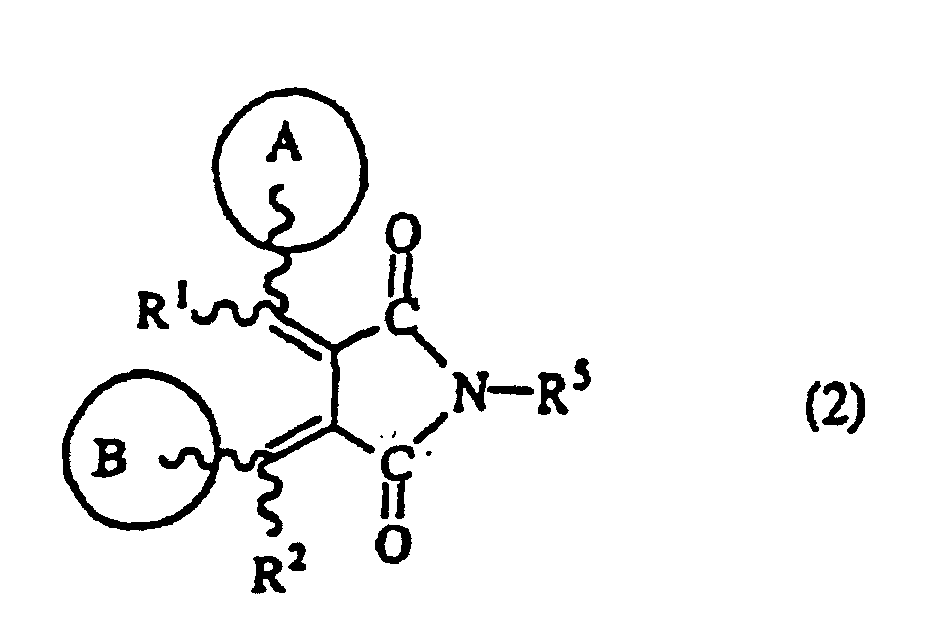
- Ring B is a pyridine ring which may optionally be substituted by an oxo group, or a benzene ring which may optionally be substituted by one to three groups selected from a C1-6 alkoxy group, a C1-4 alkylenedioxy group and a di-C1-6 alkylamino group,
- the configuration based on the double bond binding to Ring B is trans(E)-configuration, and the configuration based on the double bond binding to Ring A is cis (Z)-configuration,
- R1 is a C1-6 alkyl group,
- R2 is a hydrogen atom,
- R5 is a hydrogen atom, a pyridyl-substituted C1-6 alkyl group, a di-C1-6 alkylamino-C1-6 alkyl group, a hydroxy-C1-6 alkyl group, a di-C1-6 alkylamino group, or a C1-6 alkyl-substituted piperazinyl group, or a pharmaceutically acceptable salt thereof.
-
- Preferably in the pyrrolidine derivative of formula (2) Ring A is a benzene ring substituted by two or three groups selected from C1-20 alkoxy group, Ring B is a pyridine ring, a benzene ring, or a C1-4 alkylenedioxy-substituted benzene ring. More preferably, Ring A is a benzene ring substituted by two or three methoxy groups, R1 is a methyl group, R5 is a hydrogen atom, a pyridylmethyl group, a dimethylaminoethyl group, a hydroxyethyl group, a dimethylamino group, or a 4-methylpiperazinyl group.
- Among the substituents on the benzene ring for Ring A, the lower alkyl group is methyl, ethyl, propyl, butyl, etc., and the alkoxy group is a lower alkoxy group (e.g. methoxy, ethoxy, butoxy, etc.), a lower alkylenedioxy group (e.g. methylenedioxy, etc.), a cycloalkyloxy group (e.g. cyclopropyloxy, cyclopentyloxy, cyclohexyloxy, etc.), and methoxy and cyclopentyloxy are preferable. The halogen atom is fluorine, chlorine, bromine, iodine, etc., and chlorine is preferable.
- The C1-6 alkoxy group on the benzene ring for Ring B is methoxy, ethoxy, propyloxy, butoxy, etc., and methoxy is preferable. The C1-4 alkylenedioxy group on the benzene ring for Ring B is methylenedioxy, ethylenedioxy, etc., and the di-C1-6 alkylamino group is dimethylamino, diethylamino, etc.
- The C1-6 alkyl group for R1 and R2 is methyl, ethyl, propyl, isopropyl, butyl, etc., and methyl is preferable.
- The group: -COR32, and the group: -COR33 is an esterified carboxyl group, and said ester residue includes a C1-6 alkyl group (e.g. methyl, ethyl, isopropyl, propyl, butyl, etc.) or a C1-6 alkoxy-substituted C1-6 alkyl group (e.g. methoxymethyl, 2-methoxyethyl, etc.) and methyl, isopropyl and 2-methoxyethyl are preferable, especially methyl is most preferable.
- The more preferable compounds (1-a), (1-b) and (2) are compounds of the formulae (1-a), (1-b) and (2) wherein Ring A is a benzene ring substituted by two or three groups selected from a methoxy group, a cyclopentyloxy group, a nitro group, a hydroxy group, a dimethylamino group and a chlorine atom, and R1 is a methyl group.
- The most preferable compounds (1-b) are compounds of the formula (1-b) wherein a group: -COR33 is a methoxycarbonyl group, an isopropyloxycarbonyl group or a 2-methoxyethoxycarbonyl group, a group: -COR43 is an unsubstituted carbamoyl group or a carbamoyl group substituted by one group selected from a pyridylmethyl group, a 2-aminopyridyl group, a pyridyl group, a 1-oxopyridyl group, a 4-methylpiperazinyl group, a 4-methyl-4-oxopiperazinyl group, a 1-methylpiperidyl group, a 5-methylisoxazolyl group, a 3-pyrazolyl group, a 1,3,4-triazolyl group, a 1-oxopyridylmethyl group, a dimethylaminoethyl group, a hydroxyethyl group and a dimethylamino group. The most preferable compounds (2) are compounds of the formula (2) wherein R5 is a hydrogen atom, a pyridylmethyl group, a dimethylaminoethyl group, a hydroxyethyl group, a dimethylamino group, or a 4-methylpiperazinyl group.
- The desired compounds (1-a), (1-b) and (2) of the present invention have four stereoisomers based on two double bonds thereof, respectively, and also have optical isomers based on an asymmetric carbon atom thereof, but the present invention also includes these isomers and a mixture thereof as well.
- Among these four stereoisomers, preferable isomers are ones having a trans(E)-configuration based on the double bond binding to Ring B, and among these isomers, more preferable isomers are ones having a cis(Z)-configuration based on the double bond binding to Ring A.
- Among the desired compounds of the present invention, preferable compounds are the compounds (1-b) and (2), and among these compounds, more preferable compounds are the compounds (1-b).
- Preferable compounds (1-b) of the present invention are
- (1 1Z,3E)-1-methyl-1-(3,5-dimethoxyphenyl)-2-methoxycarbonyl-3-[N-(4-methylpiperazin-1-yl)aminocarbonyl]-4-phenylbutadiene;
- (1Z,3E)-1-methyl-1-(3,5-dimethoxyphenyl)-2-methoxycarbonyl-3-[N-(4-pyndyl)aminocarbonyl]-4-(3,4-methylenedioxyphenyl)butadiene;
- (1Z,3E)-1-methyl-1-(3,5-dimethoxyphenyl)-2-methoxycarbonyl-3-[N-(4-pyridylmethyl)aminocarbonyl]-4-phenylbutadiene;
- (1Z,3E)-1-methyl-1-(3-chloro-4,5-dimethoxyphenyl)-2-methoxycarbonyl-3-[N-(3-pyridylmethyl)aminocarbonyl]-4-phenylbutadiene, and
- (1Z,3E)-1-methyl-1-(3-chloro-4,5-dimethoxyphenyl)-2-methoxycarbonyl-3-aminocarbonyl-4-(4-pyridyl)butadiene, or a pharmaceutically acceptable salt thereof, etc.
-
- Preferable compounds (2) of the present invention are
- (3Z,4E)-3-(3,5-dimethoxy-a-methylbenzylidene)-4-benzylidene-1-(4-pyridylmethyl)pyrrolidine-2,5-dione;
- (3Z,4E)-3-(3-chloro-4,5-dimethoxy-α-methylbenzylidene)-4-(4-pyridylmethylidene)pyrrolidine-2,5-dione;
- (3Z,4E)-3-(3-methoxy-4-cyclopentyloxy-a-methylbenzylidene)-4-(4-pyridylmethylidene)pyrrolidine-2,5-dione;
- (3Z,4E)-3-(3-cyclopentyloxy-4-methoxy-α-methylbenzylidene)-4-(4-pyridylmethylidene)pyrrolidine-2,5-dione, and
- (3Z,4E)-3-(3,5-dimethoxy-a-methylbenzylidene)-4-(4-pyridylmethylidene)pyrrolidine-2,5-dione, or a pharmaceutically acceptable salt thereof, etc.
-
- The desired compounds (1-a), (1-b) and (2) of the present invention may be used in clinical use either in the free from or in the form of a pharmaceutically acceptable salt thereof. The pharmaceutically acceptable salt includes, for example, salts with an inorganic acid (e.g. hydrochloride, sulfate, hydrobromide, etc.), salts with an organic acid (e.g. acetate, fumarate, oxalate, methanesulfonate, etc.). When the desired compounds of the present invention have a substituent such as a carboxyl group, an imide group, etc., these compounds may be used in the form of a basic salt thereof such as an alkali metal salt (e.g. sodium salt, potassium salt, etc.) or an alkaline earth metal salt (e.g. calcium salt, etc.). The compounds of the present invention and a pharmaceutically acceptable salt thereof also include hydrates and solvates thereof.
- The desired compounds (1-a), (1-b) and (2) of the present invention and a pharmaceutically acceptable salt thereof may be administered either orally or parenterally, and administered in the form of a pharmaceutical preparation such as tablets, granules, capsules, powders, injections, inhalants, etc.
- The dosage of the desired compounds (1-a), (1-b) and (2) of the present invention and a pharmaceutically acceptable salt thereof may vary depending on the administration route, the ages, weights and conditions of the patients, or severity of diseases to be cured, but it is usually in the range of about 0.1 to 100 mg/kg/day in the case of oral administration. In the case of parenteral administration, it is in the range of about 0.01 to 10 mg/kg/day.
- The desired compound (1-a) of the present invention may be prepared by treating a diester compound of the formula (4):wherein Ring A, Ring B, the configuration based on the double bond binding to Ring B, the configuration based on the double bond binding to Ring A, R1 and R2 are the same as defined above, and a group: -COR31 and a group: -COR41 are the same or different and each are an esterified carboxyl group, with an acid or a base, if necessary, followed by converting the product into a pharmaceutically acceptable salt thereof.

- The desired compound (1-b) of the present invention may be prepared by reacting a compound (1-a) wherein Ring A, Ring B, the configuration based on the double bond binding to Ring B, the configuration based on the double bond binding to Ring A, R1 and R2 are the same as defined above, the group: -COR32 is a carboxyl group which is esterified, and the group: - COR42 is a carboxyl group, or a salt thereof, with a compound of the formula (5):
- The desired compound (2) of the present invention may be prepared by subjecting a compound of the formula (1-c):wherein Ring A, Ring B, the configuration based on the double bond binding to Ring B, the configuration based on the double bond binding to Ring A, R1 and R2 are the same as defined above, the group: -COR34 is a carboxyl group which may optionally be esterified, wherein the ester residue includes a C1-6 alkyl group or a C1-6 alkoxy-substituted C1-6 alkyl group, and the group: -COR44 is a carbamoyl group which may optionally be substituted by a group selected from a pyridyl-substituted C1-6 alkyl group, a di-C1-6 alkylamino-C1-6 alkyl group, a hydroxy-C1-6 alkyl group, a di-C1-6 alkylamino group, or a C1-6 alkyl-substituted piperazinyl group, or a salt thereof, to intramolecular cyclization reaction, if necessary, followed by converting the product into a pharmaceutically acceptable salt thereof.

- The desired compound (2) wherein R5 is a substituted or unsubstituted alkyl group, a substituted or unsubstituted amino group, or a substituted or unsubstituted nitrogen-containing heterocyclic group may be prepared by reacting a compound of the formula (2-a):wherein Ring A, Ring B, the configuration based on the double bond binding to Ring B, the configuration based on the double bond binding to Ring A, R1 and R2 are the same as defined above, or a salt thereof, with a compound of the formula (3):

- The treatment of the diester compound (4) with an acid or a base is carried out in a suitable solvent or without a solvent.
- The solvent may be any inert solvent which does not disturb the reaction, for example, organic solvents such as ethylene glycol, N,N-dimethylformamide, hexamethylphosphoramide, benzene, tetrahydrofuran, dioxane, toluene, ethyl acetate, a lower alcohol (methanol, ethanol, etc.), dichloromethane, 1,2-dichloroethane, chloroform, carbon tetrachloride, 1,3-dimethyl-2-imidazolidinone, diethyl ether, dimethoxyethane, dimethyl sulfoxide, carbon disulfide, acetone, etc., or a mixture of these solvents and water.
- The base includes, for example, an alkali metal, an alkali metal hydroxide, an alkali metal hydride, an alkali metal alkoxide, an alkali metal alkyl amide (e.g. lithium diisopropyl amide (LDA). etc.), a lower alkyl alkali metal (e.g. n-butyl lithium, etc.), or an organic amine such as a tri-lower alkylamine, 1,8-diazabicyclo[5.4.0]undeca-7-ene, etc. The acid includes either a conventional protonic acid or a conventional Lewis acid.
- The reaction is preferably carried out under cooling or with heating, for example, at a temperature between -60°C and 150°C, preferably at a temperature between 15°C and a boiling point of the solvent to be used.
- The condensation reaction between the compound (1-a) or a salt thereof and the compound (5) is carried out in the presence of a dehydrating agent in a suitable solvent.
- The dehydrating agent includes, for example, 1,3-dicyclohexylcarbodiimide (DCC), carbonyl diimidazole (CDI), etc.
- The salt of the compound (1-a) may be a conventional salt such as a salt with an alkali metal or alkaline earth metal, etc. These salts may preferably be converted in advance into a free compound and then used in the reaction with the compound (5).
- The condensation reaction between a reactive derivative of the compound (1-a) and the compound (5) is carried out in the presence of an acid acceptor in a suitable solvent.
- The reactive derivative may be any conventional ones which are suitable for the acid-amide bond producing reaction, for example, acid halides, mixed acid anhydrides, active esters, etc.
- The acid acceptor includes, for example, alkali metal hydroxides, alkali metal carbonates, alkali metal hydrogen carbonates, trialkylamines, N,N-dialkylanilines, pyridine, etc.
- The solvent includes, for example, dichloromethane, chloroform, 1,2-dichloroethane, diethyl ether, tetrahydrofuran, dioxane, N,N-dimethylformaimde, dimethyl sulfoxide, toluene, benzene, etc.
- The compound (5) is used in an amount of 1 to 3 moles, preferably in an amount of 1.1 to 1.3 mole, to 1 mole of the compound (1-a), a salt thereof, or a reactive derivative thereof.
- The intramolecular cyclization reaction of the compound (1-c) is preferably carried out in the presence of a base or an acid in a suitable solvent or without a solvent.
- The solvent may be any inert solvent which does not disturb the reaction, for example, organic solvents such as ethylene glycol, N,N-dimethylformamide, hexamethylphosphoramide, benzene, tetrahydrofuran, dioxane, toluene, ethyl acetate, a lower alcohol (e.g. methanol, ethanol, etc.), dichloromethane, 1,2-dichloroethane, chloroform, carbon tetrachloride, 1,3-dimethyl-2-imidazolidinone, diethyl ether, dimethoxyethane, dimethyl sulfoxide, carbon disulfide, acetone, etc., or a mixture of these organic solvents and water.
- The base includes, for example, an alkali metal, an alkali metal hydroxide, an alkali metal hydride, an alkali metal alkoxide, an alkali metal alkyl amide (e.g. lithium diisopropyl amide (LDA). etc.), a lower alkyl alkali metal (e.g. n-butyl lithium, etc.), or an organic amine such as a tri-lower alkylamine, 1,8-diazabicyclo[5.4.0]undeca-7-ene, etc. The acid includes a conventional protonic acid or a conventional Lewis acid.
- The reaction is carried out under cooling or with heating, for example, at a temperature between -60°C and 150°C, preferably at a temperature between 15°C and a boiling point of the solvent to be used.
- The condensation reaction between the compound (2-a) or a salt thereof and the compound (3) is carried out in the presence of an acid acceptor in a suitable solvent.
- The salt of the compound (2-a) is, for example, an alkali metal salt, etc.
- The acid acceptor may be any conventional ones, and includes, for example, alkali metal hydrides (e.g. sodium hydride), alkali metal hydroxides (e.g. sodium hydroxide), alkali metal carbonates (e.g. potassium carbonate), alkali metal alkoxides (e.g. sodium methoxide), alkali metal alkyl amides (e.g. lithium diisopropylamide), or alkali metals (e.g. sodium).
- The reactive residue X includes, for example, a halogen atom (e.g. chlorine, bromine, iodine, etc.), a sulfonyloxy group (e.g. trifluoromethanesulfonyloxy, toluenesulfonyloxy, methanesulfonyloxy, etc.), etc.
- The solvent includes, for example, dichloromethane, chloroform, 1,2-dichloroethane, diethyl ether, tetrahydrofuran, dioxane, ethylene glycol, N,N-dimethylformamide, dimethyl sulfoxide, toluene, benzene, etc.
- The condensation reaction is carried out under cooling or with heating, for example, a temperature between -60°C and 100°C, preferably at a temperature between -60°C and 20°C.
- The compound (3) is used in this reaction in an amount of 1 to 5 moles, to 1 mole of the compound (2-a) or a salt thereof.
- The starting compound (4) may be prepared by reacting a compound of the formula (6):wherein Ring A, R1, -COR31 and-COR41 are the same as defined above, with a compound of the formula (7):
 wherein Ring B and R2 are the same as defined above.
- The starting compound (4) may also be prepared by reacting a compound of the formula (8):wherein Ring A and R1 are the same as defined above, with a compound of the formula (9):
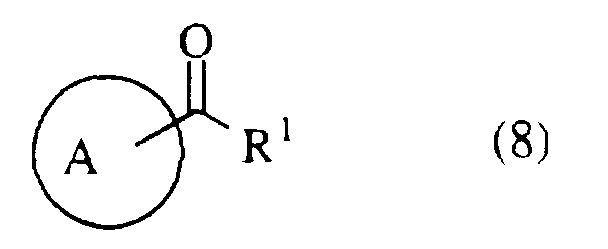 wherein Ring B, R2, -COR31 and-COR41 are the same as defined above.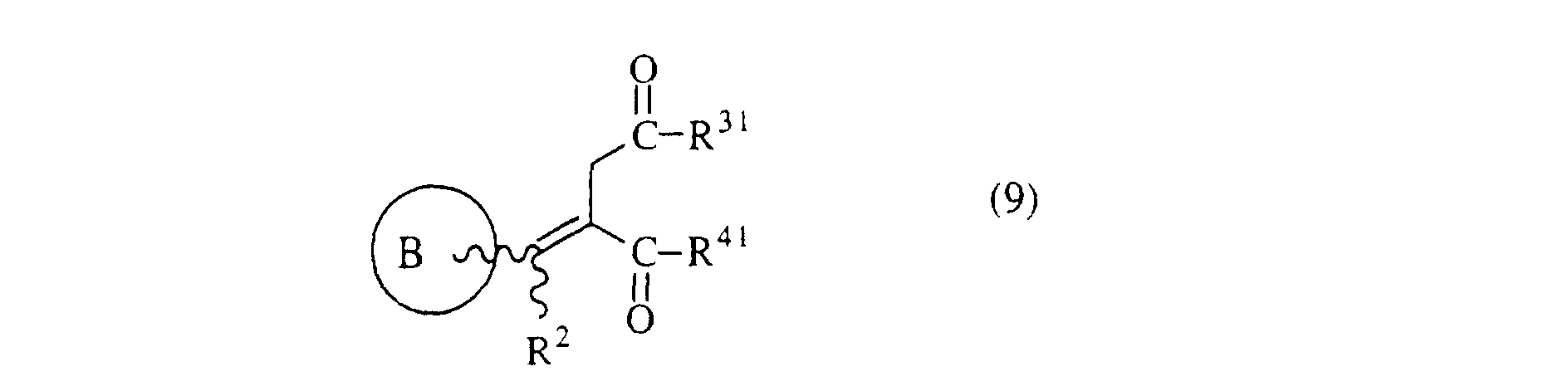
- The condensation reaction between the compound (6) and the compound (7), or the compound (8) and the compound (9) is carried out in the presence of a base in a suitable solvent. The base includes an alkali metal alkoxide or an alkali metal alkyl amide such as potassium tert-butoxide, sodium methoxide, lithium diisopropylamide (LDA), etc. The solvent includes, for example, a lower alcohol (e.g. methanol, ethanol, tert-butyl alcohol, etc.), dichloromethane, chloroform, 1,2-dichloroethane, diethyl ether, tetrahydrofuran, dioxane, ethylene glycol, N,N-dimethylformamide, dimethyl sulfoxide, toluene, benzene, etc.
- The reaction is carried out under cooling or with heating, for example, at a temperature between -30°C and a boiling point of the solvent to be used, more preferably at a temperature between 15°C and 80°C.
- Among the starting compounds (6), a trans(E)-isomer thereof may be prepared, for example, by condensing the compound (8) with a compound of the formula (10):wherein -COR31 and -COR41 are the same as defined above, in the presence of a base in a suitable solvent.

- Among the starting compounds (6), a cis(Z)-isomer thereof may be prepared by addition and elimination reaction of the corresponding trans(E)-isomer, for example, by adding a nucleophilic reagent (e.g. thiophenol) to the trans(E)-isomer of the compound (6), followed by elimination of the nucleophile from the resulting adduct in the presence of a base.
- Throughout the present specification and claims, the alkyl group and the alkoxy group mean ones having 1 to 20 carbon atoms, preferably ones having 1 to 10 carbon atoms, more preferably ones having 1 to 6 carbon atoms, respectively. The lower alkyl group and the lower alkoxy group mean ones having 1 to 6 carbon atoms, preferably ones having 1 to 4 carbon atoms, respectively. The cycloalkyl group means ones having 3 to 10 carbon atoms, preferably ones having 5 to 8 carbon atoms. The lower alkylenedioxy group means ones having 1 to 4 carbon atoms.
- The present invention is illustrated in more detail by the following Examples, but should not be construed to be limited thereto.
-
- (1) To a solution of vanillin (50 g) in N,N-dimethylformamide (600 ml)
are added 62.5 % sodium hydride (13.9 g) and cyclopentyl bromide (38.8 ml)
under ice-cooling, and the mixture is stirred at 90°C overnight. The mixture is
concentrated under reduced pressure to remove the N,N-dimethylformamide,
and to the residue is added water. The mixture is extracted with ethyl acetate,
and the extract is washed, dried, and concentrated under reduced pressure to
remove the solvent. The resulting residue is purified by silica gel column
chromatography (eluent; hexane:ethyl acetate = 3:1) to give 4-cyclopentyloxy-3-methoxybenzaldehyde
(65 g).
Yield: 90%
IR: 2960, 1683, 1583, 1506, 1266, 1135, 730 cm-1 - (2) A solution of the above product (10 g) and dimethyl succinate
(8.0 g) in tert-butyl alcohol (20 ml) is added to a solution of potassium tert-butoxide
(5.1 g) in tert-butyl alcohol (50 ml), and the mixture is stirred at room
temperature for one hour. The reaction mixture is poured into ice-water, and the
mixture is washed with diisopropyl ether. The pH value of the mixture is
adjusted to pH 1 with hydrochloric acid, and the mixture is extracted with ethyl
acetate. The extract is washed, dried, and concentrated under reduced pressure.
The resulting residue is dissolved in dichloromethane (100 ml), and thereto are
added diisopropyl ethylamine (11.8 ml) and methoxymethyl chloride (3.9 ml)
under ice-cooling, and the mixture is stirred at room temperature for one hour.
To the mixture is added water, and the mixture is extracted with ethyl acetate.
The extract is washed, dried, and concentrated under reduced pressure. The
resulting residue is purified by silica gel column chromatography (eluent;
hexane:ethyl acetate = 3:1) to give methyl (E)-3-(4-cyclopentyloxy-3-methoxyphenyl)-2-(methoxymethoxycarbonylmethyl)acrylate
(10.9 g).
Yield: 63 %
IR: 2957, 1741, 1710, 1599, 1513, 1256, 1145 cm-1 - (3) To a solution of thiophenol (5.9 ml) in tetrahydrofuran (50 ml) is
added a 15 % solution of n-butyl lithium in hexane (2.2 ml) at 0°C under
nitrogen atmosphere, and the mixture is stirred at room temperature for 30
minutes. To the mixture is added a solution of the compound obtained in the
above (2) (13.4 g) in tetrahydrofuran (100 ml), and the mixture is stirred at room
temperature overnight. The mixture is extracted with ethyl acetate, and the
extract is washed, dried and concentrated under reduced pressure to remove the
solvent. The residue is purified by silica gel column chromatography (eluent;
hexane:ethyl acetate = 3:1) to give methyl (2R*,3S*)-3-(4-cyclopentyloxy-3-methoxyphenyl)-2-methoxymethoxycarbonylmethyl-3-phenylthiopropionate
(14.5 g).
Yield: 84 %
IR: 2957, 1736, 1585, 1512, 1265, 1143 cm-1 - (4) To a solution of the above product (14.5 g) in chloroform (300 ml)
is added in portions 3-chloroperbenzoic acid (5.1 g) at 0°C. The mixture is
stirred at the same temperature for 30 minutes. To the mixture is added calcium
hydroxide (10 g), and the mixture is stirred, filtered, and the filtrate is
concentrated under reduced pressure. To the residue is added toluene (300 ml),
and the mixture is refluxed for 30 minutes. The mixture is concentrated under
reduced pressure, and the resulting residue is purified by silica gel column
chromatography (eluent; hexane:ethyl acetate = 3:1) to give methyl (Z)-3-(4-cyclopentyloxy-3-methoxyphenyl)-2-(methoxymethoxycarbonylmethyl)-acrylate
(9.0 g).
Yield: 67 %
IR: 2956, 1744, 1718, 1600, 1511, 1144 cm-1 - (5) A solution of the above product (10.3 g) in tetrahydrofuran (100
ml) is added dropwise to a solution of lithium diisopropylamide which is
prepared from diisopropylamine (4.6 ml) and n-butyl lithium (20 ml) in tetrahydrofuran
(60 ml) at -78°C under nitrogen atmosphere, and the mixture is
stirred at the same temperature for 30 minutes. To the mixture is added
dropwise a solution of benzaldehyde (3.5 g) in tetrahydrofuran (30 ml) at
-100°C, and the mixture is stirred at the same temperature for 20 minutes. To
the mixture is added aqueous ammonium chloride solution, and the mixture is
extracted with ethyl acetate. The extract is washed, dried, and concentrated
under reduced pressure. The residue is dissolved in dichloromethane (50 ml),
and thereto are added triethylamine (11 ml) and methanesulfonyl chloride (2.5
ml) at 0°C, and the mixture is stirred at room temperature for one hour. Water is
added to the mixture, and the mixture is extracted with ethyl acetate. The
extract is washed, dried, and concentrated under reduced pressure. The residue
is purified by silica gel column chromatography (eluent; hexane:ethyl acetate =
3:1) to give (1Z,3E)-1-(4-cyclopentyloxy-3-methoxyphenyl)-2-methoxycarbonyl-3-methoxymethoxycarbonyl-4-phenylbutadiene
(7.3 g).
Yield: 58 %
IR: 2957, 1717, 1597, 1509, 1264, 1160, 696 cm-1 - (6) To a solution of the above product (7.3 g) in tetrahydrofuran (50
ml) is added conc. hydrochloric acid (5 ml), and the mixture is stirred at room
temperature for one hour. To the mixture is added saturated aqueous sodium
chloride solution, and the mixture is extracted with ethyl acetate. The extract is
dried, concentrated under reduced pressure. The residue is purified by silica gel
column chromatography (eluent; chloroform:methanol = 20:1) to give (1Z,3E)-1-(4-cyclopentyloxy-3-methoxyphenyl)-2-methoxycarbonyl-3-carboxy-4-phenylbutadiene
(6.1 g).
Yield: 92 %
IR: 3500-3000 (br.), 2958, 1712, 1690, 1600, 1509, 1270, 694 cm-1 - (7) To a solution of the above product (0.75 g) in tetrahydrofuran (20
ml) is added carbonyldiimidazole (0.35 g), and the mixture is stirred at room
temperature for 30 minutes. To the solution is added a 28 % aqueous ammonia
(0.7 ml), and the mixture is stirred at room temperature for 30 minutes. To the
mixture is added water, and the mixture is extracted with chloroform. The
extract is dried, and concentrated under reduced pressure. The residue is
purified by silica gel column chromatography (eluent; chloroform:acetone = 5:1)
to give (1Z,3E)-1-(4-cyclopentyloxy-3-methoxyphenyl)-2-methoxycarbonyl-3-aminocarbonyl-4-phenylbutadiene
(0.48 g). The structure and the physical
properties thereof are shown in Table 1.
Yield: 64 %
M.p. 158-159°C -
-
- (1) To a solution of the compound obtained in Example 1-(6) (0.3 g)
in dichloromethane (10 ml) are added triethylamine (0.15 ml) and isobutyl
chloroformate (0.14 ml) at 0°C, and the mixture is stirred for 30 minutes. To the
solution is added 4-picolylamine (0.11 ml), and the mixture is stirred for 30
minutes. Water is added to the mixture, and the mixture is extracted with
chloroform. The extract is dried, concentrated under reduced pressure, and the
residue is purified by silica gel column chromatography (eluent; chloroform:
methanol = 50:1) to give (1Z,3E)-1-(3-methoxy-4-cyclopentyloxyphenyl)-2-methoxycarbonyl-3-(4-pyridylmethylaminocarbonyl)-4-phenylbutadiene
(0.29
g).
Yield: 80% - (2) To the above product (0.29 g) is added a 4N solution of hydrogen
chloride in ethyl acetate, and the mixture is triturated with ether to give (1Z,3E)-1-(3-methoxy-4-cyclopentyloxyphenyl)-2-methoxycarbonyl-3-(4-pyridylmethylaminocarbonyl)-4-phenylbutadiene
hydrochloride (0.29 g). The
structure and the physical properties thereof are shown in Table 1.
Yield: 93 %
M.p. 105-130°C -
- The corresponding starting compounds are treated in the same manner as in Example 2 to give the compounds as listed in Table 1.
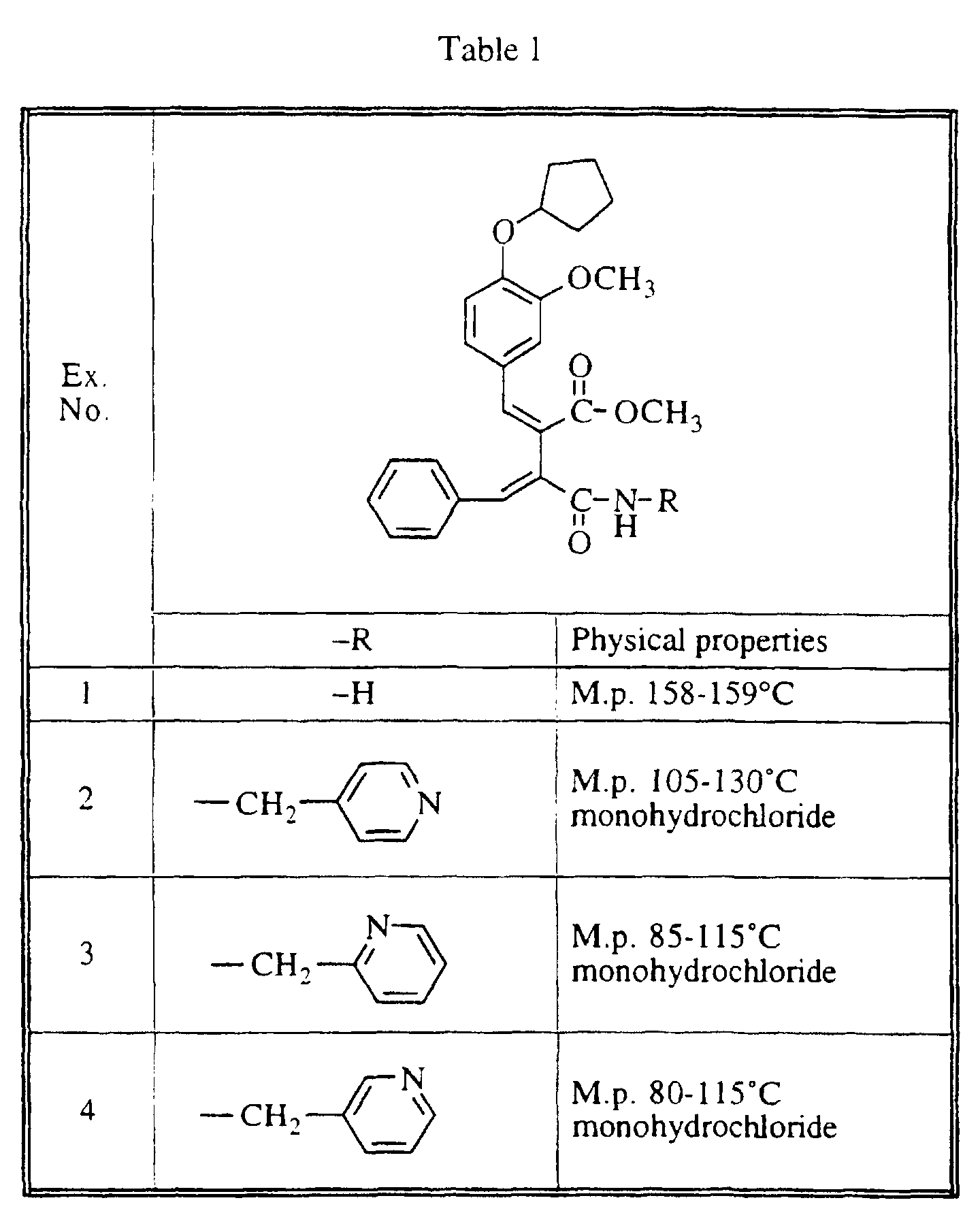
- To a solution of the compound obtained in Example 1-(7) (0.28 g) in tetrahydrofuran (10 ml) is added a 2N aqueous sodium hydroxide solution (1 ml), and the mixture is stirred at room temperature for 10 minutes. The mixture is neutralized with 2N hydrochloric acid, and extracted with chloroform. The extract is dried, concentrated under reduced pressure, and the residue is purified by silica gel column chromatography (eluent; hexane:ethyl acetate = 2:1) to give (3Z,4E)-4-benzylidene-3-(4-cyclopentyloxy-3-methoxybenzylidene)-pyrrolidine-2,5-dione (0.24 g). The structure and the physical properties thereof are shown in Table 2.
Yield: 93 %
M.p. 203-204°C -
- (1) To a solution of the compound obtained in Example 2-(2) (0.25 g)
in tetrahydrofuran (10 ml) is added a 2N aqueous sodium hydroxide solution
(1.1 ml), and the mixture is stirred at room temperature. To the mixture is added
water, and the mixture is extracted with chloroform. The extract is dried, and
concentrated under reduced pressure to remove the solvent. The residue is
purified by silica gel column chromatography (eluent; ethyl acetate:hexane =
1:1) to give (3Z,4E)-3-(4-cyclopentyloxy-3-methoxybenzylidene)-4-benzylidene-1-(4-pyridylmethyl)pyrrolidine-2,5-dione
(0.12 g).
Yield: 55 % - (2) To the above product (0.12 g) is added a 4N solution of hydrogen
chloride in dioxane, and the mixture is triturated with ether to give (3Z,4E)-3-(4-cyclopentyloxy-3-methoxybenzylidene)-4-benzylidene-1-(4-pyridylmethyl)-pyrrolidine-2,5-dione
hydrochloride (90 mg). The structure and the physical
properties thereof are shown in Table 2.
Yield: 76 %
M.p. 117-130°C (decomposed) -
- The corresponding starting compounds are treated in the same manner as in Example 6 to give the compound as listed in Table 2.
-
- (1) To a solution of the compound obtained in Example 1-(6) (0.3 g)
in dichloromethane (10 ml) are added triethylamine (0.15 ml) and isobutyl chloroformate
(0.14 ml) at 0°C, and the mixture is stirred for 30 minutes. To the
mixture is added N,N-dimethylethylenediamine (0.12 ml), and the mixture is
stirred for 30 minutes. To the mixture is added water, and the mixture is
extracted with chloroform. The extract is dried and concentrated under reduced
pressure. To the residue are added tetrahydrofuran (5 ml) and a 2N aqueous
sodium hydroxide solution (0.7 ml), and the mixture is stirred at room
temperature for 10 minutes. To the mixture is added water, and the mixture is
extracted with chloroform. The extract is dried, and concentrated under
reduced pressure. The residue is purified by silica gel column chromatography
(eluent; chloroform:methanol = 20:1) to give (3Z,4E)-3-(4-cyclopentyloxy-3-methoxybenzylidene)-4-benzylidene-1-(2-(N,N-dimethylamino)ethyl)-pyrrolidine-2,5-dione
(0.25 g).
Yield: 76 % - (2) To the above product (0.25 g) is added a 4N solution of hydrogen
chloride in ethyl acetate, and the mixture is triturated with ether to give (3Z,4E)-3-(4-cyclopentyloxy-3-methoxybenzylidene)-4-benzylidene-1-(2-(N,N-dimethylamino)ethyl)pyrrolidine-2,5-dione
hydrochloride (0.17 g). The structure and the
physical properties thereof are shown in Table 2.
Yield: 88 %
M.p. 95-110°C (decomposed) -
- The corresponding starting compounds are treated in the same manner as in Example 9 to give the compound as listed in Table 2.
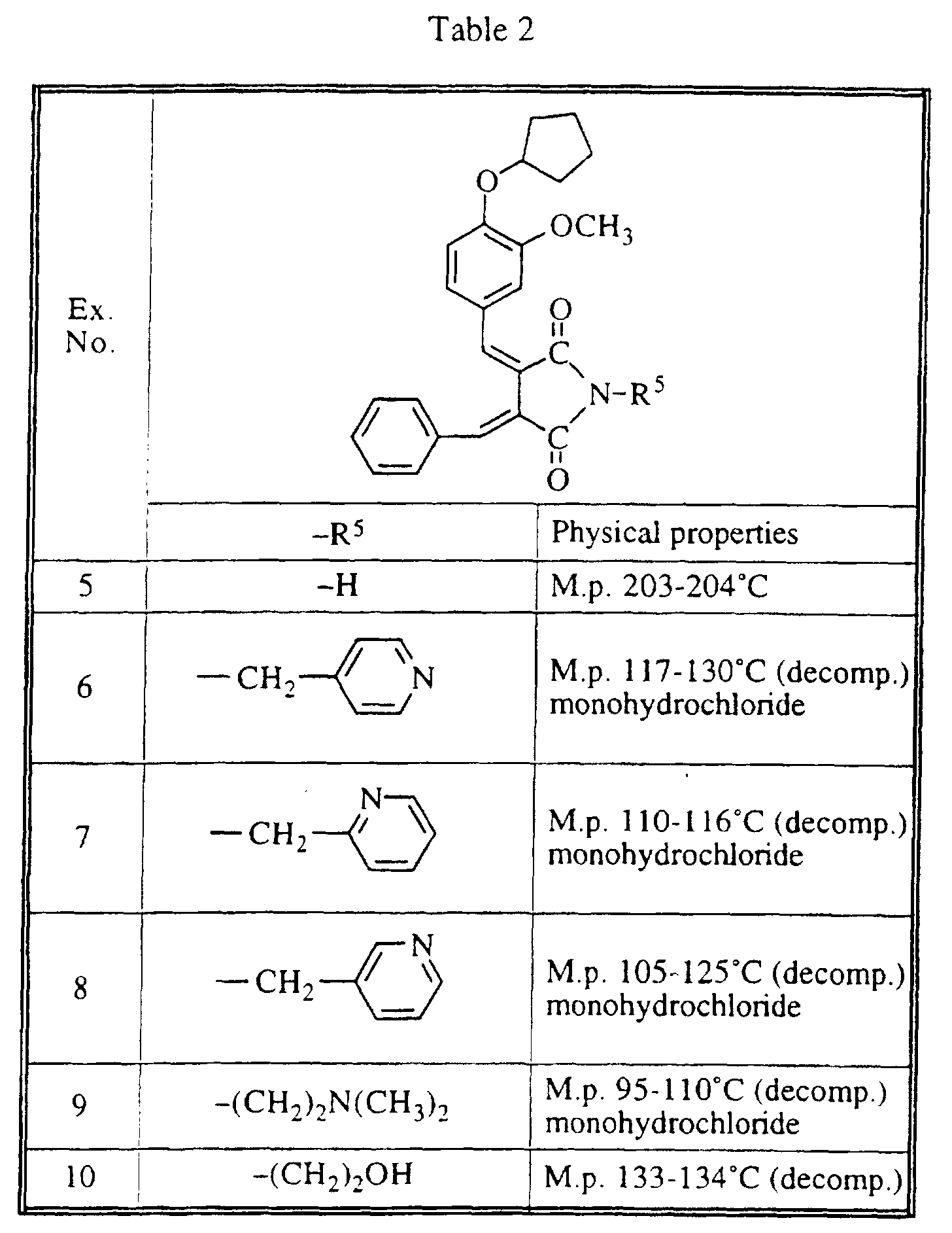
-
- (1) To a solution of methyl magnesium iodide, which is prepared from
magnesium (2.9 g) and methyl iodide (7.5 ml), in diethyl ether (150 ml) is added
dropwise a solution of 4-cyclopentyloxy-3-methoxybenzaldehyde (17.6 g) in
tetrahydrofuran (40 ml) at 0°C, and the mixture is stirred at room temperature for
one hour. To the reaction mixture is added a saturated aqueous ammonium
chloride solution (20 ml) at 0°C, and the mixture is extracted with ethyl acetate.
The extract is concentrated under reduced pressure, and the residue is dissolved
in acetonitrile (300 ml), and thereto is added manganese dioxide (55 g) at 0°C.
The mixture is warmed to room temperature, and the mixture is stirred for three
days. To the reaction mixture is added cerite (20 g), and the mixture is stirred for
30 minutes. The insoluble materials are removed by filtration, and the filtrate is
concentrated under reduced pressure. The residue is crystallized from chilled
hexane to give 4-acetyl-1-cyclopentyloxy-2-methoxybenzene (13.8 g).
Yield: 73.6 %
M.p. 55-56°C - (2) A solution of the above product (9.7 g) and dimethyl (E)-benzylidenesuccinate
(10 g) in tetrahydrofuran (100 ml) is added dropwise into
a solution of potassium tert-butoxide (4.8 g) in tert-butyl alcohol (100 ml) at
room temperature, and the mixture is stirred at the same temperature for one
hour. To the reaction mixture is added diisopropyl ether (200 ml), and the
mixture is extracted with water. The pH value of the aqueous layer is adjusted
to pH 1-2 with conc. hydrochloric acid, and the mixture is extracted again with
ethyl acetate. The extract is concentrated under reduced pressure, and the 2/5
part of the residue is collected, and dissolved in chloroform (100 ml). To the
mixture are added a few drops of N,N-dimethylformamide and thionyl chloride
(1.8 ml) at room temperature, and the mixture is refluxed for 30 minutes. The
reaction mixture is cooled with ice, and added dropwise into a solution of
aqueous ammonia (20 ml) in chloroform (50 ml), and the mixture is stirred for 30
minutes. Water (50 ml) is added to the reaction mixture, and then the mixture is
extracted with chloroform. The extract is concentrated under reduced pressure
to remove the solvent, and the residue is purified by silica gel column
chromatography (eluent; chloroform:acetone = 20:1), and crystallized from
hexane-ethyl acetate to give (1Z,3E)-1-methyl-1-(4-cyclopentyloxy-3-methoxyphenyl)-2-methoxycarbonyl-3-aminocarbonyl-4-phenylbutadiene
(0.42 g). The structure and the physical properties thereof are shown in Table 3.
M.p. 133-134°C -
- The corresponding starting compounds are treated in the same manner as in Example 11 to give the compounds as listed in Tables 3-5.


-
- (1) To a solution of potassium tert-butoxide (2.4 g) in tert-butyl
alcohol (25 ml) is added dropwise a solution of 3,4,5-trimethoxyacetophenone
(5.0 g) and dimethyl (E)-benzylidene succinate (4.5 g) in tetrahydrofuran (20
ml) at 20-25°C, and the mixture is stirred at room temperature for one hour. The
reaction mixture is poured into water, and the mixture is washed with
diisopropyl ether. The pH value of the aqueous layer is adjusted to pH 1 with
hydrochloric acid, and extracted with ethyl acetate. The extract is dried, and
concentrated under reduced pressure, and the residue is purified by silica gel
column chromatography (eluent; chloroform:methanol = 50:1 → 20:1) to give 1-methyl-1-(3,4,5-trimethoxyphenyl)-2-methoxycarbonyl-3-carboxy-4-phenylbutadiene
(6.5 g) as a mixture of (1E,3E)-isomer and (1Z,3E)-isomer.
Yield: 66.3 %
IR: 3420, 2950, 1720, 1715, 1690, 1585, 1240, 1125, 695 cm-1 - (2) To a solution of the above product (6.5 g) in chloroform (30 ml)
are added a few drops of N,N-dimethylformamide and thionyl chloride (1.15 ml),
and the mixture is refluxed for 30 minutes. The solution is added dropwise into
conc. aqueous ammonia (20 ml) at 0°C, and the mixture is stirred at room
temperature for 30 minutes. The mixture is extracted with chloroform, and the
extract is dried, concentrated under reduced pressure, and the residue is purified
by silica gel column chromatography (eluent; hexane:ethyl acetate = 1:1 → 1:2).
The eluent is concentrated and crystallized from ether, and the precipitated
crystals are collected by filtration, and further recrystallized from hexane-ethyl
acetate to give (1E,3E)-1-methyl-1-(3,4,5-trimethoxyphenyl)-2-methoxycarbonyl-3-aminocarbonyl-4-phenylbutadiene
(2.6 g). The structure and the
physical properties thereof are shown in Table 6.
Yield: 40.1 %
M.p. 155-157°C - (3) The filtrate obtained in the above (2) is concentrated under
reduced pressure, and the residue is crystallized from diisopropyl ether, and then
recrystallized from hexane-ethyl acetate to give (1Z,3E)-1-methyl-1-(3,4,5-trimethoxyphenyl)-2-methoxycarbonyl-3-aminocarbonyl-4-phenylbutadiene
(2.1 g). The structure and the physical properties are shown in Table 5.
Yield: 32.4 %
M.p. 118-120°C -
-
- (1) To a solution of potassium tert-butoxide (14.5 g) in tert-butyl
alcohol (100 ml) is added a mixture of acetophenone (15.5 g) and dimethyl
succinate (27.1 g), and the mixture is stirred at room temperature overnight. The
reaction mixture is poured into ice-water, and the mixture is washed with diisopropyl
ether. The pH value of the aqueous layer is adjusted to pH 2-3 with
conc. hydrochloric acid, and then extracted with ethyl acetate. The extract is
dried, and concentrated under reduced pressure. The residue is dissolved in
methanol (150 ml), and thereto is added dropwise thionyl chloride (12.5 ml)
under ice-cooling. The mixture is stirred at room temperature overnight, and
concentrated under reduced pressure to remove the solvent. The residue is
washed with ethyl acetate, dried, and concentrated under reduced pressure to
remove the solvent. The resulting residue is purified by silica gel column
chromatography (eluent; hexane:ethyl acetate = 4:1) to give (E)-2-benzylidene-α-methylsuccinic
acid dimethyl ester (18.6 g) and (Z)-2-benzylidene-α-methylsuccinic
acid dimethyl ester (6.2 g).
- (E)-2-Benzylidene-a-methylsuccinic acid dimethyl ester:
- Yield: 58 %
- Oily product
- IR: 2970, 2940, 2860, 1745, 1440, 1270, 1200, 1180, 1135, 1060, 770. 705 cm-1
- (Z)-2-Benzylidene-α-methylsuccinic acid dimethyl ester:
- Yield: 19 %
- Oily product
- IR: 2960, 2920, 2850, 1740, 1710, 1440, 1320, 1250, 1195, 1170, 1140, 765, 700 cm-1
- (2) A solution of (E)-2-benzylidene-α-methylsuccinic acid dimethyl
ester (5.0 g) and 3,4,5-tnmethoxybenzaldehyde (4.0 g) in tetrahydrofuran (20
ml) is added dropwise into a solution of potassium tert-butoxide (2.3 g) in tert-butyl
alcohol (20 ml), and the mixture is stirred at room temperature for one
hour. The reaction mixture is poured into ice-water, and the mixture is washed.
The pH value of the aqueous layer is adjusted to pH 2-3 with conc.
hydrochloric acid, and the mixture is extracted with ethyl acetate. The extract is
dried, concentrated under reduced pressure, and the resulting residue is
dissolved in chloroform (30 ml). To the mixture are added thionyl chloride (1.5
ml) and three drops of N,N-dimethylformamide, and the mixture is refluxed for
30 minutes. The mixture is added dropwise into a 28 % aqueous ammonia (20
ml) under ice-cooling, and the mixture is stirred at room temperature for 10
minutes. Water is added to the mixture, and extracted with chloroform. The
extract is dried and concentrated under reduced pressure to remove the solvent.
The residue is purified by silica gel column chromatography (eluent; hexane:
ethyl acetate = 1:1) to give (1E,3E)-1-(3,4,5-trimethoxyphenyl)-2-methoxycarbonyl-3-aminocarbonyl-4-methyl-4-phenylbutadiene
(4.7 g). The structure
and the physical properties thereof are shown in Table 6.
Yield: 57 %
M.p. 156-157°C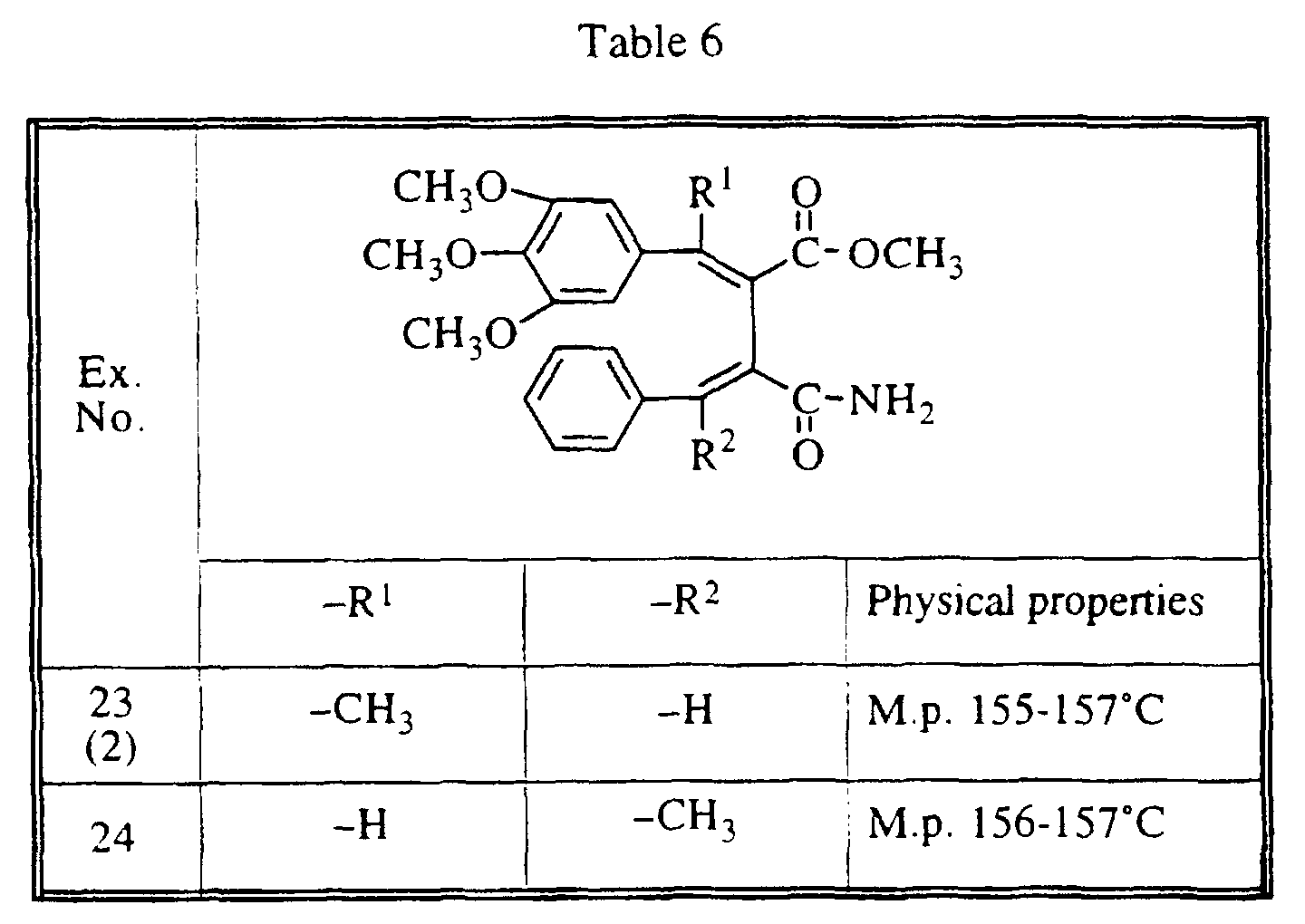
-
- (Z)-2-Benzylidene-α-methylsuccinic acid dimethyl ester (5.3 g) obtained in Example 24-(1) is treated in the same manner as in Example 24-(2) to give (1E,3Z)-1-(3,4,5-trimethoxyphenyl)-2-methoxycarbonyl-3-aminocarbonyl-4-methyl-4-phenylbutadiene (6.7 g). The structure and the physical properties thereof are shown in Table 7.
Yield: 76 %
M.p. 141-143°C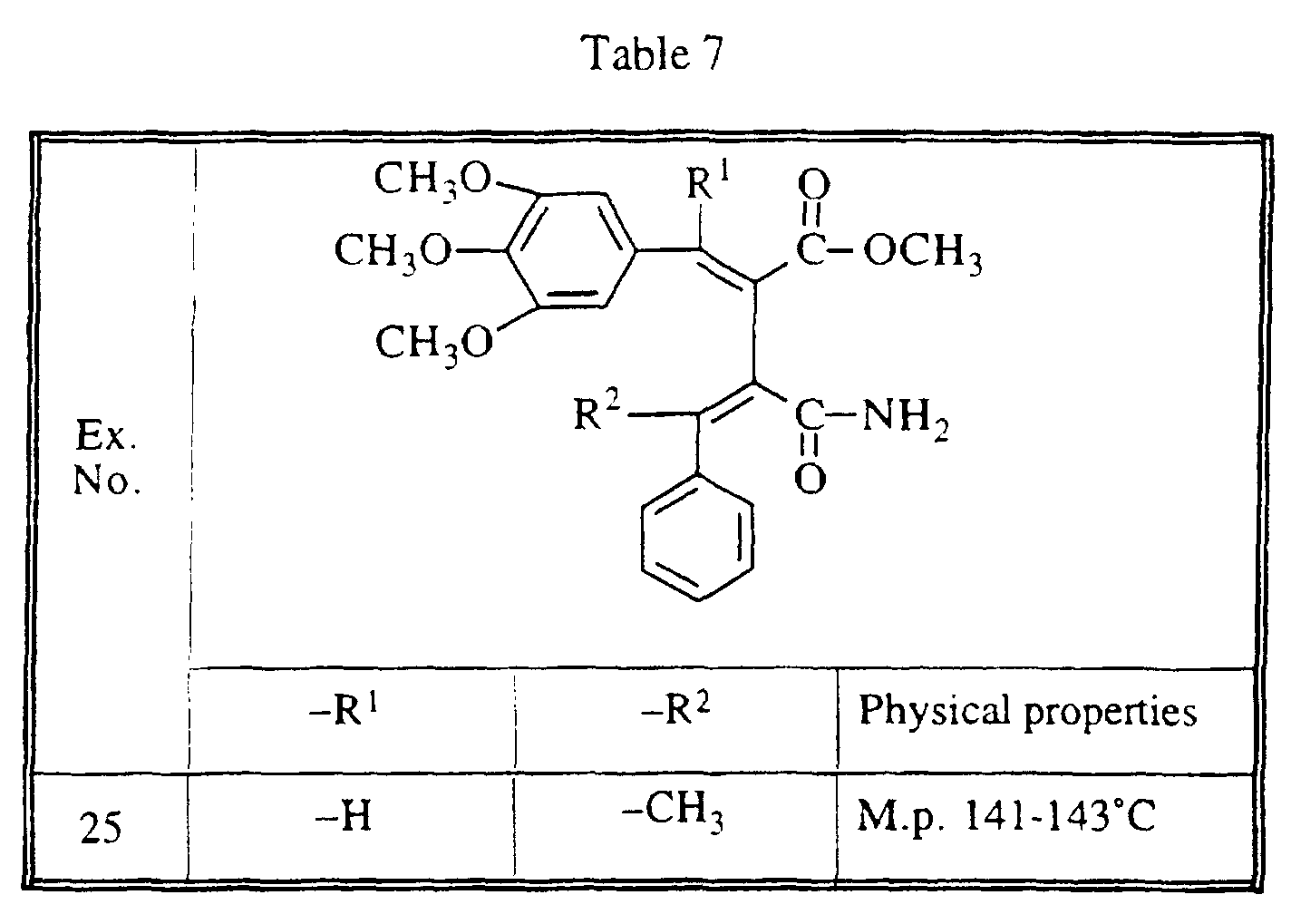
- To a solution of the compound (0.32 g) obtained in Example 11-(2) in tetrahydrofuran (20 ml) is added a 2N aqueous sodium hydroxide solution (3.6 ml) at 0°C, and the mixture is stirred for 10 minutes. To the reaction mixture is added 2N hydrochloric acid (3.6 ml), and the mixture is extracted with ethyl acetate. The extract is concentrated under reduced pressure to remove the solvent, and the residue is purified by silica gel column chromatography (eluent; chloroform:acetone = 10:1), and further crystallized from diethyl ether to give (3Z,4E)-4-benzylidene-3-(4-cyclopentyloxy-3-methoxy-α-methylbenzylidene)-pyrrolidine-2,5-dione (0.17 g). The structure and the physical properties thereof are shown in Table 8.
Yield: 58.0 %
M.p. 193-194°C - The corresponding starting compounds are treated in the same manner as in Example 26 to give the compounds as listed in Tables 8-10.
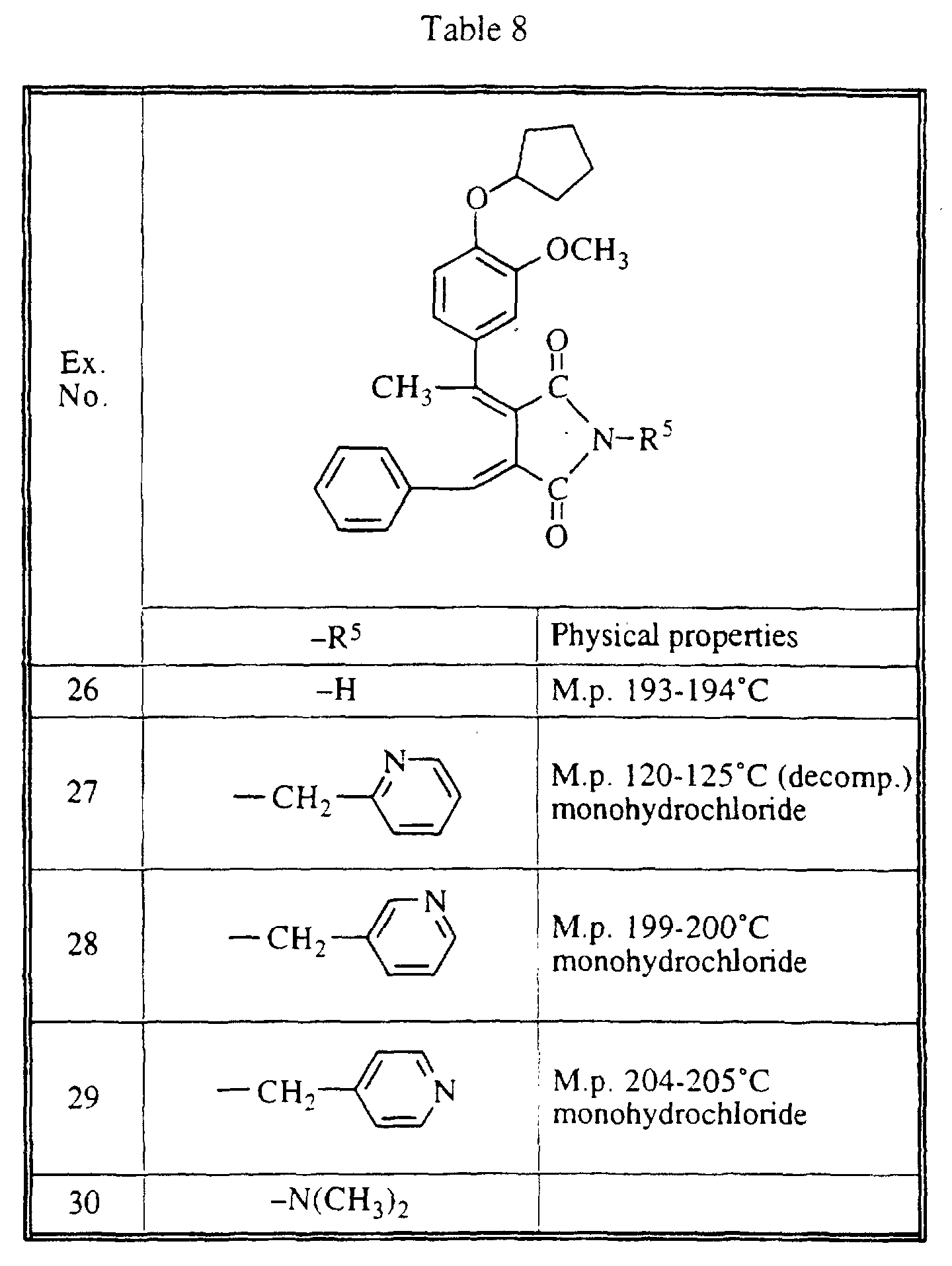


- The corresponding starting compounds are treated in the same manner as in Example 1 to give the compounds as listed in Table 11.
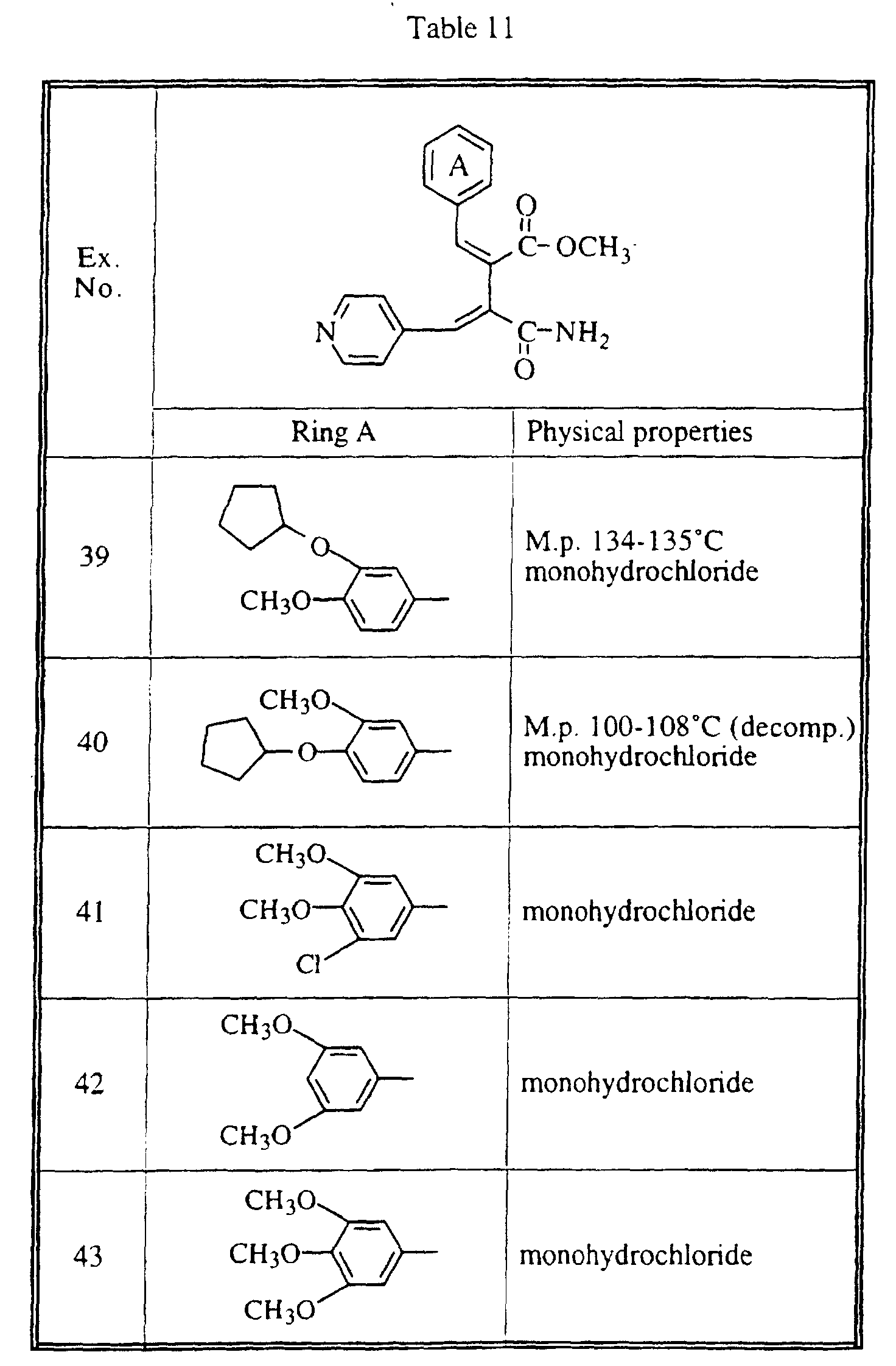
- The corresponding starting compounds are treated in the same manner as in Example 5 to give the compounds as listed in Table 12.

-
- (1) Vanillin (100 g) is dissolved in chloroform (800 ml), and thereto is
blown with stirring chlorine gas at room temperature for about one hour to give
the white solid. The compressed air is blown into the mixture to remove the
chlorine being dissolved therein, and the precipitated solid is collected by
filtration, washed, and dried. The mother liquor is concentrated, and triturated
with diethyl ether, and the precipitates are collected by filtration, washed, and
dried. The former precipitated solid and the powder thus obtained are combined
to give 3-chlorovanillin (115.25 g).
Yield: 94.0 %
M.p. 163°C - (2) The above product (62 g) is dissolved in N,N-dimethylformamide
(600 ml), and thereto are added potassium carbonate (91.8 g) and methyl iodide
(37.2 ml) at room temperature, and the mixture is stirred at the same temperature
for five hours. The reaction mixture is concentrated, and thereto is added water.
The mixture is extracted with ethyl acetate, and the ethyl acetate layer is
washed, dried, and concentrated under reduced pressure to remove the solvent
to give 3-chloro-4,5-dimethoxybenzaldehyde (65.15 g).
Yield: 97.7 %
M.p. 54°C - (3) To a solution of magnesium (11.87 g) in diethyl ether (500 ml) is
added gradually and dropwise a solution of methyl iodide (30.4 ml) in diethyl
ether (100 ml) under nitrogen atmosphere. After the addition, the mixture is
stirred for 30 minutes until the reflux is completed. To the mixture is added
dropwise a solution of the compound (70 g) obtained in the above (2) in
tetrahydrofuran (400 ml) under ice-cooling. The mixture is warmed to room
temperature, and further stirred for 30 minutes. To the reaction mixture is added
a small amount of water, and the reaction is quenched. To the reaction mixture
is added an aqueous ammonium chloride solution, and the mixture is extracted
with ethyl acetate. The ethyl acetate layer is washed, dried, and concentrated
under reduced pressure to remove the solvent to give 3-chloro-4,5-dimethoxy-1-(1-hydroxyethyl)benzene
(75 g).
The above product (75 g) is dissolved in acetonitrile (500 ml), and thereto
is added manganese dioxide (400 g), and the mixture is stirred at room
temperature overnight. Cerite is added to the reaction mixture, and the mixture
is stirred for one hour. The mixture is filtered through cerite pad, and the mother
liquor is concentrated. The residue is purified by silica gel column chromatography
(eluent; hexane:ethyl acetate = 3:1), and recrystallized from hexane to
give 3-chloro-4,5-dimethoxyacetophenone (62.0 g).
Yield: 82.8 %
M.p. 47-49°C - (4) A solution of the above product (11.3 g) in dimethyl succinate
(11.54 g) in tetrahydrofuran (50 ml) is added gradually and dropwise into a
solution of potassium tert-butoxide (6.5 g) in t-butyl alcohol (30 ml) at room
temperature. The mixture is stirred at room temperature for one hour, warmed to
70°C, and then stirred for one hour. The reaction mixture is cooled, and poured
into ice-water, and further dissolved in isopropyl ether to purification, and then
the mixture is extracted with water. The pH value of the aqueous layer is
adjusted to pH 2-3 with conc. hydrochloric acid, and the free carboxylic acid is
extracted with ethyl acetate. The extract is dried, and concentrated under
reduced pressure to give 4-(3-chloro-4,5-dimethoxyphenyl)-4-methyl-3-methoxycarbonyl-3-butenoic
acid as an amber oil.
The product thus obtained is dissolved in dichloromethane (100 ml), and
thereto are added diisopropyl ethylamine (11.0 ml) and methoxymethyl chloride
(4.8 ml) at 0°C, and the mixture is stirred at room temperature overnight. The
reaction mixture is concentrated, and thereto is added aqueous citric acid
solution, and then extracted with ethyl acetate. The extract is washed, dried,
and concentrated under reduced pressure. The residue is purified by silica gel
column chromatography (eluent; ethyl acetate:hexane = 1:3 → 2:3) to give (Z)-4-(3-chloro-4,5-dimethoxyphenyl)-4-methyl-3-methoxycarbonyl-3-butenoic
acid methoxymethyl ester (3.18 g) and (E)-4-(3-chloro-4,5-dimethoxyphenyl)-4-methyl-3-methoxycarbonyl-3-butenoic
acid methoxymethyl ester (9.12 g).
- (Z)-4-(3-Chloro-4,5-dimethoxyphenyl)-4-methyl-3-methoxycarbonyl-3-butenoic
acid methoxymethyl ester:
- Yield: 16.2 %
- IR: 1735, 1563, 1491, 1148, 932 cm-1
- (E)-4-(3-Chloro-4,5-dimethoxyphenyl)-4-methyl-3-methoxycarbonyl-3-butenoic
acid methoxymethyl ester:
- Yield: 46.5 %
- IR: 1738, 1562, 1491, 1146, 932 cm-1
- (5) To a solution of diisopropylamine (1.33 ml) in tetrahydrofuran (20
ml) is added gradually and dropwise a 1.6 N solution of n-butyl lithium in
hexane (5.91 ml) at 0°C, and the mixture is stirred at the same temperature for 30
minutes. The solution is cooled to -78°C, and thereto is added gradually and
dropwise a solution of (Z)-4-(3-chloro-4,5-dimethoxyphenyl)-4-methyl-3-methoxycarbonyl-3-butenoic
acid methoxymethyl ester (2.94 g) in
tetrahydrofuran (20 ml), and the mixture is further stirred at the same
temperature for 30 minutes. The reaction mixture is cooled to -90°C, and
thereto is added gradually and dropwise a solution of isonictinaldehyde (1.01 g)
in tetrahydrofuran (10 ml), and the mixture is stirred at -90°C for 20 minutes.
To the reaction mixture is added a saturated aqueous ammonium chloride
solution, and the mixture is extracted with ethyl acetate. The organic layer is
washed, dried, and concentrated under reduced pressure to remove the solvent
to give (Z)-4-(3-chloro-4,5-dimethoxyphenyl)-4-methyl-3-methoxycarbonyl-2-(4-pyridylhydroxymethyl)-3-butenoic
acid methoxymethyl ester.
The above product is dissolved in dichloromethane (50 ml), and thereto
are added triethylamine (7.54 ml) and methanesulfonyl chloride (0.977 ml) at
0°C. The mixture is warmed to room temperature, and stirred overnight. To the
mixture is added 1,8-diazabicyclo[5.4.0]undeca-7-ene (DBU, 1.18 ml), and the
mixture is stirred at room temperature for 3 hours. The reaction mixture is
concentrated, and thereto is added water. The mixture is extracted with ethyl
acetate, washed, dried and concentrated under reduced pressure to remove the
solvent. The residue is purified by silica gel column chromatography (eluent;
chloroform:acetone = 6:1) to give (1Z,3E)-1-methyl-1-(3-chloro-4,5-dimethoxyphenyl)-2-methoxycarbonyl-3-methoxymethoxycarbonyl-4-(4-pyridyl)-butadiene
(2.007 g).
Yield: 55.1 %
IR: 1720, 1594, 1563, 1490, 1253, 1047, 927 cm-1 - (6) To a solution of the above product (2.0 g) in tetrahydrofuran (20
ml) is added 12 N hydrochloric acid (2.0 ml) at 0°C, and the mixture is stirred at
room temperature for two hours. The reaction mixture is cooled with ice, and
the pH value thereof is adjusted to pH 4-5 with 2N aqueous sodium hydroxide
solution, and the mixture is extracted with ethyl acetate. The extract is dried,
and concentrated under reduced pressure to give (1Z,3E)-1-methyl-1-(3-chloro-4,5-dimethoxyphenyl)-2-methoxycarbonyl-3-carboxy-4-(4-pyridyl)butadiene
as a yellow solid.
The above product is dissolved in dichloromethane (20 ml), and thereto
are added triethylamine (0.67 ml) and isobutyl chloroformate (0.62 ml) under
ice-cooling. The mixture is stirred at the same temperature for 30 minutes, and
thereto is added a 28 % aqueous ammonia (2.8 ml) at 0°C. The mixture is stirred
at 0°C for 30 minutes. The 2-fold diluted, saturated aqueous sodium chloride
solution is added to the reaction mixture, and the mixture is extracted with
chloroform. The extract is dried, concentrated under reduced pressure, and the
resulting residue is purified by silica gel column chromatography (eluent;
chloroform:methanol = 20:1) to give 1-methyl-1-(3-chloro-4,5-dimethoxyphenyl)-2-methoxycarbonyl-3-aminocarbonyl-4-(4-pyridyl)butadiene
(1.498 g).
Yield: 83.0 %
IR: 1720, 1676, 1595, 1240, 1047, 999, 855 cm-1The product thus obtained is in the form of a mixture of stereoisomers based on the double bond at 1-position, and the ratio of the Z-isomer and E-isomer is 2.5:1. - (7) The above product is purified and separated by silica gel column chromatography (eluent; chloroform:acetone = 5:1) to give (1Z,3E)-1-methyl-1-(3-chloro-4,5-dimethoxyphenyl)-2-methoxycarbonyl-3-aminocarbonyl-4-(4-pyridyl)butadiene. The structure and the physical properties thereof are shown in Table 13.
-
- The corresponding starting compounds are treated in the same manner as in Example 49 to give the compounds as listed in Table 13.
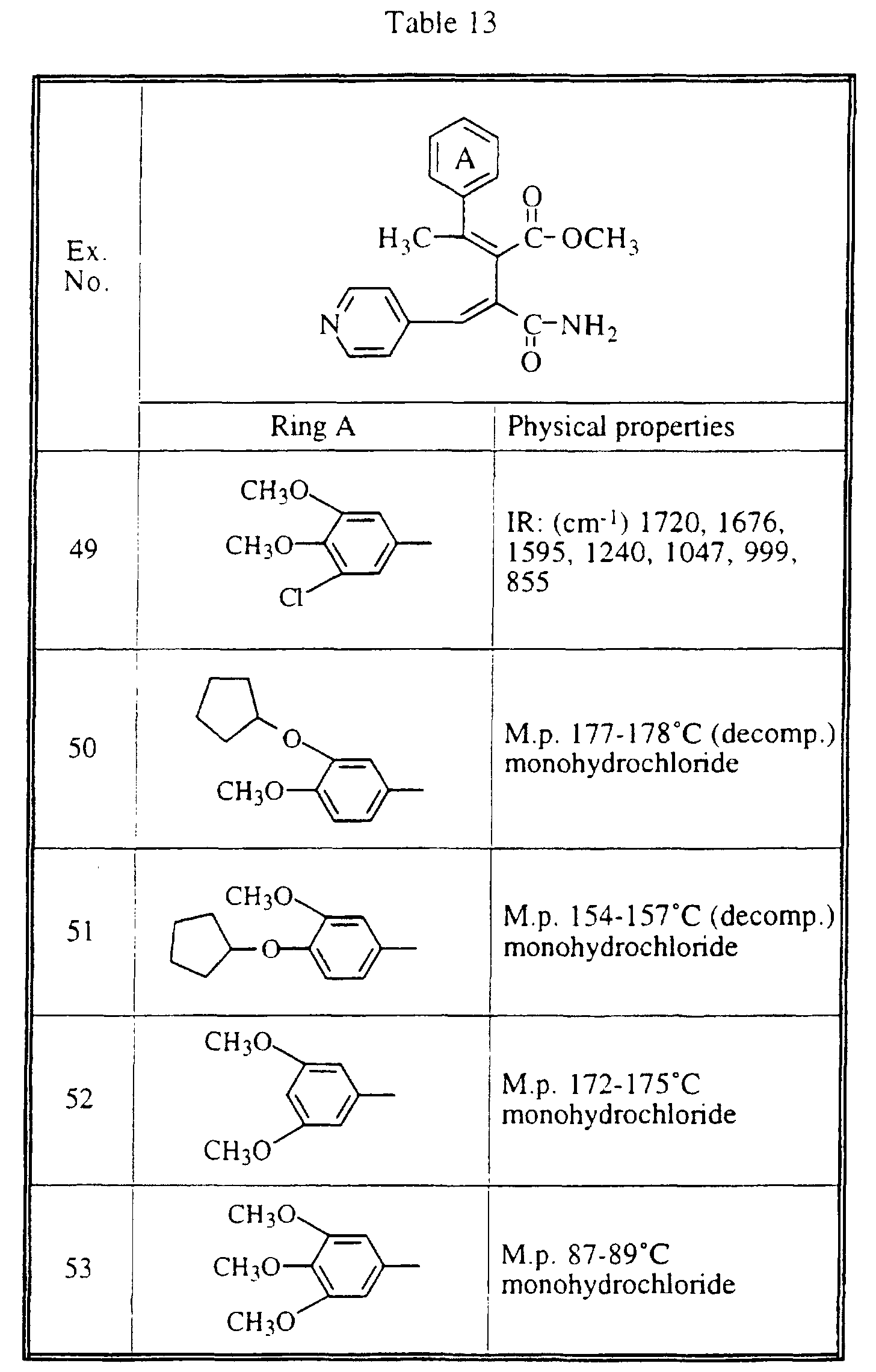
-
- (1) The compound (800 mg) obtained in Example 49-(7) is dissolved
in tetrahydrofuran (20 ml), and thereto is added a 2N aqueous sodium
hydroxide solution (0.48 ml) under ice-cooling. The mixture is warmed to room
temperature and stirred for one hour. To the reaction mixture are added water,
and the mixture is extracted with chloroform. The extract is washed, dried, and
concentrated under reduced pressure. The residue is purified by silica gel
column chromatography (eluent: chloroform:methanol = 20:1), and further
recrystallized from a mixture of hexane and ethyl acetate to give (3Z,4E)-3-(3-chloro-4,5-dimethoxy-α-methylbenzylidene)-4-(4-pyridylmethylidene)-pyrrolidine-2.5-dione
(82 mg).
Yield: 11.1 %
M.p. >194°C (decomposed)
IR: 1721, 1599, 1491, 1328, 1049 cm-1 - (2) The above product (75 mg) is dissolved in a mixture of
tetrahydrofuran (1 ml) and dioxane (1 ml), and thereto is added a 4N solution of
hydrogen chloride in dioxane (0.054 ml), and the mixture is stirred at room
temperature for crystallization to give a pale yellow solid. The mixture is
concentrated under reduced pressure to remove the solvent, and the residue is
triturated with diethyl ether, and the resultant is further stirred in a mixture of
methanol and diethyl ether at room temperature to crystallize to give (3Z,4E)-3-(3-chloro-4,5-dimethoxy-α-methylbenzylidene)-4-(4-pyridylmethylidene)-pyrrolidine-2,5-dione
hydrochloride (70 mg). The structure and the physical
properties thereof are shown in Table 14.
Yield: 85.3 %
M.p. >200°C (decomposed)
IR: 1728, 1634, 1491, 1312 cm-1 -
- The corresponding starting compounds are treated in the same manner as in Example 54 to give the compounds as listed in Table 14.

-
- (1) To a solution of potassium tert-buloxide (16.8 g) in tert-butyl
alcohol (150 ml) is added dropwise with stirring a solution of benzaldehyde
(15.9 g) and dimethyl succinate (26.3 g) in tert-butyl alcohol (20 ml) at room
temperature, and the mixture is stirred for 30 minutes. The reaction mixture is
poured into ice-water (200 ml), and the mixture is extracted with isopropyl
ether. The pH value of the aqueous layer is adjusted to pH 2-3, and extracted
with ethyl acetate. The extract is washed, dried, and concentrated under
reduced pressure. The residue is dissolved in a mixture of toluene (50 ml) and
ethylene glycol monomethyl ether (50 ml), and thereto is added dropwise
thionyl chloride (16.4 ml) at 0°C. The mixture is allowed to stand at room
temperature overnight, and the mixture is concentrated under reduced pressure.
The residue is purified by silica gel column chromatography (eluent; hexane:
ethyl acetate = 4:1) to give (E)-3-methoxycarbonyl-4-phenyl-3-butenoic acid 2-methoxyethyl
ester (26.9 g).
Yield: 65 % - (2) A solution of the above product (14 g) and 3-cyclopentyloxy-4-methoxybenzaldehyde
(11.1 g) in tert-butyl alcohol (100 ml) is added dropwise
into a solution of potassium tert-butoxide (6.2 g) in tert-butyl alcohol (40 ml) at
room temperature, and the mixture is stirred at the same temperature for one
hour. The reaction mixture is poured into water, and the mixture is extracted
with diisopropyl ether. The pH value of the aqueous layer is adjusted to pH 2-3
with hydrochloric acid, and extracted with ethyl acetate. The extract is washed,
dried, and concentrated under reduced pressure to remove the solvent. The
residue is washed with diethyl ether to give (E)-2-[(E)-3-cyclopentyloxy-4-methoxybenzylidene]-3-carboxy-4-phenyl-3-butenoic
acid methyl ester (23.4
g).
Yield: 67 % - (3) To a solution of the above product (5.0 g) in chloroform (100 ml)
are added a few drops of N,N-dimethylformamide and thionyl chloride (0.82 ml),
and the mixture is refluxed for 30 minutes. The solution is added dropwise with
vigorously stirring into 2-picolylamine under ice-cooling. The mixture is further
stirred for 30 minutes, and the organic layer is separated, washed, dried and
concentrated under reduced pressure. The residue is purified by silica gel
column chromatography (eluent; chloroform:acetone = 5:1) to give (1E,3E)-1-(3-cyclopentyloxy-4-methoxybenzylidene)-2-(2-methoxyethoxycarbonyl)-3-(2-pyridylmethylaminocarbonyl)-4-phenylbutadiene
(2.7 g).
Yield: 24 % - (4) To a solution of the above product (2.7 g) in tetrahydrofuran (20
ml) is added a 4N solution of hydrogen chloride in dioxane (1.33 ml), and the
mixture is stirred for 10 minutes. The mixture is concentrated under reduced
pressure to remove the solvent, and the residue is crystallized from isopropyl
ether to give (1E,3E)-1-(3-cyclopentyloxy-4-methoxybenzylidene)-2-(2-methoxyethoxycarbonyl)-3-(2-pyridylmethylaminocarbonyl)-4-phenylbutadiene
hydrochloride (1.9 g). The structure and the physical properties
thereof are shown in Table 15.
Yield: 66 %
M.p. 167-168°C -
- The corresponding starting compounds are treated in the same manner as in Example 59 to give the compounds as listed in Tables 15-20.

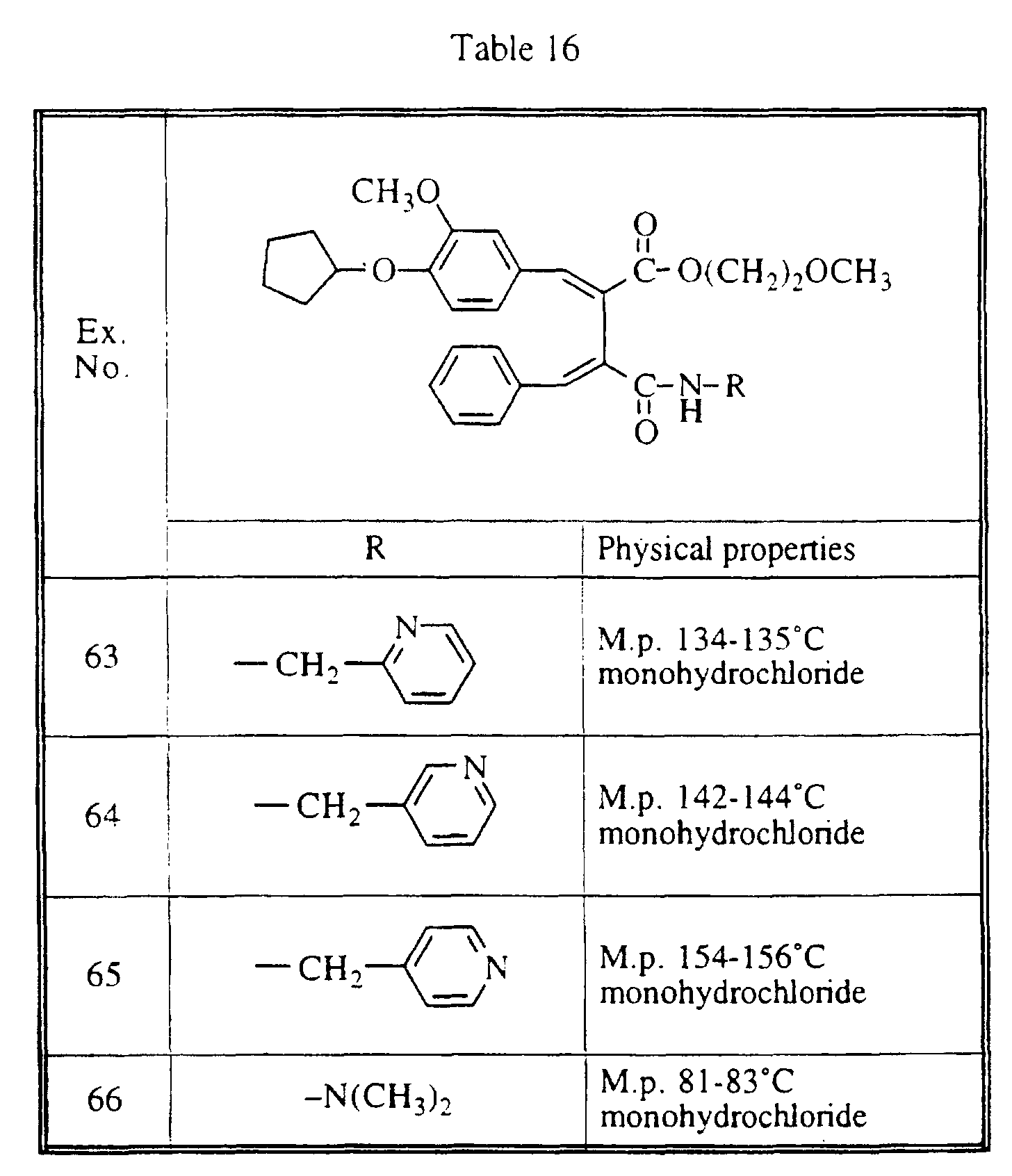

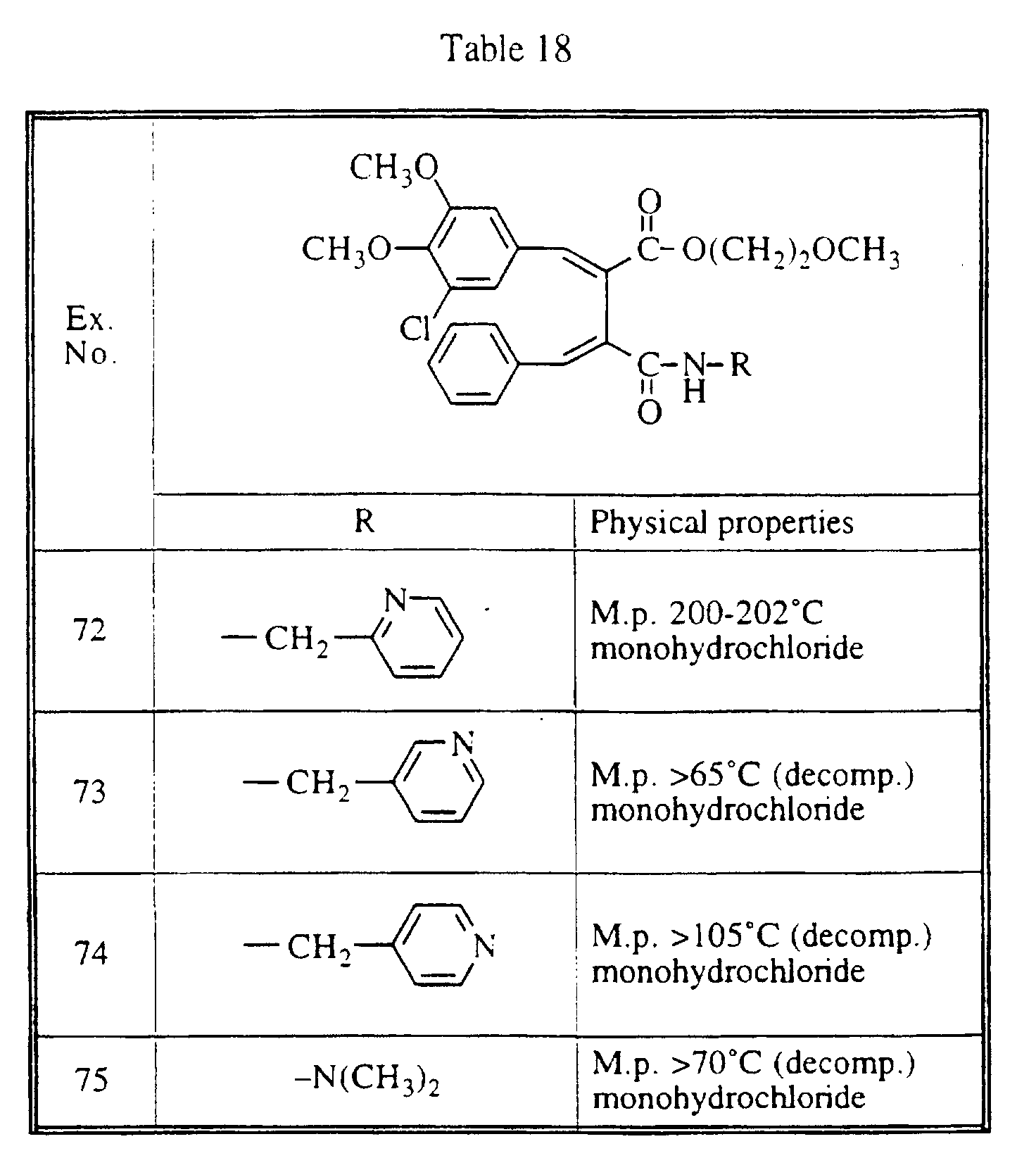


-
- (1) To a solution of the compound (1.17 g) obtained in Example 59-(4)
in tetrahydrofuran (10 ml) is added a 2N aqueous sodium hydroxide solution
(10 ml), and the mixture is stirred at room temperature for 10 minutes. To the
mixture is added 2N hydrochloric acid, and the mixture is concentrated under
reduced pressure. Chloroform is added to the residue, and the mixture is
washed, dried, and concentrated under reduced pressure to give (3E,4E)-3-(3-cyclopentyloxy-4-methoxybenzylidene)-4-benzylidene-1-(2-pyridylmethyl)-pyrrolidine-2,5-dione
(1.1 g).
Yield: 98 % - (2) To a solution of the above product (1.1 g) in tetrahydrofuran (10
ml) is added a 4N solution of hydrogen chloride in dioxane (0.7 ml) at 0°C. and
the mixture is stirred for 10 minutes. The mixture is concentrated under reduced
pressure, and the residue is crystallized from ether to give (3E,4E)-3-(3-cyclopentyloxy-4-methoxybenzylidene)-4-benzylidene-1-(2-pyridylmethyl)-pyrrolidine-2,5-dione
hydrochloride (1.1 g). The structure and the physical
properties thereof are shown in Table 21.
Yield: 88 %
M.p. 134-135°C -
- The corresponding starting compounds are treated in the same manner as in Example 86 to give the compounds as listed in Tables 21-24.
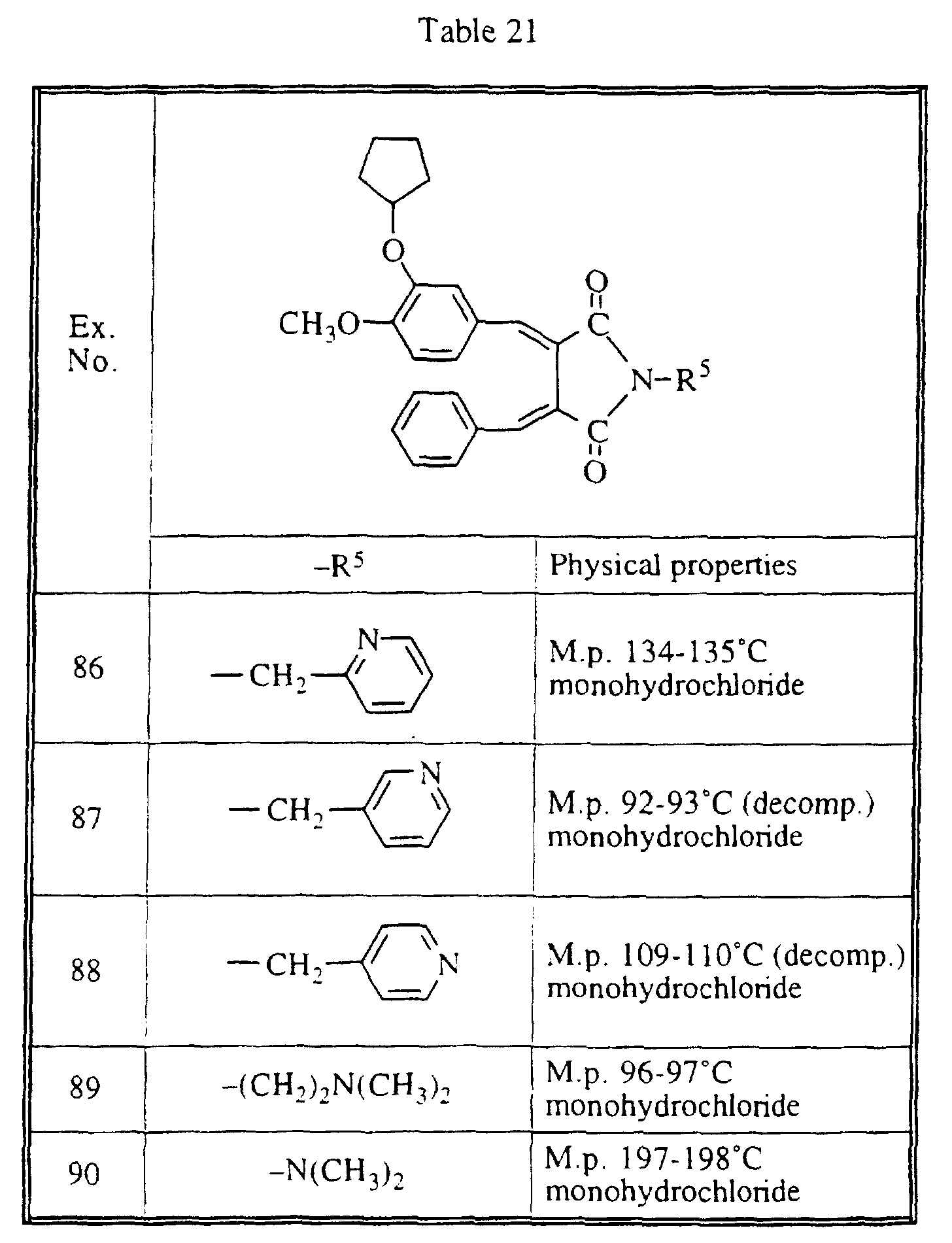
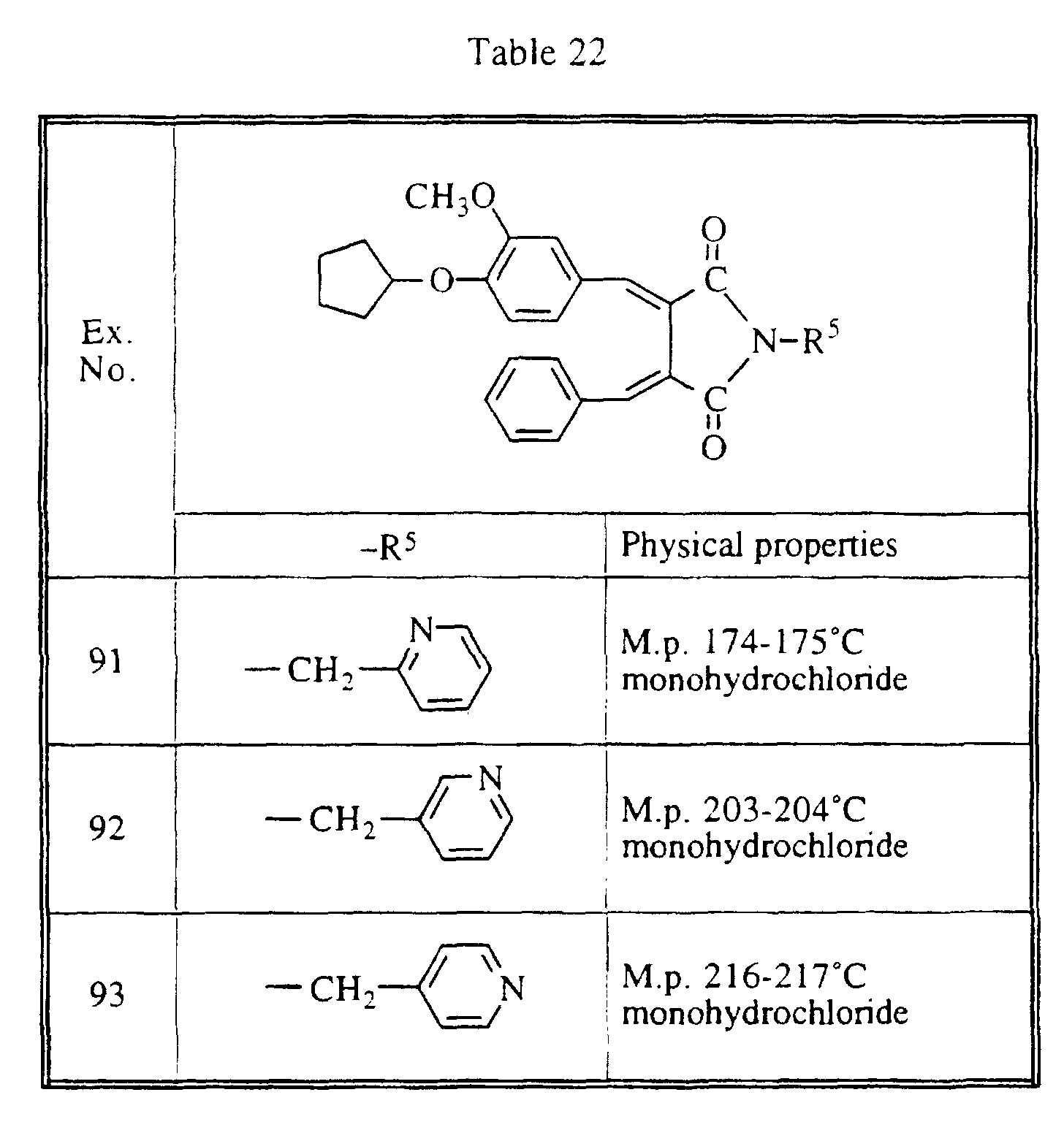
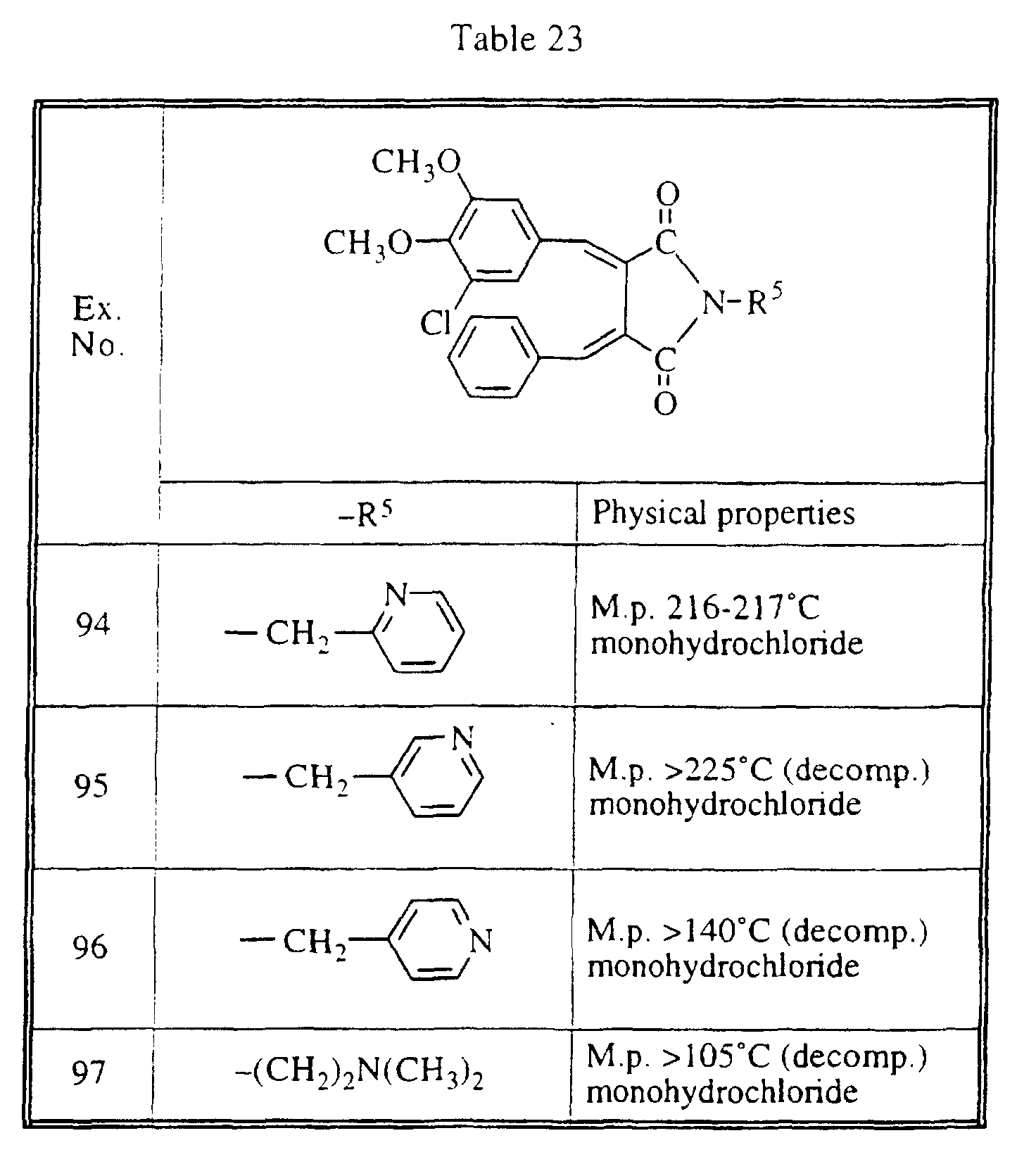

- The corresponding starting compounds are treated in the same manner as in Example 23-(1), and the products thus obtained are purified by silica gel column chromatography to separate (1E,3E)-isomers from the mixture, which are further treated in the same manner as in Example 2 to give the compounds as listed in Table 25.
- The corresponding starting compounds are treated in the same manner as in Example 23-(1) and -(2) to give the compound as listed in Table 25.

- The corresponding starting compounds are treated in the same manner as in Example 6 to give the compounds as listed in Table 26.
- The corresponding starting compounds are treated in the same manner as in Example 5 to give the compound as listed in Table 26.
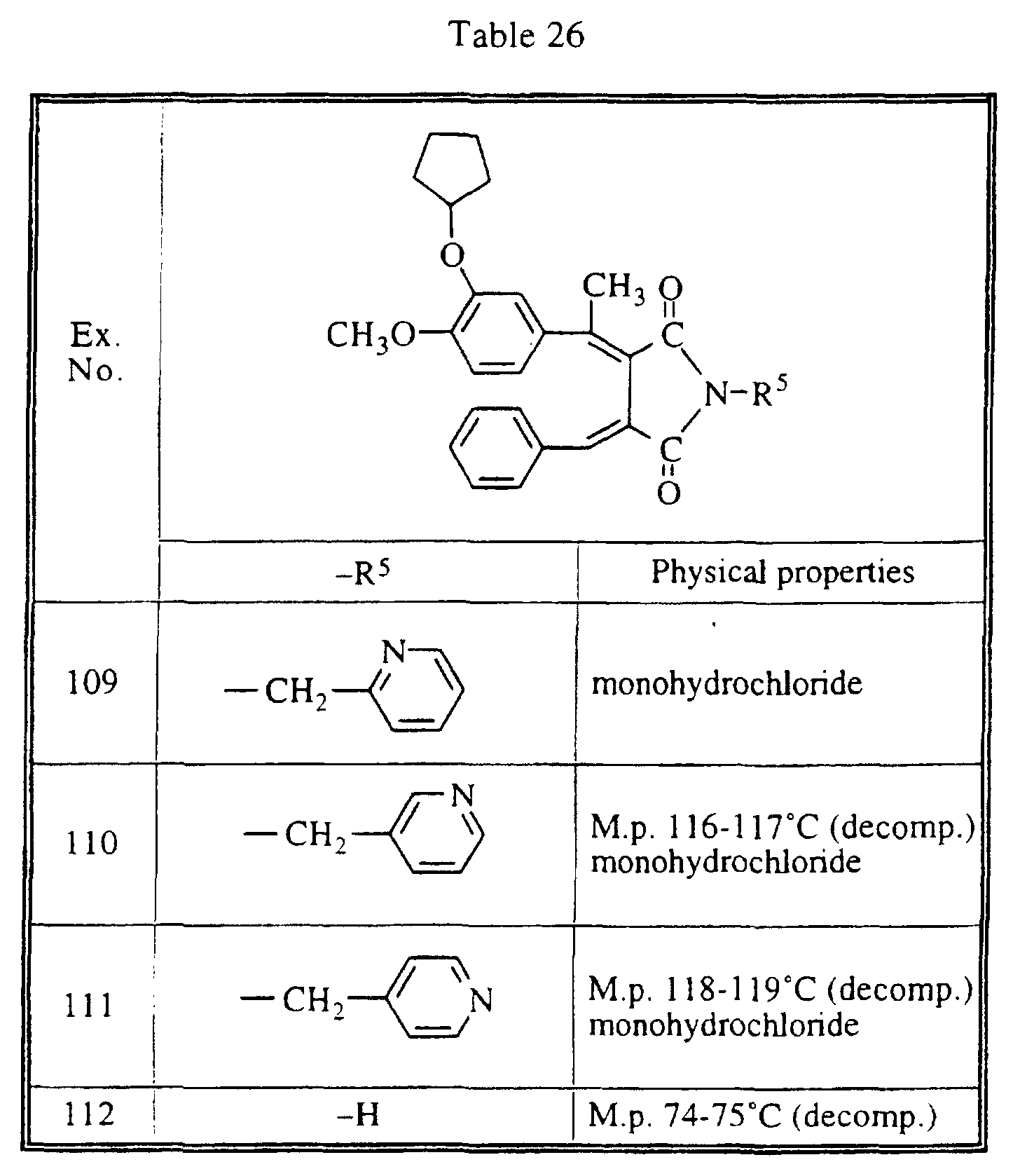
- The corresponding starting compounds are treated in the same manner as in Example 11 to give the compounds as listed in Table 27.
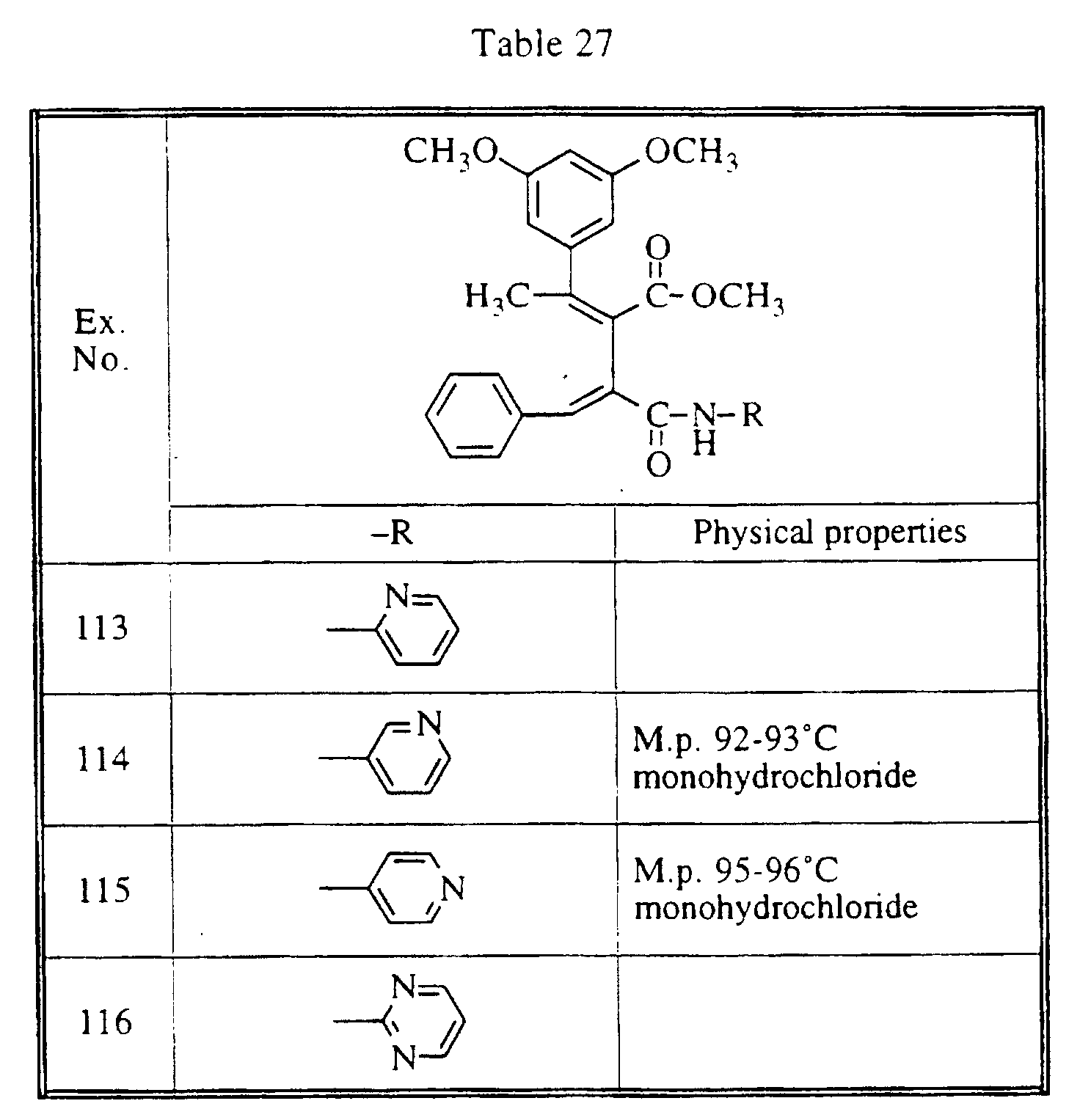
- The corresponding starting compounds are treated in the same manner as in Example 1-(1) → (6) to give the compounds as listed in Tables 28-29.

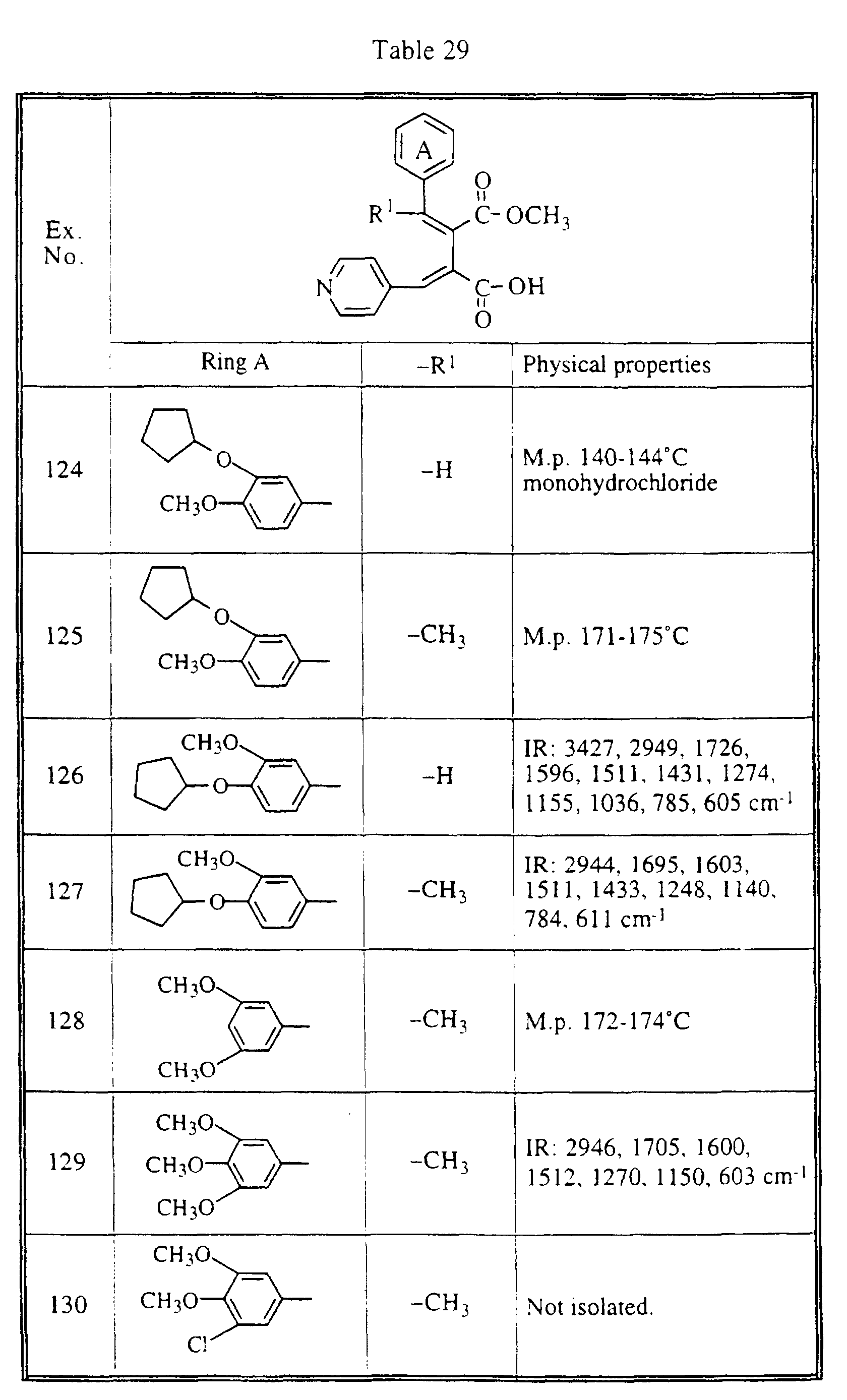
- The corresponding starting compounds are treated in the same manner as in Example 1-(1), -(2), -(5) and -(6), or Example 23 to give the compounds as listed in Tables 30-31.
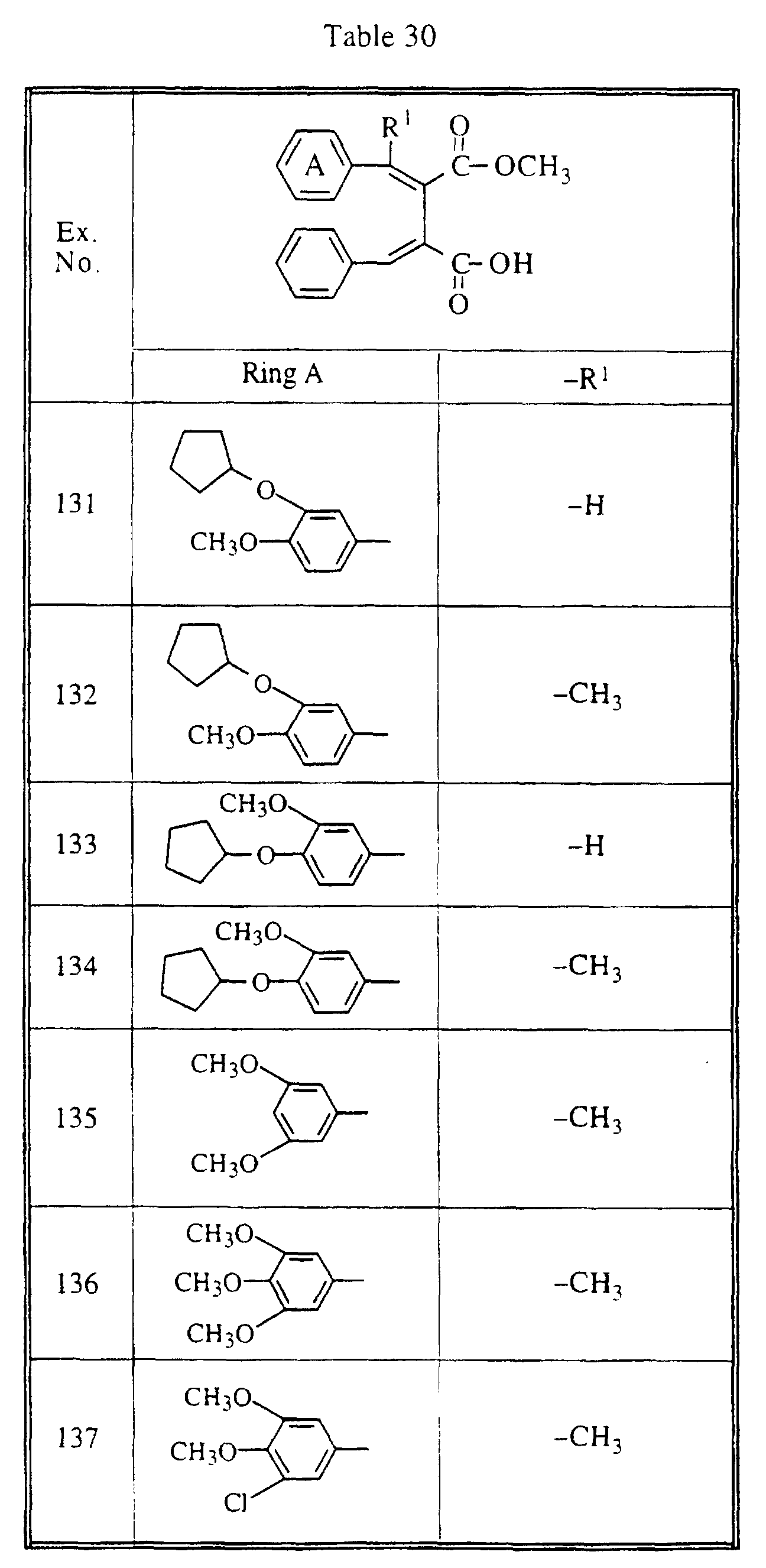

-
- (1) 3,5-Dimethoxyacetophenone (246 g) and (E)-benzylidenesuccinic acid dimethyl ester (320 g) are dissolved in tert-butyl alcohol (1300 ml), and thereto is added potassium tert-butoxide (168.6 g) at room temperature. and the mixture is stirred. The mixture is allowed to cool to room temperature, and the mixture is further stirred at the same temperature for two hours. To the reaction mixture are added water (3 L) and diisopropyl ether (700 ml), and the aqueous layer is separated. To the remaining organic layer is added water, and the aqueous layer is separated. The aqueous layers are combined, and the pH value thereof is adjusted to pH 2-3 with conc. hydrochloric acid. The resulting oily product is extracted with ethyl acetate, and the extract is dried, and concentrated to give oily 1-methyl-1-(3,5-dimethoxyphenyl)-2-methoxycarbonyl-3-carboxy-4-phenylbutadiene (580 g) which is a mixture of (1Z,3E)-isomer and (1E,3E)-isomer. The oily product thus obtained is dissolved in diisopropyl ether-hexane, and the mixture is stirred at room temperature, and the precipitated crystals are collected. To the crystals is added ethyl acetate (1 L), and the mixture is heated at about 80°C, and the remaining crystals are collected by filtration to give (1E,3E)-1-methyl-1-(3,5-dimethoxyphenyl)-2-methoxycarbonyl-3-carboxy-4-phenylbutadiene (the same compound as the compound of Example 135) (117 g). The mother liquor (the filtrate) is concentrated, and ethyl acetate (700 ml) is added to the residue, and the (1Z,3E)-isomer is inoculated thereto. The mixture is stirred, and the precipitated crystals are collected to give (1Z,3E)-1-methyl-1-(3,5-dimethoxyphenyl)-2-methoxycarbonyl-3-carboxy-4-phenylbutadiene (the same compound as the compound of Example 121) (192 g).
- (2) (1Z,3E)-1-Methyl-1-(3,5-dimethoxyphenyl)-2-methoxycarbonyl-3-carboxy-4-phenylbutadiene
(487 g) is dissolved in methylene chloride (1000
ml), and thereto is added N,N-dimethylformamide (1 ml). To the mixture is added
dropwise oxazolyl chloride (133.3 ml), and the mixture is stirred for one hour.
The reaction mixture is concentrated, and the residue is dissolved in tetrahydrofuran
(4 L), and thereto is added dropwise a mixture of triethylamine (214 ml)
and 1-amino-4-methylpiperazine (168 mg) at 0°C. The reaction mixture is
extracted with ethyl acetate, and the extract is dried, concentrated, and the
residue is crystallized from diisopropyl ether to give (1Z,3E)-1-methyl-1-(3,5-dimethoxyphenyl)-2-methoxycarbonyl-3-[N-(4-methylpiperazin-1-yl)aminocarbonyl]-4-phenylbutadiene
(490 g).
Yield: 81 %
M.p. 117-121°C - (3) The above product (268 g) is dissolved in chloroform, and thereto
is added a 4N hydrochloric acid in ethyl acetate (125 ml) at 0°C. The mixture is
poured into chilled diethyl ether, and the precipitated crystals are collected by
filtration to give (1Z,3E)-1-methyl-1-(3,5-dimethoxyphenyl)-2-methoxycarbonyl-3-[N-(4-methylpiperazin-1-yl)aminocarbonyl]-4-phenylbutadiene·monohydrochloride
(the same compound as the compound of
Example 147) (278 g).
Yield: 97 %
M.p. >234°C (decomposed) -
- (1E,3E)-1-Methyl-1-(3,5-dimethoxyphenyl)-2-methoxycarbonyl-3-carboxy-4-phenylbutadiene (114 g) obtained in Example 145-(1) is suspended in tert-butyl alcohol, and thereto is added potassium tert-butoxide (40.1 g). and the mixture is stirred. The reaction mixture is allowed to cool to room temperature, and further stirred for two hours. The reaction mixture is treated in the same manner as in Example 145 to give (1E,3E)-1-methyl-1-(3,5-dimethoxyphenyl)-2-methoxycarbonyl-3-carboxy-4-pheny]butadiene (the same compound as the compound of Example 135) (32 g) and (1Z,3E)-1-methyl-1-(3,5-dimethoxyphenyl)-2-methoxycarbonyl-3-carboxy-4-phenylbutadiene (the same compound as the compound of Example 121) (61.5 g).
- The corresponding starting compounds are treated in the same manner as in Example 11 to give the compounds as listed in Tables 32-36.
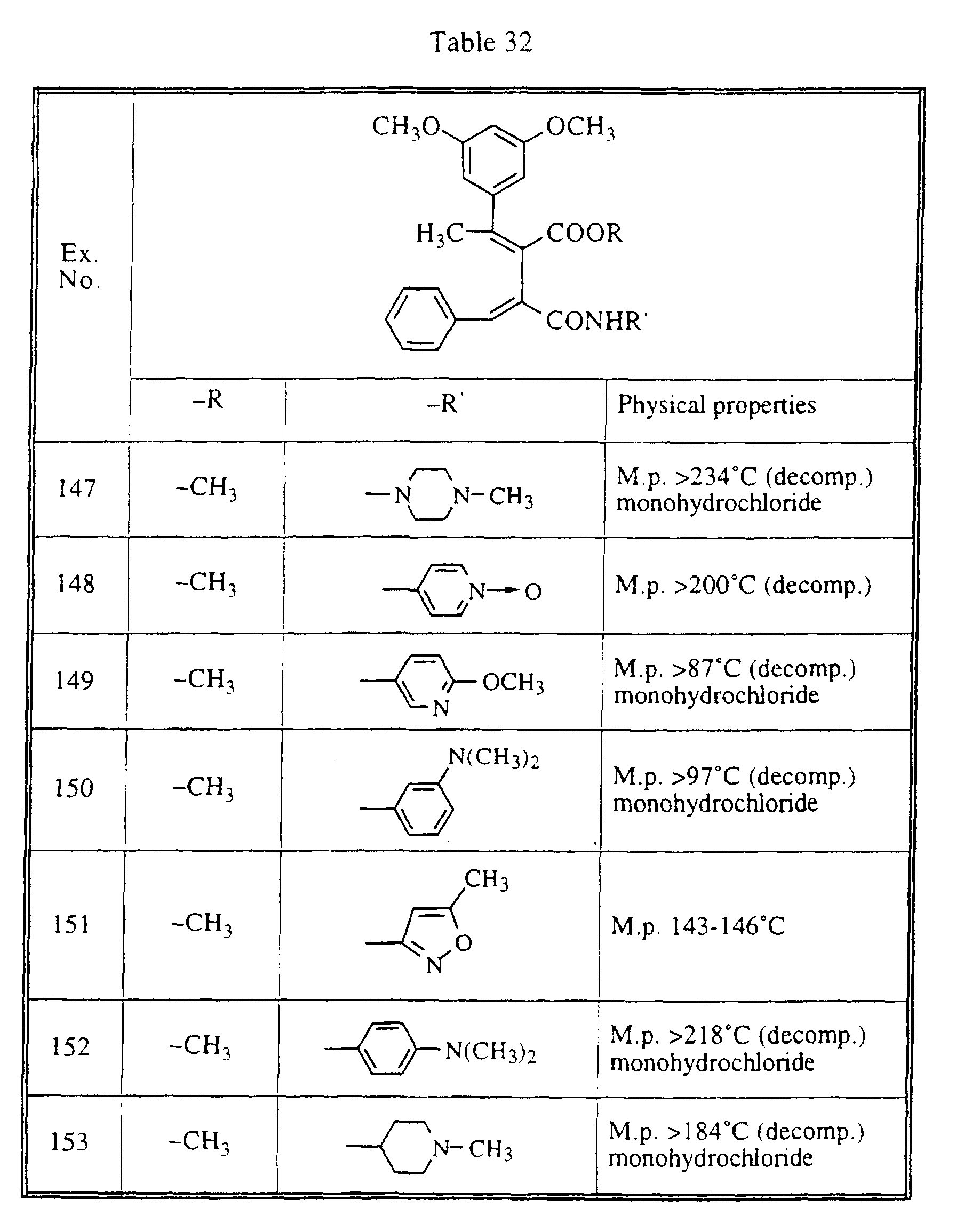


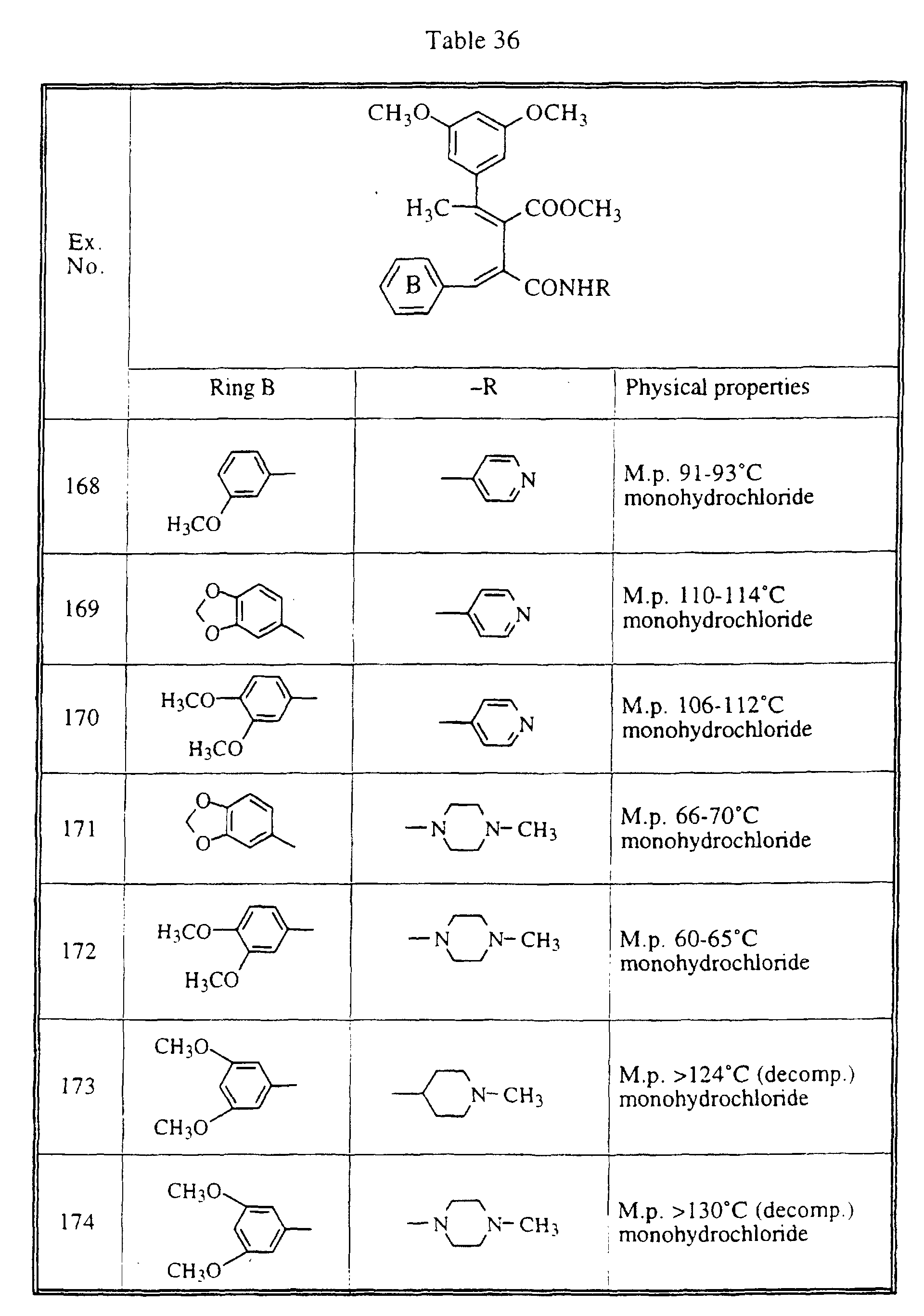
- The corresponding starting compounds are treated in the same manner as in Example 49 to give the compounds as listed in Table 37.
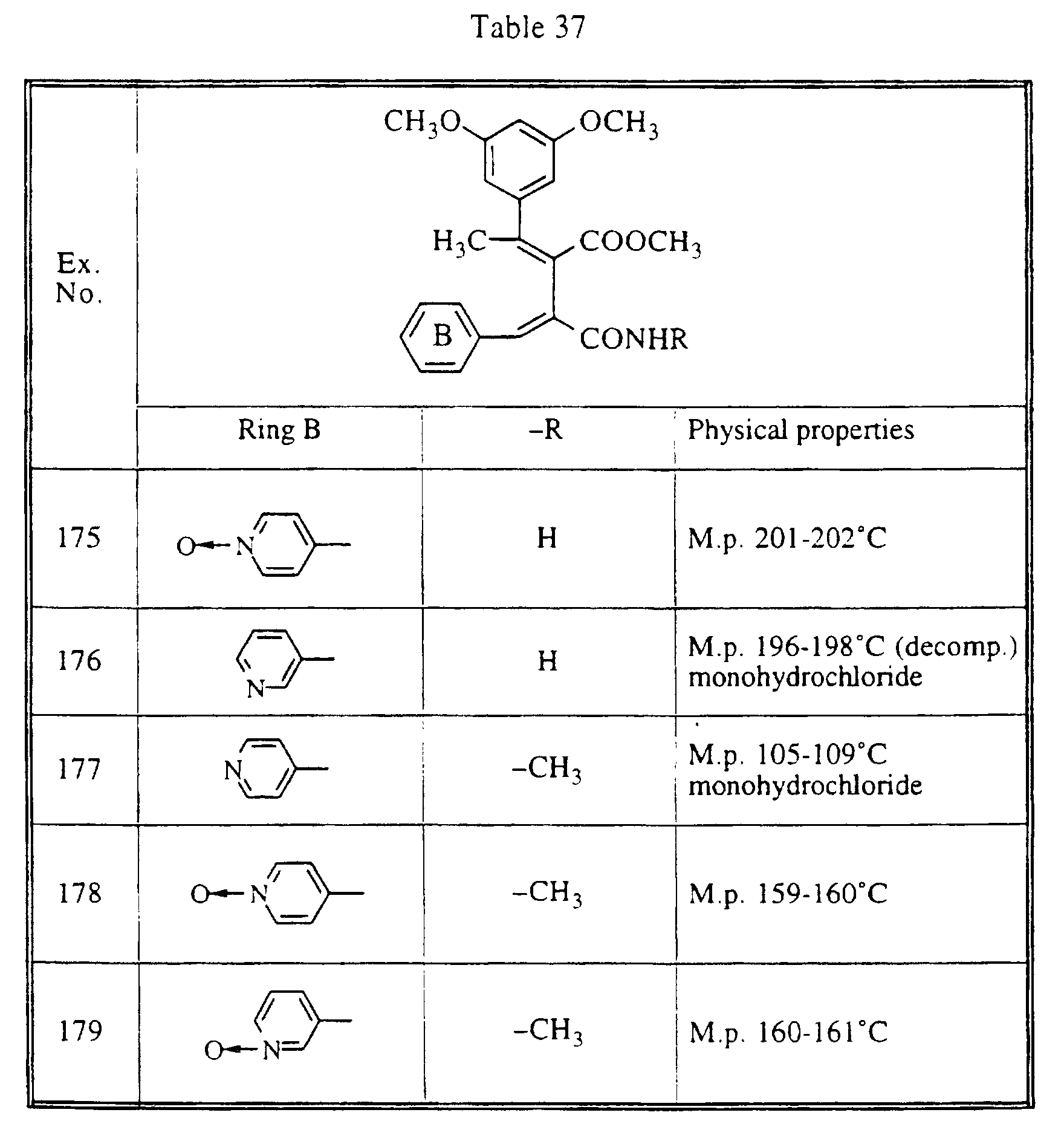
-
- (1) Potassium tert-butoxide (14.2 g) is dissolved in tert-butyl alcohol (120 ml), and thereto is added dropwise a solution of 3,5-dimethoxybenzaldehyde (20 g) and dimethyl succinate (21.1 g) in tetrahydrofuran. The mixture is stirred at room temperature for 30 minutes, and water and isopropyl ether are added to the mixture. The aqueous layer is separated, and the remaining organic layer is further extracted with water. The aqueous layers are combined, and the pH value thereof is adjusted to pH 2-3 with conc. hydrochloric acid. The resulting oily product is extracted with ethyl acetate, and the extract is dried, concentrated under reduced pressure to give 4-(3,5-dimethoxyphenyl)-3-carboxy-3-butenoic acid methyl ester (42 g) as an oily product.
- (2) The above product is dissolved in methanol (200 ml), and thereto
is added conc. sulfuric acid (2 ml), and the mixture is refluxed for 13 hours. The
reaction mixture is concentrated, and thereto are added water and diethyl ether.
The organic layer is collected, washed, dried and concentrated under reduced
pressure. The resulting residue is purified by silica gel column chromatography
(eluent; ethyl acetate:hexane = 1:4) to give (E)-2-(3,5-dimethoxybenzylidene)-succinic
acid dimethyl ester (18.4 g).
Yield: 52 % - (3) The above product (18.4 g) and 3,5-dimethoxyacetophenone
(11.83 g) are dissolved in tert-butyl alcohol (70 ml), and thereto is added
potassium tert-butoxide (8.42 g), and the mixture is stirred. The reaction mixture
is stirred at room temperature for two hours, and thereto are added water and
isopropyl ether. The aqueous layer is separated, and the remaining organic layer
is extracted with water. The aqueous layers are combined, and the pH value
thereof is adjusted to pH 2-3 with conc. hydrochloric acid. The resulting oily
product is extracted with ethyl acetate, and the extract is dried, and
concentrated under reduced pressure. Isopropyl ether is added to the residue,
and the precipitated crystals are collected by filtration to give (1Z,3E)-1-methyl-1-(3,5-dimethoxyphenyl)-2-methoxycarbonyl-3-carboxy-4-(3,5-dimethoxyphenyl)butadiene
(4.74 g).
Yield: 17.1 % - (4) The mother liquor (the filtrate) is concentrated, and isopropyl ether
is added to the residue. The mixture is stirred at room temperature, and the
precipitated crystals are collected to give 1-methyl-1-(3,5-dimethoxyphenyl)-2-methoxycarbonyl-3-carboxy-4-(3,5-dimethoxyphenyl)butadiene
(9.2 g) in the
form of a mixture of (1Z,3E)-isomer and (1E,3E)-isomer thereof.
Yield: 33.3 % - (5) The above mixture (9.0 g) is suspended in tert-butyl alcohol (50
ml), and thereto is added potassium tert-butoxide (2.51 g). The mixture is stirred
at room temperature for two hours, and then acidified by adding thereto water
and 12N hydrochloric acid. The mixture is extracted with ethyl acetate, and the
extract is dried, concentrated. To the residue is added diisopropyl ether (30 ml),
and the mixture is stirred at 0°C. The precipitated crystals are collected to give
(1Z,3E)-1-methyl-1-(3,5-dimethoxyphenyl)-2-methoxycarbonyl-3-carboxy-4-(3,5-dimethoxyphenyl)butadiene
(3.6 g).
Yield: 13.0%
M.p. 137-140°C
IR: 1724, 1670, 1591, 1423, 1206, 1156 cm-1 - (6) (1Z,3E)-1-Methyl-1-(3,5-dimethoxyphenyl)-2-methoxycarbonyl-3-carboxy-4-(3,5-dimethoxyphenyl)butadiene
(1.70 g) is dissolved in dichloromethane
(20 ml), and thereto are added a catalytic amount of N,N-dimethylformamide
and oxalyl chloride (0.4 ml). The mixture is stirred at room
temperature for one hour, and the reaction mixture is concentrated. To the
residue is added tetrahydrofuran (20 ml), and the mixture is added dropwise into
a solution of 1-methylpiperazine (462 mg) and triethylamine (0.65 ml) in
tetrahydrofuran (20 ml), and the mixture is stirred at 0°C for 30 minutes. To the
reaction mixture are added water and ethyl acetate, and the organic layer is
collected. The remaining aqueous layer is extracted with ethyl acetate. The
organic layers are combined, dried, and concentrated. The residue is purified by
silica gel column chromatography (eluent; chloroform:methanol = 30:1) to give
(1 Z,3E)-1-methyl-1-(3,5-dimethoxyphenyl)-2-methoxycarbonyl-3-(4-methylpiperazin-1-yl)carbonyl-4-(3,5-dimethoxyphenyl)butadiene
(2.0 g).
Yield: 99.2 %
IR: 1727, 1591, 1425, 1200, 1155 cm-1 - (7) The above product (2.0 g) is dissolved in chloroform (10 ml), and
thereto is added 4N hydrochloric acid in ethyl acetate (1.05 ml) at 0°C, and the
mixture is stirred for several minutes. To the reaction mixture is added dimethyl
ether, and the mixture is stirred. The precipitated crystals are collected by
filtration to give (1Z,3E)-1-methyl-1-(3,5-dimethoxyphenyl)-2-methoxycarbonyl-3-(4-methylpiperazin-1-yl)carbonyl-4-(3,5-dimethoxyphenyl)-butadiene·monohydrochloride
(1.70 g). The structure and the physical
properties thereof are shown in Table 38.
Yield: 79.5 %
M.p. >133°C (decomposed)
IR: 3436, 1725, 1591, 1425, 1206, 1156 cm-1 -
- The corresponding starting compounds are treated in the same manner as in Example 180 to give the compounds as listed in Table 38.

- The corresponding starting compounds are treated in the same manner as in Example 26 to give the compound as listed in Table 39.

- The corresponding starting compounds are treated in the same manner as in Example 11 to give the compounds as listed in Table 40.

- The butadiene derivative (1-a), the amidobutadiene derivative (1-b) and the pyrrolidine derivative (2) of the present invention and a pharmaceutically acceptable salt thereof show an excellent PAI-1 inhibitory activity, and hence, they are useful in the prophylaxis or treatment of various thrombus such as myocardial infarction, intra-atnal thrombus in atrial fibrillation, arterial sclerosis, angina pectoris, stroke, pulmonary infarction, deep venous thrombus (DVT), disseminated intravascular coagulation syndrome (DIC), diabetic complications, restenosis after percutaneous transluminal coronary angioplasty (PTCA), etc.
- Besides, the present compounds (1-a), (1-b) and (2) also show excellent bioavailability, safety as a medicament, and stability, and hence, they show low toxicity and high safety as a medicament. Especially, among the present compounds (1-b), the compounds having a trans(E)-configuration based on the double bond binding to Ring B, a cis(Z)-configuration based on the double bond binding to Ring A show (i) high solubility in water, (ii) high stability to the metabolism in the liver, (iii) low toxicity against in the liver and chromosome, (iv) high stability against light.
Claims (15)
- A butadiene derivative of the formula (1-a) :wherein Ring A is a benzene ring substituted by one to three groups selected from a C1-6 alkyl group, a C1-20 alkoxy group, a C3-10 cycloalkyloxy group, a nitro group, a hydroxy group, a dimethylamino group, and a halogen atom,
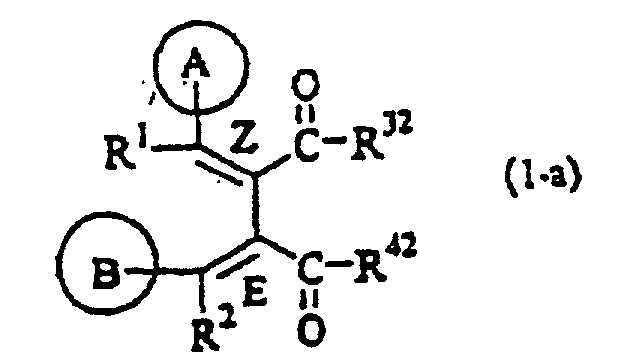 Ring B is a pyridine ring which may optionally be substituted by an oxo group, or a benzene ring which may optionally be substituted by one to three groups selected from a C1-6 alkoxy group, a C1-4 alkylenedioxy group and a di-C1-6 alkylamino group,the configuration based on the double bond binding to Ring B is trans(E)-configuration, and the configaration based on the double bond binding to Ring A is cis (Z)-configuration,R1 is a C1-6 alkyl group,R2 is a hydrogen atom,the group: -COR32 is a carboxyl group which is esterified, wherein the ester residue includes a C1-6 alkyl group or a C1-6 alkoxy-substituted C1-6 alkyl group,the group: -COR42 is a carboxyl group, or a pharmaceutically acceptable salt thereof.
 - An amidobutadiene derivative of the formula (1-b):wherein Ring A is a benzene ring substituted by one to three groups selected from a C1-6 alkyl group, a C1-20 alkoxy group, a C3-10 cycloalkyloxy group, a nitro group, a hydroxy group, a dimethylamino group, and a halogen atom.
 Ring B is a pyridine ring which may optionally be substituted by an oxo group, a benzene ring which may optionally be substituted by one to three groups selected from a C1-6 alkoxy group, a C1-4 alkylenedioxy group and a di-C1-6 alkylamino group,the configuration based on the double bond binding to Ring B is trans(E)-configuration, and the configuration based on the double bond binding to Ring A is cis(Z)-configuration,R1 is a C1-6 alkyl group,R2 is a hydrogen atom,the group: -COR33 is a carboxyl group which is esterified, wherein the ester residue includes a C1-6 alkyl group or a C1-6 alkoxy-substituted C1-6 alkyl group,the group: -COR43 is a carbamoyl group which may optionally be substituted by a group selected from a pyridyl group, an oxo-substituted pyridyl group, an amino-substituted pyridyl group, a C1-6 alkoxy-substituted pyridyl group, a C1-6 alkyl-substituted piperidyl group, a C1-6 alkyl-substituted piperazinyl group, a piperazinyl group substituted by a C1-6 alkyl group and an oxo group, a C1-6 alkyl-substituted isoxazolyl group, a pyrazolyl group, a triazolyl group, a pyridyl-substituted C1-6 alkyl group, an oxo-substituted pyridyl-C1-6 alkyl group, a di-C1-6 alkylphenyl group, a morpholinophenyl group, a C1-6 alkylpiperazinylcarbonylphenyl group, a hydroxy-C1-6 alkyl group, and a di-C1-6 alkylamino group, or a pharmaceutically acceptable salt thereof.
 - A compound according to claim 2, wherein Ring A is a benzene ring substituted by two or three groups selected from a C1-6 alkoxy group, Ring B is a pyridine ring, a benzene ring, or a C1-4 alkylenedioxy-substituted benzene ring, the group: -COR33 is a C2-7 alkoxycarbonyl group, or a pharmaceutically acceptable salt thereof.
- A compound according to claim 2 or claim 3, wherein Ring A is a benzene ring substituted by two or three a methoxy groups, R1 is a methyl group, the group: -COR33 is a methoxycarbonyl group, the group: - COR43 is a carbamoyl group which may optionally be substituted by a group selected from a pyridylmethyl group, a 2-aminopyridyl group, a pyridyl group, a 1-oxopyridyl group, a 4-methylpiperazinyl group, a 4-methyl-4-oxopiperazinyl group, a 1-methylpiperidyl group, a 5-methylisoxazolyl group, a 3-pyrazolyl group, a 1,3,4-triazolyl group, a 1-oxopyridylmethyl group, a dimethylaminoethyl group, a hydroxyethyl group, and a dimethylamino group, or a pharmaceutically acceptable salt thereof.
- A pyrrolidine derivative of the formula (2):wherein Ring A is a benzene ring which may optionally be substituted by one to three groups selected from a C1-6 alkyl group, a C1-20 alkoxy group, a C3-10 cycloalkyloxy group, a nitro group, a hydroxy group, a dimethylamino group, and a halogen atom,
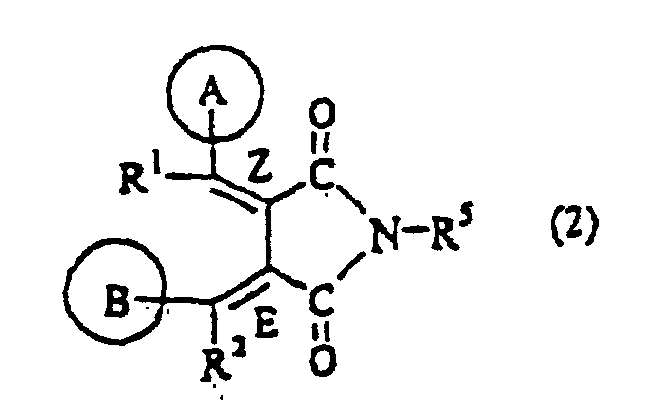 Ring B is a pyridine ring which may optionally be substituted by an oxo group, or a benzene ring which may optionally be substituted by one to three groups selected from a C1-6 alkoxy group, a C1-4 alkylenedioxy group and a di-C1-6 alkylamino group,the configuration based on the double bond binding to Ring B is trans (E)-configuration, and the configuration based on the double bond binding to Ring A is cis (Z)-configuration,R1 is a C1-6 alkyl group,R2 is a hydrogen atom,R5 is a hydrogen atom, a pyridyl-substituted C1-6 alkyl group, a di-C1-6 alkylamino-C1-6 alkyl group, a hydroxy-C1-6 alkyl group, a di-C1-6 alkylamino group, or a C1-6 alkyl-substituted piperazinyl group, or a pharmaceutically acceptable salt thereof.
 - A compound according to claim 5, wherein Ring A is a benzene ring substituted by two or three groups selected from C1-20 alkoxy group, Ring B is a pyridine ring, a benzene ring, or a C1-4 alkylenedioxy-substituted benzene ring, or a pharmaceutically acceptable salt thereof.
- A compound according to claim 5 or claim 6, wherein Ring A is a benzene ring substituted by two or three methoxy groups, R1 is a methyl group, R5 is a hydrogen atom, a pyridylmethyl group, a dimethylaminoethyl group, a hydroxyethyl group, a dimethylamino group, or a 4-methylpiperazinyl group, or a pharmaceutically acceptable salt thereof.
- A compound according to claim 2, which is selected from (1Z,3E)-1-methyl-1-(3,5-dimethoxyphenyl)-2-methoxycarbonyl-3-[N-(4-methylpiperazin-1-yl)aminocarbonyl]-4-phenylbutadiene,(1Z,3E)-1-methyl-1-(3,5-dimethoxyphenyl)-2-methoxycarbonyl-3-[N-(4-pyridyl)aminocarbonyl]-4-(3,4-methylenedioxyphenyl)butadiene,(1Z,3E)-1-methyl-1-(3,5-dimethoxyphenyl)-2-methoxycarbonyl-3-[N-(4-pyridylmethyl)aminocarbonyl]-4-phenylbutadiene,(1Z,3E)-1-methyl-1-(3-chloro-4,5-dimethoxyphenyl)-2-methoxycarbonyl-3-[N-(3-pyridylmethyl)aminocarbonyl]-4-phenylbutadiene, and(1Z,3E)-1-methyl-1-(3-chloro-4,5-dimethoxyphenyl)-2-methoxycarbonyl-3-aminocarbonyl-4-(4-pyridyl)butadiene, or a pharmaceutically acceptable salt thereof.
- (lZ,3E)-1-Methyl-1-(3,5-dimethoxyphenyl)-2-methoxycarbonyl-3-[N-(4-methylpiperazin-1-yl)aminocarbonyl]-4-phenylbutadiene, or a pharmaceutically acceptable salt thereof.
- (1Z,3E)-1-Methyl-1-(3,5-dimethoxyphenyl)-2-methoxycarbonyl-3-[N-(4-pyridyl)aminocarbonyl]-4-(3,4-methylenedioxyphenyl)butadiene, or a pharmaceutically acceptable salt thereof.
- A compound according to claim 5, which is selected from (3Z,4E)-3-(3,5-dimethoxy-α-methylbenzylidene)-4-benzylidene-1-(4-pyridylmethyl)pyrrolidine-2,5-dione,(3Z,4E)-3-(3-chloro-4,5-dimethoxy-α-methylbenzylidene)-4-(4-pyridylmethylidene)pyrrolidine-2,5-dione,(3Z,4E)-3-(3-methoxy-4-cyclopentyloxy-α-methylbenzylidene)-4-(4-pyridylmethylidene)pyrrolidine-2,5-dione,(3Z,4E)-3- (3-cyclopentyloxy-4-methoxy-α-methylbenzylidene)-4-(4-pyyridylmethylidene)pyrrolidine-2,5-dione, and(3Z,4E)-3-(3,5-dimethoxy-α-methylbenzylidene)-4-(4-pyridylmethylidene)-pyrrolidine-2,5-dione, or a pharmaceutically acceptable salt thereof.
- A process for preparing a butadiene derivative of the formula (1-a):wherein Ring A is a benzene ring substituted by one to three groups selected from a C1-6 alkyl group, a C1-20 alkoxy group, a C3-10 cycloalkyloxy group, a nitro group, a hydroxy group, a dimethylamino group, and a halogen atom,
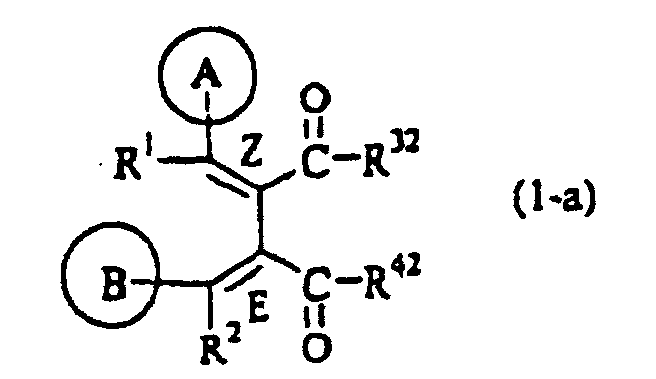 Ring B is a pyridine ring which may optionally be substituted by an oxo group, or a benzene ring which may optionally be substituted by one to three groups selected from a C1-6 alkoxy group, a C1-4 alkylenedioxy group and a di-C1-6 alkylamino group,the configuration based on the diuble bond binding to Ring B is trails (E)-configuration, and the configuration based on the double bond binding to Ring A is cis (Z)-configuration,R1 is a C1-6 alkyl group,R2 is a hydrogen atom,the group: -COR32 is a carboxyl group which is esterified, wherein the ester residue includes a C1-6 alkyl group or a C1-6 alkoxy-substituted C1-6 alkyl group,the group: -COR42 is a carboxyl group, or a pharmaceutically acceptable salt thereof, which comprises treating a diester compound of the formula (4):wherein Ring A, Ring B, the configuration based on the double bond binding to Ring B, the configuration based on the double bond binding to Ring A, R1 and R2 are the same as defined above, and a group: -COR31 and a group: -COR41 are the same or different and each are an esterified carboxyl group, with an acid or a base, if necessary, followed by converting the product into a pharmaceutically acceptable salt thereof.
- A process for preparing an amidobutadiene derivative of the formula (1-b):wherein Ring A is a benzene ring substituted by one to three groups selected from a C1-6 alkyl group, a C1-20 alkoxy group, a C3-10 cycloalkyloxy group, a nitro group, a hydroxy group, a dimethylamino group, and a halogen atom,
 Ring B is a pyridine ring which may be optionally be substituted by an oxo group, a benzene ring which may optionally be substituted by one to three groups selected from a C1-6 alkoxy group, a C1-4 alkylenedioxy group and a di-C1-6 alkylamino group,the configuration based on the double bond binding to Ring B is trans (E) -configuration, and the configuration based on the double bond binding to Ring A is cis (Z)-configuration,R1 is a C1-6 alkyl group,R2 is a hydrogen atom,the group: -COR33 is a carboxyl group which is esterified, wherein the ester residue includes a C1-6 alkyl group or a C1-6 alkoxy-substituted C1-6 alkyl group,the group: -COR43 is a carbamoyl group which may optionally be substituted by group selected from a pyridyl group, an oxo-substituted pyridyl group, an amino-substituted pyridyl group, a C1-6 alkoxy-substituted pyridyl group, a C1-6 alkyl-substituted piperidyl group, a C1-6 alkyl-substituted piperazinyl group, a piperazinyl group substituted by a C1-6 alkyl group and an oxo group, a C1-6 alkyl-substituted isoxazolyl group, a pyrazolyl group, a triazolyl group, a pyridyl-substituted C1-6 alkyl group, an oxo-substituted pyridyl-C1-6 alkyl group, a di-C1-6 alkylphenyl group, a morpholinophenyl group, a C1-6 alkylpiperazinylcarbonylphenyl group, a hydroxy-C1-6 alkyl group, and a di-C1-6 alkylamino group, or a pharmaceutically acceptable salt thereof, which comprises reacting a butadiene cmpound of the formula (1-a):wherein Ring A, Ring B, the configuration based on the double bond binding to Ring B, the configuration based on the double bond binding to Ring A, R1 and R2 are the same as defined above, the group: -COR32 is a carboxyl group which is esterified, and the group: - COR42 is a carbamyl group, or a salt thereof, with a compound of the formula (5):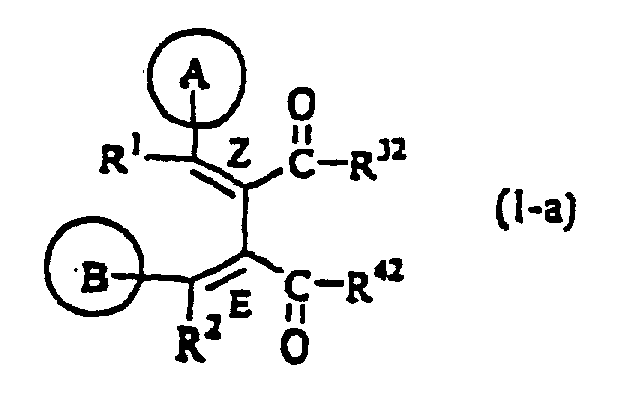
- A process for preparing a pyrrolidine derivative of the formula (2) :wherein Ring A is a benzene ring which may optionally be substituted by one to three groups selected from C1-6 alkyl group, a C1-20 alkoxy group, a C3-10 cycloalkyloxy group, a nitro group, a hydroxy group, a dimethylamino group, and a halogen atom,
 Ring B is a pyridine ring which may optionally be substituted by an oxo group, or a benzene ring which may optionally be substituted by one to three groups selected from a C1-6 alkoxy group, a C1-4 alkylenedioxy group and a di-C1-6 alkylamino group,the configuration based on the double bond binding to Ring B is trans (E)-configuration, and the configuration based on the double bond binding to Ring A is cis (Z)-configuration,R1 is a C1-6 alkyl group,R2 is a hydrogen atom,R5 is a hydrogen atom, a pyridyl-substituted C1-6 alkyl group, a di-C1-6 alkylamino-C1-6 alkyl group, a hydroxy-C1-6 alkyl group, a di-C1-6 alkylamino group or a C1-6 alkyl-substituted piperazinyl group, or a pharmaceutically acceptable salt thereof, which comprises subjecting a compound of the formula (1-c):wherein Ring A, Ring B, the configuration based on the double bond binding to Ring B, the configuration based on the double bond binding to Ring A, R1 and R2 are the same as defined above, the group: -COR34 is a. carboxyl group which may optionally be esterified, wherein the ester residue includes a C1-6 alkyl group or a C1-6 alkoxy-substituted C1-6 alkyl group, and the group: -COR44 is a carbamoyl group which may optionally be substituted by a group selected from a pyridyl-substituted C1-6 alkyl group, a di-C1-6 alkylamino-C1-6 alkyl group, a hydroxy-C1-6 alkyl group, a di-C1-6 alkylamino group, or a C1-6 alkyl-substituted piperazinyl group, or a salt thereof, to intramolecular cyclization reaction, if necessary, followed by converting the product into a pharmaceutically acceptable salt thereof.
- A process for preparing a pyrrolidine derivative of the formula (2-b):wherein Ring A is a benzene ring which may optionally be substituted by one to three groups selected from a C1-6 alkyl group, a C1-20 alkoxy group, a C3-10 cycloalkyloxy group, a nitro group, a hydroxy group, a dimethylamino group, and a halogen atom,
 Ring B is a pyridine ring which may optionally be substituted by an oxo group, or a benzene ring which may optionally be substituted by one to three groups selected from a C1-6 alkoxy group, a C1-4 alkylenedioxy group and a di-C1-6 alkylamino group,the configuration based on the double bond binding to Ring B is trans (E) -configuration, and the configuration based on the double bond binding to Ring A is cis (Z)-configuration,R1 is a C1-6 alkyl group,R2 is a hydrogen atom,R51 is a pyridyl-substituted C1-6 alkyl group, a di-C1-6, alkylamino-C1-6 alkyl group, a hydroxy-C1-6 alkyl group, a di-C1-6 alkylamino group, or a C1-6 alkyl-substituted piperazinyl group, or a pharmaceutically acceptable salt thereof, which comprises reacting a compound of the formula (2-a) :wherein Ring A, Ring B, the configuration based on the double bond binding to Ring B, the configuration based on the double bond binding to Ring A, R1 and R2 are the same as defined above, or a salt thereof, with a compound of the formula (3):
Priority Applications (1)
| Application Number | Priority Date | Filing Date | Title |
|---|---|---|---|
| SI9730354T SI0889879T1 (en) | 1996-03-29 | 1997-03-26 | Butadiene derivatives and process for preparing thereof |
Applications Claiming Priority (7)
| Application Number | Priority Date | Filing Date | Title |
|---|---|---|---|
| JP7786696 | 1996-03-29 | ||
| JP77866/96 | 1996-03-29 | ||
| JP7786696 | 1996-03-29 | ||
| JP2858197 | 1997-02-13 | ||
| JP2858197 | 1997-02-13 | ||
| JP28581/97 | 1997-02-13 | ||
| PCT/JP1997/001017 WO1997036864A1 (en) | 1996-03-29 | 1997-03-26 | Butadiene derivatives and process for preparing thereof |
Publications (2)
| Publication Number | Publication Date |
|---|---|
| EP0889879A1 EP0889879A1 (en) | 1999-01-13 |
| EP0889879B1 true EP0889879B1 (en) | 2002-06-12 |
Family
ID=26366717
Family Applications (1)
| Application Number | Title | Priority Date | Filing Date |
|---|---|---|---|
| EP97914545A Expired - Lifetime EP0889879B1 (en) | 1996-03-29 | 1997-03-26 | Butadiene derivatives and process for preparing thereof |
Country Status (26)
| Country | Link |
|---|---|
| US (1) | US6248743B1 (en) |
| EP (1) | EP0889879B1 (en) |
| KR (1) | KR100296166B1 (en) |
| CN (1) | CN1125046C (en) |
| AR (1) | AR006408A1 (en) |
| AT (1) | ATE219055T1 (en) |
| AU (1) | AU711525B2 (en) |
| BR (1) | BR9708461A (en) |
| CA (1) | CA2250391C (en) |
| CO (1) | CO4780021A1 (en) |
| CZ (1) | CZ294219B6 (en) |
| DE (1) | DE69713308T2 (en) |
| DK (1) | DK0889879T3 (en) |
| ES (1) | ES2178766T3 (en) |
| HU (1) | HUP9902650A3 (en) |
| ID (1) | ID16405A (en) |
| IL (1) | IL125654A0 (en) |
| MY (1) | MY118876A (en) |
| NO (1) | NO313280B1 (en) |
| PL (1) | PL329118A1 (en) |
| PT (1) | PT889879E (en) |
| RU (1) | RU2167863C2 (en) |
| SK (1) | SK283634B6 (en) |
| TW (1) | TW445255B (en) |
| UA (1) | UA51702C2 (en) |
| WO (1) | WO1997036864A1 (en) |
Families Citing this family (3)
| Publication number | Priority date | Publication date | Assignee | Title |
|---|---|---|---|---|
| EP0974584B1 (en) | 1997-02-21 | 2003-01-15 | Takeda Chemical Industries, Ltd. | Fused ring compounds, process for producing the same and use thereof |
| NL1015313C2 (en) | 2000-05-26 | 2001-11-27 | Dsm Nv | Process for the preparation of enantiomerically enriched esters and alcohols. |
| CN1522248A (en) * | 2001-07-03 | 2004-08-18 | 田边制药株式会社 | Novel butadiene derivative, process for preparing the same and intermediate for synthesizing the same |
Family Cites Families (5)
| Publication number | Priority date | Publication date | Assignee | Title |
|---|---|---|---|---|
| EP0043150A1 (en) * | 1980-06-24 | 1982-01-06 | Akzo N.V. | Pharmaceutical 2,3 -bis-hydroxybenzyl butane derivatives |
| EP0420397B1 (en) * | 1989-07-28 | 1995-11-29 | Wako Pure Chemical Industries Ltd | Fulgimide derivatives |
| FR2685325B1 (en) * | 1991-12-20 | 1994-02-04 | Adir Cie | NOVEL PYRROLIDINE DERIVATIVES, THEIR PREPARATION PROCESS AND THE PHARMACEUTICAL COMPOSITIONS CONTAINING THEM. |
| AU658271B2 (en) * | 1992-03-26 | 1995-04-06 | Tanabe Seiyaku Co., Ltd. | Butadiene derivatives and process for preparing the same |
| DE59300200D1 (en) * | 1992-03-30 | 1995-06-22 | Kabelmetal Electro Gmbh | Device for signal transmission between two relatively movable end points. |
-
1997
- 1997-03-21 CO CO97015550A patent/CO4780021A1/en unknown
- 1997-03-21 MY MYPI97001205A patent/MY118876A/en unknown
- 1997-03-26 UA UA98105630A patent/UA51702C2/en unknown
- 1997-03-26 EP EP97914545A patent/EP0889879B1/en not_active Expired - Lifetime
- 1997-03-26 PT PT97914545T patent/PT889879E/en unknown
- 1997-03-26 AU AU21762/97A patent/AU711525B2/en not_active Ceased
- 1997-03-26 SK SK1335-98A patent/SK283634B6/en unknown
- 1997-03-26 KR KR1019980706921A patent/KR100296166B1/en not_active Expired - Fee Related
- 1997-03-26 AT AT97914545T patent/ATE219055T1/en not_active IP Right Cessation
- 1997-03-26 WO PCT/JP1997/001017 patent/WO1997036864A1/en not_active Ceased
- 1997-03-26 CN CN97193349A patent/CN1125046C/en not_active Expired - Fee Related
- 1997-03-26 PL PL97329118A patent/PL329118A1/en unknown
- 1997-03-26 CZ CZ19983082A patent/CZ294219B6/en not_active IP Right Cessation
- 1997-03-26 DE DE69713308T patent/DE69713308T2/en not_active Expired - Fee Related
- 1997-03-26 HU HU9902650A patent/HUP9902650A3/en unknown
- 1997-03-26 RU RU98119721/04A patent/RU2167863C2/en not_active IP Right Cessation
- 1997-03-26 IL IL12565497A patent/IL125654A0/en not_active IP Right Cessation
- 1997-03-26 BR BR9708461A patent/BR9708461A/en not_active Application Discontinuation
- 1997-03-26 CA CA002250391A patent/CA2250391C/en not_active Expired - Fee Related
- 1997-03-26 AR ARP970101220A patent/AR006408A1/en active IP Right Grant
- 1997-03-26 ES ES97914545T patent/ES2178766T3/en not_active Expired - Lifetime
- 1997-03-26 DK DK97914545T patent/DK0889879T3/en active
- 1997-03-27 ID IDP971012A patent/ID16405A/en unknown
- 1997-03-28 TW TW086104005A patent/TW445255B/en not_active IP Right Cessation
-
1998
- 1998-08-28 US US09/143,358 patent/US6248743B1/en not_active Expired - Fee Related
- 1998-09-28 NO NO19984525A patent/NO313280B1/en unknown
Non-Patent Citations (2)
| Title |
|---|
| NISHIYAMA A. ET AL: "Anodic oxidation of 4-hydrocinnamic acids and related phenols", CHEMICAL & PHARMACEUTICAL BULLETIN, vol. 31, no. 8, 1983, pages 2845 - 2852 * |
| SAKAKIBARA I. ET AL: "Three acyclic bis-phenylpropane lignanamides from fruits of cannabis sativa", PHYTOCHEMISTRY, vol. 38, no. 4, 1995, pages 1003 - 1007 * |
Also Published As
Similar Documents
| Publication | Publication Date | Title |
|---|---|---|
| KR101762574B1 (en) | Plasminogen activator inhibitor-1 inhibitor | |
| US6323227B1 (en) | Substituted N-[(aminoiminomethyl or aminomethyl)phenyl]propyl amides | |
| EP0906094B1 (en) | Substituted n- (aminoiminomethyl or aminomethyl)phenyl]propyl amides | |
| JP3176365B2 (en) | Benzenesulfonamide derivative | |
| AU750734B2 (en) | D-proline derivatives | |
| US4873253A (en) | Phenylalanine derivative and proteinase inhibitor | |
| IL128653A (en) | Substituted n-[(aminoiminomethyl or aminomethyl) phenyl] propyl amide compounds and pharmaceutical compositions containing them | |
| CA2268917A1 (en) | New derivates from piperidine-keto acid, their preparation and use | |
| WO2004063202A1 (en) | Fused furan compound | |
| JP2001500533A (en) | Matrix metalloproteinase inhibitors | |
| US5514815A (en) | Succinimide derivatives and process for preparing the same | |
| HUP0101482A2 (en) | Piperidinyl and n-amidinopiperidinyl derivatives, use of them for producing pharmaceutical compositions and pharmaceutical compositions containing the same | |
| US6248743B1 (en) | Butadiene derivatives and process for preparing thereof | |
| JPH08188563A (en) | Anthranilic acid derivative | |
| CN101094835B (en) | Diamide derivatives | |
| JP3237107B2 (en) | Butadiene derivative and method for producing the same | |
| HK1015762B (en) | Butadiene derivatives and process for preparing thereof | |
| CN117480164B (en) | Coagulation factor XIa inhibitor and preparation method and application thereof | |
| CA2092017A1 (en) | Butadiene derivatives and process for preparing the same | |
| JPH05294930A (en) | Styryl compound | |
| JPH11189530A (en) | Pharmaceutical composition | |
| JP2541420B2 (en) | 3-Butenoic acid derivative and process for producing the same | |
| JPH05279324A (en) | 2,5-pyrrolidinedione derivative and its production | |
| JPWO1997045413A1 (en) | Substituted amidinobenzene derivatives and pharmaceutical compositions thereof | |
| JPH05279309A (en) | 3-Butenoic acid derivative and process for producing the same |
Legal Events
| Date | Code | Title | Description |
|---|---|---|---|
| PUAI | Public reference made under article 153(3) epc to a published international application that has entered the european phase |
Free format text: ORIGINAL CODE: 0009012 |
|
| 17P | Request for examination filed |
Effective date: 19980817 |
|
| AK | Designated contracting states |
Kind code of ref document: A1 Designated state(s): AT BE CH DE DK ES FI FR GB GR IE IT LI LU MC NL PT SE |
|
| AX | Request for extension of the european patent |
Free format text: AL PAYMENT 980817;LT PAYMENT 980817;LV PAYMENT 980817;SI PAYMENT 980817 |
|
| 17Q | First examination report despatched |
Effective date: 20000809 |
|
| GRAG | Despatch of communication of intention to grant |
Free format text: ORIGINAL CODE: EPIDOS AGRA |
|
| GRAG | Despatch of communication of intention to grant |
Free format text: ORIGINAL CODE: EPIDOS AGRA |
|
| GRAG | Despatch of communication of intention to grant |
Free format text: ORIGINAL CODE: EPIDOS AGRA |
|
| GRAG | Despatch of communication of intention to grant |
Free format text: ORIGINAL CODE: EPIDOS AGRA |
|
| GRAH | Despatch of communication of intention to grant a patent |
Free format text: ORIGINAL CODE: EPIDOS IGRA |
|
| GRAH | Despatch of communication of intention to grant a patent |
Free format text: ORIGINAL CODE: EPIDOS IGRA |
|
| GRAA | (expected) grant |
Free format text: ORIGINAL CODE: 0009210 |
|
| AK | Designated contracting states |
Kind code of ref document: B1 Designated state(s): AT BE CH DE DK ES FI FR GB GR IE IT LI LU MC NL PT SE |
|
| AX | Request for extension of the european patent |
Free format text: AL PAYMENT 19980817;LT PAYMENT 19980817;LV PAYMENT 19980817;SI PAYMENT 19980817 |
|
| REF | Corresponds to: |
Ref document number: 219055 Country of ref document: AT Date of ref document: 20020615 Kind code of ref document: T |
|
| REG | Reference to a national code |
Ref country code: GB Ref legal event code: FG4D |
|
| REG | Reference to a national code |
Ref country code: CH Ref legal event code: EP |
|
| REG | Reference to a national code |
Ref country code: CH Ref legal event code: NV Representative=s name: BOVARD AG PATENTANWAELTE |
|
| REF | Corresponds to: |
Ref document number: 69713308 Country of ref document: DE Date of ref document: 20020718 |
|
| REG | Reference to a national code |
Ref country code: IE Ref legal event code: FG4D |
|
| REG | Reference to a national code |
Ref country code: DK Ref legal event code: T3 |
|
| REG | Reference to a national code |
Ref country code: PT Ref legal event code: SC4A Free format text: AVAILABILITY OF NATIONAL TRANSLATION Effective date: 20020618 |
|
| REG | Reference to a national code |
Ref country code: GR Ref legal event code: EP Ref document number: 20020402727 Country of ref document: GR |
|
| ET | Fr: translation filed | ||
| REG | Reference to a national code |
Ref country code: ES Ref legal event code: FG2A Ref document number: 2178766 Country of ref document: ES Kind code of ref document: T3 |
|
| PLBE | No opposition filed within time limit |
Free format text: ORIGINAL CODE: 0009261 |
|
| STAA | Information on the status of an ep patent application or granted ep patent |
Free format text: STATUS: NO OPPOSITION FILED WITHIN TIME LIMIT |
|
| 26N | No opposition filed |
Effective date: 20030313 |
|
| REG | Reference to a national code |
Ref country code: SI Ref legal event code: IF |
|
| PGFP | Annual fee paid to national office [announced via postgrant information from national office to epo] |
Ref country code: IE Payment date: 20050131 Year of fee payment: 9 |
|
| PGFP | Annual fee paid to national office [announced via postgrant information from national office to epo] |
Ref country code: PT Payment date: 20050202 Year of fee payment: 9 |
|
| PGFP | Annual fee paid to national office [announced via postgrant information from national office to epo] |
Ref country code: MC Payment date: 20050214 Year of fee payment: 9 |
|
| PGFP | Annual fee paid to national office [announced via postgrant information from national office to epo] |
Ref country code: BE Payment date: 20050217 Year of fee payment: 9 |
|
| PGFP | Annual fee paid to national office [announced via postgrant information from national office to epo] |
Ref country code: GR Payment date: 20050222 Year of fee payment: 9 |
|
| PGFP | Annual fee paid to national office [announced via postgrant information from national office to epo] |
Ref country code: FI Payment date: 20050223 Year of fee payment: 9 |
|
| PGFP | Annual fee paid to national office [announced via postgrant information from national office to epo] |
Ref country code: SE Payment date: 20050304 Year of fee payment: 9 |
|
| PGFP | Annual fee paid to national office [announced via postgrant information from national office to epo] |
Ref country code: DK Payment date: 20050308 Year of fee payment: 9 |
|
| PGFP | Annual fee paid to national office [announced via postgrant information from national office to epo] |
Ref country code: CH Payment date: 20050309 Year of fee payment: 9 |
|
| PGFP | Annual fee paid to national office [announced via postgrant information from national office to epo] |
Ref country code: GB Payment date: 20050314 Year of fee payment: 9 |
|
| PGFP | Annual fee paid to national office [announced via postgrant information from national office to epo] |
Ref country code: LU Payment date: 20050316 Year of fee payment: 9 |
|
| PGFP | Annual fee paid to national office [announced via postgrant information from national office to epo] |
Ref country code: DE Payment date: 20050323 Year of fee payment: 9 Ref country code: AT Payment date: 20050323 Year of fee payment: 9 |
|
| PGFP | Annual fee paid to national office [announced via postgrant information from national office to epo] |
Ref country code: FR Payment date: 20050330 Year of fee payment: 9 |
|
| PGFP | Annual fee paid to national office [announced via postgrant information from national office to epo] |
Ref country code: ES Payment date: 20050331 Year of fee payment: 9 Ref country code: NL Payment date: 20050331 Year of fee payment: 9 |
|
| PG25 | Lapsed in a contracting state [announced via postgrant information from national office to epo] |
Ref country code: GB Free format text: LAPSE BECAUSE OF NON-PAYMENT OF DUE FEES Effective date: 20060326 Ref country code: FI Free format text: LAPSE BECAUSE OF NON-PAYMENT OF DUE FEES Effective date: 20060326 Ref country code: AT Free format text: LAPSE BECAUSE OF NON-PAYMENT OF DUE FEES Effective date: 20060326 |
|
| PG25 | Lapsed in a contracting state [announced via postgrant information from national office to epo] |
Ref country code: SE Free format text: LAPSE BECAUSE OF NON-PAYMENT OF DUE FEES Effective date: 20060327 Ref country code: IE Free format text: LAPSE BECAUSE OF NON-PAYMENT OF DUE FEES Effective date: 20060327 Ref country code: ES Free format text: LAPSE BECAUSE OF NON-PAYMENT OF DUE FEES Effective date: 20060327 |
|
| PG25 | Lapsed in a contracting state [announced via postgrant information from national office to epo] |
Ref country code: MC Free format text: LAPSE BECAUSE OF NON-PAYMENT OF DUE FEES Effective date: 20060331 Ref country code: LU Free format text: LAPSE BECAUSE OF NON-PAYMENT OF DUE FEES Effective date: 20060331 Ref country code: LI Free format text: LAPSE BECAUSE OF NON-PAYMENT OF DUE FEES Effective date: 20060331 Ref country code: DK Free format text: LAPSE BECAUSE OF NON-PAYMENT OF DUE FEES Effective date: 20060331 Ref country code: CH Free format text: LAPSE BECAUSE OF NON-PAYMENT OF DUE FEES Effective date: 20060331 Ref country code: BE Free format text: LAPSE BECAUSE OF NON-PAYMENT OF DUE FEES Effective date: 20060331 |
|
| PGFP | Annual fee paid to national office [announced via postgrant information from national office to epo] |
Ref country code: IT Payment date: 20060331 Year of fee payment: 10 |
|
| PG25 | Lapsed in a contracting state [announced via postgrant information from national office to epo] |
Ref country code: PT Free format text: LAPSE BECAUSE OF NON-PAYMENT OF DUE FEES Effective date: 20060926 |
|
| PG25 | Lapsed in a contracting state [announced via postgrant information from national office to epo] |
Ref country code: NL Free format text: LAPSE BECAUSE OF NON-PAYMENT OF DUE FEES Effective date: 20061001 |
|
| PG25 | Lapsed in a contracting state [announced via postgrant information from national office to epo] |
Ref country code: DE Free format text: LAPSE BECAUSE OF NON-PAYMENT OF DUE FEES Effective date: 20061003 |
|
| REG | Reference to a national code |
Ref country code: DK Ref legal event code: EBP |
|
| REG | Reference to a national code |
Ref country code: CH Ref legal event code: PL |
|
| EUG | Se: european patent has lapsed | ||
| LTLA | Lt: lapse of european patent or patent extension |
Effective date: 20060326 |
|
| GBPC | Gb: european patent ceased through non-payment of renewal fee |
Effective date: 20060326 |
|
| REG | Reference to a national code |
Ref country code: PT Ref legal event code: MM4A Free format text: LAPSE DUE TO NON-PAYMENT OF FEES Effective date: 20060926 |
|
| NLV4 | Nl: lapsed or anulled due to non-payment of the annual fee |
Effective date: 20061001 |
|
| REG | Reference to a national code |
Ref country code: IE Ref legal event code: MM4A |
|
| REG | Reference to a national code |
Ref country code: FR Ref legal event code: ST Effective date: 20061130 |
|
| REG | Reference to a national code |
Ref country code: SI Ref legal event code: KO00 Effective date: 20070221 |
|
| REG | Reference to a national code |
Ref country code: ES Ref legal event code: FD2A Effective date: 20060327 |
|
| BERE | Be: lapsed |
Owner name: *TANABE SEIYAKU CO. LTD Effective date: 20060331 |
|
| PG25 | Lapsed in a contracting state [announced via postgrant information from national office to epo] |
Ref country code: FR Free format text: LAPSE BECAUSE OF NON-PAYMENT OF DUE FEES Effective date: 20060331 |
|
| PG25 | Lapsed in a contracting state [announced via postgrant information from national office to epo] |
Ref country code: GR Free format text: LAPSE BECAUSE OF NON-PAYMENT OF DUE FEES Effective date: 20061002 |
|
| PG25 | Lapsed in a contracting state [announced via postgrant information from national office to epo] |
Ref country code: IT Free format text: LAPSE BECAUSE OF NON-PAYMENT OF DUE FEES Effective date: 20070326 |