EP0888402B1 - (hydroxyalkyl)urea crosslinking agents - Google Patents
(hydroxyalkyl)urea crosslinking agents Download PDFInfo
- Publication number
- EP0888402B1 EP0888402B1 EP19980901789 EP98901789A EP0888402B1 EP 0888402 B1 EP0888402 B1 EP 0888402B1 EP 19980901789 EP19980901789 EP 19980901789 EP 98901789 A EP98901789 A EP 98901789A EP 0888402 B1 EP0888402 B1 EP 0888402B1
- Authority
- EP
- European Patent Office
- Prior art keywords
- urea
- hydroxyethyl
- bis
- crosslinking agent
- group
- Prior art date
- Legal status (The legal status is an assumption and is not a legal conclusion. Google has not performed a legal analysis and makes no representation as to the accuracy of the status listed.)
- Expired - Lifetime
Links
- 239000003431 cross linking reagent Substances 0.000 title claims abstract description 46
- XSQUKJJJFZCRTK-UHFFFAOYSA-N Urea Chemical compound NC(N)=O XSQUKJJJFZCRTK-UHFFFAOYSA-N 0.000 title claims abstract description 30
- 239000004202 carbamide Substances 0.000 title abstract description 14
- 125000002768 hydroxyalkyl group Chemical group 0.000 title abstract description 9
- 239000000203 mixture Substances 0.000 claims abstract description 34
- 125000002887 hydroxy group Chemical group [H]O* 0.000 claims abstract description 29
- 125000000524 functional group Chemical group 0.000 claims abstract description 19
- 150000001412 amines Chemical group 0.000 claims abstract description 15
- 125000003178 carboxy group Chemical group [H]OC(*)=O 0.000 claims abstract description 12
- 150000008064 anhydrides Chemical group 0.000 claims abstract description 11
- 125000004432 carbon atom Chemical group C* 0.000 claims abstract description 7
- -1 where R8 is H Chemical group 0.000 claims description 57
- 238000004132 cross linking Methods 0.000 claims description 37
- WSFSSNUMVMOOMR-UHFFFAOYSA-N Formaldehyde Chemical compound O=C WSFSSNUMVMOOMR-UHFFFAOYSA-N 0.000 claims description 36
- BQMXKMPREFOYHS-UHFFFAOYSA-N 1,1-bis(2-hydroxyethyl)urea Chemical compound OCCN(C(=O)N)CCO BQMXKMPREFOYHS-UHFFFAOYSA-N 0.000 claims description 25
- 239000003054 catalyst Substances 0.000 claims description 25
- 238000000034 method Methods 0.000 claims description 13
- 125000001495 ethyl group Chemical group [H]C([H])([H])C([H])([H])* 0.000 claims description 8
- 125000002496 methyl group Chemical group [H]C([H])([H])* 0.000 claims description 7
- GRHQBTVCBZRVCM-UHFFFAOYSA-N 1,1,3,3-tetrakis(2-hydroxyethyl)urea Chemical compound OCCN(CCO)C(=O)N(CCO)CCO GRHQBTVCBZRVCM-UHFFFAOYSA-N 0.000 claims description 6
- KSYGJAFGQWTAFW-UHFFFAOYSA-N 1,3-bis(2-hydroxyethyl)urea Chemical compound OCCNC(=O)NCCO KSYGJAFGQWTAFW-UHFFFAOYSA-N 0.000 claims description 6
- CBOIHMRHGLHBPB-UHFFFAOYSA-N hydroxymethyl Chemical compound O[CH2] CBOIHMRHGLHBPB-UHFFFAOYSA-N 0.000 claims description 6
- 125000004178 (C1-C4) alkyl group Chemical group 0.000 claims description 5
- VKUPKRKGNSEUNN-UHFFFAOYSA-N 1,1,3-tris(2-hydroxyethyl)urea Chemical compound OCCNC(=O)N(CCO)CCO VKUPKRKGNSEUNN-UHFFFAOYSA-N 0.000 claims description 5
- HUEPEXWUAVEESY-UHFFFAOYSA-N 1,3-bis(3-hydroxypropyl)urea Chemical compound OCCCNC(=O)NCCCO HUEPEXWUAVEESY-UHFFFAOYSA-N 0.000 claims description 5
- 239000002841 Lewis acid Substances 0.000 claims description 5
- 239000002879 Lewis base Substances 0.000 claims description 5
- 150000007517 lewis acids Chemical class 0.000 claims description 5
- 150000007527 lewis bases Chemical class 0.000 claims description 5
- SYSQOLNYEICLCA-UHFFFAOYSA-N 1,3-bis(4-hydroxybutyl)urea Chemical compound OCCCCNC(=O)NCCCCO SYSQOLNYEICLCA-UHFFFAOYSA-N 0.000 claims description 4
- 238000004519 manufacturing process Methods 0.000 claims description 2
- 239000004971 Cross linker Substances 0.000 description 66
- XLYOFNOQVPJJNP-UHFFFAOYSA-N water Substances O XLYOFNOQVPJJNP-UHFFFAOYSA-N 0.000 description 27
- 229920000642 polymer Polymers 0.000 description 25
- 229920002125 Sokalan® Polymers 0.000 description 17
- 229920001577 copolymer Polymers 0.000 description 14
- 238000006243 chemical reaction Methods 0.000 description 12
- 239000002904 solvent Substances 0.000 description 12
- XTXRWKRVRITETP-UHFFFAOYSA-N Vinyl acetate Chemical compound CC(=O)OC=C XTXRWKRVRITETP-UHFFFAOYSA-N 0.000 description 11
- PPBRXRYQALVLMV-UHFFFAOYSA-N Styrene Chemical compound C=CC1=CC=CC=C1 PPBRXRYQALVLMV-UHFFFAOYSA-N 0.000 description 10
- ZBCBWPMODOFKDW-UHFFFAOYSA-N diethanolamine Chemical compound OCCNCCO ZBCBWPMODOFKDW-UHFFFAOYSA-N 0.000 description 7
- 238000011065 in-situ storage Methods 0.000 description 7
- 239000000758 substrate Substances 0.000 description 7
- 229920002126 Acrylic acid copolymer Polymers 0.000 description 6
- LFQSCWFLJHTTHZ-UHFFFAOYSA-N Ethanol Chemical compound CCO LFQSCWFLJHTTHZ-UHFFFAOYSA-N 0.000 description 6
- PEDCQBHIVMGVHV-UHFFFAOYSA-N Glycerine Chemical compound OCC(O)CO PEDCQBHIVMGVHV-UHFFFAOYSA-N 0.000 description 6
- KRKNYBCHXYNGOX-UHFFFAOYSA-N citric acid Chemical compound OC(=O)CC(O)(C(O)=O)CC(O)=O KRKNYBCHXYNGOX-UHFFFAOYSA-N 0.000 description 6
- CYIDZMCFTVVTJO-UHFFFAOYSA-N pyromellitic acid Chemical compound OC(=O)C1=CC(C(O)=O)=C(C(O)=O)C=C1C(O)=O CYIDZMCFTVVTJO-UHFFFAOYSA-N 0.000 description 6
- 238000002411 thermogravimetry Methods 0.000 description 6
- ARCGXLSVLAOJQL-UHFFFAOYSA-N trimellitic acid Chemical compound OC(=O)C1=CC=C(C(O)=O)C(C(O)=O)=C1 ARCGXLSVLAOJQL-UHFFFAOYSA-N 0.000 description 6
- VGGSQFUCUMXWEO-UHFFFAOYSA-N Ethene Chemical compound C=C VGGSQFUCUMXWEO-UHFFFAOYSA-N 0.000 description 5
- 239000005977 Ethylene Substances 0.000 description 5
- OAICVXFJPJFONN-UHFFFAOYSA-N Phosphorus Chemical compound [P] OAICVXFJPJFONN-UHFFFAOYSA-N 0.000 description 5
- VYPSYNLAJGMNEJ-UHFFFAOYSA-N Silicium dioxide Chemical compound O=[Si]=O VYPSYNLAJGMNEJ-UHFFFAOYSA-N 0.000 description 5
- NIXOWILDQLNWCW-UHFFFAOYSA-N acrylic acid group Chemical group C(C=C)(=O)O NIXOWILDQLNWCW-UHFFFAOYSA-N 0.000 description 5
- LVHBHZANLOWSRM-UHFFFAOYSA-N methylenebutanedioic acid Natural products OC(=O)CC(=C)C(O)=O LVHBHZANLOWSRM-UHFFFAOYSA-N 0.000 description 5
- 229910052698 phosphorus Inorganic materials 0.000 description 5
- 239000011574 phosphorus Substances 0.000 description 5
- 239000000243 solution Substances 0.000 description 5
- CSCPPACGZOOCGX-UHFFFAOYSA-N Acetone Chemical compound CC(C)=O CSCPPACGZOOCGX-UHFFFAOYSA-N 0.000 description 4
- GVNWZKBFMFUVNX-UHFFFAOYSA-N Adipamide Chemical compound NC(=O)CCCCC(N)=O GVNWZKBFMFUVNX-UHFFFAOYSA-N 0.000 description 4
- QGZKDVFQNNGYKY-UHFFFAOYSA-N Ammonia Chemical compound N QGZKDVFQNNGYKY-UHFFFAOYSA-N 0.000 description 4
- CERQOIWHTDAKMF-UHFFFAOYSA-N Methacrylic acid Chemical compound CC(=C)C(O)=O CERQOIWHTDAKMF-UHFFFAOYSA-N 0.000 description 4
- VVQNEPGJFQJSBK-UHFFFAOYSA-N Methyl methacrylate Chemical compound COC(=O)C(C)=C VVQNEPGJFQJSBK-UHFFFAOYSA-N 0.000 description 4
- 239000002253 acid Substances 0.000 description 4
- 229910052783 alkali metal Inorganic materials 0.000 description 4
- 238000000576 coating method Methods 0.000 description 4
- 239000011521 glass Substances 0.000 description 4
- 239000000047 product Substances 0.000 description 4
- SMZOUWXMTYCWNB-UHFFFAOYSA-N 2-(2-methoxy-5-methylphenyl)ethanamine Chemical compound COC1=CC=C(C)C=C1CCN SMZOUWXMTYCWNB-UHFFFAOYSA-N 0.000 description 3
- HZAXFHJVJLSVMW-UHFFFAOYSA-N 2-Aminoethan-1-ol Chemical compound NCCO HZAXFHJVJLSVMW-UHFFFAOYSA-N 0.000 description 3
- KWSLGOVYXMQPPX-UHFFFAOYSA-N 5-[3-(trifluoromethyl)phenyl]-2h-tetrazole Chemical compound FC(F)(F)C1=CC=CC(C2=NNN=N2)=C1 KWSLGOVYXMQPPX-UHFFFAOYSA-N 0.000 description 3
- OKKJLVBELUTLKV-UHFFFAOYSA-N Methanol Chemical compound OC OKKJLVBELUTLKV-UHFFFAOYSA-N 0.000 description 3
- 230000008901 benefit Effects 0.000 description 3
- CQEYYJKEWSMYFG-UHFFFAOYSA-N butyl acrylate Chemical compound CCCCOC(=O)C=C CQEYYJKEWSMYFG-UHFFFAOYSA-N 0.000 description 3
- 150000001732 carboxylic acid derivatives Chemical class 0.000 description 3
- IEJIGPNLZYLLBP-UHFFFAOYSA-N dimethyl carbonate Chemical compound COC(=O)OC IEJIGPNLZYLLBP-UHFFFAOYSA-N 0.000 description 3
- 238000010438 heat treatment Methods 0.000 description 3
- FPYJFEHAWHCUMM-UHFFFAOYSA-N maleic anhydride Chemical compound O=C1OC(=O)C=C1 FPYJFEHAWHCUMM-UHFFFAOYSA-N 0.000 description 3
- 239000000123 paper Substances 0.000 description 3
- 238000002360 preparation method Methods 0.000 description 3
- 229910001379 sodium hypophosphite Inorganic materials 0.000 description 3
- 229920002554 vinyl polymer Polymers 0.000 description 3
- JAHNSTQSQJOJLO-UHFFFAOYSA-N 2-(3-fluorophenyl)-1h-imidazole Chemical compound FC1=CC=CC(C=2NC=CN=2)=C1 JAHNSTQSQJOJLO-UHFFFAOYSA-N 0.000 description 2
- IOAOAKDONABGPZ-UHFFFAOYSA-N 2-amino-2-ethylpropane-1,3-diol Chemical compound CCC(N)(CO)CO IOAOAKDONABGPZ-UHFFFAOYSA-N 0.000 description 2
- RLHGFJMGWQXPBW-UHFFFAOYSA-N 2-hydroxy-3-(1h-imidazol-5-ylmethyl)benzamide Chemical compound NC(=O)C1=CC=CC(CC=2NC=NC=2)=C1O RLHGFJMGWQXPBW-UHFFFAOYSA-N 0.000 description 2
- IJGRMHOSHXDMSA-UHFFFAOYSA-N Atomic nitrogen Chemical compound N#N IJGRMHOSHXDMSA-UHFFFAOYSA-N 0.000 description 2
- KAKZBPTYRLMSJV-UHFFFAOYSA-N Butadiene Chemical compound C=CC=C KAKZBPTYRLMSJV-UHFFFAOYSA-N 0.000 description 2
- VEXZGXHMUGYJMC-UHFFFAOYSA-N Hydrochloric acid Chemical compound Cl VEXZGXHMUGYJMC-UHFFFAOYSA-N 0.000 description 2
- OPKOKAMJFNKNAS-UHFFFAOYSA-N N-methylethanolamine Chemical compound CNCCO OPKOKAMJFNKNAS-UHFFFAOYSA-N 0.000 description 2
- 229920002873 Polyethylenimine Polymers 0.000 description 2
- WCUXLLCKKVVCTQ-UHFFFAOYSA-M Potassium chloride Chemical compound [Cl-].[K+] WCUXLLCKKVVCTQ-UHFFFAOYSA-M 0.000 description 2
- QAOWNCQODCNURD-UHFFFAOYSA-N Sulfuric acid Chemical compound OS(O)(=O)=O QAOWNCQODCNURD-UHFFFAOYSA-N 0.000 description 2
- 244000105017 Vicia sativa Species 0.000 description 2
- 150000007513 acids Chemical class 0.000 description 2
- 239000000853 adhesive Substances 0.000 description 2
- 230000001070 adhesive effect Effects 0.000 description 2
- 125000000217 alkyl group Chemical group 0.000 description 2
- 229910021529 ammonia Inorganic materials 0.000 description 2
- 239000011230 binding agent Substances 0.000 description 2
- 239000006227 byproduct Substances 0.000 description 2
- 229960004106 citric acid Drugs 0.000 description 2
- 150000001875 compounds Chemical class 0.000 description 2
- LDHQCZJRKDOVOX-NSCUHMNNSA-N crotonic acid Chemical compound C\C=C\C(O)=O LDHQCZJRKDOVOX-NSCUHMNNSA-N 0.000 description 2
- 239000000839 emulsion Substances 0.000 description 2
- 230000032050 esterification Effects 0.000 description 2
- 238000005886 esterification reaction Methods 0.000 description 2
- 238000011156 evaluation Methods 0.000 description 2
- 239000011152 fibreglass Substances 0.000 description 2
- 229920001002 functional polymer Polymers 0.000 description 2
- 239000003365 glass fiber Substances 0.000 description 2
- 230000001939 inductive effect Effects 0.000 description 2
- 239000007788 liquid Substances 0.000 description 2
- 229910052751 metal Inorganic materials 0.000 description 2
- 239000002184 metal Substances 0.000 description 2
- 238000000470 piezoresponse force microscopy Methods 0.000 description 2
- 229920000728 polyester Polymers 0.000 description 2
- 239000000843 powder Substances 0.000 description 2
- 238000000746 purification Methods 0.000 description 2
- 239000004576 sand Substances 0.000 description 2
- 229920001059 synthetic polymer Polymers 0.000 description 2
- VDZOOKBUILJEDG-UHFFFAOYSA-M tetrabutylammonium hydroxide Chemical compound [OH-].CCCC[N+](CCCC)(CCCC)CCCC VDZOOKBUILJEDG-UHFFFAOYSA-M 0.000 description 2
- 239000004753 textile Substances 0.000 description 2
- 238000001757 thermogravimetry curve Methods 0.000 description 2
- LDHQCZJRKDOVOX-UHFFFAOYSA-N trans-crotonic acid Natural products CC=CC(O)=O LDHQCZJRKDOVOX-UHFFFAOYSA-N 0.000 description 2
- 125000000391 vinyl group Chemical group [H]C([*])=C([H])[H] 0.000 description 2
- 239000012855 volatile organic compound Substances 0.000 description 2
- 125000004209 (C1-C8) alkyl group Chemical group 0.000 description 1
- OQBLGYCUQGDOOR-UHFFFAOYSA-L 1,3,2$l^{2}-dioxastannolane-4,5-dione Chemical compound O=C1O[Sn]OC1=O OQBLGYCUQGDOOR-UHFFFAOYSA-L 0.000 description 1
- GOXQRTZXKQZDDN-UHFFFAOYSA-N 2-Ethylhexyl acrylate Chemical compound CCCCC(CC)COC(=O)C=C GOXQRTZXKQZDDN-UHFFFAOYSA-N 0.000 description 1
- UXFQFBNBSPQBJW-UHFFFAOYSA-N 2-amino-2-methylpropane-1,3-diol Chemical compound OCC(N)(C)CO UXFQFBNBSPQBJW-UHFFFAOYSA-N 0.000 description 1
- DHVBMEDBXREIAW-UHFFFAOYSA-N 2-aminoethanol;2-(2-hydroxyethylamino)ethanol Chemical compound NCCO.OCCNCCO DHVBMEDBXREIAW-UHFFFAOYSA-N 0.000 description 1
- IIFFFBSAXDNJHX-UHFFFAOYSA-N 2-methyl-n,n-bis(2-methylpropyl)propan-1-amine Chemical compound CC(C)CN(CC(C)C)CC(C)C IIFFFBSAXDNJHX-UHFFFAOYSA-N 0.000 description 1
- FVXBTPGZQMNAEZ-UHFFFAOYSA-N 3-amino-2-methylpropan-1-ol Chemical compound NCC(C)CO FVXBTPGZQMNAEZ-UHFFFAOYSA-N 0.000 description 1
- CYUZOYPRAQASLN-UHFFFAOYSA-N 3-prop-2-enoyloxypropanoic acid Chemical compound OC(=O)CCOC(=O)C=C CYUZOYPRAQASLN-UHFFFAOYSA-N 0.000 description 1
- BLFRQYKZFKYQLO-UHFFFAOYSA-N 4-aminobutan-1-ol Chemical compound NCCCCO BLFRQYKZFKYQLO-UHFFFAOYSA-N 0.000 description 1
- LMRKVKPRHROQRR-UHFFFAOYSA-N 4-butylmorpholine Chemical compound CCCCN1CCOCC1 LMRKVKPRHROQRR-UHFFFAOYSA-N 0.000 description 1
- 239000005995 Aluminium silicate Substances 0.000 description 1
- CKDWPUIZGOQOOM-UHFFFAOYSA-N Carbamyl chloride Chemical compound NC(Cl)=O CKDWPUIZGOQOOM-UHFFFAOYSA-N 0.000 description 1
- YASYEJJMZJALEJ-UHFFFAOYSA-N Citric acid monohydrate Chemical compound O.OC(=O)CC(O)(C(O)=O)CC(O)=O YASYEJJMZJALEJ-UHFFFAOYSA-N 0.000 description 1
- 229920000742 Cotton Polymers 0.000 description 1
- 239000004908 Emulsion polymer Substances 0.000 description 1
- JIGUQPWFLRLWPJ-UHFFFAOYSA-N Ethyl acrylate Chemical compound CCOC(=O)C=C JIGUQPWFLRLWPJ-UHFFFAOYSA-N 0.000 description 1
- 239000004716 Ethylene/acrylic acid copolymer Substances 0.000 description 1
- 229920000877 Melamine resin Polymers 0.000 description 1
- BPQQTUXANYXVAA-UHFFFAOYSA-N Orthosilicate Chemical compound [O-][Si]([O-])([O-])[O-] BPQQTUXANYXVAA-UHFFFAOYSA-N 0.000 description 1
- 240000005428 Pistacia lentiscus Species 0.000 description 1
- 239000004952 Polyamide Substances 0.000 description 1
- 239000004642 Polyimide Substances 0.000 description 1
- 229920000388 Polyphosphate Polymers 0.000 description 1
- 229920001328 Polyvinylidene chloride Polymers 0.000 description 1
- OFOBLEOULBTSOW-UHFFFAOYSA-N Propanedioic acid Natural products OC(=O)CC(O)=O OFOBLEOULBTSOW-UHFFFAOYSA-N 0.000 description 1
- WUGQZFFCHPXWKQ-UHFFFAOYSA-N Propanolamine Chemical compound NCCCO WUGQZFFCHPXWKQ-UHFFFAOYSA-N 0.000 description 1
- 229920000297 Rayon Polymers 0.000 description 1
- 229910021626 Tin(II) chloride Inorganic materials 0.000 description 1
- 229920004890 Triton X-100 Polymers 0.000 description 1
- 229920001807 Urea-formaldehyde Polymers 0.000 description 1
- SSBRSHIQIANGKS-UHFFFAOYSA-N [amino(hydroxy)methylidene]azanium;hydrogen sulfate Chemical compound NC(N)=O.OS(O)(=O)=O SSBRSHIQIANGKS-UHFFFAOYSA-N 0.000 description 1
- UKLDJPRMSDWDSL-UHFFFAOYSA-L [dibutyl(dodecanoyloxy)stannyl] dodecanoate Chemical compound CCCCCCCCCCCC(=O)O[Sn](CCCC)(CCCC)OC(=O)CCCCCCCCCCC UKLDJPRMSDWDSL-UHFFFAOYSA-L 0.000 description 1
- 238000005903 acid hydrolysis reaction Methods 0.000 description 1
- 150000001340 alkali metals Chemical class 0.000 description 1
- 125000005907 alkyl ester group Chemical group 0.000 description 1
- 235000012211 aluminium silicate Nutrition 0.000 description 1
- 238000013459 approach Methods 0.000 description 1
- 239000007864 aqueous solution Substances 0.000 description 1
- 230000015572 biosynthetic process Effects 0.000 description 1
- KGBXLFKZBHKPEV-UHFFFAOYSA-N boric acid Chemical compound OB(O)O KGBXLFKZBHKPEV-UHFFFAOYSA-N 0.000 description 1
- 239000004327 boric acid Substances 0.000 description 1
- 125000000484 butyl group Chemical group [H]C([*])([H])C([H])([H])C([H])([H])C([H])([H])[H] 0.000 description 1
- 229910052799 carbon Inorganic materials 0.000 description 1
- 230000015556 catabolic process Effects 0.000 description 1
- 239000001913 cellulose Substances 0.000 description 1
- 229920002678 cellulose Polymers 0.000 description 1
- 239000000919 ceramic Substances 0.000 description 1
- 239000003795 chemical substances by application Substances 0.000 description 1
- 229960002303 citric acid monohydrate Drugs 0.000 description 1
- 239000004927 clay Substances 0.000 description 1
- 239000008119 colloidal silica Substances 0.000 description 1
- 230000000052 comparative effect Effects 0.000 description 1
- 239000002131 composite material Substances 0.000 description 1
- 238000001816 cooling Methods 0.000 description 1
- 150000001913 cyanates Chemical class 0.000 description 1
- 230000007812 deficiency Effects 0.000 description 1
- 230000002950 deficient Effects 0.000 description 1
- 238000006731 degradation reaction Methods 0.000 description 1
- 238000011161 development Methods 0.000 description 1
- 239000012973 diazabicyclooctane Substances 0.000 description 1
- 239000012975 dibutyltin dilaurate Substances 0.000 description 1
- 239000006185 dispersion Substances 0.000 description 1
- 238000005516 engineering process Methods 0.000 description 1
- 230000007613 environmental effect Effects 0.000 description 1
- 150000002148 esters Chemical class 0.000 description 1
- 229920006242 ethylene acrylic acid copolymer Polymers 0.000 description 1
- 239000000835 fiber Substances 0.000 description 1
- 239000012467 final product Substances 0.000 description 1
- 239000006260 foam Substances 0.000 description 1
- IVJISJACKSSFGE-UHFFFAOYSA-N formaldehyde;1,3,5-triazine-2,4,6-triamine Chemical compound O=C.NC1=NC(N)=NC(N)=N1 IVJISJACKSSFGE-UHFFFAOYSA-N 0.000 description 1
- SLGWESQGEUXWJQ-UHFFFAOYSA-N formaldehyde;phenol Chemical compound O=C.OC1=CC=CC=C1 SLGWESQGEUXWJQ-UHFFFAOYSA-N 0.000 description 1
- BFMOAOGEABBZEO-UHFFFAOYSA-N formaldehyde;prop-2-enamide Chemical class O=C.NC(=O)C=C BFMOAOGEABBZEO-UHFFFAOYSA-N 0.000 description 1
- ORTFAQDWJHRMNX-UHFFFAOYSA-N hydroxidooxidocarbon(.) Chemical compound O[C]=O ORTFAQDWJHRMNX-UHFFFAOYSA-N 0.000 description 1
- 239000000976 ink Substances 0.000 description 1
- 238000009413 insulation Methods 0.000 description 1
- NLYAJNPCOHFWQQ-UHFFFAOYSA-N kaolin Chemical compound O.O.O=[Al]O[Si](=O)O[Si](=O)O[Al]=O NLYAJNPCOHFWQQ-UHFFFAOYSA-N 0.000 description 1
- 239000010985 leather Substances 0.000 description 1
- VZCYOOQTPOCHFL-UPHRSURJSA-N maleic acid Chemical compound OC(=O)\C=C/C(O)=O VZCYOOQTPOCHFL-UPHRSURJSA-N 0.000 description 1
- 239000011976 maleic acid Substances 0.000 description 1
- 239000000463 material Substances 0.000 description 1
- 230000007246 mechanism Effects 0.000 description 1
- 239000000155 melt Substances 0.000 description 1
- 229910001510 metal chloride Inorganic materials 0.000 description 1
- 229910044991 metal oxide Inorganic materials 0.000 description 1
- 150000004706 metal oxides Chemical class 0.000 description 1
- 229920003145 methacrylic acid copolymer Polymers 0.000 description 1
- 125000005395 methacrylic acid group Chemical class 0.000 description 1
- IZXGZAJMDLJLMF-UHFFFAOYSA-N methylaminomethanol Chemical compound CNCO IZXGZAJMDLJLMF-UHFFFAOYSA-N 0.000 description 1
- 239000000178 monomer Substances 0.000 description 1
- LNOPIUAQISRISI-UHFFFAOYSA-N n'-hydroxy-2-propan-2-ylsulfonylethanimidamide Chemical compound CC(C)S(=O)(=O)CC(N)=NO LNOPIUAQISRISI-UHFFFAOYSA-N 0.000 description 1
- OOHAUGDGCWURIT-UHFFFAOYSA-N n,n-dipentylpentan-1-amine Chemical compound CCCCCN(CCCCC)CCCCC OOHAUGDGCWURIT-UHFFFAOYSA-N 0.000 description 1
- 239000006225 natural substrate Substances 0.000 description 1
- 229910052757 nitrogen Inorganic materials 0.000 description 1
- 239000003973 paint Substances 0.000 description 1
- PNJWIWWMYCMZRO-UHFFFAOYSA-N pent‐4‐en‐2‐one Natural products CC(=O)CC=C PNJWIWWMYCMZRO-UHFFFAOYSA-N 0.000 description 1
- 229920001568 phenolic resin Polymers 0.000 description 1
- 229920002647 polyamide Polymers 0.000 description 1
- 229920001721 polyimide Polymers 0.000 description 1
- ODGAOXROABLFNM-UHFFFAOYSA-N polynoxylin Chemical compound O=C.NC(N)=O ODGAOXROABLFNM-UHFFFAOYSA-N 0.000 description 1
- 229920005862 polyol Polymers 0.000 description 1
- 229920000098 polyolefin Polymers 0.000 description 1
- 150000003077 polyols Chemical class 0.000 description 1
- 239000001205 polyphosphate Substances 0.000 description 1
- 235000011176 polyphosphates Nutrition 0.000 description 1
- 229920000137 polyphosphoric acid Polymers 0.000 description 1
- 229920002635 polyurethane Polymers 0.000 description 1
- 239000004814 polyurethane Substances 0.000 description 1
- 229920000915 polyvinyl chloride Polymers 0.000 description 1
- 239000004800 polyvinyl chloride Substances 0.000 description 1
- 239000005033 polyvinylidene chloride Substances 0.000 description 1
- 239000001103 potassium chloride Substances 0.000 description 1
- 235000011164 potassium chloride Nutrition 0.000 description 1
- GKKCIDNWFBPDBW-UHFFFAOYSA-M potassium cyanate Chemical compound [K]OC#N GKKCIDNWFBPDBW-UHFFFAOYSA-M 0.000 description 1
- 238000010926 purge Methods 0.000 description 1
- 239000002964 rayon Substances 0.000 description 1
- 238000010992 reflux Methods 0.000 description 1
- 238000002390 rotary evaporation Methods 0.000 description 1
- 150000003839 salts Chemical class 0.000 description 1
- 239000000377 silicon dioxide Substances 0.000 description 1
- 238000004513 sizing Methods 0.000 description 1
- ZVCDLGYNFYZZOK-UHFFFAOYSA-M sodium cyanate Chemical compound [Na]OC#N ZVCDLGYNFYZZOK-UHFFFAOYSA-M 0.000 description 1
- HRZFUMHJMZEROT-UHFFFAOYSA-L sodium disulfite Chemical compound [Na+].[Na+].[O-]S(=O)S([O-])(=O)=O HRZFUMHJMZEROT-UHFFFAOYSA-L 0.000 description 1
- 229940001584 sodium metabisulfite Drugs 0.000 description 1
- 235000010262 sodium metabisulphite Nutrition 0.000 description 1
- 235000011150 stannous chloride Nutrition 0.000 description 1
- 238000003756 stirring Methods 0.000 description 1
- 229920003048 styrene butadiene rubber Polymers 0.000 description 1
- 150000003467 sulfuric acid derivatives Chemical class 0.000 description 1
- 238000003786 synthesis reaction Methods 0.000 description 1
- 125000000999 tert-butyl group Chemical group [H]C([H])([H])C(*)(C([H])([H])[H])C([H])([H])[H] 0.000 description 1
- 229920001187 thermosetting polymer Polymers 0.000 description 1
- AXZWODMDQAVCJE-UHFFFAOYSA-L tin(II) chloride (anhydrous) Chemical compound [Cl-].[Cl-].[Sn+2] AXZWODMDQAVCJE-UHFFFAOYSA-L 0.000 description 1
- 238000004448 titration Methods 0.000 description 1
- 231100000331 toxic Toxicity 0.000 description 1
- 230000002588 toxic effect Effects 0.000 description 1
- 231100000419 toxicity Toxicity 0.000 description 1
- 230000001988 toxicity Effects 0.000 description 1
- VZCYOOQTPOCHFL-UHFFFAOYSA-N trans-butenedioic acid Natural products OC(=O)C=CC(O)=O VZCYOOQTPOCHFL-UHFFFAOYSA-N 0.000 description 1
- 238000012546 transfer Methods 0.000 description 1
- IMFACGCPASFAPR-UHFFFAOYSA-N tributylamine Chemical compound CCCCN(CCCC)CCCC IMFACGCPASFAPR-UHFFFAOYSA-N 0.000 description 1
- IMNIMPAHZVJRPE-UHFFFAOYSA-N triethylenediamine Chemical compound C1CN2CCN1CC2 IMNIMPAHZVJRPE-UHFFFAOYSA-N 0.000 description 1
- VXYADVIJALMOEQ-UHFFFAOYSA-K tris(lactato)aluminium Chemical compound CC(O)C(=O)O[Al](OC(=O)C(C)O)OC(=O)C(C)O VXYADVIJALMOEQ-UHFFFAOYSA-K 0.000 description 1
- 238000005292 vacuum distillation Methods 0.000 description 1
- 230000004580 weight loss Effects 0.000 description 1
- 239000002023 wood Substances 0.000 description 1
- 210000002268 wool Anatomy 0.000 description 1
Images

Classifications
-
- C—CHEMISTRY; METALLURGY
- C08—ORGANIC MACROMOLECULAR COMPOUNDS; THEIR PREPARATION OR CHEMICAL WORKING-UP; COMPOSITIONS BASED THEREON
- C08K—Use of inorganic or non-macromolecular organic substances as compounding ingredients
- C08K5/00—Use of organic ingredients
- C08K5/16—Nitrogen-containing compounds
- C08K5/21—Urea; Derivatives thereof, e.g. biuret
-
- C—CHEMISTRY; METALLURGY
- C09—DYES; PAINTS; POLISHES; NATURAL RESINS; ADHESIVES; COMPOSITIONS NOT OTHERWISE PROVIDED FOR; APPLICATIONS OF MATERIALS NOT OTHERWISE PROVIDED FOR
- C09D—COATING COMPOSITIONS, e.g. PAINTS, VARNISHES OR LACQUERS; FILLING PASTES; CHEMICAL PAINT OR INK REMOVERS; INKS; CORRECTING FLUIDS; WOODSTAINS; PASTES OR SOLIDS FOR COLOURING OR PRINTING; USE OF MATERIALS THEREFOR
- C09D167/00—Coating compositions based on polyesters obtained by reactions forming a carboxylic ester link in the main chain; Coating compositions based on derivatives of such polymers
-
- Y—GENERAL TAGGING OF NEW TECHNOLOGICAL DEVELOPMENTS; GENERAL TAGGING OF CROSS-SECTIONAL TECHNOLOGIES SPANNING OVER SEVERAL SECTIONS OF THE IPC; TECHNICAL SUBJECTS COVERED BY FORMER USPC CROSS-REFERENCE ART COLLECTIONS [XRACs] AND DIGESTS
- Y10—TECHNICAL SUBJECTS COVERED BY FORMER USPC
- Y10T—TECHNICAL SUBJECTS COVERED BY FORMER US CLASSIFICATION
- Y10T428/00—Stock material or miscellaneous articles
- Y10T428/24—Structurally defined web or sheet [e.g., overall dimension, etc.]
- Y10T428/24628—Nonplanar uniform thickness material
-
- Y—GENERAL TAGGING OF NEW TECHNOLOGICAL DEVELOPMENTS; GENERAL TAGGING OF CROSS-SECTIONAL TECHNOLOGIES SPANNING OVER SEVERAL SECTIONS OF THE IPC; TECHNICAL SUBJECTS COVERED BY FORMER USPC CROSS-REFERENCE ART COLLECTIONS [XRACs] AND DIGESTS
- Y10—TECHNICAL SUBJECTS COVERED BY FORMER USPC
- Y10T—TECHNICAL SUBJECTS COVERED BY FORMER US CLASSIFICATION
- Y10T428/00—Stock material or miscellaneous articles
- Y10T428/31504—Composite [nonstructural laminate]
- Y10T428/31725—Of polyamide
-
- Y—GENERAL TAGGING OF NEW TECHNOLOGICAL DEVELOPMENTS; GENERAL TAGGING OF CROSS-SECTIONAL TECHNOLOGIES SPANNING OVER SEVERAL SECTIONS OF THE IPC; TECHNICAL SUBJECTS COVERED BY FORMER USPC CROSS-REFERENCE ART COLLECTIONS [XRACs] AND DIGESTS
- Y10—TECHNICAL SUBJECTS COVERED BY FORMER USPC
- Y10T—TECHNICAL SUBJECTS COVERED BY FORMER US CLASSIFICATION
- Y10T428/00—Stock material or miscellaneous articles
- Y10T428/31504—Composite [nonstructural laminate]
- Y10T428/31786—Of polyester [e.g., alkyd, etc.]
- Y10T428/31794—Of cross-linked polyester
Definitions
- the present invention relates to (hydroxyalkyl)urea crosslinking agents and the use thereof to replace formaldehyde-based crosslinking agents.
- Synthetic polymers are used in a wide variety of applications. In many applications, these synthetic polymers are crosslinked in order to achieve the required performance properties.
- a large class of commercially important thermoset polymers have utilized formaldehyde-based crosslinking agents. Such crosslinking agents based on formaldehyde traditionally have provided an efficient and cost-effective means of curing a wide variety of materials. Examples of formaldehyde-based crosslinking agents include melamine-formaldehyde, urea-formaldehyde, phenol-formaldehyde and acrylamide-formaldehyde adducts. With growing toxicity and environmental concerns, there has been an ongoing search to replace formaldehyde-based crosslinking agents. However, these alternative crosslinkers have suffered from significant deficiencies including low or slow cure, requiring end uses to change their commercial high speed application equipment, emission of toxic components or volatile organic compounds other than formaldehyde.
- a particularly attractive crosslinking reaction involves the esterification of a carboxylic acid functional polymer with a hydroxyl functional polymer. This is an attractive reaction since water is the only product of the crosslinking reaction. However, for polymeric systems, this reaction is difficult to conduct effectively since it is slow under conventional time and temperature conditions of cure. Raising the temperature to force this curing reaction results in unacceptable color development and/or degradation, with the emission of unwanted volatile organic compounds.
- ⁇ -Hydroxyalkyl amide functionality was developed to facilitate the esterification crosslinking of carboxylic acid containing polymers.
- this technology still is deficient in crosslinking rate and crosslinking densities under conditions typically used for formaldehyde based crosslinking agents.
- the use of a catalyst is only marginally effective in accelerating the reaction of ⁇ -hydroxyl amides.
- the present invention relates to (hydroxyalkyl)urea crosslinking agents which are essentially free of formaldehyde and to compositions which utilize such crosslinking agents.
- the compositions comprise a poly-functional molecule comprising at least two functional groups selected from the group consisting of carboxyl, anhydride and amine; and the (hydroxyalkyl)urea crosslinking agent, present in amounts effective to provide crosslinked compositions.
- the crosslinking agent will comprise only a single urea group, at least two hydroxyl groups, and there must be at least two carbon atoms disposed between the urea group and each of the hydroxyl groups.
- Figure 1 is a thermogravimetric analysis (TGA) thermogram comparing crosslinking properties of (hydroxyalkyl)urea (HAU) crosslinking agents to hydroxyalkyl amide (HAA) crosslinking agents.
- TGA thermogravimetric analysis
- compositions according to the present invention comprise a poly-functional molecule (PFM).
- PFM poly-functional molecule
- molecule includes non-polymeric molecules, low molecular weight polymers or oligomers, for instance having molecular weight of less than about 10,000, and higher molecular weight polymers, for instance having molecular weight of greater than about 10,000 to greater than 1,000,000.
- the actual molecular weight of the molecule is not a limiting factor with respect to the use of the crosslinking agents of the present invention.
- the PFM must contain at least two functional groups selected from the group consisting of carboxyl, anhydride and amine.
- Exemplary molecules which may be used in the present invention include without limitation citric acid, 1,2,4-benzene tricarboxylic acid, 1,2,4,5-benzene tetracarboxylic acid, 1,2,3,4-butane tetracarboxylic acid, poly(acrylic acid), carboxylic-acid-functionalized polyesters, carboxylic-acid-functionalized polyurethanes, polyethylenimine, poly(vinyl amine-covinyl alcohol), poly(vinyl amines) and polymers prepared from monomers such as ethylene (E), vinyl acetate (VA), (meth)acrylic acid (M)AA, the C 1 -C 8 alkyl esters of (meth)acrylic acid, maleic anhydride (MAnh), maleic acid, itaconic acid (IA), crotonic acid (CA), ⁇ -carboxy e
- (Meth)acrylic is used herein to denote both acrylic and methacrylic acids and esters thereof.
- Exemplary copolymers include ethylene/vinyl acetate/acrylic acid copolymers, vinyl acetate/acrylic acid copolymers, acrylic acid/maleic anhydride copolymers, vinyl acetate/acrylic acid/maleic anhydride copolymers, ethylene/acrylic acid copolymers, ethylene/methacrylic acid copolymers, ethylene/vinyl acetate/acrylic acid/maleic anhydride copolymers, vinyl acetate/maleic anhydride copolymers, ethylene/vinyl acetate/maleic anhydride copolymers, methyl methacrylate/butyl acrylatelacrylic acid copolymers, methyl methacrylate/ethyl acrylate/acrylic acid copolymers, methyl methacrylate/butyl acrylate/itaconic acid copolymers, butyl
- polymers comprising anhydride groups may be generated in situ during preparation of poly(acrylic acid).
- the (hydroxyalkyl)urea crosslinking agents according to the present invention may be used to crosslink virtually any molecule which comprises at least two functional groups selected from the group consisting of carboxyl, amine and anhydride.
- the (hydroxyalkyl)urea crosslinking agent is very versatile and may be used easily to crosslink aqueous solution polymers, organic solution polymers, polymer melts, emulsion polymers, aqueous and non-aqueous dispersions of polymers, and powders.
- the crosslinking agents of the present invention are derived from urea, comprise only a single urea group, at least two hydroxyl groups, at least two carbon atoms disposed between the urea group and each of the hydroxyl groups, and may include any of those compounds represented by Structure (I).
- the two carbons disposed between the hydroxyl and urea groups may be in linear, branched or substituted configuration.
- R 1 is R 2 is H or R 5
- R 3 is H or R 5
- R 4 is H, R 1 , or R 5 , where R 5 is H, CH 2 OH, alkyl
- R 6 is H, CH 2 OH, or C 1 -C 4 alkyl
- R 7 is H, CH 2 OH, or C 1 -C 4 alkyl
- R 8 is H, methyl or ethyl
- R 9 is H, methyl or ethyl
- R 10 is H, methyl or ethyl.
- HAU crosslinkers include, without limitation, N,N-bis(2-hydroxyethyl)urea, tetrakis(2-hydroxyethyl)urea, tris(2-hydroxyethyl)urea, N,N'-bis(2-hydroxyethyl)urea, N,N'-bis(3-hydroxypropyl)urea, N,N'-bis(4-hydroxybutyl)urea and 2-urea-2-ethyl-1,3-propanediol.
- crosslinking agent and "crosslinker” are used interchangeably herein.
- the PFM may be generated in situ from starting molecules which do not comprise at least two functional groups selected from the group consisting of carboxyl, anhydride and amine.
- functional groups will be generated such that the molecules comprise at least two functional groups selected from the group consisting of carboxyl, anhydride and amine.
- the functional groups may be generated in situ by the addition of heat to the system or by chemical reaction with the starting molecules, For example, acid catalyzed hydrolysis of alkyl esters such as methyl or t -butyl, are very facile in generating carboxylic acid.
- Other mechanisms of generating functional groups in situ will be readily apparent to those skilled in the art once having the benefit of the teachings contained herein.
- HAU crosslinker when compared to other crosslinkers which contain at least two hydroxyl groups, the HAU systems exhibited dramatic improvement in crosslinking uncatalyzed systems, i.e. systems which comprise the PFM and the crosslinker, but do not contain a catalyst.
- HAU, HAA and glycerol all containing two or more hydroxyl groups, are used to crosslink poly(acrylic acid).
- the percent insolubles of the three systems are 42%, 3% and 0%, respectively, indicating that the urea group in combination with the two hydroxyl groups is critical in achieving desired crosslinking properties and that merely using a crosslinker with at least two hydroxy groups is not sufficient to realize the benefits afforded by the present invention.
- the percent insolubles are 52% and 51%, respectively.
- HAU crosslinkers possess synergism in that they perform well as crosslinkers both in catalyzed and uncatalyzed systems, while it has been reported in the literature that other polyol crosslinkers which comprise at least two hydroxy groups must be used in combination with a phosphorus-containing catalyst to achieve crosslinking properties which approach those of the HAU crosslinkers.
- EP patent application 0 583 086 teaches that in order for the crosslinkers disclosed therein to be effective, they must be used in combination with a catalyst that contains phosphorus, as opposed to any class of catalyst.
- HAU crosslinking agents according to the present invention significantly enhance the crosslinking reaction rate, and thus the crosslinking efficiency, when compared to hydroxyalkyl amides (HAA) which may be used to crosslink molecules comprising at least two functional groups selected from carboxyl, amine and anhydride.
- HAA hydroxyalkyl amides
- TGA thermogravimetric analysis
- Figure 1 is a thermogram comparing poly(acrylic acid) cured with bis[N,N-di(beta-hydroxyethyl)]adipamide (HAA crosslinker, Sample 1) to the same poly(acrylic acid) cured with N,N-bis(2-hydroxyethyl)urea (HAU crosslinker, Sample 2).
- Sample 3 is the same HAA crosslinker which has been catalyzed with a phosphorus-containing catalyst. The cure can be followed by the weight loss due to the release of water which is a byproduct of the cure.
- the catalyst improved the performance of the HAA crosslinker.
- the "uncatalyzed" HAU crosslinker (Sample 2) was much more efficient than the "catalyzed” HAA crosslinker (Sample 3).
- the degree of improvement of the uncatalyzed HAU crosslinker over the uncatalyzed HAA crosslinker was significantly greater than the degree of improvement of the "catalyzed" HAA crosslinker (Sample 3) over the uncatalyzed HAA crosslinker.
- the data clearly show that the HAU crosslinker is significantly more efficient than the HAA crosslinker with respect to the rate of cure.
- the relative degree of crosslinking generated by HAU and HAA crosslinking agents may be observed by measuring the water and solvent resistance of the crosslinked molecule (via the determination of percent insolubles).
- poly(acrylic acid) Mw 90,000 was crosslinked both with HAU and HAA crosslinkers by curing at 240°C for ten minutes.
- the HAU crosslinker was as efficient or better than the HAA crosslinkers (92% insolubles (HAU) vs. 91% and 74% insolubles, (HAA)s respectively).
- the PFM and the HAU crosslinking agent will be present in relative amounts such that the ratio of the sum total number of equivalents of the functional groups contained in the PFM to the number of equivalents of the hydroxyl groups contained in the HAU crosslinker ranges from about 1:1 to about 100:1.
- the ratio of the sum total number of equivalents of the functional groups contained in the PFM to the number of equivalents of the hydroxyl groups contained in the HAU crosslinker ranges from about 5:4 to about 10:1
- Lewis acid and Lewis base catalysts may be used in combination with the crosslinking agent in order to further enhance crosslinking.
- Such catalysts generally include clays, silica, including without limitation colloidal silica, organic amines, quaternized-amines, metal oxides, metal sulfates, metal chlorides, urea sulfate, urea chloride and silicate-based catalysts.
- Exemplary Lewis acid and Lewis base catalysts which may be used in the invention are set forth in Table 11.
- Phosphorus-containing catalysts may be used in the present invention, including without limitation alkali metal hypophosphite salts, alkali metal phosphites, alkali metal polyphosphates, alkali metal dihydrogen phosphates, polyphosphoric acid and alkyl phosphinic acids.
- Such catalysts when used, are used in less than stoichiometric amounts as the maximum level allowed, and in minimum amounts effective to improve crosslinking compared to a non-catalyzed, crosslinked composition.
- Each of the "catalyzed", crosslinked compositions of the invention exhibited significant increase in crosslinking when compared to a non-catalyzed, crosslinked composition of the invention, as evidence by the increase in insolubles noted in Table 11.
- the HAU and PFM are combined under conditions effective to induce crosslinking of the PFM.
- Such conditions permit water to be removed from the system, thereby inducing crosslinking of the PFM.
- These conditions may be provided by adjusting temperature and/or pressure.
- one of the advantages of the crosslinkers of the present invention is that they are stable at elevated temperatures and therefore work particularly well in systems which must be cured at temperatures greater than 100°C. Curing may occur at pressures where water may be removed from the system, for example at low pressures or under vacuum.
- Both temperature and pressure be may be adjusted such that water may be removed from the system.
- crosslinking may be induced by chemical reaction. For example, as noted herein above, under certain conditions PFMs may be generated in situ. Whether crosslinking be induced by heat transfer or by chemical reaction, the conditions must be effective to remove water from the system, thereby inducing crosslinking.
- compositions of the present invention may be used in preparing a number of compositions and articles of manufacture and may be applied to polymeric natural substrates, such as woven or non-woven cellulose, wood, leather, paper, cotton, wool, rayon and silk, and polymeric synthetic substrates, such as polyolefin, polyester, polyamide, polyvinyl chloride, polyvinylidene chloride and polyimide.
- polymeric natural substrates such as woven or non-woven cellulose, wood, leather, paper, cotton, wool, rayon and silk
- polymeric synthetic substrates such as polyolefin, polyester, polyamide, polyvinyl chloride, polyvinylidene chloride and polyimide.
- Other substrates to which the compositions may be applied include glass, metal and composite substrates such as sand, ceramic, foundry sand and molds.
- the compositions may be used in preparing coatings, such as automotive coatings, powder coatings, adhesive coatings, inks and paints.
- compositions also may be used as binders or sizing agents in the preparation of, for example, glass or cellulosic fibers, non-woven paper products, fiberglass insulation or batting, glass fiber rovings and molded fiberglass articles.
- the compositions also may be used as binders in woven and nonwoven textiles and as backcoatings in carpets and other textiles.
- the compositions further may be used as saturants in the preparation of laminates, foams and mastics and as adhesives for the natural and synthetic substrates noted above.
- crosslinking agents of the present invention and methods for making same are set forth below. While one skilled in the art may be aware of other means of producing such compounds, the following examples are among the preferred methods for preparing the crosslinking agents.
- Additional alkanolamines also may be used and include, without limitation, 2-amino-2-methyl-1,3-propanediol, ris(hydroxymethyl)amino-methane, 2-methyl-3-amino-1-propanol and 2-methylaminoethanol.
- the reaction also can be conducted effectively using refluxing water as a means of removing evolved ammonia.
- 105 g diethanolamine, 25 g water and 60 g urea were charged in a 1L flask equipped with heating mantle, thermometer and stirrer and allowed to react at 115°C for 8 hours.
Landscapes
- Chemical & Material Sciences (AREA)
- Organic Chemistry (AREA)
- Chemical Kinetics & Catalysis (AREA)
- Life Sciences & Earth Sciences (AREA)
- Polymers & Plastics (AREA)
- Medicinal Chemistry (AREA)
- Health & Medical Sciences (AREA)
- Engineering & Computer Science (AREA)
- Materials Engineering (AREA)
- Wood Science & Technology (AREA)
- Compositions Of Macromolecular Compounds (AREA)
- Addition Polymer Or Copolymer, Post-Treatments, Or Chemical Modifications (AREA)
- Processes Of Treating Macromolecular Substances (AREA)
- Polyesters Or Polycarbonates (AREA)
Abstract
Description
- The present invention relates to (hydroxyalkyl)urea crosslinking agents and the use thereof to replace formaldehyde-based crosslinking agents.
- Synthetic polymers are used in a wide variety of applications. In many applications, these synthetic polymers are crosslinked in order to achieve the required performance properties. For over 60 years, a large class of commercially important thermoset polymers have utilized formaldehyde-based crosslinking agents. Such crosslinking agents based on formaldehyde traditionally have provided an efficient and cost-effective means of curing a wide variety of materials. Examples of formaldehyde-based crosslinking agents include melamine-formaldehyde, urea-formaldehyde, phenol-formaldehyde and acrylamide-formaldehyde adducts. With growing toxicity and environmental concerns, there has been an ongoing search to replace formaldehyde-based crosslinking agents. However, these alternative crosslinkers have suffered from significant deficiencies including low or slow cure, requiring end uses to change their commercial high speed application equipment, emission of toxic components or volatile organic compounds other than formaldehyde.
- A particularly attractive crosslinking reaction involves the esterification of a carboxylic acid functional polymer with a hydroxyl functional polymer. This is an attractive reaction since water is the only product of the crosslinking reaction. However, for polymeric systems, this reaction is difficult to conduct effectively since it is slow under conventional time and temperature conditions of cure. Raising the temperature to force this curing reaction results in unacceptable color development and/or degradation, with the emission of unwanted volatile organic compounds.
- β-Hydroxyalkyl amide functionality was developed to facilitate the esterification crosslinking of carboxylic acid containing polymers. However, this technology still is deficient in crosslinking rate and crosslinking densities under conditions typically used for formaldehyde based crosslinking agents. In addition to the high temperature and long curing time requirements for crosslinking, the use of a catalyst is only marginally effective in accelerating the reaction of β-hydroxyl amides.
- To address this unfilled need for a robust formaldehyde-free crosslinker, we have found unexpectedly that (hydroxyalkyl)urea derivatives result in facile and safe crosslinking of di- and/or poly-functionalized molecules and polymers, as described herein below.
- The present invention relates to (hydroxyalkyl)urea crosslinking agents which are essentially free of formaldehyde and to compositions which utilize such crosslinking agents. The compositions comprise a poly-functional molecule comprising at least two functional groups selected from the group consisting of carboxyl, anhydride and amine; and the (hydroxyalkyl)urea crosslinking agent, present in amounts effective to provide crosslinked compositions. The crosslinking agent will comprise only a single urea group, at least two hydroxyl groups, and there must be at least two carbon atoms disposed between the urea group and each of the hydroxyl groups.
- Figure 1 is a thermogravimetric analysis (TGA) thermogram comparing crosslinking properties of (hydroxyalkyl)urea (HAU) crosslinking agents to hydroxyalkyl amide (HAA) crosslinking agents.
- The compositions according to the present invention comprise a poly-functional molecule (PFM). As used herein, "molecule" includes non-polymeric molecules, low molecular weight polymers or oligomers, for instance having molecular weight of less than about 10,000, and higher molecular weight polymers, for instance having molecular weight of greater than about 10,000 to greater than 1,000,000. The actual molecular weight of the molecule is not a limiting factor with respect to the use of the crosslinking agents of the present invention.
- The PFM must contain at least two functional groups selected from the group consisting of carboxyl, anhydride and amine. Exemplary molecules which may be used in the present invention include without limitation citric acid, 1,2,4-benzene tricarboxylic acid, 1,2,4,5-benzene tetracarboxylic acid, 1,2,3,4-butane tetracarboxylic acid, poly(acrylic acid), carboxylic-acid-functionalized polyesters, carboxylic-acid-functionalized polyurethanes, polyethylenimine, poly(vinyl amine-covinyl alcohol), poly(vinyl amines) and polymers prepared from monomers such as ethylene (E), vinyl acetate (VA), (meth)acrylic acid (M)AA, the C1-C8 alkyl esters of (meth)acrylic acid, maleic anhydride (MAnh), maleic acid, itaconic acid (IA), crotonic acid (CA), β-carboxy ethyl acrylate (BCEA),butadiene and styrene (STY). (Meth)acrylic is used herein to denote both acrylic and methacrylic acids and esters thereof. Exemplary copolymers include ethylene/vinyl acetate/acrylic acid copolymers, vinyl acetate/acrylic acid copolymers, acrylic acid/maleic anhydride copolymers, vinyl acetate/acrylic acid/maleic anhydride copolymers, ethylene/acrylic acid copolymers, ethylene/methacrylic acid copolymers, ethylene/vinyl acetate/acrylic acid/maleic anhydride copolymers, vinyl acetate/maleic anhydride copolymers, ethylene/vinyl acetate/maleic anhydride copolymers, methyl methacrylate/butyl acrylatelacrylic acid copolymers, methyl methacrylate/ethyl acrylate/acrylic acid copolymers, methyl methacrylate/butyl acrylate/itaconic acid copolymers, butyl acrylate/acrylic acid copolymers, butyl acrylate/BCEA copolymers, ethyl acrylatelacrylic acid copolymers, 2-ethylhexyl acrylate/acrylic acid copolymers, methyl methacrylate/ethyl (meth)-acrylate/itaconic acid copolymers, styrene/(meth)acrylic acid copolymers, styrene/maleic anhydride copolymers, styrene/(meth)acrylic acid/maleic anhydride copolymers, styrene/itaconic acid copolymers and styrene/butadiene copolymers. Additionally, polymers comprising anhydride groups may be generated in situ during preparation of poly(acrylic acid). These examples are not limiting and the (hydroxyalkyl)urea crosslinking agents according to the present invention may be used to crosslink virtually any molecule which comprises at least two functional groups selected from the group consisting of carboxyl, amine and anhydride. The (hydroxyalkyl)urea crosslinking agent is very versatile and may be used easily to crosslink aqueous solution polymers, organic solution polymers, polymer melts, emulsion polymers, aqueous and non-aqueous dispersions of polymers, and powders.
- The crosslinking agents of the present invention are derived from urea, comprise only a single urea group, at least two hydroxyl groups, at least two carbon atoms disposed between the urea group and each of the hydroxyl groups, and may include any of those compounds represented by Structure (I). The two carbons disposed between the hydroxyl and urea groups may be in linear, branched or substituted configuration.where R1 is
 R2 is H or R5, R3 is H or R5, and R4 is H, R1, or R5, where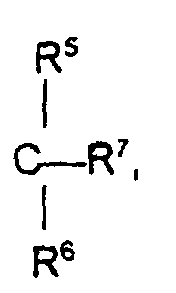
R5 is H, CH2OH,alkyl,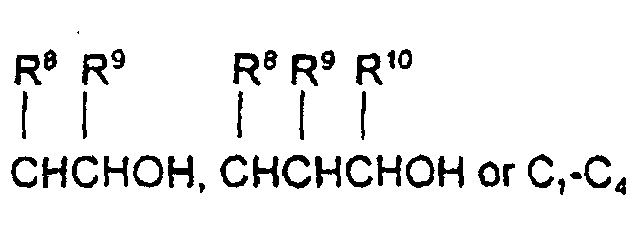
R6 is H, CH2OH,or C1-C4 alkyl, and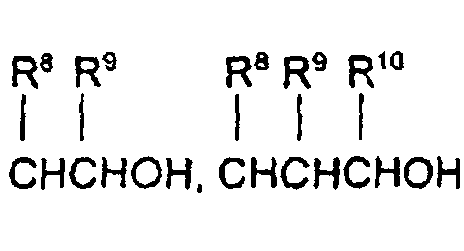
R7 is H, CH2OH,or C1-C4 alkyl,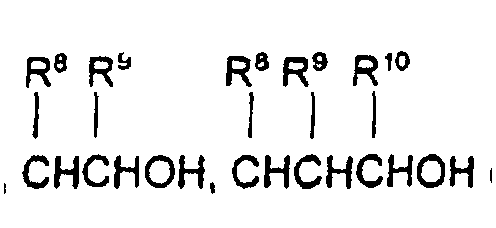
where R8 is H, methyl or ethyl, R9 is H, methyl or ethyl, and R10 is H, methyl or ethyl. - Exemplary HAU crosslinkers include, without limitation, N,N-bis(2-hydroxyethyl)urea, tetrakis(2-hydroxyethyl)urea, tris(2-hydroxyethyl)urea, N,N'-bis(2-hydroxyethyl)urea, N,N'-bis(3-hydroxypropyl)urea, N,N'-bis(4-hydroxybutyl)urea and 2-urea-2-ethyl-1,3-propanediol. The terms "crosslinking agent" and "crosslinker" are used interchangeably herein.
- In certain embodiments of the invention, the PFM may be generated in situ from starting molecules which do not comprise at least two functional groups selected from the group consisting of carboxyl, anhydride and amine. When the starting molecules and the HAU crosslinkers are combined under certain conditions effective to induce crosslinking, functional groups will be generated such that the molecules comprise at least two functional groups selected from the group consisting of carboxyl, anhydride and amine. The functional groups may be generated in situ by the addition of heat to the system or by chemical reaction with the starting molecules, For example, acid catalyzed hydrolysis of alkyl esters such as methyl or t-butyl, are very facile in generating carboxylic acid. Other mechanisms of generating functional groups in situ will be readily apparent to those skilled in the art once having the benefit of the teachings contained herein.
- It surprisingly was noted that when a HAU crosslinker is compared to other crosslinkers which contain at least two hydroxyl groups, the HAU systems exhibited dramatic improvement in crosslinking uncatalyzed systems, i.e. systems which comprise the PFM and the crosslinker, but do not contain a catalyst. For example, in Table 5a herein, HAU, HAA and glycerol, all containing two or more hydroxyl groups, are used to crosslink poly(acrylic acid). In uncatalyzed systems, the percent insolubles of the three systems are 42%, 3% and 0%, respectively, indicating that the urea group in combination with the two hydroxyl groups is critical in achieving desired crosslinking properties and that merely using a crosslinker with at least two hydroxy groups is not sufficient to realize the benefits afforded by the present invention. When the HAU and the HAA are used independently in combination with a catalyst such as sodium hypophosphite, the percent insolubles are 52% and 51%, respectively. The data indicate that the HAU crosslinkers possess synergism in that they perform well as crosslinkers both in catalyzed and uncatalyzed systems, while it has been reported in the literature that other polyol crosslinkers which comprise at least two hydroxy groups must be used in combination with a phosphorus-containing catalyst to achieve crosslinking properties which approach those of the HAU crosslinkers. Specifically, EP patent application 0 583 086 teaches that in order for the crosslinkers disclosed therein to be effective, they must be used in combination with a catalyst that contains phosphorus, as opposed to any class of catalyst. Accordingly, if any comparison is to be made between the HAU crosslinkers of the present invention and the HAA crosslinkers reported in the EP patent application, the fact that the HAU crosslinkers work in systems which are catalyzed with catalysts which do not contain phosphoros is unexpected. The fact that the HAU crosslinkers work at all in uncatalyzed systems is particularly surprising in view of the teachings of EP 0 583 086.
- Furthermore, it surprisingly was found that the HAU crosslinking agents according to the present invention significantly enhance the crosslinking reaction rate, and thus the crosslinking efficiency, when compared to hydroxyalkyl amides (HAA) which may be used to crosslink molecules comprising at least two functional groups selected from carboxyl, amine and anhydride. This accelerated crosslinking may be observed by conducting thermogravimetric analysis (TGA).
- Figure 1 is a thermogram comparing poly(acrylic acid) cured with bis[N,N-di(beta-hydroxyethyl)]adipamide (HAA crosslinker, Sample 1) to the same poly(acrylic acid) cured with N,N-bis(2-hydroxyethyl)urea (HAU crosslinker, Sample 2).
Sample 3 is the same HAA crosslinker which has been catalyzed with a phosphorus-containing catalyst. The cure can be followed by the weight loss due to the release of water which is a byproduct of the cure. - As noted, the catalyst improved the performance of the HAA crosslinker. Of particular note is the fact that the "uncatalyzed" HAU crosslinker (Sample 2) was much more efficient than the "catalyzed" HAA crosslinker (Sample 3). Furthermore, the degree of improvement of the uncatalyzed HAU crosslinker over the uncatalyzed HAA crosslinker was significantly greater than the degree of improvement of the "catalyzed" HAA crosslinker (Sample 3) over the uncatalyzed HAA crosslinker. The data clearly show that the HAU crosslinker is significantly more efficient than the HAA crosslinker with respect to the rate of cure. Based on the results of the TGA, films crosslinked with HAA and films crosslinked with HAU were cured in the TGA isothermally for 5 minutes at 120°C. The HAA-crosslinked film was 40 percent insoluble in water, compared to the HAU-crosslinked film which was 85 percent insoluble. This again indicates that HAU crosslinkers are significantly more efficient at crosslinking molecules according to the present invention than are HAA crosslinkers.
Sample 3 in Figure 1 is the same poly(acrylic acid) crosslinked with HAA and further using a phosphorus-containing catalyst. As observed, the use of a catalyst does improve crosslinking. - The relative degree of crosslinking generated by HAU and HAA crosslinking agents may be observed by measuring the water and solvent resistance of the crosslinked molecule (via the determination of percent insolubles). As observed in Table 5, poly(acrylic acid) Mw 90,000 was crosslinked both with HAU and HAA crosslinkers by curing at 240°C for ten minutes. With respect to the degree of crosslinking, the HAU crosslinker was as efficient or better than the HAA crosslinkers (92% insolubles (HAU) vs. 91% and 74% insolubles, (HAA)s respectively).
- The PFM and the HAU crosslinking agent will be present in relative amounts such that the ratio of the sum total number of equivalents of the functional groups contained in the PFM to the number of equivalents of the hydroxyl groups contained in the HAU crosslinker ranges from about 1:1 to about 100:1. Preferably, the ratio of the sum total number of equivalents of the functional groups contained in the PFM to the number of equivalents of the hydroxyl groups contained in the HAU crosslinker ranges from about 5:4 to about 10:1
- In certain embodiments of the present invention, Lewis acid and Lewis base catalysts may be used in combination with the crosslinking agent in order to further enhance crosslinking. Such catalysts generally include clays, silica, including without limitation colloidal silica, organic amines, quaternized-amines, metal oxides, metal sulfates, metal chlorides, urea sulfate, urea chloride and silicate-based catalysts. Exemplary Lewis acid and Lewis base catalysts which may be used in the invention are set forth in Table 11. Phosphorus-containing catalysts may be used in the present invention, including without limitation alkali metal hypophosphite salts, alkali metal phosphites, alkali metal polyphosphates, alkali metal dihydrogen phosphates, polyphosphoric acid and alkyl phosphinic acids. Such catalysts, when used, are used in less than stoichiometric amounts as the maximum level allowed, and in minimum amounts effective to improve crosslinking compared to a non-catalyzed, crosslinked composition. Each of the "catalyzed", crosslinked compositions of the invention exhibited significant increase in crosslinking when compared to a non-catalyzed, crosslinked composition of the invention, as evidence by the increase in insolubles noted in Table 11.
- In methods of crosslinking the PFMs with the HAU crosslinkers, the HAU and PFM are combined under conditions effective to induce crosslinking of the PFM. Such conditions permit water to be removed from the system, thereby inducing crosslinking of the PFM. These conditions may be provided by adjusting temperature and/or pressure. For example, it is advantageous to cure the compositions at temperatures around 100°C, preferably greater than 100°C, in order to drive off water from the system. In fact, one of the advantages of the crosslinkers of the present invention is that they are stable at elevated temperatures and therefore work particularly well in systems which must be cured at temperatures greater than 100°C. Curing may occur at pressures where water may be removed from the system, for example at low pressures or under vacuum. Both temperature and pressure be may be adjusted such that water may be removed from the system. Additionally, crosslinking may be induced by chemical reaction. For example, as noted herein above, under certain conditions PFMs may be generated in situ. Whether crosslinking be induced by heat transfer or by chemical reaction, the conditions must be effective to remove water from the system, thereby inducing crosslinking.
- Compositions of the present invention may be used in preparing a number of compositions and articles of manufacture and may be applied to polymeric natural substrates, such as woven or non-woven cellulose, wood, leather, paper, cotton, wool, rayon and silk, and polymeric synthetic substrates, such as polyolefin, polyester, polyamide, polyvinyl chloride, polyvinylidene chloride and polyimide. Other substrates to which the compositions may be applied include glass, metal and composite substrates such as sand, ceramic, foundry sand and molds. The compositions may be used in preparing coatings, such as automotive coatings, powder coatings, adhesive coatings, inks and paints. The compositions also may be used as binders or sizing agents in the preparation of, for example, glass or cellulosic fibers, non-woven paper products, fiberglass insulation or batting, glass fiber rovings and molded fiberglass articles. The compositions also may be used as binders in woven and nonwoven textiles and as backcoatings in carpets and other textiles. The compositions further may be used as saturants in the preparation of laminates, foams and mastics and as adhesives for the natural and synthetic substrates noted above.
- Representative crosslinking agents of the present invention and methods for making same are set forth below. While one skilled in the art may be aware of other means of producing such compounds, the following examples are among the preferred methods for preparing the crosslinking agents.
- 105 g diethanolamine and 60 g urea were charged in a 1L flask equipped with heating mantle, thermometer and stirrer and allowed to react at 115°C for 8 hours. A nitrogen purge was used to remove evolving ammonia. The progress of reaction was monitored by amine titration. A clear, hygroscopic liquid was obtained which contained N,N-bis(2-hydroxyethyl)urea, which could be used as a crosslinker without purification.
- In a similar manner the following amines were reacted with urea:
Example Amine Wt, g Urea, g 2 ethanolamine 122 60 3 diethanolamine 210 60 4 ethanolamine
diethanolamine61
10560 5 3-amino-1-propanol 150 60 6 2-amino-2-ethyl-1,3-propanediol (AEPD) 119 30 7 4-aminobutanol 12 4 - Additional alkanolamines also may be used and include, without limitation, 2-amino-2-methyl-1,3-propanediol, ris(hydroxymethyl)amino-methane, 2-methyl-3-amino-1-propanol and 2-methylaminoethanol.
- 100 g of diethanolamine in 100 g water was neutralized with concentrated hydrochloric acid. 77.2 g potassium cyanate were added and the mixture heated to 90°C for 2 hours. After cooling to ambient temperature, potassium chloride was precipitated by addition of 200 ml of ethanol. The salt was filtered out and the final product was obtained upon removal of water and ethanol by rotary evaporation. The product was a hygroscopic liquid containing N,N-bis(2-hydroxyethyl)urea, which could be used as a crosslinker without further purification. The product similarly could be obtained using other acids to neutralize the amine, e.g. sulfuric acid, and using other cyanates, e.g. sodium cyanate
- 105 g diethanolamine and 90 g dimethylcarbonate were charged to a flask equipped with a heating mantle, stirrer, and condenser. The flask contents were heated to 80°C and allowed to stir for 3 hours. Volatile byproducts, eg. methanol, were removed by vacuum distillation. A mixture containing N,N-bis(2-hydroxyethyl)urea was obtained.
- Using the method of example 1, the reaction also can be conducted effectively using refluxing water as a means of removing evolved ammonia. 105 g diethanolamine, 25 g water and 60 g urea were charged in a 1L flask equipped with heating mantle, thermometer and stirrer and allowed to react at 115°C for 8 hours.
- Using the method of example 9, 210 g diethanolamine was reacted with 90 g dimethyl carbonate. A mixture was obtained containing tetrakis(2-hydroxyethyl)urea.
- Using the method of example 9, 122 g ethanolamine was reacted with 90 g dimethyl carbonate. A mixture was obtained containing N,N'-bis(2-hydroxyethyl)urea.
-
- 1. Combine polymer and crosslinker in specified amounts, based on equivalent weights.
- 2. Cast film in petri dish and dry overnight under ambient conditions.
- 3. Cut approximately 1 g piece of film and weigh accurately.
- 4. Put film in weighed 1 oz glass jar and cure according to specified time/temperature schedule. (Usual conditions for 1 g sample of film is 240°C, 10 minutes). Weigh film again.
- 5. Fill jar with water (or other specified solvent). Cap jar and store overnight under ambient conditions.
- 6. Filter sample through weighed stainless 200 mesh screen.
- 7. Dry sample and screen to constant weight. Reweigh for final weight.
- 8. Calculate percent Insoluble = dried sample weight/cured sample weight X 100%.
-
- The following tables set forth crosslinking data for compositions of the present invention and for comparative compositions utilizing both conventional formaldehyde-based crosslinkers and conventional formaldehyde-free crosslinkers.
HAU Crosslinking of Poly(Acrylic Acid) Water Resistance HAU Crosslinker % Insoluble N,N-bis(2-hydroxyethyl) urea 100 Tetrakis(2-hydroxyethyl) urea 47 Tris(2-hydroxyethyl) urea 85 N,N'-bis(2-hydroxyethyl) urea 100 N,N'-bis(3-hydroxypropyl) urea 74 None 0 Polymer: poly(acrylic acid); 60,000 Mw
Cure: 240°C; 10 minutes
0.8 equivalents crosslinkerHAU Crosslinking of Carboxylated Polymers Polymer Polymer Form Crosslinker % Insoluble Solvent poly(AA) Aq Solution N,N-bis(2-hydroxyethyl)urea 100 water Lexorez ™ 1405-65 AF Aq Solution N,N-bis(2-hydroxyethyl)urea 98 water Kuraray™ KM 118 Aq Solution N,N-bis(2-hydroxyethyl)urea 69 water VA/AA/MAnh 45/35/20 Aq Solution N,N-bis(2-hydroxyethyl)urea 99 water E/VA, 2 parts AA Emulsion None 56 acetone E/VA, 2 parts AA Emulsion N,N-bis(2-hydroxyethyl)urea 91 acetone HAU Crosslinking of Mixtures of Poly(Acrylic Acids) and Non-polymeric Polyacids Polyacid % Insoluble citric acid 75 1,2,4-benzene tricarboxylic acid 89 1,2,4,5-benzene tetracarboxylic acid 96 Polymer: poly(acrylic acid); 60,000 Mw
Crosslinker: N,N-bis(2-hydroxyethyl)urea
Equivalents: Crosslinker/P(AA)/polyacid 1/1/0.25
Solvent: water
HAU Crosslinkers versus HAA Crosslinkers Crosslinker % Insolubles N,N-bis(2-hydroxyethyl)urea 92 bis[N,N-di(β-hydroxyethyl)] adipamide 91 N,N-bis(3-hydroxypropyl adipamide) (9) 74 Solvent: water
Polymer: poly(acrylic acid); 90,000 Mw
Cure: 240°C, 10 minutes
0.8 equivalents crosslinkerCrosslinker Catalyst % Insolubles N,N-bis(2-hydroxyethyl)urea yes 52 N,N-bis(2-hydroxyethyl)urea no 42 bis(N,N-di(β-hydroxyethyl)] adipamide yes 51 bis[N,N-di(β-hydroxyethyl)] adipamide no 3 glycerol no 0 Solvent: water
Polymer: 60,000 Mw poly(acrylic acid)
Cure: 10 minutes, 150°C in Al tares
Ratio: 1: 0.8: 0.08 carboxyl:hydroxyl:catalyst
Catalyst: sodium hypophosphiteHAU and HAU formed in situ Crosslinker % Insolubles N,N-bis(2-hydroxyethyl)urea 92 diethanolamine/urea (in situ) 95 Solvent: water
Polymer: poly(acrylic acid); 90,000 Mw
Cure: 240°C, 10 minutes
0.8 equivalents crosslinkerEvaluation on Glass Substrate Cure Time Temp. Pickup Wet Stiff % Insoluble (min) (deg C) (%) (mgf) N,N-bis(2-hydroxyethyl)urea 10 150 21% 537 35.00 10 250 21% 3342 97.00 No Crosslinker 10 150 19% 342 2.00 10 250 21% 2459 0.00 Polymer: poly(acrylic acid); 60,000 Mw
0.1 Equivalent Crosslinker:
Substrate: Whatman GF/B Glass Fiber Filter paper
Wet Soak: One minute in 0.5% Triton X100Evaluation on Cellulosic Substrate TENSILE STRENGTH Crosslinker eq. OH/eq.COOH Cure Time Pickup % Dry lb. Wet lb. 300°F lb. 0 5 min 21.2 20.71 4.41 13.6 0 10 min 21.2 17.63 5.62 13.85 0.1 5 min 20.1 32.6 10.93 20.15 0.1 10 min 20.1 24.36 12.29 17.57 0.3 5 min 20.3 33.05 15.85 21.73 0.3 10 min 20.3 26.43 16.16 18.63 0.8 5 min 20.7 26.99 11.83 19.63 0.8 10 min 20.7 28.15 13.9 21.03 Polymer: poly(acrylic acid); 60,000 Mw
Cure: 200°C
Crosslinker: N,N-bis(2-hydroxyethyl)urea
Tensile strength data obtained according to TAPPI method T494, om-88.HAU Crosslinking of Polymers Comprising Amine Polymer % Insoluble polyethylenimine 65 poly(vinyl amine-covinyl alcohol) 78 Cure: 240°C, 10 minutes
Crosslinker: 1 equivalent N,N-bis(2-hydroxyethyl)urea
Solvent: waterHAU Crosslinking of Non-polymeric Polyacids Polyacid % Insoluble Citric acid monohydrate 15 1,2,4-benzenetricarboxylic acid 15 1,2,4,5-benzenetetracarboxylic acid 15 1,2,3,4-butanetetracarboxylic acid 90 Cure: 240°C 10 minutes
Crosslinker: 1 equivalent N,N-bis(2-hydroxyethyl)urea
Solvent: waterVarying Equivalents of Crosslinker Crosslinker Equivalents % Insoluble 1 93 0.5 93 0.25 98 0.1 86 0.05 96 Polymer: poly(acrylic acid); 90,000 Mw
Cure: 240°C, 10 minutes
Crosslinker: N,N-bis(2-hydroxyethyl)urea
Solvent: waterCatalyzed Crosslinking Catalyst % Insolubles none 42 tin (II) oxalate 100 dibutyltin dilaurate 99 Tyzor™ LA 98 Ludox™ SK 89 kaolin clay 85 tributylamine 84 tripentylamine 84 triisobutylamine 83 sulfamic acid 81 Ludox™ TMA(4) 80 Polycat DBU 79 Zinplex 15 79 DABCO 78 boric acid 78 tin (II) chloride 74 tetrabutylammonium hydroxide 72 DABCO-T 71 N-butyl morpholine 68 aluminum lactate 66 sodium metabisulfite 64 sodium hypophosphite 52 Polymer: 60,000 Mw poly(acrylic acid)
Cure: 10 minutes, 150°C in Al tares
Ratio: 1: 0.8: 0.08 carboxyl:hydroxyl:catalyst
Crosslinker: N,N-bis(2-hydroxyethyl)urea
Solvent: water
Claims (11)
- A composition, comprising:a poly-functional molecule comprising at least two functional groups selected from the group consisting of carboxyl, anhydride and amine; anda crosslinking agent which is free of formaldehyde and present in amounts effective to provide crosslinked compositions, said crosslinking agent comprising a single urea group and at leasttwo hydroxyl groups, wherein at least two carbon atoms are disposed between the urea group and each of the hydroxyl groups wherein the ratio of the sum total number of equivalents of functional groups contained in the poly-functional molecule to the number of equivalents of hydroxyl groups contained in the crosslinking agent ranges from 1:1 to 100:1.
- The composition of Claim 1 wherein the ratio of the sum total number of equivalents of functional groups contained in the poly-functional molecule to the total number of equivalents of hydroxyl groups contained in the crosslinking agent ranges from 5:4 to 10:1.
- The composition of Claim 1 wherein the crosslinking agent is represented by Structure (I)where R1 is
 R2 is H or R5, R3 is H or R5, and R4 is H, R1, or R5, where
R5 is H, CH2OH,or C1-C4 alkyl,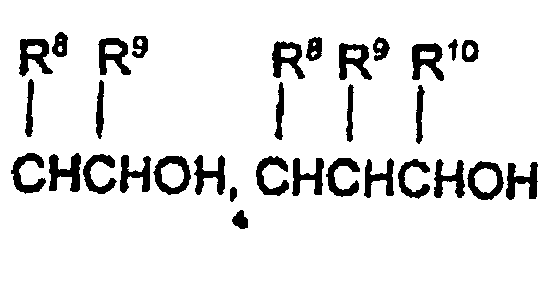
R6 is H, CH2OH,or C1-C4 alkyl, and
R7 is H, CH2OH,or C1-C4 alkyl,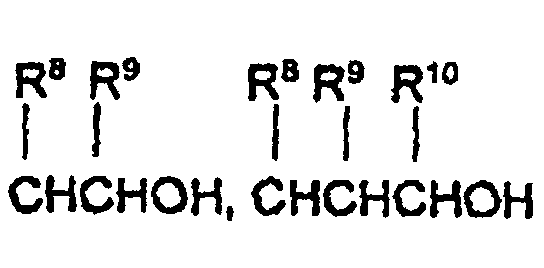
where R8 is H, methyl or ethyl, R9 is H, methyl or ethyl, and R10 is H, methyl or ethyl, with the proviso that the crosslinking agent comprises a single urea group and at least two hydroxyl groups, wherein at least two carbon atoms are disposed between the urea group and each of the hydroxyl groups. - The composition of Claim 1 wherein said crosslinking agent is selected from the group consisting of N,N-bis(2-hydroxyethyl)urea, tetrakis(2-hydroxyethyl)urea, tris(2-hydroxyethyl)-urea, N,N'-bis(2-hydroxyethyl)urea, N,N'-bis(3-hydroxypropyl)urea, N,N'-bis(4-hydroxybutyl)urea and 2-urea-2-ethyl-1,3-propanediol.
- The composition of Claim 1 further comprising less than stoichiometric amounts of a Lewis acid or Lewis base catalyst.
- A method of crosslinking a poly-functional molecule comprising at least two functional groups selected from the group consisting of carboxyl, anhydride and amine, said method comprising combining with said poly-functional molecule a crosslinking agent which is free of formaldehyde and in amounts and under conditions effective to provide crosslinked compositions, said crosslinking agent comprising a single urea group and at least two hydroxyl groups, wherein at least two carbon atoms are disposed between the urea group and each of the hydroxyl groups wherein the ratio of the sum total number of equivalents of functional groups contained in the poly-functional molecule to the number of equivalents of hydroxyl groups contained in the crosslinking agent ranges from 1:1 to 100:1.
- The method of Claim 6 further comprising combining with said poly-functional molecule and said crosslinking agent, less than stoichiometric amounts of a Lewis acid or Lewis base catalyst.
- The method of Claim 6 wherein said crosslinking agent is selected from the group consisting of N,N-bis(2-hydroxyethyl)urea, tetrakis(2-hydroxyethyl)urea, tris(2-hydroxyethyl)-urea, N,N'-bis(2-hydroxyethyl)urea, N,N'-bis(3-hydroxy-propyl)urea, N,N'-bis(4-hydroxybutyl)urea and 2-urea-2-ethyl-1,3-propanediol.
- An article of manufacture comprising a composition which comprisesa poly-functional molecule comprising at least two functional groups selected from the group consisting of carboxyl, anhydride and amine; anda crosslinking agent present in amounts effective to provide crosslinked compositions, said crosslinking agent comprising a single urea group and at least two hydroxyl groups, wherein at least two carbon atoms are disposed between the urea group and each of the hydroxyl groups and wherein said crosslinking agent is free of formaldehyde wherein the ratio of the sum total number of equivalents of functional groups contained in the poly-functional molecule to the number of equivalents of hydroxyl groups contained in the crosslinking agent ranges from 1:1 to 100:1.
- The article of Claim 9 wherein said crosslinking agent is selected from the group consisting of N,N-bis(2-hydroxyethyl)urea, tetrakis(2-hydroxyethyl)urea, tris(2-hydroxyethyl) urea, N,N'-bis(2-hydroxyethyl)urea, N,N'-bis(3-hydroxy-propyl)urea, N,N'-bis(4-hydroxybutyl)urea and 2-urea-2-ethyl-1,3-propanediol.
- The article of Claim 9 wherein the composition further comprises less than stoichiometric amounts of a Lewis acid or Lewis base catalyst.
Applications Claiming Priority (3)
| Application Number | Priority Date | Filing Date | Title |
|---|---|---|---|
| US783350 | 1997-01-07 | ||
| US08/783,350 US5858549A (en) | 1997-01-07 | 1997-01-07 | (Hydroxyalkyl)urea crosslinking agents |
| PCT/US1998/000590 WO1998030627A1 (en) | 1997-01-07 | 1998-01-07 | (hydroxyalkyl)urea crosslinking agents |
Publications (2)
| Publication Number | Publication Date |
|---|---|
| EP0888402A1 EP0888402A1 (en) | 1999-01-07 |
| EP0888402B1 true EP0888402B1 (en) | 2002-11-27 |
Family
ID=25128964
Family Applications (1)
| Application Number | Title | Priority Date | Filing Date |
|---|---|---|---|
| EP19980901789 Expired - Lifetime EP0888402B1 (en) | 1997-01-07 | 1998-01-07 | (hydroxyalkyl)urea crosslinking agents |
Country Status (7)
| Country | Link |
|---|---|
| US (2) | US5858549A (en) |
| EP (1) | EP0888402B1 (en) |
| JP (1) | JP2000508022A (en) |
| CA (1) | CA2248110C (en) |
| DE (1) | DE69809639T2 (en) |
| NO (1) | NO984074L (en) |
| WO (1) | WO1998030627A1 (en) |
Families Citing this family (48)
| Publication number | Priority date | Publication date | Assignee | Title |
|---|---|---|---|---|
| US5840822A (en) * | 1997-09-02 | 1998-11-24 | National Starch And Chemical Investment Holding Corporation | Mono(hydroxyalkyl)urea and oxazolidone crosslinking agents |
| US5965466A (en) * | 1998-06-30 | 1999-10-12 | National Starch And Chemical Investment Holding Corporation | Method for imparting permanent press to textiles |
| ATE238504T1 (en) * | 1999-01-20 | 2003-05-15 | Jurid Werke Gmbh | FRICTION SURFACE COATING FOR A FRICTION MATERIAL OF A BRAKE SYSTEM |
| NL1011403C2 (en) * | 1999-02-26 | 2000-08-29 | Dsm Nv | Binder composition for powder paints. |
| IT1311895B1 (en) * | 1999-03-12 | 2002-03-20 | Sir Ind Spa | MIXTURES OF B-HYDROXIALKYLAMIDS AND THEIR USE AS RETICULATING AGENTS FOR THE PREPARATION OF POWDER PAINTS. |
| ATE278755T1 (en) * | 1999-09-02 | 2004-10-15 | Colgate Palmolive Co | COMPOSITIONS FOR TEXTILE CARE CONTAINING POLYMERS POLYCARBOXYLATES AND UREA DERIVATIVES |
| US6391451B1 (en) | 1999-09-07 | 2002-05-21 | Basf Aktiengesellschaft | Surface-treated superabsorbent polymer particles |
| US6239230B1 (en) | 1999-09-07 | 2001-05-29 | Bask Aktiengesellschaft | Surface-treated superabsorbent polymer particles |
| US6803107B2 (en) * | 1999-09-07 | 2004-10-12 | Basf Aktiengesellschaft | Surface-treated superabsorbent polymer particles |
| US6376618B1 (en) | 1999-09-07 | 2002-04-23 | Basf Aktiengesellschaft | Surface-treated superabsorbent polymer particles |
| EP1149848A1 (en) * | 2000-04-28 | 2001-10-31 | Dsm N.V. | Powder paint composition |
| NL1014603C2 (en) * | 2000-03-10 | 2001-09-11 | Dsm Nv | Thermosetting composition for use in solvent-based coatings and powder coatings, contains a functional resin with hydroxyl or amine groups and a crosslinking agent |
| EP1132411A1 (en) * | 2000-03-10 | 2001-09-12 | Dsm N.V. | Thermosetting composition |
| EP1134266A1 (en) * | 2000-03-13 | 2001-09-19 | Dsm N.V. | Powder paint composition |
| WO2001089591A2 (en) * | 2000-05-25 | 2001-11-29 | Basf Aktiengesellschaft | Surface-treated superabsorbent polymer particles |
| WO2002055774A2 (en) * | 2000-11-14 | 2002-07-18 | Weyerhaeuser Co | Crosslinked cellulosic product formed by extrusion process |
| EP1239015A1 (en) * | 2001-03-08 | 2002-09-11 | Sika AG, vorm. Kaspar Winkler & Co. | Easy to manufacture meth (acrylic) adhesive compositions |
| US6933349B2 (en) * | 2001-03-21 | 2005-08-23 | Owens Corning Fiberglas Technology, Inc. | Low odor insulation binder from phosphite terminated polyacrylic acid |
| US7157524B2 (en) * | 2001-05-31 | 2007-01-02 | Owens Corning Fiberglas Technology, Inc. | Surfactant-containing insulation binder |
| US20030038272A1 (en) * | 2001-08-24 | 2003-02-27 | Figiel Edmund W. | Fire retardant foam and gel compositions |
| US20030203811A1 (en) * | 2002-04-25 | 2003-10-30 | Putzig Donald Edward | Stable aqueous solutions comprising titanium and zinc and process therewith |
| US7185516B2 (en) * | 2002-05-31 | 2007-03-06 | Owens Corning Fiberglas Technology, Inc. | Washwater neutralization system for glass forming line |
| US7063983B2 (en) * | 2002-05-31 | 2006-06-20 | Owens Corning Fiberglas Technology, Inc. | Method for determining cure in a polycarboxylic acid bindered material |
| US7384881B2 (en) * | 2002-08-16 | 2008-06-10 | H.B. Fuller Licensing & Financing, Inc. | Aqueous formaldehyde-free composition and fiberglass insulation including the same |
| US6965905B2 (en) * | 2002-12-20 | 2005-11-15 | Sun Microsystems, Inc. | Lock-free, parallel remembered sets |
| US6884849B2 (en) | 2003-02-21 | 2005-04-26 | Owens-Corning Fiberglas Technology, Inc. | Poly alcohol-based binder composition |
| US20040266921A1 (en) * | 2003-06-26 | 2004-12-30 | Rodrigues Klein A. | Use of (hydroxyalkyl)urea and/or (hydroxyalkyl)amide for maintaining hydration of aqueous polymer compositions |
| US20050113268A1 (en) | 2003-11-26 | 2005-05-26 | Landa Peter A. | Increased moisturization efficacy using hydroxyalkylurea |
| US7294048B2 (en) * | 2004-06-18 | 2007-11-13 | 3M Innovative Properties Company | Abrasive article |
| US20070001156A1 (en) * | 2004-08-04 | 2007-01-04 | Toreki William Iii | Degradable or reversible fire-blocking gel |
| US7491251B2 (en) * | 2005-10-05 | 2009-02-17 | 3M Innovative Properties Company | Method of making a structured abrasive article |
| US8110724B2 (en) * | 2006-03-14 | 2012-02-07 | Ceres, Inc. | Nucleotide sequences and corresponding polypeptides conferring an altered flowering time in plants |
| EP2013300B1 (en) * | 2006-05-02 | 2011-06-08 | E.I. Du Pont De Nemours And Company | Ink jet ink, ink set and method of printing |
| US8689671B2 (en) | 2006-09-29 | 2014-04-08 | Federal-Mogul World Wide, Inc. | Lightweight armor and methods of making |
| KR101168674B1 (en) * | 2007-09-21 | 2012-07-25 | 생-고벵 아브라시프 | Melamine methylol for abrasive products |
| DE602008006756D1 (en) * | 2007-09-24 | 2011-06-16 | Saint Gobain Abrasifs Sa | GRINDING PRODUCTS WITH ACTIVE FILLERS |
| US8080488B2 (en) * | 2008-03-10 | 2011-12-20 | H. B. Fuller Company | Wound glass filament webs that include formaldehyde-free binder compositions, and methods of making and appliances including the same |
| US8791198B2 (en) | 2012-04-30 | 2014-07-29 | H.B. Fuller Company | Curable aqueous composition |
| US9416294B2 (en) | 2012-04-30 | 2016-08-16 | H.B. Fuller Company | Curable epoxide containing formaldehyde-free compositions, articles including the same, and methods of using the same |
| CN103145588A (en) * | 2013-04-02 | 2013-06-12 | 福建师范大学 | Synthetic method of ethoxy urea |
| KR20180002745A (en) * | 2015-05-29 | 2018-01-08 | 피피지 인더스트리즈 오하이오 인코포레이티드 | Packing material coated with emulsion polymerized latex polymer |
| MX2018008552A (en) | 2016-01-15 | 2018-08-23 | Ppg Ind Ohio Inc | A coating composition comprising a powder dispersed in a liquid carrier. |
| US20170204289A1 (en) | 2016-01-15 | 2017-07-20 | Ppg Industries Ohio, Inc. | Hydroxy functional alkyl polyurea |
| RU2619586C1 (en) * | 2016-02-01 | 2017-05-17 | федеральное государственное бюджетное образовательное учреждение высшего образования "Казанский национальный исследовательский технологический университет" (ФГБОУ ВО "КНИТУ") | Method for 1,1,3,3-tetrakis(2-hydroxyethyl)urea preparation |
| RU2619588C1 (en) * | 2016-02-01 | 2017-05-17 | федеральное государственное бюджетное образовательное учреждение высшего образования "Казанский национальный исследовательский технологический университет" (ФГБОУ ВО "КНИТУ") | Method for 1,3-bis(2-hydroxyethyl)urea production |
| CN106831493A (en) * | 2017-02-08 | 2017-06-13 | 湖南国发精细化工科技有限公司 | The synthetic method of tetrabutyl urea |
| MX2020007544A (en) | 2018-01-15 | 2020-11-11 | C Ip S A | New additive to improve adhesive compositions. |
| CN118206472B (en) * | 2024-03-20 | 2025-10-31 | 广东工业大学 | Artificial photosynthesis trapping CO2In situ conversion process |
Family Cites Families (76)
| Publication number | Priority date | Publication date | Assignee | Title |
|---|---|---|---|---|
| US34092A (en) * | 1862-01-07 | Improvement in plows | ||
| DE1466996A1 (en) * | 1963-08-02 | 1969-02-27 | Bayer Ag | Process for the manufacture of dentures using the powder-liquid process |
| GB1127605A (en) * | 1964-10-27 | 1968-09-18 | Ici Ltd | Process for the manufacture of polyurethanes |
| US3507720A (en) * | 1967-08-28 | 1970-04-21 | Du Pont | Gelled aqueous acidic composition containing an in situ crosslinked reaction product |
| US3965072A (en) * | 1969-11-28 | 1976-06-22 | Ici United States Inc. | Polyurea-urethane polymers from urea, diamines and aminoalcohols |
| DE2106726C3 (en) * | 1971-02-12 | 1983-12-01 | Bayer Ag, 5090 Leverkusen | Hydrolysis inhibitor for plastics containing ester groups |
| DE2509237A1 (en) * | 1974-03-25 | 1975-10-09 | Rohm & Haas | PROCESS FOR CURING POLYMERS AND CURABLE POLYMER COMPOSITIONS |
| US4203900A (en) * | 1977-01-03 | 1980-05-20 | The Dow Chemical Company | Process for preparing 2-oxazolines |
| US4209607A (en) * | 1978-05-12 | 1980-06-24 | Ethicon, Inc. | Polyesteramides derived from bis-oxamidodiols and dicarboxylic acids |
| DE2908626A1 (en) * | 1979-03-06 | 1980-09-18 | Bayer Ag | TEMPERATURE-RESISTANT CROSSLINKED POLYMERS AND THEIR USE AS BINDERS |
| DE3029819C2 (en) * | 1979-08-06 | 1989-08-10 | Sony Corp | MAGNETIC RECORDING MEDIUM |
| DE3332794A1 (en) * | 1983-09-10 | 1985-03-28 | Bayer Ag, 5090 Leverkusen | USE OF POLY-HYDROXYALKYL-MONO-UREA MATERIALS FOR PU-FOAMS, DISPERSIONS OF THE POLY-HYDROXYALKYL-MONO-UREA-MATERIALS IN POLYOLEN, AND NEW TRIS-HYDROXYALKYST-MONO-HARNESS |
| US4482659A (en) * | 1983-10-21 | 1984-11-13 | Westinghouse Electric Corp. | Toughened thermosetting compositions for composites |
| US4608419A (en) * | 1983-11-14 | 1986-08-26 | The Dow Chemical Company | Cyclic iminoether modified copolymers as improved adhesives |
| EP0148457A3 (en) * | 1983-12-26 | 1987-03-25 | Takeda Chemical Industries, Ltd. | Process for producing cross-linked resins |
| US4667012A (en) * | 1984-12-14 | 1987-05-19 | Minnesota Mining And Manufacturing Company | Imidazolinone-containing polymer and copolymer |
| DE3504336A1 (en) * | 1985-02-08 | 1986-08-14 | Hoechst Ag, 6230 Frankfurt | POLYMERIZABLE CARBAMOYLOXYALKYLDICARBONIC ACID ESTERS CARRYING HYDROXYL GROUPS, METHOD FOR THE PRODUCTION THEREOF AND THEIR USE |
| US4626575A (en) * | 1985-04-22 | 1986-12-02 | Ashland Oil, Inc. | Pressure sensitive adhesives |
| US4677167A (en) * | 1985-07-26 | 1987-06-30 | Ashland Oil, Inc. | Pressure sensitive adhesive reaction product of bicyclic amide acetal and acrylate interpolymer |
| US5039759A (en) * | 1985-08-01 | 1991-08-13 | Technology Corporation United Carbide Chemicals And Plastics | Water borne high solids coating compositions |
| US4708984A (en) * | 1986-05-16 | 1987-11-24 | American Cyanamid Company | Beta-hydroxyalkylcarbamyl-methylated aminotrizines and curable compositions containing the same |
| US4727111A (en) * | 1986-09-29 | 1988-02-23 | Ppg Industries, Inc. | Powder coating compositions based on mixtures of acid group-containing materials and beta-hydroxyalkylamides |
| US4788255A (en) * | 1986-09-29 | 1988-11-29 | Ppg Industries, Inc. | Powder coating compositions |
| US5182337A (en) * | 1986-09-29 | 1993-01-26 | Ppg Industries, Inc. | Powder coating composition comprising a co-reactable particulate mixture of carboxylic acid group-containing polymers and beta-hydroxyalkylamide curing agent |
| US5214101A (en) * | 1986-09-29 | 1993-05-25 | Ppg Industries, Inc. | Powder coating composition comprising a co-reactable particulate mixture of carboxylic acid group-containing polymers and beta-hydroxyalkylamide curing agent |
| US4937288A (en) * | 1986-09-29 | 1990-06-26 | Ppg Industries, Inc. | Powder coating composition |
| US5006622A (en) * | 1987-04-02 | 1991-04-09 | Bausch & Lomb Incorporated | Polymer compositions for contact lenses |
| EP0322610A1 (en) * | 1987-12-21 | 1989-07-05 | Vianova Kunstharz Aktiengesellschaft | Process for curing cationic lacquer binders, and said binders containing the curing agents for use in the process |
| US4801680A (en) * | 1987-12-30 | 1989-01-31 | Ppg Industries, Inc. | Hydroxyalkylamide powder coating curing system |
| US4889890A (en) * | 1987-12-30 | 1989-12-26 | Ppg Industries, Inc. | Powder coating curing system containing a beta-hydroxyalkylamide |
| US5013791A (en) * | 1987-12-30 | 1991-05-07 | Ppg Industries, Inc. | Beta-hydroxyalkylamide cured acid polymer/polyepoxide powder coating |
| USRE34092E (en) | 1988-01-15 | 1992-10-06 | Ashland Oil, Inc. | Phenolic resin compositions and their use in foundry binders |
| US5190993A (en) * | 1988-04-08 | 1993-03-02 | Borden, Inc. | Process to enhance the tensile strength of reclaimed sand bonded with ester cured alkaline phenolic resin using an aminosilane solution |
| US5234973A (en) * | 1988-04-08 | 1993-08-10 | Acme Resin Corporation | Compositions for foundry molding processes utilizing reclaimed sand |
| US4963640A (en) * | 1989-02-13 | 1990-10-16 | Mobay Corporation | Process and compositions for production of moldings |
| US5108798A (en) * | 1989-06-08 | 1992-04-28 | American Cyanamid Company | Water soluble binder compositions containing beta-hydroxy urethanes and polyfunctional carboxylic acids |
| US4988767A (en) * | 1989-09-18 | 1991-01-29 | Ppg Industries, Inc. | Thermosetting powder coating composition containing a mixture of low Tg and high Tg polymers with acid functional groups |
| US5098955A (en) * | 1989-09-18 | 1992-03-24 | Ppg Industries, Inc. | Powder coating composition low Tg and high Tg polymers with acid groups |
| CA2032581C (en) * | 1989-12-20 | 2002-03-12 | Karel Ulbrich | Hydrolytically degradable hydrophilic gels and the method for preparation thereof |
| JP2831794B2 (en) * | 1990-04-03 | 1998-12-02 | 花王株式会社 | Method of manufacturing sand mold for castings |
| US5238976A (en) * | 1990-06-15 | 1993-08-24 | Borden, Inc. | Process to enhance the tensile strength of reclaimed sand bonded with ester cured alkaline phenolic resin |
| DE69130141T2 (en) * | 1990-07-05 | 1999-02-25 | Kao Corp., Tokio/Tokyo | Process for the production of casting molds |
| DE4024466C2 (en) * | 1990-07-30 | 1995-04-20 | Dainippon Ink & Chemicals | Thermally curable mixtures of polyfunctional formamides and aromatic mono-, di- or polyglycidyl ethers and their use |
| US5180795A (en) * | 1990-08-02 | 1993-01-19 | Borden, Inc. | Retarders for hardening phenolic resins |
| NL9001808A (en) * | 1990-08-13 | 1992-03-02 | Stamicarbon | POWDER PAINT. |
| DE4040023A1 (en) * | 1990-12-14 | 1992-06-17 | Bayer Ag | Open-celled polyurethane foam prepn. for automotive industry - using poly-hydroxyalkyl mono:urea as crosslinker or chain lengthener, giving increased wear hardness |
| US5143582A (en) * | 1991-05-06 | 1992-09-01 | Rohm And Haas Company | Heat-resistant nonwoven fabrics |
| US5189079A (en) * | 1991-06-12 | 1993-02-23 | Acme Resin Corp. | Low free formaldehyde phenolic polyol formulation |
| US5646199A (en) * | 1991-07-22 | 1997-07-08 | Kao Corporation | Composition for mold |
| JPH05148429A (en) * | 1991-11-26 | 1993-06-15 | Nippon Oil & Fats Co Ltd | Expandable thermosetting type resin composition for powder coating and material coated with resin foam using the same |
| DE4203085A1 (en) * | 1992-02-04 | 1993-08-05 | Bayer Ag | AT ROOM TEMPERATURE, MIXTURES AND THEIR USE AS BINDERS IN COATING AGENTS |
| DE69302808T2 (en) * | 1992-03-03 | 1997-01-23 | Minnesota Mining & Mfg | Abrasives with a thermosetting binder |
| CA2085784A1 (en) * | 1992-03-27 | 1993-09-28 | Borden, Inc. | Dialdehyde modified, phenolic foundry sand core binder resins, processes for making same, and process for preparing foundry cores and molds employing same |
| US5266628A (en) * | 1992-03-31 | 1993-11-30 | Ppg Industries, Inc. | Water based coating composition with improved process resistance |
| BE1006097A3 (en) * | 1992-07-29 | 1994-05-10 | Dsm Nv | POWDER PAINT BASED ON WITH POLYMER free carboxylic acid groups AS A BINDER AND A BETA-hydroxyalkylamide containing compound as CROSSLINKER. |
| US5661213A (en) * | 1992-08-06 | 1997-08-26 | Rohm And Haas Company | Curable aqueous composition and use as fiberglass nonwoven binder |
| GB9218596D0 (en) * | 1992-09-02 | 1992-10-14 | Ashland Chemical Ltd | Reclamation of ester-cured phenolic resin bonded foundry sands |
| ATE209984T1 (en) * | 1992-09-08 | 2001-12-15 | Ashland Oil Inc | FOUNDRY MIXTURE WITH POLYETHER POLYOL AND ITS USE |
| US5551961A (en) * | 1992-09-15 | 1996-09-03 | Minnesota Mining And Manufacturing Company | Abrasive articles and methods of making same |
| JPH06114747A (en) * | 1992-10-05 | 1994-04-26 | Minnesota Mining & Mfg Co <3M> | Abrasive material and its manufacturing process |
| NL9201985A (en) * | 1992-11-13 | 1994-06-01 | Dsm Nv | Powder paint based on a polymer with free carboxylic acid groups as binder and a compound containing beta-hydroxyalkylamide groups as crosslinker. |
| US5336807A (en) * | 1993-06-15 | 1994-08-09 | Air Products & Chemicals, Inc. | Crosslinking agents for coating and adhesive applications |
| US5318990A (en) * | 1993-06-21 | 1994-06-07 | Owens-Corning Fiberglas Technology Inc. | Fibrous glass binders |
| US5340868A (en) * | 1993-06-21 | 1994-08-23 | Owens-Corning Fiberglass Technology Inc. | Fibrous glass binders |
| US5453317A (en) * | 1993-08-31 | 1995-09-26 | Borg-Warner Automotive, Inc. | Friction material comprising powdered phenolic resin and method of making same |
| KR100350332B1 (en) * | 1993-09-23 | 2002-11-14 | 보그-워너 인코포레이티드 | Unsaturated friction materials containing powdered silicone resins and powdered phenolic resins and methods for preparing the same |
| US5427587A (en) * | 1993-10-22 | 1995-06-27 | Rohm And Haas Company | Method for strengthening cellulosic substrates |
| US5516859A (en) * | 1993-11-23 | 1996-05-14 | Ashland Inc. | Polyurethane-forming no-bake foundry binder systems |
| US5612393A (en) * | 1993-12-24 | 1997-03-18 | Nissan Motor Co., Ltd. | Casting core composition |
| DE4408688A1 (en) * | 1994-03-15 | 1995-09-21 | Basf Ag | Formaldehyde-free binding, impregnating or coating compositions for fibrous webs |
| DE69515938T3 (en) * | 1994-08-02 | 2005-09-01 | Borgwarner Inc., Auburn Hills | friction lining |
| US5591239A (en) * | 1994-08-30 | 1997-01-07 | Minnesota Mining And Manufacturing Company | Nonwoven abrasive article and method of making same |
| US5733952A (en) * | 1995-10-18 | 1998-03-31 | Borden Chemical, Inc. | Foundry binder of phenolic resole resin, polyisocyanate and epoxy resin |
| US5688857A (en) * | 1996-04-10 | 1997-11-18 | Ashland Inc. | Polyurethane-forming cold-box binders and their uses |
| US5713968A (en) * | 1996-05-16 | 1998-02-03 | Speedfam Corporation | Abrasive foam grinding composition |
| US5753018A (en) * | 1997-04-14 | 1998-05-19 | General Motors Corporation | Resin mixture for friction materials |
-
1997
- 1997-01-07 US US08/783,350 patent/US5858549A/en not_active Expired - Lifetime
-
1998
- 1998-01-07 WO PCT/US1998/000590 patent/WO1998030627A1/en not_active Ceased
- 1998-01-07 CA CA 2248110 patent/CA2248110C/en not_active Expired - Fee Related
- 1998-01-07 DE DE69809639T patent/DE69809639T2/en not_active Expired - Lifetime
- 1998-01-07 JP JP53123198A patent/JP2000508022A/en not_active Ceased
- 1998-01-07 EP EP19980901789 patent/EP0888402B1/en not_active Expired - Lifetime
- 1998-09-04 NO NO984074A patent/NO984074L/en not_active Application Discontinuation
- 1998-10-28 US US09/181,192 patent/US6051646A/en not_active Expired - Lifetime
Also Published As
| Publication number | Publication date |
|---|---|
| WO1998030627A1 (en) | 1998-07-16 |
| DE69809639T2 (en) | 2003-10-23 |
| US6051646A (en) | 2000-04-18 |
| DE69809639D1 (en) | 2003-01-09 |
| NO984074L (en) | 1998-10-29 |
| EP0888402A1 (en) | 1999-01-07 |
| NO984074D0 (en) | 1998-09-04 |
| JP2000508022A (en) | 2000-06-27 |
| US5858549A (en) | 1999-01-12 |
| CA2248110A1 (en) | 1998-07-16 |
| CA2248110C (en) | 2003-03-18 |
Similar Documents
| Publication | Publication Date | Title |
|---|---|---|
| EP0888402B1 (en) | (hydroxyalkyl)urea crosslinking agents | |
| EP0900825B1 (en) | Mono(hydroxyalkyl)urea and oxazolidone crosslinking agents | |
| EP1193288B1 (en) | Mono(hydroxyalkyl) urea and polysaccharide crosslinking systems | |
| CA2251171C (en) | Thermosetting polysaccharides | |
| US20100012879A1 (en) | Aqueous urea-modified binder for mineral fibers | |
| US20100292354A1 (en) | Aqueous binder composition for mineral fibers | |
| WO2006061249A1 (en) | Aqueous binder for mineral fibers | |
| CZ159293A3 (en) | Hardenable aqueous agent and its use as a binder of a non-woven glass fiber fabric | |
| JPS58117272A (en) | Flame proofing agent | |
| JP2002514256A (en) | Composition containing non-halogen flame retardant bonded to polymer | |
| US5478648A (en) | Spin finished aramid fibers and use thereof | |
| US20130133548A1 (en) | Curable fiberglass binder comprising salt of inorganic acid | |
| US4013813A (en) | Aminoalkylphosphonic acid ester-based textile fire retardants | |
| US4268633A (en) | Polyurethanes containing a poly (oxyorganophosphate/phosphonate) flame retardant | |
| US4177300A (en) | Phosphonoxycarboxamide flame retarding compositions | |
| KR101769803B1 (en) | Flame retardant formulations for synthetic resin including the phosphorus and the nitrogen | |
| US4049754A (en) | Tribromoneopentyl phosphorus reactive flame retardants | |
| JPS633913B2 (en) | ||
| US4113708A (en) | Melt preparation of 6TA/6IA polymers with phosphorus compound to reduce ammonia formation | |
| US4145547A (en) | Ureidoalkylphosphonates and their use for the flameproofing of textiles | |
| US4250124A (en) | Organic phosphorus compounds possessing 3-hydroxyalkylphosphinic acid ester groups | |
| CA1065336A (en) | Brominated carbamoyl derivatives | |
| US4435533A (en) | 4-Hydroxy-5-(substituted phosphinyl)ethyleneureas | |
| US4613674A (en) | 2-hydroxy-2-phosphinyl ethanals and 1,2-dihydroxy-1,2-bisphosphinyl ethanes | |
| US3955028A (en) | Process for forming a flame retardant article and article thereof |
Legal Events
| Date | Code | Title | Description |
|---|---|---|---|
| PUAI | Public reference made under article 153(3) epc to a published international application that has entered the european phase |
Free format text: ORIGINAL CODE: 0009012 |
|
| 17P | Request for examination filed |
Effective date: 19980907 |
|
| AK | Designated contracting states |
Kind code of ref document: A1 Designated state(s): BE CH DE DK ES FI FR GB IT LI LU NL SE |
|
| 17Q | First examination report despatched |
Effective date: 20010201 |
|
| GRAG | Despatch of communication of intention to grant |
Free format text: ORIGINAL CODE: EPIDOS AGRA |
|
| GRAG | Despatch of communication of intention to grant |
Free format text: ORIGINAL CODE: EPIDOS AGRA |
|
| GRAH | Despatch of communication of intention to grant a patent |
Free format text: ORIGINAL CODE: EPIDOS IGRA |
|
| GRAH | Despatch of communication of intention to grant a patent |
Free format text: ORIGINAL CODE: EPIDOS IGRA |
|
| GRAA | (expected) grant |
Free format text: ORIGINAL CODE: 0009210 |
|
| AK | Designated contracting states |
Kind code of ref document: B1 Designated state(s): BE CH DE DK ES FI FR GB IT LI LU NL SE |
|
| PG25 | Lapsed in a contracting state [announced via postgrant information from national office to epo] |
Ref country code: NL Free format text: LAPSE BECAUSE OF FAILURE TO SUBMIT A TRANSLATION OF THE DESCRIPTION OR TO PAY THE FEE WITHIN THE PRESCRIBED TIME-LIMIT Effective date: 20021127 Ref country code: LI Free format text: LAPSE BECAUSE OF FAILURE TO SUBMIT A TRANSLATION OF THE DESCRIPTION OR TO PAY THE FEE WITHIN THE PRESCRIBED TIME-LIMIT Effective date: 20021127 Ref country code: IT Free format text: LAPSE BECAUSE OF FAILURE TO SUBMIT A TRANSLATION OF THE DESCRIPTION OR TO PAY THE FEE WITHIN THE PRESCRIBED TIME-LIMIT;WARNING: LAPSES OF ITALIAN PATENTS WITH EFFECTIVE DATE BEFORE 2007 MAY HAVE OCCURRED AT ANY TIME BEFORE 2007. THE CORRECT EFFECTIVE DATE MAY BE DIFFERENT FROM THE ONE RECORDED. Effective date: 20021127 Ref country code: FI Free format text: LAPSE BECAUSE OF FAILURE TO SUBMIT A TRANSLATION OF THE DESCRIPTION OR TO PAY THE FEE WITHIN THE PRESCRIBED TIME-LIMIT Effective date: 20021127 Ref country code: CH Free format text: LAPSE BECAUSE OF FAILURE TO SUBMIT A TRANSLATION OF THE DESCRIPTION OR TO PAY THE FEE WITHIN THE PRESCRIBED TIME-LIMIT Effective date: 20021127 Ref country code: BE Free format text: LAPSE BECAUSE OF FAILURE TO SUBMIT A TRANSLATION OF THE DESCRIPTION OR TO PAY THE FEE WITHIN THE PRESCRIBED TIME-LIMIT Effective date: 20021127 |
|
| REG | Reference to a national code |
Ref country code: GB Ref legal event code: FG4D |
|
| REG | Reference to a national code |
Ref country code: CH Ref legal event code: EP |
|
| PG25 | Lapsed in a contracting state [announced via postgrant information from national office to epo] |
Ref country code: LU Free format text: LAPSE BECAUSE OF NON-PAYMENT OF DUE FEES Effective date: 20030107 |
|
| REF | Corresponds to: |
Ref document number: 69809639 Country of ref document: DE Date of ref document: 20030109 |
|
| PG25 | Lapsed in a contracting state [announced via postgrant information from national office to epo] |
Ref country code: SE Free format text: LAPSE BECAUSE OF FAILURE TO SUBMIT A TRANSLATION OF THE DESCRIPTION OR TO PAY THE FEE WITHIN THE PRESCRIBED TIME-LIMIT Effective date: 20030227 Ref country code: DK Free format text: LAPSE BECAUSE OF FAILURE TO SUBMIT A TRANSLATION OF THE DESCRIPTION OR TO PAY THE FEE WITHIN THE PRESCRIBED TIME-LIMIT Effective date: 20030227 |
|
| NLV1 | Nl: lapsed or annulled due to failure to fulfill the requirements of art. 29p and 29m of the patents act | ||
| ET | Fr: translation filed | ||
| PG25 | Lapsed in a contracting state [announced via postgrant information from national office to epo] |
Ref country code: ES Free format text: LAPSE BECAUSE OF FAILURE TO SUBMIT A TRANSLATION OF THE DESCRIPTION OR TO PAY THE FEE WITHIN THE PRESCRIBED TIME-LIMIT Effective date: 20030529 |
|
| REG | Reference to a national code |
Ref country code: CH Ref legal event code: PL |
|
| PLBI | Opposition filed |
Free format text: ORIGINAL CODE: 0009260 |
|
| PLBQ | Unpublished change to opponent data |
Free format text: ORIGINAL CODE: EPIDOS OPPO |
|
| PLAX | Notice of opposition and request to file observation + time limit sent |
Free format text: ORIGINAL CODE: EPIDOSNOBS2 |
|
| 26 | Opposition filed |
Opponent name: ROCKWOOL INTERNATIONAL A/S Effective date: 20030827 |
|
| PLAX | Notice of opposition and request to file observation + time limit sent |
Free format text: ORIGINAL CODE: EPIDOSNOBS2 |
|
| PLAX | Notice of opposition and request to file observation + time limit sent |
Free format text: ORIGINAL CODE: EPIDOSNOBS2 |
|
| PLAX | Notice of opposition and request to file observation + time limit sent |
Free format text: ORIGINAL CODE: EPIDOSNOBS2 |
|
| PLBB | Reply of patent proprietor to notice(s) of opposition received |
Free format text: ORIGINAL CODE: EPIDOSNOBS3 |
|
| PLCK | Communication despatched that opposition was rejected |
Free format text: ORIGINAL CODE: EPIDOSNREJ1 |
|
| RAP2 | Party data changed (patent owner data changed or rights of a patent transferred) |
Owner name: CELANESE INTERNATIONAL CORPORATION |
|
| PLBN | Opposition rejected |
Free format text: ORIGINAL CODE: 0009273 |
|
| STAA | Information on the status of an ep patent application or granted ep patent |
Free format text: STATUS: OPPOSITION REJECTED |
|
| 27O | Opposition rejected |
Effective date: 20050224 |
|
| REG | Reference to a national code |
Ref country code: GB Ref legal event code: 732E |
|
| REG | Reference to a national code |
Ref country code: FR Ref legal event code: TP |
|
| PGFP | Annual fee paid to national office [announced via postgrant information from national office to epo] |
Ref country code: FR Payment date: 20120202 Year of fee payment: 15 |
|
| PGFP | Annual fee paid to national office [announced via postgrant information from national office to epo] |
Ref country code: DE Payment date: 20120104 Year of fee payment: 15 |
|
| PGFP | Annual fee paid to national office [announced via postgrant information from national office to epo] |
Ref country code: GB Payment date: 20120104 Year of fee payment: 15 |
|
| GBPC | Gb: european patent ceased through non-payment of renewal fee |
Effective date: 20130107 |
|
| REG | Reference to a national code |
Ref country code: FR Ref legal event code: ST Effective date: 20130930 |
|
| PG25 | Lapsed in a contracting state [announced via postgrant information from national office to epo] |
Ref country code: DE Free format text: LAPSE BECAUSE OF NON-PAYMENT OF DUE FEES Effective date: 20130801 |
|
| REG | Reference to a national code |
Ref country code: DE Ref legal event code: R119 Ref document number: 69809639 Country of ref document: DE Effective date: 20130801 |
|
| PG25 | Lapsed in a contracting state [announced via postgrant information from national office to epo] |
Ref country code: FR Free format text: LAPSE BECAUSE OF NON-PAYMENT OF DUE FEES Effective date: 20130131 Ref country code: GB Free format text: LAPSE BECAUSE OF NON-PAYMENT OF DUE FEES Effective date: 20130107 |