EP0885142B1 - Method for sterilizing flowable product packages - Google Patents
Method for sterilizing flowable product packages Download PDFInfo
- Publication number
- EP0885142B1 EP0885142B1 EP96925220A EP96925220A EP0885142B1 EP 0885142 B1 EP0885142 B1 EP 0885142B1 EP 96925220 A EP96925220 A EP 96925220A EP 96925220 A EP96925220 A EP 96925220A EP 0885142 B1 EP0885142 B1 EP 0885142B1
- Authority
- EP
- European Patent Office
- Prior art keywords
- container
- sterilization
- electron beam
- gas stream
- electron
- Prior art date
- Legal status (The legal status is an assumption and is not a legal conclusion. Google has not performed a legal analysis and makes no representation as to the accuracy of the status listed.)
- Expired - Lifetime
Links
Images
Classifications
-
- A—HUMAN NECESSITIES
- A61—MEDICAL OR VETERINARY SCIENCE; HYGIENE
- A61L—METHODS OR APPARATUS FOR STERILISING MATERIALS OR OBJECTS IN GENERAL; DISINFECTION, STERILISATION OR DEODORISATION OF AIR; CHEMICAL ASPECTS OF BANDAGES, DRESSINGS, ABSORBENT PADS OR SURGICAL ARTICLES; MATERIALS FOR BANDAGES, DRESSINGS, ABSORBENT PADS OR SURGICAL ARTICLES
- A61L2/00—Disinfection or sterilisation of materials or objects, in general; Accessories therefor
- A61L2/02—Disinfection or sterilisation of materials or objects, in general; Accessories therefor using physical processes
- A61L2/08—Radiation
- A61L2/087—Particle radiation, e.g. electron-beam, alpha or beta radiation
-
- B—PERFORMING OPERATIONS; TRANSPORTING
- B65—CONVEYING; PACKING; STORING; HANDLING THIN OR FILAMENTARY MATERIAL
- B65B—MACHINES, APPARATUS OR DEVICES FOR, OR METHODS OF, PACKAGING ARTICLES OR MATERIALS; UNPACKING
- B65B55/00—Preserving, protecting or purifying packages or package contents in association with packaging
- B65B55/02—Sterilising, e.g. of complete packages
- B65B55/04—Sterilising wrappers or receptacles prior to, or during, packaging
- B65B55/08—Sterilising wrappers or receptacles prior to, or during, packaging by irradiation
-
- A—HUMAN NECESSITIES
- A61—MEDICAL OR VETERINARY SCIENCE; HYGIENE
- A61L—METHODS OR APPARATUS FOR STERILISING MATERIALS OR OBJECTS IN GENERAL; DISINFECTION, STERILISATION OR DEODORISATION OF AIR; CHEMICAL ASPECTS OF BANDAGES, DRESSINGS, ABSORBENT PADS OR SURGICAL ARTICLES; MATERIALS FOR BANDAGES, DRESSINGS, ABSORBENT PADS OR SURGICAL ARTICLES
- A61L2103/00—Materials or objects being the target of disinfection or sterilisation
- A61L2103/23—Containers other than laboratory or medical, e.g. bottles or mail
Definitions
- the present invention relates to a method for sterilizing a container which is ready to be filled. More specifically the invention relates to a method for sterilizing the inside of such a container or a package material in the form of a sheet or a web intended for a container.
- Containers ready to be filled in the form of a bowl or a can are presently sterilized by means of treatment with steam, steam/condensation or hydrogen peroxide.
- containers manufactured from a soaking paper or cardboard layer rapidly lose their mechanical strength properties, and thus a container easily becomes flabby and cumbersome when it is exposed to liquid or moisture during the sterilization procedure.
- a chemical sterilization with hydrogen peroxide for example a 3 % solution is sprayed on all the internal surfaces of the container, and the peroxide is then allowed to act for about 20 minutes.
- the hydrogen peroxide is converted to water and oxygen in course of time but problems with residual amounts can remain in the same way as when other types of chemical sterilization are used.
- An electromagnetic radiation can also - in dependence of dose and energy - harm microorganisms and viruses in different ways.
- the practical use of this type of sterilization is limited by the ability of the radiation to penetrate and the availability of a suitable radiation source.
- An additional problem with the existing electron guns is that they work at such a high voltage as about 150 kV or more. Since X-rays are generated as a secondary effect when electron guns are used a shield of lead must be used to protect the personal, which shield has to be properly enclosed. It would thus be of great advantage if an equipment containing lead could be avoided when foods are produced, such as for example in a dairy.
- the purpose of the invention is to provide a method of the kind mentioned above, which in a rapid, cheap and simple way permits sterilization of containers which are ready to be filled.
- the method according to the invention is made available by a cheap and small electron gun now being obtainable.
- Such an electron gun is described in US-A-5 414 267.
- This gun is constructed as a tube which is about 4 cm in diameter and about 15 cm long.
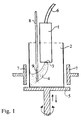
- Such an electron gun 1 is schematically shown in FIG. 1 lowered into a container 2 which is to be sterilized according to the invention.
- a container which is ready to be filled means in this connection a container in the form of for example a bowl, a capsule, a sleeve or a tube, and the container is preferably intended to be used for foods.
- a window 3 is arranged at one end of the electron gun 1 and is at present designed as a narrow slit.
- An electron flow 4 leaves the electron gun through the window with the purpose of sterilization by means of radiation according to the invention.
- several windows can be arranged on the outside of the electron gun designed as a tube in order to distribute the radiation as much as possible.
- the container 2 is arranged on a plate 5, preferably by means of suction, the plate 5 being rotatable as well as translatable up and down. These movements do not necessarily have to be linear, but preferably follow a specific cycle so that a uniform control of the electron flow 4 is achieved. It is also possible to change the position of the electron gun 1 in a similar way. However, this is less preferred since the gun is provided with high voltage terminals 6.
- the electron gun is switched on when it is lowered into the container and is switched off when the gun is withdrawn. It is in this connection important that as uniform a dose of electrons as possible is achieved on the inside of the container so that equal amounts of energy are deposited everywhere.
- the electron beam 4 is controlled by means of deflection plates 7, between which a field (e.g. a magnetic field or an electric field) is generated, a homogenous radiation being achieved in every direction when the gun is symmetrically lowered into the container.
- the beam can thus be moved, for example magnetically, to any point within the container.
- an especially strong magnetic field is not required for the deflection of the electrons since these are low energetic, and the electrons move rather slowly with said electron gun working within the interval 40-80 kV.
- two deflection plates 7 are preferably arranged opposite each other on each side of the electron beam 4. With two additional deflection plates arranged opposite each other the electron beam can be made to sweep over the total internal surface of the container and the rotation of the plate 5 can then be excluded.
- the electron beam can additionally be controlled by varying the acceleration of the electrons, a changed intensity and energy of the beam being achieved. This results in that the beam has different reaches within the individual container. Furthermore, the same equipment can be used for different types of containers.
- a control of the electron beam can also be accomplished by an additional window being arranged on the outside of the electron gun in such a way that the walls of the container as well as its bottom at the same time can be exposed to electrons from the electron gun.
- a sterilization by means of electron exposure has the advantage of the electrons penetrating the exposed material somewhat, i.e. a certain depth effect is achieved. This is an advantage since the package material used seldom has an absolutely smooth surface.
- the electron gun is thus activated and the entire gun is lowered into the container with the purpose of sterilizing its inside, the gun then being withdrawn from the container and deactivated.
- a fast sterilization method is achieved with a reduced cycle time.
- the sterilization period is considerably shorter, i.e. less than one second, and the problem with residual amounts is avoided.
- the short sterilization time in combination with the used load voltage of the electron gun results in that considerably less energy is required for the sterilization, which drastically reduces the sterilization costs.
- tubes 8 can according to the invention be arranged adjacent to the electron gun 1, through which tube a gas stream 9 can be supplied to the container with the purpose of influencing the sterilization process.
- a gas stream 9 can be supplied to the container with the purpose of influencing the sterilization process.
- helium e.g. in the form of short jets
- a range of the electrons is achieved which is about 5 times longer than that achieved without adding gas. Small portions of this gas is thus distributed to such places as corners and the like which are difficult to reach for sterilization. This results in that a higher degree of sterilization is achieved in these places by the electron beam.
- the sterilization effect By instead - or at the same time - for example adding pure oxygen via another tube singlet oxygen can be generated, the sterilization effect then being drastically increased by the formation of extremely reactive peroxide radicals which have a killing effect in biological material.
- the sterilization effect can thus be increased by replacing the air with pure oxygen (or some other gas mixture) in the area where the electron beam strikes the surface of the container.
- Such free radicals are generated when gas molecules collide with electrons from the electron gun.
- An additional sterilization effect can according to the invention be obtained by radiation by means of an electron beam since certain package materials when exposed to electrons give rise to off-taste problems in foods.
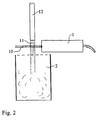
- This embodiment of the invention is shown in Fig. 2.
- the electron gun is in this connection arranged in such a way that an electron beam 10 is not directly aimed at the container 2.
- a gas stream 11 is added to the container transverse the electron beam 10, preferably perpendicular thereto, via a tube 12 which ends between the electron beam and the opening of the container.
- the gas stream 11 consists of a gas which easily can be ionized and which preferably is oxygen.
- the electron beam is utilized as an ion generator, i.e. the electrons are ejected from the atoms in the gas mixture used, active ions being formed. These active ions have by per se a sterilizing effect on the material. Also in this embodiment of the invention the electrons can be deflected in a magnetic field in the same way as described for electrons above.
- the container is formed from a package material in the form of a web, the contemplated inside of which is sterilized in a corresponding way as indicated above.
- Several electron guns are arranged in a row above a plane packaging web and the web is preferably continuously exposed to the radiation.
- One or several electron guns can also be arranged on the outside of a container. This is applicable for a plane web as well as a container which is ready to be filled.
- the sterilization method according to the invention should be performed in a sterilization chamber, preferably at a pressure above the atmospheric, but a normal pressure can also be used.
Landscapes
- Health & Medical Sciences (AREA)
- General Health & Medical Sciences (AREA)
- Epidemiology (AREA)
- Life Sciences & Earth Sciences (AREA)
- Animal Behavior & Ethology (AREA)
- Public Health (AREA)
- Veterinary Medicine (AREA)
- Toxicology (AREA)
- Engineering & Computer Science (AREA)
- Mechanical Engineering (AREA)
- Apparatus For Disinfection Or Sterilisation (AREA)
- Food Preservation Except Freezing, Refrigeration, And Drying (AREA)
Abstract
Description
Claims (12)
- Method for sterilizing the inside of a container (2) which is ready to be filled or a package material for a container in the form of a sheet or a web, characterized in that a sterilization effect is achieved by radiation by means of a gas stream (9, 11) in contact with an electron beam (4, 10).
- Method as claimed in claim 1, characterized in that the gas stream (9) is added intermittently to the container (2).
- Method as claimed in claim 1 or 2, characterized in that the gas stream (9, 11) consists of an easily ionized gas.
- Method as claimed in any of claims 1 to 3, characterized in that the gas stream (9, 11) consists of oxygen for the purpose of achieving singlet oxygen.
- Method as claimed in claim 1 or 2, characterized in that the gas stream (9) consists of helium for the purpose of increasing the range of the electron beam (4).
- Method as claimed in claim 3, characterized in that the gas stream (11) is added to the container (2) substantially perpendicular to the electron beam (10).
- Method as claimed in claim 1, characterized in that deflection plates (7) are arranged opposite each other at each side of the electron beam (4).
- Method as claimed in claim 7, characterized in that the deflection plates (7) consist of magnets.
- Use of an electron gun (1) for the sterilization of a container (2) which is ready to be filled, wherein the sterilization effect is achieved on the inside of the container by means of a gas stream (9, 11) in contact with an electron beam (4, 10) emitted from the electron gun.
- Use as claimed in claim 9, characterized in that the electron gun (1) is designed as a tube.
- Use as claimed in claim 9 or 10, characterized in that the sterilization effect is achieved in that the electron beam (4) is made to sweep over the entire inside of the container (2).
- Use as claimed in claim 9 or 10, characterized in that the sterilization effect is achieved by the gas stream (11) being an easily ionized gas which is added to the inside of the container (2) substantially transverse to the electron beam (10).
Applications Claiming Priority (3)
| Application Number | Priority Date | Filing Date | Title |
|---|---|---|---|
| SE9502812A SE507282C2 (en) | 1995-08-11 | 1995-08-11 | Ways to sterilize pre-filled packages and use of an electron gun in the method |
| SE9502812 | 1995-08-11 | ||
| PCT/SE1996/000928 WO1997007024A1 (en) | 1995-08-11 | 1996-07-09 | Method for sterilizing flowable product packages |
Publications (2)
| Publication Number | Publication Date |
|---|---|
| EP0885142A1 EP0885142A1 (en) | 1998-12-23 |
| EP0885142B1 true EP0885142B1 (en) | 2002-10-23 |
Family
ID=20399165
Family Applications (1)
| Application Number | Title | Priority Date | Filing Date |
|---|---|---|---|
| EP96925220A Expired - Lifetime EP0885142B1 (en) | 1995-08-11 | 1996-07-09 | Method for sterilizing flowable product packages |
Country Status (8)
| Country | Link |
|---|---|
| US (1) | US6139796A (en) |
| EP (1) | EP0885142B1 (en) |
| JP (1) | JP3949719B2 (en) |
| AT (1) | ATE226540T1 (en) |
| AU (1) | AU6538296A (en) |
| DE (1) | DE69624509T2 (en) |
| SE (1) | SE507282C2 (en) |
| WO (1) | WO1997007024A1 (en) |
Cited By (2)
| Publication number | Priority date | Publication date | Assignee | Title |
|---|---|---|---|---|
| EP1982921A1 (en) | 2007-04-19 | 2008-10-22 | Krones AG | Device for sterilising containers |
| EP2594495A1 (en) | 2011-11-21 | 2013-05-22 | Krones AG | Apparatus, system and method with internally gripping holding element for container sterilization by means of electron beams |
Families Citing this family (29)
| Publication number | Priority date | Publication date | Assignee | Title |
|---|---|---|---|---|
| US6024252A (en) * | 1997-11-14 | 2000-02-15 | Nestec S. A. | Dispenser system |
| US6140657A (en) | 1999-03-17 | 2000-10-31 | American International Technologies, Inc. | Sterilization by low energy electron beam |
| DE60045551D1 (en) * | 1999-07-09 | 2011-03-03 | Advanced Electron Beams Inc A Delaware Corp | ELECTRON ACCELERATOR |
| US20040086453A1 (en) * | 2001-01-22 | 2004-05-06 | Howes Randolph M. | Compositions, methods, apparatuses, and systems for singlet oxygen delivery |
| JP2003285879A (en) * | 2002-03-28 | 2003-10-07 | Yoshino Kogyosho Co Ltd | Polyethylene terephthalate resin container |
| SE529241C2 (en) * | 2005-10-26 | 2007-06-05 | Tetra Laval Holdings & Finance | Sensor for use in electron beam intensity sensing system at food packaging industry, has insulating housing engaged with exit window forming chamber for shielding conductor positioned within chamber |
| WO2007095205A2 (en) * | 2006-02-14 | 2007-08-23 | Advanced Electron Beams, Inc. | Electron beam emitter |
| DE102006026278A1 (en) * | 2006-06-02 | 2007-12-06 | Khs Ag | Method and device for treating bottles or similar containers with a treatment medium |
| US7520108B2 (en) * | 2006-06-13 | 2009-04-21 | Tetra Laval Holdings & Finance Sa | Method of sterilizing packages |
| DE102006051237B4 (en) * | 2006-10-31 | 2015-09-10 | Khs Gmbh | Purging gas introduction in beverage cans |
| US20080136064A1 (en) * | 2006-12-12 | 2008-06-12 | Husky Injection Molding Systems Ltd. | Molding apparatus and a molding method |
| DE102007017938C5 (en) | 2007-04-13 | 2017-09-21 | Khs Gmbh | Container manufacturing apparatus and mold production method |
| DE102008025868A1 (en) | 2008-05-30 | 2009-12-03 | Krones Ag | Device for sterilizing containers by means of charge carriers |
| DE102008045187A1 (en) * | 2008-08-30 | 2010-03-04 | Krones Ag | Electron beam sterilization for containers |
| SE0802101A2 (en) * | 2008-10-07 | 2010-07-20 | Tetra Laval Holdings & Finance | Switchable device for electron beam sterilization |
| US20110012030A1 (en) * | 2009-04-30 | 2011-01-20 | Michael Lawrence Bufano | Ebeam sterilization apparatus |
| US8293173B2 (en) * | 2009-04-30 | 2012-10-23 | Hitachi Zosen Corporation | Electron beam sterilization apparatus |
| JP5737885B2 (en) * | 2010-08-30 | 2015-06-17 | 三菱重工業株式会社 | Electron beam sterilizer |
| DE102011015344A1 (en) * | 2011-03-28 | 2012-10-04 | Krones Aktiengesellschaft | Method and device for sterilizing packaging materials |
| ITBS20110060A1 (en) * | 2011-04-26 | 2012-10-27 | Guala Pack Spa | STERILIZATION DEVICE FOR ELECTRONIC BANDS FOR THIN WALLS AND STERILIZATION METHOD |
| ITBS20110061A1 (en) | 2011-04-26 | 2012-10-27 | Guala Pack Spa | INPUT OR OUTPUT UNIT OF AN ELECTRONIC STERILIZATION DEVICE AND STERILIZATION METHOD |
| DE102011054097A1 (en) * | 2011-09-30 | 2013-04-04 | Krones Aktiengesellschaft | Device and method for sterilizing containers with introduced into the containers charge carrier source |
| DE102011055005A1 (en) | 2011-11-02 | 2013-05-02 | Krones Ag | Device for sterilizing plastic containers by means of media-controlled electron beams |
| DE102011055553A1 (en) | 2011-11-21 | 2013-05-23 | Krones Ag | Device for internal and external sterilization of plastic containers by means of charged particle beams |
| JP6041744B2 (en) * | 2013-04-12 | 2016-12-14 | 四国化工機株式会社 | Inactivation method and processing apparatus by electron beam irradiation |
| US9850014B2 (en) | 2014-01-31 | 2017-12-26 | Tetra Laval Holdings & Finance S.A. | Device and method for sterilizing a packaging container |
| JP6971576B2 (en) | 2014-01-31 | 2021-12-08 | テトラ ラバル ホールディングス アンド ファイナンス エス エイ | Devices and methods for sterilizing packaging containers |
| DE102016006880B3 (en) * | 2016-06-06 | 2017-08-17 | Crosslinking AB | Method for irradiating a container and electron irradiation unit thereto |
| JP6803735B2 (en) * | 2016-12-07 | 2020-12-23 | 日立造船株式会社 | Inner electron beam sterilization equipment |
Family Cites Families (13)
| Publication number | Priority date | Publication date | Assignee | Title |
|---|---|---|---|---|
| US2602751A (en) * | 1950-08-17 | 1952-07-08 | High Voltage Engineering Corp | Method for sterilizing substances or materials such as food and drugs |
| US3780308A (en) * | 1971-06-07 | 1973-12-18 | Energy Sciences Inc | Process and apparatus for surface sterilization of materials |
| CH560630A5 (en) * | 1973-08-22 | 1975-04-15 | Aluminiumwerke Ag Rorschach | |
| GB1454817A (en) * | 1973-09-11 | 1976-11-03 | Sumitomo Electric Industries | Irradiation apparatus |
| CH611847A5 (en) * | 1974-10-16 | 1979-06-29 | Aluminiumwerke Ag Rorschach | Process and apparatus for the sterilisation, filling and closing of packaging containers |
| US4652763A (en) * | 1985-03-29 | 1987-03-24 | Energy Sciences, Inc. | Electron-beam irradiation sterilization process |
| US5011660A (en) * | 1987-04-10 | 1991-04-30 | Huls America Inc. | Method of sterilizing medical grade film |
| DE3808058C2 (en) * | 1988-03-11 | 1995-05-24 | Tetra Pak Ab | Device for the sterile packaging of flowable filling goods |
| GB2253144B (en) * | 1991-03-01 | 1995-07-05 | Atomic Energy Authority Uk | Gas sterilisation |
| SE9301428D0 (en) * | 1993-04-28 | 1993-04-28 | Tetra Laval Holdings & Finance Sa | ELECTRON ACCELERATOR FOR STERILIZING PACKAGING MATERIAL IN AN ASEPTIC PACKAGING MACHINE |
| US5414267A (en) * | 1993-05-26 | 1995-05-09 | American International Technologies, Inc. | Electron beam array for surface treatment |
| US5422068A (en) * | 1994-01-05 | 1995-06-06 | Shalaby; Shalaby W. | Radiochemical sterilization |
| US5730933A (en) * | 1996-04-16 | 1998-03-24 | Depuy Orthopaedics, Inc. | Radiation sterilization of biologically active compounds |
-
1995
- 1995-08-11 SE SE9502812A patent/SE507282C2/en not_active IP Right Cessation
-
1996
- 1996-07-09 US US09/011,289 patent/US6139796A/en not_active Expired - Fee Related
- 1996-07-09 JP JP50919797A patent/JP3949719B2/en not_active Expired - Fee Related
- 1996-07-09 AT AT96925220T patent/ATE226540T1/en not_active IP Right Cessation
- 1996-07-09 DE DE69624509T patent/DE69624509T2/en not_active Expired - Lifetime
- 1996-07-09 AU AU65382/96A patent/AU6538296A/en not_active Abandoned
- 1996-07-09 WO PCT/SE1996/000928 patent/WO1997007024A1/en not_active Ceased
- 1996-07-09 EP EP96925220A patent/EP0885142B1/en not_active Expired - Lifetime
Cited By (3)
| Publication number | Priority date | Publication date | Assignee | Title |
|---|---|---|---|---|
| EP1982921A1 (en) | 2007-04-19 | 2008-10-22 | Krones AG | Device for sterilising containers |
| EP2594495A1 (en) | 2011-11-21 | 2013-05-22 | Krones AG | Apparatus, system and method with internally gripping holding element for container sterilization by means of electron beams |
| DE102011055552A1 (en) | 2011-11-21 | 2013-05-23 | Krones Ag | Internal gripping holding element for container sterilization by means of electron beams |
Also Published As
| Publication number | Publication date |
|---|---|
| US6139796A (en) | 2000-10-31 |
| SE507282C2 (en) | 1998-05-04 |
| WO1997007024A1 (en) | 1997-02-27 |
| SE9502812D0 (en) | 1995-08-11 |
| DE69624509D1 (en) | 2002-11-28 |
| JP2000500103A (en) | 2000-01-11 |
| DE69624509T2 (en) | 2003-02-27 |
| SE9502812L (en) | 1997-02-12 |
| AU6538296A (en) | 1997-03-12 |
| EP0885142A1 (en) | 1998-12-23 |
| ATE226540T1 (en) | 2002-11-15 |
| JP3949719B2 (en) | 2007-07-25 |
Similar Documents
| Publication | Publication Date | Title |
|---|---|---|
| US6139796A (en) | Method for sterilizing flowable product packages | |
| JP2780228B2 (en) | Plasma sterilization method and apparatus by pulsed sterilizing agent treatment | |
| US6261518B1 (en) | Process and apparatus for plasma sterilizing with pulsed antimicrobial agent treatment | |
| RU2095296C1 (en) | Electron accelerator for sterilizing packing materials | |
| EP0387022B1 (en) | Plasma sterilizer and method | |
| US5413759A (en) | Plasma sterilizer and method | |
| WO1992004057A1 (en) | Plasma cycling sterilizing process | |
| CN1638813A (en) | Portable radiant energy sterilizer | |
| WO2012103229A1 (en) | Method and system for sterilizing objects by the application of beam technology | |
| CN100429123C (en) | Electron beam irradiation apparatus and method | |
| KR100670714B1 (en) | Electron Beam Plasma Formation for Surface Chemical Treatment | |
| AU2002305907A1 (en) | Method for sterilizing bioactive materials | |
| JP5511289B2 (en) | Medical sterilizer | |
| JP3706695B2 (en) | Sterilizer | |
| KR101953887B1 (en) | Plasma sterlizer | |
| KR100454818B1 (en) | Device and method for disinfection and sterilization by using high density plasma | |
| RU2102084C1 (en) | Method for sterilizing objects | |
| US20060153329A1 (en) | Method for irradiating objects and device for carrying out said method | |
| JP3888715B2 (en) | Sterilization apparatus and sterilization method | |
| US20130024004A1 (en) | Method and system for sterilizing or disinfecting by the application of beam technology and biological materials treated thereby | |
| JPH11281798A (en) | Electron beam irradiation device | |
| JPH07184618A (en) | Plasma sterilization method in container and aseptic filling method | |
| JP2004222915A (en) | Sterilizer | |
| JPH08168516A (en) | Sterilization method | |
| JPH06142165A (en) | Sterilizing method by irradiation with electron beam |
Legal Events
| Date | Code | Title | Description |
|---|---|---|---|
| PUAI | Public reference made under article 153(3) epc to a published international application that has entered the european phase |
Free format text: ORIGINAL CODE: 0009012 |
|
| 17P | Request for examination filed |
Effective date: 19980129 |
|
| AK | Designated contracting states |
Kind code of ref document: A1 Designated state(s): AT BE CH DE DK ES FI FR GB GR IE IT LI LU MC NL PT SE |
|
| 17Q | First examination report despatched |
Effective date: 20000718 |
|
| GRAG | Despatch of communication of intention to grant |
Free format text: ORIGINAL CODE: EPIDOS AGRA |
|
| GRAG | Despatch of communication of intention to grant |
Free format text: ORIGINAL CODE: EPIDOS AGRA |
|
| GRAH | Despatch of communication of intention to grant a patent |
Free format text: ORIGINAL CODE: EPIDOS IGRA |
|
| GRAH | Despatch of communication of intention to grant a patent |
Free format text: ORIGINAL CODE: EPIDOS IGRA |
|
| GRAA | (expected) grant |
Free format text: ORIGINAL CODE: 0009210 |
|
| AK | Designated contracting states |
Kind code of ref document: B1 Designated state(s): AT BE CH DE DK ES FI FR GB GR IE IT LI LU MC NL PT SE |
|
| PG25 | Lapsed in a contracting state [announced via postgrant information from national office to epo] |
Ref country code: NL Free format text: LAPSE BECAUSE OF FAILURE TO SUBMIT A TRANSLATION OF THE DESCRIPTION OR TO PAY THE FEE WITHIN THE PRESCRIBED TIME-LIMIT Effective date: 20021023 Ref country code: LI Free format text: LAPSE BECAUSE OF FAILURE TO SUBMIT A TRANSLATION OF THE DESCRIPTION OR TO PAY THE FEE WITHIN THE PRESCRIBED TIME-LIMIT Effective date: 20021023 Ref country code: GR Free format text: LAPSE BECAUSE OF FAILURE TO SUBMIT A TRANSLATION OF THE DESCRIPTION OR TO PAY THE FEE WITHIN THE PRESCRIBED TIME-LIMIT Effective date: 20021023 Ref country code: FI Free format text: LAPSE BECAUSE OF FAILURE TO SUBMIT A TRANSLATION OF THE DESCRIPTION OR TO PAY THE FEE WITHIN THE PRESCRIBED TIME-LIMIT Effective date: 20021023 Ref country code: CH Free format text: LAPSE BECAUSE OF FAILURE TO SUBMIT A TRANSLATION OF THE DESCRIPTION OR TO PAY THE FEE WITHIN THE PRESCRIBED TIME-LIMIT Effective date: 20021023 Ref country code: BE Free format text: LAPSE BECAUSE OF FAILURE TO SUBMIT A TRANSLATION OF THE DESCRIPTION OR TO PAY THE FEE WITHIN THE PRESCRIBED TIME-LIMIT Effective date: 20021023 Ref country code: AT Free format text: LAPSE BECAUSE OF FAILURE TO SUBMIT A TRANSLATION OF THE DESCRIPTION OR TO PAY THE FEE WITHIN THE PRESCRIBED TIME-LIMIT Effective date: 20021023 |
|
| REF | Corresponds to: |
Ref document number: 226540 Country of ref document: AT Date of ref document: 20021115 Kind code of ref document: T |
|
| REG | Reference to a national code |
Ref country code: GB Ref legal event code: FG4D |
|
| REG | Reference to a national code |
Ref country code: CH Ref legal event code: EP |
|
| REG | Reference to a national code |
Ref country code: IE Ref legal event code: FG4D |
|
| REF | Corresponds to: |
Ref document number: 69624509 Country of ref document: DE Date of ref document: 20021128 |
|
| PG25 | Lapsed in a contracting state [announced via postgrant information from national office to epo] |
Ref country code: SE Free format text: LAPSE BECAUSE OF FAILURE TO SUBMIT A TRANSLATION OF THE DESCRIPTION OR TO PAY THE FEE WITHIN THE PRESCRIBED TIME-LIMIT Effective date: 20030123 Ref country code: PT Free format text: LAPSE BECAUSE OF FAILURE TO SUBMIT A TRANSLATION OF THE DESCRIPTION OR TO PAY THE FEE WITHIN THE PRESCRIBED TIME-LIMIT Effective date: 20030123 Ref country code: DK Free format text: LAPSE BECAUSE OF FAILURE TO SUBMIT A TRANSLATION OF THE DESCRIPTION OR TO PAY THE FEE WITHIN THE PRESCRIBED TIME-LIMIT Effective date: 20030123 |
|
| NLV1 | Nl: lapsed or annulled due to failure to fulfill the requirements of art. 29p and 29m of the patents act | ||
| ET | Fr: translation filed | ||
| PG25 | Lapsed in a contracting state [announced via postgrant information from national office to epo] |
Ref country code: ES Free format text: LAPSE BECAUSE OF FAILURE TO SUBMIT A TRANSLATION OF THE DESCRIPTION OR TO PAY THE FEE WITHIN THE PRESCRIBED TIME-LIMIT Effective date: 20030429 |
|
| REG | Reference to a national code |
Ref country code: CH Ref legal event code: PL |
|
| PG25 | Lapsed in a contracting state [announced via postgrant information from national office to epo] |
Ref country code: LU Free format text: LAPSE BECAUSE OF NON-PAYMENT OF DUE FEES Effective date: 20030709 Ref country code: IE Free format text: LAPSE BECAUSE OF NON-PAYMENT OF DUE FEES Effective date: 20030709 Ref country code: GB Free format text: LAPSE BECAUSE OF NON-PAYMENT OF DUE FEES Effective date: 20030709 |
|
| PG25 | Lapsed in a contracting state [announced via postgrant information from national office to epo] |
Ref country code: MC Free format text: LAPSE BECAUSE OF NON-PAYMENT OF DUE FEES Effective date: 20030731 |
|
| PLBE | No opposition filed within time limit |
Free format text: ORIGINAL CODE: 0009261 |
|
| STAA | Information on the status of an ep patent application or granted ep patent |
Free format text: STATUS: NO OPPOSITION FILED WITHIN TIME LIMIT |
|
| 26N | No opposition filed |
Effective date: 20030724 |
|
| GBPC | Gb: european patent ceased through non-payment of renewal fee |
Effective date: 20030709 |
|
| REG | Reference to a national code |
Ref country code: IE Ref legal event code: MM4A |
|
| PGFP | Annual fee paid to national office [announced via postgrant information from national office to epo] |
Ref country code: FR Payment date: 20110727 Year of fee payment: 16 |
|
| PGFP | Annual fee paid to national office [announced via postgrant information from national office to epo] |
Ref country code: DE Payment date: 20110706 Year of fee payment: 16 |
|
| PGFP | Annual fee paid to national office [announced via postgrant information from national office to epo] |
Ref country code: IT Payment date: 20110728 Year of fee payment: 16 |
|
| REG | Reference to a national code |
Ref country code: FR Ref legal event code: ST Effective date: 20130329 |
|
| PG25 | Lapsed in a contracting state [announced via postgrant information from national office to epo] |
Ref country code: FR Free format text: LAPSE BECAUSE OF NON-PAYMENT OF DUE FEES Effective date: 20120731 Ref country code: DE Free format text: LAPSE BECAUSE OF NON-PAYMENT OF DUE FEES Effective date: 20130201 |
|
| REG | Reference to a national code |
Ref country code: DE Ref legal event code: R119 Ref document number: 69624509 Country of ref document: DE Effective date: 20130201 |
|
| PG25 | Lapsed in a contracting state [announced via postgrant information from national office to epo] |
Ref country code: IT Free format text: LAPSE BECAUSE OF NON-PAYMENT OF DUE FEES Effective date: 20120709 |