EP0882801A1 - Verfahren für die Selektion von cDNA Fragmente - Google Patents
Verfahren für die Selektion von cDNA Fragmente Download PDFInfo
- Publication number
- EP0882801A1 EP0882801A1 EP97401238A EP97401238A EP0882801A1 EP 0882801 A1 EP0882801 A1 EP 0882801A1 EP 97401238 A EP97401238 A EP 97401238A EP 97401238 A EP97401238 A EP 97401238A EP 0882801 A1 EP0882801 A1 EP 0882801A1
- Authority
- EP
- European Patent Office
- Prior art keywords
- cdna fragments
- pcr
- dna binding
- binding agent
- differential
- Prior art date
- Legal status (The legal status is an assumption and is not a legal conclusion. Google has not performed a legal analysis and makes no representation as to the accuracy of the status listed.)
- Pending
Links
- 239000002299 complementary DNA Substances 0.000 title claims abstract description 64
- 239000012634 fragment Substances 0.000 title claims abstract description 58
- 238000000034 method Methods 0.000 title claims abstract description 44
- 230000004568 DNA-binding Effects 0.000 claims abstract description 29
- 239000011230 binding agent Substances 0.000 claims abstract description 21
- 229920000642 polymer Polymers 0.000 claims abstract description 11
- 108090000765 processed proteins & peptides Proteins 0.000 claims abstract description 10
- 229920001184 polypeptide Polymers 0.000 claims abstract description 8
- 102000004196 processed proteins & peptides Human genes 0.000 claims abstract description 8
- 239000003795 chemical substances by application Substances 0.000 claims abstract description 7
- 238000010186 staining Methods 0.000 claims abstract description 7
- 238000001502 gel electrophoresis Methods 0.000 claims abstract description 4
- 238000000163 radioactive labelling Methods 0.000 claims abstract description 4
- 238000013508 migration Methods 0.000 claims abstract description 3
- 230000005012 migration Effects 0.000 claims abstract description 3
- 239000000499 gel Substances 0.000 claims description 22
- 238000001962 electrophoresis Methods 0.000 claims description 16
- 238000000636 Northern blotting Methods 0.000 claims description 14
- -1 alkylene glycol Chemical compound 0.000 claims description 14
- 238000010367 cloning Methods 0.000 claims description 11
- 238000012163 sequencing technique Methods 0.000 claims description 9
- 239000011543 agarose gel Substances 0.000 claims description 8
- PRDFBSVERLRRMY-UHFFFAOYSA-N 2'-(4-ethoxyphenyl)-5-(4-methylpiperazin-1-yl)-2,5'-bibenzimidazole Chemical class C1=CC(OCC)=CC=C1C1=NC2=CC=C(C=3NC4=CC(=CC=C4N=3)N3CCN(C)CC3)C=C2N1 PRDFBSVERLRRMY-UHFFFAOYSA-N 0.000 claims description 6
- 229920001223 polyethylene glycol Polymers 0.000 claims description 6
- 108090000790 Enzymes Proteins 0.000 claims description 4
- 102000004190 Enzymes Human genes 0.000 claims description 4
- 102000006382 Ribonucleases Human genes 0.000 claims description 4
- 108010083644 Ribonucleases Proteins 0.000 claims description 4
- 238000003556 assay Methods 0.000 claims description 4
- LYCAIKOWRPUZTN-UHFFFAOYSA-N ethylene glycol Natural products OCCO LYCAIKOWRPUZTN-UHFFFAOYSA-N 0.000 claims description 4
- 238000003757 reverse transcription PCR Methods 0.000 claims description 4
- WGCNASOHLSPBMP-UHFFFAOYSA-N hydroxyacetaldehyde Natural products OCC=O WGCNASOHLSPBMP-UHFFFAOYSA-N 0.000 claims description 3
- 238000012795 verification Methods 0.000 claims description 3
- OSZBRXNBKKWJOM-UHFFFAOYSA-N 1-phenylphenazine Chemical compound C1=CC=CC=C1C1=CC=CC2=NC3=CC=CC=C3N=C12 OSZBRXNBKKWJOM-UHFFFAOYSA-N 0.000 claims description 2
- 229920002518 Polyallylamine hydrochloride Polymers 0.000 claims description 2
- 229920002125 Sokalan® Polymers 0.000 claims description 2
- 239000003242 anti bacterial agent Substances 0.000 claims description 2
- 229940088710 antibiotic agent Drugs 0.000 claims description 2
- 239000003153 chemical reaction reagent Substances 0.000 claims description 2
- 239000013078 crystal Substances 0.000 claims description 2
- 150000002009 diols Chemical class 0.000 claims description 2
- 125000000623 heterocyclic group Chemical group 0.000 claims description 2
- 239000000138 intercalating agent Substances 0.000 claims description 2
- 238000009830 intercalation Methods 0.000 claims description 2
- FDZZZRQASAIRJF-UHFFFAOYSA-M malachite green Chemical compound [Cl-].C1=CC(N(C)C)=CC=C1C(C=1C=CC=CC=1)=C1C=CC(=[N+](C)C)C=C1 FDZZZRQASAIRJF-UHFFFAOYSA-M 0.000 claims description 2
- 229940107698 malachite green Drugs 0.000 claims description 2
- DWCZIOOZPIDHAB-UHFFFAOYSA-L methyl green Chemical compound [Cl-].[Cl-].C1=CC(N(C)C)=CC=C1C(C=1C=CC(=CC=1)[N+](C)(C)C)=C1C=CC(=[N+](C)C)C=C1 DWCZIOOZPIDHAB-UHFFFAOYSA-L 0.000 claims description 2
- 229920002239 polyacrylonitrile Polymers 0.000 claims description 2
- 229920001610 polycaprolactone Polymers 0.000 claims description 2
- 239000004632 polycaprolactone Substances 0.000 claims description 2
- 229920002451 polyvinyl alcohol Polymers 0.000 claims description 2
- AAAQKTZKLRYKHR-UHFFFAOYSA-N triphenylmethane Chemical compound C1=CC=CC=C1C(C=1C=CC=CC=1)C1=CC=CC=C1 AAAQKTZKLRYKHR-UHFFFAOYSA-N 0.000 claims description 2
- 238000003752 polymerase chain reaction Methods 0.000 description 24
- 108091032973 (ribonucleotides)n+m Proteins 0.000 description 12
- 108020004414 DNA Proteins 0.000 description 10
- 239000000975 dye Substances 0.000 description 10
- 230000009278 visceral effect Effects 0.000 description 9
- 238000004458 analytical method Methods 0.000 description 8
- 239000000523 sample Substances 0.000 description 8
- 238000012408 PCR amplification Methods 0.000 description 6
- 210000001596 intra-abdominal fat Anatomy 0.000 description 6
- 238000007920 subcutaneous administration Methods 0.000 description 6
- 210000004003 subcutaneous fat Anatomy 0.000 description 6
- 239000002202 Polyethylene glycol Substances 0.000 description 5
- 108020004707 nucleic acids Proteins 0.000 description 4
- 102000039446 nucleic acids Human genes 0.000 description 4
- 150000007523 nucleic acids Chemical class 0.000 description 4
- 108090000623 proteins and genes Proteins 0.000 description 4
- 238000012216 screening Methods 0.000 description 4
- 238000000926 separation method Methods 0.000 description 4
- 108010006785 Taq Polymerase Proteins 0.000 description 3
- 238000013459 approach Methods 0.000 description 3
- 238000012790 confirmation Methods 0.000 description 3
- 230000008030 elimination Effects 0.000 description 3
- 238000003379 elimination reaction Methods 0.000 description 3
- PCHJSUWPFVWCPO-UHFFFAOYSA-N gold Chemical compound [Au] PCHJSUWPFVWCPO-UHFFFAOYSA-N 0.000 description 3
- 239000010931 gold Substances 0.000 description 3
- 229910052737 gold Inorganic materials 0.000 description 3
- 239000012528 membrane Substances 0.000 description 3
- 108020004999 messenger RNA Proteins 0.000 description 3
- 238000010839 reverse transcription Methods 0.000 description 3
- 239000004677 Nylon Substances 0.000 description 2
- XDROKJSWHURZGO-UHFFFAOYSA-N angelicin Chemical compound C1=C2OC=CC2=C2OC(=O)C=CC2=C1 XDROKJSWHURZGO-UHFFFAOYSA-N 0.000 description 2
- 230000008901 benefit Effects 0.000 description 2
- UDSAIICHUKSCKT-UHFFFAOYSA-N bromophenol blue Chemical compound C1=C(Br)C(O)=C(Br)C=C1C1(C=2C=C(Br)C(O)=C(Br)C=2)C2=CC=CC=C2S(=O)(=O)O1 UDSAIICHUKSCKT-UHFFFAOYSA-N 0.000 description 2
- 238000012937 correction Methods 0.000 description 2
- ZMMJGEGLRURXTF-UHFFFAOYSA-N ethidium bromide Chemical compound [Br-].C12=CC(N)=CC=C2C2=CC=C(N)C=C2[N+](CC)=C1C1=CC=CC=C1 ZMMJGEGLRURXTF-UHFFFAOYSA-N 0.000 description 2
- 229960005542 ethidium bromide Drugs 0.000 description 2
- 238000009396 hybridization Methods 0.000 description 2
- 239000011159 matrix material Substances 0.000 description 2
- 229920001778 nylon Polymers 0.000 description 2
- 206010033675 panniculitis Diseases 0.000 description 2
- 239000013612 plasmid Substances 0.000 description 2
- 230000002285 radioactive effect Effects 0.000 description 2
- 239000013598 vector Substances 0.000 description 2
- 102000040650 (ribonucleotides)n+m Human genes 0.000 description 1
- BVTVLEZDVMAWPR-UHFFFAOYSA-N 1h-pyrrolo[2,3-a]acridine Chemical class C1=CC=CC2=CC3=C(NC=C4)C4=CC=C3N=C21 BVTVLEZDVMAWPR-UHFFFAOYSA-N 0.000 description 1
- 108020005345 3' Untranslated Regions Proteins 0.000 description 1
- 238000001712 DNA sequencing Methods 0.000 description 1
- 108010014303 DNA-directed DNA polymerase Proteins 0.000 description 1
- 102000016928 DNA-directed DNA polymerase Human genes 0.000 description 1
- 108010020056 Hydrogenase Proteins 0.000 description 1
- 101000829171 Hypocrea virens (strain Gv29-8 / FGSC 10586) Effector TSP1 Proteins 0.000 description 1
- 229910001030 Iron–nickel alloy Inorganic materials 0.000 description 1
- 229920002584 Polyethylene Glycol 6000 Polymers 0.000 description 1
- 239000013614 RNA sample Substances 0.000 description 1
- MZZINWWGSYUHGU-UHFFFAOYSA-J ToTo-1 Chemical compound [I-].[I-].[I-].[I-].C12=CC=CC=C2C(C=C2N(C3=CC=CC=C3S2)C)=CC=[N+]1CCC[N+](C)(C)CCC[N+](C)(C)CCC[N+](C1=CC=CC=C11)=CC=C1C=C1N(C)C2=CC=CC=C2S1 MZZINWWGSYUHGU-UHFFFAOYSA-J 0.000 description 1
- GRRMZXFOOGQMFA-UHFFFAOYSA-J YoYo-1 Chemical compound [I-].[I-].[I-].[I-].C12=CC=CC=C2C(C=C2N(C3=CC=CC=C3O2)C)=CC=[N+]1CCC[N+](C)(C)CCC[N+](C)(C)CCC[N+](C1=CC=CC=C11)=CC=C1C=C1N(C)C2=CC=CC=C2O1 GRRMZXFOOGQMFA-UHFFFAOYSA-J 0.000 description 1
- 210000000577 adipose tissue Anatomy 0.000 description 1
- 238000000246 agarose gel electrophoresis Methods 0.000 description 1
- 230000003321 amplification Effects 0.000 description 1
- 230000000259 anti-tumor effect Effects 0.000 description 1
- 238000006243 chemical reaction Methods 0.000 description 1
- RGWHQCVHVJXOKC-SHYZEUOFSA-J dCTP(4-) Chemical compound O=C1N=C(N)C=CN1[C@@H]1O[C@H](COP([O-])(=O)OP([O-])(=O)OP([O-])([O-])=O)[C@@H](O)C1 RGWHQCVHVJXOKC-SHYZEUOFSA-J 0.000 description 1
- 230000029087 digestion Effects 0.000 description 1
- 239000012154 double-distilled water Substances 0.000 description 1
- 230000009977 dual effect Effects 0.000 description 1
- 238000001976 enzyme digestion Methods 0.000 description 1
- 238000002474 experimental method Methods 0.000 description 1
- WSFSSNUMVMOOMR-UHFFFAOYSA-N formaldehyde Substances O=C WSFSSNUMVMOOMR-UHFFFAOYSA-N 0.000 description 1
- 150000004676 glycans Chemical class 0.000 description 1
- 238000013537 high throughput screening Methods 0.000 description 1
- 238000002372 labelling Methods 0.000 description 1
- 238000004519 manufacturing process Methods 0.000 description 1
- 238000012986 modification Methods 0.000 description 1
- 230000004048 modification Effects 0.000 description 1
- 238000003199 nucleic acid amplification method Methods 0.000 description 1
- INAAIJLSXJJHOZ-UHFFFAOYSA-N pibenzimol Chemical compound C1CN(C)CCN1C1=CC=C(N=C(N2)C=3C=C4NC(=NC4=CC=3)C=3C=CC(O)=CC=3)C2=C1 INAAIJLSXJJHOZ-UHFFFAOYSA-N 0.000 description 1
- 229920002401 polyacrylamide Polymers 0.000 description 1
- 229920001748 polybutylene Polymers 0.000 description 1
- 229920001451 polypropylene glycol Polymers 0.000 description 1
- 229920001282 polysaccharide Polymers 0.000 description 1
- 239000005017 polysaccharide Substances 0.000 description 1
- MLMVLVJMKDPYBM-UHFFFAOYSA-N pseudoisopsoralene Natural products C1=C2C=COC2=C2OC(=O)C=CC2=C1 MLMVLVJMKDPYBM-UHFFFAOYSA-N 0.000 description 1
- 238000000746 purification Methods 0.000 description 1
- 238000011084 recovery Methods 0.000 description 1
- 108091008146 restriction endonucleases Proteins 0.000 description 1
- 241000894007 species Species 0.000 description 1
- 239000000126 substance Substances 0.000 description 1
- 210000001519 tissue Anatomy 0.000 description 1
Images


Classifications
-
- C—CHEMISTRY; METALLURGY
- C12—BIOCHEMISTRY; BEER; SPIRITS; WINE; VINEGAR; MICROBIOLOGY; ENZYMOLOGY; MUTATION OR GENETIC ENGINEERING
- C12Q—MEASURING OR TESTING PROCESSES INVOLVING ENZYMES, NUCLEIC ACIDS OR MICROORGANISMS; COMPOSITIONS OR TEST PAPERS THEREFOR; PROCESSES OF PREPARING SUCH COMPOSITIONS; CONDITION-RESPONSIVE CONTROL IN MICROBIOLOGICAL OR ENZYMOLOGICAL PROCESSES
- C12Q1/00—Measuring or testing processes involving enzymes, nucleic acids or microorganisms; Compositions therefor; Processes of preparing such compositions
- C12Q1/68—Measuring or testing processes involving enzymes, nucleic acids or microorganisms; Compositions therefor; Processes of preparing such compositions involving nucleic acids
- C12Q1/6813—Hybridisation assays
- C12Q1/6827—Hybridisation assays for detection of mutation or polymorphism
-
- C—CHEMISTRY; METALLURGY
- C12—BIOCHEMISTRY; BEER; SPIRITS; WINE; VINEGAR; MICROBIOLOGY; ENZYMOLOGY; MUTATION OR GENETIC ENGINEERING
- C12Q—MEASURING OR TESTING PROCESSES INVOLVING ENZYMES, NUCLEIC ACIDS OR MICROORGANISMS; COMPOSITIONS OR TEST PAPERS THEREFOR; PROCESSES OF PREPARING SUCH COMPOSITIONS; CONDITION-RESPONSIVE CONTROL IN MICROBIOLOGICAL OR ENZYMOLOGICAL PROCESSES
- C12Q1/00—Measuring or testing processes involving enzymes, nucleic acids or microorganisms; Compositions therefor; Processes of preparing such compositions
- C12Q1/68—Measuring or testing processes involving enzymes, nucleic acids or microorganisms; Compositions therefor; Processes of preparing such compositions involving nucleic acids
- C12Q1/6809—Methods for determination or identification of nucleic acids involving differential detection
Definitions
- the present invention pertains to a method tor selecting cDNA fragments generated by differential display or RNA fingerprinting.
- RNA fingerprinting (Welsh et al., 1992) are very useful techniques for identifying mRNA differences in cells. Although these two methods use different primer strategies, they take the same approach to isolate gene fragments from differentially expressed mRNAs by excising bands of interest from DNA sequencing gels followed by polymerase chain reaction (PCR) reamplification, Northern blot confirmation and cloning of the cDNA fragments.
- PCR polymerase chain reaction
- Another approach uses plasmid dot-blotting to screen cloned cDNA fragments using cDNA PCR products as probes (Callard et al., 1994). Although the dot-blotting method can screen many cDNA clones in a short time, the results may not always be conclusive because of heterogeneity in the probe of the cDNA PCR product or because the cloned cDNA fragments were originally reverse transcription (RT)-PCR related false positives.
- RT reverse transcription
- the inventors have presently solved the above-identified problem by providing an efficient method for resolving co-migrating cDNA molecules and recovering them for PCR amplification.
- one object of the present invention is a method for selecting cDNA fragments generated by differential display or RNA fingerprinting comprising the steps of :
- the amplified PCR products may be subjected to sequencing and reverse Northern Blot, Northern Blot, ribonuclease protection assay, semi-quantitative and/or quantitative RT-PCR for verification of differential expression.
- the amplified PCR products may be used directly in reverse Northern Blot for rapid and high-throughput elimination of false positives and confirmation of true positives from a large number of the cDNA fragments.
- the true positive cDNA fragments may also be cloned.
- Another object of the present invention is a kit for selecting cDNA fragments generated by differential display or RNA fingerprinting according to the method of the invention, said kit containing :
- the tube with the larger diameter is adapted to excise desirable bands
- the tube with the smaller diameter is adapted to push out the gel piece.
- an instrument such as Rotofor system (Bio-rad) may be employed.
- the electrophoresis of step b) can be run in any kind of gel matrix, such as polysaccharide or polyacrylamide gel. It is preferably run in agarose gel.
- the DNA binding agent used in the method of the invention may be preferably a positively charged molecule which is either an intercalating or a non-intercalating agent. It may be particularly selected from
- said DNA binding agent is bisbenzimide, such as Resolver GoldTM (R&D System).
- Said DNA binding agent is coupled to a polymer which increases the DNA friction coefficient in electrophoresis.
- Said polymer may be selected from poly(C2-C4)alkylene glycol, polycaprolactone diol, poly(acrylic acid), polyacrylonitrile, poly(allylamine hydrochloride) and poly(vinyl alcohol).
- said polymer is polyethylene glycol (PEG), polypropylene glycol, or polybutylene glycol, and is more preferably PEG having a molecular weight between 1000 and 10000, preferably between 6000 and 7500.
- biological molecules such as a polypeptide may be used to increase the friction of DNA in gel matrix as well.
- Such a polypeptide may also contain a DNA binding site to A+T- or G+C- regions so that it has dual properties for both DNA binding and mobility retardation. In that case the presence of another DNA binding agent is not necessary.
- the cDNA fragments may be visualized by means of a staining agent such as ethidium bromide, TOTO-1, YOYO-1, SYBR Green and radioactive labeling.
- a staining agent such as ethidium bromide, TOTO-1, YOYO-1, SYBR Green and radioactive labeling.
- Müller et al., (1981) disclosed the use of dye bisbenzimide to which polyethylene glycol was bound for separating comigrating fragments.
- PEG polyethylene glycol
- the inventors presently developed a method which involves the recovery of desirable bands and their subsequent enrichment by direct PCR for down-stream applications, including sequencing, reverse Northern Blot and Northern Blot, as well as ribonuclease protection assay, semi-quantitative and quantitative RT-PCR for verification of differential expression.
- DNA binding agent could inhibit enzymes used in molecular biology experiments.
- a benzopyridoindole derivative which is an antitumor DNA binding agent, can irreversibly inhibit elongation process by different DNA polymerases including Taq DNA polymerase (Duval-Valentin et al, 1995).
- Another well-known DNA binding agent, isopsoralen is generally used as a sterilizer for PCR amplification because it blocks Taq DNA polymerase (Issacs et al, 1991).
- the inventors presently discovered that surprisingly the DNA binding agent they used did not block the amplification by Taq polymerase.
- the use of the DNA binding agent offers several advantages for screening cDNA fragments generated by differential display or RNA fingerprinting.
- the differential cDNA fragments are classified by standard gel electrophoresis with the dye and selected by PCR amplification rather than by cloning and doing subsequent analysis with either restriction digestion or partial sequencing or SSCP.
- the method of the invention is more cost-effective than the previous ones because it does not use expensive PCR cloning vectors and enzymes for analyzing a large number of clones.
- the third and most significant benefit of the present method is that only distinct cDNA fragments are selected and further examined.
- ten clones with about 70 % of redundancy have to be analyzed by the usual cloning method for each differential band in order to avoid missing an interesting one. Screening hundreds of clones is therefore a routine but cumbersome task when the previous procedures are used.
- the method of the invention was found to be highly effective and reproductible.
- cDNA fragments recovered from gel with the dye could be effectively amplified by PCR.
- the PCR products are in turn used directly in subsequent blot analysis. It was found that the cDNA fragments amplified as such were much more specific than those amplified from plasmid clones, thereby giving rise to cleaner results from down-stream analysis.
- Figure 1 represents electrophoretic analysis of a differential cDNA fragment on a 1.5 % agarose gel in the absence (A) and presence (B) of Resolver Gold (R&D System).
- Figure 1C shows electrophoresis of three cDNA fragments re-amplified from the excised bands in (B) on a 1.5 % agarose gel without the DNA dye. Each lane contains 1-2 ⁇ g of PCR amplified cDNA fragments.
- Figure 2 represents electrophoretic analysis of differential cDNA fragments on a 1.5 % agarose gel in the absence (A) and presence (B) of Resolver Gold (R&D System).
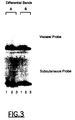
- Figure 3 represents the reverse Northern Blot analysis of two differential bands (A and B) each separated into three cDNA fragments isolated from differential display gel.
- the method of the invention was applied for selecting cDNA fragments generated by differential display. These fragments correspond to genes which are differentially expressed between human visceral and subcutaneous adipose tissues.
- a cDNA fragment of interest was subject to electrophoresis in the presence of the binding agent ("Resolver GoldTM", R&D System) according to the manufacture's instruction. 1 unit of the agent per ml was added into 1.5 % of agarose gel precooled to 70°C or less. About 1-2 ⁇ g of DNA was loaded with bromophenol blue and electrophoresis was run in 0.5 x TBE, pH 8.0 at a voltage of 10 V.cm -1 . Electrophoresis was stopped as soon as the bromophenol blue migrated at a much lower speed than that at the beginning.
- the binding agent "Resolver GoldTM", R&D System”
- the cDNA fragment appeared as a single band after electrophoresis in standard agarose gel (figure 1A), but was separated into three distinct bands in the presence of the DNA dye (Figure 1B).
- the bands resolved by the DNA binding agent were excised from the gel.
- a narrow tube such as a 50 ⁇ l tip was used to stab bands of interest.
- the gel slices contained in the tip were pushed into 100 ⁇ l ddH 2 O by a thin tube such as a sequencing tip.
- the gel containing solution was then heated at 100°C for 5 min and used in PCR amplification for enrichment.
- the method of the invention was applied to the separation of thirteen differential cDNA fragments, as shown on figure 2. Electrophoresis was run in the absence (figure 2A) and in the presence (figure 2B) of Resolver Gold. The individual cDNA fragments in lanes 1, 5, 9 were separated into 5 bands, and the cDNA fragments of lane 13 were separated into 6 bands.
- PCR amplified cDNA fragments resolved by the DNA dyes according to examples 1-3 are conveniently used in a reverse Northern Blot for high-throughput screening for true positives and elimination of false positives.
- a duplicate set of the cDNA fragments (each about 1-2 ⁇ g) are subjected to electrophoresis in two similar agarose gels (2 %) under standard conditions (Davis et al., 1986). Afterwards, the two gels are denatured, neutralized and blotted onto two Nylon membranes (PALL, Pall Europe Limited, England) using well known methods (Davis et al., 1986). The membranes are dried under vacuum at 80°C for two hours. Two radioactive probes are respectively made from total RNA samples isolated from human subcutaneous and visceral fat tissues essentially as described by Mou et al., 1994.
- Equal count of 10 6 cpm/ml of the probes are used respectively for hybridisation of two blots under standard conditions (Davis et al., 1986). Finally, the blots are washed with 5 x SSC, 0.1 % SDS and exposed to a X-ray film. The signal intensities of the cDNA bands are then compared using a densitometer between two blots for identification of false or true positives.
- a signal showing a similar intensity (after correction with a known control) between two blots indicates a false positive for elimination whereas a signal displaying a significantly different intensity (after correction with a known control) indicates a potential positive for further confirmation by Northern Blot or ribonuclease protection assay or RT-PCR.
- cDNA fragments Nos 1 and 3 showed similar intensities between two blots hybridized respectively with visceral and subcutaneous probes, indicating two false positives, whereas cDNA fragment No 2 showed a higher intensity in subcutaneous blot than in visceral blot, indicating a true positive preferentially expressed in human subcutaneous fat.
- cDNA fragments Nos 1 and 3 showed similar intensities between two blots hybridized respectively with visceral and subcutaneous probes, indicating two false positives, whereas cDNa fragment No 2 showed a higher intensity in visceral blot than in subcutaneous blot, indicating a true positive that is selectively expressed in human visceral fat.
- RNAs (10 ⁇ g) isolated from human visceral and subcutaneous fat tissues are resolved by electrophoresis in a 2 % agarose-formaldehyde gel and transferred to a nylon membrane (PALL, Pall Europe Limited, England). The filters are heated under vacuum at 80°C for two hours.
- the probes are prepared from the potential positive cDNA fragments using a random-primer labeling kit (Boehringer Mannheim) in the presence of ⁇ -[ 32 ]P dCTP.
- Northern hybridization is carried out as described (Davis et al., 1986).
- Blots are washed with 5 x SSC, 0.1 % SDS and exposed to a X-ray film. A signal observed only or with a higher intensity in one of the two human adipose tissues proves the differential expression of the cDNA.
Landscapes
- Chemical & Material Sciences (AREA)
- Life Sciences & Earth Sciences (AREA)
- Organic Chemistry (AREA)
- Zoology (AREA)
- Wood Science & Technology (AREA)
- Proteomics, Peptides & Aminoacids (AREA)
- Health & Medical Sciences (AREA)
- Engineering & Computer Science (AREA)
- Analytical Chemistry (AREA)
- Microbiology (AREA)
- Immunology (AREA)
- Molecular Biology (AREA)
- Biotechnology (AREA)
- Biophysics (AREA)
- Physics & Mathematics (AREA)
- Biochemistry (AREA)
- Bioinformatics & Cheminformatics (AREA)
- General Engineering & Computer Science (AREA)
- General Health & Medical Sciences (AREA)
- Genetics & Genomics (AREA)
- Measuring Or Testing Involving Enzymes Or Micro-Organisms (AREA)
Priority Applications (3)
| Application Number | Priority Date | Filing Date | Title |
|---|---|---|---|
| EP97401238A EP0882801A1 (de) | 1997-06-03 | 1997-06-03 | Verfahren für die Selektion von cDNA Fragmente |
| PCT/EP1998/003304 WO1998059070A1 (en) | 1997-06-03 | 1998-06-03 | METHOD FOR SELECTING cDNA FRAGMENTS |
| AU83354/98A AU8335498A (en) | 1997-06-03 | 1998-06-03 | Method for selecting cdna fragments |
Applications Claiming Priority (1)
| Application Number | Priority Date | Filing Date | Title |
|---|---|---|---|
| EP97401238A EP0882801A1 (de) | 1997-06-03 | 1997-06-03 | Verfahren für die Selektion von cDNA Fragmente |
Publications (1)
| Publication Number | Publication Date |
|---|---|
| EP0882801A1 true EP0882801A1 (de) | 1998-12-09 |
Family
ID=8229770
Family Applications (1)
| Application Number | Title | Priority Date | Filing Date |
|---|---|---|---|
| EP97401238A Pending EP0882801A1 (de) | 1997-06-03 | 1997-06-03 | Verfahren für die Selektion von cDNA Fragmente |
Country Status (3)
| Country | Link |
|---|---|
| EP (1) | EP0882801A1 (de) |
| AU (1) | AU8335498A (de) |
| WO (1) | WO1998059070A1 (de) |
Citations (3)
| Publication number | Priority date | Publication date | Assignee | Title |
|---|---|---|---|---|
| EP0487218A1 (de) * | 1990-10-31 | 1992-05-27 | Tosoh Corporation | Verfahren zum Nachweis oder Quantifizierung von Zielnukleinsäuren |
| DE4330307A1 (de) * | 1993-09-07 | 1995-03-09 | Georg Dr Meyer | Verwendung von Nukleinsäuregelelektrophorese zur Identifizierung von Organismenteilen und dergleichen |
| EP0750047A1 (de) * | 1995-06-20 | 1996-12-27 | Georg Dr. Meyer | Verwendung der Auftrennung von DNA-Fragmenten unter Anlagerung von polymergekoppelten DNA-Liganden zur Unterscheidung von Organismen, Viren, Plasmiden und Genen und zur Bestimmung ihrer Vielfalt |
-
1997
- 1997-06-03 EP EP97401238A patent/EP0882801A1/de active Pending
-
1998
- 1998-06-03 AU AU83354/98A patent/AU8335498A/en not_active Abandoned
- 1998-06-03 WO PCT/EP1998/003304 patent/WO1998059070A1/en not_active Ceased
Patent Citations (3)
| Publication number | Priority date | Publication date | Assignee | Title |
|---|---|---|---|---|
| EP0487218A1 (de) * | 1990-10-31 | 1992-05-27 | Tosoh Corporation | Verfahren zum Nachweis oder Quantifizierung von Zielnukleinsäuren |
| DE4330307A1 (de) * | 1993-09-07 | 1995-03-09 | Georg Dr Meyer | Verwendung von Nukleinsäuregelelektrophorese zur Identifizierung von Organismenteilen und dergleichen |
| EP0750047A1 (de) * | 1995-06-20 | 1996-12-27 | Georg Dr. Meyer | Verwendung der Auftrennung von DNA-Fragmenten unter Anlagerung von polymergekoppelten DNA-Liganden zur Unterscheidung von Organismen, Viren, Plasmiden und Genen und zur Bestimmung ihrer Vielfalt |
Non-Patent Citations (7)
| Title |
|---|
| CALLARD ET AL.: "A method for the elimination of false positives generated by the mRNA differential display technique", BIOTECHNIQUES, vol. 16, no. 6, 1994, pages 1096 - 1103, XP002047038 * |
| LIANG P ET AL: "DIFFERENTIAL DISPLAY OF EUKARYOTIC MESSENGER RNA BY MEANS OF THE POLYMERASE CHAIN REACTION", SCIENCE, vol. 257, no. 5072, 14 August 1992 (1992-08-14), pages 967 - 971, XP000508268 * |
| LINSKENS ET AL.: "Cataloging altered gene expression in young and senescent cells using enhanced differential display", NUCLEIC ACIDS RESEARCH, vol. 23, no. 16, 1995, OXFORD GB, pages 3244 - 3251, XP002047039 * |
| MÜLLER ET AL.: "PEG derivatives of base and sequence specific ligands: DNA interaction and application for base specific separation of DNA fragments by gel electrophoresis", NUCLEIC ACIDS RESEARCH, vol. 8, 1981, OXFORD GB, pages 95 - 119, XP002047037 * |
| WAWER ET AL.: "A simple and rapid electrophoresis method to detect sequence variation in PCR-amplified DNA fragments", NUCLEIC ACIDS RESEARCH, vol. 23, no. 23, 1995, OXFORD GB, pages 4928 - 4929, XP002047035 * |
| WELSH J ET AL: "ARBITRARILY PRIMED PCR FINGERPRINTING OF RNA", NUCLEIC ACIDS RESEARCH, vol. 20, no. 19, 11 October 1992 (1992-10-11), pages 4965 - 4970, XP000508271 * |
| ZHAO ET AL.: "Three methods for identification of true positive cloned cDNA fragments in differential display", BIOTECHNIQUES, vol. 20, March 1996 (1996-03-01), pages 400 - 404, XP002047036 * |
Also Published As
| Publication number | Publication date |
|---|---|
| AU8335498A (en) | 1999-01-04 |
| WO1998059070A1 (en) | 1998-12-30 |
Similar Documents
| Publication | Publication Date | Title |
|---|---|---|
| Kanter et al. | Analysis of restriction fragment length polymorphisms in deoxyribonucleic acid (DNA) recovered from dried bloodstains | |
| Sim et al. | Use of a cDNA library for studies on evolution and developmental expression of the chorion multigene families | |
| US6020124A (en) | Detection of soluble gene sequences in biological fluids | |
| US5137806A (en) | Methods and compositions for the detection of sequences in selected DNA molecules | |
| Deininger et al. | Base sequence studies of 300 nucleotide renatured repeated human DNA clones | |
| US5496699A (en) | Detection of allele - specific mutagens | |
| US20030215845A1 (en) | Selective extraction of DNA from groups of cells | |
| US6020126A (en) | Rapid genetic screening method | |
| WO1993006239A1 (en) | Selective restriction fragment amplification: a general method for dna fingerprinting | |
| EP0648222B1 (de) | Verfahren zur einfachen nukleotid-primer-verlängerung zum nachweis spezifischer allele und dafür geeigneter kit | |
| WO1996015262A2 (en) | Method for the detection of ras oncogenes, in particular the 12-ras oncogene | |
| CA2302432A1 (en) | Dna bracketing locus compatible standards for electrophoresis | |
| EP0402400B1 (de) | Verwendung von dna-proben mit variabler anzahl von tandem-repetitiven stellen zur genetischen identifizierung | |
| Cheng et al. | Polymerase chain reaction heteroduplex polymorphism analysis by entangled solution capillary electrophoresis | |
| US20240309434A1 (en) | Targeted rare allele crispr enrichment | |
| CA1313633C (en) | Purification of polymorphic components of complex genomes | |
| Gabriel et al. | Population variation of human mitochondrial DNA hypervariable regions I and II in 105 Croatian individuals demonstrated by immobilized sequence-specific oligonucleotide probe analysis | |
| Gelfi et al. | Capillary zone electrophoresis of polymerase chain reaction‐amplified DNA fragments in polymer networks: The case of GATT microsatellites in cystic fibrosis | |
| US6503707B1 (en) | Method for genetic typing | |
| Baron et al. | A new strategy useful rapid identification of microsatellites from DNA libraries with large size inserts | |
| EP0882801A1 (de) | Verfahren für die Selektion von cDNA Fragmente | |
| KR101843432B1 (ko) | 소 미토콘드리아 dna의 단일염기다형성 마커를 포함하는 소 개체 및 품종 식별용 조성물, 및 이를 이용하는 소의 식별 방법 | |
| US6107031A (en) | Method for screening for unknown organisms | |
| KR100920369B1 (ko) | ChiVMV저항성 고추 품종을 선별하기 위한 프라이머세트, 방법 및 키트 | |
| Arends et al. | Recombinant DNA technology and its diagnostic applications |
Legal Events
| Date | Code | Title | Description |
|---|---|---|---|
| PUAI | Public reference made under article 153(3) epc to a published international application that has entered the european phase |
Free format text: ORIGINAL CODE: 0009012 |
|
| STAA | Information on the status of an ep patent application or granted ep patent |
Free format text: STATUS: THE APPLICATION HAS BEEN PUBLISHED |
|
| AK | Designated contracting states |
Kind code of ref document: A1 Designated state(s): AT BE CH DE DK ES FI FR GB GR IE IT LI LU MC NL PT SE |
|
| AX | Request for extension of the european patent |
Free format text: AL;LT;LV;RO;SI |