EP0874917B1 - Process and apparatus to enhance the paintbake response and aging stability of aluminum sheet materials and product therefrom - Google Patents
Process and apparatus to enhance the paintbake response and aging stability of aluminum sheet materials and product therefrom Download PDFInfo
- Publication number
- EP0874917B1 EP0874917B1 EP96944361A EP96944361A EP0874917B1 EP 0874917 B1 EP0874917 B1 EP 0874917B1 EP 96944361 A EP96944361 A EP 96944361A EP 96944361 A EP96944361 A EP 96944361A EP 0874917 B1 EP0874917 B1 EP 0874917B1
- Authority
- EP
- European Patent Office
- Prior art keywords
- aging
- aluminum alloy
- sheet
- sheet product
- heating
- Prior art date
- Legal status (The legal status is an assumption and is not a legal conclusion. Google has not performed a legal analysis and makes no representation as to the accuracy of the status listed.)
- Revoked
Links
- 230000032683 aging Effects 0.000 title claims description 68
- 230000004044 response Effects 0.000 title claims description 24
- 238000000034 method Methods 0.000 title claims description 23
- 229910052782 aluminium Inorganic materials 0.000 title description 22
- XAGFODPZIPBFFR-UHFFFAOYSA-N aluminium Chemical compound [Al] XAGFODPZIPBFFR-UHFFFAOYSA-N 0.000 title description 22
- 239000000463 material Substances 0.000 title description 4
- 230000008569 process Effects 0.000 title description 2
- 238000010438 heat treatment Methods 0.000 claims description 40
- 238000001816 cooling Methods 0.000 claims description 30
- 229910000838 Al alloy Inorganic materials 0.000 claims description 28
- 238000010791 quenching Methods 0.000 claims description 13
- 230000000171 quenching effect Effects 0.000 claims description 9
- 230000006698 induction Effects 0.000 claims description 7
- 238000004519 manufacturing process Methods 0.000 claims description 6
- 229910018464 Al—Mg—Si Inorganic materials 0.000 claims description 3
- FYYHWMGAXLPEAU-UHFFFAOYSA-N Magnesium Chemical compound [Mg] FYYHWMGAXLPEAU-UHFFFAOYSA-N 0.000 claims 1
- 229910019064 Mg-Si Inorganic materials 0.000 claims 1
- 229910019406 Mg—Si Inorganic materials 0.000 claims 1
- 238000005275 alloying Methods 0.000 claims 1
- 238000005097 cold rolling Methods 0.000 claims 1
- 238000005098 hot rolling Methods 0.000 claims 1
- 229910052749 magnesium Inorganic materials 0.000 claims 1
- 239000011777 magnesium Substances 0.000 claims 1
- 238000010422 painting Methods 0.000 claims 1
- 229910052710 silicon Inorganic materials 0.000 claims 1
- 239000010703 silicon Substances 0.000 claims 1
- 239000000047 product Substances 0.000 description 20
- 238000011282 treatment Methods 0.000 description 19
- 229910045601 alloy Inorganic materials 0.000 description 16
- 239000000956 alloy Substances 0.000 description 16
- 230000001965 increasing effect Effects 0.000 description 14
- 230000000694 effects Effects 0.000 description 10
- 230000006872 improvement Effects 0.000 description 9
- 238000012545 processing Methods 0.000 description 8
- 239000000243 solution Substances 0.000 description 8
- 238000013459 approach Methods 0.000 description 6
- 230000008901 benefit Effects 0.000 description 5
- 238000002474 experimental method Methods 0.000 description 5
- 229910018594 Si-Cu Inorganic materials 0.000 description 3
- 229910008465 Si—Cu Inorganic materials 0.000 description 3
- 238000010586 diagram Methods 0.000 description 3
- 229910052751 metal Inorganic materials 0.000 description 3
- 239000002184 metal Substances 0.000 description 3
- 238000005728 strengthening Methods 0.000 description 3
- 238000012546 transfer Methods 0.000 description 3
- 206010063493 Premature ageing Diseases 0.000 description 2
- 208000032038 Premature aging Diseases 0.000 description 2
- 230000002411 adverse Effects 0.000 description 2
- 230000004888 barrier function Effects 0.000 description 2
- 238000004364 calculation method Methods 0.000 description 2
- 230000001010 compromised effect Effects 0.000 description 2
- 230000000704 physical effect Effects 0.000 description 2
- 239000002244 precipitate Substances 0.000 description 2
- 238000003672 processing method Methods 0.000 description 2
- 238000004088 simulation Methods 0.000 description 2
- 239000012086 standard solution Substances 0.000 description 2
- 238000009864 tensile test Methods 0.000 description 2
- 238000012360 testing method Methods 0.000 description 2
- 229910021365 Al-Mg-Si alloy Inorganic materials 0.000 description 1
- PNEYBMLMFCGWSK-UHFFFAOYSA-N aluminium oxide Inorganic materials [O-2].[O-2].[O-2].[Al+3].[Al+3] PNEYBMLMFCGWSK-UHFFFAOYSA-N 0.000 description 1
- 230000015572 biosynthetic process Effects 0.000 description 1
- 238000010924 continuous production Methods 0.000 description 1
- 230000007797 corrosion Effects 0.000 description 1
- 238000005260 corrosion Methods 0.000 description 1
- 230000007423 decrease Effects 0.000 description 1
- 230000002708 enhancing effect Effects 0.000 description 1
- 230000001747 exhibiting effect Effects 0.000 description 1
- 239000011888 foil Substances 0.000 description 1
- 238000009533 lab test Methods 0.000 description 1
- 239000000203 mixture Substances 0.000 description 1
- 239000003973 paint Substances 0.000 description 1
- 238000001556 precipitation Methods 0.000 description 1
- 230000001737 promoting effect Effects 0.000 description 1
- 230000009467 reduction Effects 0.000 description 1
- 238000003303 reheating Methods 0.000 description 1
- 238000011160 research Methods 0.000 description 1
- 238000000926 separation method Methods 0.000 description 1
- 238000005482 strain hardening Methods 0.000 description 1
- 230000035882 stress Effects 0.000 description 1
- 238000004627 transmission electron microscopy Methods 0.000 description 1
Images




Classifications
-
- C—CHEMISTRY; METALLURGY
- C21—METALLURGY OF IRON
- C21D—MODIFYING THE PHYSICAL STRUCTURE OF FERROUS METALS; GENERAL DEVICES FOR HEAT TREATMENT OF FERROUS OR NON-FERROUS METALS OR ALLOYS; MAKING METAL MALLEABLE, e.g. BY DECARBURISATION OR TEMPERING
- C21D9/00—Heat treatment, e.g. annealing, hardening, quenching or tempering, adapted for particular articles; Furnaces therefor
- C21D9/52—Heat treatment, e.g. annealing, hardening, quenching or tempering, adapted for particular articles; Furnaces therefor for wires; for strips ; for rods of unlimited length
- C21D9/54—Furnaces for treating strips or wire
- C21D9/56—Continuous furnaces for strip or wire
-
- C—CHEMISTRY; METALLURGY
- C22—METALLURGY; FERROUS OR NON-FERROUS ALLOYS; TREATMENT OF ALLOYS OR NON-FERROUS METALS
- C22F—CHANGING THE PHYSICAL STRUCTURE OF NON-FERROUS METALS AND NON-FERROUS ALLOYS
- C22F1/00—Changing the physical structure of non-ferrous metals or alloys by heat treatment or by hot or cold working
- C22F1/04—Changing the physical structure of non-ferrous metals or alloys by heat treatment or by hot or cold working of aluminium or alloys based thereon
-
- C—CHEMISTRY; METALLURGY
- C22—METALLURGY; FERROUS OR NON-FERROUS ALLOYS; TREATMENT OF ALLOYS OR NON-FERROUS METALS
- C22F—CHANGING THE PHYSICAL STRUCTURE OF NON-FERROUS METALS AND NON-FERROUS ALLOYS
- C22F1/00—Changing the physical structure of non-ferrous metals or alloys by heat treatment or by hot or cold working
- C22F1/04—Changing the physical structure of non-ferrous metals or alloys by heat treatment or by hot or cold working of aluminium or alloys based thereon
- C22F1/05—Changing the physical structure of non-ferrous metals or alloys by heat treatment or by hot or cold working of aluminium or alloys based thereon of alloys of the Al-Si-Mg type, i.e. containing silicon and magnesium in approximately equal proportions
-
- C—CHEMISTRY; METALLURGY
- C21—METALLURGY OF IRON
- C21D—MODIFYING THE PHYSICAL STRUCTURE OF FERROUS METALS; GENERAL DEVICES FOR HEAT TREATMENT OF FERROUS OR NON-FERROUS METALS OR ALLOYS; MAKING METAL MALLEABLE, e.g. BY DECARBURISATION OR TEMPERING
- C21D9/00—Heat treatment, e.g. annealing, hardening, quenching or tempering, adapted for particular articles; Furnaces therefor
- C21D9/52—Heat treatment, e.g. annealing, hardening, quenching or tempering, adapted for particular articles; Furnaces therefor for wires; for strips ; for rods of unlimited length
- C21D9/54—Furnaces for treating strips or wire
- C21D9/56—Continuous furnaces for strip or wire
- C21D9/60—Continuous furnaces for strip or wire with induction heating
-
- Y—GENERAL TAGGING OF NEW TECHNOLOGICAL DEVELOPMENTS; GENERAL TAGGING OF CROSS-SECTIONAL TECHNOLOGIES SPANNING OVER SEVERAL SECTIONS OF THE IPC; TECHNICAL SUBJECTS COVERED BY FORMER USPC CROSS-REFERENCE ART COLLECTIONS [XRACs] AND DIGESTS
- Y02—TECHNOLOGIES OR APPLICATIONS FOR MITIGATION OR ADAPTATION AGAINST CLIMATE CHANGE
- Y02P—CLIMATE CHANGE MITIGATION TECHNOLOGIES IN THE PRODUCTION OR PROCESSING OF GOODS
- Y02P10/00—Technologies related to metal processing
- Y02P10/25—Process efficiency
Definitions
- the present invention is directed to a method and apparatus of making aluminum sheet product and products therefrom and, in particular, a method of pre-aging aluminum automotive sheet to produce a product which exhibits increased yield strength in response to automotive paintbake cycles, superior resistance to natural aging prior to stamping, and improved stamping performance.
- vehicle sheet product is approximately 0.001m (0.040") in thickness and includes both AA 2000 and AA 6000 series aluminum alloys.
- Preferred AA 2000 series alloys include AA 2008, AA 2010 and AA 2036.
- AA 6000 series alloys include AA 6010, AA 6016 and AA. 6111.
- the AA 6000 series alloys are usually employed in automotive outer panel applications, such as deck lids or hoods, due to their higher strength and superior dent resistance.
- the standard automotive paintbake cycle of about 350°F for approximately 30 minutes is generally insufficient to impart a significant aging response (PBR) in AA 6XXX alloys. While a full T6 aging treatment of 8 hours at 177°C (350°F) can increase the yield strength of these alloys by up to 172.5 MPa (25 ksi), the standard 30 minute aging cycle generally imparts only a 2 to 27.6 MPa (4 ksi) increase in yield strength.
- PBR aging response
- AA 6111 alloys offer the potential of increasing the paintbake response substantially.
- improved PBR would significantly improve the dent resistance (or allow down gauging), while maintaining the same formability.
- Other strategies to achieve these improvements may involve using leaner alloy compositions which could deliver low yield strength (lower springback) and superior formability in the T4 condition, and yet have dent resistance comparable to more heavily alloyed Al-Mg-Si-Cu alloys (such as AA 6111 and AA 6010) in the paintbaked condition.
- An AA 6111-F temper product was subjected to a standard solution heat treatment and quench.
- a pre-aging cycle of 100°C (212°F) for 24 hours was imposed following dwell times at 24°C (75°F) of 20 minutes, 120 minutes, 18 hours, and 96 hours.
- the specimens were subjected to paintbake cycle of 177°C (350°F) for 30 minutes.
- the tensile test results showed that the effectiveness of the pre-aging treatment in enhancing the paintbake response was very sensitive to the dwell time.
- the post-paintbake yield strength was seen to decay rapidly from 248 MPa (36 ksi) to 186 MPa (27 ksi) as the dwell time was increased from 20 minutes to 96 hours, with most of the decay occurring in the first 18 hours.
- Increasing the dwell time from 20 minutes to two hours resulted in a 14 to 21 MPa (2 to 3 ksi) loss in post-paintbake response (PBR).
- PBR post-paintbake response
- the PER had decayed to a level near that of the standard AA 6111 product.
- the present invention sets forth a method and an apparatus which produces an aluminum alloy sheet having an improved paintbake response and, quite surprisingly, also provides resistance to natural aging and improved formability.
- a first object of the present invention is to provide a method of making aluminum sheet which will have a superior strength following the application of conventional automotive paintbake cycles.
- Another objective of the present invention is to produce an aluminum sheet product which exhibits superior stability during extended periods of natural aging, so as to provide for consistent stamping performance during its use in the production of automotive and truck components, such as panels.
- a further object of the present invention is to provide an apparatus for making aluminum sheet having superior strength following the application of conventional automotive paintbake cycles.
- a still further object of the present invention is to provide a method and apparatus of making aluminum sheet which is adaptable for aluminum alloys typically used in vehicle component applications such as Al-Mg-Si alloys, Al-Mg-Si-Cu alloys and more preferably AA 2000 and AA 6000 series type aluminum alloys.
- the inventive method is an improvement over the known processing of making aluminum alloy sheet based on either Al-Mg-Si or Al-Mg-Si-Cu containing aluminum alloys wherein the alloy is hot rolled and cold rolled to form a cold rolled sheet.
- the cold rolled sheet is then further subjected to continuous solution heat treating, continuous quenching and continuous coiling to provide the sheet in coil form.
- the sheet is continuously and rapidly heated to a pre-aging temperature after the continuous quenching step and prior to the continuous coiling step as taught in the claims. After rapid heating, the sheet in coil form is ambiently cooled, the rapid heating and ambient cooling improving the paintbake response of the aluminum alloy sheet.
- the rapid heating raises the coiled sheet temperature to between 65° and 121°C (150 and 250°F).
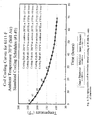
- the ambient cooling rate will be a function of ambient conditions but is between (2° and 6°F) 1.1 to 3.3 ° C per hour and more preferably about 107°C (3°F) per hour.
- the rapid heating step is designed to raise the temperature of the aluminum sheet after quenching to the target pre-aging temperature as fast as possible, preferably by induction heating.
- a means for continuously rapidly heating the sheet to a pre-aging temperature is disposed between a conventional solution heat treating/quenching apparatus and the coiling station of a conventional continuous aluminum alloy heat treating line.
- the means for rapid heating is preferably an induction heater so that the sheet temperature is rapidly brought up to the pre-aging temperature for subsequent ambient cooling and yet provides sufficient uniformity and control in the event of line slowdowns or stoppages.
- a sheet product made by the method described above is disclosed, the sheet product exhibiting significant improvement in paintbake response, e.g. up to 97 MPa (14 ksi) or more, as well as resistance to natural aging and improved formability as a result of increased elongation values, superior workhardening character and lower strength in the pre-paintbaked condition.
- solution heat treated and quenched aluminum sheet is rapidly heated to a temperature between about 65°C (150°F) and about 121°C (250°F) in a continuous process, such heating occurring as soon as possible after the application of the quench and leveling which follow solution heat treatment.
- the aluminum sheet is then coiled and allowed to cool as a coiled product without the necessity of additional furnace treatments.
- the natural cooling of the coil on the plant floor provides for an acceptable pre-aging treatment which avoids the need for subsequent re-heating and is subject to only minimal losses in performance due to the phenomenon of dwell time decay.
- the inventive method and apparatus are effective at significantly improving the strength of Al-Mg-Si and Al-Mg-Si-Cu- type aluminum alloy autobody sheet, while simultaneously improving its formability and stamping performance.
- Use of the inventive processing method on these types of aluminum alloy sheet products enhances the artificial aging response obtained during the standard automotive paintbake cycles by up to 4-fold.
- the aluminum sheet is subjected to rapid heating to a pre-aging temperature following the standard solution heating and quenching and prior to sheet coiling.
- the pre-aging temperature is defined as that temperature which does not cause excessive aging and increased T4 yield strength while still providing a significant paintbake response, resistance to natural aging and improved formability.
- the pre-aging temperature is between 65° and 121°C (150° and 250°F) .
- the heating rate is such that the material being continuously and rapidly treated is brought up to the pre-aging temperature substantially instantaneously, i.e. without any ramping or other slow heat up. The heating occurs as soon as possible after the application of the quench which follows solution heat treatment.
- the aluminum is then coiled and allowed to cool as a coiled product without the necessity of additional furnace treatments.
- the natural cocling of the coil usually on a plant floor, provides for an acceptable pre-aging treatment which avoids the need for subsequent re-heating and is subject to only minimal losses in performance due to the phenomenon of dwell time decay.
- Paintbake response can be increased from the standard 14 MPa (2 ksi) to 97 MPa (14 ksi); Natural aging in the product is suspended; Formability of the product is increased.
- the application of the continuous pre-age cycle offers a method to produce an aluminum sheet product with improved dent resistance, greater stability for consistency of stamping and superior stamping performance.
- the processing method avoids additional metal handling, and thus promises to be a low cost method to improve product performance and reduce product variability.
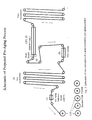
- FIG. 3 A schematic diagram showing one embodiment of a coil pre-aging apparatus is shown in Figure 3.
- a freshly quenched alloy 6111 sheet 1 exiting the accumulator 3 at the exit of a continuous heat treater (CHT) 5 is re-heated to a temperature of between 65° and 121°C (150°F and 250°F) using an induction heater 7.
- Figure 3 also shows a leveler 9 downstream of the CHT 5 and an exit accumulator 3 disposed between the leveler 9 and the induction heater 7.
- the sheet 1 After the sheet 1 is pre-aged by the induction heater 7, it is coiled into coil form 13 for subsequent processing.
- the induction heater 7 is a preferred device for rapidly heating the solution heat treated and quenched sheet 1 prior to formation of the coil form 13. Any means for this rapid heating can be utilized according to the invention.
- the rapid heating means is designed to rapidly heat the sheet 1 to a target pre-age temperature.
- the following provides an exemplary calculation to determine the power requirement or heating rate for a rapid heating means based on a target pre-aging temperature of 121°C (250°F), a specified line speed, a specified entry temperature and a specified size and type for the sheet to be rapidly heated.
- a target pre-aging temperature 121°C (250°F)
- a specified line speed a specified entry temperature
- a specified size and type for the sheet to be rapidly heated.
- the power requirement may vary depending on the particular variables selected.
- test work was performed with respect to paintbake response, natural aging resistance and improved formability.
- the tests described below further explain the ambient cooling rates used in conjunction with the rapid heating pre-aging treatment, as well as the enhanced physical properties achieved by the invention. It should be understood that the experiments described below are only exemplary of the invention and the invention is not so limited.
- samples were allowed an additional 10 days of natural aging (T4 treatment) and then specimens were taken for tensile examination and to prepare foil for transmission electron microscopy.
- Half of the specimens were given a standard paintbake simulation 194°C (350°F) 30 min.) and half were tested in the as pre-aged + 10 days natural aged condition.
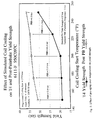
- the T4 aluminum alloy sheet prior to paint baking shows a relatively flat curve for yield strength over 60 days. What this means is that, by pre-aging according to the invention, resistance to natural aging is increased. Thus, the aluminum sheet does not exhibit the typical yield strength increase in T4 yield strength, i.e. 7 to 14 MPa (one or two ksi), which can adversely affect stamping performance. The T4 yield strength is also lowered, reducing the problem of springback that is common with automotive aluminum stampings.
- Figure 6 also reaffirms the significant paintbake response achieved when the aluminum sheet is pre-aged according to the invention, even after 60 days of natural aging time.
- this value for a standard AA 6111 - T4 alloy is about 18%.
- uniform elongation is vastly improved, extending up to 23% for a pre-aging temperature of 93 °C (200 °F).
- the data discussed above indicate that superior stability and PBR are achieved when practicing the invention, particularly when using a 1.7 °C (3 °F)per hour ambient cooling rate from a 93°C (200°F) pre-aging temperature.
- Tensile tests performed on samples prior to the application of a paintbake cycle indicate that elongation to failure which closely parallels formability and stamping performance is increased up to 28%, a full 4% improvement over standard AA 6111 - T4 aluminum alloy elongation.
- uniform elongation is also improved when practicing the invention.
- a paintbake response far exceeding the normal 14 MPa (2 ksi) is achieved when rapidly heating an aluminum sheet directly after continuous heat treatment and quenching and ambiently cooling the coil.
- the aluminum sheet also shows resistance to natural aging by not showing an increase in yield strength over time. This aging resistance is significant since increases in yield strength over time can adversely effect stamping performance.
Landscapes
- Chemical & Material Sciences (AREA)
- Engineering & Computer Science (AREA)
- Physics & Mathematics (AREA)
- Thermal Sciences (AREA)
- Crystallography & Structural Chemistry (AREA)
- Mechanical Engineering (AREA)
- Materials Engineering (AREA)
- Metallurgy (AREA)
- Organic Chemistry (AREA)
- Application Of Or Painting With Fluid Materials (AREA)
Description
Claims (9)
- A method of making a Mg-Si containing aluminum alloy sheet product from an aluminum alloy having magnesium and silicon as alloying elements which comprises the steps of providing an Al-Mg-Si- containing aluminum alloy, subjecting said aluminum alloy to hot rolling and subsequent cold rolling to form a cold rolled sheet product, solution heat treating the cold rolled sheet product, and quenching the solution heat treated product, characterized by:(a) rapidly heating said quenched sheet product to a pre-aging temperature between 65° and 121° C as said sheet product is continuously moved through means for heating the sheet product; and(b) ambient cooling said sheet in coil form from said pre-aging temperature to ambient temperature at a cooling rate of between 1.1 to 3.3 °C per hour, said heating and ambient cooling improving paintbake response of said aluminum alloy sheet product.
- The method of claim 1, wherein said pre-aging temperature is between 79° and 107° C.
- The method of any one of the preceding claims, wherein the quenched sheet product is heated by induction heating.
- The method of any one of the preceding claims, further comprising the step of levelling said sheet product after said quenching step and prior to said heating step.
- The method of any one of the preceding claims, wherein said coil form is uncoiled and subjected to stamping to form a vehicle component part.
- The method of claim 5, wherein said vehicle component part is heated as part of a painting cycle.
- The method of any one of the preceding claims, wherein the time between the end of said quenching and said heating is less than about 5 minutes.
- The method of any one of the preceding claims, wherein said Al-Mg-Si-containing aluminum alloy is an AA 6000 series aluminum alloy.
- The method of any one of the preceding claims, wherein the quenched sheet is coiled immediately after the rapid heating step.
Applications Claiming Priority (3)
| Application Number | Priority Date | Filing Date | Title |
|---|---|---|---|
| US08/573,895 US5718780A (en) | 1995-12-18 | 1995-12-18 | Process and apparatus to enhance the paintbake response and aging stability of aluminum sheet materials and product therefrom |
| US573895 | 1995-12-18 | ||
| PCT/US1996/019878 WO1997022724A1 (en) | 1995-12-18 | 1996-12-17 | Process and apparatus to enhance the paintbake response and aging stability of aluminum sheet materials and product therefrom |
Publications (3)
| Publication Number | Publication Date |
|---|---|
| EP0874917A1 EP0874917A1 (en) | 1998-11-04 |
| EP0874917A4 EP0874917A4 (en) | 1999-08-11 |
| EP0874917B1 true EP0874917B1 (en) | 2003-05-07 |
Family
ID=24293816
Family Applications (1)
| Application Number | Title | Priority Date | Filing Date |
|---|---|---|---|
| EP96944361A Revoked EP0874917B1 (en) | 1995-12-18 | 1996-12-17 | Process and apparatus to enhance the paintbake response and aging stability of aluminum sheet materials and product therefrom |
Country Status (6)
| Country | Link |
|---|---|
| US (1) | US5718780A (en) |
| EP (1) | EP0874917B1 (en) |
| JP (1) | JP2000503069A (en) |
| CA (1) | CA2240441A1 (en) |
| DE (1) | DE69628044T2 (en) |
| WO (1) | WO1997022724A1 (en) |
Cited By (1)
| Publication number | Priority date | Publication date | Assignee | Title |
|---|---|---|---|---|
| EP4423308A1 (en) * | 2021-10-26 | 2024-09-04 | Novelis, Inc. | Heat treated aluminum sheets and processes for making |
Families Citing this family (27)
| Publication number | Priority date | Publication date | Assignee | Title |
|---|---|---|---|---|
| AT408763B (en) * | 2000-09-14 | 2002-03-25 | Aluminium Ranshofen Walzwerk G | ALUMINUM ALLOY EXHAUST HARDNESS |
| US6679417B2 (en) * | 2001-05-04 | 2004-01-20 | Tower Automotive Technology Products, Inc. | Tailored solutionizing of aluminum sheets |
| JP4708555B2 (en) * | 2000-12-13 | 2011-06-22 | 株式会社神戸製鋼所 | Continuous solution quenching method for rolled aluminum alloy sheets with excellent formability and flatness |
| CA2519390C (en) | 2003-04-10 | 2015-06-02 | Corus Aluminium Walzprodukte Gmbh | An al-zn-mg-cu alloy |
| US7666267B2 (en) * | 2003-04-10 | 2010-02-23 | Aleris Aluminum Koblenz Gmbh | Al-Zn-Mg-Cu alloy with improved damage tolerance-strength combination properties |
| US20050034794A1 (en) * | 2003-04-10 | 2005-02-17 | Rinze Benedictus | High strength Al-Zn alloy and method for producing such an alloy product |
| US20060032560A1 (en) * | 2003-10-29 | 2006-02-16 | Corus Aluminium Walzprodukte Gmbh | Method for producing a high damage tolerant aluminium alloy |
| WO2006005573A1 (en) * | 2004-07-09 | 2006-01-19 | Corus Aluminium Nv | Process for producing aluminium alloy sheet material with improved bake-hardening response |
| US7491278B2 (en) * | 2004-10-05 | 2009-02-17 | Aleris Aluminum Koblenz Gmbh | Method of heat treating an aluminium alloy member and apparatus therefor |
| US7883591B2 (en) * | 2004-10-05 | 2011-02-08 | Aleris Aluminum Koblenz Gmbh | High-strength, high toughness Al-Zn alloy product and method for producing such product |
| RU2443798C2 (en) * | 2006-07-07 | 2012-02-27 | Алерис Алюминум Кобленц Гмбх | Manufacturing methods of products from aluminium alloys of aa2000 series |
| FR2907796B1 (en) * | 2006-07-07 | 2011-06-10 | Aleris Aluminum Koblenz Gmbh | ALUMINUM ALLOY PRODUCTS OF THE AA7000 SERIES AND METHOD FOR MANUFACTURING THE SAME |
| AT506727B1 (en) * | 2008-05-09 | 2010-10-15 | Amag Rolling Gmbh | METHOD FOR THE HEAT TREATMENT OF A ROLLED MOLD FROM A CURABLE ALUMINUM ALLOY |
| ES2426226T3 (en) * | 2009-06-30 | 2013-10-22 | Hydro Aluminium Deutschland Gmbh | AlMgSi band for applications with high conformation requirements |
| DE112011103667T5 (en) | 2010-11-05 | 2013-08-01 | Aleris Aluminum Duffel Bvba | Automobile molding of aluminum alloy product and process for its production |
| US8663405B2 (en) * | 2011-01-24 | 2014-03-04 | GM Global Technology Operations LLC | Stamping of age-hardenable aluminum alloy sheets |
| JP5746528B2 (en) | 2011-03-15 | 2015-07-08 | 株式会社神戸製鋼所 | Aluminum alloy sheet with excellent bake hardenability |
| EP2964800B2 (en) * | 2013-03-07 | 2022-06-15 | Aleris Aluminum Duffel BVBA | Method of manufacturing an al-mg-si alloy rolled sheet product with excellent formability |
| CN103695820B (en) * | 2013-12-28 | 2015-11-25 | 无锡透平叶片有限公司 | A kind of forging of 7050 aluminium alloys and heat-treatment technology method |
| JP6894849B2 (en) * | 2015-05-29 | 2021-06-30 | アーコニック テクノロジーズ エルエルシーArconic Technologies Llc | New 6xxx Aluminum Alloy Manufacturing Method |
| AT519995B1 (en) * | 2017-05-29 | 2021-04-15 | Andritz Ag Maschf | Process for regulating the winding temperature of a metal strip |
| US10030295B1 (en) | 2017-06-29 | 2018-07-24 | Arconic Inc. | 6xxx aluminum alloy sheet products and methods for making the same |
| KR102647056B1 (en) * | 2017-08-29 | 2024-03-14 | 노벨리스 인크. | 7xxx series aluminum alloy products in a stabilized t4 temper and methods of making the same |
| DE102018100842B3 (en) | 2018-01-16 | 2019-05-09 | Ebner Industrieofenbau Gmbh | Continuous furnace for aluminum strips |
| KR102201131B1 (en) * | 2018-04-24 | 2021-01-12 | 한국생산기술연구원 | Heat treatment method of Al-Mg-Si alloy |
| WO2019209015A1 (en) * | 2018-04-24 | 2019-10-31 | 한국생산기술연구원 | Heat treatment method for al-mg-si alloy |
| CN114959386B (en) * | 2022-05-30 | 2022-11-15 | 中国第一汽车股份有限公司 | Aluminum alloy with rapid aging response and heat treatment process thereof |
Family Cites Families (20)
| Publication number | Priority date | Publication date | Assignee | Title |
|---|---|---|---|---|
| US3135633A (en) * | 1959-09-08 | 1964-06-02 | Duralumin | Heat treatment process improving the mechanical properties of aluminiummagnesium-silicon alloys |
| US3947297A (en) * | 1973-04-18 | 1976-03-30 | The United States Of America As Represented By The Secretary Of The Air Force | Treatment of aluminum alloys |
| US4282044A (en) * | 1978-08-04 | 1981-08-04 | Coors Container Company | Method of recycling aluminum scrap into sheet material for aluminum containers |
| FR2435535A1 (en) * | 1978-09-08 | 1980-04-04 | Cegedur | PROCESS FOR THE HEAT TREATMENT OF ALUMINUM, COPPER, MAGNESIUM, SILICON ALLOYS |
| US4614552A (en) * | 1983-10-06 | 1986-09-30 | Alcan International Limited | Aluminum alloy sheet product |
| CA1286208C (en) * | 1985-11-04 | 1991-07-16 | M. Elise Hyland | Aluminum alloy vehicular member |
| JPS62142753A (en) * | 1985-12-16 | 1987-06-26 | Showa Alum Corp | Heat treatment of 7000 type aluminum alloy |
| US4808247A (en) * | 1986-02-21 | 1989-02-28 | Sky Aluminium Co., Ltd. | Production process for aluminum-alloy rolled sheet |
| JPH0668146B2 (en) * | 1986-09-09 | 1994-08-31 | スカイアルミニウム株式会社 | Method for manufacturing rolled aluminum alloy plate |
| US4812178A (en) * | 1986-12-05 | 1989-03-14 | Bruno Dubost | Method of heat treatment of Al-based alloys containing Li and the product obtained by the method |
| US4790884A (en) * | 1987-03-02 | 1988-12-13 | Aluminum Company Of America | Aluminum-lithium flat rolled product and method of making |
| US4897124A (en) * | 1987-07-02 | 1990-01-30 | Sky Aluminium Co., Ltd. | Aluminum-alloy rolled sheet for forming and production method therefor |
| JPH0674480B2 (en) * | 1987-09-03 | 1994-09-21 | 本田技研工業株式会社 | Forming and welding alloy sheet excellent in weldability, rust resistance, formability and bake hardenability, and method for producing the same |
| ZA925491B (en) * | 1991-07-23 | 1993-03-05 | Alcan Int Ltd | Aluminum alloy. |
| JPH05302154A (en) * | 1992-04-27 | 1993-11-16 | Furukawa Electric Co Ltd:The | Heat treatment method for Al-Mg-Si based aluminum alloy plate |
| JP2614686B2 (en) * | 1992-06-30 | 1997-05-28 | 住友軽金属工業株式会社 | Manufacturing method of aluminum alloy for forming process excellent in shape freezing property and paint bake hardenability |
| JPH0665695A (en) * | 1992-08-17 | 1994-03-08 | Furukawa Electric Co Ltd:The | Heat treatment method of al-mg-si aluminum alloy forged material |
| US5362341A (en) * | 1993-01-13 | 1994-11-08 | Aluminum Company Of America | Method of producing aluminum can sheet having high strength and low earing characteristics |
| JP2997145B2 (en) * | 1993-03-03 | 2000-01-11 | 日本鋼管株式会社 | Method for producing aluminum alloy sheet having delayed aging at room temperature |
| JP2997156B2 (en) * | 1993-09-30 | 2000-01-11 | 日本鋼管株式会社 | Method for producing aluminum alloy sheet at room temperature with slow aging excellent in formability and paint bake hardenability |
-
1995
- 1995-12-18 US US08/573,895 patent/US5718780A/en not_active Expired - Lifetime
-
1996
- 1996-12-17 EP EP96944361A patent/EP0874917B1/en not_active Revoked
- 1996-12-17 DE DE69628044T patent/DE69628044T2/en not_active Expired - Lifetime
- 1996-12-17 WO PCT/US1996/019878 patent/WO1997022724A1/en not_active Ceased
- 1996-12-17 CA CA002240441A patent/CA2240441A1/en not_active Abandoned
- 1996-12-17 JP JP9522922A patent/JP2000503069A/en not_active Ceased
Cited By (1)
| Publication number | Priority date | Publication date | Assignee | Title |
|---|---|---|---|---|
| EP4423308A1 (en) * | 2021-10-26 | 2024-09-04 | Novelis, Inc. | Heat treated aluminum sheets and processes for making |
Also Published As
| Publication number | Publication date |
|---|---|
| US5718780A (en) | 1998-02-17 |
| DE69628044D1 (en) | 2003-06-12 |
| CA2240441A1 (en) | 1997-06-26 |
| EP0874917A4 (en) | 1999-08-11 |
| WO1997022724A1 (en) | 1997-06-26 |
| EP0874917A1 (en) | 1998-11-04 |
| JP2000503069A (en) | 2000-03-14 |
| DE69628044T2 (en) | 2004-03-25 |
Similar Documents
| Publication | Publication Date | Title |
|---|---|---|
| US5718780A (en) | Process and apparatus to enhance the paintbake response and aging stability of aluminum sheet materials and product therefrom | |
| US4151013A (en) | Aluminum-magnesium alloys sheet exhibiting improved properties for forming and method aspects of producing such sheet | |
| JP5815947B2 (en) | How to produce a coating on a steel strip | |
| RU2699496C2 (en) | Automotive aluminium sheet of high formability with reduced or absent surface furrow and method for production thereof | |
| EP0805879B1 (en) | Heat treatment process for aluminum alloy sheet | |
| CN108474065B (en) | 6xxx aluminum alloy and preparation method thereof | |
| EP3191613B1 (en) | Method of annealing aluminium alloy sheet material | |
| KR102639005B1 (en) | New 6xxx aluminum alloy and its manufacturing method | |
| KR20230107381A (en) | Methods of continuously casting new 6xxx aluminum alloys, and products made from the same | |
| US6423164B1 (en) | Method of making high strength aluminum sheet product and product therefrom | |
| EP0761837B1 (en) | Method of producing aluminum alloys having superplastic properties | |
| CA2111706C (en) | Improved aluminium alloy | |
| EP1100977B1 (en) | Process for producing heat-treatable sheet articles | |
| US3959035A (en) | Heat treatment for minimizing crazing of hot-dip aluminum coatings | |
| US4579603A (en) | Controlling distortion in processed copper beryllium alloys | |
| RU2052533C1 (en) | Method for thermomechanical treatment of sheets from aluminum alloys containing lithium | |
| US4591395A (en) | Method of heat treating low carbon steel strip | |
| CA3166639A1 (en) | Sheet or strip made of a hardenable aluminum alloy, a vehicle part made therefrom, a use, and a method for producing the sheet or strip | |
| WO2016118945A1 (en) | Aluminum alloy products | |
| JP3794447B2 (en) | Method for producing aluminum alloy sheet having excellent bake hardenability | |
| JP2871731B2 (en) | Aluminum alloy material for forming and its manufacturing method | |
| JPS5929086B2 (en) | Manufacturing method of hot-dip galvanized steel sheet with excellent workability |
Legal Events
| Date | Code | Title | Description |
|---|---|---|---|
| PUAI | Public reference made under article 153(3) epc to a published international application that has entered the european phase |
Free format text: ORIGINAL CODE: 0009012 |
|
| 17P | Request for examination filed |
Effective date: 19980714 |
|
| AK | Designated contracting states |
Kind code of ref document: A1 Designated state(s): DE FR GB IT SE |
|
| A4 | Supplementary search report drawn up and despatched |
Effective date: 19990628 |
|
| AK | Designated contracting states |
Kind code of ref document: A4 Designated state(s): DE FR GB IT SE |
|
| 17Q | First examination report despatched |
Effective date: 19990825 |
|
| GRAG | Despatch of communication of intention to grant |
Free format text: ORIGINAL CODE: EPIDOS AGRA |
|
| GRAG | Despatch of communication of intention to grant |
Free format text: ORIGINAL CODE: EPIDOS AGRA |
|
| GRAH | Despatch of communication of intention to grant a patent |
Free format text: ORIGINAL CODE: EPIDOS IGRA |
|
| GRAH | Despatch of communication of intention to grant a patent |
Free format text: ORIGINAL CODE: EPIDOS IGRA |
|
| GRAA | (expected) grant |
Free format text: ORIGINAL CODE: 0009210 |
|
| AK | Designated contracting states |
Designated state(s): DE FR GB IT SE |
|
| REG | Reference to a national code |
Ref country code: GB Ref legal event code: FG4D |
|
| REF | Corresponds to: |
Ref document number: 69628044 Country of ref document: DE Date of ref document: 20030612 Kind code of ref document: P |
|
| REG | Reference to a national code |
Ref country code: SE Ref legal event code: TRGR |
|
| PLBI | Opposition filed |
Free format text: ORIGINAL CODE: 0009260 |
|
| ET | Fr: translation filed | ||
| PLAX | Notice of opposition and request to file observation + time limit sent |
Free format text: ORIGINAL CODE: EPIDOSNOBS2 |
|
| 26 | Opposition filed |
Opponent name: CORUS ALUMINIUM NV Effective date: 20040205 Opponent name: ALCAN TECHNOLOGY AND MANAGEMENT LIMITED Effective date: 20040129 |
|
| PLAX | Notice of opposition and request to file observation + time limit sent |
Free format text: ORIGINAL CODE: EPIDOSNOBS2 |
|
| PLBB | Reply of patent proprietor to notice(s) of opposition received |
Free format text: ORIGINAL CODE: EPIDOSNOBS3 |
|
| PLAB | Opposition data, opponent's data or that of the opponent's representative modified |
Free format text: ORIGINAL CODE: 0009299OPPO |
|
| PLAQ | Examination of admissibility of opposition: information related to despatch of communication + time limit deleted |
Free format text: ORIGINAL CODE: EPIDOSDOPE2 |
|
| PLAR | Examination of admissibility of opposition: information related to receipt of reply deleted |
Free format text: ORIGINAL CODE: EPIDOSDOPE4 |
|
| PLBQ | Unpublished change to opponent data |
Free format text: ORIGINAL CODE: EPIDOS OPPO |
|
| R26 | Opposition filed (corrected) |
Opponent name: CORUS ALUMINIUM NV Effective date: 20040205 Opponent name: ALCAN TECHNOLOGY AND MANAGEMENT LIMITED Effective date: 20040129 |
|
| PLAB | Opposition data, opponent's data or that of the opponent's representative modified |
Free format text: ORIGINAL CODE: 0009299OPPO |
|
| R26 | Opposition filed (corrected) |
Opponent name: ALCAN TECHNOLOGY AND MANAGEMENT LIMITED Effective date: 20040129 |
|
| PLAB | Opposition data, opponent's data or that of the opponent's representative modified |
Free format text: ORIGINAL CODE: 0009299OPPO |
|
| R26 | Opposition filed (corrected) |
Opponent name: CORUS ALUMINIUM NV Effective date: 20040205 Opponent name: ALCAN TECHNOLOGY AND MANAGEMENT LIMITED Effective date: 20040129 |
|
| APBP | Date of receipt of notice of appeal recorded |
Free format text: ORIGINAL CODE: EPIDOSNNOA2O |
|
| APAH | Appeal reference modified |
Free format text: ORIGINAL CODE: EPIDOSCREFNO |
|
| APBP | Date of receipt of notice of appeal recorded |
Free format text: ORIGINAL CODE: EPIDOSNNOA2O |
|
| APBQ | Date of receipt of statement of grounds of appeal recorded |
Free format text: ORIGINAL CODE: EPIDOSNNOA3O |
|
| APAH | Appeal reference modified |
Free format text: ORIGINAL CODE: EPIDOSCREFNO |
|
| PLAB | Opposition data, opponent's data or that of the opponent's representative modified |
Free format text: ORIGINAL CODE: 0009299OPPO |
|
| PGFP | Annual fee paid to national office [announced via postgrant information from national office to epo] |
Ref country code: SE Payment date: 20091214 Year of fee payment: 14 |
|
| R26 | Opposition filed (corrected) |
Opponent name: ALERIS ALUMINUM DUFFEL BVBA Effective date: 20040205 Opponent name: ALCAN TECHNOLOGY AND MANAGEMENT LIMITED Effective date: 20040129 |
|
| APBU | Appeal procedure closed |
Free format text: ORIGINAL CODE: EPIDOSNNOA9O |
|
| PGFP | Annual fee paid to national office [announced via postgrant information from national office to epo] |
Ref country code: IT Payment date: 20091223 Year of fee payment: 14 Ref country code: GB Payment date: 20091218 Year of fee payment: 14 Ref country code: FR Payment date: 20100108 Year of fee payment: 14 |
|
| PGFP | Annual fee paid to national office [announced via postgrant information from national office to epo] |
Ref country code: DE Payment date: 20091222 Year of fee payment: 14 |
|
| RIC2 | Information provided on ipc code assigned after grant |
Ipc: C22F 1/05 20060101AFI20100908BHEP |
|
| RTI2 | Title (correction) |
Free format text: PROCESS TO ENHANCE THE PAINTBAKE RESPONSE AND AGING STABILITY OF ALUMINUM SHEET MATERIALS AND PRODUCT THEREFROM |
|
| RDAF | Communication despatched that patent is revoked |
Free format text: ORIGINAL CODE: EPIDOSNREV1 |
|
| REG | Reference to a national code |
Ref country code: DE Ref legal event code: R103 Ref document number: 69628044 Country of ref document: DE Ref country code: DE Ref legal event code: R064 Ref document number: 69628044 Country of ref document: DE |
|
| GBPC | Gb: european patent ceased through non-payment of renewal fee |
Effective date: 20101217 |
|
| RDAG | Patent revoked |
Free format text: ORIGINAL CODE: 0009271 |
|
| STAA | Information on the status of an ep patent application or granted ep patent |
Free format text: STATUS: PATENT REVOKED |
|
| REG | Reference to a national code |
Ref country code: FR Ref legal event code: ST Effective date: 20110831 |
|
| REG | Reference to a national code |
Ref country code: SE Ref legal event code: EUG |
|
| 27W | Patent revoked |
Effective date: 20110522 |
|
| PG25 | Lapsed in a contracting state [announced via postgrant information from national office to epo] |
Ref country code: SE Free format text: LAPSE BECAUSE OF NON-PAYMENT OF DUE FEES Effective date: 20101218 |
|
| PG25 | Lapsed in a contracting state [announced via postgrant information from national office to epo] |
Ref country code: FR Free format text: LAPSE BECAUSE OF NON-PAYMENT OF DUE FEES Effective date: 20110103 |
|
| PG25 | Lapsed in a contracting state [announced via postgrant information from national office to epo] |
Ref country code: GB Free format text: LAPSE BECAUSE OF NON-PAYMENT OF DUE FEES Effective date: 20101217 |
|
| PG25 | Lapsed in a contracting state [announced via postgrant information from national office to epo] |
Ref country code: IT Free format text: LAPSE BECAUSE OF NON-PAYMENT OF DUE FEES Effective date: 20101217 |
|
| REG | Reference to a national code |
Ref country code: SE Ref legal event code: ECNC |