EP0874232A2 - Wellenlängenstandard - Google Patents
Wellenlängenstandard Download PDFInfo
- Publication number
- EP0874232A2 EP0874232A2 EP98105461A EP98105461A EP0874232A2 EP 0874232 A2 EP0874232 A2 EP 0874232A2 EP 98105461 A EP98105461 A EP 98105461A EP 98105461 A EP98105461 A EP 98105461A EP 0874232 A2 EP0874232 A2 EP 0874232A2
- Authority
- EP
- European Patent Office
- Prior art keywords
- wavelength
- standard
- reference material
- recited
- rare earth
- Prior art date
- Legal status (The legal status is an assumption and is not a legal conclusion. Google has not performed a legal analysis and makes no representation as to the accuracy of the status listed.)
- Granted
Links
- 229910001404 rare earth metal oxide Inorganic materials 0.000 claims abstract description 49
- 239000011159 matrix material Substances 0.000 claims abstract description 40
- 229920001343 polytetrafluoroethylene Polymers 0.000 claims abstract description 38
- 239000004810 polytetrafluoroethylene Substances 0.000 claims abstract description 38
- 239000012925 reference material Substances 0.000 claims abstract description 37
- 239000000203 mixture Substances 0.000 claims abstract description 19
- 229920000642 polymer Polymers 0.000 claims abstract description 10
- 239000002245 particle Substances 0.000 claims abstract description 9
- 239000000463 material Substances 0.000 claims description 44
- 238000002835 absorbance Methods 0.000 claims description 32
- -1 polyethylene Polymers 0.000 claims description 10
- 229910052623 talc Inorganic materials 0.000 claims description 7
- 238000002329 infrared spectrum Methods 0.000 claims description 6
- 239000000454 talc Substances 0.000 claims description 6
- 229910052692 Dysprosium Inorganic materials 0.000 claims description 5
- 229910052691 Erbium Inorganic materials 0.000 claims description 5
- 229910052689 Holmium Inorganic materials 0.000 claims description 5
- 239000004698 Polyethylene Substances 0.000 claims description 5
- 239000004793 Polystyrene Substances 0.000 claims description 5
- KBQHZAAAGSGFKK-UHFFFAOYSA-N dysprosium atom Chemical compound [Dy] KBQHZAAAGSGFKK-UHFFFAOYSA-N 0.000 claims description 5
- UYAHIZSMUZPPFV-UHFFFAOYSA-N erbium Chemical compound [Er] UYAHIZSMUZPPFV-UHFFFAOYSA-N 0.000 claims description 5
- KJZYNXUDTRRSPN-UHFFFAOYSA-N holmium atom Chemical compound [Ho] KJZYNXUDTRRSPN-UHFFFAOYSA-N 0.000 claims description 5
- 229920000573 polyethylene Polymers 0.000 claims description 5
- 229920002223 polystyrene Polymers 0.000 claims description 5
- 238000001429 visible spectrum Methods 0.000 claims description 5
- 230000001747 exhibiting effect Effects 0.000 claims description 2
- 239000011236 particulate material Substances 0.000 claims 1
- 230000005855 radiation Effects 0.000 claims 1
- 230000003287 optical effect Effects 0.000 abstract description 4
- 239000000843 powder Substances 0.000 description 31
- 238000002834 transmittance Methods 0.000 description 12
- 230000005540 biological transmission Effects 0.000 description 7
- 229910052761 rare earth metal Inorganic materials 0.000 description 6
- 150000002910 rare earth metals Chemical class 0.000 description 6
- VQCBHWLJZDBHOS-UHFFFAOYSA-N erbium(iii) oxide Chemical compound O=[Er]O[Er]=O VQCBHWLJZDBHOS-UHFFFAOYSA-N 0.000 description 4
- 239000011521 glass Substances 0.000 description 4
- 239000000178 monomer Substances 0.000 description 4
- 239000010453 quartz Substances 0.000 description 4
- VYPSYNLAJGMNEJ-UHFFFAOYSA-N silicon dioxide Inorganic materials O=[Si]=O VYPSYNLAJGMNEJ-UHFFFAOYSA-N 0.000 description 4
- BFKJFAAPBSQJPD-UHFFFAOYSA-N tetrafluoroethene Chemical group FC(F)=C(F)F BFKJFAAPBSQJPD-UHFFFAOYSA-N 0.000 description 4
- OKTJSMMVPCPJKN-UHFFFAOYSA-N Carbon Chemical compound [C] OKTJSMMVPCPJKN-UHFFFAOYSA-N 0.000 description 3
- VGGSQFUCUMXWEO-UHFFFAOYSA-N Ethene Chemical compound C=C VGGSQFUCUMXWEO-UHFFFAOYSA-N 0.000 description 3
- 239000005977 Ethylene Substances 0.000 description 3
- UFHFLCQGNIYNRP-UHFFFAOYSA-N Hydrogen Chemical compound [H][H] UFHFLCQGNIYNRP-UHFFFAOYSA-N 0.000 description 3
- QVGXLLKOCUKJST-UHFFFAOYSA-N atomic oxygen Chemical compound [O] QVGXLLKOCUKJST-UHFFFAOYSA-N 0.000 description 3
- 229910052799 carbon Inorganic materials 0.000 description 3
- 150000001875 compounds Chemical class 0.000 description 3
- 229910052739 hydrogen Inorganic materials 0.000 description 3
- 239000001257 hydrogen Substances 0.000 description 3
- 229910052760 oxygen Inorganic materials 0.000 description 3
- 239000001301 oxygen Substances 0.000 description 3
- IJGRMHOSHXDMSA-UHFFFAOYSA-N Atomic nitrogen Chemical compound N#N IJGRMHOSHXDMSA-UHFFFAOYSA-N 0.000 description 2
- YMWUJEATGCHHMB-UHFFFAOYSA-N Dichloromethane Chemical compound ClCCl YMWUJEATGCHHMB-UHFFFAOYSA-N 0.000 description 2
- 238000010521 absorption reaction Methods 0.000 description 2
- 238000004458 analytical method Methods 0.000 description 2
- 229910003440 dysprosium oxide Inorganic materials 0.000 description 2
- NLQFUUYNQFMIJW-UHFFFAOYSA-N dysprosium(iii) oxide Chemical compound O=[Dy]O[Dy]=O NLQFUUYNQFMIJW-UHFFFAOYSA-N 0.000 description 2
- 229910052736 halogen Inorganic materials 0.000 description 2
- 150000002367 halogens Chemical class 0.000 description 2
- JYTUFVYWTIKZGR-UHFFFAOYSA-N holmium oxide Inorganic materials [O][Ho]O[Ho][O] JYTUFVYWTIKZGR-UHFFFAOYSA-N 0.000 description 2
- OWCYYNSBGXMRQN-UHFFFAOYSA-N holmium(3+);oxygen(2-) Chemical compound [O-2].[O-2].[O-2].[Ho+3].[Ho+3] OWCYYNSBGXMRQN-UHFFFAOYSA-N 0.000 description 2
- 238000005259 measurement Methods 0.000 description 2
- 238000002310 reflectometry Methods 0.000 description 2
- 239000007787 solid Substances 0.000 description 2
- BQCIDUSAKPWEOX-UHFFFAOYSA-N 1,1-Difluoroethene Chemical compound FC(F)=C BQCIDUSAKPWEOX-UHFFFAOYSA-N 0.000 description 1
- OEPOKWHJYJXUGD-UHFFFAOYSA-N 2-(3-phenylmethoxyphenyl)-1,3-thiazole-4-carbaldehyde Chemical compound O=CC1=CSC(C=2C=C(OCC=3C=CC=CC=3)C=CC=2)=N1 OEPOKWHJYJXUGD-UHFFFAOYSA-N 0.000 description 1
- 239000004215 Carbon black (E152) Substances 0.000 description 1
- 229910052684 Cerium Inorganic materials 0.000 description 1
- 229910052693 Europium Inorganic materials 0.000 description 1
- 229910052688 Gadolinium Inorganic materials 0.000 description 1
- 229910052765 Lutetium Inorganic materials 0.000 description 1
- 229910052779 Neodymium Inorganic materials 0.000 description 1
- 229910052777 Praseodymium Inorganic materials 0.000 description 1
- 229910052773 Promethium Inorganic materials 0.000 description 1
- 229910052772 Samarium Inorganic materials 0.000 description 1
- 229910052771 Terbium Inorganic materials 0.000 description 1
- 229910052775 Thulium Inorganic materials 0.000 description 1
- 238000011481 absorbance measurement Methods 0.000 description 1
- 238000000862 absorption spectrum Methods 0.000 description 1
- 238000004164 analytical calibration Methods 0.000 description 1
- ZMIGMASIKSOYAM-UHFFFAOYSA-N cerium Chemical compound [Ce][Ce][Ce][Ce][Ce][Ce][Ce][Ce][Ce][Ce][Ce][Ce][Ce][Ce][Ce][Ce][Ce][Ce][Ce][Ce][Ce][Ce][Ce][Ce][Ce][Ce][Ce][Ce][Ce][Ce][Ce][Ce][Ce][Ce][Ce][Ce][Ce][Ce] ZMIGMASIKSOYAM-UHFFFAOYSA-N 0.000 description 1
- 239000000470 constituent Substances 0.000 description 1
- 238000007334 copolymerization reaction Methods 0.000 description 1
- 230000001419 dependent effect Effects 0.000 description 1
- 239000003085 diluting agent Substances 0.000 description 1
- 238000010790 dilution Methods 0.000 description 1
- 239000012895 dilution Substances 0.000 description 1
- 230000000694 effects Effects 0.000 description 1
- OGPBJKLSAFTDLK-UHFFFAOYSA-N europium atom Chemical compound [Eu] OGPBJKLSAFTDLK-UHFFFAOYSA-N 0.000 description 1
- UIWYJDYFSGRHKR-UHFFFAOYSA-N gadolinium atom Chemical compound [Gd] UIWYJDYFSGRHKR-UHFFFAOYSA-N 0.000 description 1
- 239000003292 glue Substances 0.000 description 1
- 239000008241 heterogeneous mixture Substances 0.000 description 1
- HCDGVLDPFQMKDK-UHFFFAOYSA-N hexafluoropropylene Chemical group FC(F)=C(F)C(F)(F)F HCDGVLDPFQMKDK-UHFFFAOYSA-N 0.000 description 1
- 229930195733 hydrocarbon Natural products 0.000 description 1
- 150000002430 hydrocarbons Chemical class 0.000 description 1
- 229910052500 inorganic mineral Inorganic materials 0.000 description 1
- 230000001678 irradiating effect Effects 0.000 description 1
- 229910052746 lanthanum Inorganic materials 0.000 description 1
- FZLIPJUXYLNCLC-UHFFFAOYSA-N lanthanum atom Chemical compound [La] FZLIPJUXYLNCLC-UHFFFAOYSA-N 0.000 description 1
- OHSVLFRHMCKCQY-UHFFFAOYSA-N lutetium atom Chemical compound [Lu] OHSVLFRHMCKCQY-UHFFFAOYSA-N 0.000 description 1
- 238000002844 melting Methods 0.000 description 1
- 230000008018 melting Effects 0.000 description 1
- 229910052751 metal Inorganic materials 0.000 description 1
- 239000011707 mineral Substances 0.000 description 1
- 238000012986 modification Methods 0.000 description 1
- 230000004048 modification Effects 0.000 description 1
- QEFYFXOXNSNQGX-UHFFFAOYSA-N neodymium atom Chemical compound [Nd] QEFYFXOXNSNQGX-UHFFFAOYSA-N 0.000 description 1
- 229910052757 nitrogen Inorganic materials 0.000 description 1
- 230000000149 penetrating effect Effects 0.000 description 1
- 239000012254 powdered material Substances 0.000 description 1
- PUDIUYLPXJFUGB-UHFFFAOYSA-N praseodymium atom Chemical compound [Pr] PUDIUYLPXJFUGB-UHFFFAOYSA-N 0.000 description 1
- VQMWBBYLQSCNPO-UHFFFAOYSA-N promethium atom Chemical compound [Pm] VQMWBBYLQSCNPO-UHFFFAOYSA-N 0.000 description 1
- KZUNJOHGWZRPMI-UHFFFAOYSA-N samarium atom Chemical compound [Sm] KZUNJOHGWZRPMI-UHFFFAOYSA-N 0.000 description 1
- 238000005245 sintering Methods 0.000 description 1
- 239000010421 standard material Substances 0.000 description 1
- 239000000126 substance Substances 0.000 description 1
- GZCRRIHWUXGPOV-UHFFFAOYSA-N terbium atom Chemical compound [Tb] GZCRRIHWUXGPOV-UHFFFAOYSA-N 0.000 description 1
- 238000012795 verification Methods 0.000 description 1
Images
Classifications
-
- G—PHYSICS
- G01—MEASURING; TESTING
- G01N—INVESTIGATING OR ANALYSING MATERIALS BY DETERMINING THEIR CHEMICAL OR PHYSICAL PROPERTIES
- G01N21/00—Investigating or analysing materials by the use of optical means, i.e. using sub-millimetre waves, infrared, visible or ultraviolet light
- G01N21/17—Systems in which incident light is modified in accordance with the properties of the material investigated
- G01N21/25—Colour; Spectral properties, i.e. comparison of effect of material on the light at two or more different wavelengths or wavelength bands
- G01N21/27—Colour; Spectral properties, i.e. comparison of effect of material on the light at two or more different wavelengths or wavelength bands using photo-electric detection ; circuits for computing concentration
- G01N21/274—Calibration, base line adjustment, drift correction
- G01N21/278—Constitution of standards
Definitions
- This invention relates to a wavelength standard in the visible and infrared spectrum for use in the analysis and identification of materials.
- Instruments measuring optical absorbance have proved to be a valuable tool in analyzing materials, both to determine and measure the constituents of materials and to determine and measure properties of materials as well as to identify unknown materials. For these purposes the measurements have been made primarily in the near infrared range, but measurements in the lower end of the visible spectrum have also been used.
- a typical near infrared absorbance measuring instrument irradiates the material with near infrared light and detects the near infrared light reflected from or transmitted through the material being analyzed while the wavelength of the near infrared light is restricted to a narrow band, which is varied over the near infrared spectrum.
- the instrument calibrated so that the wavelengths at which the absorbance measurements are made are precisely identified.
- the National Bureau of Standards developed a reference material which would serve as a wavelength standard in the near infrared range. This reference material was a mixture of three rare earth oxide powders in equal parts by weight, dysprosium oxide, erbium oxide and holmium oxide.
- This reference material exhibits peaks of absorbance at accurately known wavelengths as described in an article by V. R. Weidner, P. Y. Barnes and K. L. Eckerle entitled "A Wavelength Standard for the Near Infrared Based on the Reflectance of Rare-Earth Oxides” in Journal of Research of the National Bureau of Standards , September-October 1986.
- This rare earth oxide mixture is currently used as a standard by being sealed in a sample cup with a quartz window to permit an absorbance spectrum to be measured with a near infrared spectrophotometer.
- the absorbance peaks exhibited by the standard material must be within plus or minus 1.0 nanometers of the absorbance peaks described in the 1986 article.
- the mixture of rare earth oxides sealed in a cup with a quartz window meets this tolerance requirement.
- the standard consisting of the mixture of the rare earth oxide powders has several drawbacks.
- the powdered material is difficult to pack evenly and tightly in a sample cup such that the material does not shift within the cup and exhibits cracks or voids which are visible through the quartz window. Such voids can shift around thereby physically changing the reference material scanned by the spectrophotometer. While the positions of the absorbance peaks do not change as the voids change position under the window, the intensities of the peaks can and do vary. Moreover, the mechanical properties of the material creates an appearance of an instability in the material. In addition, since the mixture of powder is heterogeneous, there is no assurance that the different powders will not separate or stratify.
- the rare earth powder was mixed with PTFE powder and the resulting mixture was heated to sinter the PTFE particles to embed the rare earth powder in a concrete PTFE matrix.
- the wavelengths of the absorbance peaks exhibited by the sintered material are different from the wavelengths of the absorbance peaks exhibited by the rare earth oxides in powdered form, evidencing that a chemical change occurs during sintering.
- the peak changes are quite drastic and, as a result, a standard comprising a combination of rare earth oxide power in a thermally sintered matrix is much less useful than it would be if the absorbance peaks matched those of the National Bureau of Standards article.
- a concrete matrix embedding the rare earth oxides uniformly distributed in the matrix and in which the absorbance peaks are in the same wavelength position as in the mixture of the rare earth powders.
- the absorbance peaks in the resulting material are not changed or shifted by more than one nanometer which is within the tolerance specified in the National Bureau of Standards paper.
- the word "concrete” as used herein corresponds to its dictionary definition and means "formed by a coalition of particles into one solid mass".
- the rare earth oxides are embedded in the concrete matrix by mixing the powdered rare earth oxides or other wavelength reference material with powdered matrix material, such as PTFE, and subjecting the mixture to sufficient pressure at ambient temperature to coalesce the matrix material particles into a concrete matrix.
- the particles of PTFE coalese into a concrete cake which holds the particles of rare earth powder immovable within the PTFE matrix.
- the percentage of rare earth powder would normally be in the range of 5 to 30 percent. Above 33 percent, the cake of PTFE and rare earth oxide becomes too friable.
- a reflectance standard will normally have a thickness of 10 to 3 millimeters.
- a transmission standard is provided wherein the PTFE matrix containing the rare earth oxide powder is formed into a thin sheet from 0.3 millimeters to three millimeters thick with a percentage of rare oxide powder of 10 percent to 1 percent by weight.
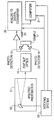
- the single figure of the drawings schematically illustrates an instrument for analyzing material from its reflectance or transmittance in the near infrared and visible range.
- the present invention in a first embodiment is a reflectance standard and in a second embodiment is a transmittance standard both for use in an instrument like that shown in the drawing.
- the instrument employed in the system of the present invention comprises a near infrared spectrophotometer 11 having an oscillating grating 13 on which the spectrophotometer directs light.
- the grating 13 reflects light with a narrow wavelength band through exit slit optics 15 to a sample 17.
- the center wavelength of the light that irradiates the sample is swept through the near infrared spectrum.
- Light from the diffraction grating that is reflected by the sample is detected by infrared photodetectors 19.
- the photodetectors generate a signal that is transmitted to an analog-to-digital converter 22 by amplifier 20.
- An indexing system 23 generates pulses as the grating 13 oscillates and applies these pulses to a computer 21 and to the analog-to-digital converter 22.
- the analog-to-digital converter converts successive samples of the output signal of the amplifier 20 to digital values. Each digital value thus corresponds to the reflectivity of the sample at a specific wavelength in the near infrared range.
- the computer 21 monitors the angular position of the grating 13 and accordingly monitors the wavelength irradiating the sample as the grating oscillates, by counting the pulses produced by the indexing system 23.
- the pulses produced by the indexing system 23 define incremental index points at which values of the output signal of the amplifier are converted to digital values.
- the index points are distributed incrementally throughout the near infrared spectrum and each correspond to a different wavelength at which the sample is irradiated.
- the computer 21 converts each reflectivity value to an absorbance of the material at the corresponding wavelength.
- photodetectors When the transmissivity of the sample is measured, photodetectors will be positioned to receive light transmitted through a sample positioned in the path of the narrow band width light passing through the exit slit optics.
- Reflectance and transmittance standards by exhibiting peaks of absorbance at known wavelengths, provide a means to achieve the needed wavelength calibration verification of spectrophotometers.
- a reflectance standard is positioned in place of the sample 17 to reflect the light transmitted through the exit slit optics to the photodetectors 19 and the spectrograph of the standard is measured. From the spectrograph, the absorbance peaks exhibited by the reflectance standard are detected. This information thus provides a basis for verifying that the wavelengths transmitted through the exit slit optics are correctly and precisely calibrated.
- the spectrophotometer When the spectrophotometer is used to analyze a sample by transmittance through the sample, it is preferable to verify the instrument calibration with a transmittance standard which is positioned in the path of the light passing through the exit slit optics so that the photodetectors will receive light transmitted through the transmittance standard. The transmittance spectrograph is then measured and is used to verify that the wavelength calibration of the instrument is precisely accurate.
- the spectrographics measured from the wavelength standards by the spectrophotometer can also be used to actively calibrate the wavelengths transmitted through the exit slit optics of the spectrophotometer at each angular increment of the grating 13.
- the spectrograph measured from the reflectance standard as descried above provides a basis for actively calibrating the spectrophotometer operating in a reflectance mode and the spectrograph measured from a transmittance standard as described above provides a basis for actively calibrating the spectrophotometer operating in a transmittance mode.
- rare earth oxides, dysprosium oxide, erbium oxide and holmium oxide, in a ratio of 1:1:1 by weight are mixed with powdered PTFE.
- the rare earth oxides are from about 5 to 30 percent by weight of the PTFE powder.
- the rare earth oxides are from 1 to 10 percent by weight of the PTFE powder.
- the mixing is carried out to thoroughly blend the rare earth oxide powder in a heterogeneous mixture with the PTFE powder and the resulting mixture is then placed in a die, pressure mold, or between platens, and sufficient pressure (500 to 5,000 pounds per square inch) is applied to the powder mixture to coalese the powdered mixture into a concrete cake at ambient temperature.
- the resulting cake when analyzed by the instrument of Fig. 1 will exhibit absorbance peaks at the same wavelengths that absorbance peaks are detected from the powder mixture alone, as described in the National Bureau of Standards 1986 paper.
- the wavelengths are determined to coincide with those of the National Bureau of Standards paper within a tolerance of plus or minus one nanometer which is the accuracy tolerance specified in the National Bureau of Standards paper.
- the pressure be applied at ambient temperature, but the temperature must be low enough that the absorbance peaks exhibited by the rare earth oxides do not shift when embedded in the concrete PTFE matrix.
- the temperature should be low enough so that the particles of the PTFE powder coalesce due to the applied pressure rather than from the surface melting of the PTFE particles.
- the material When the material is to be used as a reflectance standard, it will be formed into a concrete block at least three millimeters thick and will be formed from a mixture of about 5-30 percent of rare earth oxides by weight to the PTFE powder. When the reference standard is 3 millimeters thick, the preferred percentage of rare earth oxides is 30 percent by weight of the PTFE. When the thickness of the block is 10 millimeters, the preferred percentage of the rare earth oxide in the block is about 5 percent by weight.
- the maximum ratio of rare earth oxides to PTFE is about one-third by weight because when the amount of powder substantially exceeds one-third, the resulting cake becomes too friable.
- the matrix is in the form of a thin sheet from 0.3 millimeters to 3 millimeters thick and the percentage of the rare earth oxides in the material is in the range between 10 percent to 1 percent by weight.
- the preferred percentage of rare earth oxides to PTFE by weight is 10 percent.
- the percentage of the rare earth oxides by weight to the PTFE is 1 percent.
- the thinner the matrix the greater should be the percentage of rare earth oxide.
- the preferred rare earth oxide powders in the present invention are these same three rare earth oxide powders and in this same ratio. However, one or two of the three rare earth oxide powders can be omitted from the cake and the resulting product will still be an effective reflectance standard.
- the ratios of powder can be varied to achieve a range of selected relative intensities. In each case, the individual oxides will exhibit absorptive peaks in the matrix at the same wavelengths that they exhibit individually in pure powder form.
- oxides of any of the series of 15 metallic elements having atomic numbers ranging from 57 to 71 may be used. This group consists of lanthanum, cerium, praseodymium, neodymium, promethium, samarium, europium, gadolinium, terbium, dysprosium, holmium, erbium, thulium, yttervium and lutetium.
- Another material which may be used as the wavelength reference material is talc (Mg 3 Si 4 O 10 (OH) 2 . Talc exhibits few absorbance peaks, but the peaks are extraordinarily narrow, which makes a reference standard using talc as the wavelength reference material useful in evaluating the bandwidth of the instrument.
- Another way of embedding the rare earth oxide materials in the matrix is to dope the rare earth oxides into glass which is then ground and compressed in the matrix as described above.
- Rare earth oxides doped in glass can be used as a transmission standard, but they will not exhibit the same absorption peaks that they exhibit in pure or powder form.
- glass containing rare earth oxides is ground and then is embedded in a PTFE matrix or its equivalent and the matrix is shaped to be a reflectance standard, the resulting reflectance standard will exhibit the same peaks of absorbance that the transmission standard of glass doped with the rare earth oxides exhibits.
- powdered polystyrene or powdered polyethylene can be mixed with powdered PTFE to take advantage of the reflectance properties of PTFE as a matrix embedding the powdered polystyrene or polyethylene.
- PTFE powdered polystyrene or powdered polyethylene
- Such a product allows control of all variables to optimize a standard for a given application.
- polystyrene or polyethylene may be blended with minerals or rare earth materials as well.
- the preferred matrix material which embeds the powdered wavelength reference material is PTFE.
- PTFE is the preferred material for the matrix because it has absorbances which are well characterized in reflectance.
- the absorbance features of PTFE are very broad and very weak and PTFE lacks absorbance peaks characteristic of wavelength reference materials. The strongest absorbances which might interfere with peaks and reference materials only occur at longer wavelengths leaving most of the NIR and the visible spectrum free from interference.
- the PTFE material besides having low absorbance, is highly scattering in the optical sense. This characteristic gives the material high reflectance. Moreover, light penetrating in the material scatters internally and if the material is thin enough, the light is transmitted through the material.
- the PTFE may be thought of as a diluent and a glue which holds the wavelength reference material in place and optical properties of which permit it to reflect or transmit light with practically no absorption of visible or near infrared light while permitting the light to interact with materials embedded in the matrix. While the PTFE is a preferred material for the reasons given above, other materials may be used for the matrix. Specifically, any perhalopolyethylene may be used, such as poly(perchlorethylene) or poly(per(chlorofluoro)ethylene) or poly(chlorotrifluorethylene) may be used. As another variation a monomer, per(chlorofluoro)ethylene, can be copolymerized with tetrafluorethylene to provide the powder from which the matrix is formed.
- any solid polymeric material that contains no bonds between hydrogen and carbon, oxygen or nitrogen, would provide a matrix which would be highly suitable substitute for PTFE.
- the backbone of the polymer chain contains only carbon.
- the polymer chain it is possible for the polymer chain to include other atoms such as oxygen as long as the oxygen or other atom is bonded only to carbon and is not bonded to any other element such as hydrogen.
- Examples of such materials based on tetrafluorethylene oxide and perfluorethylene oxide are: poly(tetrafluorethylene oxide-co-difluoromethylene oxide); poly(tetrafluorethylene-co-tetrafluoroethylene perfluoropropyl ether); and poly(perfluoropropylene oxide-co-perfluoroformaldehyde).
- hydrohalo polymers can be prepared from monomers which contain some hydrogen as well as halogen, e.g., vinylidene chloride, CH 2 Cl 2 , or vinylidene fluoride, CH 2 CF 2 .
- hydrohalo polymers can be prepared through copolymerization of monomers containing no halogen, such as ethylene, and monomers that are perhalogenated, such as tetrafluorethylene.
- Such compounds would be sparsely populated with CH bonds which will absorb in the infrared and near infrared range, but the absorptivities of such materials are reduced compared to those in their pure hydrocarbon counterparts due to the effects caused by the presence of flourine or simply dilution. While such compounds have significantly stronger absorbances than PTFE, they nevertheless could be useful as a matrix material. For such compounds to have a practical utility as a matrix in a reference standard, the frequency of occurrence of the C-H bonds in the material must be low enough that at least half of the absorbance peaks caused by the wavelength reference material in the matrix remain substantially unshifted in wavelength and unobscured.
Landscapes
- Physics & Mathematics (AREA)
- Engineering & Computer Science (AREA)
- Mathematical Physics (AREA)
- Theoretical Computer Science (AREA)
- Spectroscopy & Molecular Physics (AREA)
- Health & Medical Sciences (AREA)
- Life Sciences & Earth Sciences (AREA)
- Chemical & Material Sciences (AREA)
- Analytical Chemistry (AREA)
- Biochemistry (AREA)
- General Health & Medical Sciences (AREA)
- General Physics & Mathematics (AREA)
- Immunology (AREA)
- Pathology (AREA)
- Investigating Or Analysing Materials By Optical Means (AREA)
- Sampling And Sample Adjustment (AREA)
- Curing Cements, Concrete, And Artificial Stone (AREA)
- Spectrometry And Color Measurement (AREA)
Applications Claiming Priority (2)
| Application Number | Priority Date | Filing Date | Title |
|---|---|---|---|
| US08/842,260 US5936727A (en) | 1997-04-24 | 1997-04-24 | Wavelength standard |
| US842260 | 1997-04-24 |
Publications (3)
| Publication Number | Publication Date |
|---|---|
| EP0874232A2 true EP0874232A2 (de) | 1998-10-28 |
| EP0874232A3 EP0874232A3 (de) | 1999-04-21 |
| EP0874232B1 EP0874232B1 (de) | 2006-10-18 |
Family
ID=25286886
Family Applications (1)
| Application Number | Title | Priority Date | Filing Date |
|---|---|---|---|
| EP98105461A Expired - Lifetime EP0874232B1 (de) | 1997-04-24 | 1998-03-26 | Wellenlängenstandard |
Country Status (4)
| Country | Link |
|---|---|
| US (1) | US5936727A (de) |
| EP (1) | EP0874232B1 (de) |
| JP (1) | JPH10318839A (de) |
| DE (1) | DE69836166T2 (de) |
Families Citing this family (10)
| Publication number | Priority date | Publication date | Assignee | Title |
|---|---|---|---|---|
| US6751576B2 (en) | 2000-03-10 | 2004-06-15 | Cognis Corporation | On-site agricultural product analysis system and method of analyzing |
| US20030135547A1 (en) * | 2001-07-23 | 2003-07-17 | Kent J. Thomas | Extensible modular communication executive with active message queue and intelligent message pre-validation |
| SE0301897D0 (sv) * | 2003-06-27 | 2003-06-27 | Foss Tecator Ab | Referece standard and method for calibration |
| US7193701B2 (en) * | 2004-08-06 | 2007-03-20 | Mark Howard L | Gray optical standard |
| JP5185515B2 (ja) * | 2006-09-06 | 2013-04-17 | オリンパスメディカルシステムズ株式会社 | 蛍光被写体 |
| DE102007029405B4 (de) | 2007-06-26 | 2019-11-07 | Carl Zeiss Spectroscopy Gmbh | Wellenlängen- und Intensitätsstandard für Spektrometer |
| DE102007058563A1 (de) * | 2007-11-30 | 2009-06-04 | Sentronic GmbH Gesellschaft für optische Meßsysteme | Spektrometermesskopf zur Analyse von Kenngrößen flüssiger, pastöser oder fester Substanzen |
| DE102013225940B3 (de) * | 2013-12-13 | 2015-01-22 | Leibniz-Institut Für Festkörper- Und Werkstoffforschung Dresden E.V. | Verfahren zur Herstellung von massiven Kalibrationsproben für die analytische Spektrometrie |
| US20150247210A1 (en) * | 2014-02-28 | 2015-09-03 | Asl Analytical, Inc. | Methods for Continuous Monitoring and Control of Bioprocesses |
| DE102019104066A1 (de) | 2019-02-19 | 2020-08-20 | Carl Zeiss Spectroscopy Gmbh | Spektrometersystem und Verfahren zu dessen Prüfung |
Family Cites Families (13)
| Publication number | Priority date | Publication date | Assignee | Title |
|---|---|---|---|---|
| US4461718A (en) * | 1981-12-15 | 1984-07-24 | Beckman Instruments, Inc. | Wavelength accuracy test solution |
| GB2122768A (en) * | 1982-06-18 | 1984-01-18 | Infrared Eng | Calibration standard for infrared absorption gauge |
| US4647198A (en) * | 1984-01-30 | 1987-03-03 | Mobil Oil Corporation | Optical reflectance standard for geological exploration |
| US4761552A (en) * | 1986-09-16 | 1988-08-02 | Trebor Industries, Inc. | Standard for near-infrared reflectance measurement and method of making the same |
| US4836673A (en) * | 1986-12-24 | 1989-06-06 | The Dow Chemical Company | Wavelength accuracy test solution and method |
| US4886965A (en) * | 1988-08-08 | 1989-12-12 | The Dow Chemical Company | Method for calibrating variable wavelength liquid chromatography detectors |
| US5462705A (en) * | 1988-10-27 | 1995-10-31 | Labsphere, Inc. | Method of forming diffusely reflecting sintered fluorinated long-chain addition polymers doped with pigments for color standard use |
| US4912720A (en) * | 1988-10-27 | 1990-03-27 | Labsphere, Inc. | Laser cavity material |
| AU644518B2 (en) * | 1991-04-29 | 1993-12-09 | Labsphere, Inc. | Integrating sphere for diffuse reflectance and transmittance measurements and the like |
| US5488473A (en) * | 1994-03-01 | 1996-01-30 | Labsphere, Inc. | Method of and apparatus for increasing measurement sensitivity of fluorescence and luminescence |
| US5689364A (en) * | 1995-01-06 | 1997-11-18 | W.L. Gore & Associates, Inc. | Light reflectant surface for photoinduction chambers |
| US5596450A (en) * | 1995-01-06 | 1997-01-21 | W. L. Gore & Associates, Inc. | Light reflectant surface and method for making and using same |
| WO1996032631A1 (en) * | 1995-04-13 | 1996-10-17 | Pfizer Inc. | Calibration tranfer standards and methods |
-
1997
- 1997-04-24 US US08/842,260 patent/US5936727A/en not_active Expired - Lifetime
-
1998
- 1998-03-26 EP EP98105461A patent/EP0874232B1/de not_active Expired - Lifetime
- 1998-03-26 DE DE69836166T patent/DE69836166T2/de not_active Expired - Lifetime
- 1998-04-24 JP JP10115269A patent/JPH10318839A/ja active Pending
Also Published As
| Publication number | Publication date |
|---|---|
| EP0874232B1 (de) | 2006-10-18 |
| US5936727A (en) | 1999-08-10 |
| DE69836166D1 (de) | 2006-11-30 |
| EP0874232A3 (de) | 1999-04-21 |
| JPH10318839A (ja) | 1998-12-04 |
| DE69836166T2 (de) | 2007-02-22 |
Similar Documents
| Publication | Publication Date | Title |
|---|---|---|
| US6956649B2 (en) | Spectroscopic system and method using a ceramic optical reference | |
| Siesler | Near‐infrared spectroscopy of polymers | |
| US5936727A (en) | Wavelength standard | |
| Culler et al. | Fourier transform diffuse reflectance infrared study of polymer films and coatings: A method for studying polymer surfaces | |
| CA1260628A (en) | Method and apparatus for sensing or determining one or more properties or the identity of a sample | |
| Chalmers | Mid-infrared spectroscopy: anomalies, artifacts and common errors | |
| Burger et al. | Quantitative determination of the scattering and absorption coefficients from diffuse reflectance and transmittance measurements: Application to pharmaceutical powders | |
| US3902807A (en) | Method for operating an attenuated total reflection infrared system | |
| Stuart | Infrared spectroscopy | |
| JP4778442B2 (ja) | 流れ配向型の高精度のマルチアングル反射率センサ | |
| Birch | The far-infrared optical constants of polypropylene, PTFE and polystyrene | |
| Chen et al. | Quantitative ATR FT-IR analysis of surface segregation of polymer blends of polystyrene/poly (dimethylsiloxane) co-polystyrene | |
| Harrick et al. | Advances in optical spectroscopy: The ultra-small sample analyzer | |
| US4761552A (en) | Standard for near-infrared reflectance measurement and method of making the same | |
| Watari et al. | Prediction of ethylene content in melt-state random and block polypropylene by near-infrared spectroscopy and chemometrics: comparison of a new calibration transfer method with a slope/bias correction method | |
| Manara et al. | Integrating sphere reflectance and transmittance intercomparison measurements for evaluating the accuracies of the achieved results. | |
| Donecker et al. | Optical determination of the composition of bulk SiGe monocrystals | |
| Kerslake et al. | Pharmaceutical and biomedical applications of fiber optic biosensors based on infra red technology | |
| Hauser et al. | A critical comparison of solid sample preparation techniques in infrared spectroscopy | |
| Papini | Study of the relationship between particle sizes of polymer powders and their radiative properties | |
| Causin et al. | Employing glass refractive index measurement (GRIM) in fiber analysis: a simple method for evaluating the crystallinity of acrylics | |
| Ventura et al. | Diffuse reflection spectroscopy study of granular materials and their mixtures in the mid-infrared spectral range | |
| Papini | Study of the radiative properties of powdered and fibrous polymers | |
| Papini | Influence of the orientation of polypropylene fibers on their radiative properties | |
| Benali et al. | Chemeorheology: a new design for simultaneous rheological and Fourier transform near infrared analysis |
Legal Events
| Date | Code | Title | Description |
|---|---|---|---|
| PUAI | Public reference made under article 153(3) epc to a published international application that has entered the european phase |
Free format text: ORIGINAL CODE: 0009012 |
|
| AK | Designated contracting states |
Kind code of ref document: A2 Designated state(s): DE FR GB |
|
| AX | Request for extension of the european patent |
Free format text: AL;LT;LV;MK;RO;SI |
|
| PUAL | Search report despatched |
Free format text: ORIGINAL CODE: 0009013 |
|
| AK | Designated contracting states |
Kind code of ref document: A3 Designated state(s): AT BE CH DE DK ES FI FR GB GR IE IT LI LU MC NL PT SE |
|
| AX | Request for extension of the european patent |
Free format text: AL;LT;LV;MK;RO;SI |
|
| 17P | Request for examination filed |
Effective date: 19990624 |
|
| AKX | Designation fees paid |
Free format text: DE FR GB |
|
| GRAP | Despatch of communication of intention to grant a patent |
Free format text: ORIGINAL CODE: EPIDOSNIGR1 |
|
| GRAS | Grant fee paid |
Free format text: ORIGINAL CODE: EPIDOSNIGR3 |
|
| GRAA | (expected) grant |
Free format text: ORIGINAL CODE: 0009210 |
|
| AK | Designated contracting states |
Kind code of ref document: B1 Designated state(s): DE FR GB |
|
| REG | Reference to a national code |
Ref country code: GB Ref legal event code: FG4D |
|
| REF | Corresponds to: |
Ref document number: 69836166 Country of ref document: DE Date of ref document: 20061130 Kind code of ref document: P |
|
| ET | Fr: translation filed | ||
| PLBE | No opposition filed within time limit |
Free format text: ORIGINAL CODE: 0009261 |
|
| STAA | Information on the status of an ep patent application or granted ep patent |
Free format text: STATUS: NO OPPOSITION FILED WITHIN TIME LIMIT |
|
| 26N | No opposition filed |
Effective date: 20070719 |
|
| REG | Reference to a national code |
Ref country code: FR Ref legal event code: PLFP Year of fee payment: 19 |
|
| REG | Reference to a national code |
Ref country code: FR Ref legal event code: PLFP Year of fee payment: 20 |
|
| PGFP | Annual fee paid to national office [announced via postgrant information from national office to epo] |
Ref country code: FR Payment date: 20170327 Year of fee payment: 20 |
|
| PGFP | Annual fee paid to national office [announced via postgrant information from national office to epo] |
Ref country code: GB Payment date: 20170327 Year of fee payment: 20 |
|
| PGFP | Annual fee paid to national office [announced via postgrant information from national office to epo] |
Ref country code: DE Payment date: 20170329 Year of fee payment: 20 |
|
| REG | Reference to a national code |
Ref country code: DE Ref legal event code: R071 Ref document number: 69836166 Country of ref document: DE |
|
| REG | Reference to a national code |
Ref country code: GB Ref legal event code: PE20 Expiry date: 20180325 |
|
| PG25 | Lapsed in a contracting state [announced via postgrant information from national office to epo] |
Ref country code: GB Free format text: LAPSE BECAUSE OF EXPIRATION OF PROTECTION Effective date: 20180325 |