EP0872513A1 - Expandierbare Styrolpolymerisate - Google Patents
Expandierbare Styrolpolymerisate Download PDFInfo
- Publication number
- EP0872513A1 EP0872513A1 EP98106427A EP98106427A EP0872513A1 EP 0872513 A1 EP0872513 A1 EP 0872513A1 EP 98106427 A EP98106427 A EP 98106427A EP 98106427 A EP98106427 A EP 98106427A EP 0872513 A1 EP0872513 A1 EP 0872513A1
- Authority
- EP
- European Patent Office
- Prior art keywords
- styrene
- polystyrene
- block
- polymer mixture
- rubber
- Prior art date
- Legal status (The legal status is an assumption and is not a legal conclusion. Google has not performed a legal analysis and makes no representation as to the accuracy of the status listed.)
- Granted
Links
- PPBRXRYQALVLMV-UHFFFAOYSA-N Styrene Chemical compound C=CC1=CC=CC=C1 PPBRXRYQALVLMV-UHFFFAOYSA-N 0.000 title claims abstract description 72
- 229920000642 polymer Polymers 0.000 title claims abstract description 35
- 229920002223 polystyrene Polymers 0.000 claims abstract description 29
- 239000004793 Polystyrene Substances 0.000 claims abstract description 27
- 229920001971 elastomer Polymers 0.000 claims abstract description 26
- 239000005060 rubber Substances 0.000 claims abstract description 26
- KAKZBPTYRLMSJV-UHFFFAOYSA-N Butadiene Chemical compound C=CC=C KAKZBPTYRLMSJV-UHFFFAOYSA-N 0.000 claims abstract description 25
- 239000002245 particle Substances 0.000 claims abstract description 25
- 229920002959 polymer blend Polymers 0.000 claims abstract description 17
- 239000004604 Blowing Agent Substances 0.000 claims abstract description 14
- 239000011324 bead Substances 0.000 claims abstract description 14
- 150000003440 styrenes Chemical class 0.000 claims abstract description 12
- 239000000178 monomer Substances 0.000 claims abstract description 10
- 229920006132 styrene block copolymer Polymers 0.000 claims abstract description 7
- 238000000034 method Methods 0.000 claims abstract description 6
- 229920002587 poly(1,3-butadiene) polymer Polymers 0.000 claims abstract description 6
- 229920001400 block copolymer Polymers 0.000 claims description 19
- 238000006116 polymerization reaction Methods 0.000 claims description 11
- 229920001577 copolymer Polymers 0.000 claims description 8
- 238000009835 boiling Methods 0.000 claims description 7
- 210000002421 cell wall Anatomy 0.000 claims description 5
- 238000009826 distribution Methods 0.000 claims description 3
- 238000002360 preparation method Methods 0.000 claims 1
- 238000004519 manufacturing process Methods 0.000 abstract description 5
- 241000446313 Lamella Species 0.000 abstract description 2
- 239000011148 porous material Substances 0.000 abstract 1
- 239000006260 foam Substances 0.000 description 18
- 239000012071 phase Substances 0.000 description 15
- OFBQJSOFQDEBGM-UHFFFAOYSA-N n-pentane Natural products CCCCC OFBQJSOFQDEBGM-UHFFFAOYSA-N 0.000 description 7
- 239000011049 pearl Substances 0.000 description 7
- CSNNHWWHGAXBCP-UHFFFAOYSA-L Magnesium sulfate Chemical compound [Mg+2].[O-][S+2]([O-])([O-])[O-] CSNNHWWHGAXBCP-UHFFFAOYSA-L 0.000 description 4
- 239000002904 solvent Substances 0.000 description 4
- 239000005062 Polybutadiene Substances 0.000 description 3
- 239000000654 additive Substances 0.000 description 3
- 239000006184 cosolvent Substances 0.000 description 3
- 238000000465 moulding Methods 0.000 description 3
- VLKZOEOYAKHREP-UHFFFAOYSA-N n-Hexane Chemical compound CCCCCC VLKZOEOYAKHREP-UHFFFAOYSA-N 0.000 description 3
- 229920002857 polybutadiene Polymers 0.000 description 3
- XLYOFNOQVPJJNP-UHFFFAOYSA-N water Substances O XLYOFNOQVPJJNP-UHFFFAOYSA-N 0.000 description 3
- MYRTYDVEIRVNKP-UHFFFAOYSA-N 1,2-Divinylbenzene Chemical compound C=CC1=CC=CC=C1C=C MYRTYDVEIRVNKP-UHFFFAOYSA-N 0.000 description 2
- 239000004971 Cross linker Substances 0.000 description 2
- RGSFGYAAUTVSQA-UHFFFAOYSA-N Cyclopentane Chemical compound C1CCCC1 RGSFGYAAUTVSQA-UHFFFAOYSA-N 0.000 description 2
- ATUOYWHBWRKTHZ-UHFFFAOYSA-N Propane Chemical compound CCC ATUOYWHBWRKTHZ-UHFFFAOYSA-N 0.000 description 2
- XYLMUPLGERFSHI-UHFFFAOYSA-N alpha-Methylstyrene Chemical compound CC(=C)C1=CC=CC=C1 XYLMUPLGERFSHI-UHFFFAOYSA-N 0.000 description 2
- 239000007900 aqueous suspension Substances 0.000 description 2
- MTAZNLWOLGHBHU-UHFFFAOYSA-N butadiene-styrene rubber Chemical compound C=CC=C.C=CC1=CC=CC=C1 MTAZNLWOLGHBHU-UHFFFAOYSA-N 0.000 description 2
- 210000004027 cell Anatomy 0.000 description 2
- 239000003795 chemical substances by application Substances 0.000 description 2
- 238000004132 cross linking Methods 0.000 description 2
- 238000000635 electron micrograph Methods 0.000 description 2
- 238000005187 foaming Methods 0.000 description 2
- 230000009477 glass transition Effects 0.000 description 2
- 239000008187 granular material Substances 0.000 description 2
- 238000010438 heat treatment Methods 0.000 description 2
- 238000009413 insulation Methods 0.000 description 2
- 229910052943 magnesium sulfate Inorganic materials 0.000 description 2
- 235000019341 magnesium sulphate Nutrition 0.000 description 2
- 239000011159 matrix material Substances 0.000 description 2
- 238000004806 packaging method and process Methods 0.000 description 2
- 229920006327 polystyrene foam Polymers 0.000 description 2
- 239000000725 suspension Substances 0.000 description 2
- 238000010557 suspension polymerization reaction Methods 0.000 description 2
- 125000001140 1,4-phenylene group Chemical group [H]C1=C([H])C([*:2])=C([H])C([H])=C1[*:1] 0.000 description 1
- SMZOUWXMTYCWNB-UHFFFAOYSA-N 2-(2-methoxy-5-methylphenyl)ethanamine Chemical compound COC1=CC=C(C)C=C1CCN SMZOUWXMTYCWNB-UHFFFAOYSA-N 0.000 description 1
- XMNIXWIUMCBBBL-UHFFFAOYSA-N 2-(2-phenylpropan-2-ylperoxy)propan-2-ylbenzene Chemical compound C=1C=CC=CC=1C(C)(C)OOC(C)(C)C1=CC=CC=C1 XMNIXWIUMCBBBL-UHFFFAOYSA-N 0.000 description 1
- ATEBGNALLCMSGS-UHFFFAOYSA-N 2-chloro-1,1-difluoroethane Chemical compound FC(F)CCl ATEBGNALLCMSGS-UHFFFAOYSA-N 0.000 description 1
- GVLZQVREHWQBJN-UHFFFAOYSA-N 3,5-dimethyl-7-oxabicyclo[2.2.1]hepta-1,3,5-triene Chemical compound CC1=C(O2)C(C)=CC2=C1 GVLZQVREHWQBJN-UHFFFAOYSA-N 0.000 description 1
- JHWGFJBTMHEZME-UHFFFAOYSA-N 4-prop-2-enoyloxybutyl prop-2-enoate Chemical compound C=CC(=O)OCCCCOC(=O)C=C JHWGFJBTMHEZME-UHFFFAOYSA-N 0.000 description 1
- NLHHRLWOUZZQLW-UHFFFAOYSA-N Acrylonitrile Chemical class C=CC#N NLHHRLWOUZZQLW-UHFFFAOYSA-N 0.000 description 1
- OKTJSMMVPCPJKN-UHFFFAOYSA-N Carbon Chemical compound [C] OKTJSMMVPCPJKN-UHFFFAOYSA-N 0.000 description 1
- XDTMQSROBMDMFD-UHFFFAOYSA-N Cyclohexane Chemical compound C1CCCCC1 XDTMQSROBMDMFD-UHFFFAOYSA-N 0.000 description 1
- 239000004338 Dichlorodifluoromethane Substances 0.000 description 1
- DGAQECJNVWCQMB-PUAWFVPOSA-M Ilexoside XXIX Chemical group C[C@@H]1CC[C@@]2(CC[C@@]3(C(=CC[C@H]4[C@]3(CC[C@@H]5[C@@]4(CC[C@@H](C5(C)C)OS(=O)(=O)[O-])C)C)[C@@H]2[C@]1(C)O)C)C(=O)O[C@H]6[C@@H]([C@H]([C@@H]([C@H](O6)CO)O)O)O.[Na+] DGAQECJNVWCQMB-PUAWFVPOSA-M 0.000 description 1
- CERQOIWHTDAKMF-UHFFFAOYSA-N Methacrylic acid Chemical compound CC(=C)C(O)=O CERQOIWHTDAKMF-UHFFFAOYSA-N 0.000 description 1
- OFOBLEOULBTSOW-UHFFFAOYSA-N Propanedioic acid Natural products OC(=O)CC(O)=O OFOBLEOULBTSOW-UHFFFAOYSA-N 0.000 description 1
- 150000001298 alcohols Chemical class 0.000 description 1
- 150000001335 aliphatic alkanes Chemical class 0.000 description 1
- 150000008064 anhydrides Chemical class 0.000 description 1
- 238000010539 anionic addition polymerization reaction Methods 0.000 description 1
- 230000000181 anti-adherent effect Effects 0.000 description 1
- 239000002216 antistatic agent Substances 0.000 description 1
- 239000008346 aqueous phase Substances 0.000 description 1
- KQNZLOUWXSAZGD-UHFFFAOYSA-N benzylperoxymethylbenzene Chemical compound C=1C=CC=CC=1COOCC1=CC=CC=C1 KQNZLOUWXSAZGD-UHFFFAOYSA-N 0.000 description 1
- 230000015572 biosynthetic process Effects 0.000 description 1
- 239000001273 butane Substances 0.000 description 1
- 125000004432 carbon atom Chemical group C* 0.000 description 1
- 238000006243 chemical reaction Methods 0.000 description 1
- AFYPFACVUDMOHA-UHFFFAOYSA-N chlorotrifluoromethane Chemical compound FC(F)(F)Cl AFYPFACVUDMOHA-UHFFFAOYSA-N 0.000 description 1
- 150000001875 compounds Chemical class 0.000 description 1
- 230000006835 compression Effects 0.000 description 1
- 238000007906 compression Methods 0.000 description 1
- 238000001816 cooling Methods 0.000 description 1
- 239000011258 core-shell material Substances 0.000 description 1
- 239000007822 coupling agent Substances 0.000 description 1
- PXBRQCKWGAHEHS-UHFFFAOYSA-N dichlorodifluoromethane Chemical compound FC(F)(Cl)Cl PXBRQCKWGAHEHS-UHFFFAOYSA-N 0.000 description 1
- 235000019404 dichlorodifluoromethane Nutrition 0.000 description 1
- 239000000975 dye Substances 0.000 description 1
- 238000001493 electron microscopy Methods 0.000 description 1
- 239000003995 emulsifying agent Substances 0.000 description 1
- 150000002148 esters Chemical class 0.000 description 1
- 229920006248 expandable polystyrene Polymers 0.000 description 1
- 239000000945 filler Substances 0.000 description 1
- 239000003063 flame retardant Substances 0.000 description 1
- 229910002804 graphite Inorganic materials 0.000 description 1
- 239000010439 graphite Substances 0.000 description 1
- DMEGYFMYUHOHGS-UHFFFAOYSA-N heptamethylene Natural products C1CCCCCC1 DMEGYFMYUHOHGS-UHFFFAOYSA-N 0.000 description 1
- 238000005470 impregnation Methods 0.000 description 1
- 238000010348 incorporation Methods 0.000 description 1
- 239000003999 initiator Substances 0.000 description 1
- 239000012774 insulation material Substances 0.000 description 1
- 238000012432 intermediate storage Methods 0.000 description 1
- 239000000314 lubricant Substances 0.000 description 1
- VZCYOOQTPOCHFL-UPHRSURJSA-N maleic acid Chemical compound OC(=O)\C=C/C(O)=O VZCYOOQTPOCHFL-UPHRSURJSA-N 0.000 description 1
- 239000011976 maleic acid Substances 0.000 description 1
- 239000000203 mixture Substances 0.000 description 1
- IJDNQMDRQITEOD-UHFFFAOYSA-N n-butane Chemical compound CCCC IJDNQMDRQITEOD-UHFFFAOYSA-N 0.000 description 1
- KKFHAJHLJHVUDM-UHFFFAOYSA-N n-vinylcarbazole Chemical compound C1=CC=C2N(C=C)C3=CC=CC=C3C2=C1 KKFHAJHLJHVUDM-UHFFFAOYSA-N 0.000 description 1
- 239000012454 non-polar solvent Substances 0.000 description 1
- 239000002667 nucleating agent Substances 0.000 description 1
- TVMXDCGIABBOFY-UHFFFAOYSA-N octane Chemical compound CCCCCCCC TVMXDCGIABBOFY-UHFFFAOYSA-N 0.000 description 1
- 239000012074 organic phase Substances 0.000 description 1
- 229910052762 osmium Inorganic materials 0.000 description 1
- SYQBFIAQOQZEGI-UHFFFAOYSA-N osmium atom Chemical compound [Os] SYQBFIAQOQZEGI-UHFFFAOYSA-N 0.000 description 1
- 239000005022 packaging material Substances 0.000 description 1
- 238000001556 precipitation Methods 0.000 description 1
- 239000001294 propane Substances 0.000 description 1
- 239000003380 propellant Substances 0.000 description 1
- 229920005604 random copolymer Polymers 0.000 description 1
- 230000035939 shock Effects 0.000 description 1
- 239000011734 sodium Substances 0.000 description 1
- 229910052708 sodium Inorganic materials 0.000 description 1
- FQENQNTWSFEDLI-UHFFFAOYSA-J sodium diphosphate Chemical compound [Na+].[Na+].[Na+].[Na+].[O-]P([O-])(=O)OP([O-])([O-])=O FQENQNTWSFEDLI-UHFFFAOYSA-J 0.000 description 1
- 229940048086 sodium pyrophosphate Drugs 0.000 description 1
- 239000007787 solid Substances 0.000 description 1
- 238000010996 solid-state NMR spectroscopy Methods 0.000 description 1
- 239000004071 soot Substances 0.000 description 1
- 239000003381 stabilizer Substances 0.000 description 1
- 230000003068 static effect Effects 0.000 description 1
- 125000003011 styrenyl group Chemical group [H]\C(*)=C(/[H])C1=C([H])C([H])=C([H])C([H])=C1[H] 0.000 description 1
- 239000000126 substance Substances 0.000 description 1
- BDHFUVZGWQCTTF-UHFFFAOYSA-M sulfonate Chemical compound [O-]S(=O)=O BDHFUVZGWQCTTF-UHFFFAOYSA-M 0.000 description 1
- -1 synergists Substances 0.000 description 1
- 235000019818 tetrasodium diphosphate Nutrition 0.000 description 1
- 239000001577 tetrasodium phosphonato phosphate Substances 0.000 description 1
- VZCYOOQTPOCHFL-UHFFFAOYSA-N trans-butenedioic acid Natural products OC(=O)C=CC(O)=O VZCYOOQTPOCHFL-UHFFFAOYSA-N 0.000 description 1
- 238000005303 weighing Methods 0.000 description 1
Images
Classifications
-
- C—CHEMISTRY; METALLURGY
- C08—ORGANIC MACROMOLECULAR COMPOUNDS; THEIR PREPARATION OR CHEMICAL WORKING-UP; COMPOSITIONS BASED THEREON
- C08J—WORKING-UP; GENERAL PROCESSES OF COMPOUNDING; AFTER-TREATMENT NOT COVERED BY SUBCLASSES C08B, C08C, C08F, C08G or C08H
- C08J9/00—Working-up of macromolecular substances to porous or cellular articles or materials; After-treatment thereof
- C08J9/16—Making expandable particles
-
- C—CHEMISTRY; METALLURGY
- C08—ORGANIC MACROMOLECULAR COMPOUNDS; THEIR PREPARATION OR CHEMICAL WORKING-UP; COMPOSITIONS BASED THEREON
- C08L—COMPOSITIONS OF MACROMOLECULAR COMPOUNDS
- C08L25/00—Compositions of, homopolymers or copolymers of compounds having one or more unsaturated aliphatic radicals, each having only one carbon-to-carbon double bond, and at least one being terminated by an aromatic carbocyclic ring; Compositions of derivatives of such polymers
- C08L25/02—Homopolymers or copolymers of hydrocarbons
- C08L25/04—Homopolymers or copolymers of styrene
- C08L25/06—Polystyrene
-
- C—CHEMISTRY; METALLURGY
- C08—ORGANIC MACROMOLECULAR COMPOUNDS; THEIR PREPARATION OR CHEMICAL WORKING-UP; COMPOSITIONS BASED THEREON
- C08L—COMPOSITIONS OF MACROMOLECULAR COMPOUNDS
- C08L51/00—Compositions of graft polymers in which the grafted component is obtained by reactions only involving carbon-to-carbon unsaturated bonds; Compositions of derivatives of such polymers
- C08L51/04—Compositions of graft polymers in which the grafted component is obtained by reactions only involving carbon-to-carbon unsaturated bonds; Compositions of derivatives of such polymers grafted on to rubbers
-
- C—CHEMISTRY; METALLURGY
- C08—ORGANIC MACROMOLECULAR COMPOUNDS; THEIR PREPARATION OR CHEMICAL WORKING-UP; COMPOSITIONS BASED THEREON
- C08L—COMPOSITIONS OF MACROMOLECULAR COMPOUNDS
- C08L53/00—Compositions of block copolymers containing at least one sequence of a polymer obtained by reactions only involving carbon-to-carbon unsaturated bonds; Compositions of derivatives of such polymers
- C08L53/02—Compositions of block copolymers containing at least one sequence of a polymer obtained by reactions only involving carbon-to-carbon unsaturated bonds; Compositions of derivatives of such polymers of vinyl-aromatic monomers and conjugated dienes
-
- C—CHEMISTRY; METALLURGY
- C08—ORGANIC MACROMOLECULAR COMPOUNDS; THEIR PREPARATION OR CHEMICAL WORKING-UP; COMPOSITIONS BASED THEREON
- C08J—WORKING-UP; GENERAL PROCESSES OF COMPOUNDING; AFTER-TREATMENT NOT COVERED BY SUBCLASSES C08B, C08C, C08F, C08G or C08H
- C08J2351/00—Characterised by the use of graft polymers in which the grafted component is obtained by reactions only involving carbon-to-carbon unsaturated bonds; Derivatives of such polymers
- C08J2351/04—Characterised by the use of graft polymers in which the grafted component is obtained by reactions only involving carbon-to-carbon unsaturated bonds; Derivatives of such polymers grafted on to rubbers
Definitions
- the invention relates to expandable styrene polymers which Production of elastic foams are suitable.
- Foams based on expandable polystyrene particles have a great insulation and packaging material technical importance. You become large-scale prepared that first by suspension polymerization of Styrene expandable styrene polymers in the presence of a blowing agent manufactures this by heating to foam particles foams and then in molds to form parts welded.
- Polystyrene foams are hard foams. Your low Elasticity is for many applications, for example on the Packaging area, disadvantageous because the protection of the packaged goods against shock and impact stress is insufficient and the foam molded parts used as packaging break even with slight deformation.
- WO 94/25516 relates to pre-expanded beads on the rubber-modified Styrene polymers with cell walls made of a polymer matrix from a) a continuous polystyrene phase and b) therein dispensed flat rubber particles with an l ': d'-ratio from 10: 1 to 70: 1, whereby the individual particles have a Have rubber shell in which one or more polystyrene cores are included.
- the result is a rubber-modified styrene polymer with rubber particles, which have a diameter of 0.1 to 1 ⁇ m and in which the core-shell structure is pre-formed.
- This rubber-modified styrene polymer with blowing agent impregnated and granulated, and the blowing agent-containing pearls are foamed.
- the toughness of foams on this basis leaves a lot to be desired, especially the elastic one Provision is insufficient.
- the present invention was therefore based on the object, further expandable rubber-modified styrene polymers to provide the excellent elastic resilience exhibit.
- Another object of the invention is a method for manufacturing the expandable rubber-modified styrene polymers, in which the block copolymer is in styrene and possibly dissolves the comonomer, polymerizes the monomers and the polymer transferred in granular form, during or after a low-boiling blowing agent is added to the polymerization.
- Foams made from such pre-expanded beads are characterized by good solvent resistance and high elasticity, in particular through a excellent resilience. So this is surprising because according to WO 94/25516 with an l ': d'ratio of greater than 70: 1 the ability of the rubber particles to crack to suppress is lost.
- the expandable styrene polymers contain in the polymer matrix 70 to 95 wt .-%, preferably 85 to 93 wt .-% polystyrene or a styrene copolymer with up to 50% by weight, preferably up to 80% by weight of copolymerized comonomers.
- comonomers come e.g. in question ⁇ -methylstyrene, halogenated styrenes, nuclear alkylated styrenes, acrylonitrile, esters of acrylic or Methacrylic acid of alcohols with 1 to 8 carbon atoms, N-vinylcarbazole and maleic acid (anhydride).
- the polystyrene advantageously contains polymerized a small amount of a crosslinker, i.e. a compound with more than one, preferably 2, double bonds, such as divinylbenzene, butadiene or butanediol diacrylate.
- a crosslinker i.e. a compound with more than one, preferably 2, double bonds, such as divinylbenzene, butadiene or butanediol diacrylate.
- the crosslinker is generally used in amounts from 0.005 to 0.05 mol%, based on styrene, is used.
- the block copolymers described below are Random copolymers.
- the expandable styrene polymers contain 5 to 30, preferably 8 to 25% by weight of a butadiene-styrene block copolymer in the form of particles dispersed in the polystyrene phase in the polymer mixture.
- Block copolymers are preferred which have the block structure SB / S (-S) n , in which S is a polystyrene block, B / S is a butadiene / styrene copolymer block with statistical distribution of the monomers and n is either 0 or 1, the blocks S together Make up 5 to 40% by volume.
- Suitable block copolymers with the structure SB / S (-S) n are described in WO 95/35335. It is essential that the monomers are statistically distributed in the B / S block. The structure within this block can be statistically homogeneous or inhomogeneous along the chain.
- Such block copolymers can be produced by anionic polymerization of the monomers in a non-polar solvent which contains 0.1 to 5% by weight of a polar cosolvent. Details of suitable initiators, coupling agents, solvents, cosolvents and other conditions of the multistage polymerization are described in detail in WO 95/35335.
- the volume fraction is off the B / S block existing soft phase in the solid is crucial Meaning.
- the volume fraction is Soft phase at 60-95, preferably at 70-90 and especially preferably 80 - 90 vol .-%.
- the polystyrene blocks S form the Hard phase, the volume fraction correspondingly 5-40, preferred 10 - 30 and particularly preferably 10 - 20 vol .-%.
- the volume fraction of the two phases can be measured by means of contrasted Electron microscopy or solid-state NMR spectroscopy.
- the proportion of polystyrene blocks can be reduced after the osmium has been removed Determine the polybutadiene fraction by precipitation and weighing.
- the future phase ratio of a polymer can also be determined from the Calculate the amount of monomers used if you complete each time polymerize out. In the area considered here correspond to the percentages by weight for styrene and butadiene Shares in approximately the volume percentages.
- the block copolymer is clearly defined in the sense of the invention by the quotient from the volume share in percent of from the B / S blocks formed soft phase and the proportion of Butadiene units in the entire block copolymer, which is for the combination Styrene / butadiene preferably between 25 and 70% by weight lies.
- the glass transition temperature (T g ) is influenced by the static incorporation of styrene units in the soft block of the block copolymer and the use of cosolvents during the polymerization.
- a glass transition temperature between -50 and + 25 ° C, preferably -50 to + 5 ° C is typical.
- the molecular weight of block S is generally between 1000 to 200,000, preferably between 3,000 and 80,000 [g / mol]. Within of a molecule, S blocks can have different molecular weights to have.
- the molecular weight of block B / S is usually between 2,000 to 250,000 [g / mol], values between 5,000 are preferred up to 150,000 [g / mol].
- the block copolymer is in the continuous phase in the form of Dispersed particles that have a compact lamellar structure without Have polystyrene inclusions.
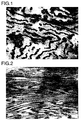
- Fig. 1 shows an electron microscopic Shot of a thin section of an unfoamed one Pearl (magnification 1: 40,000) on which the lamellar structure of the dark rubber phase is clearly visible. It is striking that in addition to many very long tapes or strips, some shorter ones Segments.
- the ratio of the medium lengths to the average thickness of the lamellae is preferably greater than 5: 1, especially larger than 10: 1.
- the polymer mixture can also contain other rubbers and block copolymers with a different structure in small amounts.
- the expandable styrene polymers contain 2 to 15% by weight. Parts, preferably 3 to 10 parts by weight, based on the polymer mixture, a low-boiling blowing agent.
- the blowing agents should not dissolve the polystyrene, but soluble in polystyrene be. The boiling point is said to be below the softening point of the polystyrene lie.
- Suitable propellants are, for example, propane, Butane, pentane, hexane, cyclopentane, cyclohexane, octane, dichlorodifluoromethane, Trifluorochloromethane and 1,1,1-difluorochloroethane. Pentane is preferably used.
- the expandable styrene polymers can also be conventional Contain additives in effective amounts, such as dyes, Fillers, stabilizers, flame retardants, synergists, Nucleating agents, lubricants, antistatic agents, anti-adhesive when foaming acting substances, means to shorten the demolding time when foaming, as well as soot or graphite to reduce the Thermal conductivity of the foams.
- Contain additives in effective amounts, such as dyes, Fillers, stabilizers, flame retardants, synergists, Nucleating agents, lubricants, antistatic agents, anti-adhesive when foaming acting substances, means to shorten the demolding time when foaming, as well as soot or graphite to reduce the Thermal conductivity of the foams.
- Poly- (2,6-dimethyl) -1,4-phenylene ether are also additives and poly-1,4-phenylene sulfide. In amounts of 1 to 20 wt. Parts, based on 100 parts by weight of the polymer mixture these additives increase the heat resistance of the Foam.
- the expandable styrene polymers are preferably thereby prepared that the block copolymer in styrene and optionally the Comonomers dissolves, the monomers polymerize and the polymer transferred in granular form, wherein during or after the Polymerization adds a low-boiling blowing agent.
- the polymerization can be carried out in bulk by known methods Carry out solution or in aqueous suspension, whereby also first pre-polymerization in bulk and polymerization in suspension is possible. In the case of suspension polymerization, this can Blowing agents are added directly, so that immediately one granules containing blowing agent are formed. You can use the blowing agent but also after the polymerization in the rubber modified Impregnate styrene polymer, with an impregnation in aqueous Suspension is preferred.
- the expandable styrene polymers are then in the form of Particles, i.e. in pearl or granule form and have advantageously an average diameter of 0.1 to 6 mm, in particular 0.4 to 3 mm.
- the degree the crosslinking can be measured in that the polymer in one suitable solvent, for example in styrene at 20 ° C, dissolves and weighs out the backlog. It shows that the insoluble The proportion is greater than the rubber proportion in the starting mixture before polymerization.
- the networked parts are of course also in the following Foam process resulting foams contain; there they bring about improved solvent resistance and high restoring force.
- the expandable styrene polymers in a known manner by heating at temperatures above their softening point, for example with hot air or preferably with steam.
- the foam particles obtained can after cooling and if necessary an intermediate storage by renewed Heat to be foamed further.
- the cell walls in the pre-expanded beads are made up again the polymer mixture described above, the rubber lamellas by inflating the cells lengthways (preferably parallel to the interfaces of the cell walls) and a ratio of the average length l 'to average thickness d 'of greater than 10: 1, preferably greater than Have 80: 1.
- Fig. 2 shows an electron micrograph from a thin section of a pre-expanded pearl (enlargement 1: 40,000).
- the foams obtained have densities of 5 to 150 g / cm 3 , in particular 10 to 100 g / cm 3 .
- Foams are characterized by high elasticity. So is the residual deformation measured after four compressions according to DIN 53 777, not more than 15%. So they're conventional clearly superior to rubber-free styrene polymers. Furthermore they also show reduced thermal conductivity.
- the pre-expanded beads have a uniform cell structure and weld during the molding process without the formation of Blow holes.
- the moldings produced in this way have an excellent Heat resistance.
- the foams according to the invention have a surprisingly good thermal insulation that is up to 10% better than the conventional polystyrene of the same density.
- the foams and Moldings can be recycled without any problems.
- the suspension is heated to 80 ° C. After 100 Minutes will be 3.96 g of a secondary sodium alkane sulfonate (Emulsifier K 30/40, Bayer AG) added. After another 95 minutes 1536.0 g of pentane are metered in and polymerized at 134 ° C.
- a secondary sodium alkane sulfonate Emulsifier K 30/40, Bayer AG
- the pearls can be foamed with water vapor to a liter weight of 25.0 g / cm 3 after 3 minutes.
- the internal water content is approximately 1% and the residual styrene content ⁇ 1000 ppm.
- the pictures show electron micrographs that show unfoamed (Fig.1) or foamed (Fig. 2) beads made were. You can clearly see the lamellar structure of the dispersed Rubber particles and you can determine by measuring that the unexpanded beads have a 1: d ratio greater than 10: 1 and greater than 100: 1 for the foamed beads.
- Example 1 was repeated with 10% block copolymers.
- Example 1 was repeated with 20% block copolymers.
Landscapes
- Chemical & Material Sciences (AREA)
- Health & Medical Sciences (AREA)
- Chemical Kinetics & Catalysis (AREA)
- Medicinal Chemistry (AREA)
- Polymers & Plastics (AREA)
- Organic Chemistry (AREA)
- Engineering & Computer Science (AREA)
- Materials Engineering (AREA)
- Manufacture Of Porous Articles, And Recovery And Treatment Of Waste Products (AREA)
- Compositions Of Macromolecular Compounds (AREA)
- Graft Or Block Polymers (AREA)
Abstract
Description
Claims (8)
- Expandierbare, kautschukmodifizierte Styrolpolymerisate, enthaltendsowie 2 bis 15 Gew.teile, bezogen auf 100 Gew.teile der Polymermischung eines niedrigsiedenden Treibmittels, dadurch gekennzeichnet, daß die Kautschukpartikel aus einem Butadien/Styrol-Blockcopolymeren bestehen und eine kompakte Lamellenstruktur ohne Polystyrol-Einschlüsse aufweisen.a) eine kontinuierliche Phase aus Polystyrol oder einem Styrolcopolymerisat mit bis zu 50 % Comonomeren undb) 5 bis 30 Gew.-%, bezogen auf die Polymermischung, darin dispergierter Kautschukpartikel,
- Expandierbare Styrolpolymerisate nach Anspruch 1, dadurch gekennzeichnet, daß das Verhältnis der mittleren Länge l der Kautschukpartikel zu ihrer mittleren Dicke d größer als 5:1 ist.
- Expandierbare Styrolpolymerisate nach Anspruch 1, dadurch gekennzeichnet, daß das Blockcopolymere den Blockaufbau S-B/S(-S)n aufweist, in dem S einen Polystyrolblock, B/S einen Butadien/Styrol-Copolymerblock mit statistischer Verteilung den Monomeren und n entweder 0 oder 1 bedeutet, wobei die Blöcke S zusammen 5 bis 40 Vol.% ausmachen.
- Expandierbare Styrolpolymerisate nach Anspruch 1, dadurch gekennzeichnet, daß die Polymermischung teilweise vernetzt ist, so daß ein Anteil, der größer ist als der Kautschukanteil in der Polymermischung, bei 20°C in Styrol unlöslich ist.
- Verfahren zur Herstellung der expandierbaren Styrolpolymerisate nach Anspruch 1, dadurch gekennzeichnet, daß man das Blockcopolymere in Styrol und ggf. den Comonomeren löst, die Monomeren polymerisiert und das Polymerisat in Granulatform überführt, wobei man während oder nach der Polymerisation ein niedrigsiedendes Treibmittel zusetzt.
- Vorgeschäumte Perlen aus kautschukmodifizierten Styrolpolymerisaten mit Zellwänden aus einer Polymermischung, welche enthältdadurch gekennzeichnet, daß die Kautschukpartikel aus einem Butadien/Styrol-Blockcopolymeren bestehen und eine kompakte Lamellenstruktur ohne Polystyrol-Einschlüsse aufweisen.a) eine kontinuierlich Phase aus Polystyrol oder einem Styrolcopolymerisat mit bis zu 50 % Comonomeren undb) 5 bis 30 Gew.%, bezogen auf die Polymermischung, darin dispergierter Kautschukpartikel mit Lamellenstruktur,
- Vorgeschäumte Perlen nach Anspruch 1, dadurch gekennzeichnet, daß das Verhältnis der mittleren Länge l' der Kautschukpartikel zu ihrer mittleren Dicke d' größer als 10:1 ist.
- Vorgeschäumte Perlen nach Anspruch 1, dadurch gekennzeichnet, daß das Blockcopolymere den Blockaufbau S-B/S(-S)n aufweist, in dem S einen Polystyrolblock, B/S einen Butadien/Styrol-Copolymerblock mit statistischer Verteilung der Monomeren und n entweder 0 oder 1 bedeutet, wobei die Blöcke S zusammen 5 bis 40 Vol.% ausmachen.
Applications Claiming Priority (2)
| Application Number | Priority Date | Filing Date | Title |
|---|---|---|---|
| DE19716572 | 1997-04-19 | ||
| DE19716572A DE19716572A1 (de) | 1997-04-19 | 1997-04-19 | Expandierbare Styrolpolymerisate |
Publications (2)
| Publication Number | Publication Date |
|---|---|
| EP0872513A1 true EP0872513A1 (de) | 1998-10-21 |
| EP0872513B1 EP0872513B1 (de) | 2004-06-30 |
Family
ID=7827128
Family Applications (1)
| Application Number | Title | Priority Date | Filing Date |
|---|---|---|---|
| EP98106427A Expired - Lifetime EP0872513B1 (de) | 1997-04-19 | 1998-04-08 | Expandierbare Styrolpolymerisate |
Country Status (4)
| Country | Link |
|---|---|
| US (1) | US5880166A (de) |
| EP (1) | EP0872513B1 (de) |
| JP (1) | JPH10310675A (de) |
| DE (2) | DE19716572A1 (de) |
Cited By (2)
| Publication number | Priority date | Publication date | Assignee | Title |
|---|---|---|---|---|
| EP1541621A2 (de) | 2003-12-12 | 2005-06-15 | Basf Aktiengesellschaft | Partikelschaumformteile aus expandierbaren, schlagzäh -modifizierten, thermoplastischen Polymergranulaten |
| WO2020035434A1 (en) | 2018-08-13 | 2020-02-20 | Versalis S.P.A. | Expandable vinyl aromatic polymer composition with improved mechanical and insulating properties |
Families Citing this family (13)
| Publication number | Priority date | Publication date | Assignee | Title |
|---|---|---|---|---|
| EP0960904B1 (de) * | 1996-12-26 | 2005-03-09 | Kaneka Corporation | EXPANDIERBARE POLYSTYROLHARZKüGELCHEN, VERFAHREN ZU IHRER HERSTELLUNG, UND DURCH IHRE VERWENDUNG HERGESTELLTER SCHAUM |
| WO1998051735A1 (de) * | 1997-05-14 | 1998-11-19 | Basf Aktiengesellschaft | Graphitpartikel enthaltende expandierbare styrolpolymerisate |
| DE19812856A1 (de) * | 1998-03-24 | 1999-09-30 | Basf Ag | Verfahren zur Herstellung wasserexpandierbarer Styrolpolymerisate |
| KR100573636B1 (ko) * | 1998-07-27 | 2006-04-26 | 바스프 악티엔게젤샤프트 | 팽창된 흑연 입자를 함유하는 발포성 스티렌 중합체의 제조 방법 |
| WO2001048068A1 (en) * | 1999-12-28 | 2001-07-05 | Kaneka Corporation | Expandable styrene resin beads and foams produced therefrom |
| US6598637B2 (en) | 2000-08-01 | 2003-07-29 | The Goodyear Tire & Rubber Company | Pneumatic tire having a rubber component containing a block styrene butadiene copolymer |
| CA2419238A1 (en) * | 2000-08-16 | 2002-02-21 | University Of Alberta | Non-pressurized methods for the preparation of conjugated solid supports for boronic acids |
| US6919382B2 (en) | 2000-08-31 | 2005-07-19 | The Governors Of The University Of Alberta | Preparation and uses of conjugated solid supports for boronic acids |
| US7358282B2 (en) * | 2003-12-05 | 2008-04-15 | Kimberly-Clark Worldwide, Inc. | Low-density, open-cell, soft, flexible, thermoplastic, absorbent foam and method of making foam |
| DE10358786A1 (de) * | 2003-12-12 | 2005-07-14 | Basf Ag | Partikelschaumformteile aus expandierbaren, Füllstoff enthaltenden Polymergranulaten |
| US7291382B2 (en) * | 2004-09-24 | 2007-11-06 | Kimberly-Clark Worldwide, Inc. | Low density flexible resilient absorbent open-cell thermoplastic foam |
| US8158689B2 (en) | 2005-12-22 | 2012-04-17 | Kimberly-Clark Worldwide, Inc. | Hybrid absorbent foam and articles containing it |
| US20070148433A1 (en) * | 2005-12-27 | 2007-06-28 | Mallory Mary F | Elastic laminate made with absorbent foam |
Citations (4)
| Publication number | Priority date | Publication date | Assignee | Title |
|---|---|---|---|---|
| EP0069792A1 (de) * | 1981-07-13 | 1983-01-19 | The Dow Chemical Company | Durchsichtige, schlagzähe Harze und ihr Herstellungsverfahren |
| DE4403017A1 (de) * | 1993-02-02 | 1994-08-04 | Sumitomo Chemical Co | Harzmasse für geschäumte Gegenstände und geschäumte Gegenstände daraus |
| WO1994025516A1 (en) * | 1993-04-27 | 1994-11-10 | Asahi Kasei Kogyo Kabushiki Kaisha | Expanded foamed bead of a rubber-modified styrene polymer |
| DE4420952A1 (de) * | 1994-06-17 | 1995-12-21 | Basf Ag | Thermoplastisches Elastomer |
-
1997
- 1997-04-19 DE DE19716572A patent/DE19716572A1/de not_active Withdrawn
-
1998
- 1998-04-08 EP EP98106427A patent/EP0872513B1/de not_active Expired - Lifetime
- 1998-04-08 DE DE59811612T patent/DE59811612D1/de not_active Expired - Lifetime
- 1998-04-13 US US09/058,899 patent/US5880166A/en not_active Expired - Fee Related
- 1998-04-17 JP JP10107424A patent/JPH10310675A/ja not_active Withdrawn
Patent Citations (4)
| Publication number | Priority date | Publication date | Assignee | Title |
|---|---|---|---|---|
| EP0069792A1 (de) * | 1981-07-13 | 1983-01-19 | The Dow Chemical Company | Durchsichtige, schlagzähe Harze und ihr Herstellungsverfahren |
| DE4403017A1 (de) * | 1993-02-02 | 1994-08-04 | Sumitomo Chemical Co | Harzmasse für geschäumte Gegenstände und geschäumte Gegenstände daraus |
| WO1994025516A1 (en) * | 1993-04-27 | 1994-11-10 | Asahi Kasei Kogyo Kabushiki Kaisha | Expanded foamed bead of a rubber-modified styrene polymer |
| DE4420952A1 (de) * | 1994-06-17 | 1995-12-21 | Basf Ag | Thermoplastisches Elastomer |
Cited By (2)
| Publication number | Priority date | Publication date | Assignee | Title |
|---|---|---|---|---|
| EP1541621A2 (de) | 2003-12-12 | 2005-06-15 | Basf Aktiengesellschaft | Partikelschaumformteile aus expandierbaren, schlagzäh -modifizierten, thermoplastischen Polymergranulaten |
| WO2020035434A1 (en) | 2018-08-13 | 2020-02-20 | Versalis S.P.A. | Expandable vinyl aromatic polymer composition with improved mechanical and insulating properties |
Also Published As
| Publication number | Publication date |
|---|---|
| US5880166A (en) | 1999-03-09 |
| DE19716572A1 (de) | 1998-10-22 |
| JPH10310675A (ja) | 1998-11-24 |
| DE59811612D1 (de) | 2004-08-05 |
| EP0872513B1 (de) | 2004-06-30 |
Similar Documents
| Publication | Publication Date | Title |
|---|---|---|
| EP0981574B1 (de) | Graphitpartikel enthaltende expandierbare styrolpolymerisate | |
| DE69413777T3 (de) | Schaumstoffperlen aus kautschukmodifiziertem styrolharz | |
| EP0872513B1 (de) | Expandierbare Styrolpolymerisate | |
| EP1758951B1 (de) | Styrolpolymer-partikelschaumstoffe mit verringerter wärmeleitfähigkeit | |
| DE3234660C2 (de) | Verfahren zur Herstellung von teilchenförmigen,treibmittelhaltigen Styrolpolymerisaten | |
| EP0682078A2 (de) | Expandierbare Styrolpolymerisate | |
| EP0682077B1 (de) | Expandierbare Styrolpolymerisate | |
| EP0682079A2 (de) | Expandierbare Styrolpolymerisate | |
| EP0405324B1 (de) | Verfahren zur Herstellung von perlförmigen expandierbaren Styrolpolymerisaten | |
| DE19710442B4 (de) | Expandierbare Styrolpolymerisate, Verfahren zu ihrer Herstellung sowie daraus hergestellte elastische Schaumstoffe | |
| EP0425973B1 (de) | Expandierbare Styrolpolymerisate und daraus hergestellte aromatenbeständige Schaumstoffe | |
| DE3879231T2 (de) | Schaumfähige Vinylidenchloridzusammensetzung und daraus hergestellter Schaum. | |
| EP0397001B1 (de) | Expandierbare Styrolpolymerisate | |
| DE69605216T2 (de) | Expandierbare, mit Kautschuk modifizierte Styrolharzpartikel, geschäumte Partikel daraus und hieraus hergestellte geschäumte Formkörper | |
| DE3901329A1 (de) | Expandierbare styrolpolymerisate mit hoher oelbestaendigkeit und verfahren zu ihrer herstellung | |
| EP0383133B1 (de) | Perlförmige expandierbare Formmassen mit hoher Wärmeformbeständigkeit und Verfahren zu ihrer Herstellung | |
| EP0418559A2 (de) | Schwerentflammbare expandierbare Styrolpolymerisate | |
| EP0682076B1 (de) | Expandierbare Styrolpolymerisate | |
| DE2624014A1 (de) | Schnell kuehlende styrolpolymerschaeume | |
| EP0489305A2 (de) | Ölbeständige expandierbare Styrolpolymerisate | |
| EP1994085B1 (de) | Verfahren zur herstellung von expandierbaren styrolpolymerisaten | |
| EP1082383B1 (de) | Verfahren zur herstellung wasserexpandierbarer recyclat enthaltender styrolpolymerisate | |
| EP0387588B1 (de) | Expandierbare Styrolpolymerisate und Verfahren zu ihrer Herstellung | |
| EP1223180B1 (de) | Verfahren zur Herstellung wasserexpandierbarer Styrolpolymerisate | |
| DE69022961T2 (de) | Verfahren zur Herstellung von Hexabromcyclododecan enthaltenden expandierbaren vinylarmoatischen Polymerpartikeln. |
Legal Events
| Date | Code | Title | Description |
|---|---|---|---|
| PUAI | Public reference made under article 153(3) epc to a published international application that has entered the european phase |
Free format text: ORIGINAL CODE: 0009012 |
|
| 17P | Request for examination filed |
Effective date: 19980810 |
|
| AK | Designated contracting states |
Kind code of ref document: A1 Designated state(s): DE FR GB IT |
|
| AX | Request for extension of the european patent |
Free format text: AL;LT;LV;MK;RO;SI |
|
| AKX | Designation fees paid |
Free format text: DE FR GB IT |
|
| 17Q | First examination report despatched |
Effective date: 20030424 |
|
| GRAP | Despatch of communication of intention to grant a patent |
Free format text: ORIGINAL CODE: EPIDOSNIGR1 |
|
| GRAS | Grant fee paid |
Free format text: ORIGINAL CODE: EPIDOSNIGR3 |
|
| GRAA | (expected) grant |
Free format text: ORIGINAL CODE: 0009210 |
|
| AK | Designated contracting states |
Kind code of ref document: B1 Designated state(s): DE FR GB IT |
|
| REG | Reference to a national code |
Ref country code: GB Ref legal event code: FG4D Free format text: NOT ENGLISH |
|
| REF | Corresponds to: |
Ref document number: 59811612 Country of ref document: DE Date of ref document: 20040805 Kind code of ref document: P |
|
| GBT | Gb: translation of ep patent filed (gb section 77(6)(a)/1977) |
Effective date: 20040802 |
|
| ET | Fr: translation filed | ||
| PLBE | No opposition filed within time limit |
Free format text: ORIGINAL CODE: 0009261 |
|
| STAA | Information on the status of an ep patent application or granted ep patent |
Free format text: STATUS: NO OPPOSITION FILED WITHIN TIME LIMIT |
|
| 26N | No opposition filed |
Effective date: 20050331 |
|
| REG | Reference to a national code |
Ref country code: FR Ref legal event code: PLFP Year of fee payment: 18 |
|
| PGFP | Annual fee paid to national office [announced via postgrant information from national office to epo] |
Ref country code: GB Payment date: 20150430 Year of fee payment: 18 |
|
| PGFP | Annual fee paid to national office [announced via postgrant information from national office to epo] |
Ref country code: FR Payment date: 20150430 Year of fee payment: 18 Ref country code: IT Payment date: 20150422 Year of fee payment: 18 |
|
| PGFP | Annual fee paid to national office [announced via postgrant information from national office to epo] |
Ref country code: DE Payment date: 20150630 Year of fee payment: 18 |
|
| REG | Reference to a national code |
Ref country code: DE Ref legal event code: R119 Ref document number: 59811612 Country of ref document: DE |
|
| GBPC | Gb: european patent ceased through non-payment of renewal fee |
Effective date: 20160408 |
|
| REG | Reference to a national code |
Ref country code: FR Ref legal event code: ST Effective date: 20161230 |
|
| PG25 | Lapsed in a contracting state [announced via postgrant information from national office to epo] |
Ref country code: GB Free format text: LAPSE BECAUSE OF NON-PAYMENT OF DUE FEES Effective date: 20160408 Ref country code: DE Free format text: LAPSE BECAUSE OF NON-PAYMENT OF DUE FEES Effective date: 20161101 Ref country code: FR Free format text: LAPSE BECAUSE OF NON-PAYMENT OF DUE FEES Effective date: 20160502 |
|
| PG25 | Lapsed in a contracting state [announced via postgrant information from national office to epo] |
Ref country code: IT Free format text: LAPSE BECAUSE OF NON-PAYMENT OF DUE FEES Effective date: 20160408 |