EP0872176A2 - Verfahren und Vorrichtung zur Herstellung von Pastete - Google Patents
Verfahren und Vorrichtung zur Herstellung von Pastete Download PDFInfo
- Publication number
- EP0872176A2 EP0872176A2 EP98300815A EP98300815A EP0872176A2 EP 0872176 A2 EP0872176 A2 EP 0872176A2 EP 98300815 A EP98300815 A EP 98300815A EP 98300815 A EP98300815 A EP 98300815A EP 0872176 A2 EP0872176 A2 EP 0872176A2
- Authority
- EP
- European Patent Office
- Prior art keywords
- tray member
- tray
- product
- path
- frame
- Prior art date
- Legal status (The legal status is an assumption and is not a legal conclusion. Google has not performed a legal analysis and makes no representation as to the accuracy of the status listed.)
- Withdrawn
Links
- 238000000034 method Methods 0.000 title claims abstract description 14
- 238000001816 cooling Methods 0.000 claims abstract description 15
- 239000007788 liquid Substances 0.000 claims abstract description 8
- 239000000047 product Substances 0.000 claims description 38
- 238000007599 discharging Methods 0.000 claims description 9
- 238000004806 packaging method and process Methods 0.000 claims description 6
- 239000012263 liquid product Substances 0.000 claims description 2
- 238000004519 manufacturing process Methods 0.000 claims description 2
- 239000002826 coolant Substances 0.000 claims 1
- 230000001788 irregular Effects 0.000 claims 1
- 235000014121 butter Nutrition 0.000 abstract description 4
- 238000012986 modification Methods 0.000 description 7
- 230000004048 modification Effects 0.000 description 7
- 238000007514 turning Methods 0.000 description 7
- 239000000463 material Substances 0.000 description 5
- 230000000712 assembly Effects 0.000 description 3
- 238000000429 assembly Methods 0.000 description 3
- 235000015243 ice cream Nutrition 0.000 description 2
- 235000013310 margarine Nutrition 0.000 description 2
- 239000003264 margarine Substances 0.000 description 2
- 229920002379 silicone rubber Polymers 0.000 description 2
- 239000004945 silicone rubber Substances 0.000 description 2
- 239000000758 substrate Substances 0.000 description 2
- 241001379910 Ephemera danica Species 0.000 description 1
- 238000010276 construction Methods 0.000 description 1
- 238000010924 continuous production Methods 0.000 description 1
- 239000002184 metal Substances 0.000 description 1
- 238000005057 refrigeration Methods 0.000 description 1
- 238000007789 sealing Methods 0.000 description 1
- 229920000260 silastic Polymers 0.000 description 1
Images





Classifications
-
- A—HUMAN NECESSITIES
- A23—FOODS OR FOODSTUFFS; TREATMENT THEREOF, NOT COVERED BY OTHER CLASSES
- A23G—COCOA; COCOA PRODUCTS, e.g. CHOCOLATE; SUBSTITUTES FOR COCOA OR COCOA PRODUCTS; CONFECTIONERY; CHEWING GUM; ICE-CREAM; PREPARATION THEREOF
- A23G7/00—Other apparatus or process specially adapted for the chocolate or confectionery industry
- A23G7/02—Cooling or drying apparatus
-
- A—HUMAN NECESSITIES
- A01—AGRICULTURE; FORESTRY; ANIMAL HUSBANDRY; HUNTING; TRAPPING; FISHING
- A01J—MANUFACTURE OF DAIRY PRODUCTS
- A01J21/00—Machines for forming slabs of butter, or the like
-
- A—HUMAN NECESSITIES
- A23—FOODS OR FOODSTUFFS; TREATMENT THEREOF, NOT COVERED BY OTHER CLASSES
- A23B—PRESERVATION OF FOODS, FOODSTUFFS OR NON-ALCOHOLIC BEVERAGES; CHEMICAL RIPENING OF FRUIT OR VEGETABLES
- A23B2/00—Preservation of foods or foodstuffs, in general
- A23B2/80—Freezing; Subsequent thawing; Cooling
- A23B2/803—Materials being transported through or in the apparatus, with or without shaping, e.g. in the form of powders, granules or flakes
- A23B2/8033—Materials being transported through or in the apparatus, with or without shaping, e.g. in the form of powders, granules or flakes with packages or with shaping in the form of blocks or portions
-
- A—HUMAN NECESSITIES
- A23—FOODS OR FOODSTUFFS; TREATMENT THEREOF, NOT COVERED BY OTHER CLASSES
- A23G—COCOA; COCOA PRODUCTS, e.g. CHOCOLATE; SUBSTITUTES FOR COCOA OR COCOA PRODUCTS; CONFECTIONERY; CHEWING GUM; ICE-CREAM; PREPARATION THEREOF
- A23G1/00—Cocoa; Cocoa products, e.g. chocolate; Substitutes therefor
- A23G1/04—Apparatus specially adapted for manufacture or treatment of cocoa or cocoa products
- A23G1/20—Apparatus for moulding, cutting or dispensing chocolate
- A23G1/28—Apparatus for removing chocolate from the moulds
-
- A—HUMAN NECESSITIES
- A23—FOODS OR FOODSTUFFS; TREATMENT THEREOF, NOT COVERED BY OTHER CLASSES
- A23G—COCOA; COCOA PRODUCTS, e.g. CHOCOLATE; SUBSTITUTES FOR COCOA OR COCOA PRODUCTS; CONFECTIONERY; CHEWING GUM; ICE-CREAM; PREPARATION THEREOF
- A23G3/00—Sweetmeats; Confectionery; Marzipan; Coated or filled products
- A23G3/02—Apparatus specially adapted for manufacture or treatment of sweetmeats or confectionery; Accessories therefor
- A23G3/0236—Shaping of liquid, paste, powder; Manufacture of moulded articles, e.g. modelling, moulding, calendering
- A23G3/0252—Apparatus in which the material is shaped at least partially in a mould, in the hollows of a surface, a drum, an endless band, or by a drop-by-drop casting or dispensing of the material on a surface, e.g. injection moulding, transfer moulding
- A23G3/0284—Removing articles from the mould; Associated manipulation
-
- A—HUMAN NECESSITIES
- A47—FURNITURE; DOMESTIC ARTICLES OR APPLIANCES; COFFEE MILLS; SPICE MILLS; SUCTION CLEANERS IN GENERAL
- A47J—KITCHEN EQUIPMENT; COFFEE MILLS; SPICE MILLS; APPARATUS FOR MAKING BEVERAGES
- A47J9/00—Apparatus or utensils for shaping or dispensing portions of butter or the like
-
- B—PERFORMING OPERATIONS; TRANSPORTING
- B65—CONVEYING; PACKING; STORING; HANDLING THIN OR FILAMENTARY MATERIAL
- B65B—MACHINES, APPARATUS OR DEVICES FOR, OR METHODS OF, PACKAGING ARTICLES OR MATERIALS; UNPACKING
- B65B63/00—Auxiliary devices, not otherwise provided for, for operating on articles or materials to be packaged
- B65B63/08—Auxiliary devices, not otherwise provided for, for operating on articles or materials to be packaged for heating or cooling articles or materials to facilitate packaging
Definitions
- the present invention relates to an apparatus and a method for making patties of a product such as butter and, more particularly, to a unique apparatus and method for filling pockets of a tray member with a liquid or "warm” form of the product, advancing the tray through a cooling area until the product solidifies into patties, and overturning the tray member to discharge the patties.
- the prior art includes a variety of apparatus and methods used to form patties of butter, margarine, ice cream and similar products.
- the patties are discrete servings that typically define intricate embossments on their non-supported surfaces. Forming them involves injecting a liquid form of the product into a mold, placing the mold in a refrigerated enclosure until the product solidifies into a patty, and removing the patty from the mold.
- These prior procedures require the use of a number of separate pieces of equipment. They are complex and labor-intensive, and thus difficult to manage and costly.
- the apparatus and method of the present invention does just that. It provides a continuous operation through filling, solidifying, discharging and packaging steps.
- the apparatus of this invention is a simple construction that conveys a mold to filling, cooling, over-turning, discharging and packaging stations without interruption or human intervention. It produces a large volume of patties in a simple, high-speed manner; and it minimizes the cost of operation. Therefore, the apparatus and method of the present invention minimize the cost of producing the resulting patties.
- a tray member moves along a predetermined path of operation defined by a frame assembly.
- This tray includes one or more resilient pocket portions that define an embossment and receive a certain amount of a product.
- the pocket portions are displaceable and turn inside-out to allow easy discharge of the product.
- Advancing means such as a continuous chain and motor drive push or pull the tray member along the path of operation to a first location where a filling assembly discharges a predetermined amount of a product in liquid form into each pocket portion.
- the advancing means then drives the tray member to a refrigerated area where the product solidifies.
- a conveying assembly in the cooling area moves the tray member along a sinuous path.
- This conveying assembly includes horizontal rail segments and turning assemblies that maintain the tray member in a horizontal position during the entire path of travel in the refrigerated area.
- the advancing means then moves the tray member out of the cooling area to a location where the frame guides the tray member to an overturned position. During this operation, the tray member continues to move along the path of operation to the next station.
- discharging means force the pocket portions to an inside-out position while pushing the patties out of the pocket portions and onto a cooled conveyor that takes the patties to a packaging station where the apparatus places the patties in packages.
- the tray member moves to a station where re-setting means assures that the pockets of the tray have moved back to their original position -- the position in which they receive the product.
- the advancing means then moves the tray member to a starting position from which the apparatus repeats all of the operations described above.
- the apparatus of the present invention shown generally at 20 produces discrete, patties P of a product such as butter, margarine, ice cream, etc.
- the apparatus 20 forms the patties P in tray members 21 (See FIG. 3) that move along a predetermined path of operation on a frame assembly F disposed on a horizontal surface S.
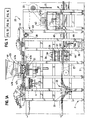
- a chain and drive assembly 22 advances each tray member 21 first to a filling assembly 23 that fills pocket portions of the tray with product, a conveying assembly 24 disposed in a cooling enclosure E where the product solidifies into patties P, an overturning station 25 where each tray member turns upside down, a discharging or "punch out” assembly 26 that forces the patties off of the tray member and onto a conveyor 27, and to a re-setting assembly 28 that pushes the pocket portions of the tray member into position for again receiving product from the filling assembly 23.
- the conveyor 27 moves the patties P to a packaging assembly 29 that packages the patties for delivery to consumers.
- the frame assembly F defines the path of operation of the apparatus of the present invention 20 and supports the various assemblies 24-29 identified above. It includes a pair of side frames 30 and 31 (See FIG. 4) united by suitable cross-members (not shown). It also includes rails 32 and 33 (See FIG. 9) that support the tray members 21 as they move along the path of operation.
- Each tray member 21 (See FIG. 3) includes three resilient segments 34, 35, and 36 and a rigid frame segment 37 that surrounds the three resilient segments and supports them.
- the frame segment 37 is made of sheet metal or any other material of sufficient strength and rigidity; and it includes a connecting rod 38 for connecting the tray member 21 to the chain and drive assembly 22, as described below. It also includes a pair of pins 39 and 40, disposed on opposite sides, for engaging the rails 32 and 33 and sliding on them (See FIG 9).
- the resilient segments 34, 35 and 36 are made of a silicone rubber material or any other suitable material. (SILASTIC® silicone rubber material made by Dow Corning Corporation is one example of such a material.)
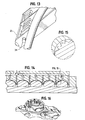
- the segments 34, 35 and 36 define pocket portions 34a, 35a, and 36a, respectively. Those pocket portions lie in uniform rows and columns separated by support portions. Each pocket has an inside surface with embossments that transfer onto the product that the pocket receives.
- the walls of the pockets have a maximum thickness that is smaller than the maximum thickness of the support portions (See FIGS. 14-16).
- the tray member may have less than three such segments; or it may have more than three segments.
- the resilient segments may have any suitable configuration and include any number of pockets arranged in any suitable manner.
- the discharging assembly 26 applies pressure to the pocket portions and turns them inside out, thus forcing the patties P out of the pocket portions. This feature allows the use of embossments with overhanging parts. After a patty P discharges from a pocket portion, the pocket portion either "self-adjusts", moving back to the original position, or the re-setting assembly 28 moves it to that position.
- the connecting rod 38 connects the tray member 21 to chains 41 and 42 of the drive assembly 22.
- a tube 45 connects the rod 38 with a pin 44 which lies fixedly secured to either the chain 41 or the chain 42 of the chain and drive assembly 22.
- the tube 43 includes a bore 43a for receiving an end portion of the rod 38 and a bore 43b for receiving an end portion of the pin 44 that lies fixedly secured to the chain 41.
- a similar connection releasably secures the other side of the tray member 21 to the chain 42.
- the chain and drive assembly 22 includes a motor 45 disposed on the frame F along with suitable gears, sprockets and pulleys for driving the chains.
- the chains 41 and 42 are continuous; and they extend along the path of operation of the apparatus 20, as further described below, driving tray members 21 along the path. The movement of the tray members 21, however, is not continuous. Suitable controls (not shown) allow for intermittent stops for the tray members 21 so that the apparatus may load and unload them.
- the filling assembly 23 fills each pocket of the tray member 21 with a liquid form of a product.
- This assembly 23 includes a hopper 46 and a spout assembly 47, including a pair of pneumatically controlled metering chambers 47a and 47b, a manifold 47c, and a spout 47d for each pocket portion of the tray member 21. (See FIG. 1A)
- the assembly 23 discharges a predetermined amount of the product into each pocket portion.
- the chain and drive assembly 22 then moves the tray member 21 further along the path of operation to a vibrating mechanism V that vibrates the tray member 21 so that the product settles into the tray pockets and into the refrigerated enclosure E through an opening 48.
- the enclosure E contains the conveying assembly 24 which keeps the tray members 21 in the cooled environment for a predetermined duration so that the liquid product in each pocket of the tray member 21 solidifies into a patty P.
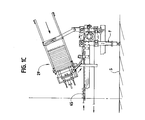
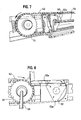
- the conveying assembly 24 (See FIGS. 1B, 6, 7 and 8) lies on a portion of the frame F and includes six rail segments 49a-f and five turning assemblies 50a-e. Each rail segment includes rails 32 and 33 with suitable frame supports.
- each turning assembly includes a pair of first, rotatable sprockets 51, a pair of second rotatable members 52, an axle 53 for the pair of sprockets 51, an axle 54 for the pair of second rotatable members 52, and a drive (including a motor, chain and gears, See FIG. 1B) for the two pairs of the rotatable members 51 and 52.
- a drive including a motor, chain and gears, See FIG. 1B
- the sprockets 51 guide the chains 41 and 42 from one rail segment down to the next rail segment.
- the tray members 21 move along with the chains from one segment to the next, See FIG. 6.
- the second rotatable members 52 have a generally triangular configuration and include grooves 52a at each corner for receiving the pins 39 and 40 and thus supporting one end of the tray member 21 as it moves between the rail segments.
- the tail end of the tray member 21 alternates between the one with the chain connections and the one with the pins 39 and 40.
- the leading end of each tray member 21 is the end with the pins 39 and 40. This orientation allows the tray members 21 to turn upside down at the overturning station 25, as described below.
- the conveying assembly 24 maintains the tray members 21 in a horizontal position during the entire path of travel from the top of the enclosure E to the bottom of the enclosure. (Although the drawings show a conveying assembly with six rail segments, the conveying assembly 24 may include less than six segments or more than six segments.)
- the tray members 21 move out of the enclosure E through an opening 55 and to the station 25.
- the rails upon which the pins 39 and 40 slide extend away from the path of the chains 41 and 42 and then back to it.
- This "gap" allows the leading end of the tray member 21 to drop farther below the chains 41 and 42 (See FIG. 10) while the tail end of the tray member remains secured to the chains (See FIGS. 10 and 12).
- the tail end then becomes the leading end (See FIGS. 10 and 12); and the leading end becomes the tail end (See FIGS. 10 and 13).
- the top of the tray member 21 becomes the bottom with the pocket portions -opening towards the bottom of the apparatus 20.
- This assembly 26 includes a plate 56 with a finger element 57 for each pocket of the tray member 21. It also includes a pneumatic drive and guide rod arrangement 58 which drives the plate 56 against the tray member 21.
- the drive 58 moves the plate 56 downwardly against the pocket portions until the pocket portions turn inside out and the patties P discharge from them onto a package substrate (not shown) on the conveyor 27.
- a platform 59 lifts a belt 60 of the conveyor 27 upwardly to facilitate the transfer.
- a pneumatic drive and guide rod arrangement 61 moves the platform 49 upwardly and downwardly.
- the apparatus 20 then moves the tray member 21 up to a re-setting assembly 28 where a rotary member 62 moves to their original positions pocket portions that have not moved back to the original product receiving position on their own.
- the rotary member 62 includes protuberances 63 that move into registry with the pocket portions as the member 62 rotates and as the tray member 21 slides along the path of operation.
- the tray members 21 then move back to the starting point of the path and to filling assembly 23.
- the conveyor 27 moves the patties P to the packaging assembly 29 which places a lid L over them.
- a packaged air cooled chiller 64 such as Model PACT-185 manufactured by Drake Refrigeration Inc. of Port St. Lucie, Florida, including a slide plate 65 (See FIG. 2), cool the belt of the conveyor 27 so that the patties do not melt.
- the lid L includes cavities that receive the patties; and the assembly 29 places the lid so that the cavities register with the patties.
- Conventional sealing means (not shown) then seal the lid L with the substrate disposed below the patties to form a package suitable for shipping the patties to a consumer.
Landscapes
- Life Sciences & Earth Sciences (AREA)
- Engineering & Computer Science (AREA)
- Food Science & Technology (AREA)
- Chemical & Material Sciences (AREA)
- Polymers & Plastics (AREA)
- Wood Science & Technology (AREA)
- Zoology (AREA)
- Animal Husbandry (AREA)
- Environmental Sciences (AREA)
- Mechanical Engineering (AREA)
- Dairy Products (AREA)
- Bakery Products And Manufacturing Methods Therefor (AREA)
Applications Claiming Priority (2)
| Application Number | Priority Date | Filing Date | Title |
|---|---|---|---|
| US84389697A | 1997-04-17 | 1997-04-17 | |
| US843896 | 1997-04-17 |
Publications (2)
| Publication Number | Publication Date |
|---|---|
| EP0872176A2 true EP0872176A2 (de) | 1998-10-21 |
| EP0872176A3 EP0872176A3 (de) | 1998-12-09 |
Family
ID=25291273
Family Applications (1)
| Application Number | Title | Priority Date | Filing Date |
|---|---|---|---|
| EP98300815A Withdrawn EP0872176A3 (de) | 1997-04-17 | 1998-02-04 | Verfahren und Vorrichtung zur Herstellung von Pastete |
Country Status (2)
| Country | Link |
|---|---|
| EP (1) | EP0872176A3 (de) |
| CA (1) | CA2226602A1 (de) |
Family Cites Families (4)
| Publication number | Priority date | Publication date | Assignee | Title |
|---|---|---|---|---|
| US3292258A (en) * | 1963-09-13 | 1966-12-20 | Peters | Apparatus for the fluid casting of decorative-surfaced butter patties |
| FR1423137A (fr) * | 1964-12-15 | 1966-01-03 | Baker Perkins Ltd | Procédé et machine pour la fabrication d'articles de confiserie |
| JPH071418A (ja) * | 1993-06-16 | 1995-01-06 | C C A Kk | 模様入り成形体の成形装置及び、模様入り成形体の製造方法 |
| JP3225133B2 (ja) * | 1993-06-24 | 2001-11-05 | 芥川製菓株式会社 | チョコレート気泡除去方法 |
-
1998
- 1998-02-04 EP EP98300815A patent/EP0872176A3/de not_active Withdrawn
- 1998-02-13 CA CA002226602A patent/CA2226602A1/en not_active Abandoned
Non-Patent Citations (1)
| Title |
|---|
| None |
Also Published As
| Publication number | Publication date |
|---|---|
| CA2226602A1 (en) | 1998-10-17 |
| EP0872176A3 (de) | 1998-12-09 |
Similar Documents
| Publication | Publication Date | Title |
|---|---|---|
| US11878829B2 (en) | Packaging machine with independently controllable movers | |
| US10287044B2 (en) | Produce tray filler | |
| US6141943A (en) | Food article loading head and method | |
| EP2502831B1 (de) | Intermittierende Transport-Drehbeutelbefüllungs- und Verpackungsmaschine | |
| EP3269669B1 (de) | Artikeltransportvorrichtung | |
| EP1035023B1 (de) | Foerdervorrichtung für Gegenstände | |
| EP0780057B1 (de) | Gefrieren von Massen zur Bildung von Blöcken | |
| US3809774A (en) | Loading process for ice cream carrier strip | |
| EP3512344B1 (de) | Lebensmittelteigextrusionsmaschine | |
| CN219468157U (zh) | 一种降解膜包装输送装置 | |
| JP4133966B2 (ja) | 粉粒体の充填包装装置 | |
| EP0872176A2 (de) | Verfahren und Vorrichtung zur Herstellung von Pastete | |
| CN112591215B (zh) | 一种灌装生产线 | |
| JP3912881B2 (ja) | 多成分充填装置 | |
| US5242291A (en) | Confection molding machine | |
| US4202436A (en) | Apparatus for handling a plurality of articles | |
| JP5916206B2 (ja) | 搬送装置および前記搬送装置を備えた食品成形装置 | |
| US3530636A (en) | Filling apparatus and method | |
| US5388390A (en) | Dough cutting and packing apparatus | |
| KR100515697B1 (ko) | 파우치용기 자동 이송장치 | |
| JP4427123B2 (ja) | もやし類の整列及び整列包装方法 | |
| US12507719B2 (en) | Jig for forming plate-shaped cooked rice and device for producing plate-shaped cooked rice | |
| CN223187744U (zh) | 易碎品称重包装设备 | |
| JP4202304B2 (ja) | 固化食材の製造装置 | |
| JPH06165641A (ja) | チョコレートの連続自動製造装置 |
Legal Events
| Date | Code | Title | Description |
|---|---|---|---|
| PUAI | Public reference made under article 153(3) epc to a published international application that has entered the european phase |
Free format text: ORIGINAL CODE: 0009012 |
|
| AK | Designated contracting states |
Kind code of ref document: A2 Designated state(s): CH DE FR GB IT LI NL |
|
| AX | Request for extension of the european patent |
Free format text: AL;LT;LV;MK;RO;SI |
|
| PUAL | Search report despatched |
Free format text: ORIGINAL CODE: 0009013 |
|
| AK | Designated contracting states |
Kind code of ref document: A3 Designated state(s): AT BE CH DE DK ES FI FR GB GR IE IT LI LU MC NL PT |
|
| AX | Request for extension of the european patent |
Free format text: AL;LT;LV;MK;RO;SI |
|
| AKX | Designation fees paid |
Free format text: CH DE FR GB IT LI NL |
|
| STAA | Information on the status of an ep patent application or granted ep patent |
Free format text: STATUS: THE APPLICATION IS DEEMED TO BE WITHDRAWN |
|
| 18D | Application deemed to be withdrawn |
Effective date: 19990610 |