EP0870529B1 - Method and device for removing condensible components from warm industrial waste gas - Google Patents
Method and device for removing condensible components from warm industrial waste gas Download PDFInfo
- Publication number
- EP0870529B1 EP0870529B1 EP98850050A EP98850050A EP0870529B1 EP 0870529 B1 EP0870529 B1 EP 0870529B1 EP 98850050 A EP98850050 A EP 98850050A EP 98850050 A EP98850050 A EP 98850050A EP 0870529 B1 EP0870529 B1 EP 0870529B1
- Authority
- EP
- European Patent Office
- Prior art keywords
- waste gas
- gas
- cooler
- adsorbent
- channels
- Prior art date
- Legal status (The legal status is an assumption and is not a legal conclusion. Google has not performed a legal analysis and makes no representation as to the accuracy of the status listed.)
- Expired - Lifetime
Links
- 239000007789 gas Substances 0.000 title claims abstract description 38
- 238000000034 method Methods 0.000 title claims abstract description 18
- 239000002440 industrial waste Substances 0.000 title claims abstract description 6
- 239000002912 waste gas Substances 0.000 claims abstract description 25
- 239000003463 adsorbent Substances 0.000 claims abstract description 19
- 238000001816 cooling Methods 0.000 claims abstract description 18
- 239000000463 material Substances 0.000 claims abstract description 11
- 238000004140 cleaning Methods 0.000 claims abstract description 8
- 239000000843 powder Substances 0.000 claims abstract description 8
- 239000002826 coolant Substances 0.000 claims abstract 4
- 238000002156 mixing Methods 0.000 claims abstract 4
- PNEYBMLMFCGWSK-UHFFFAOYSA-N aluminium oxide Inorganic materials [O-2].[O-2].[O-2].[Al+3].[Al+3] PNEYBMLMFCGWSK-UHFFFAOYSA-N 0.000 claims description 14
- 239000000428 dust Substances 0.000 claims description 14
- 230000008569 process Effects 0.000 claims description 11
- 239000011248 coating agent Substances 0.000 claims description 7
- 238000000576 coating method Methods 0.000 claims description 7
- 239000000571 coke Substances 0.000 claims description 7
- 238000002347 injection Methods 0.000 claims description 4
- 239000007924 injection Substances 0.000 claims description 4
- 238000002844 melting Methods 0.000 claims description 4
- 230000008018 melting Effects 0.000 claims description 4
- VNWKTOKETHGBQD-UHFFFAOYSA-N methane Chemical compound C VNWKTOKETHGBQD-UHFFFAOYSA-N 0.000 claims description 4
- 239000007788 liquid Substances 0.000 claims description 2
- 230000001105 regulatory effect Effects 0.000 claims 1
- 239000011269 tar Substances 0.000 description 21
- 239000000126 substance Substances 0.000 description 10
- 229910000831 Steel Inorganic materials 0.000 description 4
- XAGFODPZIPBFFR-UHFFFAOYSA-N aluminium Chemical compound [Al] XAGFODPZIPBFFR-UHFFFAOYSA-N 0.000 description 4
- 229910052782 aluminium Inorganic materials 0.000 description 4
- 239000004411 aluminium Substances 0.000 description 4
- 239000010959 steel Substances 0.000 description 4
- 241000196324 Embryophyta Species 0.000 description 3
- XLYOFNOQVPJJNP-UHFFFAOYSA-N water Substances O XLYOFNOQVPJJNP-UHFFFAOYSA-N 0.000 description 3
- 239000002253 acid Substances 0.000 description 2
- 239000000443 aerosol Substances 0.000 description 2
- 239000012809 cooling fluid Substances 0.000 description 2
- 238000005260 corrosion Methods 0.000 description 2
- 230000007797 corrosion Effects 0.000 description 2
- 230000001419 dependent effect Effects 0.000 description 2
- 230000008020 evaporation Effects 0.000 description 2
- 238000001704 evaporation Methods 0.000 description 2
- 238000004519 manufacturing process Methods 0.000 description 2
- 239000000203 mixture Substances 0.000 description 2
- 239000002994 raw material Substances 0.000 description 2
- 238000001179 sorption measurement Methods 0.000 description 2
- 241000190022 Pilea cadierei Species 0.000 description 1
- 230000001133 acceleration Effects 0.000 description 1
- 230000008859 change Effects 0.000 description 1
- 239000003245 coal Substances 0.000 description 1
- 238000009833 condensation Methods 0.000 description 1
- 230000005494 condensation Effects 0.000 description 1
- 238000011109 contamination Methods 0.000 description 1
- 238000010924 continuous production Methods 0.000 description 1
- 239000000498 cooling water Substances 0.000 description 1
- 238000005108 dry cleaning Methods 0.000 description 1
- 239000011286 gas tar Substances 0.000 description 1
- 238000000227 grinding Methods 0.000 description 1
- 230000036541 health Effects 0.000 description 1
- 238000009413 insulation Methods 0.000 description 1
- 230000009467 reduction Effects 0.000 description 1
- 238000011946 reduction process Methods 0.000 description 1
- 239000010802 sludge Substances 0.000 description 1
- 239000000243 solution Substances 0.000 description 1
Images
Classifications
-
- B—PERFORMING OPERATIONS; TRANSPORTING
- B01—PHYSICAL OR CHEMICAL PROCESSES OR APPARATUS IN GENERAL
- B01D—SEPARATION
- B01D53/00—Separation of gases or vapours; Recovering vapours of volatile solvents from gases; Chemical or biological purification of waste gases, e.g. engine exhaust gases, smoke, fumes, flue gases, aerosols
- B01D53/02—Separation of gases or vapours; Recovering vapours of volatile solvents from gases; Chemical or biological purification of waste gases, e.g. engine exhaust gases, smoke, fumes, flue gases, aerosols by adsorption, e.g. preparative gas chromatography
- B01D53/06—Separation of gases or vapours; Recovering vapours of volatile solvents from gases; Chemical or biological purification of waste gases, e.g. engine exhaust gases, smoke, fumes, flue gases, aerosols by adsorption, e.g. preparative gas chromatography with moving adsorbents, e.g. rotating beds
- B01D53/10—Separation of gases or vapours; Recovering vapours of volatile solvents from gases; Chemical or biological purification of waste gases, e.g. engine exhaust gases, smoke, fumes, flue gases, aerosols by adsorption, e.g. preparative gas chromatography with moving adsorbents, e.g. rotating beds with dispersed adsorbents
-
- B—PERFORMING OPERATIONS; TRANSPORTING
- B01—PHYSICAL OR CHEMICAL PROCESSES OR APPARATUS IN GENERAL
- B01D—SEPARATION
- B01D53/00—Separation of gases or vapours; Recovering vapours of volatile solvents from gases; Chemical or biological purification of waste gases, e.g. engine exhaust gases, smoke, fumes, flue gases, aerosols
- B01D53/002—Separation of gases or vapours; Recovering vapours of volatile solvents from gases; Chemical or biological purification of waste gases, e.g. engine exhaust gases, smoke, fumes, flue gases, aerosols by condensation
-
- B—PERFORMING OPERATIONS; TRANSPORTING
- B01—PHYSICAL OR CHEMICAL PROCESSES OR APPARATUS IN GENERAL
- B01D—SEPARATION
- B01D53/00—Separation of gases or vapours; Recovering vapours of volatile solvents from gases; Chemical or biological purification of waste gases, e.g. engine exhaust gases, smoke, fumes, flue gases, aerosols
- B01D53/34—Chemical or biological purification of waste gases
- B01D53/74—General processes for purification of waste gases; Apparatus or devices specially adapted therefor
- B01D53/81—Solid phase processes
- B01D53/83—Solid phase processes with moving reactants
Definitions
- the present invention is related to a method and a device to remove condensible components from warm industrial waste gas.
- the tower substances comprise a wide range of components having condensing temperatures also within a large scale, typically from 200 °C for the heaviest components and down to well below 70 °C for the lightest tar substances.
- the baking process for the electrodes is a stepwise process with preheating of unburned electrodes. This is strongly dependent on the waste gas temperatures, typically from 250 °C to 70 °C.
- the waste gases from the ovens for burning the electrodes may, besides tar substances, also contain dust, especially coal and coke dust as well as polluting gases.
- the most effective and therefore dominant process to clean waste gases from anode burning ovens is a dry cleaning process.
- An adsorbent in powder form is added to the gas in the reactor thereby providing good contact between the gas and the adsorbent.
- the tar substances in gas form and other gases as well may be adsorbed. Thereafter the adsorbent, dust and condensed, aerosol tar are separated from the waste gas in a bag filter.
- waste gas must be cooled down for the cleaning process to be effective as to the tar.
- Condensed, aerosol tar very easily is separated and even the gaseous components are adsorbed the most easiest at a low temperature. Too low temperature, however is not desired considering the acid condensation in the cleaning plant. Desired gas temperature after cooling typically is 70 °C.
- the cooling of the waste gas is a problem due to the tar substances being condensed on the cooling surfaces.
- the problem is solved in different ways, depending of the composition of the wasted gas.
- Waste gas from the so called closed type of oven has an high content of not burnt, evaporised tar and contains little dust.
- This type of waste gas is cooled down in water pipe coolers having preferable vertical cooling pipes as the tar condensed on the cooling pipes has so little viscosity that it substantially flows or sags down the pipes and drips off at the lowermost part
- the waste gases from the so called open type of oven cannot be cooled in this way.
- the waste gas contains partly burned, heavy tar components and a relatively high content of dust.
- the coating these components and dust leaves, is thick and sticky and does not drip off.
- a thicker layer is built up which increasingly isolate the cooling surfaces completely.
- the present invention With the method and the device according to the present invention, cooling of the mentioned type of wasted gas from open electrode burning ovens with indirect coolers is made possible, without grooving of coating of the cooling surfaces thereby avoiding insulation of the surfaces. Simultaneously, condensible components are cleaned out of the waste gas by adsorption. This is achieved with the method and the device according to the present invention as defined with the features stated in the claims. the present invention combines furthermore the gas cooler with the reactor in the following cleaning process according to the state of the art.
- the adsorbent in this cleaning process usually is coke dust or aluminium oxide.
- Latter is based on the fact that the aluminium industry without any comparison is the largest consumer of prebaked electrodes within the electro metallurgical industry.
- the prebaked anodes in melting ovens for aluminium act as reduction material and preburner in the reduction process. Larger aluminium plants have their own anode factories with continuous production of such anodes.
- Aluminium oxide has a large ability of adsorption for tar substances.
- the used and tar containing oxide may be used as raw material in the aluminium production.
- the tar substances are burnt in the aluminium ovens.
- Coke dust may, as mentioned above, be used as adsorbent in the cleaning process.
- Tar containing coke dust may be used as raw material in the production of electrodes.
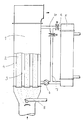
- the only figure discloses a vertical pipe cooler 1 for waste gas, containing a number of parallel, vertical, normally but not necessarily tubular, channels 2 through which the gas flows with the gas direction from below and upwardly.
- the pipes are surrounded by cooling fluid 3 within the plate mantel 4 of the cooler 1. External cooling by air, however is also possible.
- cooling fluid is circulated through the pipe cooler in a closed circuit containing a liquid cooler 5 as a secondary cooler, a pump 6 and a bypass circuit 7 for the regulation of the cooling by means of a valve 9 in the main circuit and a bypass valve 10. This is necessary because the temperature of the waste gas and therefore the need for cooling may change. Direct use of cooling water flowing through the pipe cooler is also possible.
- the adsorbent in the form of a powder is supplied to and mixed in with the wasted gas by means of an injection device 8 before the inlet to the cooler and is brought with the gas up to the pipes.
- the gas will assume a strong acceleration in the pipe openings and thereafter a retardation up through the pipes as the gas is cooled by contact with the cooled pipe walls. Both of this influences provide a relative speed and good contact between the gas and adsorbent in such a way that tar substances and possibly also other adsorbable, gaseous contaminations effectively are adsorbed.
- the adsorbent, coke dust as well as aluminium oxide, is a hard material having grinding properties.
- the adsorbent flows up through the pipes in the cooler it will grind away the sticky coating of heavy tar and dust as this is settled down to the pipe walls, in such a way that the pipe walls are kept clean or having such a thin coating that the heat transfer between the hot gas and the cool pipe walls is not substantially reduced.
- the necessary cooling of the gas by the flow through the cooler is achieved.
- the channels 2 are made of pipes of normal steel.
- the coating of heavy tar and dust which is to be ground by means of the adsorbent is relatively soft in relation to steel, but the adsorbents, coke dust as well as aluminium oxide, are hard enough also to grind the steel away providing the velocity is high enough.
- the cooler reactor therefore has to be dimensioned in such a way that the velocity for gas and adsorbent will be sufficient to grind down the coating as this occurs, but not so high that the steel surfaces also are ground Suitable gas velocities are found to be in the range of 18-36 m/s through the pipes, dependent on the type and quality of the adsorbent.
Landscapes
- Chemical & Material Sciences (AREA)
- Engineering & Computer Science (AREA)
- Analytical Chemistry (AREA)
- General Chemical & Material Sciences (AREA)
- Oil, Petroleum & Natural Gas (AREA)
- Chemical Kinetics & Catalysis (AREA)
- Environmental & Geological Engineering (AREA)
- Biomedical Technology (AREA)
- Health & Medical Sciences (AREA)
- Dispersion Chemistry (AREA)
- Treating Waste Gases (AREA)
- Separation Using Semi-Permeable Membranes (AREA)
- Industrial Gases (AREA)
- Electrolytic Production Of Metals (AREA)
- Waste-Gas Treatment And Other Accessory Devices For Furnaces (AREA)
- Vaporization, Distillation, Condensation, Sublimation, And Cold Traps (AREA)
Abstract
Description
- The present invention is related to a method and a device to remove condensible components from warm industrial waste gas.
- Industrial waste gas containing condensible components is developed especially from ovens for hard burning or baking of carbon electrodes for electro metallurgic melting plant processes. The binding material in unburned electrodes are tar substances of different kinds, especially gas tar. The most relevant prior art document in this field is US 4 702 818. Other prior art documents which are less relevant in this connections read as follows, namely US 5 013 336, US 3 992 176, US 4 097 251 and GB 1 448 369.
- During baking of the electrodes these gas tars are partly burnt and partly gasified and leave the burning oven as condensible components of the waste gas.
- These tar substances are strongly contaminating matters which partly also are health damaging. They have to be removed from the waste gases before the gases can be led out to the atmosphere.
- The tower substances comprise a wide range of components having condensing temperatures also within a large scale, typically from 200 °C for the heaviest components and down to well below 70 °C for the lightest tar substances.
- The baking process for the electrodes is a stepwise process with preheating of unburned electrodes. This is strongly dependent on the waste gas temperatures, typically from 250 °C to 70 °C. The waste gases from the ovens for burning the electrodes may, besides tar substances, also contain dust, especially coal and coke dust as well as polluting gases.
- The most effective and therefore dominant process to clean waste gases from anode burning ovens is a dry cleaning process. An adsorbent in powder form is added to the gas in the reactor thereby providing good contact between the gas and the adsorbent. By suitable choice of adsorbent the tar substances in gas form and other gases as well, may be adsorbed. Thereafter the adsorbent, dust and condensed, aerosol tar are separated from the waste gas in a bag filter.
- The waste gas, however, must be cooled down for the cleaning process to be effective as to the tar. Condensed, aerosol tar very easily is separated and even the gaseous components are adsorbed the most easiest at a low temperature. Too low temperature, however is not desired considering the acid condensation in the cleaning plant. Desired gas temperature after cooling typically is 70 °C.
- The cooling of the waste gas is a problem due to the tar substances being condensed on the cooling surfaces. The problem is solved in different ways, depending of the composition of the wasted gas.
- Two different types of ovens principally are used for baking of carbon electrodes. The waste gases correspondingly have different composition. Waste gas from the so called closed type of oven has an high content of not burnt, evaporised tar and contains little dust. This type of waste gas is cooled down in water pipe coolers having preferable vertical cooling pipes as the tar condensed on the cooling pipes has so little viscosity that it substantially flows or sags down the pipes and drips off at the lowermost part
- The waste gases from the so called open type of oven cannot be cooled in this way. The waste gas contains partly burned, heavy tar components and a relatively high content of dust. The coating these components and dust leaves, is thick and sticky and does not drip off. A thicker layer is built up which increasingly isolate the cooling surfaces completely.
- To cool this waste gas, large cooling towers therefore are used where the gas is cooled by direct water injection through fine high pressure nozzles. The evaporation of the injected water cools the gas, however along residence in the tower is necessary. Such cooling towers therefore are large and expensive. Based on experience, operational problems often occurs with incomplete evaporation of the droplets, which may result in corrosion, where the droplets hit the walls in the tower, as well as wet bottom with corrosion and drainage of acid and tar containing sludge.
- With the method and the device according to the present invention, cooling of the mentioned type of wasted gas from open electrode burning ovens with indirect coolers is made possible, without grooving of coating of the cooling surfaces thereby avoiding insulation of the surfaces. Simultaneously, condensible components are cleaned out of the waste gas by adsorption. This is achieved with the method and the device according to the present invention as defined with the features stated in the claims. the present invention combines furthermore the gas cooler with the reactor in the following cleaning process according to the state of the art.
- The adsorbent in this cleaning process usually is coke dust or aluminium oxide. Latter is based on the fact that the aluminium industry without any comparison is the largest consumer of prebaked electrodes within the electro metallurgical industry. The prebaked anodes in melting ovens for aluminium act as reduction material and preburner in the reduction process. Larger aluminium plants have their own anode factories with continuous production of such anodes. Aluminium oxide has a large ability of adsorption for tar substances. The used and tar containing oxide may be used as raw material in the aluminium production. The tar substances are burnt in the aluminium ovens.
- Coke dust may, as mentioned above, be used as adsorbent in the cleaning process. Tar containing coke dust may be used as raw material in the production of electrodes.
- The present invention is described referring to the only figure.
- The only figure discloses a vertical pipe cooler 1 for waste gas, containing a number of parallel, vertical, normally but not necessarily tubular,
channels 2 through which the gas flows with the gas direction from below and upwardly. In a preferred embodiment of the invention the pipes are surrounded bycooling fluid 3 within theplate mantel 4 of the cooler 1. External cooling by air, however is also possible. - With the preferred embodiment of the invention, cooling fluid is circulated through the pipe cooler in a closed circuit containing a
liquid cooler 5 as a secondary cooler, a pump 6 and a bypass circuit 7 for the regulation of the cooling by means of avalve 9 in the main circuit and abypass valve 10. This is necessary because the temperature of the waste gas and therefore the need for cooling may change. Direct use of cooling water flowing through the pipe cooler is also possible. - The adsorbent in the form of a powder, is supplied to and mixed in with the wasted gas by means of an injection device 8 before the inlet to the cooler and is brought with the gas up to the pipes. The gas will assume a strong acceleration in the pipe openings and thereafter a retardation up through the pipes as the gas is cooled by contact with the cooled pipe walls. Both of this influences provide a relative speed and good contact between the gas and adsorbent in such a way that tar substances and possibly also other adsorbable, gaseous contaminations effectively are adsorbed.
- The adsorbent, coke dust as well as aluminium oxide, is a hard material having grinding properties. When the adsorbent flows up through the pipes in the cooler it will grind away the sticky coating of heavy tar and dust as this is settled down to the pipe walls, in such a way that the pipe walls are kept clean or having such a thin coating that the heat transfer between the hot gas and the cool pipe walls is not substantially reduced. Hereby, also the necessary cooling of the gas by the flow through the cooler is achieved.
- In the preferred embodiment of the invention the
channels 2 are made of pipes of normal steel. The coating of heavy tar and dust which is to be ground by means of the adsorbent, is relatively soft in relation to steel, but the adsorbents, coke dust as well as aluminium oxide, are hard enough also to grind the steel away providing the velocity is high enough. The cooler reactor therefore has to be dimensioned in such a way that the velocity for gas and adsorbent will be sufficient to grind down the coating as this occurs, but not so high that the steel surfaces also are ground Suitable gas velocities are found to be in the range of 18-36 m/s through the pipes, dependent on the type and quality of the adsorbent. - With the combined cooler reactor according to the invention, substantial advantages are achieved, especially regarding costs of the plant as the new solution provides substantial lower investment costs than a cooling tower with a connected reactor.
Claims (6)
- Method for removing condensible components from warm industrial waste gas from ovens for hard burning or baking of carbon electrodes for electro metallurgic melting plant processes, by mixing an adsorbent for the condensible components in the form of a powder material into the flow of waste gas, characterized in that said mixing is done before a cooler (1) such that the material is flowing together with the waste gas through gas channels (2) of the cooler (1), surrounded by a cooling medium (3), whereby the powder material is cleaning the cooling walls of the gas channels.
- Method according to claim 1, characterized in using coke dust and/or aluminium oxides as adsorbent.
- Device for removing condensible components from industrial waste gas from ovens for hardburning or baking of carbon electrodes for electro metallurgic melting plant processes, characterized in that the device comprises gas channels (2) in a cooler (1) which are surrounded by a cooling medium (3), adapted for through-going flow of the waste gas, and an injection device (8) being arranged in front of the entrance of the channels (2), adapted for mixing of an adsorbent in the form of a powder material in the waste gas flow, whereby the powder material is cleaning the heat transferring surfaces of the cooler from coating when guided through the channels (2) by the flow of waste gas.
- Device according to claim 3, characterized in the cooling medium (3) circulating in a closed circuit with a liquid cooler (5), a pump (6) and a bypass circuit (7) for regulating the cooling by means of a valve (9) in the main circuit and a bypass valve (10).
- Device according to claims 3-4, characterized in the gas channels (2) being arranged vertically and the injection device (8) guiding the adsorbent into the flow of a waste gas below the input of the gas channels (2).
- Device according to claims 3-5, characterized in the gas channels (2) being tubular.
Applications Claiming Priority (2)
| Application Number | Priority Date | Filing Date | Title |
|---|---|---|---|
| NO971603A NO305227B1 (en) | 1997-04-08 | 1997-04-08 | Method and apparatus for removing components from exhaust gas |
| NO971603 | 1997-04-08 |
Publications (2)
| Publication Number | Publication Date |
|---|---|
| EP0870529A1 EP0870529A1 (en) | 1998-10-14 |
| EP0870529B1 true EP0870529B1 (en) | 2003-06-18 |
Family
ID=19900585
Family Applications (1)
| Application Number | Title | Priority Date | Filing Date |
|---|---|---|---|
| EP98850050A Expired - Lifetime EP0870529B1 (en) | 1997-04-08 | 1998-04-06 | Method and device for removing condensible components from warm industrial waste gas |
Country Status (4)
| Country | Link |
|---|---|
| EP (1) | EP0870529B1 (en) |
| AT (1) | ATE243063T1 (en) |
| DE (1) | DE69815577T2 (en) |
| NO (1) | NO305227B1 (en) |
Families Citing this family (4)
| Publication number | Priority date | Publication date | Assignee | Title |
|---|---|---|---|---|
| FI121699B (en) * | 2008-12-22 | 2011-03-15 | Outotec Oyj | Process and plant for the removal of solid particles and a tar component from carbon monoxide gas |
| DE102009023600B4 (en) * | 2009-06-02 | 2011-05-12 | Ctp Chemisch Thermische Prozesstechnik Gmbh | Method and device for purifying exhaust gas streams |
| EP2407228B1 (en) * | 2010-07-14 | 2016-09-07 | General Electric Technology GmbH | Gas cleaning unit and method for cleaning gas |
| FR3012048B1 (en) * | 2013-10-18 | 2017-08-18 | Solios Environnement | PROCESS FOR TREATING GASEOUS EFFLUENTS CONTAINING ORGANIC COMPOUNDS |
Family Cites Families (4)
| Publication number | Priority date | Publication date | Assignee | Title |
|---|---|---|---|---|
| NO133092L (en) * | 1972-09-21 | |||
| US3992176A (en) * | 1973-10-24 | 1976-11-16 | Kaiser Aluminum & Chemical Corporation | Dry scrubbing tar and fluoride laden gases |
| JPS6056530B2 (en) * | 1976-04-14 | 1985-12-10 | 大成建設株式会社 | Processing method for waste gas containing viscous substances |
| US5013336A (en) * | 1989-11-03 | 1991-05-07 | Aluminum Company Of America | Method and apparatus for emission control |
-
1997
- 1997-04-08 NO NO971603A patent/NO305227B1/en not_active IP Right Cessation
-
1998
- 1998-04-06 AT AT98850050T patent/ATE243063T1/en not_active IP Right Cessation
- 1998-04-06 DE DE69815577T patent/DE69815577T2/en not_active Expired - Lifetime
- 1998-04-06 EP EP98850050A patent/EP0870529B1/en not_active Expired - Lifetime
Also Published As
| Publication number | Publication date |
|---|---|
| EP0870529A1 (en) | 1998-10-14 |
| DE69815577D1 (en) | 2003-07-24 |
| DE69815577T2 (en) | 2004-05-06 |
| ATE243063T1 (en) | 2003-07-15 |
| NO971603D0 (en) | 1997-04-08 |
| NO305227B1 (en) | 1999-04-26 |
| NO971603L (en) | 1998-10-09 |
Similar Documents
| Publication | Publication Date | Title |
|---|---|---|
| US4031862A (en) | Economizer | |
| CA1055695A (en) | Method and means for dry cooling bulk materials | |
| US8679441B2 (en) | Method of optimizing the control of a fume treatment centre for a carbon block baking ring furnace | |
| GB2150856A (en) | Method and apparatus for purifying hot gases with heat recovery | |
| US4702818A (en) | Process for recovering heat of a tar-containing high-temperature gas | |
| JPS6128585A (en) | Retreatment of carbonized gas upon cracking waste | |
| US20070084341A1 (en) | Natural gas dehydrator and system | |
| US4682549A (en) | Method and an arrangement for purifying and recovering heat energy from flue gases from refuse incineration | |
| US3977846A (en) | Anti-pollution method | |
| EP0870529A1 (en) | Method and device for removing condensible components from warm industrial waste gas | |
| JPS62217093A (en) | Method and device for recovering energy | |
| SE454846B (en) | SET AND DEVICE FOR CLEANING A POLLUTION AMOUNTED OF HOT GAS FLOW | |
| US4320796A (en) | Granular bed air heater | |
| US2609063A (en) | Apparatus and method for cleaning open hearth stack gases | |
| CA1108852A (en) | Waste heat recovery process | |
| JPS63139987A (en) | Method and equipment for dry distillation of oil shale | |
| US5601625A (en) | Process and device for removing heavy metals and compounds containing heavy metals | |
| CN105018731A (en) | Lead anodic slime smelting dust gasification and hierarchical temperature-control recovery process | |
| US6470834B1 (en) | Method and device for exploiting heat in combustion gases | |
| JPS6234987Y2 (en) | ||
| EP0404815B1 (en) | Method and installation for recovering energy in metallurgical processes | |
| NO133092B (en) | ||
| CN111089491A (en) | Electric arc furnace high-temperature alternating flue gas waste heat utilization system and utilization method | |
| JPS5738923A (en) | Method and device for purifying thermally cracked gas | |
| BR112012021585B1 (en) | METHOD OF TREATING EXHAUST GAS |
Legal Events
| Date | Code | Title | Description |
|---|---|---|---|
| PUAI | Public reference made under article 153(3) epc to a published international application that has entered the european phase |
Free format text: ORIGINAL CODE: 0009012 |
|
| AK | Designated contracting states |
Kind code of ref document: A1 Designated state(s): AT DE FR GB NL |
|
| AX | Request for extension of the european patent |
Free format text: AL;LT;LV;MK;RO;SI |
|
| 17P | Request for examination filed |
Effective date: 19990107 |
|
| AKX | Designation fees paid |
Free format text: AT DE FR GB NL |
|
| 17Q | First examination report despatched |
Effective date: 20010611 |
|
| GRAH | Despatch of communication of intention to grant a patent |
Free format text: ORIGINAL CODE: EPIDOS IGRA |
|
| GRAH | Despatch of communication of intention to grant a patent |
Free format text: ORIGINAL CODE: EPIDOS IGRA |
|
| GRAA | (expected) grant |
Free format text: ORIGINAL CODE: 0009210 |
|
| AK | Designated contracting states |
Designated state(s): AT DE FR GB NL |
|
| REG | Reference to a national code |
Ref country code: GB Ref legal event code: FG4D |
|
| REF | Corresponds to: |
Ref document number: 69815577 Country of ref document: DE Date of ref document: 20030724 Kind code of ref document: P |
|
| PGFP | Annual fee paid to national office [announced via postgrant information from national office to epo] |
Ref country code: AT Payment date: 20040415 Year of fee payment: 7 |
|
| PLBE | No opposition filed within time limit |
Free format text: ORIGINAL CODE: 0009261 |
|
| STAA | Information on the status of an ep patent application or granted ep patent |
Free format text: STATUS: NO OPPOSITION FILED WITHIN TIME LIMIT |
|
| ET | Fr: translation filed | ||
| 26N | No opposition filed |
Effective date: 20040319 |
|
| PG25 | Lapsed in a contracting state [announced via postgrant information from national office to epo] |
Ref country code: AT Free format text: LAPSE BECAUSE OF NON-PAYMENT OF DUE FEES Effective date: 20050406 |
|
| REG | Reference to a national code |
Ref country code: DE Ref legal event code: R082 Ref document number: 69815577 Country of ref document: DE Representative=s name: ROESLER PATENTANWALTSKANZLEI, DE |
|
| REG | Reference to a national code |
Ref country code: FR Ref legal event code: TP Owner name: ALSTOM TECHNOLOGY LTD., CH Effective date: 20130212 |
|
| REG | Reference to a national code |
Ref country code: DE Ref legal event code: R082 Ref document number: 69815577 Country of ref document: DE Representative=s name: RUEGER, BARTHELT & ABEL, DE Effective date: 20130208 Ref country code: DE Ref legal event code: R082 Ref document number: 69815577 Country of ref document: DE Representative=s name: ROESLER PATENTANWALTSKANZLEI, DE Effective date: 20130208 Ref country code: DE Ref legal event code: R081 Ref document number: 69815577 Country of ref document: DE Owner name: GENERAL ELECTRIC TECHNOLOGY GMBH, CH Free format text: FORMER OWNER: ABB FLAEKT AB, NACKA, SE Effective date: 20130208 Ref country code: DE Ref legal event code: R081 Ref document number: 69815577 Country of ref document: DE Owner name: ALSTOM TECHNOLOGY LTD., CH Free format text: FORMER OWNER: ABB FLAEKT AB, NACKA, SE Effective date: 20130208 |
|
| REG | Reference to a national code |
Ref country code: GB Ref legal event code: 732E Free format text: REGISTERED BETWEEN 20130509 AND 20130515 |
|
| REG | Reference to a national code |
Ref country code: NL Ref legal event code: TD Effective date: 20130920 Ref country code: NL Ref legal event code: SD Effective date: 20130920 |
|
| REG | Reference to a national code |
Ref country code: FR Ref legal event code: PLFP Year of fee payment: 19 |
|
| REG | Reference to a national code |
Ref country code: DE Ref legal event code: R082 Ref document number: 69815577 Country of ref document: DE Representative=s name: RUEGER, BARTHELT & ABEL, DE |
|
| REG | Reference to a national code |
Ref country code: NL Ref legal event code: HC Owner name: GENERAL ELECTRIC TECHNOLOGY GMBH; CH Free format text: DETAILS ASSIGNMENT: VERANDERING VAN EIGENAAR(S), VERANDERING VAN NAAM VAN DE EIGENAAR(S); FORMER OWNER NAME: ALSTOM TECHNOLOGY LTD Effective date: 20160623 |
|
| REG | Reference to a national code |
Ref country code: DE Ref legal event code: R082 Ref document number: 69815577 Country of ref document: DE Representative=s name: RUEGER, BARTHELT & ABEL, DE Ref country code: DE Ref legal event code: R081 Ref document number: 69815577 Country of ref document: DE Owner name: GENERAL ELECTRIC TECHNOLOGY GMBH, CH Free format text: FORMER OWNER: ALSTOM TECHNOLOGY LTD., BADEN, CH |
|
| REG | Reference to a national code |
Ref country code: FR Ref legal event code: CD Owner name: ALSTOM TECHNOLOGY LTD, CH Effective date: 20161124 |
|
| REG | Reference to a national code |
Ref country code: FR Ref legal event code: PLFP Year of fee payment: 20 |
|
| PGFP | Annual fee paid to national office [announced via postgrant information from national office to epo] |
Ref country code: NL Payment date: 20170426 Year of fee payment: 20 |
|
| PGFP | Annual fee paid to national office [announced via postgrant information from national office to epo] |
Ref country code: GB Payment date: 20170427 Year of fee payment: 20 Ref country code: FR Payment date: 20170426 Year of fee payment: 20 Ref country code: DE Payment date: 20170427 Year of fee payment: 20 |
|
| REG | Reference to a national code |
Ref country code: DE Ref legal event code: R071 Ref document number: 69815577 Country of ref document: DE |
|
| REG | Reference to a national code |
Ref country code: NL Ref legal event code: MK Effective date: 20180405 |
|
| REG | Reference to a national code |
Ref country code: GB Ref legal event code: PE20 Expiry date: 20180405 |
|
| PG25 | Lapsed in a contracting state [announced via postgrant information from national office to epo] |
Ref country code: GB Free format text: LAPSE BECAUSE OF EXPIRATION OF PROTECTION Effective date: 20180405 |