EP0870528A1 - Verfahren zur Entfernung von flüchtigen Organopolysiloxanen aus einem Fluidstrom - Google Patents
Verfahren zur Entfernung von flüchtigen Organopolysiloxanen aus einem Fluidstrom Download PDFInfo
- Publication number
- EP0870528A1 EP0870528A1 EP98302723A EP98302723A EP0870528A1 EP 0870528 A1 EP0870528 A1 EP 0870528A1 EP 98302723 A EP98302723 A EP 98302723A EP 98302723 A EP98302723 A EP 98302723A EP 0870528 A1 EP0870528 A1 EP 0870528A1
- Authority
- EP
- European Patent Office
- Prior art keywords
- soil
- column
- volatile organopolysiloxane
- fluid stream
- volatile
- Prior art date
- Legal status (The legal status is an assumption and is not a legal conclusion. Google has not performed a legal analysis and makes no representation as to the accuracy of the status listed.)
- Withdrawn
Links
- 229920001296 polysiloxane Polymers 0.000 title claims abstract description 52
- 239000012530 fluid Substances 0.000 title claims abstract description 27
- 238000000034 method Methods 0.000 title claims abstract description 26
- 239000002689 soil Substances 0.000 claims abstract description 121
- HMMGMWAXVFQUOA-UHFFFAOYSA-N octamethylcyclotetrasiloxane Chemical compound C[Si]1(C)O[Si](C)(C)O[Si](C)(C)O[Si](C)(C)O1 HMMGMWAXVFQUOA-UHFFFAOYSA-N 0.000 claims abstract description 22
- XLYOFNOQVPJJNP-UHFFFAOYSA-N water Substances O XLYOFNOQVPJJNP-UHFFFAOYSA-N 0.000 claims abstract description 18
- 229930195733 hydrocarbon Natural products 0.000 claims abstract description 7
- 150000002430 hydrocarbons Chemical class 0.000 claims abstract description 7
- 239000004215 Carbon black (E152) Substances 0.000 claims abstract description 6
- OFBQJSOFQDEBGM-UHFFFAOYSA-N Pentane Chemical compound CCCCC OFBQJSOFQDEBGM-UHFFFAOYSA-N 0.000 claims description 32
- XCLIHDJZGPCUBT-UHFFFAOYSA-N dimethylsilanediol Chemical compound C[Si](C)(O)O XCLIHDJZGPCUBT-UHFFFAOYSA-N 0.000 claims description 12
- 230000015556 catabolic process Effects 0.000 claims description 8
- 238000006731 degradation reaction Methods 0.000 claims description 8
- VNWKTOKETHGBQD-UHFFFAOYSA-N methane Chemical compound C VNWKTOKETHGBQD-UHFFFAOYSA-N 0.000 claims description 4
- 125000003118 aryl group Chemical group 0.000 claims description 2
- 125000004432 carbon atom Chemical group C* 0.000 claims description 2
- 125000004435 hydrogen atom Chemical group [H]* 0.000 claims description 2
- 125000002887 hydroxy group Chemical group [H]O* 0.000 claims description 2
- 239000007857 degradation product Substances 0.000 abstract description 4
- 238000007605 air drying Methods 0.000 abstract description 2
- 238000009835 boiling Methods 0.000 description 10
- 238000011010 flushing procedure Methods 0.000 description 9
- 125000002496 methyl group Chemical group [H]C([H])([H])* 0.000 description 9
- WYURNTSHIVDZCO-UHFFFAOYSA-N Tetrahydrofuran Chemical compound C1CCOC1 WYURNTSHIVDZCO-UHFFFAOYSA-N 0.000 description 8
- 239000004927 clay Substances 0.000 description 8
- 239000002274 desiccant Substances 0.000 description 6
- VLKZOEOYAKHREP-UHFFFAOYSA-N n-Hexane Chemical compound CCCCCC VLKZOEOYAKHREP-UHFFFAOYSA-N 0.000 description 6
- 239000000463 material Substances 0.000 description 5
- UXVMQQNJUSDDNG-UHFFFAOYSA-L Calcium chloride Chemical class [Cl-].[Cl-].[Ca+2] UXVMQQNJUSDDNG-UHFFFAOYSA-L 0.000 description 4
- VEXZGXHMUGYJMC-UHFFFAOYSA-N Hydrochloric acid Chemical compound Cl VEXZGXHMUGYJMC-UHFFFAOYSA-N 0.000 description 4
- 125000004122 cyclic group Chemical group 0.000 description 4
- 239000000284 extract Substances 0.000 description 4
- -1 methane or pentane Chemical class 0.000 description 4
- 238000011084 recovery Methods 0.000 description 4
- YLQBMQCUIZJEEH-UHFFFAOYSA-N tetrahydrofuran Natural products C=1C=COC=1 YLQBMQCUIZJEEH-UHFFFAOYSA-N 0.000 description 4
- 230000008901 benefit Effects 0.000 description 3
- 238000001035 drying Methods 0.000 description 3
- 238000002290 gas chromatography-mass spectrometry Methods 0.000 description 3
- 239000011521 glass Substances 0.000 description 3
- NLYAJNPCOHFWQQ-UHFFFAOYSA-N kaolin Chemical compound O.O.O=[Al]O[Si](=O)O[Si](=O)O[Al]=O NLYAJNPCOHFWQQ-UHFFFAOYSA-N 0.000 description 3
- 238000012856 packing Methods 0.000 description 3
- 230000001172 regenerating effect Effects 0.000 description 3
- 230000008929 regeneration Effects 0.000 description 3
- 238000011069 regeneration method Methods 0.000 description 3
- 239000011435 rock Substances 0.000 description 3
- 239000004576 sand Substances 0.000 description 3
- 229910002808 Si–O–Si Inorganic materials 0.000 description 2
- 230000003197 catalytic effect Effects 0.000 description 2
- 229910001919 chlorite Inorganic materials 0.000 description 2
- 229910052619 chlorite group Inorganic materials 0.000 description 2
- QBWCMBCROVPCKQ-UHFFFAOYSA-N chlorous acid Chemical compound OCl=O QBWCMBCROVPCKQ-UHFFFAOYSA-N 0.000 description 2
- ZPWVASYFFYYZEW-UHFFFAOYSA-L dipotassium hydrogen phosphate Chemical class [K+].[K+].OP([O-])([O-])=O ZPWVASYFFYYZEW-UHFFFAOYSA-L 0.000 description 2
- 230000000694 effects Effects 0.000 description 2
- 230000007613 environmental effect Effects 0.000 description 2
- 238000002474 experimental method Methods 0.000 description 2
- 230000006870 function Effects 0.000 description 2
- 229910001679 gibbsite Inorganic materials 0.000 description 2
- 229910052598 goethite Inorganic materials 0.000 description 2
- 229910052595 hematite Inorganic materials 0.000 description 2
- 239000011019 hematite Substances 0.000 description 2
- UQEAIHBTYFGYIE-UHFFFAOYSA-N hexamethyldisiloxane Chemical compound C[Si](C)(C)O[Si](C)(C)C UQEAIHBTYFGYIE-UHFFFAOYSA-N 0.000 description 2
- AEIXRCIKZIZYPM-UHFFFAOYSA-M hydroxy(oxo)iron Chemical compound [O][Fe]O AEIXRCIKZIZYPM-UHFFFAOYSA-M 0.000 description 2
- 238000011534 incubation Methods 0.000 description 2
- LIKBJVNGSGBSGK-UHFFFAOYSA-N iron(3+);oxygen(2-) Chemical compound [O-2].[O-2].[O-2].[Fe+3].[Fe+3] LIKBJVNGSGBSGK-UHFFFAOYSA-N 0.000 description 2
- 229910052622 kaolinite Inorganic materials 0.000 description 2
- 230000013016 learning Effects 0.000 description 2
- 238000005567 liquid scintillation counting Methods 0.000 description 2
- CXQXSVUQTKDNFP-UHFFFAOYSA-N octamethyltrisiloxane Chemical compound C[Si](C)(C)O[Si](C)(C)O[Si](C)(C)C CXQXSVUQTKDNFP-UHFFFAOYSA-N 0.000 description 2
- 239000005416 organic matter Substances 0.000 description 2
- 239000008213 purified water Substances 0.000 description 2
- 229910052902 vermiculite Inorganic materials 0.000 description 2
- 239000010455 vermiculite Substances 0.000 description 2
- 235000019354 vermiculite Nutrition 0.000 description 2
- 229910021532 Calcite Inorganic materials 0.000 description 1
- XMSXQFUHVRWGNA-UHFFFAOYSA-N Decamethylcyclopentasiloxane Chemical compound C[Si]1(C)O[Si](C)(C)O[Si](C)(C)O[Si](C)(C)O[Si](C)(C)O1 XMSXQFUHVRWGNA-UHFFFAOYSA-N 0.000 description 1
- IUMSDRXLFWAGNT-UHFFFAOYSA-N Dodecamethylcyclohexasiloxane Chemical compound C[Si]1(C)O[Si](C)(C)O[Si](C)(C)O[Si](C)(C)O[Si](C)(C)O[Si](C)(C)O1 IUMSDRXLFWAGNT-UHFFFAOYSA-N 0.000 description 1
- 229910007161 Si(CH3)3 Inorganic materials 0.000 description 1
- 229910020388 SiO1/2 Inorganic materials 0.000 description 1
- 229910020447 SiO2/2 Inorganic materials 0.000 description 1
- 229920006362 Teflon® Polymers 0.000 description 1
- GWEVSGVZZGPLCZ-UHFFFAOYSA-N Titan oxide Chemical compound O=[Ti]=O GWEVSGVZZGPLCZ-UHFFFAOYSA-N 0.000 description 1
- ADANNTOYRVPQLJ-UHFFFAOYSA-N [dimethyl(trimethylsilyloxy)silyl]oxy-[[dimethyl(trimethylsilyloxy)silyl]oxy-dimethylsilyl]oxy-dimethylsilane Chemical compound C[Si](C)(C)O[Si](C)(C)O[Si](C)(C)O[Si](C)(C)O[Si](C)(C)O[Si](C)(C)C ADANNTOYRVPQLJ-UHFFFAOYSA-N 0.000 description 1
- YFCGDEUVHLPRCZ-UHFFFAOYSA-N [dimethyl(trimethylsilyloxy)silyl]oxy-dimethyl-trimethylsilyloxysilane Chemical compound C[Si](C)(C)O[Si](C)(C)O[Si](C)(C)O[Si](C)(C)C YFCGDEUVHLPRCZ-UHFFFAOYSA-N 0.000 description 1
- 229910001583 allophane Inorganic materials 0.000 description 1
- HPTYUNKZVDYXLP-UHFFFAOYSA-N aluminum;trihydroxy(trihydroxysilyloxy)silane;hydrate Chemical compound O.[Al].[Al].O[Si](O)(O)O[Si](O)(O)O HPTYUNKZVDYXLP-UHFFFAOYSA-N 0.000 description 1
- 229960000892 attapulgite Drugs 0.000 description 1
- 230000004888 barrier function Effects 0.000 description 1
- 125000000484 butyl group Chemical group [H]C([*])([H])C([H])([H])C([H])([H])C([H])([H])[H] 0.000 description 1
- 239000001110 calcium chloride Substances 0.000 description 1
- 229910001628 calcium chloride Inorganic materials 0.000 description 1
- 150000001768 cations Chemical class 0.000 description 1
- 239000002734 clay mineral Substances 0.000 description 1
- 238000003776 cleavage reaction Methods 0.000 description 1
- 238000010960 commercial process Methods 0.000 description 1
- 230000001627 detrimental effect Effects 0.000 description 1
- GUJOJGAPFQRJSV-UHFFFAOYSA-N dialuminum;dioxosilane;oxygen(2-);hydrate Chemical compound O.[O-2].[O-2].[O-2].[Al+3].[Al+3].O=[Si]=O.O=[Si]=O.O=[Si]=O.O=[Si]=O GUJOJGAPFQRJSV-UHFFFAOYSA-N 0.000 description 1
- 229910000396 dipotassium phosphate Inorganic materials 0.000 description 1
- KPUWHANPEXNPJT-UHFFFAOYSA-N disiloxane Chemical class [SiH3]O[SiH3] KPUWHANPEXNPJT-UHFFFAOYSA-N 0.000 description 1
- FBZANXDWQAVSTQ-UHFFFAOYSA-N dodecamethylpentasiloxane Chemical compound C[Si](C)(C)O[Si](C)(C)O[Si](C)(C)O[Si](C)(C)O[Si](C)(C)C FBZANXDWQAVSTQ-UHFFFAOYSA-N 0.000 description 1
- 229940087203 dodecamethylpentasiloxane Drugs 0.000 description 1
- 229910000514 dolomite Inorganic materials 0.000 description 1
- 239000010459 dolomite Substances 0.000 description 1
- 238000005516 engineering process Methods 0.000 description 1
- 231100000613 environmental toxicology Toxicity 0.000 description 1
- 125000001495 ethyl group Chemical group [H]C([H])([H])C([H])([H])* 0.000 description 1
- 238000000605 extraction Methods 0.000 description 1
- 239000010433 feldspar Substances 0.000 description 1
- 229910052621 halloysite Inorganic materials 0.000 description 1
- 238000010438 heat treatment Methods 0.000 description 1
- HTDJPCNNEPUOOQ-UHFFFAOYSA-N hexamethylcyclotrisiloxane Chemical compound C[Si]1(C)O[Si](C)(C)O[Si](C)(C)O1 HTDJPCNNEPUOOQ-UHFFFAOYSA-N 0.000 description 1
- 125000004051 hexyl group Chemical group [H]C([H])([H])C([H])([H])C([H])([H])C([H])([H])C([H])([H])C([H])([H])* 0.000 description 1
- 238000004128 high performance liquid chromatography Methods 0.000 description 1
- 239000003864 humus Substances 0.000 description 1
- 230000003301 hydrolyzing effect Effects 0.000 description 1
- 230000002209 hydrophobic effect Effects 0.000 description 1
- 229910052900 illite Inorganic materials 0.000 description 1
- 229910052500 inorganic mineral Inorganic materials 0.000 description 1
- 230000014759 maintenance of location Effects 0.000 description 1
- NUJOXMJBOLGQSY-UHFFFAOYSA-N manganese dioxide Inorganic materials O=[Mn]=O NUJOXMJBOLGQSY-UHFFFAOYSA-N 0.000 description 1
- 238000004519 manufacturing process Methods 0.000 description 1
- 239000011159 matrix material Substances 0.000 description 1
- 239000010445 mica Substances 0.000 description 1
- 229910052618 mica group Inorganic materials 0.000 description 1
- 239000011707 mineral Substances 0.000 description 1
- 239000000203 mixture Substances 0.000 description 1
- 229910052901 montmorillonite Inorganic materials 0.000 description 1
- VGIBGUSAECPPNB-UHFFFAOYSA-L nonaaluminum;magnesium;tripotassium;1,3-dioxido-2,4,5-trioxa-1,3-disilabicyclo[1.1.1]pentane;iron(2+);oxygen(2-);fluoride;hydroxide Chemical compound [OH-].[O-2].[O-2].[O-2].[O-2].[O-2].[F-].[Mg+2].[Al+3].[Al+3].[Al+3].[Al+3].[Al+3].[Al+3].[Al+3].[Al+3].[Al+3].[K+].[K+].[K+].[Fe+2].O1[Si]2([O-])O[Si]1([O-])O2.O1[Si]2([O-])O[Si]1([O-])O2.O1[Si]2([O-])O[Si]1([O-])O2.O1[Si]2([O-])O[Si]1([O-])O2.O1[Si]2([O-])O[Si]1([O-])O2.O1[Si]2([O-])O[Si]1([O-])O2.O1[Si]2([O-])O[Si]1([O-])O2 VGIBGUSAECPPNB-UHFFFAOYSA-L 0.000 description 1
- 150000002894 organic compounds Chemical class 0.000 description 1
- 229910052625 palygorskite Inorganic materials 0.000 description 1
- 239000002245 particle Substances 0.000 description 1
- 125000001147 pentyl group Chemical group C(CCCC)* 0.000 description 1
- 125000001997 phenyl group Chemical group [H]C1=C([H])C([H])=C(*)C([H])=C1[H] 0.000 description 1
- 125000001436 propyl group Chemical group [H]C([*])([H])C([H])([H])C([H])([H])[H] 0.000 description 1
- 239000010453 quartz Substances 0.000 description 1
- 229920006395 saturated elastomer Polymers 0.000 description 1
- 230000007017 scission Effects 0.000 description 1
- VYPSYNLAJGMNEJ-UHFFFAOYSA-N silicon dioxide Inorganic materials O=[Si]=O VYPSYNLAJGMNEJ-UHFFFAOYSA-N 0.000 description 1
- 229910021647 smectite Inorganic materials 0.000 description 1
- 239000007787 solid Substances 0.000 description 1
- 229910001220 stainless steel Inorganic materials 0.000 description 1
- 239000010935 stainless steel Substances 0.000 description 1
- 229940008424 tetradecamethylhexasiloxane Drugs 0.000 description 1
- 229910052613 tourmaline Inorganic materials 0.000 description 1
- 239000011032 tourmaline Substances 0.000 description 1
- 229940070527 tourmaline Drugs 0.000 description 1
- 239000010457 zeolite Substances 0.000 description 1
- 229910052845 zircon Inorganic materials 0.000 description 1
- GFQYVLUOOAAOGM-UHFFFAOYSA-N zirconium(iv) silicate Chemical compound [Zr+4].[O-][Si]([O-])([O-])[O-] GFQYVLUOOAAOGM-UHFFFAOYSA-N 0.000 description 1
Images


Classifications
-
- B—PERFORMING OPERATIONS; TRANSPORTING
- B01—PHYSICAL OR CHEMICAL PROCESSES OR APPARATUS IN GENERAL
- B01D—SEPARATION
- B01D53/00—Separation of gases or vapours; Recovering vapours of volatile solvents from gases; Chemical or biological purification of waste gases, e.g. engine exhaust gases, smoke, fumes, flue gases, aerosols
- B01D53/34—Chemical or biological purification of waste gases
- B01D53/46—Removing components of defined structure
- B01D53/72—Organic compounds not provided for in groups B01D53/48 - B01D53/70, e.g. hydrocarbons
-
- B—PERFORMING OPERATIONS; TRANSPORTING
- B01—PHYSICAL OR CHEMICAL PROCESSES OR APPARATUS IN GENERAL
- B01D—SEPARATION
- B01D53/00—Separation of gases or vapours; Recovering vapours of volatile solvents from gases; Chemical or biological purification of waste gases, e.g. engine exhaust gases, smoke, fumes, flue gases, aerosols
- B01D53/02—Separation of gases or vapours; Recovering vapours of volatile solvents from gases; Chemical or biological purification of waste gases, e.g. engine exhaust gases, smoke, fumes, flue gases, aerosols by adsorption, e.g. preparative gas chromatography
- B01D53/04—Separation of gases or vapours; Recovering vapours of volatile solvents from gases; Chemical or biological purification of waste gases, e.g. engine exhaust gases, smoke, fumes, flue gases, aerosols by adsorption, e.g. preparative gas chromatography with stationary adsorbents
-
- B—PERFORMING OPERATIONS; TRANSPORTING
- B01—PHYSICAL OR CHEMICAL PROCESSES OR APPARATUS IN GENERAL
- B01D—SEPARATION
- B01D2253/00—Adsorbents used in seperation treatment of gases and vapours
- B01D2253/10—Inorganic adsorbents
- B01D2253/106—Silica or silicates
- B01D2253/11—Clays
-
- B—PERFORMING OPERATIONS; TRANSPORTING
- B01—PHYSICAL OR CHEMICAL PROCESSES OR APPARATUS IN GENERAL
- B01D—SEPARATION
- B01D2257/00—Components to be removed
- B01D2257/70—Organic compounds not provided for in groups B01D2257/00 - B01D2257/602
- B01D2257/708—Volatile organic compounds V.O.C.'s
-
- B—PERFORMING OPERATIONS; TRANSPORTING
- B01—PHYSICAL OR CHEMICAL PROCESSES OR APPARATUS IN GENERAL
- B01D—SEPARATION
- B01D2259/00—Type of treatment
- B01D2259/40—Further details for adsorption processes and devices
- B01D2259/402—Further details for adsorption processes and devices using two beds
-
- B—PERFORMING OPERATIONS; TRANSPORTING
- B01—PHYSICAL OR CHEMICAL PROCESSES OR APPARATUS IN GENERAL
- B01D—SEPARATION
- B01D53/00—Separation of gases or vapours; Recovering vapours of volatile solvents from gases; Chemical or biological purification of waste gases, e.g. engine exhaust gases, smoke, fumes, flue gases, aerosols
- B01D53/02—Separation of gases or vapours; Recovering vapours of volatile solvents from gases; Chemical or biological purification of waste gases, e.g. engine exhaust gases, smoke, fumes, flue gases, aerosols by adsorption, e.g. preparative gas chromatography
- B01D53/04—Separation of gases or vapours; Recovering vapours of volatile solvents from gases; Chemical or biological purification of waste gases, e.g. engine exhaust gases, smoke, fumes, flue gases, aerosols by adsorption, e.g. preparative gas chromatography with stationary adsorbents
- B01D53/0407—Constructional details of adsorbing systems
- B01D53/0423—Beds in columns
Definitions
- This invention relates to a method of recovering or removing volatile organopolysiloxanes from fluid streams in a column containing a soil bed.
- volatile organopolysiloxanes can be adsorbed on dry soil by virtue of the presence of an induced dipole caused by cations on the clay surfaces of the soil; (ii) volatile organopolysiloxanes are not adsorbed by wet soil because of their hydrophobic nature; (iii) volatile organopolysiloxanes degrade on dry soil as a function of time due to the catalytic action of the clay surfaces of the soil; and (iv) volatile organopolysiloxanes do not degrade at a significant rate on wet soil by virtue of the water present, which functions as a barrier preventing approach of the volatile organopolysiloxane to the catalytic clay surfaces in the soil.
- the main degradation product of volatile organopolysiloxanes on dry soil is dimethylsilanediol (CH 3 ) 2 Si(OH) 2 .
- CH 3 dimethylsilanediol
- Si(OH) 2 The main degradation product of volatile organopolysiloxanes on dry soil.
- dimethylsilanediol is water soluble, it is immobile on dry soil and it can be removed along with volatile organopolysiloxane, when a column containing dry soil is flushed with water.
- the objective is to recover as much volatile organopolysiloxane as possible, then it becomes a simple matter of regenerating the soil beds in the column on a more frequent basis, before significant portions of the volatile organopolysiloxane has degraded to dimethylsilanediol.
- the soil bed in the column can be regenerated on a less frequent basis and the degradation of significant portions of the volatile organopolysiloxane to dimethylsilanediol can be tolerated.
- the volatile organopolysiloxane has the formula where R1-R10 are alkyl radicals containing 1-6 carbon atoms such as methyl, ethyl, propyl, butyl, pentyl and hexyl.
- R1-R10 can also be hydrogen atom, a hydroxyl group or an aryl group such as phenyl.
- b is 0-4 and c is 3, 4, 5 or 6.
- Most preferred are volatile organopolysiloxanes in which R1-R10 are methyl.
- Our method is carried out by (i) passing the fluid stream through a column packed with dry soil; (ii) adsorbing the volatile organopolysiloxane in the fluid stream onto the dry soil while simultaneously allowing the hydrocarbon in the fluid stream to pass through the column; (iii) desorbing and recovering the volatile organopolysiloxane from the dry soil in the column by passing moist air, water or steam, through the column to wet the soil; (iv) regenerating the column by passing air through the column to dry the wet soil; and repeating steps (i)-(iii).
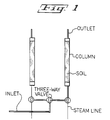
- Figure 1 is a functional representation of apparatus suitable for carrying out the claimed method using a pair of soil columns operating in parallel.
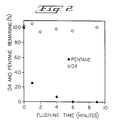
- FIG. 2 is a graphical representation illustrating the results of an experiment in which octamethylcyclotetrasiloxane (D 4 ) was separated from a fluid stream containing air, octamethylcyclotetrasiloxane and pentane.
- the graph shows the amount of octamethylcyclotetrasiloxane and pentane that remained in dry soil (i.e., 30 percent relative humidity), after an air dried soil was spiked with octamethylcyclotetrasiloxane and pentane and then flushed with air at a relative humidity of 30 percent, for periods of time varying from zero to ten minutes. This data was obtained as described in our Example I.
- FIG. 3 is another graphical representation illustrating the results of the above experiment.
- the graph shows the amount of octamethylcyclotetrasiloxane and pentane that remained in wet soil (i.e., 100 percent relative humidity), after wet soil was spiked with octamethylcyclotetrasiloxane and pentane and then flushed with air at a relative humidity of 100 percent, for periods of time varying from zero to ten minutes. This data was also obtained as described in our Example I.
- Figure 4 is an additional graphical representation showing the degradation rate of octamethylcyclotetrasiloxane to dimethylsilanediol, in the presence of Londo soil at three different humidities (i.e., 30, 90 and 100% RH).
- degradation it is meant the hydrolytic cleavage of siloxane linkages ( ⁇ Si-O-Si ⁇ ) in both cyclic and linear species.
- Londo soil at a relative humidity of 30 percent is considered dry soil.
- Londo soil at a relative humidity of 90 percent is also considered dry soil.
- Londo soil at a relative humidity of 100 percent is considered wet soil.
- the initial concentration of octamethylcyclotetrasiloxane in each of the three soils was 36 parts per million. This data was obtained as described in our Example II.
- volatile organopolysiloxanes such as octamethylcyclotetrasiloxane (D 4 ) are first adsorbed by dry soil. When the dry soil is then wetted, the volatile organopolysiloxane adsorbed in the dry soil is desorbed and becomes vaporized.
- This method can be practiced in any packed column that uses dry soil as a packing material.
- the packing material is inexpensive and readily available.
- Another advantage is that the packed column can be regenerated simply by flushing the column with moist air, water or steam.
- FIG 1 we have depicted a system suitable for practicing the method according to our invention, in which there is a pair of Column(s), each containing Soil for removing volatile organopolysiloxanes from a fluid stream.
- fluid stream it is meant any flowing stream in a gaseous or vaporous state containing volatile organopolysiloxanes, organic compounds or hydrocarbons.
- a fluid stream such as air containing a volatile organopolysiloxane and a hydrocarbon, i.e., methane or pentane, for example, is fed to the Column through an Inlet Line.
- the fluid stream can be directed to each of the Columns simultaneously, to only one Column or to neither Column, by manipulation of a Three-Way Valve located in the Inlet Line.
- a Three-Way Valve located in the Inlet Line.
- the other Column can be in a flushing or regenerating mode.
- the fluid stream enters the Column through the Inlet Line and is removed from the Column through an Outlet Line located at its opposite end.
- Each Column is provided with a Steam Line also controlled by a Three-Way Valve. While Figure 1 shows this line as a Steam Line, the line can be used for introducing moist air or water as well.
- the Three-Way Valve in the Inlet Line is rotated to shut off the supply of the fluid stream to that Column. Steam, moist air or water is then introduced into that Column by rotating the Three-Way Valve in the Steam Line.
- the steam, moist air or water flushes the adsorbed volatile organopolysiloxane from the Soil Bed out of the Column and through the Outlet.
- the Columns can be straight, U-shaped or coiled and they have a length of 0.1-10 meters and an inside diameter of 1-200 centimeters.
- the Columns are connected serially or they are operated in parallel. Flow through the Columns can be from the bottom to the top or vice versa.
- the Columns can also be fed laterally. More than two Columns can be used.
- the Columns are made of any suitable material such as glass or stainless steel.
- the Columns can be equipped with an arrangement of valves, pumps, blowers, pressure controllers, vents, heaters, coolers, separators, evaporators and condensers, necessary to conduct our method in an efficient manner.
- the temperature and pressure employed in operating the Columns will depend upon the particular fluid stream being treated; but in general, a temperature between 0-150°C. is suitable for most applications. Furthermore, pressures above or below atmospheric pressure can be employed to maintain flow through the Columns.
- volatile organopolysiloxane includes, but is not limited to, volatile methyl siloxanes (VMS) which are low viscosity linear and cyclic silicone species corresponding to the average unit formula (CH 3 ) a SiO (4-a)/2 in which a has an average value of two or three.
- VMS volatile methyl siloxanes
- These organopolysiloxanes contain monofunctional "M” units (CH 3 ) 3 SiO 1/2 and difunctional "D" units (CH 3 ) 2 SiO 2/2 joined by ⁇ Si-O-Si ⁇ bonds.
- Linear VMS have the formula (CH 3 ) 3 SiO ⁇ (CH 3 ) 2 SiO ⁇ x Si(CH 3 ) 3 where x has a value of 0-4.
- Cyclic VMS have the formula ⁇ (CH 3 ) 2 SiO ⁇ y where y has a value of 3, 4, 5 or 6.
- the VMS has a boiling point less than 250°C. and it has a viscosity of 0.65 to 5.0 centistokes (mm 2 /s).
- Examples of some representative linear VMS are hexamethyldisiloxane (MM) with a boiling point of 100°C., a viscosity of 0.65 mm 2 /s and the formula Me 3 SiOSiMe 3 where Me is, and hereafter, represents the methyl group; octamethyltrisiloxane (MDM) with a boiling point of 152°C., a viscosity of 1.04 mm 2 /s and the formula Me 3 SiOMe 2 SiOSiMe 3 ; decamethyltetrasiloxane (MD 2 M) with a boiling point of 194°C., a viscosity of 1.53 mm 2 /s and the formula Me 3 SiO(Me 2 SiO) 2 SiMe 3 ; dodecamethylpentasiloxane (MD 3 M) with a boiling point of 229°C., a viscosity of 2.06 mm 2 /s and the formula Me 3 SiO(Me 2 Sio)
- Examples of some representative cyclic VMS are hexamethylcyclotrisiloxane (D 3 ) which is a solid at room temperature having a boiling point of 134°C. and the formula ⁇ (Me 2 )SiO ⁇ ; octamethylcyclotetrasiloxane (D 4 ) with a boiling point of 176°C., a viscosity of 2.3 mm 2 /s and the formula ⁇ (Me 2 )SiO ⁇ 4 ; decamethylcyclopentasiloxane (D 5 ) with a boiling point of 210°C., a viscosity of 3.87 mm 2 /s and the formula ⁇ (Me 2 )SiO ⁇ 5 ; and dodecamethylcyclohexasiloxane (D 6 ) with a boiling point of 245°C., a viscosity of 6.62 mm 2 /s and the formula ⁇ (Me 2 )SiO ⁇ 6
- soil is defined as any freely divided, rock derived and fine grained material, such as clay, silt, sand, rock, gravel, porous rock, shale or any other material that is naturally deposited upon the earth.
- the soil has a particle size up to 2 mm, inclusive, corresponding to US Standard Sieve Numbers up to 10.
- the soil can have any texture between and including sand and clay.
- the pH of the soil varies from 3 to 9.
- the organic matter (i.e., humus) content of the soil is usually between zero to 50 percent.
- the soil can contain any combination of clay minerals such as illites, kaolinites, smectites, zeolites, halloysites and attapulgites; as well as other soil minerals such as quartz, feldspar, mica, vermiculite, chlorite, calcite, dolomite, allophane, hematite, goethite, gibbsite, anatase, pyrolusite, tourmaline and zircon.
- a synthetic soil matrix may also be employed, such as SSM soil available from the US Environmental Protection Agency, Washington, DC, which constitutes a sieved blend containing 20% soil, 20% sand, 25% silt, 5% gravel, 22.5% kaolinite and 7.5% montmorillonite.
- dry soil an air dried soil that has been obtained by passing air having a relative humidity (RH) of 0-90 percent through the soil.
- RH relative humidity
- wet soil soil that has been obtained by passing air having a relative humidity (RH) of 100 percent through the soil.
- RH relative humidity
- wet soil is also intended to include saturated soil that has been obtained by passing water or steam through the soil.
- 0% relative humidity soil contains 0.1% water; 20% relative humidity soil contains 1.5% water; 45% relative humidity soil contains 2.5% water; and 80% relative humidity soil contains 4.0% water.
- Natural or synthetic clays can also be used instead of soil, although it is not as readily available or as inexpensive as soil.
- clay it is meant any hydrated aluminum silicate such as kaolinite, smectite, attapulgite, vermiculite, chlorite, illite and halloysite, as well as oxides such as hematite, gibbsite and goethite.
- Londo soil used in these examples is a sandy clay loam obtained in Bay County, Michigan and it is generally representative of midwestern agricultural soils of intermediate texture. It is a Glossaqualf formed from glacial till under seasonally wet woodlands. In general, Londo soils have an organic matter content of 2-4 percent; a pH of 7-8; and a sandy loam or a sandy clay loam texture.
- Air dried Londo soil was weighed into several 35 milliliter glass tubes. Each tube contained 5 grams of soil. The tubes were equally divided into two groups. One group of open tubes containing soil was placed in a desiccator containing purified water in its lower compartment. Another group of open tubes containing soil was placed in a second desiccator containing a saturated calcium chloride (CaCl 2 ) solution as drying and desiccating agent in its lower compartment. The tubes were left in the two closed desiccators for two weeks to allow soil moisture to equilibrate with air in the two desiccators.
- CaCl 2 saturated calcium chloride
- the pre-equilibrated soil samples were each spiked with 0.25 ml of a 14 C-labeled octamethylcyclotetrasiloxane/pentane solution.
- the tubes were flushed with air at 30 percent relative humidity (dry air) and air at 100 percent relative humidity (wet air), for periods of time varying from 0-9 minutes, using a moisture controlled flushing arrangement.
- dry air dry air
- wet air 100 percent relative humidity
- the tubes were extracted three times with tetrahydrofuran (THF), using 20 ml of THF for each tube each time it was extracted.
- THF tetrahydrofuran
- Air dried Londo soil was weighed into several 35 milliliter glass tubes. Each tube contained 5 grams of soil.
- the tubes were divided into three groups. The first group of open tubes containing soil was placed in a desiccator. The desiccator contained purified water in its lower compartment. The second group of open tubes containing soil was placed in a second desiccator containing a saturated potassium hydrogen phosphate (K 2 HPO 4 ) solution as drying and desiccating agent in its lower compartment. The third group of open tubes containing soil was placed in a third desiccator containing a saturated CaCl 2 solution as drying and desiccating agent in its lower compartment.
- K 2 HPO 4 saturated potassium hydrogen phosphate
- the tubes were left in the three closed desiccators for one week, to allow soil moisture to equilibrate with air in the three desiccators.
- the pre-equilibrated soil samples were each spiked with 0.25 ml of a 14 C-labeled octamethylcyclotetrasiloxane/pentane solution.
- the tubes were flushed with air at 30 percent relative humidity (dry air), air at 90 percent relative humidity (dry air) and air at 100 percent relative humidity (wet air) for 1-2 minutes, using a moisture controlled flushing arrangement.
- the tubes were then closed with TEFLON® lined caps and incubated at room temperature for different periods of time ranging from 0-24 days.
Landscapes
- Chemical & Material Sciences (AREA)
- Engineering & Computer Science (AREA)
- Analytical Chemistry (AREA)
- General Chemical & Material Sciences (AREA)
- Oil, Petroleum & Natural Gas (AREA)
- Chemical Kinetics & Catalysis (AREA)
- Health & Medical Sciences (AREA)
- Biomedical Technology (AREA)
- Environmental & Geological Engineering (AREA)
- Separation Of Gases By Adsorption (AREA)
- Solid-Sorbent Or Filter-Aiding Compositions (AREA)
Applications Claiming Priority (2)
| Application Number | Priority Date | Filing Date | Title |
|---|---|---|---|
| US08/827,821 US5922108A (en) | 1997-04-11 | 1997-04-11 | Method of removing volatile organopolysiloxanes from a fluid stream |
| US827821 | 1997-04-11 |
Publications (1)
| Publication Number | Publication Date |
|---|---|
| EP0870528A1 true EP0870528A1 (de) | 1998-10-14 |
Family
ID=25250262
Family Applications (1)
| Application Number | Title | Priority Date | Filing Date |
|---|---|---|---|
| EP98302723A Withdrawn EP0870528A1 (de) | 1997-04-11 | 1998-04-07 | Verfahren zur Entfernung von flüchtigen Organopolysiloxanen aus einem Fluidstrom |
Country Status (3)
| Country | Link |
|---|---|
| US (1) | US5922108A (de) |
| EP (1) | EP0870528A1 (de) |
| JP (1) | JPH10277341A (de) |
Cited By (1)
| Publication number | Priority date | Publication date | Assignee | Title |
|---|---|---|---|---|
| CN110382083A (zh) * | 2017-03-14 | 2019-10-25 | 美国陶氏有机硅公司 | 使用吸附剂共聚物耗减混合物中的有机硅组分的方法和用于实施该方法的装置 |
Families Citing this family (3)
| Publication number | Priority date | Publication date | Assignee | Title |
|---|---|---|---|---|
| US6627698B2 (en) | 2001-02-13 | 2003-09-30 | Dow Corning Corporation | Method of making silicone emulsions having low residual volatile siloxane oligomer content |
| US7306652B2 (en) * | 2005-03-30 | 2007-12-11 | Parker-Hannifin Corporation | Siloxane removal process |
| WO2017209846A1 (en) * | 2016-05-31 | 2017-12-07 | Dow Corning Corporation | Method of depleting a volatile component in a mixture using a crosslinked elastomer sorbent and apparatus for practicing the method |
Citations (5)
| Publication number | Priority date | Publication date | Assignee | Title |
|---|---|---|---|---|
| DE2221031A1 (de) * | 1972-04-28 | 1973-11-15 | Gottfried Reuter Gmbh | Adsorptionsmittel |
| SU946648A1 (ru) * | 1980-04-10 | 1982-07-30 | Предприятие П/Я В-2913 | Способ регенерации активированного угл |
| EP0470936A1 (de) * | 1990-07-12 | 1992-02-12 | SAES GETTERS S.p.A. | Entfernung von Verunreinigungen aus gasförmigem Hydrid |
| JPH0557136A (ja) * | 1991-08-28 | 1993-03-09 | Fujitsu Ltd | 空気洗浄方法および高純度シリコンフイルター |
| JPH09141035A (ja) * | 1995-11-24 | 1997-06-03 | Nec Corp | シロキサン除去装置 |
Family Cites Families (5)
| Publication number | Priority date | Publication date | Assignee | Title |
|---|---|---|---|---|
| IT1062296B (it) * | 1980-08-08 | 1984-06-26 | Massimo Sacchetti | Processo e apparecchiatura per eliminare e recuperare sostanze organiche volatili dai gas di scarico industriali |
| US5346535A (en) * | 1991-08-23 | 1994-09-13 | Engelhard Corporation | Use of crystalline molecular sieves containing charged octahedral sites in removing volatile organic compounds from a mixture of the same |
| US5595586A (en) * | 1993-02-26 | 1997-01-21 | General Electric Company | Method for recovery of volatile organic compounds |
| US5389125A (en) * | 1993-08-20 | 1995-02-14 | Daniel D. Thayer | Automated system for recovery of VOC's from process air |
| JP3492018B2 (ja) * | 1995-05-10 | 2004-02-03 | 三菱重工業株式会社 | 揮発性有機物の回収方法 |
-
1997
- 1997-04-11 US US08/827,821 patent/US5922108A/en not_active Expired - Fee Related
-
1998
- 1998-04-07 EP EP98302723A patent/EP0870528A1/de not_active Withdrawn
- 1998-04-10 JP JP10098594A patent/JPH10277341A/ja not_active Withdrawn
Patent Citations (5)
| Publication number | Priority date | Publication date | Assignee | Title |
|---|---|---|---|---|
| DE2221031A1 (de) * | 1972-04-28 | 1973-11-15 | Gottfried Reuter Gmbh | Adsorptionsmittel |
| SU946648A1 (ru) * | 1980-04-10 | 1982-07-30 | Предприятие П/Я В-2913 | Способ регенерации активированного угл |
| EP0470936A1 (de) * | 1990-07-12 | 1992-02-12 | SAES GETTERS S.p.A. | Entfernung von Verunreinigungen aus gasförmigem Hydrid |
| JPH0557136A (ja) * | 1991-08-28 | 1993-03-09 | Fujitsu Ltd | 空気洗浄方法および高純度シリコンフイルター |
| JPH09141035A (ja) * | 1995-11-24 | 1997-06-03 | Nec Corp | シロキサン除去装置 |
Non-Patent Citations (4)
| Title |
|---|
| DATABASE WPI Section Ch Week 198324, Derwent World Patents Index; Class A41, AN 1983-58082K, XP002073296 * |
| DATABASE WPI Section Ch Week 9315, Derwent World Patents Index; Class J01, AN 93-120496, XP002073295 * |
| LEHMANN ET AL.: "Degradation of silicone polymer in a variety of soils", ENVIRONMENTAL TOXICOLOGY AND CHEMISTRY, vol. 14, no. 8, August 1995 (1995-08-01), USA, pages 1299 - 1305, XP002073294 * |
| PATENT ABSTRACTS OF JAPAN vol. 097, no. 010 31 October 1997 (1997-10-31) * |
Cited By (2)
| Publication number | Priority date | Publication date | Assignee | Title |
|---|---|---|---|---|
| CN110382083A (zh) * | 2017-03-14 | 2019-10-25 | 美国陶氏有机硅公司 | 使用吸附剂共聚物耗减混合物中的有机硅组分的方法和用于实施该方法的装置 |
| CN110382083B (zh) * | 2017-03-14 | 2022-03-29 | 美国陶氏有机硅公司 | 使用吸附剂共聚物耗减混合物中的有机硅组分的方法和用于实施该方法的装置 |
Also Published As
| Publication number | Publication date |
|---|---|
| JPH10277341A (ja) | 1998-10-20 |
| US5922108A (en) | 1999-07-13 |
Similar Documents
| Publication | Publication Date | Title |
|---|---|---|
| US6322613B1 (en) | Process for the recovery of mercury from a gaseous mixture | |
| Chang et al. | Memory effect on the dioxin emissions from municipal waste incinerator in Taiwan | |
| Suzuki | Role of adsorption in water environment processes | |
| JP3444888B2 (ja) | 気体状の溶媒中の溶質の分離 | |
| Stockmeyer | Adsorption of organic compounds on organophilic bentonites | |
| Lebedynets et al. | Adsorption of ammonium ions onto a natural zeolite: transcarpathian clinoptilolite | |
| Álvarez-Hornos et al. | Biofiltration of ethylbenzene vapours: influence of the packing material | |
| Benson et al. | Modeling vapor extraction and general transport in the presence of NAPL mixtures and nonideal conditions | |
| US5922108A (en) | Method of removing volatile organopolysiloxanes from a fluid stream | |
| Chang et al. | Characterization of dioxin emissions from two municipal solid waste incinerators in Taiwan | |
| US9039807B2 (en) | Regenerative adsorption process for removal of silicon-containing contaminants from process gas using a neutral adsorbent media | |
| EP0301090A4 (de) | Regenerierung eines dynamischen adsorptionssystems und verfahren zur entfernung von verunreinigungen. | |
| ATE4780T1 (de) | Verfahren zum entfernen und zurueckgewinnen fluechtiger organischer substanzen aus industriellen abgasen. | |
| ATE110983T1 (de) | Verfahren und anordnung zum reinigen von kohlenstoffhaltigem adsorptionsmittel. | |
| Mcnevin et al. | Inter-relationship between adsorption and pH in peat biofilters in the context of a cation-exchange mechanism | |
| JP3627100B2 (ja) | 消化ガスの精製方法 | |
| AU7337894A (en) | Gas stream odorant filtering apparatus and method | |
| JP2021122765A (ja) | 土壌浄化の解析方法 | |
| DE59906866D1 (de) | Verfahren zur rückgewinnung und/oder entfernung organischer verbindungen aus gasströmen | |
| KR20020047474A (ko) | 산소를 공급하는 기능을 갖춘 공기정화기 | |
| SHU et al. | Modeling Biofiltration of Deodoration of Exhaust Air from Burley Tobacco Processing Plant | |
| JPH043678Y2 (de) | ||
| Bunker | Construction and operation of a pilot-scale odor control device | |
| Rollor et al. | Regeneration of five activated carbons with methanol | |
| Bui et al. | Pedogenesis and mineralogy of a Halaquept in Niger (West Africa) |
Legal Events
| Date | Code | Title | Description |
|---|---|---|---|
| PUAI | Public reference made under article 153(3) epc to a published international application that has entered the european phase |
Free format text: ORIGINAL CODE: 0009012 |
|
| AK | Designated contracting states |
Kind code of ref document: A1 Designated state(s): DE FR GB NL |
|
| AX | Request for extension of the european patent |
Free format text: AL;LT;LV;MK;RO;SI |
|
| 17P | Request for examination filed |
Effective date: 19981111 |
|
| AKX | Designation fees paid |
Free format text: DE FR GB NL |
|
| GRAH | Despatch of communication of intention to grant a patent |
Free format text: ORIGINAL CODE: EPIDOS IGRA |
|
| STAA | Information on the status of an ep patent application or granted ep patent |
Free format text: STATUS: THE APPLICATION IS DEEMED TO BE WITHDRAWN |
|
| 18D | Application deemed to be withdrawn |
Effective date: 20030429 |