EP0868540B1 - Free machining stainless steel and components for automotive fuel and exhaust systems made therefrom - Google Patents
Free machining stainless steel and components for automotive fuel and exhaust systems made therefrom Download PDFInfo
- Publication number
- EP0868540B1 EP0868540B1 EP96945217A EP96945217A EP0868540B1 EP 0868540 B1 EP0868540 B1 EP 0868540B1 EP 96945217 A EP96945217 A EP 96945217A EP 96945217 A EP96945217 A EP 96945217A EP 0868540 B1 EP0868540 B1 EP 0868540B1
- Authority
- EP
- European Patent Office
- Prior art keywords
- metallic body
- max
- article
- alloy
- recited
- Prior art date
- Legal status (The legal status is an assumption and is not a legal conclusion. Google has not performed a legal analysis and makes no representation as to the accuracy of the status listed.)
- Expired - Lifetime
Links
- 229910001220 stainless steel Inorganic materials 0.000 title claims description 4
- 238000003754 machining Methods 0.000 title description 11
- 239000000446 fuel Substances 0.000 title description 9
- 239000010935 stainless steel Substances 0.000 title description 4
- 229910045601 alloy Inorganic materials 0.000 claims description 29
- 239000000956 alloy Substances 0.000 claims description 29
- 229910052717 sulfur Inorganic materials 0.000 claims description 11
- XEEYBQQBJWHFJM-UHFFFAOYSA-N Iron Chemical group [Fe] XEEYBQQBJWHFJM-UHFFFAOYSA-N 0.000 claims description 8
- PXHVJJICTQNCMI-UHFFFAOYSA-N Nickel Chemical compound [Ni] PXHVJJICTQNCMI-UHFFFAOYSA-N 0.000 claims description 8
- 239000011572 manganese Substances 0.000 claims description 8
- 229910000851 Alloy steel Inorganic materials 0.000 claims description 7
- NINIDFKCEFEMDL-UHFFFAOYSA-N Sulfur Chemical compound [S] NINIDFKCEFEMDL-UHFFFAOYSA-N 0.000 claims description 7
- 229910052799 carbon Inorganic materials 0.000 claims description 7
- 239000011593 sulfur Substances 0.000 claims description 7
- 238000005260 corrosion Methods 0.000 claims description 6
- 230000007797 corrosion Effects 0.000 claims description 6
- 238000004519 manufacturing process Methods 0.000 claims description 6
- OKTJSMMVPCPJKN-UHFFFAOYSA-N Carbon Chemical compound [C] OKTJSMMVPCPJKN-UHFFFAOYSA-N 0.000 claims description 5
- 229910052748 manganese Inorganic materials 0.000 claims description 5
- 230000013011 mating Effects 0.000 claims description 5
- 239000010955 niobium Substances 0.000 claims description 5
- PWHULOQIROXLJO-UHFFFAOYSA-N Manganese Chemical compound [Mn] PWHULOQIROXLJO-UHFFFAOYSA-N 0.000 claims description 4
- 229910052804 chromium Inorganic materials 0.000 claims description 4
- 239000011651 chromium Substances 0.000 claims description 4
- 229910052742 iron Inorganic materials 0.000 claims description 4
- 229910052759 nickel Inorganic materials 0.000 claims description 4
- 229910052710 silicon Inorganic materials 0.000 claims description 4
- VYZAMTAEIAYCRO-UHFFFAOYSA-N Chromium Chemical compound [Cr] VYZAMTAEIAYCRO-UHFFFAOYSA-N 0.000 claims description 3
- OAICVXFJPJFONN-UHFFFAOYSA-N Phosphorus Chemical compound [P] OAICVXFJPJFONN-UHFFFAOYSA-N 0.000 claims description 3
- XUIMIQQOPSSXEZ-UHFFFAOYSA-N Silicon Chemical compound [Si] XUIMIQQOPSSXEZ-UHFFFAOYSA-N 0.000 claims description 3
- 229910052782 aluminium Inorganic materials 0.000 claims description 3
- 239000010949 copper Substances 0.000 claims description 3
- 239000012535 impurity Substances 0.000 claims description 3
- 239000000203 mixture Substances 0.000 claims description 3
- GUCVJGMIXFAOAE-UHFFFAOYSA-N niobium atom Chemical compound [Nb] GUCVJGMIXFAOAE-UHFFFAOYSA-N 0.000 claims description 3
- 229910052698 phosphorus Inorganic materials 0.000 claims description 3
- 239000011574 phosphorus Substances 0.000 claims description 3
- 239000010703 silicon Substances 0.000 claims description 3
- RYGMFSIKBFXOCR-UHFFFAOYSA-N Copper Chemical compound [Cu] RYGMFSIKBFXOCR-UHFFFAOYSA-N 0.000 claims description 2
- ZOKXTWBITQBERF-UHFFFAOYSA-N Molybdenum Chemical compound [Mo] ZOKXTWBITQBERF-UHFFFAOYSA-N 0.000 claims description 2
- XAGFODPZIPBFFR-UHFFFAOYSA-N aluminium Chemical compound [Al] XAGFODPZIPBFFR-UHFFFAOYSA-N 0.000 claims description 2
- 229910052802 copper Inorganic materials 0.000 claims description 2
- 229910052750 molybdenum Inorganic materials 0.000 claims description 2
- 239000011733 molybdenum Substances 0.000 claims description 2
- QVGXLLKOCUKJST-UHFFFAOYSA-N atomic oxygen Chemical compound [O] QVGXLLKOCUKJST-UHFFFAOYSA-N 0.000 description 5
- 229910052760 oxygen Inorganic materials 0.000 description 5
- 239000001301 oxygen Substances 0.000 description 5
- 230000008901 benefit Effects 0.000 description 4
- 238000005520 cutting process Methods 0.000 description 3
- 229910052751 metal Inorganic materials 0.000 description 3
- 239000002184 metal Substances 0.000 description 3
- 238000005553 drilling Methods 0.000 description 2
- 230000000694 effects Effects 0.000 description 2
- 230000014509 gene expression Effects 0.000 description 2
- VCTOKJRTAUILIH-UHFFFAOYSA-N manganese(2+);sulfide Chemical class [S-2].[Mn+2] VCTOKJRTAUILIH-UHFFFAOYSA-N 0.000 description 2
- 238000002844 melting Methods 0.000 description 2
- 230000008018 melting Effects 0.000 description 2
- 238000010079 rubber tapping Methods 0.000 description 2
- 238000007493 shaping process Methods 0.000 description 2
- CADICXFYUNYKGD-UHFFFAOYSA-N sulfanylidenemanganese Chemical compound [Mn]=S CADICXFYUNYKGD-UHFFFAOYSA-N 0.000 description 2
- 229910000831 Steel Inorganic materials 0.000 description 1
- VVTSZOCINPYFDP-UHFFFAOYSA-N [O].[Ar] Chemical compound [O].[Ar] VVTSZOCINPYFDP-UHFFFAOYSA-N 0.000 description 1
- 230000002411 adverse Effects 0.000 description 1
- 239000012809 cooling fluid Substances 0.000 description 1
- 239000002173 cutting fluid Substances 0.000 description 1
- 238000005261 decarburization Methods 0.000 description 1
- 230000001627 detrimental effect Effects 0.000 description 1
- 238000010891 electric arc Methods 0.000 description 1
- 230000001050 lubricating effect Effects 0.000 description 1
- 238000005461 lubrication Methods 0.000 description 1
- 238000000034 method Methods 0.000 description 1
- 238000012986 modification Methods 0.000 description 1
- 230000004048 modification Effects 0.000 description 1
- 238000007670 refining Methods 0.000 description 1
- 239000010959 steel Substances 0.000 description 1
- 238000005482 strain hardening Methods 0.000 description 1
Images

Classifications
-
- C—CHEMISTRY; METALLURGY
- C22—METALLURGY; FERROUS OR NON-FERROUS ALLOYS; TREATMENT OF ALLOYS OR NON-FERROUS METALS
- C22C—ALLOYS
- C22C38/00—Ferrous alloys, e.g. steel alloys
- C22C38/18—Ferrous alloys, e.g. steel alloys containing chromium
- C22C38/26—Ferrous alloys, e.g. steel alloys containing chromium with niobium or tantalum
-
- C—CHEMISTRY; METALLURGY
- C22—METALLURGY; FERROUS OR NON-FERROUS ALLOYS; TREATMENT OF ALLOYS OR NON-FERROUS METALS
- C22C—ALLOYS
- C22C38/00—Ferrous alloys, e.g. steel alloys
- C22C38/60—Ferrous alloys, e.g. steel alloys containing lead, selenium, tellurium, or antimony, or more than 0.04% by weight of sulfur
Definitions
- This invention relates to corrosion resistant components used in automotive fuel and exhaust systems, and in particular, to a corrosion resistant steel alloy for use in such components which provides a unique combination of machinability, cold formability, and weldability.
- Type 409Cb A corrosion resistant steel alloy known as Type 409Cb has been used for fabricating components for automotive fuel and exhaust systems. Among the components made from Type 409Cb alloy are housings and bushings for oxygen sensors, and nuts and fittings for fuel filters.
- a known specification for Type 409Cb alloy is as follows, in weight percent. Carbon 0.06 max. Manganese 1.00 max. Silicon 1.00 max. Phosphorus 0.045 max. Sulfur 0.045 max. Chromium 10.5-11.75 Nickel 0.50 max. Columbium 10 ⁇ C to 0.75 Iron Balance
- Parts made from Type 409Cb alloy are cold-formed or headed to rough shape from wire or another elongated form of the alloy. Consequently, the alloy is made with very low sulfur, 0.020% or less, in order to avoid the adverse effect of sulfur on the cold-formability of the alloy.
- the headed blank is then machined to final size and shape.
- machining operations performed on the headed blanks are drilling, tapping, facing, turning, form-tool shaping, and chamfering.
- Type 409Cb is relatively soft and gummy.
- stringy chips are detrimental to the useful life of the machining tool because they accumulate around the tool and restrict the flow of cooling fluid to the tool and the part being machined.
- the tool then becomes overheated, loses its ability to remove metal from the part being machined, and must be removed for resharpening. If the tool overheats too rapidly, it can fail catastrophically. In either case, the result is undesirably frequent machine downtimes and a concurrent loss in productivity.
- a ferritic stainless steel alloy having a unique combination of cold-formability and machinability.
- the alloy consists essentially of, in weight percent : wt. % Carbon 0.08 max. Manganese 1.00 max. Silicon 1.00 max. Phosphorus 0.045 max. Sulfur 0.025-0.30 Chromium 10.5-11.75 Molybdenum 0.50 max. Copper 0.50 max. Nickel 0.30 - 0.50 Aluminum 0.10 max. Columbium 10 ⁇ C to 0.80 and the balance is iron and the usual impurities found in similar grades of ferritic stainless steels.
- an article of manufacture for use in an automotive fuel or exhaust system.
- the article according to this invention includes a metallic body having an axial bore formed therein.
- a plurality of threads are formed on the metallic body so that it can be threaded onto a second article having a mating thread.
- the metallic body is formed of a corrosion resistant, ferritic steel alloy having the weight percent composition set forth in the immediately preceding paragraph.
- percent or "%” means percent by weight unless otherwise indicated.
- FIG. 1A, 1B, and 1C there is shown a first embodiment of an article according to the present invention in the form of a bushing 10 for an engine exhaust oxygen sensor.
- the bushing 10 has a generally ring-shaped metallic body 12 and a central axial bore 14.
- a plurality of internal threads 16 are formed about the inner periphery of the metallic body 12 so that another article having a mating external thread can be threaded into the bushing 10.
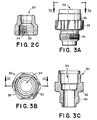
- FIG. 2A, 2B, and 2C there is shown a second embodiment of an article according to the present invention in the form of a fuel filter fitting 20.
- the fitting 20 has a generally cylindrically-shaped metallic body 22 and a central axial bore 24.
- a plurality of internal threads 26 are formed about the inner periphery of one portion of the metallic body 22 so that the fitting 20 can be threaded onto a fuel filter (not shown) having mating external threads.
- Flats 28 are preferably formed on the external surface of the metallic body 22 so that a tool such as a wrench can be applied to the metallic body for rotating it as it is threaded onto the fuel filter.
- FIG. 3A, 3B, and 3C there is shown a further embodiment of an article according to the present invention in the form of a housing or shell 30 for an engine oxygen sensor.
- the housing 30 has a generally cylindrically-shaped metallic body 32 and a central axial bore 34.
- a plurality of external threads 36 are formed about the external periphery of a first portion of the metallic body 32 so that the housing 30 can be threaded into another article (not shown) having mating internal threads.
- Flats 38 are preferably formed on the external surface of the metallic body 32 so that a tool such as a wrench can be applied to the metallic body for rotating it as it is threaded onto another article or a fitting.
- each of the above-described embodiments of an article according to the present invention is formed of a corrosion resistant, ferritic steel alloy which contains 0.08% max. C, 1.00% max. Mn, 1.00% max. Si, 0.045% max. P, 0.025-0.3% S, 10.5-11.75% Cr, 0.50% max. Ni, and Cb in an amount ranging from at least about ten times the amount of carbon (10 ⁇ C) up to about 0.8% max.
- the alloy contains not more than 0.03% C, better yet not more than 0.02% C, not more than 0.75% each of Mn and Si, not more than 0.06% S, at least 0.30% Ni, and not more than 0.60% Cb.
- Manganese-sulfide inclusions or stringers in the alloy benefit machinability by lowering the shear strength of the metal chips that are formed during the machining process. Such chips break and fall away from the machining tool more readily. Consequently, there is less heat generated on the cutting edges and surfaces of the machining tool. Also, a greater volume of cutting fluid can reach the tool to remove heat and provide lubrication. In either case the life of the machining tool is extended and machine downtime for retooling is reduced.
- the manganese sulfide inclusions also provide a lubricating effect during the machining process that permits faster machining speeds and feed rates and lower cutting forces.
- the alloy contains at least about 0.030% S, e.g., about 0.035% or about 0.04% S and an amount of Mn that is effective to combine with at least some of the S to form manganese sulfides.
- an effective amount of manganese is present in this alloy when the Mn/S ratio is at least about 2-3.
- this alloy may contain up to about 0.50% max. Cu, up to about 0.50% max. Mo, and/or up to about 0.10% Al if desired.
- the balance of the alloy is iron except for the usual impurities which are present in similar grades of corrosion resistant ferritic steel alloys.
- the alloy can be prepared in any known manner, electric arc melting followed by argon-oxygen decarburization (AOD) being the preferred melting/refining technique.
- AOD argon-oxygen decarburization
- the alloy is mechanically worked as by hot and/or cold working to a desired product form such as wire, rod, or bar.
- Useful articles such as the bushing 10, fitting 20, or housing 30 described hereinabove are formed from the alloy by first cold heading the alloy to a rough shape. The rough shape is then machined to final dimension by one or more operations such as drilling, tapping, facing, turning, form-tool shaping, and/or chamfering.
Landscapes
- Chemical & Material Sciences (AREA)
- Engineering & Computer Science (AREA)
- Materials Engineering (AREA)
- Mechanical Engineering (AREA)
- Metallurgy (AREA)
- Organic Chemistry (AREA)
- Exhaust Silencers (AREA)
- Fuel-Injection Apparatus (AREA)
- Heat Treatment Of Steel (AREA)
Description
| Carbon | 0.06 max. |
| Manganese | 1.00 max. |
| Silicon | 1.00 max. |
| Phosphorus | 0.045 max. |
| Sulfur | 0.045 max. |
| Chromium | 10.5-11.75 |
| Nickel | 0.50 max. |
| | 10×C to 0.75 |
| Iron | Balance |
| wt. % | |
| Carbon | 0.08 max. |
| Manganese | 1.00 max. |
| Silicon | 1.00 max. |
| Phosphorus | 0.045 max. |
| Sulfur | 0.025-0.30 |
| Chromium | 10.5-11.75 |
| Molybdenum | 0.50 max. |
| Copper | 0.50 max. |
| Nickel | 0.30 - 0.50 |
| Aluminum | 0.10 max. |
| | 10×C to 0.80 |
Claims (9)
- A ferritic stainless steel alloy having a unique combination of cold-formability and machinability, said alloy containing, in weight percent:
wt. % Carbon 0.08 max. Manganese 1.00 max. Silicon 1.00 max. Phosphorus 0.045 max. Sulfur 0.025-0.30 Chromium 10.5-11.75 Molybdenum 0.50 max. Copper 0.50 max. Nickel 0.30 - 0.50 Aluminum 0.10 max. Columbium 10×C to 0.8 - An alloy as recited in Claim 1 which contains at least 0.030% sulfur.
- An alloy as recited in Claim 1 or 2 which contains not more than 0.060% sulfur.
- An alloy as recited in any of Claims 1 to 3 which contains not more than 0.030% carbon.
- An article of manufacture comprising a metallic body having an axial bore formed therein and a plurality of threads formed on said metallic body whereby said metallic body can be threaded onto a second article having a mating thread, said metallic body being formed of a corrosion resistant, ferritic steel alloy having the weight percent composition set forth in any of claims 1 to 4.
- An article of manufacture as recited in Claim 5 wherein the threads are internal threads formed within the axial bore of the metallic body.
- An article of manufacture as recited in Claim 6 wherein the metallic body has an external surface and a plurality of flat surfaces formed on said external surface whereby a tool can be applied to said metallic body for turning said metallic body as it is threaded onto the second article.
- An article of manufacture as recited in Claim 5 wherein the metallic body has an external surface and the threads are external threads formed on the external surface of the metallic body.
- An article of manufacture as recited in Claim 8 wherein the metallic body has a plurality of flat surfaces formed on said external surface whereby a tool can be applied to said metallic body for turning said metallic body as it is threaded onto the second article.
Applications Claiming Priority (3)
| Application Number | Priority Date | Filing Date | Title |
|---|---|---|---|
| US574613 | 1995-12-19 | ||
| US08/574,613 US5707586A (en) | 1995-12-19 | 1995-12-19 | Free machining stainless steel and components for automotive fuel and exhaust systems made therefrom |
| PCT/US1996/020118 WO1997022726A1 (en) | 1995-12-19 | 1996-12-18 | Free machining stainless steel and components for automotive fuel and exhaust systems made therefrom |
Publications (2)
| Publication Number | Publication Date |
|---|---|
| EP0868540A1 EP0868540A1 (en) | 1998-10-07 |
| EP0868540B1 true EP0868540B1 (en) | 2000-03-08 |
Family
ID=24296874
Family Applications (1)
| Application Number | Title | Priority Date | Filing Date |
|---|---|---|---|
| EP96945217A Expired - Lifetime EP0868540B1 (en) | 1995-12-19 | 1996-12-18 | Free machining stainless steel and components for automotive fuel and exhaust systems made therefrom |
Country Status (9)
| Country | Link |
|---|---|
| US (1) | US5707586A (en) |
| EP (1) | EP0868540B1 (en) |
| JP (1) | JP2000510195A (en) |
| KR (1) | KR20000064433A (en) |
| BR (1) | BR9612077A (en) |
| CA (1) | CA2240713C (en) |
| DE (1) | DE69607033T2 (en) |
| MX (1) | MX9804857A (en) |
| WO (1) | WO1997022726A1 (en) |
Families Citing this family (2)
| Publication number | Priority date | Publication date | Assignee | Title |
|---|---|---|---|---|
| US6181509B1 (en) | 1999-04-23 | 2001-01-30 | International Business Machines Corporation | Low sulfur outgassing free machining stainless steel disk drive components |
| RU2222633C2 (en) * | 2002-04-29 | 2004-01-27 | Закрытое акционерное общество "Институт биметаллических сплавов" | Corrosion-resistant ferrite steel |
Family Cites Families (3)
| Publication number | Priority date | Publication date | Assignee | Title |
|---|---|---|---|---|
| US3401035A (en) * | 1967-12-07 | 1968-09-10 | Crucible Steel Co America | Free-machining stainless steels |
| JP3121478B2 (en) * | 1993-07-20 | 2000-12-25 | 株式会社豊田中央研究所 | Ferritic heat-resistant cast steel and method for producing the same |
| FR2720410B1 (en) * | 1994-05-31 | 1996-06-28 | Ugine Savoie Sa | Ferritic stainless steel with improved machinability. |
-
1995
- 1995-12-19 US US08/574,613 patent/US5707586A/en not_active Expired - Lifetime
-
1996
- 1996-12-18 JP JP09522969A patent/JP2000510195A/en active Pending
- 1996-12-18 EP EP96945217A patent/EP0868540B1/en not_active Expired - Lifetime
- 1996-12-18 BR BR9612077A patent/BR9612077A/en not_active Application Discontinuation
- 1996-12-18 CA CA002240713A patent/CA2240713C/en not_active Expired - Fee Related
- 1996-12-18 KR KR1019980704565A patent/KR20000064433A/en not_active Ceased
- 1996-12-18 DE DE69607033T patent/DE69607033T2/en not_active Expired - Fee Related
- 1996-12-18 WO PCT/US1996/020118 patent/WO1997022726A1/en not_active Ceased
-
1998
- 1998-06-17 MX MX9804857A patent/MX9804857A/en unknown
Also Published As
| Publication number | Publication date |
|---|---|
| CA2240713A1 (en) | 1997-06-26 |
| DE69607033D1 (en) | 2000-04-13 |
| JP2000510195A (en) | 2000-08-08 |
| WO1997022726A1 (en) | 1997-06-26 |
| BR9612077A (en) | 1999-02-17 |
| DE69607033T2 (en) | 2000-09-28 |
| CA2240713C (en) | 2003-11-25 |
| MX9804857A (en) | 1998-10-31 |
| US5707586A (en) | 1998-01-13 |
| KR20000064433A (en) | 2000-11-06 |
| EP0868540A1 (en) | 1998-10-07 |
Similar Documents
| Publication | Publication Date | Title |
|---|---|---|
| TWI391498B (en) | A steel for mechanical structure excellent in machinability and a method for manufacturing the same | |
| US3663215A (en) | Wear-resistant stainless steel | |
| Isakov | Cutting Data for turning of steel | |
| US20050252580A1 (en) | Cold work tool steel | |
| KR20120015449A (en) | Machine structural steel | |
| GB2186594A (en) | Steel alloys | |
| EP0487024A1 (en) | Electric resistance welded steel tube for mechanical engineering, and exhibiting a very good machinability | |
| JPS645100B2 (en) | ||
| US3861906A (en) | Calcium deoxidized, fine grain steels | |
| Kosa et al. | Machining of stainless steels | |
| US20200063249A1 (en) | Lead free steel and method of manufacturing | |
| JP2000034538A (en) | Machine structural steel with excellent turning workability | |
| EP0452526B1 (en) | High fatigue strength metal band saw backing material | |
| CA2240713C (en) | Free machining stainless steel and components for automotive fuel and exhaust systems made therefrom | |
| JPH09111412A (en) | High strength, high yield ratio, low ductility non-heat treated steel | |
| CN109234626B (en) | A kind of free-cutting heavy-duty automobile wheel hub bearing steel and manufacturing method | |
| JPS62211351A (en) | Tool steel having superior machinability | |
| JPH09176785A (en) | High strength / low ductility non-heat treated steel | |
| JP3109634B2 (en) | Oxygen sensor boss | |
| JP2001294973A (en) | Steel for plastic molds with excellent powder EDM | |
| SU1759944A1 (en) | Structural steel | |
| TW393519B (en) | Free machine stainless steel and components for automotive fuel and exhaust systems made therefrom | |
| KR20110067490A (en) | Lead-free, free-cutting steel wire with excellent machinability and hot rolling | |
| JPH09202938A (en) | Chrome-molybdenum cast steel with excellent machinability | |
| JPH09227990A (en) | Hot work tool steel with excellent high temperature strength and fracture toughness |
Legal Events
| Date | Code | Title | Description |
|---|---|---|---|
| PUAI | Public reference made under article 153(3) epc to a published international application that has entered the european phase |
Free format text: ORIGINAL CODE: 0009012 |
|
| 17P | Request for examination filed |
Effective date: 19980713 |
|
| AK | Designated contracting states |
Kind code of ref document: A1 Designated state(s): DE FR GB IT SE |
|
| 17Q | First examination report despatched |
Effective date: 19981112 |
|
| GRAG | Despatch of communication of intention to grant |
Free format text: ORIGINAL CODE: EPIDOS AGRA |
|
| GRAG | Despatch of communication of intention to grant |
Free format text: ORIGINAL CODE: EPIDOS AGRA |
|
| GRAH | Despatch of communication of intention to grant a patent |
Free format text: ORIGINAL CODE: EPIDOS IGRA |
|
| GRAH | Despatch of communication of intention to grant a patent |
Free format text: ORIGINAL CODE: EPIDOS IGRA |
|
| GRAA | (expected) grant |
Free format text: ORIGINAL CODE: 0009210 |
|
| AK | Designated contracting states |
Kind code of ref document: B1 Designated state(s): DE FR GB IT SE |
|
| REF | Corresponds to: |
Ref document number: 69607033 Country of ref document: DE Date of ref document: 20000413 |
|
| ITF | It: translation for a ep patent filed | ||
| ET | Fr: translation filed | ||
| PGFP | Annual fee paid to national office [announced via postgrant information from national office to epo] |
Ref country code: FR Payment date: 20001122 Year of fee payment: 5 |
|
| PGFP | Annual fee paid to national office [announced via postgrant information from national office to epo] |
Ref country code: SE Payment date: 20001204 Year of fee payment: 5 |
|
| PLBQ | Unpublished change to opponent data |
Free format text: ORIGINAL CODE: EPIDOS OPPO |
|
| PGFP | Annual fee paid to national office [announced via postgrant information from national office to epo] |
Ref country code: GB Payment date: 20001221 Year of fee payment: 5 |
|
| PLBI | Opposition filed |
Free format text: ORIGINAL CODE: 0009260 |
|
| PLBF | Reply of patent proprietor to notice(s) of opposition |
Free format text: ORIGINAL CODE: EPIDOS OBSO |
|
| 26 | Opposition filed |
Opponent name: EDELSTAHL WITTEN KREFELD GMBH Effective date: 20001208 |
|
| PLBF | Reply of patent proprietor to notice(s) of opposition |
Free format text: ORIGINAL CODE: EPIDOS OBSO |
|
| PLBF | Reply of patent proprietor to notice(s) of opposition |
Free format text: ORIGINAL CODE: EPIDOS OBSO |
|
| PLBF | Reply of patent proprietor to notice(s) of opposition |
Free format text: ORIGINAL CODE: EPIDOS OBSO |
|
| PG25 | Lapsed in a contracting state [announced via postgrant information from national office to epo] |
Ref country code: GB Free format text: LAPSE BECAUSE OF NON-PAYMENT OF DUE FEES Effective date: 20011218 |
|
| PG25 | Lapsed in a contracting state [announced via postgrant information from national office to epo] |
Ref country code: SE Free format text: LAPSE BECAUSE OF NON-PAYMENT OF DUE FEES Effective date: 20011219 |
|
| PGFP | Annual fee paid to national office [announced via postgrant information from national office to epo] |
Ref country code: DE Payment date: 20011227 Year of fee payment: 6 |
|
| REG | Reference to a national code |
Ref country code: GB Ref legal event code: IF02 |
|
| PLBO | Opposition rejected |
Free format text: ORIGINAL CODE: EPIDOS REJO |
|
| EUG | Se: european patent has lapsed |
Ref document number: 96945217.6 |
|
| GBPC | Gb: european patent ceased through non-payment of renewal fee |
Effective date: 20011218 |
|
| PLBN | Opposition rejected |
Free format text: ORIGINAL CODE: 0009273 |
|
| STAA | Information on the status of an ep patent application or granted ep patent |
Free format text: STATUS: OPPOSITION REJECTED |
|
| PG25 | Lapsed in a contracting state [announced via postgrant information from national office to epo] |
Ref country code: FR Free format text: LAPSE BECAUSE OF NON-PAYMENT OF DUE FEES Effective date: 20020830 |
|
| REG | Reference to a national code |
Ref country code: FR Ref legal event code: ST |
|
| 27O | Opposition rejected |
Effective date: 20020417 |
|
| PG25 | Lapsed in a contracting state [announced via postgrant information from national office to epo] |
Ref country code: DE Free format text: LAPSE BECAUSE OF NON-PAYMENT OF DUE FEES Effective date: 20030701 |
|
| PG25 | Lapsed in a contracting state [announced via postgrant information from national office to epo] |
Ref country code: IT Free format text: LAPSE BECAUSE OF NON-PAYMENT OF DUE FEES Effective date: 20051218 |