EP0863946B1 - Copolymers of tyrosine-based polycarbonate and poly(alkylene oxide) - Google Patents
Copolymers of tyrosine-based polycarbonate and poly(alkylene oxide) Download PDFInfo
- Publication number
- EP0863946B1 EP0863946B1 EP96942102A EP96942102A EP0863946B1 EP 0863946 B1 EP0863946 B1 EP 0863946B1 EP 96942102 A EP96942102 A EP 96942102A EP 96942102 A EP96942102 A EP 96942102A EP 0863946 B1 EP0863946 B1 EP 0863946B1
- Authority
- EP
- European Patent Office
- Prior art keywords
- poly
- random block
- copolymer
- block copolymer
- alkylene oxide
- Prior art date
- Legal status (The legal status is an assumption and is not a legal conclusion. Google has not performed a legal analysis and makes no representation as to the accuracy of the status listed.)
- Expired - Lifetime
Links
- OTKLRXDEPJIJGI-UHFFFAOYSA-N CC1C=CC(O)=CC1 Chemical compound CC1C=CC(O)=CC1 OTKLRXDEPJIJGI-UHFFFAOYSA-N 0.000 description 1
Images


Classifications
-
- C—CHEMISTRY; METALLURGY
- C08—ORGANIC MACROMOLECULAR COMPOUNDS; THEIR PREPARATION OR CHEMICAL WORKING-UP; COMPOSITIONS BASED THEREON
- C08L—COMPOSITIONS OF MACROMOLECULAR COMPOUNDS
- C08L77/00—Compositions of polyamides obtained by reactions forming a carboxylic amide link in the main chain; Compositions of derivatives of such polymers
-
- C—CHEMISTRY; METALLURGY
- C08—ORGANIC MACROMOLECULAR COMPOUNDS; THEIR PREPARATION OR CHEMICAL WORKING-UP; COMPOSITIONS BASED THEREON
- C08G—MACROMOLECULAR COMPOUNDS OBTAINED OTHERWISE THAN BY REACTIONS ONLY INVOLVING UNSATURATED CARBON-TO-CARBON BONDS
- C08G64/00—Macromolecular compounds obtained by reactions forming a carbonic ester link in the main chain of the macromolecule
- C08G64/18—Block or graft polymers
- C08G64/183—Block or graft polymers containing polyether sequences
-
- A—HUMAN NECESSITIES
- A61—MEDICAL OR VETERINARY SCIENCE; HYGIENE
- A61K—PREPARATIONS FOR MEDICAL, DENTAL OR TOILETRY PURPOSES
- A61K47/00—Medicinal preparations characterised by the non-active ingredients used, e.g. carriers or inert additives; Targeting or modifying agents chemically bound to the active ingredient
- A61K47/50—Medicinal preparations characterised by the non-active ingredients used, e.g. carriers or inert additives; Targeting or modifying agents chemically bound to the active ingredient the non-active ingredient being chemically bound to the active ingredient, e.g. polymer-drug conjugates
- A61K47/51—Medicinal preparations characterised by the non-active ingredients used, e.g. carriers or inert additives; Targeting or modifying agents chemically bound to the active ingredient the non-active ingredient being chemically bound to the active ingredient, e.g. polymer-drug conjugates the non-active ingredient being a modifying agent
- A61K47/56—Medicinal preparations characterised by the non-active ingredients used, e.g. carriers or inert additives; Targeting or modifying agents chemically bound to the active ingredient the non-active ingredient being chemically bound to the active ingredient, e.g. polymer-drug conjugates the non-active ingredient being a modifying agent the modifying agent being an organic macromolecular compound, e.g. an oligomeric, polymeric or dendrimeric molecule
- A61K47/59—Medicinal preparations characterised by the non-active ingredients used, e.g. carriers or inert additives; Targeting or modifying agents chemically bound to the active ingredient the non-active ingredient being chemically bound to the active ingredient, e.g. polymer-drug conjugates the non-active ingredient being a modifying agent the modifying agent being an organic macromolecular compound, e.g. an oligomeric, polymeric or dendrimeric molecule obtained otherwise than by reactions only involving carbon-to-carbon unsaturated bonds, e.g. polyureas or polyurethanes
-
- A—HUMAN NECESSITIES
- A61—MEDICAL OR VETERINARY SCIENCE; HYGIENE
- A61K—PREPARATIONS FOR MEDICAL, DENTAL OR TOILETRY PURPOSES
- A61K47/00—Medicinal preparations characterised by the non-active ingredients used, e.g. carriers or inert additives; Targeting or modifying agents chemically bound to the active ingredient
- A61K47/50—Medicinal preparations characterised by the non-active ingredients used, e.g. carriers or inert additives; Targeting or modifying agents chemically bound to the active ingredient the non-active ingredient being chemically bound to the active ingredient, e.g. polymer-drug conjugates
- A61K47/51—Medicinal preparations characterised by the non-active ingredients used, e.g. carriers or inert additives; Targeting or modifying agents chemically bound to the active ingredient the non-active ingredient being chemically bound to the active ingredient, e.g. polymer-drug conjugates the non-active ingredient being a modifying agent
- A61K47/56—Medicinal preparations characterised by the non-active ingredients used, e.g. carriers or inert additives; Targeting or modifying agents chemically bound to the active ingredient the non-active ingredient being chemically bound to the active ingredient, e.g. polymer-drug conjugates the non-active ingredient being a modifying agent the modifying agent being an organic macromolecular compound, e.g. an oligomeric, polymeric or dendrimeric molecule
- A61K47/59—Medicinal preparations characterised by the non-active ingredients used, e.g. carriers or inert additives; Targeting or modifying agents chemically bound to the active ingredient the non-active ingredient being chemically bound to the active ingredient, e.g. polymer-drug conjugates the non-active ingredient being a modifying agent the modifying agent being an organic macromolecular compound, e.g. an oligomeric, polymeric or dendrimeric molecule obtained otherwise than by reactions only involving carbon-to-carbon unsaturated bonds, e.g. polyureas or polyurethanes
- A61K47/60—Medicinal preparations characterised by the non-active ingredients used, e.g. carriers or inert additives; Targeting or modifying agents chemically bound to the active ingredient the non-active ingredient being chemically bound to the active ingredient, e.g. polymer-drug conjugates the non-active ingredient being a modifying agent the modifying agent being an organic macromolecular compound, e.g. an oligomeric, polymeric or dendrimeric molecule obtained otherwise than by reactions only involving carbon-to-carbon unsaturated bonds, e.g. polyureas or polyurethanes the organic macromolecular compound being a polyoxyalkylene oligomer, polymer or dendrimer, e.g. PEG, PPG, PEO or polyglycerol
-
- A—HUMAN NECESSITIES
- A61—MEDICAL OR VETERINARY SCIENCE; HYGIENE
- A61K—PREPARATIONS FOR MEDICAL, DENTAL OR TOILETRY PURPOSES
- A61K47/00—Medicinal preparations characterised by the non-active ingredients used, e.g. carriers or inert additives; Targeting or modifying agents chemically bound to the active ingredient
- A61K47/50—Medicinal preparations characterised by the non-active ingredients used, e.g. carriers or inert additives; Targeting or modifying agents chemically bound to the active ingredient the non-active ingredient being chemically bound to the active ingredient, e.g. polymer-drug conjugates
- A61K47/51—Medicinal preparations characterised by the non-active ingredients used, e.g. carriers or inert additives; Targeting or modifying agents chemically bound to the active ingredient the non-active ingredient being chemically bound to the active ingredient, e.g. polymer-drug conjugates the non-active ingredient being a modifying agent
- A61K47/62—Medicinal preparations characterised by the non-active ingredients used, e.g. carriers or inert additives; Targeting or modifying agents chemically bound to the active ingredient the non-active ingredient being chemically bound to the active ingredient, e.g. polymer-drug conjugates the non-active ingredient being a modifying agent the modifying agent being a protein, peptide or polyamino acid
- A61K47/64—Drug-peptide, drug-protein or drug-polyamino acid conjugates, i.e. the modifying agent being a peptide, protein or polyamino acid which is covalently bonded or complexed to a therapeutically active agent
-
- C—CHEMISTRY; METALLURGY
- C08—ORGANIC MACROMOLECULAR COMPOUNDS; THEIR PREPARATION OR CHEMICAL WORKING-UP; COMPOSITIONS BASED THEREON
- C08G—MACROMOLECULAR COMPOUNDS OBTAINED OTHERWISE THAN BY REACTIONS ONLY INVOLVING UNSATURATED CARBON-TO-CARBON BONDS
- C08G63/00—Macromolecular compounds obtained by reactions forming a carboxylic ester link in the main chain of the macromolecule
-
- C—CHEMISTRY; METALLURGY
- C08—ORGANIC MACROMOLECULAR COMPOUNDS; THEIR PREPARATION OR CHEMICAL WORKING-UP; COMPOSITIONS BASED THEREON
- C08G—MACROMOLECULAR COMPOUNDS OBTAINED OTHERWISE THAN BY REACTIONS ONLY INVOLVING UNSATURATED CARBON-TO-CARBON BONDS
- C08G63/00—Macromolecular compounds obtained by reactions forming a carboxylic ester link in the main chain of the macromolecule
- C08G63/68—Polyesters containing atoms other than carbon, hydrogen and oxygen
- C08G63/685—Polyesters containing atoms other than carbon, hydrogen and oxygen containing nitrogen
- C08G63/6854—Polyesters containing atoms other than carbon, hydrogen and oxygen containing nitrogen derived from polycarboxylic acids and polyhydroxy compounds
- C08G63/6856—Dicarboxylic acids and dihydroxy compounds
-
- C—CHEMISTRY; METALLURGY
- C08—ORGANIC MACROMOLECULAR COMPOUNDS; THEIR PREPARATION OR CHEMICAL WORKING-UP; COMPOSITIONS BASED THEREON
- C08G—MACROMOLECULAR COMPOUNDS OBTAINED OTHERWISE THAN BY REACTIONS ONLY INVOLVING UNSATURATED CARBON-TO-CARBON BONDS
- C08G64/00—Macromolecular compounds obtained by reactions forming a carbonic ester link in the main chain of the macromolecule
- C08G64/16—Aliphatic-aromatic or araliphatic polycarbonates
- C08G64/1608—Aliphatic-aromatic or araliphatic polycarbonates saturated
- C08G64/1625—Aliphatic-aromatic or araliphatic polycarbonates saturated containing atoms other than carbon, hydrogen or oxygen
- C08G64/1641—Aliphatic-aromatic or araliphatic polycarbonates saturated containing atoms other than carbon, hydrogen or oxygen containing nitrogen
Definitions
- the present invention relates to copolymers of tyrosine-based polycarbonates and poly(alkylene oxide) and to methods of synthesizing such polymers.
- Linear aromatic polycarbonates derived from diphenols such as bisphenol-A represent an important class of condensation polymers. Such polycarbonates are strong, tough, high melting materials. They are well-known in the literature and are commercially produced in large quantities.
- Tanisugi et al. Polym. J. , 17(3) , 499-508 (1985); Tanisugi et al., Polym. J. , 16(8) , 633-40 (1984); Tanisugi et al., Polym. J. , 17(8) , 909-18(1984); Suzuki et al., Polym. J. , 16(2) , 129-38 (1983); and Suzuki et al., Polym. J. , 15(1) , 15-23 (1982) reported detailed studies of mechanical relaxation, morphology, water sorption, swelling, and the diffusion of water and ethanol vapors through membranes made from the copolymers.
- block copolymers of polycarbonates and poly(alkylene oxide) have not been studied as medical implantation materials.
- an extensive search of the literature revealed no studies of in vitro or in vivo degradation, one of ordinary skill in the art would not expect that the currently known block copolymers of poly(bisphenol-A carbonate) and poly(alkylene oxide) would degrade under physiological conditions at rates suitable for the formulation of degradable implants.
- U.S. Patent Nos. 5,198,507 and 5,216,115 disclosed tyrosine-derived diphenolic monomers, the chemical structure of which was designed to be particularly useful in the polymerization of polycarbonates, polyiminocarbonates and polyarylates.
- the resulting polymers are useful as degradable polymers in general, and as tissue compatible bioerodible materials for biomedical uses in particular.
- the suitability of these polymers for this end-use application is the result of their derivation from naturally occurring metabolites, in particular, the amino acid L-tyrosine.
- Tyrosine-based polycarbonates are strong, tough, hydrophobic materials that degrade slowly under physiological conditions.
- relatively soft materials are needed that are more hydrophilic and degrade faster than the available tyrosine-based polycarbonates.
- poly(alkylene oxide) segments into the backbone of tyrosine-based polycarbonates was found to lead to softer, more hydrophilic polymers that exhibited significantly increased rates of degradation. Since the previously known block copolymers of poly(bisphenol-A carbonate) and poly(alkylene oxide) apparently do not degrade appreciably under physiological conditions, the finding was unexpected that the incorporation of poly(alkylene oxide) into tyrosine-based polycarbonate significantly increased the rate of degradation. Furthermore, the disclosed copolymers of tyrosine-based polycarbonate and poly(ethylene oxide) have an alkyl ester pendent chain at each monomeric repeat unit.
- This pendent chain is an unprecedented structural feature among the currently known block copolymers of poly(bisphenol A carbonate) and poly(alkylene oxide). As shown in more detail below, variation in the length of the pendent chain can be used to fine-tune the polymer properties. Studies of this kind are known in the literature for other polymer systems, but have not been performed for block copolymers of poly(bisphenol A carbonate) and poly(alkylene oxide). In addition, the presence of a carboxylic acid containing pendent chain can facilitate the attachment of biologically or pharmaceutically active moieties to the polymer backbone. This, too, is an unprecedented feature among the previously known copolymers of bisphenol-A and poly(alkylene oxide).
- a random block copolymer of a tyrosine-derived diphenol monomer and a poly(alkylene oxide) having the structure of Formula I :
- the driving force of phase transition is the combination of hydrogen bonding and hydrophobic effect.
- the gels of these polymers undergo a phase transition from a swollen to a collapsed state, while polymer solutions precipitate at certain temperature or within certain temperature ranges.
- These polymers, including the copolymers of the present invention, and especially those that undergo a phase transition at about 30-40°C on heating can be used as biomaterials for drug release and clinical implantation materials. Specific applications include the prevention of adhesions and tissue reconstruction.
- the present invention also includes implantable medical devices containing the random block copolymers of the present invention.
- the copolymers are combined with a quantity of a biologically or pharmaceutically active compound sufficient for therapeutically effective site-specific or systemic drug delivery as described by Gutowska et al., J. Biomater. Res. , 29 , 811-21 (1995) and Hoffman, J. Controlled Release , 6 , 297-305 (1987).
- the copolymer is in the form of a sheet or a coating applied to exposed injured tissue for use as a barrier for the prevention of surgical adhesions as described by Urry et al., Mat. Res. Soc. Symp. Proc. , 292 , 253-64 (1993).
- another aspect of the present invention provides a method for site-specific or systemic drug delivery by implanting in the body of a patient in need thereof an implantable drug delivery device containing a therapeutically effective amount of a biologically or physiologically active compound in combination with the random block copolymer of the present invention.
- Yet another aspect of the present invention provides a method for preventing the formation of adhesions between injured tissues by inserting as a barrier between the injured tissues a sheet or a coating of the random block copolymer of the present invention.
- tyrosine-derived diphenol monomers are also useful in the polymerization of polyarylates.
- the introduction of poly(alkylene oxide) segments into the backbone of tyrosine-based polyarylates would also be expected to lead to softer, more hydrophilic polymers with significantly increased rates of degradation.
- aliphatic and aromatic polyarylates are provided, polymerized as random block copolymers of a dicarboxylic acid with a tyrosine-derived diphenol and a poly(alkylene oxide), wherein an equimolar combined quantity of the diphenol and the poly(alkylene oxide) is reacted with a dicarboxylic acid in a molar ratio of the diphenol to the poly(alkylene oxide) between about 1:99 and about 99:1; wherein the tyrosine-derived diphenol has the structure of Formula II: in which R 1 and R 2 are the same as described above with respect to Formula I; the dicarboxylic acid has the structure of Formula III: in which R is selected from saturated and unsaturated, substituted and unsubstituted alkyl, aryl and alkylaryl groups containing up to 18 carbon atoms; and the poly(alkylene oxide) has the structure of Formula IV: (-O-R 3 -)
- Copolymers based on tyrosine-derived diphenols and poly(alkylene oxide) represent a new group of nonionic polymers that show inverse temperature transitions. These copolymers contain natural amino acids as building blocks, are degradable under physiological conditions, and have been shown to be biocompatible. By changing the tyrosine-derived diphenol, the poly(alkylene oxide) and the ratio of the two components, the copolymers can be designed and synthesized to exhibit desired transition temperatures.
- the above-defined polymers of Formula I are random block copolymers of the above-defined tyrosine-derived diphenols of Formula II with the above-defined poly(alkylene oxide) of Formula IV.
- the defined units of tyrosine-derived diphenols and poly(alkylene oxide) do not imply the presence of defined blocks within the structure of Formula I.
- the percent molar fraction of alkylene oxide, f, in the copolymer may range between about 1 and about 99 mole percent, with a molar fraction of alkylene oxide between about 5 and about 95 mole percent being preferred.
- the mole percent of alkylene oxide may vary over the entire range, with polymers having levels of alkylene oxide higher than 5 mole percent being resistant to cell attachment. Polymers with levels higher than 70 mole percent of alkylene oxide are water soluble. Polymers with any level of alkylene oxide are useful in drug delivery, with water-soluble compositions being preferred for drug-targeting applications.
- R 1 is preferably -CH 2 -CH 2 - and R 2 is preferably a straight chain ethyl, butyl, hexyl or octyl group.
- R 1 is -CH 2 -CH 2 -
- the diphenol compound of Formula I is referred to as a desaminotyrosyl-tyrosine alkyl ester.
- the most preferred member of the group of desaminotyrosyl-tyrosine alkyl esters is the hexyl ester, referred to as desaminotyrosyl-tyrosine hexyl ester or DTH.
- the diphenol compounds may be prepared as described in the above-referenced U.S. Patent No. 5,587,507. The method described in U.S. Patent No. 5,099,060 may also be employed, and is incorporated herein by reference.
- the poly(alkylene oxide) shown in Formula IV can be any commonly used alkylene oxide known in the art, as is preferably a poly(ethylene oxide), poly(propylene oxide) or poly(tetra methylene oxide).
- Poly(alkylene oxide) blocks containing ethylene oxide, propylene oxide or tetramethylene oxide units in various combinations are also possible constituents within the context of the current invention.
- the poly(alkylene oxide) is most preferably a poly(ethylene oxide) in which y of Formula IV is between about 20 and about 200. More preferred embodiments are obtained when poly(ethylene oxide) blocks with a molecular weight of about 1,000 to about 20,000 g/mol are used.
- both R 3 groups are hydrogen and y has values from about 22 to about 220. A value for y ranging between about 22 and about 182 is even more preferred.
- the random block copolymers of Formula I may be prepared by the conventional methods for polymerizing diphenols into polycarbonates described in the aforementioned U.S. Patent No. 5,099,060, which methods are also incorporated herein by reference. This involves the reaction of the desired ratio of tyrosine-derived diphenol and poly(alkylene oxide) with phosgene or phosgene precursors (e.g., diphosgene or triphosgene) in the presence of a catalyst.
- the copolymers of Formula I may be prepared by interfacial polycondensation, polycondensation in a homogeneous phase or by transesterification.
- the random block copolymers of Formula I have weight-average molecular weights above about 20,000 daltons, and preferably above about 30,000 daltons.
- the number-average molecular weights of the random block copolymers of Formula I are above about 10,000 daltons, and preferably above about 20,000 daltons.
- Molecular weight determinations are calculated from gel permeation chromatography relative to polystyrene standards without further correction.
- R 2 of the random block copolymer of Formula I and the tyrosine-derived diphenol of Formula II can be a derivative of a biologically or pharmaceutically active compound covalently bonded to the copolymer or diphenol.
- R 2 is covalently bonded to the copolymer or diphenol by means of an amide bond when in the underivatized biologically or pharmaceutically active compound a primary or secondary amine is present at the position of the amide bond in the derivative.
- R 2 is covalently bonded to the copolymer or diphenol by means of an ester bond when in the underivatized biologically or pharmaceutically active compound a primary hydroxyl is present at the position of the ester bond in the derivative.
- the biologically or pharmaceutically active compound may also be derivatized at a ketone, aldehyde or carboxylic acid group with a linkage moiety that is covalently bonded to the copolymer or diphenol by means of an amide or ester bond.
- biologically or pharmaceutically active compounds suitable for use with the present invention include acyclovir, cephradine, malphalen, procaine, ephedrine, adriamycin, daunomycin, plumbagin, atropine, quinine, digoxin, quinidine, biologically active peptides, chlorin e 6 , cephradine, cephalothin, melphalan, penicillin V, aspirin, nicotinic acid, chemodeoxycholic acid, chlorambucil, and the like.
- the compounds are covalently bonded to the copolymer or diphenol by methods well understood by those of ordinary skill in the art.
- Drug delivery compounds may also be formed by physically blending the biologically or pharmaceutically active compound to be delivered with the random block copolymers of the present invention using conventional techniques well-known to those of ordinary skill in the art.
- the tyrosine-derived diphenol compounds of Formula II and the poly(alkylene oxide) of Formula IV may also be reacted according to the method disclosed by U.S. Patent No. 5,216,115 to form polyarylates, the disclosure of which is hereby incorporated by reference thereto.
- the diphenol compounds are reacted with the aliphatic or aromatic dicarboxylic acids of Formula III in a carbodiimide mediated direct polyesterification using 4-(dimethylamino)pyridinium-p-toluene sulfonate (DPTS) as a catalyst to form aliphatic or aromatic polyarylates.
- DPTS 4-(dimethylamino)pyridinium-p-toluene sulfonate
- Random block copolymers with poly(alkylene oxide) may be formed by substituting poly(alkylene oxide) for the tyrosine derived diphenol compound in an amount effective to provide the desired ratio of diphenol to poly(alkylene oxide) in the random block copolymer.
- the random block copolymers of the present invention can be worked up by known methods commonly employed in the field of synthetic polymers.
- a variety of useful articles with valuable physical and chemical properties may be derived from the random block copolymers of the present invention, which are based on tissue-compatible monomers.
- the useful articles can be shaped by conventional polymer-forming techniques such as extrusion, compression molding, injection molding, solvent casting, spin casting, and the like. Shaped articles prepared from the polymers are useful, inter alia, as degradable biomaterials for medical implant applications. Such applications include the use of the shaped articles as vascular grafts and stents, bone plates, sutures, implantable sensors, barriers for surgical adhesion prevention, implantable drug delivery devices, scaffolds for tissue regeneration, and other therapeutic aids and articles which decompose harmlessly within a known period of time.
- the polymers can also be formed as a coating on the surface of implants by conventional dipping or spray coating techniques to prevent the formation of adhesions on the implant.
- Implantable articles formed from the random block copolymers of the present invention must be sterile. Sterility is readily accomplished by conventional methods such as irradiation or treatment with gases or heat.
- L-Tyrosine, thionyl chloride, pyridine, methylene chloride, tetrahydrofuran (THF), ethanol, butanol, hexanol, octanol, 3-(4-hydroxyphenyl)propionic acid (desaminotyrosine, Dat), dicyclohexyl carbodiimide (DCC), and hydroxybenzotriazole (HOBt) were obtained from Aldrich, phosgene (solution in toluene) was obtained from Fluka. All solvents were of HPLC grade and were used as received.
- the bottom glass slide of dual chamber units (#177380, Nunc, Inc.) was spin cast first with a styrene silane copolymer solution (2.5 % w/v in ethyl acetate), as described by Ertel et al., J. Biomat. Sci. Polym. Edn., 3, 163-83 (1991), which served as a coupling agent, and then with the polymer solution (2% w/v in methylene chloride) for 30 s at 800 rpm.
- the coated slides were dried under vacuum for one week prior to cell culture. Poly(bisphenol-A carbonate) was similarly spin cast and included as a control in the cell growth studies.
- Thin polymer films were prepared by compression molding. Processing temperature was 30-35°C above Tg for each polymer. To minimize polymer adhesion to the metal plates of the mold, two teflon sheets were added between the polymer and metal plates of the mold.
- FT-IR spectra were recorded on a Matson Cygnus 100 spectrometer. Polymer samples were dissolved in methylene chloride and films were cast directly onto NaCl plates. All spectra were collected after 16 scans at 2 cm -1 resolution. UV/Vis spectra were recorded on a Perkin-Elmer Lambda 3B spectrophotometer. NMR spectra of polymer solutions in deuterated chloroform were recorded on a Varian VXR-200 spectrometer (64 scans).
- the chromatographic system consisted of a Perkin-Elmer Model 410 pump, a Waters Model 410 RI detector, and a PE-Nelson Model 2600 computerized data station.
- Two PL-gel GPC columns (pore size 10 5 and 10 3 ⁇ ) were operated in series at a flow rate of 1 ml/min using THF. Molecular weights were calculated relative to polystyrene standards without further correction.
- T g The glass transition temperature (T g ) was determined by differential scanning calorimetry (DSC) on a DuPont 910 DSC instrument calibrated with indium. Each specimen was subjected to two consecutive DSC scans. After the first run the specimen was quenched with liquid nitrogen and the second scan was performed immediately thereafter. T g was determined in the second DSC scan as the midpoint. The heating rate for all polymers was 10°C/min and the average sample size was 10 mg.
- Microspheres were prepared by solvent evaporation as described by Mathiowitz et al., J. App. Polym. Sci. , 35 , 755-74 (1988). 0.05 g of copolymer was dissolved in 1 mL of methylene chloride. The polymer solution was injected into 50 mL of an aqueous solution of poly(vinyl alcohol) (PVA) in a 150 mL beaker with 3 baffles. The mixture was stirred by a overhead stirrer with a propeller at 1300 rpm. After 4 h of stirring, the microspheres were collected by membrane filtration and washed 6 times with water to remove as much PVA as possible. Then the microspheres were dried to constant weight under high vacuum.
- PVA poly(vinyl alcohol)
- FITC-dextrans were dissolved in 50 ml of water and dispersed in the polymer solution by sonication (w/o/w method) followed by microsphere formation as described above.
- sonication w/o/w method
- microsphere formation as described above.
- the microspheres were dissolved in methylene chloride and the FITC-dextran was extracted into aqueous phosphate buffer solution (0.1 M, pH 7.4) followed by florescence spectrophotometry (excitation: 495 nm, emission: 520 nm).
- Fetal rat lung fibroblasts (#CCL192, American Tissue Culture Collection) were grown in Ryan Red medium with 50 mg/ml sodium ascorbate and 10% fetal calf serum as described by Poiani et al., Amino Acids , 4 , 237-48 (1993) and Ryan et al., J. Tiss. Cult. Meth. , 10 , 3-5 (1986).
- the dual chamber units #177380, Nunc, Inc.
- Unmodified plastic #177429, Nunc
- glass dual chamber units #177380, Nunc
- All surfaces Prior to cell seeding, all surfaces were incubated for 3 hours with PBS containing 5% penicillin-streptomycin. Cells from passage 5 were subsequently seeded at a density of 10 4 cells/cm 2 . After 1 or 5 days of incubation, the cells were gently rinsed with PBS, and trypsinized from 3 separate chambers. The suspension was counted 4 times in a hemocytometer.
- the detection of inverse phase transition is based on the increase in turbidity as the initial soluble polymerprecipitates upon heating.
- the increase in turbidity is monitored by visible spectroscopy as described below.
- Optical Density (OD) measurements for 0.05% (w/v) polymer aqueous solutions were performed at 500 nm on a diode array spectrophotomer (Hewlett Packard, Model 8452-A) with a water-jacketed cell holder coupled with a refrigerated circulating bath (Neslab, model RTE-8). Temperature was manually controlled at rates of 0.5°C/min. and monitored by a microprocessor thermometer (Omega, model HH22). The initial breaking point in the resulting optical density versus temperature curve was taken as the onset of the temperature of transition.
- Copolymer structure and composition is represented in the following way: in poly(DTX co fPEG Mw carbonate), X relates to the length of the alkyl ester pendent chain. In the examples described below E (ethyl), B (butyl), and H (hexyl) were used. The percent molar fraction of poly(ethylene oxide) content in the copolymer is represented by the letter f. In the samples listed below, the value of f was varied from 1 to 70 mole%. M w represents the average molecular weight of the PEG blocks used in the synthesis of the copolymer.
- Poly (DTE co 5% PEG 1,000 carbonate) refers to a copolymer prepared from the ethyl ester of desaminotyrosyl-tyrosine, and 5 mole% of PEG blocks having an average molecular weight of 1000 g/mol.
- Poly(DTE co 5% PEG 1,000 carbonate) was synthesized as follows:
- Poly(DTE co 30% PEG 1,000 carbonate) was synthesized as follows:
- Poly(DTO co 5 % PEG 1,000 carbonate) was synthesized as follows:
- Poly(DTE co 70% PEG 1,000 carbonate) is water soluble, so in the final purification step, isopropanol was used instead of water:
- Poly(DTB co 1% PEG 1,000 carbonate), Poly(DTB co 5% PEG 1,000 carbonate), Poly(DTB co 10% PEG 1,000 carbonate), Poly(DTH co 1% PEG 1,000 carbonate), Poly(DTH co 5% PEG 1,000 carbonate), Poly(DTH co 10% PEG 1,000 carbonate), Poly(DTH co 20% PEG 1,000 carbonate) and poly(bisphenol-A co 5% PEG 1,000 carbonate) were synthesized by similar methods and used for different studies.
- Copolymers were prepared according to the examples given above.
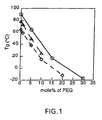
- the glass transition temperature (T g ) of these copolymers and their corresponding polycarbonate homopolymers were measured (Fig.1).
- T g of the copolymers decreased as the molar fraction of PEG 1,000 increased.
- Tensile modulus The dry specimens of poly(DTE co 5% PEG 1,000 carbonate) had tensile modulus of 1.3 Gpa, which is comparable to all tyrosine-derived polycarbonates which have tensile modulus within a range of 1.2-1.6 Gpa. See Ertel et al., J. Biomed. Mater. Res. , 28 , 919-930 (1994). After 24 h of incubation, the specimens had 10% of water uptake, and the tensile modulus dropped to 0.58 Gpa.
- Tensile strength at yield and break The combination of PEG into the backbone of the tyrosine derived polymer had a profound effect on the tensile strength and ductility of the polymer. While poly(DTE carbonate) was very brittle and failed without yielding after 4% elongation (See the aforementioned Ertel et. al., J. Biomed. Mater. Res. , 28 , 919-930 (1994)), the poly(DTE co 5% PEG 1,000 carbonate) did manage to elongate up to 153% before failing. The tensile strength at yield was 41 MPa, at break was 22 MPa. The incubated copolymer became extremely ductile. Film specimens yielded after 6% elongation and failed after up to 650% elongation. The tensile strength at yield was 15 MPa, at break was 19 MPa.
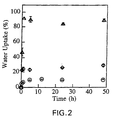
- the amount of water taken up by thin, compression molded films of poly(DTE co PEG 1,000 carbonates) was determined as described in the experimental section.
- the compression molded test specimens contained 5 mol%, 15 mol%, or 30 mol% of PEG. Over a 5 h period, poly(DTE co 5% PEG 1,000 carbonate) reached an equilibrium water uptake of 10%. For poly(DTE co 15%PEG 1000 carbonate), the equilibrium water uptake after 1 h was 25%. For poly(DTE co 30%PEG 1000 carbonate) the equilibrium water uptake after only 1 h was 92%.
- the rate of water uptake and the equilibrium water content increased as the molar fraction of poly(ethylene oxide) increased (Fig. 2). At poly(ethylene oxide) contents above 20%, the copolymers behave increasingly like hydrogels.
- microspheres were studied using poly(DTB co PEG 1000 carbonates). The homopolymer, poly(DTB carbonate), was included in the studies as control.
- microspheres were formulated containing either pNA or FITC-dextran. These compounds are useful models for low molecular weight hydrophobic drugs and high molecular weight hydrophilic drugs respectively.
- microspheres could only be isolated when the PEG content was below 10%. Above that value, microspheres formed initially, but tended to adhere to each other and formed a gum-like precipitate during work up. Thus, free flowing microspheres were formed for the poly(DTB carbonate) and for poly(DTB co 1%PEG 1000 carbonate) and poly(DTB co 5%PEG 1000 carbonate). For poly(DTB co 10 % PEG 1000 carbonate), no microspheres could be isolated.
- the release of FITC-dextran from microspheres made of the homopolymers was extremely slow.
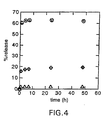
- the typical release profile for FTIC-dextran from the homopolymers was characterized by a short burst effect followed by a very long lag period during which no further FITC-dextran was released from the microspheres.
- Including 1 to 5% of PEG 1,000 in the polymer composition led to a significant increase in the amount of FITC-dextran that was rapidly released from the microspheres (Fig. 4).
- the disclosed copolymers can assist in the formulation of controlled drug release systems for hydrophilic, high molecular weight drugs.
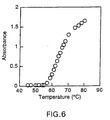
- Fig. 6 illustrates the inverse temperature transition for poly(DTE co 70% PEG 1,000 carbonate).
- This polymer is initially in solution as shown by its low absorbence at 500 nm. Upon heating, the polymer precipitates, as indicated by the increasing absorbance. In this particular case, the phase transition starts at 57 ⁇ 1°C.
Landscapes
- Health & Medical Sciences (AREA)
- Chemical & Material Sciences (AREA)
- Medicinal Chemistry (AREA)
- Life Sciences & Earth Sciences (AREA)
- Organic Chemistry (AREA)
- Chemical Kinetics & Catalysis (AREA)
- Engineering & Computer Science (AREA)
- Bioinformatics & Cheminformatics (AREA)
- Polymers & Plastics (AREA)
- Public Health (AREA)
- Epidemiology (AREA)
- Animal Behavior & Ethology (AREA)
- General Health & Medical Sciences (AREA)
- Pharmacology & Pharmacy (AREA)
- Veterinary Medicine (AREA)
- Proteomics, Peptides & Aminoacids (AREA)
- Molecular Biology (AREA)
- Polyesters Or Polycarbonates (AREA)
- Materials For Medical Uses (AREA)
- Medicinal Preparation (AREA)
- Compositions Of Macromolecular Compounds (AREA)
- Polyamides (AREA)
Applications Claiming Priority (3)
| Application Number | Priority Date | Filing Date | Title |
|---|---|---|---|
| US562842 | 1995-11-27 | ||
| US08/562,842 US5658995A (en) | 1995-11-27 | 1995-11-27 | Copolymers of tyrosine-based polycarbonate and poly(alkylene oxide) |
| PCT/US1996/019098 WO1997019996A1 (en) | 1995-11-27 | 1996-11-27 | Copolymers of tyrosine-based polycarbonate and poly(alkylene oxide) |
Publications (3)
| Publication Number | Publication Date |
|---|---|
| EP0863946A1 EP0863946A1 (en) | 1998-09-16 |
| EP0863946A4 EP0863946A4 (en) | 2000-02-23 |
| EP0863946B1 true EP0863946B1 (en) | 2004-01-28 |
Family
ID=24248016
Family Applications (1)
| Application Number | Title | Priority Date | Filing Date |
|---|---|---|---|
| EP96942102A Expired - Lifetime EP0863946B1 (en) | 1995-11-27 | 1996-11-27 | Copolymers of tyrosine-based polycarbonate and poly(alkylene oxide) |
Country Status (11)
| Country | Link |
|---|---|
| US (1) | US5658995A (enExample) |
| EP (1) | EP0863946B1 (enExample) |
| JP (2) | JP2000501139A (enExample) |
| KR (1) | KR100479288B1 (enExample) |
| AT (1) | ATE258565T1 (enExample) |
| AU (1) | AU722764B2 (enExample) |
| CA (1) | CA2237578E (enExample) |
| DE (1) | DE69631431T2 (enExample) |
| ES (1) | ES2215200T3 (enExample) |
| MX (1) | MX9804174A (enExample) |
| WO (1) | WO1997019996A1 (enExample) |
Families Citing this family (222)
| Publication number | Priority date | Publication date | Assignee | Title |
|---|---|---|---|---|
| ZA978537B (en) | 1996-09-23 | 1998-05-12 | Focal Inc | Polymerizable biodegradable polymers including carbonate or dioxanone linkages. |
| US6120491A (en) * | 1997-11-07 | 2000-09-19 | The State University Rutgers | Biodegradable, anionic polymers derived from the amino acid L-tyrosine |
| US6048521A (en) * | 1997-11-07 | 2000-04-11 | Rutgers, The State University | Copolymers of tyrosine-based polyarlates and poly(alkylene oxides) |
| US6319492B1 (en) * | 1996-11-27 | 2001-11-20 | Rutgers, The State University | Copolymers of tyrosine-based polyarylates and poly(alkylene oxides) |
| US6776792B1 (en) | 1997-04-24 | 2004-08-17 | Advanced Cardiovascular Systems Inc. | Coated endovascular stent |
| US6602497B1 (en) | 1997-11-07 | 2003-08-05 | Rutgers, The State University | Strictly alternating poly(alkylene oxide ether) copolymers |
| JP4465105B2 (ja) * | 1997-11-07 | 2010-05-19 | ルトガーズ、ザ ステイト ユニバーシティ オブ ニュージャージー | 放射線不透過性ポリマー生体適合材料 |
| US6623521B2 (en) | 1998-02-17 | 2003-09-23 | Md3, Inc. | Expandable stent with sliding and locking radial elements |
| US8133421B2 (en) * | 1999-02-23 | 2012-03-13 | Warsaw Orthopedic, Inc. | Methods of making shaped load-bearing osteoimplant |
| US20070233272A1 (en) * | 1999-02-23 | 2007-10-04 | Boyce Todd M | Shaped load-bearing osteoimplant and methods of making same |
| US6103255A (en) | 1999-04-16 | 2000-08-15 | Rutgers, The State University | Porous polymer scaffolds for tissue engineering |
| US7807211B2 (en) | 1999-09-03 | 2010-10-05 | Advanced Cardiovascular Systems, Inc. | Thermal treatment of an implantable medical device |
| US20070032853A1 (en) | 2002-03-27 | 2007-02-08 | Hossainy Syed F | 40-O-(2-hydroxy)ethyl-rapamycin coated stent |
| US7682647B2 (en) * | 1999-09-03 | 2010-03-23 | Advanced Cardiovascular Systems, Inc. | Thermal treatment of a drug eluting implantable medical device |
| US6790228B2 (en) | 1999-12-23 | 2004-09-14 | Advanced Cardiovascular Systems, Inc. | Coating for implantable devices and a method of forming the same |
| JP4917726B2 (ja) | 1999-12-31 | 2012-04-18 | ルトガーズ、ザ ステイト ユニバーシティ オブ ニュージャージー | ポリマー混合物および活性化合物からなる徐放用医薬製剤 |
| WO2001049249A2 (en) * | 1999-12-31 | 2001-07-12 | Rutgers, The State University | Pharmaceutical formulation for regulating the timed release of biologically active compounds based on a polymer matrix |
| US7521061B2 (en) | 1999-12-31 | 2009-04-21 | Rutgers, The State University Of New Jersey | Pharmaceutical formulation for regulating the timed release of biologically active compounds based on a polymer matrix |
| US6414049B1 (en) * | 2000-03-22 | 2002-07-02 | Johnson & Johnson Vision Care, Inc. | Stable initiator system |
| US7682648B1 (en) | 2000-05-31 | 2010-03-23 | Advanced Cardiovascular Systems, Inc. | Methods for forming polymeric coatings on stents |
| US6451373B1 (en) * | 2000-08-04 | 2002-09-17 | Advanced Cardiovascular Systems, Inc. | Method of forming a therapeutic coating onto a surface of an implantable prosthesis |
| US6953560B1 (en) | 2000-09-28 | 2005-10-11 | Advanced Cardiovascular Systems, Inc. | Barriers for polymer-coated implantable medical devices and methods for making the same |
| US6783793B1 (en) | 2000-10-26 | 2004-08-31 | Advanced Cardiovascular Systems, Inc. | Selective coating of medical devices |
| US7807210B1 (en) | 2000-10-31 | 2010-10-05 | Advanced Cardiovascular Systems, Inc. | Hemocompatible polymers on hydrophobic porous polymers |
| US6824559B2 (en) * | 2000-12-22 | 2004-11-30 | Advanced Cardiovascular Systems, Inc. | Ethylene-carboxyl copolymers as drug delivery matrices |
| US6663662B2 (en) * | 2000-12-28 | 2003-12-16 | Advanced Cardiovascular Systems, Inc. | Diffusion barrier layer for implantable devices |
| US6780424B2 (en) * | 2001-03-30 | 2004-08-24 | Charles David Claude | Controlled morphologies in polymer drug for release of drugs from polymer films |
| US6712845B2 (en) * | 2001-04-24 | 2004-03-30 | Advanced Cardiovascular Systems, Inc. | Coating for a stent and a method of forming the same |
| US6656506B1 (en) * | 2001-05-09 | 2003-12-02 | Advanced Cardiovascular Systems, Inc. | Microparticle coated medical device |
| US6743462B1 (en) | 2001-05-31 | 2004-06-01 | Advanced Cardiovascular Systems, Inc. | Apparatus and method for coating implantable devices |
| US8741378B1 (en) | 2001-06-27 | 2014-06-03 | Advanced Cardiovascular Systems, Inc. | Methods of coating an implantable device |
| US6695920B1 (en) | 2001-06-27 | 2004-02-24 | Advanced Cardiovascular Systems, Inc. | Mandrel for supporting a stent and a method of using the mandrel to coat a stent |
| US6565659B1 (en) | 2001-06-28 | 2003-05-20 | Advanced Cardiovascular Systems, Inc. | Stent mounting assembly and a method of using the same to coat a stent |
| US7682669B1 (en) | 2001-07-30 | 2010-03-23 | Advanced Cardiovascular Systems, Inc. | Methods for covalently immobilizing anti-thrombogenic material into a coating on a medical device |
| US8303651B1 (en) | 2001-09-07 | 2012-11-06 | Advanced Cardiovascular Systems, Inc. | Polymeric coating for reducing the rate of release of a therapeutic substance from a stent |
| US7285304B1 (en) | 2003-06-25 | 2007-10-23 | Advanced Cardiovascular Systems, Inc. | Fluid treatment of a polymeric coating on an implantable medical device |
| US7989018B2 (en) | 2001-09-17 | 2011-08-02 | Advanced Cardiovascular Systems, Inc. | Fluid treatment of a polymeric coating on an implantable medical device |
| US6753071B1 (en) | 2001-09-27 | 2004-06-22 | Advanced Cardiovascular Systems, Inc. | Rate-reducing membrane for release of an agent |
| US7223282B1 (en) * | 2001-09-27 | 2007-05-29 | Advanced Cardiovascular Systems, Inc. | Remote activation of an implantable device |
| US6709514B1 (en) * | 2001-12-28 | 2004-03-23 | Advanced Cardiovascular Systems, Inc. | Rotary coating apparatus for coating implantable medical devices |
| US7919075B1 (en) | 2002-03-20 | 2011-04-05 | Advanced Cardiovascular Systems, Inc. | Coatings for implantable medical devices |
| US7271234B2 (en) * | 2002-04-24 | 2007-09-18 | Rutgers, The State University Of New Jersey | Polyarylates for drug delivery and tissue engineering |
| US8591951B2 (en) * | 2002-05-15 | 2013-11-26 | Joachim B. Kohn | Tri-block copolymers for nanosphere-based drug delivery |
| US20060182752A1 (en) * | 2003-05-15 | 2006-08-17 | Rutgers, The State University | Tri-block polymers for nanosphere-based drug or gene delivery |
| US7217426B1 (en) | 2002-06-21 | 2007-05-15 | Advanced Cardiovascular Systems, Inc. | Coatings containing polycationic peptides for cardiovascular therapy |
| US7794743B2 (en) | 2002-06-21 | 2010-09-14 | Advanced Cardiovascular Systems, Inc. | Polycationic peptide coatings and methods of making the same |
| US7056523B1 (en) | 2002-06-21 | 2006-06-06 | Advanced Cardiovascular Systems, Inc. | Implantable medical devices incorporating chemically conjugated polymers and oligomers of L-arginine |
| US7011842B1 (en) | 2002-06-21 | 2006-03-14 | Advanced Cardiovascular Systems, Inc. | Polycationic peptide coatings and methods of making the same |
| US8506617B1 (en) | 2002-06-21 | 2013-08-13 | Advanced Cardiovascular Systems, Inc. | Micronized peptide coated stent |
| US7033602B1 (en) | 2002-06-21 | 2006-04-25 | Advanced Cardiovascular Systems, Inc. | Polycationic peptide coatings and methods of coating implantable medical devices |
| US7070798B1 (en) | 2002-06-21 | 2006-07-04 | Advanced Cardiovascular Systems, Inc. | Coatings for implantable medical devices incorporating chemically-bound polymers and oligomers of L-arginine |
| US6994867B1 (en) | 2002-06-21 | 2006-02-07 | Advanced Cardiovascular Systems, Inc. | Biocompatible carrier containing L-arginine |
| US7087263B2 (en) * | 2002-10-09 | 2006-08-08 | Advanced Cardiovascular Systems, Inc. | Rare limiting barriers for implantable medical devices |
| US6896965B1 (en) | 2002-11-12 | 2005-05-24 | Advanced Cardiovascular Systems, Inc. | Rate limiting barriers for implantable devices |
| US6982004B1 (en) * | 2002-11-26 | 2006-01-03 | Advanced Cardiovascular Systems, Inc. | Electrostatic loading of drugs on implantable medical devices |
| US7758880B2 (en) | 2002-12-11 | 2010-07-20 | Advanced Cardiovascular Systems, Inc. | Biocompatible polyacrylate compositions for medical applications |
| US7776926B1 (en) | 2002-12-11 | 2010-08-17 | Advanced Cardiovascular Systems, Inc. | Biocompatible coating for implantable medical devices |
| US7074276B1 (en) | 2002-12-12 | 2006-07-11 | Advanced Cardiovascular Systems, Inc. | Clamp mandrel fixture and a method of using the same to minimize coating defects |
| US7758881B2 (en) | 2004-06-30 | 2010-07-20 | Advanced Cardiovascular Systems, Inc. | Anti-proliferative and anti-inflammatory agent combination for treatment of vascular disorders with an implantable medical device |
| US7094256B1 (en) | 2002-12-16 | 2006-08-22 | Advanced Cardiovascular Systems, Inc. | Coatings for implantable medical device containing polycationic peptides |
| US20060002968A1 (en) | 2004-06-30 | 2006-01-05 | Gordon Stewart | Anti-proliferative and anti-inflammatory agent combination for treatment of vascular disorders |
| US8435550B2 (en) | 2002-12-16 | 2013-05-07 | Abbot Cardiovascular Systems Inc. | Anti-proliferative and anti-inflammatory agent combination for treatment of vascular disorders with an implantable medical device |
| US6916868B2 (en) * | 2003-01-23 | 2005-07-12 | Integra Lifesciences Corporation | Selective modification of pendent functionalities of polymers |
| US7063884B2 (en) | 2003-02-26 | 2006-06-20 | Advanced Cardiovascular Systems, Inc. | Stent coating |
| US6926919B1 (en) * | 2003-02-26 | 2005-08-09 | Advanced Cardiovascular Systems, Inc. | Method for fabricating a coating for a medical device |
| US7563483B2 (en) * | 2003-02-26 | 2009-07-21 | Advanced Cardiovascular Systems Inc. | Methods for fabricating a coating for implantable medical devices |
| US7279174B2 (en) | 2003-05-08 | 2007-10-09 | Advanced Cardiovascular Systems, Inc. | Stent coatings comprising hydrophilic additives |
| US20050118344A1 (en) | 2003-12-01 | 2005-06-02 | Pacetti Stephen D. | Temperature controlled crimping |
| US7056591B1 (en) | 2003-07-30 | 2006-06-06 | Advanced Cardiovascular Systems, Inc. | Hydrophobic biologically absorbable coatings for drug delivery devices and methods for fabricating the same |
| US7785512B1 (en) | 2003-07-31 | 2010-08-31 | Advanced Cardiovascular Systems, Inc. | Method and system of controlled temperature mixing and molding of polymers with active agents for implantable medical devices |
| US7431959B1 (en) | 2003-07-31 | 2008-10-07 | Advanced Cardiovascular Systems Inc. | Method and system for irradiation of a drug eluting implantable medical device |
| US7645474B1 (en) | 2003-07-31 | 2010-01-12 | Advanced Cardiovascular Systems, Inc. | Method and system of purifying polymers for use with implantable medical devices |
| RU2373958C2 (ru) | 2003-09-25 | 2009-11-27 | Рутгерс, Дзе Стейт Юниверсити | Полимерные по существу рентгеноконтрастные продукты для эмболотерапии |
| US7441513B1 (en) | 2003-09-26 | 2008-10-28 | Advanced Cardiovascular Systems, Inc. | Plasma-generated coating apparatus for medical devices and a method of coating deposition |
| US7318932B2 (en) * | 2003-09-30 | 2008-01-15 | Advanced Cardiovascular Systems, Inc. | Coatings for drug delivery devices comprising hydrolitically stable adducts of poly(ethylene-co-vinyl alcohol) and methods for fabricating the same |
| US7198675B2 (en) | 2003-09-30 | 2007-04-03 | Advanced Cardiovascular Systems | Stent mandrel fixture and method for selectively coating surfaces of a stent |
| US7704544B2 (en) * | 2003-10-07 | 2010-04-27 | Advanced Cardiovascular Systems, Inc. | System and method for coating a tubular implantable medical device |
| US7329413B1 (en) * | 2003-11-06 | 2008-02-12 | Advanced Cardiovascular Systems, Inc. | Coatings for drug delivery devices having gradient of hydration and methods for fabricating thereof |
| US9114198B2 (en) | 2003-11-19 | 2015-08-25 | Advanced Cardiovascular Systems, Inc. | Biologically beneficial coatings for implantable devices containing fluorinated polymers and methods for fabricating the same |
| US8192752B2 (en) | 2003-11-21 | 2012-06-05 | Advanced Cardiovascular Systems, Inc. | Coatings for implantable devices including biologically erodable polyesters and methods for fabricating the same |
| US7560492B1 (en) | 2003-11-25 | 2009-07-14 | Advanced Cardiovascular Systems, Inc. | Polysulfone block copolymers as drug-eluting coating material |
| US7807722B2 (en) * | 2003-11-26 | 2010-10-05 | Advanced Cardiovascular Systems, Inc. | Biobeneficial coating compositions and methods of making and using thereof |
| US7368169B2 (en) * | 2003-12-01 | 2008-05-06 | Rutgers, The State University Of New Jersey | Hydrazide compounds with angiogenic activity |
| US7220816B2 (en) | 2003-12-16 | 2007-05-22 | Advanced Cardiovascular Systems, Inc. | Biologically absorbable coatings for implantable devices based on poly(ester amides) and methods for fabricating the same |
| US7435788B2 (en) | 2003-12-19 | 2008-10-14 | Advanced Cardiovascular Systems, Inc. | Biobeneficial polyamide/polyethylene glycol polymers for use with drug eluting stents |
| US8309112B2 (en) * | 2003-12-24 | 2012-11-13 | Advanced Cardiovascular Systems, Inc. | Coatings for implantable medical devices comprising hydrophilic substances and methods for fabricating the same |
| US7563324B1 (en) | 2003-12-29 | 2009-07-21 | Advanced Cardiovascular Systems Inc. | System and method for coating an implantable medical device |
| US20060015184A1 (en) * | 2004-01-30 | 2006-01-19 | John Winterbottom | Stacking implants for spinal fusion |
| US8685431B2 (en) | 2004-03-16 | 2014-04-01 | Advanced Cardiovascular Systems, Inc. | Biologically absorbable coatings for implantable devices based on copolymers having ester bonds and methods for fabricating the same |
| US8551512B2 (en) | 2004-03-22 | 2013-10-08 | Advanced Cardiovascular Systems, Inc. | Polyethylene glycol/poly(butylene terephthalate) copolymer coated devices including EVEROLIMUS |
| US8778014B1 (en) | 2004-03-31 | 2014-07-15 | Advanced Cardiovascular Systems, Inc. | Coatings for preventing balloon damage to polymer coated stents |
| US7553377B1 (en) | 2004-04-27 | 2009-06-30 | Advanced Cardiovascular Systems, Inc. | Apparatus and method for electrostatic coating of an abluminal stent surface |
| US7820732B2 (en) | 2004-04-30 | 2010-10-26 | Advanced Cardiovascular Systems, Inc. | Methods for modulating thermal and mechanical properties of coatings on implantable devices |
| US8293890B2 (en) | 2004-04-30 | 2012-10-23 | Advanced Cardiovascular Systems, Inc. | Hyaluronic acid based copolymers |
| US9561309B2 (en) | 2004-05-27 | 2017-02-07 | Advanced Cardiovascular Systems, Inc. | Antifouling heparin coatings |
| US7563780B1 (en) | 2004-06-18 | 2009-07-21 | Advanced Cardiovascular Systems, Inc. | Heparin prodrugs and drug delivery stents formed therefrom |
| US20050287184A1 (en) | 2004-06-29 | 2005-12-29 | Hossainy Syed F A | Drug-delivery stent formulations for restenosis and vulnerable plaque |
| US7763065B2 (en) | 2004-07-21 | 2010-07-27 | Reva Medical, Inc. | Balloon expandable crush-recoverable stent device |
| US8357391B2 (en) | 2004-07-30 | 2013-01-22 | Advanced Cardiovascular Systems, Inc. | Coatings for implantable devices comprising poly (hydroxy-alkanoates) and diacid linkages |
| US7494665B1 (en) | 2004-07-30 | 2009-02-24 | Advanced Cardiovascular Systems, Inc. | Polymers containing siloxane monomers |
| US7311980B1 (en) | 2004-08-02 | 2007-12-25 | Advanced Cardiovascular Systems, Inc. | Polyactive/polylactic acid coatings for an implantable device |
| WO2006023130A2 (en) * | 2004-08-12 | 2006-03-02 | Surmodics, Inc. | Biodegradable controlled release bioactive agent delivery device |
| US20060034769A1 (en) * | 2004-08-13 | 2006-02-16 | Rutgers, The State University | Radiopaque polymeric stents |
| RU2396289C2 (ru) * | 2004-08-13 | 2010-08-10 | Рева Медикал, Инк. | Саморассасывающиеся рентгеноконтрастные по своей природе полимеры для многоцелевого использования |
| EP1923075B1 (en) | 2004-08-13 | 2015-11-11 | Rutgers, The State University | Radiopaque polymeric stents |
| AU2004322702B2 (en) * | 2004-08-13 | 2011-08-25 | Rutgers, The State University | Radiopaque polymeric stents |
| US7648727B2 (en) | 2004-08-26 | 2010-01-19 | Advanced Cardiovascular Systems, Inc. | Methods for manufacturing a coated stent-balloon assembly |
| US7244443B2 (en) | 2004-08-31 | 2007-07-17 | Advanced Cardiovascular Systems, Inc. | Polymers of fluorinated monomers and hydrophilic monomers |
| US8110211B2 (en) | 2004-09-22 | 2012-02-07 | Advanced Cardiovascular Systems, Inc. | Medicated coatings for implantable medical devices including polyacrylates |
| US7166680B2 (en) | 2004-10-06 | 2007-01-23 | Advanced Cardiovascular Systems, Inc. | Blends of poly(ester amide) polymers |
| US8603634B2 (en) | 2004-10-27 | 2013-12-10 | Abbott Cardiovascular Systems Inc. | End-capped poly(ester amide) copolymers |
| US7481835B1 (en) | 2004-10-29 | 2009-01-27 | Advanced Cardiovascular Systems, Inc. | Encapsulated covered stent |
| US7390497B2 (en) | 2004-10-29 | 2008-06-24 | Advanced Cardiovascular Systems, Inc. | Poly(ester amide) filler blends for modulation of coating properties |
| US7214759B2 (en) | 2004-11-24 | 2007-05-08 | Advanced Cardiovascular Systems, Inc. | Biologically absorbable coatings for implantable devices based on polyesters and methods for fabricating the same |
| US8609123B2 (en) | 2004-11-29 | 2013-12-17 | Advanced Cardiovascular Systems, Inc. | Derivatized poly(ester amide) as a biobeneficial coating |
| US7588642B1 (en) | 2004-11-29 | 2009-09-15 | Advanced Cardiovascular Systems, Inc. | Abluminal stent coating apparatus and method using a brush assembly |
| US7892592B1 (en) | 2004-11-30 | 2011-02-22 | Advanced Cardiovascular Systems, Inc. | Coating abluminal surfaces of stents and other implantable medical devices |
| US7632307B2 (en) | 2004-12-16 | 2009-12-15 | Advanced Cardiovascular Systems, Inc. | Abluminal, multilayer coating constructs for drug-delivery stents |
| US8292944B2 (en) | 2004-12-17 | 2012-10-23 | Reva Medical, Inc. | Slide-and-lock stent |
| US7604818B2 (en) | 2004-12-22 | 2009-10-20 | Advanced Cardiovascular Systems, Inc. | Polymers of fluorinated monomers and hydrocarbon monomers |
| US7419504B2 (en) | 2004-12-27 | 2008-09-02 | Advanced Cardiovascular Systems, Inc. | Poly(ester amide) block copolymers |
| US8007775B2 (en) | 2004-12-30 | 2011-08-30 | Advanced Cardiovascular Systems, Inc. | Polymers containing poly(hydroxyalkanoates) and agents for use with medical articles and methods of fabricating the same |
| US7202325B2 (en) * | 2005-01-14 | 2007-04-10 | Advanced Cardiovascular Systems, Inc. | Poly(hydroxyalkanoate-co-ester amides) and agents for use with medical articles |
| CA2601864A1 (en) * | 2005-04-08 | 2006-10-19 | Surmodics, Inc. | Sustained release implants and methods for subretinal delivery of bioactive agents to treat or prevent retinal disease |
| US7795467B1 (en) | 2005-04-26 | 2010-09-14 | Advanced Cardiovascular Systems, Inc. | Bioabsorbable, biobeneficial polyurethanes for use in medical devices |
| US8778375B2 (en) * | 2005-04-29 | 2014-07-15 | Advanced Cardiovascular Systems, Inc. | Amorphous poly(D,L-lactide) coating |
| US7637941B1 (en) | 2005-05-11 | 2009-12-29 | Advanced Cardiovascular Systems, Inc. | Endothelial cell binding coatings for rapid encapsulation of bioerodable stents |
| US7622070B2 (en) | 2005-06-20 | 2009-11-24 | Advanced Cardiovascular Systems, Inc. | Method of manufacturing an implantable polymeric medical device |
| US7823533B2 (en) | 2005-06-30 | 2010-11-02 | Advanced Cardiovascular Systems, Inc. | Stent fixture and method for reducing coating defects |
| US8021676B2 (en) | 2005-07-08 | 2011-09-20 | Advanced Cardiovascular Systems, Inc. | Functionalized chemically inert polymers for coatings |
| US7785647B2 (en) | 2005-07-25 | 2010-08-31 | Advanced Cardiovascular Systems, Inc. | Methods of providing antioxidants to a drug containing product |
| US7735449B1 (en) | 2005-07-28 | 2010-06-15 | Advanced Cardiovascular Systems, Inc. | Stent fixture having rounded support structures and method for use thereof |
| US9149378B2 (en) | 2005-08-02 | 2015-10-06 | Reva Medical, Inc. | Axially nested slide and lock expandable device |
| US7914574B2 (en) | 2005-08-02 | 2011-03-29 | Reva Medical, Inc. | Axially nested slide and lock expandable device |
| EP1948713B1 (en) | 2005-10-12 | 2013-12-04 | Bezwada Biomedical LLC | Functionalized amino acids and absorbable polymers therefrom |
| JP5339913B2 (ja) | 2005-11-03 | 2013-11-13 | タイレックス・インコーポレイテッド | 再吸収性フェノール性ポリマー |
| US8007526B2 (en) * | 2005-12-01 | 2011-08-30 | Bezwada Biomedical, Llc | Difunctionalized aromatic compounds and polymers therefrom |
| US7935843B2 (en) | 2005-12-09 | 2011-05-03 | Bezwada Biomedical, Llc | Functionalized diphenolics and absorbable polymers therefrom |
| US7976891B1 (en) | 2005-12-16 | 2011-07-12 | Advanced Cardiovascular Systems, Inc. | Abluminal stent coating apparatus and method of using focused acoustic energy |
| US7591841B2 (en) | 2005-12-16 | 2009-09-22 | Advanced Cardiovascular Systems, Inc. | Implantable devices for accelerated healing |
| US7638156B1 (en) | 2005-12-19 | 2009-12-29 | Advanced Cardiovascular Systems, Inc. | Apparatus and method for selectively coating a medical article |
| US7867547B2 (en) | 2005-12-19 | 2011-01-11 | Advanced Cardiovascular Systems, Inc. | Selectively coating luminal surfaces of stents |
| US8287914B2 (en) | 2006-01-12 | 2012-10-16 | Rutgers, The State University Of New Jersey | Biomimetic hydroxyapatite synthesis |
| US8591531B2 (en) | 2006-02-08 | 2013-11-26 | Tyrx, Inc. | Mesh pouches for implantable medical devices |
| MX2008010126A (es) | 2006-02-08 | 2010-02-22 | Tyrx Pharma Inc | Protesis de malla temporalmente rigidizadas. |
| US20070196428A1 (en) | 2006-02-17 | 2007-08-23 | Thierry Glauser | Nitric oxide generating medical devices |
| US7601383B2 (en) | 2006-02-28 | 2009-10-13 | Advanced Cardiovascular Systems, Inc. | Coating construct containing poly (vinyl alcohol) |
| US7713637B2 (en) | 2006-03-03 | 2010-05-11 | Advanced Cardiovascular Systems, Inc. | Coating containing PEGylated hyaluronic acid and a PEGylated non-hyaluronic acid polymer |
| AU2007236549B2 (en) * | 2006-04-07 | 2011-11-03 | The University Of Melbourne | Porous polymer blend structures |
| US8222308B2 (en) * | 2006-04-07 | 2012-07-17 | The University Of Queensland | Porous polymer structures |
| US7985441B1 (en) | 2006-05-04 | 2011-07-26 | Yiwen Tang | Purification of polymers for coating applications |
| US8069814B2 (en) | 2006-05-04 | 2011-12-06 | Advanced Cardiovascular Systems, Inc. | Stent support devices |
| US8304012B2 (en) | 2006-05-04 | 2012-11-06 | Advanced Cardiovascular Systems, Inc. | Method for drying a stent |
| US7775178B2 (en) | 2006-05-26 | 2010-08-17 | Advanced Cardiovascular Systems, Inc. | Stent coating apparatus and method |
| US8568764B2 (en) | 2006-05-31 | 2013-10-29 | Advanced Cardiovascular Systems, Inc. | Methods of forming coating layers for medical devices utilizing flash vaporization |
| US9561351B2 (en) | 2006-05-31 | 2017-02-07 | Advanced Cardiovascular Systems, Inc. | Drug delivery spiral coil construct |
| US8703167B2 (en) | 2006-06-05 | 2014-04-22 | Advanced Cardiovascular Systems, Inc. | Coatings for implantable medical devices for controlled release of a hydrophilic drug and a hydrophobic drug |
| US8778376B2 (en) | 2006-06-09 | 2014-07-15 | Advanced Cardiovascular Systems, Inc. | Copolymer comprising elastin pentapeptide block and hydrophilic block, and medical device and method of treating |
| US8603530B2 (en) | 2006-06-14 | 2013-12-10 | Abbott Cardiovascular Systems Inc. | Nanoshell therapy |
| US8114150B2 (en) | 2006-06-14 | 2012-02-14 | Advanced Cardiovascular Systems, Inc. | RGD peptide attached to bioabsorbable stents |
| US8048448B2 (en) | 2006-06-15 | 2011-11-01 | Abbott Cardiovascular Systems Inc. | Nanoshells for drug delivery |
| US8017237B2 (en) | 2006-06-23 | 2011-09-13 | Abbott Cardiovascular Systems, Inc. | Nanoshells on polymers |
| US9028859B2 (en) | 2006-07-07 | 2015-05-12 | Advanced Cardiovascular Systems, Inc. | Phase-separated block copolymer coatings for implantable medical devices |
| US8685430B1 (en) | 2006-07-14 | 2014-04-01 | Abbott Cardiovascular Systems Inc. | Tailored aliphatic polyesters for stent coatings |
| US8703169B1 (en) | 2006-08-15 | 2014-04-22 | Abbott Cardiovascular Systems Inc. | Implantable device having a coating comprising carrageenan and a biostable polymer |
| US8367108B2 (en) * | 2006-09-01 | 2013-02-05 | Bezwada Biomedical, Llc | Functionalized non-phenolic amino acids and absorbable polymers therefrom |
| CA2664682C (en) * | 2006-10-17 | 2012-12-04 | Reva Medical, Inc. | N-substituted monomers and polymers |
| US20100166854A1 (en) * | 2006-10-30 | 2010-07-01 | Rutgers, The State University Of New Jersey | Electrospun matrices for delivery of hydrophilic and lipophilic compounds |
| JP2010508915A (ja) | 2006-11-06 | 2010-03-25 | タイレックス・ファーマ・インコーポレイテッド | 埋込型医療機器のためのメッシュパウチ |
| US9023114B2 (en) * | 2006-11-06 | 2015-05-05 | Tyrx, Inc. | Resorbable pouches for implantable medical devices |
| US8597673B2 (en) | 2006-12-13 | 2013-12-03 | Advanced Cardiovascular Systems, Inc. | Coating of fast absorption or dissolution |
| US7704275B2 (en) | 2007-01-26 | 2010-04-27 | Reva Medical, Inc. | Circumferentially nested expandable device |
| MX2009008030A (es) * | 2007-01-31 | 2009-10-19 | Univ Rutgers | Liberacion controlada de activos en la piel. |
| WO2008121816A2 (en) | 2007-03-29 | 2008-10-09 | Tyrx Pharma, Inc. | Biodegradable, polymer coverings for breast implants |
| MX2009011785A (es) | 2007-05-02 | 2010-03-04 | Tyrx Pharma Inc | Polimeros de dihidroxibenzoato y usos de los mismos. |
| US8147769B1 (en) | 2007-05-16 | 2012-04-03 | Abbott Cardiovascular Systems Inc. | Stent and delivery system with reduced chemical degradation |
| US9056155B1 (en) | 2007-05-29 | 2015-06-16 | Abbott Cardiovascular Systems Inc. | Coatings having an elastic primer layer |
| WO2008157777A1 (en) | 2007-06-21 | 2008-12-24 | Tyrx Pharma, Inc. | Phenyl ester side chains to increase polymer resorptivity |
| US8109904B1 (en) | 2007-06-25 | 2012-02-07 | Abbott Cardiovascular Systems Inc. | Drug delivery medical devices |
| US8048441B2 (en) | 2007-06-25 | 2011-11-01 | Abbott Cardiovascular Systems, Inc. | Nanobead releasing medical devices |
| WO2009070180A1 (en) | 2007-11-30 | 2009-06-04 | Reva Medical, Inc. | Axially-radially nested expandable device |
| WO2009105692A1 (en) | 2008-02-21 | 2009-08-27 | Rutgers, The State University Of New Jersey | Compositions and methods for treating ophthalmic diseases |
| ES2767974T3 (es) | 2008-06-02 | 2020-06-19 | Univ Rutgers | Implante de fibrocartílago obtenido mediante ingeniería de tejidos |
| WO2010006046A1 (en) * | 2008-07-10 | 2010-01-14 | Tyrx Pharma, Inc. | Nsaid delivery from polyarylates |
| CA2737769C (en) | 2008-09-22 | 2014-02-04 | Medtronic, Inc. | Linear polyesteramides from aminophenolic esters |
| AU2009303347B2 (en) | 2008-10-10 | 2013-10-24 | Reva Medical, Inc. | Expandable slide and lock stent |
| CA2737764C (en) * | 2008-10-11 | 2019-02-26 | Rutgers, The State University Of New Jersey | Biocompatible polymers for medical devices |
| US9839628B2 (en) | 2009-06-01 | 2017-12-12 | Tyrx, Inc. | Compositions and methods for preventing sternal wound infections |
| EP2459638B1 (en) * | 2009-07-31 | 2017-09-27 | Rutgers, The State University of New Jersey | Monomers and phase-separated biocompatible polymer compositions prepared therefrom for medical uses |
| US8409279B2 (en) | 2009-10-01 | 2013-04-02 | Lipose Corporation | Breast implant implantation method and apparatus |
| US9605112B2 (en) | 2009-10-11 | 2017-03-28 | Rutgers, The State University Of New Jersey | Biocompatible polymers for medical devices |
| US8685433B2 (en) | 2010-03-31 | 2014-04-01 | Abbott Cardiovascular Systems Inc. | Absorbable coating for implantable device |
| EP2558041B1 (en) | 2010-04-10 | 2018-01-10 | Reva Medical, Inc. | Expandable slide and lock stent |
| EP2609162B1 (en) | 2010-08-25 | 2018-12-12 | Tyrx, Inc. | Novel medical device coatings |
| US9725689B2 (en) | 2010-10-08 | 2017-08-08 | Terumo Bct, Inc. | Configurable methods and systems of growing and harvesting cells in a hollow fiber bioreactor system |
| US8883861B2 (en) | 2010-11-01 | 2014-11-11 | Rutgers, The State University Of New Jersey | Iminic monomers and polymers thereof |
| CA2816343C (en) | 2010-11-12 | 2017-01-17 | Medtronic, Inc. | Anchorage devices comprising an active pharmaceutical ingredient |
| US8961948B2 (en) | 2011-01-17 | 2015-02-24 | Rutgers, The State University Of New Jersey | Molecular surface design of tyrosine-derived polycarbonates for attachment of biomolecules |
| US9381281B2 (en) | 2011-07-20 | 2016-07-05 | Tyrx, Inc. | Drug eluting mesh to prevent infection of indwelling transdermal devices |
| US11472918B2 (en) | 2012-02-03 | 2022-10-18 | Rutgers, The State University Of New Jersey | Polymeric biomaterials derived from phenolic monomers and their medical uses |
| EP2809702B1 (en) | 2012-02-03 | 2017-12-20 | Rutgers, The State University of New Jersey | Polymeric biomaterials derived from phenolic monomers and their medical uses |
| WO2014137454A1 (en) | 2013-03-07 | 2014-09-12 | Tyrx, Inc. | Methods and compositions to inhibit the assemblage of microbial cells irreversibly associated with surfaces of medical devices |
| WO2014159337A1 (en) | 2013-03-14 | 2014-10-02 | Reva Medical, Inc. | Reduced - profile slide and lock stent |
| US10329379B2 (en) | 2013-08-07 | 2019-06-25 | Rutgers, The State University Of New Jersey | Polymeric biomaterials derived from monomers comprising hydroxyacids and phenol compounds and their medical uses |
| CN105431178A (zh) | 2013-11-08 | 2016-03-23 | 泰尔克斯公司 | 用于防止手术切口部位感染的抗微生物组合物及方法 |
| EP3068867B1 (en) | 2013-11-16 | 2018-04-18 | Terumo BCT, Inc. | Expanding cells in a bioreactor |
| US11008547B2 (en) | 2014-03-25 | 2021-05-18 | Terumo Bct, Inc. | Passive replacement of media |
| EP3198006B1 (en) | 2014-09-26 | 2021-03-24 | Terumo BCT, Inc. | Scheduled feed |
| US10774030B2 (en) | 2014-12-23 | 2020-09-15 | Rutgers, The State University Of New Jersey | Polymeric biomaterials derived from phenolic monomers and their medical uses |
| AU2015370426B2 (en) | 2014-12-23 | 2019-09-12 | Rutgers, The State University Of New Jersey | Biocompatible iodinated diphenol monomers and polymers |
| WO2017004592A1 (en) | 2015-07-02 | 2017-01-05 | Terumo Bct, Inc. | Cell growth with mechanical stimuli |
| WO2017205667A1 (en) | 2016-05-25 | 2017-11-30 | Terumo Bct, Inc. | Cell expansion |
| US11104874B2 (en) | 2016-06-07 | 2021-08-31 | Terumo Bct, Inc. | Coating a bioreactor |
| US11685883B2 (en) | 2016-06-07 | 2023-06-27 | Terumo Bct, Inc. | Methods and systems for coating a cell growth surface |
| EP3579790A4 (en) | 2017-02-13 | 2020-12-23 | Rutgers, The State University of New Jersey | POLYMERIC FILAMENT REINFORCED SCAFFOLDING FOR PARTIAL MENISK REGENERATION |
| US11624046B2 (en) | 2017-03-31 | 2023-04-11 | Terumo Bct, Inc. | Cell expansion |
| US12234441B2 (en) | 2017-03-31 | 2025-02-25 | Terumo Bct, Inc. | Cell expansion |
| JP7393945B2 (ja) | 2017-03-31 | 2023-12-07 | テルモ ビーシーティー、インコーポレーテッド | 細胞増殖 |
| AU2019319836B2 (en) * | 2018-08-08 | 2026-06-18 | Reva Medical, Llc | Cross-linked radiopaque bioresorbable polymers and devices made therefrom |
| EP4314244B1 (en) | 2021-03-23 | 2025-07-23 | Terumo BCT, Inc. | Cell capture and expansion |
| US12152699B2 (en) | 2022-02-28 | 2024-11-26 | Terumo Bct, Inc. | Multiple-tube pinch valve assembly |
| USD1099116S1 (en) | 2022-09-01 | 2025-10-21 | Terumo Bct, Inc. | Display screen or portion thereof with a graphical user interface for displaying cell culture process steps and measurements of an associated bioreactor device |
Family Cites Families (10)
| Publication number | Priority date | Publication date | Assignee | Title |
|---|---|---|---|---|
| US4308145A (en) * | 1976-03-19 | 1981-12-29 | United States Of America | Relatively thick polycarbonate membranes for use in hemodialysis |
| US4069151A (en) * | 1976-03-31 | 1978-01-17 | C. R. Bard, Inc. | Thin polycarbonate membranes for use in hemodialysis |
| DE2932737C2 (de) * | 1979-08-13 | 1983-04-21 | Akzo Gmbh, 5600 Wuppertal | Polycarbonat-Polyätherblockcopolymere |
| DE2932761A1 (de) * | 1979-08-13 | 1981-02-26 | Akzo Gmbh | Polycarbonat-polyaether-copolymermembran |
| DE3069709D1 (en) * | 1980-09-01 | 1985-01-10 | Gambro Inc | Dry polycarbonate membrane and process of manufacture |
| US5084173A (en) * | 1985-05-27 | 1992-01-28 | Asahi Medical Co., Ltd. | Hydrophilic composite porous membrane, a method of producing the plasma separator |
| US5216115A (en) * | 1990-06-12 | 1993-06-01 | Rutgers, The State University Of New Jersey | Polyarylate containing derivatives of the natural amino acid L-tyrosine |
| US5198507A (en) * | 1990-06-12 | 1993-03-30 | Rutgers, The State University Of New Jersey | Synthesis of amino acid-derived bioerodible polymers |
| US5099060A (en) * | 1990-06-12 | 1992-03-24 | Rutgers, The State University Of New Jersey | Synthesis of amino acid-derived bioerodible polymers |
| JPH09151249A (ja) * | 1995-06-22 | 1997-06-10 | Mitsui Toatsu Chem Inc | 重合体及びその製造方法 |
-
1995
- 1995-11-27 US US08/562,842 patent/US5658995A/en not_active Expired - Lifetime
-
1996
- 1996-11-27 AT AT96942102T patent/ATE258565T1/de not_active IP Right Cessation
- 1996-11-27 ES ES96942102T patent/ES2215200T3/es not_active Expired - Lifetime
- 1996-11-27 KR KR10-1998-0703886A patent/KR100479288B1/ko not_active Expired - Lifetime
- 1996-11-27 CA CA2237578A patent/CA2237578E/en not_active Expired - Lifetime
- 1996-11-27 WO PCT/US1996/019098 patent/WO1997019996A1/en not_active Ceased
- 1996-11-27 JP JP9520704A patent/JP2000501139A/ja not_active Ceased
- 1996-11-27 AU AU11264/97A patent/AU722764B2/en not_active Ceased
- 1996-11-27 EP EP96942102A patent/EP0863946B1/en not_active Expired - Lifetime
- 1996-11-27 DE DE69631431T patent/DE69631431T2/de not_active Expired - Lifetime
-
1998
- 1998-05-26 MX MX9804174A patent/MX9804174A/es unknown
-
2007
- 2007-08-01 JP JP2007221741A patent/JP4996391B2/ja not_active Expired - Lifetime
Also Published As
| Publication number | Publication date |
|---|---|
| CA2237578E (en) | 2011-10-11 |
| KR100479288B1 (ko) | 2005-08-30 |
| CA2237578C (en) | 2003-09-30 |
| US5658995A (en) | 1997-08-19 |
| CA2237578A1 (en) | 1997-06-05 |
| EP0863946A4 (en) | 2000-02-23 |
| JP4996391B2 (ja) | 2012-08-08 |
| ES2215200T3 (es) | 2004-10-01 |
| AU1126497A (en) | 1997-06-19 |
| JP2000501139A (ja) | 2000-02-02 |
| EP0863946A1 (en) | 1998-09-16 |
| MX9804174A (es) | 1998-09-30 |
| JP2008056925A (ja) | 2008-03-13 |
| KR19990071610A (ko) | 1999-09-27 |
| WO1997019996A1 (en) | 1997-06-05 |
| DE69631431T2 (de) | 2004-12-02 |
| DE69631431D1 (en) | 2004-03-04 |
| AU722764B2 (en) | 2000-08-10 |
| ATE258565T1 (de) | 2004-02-15 |
Similar Documents
| Publication | Publication Date | Title |
|---|---|---|
| AU722764B2 (en) | Copolymers of tyrosine-based polycarbonate and poly(alkylene oxide) | |
| US6319492B1 (en) | Copolymers of tyrosine-based polyarylates and poly(alkylene oxides) | |
| US6048521A (en) | Copolymers of tyrosine-based polyarlates and poly(alkylene oxides) | |
| Yu et al. | Tyrosine–PEG-derived poly (ether carbonate) s as new biomaterials: Part I: synthesis and evaluation | |
| EP0961801B1 (en) | Monomers derived from hydroxy acids and polymers prepared therefrom | |
| AU730549B2 (en) | Biodegradable, anionic polymers derived from the amino acid L-tyrosine | |
| US5198507A (en) | Synthesis of amino acid-derived bioerodible polymers | |
| EP0656026B1 (en) | Polyarylates containing derivatives of the natural amino acid l-tyrosine | |
| US5099060A (en) | Synthesis of amino acid-derived bioerodible polymers | |
| JP2013189449A (ja) | 再吸収性フェノール性ポリマー | |
| JP2012533660A (ja) | ポリマー、好ましくは(アルキル)アクリロイルポリカーボネートを作る方法、得られるポリマーおよび(アルキル)アクリロイルポリカーボネート、ならびにこれを含むバイオデバイス | |
| Yu | Development and evaluation of new biodegradable materials: Poly (ether carbonate) s of tyrosine derivatives and poly (ethylene glycol) | |
| Kohn et al. | Polymers Derived from L-Tyrosine |
Legal Events
| Date | Code | Title | Description |
|---|---|---|---|
| PUAI | Public reference made under article 153(3) epc to a published international application that has entered the european phase |
Free format text: ORIGINAL CODE: 0009012 |
|
| 17P | Request for examination filed |
Effective date: 19980526 |
|
| AK | Designated contracting states |
Kind code of ref document: A1 Designated state(s): AT BE CH DE DK ES FI FR GB GR IE IT LI LU MC NL PT SE |
|
| RIN1 | Information on inventor provided before grant (corrected) |
Inventor name: YU, CHUN Inventor name: KOHN, JOACHIM, B. |
|
| A4 | Supplementary search report drawn up and despatched |
Effective date: 20000112 |
|
| AK | Designated contracting states |
Kind code of ref document: A4 Designated state(s): AT BE CH DE DK ES FI FR GB GR IE IT LI LU MC NL PT SE |
|
| RIC1 | Information provided on ipc code assigned before grant |
Free format text: 7C 08G 63/00 A, 7C 08G 64/00 B, 7C 08G 63/02 B, 7C 08G 69/26 B, 7C 08G 63/685 B, 7A 61K 47/48 B, 7C 08L 77/00 B |
|
| GRAH | Despatch of communication of intention to grant a patent |
Free format text: ORIGINAL CODE: EPIDOS IGRA |
|
| GRAS | Grant fee paid |
Free format text: ORIGINAL CODE: EPIDOSNIGR3 |
|
| GRAA | (expected) grant |
Free format text: ORIGINAL CODE: 0009210 |
|
| AK | Designated contracting states |
Kind code of ref document: B1 Designated state(s): AT BE CH DE DK ES FI FR GB GR IE IT LI LU MC NL PT SE |
|
| PG25 | Lapsed in a contracting state [announced via postgrant information from national office to epo] |
Ref country code: LI Free format text: LAPSE BECAUSE OF FAILURE TO SUBMIT A TRANSLATION OF THE DESCRIPTION OR TO PAY THE FEE WITHIN THE PRESCRIBED TIME-LIMIT Effective date: 20040128 Ref country code: IT Free format text: LAPSE BECAUSE OF FAILURE TO SUBMIT A TRANSLATION OF THE DESCRIPTION OR TO PAY THE FEE WITHIN THE PRESCRIBED TIME-LIMIT;WARNING: LAPSES OF ITALIAN PATENTS WITH EFFECTIVE DATE BEFORE 2007 MAY HAVE OCCURRED AT ANY TIME BEFORE 2007. THE CORRECT EFFECTIVE DATE MAY BE DIFFERENT FROM THE ONE RECORDED. Effective date: 20040128 Ref country code: CH Free format text: LAPSE BECAUSE OF FAILURE TO SUBMIT A TRANSLATION OF THE DESCRIPTION OR TO PAY THE FEE WITHIN THE PRESCRIBED TIME-LIMIT Effective date: 20040128 Ref country code: AT Free format text: LAPSE BECAUSE OF FAILURE TO SUBMIT A TRANSLATION OF THE DESCRIPTION OR TO PAY THE FEE WITHIN THE PRESCRIBED TIME-LIMIT Effective date: 20040128 |
|
| REG | Reference to a national code |
Ref country code: GB Ref legal event code: FG4D |
|
| REG | Reference to a national code |
Ref country code: CH Ref legal event code: EP |
|
| REG | Reference to a national code |
Ref country code: IE Ref legal event code: FG4D |
|
| REF | Corresponds to: |
Ref document number: 69631431 Country of ref document: DE Date of ref document: 20040304 Kind code of ref document: P |
|
| PG25 | Lapsed in a contracting state [announced via postgrant information from national office to epo] |
Ref country code: SE Free format text: LAPSE BECAUSE OF FAILURE TO SUBMIT A TRANSLATION OF THE DESCRIPTION OR TO PAY THE FEE WITHIN THE PRESCRIBED TIME-LIMIT Effective date: 20040428 Ref country code: GR Free format text: LAPSE BECAUSE OF FAILURE TO SUBMIT A TRANSLATION OF THE DESCRIPTION OR TO PAY THE FEE WITHIN THE PRESCRIBED TIME-LIMIT Effective date: 20040428 Ref country code: DK Free format text: LAPSE BECAUSE OF FAILURE TO SUBMIT A TRANSLATION OF THE DESCRIPTION OR TO PAY THE FEE WITHIN THE PRESCRIBED TIME-LIMIT Effective date: 20040428 |
|
| REG | Reference to a national code |
Ref country code: CH Ref legal event code: PL |
|
| REG | Reference to a national code |
Ref country code: ES Ref legal event code: FG2A Ref document number: 2215200 Country of ref document: ES Kind code of ref document: T3 |
|
| ET | Fr: translation filed | ||
| PG25 | Lapsed in a contracting state [announced via postgrant information from national office to epo] |
Ref country code: LU Free format text: LAPSE BECAUSE OF NON-PAYMENT OF DUE FEES Effective date: 20041127 |
|
| PG25 | Lapsed in a contracting state [announced via postgrant information from national office to epo] |
Ref country code: MC Free format text: LAPSE BECAUSE OF NON-PAYMENT OF DUE FEES Effective date: 20041130 |
|
| PLBE | No opposition filed within time limit |
Free format text: ORIGINAL CODE: 0009261 |
|
| STAA | Information on the status of an ep patent application or granted ep patent |
Free format text: STATUS: NO OPPOSITION FILED WITHIN TIME LIMIT |
|
| 26N | No opposition filed |
Effective date: 20041029 |
|
| PG25 | Lapsed in a contracting state [announced via postgrant information from national office to epo] |
Ref country code: PT Free format text: LAPSE BECAUSE OF NON-PAYMENT OF DUE FEES Effective date: 20040628 |
|
| REG | Reference to a national code |
Ref country code: FR Ref legal event code: PLFP Year of fee payment: 20 |
|
| PGFP | Annual fee paid to national office [announced via postgrant information from national office to epo] |
Ref country code: FI Payment date: 20151127 Year of fee payment: 20 Ref country code: IE Payment date: 20151130 Year of fee payment: 20 Ref country code: GB Payment date: 20151127 Year of fee payment: 20 Ref country code: DE Payment date: 20151127 Year of fee payment: 20 |
|
| PGFP | Annual fee paid to national office [announced via postgrant information from national office to epo] |
Ref country code: BE Payment date: 20151130 Year of fee payment: 20 Ref country code: FR Payment date: 20151117 Year of fee payment: 20 Ref country code: NL Payment date: 20151126 Year of fee payment: 20 Ref country code: ES Payment date: 20151126 Year of fee payment: 20 |
|
| REG | Reference to a national code |
Ref country code: DE Ref legal event code: R071 Ref document number: 69631431 Country of ref document: DE |
|
| REG | Reference to a national code |
Ref country code: NL Ref legal event code: MK Effective date: 20161126 |
|
| REG | Reference to a national code |
Ref country code: GB Ref legal event code: PE20 Expiry date: 20161126 |
|
| REG | Reference to a national code |
Ref country code: IE Ref legal event code: MK9A |
|
| PG25 | Lapsed in a contracting state [announced via postgrant information from national office to epo] |
Ref country code: GB Free format text: LAPSE BECAUSE OF EXPIRATION OF PROTECTION Effective date: 20161126 Ref country code: IE Free format text: LAPSE BECAUSE OF EXPIRATION OF PROTECTION Effective date: 20161127 |
|
| REG | Reference to a national code |
Ref country code: ES Ref legal event code: FD2A Effective date: 20170306 |
|
| PG25 | Lapsed in a contracting state [announced via postgrant information from national office to epo] |
Ref country code: ES Free format text: LAPSE BECAUSE OF EXPIRATION OF PROTECTION Effective date: 20161128 |