EP0850609A1 - Prothèse humérale à tête mobile - Google Patents
Prothèse humérale à tête mobile Download PDFInfo
- Publication number
- EP0850609A1 EP0850609A1 EP97403140A EP97403140A EP0850609A1 EP 0850609 A1 EP0850609 A1 EP 0850609A1 EP 97403140 A EP97403140 A EP 97403140A EP 97403140 A EP97403140 A EP 97403140A EP 0850609 A1 EP0850609 A1 EP 0850609A1
- Authority
- EP
- European Patent Office
- Prior art keywords
- head
- ball joint
- insert
- plate
- prosthesis
- Prior art date
- Legal status (The legal status is an assumption and is not a legal conclusion. Google has not performed a legal analysis and makes no representation as to the accuracy of the status listed.)
- Withdrawn
Links
Images
Classifications
-
- A—HUMAN NECESSITIES
- A61—MEDICAL OR VETERINARY SCIENCE; HYGIENE
- A61F—FILTERS IMPLANTABLE INTO BLOOD VESSELS; PROSTHESES; DEVICES PROVIDING PATENCY TO, OR PREVENTING COLLAPSING OF, TUBULAR STRUCTURES OF THE BODY, e.g. STENTS; ORTHOPAEDIC, NURSING OR CONTRACEPTIVE DEVICES; FOMENTATION; TREATMENT OR PROTECTION OF EYES OR EARS; BANDAGES, DRESSINGS OR ABSORBENT PADS; FIRST-AID KITS
- A61F2/00—Filters implantable into blood vessels; Prostheses, i.e. artificial substitutes or replacements for parts of the body; Appliances for connecting them with the body; Devices providing patency to, or preventing collapsing of, tubular structures of the body, e.g. stents
- A61F2/02—Prostheses implantable into the body
- A61F2/30—Joints
- A61F2/40—Joints for shoulders
- A61F2/4014—Humeral heads or necks; Connections of endoprosthetic heads or necks to endoprosthetic humeral shafts
-
- A—HUMAN NECESSITIES
- A61—MEDICAL OR VETERINARY SCIENCE; HYGIENE
- A61F—FILTERS IMPLANTABLE INTO BLOOD VESSELS; PROSTHESES; DEVICES PROVIDING PATENCY TO, OR PREVENTING COLLAPSING OF, TUBULAR STRUCTURES OF THE BODY, e.g. STENTS; ORTHOPAEDIC, NURSING OR CONTRACEPTIVE DEVICES; FOMENTATION; TREATMENT OR PROTECTION OF EYES OR EARS; BANDAGES, DRESSINGS OR ABSORBENT PADS; FIRST-AID KITS
- A61F2/00—Filters implantable into blood vessels; Prostheses, i.e. artificial substitutes or replacements for parts of the body; Appliances for connecting them with the body; Devices providing patency to, or preventing collapsing of, tubular structures of the body, e.g. stents
- A61F2/02—Prostheses implantable into the body
- A61F2/30—Joints
- A61F2/40—Joints for shoulders
-
- A—HUMAN NECESSITIES
- A61—MEDICAL OR VETERINARY SCIENCE; HYGIENE
- A61F—FILTERS IMPLANTABLE INTO BLOOD VESSELS; PROSTHESES; DEVICES PROVIDING PATENCY TO, OR PREVENTING COLLAPSING OF, TUBULAR STRUCTURES OF THE BODY, e.g. STENTS; ORTHOPAEDIC, NURSING OR CONTRACEPTIVE DEVICES; FOMENTATION; TREATMENT OR PROTECTION OF EYES OR EARS; BANDAGES, DRESSINGS OR ABSORBENT PADS; FIRST-AID KITS
- A61F2/00—Filters implantable into blood vessels; Prostheses, i.e. artificial substitutes or replacements for parts of the body; Appliances for connecting them with the body; Devices providing patency to, or preventing collapsing of, tubular structures of the body, e.g. stents
- A61F2/02—Prostheses implantable into the body
- A61F2/30—Joints
- A61F2/40—Joints for shoulders
- A61F2/4059—Humeral shafts
-
- A—HUMAN NECESSITIES
- A61—MEDICAL OR VETERINARY SCIENCE; HYGIENE
- A61F—FILTERS IMPLANTABLE INTO BLOOD VESSELS; PROSTHESES; DEVICES PROVIDING PATENCY TO, OR PREVENTING COLLAPSING OF, TUBULAR STRUCTURES OF THE BODY, e.g. STENTS; ORTHOPAEDIC, NURSING OR CONTRACEPTIVE DEVICES; FOMENTATION; TREATMENT OR PROTECTION OF EYES OR EARS; BANDAGES, DRESSINGS OR ABSORBENT PADS; FIRST-AID KITS
- A61F2/00—Filters implantable into blood vessels; Prostheses, i.e. artificial substitutes or replacements for parts of the body; Appliances for connecting them with the body; Devices providing patency to, or preventing collapsing of, tubular structures of the body, e.g. stents
- A61F2/02—Prostheses implantable into the body
- A61F2/30—Joints
- A61F2002/30001—Additional features of subject-matter classified in A61F2/28, A61F2/30 and subgroups thereof
- A61F2002/30316—The prosthesis having different structural features at different locations within the same prosthesis; Connections between prosthetic parts; Special structural features of bone or joint prostheses not otherwise provided for
- A61F2002/30329—Connections or couplings between prosthetic parts, e.g. between modular parts; Connecting elements
- A61F2002/30331—Connections or couplings between prosthetic parts, e.g. between modular parts; Connecting elements made by longitudinally pushing a protrusion into a complementarily-shaped recess, e.g. held by friction fit
- A61F2002/30332—Conically- or frustoconically-shaped protrusion and recess
-
- A—HUMAN NECESSITIES
- A61—MEDICAL OR VETERINARY SCIENCE; HYGIENE
- A61F—FILTERS IMPLANTABLE INTO BLOOD VESSELS; PROSTHESES; DEVICES PROVIDING PATENCY TO, OR PREVENTING COLLAPSING OF, TUBULAR STRUCTURES OF THE BODY, e.g. STENTS; ORTHOPAEDIC, NURSING OR CONTRACEPTIVE DEVICES; FOMENTATION; TREATMENT OR PROTECTION OF EYES OR EARS; BANDAGES, DRESSINGS OR ABSORBENT PADS; FIRST-AID KITS
- A61F2/00—Filters implantable into blood vessels; Prostheses, i.e. artificial substitutes or replacements for parts of the body; Appliances for connecting them with the body; Devices providing patency to, or preventing collapsing of, tubular structures of the body, e.g. stents
- A61F2/02—Prostheses implantable into the body
- A61F2/30—Joints
- A61F2002/30001—Additional features of subject-matter classified in A61F2/28, A61F2/30 and subgroups thereof
- A61F2002/30316—The prosthesis having different structural features at different locations within the same prosthesis; Connections between prosthetic parts; Special structural features of bone or joint prostheses not otherwise provided for
- A61F2002/30329—Connections or couplings between prosthetic parts, e.g. between modular parts; Connecting elements
- A61F2002/30331—Connections or couplings between prosthetic parts, e.g. between modular parts; Connecting elements made by longitudinally pushing a protrusion into a complementarily-shaped recess, e.g. held by friction fit
- A61F2002/30362—Connections or couplings between prosthetic parts, e.g. between modular parts; Connecting elements made by longitudinally pushing a protrusion into a complementarily-shaped recess, e.g. held by friction fit with possibility of relative movement between the protrusion and the recess
- A61F2002/3037—Translation along the common longitudinal axis, e.g. piston
- A61F2002/30372—Translation along the common longitudinal axis, e.g. piston with additional means for limiting said translation
-
- A—HUMAN NECESSITIES
- A61—MEDICAL OR VETERINARY SCIENCE; HYGIENE
- A61F—FILTERS IMPLANTABLE INTO BLOOD VESSELS; PROSTHESES; DEVICES PROVIDING PATENCY TO, OR PREVENTING COLLAPSING OF, TUBULAR STRUCTURES OF THE BODY, e.g. STENTS; ORTHOPAEDIC, NURSING OR CONTRACEPTIVE DEVICES; FOMENTATION; TREATMENT OR PROTECTION OF EYES OR EARS; BANDAGES, DRESSINGS OR ABSORBENT PADS; FIRST-AID KITS
- A61F2/00—Filters implantable into blood vessels; Prostheses, i.e. artificial substitutes or replacements for parts of the body; Appliances for connecting them with the body; Devices providing patency to, or preventing collapsing of, tubular structures of the body, e.g. stents
- A61F2/02—Prostheses implantable into the body
- A61F2/30—Joints
- A61F2002/30001—Additional features of subject-matter classified in A61F2/28, A61F2/30 and subgroups thereof
- A61F2002/30316—The prosthesis having different structural features at different locations within the same prosthesis; Connections between prosthetic parts; Special structural features of bone or joint prostheses not otherwise provided for
- A61F2002/30329—Connections or couplings between prosthetic parts, e.g. between modular parts; Connecting elements
- A61F2002/30331—Connections or couplings between prosthetic parts, e.g. between modular parts; Connecting elements made by longitudinally pushing a protrusion into a complementarily-shaped recess, e.g. held by friction fit
- A61F2002/30378—Spherically-shaped protrusion and recess
-
- A—HUMAN NECESSITIES
- A61—MEDICAL OR VETERINARY SCIENCE; HYGIENE
- A61F—FILTERS IMPLANTABLE INTO BLOOD VESSELS; PROSTHESES; DEVICES PROVIDING PATENCY TO, OR PREVENTING COLLAPSING OF, TUBULAR STRUCTURES OF THE BODY, e.g. STENTS; ORTHOPAEDIC, NURSING OR CONTRACEPTIVE DEVICES; FOMENTATION; TREATMENT OR PROTECTION OF EYES OR EARS; BANDAGES, DRESSINGS OR ABSORBENT PADS; FIRST-AID KITS
- A61F2/00—Filters implantable into blood vessels; Prostheses, i.e. artificial substitutes or replacements for parts of the body; Appliances for connecting them with the body; Devices providing patency to, or preventing collapsing of, tubular structures of the body, e.g. stents
- A61F2/02—Prostheses implantable into the body
- A61F2/30—Joints
- A61F2002/30001—Additional features of subject-matter classified in A61F2/28, A61F2/30 and subgroups thereof
- A61F2002/30316—The prosthesis having different structural features at different locations within the same prosthesis; Connections between prosthetic parts; Special structural features of bone or joint prostheses not otherwise provided for
- A61F2002/30535—Special structural features of bone or joint prostheses not otherwise provided for
- A61F2002/30563—Special structural features of bone or joint prostheses not otherwise provided for having elastic means or damping means, different from springs, e.g. including an elastomeric core or shock absorbers
-
- A—HUMAN NECESSITIES
- A61—MEDICAL OR VETERINARY SCIENCE; HYGIENE
- A61F—FILTERS IMPLANTABLE INTO BLOOD VESSELS; PROSTHESES; DEVICES PROVIDING PATENCY TO, OR PREVENTING COLLAPSING OF, TUBULAR STRUCTURES OF THE BODY, e.g. STENTS; ORTHOPAEDIC, NURSING OR CONTRACEPTIVE DEVICES; FOMENTATION; TREATMENT OR PROTECTION OF EYES OR EARS; BANDAGES, DRESSINGS OR ABSORBENT PADS; FIRST-AID KITS
- A61F2/00—Filters implantable into blood vessels; Prostheses, i.e. artificial substitutes or replacements for parts of the body; Appliances for connecting them with the body; Devices providing patency to, or preventing collapsing of, tubular structures of the body, e.g. stents
- A61F2/02—Prostheses implantable into the body
- A61F2/30—Joints
- A61F2002/30001—Additional features of subject-matter classified in A61F2/28, A61F2/30 and subgroups thereof
- A61F2002/30316—The prosthesis having different structural features at different locations within the same prosthesis; Connections between prosthetic parts; Special structural features of bone or joint prostheses not otherwise provided for
- A61F2002/30535—Special structural features of bone or joint prostheses not otherwise provided for
- A61F2002/30574—Special structural features of bone or joint prostheses not otherwise provided for with an integral complete or partial collar or flange
-
- A—HUMAN NECESSITIES
- A61—MEDICAL OR VETERINARY SCIENCE; HYGIENE
- A61F—FILTERS IMPLANTABLE INTO BLOOD VESSELS; PROSTHESES; DEVICES PROVIDING PATENCY TO, OR PREVENTING COLLAPSING OF, TUBULAR STRUCTURES OF THE BODY, e.g. STENTS; ORTHOPAEDIC, NURSING OR CONTRACEPTIVE DEVICES; FOMENTATION; TREATMENT OR PROTECTION OF EYES OR EARS; BANDAGES, DRESSINGS OR ABSORBENT PADS; FIRST-AID KITS
- A61F2/00—Filters implantable into blood vessels; Prostheses, i.e. artificial substitutes or replacements for parts of the body; Appliances for connecting them with the body; Devices providing patency to, or preventing collapsing of, tubular structures of the body, e.g. stents
- A61F2/02—Prostheses implantable into the body
- A61F2/30—Joints
- A61F2002/30001—Additional features of subject-matter classified in A61F2/28, A61F2/30 and subgroups thereof
- A61F2002/30621—Features concerning the anatomical functioning or articulation of the prosthetic joint
- A61F2002/30649—Ball-and-socket joints
- A61F2002/30662—Ball-and-socket joints with rotation-limiting means
-
- A—HUMAN NECESSITIES
- A61—MEDICAL OR VETERINARY SCIENCE; HYGIENE
- A61F—FILTERS IMPLANTABLE INTO BLOOD VESSELS; PROSTHESES; DEVICES PROVIDING PATENCY TO, OR PREVENTING COLLAPSING OF, TUBULAR STRUCTURES OF THE BODY, e.g. STENTS; ORTHOPAEDIC, NURSING OR CONTRACEPTIVE DEVICES; FOMENTATION; TREATMENT OR PROTECTION OF EYES OR EARS; BANDAGES, DRESSINGS OR ABSORBENT PADS; FIRST-AID KITS
- A61F2/00—Filters implantable into blood vessels; Prostheses, i.e. artificial substitutes or replacements for parts of the body; Appliances for connecting them with the body; Devices providing patency to, or preventing collapsing of, tubular structures of the body, e.g. stents
- A61F2/02—Prostheses implantable into the body
- A61F2/30—Joints
- A61F2/32—Joints for the hip
- A61F2002/3208—Bipolar or multipolar joints, e.g. having a femoral head articulating within an intermediate acetabular shell whilst said shell articulates within the natural acetabular socket or within an artificial outer shell
-
- A—HUMAN NECESSITIES
- A61—MEDICAL OR VETERINARY SCIENCE; HYGIENE
- A61F—FILTERS IMPLANTABLE INTO BLOOD VESSELS; PROSTHESES; DEVICES PROVIDING PATENCY TO, OR PREVENTING COLLAPSING OF, TUBULAR STRUCTURES OF THE BODY, e.g. STENTS; ORTHOPAEDIC, NURSING OR CONTRACEPTIVE DEVICES; FOMENTATION; TREATMENT OR PROTECTION OF EYES OR EARS; BANDAGES, DRESSINGS OR ABSORBENT PADS; FIRST-AID KITS
- A61F2/00—Filters implantable into blood vessels; Prostheses, i.e. artificial substitutes or replacements for parts of the body; Appliances for connecting them with the body; Devices providing patency to, or preventing collapsing of, tubular structures of the body, e.g. stents
- A61F2/02—Prostheses implantable into the body
- A61F2/30—Joints
- A61F2/32—Joints for the hip
- A61F2/34—Acetabular cups
- A61F2002/348—Additional features
- A61F2002/3493—Spherical shell significantly greater than a hemisphere, e.g. extending over more than 200 degrees
-
- A—HUMAN NECESSITIES
- A61—MEDICAL OR VETERINARY SCIENCE; HYGIENE
- A61F—FILTERS IMPLANTABLE INTO BLOOD VESSELS; PROSTHESES; DEVICES PROVIDING PATENCY TO, OR PREVENTING COLLAPSING OF, TUBULAR STRUCTURES OF THE BODY, e.g. STENTS; ORTHOPAEDIC, NURSING OR CONTRACEPTIVE DEVICES; FOMENTATION; TREATMENT OR PROTECTION OF EYES OR EARS; BANDAGES, DRESSINGS OR ABSORBENT PADS; FIRST-AID KITS
- A61F2/00—Filters implantable into blood vessels; Prostheses, i.e. artificial substitutes or replacements for parts of the body; Appliances for connecting them with the body; Devices providing patency to, or preventing collapsing of, tubular structures of the body, e.g. stents
- A61F2/02—Prostheses implantable into the body
- A61F2/30—Joints
- A61F2/40—Joints for shoulders
- A61F2/4014—Humeral heads or necks; Connections of endoprosthetic heads or necks to endoprosthetic humeral shafts
- A61F2002/4018—Heads or epiphyseal parts of humerus
-
- A—HUMAN NECESSITIES
- A61—MEDICAL OR VETERINARY SCIENCE; HYGIENE
- A61F—FILTERS IMPLANTABLE INTO BLOOD VESSELS; PROSTHESES; DEVICES PROVIDING PATENCY TO, OR PREVENTING COLLAPSING OF, TUBULAR STRUCTURES OF THE BODY, e.g. STENTS; ORTHOPAEDIC, NURSING OR CONTRACEPTIVE DEVICES; FOMENTATION; TREATMENT OR PROTECTION OF EYES OR EARS; BANDAGES, DRESSINGS OR ABSORBENT PADS; FIRST-AID KITS
- A61F2/00—Filters implantable into blood vessels; Prostheses, i.e. artificial substitutes or replacements for parts of the body; Appliances for connecting them with the body; Devices providing patency to, or preventing collapsing of, tubular structures of the body, e.g. stents
- A61F2/02—Prostheses implantable into the body
- A61F2/30—Joints
- A61F2/40—Joints for shoulders
- A61F2/4014—Humeral heads or necks; Connections of endoprosthetic heads or necks to endoprosthetic humeral shafts
- A61F2002/4029—Necks
-
- A—HUMAN NECESSITIES
- A61—MEDICAL OR VETERINARY SCIENCE; HYGIENE
- A61F—FILTERS IMPLANTABLE INTO BLOOD VESSELS; PROSTHESES; DEVICES PROVIDING PATENCY TO, OR PREVENTING COLLAPSING OF, TUBULAR STRUCTURES OF THE BODY, e.g. STENTS; ORTHOPAEDIC, NURSING OR CONTRACEPTIVE DEVICES; FOMENTATION; TREATMENT OR PROTECTION OF EYES OR EARS; BANDAGES, DRESSINGS OR ABSORBENT PADS; FIRST-AID KITS
- A61F2/00—Filters implantable into blood vessels; Prostheses, i.e. artificial substitutes or replacements for parts of the body; Appliances for connecting them with the body; Devices providing patency to, or preventing collapsing of, tubular structures of the body, e.g. stents
- A61F2/02—Prostheses implantable into the body
- A61F2/30—Joints
- A61F2/40—Joints for shoulders
- A61F2/4014—Humeral heads or necks; Connections of endoprosthetic heads or necks to endoprosthetic humeral shafts
- A61F2002/4037—Connections of heads to necks
-
- A—HUMAN NECESSITIES
- A61—MEDICAL OR VETERINARY SCIENCE; HYGIENE
- A61F—FILTERS IMPLANTABLE INTO BLOOD VESSELS; PROSTHESES; DEVICES PROVIDING PATENCY TO, OR PREVENTING COLLAPSING OF, TUBULAR STRUCTURES OF THE BODY, e.g. STENTS; ORTHOPAEDIC, NURSING OR CONTRACEPTIVE DEVICES; FOMENTATION; TREATMENT OR PROTECTION OF EYES OR EARS; BANDAGES, DRESSINGS OR ABSORBENT PADS; FIRST-AID KITS
- A61F2/00—Filters implantable into blood vessels; Prostheses, i.e. artificial substitutes or replacements for parts of the body; Appliances for connecting them with the body; Devices providing patency to, or preventing collapsing of, tubular structures of the body, e.g. stents
- A61F2/02—Prostheses implantable into the body
- A61F2/30—Joints
- A61F2/40—Joints for shoulders
- A61F2/4059—Humeral shafts
- A61F2002/4062—Proximal or metaphyseal parts of shafts
-
- A—HUMAN NECESSITIES
- A61—MEDICAL OR VETERINARY SCIENCE; HYGIENE
- A61F—FILTERS IMPLANTABLE INTO BLOOD VESSELS; PROSTHESES; DEVICES PROVIDING PATENCY TO, OR PREVENTING COLLAPSING OF, TUBULAR STRUCTURES OF THE BODY, e.g. STENTS; ORTHOPAEDIC, NURSING OR CONTRACEPTIVE DEVICES; FOMENTATION; TREATMENT OR PROTECTION OF EYES OR EARS; BANDAGES, DRESSINGS OR ABSORBENT PADS; FIRST-AID KITS
- A61F2220/00—Fixations or connections for prostheses classified in groups A61F2/00 - A61F2/26 or A61F2/82 or A61F9/00 or A61F11/00 or subgroups thereof
- A61F2220/0025—Connections or couplings between prosthetic parts, e.g. between modular parts; Connecting elements
- A61F2220/0033—Connections or couplings between prosthetic parts, e.g. between modular parts; Connecting elements made by longitudinally pushing a protrusion into a complementary-shaped recess, e.g. held by friction fit
-
- A—HUMAN NECESSITIES
- A61—MEDICAL OR VETERINARY SCIENCE; HYGIENE
- A61F—FILTERS IMPLANTABLE INTO BLOOD VESSELS; PROSTHESES; DEVICES PROVIDING PATENCY TO, OR PREVENTING COLLAPSING OF, TUBULAR STRUCTURES OF THE BODY, e.g. STENTS; ORTHOPAEDIC, NURSING OR CONTRACEPTIVE DEVICES; FOMENTATION; TREATMENT OR PROTECTION OF EYES OR EARS; BANDAGES, DRESSINGS OR ABSORBENT PADS; FIRST-AID KITS
- A61F2310/00—Prostheses classified in A61F2/28 or A61F2/30 - A61F2/44 being constructed from or coated with a particular material
- A61F2310/00005—The prosthesis being constructed from a particular material
- A61F2310/00011—Metals or alloys
- A61F2310/00017—Iron- or Fe-based alloys, e.g. stainless steel
-
- A—HUMAN NECESSITIES
- A61—MEDICAL OR VETERINARY SCIENCE; HYGIENE
- A61F—FILTERS IMPLANTABLE INTO BLOOD VESSELS; PROSTHESES; DEVICES PROVIDING PATENCY TO, OR PREVENTING COLLAPSING OF, TUBULAR STRUCTURES OF THE BODY, e.g. STENTS; ORTHOPAEDIC, NURSING OR CONTRACEPTIVE DEVICES; FOMENTATION; TREATMENT OR PROTECTION OF EYES OR EARS; BANDAGES, DRESSINGS OR ABSORBENT PADS; FIRST-AID KITS
- A61F2310/00—Prostheses classified in A61F2/28 or A61F2/30 - A61F2/44 being constructed from or coated with a particular material
- A61F2310/00005—The prosthesis being constructed from a particular material
- A61F2310/00011—Metals or alloys
- A61F2310/00023—Titanium or titanium-based alloys, e.g. Ti-Ni alloys
-
- A—HUMAN NECESSITIES
- A61—MEDICAL OR VETERINARY SCIENCE; HYGIENE
- A61F—FILTERS IMPLANTABLE INTO BLOOD VESSELS; PROSTHESES; DEVICES PROVIDING PATENCY TO, OR PREVENTING COLLAPSING OF, TUBULAR STRUCTURES OF THE BODY, e.g. STENTS; ORTHOPAEDIC, NURSING OR CONTRACEPTIVE DEVICES; FOMENTATION; TREATMENT OR PROTECTION OF EYES OR EARS; BANDAGES, DRESSINGS OR ABSORBENT PADS; FIRST-AID KITS
- A61F2310/00—Prostheses classified in A61F2/28 or A61F2/30 - A61F2/44 being constructed from or coated with a particular material
- A61F2310/00005—The prosthesis being constructed from a particular material
- A61F2310/00011—Metals or alloys
- A61F2310/00029—Cobalt-based alloys, e.g. Co-Cr alloys or Vitallium
-
- A—HUMAN NECESSITIES
- A61—MEDICAL OR VETERINARY SCIENCE; HYGIENE
- A61F—FILTERS IMPLANTABLE INTO BLOOD VESSELS; PROSTHESES; DEVICES PROVIDING PATENCY TO, OR PREVENTING COLLAPSING OF, TUBULAR STRUCTURES OF THE BODY, e.g. STENTS; ORTHOPAEDIC, NURSING OR CONTRACEPTIVE DEVICES; FOMENTATION; TREATMENT OR PROTECTION OF EYES OR EARS; BANDAGES, DRESSINGS OR ABSORBENT PADS; FIRST-AID KITS
- A61F2310/00—Prostheses classified in A61F2/28 or A61F2/30 - A61F2/44 being constructed from or coated with a particular material
- A61F2310/00005—The prosthesis being constructed from a particular material
- A61F2310/00179—Ceramics or ceramic-like structures
Definitions
- the present invention relates to a prosthesis humeral head.
- a humeral prosthesis mainly comprises a anchor rod having an elongated body penetrating into the humeral canal to anchor there, the humeral head having been previously resected.
- This anchor rod has a protruding end of the humerus, to which it is connected a substantially hemispherical head replacing with a natural humeral head.
- the head of the prosthesis is integral with the anchor rod and is movable with it in the humeral joint cavity.
- Her spherical surface then rests against a prosthesis glenoid replacing the natural glenoid patient.
- the head of the prosthesis is mounted on a spherical piece forming a ball joint secured to the end of the anchor rod.
- the head fills the humeral joint cavity inside which it accommodates and comes to bear against the glenoid and the acromion.
- the prosthesis ball therefore gives the stem anchor (and therefore to the humerus) a first amplitude of pivoting in all directions. This amplitude may be supplemented by the mobilization of the head by compared to the humeral joint cavity.
- the invention relates to this second type of prosthesis "with moving head".
- a humeral prosthesis comprising a rod anchor, one end of which is provided with a projection of which is arranged a ball joint on which is mounted a freely swiveling head, characterized in that the plate forms an angular stop limiting the pivoting of the head on the patella.
- the plate provided at the end of the anchor rod is located, in situ, overlapping the end severed from the humerus. He therefore opposes training bone ramifications and thus prevents the appearance movement pain and preserves freedom of movement of the anchor rod relative to the head.
- the abutment function exerted by the tray intrinsically to the prosthesis, allows to limit the extreme angular deflections of the rod. We obtain thus better tolerance of angular movements extremes which are taken into account by the stop means of the prosthesis.
- This tray therefore ensures mobility intraprosthetic of large amplitude combined with the absence pain, while not changing the provisions anatomical of the shoulder joint.
- the head comprising a cup hollow exterior inside which is fixed a insert having a housing for the ball joint, the insert has a protruding part of the cup forming a stop for the plate of the anchor rod during pivoting relative of the anchor rod relative to the head.
- the insert which is generally made of polyethylene, assumes fully the stop contact between the head and the plate which is made of metal.
- the outer cup of the head being itself made of metal, this avoids metal-metal contact of the cup with the tray. Such contact would indeed too rigid and would lead in particular to the appearance of noise and the dispersion of particles metal separating from the cup and the tray.
- the articulation of the head on the patella presents a game.
- This game by the freedom of additional movement it provides, avoids the creation of fibrosis between the head and the plateau.
- the housing provided in the insert for the patella has, in one direction substantially parallel to the axis of revolution of the head, a cylindrical portion creating the above play.
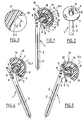
- the humeral prosthesis with movable head comprises an anchor rod 1 comprising a body elongated 2 of axis 3 intended to be inserted in the channel bone from the humerus (not shown) to anchor there.
- the constitution of this stem body is well known by elsewhere and will therefore not be described further.
- the anchor rod 1 has an upper end 4 which is equipped with a plate 5.
- This plate extends according to a plane which here forms an angle of about 35 ° with the direction of axis 3 of rod body 2. It has a lower face 6 opposite the rod body 2 and one face upper 7 opposite.
- the plate 5 is significantly more as wide as the rod body 2. In the example illustrated, it has the shape of a disc having a central axis of revolution 8.
- the plate 5 overlaps from the cut edge of the humerus to form a collar of bridle opposing any outgrowth of the humerus. We thus avoids the formation of bone ramifications which could cause pain or hinder good mobility of the prosthesis.
- a fixing pin 9 secured to the rod anchor 1 is arranged projecting from the upper face 7 of the plate 5, along the axis 8.
- This fixing pin has a side face 10 of slightly conical shape.
- the whole anchor rod, with its body 2, its plate 5 and its fixing pin 9, is made in metallic material such as stainless steel, titanium alloy, or cobalt-chromium alloy.
- a part 11 of substantially spherical shape, forming a ball joint, is rigidly fixed on the pin of fixing 9.
- the ball joint 11 has for this purpose a housing 12 having a conical side face of shape and dimension corresponding to those of the face 10 of the fixing pin 9.
- the ball joint 11 is thus force-fitted onto the pin 9, so as to create a wedging of the conical faces 10 and 12 one against the other.
- the ball 11 can be made of a material metallic such as stainless steel or an alloy cobalt-chrome or ceramic.
- a prosthetic joint head 13 is mounted to pivot freely on the ball joint 11.
- the head 13 is consists of two main parts. It thus comprises an outer shell or hollow cup 14 having one side exterior 15 of substantially spherical shape and one face interior 16 (also substantially spherical in shape) delimiting an interior volume.
- This cup 14 can be made of a metallic material such as steel stainless or a chrome-cobalt alloy. In situ, it fills the joint cavity and comes to bear against the glenoid and acromion.
- the head 13 further comprises a core or insert 17 partially housed in the interior volume of the cup 14 and rigidly attached to it.
- This insert has one side outer 18 substantially spherical, in contact with the inner face 16 of the cup 14, and, opposite this face 18, a housing 19 of substantially spherical shape, receiving the ball joint 11.
- This housing 19 follows the ball joint 11 over a portion slightly larger than a hemisphere, so that it ensures retention of the kneecap 11.
- the insert 17 is made of a material having a low coefficient friction and "biofunctional" with the material constituting the patella 11. It is in particular possible to use a plastic material such as polyethylene ultra high molecular weight. Insert 17, thus interposed between the ball 11 of the anchor rod 1 and the cup 14, ensures a silent and low friction connection of the head 13 with the ball joint 11. It also exerts a shock absorption function between these two elements.
- the housing 19 of insert 17 has, in a direction substantially parallel to the axis of revolution 13.1 of the head 13, a cylindrical portion 19.1 of axial movement.
- This game provides additional freedom of movement while translation between the head 13 and the anchor rod 1.
- This freedom of movement prevents the formation of fibrosis between the plate 5 and the head 13.
- the insert 17 slightly protrudes from the envelope 14 and thus has a part 20 which extends projecting from the casing 14. This projecting part forms a stop for the plate 5 during extreme pivoting of the anchor rod relative to the head 13.
- FIGS. 4 and 5 respectively illustrate the intraprosthetic adduction and abduction configurations prosthesis maximums.
- the upper side 7 of the plate 5 comes, in these extreme configurations, in abutment against the projecting part 20 of the insert 17.
- Good heard this stop function works in the same way in any extreme configuration of pivoting around a any axis.
- the plateau 5 exercises, in addition to this stop function, a first function essential to prevent the formation of possible bone ramifications at the end of the humerus.
- ramifications could in particular abnormally restrict the mobility of the link ball joint between the anchor rod and the head.
- the plate 5 therefore makes it possible to define so certain and viable the maximum angular deflections of the anchor rod relative to the head.
Landscapes
- Health & Medical Sciences (AREA)
- Orthopedic Medicine & Surgery (AREA)
- Cardiology (AREA)
- Oral & Maxillofacial Surgery (AREA)
- Transplantation (AREA)
- Engineering & Computer Science (AREA)
- Biomedical Technology (AREA)
- Heart & Thoracic Surgery (AREA)
- Vascular Medicine (AREA)
- Life Sciences & Earth Sciences (AREA)
- Animal Behavior & Ethology (AREA)
- General Health & Medical Sciences (AREA)
- Public Health (AREA)
- Veterinary Medicine (AREA)
- Prostheses (AREA)
Abstract
Description
- la figure 1 est une vue de profil partiellement en coupe d'une prothèse humérale conforme à l'invention ;
- la figure 2 est une vue de face de l'extrémité de la tige d'ancrage seule ;
- la figure 3 est une vue de détail de la zone III de la figure 1 ;
- la figure 4 est une vue analogue à la figure 1 illustrant une configuration d'adduction maximum (dans l'articulation intraprothétique) ;
- la figure 5 est une vue analogue à la figure 1 illustrant une configuration d'abduction maximum (dans l'articulation intraprothétique).
Claims (4)
- Prothèse humérale comportant une tige d'ancrage (1) dont une extrémité (4) est pourvue d'un plateau (5) en saillie duquel est disposée une rotule (11) sur laquelle est montée une tête (13) librement pivotante, caractérisée en ce que le plateau (5) forme une butée angulaire limitant le pivotement de la tête (13) sur la rotule (11).
- Prothèse selon la revendication 1, caractérisée en ce que, la tête (13) comportant une cupule extérieure creuse (14) à l'intérieur de laquelle est fixé un insert (17) présentant un logement (18) pour la rotule (11), l'insert (17) possède une partie (20) en saillie de la cupule (13) qui vient en butée contre le plateau (5) de la tige d'ancrage (1) lors du pivotement relatif de la tige d'ancrage (1) par rapport à la tête (13).
- Prothèse selon l'une des revendications précédentes, caractérisée en ce que l'articulation de la tête (13) sur la rotule (11) présente un jeu.
- Prothèse selon les revendications 2 et 3, caractérisée en ce que le logement (18) ménagé dans l'insert (17) pour la rotule (11) possède, selon une direction sensiblement parallèle à l'axe de révolution (13.1) de la tête (13), une portion cylindrique (19) créant le jeu précité.
Applications Claiming Priority (2)
| Application Number | Priority Date | Filing Date | Title |
|---|---|---|---|
| FR9616203A FR2757764B1 (fr) | 1996-12-30 | 1996-12-30 | Prothese humerale a tete mobile |
| FR9616203 | 1996-12-30 |
Publications (1)
| Publication Number | Publication Date |
|---|---|
| EP0850609A1 true EP0850609A1 (fr) | 1998-07-01 |
Family
ID=9499291
Family Applications (1)
| Application Number | Title | Priority Date | Filing Date |
|---|---|---|---|
| EP97403140A Withdrawn EP0850609A1 (fr) | 1996-12-30 | 1997-12-23 | Prothèse humérale à tête mobile |
Country Status (2)
| Country | Link |
|---|---|
| EP (1) | EP0850609A1 (fr) |
| FR (1) | FR2757764B1 (fr) |
Cited By (11)
| Publication number | Priority date | Publication date | Assignee | Title |
|---|---|---|---|---|
| RU2155547C2 (ru) * | 1997-10-15 | 2000-09-10 | Российский научно-исследовательский институт травматологии и ортопедии им. Р.Р. Вредена | Способ органосохраняющего эндопротезирования метадиафизарной части плечевой кости и эндопротез для его осуществления |
| FR2793137A1 (fr) * | 1999-05-07 | 2000-11-10 | Tornier Sa | Implant cotyloidien et son dispositif d'adaptation |
| WO2001022905A1 (fr) * | 1999-09-24 | 2001-04-05 | Baehler Andre | Endoprothese de l'epaule |
| FR2832922A1 (fr) * | 2001-12-04 | 2003-06-06 | Jean Claude Bouvet | Prothese d'epaule |
| US7097663B1 (en) | 2001-12-17 | 2006-08-29 | Smith & Nephew, Inc. | Modular prosthesis system with novel locking mechanism |
| US7108719B2 (en) | 2000-11-16 | 2006-09-19 | Willi Horber | Joint prosthesis |
| US7303585B2 (en) | 2000-11-16 | 2007-12-04 | Willi Horber | Endoprosthesis for a shoulder joint |
| WO2007122327A3 (fr) * | 2006-04-21 | 2008-03-13 | Tornier Sa | Prothese d'epaule ou de hanche et methode de pose d'une telle prothese |
| EP2749255A1 (fr) * | 2012-12-27 | 2014-07-02 | Zimmer GmbH | Prothèse d'épaule et ses composants |
| US10052199B2 (en) | 2014-02-21 | 2018-08-21 | Mitral Valve Technologies Sarl | Devices, systems and methods for delivering a prosthetic mitral valve and anchoring device |
| US10828169B2 (en) | 2013-12-19 | 2020-11-10 | Zimmer, Inc. | Stemless shoulder implant |
Citations (3)
| Publication number | Priority date | Publication date | Assignee | Title |
|---|---|---|---|---|
| US3863273A (en) * | 1973-09-20 | 1975-02-04 | Meditec Inc | Orthopedic prosthetic implant devices |
| US4040131A (en) * | 1976-04-29 | 1977-08-09 | Howmedica, Inc. | Trispherical prosthetic shoulder device |
| EP0715836A1 (fr) * | 1994-12-08 | 1996-06-12 | CEDIOR S.a.r.L | Endoprothèse totale d'épaule |
-
1996
- 1996-12-30 FR FR9616203A patent/FR2757764B1/fr not_active Expired - Fee Related
-
1997
- 1997-12-23 EP EP97403140A patent/EP0850609A1/fr not_active Withdrawn
Patent Citations (3)
| Publication number | Priority date | Publication date | Assignee | Title |
|---|---|---|---|---|
| US3863273A (en) * | 1973-09-20 | 1975-02-04 | Meditec Inc | Orthopedic prosthetic implant devices |
| US4040131A (en) * | 1976-04-29 | 1977-08-09 | Howmedica, Inc. | Trispherical prosthetic shoulder device |
| EP0715836A1 (fr) * | 1994-12-08 | 1996-06-12 | CEDIOR S.a.r.L | Endoprothèse totale d'épaule |
Cited By (19)
| Publication number | Priority date | Publication date | Assignee | Title |
|---|---|---|---|---|
| RU2155547C2 (ru) * | 1997-10-15 | 2000-09-10 | Российский научно-исследовательский институт травматологии и ортопедии им. Р.Р. Вредена | Способ органосохраняющего эндопротезирования метадиафизарной части плечевой кости и эндопротез для его осуществления |
| FR2793137A1 (fr) * | 1999-05-07 | 2000-11-10 | Tornier Sa | Implant cotyloidien et son dispositif d'adaptation |
| WO2001022905A1 (fr) * | 1999-09-24 | 2001-04-05 | Baehler Andre | Endoprothese de l'epaule |
| US6749637B1 (en) | 1999-09-24 | 2004-06-15 | Baehler Andre | Endoprosthesis for a shoulder joint |
| US7108719B2 (en) | 2000-11-16 | 2006-09-19 | Willi Horber | Joint prosthesis |
| US7303585B2 (en) | 2000-11-16 | 2007-12-04 | Willi Horber | Endoprosthesis for a shoulder joint |
| FR2832922A1 (fr) * | 2001-12-04 | 2003-06-06 | Jean Claude Bouvet | Prothese d'epaule |
| US7097663B1 (en) | 2001-12-17 | 2006-08-29 | Smith & Nephew, Inc. | Modular prosthesis system with novel locking mechanism |
| WO2007122327A3 (fr) * | 2006-04-21 | 2008-03-13 | Tornier Sa | Prothese d'epaule ou de hanche et methode de pose d'une telle prothese |
| US8277511B2 (en) | 2006-04-21 | 2012-10-02 | Tornier Sas | Shoulder or hip prosthesis and method for setting same |
| EP2749255A1 (fr) * | 2012-12-27 | 2014-07-02 | Zimmer GmbH | Prothèse d'épaule et ses composants |
| WO2014102141A1 (fr) | 2012-12-27 | 2014-07-03 | Zimmer Gmbh | Prothèse d'épaule et composants de celle-ci |
| CN104884003A (zh) * | 2012-12-27 | 2015-09-02 | 捷迈有限责任公司 | 肩假体和肩假体元件 |
| CN104884003B (zh) * | 2012-12-27 | 2016-09-07 | 捷迈有限责任公司 | 肩假体和肩假体元件 |
| US9763797B2 (en) | 2012-12-27 | 2017-09-19 | Zimmer Gmbh | Shoulder prosthesis and components thereof |
| US10687949B2 (en) | 2012-12-27 | 2020-06-23 | Zimmer Gmbh | Shoulder prosthesis and components thereof |
| US10828169B2 (en) | 2013-12-19 | 2020-11-10 | Zimmer, Inc. | Stemless shoulder implant |
| US10052199B2 (en) | 2014-02-21 | 2018-08-21 | Mitral Valve Technologies Sarl | Devices, systems and methods for delivering a prosthetic mitral valve and anchoring device |
| US11666450B2 (en) | 2015-10-15 | 2023-06-06 | Zimmer, Inc. | Method for installing a stemless shoulder implant |
Also Published As
| Publication number | Publication date |
|---|---|
| FR2757764A1 (fr) | 1998-07-03 |
| FR2757764B1 (fr) | 1999-01-29 |
Similar Documents
| Publication | Publication Date | Title |
|---|---|---|
| EP1611872B1 (fr) | Prothèse d'épaule ou de hanche | |
| EP0069683B1 (fr) | Prothèse totale du genou | |
| EP1139934B1 (fr) | Prothese de disque intervertebral | |
| EP1781214B1 (fr) | Système d'implants à triple articulation du type sphérique pour membre supérieur ou inférieur | |
| FR2787015A1 (fr) | Prothese de disque intervertebral a corps compressible | |
| EP1139935A1 (fr) | Prothese de disque intervertebral a comportement mecanique ameliore | |
| FR2758455A1 (fr) | Prothese totale de coude | |
| FR2838634A1 (fr) | Prothese totale de genou | |
| EP2574313A1 (fr) | Implant huméral de prothèse d'épaule | |
| EP4166114A1 (fr) | Implant avec surface articulaire en céramique | |
| FR2757764A1 (fr) | Prothese humerale a tete mobile | |
| EP2010109A2 (fr) | Prothese d'epaule ou de hanche et methode de pose d'une telle prothese | |
| EP0472475A2 (fr) | Prothèse bicondylienne du genou | |
| EP0611225B1 (fr) | Tige fémorale pour prothèse de hanche | |
| FR2805152A1 (fr) | Prothese trapezo-metacarpienne a mobilite amelioree | |
| EP0359672B1 (fr) | Prothèse articulaire, notamment prothèse fémorale, à effet d'auto-amortissement | |
| EP1670395A1 (fr) | Insert humeral pour une prothese d'epaule inversee | |
| FR2810878A1 (fr) | Prothese articulee | |
| FR2551655A1 (fr) | Cupule pour prothese articulaire, en particulier pour prothese de la hanche | |
| FR2516377A1 (fr) | Cupule universelle pour prothese de la hanche | |
| FR2903882A1 (fr) | Insert pour implant cotyloidien a double mobilite, implant cotyloidien correspondant et prothese de hanche correspondante | |
| FR2688132A1 (fr) | Prothese passive pour chaine tympano-ossiculaire. | |
| FR2707871A1 (fr) | Prothèse bicondylienne du genou du type à glissement. | |
| FR2621814A1 (fr) | Prothese orthopedique, en particulier pour la tete du femur | |
| BE1008526A6 (fr) | Prothese d'articulation. |
Legal Events
| Date | Code | Title | Description |
|---|---|---|---|
| PUAI | Public reference made under article 153(3) epc to a published international application that has entered the european phase |
Free format text: ORIGINAL CODE: 0009012 |
|
| AK | Designated contracting states |
Kind code of ref document: A1 Designated state(s): DE ES GB IT |
|
| AX | Request for extension of the european patent |
Free format text: AL;LT;LV;MK;RO;SI |
|
| 17P | Request for examination filed |
Effective date: 19981201 |
|
| AKX | Designation fees paid |
Free format text: DE ES GB IT |
|
| RBV | Designated contracting states (corrected) |
Designated state(s): DE ES GB IT |
|
| 17Q | First examination report despatched |
Effective date: 20010223 |
|
| STAA | Information on the status of an ep patent application or granted ep patent |
Free format text: STATUS: THE APPLICATION IS DEEMED TO BE WITHDRAWN |
|
| 18D | Application deemed to be withdrawn |
Effective date: 20020725 |