EP0848072B1 - An abrasion resistant valve seat made of sintered alloy for internal combustion engines - Google Patents
An abrasion resistant valve seat made of sintered alloy for internal combustion engines Download PDFInfo
- Publication number
- EP0848072B1 EP0848072B1 EP97121778A EP97121778A EP0848072B1 EP 0848072 B1 EP0848072 B1 EP 0848072B1 EP 97121778 A EP97121778 A EP 97121778A EP 97121778 A EP97121778 A EP 97121778A EP 0848072 B1 EP0848072 B1 EP 0848072B1
- Authority
- EP
- European Patent Office
- Prior art keywords
- less
- alloy
- valve seat
- phase
- powder
- Prior art date
- Legal status (The legal status is an assumption and is not a legal conclusion. Google has not performed a legal analysis and makes no representation as to the accuracy of the status listed.)
- Revoked
Links
Images


Classifications
-
- F—MECHANICAL ENGINEERING; LIGHTING; HEATING; WEAPONS; BLASTING
- F01—MACHINES OR ENGINES IN GENERAL; ENGINE PLANTS IN GENERAL; STEAM ENGINES
- F01L—CYCLICALLY OPERATING VALVES FOR MACHINES OR ENGINES
- F01L3/00—Lift-valve, i.e. cut-off apparatus with closure members having at least a component of their opening and closing motion perpendicular to the closing faces; Parts or accessories thereof
- F01L3/22—Valve-seats not provided for in preceding subgroups of this group; Fixing of valve-seats
-
- C—CHEMISTRY; METALLURGY
- C22—METALLURGY; FERROUS OR NON-FERROUS ALLOYS; TREATMENT OF ALLOYS OR NON-FERROUS METALS
- C22C—ALLOYS
- C22C33/00—Making ferrous alloys
- C22C33/02—Making ferrous alloys by powder metallurgy
- C22C33/0207—Using a mixture of pre-alloyed powders or a master alloy
-
- F—MECHANICAL ENGINEERING; LIGHTING; HEATING; WEAPONS; BLASTING
- F01—MACHINES OR ENGINES IN GENERAL; ENGINE PLANTS IN GENERAL; STEAM ENGINES
- F01C—ROTARY-PISTON OR OSCILLATING-PISTON MACHINES OR ENGINES
- F01C21/00—Component parts, details or accessories not provided for in groups F01C1/00 - F01C20/00
- F01C21/08—Rotary pistons
- F01C21/0809—Construction of vanes or vane holders
Definitions
- the present invention relates to a valve seat made of sintered alloy used for internal combustion engines, in particular to a valve seat of sintered alloy superior in abrasion resistance.
- Sintered alloy is produced in a process in which alloy powder is combined and blended, filled into a mould, press-formed, and then sintered in a determined atmosphere and at a determined temperature. According to such sintering method, metals and alloys which are hardly obtained by usual melting and casting method, can be easily produced, and a plurality of functions can be easily obtained together, which enables to produce parts having peculiar function or functions. Also, sintered alloy is adapted for production of porous materials, hard-machining materials and complicated mechanical parts. In recent years, such sintered alloy has been used for valve seats for which high abrasion resistance is required.
- this sintered alloy needs in particular a lot of W and Co annexed thereto in order to effect the characteristics of high heat resistance, abrasion resistance, anti-corrosion, etc. Therefore, the valve seats made of this sintered alloy will be expensive and thus accompanied with drawbacks at cost.
- EP-0 418 943 A1 discloses a valve seat insert composed of a sintered ferrous material having a composition (expressed in weight %) lying within the ranges C 0.7-1.3/Si 0.3-1.3/Cr 1.9-5.3/Mo 0.5-1.8/V 0.1-1.5/Mn 0.6 max/Fe balance apart from incidental impurities.
- EP-0 339 436 A1 discloses a material for valve seats comprising a wear resistant sintered ferro alloy formed by dispersing particles of a high speed steel in a matrix in which hard alloy particles are dispersed.
- the ferro alloy comprises a mixture of particles having a first component as a matrix material and a second component as a carbide material and a third component as a hard alloy, the first component having at least one element of Fe, C, Ni, Co Si, Mn in the form of a particle, the second component having at least one element of Fe, Cr, Mo, V in the form of a particle and the third component having at least one element of Fe, Cr, Mo, Co, C, W in the form of a particle, a high speed steel particle blended with said mixture of particles before being pressurized and cast, and a residual Fe, to enhance the sealing between said hard alloy particle and said matrix.
- An object of the invention is to solve advantageously the above mentioned drawbacks and therefore to provide an improved valve seat superior in abrasion resistance made of iron base sintered alloy material used for internal combustion engines.
- the present invention provides a valve seat with excellent abrasion resistance for use in internal combustion engines, the said valve seat comprising an iron based sintered alloy such that said alloy microstructure consists of;
- said secondary phase is preferably composed of pure iron containing by weight 0.5 % or less of C, or carbon steel consisted of by weight C:1.5 % or less, Mn:0.5 % or less, Si:1.0 % or less and the reminder Fe and inevitable impurities, or low alloy steel consisted of by weight C:1.5 % or less, Mn:0.5 % or less, Si:1.0 % or less and one or more selected from a group of Cr:4 % or less, Mo:3 % or less, Co:6 % or less, Ni:5 % or less, V:1.0 % or less and Cu:5.0 % or less and the reminder Fe and inevitable impurities.
- the valve seat will include in area ratio 1 ⁇ 20 % of infiltrated or previously added Cu phase or Cu alloy phase, or include dispersed therein in area ratio 1 ⁇ 20 % hard particles having average diameter 20 ⁇ 100 ⁇ m and a hardness 700 ⁇ 1500 Hv, added in said matrix.
- Said hard particles are preferably consisted of one selected from a group of Fe-Mo particles, Fe-W particles, Cr-Mo-Co intermetallic compound particles and C-Cr-W-Co particles.
- the valve seat will include in area ratio 0.5 ⁇ 10 % of solid lubricant added in the above described matrix.
- solid lubricant is preferably of one of graphite, sulfide, nitride and fluoride.
- sintered pores will be infiltrated with a metal having a low melting point.
- the described low melting point metal is preferably of a metal selected from a group of Pb, Pb alloy, Sn, Sn alloy, Zn and Zn alloy.
- H primary phase
- S secondary phase
- C Cu phase
- D hard particles
- L solid lubricant
- A base matrix
- the primary phase includes in its microstructure fine precipitated carbides of ⁇ 10 microns, preferably 1 to 5 microns and has a hardness of 450 Hv or more, in view of abrasion resistance, strength and opposite aggressibility preferably a hardness in the range of 450 - 900 Hv. If the size of the fine precipitated carbides exceeds 10 microns, its strength is lowered and opposite aggressibility increases. Also, where the hardness is below 450 Hv, its abrasion resistance cannot be improved. Also, the microstructure of the primary phase is basically, mainly of a microstructure with fine precipitated carbides.
- the primary phase in the matrix alloy occupies 30 to 95% area ratio of the alloy. If the ratio is below 30%, the abrasion resistance becomes too deteriorative to attain the object of the invention. Otherwise, if it exceeds 95 %, the abrasion resistance can not be further improved, which results in economical disadvantage because there is little effect in comparison with quantitative increase of the alloy elements. Further, the primary phase occupies preferably 50 ⁇ 90 % area ratio of the alloy.
- C is needed to adjust the phase to a determined structure and hardness and also to form carbide. If it exceeds 2.0 %, the melting point decreases and liquid phase is formed thereby to bring liquid phase sintering. This brings too much formation of precipitated carbide and lots of pores, so that this also leads to deterioration of the elongation characteristic and lowering of dimensional accuracy. If it is less than 0,7 %, the sintering is not advanced enough and quantity of the precipitated carbide is so limited that abrasion resistance is lowered. C is more preferably 0,7 ⁇ 1,7 %.
- Cr is an element to enhance strength, heat resistance and abrasion resistance. If it exceds 17 %, precipitated quantity of Cr carbide becomes too much thereby to lower machinability, and the carbide precipitated in the phase will hardly be ⁇ 10 microns or smaller. Cr is preferably 4 % or more. If it is less than 4 %, quantity of precipitated carbide decreases. This leads to lowering of abrasion resistance. Cr is more preferably in a range of 4 ⁇ 12 %. Mo: 12 % or less
- Mo precipitates as carbide or solid solution, and enhances hardness of the phase thereby to increase the abrasion resistance. Otherwise, if it exceeds 12 %, powder fluidity is lowered and therefore formability is also lowered. Mo is preferably 3 % or more. If it is less than 3 %, quantity of precipitated carbide is so limited that the abrasion resistance decreases. Mo is more preferably in a range of 3 ⁇ 6 %. W: 20 % or less
- W is an element which forms carbide and increases abrasion resistance. If it exceeds 20 %, quantity of precipitated carbide increases too much and strength is so enhanced, that elongation property decreases. W is preferably 4 % or more. If it is less than 4 %, quantity of precipitated carbide lessens, which results in a little decrease in abrasion resistance. W is more preferably in a range of 4 ⁇ 12 % and much more preferably 4 ⁇ 7 %. V: 6 % or less
- V is an element which forms carbide and enhances abrasion resistance. However,if it exceeds 6 %, quantity of precipitated carbide increases too much and strength is so enhanced, that elongation property is lowered. V is preferably 1 % or more. If it is less than 1 %, the quantity of precipitated carbide is so limited that abrasion resistance goes down a little. V is more preferably 2 ⁇ 5 %, and much more preferably 2 ⁇ 3 %. Ti: 3 % or less
- Ti is an element which forms carbide and enhances abrasion resistance. If it exceeds 3 %, quantity of precipitated carbide increases too much, which results in a decrease in elongation. Also, Ti is preferably in a range of 0.5 ⁇ 2.0 %. Nb: 3 % or less
- Nb is, similar to Ti, an element which forms carbide and enhances abrasion resistance. Otherwise, if it exceeds 3 %, quantity of precipitated carbide increases too much and therefore brings a decrease in elongation. Incidentally, Nb is preferably 0.5 ⁇ 2.0 %. B: 3 % or less
- B is an element which modifies the alloy to a predetermined structure together with an element forming carbide, and increases abrasion resistance. If it exceeds 3 %, rough precipitated substance is formed, which brings a decrease in abrasion resistance.
- B is preferably 0.5 ⁇ 2.0 %.
- Co is an element which increases high temperature strength and improves abrasion resistance by restraining a decrease of hardness which results from an increase in temperature. Otherwise, if it exceeds 13 %, such effects can not be further advanced and can not be expected in line with its annexed quantity. Since this leads to economical disadvantage, Co is limited to 13 % or less. Furthermore, Co is preferably in a range of 8 ⁇ 10 %.
- the primary phase includes as the reminder Fe and inevitable impurities.
- a valve seat made of sintered alloy according to the present invention includes formation of the secondary phase in order to increase powder compressibility at forming. It is needed for the secondary phase to be softer than the primary phase, and the secondary phase has a hardness of 400 Hv or below. According to the presence of the secondary phase in the iron based alloy, the strength and toughness of the sintered body are much improved in comparison with those of a single hard phase. Also, the secondary phase is economically more advantageous than the primary phase because of less quantity of alloy elements.
- the secondaray phase is composed mainly of Fe, and is preferably of pure iron, or carbon steel, or low alloy steel.
- the secondary phase occupies in area ratio 5 ⁇ 70 % of the alloy. If the ratio of the secondary phase is less than 5 %, the powder compressibility goes down, whereas if it exceeds 70 %, the abrasion resistance is badly influenced. Therefore, the ratio of the secondary phase of the alloy is limited to 5 ⁇ 70 %.
- the secondary phase preferably is composed of pure iron consisting of (by weight) 0.5 % or less and the reminder Fe and inevitable impurities, or carbon steel consisting of (by weight) C:1.5 % or less, Mn:0.5 % or less, Si:1.0 % or less and the reminder Fe and inevitable impurities, or low alloy steel consisting of (by weight) C:1.5 % or less, Mn:0.5 % or less, Si:1.0 % or less and one or more selected from a group of Cr:4 % or less, Mo:3 % or less, Co:6 % or less, Ni:5 % or less, Cu:5.0 % or less and V:1.0 % or less and the reminder Fe and inevitable impurities.
- the secondary phase can be suitably selected in accordance with the purpose of use of the valve seat made of sintered alloy.
- the composition of the secondary phase is preferably comprises pure iron consisting of (by weight) 0.5 % or less of C and the reminder Fe and inevitable impurities in order to be softer than the primary phase. If C in the secondary phase exceeds 0.5 %, it will become easily harder than the primary phase. Accordingly, it was decided to be the upper limit of C in case of pure iron.
- alloy elements will attain a desired hardness.
- the alloy elements added into the secondary phase are limited to comparatively a little quantity as mentioned above in view of the purpose.
- carbon steel is desirably employed.
- the composition of such carbon steel preferably comprises of (by weight) C:1.5 % or less, Mn:0.5 % or less, Si:1.0 % or less and the reminder Fe and inevitable impurities.
- the reasons for these upper limits are as follows; if C exceeds 1.5 %, liquid phase easily occurs, if Mn exceeds 0.5 %, sinter diffusibility is reduced, and if Si exceeds 1.0 %, similar to the case of Mn, sinter diffusibility is reduced.
- low alloy steel is preferably employed which is equivalent to the described carbon steel added with alloy elements.
- alloy elements are preferably composed of one or more selected from a group of Cr:4 % or less, Mo:3 % or less, Co:6 % or less, Ni:5 % or less, Cu:5.0 % or less and V:1.0 % or less. These alloy elements serve respectively to enhance hardness of the steel. If one of the elements exceeds their limits, namely Cr:4 %, Mo:3 %, Co:6 %, Ni:5%, Cu:5.0 %, or V:1.0 %, the hardness becomes too high and equals to the same one as that of the primary phase, so that these values forms upper limits respectively.
- Cu phase or Cu alloy phase in area ratio 1 ⁇ 20 % will be contained into the described alloy.
- Cu powder or Cu alloy powder will be contained therein in such a way that it is mixed with iron powder, or instead of adding Cu powder or Cu alloy powder at the mixing of powder, Cu powder or Cu alloy powder will be disposed on compressed powder body at the sintering or on sintered body at the heat treatment, and then will be infiltrated into sintered pores.
- Cu phase or Cu alloy phase is precipitated into the base alloy to thereby enhance heat conductivity and inter-particle bonding force of sintered body.
- Cu phase or Cu alloy phase is precipitated in pores and seals the pores whereby to improve elongation and machinability. If Cu phase or Cu alloy phase is less than 1 %, elongation reduces and also machinability of the sintered body goes down. On the other hand, it exceeds 20 %, precipitated Cu phase or Cu alloy phase is brought to too large, which results in a decrease of shearing strength and abrasion resistance of the sintered body. Accordingly, Cu phase or Cu alloy phase is limited in a range of 1 ⁇ 20 %.
- sintered pores will be infiltrated with a low melting point metal.
- a low melting point metal is preferably of Pb, Pb alloy, Sn, Sn alloy, Zn or Zn alloy.
- the sintered pores to be infiltrated with a low melting point metal will be in area ratio 1 ⁇ 20 %. If it is less than 1%, elongation of the sintered body reduces, whereas if it exceeds 20 %, strength of the sintered body goes down.
- hard particles which have average grain-diameter of 20 ⁇ 100 microns and a hardness of 700 ⁇ 1500 Hv, will be dispersed in a range of 1 ⁇ 20 % in area ratio into the described alloy.
- hard particles can be expected to effectively elevate abrasion resistance of the sintered alloy, if the average grain-diameter is smaller than 20 microns, dispersion is apt to occur and therefor the effectiveness for improving abrasion resistance is limited. Otherwise, if it exceeds 100 microns, machinability is badly influenced, so that the average grain-diameter of the hard particles is limited to 20 ⁇ 100 microns. Also, if the hardness of the hard particles is below 700 Hv, the effectiveness for improving abrasion resistance is limited, while if it exceeds 1500 Hv, machinability is badly influenced, so that the hardness of the hard particles is limited in a range of 700 ⁇ 1500 Hv.
- the hard particles will be disparsed in area ratio 1 ⁇ 20 %. If they are less than 1 %, the effectiveness for improving abrasion resistance is limited, but if they exceed 20 %, machinability and powder compressibility are deteriorated, so that the ratio of the dispersed hard particles will be limited in a range of 1 ⁇ 20 %.
- the hard particles are preferably of one of Fe-Mo particles, Fe-W particles, Cr-Mo-Co intermetallic compound particles or C-Cr-W-Co particles.
- Fe-Mo particles and Fe-W particles disperse into the matrix by being added with ferromolybdenum powder or ferrotungsten powder.
- the comosition of ferromolybdenum is enough in a range stipulated by JIS.
- the composition of ferromolybdenum is, for example, of Mo:50 ⁇ 70 wt % and Fe:30 ⁇ 50 wt %
- the comosition of ferrotungsten is, for example, of W:40 - 60 wt % and Fe:40 ⁇ 60 wt %.
- Cr-Mo-Co intermetallic compound particles will be added in a form of intermetallic compound powder composed of Cr:10 wt %, Mo:30 wt % and Co: 60 wt %. Also, C-Cr-W-Co particles will be added as a powder composed of C:1 ⁇ 5 wt %, Cr:40 ⁇ 70 wt %, W:10 ⁇ 30 wt % and Co:5 ⁇ 20 wt %.
- solid lubricant can be added into the described alloy in order to improve machinability, abrasion resistance and anti-opposite aggressibility.
- the solid lubricant is desirably in area ratio 0.5 ⁇ 10 %. If it less than 0.5 %, its effects can not be expected, but if it exceeds 10 %, progress of sintering reaction is hindered thereby to deteriorate mechanical properties.
- the solid lubricant is preferably of one of graphite, sulfide, nitride and fluoride. Such sulfide is preferably of MnS or MnS 2 and the fluoride is preferably of CaF 2 .
- alloy steel powder forming the primary phase and composed of C and one or more of a group of Cr, Mo, W, V, Ti, Nb, B and Co and the reminder Fe is blended with steel powder forming the secondary phase and consisted of pure iron or carbon steel or low alloy steel, or together with Cu powder, Cu alloy powder.
- zinc stearate or the like will be combined as the lubricant.
- solid lubricant or ferromolybdenum powder or the like forming hard particles will be added and combined.
- these powders are filled into a mould and then press-formed by a forming press to form a compressed powder body. And thereafter, the powder body is sintered to a sintered body.
- the compressed powder body is preferably heated and sintered in a protective atmosphere of a temperature of 1100 ⁇ 1200 °C. If the temperature is below 1100 °C, there is caused a lack of sintering diffusion. But if the temperature is higher than 1200 °C, over-diffusion of hard particles in the base occurs, which results in a lowering of abrasion resistance.
- these sintered bodies will be provided thereon with Cu or Cu alloy or a low melting point metal, and heated thereby for pores to be sealed. After that, the sintered bodies are worked out to valve seats (products) by machining.
- Alloy steel powder (A ⁇ E, J) which forms the primary phase and steel powder (a ⁇ d, h) which forms the secondary phase were combined to the composition shown in Table 1, and the following powders, namely, C powder or further Cu powder or Cu alloy powder forming Cu phase, or ferromolybdenum powder or intermetallic comound consisted of Cr, Mo, Co as hard particles, or MnS or graphite or CaF 2 as solid lubricant, were combined so as to be the rate shown in Table 1, and furthermore zinc stearate 1 % as lubricant was combined therein, and blended, thereafter filled into a mould, press-formed, and sintered at 1150°C ⁇ 0.5 hour in an AX-gas atmosphere. After sintering, relevant to some samples, the sintered bodies were infiltrated at 600°C ⁇ 1 hour by means of Pb - vacuum impregnation.
- composition of used alloy steel powders are as follows:
- composition of used steel powders forming the secondary phase are as follows:
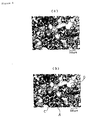
- Figure 1 (a) shows a structure of Sample No.1
- Figure 1 (b) shows a structure of Sample No.5
- Figure 1 (c) shows a structure of Sample No. 8
- Figure 1 (d) shows a structure of Sample No.9.
- H denotes the primary phase
- S the secondary phase
- C Cu phase
- D hard particles
- L solid lubricant
- A denotes base matrix (1 wt % C - 7 wt % Co - 2 wt % Ni - Fe), B: pearite, and D: hard particles (Cr-Mo-Co intermetallic compound).
- A denotes base matrix (1 wt % C - 6 wt % Co - 2 wt % Ni - Fe), B: Cu phase, D: hard particles (C-Cr-W-Co alloy).
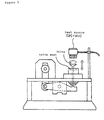
- Sintered bodies embodied by .the invention and those of compared examples were worked respectively to valve seats, and tested by means of a rig tester shown in Figure 5 to carry out abrasion tests under the followinng test conditions described below: test temperature 400 °C test time 9 hours cam rotary speed 3000 rpm valve rotary speed 20 rpm spring load 35 Kg (at setting) lifted amount 7 mm material of valve SUH 35
- valve seats made of sintered alloy can be inexpensively produced which are superior in abrasion resistance , usable for valve seats used in internal combustion engines driven under severe conditions.
Landscapes
- Engineering & Computer Science (AREA)
- Mechanical Engineering (AREA)
- Chemical & Material Sciences (AREA)
- General Engineering & Computer Science (AREA)
- Materials Engineering (AREA)
- Metallurgy (AREA)
- Organic Chemistry (AREA)
- Powder Metallurgy (AREA)
- Rotary Pumps (AREA)
Description
- occupying 30 to 95% area ratio of the alloy,
- comprising 0.7 to 2 wt.% carbon and one or more of 0-17wt.% Cr, 0-12wt.% Mo, 0-20 wt.% W, 0-6 wt.% V, 0-3 wt.% Ti, 0-3 wt.% Nb, 0-3 wt.% B and 0-13 wt.% Co and the remainder iron and inevitable impurities,
- having a hardness of 450 Hv or more, and
- having a microstructure comprising fine precipitated carbides of <10 microns,
and
- occupying 70 to 5% area ratio of the alloy,
- having a composition of either pure iron, carbon steel or low alloy steel, and
- having a hardness of 400Hv or less.
C: 0,7 to 2,0 %
Cr: 17 % or less
Mo: 12 % or less
W: 20 % or less
V: 6 % or less
Ti: 3 % or less
Nb: 3 % or less
B: 3 % or less
Co: 13 % or less
The composition of the secondary phase is preferably comprises pure iron consisting of (by weight) 0.5 % or less of C and the reminder Fe and inevitable impurities in order to be softer than the primary phase. If C in the secondary phase exceeds 0.5 %, it will become easily harder than the primary phase. Accordingly, it was decided to be the upper limit of C in case of pure iron.
| test temperature | 400 °C |
| test time | 9 hours |
| cam rotary speed | 3000 rpm |
| valve rotary speed | 20 rpm |
| spring load | 35 Kg (at setting) |
| lifted amount | 7 mm |
| material of valve | SUH 35 |

Claims (6)
- A valve seat with excellent abrasion resistance for use in internal combustion engines, the said valve seat comprising an iron based sintered alloy such that said alloy microstructure consists of;a). a primary phaseoccupying 30 to 95% area ratio of the alloy,comprising 0.7 to 2 wt.% carbon and one or more of 0-17wt.% Cr, 0-12wt.% Mo, 0-20 wt.% W, 0-6 wt.% V, 0-3 wt.% Ti, 0-3 wt.% Nb, 0-3 wt.% B and 0-13 wt.% Co and the remainder iron and inevitable impurities,having a hardness of 450 Hv or more, andhaving a microstructure comprising fine precipitated carbides of <10 microns,
andb). a secondary phaseoccupying 70 to 5% area ratio of the alloy,having a composition of either pure iron, carbon steel or low alloy steel, andhaving a hardness of 400Hv or less. - A valve seat set forth in claim 1, wherein said secondary phase is composed of pure iron containing by weight 0.5% or less of C, or carbon steel consisting of by weight C:1.5% or less, Mn:0.5% or less, Si:1.0% or less and the remainder Fe and inevitable impurities, or low alloy steel consisting of by weight C:1.5% or less, Mn:0.5% or less, Si:1.0% or less and one or more selected from a group of Cr:4.0% or less, Mo:3% or less, Co:6.0% or less, Ni:5.0% or less, V:1.0% or less and Cu:5.0% or less and the remainder Fe and inevitable impurities.
- A valve seat set forth in claims 1 or 2, wherein said valve seat includes in area ratio 1 - 20% of infiltrated or previously added Cu phase or Cu alloy phase.
- A valve seat set forth in one of claims 1 - 3, wherein said valve seat includes dispersed therein in area ratio 1 - 20% hard particles having average diameter 20 - 100/µm and a hardness 700 - 1500 Hv, added in said material.
- A valve seat set forth in one of claims 1 - 4, wherein said valve seat includes in area ratio 0.5 - 10% of solid lubricant added in said material.
- A valve seat set forth in one of claims 1, 2, 4 and 5, wherein sintered pores are infiltrated with a metal having a low melting point.
Applications Claiming Priority (6)
| Application Number | Priority Date | Filing Date | Title |
|---|---|---|---|
| JP352044/96 | 1996-12-11 | ||
| JP35204496 | 1996-12-11 | ||
| JP35204496 | 1996-12-11 | ||
| JP9301973A JPH10226855A (en) | 1996-12-11 | 1997-11-04 | Valve seat for internal combustion engine made of wear resistant sintered alloy |
| JP30197397 | 1997-11-04 | ||
| JP301973/97 | 1997-11-04 |
Publications (2)
| Publication Number | Publication Date |
|---|---|
| EP0848072A1 EP0848072A1 (en) | 1998-06-17 |
| EP0848072B1 true EP0848072B1 (en) | 2001-06-20 |
Family
ID=26562947
Family Applications (1)
| Application Number | Title | Priority Date | Filing Date |
|---|---|---|---|
| EP97121778A Revoked EP0848072B1 (en) | 1996-12-11 | 1997-12-10 | An abrasion resistant valve seat made of sintered alloy for internal combustion engines |
Country Status (5)
| Country | Link |
|---|---|
| US (1) | US5870989A (en) |
| EP (1) | EP0848072B1 (en) |
| JP (1) | JPH10226855A (en) |
| DE (2) | DE69705289T2 (en) |
| GB (1) | GB2322926B (en) |
Families Citing this family (20)
| Publication number | Priority date | Publication date | Assignee | Title |
|---|---|---|---|---|
| GB2315115B (en) * | 1996-07-10 | 2000-05-31 | Hitachi Powdered Metals | Valve guide |
| GB2325005B (en) * | 1997-05-08 | 2000-10-11 | Brico Eng | Method of forming a component |
| JP3952344B2 (en) * | 1998-12-28 | 2007-08-01 | 日本ピストンリング株式会社 | Wear-resistant iron-based sintered alloy material for valve seat and valve seat made of iron-based sintered alloy |
| JP3346321B2 (en) * | 1999-02-04 | 2002-11-18 | 三菱マテリアル株式会社 | High strength Fe-based sintered valve seat |
| JP4555491B2 (en) * | 2000-03-16 | 2010-09-29 | 新日本製鐵株式会社 | Hot-dip zinc-aluminum alloy-plated steel sheet with excellent chemical conversion and its manufacturing method |
| KR20030021916A (en) * | 2001-09-10 | 2003-03-15 | 현대자동차주식회사 | A compound of wear-resistant sintered alloy for valve seat and its manufacturing method |
| US6632263B1 (en) | 2002-05-01 | 2003-10-14 | Federal - Mogul World Wide, Inc. | Sintered products having good machineability and wear characteristics |
| US6702905B1 (en) * | 2003-01-29 | 2004-03-09 | L. E. Jones Company | Corrosion and wear resistant alloy |
| JP4213060B2 (en) * | 2004-03-03 | 2009-01-21 | 日本ピストンリング株式会社 | Ferrous sintered alloy material for valve seats |
| JP4412133B2 (en) | 2004-09-27 | 2010-02-10 | Jfeスチール株式会社 | Iron-based mixed powder for powder metallurgy |
| US20100034686A1 (en) * | 2005-01-28 | 2010-02-11 | Caldera Engineering, Llc | Method for making a non-toxic dense material |
| US7575619B2 (en) * | 2005-03-29 | 2009-08-18 | Hitachi Powdered Metals Co., Ltd. | Wear resistant sintered member |
| DE112009000775B4 (en) * | 2008-03-31 | 2014-12-31 | Nippon Piston Ring Co., Ltd. | Iron-based sintered alloy for a valve seat and valve seat for an internal combustion engine |
| JP5525986B2 (en) * | 2009-12-21 | 2014-06-18 | 日立粉末冶金株式会社 | Sintered valve guide and manufacturing method thereof |
| TWI448563B (en) * | 2010-09-24 | 2014-08-11 | Taiwan Powder Technologies Co Ltd | Alloy steel powder composition and its sintered body |
| US20120107170A1 (en) * | 2010-11-03 | 2012-05-03 | Kuen-Shyang Hwang | Alloy steel powder and their sintered body |
| KR101316474B1 (en) * | 2011-09-19 | 2013-10-08 | 현대자동차주식회사 | Valve seat of engine and manufacturing method therof |
| CN104046897A (en) * | 2014-07-01 | 2014-09-17 | 张家港市佳晟机械有限公司 | High-strength special steel alloy |
| JP6736227B2 (en) * | 2016-11-28 | 2020-08-05 | 日本ピストンリング株式会社 | Valve seat made of iron-based sintered alloy for internal combustion engine with excellent wear resistance and combination of valve seat and valve |
| DE102017010809A1 (en) | 2016-11-28 | 2018-05-30 | Nippon Piston Ring Co., Ltd. | VALVE INSERT MADE OF IRON-BASED SINTERED ALLOY WITH EXCELLENT WEAR RESISTANCE FOR INTERNAL COMBUSTION ENGINES, AND ARRANGEMENT FROM VALVE SEAT INSERT AND VALVE |
Family Cites Families (16)
| Publication number | Priority date | Publication date | Assignee | Title |
|---|---|---|---|---|
| US4080205A (en) * | 1972-07-13 | 1978-03-21 | Toyota Jidosha Kogyo Kabushiki Kaisha | Sintered alloy having wear-resistance at high temperature |
| JPS5113093A (en) * | 1974-07-24 | 1976-02-02 | Hitachi Ltd | YUATSUATSUKASOCHI |
| JPS55145151A (en) * | 1979-04-26 | 1980-11-12 | Nippon Piston Ring Co Ltd | Wear resistant sintered alloy material for internal combustion engine |
| KR890004522B1 (en) * | 1982-09-06 | 1989-11-10 | 미쯔비시긴조구 가부시기가이샤 | Method for manufacturing copper-clad iron alloy member and two-layer valve sheet manufactured by the method |
| US4540737A (en) * | 1983-02-07 | 1985-09-10 | Celanese Corporation | Method for the formation of composite articles comprised of thermotropic liquid crystalline polymers and articles produced thereby |
| EP0167034B1 (en) * | 1984-06-12 | 1988-09-14 | Sumitomo Electric Industries Limited | Valve-seat insert for internal combustion engines and its production |
| US4724000A (en) * | 1986-10-29 | 1988-02-09 | Eaton Corporation | Powdered metal valve seat insert |
| GB8723818D0 (en) * | 1987-10-10 | 1987-11-11 | Brico Eng | Sintered materials |
| JP2957180B2 (en) * | 1988-04-18 | 1999-10-04 | 株式会社リケン | Wear-resistant iron-based sintered alloy and method for producing the same |
| JP2709103B2 (en) * | 1988-11-28 | 1998-02-04 | 日本ピストンリング株式会社 | Rocker arm |
| GB8921260D0 (en) * | 1989-09-20 | 1989-11-08 | Brico Engineering Company | Sintered materials |
| JPH04259351A (en) * | 1991-02-14 | 1992-09-14 | Nissan Motor Co Ltd | Manufacture of wear resistant ferrous sintered alloy |
| JP3520093B2 (en) * | 1991-02-27 | 2004-04-19 | 本田技研工業株式会社 | Secondary hardening type high temperature wear resistant sintered alloy |
| US5512080A (en) * | 1992-11-27 | 1996-04-30 | Toyota Jidosha Kabushiki Kaisha | Fe-based alloy powder adapted for sintering, Fe-based sintered alloy having wear resistance, and process for producing the same |
| GB9311051D0 (en) * | 1993-05-28 | 1993-07-14 | Brico Eng | Valve seat insert |
| JPH08134608A (en) * | 1994-11-08 | 1996-05-28 | Sumitomo Electric Ind Ltd | Iron-based sintered alloy for valve seats |
-
1997
- 1997-11-04 JP JP9301973A patent/JPH10226855A/en active Pending
- 1997-12-05 US US08/985,550 patent/US5870989A/en not_active Expired - Fee Related
- 1997-12-08 GB GB9725843A patent/GB2322926B/en not_active Expired - Fee Related
- 1997-12-10 EP EP97121778A patent/EP0848072B1/en not_active Revoked
- 1997-12-10 DE DE69705289T patent/DE69705289T2/en not_active Revoked
- 1997-12-10 DE DE0848072T patent/DE848072T1/en active Pending
Also Published As
| Publication number | Publication date |
|---|---|
| JPH10226855A (en) | 1998-08-25 |
| GB2322926B (en) | 2000-08-02 |
| DE69705289D1 (en) | 2001-07-26 |
| US5870989A (en) | 1999-02-16 |
| DE848072T1 (en) | 1998-11-12 |
| GB2322926A (en) | 1998-09-09 |
| EP0848072A1 (en) | 1998-06-17 |
| GB9725843D0 (en) | 1998-02-04 |
| DE69705289T2 (en) | 2001-11-15 |
Similar Documents
| Publication | Publication Date | Title |
|---|---|---|
| EP0848072A1 (en) | An abrasion resistant valve seat made of sintered alloy for internal combustion engines | |
| US5188659A (en) | Sintered materials and method thereof | |
| US8733313B2 (en) | Iron-based sintered alloy for valve seat, and valve seat for internal combustion engine | |
| US5273570A (en) | Secondary hardening type high temperature wear-resistant sintered alloy | |
| US6139599A (en) | Abrasion resistant iron base sintered alloy material for valve seat and valve seat made of iron base sintered alloy | |
| CA1337748C (en) | Sintered materials | |
| KR101194079B1 (en) | Sintered valve guide and method for manufacturing the same | |
| JP3469435B2 (en) | Valve seat for internal combustion engine | |
| EP3358156B1 (en) | Sintered valve seat | |
| KR100499896B1 (en) | A sintered member having an abrasion resistance and a method for producing the same | |
| US20030097904A1 (en) | Sintered alloy for valve seat having excellent wear resistance and method for producing the same | |
| JP3614237B2 (en) | Valve seat for internal combustion engine | |
| KR100691097B1 (en) | Sintered Steel Material | |
| US6251157B1 (en) | Sintered alloy having superb wear resistance and process for producing the same | |
| US5952590A (en) | Sintered alloy having superb wear resistance and process for producing the same | |
| JP3434527B2 (en) | Sintered alloy for valve seat | |
| JP4455390B2 (en) | Wear-resistant sintered alloy and method for producing the same | |
| EP0796927A2 (en) | Powder-produced material having wear-resistance | |
| JP2571567B2 (en) | High temperature wear resistant iron-based sintered alloy | |
| JP2683444B2 (en) | Sintered alloy for valve mechanism of internal combustion engine | |
| JP2010144237A (en) | Wear-resistant sintered alloy and method for producing the same | |
| JPH11140603A (en) | Wear-resistant sintered alloy material for compressor parts | |
| JPH11209855A (en) | Valve seat made of Fe-based sintered alloy that exhibits excellent wear resistance under conditions of high surface pressure | |
| JP2023152727A (en) | Valve seat made of iron-based sintered alloy for internal combustion engines and its manufacturing method | |
| KR970001323B1 (en) | Small alloy for valve seat with excellent wear resistance |
Legal Events
| Date | Code | Title | Description |
|---|---|---|---|
| PUAI | Public reference made under article 153(3) epc to a published international application that has entered the european phase |
Free format text: ORIGINAL CODE: 0009012 |
|
| AK | Designated contracting states |
Kind code of ref document: A1 Designated state(s): DE |
|
| AX | Request for extension of the european patent |
Free format text: AL;LT;LV;MK;RO;SI |
|
| 17P | Request for examination filed |
Effective date: 19980723 |
|
| DET | De: translation of patent claims | ||
| 17Q | First examination report despatched |
Effective date: 19981005 |
|
| AKX | Designation fees paid |
Free format text: DE |
|
| RBV | Designated contracting states (corrected) |
Designated state(s): DE |
|
| GRAG | Despatch of communication of intention to grant |
Free format text: ORIGINAL CODE: EPIDOS AGRA |
|
| GRAG | Despatch of communication of intention to grant |
Free format text: ORIGINAL CODE: EPIDOS AGRA |
|
| GRAH | Despatch of communication of intention to grant a patent |
Free format text: ORIGINAL CODE: EPIDOS IGRA |
|
| GRAH | Despatch of communication of intention to grant a patent |
Free format text: ORIGINAL CODE: EPIDOS IGRA |
|
| GRAA | (expected) grant |
Free format text: ORIGINAL CODE: 0009210 |
|
| AK | Designated contracting states |
Kind code of ref document: B1 Designated state(s): DE |
|
| REF | Corresponds to: |
Ref document number: 69705289 Country of ref document: DE Date of ref document: 20010726 |
|
| PLBQ | Unpublished change to opponent data |
Free format text: ORIGINAL CODE: EPIDOS OPPO |
|
| PLBI | Opposition filed |
Free format text: ORIGINAL CODE: 0009260 |
|
| PLBF | Reply of patent proprietor to notice(s) of opposition |
Free format text: ORIGINAL CODE: EPIDOS OBSO |
|
| 26 | Opposition filed |
Opponent name: FEDERAL-MOGUL SINTERED PRODUCTS LIMITED Effective date: 20020305 |
|
| PLBF | Reply of patent proprietor to notice(s) of opposition |
Free format text: ORIGINAL CODE: EPIDOS OBSO |
|
| PLBF | Reply of patent proprietor to notice(s) of opposition |
Free format text: ORIGINAL CODE: EPIDOS OBSO |
|
| PLBF | Reply of patent proprietor to notice(s) of opposition |
Free format text: ORIGINAL CODE: EPIDOS OBSO |
|
| PGFP | Annual fee paid to national office [announced via postgrant information from national office to epo] |
Ref country code: DE Payment date: 20031218 Year of fee payment: 7 |
|
| RDAF | Communication despatched that patent is revoked |
Free format text: ORIGINAL CODE: EPIDOSNREV1 |
|
| RDAG | Patent revoked |
Free format text: ORIGINAL CODE: 0009271 |
|
| STAA | Information on the status of an ep patent application or granted ep patent |
Free format text: STATUS: PATENT REVOKED |
|
| 27W | Patent revoked |
Effective date: 20041201 |