EP0831782B1 - Methods and system for processing dispersible fine powders - Google Patents
Methods and system for processing dispersible fine powders Download PDFInfo
- Publication number
- EP0831782B1 EP0831782B1 EP96916928A EP96916928A EP0831782B1 EP 0831782 B1 EP0831782 B1 EP 0831782B1 EP 96916928 A EP96916928 A EP 96916928A EP 96916928 A EP96916928 A EP 96916928A EP 0831782 B1 EP0831782 B1 EP 0831782B1
- Authority
- EP
- European Patent Office
- Prior art keywords
- units
- range
- fine particles
- binding liquid
- agglomerate
- Prior art date
- Legal status (The legal status is an assumption and is not a legal conclusion. Google has not performed a legal analysis and makes no representation as to the accuracy of the status listed.)
- Expired - Lifetime
Links
- 239000000843 powder Substances 0.000 title claims abstract description 71
- 238000000034 method Methods 0.000 title claims abstract description 46
- 238000012545 processing Methods 0.000 title description 5
- 239000003814 drug Substances 0.000 claims abstract description 43
- 239000002245 particle Substances 0.000 claims abstract description 40
- 239000010419 fine particle Substances 0.000 claims abstract description 39
- 239000007788 liquid Substances 0.000 claims description 45
- NBVXSUQYWXRMNV-UHFFFAOYSA-N fluoromethane Chemical compound FC NBVXSUQYWXRMNV-UHFFFAOYSA-N 0.000 claims description 23
- 239000002904 solvent Substances 0.000 claims description 19
- 102000004169 proteins and genes Human genes 0.000 claims description 16
- 108090000623 proteins and genes Proteins 0.000 claims description 16
- 238000005469 granulation Methods 0.000 claims description 15
- 230000003179 granulation Effects 0.000 claims description 14
- 238000009826 distribution Methods 0.000 claims description 12
- 230000015572 biosynthetic process Effects 0.000 claims description 10
- 108090000765 processed proteins & peptides Proteins 0.000 claims description 8
- 229950011087 perflunafene Drugs 0.000 claims description 6
- UWEYRJFJVCLAGH-IJWZVTFUSA-N perfluorodecalin Chemical compound FC1(F)C(F)(F)C(F)(F)C(F)(F)[C@@]2(F)C(F)(F)C(F)(F)C(F)(F)C(F)(F)[C@@]21F UWEYRJFJVCLAGH-IJWZVTFUSA-N 0.000 claims description 6
- 150000001720 carbohydrates Chemical class 0.000 claims description 5
- 238000001035 drying Methods 0.000 claims description 4
- WTWWXOGTJWMJHI-UHFFFAOYSA-N perflubron Chemical compound FC(F)(F)C(F)(F)C(F)(F)C(F)(F)C(F)(F)C(F)(F)C(F)(F)C(F)(F)Br WTWWXOGTJWMJHI-UHFFFAOYSA-N 0.000 claims description 4
- 239000000337 buffer salt Substances 0.000 claims description 3
- 229960001217 perflubron Drugs 0.000 claims description 3
- 238000005096 rolling process Methods 0.000 claims description 3
- 102000039446 nucleic acids Human genes 0.000 claims description 2
- 108020004707 nucleic acids Proteins 0.000 claims description 2
- 150000007523 nucleic acids Chemical class 0.000 claims description 2
- 238000007873 sieving Methods 0.000 claims 1
- 239000000203 mixture Substances 0.000 abstract description 8
- 238000004519 manufacturing process Methods 0.000 abstract description 2
- 238000012384 transportation and delivery Methods 0.000 description 16
- 229940079593 drug Drugs 0.000 description 15
- 230000008569 process Effects 0.000 description 13
- 239000006185 dispersion Substances 0.000 description 11
- 210000004072 lung Anatomy 0.000 description 11
- YMWUJEATGCHHMB-UHFFFAOYSA-N Dichloromethane Chemical compound ClCCl YMWUJEATGCHHMB-UHFFFAOYSA-N 0.000 description 9
- YXFVVABEGXRONW-UHFFFAOYSA-N Toluene Chemical compound CC1=CC=CC=C1 YXFVVABEGXRONW-UHFFFAOYSA-N 0.000 description 9
- 230000002685 pulmonary effect Effects 0.000 description 9
- CSCPPACGZOOCGX-UHFFFAOYSA-N Acetone Chemical compound CC(C)=O CSCPPACGZOOCGX-UHFFFAOYSA-N 0.000 description 8
- 238000005054 agglomeration Methods 0.000 description 7
- 230000002776 aggregation Effects 0.000 description 7
- 102000004196 processed proteins & peptides Human genes 0.000 description 7
- UHOVQNZJYSORNB-UHFFFAOYSA-N Benzene Chemical compound C1=CC=CC=C1 UHOVQNZJYSORNB-UHFFFAOYSA-N 0.000 description 6
- FBPFZTCFMRRESA-KVTDHHQDSA-N D-Mannitol Chemical compound OC[C@@H](O)[C@@H](O)[C@H](O)[C@H](O)CO FBPFZTCFMRRESA-KVTDHHQDSA-N 0.000 description 6
- 229930195725 Mannitol Natural products 0.000 description 6
- 238000001125 extrusion Methods 0.000 description 6
- NOESYZHRGYRDHS-UHFFFAOYSA-N insulin Chemical compound N1C(=O)C(NC(=O)C(CCC(N)=O)NC(=O)C(CCC(O)=O)NC(=O)C(C(C)C)NC(=O)C(NC(=O)CN)C(C)CC)CSSCC(C(NC(CO)C(=O)NC(CC(C)C)C(=O)NC(CC=2C=CC(O)=CC=2)C(=O)NC(CCC(N)=O)C(=O)NC(CC(C)C)C(=O)NC(CCC(O)=O)C(=O)NC(CC(N)=O)C(=O)NC(CC=2C=CC(O)=CC=2)C(=O)NC(CSSCC(NC(=O)C(C(C)C)NC(=O)C(CC(C)C)NC(=O)C(CC=2C=CC(O)=CC=2)NC(=O)C(CC(C)C)NC(=O)C(C)NC(=O)C(CCC(O)=O)NC(=O)C(C(C)C)NC(=O)C(CC(C)C)NC(=O)C(CC=2NC=NC=2)NC(=O)C(CO)NC(=O)CNC2=O)C(=O)NCC(=O)NC(CCC(O)=O)C(=O)NC(CCCNC(N)=N)C(=O)NCC(=O)NC(CC=3C=CC=CC=3)C(=O)NC(CC=3C=CC=CC=3)C(=O)NC(CC=3C=CC(O)=CC=3)C(=O)NC(C(C)O)C(=O)N3C(CCC3)C(=O)NC(CCCCN)C(=O)NC(C)C(O)=O)C(=O)NC(CC(N)=O)C(O)=O)=O)NC(=O)C(C(C)CC)NC(=O)C(CO)NC(=O)C(C(C)O)NC(=O)C1CSSCC2NC(=O)C(CC(C)C)NC(=O)C(NC(=O)C(CCC(N)=O)NC(=O)C(CC(N)=O)NC(=O)C(NC(=O)C(N)CC=1C=CC=CC=1)C(C)C)CC1=CN=CN1 NOESYZHRGYRDHS-UHFFFAOYSA-N 0.000 description 6
- 235000010355 mannitol Nutrition 0.000 description 6
- 239000000594 mannitol Substances 0.000 description 6
- VLKZOEOYAKHREP-UHFFFAOYSA-N n-Hexane Chemical compound CCCCCC VLKZOEOYAKHREP-UHFFFAOYSA-N 0.000 description 6
- 229920001184 polypeptide Polymers 0.000 description 6
- 238000012360 testing method Methods 0.000 description 5
- HEDRZPFGACZZDS-UHFFFAOYSA-N Chloroform Chemical compound ClC(Cl)Cl HEDRZPFGACZZDS-UHFFFAOYSA-N 0.000 description 4
- 239000000443 aerosol Substances 0.000 description 4
- 235000014633 carbohydrates Nutrition 0.000 description 4
- 238000005563 spheronization Methods 0.000 description 4
- LFQSCWFLJHTTHZ-UHFFFAOYSA-N Ethanol Chemical compound CCO LFQSCWFLJHTTHZ-UHFFFAOYSA-N 0.000 description 3
- 102000004877 Insulin Human genes 0.000 description 3
- 108090001061 Insulin Proteins 0.000 description 3
- OKKJLVBELUTLKV-UHFFFAOYSA-N Methanol Chemical compound OC OKKJLVBELUTLKV-UHFFFAOYSA-N 0.000 description 3
- 229940125396 insulin Drugs 0.000 description 3
- 239000002184 metal Substances 0.000 description 3
- 239000008194 pharmaceutical composition Substances 0.000 description 3
- 238000012383 pulmonary drug delivery Methods 0.000 description 3
- 239000000126 substance Substances 0.000 description 3
- PEDCQBHIVMGVHV-UHFFFAOYSA-N Glycerine Chemical compound OCC(O)CO PEDCQBHIVMGVHV-UHFFFAOYSA-N 0.000 description 2
- KFZMGEQAYNKOFK-UHFFFAOYSA-N Isopropanol Chemical compound CC(C)O KFZMGEQAYNKOFK-UHFFFAOYSA-N 0.000 description 2
- CTQNGGLPUBDAKN-UHFFFAOYSA-N O-Xylene Chemical compound CC1=CC=CC=C1C CTQNGGLPUBDAKN-UHFFFAOYSA-N 0.000 description 2
- 230000008901 benefit Effects 0.000 description 2
- 238000009835 boiling Methods 0.000 description 2
- 238000012377 drug delivery Methods 0.000 description 2
- 238000009472 formulation Methods 0.000 description 2
- 210000001035 gastrointestinal tract Anatomy 0.000 description 2
- 230000033001 locomotion Effects 0.000 description 2
- 238000002156 mixing Methods 0.000 description 2
- TVMXDCGIABBOFY-UHFFFAOYSA-N octane Chemical compound CCCCCCCC TVMXDCGIABBOFY-UHFFFAOYSA-N 0.000 description 2
- 239000000546 pharmaceutical excipient Substances 0.000 description 2
- 239000011164 primary particle Substances 0.000 description 2
- 239000007921 spray Substances 0.000 description 2
- 230000009885 systemic effect Effects 0.000 description 2
- 238000012546 transfer Methods 0.000 description 2
- XLYOFNOQVPJJNP-UHFFFAOYSA-N water Substances O XLYOFNOQVPJJNP-UHFFFAOYSA-N 0.000 description 2
- 239000008096 xylene Substances 0.000 description 2
- PXGOKWXKJXAPGV-UHFFFAOYSA-N Fluorine Chemical compound FF PXGOKWXKJXAPGV-UHFFFAOYSA-N 0.000 description 1
- GUBGYTABKSRVRQ-QKKXKWKRSA-N Lactose Natural products OC[C@H]1O[C@@H](O[C@H]2[C@H](O)[C@@H](O)C(O)O[C@@H]2CO)[C@H](O)[C@@H](O)[C@H]1O GUBGYTABKSRVRQ-QKKXKWKRSA-N 0.000 description 1
- 241000124008 Mammalia Species 0.000 description 1
- 102000035195 Peptidases Human genes 0.000 description 1
- 108091005804 Peptidases Proteins 0.000 description 1
- QAOWNCQODCNURD-UHFFFAOYSA-L Sulfate Chemical compound [O-]S([O-])(=O)=O QAOWNCQODCNURD-UHFFFAOYSA-L 0.000 description 1
- 230000009471 action Effects 0.000 description 1
- 238000012387 aerosolization Methods 0.000 description 1
- 238000013459 approach Methods 0.000 description 1
- 239000003125 aqueous solvent Substances 0.000 description 1
- 239000011230 binding agent Substances 0.000 description 1
- 230000017531 blood circulation Effects 0.000 description 1
- 239000003633 blood substitute Substances 0.000 description 1
- 239000002775 capsule Substances 0.000 description 1
- 239000000969 carrier Substances 0.000 description 1
- 239000012876 carrier material Substances 0.000 description 1
- 230000015556 catabolic process Effects 0.000 description 1
- 150000001875 compounds Chemical class 0.000 description 1
- 238000000354 decomposition reaction Methods 0.000 description 1
- 238000006731 degradation reaction Methods 0.000 description 1
- 238000004925 denaturation Methods 0.000 description 1
- 230000036425 denaturation Effects 0.000 description 1
- 230000008021 deposition Effects 0.000 description 1
- 238000010790 dilution Methods 0.000 description 1
- 239000012895 dilution Substances 0.000 description 1
- 201000010099 disease Diseases 0.000 description 1
- 208000037265 diseases, disorders, signs and symptoms Diseases 0.000 description 1
- 238000005553 drilling Methods 0.000 description 1
- 239000013583 drug formulation Substances 0.000 description 1
- 238000002651 drug therapy Methods 0.000 description 1
- 238000007908 dry granulation Methods 0.000 description 1
- 239000000428 dust Substances 0.000 description 1
- 238000005516 engineering process Methods 0.000 description 1
- 238000011049 filling Methods 0.000 description 1
- 238000005429 filling process Methods 0.000 description 1
- 229910052731 fluorine Inorganic materials 0.000 description 1
- 239000011737 fluorine Substances 0.000 description 1
- 238000012395 formulation development Methods 0.000 description 1
- 239000011521 glass Substances 0.000 description 1
- 235000011187 glycerol Nutrition 0.000 description 1
- 238000009478 high shear granulation Methods 0.000 description 1
- 150000002433 hydrophilic molecules Chemical class 0.000 description 1
- 230000002209 hydrophobic effect Effects 0.000 description 1
- 238000003384 imaging method Methods 0.000 description 1
- 230000006872 improvement Effects 0.000 description 1
- 229960004592 isopropanol Drugs 0.000 description 1
- 239000008101 lactose Substances 0.000 description 1
- 150000002634 lipophilic molecules Chemical class 0.000 description 1
- 239000002502 liposome Substances 0.000 description 1
- 238000009476 low shear granulation Methods 0.000 description 1
- 239000000463 material Substances 0.000 description 1
- 238000005259 measurement Methods 0.000 description 1
- 238000012986 modification Methods 0.000 description 1
- 230000004048 modification Effects 0.000 description 1
- 229940126701 oral medication Drugs 0.000 description 1
- 239000008188 pellet Substances 0.000 description 1
- 238000009512 pharmaceutical packaging Methods 0.000 description 1
- 238000003825 pressing Methods 0.000 description 1
- 229940024999 proteolytic enzymes for treatment of wounds and ulcers Drugs 0.000 description 1
- 238000004080 punching Methods 0.000 description 1
- 210000002345 respiratory system Anatomy 0.000 description 1
- 238000009490 roller compaction Methods 0.000 description 1
- 238000010079 rubber tapping Methods 0.000 description 1
- 238000004513 sizing Methods 0.000 description 1
- 238000005728 strengthening Methods 0.000 description 1
- 238000010254 subcutaneous injection Methods 0.000 description 1
- 239000007929 subcutaneous injection Substances 0.000 description 1
- 229910021653 sulphate ion Inorganic materials 0.000 description 1
- 238000012385 systemic delivery Methods 0.000 description 1
- 238000009827 uniform distribution Methods 0.000 description 1
- 239000002699 waste material Substances 0.000 description 1
Images
Classifications
-
- A—HUMAN NECESSITIES
- A61—MEDICAL OR VETERINARY SCIENCE; HYGIENE
- A61K—PREPARATIONS FOR MEDICAL, DENTAL OR TOILETRY PURPOSES
- A61K9/00—Medicinal preparations characterised by special physical form
- A61K9/14—Particulate form, e.g. powders, Processes for size reducing of pure drugs or the resulting products, Pure drug nanoparticles
-
- A—HUMAN NECESSITIES
- A61—MEDICAL OR VETERINARY SCIENCE; HYGIENE
- A61K—PREPARATIONS FOR MEDICAL, DENTAL OR TOILETRY PURPOSES
- A61K9/00—Medicinal preparations characterised by special physical form
- A61K9/0012—Galenical forms characterised by the site of application
- A61K9/007—Pulmonary tract; Aromatherapy
- A61K9/0073—Sprays or powders for inhalation; Aerolised or nebulised preparations generated by other means than thermal energy
- A61K9/0075—Sprays or powders for inhalation; Aerolised or nebulised preparations generated by other means than thermal energy for inhalation via a dry powder inhaler [DPI], e.g. comprising micronized drug mixed with lactose carrier particles
-
- A—HUMAN NECESSITIES
- A61—MEDICAL OR VETERINARY SCIENCE; HYGIENE
- A61K—PREPARATIONS FOR MEDICAL, DENTAL OR TOILETRY PURPOSES
- A61K9/00—Medicinal preparations characterised by special physical form
- A61K9/14—Particulate form, e.g. powders, Processes for size reducing of pure drugs or the resulting products, Pure drug nanoparticles
- A61K9/16—Agglomerates; Granulates; Microbeadlets ; Microspheres; Pellets; Solid products obtained by spray drying, spray freeze drying, spray congealing,(multiple) emulsion solvent evaporation or extraction
- A61K9/1605—Excipients; Inactive ingredients
- A61K9/1617—Organic compounds, e.g. phospholipids, fats
- A61K9/1623—Sugars or sugar alcohols, e.g. lactose; Derivatives thereof; Homeopathic globules
-
- Y—GENERAL TAGGING OF NEW TECHNOLOGICAL DEVELOPMENTS; GENERAL TAGGING OF CROSS-SECTIONAL TECHNOLOGIES SPANNING OVER SEVERAL SECTIONS OF THE IPC; TECHNICAL SUBJECTS COVERED BY FORMER USPC CROSS-REFERENCE ART COLLECTIONS [XRACs] AND DIGESTS
- Y10—TECHNICAL SUBJECTS COVERED BY FORMER USPC
- Y10T—TECHNICAL SUBJECTS COVERED BY FORMER US CLASSIFICATION
- Y10T428/00—Stock material or miscellaneous articles
- Y10T428/29—Coated or structually defined flake, particle, cell, strand, strand portion, rod, filament, macroscopic fiber or mass thereof
- Y10T428/2982—Particulate matter [e.g., sphere, flake, etc.]
Definitions
- the present invention relates generally to a method for processing fine dispensable powders. More particularly, the present invention relates to a method for forming fine powdered medicaments into agglomerates for easier processing, where the agglomerates are readily broken back down to the fine powder when needed for pulmonary delivery or other uses benefitting from fine powders.
- Effective delivery to a patient is a critical aspect of any successful drug therapy.
- Oral drug delivery of tablets, capsules, elixirs, and the like, is perhaps the most convenient method, but many drugs are degraded in the digestive tract before they can be absorbed. Such degradation is a particular problem with modern protein drugs which are rapidly degraded by proteolytic enzymes in the digestive tract.
- Subcutaneous injection is frequently an effective route for systemic drug delivery, including the delivery of proteins, but enjoys a low patient acceptance.
- pulmonary drug delivery procedures which rely on inhalation of a drug dispersion or aerosol by the patient so that the active drug within the dispersion can reach the distal (alveolar) regions of the lung. It has been found that certain drugs are readily absorbed through the alveolar region directly into blood circulation. Pulmonary delivery is particularly promising for the delivery of proteins and polypeptides which are difficult to deliver by other routes of administration. Such pulmonary delivery can be effective both for systemic delivery and for localized delivery to treat diseases of the lungs.
- Pulmonary drug delivery can itself be achieved by different approaches, including liquid nebulizers, metered dose inhalers (MDI's) and dry powder dispersion devices. Dry powder dispersion devices are particularly promising for delivering protein and polypeptide drugs which may be readily formulated as dry powders. Many otherwise labile proteins and polypeptides may be stably stored as lyophilized or spray-dried powders by themselves or in combination with suitable powder carriers.
- liquid nebulizers including metered dose inhalers (MDI's) and dry powder dispersion devices.
- MDI's metered dose inhalers
- dry powder dispersion devices are particularly promising for delivering protein and polypeptide drugs which may be readily formulated as dry powders. Many otherwise labile proteins and polypeptides may be stably stored as lyophilized or spray-dried powders by themselves or in combination with suitable powder carriers.
- Such a dispersion device for efficiently delivering dry powder medicaments to the lungs is described in copending U.S. Patent Application Serial No. 08/309, 691, filed September 21, 1994.
- Such a dispersion device is constructed to receive the powdered medicament in a receptacle having a puncturable lid or other access surface.
- the receptacle is placed in the device, and a feed tube is penetrated into the lid of the receptacle to provide access to the powdered medicament therein.
- a high velocity gas stream is then flowed past a portion of the tube, such as an outlet end, to draw powder from the receptacle, through the tube, and into the flowing gas stream to form an aerosol for inhalation by the patient.
- the physical characteristics of the fine powders to be delivered by such apparatus and particularly, the flowability of the fine powders.
- Most fine powders have poor flowability which can often be problematic when attempting to process, e.g. move and meter, the powders.
- poor flowability increases the time and/or reduces the accuracy of filling the receptacles with unit doses of the powdered medicaments for subsequent use in a powder inhaler. Therefore, a significant improvement in the powder flow will increase the probability for success of filling processes.
- Another proposed process for improving flowability is to increase the size of small particles by agglomeration where the fine powders are combined into larger-sized aggregated units.
- aggregated units can be formed by a variety of processes including low shear granulation, high shear granulation, roller compaction or dry granulation, and extrusion.
- One particular concern with the formulation of inhalation powders into aggregated units is the resulting friability of the aggregated units, i.e. the ability of the aggregated units to be broken down to the fine powder. If the aggregated units are not sufficiently friable, they cannot be sufficiently broken down by an inhaler when used for pulmonary delivery.
- Another concern with the formulation of inhalation powders into aggregated units is their resulting size.
- the aggregated units should have a narrow size distribution so that they may be utilized in existing inhalation devices. For example, if the aggregated units are too large, they can become trapped within the holding receptacle and will not be delivered to the lungs.
- the extrusion process is advantageous over other agglomeration processes in that it allows for the rapid formation of aggregated units in a specific size range using low pressures.
- the fine powder is wetted with a liquid, referred to as a binding liquid, and then forced through a screen to form an extrudate.
- the extrudate is then dried and sieved to break up the extrudate into the aggregated units.
- water, ethanol, glycerin, iso-propanol, or methanol are used as the binding liquid.
- One particular drawback to the use of such liquids is that a significant portion of proteins are susceptible to denaturation following exposure to alkanols.
- Alkanols and water can also solubilize excipients in the powder, such as carbohydrates and buffer salts. Excipients solubilized by the binding liquid can lead to the formation of strong crystalline bridges between particles, thereby strengthening the aggregated units and making them more difficult to disperse.
- the systems and methods should allow for the aggregated units to be produced with a narrow size distribution and to have an appropriate level of friability, i.e. neither too high nor too low, so that the aggregated units can be used with existing dry power inhalers which require the break up of the aggregated units prior to inhalation.
- Dry powder dispersion devices for medicaments are described in a variety of patent documents, including U.S. Patent Nos. 4,137,914; 4,174,712; 4,524,769; 4,667,688; U.K. Patent Application No. 2,156,738; European Patent Application No. 87850060.2; and PCT Application Nos. PCT/SE93/00389; PCT/SE93/01053; and PCT/DK90/00005.
- U.S. Patent No. 5,376,359 describes a method for making a stabilized aerosol drug formulation.
- British Patent No. 1,151,017 describes a process for producing finely divided metal powders.
- Dr. Gabrie M. H. Meesters Not so dusty, describes market demand for free flowing powders through agglomeration.
- US 4,161,516 teaches the formation of soft pellets having a diameter of between 10 to 1000 microns from an agglomeration of individual medicament particles each having a diameter of less than 10 microns.
- the preferred method of forming the agglomerates is by extrusion of the particles through an aperture.
- WO 95/09615 teaches a method of treating fine medicament powder having particles of less than 10 microns in diameter to from agglomerates which are free flowing and break down to form the finely divided medicament.
- the particles are fed to a screw feeder to form the agglomerates and then to a spheronizer.
- WO 95/00128 teaches the formation of a pharmaceutical composition containing a mixture of active compounds having primary particles with a diameter less than 10 microns.
- the primary particles may optionally be formed into agglomerates which are substantially deagglomerated prior to entry into the respiratory tract of a patient.
- the invention provides a method for agglomerating fine particles as defined in appendant claim 1.
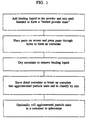
- a powder of fine particles is combined with a binding liquid to produce a wetted mass, such as a granulation or a paste.
- the wetted mass is then divided into small volumes which are dried to remove the binding liquid and to produce dry powder agglomerate units having a first size distribution.
- the dry powder agglomerate units are then adjusted to have a second size distribution characterized by the fact that the binding liquid is a non-aqueous solvent which minimises formation of crystalline bridges between particles, whereby the agglomerate units have a friability index in the range from about 10 to 60.
- nonaqueous solvent minimises the formation of crystalline bridges between particles.
- the minimization of crystalline bridges will allow the aggregated units to be broken down into the fine powder when needed.
- Many nonaqueous solvents also have a low boiling point, and therefore a high vapor pressure, so that they may be readily removed from the aggregated units.
- most nonaqueous solvents have a low surface tension and therefore form weak bonds between particles, allowing the agglomerated units to be broken down into the fine particles when needed. Further, some nonaqueous solvents will not denature proteins.
- Preferable nonaqueous solvents include, but are not limited to toluene, xylene, benzene, acetone, hexane, octane, chloroform, methylene chloride, and fluorocarbons.
- fluorocarbon liquid in forming the aggregated units is particularly preferable because the fluorocarbon liquid will not dissolve lipophilic and hydrophilic compounds. Further, the fluorocarbon liquid has a low surface tension which forms a relatively weak bond between the fine particles of the aggregated units so that the aggregated units can easily be broken down to the fine particles when needed. Fluorocarbon liquids further have a high vapor pressure and are therefore easy to remove from the particles during formation of the aggregated units. Fluorocarbon liquids are also biocompatible with many pharmaceutical formulations. Preferable fluorocarbon liquids include but are not limited to perfluorodecalin and perfluorooctyl bromide.
- the fine particles have a mean particle size in the range from 1 ⁇ m to 5 ⁇ m.
- the dry powder agglomerate units have a mean size in the range from 50 ⁇ m to 600 ⁇ m, preferably between about 150 ⁇ m and 500 ⁇ m, and most preferably between 200 ⁇ m to 500 ⁇ m.
- the aggregated units will preferably be formed such that substantially all, i.e. about 90% or more, fall within a narrow size distribution, i.e. within about ⁇ 250 ⁇ m, more preferably within about ⁇ 150 ⁇ m, and most preferably within about ⁇ 100 ⁇ m.
- the paste or granulation is divided into small volumes by extruding the paste or granulation through a screen having holes in the range from 40 ⁇ m to 650 ⁇ m, and more preferably in the range from 150 ⁇ m to 500 ⁇ m.
- the holes are circular in geometry, thereby producing elongate cylindrical portions of extrudate.
- the extrudate is preferably dried at a temperature in the range from 15°C to 40°C.
- Preferable environments for drying the extrudate include the use of forced convection with dry air or by placing the extrudate in a vacuum.
- the dry powder agglomerate units are preferably sieved.
- the dry powder agglomerate units can further be adjusted to have a spherical geometry, often referred to as spheronization.
- the agglomerate units are spheronized by rolling the agglomerate units in a container.
- the nonaqueous solvent binding liquid is a fluorocarbon
- the fine particles will preferably comprise a medicament powder.
- the amount of binding liquid added to the medicament powder is preferably based on the surface area of the powder.
- the fluorocarbon liquid is perfluorodecalin. With such a configuration, the amount of fluorocarbon added is preferably in the range from 0.5 gram to 5 gram per gram of fine particles.
- the invention provides a method of agglomerating fine particle to produce dry powder agglomerate units. Although useful in a wide variety of applications, the method will find its greatest use in preparing such units for pulmonary drug delivery procedures which rely on the inhalation of a drug dispersion by a patient so that the active drug within the dispersion can reach the alveolar regions of the lung.
- the agglomeration method is provided to improve the ability to handle and process the fine particles.
- flowability of the particles is improved. Improved flowability is desirable in that it allows for easier transfer and metering of the particles.
- the aggregated units are formed by binding the fine particles together with a bond sufficiently strong to hold the fine particles together during handling and processing yet weak enough so that the aggregated units can be broken down to the fine particles when needed, usually upon dispersion into an aerosol for delivery of the particles to the lungs.
- the fine particles employed in the present invention have a size that is small enough to effectively be delivered to the alveolar regions of the lung when inhaled by a patient.
- Such particles are very fine, usually having a mean size in the range from 1 ⁇ m to 5 ⁇ m.
- Such small sizes make handling and metering of the particles difficult. For instance, transfer of the particles often occurs through a funnel. When traveling through the funnel, the particles often clump together and clog the funnel. By forming the particles into agglomerates, flowability is improved allowing for easier movement of the particles.
- the particles comprise a medicament powder.
- medicament powders include powders made of proteins, nucleic acids, peptides, buffer salts, other biomolecules, and the like, and can include carrier materials such as carbohydrates.
- carrier materials such as carbohydrates.
- One particularly preferable medicament powder is insulin which has been shown to be effective when delivered in powdered form.
- Aggregated units of the invention have a mean size in the range from 50 ⁇ m to 600 ⁇ m, more preferably between about 150 ⁇ m and 500 ⁇ m, and most preferably between 200 ⁇ m to 500 ⁇ m. Such a size allows for improved handling and flowability of the powder. As described in greater detail hereinafter, such a size is also small enough for the aggregated units to be effective when used in inhalation devices. To further improve the flowability, the aggregated units can optionally be provided with a spherical geometry. When forming the aggregated units, it is desirable to have substantially all, i.e. about 90% or more, fall within a narrow size distribution, i.e. within about ⁇ 250 ⁇ m, more preferably within about ⁇ 150 ⁇ m, and most preferably within about ⁇ 100 ⁇ m. Such a narrow size distribution makes it easier for the aggregated units to be dispersed within an inhaler.
- a nonaqueous solvent binding liquid is employed to bind the fine particles into aggregated units.
- the binding liquid is added to the particles, with the surface tension of the liquid holding the particles together.
- a granulation or paste is formed allowing the particles to be formed or molded into an aggregated unit having the desired shape and size.
- the aggregated unit is then dried to remove the binding liquid and to leave the aggregated unit in the desired shape.
- the resulting aggregated unit is held together by a series of bonds that are strong enough to hold the aggregated unit together during normal handling and metering procedures. At the same time, the bonds are weak enough so that the aggregated unit can be broken down to the fine particles when needed, i.e., the aggregated units have an appropriate level of friability. Sufficient friability is particularly important in inhalation devices where it is desirable to have the aggregated units broken down to the fine particles when delivered to the lungs. As used herein, the friability of the aggregated units is determined by the following friability test. The friability test measures the attrition of the aggregated units after shaking the units through a stack of sieves, using a specific frequency and amplitude, for a specified time.
- the sieve stack includes seven vertically arranged screens. Each screen is 3 inches in diameter and is separated from an adjacent screen by 3.18 cm (1.25 inches). In order from top to bottom, the screen sizes are: 1000 ⁇ m, 500 ⁇ m, 425 ⁇ m, 355 ⁇ m, 300 ⁇ m, 250 ⁇ m, and 150 ⁇ m. Below the 150 ⁇ m screen is a collection pan. To test the friability, an amount of the aggregated units in the range from about 0.4 g to 0.5 g is weighed to give a beginning weight W 1. The weighed aggregated units are then placed on the 1000 ⁇ m screen, and the entire stack is vibrated for 20 minutes with an amplitude of approximately 1 cm and at a frequency of approximately 5 Hz.
- the vibration is ceased, and the aggregated units which have not been broken down to the fine particles are collected and weighed to give a weight W 2 .
- the aggregated units can easily be collected by pouring them from the sieve stack since the fine powder will have either been collected in the pan or will coat the screens.
- the ending weight W 2 is then divided by the beginning weight W 1 to give a percentage of aggregated units that have not been broken down to the fine particles.
- the particular numerical values of the percentages are referred to as the friability index. For example, if 50 percent of the aggregated units were broken down using the friability test, the friability index for such aggregated units would be 50.
- a preferable friability index for pulmonary powder inhalers as described herein is in the range from about 10 to 60.
- the binding liquid In addition to holding the agglomerate together, the binding liquid also reduces the level of dust, or loss of product, when applied to the powder. In this way, waste of the powdered medicaments is reduced.
- nonaqueous solvents include fluorocarbon liquid, and more preferably perfluorodecalin or perfluorooctyl bromide, with the most preferred being perfluorodecalin.
- Other exemplary nonaqueous solvents include toluene, xylene, benzene, acetone, hexane, octane, chloroform, and methylene chloride.
- the use of a nonaqueous solvent is essential because carbohydrates and proteins are usually poorly soluble in them, thereby minimizing the formation of crystalline bridges between particles.
- most nonaqueous solvents have a low surface tension which allows the agglomerates to more easily be broken down to the fine particles when needed.
- many nonaqueous solvents have a low boiling point, and hence high vapor pressure, allowing them to be easily removed from the agglomerates.
- some nonaqueous solvents will not denature proteins.
- fluorocarbon liquids are particularly preferable in that they are hydrophobic and do not dissolve carbohydrates or proteins. Fluorocarbon liquids are also lipophobic and do not interact with the proteins. Further, fluorocarbon liquids have a low surface tension and therefore form weak bonds between the particles so that the desired level of friability for the agglomerates can be obtained. Fluorocarbon liquids also have a high vapor pressure and are therefore easy to remove from the agglomerates. In a further advantage, fluorocarbon liquids do not contain fluorine and are therefore ozone-friendly. In a further aspect, fluorocarbon liquids are biocompatible with most pharmaceutical formulations, such as blood substitutes and imaging aids.
- Suitable fluorocarbon liquids are commercially available from a variety of commercial suppliers including PCR, Inc. (Gainesville, FL), Sigma Chemical Company (St. Louis, MO), and Aldrich Chemical Company, Inc. (Milwaukee, WI) .
- the aggregated units must be broken down to the powdered medicament.
- the aggregated units can be broken down into powdered form within the inhaler. In this way, the powdered medicaments can remain in agglomerate form for measurement and handling until needed for pulmonary delivery by the inhaler.
- the aggregated units are usually delivered to the inhaler in unit dosage receptacles, commonly referred to as blister packs or cartridges.
- blister packs or cartridges.
- the manufacture of blister packs is well-known in the pharmaceutical packaging art and need not be described further.
- To extract the aggregated units from the receptacle a wall of the receptacle is pierced when the receptacle is held within the inhaler.
- An exemplary inhaler is described in U.S. Patent Application Serial No. 08/309,691, filed September 21, 1994. With the receptacle opened, the aggregated units are extracted into a gas stream having sufficient disruptive force to break down the aggregated units to the fine particles.
- the aggregated units can be broken down to the fine particles when the gas stream is flowed at a velocity sufficient to provide adequate shear forces needed to break down the aggregated units.
- a gas stream is flowed at a sonic velocity to provide the sufficient disruptive force.
- the blister packs can be subjected to vibratory energy. Subjecting the aggregated units to vibratory energy when within the blister packs assists in breaking down the aggregated units to the fine particles before they are extracted by the inhaler. In this way, the aggregated units can be produced with a smaller friability index and still be useful in pulmonary delivery procedures.
- the aggregated units should be broken down substantially completely, i.e., at least 30%, preferably at least 50%, and most preferably at least 70% of the aggregated units that are extracted from the receptacle being broken down to 1 ⁇ m to 5 ⁇ m, before being inhaled by the patient.
- Such decomposition to the fine particles is realizable when the aggregated units have a friability index in the range from about 10 to 60.
- substantial complete removal of the aggregated units (usually at least 55 percent, and preferably at least 70 percent, and more preferably at least 90 percent by weight) from the interior of the receptacle is obtainable.
- Formation of aggregated units having a mean size range of greater than about 600 ⁇ m reduces the percentage of powder removed from the receptacle by the airstream because the larger aggregated units tend to become trapped behind the penetrated walls of the receptacle.
- a binding liquid is added to a powder of fine particles to produce a wetted powder mass.
- the fine particles are a medicament powder having a mean particle size in the range from 1 ⁇ m to 5 ⁇ m
- the binding liquid is a nonaqueous solvent, preferably fluorocarbon, and more preferably perfluorodecalin.
- the granulation or paste is mixed to ensure uniform distribution of the binding liquid. After mixing, the granulation or paste is extruded to divide the granulation or paste into smaller volumes.
- the granulation or paste is preferably extruded by pressing the granulation or paste through a screen having holes in the range from 40 ⁇ m to 650 ⁇ m, preferably at about 150 ⁇ m to 500 ⁇ m, and more preferably at about 250 ⁇ m to 400 ⁇ m.
- Extrusion screens having less than 500 ⁇ m holes can be provided by mechanical punching, electrical discharge, or laser drilling a thin sheet of metal as is known in the art.
- the holes in the extrusion screen are preferably circular in geometry so that elongate cylindrical portions of extrudate are formed when the paste is pressed through the screen.
- the extrudate is then dried to remove the binding liquid from the extrudate. Drying can be accomplished in a variety of ways including placing the extrudate in a vacuum chamber having a vacuum in the range from 250 mmHg to 650 mmHg, and with a temperature within the chamber being in the range from 15°C to 40°C or by forced convection with dry air having a temperature in the range from about 15°C to 40°C. After drying, the extrudate is sieved to break up the extrudate into agglomerated particle units and to classify the agglomerated particle units by size.
- the sieve will have holes sized in the range from 150 ⁇ m to 1000 ⁇ m and will be vibrated either at a frequency in the range from 0.5 Hz to 10 Hz and at an amplitude in the range from about 5 mm to 50 mm or, alternatively, vibration may be accomplished by a tapping action combined with lateral and/or tiling motions or circular rotation.
- the resulting agglomerated particle units preferably have a mean size in the range from 50 ⁇ m to 600 ⁇ m, more preferably between about 150 ⁇ m and 500 ⁇ m, and most preferably between 200 ⁇ m to 500 ⁇ m.
- the agglomerated particle units can be subjected to a spheronization process to spheronize the agglomerated units. Spheronization is often desirable because it can improve the flowability of the agglomerated particle units. Spheronization can occur by rolling the agglomerated particle units, such as in a metal or a glass container.
- the amount of binding liquid added to the medicament powder is generally based on the surface area of the fine particles, as illustrated in the following examples.
- the amount of fluorocarbon added is preferably in the range from 0.5 gram to 5 gram per gram of fine particles.
- Fine powders having a weight of about 0.5g to 10g were combined with a nonaqueous solvent to form a wetted mass.
- the wetted mass was then extruded through a screen.
- the resulting extrudate was then dried (by forced convection or in a vacuum) at room temperature for at least one hour to remove the nonaqueous solvent.
- the dried extrudate was then sieved to produce aggregated units.
- the size of the aggregated units was measured to determine the percentage falling between 200 ⁇ m and 500 ⁇ m.
- the friability of the first three batches of aggregate units was also measured according to the friability test as previously described. The results were acceptable if the aggregated units had a friability index between 10 and 60.
Landscapes
- Health & Medical Sciences (AREA)
- Bioinformatics & Cheminformatics (AREA)
- Engineering & Computer Science (AREA)
- Life Sciences & Earth Sciences (AREA)
- Animal Behavior & Ethology (AREA)
- Public Health (AREA)
- Medicinal Chemistry (AREA)
- Pharmacology & Pharmacy (AREA)
- Epidemiology (AREA)
- Chemical & Material Sciences (AREA)
- Veterinary Medicine (AREA)
- General Health & Medical Sciences (AREA)
- Pulmonology (AREA)
- Otolaryngology (AREA)
- Biophysics (AREA)
- Molecular Biology (AREA)
- Medicinal Preparation (AREA)
- Physical Or Chemical Processes And Apparatus (AREA)
- Medicines Containing Material From Animals Or Micro-Organisms (AREA)
- Medicines That Contain Protein Lipid Enzymes And Other Medicines (AREA)
- Pharmaceuticals Containing Other Organic And Inorganic Compounds (AREA)
Abstract
Description
| Fine Powder Composition | Nonaqueous Solvent/ Amount Added (g/g) | Screen Type/ Hole Size | Extruded Material in the Proper Size Range | Friability |
| Mannitol with HSA | PFOB/2.0 | Standard Sieve Screen/355 µm | 92% | Acceptable |
| Mannitol with Insulin | PFD/3.8 | Laser Drilled/250 µm | 69% | Acceptable |
| Mannitol with HSA | PFD/2.2 | Laser Drilled/175 µm | 73% | Acceptable |
| Mannitol with HSA | Acetone/0.8 | Laser Drilled/355 µm | 12% | Acceptable |
| Mannitol with HSA | Methylene Chloride/1.3 | Laser Drilled/355 µm | 14% | Acceptable |
| Mannitol with HSA | Toluene/0.9 | Laser Drilled/355 µm | 64% | Acceptable |
Claims (10)
- A method of agglomerating fine particles, comprising;
combining a powder of fine particles having a mean particle size in the range from 1 µm to 5 µm with a binding liquid to produce a granulation or a paste;
dividing the granulation or paste into small volumes;
drying the small volumes to remove binding liquid and produce dry powder agglomerate units having a first size distribution;
adjusting the dry powder agglomerate units to have a second size distribution in which the units have a mean size in the range from 50 µm to 600 µm, characterized in that the binding liquid is a nonaqueous solvent which minimises formation of crystalline bridges between particles, whereby the agglomerate units have a friability index in the range from 10 to 60. - A method as in claim 1, wherein the dividing step comprises extruding the granulation or paste through a screen having holes in the range from 40 µm to 650 µm, with the granulation or paste being extruded into elongate cylindrical portions.
- A method as in claim 1 or claim 2, wherein the granulation or paste is dried at a temperature in the range from 15°C to 40°C in a vacuum or by forced air convection.
- A method as in any one of the preceding claims, further comprising treating the size adjusted agglomerate units to have a spherical geometry by rolling the agglomerate units in a container to spheronize the agglomerate units.
- A method as in any one of the preceding claims, wherein the adjusting step comprises sieving the dry power agglomerate units to adjust the dry power agglomerate units to the second size distribution so that at least 90% of the dry power agglomerate units have a size within ±250 µm of each other.
- A method as in one of the preceding claims, wherein the fine particles are a medicament powder selected from the group consisting of protein, nucleic acid, peptide, buffer salt, and carbohydrate medicaments.
- A method as in one of the preceding claims, wherein the amount of binding liquid added is based on the surface area of the fine particles.
- A method as in one of the preceding claims, wherein the nonaqueous solvent binding liquid comprises a fluorocarbon binding liquid.
- A method as in claim 8, wherein the fluorocarbon binding liquid is selected from the group consisting of perfluorodecalin and perfluorooctyl bromide.
- A method as in claim 8 or claim 9, wherein the amount of fluorocarbon added is in the range from 0.5 gram to 5 gram per gram of fine particles.
Applications Claiming Priority (3)
| Application Number | Priority Date | Filing Date | Title |
|---|---|---|---|
| US08/483,467 US5654007A (en) | 1995-06-07 | 1995-06-07 | Methods and system for processing dispersible fine powders |
| US483467 | 1995-06-07 | ||
| PCT/US1996/008282 WO1996040068A1 (en) | 1995-06-07 | 1996-05-30 | Methods and system for processing dispersible fine powders |
Publications (3)
| Publication Number | Publication Date |
|---|---|
| EP0831782A1 EP0831782A1 (en) | 1998-04-01 |
| EP0831782A4 EP0831782A4 (en) | 2001-08-29 |
| EP0831782B1 true EP0831782B1 (en) | 2005-12-14 |
Family
ID=23920152
Family Applications (1)
| Application Number | Title | Priority Date | Filing Date |
|---|---|---|---|
| EP96916928A Expired - Lifetime EP0831782B1 (en) | 1995-06-07 | 1996-05-30 | Methods and system for processing dispersible fine powders |
Country Status (10)
| Country | Link |
|---|---|
| US (2) | US5654007A (en) |
| EP (1) | EP0831782B1 (en) |
| JP (1) | JPH11507040A (en) |
| KR (1) | KR100567645B1 (en) |
| AT (1) | ATE312600T1 (en) |
| AU (1) | AU701530B2 (en) |
| CA (1) | CA2224064A1 (en) |
| DE (1) | DE69635578T2 (en) |
| MX (1) | MX9709448A (en) |
| WO (1) | WO1996040068A1 (en) |
Cited By (2)
| Publication number | Priority date | Publication date | Assignee | Title |
|---|---|---|---|---|
| US7836922B2 (en) | 2005-11-21 | 2010-11-23 | Mannkind Corporation | Powder dispenser modules and powder dispensing methods |
| US9221561B2 (en) | 2008-08-05 | 2015-12-29 | Mannkind Corporation | Powder dispenser modules and powder dispenser assemblies |
Families Citing this family (148)
| Publication number | Priority date | Publication date | Assignee | Title |
|---|---|---|---|---|
| US7628339B2 (en) | 1991-04-24 | 2009-12-08 | Novartis Pharma Ag | Systems and methods for controlling fluid feed to an aerosol generator |
| US6540154B1 (en) | 1991-04-24 | 2003-04-01 | Aerogen, Inc. | Systems and methods for controlling fluid feed to an aerosol generator |
| US5983956A (en) | 1994-10-03 | 1999-11-16 | Astra Aktiebolag | Formulation for inhalation |
| US5980949A (en) * | 1994-10-03 | 1999-11-09 | Astra Aktiebolag | Formulation for inhalation |
| US6427682B1 (en) | 1995-04-05 | 2002-08-06 | Aerogen, Inc. | Methods and apparatus for aerosolizing a substance |
| US6205999B1 (en) | 1995-04-05 | 2001-03-27 | Aerogen, Inc. | Methods and apparatus for storing chemical compounds in a portable inhaler |
| US5758637A (en) | 1995-08-31 | 1998-06-02 | Aerogen, Inc. | Liquid dispensing apparatus and methods |
| US6085740A (en) | 1996-02-21 | 2000-07-11 | Aerogen, Inc. | Liquid dispensing apparatus and methods |
| US6672304B1 (en) | 1995-06-08 | 2004-01-06 | Innovative Devices, Llc | Inhalation actuated device for use with metered dose inhalers (MDIs) |
| GB9616047D0 (en) * | 1996-07-31 | 1996-09-11 | Glaxo Group Ltd | Medicament carrier with agglomerated large medicament particles and related method of manufacture thereof |
| US6458574B1 (en) | 1996-09-12 | 2002-10-01 | Transkaryotic Therapies, Inc. | Treatment of a α-galactosidase a deficiency |
| US6083725A (en) * | 1996-09-13 | 2000-07-04 | Transkaryotic Therapies, Inc. | Tranfected human cells expressing human α-galactosidase A protein |
| SE9700135D0 (en) | 1997-01-20 | 1997-01-20 | Astra Ab | New formulation |
| SE9700133D0 (en) * | 1997-01-20 | 1997-01-20 | Astra Ab | New formulation |
| US6153211A (en) * | 1997-07-18 | 2000-11-28 | Infimed, Inc. | Biodegradable macromers for the controlled release of biologically active substances |
| US6309623B1 (en) | 1997-09-29 | 2001-10-30 | Inhale Therapeutic Systems, Inc. | Stabilized preparations for use in metered dose inhalers |
| US6565885B1 (en) | 1997-09-29 | 2003-05-20 | Inhale Therapeutic Systems, Inc. | Methods of spray drying pharmaceutical compositions |
| US6433040B1 (en) * | 1997-09-29 | 2002-08-13 | Inhale Therapeutic Systems, Inc. | Stabilized bioactive preparations and methods of use |
| US20060165606A1 (en) | 1997-09-29 | 2006-07-27 | Nektar Therapeutics | Pulmonary delivery particles comprising water insoluble or crystalline active agents |
| US20020017295A1 (en) * | 2000-07-07 | 2002-02-14 | Weers Jeffry G. | Phospholipid-based powders for inhalation |
| US6946117B1 (en) | 1997-09-29 | 2005-09-20 | Nektar Therapeutics | Stabilized preparations for use in nebulizers |
| ATE248583T1 (en) * | 1997-09-29 | 2003-09-15 | Nektar Therapeutics | STABILIZED PREPARATIONS USABLE IN DOSAGE INHALERS |
| GEP20043260B (en) | 1998-03-16 | 2004-06-25 | Nectar Therapeutics | Aerosolized Active Agent Delivery and Device for Realization Thereof |
| US6593133B1 (en) | 1998-07-06 | 2003-07-15 | Nsgene A/S | Neurotrophic factors |
| US6956021B1 (en) * | 1998-08-25 | 2005-10-18 | Advanced Inhalation Research, Inc. | Stable spray-dried protein formulations |
| UA73924C2 (en) * | 1998-10-09 | 2005-10-17 | Nektar Therapeutics | Device for delivering active agent formulation to lungs of human patient |
| US6660715B2 (en) | 1998-11-19 | 2003-12-09 | Massachusetts Institute Of Technology | Nonaqueous solutions and suspensions of macromolecules for pulmonary delivery |
| EP2191718A1 (en) | 1998-12-22 | 2010-06-02 | The University of North Carolina at Chapel Hill | Compounds and uses for the treatment of airway diseases and for the delivery of airway drugs |
| US20020006901A1 (en) * | 1999-02-05 | 2002-01-17 | Aldo T. Iacono | Use of aerosolized cyclosporine for prevention and treatment of pulmonary disease |
| AU779869B2 (en) | 1999-04-13 | 2005-02-17 | Nektar Therapeutics | Pulmonary administration of dry powder formulations for treating infertility |
| HK1049621A1 (en) | 1999-06-09 | 2003-05-23 | 罗伯特‧E‧希弗斯 | Supercritical fluid-assisted nebulization and bubble drying |
| US6606992B1 (en) | 1999-06-30 | 2003-08-19 | Nektar Therapeutics | Systems and methods for aerosolizing pharmaceutical formulations |
| US6749835B1 (en) | 1999-08-25 | 2004-06-15 | Advanced Inhalation Research, Inc. | Formulation for spray-drying large porous particles |
| US7678364B2 (en) | 1999-08-25 | 2010-03-16 | Alkermes, Inc. | Particles for inhalation having sustained release properties |
| US20010036481A1 (en) * | 1999-08-25 | 2001-11-01 | Advanced Inhalation Research, Inc. | Modulation of release from dry powder formulations |
| CA2382821A1 (en) * | 1999-08-25 | 2001-03-01 | Advanced Inhalation Research, Inc. | Modulation of release from dry powder formulations |
| US6235177B1 (en) | 1999-09-09 | 2001-05-22 | Aerogen, Inc. | Method for the construction of an aperture plate for dispensing liquid droplets |
| DE60025019T2 (en) * | 1999-10-29 | 2006-08-24 | Nektar Therapeutics, San Carlos | DRY POWDER COMPOSITIONS WITH IMPROVED DISPERSIBILITY |
| US20010029947A1 (en) * | 1999-12-17 | 2001-10-18 | Steve Paboojian | Receptacles to facilitate the extraction of powders |
| EP1242112A4 (en) * | 1999-12-21 | 2005-02-09 | Rxkinetix Inc | Particulate drug-containing products and method of manufacture |
| US6761909B1 (en) | 1999-12-21 | 2004-07-13 | Rxkinetix, Inc. | Particulate insulin-containing products and method of manufacture |
| HUP0203751A3 (en) | 2000-01-10 | 2005-01-28 | Maxygen Holdings Ltd Redwood C | G-csf conjugates |
| US7971588B2 (en) | 2000-05-05 | 2011-07-05 | Novartis Ag | Methods and systems for operating an aerosol generator |
| US6948491B2 (en) | 2001-03-20 | 2005-09-27 | Aerogen, Inc. | Convertible fluid feed system with comformable reservoir and methods |
| MXPA02010884A (en) | 2000-05-05 | 2003-03-27 | Aerogen Ireland Ltd | Apparatus and methods for the delivery of medicaments to the respiratory system. |
| US7100600B2 (en) | 2001-03-20 | 2006-09-05 | Aerogen, Inc. | Fluid filled ampoules and methods for their use in aerosolizers |
| US7600511B2 (en) | 2001-11-01 | 2009-10-13 | Novartis Pharma Ag | Apparatus and methods for delivery of medicament to a respiratory system |
| US8336545B2 (en) | 2000-05-05 | 2012-12-25 | Novartis Pharma Ag | Methods and systems for operating an aerosol generator |
| PT1280520E (en) | 2000-05-10 | 2014-12-16 | Novartis Ag | Phospholipid-based powders for drug delivery |
| US6948494B1 (en) | 2000-05-10 | 2005-09-27 | Innovative Devices, Llc. | Medicament container with same side airflow inlet and outlet and method of use |
| US8404217B2 (en) | 2000-05-10 | 2013-03-26 | Novartis Ag | Formulation for pulmonary administration of antifungal agents, and associated methods of manufacture and use |
| US7871598B1 (en) | 2000-05-10 | 2011-01-18 | Novartis Ag | Stable metal ion-lipid powdered pharmaceutical compositions for drug delivery and methods of use |
| US6668827B2 (en) * | 2000-05-16 | 2003-12-30 | Nektar Therapeutics | Systems devices and methods for opening receptacles having a powder to be fluidized |
| US6613308B2 (en) * | 2000-09-19 | 2003-09-02 | Advanced Inhalation Research, Inc. | Pulmonary delivery in treating disorders of the central nervous system |
| US6514482B1 (en) | 2000-09-19 | 2003-02-04 | Advanced Inhalation Research, Inc. | Pulmonary delivery in treating disorders of the central nervous system |
| US20020141946A1 (en) * | 2000-12-29 | 2002-10-03 | Advanced Inhalation Research, Inc. | Particles for inhalation having rapid release properties |
| US7442370B2 (en) | 2001-02-01 | 2008-10-28 | Biogen Idec Ma Inc. | Polymer conjugates of mutated neublastin |
| EP1366075B1 (en) | 2001-02-27 | 2009-05-27 | Maxygen Aps | New interferon beta-like molecules |
| US7276580B2 (en) * | 2001-03-12 | 2007-10-02 | Biogen Idec Ma Inc. | Neurotrophic factors |
| US6546927B2 (en) | 2001-03-13 | 2003-04-15 | Aerogen, Inc. | Methods and apparatus for controlling piezoelectric vibration |
| US6732944B2 (en) | 2001-05-02 | 2004-05-11 | Aerogen, Inc. | Base isolated nebulizing device and methods |
| EG24184A (en) * | 2001-06-15 | 2008-10-08 | Otsuka Pharma Co Ltd | Dry powder inhalation system for transpulmonary |
| WO2003015747A1 (en) | 2001-08-13 | 2003-02-27 | Genomed, Llc | Method to treat pulmonary hypoplasia in the newborn |
| ITMI20012174A1 (en) * | 2001-10-18 | 2003-04-18 | Univ Parma | POWDER FOR NASAL DRUG ADMINISTRATION |
| CA2465675C (en) * | 2001-11-20 | 2008-06-10 | Advanced Inhalation Research, Inc. | Improved particulate compositions for pulmonary delivery |
| US20030129250A1 (en) * | 2001-11-20 | 2003-07-10 | Advanced Inhalation Research Inc. | Particulate compositions for improving solubility of poorly soluble agents |
| TWI324518B (en) * | 2001-12-19 | 2010-05-11 | Nektar Therapeutics | Pulmonary delivery of aminoglycosides |
| US7677467B2 (en) | 2002-01-07 | 2010-03-16 | Novartis Pharma Ag | Methods and devices for aerosolizing medicament |
| WO2003057291A1 (en) | 2002-01-07 | 2003-07-17 | Aerogen, Inc. | Devices and methods for nebulizing fluids for inhalation |
| JP4761709B2 (en) | 2002-01-15 | 2011-08-31 | エアロジェン,インコーポレイテッド | Method and system for operating an aerosol generator |
| AU2003217950A1 (en) * | 2002-03-05 | 2003-09-22 | Cleveland State University | Agglomerated particles for aerosol drug delivery |
| SI2630954T1 (en) * | 2002-03-20 | 2017-02-28 | Civitas Therapeutics, Inc. | Pulmonary delivery for levodopa |
| WO2003088961A1 (en) * | 2002-04-19 | 2003-10-30 | Yissum Research Development Company Of The Hebrew University Of Jerusalem | Beta-agonist compounds comprising nitric oxide donor groups and reactive oxygen species scavenger groups and their use in the treatment of respiratory disorders |
| DK1503788T3 (en) | 2002-04-25 | 2011-10-17 | Shire Human Genetic Therapies | Treatment of alpha-galactosidase A deficiency |
| EP1531795A4 (en) | 2002-05-02 | 2011-02-23 | Harvard College | FORMULATIONS LIMITING THE EXTENSION OF PULMONARY INFECTIONS |
| US20050220720A1 (en) * | 2002-05-02 | 2005-10-06 | David Edwards | Formulations limiting spread of pulmonary infections |
| US6915962B2 (en) | 2002-05-20 | 2005-07-12 | Aerogen, Inc. | Apparatus for providing aerosol for medical treatment and methods |
| US6930137B2 (en) * | 2002-05-31 | 2005-08-16 | Fina Technology, Inc. | Method of improving blown film processing performance and physical properties |
| US7185651B2 (en) * | 2002-06-18 | 2007-03-06 | Nektar Therapeutics | Flow regulator for aerosol drug delivery and methods |
| WO2004037843A2 (en) * | 2002-10-25 | 2004-05-06 | Yissum Research Development Company Of The Hebrew University Of Jerusalem | Steroid compounds comprising superoxide dismutase mimic groups and nitric oxide donor groups, and their use in the preparation of medicaments |
| JP4571776B2 (en) * | 2002-11-05 | 2010-10-27 | Jx日鉱日石エネルギー株式会社 | Lubricating oil composition |
| HRP20050638A2 (en) * | 2002-12-13 | 2007-03-31 | Otsuka Pharmaceutical Co. | Inhalation device for transpulmonary administration |
| JP5589165B2 (en) | 2003-01-31 | 2014-09-17 | マウント シナイ スクール オブ メディシン オブ ニューヨーク ユニバーシティー | Combination therapy for the treatment of protein deficiency disorders |
| EP1897552B1 (en) | 2003-04-18 | 2009-06-17 | Biogen Idec MA Inc. | Polymer-conjugated glycosylated neublastin |
| US8616195B2 (en) | 2003-07-18 | 2013-12-31 | Novartis Ag | Nebuliser for the production of aerosolized medication |
| AU2004266704B2 (en) | 2003-08-18 | 2012-02-23 | Parion Sciences, Inc. | Capped pyrazinoylguanidine sodium channel blockers |
| CA2555841A1 (en) * | 2004-02-12 | 2005-09-01 | Nektar Therapeutics | Interleukin-13 antagonist powders, spray-dried particles, and methods |
| US20050207983A1 (en) * | 2004-03-05 | 2005-09-22 | Pulmatrix, Inc. | Formulations decreasing particle exhalation |
| AU2005229434B2 (en) | 2004-03-30 | 2010-09-30 | Nsgene A/S | Therapeutic use of a growth factor, NsG33 |
| US7290541B2 (en) | 2004-04-20 | 2007-11-06 | Aerogen, Inc. | Aerosol delivery apparatus and method for pressure-assisted breathing systems |
| US7267121B2 (en) | 2004-04-20 | 2007-09-11 | Aerogen, Inc. | Aerosol delivery apparatus and method for pressure-assisted breathing systems |
| US7946291B2 (en) | 2004-04-20 | 2011-05-24 | Novartis Ag | Ventilation systems and methods employing aerosol generators |
| CN101027318B (en) | 2004-07-19 | 2016-05-25 | 比奥孔有限公司 | Insulin-oligomer conjugates, preparations and uses thereof |
| WO2006013462A2 (en) * | 2004-07-30 | 2006-02-09 | Nsgene A/S | Growth factors nsg28, nsg30, and nsg32 |
| DK1786454T3 (en) * | 2004-08-19 | 2010-09-06 | Biogen Idec Inc | Neublastin variants |
| CN101043899B (en) | 2004-08-19 | 2011-03-30 | 比奥根艾迪克Ma公司 | Refolding transforming growth factor beta family proteins |
| UA95446C2 (en) | 2005-05-04 | 2011-08-10 | Іллюміджен Байосайєнсіз, Інк. | Mutations in oas1 genes |
| EP3782655A1 (en) | 2005-05-17 | 2021-02-24 | Amicus Therapeutics, Inc. | A method for the treatment of pompe disease using 1-deoxynojirimycin and derivatives |
| WO2006125153A2 (en) * | 2005-05-18 | 2006-11-23 | Pulmatrix Inc. | Formulations for alteration of biophysical properties of mucosal lining |
| NZ563360A (en) | 2005-05-25 | 2011-04-29 | Aerogen Inc | Aerosolising liquid using an apertured membrane aligned within a peizoelectric ring |
| US7474379B2 (en) * | 2005-06-28 | 2009-01-06 | Asml Netherlands B.V. | Lithographic apparatus and device manufacturing method |
| WO2007016643A2 (en) * | 2005-08-01 | 2007-02-08 | Mount Sinai School Of Medicine Of New York University | A method for extending longevity using npc1l1 antagonists |
| WO2007098507A2 (en) | 2006-02-24 | 2007-08-30 | Rigel Pharmaceuticals, Inc. | Compositions and methods for inhibition of the jak pathway |
| TWI501774B (en) | 2006-02-27 | 2015-10-01 | Biogen Idec Inc | Treatments for neurological disorders |
| US20100056440A1 (en) * | 2006-03-01 | 2010-03-04 | Biogen Idec Ma Inc. | Compositions and methods for administering gdnf ligand family proteins |
| TWI445544B (en) | 2007-05-01 | 2014-07-21 | Biogen Idec Inc | Compositions and methods for increasing vascularization |
| US20110135648A1 (en) * | 2007-08-08 | 2011-06-09 | Biogen Idec Ma Inc. | Anti-neublastin antibodies and uses thereof |
| WO2009139948A1 (en) | 2008-02-26 | 2009-11-19 | Johnson Michael R | Poly aromatic sodium channel blockers |
| EP2344200A2 (en) * | 2008-09-19 | 2011-07-20 | Nektar Therapeutics | Modified therapeutics peptides, methods of their preparation and use |
| EP2350118B1 (en) | 2008-09-19 | 2016-03-30 | Nektar Therapeutics | Carbohydrate-based drug delivery polymers and conjugates thereof |
| PL2389372T3 (en) | 2009-01-23 | 2016-02-29 | Rigel Pharmaceuticals Inc | Compositions and methods for inhibition of the jak pathway |
| JP5645918B2 (en) | 2009-04-09 | 2014-12-24 | アミカス セラピューティックス インコーポレイテッド | Method for preventing and / or treating lysosomal storage disorders |
| EP2440251A4 (en) | 2009-06-09 | 2013-01-16 | Defyrus Inc | Administration of interferon for prophylaxis against or treatment of pathogenic infection |
| WO2011049737A1 (en) | 2009-10-19 | 2011-04-28 | Amicus Therapeutics, Inc. | Novel compositions for preventing and/or treating lysosomal storage disorders |
| RU2015147509A (en) | 2009-10-19 | 2019-01-14 | Амикус Терапьютикс, Инк. | NEW COMPOSITIONS FOR PREVENTING AND / OR TREATING DEGENERATIVE DISORDERS OF THE CENTRAL NERVOUS SYSTEM |
| WO2011092690A1 (en) | 2010-01-26 | 2011-08-04 | Yissum Research Development Company Of The Hebrew University Of Jerusalem Ltd | Compositions and methods for prevention and treatment of pulmonary hypertension |
| EP2580242B1 (en) | 2010-06-14 | 2016-04-06 | H. Lundbeck A/S | Modulation of the interaction between sorla and gdnf-family ligand receptors |
| US8758824B2 (en) | 2010-08-30 | 2014-06-24 | Pulmatrix, Inc. | Respirably dry powder comprising calcium lactate, sodium chloride and leucine |
| WO2012030664A1 (en) | 2010-08-30 | 2012-03-08 | Pulmatrix, Inc. | Dry powder formulations and methods for treating pulmonary diseases |
| EP4008326A1 (en) | 2010-09-29 | 2022-06-08 | Pulmatrix Operating Company, Inc. | Monovalent metal cation dry powders for inhalation |
| PT2621488T (en) | 2010-09-29 | 2019-02-12 | Pulmatrix Operating Co Inc | Cationic dry powders |
| CA2754237A1 (en) | 2011-05-27 | 2012-11-27 | The Regents Of The University Of California | Cyanoquinoline compounds having activity in correcting mutant-cftr processing and increasing ion transport and uses thereof |
| SI2723176T1 (en) | 2011-06-27 | 2017-09-29 | Parion Sciences, Inc. | A chemically and metabolically stable dipeptide possessing potent sodium channel blocker activity |
| US20130096170A1 (en) | 2011-10-14 | 2013-04-18 | Hospira, Inc. | Methods of treating pediatric patients using dexmedetomidine |
| US8242158B1 (en) | 2012-01-04 | 2012-08-14 | Hospira, Inc. | Dexmedetomidine premix formulation |
| US20150136130A1 (en) | 2012-02-29 | 2015-05-21 | Pulmatrix, Inc. | Inhalable dry powders |
| CA2809279C (en) * | 2012-03-23 | 2014-05-06 | Pharma 73 S.A. | Natural biocomposite powder prepared from pichia pastoris biomass, method of preparation and its use as excipient |
| WO2013142038A2 (en) | 2012-03-23 | 2013-09-26 | Oxigene, Inc. | Compositions and methods for inhibition of cathepsins |
| MX354127B (en) | 2012-03-27 | 2018-02-14 | Amicus Therapeutics Inc | NEW COMPOUNDS TO PREVENT AND / OR TREAT LISOSOMIC TESAURISMOSIS AND / OR DEGENERATIVE DISORDERS OF THE CENTRAL NERVOUS SYSTEM. |
| KR20150135328A (en) | 2013-04-01 | 2015-12-02 | 풀매트릭스 인코퍼레이티드 | Tiotropium dry powders |
| CA2939380A1 (en) | 2014-02-12 | 2015-08-20 | Amicus Therapeutics, Inc. | Sugar derivatives comprising sulfur-containing moieties and methods of making same and methods of using the same for the treatment of mps iiic |
| US9675627B2 (en) | 2014-04-14 | 2017-06-13 | Amicus Therapeutics, Inc. | Dosing regimens for treating and/or preventing cerebral amyloidoses |
| AU2015263025A1 (en) | 2014-05-21 | 2017-01-12 | Pharma73, S.A. | Chitin-glucan complex, its preparation, and uses |
| KR101746911B1 (en) | 2014-12-26 | 2017-06-28 | 주식회사 종근당 | Pharmaceutical composition comprising granules containing an active ingredient with adjusted diameter size |
| US10179128B2 (en) | 2015-08-31 | 2019-01-15 | Amicus Therapeutics, Inc. | Regimens for treating and preventing lysosomal disorders and degenerative disorders of the central nervous system |
| NL2017294B1 (en) | 2016-08-05 | 2018-02-14 | Univ Erasmus Med Ct Rotterdam | Natural cryptic exon removal by pairs of antisense oligonucleotides. |
| IL267689B2 (en) | 2016-12-31 | 2025-05-01 | Bioxcel Therapeutics Inc | Using sublingual dexmedetomidine to treat restlessness |
| KR20190134807A (en) | 2017-04-25 | 2019-12-04 | 아미쿠스 세라퓨틱스, 인코포레이티드 | Novel compositions for preventing and / or treating degenerative diseases and / or lysosomal reservoirs of the central nervous system |
| IL279713B2 (en) | 2018-06-27 | 2025-01-01 | Bioxcel Therapeutics Inc | Film formulations containing dexmedetomidine and methods of producing them |
| US11160791B2 (en) | 2018-11-01 | 2021-11-02 | Medefil, Inc. | Dexmedetomidine injection premix formulation in ready to use (RTU) bags |
| US20220000880A1 (en) | 2018-11-01 | 2022-01-06 | Rigel Pharmaceuticals, Inc. | Method and composition embodiments for treating acute myeloid leukemia |
| US20200377518A1 (en) | 2019-05-29 | 2020-12-03 | Rigel Pharmaceuticals, Inc. | Method of preventing and treating thrombosis |
| EP3999058A4 (en) | 2019-07-19 | 2023-05-03 | Bioxcel Therapeutics, Inc. | NON-SEDATIVE DEXMEDETOMIDINE-BASED TREATMENT REGIMEN |
| EP4009974A1 (en) | 2019-08-08 | 2022-06-15 | Rigel Pharmaceuticals, Inc. | Compounds and method for treating cytokine release syndrome |
| CA3147444A1 (en) | 2019-08-14 | 2021-02-18 | Rigel Pharmaceuticals, Inc. | Method of blocking or ameliorating cytokine release syndrome |
| WO2022006051A1 (en) | 2020-06-29 | 2022-01-06 | Anovent Pharmaceutical (U.S.), Llc | Formulation of tocilizumab and method for treating covid-19 by inhalation |
| ES3075943T3 (en) | 2022-03-23 | 2026-08-10 | Rigel Pharmaceuticals Inc | Pyrimid-2-yl-pyrazole compounds as irak inhibitors |
| US11806334B1 (en) | 2023-01-12 | 2023-11-07 | Bioxcel Therapeutics, Inc. | Non-sedating dexmedetomidine treatment regimens |
Family Cites Families (24)
| Publication number | Priority date | Publication date | Assignee | Title |
|---|---|---|---|---|
| GB1151017A (en) * | 1966-08-11 | 1969-05-07 | Pfizer & Co C | Process and Apparatus for the Production of Metal Powders. |
| US3920634A (en) * | 1974-08-30 | 1975-11-18 | Lilly Co Eli | 2,3-Dihydroestra-1,3,5(10)-trieno (16{60 ,17{60 -{62 ) furan-17{62 ols |
| US4161516A (en) * | 1975-07-25 | 1979-07-17 | Fisons Limited | Composition for treating airway disease |
| SE395611B (en) * | 1975-12-12 | 1977-08-22 | Draco Ab | AEROSOL INHALATION DEVICE INTENDED FOR INHALATION THROUGH AN INHALATION MOUTH OF PHARMACOLOGICALLY ACTIVE SUBSTANCES |
| SE411705B (en) * | 1976-11-09 | 1980-02-04 | Draco Ab | DEVICE FOR GENERATION OF A SHIELD, ESSENTIAL FUEL-FREE AEROSOL |
| SE438261B (en) * | 1981-07-08 | 1985-04-15 | Draco Ab | USE IN A DOSHALATOR OF A PERFORED MEMBRANE |
| EP0069715B1 (en) * | 1981-07-08 | 1986-11-05 | Aktiebolaget Draco | Powder inhalator |
| SE8401796D0 (en) * | 1984-04-02 | 1984-04-02 | Draco Ab | dosing device |
| IT1190371B (en) * | 1985-06-19 | 1988-02-16 | Zambon Spa | PROCESS FOR THE PREPARATION OF CIS-5-FLUORO-2-METHYL-1- (4-METHYLTHIOBENZYLIDEN) -INDENYL-3-ACETIC ACID |
| SE453566B (en) * | 1986-03-07 | 1988-02-15 | Draco Ab | POWDER INHALATOR DEVICE |
| SE8603812D0 (en) * | 1986-09-12 | 1986-09-12 | Draco Ab | ADMINISTRATION OF LIPOSOMES TO MAMMALS |
| FR2618674B1 (en) * | 1987-07-30 | 1990-06-15 | Ire Celltarg Sa | MICROPARTICLES COMPRISING A BIODEGRADABLE POLYMER CONTROLLING THE RELEASE OF AN ANTIMALARIA ACTIVE INGREDIENT, PHARMACEUTICAL COMPOSITIONS COMPRISING SAME AND METHOD OF PREPARATION |
| DK479189D0 (en) * | 1989-01-06 | 1989-09-28 | Hans Gernot Schenk | INHALER |
| SE9101090D0 (en) * | 1991-04-11 | 1991-04-11 | Astra Ab | PROCESS FOR CONDITIONING OF WATER-SOLUBLE SUBSTANCES |
| US5186166A (en) * | 1992-03-04 | 1993-02-16 | Riggs John H | Powder nebulizer apparatus and method of nebulization |
| US5639441A (en) * | 1992-03-06 | 1997-06-17 | Board Of Regents Of University Of Colorado | Methods for fine particle formation |
| SE9201411D0 (en) * | 1992-05-05 | 1992-05-05 | Astra Ab | DOSAGE INHALATOR WITH INDICATING / INTERUPTING MEANS |
| US5376359A (en) * | 1992-07-07 | 1994-12-27 | Glaxo, Inc. | Method of stabilizing aerosol formulations |
| SE9203743D0 (en) * | 1992-12-11 | 1992-12-11 | Astra Ab | EFFICIENT USE |
| IS1796B (en) * | 1993-06-24 | 2001-12-31 | Ab Astra | Inhaled polypeptide formulation composition which also contains an enhancer compound |
| TW402506B (en) * | 1993-06-24 | 2000-08-21 | Astra Ab | Therapeutic preparation for inhalation |
| ES2166786T3 (en) * | 1993-10-01 | 2002-05-01 | Astrazeneca Ab | PROCEDURE I. |
| US5711934A (en) * | 1994-04-11 | 1998-01-27 | Abbott Laboratories | Process for the continuous milling of aerosol pharmaceutical formulations in aerosol propellants |
| US5531219A (en) * | 1994-11-04 | 1996-07-02 | Alliance Pharmaceutical Corp. | Use of liquid fluorocarbons to facilitate pulmonary drug delivery |
-
1995
- 1995-06-07 US US08/483,467 patent/US5654007A/en not_active Expired - Lifetime
-
1996
- 1996-05-30 CA CA002224064A patent/CA2224064A1/en not_active Abandoned
- 1996-05-30 DE DE69635578T patent/DE69635578T2/en not_active Expired - Fee Related
- 1996-05-30 JP JP9500936A patent/JPH11507040A/en active Pending
- 1996-05-30 AT AT96916928T patent/ATE312600T1/en not_active IP Right Cessation
- 1996-05-30 KR KR1019970708700A patent/KR100567645B1/en not_active Expired - Fee Related
- 1996-05-30 WO PCT/US1996/008282 patent/WO1996040068A1/en not_active Ceased
- 1996-05-30 AU AU59643/96A patent/AU701530B2/en not_active Ceased
- 1996-05-30 EP EP96916928A patent/EP0831782B1/en not_active Expired - Lifetime
- 1996-05-30 MX MX9709448A patent/MX9709448A/en not_active IP Right Cessation
-
1997
- 1997-05-09 US US08/853,618 patent/US5922354A/en not_active Expired - Lifetime
Cited By (10)
| Publication number | Priority date | Publication date | Assignee | Title |
|---|---|---|---|---|
| US7836922B2 (en) | 2005-11-21 | 2010-11-23 | Mannkind Corporation | Powder dispenser modules and powder dispensing methods |
| US7950423B2 (en) | 2005-11-21 | 2011-05-31 | Mannkind Corporation | Powder transport systems and methods |
| US7958916B2 (en) | 2005-11-21 | 2011-06-14 | Mannkind Corporation | Powder dispensing and sensing apparatus and methods |
| US8025082B2 (en) | 2005-11-21 | 2011-09-27 | Mannkind Corporation | Powder dispenser modules and powder dispensing methods |
| US8220505B2 (en) | 2005-11-21 | 2012-07-17 | Mannkind Corporation | Powder transport systems and methods |
| US8230887B2 (en) | 2005-11-21 | 2012-07-31 | Mannkind Corporation | Powder dispensing and sensing apparatus and methods |
| US8803009B2 (en) | 2005-11-21 | 2014-08-12 | Mannkind Corporation | Powder dispensing and sensing apparatus and methods |
| US9772216B2 (en) | 2005-11-21 | 2017-09-26 | Mannkind Corporation | Powder dispensing and sensing apparatus and methods |
| US10620034B2 (en) | 2005-11-21 | 2020-04-14 | Mannkind Corporation | Powder dispensing and sensing apparatus and methods for simultaneous filling of cartridges |
| US9221561B2 (en) | 2008-08-05 | 2015-12-29 | Mannkind Corporation | Powder dispenser modules and powder dispenser assemblies |
Also Published As
| Publication number | Publication date |
|---|---|
| KR100567645B1 (en) | 2006-07-06 |
| MX9709448A (en) | 1998-02-28 |
| WO1996040068A1 (en) | 1996-12-19 |
| DE69635578T2 (en) | 2006-09-14 |
| JPH11507040A (en) | 1999-06-22 |
| AU701530B2 (en) | 1999-01-28 |
| KR19990022221A (en) | 1999-03-25 |
| EP0831782A4 (en) | 2001-08-29 |
| EP0831782A1 (en) | 1998-04-01 |
| DE69635578D1 (en) | 2006-01-19 |
| US5654007A (en) | 1997-08-05 |
| CA2224064A1 (en) | 1996-12-19 |
| ATE312600T1 (en) | 2005-12-15 |
| AU5964396A (en) | 1996-12-30 |
| US5922354A (en) | 1999-07-13 |
Similar Documents
| Publication | Publication Date | Title |
|---|---|---|
| US5922354A (en) | Methods and system for processing dispersible fine powders | |
| US6103270A (en) | Methods and system for processing dispersible fine powders | |
| AU2001282743B2 (en) | Electro-powder | |
| US6509006B1 (en) | Devices compositions and methods for the pulmonary delivery of aerosolized medicaments | |
| US7097827B2 (en) | Devices, compositions and methods for the pulmonary delivery of aerosolized medicaments | |
| AU2001282743A1 (en) | Electro-powder | |
| EP1036562A1 (en) | Soft-pellet drug and process for the preparation thereof | |
| SK152598A3 (en) | Dispersible macromolecule compositions and methods for their preparation and use | |
| CZ255599A3 (en) | Inhalant composition, process for its preparation and its use in the preparation of a medicament | |
| De Boer et al. | Dry powder inhalation of antibiotics in cystic fibrosis therapy, part 1: development of a powder formulation with colistin sulfate for a special test inhaler with an air classifier as de-agglomeration principle | |
| EP1765291B1 (en) | Enhanced medical product | |
| CZ255899A3 (en) | Inhalant composition, process for its preparation and its use in the preparation of a medicament | |
| JP2001072586A (en) | Powder formulation for inhalation and production method thereof | |
| US20060088479A1 (en) | Particle formulation and its preparation | |
| Chew et al. | Pharmaceutical dry powder aerosol delivery | |
| Batycky et al. | The development of large porous particles for inhalation drug delivery | |
| HK1116391A (en) | Minimizing powder retention on surfaces | |
| MXPA01003614A (en) | Flow resistance modulated aerosolized active agent delivery | |
| MXPA01002649A (en) | Dry powder active agent pulmonary delivery |
Legal Events
| Date | Code | Title | Description |
|---|---|---|---|
| PUAI | Public reference made under article 153(3) epc to a published international application that has entered the european phase |
Free format text: ORIGINAL CODE: 0009012 |
|
| 17P | Request for examination filed |
Effective date: 19971217 |
|
| AK | Designated contracting states |
Kind code of ref document: A1 Designated state(s): AT BE CH DE DK ES FI FR GB GR IE IT LI LU MC NL PT SE |
|
| A4 | Supplementary search report drawn up and despatched |
Effective date: 20010717 |
|
| AK | Designated contracting states |
Kind code of ref document: A4 Designated state(s): AT BE CH DE DK ES FI FR GB GR IE IT LI LU MC NL PT SE |
|
| 17Q | First examination report despatched |
Effective date: 20020625 |
|
| RAP1 | Party data changed (applicant data changed or rights of an application transferred) |
Owner name: NEKTAR THERAPEUTICS |
|
| GRAP | Despatch of communication of intention to grant a patent |
Free format text: ORIGINAL CODE: EPIDOSNIGR1 |
|
| GRAS | Grant fee paid |
Free format text: ORIGINAL CODE: EPIDOSNIGR3 |
|
| GRAA | (expected) grant |
Free format text: ORIGINAL CODE: 0009210 |
|
| AK | Designated contracting states |
Kind code of ref document: B1 Designated state(s): AT BE CH DE DK ES FI FR GB GR IE IT LI LU MC NL PT SE |
|
| PG25 | Lapsed in a contracting state [announced via postgrant information from national office to epo] |
Ref country code: NL Free format text: LAPSE BECAUSE OF FAILURE TO SUBMIT A TRANSLATION OF THE DESCRIPTION OR TO PAY THE FEE WITHIN THE PRESCRIBED TIME-LIMIT Effective date: 20051214 Ref country code: LI Free format text: LAPSE BECAUSE OF FAILURE TO SUBMIT A TRANSLATION OF THE DESCRIPTION OR TO PAY THE FEE WITHIN THE PRESCRIBED TIME-LIMIT Effective date: 20051214 Ref country code: IT Free format text: LAPSE BECAUSE OF FAILURE TO SUBMIT A TRANSLATION OF THE DESCRIPTION OR TO PAY THE FEE WITHIN THE PRESCRIBED TIME-LIMIT;WARNING: LAPSES OF ITALIAN PATENTS WITH EFFECTIVE DATE BEFORE 2007 MAY HAVE OCCURRED AT ANY TIME BEFORE 2007. THE CORRECT EFFECTIVE DATE MAY BE DIFFERENT FROM THE ONE RECORDED. Effective date: 20051214 Ref country code: FI Free format text: LAPSE BECAUSE OF FAILURE TO SUBMIT A TRANSLATION OF THE DESCRIPTION OR TO PAY THE FEE WITHIN THE PRESCRIBED TIME-LIMIT Effective date: 20051214 Ref country code: CH Free format text: LAPSE BECAUSE OF FAILURE TO SUBMIT A TRANSLATION OF THE DESCRIPTION OR TO PAY THE FEE WITHIN THE PRESCRIBED TIME-LIMIT Effective date: 20051214 Ref country code: BE Free format text: LAPSE BECAUSE OF FAILURE TO SUBMIT A TRANSLATION OF THE DESCRIPTION OR TO PAY THE FEE WITHIN THE PRESCRIBED TIME-LIMIT Effective date: 20051214 Ref country code: AT Free format text: LAPSE BECAUSE OF FAILURE TO SUBMIT A TRANSLATION OF THE DESCRIPTION OR TO PAY THE FEE WITHIN THE PRESCRIBED TIME-LIMIT Effective date: 20051214 |
|
| REG | Reference to a national code |
Ref country code: GB Ref legal event code: FG4D |
|
| REG | Reference to a national code |
Ref country code: CH Ref legal event code: EP |
|
| REG | Reference to a national code |
Ref country code: IE Ref legal event code: FG4D |
|
| REF | Corresponds to: |
Ref document number: 69635578 Country of ref document: DE Date of ref document: 20060119 Kind code of ref document: P |
|
| PG25 | Lapsed in a contracting state [announced via postgrant information from national office to epo] |
Ref country code: SE Free format text: LAPSE BECAUSE OF FAILURE TO SUBMIT A TRANSLATION OF THE DESCRIPTION OR TO PAY THE FEE WITHIN THE PRESCRIBED TIME-LIMIT Effective date: 20060314 Ref country code: GR Free format text: LAPSE BECAUSE OF FAILURE TO SUBMIT A TRANSLATION OF THE DESCRIPTION OR TO PAY THE FEE WITHIN THE PRESCRIBED TIME-LIMIT Effective date: 20060314 Ref country code: DK Free format text: LAPSE BECAUSE OF FAILURE TO SUBMIT A TRANSLATION OF THE DESCRIPTION OR TO PAY THE FEE WITHIN THE PRESCRIBED TIME-LIMIT Effective date: 20060314 |
|
| PG25 | Lapsed in a contracting state [announced via postgrant information from national office to epo] |
Ref country code: ES Free format text: LAPSE BECAUSE OF FAILURE TO SUBMIT A TRANSLATION OF THE DESCRIPTION OR TO PAY THE FEE WITHIN THE PRESCRIBED TIME-LIMIT Effective date: 20060325 |
|
| PG25 | Lapsed in a contracting state [announced via postgrant information from national office to epo] |
Ref country code: PT Free format text: LAPSE BECAUSE OF FAILURE TO SUBMIT A TRANSLATION OF THE DESCRIPTION OR TO PAY THE FEE WITHIN THE PRESCRIBED TIME-LIMIT Effective date: 20060515 |
|
| PG25 | Lapsed in a contracting state [announced via postgrant information from national office to epo] |
Ref country code: MC Free format text: LAPSE BECAUSE OF NON-PAYMENT OF DUE FEES Effective date: 20060531 |
|
| NLV1 | Nl: lapsed or annulled due to failure to fulfill the requirements of art. 29p and 29m of the patents act | ||
| REG | Reference to a national code |
Ref country code: CH Ref legal event code: PL |
|
| ET | Fr: translation filed | ||
| PGFP | Annual fee paid to national office [announced via postgrant information from national office to epo] |
Ref country code: IE Payment date: 20060829 Year of fee payment: 11 |
|
| PLBE | No opposition filed within time limit |
Free format text: ORIGINAL CODE: 0009261 |
|
| STAA | Information on the status of an ep patent application or granted ep patent |
Free format text: STATUS: NO OPPOSITION FILED WITHIN TIME LIMIT |
|
| 26N | No opposition filed |
Effective date: 20060915 |
|
| PGFP | Annual fee paid to national office [announced via postgrant information from national office to epo] |
Ref country code: GB Payment date: 20070410 Year of fee payment: 12 |
|
| PGFP | Annual fee paid to national office [announced via postgrant information from national office to epo] |
Ref country code: DE Payment date: 20070928 Year of fee payment: 12 |
|
| PG25 | Lapsed in a contracting state [announced via postgrant information from national office to epo] |
Ref country code: IE Free format text: LAPSE BECAUSE OF NON-PAYMENT OF DUE FEES Effective date: 20070530 |
|
| PG25 | Lapsed in a contracting state [announced via postgrant information from national office to epo] |
Ref country code: LU Free format text: LAPSE BECAUSE OF NON-PAYMENT OF DUE FEES Effective date: 20060530 |
|
| GBPC | Gb: european patent ceased through non-payment of renewal fee |
Effective date: 20080530 |
|
| REG | Reference to a national code |
Ref country code: FR Ref legal event code: ST Effective date: 20090119 |
|
| PG25 | Lapsed in a contracting state [announced via postgrant information from national office to epo] |
Ref country code: FR Free format text: LAPSE BECAUSE OF NON-PAYMENT OF DUE FEES Effective date: 20080602 Ref country code: DE Free format text: LAPSE BECAUSE OF NON-PAYMENT OF DUE FEES Effective date: 20081202 |
|
| PG25 | Lapsed in a contracting state [announced via postgrant information from national office to epo] |
Ref country code: GB Free format text: LAPSE BECAUSE OF NON-PAYMENT OF DUE FEES Effective date: 20080530 |
|
| PGFP | Annual fee paid to national office [announced via postgrant information from national office to epo] |
Ref country code: FR Payment date: 20090515 Year of fee payment: 14 |
|
| PG25 | Lapsed in a contracting state [announced via postgrant information from national office to epo] |
Ref country code: FR Free format text: LAPSE BECAUSE OF NON-PAYMENT OF DUE FEES Effective date: 20090531 |