EP0826311A1 - Oral composition for animals - Google Patents
Oral composition for animals Download PDFInfo
- Publication number
- EP0826311A1 EP0826311A1 EP97907286A EP97907286A EP0826311A1 EP 0826311 A1 EP0826311 A1 EP 0826311A1 EP 97907286 A EP97907286 A EP 97907286A EP 97907286 A EP97907286 A EP 97907286A EP 0826311 A1 EP0826311 A1 EP 0826311A1
- Authority
- EP
- European Patent Office
- Prior art keywords
- composition
- animals
- oral composition
- bacterium
- cells
- Prior art date
- Legal status (The legal status is an assumption and is not a legal conclusion. Google has not performed a legal analysis and makes no representation as to the accuracy of the status listed.)
- Granted
Links
Classifications
-
- A—HUMAN NECESSITIES
- A61—MEDICAL OR VETERINARY SCIENCE; HYGIENE
- A61K—PREPARATIONS FOR MEDICAL, DENTAL OR TOILETRY PURPOSES
- A61K35/00—Medicinal preparations containing materials or reaction products thereof with undetermined constitution
- A61K35/66—Microorganisms or materials therefrom
- A61K35/74—Bacteria
- A61K35/741—Probiotics
- A61K35/742—Spore-forming bacteria, e.g. Bacillus coagulans, Bacillus subtilis, clostridium or Lactobacillus sporogenes
-
- A—HUMAN NECESSITIES
- A23—FOODS OR FOODSTUFFS; TREATMENT THEREOF, NOT COVERED BY OTHER CLASSES
- A23K—FODDER
- A23K10/00—Animal feeding-stuffs
- A23K10/10—Animal feeding-stuffs obtained by microbiological or biochemical processes
- A23K10/16—Addition of microorganisms or extracts thereof, e.g. single-cell proteins, to feeding-stuff compositions
- A23K10/18—Addition of microorganisms or extracts thereof, e.g. single-cell proteins, to feeding-stuff compositions of live microorganisms
-
- A—HUMAN NECESSITIES
- A23—FOODS OR FOODSTUFFS; TREATMENT THEREOF, NOT COVERED BY OTHER CLASSES
- A23K—FODDER
- A23K50/00—Feeding-stuffs specially adapted for particular animals
- A23K50/30—Feeding-stuffs specially adapted for particular animals for swines
-
- A—HUMAN NECESSITIES
- A61—MEDICAL OR VETERINARY SCIENCE; HYGIENE
- A61L—METHODS OR APPARATUS FOR STERILISING MATERIALS OR OBJECTS IN GENERAL; DISINFECTION, STERILISATION OR DEODORISATION OF AIR; CHEMICAL ASPECTS OF BANDAGES, DRESSINGS, ABSORBENT PADS OR SURGICAL ARTICLES; MATERIALS FOR BANDAGES, DRESSINGS, ABSORBENT PADS OR SURGICAL ARTICLES
- A61L9/00—Disinfection, sterilisation or deodorisation of air
- A61L9/01—Deodorant compositions
-
- A—HUMAN NECESSITIES
- A61—MEDICAL OR VETERINARY SCIENCE; HYGIENE
- A61P—SPECIFIC THERAPEUTIC ACTIVITY OF CHEMICAL COMPOUNDS OR MEDICINAL PREPARATIONS
- A61P1/00—Drugs for disorders of the alimentary tract or the digestive system
-
- C—CHEMISTRY; METALLURGY
- C12—BIOCHEMISTRY; BEER; SPIRITS; WINE; VINEGAR; MICROBIOLOGY; ENZYMOLOGY; MUTATION OR GENETIC ENGINEERING
- C12N—MICROORGANISMS OR ENZYMES; COMPOSITIONS THEREOF; PROPAGATING, PRESERVING, OR MAINTAINING MICROORGANISMS; MUTATION OR GENETIC ENGINEERING; CULTURE MEDIA
- C12N1/00—Microorganisms; Compositions thereof; Processes of propagating, maintaining or preserving microorganisms or compositions thereof; Processes of preparing or isolating a composition containing a microorganism; Culture media therefor
- C12N1/20—Bacteria; Culture media therefor
- C12N1/205—Bacterial isolates
-
- C—CHEMISTRY; METALLURGY
- C12—BIOCHEMISTRY; BEER; SPIRITS; WINE; VINEGAR; MICROBIOLOGY; ENZYMOLOGY; MUTATION OR GENETIC ENGINEERING
- C12R—INDEXING SCHEME ASSOCIATED WITH SUBCLASSES C12C - C12Q, RELATING TO MICROORGANISMS
- C12R2001/00—Microorganisms ; Processes using microorganisms
- C12R2001/01—Bacteria or Actinomycetales ; using bacteria or Actinomycetales
- C12R2001/07—Bacillus
- C12R2001/125—Bacillus subtilis ; Hay bacillus; Grass bacillus
-
- Y—GENERAL TAGGING OF NEW TECHNOLOGICAL DEVELOPMENTS; GENERAL TAGGING OF CROSS-SECTIONAL TECHNOLOGIES SPANNING OVER SEVERAL SECTIONS OF THE IPC; TECHNICAL SUBJECTS COVERED BY FORMER USPC CROSS-REFERENCE ART COLLECTIONS [XRACs] AND DIGESTS
- Y10—TECHNICAL SUBJECTS COVERED BY FORMER USPC
- Y10S—TECHNICAL SUBJECTS COVERED BY FORMER USPC CROSS-REFERENCE ART COLLECTIONS [XRACs] AND DIGESTS
- Y10S435/00—Chemistry: molecular biology and microbiology
- Y10S435/8215—Microorganisms
- Y10S435/822—Microorganisms using bacteria or actinomycetales
- Y10S435/832—Bacillus
- Y10S435/839—Bacillus subtilis
Definitions
- the present invention relates to an oral composition for animals; more specifically, the present invention relates to an oral composition containing Bacillus subtilis Kubota for animals.
- a bad odor from feces and urine is generated not only from livestock farmers but also from pets in individual homes and animals and fish and shellfish in zoos and aquariums. Therefore, it has been demanded to deodorize the odor.
- the present inventors have made investigations from various angles so as to attain the object. Focusing attention to the current status that microorganisms such as yeast, vibrio and activated sludge are used as the bacteria for treating sewage, the present inventor has further made screening of useful bacterial strains as scum treating bacteria and deodorizing bacteria. Then, the inventor has successfully separated a bacterial strain from soil, which can reduce scum when used as a sewage treating bacterium and has a remarkable deodorizing effect.
- the bacterial strain thus separated bacteriologically belongs to Bacillus subtilis , but the useful properties thereof such as scum reduction and deodorizing action cannot be observed in conventional Bacillus subtilis strains. Therefore, the separated strain has been regarded as a new bacterial strain of Bacillus subtilis and named Bacillus subtilis Kubota.
- the bacterial strain has been deposited under Bacillus subtilis Kubota FERM BP-5847 in the National Institute of Bioscience and Human-Technology, Agency of Industrial Science and Technology, Japan.
- Bacillus subtilis Kubota (sometimes referred to as “the bacterial strain” or “BSK bacterium” hereinbelow) directly sprayed on feces and urine can efficiently deodorize feces and urine.
- Bacillus subtilis Kubota (sometimes referred to as “the bacterial strain” or “BSK bacterium” hereinbelow) directly sprayed on feces and urine can efficiently deodorize feces and urine.
- the inventor has found not only direct deodorizing effect of the BSK bacterium to deodorize feces and urine if the bacterium is applied directly to feces and urine but also so-called indirect deodorising effect of the BSK bacterium to deodorize feces and urine when the bacterium is orally administered, and have continued further investigations.
- the present invention has been attained.
- the present invention is essentially based on the technical conception of an oral composition containing Bacillus subtilis Kubota for animals.
- Bacillus subtilis Kubota (BSK bacterium; FERM BP-5847) is used as the deodorizing micro-organism.
- BSK bacterium is regarded bacteriologically to belong to Bacillus subtilis , but characteristically the bacterium has an excellent usefulness such as deodorizing action.
- the colonies are of R-type, opaque and pale yellow with good growth.
- the growth state in each of the culture media is as follows;
- the novel strain Bacillus subtilis Kubota isolated in the present invention can show good growth in any common nutrient medium. Extract solutions from poultry feces, extract solutions from livestock feces, etc. particularly serve as an excellent culture broth.
- the strain shows an excellent growth.
- the resulting culture may be used as it is, because the culture contains a great amount of the cells thereof.
- the cells may be separated by centrifugation or the like from the culture, which are then thoroughly washed and used as they are as the cultivated cells; such cells may be used as a paste form such as wet cake in the above case or the cells may be further freeze-dried; alternatively, the cells may be diluted and prepared in suspension, for use in the form of such a processed product. It is needless to say that the processed product of the culture may also be used similarly.
- BSK bacterium including the culture and the processed products thereof
- the cells may be formulated into pharmaceutical agents for animals, after addition and mixing of starch, talc and other routine components into the cells.
- the formulation powder, granule, table, liquid, paste and other forms may appropriately be selected.
- the oral composition in accordance with the present invention may be formulated as feed type, and in such a case, the cells of BSK bacterium may, of course, be added as they are into feeds; besides, the cells may be prepared preliminarily as a premix, which may be used; or the cells formulated as the aforementioned pharmaceutical type may be added into feeds.
- the oral compostion of the present invention may be used as a pharmaceutical type or a feed type; and the cells of BSK bacterium (after premixed or formulated if necessary) may directly be administered orally as they are or they may be added and mixed as a feed additive into feeds or drinking water prior ot intake.
- the cells of BSK bacterium may be directly added and mixed into drinking water and additionally, the cells of BSK bacterium may be packaged in a water-permeable bag which may be hung in a tank of drinking water.
- the cells of BSK bacterium may be possibly mixed with a feed or a pet food product or a drink product, for preparation as a final feed product.
- the amount of the microorganism in a feed varies depending on the species, age, etc. of a subject animal, but it may satisfactorily be said as a tentative standard that the BSK bacteria added in feeding water should be fed ad libtum at 10 7 cells per pig weighed 70 kg per day.
- the LD 50 of BSK bacterium to be used in the oral composition of the present invention is nearly infinite; at coating tests on murine skin, no change has been observed. Hence, no problem in safety is noticed. Therefore, BSK bacterium can be used safely, without any adverse effect on animals at other microbial doses above the dose described previously.
- BSK bacterium has already been tested of its safety at the TOKYO FOOD SANITATION ASSOCIATION, FOOD RESEARCH LABORATORY, which is an inspection organization authorized by the Minister of Health and Welfare. From the respect, the safety of the bacterium has been validated.
- the composition of the present invention has prominent characteristics in that the composition orally given can deodorize feces indirectly in a sense, in addition to direct application thereof over feces and urine.
- the use of the composition simply added into assorted feeds, other feeds or drinking water and the like, or simple feeding of the composition as a feed, pet food, drinks, etc. can deodorize feces and urine.
- laborious works can be skipped with the resultant energy saving; labor can be saved in environment with bad odor in particular, which is advantageous for not only workers for cattle farmers but also near-by residents around such cattle farmers because they can be free from the bad odor.
- the present invention is very excellent in terms of pollution control.
- feces and urine from pets at homes and pet shops, animals at zoos and aquariums, and animals at pet hotels and veterinary clinics can be deodorized in a simple manner, so bad odor therefrom can be eliminated from these environment; even if feces and urine are left to stand alone, the generation of bad odor can be suppressed.
- the present invention is prominent.
- composition of the present invention if put as it is or together with feeds in a water tank or a fish preserve, can prevent the generation of bad odor in the water therein. Therefore, the present invention is very useful in cleaning up water at aquariums, fish preserves and fishing ponds, and water in water tanks for tropical fish and other pets at homes and pet shops, and in preventing the generation of bad odor or fishy odor.
- the composition of the present invention has a good action of curing intestinal disorder, and when administered orally, the composition distinctively suppresses the occurrence of diarrhea.
- pigs are animals readily having loose bowels, so if the occurrence of diarrhea is suppressed in young pigs, they can make good growth, leading to the increase of profit.
- chicken and other animals can dramatically elevate the generation of meat and egg. From these respects, the present invention is very excellent.
- the medium of the composition described above was placed in a 500-ml flask, into which was inoculated Bacillus subtilis Kubota FERM BP-5847, for stationary culture at 37 °C for 20 hours.
- the resulting culture broth was centrifuged to recover the cells,which were then mixed with 300 g of starch.
- the resulting mixture was defined as a microbial formulation.
- the odor and ammonia concentration in the pig-pens were determined.
- the concentration of the odor was determined by the three-point comparison method (Notification No. 238 of the Metropolitan Environmental Pollution Control Ordinate),while the ammonia concentration was measured by an ammonia detector.
- the concentration of the odor which was 117 prior to feeding was reduced to 74 after feeding (one month later), which means odor reduction and elimination as much as by 37 %.
- the ammonia concentration was 2.3 prior to feeding but 1.0 after feeding (one month later), which means the ammonia reduction and elimination as much as by 57 %.
- eight of the young pigs had diarrhea, but one month later, then, no young pig with diarrhea was observed.
- Example 2 Twenty dairy cows were divided in two groups, each of ten cows, and then, green oats as a crude feed was blended with a commercially available feed. Subsequently, the resulting feed was further blended with the microbial formulation as prepared in Example 1; the added amount of the microbial formulation was 0.1 %. The resulting mixture was fed to a test lot of 10 dairy cows for one week. On contrast, the feed with no addition of the microbial formulation was fed to a control lot of 10 dairy cows.
- a feed was prepared by adding the freeze-dried product of the cells as prepared in Example 1 at 0.2 % into a commercially available goldfish feed, and the feed was used to feed goldfish in a commercially availabe round goldfish basin.
- the composition of the present invention can be applied widely not only to fish, cattle and poultry at homes and of cattle farmers and fish breeders but also to pets, experimental animals and animals at zoos and aquariums.
- the composition serves very well for pollution control of a bad odor currently drawing serious concern, which enables the establishment of a livestock industry in the suburbs of cities and also serves markedly for livestock farmers in the suburbs of cities.
- the composition contributes much for the propagation of the domestic livestock industry.
Landscapes
- Life Sciences & Earth Sciences (AREA)
- Health & Medical Sciences (AREA)
- Chemical & Material Sciences (AREA)
- Engineering & Computer Science (AREA)
- Microbiology (AREA)
- Zoology (AREA)
- Polymers & Plastics (AREA)
- General Health & Medical Sciences (AREA)
- Biotechnology (AREA)
- Medicinal Chemistry (AREA)
- Organic Chemistry (AREA)
- Animal Behavior & Ethology (AREA)
- Bioinformatics & Cheminformatics (AREA)
- Public Health (AREA)
- Veterinary Medicine (AREA)
- Wood Science & Technology (AREA)
- Epidemiology (AREA)
- Biochemistry (AREA)
- Biomedical Technology (AREA)
- Mycology (AREA)
- Molecular Biology (AREA)
- Food Science & Technology (AREA)
- Animal Husbandry (AREA)
- Genetics & Genomics (AREA)
- Pharmacology & Pharmacy (AREA)
- General Engineering & Computer Science (AREA)
- Birds (AREA)
- Tropical Medicine & Parasitology (AREA)
- Virology (AREA)
- Physiology (AREA)
- Nuclear Medicine, Radiotherapy & Molecular Imaging (AREA)
- General Chemical & Material Sciences (AREA)
- Chemical Kinetics & Catalysis (AREA)
- Fodder In General (AREA)
- Micro-Organisms Or Cultivation Processes Thereof (AREA)
- Feed For Specific Animals (AREA)
- Medicines Containing Material From Animals Or Micro-Organisms (AREA)
- Disinfection, Sterilisation Or Deodorisation Of Air (AREA)
Abstract
Description


- Starch
- 10 g
- Meat extract
- 3 g
- Peptone
- 10 g
- Sodium chloride
- 5 g
- Water
- 1,000 ml (pH 7.0)
Reference to the microorganism deposited under the provision of Article 13-2
Claims (4)
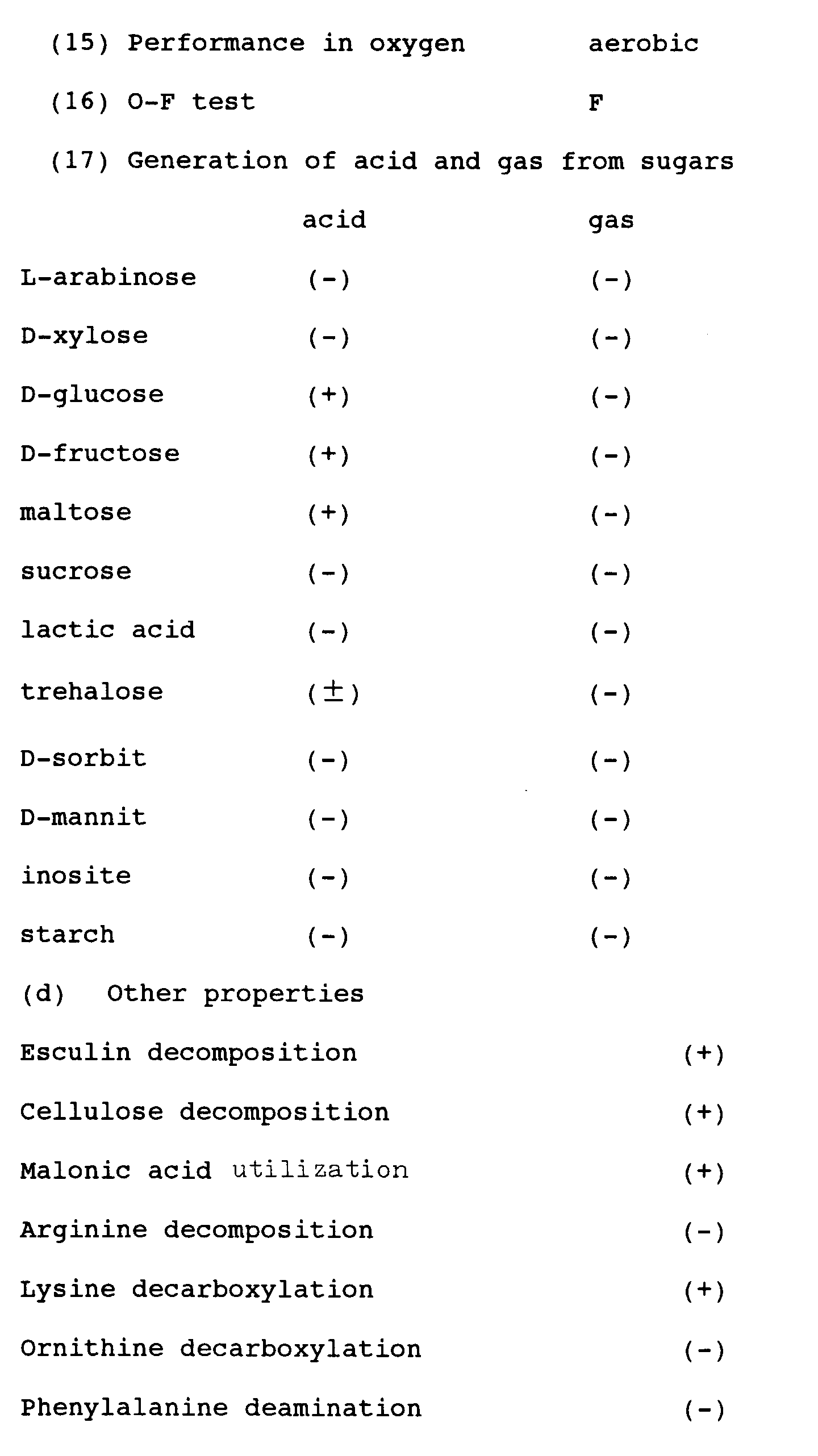
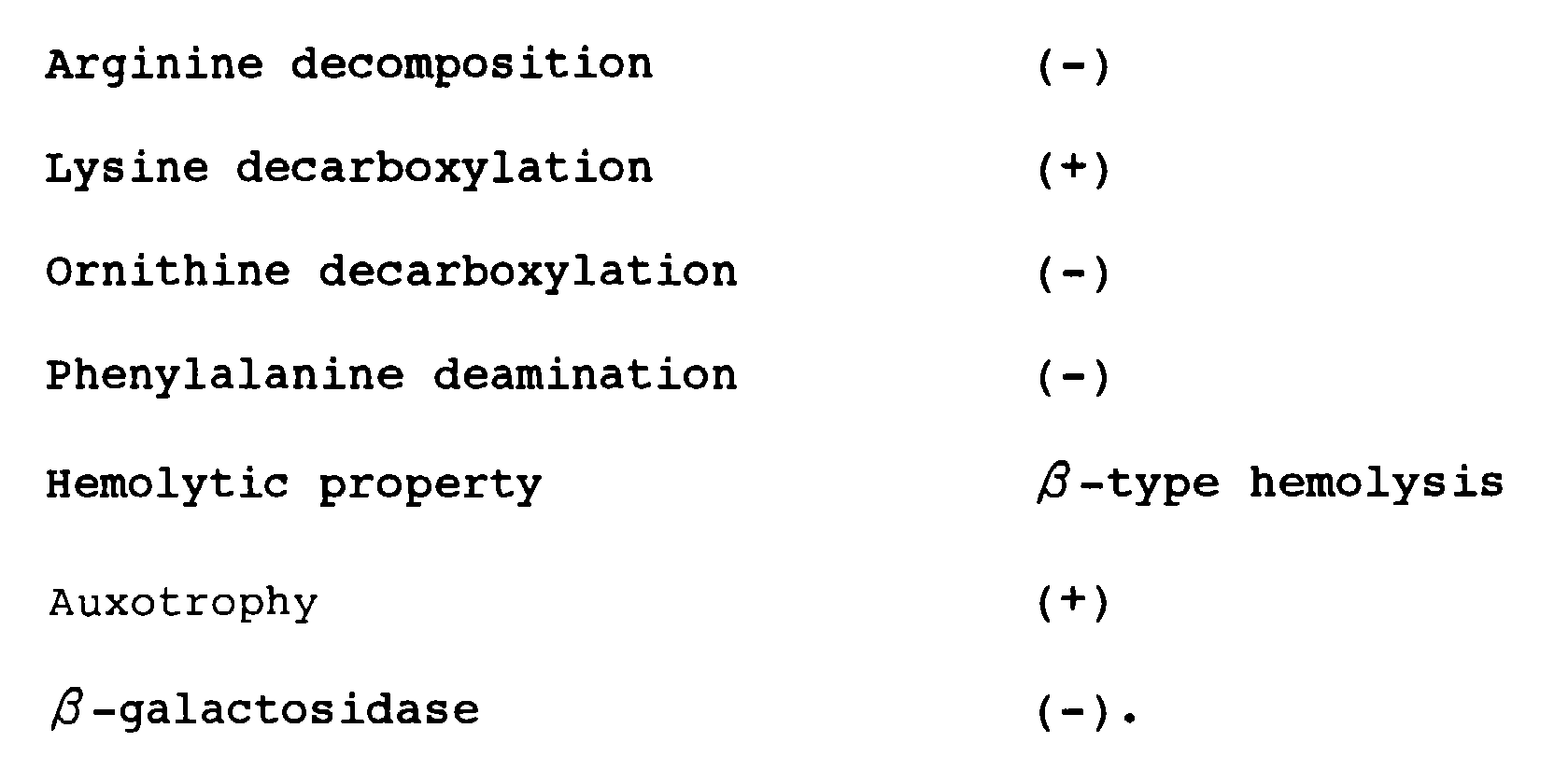
- An oral composition containing Bacillus subtilis Kubota for animals, with the following bacteriological properties:(a) Morphology1. Shape and size of the cell
Short and small bacillus (1.2 - 1.4×3.6 - 3.8 µm)2. Cellular polymorphism
No specific polymorphism. Being surrounded with cell membrane and having a nucleus and also having spore, characteristically, with septum observed.3. Presence or absence of mobility
Mobile. About ten flagella.4. Presence or absence of spore
Spore present.5. Gram staining
Gram positive and stained blue with FAVOR-GSET (Nissui)6. Acid-fast property
Stained red with Ziehl-Neelsen staining. Acid-fast bacterium.(b) Growth state in individual culture media
Inoculating the bacterium in the state suspended in a physiological saline onto a meat broth agar plate, for cultivation at 37°C for 24 hours, good growth is obserbed.
The periphery of the colony is of R-type, not a round shape. The color is opaque and pale yellow.
During sheep blood agar cultivation, heart infusion agar cultivation and TRYPTO-SOYA-AGAR cultivation, the colonies are of R-type, opaque and pale yellow with good growth. The growth state in each of the culture media are as follows;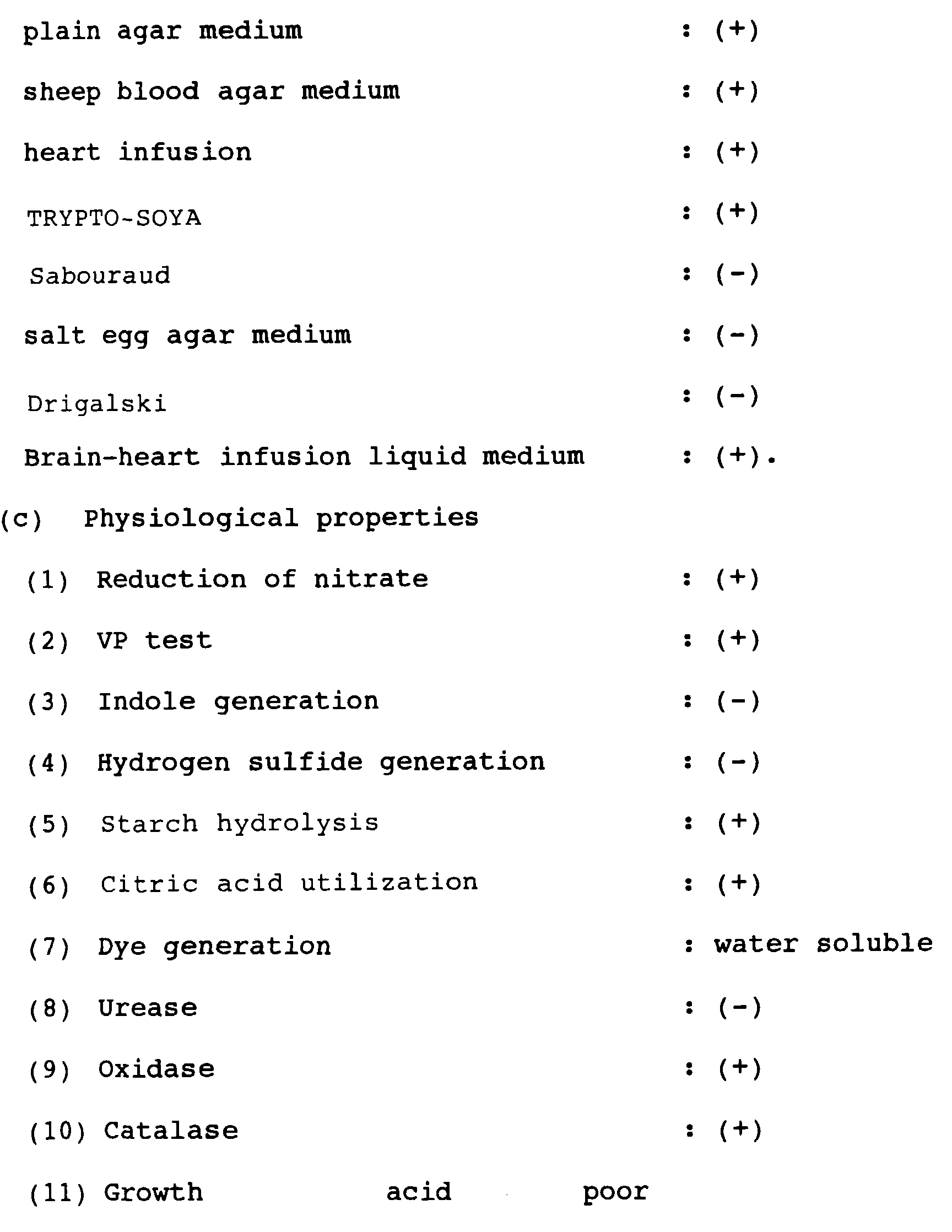

- An oral composition for animals according to claim 1, wherein Bacillus subtilis Kubota is in the form of the isolated cells thereof, a culture containing the cells thereof and/or a processed product thereof.
- An oral composition for animals according to claim 1 or 2, wherein the composition is a deodorizing composition and/or a composition for curing intestinal disorder.
- An oral composition for animals according to any one of claims 1 to 3, wherein the composition is a composition of feed type and/or pharmaceutical agent type for animals.
Applications Claiming Priority (4)
| Application Number | Priority Date | Filing Date | Title |
|---|---|---|---|
| JP84511/96 | 1996-03-14 | ||
| JP8451196 | 1996-03-14 | ||
| JP8084511A JP2879321B2 (en) | 1996-03-14 | 1996-03-14 | Oral composition for animals |
| PCT/JP1997/000778 WO1997033487A1 (en) | 1996-03-14 | 1997-03-12 | Oral composition for animals |
Publications (3)
| Publication Number | Publication Date |
|---|---|
| EP0826311A1 true EP0826311A1 (en) | 1998-03-04 |
| EP0826311A4 EP0826311A4 (en) | 1998-12-30 |
| EP0826311B1 EP0826311B1 (en) | 2002-05-29 |
Family
ID=13832676
Family Applications (1)
| Application Number | Title | Priority Date | Filing Date |
|---|---|---|---|
| EP97907286A Expired - Lifetime EP0826311B1 (en) | 1996-03-14 | 1997-03-12 | Oral composition for animals |
Country Status (7)
| Country | Link |
|---|---|
| US (1) | US6051219A (en) |
| EP (1) | EP0826311B1 (en) |
| JP (1) | JP2879321B2 (en) |
| CN (1) | CN1104844C (en) |
| DE (1) | DE69712841T2 (en) |
| DK (1) | DK0826311T3 (en) |
| WO (1) | WO1997033487A1 (en) |
Cited By (6)
| Publication number | Priority date | Publication date | Assignee | Title |
|---|---|---|---|---|
| WO2014207386A1 (en) * | 2013-06-27 | 2014-12-31 | Lesaffre Et Compagnie | Oral rehydration solute composition containing probiotics |
| WO2015061789A2 (en) | 2013-10-25 | 2015-04-30 | Nch Corporation | Delivery system and probiotic composition for animals and plants |
| EP3060225A4 (en) * | 2013-10-25 | 2017-11-15 | NCH Corporation | Delivery system and probiotic composition for animals and plants |
| US10766799B2 (en) | 2014-05-23 | 2020-09-08 | Nch Corporation | Method for improving quality of aquaculture pond water using a nutrient germinant composition and spore incubation method |
| US10897922B2 (en) | 2016-04-05 | 2021-01-26 | Nch Corporation | Composition and method for germinative compounds in probiotic food and beverage products for human consumption |
| US11401500B2 (en) | 2018-08-29 | 2022-08-02 | Nch Corporation | System, method, and composition for incubating spores for use in aquaculture, agriculture, wastewater, and environmental remediation applications |
Families Citing this family (25)
| Publication number | Priority date | Publication date | Assignee | Title |
|---|---|---|---|---|
| JP2879321B2 (en) * | 1996-03-14 | 1999-04-05 | 久保田 豊秋 | Oral composition for animals |
| KR20020008489A (en) * | 2000-07-20 | 2002-01-31 | 강준구 | Diarrhea treatment agent for livestock and preparation method thereof |
| NO319624B1 (en) * | 2003-09-15 | 2005-09-05 | Trouw Internat Bv | Fish feed for salmonids in fresh water and use of such feed. |
| MY146423A (en) * | 2005-10-22 | 2012-08-15 | Park Se Joon | Microorganisms having bad smell removal activity of organic waste and use thereof |
| AU2006305031B2 (en) * | 2005-10-22 | 2011-05-12 | Se Joon Park | Microorganisms having bad smell removal activity of organic waste and use thereof |
| RU2414508C2 (en) * | 2005-10-22 | 2011-03-20 | Се Джун ПАРК | Microorganism strains capable of eliminating foul smell of organic wastes, and use of said microorganism strains |
| US20080057047A1 (en) * | 2005-11-29 | 2008-03-06 | Benedikt Sas | Use of bacillus amyloliquefaciens PB6 for the prophylaxis or treatment of gastrointestinal and immuno-related diseases |
| JP4659781B2 (en) * | 2007-04-25 | 2011-03-30 | 株式会社ミツカングループ本社 | New natto bacteria and soft natto produced using the natto bacteria |
| KR100870878B1 (en) | 2007-10-30 | 2008-11-28 | 박세준 | Szepimicroorganism of the genus Lactobacillus |
| KR100870880B1 (en) | 2007-10-30 | 2008-11-28 | 박세준 | Lactobacillus SJ microorganism |
| KR100870882B1 (en) | 2007-10-30 | 2008-11-28 | 박세준 | Penivacillus sp. |
| KR100870881B1 (en) | 2007-10-30 | 2008-11-28 | 박세준 | Szepimicroorganism in the genus Brevibacillus |
| KR100870877B1 (en) | 2007-10-30 | 2008-11-28 | 박세준 | Chamobacterium S. zephyr microorganism |
| KR100870879B1 (en) | 2007-10-30 | 2008-11-28 | 박세준 | Lactobacillus SJ microorganism |
| DE102009057023B4 (en) * | 2009-11-25 | 2012-01-12 | Inter-Harz Gmbh | A method of reducing pathogenic bacteria in a livestock housing |
| DE202009017734U1 (en) | 2009-11-25 | 2011-09-02 | Inter-Harz Gmbh | Additive for reducing pathogenic bacteria in a stable for livestock |
| CN103614313B (en) * | 2013-09-30 | 2016-03-02 | 徐州工程学院 | A kind of bacterial strain and screening method thereof of producing high temperature resistant beta-galactosidase enzymes of fermenting |
| US10201574B1 (en) | 2015-09-16 | 2019-02-12 | Church & Dwight Co., Inc. | Methods of microbial treatment of poultry |
| US12097226B2 (en) | 2016-04-05 | 2024-09-24 | Nch Corporation | System and method for using a single-serve nutrient spore composition for small scale farm applications |
| US11298383B2 (en) | 2016-05-20 | 2022-04-12 | Church & Dwight Co., Inc. | Lactobacillus and bacillus based direct fed microbial treatment for poultry and method of use |
| US10835561B2 (en) | 2016-05-25 | 2020-11-17 | Church & Dwight Co., Inc. | Bacillus compositions and methods of use with ruminants |
| US11622569B2 (en) | 2017-07-24 | 2023-04-11 | Church & Dwight Co., Inc. | Bacillus microbial terroir for pathogen control in swine |
| KR102299266B1 (en) * | 2019-03-07 | 2021-09-08 | 씨제이제일제당 주식회사 | Bacillus subtilis CJBS303 and composition comprising the same |
| CN110643550B (en) * | 2019-11-14 | 2022-12-06 | 河北农业大学 | Bacillus subtilis J530 strain for producing urease inhibitor and application thereof |
| US11576937B2 (en) | 2020-02-06 | 2023-02-14 | Nch Corporation | Method of reducing gut inflammation reduction in humans by consuming a heated probiotic composition |
Family Cites Families (13)
| Publication number | Priority date | Publication date | Assignee | Title |
|---|---|---|---|---|
| JPS52154590A (en) * | 1976-05-21 | 1977-12-22 | Seikenkai | Cultivating and preserving method of deodorising lactobucillus and liling cell preparation |
| JPS55143916A (en) * | 1980-01-21 | 1980-11-10 | Seikenkai | Viable bacterium preparation |
| JPH01144971A (en) * | 1987-12-01 | 1989-06-07 | Toyoaki Kubota | Useful microorganism |
| JP2608459B2 (en) * | 1988-05-20 | 1997-05-07 | 豊秋 久保田 | Waste liquid treatment method |
| JPH02154590A (en) * | 1988-12-06 | 1990-06-13 | Mitsubishi Electric Corp | Super-miniaturized color monitor |
| US4996055A (en) * | 1989-06-05 | 1991-02-26 | Kurasawa Optical Industry Co., Ltd. | Deodorized bacteria composition |
| EP0416892B2 (en) * | 1989-09-05 | 1998-10-21 | Ajinomoto Co., Inc. | Agents for the prevention and treatment of diarrhoea |
| DK0537418T3 (en) * | 1991-07-01 | 1998-10-12 | Ahc Inc | Hitherto unknown bacillus bacterium and its use |
| JP2798830B2 (en) * | 1991-11-15 | 1998-09-17 | アルプス電気株式会社 | Magnetic head |
| JP3202334B2 (en) * | 1992-06-08 | 2001-08-27 | 株式会社東洋発酵 | Vegetable deodorant |
| JP2608524B2 (en) * | 1994-01-21 | 1997-05-07 | 全国農業協同組合連合会 | Deodorants |
| JPH07258049A (en) * | 1994-03-17 | 1995-10-09 | Washi Kosan Kk | Method for preventing bad breath by microorganisms and anti-halitosis |
| JP2879321B2 (en) * | 1996-03-14 | 1999-04-05 | 久保田 豊秋 | Oral composition for animals |
-
1996
- 1996-03-14 JP JP8084511A patent/JP2879321B2/en not_active Expired - Lifetime
-
1997
- 1997-03-12 DE DE69712841T patent/DE69712841T2/en not_active Expired - Fee Related
- 1997-03-12 EP EP97907286A patent/EP0826311B1/en not_active Expired - Lifetime
- 1997-03-12 CN CN97190146A patent/CN1104844C/en not_active Expired - Lifetime
- 1997-03-12 WO PCT/JP1997/000778 patent/WO1997033487A1/en not_active Ceased
- 1997-03-12 DK DK97907286T patent/DK0826311T3/en active
- 1997-03-12 US US08/913,045 patent/US6051219A/en not_active Expired - Lifetime
Non-Patent Citations (2)
| Title |
|---|
| No further relevant documents disclosed * |
| See also references of WO9733487A1 * |
Cited By (10)
| Publication number | Priority date | Publication date | Assignee | Title |
|---|---|---|---|---|
| WO2014207386A1 (en) * | 2013-06-27 | 2014-12-31 | Lesaffre Et Compagnie | Oral rehydration solute composition containing probiotics |
| FR3007654A1 (en) * | 2013-06-27 | 2015-01-02 | Lesaffre & Cie | ORAL REHYDRATION SOLUTE COMPOSITION CONTAINING PROBIOTICS |
| WO2015061789A2 (en) | 2013-10-25 | 2015-04-30 | Nch Corporation | Delivery system and probiotic composition for animals and plants |
| EP3060225A4 (en) * | 2013-10-25 | 2017-11-15 | NCH Corporation | Delivery system and probiotic composition for animals and plants |
| US10653729B2 (en) | 2013-10-25 | 2020-05-19 | Nch Corporation | Delivery system and probiotic composition for animals and plants |
| US12115199B2 (en) | 2013-10-25 | 2024-10-15 | Nch Corporation | Delivery system and probiotic composition for animals and plants |
| US10766799B2 (en) | 2014-05-23 | 2020-09-08 | Nch Corporation | Method for improving quality of aquaculture pond water using a nutrient germinant composition and spore incubation method |
| US10897922B2 (en) | 2016-04-05 | 2021-01-26 | Nch Corporation | Composition and method for germinative compounds in probiotic food and beverage products for human consumption |
| US11206860B2 (en) | 2016-04-05 | 2021-12-28 | Nch Corporation | Composition and method for germinative compounds in probiotic food and beverage products for human consumption |
| US11401500B2 (en) | 2018-08-29 | 2022-08-02 | Nch Corporation | System, method, and composition for incubating spores for use in aquaculture, agriculture, wastewater, and environmental remediation applications |
Also Published As
| Publication number | Publication date |
|---|---|
| WO1997033487A1 (en) | 1997-09-18 |
| CN1181691A (en) | 1998-05-13 |
| JPH09248134A (en) | 1997-09-22 |
| JP2879321B2 (en) | 1999-04-05 |
| US6051219A (en) | 2000-04-18 |
| DE69712841T2 (en) | 2002-09-05 |
| DE69712841D1 (en) | 2002-07-04 |
| EP0826311B1 (en) | 2002-05-29 |
| CN1104844C (en) | 2003-04-09 |
| EP0826311A4 (en) | 1998-12-30 |
| DK0826311T3 (en) | 2002-06-17 |
Similar Documents
| Publication | Publication Date | Title |
|---|---|---|
| US6051219A (en) | Method for reducing malodor with Bacillus subtilis Kubota | |
| US5549890A (en) | Animal feed containing Bacillus subtilis FERM BP-3418 that decomposes aflatoxin | |
| SE510498C2 (en) | Animal feed additive containing microorganisms | |
| KR100949903B1 (en) | Microorganisms preparations for the additional feedstuff and preparation thereof | |
| CN104787899B (en) | A kind of antibacterial water quality purifier for marine aquaculture and preparation method thereof | |
| JPH08502019A (en) | Probiotech for Salmonella control | |
| CN118126869B (en) | Bacillus subtilis BS-22 strain and application thereof | |
| CN1930282B (en) | Novel lactic acid bacterium | |
| CN108546653B (en) | Novel lactobacillus fermentum and application thereof in feed field and sewage treatment field | |
| JP2001149023A (en) | Bioactive agent and animal feed additive using the same | |
| CN109874920A (en) | A kind of compound microorganism feed additive and preparation method thereof | |
| JPH07241169A (en) | Deodorants | |
| Larson et al. | The Intestinal Microflora of Young Swine Obtained by Hysterectomy: Observations on Chlortetracycline Supplementation | |
| SE510497C2 (en) | Additive for non-ruminant animal or human feed | |
| Baker et al. | Longevity of Salmonella typhimurium in Tilapia aurea and water from pools fertilized with swine waste | |
| Godara et al. | Effect of pond fertilization with vermicompost and some other manures on the pathogenic bacterial populations of treated waters | |
| CN101294142A (en) | Tunica mucosa zymocyte agent and prepraring method thereof | |
| US8414878B2 (en) | Irilis biopreparation based on bacillus-strain bacteria, bacillus subtilis and bacillus licheniformis contained therein | |
| JP3180886B2 (en) | Animal growth promoter | |
| CN1333072C (en) | Large bacillus, its preparation method and use | |
| KR102623909B1 (en) | Microorganism strain having inhibitor for biofilm in animal intestines derived from Escherichia coli | |
| Niewolak et al. | Sanitary and bacteriological evaluation of common carp, tench and crucian carp reared in a pond supplied with biologically treated sewage | |
| KR0170043B1 (en) | Manufacturing method of cell fermentation feed and cell compost using waste resources such as food waste or agricultural waste | |
| Obire et al. | Microbiological quality of fish pond water | |
| Jie-yi et al. | Preliminary studies on the effect of livestock manure application on bacterial fish disease and human hygiene |
Legal Events
| Date | Code | Title | Description |
|---|---|---|---|
| PUAI | Public reference made under article 153(3) epc to a published international application that has entered the european phase |
Free format text: ORIGINAL CODE: 0009012 |
|
| AK | Designated contracting states |
Kind code of ref document: A1 Designated state(s): BE DE DK FR GB NL |
|
| 17P | Request for examination filed |
Effective date: 19980303 |
|
| A4 | Supplementary search report drawn up and despatched |
Effective date: 19981112 |
|
| AK | Designated contracting states |
Kind code of ref document: A4 Designated state(s): BE DE DK FR GB NL |
|
| 17Q | First examination report despatched |
Effective date: 20000712 |
|
| GRAG | Despatch of communication of intention to grant |
Free format text: ORIGINAL CODE: EPIDOS AGRA |
|
| GRAG | Despatch of communication of intention to grant |
Free format text: ORIGINAL CODE: EPIDOS AGRA |
|
| GRAH | Despatch of communication of intention to grant a patent |
Free format text: ORIGINAL CODE: EPIDOS IGRA |
|
| GRAH | Despatch of communication of intention to grant a patent |
Free format text: ORIGINAL CODE: EPIDOS IGRA |
|
| GRAA | (expected) grant |
Free format text: ORIGINAL CODE: 0009210 |
|
| AK | Designated contracting states |
Kind code of ref document: B1 Designated state(s): BE DE DK FR GB NL |
|
| REG | Reference to a national code |
Ref country code: GB Ref legal event code: FG4D |
|
| REG | Reference to a national code |
Ref country code: DK Ref legal event code: T3 |
|
| REF | Corresponds to: |
Ref document number: 69712841 Country of ref document: DE Date of ref document: 20020704 |
|
| ET | Fr: translation filed | ||
| PLBE | No opposition filed within time limit |
Free format text: ORIGINAL CODE: 0009261 |
|
| STAA | Information on the status of an ep patent application or granted ep patent |
Free format text: STATUS: NO OPPOSITION FILED WITHIN TIME LIMIT |
|
| 26N | No opposition filed |
Effective date: 20030303 |
|
| PGFP | Annual fee paid to national office [announced via postgrant information from national office to epo] |
Ref country code: DK Payment date: 20080221 Year of fee payment: 12 |
|
| PGFP | Annual fee paid to national office [announced via postgrant information from national office to epo] |
Ref country code: NL Payment date: 20080225 Year of fee payment: 12 Ref country code: GB Payment date: 20080221 Year of fee payment: 12 |
|
| PGFP | Annual fee paid to national office [announced via postgrant information from national office to epo] |
Ref country code: FR Payment date: 20080219 Year of fee payment: 12 Ref country code: DE Payment date: 20080331 Year of fee payment: 12 |
|
| PGFP | Annual fee paid to national office [announced via postgrant information from national office to epo] |
Ref country code: BE Payment date: 20080403 Year of fee payment: 12 |
|
| BERE | Be: lapsed |
Owner name: *KUBOTA TOYOAKI Effective date: 20090331 |
|
| REG | Reference to a national code |
Ref country code: DK Ref legal event code: EBP |
|
| GBPC | Gb: european patent ceased through non-payment of renewal fee |
Effective date: 20090312 |
|
| NLV4 | Nl: lapsed or anulled due to non-payment of the annual fee |
Effective date: 20091001 |
|
| REG | Reference to a national code |
Ref country code: FR Ref legal event code: ST Effective date: 20091130 |
|
| PG25 | Lapsed in a contracting state [announced via postgrant information from national office to epo] |
Ref country code: DE Free format text: LAPSE BECAUSE OF NON-PAYMENT OF DUE FEES Effective date: 20091001 |
|
| PG25 | Lapsed in a contracting state [announced via postgrant information from national office to epo] |
Ref country code: NL Free format text: LAPSE BECAUSE OF NON-PAYMENT OF DUE FEES Effective date: 20091001 Ref country code: BE Free format text: LAPSE BECAUSE OF NON-PAYMENT OF DUE FEES Effective date: 20090331 |
|
| PG25 | Lapsed in a contracting state [announced via postgrant information from national office to epo] |
Ref country code: GB Free format text: LAPSE BECAUSE OF NON-PAYMENT OF DUE FEES Effective date: 20090312 Ref country code: FR Free format text: LAPSE BECAUSE OF NON-PAYMENT OF DUE FEES Effective date: 20091123 Ref country code: DK Free format text: LAPSE BECAUSE OF NON-PAYMENT OF DUE FEES Effective date: 20090331 |