EP0825662A2 - Flame-retardant solid electrolytes - Google Patents
Flame-retardant solid electrolytes Download PDFInfo
- Publication number
- EP0825662A2 EP0825662A2 EP97114280A EP97114280A EP0825662A2 EP 0825662 A2 EP0825662 A2 EP 0825662A2 EP 97114280 A EP97114280 A EP 97114280A EP 97114280 A EP97114280 A EP 97114280A EP 0825662 A2 EP0825662 A2 EP 0825662A2
- Authority
- EP
- European Patent Office
- Prior art keywords
- solid electrolyte
- flame retardant
- compound
- retardant solid
- hydrocarbon residue
- Prior art date
- Legal status (The legal status is an assumption and is not a legal conclusion. Google has not performed a legal analysis and makes no representation as to the accuracy of the status listed.)
- Withdrawn
Links
Images

Classifications
-
- C—CHEMISTRY; METALLURGY
- C07—ORGANIC CHEMISTRY
- C07F—ACYCLIC, CARBOCYCLIC OR HETEROCYCLIC COMPOUNDS CONTAINING ELEMENTS OTHER THAN CARBON, HYDROGEN, HALOGEN, OXYGEN, NITROGEN, SULFUR, SELENIUM OR TELLURIUM
- C07F9/00—Compounds containing elements of Groups 5 or 15 of the Periodic Table
- C07F9/02—Phosphorus compounds
- C07F9/06—Phosphorus compounds without P—C bonds
- C07F9/08—Esters of oxyacids of phosphorus
- C07F9/09—Esters of phosphoric acids
- C07F9/091—Esters of phosphoric acids with hydroxyalkyl compounds with further substituents on alkyl
-
- C—CHEMISTRY; METALLURGY
- C08—ORGANIC MACROMOLECULAR COMPOUNDS; THEIR PREPARATION OR CHEMICAL WORKING-UP; COMPOSITIONS BASED THEREON
- C08G—MACROMOLECULAR COMPOUNDS OBTAINED OTHERWISE THAN BY REACTIONS ONLY INVOLVING UNSATURATED CARBON-TO-CARBON BONDS
- C08G79/00—Macromolecular compounds obtained by reactions forming a linkage containing atoms other than silicon, sulfur, nitrogen, oxygen, and carbon with or without the latter elements in the main chain of the macromolecule
- C08G79/02—Macromolecular compounds obtained by reactions forming a linkage containing atoms other than silicon, sulfur, nitrogen, oxygen, and carbon with or without the latter elements in the main chain of the macromolecule a linkage containing phosphorus
- C08G79/04—Phosphorus linked to oxygen or to oxygen and carbon
-
- H—ELECTRICITY
- H01—ELECTRIC ELEMENTS
- H01B—CABLES; CONDUCTORS; INSULATORS; SELECTION OF MATERIALS FOR THEIR CONDUCTIVE, INSULATING OR DIELECTRIC PROPERTIES
- H01B1/00—Conductors or conductive bodies characterised by the conductive materials; Selection of materials as conductors
- H01B1/06—Conductors or conductive bodies characterised by the conductive materials; Selection of materials as conductors mainly consisting of other non-metallic substances
- H01B1/12—Conductors or conductive bodies characterised by the conductive materials; Selection of materials as conductors mainly consisting of other non-metallic substances organic substances
- H01B1/122—Ionic conductors
-
- H—ELECTRICITY
- H01—ELECTRIC ELEMENTS
- H01M—PROCESSES OR MEANS, e.g. BATTERIES, FOR THE DIRECT CONVERSION OF CHEMICAL ENERGY INTO ELECTRICAL ENERGY
- H01M10/00—Secondary cells; Manufacture thereof
- H01M10/05—Accumulators with non-aqueous electrolyte
- H01M10/052—Li-accumulators
-
- H—ELECTRICITY
- H01—ELECTRIC ELEMENTS
- H01M—PROCESSES OR MEANS, e.g. BATTERIES, FOR THE DIRECT CONVERSION OF CHEMICAL ENERGY INTO ELECTRICAL ENERGY
- H01M10/00—Secondary cells; Manufacture thereof
- H01M10/05—Accumulators with non-aqueous electrolyte
- H01M10/056—Accumulators with non-aqueous electrolyte characterised by the materials used as electrolytes, e.g. mixed inorganic/organic electrolytes
- H01M10/0564—Accumulators with non-aqueous electrolyte characterised by the materials used as electrolytes, e.g. mixed inorganic/organic electrolytes the electrolyte being constituted of organic materials only
- H01M10/0565—Polymeric materials, e.g. gel-type or solid-type
-
- H—ELECTRICITY
- H01—ELECTRIC ELEMENTS
- H01M—PROCESSES OR MEANS, e.g. BATTERIES, FOR THE DIRECT CONVERSION OF CHEMICAL ENERGY INTO ELECTRICAL ENERGY
- H01M2300/00—Electrolytes
- H01M2300/0017—Non-aqueous electrolytes
- H01M2300/0065—Solid electrolytes
- H01M2300/0082—Organic polymers
-
- Y—GENERAL TAGGING OF NEW TECHNOLOGICAL DEVELOPMENTS; GENERAL TAGGING OF CROSS-SECTIONAL TECHNOLOGIES SPANNING OVER SEVERAL SECTIONS OF THE IPC; TECHNICAL SUBJECTS COVERED BY FORMER USPC CROSS-REFERENCE ART COLLECTIONS [XRACs] AND DIGESTS
- Y02—TECHNOLOGIES OR APPLICATIONS FOR MITIGATION OR ADAPTATION AGAINST CLIMATE CHANGE
- Y02E—REDUCTION OF GREENHOUSE GAS [GHG] EMISSIONS, RELATED TO ENERGY GENERATION, TRANSMISSION OR DISTRIBUTION
- Y02E60/00—Enabling technologies; Technologies with a potential or indirect contribution to GHG emissions mitigation
- Y02E60/10—Energy storage using batteries
Definitions
- This invention relates to a solid electrolyte, and more particularly, to a flame-retardant solid electrolyte which is applicable to secondary cells which are high in energy density and safety.
- a flame retardant solid electrolyte which comprises an ion conductive polymer matrix having moieties derived from a halogen or phosphorus-bearing compound and capable of imparting flame retardance to the polymer matrix, and an electrolyte salt dispersed in the polymer matrix.
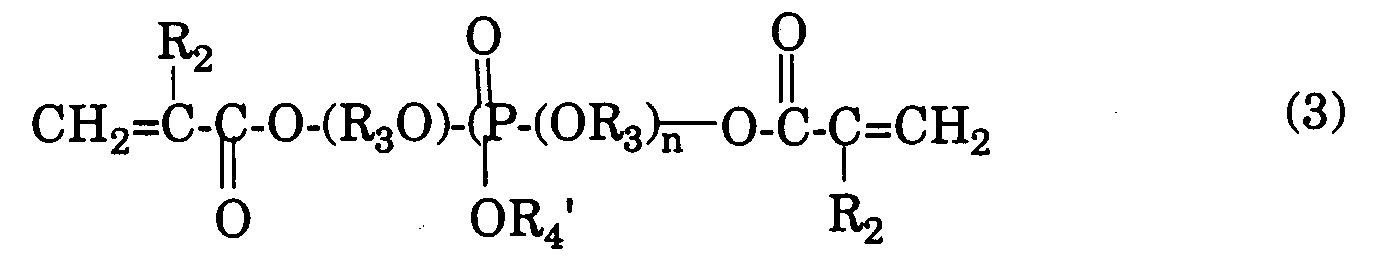
- the moiety capable of imparting flame retardance to the ion conductive polymer matrix should preferably be derived from at least one compound selected from compounds of the general formulas (1), (2) and (3):
- (CH 2 CR 2 COO) n (R 3 O) m PO(OR 4 ) 3-m wherein R 2 has the same meaning as defined above and represents H or CH 3 , R 3 represents an aliphatic or aromatic hydrocarbon residue, R 4 represents hydrogen, an aliphatic or aromatic hydrocarbon residue or a phosphorus-containing aliphatic or aromatic hydrocarbon residue, m
- the ion conductive polymer matrix used in this embodiment should preferably be a crosslinked polymer product having a network structure obtained by crosslinking reaction between a homopolymer or copolymer (hereinafter referred to as polymer A) of alkylene oxides and/or glycidyl ethers, which is modified with polymerizable multiple bond groups at part or all of terminal end groups or functional groups in the polymer chain and the at least one compound selected from the compounds of the formulas (1), (2) and (3).
- polymer A homopolymer or copolymer
- the electrolyte salt may be contained in the ion conductive polymer matrix in the form of a liquid electrolyte wherein an electrolyte salt is dissolved in an organic solvent.
- an organic solvent should preferably consist of at least one non-aqueous solvent selected from carbonates, lactones, ethers, sulfolanes, and dioxolanes.
- the homopolymer or copolymer (polymer A) is modified to have a crosslinkable multiple bond group therein.
- Preferred examples of the crosslinkable multiple bond group include acrylic group, acryloyl, or methacryloyl.
- the polymer A and the at least one compound selected from those compounds of the general formula (1), (2) and (3) are preferably subjected to crosslinking reaction by application of actinic light such as an UV light, an electron beam or a gamma ray or the like, or by application of heat.
- the electrolyte salts dispersed in the ion conductive polymer matrix should preferably include those salts of a lithium cation and one or more anions selected from those anions such as BF 4 , PF 6 , ClO 4 , AsF 6 , CF 3 SO 3 , N(CF 3 SO 2 ) 2 , N(C 2 F 5 SO 2 ) 2 , C(CF 3 SO 2 ) 3 , and derivatives thereof.
- the flame-retardant ion conductive polymer matrix is obtained by crosslinking reaction between the polymer A and the at least one compound selected from those compounds of the general formulas (1), (2) and (3) at a ratio by weight of 40:60 to 98:2.
- a flame-retardant solid electrolyte which comprises a non-ion-conductive polymer matrix having moieties capable of imparting flame retardance thereto, and a liquid electrolyte wherein an electrolyte salt is dissolved in an organic solvent therefor.
- the moieties capable of imparting flame retardance to the polymer should preferably be those derived from at least one compound selected from the compounds of the above-indicated general formulas (1), (2) and (3).
- the non-ion-conductive polymer serving as a matrix of the solid electrolyte should preferably have a skeletal structure consisting of a polymer of at least one monomer selected from vinylidene chloride, acrylonitrile and methyl methacrylate.
- the at least one compound selected from those of the formulas (1), (2) and (3) are preferably present in the non-ion-conductive polymer matrix at a ratio by weight of 2 to 60%.
- Fig. 1 is a schematic sectional view showing a lithium secondary cell using a flame-retardant solid electrolyte of the invention.
- the solid electrolyte of the invention has a skeletal structure comprising moieties capable of imparting flame retardance to the structure and derived from at least one compound selected from those compounds of the general formula (1), (2) and (3).
- a cell using the solid electrolyte is imparted with flame retardance, thereby enhancing the safety of the cell.
- the flame-retardant solid electrolyte of the invention is not a mere mixture of a flame retardant and an ion conductive polymer, but is made of an ion conductive polymer wherein such functional groups or moieties capable of imparting flame retardance to the polymer are joined to the skeletal structure of the polymer. Accordingly, any free flame-retardant substance is not present in the ion conductive polymer, and thus, migration of such a flame-retardant substance through the polymer does not occur. This is advantageous in that a good flame-retardant effect can be expected throughout the polymer without involving any local loss of the effect. In the event that a cell using the solid electrolyte of the invention would be exposed to a solvent in the inside thereof, any flame retardant would not be dissolved out. Thus, the flame retardant effect of the polymer matrix is not lost.
- the flame-retardant solid electrolyte should comprise an ion conductive polymer matrix having moieties derived from a halogen or phosphorus-bearing compound and capable of imparting flame retardance to the polymer matrix, and an electrolyte salt dispersed in the polymer matrix.
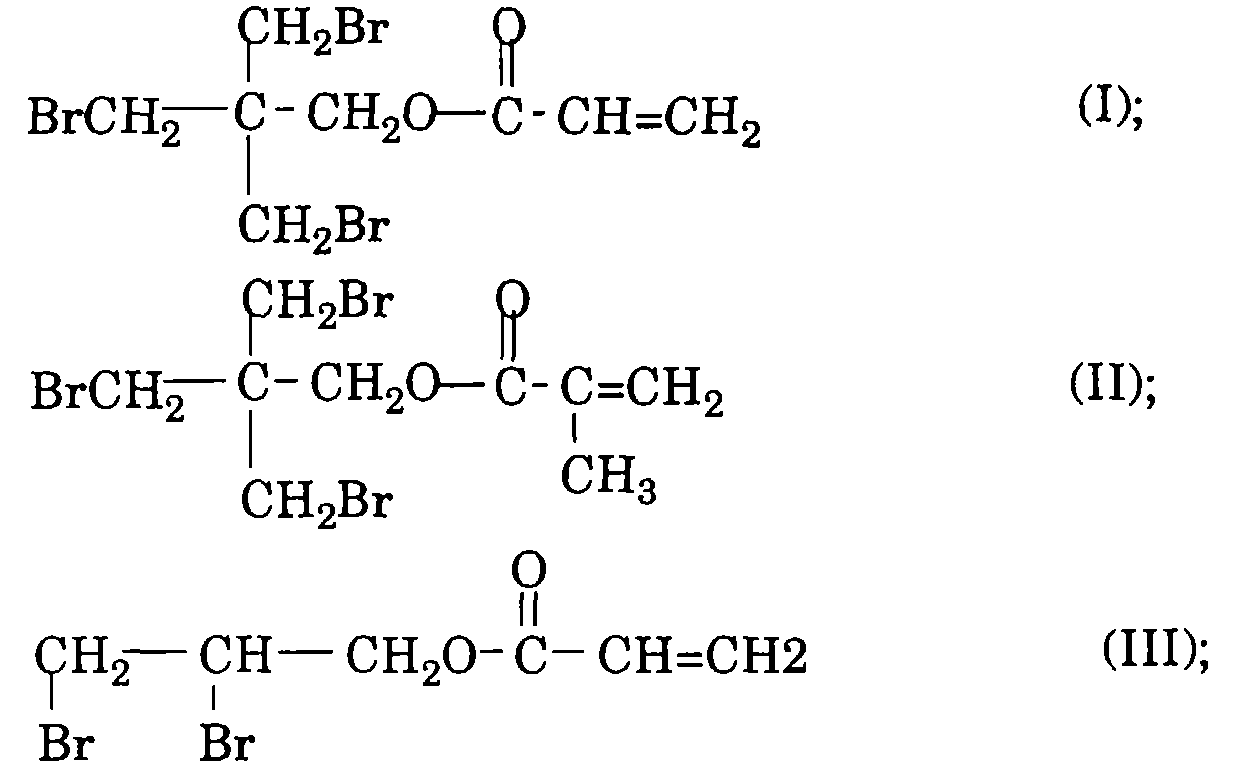
- the halogen-containing aliphatic hydrocarbon residue represented by R 1 has from 1 to 10 carbon atoms and includes, for example, dibromopropyl, tribromoneopentyl and the like.
- the halogen-containing aromatic hydrocarbon residue represented by R 1 includes, for example, tribromophenyl, dibromotolyl and the like.
- the aliphatic residue or group represented by R' has from 1 to 30 carbon atoms, preferably from 1 to 10 carbon atoms and includes, for example, methyl, ethyl, propyl, butyl, pentyl, hexyl, heptyl, octyl, nonyl, decyl and the like.
- the aromatic group represented by R' includes, for example, phenyl, tolyl or the like.
- the aliphatic moiety of the halogen-containing aliphatic hydrocarbon residue represented by R 1 ' has from 1 to 10 carbon atoms and includes, for example, methyl, ethyl, propyl, butyl, pentyl, hexyl, heptyl, octyl, nonyl, decyl and the like, and methylene and ethylene.
- the aromatic moiety of the halogen-containing aliphatic hydrocarbon residue represented by R 1 ' includes, for example, phenyl, tolyl and the like.
- the aliphatic hydrocarbon residue represented by R 3 and R 4 has from 1 to 10 carbon atoms and includes, for example, methyl, ethyl, propyl, butyl, pentyl, hexyl, heptyl, octyl, nonyl, decyl and the like.
- the aromatic hydrocarbon residue represented by R 3 and R 4 includes, for example, phenyl, tolyl or the like.
- the aliphatic moiety of the phosphorus-containing aliphatic hydrocarbon residue represented by R 4 has from 1 to 10 carbon atoms as defined with respect to R 3 .
- the aromatic moiety of the phosphorus-containing aliphatic hydrocarbon residue represented by R 4 includes, for example, phenyl, tolyl or the like.
- R 4 ' and R 5 are, respectively, those defined with respect to R 3 or R 4 .
- n is an integer of from 1 to 3
- m is an integer of from 1 to 3.
- m ' in the formula (3) is an integer of from 0 to 20, preferably 0 to 3.
- phosphorus-containing compounds of the formulas (2) and (3) are those indicated below: wherein n is 1 or 2; wherein n is 1 or 2;
- the other component for the ion conductive polymer is made of a homopolymer or copolymer of alkylene oxides and/or glycidyl ethers.
- the homopolymer or copolymer should be modified with a crosslinkable multiple bond group at part or all of the terminal end groups and/or functional groups in the chain thereof.
- Examples of such a homopolymer or copolymer include those represented by the following general formula (4) Z ⁇ (CH 2 CH 2 O) o (CH 2 CHR 6 O) p ⁇ q Y wherein R 6 represents an alkyl group having from 1 to 12 carbon atoms, an alkenyl group having from 1 to 12 carbon atoms, or a group of the formula, CH 2 OReRa in which Ra represents an alkyl or alkenyl group having from 1 to 4 carbon atoms, and Re represents (CH 2 CH 2 O) k wherein k is an integer of 0 to 10, Y represents an alkyl or alkenyl group having from 1 to 12 carbon atoms, an acrylic acid residue, a methacrylic acid residue, Z represents an active hydrogen-bearing compound residue, o is an integer of 0 to 1100, p is an integer of 0 to 850, and q is an integer of 1 to 3.
- the active hydrogen-bearing compound residues are those derived from alcohols such as ethylene glycol, glycerol and the like and amines such as ethylenediamine, n-butylamine and the like.
- the molecular weight of the homopolymer or copolymer is preferably in the range of 200 to 50,000.
- Glycidyl ether homopolymers may be prepared according to the following reaction formula wherein m and n are, respectively, an integer.
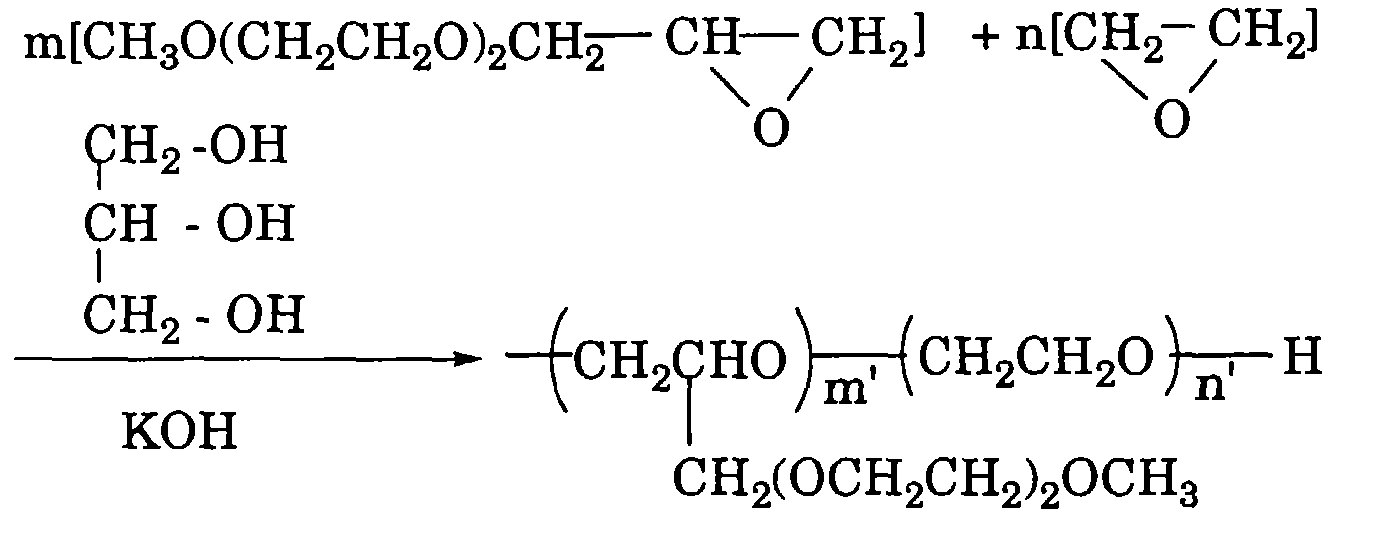
- (Ethylene oxide)-(glycidyl ether) copolymers may be prepared according to the following reaction formula wherein m' and n' are, respectively, an integer.
- modified homopolymers or copolymers may be prepared according to a process described, for example, in United States Patent No. 5,436,090, Electrochimica Acta, 37, 9, pp. 1725 (1992), and Polymers for Advanced Technology, 4. p. 179 (1993).
- a trifunctional terminal acryloyl-modified alkylene oxide polymer is prepared by a procedure wherein alkylene oxides are polymerized, for example, with glycerol or trimethylolpropane by ring-opening and the resultant polyalkylene oxide polymer is esterified with an unsaturated organic acid such as acrylic acid or methacrylic acid or is dehydrochlorinated with an acid chloride such as an acrylic chloride or methacrylic acid chloride.
- modified polymer or copolymer (polymer A) include alkylene oxide diacrylate having a molecular weight ranging from 500 to 5,000, (ethylene oxide-propylene oxide) random copolymer triacrylate having a molecular weight ranging from 3,000 to 20,000, (ethylene oxide-butylene oxide) random copolymer trimethacrylate having molecular weight of 3,000 to 30,000, those homopolymers and copolymers of the formulas mentioned above which are modified with acrylic acid or methacrylic acid, and the like.
- an electrolyte salt is mixed with the polymer A and a halogen or phosphorus-bearing compound selected, for example, from compounds of the afore-indicated general formulas (1), (2) and (3).
- a crosslinking agent such as benzoyl peroxide is added to the resultant mixture, followed by heating at a temperature of 80 to 110°C for 0.5 to 2 hours to obtain a crosslinked product having the electrolyte salt dispersed therein.
- the polymer A has a multiple bond group, such as a vinyl group, and an ether bond in the molecule and can impart ion conductivity and polymeric physical properties to the ion conductive polymer.
- the polymer A having multiple bond groups and at least one compound having multiple bond groups selected from those compounds of the general formulas (1), (2) and (3) are crosslinked through both types of multiple bond groups. As a result, there can be formed a polymer matrix having both flame retardance and ion conductivity.
- the ion conductive polymer should preferably be made of a crosslinked product obtained by reaction between the polymer A and the at least one compound selected from the compounds of the general formulas (1), (2) and (3) at a ratio by weight of 40:60 to 98:2. If the ratio by weight of the at least one compound imparting flame retardance is less than 2, flame retardance is not satisfactorily shown. On the contrary, when the ratio of the at least one compound exceeds 60, the characteristic properties of the ion conductive polymer may unfavorably be lost.
- Both polymer A and the at least one compound selected from those compounds of the general formulas (1), (2) and (3) have multiple bond groups such as an acrylic acid group, an acryloyl group, a methacryloyl group and the like.
- the electrolyte salts usable for this purpose include, for example, lithium borofluoride, lithium hexafluorophosphate, lithium perchlorate, lithium hexafluoroarsenate, lithium trifluoromethanesulfonate, lithium imides, lithium methides and derivatives thereof such as lithium trifluoromethanesulfonylimide, lithium trifluoromethanesulfonylmethide and the like, and mixtures thereof.
- These salts should preferably be present in the ion conductive polymer matrix in an amount of 2 to 20 wt% based on the polymer.
- the solid electrolyte according to this embodiment may further comprise an organic solvent.
- an electrolyte salt is dissolved in a solvent thereof to provide a liquid electrolyte.
- the liquid electrolyte has a concentration of 0.5 to 2 moles/liter.
- This liquid electrolyte is added to a mixture of the polymer A and a halogen or phosphorus-bearing compound, e.g. the compound selected from compounds of the formulas (1), (2) and (3), followed by crosslinking reaction by irradiation of UV light, an electron beam or a gamma ray, or by application of heat.
- a halogen or phosphorus-bearing compound e.g. the compound selected from compounds of the formulas (1), (2) and (3), followed by crosslinking reaction by irradiation of UV light, an electron beam or a gamma ray, or by application of heat.
- photopolymerization initiators ordinarily used for this purpose may be used.
- the resultant polymer is at least partially crosslinked, so that when the crosslinking reaction is conducted in co-existence of a relatively large amount of a liquid electrolyte, the resultant crosslinked product may be so formed as to be swelled in the liquid electrolyte.
- This type of solid electrolyte may be called a gel-type solid electrolyte.
- the organic solvents used for this purpose includes non-aqueous solvents such as carbonates, lactones, ethers, sulfolanes, dioxolanes and mixtures thereof.
- non-aqueous solvents such as carbonates, lactones, ethers, sulfolanes, dioxolanes and mixtures thereof.
- Specific examples include propylene carbonate, ethylene carbonate, dimethyl carbonate, diethyl carbonate, ethylmethyl carbonate, tetrahydrofuran, 2-methyltetrahydrofuran, ⁇ -butyrolactone, 1,2-dimethoxyethane, diethoxyethane, 1,3-dioxolane, 1,3-dimethoxypropane and mixtures thereof.
- the liquid electrolyte should preferably be present at a ratio by weight between the ion conductive polymer and the liquid electrolyte of 10:90 to 90:10.
- the solid electrolyte may be made of a non-ion-conductive polymer matrix imparted with flame retardance, and a liquid electrolyte of an electrolyte salt in an organic solvent dispersed in the non-ion conductive polymer matrix.
- the liquid electrolyte should preferably be present at such a ratio as defined with respect to the first embodiment.
- the non-ion conductive polymer matrix is made of a copolymer of at least one compound selected from those compounds of the afore-indicated formulas (1), (2) and (3) and at least one monomer selected from vinylidene chloride, acrylonitrile and methyl methacrylate.
- the at least one compound should preferably present in an amount of 2 to 60 wt% and the balance is for the at least one monomer.
- the copolymerization is conducted by a usual manner such as suspension or solution polymerization.
- the resultant copolymer has no ether bond exhibiting ion conductivity in the molecule.
- the copolymerization is conducted in a medium comprising an organic solvent and a salt electrolyte or when a separately prepared non-ion-conductive polymer is heated in a liquid electrolyte, the liquid electrolyte is taken in and swells the polymer, thereby providing a flame retardant solid electrolyte or a gel-type solid electrolyte.
- the solid electrolyte can be used, like the electrolyte comprising the ion conductive polymer.
- the flame retardant solid electrolytes of the invention can be used in lithium primary and secondary cells.
- Fig. 1 shows a fundamental lithium secondary cell.
- a cell C having a negative electrode 1 and a positive electrode 3 sandwiching a solid electrolyte layer 5 therebetween.
- the negative electrode 1 has a current collector 2 therefor on the outer side thereof.
- the positive electrode 3 has a current collector 4 therefor.
- 6 and 7 are, respectively, terminals for the positive electrode 3 and the negative electrode 1.
- the active substance of the negative electrode 1 consists of lithium or its alloy as ordinarily used for this purpose.
- the active substance of the positive electrode 3 may be any ones known in the art, e.g. metal oxides such as nickel oxide, cobalt oxide, titanium oxide and the like, and metal sulfides such as molybdenum sulfide, iron sulfide and the like.
- the current collectors 2, 4 may be, respectively, made of a conductive material such as carbon, stainless steels, titanium, nickel, copper, gold or the like in the form of fibers, mesh or the like.
- the solid electrolyte layer 5 is made of a flame retardant solid electrolyte according to the invention.
- lithium ions from the negative electrode active substance are electrochemically moved into the solid electrolyte layer 5.
- lithium ions in the solid electrolyte layer 5 are taken in the active substance of the positive electrode 3.
- the lithium ions in the solid electrolyte deposits as lithium metal, and the lithium ions in the positive electrode active substance is unlikely to dissolve out in the solid electrolyte layer.
- the locally deposited metal serves as a growing nucleus, from which lithium dendritically grows through the solid electrolyte. Finally, the resultant dendrite is in contact with the positive electrode, thereby causing short-circuiting of the cell. In this condition, a great current passes within a very short time, with the possibility that the cell catches fire.
- the ion conductive polymer matrix or the non-ion conductive polymer matrix contains halogen or phosphorus-bearing moieties capable of imparting flame retardance to the matrix. If a great current passes within a short time such as by short-circuiting, the polymer matrix can suppress the cell from catching fire.
- the negative electrode active substance is not made of lithium or its alloy but is made of a material capable of occlusion and discharge of lithium ions, e.g. a carbon material
- lithium metal deposits on the carbon surface at the time of overcharge. This deposit serves as a growing nucleus to permit dendrite to grow, thereby causing short-circuiting.
- the use of the ion conductive polymer or non-ion-conductive polymer is effective in improving the safety of the cell.
- An ion conductive polymer was prepared by providing alkylene oxide diacrylate serving polymer A having a molecular weight of 1000 and a bromine-bearing compound of the afore-indicated formula (III) at a mixing ratio by weight of 75:25. 70 wt% of a liquid electrolyte consisting of 1 mole/liter of LiClO 4 in propylene carbonate was added to 30 wt% of the mixture, to which 1000 ppm of a photopolymerization initiator, Irgacure 651 (Chiba-Geigy), was added.
- a photopolymerization initiator Irgacure 651 (Chiba-Geigy)
- the resulting mixture was applied onto a positive electrode and then subjected to crosslinking reaction by irradiation of light with a wavelength of 365 nm from a UV lamp of 30 mW/cm 2 for 5 minutes in an atmosphere of an inert gas, thereby forming a solid electrolyte on the positive electrode although any other techniques of forming a solid electrolyte layer may be used.
- the electric conductivity of the solid electrolyte was found to be 2 x 10 -3 S/cm.
- the flame retardance of the solid electrolyte was evaluated according to the UL-94 flame retardance test, revealing that the flame retardance corresponded to V-0.
- a test piece having a length of 125 mm, a width of 13 mm and a thickness of 3 to 13 mm was fixed vertically by means of a clamp by 6 mm from the above.
- marking absorbent cotton was placed on a floor below the test piece in order to confirm whether or not the cotton was ignited by means of a dropped matter from the test piece.
- a burner was place below the test piece at a distance of 10 mm from the lower end of the piece, followed by applying a flame at the center of the test piece for 10 seconds and then keeping the flame apart from the piece over 150 mm or above.
- An afterflame time, t1 was measured in seconds.
- the evaluation standards are as follows.
- Poly(ethylene oxide-propylene oxide) random copolymer triacrylate having a ratio by weight between ethylene oxide and propylene oxide of 60:40 and a molecular weight of 6000 and a phosphorus-bearing compound of the afore-indicated formula (VI) were mixed at a ratio by weight of 80:20. 70 wt%, based on the mixture, of an electrolyte solution of 1 mole/liter of LiPF 6 in a mixed solvent of ethylene carbonate (EC) and dimethoxyethane (DME) at a ratio of 1:1 was added to 30 parts by weight of the mixture, followed by irradiation with an electron beam in an atmosphere of an inert gas to obtain a crosslinked product. The irradiation was conducted by use of an electron beam irradiator under conditions of an acceleration voltage of 150 kV and an electron beam dosage of 10 Mrad.
- EC ethylene carbonate
- DME dimethoxyethane
- the resultant solid electrolyte was found to have a conductivity of 1 x 10 -3 /cm.
- Poly(ethylene oxide-butylene oxide) random copolymer trimethacrylate having a ratio by weight between ethylene oxide and propylene oxide of 90:10 and a molecular weight of 48000 and a bromine-bearing compound of the afore-indicated formula (III) were mixed at a ratio by weight of 60:40.
- one mole of a LiPF 6 supporting electrolyte alone was added to 1 kg of the mixture, to which 1 wt% of benzoyl peroxide serving as a crosslinking agent was added, followed by maintaining at 80°C for 1 hour to obtain a crosslinked product.
- the resultant solid electrolyte product was found to have a conductivity of 2 x 10 -5 S/cm.
- the flame retardance was evaluated in the same manner as in Example 1, revealing that the retardance corresponded to V-0.
- Example 1 The general procedure of Example 1 was repeated without addition of any bromine-bearing compound.
- the flame retardance of the resultant solid electrolyte was evaluated in the same manner as in Example 1, revealing the retardance did not pass the standard of V-2 and did not exhibit flame retardance.
- Such starting components as used in Example 1 including the alkylene oxide diacrylate, the bromine-bearing compound, LiClO 4 /propylene carbonate and the photopolymerization initiator were mixed, followed by impregnation in a sheet-shaped positive electrode made of LiMn 2 O 4 and also in a sheet-shaped negative electrode made of a carbon material under reduced pressure. Thereafter, UV light was irradiated on the thus impregnated electrodes to obtain a positive electrode and a negative electrode each integrally combined with the flame retardant solid electrolyte.
- the sheet-shaped positive electrode, the solid electrolyte sheet obtained in Example 1 and the negative electrode were superposed in this order and convolutely wounded to obtain a cylindrical cell attached with a safety valve by a usual manner.
- the cell was heated by means of a burner or heated with a hot plate, whereupon the safety valve worked but neither ignition nor bursting took place.
- a flame retardant solid electrolyte composition of the type used in Example 3 was impregnated, under reduced pressure, in a cylindrical cell structure obtained by convolutely winding a sheet-shaped positive electrode, a separator made of a polypropylene non-woven fabric, and a sheet-shaped negative electrode and inserting the wound body into a casing, followed by heating to crosslink the electrolyte composition thereby obtaining a cell.
- the cell was heated by means of a burner, whereupon neither ignition nor bursting took place although a safety valve went into action.
- Such a cylindrical cell structure as used in Example 5 was impregnated with a liquid electrolyte consisting of 1 mole/liter of LiPF 3 in a mixed solvent of ethylene carbonate and dimethoxyethane (DME) at a mixing ratio of 1:1 to obtain a cell.
- the thus obtained cell was heated by use of a burner, revealing that a safety valve worked and the cell took fire. Likewise, when the cell was heated on a hot plate, the safety valve worked, resulting in the ignition of the cell.
- a compound of the afore-indicated formula (IV) and methyl methacrylate were mixed at a mixing ratio by weight of 25:75 and subjected to suspension polymerization in the presence of azobutyronitrile at a temperature of 50 to 100°C for 3 hours to obtain a copolymer having a molecular weight of about 200,000 and Br-bearing moieties in the molecule.
- the copolymer was dissolved in methyl ethyl ketone, applied onto a glass sheet and dried to obtain about 30 ⁇ m thick film.
- the film was heated to 100°C and immersed in a liquid electrolyte consisting of 1 mole/liter of LiClO 4 in propylene carbonate and cooled down to room temperature, thereby obtaining a flame retardant solid electrolyte containing 70 wt% of the liquid electrolyte and 30 wt% of the polymer.
- This flame retardant non-ion conductive polymer containing the electrolyte had a conductivity of 2 x 10 -3 S/cm.
- the flame retardance of the solid electrolyte was evaluated in the same manner as in Example 1, revealing that the retardance corresponded to V-1.
- a phosphorus-bearing compound of the afore-indicated formula (X) and acrylonitrile were mixed at a mixing ratio by weight of 25:75, to which azobisisobutyronitrile was added, followed by solution polymerization at 50°C to obtain a copolymer having flame retardance-imparted moieties therein.
- 70 wt% of a liquid electrolyte consisting of 1 mole/liter of supporting electrolyte, LiBF 4 , in a mixed solvent of ethylene carbonate and ⁇ -butyrolactone at a mixing ratio of 50:50 was added to the polymer, followed by mixing under heating conditions at 100°C.
- the resultant solution was applied onto a glass sheet where it was cooled down to room temperature.
- a solid electrolyte made of the non-ion conductive polymer containing the 70 wt% of the liquid electrolyte was obtained.
- the flame retardant solid electrolyte was found to have a conductivity of 3 x 10 -3 S/cm.
- the solid electrolyte was evaluated in the same manner as in Example 1 with respect to the flame retardance, revealing that the retardance corresponded to V-1.
- a Br-bearing compound of the afore-indicated formula (II) and vinylidene fluoride monomer were used. Initially, the compound of the formula (II) was dissolved in toluene along with benzoyl peroxide, followed by further introduction of vinylidene fluoride so that a mixing ratio by weight was 30:70 to obtain a copolymer. 70 wt% of a liquid electrolyte consisting of 1 mole/liter of LiBF 4 in a mixed solvent of ethylene carbonate and ⁇ -butyrolactone at a mixing ratio of 50:50 was added to 30 wt% of the polymer. The resultant mixture was mixed and heated at 70°C. The mixture was cooled down to room temperature on a glass sheet to obtain a solid electrolyte containing 70 wt% of the liquid electrolyte.
- the solid electrolyte had a conductivity of 3 x 10 -3 S/cm.
- the flame retardance of this solid electrolyte was evaluated in the same manner as in Example 1, revealing that the retardance corresponded to V-1.
- a mixture of a bromine-bearing compound of the afore-indicated formula (IV) and a compound of the afore-indicated formula (XIV) at a mixing ratio by weight of 50:50, and acrylonitrile monomer were mixed at a mixing ratio by weight of 40:60.
- the mixture was treated in the same manner as in Example 2 to obtain a flame retardant solid electrolyte
- the solid electrolyte had a conductivity of 1 x 10 -3 S/cm.
- the flame retardance of this solid electrolyte was evaluated in the same manner as in Example 1, revealing that the retardance corresponded to V-0.
- Example 1 The general procedure of Example 1 was repeated without use of any bromine-bearing compound. The flame retardance was evaluated in the same manner as in Example 1, revealing that the solid electrolyte did not pass the standard HB and no flame retardance was shown.
- the flame retardant solid electrolyte of the invention comprises an ion conductive or non-ion conductive polymer matrix having the moieties derived from halogen or phosphorus-bearing compounds and capable imparting flame retardance to the polymer matrix.
- the polymer matrix shows good flame retardance.
- the solid electrolyte is also effective in flame retardance when applied to cells using active substances other than lithium, lithium alloys and carbon materials.
Landscapes
- Chemical & Material Sciences (AREA)
- Organic Chemistry (AREA)
- Chemical Kinetics & Catalysis (AREA)
- Manufacturing & Machinery (AREA)
- Engineering & Computer Science (AREA)
- General Chemical & Material Sciences (AREA)
- Physics & Mathematics (AREA)
- Electrochemistry (AREA)
- Health & Medical Sciences (AREA)
- General Physics & Mathematics (AREA)
- Molecular Biology (AREA)
- Polymers & Plastics (AREA)
- Dispersion Chemistry (AREA)
- Condensed Matter Physics & Semiconductors (AREA)
- Medicinal Chemistry (AREA)
- Life Sciences & Earth Sciences (AREA)
- Biochemistry (AREA)
- General Health & Medical Sciences (AREA)
- Inorganic Chemistry (AREA)
- Spectroscopy & Molecular Physics (AREA)
- Secondary Cells (AREA)
- Conductive Materials (AREA)
- Compositions Of Macromolecular Compounds (AREA)
- Addition Polymer Or Copolymer, Post-Treatments, Or Chemical Modifications (AREA)
- Macromonomer-Based Addition Polymer (AREA)
- Primary Cells (AREA)
Abstract
Description



(Ethylene oxide)-(glycidyl ether) copolymers may be prepared according to the following reaction formula
Claims (26)
- A flame retardant solid electrolyte which comprises an ion conductive polymer matrix having moieties derived from a halogen or phosphorus-bearing polymer and capable of imparting flame retardance to said polymer matrix, and an electrolyte salt dispersed in said polymer matrix.
- A flame retardant solid electrolyte according to Claim 1, wherein said ion conductive polymer matrix consists of a crosslinked product between a polymer of at least one compound selected form the group consisting of alkylene oxides and glycidyl ethers, which polymer is modified with a crosslinkable multiple bond group at part or all of terminal end groups and at functional groups in a polymer chain and at least one compound selected from the group consisting of compounds of the following formulas (1), (2) and (3):wherein R2 has the same meaning as defined above, R3 has the same meaning as defined in (2), R4' represents hydrogen, an aliphatic or aromatic hydrocarbon residue, or -(R3O)m'-R5, in which R3 is as defined above, and R 5 represents hydrogen, or an aliphatic or aromatic hydrocarbon residue, and m' is an integer of from 0 to 20.

- A flame retardant solid electrolyte according to Claim 2, wherein said polymer consists of a homopolymer of the first-mentioned at least one compound.
- A flame retardant solid electrolyte according to Claim 2, wherein said polymer consists of a copolymer of compounds selected from the group consisting of alkylene oxides and glycidyl ethers.
- A flame retardant solid electrolyte according to Claim 2, wherein the second-mentioned at least one compound consists of the compound of the formula (I)
- A flame retardant solid electrolyte according to Claim 2, wherein the second-mentioned at least one compound consists of the compound of the formula (II).
- A flame retardant solid electrolyte according to Claim 2, wherein the second-mentioned at least one compound consists of the compound of the formula (III).
- A flame retardant solid electrolyte according to Claim 2, wherein said multiple bond group is a member selected from the group consisting of an acrylic acid group, an acryloyl group and a methacryloyl group.
- A flame retardant solid electrolyte according to Claim 2, wherein said reaction product is obtained by irradiation of UV light, an electron beam or a γ-ray or by application of heat.
- A flame retardant solid electrolyte according to Claim 2, wherein said polymer and the second-mentioned at least one compound are present at a mixing ratio by weight of 40:60 to 98:2.
- A flame retardant solid electrolyte according to Claim 1, wherein said electrolyte salt consists of a combination of a lithium cation and at least one anion selected from the group consisting of BF4, PF6, ClO4, AsF6, CF3SO3, N(CF3SO2)2, N(C2F5SO2)2, C(CF3SO2)3 and derivatives thereof.
- A flame retardant solid electrolyte according to Claim 1, further comprising a solvent dissolving said electrolyte salt therein to provide a liquid electrolyte, and said liquid electrolyte is dispersed in said polymer matrix.
- A flame retardant solid electrolyte according to Claim 12, wherein said solvent consists of a non-aqueous solvent selected from the group consisting of carbonates, lactones, ethers, sulfolanes, dioxolanes and mixtures thereof.
- A flame retardant solid electrolyte according to Claim 12, wherein said liquid electrolyte is present at a ratio by weight, to said polymer matrix, of 90:10 to 10:90.
- A lithium secondary cell comprising the solid electrolyte defined in Claim 1.
- A flame retardant solid electrolyte which comprises a non-ion-conductive polymer matrix having moieties derived from a halogen or phosphorus-bearing compound and capable of imparting flame retardance to said polymer matrix, and a liquid electrolyte comprising an electrolyte salt dissolved in a solvent therefor, said liquid electrolyte being dispersed in said polymer matrix.
- A flame retardant solid electrolyte according to Claim 16, wherein said non-ion-conductive polymer matrix consists of a copolymer obtained by crosslinking reaction between a copolymerizable monomer and at least one compound selected from the group consisting of compounds of the following formulas (1), (2) and (3):wherein R2 has the same meaning as defined above, R3 has the same meaning as defined in (2), R4' represents hydrogen, an aliphatic or aromatic hydrocarbon residue, or -(R3O)m'-R5, in which R3 is as defined above, and R 5 represents hydrogen, or an aliphatic or aromatic hydrocarbon residue, and m' is an integer of from 0 to 20.

- A flame retardant solid electrolyte according to Claim 17, wherein said at least one compound consists of the compound of the formula (I)
- A flame retardant solid electrolyte according to Claim 17, wherein said at least one compound consists of the compound of the formula (II).
- A flame retardant solid electrolyte according to Claim 17, wherein said at least one compound consists of the compound of the formula (III).
- A flame retardant solid electrolyte according to Claim 17, wherein said copolymerizable monomer consists of at least one member selected from the group consisting of vinylidene chloride, acrylonitrile and methyl methacrylate.
- A flame retardant solid electrolyte according to Claim 17, wherein said at least one compound is present in an amount of 2 to 60 wt% in said non-ion-conductive polymer matrix.
- A flame retardant solid electrolyte according to Claim 16, wherein said electrolyte salt consists of at least one combination of a lithium cation and at least one anion selected from the group consisting of BF4, PF6, ClO4, AsF6, CF3SO3, N(CF3SO2)2, N(C2F5SO2)2, C(CF3SO2)3 and derivatives thereof.
- A flame retardant solid electrolyte according to Claim 16, wherein said organic solvent is at least one member selected from the group consisting of carbonates, lactones, ethers, sulfolanes, dioxolanes and mixtures thereof.
- A flame retardant solid electrolyte according to Claim 16, wherein said liquid electrolyte is present at a ratio by weight, to said polymer matrix, of 90:10 to 10:90.
- A lithium secondary cell comprising the flame retardant electrolyte defined in Claim 16.
Applications Claiming Priority (6)
| Application Number | Priority Date | Filing Date | Title |
|---|---|---|---|
| JP21745496 | 1996-08-19 | ||
| JP217454/96 | 1996-08-19 | ||
| JP21745496 | 1996-08-19 | ||
| JP197181/97 | 1997-07-23 | ||
| JP19718197A JP3729610B2 (en) | 1996-08-19 | 1997-07-23 | Flame retardant solid electrolyte |
| JP19718197 | 1997-07-23 |
Publications (2)
| Publication Number | Publication Date |
|---|---|
| EP0825662A2 true EP0825662A2 (en) | 1998-02-25 |
| EP0825662A3 EP0825662A3 (en) | 2004-02-04 |
Family
ID=26510216
Family Applications (1)
| Application Number | Title | Priority Date | Filing Date |
|---|---|---|---|
| EP97114280A Withdrawn EP0825662A3 (en) | 1996-08-19 | 1997-08-19 | Flame-retardant solid electrolytes |
Country Status (3)
| Country | Link |
|---|---|
| US (1) | US5972539A (en) |
| EP (1) | EP0825662A3 (en) |
| JP (1) | JP3729610B2 (en) |
Cited By (6)
| Publication number | Priority date | Publication date | Assignee | Title |
|---|---|---|---|---|
| EP1057846A4 (en) * | 1998-12-17 | 2001-12-12 | Nisshin Spinning | ION-CONDUCTING POLYMER ELECTROLYTE |
| EP1057869A4 (en) * | 1998-12-17 | 2001-12-19 | Nisshin Spinning | ION-CONDUCTING POLYMER ELECTROLYT |
| WO2002051925A1 (en) * | 2000-12-27 | 2002-07-04 | 3M Innovative Properties Company | Flame retardant carbonate polymers and use thereof |
| AU770639B2 (en) * | 1999-03-17 | 2004-02-26 | Noboru Oyama | Polymer electrolyte |
| EP1164654A3 (en) * | 2000-06-16 | 2004-06-09 | Nisshinbo Industries, Inc. | Polymer battery and method of manufacture |
| EP1030397A3 (en) * | 1999-02-19 | 2004-07-14 | Sony Corporation | Solid-electrolyte battery and manufacturing method therefor |
Families Citing this family (25)
| Publication number | Priority date | Publication date | Assignee | Title |
|---|---|---|---|---|
| US6210840B1 (en) * | 1997-12-02 | 2001-04-03 | Denso Corporation | Flame-retardant electrolytic solution and nonaqueous secondary battery containing the same |
| US6232019B1 (en) * | 1998-11-02 | 2001-05-15 | Lithium Technology Corporation | Gel electrolytes for electrochromic and electrochemical devices |
| JP4218183B2 (en) * | 1999-07-21 | 2009-02-04 | 株式会社ジーエス・ユアサコーポレーション | Lithium battery |
| JP4491103B2 (en) * | 1999-12-27 | 2010-06-30 | 株式会社Kri | Multi-branched polymer, production method thereof, solid electrolyte and electrochemical device |
| US20030064282A1 (en) * | 2000-03-31 | 2003-04-03 | Hiroe Nakagawa | Battery-use separator, battery-use power generating element and battery |
| KR100357959B1 (en) | 2000-05-15 | 2002-10-25 | 삼성에스디아이 주식회사 | Lithium secondary battery |
| CN100414765C (en) | 2000-09-05 | 2008-08-27 | 三星Sdi株式会社 | lithium battery |
| KR100369076B1 (en) * | 2001-01-05 | 2003-01-24 | 삼성에스디아이 주식회사 | Polymer electrolytes and 1ithium secondary battery employing the same |
| US6727343B2 (en) * | 2001-04-17 | 2004-04-27 | Phoenix Innovation, Inc. | Heteroatomic polymer for more efficient solid polymer electrolytes for lithium batteries |
| KR100542198B1 (en) * | 2003-10-23 | 2006-01-11 | 삼성에스디아이 주식회사 | Lithium polymer secondary battery |
| KR100889244B1 (en) | 2005-04-20 | 2009-03-17 | 주식회사 엘지화학 | Secondary Battery Module with Piezoelectric Sensor |
| KR100878702B1 (en) * | 2005-11-30 | 2009-01-14 | 주식회사 엘지화학 | Secondary battery safety device and battery pack including same |
| KR100744835B1 (en) * | 2006-07-26 | 2007-08-01 | 한국화학연구원 | Phosphate acrylate crosslinking agent for polymer electrolyte, and polymer electrolyte composition containing same |
| JP5110359B2 (en) * | 2007-10-09 | 2012-12-26 | 日立化成工業株式会社 | Curable resin composition, prepreg, metal-clad laminate, sealing material, photosensitive film, resist pattern forming method, and printed wiring board |
| JP2009269974A (en) * | 2008-05-02 | 2009-11-19 | Three M Innovative Properties Co | Gel composition, method for producing the same, and shock absorbing material produced by using the same |
| US20110091749A1 (en) * | 2009-10-15 | 2011-04-21 | Ac Propulsion, Inc. | Battery Pack |
| US10355309B2 (en) | 2013-10-31 | 2019-07-16 | Lg Chem, Ltd. | Gel polymer electrolyte and electrochemical device including the same |
| KR20160128725A (en) * | 2015-04-29 | 2016-11-08 | 삼성에스디아이 주식회사 | Heat-resistant and nonflammable separator and electrochemical battery |
| CN108370065B (en) * | 2015-12-07 | 2022-04-22 | 株式会社村田制作所 | Secondary battery, battery pack, electric vehicle, electric power storage system, electric power tool, and electronic apparatus |
| CN112133961B (en) * | 2020-09-18 | 2022-04-26 | 蜂巢能源科技有限公司 | Gel electrolyte precursor and application thereof |
| US20220238916A1 (en) * | 2021-01-27 | 2022-07-28 | Global Graphene Group, Inc. | Flame-resistant electrolyte compositions from phosphonate vinyl monomers, quasi-solid and solid-state electrolytes, and lithium batteries |
| US20220255080A1 (en) * | 2021-02-08 | 2022-08-11 | Global Graphene Group, Inc. | Flame-retardant high-elasticity polymer for lithium metal protection, lithium secondary battery and manufacturing method |
| US12592453B2 (en) * | 2021-06-03 | 2026-03-31 | Honeycomb Battery Company | Multi-layer solid electrolyte separator for a lithium secondary battery and manufacturing method |
| KR20240105050A (en) * | 2022-12-28 | 2024-07-05 | 에스케이온 주식회사 | Polymer electrolyte for lithium secondary battery and lithium secondary battery including the same |
| CN117384330B (en) * | 2023-12-12 | 2024-02-23 | 蓝固(淄博)新能源科技有限公司 | Preparation method of fluoro-1, 3-dioxolane heterocyclic compound, in-situ solid electrolyte, preparation method and application thereof |
Family Cites Families (11)
| Publication number | Priority date | Publication date | Assignee | Title |
|---|---|---|---|---|
| JPS6047372A (en) * | 1983-08-26 | 1985-03-14 | Toshiba Corp | Solid battery |
| JPH0238451A (en) * | 1988-07-27 | 1990-02-07 | Yotsukaichi Gosei Kk | Ionically conductive solid electrolyte material |
| JP2543996B2 (en) * | 1989-12-06 | 1996-10-16 | 日本石油株式会社 | Polymer solid electrolyte |
| JPH05198303A (en) * | 1992-01-21 | 1993-08-06 | Dai Ichi Kogyo Seiyaku Co Ltd | Battery |
| JP3290229B2 (en) * | 1992-01-21 | 2002-06-10 | 第一工業製薬株式会社 | Battery |
| JPH06203814A (en) * | 1992-12-28 | 1994-07-22 | Nippon G Ii Plast Kk | Container for sealed secondary battery and resin composition for container |
| CA2119959C (en) * | 1993-03-30 | 2000-03-14 | Soichiro Kawakami | Secondary battery |
| JP3305035B2 (en) * | 1993-03-30 | 2002-07-22 | キヤノン株式会社 | Lithium secondary battery |
| US5521025A (en) * | 1993-10-20 | 1996-05-28 | Chaloner-Gill; Benjamin | Electro chemical cell comprising non-radiation curable solid polymer electrolytes |
| US5455127A (en) * | 1994-03-31 | 1995-10-03 | Olsen; Ib I. | Fire resistant curable solid electrolytes and electrolytic cells produced therefrom |
| CA2153478C (en) * | 1994-07-07 | 1999-03-09 | Keiichi Yokoyama | Non-aqueous electrolytic solutions and non-aqueous electrolyte cells comprising the same |
-
1997
- 1997-07-23 JP JP19718197A patent/JP3729610B2/en not_active Expired - Fee Related
- 1997-08-18 US US08/912,787 patent/US5972539A/en not_active Expired - Fee Related
- 1997-08-19 EP EP97114280A patent/EP0825662A3/en not_active Withdrawn
Cited By (10)
| Publication number | Priority date | Publication date | Assignee | Title |
|---|---|---|---|---|
| EP1057846A4 (en) * | 1998-12-17 | 2001-12-12 | Nisshin Spinning | ION-CONDUCTING POLYMER ELECTROLYTE |
| EP1057869A4 (en) * | 1998-12-17 | 2001-12-19 | Nisshin Spinning | ION-CONDUCTING POLYMER ELECTROLYT |
| US6469107B1 (en) | 1998-12-17 | 2002-10-22 | Nissihinbo Industries, Inc. | Ion-conductive polymer electrolyte composition of polyglycidol |
| US6472106B1 (en) | 1998-12-17 | 2002-10-29 | Nisshinbo Industries Inc. | Polymeric compound, polymer for polyelectrolyte, and composition for ionically conductive polyelectrolyte |
| EP1030397A3 (en) * | 1999-02-19 | 2004-07-14 | Sony Corporation | Solid-electrolyte battery and manufacturing method therefor |
| US8083812B1 (en) | 1999-02-19 | 2011-12-27 | Sony Corporation | Solid-electrolyte battery and manufacturing method therefor |
| AU770639B2 (en) * | 1999-03-17 | 2004-02-26 | Noboru Oyama | Polymer electrolyte |
| EP1164654A3 (en) * | 2000-06-16 | 2004-06-09 | Nisshinbo Industries, Inc. | Polymer battery and method of manufacture |
| WO2002051925A1 (en) * | 2000-12-27 | 2002-07-04 | 3M Innovative Properties Company | Flame retardant carbonate polymers and use thereof |
| US6518347B1 (en) | 2000-12-27 | 2003-02-11 | 3M Innovative Properties Company | Flame retardant carbonate polymers and use thereof |
Also Published As
| Publication number | Publication date |
|---|---|
| JPH10116515A (en) | 1998-05-06 |
| US5972539A (en) | 1999-10-26 |
| EP0825662A3 (en) | 2004-02-04 |
| JP3729610B2 (en) | 2005-12-21 |
Similar Documents
| Publication | Publication Date | Title |
|---|---|---|
| US5972539A (en) | Flame-retardant solid electrolytes | |
| JP4418134B2 (en) | Polymer gel electrolyte and lithium battery using the same | |
| KR100337889B1 (en) | Lithium secondary battery | |
| US6025437A (en) | Block-graft copolymer, self-crosslinked polymer solid electrolyte and composite solid electrolyte manufactured through use of the block-graft copolymer, and solid cell employing the composite solid electrolyte | |
| EP3261165B1 (en) | Polymer electrolyte, method of preparing the polymer electrolyte, and lithium metal battery including the same | |
| JP3569612B2 (en) | Block-graft copolymer, self-crosslinking polymer solid electrolyte produced using the same, and method for producing the same | |
| US6190804B1 (en) | Solid battery | |
| US6322924B1 (en) | Preparation of crosslinked solid polymer electrolyte | |
| JP2000281737A (en) | Method for producing cross-linked polymer solid electrolyte | |
| JP2000285751A (en) | Method for producing cross-linked polymer solid electrolyte | |
| US12191476B2 (en) | Solid electrolyte, method for preparing same, and all-solid-state battery including same | |
| JP3854382B2 (en) | Polymer matrix for forming gelled solid electrolyte, solid electrolyte and battery | |
| CN111052481A (en) | Gel polymer electrolyte composition and lithium secondary battery including the same | |
| EP0777287B1 (en) | Non-aqueous electrolyte secondary battery | |
| JP3484974B2 (en) | New lithium polymer battery | |
| JP2000222939A (en) | Composition for electrolyte, electrolyte, method for producing the same, and battery using the same | |
| JP4163295B2 (en) | Gel-like solid electrolyte battery | |
| EP0585072B1 (en) | Ion-conductive polymer electrolyte | |
| CN1191651C (en) | Polymer gel electrolyte | |
| JP2001319692A (en) | Solid type lithium polymer battery | |
| JP4117528B2 (en) | Electrolyte composition, electrolyte, method for producing the same, and battery | |
| JPH10294015A (en) | Polymeric solid electrolyte and usage thereof | |
| EP1049108A1 (en) | Polymer electrolyte and lithium-base secondary cell made therewith | |
| JPH1196832A (en) | Polymer electrolyte and lithium battery | |
| KR102488679B1 (en) | Aqueous binder for a lithium-ion secondary battery, anode comprising the same, lithium-ion secondary battery comprising the anode, and method for polymerizing copolymer comprised in the binder |
Legal Events
| Date | Code | Title | Description |
|---|---|---|---|
| PUAI | Public reference made under article 153(3) epc to a published international application that has entered the european phase |
Free format text: ORIGINAL CODE: 0009012 |
|
| AK | Designated contracting states |
Kind code of ref document: A2 Designated state(s): AT BE CH DE DK ES FI FR GB GR IE IT LI LU MC NL PT SE |
|
| PUAL | Search report despatched |
Free format text: ORIGINAL CODE: 0009013 |
|
| AK | Designated contracting states |
Kind code of ref document: A3 Designated state(s): AT BE CH DE DK ES FI FR GB GR IE IT LI LU MC NL PT SE |
|
| 17P | Request for examination filed |
Effective date: 20040304 |
|
| AKX | Designation fees paid |
Designated state(s): DE FR GB |
|
| 17Q | First examination report despatched |
Effective date: 20050308 |
|
| 18D | Application deemed to be withdrawn |
Effective date: 20080301 |
|
| STAA | Information on the status of an ep patent application or granted ep patent |
Free format text: STATUS: THE APPLICATION IS DEEMED TO BE WITHDRAWN |