EP0824535B1 - Antibacterial cephalosporins - Google Patents
Antibacterial cephalosporins Download PDFInfo
- Publication number
- EP0824535B1 EP0824535B1 EP96919770A EP96919770A EP0824535B1 EP 0824535 B1 EP0824535 B1 EP 0824535B1 EP 96919770 A EP96919770 A EP 96919770A EP 96919770 A EP96919770 A EP 96919770A EP 0824535 B1 EP0824535 B1 EP 0824535B1
- Authority
- EP
- European Patent Office
- Prior art keywords
- alkyl
- denotes
- lactam
- heterocyclyl
- compound
- Prior art date
- Legal status (The legal status is an assumption and is not a legal conclusion. Google has not performed a legal analysis and makes no representation as to the accuracy of the status listed.)
- Expired - Lifetime
Links
- 229930186147 Cephalosporin Natural products 0.000 title description 3
- 230000000844 anti-bacterial effect Effects 0.000 title description 3
- 229940124587 cephalosporin Drugs 0.000 title description 3
- 150000001780 cephalosporins Chemical class 0.000 title description 2
- 229910052739 hydrogen Inorganic materials 0.000 claims description 152
- 125000002496 methyl group Chemical group [H]C([H])([H])* 0.000 claims description 138
- 150000001875 compounds Chemical class 0.000 claims description 95
- 239000001257 hydrogen Substances 0.000 claims description 83
- UFHFLCQGNIYNRP-UHFFFAOYSA-N Hydrogen Chemical compound [H][H] UFHFLCQGNIYNRP-UHFFFAOYSA-N 0.000 claims description 75
- 125000000623 heterocyclic group Chemical group 0.000 claims description 73
- 125000004178 (C1-C4) alkyl group Chemical group 0.000 claims description 63
- 125000004209 (C1-C8) alkyl group Chemical group 0.000 claims description 59
- 229910052757 nitrogen Inorganic materials 0.000 claims description 46
- IJGRMHOSHXDMSA-UHFFFAOYSA-N Atomic nitrogen Chemical compound N#N IJGRMHOSHXDMSA-UHFFFAOYSA-N 0.000 claims description 45
- 150000003839 salts Chemical class 0.000 claims description 39
- 125000000753 cycloalkyl group Chemical group 0.000 claims description 31
- -1 hydroxy, amino, phenyl Chemical group 0.000 claims description 29
- 125000001997 phenyl group Chemical group [H]C1=C([H])C([H])=C(*)C([H])=C1[H] 0.000 claims description 23
- 125000002924 primary amino group Chemical group [H]N([H])* 0.000 claims description 19
- 150000002148 esters Chemical group 0.000 claims description 17
- 125000002252 acyl group Chemical group 0.000 claims description 16
- 229910052760 oxygen Inorganic materials 0.000 claims description 16
- 125000004356 hydroxy functional group Chemical group O* 0.000 claims description 15
- 125000004433 nitrogen atom Chemical group N* 0.000 claims description 14
- 229920006395 saturated elastomer Polymers 0.000 claims description 13
- 239000001301 oxygen Substances 0.000 claims description 12
- 239000002253 acid Substances 0.000 claims description 11
- 125000003178 carboxy group Chemical group [H]OC(*)=O 0.000 claims description 11
- 125000004648 C2-C8 alkenyl group Chemical group 0.000 claims description 10
- 125000004076 pyridyl group Chemical group 0.000 claims description 10
- 125000003545 alkoxy group Chemical group 0.000 claims description 9
- 229910052736 halogen Inorganic materials 0.000 claims description 9
- 150000002367 halogens Chemical class 0.000 claims description 9
- NINIDFKCEFEMDL-UHFFFAOYSA-N Sulfur Chemical compound [S] NINIDFKCEFEMDL-UHFFFAOYSA-N 0.000 claims description 8
- 239000005864 Sulphur Substances 0.000 claims description 8
- 238000006243 chemical reaction Methods 0.000 claims description 8
- 150000002431 hydrogen Chemical class 0.000 claims description 8
- 238000000034 method Methods 0.000 claims description 8
- QVGXLLKOCUKJST-UHFFFAOYSA-N atomic oxygen Chemical compound [O] QVGXLLKOCUKJST-UHFFFAOYSA-N 0.000 claims description 7
- 125000004043 oxo group Chemical group O=* 0.000 claims description 6
- 201000010099 disease Diseases 0.000 claims description 5
- 208000037265 diseases, disorders, signs and symptoms Diseases 0.000 claims description 5
- 230000000813 microbial effect Effects 0.000 claims description 5
- 241000588748 Klebsiella Species 0.000 claims description 4
- 125000001164 benzothiazolyl group Chemical group S1C(=NC2=C1C=CC=C2)* 0.000 claims description 4
- 238000004519 manufacturing process Methods 0.000 claims description 4
- 229910052751 metal Inorganic materials 0.000 claims description 4
- 239000002184 metal Substances 0.000 claims description 4
- 125000003808 silyl group Chemical group [H][Si]([H])([H])[*] 0.000 claims description 4
- 239000012453 solvate Substances 0.000 claims description 4
- 125000002023 trifluoromethyl group Chemical group FC(F)(F)* 0.000 claims description 4
- 125000003903 2-propenyl group Chemical group [H]C([*])([H])C([H])=C([H])[H] 0.000 claims description 3
- 241000894006 Bacteria Species 0.000 claims description 3
- 241000588914 Enterobacter Species 0.000 claims description 3
- 241000194033 Enterococcus Species 0.000 claims description 3
- 241000588722 Escherichia Species 0.000 claims description 3
- 241000606790 Haemophilus Species 0.000 claims description 3
- 241000588621 Moraxella Species 0.000 claims description 3
- KMCLVMCIAXYBQA-HNZMJNDTSA-N NC1=NC(=NS1)/C(/C(=O)NC1[C@@H]2N(C(=C(CS2)C=NNC=NN2CCNCC2)C(=O)O)C1=O)=N/OCF Chemical compound NC1=NC(=NS1)/C(/C(=O)NC1[C@@H]2N(C(=C(CS2)C=NNC=NN2CCNCC2)C(=O)O)C1=O)=N/OCF KMCLVMCIAXYBQA-HNZMJNDTSA-N 0.000 claims description 3
- 241000588769 Proteus <enterobacteria> Species 0.000 claims description 3
- 241000589516 Pseudomonas Species 0.000 claims description 3
- 229910006069 SO3H Inorganic materials 0.000 claims description 3
- 241000191940 Staphylococcus Species 0.000 claims description 3
- 241000194017 Streptococcus Species 0.000 claims description 3
- 239000003814 drug Substances 0.000 claims description 3
- 125000000020 sulfo group Chemical group O=S(=O)([*])O[H] 0.000 claims description 3
- JZWZGAZOPKBJOV-IMLPGUOCSA-N (6R)-7-[[(2Z)-2-(2-amino-1,3-thiazol-4-yl)-2-hydroxyiminoacetyl]amino]-3-[(methanehydrazonoylhydrazinylidene)methyl]-8-oxo-5-thia-1-azabicyclo[4.2.0]oct-2-ene-2-carboxylic acid Chemical compound NC=1SC=C(N=1)/C(/C(=O)NC1[C@@H]2N(C(=C(CS2)C=NNC=NN)C(=O)O)C1=O)=N/O JZWZGAZOPKBJOV-IMLPGUOCSA-N 0.000 claims description 2
- 150000001768 cations Chemical class 0.000 claims description 2
- 239000003937 drug carrier Substances 0.000 claims description 2
- 125000001153 fluoro group Chemical group F* 0.000 claims description 2
- 239000008194 pharmaceutical composition Substances 0.000 claims description 2
- 239000008024 pharmaceutical diluent Substances 0.000 claims description 2
- 125000004193 piperazinyl group Chemical group 0.000 claims description 2
- 238000002360 preparation method Methods 0.000 claims description 2
- 125000000542 sulfonic acid group Chemical group 0.000 claims description 2
- UXWYCYYLFCIYIF-VNPQFXCCSA-N (6R)-3-[[(Z)-[amino(piperazin-1-yl)methylidene]hydrazinylidene]methyl]-7-[[(2Z)-2-(2-amino-1,3-thiazol-4-yl)-2-hydroxyiminoacetyl]amino]-8-oxo-5-thia-1-azabicyclo[4.2.0]oct-2-ene-2-carboxylic acid Chemical compound NC=1SC=C(N=1)/C(/C(=O)NC1[C@@H]2N(C(=C(CS2)C=NNC(=N)N2CCNCC2)C(=O)O)C1=O)=N/O UXWYCYYLFCIYIF-VNPQFXCCSA-N 0.000 claims 1
- 239000003242 anti bacterial agent Substances 0.000 claims 1
- 230000003115 biocidal effect Effects 0.000 claims 1
- IAZDPXIOMUYVGZ-WFGJKAKNSA-N Dimethyl sulfoxide Chemical compound [2H]C([2H])([2H])S(=O)C([2H])([2H])[2H] IAZDPXIOMUYVGZ-WFGJKAKNSA-N 0.000 description 318
- WEVYAHXRMPXWCK-UHFFFAOYSA-N Acetonitrile Chemical compound CC#N WEVYAHXRMPXWCK-UHFFFAOYSA-N 0.000 description 87
- FZWLAAWBMGSTSO-UHFFFAOYSA-N Thiazole Chemical compound C1=CSC=N1 FZWLAAWBMGSTSO-UHFFFAOYSA-N 0.000 description 64
- OKKJLVBELUTLKV-UHFFFAOYSA-N Methanol Chemical compound OC OKKJLVBELUTLKV-UHFFFAOYSA-N 0.000 description 60
- IAZDPXIOMUYVGZ-UHFFFAOYSA-N Dimethylsulphoxide Chemical compound CS(C)=O IAZDPXIOMUYVGZ-UHFFFAOYSA-N 0.000 description 53
- VEXZGXHMUGYJMC-UHFFFAOYSA-N Hydrochloric acid Chemical compound Cl VEXZGXHMUGYJMC-UHFFFAOYSA-N 0.000 description 53
- RTZKZFJDLAIYFH-UHFFFAOYSA-N Diethyl ether Chemical compound CCOCC RTZKZFJDLAIYFH-UHFFFAOYSA-N 0.000 description 42
- 125000003118 aryl group Chemical group 0.000 description 40
- XLYOFNOQVPJJNP-UHFFFAOYSA-N water Substances O XLYOFNOQVPJJNP-UHFFFAOYSA-N 0.000 description 34
- 239000002244 precipitate Substances 0.000 description 32
- 239000000243 solution Substances 0.000 description 32
- 239000000203 mixture Substances 0.000 description 28
- 239000011541 reaction mixture Substances 0.000 description 27
- 125000006519 CCH3 Chemical group 0.000 description 23
- 239000002904 solvent Substances 0.000 description 21
- XMBWDFGMSWQBCA-UHFFFAOYSA-N hydrogen iodide Chemical compound I XMBWDFGMSWQBCA-UHFFFAOYSA-N 0.000 description 18
- 238000003756 stirring Methods 0.000 description 14
- 125000000956 methoxy group Chemical group [H]C([H])([H])O* 0.000 description 12
- CSCPPACGZOOCGX-UHFFFAOYSA-N Acetone Chemical compound CC(C)=O CSCPPACGZOOCGX-UHFFFAOYSA-N 0.000 description 10
- OKKJLVBELUTLKV-MZCSYVLQSA-N Deuterated methanol Chemical compound [2H]OC([2H])([2H])[2H] OKKJLVBELUTLKV-MZCSYVLQSA-N 0.000 description 10
- YMWUJEATGCHHMB-UHFFFAOYSA-N Dichloromethane Chemical compound ClCCl YMWUJEATGCHHMB-UHFFFAOYSA-N 0.000 description 9
- XEKOWRVHYACXOJ-UHFFFAOYSA-N Ethyl acetate Chemical compound CCOC(C)=O XEKOWRVHYACXOJ-UHFFFAOYSA-N 0.000 description 9
- QTBSBXVTEAMEQO-UHFFFAOYSA-N Acetic acid Chemical compound CC(O)=O QTBSBXVTEAMEQO-UHFFFAOYSA-N 0.000 description 8
- LFQSCWFLJHTTHZ-UHFFFAOYSA-N Ethanol Chemical compound CCO LFQSCWFLJHTTHZ-UHFFFAOYSA-N 0.000 description 8
- DTQVDTLACAAQTR-UHFFFAOYSA-M Trifluoroacetate Chemical compound [O-]C(=O)C(F)(F)F DTQVDTLACAAQTR-UHFFFAOYSA-M 0.000 description 8
- DTQVDTLACAAQTR-UHFFFAOYSA-N Trifluoroacetic acid Chemical compound OC(=O)C(F)(F)F DTQVDTLACAAQTR-UHFFFAOYSA-N 0.000 description 8
- 125000003282 alkyl amino group Chemical group 0.000 description 8
- 125000001841 imino group Chemical group [H]N=* 0.000 description 8
- 239000000843 powder Substances 0.000 description 8
- KFZMGEQAYNKOFK-UHFFFAOYSA-N Isopropanol Chemical compound CC(C)O KFZMGEQAYNKOFK-UHFFFAOYSA-N 0.000 description 7
- 239000007787 solid Substances 0.000 description 7
- TWAHQTDAFGRKLL-HWZXHQHMSA-N (6r)-7-amino-3-formyl-8-oxo-5-thia-1-azabicyclo[4.2.0]oct-2-ene-2-carboxylic acid Chemical compound S1CC(C=O)=C(C(O)=O)N2C(=O)C(N)[C@H]21 TWAHQTDAFGRKLL-HWZXHQHMSA-N 0.000 description 6
- BZLVMXJERCGZMT-UHFFFAOYSA-N Methyl tert-butyl ether Chemical compound COC(C)(C)C BZLVMXJERCGZMT-UHFFFAOYSA-N 0.000 description 6
- ZMXDDKWLCZADIW-UHFFFAOYSA-N N,N-Dimethylformamide Chemical compound CN(C)C=O ZMXDDKWLCZADIW-UHFFFAOYSA-N 0.000 description 6
- 125000003342 alkenyl group Chemical group 0.000 description 6
- 125000000217 alkyl group Chemical group 0.000 description 6
- 229960004132 diethyl ether Drugs 0.000 description 6
- 125000005638 hydrazono group Chemical group 0.000 description 6
- NWZSZGALRFJKBT-KNIFDHDWSA-N (2s)-2,6-diaminohexanoic acid;(2s)-2-hydroxybutanedioic acid Chemical compound OC(=O)[C@@H](O)CC(O)=O.NCCCC[C@H](N)C(O)=O NWZSZGALRFJKBT-KNIFDHDWSA-N 0.000 description 5
- BVKZGUZCCUSVTD-UHFFFAOYSA-M Bicarbonate Chemical compound OC([O-])=O BVKZGUZCCUSVTD-UHFFFAOYSA-M 0.000 description 5
- HAMNKKUPIHEESI-UHFFFAOYSA-N aminoguanidine Chemical compound NNC(N)=N HAMNKKUPIHEESI-UHFFFAOYSA-N 0.000 description 5
- 239000000706 filtrate Substances 0.000 description 5
- IKDUDTNKRLTJSI-UHFFFAOYSA-N hydrazine monohydrate Substances O.NN IKDUDTNKRLTJSI-UHFFFAOYSA-N 0.000 description 5
- INQOMBQAUSQDDS-UHFFFAOYSA-N iodomethane Chemical compound IC INQOMBQAUSQDDS-UHFFFAOYSA-N 0.000 description 5
- 125000001449 isopropyl group Chemical group [H]C([H])([H])C([H])(*)C([H])([H])[H] 0.000 description 5
- 239000000725 suspension Substances 0.000 description 5
- IIWUHQNIKKLMSC-IADYIPOJSA-N (2z)-2-methoxyimino-2-[2-(tritylamino)-1,3-thiazol-4-yl]acetyl chloride Chemical compound CO\N=C(/C(Cl)=O)C1=CSC(NC(C=2C=CC=CC=2)(C=2C=CC=CC=2)C=2C=CC=CC=2)=N1 IIWUHQNIKKLMSC-IADYIPOJSA-N 0.000 description 4
- FJBWDQATHDGRDH-UHFFFAOYSA-N 1,5-dimethylpyrrole-2-carbothioamide Chemical compound CC1=CC=C(C(N)=S)N1C FJBWDQATHDGRDH-UHFFFAOYSA-N 0.000 description 4
- AGIJRRREJXSQJR-UHFFFAOYSA-N 2h-thiazine Chemical compound N1SC=CC=C1 AGIJRRREJXSQJR-UHFFFAOYSA-N 0.000 description 4
- CPELXLSAUQHCOX-UHFFFAOYSA-N Hydrogen bromide Chemical compound Br CPELXLSAUQHCOX-UHFFFAOYSA-N 0.000 description 4
- GLUUGHFHXGJENI-UHFFFAOYSA-N Piperazine Chemical compound C1CNCCN1 GLUUGHFHXGJENI-UHFFFAOYSA-N 0.000 description 4
- KAESVJOAVNADME-UHFFFAOYSA-N Pyrrole Chemical compound C=1C=CNC=1 KAESVJOAVNADME-UHFFFAOYSA-N 0.000 description 4
- UIIMBOGNXHQVGW-UHFFFAOYSA-M Sodium bicarbonate Chemical compound [Na+].OC([O-])=O UIIMBOGNXHQVGW-UHFFFAOYSA-M 0.000 description 4
- 125000002777 acetyl group Chemical group [H]C([H])([H])C(*)=O 0.000 description 4
- VQFAIAKCILWQPZ-UHFFFAOYSA-N bromoacetone Chemical compound CC(=O)CBr VQFAIAKCILWQPZ-UHFFFAOYSA-N 0.000 description 4
- 239000013078 crystal Substances 0.000 description 4
- 230000000694 effects Effects 0.000 description 4
- 125000002485 formyl group Chemical group [H]C(*)=O 0.000 description 4
- 125000005842 heteroatom Chemical group 0.000 description 4
- 150000007522 mineralic acids Chemical class 0.000 description 4
- 150000007524 organic acids Chemical class 0.000 description 4
- AHVLFCKYZWLBBC-FXBPXSCXSA-N (2Z)-2-(2-amino-1,3-thiazol-4-yl)-N-(9-hydroxy-3,11-dioxo-10-oxa-6-thia-2-azatricyclo[6.3.0.02,5]undec-1(8)-en-4-yl)-2-methoxyiminoacetamide Chemical compound C12SCC(C(OC3=O)O)=C3N2C(=O)C1NC(=O)\C(=N/OC)C1=CSC(N)=N1 AHVLFCKYZWLBBC-FXBPXSCXSA-N 0.000 description 3
- RZLYXGBIGSPLDM-HWZXHQHMSA-N (6R)-7-amino-3-(hydroxyiminomethyl)-8-oxo-5-thia-1-azabicyclo[4.2.0]oct-2-ene-2-carboxylic acid Chemical compound NC1[C@H]2SCC(C=NO)=C(N2C1=O)C(O)=O RZLYXGBIGSPLDM-HWZXHQHMSA-N 0.000 description 3
- DIAQVMDKOQUHNF-XCGJVMPOSA-N (6R)-7-amino-3-[(methanehydrazonoylhydrazinylidene)methyl]-8-oxo-5-thia-1-azabicyclo[4.2.0]oct-2-ene-2-carboxylic acid Chemical compound NC1[C@@H]2N(C(=C(CS2)C=NNC=NN)C(=O)O)C1=O DIAQVMDKOQUHNF-XCGJVMPOSA-N 0.000 description 3
- 125000004169 (C1-C6) alkyl group Chemical group 0.000 description 3
- PHRVZOCAVVAVQS-UHFFFAOYSA-N 1-[(aminohydrazinylidene)methyl]piperazine Chemical compound NNN=CN1CCNCC1 PHRVZOCAVVAVQS-UHFFFAOYSA-N 0.000 description 3
- SATQBRJNOYHDSC-UHFFFAOYSA-N 2-[(aminohydrazinylidene)methyl]-1,5-dimethylpyrrole Chemical compound CC1=CC=C(C=NNN)N1C SATQBRJNOYHDSC-UHFFFAOYSA-N 0.000 description 3
- OOQRNBSWGUQWOU-UHFFFAOYSA-M 4-[(aminohydrazinylidene)methyl]-1,1-dimethylpiperazin-1-ium;chloride Chemical compound [Cl-].C[N+]1(C)CCN(C=NNN)CC1 OOQRNBSWGUQWOU-UHFFFAOYSA-M 0.000 description 3
- GEURAGKTZBDTCE-UHFFFAOYSA-N 4-[(aminohydrazinylidene)methyl]piperazine-1-carbaldehyde Chemical compound NNN=CN1CCN(C=O)CC1 GEURAGKTZBDTCE-UHFFFAOYSA-N 0.000 description 3
- GBPCPFAHYWYPFZ-UHFFFAOYSA-N 4-amino-9-hydroxy-10-oxa-6-thia-2-azatricyclo[6.3.0.02,5]undec-1(8)-ene-3,11-dione Chemical compound N12C(=O)C(N)C2SCC2=C1C(=O)OC2O GBPCPFAHYWYPFZ-UHFFFAOYSA-N 0.000 description 3
- RKOTXQYWCBGZLP-UHFFFAOYSA-N N-[(2,4-difluorophenyl)methyl]-2-ethyl-9-hydroxy-3-methoxy-1,8-dioxospiro[3H-pyrido[1,2-a]pyrazine-4,3'-oxolane]-7-carboxamide Chemical compound CCN1C(OC)C2(CCOC2)N2C=C(C(=O)NCC3=C(F)C=C(F)C=C3)C(=O)C(O)=C2C1=O RKOTXQYWCBGZLP-UHFFFAOYSA-N 0.000 description 3
- RWRDLPDLKQPQOW-UHFFFAOYSA-N Pyrrolidine Chemical compound C1CCNC1 RWRDLPDLKQPQOW-UHFFFAOYSA-N 0.000 description 3
- YXFVVABEGXRONW-UHFFFAOYSA-N Toluene Chemical compound CC1=CC=CC=C1 YXFVVABEGXRONW-UHFFFAOYSA-N 0.000 description 3
- ZMANZCXQSJIPKH-UHFFFAOYSA-N Triethylamine Chemical compound CCN(CC)CC ZMANZCXQSJIPKH-UHFFFAOYSA-N 0.000 description 3
- TUCNEACPLKLKNU-UHFFFAOYSA-N acetyl Chemical compound C[C]=O TUCNEACPLKLKNU-UHFFFAOYSA-N 0.000 description 3
- 239000002585 base Substances 0.000 description 3
- 125000003917 carbamoyl group Chemical group [H]N([H])C(*)=O 0.000 description 3
- 238000001816 cooling Methods 0.000 description 3
- 150000004683 dihydrates Chemical class 0.000 description 3
- 150000002500 ions Chemical class 0.000 description 3
- WBXIVMKUVCSGHB-UHFFFAOYSA-N methyl 1,5-dimethylpyrrole-2-carboximidothioate Chemical compound CSC(=N)C1=CC=C(C)N1C WBXIVMKUVCSGHB-UHFFFAOYSA-N 0.000 description 3
- XECGTMAWEOLIPB-UHFFFAOYSA-M methyl 4,4-dimethylpiperazin-4-ium-1-carboximidothioate;iodide Chemical compound [I-].CSC(=N)N1CC[N+](C)(C)CC1 XECGTMAWEOLIPB-UHFFFAOYSA-M 0.000 description 3
- QZIOMSHDCDMUBR-UHFFFAOYSA-N methyl 4-formylpiperazine-1-carboximidothioate Chemical compound CSC(=N)N1CCN(C=O)CC1 QZIOMSHDCDMUBR-UHFFFAOYSA-N 0.000 description 3
- YGPARWKFMOISJL-FBCYGCLPSA-N n-(1,4,5a,6-tetrahydro-3-hydroxy-1,7-dioxo-3h,7h-azeto[2,1-b]furo[3,4-d][1,3]thiazin-6-yl)-2-(2-aminothiazol4-yl)-(z)-2-(acetoxyimino)-acetic acid amide Chemical compound C12SCC(C(OC3=O)O)=C3N2C(=O)C1NC(=O)/C(=N/OC(=O)C)C1=CSC(N)=N1 YGPARWKFMOISJL-FBCYGCLPSA-N 0.000 description 3
- ASNDCEQEXYBBPM-UHFFFAOYSA-N n-amino-4-formyl-n'-methylpiperazine-1-carboximidamide Chemical compound CN=C(NN)N1CCN(C=O)CC1 ASNDCEQEXYBBPM-UHFFFAOYSA-N 0.000 description 3
- YVQGKJYJFHPLGF-UHFFFAOYSA-N n-amino-n'-methylpiperazine-1-carboximidamide Chemical compound CN=C(NN)N1CCNCC1 YVQGKJYJFHPLGF-UHFFFAOYSA-N 0.000 description 3
- 239000007858 starting material Substances 0.000 description 3
- SIOVKLKJSOKLIF-HJWRWDBZSA-N trimethylsilyl (1z)-n-trimethylsilylethanimidate Chemical compound C[Si](C)(C)OC(/C)=N\[Si](C)(C)C SIOVKLKJSOKLIF-HJWRWDBZSA-N 0.000 description 3
- 150000003952 β-lactams Chemical class 0.000 description 3
- MSHVRSQIXOCAIV-YYTJPYFWSA-N (6R)-7-[[(2Z)-2-(2-amino-1,3-thiazol-4-yl)-2-methoxyiminoacetyl]amino]-3-[[(4-methyl-1,3-thiazol-2-yl)hydrazinylidene]methyl]-8-oxo-5-thia-1-azabicyclo[4.2.0]oct-2-ene-2-carboxylic acid Chemical compound NC=1SC=C(N=1)/C(/C(=O)NC1[C@@H]2N(C(=C(CS2)C=NNC=2SC=C(N=2)C)C(=O)O)C1=O)=N/OC MSHVRSQIXOCAIV-YYTJPYFWSA-N 0.000 description 2
- WSVLOAZAGRXYIY-CBGUJRSMSA-N (6R)-7-[[(2Z)-2-(2-amino-1,3-thiazol-4-yl)-2-methoxyiminoacetyl]amino]-3-[[(4-methyl-1,3-thiazol-2-yl)methylhydrazinylidene]methyl]-8-oxo-5-thia-1-azabicyclo[4.2.0]oct-2-ene-2-carboxylic acid Chemical compound NC=1SC=C(N=1)/C(/C(=O)NC1[C@@H]2N(C(=C(CS2)C=NNCC=2SC=C(N=2)C)C(=O)O)C1=O)=N/OC WSVLOAZAGRXYIY-CBGUJRSMSA-N 0.000 description 2
- KQIPAMNNRSYIHZ-GKSTUZPVSA-N (6R)-7-[[(Z)-2-(2-amino-1,3-thiazol-4-yl)pent-2-enoyl]amino]-3-[(methanehydrazonoylhydrazinylidene)methyl]-8-oxo-5-thia-1-azabicyclo[4.2.0]oct-2-ene-2-carboxylic acid Chemical compound S([C@@H]12)CC(C=NNC=NN)=C(C(O)=O)N1C(=O)C2NC(=O)\C(=C/CC)c1csc(N)n1 KQIPAMNNRSYIHZ-GKSTUZPVSA-N 0.000 description 2
- HVRFHWIDEOGWRI-DOEHDHBDSA-N (6R)-7-[[2-(2-amino-1,3-thiazol-4-yl)-2-methoxyiminoacetyl]amino]-3-[(Z)-[(N'-methylcarbamimidoyl)hydrazinylidene]methyl]-8-oxo-5-thia-1-azabicyclo[4.2.0]oct-2-ene-2-carboxylic acid Chemical compound NC=1SC=C(N=1)C(C(=O)NC1[C@@H]2N(C(=C(CS2)\C=N/NC(NC)=N)C(=O)O)C1=O)=NOC HVRFHWIDEOGWRI-DOEHDHBDSA-N 0.000 description 2
- GMZPISUJJXZKEM-IOJJLOCKSA-N (6R)-7-amino-3-(carboxymethoxyiminomethyl)-8-oxo-5-thia-1-azabicyclo[4.2.0]oct-2-ene-2-carboxylic acid Chemical compound NC1[C@H]2SCC(C=NOCC(O)=O)=C(N2C1=O)C(O)=O GMZPISUJJXZKEM-IOJJLOCKSA-N 0.000 description 2
- WLWXSEMZJAMZGI-XCGJVMPOSA-N (6R)-7-amino-3-(methoxyiminomethyl)-8-oxo-5-thia-1-azabicyclo[4.2.0]oct-2-ene-2-carboxylic acid Chemical compound NC1[C@@H]2N(C(=C(CS2)C=NOC)C(=O)O)C1=O WLWXSEMZJAMZGI-XCGJVMPOSA-N 0.000 description 2
- RVQWUADTJBPGMD-NAUCKOFQSA-N 1-propan-2-yloxycarbonyloxyethyl (6R)-7-[[2-(2-amino-1,3-thiazol-4-yl)-2-methoxyiminoacetyl]amino]-3-[(Z)-[(N'-methylcarbamimidoyl)hydrazinylidene]methyl]-8-oxo-5-thia-1-azabicyclo[4.2.0]oct-2-ene-2-carboxylate Chemical compound C(C)(C)OC(=O)OC(C)OC(=O)C1=C(CS[C@H]2N1C(C2NC(C(=NOC)C=1N=C(SC=1)N)=O)=O)\C=N/NC(NC)=N RVQWUADTJBPGMD-NAUCKOFQSA-N 0.000 description 2
- AHVLFCKYZWLBBC-UHFFFAOYSA-N 2-(2-amino-1,3-thiazol-4-yl)-N-(9-hydroxy-3,11-dioxo-10-oxa-6-thia-2-azatricyclo[6.3.0.02,5]undec-1(8)-en-4-yl)-2-methoxyiminoacetamide Chemical compound C12SCC(C(OC3=O)O)=C3N2C(=O)C1NC(=O)C(=NOC)C1=CSC(N)=N1 AHVLFCKYZWLBBC-UHFFFAOYSA-N 0.000 description 2
- QCHUXABRLGHEKF-UHFFFAOYSA-N 2-amino-1-[(3,4-dihydroxyphenyl)methylideneamino]guanidine Chemical compound NNC(=N)NN=CC1=CC=C(O)C(O)=C1 QCHUXABRLGHEKF-UHFFFAOYSA-N 0.000 description 2
- FEYVCEMTFZCCQK-UHFFFAOYSA-N 2-methyl-3-sulfanylidene-1h-1,2,4-triazole-5-carbohydrazide Chemical compound CN1N=C(C(=O)NN)N=C1S FEYVCEMTFZCCQK-UHFFFAOYSA-N 0.000 description 2
- MUOUEIKXWHZNKV-WAZPIXFXSA-N 2-propan-2-yloxycarbonyloxyethyl (6R)-7-[[2-(2-amino-1,3-thiazol-4-yl)-2-hydroxyiminoacetyl]amino]-3-[(Z)-(methanehydrazonoylhydrazinylidene)methyl]-8-oxo-5-thia-1-azabicyclo[4.2.0]oct-2-ene-2-carboxylate Chemical compound C(C)(C)OC(=O)OCCOC(=O)C1=C(CS[C@H]2N1C(C2NC(C(=NO)C=1N=C(SC=1)N)=O)=O)\C=N/NC=NN MUOUEIKXWHZNKV-WAZPIXFXSA-N 0.000 description 2
- IBGBGRVKPALMCQ-UHFFFAOYSA-N 3,4-dihydroxybenzaldehyde Chemical compound OC1=CC=C(C=O)C=C1O IBGBGRVKPALMCQ-UHFFFAOYSA-N 0.000 description 2
- 208000035143 Bacterial infection Diseases 0.000 description 2
- 0 CC**(*)C[N+](C)[N-] Chemical compound CC**(*)C[N+](C)[N-] 0.000 description 2
- PSTJASLDGHHUOO-UHFFFAOYSA-N CCCCNC(NN)=[S+]C Chemical compound CCCCNC(NN)=[S+]C PSTJASLDGHHUOO-UHFFFAOYSA-N 0.000 description 2
- ZXZXQMRPXJYMIP-UHFFFAOYSA-N C[S+]=C(NC1CC1)NN Chemical compound C[S+]=C(NC1CC1)NN ZXZXQMRPXJYMIP-UHFFFAOYSA-N 0.000 description 2
- 241000194032 Enterococcus faecalis Species 0.000 description 2
- AVXURJPOCDRRFD-UHFFFAOYSA-N Hydroxylamine Chemical compound ON AVXURJPOCDRRFD-UHFFFAOYSA-N 0.000 description 2
- DGAQECJNVWCQMB-PUAWFVPOSA-M Ilexoside XXIX Chemical compound C[C@@H]1CC[C@@]2(CC[C@@]3(C(=CC[C@H]4[C@]3(CC[C@@H]5[C@@]4(CC[C@@H](C5(C)C)OS(=O)(=O)[O-])C)C)[C@@H]2[C@]1(C)O)C)C(=O)O[C@H]6[C@@H]([C@H]([C@@H]([C@H](O6)CO)O)O)O.[Na+] DGAQECJNVWCQMB-PUAWFVPOSA-M 0.000 description 2
- 241000124008 Mammalia Species 0.000 description 2
- YNAVUWVOSKDBBP-UHFFFAOYSA-N Morpholine Chemical compound C1COCCN1 YNAVUWVOSKDBBP-UHFFFAOYSA-N 0.000 description 2
- CBENFWSGALASAD-UHFFFAOYSA-N Ozone Chemical compound [O-][O+]=O CBENFWSGALASAD-UHFFFAOYSA-N 0.000 description 2
- 241000589517 Pseudomonas aeruginosa Species 0.000 description 2
- 241000191967 Staphylococcus aureus Species 0.000 description 2
- 241000193998 Streptococcus pneumoniae Species 0.000 description 2
- 241000193996 Streptococcus pyogenes Species 0.000 description 2
- WYURNTSHIVDZCO-UHFFFAOYSA-N Tetrahydrofuran Chemical compound C1CCOC1 WYURNTSHIVDZCO-UHFFFAOYSA-N 0.000 description 2
- HEDRZPFGACZZDS-MICDWDOJSA-N Trichloro(2H)methane Chemical compound [2H]C(Cl)(Cl)Cl HEDRZPFGACZZDS-MICDWDOJSA-N 0.000 description 2
- 238000002814 agar dilution Methods 0.000 description 2
- 239000004599 antimicrobial Substances 0.000 description 2
- 239000000010 aprotic solvent Substances 0.000 description 2
- VAAUVRVFOQPIGI-SPQHTLEESA-N ceftriaxone Chemical compound S([C@@H]1[C@@H](C(N1C=1C(O)=O)=O)NC(=O)\C(=N/OC)C=2N=C(N)SC=2)CC=1CSC1=NC(=O)C(=O)NN1C VAAUVRVFOQPIGI-SPQHTLEESA-N 0.000 description 2
- 229960004755 ceftriaxone Drugs 0.000 description 2
- 239000003610 charcoal Substances 0.000 description 2
- 239000003795 chemical substances by application Substances 0.000 description 2
- 238000007796 conventional method Methods 0.000 description 2
- 125000002147 dimethylamino group Chemical group [H]C([H])([H])N(*)C([H])([H])[H] 0.000 description 2
- 229940032049 enterococcus faecalis Drugs 0.000 description 2
- 238000001704 evaporation Methods 0.000 description 2
- 230000008020 evaporation Effects 0.000 description 2
- 238000004128 high performance liquid chromatography Methods 0.000 description 2
- 125000002816 methylsulfanyl group Chemical group [H]C([H])([H])S[*] 0.000 description 2
- LULXBAGMGMJJRW-UHFFFAOYSA-N n,2-bis(trimethylsilyl)acetamide Chemical compound C[Si](C)(C)CC(=O)N[Si](C)(C)C LULXBAGMGMJJRW-UHFFFAOYSA-N 0.000 description 2
- UIUIEOPJSWPEIM-YAXRCOADSA-N n-(1,4,5a,6-tetrahydro-3-hydroxy-1,7-dioxo-3h,7h-azeto[2,1-b]furo[3,4-d][1,3]-thiazin-6-yl)-2-(2-aminothiazol-4-yl)-(z)-2-(hydroxyimino)acetic acid amide Chemical compound S1C(N)=NC(C(=N/O)\C(=O)NC2C(N3C4=C(C(OC4=O)O)CSC32)=O)=C1 UIUIEOPJSWPEIM-YAXRCOADSA-N 0.000 description 2
- VLKZOEOYAKHREP-UHFFFAOYSA-N n-Hexane Chemical compound CCCCCC VLKZOEOYAKHREP-UHFFFAOYSA-N 0.000 description 2
- 230000004962 physiological condition Effects 0.000 description 2
- 125000006239 protecting group Chemical group 0.000 description 2
- 239000011734 sodium Substances 0.000 description 2
- 229910052708 sodium Inorganic materials 0.000 description 2
- 229910000030 sodium bicarbonate Inorganic materials 0.000 description 2
- 235000017557 sodium bicarbonate Nutrition 0.000 description 2
- 238000001228 spectrum Methods 0.000 description 2
- 229940031000 streptococcus pneumoniae Drugs 0.000 description 2
- 125000000547 substituted alkyl group Chemical group 0.000 description 2
- 229910052717 sulfur Inorganic materials 0.000 description 2
- 125000004495 thiazol-4-yl group Chemical group S1C=NC(=C1)* 0.000 description 2
- WJFWSOGLGPGECT-LMXLVEHLSA-N (2Z)-2-(5-amino-1,2,4-thiadiazol-3-yl)-2-(fluoromethoxyimino)-N-(9-hydroxy-3,11-dioxo-10-oxa-6-thia-2-azatricyclo[6.3.0.02,5]undec-1(8)-en-4-yl)acetamide Chemical compound S1C(N)=NC(C(=N\OCF)\C(=O)NC2C(N3C4=C(C(OC4=O)O)CSC32)=O)=N1 WJFWSOGLGPGECT-LMXLVEHLSA-N 0.000 description 1
- WCOOYBZLLQAJLE-PNEAAFPUSA-N (2Z)-N-(9-hydroxy-3,11-dioxo-10-oxa-6-thia-2-azatricyclo[6.3.0.02,5]undec-1(8)-en-4-yl)-2-methoxyimino-2-[2-(tritylamino)-1,3-thiazol-4-yl]acetamide Chemical compound C12SCC(C(OC3=O)O)=C3N2C(=O)C1NC(=O)\C(=N/OC)C(N=1)=CSC=1NC(C=1C=CC=CC=1)(C=1C=CC=CC=1)C1=CC=CC=C1 WCOOYBZLLQAJLE-PNEAAFPUSA-N 0.000 description 1
- ZSGNKOMGAXONLJ-WTDSWWLTSA-N (2z)-2-(5-amino-1,2,4-thiadiazol-3-yl)-2-(fluoromethoxyimino)acetyl chloride Chemical compound NC1=NC(C(=N\OCF)\C(Cl)=O)=NS1 ZSGNKOMGAXONLJ-WTDSWWLTSA-N 0.000 description 1
- ZDEBRMBLSRZIBV-HFTWOUSFSA-N (2z)-2-hydroxyimino-2-[2-(tritylamino)-1,3-thiazol-4-yl]acetyl chloride Chemical compound O\N=C(/C(Cl)=O)C1=CSC(NC(C=2C=CC=CC=2)(C=2C=CC=CC=2)C=2C=CC=CC=2)=N1 ZDEBRMBLSRZIBV-HFTWOUSFSA-N 0.000 description 1
- GTNSIBACZJWFJD-ODVKZRBYSA-N (6R)-3-(2-amino-2-sulfanylideneethanehydrazonoyl)-7-[[(2Z)-2-(2-amino-1,3-thiazol-4-yl)-2-methoxyiminoacetyl]amino]-8-oxo-5-thia-1-azabicyclo[4.2.0]oct-2-ene-2-carboxylic acid Chemical compound NC=1SC=C(N=1)/C(/C(=O)NC1[C@@H]2N(C(=C(CS2)C(=NN)C(=S)N)C(=O)O)C1=O)=N/OC GTNSIBACZJWFJD-ODVKZRBYSA-N 0.000 description 1
- YBFFAAIWIUEZGX-RSUOEDJMSA-N (6R)-7-[[(2Z)-2-(2-amino-1,3-thiazol-4-yl)-2-hydroxyiminoacetyl]amino]-3-[(diaminomethylidenehydrazinylidene)methyl]-8-oxo-5-thia-1-azabicyclo[4.2.0]oct-2-ene-2-carboxylic acid Chemical compound NC=1SC=C(N=1)/C(/C(=O)NC1[C@@H]2N(C(=C(CS2)C=NNC(=N)N)C(=O)O)C1=O)=N/O YBFFAAIWIUEZGX-RSUOEDJMSA-N 0.000 description 1
- SQROPBNXEMAQBX-HXGDDSCJSA-N (6R)-7-[[(2Z)-2-(2-amino-1,3-thiazol-4-yl)-2-hydroxyiminoacetyl]amino]-8-oxo-3-[[(E)-(piperazin-1-ylamino)methylidenehydrazinylidene]methyl]-5-thia-1-azabicyclo[4.2.0]oct-2-ene-2-carboxylic acid Chemical compound NC=1SC=C(N=1)/C(/C(=O)NC1[C@@H]2N(C(=C(CS2)C=NNC=NN2CCNCC2)C(=O)O)C1=O)=N/O SQROPBNXEMAQBX-HXGDDSCJSA-N 0.000 description 1
- JVUPQBYVJPCJOC-BDYZBVIPSA-N (6R)-7-[[(2Z)-2-(2-amino-1,3-thiazol-4-yl)-2-methoxyiminoacetyl]amino]-3-[(methanehydrazonoylhydrazinylidene)methyl]-8-oxo-5-thia-1-azabicyclo[4.2.0]oct-2-ene-2-carboxylic acid Chemical compound NC=1SC=C(N=1)/C(/C(=O)NC1[C@@H]2N(C(=C(CS2)C=NNC=NN)C(=O)O)C1=O)=N/OC JVUPQBYVJPCJOC-BDYZBVIPSA-N 0.000 description 1
- FAGQCMJRJSMKRS-AVIPYTAWSA-N (6R)-7-[[(2Z)-2-(2-amino-1,3-thiazol-4-yl)-2-methoxyiminoacetyl]amino]-3-[C-carbamothioyl-N-(methylamino)carbonimidoyl]-8-oxo-5-thia-1-azabicyclo[4.2.0]oct-2-ene-2-carboxylic acid Chemical compound NC=1SC=C(N=1)/C(/C(=O)NC1[C@@H]2N(C(=C(CS2)C(=NNC)C(=S)N)C(=O)O)C1=O)=N/OC FAGQCMJRJSMKRS-AVIPYTAWSA-N 0.000 description 1
- UOMZKTVFHNEPKX-ZOSUFEQASA-N (6R)-7-[[(2Z)-2-(2-amino-1,3-thiazol-4-yl)-2-methoxyiminoacetyl]amino]-3-[[[2-[(2-methylpropan-2-yl)oxy]-2-oxoethoxy]hydrazinylidene]methyl]-8-oxo-5-thia-1-azabicyclo[4.2.0]oct-2-ene-2-carboxylic acid Chemical compound NC=1SC=C(N=1)/C(/C(=O)NC1[C@@H]2N(C(=C(CS2)C=NNOCC(=O)OC(C)(C)C)C(=O)O)C1=O)=N/OC UOMZKTVFHNEPKX-ZOSUFEQASA-N 0.000 description 1
- FNRRWJKEFAXXGE-PDXYIFCTSA-N (6R)-7-[[(2Z)-2-(2-amino-1,3-thiazol-4-yl)-2-methoxyiminoacetyl]amino]-3-methanehydrazonoyl-8-oxo-5-thia-1-azabicyclo[4.2.0]oct-2-ene-2-carboxylic acid Chemical compound NC=1SC=C(N=1)/C(/C(=O)NC1[C@@H]2N(C(=C(CS2)C=NN)C(=O)O)C1=O)=N/OC FNRRWJKEFAXXGE-PDXYIFCTSA-N 0.000 description 1
- JVUPQBYVJPCJOC-WCRCJTMVSA-N (6R)-7-[[2-(2-amino-1,3-thiazol-4-yl)-2-methoxyiminoacetyl]amino]-3-[(methanehydrazonoylhydrazinylidene)methyl]-8-oxo-5-thia-1-azabicyclo[4.2.0]oct-2-ene-2-carboxylic acid Chemical compound NC=1SC=C(N=1)C(C(=O)NC1[C@@H]2N(C(=C(CS2)C=NNC=NN)C(=O)O)C1=O)=NOC JVUPQBYVJPCJOC-WCRCJTMVSA-N 0.000 description 1
- TWAHQTDAFGRKLL-CLZZGJSISA-N (6r,7r)-7-amino-3-formyl-8-oxo-5-thia-1-azabicyclo[4.2.0]oct-2-ene-2-carboxylic acid Chemical compound S1CC(C=O)=C(C(O)=O)N2C(=O)[C@@H](N)[C@H]21 TWAHQTDAFGRKLL-CLZZGJSISA-N 0.000 description 1
- 125000005913 (C3-C6) cycloalkyl group Chemical group 0.000 description 1
- NQRKYASMKDDGHT-UHFFFAOYSA-N (aminooxy)acetic acid Chemical compound NOCC(O)=O NQRKYASMKDDGHT-UHFFFAOYSA-N 0.000 description 1
- KYVBNYUBXIEUFW-UHFFFAOYSA-N 1,1,3,3-tetramethylguanidine Chemical compound CN(C)C(=N)N(C)C KYVBNYUBXIEUFW-UHFFFAOYSA-N 0.000 description 1
- FQQQSNAVVZSYMB-UHFFFAOYSA-N 1,1-diaminoguanidine Chemical compound NN(N)C(N)=N FQQQSNAVVZSYMB-UHFFFAOYSA-N 0.000 description 1
- RYHBNJHYFVUHQT-UHFFFAOYSA-N 1,4-Dioxane Chemical compound C1COCCO1 RYHBNJHYFVUHQT-UHFFFAOYSA-N 0.000 description 1
- DRXOPQFEWDRGKT-UHFFFAOYSA-N 1,5-dimethylpyrrole-2-carbonitrile Chemical compound CC1=CC=C(C#N)N1C DRXOPQFEWDRGKT-UHFFFAOYSA-N 0.000 description 1
- MSSDTZLYNMFTKN-UHFFFAOYSA-N 1-Piperazinecarboxaldehyde Chemical compound O=CN1CCNCC1 MSSDTZLYNMFTKN-UHFFFAOYSA-N 0.000 description 1
- KNGDMOLRXYKGAD-UHFFFAOYSA-N 1-amino-3-butylthiourea Chemical compound CCCCNC(=S)NN KNGDMOLRXYKGAD-UHFFFAOYSA-N 0.000 description 1
- IWYSVPJSANLOFP-UHFFFAOYSA-N 1-amino-3-cyclopropylthiourea Chemical compound NNC(=S)NC1CC1 IWYSVPJSANLOFP-UHFFFAOYSA-N 0.000 description 1
- XZVBIIRIWFZJOE-UHFFFAOYSA-N 1-iodoethyl propan-2-yl carbonate Chemical compound CC(C)OC(=O)OC(C)I XZVBIIRIWFZJOE-UHFFFAOYSA-N 0.000 description 1
- VOUXIDUTSWGKDH-WNJXDIFMSA-N 1-propan-2-yloxycarbonyloxyethyl (6R)-7-[[2-[(1Z)-1-acetyloxyimino-2-amino-1,3-thiazol-4-yl]acetyl]amino]-3-formyl-8-oxo-5-thia-1-azabicyclo[4.2.0]oct-2-ene-2-carboxylate Chemical compound C(C)(C)OC(=O)OC(C)OC(=O)C1=C(CS[C@H]2N1C(C2NC(CC=1N=C(\S(\C=1)=N/OC(C)=O)N)=O)=O)C=O VOUXIDUTSWGKDH-WNJXDIFMSA-N 0.000 description 1
- 238000001644 13C nuclear magnetic resonance spectroscopy Methods 0.000 description 1
- FQVHJEYCSCENOW-YXSASFKJSA-N 2-[(Z)-[1-(2-amino-1,3-thiazol-4-yl)-2-[(9-hydroxy-3,11-dioxo-10-oxa-6-thia-2-azatricyclo[6.3.0.02,5]undec-1(8)-en-4-yl)amino]-2-oxoethylidene]amino]oxy-2-methylpropanoic acid Chemical compound C12SCC(C(OC3=O)O)=C3N2C(=O)C1NC(=O)\C(=N/OC(C)(C)C(O)=O)C1=CSC(N)=N1 FQVHJEYCSCENOW-YXSASFKJSA-N 0.000 description 1
- PCYGLFXKCBFGPC-UHFFFAOYSA-N 3,4-Dihydroxy hydroxymethyl benzene Natural products OCC1=CC=C(O)C(O)=C1 PCYGLFXKCBFGPC-UHFFFAOYSA-N 0.000 description 1
- RJTMJGOAYKKXOR-UHFFFAOYSA-N 3,4-dihydroxybenzenecarbothioamide Chemical compound NC(=S)C1=CC=C(O)C(O)=C1 RJTMJGOAYKKXOR-UHFFFAOYSA-N 0.000 description 1
- BYHQTRFJOGIQAO-GOSISDBHSA-N 3-(4-bromophenyl)-8-[(2R)-2-hydroxypropyl]-1-[(3-methoxyphenyl)methyl]-1,3,8-triazaspiro[4.5]decan-2-one Chemical compound C[C@H](CN1CCC2(CC1)CN(C(=O)N2CC3=CC(=CC=C3)OC)C4=CC=C(C=C4)Br)O BYHQTRFJOGIQAO-GOSISDBHSA-N 0.000 description 1
- RPADSBKANXTVKJ-UHFFFAOYSA-N 3-[(aminohydrazinylidene)methyl]benzene-1,2-diol Chemical compound NNN=CC1=CC=CC(O)=C1O RPADSBKANXTVKJ-UHFFFAOYSA-N 0.000 description 1
- VSOQJWQZXRMQFX-UHFFFAOYSA-N 4-formylpiperazine-1-carbothioamide Chemical compound NC(=S)N1CCN(C=O)CC1 VSOQJWQZXRMQFX-UHFFFAOYSA-N 0.000 description 1
- 125000004217 4-methoxybenzyl group Chemical group [H]C1=C([H])C(=C([H])C([H])=C1OC([H])([H])[H])C([H])([H])* 0.000 description 1
- QFACSDPLAUCZBD-UHFFFAOYSA-N 4-methylpiperazine-1-carbothioamide Chemical compound CN1CCN(C(N)=S)CC1 QFACSDPLAUCZBD-UHFFFAOYSA-N 0.000 description 1
- KCBWAFJCKVKYHO-UHFFFAOYSA-N 6-(4-cyclopropyl-6-methoxypyrimidin-5-yl)-1-[[4-[1-propan-2-yl-4-(trifluoromethyl)imidazol-2-yl]phenyl]methyl]pyrazolo[3,4-d]pyrimidine Chemical compound C1(CC1)C1=NC=NC(=C1C1=NC=C2C(=N1)N(N=C2)CC1=CC=C(C=C1)C=1N(C=C(N=1)C(F)(F)F)C(C)C)OC KCBWAFJCKVKYHO-UHFFFAOYSA-N 0.000 description 1
- DLFVBJFMPXGRIB-UHFFFAOYSA-N Acetamide Chemical compound CC(N)=O DLFVBJFMPXGRIB-UHFFFAOYSA-N 0.000 description 1
- VHUUQVKOLVNVRT-UHFFFAOYSA-N Ammonium hydroxide Chemical compound [NH4+].[OH-] VHUUQVKOLVNVRT-UHFFFAOYSA-N 0.000 description 1
- OYPRJOBELJOOCE-UHFFFAOYSA-N Calcium Chemical compound [Ca] OYPRJOBELJOOCE-UHFFFAOYSA-N 0.000 description 1
- OKTJSMMVPCPJKN-UHFFFAOYSA-N Carbon Chemical compound [C] OKTJSMMVPCPJKN-UHFFFAOYSA-N 0.000 description 1
- BWLUMTFWVZZZND-UHFFFAOYSA-N Dibenzylamine Chemical compound C=1C=CC=CC=1CNCC1=CC=CC=C1 BWLUMTFWVZZZND-UHFFFAOYSA-N 0.000 description 1
- 241000588697 Enterobacter cloacae Species 0.000 description 1
- 241000520130 Enterococcus durans Species 0.000 description 1
- 241000194031 Enterococcus faecium Species 0.000 description 1
- 241000588724 Escherichia coli Species 0.000 description 1
- 241000192125 Firmicutes Species 0.000 description 1
- 241000579664 Grateloupia proteus Species 0.000 description 1
- 241000606768 Haemophilus influenzae Species 0.000 description 1
- 241000588747 Klebsiella pneumoniae Species 0.000 description 1
- GMPKIPWJBDOURN-UHFFFAOYSA-N Methoxyamine Chemical compound CON GMPKIPWJBDOURN-UHFFFAOYSA-N 0.000 description 1
- 241000219470 Mirabilis Species 0.000 description 1
- SOWBFZRMHSNYGE-UHFFFAOYSA-N Monoamide-Oxalic acid Natural products NC(=O)C(O)=O SOWBFZRMHSNYGE-UHFFFAOYSA-N 0.000 description 1
- 241000588655 Moraxella catarrhalis Species 0.000 description 1
- FXHOOIRPVKKKFG-UHFFFAOYSA-N N,N-Dimethylacetamide Chemical compound CN(C)C(C)=O FXHOOIRPVKKKFG-UHFFFAOYSA-N 0.000 description 1
- MMFMUDWTOSEEQZ-ZTPBERLHSA-N NC(NN=CC(C[S+]([C@@H]1C2)NC(/C(\C3=CSC(N)=N3)=N\O)=O)=C(C([O-])=O)N1C2=O)=N Chemical compound NC(NN=CC(C[S+]([C@@H]1C2)NC(/C(\C3=CSC(N)=N3)=N\O)=O)=C(C([O-])=O)N1C2=O)=N MMFMUDWTOSEEQZ-ZTPBERLHSA-N 0.000 description 1
- AYQZQNZZDHUBQU-JCIVBBJWSA-N NC1[C@@H]2N(C(=C(CS2)C=O)C(=O)O)C1=O.N[C@H]1[C@H]2SCC(=C(N2C1=O)C(=O)O)C=O Chemical compound NC1[C@@H]2N(C(=C(CS2)C=O)C(=O)O)C1=O.N[C@H]1[C@H]2SCC(=C(N2C1=O)C(=O)O)C=O AYQZQNZZDHUBQU-JCIVBBJWSA-N 0.000 description 1
- 239000007832 Na2SO4 Substances 0.000 description 1
- ZLMJMSJWJFRBEC-UHFFFAOYSA-N Potassium Chemical compound [K] ZLMJMSJWJFRBEC-UHFFFAOYSA-N 0.000 description 1
- 241000589540 Pseudomonas fluorescens Species 0.000 description 1
- JUJWROOIHBZHMG-UHFFFAOYSA-N Pyridine Chemical compound C1=CC=NC=C1 JUJWROOIHBZHMG-UHFFFAOYSA-N 0.000 description 1
- PMZURENOXWZQFD-UHFFFAOYSA-L Sodium Sulfate Chemical compound [Na+].[Na+].[O-]S([O-])(=O)=O PMZURENOXWZQFD-UHFFFAOYSA-L 0.000 description 1
- HCHKCACWOHOZIP-UHFFFAOYSA-N Zinc Chemical compound [Zn] HCHKCACWOHOZIP-UHFFFAOYSA-N 0.000 description 1
- UQJVYMLSQWHWDW-WZUFQYTHSA-N [(z)-[1-(2-amino-1,3-thiazol-4-yl)-2-chloro-2-oxoethylidene]amino] acetate Chemical compound CC(=O)O\N=C(/C(Cl)=O)C1=CSC(N)=N1 UQJVYMLSQWHWDW-WZUFQYTHSA-N 0.000 description 1
- WEVYAHXRMPXWCK-FIBGUPNXSA-N acetonitrile-d3 Chemical compound [2H]C([2H])([2H])C#N WEVYAHXRMPXWCK-FIBGUPNXSA-N 0.000 description 1
- 230000010933 acylation Effects 0.000 description 1
- 238000005917 acylation reaction Methods 0.000 description 1
- 125000004423 acyloxy group Chemical group 0.000 description 1
- 125000006307 alkoxy benzyl group Chemical group 0.000 description 1
- 125000005194 alkoxycarbonyloxy group Chemical group 0.000 description 1
- 125000004849 alkoxymethyl group Chemical group 0.000 description 1
- 150000003973 alkyl amines Chemical class 0.000 description 1
- 125000005277 alkyl imino group Chemical group 0.000 description 1
- 125000004414 alkyl thio group Chemical group 0.000 description 1
- AZDRQVAHHNSJOQ-UHFFFAOYSA-N alumane Chemical class [AlH3] AZDRQVAHHNSJOQ-UHFFFAOYSA-N 0.000 description 1
- QGZKDVFQNNGYKY-UHFFFAOYSA-N ammonia Natural products N QGZKDVFQNNGYKY-UHFFFAOYSA-N 0.000 description 1
- RDOXTESZEPMUJZ-UHFFFAOYSA-N anisole Chemical compound COC1=CC=CC=C1 RDOXTESZEPMUJZ-UHFFFAOYSA-N 0.000 description 1
- 230000000845 anti-microbial effect Effects 0.000 description 1
- 239000012296 anti-solvent Substances 0.000 description 1
- 238000009635 antibiotic susceptibility testing Methods 0.000 description 1
- 125000003710 aryl alkyl group Chemical group 0.000 description 1
- 229910052788 barium Inorganic materials 0.000 description 1
- DSAJWYNOEDNPEQ-UHFFFAOYSA-N barium atom Chemical compound [Ba] DSAJWYNOEDNPEQ-UHFFFAOYSA-N 0.000 description 1
- 125000001797 benzyl group Chemical group [H]C1=C([H])C([H])=C(C([H])=C1[H])C([H])([H])* 0.000 description 1
- 150000003939 benzylamines Chemical class 0.000 description 1
- 239000008280 blood Substances 0.000 description 1
- 210000004369 blood Anatomy 0.000 description 1
- 230000037396 body weight Effects 0.000 description 1
- 125000006630 butoxycarbonylamino group Chemical group 0.000 description 1
- 229910052791 calcium Inorganic materials 0.000 description 1
- 239000011575 calcium Substances 0.000 description 1
- 239000002775 capsule Substances 0.000 description 1
- 229910052799 carbon Inorganic materials 0.000 description 1
- 125000004432 carbon atom Chemical group C* 0.000 description 1
- 125000006297 carbonyl amino group Chemical group [H]N([*:2])C([*:1])=O 0.000 description 1
- 150000007942 carboxylates Chemical class 0.000 description 1
- 125000003262 carboxylic acid ester group Chemical group [H]C([H])([*:2])OC(=O)C([H])([H])[*:1] 0.000 description 1
- 229960004261 cefotaxime Drugs 0.000 description 1
- AZZMGZXNTDTSME-JUZDKLSSSA-M cefotaxime sodium Chemical compound [Na+].N([C@@H]1C(N2C(=C(COC(C)=O)CS[C@@H]21)C([O-])=O)=O)C(=O)\C(=N/OC)C1=CSC(N)=N1 AZZMGZXNTDTSME-JUZDKLSSSA-M 0.000 description 1
- 150000008280 chlorinated hydrocarbons Chemical class 0.000 description 1
- 238000004587 chromatography analysis Methods 0.000 description 1
- 238000002425 crystallisation Methods 0.000 description 1
- 230000008025 crystallization Effects 0.000 description 1
- 125000004663 dialkyl amino group Chemical group 0.000 description 1
- 238000010790 dilution Methods 0.000 description 1
- 239000012895 dilution Substances 0.000 description 1
- 239000002552 dosage form Substances 0.000 description 1
- 238000001035 drying Methods 0.000 description 1
- 125000004185 ester group Chemical group 0.000 description 1
- 150000002170 ethers Chemical class 0.000 description 1
- 229940052303 ethers for general anesthesia Drugs 0.000 description 1
- 238000001914 filtration Methods 0.000 description 1
- 239000012458 free base Chemical group 0.000 description 1
- 238000004108 freeze drying Methods 0.000 description 1
- 230000007062 hydrolysis Effects 0.000 description 1
- 238000006460 hydrolysis reaction Methods 0.000 description 1
- 238000000338 in vitro Methods 0.000 description 1
- 238000001727 in vivo Methods 0.000 description 1
- 125000003392 indanyl group Chemical group C1(CCC2=CC=CC=C12)* 0.000 description 1
- 238000002955 isolation Methods 0.000 description 1
- 238000002844 melting Methods 0.000 description 1
- 230000008018 melting Effects 0.000 description 1
- 125000004184 methoxymethyl group Chemical group [H]C([H])([H])OC([H])([H])* 0.000 description 1
- PXKBIZAPCQBYGC-UHFFFAOYSA-N methyl 2-methyl-3-sulfanylidene-1h-1,2,4-triazole-5-carboxylate Chemical compound COC(=O)C=1N=C(S)N(C)N=1 PXKBIZAPCQBYGC-UHFFFAOYSA-N 0.000 description 1
- 150000004682 monohydrates Chemical class 0.000 description 1
- 125000004573 morpholin-4-yl group Chemical group N1(CCOCC1)* 0.000 description 1
- 238000010172 mouse model Methods 0.000 description 1
- WCOOYBZLLQAJLE-UHFFFAOYSA-N n-(1,4,5a,6-tetrahydro-3-hydroxy-1,7-dioxo-3h,7h-azeto[2,1-b]furo[3,4-d][1,3]thiazin-6-yl)-2-(2-tritylaminothiazol-4-yl)-2-methoxyiminoacetic acid amide Chemical compound C12SCC(C(OC3=O)O)=C3N2C(=O)C1NC(=O)C(=NOC)C(N=1)=CSC=1NC(C=1C=CC=CC=1)(C=1C=CC=CC=1)C1=CC=CC=C1 WCOOYBZLLQAJLE-UHFFFAOYSA-N 0.000 description 1
- GQVNTZNZAGYMPA-UHFFFAOYSA-N n-methyl-4,5-dihydro-1,3-oxazol-2-amine Chemical compound CNC1=NCCO1 GQVNTZNZAGYMPA-UHFFFAOYSA-N 0.000 description 1
- LWFWUJCJKPUZLV-UHFFFAOYSA-N n-trimethylsilylacetamide Chemical compound CC(=O)N[Si](C)(C)C LWFWUJCJKPUZLV-UHFFFAOYSA-N 0.000 description 1
- 150000002825 nitriles Chemical class 0.000 description 1
- 239000012074 organic phase Substances 0.000 description 1
- 239000003960 organic solvent Substances 0.000 description 1
- 238000005949 ozonolysis reaction Methods 0.000 description 1
- 238000007911 parenteral administration Methods 0.000 description 1
- 230000000144 pharmacologic effect Effects 0.000 description 1
- 239000012071 phase Substances 0.000 description 1
- 125000005633 phthalidyl group Chemical group 0.000 description 1
- 229910052700 potassium Inorganic materials 0.000 description 1
- 239000011591 potassium Substances 0.000 description 1
- 159000000001 potassium salts Chemical class 0.000 description 1
- MFDFERRIHVXMIY-UHFFFAOYSA-N procaine Chemical compound CCN(CC)CCOC(=O)C1=CC=C(N)C=C1 MFDFERRIHVXMIY-UHFFFAOYSA-N 0.000 description 1
- 229960004919 procaine Drugs 0.000 description 1
- 239000000651 prodrug Substances 0.000 description 1
- 229940002612 prodrug Drugs 0.000 description 1
- 239000000047 product Substances 0.000 description 1
- 238000000425 proton nuclear magnetic resonance spectrum Methods 0.000 description 1
- KOUKXHPPRFNWPP-UHFFFAOYSA-N pyrazine-2,5-dicarboxylic acid;hydrate Chemical compound O.OC(=O)C1=CN=C(C(O)=O)C=N1 KOUKXHPPRFNWPP-UHFFFAOYSA-N 0.000 description 1
- 238000006884 silylation reaction Methods 0.000 description 1
- 229910052938 sodium sulfate Inorganic materials 0.000 description 1
- 125000003107 substituted aryl group Chemical group 0.000 description 1
- BDHFUVZGWQCTTF-UHFFFAOYSA-N sulfonic acid Chemical class OS(=O)=O BDHFUVZGWQCTTF-UHFFFAOYSA-N 0.000 description 1
- LMBFAGIMSUYTBN-MPZNNTNKSA-N teixobactin Chemical compound C([C@H](C(=O)N[C@@H]([C@@H](C)CC)C(=O)N[C@@H](CO)C(=O)N[C@H](CCC(N)=O)C(=O)N[C@H]([C@@H](C)CC)C(=O)N[C@@H]([C@@H](C)CC)C(=O)N[C@@H](CO)C(=O)N[C@H]1C(N[C@@H](C)C(=O)N[C@@H](C[C@@H]2NC(=N)NC2)C(=O)N[C@H](C(=O)O[C@H]1C)[C@@H](C)CC)=O)NC)C1=CC=CC=C1 LMBFAGIMSUYTBN-MPZNNTNKSA-N 0.000 description 1
- 125000000999 tert-butyl group Chemical group [H]C([H])([H])C(*)(C([H])([H])[H])C([H])([H])[H] 0.000 description 1
- YLQBMQCUIZJEEH-UHFFFAOYSA-N tetrahydrofuran Natural products C=1C=COC=1 YLQBMQCUIZJEEH-UHFFFAOYSA-N 0.000 description 1
- JOXIMZWYDAKGHI-UHFFFAOYSA-N toluene-4-sulfonic acid Chemical compound CC1=CC=C(S(O)(=O)=O)C=C1 JOXIMZWYDAKGHI-UHFFFAOYSA-N 0.000 description 1
- 125000004954 trialkylamino group Chemical group 0.000 description 1
- DTQVDTLACAAQTR-DYCDLGHISA-N trifluoroacetic acid-d1 Chemical compound [2H]OC(=O)C(F)(F)F DTQVDTLACAAQTR-DYCDLGHISA-N 0.000 description 1
- GETQZCLCWQTVFV-UHFFFAOYSA-N trimethylamine Chemical compound CN(C)C GETQZCLCWQTVFV-UHFFFAOYSA-N 0.000 description 1
- 238000002211 ultraviolet spectrum Methods 0.000 description 1
- 125000000391 vinyl group Chemical group [H]C([*])=C([H])[H] 0.000 description 1
- 229910052725 zinc Inorganic materials 0.000 description 1
- 239000011701 zinc Substances 0.000 description 1
Classifications
-
- C—CHEMISTRY; METALLURGY
- C07—ORGANIC CHEMISTRY
- C07D—HETEROCYCLIC COMPOUNDS
- C07D501/00—Heterocyclic compounds containing 5-thia-1-azabicyclo [4.2.0] octane ring systems, i.e. compounds containing a ring system of the formula:, e.g. cephalosporins; Such ring systems being further condensed, e.g. 2,3-condensed with an oxygen-, nitrogen- or sulfur-containing hetero ring
- C07D501/14—Compounds having a nitrogen atom directly attached in position 7
- C07D501/16—Compounds having a nitrogen atom directly attached in position 7 with a double bond between positions 2 and 3
- C07D501/20—7-Acylaminocephalosporanic or substituted 7-acylaminocephalosporanic acids in which the acyl radicals are derived from carboxylic acids
- C07D501/24—7-Acylaminocephalosporanic or substituted 7-acylaminocephalosporanic acids in which the acyl radicals are derived from carboxylic acids with hydrocarbon radicals, substituted by hetero atoms or hetero rings, attached in position 3
-
- C—CHEMISTRY; METALLURGY
- C07—ORGANIC CHEMISTRY
- C07D—HETEROCYCLIC COMPOUNDS
- C07D501/00—Heterocyclic compounds containing 5-thia-1-azabicyclo [4.2.0] octane ring systems, i.e. compounds containing a ring system of the formula:, e.g. cephalosporins; Such ring systems being further condensed, e.g. 2,3-condensed with an oxygen-, nitrogen- or sulfur-containing hetero ring
-
- A—HUMAN NECESSITIES
- A01—AGRICULTURE; FORESTRY; ANIMAL HUSBANDRY; HUNTING; TRAPPING; FISHING
- A01N—PRESERVATION OF BODIES OF HUMANS OR ANIMALS OR PLANTS OR PARTS THEREOF; BIOCIDES, e.g. AS DISINFECTANTS, AS PESTICIDES OR AS HERBICIDES; PEST REPELLANTS OR ATTRACTANTS; PLANT GROWTH REGULATORS
- A01N3/00—Preservation of plants or parts thereof, e.g. inhibiting evaporation, improvement of the appearance of leaves or protection against physical influences such as UV radiation using chemical compositions; Grafting wax
- A01N3/02—Keeping cut flowers fresh chemically
-
- A—HUMAN NECESSITIES
- A01—AGRICULTURE; FORESTRY; ANIMAL HUSBANDRY; HUNTING; TRAPPING; FISHING
- A01N—PRESERVATION OF BODIES OF HUMANS OR ANIMALS OR PLANTS OR PARTS THEREOF; BIOCIDES, e.g. AS DISINFECTANTS, AS PESTICIDES OR AS HERBICIDES; PEST REPELLANTS OR ATTRACTANTS; PLANT GROWTH REGULATORS
- A01N37/00—Biocides, pest repellants or attractants, or plant growth regulators containing organic compounds containing a carbon atom having three bonds to hetero atoms with at the most two bonds to halogen, e.g. carboxylic acids
- A01N37/02—Saturated carboxylic acids or thio analogues thereof; Derivatives thereof
- A01N37/04—Saturated carboxylic acids or thio analogues thereof; Derivatives thereof polybasic
-
- A—HUMAN NECESSITIES
- A01—AGRICULTURE; FORESTRY; ANIMAL HUSBANDRY; HUNTING; TRAPPING; FISHING
- A01N—PRESERVATION OF BODIES OF HUMANS OR ANIMALS OR PLANTS OR PARTS THEREOF; BIOCIDES, e.g. AS DISINFECTANTS, AS PESTICIDES OR AS HERBICIDES; PEST REPELLANTS OR ATTRACTANTS; PLANT GROWTH REGULATORS
- A01N37/00—Biocides, pest repellants or attractants, or plant growth regulators containing organic compounds containing a carbon atom having three bonds to hetero atoms with at the most two bonds to halogen, e.g. carboxylic acids
- A01N37/44—Biocides, pest repellants or attractants, or plant growth regulators containing organic compounds containing a carbon atom having three bonds to hetero atoms with at the most two bonds to halogen, e.g. carboxylic acids containing at least one carboxylic group or a thio analogue, or a derivative thereof, and a nitrogen atom attached to the same carbon skeleton by a single or double bond, this nitrogen atom not being a member of a derivative or of a thio analogue of a carboxylic group, e.g. amino-carboxylic acids
- A01N37/46—N-acyl derivatives
-
- A—HUMAN NECESSITIES
- A01—AGRICULTURE; FORESTRY; ANIMAL HUSBANDRY; HUNTING; TRAPPING; FISHING
- A01N—PRESERVATION OF BODIES OF HUMANS OR ANIMALS OR PLANTS OR PARTS THEREOF; BIOCIDES, e.g. AS DISINFECTANTS, AS PESTICIDES OR AS HERBICIDES; PEST REPELLANTS OR ATTRACTANTS; PLANT GROWTH REGULATORS
- A01N41/00—Biocides, pest repellants or attractants, or plant growth regulators containing organic compounds containing a sulfur atom bound to a hetero atom
- A01N41/02—Biocides, pest repellants or attractants, or plant growth regulators containing organic compounds containing a sulfur atom bound to a hetero atom containing a sulfur-to-oxygen double bond
- A01N41/04—Sulfonic acids; Derivatives thereof
-
- A—HUMAN NECESSITIES
- A01—AGRICULTURE; FORESTRY; ANIMAL HUSBANDRY; HUNTING; TRAPPING; FISHING
- A01N—PRESERVATION OF BODIES OF HUMANS OR ANIMALS OR PLANTS OR PARTS THEREOF; BIOCIDES, e.g. AS DISINFECTANTS, AS PESTICIDES OR AS HERBICIDES; PEST REPELLANTS OR ATTRACTANTS; PLANT GROWTH REGULATORS
- A01N57/00—Biocides, pest repellants or attractants, or plant growth regulators containing organic phosphorus compounds
- A01N57/18—Biocides, pest repellants or attractants, or plant growth regulators containing organic phosphorus compounds having phosphorus-to-carbon bonds
- A01N57/20—Biocides, pest repellants or attractants, or plant growth regulators containing organic phosphorus compounds having phosphorus-to-carbon bonds containing acyclic or cycloaliphatic radicals
-
- A—HUMAN NECESSITIES
- A61—MEDICAL OR VETERINARY SCIENCE; HYGIENE
- A61K—PREPARATIONS FOR MEDICAL, DENTAL OR TOILETRY PURPOSES
- A61K31/00—Medicinal preparations containing organic active ingredients
- A61K31/33—Heterocyclic compounds
- A61K31/395—Heterocyclic compounds having nitrogen as a ring hetero atom, e.g. guanethidine or rifamycins
- A61K31/54—Heterocyclic compounds having nitrogen as a ring hetero atom, e.g. guanethidine or rifamycins having six-membered rings with at least one nitrogen and one sulfur as the ring hetero atoms, e.g. sulthiame
- A61K31/542—Heterocyclic compounds having nitrogen as a ring hetero atom, e.g. guanethidine or rifamycins having six-membered rings with at least one nitrogen and one sulfur as the ring hetero atoms, e.g. sulthiame ortho- or peri-condensed with heterocyclic ring systems
- A61K31/545—Compounds containing 5-thia-1-azabicyclo [4.2.0] octane ring systems, i.e. compounds containing a ring system of the formula:, e.g. cephalosporins, cefaclor, or cephalexine
-
- A—HUMAN NECESSITIES
- A61—MEDICAL OR VETERINARY SCIENCE; HYGIENE
- A61P—SPECIFIC THERAPEUTIC ACTIVITY OF CHEMICAL COMPOUNDS OR MEDICINAL PREPARATIONS
- A61P31/00—Antiinfectives, i.e. antibiotics, antiseptics, chemotherapeutics
- A61P31/04—Antibacterial agents
-
- C—CHEMISTRY; METALLURGY
- C05—FERTILISERS; MANUFACTURE THEREOF
- C05F—ORGANIC FERTILISERS NOT COVERED BY SUBCLASSES C05B, C05C, e.g. FERTILISERS FROM WASTE OR REFUSE
- C05F11/00—Other organic fertilisers
-
- C—CHEMISTRY; METALLURGY
- C05—FERTILISERS; MANUFACTURE THEREOF
- C05F—ORGANIC FERTILISERS NOT COVERED BY SUBCLASSES C05B, C05C, e.g. FERTILISERS FROM WASTE OR REFUSE
- C05F11/00—Other organic fertilisers
- C05F11/10—Fertilisers containing plant vitamins or hormones
-
- C—CHEMISTRY; METALLURGY
- C05—FERTILISERS; MANUFACTURE THEREOF
- C05G—MIXTURES OF FERTILISERS COVERED INDIVIDUALLY BY DIFFERENT SUBCLASSES OF CLASS C05; MIXTURES OF ONE OR MORE FERTILISERS WITH MATERIALS NOT HAVING A SPECIFIC FERTILISING ACTIVITY, e.g. PESTICIDES, SOIL-CONDITIONERS, WETTING AGENTS; FERTILISERS CHARACTERISED BY THEIR FORM
- C05G3/00—Mixtures of one or more fertilisers with additives not having a specially fertilising activity
-
- C—CHEMISTRY; METALLURGY
- C05—FERTILISERS; MANUFACTURE THEREOF
- C05G—MIXTURES OF FERTILISERS COVERED INDIVIDUALLY BY DIFFERENT SUBCLASSES OF CLASS C05; MIXTURES OF ONE OR MORE FERTILISERS WITH MATERIALS NOT HAVING A SPECIFIC FERTILISING ACTIVITY, e.g. PESTICIDES, SOIL-CONDITIONERS, WETTING AGENTS; FERTILISERS CHARACTERISED BY THEIR FORM
- C05G5/00—Fertilisers characterised by their form
- C05G5/20—Liquid fertilisers
- C05G5/23—Solutions
-
- Y—GENERAL TAGGING OF NEW TECHNOLOGICAL DEVELOPMENTS; GENERAL TAGGING OF CROSS-SECTIONAL TECHNOLOGIES SPANNING OVER SEVERAL SECTIONS OF THE IPC; TECHNICAL SUBJECTS COVERED BY FORMER USPC CROSS-REFERENCE ART COLLECTIONS [XRACs] AND DIGESTS
- Y02—TECHNOLOGIES OR APPLICATIONS FOR MITIGATION OR ADAPTATION AGAINST CLIMATE CHANGE
- Y02E—REDUCTION OF GREENHOUSE GAS [GHG] EMISSIONS, RELATED TO ENERGY GENERATION, TRANSMISSION OR DISTRIBUTION
- Y02E50/00—Technologies for the production of fuel of non-fossil origin
- Y02E50/30—Fuel from waste, e.g. synthetic alcohol or diesel
-
- Y—GENERAL TAGGING OF NEW TECHNOLOGICAL DEVELOPMENTS; GENERAL TAGGING OF CROSS-SECTIONAL TECHNOLOGIES SPANNING OVER SEVERAL SECTIONS OF THE IPC; TECHNICAL SUBJECTS COVERED BY FORMER USPC CROSS-REFERENCE ART COLLECTIONS [XRACs] AND DIGESTS
- Y02—TECHNOLOGIES OR APPLICATIONS FOR MITIGATION OR ADAPTATION AGAINST CLIMATE CHANGE
- Y02W—CLIMATE CHANGE MITIGATION TECHNOLOGIES RELATED TO WASTEWATER TREATMENT OR WASTE MANAGEMENT
- Y02W30/00—Technologies for solid waste management
- Y02W30/40—Bio-organic fraction processing; Production of fertilisers from the organic fraction of waste or refuse
Definitions
- the present invention relates to antibacterial compounds which are 7-acylamino-3-(imino)methyl cephalosporins. Particularly the present invention provides a compound of formula wherein
- a subgroup of the invention comprises each of the invidual groups of significances.
- R 1 may be hydrogen or an ester moiety.
- An ester moiety includes (C 1-8 )alkyl, preferably C 1-6 alkyl; arylalkyl, for example benzyl, alkoxybenzyl, such as 4-methoxybenzyl; indanyl, phthalidyl, alkoxymethyl, e.g.
- esters as used herein is meant an ester in which the COO-group is esterified and which is hydrolysable under physiological conditions to yield an acid which is itself physilogically tolerable at dosages to be administered.
- the term is thus to be understood as defining regular pro-drug forms.
- An ester moiety may be preferably a group which is easily hydrolysable under physiological conditions. Such esters may be administered preferably orally. Parenteral administration may be indicated if the ester per se is an active compound or, if hydrolysis occurs in the blood.
- R 4 may be preferably hydrogen or (C 1-8 )alkyl, for example (C 1-4 )alkyl.
- R 5 may be preferably hydrogen; unsubstituted (C 1-8 )alkyl; (C 1-8 )alkyl substituted for example by oxo, (C 1-8 )alkyl or halogenated (C 1-8 )alkyl; amino; one or several fold substituted heterocyclyl; or a group of formulae IId, IIe, IIf.
- Heterocyclyl includes unsaturated or saturated heterocyclyl having, e.g .
- R 4 and R 5 together with the nitrogen atom may be heterocyclyl, having preferably 5 or 6 ring members and having preferably 1 to 3 heteroatoms, for example N atoms; which may be unsubstituted heterocyclyl; or one or several fold substituted heterocyclyl, for example by oxo, amino, (C 1-8 )alkyl.
- R 6 may be saturated or unsaturated heterocyclyl; having preferably 5 or 6 ring members and having for example 1 or 2 nitrogen hetero atoms; for example unsubstituted heterocylclyl; or one or several fold substituted heterocyclyl, for example by amino, (C 1-8 )alkyl or thiono.
- R 7 may be preferably (C 1-8 )alkyl.
- R 8 may be preferably (C 1-8 )alkyl or (C 3-6 )cycloalkyl.
- R 9 may be preferably hydrogen or (C 1-4 )alkyl.
- R 13 may be preferably (C 1-8 )alkyl.
- R 9 and R 10 together with the nitrogen atom may be heterocyclyl having preferably 5 or 6 ring members and 1 to 3 hetero atoms such as N, S, O, for example N, O; preferably saturated heterocyclyl.
- Heterocyclyl includes unsubstituted heterocyclyl, or substituted heterocyclyl, for example by (C 1-12 )acyl, e.g. formyl, (C 1-8 )alkyl, for example (C 1-4 )alkyl. Examples include pyrrolidine, morpholine, piperazine, preferably piperazine.
- R 11 may be preferably hydrogen; unsubstituted (C 1-8 )alkyl; substituted (C 1-8 )alkyl, for example by amino(C 1-8 )alkyl, diamino(C 1-8 )alkyl, triamino(C 1-8 )alkyl; dihydroxyphenyl; (C 3-6 )cycloalkyl; or unsubstituted heterocyclyl; or substituted heterocyclyl, for example by (C 1-8 )alkyl, thiono heterocyclyl; heterocyclyl having preferably 5 or 6 ring members and 1 to 3 hetero, preferably N atoms. If not otherwise stated therein any carbon containing group may contain up to 20 carbon atoms, e.g.
- alkyl includes C 1-20 , e.g. C 1-8 alkyl.
- Lower alkyl includes e.g. C 1-4 alkyl, preferably C 1-2 alkyl.
- Alkenyl includes C 2-20 e.g. C 2-8 alkenyl.
- Lower alkenyl includes e.g. C 3-5 alkenyl, preferably C 3 alkyl.
- Cycloalkyl includes, for example, C 3-6 cycloalkyl, particularly C 3 , C 5 or C 6 cycloalkyl.
- Alkyl, alkenyl and cycloalkyl include unsubstituted alkyl, alkenyl and cycloalkyl; and, substituted alkyl, alkenyl and cycloalkyl, for example, by halogen, a sulphonic acid derivative, such as SO 3 H, CF 3 , hydroxy, (C 1-8 )alkoxy, (C 1-12 )acyl, (C 1-8 )alkylamino, pyridyl.
- Cycloalkyl is preferably unsubstituted.
- Acyl includes C 1-12 , e.g. C 1-6 acyl, particularly C 1-4 acyl.
- Acyl includes unsubstituted acyl and substituted acyl, for example, by hydroxy, (C 1-8 )alkoxy, amino.
- Aryl includes phenyl.
- Aryl may be unsubstituted aryl or substituted aryl, for example by (C 1-8 )alkyl, (C 1-8 )alkoxy, (C 1-12 )acyl, halogen, hydroxy, unprotected or protected amino.
- Alkoxy includes alkoxy wherein the alkyl part is as defined above.
- Heterocyclyl includes heterocyclyl having 5 or 6 ring members and 1 to 3 nitrogen, sulphur and/or oxygen hetero atoms including, for example, condensed heterocyclyl, such as for example benzthiazolyl. Heterocyclyl includes further unsubstituted hetercyclyl and substituted heterocyclyl, for example by oxo, (C 1-8 )alkoxy, hydroxy, thiono, mercapto, (C 1-8 )alkylthio, imino, (C 1-8 )alkylamino, (C 1-8 )alkylimino, amino, halogen, (C 1-12 )acyl, e.g CHO, CF 3 , (C 1-8 )alkyl, (C 3-6 )cycloalkyl. Carbamoyl includes the carbamoyl group or carbamoyl having alkyl and aryl residues.
- R 3 denotes (C 1-8 )alkyl
- R 3 includes unsubstituted (C 1-8 )alkyl or substituted (C 1-8 )alkyl, for example by halogen, carboxyl.
- W denotes CH.
- the present invention provides a compound of formula wherein
- the present invention provides a compound of formula wherein
- the present invention provides a compound of formula I wherein
- the present invention provides a compound of formula wherein
- the present invention provides a compound selected from the group consisting of 7-[[(2-amino-4-thiazolyl)-(Z)-(hydroxyimino)acetyl]amino]-3-[[(aminoiminomethyl)-hydrazono]methyl]-3-cephem-4-carboxylic acid (compound of Example 2), 7-[[(2-amino-4-thiazolyl)-(Z)-(hydroxyimino)acetyl]-amino]-3-[[(piperazinoiminomethyl)-hydrazono]methyl]-3-cephem-4-carboxylic acid (compound of Example 96) 7-[[(5-Amino-1,2,4-thiadiazol-3-yl)-(Z)-(fluormethoxyimino)acetyl]amino]-3-[[(piperazinoiminomethyl)hydrazono]methyl]-3-cephem-4-carboxylic acid (compound of Example 139
- a compound of formulae I, IA, I p , I q ,I s , IVi, IVa and VIa may exist in equilibrium with tautomeric forms.
- the present invention includes a compound of formulae I, IA, I p , I q , I s IVi, IVa and VIa in any tautomeric form in which it may exists.
- the present invention provides a process for the production of a compound of formula I by reaction of a compound of formula wherein V, W and R 3 are as defined in formula I and
- Process a may be carried out as follows:
- a compound of formula III in a solvent which is inert under the reaction conditions such as water, a mixture of water and a lower alcohol and/or dioxane, or a dipolar aprotic solvent, for example dimethylformamide or dimethylsulfoxide, optionally mixed with an alcohol or water is reacted with a compound of formula IV at a temperature of about -20 to 50° C.
- An optimal pH may be adjusted by addition of an inorganic or organic acid or base.
- a compound of formula I thus obtained may be isolated in conventional manner, for example by addition of an anti-solvent or by chromatographic techniques.
- Process b) may be carried out as follows:
- reaction may be carried out as conventional, e.g. a compound of formula VI may be reacted with a compound of formula VII in a solvent, for example dissolved or suspended in a mixture of acetone/water, for example at room temperature.
- a solvent for example dissolved or suspended in a mixture of acetone/water, for example at room temperature.
- a reactive group may be protected, preferably by silyl protecting group technology.
- Suitable solvents include solvents which are inert under the reaction conditions, such as chlorinated hydrocarbons, nitriles, such as acetonitrile, ethers, such as tetrahydrofuran or a mixture of such solvents. Further suitable solvents include dipolar aprotic solvents, e.g. N,N-dimethylformamide. Protecting groups may be split off in conventional manner.
- a starting compound of formula II may, for example, be obtained by
- a compound of formula IIIc may be obtained
- a salt may be a pharmaceutically acceptable salt of a compound of formula I, such as a metal salt or an amine salt.
- Metal salts include for example sodium, potassium, calcium, barium, zinc, aluminum salts, preferably sodium or potassium salts.
- Amine salts include for example tri(C 1-8 )alkylamine, procaine, dibenzylamine and benzylamine salts.
- a free form of a compound of formula I may be converted into a salt form and vice versa.
- the present invention provides a compound of formula I in free form; or in salt form, for example in acid addition salt form or in metal salt form; and a compound of formula I in solvate form.
- a compound of formula I may also be obtained analogously to other processes conventional in the ⁇ -lactam chemistry.
- the compounds of formula I exhibits pharmacological activity and are therefore useful as pharmaceuticals.
- the active compounds of the invention show antimicrobial, e.g. antibacterial, activity against gram negative and gram positive bacteria such as Pseudomonas, e.g. Pseudomonas aeruginosa, Pseudomonas fluorescens; Enterobacter, e.g. Enterobacter cloacae; Enterococcus, e.g. Enterococcus faecalis: Moraxella, e.g. Moraxella catarrhalis; Haemophilus, e.g.
- the active compounds of the invention show activity in the mouse when administerd at dosages from about 0.05 to 50 mg/kg body weight (ED 50 values).
- ED 50 values body weight
- the active compounds show an MHK( ⁇ g/ml) in the Agar Dilution Test from about 0.005 to ca. 50.
- the active compounds of the invention show an surprising overall activity spectrum.
- the active compounds of the invention are, therefore, useful for the treatment of microbial, e.g . bacterial diseases.
- the present invention provides a compound of claim 1 for use as a pharmaceutical, preferably as an antimicrobial agent, such as an antibioticum.
- an antimicrobial agent such as an antibioticum.
- the present invention provides a compound of claim 1 for use in the preparation of a medicament for the treatment of microbial diseases, for example of diseases caused by bacterias selected from Pseudomonas, Enterobacter, Enterococcus, Moraxella, Haemophilus, Klebsiella, Streptococcus, Staphylococcus, Escherichia, or Proteus.
- an indicated daily dosage is in the range from about 0.05 to 5 g, for example 0.1 to about 2.5 g, of an active compound of the invention conveniently administered, for example, in divided doses up to four times a day.
- An active compound of the invention may be administered by any conventional route, for example orally, e.g. in form of tablets or capsules, or parenterally in the form of injectable solutions or suspensions, e.g . in analogous manner to cefotaxime.
- the compound 7-[[(5-Amino-1,2,4-thiadiazol-3-yl)-(Z)-(fluormethoxyimino)acetyl]amino]-3-[[(piperazinoiminomethyl)hydrazono]methyl]-3-cephem-4-carboxylic acid (compound of Example 139) is the preferred compound of the invention for use as an antimicrobial agent. It has, for example been determined that the MHK ( ⁇ g/ml) of the compound of Example 139 (tested in form of the trihydrochloride) against, for example Streptococcus pneumoniae, strain ATCC 49619 is ca. 0.01 whereas, for example ceftriaxone shows an MHK ( ⁇ g/ml) of ca.
- the preferred compounds of the invention may be administered to larger mammals, for example humans, by similar modes of administration at similar dosages than conventionally employed with ceftriaxone.
- the compounds of formula I may be administered in pharmaceutically acceptable salt form, e.g. acid addition salt form or base addition salt form or in the corresponding free forms, optionally in solvate form.
- pharmaceutically acceptable salt form e.g. acid addition salt form or base addition salt form or in the corresponding free forms, optionally in solvate form.
- Such salts exhibit the same order of activity as the free forms.
- the present invention also provides pharmaceutical compositions comprising a compound of formula I in pharmaceutically acceptable salt form or free form in association with at least one pharmaceutical carrier or diluent.
- Unit dosage form may contain, for example 10 mg to about 1 g, for example 10 mg to about 700 mg.
- a solution of 0.6 g of a compound obtained according to Example 146 in a mixture of 50 ml of acetonitrile and 20 ml of isopropanol is treated with 0.66 g of the monohydrate of toluene-4-sulfonic acid and stirred overnight at 25°.
- the reaction mixture is poured into 150 ml of tert.butyl-methylether.
- the precipitate obtained is filtered off, washed with tert.butyl-methylether and dried.
- a precipitate forms is filtered off, washed with ether, dried, dissolved in 15 ml of 2N HCl and stirred for ca. 1 hour at 20°.
- a light brownish precipitate of the dihydrochloride of 7-[[(2-amino-4 thiazolyl)-(Z)-[(carboxy-methoxy)imino]actyl]-amino]-3-[[(aminoiminomethyl)hydrazono]methyl]-3-cephem-4-carboxylic acid is obtained, filtered off and dried.
- Example 147 The compounds of Examples 1 to 146 may be obtained as described in Example 147 using the appropriate starting material.
- a solution of 1.86 g of the hydrochloride of aminooxyacetic acid in 20 ml of water is treated under stirring at 0° with 3.16 g of the hydrochloride of 6-amino-1,4,5a,6-tetrahydro-3-hydroxy-1,7-dioxo-3H,7H-azeto[2,1-b]furo[3,4-d][1,3]thiazin.
- the mixture is stirred for ca. 8 hours at 0°.
- a solution of 0.5 g of the hydrochloride of O-methylhydroxylamine in 10 ml of water is treated under stirring at 0° with 1.38 g of 7-amino-3-formyl-3-cephem-4-carboxylic acid and stirred for ca. 8 hours at 0°.
- 7-Amino-3-[(methoxyimino)methyl]-3-cephem-4-carboxylic acid precipitates in form of almost white crystals, which are filtered off, washed with 5 ml of cold water and 5 ml of acetone and dried.
- R) b) (90 MHz, DMSO-d 6 ): 3,15 ppm (s, 3H, NCH 3 ); 3,2 - 3,28 ppm (m, 2H); 3,28 - 3,35 ppm (m, 2H); 3,4 - 3,55 ppm (m, 4H); 5,18 ppm (broad singulet, 2H); 8,05 (s, 1H, -CH O); 8,1 - 8,3 (broad singulet, 2H).
- AB) (300 MHz, DMSO d 6 /D 2 O): 6.75-6.85 (m, 1H, CH aromatic); 7.00-7.05 (m, 1H, CH aromatic); 7.05-7.10 (m, 1H, CH aromatic).
Landscapes
- Life Sciences & Earth Sciences (AREA)
- Chemical & Material Sciences (AREA)
- Health & Medical Sciences (AREA)
- Organic Chemistry (AREA)
- General Health & Medical Sciences (AREA)
- Pest Control & Pesticides (AREA)
- Dentistry (AREA)
- Engineering & Computer Science (AREA)
- Wood Science & Technology (AREA)
- Plant Pathology (AREA)
- Zoology (AREA)
- Agronomy & Crop Science (AREA)
- Environmental Sciences (AREA)
- Veterinary Medicine (AREA)
- Public Health (AREA)
- Animal Behavior & Ethology (AREA)
- Pharmacology & Pharmacy (AREA)
- Toxicology (AREA)
- Botany (AREA)
- Medicinal Chemistry (AREA)
- General Chemical & Material Sciences (AREA)
- Chemical Kinetics & Catalysis (AREA)
- Oncology (AREA)
- Communicable Diseases (AREA)
- Nuclear Medicine, Radiotherapy & Molecular Imaging (AREA)
- Epidemiology (AREA)
- Pharmaceuticals Containing Other Organic And Inorganic Compounds (AREA)
- Cephalosporin Compounds (AREA)
- Nitrogen And Oxygen Or Sulfur-Condensed Heterocyclic Ring Systems (AREA)
Description
- The present invention relates to antibacterial compounds which are 7-acylamino-3-(imino)methyl cephalosporins.
Particularly the present invention provides a compound of formulawherein
- R1
- denotes hydrogen or an ester moiety,
- R2
- denotes a group of formula
wherein
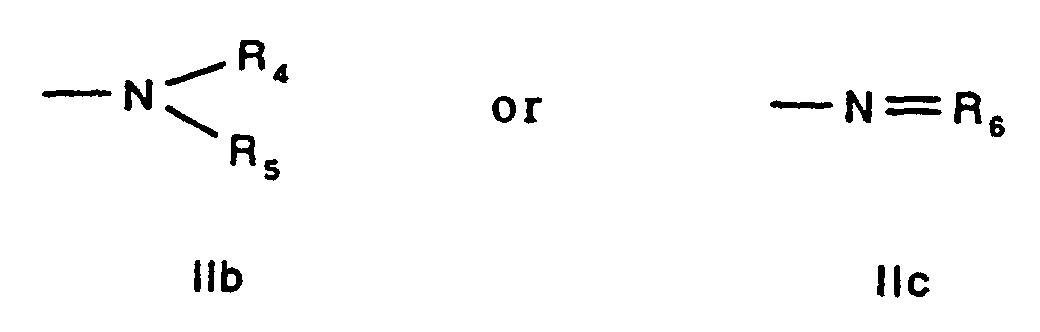
- R4
- denotes hydrogen, (C1-8)alkyl, (C2-8)alkenyl, (C3-6)cycloalkyl, phenyl, (C1-12)acyl or heterocyclyl
- R5
- denotes hydrogen, (C1-8)alkyl, (C2-8)alkenyl, (C3-6)cycloalkyl, phenyl, heterocyclyl, or
a group of formula
wherein
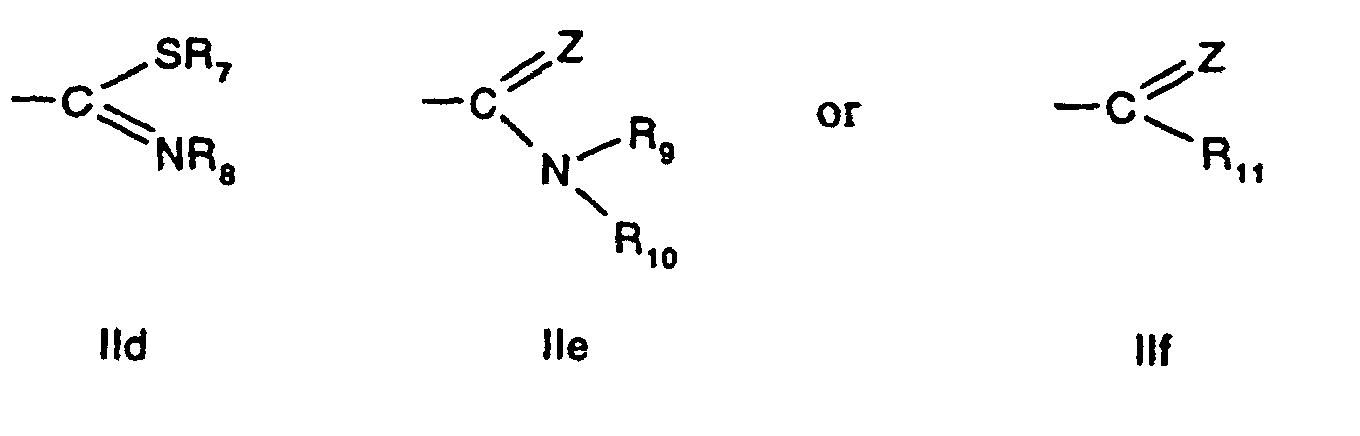
- R7
- denotes (C1-8)alkyl or phenyl
- R8
- denotes hydrogen, (C3-6)cycloalkyl or (C1-8)alkyl
- R9
- denotes hydrogen or (C1-8)alkyl
- R10
- denotes hydrogen, (C1-8)alkyl, hydroxy, amino, phenyl, (C2-8)alkenyl,
(C3-6)cycloalkyl, heterocyclyl or a group of formula
- R9
- and R10 together with the nitrogen atom denote heterocyclyl,
- Z
- denotes oxygen, sulphur or N-R13, wherein
- R13
- denotes hydrogen, (C1-8)alkyl or (C3-6)cycloalkyl
- R11
- denotes hydrogen, (C1-8)alkyl, phenyl, (C3-6)cycloalkyl or heterocyclyl, or
- R4
- and R5 together with the nitrogen atom denote heterocyclyl,
- R6
- denotes heterocyclyl,
- W
- denotes N or CH
- V
- denotes CH or N-O, and
- R3
- denotes hydrogen, (C1-8)alkyl, (C1-12)acyl or carboxyl
- A subgroup of the invention comprises each of the invidual groups of significances.
- R1 may be hydrogen or an ester moiety. An ester moiety includes (C1-8)alkyl, preferably C1-6alkyl; arylalkyl, for example benzyl, alkoxybenzyl, such as 4-methoxybenzyl; indanyl, phthalidyl, alkoxymethyl, e.g. methoxymethyl; (C1-6)alkanoyloxy(C1-6)alkyl, (C1-6)alkoxycarbonyl-oxy(C1-6)alkyl, glycyloxymethyl, phenylglycyloxymethyl, (5-methyl-2-oxo-1,3-dioxolen-4-yl)methyl and ester moieties which form with the COO- group a physiologically hydrolysable and acceptable ester, e.g. such known to be hydrolysable ester groups in the field of cephalosporins. A compound of formula I may thus be in the form of an physiologically-hydrolysable and -acceptable ester. By physiologically-hydrolysable and -acceptable esters as used herein is meant an ester in which the COO-group is esterified and which is hydrolysable under physiological conditions to yield an acid which is itself physilogically tolerable at dosages to be administered. The term is thus to be understood as defining regular pro-drug forms. An ester moiety may be preferably a group which is easily hydrolysable under physiological conditions. Such esters may be administered preferably orally. Parenteral administration may be indicated if the ester per se is an active compound or, if hydrolysis occurs in the blood.
- R4 may be preferably hydrogen or (C1-8)alkyl, for example (C1-4)alkyl.
R5 may be preferably hydrogen; unsubstituted (C1-8)alkyl; (C1-8)alkyl substituted for example by oxo, (C1-8)alkyl or halogenated (C1-8)alkyl; amino; one or several fold substituted heterocyclyl; or a group of formulae IId, IIe, IIf. Heterocyclyl includes unsaturated or saturated heterocyclyl having, e.g. 5 or 6 ring members and, for example, 1 to 3 hetero atoms, such as N, O, S, preferably N, or condensed heterocyclyl, such as benzothiazolyl.
R4 and R5 together with the nitrogen atom may be heterocyclyl, having preferably 5 or 6 ring members and having preferably 1 to 3 heteroatoms, for example N atoms; which may be unsubstituted heterocyclyl; or one or several fold substituted heterocyclyl, for example by oxo, amino, (C1-8)alkyl.
R6 may be saturated or unsaturated heterocyclyl; having preferably 5 or 6 ring members and having for example 1 or 2 nitrogen hetero atoms; for example unsubstituted heterocylclyl; or one or several fold substituted heterocyclyl, for example by amino, (C1-8)alkyl or thiono.
R7 may be preferably (C1-8)alkyl.
R8 may be preferably (C1-8)alkyl or (C3-6)cycloalkyl.
R9 may be preferably hydrogen or (C1-4)alkyl.
R13 may be preferably (C1-8)alkyl.
R10 may be preferably hydrogen; (C2-8)alkenyl; (C3-6)cycloalkyl; unsubstituted (C1-8)alkyl; substituted (C1-8)alkyl, for example by hydroxy, halogen, heterocyclyl, such as pyridyl, amino, for example N((C1-8)alkyl)2 or N+((C1-8)alkyl)3; or a group
R9 and R10 together with the nitrogen atom may be heterocyclyl having preferably 5 or 6 ring members and 1 to 3 hetero atoms such as N, S, O, for example N, O; preferably saturated heterocyclyl. Heterocyclyl includes unsubstituted heterocyclyl, or substituted heterocyclyl, for example by (C1-12)acyl, e.g. formyl, (C1-8)alkyl, for example (C1-4)alkyl. Examples include pyrrolidine, morpholine, piperazine, preferably piperazine.
R11 may be preferably hydrogen; unsubstituted (C1-8)alkyl; substituted (C1-8)alkyl, for example by amino(C1-8)alkyl, diamino(C1-8)alkyl, triamino(C1-8)alkyl; dihydroxyphenyl; (C3-6)cycloalkyl; or unsubstituted heterocyclyl; or substituted heterocyclyl, for example by (C1-8)alkyl, thiono heterocyclyl; heterocyclyl having preferably 5 or 6 ring members and 1 to 3 hetero, preferably N atoms.
If not otherwise stated therein any carbon containing group may contain up to 20 carbon atoms, e.g. alkyl includes C1-20, e.g. C1-8 alkyl. Lower alkyl includes e.g. C1-4alkyl, preferably C1-2alkyl. Alkenyl includes C2-20 e.g. C2-8 alkenyl. Lower alkenyl includes e.g. C3-5alkenyl, preferably C3alkyl. Cycloalkyl includes, for example, C3-6cycloalkyl, particularly C3, C5 or C6cycloalkyl. Alkyl, alkenyl and cycloalkyl include unsubstituted alkyl, alkenyl and cycloalkyl; and, substituted alkyl, alkenyl and cycloalkyl, for example, by halogen, a sulphonic acid derivative, such as SO3H, CF3, hydroxy, (C1-8)alkoxy, (C1-12)acyl, (C1-8)alkylamino, pyridyl. Cycloalkyl is preferably unsubstituted. Acyl includes C1-12, e.g. C1-6acyl, particularly C1-4acyl. Acyl includes unsubstituted acyl and substituted acyl, for example, by hydroxy, (C1-8)alkoxy, amino. Aryl includes phenyl. Aryl may be unsubstituted aryl or substituted aryl, for example by (C1-8)alkyl, (C1-8)alkoxy, (C1-12)acyl, halogen, hydroxy, unprotected or protected amino. Alkoxy includes alkoxy wherein the alkyl part is as defined above. Heterocyclyl includes heterocyclyl having 5 or 6 ring members and 1 to 3 nitrogen, sulphur and/or oxygen hetero atoms including, for example, condensed heterocyclyl, such as for example benzthiazolyl. Heterocyclyl includes further unsubstituted hetercyclyl and substituted heterocyclyl, for example by oxo, (C1-8)alkoxy, hydroxy, thiono, mercapto, (C1-8)alkylthio, imino, (C1-8)alkylamino, (C1-8)alkylimino, amino, halogen, (C1-12)acyl, e.g CHO, CF3, (C1-8)alkyl, (C3-6)cycloalkyl. Carbamoyl includes the carbamoyl group or carbamoyl having alkyl and aryl residues. - The configuration of R3 in group of - C = V - R3 may be syn [(Z)] and anti [(E)] and is preferably syn [(Z)].
- If R3 denotes (C1-8)alkyl, R3 includes unsubstituted (C1-8)alkyl or substituted (C1-8)alkyl, for example by halogen, carboxyl. Preferably W denotes CH.
- In another aspect the present invention provides a compound of formulawherein

- W
- denotes CH or N
- V
- denotes CH or N-O
- R1
- denotes hydrogen or an ester moiety,
- R2
- denotes a group of formula
wherein
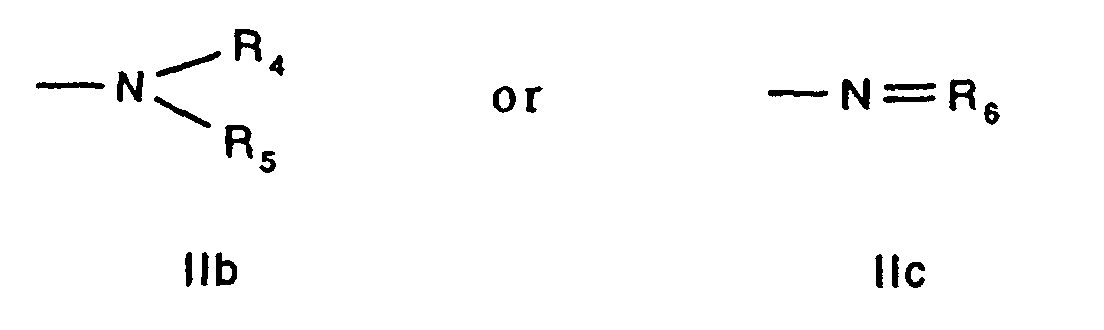
- R4
- denotes hydrogen, phenyl, (C3-6)cycloalkyl or (C1-4)alkyl
- R5
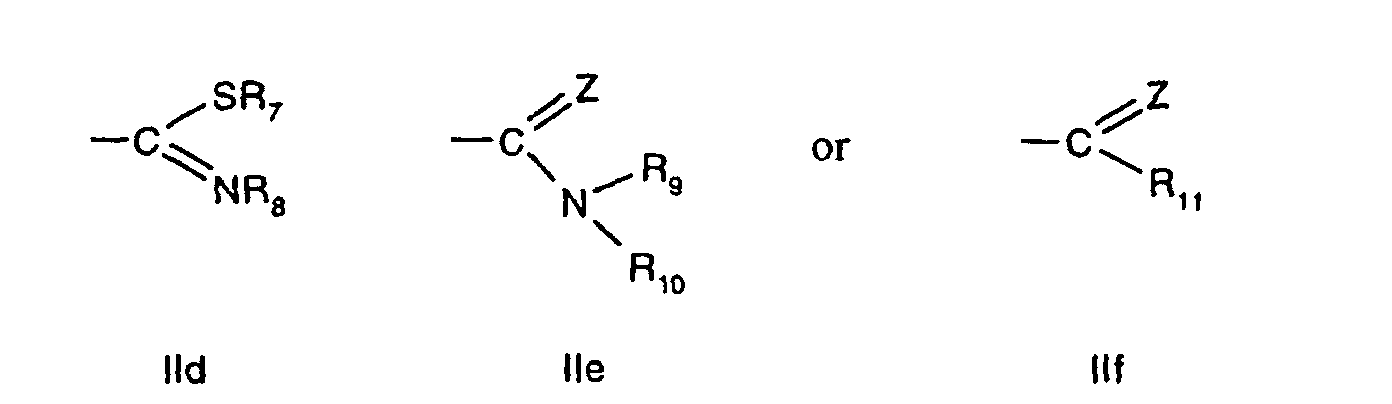
- denotes hydrogen, (C1-4)alkyl, heterocyclyl or a group of formulae
wherein
- R7
- denotes (C1-4)alkyl
- R8
- denotes hydrogen, (C3-6)cycloalkyl or (C1-4)alkyl
- R9
- denotes hydrogen or (C1-4)alkyl,
- R10
- denotes hydrogen, hydroxy; amino; phenyl; (C2-8)alkenyl; (C3-6)cycloalkyl;
heterocyclyl; unsubstituted (C1-8)alkyl; substituted alkyl, by CF3, OH, alkoxy,
carboxyl, halogen, amino, monoalkylamino, dialkylamino, trialkylamino,
pyridyl or a a sulfonic acid residue; a group of formula
wherein
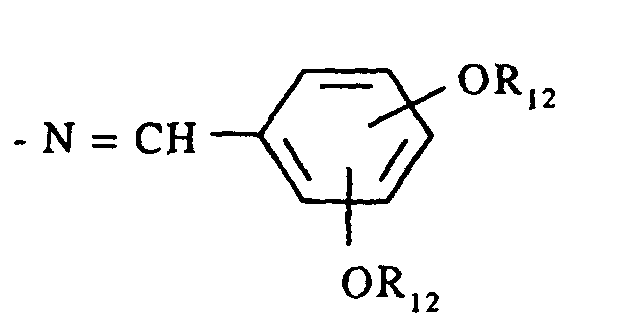
- R12
- denotes hydrogen or (C1-4)alkyl,
- Z
- denotes oxygen, sulphur, or N-R13, wherein
- R13
- denotes hydrogen or (C1-4)alkyl, and
- R11
- denotes hydrogen; dihydroxyphenyl; (C3-6)cycloalkyl; heterocyclyl; unsubstituted (C1-4)alkyl; substituted (C1-4)alkyl by pyridyl or mono(C1-8)alkylamino, di(C1-8)alkylamino or tri(C1-8)alkylamino; and,
- R4 and R5 and/or R9 and R10
- independently of one another together with the nitrogen denote heterocyclyl,
- R6
- denotes heterocyclyl, and
- R3
- denotes hydrogen; (C1-12)acyl; carboxyl; unsubstituted (C1-8)alkyl; substituted (C1-8)alkyl by halogen or carboxyl.
- In another aspect the present invention provides a compound of formulawherein
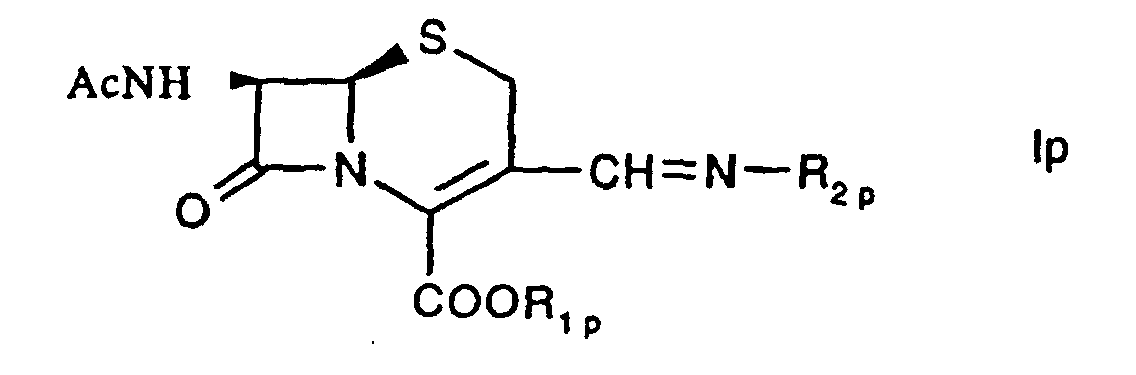
- R1
- denotes hydrogen or an ester moiety
- R2
- denotes a group of formulae
wherein

- R4
- denotes hydrogen, phenyl, (C3-6)cycloalkyl, (C1-4)alkyl,
- R5
- denotes hydrogen, (C3-6)cycloalkyl, (C1-4)alkyl or a group of formula
wherein
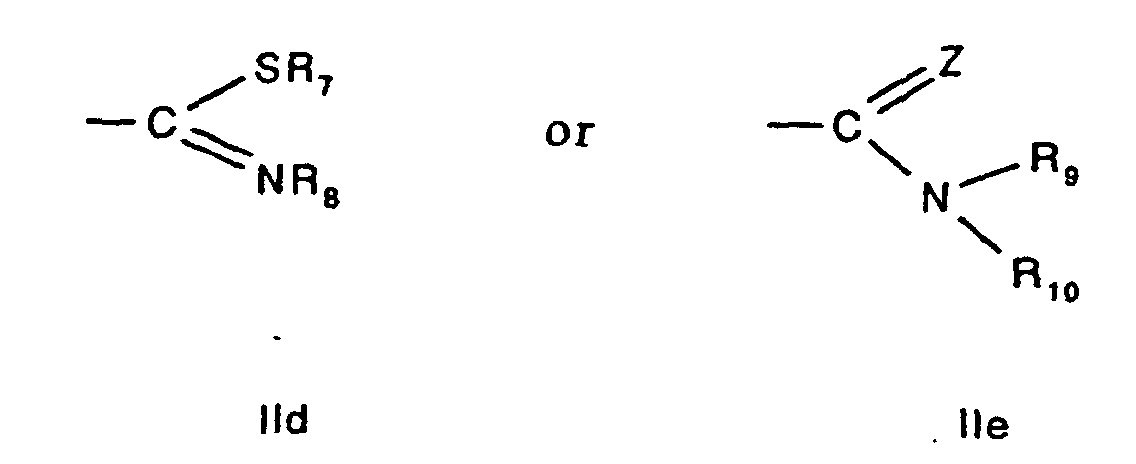
- R8
- denotes hydrogen, (C3-6)cycloalkyl or (C1-4)alkyl,
- Z
- denotes oxygen, sulphur, or N-R13 wherein R13 denotes hydrogen or (C1-4)alkyl
- R9
- denotes hydrogen or (C1-4)alkyl,
- R7
- denotes methyl,
- R10
- denotes hydrogen, (C1-4)alkyl or hydroxy, and
- R4 and R5 and/or R9 and R10
- independently of one another together with the nitrogen denote heterocyclyl, and
- In another aspect the present invention provides a compound of formula I
wherein - R2
- denotes a group of formula
wherein

- R4
- denotes hydrogen, phenyl, (C3-6)cycloalkyl or (C1-4)alkyl, and
- R5
- denotes hydrogen, (C3-6)cycloalkyl, (C1-4)alkyl or a group of formulae
wherein
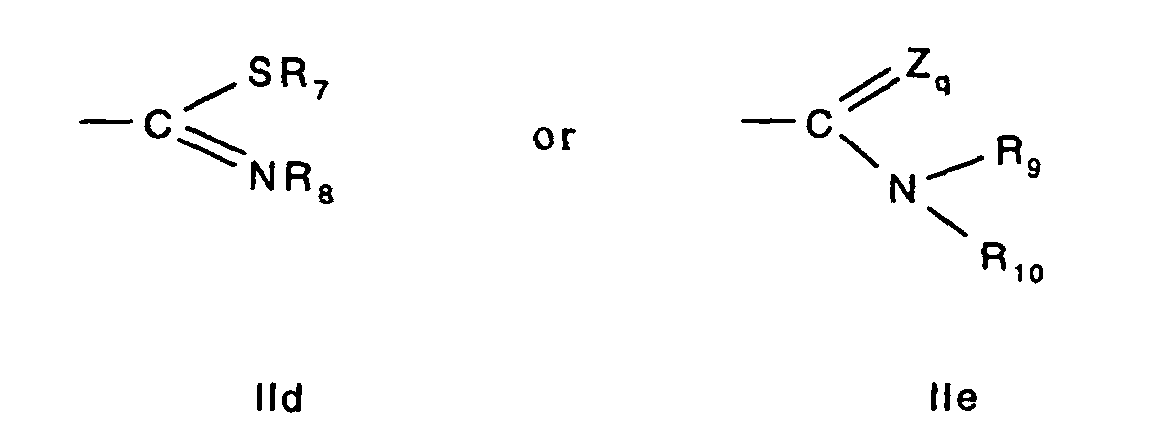
- R7
- is (C1-4)alkyl,
- R8
- denotes hydrogen, (C3-6)cycloalkyl or (C1-4)alkyl,
- Z
- denotes oxygen, sulphur, or N-R13 wherein R13 denotes hydrogen or (C1-4)alkyl,
- R9
- denotes hydrogen or (C1-4)alkyl,
- R10
- denotes hydrogen, (C1-4)alkyl or hydroxy, and
- R4 and R5 and/or R9 and R10
- independently of one another together with the nitrogen denote heterocyclyl, and
- In a further aspect the present invention provides a compound of formula I
wherein - R3
- denotes hydrogen, (C1-4)acyl; unsubstituted (C1-8)alkyl; substituted (C1-4) alkyl, by carboxyl and/or fluoro; and
- R2
- denotes a group of formula
wherein
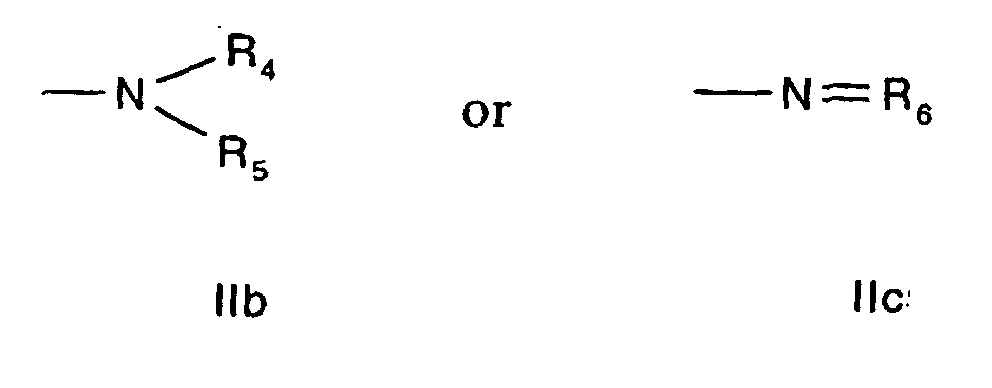
- R4
- denotes hydrogen or (C1-4)alkyl, and
- R5
- denotes hydrogen; saturated or unsaturated, unsubstituted heterocyclyl having
5 or 6 ring members and 1 to 3 nitrogen hetero atoms; saturated or
unsaturated one or several fold substituted heterocyclyl by oxo, (C1-4)alkyl,
amino or CF3, having 5 or 6 ring members and 1 to 3 nitrogen hetero atoms;
benzothiazolyl; or a group of formula
wherein
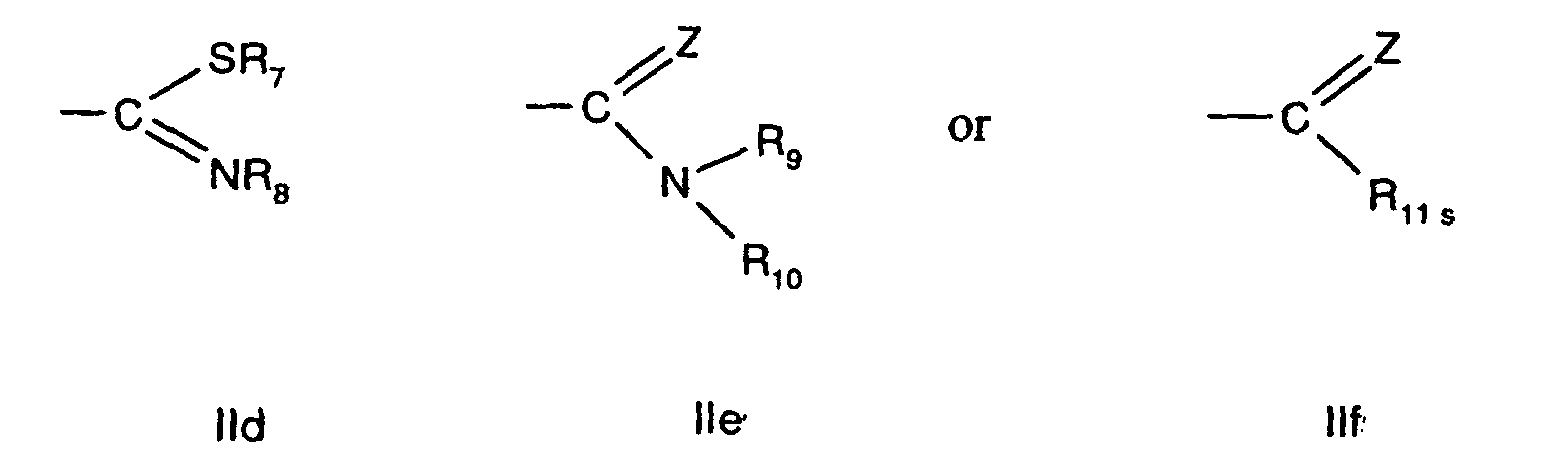
- Z
- is oxygen, sulphur, or N-R13 wherein R13 denotes hydrogen or (C1-4)alkyl
- R7
- denotes (C1-4)alkyl,
- R8
- denotes hydrogen, (C3-6)cycloalkyl or (C1-4)alkyl,
- R9
- denotes hydrogen or (C1-4)alkyl,
- R10
- denotes hydrogen; phenyl; allyl; (C3-6)cycloalkyl; unsubstituted (C1-8)alkyl; substituted (C1-8)alkyl by CF3, di(C1-8)alkylamino, tri(C1-8)alkylamino, hydroxy, pyridyl or SO3H, and
- R11
- denotes hydrogen; pyridyl; (C3-6)cycloalkyl; unsubstituted (C1-4)alkyl; substituted (C1-4)alkyl by pyridyl or tri(C1-8)alkylamino; saturated or unsaturated heterocyclyl having 5 or 6 ring members and 1 to 3 nitrogen hetero atoms; or one or several fold substituted heterocyclyl by (C1-4)alkyl and/or thiono, having 5 or 6 ring members and 1 to 3 nitrogen hetero atoms;
- R4 and R5
- together with the nitrogen atom denote heterocyclyl selected from
saturated, unsubstituted heterocyclyl having 5 or 6 ring members and 1 or 2
nitrogen hetero atoms; saturated, one or several fold substituted
heterocyclyl by oxo or (C1-4)alkyl, having 5 or 6 ring members and 1 or 2 nitrogen hetero
atoms; and/or
- R9s and R10s
- together with the nitrogen atom denote saturated, unsubstituted heterocyclyl having 5 or 6 ring members and 1 or 2 nitrogen and/or oxygen hetero atoms; unsaturated, one or several fold substituted heterocyclyl by CHO or (C1-4)alkyl, having 5 or 6 ring members and 1 or 2 nitrogen and/or oxygen hetero atoms.
- In another aspect the present invention provides a compound of formulawherein

- W
- denotes CH or N
- V
- denotes CH or N―O
- R1
- denotes hydrogen or an ester moiety, and
- R2
- denotes a group of formula
- R4
- denotes hydrogen, (C1-4)alkyl, (C1-4)alkenyl, (C1-4)cycloalkyl, phenyl, heterocyclyl or (C1-12)acyl, and
- R5
- denotes a group of formula
wherein

Z denotes -N-R13, wherein- R13
- is hydrogen, (C1-8)alkyl, or (C3-6)cycloalkyl, and
- R9 and R10
- together with the nitrogen atom denote heterocyclyl which is a piperazinyl.
- In another aspect the present invention provides a compound selected from the group consisting of
7-[[(2-amino-4-thiazolyl)-(Z)-(hydroxyimino)acetyl]amino]-3-[[(aminoiminomethyl)-hydrazono]methyl]-3-cephem-4-carboxylic acid (compound of Example 2),
7-[[(2-amino-4-thiazolyl)-(Z)-(hydroxyimino)acetyl]-amino]-3-[[(piperazinoiminomethyl)-hydrazono]methyl]-3-cephem-4-carboxylic acid (compound of Example 96)
7-[[(5-Amino-1,2,4-thiadiazol-3-yl)-(Z)-(fluormethoxyimino)acetyl]amino]-3-[[(piperazinoiminomethyl)hydrazono]methyl]-3-cephem-4-carboxylic acid (compound of Example 139). - A compound of formulae I, IA, Ip, Iq ,Is, IVi, IVa and VIa may exist in equilibrium with tautomeric forms. The present invention includes a compound of formulae I, IA, Ip, Iq, Is IVi, IVa and VIa in any tautomeric form in which it may exists.
- In another aspect the present invention provides a process for the production of a compound of formula I by reaction of a compound of formulawherein V, W and R3 are as defined in formula I and

- a) either
- α) Rb
- denotes hydroxy and Rc and Rd together form a bond, or
- β) Rd
- denotes hydrogen, a cation, an ester forming group or a silyl group, and
Rb and Rc together denote oxo,
in free form or in form of an acid addition salt
- b) reacting a compound of formula
wherein R1 and R2 are as defined in formula I, with a compound of formula
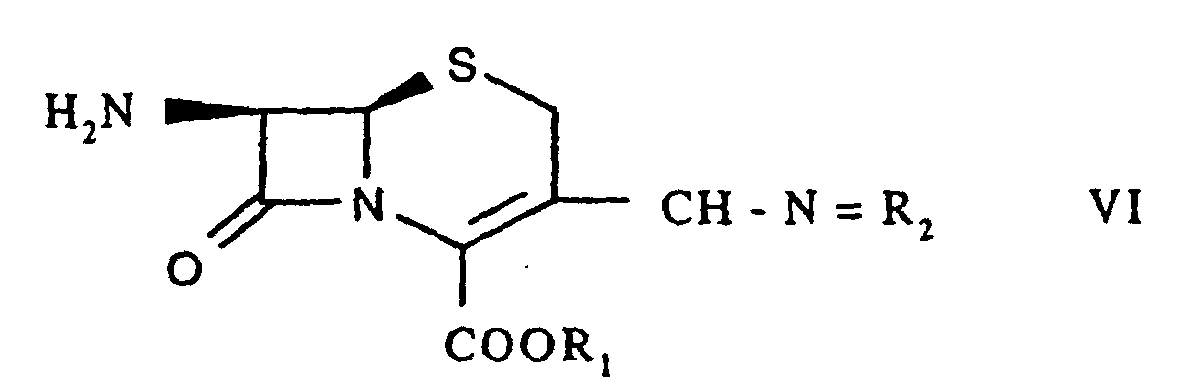
-
- A compound of formula III in a solvent which is inert under the reaction conditions, such as water, a mixture of water and a lower alcohol and/or dioxane, or a dipolar aprotic solvent, for example dimethylformamide or dimethylsulfoxide, optionally mixed with an alcohol or water is reacted with a compound of formula IV at a temperature of about -20 to 50° C. An optimal pH may be adjusted by addition of an inorganic or organic acid or base. A compound of formula I thus obtained may be isolated in conventional manner, for example by addition of an anti-solvent or by chromatographic techniques.
- The reaction may be carried out as conventional, e.g. a compound of formula VI may be reacted with a compound of formula VII in a solvent, for example dissolved or suspended in a mixture of acetone/water, for example at room temperature.
- A reactive group may be protected, preferably by silyl protecting group technology. Suitable solvents include solvents which are inert under the reaction conditions, such as chlorinated hydrocarbons, nitriles, such as acetonitrile, ethers, such as tetrahydrofuran or a mixture of such solvents. Further suitable solvents include dipolar aprotic solvents, e.g. N,N-dimethylformamide. Protecting groups may be split off in conventional manner.
- A starting compound of formula II may, for example, be obtained by
- a) reaction of a compound of formula
wherein either

- α) Ra
- denotes a salt of -NH2 with an inorganic or organic acid, R'b denotes hydroxy, and
- R'c
- and R'd denote together a bond, or
- β) Ra
- denotes NH2, R'd denotes hydrogen and R'b and R'c together denote oxo, with a silylation agent and,
wherein Sil denotes a silyl group and either
- α) R"b
- denotes -OSil and R"c and R"d together denote a bond
- β) R"d
- denotes Sil and R"b and R"c together denote oxo
Acylation may be carried out as conventional. -
- A compound of formula IIIc may be obtained
- a) for the production of a compound of formula
which is an the form of a salt of an inorganic or organic acid and wherein R"'b denotes hydroxy and R'"c and R'"d together denote a bond, reacting a salt of an inorganic or organic acid of a compound of formula
 wherein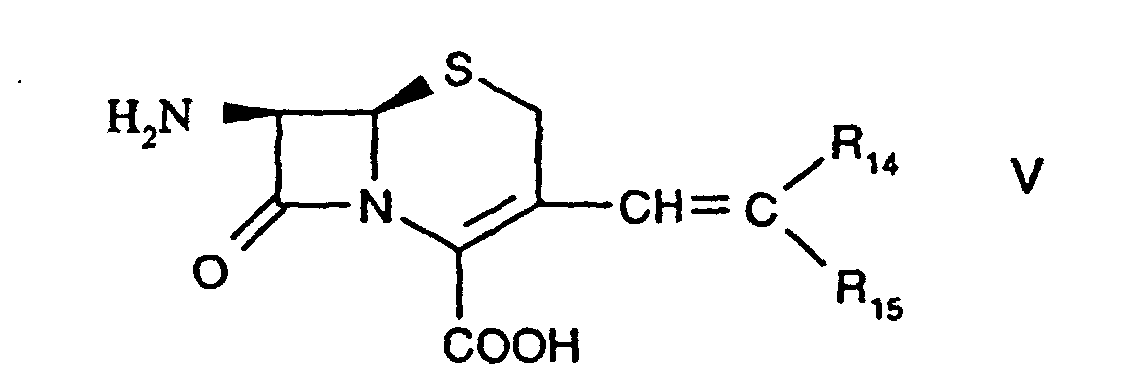
R14 and R15 are the same or different and each denote hydrogen or an organic residue
in an organic solvent optionally in the presence of water with ozone - b) for the production of a compound of formula
treating a compound of formula IIIe wherein R"'b, R'"c and R"'d ar as defined above, with a base.
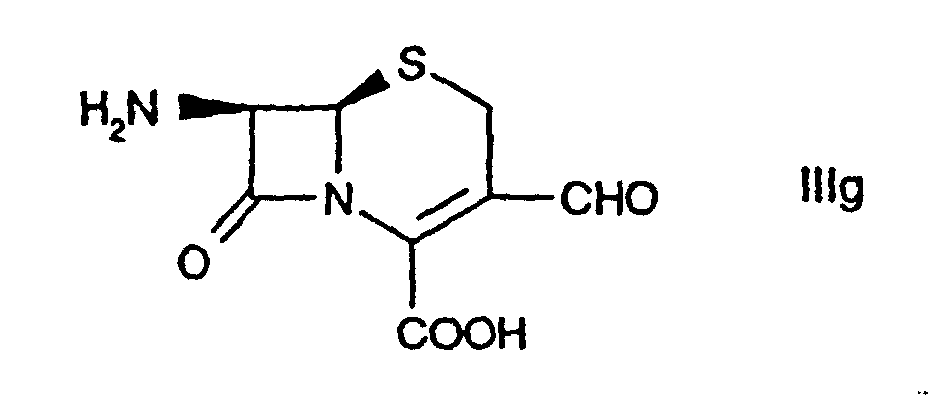
-
- Compounds of formulae IV are partially new and may be obtained analogously to conventional methods, or, as described in the examples.
- Compounds of formulae VI are partially new and may be obtained analogously to conventional methods, or, as described in the examples.
- In this specification unless otherwise indicated terms such as "compound of formula I, " embrace the compound in any form, for example in salt form and free base form. The present invention thus includes a compound in free form or, where such forms exist, in salt form, for example in form of an acid addition salt, inner salt, quaternary salt and/or in solvate, for example hydrate form thereof. A salt may be a pharmaceutically acceptable salt of a compound of formula I, such as a metal salt or an amine salt. Metal salts include for example sodium, potassium, calcium, barium, zinc, aluminum salts, preferably sodium or potassium salts. Amine salts include for example tri(C1-8)alkylamine, procaine, dibenzylamine and benzylamine salts. A free form of a compound of formula I, may be converted into a salt form and vice versa.
- In a further aspect the present invention provides a compound of formula I in free form; or in salt form, for example in acid addition salt form or in metal salt form; and a compound of formula I in solvate form.
- A compound of formula I may also be obtained analogously to other processes conventional in the β-lactam chemistry.
- The compounds of formula I, hereinafter designated as "active compound(s) of the invention" exhibits pharmacological activity and are therefore useful as pharmaceuticals. In particular, the active compounds of the invention show antimicrobial, e.g. antibacterial, activity against gram negative and gram positive bacteria such as Pseudomonas, e.g. Pseudomonas aeruginosa, Pseudomonas fluorescens; Enterobacter, e.g. Enterobacter cloacae; Enterococcus, e.g. Enterococcus faecalis: Moraxella, e.g. Moraxella catarrhalis; Haemophilus, e.g. Haemophilus influenza; Klebsiella, e.g. Klebsiella edwardsii, Klebsiella pneumoniae; Streptococcus, e.g. Streptococcus pneumoniae, Streptococcus durans, Streptococcus faecium, Streptococcus pyogenes; Staphylococcus, e.g. Staphylococcus aureus, Staphylococcus pyogenes; Escherichia, e.g. Escherichia coli; and Proteus, e.g. Proteus mirabilis in vitro in the Agar Dilution Test according to National Commitee for Clinical Laboratory Standards (NCCLS) 1993, Document M7-A3Vol.13, No. 25: "Methods for dilution Antimicrobial Susceptibility Tests for Bacteria that Grow Aerobically - Third Edition, Approved Standard" and in vivo in the septikaemic mouse model. The active compounds of the invention show activity in the mouse when administerd at dosages from about 0.05 to 50 mg/kg body weight (ED50 values).The active compounds show an MHK(µg/ml) in the Agar Dilution Test from about 0.005 to ca. 50. The active compounds of the invention show an surprising overall activity spectrum.
- It has, for example, been determined that the MHK (µg/ml) ot the compound of Example 139 against, for example Enterococcus faecalis strains ATTC 29212 or ATCC 51299, is of ca. 0.08 to 0.25; ainst Staphylococcus aureus strains ATCC 29213 or ATCC 9144 is of ca. 0.2 to 0.4 and against Pseudomonas aeruginosa strain 27853 is ca. 0.8.
- The active compounds of the invention are, therefore, useful for the treatment of microbial, e.g. bacterial diseases.
- In another aspect the present invention provides a compound of claim 1 for use as a pharmaceutical, preferably as an antimicrobial agent, such as an antibioticum. In a further aspect the present invention provides a compound of claim 1 for use in the preparation of a medicament for the treatment of microbial diseases, for example of diseases caused by bacterias selected from Pseudomonas, Enterobacter, Enterococcus, Moraxella, Haemophilus, Klebsiella, Streptococcus, Staphylococcus, Escherichia, or Proteus.
- For this indication, the appropriate dosage will, of course, vary depending upon, for example, the compound of formula I employed, the host, the mode of administration and the nature and severity of the conditions being treated. However, in general, satisfactory results in larger mammals, for example humans, an indicated daily dosage is in the range from about 0.05 to 5 g, for example 0.1 to about 2.5 g, of an active compound of the invention conveniently administered, for example, in divided doses up to four times a day.
- An active compound of the invention may be administered by any conventional route, for example orally, e.g. in form of tablets or capsules, or parenterally in the form of injectable solutions or suspensions, e.g. in analogous manner to cefotaxime.
- The compound 7-[[(5-Amino-1,2,4-thiadiazol-3-yl)-(Z)-(fluormethoxyimino)acetyl]amino]-3-[[(piperazinoiminomethyl)hydrazono]methyl]-3-cephem-4-carboxylic acid (compound of Example 139) is the preferred compound of the invention for use as an antimicrobial agent.
It has, for example been determined that the MHK (µg/ml) of the compound of Example 139 (tested in form of the trihydrochloride) against, for example Streptococcus pneumoniae, strain ATCC 49619 is ca. 0.01 whereas, for example ceftriaxone shows an MHK (µg/ml) of ca. 0.02. It is therefore, indicated that for the treatment of microbial diseases, e.g. bacterial diseases the preferred compounds of the invention may be administered to larger mammals, for example humans, by similar modes of administration at similar dosages than conventionally employed with ceftriaxone. - The compounds of formula I may be administered in pharmaceutically acceptable salt form, e.g. acid addition salt form or base addition salt form or in the corresponding free forms, optionally in solvate form. Such salts exhibit the same order of activity as the free forms.
- The present invention also provides pharmaceutical compositions comprising a compound of formula I in pharmaceutically acceptable salt form or free form in association with at least one pharmaceutical carrier or diluent.
- Such compositions may be manufactured in conventional manner.
Unit dosage form may contain, for example 10 mg to about 1 g, for example 10 mg to about 700 mg. - In the following Examples the temperatures indicated are in degree Celsius.
- 1.24 g of the hydrogen carbonate of aminoguanidine are dissolved in 9.15 ml of 2 N HCl and added under stirring to a solution of 3.2 g of the trifluoroacetate of N-(1,4,5a,6-tetrahydro-3-hydroxy-1,7-dioxo-3H,7H-azeto[2,1-b]furo[3,4-d][1,3]-thiazin-6-yl)-2-(2-aminothiazol-4yl)-(Z)-2-methoxyimino acetic acid amide in 125 ml of 4% aqueous acetonitrile. After ca. 90 minutes the precipitated dihydrochloride of 7-[(2-Amino-4-thiazolyl)(methoxyimino)acetyl]amino-3-[[(aminoimino-methyl)-hydrazono]methyl]-3-cephem-4-carboxylic acid is filtered off, washed with acetonitrile and dried.
-
- a) 10 g of the hydrochloride of N-(1,4,5a,6-tetrahydro-3-hydroxy-1,7-dioxo-3H,7H-azeto[2,1-b]furo[3,4-d][1,3]-thiazin-6-yl)-2-(2-aminothiazol-4-yl)-(Z)-2-(acetoxyimino)-acetic acid amide are suspended in 160 ml of acetonitrile and treated with 53 ml of water and 11 ml of 8 N HCl. The reaction mixture is stirred for ca. 14 hours at room temperature. A clear solution is obtained in which the acetoxyimino group being hydrolyzed to give the hydroxyimino group.
- b) 3 g of the hydrogen carbonate of aminoguanidine are dissolved in 11 ml of 1 N HCl
and added dropwise to the solution obtained in step a) which is cooled to 0°. After
ca. 30 minutes the reaction mixture is warmed to room temperature and stirred for
ca. another 2.5 hours. The dihydrochloride of 1-[[(2-Amino-4-thiazolyl)-(Z)-(hydroxyimino)acetyl]amino]-3-[[(amino-iminomethyl)hydrazono]methyl]--3-cephem-4-carboxylic
acid precipitate, is filtered off, washed with a mixture of
acetonitrile and water, acetonitrile and with ether and dried.


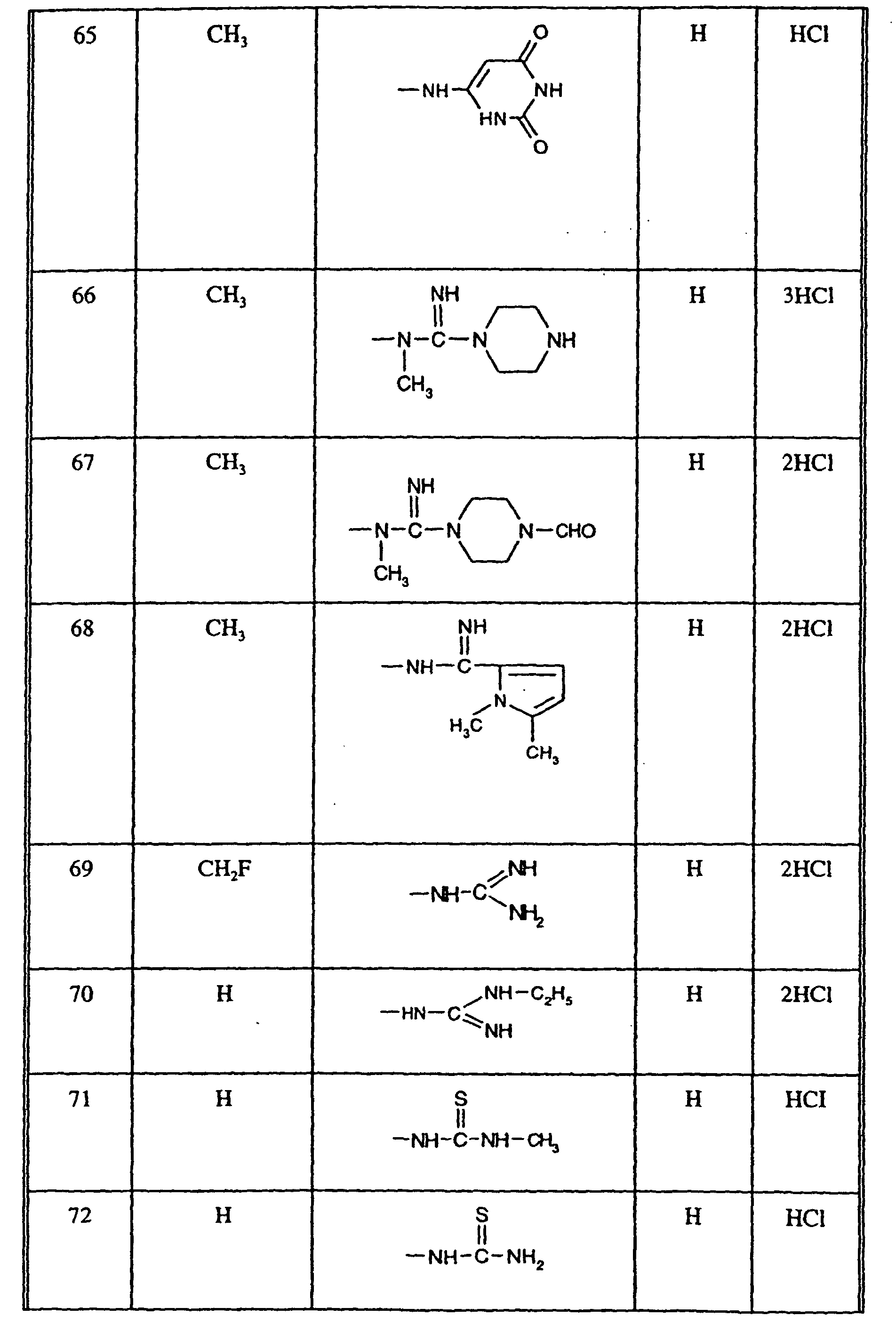
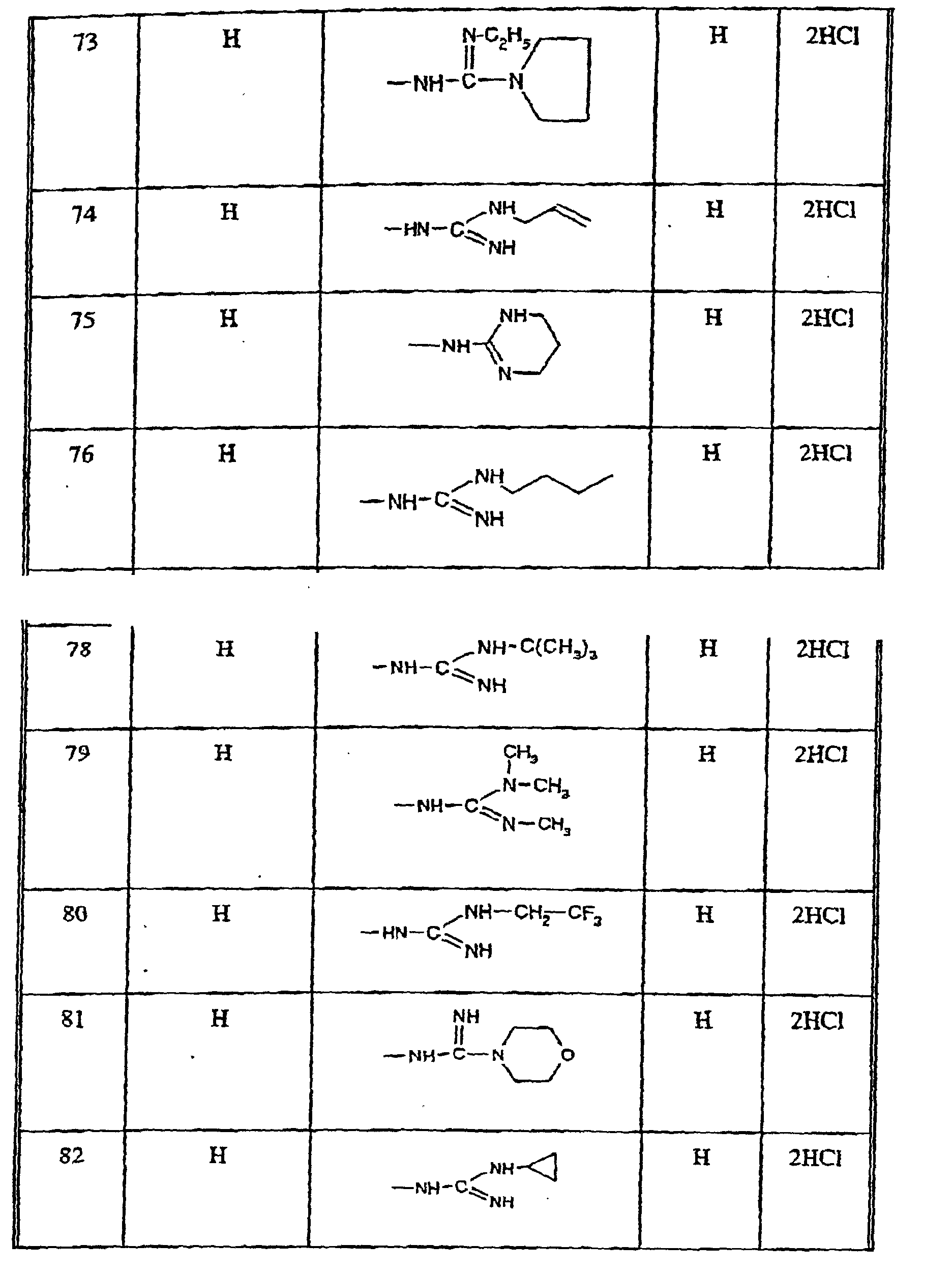


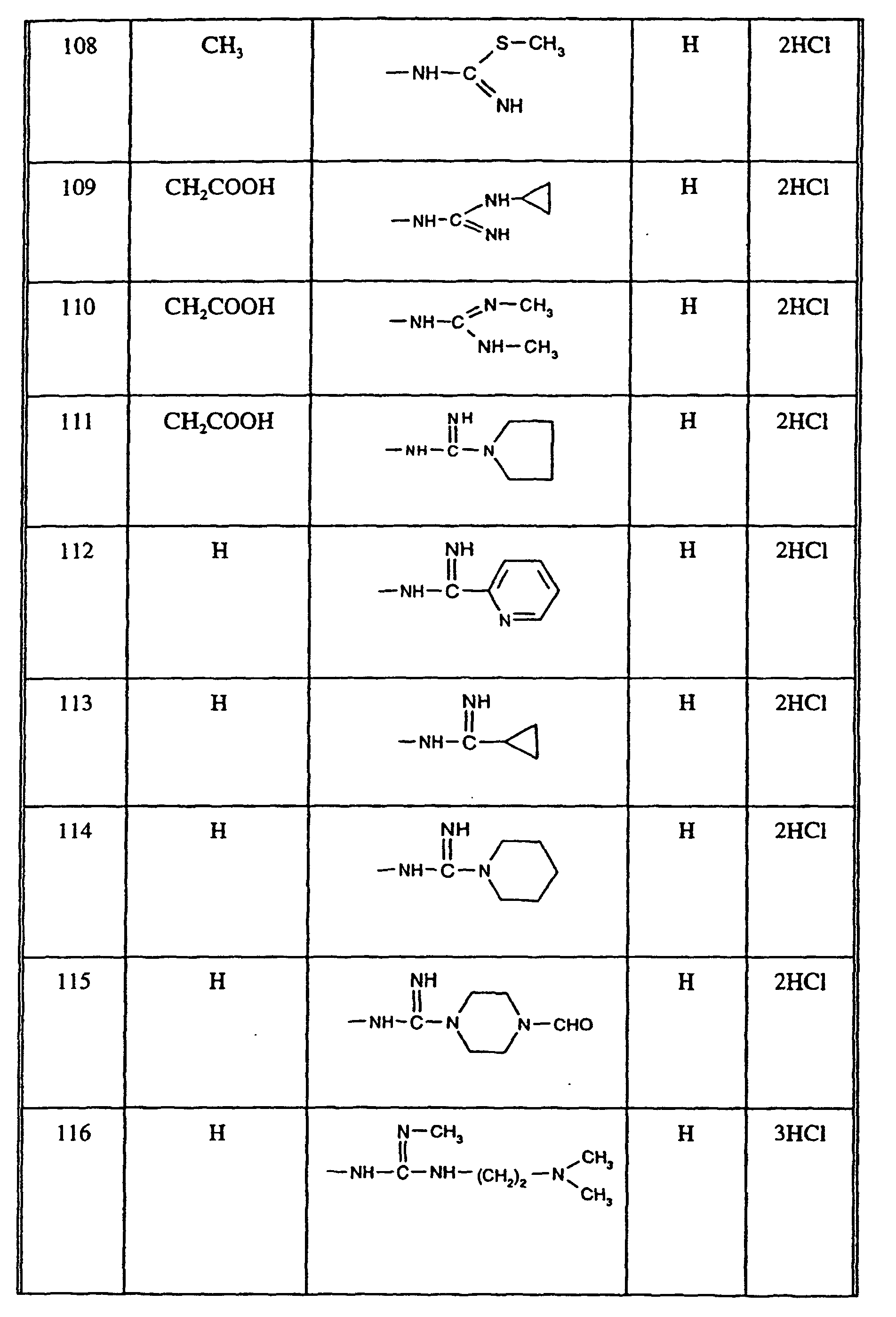
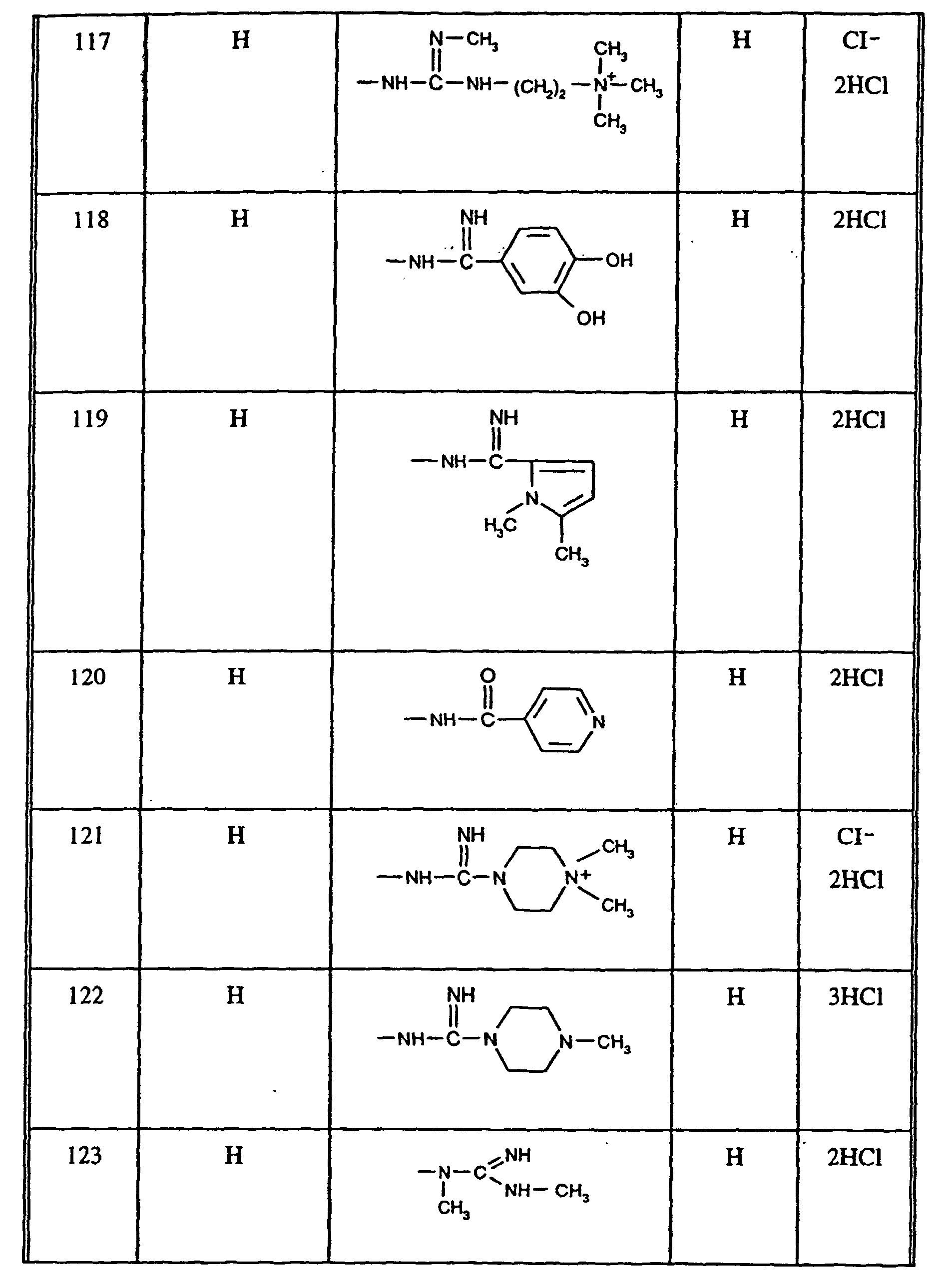


-
- 1 g of N-(1,4,5a,6-tetrahydro-3-hydroxy-1,7-dioxo-3H,7H-azeto[2,1-b]furo[3,4-d][1,3]-thiazin-6-yl)-2-[2-(tert.-butoxycarbonylamino)thiazol-4-yl]-(Z)-2-pentenoic acid amide is dissolved in a mixture of 30 ml of methanol and 30 ml of acetonitrile and 0.3 g of the hydrogencarbonate of aminoguanidine are added. A pH of 2.0 is adjusted by addition of methanolic HCI. Stirring is continued at room temperature. Within ca. 30 minutes a light coloured precipitate forms, which is filtered off after ca. 3 hours, washed with acetonitrile and ether and dried. The dihydrochloride of 7-[2-(2-aminothiazol-4-yl)-(Z)-2-pentenoylamino]-3-{[(aminoiminomethyl)hydrazono]-methyl}-3-cephem-4-carboxylic acid is obtained in the form of a light yellow powder.
- A suspension of 3 g of 7-[(2-amino-4-thiazolyl)-(Z)-(methoxyimino)acetyl]amino-3-[[2-(1,1-dimethylethoxy)-2-oxoethoxy]hydrazonomethyl]-3-cephem-4-carboxylic acid in 75 ml of methylenchloride is treated at ca. 0° with 0,6 ml of anisol. 10 ml of trifluoro acetic acid are added dropwise under stirring. The solution obtained is stirred for ca. further 3 hours at 0°. The reaction mixture is poured into 600 ml of ether. The trifluoroacetate of 7-[(2-Amino-4-thiazolyl)-(Z)-(methoxyimino)acetyl]-amino-3-(hydrazono)-3-cephem-4-carboxylic acid precipitates, is filtered off and dried.
- 1 g of 7-[(2-amino-4-thiazolyl)-(Z)-(methoxyimino)acetyl]amino-3-[(aminothioxomethyl)-hydrazonomethyl]-3-cephem-4-carboxylic acid is suspended in 30 ml of acetonitrile and stirred after addition of 2.5 ml of N,O-bistrimethylsilylacetamide for ca. 20 minutes. The clear solution obtained is treated with 0.6 g of bromoacetone and stirred overnight. 1 ml of water are added. The precipitate is filtered off and dried. The hydrobromide of 7-[(2-amino-4-thiazolyl)-(Z)-(methoxyimino)acetyl]amino-3-[(4-methylthiazol-2-yl)hydrazonomethyl]-3-cephem-4-carboxylic acid is obtained as a yellow solid.
- 1 g of 7-[(2-amino-4-thiazolyl)-(Z)-(methoxyimino)acetyl]amino-3-[(aminothioxomethyl)- methylhydrazonomethyl]-3-cephem-4-carboxylic acid is reacted in analogous manner as described in Example 142 with N,O-bistrimethylsilylacetamide and with bromoacetone. The hydrobromide of 7-[(2-amino-4-thiazolyl)-(Z)-(methoxyimino)-acetyl]amino-3-[(4-methylthiazol-2-yl)methylhydrazonomethyl]-3-cephem-4-carboxylic acid is obtained as a yellow solid.
- 1.1 g of the dihydrochloride obtained according to Example 8 are dissolved in 25 ml of water, treated with 0.5 g of active charcoal and stirred for ca. 5 minutes. The almost colourless filtrate is poured into 5 ml of water under stirring. A pH of about 7 is kept by addition of 2.5% aqueous ammonia. The precipitate obtained is filtered off and dried. The dihydrate of 6R-trans (Z)-7-[(2-Amino-4-thiazolyl)-(methoxyimino)-acetyl]amino-3[[(imino(methylamino)methyl)hydrazono]-methyl]-3-cephem-4-carboxylic acid is obtained as a yellowish powder.
- 5.5 g of the dihydrate obtained according to Example 144 are dissolved in 55 ml of dimethylacetamide under addition of 1.43 ml tetramethylguanidine. This solution is cooled to 0°, treated with a solution of 4.4 g of 1-iodoethyl-isopropylcarbonate in 30 ml of toluene and stirred for ca. 90 minutes at 0°. The reaction mixture is poured into 1 liter of diethylether. The precipitate obtained is filtered off and stirred twice each with 500 ml of acetonitrile. The acetonitrile phases are combined, filtered and evaporated to a volume of ca. 10 ml. The oily residue is treated with 400 ml of water. A precipitate forms which is filtered off and dried. The precipitate is stirred with 700 ml of ethyl acetate. After evaporation of the ethyl acetate yellow coloured 6R-trans (Z)-7-[(2-amino-4-thiazolyl)-(methoxyimino)acetyl]amino-3-[[(imino(methylamino)methyl)hydrazono]methyl]--3-cephem-4-carboxylic acid 1-(isopropoxycarbonyloxy)ethyl ester is obtained in the form of a diastereomeric mixture in the ratio of ca. 1:1.
- 0,72 g of the hydrogen carbonate of aminoguanidine are dissolved in 5.2 ml of 2 N HCl. This solution is added to a solution of 2 g of 6R-trans (Z)-7-[((acetoxyimino)-2-amino-4-thiazolyl)acetyl]amino-3-formyl-3-cephem-4-carboxylic acid 1-(isopropoxycarbonyloxy)ethyl ester in 14 ml of acetonitrile containing 1.3 ml of water. The reaction mixture is stirred for ca. 45 minutes at room temperature and poured into 100 ml of acetonitrile. The precipitate formed is filtered off and dissolved in 100 ml of water. The pH of the solution obtained is adjusted to 7 by addition of 0.5 N aqueous sodium hydrogen carbonate. A yellow suspension is obtained which is extracted twice with a mixture of 200 ml of ethyl acetate and 40 ml of acetonitrile. The organic phases are combined, dried over Na2SO4 and evaporated. 6R-trans (Z)-7-[((acet-oxyimino)-2-amino-4-thiazolyl)acetyl]amino-3-[[(aminoiminomethyl)hydrazono]-methyl]-3-cephem-4-carboxylic acid 1-(isopropoxycarbonyloxy) ethyl ester is obtained in the form of a yellow diastereomeric mixture in the ratio of ca. 1:1.
- A solution of 0.6 g of a compound obtained according to Example 146 in a mixture of 50 ml of acetonitrile and 20 ml of isopropanol is treated with 0.66 g of the monohydrate of toluene-4-sulfonic acid and stirred overnight at 25°. The reaction mixture is poured into 150 ml of tert.butyl-methylether. The precipitate obtained is filtered off, washed with tert.butyl-methylether and dried. The ditosylate of 6R-trans (Z)-7-[(2-amino-4-thiazolyl)(hydroxyimino)acetyl]amino-3[[(aminoiminomethyl)-hydrazono]methyl]-3-cephem-4-carboxylic acid (isopropoxycarbonyloxy)ethyl ester is obtained in the form of a light coloured diastereomeric mixture in the ratio of ca. 1:1.
- To 1.0 g of 7-amino-3-formyl-3-cephem-4-carboxylic acid in a mixture of 50 ml of acetonitrile and 5 ml of 2N HCl are added dropwise 0.6 g of the hydrogen carbonate of aminoguanidine, dissolved in 2.2 ml of 2N HCl. The dihydrochloride of 7-amino-3-[[(aminoiminomethyl)hydrazono]methyl]-3-cephem-4-carboxylic acid precipitates, is filtered off, washed with acetonitrile and dried.
- 4 g of the dihydrochloride of 7-amino-3-[[(aminoiminomethyl)hydrazono]methyl]-3-cephem-4-carboxylic acid are dissolved in 80 ml of methanol. The solution is cooled to 0° and treated with a solution of 7 g of (2-amino-4-thiazolyl)-(Z)-[2-(1,1-dimethylethoxy)-2-oxoethoxy]imino]thioacetic acid S-benzothiazol ester in 50 ml of methylene chloride. The reaction mixture is stirred for about 2.5 hours at 20°. About a third of the solvent is evaporated off and 120 ml of ether are added to the residue. The hydrochloride of 7-[[(2-amino-4-thiazolyl)-(Z)-[[2-(1,1-dimethylethoxy)-2-oxoetoxy]imino]-acetyl]amino]-3-[[(aminoiminomethyl)hydrazono]methyl]-3-cephem-4-carboxylic acid precipitates, is filtered off, washed with ether and dried.
- 3.5 g of the hydrochloride of 7-[[(2-amino-4-thiazolyl)-(Z)-[[2-(1,1-dimethylethoxy)-2-oxoetoxy]imino]acetyl]amino]-3-[[(aminoiminomethyl)hydrazonolmethyl]-3-cephem-4-carboxylic acid are dissolved in 20 ml of trifluoroacetic acid at 0°. The solution is stirred for ca. 15 minutes at 0° and for ca. 1 hour at 20°. The reaction mixture is treated with 40 ml of ether. A precipitate forms, is filtered off, washed with ether, dried, dissolved in 15 ml of 2N HCl and stirred for ca. 1 hour at 20°. A light brownish precipitate of the dihydrochloride of 7-[[(2-amino-4 thiazolyl)-(Z)-[(carboxy-methoxy)imino]actyl]-amino]-3-[[(aminoiminomethyl)hydrazono]methyl]-3-cephem-4-carboxylic acid is obtained, filtered off and dried.
- The compounds of Examples 1 to 146 may be obtained as described in Example 147 using the appropriate starting material.
- Compounds used as starting material may be prepared as follows:
- 13.8 g of the hydrochloride of 7-amino-3-[(Z/E)-prop-1-en-1-yl]-3-cephem-4-carboxylic acid are dissolved in 200 ml of methanol. The solution is cooled to -50° and 8 l of O2 containing ca. 2 percent v/v ozone are introduced per minute under stirring at this temperature. After ca. 20 minutes the hydrochloride of 6-amino-1,4,5a,6-tetrahydro-3-hydroxy-1,7-dioxo-3H,7H-aceto[2,1-b]furo[3,4-d][1,3]thiazin being practically quantitatively formed and ozonolysis is terminated as determined by HPLC. 8 l of N2 are bubbled through the reaction mixture within ca. 2 minutes. The slight cloudy solution is poured into 1400 ml of tert.butyl-methyl ether. The precipitate is filtered off under N2, washed with a little of tert.butyl-methyl ether and acetonitrile and dried. The hydrochloride of 6-amino-1,4,5a,6-tetrahydro-3-hydroxy-1,7-dioxo-3H,7H-aceto[2,1-b]furo[3,4-d][1,3]thiazin is obtained in the form of a white powder (HPLC content of more than 95%).
- 2.64 g of the hydrochloride of 6-amino-1,4,5a,6-tetrahydro-3-hydroxy-1,7-dioxo-3H,7H-aceto[2,1-b]furo[3,4-d][1,3]thiazin are dissolved in 50 ml of methanol. To this solution a solution of 0.78 g of pyridin in 10 ml of methanol is added dropwise under ice cooling and stirring. The precipitate obtained is filtered off moisture free under nitrogen, washed with a little methanol and dried. (6R-trans)-7-Amino-3-formyl-8-oxo-5-thia-1-azabicyclo[4.2.0]oct-2-en-2-carboxylic acid is obtained in the form of a light brownish powder.
IR (KBr): 1799 cm-1 (β-lactam), 1672 cm-1 (CHO), 1606 and 1542 cm-1 (carboxylate) UV-Spectrum: λmax in H2O = 302 nm. - 10 g of 7-amino-3-formyl-3-cephem-4-carboxylic acid in 200 ml of acetonitrile : methylenchloride (1:1) are treated with 37.4 ml of N,O-bis(trimethylsilyl)acetamide at room temperature within ca. 5 minutes. After ca. 30 minutes the reaction mixture is cooled to -10° and 21 g of 2-(2-tritylaminothiazol-4-yl)-(Z)-2-methoxyiminoacetic acid chloride are added in 3 portions. The temperature raises to -5°. After ca. 45 minutes the reaction mixture is treated with 4 ml of water. The temperature raises to 20°. The reaction mixture is stirred for ca. 10 minutes and filtered. 15 g of active charcoal are added to this filtrate and stirring is continued for ca. 10 minutes. After filtration the solvent of the filtrate obtained is evaporated. The evaporation residue is treated with tert.butyl-methyl ether. A crystalline, almost colourless precipitate is obtained, filtered off and dried. Crystalline N-(1,4,5a,6-Tetrahydro-3-hydroxy-1,7-dioxo-3H,7H-azeto[2,1-b]furo[3,4-d][1,3]thiazin-6-yl)-2-(2-tritylaminothiazol-4-yl)-2-methoxyiminoacetic acid amide is obtained in form of a diastereomeric mixture in the ratio of ca. 1:1.
- 5 g of N-(1,4,5a,6-tetrahydro-3-hydroxy-1,7-dioxo-3H,7H-azeto[2,1-b]furo[3,4-d][1,3]-thiazin-6-yl)-2-(2-aminothiazol-4-yl)-2-methoxyiminoacetic acid amide are introduced into 20 ml of trifluoro acetic acid at 0°. The temperature raises to 10°. The reaction mixture is stirred for ca. 30 minutes at 0° and added dropwise into 200 ml of diethylether. The mixture obtained is stirred for ca. 5 minutes and filtered. A crystalline, diastereomeric mixture of the trifluoroacetate of N-(1,4,5a,6-tetrahydro-3-hydroxy-1,7-dioxo-3H,7H-azeto[2,1-b]furo[3,4-d][1,3]thiazin-6-yl)-2-(2-aminothiazol-4-yl)-2-methoxyiminoacetic acid amide in the ratio of ca. 1:1 is obtained.
- is obtained in form of a light yellow powder analogously as described in Example A) c) to d) but using in step c) 2-(2-tritylaminothiazol-4-yl)-(Z)-2-hydroxyimino acetic acid chloride instead of 2-(2-tritylaminothiazol-4-yl)-(Z)-2-methoxyimino-acetic acid chloride.
- A suspension of 3.73 g of 7-amino-3-formyl-3-cephem-4-carboxylic acid in a mixture of 80 ml of methylenchloride and 30 ml of acetonitrile is stirred at 0° with 16 ml of N,O-bis(trimethylsilylacetamide). Within ca.15 minutes a clear solution is obtained to which 3.9 g of (5-amino-1,2,4-thiadiazol-3-yl)-(Z)-2-fluormethoxyiminoacetic acid chloride, obtainable for example as described in Example 1 of EP-0 590 681, are added. The reaction mixture is stirred for ca. 1 hour at 0°. 500 ml of acetonitrile containing 10 g of water are added and the mixture is filtered to remove insolubles. The filtrate is evaporated. The residue is treated with 500 ml of acetonitrile, the mixture is filtered and the filtrate is evaporated. The solid obtained is treated with tert.butyl-methyl ether and dried. The hydrochloride of N-(1,4,5a,6-Tetrahydro-3-hydroxy-1,7-dioxo-3H,7H-azeto[2,1-b]furo[3,4-d][1,3]-thiazin-6-yl)-2-(5-amino-1,2,4-thiadiazol-3-yl)-(Z)-2-(fluoro-methoxyimino)acetic acid amide is obtained in the form of a light brownish powder.
- 40 g of 7-amino-3-formyl-3-cephem-4-carboxylic acid are suspended in 1500 ml of acetonitrile and cooled to 0°. Within ca. 20 minutes 170 ml of N,O-bis(trimethylsilyl)acetamide are added under stirring. Within ca.15 minutes at 0° a clear solution is obtained, which is cooled to -10° and to which 48 g of (2-aminothiazol-4-yl)-(Z)-(acetoxyimino)acetic acid chloride are added in portions in such a way that the temperature of the reaction mixture does not exceed - 8°. Stirring is continued for ca. 60 minutes at -10° and 168 ml of water are added. Stirring is continued for ca. further 20 minutes at 0° and for ca. 2 hours at room temperature. A crystalline precipitate forms, is filtered off, washed with ca. 350 ml of acetonitrile and ca. 100 ml of ether and dried. The hydrochloride of N-(1,4,5a,6-tetra-hydro-3-hydroxy-1,7-dioxo-3H,7H-azeto[2,1-b]furo-[3,4-d][1,3]-thiazin-6-yl)-2-(2-aminothiazol-4-yl)-(Z)--2-(acetoxyimino)acetic acid is obtained in form of a diastereomeric mixture in the ratio of ca. 1:1.
- 10 g of the hydrochloride of N-(1,4,5a,6-tetrahydro-3-hydroxy-1,7-dioxo-3H,7H-azeto[2,1-b]furo[3,4-d][1,3]thiazin-6-yl)-2-(2-aminothiazol-4-yl)-(Z)-2-(acetoxyimino)-acetic acid amide are suspended in 160 ml of acetonitrile and treated with 53 ml of water and 11 ml of 8 N HCI. The reaction mixture is stirred for ca. 14 hours at room temperature. A clear solution is obtained which is diluted with water-free acetonitrile to obtain the 3-fold volume. The solvent is evaporated off to obtain a volume of ca. 10 ml, which is treated with ca. 200 ml of acetonitrile. A precipitate forms which is treated with ether, filtered off and dried. The hydrochloride of N-(1,4,5a,6-tetrahydro-3-hydroxy-1,7-dioxo-3H,7H-azeto[2,1-b]furo[3,4-d][1,3]-thiazin-6-yl)-2-(2-aminothiazol-4-yl)-(Z)-2-(hydroxyimino)acetic acid amide is obtained in yellowish coloured form.
- is obtained in form of a light brownish powder analogously as described in Example A) a) to c) but using 2-(2-tritylaminothiazol-4-yl)-(Z)-2-[(1-carboxy-1-methylethoxy)-iminoacetic acid chloride instead of 2-(2-tritylaminothiazol-4-yl)-(Z)-2-methoxyiminoacetic acid chloride.
- is obtained in form of a light brownish powder analogously as described in Example A) c) to d) but using 2-(2-(tert.butoxycarbonylamino)thiazol-4-yl)-(Z)-2-pentenoic acid chloride instead of 2-(2-tritylaminothiazol-4-yl)-(Z)-2-methoxyimino-acetic acid chloride.
- 25.5 g of 4-formyl-1-piperazinecarbothioamide are suspended in 80 ml of methanol, treated with 22 g of methyliodide and refluxed. Within ca.10 minutes a clear solution is obtained. The mixture is cooled to room temperature. The solvent is evaporated. Crystalline hydroiodide of 4-formyl-1-[imino(methylthio)methyl]piperazine is obtained.
- 48.1 g of the hydroiodide of 4-formyl-1-[imino(methylthio)methyl]piperazine are dissolved in 100 ml of water, run through a column filled with 800 ml of a strong basic ion exchanger in chloride form and eluated with 850 ml of water. The solvent is evaporated to obtain a volume of ca. 100 ml which is treated with 7.35 g of hydrazinehydrate. The reaction mixture is stirred for ca. 1 hour at room temperature and the solvent is evaporated off. The oily hydrochloride of 4-formyl-1-(hydrazinoiminomethyl)piperazine crystallizes on drying.
- 11 g of the hydrochloride of 4-formyl-1-(hydrazinoiminomethyl)piperazine are dissolved in 400 ml of methanol and treated with 50 of HClconc. The reaction mixture is stirred for ca. 14 hours at room temperature. A white precipitate forms, is filtered off, washed with methanol and ether, dried and recrystallized with water/ethanol. The dihydrochloride of 1-(hydrazinoiminomethyl)-piperazine is obtained in crystalline, colourless form.
- Analogous in the manner as described in Example H) compounds of formula IV of TABLE 2 may be obtained:
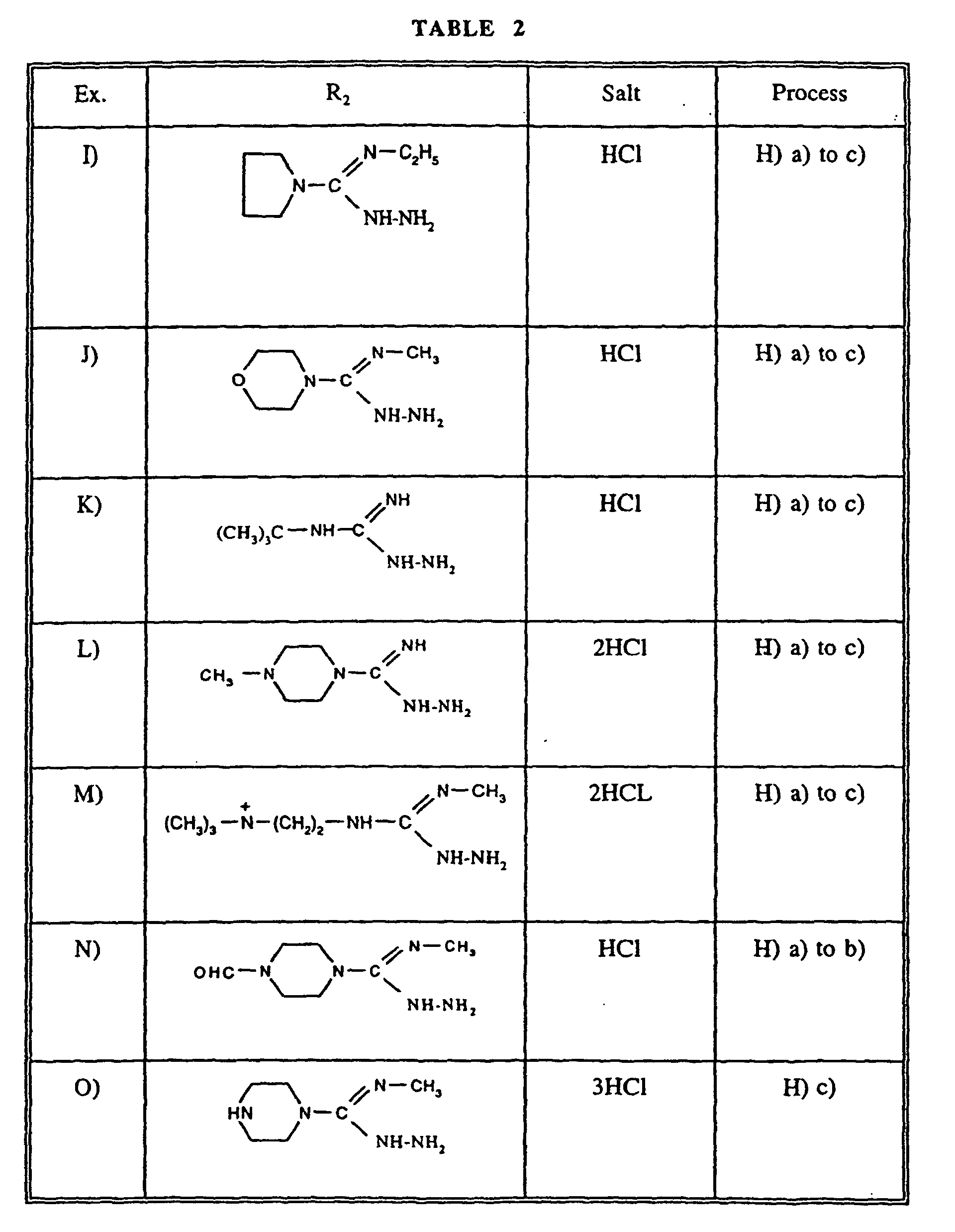
- 12.7 g of 2-methylamino-2-oxazoline ar dissolved in 50 ml of water, treated with 3 g of hydrazinehydrate and stirred for ca. 17 hours at room temperature. The solvent is evaporated and 1-amino-3-(2-hydroxyethyl)-4-methylguanidine is obtained as oily residue crystallizing upon cooling.
- 3.2 g of 4-methyl-1-piperazinecarbothioamide are suspended in 100 ml of methanol. 6.2 g of methyliodide are added and the mixture is refluxed for ca. 2 hours and cooled to 20° ab. The hydroiodide of 1,1-dimethyl-4-[imino-(methylthio)methyl]piperaziniumiodide precipitates, is filtered off and dried.
- 6.57 g of the hydroiodide of 1,1-dimethyl-4-[imino(methylthio)methyl]piperaziniumiodide are dissolved in 70 ml of water, run through a column filled with 150 ml of a strong basic ion exchanger in chloride form and eluated with 250 ml of water. Water is evaporated off the eluate to obtain to a volume of ca. 50 ml, which is treated with 0.9 ml of hydrazinehydrate and stirred overnight. The solvent is evaporated off and the residue obtained is treated with n-hexane. The hydrochloride of 1,1-dimethyl-4-(hydrazinoiminomethyl)piperaziniumchloride is obtained.
- A solution of 239.8 g of the hydroiodide of S-Methyl-2-methylisothiosemicarbazide in 100 ml of water is run through a column filled with 1500 ml of a strong basic ion exchanger in chloride form and eluated with water. The eluate is lyophilized and the lyophilization residue is treated with ether. The precipitate is filtered off and dried. The hydrochloride of S-methyl-2-methylisothiosemicarbazide is obtained as a white solid.
Melting point: 116 ° - A mixture of 20 g of freshly distilled formylpiperazine and 27.3 g of the hydrochloride of S-methyl-2-methylisothiosemicarbazide in 250 ml of ethanol is refluxed overnight and the solvent is evaporated. The oily residue is dissolved in 70 ml of hot isopropanol and the solution is slowly cooled to 20°. A precipitate forms and the mixture is allowed to stand for ca. 2 hours at 4°. The hydrochloride of 4-formyl-1-[hydrazino(methylimino)methyl]piperazine is filtered off and recrystallized from isopropanol.
- 10 g of the hydrochloride of 1-formyl-4-[hydrazino(methylimino)methyl]piperazine are dissolved in 250 ml of methanol. 50 ml of HClconc. are added, the mixture obtained is stirred overnight and the solvent is evaporated. A solid residue is obtained which is dried over solid KOH. The trihydrochloride of 1-[hydrazino-(methylimino)methyl]piperazine is obtained in form of a white product.
- In analogous manner as described in Example R) but reacting the hydrochloride of S-methyl-isothiosemicarbazide or the hydrochloride of S-methyl-2-methylisothiosemicarbazide or the hydrochloride of S-methyl-4-methylisothiosemicarbazide with a corresponding amine compounds of formula IV of TABLE 3 may be obtained.


- 1 g of the hydrochloride of diaminoguanidine are dissolved in 10 ml of 4 N HCl and diluted with 20 ml of methanol. This solution is treated quickly with a solution of 1 g of 3,4-dihydroxybenzaldehyde in 40 ml of methanol. The reaction mixture is stirred for some minutes at room temperature and the solvent is evaporated off. The residue is suspended in 50 ml of acetonitrile. The precipitate formed is filtered off and dried. The hydrochloride of 1-amino-3-(3,4-dihydroxybenzylidenamino)guanidine is obtained.
- 295 mg of 4-cyclopropylthiosemicarbazide are dissolved in 5 ml of dry methanol and treated with 154 ml of methyliodide. The mixture is stirred at 40° under nitrogen for ca. 5 hours, cooled and treated with diethylether. A colourless precipitate of the hydroiodide of S-Methyl-4-cyclopropylthiosemicarbazide is formed, filtered off, washed with diethylether and dried.
- 147 mg of 4-n-butylthiosemicarbazide in 2,5 ml of dry methanol are treated with 149 mg of methyliodide. The mixture is stirred under nitrogen for ca. 5 hours, cooled and treated with diethylether. A colourless precipitate of the hydroiodide of S-methyl-4-n-butylthiosemicarbazide is formed, filtered off, washed with diethylether and dried.
- 0.48 g of 1-methyl-5-mercapto-1,2,4-triazol-3-carboxylic acid methyl ester are dissolved in 10 ml of methanol, treated with 450 µl of hydrazinehydrate and stirred for ca. 2 hours at 20°. A precipitate of 1-methyl-5-mercapto-1,2,4-triazol-3-carboxylic acid hydrazide is formed, filtered off, washed with methanol and dried. IR (KBr): 1669 cm-1, 1608 cm-1, 1517 cm-1
13C-NMR (300 MHz, DMSO-d6): 35.4 (NCH3); 143.3, 154.3 and 166.7 - 5 g of 2-cyano-1,5-dimethylpyrrol are dissolved in 40 ml of ethanol and treated with 10 ml of triethylamine. 50 ml of an ethanolic H2S solution (3.8 g/100 ml) are added and the mixture is heated for ca. 15 hours in an autoclave at 70°. The reaction mixture is cooled and the solvent is evaporated off to obtain ca. a quarter of its volume. 1,5-dimethylpyrrol-2-carbothioamide crystallizes upon cooling at 0° in the form of a light yellow precipitate.
- 1 g of 1,5-dimethylpyrrol-2-carbothioamide are dissolved in 20 ml of methanol and treated with 1.7 g of methyliodide. The reaction mixture is stirred for about 5 hours at room temperature. The solvent is evaporated until crystallization starts. The residue is cooled to ca. 0°. The crystalline hydroiodide of 1,5-dimethyl-2-[imino(methylthio)methyl]pyrrol is filtered off, washed with methanol and dried.
- 1.3 g of the hydroiodide of 1,5-dimethyl-2-[imino(methylthio)methyl]pyrrol are dissolved in 20 ml of methanol. 0.28 g of hydrazinehydrate are added. The reaction mixture is stirred for ca. 3 hours, the solvent is evaporated off and the residue is recrystallized from acetonitrile/ether. The hydroiodide of 1,5-dimethyl-2-(hydrazinoiminomethyl)pyrrol is obtained.
- is obtained in analogous manner as described in Example AA), but using 3,4-dihydroxy-thiobenzamide instead of 1,5-dimethylpyrrol-2-carbothioamide.
- A solution of 1.86 g of the hydrochloride of aminooxyacetic acid in 20 ml of water is treated under stirring at 0° with 3.16 g of the hydrochloride of 6-amino-1,4,5a,6-tetrahydro-3-hydroxy-1,7-dioxo-3H,7H-azeto[2,1-b]furo[3,4-d][1,3]thiazin. The mixture is stirred for ca. 8 hours at 0°. 7-Amino-3-[[(carboxymethoxy)imino]methyl]-3-cephem-4-carboxylic acid precipitates in form of colourless crystals, which are filtered off, washed with 5 ml of cold water and 5 ml of acetone and dried.
- A solution of 0.5 g of the hydrochloride of O-methylhydroxylamine in 10 ml of water is treated under stirring at 0° with 1.38 g of 7-amino-3-formyl-3-cephem-4-carboxylic acid and stirred for ca. 8 hours at 0°. 7-Amino-3-[(methoxyimino)methyl]-3-cephem-4-carboxylic acid precipitates in form of almost white crystals, which are filtered off, washed with 5 ml of cold water and 5 ml of acetone and dried.
-
- a) A solution of 1.26 g of the hydrochloride of hydroxylamine in 7.5 ml of water is treated under stirring at 0° with 4.74 g of the hydrochloride of 6-amino-1,4,5a,6-tetrahydro-3-hydroxy-1,7-dioxo-3H,7H-azeto[2,1-b]furo[3,4-d][1,3]thiazin and stirred for ca. 8 hours at 0° under nitrogen. The pH of the reaction mixture is adjusted to 3.5 using solid sodium hydrogen carbonate. 7-Amino-3-[(hydroxy-imino)methyl]-3-cephem-4-carboxylic acid precipitates in form of colourless crystals, which are filtered off, washed with ca. 5 ml of cold water and 5 ml of acetone and dried.
- b) A suspension of 0.79 g of the hydrochloride of 6-amino-1,4,5a,6-tetrahydro-3-hydroxy-1,7-dioxo-3H,7H-azeto[2,1-b]furo[3,4-d][1,3]thiazin in 10 ml of dichloromethane is treated under stirring at 4° with 2.67 g of N,O-bis-(trimethylsilyl)acetamide. A clear solution is obtained within 10 minutes. 0.21 g of the hydrochloride of hydroxylamine are added. The reaction mixture is stirred for ca. 2 hours under nitrogen at 4° and the solvent is evaporated off. The residue is treated with 10 ml of isopropylalkohol, precooled to 1°. 7-Amino-3-[(hydroxy-imino)methyl]-3-cephem-4-carboxylic acid precipitates in form of almost colourless crystals which are filtered off, washed with 5 ml of acetone and dried.
-
- Analoguously as described in Examples AC) to AE) the compounds of Table 4 of formula VI may be obtained.

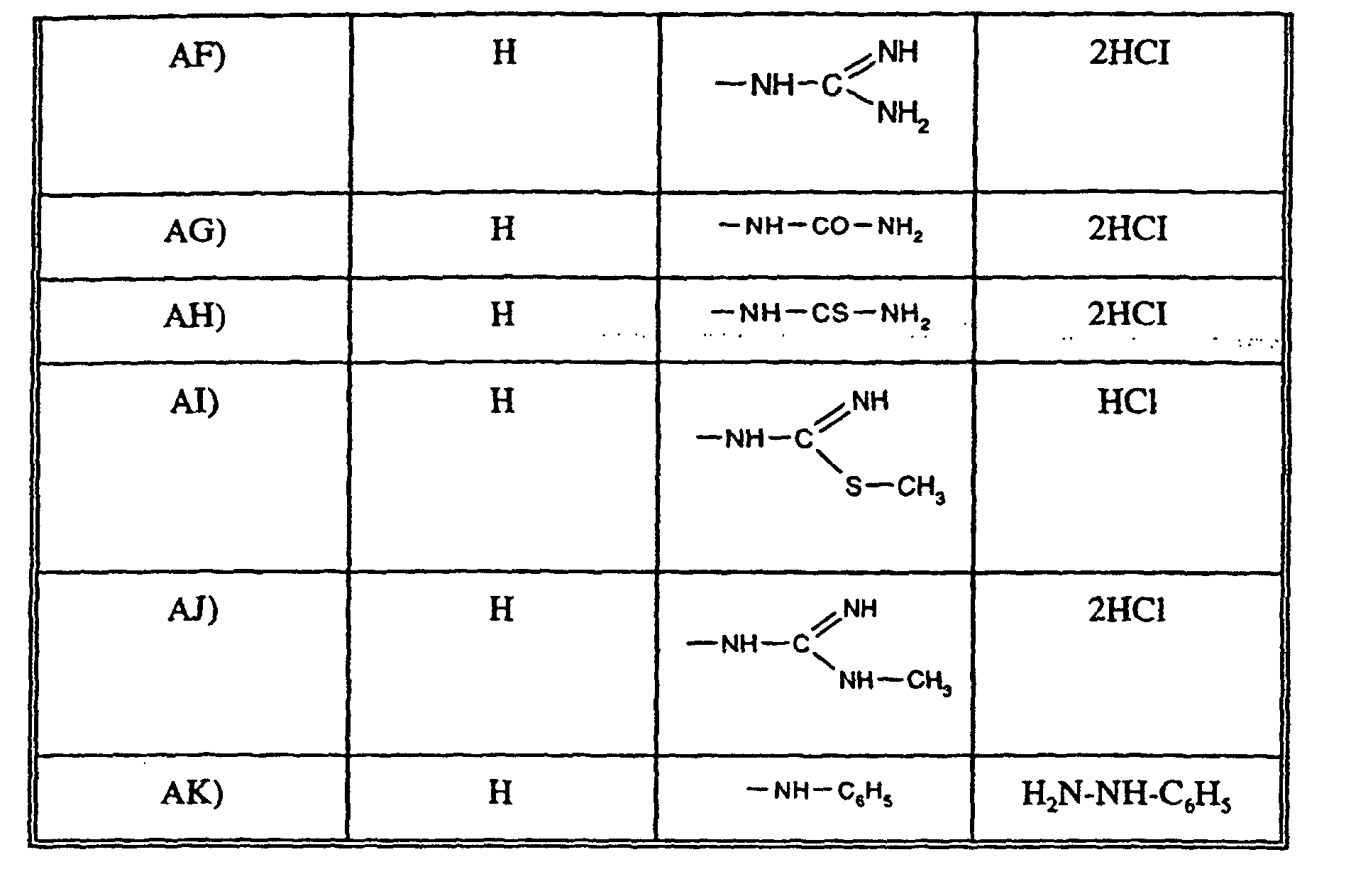
1H-NMR-Spectra of the compounds obtained according to the Examples (Ex.) Ex. Spectrum 1 (300 MHz, CD3OD): 8.43 (s, 1H, CH=N); 6.96 (s, 1H, CH); 5.99 (d, J=4.9 Hz, 1H, CH); 5.22 (d, J=4.9 Hz, 1 H,CH); 4.04 (s, 3H, OCH3); 3.99 and 3.56 (AB quartet, J=17.8 Hz, 2H, SCH2). 2 (90 MHz, DMSO-d6 + D2O): 3.6 and 4.3 (AB quartet, J=18 Hz, 2H, SCH2); 5.3 (d, J=5.1 Hz, 1H, β-lactam-H); 5.95 (d, J=5.1 Hz, 1H, β-lactam-H); 6,95 (s, 1H, thiazolyl-H); 8.35 (s, 1H, CH=N). 5 (300 MHz, DMSO-d6): 3.57 and 4.43 (AB quartet, J=18.2 Hz, 2H, S-CH2); 4.71 (s, 2H, O-CH2); 5.30 (d, J=5.0 Hz, 1H, β-lactam-H); 5.91 (dd, J=5.0 and 7.9 Hz, 1H, β-lactam-H); 7.02 (s, 1H, CH thiazol); 7.9 (broad 4H, NH); 8.29 (s, 1H, CH=N); 9.88 (d, J=7.9 Hz, 1H, NH); 12.25 (s, 1H, OH). 7 (300 MHz, CD3OD): 8.26 (s, 1H, CH=N); 7.04 (s, 1H, CH); 5.90 (d, J=5.1 Hz, 1H, CH); 5.24 (d, J=5.1 Hz, 1 H, CH); 4.05 (s, 3H, OCH3); 4.32 and 3.65 (AB quartet, J=17.8 Hz, 2H, SCH2). 8 (300 MHz, CD3OD): 8.46 (s, 1H, CH=N); 6.99 (s, 1H, CH); 5.95 (d, J=5.2 Hz, 1H, CH); 5.27 (d, J=5.2 Hz, 1 H, CH); 4.01 (s, 3H, OCH3); 4.37 and 3.63 (AB quartet, J=18.1 Hz, 2H, SCH2); 2.95 (s, 3H, N-CH3). 9 (90 MHz, DMSO-d6): 9.78 (d, J=8.0 Hz, 1H, CONH); 8.26 (s, 1H, CH=N); 6.91 (s, 1H, CH); 7.32 (dd, J=7.3 Hz, 2H, Hm); 7.05 (d, J=7.3 Hz, 2H, Ho); 6.78 (t, J=7.3 Hz, 1H, Hp); 5.76 (dd, J1=4.8 Hz, J2=8.0 Hz, 1H, CH); 5.25 (d, J=4.8 Hz, 1 H, CH); 3.91 (s, 3H, OCH3); 4.16 and 3.76 (AB quartet, J=17.4 Hz, 2H, SCH2). 10 (90 MHz, DMSO-d6): 2.25 (s, 3H, CH3CO); 3.65 and 4.55 (AB quartet, J=18 Hz, 2H, SCH2); 5.4 (d, J=5 Hz, 1 H, β-lactam-H); 5.95 (dd, J=5Hz and 8 Hz, 1H, β-lactam-H); 7,32 (s, 1H, thiazolyl-H); 8.4 (s, 1H, CH=N); 10,2 (d, J=8.0 Hz, 1H, NH). 11 (90 MHz, DMSO-d6): 1.12 (t, J=7.1 Hz, 3H, CH3); 3.29 (q, 2H, CH2); 3.56 and 4.50 (AB quartet, J=18.1 Hz, 2H, SCH2); 3.93 (s, 3H, N-O- CH3); 5.30 (d, J=5Hz, 1H, CH); 5.9 (q, J=6Hz, and 8Hz, 1H, CH); 6.90 (s, 1H, thiazolyl-H); 8.32 (s, 1H, CH=N); 9.86 (d, J=8.0Hz, NH). 12 (90 MHz, DMSO-d6): 1.85-2.15 (m, 4H); 3.25-3.7 (m, 5H, -CH2-N-CH2- and 1H of SCH2); 4.0 (s, 3H, N-O-CH3); 4.5 (part of the AB quartet, J=18Hz, 1H of SCH2); 5.3 (d, J=5Hz, 1H, CH); 5.9 (q, J=5Hz and 8Hz, 1H, CH); 7.0 (s, 1H, thiazolyl-H); 8.8 (s, 1H, CH=N); 10.1 (d, J=7.9Hz, NH). 13 (90 MHz, DMSO-d6): 2.9 (broad s, 6H, N-CH3), 3); 3.6 and 4.5 (AB quartet, J=18Hz, 2H, SCH2); 3.9 (s, 3H, N-O-CH3); 5.3 (d, J=5Hz, 1H, CH)); (q, J=5Hz and 8Hz, 1H, CH); 6.95 (s, 1H, thiazolyl-H); 8.75 (s, 1H, CH=N); 9.95 (d, J=8Hz, NH). 14 (90 MHz, DMSO-d6): 3.65 (broad s, 4H, N-CH2-CH2-N); 3.5 and 4.4 (AB quartet, J=18Hz, 2H, SCH2); 3.9 (s, 3H, N-O-CH3); 5.3 (d, J=5.0Hz, 1H, CH); 5.85 (q, J=5Hz and 8Hz, 1H, CH); 6.9 (s, 1H, thiazolyl-H); 8.35 (s, 1H, CH=N); 9.9 (d, J=8Hz, NH). 15 (90 MHz, DMSO-d6): 1.16 (t, J=7.1Hz, 3H, CH3); 1.8-2 (m, 4H); 3.32 (q, 2H, CH2); 3.45-3.65 (m, 5H, -CH2-N-CH2- and 1H of SCH2); 3.91 (s, 3H, N-O-CH3); 4.1 (part of the AB quartet, J=18Hz, 1H of SCH2); 5.27 (d, J=5Hz, 1H, CH); 5.9 (q, J=5Hz and 8Hz, 1H, CH); 6.86 (s, 1H, thiazolyl-H); 8.56 (s, 1H, CH=N); 9.82 (d, J=8Hz, NH). 16 (90 MHz, DMSO-d6): 2.86 (broad s, 3H, N-CH3); 3.5 and 4.5 (AB quartet, J=18Hz, 2H, SCH2); 5.3 (d, J=6Hz, 1H, CH); 5.9 (q, J=5Hz and 8Hz, 1H, CH); 6.85 (s, 1H, thiazolyl-H); 8.4 (s, 1H, CH=N); 9.8 (d, J=8Hz, NH). 17 (90 MHz, DMSO-d6): 1.85-2.15 (m, 4H); 3.25-3.8 (m, 5H, -CH2-N-CH2- and 1H of SCH2); 4.5 (part of the AB quartet, J=18Hz, 1H of SCH2); 5.3 (d, J=5Hz, 1H, CH); 5.85 (q, J=5Hz and 8Hz, 1H, CH); 6.85 (s, 1H, thiazolyl- H); 8.7 (s, 1H, CH=N); 9.8 (d, J=7.9Hz, NH). 18 (90 MHz, DMSO-d6): 2.86 (broad s, 6H, N-CH3), 3); 3.55 and 4.47 (AB quartet, J=18.9Hz, 2H, SCH2); 5.31 (d, J=5.1Hz, 1H, CH); 5.91 (q, J=5.1Hz and 7.9Hz, 1H, CH); 6.8 (s, 1H, thiazolyl-H); 8.58 (s, 1H, CH=N); 9.72 (d, J=7.9Hz, NH). 19 (90 MHz, DMSO-d6): 3.7 (broad s, 4H, N-CH2-CH2-N); 3.55 and 4.35 (AB quartet, J=18.1Hz, 2H, SCH2); 5.31 (d, J=5.0Hz, 1H, CH); 5.9 (q, J=5.1Hz and 8Hz, 1H, CH); 6.8 (s, 1H, thiazolyl-H); 8.38 (s, 1H, CH=N); 9.73 (d, J=8.0Hz, NH). 20 (300 MHz, CD3OD): 8.34 (s, 1H, CH=N); 7.06 (s, 1H, CH); 5.93 (d, J=4.9 Hz, 1H, CH); 5.32 (d, J=4.9 Hz, 1 H, CH); 4.09 (s, 3H, OCH3); 4.33 and 3.64 (AB quartet, J=18.2 Hz, 2H, SCH2). 21 (90 MHz, DMSO-d6): 3.65 and 4.7 (AB quartet, J = 18 Hz, 2H, SCH2); 3.95 (s, 3 H, O-CH3); 4.2 (part of the AB quartet, J = 18 Hz, 1H of SCH2); 5.3 s(d, J = 5 Hz, 1 H, β-lactam-H), 5.85 (dd, J =5 Hz and 8 Hz, β-lactam-H); 7.0 (s, 1 H, thiazolyl-H); 7 to 7.7 (m, 5 H, aromatic H); 8.45 (s, 1 H, CH=N);.9 (d, J = 8 Hz, NH). 22 (90 MHz, DMSO-d6):3.55 and 4.6 (AB quartet, J = 18 Hz, 2H, SCH2); 3.93 (s, 3 H, O-CH3); 4.2 (part of the AB quartet, J = 18 Hz, 1H of SCH2); 5.3 (d, J = 5 Hz, 1 H, β-lactam-H); 5.85 (dd, J = 5 Hz and 8 Hz, β-lactam-H); 7.0 (s, 1 H, thiazolyl-H); 7 to 7.7 (m, 5 H, aromatic-H); 8.3 (s, 1 H, CH=N); 9.9 (d, J = 8 Hz, NH). 23 (90 MHz, DMSO-d6): 3.05 (d, J = 4 Hz, 3 H, NHCH 3); 3.55 and 4.5 (AB quartet, J = 18 Hz, 2H, SCH2); 3.93 (s, 3 H, O-CH3); 4.2 (part of the AB quartet, J = 18 Hz, 1H of SCH2); 5.25 (d, J = 5 Hz, 1 H, β-lactam-H); 5.8 (dd, J = 5 Hz and 8 Hz, β-lactam-H); 6.95 (s, 1 H, thiazolyl-H); 8.25 (s, 1 H, CH=N);8.4 (d, J = 4 Hz, NHCH3);9.85 (d, J = 8 Hz, NH). 24 (90 MHz, DMSO-d6): 2.85 (s, 3H, NCH3); 3.1 to 3.7 (m, 9 H, 8 piperazinyl-H's and 1H of SCH2); 3.95(s, 3 H, OCH3); 4.1 (part of the AB quartet, J = 18 Hz, 1H of SCH2); 3.95 (s, 3 H,O-CH3); 5.3 (d, J = 5 Hz, 1 H, β-lactam-H); 5.85 (dd, J = 5 Hz and 8 Hz, β-lactam-H);6.95 (s, 1 H, thiazolyl-H); 7.95 (s, 1 H, CH=N); 9.9 (d, J = 8 Hz, NH). 25 (90 MHz, DMSO-d6): 3.6 and 4.55 (AB quartet, J = 18 Hz, 2H, SCH2); 3.9 to 4.1 (m, 5 H, -OCH3 and -N-CH 2-CH=CH2); 5.1 to 5.5 (m, 3 H, β-lactam-H and -N-CH2-CH=CH 2); 5.7 to 6.1 (m,2H, β-lactam-H and N-CH2-CH=CH2);6.95 (s, 1 H, thiazolyl-H);8.3 (s, 1 H, CH=N); 9.95 (d, J = 8 Hz, NH). 26 (90 MHz, DMSO-d6): 1.7 to 2 (m, 2 H, -CH2-CH 2-CH3); 3.1 to 3.5 (m, 4 H); 3.55 and 4.5(AB quartet, J = 18 Hz, 2H, SCH2); 3.95 (s, 3 H, O-CH3); 5.3 (d, J = 5 Hz, 1 H, β-lactam-H); 5.85 (dd, J = 5 Hz and 8 Hz, β-lactam-H); 6.95 (s, 1H, thiazolyl-H); 8.3 (s, 1 H, CH=N); 9.9 (d, J = 8 Hz, NH). 27 (90 MHz, DMSO-d6): 0.8 to 1.1 and 1.1 to 1.7 (m, 7 H, -CH2-CH2-CH3); 3.15 to 3.45 (m, 2 H, -NHCH 2-); 3.6 and 4.55 (AB quartet, J = 18 Hz, 2H, SCH2); 3.95 (s, 3 H, O-CH3); 5.3 (d, J = 5 Hz, 1 H, β-lactam-H); 5.85 (dd, J = 5 Hz and 8 Hz, β-lactam-H); 6.95 (s, 1 H, thiazolyl-H); 8.4 (s, 1 H, CH=N); 9.95 (d, J = 8 Hz, NH). 28 (90 MHz, DMSO-d6): 3.05 (d, J = 4 Hz, 3 H, NHCH3); 3.65 (s, 3 H, NCH3); 3.55 and 4.6 (AB quartet, J = 18 Hz, 2H, SCH2); 3.93 (s, 3 H, O-CH3); 4.2 (part of the AB quartet, J = 18 Hz, 1H of SCH2); 5.3 (d, J = 5 Hz, 1 H, β-lactam-H); 5.85 (dd, J = 5 Hz and 8 Hz, β-lactam-H); 7.0 (s, 1 H, thiazolyl-H); 8.6 (s, 1 H, CH=N); 9.4 (d, J = 8 Hz, NH). 29 300 MHz, DMSO-d6): 2.93 (d, J = 4.6 Hz, 3 H, NCH3); 3.4 to 3.6 (m, 5H); 3.6 to 3.8 (m, 4H); 3.93 (s, 3 H, O-CH3); 4.2 (part of the AB quartet, J = 18 Hz, 1H of SCH2); 5.3 (d, J = 5 Hz, 1 H, β-lactam-H); 5.85 (dd, J = 5 Hz and 8 Hz, β-lactam-H); 6.93 (s, 1 H, thiazolyl-H); 8.6 (s, 1 H, CH=N); 9.92 (d, J = 8 Hz, NH). 30 (90 MHz, DMSO-d6):1.3 (s, 9 H, -C(CH3)3); 3.55 and 4.55 (AB quartet, J = 18 Hz, 2H, SCH2); 5.3 (d, J = 5 Hz, 1 H, β-lactam-H); 5.85 (dd, J = 5 Hz and 8 Hz, β-lactam-H); 6.95 (s, 1 H, thiazolyl-H); 8.25 (s, 1 H, CH=N); 9.95 (d, J = 8 Hz, NH). 31 (90 MHz, DMSO-d6): 2.9 (s, 3 H, NCH3); 3.0 (s, 6 H, N(CH3)2); 3.6 and 4.2 (AB quartet, J = 18 Hz, 2H, SCH2); 3.95 (s, 3 H, O-CH3); 5.3 (d, J = 5 Hz, 1 H, β-lactam-H); 5.85 (dd, J = 5 Hz and 8 Hz, β-lactam-H); 7.0 (s, 1 H, thiazolyl-H); 8.55 (s, 1 H, CH=N); 9.95 (d, J = 8 Hz, NH). 32 (90 MHz, DMSO-d6) : 2.85 (s, 2 H); 3.55 and 4.6 (AB quartet, J = 18 Hz, 2H, SCH2); 3.95 (s, 3 H, O-CH3); 5.3 (d, J = 5 Hz, 1 H, β-lactam-H); 5.85 (dd, J = 5 Hz and 8 Hz, β-lactam-H); 6.95 (s, 1 H, thiazolyl-H); 8.65 (s, 1 H, CH=N); 9.9 (d, J = 8 Hz, NH). 33 (90 MHz, DMSO-d6): 3.4 to 3.8 (m, 9 H, morpholino H's and 1H of SCH2); 3.95 (s, 3 H, O-CH3); 4.6 (part of the AB quartet, J = 18 Hz, 1H of SCH2); 5.3 (d, J = 5 Hz, 1 H, β-lactam-H); 5.85 (dd, J = 5 Hz and 8 Hz, β-lactam-H); 6.95 (s, 1 H, thiazolyl-H); 8.7 (s, 1 H, CH=N); 9.9 (d, J = 8 Hz, NH). 34 (300 MHz, DMSO-d6): 3.32 (s, 9H,-N+(CH3)3); 0.4 to 1 (m, 4 H, -CH2-CH2-); 2.5 to 2.8 (m, 1 H); 3.65 and 4.17 (AB quartet, J = 18.1 Hz, 2H, SCH2); 3.94 (s, 3 H, O-CH3); 4.8 (q, J = 17 Hz, 2H); 5.3 (d, J = 5 Hz, 1 H, β-lactam-H); 5.85 (dd, J = 5 Hz and 8 Hz, β-lactam-H); 6.94 (s, 1 H, thiazolyl-H); 8.26 (s, 1 H, CH=N); 9.93 (d, J = 8 Hz, NH). 35 (90 MHz, DMSO-d6): 0.4 to 1 (m, 4 H, -CH2-CH2-); 2.5 to 2.8 (m, 1 H), 3.55 and 4.6 (AB quartet, J = 18 Hz, 2H, SCH2); 3.95 (s, 3 H, O-CH3); 5.3 (d, J = 5 Hz, 1 H, β-lactam-H); 5.85 (dd, J = 5 Hz and 8 Hz, β-lactam-H); 6.9 (s, 1 H, thiazolyl-H); 8.35 (s, 1 H, CH=N); 9.85 (d, J = 8 Hz, NH). 36 (90 MHz, DMSO-d6): 3.6 and 455 (AB quartet, J = 18 Hz, 2H, SCH2); 3.95 s, 3 H, O-CH3); 5.3 (d, J = 5 Hz, 1 H, β-lactam-H); 5.85 (dd, J = 5 Hz and 8 Hz, β-lactam-H); 6.9 (s, 1 H, thiazolyl-H); 8.5 (s, 1 H, CH=N); 9.85 (d, J = 8 Hz, NH); 10.4 (broad singulet, 1 H, -NH-OH). 37 (90 MHz, DMSO-d6): 3.1 (s, 3 H, N-CH3); 3.55 and 4.6 (AB quartet, J = 18 Hz, 2H, SCH2); 3.9 (s, 3 H, O-CH3); 5.3 (d, J = 5 Hz, 1 H, β-lactam- H); 5.85 (dd, J = 5 Hz and 8 Hz, β-lactam-H); 6.9 (s, 1 H, thiazolyl-H); 8.7 (s, 1 H, CH=N); 9.85 (d, J = 8 Hz, NH). 38 (300 MHz, DMSO-d6): 3.56 and 4.54 (AB quartet, J = 18.1 Hz, 2H, SCH2); 3.91 (s, 3 H, O-CH3); 4.87 (d, J = 6.5 Hz, 2 H); 5.3 (d, J = 5 Hz, 1 H, β-lactam-H); 5.89 (dd, J = 5 Hz and 8 Hz, β-lactam-H); 6.88 (s, 1 H, thiazolyl-H); 7.6 (m, 2 H, pyridinyl-H); 8.15 (m, 1 H, pyridinyl-H); 8.39 (s, 1 H, CH=N); 8.86 (m, 1 H, pyridinyl-H); 9.83 (d, J = 8 Hz, NH). 39 (300 MHz, DMSO-d6): 3.57 and 4.52 (AB quartet, J = 18.1 Hz, 2H, SCH2); 3.91 (s, 3 H, O-CH3); 4.87 (d, J = 6 Hz, 2 H); 5.3 (d, J = 5 Hz, 1 H, β-lactam-H); 5.89 (dd, J = 5 Hz and 8 Hz, β-lactam-H); 6.88 (s, 1 H, thiazolyl-H); 8.15 (m, 1 H, pyridinyl-H); 8.38 (s, 1 H, CH=N); 8.45 (m, 1 H, pyridinyl-H); 8.8 (m, 1 H, pyridinyl-H); 8.85 (s, 1 H, pyridinyl-H); 9.91 (d, J = 8 Hz, NH). 40 (300 MHz, DMSO-d6): 3.58 and 4.57 (AB quartet, J = 18.3 Hz, 2H, SCH2); 3.9 (s, 3 H, O-CH3); 5.06 (broad singulet, 2 H); 5.3 (d, J = 5 Hz, 1 H, β-lactam-H); 5.88 (dd, J = 5 Hz and 8 Hz, β-lactam-H); 6.94 (s, 1 H, thiazolyl-H); 8.02 (d, J = 6.6 Hz, 2 H, pyridinyl-H); 8.4 (s, 1 H, CH=N); 8.92 (d, J = 6.6 Hz, 2 H, pyridinyl-H); 9.91 (d, J = 8 Hz, NH). 41 (90 MHz, DMSO-d6): 3.65 and 4.35 (AB quartet, J = 18 Hz, 2H, SCH2); 3.9 (s, 3 H, O-CH3); 4.2 (d,1 J = 7 Hz, 2H); 5.2 (d, J = 5 Hz, 1 H, β-lactam-H); 5.75 (dd, J = 5 Hz and 8 Hz, β-lactam-H); 6.95 (s, 1 H, thiazolyl-H); 7.85 (s, 1 H, CH=N); 9.8 (d, J = 8 Hz, NH). 42 (90 MHz, DMSO-d6): 2.95 (broad duplet, 3 H, N-CH3); 3.0 to 3.3 (m, 4 H, -CH2-N-CH2; 3.4 to 3.8 (m, 5 H, -CH2-NH+-CH2- and 1H of SCH2); 3.85 (s, 3 H, O-CH3); 4.1 (part of the AB quartet, J = 18 Hz, 1H of SCH2); 5.25 (d, J = 5 Hz, 1 H, β-lactam-H); 5.85 (dd, J = 5 Hz and 8 Hz, β-lactam-H); 6.8 (s, 1 H, thiazolyl-H); 8.65 (s, 1 H, CH=N); 9.75 (d, J = 8 Hz, NH). 43 (90 MHz, DMSO-d6): 3.7 and 4.85 (AB quartet, J = 18 Hz, 2H, SCH2); 3.95 (s, 3 H, O-CH3); 5.35 (d, J = 5 Hz, 1 H, β-lactam-H); 5.95 (dd, J = 5 Hz and 8 Hz, β-lactam-H); 7.0 (s, 1 H, thiazolyl-H); 7.2 (t, J = 6 Hz, 1 H, pyridinyl-H); 7.4(d, J= 8 Hz, 1 H, pyridinyl-H); 8.15 (t, J = 6 Hz, 2 H, pyridinyl-H); 8.55 (s, 1 H, CH=N); 9.95 (d, J = 8 Hz, NH). 44 (90 MHz, DMSO-d6): 3.6 and 4.05 (AB quartet, J = 18 Hz, 2H, SCH2); 3.95 (s, 3 H, O-CH3); 5.25 (d, J = 5 Hz, 1 H, β-lactam-H); 5.75 (dd, J = 5 Hz and 8 Hz, β-lactam-H); 6.9 (s, 1 H, thiazolyl-H); 8.5 (s, 1 H, CH=N); 9.85 (d, J = 8 Hz, NH). 45 (300 MHz, DMSO-d6): 1.4 to 1.7 (m, 6 H); 3.4 to 3.7 (m, 5 H, -CH2-N-CH2- and 1H of SCH2); 3.92 (s, 3 H, O-CH3); 4.55 (part of the AB quartet, J = 18 Hz, 1H of SCH2); 5.29 (d, J = 5 Hz, 1 H, β-lactam-H); 5.89 (dd, J = 5 Hz and 7.8 Hz, β-lactam-H); 6.89 (s, 1 H, thiazolyl-H); 8.6 (s, 1 H, CH=N); 9.84 (d, J = 7.8 Hz, NH). 46 (90 MHz, DMSO-d6): 3.1 to 3.4 (m, 4 H, -CH2-NH+-CH2-); 3.65 and 4.65 (AB quartet, J = 18 Hz, 2H, SCH2); 3.85 (s, 3 H, O-CH3); 4 to 4.3 (m, 4 H, -CH2-N-CH2-); 4.65 (part of the AB quartet, J = 18 Hz, 1H of SCH2); 5.2 (d, J = 5 Hz, 1 H, β-lactam-H); 5.8 (dd, J = 5 Hz and 8 Hz, β-lactam-H); 6.75 (s, 1 H, thiazolyl-H); 8.5 (s, 1 H, CH=N); 9.7 (d, J = 8 Hz, NH). 47 (300 MHz, DMSO-d6): 2.85 (broad singulet, 3 H, N-CH3); 3.54 and 4.52 (AB quartet, J = 18.1 Hz, 2H, SCH2); 3.93 (s, 3 H, O-CH3); 5.3 (d, J = 5 Hz, 1 H, β-lactam-H); 5.89 (dd, J = 5 Hz and 7.9 Hz, β-lactam-H); 6.91 (s, 1 H, thiazolyl-H); 8.62 (s, 1 H, CH=N); 9.88 (d, J = 7.9 Hz, NH); 12.0 (s, 1 H, OH). 48 (90 MHz, DMSO-d6): 3.2 (s, 6 H, NCH3); 3.7 (s, 4 H, -N-(CH2)2-N-); 3.65 and 4.0 (AB quartet, J = 17.8 Hz, 2H, SCH2); 3.95 (s, 3 H, O-CH3); 5.3 (d, J = 5 Hz, 1 H, β-lactam-H); 5.85 (dd, J = 5 Hz and 8 Hz, β-lactam-H); 6.95 (s, 1 H, thiazolyl-H); 8.8 (s, 1 H, CH=N); 9.9 (d, J = 8 Hz, NH). 49 (300 MHz, DMSO-d6): 3.7 and 4.13 (AB quartet, J = 17.8 Hz, 2H, SCH2); 3.9 (s, 3 H, O-CH3); 5.31 (d, J = 5 Hz, 1 H, β-lactam-H); 5.89 (dd, J = 5 Hz and 8 Hz, β-lactam-H); 6.92 (s, 1 H, thiazolyl-H); 8.13 (d, J = 6 Hz, 2 H, pyridinyl-H); 8.7 (s, 1 H, CH=N); 8.93 (m, 3 H, pyridinyl-H); 9.88 (d, J = 8 Hz, NH). 50 (300 MHz, DMSO-d6): 2.94 (d, J = 4.7 Hz, 3 H, N-CH3); 3.29 (broad s, 6 H, N+(CH3)2); 3.3 to 3.7 (m, 9H, piperazinyl-H's and 1H of SCH2); 3.93 (s, 3 H, O-CH3); 4.2 (part of the AB quartet, J = 18 Hz, 1H of SCH2); 5.28 (d, J = 5 Hz, 1 H, β-lactam-H); 5.89 (dd, J = 5 Hz and 7.6 Hz, β-lactam-H); 6.9 (s, 1 H, thiazolyl-H); 8.1 (s, 1 H, formyl-H); 8.6 (s, 1 H, CH=N); 9.9 (d, J = 8 Hz, NH). 51 (300 MHz, DMSO-d6): 3.7 and 4.2 (AB quartet, J = 18 Hz, 2H, SCH2); 3.93 (s, 3 H, O-CH3); 5.35 (d, J = 5 Hz, 1 H, β-lactam-H); 5.85 (dd, J = 5 Hz and 8 Hz, β-lactam-H); 6.0 (AB quartet, J = 9 Hz, 2H); 6.93 (s, 1 H, thiazolyl-H); 8.2 (t, J = 7 Hz, 2 H), 8.7 (t, J = 7 Hz, 1 H) and 9.1 (d, J = 6 Hz, 2H), pyridinium-H; 8.32 (s, 1 H, CH=N); 9.95 (d, J = 8 Hz, NH). 52 (90 MHz, DMSO-d6): 3.7 (s, 3 H, N-CH3); 3.65 and 4.1 (AB quartet, J = 18 Hz, 2H, SCH2); 3.95 (s, 3 H, O-CH3); 5.35 (d, J = 5 Hz, 1 H, β-lactam-H); 5.85 (dd, J = 5 Hz and 8 Hz, β-lactam-H); 7.0 (s, 1 H, thiazolyl-H); 8.75 (s, 1 H, CH=N); 9.9 (d, J = 8 Hz, NH). 53 (90 MHz, DMSO-d6): 2.25 (s, 3 H, triazinyl-CH3); 3.5 and 4.65 (AB quartet, J = 18 Hz, 2H, SCH2); 4.0 (s, 3 H, O-CH3); 5.35 (d, J = 5 Hz, 1 H, β-lactam-H); 5.85 (dd, J = 5 Hz and 8 Hz, β-lactam-H); 6.95 (s, 1 H, thiazolyl-H); 8.85 (s, 1 H, CH=N); 9.95 (d, J = 8 Hz, NH). 54 (90 MHz, DMSO-d6): 2.3 (s, 3 H, CH3); 1.8 to 2.1 (m, 1 H); 3.6 and 4.55 (AB quartet, J = 18 Hz, 2H, SCH2); 3.95 (s, 3 H, O-CH3); 5.35 (d, J = 5 Hz, 1 H, β-lactam-H); 5.9 (dd, J = 5 Hz and 8 Hz, β-lactam H); 6.95 (s. 1 H, thiazolyl-H); 8.65 (s, 1 H, CH=N); 9.9 (d, J = 8 Hz, NH). 55 (90 MHz, DMSO-d6): 2.8 (broad duplet, 3H, N-CH3); 3.2 to 3.7 (m, 5 H, N-CH2-CH2-O and 1 H of SCH2); 3.95 (s, 3 H, O-CH3); 4.5 (part of the AB quartet, J = 18 Hz, 1H of SCH2); 5.3 (d, J = 5 Hz, 1 H, β-lactam-H); 5.85 (dd, J = 5 Hz and 8 Hz, β-lactam-H); 6.95 (s, 1 H, thiazolyl-H); 8.65 (s, 1 H, CH=N); 9.9 (d, J = 8 Hz, NH). 56 (90 MHz, DMSO-d6): 3.7 and 4.15 (AB quartet, J = 18 Hz, 2H, SCH2); 4.0 (s, 3 H, O-CH3); 5.35 (d, J = 5 Hz, 1 H, β-lactam-H); 5.85 (dd, J = 5 Hz and 8 Hz, β-lactam-H); 7.0 (s, 1 H, thiazolyl-H); 7 to 7.8 (m, 4 H, aromatic-H); 8.45 (s, 1 H, CH=N); 9.95 (d, J = 8 Hz, NH). 57 (90 MHz, DMSO-d6): 3.35 broad singulet, 3 H, NCH3); 3.55 and 4.55 (AB quartet, J = 18 Hz, 2H, SCH2); 3.95 (s, 3 H, O-CH3); 5.3 (d, J = 5 Hz, 1 H, β-lactam-H); 5.85 (dd, J = 5 Hz and 8 Hz, β-lactam-H); 6.95 (s, 1 H, thiazolyl-H); 8.15 (s, 1 H, CH=N); 9.85 (d, J = 8 Hz, NH). 58 (90 MHz, DMSO-d6): 2.95 (broad duplet, 3 H, NCH3); 3.35 (broad singulet, 3 H, NCH3); 3.65 and 4.65 (AB quartet, J = 18 Hz, 2H, SCH2); 3.95 (s, 3 H, O-CH3); 5.3 (d, J = 5 Hz, 1 H, β-lactam-H); 5.85 (dd, J = 5 Hz and 8 Hz, β-lactam-H); 6.95 (s, 1 H, thiazolyl-H); 8.1 (s, 1 H, CH=N); 9.85 (d, J = 8 Hz, NH). 59 (90 MHz, DMSO-d6): 1 to 1.5 (m, 4 H, -CH2-CH2-); 1.8 to 2.1 (m, 1 H); 3.55 and 4.55 (AB quartet, J = 18 Hz, 2H, SCH2); 3.95 (s, 3 H, O-CH3); 5.3 (d, J = 5 Hz, 1 H, β-lactam-H); 5.85 (dd, J = 5 Hz and 8 Hz, β-lactam-H); 6.9 (s, 1 H, thiazolyl-H); 8.65 (s, 1 H, CH=N); 9.9 (d, J = 8 Hz, NH). 60 (90 MHz, DMSO-d6): 3.7 and 4.8 (AB quartet, J = 18 Hz, 2H, SCH2); 4.0 (s, 3 H, O-CH3); 5.35 (d,J = 5 Hz, 1 H, β-lactam-H); 5.95 (dd, J = 5 Hz and 8 Hz, β-lactam-H); 7.0 (s, 1 H, thiazolyl-H); 7.85 (dd, J = 4 Hz and 6 Hz, pyridinyl-H); 8.2 (dt, J = 2 and 8 Hz, pyridinyl-H); 8.5 (d, J = 6 Hz, pyridinyl-H); 8.9 (d, J = 4 Hz, pyridinyl-H); 8.95 (s, 1 H, CH=N); 9.95 (d, J = 8 Hz, NH). 61 (90 MHz, DMSO-d6): 3.6 and 4.15 (AB quartet, J = 18 Hz, 2H, SCH2); 3.85 (s, 3 H, O-CH3); 5.25 (d, J = 5 Hz, 1 H, β-lactam-H); 5.85 (dd, J = 5 Hz and 8 Hz, β-lactam-H); 6.75 (s, 1 H, thiazolyl-H); 7.5 (dd, J = 5 Hz and 8 Hz, pyridinyl-H); 8.25 (broad duplet, J = 8 Hz, pyridinyl-H); 8.65 (broad triplet, J = 6 Hz, pyridinyl-H); 9.05 (s, 1 H, CH=N); 9.7 (d, J = 8 Hz, NH). 62 (300 MHz, DMSO-d6): 3.13 (broad duplet, 3 H, N-CH3); 3.29 (broad s, 6 H, N+(CH3)2); 3.4 to 3.75 (m, 5 H, -CH2-N+-CH2- and 1H of SCH2); 3.85 (s, 3 H, O-CH3); 4 to 4.3 (m, 4 H, -CH2-N-CH2-); 4.65 (part of the AB quartet, J = 18 Hz, 1H of SCH2); 5.27 (d, J = 5 Hz, 1 H, β-lactam-H); 5.85 (dd, J = 5 Hz and 7.6 Hz, β-lactam-H); 6.78 (s, 1 H, thiazolyl-H); 8.75 (s, 1 H, CH=N); 9.75 (d, J = 7.6 Hz, NH). 63 (90 MHz, DMSO-d6 +TFA): 3.0 (broad duplet, 3 H, N-CH3); 3.2 (s, 9 H, N+(CH3)3); 3.5 to 3.8 (m, 5 H, N-CH2-CH2-N+ and 1H of SCH2); 3.90 (s, 3 H, O-CH3); 4.65 (part of the AB quartet, J = 18 Hz, 1H of SCH2); 5.3 (d, J = 5 Hz, 1 H, β-lactam-H); 5.85 (dd, J = 5 Hz and 8 Hz, β-lactam-H); 6.8 (s, 1 H, thiazolyl-H); 8.75 (s, 1 H, CH=N); 9.75 (d, J = 8 Hz, NH). 64 (90 MHz, DMSO-d6: 3.65 and 4.15 (AB quartet, J = 18 Hz, 2H, SCH2); 4.0 (s, 3 H, O-CH3); 5.25 (d, J = 5 Hz, 1 H, β-lactam-H); 5.8 (dd, J = 5 Hz and 8 Hz, β-lactam-H); 7.0 (s, 1 H, thiazolyl-H); 7.2 (d, J = 5 Hz, 1 H, pyrimidinyl-H); 8.45 (s, 1 H, CH=N); 8.8 (d, J = 5 Hz, 1 H, pyrimidinyl-H); 9.9 (d, J = 8 Hz, NH). 65 (90 MHz, DMSO-d6 +TFA): 4.0 (s, 3 H, O-CH3); 3.6 and 4.65 (AB quartet, J = 18 Hz, 2H, SCH2); 5.25 (d, J = 5 Hz, 1 H, β-lactam-H); 5.85 (dd, J = 5 Hz and 8 Hz, β-lactam-H); 7.0 (s, 1 H, thiazolyl-H); 8.3 (s, 1 H, CH=N); 9.85 (d, J = 8 Hz, NH). 66 (90 MHz, DMSO-d6): 3.2 (broad singulet, 3 H, N-CH3); 3.0 to 3.4 (m, 4 H, -CH2-N-CH2); 3.4 to 3.8 (m, 5 H, -CH2-NH+-CH2- and 1H of SCH2); 3.95 (s, 3 H, O-CH3); 4.3 (part of the AB quartet, J = 18 Hz, 1H of SCH2); 5.35 (d, J = 5 Hz, 1 H, β-lactam-H); 5.85 (dd, J = 5 Hz and 8 Hz, β-lactam-H); 7.0 (s, 1 H, thiazolyl-H); 8.15 (s, 1 H, CH=N); 9.9 (d, J = 8 Hz, NH). 67 (90 MHz, DMSO-d6): 3.3 (s, 3 H, N-CH3); 3.3 (broad s, 6 H, N+(CH3)2); 3.3 to 3.7 (m, 9H, piperazinyl-H's and 1H of SCH2); 3.85 (s, 3 H, O-CH3); 4.25 (part of the AB quartet, J = 18 Hz, 1H of SCH2); 5.25 (d, J = 5 Hz, 1 H, β-lactam-H); 5.8 (dd, J = 5 Hz and 8 Hz, β-lactam-H); 6.8 (s, 1 H, thiazolyl-H); 8.1 (s, 1 H, formyl-H); 8.15 (s, 1 H, CH=N); 9.75 (d, J = 8 Hz, NH). 68 (90 MHz, DMSO-d6): 2.25 (s, 3 H); 3.65 (s, 3 H, N-CH3); 3.7 and 4.6 (AB quartet, J = 18 Hz, 2H, SCH2); 3.9 (s, 3 H, O-CH3); 5.3 (d, J = 5 Hz, 1 H, β-lactam-H); 5.85 (dd, J = 5 Hz and 8 Hz, β-lactam-H); 6.05 (d, J = 4 Hz, pyrrol-H); 6.85 (d, J = 4 Hz, pyrrol-H); 6.9 (s, 1 H, thiazolyl-H); 8.75 (s, 1 H, CH=N); 9.9 (d, J = 8 Hz, NH). 69 (90 MHz, DMSO-d6): 3.5 and 4.45 (AB quartet, J = 20 Hz, 2H, SCH2); 5.25 (d, J = 5 Hz, 1 H, β-lactam-H); 5.75 (d, J = 55 Hz, 2H, -CH2F); 5.85 (dd, J = 5 Hz and 8 Hz, β-lactam-H); 8.25 (s, 1 H, CH=N);9.85 (d, J = 8 Hz, NH). 70 (300 MHz, DMSO-d6): 1.13 (t, J=7.1 Hz, 3H, CH3); 3.31 (qd, J=7.1 and ca. 6 Hz, 2H, CH2); 3.55 and 4.47 (AB quartet, J=18.1 Hz, 2H, S-CH2); 5.29 (d, J=5.0 Hz, 1H, β-lactam-H); 5.89 (dd, J=5.0 and 7.9 Hz, 1H, β-lactam-H); 6.78 (s, 1H, CH thiazol); 8.01 (broad, 2H, NH); 8.19 (broad t 1H, NH) ; 8.32 (s, 1H, CH=N); 9.70 (d, J=7.9 Hz, 1H, NH); 12.03 (s, 1H, OH). 71 (300 MHz, DMSO-d6): 2.98 (d, J=4.6 Hz, 3H, N-CH3); 3.56 and 4.46 (AB quartet, J=18.1 Hz, 2H, S-CH2); 5.28 (d, J=4.9 Hz, 1H, β-lactam-H); 5.87 (dd, J=4.9 and 7.9 Hz, 1H, β-lactam-H); 6.83 (s, 1H, CH thiazol); 8.22 (s, 1H, CH=N); 8.48 (q broad J=4.6 Hz, 1H, NH); 9.75 (d, J=7.9 Hz, 1H, NH); 11.63 (s, 1H, OH); 12.28 (s, 1H, OH). 72 (300 MHz, DMSO-d6): 3.53 and 4.47 (AB quartet, J=18.1 Hz, 2H, S-CH2); 5.26 (d, J=5.0 Hz, 1H, β-lactam-H); 5.88 (dd, J=4.9 and 7.9 Hz, 1H, β-lactam-H); 6.84 (s, 1H, CH thiazol); 8.00 (s, 1H, NH); 8.23 (s, 1H, CH=N); 8.28 (s, 1H, NH); 9.76 (d, J=7.9 Hz, 1H, NH); 11.56 (s, 1H, OH); 12.31 (s, 1H, OH). 73 (300 MHz, DMSO-d6): 1.16 (t, J=7.1 Hz, 3H, CH3); 1.90 (m broad, 4H, CH2); 3.39 (qd, J=7.1 and ca. 6 Hz, 2H, CH2); 3.56 (m broad, 4H, CH2); 3.63 and 4.07 (AB quartet, J=18.0 Hz, 2H, S-CH2); 5.28 (d, J=5.0 Hz, 1H, β-lactam-H); 5.88 (dd, J=5.0 and 7.8 Hz, 1H, β-lactam-H); 6.81 (s, 1H, CH thiazol); 7.97 (t broad, J= ca. 6 Hz 1H, NH); 8.60 (s, 1H, CH=N); 9.76 (d, J=7.8 Hz, 1H, NH); 11.70 (s, 1R, OH); 12.26 (s, 1H, OH). 74 (300 MHz, DMSO-d6): 3.57 and 4.48 (AB quartet, J=18.1 Hz, 2H, S-CH2); 3.97 (broad, 2H, N-CH2-C=C); 5.1-5.3 (m, 2H, C=CH2); 5.30 (d, J=5.1 Hz, 1H, β-lactam-H); 5.8-5.9 (m, 1H, C-CH=C); 5.89 (dd, J=4.9 and 8.2 Hz, 1H, β-lactam-H); 6.83 (s, 1H, CH thiazol); 8.10 (s, 2H, NH); 8.34 (s, 1H, CH=N); 8.41 (s, 1H, NH); 9.77 (d, J=8.0 Hz, 1H, NH); 12.26 (s, 1H, OH); 12.38 (s, 1H, OH). 75 (300 MHz, DMSO-d6): 1.89 (m broad 2H, CH2); 3.33 (s broad, 4H, N-CH2); 3.54 and 4.42 (AB quartet, J=18.1 Hz, 2H, S-CH2); 5.29 (d, J=5.0 Hz, 1H, β-lactam-H); 5.89 (dd, J=5.0 and 8.0 Hz, 1H, β-lactam-H); 6.76 (s, 1H, CH thiazol); 8.29 (s, 1H, CH=N); 8.38 (s, 2H, NH); 9.66 (d, J=8.0 Hz, 1H, NH); 11.90 (s, 1H, OH); 12.03 (s, 1H, OH). 76 (300 MHz, DMSO-d6): 0.89 (t, 3H, C-CH3); 1.2-1.4 (m, 2H, C-CH2-C); 1.4-1.6 (m, 2H, C-CH2-C); 3.2-3.4 (m, 2H, N-CH2-C); 3.56 and 4.47 (AB quartet, J=18.1 Hz, 2H, S-CH2); 5.30 (d, J=5.0 Hz, 1H, β-lactam-H); 5.89 (dd, J=5.0 and 7.9 Hz, 1H, β-lactam-H); 6.83 (s, 1H, CH thiazol); 8.04 (s, 2H, NH); 8.24 (s, 1H, CH=N); 8.32 (s, 1H, NH); 9.76 (d, J=7.9 Hz, 1H, NH); 12.13 (s, 1H, OH); 12.36 (s, 1H, OH). 78 (300 MHz, DMSO-d6): 1.39 (s, 9H, C-CH3); 3.56 and 4.47 (AB quartet, J=18.0 Hz, 2H, S-CH2); 5.29 (d, J=5.0 Hz, 1H, β-lactam-H); 5.89 (dd, J=5.0 and 7.9 Hz, 1H, β-lactam-H); 6.81 (s, 1H, CH thiazol); 7.90 (s broad 2H, NH); 7.99 (s broad 1H, NH); 8.25 (s, 1H, CH=N); 9.68 (d, J=7.9 Hz, 1H, NH); 12.03 (s, 1H, OH); 12.16 (s, 1H, OH). 79 (300 MHz, DMSO-d6): 2.92 (d, J=4.8 Hz, 3H, N-CH3); 3.03 (s, 6H, N-CH3); 3.61 and 4.17 (AB quartet, J=18.0 Hz, 2H, S-CH2): 5.29 (d, J=5.0 Hz, 1H, β-lactam-H); 5.88 (dd, J=5.0 and 7.8 Hz, 1H, β-lactam-H); 6.81 (s, 1H, CH thiazol); 8.20 (q broad J=4.8 Hz, 1H, NH); 8.55 (s, 1H, CH=N); 9.76 (d, J=7.5 Hz, 1H, NH); 11.83 (s, 1H, OH); 12.28 (s, 1H, OH). 80 (300 MHz, DMSO-d6): 2.75 (s, 2H, N-CH2); 3.55 and 4.54 (AB quartet, J=18.1 Hz, 2H, S-CH2); 5.32 (d, J=5.1 Hz, 1H, β-lactam-H); 5.93 (dd, J=5.1 and 7.9 Hz, 1H, β-lactam-H); 6.79 (s, 1H, CH thiazol); 8.59 (s, 1H, CH=N); 9.73 (d, J=8.0 Hz, 1H, NH); 12.13 (s, 1H, OH). 81 (300 MHz, DMSO-d6): 3.55 and 4.54 (AB quartet, J=18.1 Hz, 2H, S-CH2); 3.5-3.6 (m, 4H, CH2); 3.6-3.7 (m,4H,CH2); 5.30 (d, J=5.1 Hz, 1H, β-lactam-H); 5.89 (dd, J=5.0 and 7.9 Hz, 1H, β-lactam-H); 6.84 (s, 1H, CH thiazol); 8.35 (broad, 2H, NH); 8.65 (s, 1H, CH=N); 9.80 (d, J=7.9 Hz, 1H, NH); 12.27 (s, 1H, OH); 12.51 (s, 1H, OH). 82 (300 MHz, DMSO-d6): 0.64 (m, 2H, cyclopr. CH2); 0.83 (m, 2H, cyclopr. CH2); 2.62 (m, 1H, cyclopr. CH); 3.53 and 4.49 (AB quartet, J=18.1 Hz, 2H, S-CH2); 5.29 (d, J=5.0 Hz, 1H, β-lactam-H); 5.89 (dd, J=5.0 and 8.0 Hz, 1H, β-lactam-H); 6.79 (s, 1H, CH thiazol); 8.09 (s, 2H, NH); 8.35 (s, 1H, CH=N); 8.59 (s, 1H, NH); 9.70 (d, J=8.0 Hz, 1H, NH); 12.08 (s, 1H, OH); 12.13 (s, 1H, OH). 83 (300 MHz, DMSO-d6): 3.54 and 4.48 (AB quartet, J=18.1 Hz, 2H, S-CH2); 5.29 (d, J=5.0 Hz, 1H, β-lactam-H); 5.89 (dd, J=4.9 and 7.8 Hz, 1H, β-lactam-H); 6.83 (s, 1H, CH thiazol); 8.15 (s, 2H, NH); 8.39 (s, 1H, CH=N); 9.79 (d, J=7.9 Hz, 1H, NH); 11.21 (s, 1H, OH); 12.15 (s, 1H, OH); 12.44 (s, 1H, OH). 84 (300 MHz, DMSO-d6): 3.09 (s, 6H, N-CH3); 3.55 and 4.55 (AB quartet, J=18.1 Hz, 2H, S-CH2); 5.30 (d, J=5.0 Hz, 1H, β-lactam-H); 5.89 (dd, J=5.0 and 7.8 Hz, 1H, β-lactam-H); 6.84 (s, 1H, CH thiazol); 8.07 (s, 2H, NH); 8.65 (s, 1H, CH=N); 9.81 (d, J=7.9 Hz, 1H, NH); 11.86 (s, 1H, OH); 12.53 (s, 1H, OH). 85 (300 MHz, DMSO-d6): 3.58 and 4.50 (AB quartet, J=18.0 Hz, 2H, S-CH2); 4.90 (d, J=6.4 Hz, 2H, N-CH2); 5.31 (d, J=5.1 Hz, 1H, β-lactam-H); 5.90 (dd, J=5.2 and 7.8 Hz, 1H, β-lactam-H); 6.84, (s, 1H, CH thiazol); 7.6-7.8 (m, 2H, CH aromatic); 8.1-8.3 (m, 1H, CH aromatic); 8.35 (s broad, 1H, NH); 8.39 (s, 1H, CH=N); 8.7-8.8 (m, 2H, CH aromatic); 9.3 (broad, 1H, NH); 9.78 (d, J=7.8 Hz, 1H, NH); 12.42 (s, 1H, OH); 12.49 (s, 1H, OH). 86 (300 MHz, DMSO-d6): 3.57 and 4.52 (AB quartet, J=18.0 Hz, 2H, S-CH2); 4.85 (d, J=6.6 Hz, 2H, N-CH2); 5.30 (d, J=5.0 Hz, 1H, β-lactam-H); 5.90 (dd, J=5.0 and 7.8 Hz, 1H, β-lactam-H); 6.82 (s, 1H, CH thiazol); 7.9-8.1 (m, 1H, CH aromatic); 8.38 (s, 1H, CH=N); 8.4-8.6 (m, 1H, CH aromatic); 8.8-8.9 (m, 1H, CH aromatic); 8.9-9.0 (m, 1H, CH aromatic); 8.7-8.8 (m, 2H, CH aromatic); 9.77 (d, J=7.9 Hz, 1H, NH); 12.32 (s, 1H, OH); 12.45 (s, 1H, OH). 87 (300 MHz, DMSO-d6): 3.57 and 4.52 (AB quartet, J=18.1 Hz, 2H, S-CH2); 4.98 (d, J=6.2 Hz, 2H, N-CH2); 5.30 (d, J=5.0 Hz, 1H, β-lactam-H); 5.90 (dd, J=5.0 and 7.9 Hz, 1H, β-lactam-H); 6.81 (s, 1H, CH thiazol); 7.9-8.0 (m, 2H, CH aromatic); 8.40 (s, 1H, CH=N); 8.8-9.0 (m, 1H, CH aromatic); 9.00 (s broad 1H, NH); 9.76 (d, J=7.9 Hz, 1H, NH); 12.30 (s, 1H, OH); 12.56 (s, 1H, OH). 88 (300 MHz, DMSO-d6): 3.68 and 4.05 (AB quartet, J=17.9 Hz, 2H, S-CH2); 4.19 and 4.38 (AB quartet, J=16.4 Hz, 2H, N-CH2-C=O); 5.30 (d, J=5.0 Hz, 1H, β-lactam-H); 5.87 (dd, J=5.0 and 7.7 Hz, 1H, β-lactam-H); 6.87 (s, 1H, CH thiazol); 7.86 (s, 1H, CH=N); 9.82 (d, J=7.7 Hz, 1H, NH); 11.35 (s, 1H, OH); 12.45 (s, 1H, OH). 89 (300 MHz, DMSO-d6): 3.58 and 4.64 (AB quartet, J=18.1 Hz, 2H, S-CH2); 5.29 (d, J=4.9 Hz, 1H, β-lactam-H); 5.89 (dd, J=4.9 and 7.9 Hz, 1H, β-lactam-H); 6.84 (s, 1H, CH thiazol); 7.1-7.6 (m, CH aromatic); 8.33 (s, 1H, CH=N); 9.78 (d, J=7.9 Hz, 1H, NH); 10.03 (s, 1H, NH); 11.86 (s, 1H, OH); 12.35 (s, 1H, OH). 90 (300 MHz, DMSO-d6): 3.66 and 4.70 (AB quartet, J=18.1 Hz, 2H, S-CH2); 5.34 (d, J=5.0 Hz, 1H, β-lactam-H); 5.92 (dd, J=5.0 and 7.9 Hz, 1H, β-lactam-H); 6.84 (s, 1H, CH thiazol); 7.0-7.2 (m, 1H, CH aromatic); 7.2-7.3 (m, 1H, CH aromatic); 8.0-8.2 (m, 2H, CH aromatic); 8.49 (s, 1H, CH=N); 9.79 (d, J=8.0 Hz, 1H, NH); 12.32 (s, 1H, OH); 13.41 (s, 1H, OH). 91 (300 MHz, DMSO-d6): 3.65 and 4.03 (AB quartet, J=17.8 Hz, 2H, S-CH2); 5.27 (d, J=4.9 Hz, 1H, β-lactam-H); 5.83 (dd, J=4.9 and 7.7 Hz, 1H, β-lactam-H); 6.88 (s, 1H, CH thiazol); 8.52 (s, 1H, CH=N); 9.77 (d, J=7.7 Hz, 1H, NH); 11.08 (s, 1H, OH); 12.35 (s, 1H, OH). 92 (300 MHz, DMSO-d6): 1.51 (s, 3H, C-CH3); 1.54 (s, 3H, C-CH3); 2.86 (d, J=4.9 Hz, 3H, N-CH3); 3.55 and 4.50 (AB quartet, J=18.2 Hz, 2H, S-CH2); 5.32 (d, J=5.1 Hz, 1H, β-lactam-H); 5.96 (dd, J=5.0 and 8.2 Hz, 1H, β-lactam-H); 6.95 (s, 1H, CH thiazol); 8.03 (s broad 2H, NH); 8.18 (s broad 1H, NH); 8.32 (s, 1H, CH=N); 9.74 (d, J=7.9 Hz, 1H, NH); 12.19 (s, 1H, OH). 93 (300 MHz, DMSO-d6): 2.9 (broad, 3H, N-CH3); 3.54 and 4.50 (AB quartet, J=18.1 Hz, 2H, S-CH2); 5.30 (d, J=5.1 Hz, 1H, β-lactam-H); 5.89 (dd, J=5.0 and 7.8 Hz, 1H, β-lactam-H); 6.83 (s, 1H, CH thiazol); 8.62 (s, 1H, CH=N); 9.79 (d, J=7.9 Hz, 1H, NH); 11.98 (s, 1H, OH); 12.42 (s, 1H, OH). 94 (300 MHz, DMSO-d6): 3.39 (m broad 2H, CH2); 3.54 (m broad 2H, CH2); 2.89 (d, J=4.6 Hz, 3H, N-CH3); 3.55 and 4.49 (AB quartet, J=18.0 Hz, 2H, S-CH2); 5.30 (d, J=5.0 Hz, 1H, β-lactam-H); 5.90 (dd, J=5.0 and 7.9 Hz, 1H, β-lactam-H); 6.79 (s, 1H, CH thiazol); 8.61 (s, 1H, CH=N); 9.71 (d, J=7.9 Hz, 1H, NH); 11.73 (s, 1H, OH); 12.10 (s, 1H, OH). 95 (300 MHz, DMSO-d6) 2.26 (s, 3H, CH3); 3.57 and 4.70 (AB quartet, J=18.0 Hz, 2H, S-CH2); 5.33 (d, J=5.0 Hz, 1H, β-lactam-H); 5.93 (dd, J=5.0 and 7.9 Hz, 1H, β-lactam-H); 6.83 (s, 1H, CH thiazol); 8.77 (s, 1H, CH=N); 9.80 (d, J=7.9 Hz, 1H, NH); 12.40 (s, 1H, OH). 96 (300 MHz, DMSO-d6): 3.22 (m broad 4H, N-CH2); 3.55 and 4.52 (AB quartet, J=18.1 Hz, 2H, S-CH2); 3.85 (m broad 4H, N-CH2); 5.30 (d, J=5.0 Hz, 1H, β-lactam-H); 5.90 (dd, J=5.0 and 7.9 Hz, 1H, β-lactam-H); 6.82 (s, 1H, CH thiazol); 8.5 (broad, 2H, NH); 8.65 (s, 1H, CH=N); 9.76 (d, J=7.9 Hz, 1H, NH); 9.82 (s, 2H, NH); 12.31 (s, 1H, OH); 12.47 (s, 1H, OH). 97 (300 MHz, DMSO-d6): 3.14 (s, 6H, N-CH3); 3.64 and 3.94 (AB quartet, J=17.9 Hz, 2H, S-CH2); 3.68 (s 4H, N-CH2); 5.28 (d, J=5.0 Hz, 1H, β-lactam-H); 5.89 (dd, J=5.0 and 7.7 Hz, 1H, β-lactam-H); 6.81 (s, 1H, CH thiazol); 8.64 (s, 1H, CH=N); 9.77 (d, J=7.7 Hz, 1H, NH); 12.29 (s, 1H, OH); 12.36 (s, 1H, OH). 98 (300 MHz, DMSO-d6): 3.33 (s, 3H, N-CH3); 3.54 and 4.55 (AB quartet, J=18.3 Hz, 2H, S-CH2); 5.29 (d, J=5.0 Hz, 1H, β-lactam-H); 5.91 (dd, J=5.1 and 7.9 Hz, 1H, β-lactam-H); 6.76 (s, 1H, CH thiazol); 8.10 (s, 1H, CH=N); 8.2 (s, NH); 9.67 (d, J=7.8 Hz, 1H, NH); 11.92 (s, 1H, OH). 99 (300 MHz, DMSO-d6): 2.80 (s, 3H, CH3); 3.57 and 4.48 (AB quartet, J=18.1 Hz, 2H, S-CH2); 5.34 (d, J=5.1 Hz, 1H, β-lactam-H); 5.94 (dd, J=5.1 and 7.9 Hz, 1H, β-lactam-H); 6.82 (s, 1H, CH thiazol); 8.55 (s, 1H, CH=N); 9.28 (s, 1H, NH); 9.80 (d, J=7.9 Hz, 1H, NH); 9.90 (s, 1H, NH); 12.39 (s, 1H, OH); 13.52 (s, 1H, OH). 100 (300 MHz, DMSO-d6): 3.58 and 4.46 (AB quartet, J=18.1 Hz, 2H, S-CH2); 5.34 (d, J=5.1 Hz, 1H, β-lactam-H); 5.94 (dd, J=5.1 and 7.9 Hz, 1H, β-lactam-H); 6.82 (s, 1H, CH thiazol); 8.28 (dd, J=6.7 and 14.8 Hz, 1H, N-CH=N); 8.58 (s, 1H, CH=N); 9.58 (d, J=14.8 Hz 1H, NH); 9.77 (d, J=8.0 Hz, 1H, NH); 9.9 (d, J=6.7 Hz 1H, NH); 12.29 (s, 1H, OH). 101 (300 MHz, DMSO-d6): 3.57 and 4.48 (AB quartet, J=18.0 Hz, 2H, S-CH2); 3.9 (s, 3H, O-CH3); 5.33 (d, J=5.1 Hz, 1H, β-lactam-H); 5.92 (dd, J=5.1 and 8.0 Hz, 1H, β-lactam-H); 6.87 (s, 1H, CH thiazol); 8.27 (dd, J=6. 9 and 14.6 Hz, 1H, N-CH=N); 8.60 (s, 1H, CH=N); 9.55 (d, J=14.4 Hz 1H, NH); 9.79 (d, J=8.0 Hz, 1H, NH); 9.91 (d, J=6.5 Hz 1H, NH). 102 (300 MHz, DMSO-d6): 1.49 (s, 3H, C-CH3); 1.50 (s, 3H, C-CH3); 3.54 and 4.48 (AB quartet, J=18.1 Hz, 2H, S-CH2); 5.31 (d, J=4.9 Hz, 1H, β-lactam-H); 5.97 (dd, J=4.9 and 8 Hz, 1H, β-lactam-H); 6.84 (s, 1H, CH thiazol); 8.29 (s, 1H, CH=N); 9.65 (d, J=8 Hz, 1H, NH); 12.06 (s, 1H, OH). 103 (300 MHz, DMSO-d6): 1.51 (s, 3H, C-CH3); 1.53 (s, 3H, C-CH3); 3.52 and 4.52 (AB quartet, J=18.3 Hz, 2H, S-CH2); 5.30 (d, J=5.0 Hz, 1H, β-lactam-H); 5.95 (dd, J=5.0 and 8.1 Hz, 1H, β-lactam-H); 6.94 (s, 1H, CH thiazol); 7.61 (s broad 2H, NH); 8.15 (s broad 2H, NH); 8.38 (s, 1H, CH=N); 9.74 (d, J=8.1 Hz, 1H, NH); 11.20 (s, 1H, OH); 12.16 (s, 1H, OH). 104 (300 MHz, DMSO-d6): 1.49 (s, 3H, C-CH3); 1.51 (s, 3H, C-CH3); 3.56 and 4.52 (AB quartet, J=18.3 Hz, 2H, S-CH2); 4.90 (d, J=6.3 Hz, 2H, CH2); 5.32 (d, J=5.0 Hz, 1H, β-lactam-H); 5.97 (dd, J=5.0 and 8.1 Hz, 1H, β-lactam-H); 6.91 (s, 1H, CH thiazol); 7.6-7.8 (m 2H, CH aromatic); 8.2-8.3 (m 1H, CH aromatic); 8.38 (s, 1H, CH=N); 8.6-8.8 (m 1H, CH aromatic); 9.71 (d, J=8.2 Hz, 1H, NH); 12.48 (s, 1H, OH). 105 (300 MHz, DMSO-d6): 0.64 (m broad 2H, CH2); 0.84 (m broad 2H, CH2); 1.50 (s, 3H, C-CH3); 1.52 (s, 3H, C-CH3); 2.61 (m broad 1H, N-CH); 3.53 and 4.53 (AB quartet, J=18.2 Hz, 2H, S-CH2); 5.31 (d, J=5.0 Hz, 1H, β-lactam-H); 5.96 (dd, J=5.0 and 8.2 Hz, 1H, β-lactam-H); 6.90 (s, 1H, CH thiazol); 8.10 (s broad 2H, NH); 8.34 (s, 1H, CH=N); 8.60 (s broad 1H, NH); 9.70 (d, J=8.2 Hz, 1H, NH); 12.08 (s, 1H, OH). 106 (300 MHz, DMSO-d6): 1.50 (s, 3H, C-CH3); 1.52 (s, 3H, C-CH3); 2.87 (broad 6H, N-CH3); 3.54 and 4.51 (AB quartet, J=18.1 Hz, 2H, S-CH2); 5.33 (d, J=5.0 Hz, 1H, β-lactam-H); 5.96 (dd, J=5.0 and 8.1 Hz, 1H, β-lactam-H); 6.91 (s, 1H, CH thiazol); 8.06 (s broad 1H, NH); 8.30 (s broad 1H, NH); 8.62 (s, 1H, CH=N); 9.71 (d, J=8.4 Hz, 1H, NH); 11.76 (s, 1H, OH). 107 (300 MHz, DMSO-d6): 1.51 (s, 3H, C-CH3); 1.53 (s, 3H, C-CH3); 1.8-2.0 (m, 4H, C-CH2); 1.8-2.0 (m, 4H, N-CH2); 3.54 and 4.55 (AB quartet, J=18.1 Hz, 2H, S-CH2); 5.31 (d, J=5.0 Hz, 1H, β-lactam-H); 5.95 (dd, J=5.0 and 8.3 Hz, 1H, β-lactam-H); 6.90 (s, 1H, CH thiazol); 7.70 (s broad NH); 7.93 (s broad NH); 8.63 (s, 1H, CH=N); 9.62 (d, J=8.2 Hz, 1H, NH); 9.75 (s, 1H, NH); 11.71 (s, 1H, OH). 108 (300 MHz, CD3OD): 8.59 (s, 1H, CH=N); 6.94 (s, 1H, CH); 5.95 (d, J=5.0 Hz, 1H, CH); 5.29 (d, J=5.0 Hz, 1 H, CH); 4.02 (s, 3H, OCH3); 4.34 and 3.61 (AB quartet, J=18.0 Hz, 2H, SCH2); 2.73 (s, 3H, SCH3). 109 (300 MHz, DMSO-d6): 0.64 (m broad 2H, CH2 cyclopr); 0.84 (m broad 2H, CH2 cyclopr); 2.62 (m broad 1H, N-CH cyclopr); 3.54 and 4.51 (AB quartet, J=18.1 Hz, 2H, S-CH2); 4.66 (s, 2H, O-CH2); 5.30 (d, J=5.0 Hz, 1H, β-lactam-H); 5.93 (dd, J=5.0 and 8.1 Hz, 1H, β-lactam-H); 6.93 (s, 1H, CH thiazol); 8.09 (broad 2H, NH); 8.35 (s, 1H, CH=N); 8.58 (broad, 1H, NH); 9.77 (d, J=8.0 Hz, 1H, NH); 12.04 (s, 1H, OH). 110 (300 MHz, DMSO-d6): 2.87 (s, 6H, N-CH3); 3.56 and 4.50 (AB quartet, J=18.0 Hz, 2H, S-CH2); 4.67 (s, 2H, O-CH2); 5.32 (d, J=5.0 Hz, 1H, β-lactam-H); 5.92 (dd, J=5.0 and 8.1 Hz, 1H, β-lactam-H); 6.94 (s, 1H, CH thiazol); 8.1 (broad 1H, NH); 8.35 (broad 1H, NH); 8.63 (s, 1H, CH=N); 9.80 (d, J=8.1 Hz, 1H, NH); 11.77 (s, 1H, OH). 111 (300 MHz, DMSO-d6): 1.93 (broad, 4H, C-CH2); 3.47 (broad, 4H, N-CH2); 3.55 and 4.54 (AB quartet, J=17.9 Hz, 2H, S-CH2); 4.67 (s, 2H, O-CH2); 5.30 (d, J=5.0 Hz, 1H, β-lactam-H); 5.92 (dd, J=5.0 and 7.9 Hz, 1H, β-lactam-H); 6.94 (s, 1H, CH thiazol); 7.96 (broad 2H, NH); 8.62 (s, 1H, CH=N); 9.79 (d, J=7.8 Hz, 1H, NH); 11.72 (s, 1H, OH). 112 (300 MHz, DMSO-d6): 3.62 and 4.67 (AB quartet, J=18.1 Hz, 2H, S-CH2); 5.37 (d, J=5.1 Hz, 1H, β-lactam-H); 5.96 (dd, J=5.1 and 7.9 Hz, 1H, β-lactam-H); 6.83 (s, 1H, CH thiazol); 7.7-7.9 (m, 1H, CH aromatic); 8.1-8.3 (m, 1H, CH aromatic); 8.4-8.6 (m, 1H, CH aromatic); 8.8-8.9 (m, 1H, CH aromatic); 8.97 (s, 1H, CH=N); 9.79 (d, J=7.9 Hz, 1H, NH); 9.85 (s, 1H, NH); 10.37 (s, 1H, NH); 12.31 (s, 1H, OH). 113 (300 MHz, DMSO-d6): 1.1-1.3 (m, 2H, CH2 cyclopr); 1.2-1.4 (m, 2H, CH2 cyclopr); 1.9-2.0 (m, 1H, CH2 cyclopr); 3.54 and 4.49 (AB quartet, J=18.1 Hz, 2H, S-CH2); 5.32 (d, J=5.1 Hz, 1H, β-lactam-H); 5.93 (dd, J=5.1 and 8.0 Hz, 1H, β-lactam-H); 6.76 (s, 1H, CH thiazol); 8.59 (s, 1H, CH=N); 9.07 (s, 1H, NH); 9.23 (s, 1H, NH); 9.67 (d, J=8.0 Hz, 1H, NH); 11.92 (s, 1H, OH); 13.27 (s, 1H, OH). 114 (300 MHz, DMSO-d6): 1.59 (broad, 6H, C-CH2); 3.53 (broad 4H, N-CH2); 3.6 and 4.52 (AB quartet, J=18.4 Hz, 2H, S-CH2); 5.29 (d, J=5.0 Hz, 1H, β-lactam-H); 5.89 (dd, J=5.0 and 7.6 Hz, 1H, β-lactam-H); 6.82 (s, 1H, CH thiazol); 8.16 (s 2H, NH); 8.60 (s, 1H, CH=N); 9.75 (d, J=7.6 Hz, 1H, NH); 11.94 (s, 1H, OH); 12.30 (s, 1H, OH). 115 (300 MHz, DMSO-d6): 3.5 and 4.53 (AB quartet, J=17.9 Hz, 2H, S-CH2); 3.4-3.7 (m, 8H, N-CH2); 5.31 (d, J=5.0 Hz, 1H, β-lactam-H); 5.90 (dd, J=5.0 and 7.9 Hz, 1H, β-lactam-H); 6.82 (s, 1H, CH thiazol); 8.08 (s, 1H, CH=O); 8.38 (broad 2H, NH); 8.62 (s, 1H, CH=N); 9.75 (d, J=7.9 Hz, 1H, NH); 12.18 (s, 1H, OH); 12.28 (s, 1H, OH). 116 (300 MHz, DMSO-d6/D2O): 2.81 (s, 6H, N-CH3); 2.92 (s, 3H, C=N-CH3); 3.54 and 4.58 (AB quartet, J=18.1 Hz, 2H, S-CH2); 3.6 (broad, 2H, N-CH2); 3.97 (broad, 2H, N-CH2); 5.30 (d, J=4.8 Hz, 1H, β-lactam-H); 5.90 (d, J=4.8 Hz, 1H, β-lactam-H); 6.81 (s, 1H, CH thiazol); 8.55 (s, 1H, CH=N). 117 (300 MHz, DMSO-d6/D2O): 2.91 (s, 3H, C=N-CH3); 3.19 (s, 9H, N-CH3); 3.29 (broad, 2H, N-CH2); 3.56 and 4.48 (AB quartet, J=18.1 Hz, 2H, S-CH2); 3.82 (broad, 2H, N-CH2); 5.31 (d, J=5.0 Hz, 1H, β-lactam-H); 5.90 (d, J=5.0 Hz, 1H, β-lactam-H); 6.84 (s, 1H, CH thiazol); 8.56 (s, 1H, CH=N). 118 (300 MHz, DMSO-d6): 3.61 and 4.59 (AB quartet, J=18.0 Hz, 2H, S-CH2); 5.35 (d, J=5.1 Hz, 1H, β-lactam-H); 5.59 (dd, J=5.1 and 7.9 Hz, 1H, β-lactam-H); 6.82 (s, 1H, CH thiazol); 6.9-7.1 (m, 1H, CH aromatic); 7.2-7.4 (m, 2H, CH aromatic); 8.74 (s, 1H, CH=N); 9.31 (s 1H, NH/OH); 9.76 (s 1H, NH/OH); 9.78 (d, J=7.9 Hz, 1H, NH); 12.25 (s, 1H, OH); 13.03 (s, 1H, OH). 119 (300 MHz, DMSO-d6): 2.30 (s, 3H, C-CH3); 3.59 and 4.57 (AB quartet, J=18.1 Hz, 2H, S-CH2); 3.67 (s, 3H, N-CH3); 5.34 (d, J=5.1 Hz, 1H, β-lactam-H); 5.94 (dd, J=5.1 and 8.0 Hz, 1H, β-lactam-H); 6.13 (d, J=3.9 Hz 1H, CH Pyrrol); 6.77 (s, 1H, CH thiazol); 6.86 (d, J=3.9 Hz 1H, CH Pyrrol); 8.66 (s, 1H, CH=N); 9.25 (s 1H, NH); 9.46 (s 1H, NH); 9.70 (d, J=8.0 Hz, 1H, NH); 11.96 (s, 1H, OH); 12.90 (s, 1H, OH). 120 (300 MHz, DMSO-d6): 3.71 and 4.12 (AB quartet, J=17.9 Hz, 2H, S-(CH2); 5.32 (d, J=5.1 Hz, 1H, β-lactam-H); 5.91 (dd, J=5.0 and 7.9 Hz, 1H, β-lactam-H); 6.84 (s, 1H, CH thiazol); 7.9-8.0 (m, 2H, CH aromatic); 8.66 (s, 1H, CH=N); 8.8-8.9 (m, 2H, CH aromatic); 8.8 (broad 1H, NH); 9.76 (d, J=8.0 Hz, 1H, NH); 12.17 (s, 1H, OH); 12.37 (s, 1H, OH). 121 (300 MHz, DMSO-d6): 3.22 (s, 6H, N-CH3); 3.54 and 4.55 (AB quartet, J=18.5 Hz, 2H, S-CH2); 3.6 (broad, 4H, N-CH2; 4.0 (broad, 4H, N-CH2); 5.30 (d, J=5.0 Hz, 1H, β-lactam-H); 5.91 (dd, J=5.0 and 7.9 Hz, 1H, β-lactam-H); 6.82 (s, 1H, CH thiazol); 8.73 (s, 1H, CH=N); 9.75 (d, J=7.6 Hz, 1H, NH); 12.30 (s, 1H, OH); 12.76 (s, 1H, OH). 122 (300 MHz, DMSO-d6): 2.76 (s, 3H, N-CH3); 3.1-3.3 (broad, 2H, N-CH2); 3.4-3.6 (broad, 2H, N-CH2); 3.5-3.7 (broad, 2H, N-CH2); 3.55 and 4.53 (AB quartet, J=18.1 Hz, 2H, S-CH2); 4.2-4.4 (broad, 2H, N-CH2); 5.31 (d, J=5.0 Hz, 1H, β-lactam-H); 5.90 (dd, J=5.0 and 7.8 Hz, 1H, β-lactam-H); 6.82 (s, 1H, CH thiazol); 8.66 (s, 1H, CH=N); 9.77 (d, J=7.8 Hz, 1H, NH); 11.74 (s, 1H, NH); 12.36 (s, 1H, OH); 12.56 (s, 1H, OH). 123 (300 MHz, DMSO-d6): 2.90 (d, J=4.7 Hz 3H, N-CH3); 3.34 (s, 3H, N-CH3); 3.55 and 4.59 (AB quartet, J=18.1 Hz, 2H, S-CH2); 5.30 (d, J=5.0 Hz, 1H, β-lactam-H); 5.91 (dd, J=5.0 and 7.9 Hz, 1H, β-lactam-H); 6.81 (s, 1H, CH thiazol); 8.09 (s, 1H, CH=N); 8.25 (s, 2H, NH); 8.37 (s, 1H, NH); 9.72 (d, J=7.9 Hz, 1H, NH); 12.14 (s, 1H, OH). 124 (300 MHz, DMSO-d6): 2.81 (d, J=4.3 Hz 6H, N-CH3); 3.2-3.4 (m broad 2H, N-CH2); 3.56 and 4.55 (AB quartet, J=18.0 Hz, 2H, S-CH2); 3.7-3.9 (m broad 2H, N-CH2); 5.30 (d, J=4.9 Hz, 1H, β-lactam-H); 5.9 (dd, J=4.9 and 7.9 Hz, 1H, β-lactam-H); 6.82 (s, 1H, CH thiazol); 8.3 (broad, NH); 8.38 (s, 1H, CH=N); 8.47 (broad, NH); 9.76 (d, J=7.9 Hz, 1H, NH); 10.84 (s, 1H, NH); 12.31 (s, 2H, OH). 125 (300 MHz, DMSO-d6): 2.82 (d, J=4.5 Hz 6H, N-CH3); 3.2-3.3 (m broad 2H, N-CH2); 3.40 (s, 3H, N-CH3); 3.56 and 4.73 (AB quartet, J=18.3 Hz, 2H, S-CH2); 3.8-3.9 (m broad 2H, N-CH2); 5.29 (d, J=5.0 Hz, 1H, β-lactam-H); 5.91 (dd, J=5.0 and 7.8 Hz, 1H, β-lactam-H); 6.82 (s, 1H, CH thiazol); 8.11 (s, 1H, CH=N); 8.68 (s, 2H, NH); 8.74 (m broad 1H, NH); 9.77 (d, J=7.9 Hz, 1H, NH); 10.91 (s, 1H, OH); 12.32 (s, 1H, OH). 126 (300 MHz, DMSO-d6): 3.60 and 4.56 (AB quartet, J=18.1 Hz, 2H, S-CH2); 5.32 (d, J=5.0 Hz, 1H, β-lactam-H); 5.92 (dd, J=5.0 and 7.9 Hz, 1H, β-lactam-H); 6.83 (s, 1H, CH thiazol); 6.8-6.9 (m, 1H, CH aromatic); 7.1-7.2 (m, 1H, CH aromatic); 7.3-7.4 (m, 1H, CH aromatic); 8.23 (s, 1H, CH=N); 8.37 ( 2H, NH/OH); 8.51 (s, 1H, CH=N); 9.78 (d, J=7.9 Hz, 1H, NH); 12.27 (s, 1H, OH). 127 (300 MHz, DMSO-d6): 3.53 and 4.49 (AB quartet, J=18.1 Hz, 2H, S-CH2); 5.29 (d, J=5.0 Hz, 1H, β-lactam-H); 5.89 (dd, J=5.0 and 7.9 Hz, 1H, β-lactam-H); 6.79 (s, 1H, CH thiazol); 7.93 (broad, 2H, NH); 8.37 (broad, 1R, CH=N); 9.73 (d, J=7.8 Hz, 1R, NH); 12.15 (s, 1H, OH). 128 (300 MHz, DMSO-d6): 3.25 (broad, 4H, N-CH2); 3.31 (s, 3H, N-CH2); 3.62 and 4.27 (AB quartet, J=18.0 Hz, 2H, S-CH2); 3.74 (broad, 4H, N-CH2; 5.30 (d, J=5.0 Hz, 1H, β-lactam-H); 5.89 (dd, J=4.9 and 7.9 Hz, 1H, β-lactam-H); 6.79 (s, 1H, CH thiazol); 8.11 (s, 1H, CH=N); 9.03 (broad, 1H, NH); 9.31 (broad, 1H, NH); 9.67 (d, J=7.9 Hz, 1H, NH); 9.87 (s, 2H, NH); 12.07 (s, 1H, OH). 129 (300 MHz, DMSO-d6): 0,70 (m; 4H, -CH2-CH2-); 3,05 (m, 1H); 3,51 and 4,49 (AB quartet, J=18 Hz, 2H, SCH2); 4,38 (s, 3H, O-CH3); 5,24 (d, J=4,9 Hz,1H, β-lactam-H); 5,84 (dd, J=7,9 Hz and 4,9 Hz, 1H, β-lactam-H); 6,86 (s, 1H, thiazolyl-H); 8,19 (d, J=3,9 Hz, 1H); 8,21(s, 1H, CH=N); 9,72 (d, J=8,0 Hz, 1H, NH);11,58 (s, 1H). 130 (300 MHz, CD3CN + D2O): 1,26 (t, J=7 Hz, 3H); 1,68 (sextet, J=7 Hz, 2H); 1,93 (quintet, J=7 Hz, 2H); 3,93 (t, J=7,1 Hz, 2H); 3;95 (s, 3H; O-CH3); 3,98 and 4,57 (AB quartet, J=18 Hz, 2H, SCH2); 5,59 (d, J=4,9 Hz, 1H, β-lactam-H); 6,18 (d, J=4,9 Hz, 1H, β-lactam-H); 7,40 (s, 1H, thiazolyl-H); 8,63 (s, 1H, CH=N). 131 (300 MHz, D2O): 0,74 (m, 2H); 0,88 (m, 2H); 2,58 and 2,38 (two singulets, 3H, SCH3); 2,68 (m, 1H); 3,45 and 3,94 (AB-system, broad, 2H, SCH2); 3,95 (s, 3H, O-CH3); 5,23 (d, J=4,7 Hz, 1H, β-lactam-H); 5,75 (d, J=4,7 Hz, 1H, β-lactam-H); 7,03 (s, 1H, thiazolyl-H); 8,36 (s, broad, 1H, CH=N). 132 (300 MHz, D2O): 0,82 (t, J=7,3 Hz, 3H); 1,29 (sextet, J=7 Hz, 2H); 1,56 (quintet, J=7 Hz, 2H); 2,61 and 2,46 (two singulets, 3H, SCH3); 3,46 (t, J=7,1 Hz, 2H); 3,55 and 4,01 (AB quartet, J=18 Hz, 2H, SCH2); 3,98 (s, 3H, O-CH3); 5,25 (d, J=4,9 Hz, 1H, β-lactam-H); 5,78 (d, J=4,9 Hz, 1H, β-lactam-H); 7,05 (s, 1H, thiazolyl-H); 8,39 (s, 1H, CH=N). 133 (300 MHz, DMSO-d6): 2,68 (m, 2H); 3,73 (m, 2H); 3,57 and 4,23 (AB quartet, J=18 Hz, 2H, SCH2); 3,96 (s, 3H, O-CH3); 5,29 (d, J=4,9 Hz, 1H, β-lactam-H); 8,48 (dd, J=8 Hz and J=4,9 Hz, 1H, β-lactam-H); 6,91 (s, 1H, thiazolyl-H); 8,24 (s, 1H, CH=N); 9,20 (s, 1H); 9,90 (d, J=8,0 Hz, 1H NH). 134 (300 MHz, DMSO-d6+ D2O): 0,68 (m, 2H); 0,84 (m, 2H); 2,91 (m, 1H); 3,62 and 4,22 (AB quartet, J=18 Hz, 2H, SCH2); 5,28 (d, J=4,9 Hz, 1H, β-lactam-H); 5,85 (d, J=4,8 Hz, 1H, β-lactam-H); 7,06 (s, 1H, thiazolyl-H); 8,23 (s, 1H, CH=N). 135 (300 MHz, DMSO-d6): 0,89 (t, J=7 Hz, 3H); 1,29 (sextet, J=7 Hz, 2H); 1,54 (quintet, J=7 Hz, 2H); 3,51 and 4,47 (AB quartet, J=18 Hz, 2H, SCH2); 3,52 (m, 2H); 5,24 (d, J=4,8 Hz, 1H, β-lactam-H); 5,85 (dd, J=7,9 Hz and 4,8 Hz, 1H, β-lactam-H); 6,69 (s, 1H, thiazolyl-H); 8,21 (s, 1H, CH=N); 8,47 (m, 1H); 9,55 (d, J=7,9 Hz, 1H, NH); 11,44 (s, 1H); 11,54(s, 1H). 136 (300 MHz, DMSO-d6): 2,77 (s,3H, NCH3); 3,0-3,2 (m, 4H); 3,35-3,6 (m, 4H); 3,63 and 4,03 (AB quartet, J=18 Hz, 2H, SCH2); 3,95 (s, 3H, OCH3); 5,26 (d, J=4,9 Hz, 1H, β-lactam-H); 5,84 (dd, J=7,9 Hz and J=4,9 Hz, 1H, β-lactam-H); 6,85 (s, 1H, thiazolyl-H); 8,40 (s, 1H, CH=N); 9,69 (d, J=8,0 Hz, 1H, NH); 11,67 (s, 1H). 137 (300 MHz, DMSO-d6): 3.59 and 4.54 (AB quartet, J = 18.2 Hz, 2H, SCH2); 3.66 (d, J = 4 Hz, 3 H, NHCH 3); 3.95 (s, 3 H, O-CH3); 5.26 (d, J = 5 Hz, 1 H, β-lactam-H); 5.85 (dd, J = 5 Hz and 8 Hz; β-lactam-H); 6.95 (s, 1 H, thiazolyl-H); 7.96 (s, 1 H, CH=N); 8.4 (d, J = 4 Hz, NHCH3); 9.84 (d, J = 8 Hz, NH). 138 (300 MHz, DMSO-d6): 1,43 (s, 9H, -OC(CH3)3); 3.62 and 4.02 (AB quartet, J = 17.8 Hz, 2H, SCH2); 5.25 (d, J = 4.9 Hz, 1H, β-lactam-H); 5.83 (dd, J = 4.9 and 8,0 Hz, 1H, β-lactam-H); 6,93 (s, 1H, thiazolyl-H); 8,20 (s, 1H, CH=N); 9,69 (d, J = 8,0 Hz, 1H, NH). 139 (300 MHz, DMSO-d6): 3.21 (broad singulet, 4 H); 3.89 (broad singulet, 4 H); 3.50 and 4.53 (AB quartet, J = 18.1 Hz, 2H, SCH2); 5.27 (d, J = 5 Hz, 1 H, β-lactam-H); 5.77 (d, J = 58 Hz, 2H, -CH2F); 5.90 (dd, J = 5 Hz and 8.2 Hz, β-lactam-H); 8.66 (s, 1 H, CH=N); 9.85 (d, J = 8.2 Hz, NH). 140 (300 MHZ, DMSO-d6): 1.02 (t, J=7.4 Hz, 3H, C-CH3); 2.32 (qd, J=7.4 and 7.5 Hz, 2H, C=C-CH2-C); 3.52 and 4.15 (AB, J=17.7 Hz, 2H, S-CH2); 5.17 (d, J=5.2 Hz, 1H, β-lactam-H); 5.73 (dd, J=5.2 and 8.8 Hz, 1H, β-lactam-H); 6.48 (s, 1H, CH thiazol); 6.61 (t, J=7.5 Hz, 1H, C=CH-C); 8.93 (s, 1H, CH=N); 9.14 (d, J=8.8 Hz, 1H, NH). 141 (90 MHz, DMSO-d6): 2.3 (s, 3 H, CH3); 1.8 to 2.1 (m, 1 H); 3.95 (s, 2H, SCH2); 3.9 (s, 3 H, O-CH3); 5.35 (d, J = 5 Hz, 1 H, β-lactam-H); 5.9 (dd, J =5 Hz and 8 Hz, β-lactam-H); 6.95 (s; 1H thiazolyl-H); 8.65 (s, 1 H, CH=N); 9.9 (d, J = 8 Hz, NH). 142 (90 MHz, DMSO-d6): 2.3 (s, 3 H, thiazolyl-CH3); 4.0 (s, 3 H, O-CH3); 3.75 and 4.3 (AB quartet, J = 18 Hz, 2H, SCH2); 5.4 (d, J = 5 Hz, 1 H, β-lactam-H); 5.95 (dd, J = 5 Hz and 8 Hz, β-lactam-H); 6.7 (s, 1 H, thiazolyl-H); 7.05 (s, 1 H, thiazolyl-H); 8.55 (s, 1 H, CH=N); 9.95 (d, J = 8 Hz, NH). 143 (90 MHz, DMSO-d6): 2.25 (s, 3 H, thiazolyl-CH3); 3.60 (s, 3 H, N-CH3); 3.7 and 4.15 (AB quartet, J = 18 Hz, 2H, SCH2); 3.95 (s, 3 H, O-CH3); 5.35 (d, J = 5 Hz, 1 H, β-lactam-H); 5.85 (dd, J = 5 Hz and 8 Hz, β-lactam-H); 6.7 (s, 1 H, thiazolyl-H); 7.02 (s, 1 H, thiazolyl-H); 8.15 (s, 1 H, CH=N); 9.95 (d, J = 8 Hz, NH). 144 (300 MHz, DMSO-d6): 2.83 (d, 3H, NCH3); 3.55 and 4.23 (AB quartet, J = 19.8 Hz, 2H, SCH2); 3.84 (s, 3H, =N-OCH3); 5.21 (d, J = 5.5 Hz, 1H, β-lactam-H); 5.70 (dd, J = 5.5 Hz and 9 Hz, β-lactam-H); 6.77 (s, 1H, thiazolyl-H); 9.28 (s, 1 H, CH=N); 9.63 (d, J = 9 Hz, 1H, NH). 145 (300 MHz, DMSO-d6):
Diastereomer A: 1.25 (d, J = 6 Hz, 3H); 1.24 (d, J = 6 Hz, 3H); 1.53 (d, J = 5.4 Hz, 3H, -O(CH 3)CH-O-); 2.9 (d, J = 4,9 Hz, 3H, NCH3); 3.62 and 4.61 (AB quartet, J = 18.3 Hz, 2H, SCH2); 3.94 (s, 3H, =N-OCH3); 4.75 to 4.84 (m, 1 H, -O-CH(CH3)2); 5.34 (d, J = 5 Hz, 1H, β-lactam-H); 5.94 (dd, J = 5 Hz and 7.8 Hz, β-lactam-H); 6.9 (q, J = 5.3 Hz, 1 H, -O(CH3)CH-O-); 6.92 (s, 1 H, thiazolyl-H); 8.3 (s, 1 H, CH=N); 9.96 (d, J= 7.8 Hz, 1H, NH).
Diastereomer B: 1.24 (d, J = 6 Hz, 3H); 1.22 (d, J = 6 Hz, 3H); 1.51 (d, J = 5.5 Hz, 3H, -O(CH 3)CH-O-); 2.9 (d, J = 4,9 Hz, 3H, NCH3); 3.60 and 4.65 (AB quartet, J = 18.3 Hz, 2H, SCH2); 3.93 (s, 3H, =N-OCH3); 4.75 to 4.84 (m, 1 H, -O-CH(CH3)2); 5.30 (d, J = 5 Hz, 1H, β-lactam-H); 6.04 (dd, J = 5 Hz and 7.6 Hz, β-lactam-H); 6.8 (q, J = 5.3, 1 H, -O(CH3)CH-O-); 6.92 (s, 1 H, thiazolyl-H); 8.14 (s, 1 H, CH=N); 9.95 (d, J = 7.6 Hz, 1H, NH).146 (300 MHz, DMSO-d6):
Diastereomer A: 1.25 (d, J = 6 Hz, 6H); 1.50 (d, J = 5.4 Hz, 3H, -O(CH 3)CH-O-); 2.18 (s, 3H, CH3CO); 3.76 and 4.48 (AB quartet, J = 17.9 Hz, 2H, SCH2); 4.7 to 4.9 (m, 1 H, -O-CH(CH 3)2); 5.31(d, J = 4.8 Hz, 1H, β-lactam-H); 5.88 (dd, J = 4.8 Hz and 7.6 Hz, β-lactam-H); 6.87 (q, J = 5.3 Hz, 1 H, -O(CH3)CH-O-); 7.1 (s, 1 H, thiazolyl-H); 8.28 (s, 1 H, CH=N); 9.93 (d, J = 7.6 Hz, 1H, NH).
Diastereomer B: 1.23 (d, J = 6 Hz, 6H); 1.49 (d, J = 5.4 Hz, 3H, -O(CH 3)CH-O-); 2.17 (s, 3H, CH3CO); 3.70 and 4.38 (AB quartet, J = 18 Hz, 2H, SCH2); 4.7 to 4.9 (m, 1 H, -O-CH(CH3)2); 5.28 (d, J = 4.8 Hz, 1H, β-lactam-H); 5.83 (dd, J = 4.8 Hz and 7.6 Hz, β-lactam-H); 6.80 (q, J = 5.2, 1 H,-O(CH3)CH-O-); 7.1 (s, 1 H, thiazolyl-H); 8.18 (s, 1 H, CH=O); 9.91 (d, J = 7.6 Hz, 1H, NH).147 (300 MHz, DMSO-d6 )
Diastereomer A: 1.26 (d, J = 6.2 Hz, 6H); 1.53 (d, J = 5 Hz, 3H, -O(CH 3)CH-O-); 2.29 (s, 6H, 2 aryl-CH3); 3.60 and 4.54 (AB quartet, J = 18.5 Hz, 2H, SCH2); 4.75 to 4.84 (m, 1 H, -O-CH(CH3)2); 5.34 (d, J = 5 Hz, 1H, β-lactam-H); 5.97 (dd, J = 5 Hz and 7.7 Hz, β-lactam-H); 6.91 (q, J = 5.3 Hz, 1 H, -O(CH3)CH-O-); 6.92 (s, 1 H, thiazolyl-H); 7.12 and 7.49 (AB quartet, J = 8 Hz, 2 x 4 aromatic-H); 8.34 (s, 1 H, CH=N); 9.69 (d, J = 7.7 Hz, 1H, NH).
Diastereomer B: 1.24 (d, J = 6.2 Hz, 6H); 1.52 (d, J = 5.5 Hz, 3H,-O(CH 3)CH-O-); 2.29 (3. 6 H, 2 Aryl-CH3); 3.59 and 4.51 (AB quartet, J = 18.4 Hz, 2H, SCH2); 4.75 to 4.84 (m, 1 H, -O-CH(CH3)2); 5.31 (d, J = 5 Hz, 1H, β-lactam-H); 5.93 (dd, J = 5 Hz and 7.7 Hz, β-lactam-H); 6.83 (q, J = 5.3, 1 H,-O(CH3)CH-O-); 6.84 (s, 1 H, thiazolyl-H); 7.12 and 7.49 (AB quartet, J = 8 Hz, 2 x 4 aromatic-H); 8.24 (s, 1 H, CH=N); 9.69 (d, J = 7.7 Hz, 1H, NH). A) a) (D2O + DCl): 3.62 (AB quartet, J=16Hz, 2H, S-CH2); 5.10 (2d, J=5Hz, 2H, β-lactam-H); 6.20 (s, broad, 1H, O-CH-O). A) c) (DMSO-d6): 3.55 and 3.73 (AB quartet, J=18Hz) resp. 3.70 (s), (2H, S-CH2); 3.87 (s, 3H, N-O-CH3), 5.11 (d, J=5Hz, β-lactam-H); 5.87 (m, 1H, β-lactam-H); 6.20 resp. 6.26 (s, 1H, O-CH-O); 6.77 resp. 6.78 (s, 1H, thiazolyl-H);7.27-7.35 (m, 15H, Ar-H); 9.6 (s, broad, 1H, NH-thiazolyl); 9.72 resp. 9.74 (d, J=8Hz, 1H, NH). A) d) (DMSO-d6): 3.58 and 3.76 (AB quartet, J=18Hz) resp. 3.72 (s), (2H, S-CH2); 3.88 (s, 3H, N-O-CH3), 5.15 (d, J=5Hz, β-lactam-H); 5.94 (dd, J=8Hz and 5Hz, 1H, β-lactam-H); 6.21 resp. 6.28 (s, 1H, O-CH-O); 6.81 resp. 6.82 (s, 1H, thiazolyl-H); 9.77 resp. 9.78 (d, J=8Hz, 1H, NH). B) c) (CDCl3): 3.2- 3,5 (m, 2H, S-CH2); 5.05 (d, J=5Hz, β-lactam-H); 6,0 (dd, J= 5 and 8Hz, 1H, β-lactam-H); 6.4 (s, 1H, O-CH-O); 7-7.4 (m, 30H, Ar-H). B) d) (DMSO-d6): 3.72 (m, 2H, S-CH2); 5.15 (d, J=5Hz, β-lactam-H); 5.95 (dd,J=8Hz and 5Hz, 1H, β-lactam-H); 6.3 (broad s, 1H, O-CH-O); 6.8 (s, 1H, thiazolyl-H); 9.75 (d,=8Hz, 1H, NH). C) (300 MHz, DMSO-d6): 3.55 and 3.77 (AB quartet, J=18Hz) resp. 3.71 (s), (2H, S-CH2); 5.14 (d, J=5Hz, β-lactam-H); 5.97 (m, 1H, β-lactam-H); 5,79 (d, J=55 Hz, 2H, -CH2F); 6.20 resp. 6.27 (s, 1H, O-CH-O); 9.81 resp. 9.84 (d, J=8Hz, 1H, NH). D) (300 MHz, DMSO-d6): 2.20 resp. 2.21 (s, 3H, O=C-CH3); 3.63 and 3.80 (AB quartet, J=18 Hz) resp. 3.76 (s) (2H, S-CH2); 5.20 (d, J=5Hz, 1H, β-lactam-H); 6,00 (dd, J=8Hz and 5Hz, 1H, β-lactam-H); 6,23 resp. 6,29 (s, 1H, O-CH-O); 7.16 resp. 7.17 (s, 1H, CH thiazol); 10,04 resp. 10,05 (d, J=8Hz, 1H, NH). E) (300 MHz, DMSO-d6): 3.58 and 3.79 (AB quartet, J=18.2Hz) resp. 3.75 (s) (2H, S-CH2); 5.17 (d, J=5Hz, 1H, β-lactam-H); 5.94 (dd, J=8Hz and 5Hz, 1H, β-lactam-H); 6,21 resp. 6,28 (s, 1H, O-CH-O); 6.85 resp. 6.86 (s, 1H, CH thiazol); 9.74 (d, J=8Hz, 1H, NH); 12.38 (s, 1H, OH). F) c) (300 MHz, DMSO-d6): 1.4 (2s, 6H, C-(CH3)2); 1.5 (s, 9H, C-(CH3)3);3.6 and 3.7 (AB quartet, J=18 Hz) resp. 3.7 (s) (2H, S-CH2); 5.2 (d, J=5Hz, 1H, β-lactam-H); 5.9 (dd, J=8Hz and 5Hz, 1H, β-lactam-H); 6,2 resp. 6,3 (s, 1H, O-CH-O); 6.8 (s, 1H, CH thiazol); 7.2-7.5 (m, 15H, CH aromatic); 9.6 (d, J=8Hz, 1H, NH). F) d) (300 MHz, DMSO-d6): 1.48 resp. 1.50 (s, 6H, C-(CH3)2); 3.60 and 3.77 (AB quartet, J=18 Hz) resp. 3.74 (s) (2H, S-CH2); 5.19 (d, J=5.2Hz, 1H, β-lactam-H); 6,01 (dd, J=8.5Hz and 5.2Hz, 1H, β-lactam-H); 6,23 resp. 6,29 (s, 1H, O-CH-O); 6.87 resp. 6.88 (s, 1H, CH thiazol); 9.67 (d, J=8.5Hz, 1H, NH). G) (300 MHz, DMSO-d6): 1.00 (t, J=7.5 Hz, 3H, C-CH3); 1.47 (s, 9H,O-C(-CH3)3); 2.27 (qd, J=7.5 Hz, 2H, C=C-CH2-C); 3.57 and 3.74 (AB quartet, J=18,3 Hz) resp. 3.73 (s) (2H, S-CH2); 5.11 (d, J=5.1 Hz, 1H, β-lactam-H); 5.88 (dd, J=8.5 Hz and 5.1 Hz, 1H, β-lactam-H); 6,22 resp. 6,26 (s, 1H, O-CH-O); 6.56 (t, J=7.5 Hz, 1H, C=CH-C); 7.05 (s, 1H, CH thiazol); 8.80 resp. 8.81 (d, J=8.4 Hz, 1H, NH). H) a) (300 MHz, DMSO-d6): 2.7 (s, 3H, S-CH3); 3.5-3.6 (m, 4H, N-CH2); 3.7-3.8 (m, 2H, N-CH2); 3.8-3.9 (m, 2H, N-CH2); 8.1 (s, 1H, CH=O); 9.6 (broad, 2H, NH). H) b) (300 MHz, DMSO-d6): 3.42 (s, 4H, N-CH2); 3.4-3.6 (m, 4H, N-CH2); 4.8 (broad, 2H, NH); 7.9 (broad, 2H, NH); 8.1 (s, 1H, CH=O); 9.5 (broad, 1H, NH). H) c) (300 MHz, DMSO-d6): 3.1-3.2 (s, 4H, N-CH2); 3.7-3.8 (m, 4H, N-CH2); 4.8 (broad, 2H, NH); 8.0 (broad, 2H, NH); 9.6 (broad, 1H, NH); 10.0 (broad, 2H, NH). I) (90 MHz, D2O): 1,2 ppm (t, 3H); 1,9 - 2,1 ppm (m, 4H); 3,3 - 3,7 ppm (m, 6H). J) (90 MHz, DMSO-d6); 2,9 ppm (d, J = 5 Hz, 3H, NCH3), 3,4 - 3,8 ppm (m, 8H), 7,55 ppm (broad quartet, 1 H, NH). K) (90 MHz, D2O): 1,3 ppm (s, 9H). L) (90 MHz, DMSO-d6 + D2O): 2,8 ppm (s, 3H, NCH3); 3,4 - 3,65 ppm (m, 4H); 4,0 - 4,4 ppm (m, 4H). M) (300 MHz, DMSO-d6): 2.74 (s, 3H, C=N-CH3); 3.15 (s, 9H, N(CH3)3); 3.49 (m broad, 2H, N-CH2); 3.64 (m broad, 2H, N-CH2); 4.8 (broad, 2H, NH); 7.8 (broad, 3H, NH). N) (90 MHz, DMSO-d6): 2,85 ppm (s, 3H, NCH3); 3,2 - 3,65 ppm (m, 8H); 8,1 ppm (s, 1H, CH=O). O) (90 MHz, DMSO-d6 + D2O): 2,85 ppm (s, 3H, NCH3); 3,2 - 3,5 ppm (m, 4H); 3,5 -3,9 ppm (m, 4H). P) (300 MHz, D2O): 2.84 (s, 3H, N-CH3); 3.3-3.4 (m, 2H, N-CH2); 3.7-3.8 (m, 2H, N-CH2). Q) a) (90 MHz, DMSO-d6): 2,65 ppm (s, 3H, S-CH3); 3,35 ppm (s, 6H, NCH3)2); 3,65 - 4,0 ppm (m, 4H); 4,0 - 4,3 ppm (m, 4H), 9,45 ppm (broad singulet, 1H, NH). Q) b) (90 MHz, DMSO-d6): 3,3 ppm (s, 6H, NCH3)2); 3,5 - 3,8 ppm (m, 4H); 3,8 - 4,2 ppm (m, 4H). R) a) (90 MHz, DMSO-d6): 2,55 ppm (s, 3H, SCH3); 3,45 ppm (s, 3H, NCH3). R) b) (90 MHz, DMSO-d6): 3,15 ppm (s, 3H, NCH3); 3,2 - 3,28 ppm (m, 2H); 3,28 - 3,35 ppm (m, 2H); 3,4 - 3,55 ppm (m, 4H); 5,18 ppm (broad singulet, 2H); 8,05 (s, 1H, -CH=O); 8,1 - 8,3 (broad singulet, 2H). R) c) (300 MHz, DMSO-d6): 3,16 ppm (m, 3 + 4 H); 3,63 ppm (m, 4H); 6,7 ppm (broad singulet, 5H); 8,5 (broad singulet, 1H); 10,0 ppm (broad singulet, 2H). S) (300 MHz, DMSO d6): 2.55 (s, 2H, N-CH2); 5.92 (s, 2H, NH). T) (300 MHz, DMSO d6): 0.5 (m, 2H, CH2); 0.7-0.8 (m, 2H, CH2); 2.4-2.5 (m, 1H, N-CH); 4.7 (broad, 2H, NH); 7.5 (broad, 2H, NH); 8.2 (broad, 1R, NH); 8.9 (broad, 1H, NH). U) (300 MHz, DMSO d6): 2.7 (s, 3H, N-CH3); 4.7 (broad, 2H, NH); 7.7 (broad, 1H, NH); 9.2 (broad, 1H, NH/OH); 9.8 (broad, 1H, NH/OH). V) (300 MHz, DMSO d6): 2.79 (d, J=4.8Hz 6H, N(CH3)2; 3.20 (s, 3H, N-CH3); 3.2 (m, 2H, N-CH2); 3.6 (m, 2H, N-CH2); 4.7 (very broad, 2H, NH); 7.7 (broad, 2H, NH); 10.4 (broad, 1H, NH). W) (300 MHz, D2O): 6.75-6.85 (m, 1H, CH aromatic); 6.9-7.0 (m, 1H, CH aromatic); 7.1-7.15 (m, 1H, CH aromatic); 7.7 (s, 1H, CH=N). X) (300 MHz, D2O): 2,0 (m, 1H); 2,47, 2,35 (s, s, together 3H, -SCH3); 0,84 (m, 2H); 0,69 (m, 2H). Y) (300 MHz, D2O): 3,36 (t, J=7 Hz, 2H); 2,51, 2,43 (s, s, together 3H, -SCH3); 1,55 (quintet, J=7 Hz, 2H); 1,29 (sextet, J=7 Hz, 2H); 0,85 (t, J=7 Hz, 3H). Z) (90 MHz, DMSO-d6): 3,65 ppm (s, 3H, NCH3). AA) a) (300 MHz, DMSO d6): 2.19 (s, 3H, C-CH3); 3.84 (s, 3H, N-CH3); 5.84 (d, J=3.8Hz 1H, C=CH); 6.58 (d, J=3.8Hz 1Hz, C=CH); 8.76 (s, 1H, NH); 8.93 (s, 1H, NH). AA) b) (300 MHz, DMSO d6): 2.3 (s, 3H, C-CH3); 2.75 (s, 3H, S-CH3); 3.65 (s, 3H, N-CH3); 6.2 (d, J=4Hz 1H, C=CH); 7.1 (d, J=4Hz 1Hz, C=CH); 10.6 (s, broad 5H, NH). AA) c) (300 MHz, DMSO d6): 2.2 (s, 3H, C-CH3); 3.1 (s, 3H, N-CH3); 5.95 (d, J=4Hz 1H, C=CH); 6.5 (d, J=4Hz 1Hz, C=CH); 7.2 (very broad 5H, NH). AB) (300 MHz, DMSO d6/D2O): 6.75-6.85 (m, 1H, CH aromatic); 7.00-7.05 (m, 1H, CH aromatic); 7.05-7.10 (m, 1H, CH aromatic). AC) (300 MHz, DMSO d6/D2O): 8.24 (s, 1H, CH=N); 5.20 (d, J=5.2 Hz, 1H, β-lactam-H); 4.07 (d, J=5.2 Hz, 1H, β-lactam-H); 3.89 and 3.61 (ABq, J=17.8 Hz, 2H, SCH2). AD) (300 MHz, DMSO d6/CD3CO2D+CF3COOD): 8.67 (s, 1H, CH=N); 5.38-5.40 (2d, 2H, 2β-lactam-H); 4,01 (s, 3H, CH3-O); 3,98-4.00 (ABq, 2H, SCH2). AE) (300 MHz, DMSO d6): 8.14 (s, 1H, CH=N); 5.33 (d, J=5.6 Hz, 1H, CH); 4.80 (d, J=5.6 Hz, 1H, CH); 3.88 and 3.58 (ABq, J=17.8 Hz, 2H, SCH2). AF) (300 MHz, DMSO d6): 7.96 (s, 1H, CH=N); 5.17 (d, J=5.2 Hz, 1H, CH); 5.02 (d, J=5.2 Hz, 1H, CH); 3.96 and 3.47 (ABq, J=17.7 Hz, 2H, SCH2). AG) (300 MHz, DMSO d6): 8.35 (s, 1H, CH=N); 5.31 (d, J=5.1 Hz, 1H, CH); 5.14 (d, J=5.1 Hz, 1H, CH); 4.28 and 3.84 (ABq, J=17.9 Hz, SCH2). AH) (300 MHz, DMSO d6): 8.41 (s, 1H, CH=N); 5.34 (d, J=5.1 Hz, 1H, CH); 5.18 (d, J=5.1 Hz, 1H, CH); 4.37 and 3.80 (ABq, J=17.9 Hz, SCH2). AI) (300 MHz, DMSO d6): 8.61 (s, 1H, CH=N); 5.36 (d, J=5.1 Hz, 1H, CH); 5.18 (d, J=5.1 Hz, 1R, CH); 4.42 und 3.71 (ABq, J=18.0 Hz, SCH2); 2.74 (s, 3H, SCH3). AJ) (300 MHz, DMSO d6): 8.52 (s, 1H, CH=N); 5.36 (d, J=5.1 Hz, 1H, CH); 5.21 (d, J=5.1 Hz, 1H, CH); 4.46 and 3.79 (ABq, J=17.7 Hz, 2H, SCH2); 2.95 (s, 3H, N-CH3). AK) (300 MHz, DMSO d6): 8.51 (s, 1H, CH=N); 7.56-6.84 (m, 10H, 2Ph); 5.28 (d, J=4.8 Hz, 1H, CH); 5.00 (d, J=5.1 Hz, 1H, CH); 4.13 and 3.93 (ABq, J=16.8 Hz, 2H, SCH2).
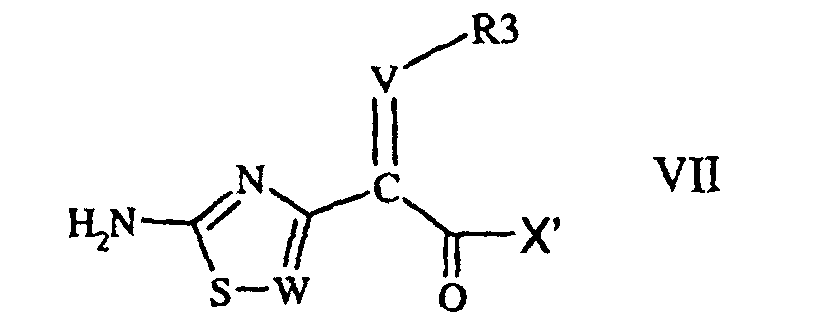
Claims (18)
- A compound of formulawherein
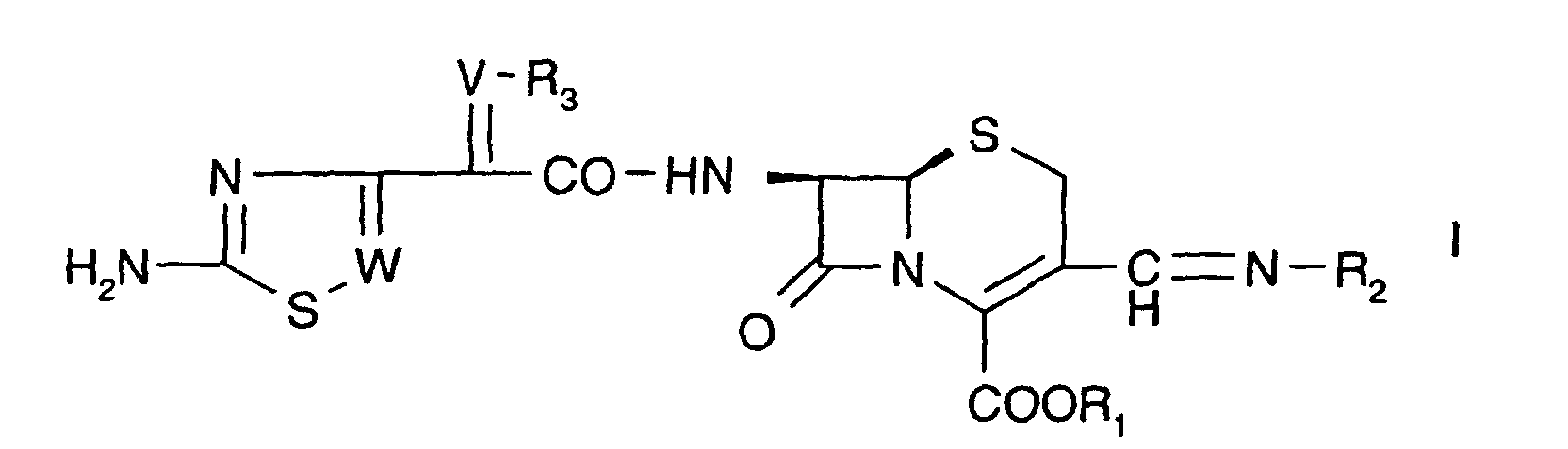
- R1
- denotes hydrogen or an ester moiety,
- R2
- denotes a group of formula
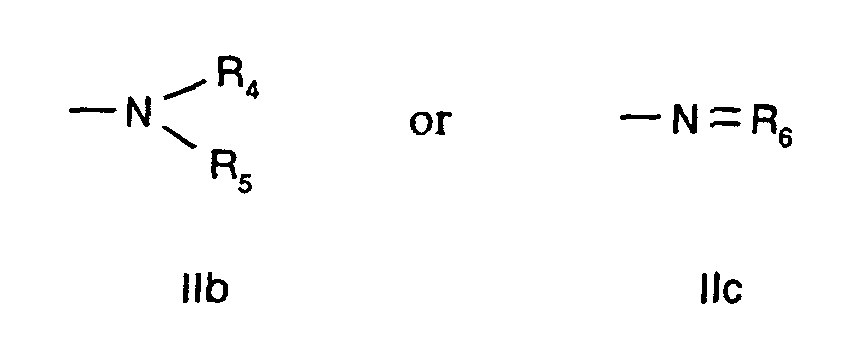
- R4
- denotes hydrogen, (C1-8)-alkyl, (C2-8)-alkenyl, (C3-6)-cycloalkyl, phenyl, (C1-12)acyl or heterocyclyl
- R5
- denotes hydrogen, (C1-8)-alkyl, (C2-8)-alkenyl, (C3-6)-cycloalkyl, phenyl, heterocyclyl, or a
group of formula
wherein

- R7
- denotes (C1-8)-alkyl or phenyl
- R8
- denotes hydrogen, (C3-6)-cycloalkyl or (C1-8)-alkyl
- R9
- denotes hydrogen or (C1-8)-alkyl
- R10
- denotes hydrogen, (C1-8)-alkyl, hydroxy, amino, phenyl, (C2-8)-alkenyl,
(C3-6)-cycloalkyl, , heterocyclyl or a group of formula
- R9 and R10
- together with the nitrogen atom denote heterocyclyl,
- Z
- denotes oxygen, sulphur or N-R13, wherein
- R13
- denotes hydrogen, (C1-8)-alkyl or (C3-6)cycloalkyl
- R11
- denotes hydrogen, (C1-8)-alkyl, phenyl, (C3-6)-cycloalkyl or heterocyclyl, or
- R4 and R5
- together with the nitrogen atom denote heterocyclyl,
- R6
- denotes heterocyclyl,
- W
- denotes N or CH
- V
- denotes CH or N-O, and
- R3
- denotes hydrogen, (C1-8)-alkyl, (C1-12)acyl, or carboxyl.
- A compound according to claim 1
wherein- R2
- denotes a group of formula
wherein

- R4
- denotes hydrogen, phenyl, (C3-6)-cycloalkyl or (C1-4)-alkyl
- R5
- denotes hydrogen, (C1-4)-alkyl, heterocyclyl or a group of formulae
wherein

- R7
- denotes (C1-4)-alkyl
- R8
- denotes hydrogen, (C3-8)-cycloalkyl or (C1-4)-alkyl
- R9
- denotes hydrogen or (C1-4)-alkyl,
- R10
- denotes hydrogen, hydroxy; amino; phenyl; (C2-8)-alkenyl; (C3-6)-cycloalkyl;
heterocyclyl; unsubstituted (C1-8)-alkyl; substituted (C1-8)-alkyl, by CF3, OH,
alkoxy, carboxyl, halogen, amino, mono(C1-8)-alkylamino, di(C1-8)-alkylamino,
tri(C1-8)-alkylamino, pyridyl or a a sulfonic acid residue; a group of
formula
wherein
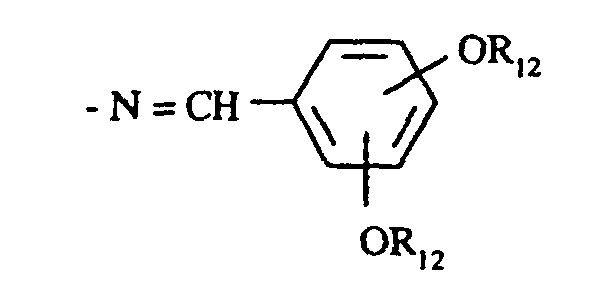
- R12
- denotes hydrogen or (C1-4)-alkyl,
- Z
- denotes oxygen, sulphur, or N-R13, wherein
- R13
- denotes hydrogen or (C1-4)-alkyl, and
- R11
- denotes hydrogen; dihydroxyphenyl; (C3-6)-cycloalkyl; heterocyclyl; unsubstituted (C1-4)-alkyl; substituted (C1-4)-alkyl by pyridyl or mono(C1-8)-alkylamino, di(C1-8)-alkylamino or tri(C1-8)-alkylamino; and,
- R4 and R5 and/or R9 and R10
- independently of one another together with the nitrogen denote heterocyclyl,
- R6
- denotes heterocyclyl, and
- R3
- denotes hydrogen; (C1-12)acyl; carboxyl; unsubstituted (C1-8)-alkyl; substituted (C1-8)-alkyl by halogen or carboxyl.
- A compound of claim 1wherein
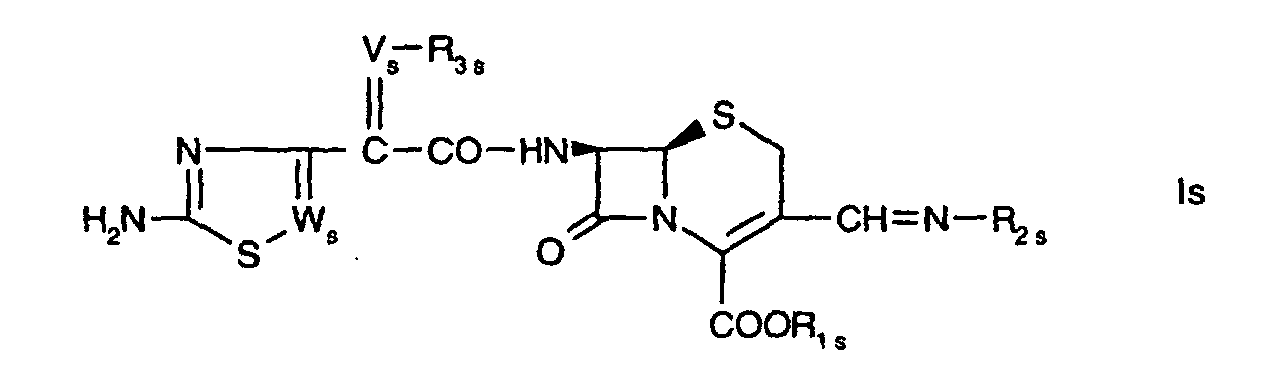
- R3
- denotes hydrogen, (C1-4)-acyl; unsubstituted (C1-8)-alkyl; substituted (C1-4)alkyl, by carboxyl and/or fluoro; and
- R2
- denotes a group of formula
wherein
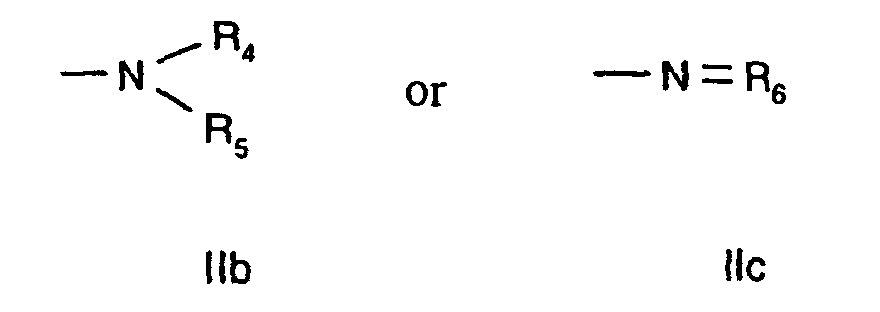
- R4
- denotes hydrogen or (C1-4)-alkyl, and
- R5
- denotes hydrogen; saturated or unsaturated, unsubstituted heterocyclyl
having 5 or 6 ring members and 1 to 3 nitrogen hetero atoms; saturated or
unsaturated one or several fold substituted heterocyclyl by oxo, (C1-4)-alkyl,
amino or CF3, having 5 or 6 ring members and 1 to 3 nitrogen hetero
atoms; benzothiazolyl; or a group of formula
wherein
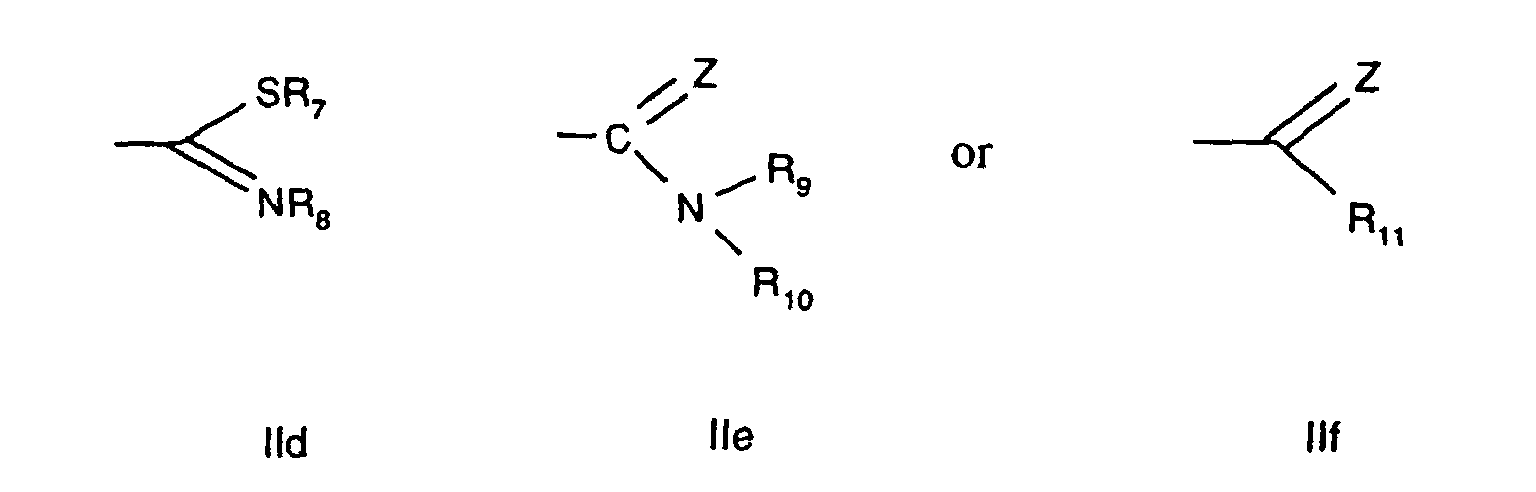
- R7
- denotes (C1-4)-alkyl,
- R8
- denotes hydrogen, (C3-6)-cycloalkyl or (C1-4)-alkyl,
- R9
- denotes hydrogen or (C1-4)-alkyl,
- R10
- denotes hydrogen; phenyl; allyl; (C3-6)-cycloalkyl; unsubstituted (C1-8)-alkyl; substituted (C1-8)-alkyl by CF3, di(C1-8)-alkylamino, tri(C1-8)-alkylamino, hydroxy, pyridyl or SO3H, and
- R11
- denotes hydrogen; pyridyl; (C3-6)-cycloalkyl; unsubstituted (C1-4)-alkyl; substituted (C1-4)-alkyl by pyridyl or tri(C1-8)-alkylamino; saturated or unsaturated heterocyclyl having 5 or 6 ring members and 1 to 3 nitrogen hetero atoms; or one or several fold substituted heterocyclyl by (C1-4)-alkyl and/or thiono, having 5 or 6 ring members and 1 to 3 nitrogen hetero atoms;
- R4 and R5
- together with the nitrogen atom denote heterocyclyl selected from saturated, unsubstituted heterocyclyl having 5 or 6 ring members and 1 or 2 nitrogen hetero atoms; saturated, one or several fold substituted heterocyclyl by oxo or (C1-4)-alkyl, having 5 or 6 ring members and 1 or 2 nitrogen hetero atoms; and/or
- R9 and R10
- together with the nitrogen atom denote saturated, unsubstituted heterocyclyl having 5 or 6 ring members and 1 or 2 nitrogen and/or oxygen hetero atoms; unsaturated, one or several fold substituted heterocyclyl by CHO or (C1-4)-alkyl, having 5 or 6 ring members and 1 or 2 nitrogen and/or oxygen hetero atoms.
- A compound according to claim 1,
wherein- R2
- denotes a group of formula
- R4
- is as defined in claim 1 and
- R5
- denotes a group of formula
wherein

- Z
- denotes N-R13, wherein
- R13
- is as defined in claim 1, and
- R9 and R10
- together with the nitrogen atom denote heterocyclyl which is a piperazinyl.
- A compound according to claim 1 selected from the group consisting of 7-[[(2-amino-4-thiazolyl)-(Z)-(hydroxyimino)acetyl]amino]-3-[[(aminoiminomethyl)-hydrazono]methyl]-3-cephem-4-carboxylic acid;
7-[[(2-amino-4-thiazolyl)-(Z)-(hydroxyimino)acetyl]-amino]-3-[[(piperazino-iminomethyl)-hydrazono]methyl]-3-cephem-4-carboxylic acid; and
7-[[(5-Amino-1,2,4-thiadiazol-3-yl)-(Z)-(fluormethoxyimino)acetyl]amino]-3-[[(piperazinoiminomethyl)hydrazono]methyl]-3-cephem-4-carboxylic acid. - A compound of formula I
wherein- R2
- denotes a group of formulae
wherein

- R4
- is as defined in claim 2, and
- R5
- denotes hydrogen, (C3-6)-cycloalkyl, (C1-4)-alkyl or a group of formula
wherein
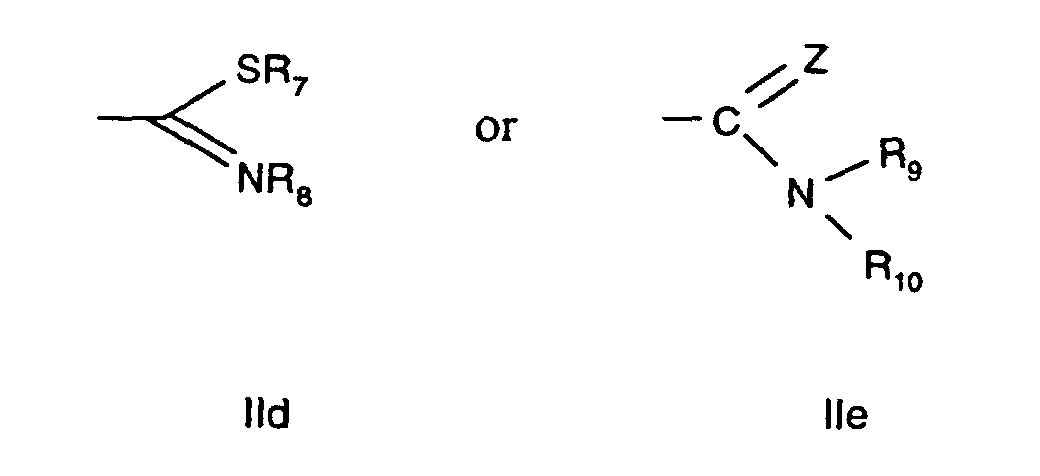
- R8
- as defined in claim 2,
- Z
- is as defined in claim 2,
- R9
- is as defined in claim 2,
- R7
- denotes methyl,
- R10
- denotes hydrogen, (C1-4)-alkyl or hydroxy, and
- R4 and R5 and/or R9 and R10
- independently of one another together with the nitrogen denote heterocyclyl, and a compound of formulae IIb, IId and IIe denote any tautomeric form, in free form, or, where such a form exists, in form of an acid addition salt, inner salt, quaternary salt or hydrate thereof.
- A compound of formula I according to claim 1
wherein- R2
- denotes a group of formulae
wherein

- R4
- is as defined in claim 2, and
- R5
- denotes hydrogen, (C3-6)-cycloalkyl, (C1-4)-alkyl or a group of formulae
wherein

- R7
- is as defined in claim 2,
- R8
- is as defined in claim 2,
- Z
- is as defined in claim 2,
- R9
- is as defined in claim 2,
- R10
- denotes hydrogen, (C1-4)-alkyl or hydroxy, and
- R4 and R5 and/or R9 and R10
- independently of one another together with the nitrogen denote heterocyclyl, and
- A process for the production of a compound of formula I as defined in claim 1 by reaction of a compound of formulawherein V, W and R3 are as defined in claim 1 and
 wherein R1 and R2 are as defined in claim 1, with a compound of formulaa) either
- α)
- Rb denotes hydroxy and Rc and Rd together form a bond, or
- β)
- Rd denotes hydrogen, a cation, an ester forming group or a silyl group, and Rb and Rc together denote oxo, in free form or in form of an acid addition salt
b) reacting a compound of formula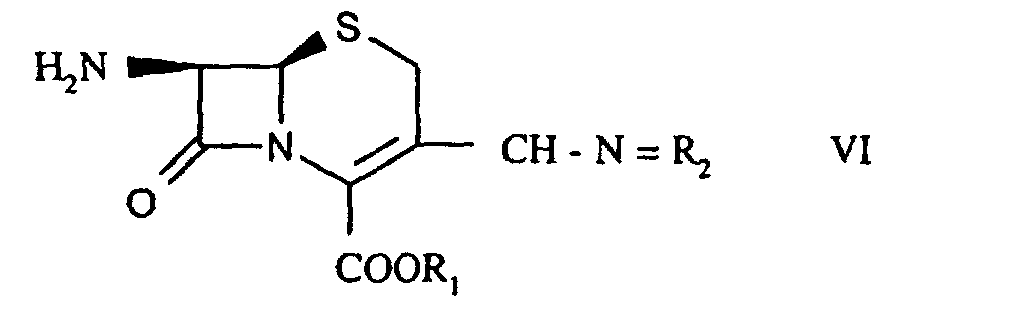 wherein V, W and R3 are as defined in claim 1 and X' denotes a leaving group.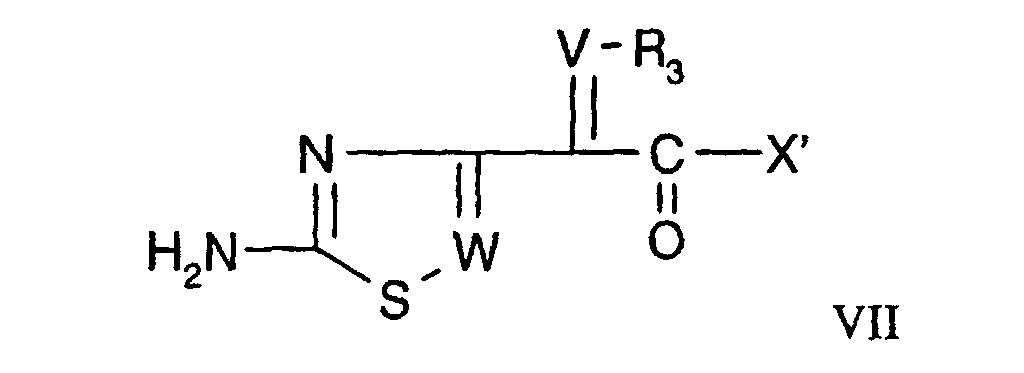
- A compound of formulae I according to any preceding claim in free form.
- A compound of formulae I according to any preceding claim in salt form.
- A compound of formulae I according to claim 10 in acid addition salt form.
- A compound of formulae I according to claim 13 in metal salt form.
- A compound of formulae I according to any one of claims 9 to 12 in solvate form.
- Pharmaceutical composition, comprising a compound of claim 1 in pharmaceutically acceptable salt form or free form in association with at least one pharmaceutical carrier or diluent.
- A compound of claim 1 for use as a pharmaceutical.
- A compound according to claim 15 wherein the pharmaceutical is an antibiotic.
- Use of a compound claim 1 in the preparation of a medicament for the treatment of microbial diseases.
- The use according to claim 17 wherein the microbial disease is caused by bacterias selected from the group consisting of Pseudomonas, Enterobacter, Enterococcus, Moraxella, Haemophilus, Klebsiella, Streptococcus, Staphylococcus, Escherichia, and Proteus.
Priority Applications (2)
| Application Number | Priority Date | Filing Date | Title |
|---|---|---|---|
| EP02008065A EP1221446B1 (en) | 1995-05-11 | 1996-05-10 | Antibacterial cephalosporins |
| SI9630599T SI0824535T1 (en) | 1995-05-11 | 1996-05-10 | Antibacterial cephalosporins |
Applications Claiming Priority (13)
| Application Number | Priority Date | Filing Date | Title |
|---|---|---|---|
| AT79495 | 1995-05-11 | ||
| AT794/95 | 1995-05-11 | ||
| AT79495A AT402820B (en) | 1995-05-11 | 1995-05-11 | Organic compounds |
| AT99295A AT402821B (en) | 1995-06-12 | 1995-06-12 | Organic compounds |
| AT992/95 | 1995-06-12 | ||
| AT99295 | 1995-06-12 | ||
| AT698/96 | 1996-04-17 | ||
| AT69896 | 1996-04-17 | ||
| AT69896A AT403283B (en) | 1996-04-17 | 1996-04-17 | 3-methylimino-3-cephem derivatives |
| AT733/96 | 1996-04-23 | ||
| AT73396A AT403284B (en) | 1996-04-23 | 1996-04-23 | 3-methylimino-3-cephem derivatives |
| AT73396 | 1996-04-23 | ||
| PCT/EP1996/002023 WO1996035692A1 (en) | 1995-05-11 | 1996-05-10 | Antibacterial cephalosporins |
Related Child Applications (1)
| Application Number | Title | Priority Date | Filing Date |
|---|---|---|---|
| EP02008065A Division EP1221446B1 (en) | 1995-05-11 | 1996-05-10 | Antibacterial cephalosporins |
Publications (2)
| Publication Number | Publication Date |
|---|---|
| EP0824535A1 EP0824535A1 (en) | 1998-02-25 |
| EP0824535B1 true EP0824535B1 (en) | 2003-02-26 |
Family
ID=27421316
Family Applications (2)
| Application Number | Title | Priority Date | Filing Date |
|---|---|---|---|
| EP02008065A Expired - Lifetime EP1221446B1 (en) | 1995-05-11 | 1996-05-10 | Antibacterial cephalosporins |
| EP96919770A Expired - Lifetime EP0824535B1 (en) | 1995-05-11 | 1996-05-10 | Antibacterial cephalosporins |
Family Applications Before (1)
| Application Number | Title | Priority Date | Filing Date |
|---|---|---|---|
| EP02008065A Expired - Lifetime EP1221446B1 (en) | 1995-05-11 | 1996-05-10 | Antibacterial cephalosporins |
Country Status (29)
| Country | Link |
|---|---|
| US (2) | US6531465B1 (en) |
| EP (2) | EP1221446B1 (en) |
| JP (2) | JPH11506429A (en) |
| KR (1) | KR100451336B1 (en) |
| CN (1) | CN1142937C (en) |
| AR (1) | AR001931A1 (en) |
| AT (2) | ATE233268T1 (en) |
| AU (1) | AU712814B2 (en) |
| BR (1) | BR9608517A (en) |
| CA (1) | CA2219656C (en) |
| CO (1) | CO4750666A1 (en) |
| CY (1) | CY2445B1 (en) |
| CZ (1) | CZ352997A3 (en) |
| DE (2) | DE69634581T2 (en) |
| DK (1) | DK0824535T3 (en) |
| ES (1) | ES2193246T3 (en) |
| HU (1) | HUP9801387A3 (en) |
| IL (2) | IL118221A (en) |
| MX (1) | MX9708696A (en) |
| NO (1) | NO326126B1 (en) |
| NZ (1) | NZ308518A (en) |
| PE (1) | PE8398A1 (en) |
| PL (1) | PL193133B1 (en) |
| PT (1) | PT824535E (en) |
| RU (1) | RU2183212C2 (en) |
| SK (1) | SK284962B6 (en) |
| TW (1) | TW452579B (en) |
| WO (1) | WO1996035692A1 (en) |
| ZA (1) | ZA963758B (en) |
Families Citing this family (20)
| Publication number | Priority date | Publication date | Assignee | Title |
|---|---|---|---|---|
| US20020115852A1 (en) * | 1997-04-01 | 2002-08-22 | Gerd Ascher | Antibacterial substituted 7-acylamino-3-(methylhydrazono) methyl-cephalosporins and intermediates |
| AT405180B (en) * | 1997-04-01 | 1999-06-25 | Biochemie Gmbh | Novel derivatives of substituted 3-cephem-4-carboxylic acid derivatives and process for their preparation |
| CA2284501C (en) * | 1997-04-01 | 2007-07-17 | Biochemie Gesellschaft M.B.H. | Antibacterial substituted 7-acylamino-3-(methylhydrazono) methyl-cephalosporins and intermediates |
| AT406772B (en) * | 1998-03-23 | 2000-08-25 | Biochemie Gmbh | ANTIBACTERIAL 7-ACYLAMINO-3-IMINOMETHYL-CEPHALOSPORINE AND METHOD FOR THE PRODUCTION THEREOF |
| AR025976A1 (en) | 1999-10-08 | 2002-12-26 | Affinium Pharm Inc | FAB INHIBITORS I. |
| KR100739830B1 (en) * | 2001-03-23 | 2007-07-13 | 주식회사 하원제약 | Method for preparing cephalosporin derivative |
| CA2444597A1 (en) * | 2001-04-06 | 2002-10-06 | Affinium Pharmaceuticals, Inc. | Fab i inhibitors |
| AR040545A1 (en) * | 2002-07-15 | 2005-04-13 | Sandoz Ag | CEPHALOSPORINS |
| CA2508792C (en) | 2002-12-06 | 2013-02-05 | Affinium Pharmaceuticals, Inc. | Heterocyclic compounds, methods of making them and their use in therapy |
| WO2004082586A2 (en) * | 2003-03-17 | 2004-09-30 | Affinium Pharmaceuticals, Inc. | Phamaceutical compositions comprising inhibitors of fab i and further antibiotics |
| CA2568914C (en) * | 2004-06-04 | 2013-09-24 | Affinium Pharmaceuticals, Inc. | Therapeutic agents, and methods of making and using the same |
| EP1973902A2 (en) * | 2005-12-05 | 2008-10-01 | Affinium Pharmaceuticals, Inc. | 3-heterocyclylacrylamide compounds as fabi inhibitors and antibacterial agents |
| EP2687533B1 (en) | 2006-07-20 | 2017-07-19 | Debiopharm International SA | Acrylamide derivatives as FAB I inhibitors |
| US8263613B2 (en) * | 2007-02-16 | 2012-09-11 | Affinium Pharmaceuticals, Inc. | Salts, prodrugs and polymorphs of fab I inhibitors |
| SMT201900411T1 (en) | 2012-06-19 | 2019-09-09 | Debiopharm Int Sa | Prodrug derivatives of (e)-n-methyl-n-((3-methylbenzofuran-2-yl)methyl)-3-(7-oxo-5,6,7,8-tetrahydro-1,8-naphthyridin-3-yl)acrylamide |
| BR122023021456A2 (en) | 2016-02-26 | 2024-02-20 | Debiopharm International S.A. | USE OF {6- [(E)-3-{METHYL[(3-METHYL-1-BENFOFURAN-2- IOL)METHYL]AMINO)-3- OXOPRO-1-EN-1-IL] DIHYDROGEN PHOSPHATE -2-OXO-3,4-DI-HYDRO-1,8-NAFTYRIDIN-1(2H)- IL}METHYL FOR TREATMENT OF OSTEOMYELITIS OF THE DIABETIC FOOT AND PHARMACEUTICAL COMPOSITION |
| FI3923914T3 (en) | 2019-02-14 | 2023-04-27 | Debiopharm Int Sa | Afabicin formulation, method for its preparation |
| MA56184A (en) | 2019-06-14 | 2022-04-20 | Debiopharm Int Sa | AFABICIN FOR USE IN THE TREATMENT OF BACTERIAL INFECTIONS INVOLVING BIOFILM |
| US12371441B2 (en) | 2019-09-06 | 2025-07-29 | Ariva Med Gmbh | Siderophore cephalosporin conjugates and uses thereof |
| CN110590814A (en) * | 2019-09-29 | 2019-12-20 | 天津力生制药股份有限公司 | Synthetic method of dimer impurity generated in production of cefazolin sodium |
Family Cites Families (19)
| Publication number | Priority date | Publication date | Assignee | Title |
|---|---|---|---|---|
| DE2333263A1 (en) * | 1972-07-07 | 1974-01-24 | Ciba Geigy Ag | 7 BETA-AMINO-3-OXIMINOMETHYL-CEPHEM-4CARBONIC ACID COMPOUNDS AND THE PROCESS FOR THEIR PRODUCTION |
| JPS5417030B2 (en) | 1972-12-06 | 1979-06-27 | ||
| DE2262500A1 (en) * | 1972-12-20 | 1973-07-05 | Lilly Co Eli | 3-(hydroxyiminomethyl) cephalosporins and o-substd - derivs - useful as antibiotics and antibiotic inters |
| US4053469A (en) | 1973-02-28 | 1977-10-11 | Shionogi & Co., Ltd. | Intermediates for the preparation of 7-acylamino-3-oxyiminomethyl-3-cephem-4-carboxylic acids |
| JPS49109391A (en) | 1973-02-28 | 1974-10-17 | ||
| JPS49124091A (en) * | 1973-03-30 | 1974-11-27 | ||
| JPS5013389A (en) * | 1973-06-08 | 1975-02-12 | ||
| JPS5093989A (en) * | 1973-10-25 | 1975-07-26 | ||
| JPS5076085A (en) * | 1973-10-31 | 1975-06-21 | ||
| JPS5083391A (en) * | 1973-11-28 | 1975-07-05 | ||
| JPS5715597B2 (en) * | 1973-12-20 | 1982-03-31 | ||
| JPS50131982A (en) * | 1974-04-05 | 1975-10-18 | ||
| US4101658A (en) | 1975-06-04 | 1978-07-18 | Shionogi & Co., Ltd. | Antibacterial hydrazono cephalosporins |
| JPS5283865A (en) * | 1976-01-01 | 1977-07-13 | Takeda Chem Ind Ltd | Cephalosporin derivatives |
| JPS5470294A (en) * | 1977-11-09 | 1979-06-05 | Takeda Chem Ind Ltd | Cephalosporin derivative and its preparation |
| US4258181A (en) * | 1978-09-05 | 1981-03-24 | American Cyanamid Company | Substituted 9,10-anthracenebishydrazones |
| JPS56118085A (en) * | 1980-02-25 | 1981-09-16 | Takeda Chem Ind Ltd | 2-methylcephalosporin derivative and its preparation |
| RU1831484C (en) * | 1988-06-06 | 1993-07-30 | Фудзисава Фармасьютикал Ко, ЛтД | Method of preparing cephemic compounds or their salts |
| US20020115852A1 (en) * | 1997-04-01 | 2002-08-22 | Gerd Ascher | Antibacterial substituted 7-acylamino-3-(methylhydrazono) methyl-cephalosporins and intermediates |
-
1996
- 1996-05-10 RU RU97120241/04A patent/RU2183212C2/en not_active IP Right Cessation
- 1996-05-10 ES ES96919770T patent/ES2193246T3/en not_active Expired - Lifetime
- 1996-05-10 KR KR1019970708010A patent/KR100451336B1/en not_active Expired - Fee Related
- 1996-05-10 CA CA002219656A patent/CA2219656C/en not_active Expired - Fee Related
- 1996-05-10 EP EP02008065A patent/EP1221446B1/en not_active Expired - Lifetime
- 1996-05-10 EP EP96919770A patent/EP0824535B1/en not_active Expired - Lifetime
- 1996-05-10 IL IL11822196A patent/IL118221A/en not_active IP Right Cessation
- 1996-05-10 ZA ZA9603758A patent/ZA963758B/en unknown
- 1996-05-10 CZ CZ973529A patent/CZ352997A3/en unknown
- 1996-05-10 BR BR9608517A patent/BR9608517A/en not_active IP Right Cessation
- 1996-05-10 PT PT96919770T patent/PT824535E/en unknown
- 1996-05-10 DE DE69634581T patent/DE69634581T2/en not_active Expired - Lifetime
- 1996-05-10 DE DE69626389T patent/DE69626389T2/en not_active Expired - Lifetime
- 1996-05-10 HU HU9801387A patent/HUP9801387A3/en unknown
- 1996-05-10 AT AT96919770T patent/ATE233268T1/en not_active IP Right Cessation
- 1996-05-10 PL PL323233A patent/PL193133B1/en not_active IP Right Cessation
- 1996-05-10 CO CO96023680A patent/CO4750666A1/en unknown
- 1996-05-10 DK DK96919770T patent/DK0824535T3/en active
- 1996-05-10 IL IL13253296A patent/IL132532A/en not_active IP Right Cessation
- 1996-05-10 NZ NZ308518A patent/NZ308518A/en unknown
- 1996-05-10 SK SK1503-97A patent/SK284962B6/en unknown
- 1996-05-10 JP JP8533793A patent/JPH11506429A/en not_active Withdrawn
- 1996-05-10 WO PCT/EP1996/002023 patent/WO1996035692A1/en not_active Ceased
- 1996-05-10 AT AT02008065T patent/ATE292637T1/en not_active IP Right Cessation
- 1996-05-10 CN CNB961944404A patent/CN1142937C/en not_active Expired - Fee Related
- 1996-05-10 AU AU58184/96A patent/AU712814B2/en not_active Ceased
- 1996-05-13 PE PE1996000335A patent/PE8398A1/en not_active Application Discontinuation
- 1996-05-13 AR AR33649596A patent/AR001931A1/en not_active Application Discontinuation
- 1996-05-23 TW TW085106099A patent/TW452579B/en not_active IP Right Cessation
-
1997
- 1997-11-10 NO NO19975151A patent/NO326126B1/en unknown
- 1997-11-11 MX MX9708696A patent/MX9708696A/en not_active IP Right Cessation
-
2001
- 2001-05-21 US US09/861,838 patent/US6531465B1/en not_active Expired - Fee Related
-
2002
- 2002-12-03 US US10/308,331 patent/US7317101B2/en not_active Expired - Fee Related
-
2004
- 2004-07-14 CY CY0400057A patent/CY2445B1/en unknown
-
2006
- 2006-08-31 JP JP2006235995A patent/JP2007023046A/en not_active Withdrawn
Also Published As
Similar Documents
| Publication | Publication Date | Title |
|---|---|---|
| US6531465B1 (en) | Antibacterial cephalosporins | |
| US5532354A (en) | Intermediates for cephem compounds | |
| HU204531B (en) | Process for producing new cepheme compounds and pharmaceutical compositions containing them | |
| EP0376724A2 (en) | Cephalosporin compounds | |
| HU189793B (en) | Process for producing cepheme-4-carboxylic acid derivatives and pharmaceutical compositions containing them | |
| FI74971C (en) | FOERFARANDE FOER FRAMSTAELLNING AV EN TERAPEUTISKT AKTIV SYN-ISOMER AV EN 7- (2-AMINOTIAZOLYL-2-HYDROXY-IMINOACETAMIDO) -3-VINYL-3-CEFEMFOERENING. | |
| EP0248645A2 (en) | Cephalosporin compounds | |
| EP0584797A2 (en) | Novel cephalosporin compounds and processes for the preparation thereof | |
| US4956462A (en) | "Triazolo-pyrimidine intermediates" | |
| EP0186463A2 (en) | Beta-lactam antibiotics | |
| EP1077981B1 (en) | Novel cephalosporin compounds, processes for preparation thereof and antimicrobial compositions containing the same | |
| EP1300408A1 (en) | Antibacterial substituted 7-acylamino-3-(methylhydrazono)methyl-cephalosporins and intermediates | |
| HK1008993B (en) | Antibacterial cephalosporins | |
| GB2271564A (en) | 3-thiosubstituted carbacephalosporins | |
| IE53116B1 (en) | Cephem derivatives and a process for their preparation | |
| CA2100623A1 (en) | Cephem compounds, their production and use | |
| JPH093074A (en) | Cephalosporin compound, its use and intermediate compound | |
| IL141442A (en) | Guanidine derivatives of cephalosporins | |
| AT403284B (en) | 3-methylimino-3-cephem derivatives | |
| KR930006769B1 (en) | Intermediates for the preparation of cephalosporin compounds | |
| EP0250172A2 (en) | Cephalosporin compounds & processes for preparing the same | |
| JPH03204885A (en) | New cephalosporin based compound | |
| JPH02129188A (en) | Triazole derivative and antibacterial composition thereof |
Legal Events
| Date | Code | Title | Description |
|---|---|---|---|
| PUAI | Public reference made under article 153(3) epc to a published international application that has entered the european phase |
Free format text: ORIGINAL CODE: 0009012 |
|
| 17P | Request for examination filed |
Effective date: 19971006 |
|
| AK | Designated contracting states |
Kind code of ref document: A1 Designated state(s): AT BE CH DE DK ES FI FR GB GR IE IT LI LU NL PT SE |
|
| AX | Request for extension of the european patent |
Free format text: SI PAYMENT 971006 |
|
| 17Q | First examination report despatched |
Effective date: 19990813 |
|
| GRAH | Despatch of communication of intention to grant a patent |
Free format text: ORIGINAL CODE: EPIDOS IGRA |
|
| GRAH | Despatch of communication of intention to grant a patent |
Free format text: ORIGINAL CODE: EPIDOS IGRA |
|
| GRAA | (expected) grant |
Free format text: ORIGINAL CODE: 0009210 |
|
| AK | Designated contracting states |
Designated state(s): AT BE CH DE DK ES FI FR GB GR IE IT LI LU NL PT SE |
|
| AX | Request for extension of the european patent |
Extension state: SI |
|
| REG | Reference to a national code |
Ref country code: GB Ref legal event code: FG4D |
|
| REG | Reference to a national code |
Ref country code: CH Ref legal event code: EP |
|
| REG | Reference to a national code |
Ref country code: IE Ref legal event code: FG4D |
|
| REF | Corresponds to: |
Ref document number: 69626389 Country of ref document: DE Date of ref document: 20030403 Kind code of ref document: P |
|
| REG | Reference to a national code |
Ref country code: DK Ref legal event code: T3 |
|
| REG | Reference to a national code |
Ref country code: SE Ref legal event code: TRGR |
|
| REG | Reference to a national code |
Ref country code: GR Ref legal event code: EP Ref document number: 20030401832 Country of ref document: GR |
|
| ET | Fr: translation filed | ||
| REG | Reference to a national code |
Ref country code: ES Ref legal event code: FG2A Ref document number: 2193246 Country of ref document: ES Kind code of ref document: T3 |
|
| PLBE | No opposition filed within time limit |
Free format text: ORIGINAL CODE: 0009261 |
|
| STAA | Information on the status of an ep patent application or granted ep patent |
Free format text: STATUS: NO OPPOSITION FILED WITHIN TIME LIMIT |
|
| 26N | No opposition filed |
Effective date: 20031127 |
|
| REG | Reference to a national code |
Ref country code: CH Ref legal event code: PFA Owner name: SANDOZ G.M.B.H Free format text: BIOCHEMIE GESELLSCHAFT M.B.H.##6250 KUNDL (AT) -TRANSFER TO- SANDOZ G.M.B.H#BIOCHEMIESTRASSE10#6250 KUNDL (AT) |
|
| REG | Reference to a national code |
Ref country code: CH Ref legal event code: PUE Owner name: SANDOZ AG Free format text: SANDOZ G.M.B.H#BIOCHEMIESTRASSE10#6250 KUNDL (AT) -TRANSFER TO- SANDOZ AG#LICHTSTRASSE 35#4056 BASEL (CH) |
|
| REG | Reference to a national code |
Ref country code: SI Ref legal event code: SP73 Owner name: SANDOZ AG; CH Effective date: 20041021 |
|
| NLS | Nl: assignments of ep-patents |
Owner name: SANDOZ AG |
|
| NLT1 | Nl: modifications of names registered in virtue of documents presented to the patent office pursuant to art. 16 a, paragraph 1 |
Owner name: SANDOZ GMBH |
|
| REG | Reference to a national code |
Ref country code: SI Ref legal event code: IF |
|
| REG | Reference to a national code |
Ref country code: FR Ref legal event code: TP Ref country code: FR Ref legal event code: CD |
|
| REG | Reference to a national code |
Ref country code: FR Ref legal event code: TP |
|
| REG | Reference to a national code |
Ref country code: SI Ref legal event code: SP73 Owner name: NABRIVA THERAPEUTICS FORSCHUNGS GMBH; AT Effective date: 20070125 |
|
| PGFP | Annual fee paid to national office [announced via postgrant information from national office to epo] |
Ref country code: LU Payment date: 20070511 Year of fee payment: 12 |
|
| NLS | Nl: assignments of ep-patents |
Owner name: NABRIVA THERAPEUTICS FORSCHUNGS GMBH Effective date: 20070323 |
|
| BECA | Be: change of holder's address |
Owner name: *NABRIVA THERAPEUTICS FORSCHUNGS G.M.B.H.BRUNNERST Effective date: 20060208 |
|
| BECH | Be: change of holder |
Owner name: *NABRIVA THERAPEUTICS FORSCHUNGS G.M.B.H. Effective date: 20060208 Owner name: *NABRIVA THERAPEUTICS FORSCHUNGS G.M.B.H. Effective date: 20060131 |
|
| PGFP | Annual fee paid to national office [announced via postgrant information from national office to epo] |
Ref country code: ES Payment date: 20080529 Year of fee payment: 13 Ref country code: DK Payment date: 20080509 Year of fee payment: 13 Ref country code: DE Payment date: 20080523 Year of fee payment: 13 Ref country code: CH Payment date: 20080515 Year of fee payment: 13 |
|
| PGFP | Annual fee paid to national office [announced via postgrant information from national office to epo] |
Ref country code: AT Payment date: 20080530 Year of fee payment: 13 |
|
| PGFP | Annual fee paid to national office [announced via postgrant information from national office to epo] |
Ref country code: FI Payment date: 20080514 Year of fee payment: 13 Ref country code: BE Payment date: 20080620 Year of fee payment: 13 Ref country code: PT Payment date: 20080428 Year of fee payment: 13 |
|
| PGFP | Annual fee paid to national office [announced via postgrant information from national office to epo] |
Ref country code: SE Payment date: 20080513 Year of fee payment: 13 Ref country code: NL Payment date: 20080515 Year of fee payment: 13 Ref country code: IE Payment date: 20080523 Year of fee payment: 13 |
|
| PGFP | Annual fee paid to national office [announced via postgrant information from national office to epo] |
Ref country code: IT Payment date: 20080527 Year of fee payment: 13 |
|
| PGFP | Annual fee paid to national office [announced via postgrant information from national office to epo] |
Ref country code: GB Payment date: 20080522 Year of fee payment: 13 |
|
| PG25 | Lapsed in a contracting state [announced via postgrant information from national office to epo] |
Ref country code: DE Free format text: LAPSE BECAUSE OF THE APPLICANT RENOUNCES Effective date: 20090129 |
|
| PGFP | Annual fee paid to national office [announced via postgrant information from national office to epo] |
Ref country code: GR Payment date: 20080514 Year of fee payment: 13 |
|
| REG | Reference to a national code |
Ref country code: PT Ref legal event code: MM4A Free format text: LAPSE DUE TO NON-PAYMENT OF FEES Effective date: 20091110 |
|
| BERE | Be: lapsed |
Owner name: *NABRIVA THERAPEUTICS FORSCHUNGS G.M.B.H. Effective date: 20090531 |
|
| REG | Reference to a national code |
Ref country code: CH Ref legal event code: PL |
|
| REG | Reference to a national code |
Ref country code: DK Ref legal event code: EBP |
|
| GBPC | Gb: european patent ceased through non-payment of renewal fee |
Effective date: 20090510 |
|
| PG25 | Lapsed in a contracting state [announced via postgrant information from national office to epo] |
Ref country code: LI Free format text: LAPSE BECAUSE OF NON-PAYMENT OF DUE FEES Effective date: 20090531 Ref country code: FI Free format text: LAPSE BECAUSE OF NON-PAYMENT OF DUE FEES Effective date: 20090510 Ref country code: CH Free format text: LAPSE BECAUSE OF NON-PAYMENT OF DUE FEES Effective date: 20090531 Ref country code: AT Free format text: LAPSE BECAUSE OF NON-PAYMENT OF DUE FEES Effective date: 20090510 |
|
| NLV4 | Nl: lapsed or anulled due to non-payment of the annual fee |
Effective date: 20091201 |
|
| PG25 | Lapsed in a contracting state [announced via postgrant information from national office to epo] |
Ref country code: NL Free format text: LAPSE BECAUSE OF NON-PAYMENT OF DUE FEES Effective date: 20091201 |
|
| REG | Reference to a national code |
Ref country code: FR Ref legal event code: ST Effective date: 20100129 Ref country code: SI Ref legal event code: KO00 Effective date: 20100114 |
|
| REG | Reference to a national code |
Ref country code: IE Ref legal event code: MM4A |
|
| PG25 | Lapsed in a contracting state [announced via postgrant information from national office to epo] |
Ref country code: PT Free format text: LAPSE BECAUSE OF NON-PAYMENT OF DUE FEES Effective date: 20091110 |
|
| PG25 | Lapsed in a contracting state [announced via postgrant information from national office to epo] |
Ref country code: IE Free format text: LAPSE BECAUSE OF NON-PAYMENT OF DUE FEES Effective date: 20090511 Ref country code: FR Free format text: LAPSE BECAUSE OF NON-PAYMENT OF DUE FEES Effective date: 20090602 Ref country code: DK Free format text: LAPSE BECAUSE OF NON-PAYMENT OF DUE FEES Effective date: 20090531 |
|
| PGFP | Annual fee paid to national office [announced via postgrant information from national office to epo] |
Ref country code: FR Payment date: 20080425 Year of fee payment: 13 |
|
| PG25 | Lapsed in a contracting state [announced via postgrant information from national office to epo] |
Ref country code: GB Free format text: LAPSE BECAUSE OF NON-PAYMENT OF DUE FEES Effective date: 20090510 |
|
| PG25 | Lapsed in a contracting state [announced via postgrant information from national office to epo] |
Ref country code: LU Free format text: LAPSE BECAUSE OF NON-PAYMENT OF DUE FEES Effective date: 20080510 Ref country code: GR Free format text: LAPSE BECAUSE OF NON-PAYMENT OF DUE FEES Effective date: 20091202 Ref country code: BE Free format text: LAPSE BECAUSE OF NON-PAYMENT OF DUE FEES Effective date: 20090531 |
|
| REG | Reference to a national code |
Ref country code: ES Ref legal event code: FD2A Effective date: 20090511 |
|
| PG25 | Lapsed in a contracting state [announced via postgrant information from national office to epo] |
Ref country code: ES Free format text: LAPSE BECAUSE OF NON-PAYMENT OF DUE FEES Effective date: 20090511 |
|
| PG25 | Lapsed in a contracting state [announced via postgrant information from national office to epo] |
Ref country code: IT Free format text: LAPSE BECAUSE OF NON-PAYMENT OF DUE FEES Effective date: 20090510 |
|
| PG25 | Lapsed in a contracting state [announced via postgrant information from national office to epo] |
Ref country code: SE Free format text: LAPSE BECAUSE OF NON-PAYMENT OF DUE FEES Effective date: 20090511 |