EP0824276A1 - Visible-light or near-infrared-light curing resin for battery-insulating seal - Google Patents
Visible-light or near-infrared-light curing resin for battery-insulating seal Download PDFInfo
- Publication number
- EP0824276A1 EP0824276A1 EP96305943A EP96305943A EP0824276A1 EP 0824276 A1 EP0824276 A1 EP 0824276A1 EP 96305943 A EP96305943 A EP 96305943A EP 96305943 A EP96305943 A EP 96305943A EP 0824276 A1 EP0824276 A1 EP 0824276A1
- Authority
- EP
- European Patent Office
- Prior art keywords
- light
- infrared
- visible
- battery
- curing resin
- Prior art date
- Legal status (The legal status is an assumption and is not a legal conclusion. Google has not performed a legal analysis and makes no representation as to the accuracy of the status listed.)
- Withdrawn
Links
- 229920005989 resin Polymers 0.000 title claims abstract description 63
- 239000011347 resin Substances 0.000 title claims abstract description 63
- 239000011248 coating agent Substances 0.000 claims abstract description 10
- 238000000576 coating method Methods 0.000 claims abstract description 10
- 150000001875 compounds Chemical class 0.000 claims abstract description 10
- 239000003054 catalyst Substances 0.000 claims abstract description 7
- 239000011342 resin composition Substances 0.000 claims abstract description 7
- 230000002093 peripheral effect Effects 0.000 claims abstract description 6
- -1 azo compound Chemical class 0.000 claims description 27
- 150000001451 organic peroxides Chemical class 0.000 claims description 13
- 125000002091 cationic group Chemical group 0.000 claims description 9
- 150000001639 boron compounds Chemical class 0.000 claims description 8
- DSSYKIVIOFKYAU-XCBNKYQSSA-N (R)-camphor Chemical compound C1C[C@@]2(C)C(=O)C[C@@H]1C2(C)C DSSYKIVIOFKYAU-XCBNKYQSSA-N 0.000 claims description 7
- AZQWKYJCGOJGHM-UHFFFAOYSA-N 1,4-benzoquinone Chemical compound O=C1C=CC(=O)C=C1 AZQWKYJCGOJGHM-UHFFFAOYSA-N 0.000 claims description 7
- 241000723346 Cinnamomum camphora Species 0.000 claims description 7
- 229960000846 camphor Drugs 0.000 claims description 7
- 229930008380 camphor Natural products 0.000 claims description 7
- 239000000975 dye Substances 0.000 description 9
- NIXOWILDQLNWCW-UHFFFAOYSA-M Acrylate Chemical compound [O-]C(=O)C=C NIXOWILDQLNWCW-UHFFFAOYSA-M 0.000 description 7
- 238000009413 insulation Methods 0.000 description 6
- 150000003254 radicals Chemical class 0.000 description 6
- 239000007787 solid Substances 0.000 description 6
- 229910052751 metal Inorganic materials 0.000 description 5
- 239000002184 metal Substances 0.000 description 5
- 239000000203 mixture Substances 0.000 description 5
- 230000005855 radiation Effects 0.000 description 5
- 239000000565 sealant Substances 0.000 description 5
- 229910052799 carbon Inorganic materials 0.000 description 4
- 239000003795 chemical substances by application Substances 0.000 description 4
- 238000007789 sealing Methods 0.000 description 4
- 239000004342 Benzoyl peroxide Substances 0.000 description 3
- OMPJBNCRMGITSC-UHFFFAOYSA-N Benzoylperoxide Chemical compound C=1C=CC=CC=1C(=O)OOC(=O)C1=CC=CC=C1 OMPJBNCRMGITSC-UHFFFAOYSA-N 0.000 description 3
- OKTJSMMVPCPJKN-UHFFFAOYSA-N Carbon Chemical compound [C] OKTJSMMVPCPJKN-UHFFFAOYSA-N 0.000 description 3
- LYCAIKOWRPUZTN-UHFFFAOYSA-N Ethylene glycol Chemical compound OCCO LYCAIKOWRPUZTN-UHFFFAOYSA-N 0.000 description 3
- DNIAPMSPPWPWGF-UHFFFAOYSA-N Propylene glycol Chemical compound CC(O)CO DNIAPMSPPWPWGF-UHFFFAOYSA-N 0.000 description 3
- VYPSYNLAJGMNEJ-UHFFFAOYSA-N Silicium dioxide Chemical compound O=[Si]=O VYPSYNLAJGMNEJ-UHFFFAOYSA-N 0.000 description 3
- 125000000217 alkyl group Chemical group 0.000 description 3
- 150000001450 anions Chemical class 0.000 description 3
- 235000019400 benzoyl peroxide Nutrition 0.000 description 3
- MTHSVFCYNBDYFN-UHFFFAOYSA-N diethylene glycol Chemical compound OCCOCCO MTHSVFCYNBDYFN-UHFFFAOYSA-N 0.000 description 3
- 229910052736 halogen Inorganic materials 0.000 description 3
- 238000010438 heat treatment Methods 0.000 description 3
- 239000000178 monomer Substances 0.000 description 3
- 229920006395 saturated elastomer Polymers 0.000 description 3
- OZAIFHULBGXAKX-UHFFFAOYSA-N 2-(2-cyanopropan-2-yldiazenyl)-2-methylpropanenitrile Chemical compound N#CC(C)(C)N=NC(C)(C)C#N OZAIFHULBGXAKX-UHFFFAOYSA-N 0.000 description 2
- VDSFCTZCJJXTMN-UHFFFAOYSA-N 2-[(1-carboxy-1-cyclobutylethyl)diazenyl]-2-cyclobutylpropanoic acid Chemical compound C1CCC1C(C(O)=O)(C)N=NC(C)(C(O)=O)C1CCC1 VDSFCTZCJJXTMN-UHFFFAOYSA-N 0.000 description 2
- 125000003903 2-propenyl group Chemical group [H]C([*])([H])C([H])=C([H])[H] 0.000 description 2
- VTYYLEPIZMXCLO-UHFFFAOYSA-L Calcium carbonate Chemical compound [Ca+2].[O-]C([O-])=O VTYYLEPIZMXCLO-UHFFFAOYSA-L 0.000 description 2
- VZCYOOQTPOCHFL-OWOJBTEDSA-N Fumaric acid Chemical compound OC(=O)\C=C\C(O)=O VZCYOOQTPOCHFL-OWOJBTEDSA-N 0.000 description 2
- PWHULOQIROXLJO-UHFFFAOYSA-N Manganese Chemical compound [Mn] PWHULOQIROXLJO-UHFFFAOYSA-N 0.000 description 2
- HCHKCACWOHOZIP-UHFFFAOYSA-N Zinc Chemical compound [Zn] HCHKCACWOHOZIP-UHFFFAOYSA-N 0.000 description 2
- DZBUGLKDJFMEHC-UHFFFAOYSA-N acridine Chemical compound C1=CC=CC2=CC3=CC=CC=C3N=C21 DZBUGLKDJFMEHC-UHFFFAOYSA-N 0.000 description 2
- 125000002723 alicyclic group Chemical group 0.000 description 2
- 125000003342 alkenyl group Chemical group 0.000 description 2
- 125000002877 alkyl aryl group Chemical group 0.000 description 2
- 125000000304 alkynyl group Chemical group 0.000 description 2
- 125000003710 aryl alkyl group Chemical group 0.000 description 2
- 125000003118 aryl group Chemical group 0.000 description 2
- CUFNKYGDVFVPHO-UHFFFAOYSA-N azulene Chemical compound C1=CC=CC2=CC=CC2=C1 CUFNKYGDVFVPHO-UHFFFAOYSA-N 0.000 description 2
- 230000000052 comparative effect Effects 0.000 description 2
- 230000006866 deterioration Effects 0.000 description 2
- VFHVQBAGLAREND-UHFFFAOYSA-N diphenylphosphoryl-(2,4,6-trimethylphenyl)methanone Chemical compound CC1=CC(C)=CC(C)=C1C(=O)P(=O)(C=1C=CC=CC=1)C1=CC=CC=C1 VFHVQBAGLAREND-UHFFFAOYSA-N 0.000 description 2
- JZMPIUODFXBXSC-UHFFFAOYSA-N ethyl carbamate;prop-2-enoic acid Chemical compound OC(=O)C=C.OC(=O)C=C.CCOC(N)=O JZMPIUODFXBXSC-UHFFFAOYSA-N 0.000 description 2
- 150000002367 halogens Chemical class 0.000 description 2
- 239000003999 initiator Substances 0.000 description 2
- QQVIHTHCMHWDBS-UHFFFAOYSA-N isophthalic acid Chemical compound OC(=O)C1=CC=CC(C(O)=O)=C1 QQVIHTHCMHWDBS-UHFFFAOYSA-N 0.000 description 2
- 229910052748 manganese Inorganic materials 0.000 description 2
- 239000011572 manganese Substances 0.000 description 2
- 238000004519 manufacturing process Methods 0.000 description 2
- 239000000463 material Substances 0.000 description 2
- VNWKTOKETHGBQD-UHFFFAOYSA-N methane Chemical compound C VNWKTOKETHGBQD-UHFFFAOYSA-N 0.000 description 2
- 150000002978 peroxides Chemical class 0.000 description 2
- 229920000642 polymer Polymers 0.000 description 2
- 238000006116 polymerization reaction Methods 0.000 description 2
- 230000000379 polymerizing effect Effects 0.000 description 2
- LVOICKNPHXSSQM-UHFFFAOYSA-N prop-2-en-1-one Chemical compound C=C[C]=O LVOICKNPHXSSQM-UHFFFAOYSA-N 0.000 description 2
- 238000003860 storage Methods 0.000 description 2
- 239000000126 substance Substances 0.000 description 2
- 239000011701 zinc Substances 0.000 description 2
- 229910052725 zinc Inorganic materials 0.000 description 2
- IHBXBLQAXRVBQV-UHFFFAOYSA-N (2-butylphenyl)-diphenylborane;tetramethylazanium Chemical compound C[N+](C)(C)C.CCCCC1=CC=CC=C1B(C=1C=CC=CC=1)C1=CC=CC=C1 IHBXBLQAXRVBQV-UHFFFAOYSA-N 0.000 description 1
- QEQBMZQFDDDTPN-UHFFFAOYSA-N (2-methylpropan-2-yl)oxy benzenecarboperoxoate Chemical compound CC(C)(C)OOOC(=O)C1=CC=CC=C1 QEQBMZQFDDDTPN-UHFFFAOYSA-N 0.000 description 1
- NLBJAOHLJABDAU-UHFFFAOYSA-N (3-methylbenzoyl) 3-methylbenzenecarboperoxoate Chemical compound CC1=CC=CC(C(=O)OOC(=O)C=2C=C(C)C=CC=2)=C1 NLBJAOHLJABDAU-UHFFFAOYSA-N 0.000 description 1
- WPWHSFAFEBZWBB-UHFFFAOYSA-N 1-butyl radical Chemical compound [CH2]CCC WPWHSFAFEBZWBB-UHFFFAOYSA-N 0.000 description 1
- CDDDRVNOHLVEED-UHFFFAOYSA-N 1-cyclohexyl-3-[1-[[1-(cyclohexylcarbamoylamino)cyclohexyl]diazenyl]cyclohexyl]urea Chemical compound C1CCCCC1(N=NC1(CCCCC1)NC(=O)NC1CCCCC1)NC(=O)NC1CCCCC1 CDDDRVNOHLVEED-UHFFFAOYSA-N 0.000 description 1
- 239000012956 1-hydroxycyclohexylphenyl-ketone Substances 0.000 description 1
- VBZBISQOWJYWCC-UHFFFAOYSA-N 2-(2-carboxypropan-2-yldiazenyl)-2-methylpropanoic acid Chemical compound OC(=O)C(C)(C)N=NC(C)(C)C(O)=O VBZBISQOWJYWCC-UHFFFAOYSA-N 0.000 description 1
- XMNIXWIUMCBBBL-UHFFFAOYSA-N 2-(2-phenylpropan-2-ylperoxy)propan-2-ylbenzene Chemical compound C=1C=CC=CC=1C(C)(C)OOC(C)(C)C1=CC=CC=C1 XMNIXWIUMCBBBL-UHFFFAOYSA-N 0.000 description 1
- OBETXYAYXDNJHR-UHFFFAOYSA-N 2-Ethylhexanoic acid Chemical compound CCCCC(CC)C(O)=O OBETXYAYXDNJHR-UHFFFAOYSA-N 0.000 description 1
- FHXXTXOPESHQPU-UHFFFAOYSA-N 2-[(1-carboxy-3-chlorobutyl)diazenyl]-4-chloropentanoic acid Chemical compound CC(Cl)CC(C(O)=O)N=NC(C(O)=O)CC(C)Cl FHXXTXOPESHQPU-UHFFFAOYSA-N 0.000 description 1
- JEBUMNGCGFZKCS-UHFFFAOYSA-N 2-[(1-carboxy-3-nitrobutyl)diazenyl]-4-nitropentanoic acid Chemical compound [O-][N+](=O)C(C)CC(C(O)=O)N=NC(C(O)=O)CC(C)[N+]([O-])=O JEBUMNGCGFZKCS-UHFFFAOYSA-N 0.000 description 1
- WYGWHHGCAGTUCH-UHFFFAOYSA-N 2-[(2-cyano-4-methylpentan-2-yl)diazenyl]-2,4-dimethylpentanenitrile Chemical compound CC(C)CC(C)(C#N)N=NC(C)(C#N)CC(C)C WYGWHHGCAGTUCH-UHFFFAOYSA-N 0.000 description 1
- XQOYLGZSZVHMGB-UHFFFAOYSA-N 2-[[1-carboxy-1-(3-hydroxyphenyl)propyl]diazenyl]-2-(3-hydroxyphenyl)butanoic acid Chemical compound C=1C=CC(O)=CC=1C(CC)(C(O)=O)N=NC(CC)(C(O)=O)C1=CC=CC(O)=C1 XQOYLGZSZVHMGB-UHFFFAOYSA-N 0.000 description 1
- 125000000954 2-hydroxyethyl group Chemical group [H]C([*])([H])C([H])([H])O[H] 0.000 description 1
- GOFJWADLJYASNC-UHFFFAOYSA-N 2-tert-butylperoxy-2-methylpropane;2-methylpropyl propan-2-yl carbonate Chemical compound CC(C)(C)OOC(C)(C)C.CC(C)COC(=O)OC(C)C GOFJWADLJYASNC-UHFFFAOYSA-N 0.000 description 1
- AGIJRRREJXSQJR-UHFFFAOYSA-N 2h-thiazine Chemical compound N1SC=CC=C1 AGIJRRREJXSQJR-UHFFFAOYSA-N 0.000 description 1
- VFXXTYGQYWRHJP-UHFFFAOYSA-N 4,4'-azobis(4-cyanopentanoic acid) Chemical compound OC(=O)CCC(C)(C#N)N=NC(C)(CCC(O)=O)C#N VFXXTYGQYWRHJP-UHFFFAOYSA-N 0.000 description 1
- JGLYXLCIDZQOEW-UHFFFAOYSA-N 4,4,4-triphenylbutoxyboronic acid Chemical compound C=1C=CC=CC=1C(C=1C=CC=CC=1)(CCCOB(O)O)C1=CC=CC=C1 JGLYXLCIDZQOEW-UHFFFAOYSA-N 0.000 description 1
- GJCOSYZMQJWQCA-UHFFFAOYSA-N 9H-xanthene Chemical compound C1=CC=C2CC3=CC=CC=C3OC2=C1 GJCOSYZMQJWQCA-UHFFFAOYSA-N 0.000 description 1
- FERIUCNNQQJTOY-UHFFFAOYSA-N Butyric acid Natural products CCCC(O)=O FERIUCNNQQJTOY-UHFFFAOYSA-N 0.000 description 1
- 239000004593 Epoxy Substances 0.000 description 1
- LFQSCWFLJHTTHZ-UHFFFAOYSA-N Ethanol Chemical compound CCO LFQSCWFLJHTTHZ-UHFFFAOYSA-N 0.000 description 1
- JOYRKODLDBILNP-UHFFFAOYSA-N Ethyl urethane Chemical compound CCOC(N)=O JOYRKODLDBILNP-UHFFFAOYSA-N 0.000 description 1
- SIKJAQJRHWYJAI-UHFFFAOYSA-N Indole Chemical compound C1=CC=C2NC=CC2=C1 SIKJAQJRHWYJAI-UHFFFAOYSA-N 0.000 description 1
- CBENFWSGALASAD-UHFFFAOYSA-N Ozone Chemical compound [O-][O+]=O CBENFWSGALASAD-UHFFFAOYSA-N 0.000 description 1
- LGRFSURHDFAFJT-UHFFFAOYSA-N Phthalic anhydride Natural products C1=CC=C2C(=O)OC(=O)C2=C1 LGRFSURHDFAFJT-UHFFFAOYSA-N 0.000 description 1
- 239000002253 acid Substances 0.000 description 1
- 239000000654 additive Substances 0.000 description 1
- 239000000853 adhesive Substances 0.000 description 1
- 230000001070 adhesive effect Effects 0.000 description 1
- 239000003963 antioxidant agent Substances 0.000 description 1
- 230000003078 antioxidant effect Effects 0.000 description 1
- MQDJYUACMFCOFT-UHFFFAOYSA-N bis[2-(1-hydroxycyclohexyl)phenyl]methanone Chemical compound C=1C=CC=C(C(=O)C=2C(=CC=CC=2)C2(O)CCCCC2)C=1C1(O)CCCCC1 MQDJYUACMFCOFT-UHFFFAOYSA-N 0.000 description 1
- UORVGPXVDQYIDP-BJUDXGSMSA-N borane Chemical compound [10BH3] UORVGPXVDQYIDP-BJUDXGSMSA-N 0.000 description 1
- 229910000085 borane Inorganic materials 0.000 description 1
- DBDNZCBRIPTLJF-UHFFFAOYSA-N boron(1-) monohydride Chemical compound [BH-] DBDNZCBRIPTLJF-UHFFFAOYSA-N 0.000 description 1
- JHIWVOJDXOSYLW-UHFFFAOYSA-N butyl 2,2-difluorocyclopropane-1-carboxylate Chemical compound CCCCOC(=O)C1CC1(F)F JHIWVOJDXOSYLW-UHFFFAOYSA-N 0.000 description 1
- 229910000019 calcium carbonate Inorganic materials 0.000 description 1
- SHZIWNPUGXLXDT-UHFFFAOYSA-N caproic acid ethyl ester Natural products CCCCCC(=O)OCC SHZIWNPUGXLXDT-UHFFFAOYSA-N 0.000 description 1
- 239000000298 carbocyanine Substances 0.000 description 1
- 150000001721 carbon Chemical group 0.000 description 1
- 229910001914 chlorine tetroxide Inorganic materials 0.000 description 1
- 239000012933 diacyl peroxide Substances 0.000 description 1
- SQXGNIAFWCTHCR-UHFFFAOYSA-N diphenylphosphoryl-(2,4,6-triethylphenyl)methanone Chemical compound CCC1=CC(CC)=CC(CC)=C1C(=O)P(=O)(C=1C=CC=CC=1)C1=CC=CC=C1 SQXGNIAFWCTHCR-UHFFFAOYSA-N 0.000 description 1
- SBECZZGBLMCBLT-UHFFFAOYSA-N diphenylphosphoryl-(2,4,6-triphenylphenyl)methanone Chemical compound C=1C=CC=CC=1P(=O)(C=1C=CC=CC=1)C(=O)C1=C(C=2C=CC=CC=2)C=C(C=2C=CC=CC=2)C=C1C1=CC=CC=C1 SBECZZGBLMCBLT-UHFFFAOYSA-N 0.000 description 1
- 239000003792 electrolyte Substances 0.000 description 1
- 230000005670 electromagnetic radiation Effects 0.000 description 1
- 239000001530 fumaric acid Substances 0.000 description 1
- 239000007789 gas Substances 0.000 description 1
- 125000004435 hydrogen atom Chemical group [H]* 0.000 description 1
- 239000003112 inhibitor Substances 0.000 description 1
- 239000011256 inorganic filler Substances 0.000 description 1
- 229910003475 inorganic filler Inorganic materials 0.000 description 1
- QDLAGTHXVHQKRE-UHFFFAOYSA-N lichenxanthone Natural products COC1=CC(O)=C2C(=O)C3=C(C)C=C(OC)C=C3OC2=C1 QDLAGTHXVHQKRE-UHFFFAOYSA-N 0.000 description 1
- 239000007788 liquid Substances 0.000 description 1
- FPYJFEHAWHCUMM-UHFFFAOYSA-N maleic anhydride Chemical compound O=C1OC(=O)C=C1 FPYJFEHAWHCUMM-UHFFFAOYSA-N 0.000 description 1
- DZVCFNFOPIZQKX-LTHRDKTGSA-M merocyanine Chemical compound [Na+].O=C1N(CCCC)C(=O)N(CCCC)C(=O)C1=C\C=C\C=C/1N(CCCS([O-])(=O)=O)C2=CC=CC=C2O\1 DZVCFNFOPIZQKX-LTHRDKTGSA-M 0.000 description 1
- 229910001507 metal halide Inorganic materials 0.000 description 1
- 150000005309 metal halides Chemical class 0.000 description 1
- 238000000034 method Methods 0.000 description 1
- VLTRZXGMWDSKGL-UHFFFAOYSA-M perchlorate Chemical compound [O-]Cl(=O)(=O)=O VLTRZXGMWDSKGL-UHFFFAOYSA-M 0.000 description 1
- 125000000864 peroxy group Chemical group O(O*)* 0.000 description 1
- QWYZFXLSWMXLDM-UHFFFAOYSA-M pinacyanol iodide Chemical compound [I-].C1=CC2=CC=CC=C2N(CC)C1=CC=CC1=CC=C(C=CC=C2)C2=[N+]1CC QWYZFXLSWMXLDM-UHFFFAOYSA-M 0.000 description 1
- 229920000728 polyester Polymers 0.000 description 1
- 239000002685 polymerization catalyst Substances 0.000 description 1
- 229920001451 polypropylene glycol Polymers 0.000 description 1
- 150000007519 polyprotic acids Polymers 0.000 description 1
- 238000002360 preparation method Methods 0.000 description 1
- AZIQALWHRUQPHV-UHFFFAOYSA-N prop-2-eneperoxoic acid Chemical compound OOC(=O)C=C AZIQALWHRUQPHV-UHFFFAOYSA-N 0.000 description 1
- 239000010453 quartz Substances 0.000 description 1
- PYWVYCXTNDRMGF-UHFFFAOYSA-N rhodamine B Chemical compound [Cl-].C=12C=CC(=[N+](CC)CC)C=C2OC2=CC(N(CC)CC)=CC=C2C=1C1=CC=CC=C1C(O)=O PYWVYCXTNDRMGF-UHFFFAOYSA-N 0.000 description 1
- 230000035945 sensitivity Effects 0.000 description 1
- 239000000377 silicon dioxide Substances 0.000 description 1
- 229920003002 synthetic resin Polymers 0.000 description 1
- 239000000057 synthetic resin Substances 0.000 description 1
- 239000000454 talc Substances 0.000 description 1
- 229910052623 talc Inorganic materials 0.000 description 1
- SWAXTRYEYUTSAP-UHFFFAOYSA-N tert-butyl ethaneperoxoate Chemical compound CC(=O)OOC(C)(C)C SWAXTRYEYUTSAP-UHFFFAOYSA-N 0.000 description 1
- ANRHNWWPFJCPAZ-UHFFFAOYSA-M thionine Chemical compound [Cl-].C1=CC(N)=CC2=[S+]C3=CC(N)=CC=C3N=C21 ANRHNWWPFJCPAZ-UHFFFAOYSA-M 0.000 description 1
- DVKJHBMWWAPEIU-UHFFFAOYSA-N toluene 2,4-diisocyanate Chemical compound CC1=CC=C(N=C=O)C=C1N=C=O DVKJHBMWWAPEIU-UHFFFAOYSA-N 0.000 description 1
- VZCYOOQTPOCHFL-UHFFFAOYSA-N trans-butenedioic acid Natural products OC(=O)C=CC(O)=O VZCYOOQTPOCHFL-UHFFFAOYSA-N 0.000 description 1
- 238000002834 transmittance Methods 0.000 description 1
- UORVGPXVDQYIDP-UHFFFAOYSA-N trihydridoboron Substances B UORVGPXVDQYIDP-UHFFFAOYSA-N 0.000 description 1
- MXSVLWZRHLXFKH-UHFFFAOYSA-N triphenylborane Chemical compound C1=CC=CC=C1B(C=1C=CC=CC=1)C1=CC=CC=C1 MXSVLWZRHLXFKH-UHFFFAOYSA-N 0.000 description 1
- 229910052724 xenon Inorganic materials 0.000 description 1
- FHNFHKCVQCLJFQ-UHFFFAOYSA-N xenon atom Chemical compound [Xe] FHNFHKCVQCLJFQ-UHFFFAOYSA-N 0.000 description 1
Images

Classifications
-
- H—ELECTRICITY
- H01—ELECTRIC ELEMENTS
- H01M—PROCESSES OR MEANS, e.g. BATTERIES, FOR THE DIRECT CONVERSION OF CHEMICAL ENERGY INTO ELECTRICAL ENERGY
- H01M50/00—Constructional details or processes of manufacture of the non-active parts of electrochemical cells other than fuel cells, e.g. hybrid cells
- H01M50/10—Primary casings; Jackets or wrappings
- H01M50/183—Sealing members
-
- H—ELECTRICITY
- H01—ELECTRIC ELEMENTS
- H01M—PROCESSES OR MEANS, e.g. BATTERIES, FOR THE DIRECT CONVERSION OF CHEMICAL ENERGY INTO ELECTRICAL ENERGY
- H01M50/00—Constructional details or processes of manufacture of the non-active parts of electrochemical cells other than fuel cells, e.g. hybrid cells
- H01M50/10—Primary casings; Jackets or wrappings
- H01M50/183—Sealing members
- H01M50/19—Sealing members characterised by the material
- H01M50/193—Organic material
-
- Y—GENERAL TAGGING OF NEW TECHNOLOGICAL DEVELOPMENTS; GENERAL TAGGING OF CROSS-SECTIONAL TECHNOLOGIES SPANNING OVER SEVERAL SECTIONS OF THE IPC; TECHNICAL SUBJECTS COVERED BY FORMER USPC CROSS-REFERENCE ART COLLECTIONS [XRACs] AND DIGESTS
- Y02—TECHNOLOGIES OR APPLICATIONS FOR MITIGATION OR ADAPTATION AGAINST CLIMATE CHANGE
- Y02E—REDUCTION OF GREENHOUSE GAS [GHG] EMISSIONS, RELATED TO ENERGY GENERATION, TRANSMISSION OR DISTRIBUTION
- Y02E60/00—Enabling technologies; Technologies with a potential or indirect contribution to GHG emissions mitigation
- Y02E60/10—Energy storage using batteries
Definitions
- the present invention relates to an insulating sealing resin for an alkaline battery, and more particularly to a sealing resin which which cures on application of visible light rays or near infrared rays thereto.
- a metallic battery case which also serves as an electrode
- a metal cap which is a counter electrode.
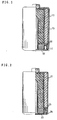
- an alkaline battery has a metallic battery case 11 which also serves as a positive electrode terminal, and a positive electrode combining agent is filled therein.
- a gel-like zinc negative electrode and a negative current collector are disposed further inside the metallic battery case 11 by being separated by a separator.
- the negative current collector is connected to a negative electrode terminal 12.
- the negative electrode terminal 12 is secured by a calked portion 11' of the battery case 11 with a gasket 13 placed therebetween.
- the calked portion 11' of the positive electrode and the negative electrode 12 are disposed in very close proximity to each other, and if these two electrodes come into contact with each other, an external short-circuiting naturally occurs, resulting in the breakage of the electrodes and leakage of the solution.
- this portion is insulated and protected, not only is a coil spring-like terminal on the appliance side liable to enter between a negative electrode bottom plate and a calked portion of the positive electrode battery case at the time of fitting and using the battery, but also a short-circuiting can occur if the battery is placed upright on a metal portion with the negative electrode bottom plate placed downward during storage.
- insulation is provided by coating only by the heat-shrunk sheet, there are cases where the sheet is peeled off the bottom portion of the battery due to the deterioration of an adhesive or friction during transport or storage of the battery, and the battery is liable to be subjected to damage such as the peeling off or fracture of a label by the appliance-side terminal during the fitting or detaching of the battery with respect to the appliance for which the battery is used, so that the two electrodes are liable to be exposed.
- the battery using such an insulation lacks reliability in the insulating characteristic.
- insulating caps are products which are formed by being blanked out from an insulating sheet or by using a die assembly, and these caps are fabricated in conformity to the shapes of batteries. Since there are many shapes of batteries, it is necessary to prepare insulating caps in conformity to the shapes of the batteries, so that the inventory control of parts is troublesome. In addition, the number of steps of fitting the caps increases, so that the cost becomes high.
- the method of securing the insulating characteristic by means of an ultraviolet curing resin is seen in Japanese Patent Application Laid-Open No. 63901/1993.
- the ultraviolet curing resin does not require the mixing of two components or heating, and can be cured in several seconds upon application of light thereto, so that the ultraviolet curing resin is an advantageous material.
- the ultraviolet radiation is electromagnetic radiation which is armful to the human body, and generates ozone gas, so that an ultraviolet-emitting lamp device provided with a local exhauster is required.
- the lamp for emitting the ultraviolet radiation is expensive.
- the ultraviolet curing resin is composed of a mixture of a substance for polymerizing a radical, such as an acryl radical, and an ultraviolet initiator.
- the ultraviolet initiator is activated upon application of ultraviolet radiation thereto and produces a radical. That is, there is a problem in that a portion which is shaded and to which ultraviolet radiation is not applied and a thick coating portion which the ultraviolet radiation does not reach do not cure.
- the resin In a case where only the surface of the ultraviolet curing resin is cured and its interior is not cured, the resin is easily peeled off by vibrations or a stress from the outside. Further, in the interior is uncured in the case of a battery seal, the uncured resin is dispersed in and penetrates the interior of the battery, and is mixed and reacts with the electricity-generating elements, thereby undermining the performance of the battery. Therefore, such a case is not desirable.
- a visible-light or near-infrared-light curing resin composition for use in a battery in which a metallic battery case for accommodating electricity-generating elements also serves as an electrode terminal, wherein a visible-light or near-infrared-light curing resin is used for providing a coating to insulate an end face and a peripheral edge portion of an opening portion of the battery case or a gap between a positive electrode and a negative electrode,
- the resin composition essentially consists of: a) a compound having in its molecule at least one ethylenic unsaturated radical which is radial polymerizable; and b) a light curing catalyst having an absorbing band in a visible-light or near-infrared-light wavelength region and for producing a radial on application of visible light or near-infrared light thereto.
- the light curing catalyst which is the b) component is selected from the group consisting of: 1) a combination of a boron compound, a cationic dye, and an azo compound, 2) a combination of a boron compound, a cationic dye, and an organic peroxide, 3) a combination of camphor chinone and an organic peroxide, 4) a combination of camphor chinone and an azo compound, 5) a combination of an acyl phosphine oxide and an organic peroxide, and 6) a combination of an acyl phosphine oxide and an azo compound.
- compounds having in their molecules at least one (meta)acryloyl radical are included, and it is possible to cite polymers having in their molecules at least two (meta)acryloyl radicals, such as urethane di(meta)acrylate, epoxy di(meta)acrylate, and polyester di(meta)acrylate, as well as monomers having in their molecules at least one (meta)acryloyl radical, such as 2-hydroxyethyl (meta)acrylate, diethylene glycol (meta)acrylate, and phenoxyethyl (meta)acrylate.
- polymers and monomers may be used singly or in combination.
- a resin in which a resin which unfailingly includes as a component an unsaturated acid, such as maleic anhydride or fumaric acid, jointly uses a saturated polybasic acid, such as phthalic anhydride or isophthalic acid, and is obtained by being esterified with a polyhydroxy alcohol, such as propylene glycol or ethylene glycol, is dissolved in a polymerizing monomer having its molecule a reactive ethylenic unsaturated bond.
- an unsaturated acid such as maleic anhydride or fumaric acid
- a saturated polybasic acid such as phthalic anhydride or isophthalic acid
- a polyhydroxy alcohol such as propylene glycol or ethylene glycol
- the light curing catalyst which is the b) component of the present invention is selected from the group consisting of: 1) a combination of a boron compound, a cationic dye, and an azo compound, 2) a combination of a boron compound, a cationic dye, and an organic peroxide, 3) a combination of camphor chinone and an organic peroxide, 4) a combination of camphor chinone and an azo compound, 5) a combination of an acyl phosphine oxide and an organic peroxide, and 6) a combination of an acyl phosphine oxide and an azo compound.
- the boron compound and the cationic dye can be expressed by a mixture in accordance with the following Formulae (1) to (3):
- D + is a cationic dye having an absorbing band in a visible-light to near-infrared-light wavelength region
- R 1 , R 2 , R 3 , and R 4 respectively independently denote alkyl, aryl, alkaryl, allyl, aralkyl, alkenyl, alkynyl, and an alicyclic or saturated or unsaturated heterocyclic radical, at least one of R 1 , R 2 , R 3 , and R 4 being an alkyl radial having a carbon atom number of 1 to 8.
- D + is the same as described above, and A - denotes an anion.
- R 1 , R 2 , R 3 , and R 4 are the same as described above, and R 5 , R 6 , R 7 , and R 8 respectively independently denote a hydrogen atom, alkyl, aryl, alkaryl, allyl, aralkyl, alkenyl, alkynyl, and an alicyclic or saturated or unsaturated heterocyclic radical.
- the cationic dye according to Formulae (1) and (2), which is combined with the boron compound, is not particularly limits insofar as it has an absorbing band in a visible-light to near-infrared-light wavelength region.
- a boron anion according to Formulae (1) and (3) are a triphenylbutyl borate anion and a trianisyl-butyl borate anion. These are easily dissolved and become triphenyl borane or trianisyl borane and a butyl radical. These anions form complexes with the aforementioned cathionic dye.
- anion according to Formula (2) it is possible to cite a halogen anion, ClO 4 - , PF 6 - , BF 4 - , SbF 6 - , CH 3 SO 3 - , F 3 CSO 3 - , C 6 H 4 SO 3 - , CH 3 C 6 H 4 SO 3 - , HOC 6 H 4 SO 3 - , and ClC 6 H 4 SO 3 - .
- such compounds include 2,2'-azoisobutyronitrile, 4,4'-azobis(4-cyano valerianic acid), 2,2'-azobis(2,4-dimethyl valeronitrile), 1,1'-azobis(cyclohaxane-1-carbonitrile), 2,2'-azobis-iso-dimethyl butyrate, 2,2'-azobis(2-methyl propionate), 2,2'-azobis(2-cyclobutyl propionate), 2,2'-azobis(2-cyclobutyl propionate), 2,2'-azobis[2-(3-hydroxy phenyl) butyrate], 2,2'-azobis(4-nitro valerianic acid), and 2,2'-azobis(4-chloro valerianic acid).
- organic peroxide a known one is used.
- Typical organic peroxides include diacyl peroxides, dialkyl peroxides, ketone peroxides, peroxy esters, and the like. Particularly useful among them are organic peroxides for which the temperature for obtaining a half life in 10 hours is 50°C or more, preferably 70 to 110°C.
- organic peroxides include t-butyl peroxy(2-ethylhexanoate), m-toluoyl peroxide, benzoyl peroxide, t-butyl peroxy isoburyate, cyclohaxanoate peroxide, t-butyl peroxide isobutyl isopropyl carbonate, t-butyl peroxy acetate, t-butyl peroxy benzoate, dibutyl peroxy isophthalate, benzoyl peroxide, dicumyl peroxide, and the like.
- acyl phosphine oxides As specific examples of acyl phosphine oxides, it is possible to cite 2,4,6-trimethyl benzoyl diphenyl phosphine oxide, 2,4,6-triethyl benzoyl diphenyl phosphine oxide, and 2,4,6-triphenyl benzoyl diphenyl phosphine oxide, and the like.
- Such a catalyst having an absorbing band in a visible-light or near-infrared-light wavelength region may be used in an amount of 0.1 to 5.0 parts by weight, preferably 0.3 to 1.5 parts by weight with respect to 100 parts by weight of the aforementioned ethylenic unsaturated compound. If the amount is excessively small, the curing properties deteriorate, and if it is excessively large, the deterioration of the cured substance is speeded.
- the light for curing the visible-light or near-infrared-light curing resin may be either visible light or near infrared light.
- the near infrared light exhibits a good curing characteristic since it radiates heat, and the curing time is shorter than the visible light, but the battery is subjected to excess heating. Since heating is not very suitable to the battery, it is possible to selectively use the visible light and the near infrared light as required.
- a light source for radiating the visible light or the near infrared light it is possible to cite a xenon lamp, a metal halide lamp, and a halogen lamp.
- a xenon lamp In a longer wavelength region, near infrared ray, infrared ray, far infrared ray lamps and the like are suitable.
- the sun rays are also suitable.
- a light source which efficiently radiates the visible light and infrared light a halogen lamp and an infrared ray lamp are particularly suitable.
- additives may be added to the visible-light or near-infrared-light curing resin to improve the physical and other properties.
- inorganic fillers such as silica, talc, quartz, and calcium carbonate, a polymerization inhibitor, an adhesion-improving agent, an antioxidant, an antifoamer, and the like may be added.
- the visible-light or near-infrared-light curing resin Since an insulating seal is provided by the visible-light or near-infrared-light curing resin, the insulation between the two electrodes in the vicinity of an opening portion of a metallic battery case can be made reliable, and even if the heat-shrunk film is peeled off or damaged, an external shortcircuiting does not occur.
- a liquid resin is applied in conformity to the shape of the battery, and is allowed to cure by the visible light or near infrared light, even if the battery shapes are diverse, it is unnecessary to prepare parts for the respective shapes, and since it cures speedily, the visible-light or near-infrared-light curing resin in accordance with the present invention, when used in production lines, excels in mass productivity and is therefore advantageous.
- the visible-light or near-infrared-light curing resin in accordance with the present invention is capable of curing with a large thickness, and since even in the case where the light receiving portion is narrow and is difficult to receive the light, the visible-light or near-infrared-light curing resin in accordance with the present invention is capable of curing. Therefore, the visible-light or near-infrared-light curing resin can be used not only as insulating seals for the two electrodes but can also be substituted for a solid gasket for preventing leakage of electricity-generating elements in the battery. For this reason, it is possible to make the thickness of the solid gasket thin. Alternatively, the solid gasket may not be used, and the amount of contents of the electricity-generating elements can be increased.
- a light curing resin was prepared on the basis of the composition shown in Table 1 below. It should be noted that, as urethane diacrylate, one was used in which tolylene diisocyanate and polypropylene glycol were reacted at a molar ratio of 2 : 1, and the mixture was then reacted with 1 mol of hydroxy acrylate. In this way, resins A, B, and C were obtained. In addition, an ultraviolet curing resin D was obtained for the purpose of comparison.
- the resin A obtained in Example 1 was used, as an insulating sealant for an alkaline battery. Its example is is shown in Fig. 2.
- reference numeral 21 denotes a metallic battery case which also served as a positive electrode terminal, and a positive electrode combining agent, a bag-like separator, and a gel-like zinc negative electrode were filled therein.
- Reference numeral 22 denotes a negative electrode terminal which was welded to a negative electrode collector.
- a gasket 23 was fitted to the negative electrode terminal 22, and was secured by a lower peripheral edge of the battery case 21 which was calked. The calked portion held the gasket sufficiently.
- the resin A was applied to a gap portion between the calked portion and the negative electrode terminal 22, and visible light rays were applied to the resin A, thereby obtaining an insulating coat 24.
- the resin B obtained in Example 1 was used as an insulating sealant for a manganese battery. Its example is is shown in Fig. 3.
- reference numeral 31 denotes a metallic battery case which also served as a negative electrode terminal, and a positive electrode combining agent, an electrolyte, an upper cover sheet, and a carbon rod were filled therein.
- An opening of this case was sealed by a sealing member 33 made of a synthetic resin and having in its center a through hole through which the carbon rod was passed, an outer periphery of the battery case 31 was coated with a heat-shrinkable tape, and an upper end of the battery case 31 extended into an upper portion of the sealing member 33.
- a positive electrode terminal 32 was fitted to the head of a carbon rod, and an outer peripheral edge portion of the positive electrode terminal plate 32 was coated with the resin B, which was irradiated with visible light rays, thereby obtaining an insulating coat 34.
- an outer peripheral edge portion of the negative electrode terminal plate was also coated with the resin B, which was similarly irradiated with visible light rays, thereby obtaining an insulating coat 34'.
- an opening portion of a metal outer can 36 was bent inwardly to tighten the positive electrode terminal in the downward direction of the battery with the insulating coat 34 placed therebetween, so as to hold the positive electrode terminal and the contents.
- the resin C obtained in Example 1 was used as an insulating sealant and a sealant for fixing a negative electrode terminal in an alkaline battery. Its example is shown in Fig. 4.
- reference numeral 41 denotes a metal can in which the same contents as those of Example 2 are filled.
- the resin C cured uniformly up to its interior and reliably secured the negative electrode terminal plate 42 and the battery case 41. Further, the coated portions of the two electrodes were completely coated, and the coating resin was not peeled off.
- the resin D which was an ultraviolet curing resin, was applied to the same portion as that in Example 2, and ultraviolet rays were applied thereto. Although the surface of the resin D cured, but its interior was not cured, and the coating resin was easily peeled off.
- the resin D which was an ultraviolet curing resin, was applied to the same portion as that in Example 4, and ultraviolet rays were applied thereto. Although the surface of the resin D cured, but its interior remained uncured, and the negative electrode plate was not fixed. Further, the coating resin was easily peeled off.
- the ultraviolet curing resin has poor interior curing properties, and since particularly the opening portion of the battery is narrow and is not sufficiently wide as a port for receiving the light, the ultraviolet curing resin does not cure up to its interior.
- the visible-light or near-infrared-light curing resin has high sensitivity to visible light or near infrared rays, and has excellent light transmittance, so that the visible-light or near-infrared-light curing resin is cured even up to its interior even in the case of a portion such as a battery seal which is disadvantageous to light curing.
- the visible-light or near-infrared-light curing resin is used as an insulating sealant for a battery, as compared with the case where a cap is fitted, production cost is low and productivity excels, and as compared with the case where an ultraviolet curing resin is used, it is possible to allow the resin to cure safely by inexpensive visible light without using harmful ultraviolet rays. In addition, even in the case where the coat is thick and the light receiving portion is narrow, it is possible to allow the resin to be reliably cured up to its interior, so that the reliability of insulation can be enhanced.
- the visible-light or rear-infrared-light curing resin can be used not only as insulating seals for the positive electrode terminal and negative electrode terminal but can be substituted for a solid gasket for preventing leakage of electricity-generating elements in the battery. For this reason, it is possible to make the thickness of the solid gasket thin. Consequently, it is possible to increase the amount of contents of the electricity-generating elements in the battery and obtain higher performance.
Landscapes
- Chemical & Material Sciences (AREA)
- Chemical Kinetics & Catalysis (AREA)
- Electrochemistry (AREA)
- General Chemical & Material Sciences (AREA)
- Sealing Battery Cases Or Jackets (AREA)
Abstract
In a battery in which a metallic battery case for accommodating
electricity-generating elements also serves as an electrode, a
visible-light or near-infrared-light curing resin is used for providing a
coating to insulate an end face and a peripheral edge portion of an
opening portion of the battery case or a gap between a positive
electrode and a negative electrode. The visible-light or
near-infrared-light curing resin excels in a depth-curing characteristic
as compared with a conventional ultraviolet curing resin, and cures well
even up to a portion such as an insulating seal of a battery where a
light-receiving port is light and the light is difficult to reach. Said
resin composition essentially consists of: a) compound having in its
molecule at least one ethylenic unsaturated bond which is radical
polymerizable; and b) a light curing catalyst having an absorbing band
in a visible-light or near-infrared-light wavelength region and for
producing a radical on application of visible light or
near-infrared-light thereto. Hence, the visible-light or
near-infrared-light curing resin is prevented from becoming peeled off
and provides a reliable insulating characteristic.
Description
The present invention relates to an insulating sealing
resin for an alkaline battery, and more particularly to a
sealing resin which which cures on application of visible
light rays or near infrared rays thereto.
In a dry battery, electricity-generating elements are
accommodated in a metallic battery case, which also serves
as an electrode, and a metal cap which is a counter
electrode. For example, as shown in Fig. 1, an alkaline
battery has a metallic battery case 11 which also serves as
a positive electrode terminal, and a positive electrode
combining agent is filled therein. A gel-like zinc negative
electrode and a negative current collector are disposed
further inside the metallic battery case 11 by being
separated by a separator. The negative current collector is
connected to a negative electrode terminal 12. Further, the
negative electrode terminal 12 is secured by a calked
portion 11' of the battery case 11 with a gasket 13 placed
therebetween. As can be seen from Fig. 1, the calked
portion 11' of the positive electrode and the negative
electrode 12 are disposed in very close proximity to each
other, and if these two electrodes come into contact with
each other, an external short-circuiting naturally occurs,
resulting in the breakage of the electrodes and leakage of
the solution.
Unless this portion is insulated and protected, not
only is a coil spring-like terminal on the appliance side
liable to enter between a negative electrode bottom plate
and a calked portion of the positive electrode battery case
at the time of fitting and using the battery, but also a
short-circuiting can occur if the battery is placed upright
on a metal portion with the negative electrode bottom plate
placed downward during storage.
For this reason, coating and insulation are
conventionally provided only by an insulating heat-shrunk
sheet 15, or an insulating characteristic is secured by
fitting an insulating circular or cylindrical cap (see
Japanese Patent Application Laid-Open No. 118855/1992).
Further, there is an example in which an ultraviolet curing
resin is used as an insulating and coating material (see
Japanese Patent Application Publication No. 63901/1993).
If insulation is provided by coating only by
the heat-shrunk sheet, there are cases where the sheet is
peeled off the bottom portion of the battery due to the
deterioration of an adhesive or friction during transport or
storage of the battery, and the battery is liable to be
subjected to damage such as the peeling off or fracture of a
label by the appliance-side terminal during the fitting or
detaching of the battery with respect to the appliance for
which the battery is used, so that the two electrodes are
liable to be exposed. Hence the battery using such an
insulation lacks reliability in the insulating
characteristic.
On the other hand, if the insulating circular or
cylindrical cap is fitted, the reliability of insulation
becomes high. However, insulating caps are products which
are formed by being blanked out from an insulating sheet or
by using a die assembly, and these caps are fabricated in
conformity to the shapes of batteries. Since there are many
shapes of batteries, it is necessary to prepare insulating
caps in conformity to the shapes of the batteries, so that
the inventory control of parts is troublesome. In addition,
the number of steps of fitting the caps increases, so that
the cost becomes high.
The method of securing the insulating characteristic by
means of an ultraviolet curing resin is seen in Japanese
Patent Application Laid-Open No. 63901/1993. The
ultraviolet curing resin does not require the mixing of two
components or heating, and can be cured in several seconds
upon application of light thereto, so that the ultraviolet
curing resin is an advantageous material.
However, the ultraviolet radiation is electromagnetic
radiation which is armful to the human body, and generates
ozone gas, so that an ultraviolet-emitting lamp device
provided with a local exhauster is required. The lamp for
emitting the ultraviolet radiation is expensive.
In addition, if the ultraviolet curing resin is used as
a battery insulating seal, there is a serious problem. The
ultraviolet curing resin is composed of a mixture of a
substance for polymerizing a radical, such as an acryl
radical, and an ultraviolet initiator. The ultraviolet
initiator is activated upon application of ultraviolet
radiation thereto and produces a radical. That is, there is
a problem in that a portion which is shaded and to which
ultraviolet radiation is not applied and a thick coating
portion which the ultraviolet radiation does not reach do
not cure.
In a case where only the surface of the ultraviolet
curing resin is cured and its interior is not cured, the
resin is easily peeled off by vibrations or a stress from
the outside. Further, in the interior is uncured in the
case of a battery seal, the uncured resin is dispersed in
and penetrates the interior of the battery, and is mixed and
reacts with the electricity-generating elements, thereby
undermining the performance of the battery. Therefore, such
a case is not desirable.
Accordingly, it is an object of the present invention
to provide a visible-light or near-infrared-light curing
resin composition which is capable of overcoming the above-described
drawbacks of the conventional art.
To this end, in accordance with one aspect of the
present invention, there is provided a visible-light or
near-infrared-light curing resin composition for use in a
battery in which a metallic battery case for accommodating
electricity-generating elements also serves as an electrode
terminal, wherein a visible-light or near-infrared-light
curing resin is used for providing a coating to insulate an
end face and a peripheral edge portion of an opening portion
of the battery case or a gap between a positive electrode
and a negative electrode, the resin composition essentially
consists of: a) a compound having in its molecule at least
one ethylenic unsaturated radical which is radial
polymerizable; and b) a light curing catalyst having an
absorbing band in a visible-light or near-infrared-light
wavelength region and for producing a radial on application
of visible light or near-infrared light thereto.
In accordance with another aspect of the present
invention, the light curing catalyst which is the b)
component is selected from the group consisting of: 1) a
combination of a boron compound, a cationic dye, and an azo
compound, 2) a combination of a boron compound, a cationic
dye, and an organic peroxide, 3) a combination of camphor
chinone and an organic peroxide, 4) a combination of camphor
chinone and an azo compound, 5) a combination of an acyl
phosphine oxide and an organic peroxide, and 6) a
combination of an acyl phosphine oxide and an azo compound.
Here, a detailed description will be given of the
visible-light or near-infrared-light curing resin. The
compound having in its molecule at least one ethylenic
unsaturated radical which is radial polymerizable, which is
the component a) of this composition, undergoes
polymerization reaction and is cured by being combined with
a polymerization catalyst for generating a free radical,
upon application of light thereto. Among the polymerizable
ethylenic unsaturated compounds, compounds having in their
molecules at least one (meta)acryloyl radical are included,
and it is possible to cite polymers having in their
molecules at least two (meta)acryloyl radicals, such as
urethane di(meta)acrylate, epoxy di(meta)acrylate, and
polyester di(meta)acrylate, as well as monomers having in
their molecules at least one (meta)acryloyl radical, such as
2-hydroxyethyl (meta)acrylate, diethylene glycol
(meta)acrylate, and phenoxyethyl (meta)acrylate. These
polymers and monomers may be used singly or in combination.
Further, as another polymerizable ethylenic unsaturated
compound, it is possible to cite a resin in which a resin
which unfailingly includes as a component an unsaturated
acid, such as maleic anhydride or fumaric acid, jointly uses
a saturated polybasic acid, such as phthalic anhydride or
isophthalic acid, and is obtained by being esterified with a
polyhydroxy alcohol, such as propylene glycol or ethylene
glycol, is dissolved in a polymerizing monomer having its
molecule a reactive ethylenic unsaturated bond.
The light curing catalyst which is the b) component of
the present invention is selected from the group consisting
of: 1) a combination of a boron compound, a cationic dye,
and an azo compound, 2) a combination of a boron compound, a
cationic dye, and an organic peroxide, 3) a combination of
camphor chinone and an organic peroxide, 4) a combination of
camphor chinone and an azo compound, 5) a combination of an
acyl phosphine oxide and an organic peroxide, and 6) a
combination of an acyl phosphine oxide and an azo compound.
The boron compound and the cationic dye can be
expressed by a mixture in accordance with the following
Formulae (1) to (3):

In Formula (1), D+ is a cationic dye having an
absorbing band in a visible-light to near-infrared-light
wavelength region, and R1, R2, R3, and R4 respectively
independently denote alkyl, aryl, alkaryl, allyl, aralkyl,
alkenyl, alkynyl, and an alicyclic or saturated or
unsaturated heterocyclic radical, at least one of R1, R2,
R3, and R4 being an alkyl radial having a carbon atom number
of 1 to 8.
In Formula (2), D+ is the same as described above, and
A- denotes an anion.
In Formula (3), R1, R2, R3, and R4 are the same as
described above, and R5, R6, R7, and R8 respectively
independently denote a hydrogen atom, alkyl, aryl, alkaryl,
allyl, aralkyl, alkenyl, alkynyl, and an alicyclic or
saturated or unsaturated heterocyclic radical.
The cationic dye according to Formulae (1) and (2),
which is combined with the boron compound, is not
particularly limits insofar as it has an absorbing band in
a visible-light to near-infrared-light wavelength region.
Preferably, it is possible to cite cyanine, merocyanine,
carbocyanine, rhodamine, azo methine, indoaniline, azulene,
polymethine, triaryl methane, indoline, thiazine, xanthene,
acridine, axadine, aminium, and diimonium dyes.
Preferable examples of a boron anion according to
Formulae (1) and (3) are a triphenylbutyl borate anion and a
trianisyl-butyl borate anion. These are easily dissolved
and become triphenyl borane or trianisyl borane and a butyl
radical. These anions form complexes with the
aforementioned cathionic dye.
As the anion according to Formula (2), it is possible
to cite a halogen anion, ClO4 -, PF6 -, BF4 -, SbF6 -, CH3SO3 -,
F3CSO3 -, C6H4SO3 -, CH3C6H4SO3 -, HOC6H4SO3 -, and ClC6H4SO3 -.
Here, the azo compound is a compound which is expressed
by the general formula:
R9 - N = N - R10
(where R9 and R10 are substituted or nonsubstituted aklyl
radical or alkenyl radicals of the same or different type).
Specifically, such compounds include 2,2'-azoisobutyronitrile,
4,4'-azobis(4-cyano valerianic acid),
2,2'-azobis(2,4-dimethyl valeronitrile), 1,1'-azobis(cyclohaxane-1-carbonitrile),
2,2'-azobis-iso-dimethyl
butyrate, 2,2'-azobis(2-methyl propionate), 2,2'-azobis(2-cyclobutyl
propionate), 2,2'-azobis(2-cyclobutyl
propionate), 2,2'-azobis[2-(3-hydroxy phenyl) butyrate],
2,2'-azobis(4-nitro valerianic acid), and 2,2'-azobis(4-chloro
valerianic acid).
As the organic peroxide, a known one is used. Typical
organic peroxides include diacyl peroxides, dialkyl
peroxides, ketone peroxides, peroxy esters, and the like.
Particularly useful among them are organic peroxides for
which the temperature for obtaining a half life in 10 hours
is 50°C or more, preferably 70 to 110°C. Specifically, such
organic peroxides include t-butyl peroxy(2-ethylhexanoate),
m-toluoyl peroxide, benzoyl peroxide, t-butyl peroxy
isoburyate, cyclohaxanoate peroxide, t-butyl peroxide
isobutyl isopropyl carbonate, t-butyl peroxy acetate, t-butyl
peroxy benzoate, dibutyl peroxy isophthalate, benzoyl
peroxide, dicumyl peroxide, and the like.
As specific examples of acyl phosphine oxides, it is
possible to cite 2,4,6-trimethyl benzoyl diphenyl phosphine
oxide, 2,4,6-triethyl benzoyl diphenyl phosphine oxide, and
2,4,6-triphenyl benzoyl diphenyl phosphine oxide, and the
like.
Such a catalyst having an absorbing band in a visible-light
or near-infrared-light wavelength region may be used
in an amount of 0.1 to 5.0 parts by weight, preferably 0.3
to 1.5 parts by weight with respect to 100 parts by weight
of the aforementioned ethylenic unsaturated compound. If
the amount is excessively small, the curing properties
deteriorate, and if it is excessively large, the
deterioration of the cured substance is speeded.
The light for curing the visible-light or near-infrared-light
curing resin may be either visible light or
near infrared light. Although the near infrared light
exhibits a good curing characteristic since it radiates
heat, and the curing time is shorter than the visible light,
but the battery is subjected to excess heating. Since
heating is not very suitable to the battery, it is possible
to selectively use the visible light and the near infrared
light as required.
In addition, as a light source for radiating the
visible light or the near infrared light, it is possible to
cite a xenon lamp, a metal halide lamp, and a halogen lamp.
In a longer wavelength region, near infrared ray, infrared
ray, far infrared ray lamps and the like are suitable.
Further, the sun rays are also suitable. Among them, as a
light source which efficiently radiates the visible light
and infrared light, a halogen lamp and an infrared ray lamp
are particularly suitable.
In addition, various additives may be added to the
visible-light or near-infrared-light curing resin to improve
the physical and other properties. For instance, inorganic
fillers, such as silica, talc, quartz, and calcium
carbonate, a polymerization inhibitor, an adhesion-improving
agent, an antioxidant, an antifoamer, and the like may be
added.
Since an insulating seal is provided by the visible-light
or near-infrared-light curing resin, the insulation
between the two electrodes in the vicinity of an opening
portion of a metallic battery case can be made reliable, and
even if the heat-shrunk film is peeled off or damaged, an
external shortcircuiting does not occur. In addition, since
a liquid resin is applied in conformity to the shape of the
battery, and is allowed to cure by the visible light or near
infrared light, even if the battery shapes are diverse, it
is unnecessary to prepare parts for the respective shapes,
and since it cures speedily, the visible-light or near-infrared-light
curing resin in accordance with the present
invention, when used in production lines, excels in mass
productivity and is therefore advantageous.
Furthermore, unlike the ultraviolet curing resin, the
visible-light or near-infrared-light curing resin in
accordance with the present invention is capable of curing
with a large thickness, and since even in the case where the
light receiving portion is narrow and is difficult to
receive the light, the visible-light or near-infrared-light
curing resin in accordance with the present invention is
capable of curing. Therefore, the visible-light or near-infrared-light
curing resin can be used not only as
insulating seals for the two electrodes but can also be
substituted for a solid gasket for preventing leakage of
electricity-generating elements in the battery. For this
reason, it is possible to make the thickness of the solid
gasket thin. Alternatively, the solid gasket may not be
used, and the amount of contents of the electricity-generating
elements can be increased.
The above and other objects, features and advantages of
the present invention will become more apparent from the
following detailed description of the invention when read in
conjunction with the accompanying drawings, in which:
Referring now to the accompanying drawings, a
description will be given of an embodiment of the present
invention. It should be noted, however, that the present
invention is not limited to the following embodiment which
is given only for illustrative purposes only.
A light curing resin was prepared on the basis of the
composition shown in Table 1 below. It should be noted
that, as urethane diacrylate, one was used in which tolylene
diisocyanate and polypropylene glycol were reacted at a
molar ratio of 2 : 1, and the mixture was then reacted with
1 mol of hydroxy acrylate. In this way, resins A, B, and C
were obtained. In addition, an ultraviolet curing resin D
was obtained for the purpose of comparison.
| A | B | C | D | |
| urethane diacrylate | 40 | 40 | 40 | 40 |
| isoboronyl acrylate | 60 | 60 | 60 | 60 |
| tetramethyl ammonium n-butyl triphenyl boron | 1.0 | |||
| camphor chinone | 1.0 | |||
| 2,4,6-trimethyl benzoyl diphenyl phosphine oxide | 1.0 | |||
| 1-hydroxy cyclohexyl phenyl ketone | 1.5 | |||
| azobisisobutyronitrile | 0.5 | 0.5 | ||
| benzoyl peroxide | 0.5 |
The resin A obtained in Example 1 was used, as an
insulating sealant for an alkaline battery. Its example is
is shown in Fig. 2. In the drawing, reference numeral 21
denotes a metallic battery case which also served as a
positive electrode terminal, and a positive electrode
combining agent, a bag-like separator, and a gel-like zinc
negative electrode were filled therein. Reference numeral
22 denotes a negative electrode terminal which was welded to
a negative electrode collector. A gasket 23 was fitted to
the negative electrode terminal 22, and was secured by a
lower peripheral edge of the battery case 21 which was
calked. The calked portion held the gasket sufficiently.
The resin A was applied to a gap portion between the calked
portion and the negative electrode terminal 22, and visible
light rays were applied to the resin A, thereby obtaining an
insulating coat 24.
The resin B obtained in Example 1 was used as an
insulating sealant for a manganese battery. Its example is
is shown in Fig. 3. In the drawing, reference numeral 31
denotes a metallic battery case which also served as a
negative electrode terminal, and a positive electrode
combining agent, an electrolyte, an upper cover sheet, and a
carbon rod were filled therein. An opening of this case was
sealed by a sealing member 33 made of a synthetic resin and
having in its center a through hole through which the carbon
rod was passed, an outer periphery of the battery case 31
was coated with a heat-shrinkable tape, and an upper end of
the battery case 31 extended into an upper portion of the
sealing member 33. A positive electrode terminal 32 was
fitted to the head of a carbon rod, and an outer peripheral
edge portion of the positive electrode terminal plate 32 was
coated with the resin B, which was irradiated with visible
light rays, thereby obtaining an insulating coat 34. In
addition, an outer peripheral edge portion of the negative
electrode terminal plate was also coated with the resin B,
which was similarly irradiated with visible light rays,
thereby obtaining an insulating coat 34'. Subsequently, an
opening portion of a metal outer can 36 was bent inwardly to
tighten the positive electrode terminal in the downward
direction of the battery with the insulating coat 34 placed
therebetween, so as to hold the positive electrode terminal
and the contents.
The resin C obtained in Example 1 was used as an
insulating sealant and a sealant for fixing a negative
electrode terminal in an alkaline battery. Its example is
shown in Fig. 4. In the drawing, reference numeral 41
denotes a metal can in which the same contents as those of
Example 2 are filled. A negative electrode terminal 42, to
which a negative electrode current collector was welded, was
not fitted with a solid gasket, was inserted into the
interior of the battery, and the resin C was applied to an
opening portion as at 44 and was allowed to cure on
application of visible light rays thereto. The resin C
cured uniformly up to its interior and reliably secured the
negative electrode terminal plate 42 and the battery case
41. Further, the coated portions of the two electrodes were
completely coated, and the coating resin was not peeled off.
The resin D, which was an ultraviolet curing resin, was
applied to the same portion as that in Example 2, and
ultraviolet rays were applied thereto. Although the surface
of the resin D cured, but its interior was not cured, and
the coating resin was easily peeled off.
The resin D, which was an ultraviolet curing resin, was
applied to the same portion as that in Example 4, and
ultraviolet rays were applied thereto. Although the surface
of the resin D cured, but its interior remained uncured, and
the negative electrode plate was not fixed. Further, the
coating resin was easily peeled off.
From these facts, it can be appreciated that the
ultraviolet curing resin has poor interior curing
properties, and since particularly the opening portion of
the battery is narrow and is not sufficiently wide as a port
for receiving the light, the ultraviolet curing resin does
not cure up to its interior. In contrast, the visible-light
or near-infrared-light curing resin has high sensitivity to
visible light or near infrared rays, and has excellent light
transmittance, so that the visible-light or near-infrared-light
curing resin is cured even up to its interior even in
the case of a portion such as a battery seal which is
disadvantageous to light curing.
As described above, since the visible-light or near-infrared-light
curing resin is used as an insulating sealant
for a battery, as compared with the case where a cap is
fitted, production cost is low and productivity excels, and
as compared with the case where an ultraviolet curing resin
is used, it is possible to allow the resin to cure safely by
inexpensive visible light without using harmful ultraviolet
rays. In addition, even in the case where the coat is thick
and the light receiving portion is narrow, it is possible to
allow the resin to be reliably cured up to its interior, so
that the reliability of insulation can be enhanced.
Since the adhesion between the metal and the resin is
excellent, and the resin can be cured up to its interior,
the visible-light or rear-infrared-light curing resin can be
used not only as insulating seals for the positive electrode
terminal and negative electrode terminal but can be
substituted for a solid gasket for preventing leakage of
electricity-generating elements in the battery. For this
reason, it is possible to make the thickness of the solid
gasket thin. Consequently, it is possible to increase the
amount of contents of the electricity-generating elements in
the battery and obtain higher performance.
Claims (2)
- A visible-light or near-infrared-light curing resin composition for use in a battery in which a metallic battery case for accommodating electricity-generating elements also serves as an electrode, wherein a visible-light or near-infrared-light curing resin is used for providing a coating to insulate an end face and a peripheral edge portion of an opening portion of the battery case or a gap between a positive electrode and a negative electrode, said resin composition essentially consists of: a) a compound having in its molecule at least one ethylenic unsaturated radical which is radial polymerizable; and b) a light curing catalyst having an absorbing band in a visible-light or near-infrared-light wavelength region and for producing a radial on application of visible light or near-infrared light thereto.
- A visible-light or near-infrared-light curing resin composition according to Claim 1, wherein the light curing catalyst which is the b) component is selected from the group consisting of: 1) a combination of a boron compound, a cationic dye, and an azo compound, 2) a combination of a boron compound, a cationic dye, and an organic peroxide, 3) a combination of camphor chinone and an organic peroxide, 4) a combination of camphor chinone and an azo compound, 5) a combination of an acyl phosphine oxide and an organic peroxide, and 6) a combination of an acyl phosphine oxide and an azo compound.
Priority Applications (1)
| Application Number | Priority Date | Filing Date | Title |
|---|---|---|---|
| EP96305943A EP0824276A1 (en) | 1996-08-14 | 1996-08-14 | Visible-light or near-infrared-light curing resin for battery-insulating seal |
Applications Claiming Priority (1)
| Application Number | Priority Date | Filing Date | Title |
|---|---|---|---|
| EP96305943A EP0824276A1 (en) | 1996-08-14 | 1996-08-14 | Visible-light or near-infrared-light curing resin for battery-insulating seal |
Publications (1)
| Publication Number | Publication Date |
|---|---|
| EP0824276A1 true EP0824276A1 (en) | 1998-02-18 |
Family
ID=8225049
Family Applications (1)
| Application Number | Title | Priority Date | Filing Date |
|---|---|---|---|
| EP96305943A Withdrawn EP0824276A1 (en) | 1996-08-14 | 1996-08-14 | Visible-light or near-infrared-light curing resin for battery-insulating seal |
Country Status (1)
| Country | Link |
|---|---|
| EP (1) | EP0824276A1 (en) |
Cited By (2)
| Publication number | Priority date | Publication date | Assignee | Title |
|---|---|---|---|---|
| DE102010016312A1 (en) | 2010-04-01 | 2011-10-06 | Saertex Multicom Gmbh | Composition useful for manufacturing liners, comprises acylphosphine oxide or bisacylphosphine oxide, a photo initiator forming a radical, 1,1'-azobis-(1-cyclohexyl carbonitrile) or 2,2'-azobis-(2-methylbutyronitrile) and a resin |
| CN110858634A (en) * | 2018-08-23 | 2020-03-03 | 昭和电工包装株式会社 | Outer packaging material for power storage device and power storage device |
Citations (5)
| Publication number | Priority date | Publication date | Assignee | Title |
|---|---|---|---|---|
| US3713896A (en) * | 1970-08-19 | 1973-01-30 | Esb Inc | Seal for electrochemical cells |
| JPS56165264A (en) * | 1980-05-23 | 1981-12-18 | Yuasa Battery Co Ltd | Manufacture of battery |
| JPH01107449A (en) * | 1987-10-20 | 1989-04-25 | Toshiba Battery Co Ltd | Manufacture of flat type battery |
| JPH02177252A (en) * | 1988-12-28 | 1990-07-10 | Matsushita Electric Ind Co Ltd | Batteries and their manufacturing methods |
| WO1995029513A1 (en) * | 1994-04-20 | 1995-11-02 | Valence Technology, Inc. | Radiation curable frame for stacked cell construction and for edge sealing of electrochemical cells to retard dendritic short-circuits |
-
1996
- 1996-08-14 EP EP96305943A patent/EP0824276A1/en not_active Withdrawn
Patent Citations (5)
| Publication number | Priority date | Publication date | Assignee | Title |
|---|---|---|---|---|
| US3713896A (en) * | 1970-08-19 | 1973-01-30 | Esb Inc | Seal for electrochemical cells |
| JPS56165264A (en) * | 1980-05-23 | 1981-12-18 | Yuasa Battery Co Ltd | Manufacture of battery |
| JPH01107449A (en) * | 1987-10-20 | 1989-04-25 | Toshiba Battery Co Ltd | Manufacture of flat type battery |
| JPH02177252A (en) * | 1988-12-28 | 1990-07-10 | Matsushita Electric Ind Co Ltd | Batteries and their manufacturing methods |
| WO1995029513A1 (en) * | 1994-04-20 | 1995-11-02 | Valence Technology, Inc. | Radiation curable frame for stacked cell construction and for edge sealing of electrochemical cells to retard dendritic short-circuits |
Non-Patent Citations (3)
| Title |
|---|
| PATENT ABSTRACTS OF JAPAN vol. 006, no. 052 (E - 100) 7 April 1982 (1982-04-07) * |
| PATENT ABSTRACTS OF JAPAN vol. 013, no. 348 (E - 799) 4 August 1989 (1989-08-04) * |
| PATENT ABSTRACTS OF JAPAN vol. 014, no. 444 (E - 0982) 21 September 1990 (1990-09-21) * |
Cited By (3)
| Publication number | Priority date | Publication date | Assignee | Title |
|---|---|---|---|---|
| DE102010016312A1 (en) | 2010-04-01 | 2011-10-06 | Saertex Multicom Gmbh | Composition useful for manufacturing liners, comprises acylphosphine oxide or bisacylphosphine oxide, a photo initiator forming a radical, 1,1'-azobis-(1-cyclohexyl carbonitrile) or 2,2'-azobis-(2-methylbutyronitrile) and a resin |
| CN110858634A (en) * | 2018-08-23 | 2020-03-03 | 昭和电工包装株式会社 | Outer packaging material for power storage device and power storage device |
| CN110858634B (en) * | 2018-08-23 | 2023-04-21 | 株式会社乐索纳克包装 | Outer packaging material for power storage device, and power storage device |
Similar Documents
| Publication | Publication Date | Title |
|---|---|---|
| JP7254953B2 (en) | CASE, SECONDARY BATTERY, BATTERY PACK, VEHICLE, AND SECONDARY BATTERY MANUFACTURING METHOD | |
| KR101537399B1 (en) | Electrochemical cell packaging material | |
| KR102167214B1 (en) | Battery Module Case and Battery Module Comprising The Same | |
| TWI437073B (en) | tape | |
| US12394842B2 (en) | Electricity storage device cladding | |
| US6146789A (en) | Battery having a visible-light or near-infrared-light curing resin as an insulating seal | |
| US12206124B2 (en) | Battery module | |
| TW201302966A (en) | Swelling tape for filling a gap | |
| US10944085B2 (en) | Outer covering material for electricity storage devices, and electricity storage device | |
| KR20200118068A (en) | Battery packaging material, manufacturing method thereof, and battery | |
| EP3799147A1 (en) | Secondary battery having lead film including light-emitting material, and secondary battery defect inspection method | |
| JP7270889B2 (en) | Manufacturing method of pouch-type secondary battery | |
| JP3460805B2 (en) | Battery manufacturing method | |
| KR20200052061A (en) | The Apparatus And The Method For Forming Pouch | |
| CN117044020A (en) | Batteries, electrical devices and methods of manufacturing batteries | |
| EP0824276A1 (en) | Visible-light or near-infrared-light curing resin for battery-insulating seal | |
| KR102900633B1 (en) | Pouch-type secondary battery and manufacturing method therof | |
| KR101929789B1 (en) | Electrode lead wire member for nonaqueous battery | |
| US20220223938A1 (en) | Battery Module, Method for Manufacturing the Same and Battery Pack | |
| CN112615091A (en) | Injection molding assembly method of secondary battery top cover assembly and top cover assembly | |
| US20250273774A1 (en) | Battery insulation protective sheath and battery | |
| JPH08287890A (en) | Visible light or near infrared light curing resin for dry battery insulation seal | |
| KR101438183B1 (en) | Fabricating method for solar cell module using jig and solar cell module fabricated by the same | |
| KR20230051109A (en) | Curable composition | |
| JP2005142416A (en) | Sealed power storage device and manufacturing method thereof |
Legal Events
| Date | Code | Title | Description |
|---|---|---|---|
| PUAI | Public reference made under article 153(3) epc to a published international application that has entered the european phase |
Free format text: ORIGINAL CODE: 0009012 |
|
| AK | Designated contracting states |
Kind code of ref document: A1 Designated state(s): DE FR GB |
|
| AKX | Designation fees paid |
Free format text: DE FR GB |
|
| RBV | Designated contracting states (corrected) |
Designated state(s): DE FR GB |
|
| STAA | Information on the status of an ep patent application or granted ep patent |
Free format text: STATUS: THE APPLICATION IS DEEMED TO BE WITHDRAWN |
|
| 18D | Application deemed to be withdrawn |
Effective date: 19990819 |