EP0821132A2 - Dichtung für einen Rollenbohrmeissel - Google Patents
Dichtung für einen Rollenbohrmeissel Download PDFInfo
- Publication number
- EP0821132A2 EP0821132A2 EP96307024A EP96307024A EP0821132A2 EP 0821132 A2 EP0821132 A2 EP 0821132A2 EP 96307024 A EP96307024 A EP 96307024A EP 96307024 A EP96307024 A EP 96307024A EP 0821132 A2 EP0821132 A2 EP 0821132A2
- Authority
- EP
- European Patent Office
- Prior art keywords
- seal
- cutter
- stiffness
- energizer
- bearing shaft
- Prior art date
- Legal status (The legal status is an assumption and is not a legal conclusion. Google has not performed a legal analysis and makes no representation as to the accuracy of the status listed.)
- Granted
Links
Images

Classifications
-
- E—FIXED CONSTRUCTIONS
- E21—EARTH OR ROCK DRILLING; MINING
- E21B—EARTH OR ROCK DRILLING; OBTAINING OIL, GAS, WATER, SOLUBLE OR MELTABLE MATERIALS OR A SLURRY OF MINERALS FROM WELLS
- E21B10/00—Drill bits
- E21B10/08—Roller bits
- E21B10/22—Roller bits characterised by bearing, lubrication or sealing details
- E21B10/25—Roller bits characterised by bearing, lubrication or sealing details characterised by sealing details
-
- E—FIXED CONSTRUCTIONS
- E05—LOCKS; KEYS; WINDOW OR DOOR FITTINGS; SAFES
- E05Y—INDEXING SCHEME ASSOCIATED WITH SUBCLASSES E05D AND E05F, RELATING TO CONSTRUCTION ELEMENTS, ELECTRIC CONTROL, POWER SUPPLY, POWER SIGNAL OR TRANSMISSION, USER INTERFACES, MOUNTING OR COUPLING, DETAILS, ACCESSORIES, AUXILIARY OPERATIONS NOT OTHERWISE PROVIDED FOR, APPLICATION THEREOF
- E05Y2900/00—Application of doors, windows, wings or fittings thereof
- E05Y2900/40—Application of doors, windows, wings or fittings thereof for gates
- E05Y2900/402—Application of doors, windows, wings or fittings thereof for gates for cantilever gates
Definitions
- This invention relates to earth boring bits used in the oil gas, and mining industry and in particular to rolling cone drill bits with lubricant systems sealed by volume compensating rigid face seals.
- a common characteristic of all the above rigid face seal designs is that they cannot displace an effective volume of lubricant near the bearing to limit the pressure fluctuations caused by the bearing play.
- the above designs either have very limited axial movement and therefore are prevented from sweeping through a volume, or they are arranged in a manner where they do not displace a volume as they move. None of these designs have had widespread commercial success, due in part to this inability to effectively compensate for lubricant volume changes caused by bearing play.
- These seal designs are known as non-volume compensating type face seals, and the above patents are listed primarily for background information.
- a second problem in these prior art rigid face seal designs is that the force on the seal face can vary during operation as the seal assembly moves in response to lubricant volume changes. If the sealing face force were to drop significantly, lubricant could be lost from, or drilling fluid could enter, the bearing cavity, leading to rapid bearing degradation of the bit. Also, a large increase from the initial sealing face load can cause excessive heat generation and adhesive wear at the sealing faces, leading to failure of the seal.
- Another problem with all rigid face seals in rock bits is abrasive wear of the sealing faces caused by intrusion of fine abrasives from the drilling fluid.
- a .040 inch to .060 inch wide, smooth and flat sealing band is formed upon the sealing faces.
- the sealing band on these seal faces is placed as closely as possible to the outer periphery of the seal rings to minimize the intrusion of abrasive particles. This slows abrasive wear of the sealing faces, but does not prevent it.
- Adhesive wear of the seal faces is caused by asperity contact of the mating seal faces. If the seals are made from materials which resist adhesive wear, the abrasives can still intrude into the edge of the seal face, cause abrasive wear, and slowly cause the sealing band to become ever narrower until there is no flat sealing band left to seal. At this point, abrasive laden drilling fluid may enter the bit and cause bearing failure.
- the present invention provides a volume compensating rigid face seal which mitigates the above problems.
- the invention provides a rigid face seal for a rock bit which minimizes the variation in face loads as the seal assembly moves in response to lubricant volume changes. Another feature of the invention is that slippage of the shaft energizer is also minimized.
- a bit made in accordance with the present invention has a volume compensating rigid face seal which better tolerates differential pressurization of the lubrication with respect to the drilling fluid.
- the two energizers for the seal rings of a volume compensating rigid face seal assembly are made with significantly different stiffnesses.
- the energizer for the seal ring mounted in the cutter has much less stiffness than the energizer for the seal ring mounted upon the cantilevered bearing shaft.
- the different energizer stiffnesses change the seal assembly's response to pressure differentials, minimizing face load variation and shaft energizer slippage.
- the present invention reduces the change in sealing face force as the seal moves axially within its cavity due to volume compensation or during differential pressure increases of the lubricant. Minimizing face load variation minimizes the lubricant loss and contaminant ingress of the prior art volume compensating rigid face designs when the seal assembly moves in such a way as to reduce sealing face force. In the same way, when the prior art seal assembly moves axially in the opposite direction, the sealing face force increase can overload the faces leading to failure. Again, a bit made in accordance with this invention will minimize this sealing face load increase.
- the present invention can theoretically maintain the sealing face force within +/-5% of the initial sealing face load as the seal traverses through its entire range of axial movement.
- the sealing face load can theoretically vary more than +/- 50% of the initial sealing face load as the seal traverses through its entire range of axial movement.
- a further benefit of the present invention is that minimizing the variation in sealing face force also minimizes the variation in face torque. As sealing face torque increases, so does the tendency for slippage of the energizer mounted on the bearing shalt. Since the invention minimizes face torque changes, rotation of the bearing shaft seal ring on the bearing shaft is greatly reduced from the prior art volume compensating rigid face seals.
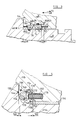
- a rolling cutter earth boring bit 10 includes a body 12 with a plurality of leg portions 14.
- a cantilevered bearing shaft 16 formed on each leg 14 extends inwardly and downwardly.
- a rolling cutter 18 is rotatably mounted upon the shaft 16. Attached to the rolling cutter 18 are hard, wear resistant cutting inserts 20 which engage the earth to effect a drilling action and cause rotation of the rolling cutter 18.
- a friction bearing member 36 is mounted between the bearing shaft 16 and a mating bearing cavity 38 formed in the cutter 18. This friction bearing 36 is designed to carry the radial loads imposed upon the cutter 18 during drilling.
- a retention bearing member 42 is configured as a split threaded ring which engages internal threads 40 in the cutter 18. This retention bearing member 42 serves to retain the cutter 18 upon the bearing shaft by resisting the forces which tend to push the cutter 18 off the bearing shaft 16 during drilling.
- Internal passageways 22, 24, & 26, as well as a reservoir 28 and bearing area 30 of the leg 14, are filled with lubricant (not shown) during bit assembly.
- the lubricant helps reduce bearing friction and wear during bit operation and is retained within the cutter 18 by a volume compensating rigid face seal assembly 32.
- FIG. 3 An enlarged schematic view of a section of an idealized volume compensating rigid face seal assembly 32a for rock bits is shown in Figure 3. This schematic is helpful in demonstrating the effects of seal movement, energizer forces, and face loading as the stiffnesses of the energizers are varied.
- This seal assembly 32a is comprised of two seal rings 44 and 46 and two energizers 48 and 50 within a seal cavity 56 and 58.
- Energizers 48, 50 can take many forms, such as elastomeric O-rings, belleville springs, sets of coil compression springs, and the like. For this idealized analysis, simple compression springs are shown.
- the seal ring 44 and the energizer 48 are mounted on the bearing shaft 16a, and the seal ring 46 and energizer 50 are mounted on the cutter 18a.
- the portion of the seal cavity identified by numeral 56 fills with abrasive laden drilling fluid during operation.
- the other portion of the seal cavity, identified by numeral 58, is filled with lubricant.
- the bearing shaft energizer 48 is shown compressed between the bearing shaft seal ring 44 and a wall 54 formed on the bearing shaft 16a.
- the energizer 48 acts to load the seal ring 44 axially against the mating seal ring 46 to effect a seal. The magnitude of this load will vary as the seal ring 44 moves axially in the cavity 56, 58.
- a static seal 72 is placed between the seal ring 44 and the bearing shaft 16.
- the cutter energizer 50 and static seal ring 74 perform the same functions, except that the cutter energizer 50 is compressed between the cutter seal ring 46 and a wall 52 formed in the cutter 18a.
- the operating range for the axial movement of seal assembly 32a is determined from the expected axial play of the bearing assembly and the volume ratio.
- This prior art did not recognize the need to also include into the operating range axial movements of the seal assembly 32a due to intransient lubricant pressure differentials. Therefore, in accordance with the present invention, the operating range is determined from the expected axial play of the bearing assembly and the volume ratio with an additional allowance for seal movement without axial movement of the cutter caused by intransient lubrication pressure differentials.
- the axial bearing play of the cutter 18a on the bearing shaft 16a is included in this operating range.
- the maximum possible operating range is equal to the sum of cavity clearances 60 and 62 plus the axial bearing play. In practice it is desirable to design the seal and seal cavity with an operating range less than this so the seal assembly does not contact either end wall 52 or 54 during operation.
- the range of axial displacement of the bearing shaft seal ring 44 with respect to the wall 54 will not necessarily be equal to the range of axial displacement of the cutter seal ring 46 with respect to the wall 52 as the seal assembly 32a moves through the operating range. This is due to the interdependence of the cutter axial play on the bearing shaft and the axial distance the seal assembly 32a moves to compensates for changes in lubricant volume.
- a stiffness, K1 for the bearing shaft energizer 48 is defined as the maximum minus the minimum axial load the bearing shaft energizer 48 exerts over the range of axial displacement of the bearing shaft seal ring 44 with respect to the bearing shaft wall 54 divided by the amount of that axial displacement, as the seal assembly 32a traverses through its full operating range of movement.
- the units for this stiffness are therefore force divided by distance (F.L -1 ).
- a stiffness, K2 is defined in a similar manner for the cutter energizer 50 as the maximum minus the minimum axial load the cutter energizer 50 exerts over the range of axial displacement of cutter seal ring 46 with respect to the cutter wall 52 divided by the amount of that axial displacement, as the seal assembly 32a traverses through its full operating range of movement.
- Stiffness K2 also has the units of force divided by distance (F.L -1 ). The load variation on either energizer as it moves through an intermediate position is continuous but not necessarily linear.
- a dynamic sealing point 64 is defined on the engaged faces of the seal rings 44 and 46. In practice, this point is the center of a .040"-.060" wide flat and smooth sealing surface on the seal faces of rings 44, 46. However, for clarity in this example, the dynamic seal point 64 is placed at the very edge of the sealing faces, closely adjacent to the abrasive drilling fluid portion of the seal cavity 56. It would be appreciated by those skilled in the art that it is desirable to locate this sealing point 64 as closely as possible to this edge to minimize face wear due to the presence of abrasive particles from the drilling fluid between the sealing faces.
- the seal assembly 32a is called a volume compensating seal design because it sweeps a volume of lubricant in response to the volume change of lubricant that would normally be displaced by axial bearing play. Although the amount of seal movement is determined by the swept volume relationships, it is the pressure differentials acting upon the swept area of the seal 32a that force seal movement. It is in the understanding of how these pressure differentials act on the seal assembly that the utility of the present invention, is appreciated.
- both energizers 48 and 50 are compressed sufficiently to provide a nominal sealing force at the sealing face.
- the seal assembly moves a discrete amount to compensate for the change in the volume of lubricant.
- the seal moves in response to the pressure differential which arises between the cavities 56 and 58 as a result of the movement of the cutter on the bearing shaft. Since the sealing point 64 is at the very edge of the seals, the pressure in the cavity 58 acts on the entire face side 74 and the entire wall side 76 of the seal ring 46. Therefore none of the differential pressure between the cavities 58 and 56 act on the seal ring 46 in the axial direction.
- seal ring 44 is fully subjected to the pressure differential between the cavities 58 and 56 in the axial direction.
- the force arising from the pressure differential which causes axial seal movement is exerted solely upon the seal ring 44.
- the change in force of energizer 48 due to the axial movement of the seal assembly 32a is also important to understand.
- the changes in this force affect the tendency for bearing shaft seal ring 44 to rotate upon the bearing shaft (also known as seal ring slippage).
- the torque exerted upon the seal ring 44 is transferred through the energizer 48 to the bearing shaft.
- the manner in which this energizer is commonly used in practice relies upon frictional resistance between the energizer 48 and bearing shaft 16a to transmit this torque.
- the force within this energizer 48 can therefore be thought of as a grip force. Should the grip force within this energizer be significantly reduced, the likelihood of seal ring slippage increases.
- the force change in energizer 48 (i.e. the change in grip force) is equal to the axial movement of the seal assembly with respect to the bearing shaft 16a multiplied by the stiffness K1 of energizer 48.
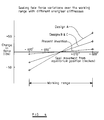
- FIG 4 shown is a family of curves representing the changes in sealing face force plotted against seal movement through a .040" operating range for the four cases described above.
- the change in sealing face force plotted against seal movement is shown as being linear. In practice, however, it is known that non-linearities occur between the end points and the center equilibrium position, especially when the energizers are resilient elastomers.
- a volume compensating rigid face seal of the present invention will also have a slower and more predictable wear progression of the sealing band than prior art designs. This is due to less fluctuation in face loads of the present invention compared to the prior art designs.
- the preferred embodiment of the new volume compensating rigid face seal assembly of the present invention is shown in Figure 5.
- the seal assembly 132 is comprised of two seal rings 144, 146, energizers 148, 150, and static seal 174 separating seal cavities 156 and 158.
- Cavity 156 fills with abrasive laden drilling fluid during operation.
- Cavity 158 is filled with lubricant.
- Clearances 160, 162 within the seal cavity allow the seal assembly to move axially within the operating range between the bearing shaft wall 154 and the cutter wall 152.
- Clearance 160 is greater than 162 to allow for greater seal movement toward the bearing shaft due to the occasional intransient pressures which may build up in the lubricant.
- the clearance 160 is by design made at least 10% greater than clearance 162 to accommodate these pressure differentials.
- the bearing shaft energizer 148 is an elastomer ring compressed between the bearing shaft seal ring 144 and a ramp 178 formed on the bearing shaft 116.
- the ramp 178 and the portion of the shaft seal ring 144 which contacts the energizer 148 are grit blasted prior to assembly to achieve a surface roughness of about 120 to 400 RA.
- the cutter energizer 150 is a plurality of coil springs 150. Coil springs 150 are particularly advantageous when cutter energizer stiffness, K2, is made very low.
- the coil springs 150 can be precisely engineered for any desired energizer stiffness by changing the spring wire material and diameter, number of coils in the spring and the total number of springs 150 in the seal assembly 132.
- the coil springs 150 are placed in recesses 172 in the cutter seal ring 146 and in recesses 176 in the cutter 118. This construction provides the advantage of eliminating energizer slippage and rotation of seal ring 46 relative to cutter 118.
- the geometry of the seal and bearing design along with the axial play of the bearing and expected pressure differentials are all considered when calculating an operating range of the seal assembly 132 within the seal cavity 156, 158.
- the width of the seal cavity 156, 158 is designed to provide for adequate axial clearances as seal assembly 132 moves axially to provide volume compensation during operation.
- the total stiffness, K2 over the operating range of the coil springs 150 energizer is about 400 to 500 pounds per inch.
- the static seal 174 in the preferred embodiment is an elastomeric packing type seal ring placed in a groove 176 formed in the cutter 118.
- the static seal ring 174 bears against the cutter ring 146, preventing the exchange of lubricant and drilling fluid around the cutter ring 146.
- the stiffness K1 of the bearing shaft energizer 148 generally lies between 2000 lb/in and 4500 lb/in.
- the practical constraints in the present invention limit the stiffness K1 to between 2000 lb/in and 3500 lb/in. Since the maximum effective stiffness of K2 is about 1000 lb/in and the mininium stiffness of K1 is about 2000 lb/in, in the practice of the present invention the stiffness K2 will be less than half of the stiffness K1.
- the bearing shaft energizer 148 is designed to have a stiffness, K1, over its operating range of about 2500 pounds per inch and is the equivalent to the combination of the bearing shaft energizer 48 and static seal 72 in Figure 3. Therefore, in the preferred embodiment the stiffness K2 is less than about .2 of the stiffness of K1.
- energizer K2 When one considers prior art rigid face seal designs, there are many ways to reduce the stiffness of energizer K2 to practice the present invention.
- One way to reduce the stiffness, K2, of cutter energizer 50 is by changing the dimensions and composition of the energizer 50.
- the energizer 50 is elastomeric, a softer elastomer can be used with similar space and geometry.
- an elastomer O-ring with a larger cross section diameter could be used in a larger seal cavity or the geometric relationships of the mating surfaces between energizer 50 and the cutter seal ring 46 and the wall 52 can be changed to reduce stiffness K2.
Landscapes
- Engineering & Computer Science (AREA)
- Life Sciences & Earth Sciences (AREA)
- Geology (AREA)
- Mining & Mineral Resources (AREA)
- Mechanical Engineering (AREA)
- Physics & Mathematics (AREA)
- Environmental & Geological Engineering (AREA)
- Fluid Mechanics (AREA)
- General Life Sciences & Earth Sciences (AREA)
- Geochemistry & Mineralogy (AREA)
- Earth Drilling (AREA)
Applications Claiming Priority (2)
| Application Number | Priority Date | Filing Date | Title |
|---|---|---|---|
| US08/685,851 US5875861A (en) | 1996-07-24 | 1996-07-24 | Different stiffness energizers for MF seals |
| US685851 | 1996-07-24 |
Publications (3)
| Publication Number | Publication Date |
|---|---|
| EP0821132A2 true EP0821132A2 (de) | 1998-01-28 |
| EP0821132A3 EP0821132A3 (de) | 1998-12-16 |
| EP0821132B1 EP0821132B1 (de) | 2003-07-09 |
Family
ID=24753935
Family Applications (1)
| Application Number | Title | Priority Date | Filing Date |
|---|---|---|---|
| EP96307024A Expired - Lifetime EP0821132B1 (de) | 1996-07-24 | 1996-09-26 | Dichtung für einen Rollenbohrmeissel |
Country Status (3)
| Country | Link |
|---|---|
| US (1) | US5875861A (de) |
| EP (1) | EP0821132B1 (de) |
| DE (1) | DE69629022T2 (de) |
Cited By (3)
| Publication number | Priority date | Publication date | Assignee | Title |
|---|---|---|---|---|
| WO2014126627A1 (en) * | 2013-02-13 | 2014-08-21 | Varel International Ind., L.P. | Rock bit having a pressure balanced metal faced seal |
| US9091130B2 (en) | 2013-02-13 | 2015-07-28 | Varel International, Ind., L.P. | Rock bit having a radially self-aligning metal faced seal |
| US9163458B2 (en) | 2013-02-13 | 2015-10-20 | Varel International, Ind., L.P. | Rock bit having a flexible metal faced seal |
Families Citing this family (15)
| Publication number | Priority date | Publication date | Assignee | Title |
|---|---|---|---|---|
| US6026917A (en) * | 1997-12-18 | 2000-02-22 | Baker Hughes Incorporated | Earth-boring bit with improved bearing seal |
| US6176330B1 (en) * | 1999-10-12 | 2001-01-23 | Camco International Inc. | Rock bit face seal having anti-rotation pins |
| US6497415B2 (en) | 2000-07-24 | 2002-12-24 | Ti Specialty Polymer Products, Inc. | Elastomer energized rod seal |
| US6513607B2 (en) | 2001-02-15 | 2003-02-04 | Baker Hughes Incorporated | Metal-face-seal rock bit |
| US6427790B1 (en) | 2001-11-08 | 2002-08-06 | Schlumberger Technology Corporation | Rock bit face seal having lubrication gap |
| US7117961B2 (en) | 2003-07-31 | 2006-10-10 | Smith International, Inc. | Dynamic seal with soft interface |
| US7188691B2 (en) * | 2004-06-15 | 2007-03-13 | Smith International, Inc. | Metal seal with impact-absorbing ring |
| US7347290B2 (en) * | 2004-06-15 | 2008-03-25 | Smith International, Inc. | Multi-part energizer for mechanical seal assembly |
| US7461708B2 (en) * | 2004-08-16 | 2008-12-09 | Smith International, Inc. | Elastomeric seal assembly having auxiliary annular seal components |
| US20060065445A1 (en) * | 2004-09-28 | 2006-03-30 | Smith International, Inc. | Rock-bit seals with asymmetric contact profiles |
| US7392862B2 (en) * | 2006-01-06 | 2008-07-01 | Baker Hughes Incorporated | Seal insert ring for roller cone bits |
| US7992657B2 (en) | 2006-08-18 | 2011-08-09 | Atlas Copco Secoroc Llc | Earth bit having a wear ring |
| US7887061B2 (en) * | 2007-09-14 | 2011-02-15 | Caterpillar Inc | Metal face seal assembly and machine using same |
| US8967301B2 (en) | 2010-02-03 | 2015-03-03 | Baker Hughes Incorporated | Composite metallic elastomeric sealing components for roller cone drill bits |
| US9482282B2 (en) * | 2014-08-21 | 2016-11-01 | Zilift Holdings, Ltd. | Bearing for a rotary machine |
Family Cites Families (31)
| Publication number | Priority date | Publication date | Assignee | Title |
|---|---|---|---|---|
| US3137508A (en) * | 1961-01-03 | 1964-06-16 | Hughes Tool Co | Bearing seal |
| US3370895A (en) * | 1965-09-28 | 1968-02-27 | Dresser Ind | Bearing seal for drilling bits |
| US3529840A (en) * | 1969-10-23 | 1970-09-22 | Caterpillar Tractor Co | Bearing seal |
| US3713707A (en) * | 1970-01-12 | 1973-01-30 | Sun Oil Co | Bearing seal |
| US4199156A (en) * | 1978-04-28 | 1980-04-22 | Smith International, Inc. | Sealing ring for drilling tool cutters |
| US4178045A (en) * | 1978-05-05 | 1979-12-11 | Smith International, Inc. | Abrasion resistant bearing seal |
| US4176848A (en) * | 1978-06-30 | 1979-12-04 | Dresser Industries, Inc. | Rotary bearing seal for drill bits |
| US4249622A (en) * | 1979-06-11 | 1981-02-10 | Dresser Industries, Inc. | Floating seal for drill bits |
| US4359111A (en) * | 1980-05-27 | 1982-11-16 | Gonzalez Eduardo B | Self compensating seal apparatus |
| US4466622A (en) * | 1980-07-24 | 1984-08-21 | Reed Rock Bit Company | Compound dynamic seal for rolling cutter drill bit |
| US4306727A (en) * | 1980-07-24 | 1981-12-22 | Reed Rock Bit Company | Dynamic seal for rolling cutter drill bit |
| US4344629A (en) * | 1980-10-14 | 1982-08-17 | Smith International, Inc. | Self-lapping high speed seal with wear-in lip |
| US4394020A (en) * | 1982-10-18 | 1983-07-19 | Smith International, Inc. | High-speed seal |
| US4516641A (en) * | 1983-10-17 | 1985-05-14 | Hughes Tool Company-Usa | Earth boring bit with pressure compensating rigid face seal |
| US4753303A (en) * | 1983-10-17 | 1988-06-28 | Hughes Tool Company--USA | Earth boring bit with two piece bearing and rigid face seal assembly |
| US4666001A (en) * | 1983-10-17 | 1987-05-19 | Hughes Tool Company - Usa | Earth boring bit with improved rigid face seal assembly |
| US4516640A (en) * | 1983-12-08 | 1985-05-14 | Santrade Ltd. | Rotary drill bit |
| US4613005A (en) * | 1984-06-20 | 1986-09-23 | Chicago Rawhide Manufacturing Co. | Unitized seal for severe service applications |
| US4671368A (en) * | 1985-05-13 | 1987-06-09 | Hughes Tool Company - Usa | Earth boring bit with shear compression seal |
| JPH0742837B2 (ja) * | 1986-06-13 | 1995-05-10 | 塚本精機株式会社 | ドリルビツトのカツタ−用回転軸封装置 |
| US4753304A (en) * | 1987-03-09 | 1988-06-28 | Hughes Tool Company | Volume and pressure balanced rigid face seal for rock bits |
| US5009519A (en) * | 1987-05-28 | 1991-04-23 | Tatum David M | Sealing assembly for relatively movable members |
| US4762189A (en) * | 1987-05-28 | 1988-08-09 | Tatum David M | Seal and seal shield assembly for rotary drill bits |
| US4824123A (en) * | 1988-03-31 | 1989-04-25 | Smith International, Inc. | Mechanical face seal for rock bits |
| US4822057A (en) * | 1988-03-31 | 1989-04-18 | Smith International, Inc. | Mechanical face seal for rock bits |
| US4838365A (en) * | 1988-04-25 | 1989-06-13 | Reed Tool Company | Seal assembly for rotary drill bits |
| US4903786A (en) * | 1988-06-23 | 1990-02-27 | Hughes Tool Company | Earth boring bit with improved two piece bearing and seal assembly |
| US4923020A (en) * | 1988-06-23 | 1990-05-08 | Hughes Tool Company | Rock bit with rigid face seals and recessed energizers |
| US5040624A (en) * | 1990-08-13 | 1991-08-20 | Schumacher Percy W | Seal assembly for roller cutter drill bit having a pressure balanced lubrication system |
| US5360076A (en) * | 1992-04-03 | 1994-11-01 | Hughes Tool Company | Dual metal face seal with single recessed energizer |
| US5295549A (en) * | 1992-12-14 | 1994-03-22 | Baker Hughes Incorporated | Mechanical lock to prevent seal ring rotation |
-
1996
- 1996-07-24 US US08/685,851 patent/US5875861A/en not_active Expired - Lifetime
- 1996-09-26 DE DE69629022T patent/DE69629022T2/de not_active Expired - Fee Related
- 1996-09-26 EP EP96307024A patent/EP0821132B1/de not_active Expired - Lifetime
Cited By (5)
| Publication number | Priority date | Publication date | Assignee | Title |
|---|---|---|---|---|
| WO2014126627A1 (en) * | 2013-02-13 | 2014-08-21 | Varel International Ind., L.P. | Rock bit having a pressure balanced metal faced seal |
| US9091130B2 (en) | 2013-02-13 | 2015-07-28 | Varel International, Ind., L.P. | Rock bit having a radially self-aligning metal faced seal |
| US9163458B2 (en) | 2013-02-13 | 2015-10-20 | Varel International, Ind., L.P. | Rock bit having a flexible metal faced seal |
| US9163459B2 (en) | 2013-02-13 | 2015-10-20 | Varel International, Ind., L.P. | Rock bit having a pressure balanced metal faced seal |
| EP2956612A4 (de) * | 2013-02-13 | 2017-01-04 | Varel International, Ind., L.P. | Bohrmeissel mit flexibler dichtung mit metallseite |
Also Published As
| Publication number | Publication date |
|---|---|
| DE69629022T2 (de) | 2004-03-18 |
| EP0821132B1 (de) | 2003-07-09 |
| EP0821132A3 (de) | 1998-12-16 |
| DE69629022D1 (de) | 2003-08-14 |
| US5875861A (en) | 1999-03-02 |
Similar Documents
| Publication | Publication Date | Title |
|---|---|---|
| EP0821132B1 (de) | Dichtung für einen Rollenbohrmeissel | |
| US6679342B2 (en) | Dual-seal drill bit pressure communication system | |
| US3656764A (en) | Drill bit seal assembly | |
| EP2354435B1 (de) | Elastomere Verbundmetallabdichtungskomponenten für Rollenkonusbohrmeißel | |
| EP1013876B1 (de) | Dichtung für Gesteinsbohrmeissel | |
| US4838365A (en) | Seal assembly for rotary drill bits | |
| US4623028A (en) | Seal assembly for drill bits | |
| US6427790B1 (en) | Rock bit face seal having lubrication gap | |
| CA1292221C (en) | Volume and pressure balanced rigid face seal for rock bits | |
| CA2509318C (en) | Metal seal with impact-absorbing ring | |
| US4428588A (en) | Radial belleville seal with encapsulated resilient core member | |
| US6176330B1 (en) | Rock bit face seal having anti-rotation pins | |
| US4629338A (en) | Seal and bearing apparatus for bits | |
| CA2397141C (en) | Rock bit seal with extrusion prevention member | |
| US4466621A (en) | Rotary drill bit multiple seal assembly | |
| US6109376A (en) | Face seal having strain induced face geometry | |
| US4671368A (en) | Earth boring bit with shear compression seal | |
| US20030024743A1 (en) | Dual dynamic rotary seal | |
| US5853245A (en) | Rock bit cutter retainer with differentially pitched threads | |
| US4494749A (en) | Seal assemblies | |
| CA1037464A (en) | Drilling string shock-absorbing tool | |
| US5186267A (en) | Journal bearing type rock bit | |
| US4519614A (en) | Generally cylindrical rotary drill face seal having improved resistance to radial distortion | |
| CN105051311A (zh) | 用于牙轮钻头中的金属面密封件的改进的支承环特征 | |
| US4294492A (en) | Caliper seal assembly |
Legal Events
| Date | Code | Title | Description |
|---|---|---|---|
| PUAI | Public reference made under article 153(3) epc to a published international application that has entered the european phase |
Free format text: ORIGINAL CODE: 0009012 |
|
| AK | Designated contracting states |
Kind code of ref document: A2 Designated state(s): DE GB IT NL |
|
| PUAL | Search report despatched |
Free format text: ORIGINAL CODE: 0009013 |
|
| AK | Designated contracting states |
Kind code of ref document: A3 Designated state(s): DE GB IT NL |
|
| 17P | Request for examination filed |
Effective date: 19990601 |
|
| AKX | Designation fees paid |
Free format text: DE GB IT NL |
|
| GRAH | Despatch of communication of intention to grant a patent |
Free format text: ORIGINAL CODE: EPIDOS IGRA |
|
| GRAH | Despatch of communication of intention to grant a patent |
Free format text: ORIGINAL CODE: EPIDOS IGRA |
|
| GRAA | (expected) grant |
Free format text: ORIGINAL CODE: 0009210 |
|
| RAP1 | Party data changed (applicant data changed or rights of an application transferred) |
Owner name: CAMCO INTERNATIONAL (UK) LTD. |
|
| AK | Designated contracting states |
Designated state(s): DE GB IT NL |
|
| REG | Reference to a national code |
Ref country code: GB Ref legal event code: FG4D |
|
| REF | Corresponds to: |
Ref document number: 69629022 Country of ref document: DE Date of ref document: 20030814 Kind code of ref document: P |
|
| PLBE | No opposition filed within time limit |
Free format text: ORIGINAL CODE: 0009261 |
|
| STAA | Information on the status of an ep patent application or granted ep patent |
Free format text: STATUS: NO OPPOSITION FILED WITHIN TIME LIMIT |
|
| 26N | No opposition filed |
Effective date: 20040414 |
|
| PGFP | Annual fee paid to national office [announced via postgrant information from national office to epo] |
Ref country code: NL Payment date: 20060903 Year of fee payment: 11 |
|
| PGFP | Annual fee paid to national office [announced via postgrant information from national office to epo] |
Ref country code: DE Payment date: 20060922 Year of fee payment: 11 |
|
| PG25 | Lapsed in a contracting state [announced via postgrant information from national office to epo] |
Ref country code: NL Free format text: LAPSE BECAUSE OF NON-PAYMENT OF DUE FEES Effective date: 20080401 |
|
| NLV4 | Nl: lapsed or anulled due to non-payment of the annual fee |
Effective date: 20080401 |
|
| PG25 | Lapsed in a contracting state [announced via postgrant information from national office to epo] |
Ref country code: DE Free format text: LAPSE BECAUSE OF NON-PAYMENT OF DUE FEES Effective date: 20080401 |
|
| PGFP | Annual fee paid to national office [announced via postgrant information from national office to epo] |
Ref country code: GB Payment date: 20150923 Year of fee payment: 20 |
|
| PGFP | Annual fee paid to national office [announced via postgrant information from national office to epo] |
Ref country code: IT Payment date: 20150925 Year of fee payment: 20 |
|
| REG | Reference to a national code |
Ref country code: GB Ref legal event code: PE20 Expiry date: 20160925 |
|
| PG25 | Lapsed in a contracting state [announced via postgrant information from national office to epo] |
Ref country code: GB Free format text: LAPSE BECAUSE OF EXPIRATION OF PROTECTION Effective date: 20160925 |