EP0817627B1 - Protein kinase c inhibitors - Google Patents
Protein kinase c inhibitors Download PDFInfo
- Publication number
- EP0817627B1 EP0817627B1 EP95904892A EP95904892A EP0817627B1 EP 0817627 B1 EP0817627 B1 EP 0817627B1 EP 95904892 A EP95904892 A EP 95904892A EP 95904892 A EP95904892 A EP 95904892A EP 0817627 B1 EP0817627 B1 EP 0817627B1
- Authority
- EP
- European Patent Office
- Prior art keywords
- solvate
- pharmaceutically acceptable
- hydrogen
- acceptable salt
- compound according
- Prior art date
- Legal status (The legal status is an assumption and is not a legal conclusion. Google has not performed a legal analysis and makes no representation as to the accuracy of the status listed.)
- Expired - Lifetime
Links
- 229940123924 Protein kinase C inhibitor Drugs 0.000 title description 10
- 239000003881 protein kinase C inhibitor Substances 0.000 title description 10
- 150000001875 compounds Chemical class 0.000 claims abstract description 111
- 206010012601 diabetes mellitus Diseases 0.000 claims abstract description 13
- -1 monoalkylaminoalkyl Chemical group 0.000 claims description 49
- 150000003839 salts Chemical class 0.000 claims description 40
- 239000012453 solvate Substances 0.000 claims description 30
- 239000001257 hydrogen Substances 0.000 claims description 28
- 229910052739 hydrogen Inorganic materials 0.000 claims description 28
- 239000004480 active ingredient Substances 0.000 claims description 21
- 125000004435 hydrogen atom Chemical group [H]* 0.000 claims description 16
- 125000000217 alkyl group Chemical group 0.000 claims description 15
- 125000000623 heterocyclic group Chemical group 0.000 claims description 11
- 125000004453 alkoxycarbonyl group Chemical group 0.000 claims description 10
- 125000002496 methyl group Chemical group [H]C([H])([H])* 0.000 claims description 10
- JUJWROOIHBZHMG-UHFFFAOYSA-N Pyridine Chemical compound C1=CC=NC=C1 JUJWROOIHBZHMG-UHFFFAOYSA-N 0.000 claims description 9
- 125000004663 dialkyl amino group Chemical group 0.000 claims description 8
- 125000004178 (C1-C4) alkyl group Chemical group 0.000 claims description 7
- 239000003814 drug Substances 0.000 claims description 7
- 125000001188 haloalkyl group Chemical group 0.000 claims description 7
- 125000006273 (C1-C3) alkyl group Chemical group 0.000 claims description 6
- 206010028980 Neoplasm Diseases 0.000 claims description 6
- 125000003545 alkoxy group Chemical group 0.000 claims description 6
- 201000011510 cancer Diseases 0.000 claims description 6
- 229910052736 halogen Inorganic materials 0.000 claims description 6
- 150000002367 halogens Chemical class 0.000 claims description 6
- VEXZGXHMUGYJMC-UHFFFAOYSA-N Hydrochloric acid Chemical class Cl VEXZGXHMUGYJMC-UHFFFAOYSA-N 0.000 claims description 5
- 125000002777 acetyl group Chemical group [H]C([H])([H])C(*)=O 0.000 claims description 5
- 125000000753 cycloalkyl group Chemical group 0.000 claims description 5
- 125000002023 trifluoromethyl group Chemical group FC(F)(F)* 0.000 claims description 5
- 125000004414 alkyl thio group Chemical group 0.000 claims description 4
- 125000003118 aryl group Chemical group 0.000 claims description 4
- 239000003085 diluting agent Substances 0.000 claims description 4
- 125000002887 hydroxy group Chemical group [H]O* 0.000 claims description 4
- 239000000546 pharmaceutical excipient Substances 0.000 claims description 4
- 125000002924 primary amino group Chemical group [H]N([H])* 0.000 claims description 4
- 125000000475 sulfinyl group Chemical group [*:2]S([*:1])=O 0.000 claims description 4
- 125000004455 (C1-C3) alkylthio group Chemical group 0.000 claims description 3
- 125000004103 aminoalkyl group Chemical group 0.000 claims description 3
- 125000004985 dialkyl amino alkyl group Chemical group 0.000 claims description 3
- 239000003937 drug carrier Substances 0.000 claims description 3
- 125000002795 guanidino group Chemical group C(N)(=N)N* 0.000 claims description 3
- 125000001041 indolyl group Chemical group 0.000 claims description 3
- 125000001449 isopropyl group Chemical group [H]C([H])([H])C([H])(*)C([H])([H])[H] 0.000 claims description 3
- 239000008194 pharmaceutical composition Substances 0.000 claims description 3
- 125000004206 2,2,2-trifluoroethyl group Chemical group [H]C([H])(*)C(F)(F)F 0.000 claims description 2
- JQGRMZUVGWRDIV-UHFFFAOYSA-N 3-(1-methylindol-3-yl)-4-[1-(1-methylpiperidin-4-yl)indol-3-yl]pyrrole-2,5-dione Chemical compound C1CN(C)CCC1N1C2=CC=CC=C2C(C=2C(NC(=O)C=2C=2C3=CC=CC=C3N(C)C=2)=O)=C1 JQGRMZUVGWRDIV-UHFFFAOYSA-N 0.000 claims description 2
- 125000004183 alkoxy alkyl group Chemical group 0.000 claims description 2
- 239000002246 antineoplastic agent Substances 0.000 claims description 2
- 125000001797 benzyl group Chemical group [H]C1=C([H])C([H])=C(C([H])=C1[H])C([H])([H])* 0.000 claims description 2
- 229940127089 cytotoxic agent Drugs 0.000 claims description 2
- 125000001495 ethyl group Chemical group [H]C([H])([H])C([H])([H])* 0.000 claims description 2
- 125000002541 furyl group Chemical group 0.000 claims description 2
- 125000002636 imidazolinyl group Chemical group 0.000 claims description 2
- 125000002883 imidazolyl group Chemical group 0.000 claims description 2
- 125000004482 piperidin-4-yl group Chemical group N1CCC(CC1)* 0.000 claims description 2
- 125000004076 pyridyl group Chemical group 0.000 claims description 2
- 125000000714 pyrimidinyl group Chemical group 0.000 claims description 2
- 125000002769 thiazolinyl group Chemical group 0.000 claims description 2
- 150000002431 hydrogen Chemical group 0.000 claims 11
- 238000004519 manufacturing process Methods 0.000 claims 3
- IRUHVWFVQLJFRG-UHFFFAOYSA-N 1-hydroxy-2h-pyrrol-3-one Chemical compound ON1CC(=O)C=C1 IRUHVWFVQLJFRG-UHFFFAOYSA-N 0.000 claims 1
- UFHFLCQGNIYNRP-UHFFFAOYSA-N Hydrogen Chemical compound [H][H] UFHFLCQGNIYNRP-UHFFFAOYSA-N 0.000 claims 1
- MDFFNEOEWAXZRQ-UHFFFAOYSA-N aminyl Chemical compound [NH2] MDFFNEOEWAXZRQ-UHFFFAOYSA-N 0.000 claims 1
- 125000003739 carbamimidoyl group Chemical group C(N)(=N)* 0.000 claims 1
- 230000003301 hydrolyzing effect Effects 0.000 claims 1
- 125000002768 hydroxyalkyl group Chemical group 0.000 claims 1
- 108010044467 Isoenzymes Proteins 0.000 abstract description 63
- 102000003923 Protein Kinase C Human genes 0.000 abstract description 56
- 108090000315 Protein Kinase C Proteins 0.000 abstract description 56
- 102000015766 Protein Kinase C beta Human genes 0.000 abstract description 17
- 108010024526 Protein Kinase C beta Proteins 0.000 abstract description 17
- 238000000034 method Methods 0.000 abstract description 13
- 208000037265 diseases, disorders, signs and symptoms Diseases 0.000 abstract description 11
- 239000003112 inhibitor Substances 0.000 abstract description 9
- 201000010099 disease Diseases 0.000 abstract description 8
- 230000002401 inhibitory effect Effects 0.000 abstract description 7
- 229940124639 Selective inhibitor Drugs 0.000 abstract description 4
- YMWUJEATGCHHMB-UHFFFAOYSA-N Dichloromethane Chemical compound ClCCl YMWUJEATGCHHMB-UHFFFAOYSA-N 0.000 description 124
- XLYOFNOQVPJJNP-UHFFFAOYSA-N water Substances O XLYOFNOQVPJJNP-UHFFFAOYSA-N 0.000 description 71
- 239000000243 solution Substances 0.000 description 67
- YXFVVABEGXRONW-UHFFFAOYSA-N Toluene Chemical compound CC1=CC=CC=C1 YXFVVABEGXRONW-UHFFFAOYSA-N 0.000 description 54
- 239000000203 mixture Substances 0.000 description 51
- 238000006243 chemical reaction Methods 0.000 description 46
- LFQSCWFLJHTTHZ-UHFFFAOYSA-N Ethanol Chemical compound CCO LFQSCWFLJHTTHZ-UHFFFAOYSA-N 0.000 description 45
- ZMANZCXQSJIPKH-UHFFFAOYSA-N Triethylamine Chemical compound CCN(CC)CC ZMANZCXQSJIPKH-UHFFFAOYSA-N 0.000 description 45
- CSCPPACGZOOCGX-UHFFFAOYSA-N Acetone Chemical compound CC(C)=O CSCPPACGZOOCGX-UHFFFAOYSA-N 0.000 description 42
- XEKOWRVHYACXOJ-UHFFFAOYSA-N Ethyl acetate Chemical compound CCOC(C)=O XEKOWRVHYACXOJ-UHFFFAOYSA-N 0.000 description 39
- 238000002360 preparation method Methods 0.000 description 34
- RTZKZFJDLAIYFH-UHFFFAOYSA-N Diethyl ether Chemical compound CCOCC RTZKZFJDLAIYFH-UHFFFAOYSA-N 0.000 description 32
- WYURNTSHIVDZCO-UHFFFAOYSA-N Tetrahydrofuran Chemical compound C1CCOC1 WYURNTSHIVDZCO-UHFFFAOYSA-N 0.000 description 28
- UIIMBOGNXHQVGW-UHFFFAOYSA-M Sodium bicarbonate Chemical compound [Na+].OC([O-])=O UIIMBOGNXHQVGW-UHFFFAOYSA-M 0.000 description 26
- 238000003756 stirring Methods 0.000 description 26
- CTSLXHKWHWQRSH-UHFFFAOYSA-N oxalyl chloride Chemical compound ClC(=O)C(Cl)=O CTSLXHKWHWQRSH-UHFFFAOYSA-N 0.000 description 24
- BWHMMNNQKKPAPP-UHFFFAOYSA-L potassium carbonate Chemical compound [K+].[K+].[O-]C([O-])=O BWHMMNNQKKPAPP-UHFFFAOYSA-L 0.000 description 24
- VYPSYNLAJGMNEJ-UHFFFAOYSA-N Silicium dioxide Chemical compound O=[Si]=O VYPSYNLAJGMNEJ-UHFFFAOYSA-N 0.000 description 23
- 239000000741 silica gel Substances 0.000 description 22
- 229910002027 silica gel Inorganic materials 0.000 description 22
- ZMXDDKWLCZADIW-UHFFFAOYSA-N N,N-Dimethylformamide Chemical compound CN(C)C=O ZMXDDKWLCZADIW-UHFFFAOYSA-N 0.000 description 21
- VLKZOEOYAKHREP-UHFFFAOYSA-N n-Hexane Chemical compound CCCCCC VLKZOEOYAKHREP-UHFFFAOYSA-N 0.000 description 18
- 239000013078 crystal Substances 0.000 description 16
- 238000009472 formulation Methods 0.000 description 16
- HEMHJVSKTPXQMS-UHFFFAOYSA-M Sodium hydroxide Chemical compound [OH-].[Na+] HEMHJVSKTPXQMS-UHFFFAOYSA-M 0.000 description 15
- 239000002904 solvent Substances 0.000 description 15
- 229940086542 triethylamine Drugs 0.000 description 15
- 238000001704 evaporation Methods 0.000 description 14
- 230000008020 evaporation Effects 0.000 description 14
- 239000003921 oil Substances 0.000 description 14
- 239000012074 organic phase Substances 0.000 description 13
- HQKMJHAJHXVSDF-UHFFFAOYSA-L magnesium stearate Chemical compound [Mg+2].CCCCCCCCCCCCCCCCCC([O-])=O.CCCCCCCCCCCCCCCCCC([O-])=O HQKMJHAJHXVSDF-UHFFFAOYSA-L 0.000 description 12
- 229910000027 potassium carbonate Inorganic materials 0.000 description 12
- 239000002585 base Substances 0.000 description 11
- 239000000706 filtrate Substances 0.000 description 11
- 229910000030 sodium bicarbonate Inorganic materials 0.000 description 11
- RQEDXUKWSYJDPG-UHFFFAOYSA-N 1-piperidin-4-ylindole Chemical compound C1CNCCC1N1C2=CC=CC=C2C=C1 RQEDXUKWSYJDPG-UHFFFAOYSA-N 0.000 description 10
- 239000002775 capsule Substances 0.000 description 10
- 230000005764 inhibitory process Effects 0.000 description 10
- 239000002244 precipitate Substances 0.000 description 10
- 239000011541 reaction mixture Substances 0.000 description 10
- 239000000725 suspension Substances 0.000 description 10
- JOXIMZWYDAKGHI-UHFFFAOYSA-N toluene-4-sulfonic acid Chemical compound CC1=CC=C(S(O)(=O)=O)C=C1 JOXIMZWYDAKGHI-UHFFFAOYSA-N 0.000 description 10
- OKKJLVBELUTLKV-UHFFFAOYSA-N Methanol Chemical compound OC OKKJLVBELUTLKV-UHFFFAOYSA-N 0.000 description 9
- BZLVMXJERCGZMT-UHFFFAOYSA-N Methyl tert-butyl ether Chemical compound COC(C)(C)C BZLVMXJERCGZMT-UHFFFAOYSA-N 0.000 description 9
- 238000004440 column chromatography Methods 0.000 description 9
- 230000000694 effects Effects 0.000 description 9
- 229920006395 saturated elastomer Polymers 0.000 description 9
- 229920002472 Starch Polymers 0.000 description 8
- AXJDEHNQPMZKOS-UHFFFAOYSA-N acetylazanium;chloride Chemical compound [Cl-].CC([NH3+])=O AXJDEHNQPMZKOS-UHFFFAOYSA-N 0.000 description 8
- 235000019698 starch Nutrition 0.000 description 8
- 210000001519 tissue Anatomy 0.000 description 8
- HEDRZPFGACZZDS-MICDWDOJSA-N Trichloro(2H)methane Chemical compound [2H]C(Cl)(Cl)Cl HEDRZPFGACZZDS-MICDWDOJSA-N 0.000 description 7
- 239000000651 prodrug Substances 0.000 description 7
- 229940002612 prodrug Drugs 0.000 description 7
- 235000017557 sodium bicarbonate Nutrition 0.000 description 7
- 239000008107 starch Substances 0.000 description 7
- WEVYAHXRMPXWCK-UHFFFAOYSA-N Acetonitrile Chemical compound CC#N WEVYAHXRMPXWCK-UHFFFAOYSA-N 0.000 description 6
- 102000004190 Enzymes Human genes 0.000 description 6
- 108090000790 Enzymes Proteins 0.000 description 6
- WPYMKLBDIGXBTP-UHFFFAOYSA-N benzoic acid group Chemical group C(C1=CC=CC=C1)(=O)O WPYMKLBDIGXBTP-UHFFFAOYSA-N 0.000 description 6
- 239000012267 brine Substances 0.000 description 6
- 235000019359 magnesium stearate Nutrition 0.000 description 6
- 239000000463 material Substances 0.000 description 6
- 239000012528 membrane Substances 0.000 description 6
- KJIFKLIQANRMOU-UHFFFAOYSA-N oxidanium;4-methylbenzenesulfonate Chemical compound O.CC1=CC=C(S(O)(=O)=O)C=C1 KJIFKLIQANRMOU-UHFFFAOYSA-N 0.000 description 6
- 238000000746 purification Methods 0.000 description 6
- HPALAKNZSZLMCH-UHFFFAOYSA-M sodium;chloride;hydrate Chemical compound O.[Na+].[Cl-] HPALAKNZSZLMCH-UHFFFAOYSA-M 0.000 description 6
- 239000003826 tablet Substances 0.000 description 6
- RYHBNJHYFVUHQT-UHFFFAOYSA-N 1,4-Dioxane Chemical compound C1COCCO1 RYHBNJHYFVUHQT-UHFFFAOYSA-N 0.000 description 5
- QTBSBXVTEAMEQO-UHFFFAOYSA-N Acetic acid Chemical compound CC(O)=O QTBSBXVTEAMEQO-UHFFFAOYSA-N 0.000 description 5
- OYPRJOBELJOOCE-UHFFFAOYSA-N Calcium Chemical compound [Ca] OYPRJOBELJOOCE-UHFFFAOYSA-N 0.000 description 5
- 230000015572 biosynthetic process Effects 0.000 description 5
- 235000001465 calcium Nutrition 0.000 description 5
- 239000011575 calcium Substances 0.000 description 5
- 229910052791 calcium Inorganic materials 0.000 description 5
- 238000003818 flash chromatography Methods 0.000 description 5
- 238000004128 high performance liquid chromatography Methods 0.000 description 5
- 239000004615 ingredient Substances 0.000 description 5
- LZZHKPRKLWCFSP-UHFFFAOYSA-N 1-(1-benzylpiperidin-4-yl)indole Chemical compound C1CC(N2C3=CC=CC=C3C=C2)CCN1CC1=CC=CC=C1 LZZHKPRKLWCFSP-UHFFFAOYSA-N 0.000 description 4
- 238000005160 1H NMR spectroscopy Methods 0.000 description 4
- 0 CC(*)C*(CC*)N(C)C Chemical compound CC(*)C*(CC*)N(C)C 0.000 description 4
- SIKJAQJRHWYJAI-UHFFFAOYSA-N Indole Chemical compound C1=CC=C2NC=CC2=C1 SIKJAQJRHWYJAI-UHFFFAOYSA-N 0.000 description 4
- KDLHZDBZIXYQEI-UHFFFAOYSA-N Palladium Chemical compound [Pd] KDLHZDBZIXYQEI-UHFFFAOYSA-N 0.000 description 4
- DTQVDTLACAAQTR-UHFFFAOYSA-N Trifluoroacetic acid Chemical compound OC(=O)C(F)(F)F DTQVDTLACAAQTR-UHFFFAOYSA-N 0.000 description 4
- 239000000556 agonist Substances 0.000 description 4
- 238000003556 assay Methods 0.000 description 4
- AEILLAXRDHDKDY-UHFFFAOYSA-N bromomethylcyclopropane Chemical compound BrCC1CC1 AEILLAXRDHDKDY-UHFFFAOYSA-N 0.000 description 4
- 244000309464 bull Species 0.000 description 4
- 150000001982 diacylglycerols Chemical class 0.000 description 4
- DNJIEGIFACGWOD-UHFFFAOYSA-N ethanethiol Chemical compound CCS DNJIEGIFACGWOD-UHFFFAOYSA-N 0.000 description 4
- 239000007903 gelatin capsule Substances 0.000 description 4
- 239000012280 lithium aluminium hydride Substances 0.000 description 4
- 239000012071 phase Substances 0.000 description 4
- 239000000843 powder Substances 0.000 description 4
- UMJSCPRVCHMLSP-UHFFFAOYSA-N pyridine Natural products COC1=CC=CN=C1 UMJSCPRVCHMLSP-UHFFFAOYSA-N 0.000 description 4
- 230000001105 regulatory effect Effects 0.000 description 4
- 238000000967 suction filtration Methods 0.000 description 4
- 235000020357 syrup Nutrition 0.000 description 4
- 239000006188 syrup Substances 0.000 description 4
- WFDIJRYMOXRFFG-UHFFFAOYSA-N Acetic anhydride Chemical compound CC(=O)OC(C)=O WFDIJRYMOXRFFG-UHFFFAOYSA-N 0.000 description 3
- 208000024172 Cardiovascular disease Diseases 0.000 description 3
- VOPWNXZWBYDODV-UHFFFAOYSA-N Chlorodifluoromethane Chemical compound FC(F)Cl VOPWNXZWBYDODV-UHFFFAOYSA-N 0.000 description 3
- 241000124008 Mammalia Species 0.000 description 3
- 229920000168 Microcrystalline cellulose Polymers 0.000 description 3
- 201000004681 Psoriasis Diseases 0.000 description 3
- CDBYLPFSWZWCQE-UHFFFAOYSA-L Sodium Carbonate Chemical class [Na+].[Na+].[O-]C([O-])=O CDBYLPFSWZWCQE-UHFFFAOYSA-L 0.000 description 3
- 239000002253 acid Substances 0.000 description 3
- 230000009471 action Effects 0.000 description 3
- 230000004913 activation Effects 0.000 description 3
- 150000008064 anhydrides Chemical class 0.000 description 3
- SIPUZPBQZHNSDW-UHFFFAOYSA-N bis(2-methylpropyl)aluminum Chemical compound CC(C)C[Al]CC(C)C SIPUZPBQZHNSDW-UHFFFAOYSA-N 0.000 description 3
- 125000004432 carbon atom Chemical group C* 0.000 description 3
- 230000003197 catalytic effect Effects 0.000 description 3
- 235000010980 cellulose Nutrition 0.000 description 3
- 239000001913 cellulose Substances 0.000 description 3
- 229920002678 cellulose Polymers 0.000 description 3
- 239000003153 chemical reaction reagent Substances 0.000 description 3
- UAOMVDZJSHZZME-UHFFFAOYSA-N diisopropylamine Chemical compound CC(C)NC(C)C UAOMVDZJSHZZME-UHFFFAOYSA-N 0.000 description 3
- 208000035475 disorder Diseases 0.000 description 3
- 239000000839 emulsion Substances 0.000 description 3
- 230000007717 exclusion Effects 0.000 description 3
- 239000000796 flavoring agent Substances 0.000 description 3
- 239000003349 gelling agent Substances 0.000 description 3
- IXCSERBJSXMMFS-UHFFFAOYSA-N hydrogen chloride Substances Cl.Cl IXCSERBJSXMMFS-UHFFFAOYSA-N 0.000 description 3
- 229910000041 hydrogen chloride Inorganic materials 0.000 description 3
- RCBVKBFIWMOMHF-UHFFFAOYSA-L hydroxy-(hydroxy(dioxo)chromio)oxy-dioxochromium;pyridine Chemical compound C1=CC=NC=C1.C1=CC=NC=C1.O[Cr](=O)(=O)O[Cr](O)(=O)=O RCBVKBFIWMOMHF-UHFFFAOYSA-L 0.000 description 3
- 230000006303 immediate early viral mRNA transcription Effects 0.000 description 3
- 208000028867 ischemia Diseases 0.000 description 3
- 150000002632 lipids Chemical class 0.000 description 3
- 235000019813 microcrystalline cellulose Nutrition 0.000 description 3
- 239000008108 microcrystalline cellulose Substances 0.000 description 3
- 229940016286 microcrystalline cellulose Drugs 0.000 description 3
- 239000002480 mineral oil Substances 0.000 description 3
- 235000010446 mineral oil Nutrition 0.000 description 3
- 239000002808 molecular sieve Substances 0.000 description 3
- 239000012452 mother liquor Substances 0.000 description 3
- 150000003904 phospholipids Chemical class 0.000 description 3
- 239000001267 polyvinylpyrrolidone Substances 0.000 description 3
- 229920000036 polyvinylpyrrolidone Polymers 0.000 description 3
- 235000013855 polyvinylpyrrolidone Nutrition 0.000 description 3
- NLKNQRATVPKPDG-UHFFFAOYSA-M potassium iodide Chemical compound [K+].[I-] NLKNQRATVPKPDG-UHFFFAOYSA-M 0.000 description 3
- 108090000765 processed proteins & peptides Proteins 0.000 description 3
- 238000010992 reflux Methods 0.000 description 3
- 230000004044 response Effects 0.000 description 3
- URGAHOPLAPQHLN-UHFFFAOYSA-N sodium aluminosilicate Chemical compound [Na+].[Al+3].[O-][Si]([O-])=O.[O-][Si]([O-])=O URGAHOPLAPQHLN-UHFFFAOYSA-N 0.000 description 3
- FVAUCKIRQBBSSJ-UHFFFAOYSA-M sodium iodide Chemical compound [Na+].[I-] FVAUCKIRQBBSSJ-UHFFFAOYSA-M 0.000 description 3
- 239000007787 solid Substances 0.000 description 3
- 239000000126 substance Substances 0.000 description 3
- 239000000829 suppository Substances 0.000 description 3
- 238000003786 synthesis reaction Methods 0.000 description 3
- 239000000454 talc Substances 0.000 description 3
- 229910052623 talc Inorganic materials 0.000 description 3
- 235000012222 talc Nutrition 0.000 description 3
- 239000012049 topical pharmaceutical composition Substances 0.000 description 3
- VZCYOOQTPOCHFL-UHFFFAOYSA-N trans-butenedioic acid Natural products OC(=O)C=CC(O)=O VZCYOOQTPOCHFL-UHFFFAOYSA-N 0.000 description 3
- QAEDZJGFFMLHHQ-UHFFFAOYSA-N trifluoroacetic anhydride Chemical compound FC(F)(F)C(=O)OC(=O)C(F)(F)F QAEDZJGFFMLHHQ-UHFFFAOYSA-N 0.000 description 3
- 239000003039 volatile agent Substances 0.000 description 3
- MSVZMUILYMLJCF-UHFFFAOYSA-N (1-benzhydrylazetidin-3-yl) methanesulfonate Chemical compound C1C(OS(=O)(=O)C)CN1C(C=1C=CC=CC=1)C1=CC=CC=C1 MSVZMUILYMLJCF-UHFFFAOYSA-N 0.000 description 2
- PFDCSCAAZRVKEE-UHFFFAOYSA-N 1-(1-ethylpiperidin-4-yl)indole Chemical compound C1CN(CC)CCC1N1C2=CC=CC=C2C=C1 PFDCSCAAZRVKEE-UHFFFAOYSA-N 0.000 description 2
- HDBWSCPBUCTVMT-UHFFFAOYSA-N 1-(1-methylpiperidin-4-yl)indole Chemical compound C1CN(C)CCC1N1C2=CC=CC=C2C=C1 HDBWSCPBUCTVMT-UHFFFAOYSA-N 0.000 description 2
- PFGJVEXRRZRWQS-UHFFFAOYSA-N 1-[1-(2,2,2-trifluoroethyl)piperidin-4-yl]indole Chemical compound C1CN(CC(F)(F)F)CCC1N1C2=CC=CC=C2C=C1 PFGJVEXRRZRWQS-UHFFFAOYSA-N 0.000 description 2
- MCZAQODBBXEFIV-UHFFFAOYSA-N 1-[1-(3-chloropropyl)piperidin-4-yl]indole Chemical compound C1CN(CCCCl)CCC1N1C2=CC=CC=C2C=C1 MCZAQODBBXEFIV-UHFFFAOYSA-N 0.000 description 2
- HZAXFHJVJLSVMW-UHFFFAOYSA-N 2-Aminoethan-1-ol Chemical compound NCCO HZAXFHJVJLSVMW-UHFFFAOYSA-N 0.000 description 2
- AFABGHUZZDYHJO-UHFFFAOYSA-N 2-Methylpentane Chemical compound CCCC(C)C AFABGHUZZDYHJO-UHFFFAOYSA-N 0.000 description 2
- HHROFTMOYYXAAW-UHFFFAOYSA-N 2-indol-1-ylbutane-1,4-diol Chemical compound C1=CC=C2N(C(CO)CCO)C=CC2=C1 HHROFTMOYYXAAW-UHFFFAOYSA-N 0.000 description 2
- IUAKPBZKBNOACJ-UHFFFAOYSA-N 3-(4-indol-1-ylpiperidin-1-yl)-n,n-dimethylpropan-1-amine Chemical compound C1CN(CCCN(C)C)CCC1N1C2=CC=CC=C2C=C1 IUAKPBZKBNOACJ-UHFFFAOYSA-N 0.000 description 2
- UMEVYDLODKYDQA-UHFFFAOYSA-N 3-indol-1-yloxolan-2-one Chemical compound O=C1OCCC1N1C2=CC=CC=C2C=C1 UMEVYDLODKYDQA-UHFFFAOYSA-N 0.000 description 2
- VHYFNPMBLIVWCW-UHFFFAOYSA-N 4-Dimethylaminopyridine Chemical compound CN(C)C1=CC=NC=C1 VHYFNPMBLIVWCW-UHFFFAOYSA-N 0.000 description 2
- HBAQYPYDRFILMT-UHFFFAOYSA-N 8-[3-(1-cyclopropylpyrazol-4-yl)-1H-pyrazolo[4,3-d]pyrimidin-5-yl]-3-methyl-3,8-diazabicyclo[3.2.1]octan-2-one Chemical class C1(CC1)N1N=CC(=C1)C1=NNC2=C1N=C(N=C2)N1C2C(N(CC1CC2)C)=O HBAQYPYDRFILMT-UHFFFAOYSA-N 0.000 description 2
- XKRFYHLGVUSROY-UHFFFAOYSA-N Argon Chemical compound [Ar] XKRFYHLGVUSROY-UHFFFAOYSA-N 0.000 description 2
- IJGRMHOSHXDMSA-UHFFFAOYSA-N Atomic nitrogen Chemical compound N#N IJGRMHOSHXDMSA-UHFFFAOYSA-N 0.000 description 2
- 239000005711 Benzoic acid Substances 0.000 description 2
- BVKZGUZCCUSVTD-UHFFFAOYSA-M Bicarbonate Chemical class OC([O-])=O BVKZGUZCCUSVTD-UHFFFAOYSA-M 0.000 description 2
- WQZGKKKJIJFFOK-GASJEMHNSA-N Glucose Natural products OC[C@H]1OC(O)[C@H](O)[C@@H](O)[C@@H]1O WQZGKKKJIJFFOK-GASJEMHNSA-N 0.000 description 2
- MFESCIUQSIBMSM-UHFFFAOYSA-N I-BCP Chemical compound ClCCCBr MFESCIUQSIBMSM-UHFFFAOYSA-N 0.000 description 2
- 206010061218 Inflammation Diseases 0.000 description 2
- KFZMGEQAYNKOFK-UHFFFAOYSA-N Isopropanol Chemical compound CC(C)O KFZMGEQAYNKOFK-UHFFFAOYSA-N 0.000 description 2
- TWRXJAOTZQYOKJ-UHFFFAOYSA-L Magnesium chloride Chemical compound [Mg+2].[Cl-].[Cl-] TWRXJAOTZQYOKJ-UHFFFAOYSA-L 0.000 description 2
- 239000012359 Methanesulfonyl chloride Substances 0.000 description 2
- BAVYZALUXZFZLV-UHFFFAOYSA-N Methylamine Chemical compound NC BAVYZALUXZFZLV-UHFFFAOYSA-N 0.000 description 2
- MZRVEZGGRBJDDB-UHFFFAOYSA-N N-Butyllithium Chemical compound [Li]CCCC MZRVEZGGRBJDDB-UHFFFAOYSA-N 0.000 description 2
- 238000005481 NMR spectroscopy Methods 0.000 description 2
- NBIIXXVUZAFLBC-UHFFFAOYSA-N Phosphoric acid Chemical compound OP(O)(O)=O NBIIXXVUZAFLBC-UHFFFAOYSA-N 0.000 description 2
- KEAYESYHFKHZAL-UHFFFAOYSA-N Sodium Chemical compound [Na] KEAYESYHFKHZAL-UHFFFAOYSA-N 0.000 description 2
- QAOWNCQODCNURD-UHFFFAOYSA-N Sulfuric acid Chemical compound OS(O)(=O)=O QAOWNCQODCNURD-UHFFFAOYSA-N 0.000 description 2
- 230000002159 abnormal effect Effects 0.000 description 2
- 239000002250 absorbent Substances 0.000 description 2
- 230000002745 absorbent Effects 0.000 description 2
- 229960000583 acetic acid Drugs 0.000 description 2
- DPXJVFZANSGRMM-UHFFFAOYSA-N acetic acid;2,3,4,5,6-pentahydroxyhexanal;sodium Chemical compound [Na].CC(O)=O.OCC(O)C(O)C(O)C(O)C=O DPXJVFZANSGRMM-UHFFFAOYSA-N 0.000 description 2
- 125000004442 acylamino group Chemical group 0.000 description 2
- 239000000443 aerosol Substances 0.000 description 2
- 125000004644 alkyl sulfinyl group Chemical group 0.000 description 2
- 125000004390 alkyl sulfonyl group Chemical group 0.000 description 2
- 230000029936 alkylation Effects 0.000 description 2
- 238000005804 alkylation reaction Methods 0.000 description 2
- 150000001413 amino acids Chemical class 0.000 description 2
- 239000008346 aqueous phase Substances 0.000 description 2
- 239000012298 atmosphere Substances 0.000 description 2
- 235000010233 benzoic acid Nutrition 0.000 description 2
- WGQKYBSKWIADBV-UHFFFAOYSA-N benzylamine Chemical compound NCC1=CC=CC=C1 WGQKYBSKWIADBV-UHFFFAOYSA-N 0.000 description 2
- MCQRPQCQMGVWIQ-UHFFFAOYSA-N boron;methylsulfanylmethane Chemical compound [B].CSC MCQRPQCQMGVWIQ-UHFFFAOYSA-N 0.000 description 2
- 239000001273 butane Substances 0.000 description 2
- 239000001768 carboxy methyl cellulose Substances 0.000 description 2
- 230000004663 cell proliferation Effects 0.000 description 2
- 239000003795 chemical substances by application Substances 0.000 description 2
- 239000012230 colorless oil Substances 0.000 description 2
- 238000001816 cooling Methods 0.000 description 2
- 230000002596 correlated effect Effects 0.000 description 2
- 239000006071 cream Substances 0.000 description 2
- 239000013058 crude material Substances 0.000 description 2
- 238000002425 crystallisation Methods 0.000 description 2
- 230000008025 crystallization Effects 0.000 description 2
- 239000002552 dosage form Substances 0.000 description 2
- 239000003995 emulsifying agent Substances 0.000 description 2
- 230000002255 enzymatic effect Effects 0.000 description 2
- 238000001952 enzyme assay Methods 0.000 description 2
- NEMGGLUZJGBQRS-UHFFFAOYSA-N ethyl 4-(indol-1-ylmethylidene)piperidine-1-carboxylate Chemical compound C1CN(C(=O)OCC)CCC1=CN1C2=CC=CC=C2C=C1 NEMGGLUZJGBQRS-UHFFFAOYSA-N 0.000 description 2
- IMLHEVKSJVHFFB-UHFFFAOYSA-N ethyl 4-indol-1-ylpiperidine-1-carboxylate Chemical compound C1CN(C(=O)OCC)CCC1N1C2=CC=CC=C2C=C1 IMLHEVKSJVHFFB-UHFFFAOYSA-N 0.000 description 2
- RIFGWPKJUGCATF-UHFFFAOYSA-N ethyl chloroformate Chemical compound CCOC(Cl)=O RIFGWPKJUGCATF-UHFFFAOYSA-N 0.000 description 2
- 238000001914 filtration Methods 0.000 description 2
- 235000019634 flavors Nutrition 0.000 description 2
- 230000006870 function Effects 0.000 description 2
- 239000000499 gel Substances 0.000 description 2
- 239000008187 granular material Substances 0.000 description 2
- 229940093915 gynecological organic acid Drugs 0.000 description 2
- 150000008282 halocarbons Chemical class 0.000 description 2
- 229930195733 hydrocarbon Natural products 0.000 description 2
- 150000002430 hydrocarbons Chemical class 0.000 description 2
- XMBWDFGMSWQBCA-UHFFFAOYSA-N hydrogen iodide Chemical compound I XMBWDFGMSWQBCA-UHFFFAOYSA-N 0.000 description 2
- PZOUSPYUWWUPPK-UHFFFAOYSA-N indole Natural products CC1=CC=CC2=C1C=CN2 PZOUSPYUWWUPPK-UHFFFAOYSA-N 0.000 description 2
- RKJUIXBNRJVNHR-UHFFFAOYSA-N indolenine Natural products C1=CC=C2CC=NC2=C1 RKJUIXBNRJVNHR-UHFFFAOYSA-N 0.000 description 2
- 230000004054 inflammatory process Effects 0.000 description 2
- NOESYZHRGYRDHS-UHFFFAOYSA-N insulin Chemical compound N1C(=O)C(NC(=O)C(CCC(N)=O)NC(=O)C(CCC(O)=O)NC(=O)C(C(C)C)NC(=O)C(NC(=O)CN)C(C)CC)CSSCC(C(NC(CO)C(=O)NC(CC(C)C)C(=O)NC(CC=2C=CC(O)=CC=2)C(=O)NC(CCC(N)=O)C(=O)NC(CC(C)C)C(=O)NC(CCC(O)=O)C(=O)NC(CC(N)=O)C(=O)NC(CC=2C=CC(O)=CC=2)C(=O)NC(CSSCC(NC(=O)C(C(C)C)NC(=O)C(CC(C)C)NC(=O)C(CC=2C=CC(O)=CC=2)NC(=O)C(CC(C)C)NC(=O)C(C)NC(=O)C(CCC(O)=O)NC(=O)C(C(C)C)NC(=O)C(CC(C)C)NC(=O)C(CC=2NC=NC=2)NC(=O)C(CO)NC(=O)CNC2=O)C(=O)NCC(=O)NC(CCC(O)=O)C(=O)NC(CCCNC(N)=N)C(=O)NCC(=O)NC(CC=3C=CC=CC=3)C(=O)NC(CC=3C=CC=CC=3)C(=O)NC(CC=3C=CC(O)=CC=3)C(=O)NC(C(C)O)C(=O)N3C(CCC3)C(=O)NC(CCCCN)C(=O)NC(C)C(O)=O)C(=O)NC(CC(N)=O)C(O)=O)=O)NC(=O)C(C(C)CC)NC(=O)C(CO)NC(=O)C(C(C)O)NC(=O)C1CSSCC2NC(=O)C(CC(C)C)NC(=O)C(NC(=O)C(CCC(N)=O)NC(=O)C(CC(N)=O)NC(=O)C(NC(=O)C(N)CC=1C=CC=CC=1)C(C)C)CC1=CN=CN1 NOESYZHRGYRDHS-UHFFFAOYSA-N 0.000 description 2
- 238000001990 intravenous administration Methods 0.000 description 2
- 210000002510 keratinocyte Anatomy 0.000 description 2
- ZCSHNCUQKCANBX-UHFFFAOYSA-N lithium diisopropylamide Chemical compound [Li+].CC(C)[N-]C(C)C ZCSHNCUQKCANBX-UHFFFAOYSA-N 0.000 description 2
- VZCYOOQTPOCHFL-UPHRSURJSA-N maleic acid Chemical compound OC(=O)\C=C/C(O)=O VZCYOOQTPOCHFL-UPHRSURJSA-N 0.000 description 2
- 239000002609 medium Substances 0.000 description 2
- QARBMVPHQWIHKH-UHFFFAOYSA-N methanesulfonyl chloride Chemical compound CS(Cl)(=O)=O QARBMVPHQWIHKH-UHFFFAOYSA-N 0.000 description 2
- 125000000325 methylidene group Chemical group [H]C([H])=* 0.000 description 2
- 150000007522 mineralic acids Chemical class 0.000 description 2
- 210000000440 neutrophil Anatomy 0.000 description 2
- 229910052757 nitrogen Inorganic materials 0.000 description 2
- 239000000346 nonvolatile oil Substances 0.000 description 2
- 239000002674 ointment Substances 0.000 description 2
- 150000007524 organic acids Chemical class 0.000 description 2
- 235000005985 organic acids Nutrition 0.000 description 2
- 239000003960 organic solvent Substances 0.000 description 2
- AICOOMRHRUFYCM-ZRRPKQBOSA-N oxazine, 1 Chemical compound C([C@@H]1[C@H](C(C[C@]2(C)[C@@H]([C@H](C)N(C)C)[C@H](O)C[C@]21C)=O)CC1=CC2)C[C@H]1[C@@]1(C)[C@H]2N=C(C(C)C)OC1 AICOOMRHRUFYCM-ZRRPKQBOSA-N 0.000 description 2
- 230000007170 pathology Effects 0.000 description 2
- 235000019271 petrolatum Nutrition 0.000 description 2
- 125000001997 phenyl group Chemical group [H]C1=C([H])C([H])=C(*)C([H])=C1[H] 0.000 description 2
- 230000003389 potentiating effect Effects 0.000 description 2
- 230000008569 process Effects 0.000 description 2
- 102000004196 processed proteins & peptides Human genes 0.000 description 2
- 230000035755 proliferation Effects 0.000 description 2
- 125000006239 protecting group Chemical group 0.000 description 2
- 238000001953 recrystallisation Methods 0.000 description 2
- 230000019254 respiratory burst Effects 0.000 description 2
- 239000011734 sodium Substances 0.000 description 2
- 229910052708 sodium Inorganic materials 0.000 description 2
- 235000019812 sodium carboxymethyl cellulose Nutrition 0.000 description 2
- 229920001027 sodium carboxymethylcellulose Polymers 0.000 description 2
- 239000012312 sodium hydride Substances 0.000 description 2
- 229910000104 sodium hydride Inorganic materials 0.000 description 2
- 241000894007 species Species 0.000 description 2
- 125000001424 substituent group Chemical group 0.000 description 2
- 208000024891 symptom Diseases 0.000 description 2
- YLQBMQCUIZJEEH-UHFFFAOYSA-N tetrahydrofuran Natural products C=1C=COC=1 YLQBMQCUIZJEEH-UHFFFAOYSA-N 0.000 description 2
- 230000001225 therapeutic effect Effects 0.000 description 2
- 230000001988 toxicity Effects 0.000 description 2
- 231100000419 toxicity Toxicity 0.000 description 2
- 208000001072 type 2 diabetes mellitus Diseases 0.000 description 2
- 238000005406 washing Methods 0.000 description 2
- 238000005303 weighing Methods 0.000 description 2
- QGVLYPPODPLXMB-UBTYZVCOSA-N (1aR,1bS,4aR,7aS,7bS,8R,9R,9aS)-4a,7b,9,9a-tetrahydroxy-3-(hydroxymethyl)-1,1,6,8-tetramethyl-1,1a,1b,4,4a,7a,7b,8,9,9a-decahydro-5H-cyclopropa[3,4]benzo[1,2-e]azulen-5-one Chemical compound C1=C(CO)C[C@]2(O)C(=O)C(C)=C[C@H]2[C@@]2(O)[C@H](C)[C@@H](O)[C@@]3(O)C(C)(C)[C@H]3[C@@H]21 QGVLYPPODPLXMB-UBTYZVCOSA-N 0.000 description 1
- LNAZSHAWQACDHT-XIYTZBAFSA-N (2r,3r,4s,5r,6s)-4,5-dimethoxy-2-(methoxymethyl)-3-[(2s,3r,4s,5r,6r)-3,4,5-trimethoxy-6-(methoxymethyl)oxan-2-yl]oxy-6-[(2r,3r,4s,5r,6r)-4,5,6-trimethoxy-2-(methoxymethyl)oxan-3-yl]oxyoxane Chemical compound CO[C@@H]1[C@@H](OC)[C@H](OC)[C@@H](COC)O[C@H]1O[C@H]1[C@H](OC)[C@@H](OC)[C@H](O[C@H]2[C@@H]([C@@H](OC)[C@H](OC)O[C@@H]2COC)OC)O[C@@H]1COC LNAZSHAWQACDHT-XIYTZBAFSA-N 0.000 description 1
- MPDDTAJMJCESGV-CTUHWIOQSA-M (3r,5r)-7-[2-(4-fluorophenyl)-5-[methyl-[(1r)-1-phenylethyl]carbamoyl]-4-propan-2-ylpyrazol-3-yl]-3,5-dihydroxyheptanoate Chemical compound C1([C@@H](C)N(C)C(=O)C2=NN(C(CC[C@@H](O)C[C@@H](O)CC([O-])=O)=C2C(C)C)C=2C=CC(F)=CC=2)=CC=CC=C1 MPDDTAJMJCESGV-CTUHWIOQSA-M 0.000 description 1
- TZCPCKNHXULUIY-RGULYWFUSA-N 1,2-distearoyl-sn-glycero-3-phosphoserine Chemical compound CCCCCCCCCCCCCCCCCC(=O)OC[C@H](COP(O)(=O)OC[C@H](N)C(O)=O)OC(=O)CCCCCCCCCCCCCCCCC TZCPCKNHXULUIY-RGULYWFUSA-N 0.000 description 1
- PFPUMJVBHFHMAN-UHFFFAOYSA-N 1-(1,4-diiodobutan-2-yl)indole Chemical compound C1=CC=C2N(C(CI)CCI)C=CC2=C1 PFPUMJVBHFHMAN-UHFFFAOYSA-N 0.000 description 1
- NZCJPMQXAXRRCX-UHFFFAOYSA-N 1-(1-benzhydrylazetidin-3-yl)indole Chemical compound C1C(N2C3=CC=CC=C3C=C2)CN1C(C=1C=CC=CC=1)C1=CC=CC=C1 NZCJPMQXAXRRCX-UHFFFAOYSA-N 0.000 description 1
- YYHDCZNNADMZDB-UHFFFAOYSA-N 1-(1-benzylpyrrolidin-3-yl)indole Chemical compound C1CC(N2C3=CC=CC=C3C=C2)CN1CC1=CC=CC=C1 YYHDCZNNADMZDB-UHFFFAOYSA-N 0.000 description 1
- RRJBXAZFCXOEIJ-UHFFFAOYSA-N 1-(1-propan-2-ylpiperidin-4-yl)indole Chemical compound C1CN(C(C)C)CCC1N1C2=CC=CC=C2C=C1 RRJBXAZFCXOEIJ-UHFFFAOYSA-N 0.000 description 1
- QTUBHJUPHOYQPM-UHFFFAOYSA-N 1-[1-(2,2,3,3,4,4,4-heptafluorobutyl)piperidin-4-yl]indole Chemical compound C1CN(CC(F)(F)C(F)(F)C(F)(F)F)CCC1N1C2=CC=CC=C2C=C1 QTUBHJUPHOYQPM-UHFFFAOYSA-N 0.000 description 1
- GMJLKDDVABMGCD-UHFFFAOYSA-N 1-[1-(cyclopropylmethyl)piperidin-4-yl]indole Chemical compound C1CC(N2C3=CC=CC=C3C=C2)CCN1CC1CC1 GMJLKDDVABMGCD-UHFFFAOYSA-N 0.000 description 1
- MMAJXKGUZYDTHV-UHFFFAOYSA-N 1-benzhydrylazetidin-3-ol Chemical compound C1C(O)CN1C(C=1C=CC=CC=1)C1=CC=CC=C1 MMAJXKGUZYDTHV-UHFFFAOYSA-N 0.000 description 1
- 101710175516 14 kDa zinc-binding protein Proteins 0.000 description 1
- GREHKUAVLDCGGG-UHFFFAOYSA-N 2,2,2-trifluoro-1-(4-indol-1-ylpiperidin-1-yl)ethanone Chemical compound C1CN(C(=O)C(F)(F)F)CCC1N1C2=CC=CC=C2C=C1 GREHKUAVLDCGGG-UHFFFAOYSA-N 0.000 description 1
- WFELVFKXQJYPSL-UHFFFAOYSA-N 2,2,3,3,4,4,4-heptafluorobutanoyl chloride Chemical compound FC(F)(F)C(F)(F)C(F)(F)C(Cl)=O WFELVFKXQJYPSL-UHFFFAOYSA-N 0.000 description 1
- 150000003923 2,5-pyrrolediones Chemical class 0.000 description 1
- JKMHFZQWWAIEOD-UHFFFAOYSA-N 2-[4-(2-hydroxyethyl)piperazin-1-yl]ethanesulfonic acid Chemical compound OCC[NH+]1CCN(CCS([O-])(=O)=O)CC1 JKMHFZQWWAIEOD-UHFFFAOYSA-N 0.000 description 1
- KISWVXRQTGLFGD-UHFFFAOYSA-N 2-[[2-[[6-amino-2-[[2-[[2-[[5-amino-2-[[2-[[1-[2-[[6-amino-2-[(2,5-diamino-5-oxopentanoyl)amino]hexanoyl]amino]-5-(diaminomethylideneamino)pentanoyl]pyrrolidine-2-carbonyl]amino]-3-hydroxypropanoyl]amino]-5-oxopentanoyl]amino]-5-(diaminomethylideneamino)p Chemical compound C1CCN(C(=O)C(CCCN=C(N)N)NC(=O)C(CCCCN)NC(=O)C(N)CCC(N)=O)C1C(=O)NC(CO)C(=O)NC(CCC(N)=O)C(=O)NC(CCCN=C(N)N)C(=O)NC(CO)C(=O)NC(CCCCN)C(=O)NC(C(=O)NC(CC(C)C)C(O)=O)CC1=CC=C(O)C=C1 KISWVXRQTGLFGD-UHFFFAOYSA-N 0.000 description 1
- NAMYKGVDVNBCFQ-UHFFFAOYSA-N 2-bromopropane Chemical compound CC(C)Br NAMYKGVDVNBCFQ-UHFFFAOYSA-N 0.000 description 1
- AUVALWUPUHHNQV-UHFFFAOYSA-N 2-hydroxy-3-propylbenzoic acid Chemical class CCCC1=CC=CC(C(O)=O)=C1O AUVALWUPUHHNQV-UHFFFAOYSA-N 0.000 description 1
- AMIQWFKUOQYSLF-UHFFFAOYSA-N 2-indol-1-ylbutyl methanesulfonate Chemical compound C1=CC=C2N(C(COS(C)(=O)=O)CC)C=CC2=C1 AMIQWFKUOQYSLF-UHFFFAOYSA-N 0.000 description 1
- NIWVOTLEIXJYGZ-UHFFFAOYSA-N 3-(1-methylindol-3-yl)-4-[1-(1-methylpiperidin-2-yl)indol-3-yl]pyrrole-2,5-dione Chemical compound CN1CCCCC1N1C2=CC=CC=C2C(C=2C(NC(=O)C=2C=2C3=CC=CC=C3N(C)C=2)=O)=C1 NIWVOTLEIXJYGZ-UHFFFAOYSA-N 0.000 description 1
- TZCVWFOZBOBEIU-UHFFFAOYSA-N 3-(1-methylindol-3-yl)-4-[1-(1-methylpiperidin-4-yl)indol-3-yl]pyrrole-2,5-dione;hydrochloride Chemical compound Cl.C1CN(C)CCC1N1C2=CC=CC=C2C(C=2C(NC(=O)C=2C=2C3=CC=CC=C3N(C)C=2)=O)=C1 TZCVWFOZBOBEIU-UHFFFAOYSA-N 0.000 description 1
- IFTMGQDZPAVXCG-UHFFFAOYSA-N 3-(1-methylindol-3-yl)-4-[1-(1-propylpiperidin-4-yl)indol-3-yl]pyrrole-2,5-dione Chemical compound C1CN(CCC)CCC1N1C2=CC=CC=C2C(C=2C(NC(=O)C=2C=2C3=CC=CC=C3N(C)C=2)=O)=C1 IFTMGQDZPAVXCG-UHFFFAOYSA-N 0.000 description 1
- WKAHWXDLLVBAFI-UHFFFAOYSA-N 3-(1-methylindol-3-yl)-4-[1-[1-(2,2,2-trifluoroethyl)piperidin-4-yl]indol-3-yl]pyrrole-2,5-dione Chemical compound C12=CC=CC=C2N(C)C=C1C(C(NC1=O)=O)=C1C(C1=CC=CC=C11)=CN1C1CCN(CC(F)(F)F)CC1 WKAHWXDLLVBAFI-UHFFFAOYSA-N 0.000 description 1
- INRSJRVWEVTFDV-UHFFFAOYSA-N 3-[1-(1-acetylpiperidin-4-yl)indol-3-yl]-4-(1-methylindol-3-yl)pyrrole-2,5-dione Chemical compound C1CN(C(=O)C)CCC1N1C2=CC=CC=C2C(C=2C(NC(=O)C=2C=2C3=CC=CC=C3N(C)C=2)=O)=C1 INRSJRVWEVTFDV-UHFFFAOYSA-N 0.000 description 1
- ARKNUCQRPYIUMU-UHFFFAOYSA-N 3-[1-(1-ethylpiperidin-4-yl)indol-3-yl]-4-(1-methylindol-3-yl)pyrrole-2,5-dione Chemical compound C1CN(CC)CCC1N1C2=CC=CC=C2C(C=2C(NC(=O)C=2C=2C3=CC=CC=C3N(C)C=2)=O)=C1 ARKNUCQRPYIUMU-UHFFFAOYSA-N 0.000 description 1
- BQZQRZSRZHVEPY-UHFFFAOYSA-N 3-[1-[1-(2,2,3,3,4,4,4-heptafluorobutyl)piperidin-4-yl]indol-3-yl]-4-(1-methylindol-3-yl)pyrrole-2,5-dione Chemical compound C12=CC=CC=C2N(C)C=C1C(C(NC1=O)=O)=C1C(C1=CC=CC=C11)=CN1C1CCN(CC(F)(F)C(F)(F)C(F)(F)F)CC1 BQZQRZSRZHVEPY-UHFFFAOYSA-N 0.000 description 1
- VYXIZKJRRNWQAK-UHFFFAOYSA-N 3-[1-[1-(cyclopropylmethyl)piperidin-4-yl]indol-3-yl]-4-(1-methylindol-3-yl)pyrrole-2,5-dione Chemical compound C12=CC=CC=C2N(C)C=C1C(C(NC1=O)=O)=C1C(C1=CC=CC=C11)=CN1C(CC1)CCN1CC1CC1 VYXIZKJRRNWQAK-UHFFFAOYSA-N 0.000 description 1
- QMGUOJYZJKLOLH-UHFFFAOYSA-N 3-[1-[3-(dimethylamino)propyl]indol-3-yl]-4-(1h-indol-3-yl)pyrrole-2,5-dione Chemical compound C12=CC=CC=C2N(CCCN(C)C)C=C1C1=C(C=2C3=CC=CC=C3NC=2)C(=O)NC1=O QMGUOJYZJKLOLH-UHFFFAOYSA-N 0.000 description 1
- MTJGVAJYTOXFJH-UHFFFAOYSA-N 3-aminonaphthalene-1,5-disulfonic acid Chemical compound C1=CC=C(S(O)(=O)=O)C2=CC(N)=CC(S(O)(=O)=O)=C21 MTJGVAJYTOXFJH-UHFFFAOYSA-N 0.000 description 1
- KIWODJBCHRADND-UHFFFAOYSA-N 3-anilino-4-[1-[3-(1-imidazolyl)propyl]-3-indolyl]pyrrole-2,5-dione Chemical compound O=C1NC(=O)C(C=2C3=CC=CC=C3N(CCCN3C=NC=C3)C=2)=C1NC1=CC=CC=C1 KIWODJBCHRADND-UHFFFAOYSA-N 0.000 description 1
- BMYNFMYTOJXKLE-UHFFFAOYSA-N 3-azaniumyl-2-hydroxypropanoate Chemical compound NCC(O)C(O)=O BMYNFMYTOJXKLE-UHFFFAOYSA-N 0.000 description 1
- LFJJGHGXHXXDFT-UHFFFAOYSA-N 3-bromooxolan-2-one Chemical compound BrC1CCOC1=O LFJJGHGXHXXDFT-UHFFFAOYSA-N 0.000 description 1
- WHBMMWSBFZVSSR-UHFFFAOYSA-N 3-hydroxybutyric acid Chemical compound CC(O)CC(O)=O WHBMMWSBFZVSSR-UHFFFAOYSA-N 0.000 description 1
- OBKXEAXTFZPCHS-UHFFFAOYSA-N 4-phenylbutyric acid Chemical compound OC(=O)CCCC1=CC=CC=C1 OBKXEAXTFZPCHS-UHFFFAOYSA-N 0.000 description 1
- 125000004070 6 membered heterocyclic group Chemical group 0.000 description 1
- ZCYVEMRRCGMTRW-UHFFFAOYSA-N 7553-56-2 Chemical compound [I] ZCYVEMRRCGMTRW-UHFFFAOYSA-N 0.000 description 1
- 241000220479 Acacia Species 0.000 description 1
- 244000215068 Acacia senegal Species 0.000 description 1
- 235000006491 Acacia senegal Nutrition 0.000 description 1
- QTBSBXVTEAMEQO-UHFFFAOYSA-M Acetate Chemical compound CC([O-])=O QTBSBXVTEAMEQO-UHFFFAOYSA-M 0.000 description 1
- NIXOWILDQLNWCW-UHFFFAOYSA-M Acrylate Chemical compound [O-]C(=O)C=C NIXOWILDQLNWCW-UHFFFAOYSA-M 0.000 description 1
- GUBGYTABKSRVRQ-XLOQQCSPSA-N Alpha-Lactose Chemical compound O[C@@H]1[C@@H](O)[C@@H](O)[C@@H](CO)O[C@H]1O[C@@H]1[C@@H](CO)O[C@H](O)[C@H](O)[C@H]1O GUBGYTABKSRVRQ-XLOQQCSPSA-N 0.000 description 1
- 208000024827 Alzheimer disease Diseases 0.000 description 1
- NLXLAEXVIDQMFP-UHFFFAOYSA-N Ammonia chloride Chemical class [NH4+].[Cl-] NLXLAEXVIDQMFP-UHFFFAOYSA-N 0.000 description 1
- QGZKDVFQNNGYKY-UHFFFAOYSA-O Ammonium Chemical compound [NH4+] QGZKDVFQNNGYKY-UHFFFAOYSA-O 0.000 description 1
- VHUUQVKOLVNVRT-UHFFFAOYSA-N Ammonium hydroxide Chemical compound [NH4+].[OH-] VHUUQVKOLVNVRT-UHFFFAOYSA-N 0.000 description 1
- 241000416162 Astragalus gummifer Species 0.000 description 1
- 201000001320 Atherosclerosis Diseases 0.000 description 1
- LSNNMFCWUKXFEE-UHFFFAOYSA-M Bisulfite Chemical compound OS([O-])=O LSNNMFCWUKXFEE-UHFFFAOYSA-M 0.000 description 1
- 108091003079 Bovine Serum Albumin Proteins 0.000 description 1
- CPELXLSAUQHCOX-UHFFFAOYSA-M Bromide Chemical compound [Br-] CPELXLSAUQHCOX-UHFFFAOYSA-M 0.000 description 1
- WKBOTKDWSSQWDR-UHFFFAOYSA-N Bromine atom Chemical compound [Br] WKBOTKDWSSQWDR-UHFFFAOYSA-N 0.000 description 1
- COVZYZSDYWQREU-UHFFFAOYSA-N Busulfan Chemical compound CS(=O)(=O)OCCCCOS(C)(=O)=O COVZYZSDYWQREU-UHFFFAOYSA-N 0.000 description 1
- 101150041968 CDC13 gene Proteins 0.000 description 1
- UXVMQQNJUSDDNG-UHFFFAOYSA-L Calcium chloride Chemical compound [Cl-].[Cl-].[Ca+2] UXVMQQNJUSDDNG-UHFFFAOYSA-L 0.000 description 1
- BVKZGUZCCUSVTD-UHFFFAOYSA-L Carbonate Chemical compound [O-]C([O-])=O BVKZGUZCCUSVTD-UHFFFAOYSA-L 0.000 description 1
- PTHCMJGKKRQCBF-UHFFFAOYSA-N Cellulose, microcrystalline Chemical compound OC1C(O)C(OC)OC(CO)C1OC1C(O)C(O)C(OC)C(CO)O1 PTHCMJGKKRQCBF-UHFFFAOYSA-N 0.000 description 1
- VEXZGXHMUGYJMC-UHFFFAOYSA-M Chloride anion Chemical compound [Cl-] VEXZGXHMUGYJMC-UHFFFAOYSA-M 0.000 description 1
- ZAMOUSCENKQFHK-UHFFFAOYSA-N Chlorine atom Chemical compound [Cl] ZAMOUSCENKQFHK-UHFFFAOYSA-N 0.000 description 1
- KRKNYBCHXYNGOX-UHFFFAOYSA-K Citrate Chemical compound [O-]C(=O)CC(O)(CC([O-])=O)C([O-])=O KRKNYBCHXYNGOX-UHFFFAOYSA-K 0.000 description 1
- FBPFZTCFMRRESA-FSIIMWSLSA-N D-Glucitol Natural products OC[C@H](O)[C@H](O)[C@@H](O)[C@H](O)CO FBPFZTCFMRRESA-FSIIMWSLSA-N 0.000 description 1
- FBPFZTCFMRRESA-KVTDHHQDSA-N D-Mannitol Chemical compound OC[C@@H](O)[C@@H](O)[C@H](O)[C@H](O)CO FBPFZTCFMRRESA-KVTDHHQDSA-N 0.000 description 1
- FBPFZTCFMRRESA-JGWLITMVSA-N D-glucitol Chemical compound OC[C@H](O)[C@@H](O)[C@H](O)[C@H](O)CO FBPFZTCFMRRESA-JGWLITMVSA-N 0.000 description 1
- FEWJPZIEWOKRBE-JCYAYHJZSA-N Dextrotartaric acid Chemical compound OC(=O)[C@H](O)[C@@H](O)C(O)=O FEWJPZIEWOKRBE-JCYAYHJZSA-N 0.000 description 1
- ZAFNJMIOTHYJRJ-UHFFFAOYSA-N Diisopropyl ether Chemical compound CC(C)OC(C)C ZAFNJMIOTHYJRJ-UHFFFAOYSA-N 0.000 description 1
- 208000031637 Erythroblastic Acute Leukemia Diseases 0.000 description 1
- 208000036566 Erythroleukaemia Diseases 0.000 description 1
- 108090000371 Esterases Proteins 0.000 description 1
- PIICEJLVQHRZGT-UHFFFAOYSA-N Ethylenediamine Chemical compound NCCN PIICEJLVQHRZGT-UHFFFAOYSA-N 0.000 description 1
- PXGOKWXKJXAPGV-UHFFFAOYSA-N Fluorine Chemical compound FF PXGOKWXKJXAPGV-UHFFFAOYSA-N 0.000 description 1
- BDAGIHXWWSANSR-UHFFFAOYSA-M Formate Chemical compound [O-]C=O BDAGIHXWWSANSR-UHFFFAOYSA-M 0.000 description 1
- VZCYOOQTPOCHFL-OWOJBTEDSA-N Fumaric acid Chemical compound OC(=O)\C=C\C(O)=O VZCYOOQTPOCHFL-OWOJBTEDSA-N 0.000 description 1
- 108010010803 Gelatin Proteins 0.000 description 1
- ZWZWYGMENQVNFU-UHFFFAOYSA-N Glycerophosphorylserin Natural products OC(=O)C(N)COP(O)(=O)OCC(O)CO ZWZWYGMENQVNFU-UHFFFAOYSA-N 0.000 description 1
- 229920000084 Gum arabic Polymers 0.000 description 1
- 239000007995 HEPES buffer Substances 0.000 description 1
- 108010033040 Histones Proteins 0.000 description 1
- 101001059454 Homo sapiens Serine/threonine-protein kinase MARK2 Proteins 0.000 description 1
- 229920002153 Hydroxypropyl cellulose Polymers 0.000 description 1
- 206010020772 Hypertension Diseases 0.000 description 1
- 102000004877 Insulin Human genes 0.000 description 1
- 108090001061 Insulin Proteins 0.000 description 1
- 206010022489 Insulin Resistance Diseases 0.000 description 1
- JVTAAEKCZFNVCJ-UHFFFAOYSA-M Lactate Chemical compound CC(O)C([O-])=O JVTAAEKCZFNVCJ-UHFFFAOYSA-M 0.000 description 1
- GUBGYTABKSRVRQ-QKKXKWKRSA-N Lactose Natural products OC[C@H]1O[C@@H](O[C@H]2[C@H](O)[C@@H](O)C(O)O[C@@H]2CO)[C@H](O)[C@@H](O)[C@H]1O GUBGYTABKSRVRQ-QKKXKWKRSA-N 0.000 description 1
- 235000010643 Leucaena leucocephala Nutrition 0.000 description 1
- 239000004367 Lipase Substances 0.000 description 1
- 108090001060 Lipase Proteins 0.000 description 1
- 102000004882 Lipase Human genes 0.000 description 1
- OFOBLEOULBTSOW-UHFFFAOYSA-L Malonate Chemical compound [O-]C(=O)CC([O-])=O OFOBLEOULBTSOW-UHFFFAOYSA-L 0.000 description 1
- 229930195725 Mannitol Natural products 0.000 description 1
- 241001465754 Metazoa Species 0.000 description 1
- AFVFQIVMOAPDHO-UHFFFAOYSA-N Methanesulfonic acid Chemical compound CS(O)(=O)=O AFVFQIVMOAPDHO-UHFFFAOYSA-N 0.000 description 1
- 102000047918 Myelin Basic Human genes 0.000 description 1
- 101710107068 Myelin basic protein Proteins 0.000 description 1
- QIAFMBKCNZACKA-UHFFFAOYSA-N N-benzoylglycine Chemical compound OC(=O)CNC(=O)C1=CC=CC=C1 QIAFMBKCNZACKA-UHFFFAOYSA-N 0.000 description 1
- SURBUIJTPHUHMS-UHFFFAOYSA-N O=C1NC(=O)C=C1.C1=CC=C2NC=CC2=C1.C1=CC=C2NC=CC2=C1 Chemical compound O=C1NC(=O)C=C1.C1=CC=C2NC=CC2=C1.C1=CC=C2NC=CC2=C1 SURBUIJTPHUHMS-UHFFFAOYSA-N 0.000 description 1
- 206010030113 Oedema Diseases 0.000 description 1
- MUBZPKHOEPUJKR-UHFFFAOYSA-N Oxalic acid Chemical compound OC(=O)C(O)=O MUBZPKHOEPUJKR-UHFFFAOYSA-N 0.000 description 1
- 229910019142 PO4 Inorganic materials 0.000 description 1
- 108091005804 Peptidases Proteins 0.000 description 1
- 102000035195 Peptidases Human genes 0.000 description 1
- 239000004264 Petrolatum Substances 0.000 description 1
- NBIIXXVUZAFLBC-UHFFFAOYSA-L Phosphate ion(2-) Chemical compound OP([O-])([O-])=O NBIIXXVUZAFLBC-UHFFFAOYSA-L 0.000 description 1
- 108010064785 Phospholipases Proteins 0.000 description 1
- 102000015439 Phospholipases Human genes 0.000 description 1
- XBDQKXXYIPTUBI-UHFFFAOYSA-M Propionate Chemical compound CCC([O-])=O XBDQKXXYIPTUBI-UHFFFAOYSA-M 0.000 description 1
- 239000004365 Protease Substances 0.000 description 1
- 102000001253 Protein Kinase Human genes 0.000 description 1
- 102100028904 Serine/threonine-protein kinase MARK2 Human genes 0.000 description 1
- PMZURENOXWZQFD-UHFFFAOYSA-L Sodium Sulfate Chemical compound [Na+].[Na+].[O-]S([O-])(=O)=O PMZURENOXWZQFD-UHFFFAOYSA-L 0.000 description 1
- UIIMBOGNXHQVGW-DEQYMQKBSA-M Sodium bicarbonate-14C Chemical compound [Na+].O[14C]([O-])=O UIIMBOGNXHQVGW-DEQYMQKBSA-M 0.000 description 1
- FAPWRFPIFSIZLT-UHFFFAOYSA-M Sodium chloride Chemical compound [Na+].[Cl-] FAPWRFPIFSIZLT-UHFFFAOYSA-M 0.000 description 1
- DBMJMQXJHONAFJ-UHFFFAOYSA-M Sodium laurylsulphate Chemical compound [Na+].CCCCCCCCCCCCOS([O-])(=O)=O DBMJMQXJHONAFJ-UHFFFAOYSA-M 0.000 description 1
- 229920002125 Sokalan® Polymers 0.000 description 1
- 235000021355 Stearic acid Nutrition 0.000 description 1
- 229930006000 Sucrose Natural products 0.000 description 1
- CZMRCDWAGMRECN-UGDNZRGBSA-N Sucrose Chemical compound O[C@H]1[C@H](O)[C@@H](CO)O[C@@]1(CO)O[C@@H]1[C@H](O)[C@@H](O)[C@H](O)[C@@H](CO)O1 CZMRCDWAGMRECN-UGDNZRGBSA-N 0.000 description 1
- QAOWNCQODCNURD-UHFFFAOYSA-L Sulfate Chemical compound [O-]S([O-])(=O)=O QAOWNCQODCNURD-UHFFFAOYSA-L 0.000 description 1
- NINIDFKCEFEMDL-UHFFFAOYSA-N Sulfur Chemical compound [S] NINIDFKCEFEMDL-UHFFFAOYSA-N 0.000 description 1
- LSNNMFCWUKXFEE-UHFFFAOYSA-N Sulfurous acid Chemical compound OS(O)=O LSNNMFCWUKXFEE-UHFFFAOYSA-N 0.000 description 1
- 210000001744 T-lymphocyte Anatomy 0.000 description 1
- 229920001615 Tragacanth Polymers 0.000 description 1
- 206010047139 Vasoconstriction Diseases 0.000 description 1
- ZZXDRXVIRVJQBT-UHFFFAOYSA-M Xylenesulfonate Chemical compound CC1=CC=CC(S([O-])(=O)=O)=C1C ZZXDRXVIRVJQBT-UHFFFAOYSA-M 0.000 description 1
- ZKHQWZAMYRWXGA-KNYAHOBESA-N [[(2r,3s,4r,5r)-5-(6-aminopurin-9-yl)-3,4-dihydroxyoxolan-2-yl]methoxy-hydroxyphosphoryl] dihydroxyphosphoryl hydrogen phosphate Chemical compound C1=NC=2C(N)=NC=NC=2N1[C@@H]1O[C@H](COP(O)(=O)OP(O)(=O)O[32P](O)(O)=O)[C@@H](O)[C@H]1O ZKHQWZAMYRWXGA-KNYAHOBESA-N 0.000 description 1
- 238000010521 absorption reaction Methods 0.000 description 1
- 235000010489 acacia gum Nutrition 0.000 description 1
- IPBVNPXQWQGGJP-UHFFFAOYSA-N acetic acid phenyl ester Natural products CC(=O)OC1=CC=CC=C1 IPBVNPXQWQGGJP-UHFFFAOYSA-N 0.000 description 1
- 230000002378 acidificating effect Effects 0.000 description 1
- 150000007513 acids Chemical class 0.000 description 1
- 239000011149 active material Substances 0.000 description 1
- 208000021841 acute erythroid leukemia Diseases 0.000 description 1
- 230000002776 aggregation Effects 0.000 description 1
- 238000004220 aggregation Methods 0.000 description 1
- 235000010443 alginic acid Nutrition 0.000 description 1
- 229920000615 alginic acid Polymers 0.000 description 1
- 125000001931 aliphatic group Chemical group 0.000 description 1
- 239000003513 alkali Substances 0.000 description 1
- 229910001854 alkali hydroxide Inorganic materials 0.000 description 1
- 229910052783 alkali metal Inorganic materials 0.000 description 1
- 229910001860 alkaline earth metal hydroxide Inorganic materials 0.000 description 1
- 230000002152 alkylating effect Effects 0.000 description 1
- 230000004075 alteration Effects 0.000 description 1
- 229910000147 aluminium phosphate Inorganic materials 0.000 description 1
- 150000001408 amides Chemical class 0.000 description 1
- 150000001412 amines Chemical class 0.000 description 1
- 239000000908 ammonium hydroxide Substances 0.000 description 1
- 238000005915 ammonolysis reaction Methods 0.000 description 1
- 229940031955 anhydrous lanolin Drugs 0.000 description 1
- 229910052786 argon Inorganic materials 0.000 description 1
- 239000012300 argon atmosphere Substances 0.000 description 1
- 150000004982 aromatic amines Chemical class 0.000 description 1
- 125000003710 aryl alkyl group Chemical group 0.000 description 1
- QVGXLLKOCUKJST-UHFFFAOYSA-N atomic oxygen Chemical compound [O] QVGXLLKOCUKJST-UHFFFAOYSA-N 0.000 description 1
- DCBDOYDVQJVXOH-UHFFFAOYSA-N azane;1h-indole Chemical compound N.C1=CC=C2NC=CC2=C1 DCBDOYDVQJVXOH-UHFFFAOYSA-N 0.000 description 1
- WQZGKKKJIJFFOK-VFUOTHLCSA-N beta-D-glucose Chemical compound OC[C@H]1O[C@@H](O)[C@H](O)[C@@H](O)[C@@H]1O WQZGKKKJIJFFOK-VFUOTHLCSA-N 0.000 description 1
- 230000000975 bioactive effect Effects 0.000 description 1
- 230000008238 biochemical pathway Effects 0.000 description 1
- 230000033228 biological regulation Effects 0.000 description 1
- 210000004369 blood Anatomy 0.000 description 1
- 239000008280 blood Substances 0.000 description 1
- 229940098773 bovine serum albumin Drugs 0.000 description 1
- GDTBXPJZTBHREO-UHFFFAOYSA-N bromine Substances BrBr GDTBXPJZTBHREO-UHFFFAOYSA-N 0.000 description 1
- 229910052794 bromium Inorganic materials 0.000 description 1
- 125000001246 bromo group Chemical group Br* 0.000 description 1
- 125000000484 butyl group Chemical group [H]C([*])([H])C([H])([H])C([H])([H])C([H])([H])[H] 0.000 description 1
- YTIVTFGABIZHHX-UHFFFAOYSA-N butynedioic acid Chemical compound OC(=O)C#CC(O)=O YTIVTFGABIZHHX-UHFFFAOYSA-N 0.000 description 1
- FJDQFPXHSGXQBY-UHFFFAOYSA-L caesium carbonate Chemical compound [Cs+].[Cs+].[O-]C([O-])=O FJDQFPXHSGXQBY-UHFFFAOYSA-L 0.000 description 1
- 229910000024 caesium carbonate Inorganic materials 0.000 description 1
- 239000001110 calcium chloride Substances 0.000 description 1
- 229910001628 calcium chloride Inorganic materials 0.000 description 1
- AXCZMVOFGPJBDE-UHFFFAOYSA-L calcium dihydroxide Chemical compound [OH-].[OH-].[Ca+2] AXCZMVOFGPJBDE-UHFFFAOYSA-L 0.000 description 1
- 239000000920 calcium hydroxide Substances 0.000 description 1
- 229910001861 calcium hydroxide Inorganic materials 0.000 description 1
- 239000001506 calcium phosphate Substances 0.000 description 1
- 229910000389 calcium phosphate Inorganic materials 0.000 description 1
- 235000011010 calcium phosphates Nutrition 0.000 description 1
- 239000000378 calcium silicate Substances 0.000 description 1
- 229910052918 calcium silicate Inorganic materials 0.000 description 1
- 229960003340 calcium silicate Drugs 0.000 description 1
- 235000012241 calcium silicate Nutrition 0.000 description 1
- OYACROKNLOSFPA-UHFFFAOYSA-N calcium;dioxido(oxo)silane Chemical compound [Ca+2].[O-][Si]([O-])=O OYACROKNLOSFPA-UHFFFAOYSA-N 0.000 description 1
- 229910052799 carbon Inorganic materials 0.000 description 1
- 150000004649 carbonic acid derivatives Chemical class 0.000 description 1
- 239000000969 carrier Substances 0.000 description 1
- 108020001778 catalytic domains Proteins 0.000 description 1
- 210000004027 cell Anatomy 0.000 description 1
- 230000024245 cell differentiation Effects 0.000 description 1
- 230000010261 cell growth Effects 0.000 description 1
- 230000023549 cell-cell signaling Effects 0.000 description 1
- 210000003169 central nervous system Anatomy 0.000 description 1
- 208000015114 central nervous system disease Diseases 0.000 description 1
- 238000012512 characterization method Methods 0.000 description 1
- 238000007385 chemical modification Methods 0.000 description 1
- 239000000460 chlorine Substances 0.000 description 1
- 229910052801 chlorine Inorganic materials 0.000 description 1
- KVSASDOGYIBWTA-UHFFFAOYSA-N chloro benzoate Chemical compound ClOC(=O)C1=CC=CC=C1 KVSASDOGYIBWTA-UHFFFAOYSA-N 0.000 description 1
- 125000001309 chloro group Chemical group Cl* 0.000 description 1
- WBLIXGSTEMXDSM-UHFFFAOYSA-N chloromethane Chemical compound Cl[CH2] WBLIXGSTEMXDSM-UHFFFAOYSA-N 0.000 description 1
- 238000004587 chromatography analysis Methods 0.000 description 1
- 239000000084 colloidal system Substances 0.000 description 1
- 235000008504 concentrate Nutrition 0.000 description 1
- 239000012141 concentrate Substances 0.000 description 1
- 238000009833 condensation Methods 0.000 description 1
- 230000005494 condensation Effects 0.000 description 1
- 238000007796 conventional method Methods 0.000 description 1
- MPTQRFCYZCXJFQ-UHFFFAOYSA-L copper(II) chloride dihydrate Chemical compound O.O.[Cl-].[Cl-].[Cu+2] MPTQRFCYZCXJFQ-UHFFFAOYSA-L 0.000 description 1
- 125000004093 cyano group Chemical group *C#N 0.000 description 1
- 125000001995 cyclobutyl group Chemical group [H]C1([H])C([H])([H])C([H])(*)C1([H])[H] 0.000 description 1
- 125000000582 cycloheptyl group Chemical group [H]C1([H])C([H])([H])C([H])([H])C([H])([H])C([H])(*)C([H])([H])C1([H])[H] 0.000 description 1
- 125000000113 cyclohexyl group Chemical group [H]C1([H])C([H])([H])C([H])([H])C([H])(*)C([H])([H])C1([H])[H] 0.000 description 1
- 125000001511 cyclopentyl group Chemical group [H]C1([H])C([H])([H])C([H])([H])C([H])(*)C1([H])[H] 0.000 description 1
- 125000001559 cyclopropyl group Chemical group [H]C1([H])C([H])([H])C1([H])* 0.000 description 1
- GHVNFZFCNZKVNT-UHFFFAOYSA-N decanoic acid Chemical compound CCCCCCCCCC(O)=O GHVNFZFCNZKVNT-UHFFFAOYSA-N 0.000 description 1
- 230000007547 defect Effects 0.000 description 1
- 230000003111 delayed effect Effects 0.000 description 1
- 230000001419 dependent effect Effects 0.000 description 1
- 238000013461 design Methods 0.000 description 1
- 239000008121 dextrose Substances 0.000 description 1
- NPOMSUOUAZCMBL-UHFFFAOYSA-N dichloromethane;ethoxyethane Chemical compound ClCCl.CCOCC NPOMSUOUAZCMBL-UHFFFAOYSA-N 0.000 description 1
- UJDPDDLUIHYJFF-UHFFFAOYSA-N diethyl 7,9-dihydro-6h-pyrido[1,2-a]indole-8,8-dicarboxylate Chemical compound C1=CC=C2N3CCC(C(=O)OCC)(C(=O)OCC)CC3=CC2=C1 UJDPDDLUIHYJFF-UHFFFAOYSA-N 0.000 description 1
- HPNMFZURTQLUMO-UHFFFAOYSA-N diethylamine Chemical compound CCNCC HPNMFZURTQLUMO-UHFFFAOYSA-N 0.000 description 1
- 230000004069 differentiation Effects 0.000 description 1
- NBIIXXVUZAFLBC-UHFFFAOYSA-M dihydrogenphosphate Chemical compound OP(O)([O-])=O NBIIXXVUZAFLBC-UHFFFAOYSA-M 0.000 description 1
- 229940043279 diisopropylamine Drugs 0.000 description 1
- IQDGSYLLQPDQDV-UHFFFAOYSA-N dimethylazanium;chloride Chemical compound Cl.CNC IQDGSYLLQPDQDV-UHFFFAOYSA-N 0.000 description 1
- XPPKVPWEQAFLFU-UHFFFAOYSA-J diphosphate(4-) Chemical compound [O-]P([O-])(=O)OP([O-])([O-])=O XPPKVPWEQAFLFU-UHFFFAOYSA-J 0.000 description 1
- 235000011180 diphosphates Nutrition 0.000 description 1
- POLCUAVZOMRGSN-UHFFFAOYSA-N dipropyl ether Chemical compound CCCOCCC POLCUAVZOMRGSN-UHFFFAOYSA-N 0.000 description 1
- 238000009826 distribution Methods 0.000 description 1
- 230000003828 downregulation Effects 0.000 description 1
- 229940079593 drug Drugs 0.000 description 1
- 230000002526 effect on cardiovascular system Effects 0.000 description 1
- 230000001804 emulsifying effect Effects 0.000 description 1
- 210000000981 epithelium Anatomy 0.000 description 1
- 150000002148 esters Chemical class 0.000 description 1
- DLFVBJFMPXGRIB-UHFFFAOYSA-M ethanimidate Chemical compound CC([O-])=N DLFVBJFMPXGRIB-UHFFFAOYSA-M 0.000 description 1
- FCZCIXQGZOUIDN-UHFFFAOYSA-N ethyl 2-diethoxyphosphinothioyloxyacetate Chemical compound CCOC(=O)COP(=S)(OCC)OCC FCZCIXQGZOUIDN-UHFFFAOYSA-N 0.000 description 1
- VRZVPALEJCLXPR-UHFFFAOYSA-N ethyl 4-methylbenzenesulfonate Chemical compound CCOS(=O)(=O)C1=CC=C(C)C=C1 VRZVPALEJCLXPR-UHFFFAOYSA-N 0.000 description 1
- VBMGKNNNZFMWCP-UHFFFAOYSA-N ethyl 6,7,8,9-tetrahydropyrido[1,2-a]indole-8-carboxylate Chemical compound C1=CC=C2N3CCC(C(=O)OCC)CC3=CC2=C1 VBMGKNNNZFMWCP-UHFFFAOYSA-N 0.000 description 1
- PQJJJMRNHATNKG-UHFFFAOYSA-N ethyl bromoacetate Chemical compound CCOC(=O)CBr PQJJJMRNHATNKG-UHFFFAOYSA-N 0.000 description 1
- 125000004494 ethyl ester group Chemical group 0.000 description 1
- DEFVIWRASFVYLL-UHFFFAOYSA-N ethylene glycol bis(2-aminoethyl)tetraacetic acid Chemical compound OC(=O)CN(CC(O)=O)CCOCCOCCN(CC(O)=O)CC(O)=O DEFVIWRASFVYLL-UHFFFAOYSA-N 0.000 description 1
- 238000000605 extraction Methods 0.000 description 1
- 238000011049 filling Methods 0.000 description 1
- 239000011737 fluorine Substances 0.000 description 1
- 229910052731 fluorine Inorganic materials 0.000 description 1
- 235000013355 food flavoring agent Nutrition 0.000 description 1
- 235000003599 food sweetener Nutrition 0.000 description 1
- 239000008273 gelatin Substances 0.000 description 1
- 229920000159 gelatin Polymers 0.000 description 1
- 229940014259 gelatin Drugs 0.000 description 1
- 235000019322 gelatine Nutrition 0.000 description 1
- 235000011852 gelatine desserts Nutrition 0.000 description 1
- 230000014509 gene expression Effects 0.000 description 1
- 239000012362 glacial acetic acid Substances 0.000 description 1
- 239000003365 glass fiber Substances 0.000 description 1
- 239000008103 glucose Substances 0.000 description 1
- 125000005843 halogen group Chemical group 0.000 description 1
- 230000004217 heart function Effects 0.000 description 1
- MNWFXJYAOYHMED-UHFFFAOYSA-N heptanoic acid Chemical compound CCCCCCC(O)=O MNWFXJYAOYHMED-UHFFFAOYSA-N 0.000 description 1
- 125000005842 heteroatom Chemical group 0.000 description 1
- FUZZWVXGSFPDMH-UHFFFAOYSA-M hexanoate Chemical compound CCCCCC([O-])=O FUZZWVXGSFPDMH-UHFFFAOYSA-M 0.000 description 1
- QAOWNCQODCNURD-UHFFFAOYSA-M hydrogensulfate Chemical compound OS([O-])(=O)=O QAOWNCQODCNURD-UHFFFAOYSA-M 0.000 description 1
- 239000001863 hydroxypropyl cellulose Substances 0.000 description 1
- 235000010977 hydroxypropyl cellulose Nutrition 0.000 description 1
- 230000003345 hyperglycaemic effect Effects 0.000 description 1
- 238000001727 in vivo Methods 0.000 description 1
- 238000011065 in-situ storage Methods 0.000 description 1
- 125000000814 indol-3-yl group Chemical group [H]C1=C([H])C([H])=C2N([H])C([H])=C([*])C2=C1[H] 0.000 description 1
- 239000011261 inert gas Substances 0.000 description 1
- 230000028709 inflammatory response Effects 0.000 description 1
- 150000007529 inorganic bases Chemical class 0.000 description 1
- 229940125396 insulin Drugs 0.000 description 1
- 239000000543 intermediate Substances 0.000 description 1
- 238000007918 intramuscular administration Methods 0.000 description 1
- XMBWDFGMSWQBCA-UHFFFAOYSA-M iodide Chemical compound [I-] XMBWDFGMSWQBCA-UHFFFAOYSA-M 0.000 description 1
- 239000011630 iodine Substances 0.000 description 1
- 229910052740 iodine Inorganic materials 0.000 description 1
- KQNPFQTWMSNSAP-UHFFFAOYSA-N isobutyric acid Chemical compound CC(C)C(O)=O KQNPFQTWMSNSAP-UHFFFAOYSA-N 0.000 description 1
- 239000008101 lactose Substances 0.000 description 1
- 239000010410 layer Substances 0.000 description 1
- 125000005647 linker group Chemical group 0.000 description 1
- 235000019421 lipase Nutrition 0.000 description 1
- 239000007788 liquid Substances 0.000 description 1
- 239000011344 liquid material Substances 0.000 description 1
- 239000007937 lozenge Substances 0.000 description 1
- 239000000314 lubricant Substances 0.000 description 1
- 229910001629 magnesium chloride Inorganic materials 0.000 description 1
- IWYDHOAUDWTVEP-UHFFFAOYSA-M mandelate Chemical compound [O-]C(=O)C(O)C1=CC=CC=C1 IWYDHOAUDWTVEP-UHFFFAOYSA-M 0.000 description 1
- 239000000594 mannitol Substances 0.000 description 1
- 235000010355 mannitol Nutrition 0.000 description 1
- 238000001819 mass spectrum Methods 0.000 description 1
- 239000011159 matrix material Substances 0.000 description 1
- 210000003593 megakaryocyte Anatomy 0.000 description 1
- 238000002844 melting Methods 0.000 description 1
- 230000008018 melting Effects 0.000 description 1
- 125000005341 metaphosphate group Chemical group 0.000 description 1
- IZYBEMGNIUSSAX-UHFFFAOYSA-N methyl benzenecarboperoxoate Chemical compound COOC(=O)C1=CC=CC=C1 IZYBEMGNIUSSAX-UHFFFAOYSA-N 0.000 description 1
- 229920000609 methyl cellulose Polymers 0.000 description 1
- 239000001923 methylcellulose Substances 0.000 description 1
- 235000010981 methylcellulose Nutrition 0.000 description 1
- 238000002156 mixing Methods 0.000 description 1
- PSZYNBSKGUBXEH-UHFFFAOYSA-N naphthalene-1-sulfonic acid Chemical compound C1=CC=C2C(S(=O)(=O)O)=CC=CC2=C1 PSZYNBSKGUBXEH-UHFFFAOYSA-N 0.000 description 1
- KVBGVZZKJNLNJU-UHFFFAOYSA-N naphthalene-2-sulfonic acid Chemical compound C1=CC=CC2=CC(S(=O)(=O)O)=CC=C21 KVBGVZZKJNLNJU-UHFFFAOYSA-N 0.000 description 1
- 125000004433 nitrogen atom Chemical group N* 0.000 description 1
- 238000000655 nuclear magnetic resonance spectrum Methods 0.000 description 1
- QIQXTHQIDYTFRH-UHFFFAOYSA-N octadecanoic acid Chemical compound CCCCCCCCCCCCCCCCCC(O)=O QIQXTHQIDYTFRH-UHFFFAOYSA-N 0.000 description 1
- OQCDKBAXFALNLD-UHFFFAOYSA-N octadecanoic acid Natural products CCCCCCCC(C)CCCCCCCCC(O)=O OQCDKBAXFALNLD-UHFFFAOYSA-N 0.000 description 1
- WWZKQHOCKIZLMA-UHFFFAOYSA-M octanoate Chemical compound CCCCCCCC([O-])=O WWZKQHOCKIZLMA-UHFFFAOYSA-M 0.000 description 1
- 239000012044 organic layer Substances 0.000 description 1
- 239000001301 oxygen Substances 0.000 description 1
- 229910052760 oxygen Inorganic materials 0.000 description 1
- 125000001147 pentyl group Chemical group C(CCCC)* 0.000 description 1
- 230000035699 permeability Effects 0.000 description 1
- 229940066842 petrolatum Drugs 0.000 description 1
- 239000003208 petroleum Substances 0.000 description 1
- DYUMLJSJISTVPV-UHFFFAOYSA-N phenyl propanoate Chemical compound CCC(=O)OC1=CC=CC=C1 DYUMLJSJISTVPV-UHFFFAOYSA-N 0.000 description 1
- 229940049953 phenylacetate Drugs 0.000 description 1
- WLJVXDMOQOGPHL-UHFFFAOYSA-N phenylacetic acid Chemical compound OC(=O)CC1=CC=CC=C1 WLJVXDMOQOGPHL-UHFFFAOYSA-N 0.000 description 1
- 229950009215 phenylbutanoic acid Drugs 0.000 description 1
- QGVLYPPODPLXMB-QXYKVGAMSA-N phorbol Natural products C[C@@H]1[C@@H](O)[C@]2(O)[C@H]([C@H]3C=C(CO)C[C@@]4(O)[C@H](C=C(C)C4=O)[C@@]13O)C2(C)C QGVLYPPODPLXMB-QXYKVGAMSA-N 0.000 description 1
- 150000004633 phorbol derivatives Chemical class 0.000 description 1
- 239000002644 phorbol ester Substances 0.000 description 1
- 235000021317 phosphate Nutrition 0.000 description 1
- NBIIXXVUZAFLBC-UHFFFAOYSA-K phosphate Chemical compound [O-]P([O-])([O-])=O NBIIXXVUZAFLBC-UHFFFAOYSA-K 0.000 description 1
- 239000010452 phosphate Substances 0.000 description 1
- 230000026731 phosphorylation Effects 0.000 description 1
- 238000006366 phosphorylation reaction Methods 0.000 description 1
- XNGIFLGASWRNHJ-UHFFFAOYSA-L phthalate(2-) Chemical compound [O-]C(=O)C1=CC=CC=C1C([O-])=O XNGIFLGASWRNHJ-UHFFFAOYSA-L 0.000 description 1
- 230000035479 physiological effects, processes and functions Effects 0.000 description 1
- 239000006187 pill Substances 0.000 description 1
- 239000003880 polar aprotic solvent Substances 0.000 description 1
- 229920001184 polypeptide Polymers 0.000 description 1
- IUBQJLUDMLPAGT-UHFFFAOYSA-N potassium bis(trimethylsilyl)amide Chemical compound C[Si](C)(C)N([K])[Si](C)(C)C IUBQJLUDMLPAGT-UHFFFAOYSA-N 0.000 description 1
- LPNYRYFBWFDTMA-UHFFFAOYSA-N potassium tert-butoxide Chemical compound [K+].CC(C)(C)[O-] LPNYRYFBWFDTMA-UHFFFAOYSA-N 0.000 description 1
- 239000003755 preservative agent Substances 0.000 description 1
- KHBZWURVKMBOJF-UHFFFAOYSA-N propan-2-yl 2-(1-methylindol-3-yl)ethanimidate;hydrochloride Chemical compound Cl.C1=CC=C2C(CC(=N)OC(C)C)=CN(C)C2=C1 KHBZWURVKMBOJF-UHFFFAOYSA-N 0.000 description 1
- KCXFHTAICRTXLI-UHFFFAOYSA-N propane-1-sulfonic acid Chemical compound CCCS(O)(=O)=O KCXFHTAICRTXLI-UHFFFAOYSA-N 0.000 description 1
- 125000001436 propyl group Chemical group [H]C([*])([H])C([H])([H])C([H])([H])[H] 0.000 description 1
- UORVCLMRJXCDCP-UHFFFAOYSA-M propynoate Chemical compound [O-]C(=O)C#C UORVCLMRJXCDCP-UHFFFAOYSA-M 0.000 description 1
- 108060006633 protein kinase Proteins 0.000 description 1
- 239000012264 purified product Substances 0.000 description 1
- 239000008213 purified water Substances 0.000 description 1
- 102000005962 receptors Human genes 0.000 description 1
- 108020003175 receptors Proteins 0.000 description 1
- 238000011160 research Methods 0.000 description 1
- 208000037803 restenosis Diseases 0.000 description 1
- YGSDEFSMJLZEOE-UHFFFAOYSA-M salicylate Chemical compound OC1=CC=CC=C1C([O-])=O YGSDEFSMJLZEOE-UHFFFAOYSA-M 0.000 description 1
- 229940116351 sebacate Drugs 0.000 description 1
- CXMXRPHRNRROMY-UHFFFAOYSA-L sebacate(2-) Chemical compound [O-]C(=O)CCCCCCCCC([O-])=O CXMXRPHRNRROMY-UHFFFAOYSA-L 0.000 description 1
- 125000002914 sec-butyl group Chemical group [H]C([H])([H])C([H])([H])C([H])(*)C([H])([H])[H] 0.000 description 1
- 239000012056 semi-solid material Substances 0.000 description 1
- 230000011664 signaling Effects 0.000 description 1
- 239000002002 slurry Substances 0.000 description 1
- 210000000329 smooth muscle myocyte Anatomy 0.000 description 1
- 229910000029 sodium carbonate Inorganic materials 0.000 description 1
- 239000011780 sodium chloride Substances 0.000 description 1
- 235000009518 sodium iodide Nutrition 0.000 description 1
- 235000019333 sodium laurylsulphate Nutrition 0.000 description 1
- 229910052938 sodium sulfate Inorganic materials 0.000 description 1
- 235000011152 sodium sulphate Nutrition 0.000 description 1
- 239000011343 solid material Substances 0.000 description 1
- 239000000600 sorbitol Substances 0.000 description 1
- 235000010356 sorbitol Nutrition 0.000 description 1
- 238000001228 spectrum Methods 0.000 description 1
- 229910001220 stainless steel Inorganic materials 0.000 description 1
- 239000010935 stainless steel Substances 0.000 description 1
- 239000008117 stearic acid Substances 0.000 description 1
- 239000012058 sterile packaged powder Substances 0.000 description 1
- 239000010902 straw Substances 0.000 description 1
- 238000007920 subcutaneous administration Methods 0.000 description 1
- TYFQFVWCELRYAO-UHFFFAOYSA-L suberate(2-) Chemical compound [O-]C(=O)CCCCCCC([O-])=O TYFQFVWCELRYAO-UHFFFAOYSA-L 0.000 description 1
- 239000000758 substrate Substances 0.000 description 1
- KDYFGRWQOYBRFD-UHFFFAOYSA-L succinate(2-) Chemical compound [O-]C(=O)CCC([O-])=O KDYFGRWQOYBRFD-UHFFFAOYSA-L 0.000 description 1
- 239000005720 sucrose Substances 0.000 description 1
- 239000011593 sulfur Substances 0.000 description 1
- 229910052717 sulfur Inorganic materials 0.000 description 1
- 239000004094 surface-active agent Substances 0.000 description 1
- 239000000375 suspending agent Substances 0.000 description 1
- 230000002459 sustained effect Effects 0.000 description 1
- 239000003765 sweetening agent Substances 0.000 description 1
- 230000009885 systemic effect Effects 0.000 description 1
- 229940095064 tartrate Drugs 0.000 description 1
- LMBFAGIMSUYTBN-MPZNNTNKSA-N teixobactin Chemical compound C([C@H](C(=O)N[C@@H]([C@@H](C)CC)C(=O)N[C@@H](CO)C(=O)N[C@H](CCC(N)=O)C(=O)N[C@H]([C@@H](C)CC)C(=O)N[C@@H]([C@@H](C)CC)C(=O)N[C@@H](CO)C(=O)N[C@H]1C(N[C@@H](C)C(=O)N[C@@H](C[C@@H]2NC(=N)NC2)C(=O)N[C@H](C(=O)O[C@H]1C)[C@@H](C)CC)=O)NC)C1=CC=CC=C1 LMBFAGIMSUYTBN-MPZNNTNKSA-N 0.000 description 1
- VJCXACABXTXLEE-UHFFFAOYSA-N tert-butyl 4-indol-1-ylpiperidine-1-carboxylate Chemical compound C1CN(C(=O)OC(C)(C)C)CCC1N1C2=CC=CC=C2C=C1 VJCXACABXTXLEE-UHFFFAOYSA-N 0.000 description 1
- 125000000999 tert-butyl group Chemical group [H]C([H])([H])C(*)(C([H])([H])[H])C([H])([H])[H] 0.000 description 1
- GCMMHBRAPKXXJF-UHFFFAOYSA-N tert-butyl n-carbamothioyl-n-[(2-methylpropan-2-yl)oxycarbonyl]carbamate Chemical compound CC(C)(C)OC(=O)N(C(N)=S)C(=O)OC(C)(C)C GCMMHBRAPKXXJF-UHFFFAOYSA-N 0.000 description 1
- 150000003512 tertiary amines Chemical class 0.000 description 1
- 229940124597 therapeutic agent Drugs 0.000 description 1
- 230000000699 topical effect Effects 0.000 description 1
- 235000010487 tragacanth Nutrition 0.000 description 1
- 239000000196 tragacanth Substances 0.000 description 1
- 229940116362 tragacanth Drugs 0.000 description 1
- QORWJWZARLRLPR-UHFFFAOYSA-H tricalcium bis(phosphate) Chemical compound [Ca+2].[Ca+2].[Ca+2].[O-]P([O-])([O-])=O.[O-]P([O-])([O-])=O QORWJWZARLRLPR-UHFFFAOYSA-H 0.000 description 1
- YNJBWRMUSHSURL-UHFFFAOYSA-N trichloroacetic acid Chemical compound OC(=O)C(Cl)(Cl)Cl YNJBWRMUSHSURL-UHFFFAOYSA-N 0.000 description 1
- 238000001665 trituration Methods 0.000 description 1
- 230000004614 tumor growth Effects 0.000 description 1
- 238000003828 vacuum filtration Methods 0.000 description 1
- 230000002792 vascular Effects 0.000 description 1
- 210000005166 vasculature Anatomy 0.000 description 1
- 230000025033 vasoconstriction Effects 0.000 description 1
- 239000003981 vehicle Substances 0.000 description 1
- 102000009310 vitamin D receptors Human genes 0.000 description 1
- 108050000156 vitamin D receptors Proteins 0.000 description 1
- 239000001993 wax Substances 0.000 description 1
- 239000000080 wetting agent Substances 0.000 description 1
- 239000003871 white petrolatum Substances 0.000 description 1
- 238000010626 work up procedure Methods 0.000 description 1
- 229940071104 xylenesulfonate Drugs 0.000 description 1
Classifications
-
- C—CHEMISTRY; METALLURGY
- C07—ORGANIC CHEMISTRY
- C07D—HETEROCYCLIC COMPOUNDS
- C07D401/00—Heterocyclic compounds containing two or more hetero rings, having nitrogen atoms as the only ring hetero atoms, at least one ring being a six-membered ring with only one nitrogen atom
- C07D401/14—Heterocyclic compounds containing two or more hetero rings, having nitrogen atoms as the only ring hetero atoms, at least one ring being a six-membered ring with only one nitrogen atom containing three or more hetero rings
-
- A—HUMAN NECESSITIES
- A61—MEDICAL OR VETERINARY SCIENCE; HYGIENE
- A61P—SPECIFIC THERAPEUTIC ACTIVITY OF CHEMICAL COMPOUNDS OR MEDICINAL PREPARATIONS
- A61P17/00—Drugs for dermatological disorders
-
- A—HUMAN NECESSITIES
- A61—MEDICAL OR VETERINARY SCIENCE; HYGIENE
- A61P—SPECIFIC THERAPEUTIC ACTIVITY OF CHEMICAL COMPOUNDS OR MEDICINAL PREPARATIONS
- A61P17/00—Drugs for dermatological disorders
- A61P17/06—Antipsoriatics
-
- A—HUMAN NECESSITIES
- A61—MEDICAL OR VETERINARY SCIENCE; HYGIENE
- A61P—SPECIFIC THERAPEUTIC ACTIVITY OF CHEMICAL COMPOUNDS OR MEDICINAL PREPARATIONS
- A61P25/00—Drugs for disorders of the nervous system
-
- A—HUMAN NECESSITIES
- A61—MEDICAL OR VETERINARY SCIENCE; HYGIENE
- A61P—SPECIFIC THERAPEUTIC ACTIVITY OF CHEMICAL COMPOUNDS OR MEDICINAL PREPARATIONS
- A61P25/00—Drugs for disorders of the nervous system
- A61P25/28—Drugs for disorders of the nervous system for treating neurodegenerative disorders of the central nervous system, e.g. nootropic agents, cognition enhancers, drugs for treating Alzheimer's disease or other forms of dementia
-
- A—HUMAN NECESSITIES
- A61—MEDICAL OR VETERINARY SCIENCE; HYGIENE
- A61P—SPECIFIC THERAPEUTIC ACTIVITY OF CHEMICAL COMPOUNDS OR MEDICINAL PREPARATIONS
- A61P29/00—Non-central analgesic, antipyretic or antiinflammatory agents, e.g. antirheumatic agents; Non-steroidal antiinflammatory drugs [NSAID]
-
- A—HUMAN NECESSITIES
- A61—MEDICAL OR VETERINARY SCIENCE; HYGIENE
- A61P—SPECIFIC THERAPEUTIC ACTIVITY OF CHEMICAL COMPOUNDS OR MEDICINAL PREPARATIONS
- A61P3/00—Drugs for disorders of the metabolism
- A61P3/08—Drugs for disorders of the metabolism for glucose homeostasis
- A61P3/10—Drugs for disorders of the metabolism for glucose homeostasis for hyperglycaemia, e.g. antidiabetics
-
- A—HUMAN NECESSITIES
- A61—MEDICAL OR VETERINARY SCIENCE; HYGIENE
- A61P—SPECIFIC THERAPEUTIC ACTIVITY OF CHEMICAL COMPOUNDS OR MEDICINAL PREPARATIONS
- A61P35/00—Antineoplastic agents
-
- A—HUMAN NECESSITIES
- A61—MEDICAL OR VETERINARY SCIENCE; HYGIENE
- A61P—SPECIFIC THERAPEUTIC ACTIVITY OF CHEMICAL COMPOUNDS OR MEDICINAL PREPARATIONS
- A61P43/00—Drugs for specific purposes, not provided for in groups A61P1/00-A61P41/00
-
- A—HUMAN NECESSITIES
- A61—MEDICAL OR VETERINARY SCIENCE; HYGIENE
- A61P—SPECIFIC THERAPEUTIC ACTIVITY OF CHEMICAL COMPOUNDS OR MEDICINAL PREPARATIONS
- A61P7/00—Drugs for disorders of the blood or the extracellular fluid
- A61P7/02—Antithrombotic agents; Anticoagulants; Platelet aggregation inhibitors
-
- A—HUMAN NECESSITIES
- A61—MEDICAL OR VETERINARY SCIENCE; HYGIENE
- A61P—SPECIFIC THERAPEUTIC ACTIVITY OF CHEMICAL COMPOUNDS OR MEDICINAL PREPARATIONS
- A61P9/00—Drugs for disorders of the cardiovascular system
-
- A—HUMAN NECESSITIES
- A61—MEDICAL OR VETERINARY SCIENCE; HYGIENE
- A61P—SPECIFIC THERAPEUTIC ACTIVITY OF CHEMICAL COMPOUNDS OR MEDICINAL PREPARATIONS
- A61P9/00—Drugs for disorders of the cardiovascular system
- A61P9/10—Drugs for disorders of the cardiovascular system for treating ischaemic or atherosclerotic diseases, e.g. antianginal drugs, coronary vasodilators, drugs for myocardial infarction, retinopathy, cerebrovascula insufficiency, renal arteriosclerosis
-
- A—HUMAN NECESSITIES
- A61—MEDICAL OR VETERINARY SCIENCE; HYGIENE
- A61P—SPECIFIC THERAPEUTIC ACTIVITY OF CHEMICAL COMPOUNDS OR MEDICINAL PREPARATIONS
- A61P9/00—Drugs for disorders of the cardiovascular system
- A61P9/12—Antihypertensives
-
- C—CHEMISTRY; METALLURGY
- C07—ORGANIC CHEMISTRY
- C07D—HETEROCYCLIC COMPOUNDS
- C07D403/00—Heterocyclic compounds containing two or more hetero rings, having nitrogen atoms as the only ring hetero atoms, not provided for by group C07D401/00
- C07D403/14—Heterocyclic compounds containing two or more hetero rings, having nitrogen atoms as the only ring hetero atoms, not provided for by group C07D401/00 containing three or more hetero rings
-
- C—CHEMISTRY; METALLURGY
- C07—ORGANIC CHEMISTRY
- C07D—HETEROCYCLIC COMPOUNDS
- C07D405/00—Heterocyclic compounds containing both one or more hetero rings having oxygen atoms as the only ring hetero atoms, and one or more rings having nitrogen as the only ring hetero atom
- C07D405/14—Heterocyclic compounds containing both one or more hetero rings having oxygen atoms as the only ring hetero atoms, and one or more rings having nitrogen as the only ring hetero atom containing three or more hetero rings
-
- C—CHEMISTRY; METALLURGY
- C07—ORGANIC CHEMISTRY
- C07D—HETEROCYCLIC COMPOUNDS
- C07D471/00—Heterocyclic compounds containing nitrogen atoms as the only ring hetero atoms in the condensed system, at least one ring being a six-membered ring with one nitrogen atom, not provided for by groups C07D451/00 - C07D463/00
- C07D471/02—Heterocyclic compounds containing nitrogen atoms as the only ring hetero atoms in the condensed system, at least one ring being a six-membered ring with one nitrogen atom, not provided for by groups C07D451/00 - C07D463/00 in which the condensed system contains two hetero rings
- C07D471/04—Ortho-condensed systems
-
- C—CHEMISTRY; METALLURGY
- C07—ORGANIC CHEMISTRY
- C07H—SUGARS; DERIVATIVES THEREOF; NUCLEOSIDES; NUCLEOTIDES; NUCLEIC ACIDS
- C07H15/00—Compounds containing hydrocarbon or substituted hydrocarbon radicals directly attached to hetero atoms of saccharide radicals
- C07H15/26—Acyclic or carbocyclic radicals, substituted by hetero rings
Definitions
- Protein kinase C consists of a family of closely related enzymes that function as serine/threonine kinases. Protein kinase C plays an important role in cell-cell signaling, gene expression, and in the control of cell differentiation and growth. At present, there are currently at least ten known isozymes of PKC that differ in their tissue distribution, enzymatic specificity, and regulation. Nishizuka Y. Annu, Rev. Biochem. 58 : 31-44 (1989); Nishizuka Y. Science 258 : 607-614 (1992).
- Protein kinase C isozymes are single polypeptide chains ranging from 592 to 737 amino acids in length.
- the isozymes contain a regulatory domain and a catalytic domain connected by a linker peptide.
- the regulatory and catalytic domains can be further subdivided into constant and variable regions.
- the catalytic domain of protein kinase C is very similar to that seen in other protein kinases while the regulatory domain is unique to the PKC isozymes.
- the PKC isozymes demonstrate between 40-80% homology at the amino acid level among the group, however, the homology of a single isozyme between different species is generally greater than 97%.
- Protein kinase C is a membrane-associated enzyme that is allosterically regulated by a number of factors, including membrane phospholipids, calcium, and certain membrane lipids such as diacylglycerols that are liberated in response to the activities of phospholipases. Bell, R.M. and Burns, D.J., J. Biol. Chem. 266 : 4661-4664 (1991); Nishizuka, Y. Science 258 : 607-614 (1992). The protein kinase C isozymes, alpha, beta-1, beta-2 and gamma, require membrane phospholipid, calcium and diacylglycerol/phorbol esters for full activation.
- the delta, epsilon, eta, and theta forms of PKC are calcium-independent in their mode of activation.
- the zeta and lambda forms of PKC are independent of both calcium and diacylglycerol and are believed to require only membrane phospholipid for their activation.
- the compounds of the present invention are highly isozyme selective.
- the compounds selectively inhibit protein kinase C beta-1 and beta-2 isozymes.
- the present invention provides a method of selectively inhibiting protein kinase C isozymes beta-1 and beta-2.
- isozyme selective inhibitors of beta-1 and beta-2 the compounds are therapeutically useful in treating conditions associated with diabetes mellitus and its complications, as well as other disease states associated with an elevation of the beta-1 and beta-2 isozymes.
- R 1 is R 1' is hydrogen, C 1 -C 4 alkyl, aminoalkyl, monoalkylaminoalkyl, or dialkylaminoalkyl
- R 2 and R 2' are independently hydrogen, alkyl, alkoxyalkyl hydroxyalkyl, C 1 -C 3 alkylthio, S(O)C 1 -C 3 alkyl, CF 3
- R 3 is hydrogen or CH 3 CO-
- R 4 , R 4' , R 5 , R 5' , R 6 , R 6' , R 7 and R 7' are independently hydrogen, halogen, alkyl, hydroxy, alkoxy, -COO(C 1 -C 3 alkyl), CF 3 , nitro, amino, acetylamino, monoalkylamino, dialkylamino, alkylthio (preferably C 1 -C 3 alkylthio),
- This invention also relates to a method of selectively inhibiting protein kinase C beta-1 and beta-2 isozyme, which comprises administering to a mammal in need of such treatment a pharmaceutically effective amount of a compound of the Formula II.
- a particularly preferred group of compounds of Formula II are of the Formula (IIa): wherein: R 1 is R 1' is hydrogen, or C 1 -C 4 alkyl; and R 12 is hydrogen, or C 1 -C 4 alkyl.
- alkyl alone or in combinations, means a straight or branched-chain alkyl group containing from one to seven, preferably one to four, carbon atoms such an methyl, ethyl, propyl, isopropyl, butyl, sec-butyl, t-butyl and pentyl.
- C 1 -C 4 alkyl is an alkyl limited to one to four carbon atoms.
- cycloalkyl alone or in combinations, means a three to seven carbon cycloalkyl, for example, cyclopropyl, cyclobutyl, cyclopentyl, cyclohexyl, and cycloheptyl.
- alkoxy is an alkyl covalently bonded by an -O- linkage.
- alkoxy groups are methoxy, ethoxy, propoxy, isopropoxy, butoxy and t-butoxy.
- An alkoxyalkyl is, for example, CH 3 (CH 2 )-O-(CH 2 ) m - wherein m is the from one to seven or preferably one to four.
- alkoxycarbonyl is, for example, t-butoxycarbonyl or BOC.
- a haloalkyl group is an alkyl with one or more, preferably one to three halogen atoms, examples of such group CH 2 Cl, CF 3 , CH 2 CF 3 , CH 2 (CF 2 ) 2 CF 3 , and the like.
- aryl alone or in combinations means an unsubstituted phenyl group or a phenyl group carrying one or more, preferably one to three, substituents, independently selected from halogen, alkyl, hydroxy, benzyloxy, alkoxy, haloalkyl, nitro, amino, acylamino, monoalkylamino, dialkylamino, alkylthio, alkylsulfinyl, alkylsulfonyl and cyano.
- arylalkyl is preferably benzyl.
- halogen means fluorine, chlorine, bromine or iodine.
- heterocyclyl can be a stable, saturated, partially unsaturated, or aromatic 5- or 6-membered heterocyclic group.
- the heterocyclic ring consists of carbon atoms and from one to three heteroatoms independently selected from the group consisting of nitrogen, oxygen, and sulfur.
- the heterocyclic group can be optionally substituted with one to three substituents independently selected from halogen, alkyl, hydroxy, alkoxy, haloalkyl, nitro, amino, acylamino, monoalkylamino, dialkylamino, alkylthio, alkylsulfinyl and alkylsulfonyl or, when the heterocyclyl group is an aromatic nitrogen-containing heterocyclic group, the nitrogen atom can carry an oxide group.
- substituents independently selected from halogen, alkyl, hydroxy, alkoxy, haloalkyl, nitro, amino, acylamino, monoalkylamino, dialkylamino, alkylthio, alkylsulfinyl and alkylsulfonyl or, when the heterocyclyl group is an aromatic nitrogen-containing heterocyclic group, the nitrogen atom can carry an oxide group.
- Examples of such heterocyclyl groups are imidazolyl, imidazoliny
- pharmaceutically effective amount represents an amount of a compound of the invention that is capable of selectively inhibiting PKC isozyme activity in mammals.
- the particular dose of the compound administered according to this invention will, of course, be determined by a physician under the particular circumstances surrounding the case, including the compound administered, the route of administration, the particular condition being treated, and similar considerations.
- the compounds can be administered by a variety of routes including the oral, rectal, transdermal, subcutaneous, topical, intravenous, intramuscular or intranasal routes.
- treating describes the management and care of a patient for the purpose of combating the disease, condition, or disorder and includes the administration of a compound of present invention to prevent the onset of the symptoms or complications, alleviating the symptoms or complications, or eliminating the disease, condition, or disorder.
- isozyme selective means the preferential inhibition of protein kinase C beta-1 or beta-2 isozymes over protein kinase C isozymes, alpha, gamma, delta, epsilon, zeta, and eta.
- the compounds demonstrate a minimum of a eight fold differential, preferably ten fold differential, in the dosage required to inhibit PKC beta-1 or beta-2 isozymes and the dosage required for equal inhibition of the alpha protein kinase C isozyme as measured in the PKC assay.
- the compounds demonstrate this differential across the range of inhibition and are exemplified at the IC 50 , i.e., a 50% inhibition.
- the invention relates to a method for selectively inhibiting the beta-1 or beta-2 protein kinase C isozyme.
- one needs a substantially higher concentration of compound to inhibit the other protein kinase C isozymes e.g.
- the reaction is best carried out in a polar aprotic solvent employing an alkali metal salt or other such alkylation conditions as are appreciated in the art.
- a catalytic amount of iodide salt such as potassium iodide may be added to speed the reaction.
- Preferred reaction conditions include the following: Potassium hexamethyldisilazide in dimethylformamide or tetrahydrofuran, sodium hydride in dimethylformamide, or cesium carbonate in acetonitrile.
- the temperature of the reaction is preferably from about ambient temperature to about the reflux temperature of the reaction mixture. When elevated temperatures are employed, the reaction is generally complete in 1-4 hours.
- the compounds of Formula II can be prepared by procedures described in Chem. Pharm. Bull. , 33 (5) 1826-1835 (1985) Synth. Commun. , 18 (3) 265-273 (1988) and J. Org. Chem. , 44 (4) 578-586 (1979) and are generally described in Scheme 1.
- r, s, and R 1 are the same as previously defined in Formula II; and Ac is acetyl.
- P 1 is a protecting group such as t-butoxycarbonyl or other indole protecting group known in the art. T. W. Greene and P. Wuts, Protective Groups in Organic Synthesis, Chapter 7, page 385.
- the reaction described in Scheme 1 is known as a Perkin Condensation. The reaction is described in Hill et al., J. Med. Chem . 36 : 21-29 (1993).
- oxalyl chloride is added at between -78°C and the reflux temperature of the mixture (preferably at 0°C) to an anhydrous solution of Compound VI in inert organic solvent such as a halogenated hydrocarbon like methylene chloride.
- inert organic solvent such as a halogenated hydrocarbon like methylene chloride.
- the volatiles are then removed.
- the resulting solids are dissolved in a dry halogenated hydrocarbon solvent, e.g. methylene chlorides and added to Compound VIII in the presence of a base, preferably a tertiary amine such as triethylamine, at room temperature.
- the conversion of the anhydride of Compound X to the maleimides of Formula II occurs by an ammonolysis as described in Brenner et al., Tetrahedron 44 : 2887-2892 (1988).
- the anhydride may be converted to the bis-indole maleimide by reacting the anhydride with hexametlyldisilazane and methanol in an inert organic solvent such as DMF at room temperature.
- Compound VI, VIII, and any other reagents required for the reactions described herein are either commercially available, known in the art, or can be prepared by methods known in the art.
- Compound VI may be prepared by techniques described in M. Adachi et al., Chem. Pharm. Bull ., 33 (5), 1826-35 (1985) ; K. Sasakura et al., Synth.Common. , 18 (3), 265-273 (1988).
- the compounds of Formula II include the pharmaceutically acceptable base addition salts thereof.
- Such salts include those derived from inorganic bases such as ammonium and alkali and alkaline earth metal hydroxides, carbonates, bicarbonates, and the like, as well as salts derived from basic organic amines such as aliphatic and aromatic amines, aliphatic diamines, hydroxy alkamines, and the like.
- bases useful in preparing the salts of this invention thus include ammonium hydroxide, potassium carbonate, sodium bicarbonate, calcium hydroxide, methylamine, diethylamine, ethylenediamine, cyclohexalamine ethanolamine and the like.
- the compounds of Formula II can also exist as pharmaceutically acceptable acid addition salts.
- Acids commonly employed to form such salts include inorganic acids such as hydrochloric, hydrobromic, hydroiodic, sulfuric and phosphoric acid, as well as organic acids such as para-toluenesulfonic, methanesulfonic, oxalic, para-bromophenylsulfonic, carbonic, succinic, citric, benzoic, acetic acid, and related inorganic and organic acids.
- Such pharmaceutically acceptable salts thus include sulfate, pyrosulfate, bisulfate, sulfite, bisulfite, phosphate, monohydrogenphosphate, dihydrogenphosphate, metaphosphate, pyrophosphate, chloride, bromide, iodide, acetate, propionate, decanoate, caprylate, acrylate, formate, isobutyrate, caproate, heptanoate, propiolate, oxalate, malonate, succinate, suberate, sebacate, fumarate, maleate, 2-butyn-1,4 dioate, 3-hexyn-2, 5-dioate, benzoate, chlorobenzoate, hydroxybenzoate, methoxybenzoate, phthalate, xylenesulfonate, phenylacetate, phenylpropionate, phenylbutyrate, citrate, lactate, hippurate, ⁇ -hydroxybutyrate, glycoll
- salts are included in the invention. They may serve as intermediates in the purification of compounds or in the preparation of other salts, or are useful for the identification, characterization or purification.
- the pharmaceutically acceptable salts of compounds of Formula II can also exist as various solvates, such as with water, methanol, ethanol, dimetylformamide, ethyl acetate and the like. Mixtures of such solvates can also be prepared.
- the source of such solvate can be from the solvent of crystallization, inherent in the solvent of preparation or crystallization, or adventitious to such solvent. Such solvates are within the scope of the present invention.
- a prodrug is a drug which has been chemically modified and may be biologically inactive at its site of action, but which may be degraded or modified by one or more enzymatic or other in vivo processes to the parent bioactive form.
- This prodrug should have a different pharmacokinetic profile than the parent, enabling easier absorption across the mucosal epithelium, better salt formation or solubility, and/or improved systemic stability (an increase in plasma half-life, for example).
- chemical modifications include the following:
- the compounds of the present invention are potent, beta-1 and beta-2 isozyme selective PKC inhibitors. As such, they are useful in the treatment of conditions associated with diabetes mellitus and its complications, as well as other disease states associated with an elevation of PKC and, in particular, the beta-1 and beta-2 isozymes.
- Protein kinase C beta-1 and beta-2 has been linked to diabetes. Inoguchi et al., Proc. Natl. Acad. Sci. USA 89 : 11059-11065 (1992). In addition, excessive activity of protein kinase C has been linked to insulin signaling defects and therefore to the insulin resistance seen in Type II diabetes. Karasik, A. et al., J. Biol. Chem. 265 : 10226-10231 (1990); Chen, K.S. et al., Trans. Assoc. Am. Physicians 104 : 206-212 (1991); Chin, J.B. et al., J. Biol. Chem. 268 : 6338-6347 (1993).
- the compounds of the present invention as an inhibitor of protein kinase C. are useful in the treatment of conditions in which protein kinase C has demonstrated a role in the pathology.
- Conditions recognized in the art include: diabetes mellitus and its complications, ischemia, inflammation, central nervous system disorders, cardiovascular disease, dermatological disease, Alzheimer's disease, and cancer.
- Protein kinase C inhibitors have been shown to block inflammatory responses such an neutrophil oxidative burst, CD3 down-regulation in T-lymphocytes, and phorbol-induced paw edema. Twoemy, B. et al . Biochem. Biophys. Res. Commun. 171 : 1087-1092 (1990) ; Mulqueen, M.J. et al. Agents Actions 37 : 85-89 (1992). Accordingly, as inhibitors of PKC, the present compounds are useful in treating inflammation.
- Protein kinase C activity plays a central role in the functioning of the central nervous system. Huang, K.P. Trends Neurosci. 12 : 425-432 (1989). In addition, protein kinase C inhibitors have been shown to prevent the damage seen in focal and central is chemic brain injury and brain edema. Hara, H. et al. J. Cereb. Blood Flow Metab. 10 : 646-653 (1990); Shibata, S. et al. Brain Res . 594 : 290-294 (1992) . Recently, protein kinase C has been determined to be implicated in Alzheimer's disease. Shimohama, S. et al., Neurology 43 : 1407-1413 (1993). Felsenstein, K.M. et al., Neuroscience Letters 174 : 173-76 (1994). Accordingly, the compounds of the present invention are useful in treating Alzheimer's disease and ischemic brain injury.
- Protein kinase C activity has long been associated with cell growth, tumor promotion and cancer. Rotenberg, S.A. and Weinstein, I.B. Biochem. Mol. Aspects Sel . Cancer 1: 25-73 (1991). Ahmad et al., Molecular Pharmacology , 43 : 858-862 (1993). It is known that inhibitors of protein kinase C inhibitors are effective in preventing tumor growth in animals. Meyer, T. et al. Int. J. Cancer 43 : 851-856 (1989) ; Akinagaka, S. et al. Cancer Res. 51 : 4888-4892 (1991).
- the compounds of the present invention also act as multidrug reversal (MDR) agents making them effective compounds when administered in conjunction with other chemotherapeutic agents.
- MDR multidrug reversal
- Protein kinase C activity also plays an important role in cardiovascular disease. Increased protein kinase C activity in the vasculature has been shown to cause increased vasoconstriction and hypertension. A known protein kinase C inhibitor prevented this increase. Bilder, G.B. et al. J. Pharmacol. Exp. Ther. 252 : 526-530 (1990). Because protein kinase C inhibitors demonstrate inhibition of the neutrophil oxidative burst, protein kinase C inhibitors are also useful in treating cardiovascular ischemia and improving cardiac function following ischemia. Muid, R.B. et al. FEBS Lett. 293 : 169-172 (1990); Sonoki, H. at al.
- Psoriasis is characterized by abnormal proliferation of keratinocytes.
- Known protein kinase C inhibitors have been shown to inhibit keratinocyte proliferation in a manner that parallels their potency as PKC inhibitors. Hegemann, L. et al. Arch. Dermatol. Res. 283 : 456-460 (1991); Bollag, W.B. et al. J. Invest. Dermatol . 100 : 240-246 (1993). Accordingly, the compounds as inhibitors of PKC are useful in treating psoriasis.
- PKC enzymes alpha, beta I, beta II, gamma, delta, epsilon, eta and zeta.
- Assay components in a total volume of 250 ⁇ L are the following:
- the compounds are isozyme selective, i.e., the compounds preferentially inhibit protein kinase C beta-1 and beta-2 isozyme over the protein kinase C isozymes, alpha, gamma, delta, epsilon, zeta, and eta.
- the compounds demonstrate a minimum of a ten fold differential in the dosage required to inhibit PKC beta-1 or beta-2 isozyme and the dosage required for equal inhibition of the alpha protein kinase C isozyme as measured in this assay. Therefore, as selective inhibitors of PKC isozyme beta-1 and beta-2, the compounds are useful in the treatment of conditions in which PKC beta isozymes have demonstrated a role in the pathology, in particular, diabetes mellitus and its complications.
- LAH lithium aluminum hydride
- THF absolute THF
- 4-(indol-1-yl)methylenepiperidine-1-carboxylic acid ethyl ester 0.64 g, 2.23 mmol
- additional LAH 85 mg, 2.24 mmol
- the mixture was cooled to 0°C and quenched by successive addition of water (0.17 mL), 15% aqueous sodium hydroxide (0.17 mL), water (0.51 mL), stirred for 30 minutes, filtered, and evaporated to dryness.
- Triethylamine (0.54 g, 2.02 mmol) was added at 0°C. The mixture was stirred at ambient temperature for 3 hours.
- p-Toluene sulfonic acid monohydrate (1.8 g, 9.6 mmol) was added to the reaction . After 30 minutes, the reaction was quenched with saturated Na 2 CO 3 (40 mL). The organic phase was separated, washed with Na 2 CO 3 (sat. aq.), brine, water, dried, and evaporated. The residue was purified by column chromatography on silica gel eluting with toluene/acetone (9:1). Evaporation of the eluting solvent gave a residue.
- the reaction was performed under an argon atmosphere and exclusion of moisture.
- 1-(1-ethyl-piperidin-4-yl)-indole (350 mg, 1.53 mmol) was dissolved in ether (6 mL) , cooled to 0°C and oxalyl chloride (0.175 mL, 2 mmol) was slowly added. After 30 minutes, the precipitate which formed was collected and suspended in dry methylene chloride (10 mL) .
- the reaction is performed under an inert gas atmosphere with rigorous exclusion of moisture.
- the collected precipitant was dissolved in dry methylene chloride (10 mL) and treated with isopropyl(1-methyl)indol-3-yl)acetimidate hydrochloride (190 mg, 0.71 mmol) followed by slow addition of triethylamine (0.44 mL, 3.2 mmol) at 0°C. After 4 hours at ambient temperature, p-toluene sulfonic acid monohydrate (0.61 g, 3.2 mmol) was added. After 30 minutes the mixture was quenched with saturated aqueous sodium hydrogen carbonate solution (40 mL). The organic phase was separated, washed with water, dried, and evaporated.
- Examples 16 to 22 were prepared in a manner analogous to the examples and description provided herein.
- compositions of Formula II are preferably formulated prior to administration. Therefore, yet another embodiment of the present invention is a pharmaceutical formulation comprising a compound of Formula II, and one or more pharmaceutically acceptable carriers, diluents or excipients.
- the active ingredient will usually be mixed with a carrier, or diluted by a carrier, or enclosed within a carrier which may be in the form of a capsule, sachet, paper or other container.
- a carrier which may be in the form of a capsule, sachet, paper or other container.
- the carrier serves as a diluent, it may be a solid, semisolid or liquid material which acts as a vehicle, excipient or medium for the active ingredient.
- compositions can be in the form of tablets, pills, powders, lozenges, sachets, cachets, elixirs, suspensions, emulsions, solutions, syrups, aerosol (as a solid or in a liquid medium), soft and hard gelatin capsules, suppositories, sterile injectable solutions and sterile packaged powders.
- Suitable carriers, excipients, and diluents include lactose, dextrose, sucrose, sorbitol, mannitol, starches, gum acacia, calcium phosphate, alginates, tragacanth, gelatin, calcium silicate, microcrystalline cellulose, polyvinylpyrrolidone, cellulose, water syrup, methyl cellulose, methyl and propylhydroxybenzoates, talc, magnesium stearate and mineral oil.
- the formulations can additionally include lubricating agents, wetting agents, emulsifying and suspending agents, preserving agents, sweetening agents or flavoring agents.
- compositions of the invention may be formulated so as to provide quick, sustained or delayed release of the active ingredient after administration to the patient.
- the compositions are preferably formulated in a unit dosage form, each dosage containing from about 1 to about 500 mg, more usually about 5 to about 300 mg, of the active ingredient.
- the therapeutic dosage administered will be determined by the physician in the light of the relevant circumstances including the condition to be treated, the choice of compound to be administered and the chosen route of administration, and therefore the above dosage ranges are not intended to limit the scope of the invention in any way.
- unit dosage form refers to physically discrete units suitable as unitary dosages for human subjects and other mammals, each unit containing a predetermined quantity of active material calculated to produce the desired therapeutic effect, in association with a suitable pharmaceutical carrier.
- Topical formulations are ointments, creams, and gels.
- Ointments generally are prepared using either (1) an oleaginous base, i.e., one consisting of fixed oils or hydrocarbons, such as white petrolatum or mineral oil, or (2) an absorbent base, i.e., one consisting of an anhydrous substance or substances that can absorb water, for example anhydrous lanolin.
- an oleaginous base i.e., one consisting of fixed oils or hydrocarbons, such as white petrolatum or mineral oil
- an absorbent base i.e., one consisting of an anhydrous substance or substances that can absorb water, for example anhydrous lanolin.
- the active ingredient is added to an amount affording the desired concentration.
- Creams are oil/water emulsions. They consist of an oil phase (internal phase), comprising typically fixed oils, hydrocarbons, and the like, such as waxes, petrolatum, mineral oil, and the like, and an aqueous phase (continuous phase), comprising water and any water-soluble substances, such as added salts.
- the two phases are stabilized by use of an emulsifying agent, for example, a surface active agent, such as sodium lauryl sulfate; hydrophilic colloids, such as acacia colloidal clays, veegum, and the like.
- the active ingredient customarily is added to an amount to achieve the desired concentration.
- Gels comprise a base selection from an oleaginous base, water, or an emulsion-suspension base.
- a gelling agent that forms a matrix in the base, thus increasing its viscosity.
- examples of gelling agents are hydroxypropyl cellulose, acrylic acid polymers, and the like.
- the active ingredient is added to the formulation at the desired concentration at a point preceding addition of the gelling agent.
- the amount of compound incorporated into a topical formulation of invention is not critical; the concentration should only be a range sufficient to permit ready application of the formulation to the an affected tissue area in an amount that will deliver the desired amount of compound.
- the customary amount of topical formulation to be applied to an affected tissue will depend upon an affected tissue size and concentration of compound in the formulation. Generally, the formulation will be applied to the an affected tissue in an amount affording from about 1 to about 500 ⁇ g compound per cm 2 of an affected tissue. Preferably, the applied amount of compound will range from about 30 to about 300 ⁇ g/cm 2 , more preferably, from about 50 to about 200 ⁇ g/cm 2 , and, most preferably, from about 60 to about 100 ⁇ g/cm 2 .
- Hard gelatin capsules are prepared using the following ingredients: Quantity (mg/capsule) Active ingredient 250 starch, dried 200 magnesium stearate 10 Total 460 mg The above ingredients are mixed and filled into hard gelatin capsules in 460 mg quantities.
- a tablet is prepared using the ingredients below: Quantity (mg/capsule) Active ingredient 250 cellulose, microcrystalline 400 silicon dioxide, fumed 10 stearic acid 5 Total 665 mg The components are blended and compressed to form tablets each weighing 665 mg.
- An aerosol solution is prepared containing the following components: Quantity (mg/capsule) Active ingredient 0.25 ethanol 29.75 propellant 22 (chlorodifluoromethane) 70.00 Total 100.00
- Quantity mg/capsule
- Active ingredient 0.25 ethanol 29.75 propellant 22 (chlorodifluoromethane) 70.00
- the active compound is mixed with ethanol.
- the mixture is added to a portion of the Propellant 22, cooled to -30°C and transferred to a filling device.
- the required amount is then fed to a stainless steel container and diluted with the remainder of the propellent.
- the valve units are then fitted to the container.
- Tablets each containing 60 mg of active ingredient are made as follows: Quantity (mg/capsule) Active ingredient 60 mg starch 45 mg microcrystalline cellulose 35 mg polyvinylpyrrolidone (as 10% solution in water) 4 mg sodium carboxymethyl starch 4.5 mg magnesium stearate 0.5 mg talc 1 mg Total 150 mg
- the active ingredient, starch and cellulose are passed through a 355 ⁇ m aperture (No. 45 mesh U.S.) sieve and mixed thoroughly.
- the solution of polyvinylpyrrolidone is mixed with the resultant powders which are then passed through a 1410 ⁇ m aperture (No. 14 mesh U.S.) sieve.
- the granules so produced are dried at 50°C and passed through a 100 ⁇ m aperture (No. 18 mesh U.S.) sieve.
- the sodium carboxymethyl starch, magnesium stearate and talc, previously passed through a 250 ⁇ m aperture (No. 60 mesh U.S.) sieve, are then added to the granules which, after mixing, are compressed on a tablet machine to yield tablets each weighing 150 mg.
- Capsules each containing 80 mg of medicament are made as follows: Quantity (mg/capsule) Active ingredient 80 mg starch 59 mg microcrystalline cellulose 59 mg magnesium stearate 2 mg Total 200 mg The active ingredient, cellulose, starch and magnesium stearate are blended, passed through a 355 ⁇ m aperture (No. 45 mesh U.S.) sieve, and filled into hard gelatin capsules in 200 mg quantities.
- Suppositories each containing 225 mg of active ingredient may be made as follows: Quantity (mg/capsule) Active ingredient 225 mg saturated fatty acid glycerides 2,000 mg Total 2,225 mg The active ingredient is passed through a 250 ⁇ m aperture (No. 60 mesh U.S.) sieve and suspended in the saturated fatty acid glycerides previously melted using the minimum heat necessary. The mixture is then poured into a suppository mold of nominal 2 g capacity and allowed to cool.
- Suspensions each containing 50 mg of medicament per 5 mL dose are made as follows: Quantity (mg/capsule) Active ingredient 50 mg sodium carboxymethyl cellulose 50 mg syrup 1.25 mL benzoic acid solution 0.10 mL flavor q.v. color q.v. purified water to total 5 mL The medicament in passed through a 355 ⁇ m aperture (No. 45 mesh U.S.) sieve and mixed with the sodium carboxymethyl cellulose and syrup to form a smooth paste. The benzoic acid solution, flavor and color are diluted with some of the water and added, with stirring. Sufficient water is then added to produce the required volume.
- An intravenous formulation may be prepared as follows: Quantity (mg/capsule) Active ingredient 250 mg isotenic saline 1000 mg The solution of the above ingredients is administered intravenously at a rate of 1 mL per minute to a subject in need of treatment.
Landscapes
- Chemical & Material Sciences (AREA)
- Organic Chemistry (AREA)
- Health & Medical Sciences (AREA)
- Engineering & Computer Science (AREA)
- General Health & Medical Sciences (AREA)
- Life Sciences & Earth Sciences (AREA)
- Animal Behavior & Ethology (AREA)
- Bioinformatics & Cheminformatics (AREA)
- Public Health (AREA)
- Veterinary Medicine (AREA)
- Chemical Kinetics & Catalysis (AREA)
- General Chemical & Material Sciences (AREA)
- Medicinal Chemistry (AREA)
- Nuclear Medicine, Radiotherapy & Molecular Imaging (AREA)
- Pharmacology & Pharmacy (AREA)
- Diabetes (AREA)
- Cardiology (AREA)
- Heart & Thoracic Surgery (AREA)
- Neurosurgery (AREA)
- Neurology (AREA)
- Biomedical Technology (AREA)
- Molecular Biology (AREA)
- Hematology (AREA)
- Genetics & Genomics (AREA)
- Biotechnology (AREA)
- Biochemistry (AREA)
- Dermatology (AREA)
- Hospice & Palliative Care (AREA)
- Vascular Medicine (AREA)
- Urology & Nephrology (AREA)
- Psychiatry (AREA)
- Emergency Medicine (AREA)
- Rheumatology (AREA)
- Pain & Pain Management (AREA)
- Endocrinology (AREA)
- Obesity (AREA)
- Pharmaceuticals Containing Other Organic And Inorganic Compounds (AREA)
- Nitrogen Condensed Heterocyclic Rings (AREA)
- Plural Heterocyclic Compounds (AREA)
- Medicines That Contain Protein Lipid Enzymes And Other Medicines (AREA)
Abstract
Description
- Protein kinase C (PKC) consists of a family of closely related enzymes that function as serine/threonine kinases. Protein kinase C plays an important role in cell-cell signaling, gene expression, and in the control of cell differentiation and growth. At present, there are currently at least ten known isozymes of PKC that differ in their tissue distribution, enzymatic specificity, and regulation. Nishizuka Y. Annu, Rev. Biochem. 58: 31-44 (1989); Nishizuka Y. Science 258: 607-614 (1992).
- Protein kinase C isozymes are single polypeptide chains ranging from 592 to 737 amino acids in length. The isozymes contain a regulatory domain and a catalytic domain connected by a linker peptide. The regulatory and catalytic domains can be further subdivided into constant and variable regions. The catalytic domain of protein kinase C is very similar to that seen in other protein kinases while the regulatory domain is unique to the PKC isozymes. The PKC isozymes demonstrate between 40-80% homology at the amino acid level among the group, however, the homology of a single isozyme between different species is generally greater than 97%.
- Protein kinase C is a membrane-associated enzyme that is allosterically regulated by a number of factors, including membrane phospholipids, calcium, and certain membrane lipids such as diacylglycerols that are liberated in response to the activities of phospholipases. Bell, R.M. and Burns, D.J., J. Biol. Chem. 266: 4661-4664 (1991); Nishizuka, Y. Science 258: 607-614 (1992). The protein kinase C isozymes, alpha, beta-1, beta-2 and gamma, require membrane phospholipid, calcium and diacylglycerol/phorbol esters for full activation. The delta, epsilon, eta, and theta forms of PKC are calcium-independent in their mode of activation. The zeta and lambda forms of PKC are independent of both calcium and diacylglycerol and are believed to require only membrane phospholipid for their activation.
- Only one or two of the protein kinase C isozymes may be involved in a given disease state. For example, the elevated blood glucose levels found in diabetes lead to an isozyme-specific elevation of the beta-2 isozyme in vascular tissues. Inoguchi et al., Proc. Natl. Acad. Sci. USA 89: 11059-11065 (1992). A diabetes-linked elevation of the beta isozyme in human platelets has been correlated with their altered response to agonists. Bastyr III, E.J. and Lu, J. Diabetes 42: (Suppl 1) 97A (1993). The human vitamin D receptor has been shown to be selectively phosphorylated by protein kinase C beta. This phosphorylation has been linked to alterations in the functioning of the receptor. Hsieh et al., Proc. Natl. Acad. Sci. USA 88: 9315-9319 (1991); Hsieh et al., J. Biol. Chem. 286: 15118-15126 (1993). In addition, recent work has shown that the beta-2 isozyme is responsible for erythroleukemia cell proliferation while the alpha isozyme is involved in megakaryocyte differentiation in these same cells. Murray et al., J. Biol. Chem. 268: 15847-15853 (1993).
- The ubiquitous nature of the protein kinase C isozymes and their important roles in physiology provide incentives to produce highly isozyme selective PKC inhibitors. Given the evidence demonstrating linkage of certain isozymes to disease states, it is reasonable to assume that inhibitory compounds that are selective to one or two protein kinase C isozymes relative to the other PKC isozymes are superior therapeutic agents. Such compounds should demonstrate greater efficacy and lower toxicity by virtue of their specificity.
- Compounds are known to be protein kinase C inhibitors. Some are also known to demonstrate specificity to protein kinase C. However, very little is known regarding isozyme selectivity. Studies of the PKC-selective compound, 3-[1-(3-dimethylaminopropyl)-indol-3-yl]-4-(1H-indol-3-yl)-1H-pyrrole-2,5-dione, suggest a slight selectivity for the calcium dependent isozymes, but find no isozyme selectivity between alpha, beta-1, beta-2, and gamma. Toullec et al., J. Biol. Chem. 266: 15771-15781 (1991). Martiny-Baron, et al., J. Biol. Chem. 268: 9194-9197 (1993), tested the same compound and found slight selectivity for isozymes, alpha and beta versus delta, epsilon, and zeta. Martiny-Baron observed no differences in the selectivity between alpha and beta-1 isozyme. Wilkinson, et al., Biochem. J. 294: 335-337 (1993), failed to observe any high degree of isozyme selectivity and suggest only slight selectivity for the alpha isozyme and equal inhibition of beta, gamma, and epsilon for several species of bis-indolemaleimides. Therefore, despite years of research, there remains a need for therapeutically effective isozyme-selective inhibitors.
- This invention provides the unexpected discovery that the compounds of the present invention are highly isozyme selective. The compounds selectively inhibit protein kinase C beta-1 and beta-2 isozymes. Accordingly, the present invention provides a method of selectively inhibiting protein kinase C isozymes beta-1 and beta-2. As isozyme selective inhibitors of beta-1 and beta-2, the compounds are therapeutically useful in treating conditions associated with diabetes mellitus and its complications, as well as other disease states associated with an elevation of the beta-1 and beta-2 isozymes.
- The present invention provides novel compounds, which are isozyme selective PKC inhibitors, of the Formula II:wherein:
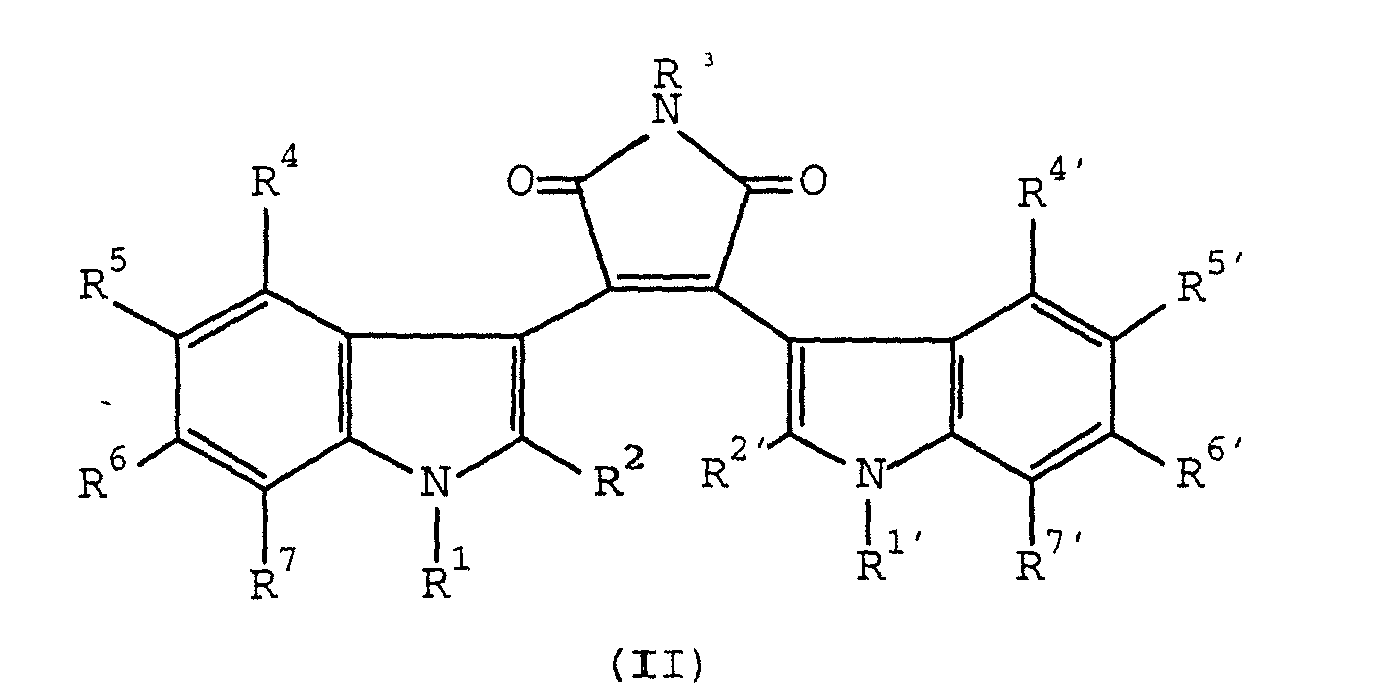
R1 isR1' is hydrogen, C1-C4 alkyl, aminoalkyl, monoalkylaminoalkyl, or dialkylaminoalkyl;
R2 and R2' are independently hydrogen, alkyl, alkoxyalkyl hydroxyalkyl, C1-C3 alkylthio, S(O)C1-C3 alkyl, CF3;
R3 is hydrogen or CH3CO-;
R4, R4', R5, R5', R6, R6', R7 and R7' are independently hydrogen, halogen, alkyl, hydroxy, alkoxy, -COO(C1-C3 alkyl), CF3, nitro, amino, acetylamino, monoalkylamino, dialkylamino, alkylthio (preferably C1-C3 alkylthio), or S(O)C1-C3 alkyl;
R12 is hydrogen, alkyl, haloalkyl, cycloalkyl, acetyl, aryl, -CH(aryl)2, amino, monoalkylamino, dialkylamino, guanidino, -C(=N(alkoxycarbonyl))NH (alkoxycarbonyl), amidino, hydroxy, carboxy, alkoxycarbonyl or heterocyclic;
p and q are independently 1, 2, 3, or 4;
s is 0, 1, 2 or 3;
t is 1 or 2;
u is 0; or
pharmaceutically acceptable salts or solvates thereof. - This invention also relates to a method of selectively inhibiting protein kinase C beta-1 and beta-2 isozyme, which comprises administering to a mammal in need of such treatment a pharmaceutically effective amount of a compound of the Formula II.
- A particularly preferred group of compounds of Formula II are of the Formula (IIa):wherein: R1 is
 R1' is hydrogen, or C1-C4 alkyl; and
R12 is hydrogen, or C1-C4 alkyl. - As used herein, the term "alkyl", alone or in combinations, means a straight or branched-chain alkyl group containing from one to seven, preferably one to four, carbon atoms such an methyl, ethyl, propyl, isopropyl, butyl, sec-butyl, t-butyl and pentyl. The term "C1-C4 alkyl" is an alkyl limited to one to four carbon atoms.
- The term "cycloalkyl", alone or in combinations, means a three to seven carbon cycloalkyl, for example, cyclopropyl, cyclobutyl, cyclopentyl, cyclohexyl, and cycloheptyl.
- The term "alkoxy", alone or in combinations, is an alkyl covalently bonded by an -O- linkage. Examples of alkoxy groups are methoxy, ethoxy, propoxy, isopropoxy, butoxy and t-butoxy. An alkoxyalkyl is, for example, CH3(CH2)-O-(CH2)m- wherein m is the from one to seven or preferably one to four. The term alkoxycarbonyl is, for example, t-butoxycarbonyl or BOC.
- A haloalkyl group is an alkyl with one or more, preferably one to three halogen atoms, examples of such group CH2Cl, CF3, CH2CF3, CH2(CF2)2CF3, and the like.
- The term "aryl", alone or in combinations means an unsubstituted phenyl group or a phenyl group carrying one or more, preferably one to three, substituents, independently selected from halogen, alkyl, hydroxy, benzyloxy, alkoxy, haloalkyl, nitro, amino, acylamino, monoalkylamino, dialkylamino, alkylthio, alkylsulfinyl, alkylsulfonyl and cyano. The term arylalkyl is preferably benzyl.
- The term "halogen" means fluorine, chlorine, bromine or iodine.
- The heterocyclic group denoted by "heterocyclyl" can be a stable, saturated, partially unsaturated, or aromatic 5- or 6-membered heterocyclic group. The heterocyclic ring consists of carbon atoms and from one to three heteroatoms independently selected from the group consisting of nitrogen, oxygen, and sulfur. The heterocyclic group can be optionally substituted with one to three substituents independently selected from halogen, alkyl, hydroxy, alkoxy, haloalkyl, nitro, amino, acylamino, monoalkylamino, dialkylamino, alkylthio, alkylsulfinyl and alkylsulfonyl or, when the heterocyclyl group is an aromatic nitrogen-containing heterocyclic group, the nitrogen atom can carry an oxide group. Examples of such heterocyclyl groups are imidazolyl, imidazolinyl, thiazolinyl, pyridyl, indolyl, furyl, and pyrimidinyl.
- The term "pharmaceutically effective amount", as used herein, represents an amount of a compound of the invention that is capable of selectively inhibiting PKC isozyme activity in mammals. The particular dose of the compound administered according to this invention will, of course, be determined by a physician under the particular circumstances surrounding the case, including the compound administered, the route of administration, the particular condition being treated, and similar considerations. The compounds can be administered by a variety of routes including the oral, rectal, transdermal, subcutaneous, topical, intravenous, intramuscular or intranasal routes.
- The term "treating," as used herein, describes the management and care of a patient for the purpose of combating the disease, condition, or disorder and includes the administration of a compound of present invention to prevent the onset of the symptoms or complications, alleviating the symptoms or complications, or eliminating the disease, condition, or disorder.
- The term "isozyme selective" means the preferential inhibition of protein kinase C beta-1 or beta-2 isozymes over protein kinase C isozymes, alpha, gamma, delta, epsilon, zeta, and eta. In general, the compounds demonstrate a minimum of a eight fold differential, preferably ten fold differential, in the dosage required to inhibit PKC beta-1 or beta-2 isozymes and the dosage required for equal inhibition of the alpha protein kinase C isozyme as measured in the PKC assay. The compounds demonstrate this differential across the range of inhibition and are exemplified at the IC50, i.e., a 50% inhibition. Accordingly, the invention relates to a method for selectively inhibiting the beta-1 or beta-2 protein kinase C isozyme. A related phrase in "selectively inhibiting protein kinase C beta-1 and beta-2 isozymes," which refers to isozyme selective inhibition. Thus, because one needs a substantially higher concentration of compound to inhibit the other protein kinase C isozymes (e.g. An Example which discloses 50% inhibition at a concentration of 0.046 µmol/L for the beta-2 protein kinase C isozyme while the IC50 with respect to the alpha protein kinase C isozyme is 0.45 µmol/L), a pharmaceutically effective dosage of the compound inhibits beta-1 and beta-2 protein kinase C isozymes with lower toxicity by virtue of their minimal inhibition of the other isozymes.
- The synthesis of the compounds is described in Davis et al. U.S. Patent 5,057,614, herein incorporated by reference. The compounds of Formula II are readily prepared in an analogous process to that disclosed in U.S. Patent 5,057,614 and known in the art as evidenced by EPO 397 060 (1990) and Bit et al., J.Med. Chem. 36: 21-29 (1993). For example, when preparing the compounds of Formula II, the alkylation of the indole nitrogen occurs under conditions appreciated in the art. The reaction usually involves approximately equimolar accounts of the two reagents, although other ratios, especially those wherein the alkylating reagent is in excess, are operative. The reaction is best carried out in a polar aprotic solvent employing an alkali metal salt or other such alkylation conditions as are appreciated in the art. When the leaving group is bromo or chloro, a catalytic amount of iodide salt, such as potassium iodide may be added to speed the reaction. Preferred reaction conditions include the following: Potassium hexamethyldisilazide in dimethylformamide or tetrahydrofuran, sodium hydride in dimethylformamide, or cesium carbonate in acetonitrile. The temperature of the reaction is preferably from about ambient temperature to about the reflux temperature of the reaction mixture. When elevated temperatures are employed, the reaction is generally complete in 1-4 hours.
- The compounds of Formula II can be prepared by procedures described in Chem. Pharm. Bull., 33(5) 1826-1835 (1985) Synth. Commun., 18(3) 265-273 (1988) and J. Org. Chem., 44(4) 578-586 (1979) and are generally described in Scheme 1.

- In the above scheme, r, s, and R1 are the same as previously defined in Formula II; and Ac is acetyl. P1 is a protecting group such as t-butoxycarbonyl or other indole protecting group known in the art. T. W. Greene and P. Wuts, Protective Groups in Organic Synthesis, Chapter 7, page 385. The reaction described in Scheme 1 is known as a Perkin Condensation. The reaction is described in Hill et al., J. Med. Chem. 36: 21-29 (1993). Generally, oxalyl chloride is added at between -78°C and the reflux temperature of the mixture (preferably at 0°C) to an anhydrous solution of Compound VI in inert organic solvent such as a halogenated hydrocarbon like methylene chloride. The volatiles are then removed. The resulting solids are dissolved in a dry halogenated hydrocarbon solvent, e.g. methylene chlorides and added to Compound VIII in the presence of a base, preferably a tertiary amine such as triethylamine, at room temperature.
- The conversion of the anhydride of Compound X to the maleimides of Formula II occurs by an ammonolysis as described in Brenner et al., Tetrahedron 44: 2887-2892 (1988). For example, the anhydride may be converted to the bis-indole maleimide by reacting the anhydride with hexametlyldisilazane and methanol in an inert organic solvent such as DMF at room temperature.
- Compound VI, VIII, and any other reagents required for the reactions described herein, are either commercially available, known in the art, or can be prepared by methods known in the art. For example, Compound VI may be prepared by techniques described in M. Adachi et al., Chem. Pharm. Bull., 33(5), 1826-35 (1985) ; K. Sasakura et al., Synth.Common., 18(3), 265-273 (1988).
- By virtue of their acidic moieties, the compounds of Formula II include the pharmaceutically acceptable base addition salts thereof. Such salts include those derived from inorganic bases such as ammonium and alkali and alkaline earth metal hydroxides, carbonates, bicarbonates, and the like, as well as salts derived from basic organic amines such as aliphatic and aromatic amines, aliphatic diamines, hydroxy alkamines, and the like. Such bases useful in preparing the salts of this invention thus include ammonium hydroxide, potassium carbonate, sodium bicarbonate, calcium hydroxide, methylamine, diethylamine, ethylenediamine, cyclohexalamine ethanolamine and the like.
- Because of the basic moiety, the compounds of Formula II can also exist as pharmaceutically acceptable acid addition salts. Acids commonly employed to form such salts include inorganic acids such as hydrochloric, hydrobromic, hydroiodic, sulfuric and phosphoric acid, as well as organic acids such as para-toluenesulfonic, methanesulfonic, oxalic, para-bromophenylsulfonic, carbonic, succinic, citric, benzoic, acetic acid, and related inorganic and organic acids. Such pharmaceutically acceptable salts thus include sulfate, pyrosulfate, bisulfate, sulfite, bisulfite, phosphate, monohydrogenphosphate, dihydrogenphosphate, metaphosphate, pyrophosphate, chloride, bromide, iodide, acetate, propionate, decanoate, caprylate, acrylate, formate, isobutyrate, caproate, heptanoate, propiolate, oxalate, malonate, succinate, suberate, sebacate, fumarate, maleate, 2-butyn-1,4 dioate, 3-hexyn-2, 5-dioate, benzoate, chlorobenzoate, hydroxybenzoate, methoxybenzoate, phthalate, xylenesulfonate, phenylacetate, phenylpropionate, phenylbutyrate, citrate, lactate, hippurate, β-hydroxybutyrate, glycollate, maleate, tartrate, methanesulfonate, propanesulfonate, naphthalene-1-sulfonate, naphthalene-2-sulfonate mandelate and the like salts.
- In addition to pharmaceutically-acceptable salts, other salts are included in the invention. They may serve as intermediates in the purification of compounds or in the preparation of other salts, or are useful for the identification, characterization or purification.
- The pharmaceutically acceptable salts of compounds of Formula II can also exist as various solvates, such as with water, methanol, ethanol, dimetylformamide, ethyl acetate and the like. Mixtures of such solvates can also be prepared. The source of such solvate can be from the solvent of crystallization, inherent in the solvent of preparation or crystallization, or adventitious to such solvent. Such solvates are within the scope of the present invention.
- It is recognized that various stereoisomaric forms of the compounds of Formula II may exist. The compounds are normally prepared as racemates and can conveniently be used as such, but individual enantiomers can be isolated or synthesized by conventional techniques if so desired. Such racemates and individual enantiomers and mixtures thereof form part of the present invention.
- The invention also encompasses the pharmaceutically acceptable prodrugs of the compounds of Formula II. A prodrug is a drug which has been chemically modified and may be biologically inactive at its site of action, but which may be degraded or modified by one or more enzymatic or other in vivo processes to the parent bioactive form. This prodrug should have a different pharmacokinetic profile than the parent, enabling easier absorption across the mucosal epithelium, better salt formation or solubility, and/or improved systemic stability (an increase in plasma half-life, for example). Typically, such chemical modifications include the following:
- 1) ester or amide derivatives which may be cleaved by esterases or lipases;
- 2) peptides which may be recognized by specific or nonspecific proteases; or
- 3) derivatives that accumulate at a site of action through membrane selection of a prodrug form or a modified prodrug form; or any combination of 1 to 3, supra. Conventional procedures for the selection and preparation of suitable prodrug derivatives are described, for example, in H, Bundgaard, Design of Prodrugs, (1985).
-
- As previously noted, the compounds of the present invention are potent, beta-1 and beta-2 isozyme selective PKC inhibitors. As such, they are useful in the treatment of conditions associated with diabetes mellitus and its complications, as well as other disease states associated with an elevation of PKC and, in particular, the beta-1 and beta-2 isozymes.
- Protein kinase C beta-1 and beta-2 has been linked to diabetes. Inoguchi et al., Proc. Natl. Acad. Sci. USA 89: 11059-11065 (1992). In addition, excessive activity of protein kinase C has been linked to insulin signaling defects and therefore to the insulin resistance seen in Type II diabetes. Karasik, A. et al., J. Biol. Chem. 265: 10226-10231 (1990); Chen, K.S. et al., Trans. Assoc. Am. Physicians 104: 206-212 (1991); Chin, J.B. et al., J. Biol. Chem. 268: 6338-6347 (1993). Further, studies have demonstrated a marked increase in protein kinase C activity in tissues known to be susceptible to diabetic complicatiom when exposed to hyperglycemic conditions. Lee, T.-S. et al., J.Clin.Invest. 83: 90-94 (1989); Lee, T.-S. et al., Proc. Natl. Acad. Sci. USA 86: 5141-5145 (1989); Craven, P.A. and DeRubertis, P.R. J. Clin. Invest. 83: 1667-1675 (1989); Wolf, B.A. et al., J. Clin Invest. 87: 31-38 (1991); Tesfamariam, B. et al., J. Clin. Invest. 87: 1643-1648 (1991); Bastyr III, B.J. and Lu, J., Diabetes 42: (Suppl 1) 97A (1993).
- The compounds of the present invention, as an inhibitor of protein kinase C. are useful in the treatment of conditions in which protein kinase C has demonstrated a role in the pathology. Conditions recognized in the art include: diabetes mellitus and its complications, ischemia, inflammation, central nervous system disorders, cardiovascular disease, dermatological disease, Alzheimer's disease, and cancer.
- Protein kinase C inhibitors have been shown to block inflammatory responses such an neutrophil oxidative burst, CD3 down-regulation in T-lymphocytes, and phorbol-induced paw edema. Twoemy, B. et al. Biochem. Biophys. Res. Commun. 171: 1087-1092 (1990) ; Mulqueen, M.J. et al. Agents Actions 37: 85-89 (1992). Accordingly, as inhibitors of PKC, the present compounds are useful in treating inflammation.
- Protein kinase C activity plays a central role in the functioning of the central nervous system. Huang, K.P. Trends Neurosci. 12: 425-432 (1989). In addition, protein kinase C inhibitors have been shown to prevent the damage seen in focal and central is chemic brain injury and brain edema. Hara, H. et al. J. Cereb. Blood Flow Metab. 10: 646-653 (1990); Shibata, S. et al. Brain Res. 594: 290-294 (1992) . Recently, protein kinase C has been determined to be implicated in Alzheimer's disease. Shimohama, S. et al., Neurology 43: 1407-1413 (1993). Felsenstein, K.M. et al., Neuroscience Letters 174: 173-76 (1994). Accordingly, the compounds of the present invention are useful in treating Alzheimer's disease and ischemic brain injury.
- Protein kinase C activity has long been associated with cell growth, tumor promotion and cancer. Rotenberg, S.A. and Weinstein, I.B. Biochem. Mol. Aspects Sel. Cancer 1: 25-73 (1991). Ahmad et al., Molecular Pharmacology, 43: 858-862 (1993). It is known that inhibitors of protein kinase C inhibitors are effective in preventing tumor growth in animals. Meyer, T. et al. Int. J. Cancer 43: 851-856 (1989) ; Akinagaka, S. et al. Cancer Res. 51: 4888-4892 (1991). The compounds of the present invention also act as multidrug reversal (MDR) agents making them effective compounds when administered in conjunction with other chemotherapeutic agents.
- Protein kinase C activity also plays an important role in cardiovascular disease. Increased protein kinase C activity in the vasculature has been shown to cause increased vasoconstriction and hypertension. A known protein kinase C inhibitor prevented this increase. Bilder, G.B. et al. J. Pharmacol. Exp. Ther. 252: 526-530 (1990). Because protein kinase C inhibitors demonstrate inhibition of the neutrophil oxidative burst, protein kinase C inhibitors are also useful in treating cardiovascular ischemia and improving cardiac function following ischemia. Muid, R.B. et al. FEBS Lett. 293: 169-172 (1990); Sonoki, H. at al. Kokyu-To Junkan 37: 669-674 (1989). The role of protein kinase C in platelet function has also been investigated and as shown elevated protein kinase C levels being correlated with increased response to agonists. Bastyr III, B.J. and Lu, J. Diabetes 42: (Suppl. 1) 97A (1993). PKC has been implicated in the biochemical pathway in the platelet-activity factor modulation of microvascular permeability. Kobayashi et al., Amer. Phys. Soc. H1214-H120 (1994). Potent protein kinase C inhibitors have been demonstrated to affect agonist-induced aggregation in platelets. Toullec, D. et al. J. Biol. Chem. 266: 15771-15781 (1991). Protein kinase C inhibitors also block agonist-induced smooth muscle cell proliferation. Matsumoto, H. and sasaki, Y. Biochem. Biophys. Res. Commun. 158: 105-109 (1989). Therefore, the present compounds are useful in treating cardiovascular diseases, atherosclerosis and in particular, restenosis.
- Abnormal activity of protein kinase C has also been linked to dermatological disorders such as psoriasis. Horn, F. et al. J. Invest. Dermatol. 88: 220-222 (1987); Raynaud, F. and Evain-Brion, D. Br. J.Dermatol. 124: 542-546 (1991). Psoriasis is characterized by abnormal proliferation of keratinocytes. Known protein kinase C inhibitors have been shown to inhibit keratinocyte proliferation in a manner that parallels their potency as PKC inhibitors. Hegemann, L. et al. Arch. Dermatol. Res. 283: 456-460 (1991); Bollag, W.B. et al. J. Invest. Dermatol. 100: 240-246 (1993). Accordingly, the compounds as inhibitors of PKC are useful in treating psoriasis.
- The ability of the compounds of the present invention to selectively inhibit protein kinase C beta-1 and beta-2 isozyme was determined in the PKC Enzyme assay.
- PKC enzymes = alpha, beta I, beta II, gamma, delta, epsilon, eta and zeta.
- Assay components in a total volume of 250 µL are the following:
- Vesicles consisting of 120 µg/mL phosphatidylserine (Avanti Polar Lipids) and sufficient diacylglycerol (Avanti Polar Lipids) to activate the enzyme to maximum activity in 20 mM HEPES buffer (Sigma, St. Louis, Missouri) , pH 7.5, 940 µM calcium chloride (Sigma, St. Louis, Missouri) for assaying the alpha, beta I, beta II and gamma enzyme only, 1 mM EGTA for all the enzymes, 10 mM magnesium chloride (Sigma, St. Louis, Missouri) and 30 µM (gamma-32P) ATP (DuPont). For all the enzymes either histone type HL (Worthington) or myelin basic protein is used as substrate. The assay is started by addition of protein kinase C enzyme incubated at 30° C for 10 minutes and stopped by adding 0.5 mL of cold trichloroacetic acid (Amresco) followed by 100 µL of 1 ng/mL bovine serum albumin (Sigma, St. Louis, Missouri). The precipitate is collected by vacuum filtration an glass fiber filters employing a TOMTEC™ filtration system and quantified by counting in a beta scintillation counter.
-
- Using the methodology described, representative compounds were evaluated and were found to have an IC50 value with respect to the beta-1 and beta-2 isozyme of below 10 µm. Surprisingly, the compounds are isozyme selective, i.e., the compounds preferentially inhibit protein kinase C beta-1 and beta-2 isozyme over the protein kinase C isozymes, alpha, gamma, delta, epsilon, zeta, and eta. In general, the compounds demonstrate a minimum of a ten fold differential in the dosage required to inhibit PKC beta-1 or beta-2 isozyme and the dosage required for equal inhibition of the alpha protein kinase C isozyme as measured in this assay. Therefore, as selective inhibitors of PKC isozyme beta-1 and beta-2, the compounds are useful in the treatment of conditions in which PKC beta isozymes have demonstrated a role in the pathology, in particular, diabetes mellitus and its complications.
- The following examples and preparations are provided merely to further illustrate the invention. The scope of the invention is not construed as merely consisting of the following examples. In the following examples and preparations, melting point, nuclear magnetic resonance spectra, mass spectra, high pressure liquid chromatography over silica gel, N,N-dimethylformamide, palladium on charcoal, diisobutylaluminum hydride, acetonitrile, and tetrahydrofuran are abbreviated M.Pt., NMR, MS, HPLC, DMF, Pd/C, DIBAL, ACN and THF, respectively. The terms "NMR" and "MS" indicate that the spectrum was consistent with the desired structure. The term "ND" indicates that data are not available.
- The above reaction is carried out in a manner analogous to M. Adachi et al., Chem. Pharm. Bull., 33(5), 1826-35 (1985); and R. Sasakura et al., synth. Commun., 18(3), 265-273 (1988).

- To a solution of 4-(1-indolyl)-piperidine (300 mg,1.5 mmol) was added dry ethanol (3 nL) and anhydrous potassium carbonate (410 mg, 3 mmol). After 20 minutes, ethyl bromoacetate (0.17 mL, 1.5 mmol) was added. After 12 hours, the reaction was quenched with water, extracted with ethyl acetate (3x), washed with water, dried, and concentrated to a residue. The residue was eluted through a column of silica gel with toluene/acetone (80:20). Evaporation of the eluding advent gave of the title compound (300 mg) as a brownish oil (70% of theory).
- To a solution of 1-piperidin-4-yl-1H-indole (0.6 g, 3 mmol) in 5 mL of dry ethanol was added anhydrous potassium carbonate (680 mg, 4.9 mmol). After stirring for 15 minutes at ambient temperature, ethyl p-toluenesulfonate (0.48 mL, 4.5 mmol) was added. The reaction was heated under reflux for 24 hours with stirring, quenched with water, extracted with methylene chloride (2x), dried and evaporated to give a residue. The residue was chromatographed on silica gel with toluene/acetone (50:50) to yield 360 mg straw colored material (53% of theory).
- To a solution of 4-(1-indolyl)-piperidine (0.6 g, 3 mmol) in dry ethanol (4 mL) was added anhydrous potassium carbonate (680 mg, 4.9 mmol). After 15 minutes, bromomethylcyclopropane (0.29 mL, 4.5 mmnol) was added and stirring was continued over night. Additional potassium carbonate (0.22 g) and bromomethylcyclopropane (0.14 mL) was added. After 3 hours, the reaction mixture was quenched with water and extracted with ethyl acetate (3x). The combined organic phases were washed with water, dried, evaporated, and purified by column chromatography on silica gel eluting with methylene chloride/ethanol (98:2). Evaporation of the eluting solvent gave the title compound. 480 mg (63% yield).
- To a solution of 1-(piperidin-4-yl)-indole (100 mg, 0.5 mmol) in absolute ethanol (2 mL) was added anhydrous potassium carbonate (70 mg, 0.5 mmol) and 1-bromo-3-chloropropane (150 mg, 1 mmol). After stirring overnight additional 1-bromo-3-chloropropane (150 mg) was added and stirring continued for 2 hours. The mixture was evaporated; and the residue dissolved in methylene chloride and shaken with water. The organic solution was dried over anhydrous potassium carbonate and evaporated. The residue was chromatographed on silica gel with methylene chloride/ethanol (95:5) to give the title compound (90 mg, 65% yield).
- A mixture of 1-N-[1-N-(3-chloro-propyl)-piperidin-4-yl]-indole (900 mg, 3.25 mmol), anhydrous potassium carbonate (440 mg, 3.25 mmol) and dimethylammonium hydrochloride (260 mg, 3.25 mmol) in absolute ethanol (10 mL) was refluxed for 6 hours, evaporated and suspended in water. The mixture was extracted with methylene chloride, dried over anhydrous potassium carbonate, and evaporated to yield 1 g of the desired compound (100% of theory).
- This compound was prepared in a manner analogous to the synthesis described in the literature: a) M. Adachi et al., Chem. Pharm. Bull., 33(5), 1826-35 (1985); b) K. Sasakura et al., Synth. Commun., 18(3), 265-273 (1988).
- To a 0°C methylene chloride (20 mL) solution of tert-butoxycarbonate (5.44 mmol) containing triethylamine (0.76 mL, 5.44 mmol) was added 4-(1-indolyl)-piperidine (1.09 g, 5.44 mmol). The reaction was brought to room temperature. After 4 hours, the reaction was Quenched with sat NaHCO3, water (2 x), dried, filtered and concentrated. The residue was purified by flash chromatography eluting with methylene chloride to give the title compound 1.25 g (76% yield) as an oil which crystallized on standing.
- A glacial acetic acid (15 mL) solution containing Pd(OH)2 /C and 1-benzyl-4-(1-indolyl)-piperidine was placed under an H2 atmosphere. The reaction temperature was raised to 80°C. After 1 hour, the reaction was cooled to room temperature and filtered. The filtrate was made basic (pH 8-9) with saturated NaHCO3, and extracted with methylene chloride. The extract was washed with water, dried, and concentrated. This material was sufficiently pure for further reactions giving 1.09 g (60% yield) of the title compound.
- To a -78°C THF (12 mL) solution of lithium diisopropylamide (generated in situ from diisopropylamine (3.8 mL) and 15% n-butyl lithium in hexane (17 mL) at 0°C) was added dropwise a THF solution of 6,7,8,9-tetrahydropyrido[1,2-a]indole-8-carboxylic acid ethyl ester. After 30 minutes, the temperature was brought to 0°C. After 1 hour, ethyl chloroformate (2.6 mL) was added over one hour. The reaction was allowed to come to room temperature overnight. The reaction was quenched with saturated NH4Cl and extracted t-butyl methyl ether (3x). The extract was washed with water, dried, filtered, and concentrated to give a residue. The residue was purified by flash chromatography eluting with 15% ethyl acetate/hexane to give the title compound 1.29 g (33% yield) as off white crystals (M.Pt. 69°C).
- To an ice cooled solution of 4-indol-1-yl-piperidine-1-carboxylic acid ethyl ester (50 g, 0.18 mol) in dry THE (400 mL) was added LAH in small portions (7 g, 0.18 mol). After 2 hours, the mixture was quenched by successive addition of water (7 mL) 15% of sodium hydroxide (7 mL) and water (21 mL). The reaction mixture was filtered. The filtrate was dried and evaporated. The residue crystallized on standing and was recrystallized from a small amount of di-i-propyl ether to give the title compound (25 g, 63% of theory). M.Pt. : 58°C
- To a solution of 1-N-(1-benzyl-piperidin-4-yl)-indole (100 g, 0.344 mol) in methylene chloride (1 L) was added ethyl chloroformate (99.2 mL) dropwise with stirring. The mixture was refluxed for 48 hours, cooled to room temperature, and concentrated. The residue was crystallized from i-propanol to give the title compound as colorless crystals (50 g, 53% yield). M.Pt.: 127°C.
- To a solution of 1-N-(piperidin-4-yl)-indole (0.6 g, 3 mmol) in dry ethanol (4 mL) was added anhydrous potassium carbonate (680 mg, 4.9 mmol). After stirring for 15 minutes at ambient temperature, bromomethylcyclopropane (0.29 mL,4.5 mmol) was added. Stirring was continued overnight. An additional amount of carbonate (0.22 g) and bromomethylcyclopropane (0.14 mL) was added. After 3 hours, the reaction mixture was quenched with water and extracted with ethyl acetate (3x). The combined organic phase was washed with water, dried, evaporated, and purified by column chromatography an silica gel eluting with methylene chloride/ethanol (98:2). Evaporation of the eluting solvent gave the title compound as an oil (480 mg, 63% yield).
- To a solution of 1-(piperin-4-yl)-indole (0.5 g, 2.5 mmol) in dry DMF (3 m) was added anhydrous potassium carbonate (360 mg, 2.6 mmol). After stirring for 15 minutes at ambient temperature, i-propyl bromide (0.84 mL, 9 mmol) was added. The reaction mixture was refluxed for 2 days with stirring, quenched with water, extracted with ethyl acetate (2x), dried, and evaporated. The remaining residue was chromatographed on silica gel eluting with a toluene/acetone gradient (90:10 to 70:30). Evaporation of the eluting solvent gave the title compound as an oil. (220 mg, 36% yield).
- To a solution of 1-N-(1-N-(trifluoroaceto) piperidin-4-yl)-indole (400 mg, 1.35 mmol) in dry THF (3 mL) was added dropwise a 10 N solution of borane methyl sulfide (0.15 mL) complex. The mixture was stirred at 60°c for 3 hours, cooled, quenched with 2N aqueous sodium hydroxide, and brought to pH 10. The mixture was diluted with water and extracted with t-butyl methyl ether (2x). The combined organic solutions were washed with water (2x), dried, and evaporated. The residue solidified on standing and was recrystallized from hexane to give the title compound as colorless crystals (190 mg, 50% yield). M.Pt.: 79-81°C.
- To an ice cooled solution of 1-N-(piperidin-4-yl)-indole (1.0 g, 5 mmol) in dry pyridine (5 mL) was carefully added trifluoroacetic acid anhydride (0.71 mL, 5 mmol). After stirring for 48 hours at ambient temperature, all volatiles were evaporated. The residue was redissolved and evaporated with toluene (x2). The residue was taken up in water and extracted twice with t-butyl methyl ether. The combined organic phase was washed with water, dried, and evaporated. The residue was triturated with ether. The crystalline precipitate formed was separated and discarded. After evaporation of the filtrate, the residue was purified by column chromatography on silica gel eluting with toluene/acetone 98:2 to give 410 mg of off white crystals (28% of theory). M.Pt.: 130-132°C.
- To a solution of 1-N-[(1-N-2,2,3,3,4,4,4-heptafluoro)butyramido-piperidin-4-yl]-indole (750 mg, 1.89 mmol) in 5 mL of absolute THF was added dropwise a 10 N solution of borane methyl sulfide (0.19 mL) complex. The mixture was stirred at 60°C for 3 hours. After cooling, the mixture was decomposed with 2N aqueous sodium hydroxide and brought to pH 10, diluted with water and extracted with t-butyl methyl other twice. The combined organic solutions were washed with water twice, dried, and evaporated. The residue was chromatographed on silica gel with toluene as the eluant. The eluant was evaporated to give 430 mg of a yellowish oil (60% of theory).
- To an ice cooled solution of 1-N-(piperidin-4-yl)-indole (1.0 g, 5 mmol) in dry pyridine (3 mL) was carefully added heptafluorobutyric acid chloride (0.75 mL, 5 mmol). After stirring for 16 hours at ambient temperature, the mixture was quenched with water and extracted with ethyl acetate (3x). The combined organic phase was washed with water, dried, and evaporated. The residue was purified by column chromatography on silica gel eluting with toluene/acetone 97:3 to give 1.34 g of brownish oil (68% of theory).
- This material was prepared by the known procedure. Tetrahedron Letters 1993, 34(48), 7677. To an ice cooled solution of 1-piperidin-4-yl-1H-indole (0.6 g, 3 mmol), N,N-bis-t-butoxycarbonylthiourea (0.83 g, 3 mmol) and triethylamine (1.38 g, 9.9 mmol) in dry DMF (5 mL) was carefully added copper (II) chloride dihydrate (exothermic) (0.56 g, 3.3 mmol). After stirring for 30 minutes at ambient temperature, the mixture was diluted with ethyl acetate and filtered over Hyflo. The filtrate was washed twice each with brine and water, dried, evaporated. The residue was purified by column chromatography on silica gel eluting with toluene/acetone 95:5. 0.61 g of yellow crystals (46 % of theory). M.Pt.: 115-118°C.
- To an ice cooled stirred suspension of lithium aluminum hydride (LAH) (85 mg, 2.24 mmol) in absolute THF (7 mL) was added 4-(indol-1-yl)methylenepiperidine-1-carboxylic acid ethyl ester (0.64 g, 2.23 mmol) in 4 mL of absolute THF and then stirred at ambient temperature. After 2 hours, additional LAH (85 mg, 2.24 mmol) was added and stirring continued for 1 hour. The mixture was cooled to 0°C and quenched by successive addition of water (0.17 mL), 15% aqueous sodium hydroxide (0.17 mL), water (0.51 mL), stirred for 30 minutes, filtered, and evaporated to dryness. The residue was taken up in water (40 mL) and extracted (2x) with t-butyl methyl ether (30 mL). The combined organic phases were washed with water (2x), dried, and evaporated. The remaining oily residue was sufficiently pure for further reaction.
- To a stirred solution of indole (0.53 g, 4.5 mmol) in dry DMF (15 mL) was added potassium t-butoxide (580 mg, 5.2 mmol) at ambient temperature. After stirring for 30 minutes, 4-(methanesulfonylymethylene)-piperidine-1-carbcoylic acid ethyl ester (1.2 g, 4.5 mmol) was added. After 8 hours, the reaction mixture was quenched with water and extracted with t-butyl methyl ether (2x50 mL). The combined organic phases were washed with water (2x), dried, evaporated, and purified by column chromatography on silica gel eluting with toluene/ acetone 96:4. Evaporation of the eluting solvent gave 0.92 g (71 % of theory) of a slightly bluish oil.
- An ice cooled solution of indole (9 g, 78 mmol) in dry THF (80 mL) was treated with oil free sodium hydride (2.25 g, 94 mmol). After 1 hour, a solution of 2-bromobutyrolactone (14.6 mL, 78 mmol) in dry THF (20 mL) was added dropwise. After stirring overnight at ambient temperature, the mixture was poured on crushed ice, extracted with ethyl acetate (3x), dried, and evaporated. The residue was purified by flash chromatography on silica gel with a hexane/ethyl acetate gradient (9:1 to 7:3). Evaporation of the eluting solvent gave 8 g of a yellowish oil (52% of theory).
- To an ice cooled suspension of LAN (0.84 g, 0.022 mol) in dry THF (60 mL) was added 2-(indol-1-yl)butyrolactone (4 g, 0.02 mol). After 1 hour the mixture was quenched successively with water (0.84 mL), 15% aqueous sodium hydroxide (0.84 mL), and water (2.5 mL). The reaction was filtered and the filtrate was dried, and evaporated. The material obtained, 2.5 g of colorless oil (61% of theory), was used directly in the next reaction.
- An ice cooled solution of 2-(indol-1-yl)-butane-1,4-diol (2 g, 10 mmol) containing triethylamine (3.6 mL, 26 mmol) in dry methylene chloride (30 mL) was treated with methanesulfonyl chloride (1.86 mL, 12 mmol). After stirring over night, the mixture was poured onto crushed ice, extracted with methylene chloride (3x), dried, and evaporated. The crude material, 2.5 g (71% of theory) was used in the next reaction.
- An acetone solution (20 mL) containing 1,4-(bis) methanesulfonyloxy-2-(indol-1-yl)-butane (0.5 g, 1.4 mmol) and sodium iodide (1.86 g, 12.5 mmol) was refluxed for 4 hours, cooled, and filtered. The filtrate was evaporated. The residue, 400 mg (70% of theory), was used directly in the next reaction.
- To a solution of 1,4-diodo-(2-indol-1-yl)-butane (400 mg, 0.94 mmol) in THF (20 mL) was added successively benzyl amine (0.12 mL, 1.07 mmol) and triethyl amine (0.15 mL, 2.9 mmol). The mixture was refluxed for 1 hour and evaporated. The residue was dissolved in t-butyl methyl ether. The organic solution was washed with water (2x), dried, and evaporated. The oily residue was purified by HPLC on silica gel using methylene chloride/ethanol (98:2). Evaporation of the eluting solvent gave 110 mg of a pale oil (42% of theory).
- A solution of 2-[2-(1-(benzhydryl)-azetidin-3-yl)-2-amino)-phenyl]-ethanol (3.1 g, 0.01 mol) in dry methylene chloride (100 mL) was cooled to -5°C and treated with pyridinium dichromate (PDC) (9.3 g) in small portions. The mixture was slowly brought to ambient temperature and additional PDC (9.3 g) was added. After 1 hour, the mixture was filtered through a layer of dry silica gel, rinsed with methylene chloride diethyl ether after evaporation of the eluant. (0-85 g) a yellow oil, which was used without further purification. (25% of theory). MS
- A mixture of methanesulfonic acid 1-benzhydryl-azetidin-3-yl ester (14 g, 44.2 mmol), 2-(ethan-2-ol)-analine (14 g, 44.2 mmol), and anhydrous potassium carbonate (2.8 g, 50 mmol) in dry toluene (150 mL) was refluxed for 4 hours. The toluene was evaporated, and the residue was partitioned between water and methylene chloride. The organic phase was dried, evaporated, and the remaining oil was purified by column chromatography on silica gel eluting with a home/acetone gradient (90:10 to 85:15) . Evaporation of the eluting solvent gave 6 g of a colorless oil (44% of theory). MS
- A solution of 1-benzhydryl-azetidin-3-ol (50 g, 0.208 mol) in dry pyridine (500 mL) was cooled to 5°C. Methane sulfonyl chloride (16.2 mL, 0.208 mol) was added over 30 minutes. The mixture was slowly (12 hours) brought to ambient temperature and stirring was continued for additional 2 hours. The solvent was removed in vacuo at 40 to 50°C. The residue was redissolved in methylene chloride, washed with water (2x), and dried. The crude material was triturated with a solution of t-butylmethylether/petroleum ether (15:85), to produce the purified product as crystals. (53g, 80% yield). M.Pt.: 85-87°C. MS
- To a toluene (4 mL) solution of 8,8'-bis(acetoxymethylene)-6,7,8,9-tetrahydropyrido[1,2-a]indole-8,8'-dicarboxylic acid diethyl ester (1.2 g, 3.8 mmol) was added a hexane solution of 1 M diisobutylaluminum hydride. After 1 hour, acetic anhydride (15 mL) was added. After an additional 15 hours, 4-dimethylaminopyridine (100 mg) was added, and the reaction temperature brought to 65°C for 3 hours. The reaction was filtered, washing with t-butylmethyl ether. The filtrate was washed with water, dilute aqueou HCl, saturated NaHCO3, and water. evaporation of the solvents gave a residue that was purified by chromatography eluting with 60% hexane/acetone to give the title compound in 42% yield.
- To a 0°C methylene chloride (2.5 mL) solution of 1-benzyl-4-(1-indolyl)piperidine (290 mg, 1 mol) was added oxalyl chloride (0.10 mL). The reaction was brought to room temperature. After 30 minutes, the volatiles were removed in vacuo below 30°C. The residue was dissolved in methylene chloride (25 mL) and added dropwise to a methylene chloride (20 mL) solution of isopropyl (1-methyl)indol-3-yl)acetimidate hydrochloride (270 mg, 1 mmol) containing triethylamine (4 mmol) and 4A molecular sieves (2.8 g). After 18 hours, p-toluene sulfonic acid (950 mg, 5 mmol) was added. After 2 hours, the reaction was filtered. The filtrate washed with saturated NaHCO3, water (2 x), dried, filtered, and concentrated. The concentrate was purified by flash chromatography eluting with 10% acetone/toluene to give the title compound 50 mg (10% yield) as red crystals. MS. 1H-NMR - (CDCl3, 250 MHz) δ 2.02 - 2.26 (6H, m), 3.06 (2H, m), 3.64 (2H, s), 3.84 (3H, 2), 4.24 (1H, m), 6.68 (1H, m), 6.81 (2H, m), 7.11 (3H, m), 7.28 (7H, m), 7.69 (1H, s), 7.85 (1H, s), 8.50 (1H, bs). MS 515 [M++H], calculated. 514 FW.

- To a stirred 0°C solution of [t-butoxycarbonylimino-(4-indol-1-yl-piperidin-1-yl)-methyl]-carbamic acid t-butyl ester (0.85 g, 1.92 mmol) in dry methylene chloride (5 mL) was added oxalyl chloride (0.18 mL, 2.11 mmol). After 30 minutes at room temperature, the reaction mixture was concentrated below 30°C, dissolved in dry methylene chloride (10 mL). and treated with isopropyl(1-methyl)indol-3-yl)acetimidate hydrochloride (0.54 g, 2.02 mmol). Triethylamine (0.54 g, 2.02 mmol) was added at 0°C. The mixture was stirred at ambient temperature for 3 hours. p-Toluene sulfonic acid monohydrate (1.8 g, 9.6 mmol) was added to the reaction . After 30 minutes, the reaction was quenched with saturated Na2CO3 (40 mL). The organic phase was separated, washed with Na2CO3 (sat. aq.), brine, water, dried, and evaporated. The residue was purified by column chromatography on silica gel eluting with toluene/acetone (9:1). Evaporation of the eluting solvent gave a residue. The residue was recrystallized from diisopropyl ether (150 mg), work up of the mother liquor yielded a second crop (60 mg). Overall yield: 210 mg of bright orange crystals (16% of theory). M.Pt.: 238-245°C. 1H-NMR (CDCl3, 250 MHz) δ 1.49 (18H, s), 2.02 (2H, m), 2.02 (4H, m), 3.09 (2H, m), 3.86 (3H, s) , 5.29 (3H, m), 6.66 (2H, m), 6.91 (1H, m), 7.16 - 7.36 (5H, m), 7.48 (1H, s), 7.75 (1H, s), 10.18 (1H, bs). MS 667 [M++H], calculated. 666 FW.

- To a 0°C ether (6 mL) solution of 1-t-butoxycarbonyl- 4-(1-indolyl)-piperidice (690 mg, 2.3 mmol) was added oxalyl chloride (0.22 mL, 2.5 mmol). After 15 minutes, the precipitant was filtered under argon, washed with ether and dissolved in methylene chloride (5 mL). This solution was added dropwise to a 0°C methylene chloride (3 mL) solution of isopropyl(1-methyl)indol-3-yl)acetimidate hydrochloride (610 mg, 2.3 mmol) containing triethylamine (9.3 mmol) and 4A molecular sieves (2.8 g). The reaction was brought to room temperature. After 4 hours, the reaction was quenched with water, washed with 0.5 N HCl. The organic layer was separated and concentrated. The residue was dissolved in pyridine (5 mL) cooled to 0°C, and molecular sieves 4A (7 g) was added followed by triflouroacetic anhydride. The reaction was brought to room temperature and after 2.5 hours and then filtered. The filtrate washed with saturated NaHCO3, water (2 x), dried, filtered, and concentrated. The residue was concentrated from toluene (3 x) and purified by flash chromatography eluting with 10% acetone/toluene to give the title compound 366 mg (30% yield) of red crystals. 1H-NMR (CDC13, 250 MHz) δ 1.48 (9H, s), 1.74 (2H, m), 2.02 (2H, m), 2.87 (2H, m), 3.85 (3H, s), 4.29 (3H, m), 6.69 (2H, d), 6.88 (1H, t), 7.07 - 7.36 (5H, m), 7.51 (1H, s), 7.68 (1H, s), 7.75 (1H, bs).
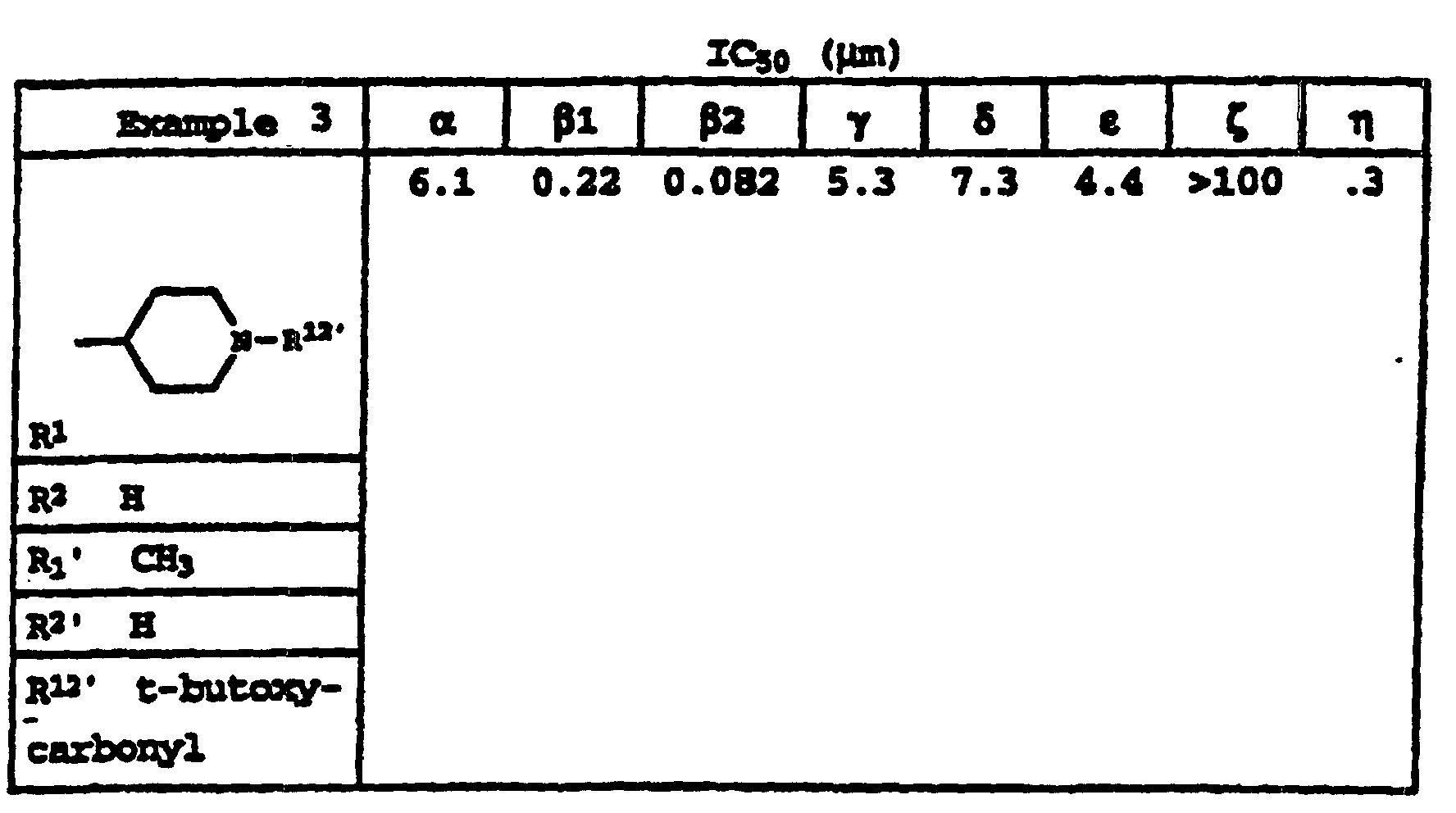
- The titled compound was prepared in a manner analogous to Example 3. 1H-NMR (CDCl3, 250 MNz) δ 1.49 (9H, m), 1.79 (2H, m), 2.02 (2H, m), 2.88 (2H, m), 4.27 (3H, m), 6.74 (1H, m), 6.85 (2H, m), 7.07 - 7.35 (5H, m), 7.59 (1H, s), 7.62 (1H, s), 7.74 (1H, s), 8.67 (1H, bs). MS 510 [M+], calculated. 510 FW.

- The title compound was prepared analogously to 3-[1-(1-cyclopropylmethyl-piperidin-4-yl)-1H-indol-3-yl]-4-(1-methyl-1H-indol-3-yl)-pyrrole-2,5-dione. Yield: 11% of theory. M.Pt.: >250°C.

- 3-(1-[4-(1-t-butoxycarbonyl)-piperidinyl]-3-indolyl)-4-(1-methyl-3-indolyl)-1H-pyrrole-2,5-dione (120 mg, 0.23 mmol) was added to a solution of ethanethiol (0.27 mL) in trifluoroacetic acid (2.7 mL) precooled to 0°C with proper stirring. After 30 minutes the reaction mixture was made alkaline by careful addition of saturated aqueous sodium hydrogen carbonate and extracted with ethyl acetate. The organic phase was washed with hydrogen carbonate (2x), brine, water, and dried with sodium sulfate. After stirring overnight the solution was filtered, concentrated, and the residue chromatographed on silica gel eluting with toluene/acetone (50:50). Evaporation of the eluting solvent gave 20 mg of orange red crystals (19% yield). M.Pt.: >293°C.

- The reaction was performed under an argon atmosphere and exclusion of moisture.
- To a 0°C solution of 4-(1-indolyl)-1-piperidinoacetic acid ethyl ester (520 mg, 1.8 mmol) in methylene chloride (4 mL) was added oxalyl chloride (0.165 mL, 1.9 mmol) with stirring. After 15 minutes, the reaction was concentrated, and the residue suspended in dry methylene chloride (10 mL). To this suspension was added isopropyl-1-(methyl)indol-3-yl)-acetimidate hydrochloride (480 m, 1.8 mmol), mol sieves (6 g, 0.4 Å), followed by a solution of triethylamine (1.26 mL, 9 mmol) in methylene chloride (2 mL). The reaction was brought to ambient temperature for 3 hours, recooled to 0°C, and p-toluene sulfonic acid (684 mg, 3.6 mmol) was added in small portions. After 2 hours, the reaction was filtered and the filtrate was washed with NaHCO3 (sat. aq.) (3x), brine (2x) and water (1x), dried, and concentrated. The residue was chromatographed on silica gel eluting with methylene chloride/ethanol (96:4). The material obtained was recrystallized from ether to give the title compound (50 mg, 6% yield) as red crystals. H.Pt.: 247-252°C.

- 1-N-[1-N-(cycloprepylmethylene)-piperidin-4-yl]-indole (460 mg, 1.81 mmol) was suspended in ether (8 mL), and the suspension was filtered. The filtrate was cooled to 0°C and oxalyl chloride (0.175 mL, 2 mmol) was slowly added. After 30 minutes, the precipitate that formed was collected, washed with a small amount of ether, and resuspended in dry methylene chloride (10 mL). To this suspension was added isopropyl(1-(methyl)indole-3-yl)acetimidate hydrochloride (480 mg, 1.81 mmol), followed by the dropwise addition of triethylamine (1.26 mL, 9.05 mmol) in dry methylene chloride (3 mL). After 3 hours, p-toluene sulfonic acid (1.38 g, 7.25 mmol) was added in several portions (slightly exothermic reaction) and stirring continued for an additional hour. The reaction was quenched by washing with NaHCO3 (sat. aq.) (2x), water (1x), and back extraction of the aqueous phase with methylene chloride. The combined organic solutions were dried, concentrated to a small volume, and the title compound crystallized from the solution. The collected crystals gave the title compound (200 mg, 23% of theory) as a bright orange powder (23% of theory). M.Pt. : >250°C.
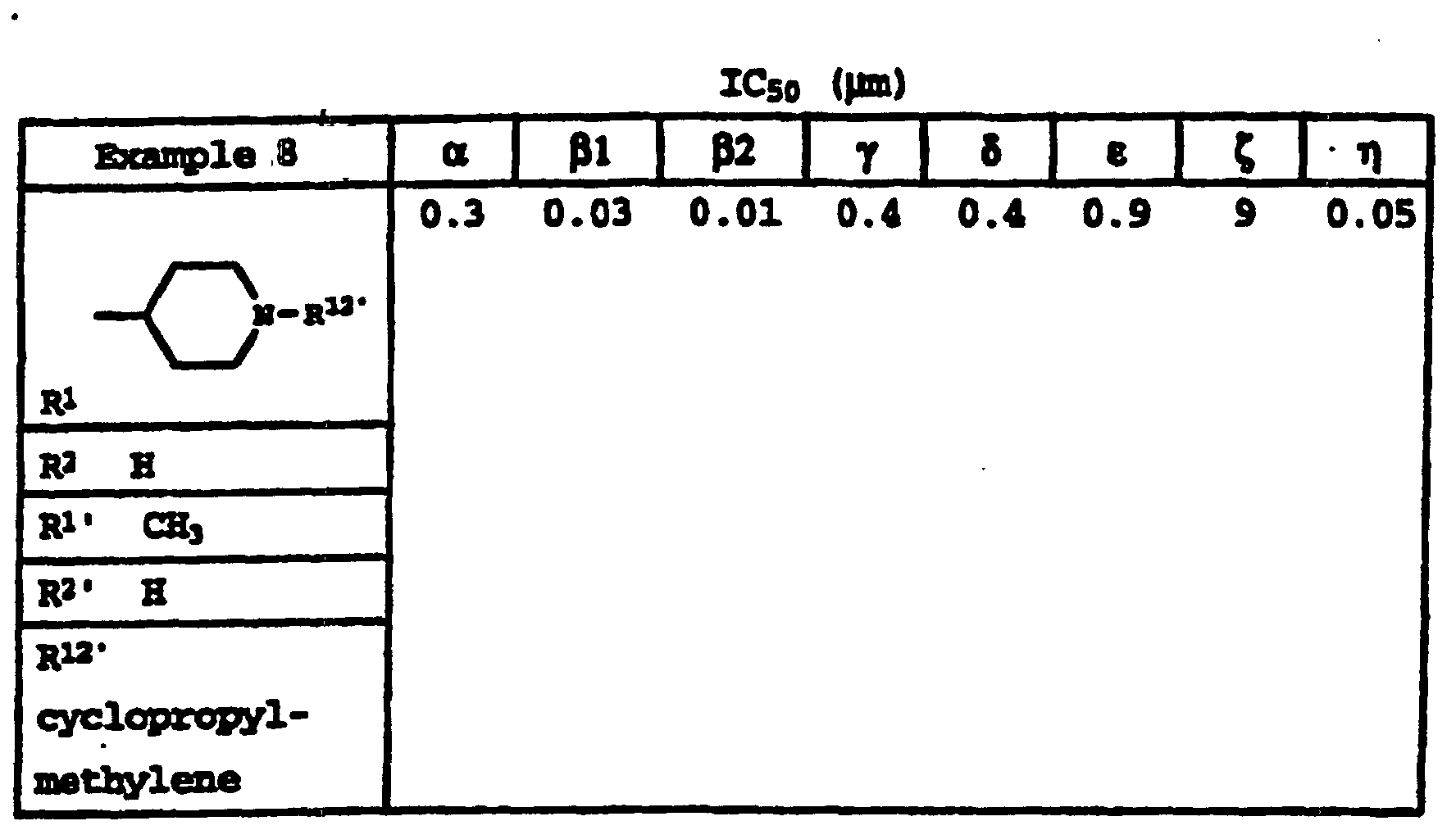
- 1-(1-ethyl-piperidin-4-yl)-indole (350 mg, 1.53 mmol) was dissolved in ether (6 mL) , cooled to 0°C and oxalyl chloride (0.175 mL, 2 mmol) was slowly added. After 30 minutes, the precipitate which formed was collected and suspended in dry methylene chloride (10 mL) . To this suspension was added isopropyl (1-methyl) indol-3-yl)acetimidate hydrochloride (410 ng, 1.53 mmol), followed by the dropwise addition of isopropyl (1-methyl)indol-3-yl)acetimidate (1.07 mL, 7.65 mmol) in dry methylene chloride (3 mL). After 3.5 hours, p-toluene sulfonic acid (1.16 g, 6.12 mmol) was added in several portions (slightly exothermic reaction) and stirring continued for an additional hour. Title compound was isolated as described in Example 8. Recrystallization from dioxane yielded 180 mg of bright orange crystals (26% yield). M, pt.: >250°C.
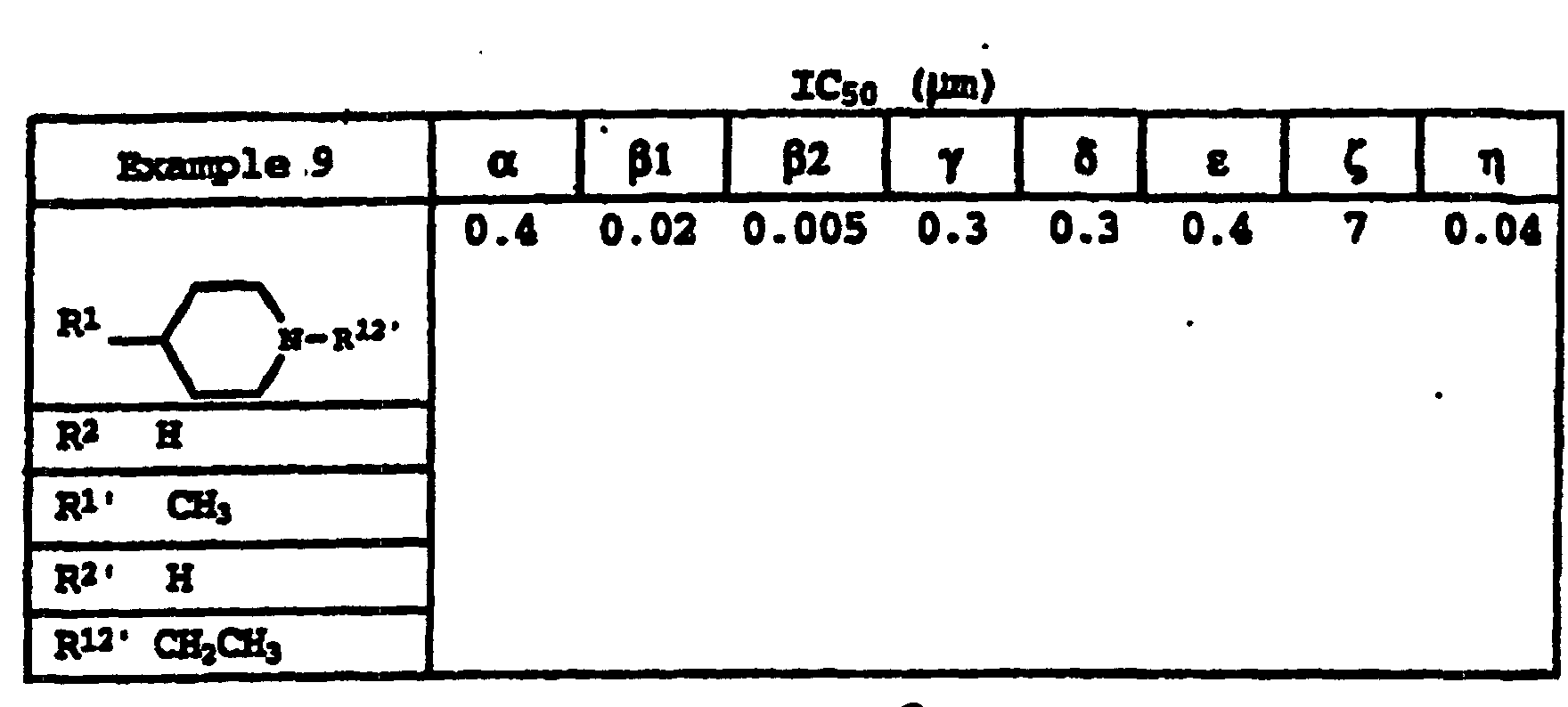
- To a stirred 0°C solution of [3-(4-indol-1-yl-piperidin-1-yl)-propyl]-dimethyl-amine (1g, 3.25 mmol) in dry methylene chloride (10 mL) was added oxalyl chloride (0.33 mL, 4.2 mmol) and warmed up to ambient temperature for 15 minutes. The reaction was concentrated below 30°C, dissolved in dry toluene (10 mL) and treated with isoproyl(1-methyl)indol-3-yl)acetimidate hydrochloride (930 mg, 3.5 mmol) . After slow addition of triethylamine (3 mL, 21 mmol) at 0°C, the mixture was stirred at ambient temperature for 1 hour and then treated with trifluoroacetic acid anhydride (3 mL). After 5 minutes the mixture was carefully quenched with saturated aqueous sodium hydrogen carbonate solution (100 mL). The organic phase was separated, washed with water, dried, and evaporated, the residue solidified on treatment with i-hexane (3x50 mL) and was filtered off. Further purification of the precipitate was accomplished by column chromatography on silica gel eluting with i-propanol/ ethyl acetate/ triethylamine (47:40:13). The material obtained was triturated with t-butyl methyl ether and dried. Yield: 100 mg of red powder (6% yield).

- The reaction is performed under an inert gas atmosphere with rigorous exclusion of moisture.
- To an ice cooled solution of 1-(1-methyl-piperidin-4-yl)-1H-indole (38 g, 0.177 mol) in dry ether (1.2 L) was added oxalyl chloride (16.7 mL, 0.195 mol) dropwise at a rate such that the internal temperature does not exceed 5°C. Stirring at 0 to 5°C is continued for 30 minutes. A yellow precipitate was isolated by suction filtration, washed with ether (800 mL) and suspended in methylene chloride (1.5 L). The solution was recooled to 0 to 5°C and treated with isopropyl(1-methyl)-3-yl)acetimidate hydrochloride (49.6 g, 0.186 mol) in one portion followed by dropwise addition of triethylamine (123 mL, 0.885 mol). The reaction was brought to ambient temperature and stirred for 3 hours. Anhydrous p-toluene sulfonic acid (152.4 g) was added in several portions with external Cooling and stirring was continue for 30 minutes. The mixture was poured into saturated aqueous sodium hydrogen carbonate (2 L) and shaken. A bright orange precipitate (32.2 g) formed which was isolated by suction filtration and washed successively with water, dioxane, and ether. A second crop was isolated by evaporation of the mother liquor and trituration with dioxane (9.4 g). Total yield: 41.6 g (54% of theory). M.Pt.: 316-318°C.
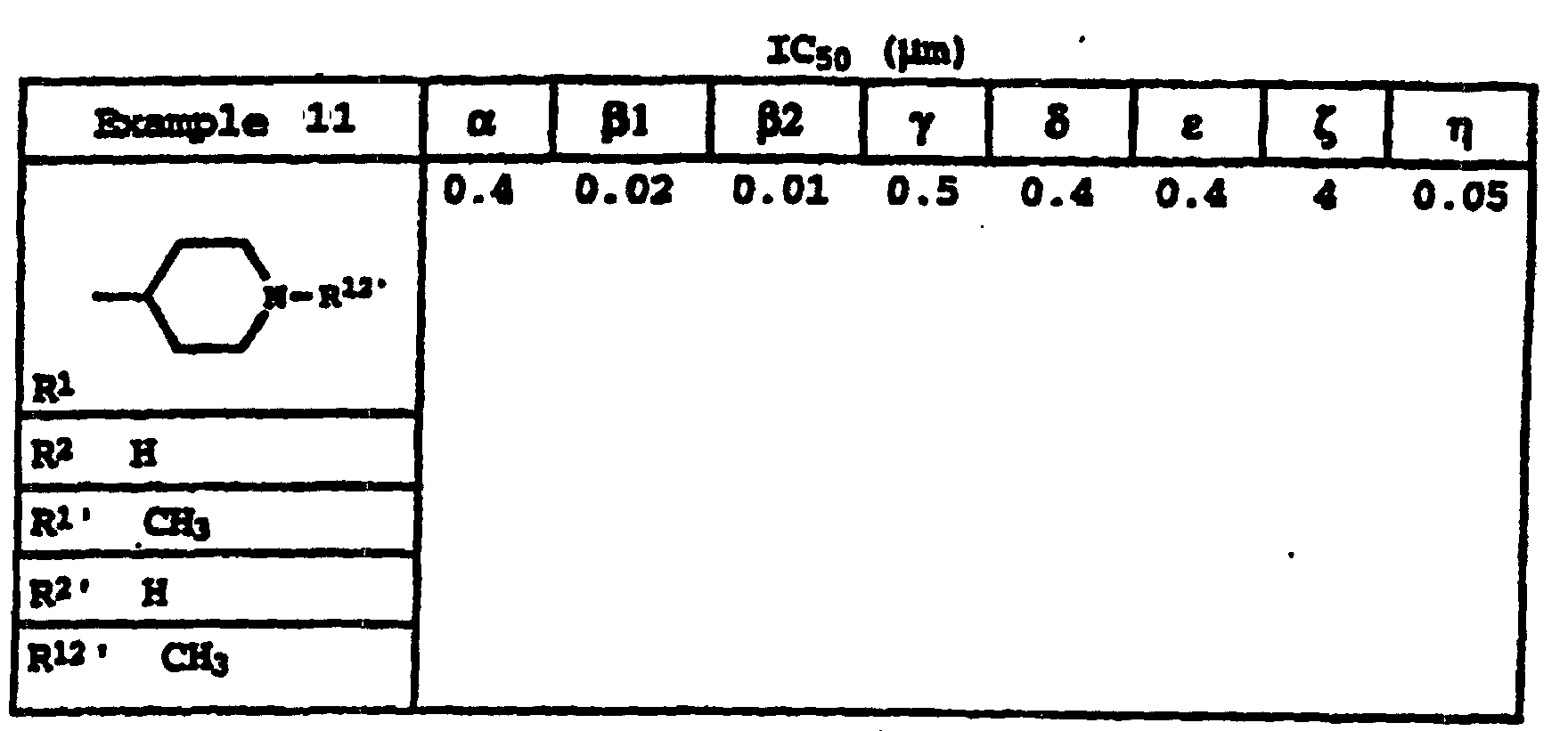
- An ice cooled solution of 3-[1-(1-methyl-piperidin-4-yl)-1H-indol-3-yl]-4-(1-methyl-1H-indol-3-yl)-pyrrole-2, 5-dione (70 g, 0.16 mol) in ethyl acetate (4 L) was saturated with gaseous hydrogen chloride for 3 hours. The precipitate formed was isolated by suction filtration, suspended in methanol (3 L) and stirred for 30 minutes. The mixture turned into a homogenous slurry, which was concentratad and treated with ether (500 mL). The title compound crystallized and was collected by suction filtration. The filter was vacuum dried over night (100°C/0.1 mm. Yield 70 g (92% of theory). M.Pt.: 280-282°C.
- [t-Butoxycarbonylimino-(4-{3- [4-(1-methyl-1H-indol-3-yl)-2,5-dioxo-2,5-dihydro-1H-pyrrole-3-yl]-indol-1-yl}-piperidin-1-yl)-methyl]-carbamic acid t-butyl ester (110 mg, 0.17 mmol) was added to a 0°C solution of ethanethiol (0.1 mL) in trifluoroacetic acid (1 mL). After 30 minutes, the reaction mixture was brought to ambient temperature for an additional 30 minutes, quenched with saturated aqueous sodium hydrogen carbonate, and diluted with methylene chloride. The organic phase was washed with NaHCO3 (2x), water, brine, and evaporated. The orange amorphous solid was recrystallized from hot dioxane to give the title compound (40 mg, 50% yield). M.Pt.:>210°C dec.
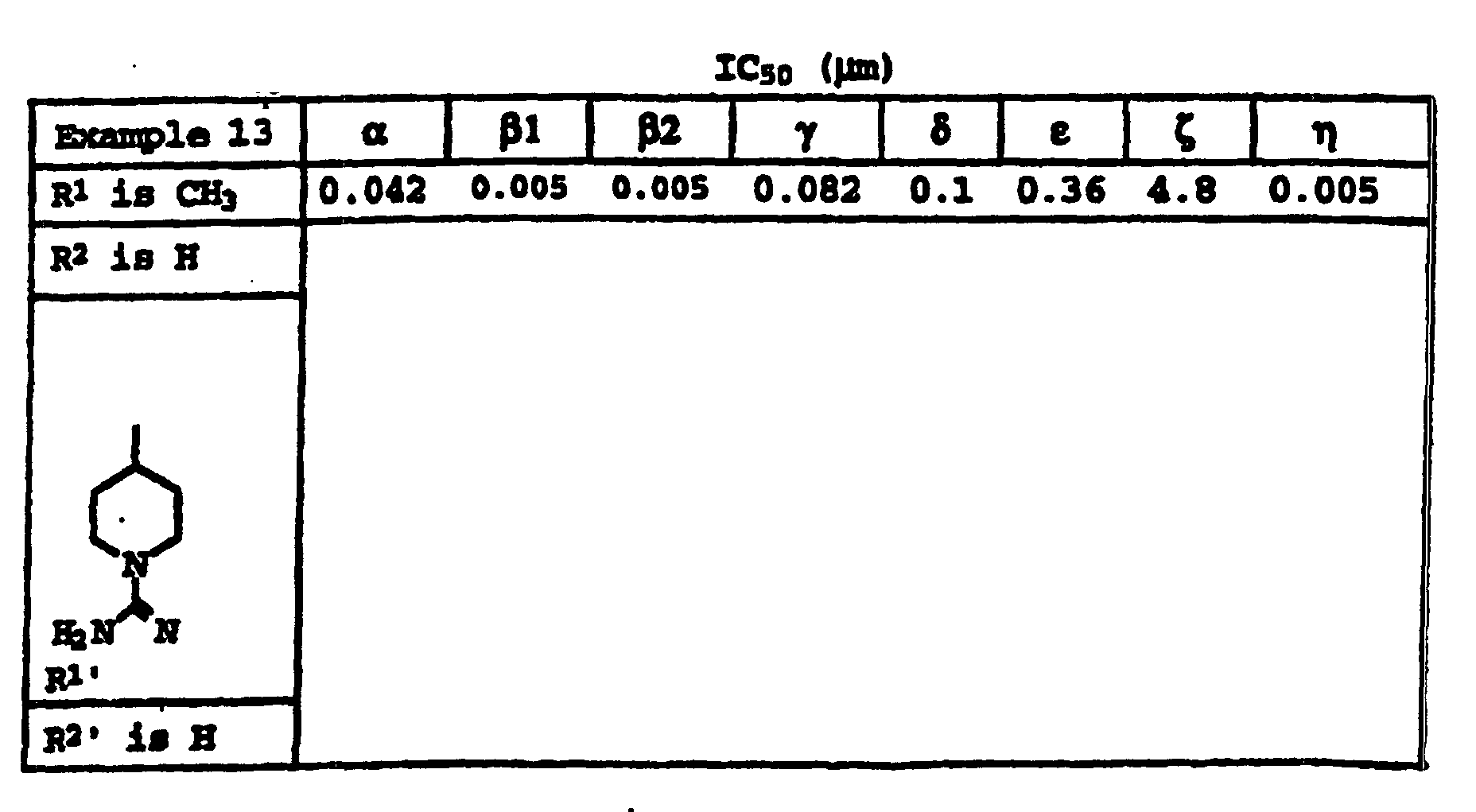
- To a stirred 0°C solution of 1-[1-(2,2,2-trifluoro-ethyl)-piperidin-4-yl]-indole (180 mg, 0.64 mmol) in dry ether (3 mL) was added oxalyl chloride (0.06 mL, 0.7 mmol). The reaction mixture was warmed to ambient temperature for . 30 minutes. An additional amount of oxalyl chloride (0.04 mL, 0.5 mmol) was added. After 30 minutes, a yellow precipitate formed which was filtered with the exclusion of moisture and air, and washed with a small amount of ether. The collected precipitant was dissolved in dry methylene chloride (10 mL) and treated with isopropyl(1-methyl)indol-3-yl)acetimidate hydrochloride (190 mg, 0.71 mmol) followed by slow addition of triethylamine (0.44 mL, 3.2 mmol) at 0°C. After 4 hours at ambient temperature, p-toluene sulfonic acid monohydrate (0.61 g, 3.2 mmol) was added. After 30 minutes the mixture was quenched with saturated aqueous sodium hydrogen carbonate solution (40 mL). The organic phase was separated, washed with water, dried, and evaporated. The residue was recrystallized from hot dioxane and yielded 100 mg of bright orange crystals. Recrystallization of the mother liquor from THF yielded a second crop (60 mg). Yield: 160 mg of bright orange crystals (49% of theory) M.Pt.: > 250°C.
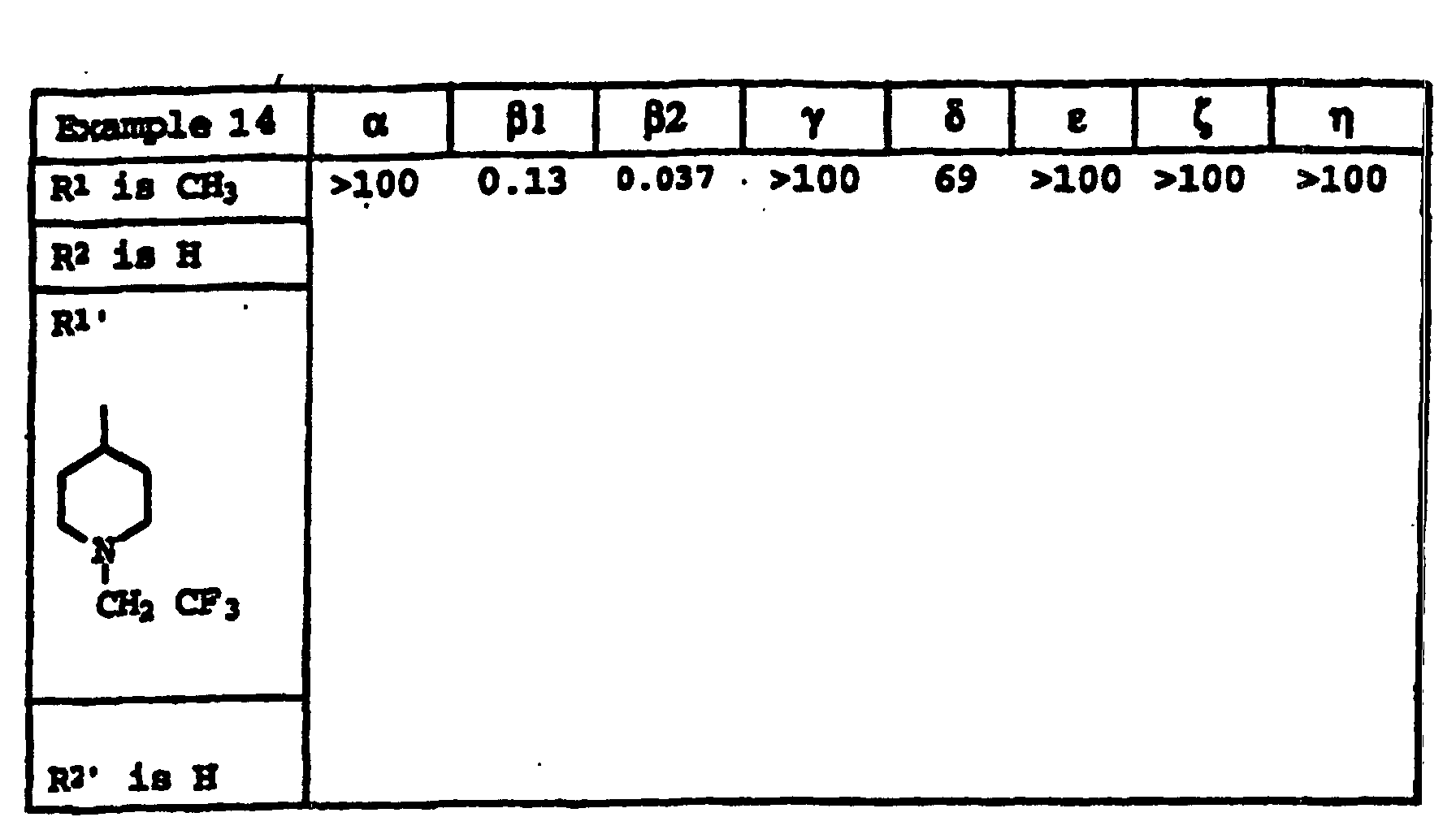
- To a stirred 0°C solution of 1-(4,4,4,3,2,2-heptafluorobutyl)-4-(1-indolyl)-piperidine (430 mg, 1.12 mmol) in dry ether (5 mL) was added oxalyl chloride (0.11 mL, 1.23 mmol). After 1 hour at room temperature, a yellow precipitate formed. The precipitant was collected by filtration under Ar, washed with ether, suspended in dry methylene chloride (10 mL) and treated with isopropyl(1-methyl)indol-3-yl)acetimidate hydrochloride (300 mg, 1.12 mmol). To this suspension was added triethylamine (0.78 mL, 5.6 mmol) in dry methylene chloride (3 mL) at 0°C. The reaction was stirred at ambient temperature for 3 hours and treated with p-toluene sulfonic acid monohydrate (slightly exothermic) (0.86 g, 4.5 mmol). After 30 minutes, the reaction was carefully quenched with saturated aqueous sodium hydrogen carbonate solution (30 mL). The organic phase was separated, washed with saturated aqueous sodium hydrogen carbonate solution, water, brine, dried, and evaporated. The residue was crystallized from an ethereal solution. Yield: 260 mg of might orange crystals (38% of theory). M.Pt.: 231-234°C.

- Examples 16 to 22 were prepared in a manner analogous to the examples and description provided herein.
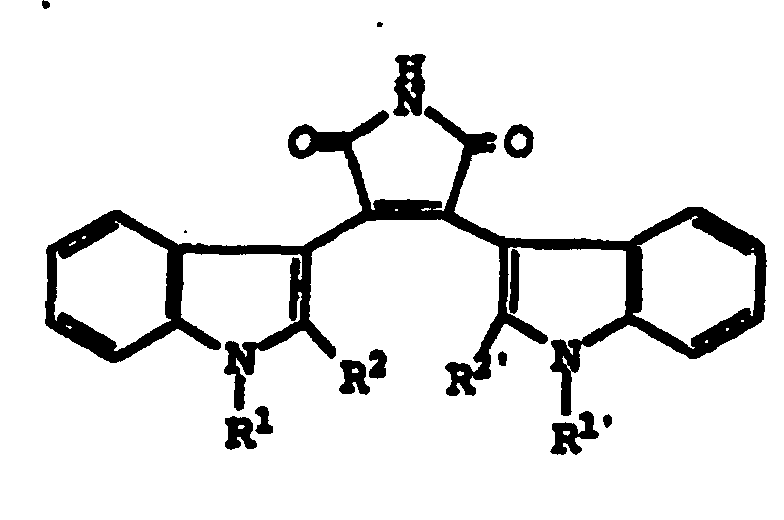


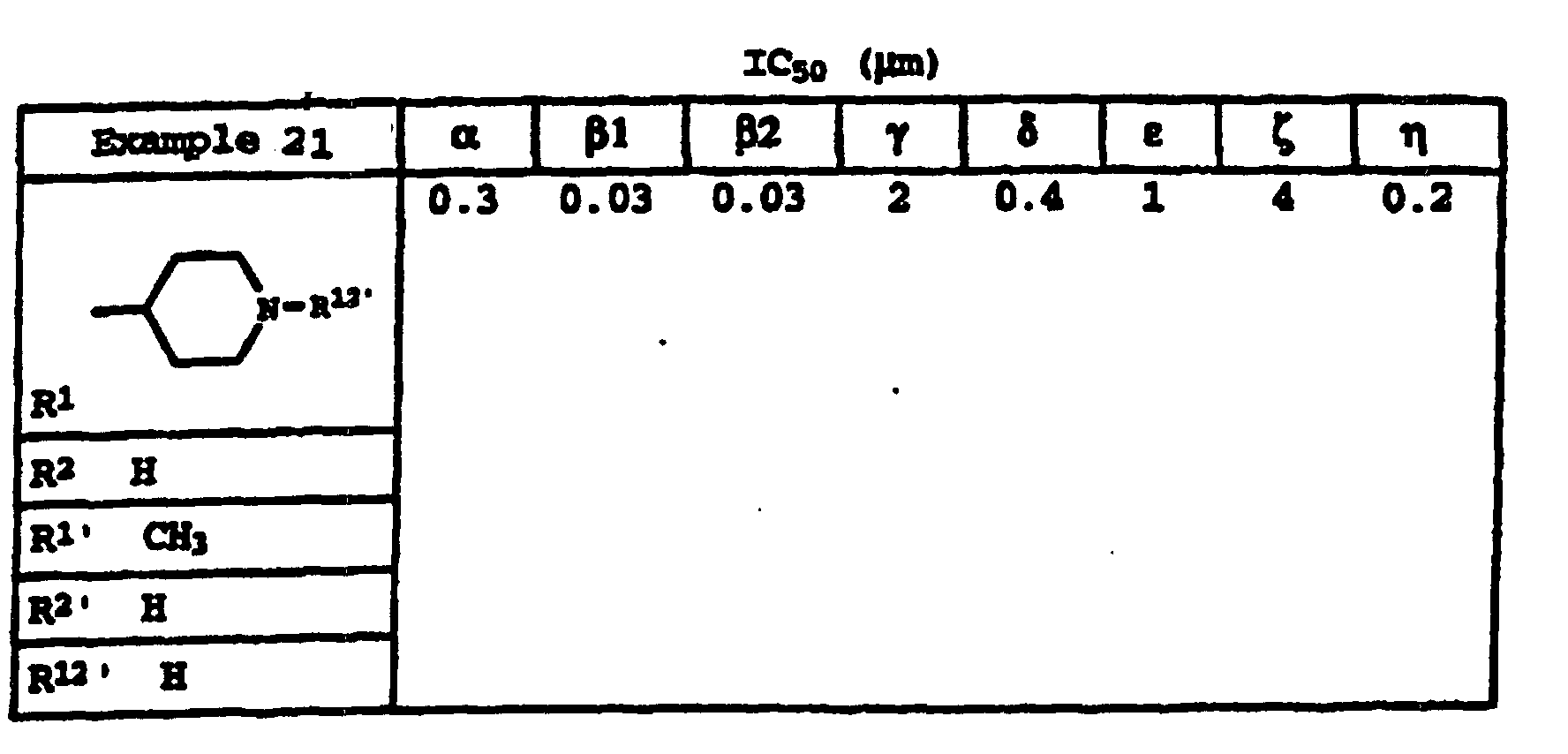

- The title compound was prepared in a manner analogous to the examples and description provided herein. Purification was accomplished by HPLC in silica gel with a methylene chloride/ethanol gradient 99:1 to 98:2. Yield: 6% of theory. MS: 500 (M+), 341, 303, 276, 159, 91 (100%).

- The title compound was prepared in a manner analogous to the examples and description provided herein. Purification was accomplished by HPLC on silica gel with a methylene chloride/ethanol gradient 99:1 to 98:2. Yield 3% of theory. M.Pt.: 102-105°C.
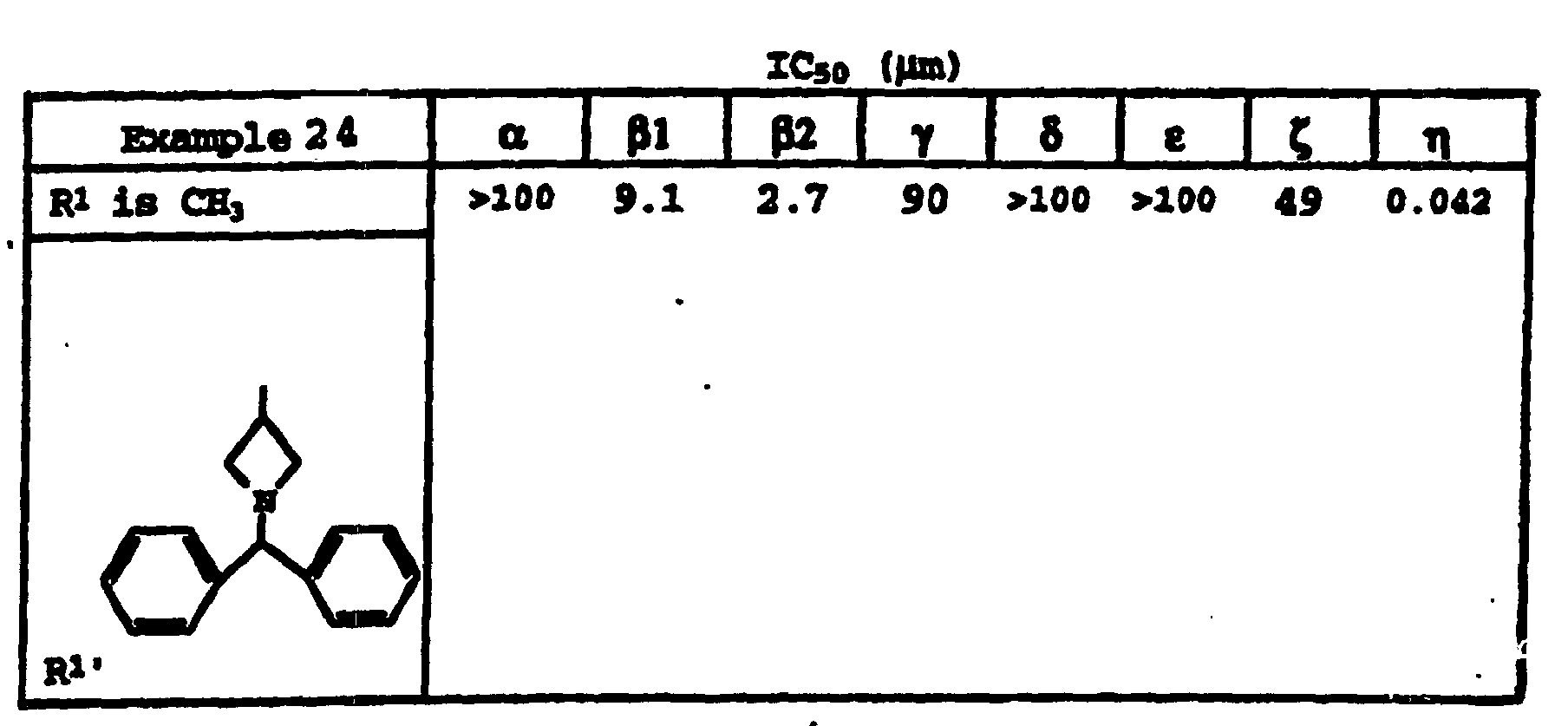
- The compounds of Formula II are preferably formulated prior to administration. Therefore, yet another embodiment of the present invention is a pharmaceutical formulation comprising a compound of Formula II, and one or more pharmaceutically acceptable carriers, diluents or excipients.
- The present pharmaceutical formulations are prepared by known procedures using well known and readily available ingredients. In making the compositions of the present invention, the active ingredient will usually be mixed with a carrier, or diluted by a carrier, or enclosed within a carrier which may be in the form of a capsule, sachet, paper or other container. When the carrier serves as a diluent, it may be a solid, semisolid or liquid material which acts as a vehicle, excipient or medium for the active ingredient. Thus, the compositions can be in the form of tablets, pills, powders, lozenges, sachets, cachets, elixirs, suspensions, emulsions, solutions, syrups, aerosol (as a solid or in a liquid medium), soft and hard gelatin capsules, suppositories, sterile injectable solutions and sterile packaged powders.
- Some examples of suitable carriers, excipients, and diluents include lactose, dextrose, sucrose, sorbitol, mannitol, starches, gum acacia, calcium phosphate, alginates, tragacanth, gelatin, calcium silicate, microcrystalline cellulose, polyvinylpyrrolidone, cellulose, water syrup, methyl cellulose, methyl and propylhydroxybenzoates, talc, magnesium stearate and mineral oil. The formulations can additionally include lubricating agents, wetting agents, emulsifying and suspending agents, preserving agents, sweetening agents or flavoring agents. The compositions of the invention may be formulated so as to provide quick, sustained or delayed release of the active ingredient after administration to the patient. The compositions are preferably formulated in a unit dosage form, each dosage containing from about 1 to about 500 mg, more usually about 5 to about 300 mg, of the active ingredient. However, it will be understood that the therapeutic dosage administered will be determined by the physician in the light of the relevant circumstances including the condition to be treated, the choice of compound to be administered and the chosen route of administration, and therefore the above dosage ranges are not intended to limit the scope of the invention in any way. The term "unit dosage form" refers to physically discrete units suitable as unitary dosages for human subjects and other mammals, each unit containing a predetermined quantity of active material calculated to produce the desired therapeutic effect, in association with a suitable pharmaceutical carrier.
- In addition to the above formulations, the compounds of the present invention may be administered topically. Topical formulations are ointments, creams, and gels.
- Ointments generally are prepared using either (1) an oleaginous base, i.e., one consisting of fixed oils or hydrocarbons, such as white petrolatum or mineral oil, or (2) an absorbent base, i.e., one consisting of an anhydrous substance or substances that can absorb water, for example anhydrous lanolin. Customarily, following formation of the base, whether oleaginous or absorbent, the active ingredient (compound) is added to an amount affording the desired concentration.
- Creams are oil/water emulsions. They consist of an oil phase (internal phase), comprising typically fixed oils, hydrocarbons, and the like, such as waxes, petrolatum, mineral oil, and the like, and an aqueous phase (continuous phase), comprising water and any water-soluble substances, such as added salts. The two phases are stabilized by use of an emulsifying agent, for example, a surface active agent, such as sodium lauryl sulfate; hydrophilic colloids, such as acacia colloidal clays, veegum, and the like. Upon formation of the emulsions, the active ingredient (compound) customarily is added to an amount to achieve the desired concentration.
- Gels comprise a base selection from an oleaginous base, water, or an emulsion-suspension base. To the base is added a gelling agent that forms a matrix in the base, thus increasing its viscosity. Examples of gelling agents are hydroxypropyl cellulose, acrylic acid polymers, and the like. Customarily, the active ingredient (compounds) is added to the formulation at the desired concentration at a point preceding addition of the gelling agent.
- The amount of compound incorporated into a topical formulation of invention is not critical; the concentration should only be a range sufficient to permit ready application of the formulation to the an affected tissue area in an amount that will deliver the desired amount of compound. The customary amount of topical formulation to be applied to an affected tissue will depend upon an affected tissue size and concentration of compound in the formulation. Generally, the formulation will be applied to the an affected tissue in an amount affording from about 1 to about 500 µg compound per cm2 of an affected tissue. Preferably, the applied amount of compound will range from about 30 to about 300 µg/cm2, more preferably, from about 50 to about 200 µg/cm2, and, most preferably, from about 60 to about 100 µg/cm2.
- The following formulation examples are illustrative only and are not intended to limit the scope of the invention in any way.
- Hard gelatin capsules are prepared using the following ingredients:
Quantity (mg/capsule) Active ingredient 250 starch, dried 200 magnesium stearate 10 Total 460 mg - A tablet is prepared using the ingredients below:
Quantity (mg/capsule) Active ingredient 250 cellulose, microcrystalline 400 silicon dioxide, fumed 10 stearic acid 5 Total 665 mg - An aerosol solution is prepared containing the following components:
Quantity (mg/capsule) Active ingredient 0.25 ethanol 29.75 propellant 22 (chlorodifluoromethane) 70.00 Total 100.00 - Tablets each containing 60 mg of active ingredient are made as follows:
Quantity (mg/capsule) Active ingredient 60 mg starch 45 mg microcrystalline cellulose 35 mg polyvinylpyrrolidone (as 10% solution in water) 4 mg sodium carboxymethyl starch 4.5 mg magnesium stearate 0.5 mg talc 1 mg Total 150 mg - The active ingredient, starch and cellulose are passed through a 355 µm aperture (No. 45 mesh U.S.) sieve and mixed thoroughly. The solution of polyvinylpyrrolidone is mixed with the resultant powders which are then passed through a 1410 µm aperture (No. 14 mesh U.S.) sieve. The granules so produced are dried at 50°C and passed through a 100 µm aperture (No. 18 mesh U.S.) sieve. The sodium carboxymethyl starch, magnesium stearate and talc, previously passed through a 250 µm aperture (No. 60 mesh U.S.) sieve, are then added to the granules which, after mixing, are compressed on a tablet machine to yield tablets each weighing 150 mg.
- Capsules each containing 80 mg of medicament are made as follows:
Quantity (mg/capsule) Active ingredient 80 mg starch 59 mg microcrystalline cellulose 59 mg magnesium stearate 2 mg Total 200 mg - Suppositories each containing 225 mg of active ingredient may be made as follows:
Quantity (mg/capsule) Active ingredient 225 mg saturated fatty acid glycerides 2,000 mg Total 2,225 mg - Suspensions each containing 50 mg of medicament per 5 mL dose are made as follows:
Quantity (mg/capsule) Active ingredient 50 mg sodium carboxymethyl cellulose 50 mg syrup 1.25 mL benzoic acid solution 0.10 mL flavor q.v. color q.v. purified water to total 5 mL - An intravenous formulation may be prepared as follows:
Quantity (mg/capsule) Active ingredient 250 mg isotenic saline 1000 mg
Claims (27)
- A compound of the formulawherein:

R1 isR1' is hydrogen, C1-C4 alkyl, aminoalkyl, monoalkylaminoalkyl, or dialkylaminoalkyl;
R2 and R2' are independently hydrogen, alkyl, alkoxyalkyl, hydroxyalkyl, C1-C3 alkylthio, S(O)C1-C3 alkyl, CF3;
R3 is hydrogen or CH3CO-;
R4, R4', R5, R5', R6, R6', R7 and R7' are independently hydrogen, halogen, alkyl, hydroxy, alkoxy, -COO(C1-C3 alkyl), CF3, nitro, amino, acetylamino, monoalkylamino, dialkylamino, alkylthio, or S(O)C1-C3 alkyl;
R12 is hydrogen, alkyl, haloalkyl, cycloalkyl, acetyl, aryl, -CH(aryl)2, amino, monoalkylamino, dialkylamino, guanidino, -C(=N(alkoxycarbonyl))NH(alkoxycarbonyl), amidino, hydroxy, carboxy, alkoxycarbonyl or heterocyclyl;
p and q are independently 1, 2, 3, or 4;
s is 0, 1, 2 or 3;
t is 1 or 2;
u is 0;
or a pharmaceutically acceptable salt or solvate thereof. - A compound according to Claim 1 wherein R1 isor a pharmaceutically acceptable salt or solvate thereof.
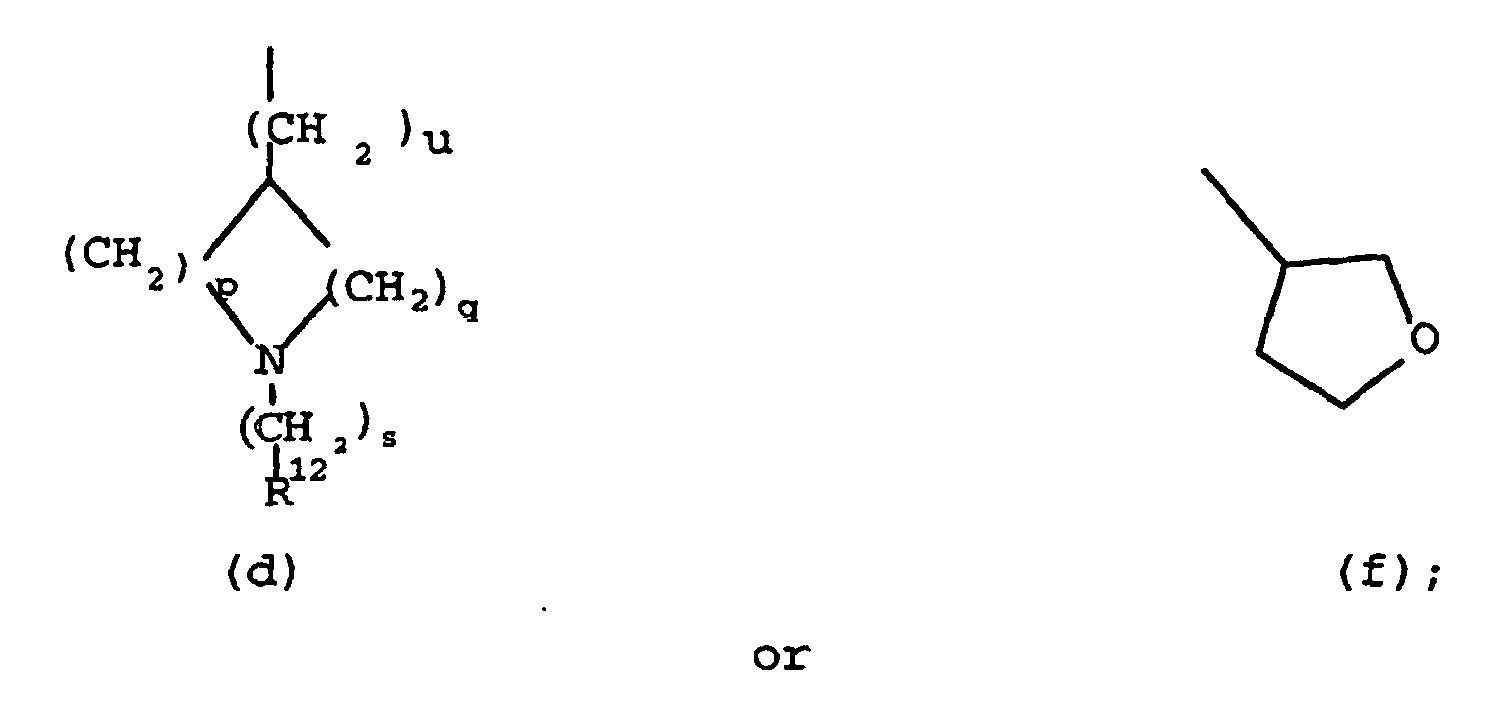
- A compound according to Claim 1 or Claim 2 wherein R1 isor a pharmaceutically acceptable salt or solvate thereof.
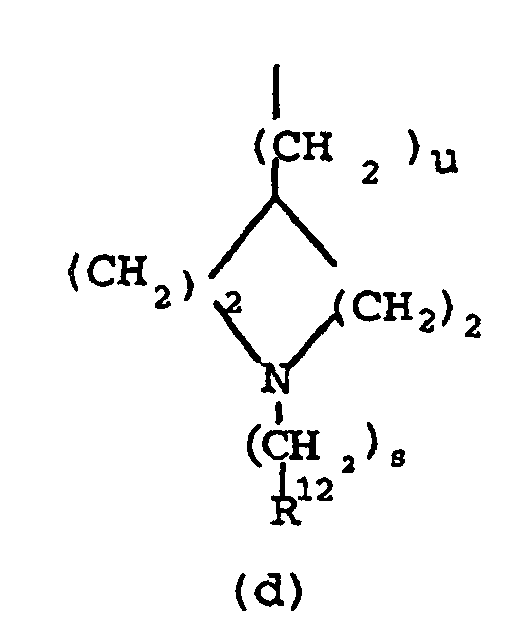
- A compound according to any one of Claims 1 to 3 wherein R4, R4', R5, R5', R6, R6' R7 and R7' are independently hydrogen or halogen, or a pharmaceutically acceptable salt or solvate thereof.
- A compound according to any one of Claims 1 to 4 wherein R4, R4', R5, R5', R6, R6' R7 and R7' are hydrogen, or a pharmaceutically acceptable salt or solvate thereof.
- A compound according to any one of Claims 1 to 5 wherein R12 is hydrogen, alkyl, haloalkyl, cycloalkyl, acetyl aryl, amino, monoalkylamino, dialkylamino, -C(=N(alkoxycarboxyl))NH(alkoxycarboxyl), amidino, alkoxycarboxyl or heterocyclyl, or a pharmaceutically acceptable salt or solvate thereof.
- A compound according to any one of Claims 1 to 6 wherein R12 is a heterocyclyl group selected from imidazolyl, imidazolinyl, thiazolinyl, pyridyl, indolyl, furyl and pyrimidinyl, or a pharmaceutically acceptable salt or solvate thereof.
- A compound according to any one of Claims 1 to 3 when R1' is C1-C4 alkyl, aminoalkyl, monoalkylaminoalkyl or dialkylaminoalkyl, or a pharmaceutically acceptable salt or solvate thereof.
- A compound according to any one of Claims 1 to 3 wherein R1' is C1-4 alkyl, or a pharmaceutically acceptable salt or solvate thereof.
- A compound according to any one of Claims 1 to 3 wherein R2 and R2' are hydrogen, or a pharmaceutically acceptable salt or solvate thereof.
- A compound according to any one of claims 1 to 3 wherein S is 0 or 1, or a pharmaceutically acceptable salt or solvate thereof.
- A compound according to any one of Claims 1 to 3 wherein R12 is hydrogen, or a pharmaceutically acceptable salt or solvate thereof.
- A compound according to Claim 1 having the formula:wherein

R1 isR2 is hydrogen;
R1' is methyl;
R2' is hydrogen;
R12' is hydrogen, methyl, ethyl, isopropyl, CH2CF3, CH2CF2CF3, benzyl; C(O)CH3, t-butoxycarbonyl, CH2CO2CH2CH3, CH2CH2CH2 N(CH3)2, C(=N t-butoxycarbonyl)NH t-butoxycarbonyl, C(=NH)NH2, cyclopropylmethylene, 2-pyridine or CH2-2 -pyridine;
or a pharmaceutically acceptable salt or solvate thereof. - 3-[1-(1-Methyl-piperidin-4-yl)-1H-indol-3-yl]-4-(1-methyl-1H-indol-3-yl)-pyrrole-2,5-dione or a pharmaceutically acceptable salt or solvate thereof.
- 3-[1-(-1-pyridin-2-ylmethyl)piperidin-4-yl)-indol-3-yl]-4-(1-methylindol-3-yl)-1H-pyrrole-2,5-dione or a pharmaceutically acceptable salt or solvate thereof.
- A compound according to Claim 1 having the formula:wherein

R1 isR2 is hydrogen;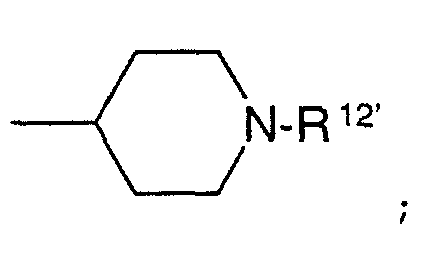
R1' is hydrogen;
R2' is hydrogen;
R12' is hydrogen, methyl or t-butoxycarbonyl; or a pharmaceutically acceptable salt or solvate thereof. - A compound according to Claim 1 having the formula:wherein
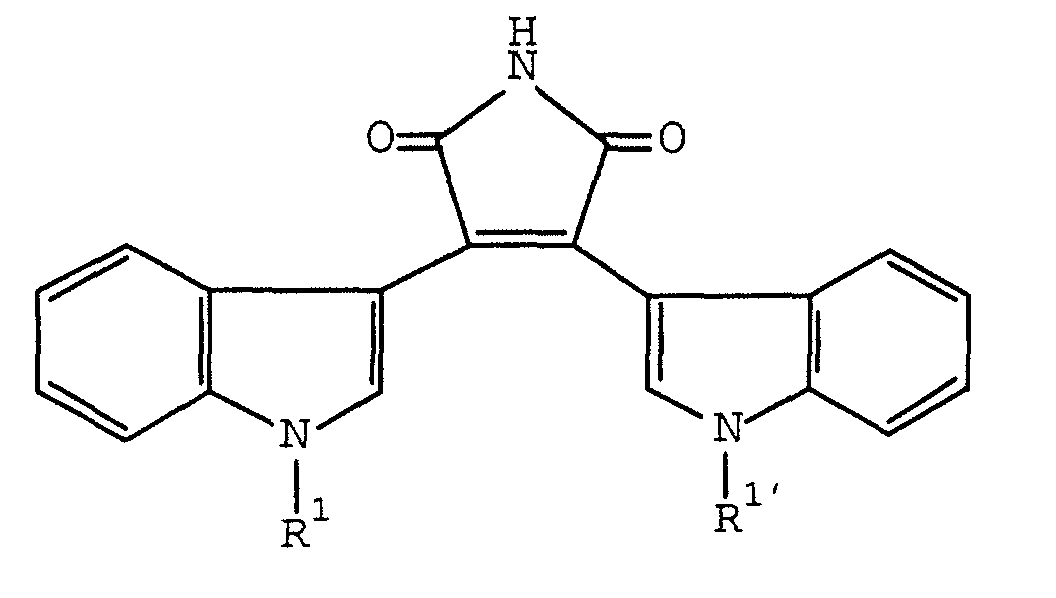
R1 is methyl;
R1' isor a pharmaceutically acceptable salt or solvate thereof.
- A compound according to Claim 1 having the formula:wherein
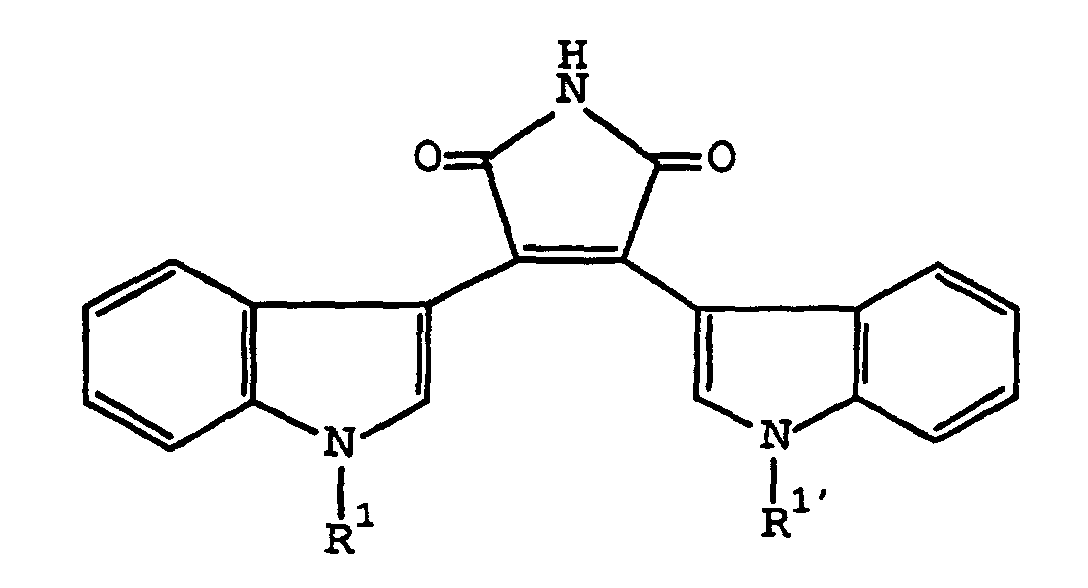
R1 is methyl;
R1' isor a pharmaceutically acceptable salt or solvate thereof.
- A compound according to Claim 1 having the formula:wherein
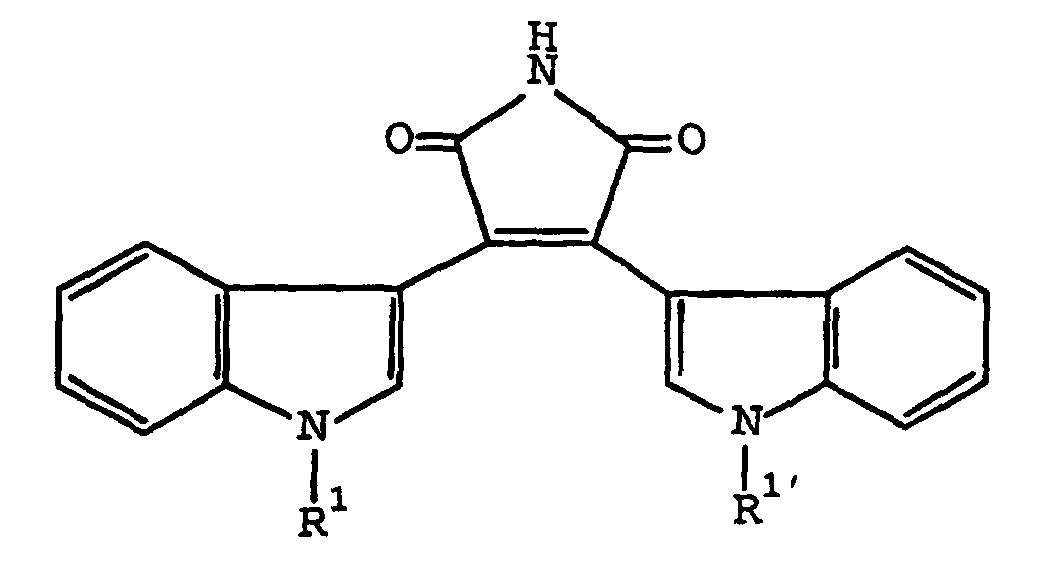
R1 is methyl;
R1' isor a pharmaceutically acceptable salt or solvate thereof.
- A compound according to Claim 13 having the formula:wherein

R1 isR2 is hydrogen;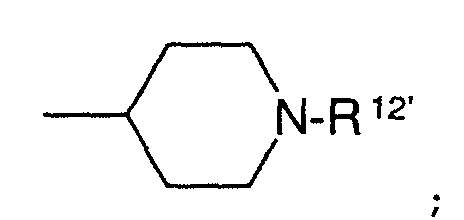
R1' is methyl;
R2' is hydrogen;
R12' is hydrogen;
or a pharmaceutically acceptable salt or solvate thereof. - A compound according to any one of Claims 1 to 20 which is the hydrocloride salt.
- A compound, salt or solvate as claimed in any one of Claims 1 to 21 for use as a pharmaceutical.
- A pharmaceutical formulation comprising as an active ingredient a compound, salt or solvate as claimed in any one of Claims 1 to 21, associated with one or more pharmaceutically acceptable carriers, excipients, or diluents.
- Use of a compound, salt or solvate as claimed in any one of Claims 1 to 21 in the manufacture of a medicament for the treatment of diabetes mellitus and its complications.
- Use of a compound, salt or solvate as claimed in any one of Claims 1 to 21 in the manufacture of a medicament for the treatment of cancer.
- Use according to Claim 25 wherein the treatment of cancer comprises administration of the compound, salt or solvate in conjunction with another chemotherapeutic agent.
- A process for preparing a compound as claimed in any one of Claims 1 to 21 which comprises:wherein:Hydrolyzing and dehydrating a hydroxy-pyrrolinone of the Formula:
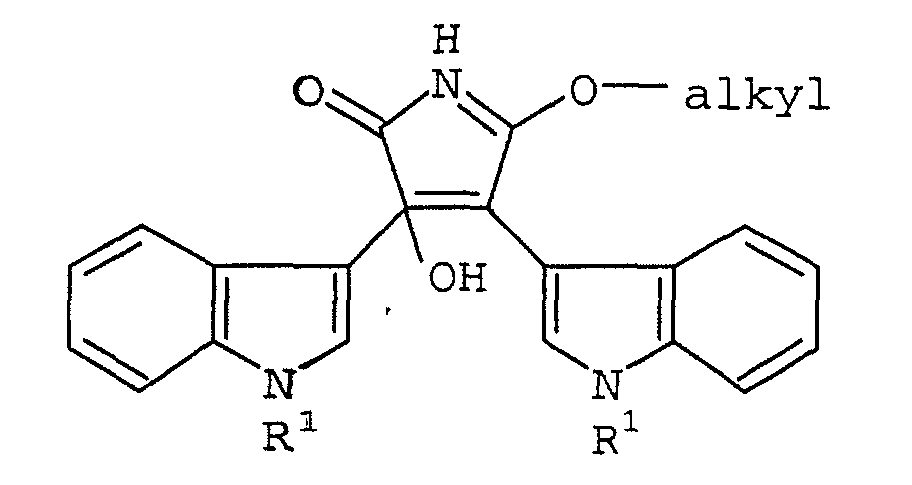
R1 isR12 is hydrogen, alkyl, haloalkyl, cycloalkyl, acetyl, aryl, -CH(aryl)2, amino, monoalkylamino, dialkylamino, guanidino, -C(=N(alkoxycarbonyl))NH(alkoxycarbonyl), amidino, hydroxy, carboxy, alkoxycarbonyl or heterocyclyl; p and q are independently 1, 2, 3, or 4; s is 0, 1, 2 or 3; t is 1 or 2; u is 0.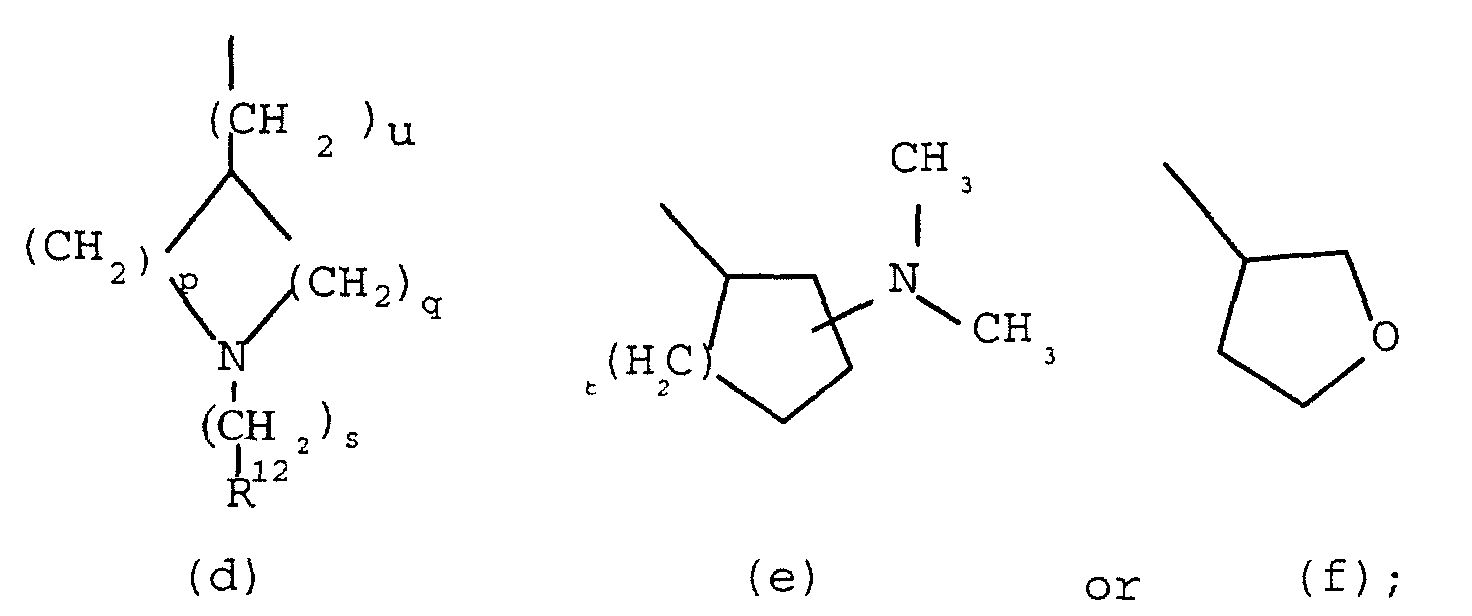
Priority Applications (2)
| Application Number | Priority Date | Filing Date | Title |
|---|---|---|---|
| EP04102054A EP1449529B1 (en) | 1993-12-23 | 1994-12-14 | Protein Kinase C Inhibitors |
| SI9430475T SI0817627T1 (en) | 1993-12-23 | 1994-12-14 |
Applications Claiming Priority (5)
| Application Number | Priority Date | Filing Date | Title |
|---|---|---|---|
| US17374193A | 1993-12-23 | 1993-12-23 | |
| US173741 | 1993-12-23 | ||
| US08/324,948 US5545636A (en) | 1993-12-23 | 1994-10-18 | Protein kinase C inhibitors |
| US324948 | 1994-10-18 | ||
| PCT/US1994/014313 WO1995017182A1 (en) | 1993-12-23 | 1994-12-14 | Protein kinase c inhibitors |
Related Child Applications (1)
| Application Number | Title | Priority Date | Filing Date |
|---|---|---|---|
| EP04102054A Division EP1449529B1 (en) | 1993-12-23 | 1994-12-14 | Protein Kinase C Inhibitors |
Publications (3)
| Publication Number | Publication Date |
|---|---|
| EP0817627A1 EP0817627A1 (en) | 1998-01-14 |
| EP0817627A4 EP0817627A4 (en) | 2002-07-17 |
| EP0817627B1 true EP0817627B1 (en) | 2005-03-09 |
Family
ID=26869484
Family Applications (2)
| Application Number | Title | Priority Date | Filing Date |
|---|---|---|---|
| EP04102054A Expired - Lifetime EP1449529B1 (en) | 1993-12-23 | 1994-12-14 | Protein Kinase C Inhibitors |
| EP95904892A Expired - Lifetime EP0817627B1 (en) | 1993-12-23 | 1994-12-14 | Protein kinase c inhibitors |
Family Applications Before (1)
| Application Number | Title | Priority Date | Filing Date |
|---|---|---|---|
| EP04102054A Expired - Lifetime EP1449529B1 (en) | 1993-12-23 | 1994-12-14 | Protein Kinase C Inhibitors |
Country Status (12)
| Country | Link |
|---|---|
| US (3) | US5661173A (en) |
| EP (2) | EP1449529B1 (en) |
| JP (4) | JP3998261B2 (en) |
| AT (2) | ATE290378T1 (en) |
| AU (1) | AU1339895A (en) |
| CA (1) | CA2179650C (en) |
| DE (1) | DE69434294T2 (en) |
| DK (1) | DK0817627T3 (en) |
| ES (1) | ES2236702T3 (en) |
| PT (1) | PT817627E (en) |
| SI (1) | SI0817627T1 (en) |
| WO (1) | WO1995017182A1 (en) |
Cited By (4)
| Publication number | Priority date | Publication date | Assignee | Title |
|---|---|---|---|---|
| WO2011120911A1 (en) | 2010-03-30 | 2011-10-06 | Novartis Ag | Pkc inhibitors for the treatment of b-cell lymphoma having chronic active b-cell-receptor signalling |
| WO2014085381A1 (en) | 2012-11-29 | 2014-06-05 | Novartis Ag | Pharmaceutical combinations |
| WO2014174478A1 (en) | 2013-04-26 | 2014-10-30 | Novartis Ag | Pharmaceutical combinations of a pkc inhibitor and a c-met receptor tyrosine kinase inhibitor |
| WO2016020864A1 (en) | 2014-08-06 | 2016-02-11 | Novartis Ag | Protein kinase c inhibitors and methods of their use |
Families Citing this family (73)
| Publication number | Priority date | Publication date | Assignee | Title |
|---|---|---|---|---|
| KR20000064764A (en) * | 1996-03-20 | 2000-11-06 | 피터지.스트링거 | Manufacturing method of indolyl maleimide |
| US6232299B1 (en) * | 1996-05-01 | 2001-05-15 | Eli Lilly And Company | Use of protein kinase C inhibitors to enhance the clinical efficacy of oncolytic agents and radiation therapy |
| SE9603284D0 (en) * | 1996-09-10 | 1996-09-10 | Astra Ab | New compounds |
| SE9603283D0 (en) * | 1996-09-10 | 1996-09-10 | Astra Ab | New compounds |
| SE9603285D0 (en) * | 1996-09-10 | 1996-09-10 | Astra Ab | New compounds |
| TW472045B (en) | 1996-09-25 | 2002-01-11 | Astra Ab | Protein kinase C inhibitor compounds, method for their preparation, pharmaceutical composition thereof and intermediate used for their preparation |
| US5859261A (en) * | 1997-03-20 | 1999-01-12 | Eli Lilly And Company | Synthesis of indolylmaleimides |
| AR017200A1 (en) | 1997-12-23 | 2001-08-22 | Astrazeneca Ab | INHIBITING COMPOUNDS OF PROTEIN CINASE C, PHARMACEUTICALLY ACCEPTABLE SALTS OF THE SAME, PHARMACEUTICAL FORMULATIONS THAT UNDERSTAND THEM, USE THE SAME AND PROCESS FOR THE SYNTHESIS OF SUCH COMPOUNDS |
| SE9800835D0 (en) | 1998-03-13 | 1998-03-13 | Astra Ab | New Compounds |
| HRP20000585B1 (en) * | 1998-03-17 | 2009-02-28 | F. Hoffmann - La Roche Ag | Substituted bisindolymaleimides for the inhibition of cell proliferation |
| DE19838506C2 (en) * | 1998-05-04 | 2000-08-31 | Asta Medica Ag | Indole derivatives and their use for the treatment of malignant and other diseases based on pathological cell proliferation |
| ES2190221T3 (en) * | 1998-05-04 | 2003-07-16 | Zentaris Ag | DERIVATIVES OF INDOL AND ITS USE FOR THE TREATMENT OF MALIGNAL AND OTHER DISEASES, BASED ON PATHOLOGICAL CELL PROLIFERATIONS. |
| US6127401A (en) | 1998-06-05 | 2000-10-03 | Cephalon, Inc. | Bridged indenopyrrolocarbazoles |
| US6013646A (en) | 1998-07-02 | 2000-01-11 | Bayer Corporation | Indolocarbazole derivatives useful for the treatment of neurodegenerative diseases and cancer |
| US6841567B1 (en) * | 1999-02-12 | 2005-01-11 | Cephalon, Inc. | Cyclic substituted fused pyrrolocarbazoles and isoindolones |
| US6492406B1 (en) | 1999-05-21 | 2002-12-10 | Astrazeneca Ab | Pharmaceutically active compounds |
| US6284783B1 (en) | 1999-06-09 | 2001-09-04 | The Uab Research Foundation | Use of bisindolylmaleimide compounds to induce Fas-mediated apoptosis |
| US6346625B1 (en) | 1999-06-23 | 2002-02-12 | Astrazeneca Ab | Protein kinase inhibitors |
| EP1106605A4 (en) * | 1999-06-24 | 2005-12-07 | Toray Industries | Alpha1b-adrenergic receptor antagonists |
| US6399780B1 (en) * | 1999-08-20 | 2002-06-04 | Cephalon, Inc. | Isomeric fused pyrrolocarbazoles and isoindolones |
| DE60010934T2 (en) * | 1999-12-16 | 2005-05-19 | Eli Lilly And Co., Indianapolis | Medicines suitable for the treatment of proliferative diseases |
| US6867198B2 (en) | 1999-12-16 | 2005-03-15 | Eli Lilly And Company | Agents and methods for the treatment of proliferative diseases |
| US6743785B2 (en) | 1999-12-16 | 2004-06-01 | Eli Lilly And Company | Agents and methods for the treatment of proliferative diseases |
| CA2408747C (en) * | 2000-05-11 | 2011-04-05 | Consejo Superior Investigaciones Cientificas | Heterocyclic inhibitors of glycogen synthase kinase gsk-3 |
| ES2166328B1 (en) * | 2000-05-11 | 2003-09-16 | Consejo Superior Investigacion | HETEROCICLIC INHIBITORS OF ENZYME GSK 3 USEFUL IN THE TREATMENT OF NEURODEGENERATIVE AND HYPERPROLIFERATIVE PROCESSES |
| AU2001271257A1 (en) * | 2000-06-29 | 2002-01-14 | Eli Lilly And Company | Use of a protein kinase c inhibitor to enhance the clinical efficacy of anti-neoplastic chemotherapeutic agents and radiation therapy |
| WO2002002116A2 (en) * | 2000-06-29 | 2002-01-10 | Eli Lilly And Company | Therapeutic treatment of cancer with a protein kinase c inhibitor |
| KR20040016828A (en) | 2000-12-08 | 2004-02-25 | 오르토-맥네일 파마슈티칼, 인코퍼레이티드 | Indazolyl-substituted pyrroline compounds as kinase inhibitors |
| RU2004135382A (en) | 2002-06-05 | 2005-06-27 | Янссен Фармацевтика Н.В. (Be) | SUBSTITUTED PYRROLINS AS KINASE INHIBITORS |
| JP2005531607A (en) | 2002-06-05 | 2005-10-20 | ジヤンセン・フアーマシユーチカ・ナームローゼ・フエンノートシヤツプ | Substituted pyrroline as a kinase inhibitor |
| CA2393720C (en) * | 2002-07-12 | 2010-09-14 | Eli Lilly And Company | Crystalline 2,5-dione-3-(1-methyl-1h-indol-3-yl)-4-[1-(pyridin-2-ylmethyl)piperidin-4-yl]-1h-indol-3-yl]-1h-pyrrole mono-hydrochloride |
| DE10244453A1 (en) | 2002-09-24 | 2004-04-01 | Phenomiques Gmbh | Inhibition of the protein kinase C-alpha for the treatment of diseases |
| DE602004014965D1 (en) * | 2003-10-24 | 2008-08-21 | Lilly Co Eli | BISINDOLYLMALEIMID FOR THE TREATMENT OF PROSTATE CANCER AND ACT-MEDIATED ILLNESSES |
| GB0329667D0 (en) | 2003-12-22 | 2004-01-28 | King S College London | Core 2 GlcNAc-T inhibitor |
| US20080182801A1 (en) | 2003-12-22 | 2008-07-31 | Btg International Limited | Core 2 glcnac-t inhibitors |
| GB0513881D0 (en) | 2005-07-06 | 2005-08-10 | Btg Int Ltd | Core 2 GLCNAC-T Inhibitors III |
| CA2571421A1 (en) | 2004-06-24 | 2006-01-05 | Nicholas Valiante | Compounds for immunopotentiation |
| DK1846406T5 (en) | 2005-02-09 | 2011-10-31 | Arqule Inc | Maleimide derivatives, pharmaceutical compositions and methods for the treatment of cancer |
| WO2006108270A1 (en) * | 2005-04-11 | 2006-10-19 | Pharmagap Inc. | Inhibitors of protein kinases and uses thereof |
| GB0513888D0 (en) | 2005-07-06 | 2005-08-10 | Btg Int Ltd | Core 2 GLCNAC-T Inhibitors II |
| PL1904482T3 (en) * | 2005-07-11 | 2011-06-30 | Novartis Ag | Indolylmaleimide derivatives |
| JO2660B1 (en) | 2006-01-20 | 2012-06-17 | نوفارتيس ايه جي | PI-3 Kinase inhibitors and methods of their use |
| GB0605691D0 (en) * | 2006-03-21 | 2006-05-03 | Novartis Ag | Organic Compounds |
| TW200808739A (en) | 2006-04-06 | 2008-02-16 | Novartis Vaccines & Diagnostic | Quinazolines for PDK1 inhibition |
| CN101801937A (en) | 2007-06-22 | 2010-08-11 | 艾科尔公司 | Quinazolinone compounds and methods of use thereof |
| JP5490688B2 (en) | 2007-06-22 | 2014-05-14 | アークル インコーポレイテッド | Indolylpyrrolidine for the treatment of cancer |
| CA2690799C (en) | 2007-06-22 | 2015-06-16 | Arqule, Inc. | Pyrrolidinone, pyrrolidine-2,5-dione, pyrrolidine and thiosuccinimide derivatives, compositions and methods for treatment of cancer |
| KR20100093129A (en) | 2007-12-20 | 2010-08-24 | 노파르티스 아게 | Thiazole derivatives used as pi 3 kinase inhibitors |
| WO2010019225A1 (en) * | 2008-08-15 | 2010-02-18 | Robert Shorr | Pharmaceutical composition |
| CA2746085A1 (en) | 2008-12-15 | 2010-07-01 | Eli Lilly And Company | Enzastaurin for the treatment of cancer |
| US8293753B2 (en) | 2009-07-02 | 2012-10-23 | Novartis Ag | Substituted 2-carboxamide cycloamino ureas |
| AR082418A1 (en) | 2010-08-02 | 2012-12-05 | Novartis Ag | CRYSTAL FORMS OF 1- (4-METHYL-5- [2- (2,2,2-TRIFLUORO-1,1-DIMETHYL-Ethyl) -PIRIDIN-4-IL] -TIAZOL-2-IL) -AMIDE OF 2 -AMIDA OF THE ACID (S) -PIRROLIDIN-1,2-DICARBOXILICO |
| CA2825605C (en) | 2011-01-31 | 2019-05-07 | Novartis Ag | Heterocyclic derivatives |
| EP2567959B1 (en) | 2011-09-12 | 2014-04-16 | Sanofi | 6-(4-hydroxy-phenyl)-3-styryl-1h-pyrazolo[3,4-b]pyridine-4-carboxylic acid amide derivatives as kinase inhibitors |
| WO2013037390A1 (en) | 2011-09-12 | 2013-03-21 | Sanofi | 6-(4-hydroxy-phenyl)-3-styryl-1h-pyrazolo[3,4-b]pyridine-4-carboxylic acid amide derivatives as kinase inhibitors |
| US8846712B2 (en) | 2011-09-12 | 2014-09-30 | Sanofi | 6-(4-hydroxy-phenyl)-3-styryl-1H-pyrazolo[3,4-b]pyridine-4-carboxylic acid amide derivatives as kinase inhibitors |
| WO2013045413A1 (en) | 2011-09-27 | 2013-04-04 | Sanofi | 6-(4-hydroxy-phenyl)-3-alkyl-1h-pyrazolo[3,4-b]pyridine-4-carboxylic acid amide derivatives as kinase inhibitors |
| PH12014500912A1 (en) | 2011-10-28 | 2014-06-09 | Novartis Ag | Novel purine derivatives and their use in the treatment of disease |
| SMT201700009T1 (en) | 2012-03-16 | 2017-03-08 | Vitae Pharmaceuticals Inc | Liver x receptor modulators |
| SG11201405328SA (en) | 2012-03-16 | 2014-11-27 | Vitae Pharmaceuticals Inc | Liver x receptor modulators |
| WO2013167403A1 (en) | 2012-05-09 | 2013-11-14 | Sanofi | Substituted 6-(4-hydroxy-phenyl)-1h-pyrazolo[3,4-b]pyridine derivatives as kinase inhibitors |
| SG11201406550QA (en) | 2012-05-16 | 2014-11-27 | Novartis Ag | Dosage regimen for a pi-3 kinase inhibitor |
| KR20160095035A (en) | 2013-12-06 | 2016-08-10 | 노파르티스 아게 | Dosage regimen for an alpha-isoform selective phosphatidylinositol 3-kinase inhibitor |
| WO2015116735A1 (en) | 2014-01-28 | 2015-08-06 | Mayo Foundation For Medical Education And Research | Methods and combinations for killing senescent cells and for treating senescence-associated diseases and disorders |
| CN104398508B (en) * | 2014-11-28 | 2017-06-13 | 上海交通大学 | Application of the bisindole maleimide derivative in treatment chronic myelocytic leukemia medicine is prepared |
| KR20180073674A (en) | 2015-11-02 | 2018-07-02 | 노파르티스 아게 | Therapy for phosphatidylinositol 3-kinase inhibitors |
| EP4455145A3 (en) * | 2015-12-02 | 2025-03-12 | Astraea Therapeutics, LLC | Piperidinyl nociceptin receptor compounds |
| US10112924B2 (en) | 2015-12-02 | 2018-10-30 | Astraea Therapeutics, Inc. | Piperdinyl nociceptin receptor compounds |
| CN110526903B (en) * | 2016-06-01 | 2021-12-10 | 中国海洋大学 | Bisindolylmaleimide derivative and preparation method and application thereof |
| CN110218206B (en) * | 2016-06-01 | 2022-03-04 | 中国海洋大学 | Bisindolemaleimide derivatives and preparation methods and uses thereof |
| JOP20190025A1 (en) | 2016-09-01 | 2019-02-19 | Denovo Biopharma Llc | Methods and composition for the prediction of the activity of enzastaurin |
| WO2018060833A1 (en) | 2016-09-27 | 2018-04-05 | Novartis Ag | Dosage regimen for alpha-isoform selective phosphatidylinositol 3-kinase inhibitor alpelisib |
| WO2019000224A1 (en) * | 2017-06-27 | 2019-01-03 | 中国海洋大学 | Bisindolylmaleimide derivative and preparation method and use thereof |
Family Cites Families (22)
| Publication number | Priority date | Publication date | Assignee | Title |
|---|---|---|---|---|
| US4808613A (en) * | 1986-11-21 | 1989-02-28 | Bristol-Myers Company | Rebeccamycin derivative containing pharmaceutical composition |
| US4785085A (en) * | 1986-11-21 | 1988-11-15 | Bristol-Myers Company | Rebeccamycin analogs |
| US4923986A (en) * | 1987-03-09 | 1990-05-08 | Kyowa Hakko Kogyo Co., Ltd. | Derivatives of physiologically active substance K-252 |
| DE3803620A1 (en) * | 1988-02-06 | 1989-08-17 | Goedecke Ag | INDOLOCARBAZOL DERIVATIVES, METHOD FOR THE PRODUCTION THEREOF AND MEDICINAL PRODUCTS CONTAINING THE SAME |
| SK75289A3 (en) * | 1988-02-10 | 1998-05-06 | Hoffmann La Roche | Substituted pyrroles, their use for producing a drug, and the drug on their base |
| MC2096A1 (en) | 1989-02-23 | 1991-02-15 | Hoffmann La Roche | SUBSTITUTED PYRROLES |
| DE3914764A1 (en) * | 1989-05-05 | 1990-11-08 | Goedecke Ag | New bis(1H-indol-3-yl) maleinimide derivs. - are inhibitors of protein kinase C for treatment of cardiovascular, CNS and immune system disorders |
| US5380746A (en) * | 1989-05-05 | 1995-01-10 | Goedecke Aktiengesellschaft | Bis-(1H-indol-3-YL)-maleinimide derivatives, processes for the preparation thereof and pharmaceutical compositions containing them |
| IL94274A0 (en) | 1989-05-05 | 1991-03-10 | Goedecke Ag | Maleinimide derivatives,process for the preparation thereof and pharmaceutical compositions containing the same |
| DE3942991A1 (en) * | 1989-12-27 | 1991-07-04 | Goedecke Ag | New 2,3-bis:indolyl-maleimide derivs. |
| DE3942296A1 (en) * | 1989-12-21 | 1991-06-27 | Goedecke Ag | INDOLOCARBAZOL DERIVATIVES, METHOD FOR THE PRODUCTION AND USE THEREOF |
| DE4005969A1 (en) * | 1990-02-26 | 1991-08-29 | Boehringer Mannheim Gmbh | NEW TRISUBSTITUTED PYRROLE, METHOD FOR THE PRODUCTION THEREOF AND MEDICINAL PRODUCTS CONTAINING THESE COMPOUNDS |
| DE4005970A1 (en) * | 1990-02-26 | 1991-08-29 | Boehringer Mannheim Gmbh | NEW TRISUBSTITUTED MALEINIMIDES, METHOD FOR THE PRODUCTION THEREOF AND MEDICINAL PRODUCTS CONTAINING THESE COMPOUNDS |
| CA2046801C (en) * | 1990-08-07 | 2002-02-26 | Peter D. Davis | Substituted pyrroles |
| US5292747A (en) * | 1990-08-07 | 1994-03-08 | Hoffman-La Roche Inc. | Substituted pyrroles |
| EP0580609A1 (en) * | 1991-03-22 | 1994-02-02 | Xenova Limited | Pharmaceutical xanthone derivatives |
| GB9123396D0 (en) * | 1991-11-04 | 1991-12-18 | Hoffmann La Roche | A process for the manufacture of substituted maleimides |
| AU3761393A (en) * | 1992-03-20 | 1993-10-21 | Wellcome Foundation Limited, The | Indole derivatives with antiviral activity |
| US5461146A (en) * | 1992-07-24 | 1995-10-24 | Cephalon, Inc. | Selected protein kinase inhibitors for the treatment of neurological disorders |
| DE4243321A1 (en) * | 1992-12-21 | 1994-06-23 | Goedecke Ag | Amino acid derivatives of heterocycles as PKC inhibitors |
| AU678435B2 (en) * | 1993-05-10 | 1997-05-29 | F. Hoffmann-La Roche Ag | Substituted pyrroles |
| US5481003A (en) * | 1994-06-22 | 1996-01-02 | Eli Lilly And Company | Protein kinase C inhibitors |
-
1994
- 1994-12-14 DK DK95904892T patent/DK0817627T3/en active
- 1994-12-14 AU AU13398/95A patent/AU1339895A/en not_active Abandoned
- 1994-12-14 PT PT95904892T patent/PT817627E/en unknown
- 1994-12-14 SI SI9430475T patent/SI0817627T1/xx unknown
- 1994-12-14 CA CA002179650A patent/CA2179650C/en not_active Expired - Lifetime
- 1994-12-14 ES ES95904892T patent/ES2236702T3/en not_active Expired - Lifetime
- 1994-12-14 EP EP04102054A patent/EP1449529B1/en not_active Expired - Lifetime
- 1994-12-14 WO PCT/US1994/014313 patent/WO1995017182A1/en not_active Ceased
- 1994-12-14 EP EP95904892A patent/EP0817627B1/en not_active Expired - Lifetime
- 1994-12-14 AT AT95904892T patent/ATE290378T1/en active
- 1994-12-14 AT AT04102054T patent/ATE456367T1/en not_active IP Right Cessation
- 1994-12-14 DE DE69434294T patent/DE69434294T2/en not_active Expired - Lifetime
- 1994-12-14 JP JP51747995A patent/JP3998261B2/en not_active Expired - Lifetime
-
1995
- 1995-05-25 US US08/450,320 patent/US5661173A/en not_active Expired - Lifetime
- 1995-05-25 US US08/452,606 patent/US5672618A/en not_active Expired - Lifetime
- 1995-05-25 US US08/452,617 patent/US5668152A/en not_active Expired - Lifetime
-
2005
- 2005-05-09 JP JP2005135896A patent/JP4365803B2/en not_active Expired - Lifetime
- 2005-05-09 JP JP2005135900A patent/JP4369397B2/en not_active Expired - Lifetime
-
2006
- 2006-07-20 JP JP2006198260A patent/JP4490400B2/en not_active Expired - Lifetime
Cited By (6)
| Publication number | Priority date | Publication date | Assignee | Title |
|---|---|---|---|---|
| WO2011120911A1 (en) | 2010-03-30 | 2011-10-06 | Novartis Ag | Pkc inhibitors for the treatment of b-cell lymphoma having chronic active b-cell-receptor signalling |
| US8748428B2 (en) | 2010-03-30 | 2014-06-10 | Novartis Ag | Use of a PKC inhibitor |
| WO2014085381A1 (en) | 2012-11-29 | 2014-06-05 | Novartis Ag | Pharmaceutical combinations |
| WO2014174478A1 (en) | 2013-04-26 | 2014-10-30 | Novartis Ag | Pharmaceutical combinations of a pkc inhibitor and a c-met receptor tyrosine kinase inhibitor |
| WO2016020864A1 (en) | 2014-08-06 | 2016-02-11 | Novartis Ag | Protein kinase c inhibitors and methods of their use |
| EP4552697A2 (en) | 2014-08-06 | 2025-05-14 | Novartis AG | Protein kinase c inhibitors and methods of their use |
Also Published As
| Publication number | Publication date |
|---|---|
| EP1449529B1 (en) | 2010-01-27 |
| JP3998261B2 (en) | 2007-10-24 |
| DE69434294D1 (en) | 2005-04-14 |
| ES2236702T3 (en) | 2005-07-16 |
| JP4365803B2 (en) | 2009-11-18 |
| EP1449529A1 (en) | 2004-08-25 |
| JP4490400B2 (en) | 2010-06-23 |
| ATE456367T1 (en) | 2010-02-15 |
| PT817627E (en) | 2005-07-29 |
| CA2179650C (en) | 2007-10-30 |
| JP4369397B2 (en) | 2009-11-18 |
| JP2005225896A (en) | 2005-08-25 |
| SI0817627T1 (en) | 2005-08-31 |
| JP2006316068A (en) | 2006-11-24 |
| AU1339895A (en) | 1995-07-10 |
| HK1008183A1 (en) | 1999-05-07 |
| JPH09507066A (en) | 1997-07-15 |
| ATE290378T1 (en) | 2005-03-15 |
| JP2005225895A (en) | 2005-08-25 |
| CA2179650A1 (en) | 1995-06-29 |
| EP0817627A1 (en) | 1998-01-14 |
| DE69434294T2 (en) | 2005-12-29 |
| EP0817627A4 (en) | 2002-07-17 |
| US5672618A (en) | 1997-09-30 |
| DK0817627T3 (en) | 2005-06-06 |
| WO1995017182A1 (en) | 1995-06-29 |
| US5668152A (en) | 1997-09-16 |
| US5661173A (en) | 1997-08-26 |
Similar Documents
| Publication | Publication Date | Title |
|---|---|---|
| EP1449529B1 (en) | Protein Kinase C Inhibitors | |
| US5545636A (en) | Protein kinase C inhibitors | |
| US5491242A (en) | Protein kinase C inhibitors | |
| US5696108A (en) | Protein kinase C inhibitors | |
| EP0657458B1 (en) | Protein kinase C inhibitors | |
| US5481003A (en) | Protein kinase C inhibitors | |
| US20030069424A1 (en) | Indolylmaleimide derivatives | |
| US5843935A (en) | Protein kinase C inhibitors | |
| HK1008183B (en) | Protein kinase c inhibitors | |
| HK1071289B (en) | Protein kinase c inhibitors | |
| CA2193703C (en) | Protein kinase c inhibitors | |
| HK1013827B (en) | Protein kinase c inhibitors | |
| CN1223658A (en) | Halogenated protein kinase C inhibitors |
Legal Events
| Date | Code | Title | Description |
|---|---|---|---|
| PUAI | Public reference made under article 153(3) epc to a published international application that has entered the european phase |
Free format text: ORIGINAL CODE: 0009012 |
|
| 17P | Request for examination filed |
Effective date: 19960621 |
|
| AK | Designated contracting states |
Kind code of ref document: A1 Designated state(s): AT BE CH DE DK ES FR GB GR IE IT LI LU MC NL PT SE |
|
| AX | Request for extension of the european patent |
Free format text: LT PAYMENT 960621;SI PAYMENT 960621 |
|
| RIC1 | Information provided on ipc code assigned before grant |
Free format text: 7A 61K 31/40 A, 7A 61K 31/44 B, 7A 61K 31/55 B, 7A 61K 31/70 B, 7A 61K 31/445 B, 7C 07D 209/00 B, 7C 07D 221/00 B, 7C 07D 223/00 B, 7C 07D 403/04 B, 7C 07D 405/04 B, 7C 07D 487/04 B |
|
| A4 | Supplementary search report drawn up and despatched |
Effective date: 20020531 |
|
| AK | Designated contracting states |
Kind code of ref document: A4 Designated state(s): AT BE CH DE DK ES FR GB GR IE IT LI LU MC NL PT SE |
|
| 17Q | First examination report despatched |
Effective date: 20030219 |
|
| GRAP | Despatch of communication of intention to grant a patent |
Free format text: ORIGINAL CODE: EPIDOSNIGR1 |
|
| RIC1 | Information provided on ipc code assigned before grant |
Ipc: 7C 07D 487/04 B Ipc: 7C 07D 405/04 B Ipc: 7C 07D 403/04 B Ipc: 7C 07D 223/00 B Ipc: 7C 07D 221/00 B Ipc: 7C 07D 209/00 B Ipc: 7A 61P 35/00 B Ipc: 7A 61P 3/10 B Ipc: 7A 61K 31/445 B Ipc: 7A 61K 31/70 B Ipc: 7A 61K 31/55 B Ipc: 7A 61K 31/44 B Ipc: 7A 61K 31/40 A |
|
| GRAS | Grant fee paid |
Free format text: ORIGINAL CODE: EPIDOSNIGR3 |
|
| GRAA | (expected) grant |
Free format text: ORIGINAL CODE: 0009210 |
|
| AK | Designated contracting states |
Kind code of ref document: B1 Designated state(s): AT BE CH DE DK ES FR GB GR IE IT LI LU MC NL PT SE |
|
| AX | Request for extension of the european patent |
Extension state: LT SI |
|
| REG | Reference to a national code |
Ref country code: GB Ref legal event code: FG4D |
|
| REG | Reference to a national code |
Ref country code: CH Ref legal event code: EP |
|
| REG | Reference to a national code |
Ref country code: IE Ref legal event code: FG4D |
|
| REF | Corresponds to: |
Ref document number: 69434294 Country of ref document: DE Date of ref document: 20050414 Kind code of ref document: P |
|
| REG | Reference to a national code |
Ref country code: DK Ref legal event code: T3 |
|
| REG | Reference to a national code |
Ref country code: CH Ref legal event code: NV Representative=s name: E. BLUM & CO. PATENTANWAELTE Ref country code: GR Ref legal event code: EP Ref document number: 20050401490 Country of ref document: GR |
|
| REG | Reference to a national code |
Ref country code: SE Ref legal event code: TRGR |
|
| REG | Reference to a national code |
Ref country code: ES Ref legal event code: FG2A Ref document number: 2236702 Country of ref document: ES Kind code of ref document: T3 |
|
| REG | Reference to a national code |
Ref country code: PT Ref legal event code: SC4A Effective date: 20050525 |
|
| REG | Reference to a national code |
Ref country code: HK Ref legal event code: GR Ref document number: 1008183 Country of ref document: HK |
|
| PLBE | No opposition filed within time limit |
Free format text: ORIGINAL CODE: 0009261 |
|
| STAA | Information on the status of an ep patent application or granted ep patent |
Free format text: STATUS: NO OPPOSITION FILED WITHIN TIME LIMIT |
|
| ET | Fr: translation filed | ||
| 26N | No opposition filed |
Effective date: 20051212 |
|
| REG | Reference to a national code |
Ref country code: CH Ref legal event code: PFA Owner name: ELI LILLY AND COMPANY Free format text: ELI LILLY AND COMPANY#LILLY CORPORATE CENTER#INDIANAPOLIS, INDIANA 46285 (US) -TRANSFER TO- ELI LILLY AND COMPANY#LILLY CORPORATE CENTER#INDIANAPOLIS, INDIANA 46285 (US) |
|
| PGFP | Annual fee paid to national office [announced via postgrant information from national office to epo] |
Ref country code: DK Payment date: 20131126 Year of fee payment: 20 |
|
| PGFP | Annual fee paid to national office [announced via postgrant information from national office to epo] |
Ref country code: GB Payment date: 20131126 Year of fee payment: 20 Ref country code: PT Payment date: 20130614 Year of fee payment: 20 Ref country code: SE Payment date: 20131206 Year of fee payment: 20 Ref country code: IE Payment date: 20131127 Year of fee payment: 20 Ref country code: MC Payment date: 20131128 Year of fee payment: 20 Ref country code: CH Payment date: 20131029 Year of fee payment: 20 Ref country code: AT Payment date: 20131126 Year of fee payment: 20 |
|
| PGFP | Annual fee paid to national office [announced via postgrant information from national office to epo] |
Ref country code: NL Payment date: 20131206 Year of fee payment: 20 Ref country code: ES Payment date: 20131211 Year of fee payment: 20 Ref country code: IT Payment date: 20131216 Year of fee payment: 20 Ref country code: GR Payment date: 20131129 Year of fee payment: 20 Ref country code: FR Payment date: 20131126 Year of fee payment: 20 Ref country code: LU Payment date: 20140103 Year of fee payment: 20 |
|
| PGFP | Annual fee paid to national office [announced via postgrant information from national office to epo] |
Ref country code: BE Payment date: 20131230 Year of fee payment: 20 |
|
| PGFP | Annual fee paid to national office [announced via postgrant information from national office to epo] |
Ref country code: DE Payment date: 20131230 Year of fee payment: 20 |
|
| REG | Reference to a national code |
Ref country code: DE Ref legal event code: R071 Ref document number: 69434294 Country of ref document: DE |
|
| REG | Reference to a national code |
Ref country code: CH Ref legal event code: PL Ref country code: DK Ref legal event code: EUP Effective date: 20141214 |
|
| REG | Reference to a national code |
Ref country code: DE Ref legal event code: R071 Ref document number: 69434294 Country of ref document: DE |
|
| REG | Reference to a national code |
Ref country code: PT Ref legal event code: MM4A Free format text: MAXIMUM VALIDITY LIMIT REACHED Effective date: 20141214 |
|
| REG | Reference to a national code |
Ref country code: NL Ref legal event code: V4 Effective date: 20141214 |
|
| REG | Reference to a national code |
Ref country code: GB Ref legal event code: PE20 Expiry date: 20141213 |
|
| REG | Reference to a national code |
Ref country code: IE Ref legal event code: MK9A |
|
| PG25 | Lapsed in a contracting state [announced via postgrant information from national office to epo] |
Ref country code: PT Free format text: LAPSE BECAUSE OF EXPIRATION OF PROTECTION Effective date: 20141222 Ref country code: GB Free format text: LAPSE BECAUSE OF EXPIRATION OF PROTECTION Effective date: 20141213 |
|
| REG | Reference to a national code |
Ref country code: SE Ref legal event code: EUG |
|
| REG | Reference to a national code |
Ref country code: AT Ref legal event code: MK07 Ref document number: 290378 Country of ref document: AT Kind code of ref document: T Effective date: 20141214 |
|
| REG | Reference to a national code |
Ref country code: ES Ref legal event code: FD2A Effective date: 20150226 |
|
| REG | Reference to a national code |
Ref country code: GR Ref legal event code: MA Ref document number: 20050401490 Country of ref document: GR Effective date: 20141215 |
|
| PG25 | Lapsed in a contracting state [announced via postgrant information from national office to epo] |
Ref country code: IE Free format text: LAPSE BECAUSE OF EXPIRATION OF PROTECTION Effective date: 20141214 Ref country code: ES Free format text: LAPSE BECAUSE OF EXPIRATION OF PROTECTION Effective date: 20141215 |