EP0815307B1 - Procede et dispositif de fabrication d'un materiau composite - Google Patents
Procede et dispositif de fabrication d'un materiau composite Download PDFInfo
- Publication number
- EP0815307B1 EP0815307B1 EP97901119A EP97901119A EP0815307B1 EP 0815307 B1 EP0815307 B1 EP 0815307B1 EP 97901119 A EP97901119 A EP 97901119A EP 97901119 A EP97901119 A EP 97901119A EP 0815307 B1 EP0815307 B1 EP 0815307B1
- Authority
- EP
- European Patent Office
- Prior art keywords
- threads
- strip
- deposited
- assembly
- blended
- Prior art date
- Legal status (The legal status is an assumption and is not a legal conclusion. Google has not performed a legal analysis and makes no representation as to the accuracy of the status listed.)
- Expired - Lifetime
Links
- 238000000034 method Methods 0.000 title claims abstract description 38
- 239000002131 composite material Substances 0.000 title claims abstract description 20
- 239000011521 glass Substances 0.000 claims abstract description 47
- 229920001169 thermoplastic Polymers 0.000 claims abstract description 24
- 239000004416 thermosoftening plastic Substances 0.000 claims abstract description 23
- 239000011368 organic material Substances 0.000 claims abstract description 22
- 239000000463 material Substances 0.000 claims abstract description 13
- 239000000758 substrate Substances 0.000 claims abstract description 13
- 238000004804 winding Methods 0.000 claims abstract description 13
- 238000005520 cutting process Methods 0.000 claims abstract description 12
- 238000000151 deposition Methods 0.000 claims abstract 2
- 239000004744 fabric Substances 0.000 claims description 52
- 230000008569 process Effects 0.000 claims description 28
- 238000004519 manufacturing process Methods 0.000 claims description 22
- 238000001816 cooling Methods 0.000 claims description 9
- 238000010438 heat treatment Methods 0.000 claims description 9
- 238000011144 upstream manufacturing Methods 0.000 claims description 9
- 230000006835 compression Effects 0.000 claims description 4
- 238000007906 compression Methods 0.000 claims description 4
- 238000009826 distribution Methods 0.000 claims description 4
- 238000003860 storage Methods 0.000 claims description 3
- 238000012546 transfer Methods 0.000 claims description 2
- 239000002759 woven fabric Substances 0.000 claims 18
- 239000000047 product Substances 0.000 description 22
- 239000010410 layer Substances 0.000 description 16
- 210000001519 tissue Anatomy 0.000 description 12
- 230000002787 reinforcement Effects 0.000 description 7
- 238000002844 melting Methods 0.000 description 6
- 230000008018 melting Effects 0.000 description 6
- 238000000465 moulding Methods 0.000 description 5
- 239000005416 organic matter Substances 0.000 description 5
- 241001639412 Verres Species 0.000 description 4
- 239000000835 fiber Substances 0.000 description 4
- 238000007731 hot pressing Methods 0.000 description 4
- 239000004743 Polypropylene Substances 0.000 description 3
- 230000008901 benefit Effects 0.000 description 3
- 238000010924 continuous production Methods 0.000 description 3
- 239000003365 glass fiber Substances 0.000 description 3
- 230000006872 improvement Effects 0.000 description 3
- 229920001155 polypropylene Polymers 0.000 description 3
- 230000003014 reinforcing effect Effects 0.000 description 3
- 239000003990 capacitor Substances 0.000 description 2
- 238000009940 knitting Methods 0.000 description 2
- 239000007788 liquid Substances 0.000 description 2
- -1 polypropylene Polymers 0.000 description 2
- 238000003825 pressing Methods 0.000 description 2
- 239000012783 reinforcing fiber Substances 0.000 description 2
- 241001417494 Sciaenidae Species 0.000 description 1
- 230000009471 action Effects 0.000 description 1
- 239000000853 adhesive Substances 0.000 description 1
- 230000001070 adhesive effect Effects 0.000 description 1
- 230000008859 change Effects 0.000 description 1
- 239000006185 dispersion Substances 0.000 description 1
- 230000000694 effects Effects 0.000 description 1
- 239000000839 emulsion Substances 0.000 description 1
- 238000000605 extraction Methods 0.000 description 1
- 238000013213 extrapolation Methods 0.000 description 1
- 238000001125 extrusion Methods 0.000 description 1
- 239000012467 final product Substances 0.000 description 1
- 238000005304 joining Methods 0.000 description 1
- 229920000642 polymer Polymers 0.000 description 1
- 239000004810 polytetrafluoroethylene Substances 0.000 description 1
- 229920001343 polytetrafluoroethylene Polymers 0.000 description 1
- 239000000843 powder Substances 0.000 description 1
- 230000007425 progressive decline Effects 0.000 description 1
- 239000002356 single layer Substances 0.000 description 1
- 239000007787 solid Substances 0.000 description 1
- 238000005507 spraying Methods 0.000 description 1
- 230000003068 static effect Effects 0.000 description 1
- 239000002344 surface layer Substances 0.000 description 1
- 239000004753 textile Substances 0.000 description 1
- 239000012815 thermoplastic material Substances 0.000 description 1
- XLYOFNOQVPJJNP-UHFFFAOYSA-N water Substances O XLYOFNOQVPJJNP-UHFFFAOYSA-N 0.000 description 1
- 238000009736 wetting Methods 0.000 description 1
Images

Classifications
-
- D—TEXTILES; PAPER
- D04—BRAIDING; LACE-MAKING; KNITTING; TRIMMINGS; NON-WOVEN FABRICS
- D04H—MAKING TEXTILE FABRICS, e.g. FROM FIBRES OR FILAMENTARY MATERIAL; FABRICS MADE BY SUCH PROCESSES OR APPARATUS, e.g. FELTS, NON-WOVEN FABRICS; COTTON-WOOL; WADDING ; NON-WOVEN FABRICS FROM STAPLE FIBRES, FILAMENTS OR YARNS, BONDED WITH AT LEAST ONE WEB-LIKE MATERIAL DURING THEIR CONSOLIDATION
- D04H1/00—Non-woven fabrics formed wholly or mainly of staple fibres or like relatively short fibres
- D04H1/70—Non-woven fabrics formed wholly or mainly of staple fibres or like relatively short fibres characterised by the method of forming fleeces or layers, e.g. reorientation of fibres
-
- B—PERFORMING OPERATIONS; TRANSPORTING
- B29—WORKING OF PLASTICS; WORKING OF SUBSTANCES IN A PLASTIC STATE IN GENERAL
- B29B—PREPARATION OR PRETREATMENT OF THE MATERIAL TO BE SHAPED; MAKING GRANULES OR PREFORMS; RECOVERY OF PLASTICS OR OTHER CONSTITUENTS OF WASTE MATERIAL CONTAINING PLASTICS
- B29B15/00—Pretreatment of the material to be shaped, not covered by groups B29B7/00 - B29B13/00
- B29B15/08—Pretreatment of the material to be shaped, not covered by groups B29B7/00 - B29B13/00 of reinforcements or fillers
- B29B15/10—Coating or impregnating independently of the moulding or shaping step
- B29B15/12—Coating or impregnating independently of the moulding or shaping step of reinforcements of indefinite length
-
- B—PERFORMING OPERATIONS; TRANSPORTING
- B29—WORKING OF PLASTICS; WORKING OF SUBSTANCES IN A PLASTIC STATE IN GENERAL
- B29C—SHAPING OR JOINING OF PLASTICS; SHAPING OF MATERIAL IN A PLASTIC STATE, NOT OTHERWISE PROVIDED FOR; AFTER-TREATMENT OF THE SHAPED PRODUCTS, e.g. REPAIRING
- B29C70/00—Shaping composites, i.e. plastics material comprising reinforcements, fillers or preformed parts, e.g. inserts
- B29C70/04—Shaping composites, i.e. plastics material comprising reinforcements, fillers or preformed parts, e.g. inserts comprising reinforcements only, e.g. self-reinforcing plastics
- B29C70/28—Shaping operations therefor
- B29C70/40—Shaping or impregnating by compression not applied
- B29C70/50—Shaping or impregnating by compression not applied for producing articles of indefinite length, e.g. prepregs, sheet moulding compounds [SMC] or cross moulding compounds [XMC]
- B29C70/504—Shaping or impregnating by compression not applied for producing articles of indefinite length, e.g. prepregs, sheet moulding compounds [SMC] or cross moulding compounds [XMC] using rollers or pressure bands
-
- D—TEXTILES; PAPER
- D04—BRAIDING; LACE-MAKING; KNITTING; TRIMMINGS; NON-WOVEN FABRICS
- D04H—MAKING TEXTILE FABRICS, e.g. FROM FIBRES OR FILAMENTARY MATERIAL; FABRICS MADE BY SUCH PROCESSES OR APPARATUS, e.g. FELTS, NON-WOVEN FABRICS; COTTON-WOOL; WADDING ; NON-WOVEN FABRICS FROM STAPLE FIBRES, FILAMENTS OR YARNS, BONDED WITH AT LEAST ONE WEB-LIKE MATERIAL DURING THEIR CONSOLIDATION
- D04H1/00—Non-woven fabrics formed wholly or mainly of staple fibres or like relatively short fibres
- D04H1/40—Non-woven fabrics formed wholly or mainly of staple fibres or like relatively short fibres from fleeces or layers composed of fibres without existing or potential cohesive properties
- D04H1/42—Non-woven fabrics formed wholly or mainly of staple fibres or like relatively short fibres from fleeces or layers composed of fibres without existing or potential cohesive properties characterised by the use of certain kinds of fibres insofar as this use has no preponderant influence on the consolidation of the fleece
- D04H1/4209—Inorganic fibres
- D04H1/4218—Glass fibres
-
- D—TEXTILES; PAPER
- D04—BRAIDING; LACE-MAKING; KNITTING; TRIMMINGS; NON-WOVEN FABRICS
- D04H—MAKING TEXTILE FABRICS, e.g. FROM FIBRES OR FILAMENTARY MATERIAL; FABRICS MADE BY SUCH PROCESSES OR APPARATUS, e.g. FELTS, NON-WOVEN FABRICS; COTTON-WOOL; WADDING ; NON-WOVEN FABRICS FROM STAPLE FIBRES, FILAMENTS OR YARNS, BONDED WITH AT LEAST ONE WEB-LIKE MATERIAL DURING THEIR CONSOLIDATION
- D04H1/00—Non-woven fabrics formed wholly or mainly of staple fibres or like relatively short fibres
- D04H1/40—Non-woven fabrics formed wholly or mainly of staple fibres or like relatively short fibres from fleeces or layers composed of fibres without existing or potential cohesive properties
- D04H1/42—Non-woven fabrics formed wholly or mainly of staple fibres or like relatively short fibres from fleeces or layers composed of fibres without existing or potential cohesive properties characterised by the use of certain kinds of fibres insofar as this use has no preponderant influence on the consolidation of the fleece
- D04H1/4382—Stretched reticular film fibres; Composite fibres; Mixed fibres; Ultrafine fibres; Fibres for artificial leather
-
- D—TEXTILES; PAPER
- D04—BRAIDING; LACE-MAKING; KNITTING; TRIMMINGS; NON-WOVEN FABRICS
- D04H—MAKING TEXTILE FABRICS, e.g. FROM FIBRES OR FILAMENTARY MATERIAL; FABRICS MADE BY SUCH PROCESSES OR APPARATUS, e.g. FELTS, NON-WOVEN FABRICS; COTTON-WOOL; WADDING ; NON-WOVEN FABRICS FROM STAPLE FIBRES, FILAMENTS OR YARNS, BONDED WITH AT LEAST ONE WEB-LIKE MATERIAL DURING THEIR CONSOLIDATION
- D04H1/00—Non-woven fabrics formed wholly or mainly of staple fibres or like relatively short fibres
- D04H1/70—Non-woven fabrics formed wholly or mainly of staple fibres or like relatively short fibres characterised by the method of forming fleeces or layers, e.g. reorientation of fibres
- D04H1/72—Non-woven fabrics formed wholly or mainly of staple fibres or like relatively short fibres characterised by the method of forming fleeces or layers, e.g. reorientation of fibres the fibres being randomly arranged
- D04H1/736—Non-woven fabrics formed wholly or mainly of staple fibres or like relatively short fibres characterised by the method of forming fleeces or layers, e.g. reorientation of fibres the fibres being randomly arranged characterised by the apparatus for arranging fibres
-
- D—TEXTILES; PAPER
- D04—BRAIDING; LACE-MAKING; KNITTING; TRIMMINGS; NON-WOVEN FABRICS
- D04H—MAKING TEXTILE FABRICS, e.g. FROM FIBRES OR FILAMENTARY MATERIAL; FABRICS MADE BY SUCH PROCESSES OR APPARATUS, e.g. FELTS, NON-WOVEN FABRICS; COTTON-WOOL; WADDING ; NON-WOVEN FABRICS FROM STAPLE FIBRES, FILAMENTS OR YARNS, BONDED WITH AT LEAST ONE WEB-LIKE MATERIAL DURING THEIR CONSOLIDATION
- D04H13/00—Other non-woven fabrics
-
- D—TEXTILES; PAPER
- D04—BRAIDING; LACE-MAKING; KNITTING; TRIMMINGS; NON-WOVEN FABRICS
- D04H—MAKING TEXTILE FABRICS, e.g. FROM FIBRES OR FILAMENTARY MATERIAL; FABRICS MADE BY SUCH PROCESSES OR APPARATUS, e.g. FELTS, NON-WOVEN FABRICS; COTTON-WOOL; WADDING ; NON-WOVEN FABRICS FROM STAPLE FIBRES, FILAMENTS OR YARNS, BONDED WITH AT LEAST ONE WEB-LIKE MATERIAL DURING THEIR CONSOLIDATION
- D04H3/00—Non-woven fabrics formed wholly or mainly of yarns or like filamentary material of substantial length
- D04H3/002—Inorganic yarns or filaments
- D04H3/004—Glass yarns or filaments
-
- D—TEXTILES; PAPER
- D04—BRAIDING; LACE-MAKING; KNITTING; TRIMMINGS; NON-WOVEN FABRICS
- D04H—MAKING TEXTILE FABRICS, e.g. FROM FIBRES OR FILAMENTARY MATERIAL; FABRICS MADE BY SUCH PROCESSES OR APPARATUS, e.g. FELTS, NON-WOVEN FABRICS; COTTON-WOOL; WADDING ; NON-WOVEN FABRICS FROM STAPLE FIBRES, FILAMENTS OR YARNS, BONDED WITH AT LEAST ONE WEB-LIKE MATERIAL DURING THEIR CONSOLIDATION
- D04H3/00—Non-woven fabrics formed wholly or mainly of yarns or like filamentary material of substantial length
- D04H3/005—Synthetic yarns or filaments
Definitions
- the subject of the present invention is a method and a device for implementing work of said process for the manufacture of a composite material, formed by the combination of reinforcing fibers, such as glass fibers, and a thermoplastic organic material.
- Glass fibers can be in the form of a mat of continuous threads or cut threads, of fabrics; organic matter can be in liquid form or in a solid state in the form of powder, film, sheet or wire.
- shape under which glass fibers and organic matter are associated depends the configuration of the part to be produced and the properties required for said part room.
- the parts produced are flat panels or curved parts which are made by hot pressing of layers superimposed with glass yarn fabrics for example.
- Laminates composites thus produced are characterized by a high fiber content of enhancement.
- the manufacturing process for these laminates is a discontinuous process according to which we superimpose several layers of fabric then we heat the whole said layers while compressing them in a static press.
- a reinforcement which has the advantage of being in the form of a wire continuous which can move with the thermoplastic organic material under the effect of the pressure exerted during the molding operation.
- This process has the advantage of allowing continuous manufacturing a sheet of a composite material ready to be molded. However if the product thus obtained is easily moldable, the fiber content of reinforcement in the final piece remains limited.
- the subject of the present invention is a process which makes it possible to manufacture in continuous composite product with reinforcing fiber content higher than that achieved by continuous processes known to date.
- the subject of the present invention is a process which makes it possible to manufacture in a composite product in the form of a plate, at a rate of less as high as that of the best continuous processes known in this field.
- the present invention also relates to a method which makes it possible to continuously manufacture a composite product in the form of a plate, which combines moldability specific to products that contain non-reinforcements woven and which gives the product obtained by molding the level of properties mechanical characteristics of products containing woven reinforcements.
- mixed yarns yarns in which glass filaments and filaments of thermoplastic organic material are intimately mixed. These threads can be obtained by mechanical means as described, for example, US-A-4,818,318. According to this patent, the reinforcing wires and the thermoplastic wires are extracted from their respective windings, then the filaments which constitute them are separated in the form of two layers of same width. These layers are then brought into contact with each other. to form a single layer, alternating as regularly as possible the two kinds of filaments. All the filaments thus mixed together in a single wire.
- mixed threads we also mean those who are directly obtained during the production of organic thermoplastic filaments and glass filaments.
- Methods for manufacturing such a wire are described, for example, in patent applications EP-A-0 599 695 and EP-A-0 616,055.
- filaments obtained by extrusion and drawing mechanics of a molten thermoplastic organic material are stretched in the form of a sheet and are mixed with a bundle or a sheet of glass filaments (or are projected into said bundle or said sheet), said glass filaments also being drawn. Thanks to this kind of process we thus obtain directly a wire within which the various filaments are mixed homogeneously.
- moving substrate is meant a strip of material formed by the combination of glass yarns and a thermoplastic organic material, by example a strip of fabric formed of glass threads of which at least 80% in weights of them are co-mixed threads as defined above.
- moving substrate is also meant a conveyor which transfers, from one point to another of a production line, the glass yarn association - organic material.
- the glass strands and the material continuously deposited on the substrate are exclusively in the form of at least one strip of fabric and / or knitted fabric formed at least in part from mixed threads.
- the fabrics used in the context of the invention include mixed yarns which can be warp or weft threads, preferably both at a time.
- the knits used can be made in part or in all co-mixed threads.
- the material deposited on the substrate is exclusively in the form of cut wires.
- the material deposited on the substrate is exclusively in the form of continuous wires. These wires can be deposited in the direction of movement of the substrate or in the form of loops superimposed.
- a deposit is made on a substrate at least one strip of fabric and / or knitted fabric formed at least in part co-mixed yarns and at least one layer of co-mixed yarns is also deposited, cut or continuous, the said ply or plies being brought into contact with at minus one of the faces of the said strip (s), then the whole is heated sheet (s) of yarn-strip (s) of fabric and / or knitted fabric thus formed and it is compressed on its two faces before cooling and cutting it.
- the width of the ply (s) of mixed yarns deposited is (s) of preferably equal to the width of the strip (s) of fabric and / or knitting to which (which) it (s) is (are) associated (s).
- plates When combining strips of fabric and / or knitting and tablecloths of cut or continuous threads, plates are obtained whose middle part and / or at least one of the surface layers consists of at least one layer of glass strands likely to move in a mold during the operation of molding said plates.
- a layer of cut threads When a layer of cut threads is deposited, it can be obtained from a distribution device located at the base of a storage hopper of co-mixed threads previously cut. It is also possible to obtain this tablecloth directly from a cutting machine supplied with permanence by a multiplicity of strands of co-mixed threads extracted from a multiplicity of windings.
- the layer of continuous mixed threads can be obtained by spraying one or, preferably, several wires using one or more devices permanently supplied by one or more wires extracted from windings.
- the sheets or layers of threads deposited continuously are, preferably the same width as the strips of fabric used.
- the weight of glass deposited can represent at least half of the total weight of material deposited on the conveyor.
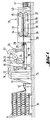
- Figure 1 schematically shows a production line of composite plates which includes, upstream, at least one creel 10 to several stages on which are arranged a multiplicity of windings of co-mixed yarns 11.
- the yarns extracted from these windings are guided and assembled by different parts before entering a cutting machine 12.
- the cut threads are collected and transferred by means of a tape conveyor 13 in a storage silo 14.
- This chimney 17 equipped with a metering device, distributes the cut wires in the form of a first ply 18 on a moving conveyor 19.
- a barrel device 20 Downstream of the chimney 17 and above the conveyor 19 is installed a barrel device 20 provided with two free axes in rotation and supporting two rolls of fabrics 21 and 22, formed of co-mixed threads.
- a strip of fabric 23, extracted from the roller 21, is applied by means of a device 24 on the ply 18.
- the device 20 pivots 180 ° in order to continue the unwinding of a strip of fabric from the roll 22.
- a fabric accumulator and a device ensuring the positioning of the strip 23 are located between the barrel 20 and the device 24.
- a second chimney 25 Downstream of the device 20 is installed a second chimney 25, also supplied with cut wires thanks to a perforated drum capacitor 26 connected by a conduit 27 to the silo 14.
- This "sandwich" formed of a strip of fabric of mixed threads taken between two layers of co-mixed cut yarn, is introduced into a preheating 30.
- This oven heats this sandwich to a temperature higher than the melting point of the thermoplastic organic material from which part of the filaments mixed with glass filaments are formed.
- This heat treatment can be carried out, for example, by means of hot air.
- the sandwich thus heated then enters a press 31 of a type known, for example, such as that described in US-A-4,277,531.
- This press essentially comprises two bands 32 and 33, moulted respectively by the rollers 34, 35 for the first, 36 and 37 for the second. Rollers 34 and 36 are heated, rollers 35 and 37 are cooled. It also includes, between these two pairs of rollers, two areas in which the sandwich is compressed on both sides and trained.
- the pressing means contribute to the heating the sandwich to a temperature higher than the temperature of melting of the thermoplastic organic material; in the second zone 39, the pressing means fulfill a cooling function which is supplemented by the action of rollers 35 and 37.
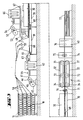
- Figure 2 shows schematically a production line of composite plates according to a second embodiment of the invention.
- a creel 10 on which are arranged a multiplicity of co-mixed son windings 11, is located at start of the line.
- These wires also feed a cutting machine 12.
- the wires cut by this means are collected and transferred by tape conveyor 42 to the top of a hopper 43, disposed above a conveyor 19 in motion.
- a barrel device 44 Upstream of this conveyor is installed a barrel device 44 provided with two free axes in rotation and supporting two rolls of fabric 45 and 46, made up of mixed threads.
- the hopper 43 which stores a sufficient amount of wire to work on the cutting machine without interrupt manufacturing, is used to feed, through strips conveyors 48 and 49, a tablecloth chimney 50. The latter delivers a sheet of cut threads 51 on the moving strip 47.
- a second barrel device 52 Downstream of the chimney 50 is located, above the conveyor, a second barrel device 52 provided with two free rotating axes which support two rolls of fabric 53 and 54, also formed of co-mixed threads.
- a strip of fabric 55 is extracted from the roller 53 and is applied to the sheet 51, at the outlet of the chimney 50, by means of a device 56.
- a tissue accumulator and a device ensuring the positioning of the fabric strip are located between the barrel 44 and the upstream part of the conveyor 19, and between the barrel 52 and device 56 (see Figure 3).
- This "sandwich” formed of a sheet of cut threads caught between two strips of fabric, is, as before, introduced into a preheating 30 before entering a press 31 identical to that described in the context of the first embodiment of the invention.
- the plaque rigid which comes out, is cut by a cutter device 40 in the form of plates 57.
- Figure 3 schematically shows a production line of composite plates according to a third embodiment of the invention.
- a creel 10 on which are arranged a multiplicity of windings 11 of co-mixed wires, is installed upstream of the line. These wires are extracted from the windings 11 then guided and united by different devices to form wicks 58.
- This line also includes two barrel devices 44 and 52 which support rolls of fabric made up of implanted co-mixed threads, as on the line shown in Figure 2, upstream and downstream of the devices 59 of distribution of wicks.
- a first strip of fabric 61 made up of mixed threads, is unwound constant tension of the roller 46.
- This strip passes through an accumulator of fabric 62, then in a rotary frame 63 equipped with a selvedge detector which allows to position it precisely before said strip comes in contact with the conveyor 19.
- the barrel 44 pivots in order to place the roll 45 in the unwinding position.
- the end of the strip 61 is stopped at the device 64 the time necessary to sew it with the beginning of the strip of the roll 45.
- the reserve 62 during this time ensures the supply of fabric to the line.
- a second strip of fabric 65 is deposited on the sheet of wicks 58 which have themselves been deposited on the strip of fabric 61.
- This strip 65 is unwound at constant tension from the roller 54; it passes through a tissue accumulator 66, then after a return 67, in a rotary frame 68 equipped with a selvedge detector which makes it possible to positioning said strip with precision with respect to strip 61 and the ply wicks 58.
- the sandwich 69 formed by the sheet of wicks 58 and the strips 61 and 65, enters a hot air oven 30 supported by a perforated strip 70 and not very adhesive, for example a glass grid coated with PTFE. During the crossing this oven, the sandwich 69 is brought to a temperature above the melting point of the thermoplastic organic material. To the output from the oven, the volume of the sandwich is reduced by compressing it slightly between the rollers 71.
- the sandwich enters then in a press 31 equipped with two bands 32 and 33 in which it is brought to a temperature higher than the melting temperature of the thermoplastic organic material.
- this press is equipped a pair of rollers 72 and 73 which are heated. These rollers compress also the sandwich and help eliminate the air that still remains there.
- Press 31 exits a rigid, cooled strip which passes through a device 74, equipped with saws 75 which eliminate the selvedges of said strip.
- this band is cut transversely by cutter 40, controlled automatically by call rollers 76 adjusted to obtain plates 77 of a determined length.
- this or that device can be replaced by another device which generally fulfills the same function.
- the press 31 could be replaced by a calender equipped of several pairs of cylinders ensuring a progressive decrease in the temperature of the sandwich, or by a grille formed by a single pair of thermostated cylinders followed by double bands ensuring movement and cooling of said sandwich.
- the method according to the invention and its implementation described above allow continuous production of composite plates, the wire content of glass can reach and exceed 60% by weight.
- composite plates have been produced in the following conditions using a production line as illustrated by figure 3.
- the fabrics used have a balanced twill 2 bond 2 weave of 650 g / m2 comprising 4 rovings identical in chain and weft. These rovings have 800 glass filaments with an average diameter of 17 micrometers and 800 polypropylene filaments with an average diameter of 22 micrometers.
- the sheet of cut co-mixed threads is formed from the same rovings.
- a first strip of fabric (61), 1.4 meters wide, is unrolled and deposited on the conveyor (19) which moves at a speed of 2 meters per minute.
- a second strip of fabric (65) is unrolled and deposited on the tablecloth thus formed.
- the sandwich (69) thus formed passes into the oven (30) heated to 200 ° C by means of a circulation of hot air.
- the sandwich (69) is compressed using two rollers (71) cooled with water.
- the sandwich whose thickness is then about 5 millimeters thick, enters the belt press (31).
- the sandwich In the first area of this press, between the pairs of rollers (34, 36) and (72, 73) which are heated, the sandwich is brought to a temperature of the order of 230 ° C.
- the sandwich In the second area of this press, between the pairs of rollers (72, 73) and (35, 37), the latter being cooled, the sandwich is gradually cooled up to a temperature of around 30 ° C.
- the sandwich is subjected to a pressure of the order of 1.5 bar. He comes out of the press (31) a flat product whose thickness is approximately 3 millimeters, which is notched and then cut into the form of plates. One meter plate square weighs about 4.2 kilograms.
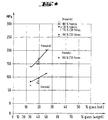
- the products, the glass content of which is limited to 50% by weight, are obtained by continuous manufacturing methods of the prior art; those whose glass content is equal to 60% by weight are obtained by the process according to the invention.
- the continuous manufacturing processes of the prior art combine by heating and compression of glass strands and polypropylene films.
- These glass strands can be present in the final product either under the form of a mat of chopped strands (symbol X), or in the form of a mat of strands continuous (symbol 0,.).
- the values of the breaking strengths of the products obtained according to the present invention also relates to manufactured products only from fabrics, themselves exclusively made up of mixed threads, only products made only from cut mixed yarn (C 33 - length 33 millimeters) and mixed products such as the one whose manufacturing has been described, by way of example, previously (30% fabrics; 70 % son C 38).
- the products obtained by the process according to the invention are particularly well suited for obtaining by molding or by stamping complex shaped parts such as, for example, the very large number of parts composites used in the design and manufacture of vehicles automobiles.
- complex products combining fabrics and cut or continuous combine both the good distribution of the reinforcement in a mold of complex shape and the high mechanical properties that are required for the part produced.
Landscapes
- Engineering & Computer Science (AREA)
- Textile Engineering (AREA)
- Chemical & Material Sciences (AREA)
- Mechanical Engineering (AREA)
- Inorganic Chemistry (AREA)
- Composite Materials (AREA)
- Reinforced Plastic Materials (AREA)
- Laminated Bodies (AREA)
- Yarns And Mechanical Finishing Of Yarns Or Ropes (AREA)
- Nonwoven Fabrics (AREA)
- Moulding By Coating Moulds (AREA)
- Compositions Of Macromolecular Compounds (AREA)
Applications Claiming Priority (3)
| Application Number | Priority Date | Filing Date | Title |
|---|---|---|---|
| FR9600578A FR2743822B1 (fr) | 1996-01-19 | 1996-01-19 | Procede et dispositif de fabrication d'un materiau composite |
| FR9600578 | 1996-01-19 | ||
| PCT/FR1997/000101 WO1997026397A2 (fr) | 1996-01-19 | 1997-01-17 | Procede et dispositif de fabrication d'un materiau composite |
Publications (2)
| Publication Number | Publication Date |
|---|---|
| EP0815307A2 EP0815307A2 (fr) | 1998-01-07 |
| EP0815307B1 true EP0815307B1 (fr) | 2001-03-21 |
Family
ID=9488253
Family Applications (1)
| Application Number | Title | Priority Date | Filing Date |
|---|---|---|---|
| EP97901119A Expired - Lifetime EP0815307B1 (fr) | 1996-01-19 | 1997-01-17 | Procede et dispositif de fabrication d'un materiau composite |
Country Status (24)
| Country | Link |
|---|---|
| US (1) | US7005024B2 (cs) |
| EP (1) | EP0815307B1 (cs) |
| JP (1) | JPH11502274A (cs) |
| KR (1) | KR100410712B1 (cs) |
| CN (1) | CN1086007C (cs) |
| AR (1) | AR005467A1 (cs) |
| AT (1) | ATE199947T1 (cs) |
| AU (1) | AU705872B2 (cs) |
| BR (1) | BR9704627A (cs) |
| CA (1) | CA2215491C (cs) |
| CZ (1) | CZ296304B6 (cs) |
| DE (1) | DE69704302T2 (cs) |
| DK (1) | DK0815307T3 (cs) |
| ES (1) | ES2157059T3 (cs) |
| FR (1) | FR2743822B1 (cs) |
| MX (1) | MX9707122A (cs) |
| NO (1) | NO313205B1 (cs) |
| NZ (1) | NZ326389A (cs) |
| PL (1) | PL183409B1 (cs) |
| RU (1) | RU2178027C2 (cs) |
| SK (1) | SK285063B6 (cs) |
| TW (1) | TW349905B (cs) |
| UA (1) | UA54387C2 (cs) |
| WO (1) | WO1997026397A2 (cs) |
Cited By (1)
| Publication number | Priority date | Publication date | Assignee | Title |
|---|---|---|---|---|
| FR2862316A1 (fr) * | 2003-11-17 | 2005-05-20 | Gilbert Chomarat | Produit de renforcement a base de fibres, et procede pour sa realisation |
Families Citing this family (40)
| Publication number | Priority date | Publication date | Assignee | Title |
|---|---|---|---|---|
| US6010785A (en) * | 1998-02-25 | 2000-01-04 | E. I. Du Pont De Nemours And Company | Cardable blends of dual glass fibers |
| FR2784931B1 (fr) * | 1998-10-23 | 2001-02-09 | Vetrotex France Sa | Procede de fabrication d'un ruban composite forme de fibres de renforcement et de matiere organique thermoplastique |
| FR2797892B1 (fr) * | 1999-08-27 | 2002-08-30 | Vetrotex France Sa | Procede et dispositif de fabrication de plaques composites |
| CA2304403A1 (fr) * | 1999-10-20 | 2001-04-20 | Jean-Paul Debalme | Procede de fabrication d'un ruban composite forme de fibres de renforcement et de matiere organique thermoplastique |
| DK173918B1 (da) * | 2000-02-17 | 2002-02-18 | Thermo Comp Aps | Fremgangsmåde og apparat til fremstilling af kompositplader |
| DE10105813A1 (de) * | 2001-02-08 | 2002-08-14 | Quadrant Plastic Composites Ag | Verfahren zur Herstellung eines thermoplastisch verformbaren, faserverstärkten Halbzeugs |
| FR2821631B1 (fr) * | 2001-03-01 | 2003-09-19 | Saint Gobain Vetrotex | Procede et dispositif de fabrication d'une plaque composite a renfort fibreux multiaxial |
| DE10114553A1 (de) * | 2001-03-24 | 2002-09-26 | Quadrant Plastic Composites Ag | Verfahren zur Herstellung eines dicken, thermoplastisch verformbaren, faserverstärkten Halbzeugs |
| FR2823510B1 (fr) * | 2001-04-11 | 2003-06-06 | Saint Gobain Vetrotex | Procede, installation de fabrication de mats et utilisation associee |
| AU2003218143A1 (en) * | 2002-03-13 | 2003-09-29 | Ppg Industries Ohio, Inc. | Fiber glass product incorporating string binders |
| FR2861749B1 (fr) * | 2003-11-03 | 2005-12-16 | Saint Gobain Vetrotex | Mat deformable a renfort fibreux pour la fabrication de composites a matrice thermoplastique |
| JP4939399B2 (ja) * | 2004-04-08 | 2012-05-23 | エムス−ヒエミー アーゲー | 製紙機械用プレスフェルト、および前記フェルトの製造方法ならびに製造装置 |
| DE202004007400U1 (de) * | 2004-05-08 | 2004-08-05 | Quadrant Ip Ag | Flächiges Halbzeug |
| FR2877955B1 (fr) * | 2004-11-16 | 2007-03-02 | Gilbert Chomarat | Produit de renforcement aere et procede pour sa realisation |
| US7429305B2 (en) * | 2004-12-08 | 2008-09-30 | Hossein Borazghi | Process and machine for producing lightweight thermoplastic composite products in a continuous manner |
| WO2006105682A1 (de) * | 2005-04-05 | 2006-10-12 | Quadrant Plastic Composites Ag | Verfahren zur herstellung eines thermoplastisch verformbaren faserverstärskten halbzeugs |
| US20060245830A1 (en) * | 2005-04-27 | 2006-11-02 | Jon Woolstencroft | Reinforcement membrane and methods of manufacture and use |
| US20060257678A1 (en) * | 2005-05-10 | 2006-11-16 | Benson Olester Jr | Fiber reinforced optical films |
| US20060255486A1 (en) * | 2005-05-10 | 2006-11-16 | Benson Olester Jr | Method of manufacturing composite optical body containing inorganic fibers |
| US20070153162A1 (en) * | 2005-12-30 | 2007-07-05 | Wright Robin E | Reinforced reflective polarizer films |
| US20070237938A1 (en) * | 2006-03-31 | 2007-10-11 | 3M Innovative Properties Company | Reinforced Optical Films |
| US20070236938A1 (en) * | 2006-03-31 | 2007-10-11 | 3M Innovative Properties Company | Structured Composite Optical Films |
| US20070236939A1 (en) * | 2006-03-31 | 2007-10-11 | 3M Innovative Properties Company | Structured Composite Optical Films |
| EP2338666B1 (en) * | 2009-12-22 | 2013-07-03 | Eurocopter Deutschland GmbH | Semi-finished product and preform used to manufacture a part made form composite material |
| CN102978830B (zh) * | 2011-09-02 | 2016-04-06 | 上海杰事杰新材料(集团)股份有限公司 | 一种玻璃纤维/阻燃丙纶纤维轻质复合板材及其制备方法 |
| RU2494953C1 (ru) * | 2012-04-24 | 2013-10-10 | Федеральное государственное бюджетное образовательное учреждение высшего профессионального образования "Московский государственный технологический университет "СТАНКИН" (ФГБОУ ВПО МГТУ "СТАНКИН") | Способ подачи армирующих волокон для технологических линий непрерывного изготовления изделий из полимерных композиционных материалов |
| CH706511A1 (de) * | 2012-05-15 | 2013-11-15 | Bba Innova Ag | Verfahren zur Herstellung von Pulver aus einem körnigeren, thermoplastischen Material und Vorrichtung zur Herstellung von Chips aus einem pulverförmigen, thermoplastischen Material. |
| KR101442735B1 (ko) * | 2013-07-04 | 2014-09-25 | 주식회사 라지 | 열가소성 필름-연속섬유 복합체 제조장치 |
| KR101626305B1 (ko) * | 2014-02-03 | 2016-06-01 | 한화첨단소재 주식회사 | 연속 편조 섬유강화 열가소성 복합재료의 성형장치 및 방법 |
| KR101657579B1 (ko) * | 2014-12-31 | 2016-09-19 | 한국항공우주산업 주식회사 | 항공기 보강재용 원자재의 성형 장치 |
| US11534991B2 (en) * | 2015-07-08 | 2022-12-27 | Johns Manville | System for producing a fully impregnated thermoplastic prepreg |
| US12319016B2 (en) | 2015-07-08 | 2025-06-03 | Johns Manville | System for producing a fully impregnated thermoplastic prepreg |
| US10220601B2 (en) * | 2016-03-01 | 2019-03-05 | Talon Technologies, Inc. | Multi-feed system |
| FR3067961B1 (fr) | 2017-06-22 | 2020-11-06 | Arkema France | Procede de fabrication d'un materiau fibreux impregne de polymere thermoplastique |
| KR102002403B1 (ko) * | 2017-08-11 | 2019-07-23 | 주식회사 캠스 | 빔 제조방법 |
| US10717245B2 (en) * | 2018-04-03 | 2020-07-21 | Johns Manville | System for producing a fully impregnated thermoplastic prepreg |
| FR3085127B1 (fr) | 2018-08-22 | 2020-11-13 | Faurecia Automotive Ind | Procede de fabrication d'un precurseur d'une peau composite pour piece structurelle et methode de fabrication de ladite piece structurelle |
| CN109176725A (zh) * | 2018-11-01 | 2019-01-11 | 盐城市华森机械有限公司 | 一种植绒复合材料自动冲切成型生产线 |
| CN111455560B (zh) * | 2020-04-27 | 2022-07-05 | 邵庆河 | 一种智能化的纸尿裤棉絮加工设备 |
| KR102886078B1 (ko) * | 2023-11-24 | 2025-11-17 | 주식회사 라지 | 자기강화복합소재 제직기용 절단장치 |
Family Cites Families (26)
| Publication number | Priority date | Publication date | Assignee | Title |
|---|---|---|---|---|
| US2543101A (en) * | 1944-07-20 | 1951-02-27 | American Viscose Corp | Composite fibrous products and method of making them |
| GB1200342A (en) * | 1967-06-02 | 1970-07-29 | Ici Ltd | Reinforcing thermoplastic materials |
| US3873388A (en) * | 1972-04-21 | 1975-03-25 | Hunter Mildred B | Mattress pad and method and apparatus for constructing the same |
| US4129675A (en) * | 1977-12-14 | 1978-12-12 | E. I. Du Pont De Nemours And Company | Product comprising blend of hollow polyester fiber and crimped polyester binder fiber |
| JPS5577525A (en) * | 1978-12-04 | 1980-06-11 | Ppg Industries Inc | Method of laminating glass fiber reinforcing thermal plastic resin |
| US4277531A (en) * | 1979-08-06 | 1981-07-07 | Ppg Industries, Inc. | High strength fiber glass reinforced thermoplastic sheets and method of manufacturing same involving a reverse barb needling procedure |
| US4410385A (en) * | 1981-01-28 | 1983-10-18 | General Electric Company | Method of making a composite article |
| DE3206072A1 (de) * | 1981-02-26 | 1982-10-14 | Fothergill & Harvey Ltd., Littleborough, Lancashire | Verfahren zur herstellung gewebter schichtstoffe |
| US4818318A (en) * | 1984-03-15 | 1989-04-04 | Hoechst Celanese Corp. | Method of forming composite fiber blends |
| CA1277188C (en) * | 1984-11-19 | 1990-12-04 | James E. O'connor | Fiber reinforced thermoplastic articles and process for the preparationthereof |
| DE3540389C1 (de) * | 1985-11-14 | 1991-09-26 | Santrade Ltd | Vorrichtung zur Herstellung von glasmattenverstaerkten Thermoplasten |
| US5201979A (en) * | 1987-05-08 | 1993-04-13 | Research Association For New Technology Development Of High Performance Polymer | Method of manufacturing a sheet-prepreg reinforced with fibers |
| GB8822521D0 (en) * | 1988-09-26 | 1988-11-02 | Tech Textiles Ltd | Method of producing formable composite material |
| US5021289A (en) * | 1988-11-15 | 1991-06-04 | Eastman Kodak Company | Reinforced polymeric sheet material |
| US5149391A (en) * | 1988-12-09 | 1992-09-22 | Allied-Signal Inc. | Prepreg machine with a single endless conveyor belt |
| DE3904813A1 (de) * | 1989-02-17 | 1990-08-23 | Basf Ag | Faserverbundwerkstoff |
| FI84843C (fi) * | 1989-05-17 | 1992-01-27 | Ahlstroem Oy | Foerfarande foer framstaellning av fiberfoerstaerkt raomaterial foer plast. |
| NL8901844A (nl) * | 1989-07-18 | 1991-02-18 | Gen Electric | Werkwijze ter vervaardiging van met vezels gewapende laminaten van thermoplastische kunststof, alsmede onder toepassing hiervan verkregen vootbrengselen. |
| FR2664621B1 (fr) * | 1990-07-13 | 1994-08-26 | Schappe Sa | Fil hybride pour materiaux composites a matrice thermoplastique et procede pour son obtention. |
| JPH04201412A (ja) * | 1990-11-30 | 1992-07-22 | Nippon G Ii Plast Kk | 織布強化樹脂複合材 |
| US5264274A (en) * | 1991-02-04 | 1993-11-23 | Honda Giken Kogyo Kabushiki Kaisha | Thermoplastic composite material having improved toughness and method of producing same |
| US5227236A (en) * | 1991-07-29 | 1993-07-13 | Basf Aktiengesellschaft | Process for preparing thermoplastic matrix fiber-reinforced prepregs and composite structure products formed thereby |
| CA2158922C (en) * | 1993-03-24 | 2004-09-21 | Kenneth Wayne Tucker | Wet-laid sheet material and composites thereof |
| CA2122548A1 (en) * | 1993-05-25 | 1994-11-26 | George M. Kent | Reinforcing composite items with composite thermoplastic staple fibers |
| US5529826A (en) * | 1994-02-15 | 1996-06-25 | Tailor; Dilip K. | Fabric-faced thermoplastic composite panel |
| US5618364A (en) * | 1995-10-13 | 1997-04-08 | E. I. Du Pont De Nemours And Company | Process for lofty battings |
-
1996
- 1996-01-19 FR FR9600578A patent/FR2743822B1/fr not_active Expired - Fee Related
-
1997
- 1997-01-15 AR ARP970100145A patent/AR005467A1/es active IP Right Grant
- 1997-01-17 AT AT97901119T patent/ATE199947T1/de not_active IP Right Cessation
- 1997-01-17 AU AU14478/97A patent/AU705872B2/en not_active Ceased
- 1997-01-17 US US08/913,518 patent/US7005024B2/en not_active Expired - Fee Related
- 1997-01-17 PL PL97322303A patent/PL183409B1/pl not_active IP Right Cessation
- 1997-01-17 JP JP9525756A patent/JPH11502274A/ja not_active Ceased
- 1997-01-17 KR KR1019970706626A patent/KR100410712B1/ko not_active Expired - Fee Related
- 1997-01-17 ES ES97901119T patent/ES2157059T3/es not_active Expired - Lifetime
- 1997-01-17 DE DE69704302T patent/DE69704302T2/de not_active Expired - Lifetime
- 1997-01-17 EP EP97901119A patent/EP0815307B1/fr not_active Expired - Lifetime
- 1997-01-17 CZ CZ0295597A patent/CZ296304B6/cs not_active IP Right Cessation
- 1997-01-17 CA CA002215491A patent/CA2215491C/fr not_active Expired - Fee Related
- 1997-01-17 SK SK1275-97A patent/SK285063B6/sk unknown
- 1997-01-17 DK DK97901119T patent/DK0815307T3/da active
- 1997-01-17 MX MX9707122A patent/MX9707122A/es not_active IP Right Cessation
- 1997-01-17 BR BR9704627-2A patent/BR9704627A/pt not_active IP Right Cessation
- 1997-01-17 NZ NZ326389A patent/NZ326389A/xx unknown
- 1997-01-17 RU RU97117176/12A patent/RU2178027C2/ru not_active IP Right Cessation
- 1997-01-17 WO PCT/FR1997/000101 patent/WO1997026397A2/fr not_active Ceased
- 1997-01-17 CN CN97190181A patent/CN1086007C/zh not_active Expired - Fee Related
- 1997-01-17 UA UA97105082A patent/UA54387C2/uk unknown
- 1997-02-13 TW TW086101611A patent/TW349905B/zh active
- 1997-09-18 NO NO19974311A patent/NO313205B1/no unknown
Cited By (2)
| Publication number | Priority date | Publication date | Assignee | Title |
|---|---|---|---|---|
| FR2862316A1 (fr) * | 2003-11-17 | 2005-05-20 | Gilbert Chomarat | Produit de renforcement a base de fibres, et procede pour sa realisation |
| WO2005049906A1 (fr) * | 2003-11-17 | 2005-06-02 | Gilbert Chomarat | Produit de renforcement a base de fibres, et procede pour sa realisation |
Also Published As
Similar Documents
| Publication | Publication Date | Title |
|---|---|---|
| EP0815307B1 (fr) | Procede et dispositif de fabrication d'un materiau composite | |
| EP1373621B1 (fr) | Procede et dispositif de fabrication d'une plaque composite a renfort fibreux multiaxial | |
| EP1134314B2 (fr) | Produit intermédiaire composite, procédé de production d'un tel produit et utilisation à titre de matériau de moulage | |
| CA2407075C (fr) | Procede et dispositif de fabrication d'un profile composite forme de matiere organique thermoplastique renforcee par des fibres de renforcement | |
| EP0888471B1 (fr) | Procede et dispositif de fabrication de plaques composites | |
| WO2019087141A1 (fr) | Produit composite comprenant un treillis et un polymere | |
| EP1226298B1 (fr) | Procede et dispositif de fabrication de plaques composites | |
| JPH0242058B2 (cs) | ||
| EP3551413B1 (fr) | Procédé de fabrication d'un matériau thermoplastique | |
| FR2646443A1 (fr) | Feuille plastique renforcee de fibres et procede de production d'une telle feuille | |
| EP1144745B1 (fr) | Procede de fabrication d'un mat et produits obtenus | |
| EP2233624B1 (fr) | Renfort textile pour materiau composite et procede de fabrication d'un tel renfort | |
| EP3426832A1 (fr) | Armature textile lisse pour pultrusion, procédé et dispositif pour sa réalisation, et son utilisation pour la fabrication de pièces par pultrusion | |
| FR2709697A1 (fr) | Procédé et appareil pour imprégner des fibres avec des matières à viscosité élevée, et article correspondant. | |
| FR2919820A1 (fr) | Canal drainant pour composite | |
| FR2861749A1 (fr) | Mat deformable a renfort fibreux pour la fabrication de composites a matrice thermoplastique |
Legal Events
| Date | Code | Title | Description |
|---|---|---|---|
| PUAI | Public reference made under article 153(3) epc to a published international application that has entered the european phase |
Free format text: ORIGINAL CODE: 0009012 |
|
| 17P | Request for examination filed |
Effective date: 19970917 |
|
| AK | Designated contracting states |
Kind code of ref document: A2 Designated state(s): AT BE CH DE DK ES FI FR GB IT LI NL SE |
|
| GRAG | Despatch of communication of intention to grant |
Free format text: ORIGINAL CODE: EPIDOS AGRA |
|
| 17Q | First examination report despatched |
Effective date: 20000229 |
|
| GRAG | Despatch of communication of intention to grant |
Free format text: ORIGINAL CODE: EPIDOS AGRA |
|
| GRAH | Despatch of communication of intention to grant a patent |
Free format text: ORIGINAL CODE: EPIDOS IGRA |
|
| GRAH | Despatch of communication of intention to grant a patent |
Free format text: ORIGINAL CODE: EPIDOS IGRA |
|
| GRAA | (expected) grant |
Free format text: ORIGINAL CODE: 0009210 |
|
| AK | Designated contracting states |
Kind code of ref document: B1 Designated state(s): AT BE CH DE DK ES FI FR GB IT LI NL SE |
|
| REF | Corresponds to: |
Ref document number: 199947 Country of ref document: AT Date of ref document: 20010415 Kind code of ref document: T |
|
| REG | Reference to a national code |
Ref country code: CH Ref legal event code: EP |
|
| RAP2 | Party data changed (patent owner data changed or rights of a patent transferred) |
Owner name: SAINT-GOBAIN VETROTEX FRANCE |
|
| REF | Corresponds to: |
Ref document number: 69704302 Country of ref document: DE Date of ref document: 20010426 |
|
| NLT2 | Nl: modifications (of names), taken from the european patent patent bulletin |
Owner name: SAINT-GOBAIN VETROTEX FRANCE |
|
| ITF | It: translation for a ep patent filed | ||
| REG | Reference to a national code |
Ref country code: CH Ref legal event code: NV Representative=s name: KIRKER & CIE SA * KIRKER & CIE SA |
|
| GBT | Gb: translation of ep patent filed (gb section 77(6)(a)/1977) |
Effective date: 20010622 |
|
| REG | Reference to a national code |
Ref country code: DK Ref legal event code: T3 |
|
| REG | Reference to a national code |
Ref country code: ES Ref legal event code: FG2A Ref document number: 2157059 Country of ref document: ES Kind code of ref document: T3 |
|
| REG | Reference to a national code |
Ref country code: GB Ref legal event code: IF02 |
|
| PLBE | No opposition filed within time limit |
Free format text: ORIGINAL CODE: 0009261 |
|
| STAA | Information on the status of an ep patent application or granted ep patent |
Free format text: STATUS: NO OPPOSITION FILED WITHIN TIME LIMIT |
|
| 26N | No opposition filed | ||
| PGFP | Annual fee paid to national office [announced via postgrant information from national office to epo] |
Ref country code: ES Payment date: 20050211 Year of fee payment: 9 |
|
| PGFP | Annual fee paid to national office [announced via postgrant information from national office to epo] |
Ref country code: NL Payment date: 20060103 Year of fee payment: 10 |
|
| PGFP | Annual fee paid to national office [announced via postgrant information from national office to epo] |
Ref country code: SE Payment date: 20060105 Year of fee payment: 10 |
|
| PGFP | Annual fee paid to national office [announced via postgrant information from national office to epo] |
Ref country code: AT Payment date: 20060111 Year of fee payment: 10 |
|
| PGFP | Annual fee paid to national office [announced via postgrant information from national office to epo] |
Ref country code: FI Payment date: 20060112 Year of fee payment: 10 |
|
| PGFP | Annual fee paid to national office [announced via postgrant information from national office to epo] |
Ref country code: DK Payment date: 20060118 Year of fee payment: 10 |
|
| PG25 | Lapsed in a contracting state [announced via postgrant information from national office to epo] |
Ref country code: FI Free format text: LAPSE BECAUSE OF NON-PAYMENT OF DUE FEES Effective date: 20070117 |
|
| PG25 | Lapsed in a contracting state [announced via postgrant information from national office to epo] |
Ref country code: SE Free format text: LAPSE BECAUSE OF NON-PAYMENT OF DUE FEES Effective date: 20070118 |
|
| EUG | Se: european patent has lapsed | ||
| GBPC | Gb: european patent ceased through non-payment of renewal fee |
Effective date: 20070117 |
|
| NLV4 | Nl: lapsed or anulled due to non-payment of the annual fee |
Effective date: 20070801 |
|
| REG | Reference to a national code |
Ref country code: DK Ref legal event code: EBP |
|
| PG25 | Lapsed in a contracting state [announced via postgrant information from national office to epo] |
Ref country code: GB Free format text: LAPSE BECAUSE OF NON-PAYMENT OF DUE FEES Effective date: 20070117 Ref country code: AT Free format text: LAPSE BECAUSE OF NON-PAYMENT OF DUE FEES Effective date: 20070117 |
|
| PG25 | Lapsed in a contracting state [announced via postgrant information from national office to epo] |
Ref country code: NL Free format text: LAPSE BECAUSE OF NON-PAYMENT OF DUE FEES Effective date: 20070801 Ref country code: DK Free format text: LAPSE BECAUSE OF NON-PAYMENT OF DUE FEES Effective date: 20070131 |
|
| REG | Reference to a national code |
Ref country code: ES Ref legal event code: FD2A Effective date: 20070118 |
|
| PGFP | Annual fee paid to national office [announced via postgrant information from national office to epo] |
Ref country code: IT Payment date: 20080130 Year of fee payment: 12 |
|
| PG25 | Lapsed in a contracting state [announced via postgrant information from national office to epo] |
Ref country code: ES Free format text: LAPSE BECAUSE OF NON-PAYMENT OF DUE FEES Effective date: 20070118 |
|
| PGFP | Annual fee paid to national office [announced via postgrant information from national office to epo] |
Ref country code: BE Payment date: 20080124 Year of fee payment: 12 |
|
| PGFP | Annual fee paid to national office [announced via postgrant information from national office to epo] |
Ref country code: GB Payment date: 20060111 Year of fee payment: 10 |
|
| PG25 | Lapsed in a contracting state [announced via postgrant information from national office to epo] |
Ref country code: BE Free format text: LAPSE BECAUSE OF NON-PAYMENT OF DUE FEES Effective date: 20090131 |
|
| PG25 | Lapsed in a contracting state [announced via postgrant information from national office to epo] |
Ref country code: IT Free format text: LAPSE BECAUSE OF NON-PAYMENT OF DUE FEES Effective date: 20090117 |
|
| PGFP | Annual fee paid to national office [announced via postgrant information from national office to epo] |
Ref country code: CH Payment date: 20120125 Year of fee payment: 16 Ref country code: FR Payment date: 20120130 Year of fee payment: 16 |
|
| PGFP | Annual fee paid to national office [announced via postgrant information from national office to epo] |
Ref country code: DE Payment date: 20120127 Year of fee payment: 16 |
|
| REG | Reference to a national code |
Ref country code: CH Ref legal event code: PL |
|
| REG | Reference to a national code |
Ref country code: FR Ref legal event code: ST Effective date: 20130930 |
|
| PG25 | Lapsed in a contracting state [announced via postgrant information from national office to epo] |
Ref country code: DE Free format text: LAPSE BECAUSE OF NON-PAYMENT OF DUE FEES Effective date: 20130801 Ref country code: CH Free format text: LAPSE BECAUSE OF NON-PAYMENT OF DUE FEES Effective date: 20130131 Ref country code: LI Free format text: LAPSE BECAUSE OF NON-PAYMENT OF DUE FEES Effective date: 20130131 |
|
| PG25 | Lapsed in a contracting state [announced via postgrant information from national office to epo] |
Ref country code: FR Free format text: LAPSE BECAUSE OF NON-PAYMENT OF DUE FEES Effective date: 20130131 |
|
| REG | Reference to a national code |
Ref country code: DE Ref legal event code: R119 Ref document number: 69704302 Country of ref document: DE Effective date: 20130801 |