EP0814162A2 - Expression des alpha-Toxin Gens (hla) von Staphylococcus aureus unter Verwendung einer chromosomalen hla-lacZ Genfusion - Google Patents
Expression des alpha-Toxin Gens (hla) von Staphylococcus aureus unter Verwendung einer chromosomalen hla-lacZ Genfusion Download PDFInfo
- Publication number
- EP0814162A2 EP0814162A2 EP97109634A EP97109634A EP0814162A2 EP 0814162 A2 EP0814162 A2 EP 0814162A2 EP 97109634 A EP97109634 A EP 97109634A EP 97109634 A EP97109634 A EP 97109634A EP 0814162 A2 EP0814162 A2 EP 0814162A2
- Authority
- EP
- European Patent Office
- Prior art keywords
- hla
- gene
- wood
- staphylococcus aureus
- toxin
- Prior art date
- Legal status (The legal status is an assumption and is not a legal conclusion. Google has not performed a legal analysis and makes no representation as to the accuracy of the status listed.)
- Withdrawn
Links
Images





Classifications
-
- C—CHEMISTRY; METALLURGY
- C07—ORGANIC CHEMISTRY
- C07K—PEPTIDES
- C07K14/00—Peptides having more than 20 amino acids; Gastrins; Somatostatins; Melanotropins; Derivatives thereof
- C07K14/195—Peptides having more than 20 amino acids; Gastrins; Somatostatins; Melanotropins; Derivatives thereof from bacteria
- C07K14/305—Peptides having more than 20 amino acids; Gastrins; Somatostatins; Melanotropins; Derivatives thereof from bacteria from Micrococcaceae (F)
- C07K14/31—Peptides having more than 20 amino acids; Gastrins; Somatostatins; Melanotropins; Derivatives thereof from bacteria from Micrococcaceae (F) from Staphylococcus (G)
-
- C—CHEMISTRY; METALLURGY
- C07—ORGANIC CHEMISTRY
- C07K—PEPTIDES
- C07K2319/00—Fusion polypeptide
Definitions
- Staphylococcus aureus is an important pathogenic bacterium, which causes a variety of human infectious diseases, including endocarditis, osteomyelitis, dermonecrosis, skin abcesses and pneumonia (49, 68, 70).
- the organism produces a large number of extracellular and cell associated proteins, many of which are involved in pathogenesis, such as alpha-, beta-, gamma-, delta-toxin, leukocidin, toxic shock syndrome toxin (TSST), enterotoxins, coagulase, protein A, fibrinogen-, fibronectin binding protein and others (2, 32, 34).
- the alpha-toxin ( hla ) is one of the major virulence factors of Staphylococcus aureus and is produced by the majority of the strains (44).
- the protein is a pore forming toxin and has cytolytic, hemolytic, dermonecrotic and lethal activities.
- a wide range of celltypes is affected by ⁇ -toxin, including erythrocytes, monocytes, lymphocytes, macrophages, epithelial cells, fibroblasts and kera- tinocytes (7, 8, 9, 69).
- Staphylococcal ⁇ -toxin is secreted as a water-soluble single chain polypeptide of 34 kDa (8).
- ⁇ -toxin interacts with target cells; (i) it can bind to specific, high affinity receptors of unknown structure on the cell surface of human platelets, monocytes, endothelial cells, rabbit erythrocytes and others or (ii) it can interact unspecifically by ad-sorption to lipid bilayers. In both cases, six molecules aggregate to form a hexameric trans- membrane channel of 1-2 nm diameter.
- ⁇ -toxin is not expressed constitutively, but rather its production is regulated by an array of extracellular and intracellular signals.
- the bacteria are able to sense surrounding environmental signals such as temperature, pH, nutrition, oxygen, osmolarity, CO 2 , host factors and others, and respond by activating specific genes.
- the best investigated global regulatory system is the accessory gene regulator ( agr ), which contributes to the postexponential growth phase re-gulation of a number of unlinked genes.
- exoproteins including ⁇ -toxin
- cell surface proteins are downregulated (1, 2, 34, 37).
- exoprotein regulator xpr
- staphylococcal accessory regulator sar
- Supplementary regulatory mechanisms may be involved in ⁇ -toxin expression. For instance a separate temporal signal independent of agr is required for hla but not protein A ( spa ) transcription (66).
- S. aureus infections are usually treated with antibiotics. It is known that low doses of anti-biotics influence the production of various pathogenicity factors in Escherichia coli , Klebsiella pneumoniae , Pseudomonas aeruginosa , Proteus mirabilis , Streptococcus pyogenes and others (for review see 43).
- Several former reports describe an enhancing hemolytic activity caused by subinhibitory concentrations of antibiotics, especially by ⁇ -lactams, and it is supposed that these commonly applied antibiotics also elevate the ⁇ -toxin production (42, 43, 67). Recently, it has been shown that the ⁇ -lactam nafcillin induces ⁇ -toxin production in vitro and also increases the lethal activity of broth filtrates in a mouse model (36).
- the agr is a polycistronic locus that encode a two-component signal transduction system.
- the central element of agr regulation is a 514 nt RNA molecule, designated RNAIII.
- RNAIII regulates exoprotein and cell surface protein production of many genes involved in pathogenicity (2, 37, 50) and acts primarily on the level of transcription and in the case of ⁇ -toxin also on the level of translation (48, 50).
- Agr negative mutants do not produce many exoproteins and also lack the production of ⁇ -toxin (37, 50).
- Coordinately regulated virulence determinants in bacteria are often controlled by environmental stimuli (27, 45).
- the temperature dependence of hla -expression showed some interesting features. Unlike other pathogenic bacteria which express virulence factors mostly at the human body temperature, e.g. E. coli P-fimbriae or S-fimbriae (25, 59), or at 30° C e.g. the cholera-toxin of Vibrio cholerae (22) or Yersinia enterocolitica enterotoxin Yst (46), staphylococcal ⁇ -toxin is optimally expressed at 42° C. In S. aureus little is known about the influence of temperature on the expression of virulence genes.
- E. coli P-fimbriae or S-fimbriae 25, 59
- staphylococcal ⁇ -toxin is optimally expressed at 42° C.
- S. aureus little is known about the influence of temperature on the expression of virulence genes.
- S. aureus is a halotolerant bacterium and can be isolated from environments that exert a high level of osmotic stress. However, this organism is also capable to grow in low osmotic con- ditions.
- the salt concentration affects the expression of virulence factors in various bacteria, such as cholera toxin, adhesins in Vibrio cholera (22), or E. coli S-fimbriae (59).
- cholera toxin adhesins in Vibrio cholera (22), or E. coli S-fimbriae (59).
- ⁇ -toxin is osmotically regulated.
- the highest level of hla transcription was observed when cultivation occured without NaCl. Similar results were obtained by Sheehan et al. (60) who investigated the S.
- aureus epi- dermolytic toxin A ( eta ).
- eta aureus epi- dermolytic toxin A
- eta aureus epi- dermolytic toxin A
- V. cholera cholera toxin (22) and E. coli S-fimbriae (59) an optimal gene expression was reported below 0.1 M NaCl. This could reflect a specific adaption of S. aureus to NaCl, which may be a common component of the habitat of this bacterium. Higher osmolarities leaded to decreased hla expression and over 1.6 M no expression was detected.
- hla expression Another physiological factor found to influence hla expression is glucose.
- the addition of glucose to the growth medium resulted in a decrease of hla expression in a concentration dependent manner.
- Regassa et al. 55, 56 have shown that the glucose effect on hla expression is a result of two cumultative effects, a decrease of RNA III, the mediator of agr, and additionally an agr independent event. They reported a 16-fold decrease of hla mRNA following cultivation in the presence of 0.1 M glucose. It remains unresolved how glucose influence RNA III and hla expression and it is speculated that it occurs at the mRNA level (56).
- hla showed a strong oxygen dependence. Under anaerobic conditions almost no hla expression was detectable. Moreover, the expression of hla was induced after cultivation on solid medium. Such an induction was observed for attachment organells, such as flagellae or fimbriae, of gram negative bacteria (5, 59). S. aureus is able to colonize a variety of tissues. The organism frequently forms abcesses on the skin. Moreover, after invasion of the skin and mucous memranes, it can enter the blood stream and spread to many organs. S. aureus can seed to heart valves, bones, joints, kidneys and other tissues (68, 70). Cultivation on solid medium was shown to enhance ⁇ -toxin expression.
- organells such as flagellae or fimbriae
- antibiotics such as vancomycin, fosfomycin and trimethoprim had a weak stimulatary effect. It remains to be elucidated whether the antibiotics directly interact with the promoter or whether they influence regulatory systems such as agr. It has recently been shown that nafcillin induces ⁇ -toxin production and also increases the lethal activity of broth filtrates in a mouse model (36). It has also been shown that regulatory mechanisms other than agr contribute to the induction of ⁇ -toxin production by nafcillin.
- One embodiment of the invention is a bacterial strain, obtainable by transforming Staphylococcus aureus Wood 46 with a hla-lacZ fusion gene using the recombinant plasmid pKO 10 carrying said fusion gene, growing the transformants overnight at about 30°C in the presence of chloramphenicol, plating the transformants onto BHI plates with chloramphenicol, incubating said plates at the non-permissive temperature of 43°C and analyzing chlormphenicol resistant colonies at the non-permissive temperature by Southern hybridization using the cloned hla -fragment as a probe upon chromosomal integration of pKO 10 into the promoter region of the hla -gene of Wood 46.
- Another embodiment is bacterial strain Staphylococcus aureus Wood 46-3.
- One embodiment of the invention is a Staphylococcus aureus strain containing a reporter gene operatively linked to the promoter of the hla-gene, preferably wherein the reporter gene is the lacZ gene.
- a further embodiment of the invention is the use of a bacterial strain to measure the hla promoter activity under different growth conditions, preferably wherein the different growth conditions are selected from the group consisting of length of growth time and phase, temperature, osmolarity, glucose concentration, solid/liquid media, oxygen and concentration of low, subinhibitory concentrations of antibiotics.
- Another embodiment of the present invention is vector pKO10.
- Another embodiment of the invention is a process for the production of Staphylococcus aureaus Wood 46-3, wherein
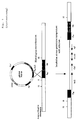
- FIG. 1 Strategy for the construction of the chromosomally encoded hla - lacZ fusion.
- the hla promoter region used to generate the transcriptional fusion was amplified by PCR. EcoRI and BamHI restriction sites were introduced to fascilate subsequently cloning.
- Fusion vector pKO 10 was first transformed into E. coli MC 4100 cells, following transformation of S. aureus RN 4220 and S. aureus Wood 46 cells. The homologous recombination was carried out like described in the text. Ampicillin resistance (Ap ) is only expressed in gram-negative species, whereas Chloramphenicol resistance (Cm r ) is expressed in gram-positive species.
- Ori is a gram-positive temperature-sensitive origin of replication from pTV 1 (ts) Restriction site abbreviations: B, BamHI ; EI, EcoRI ; EV, EcoRV ; N, Nsil .
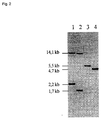
- FIG. 2 Southern blot analyses of chromosomal DNA from S. aureus wild-type Wood 46 and hla - lacZ fusion strain Wood 46-3. Chromosomal DNA was cleaved with EcoRI (Lane 1 and 3) and HindIII (Lane 2 and 4) and probed with cloned 1,1 kb EcoRI-BamHI fragment containing hla promoter region. DNA was isolated from strain Wood 46 (Lane 3 and 4) and Wood 46-3 (Lane 1 and 2). Sizes in kb are indicated.
- FIG. 3 Kinetics of transcription of a chromosomal hla - lacZ fusion. ⁇ -galactosidase activity indicated by bars is expressed in relative light units (RLU). Assays were performed as described in materials and methods. Line indicates growth as measured by optical density at 600 nm. Mean value h standard deviation of 6 experiments are given.
- FIG. 4 Temperature dependence of hla-lacZ transcription in S. aureus Wood 46-3 (A) and of hemolytic activity of Wood 46 (B). ⁇ -galactosidase activity is given as relative light units (RLU) and hemolytic activity as hemolytic units (HU). Cultures were grown at different temperatures and assays were performed as described in the text. Data are means ⁇ SD of 6 experiments.
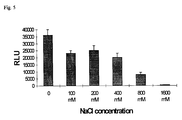
- FIG. 5 ⁇ -galactosidase production at varying osmolarities given as relative light units (RLU). Cultures were grown as described with varying NaCl concentrations. Data are means ⁇ SD of 3 experiments.
- FIG. 6 Effect of glucose on ⁇ -galactosidase production indicated as relative light units (RLU). Wood 46-3 cultures grown in LB medium without glucose and with 1 mM, 5 mM, 10 mM, 50 mM and 100 mM respectively. Mean values ⁇ SD of 3 experiments are given.
- FIG. 7 ⁇ -galactosidase production given as relative light units (RLU) by the fusion strain Wood 46-3 grown on solid or liquid medium (A) and under aerobic and anaerobic conditions on solid medium (B) as described in materials and methods. Data are means ⁇ SD of 3 experiments.
- RLU relative light units
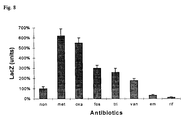
- FIG. 8 Influence of 1 ⁇ 4 sub-MIC of antibiotics on ⁇ -galactosidase (LacZ) production of the fusion strain Wood 46-3 grown in liquid medium up to postexponential phase. LacZ units are given as % values of the LacZ production after growing Wood 46-3 without antibiotics which was set as 100%. Mean ⁇ SD of 5 experiments are given. Abbreviations: met, methicillin; oxa, oxacillin; van, vancomycin; fos, fosfomycin; tri, trimethoprim; rif, rifampicin; em, erythromycin.
- FIG. 9 Northern blot analysis of samples isolated from strain S. aureus Wood 46-3 grown without (Lane 1) and with 0,5 ⁇ g/ml methicillin (Lane 2). The samples contained the same amount of total cellular RNA. Hybridization was done using a 0,7 kb Cla I intragenic hla probe.
- S. aureus Wood 46 is an ⁇ -toxin producing strain and was used to introduce a hla - lacZ gene fusion into the chromosome.
- RN4220 is a restriction negative mutant o f S. aureus 8325-4 and capable for accepting E. coli DNA (39).
- MC4100 a lac negative E. coli strain (13), was used as host strain in cloning experiments.
- pDH32M is a Bacillus subtilis integration vector, containing a promoterless lacZ gene preceded by the B. subtilis spoVG ribosome binding site (38).
- pBT1 (12) is a temperature sensitive shuttle vector and was constructed by ligating a 2,3 kb Pvull-BamHI fragment from pBR322 with a 4,0 kb Pstl (filled in by Klenow fragment) - BamHI fragment of pTV 1 (Ts) (71).
- Escherichia coli strains were grown in LB broth (57). Staphylococcus aureus strains were cultured in either brain heart infusion (BHI) (Difco, Augsburg, Germany) or LB broth. The recombinant E. coli and S. aureus clones were cultivated under selective antibiotic pressure with either ampicillin (100 ⁇ g/ml ) or chlor- amphenicol (10 ⁇ g/ml), respectively. Antibiotics were purchased from Sigma, Deisenhofen, Germany. Restriction enzymes, Klenow fragment and T4 DNA ligase were purchased from Pharmacia, Freiburg, Germany. For detection of Lac + colonies, LB plates containing 0.01% 5-bromo-4-chloro-3-indolyl-b-D-galactoside (X-gal) (GERBU, Gaiberg, Germany) were used.
- GERBU 5-bromo-4-chloro-3-indolyl-b-D-galactoside
- LB was modified in respect to its NaCl-concentrations, ranging from 0 M to 1.6 M. Temperature effects were studied at 30° C, 37° C and 42° C. Glucose was added to a final concentration of 0 M to 0.1 M. Subinhibitory concentrations of antibiotics were supplemented as listed in Table 2. Solid cultures were grown overnight on LB agar. Cultivation under anaerobic conditions was done using the anaerobic system Anaerocult (Merck, Darmstadt, Germany).
- S. aureus was transformed by electroporation (58). All plasmid constructions were done in E. coli and subsequently transferred into the restriction deficient S. aureus strain RN 4220 by electroporation prior to transforming S. aureus Wood 46.
- the alpha-toxin promoter was amplified from S. aureus Wood 46 by PCR by using the primers 5'-GTTTGATATGGAATTCCTGAA TTTTTC-3' (SEQ ID NO.: 1), generating an Eco RI -site at the beginning, and 3'-CTACTTTTACTTTTGTGC ATACCTAGGAGTCA-5' (SEQ ID NO.: 2), generating a BamHI site at the end, and consecutively cloned into pDH32M creating pKO8.
- Plasmid pKO3 was con-structed by cloning of a 3.5 kb Eco RI-Nsi l fragment of pDH32M, containing the promoterless lacZ gene into the EcoRI-EcoRV digested shuttle vector pBT1.
- Example 2 Generation of DNA probes and Southern blot analysis.
- Chromosomal DNA was prepared from cells grown overnight in BHI by a method of Pospiech and Neumann (53). The protocol was modified by substituting lysozyme by 50 ⁇ g/ml lysostaphin . Following its digestion with restriction endonucleases, the resulting fragments were seperated by electrophoresis using a 0.8 % agarose gel. The Southern transfer of the DNA to a Biodyne B membrane (Pall, Portsmouth, U.K.) was performed using a vacuum blot apparatus (Vacu Gene, Pharmacia, Freiburg, Germany) .
- the gel was submerged successively in depurination (0.25 M HCl), denaturation (0.5M NaOH, 1.5 M NaCl), and neutralization (0.5M Tris-HCl pH 8.0, 1.5 M NaCl) solutions for 8 min and 20xSSC (SSC; 0.15M NaCl, 0.015 M sodium citrate, pH 7.0) for 40 min.
- the blotted DNA was crosslinked on the filter using a GS Gene Linker UV chamber (Biorad, Richmond, Calif.).
- GS Gene Linker UV chamber Biorad, Richmond, Calif.
- the cloned 1.1 kb Eco RI-BamHI fragment containing hla -promoter was used as a DNA probe.
- the hybridization was carried out using an ECL direct nucleic acid labelling and detection system from Amersham according to the manufacture's instructions (Amersham, Braunschweig, Germany).
- Example 3 Extraction of RNA and DNA-RNA hybridization.
- RNA was prepared by using a RNeasy-kit (Qiagen, Hillen, Germany). For Northern blot analysis samples with the same amount of total cellular RNA, determined by measuring the A 260 , were electrophoresed and transferred to Biodyne B nylon membrane (Pall, Portsmouth, U.K.) as described (3). The probe, a 722 nt intragenic Clal fragment (26) from the hla gene, was labelled using an ECL- kit from Amersham (Amersham, Braunschweig, Germany) and the hybridization was per- formed according to the manufacture's instructions.
- Example 4 SDS-PAGE and immunoblotting.
- SDS-PAGE was performed as described by Laemmli using discontinous 12.5 % acrylamid gels (41).
- proteins were transferred to nylon membrane by semidry electroblotting in a graphite chamber according to the method described by Kyhse-Anderson (40).
- blocking occured using 5% bovine serum albumin (BSA) (GERBU, Gaiberg, Germany) in TBS for 1 h.
- BSA bovine serum albumin
- the filters were then incubated for 1 h with a polyclonal anti-alpha-toxin antibody in TBS containing 0.05% Tween 20 (Sigma, Deisenhofen, Germany), following a 1 h-incubation with HRP-conjugated anti-rabbit Antiserum (DAKO, Hamburg, Germany) diluted 1:1000. Blots were developed using 4-chloro-1-naphtol and hydrogen peroxide.
- Example 5 ⁇ -Galactosidase tests.
- ⁇ -Galactosidase assays were performed using a Galacto light TM chemiluminescent reporter assay system (Tropix, Bedford, Mass.). After cultivation described above bacterial cells were harvested, washed and resuspended in 0.9% NaCl. The cell sus- pension was adjusted to an OD 600 of 1.0. 0.5 ml of this suspension were centrifuged (8000 rpm, 10 min) and the cell pellet was resuspended in lysis buffer (0.01 M potassium phosphate buffer pH 7.8 ; 0.015M EDTA, 1 % Triton X-100, 50 ⁇ g/ml lysostaphin) and incubated at 37°C for 15 min.
- lysis buffer (0.01 M potassium phosphate buffer pH 7.8 ; 0.015M EDTA, 1 % Triton X-100, 50 ⁇ g/ml lysostaphin
- ⁇ -galactosidase activity was measured by a luminometer LB 9501 (Berthold, Wildbad, Germany) with a 300 ⁇ l automatic injector and using a 5 second integral.
- Example 6 Assays of hemolytic activity.
- Antibiotics The antibiotics used are listed in Table 2.
- Example 7 Construction of the wild-type hla - lacZ fusion in S. aureus Wood 46-3.
- the construction of the transcriptional fusion strain Wood 46-3 is indicated in Fig. 1.
- the recombinant plasmid pKO 10, carrying the hla-lacZ fusion (see materials and methods) was transformed into S. aureus Wood 46.
- Transformants were grown overnight at 30 °C in the presence of chloramphenicol to generate a population of plasmid-bearing cells.
- Serial dilutions of this culture were plated onto BHI plates with chloramphenicol and incubated at the non-permissive temperature of 43°C.
- Example 8 Influence of the length of growth time and phase on the expression of hla .
- the ⁇ -galactosidase activity was about 520 RLU and increased slowly during the log-phase (3800 RLU after 5 h). However, at the end of the log-phase and at the early stationary phase the ⁇ -galactosidase activity increased from 3800 RLU after 5 h to 19500 RLU after 6 h. During the following four hours the ⁇ -galactosidase level increased only slightly and was maintained on a high level. Subsequently (after 14 h and 18 h) a decrease of the ⁇ -galactosidase activity was detected, and after 24 h the level reached 4800 RLU.
- Example 9 Influence of the temperature on the expression of the hla gene.
- the influence of the temperature on the expression of the hla-lacZ in S. aureus Wood 46-3 was also determined. As shown in Fig. 4 A, ⁇ -toxin production was influenced by temperature. Surprisingly, op- timal expression of ⁇ -galactosidase, representing hla -expression, was obtained at 42 ° C. A significant increase of the ⁇ -galactosidase level was measured after cultivation of Wood 46-3 at 42° C (18400 RLU at 37° C cultivation versus 57100 RLU at 42 ° C). At 30 ° C the ⁇ -galactosidase activity was only one third compared to 37°C.
- Example 10 Influence of the temperature on the hemolytic activity of Wood 46.
- the hemolytic activity of supernatants was measured following growth at 30° C, 37° C and 42° C. As indicated in Fig. 4 B, the hemolytic activity was highest when growth occured at 42° C; 538 HU). Lower temperatures leaded to a decreased hemolytic activity (181 HU at 37° C and 64 HU at 30° C).
- Example 11 Influence of the osmolarity.
- Wood 46-3 was grown in LB broth containing different amounts of sodium chloride (see materials and methods). Although S. aureus is a halotolerant, the cultures grew more slowly at higher osmotic strength (above 0.2 M). The samples were taken for every osmolarity postexponentially and equal numbers of cells were assayed. As indicated in Fig. 5 the highest level of expression was observed after cultivation in LB lacking NaCl. Cultivation with 0.1 M NaCl leaded to decreased ⁇ -galactosidase production, while 0.2 M slightly increased the ⁇ -galactosidase production again. Further increasing amounts of NaCl decreased the hla dependent ⁇ -galactosidase production. At 0.8 M only 7800 RLU were measured and concentrations of NaCl above 1.6 M were inhibitory for hla expression.
- Example 12 Influence of glucose.
- Example 13 Influence of solid and liquid media.
- the S. aureus strain Wood 46-3 carrying a transcriptionally hla-lacZ fusion on its chromosome was used to determine the influence of subinhibitory concentrations of antibiotics on the hla expression.
- a chloramphenicol resistance gene was introduced into the chromosome of strain Wood 46.
- MIC minimal inhibitory concentration
- the hla-lacZ containing strain was grown in LB broth with a quarter of the MIC values until they reached the postexponential growth phase.
- S. aureus strain Wood 46-3 grown without antibiotic. This value was set as 100 %.
- the ⁇ -lactam antibiotics methicillin and oxacillin had a dramatic effect on the ⁇ -galactosidase production.
- a sixfold increase of the ⁇ -galactosidase activity was obtained following cultivation in medium containing methicillin compared to cultivation in medium without antibiotic (28000 RLU grown without antibiotic and 167000 RLU grown with methicillin).
- Oxacillin exhibited comparable ⁇ -galactosidase values (158000 RLU versus 28000 RLU).
- a Northern blot analysis of samples prepared from Wood 46 WT cultures grown without and with 0.5 ⁇ g/ml methicillin was performed. A greater amount of hla mRNA was detected by Northern hybridization when cultures were grown in methicillin containing medium than when they were grown without this antibiotic (Fig. 9).
- Antibiotica source
- MIC ⁇ g/ml for strain Wood 46-3 1 Methicillin (Sigma, Deisenhofen, Germany) 2 2 Oxacillin ( Sigma, Deisenhofen, Germany) 0,25 3 Fosfomycin (Madaus, GmbH, Germany) 0,25 4 Trimethoprim (Sigma, Deisenhofen, 0,25 5 Germany) 1 6 Vancomycin (Sigma, Deisenhofen, 1 7 Germany) Erythromycin (Sigma, Deisenhofen, Germany 0,008 Rifampicin (Sigma, Deisenhofen, Germany)
Landscapes
- Chemical & Material Sciences (AREA)
- Organic Chemistry (AREA)
- Health & Medical Sciences (AREA)
- General Health & Medical Sciences (AREA)
- Biochemistry (AREA)
- Biophysics (AREA)
- Life Sciences & Earth Sciences (AREA)
- Genetics & Genomics (AREA)
- Medicinal Chemistry (AREA)
- Molecular Biology (AREA)
- Proteomics, Peptides & Aminoacids (AREA)
- Gastroenterology & Hepatology (AREA)
- Micro-Organisms Or Cultivation Processes Thereof (AREA)
- Measuring Or Testing Involving Enzymes Or Micro-Organisms (AREA)
- Medicines Containing Antibodies Or Antigens For Use As Internal Diagnostic Agents (AREA)
Applications Claiming Priority (2)
| Application Number | Priority Date | Filing Date | Title |
|---|---|---|---|
| EP96110045 | 1996-06-21 | ||
| EP96110045 | 1996-06-21 |
Publications (2)
| Publication Number | Publication Date |
|---|---|
| EP0814162A2 true EP0814162A2 (de) | 1997-12-29 |
| EP0814162A3 EP0814162A3 (de) | 1999-05-12 |
Family
ID=8222917
Family Applications (1)
| Application Number | Title | Priority Date | Filing Date |
|---|---|---|---|
| EP97109634A Withdrawn EP0814162A3 (de) | 1996-06-21 | 1997-06-13 | Expression des alpha-Toxin Gens (hla) von Staphylococcus aureus unter Verwendung einer chromosomalen hla-lacZ Genfusion |
Country Status (3)
| Country | Link |
|---|---|
| EP (1) | EP0814162A3 (de) |
| JP (1) | JPH1080287A (de) |
| CA (1) | CA2208724A1 (de) |
Cited By (2)
| Publication number | Priority date | Publication date | Assignee | Title |
|---|---|---|---|---|
| ES2200705A1 (es) * | 2002-08-14 | 2004-03-01 | Newbiotechnic Sa | Elemento regulador que activa la expresion genica en condiciones de baja tension de oxigeno y represion por glucosa. |
| CN110651043A (zh) * | 2017-06-07 | 2020-01-03 | 天野酶制品株式会社 | 乳糖酶原料粉末和乳糖酶制剂 |
Families Citing this family (2)
| Publication number | Priority date | Publication date | Assignee | Title |
|---|---|---|---|---|
| JP6478375B2 (ja) * | 2014-08-01 | 2019-03-06 | 国立研究開発法人産業技術総合研究所 | 高発現プロモーター遺伝子 |
| CN110628799A (zh) * | 2019-10-09 | 2019-12-31 | 武汉博欧特生物科技有限公司 | 一种细菌启动子报告载体的构建方法及其应用 |
-
1997
- 1997-06-13 EP EP97109634A patent/EP0814162A3/de not_active Withdrawn
- 1997-06-23 JP JP9181747A patent/JPH1080287A/ja not_active Withdrawn
- 1997-06-23 CA CA 2208724 patent/CA2208724A1/en not_active Abandoned
Non-Patent Citations (10)
| Title |
|---|
| FAIRWEATHER N ET AL: "Expression of a cloned Staphylococcus aureus alpha-hemolysin determinant in Bacillus subtilis and Staphylococcus aureus" INFECTION AND IMMUNITY, vol. 41, no. 3, 1983, pages 1112-1117, XP002019463 WASHINGTON US * |
| FREITAG NE ET AL: "Transcriptional activation of the Listeria monocytogenes hemolysin gene in Bacillus subtilis." J BACTERIOL, FEB 1992, 174 (4) P1293-8, XP000611497 UNITED STATES * |
| JUAREZ A ET AL: "EXPRESSION AND REGULATION OF THE PLASMID-ENCODED HEMOLYSIN DETERMINANT OF ESCHERICHIA-COLI" MOL GEN GENET, 197 (2). 1984. 196-203., XP000611539 * |
| JUAREZ A ET AL: "Study of regulation and transport of hemolysin by using fusion of the beta- galactosidase gene ( lacZ ) to hemolysin genes." JOURNAL OF BACTERIOLOGY, (1984 OCT) 160 (1) 161-8. JOURNAL CODE: HH3. ISSN: 0021-9193., XP002096773 United States * |
| KEHOE M ET AL: "Cloning, expression, and mapping of the Staphylococcus aureus alpha-hemolysin determinant in Escherichia coli K-12" INFECTION AND IMMUNITY, vol. 41, no. 1983, pages 1105-1111, XP002019464 WASHINGTON US * |
| NOVICK RP ET AL: "Synthesis of staphylococcal virulence factors is controlled by a regulatory RNA molecule" EMBO JOURNAL., vol. 12, no. 10, 1993, pages 3967-3975, XP002096772 EYNSHAM, OXFORD GB * |
| OHLSEN K ET AL: "Analysis of expression of the alpha-toxin gene (hla) of Staphylococcus aureus by using a chromosomally encoded hla::lacZ gene fusion." INFECTION AND IMMUNITY, (1997 SEP) 65 (9) 3606-14. JOURNAL CODE: GO7. ISSN: 0019-9567., XP002096777 United States * |
| PATTEE PA: "Chromosomal map locaation of the alpha-hemolyisn structural gene in Staphylococcus aureus NCTC 8325" INFECTION AND IMMUNITY, vol. 54, no. 2, 1986, pages 593-596, XP002096775 WASHINGTON US * |
| SULLIVAN, D. ET AL: "AGR regulated alpha toxin promoter of Staphylococcus aureus" ZENTRALBL. BAKTERIOL., SUPPL. (1990), 19(BACT. PROTEIN TOXINS), 349-50 CODEN: ZBASE2, XP002096774 * |
| VANDENESCH F ET AL: "A temporal signal, independent of agr, is required for hla but not spa transcription in Staphylococcus aureus" JOURNAL OF BACTERIOLOGY, vol. 173, no. 20, 1991, pages 6313-6320, XP000609223 United States * |
Cited By (3)
| Publication number | Priority date | Publication date | Assignee | Title |
|---|---|---|---|---|
| ES2200705A1 (es) * | 2002-08-14 | 2004-03-01 | Newbiotechnic Sa | Elemento regulador que activa la expresion genica en condiciones de baja tension de oxigeno y represion por glucosa. |
| ES2200705B1 (es) * | 2002-08-14 | 2005-04-16 | Newbiotechnic, S.A. | Elemento regulador que activa la expresion genica en condiciones de baja tension de oxigeno y represion por glucosa y aplicaciones. |
| CN110651043A (zh) * | 2017-06-07 | 2020-01-03 | 天野酶制品株式会社 | 乳糖酶原料粉末和乳糖酶制剂 |
Also Published As
| Publication number | Publication date |
|---|---|
| EP0814162A3 (de) | 1999-05-12 |
| CA2208724A1 (en) | 1997-12-21 |
| JPH1080287A (ja) | 1998-03-31 |
Similar Documents
| Publication | Publication Date | Title |
|---|---|---|
| Cheung et al. | Cloning and sequencing of sarA of Staphylococcus aureus, a gene required for the expression of agr | |
| Ohlsen et al. | Analysis of expression of the alpha-toxin gene (hla) of Staphylococcus aureus by using a chromosomally encoded hla:: lacZ gene fusion | |
| Cheung et al. | Regulation of exoprotein expression in Staphylococcus aureus by a locus (sar) distinct from agr. | |
| Todd et al. | Candida albicans augments Staphylococcus aureus virulence by engaging the staphylococcal agr quorum sensing system | |
| Cheung et al. | Regulation of alpha-and beta-hemolysins by the sar locus of Staphylococcus aureus | |
| Wolz et al. | Agr‐independent regulation of fibronectin‐binding protein (s) by the regulatory locus sar in Staphylococcus aureus | |
| Vandenesch et al. | A temporal signal, independent of agr, is required for hla but not spa transcription in Staphylococcus aureus | |
| Cheung et al. | Global regulation of virulence determinants in Staphylococcus aureus by the SarA protein family | |
| Giraudo et al. | The sae locus of Staphylococcus aureus controls exoprotein synthesis at the transcriptional level | |
| Palma et al. | Lack of the extracellular 19-kilodalton fibrinogen-binding protein from Staphylococcus aureus decreases virulence in experimental wound infection | |
| Kleerebezem et al. | Peptide pheromone-dependent regulation of antimicrobial peptide production in Gram-positive bacteria: a case of multicellular behavior | |
| Rachid et al. | Effect of subinhibitory antibiotic concentrations on polysaccharide intercellular adhesin expression in biofilm-forming Staphylococcus epidermidis | |
| Lindsay et al. | Interactive regulatory pathways control virulence determinant production and stability in response to environmental conditions in Staphylococcus aureus | |
| Sheehan et al. | Osmotic and growth-phase dependent regulation of the eta gene of Staphylococcus aureus: a role for DNA supercoiling | |
| Conlon et al. | Role for the A domain of unprocessed accumulation-associated protein (Aap) in the attachment phase of the Staphylococcus epidermidis biofilm phenotype | |
| Howery et al. | The Rcs regulon in Proteus mirabilis: implications for motility, biofilm formation, and virulence | |
| US5587288A (en) | Regulation of exoprotein in Staphylococcus aureus | |
| WO2001085664A2 (en) | Compounds and methods for regulating bacterial growth and pathogenesis | |
| Golla et al. | Resistome of Staphylococcus aureus in response to human cathelicidin LL-37 and its engineered antimicrobial peptides | |
| Château et al. | CodY regulation is required for full virulence and heme iron acquisition in Bacillus anthracis | |
| Novick | Staphylococcal pathogenesis and pathogenicity factors: genetics and regulation | |
| EP0814162A2 (de) | Expression des alpha-Toxin Gens (hla) von Staphylococcus aureus unter Verwendung einer chromosomalen hla-lacZ Genfusion | |
| Corsini et al. | The expression of genes involved in microcin maturation regulates the production of active microcin E492 | |
| Das et al. | Molecular characterization of Vibrio cholerae Δ relA Δ spoT double mutants | |
| Hacker et al. | Effects of low, subinhibitory concentrations of antibiotics on expression of a virulence gene cluster of pathogenic Escherichia coli by using a wild-type gene fusion |
Legal Events
| Date | Code | Title | Description |
|---|---|---|---|
| PUAI | Public reference made under article 153(3) epc to a published international application that has entered the european phase |
Free format text: ORIGINAL CODE: 0009012 |
|
| AK | Designated contracting states |
Kind code of ref document: A2 Designated state(s): AT BE CH DE DK ES FI FR GB GR IE IT LI LU NL PT SE |
|
| PUAL | Search report despatched |
Free format text: ORIGINAL CODE: 0009013 |
|
| AK | Designated contracting states |
Kind code of ref document: A3 Designated state(s): AT BE CH DE DK ES FI FR GB GR IE IT LI LU MC NL PT SE |
|
| 17P | Request for examination filed |
Effective date: 19991112 |
|
| AKX | Designation fees paid |
Free format text: AT BE CH DE DK ES FI FR GB GR IE IT LI LU NL PT SE |
|
| RAP1 | Party data changed (applicant data changed or rights of an application transferred) |
Owner name: AVENTIS PHARMA DEUTSCHLAND GMBH |
|
| STAA | Information on the status of an ep patent application or granted ep patent |
Free format text: STATUS: THE APPLICATION HAS BEEN WITHDRAWN |
|
| RAP1 | Party data changed (applicant data changed or rights of an application transferred) |
Owner name: SANOFI-AVENTIS DEUTSCHLAND GMBH |
|
| 18W | Application withdrawn |
Effective date: 20050930 |