EP0811689B1 - Process for the production of clavulanic acid and/or salts thereof - Google Patents
Process for the production of clavulanic acid and/or salts thereof Download PDFInfo
- Publication number
- EP0811689B1 EP0811689B1 EP96938223A EP96938223A EP0811689B1 EP 0811689 B1 EP0811689 B1 EP 0811689B1 EP 96938223 A EP96938223 A EP 96938223A EP 96938223 A EP96938223 A EP 96938223A EP 0811689 B1 EP0811689 B1 EP 0811689B1
- Authority
- EP
- European Patent Office
- Prior art keywords
- fermentation
- soluble phosphate
- phosphate
- culture
- beginning
- Prior art date
- Legal status (The legal status is an assumption and is not a legal conclusion. Google has not performed a legal analysis and makes no representation as to the accuracy of the status listed.)
- Expired - Lifetime
Links
- 238000000034 method Methods 0.000 title claims abstract description 49
- HZZVJAQRINQKSD-UHFFFAOYSA-N Clavulanic acid Natural products OC(=O)C1C(=CCO)OC2CC(=O)N21 HZZVJAQRINQKSD-UHFFFAOYSA-N 0.000 title claims description 37
- HZZVJAQRINQKSD-PBFISZAISA-N clavulanic acid Chemical compound OC(=O)[C@H]1C(=C/CO)/O[C@@H]2CC(=O)N21 HZZVJAQRINQKSD-PBFISZAISA-N 0.000 title claims description 37
- 229960003324 clavulanic acid Drugs 0.000 title claims description 37
- 150000003839 salts Chemical class 0.000 title claims description 15
- 238000004519 manufacturing process Methods 0.000 title abstract description 39
- 238000000855 fermentation Methods 0.000 claims abstract description 93
- 230000004151 fermentation Effects 0.000 claims abstract description 93
- 229910019142 PO4 Inorganic materials 0.000 claims abstract description 71
- NBIIXXVUZAFLBC-UHFFFAOYSA-K phosphate Chemical compound [O-]P([O-])([O-])=O NBIIXXVUZAFLBC-UHFFFAOYSA-K 0.000 claims abstract description 71
- 239000010452 phosphate Substances 0.000 claims abstract description 70
- 229910052799 carbon Inorganic materials 0.000 claims abstract description 8
- OKTJSMMVPCPJKN-UHFFFAOYSA-N Carbon Chemical compound [C] OKTJSMMVPCPJKN-UHFFFAOYSA-N 0.000 claims abstract description 7
- 241000424942 Streptomyces clavuligerus ATCC 27064 Species 0.000 claims abstract description 7
- 150000003626 triacylglycerols Chemical class 0.000 claims abstract description 6
- 239000002609 medium Substances 0.000 claims description 28
- 239000001963 growth medium Substances 0.000 claims description 18
- 238000013019 agitation Methods 0.000 claims description 7
- 238000005273 aeration Methods 0.000 claims description 5
- 229940043430 calcium compound Drugs 0.000 claims description 5
- 150000001674 calcium compounds Chemical class 0.000 claims description 5
- 238000012258 culturing Methods 0.000 claims description 4
- 229940085991 phosphate ion Drugs 0.000 claims description 2
- 230000001376 precipitating effect Effects 0.000 claims 1
- 150000002632 lipids Chemical class 0.000 abstract description 4
- 230000003115 biocidal effect Effects 0.000 abstract 1
- 235000021317 phosphate Nutrition 0.000 description 62
- PEDCQBHIVMGVHV-UHFFFAOYSA-N Glycerine Chemical compound OCC(O)CO PEDCQBHIVMGVHV-UHFFFAOYSA-N 0.000 description 33
- 238000007792 addition Methods 0.000 description 26
- 229910000402 monopotassium phosphate Inorganic materials 0.000 description 16
- 235000019796 monopotassium phosphate Nutrition 0.000 description 16
- GNSKLFRGEWLPPA-UHFFFAOYSA-M potassium dihydrogen phosphate Chemical compound [K+].OP(O)([O-])=O GNSKLFRGEWLPPA-UHFFFAOYSA-M 0.000 description 16
- LWIHDJKSTIGBAC-UHFFFAOYSA-K potassium phosphate Substances [K+].[K+].[K+].[O-]P([O-])([O-])=O LWIHDJKSTIGBAC-UHFFFAOYSA-K 0.000 description 16
- 235000015097 nutrients Nutrition 0.000 description 13
- XLYOFNOQVPJJNP-UHFFFAOYSA-N water Substances O XLYOFNOQVPJJNP-UHFFFAOYSA-N 0.000 description 13
- 230000000052 comparative effect Effects 0.000 description 11
- 230000001954 sterilising effect Effects 0.000 description 11
- 238000004659 sterilization and disinfection Methods 0.000 description 11
- 238000011534 incubation Methods 0.000 description 10
- 244000068988 Glycine max Species 0.000 description 9
- 235000010469 Glycine max Nutrition 0.000 description 9
- 238000000605 extraction Methods 0.000 description 9
- 238000004128 high performance liquid chromatography Methods 0.000 description 7
- 229920001353 Dextrin Polymers 0.000 description 5
- 239000004375 Dextrin Substances 0.000 description 5
- 239000003242 anti bacterial agent Substances 0.000 description 5
- 229940088710 antibiotic agent Drugs 0.000 description 5
- AXCZMVOFGPJBDE-UHFFFAOYSA-L calcium dihydroxide Chemical compound [OH-].[OH-].[Ca+2] AXCZMVOFGPJBDE-UHFFFAOYSA-L 0.000 description 5
- 235000019425 dextrin Nutrition 0.000 description 5
- 239000000243 solution Substances 0.000 description 5
- 239000008223 sterile water Substances 0.000 description 5
- TWRXJAOTZQYOKJ-UHFFFAOYSA-L Magnesium chloride Chemical compound [Mg+2].[Cl-].[Cl-] TWRXJAOTZQYOKJ-UHFFFAOYSA-L 0.000 description 4
- QVGXLLKOCUKJST-UHFFFAOYSA-N atomic oxygen Chemical compound [O] QVGXLLKOCUKJST-UHFFFAOYSA-N 0.000 description 4
- 239000000920 calcium hydroxide Substances 0.000 description 4
- 229910001861 calcium hydroxide Inorganic materials 0.000 description 4
- 230000012010 growth Effects 0.000 description 4
- 235000012054 meals Nutrition 0.000 description 4
- 244000005700 microbiome Species 0.000 description 4
- 229910052760 oxygen Inorganic materials 0.000 description 4
- 239000001301 oxygen Substances 0.000 description 4
- 150000003013 phosphoric acid derivatives Chemical class 0.000 description 4
- 241000187433 Streptomyces clavuligerus Species 0.000 description 3
- 238000010790 dilution Methods 0.000 description 3
- 239000012895 dilution Substances 0.000 description 3
- 239000012153 distilled water Substances 0.000 description 3
- 230000000694 effects Effects 0.000 description 3
- 238000013467 fragmentation Methods 0.000 description 3
- 238000006062 fragmentation reaction Methods 0.000 description 3
- 238000011081 inoculation Methods 0.000 description 3
- 239000000203 mixture Substances 0.000 description 3
- 239000000725 suspension Substances 0.000 description 3
- UFTFJSFQGQCHQW-UHFFFAOYSA-N triformin Chemical compound O=COCC(OC=O)COC=O UFTFJSFQGQCHQW-UHFFFAOYSA-N 0.000 description 3
- OWEGMIWEEQEYGQ-UHFFFAOYSA-N 100676-05-9 Natural products OC1C(O)C(O)C(CO)OC1OCC1C(O)C(O)C(O)C(OC2C(OC(O)C(O)C2O)CO)O1 OWEGMIWEEQEYGQ-UHFFFAOYSA-N 0.000 description 2
- VTYYLEPIZMXCLO-UHFFFAOYSA-L Calcium carbonate Chemical compound [Ca+2].[O-]C([O-])=O VTYYLEPIZMXCLO-UHFFFAOYSA-L 0.000 description 2
- UXVMQQNJUSDDNG-UHFFFAOYSA-L Calcium chloride Chemical compound [Cl-].[Cl-].[Ca+2] UXVMQQNJUSDDNG-UHFFFAOYSA-L 0.000 description 2
- XEEYBQQBJWHFJM-UHFFFAOYSA-N Iron Chemical compound [Fe] XEEYBQQBJWHFJM-UHFFFAOYSA-N 0.000 description 2
- 241000588915 Klebsiella aerogenes Species 0.000 description 2
- GUBGYTABKSRVRQ-PICCSMPSSA-N Maltose Natural products O[C@@H]1[C@@H](O)[C@H](O)[C@@H](CO)O[C@@H]1O[C@@H]1[C@@H](CO)OC(O)[C@H](O)[C@H]1O GUBGYTABKSRVRQ-PICCSMPSSA-N 0.000 description 2
- OAICVXFJPJFONN-UHFFFAOYSA-N Phosphorus Chemical compound [P] OAICVXFJPJFONN-UHFFFAOYSA-N 0.000 description 2
- ZLMJMSJWJFRBEC-UHFFFAOYSA-N Potassium Chemical compound [K] ZLMJMSJWJFRBEC-UHFFFAOYSA-N 0.000 description 2
- FAPWRFPIFSIZLT-UHFFFAOYSA-M Sodium chloride Chemical compound [Na+].[Cl-] FAPWRFPIFSIZLT-UHFFFAOYSA-M 0.000 description 2
- 229920002472 Starch Polymers 0.000 description 2
- 238000004458 analytical method Methods 0.000 description 2
- 239000002518 antifoaming agent Substances 0.000 description 2
- 102000006635 beta-lactamase Human genes 0.000 description 2
- 230000015572 biosynthetic process Effects 0.000 description 2
- 239000001110 calcium chloride Substances 0.000 description 2
- 229910001628 calcium chloride Inorganic materials 0.000 description 2
- 238000011049 filling Methods 0.000 description 2
- -1 glycerol Chemical class 0.000 description 2
- 230000002401 inhibitory effect Effects 0.000 description 2
- 239000012499 inoculation medium Substances 0.000 description 2
- 229910001629 magnesium chloride Inorganic materials 0.000 description 2
- 230000035772 mutation Effects 0.000 description 2
- 229910052698 phosphorus Inorganic materials 0.000 description 2
- 239000011574 phosphorus Substances 0.000 description 2
- 239000011591 potassium Substances 0.000 description 2
- 229910052700 potassium Inorganic materials 0.000 description 2
- 235000019698 starch Nutrition 0.000 description 2
- 239000007858 starting material Substances 0.000 description 2
- 238000003786 synthesis reaction Methods 0.000 description 2
- WRIDQFICGBMAFQ-UHFFFAOYSA-N (E)-8-Octadecenoic acid Natural products CCCCCCCCCC=CCCCCCCC(O)=O WRIDQFICGBMAFQ-UHFFFAOYSA-N 0.000 description 1
- LQJBNNIYVWPHFW-UHFFFAOYSA-N 20:1omega9c fatty acid Natural products CCCCCCCCCCC=CCCCCCCCC(O)=O LQJBNNIYVWPHFW-UHFFFAOYSA-N 0.000 description 1
- DVLFYONBTKHTER-UHFFFAOYSA-N 3-(N-morpholino)propanesulfonic acid Chemical compound OS(=O)(=O)CCCN1CCOCC1 DVLFYONBTKHTER-UHFFFAOYSA-N 0.000 description 1
- QSBYPNXLFMSGKH-UHFFFAOYSA-N 9-Heptadecensaeure Natural products CCCCCCCC=CCCCCCCCC(O)=O QSBYPNXLFMSGKH-UHFFFAOYSA-N 0.000 description 1
- QTBSBXVTEAMEQO-UHFFFAOYSA-M Acetate Chemical compound CC([O-])=O QTBSBXVTEAMEQO-UHFFFAOYSA-M 0.000 description 1
- QGZKDVFQNNGYKY-UHFFFAOYSA-O Ammonium Chemical compound [NH4+] QGZKDVFQNNGYKY-UHFFFAOYSA-O 0.000 description 1
- 108020004256 Beta-lactamase Proteins 0.000 description 1
- 239000002028 Biomass Substances 0.000 description 1
- OYPRJOBELJOOCE-UHFFFAOYSA-N Calcium Chemical compound [Ca] OYPRJOBELJOOCE-UHFFFAOYSA-N 0.000 description 1
- 229930186147 Cephalosporin Natural products 0.000 description 1
- 108090000204 Dipeptidase 1 Proteins 0.000 description 1
- 102000004190 Enzymes Human genes 0.000 description 1
- 108090000790 Enzymes Proteins 0.000 description 1
- 241000588724 Escherichia coli Species 0.000 description 1
- 235000019733 Fish meal Nutrition 0.000 description 1
- DGAQECJNVWCQMB-PUAWFVPOSA-M Ilexoside XXIX Chemical compound C[C@@H]1CC[C@@]2(CC[C@@]3(C(=CC[C@H]4[C@]3(CC[C@@H]5[C@@]4(CC[C@@H](C5(C)C)OS(=O)(=O)[O-])C)C)[C@@H]2[C@]1(C)O)C)C(=O)O[C@H]6[C@@H]([C@H]([C@@H]([C@H](O6)CO)O)O)O.[Na+] DGAQECJNVWCQMB-PUAWFVPOSA-M 0.000 description 1
- 229910021578 Iron(III) chloride Inorganic materials 0.000 description 1
- 239000007993 MOPS buffer Substances 0.000 description 1
- FYYHWMGAXLPEAU-UHFFFAOYSA-N Magnesium Chemical compound [Mg] FYYHWMGAXLPEAU-UHFFFAOYSA-N 0.000 description 1
- VZUNGTLZRAYYDE-UHFFFAOYSA-N N-methyl-N'-nitro-N-nitrosoguanidine Chemical compound O=NN(C)C(=N)N[N+]([O-])=O VZUNGTLZRAYYDE-UHFFFAOYSA-N 0.000 description 1
- GRYLNZFGIOXLOG-UHFFFAOYSA-N Nitric acid Chemical compound O[N+]([O-])=O GRYLNZFGIOXLOG-UHFFFAOYSA-N 0.000 description 1
- 239000005642 Oleic acid Substances 0.000 description 1
- ZQPPMHVWECSIRJ-UHFFFAOYSA-N Oleic acid Natural products CCCCCCCCC=CCCCCCCCC(O)=O ZQPPMHVWECSIRJ-UHFFFAOYSA-N 0.000 description 1
- 239000001888 Peptone Substances 0.000 description 1
- 108010080698 Peptones Proteins 0.000 description 1
- VMHLLURERBWHNL-UHFFFAOYSA-M Sodium acetate Chemical compound [Na+].CC([O-])=O VMHLLURERBWHNL-UHFFFAOYSA-M 0.000 description 1
- 241000187747 Streptomyces Species 0.000 description 1
- 241000187215 Streptomyces jumonjinensis Species 0.000 description 1
- QAOWNCQODCNURD-UHFFFAOYSA-N Sulfuric acid Chemical compound OS(O)(=O)=O QAOWNCQODCNURD-UHFFFAOYSA-N 0.000 description 1
- PHYFQTYBJUILEZ-UHFFFAOYSA-N Trioleoylglycerol Natural products CCCCCCCCC=CCCCCCCCC(=O)OCC(OC(=O)CCCCCCCC=CCCCCCCCC)COC(=O)CCCCCCCC=CCCCCCCCC PHYFQTYBJUILEZ-UHFFFAOYSA-N 0.000 description 1
- 240000008042 Zea mays Species 0.000 description 1
- 235000016383 Zea mays subsp huehuetenangensis Nutrition 0.000 description 1
- 235000002017 Zea mays subsp mays Nutrition 0.000 description 1
- HYHJDTAYSGQLFB-UHFFFAOYSA-K [Pb+3].[O-]P([O-])([O-])=O Chemical compound [Pb+3].[O-]P([O-])([O-])=O HYHJDTAYSGQLFB-UHFFFAOYSA-K 0.000 description 1
- 239000002253 acid Substances 0.000 description 1
- 150000001413 amino acids Chemical class 0.000 description 1
- 239000011609 ammonium molybdate Substances 0.000 description 1
- APUPEJJSWDHEBO-UHFFFAOYSA-P ammonium molybdate Chemical compound [NH4+].[NH4+].[O-][Mo]([O-])(=O)=O APUPEJJSWDHEBO-UHFFFAOYSA-P 0.000 description 1
- 235000018660 ammonium molybdate Nutrition 0.000 description 1
- 229940010552 ammonium molybdate Drugs 0.000 description 1
- BFNBIHQBYMNNAN-UHFFFAOYSA-N ammonium sulfate Chemical compound N.N.OS(O)(=O)=O BFNBIHQBYMNNAN-UHFFFAOYSA-N 0.000 description 1
- 229910052921 ammonium sulfate Inorganic materials 0.000 description 1
- 239000001166 ammonium sulphate Substances 0.000 description 1
- 235000011130 ammonium sulphate Nutrition 0.000 description 1
- 230000000844 anti-bacterial effect Effects 0.000 description 1
- 238000003556 assay Methods 0.000 description 1
- 238000010923 batch production Methods 0.000 description 1
- 239000003782 beta lactam antibiotic agent Substances 0.000 description 1
- GUBGYTABKSRVRQ-QUYVBRFLSA-N beta-maltose Chemical compound OC[C@H]1O[C@H](O[C@H]2[C@H](O)[C@@H](O)[C@H](O)O[C@@H]2CO)[C@H](O)[C@@H](O)[C@@H]1O GUBGYTABKSRVRQ-QUYVBRFLSA-N 0.000 description 1
- 239000011575 calcium Substances 0.000 description 1
- 229910052791 calcium Inorganic materials 0.000 description 1
- 239000001639 calcium acetate Substances 0.000 description 1
- 235000011092 calcium acetate Nutrition 0.000 description 1
- 229960005147 calcium acetate Drugs 0.000 description 1
- 229910000019 calcium carbonate Inorganic materials 0.000 description 1
- 235000014633 carbohydrates Nutrition 0.000 description 1
- 150000001720 carbohydrates Chemical class 0.000 description 1
- 239000005018 casein Substances 0.000 description 1
- BECPQYXYKAMYBN-UHFFFAOYSA-N casein, tech. Chemical compound NCCCCC(C(O)=O)N=C(O)C(CC(O)=O)N=C(O)C(CCC(O)=N)N=C(O)C(CC(C)C)N=C(O)C(CCC(O)=O)N=C(O)C(CC(O)=O)N=C(O)C(CCC(O)=O)N=C(O)C(C(C)O)N=C(O)C(CCC(O)=N)N=C(O)C(CCC(O)=N)N=C(O)C(CCC(O)=N)N=C(O)C(CCC(O)=O)N=C(O)C(CCC(O)=O)N=C(O)C(COP(O)(O)=O)N=C(O)C(CCC(O)=N)N=C(O)C(N)CC1=CC=CC=C1 BECPQYXYKAMYBN-UHFFFAOYSA-N 0.000 description 1
- 235000021240 caseins Nutrition 0.000 description 1
- 229940124587 cephalosporin Drugs 0.000 description 1
- 150000001780 cephalosporins Chemical class 0.000 description 1
- 238000006243 chemical reaction Methods 0.000 description 1
- 150000003841 chloride salts Chemical class 0.000 description 1
- 238000010924 continuous production Methods 0.000 description 1
- 238000007796 conventional method Methods 0.000 description 1
- 239000004467 fishmeal Substances 0.000 description 1
- 235000013312 flour Nutrition 0.000 description 1
- 230000005484 gravity Effects 0.000 description 1
- 238000010438 heat treatment Methods 0.000 description 1
- 230000005764 inhibitory process Effects 0.000 description 1
- 229910052816 inorganic phosphate Inorganic materials 0.000 description 1
- 239000003456 ion exchange resin Substances 0.000 description 1
- 229920003303 ion-exchange polymer Polymers 0.000 description 1
- 229910052742 iron Inorganic materials 0.000 description 1
- RBTARNINKXHZNM-UHFFFAOYSA-K iron trichloride Chemical compound Cl[Fe](Cl)Cl RBTARNINKXHZNM-UHFFFAOYSA-K 0.000 description 1
- QXJSBBXBKPUZAA-UHFFFAOYSA-N isooleic acid Natural products CCCCCCCC=CCCCCCCCCC(O)=O QXJSBBXBKPUZAA-UHFFFAOYSA-N 0.000 description 1
- 239000011777 magnesium Substances 0.000 description 1
- 229910052749 magnesium Inorganic materials 0.000 description 1
- 235000009973 maize Nutrition 0.000 description 1
- 229910017604 nitric acid Inorganic materials 0.000 description 1
- 229910052757 nitrogen Inorganic materials 0.000 description 1
- ZQPPMHVWECSIRJ-KTKRTIGZSA-N oleic acid Chemical compound CCCCCCCC\C=C/CCCCCCCC(O)=O ZQPPMHVWECSIRJ-KTKRTIGZSA-N 0.000 description 1
- 230000001717 pathogenic effect Effects 0.000 description 1
- 235000019319 peptone Nutrition 0.000 description 1
- 229920001515 polyalkylene glycol Polymers 0.000 description 1
- 229920005862 polyol Polymers 0.000 description 1
- 150000003077 polyols Chemical class 0.000 description 1
- 239000011148 porous material Substances 0.000 description 1
- 238000002360 preparation method Methods 0.000 description 1
- 229930010796 primary metabolite Natural products 0.000 description 1
- 230000002035 prolonged effect Effects 0.000 description 1
- 230000024053 secondary metabolic process Effects 0.000 description 1
- 229930000044 secondary metabolite Natural products 0.000 description 1
- 239000003352 sequestering agent Substances 0.000 description 1
- 239000011734 sodium Substances 0.000 description 1
- 229910052708 sodium Inorganic materials 0.000 description 1
- 239000001632 sodium acetate Substances 0.000 description 1
- 235000017281 sodium acetate Nutrition 0.000 description 1
- 239000011780 sodium chloride Substances 0.000 description 1
- 159000000000 sodium salts Chemical class 0.000 description 1
- 239000007787 solid Substances 0.000 description 1
- 239000002904 solvent Substances 0.000 description 1
- 238000001228 spectrum Methods 0.000 description 1
- 230000028070 sporulation Effects 0.000 description 1
- 239000008107 starch Substances 0.000 description 1
- 150000003467 sulfuric acid derivatives Chemical class 0.000 description 1
- 239000001117 sulphuric acid Substances 0.000 description 1
- 235000011149 sulphuric acid Nutrition 0.000 description 1
- QORWJWZARLRLPR-UHFFFAOYSA-H tricalcium bis(phosphate) Chemical compound [Ca+2].[Ca+2].[Ca+2].[O-]P([O-])([O-])=O.[O-]P([O-])([O-])=O QORWJWZARLRLPR-UHFFFAOYSA-H 0.000 description 1
- 235000019731 tricalcium phosphate Nutrition 0.000 description 1
- PHYFQTYBJUILEZ-IUPFWZBJSA-N triolein Chemical compound CCCCCCCC\C=C/CCCCCCCC(=O)OCC(OC(=O)CCCCCCC\C=C/CCCCCCCC)COC(=O)CCCCCCC\C=C/CCCCCCCC PHYFQTYBJUILEZ-IUPFWZBJSA-N 0.000 description 1
- 229940117972 triolein Drugs 0.000 description 1
- 239000012138 yeast extract Substances 0.000 description 1
- 239000002132 β-lactam antibiotic Substances 0.000 description 1
- 229940124586 β-lactam antibiotics Drugs 0.000 description 1
- 150000003952 β-lactams Chemical class 0.000 description 1
Classifications
-
- C—CHEMISTRY; METALLURGY
- C12—BIOCHEMISTRY; BEER; SPIRITS; WINE; VINEGAR; MICROBIOLOGY; ENZYMOLOGY; MUTATION OR GENETIC ENGINEERING
- C12P—FERMENTATION OR ENZYME-USING PROCESSES TO SYNTHESISE A DESIRED CHEMICAL COMPOUND OR COMPOSITION OR TO SEPARATE OPTICAL ISOMERS FROM A RACEMIC MIXTURE
- C12P17/00—Preparation of heterocyclic carbon compounds with only O, N, S, Se or Te as ring hetero atoms
- C12P17/18—Preparation of heterocyclic carbon compounds with only O, N, S, Se or Te as ring hetero atoms containing at least two hetero rings condensed among themselves or condensed with a common carbocyclic ring system, e.g. rifamycin
-
- C—CHEMISTRY; METALLURGY
- C12—BIOCHEMISTRY; BEER; SPIRITS; WINE; VINEGAR; MICROBIOLOGY; ENZYMOLOGY; MUTATION OR GENETIC ENGINEERING
- C12P—FERMENTATION OR ENZYME-USING PROCESSES TO SYNTHESISE A DESIRED CHEMICAL COMPOUND OR COMPOSITION OR TO SEPARATE OPTICAL ISOMERS FROM A RACEMIC MIXTURE
- C12P17/00—Preparation of heterocyclic carbon compounds with only O, N, S, Se or Te as ring hetero atoms
- C12P17/18—Preparation of heterocyclic carbon compounds with only O, N, S, Se or Te as ring hetero atoms containing at least two hetero rings condensed among themselves or condensed with a common carbocyclic ring system, e.g. rifamycin
- C12P17/188—Heterocyclic compound containing in the condensed system at least one hetero ring having nitrogen atoms and oxygen atoms as the only ring heteroatoms
-
- Y—GENERAL TAGGING OF NEW TECHNOLOGICAL DEVELOPMENTS; GENERAL TAGGING OF CROSS-SECTIONAL TECHNOLOGIES SPANNING OVER SEVERAL SECTIONS OF THE IPC; TECHNICAL SUBJECTS COVERED BY FORMER USPC CROSS-REFERENCE ART COLLECTIONS [XRACs] AND DIGESTS
- Y10—TECHNICAL SUBJECTS COVERED BY FORMER USPC
- Y10S—TECHNICAL SUBJECTS COVERED BY FORMER USPC CROSS-REFERENCE ART COLLECTIONS [XRACs] AND DIGESTS
- Y10S435/00—Chemistry: molecular biology and microbiology
- Y10S435/8215—Microorganisms
- Y10S435/822—Microorganisms using bacteria or actinomycetales
- Y10S435/886—Streptomyces
Definitions
- a process for the production of clavulanic acid and/or its salts by means of a fermentation with selected strains of Streptomyces clavuligerus with a strict control of the concentration of soluble phosphate present during the fermentation and with the optional use of carbon sources such as lipids, preferably triglycerides.
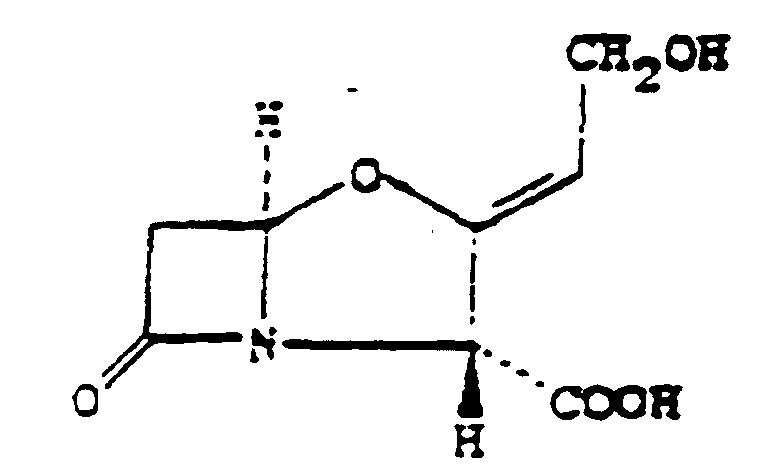
- Clavulanic acid is a molecule of formula whose usefulness is based on its capacity to inhibit the enzymes called beta-lactamases, which are possessed by some Gram-positive and Gram-negative pathogenic microbes such as Escherichia coli , Klebsiella aerogenes , and the like, and which, due to their action, endows them with resistance to some beta-lactam antibiotics.
- beta-lactamases some Gram-positive and Gram-negative pathogenic microbes
- some beta-lactamases such as Escherichia coli , Klebsiella aerogenes , and the like, and which, due to their action, endows them with resistance to some beta-lactam antibiotics.
- clavulanic acid mixed with the said antibiotics increases their antibacterial spectrum.
- clavulanic acid is performed by several strains belonging to the genus Streptomyces , such as, for example, Streptomyces clavuligerus ATCC 27064, Streptomyces jumonjinensis NRRL 5741, and the like.
- the production of clavulanic acid may be increased in batch fermentation when an assimilable carbon source such as, for example, glycerol or maltose is added during the fermentation also instead of only being added initially.
- an assimilable carbon source such as, for example, glycerol or maltose
- addition of ⁇ -caprolactame increases clavulanic said production by fermentation until 768 ⁇ g/cc.However, this increase in production obtained in this way is fairly low. Accordingly, an objective of the present invention is to procure a process for obtaining clavulanic acid and/or its salts with a production which is plainly greater than that obtained by the processes known in the prior art.
- a batch or semi-continuous (fed-batch) culture of Streptomyces clavuligerus was used for the production of clavulanic acid, as well as other antibiotics or molecules typical of secondary metabolism.
- the term batch culture indicates a fermentation in which the nutrients are introduced into the culture medium only initially and the broth is extracted from the fermentation tank only at the end of the process.
- semi-continuous (fed-batch) culture implies a fermentation in which the nutrients are introduced into the culture medium not only initially, but also throughout the fermentation, and the broth is extracted from the fermentation tank only at the end of the process.
- the process of batch or fed-batch production of clavulanic acid displays some special features of fermentation, so that a significant increase in viscosity is initially produced, with the resulting difficulty of maintaining an acceptable level of dissolved oxygen for prolonging the production phase for longer periods of time. Consequently, a fragmentation of the mycelium, a decrease in viscosity and a reduction in production occur, ending of the process being unavoidable.
- Continuous culture is preferentially applied for obtaining biomass, amino acids and other primary metabolites (Hospodka, J. 1966, Theoretical and Methodological Basis of Continuous Culture of Microorganisms, pp 493-645; Malek, J and Fencl, Z. eds. Academic Press New York).
- a continuous culture for obtaining secondary metabolites has not really been described, or has been carried out with limited efficacy (Vu-Trong, K. and Grey, 1982 Biotechnol. Bioengineering 24: 1093-1103; Trangott C.S. et al. 1993 Apol. Microbiol. Biotechnol. 39:433-437; Noack. D. 1988, J. Bas.
- the term continuous culture implies a fermentation in which the nutrients are introduced into the culture medium both at the beginning and also throughout fermentation, and some portions of broth are extracted from the fermentation tank throughout the fermentation and not only at the end of the latter.
- the viscosity reduces progressively throughout the process, enabling the concentration of dissolved oxygen to be maintained (>40%) for longer periods of time without an increase in agitation, avoiding fragmentation of the mycelium and prolonging the period of production of clavulanic acid.
- complete filling of the installed capacity is achieved, which requires continuous extraction of the broth throughout the fermentation process, either intermittently or continuously, in order to maintain the appropriate working volume.
- the present invention provides a process for producing clavulanic acid and/or its salts, by culturing selected strains of Streptomyces clavuligerus ATCC 27064 and/or mutants thereof, in submerged fermentation with aeration and agitation, in batch, semi-continuous or continuous culture, in which the concentration of soluble phosphate present in the culture medium initially and throughout fermentation is fixed and/or maintained within set ranges, depending on each type of culture employed, 500 to 4000 mg/l at the beginning of the fermentation in batch culture or, in the case of semi-continuous (fed-batch) or continuous culture, between 150 and 600 mg/l at the beginning of the fermentation and between 20 and 150 mg/l throughout the latter.
- the process for the production of clavulanic acid and/or its salts according to the present invention is carried out in the presence of assimilable C and N sources and, optionally, of inorganic salts.
- the fermentation is carried out under aerobic conditions and in submerged culture.
- the optimal fermentation temperature preferentially lies between 20°C and 40°C, especially between 22°C and 30°C.
- the C sources may be added as simple or complex nutrients, only initially (in the case of a batch culture) or throughout the fermentation by means of intermittent or continuous additions, in the case of semi-continuous (fed-batch) or continuous culture, respectively.
- these C sources include carbohydrates (dextrins, starches, maltose, and the like), polyols such as glycerol, for example, lipids (chiefly triglycerides, either natural or synthetic) and, in general, any other C source which permits the growth of microorganisms.
- lipids and more especially natural or synthetic triglycerides, can be regarded as one of the preferred sources for carrying out the process of the invention, while there are no references to this effect in the prior art.
- carbon sources even only by means of a single initial addition to the culture medium (batch culture), the production of clavulanic acid and/or its salts can be manifestly increased simply by taking care that the concentration of soluble phosphate remains within the limits defined in the present invention.
- the culture medium should also carry an assimilable source of organic or inorganic N, such as, for example, soya-bean meal, corn-steep liquor, soluble distillates, yeast extracts, cotton-seed flour, peptone, casein or ammonium sulphate.
- an assimilable source of organic or inorganic N such as, for example, soya-bean meal, corn-steep liquor, soluble distillates, yeast extracts, cotton-seed flour, peptone, casein or ammonium sulphate.
- inorganic salts such as sodium, potassium, ammonium, iron, calcium and magnesium, chlorides, sulphates and phosphates, may also be incorporated in the culture medium.
- the clavulanic acid concentration may be determined microbiologically by employing a microbe producing beta-lactamase, such as, for example, Klebsiella aerogenes , although it is preferable to carry out the determination using high performance liquid chromatography.
- a microbe producing beta-lactamase such as, for example, Klebsiella aerogenes , although it is preferable to carry out the determination using high performance liquid chromatography.
- the extraction of clavulanic acid or its salts from the broth may be performed in the manner in which other antibiotics, specifically other beta-lactams, are extracted, employing ion exchange resins or solvents or any other of the known conventional methods.
- the soluble phosphate in the initial medium may be determined by a simple and rapid procedure, for example by means of a commercial kit (Boehringer Mannheim Automated Analysis for BM/Hitachi System 704).
- the principle of the method is the reaction of inorganic phosphorus with ammonium molybdate. This inorganic phosphorus is then expressed as phosphate.
- the sample taken homogeneously from the culture broth
- This sample should be taken after the sterilization of the culture medium, since the concentration of soluble phosphate may fluctuate in accordance with the sterilization process. Samples may also be taken throughout the fermentation process.
- the assay of total phosphate is carried out by taking 1 ml of total broth and adding 1 ml of sulphuric acid and 5 ml of nitric acid. This solution is evaporated by heating until it has a final volume of 1 ml of a transparent solution. This final volume is brought to 25 ml with distilled water and assayed by the above-mentioned method for soluble phosphate.
- the optimal level of soluble phosphate at the beginning of the fermentation shall be between 500 and 4000 mg/l, and preferably between 800 and 1600 mg/l.
- the level of soluble phosphate is well above or below these limits, it should be corrected.
- more inorganic phosphate may be added before or after the sterilization, for example in the form of potassium or sodium salt, until the desired level is reached.
- part of the soluble phosphate may be precipitated if its level is very high by adding any precipitant, for example by means of a calcium compound such as a calcium hydroxide or acetate, or by any other system which ensures that this objective is attained.
- Percentage increase is understood to mean the production of clavulanic acid and/or its salts, expressed as the result of multiplying the final value in ⁇ g/ml by 100 and dividing this figure by 311 (in the case of a 72 h incubation) or by 420 (at 96 h), which represent the results of the fermentation in which the soluble phosphate levels lie outside the optimal range.
- This phosphate should be soluble in the fermentation broth, as is reflected in the following results in Table II, in which similar levels of total phosphate lead to fermentations with very disparate results depending on whether the soluble phosphate is or is not within the optimal limits. Fermentation No. Soluble phosphate mg/l Total phosphate mg/l Clavulanic acid ⁇ g/ml (96 h) 4 1580 2380 2240 7 (comparative) 230 2265 920
- the difference in growth of the microorganism for different phosphate levels does not appear to be responsible for the difference in production, at least as a main factor.
- Table III it may be observed that there are different levels of production for similar growths, so that the phosphate level appears once again to be the cause of the increase in production.
- the mycelial volume has been determined in a centrifuge at 2500 g for 10 minutes. (g denotes force of gravity.) Fermentation No. Soluble phosphate mg/l % Mycelial vol.
- This input should be effected in such a way that the initial level is between 150 and 600 mg/l, and that the level of soluble phosphate throughout the fermentation is between 20 and 150 mg/l.
- Table IV shows the results of several semi-continuous fermentations carried out with different concentrations of soluble phosphate, present initially and added.
- an initial addition of soluble phosphate is carried out.
- This addition is generally less than that for the batch and semi-continuous cultures, and is of the order of 150 to 600 mg/l, preferably an initial 200 to 400 mg/l, a subsequent level in the broth of the same order, 20 - 150 mg/l, being maintained for a longer time (50 - 100 hours).
- Water is, moreover, added to the culture medium from 32 hours onwards, with the object of maintaining the viscosity of the broth at values below 700 cP, which permits an increase in the amount of nutrients added in the traditional systems, maintaining the level of dissolved oxygen above 40%, and of prolonging the production of clavulanic acid up to 150 - 170 hours.
- a total dilution of 1.5 to 1.6 is generally achieved, against 0.9 to 1.1 for the traditional cultures, making the installed geometric capacity economically viable.
- the process is carried out by adding nutrients to the initial medium continuously throughout the fermentation. These nutrients are chiefly the carbon source. From 100 hours onwards, continuous or intermittent extraction of the broth is carried out in a proportion of 2.5 to 14% of the volume of the fermenter per day, with the object of keeping the volume constant and the viscosity of the medium to below 700 cP. The process may be prolonged up to 160 - 170 hours.
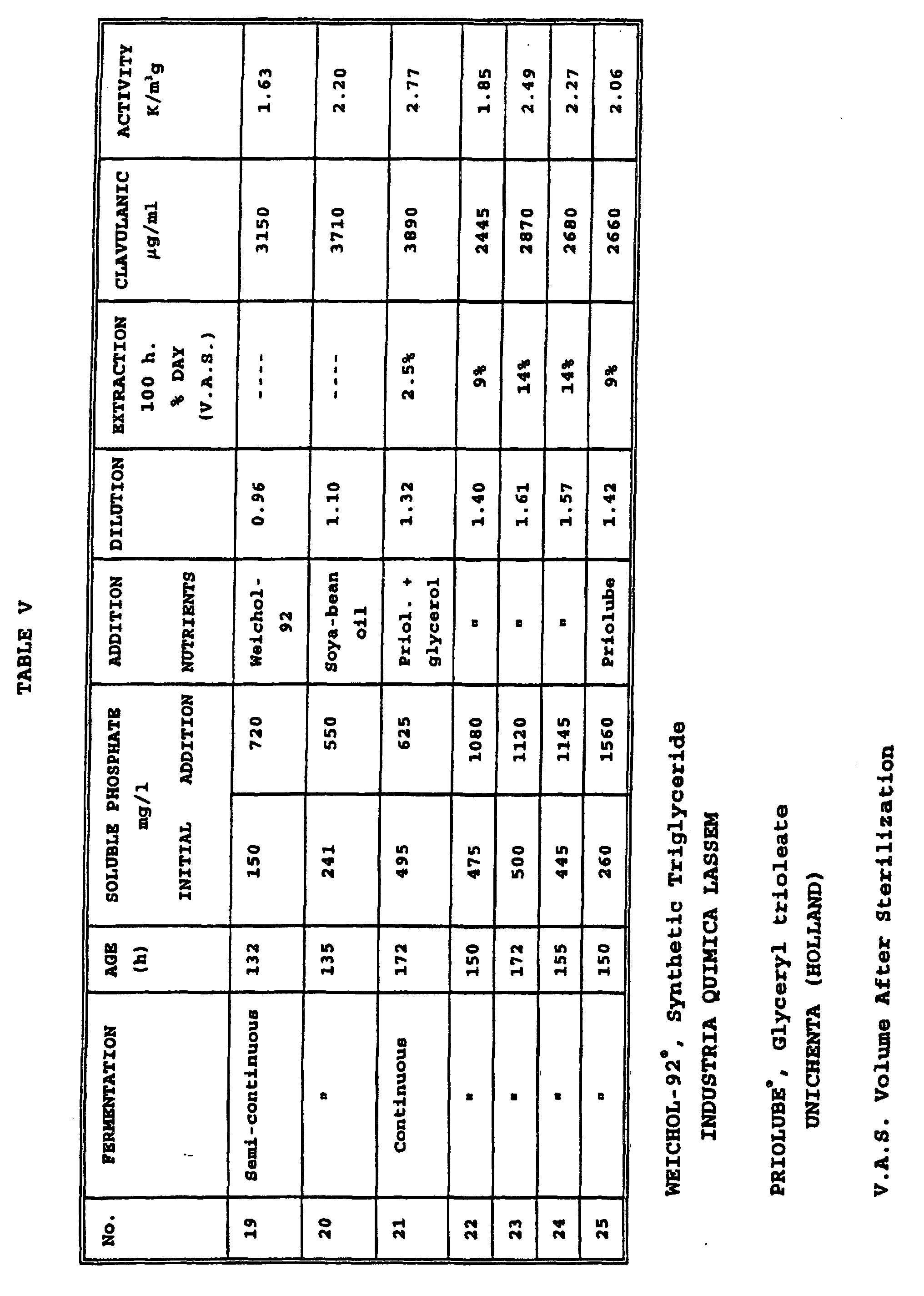
- Examples 19-25 are reproduced in Table V, with fed-batch and continuous cultures, with different nutrients and different levels or inputs of soluble phosphate.
- An inoculation medium with the following composition is prepared:
- the pH is adjusted to 6.7 and the medium is distributed in 250-ml Erlenmeyer flasks in the proportion of 40 ml per flask.
- the flasks are stoppered and sterilized at 121°C for 20 minutes.
- the medium thus prepared is inoculated with a suspension of spores of a mutant strain that overproduces calvulanic acid, obtained by means of a step of mutation of Streptomyces clavuligerus ATCC 27064 with N-methyl-N'-nitro-N-nitrosoguanidine and several steps of mutation with ultraviolet light.
- This suspension is prepared from a slant or plate, with a nutrient medium capable of permitting growth and sporulation.
- the medium is incubated for 2 days at 25 °C on a rotary agitator with an eccentricity of 5 cm at 250 rpm.
- This culture thus prepared is employed to inoculate in the proportion of 5% a fermentation medium with the following composition:
- the pH of the medium is adjusted to 7.0 and the medium is distributed in 250-ml flasks in the proportion of 30 ml per flask.
- the flasks are stoppered and sterilized for 20 minutes at 121°C. After sterilization, the soluble phosphate is measured in one of the flasks, a value of 100 mg/l being obtained.
- the fermentation medium thus prepared and inoculated is incubated at 25°C in a rotary agitator with an eccentricity of 5 cm at 250 rpm. At 96 hours of incubation, the production of clavulanic acid obtained was 420 ⁇ g/ml HPLC.
- Example 2 The procedure is the same as in the case of Example 1, but addition of calcium hydroxide is not performed. As a result, the fermentation is carried out in a medium with 100 mg/l of soluble phosphate. At 96 hours of incubation, the production of clavulanic acid was 790 ⁇ g/ml HPLC (see fermentation No. 2 of Table I).
- Example 2 The procedure is the same as in the case of Example 1, but in this case addition of calcium hydroxide is not carried out, and 0.12% of monopotassium phosphate, added before adjusting the pH, is included in the formula of the fermentation medium.
- the soluble phosphate is assayed from one flask after sterilization, and it is established that the fermentation is carried out in a medium with 900 mg/l of soluble phosphate.
- the production of clavulanic acid was 2210 ⁇ g/ml HPLC (see fermentation No. 3 of Table I).
- Example 3 The procedure is the same as in Example 3, but in this case 0.21% of monopotassium phosphate is included in the formula.
- the soluble phosphate is assayed from one flask after sterilization, and it is established that the fermentation is carried out in a medium with 1580 mg/l of soluble phosphate. In this case the total phosphate was also determined, a value of 2380 mg/l being obtained, as may be seen in Table II.
- the production of clavulanic acid was 2240 ⁇ g/ml HPLC (see fermentation No. 4 of Table I).
- Example 3 The procedure is the same as in Example 3, but in this case 0.4% of monopotassium phosphate is included in the formula.
- the soluble phosphate is assayed from one flask after sterilization, and it is established that the fermentation is carried out in a medium with 3000 mg/l of soluble phosphate.
- the production of clavulanic acid was 1750 ⁇ g/ml HPLC (see fermentation No. 5 of Table I).
- Example 3 The procedure is the same as in the case of Example 3, but in this case 0.95% of monopotassium phosphate is included in the formula.
- the soluble phosphate is assayed from one flask after sterilization, and it is established that the fermentation is carried out in a medium with 7000 mg/l of soluble phosphate. At 96 hours of incubation, the production of clavulanic acid was 780 ⁇ g/ml (see fermentation No. 6 of Table I).
- the process is the same as the one in Example 3, but in this case 0.245% of tribasic calcium phosphate is included in the formula (monopotassium phosphate is not included).
- the soluble phosphate is assayed from one flask after sterilization, the result of 230 mg/l of soluble phosphate being obtained. In this case the total phosphate was also determined, the result being 2265 mg/l (see fermentation No. 7 of Table II). After 96 hours of incubation, the production of clavulanic acid was 920 ⁇ g/ml HPLC.
- An inoculation medium with the same composition as the one described in Example 1 is prepared, and is distributed in 2000-ml Erlenmeyer flasks with 500 ml of medium. The flasks are stoppered and sterilized at 121°C for 20 minutes.
- the medium is incubated for 2 days at 25°C on a rotary agitator with an eccentricity of 5 cm at 250 rpm.
- the pH of the medium is adjusted to 7.3 and the medium is sterilized at 121°C for 20 minutes. Incubation takes place at 28°C for about 30 hours, with agitation at 115 rpm, an aeration of 0.5 v/v/min and a dome pressure of 1 kg/cm 2 .
- the pH of the medium is adjusted to 7.0 and the medium is sterilized at 121°C for 20 minutes. After sterilization, the soluble phosphate is measured, which in this case gives a result of 200 mg/l to 300 mg/l. If necessary, with the object of obtaining different initial concentrations, this value is adjusted by adding suitable volumes of 1% monopotassium phosphate solution (Examples 10, 11, 12, 14, 15 and 16), or with a calcium compound (Example 8, where the appropriate volume of Ca(OH) 2 solution was added). When the soluble phosphate has been adjusted, transfer of the 45 litres of inoculation culture is carried out and fermentation commences.
- the latter takes place while maintaining a constant temperature of 25°C, 115 rpm, 0.5 v/v/min for the first 24 hours and 1.5 v/v/min from 25 hours up to the end of fermentation, and under a dome pressure of 0.5 kg/cm 2 .
- Example 19 The procedure is the same as in Example 19, but the fermentation is extended up to 172 h, the continuous system being established with extractions of total broth from 100 h of fermentation onwards in a proportion of 2.5% of the broth extracted every 24 h relative to the initial volume of the fermenter after sterilization.
- glycerol 33%
- Priolube glyceryl trioleate, manufactured by Unichenta
- monopotassium phosphate 1%) are made according to the programmes: Priolube 100 ml/h from 10 h to the end Glycerol (33%) 400 ml/h from 32 h to the end Monopotassium phosphate (1%) 400 to 1400 ml/h from 0 to 25 h and 1500 to 5000 ml/h from 25 to 50 h
- Example 22 The procedure is as in Example 22. The fermentation is extended to 172 h with an extraction of 14% every 24 h. A programme of addition of sterile water is also included in order to maintain the viscosity level low.
- the procedure is as in Example 23, but the initial fermentation medium is increased by 30% with respect to all its starting materials. The fermentation reaches 155 h and the extraction carried out is of 14% every 24 h.
- the programmes of addition used are: Priolube 130 ml/h from 10 h to 100 h 240 ml/h from 100 h to the end Glycerol (33%) 515 ml/h from 32 h to 100 h 960 ml/h from 100 h to the end Monopotassium phosphate (1%) 400 to 1400 ml/h from 0 to 25 h 1500 to 5000 ml/h from 25 to 50 h 300 ml/h from 50 h to the end Sterile water 630 ml/h from 32 to 100 h 1260 ml/h from 100 h to the end
- Example 21 The procedure is as in Example 21.
- the fermentation is extended up to 150 h and extractions are carried out in a proportion of 9% every 24 h.
- the addition of glycerol is omitted completely and the addition of the triglyceride Priolube is increased.
- the additions of phosphate and sterile water are identical to those in Example 22.
- the addition of Priolube is according to the following programme: Priolube 320 ml/h from 10 to 100 h 590 ml/h from 100 h to the end
Landscapes
- Organic Chemistry (AREA)
- Chemical & Material Sciences (AREA)
- Engineering & Computer Science (AREA)
- Life Sciences & Earth Sciences (AREA)
- Zoology (AREA)
- Wood Science & Technology (AREA)
- Health & Medical Sciences (AREA)
- General Engineering & Computer Science (AREA)
- General Chemical & Material Sciences (AREA)
- Chemical Kinetics & Catalysis (AREA)
- Biotechnology (AREA)
- Biochemistry (AREA)
- Bioinformatics & Cheminformatics (AREA)
- Microbiology (AREA)
- General Health & Medical Sciences (AREA)
- Genetics & Genomics (AREA)
- Preparation Of Compounds By Using Micro-Organisms (AREA)
- Micro-Organisms Or Cultivation Processes Thereof (AREA)
- Nitrogen And Oxygen Or Sulfur-Condensed Heterocyclic Ring Systems (AREA)
- Pharmaceuticals Containing Other Organic And Inorganic Compounds (AREA)
Abstract
Description
- A process is described for the production of clavulanic acid and/or its salts by means of a fermentation with selected strains of Streptomyces clavuligerus with a strict control of the concentration of soluble phosphate present during the fermentation and with the optional use of carbon sources such as lipids, preferably triglycerides.
- Clavulanic acid is a molecule of formulawhose usefulness is based on its capacity to inhibit the enzymes called beta-lactamases, which are possessed by some Gram-positive and Gram-negative pathogenic microbes such as Escherichia coli , Klebsiella aerogenes , and the like, and which, due to their action, endows them with resistance to some beta-lactam antibiotics. As a result, clavulanic acid mixed with the said antibiotics increases their antibacterial spectrum.
- It is known that the production of clavulanic acid is performed by several strains belonging to the genus Streptomyces, such as, for example, Streptomyces clavuligerus ATCC 27064, Streptomyces jumonjinensis NRRL 5741, and the like.
- As has already been disclosed in earlier patents EP-A-0182522), the production of clavulanic acid may be increased in batch fermentation when an assimilable carbon source such as, for example, glycerol or maltose is added during the fermentation also instead of only being added initially. In ES 8405439, for instead, addition of ε-caprolactame increases clavulanic said production by fermentation until 768 µg/cc.However, this increase in production obtained in this way is fairly low. Accordingly, an objective of the present invention is to procure a process for obtaining clavulanic acid and/or its salts with a production which is plainly greater than that obtained by the processes known in the prior art.
- Many authors have demonstrated the inhibitory effect of phosphate on the production of antibiotics (Martín, J. F., 1977, Adv. Biochem. Eng. 6:105-127). Specifically, an inhibition of phosphate on the synthesis of cephalosporins by Streptomyces clavuligerus has been found (Lübbe, C. et al. 1985, Arch. Microbiol. 140:317-320 and Lübbe, C. et al. 1984, FEMS Microbiol. Lett. 25:75-79; Aharonowithz, Y. et al. 1977, Arch. Microbiol. 115:169-173; Jhang, J. et al. 1989, FEMS, 57:145-150), and also an inhibitory effect of phosphate on the synthesis of clavulanic acid by the said microorganism (Lebrihi, A. et al. 1987, Appl. Microbiol. Biotechnol. 26:130-135; Romero, J. et al. 1984, Appl. Microbiol. Biotechnol. 20:318-325). However, contrary to the findings reported in the above papers, we have found, surprisingly, instead of a negative effect of phosphate on the production of clavulanic acid, a substantial increase in the production of clavulanic acid and/or its salts when the soluble phosphate level in the culture medium reaches an optimal range and is maintained in the said range. What is more, we have found that a strict control of the concentration of soluble phosphate in the culture medium has a greater influence on the increase in production of the system than the actual addition of nutrients. A batch or semi-continuous (fed-batch) culture of Streptomyces clavuligerus was used for the production of clavulanic acid, as well as other antibiotics or molecules typical of secondary metabolism. For the purposes of this specification, the term batch culture indicates a fermentation in which the nutrients are introduced into the culture medium only initially and the broth is extracted from the fermentation tank only at the end of the process. The term semi-continuous (fed-batch) culture implies a fermentation in which the nutrients are introduced into the culture medium not only initially, but also throughout the fermentation, and the broth is extracted from the fermentation tank only at the end of the process. The process of batch or fed-batch production of clavulanic acid displays some special features of fermentation, so that a significant increase in viscosity is initially produced, with the resulting difficulty of maintaining an acceptable level of dissolved oxygen for prolonging the production phase for longer periods of time. Consequently, a fragmentation of the mycelium, a decrease in viscosity and a reduction in production occur, ending of the process being unavoidable.
- Continuous culture is preferentially applied for obtaining biomass, amino acids and other primary metabolites (Hospodka, J. 1966, Theoretical and Methodological Basis of Continuous Culture of Microorganisms, pp 493-645; Malek, J and Fencl, Z. eds. Academic Press New York). However, the use of a continuous culture for obtaining secondary metabolites (antibiotics) has not really been described, or has been carried out with limited efficacy (Vu-Trong, K. and Grey, 1982 Biotechnol. Bioengineering 24: 1093-1103; Trangott C.S. et al. 1993 Apol. Microbiol. Biotechnol. 39:433-437; Noack. D. 1988, J. Bas. Microbiol. 28:101-106). For the purposes of the present specification, the term continuous culture implies a fermentation in which the nutrients are introduced into the culture medium both at the beginning and also throughout fermentation, and some portions of broth are extracted from the fermentation tank throughout the fermentation and not only at the end of the latter. We have now found that, by adding soluble phosphate to the culture medium and/or controlling and fixing its concentration throughout the fermentation, it is possible and advantageous to obtain clavulanic acid and/or its salts in continuous culture with a high production. In the continuous process, by means of suitable dilution of the culture, the viscosity reduces progressively throughout the process, enabling the concentration of dissolved oxygen to be maintained (>40%) for longer periods of time without an increase in agitation, avoiding fragmentation of the mycelium and prolonging the period of production of clavulanic acid. As a consequence of the addition of nutrients and water, complete filling of the installed capacity is achieved, which requires continuous extraction of the broth throughout the fermentation process, either intermittently or continuously, in order to maintain the appropriate working volume. In this way, and by controlling the process by adding soluble phosphate to the culture medium throughout the process, a lengthening of the fermentation cycle and an increase in total production achieved are obtained, increasing in turn the production yield per geometrical installed capacity.
- Accordingly, the present invention provides a process for producing clavulanic acid and/or its salts, by culturing selected strains of Streptomyces clavuligerus ATCC 27064 and/or mutants thereof, in submerged fermentation with aeration and agitation, in batch, semi-continuous or continuous culture, in which the concentration of soluble phosphate present in the culture medium initially and throughout fermentation is fixed and/or maintained within set ranges, depending on each type of culture employed, 500 to 4000 mg/l at the beginning of the fermentation in batch culture or, in the case of semi-continuous (fed-batch) or continuous culture, between 150 and 600 mg/l at the beginning of the fermentation and between 20 and 150 mg/l throughout the latter.
- The process for the production of clavulanic acid and/or its salts according to the present invention is carried out in the presence of assimilable C and N sources and, optionally, of inorganic salts. The fermentation is carried out under aerobic conditions and in submerged culture.
- The optimal fermentation temperature preferentially lies between 20°C and 40°C, especially between 22°C and 30°C.
- The C sources may be added as simple or complex nutrients, only initially (in the case of a batch culture) or throughout the fermentation by means of intermittent or continuous additions, in the case of semi-continuous (fed-batch) or continuous culture, respectively. Depending on the strain used, these C sources include carbohydrates (dextrins, starches, maltose, and the like), polyols such as glycerol, for example, lipids (chiefly triglycerides, either natural or synthetic) and, in general, any other C source which permits the growth of microorganisms. We have found specifically that lipids, and more especially natural or synthetic triglycerides, can be regarded as one of the preferred sources for carrying out the process of the invention, while there are no references to this effect in the prior art. In fact, we have found that, using such carbon sources, even only by means of a single initial addition to the culture medium (batch culture), the production of clavulanic acid and/or its salts can be manifestly increased simply by taking care that the concentration of soluble phosphate remains within the limits defined in the present invention.
- The culture medium should also carry an assimilable source of organic or inorganic N, such as, for example, soya-bean meal, corn-steep liquor, soluble distillates, yeast extracts, cotton-seed flour, peptone, casein or ammonium sulphate.
- Various inorganic salts, such as sodium, potassium, ammonium, iron, calcium and magnesium, chlorides, sulphates and phosphates, may also be incorporated in the culture medium.
- The clavulanic acid concentration may be determined microbiologically by employing a microbe producing beta-lactamase, such as, for example, Klebsiella aerogenes, although it is preferable to carry out the determination using high performance liquid chromatography.
- The extraction of clavulanic acid or its salts from the broth may be performed in the manner in which other antibiotics, specifically other beta-lactams, are extracted, employing ion exchange resins or solvents or any other of the known conventional methods.
- The soluble phosphate in the initial medium may be determined by a simple and rapid procedure, for example by means of a commercial kit (Boehringer Mannheim Automated Analysis for BM/Hitachi System 704). The principle of the method is the reaction of inorganic phosphorus with ammonium molybdate. This inorganic phosphorus is then expressed as phosphate. To analyse the soluble phosphate, the sample (taken homogeneously from the culture broth) should be filtered beforehand through a Millipore filter of pore size 0.45 µm or similar, in order to remove solids. This sample should be taken after the sterilization of the culture medium, since the concentration of soluble phosphate may fluctuate in accordance with the sterilization process. Samples may also be taken throughout the fermentation process.
- The assay of total phosphate is carried out by taking 1 ml of total broth and adding 1 ml of sulphuric acid and 5 ml of nitric acid. This solution is evaporated by heating until it has a final volume of 1 ml of a transparent solution. This final volume is brought to 25 ml with distilled water and assayed by the above-mentioned method for soluble phosphate.
- When the fermentation is carried out batchwise, it has been found that the optimal level of soluble phosphate at the beginning of the fermentation shall be between 500 and 4000 mg/l, and preferably between 800 and 1600 mg/l.
- If, owing to the nature of the starting materials used and to their concentration, the level of soluble phosphate is well above or below these limits, it should be corrected. To this end, when the level is below the lower limit, more inorganic phosphate may be added before or after the sterilization, for example in the form of potassium or sodium salt, until the desired level is reached. Alternatively, part of the soluble phosphate may be precipitated if its level is very high by adding any precipitant, for example by means of a calcium compound such as a calcium hydroxide or acetate, or by any other system which ensures that this objective is attained.
- According to the present invention, an up to 5-fold increase in production has been observed compared with a fermentation system without control of the initial soluble phosphate in the medium in batch culture. Table I shows the results of several fermentations carried out with the optimal level of soluble phosphate, and outside this level.
Fermentation No. Soluble phosphate mg/l Clavulanic acid 72 h µg/ml % 96 h µg/ml % 1 (comparative) 18 311 100 420 100 2 (comparative) 100 560 180 790 188 3 900 1410 453 2210 526 4 1580 1550 495 2240 533 5 3000 1410 453 1750 416 6 (comparative) 7000 410 131 780 186 - Percentage increase (%) is understood to mean the production of clavulanic acid and/or its salts, expressed as the result of multiplying the final value in µg/ml by 100 and dividing this figure by 311 (in the case of a 72 h incubation) or by 420 (at 96 h), which represent the results of the fermentation in which the soluble phosphate levels lie outside the optimal range.
- This phosphate should be soluble in the fermentation broth, as is reflected in the following results in Table II, in which similar levels of total phosphate lead to fermentations with very disparate results depending on whether the soluble phosphate is or is not within the optimal limits.
Fermentation No. Soluble phosphate mg/l Total phosphate mg/l Clavulanic acid µg/ml (96 h) 4 1580 2380 2240 7 (comparative) 230 2265 920 - The difference in growth of the microorganism for different phosphate levels does not appear to be responsible for the difference in production, at least as a main factor. In Table III, it may be observed that there are different levels of production for similar growths, so that the phosphate level appears once again to be the cause of the increase in production. The mycelial volume has been determined in a centrifuge at 2500 g for 10 minutes. (g denotes force of gravity.)
Fermentation No. Soluble phosphate mg/l % Mycelial vol. Clavulanic acid 72 h 96 h 72 h 96 h µg/ml 1 (comparative) 18 23 22 311 420 2 (comparative) 100 22 22 560 790 3 900 30 30 1410 2210 4 1580 30 30 1550 2240 5 3000 30 30 1410 1750 6 (comparative) 7000 27 28 410 780 - During the period of fermentation, it is possible to carry out a process of fed-batch addition of phosphate, and also of the remainder of the nutrients, distributed throughout the whole fermentation. It has been found that the optimal level of total soluble phosphate (initial and added) is slightly less than the level in the batch mode, lying between 400 and 2000 mg/l.
- This input should be effected in such a way that the initial level is between 150 and 600 mg/l, and that the level of soluble phosphate throughout the fermentation is between 20 and 150 mg/l. To this end, it is appropriate to effect an input of soluble phosphate ion or any precipitant calcium compound, as in the case of batch fermentation, depending on whether it is required to raise or lower the phosphate level, respectively, in order to maintain it within the indicated limits. Table IV shows the results of several semi-continuous fermentations carried out with different concentrations of soluble phosphate, present initially and added.
- It may be observed that the total amount of added phosphate is considerably higher, without impairing production, when the said addition is carried out throughout the fermentation instead of initially. All the tests carried out maintained the concentration of soluble phosphate throughout the fermentation at the indicated level, except for fermentations Nos 8, 9 and 10, in which the level was lower than that required, and No. 16 in which the level was higher.
Fermentation SOLUBLE PHOSPHATE (mg/l) CLAVULANIC ACID No. Initial concentration Total added µg/ml % 8 80 0 990 33 9 265 0 1230 41 10 520 0 2400 80 11 990 0 2080 69 12 1530 0 1920 64 13 228 618 3000 100 14 510 570 4020 134 15 722 594 3270 109 16 950 603 2730 91 17 278 1710 3600 120 18 230 2280 3360 112 - In continuous culture, by means of suitable dilution of the culture, the viscosity reduces progressively throughout the process, enabling the concentration of dissolved oxygen to be maintained (>40%) for longer periods of time without an increase in agitation, avoiding fragmentation of the mycelium and prolonging the period of production of clavulanic acid. As a consequence of the addition of nutrients and water, complete filling of the installed capacity is achieved, which requires continuous extraction of the broth in order to maintain the appropriate working volume. In this way, and by controlling the process by adding soluble phosphate to the culture medium throughout the process, a lengthening of the fermentation cycle and an increase in total production achieved are obtained, increasing in turn the production yield per geometrical installed capacity.
- In continuous culture, as in the previous cases, in batch and semi-continuous modes, an initial addition of soluble phosphate is carried out. This addition is generally less than that for the batch and semi-continuous cultures, and is of the order of 150 to 600 mg/l, preferably an initial 200 to 400 mg/l, a subsequent level in the broth of the same order, 20 - 150 mg/l, being maintained for a longer time (50 - 100 hours).
- In continuous cultures, as in the batch or semi-continuous fermentation, inputs of soluble phosphate salts or calcium compounds or other efficient sequestering agents are effected in order to establish the requisite initial concentrations in each case and to maintain the desired concentration during the fermentation. The addition of total soluble phosphate salts is similar or slightly greater than that used in semi-continuous fermentation.
- Water is, moreover, added to the culture medium from 32 hours onwards, with the object of maintaining the viscosity of the broth at values below 700 cP, which permits an increase in the amount of nutrients added in the traditional systems, maintaining the level of dissolved oxygen above 40%, and of prolonging the production of clavulanic acid up to 150 - 170 hours.
- During the complete process, a total dilution of 1.5 to 1.6 is generally achieved, against 0.9 to 1.1 for the traditional cultures, making the installed geometric capacity economically viable. The process is carried out by adding nutrients to the initial medium continuously throughout the fermentation. These nutrients are chiefly the carbon source. From 100 hours onwards, continuous or intermittent extraction of the broth is carried out in a proportion of 2.5 to 14% of the volume of the fermenter per day, with the object of keeping the volume constant and the viscosity of the medium to below 700 cP. The process may be prolonged up to 160 - 170 hours.
- Examples 19-25 are reproduced in Table V, with fed-batch and continuous cultures, with different nutrients and different levels or inputs of soluble phosphate.
- By way of illustration, the following examples are described:
- An inoculation medium with the following composition is prepared:
- Fish meal - 2 g
- Glycerol - 1.5 g
- Soluble starch - 1.5 g
- Calcium carbonate - 0.2 g
- Distilled water q.s. 100 ml
- The pH is adjusted to 6.7 and the medium is distributed in 250-ml Erlenmeyer flasks in the proportion of 40 ml per flask. The flasks are stoppered and sterilized at 121°C for 20 minutes.
- The medium thus prepared is inoculated with a suspension of spores of a mutant strain that overproduces calvulanic acid, obtained by means of a step of mutation of Streptomyces clavuligerus ATCC 27064 with N-methyl-N'-nitro-N-nitrosoguanidine and several steps of mutation with ultraviolet light. This suspension is prepared from a slant or plate, with a nutrient medium capable of permitting growth and sporulation.
- After inoculation, the medium is incubated for 2 days at 25 °C on a rotary agitator with an eccentricity of 5 cm at 250 rpm.
- This culture thus prepared is employed to inoculate in the proportion of 5% a fermentation medium with the following composition:
- Soya-bean meal - 4 g
- Maize dextrin - 1 g
- MOPS buffer - 1 g (3- [N-morpholino] propanesulphonic acid)
- Calcium chloride - 10 mg
- Sodium chloride - 10 mg
- Magnesium chloride - 10 mg
- Sodium acetate - 0.1 g
- Soya-bean oil - 2 g
- Distilled water q.s. 100 ml
- The pH of the medium is adjusted to 7.0 and the medium is distributed in 250-ml flasks in the proportion of 30 ml per flask. The flasks are stoppered and sterilized for 20 minutes at 121°C. After sterilization, the soluble phosphate is measured in one of the flasks, a value of 100 mg/l being obtained.
- By way of example and in order to illustrate the results of fermentation No. 1 shown in Table I, 0.5 ml of 0.5% calcium hydroxide solution was added to each flask. After the addition, the level of soluble phosphate was assayed again in one of the flasks, a value of 18 mg/l now being obtained, at which level the said fermentation No. 1 was carried out.
- The fermentation medium thus prepared and inoculated is incubated at 25°C in a rotary agitator with an eccentricity of 5 cm at 250 rpm. At 96 hours of incubation, the production of clavulanic acid obtained was 420 µg/ml HPLC.
- The procedure is the same as in the case of Example 1, but addition of calcium hydroxide is not performed. As a result, the fermentation is carried out in a medium with 100 mg/l of soluble phosphate. At 96 hours of incubation, the production of clavulanic acid was 790 µg/ml HPLC (see fermentation No. 2 of Table I).
- The procedure is the same as in the case of Example 1, but in this case addition of calcium hydroxide is not carried out, and 0.12% of monopotassium phosphate, added before adjusting the pH, is included in the formula of the fermentation medium. The soluble phosphate is assayed from one flask after sterilization, and it is established that the fermentation is carried out in a medium with 900 mg/l of soluble phosphate. At 96 hours of incubation, the production of clavulanic acid was 2210 µg/ml HPLC (see fermentation No. 3 of Table I).
- The procedure is the same as in Example 3, but in this case 0.21% of monopotassium phosphate is included in the formula. The soluble phosphate is assayed from one flask after sterilization, and it is established that the fermentation is carried out in a medium with 1580 mg/l of soluble phosphate. In this case the total phosphate was also determined, a value of 2380 mg/l being obtained, as may be seen in Table II. At 96 hours of incubation, the production of clavulanic acid was 2240 µg/ml HPLC (see fermentation No. 4 of Table I).
- The procedure is the same as in Example 3, but in this case 0.4% of monopotassium phosphate is included in the formula. The soluble phosphate is assayed from one flask after sterilization, and it is established that the fermentation is carried out in a medium with 3000 mg/l of soluble phosphate. At 96 hours of incubation, the production of clavulanic acid was 1750 µg/ml HPLC (see fermentation No. 5 of Table I).
- The procedure is the same as in the case of Example 3, but in this case 0.95% of monopotassium phosphate is included in the formula. The soluble phosphate is assayed from one flask after sterilization, and it is established that the fermentation is carried out in a medium with 7000 mg/l of soluble phosphate. At 96 hours of incubation, the production of clavulanic acid was 780 µg/ml (see fermentation No. 6 of Table I).
- The process is the same as the one in Example 3, but in this case 0.245% of tribasic calcium phosphate is included in the formula (monopotassium phosphate is not included). The soluble phosphate is assayed from one flask after sterilization, the result of 230 mg/l of soluble phosphate being obtained. In this case the total phosphate was also determined, the result being 2265 mg/l (see fermentation No. 7 of Table II). After 96 hours of incubation, the production of clavulanic acid was 920 µg/ml HPLC.
- An inoculation medium with the same composition as the one described in Example 1 is prepared, and is distributed in 2000-ml Erlenmeyer flasks with 500 ml of medium. The flasks are stoppered and sterilized at 121°C for 20 minutes.
- When inoculation has been performed with a spore suspension similar to the one used in Example 1, the medium is incubated for 2 days at 25°C on a rotary agitator with an eccentricity of 5 cm at 250 rpm.
- 400 ml of this culture are taken and used to inoculate a tank with 150 litres of the following medium:
- Soya-bean meal - 2 g
- Dextrin - 2 g
- Monopotassium phosphate - 0.04 g
- Soya-bean oil - 0.1 g
- UCON antifoam - 0.1 g (Polyalkylene glycol)
- Water q.s. 100 ml
- The pH of the medium is adjusted to 7.3 and the medium is sterilized at 121°C for 20 minutes. Incubation takes place at 28°C for about 30 hours, with agitation at 115 rpm, an aeration of 0.5 v/v/min and a dome pressure of 1 kg/cm2.
- 45 litres of culture incubated under the above conditions are taken and transferred to a tank with 450 litres of the following medium:
- Soya-bean meal - 4 g
- Dextrin - 2 g
- Soya-bean oil - 0.1 g
- UCON antifoam - 0.1 g
- Magnesium chloride - 0.02 g
- Ferric chloride - 0.003 g
- Calcium chloride - 0.01 g
- Water q.s. 100 ml
- The pH of the medium is adjusted to 7.0 and the medium is sterilized at 121°C for 20 minutes. After sterilization, the soluble phosphate is measured, which in this case gives a result of 200 mg/l to 300 mg/l. If necessary, with the object of obtaining different initial concentrations, this value is adjusted by adding suitable volumes of 1% monopotassium phosphate solution (Examples 10, 11, 12, 14, 15 and 16), or with a calcium compound (Example 8, where the appropriate volume of Ca(OH)2 solution was added). When the soluble phosphate has been adjusted, transfer of the 45 litres of inoculation culture is carried out and fermentation commences. The latter takes place while maintaining a constant temperature of 25°C, 115 rpm, 0.5 v/v/min for the first 24 hours and 1.5 v/v/min from 25 hours up to the end of fermentation, and under a dome pressure of 0.5 kg/cm2.
- The different concentrations of soluble phosphate throughout the fermentation were obtained by adding different volumes of sterile 1% monopotassium phosphate solution (Examples 13 to 18).
- Automatic control of the pH is performed in order to maintain the latter between 6.8 and 7.2. The following additions are also made:
- Soya-bean oil: 100 ml/h from 10 to 120 hours.
- 33% glycerol: 400 ml/h from 32 to 120 hours.
- 1% monopotassium phosphate: 400 to 1400 ml/h from 0 to 25 hours and 1500 to 5000 ml/h from 25 to 50 hours.
- After. 120 h of incubation, the production of clavulanic acid varies between 990 and 4020 µg/ml, in accordance with Table IV.
- The preparation of the media and establishing of the fermentation conditions are carried out as in Examples 8 to 18 (Table IV), but a dextrin concentration of 34 g/l was included in the initial cycle. The addition of glycerol was omitted, and only Weichol-92 (synthetic triglyceride with 60% of oleic acid, manufactured by Industria Quimica Lassem) and 1% monopotassium phosphate were supplied, with the following programmes of addition:
Weichol-92 100 ml/h from 10 h to 120 h Monopotassium phosphate (1%) 400 to 1400 ml/h from 0 to 25 h and 1500 to 5000 ml/h from 25 to 50 h - The procedure is the same as in Example 19, but the addition of the synthetic triglyceride Weichol-92 is replaced by that of soya-bean oil.
- The procedure is the same as in Example 19, but the fermentation is extended up to 172 h, the continuous system being established with extractions of total broth from 100 h of fermentation onwards in a proportion of 2.5% of the broth extracted every 24 h relative to the initial volume of the fermenter after sterilization.
- Additions of glycerol (33%), Priolube (glyceryl trioleate, manufactured by Unichenta) and monopotassium phosphate (1%) are made according to the programmes:
Priolube 100 ml/h from 10 h to the end Glycerol (33%) 400 ml/h from 32 h to the end Monopotassium phosphate (1%) 400 to 1400 ml/h from 0 to 25 h and 1500 to 5000 ml/h from 25 to 50 h - The procedure is as in Example 21, but the fermentation is extended only up to 150 h and the extraction of broth is carried out in a proportion of 9% every 24 h. The additions are modified according to the programmes:
Priolube 100 ml/h from 10 h to 100 h
200 ml/h from 100 h to the endGlycerol (33%) 420 ml/h from 32 h to 100 h
780 ml/h from 100 h to the endMonopotassium phosphate (1%) 400 to 1400 ml/h from 0 to 25 h
1500 to 5000 ml/h from 25 to 50 h
300 ml/h from 50 h to the endSterile water 312 ml/h from 32 to 100 h
625 ml/h from 100 h to the end - The procedure is as in Example 22. The fermentation is extended to 172 h with an extraction of 14% every 24 h. A programme of addition of sterile water is also included in order to maintain the viscosity level low.
Priolube 130 ml/h from 10 h to 100 h
240 ml/h from 100 h to the endGlycerol (33%) 515 ml/h from 32 h to 100 h
960 ml/h from 100 h to the endMonopotassium phosphate (1%) 400 to 1400 ml/h from 0 to 25 h
1500 to 5000 ml/h from 25 to 50 h
300 ml/h from 50 h to the endSterile water 630 ml/h from 32 to 100 h
1260 ml/h from 100 h to the end - The procedure is as in Example 23, but the initial fermentation medium is increased by 30% with respect to all its starting materials. The fermentation reaches 155 h and the extraction carried out is of 14% every 24 h. The programmes of addition used are:
Priolube 130 ml/h from 10 h to 100 h
240 ml/h from 100 h to the endGlycerol (33%) 515 ml/h from 32 h to 100 h
960 ml/h from 100 h to the endMonopotassium phosphate (1%) 400 to 1400 ml/h from 0 to 25 h
1500 to 5000 ml/h from 25 to 50 h
300 ml/h from 50 h to the endSterile water 630 ml/h from 32 to 100 h
1260 ml/h from 100 h to the end - The procedure is as in Example 21. The fermentation is extended up to 150 h and extractions are carried out in a proportion of 9% every 24 h. The addition of glycerol is omitted completely and the addition of the triglyceride Priolube is increased. The additions of phosphate and sterile water are identical to those in Example 22. The addition of Priolube is according to the following programme:
Priolube 320 ml/h from 10 to 100 h
590 ml/h from 100 h to the end
Claims (11)
- A process for producing clavulanic acid and/or its salts by culturing Streptomyces clavuligerus ATCC 27064 or mutants obtained from the latter, in submerged fermentation with aeration and agitation, in batch culture, in which the concentrations of soluble phosphate are fixed at the beginning of the fermentation within the range 500 and 4000 mg/l.
- A process for producing clavulanic acid and/or its salts by culturing Streptomyces clavuligerus ATCC 27064 or mutants obtained from the latter, in submerged fermentation with aeration and agitation, in semi-continuous culture, in which the concentrations of soluble phosphate are fixed at the beginning and maintained throughout the fermentation within set values.
- A process for producing clavulanic acid and/or its salts by culturing Streptomyces clavuligerus ATCC 27064 or mutants obtained from the latter, in submerged fermentation with aeration and agitation, in continuous culture, in which the concentrations of soluble phosphate are fixed at the beginning and maintained throughout the fermentation within set values.
- A process according to Claims 2 and 3, characterized in that the established concentration of soluble phosphate present in the medium at the beginning of the fermentation, in semi-continuous or continuous culture, is fixed in a range between 150 and 600 mg/l, and/or is maintained within a set range, preferably from 20 to 150 mg/l, throughout the fermentation.
- A process according to Claims 1 to 4, characterized in that the concentrations of soluble phosphate present in the culture medium are fixed at the beginning and/or are maintained throughout the fermentation by adding a soluble phosphate ion, in any of its forms, to the said culture medium.
- A process according to Claims 1 to 4, characterized in that the concentrations of soluble phosphate present in the culture medium are fixed at the beginning and/or are maintained throughout the fermentation by precipitating the said soluble phosphate if the latter exceeds the desired limits.
- A process according to Claim 6, characterized in that the said soluble phosphate is precipitated by adding a calcium compound to the culture medium.
- A process according to any one of the preceding claims, characterized in that a carbon source is employed which consists of one or more natural or synthetic triglycerides, which are added at the beginning of the fermentation and/or throughout the latter.
- A process according to any one of the preceding claims, characterized in that one or more natural or synthetic triglycerides, which are added at the beginning of the fermentation and/or throughout the latter, are employed exclusively as carbon source.
- A process according to any one of the preceding claims, characterized in that the fermentation is carried out at a temperature of 20-40°C.
- A process according to any one of the preceding claims, characterized in that the fermentation is carried out at a temperature of 22 to 30°C.
Priority Applications (1)
| Application Number | Priority Date | Filing Date | Title |
|---|---|---|---|
| SI9630508T SI0811689T1 (en) | 1995-11-23 | 1996-11-15 | Process for the production of clavulanic acid and/or salts thereof |
Applications Claiming Priority (3)
| Application Number | Priority Date | Filing Date | Title |
|---|---|---|---|
| ES9502300 | 1995-11-23 | ||
| ES09502300A ES2101658B1 (en) | 1995-11-23 | 1995-11-23 | NEW PROCEDURE FOR THE PRODUCTION OF CLAVULANIC ACID AND ITS SALTS. |
| PCT/ES1996/000215 WO1997019187A1 (en) | 1995-11-23 | 1996-11-15 | Process for the production of clavulanic acid and/or salts thereof |
Publications (2)
| Publication Number | Publication Date |
|---|---|
| EP0811689A1 EP0811689A1 (en) | 1997-12-10 |
| EP0811689B1 true EP0811689B1 (en) | 2002-06-12 |
Family
ID=8292259
Family Applications (1)
| Application Number | Title | Priority Date | Filing Date |
|---|---|---|---|
| EP96938223A Expired - Lifetime EP0811689B1 (en) | 1995-11-23 | 1996-11-15 | Process for the production of clavulanic acid and/or salts thereof |
Country Status (27)
| Country | Link |
|---|---|
| US (1) | US6100052A (en) |
| EP (1) | EP0811689B1 (en) |
| JP (1) | JP3313730B2 (en) |
| KR (1) | KR19980701615A (en) |
| CN (1) | CN1113965C (en) |
| AR (1) | AR004342A1 (en) |
| AT (1) | ATE219145T1 (en) |
| AU (1) | AU729094B2 (en) |
| BG (1) | BG101788A (en) |
| BR (1) | BR9606930A (en) |
| CA (1) | CA2211207A1 (en) |
| CO (1) | CO4700346A1 (en) |
| CZ (1) | CZ231797A3 (en) |
| DE (1) | DE69621780T2 (en) |
| DK (1) | DK0811689T3 (en) |
| ES (2) | ES2101658B1 (en) |
| HU (1) | HUP9800343A3 (en) |
| MX (1) | MX9705555A (en) |
| PL (1) | PL321456A1 (en) |
| PT (1) | PT811689E (en) |
| RU (1) | RU2187556C2 (en) |
| SI (1) | SI0811689T1 (en) |
| SK (1) | SK97997A3 (en) |
| TR (1) | TR199700679T1 (en) |
| UY (1) | UY24374A1 (en) |
| WO (1) | WO1997019187A1 (en) |
| ZA (1) | ZA969734B (en) |
Families Citing this family (11)
| Publication number | Priority date | Publication date | Assignee | Title |
|---|---|---|---|---|
| SI9400107A (en) | 1994-03-02 | 1995-10-31 | Lek Tovarna Farmacevtskih | New process of the isolation of clavulanic acid and its pharmaceutical salts from fermented broth of streptomyces sp.p 6621 ferm p 2804. |
| SI9500265A1 (en) * | 1995-08-28 | 1997-02-28 | Lek Tovarna Farmacevtskih | Process for purification of the aqueous fermented broth filtrate of streptomyces sp. p 6621 ferm p 2804 by ultrafiltration |
| AR015825A1 (en) * | 1997-05-28 | 2001-05-30 | Gist Brocades Bv | FERMENTATIVE PRODUCTION OF CLAVULANIC ACID UNDER CONTROLLED PHOSPHATE CONDITIONS |
| PT102181A (en) * | 1998-07-20 | 2000-01-31 | Dsm Nv | IMPROVED PROCESS FOR THE PRODUCTION OF CLAVULANIC ACID |
| EP1026236A1 (en) * | 1999-02-04 | 2000-08-09 | Dsm N.V. | Auxotrophic strains for secondary metabolite biosynthesis |
| CN100355895C (en) * | 2004-12-17 | 2007-12-19 | 天津科技大学 | Plasmid with bar streptomycete Lat gene loss, derivative and constructing method thereof |
| CN1872854B (en) * | 2005-05-31 | 2010-04-07 | 西北农林科技大学农药研究所 | Antibiotic in lactam class, and prepartion method |
| WO2006128342A1 (en) * | 2005-05-31 | 2006-12-07 | Northwest Sci-Tech University Of Agriculture & Forestry | Lactam antibiotic, its production fungus and use |
| EP2589663A1 (en) | 2011-11-04 | 2013-05-08 | LEK Pharmaceuticals d.d. | Process for production of clavulanic acid |
| US10144943B2 (en) * | 2015-05-05 | 2018-12-04 | Logos Technologies, Llc | Semi-continuous process for the production of rhamnolipids at high yield and titer |
| CN109913392A (en) * | 2019-03-30 | 2019-06-21 | 山东睿智医药科技有限公司 | The clavuligerus bacterial strain of high yield clavulanic acid, its stress selection and application thereof |
Citations (1)
| Publication number | Priority date | Publication date | Assignee | Title |
|---|---|---|---|---|
| WO1997039137A1 (en) * | 1996-04-12 | 1997-10-23 | Lek Pharmaceutical & Chemical Co. Dd | Process for the preparation of clavulanic acid |
Family Cites Families (6)
| Publication number | Priority date | Publication date | Assignee | Title |
|---|---|---|---|---|
| GB1508977A (en) * | 1974-04-20 | 1978-04-26 | Beecham Group Ltd | Beta-lactam antibiotic from streptomyces clavuligerus |
| US4110165A (en) * | 1974-04-20 | 1978-08-29 | Beecham Group Limited | Process for the production of clavulanic acid |
| IT1152277B (en) * | 1982-06-30 | 1986-12-31 | Istituto Biochimico Italiano | PROCEDURE FOR THE PRODUCTION OF CLAVULANIC ACID |
| ES537157A0 (en) * | 1984-10-27 | 1985-12-16 | Antibioticos Sa | PROCEDURE FOR THE IMPROVEMENT OF THE FERMENTATION OF CLAVULANIC ACID AND ITS SALTS |
| AU600655B2 (en) * | 1984-10-27 | 1990-08-23 | Beecham Group Plc | Preparation of clavulanic acid and its salts and esters |
| AT400846B (en) * | 1994-02-25 | 1996-03-25 | Fermic S A De C V | Method for isolating and purifying alkali metal salts of clavulanic acid |
-
1995
- 1995-11-23 ES ES09502300A patent/ES2101658B1/en not_active Expired - Fee Related
-
1996
- 1996-11-15 PT PT96938223T patent/PT811689E/en unknown
- 1996-11-15 PL PL96321456A patent/PL321456A1/en unknown
- 1996-11-15 US US08/875,189 patent/US6100052A/en not_active Expired - Fee Related
- 1996-11-15 DK DK96938223T patent/DK0811689T3/en active
- 1996-11-15 HU HU9800343A patent/HUP9800343A3/en unknown
- 1996-11-15 CO CO96060301A patent/CO4700346A1/en unknown
- 1996-11-15 MX MX9705555A patent/MX9705555A/en unknown
- 1996-11-15 CN CN96192509A patent/CN1113965C/en not_active Expired - Fee Related
- 1996-11-15 AT AT96938223T patent/ATE219145T1/en not_active IP Right Cessation
- 1996-11-15 SK SK979-97A patent/SK97997A3/en unknown
- 1996-11-15 EP EP96938223A patent/EP0811689B1/en not_active Expired - Lifetime
- 1996-11-15 AU AU26122/97A patent/AU729094B2/en not_active Ceased
- 1996-11-15 CA CA002211207A patent/CA2211207A1/en not_active Abandoned
- 1996-11-15 ES ES96938223T patent/ES2178721T3/en not_active Expired - Lifetime
- 1996-11-15 CZ CZ972317A patent/CZ231797A3/en unknown
- 1996-11-15 TR TR97/00679T patent/TR199700679T1/en unknown
- 1996-11-15 BR BR9606930A patent/BR9606930A/en not_active Application Discontinuation
- 1996-11-15 DE DE69621780T patent/DE69621780T2/en not_active Expired - Fee Related
- 1996-11-15 JP JP51941397A patent/JP3313730B2/en not_active Expired - Fee Related
- 1996-11-15 WO PCT/ES1996/000215 patent/WO1997019187A1/en not_active Ceased
- 1996-11-15 RU RU97114101/13A patent/RU2187556C2/en not_active IP Right Cessation
- 1996-11-15 SI SI9630508T patent/SI0811689T1/en unknown
- 1996-11-20 ZA ZA969734A patent/ZA969734B/en unknown
- 1996-11-21 UY UY24374A patent/UY24374A1/en not_active IP Right Cessation
- 1996-11-22 AR ARP960105302A patent/AR004342A1/en unknown
- 1996-11-23 KR KR1019970705008A patent/KR19980701615A/en not_active Withdrawn
-
1997
- 1997-07-25 BG BG101788A patent/BG101788A/en unknown
Patent Citations (1)
| Publication number | Priority date | Publication date | Assignee | Title |
|---|---|---|---|---|
| WO1997039137A1 (en) * | 1996-04-12 | 1997-10-23 | Lek Pharmaceutical & Chemical Co. Dd | Process for the preparation of clavulanic acid |
Also Published As
| Publication number | Publication date |
|---|---|
| SI0811689T1 (en) | 2003-04-30 |
| ES2101658B1 (en) | 1998-03-01 |
| CN1113965C (en) | 2003-07-09 |
| ES2178721T3 (en) | 2003-01-01 |
| EP0811689A1 (en) | 1997-12-10 |
| DE69621780D1 (en) | 2002-07-18 |
| CO4700346A1 (en) | 1998-12-29 |
| HUP9800343A2 (en) | 1998-05-28 |
| BG101788A (en) | 1998-07-31 |
| DK0811689T3 (en) | 2003-01-27 |
| JP3313730B2 (en) | 2002-08-12 |
| ATE219145T1 (en) | 2002-06-15 |
| SK97997A3 (en) | 1998-05-06 |
| BR9606930A (en) | 1997-11-11 |
| CA2211207A1 (en) | 1997-05-29 |
| MX9705555A (en) | 1998-02-28 |
| AU729094B2 (en) | 2001-01-25 |
| KR19980701615A (en) | 1998-06-25 |
| AR004342A1 (en) | 1998-11-04 |
| RU2187556C2 (en) | 2002-08-20 |
| UY24374A1 (en) | 1996-11-28 |
| ES2101658A1 (en) | 1997-07-01 |
| CZ231797A3 (en) | 1997-12-17 |
| DE69621780T2 (en) | 2003-02-06 |
| TR199700679T1 (en) | 1997-11-21 |
| JPH11501822A (en) | 1999-02-16 |
| HUP9800343A3 (en) | 1999-04-28 |
| PT811689E (en) | 2002-11-29 |
| CN1178556A (en) | 1998-04-08 |
| US6100052A (en) | 2000-08-08 |
| AU2612297A (en) | 1997-06-11 |
| WO1997019187A1 (en) | 1997-05-29 |
| PL321456A1 (en) | 1997-12-08 |
| ZA969734B (en) | 1997-06-10 |
Similar Documents
| Publication | Publication Date | Title |
|---|---|---|
| US4814272A (en) | Process for the biotechnical production of rhamnolipids including rhamnolipids with only one β-hydroxydecanoic acid residue in the molecule | |
| US6100052A (en) | Process for the production of clavulanic acid and/or salts thereof by fermentation controlling soluble phosphate concentration | |
| IE59623B1 (en) | A method for producing 2-keto-l-gulonic acid | |
| US4774179A (en) | Process for preparing a 7-aminocephalosporanic acid compound | |
| CA2032658A1 (en) | Process for the production of 6-hydroxynicotinic acid | |
| US3770590A (en) | Fermentation process | |
| GB2058776A (en) | Esters and their use in the synthesis of -lactam antibacterial compounds | |
| US3939042A (en) | Process for the production of L-glutamic acid | |
| EP0113569A2 (en) | Process for producing L-glutamic acid by fermentation | |
| EP0906446A1 (en) | Process for the preparation of clavulanic acid | |
| US20080318289A1 (en) | Fermentation Processes for the Preparation of Tacrolimus | |
| US4728610A (en) | Method for producing L-glutamic acid | |
| US2886490A (en) | Process of producing cobalamines by fermenting culture media with nocardia rugosa | |
| KR910004371B1 (en) | Method for preparation of cephalosporin -c | |
| KR100317901B1 (en) | A microorganism producing glutamic acid and a method for producing glutamic acid using said microorganism | |
| US3922202A (en) | Fermentation process | |
| US3902968A (en) | Fermentation process | |
| US4164445A (en) | Ethanol as the major source of carbon and energy in penicillin production | |
| US3524797A (en) | Lysine production | |
| EP0038534B1 (en) | Process for preparing thienamycin | |
| CA1239886A (en) | R-(z)-4-amino-3-chloro-2-pentenedioic acid, novel antibacterial agent | |
| KR900007946B1 (en) | Novel microorganism for producing of glutamic acid | |
| SI9800144A (en) | New biotechnological process for producing of 3-hidroxy-ml-236b derivatives known as m-4 and m-4' | |
| MXPA01000653A (en) | Improved process for clavulanic acid production. | |
| US3661714A (en) | Process for producing zearalenone |
Legal Events
| Date | Code | Title | Description |
|---|---|---|---|
| PUAI | Public reference made under article 153(3) epc to a published international application that has entered the european phase |
Free format text: ORIGINAL CODE: 0009012 |
|
| 17P | Request for examination filed |
Effective date: 19970710 |
|
| AK | Designated contracting states |
Kind code of ref document: A1 Designated state(s): AT BE CH DE DK ES FI FR GB GR IE IT LI LU MC NL PT SE |
|
| AX | Request for extension of the european patent |
Free format text: LT PAYMENT 970710;LV PAYMENT 970710;RO PAYMENT 970710;SI PAYMENT 970710 |
|
| 17Q | First examination report despatched |
Effective date: 20000615 |
|
| GRAG | Despatch of communication of intention to grant |
Free format text: ORIGINAL CODE: EPIDOS AGRA |
|
| GRAG | Despatch of communication of intention to grant |
Free format text: ORIGINAL CODE: EPIDOS AGRA |
|
| GRAH | Despatch of communication of intention to grant a patent |
Free format text: ORIGINAL CODE: EPIDOS IGRA |
|
| GRAH | Despatch of communication of intention to grant a patent |
Free format text: ORIGINAL CODE: EPIDOS IGRA |
|
| GRAA | (expected) grant |
Free format text: ORIGINAL CODE: 0009210 |
|
| AK | Designated contracting states |
Kind code of ref document: B1 Designated state(s): AT BE CH DE DK ES FI FR GB GR IE IT LI LU MC NL PT SE |
|
| AX | Request for extension of the european patent |
Free format text: LT PAYMENT 19970710;LV PAYMENT 19970710;RO PAYMENT 19970710;SI PAYMENT 19970710 |
|
| LTIE | Lt: invalidation of european patent or patent extension | ||
| PG25 | Lapsed in a contracting state [announced via postgrant information from national office to epo] |
Ref country code: GR Free format text: LAPSE BECAUSE OF FAILURE TO SUBMIT A TRANSLATION OF THE DESCRIPTION OR TO PAY THE FEE WITHIN THE PRESCRIBED TIME-LIMIT Effective date: 20020612 Ref country code: FI Free format text: LAPSE BECAUSE OF FAILURE TO SUBMIT A TRANSLATION OF THE DESCRIPTION OR TO PAY THE FEE WITHIN THE PRESCRIBED TIME-LIMIT Effective date: 20020612 |
|
| REF | Corresponds to: |
Ref document number: 219145 Country of ref document: AT Date of ref document: 20020615 Kind code of ref document: T |
|
| REG | Reference to a national code |
Ref country code: GB Ref legal event code: FG4D |
|
| REG | Reference to a national code |
Ref country code: CH Ref legal event code: EP |
|
| REF | Corresponds to: |
Ref document number: 69621780 Country of ref document: DE Date of ref document: 20020718 |
|
| REG | Reference to a national code |
Ref country code: IE Ref legal event code: FG4D |
|
| PG25 | Lapsed in a contracting state [announced via postgrant information from national office to epo] |
Ref country code: LU Free format text: LAPSE BECAUSE OF NON-PAYMENT OF DUE FEES Effective date: 20021115 |
|
| REG | Reference to a national code |
Ref country code: CH Ref legal event code: NV Representative=s name: ARNOLD & SIEDSMA AG |
|
| ET | Fr: translation filed | ||
| REG | Reference to a national code |
Ref country code: PT Ref legal event code: SC4A Free format text: AVAILABILITY OF NATIONAL TRANSLATION Effective date: 20020906 |
|
| REG | Reference to a national code |
Ref country code: ES Ref legal event code: FG2A Ref document number: 2178721 Country of ref document: ES Kind code of ref document: T3 |
|
| RAP2 | Party data changed (patent owner data changed or rights of a patent transferred) |
Owner name: ANTIBIOTICOS, S.A.U. |
|
| REG | Reference to a national code |
Ref country code: DK Ref legal event code: T3 |
|
| NLT2 | Nl: modifications (of names), taken from the european patent patent bulletin |
Owner name: ANTIBIOTICOS, S.A.U. |
|
| PLBE | No opposition filed within time limit |
Free format text: ORIGINAL CODE: 0009261 |
|
| STAA | Information on the status of an ep patent application or granted ep patent |
Free format text: STATUS: NO OPPOSITION FILED WITHIN TIME LIMIT |
|
| PG25 | Lapsed in a contracting state [announced via postgrant information from national office to epo] |
Ref country code: MC Free format text: LAPSE BECAUSE OF NON-PAYMENT OF DUE FEES Effective date: 20030601 |
|
| 26N | No opposition filed |
Effective date: 20030313 |
|
| REG | Reference to a national code |
Ref country code: FR Ref legal event code: TP |
|
| REG | Reference to a national code |
Ref country code: SI Ref legal event code: IF |
|
| PGFP | Annual fee paid to national office [announced via postgrant information from national office to epo] |
Ref country code: NL Payment date: 20051106 Year of fee payment: 10 |
|
| PGFP | Annual fee paid to national office [announced via postgrant information from national office to epo] |
Ref country code: SE Payment date: 20051107 Year of fee payment: 10 |
|
| PGFP | Annual fee paid to national office [announced via postgrant information from national office to epo] |
Ref country code: FR Payment date: 20051108 Year of fee payment: 10 |
|
| PGFP | Annual fee paid to national office [announced via postgrant information from national office to epo] |
Ref country code: GB Payment date: 20051109 Year of fee payment: 10 |
|
| PGFP | Annual fee paid to national office [announced via postgrant information from national office to epo] |
Ref country code: DE Payment date: 20051110 Year of fee payment: 10 |
|
| PGFP | Annual fee paid to national office [announced via postgrant information from national office to epo] |
Ref country code: IE Payment date: 20051111 Year of fee payment: 10 Ref country code: AT Payment date: 20051111 Year of fee payment: 10 |
|
| PGFP | Annual fee paid to national office [announced via postgrant information from national office to epo] |
Ref country code: DK Payment date: 20051115 Year of fee payment: 10 Ref country code: CH Payment date: 20051115 Year of fee payment: 10 |
|
| PGFP | Annual fee paid to national office [announced via postgrant information from national office to epo] |
Ref country code: ES Payment date: 20051128 Year of fee payment: 10 |
|
| PGFP | Annual fee paid to national office [announced via postgrant information from national office to epo] |
Ref country code: BE Payment date: 20060120 Year of fee payment: 10 |
|
| PGFP | Annual fee paid to national office [announced via postgrant information from national office to epo] |
Ref country code: PT Payment date: 20061114 Year of fee payment: 11 |
|
| PG25 | Lapsed in a contracting state [announced via postgrant information from national office to epo] |
Ref country code: IE Free format text: LAPSE BECAUSE OF NON-PAYMENT OF DUE FEES Effective date: 20061115 Ref country code: AT Free format text: LAPSE BECAUSE OF NON-PAYMENT OF DUE FEES Effective date: 20061115 |
|
| PG25 | Lapsed in a contracting state [announced via postgrant information from national office to epo] |
Ref country code: SE Free format text: LAPSE BECAUSE OF NON-PAYMENT OF DUE FEES Effective date: 20061116 |
|
| PG25 | Lapsed in a contracting state [announced via postgrant information from national office to epo] |
Ref country code: LI Free format text: LAPSE BECAUSE OF NON-PAYMENT OF DUE FEES Effective date: 20061130 Ref country code: DK Free format text: LAPSE BECAUSE OF NON-PAYMENT OF DUE FEES Effective date: 20061130 Ref country code: CH Free format text: LAPSE BECAUSE OF NON-PAYMENT OF DUE FEES Effective date: 20061130 Ref country code: BE Free format text: LAPSE BECAUSE OF NON-PAYMENT OF DUE FEES Effective date: 20061130 |
|
| PGFP | Annual fee paid to national office [announced via postgrant information from national office to epo] |
Ref country code: IT Payment date: 20061130 Year of fee payment: 11 |
|
| PG25 | Lapsed in a contracting state [announced via postgrant information from national office to epo] |
Ref country code: NL Free format text: LAPSE BECAUSE OF NON-PAYMENT OF DUE FEES Effective date: 20070601 Ref country code: DE Free format text: LAPSE BECAUSE OF NON-PAYMENT OF DUE FEES Effective date: 20070601 |
|
| REG | Reference to a national code |
Ref country code: DK Ref legal event code: EBP |
|
| REG | Reference to a national code |
Ref country code: CH Ref legal event code: PL |
|
| EUG | Se: european patent has lapsed | ||
| GBPC | Gb: european patent ceased through non-payment of renewal fee |
Effective date: 20061115 |
|
| NLV4 | Nl: lapsed or anulled due to non-payment of the annual fee |
Effective date: 20070601 |
|
| REG | Reference to a national code |
Ref country code: FR Ref legal event code: ST Effective date: 20070731 |
|
| REG | Reference to a national code |
Ref country code: IE Ref legal event code: MM4A |
|
| PG25 | Lapsed in a contracting state [announced via postgrant information from national office to epo] |
Ref country code: GB Free format text: LAPSE BECAUSE OF NON-PAYMENT OF DUE FEES Effective date: 20061115 |
|
| BERE | Be: lapsed |
Owner name: *ANTIBIOTICOS S.A.U. Effective date: 20061130 |
|
| REG | Reference to a national code |
Ref country code: ES Ref legal event code: FD2A Effective date: 20061116 |
|
| PG25 | Lapsed in a contracting state [announced via postgrant information from national office to epo] |
Ref country code: FR Free format text: LAPSE BECAUSE OF NON-PAYMENT OF DUE FEES Effective date: 20061130 Ref country code: ES Free format text: LAPSE BECAUSE OF NON-PAYMENT OF DUE FEES Effective date: 20061116 |
|
| REG | Reference to a national code |
Ref country code: PT Ref legal event code: MM4A Free format text: LAPSE DUE TO NON-PAYMENT OF FEES Effective date: 20080515 |
|
| PG25 | Lapsed in a contracting state [announced via postgrant information from national office to epo] |
Ref country code: PT Free format text: LAPSE BECAUSE OF NON-PAYMENT OF DUE FEES Effective date: 20080515 |
|
| PG25 | Lapsed in a contracting state [announced via postgrant information from national office to epo] |
Ref country code: IT Free format text: LAPSE BECAUSE OF NON-PAYMENT OF DUE FEES Effective date: 20071115 |