EP0808536B1 - Method for assignment of wavelength channels in an optical bus network - Google Patents
Method for assignment of wavelength channels in an optical bus network Download PDFInfo
- Publication number
- EP0808536B1 EP0808536B1 EP96902553A EP96902553A EP0808536B1 EP 0808536 B1 EP0808536 B1 EP 0808536B1 EP 96902553 A EP96902553 A EP 96902553A EP 96902553 A EP96902553 A EP 96902553A EP 0808536 B1 EP0808536 B1 EP 0808536B1
- Authority
- EP
- European Patent Office
- Prior art keywords
- node
- channels
- nodes
- bus network
- channel
- Prior art date
- Legal status (The legal status is an assumption and is not a legal conclusion. Google has not performed a legal analysis and makes no representation as to the accuracy of the status listed.)
- Expired - Lifetime
Links
- 238000000034 method Methods 0.000 title claims description 18
- 230000003287 optical effect Effects 0.000 title claims description 17
- 239000000835 fiber Substances 0.000 claims description 33
- 230000005540 biological transmission Effects 0.000 claims description 19
- 239000013307 optical fiber Substances 0.000 claims description 7
- 230000001681 protective effect Effects 0.000 claims description 2
- 239000011159 matrix material Substances 0.000 description 30
- 238000010586 diagram Methods 0.000 description 6
- 238000002360 preparation method Methods 0.000 description 1
- 230000000717 retained effect Effects 0.000 description 1
Images


Classifications
-
- H—ELECTRICITY
- H04—ELECTRIC COMMUNICATION TECHNIQUE
- H04J—MULTIPLEX COMMUNICATION
- H04J14/00—Optical multiplex systems
- H04J14/02—Wavelength-division multiplex systems
- H04J14/0227—Operation, administration, maintenance or provisioning [OAMP] of WDM networks, e.g. media access, routing or wavelength allocation
-
- H—ELECTRICITY
- H04—ELECTRIC COMMUNICATION TECHNIQUE
- H04J—MULTIPLEX COMMUNICATION
- H04J14/00—Optical multiplex systems
- H04J14/02—Wavelength-division multiplex systems
- H04J14/0278—WDM optical network architectures
- H04J14/028—WDM bus architectures
-
- H—ELECTRICITY
- H04—ELECTRIC COMMUNICATION TECHNIQUE
- H04J—MULTIPLEX COMMUNICATION
- H04J14/00—Optical multiplex systems
- H04J14/02—Wavelength-division multiplex systems
- H04J14/0278—WDM optical network architectures
- H04J14/0283—WDM ring architectures
-
- H—ELECTRICITY
- H04—ELECTRIC COMMUNICATION TECHNIQUE
- H04J—MULTIPLEX COMMUNICATION
- H04J14/00—Optical multiplex systems
- H04J14/02—Wavelength-division multiplex systems
- H04J14/0287—Protection in WDM systems
- H04J14/0289—Optical multiplex section protection
- H04J14/0291—Shared protection at the optical multiplex section (1:1, n:m)
Definitions
- the present invention relates to a method for the assignment of wavelength channels to nodes in an optical bus network.
- Very fast data transmission can be achieved by using optical transmission by way of modulated light signals.
- wavelength division multiplexing In order to send a plurality of light signals over a common optical medium, wavelength division multiplexing (WDM) is used.
- the signals are sent by way of independent wavelength channels, which can exist simultaneously in one optical fibre.
- the optical transmission can be achieved in optical bus networks which comprise a number of optically connected nodes adapted for reciprocal communication.
- optical bus networks which comprise a number of optically connected nodes adapted for reciprocal communication.
- communication between nodes can be achieved in both directions by using at least two fibres for this communication, at least one fibre of which is used for each signal distribution direction.
- Each node communicates with each other node by way of a unique wavelength channel. This means that at least N-1 wavelength channels will exist simultaneously on each optical fibre.
- a network which facilitates continuous communication between all nodes even following a fibre fracture between two nodes is already known from US 5 159 595.
- the network comprises a number of nodes which are connected to one another in an circular configuration. This configuration is suited, for example, to wavelength division multiplexing.
- the wavelength channels which are used for communication to or from the said two nodes must change direction.
- the number of channels on the signal path used after interruption must then be increased.
- each node comprises one transmitter port and one receiver port respectively, by means of which arbitrary wavelength channels can be added to or removed from the bus network.
- This solution is both technically and economically disadvantageous.
- the method according to the invention relates to channel assignment in an optical bus network, comprising N nodes connected in series to one another by way of two fibres.
- Each node communicates with each other node by way of a transmitter and a receiver, so that each node comprises N-1 transmitters and N-1 receivers.
- Each transmitter in the network transmits a certain wavelength channel.
- Each receiver in the network receives a certain wavelength channel and allows other wavelength channels to pass on to the next node.
- the channel which is received by a receiver in a node is removed entirely from the network, whereafter the channel can be reused for transmission of information between two other nodes. In this way a minimum number of channels can be used for this communication between the nodes.
- an additional, geographically separated, pair of fibres is provided, which connect the first and last node of the bus network.
- This pair of fibres is activated if any of the ordinary fibres is damaged, the arrangement being designed to completely prevent communication past the point of interruption by way of the ordinary fibres.
- the network then acquires another configuration in such a way that the arrangement between the nodes must be changed and transmitter and receiver switched over.
- the invention is intended to solve the above-mentioned problem in that it provides a new method for channel assignment in an optical bus network, by means of which a minimum number of channels is assigned to a node, in such a way that the channel assignment can be retained in the event of an interruption at any point in the bus network.
- the channel assignment is performed so that transmission or reception between each specific pair of nodes always occurs on the same predetermined wavelength channels, regardless of whether the network configuration is modified by interruption in the bus network.
- Figure 1 shows a bus network with N nodes, which are connected in series by way of just two fibres.
- Each node comprises N-1 transmitters and N-1 receivers.
- the transmitters and receivers are connected to one or other of the two fibres respectively.
- a varying number of transmitters and receivers is connected to the first fibre, depending on where the node is located in the network.
- the first node for example, has N-1 transmitters connected to fibre 1, all signals from which go to the right in the figure, and N-1 receivers connected to fibre 2, all signals from which go to the left in the figure.
- the last node on the other hand, has N-1 receivers connected to fibre 1 and N-1 transmitters connected to fibre 2.
- the intermediate nodes have both transmitters and receivers connected to both the fibres.
- Each transmitter in the network transmits on a certain wavelength, a so-called wavelength channel.
- Each receiver in the network receives a certain wavelength channel and allows other channels to pass on to the next node. Two channels of the same wavelength are never allowed to occur on any common section of fibre, since then the channels would not separate in the receiver.
- channels are re-used in the bus network, each channel received in a node being directly re-used in the node, the channel which is received by a receiver in a node must be entirely removed from the optical bus network. The channel can thereafter be re-used for communication between further nodes in the bus network.
- N 2 /4 where N denotes an even number of nodes
- N 2 -1)/4 where N denotes an odd number of nodes in the network.
- Figure 2 shows the new configuration which is obtained following a fibre fracture between nodes A and B, after the additional pair of fibres has been activated.
- Node A is here situated last in the network for traffic going to the right and will thus have N-1 receivers connected to fibre 1 and N-1 transmitters connected to fibre 2.
- node B the changes are considerably fewer, since it is only the transmitters and receivers for communication between node A and node B which need to be switched over between the fibres.
- the transmitter in node B intended for communication with node A, was used for transmission over fibre 2, towards the left the figure. After interruption this transmitter must instead communicate with node A over fibre 1, towards the direction.
- the receiver in node B intended for receiving from node A, must in the same way switch to receiving information from the fibre going to the left, fibre 2. In the same way a transmitter/receiver pair must be switched over in node C, a further one in node D etc. Interruption between nodes A and node B consequently leads to all transmitters and receivers in node A having to be switched over between the fibres, whilst only one transmitter/receiver pair needs to be switched over in other nodes.
- N-1 different wavelength channels are assigned to each node for communication with each other node.
- the channel assignment is performed so that two different wavelength channels are used for communication between two nodes; one channel for transmission from a first node to a second node and an other channel for receiving in the first node from the second node. Transmission to a node and reception from a node occur over different fibres.
- N-1 transmitters for each of its wavelength channels and an equal number of receivers of the same wavelength channels.
- N 2 /4 different wavelength channels exist in the network where N is an even number, and (N 2 -1)/4 different wavelength channels where N is an odd number, because of channel re-use.
- N is an even number
- each channel must be used for transmission from at least two nodes and where N is an odd number each channel must be used for transmission from at least three nodes.
- the bus network In order to perform a wavelength assignment to nodes which can be maintained with any possible network configuration, the bus network, for channel assignment purposes, is regarded as a ring network comprising a single optical fibre for transmission in one direction, for example clockwise, along the ring network.
- N-1 different channels are assigned to each node. These channels are intended for both reception and transmission.
- the channels are assigned so that, where N is an odd number, they are assigned in pairs to a node for communication from this to each of the other nodes arranged clockwise in the ring network, up to the distance (N-1)/2 nodes clockwise in the ring network, i.e. until N-1 channels are assigned for communication with a node arranged clockwise in the ring network.
- N-2 channels are in the same way assigned in pairs for communication from a node to each one of the nodes which are arranged at a distance up to (N/2)-1 nodes clockwise in the ring network and a further channel for communication with the node at the distance N/2 clockwise. The assignment is performed so that each wavelength channel occurs just once on each section of the ring network.
- transmitters and receivers In order to then achieve a wavelength assignment on respective fibres, adapted to the actual bus network, with two optical fibres for transmission in different directions, transmitters and receivers must be assigned to appropriate fibres. In order to facilitate two-way communication between each pair of nodes, half of all transmitters and receivers must be induced to transmit in the other fibre direction. Which ones are to change direction is determined by the requirement that two channels of the same wavelength be never allowed to occur on the same section of fibre.
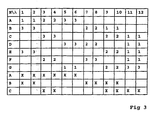
- FIG. 3 shows an example of a channel assignment table in which the bus network is constructed from 7 nodes connected in series.
- the number of columns in the table corresponds to the minimum number of channels, that is wavelengths, which must be used in this bus network.
- the number of rows represents the number of nodes in the bus network.
- the table has been supplemented with (N-1)/2 and N/2 rows respectively so that in the assignment, allowance can be made for the fact that the first and last nodes respectively in the bus network may, in the event of protective switching, be connected to one another by way of the additional pair of fibres 3, 4 and must therefore be treated as nodes arranged adjacent to one another.
- the table accordingly has 3N/2 rows if N is an even number and (3N-1)/2 rows if N is an odd number.
- the channel assignment table is filled in by assigning N-1 channels to each row in the network. For the first row in the table, corresponding to node A, these channels can be selected at random. In connection with the channel selection, marking is undertaken showing how these channels will coincide with the selection performed for the next few rows. In each row just two of the channels must coincide with the channels selected in the next row, two with the channels selected in the next but one row etc. up to a row of distance (N-1)/2 rows from the first row, if N is an odd number, and (N/2)-1 rows if N is an even number. In the case of channel assignment in a bus network with an even number of nodes, one channel must furthermore coincide with the row situated N/2 rows further down the table.
- the channel assignment is marked in the table by entering the row distance to that row in the table in which the same channel recurs, in the position in the first row of the table corresponding to a certain channel.
- these markings have been made by entering the figures 1, 2 and 3, which correspond to the distance to the rows in which the channels recur and are therefore to be marked again.
- the channels selected are also marked in the row at the end of the table which represents node A.
- this marking is denoted by X, since the selected channels coincide completely with those selected in the first row of the table, in which the distance to the nearest neighbour has already been established.
- the channel selection made in the first row of the table affects the channel selection for the next (N-1)/2 rows if N is an odd number or (N/2)-1 rows if N is an even number, since these rows, according to the channel assignment method according to the invention, must have certain common channels.
- the channels which are consequently fixed in a certain row are in turn further used either in the next row in the arrangement or the next but one row etc.
- the way in which the channel is used can be freely selected provided that there are never more than two channels marked for a certain row distance in the table.
- a wavelength must be used at least twice in the table if N is an even number and three times in the table if N is an odd number, that is to say a corresponding number of markings must occur at least in each column.
- no wavelength can be used more than P ⁇ + 2R ⁇ ⁇ N (N-1) (1) if N is an even number P ⁇ + 3R ⁇ ⁇ N (N-1) (2) if N is an odd number where P ⁇ represents the total number of wavelengths already placed, that is the number of markings in the rows of the table already filled in, and the number of wavelengths in the hypothetically completed wavelength column in preparation; R ⁇ is the number of wavelength columns not yet used.
- channel assignment When the channel assignment has been performed as can be predicted on the basis of the channel assignment in row A, channel assignment is performed in the same way for the other rows.
- the table When the table is completely filled in precisely N-1 channels will have been assigned to each row. Since the rows of the table correspond to nodes in the bus network the channel assignment table provides a definition of which channels are used for communication on each node. Each channel is reused directly on each node; transmitters and receivers in the respective node will therefore be intended for the same channels.
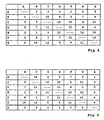
- the channel assignment on respective fibres is fixed by transferring the result from the channel assignment table to a connection matrix.
- the said matrix contains N rows and N columns, which correspond to the number of nodes in the bus network. In order to clarify this connection, rows and columns are given with corresponding node designation.
- the matrix In the connection table shown in Figure 4 having seven nodes, the matrix contains rows A-G and columns A-G.
- the connection matrix is used to clarify the nodes reciprocal communication and to make clear which fibre is communicating as transmitter or receiver for a certain channel.
- a channel indication in row A, column B corresponds, for example, to the channel which is used for communication from node A to node B by way of fibre 1; the channel indication in row B, column A then corresponds to the channel which is used for communication from node B to node A by way of fibre 2.
- the positions in the matrix at which both a column and a row symbolise one and the same node are not assigned any value, since the nodes in the bus network do not communicate with themselves.
- the diagonal of the connection matrix will therefore be left empty.
- the wavelengths which, according to the channel assignment column, will be used for communication between two nodes situated adjacent to one another are transferred to the connection matrix and entered on either side of the matrix diagonal. These are to be placed just below and just above the diagonal and in the bottom left-hand corner and in the upper right corner. The placing in relation to the diagonal is unimportant in this case.
- the channels which are used for the connection between the last two nodes are entered in the bottom right-hand comer of the matrix.
- the channels entered on either side of the diagonal correspond to the channels which are used for transmission on each fibre.
- the channels which will be used for communication between nodes arranged next but one in the bus network are entered in the same way. These channels are filled in as close as possible to the matrix diagonal; for a pair of channels marked in the channel assignment table, one channel is entered on each side of the matrix diagonal. For the outer nodes in the network configuration corresponding values are entered on each side of the diagonal, at those positions which are situated as far away as possible from the diagonal. If any wavelength channel is used more than once, this channel is to be placed on the same side of the connection matrix diagonal as in earlier placings.
- the completed connection matrix provides information on which channels are used for a connection between two nodes and information on how transmitters and receivers in a node are to be assigned between the fibres going to the right or the left respectively.
- the channels 1-6 have initially been arbitrarily assigned to node A.
- the assignment establishes that channel 1-2 is to be used for communication with node B, that is with the nearest node; channel 3-4 for communication with node C, that is the next but one node; and channel 5-6 for communication with node D, that is the node N/2 positions from node A. Due to the channel assignment performed in node A, the channel selection is limited in the other nodes.
- channel 1-2 Since, in the method according to the invention, each channel is directly reused after receiving in a node, channel 1-2 must be used for communication from node B, channel 3-4 for communication from node C and channel 5-6 for communication from node D.
- the node with which node D communicates by way of channel 5 and 6 has, however, been selected at random, the same applying to the nodes with which B and C communicate.
- the channels on node B can be selected arbitrarily. In the same way as for node A, this channel selection has affected which channels can be selected on node C, D and E.
- the table shown in the figure is correctly completed in accordance with the conditions stated above, which means that each wavelength is used at least twice and that no wavelength on any level in the table, that is to say with any number of completed rows, has been used more than the limit specified in (2).
- connection matrix By transferring the result in the channel assignment table according to Figure 3 to a connection matrix in the way described above, information is obtained on how each node will communicate with each other node.
- one of the channels marked in row A is for communication with the nearest neighbour, that is between node A and node B, located in row A, column B; the second channel is correspondingly located in row B, column A.
- the channels marked in row A in the channel assignment table for communication between node A and node C are located in row A, column C and row C, column A respectively in the connection table.
- a corresponding procedure has been performed for all other values in the channel assignment table, as can be seen from a comparison of Figure 3 and Figure 4.
- the channels which are given above the connection matrix diagonal are used, for example, for communication over the fibres going to the right, the channels which are given below the diagonal are then used for communication over the second fibre.
- FIG. 6 shows a flow diagram for the channel assignment to each node in accordance with the method according to the invention. The various steps have corresponding reference designations in the flow diagram shown in Figure 6. The following steps are performed in the channel assignment:
- the channel assignment is considerably simplified by using the channel assignment table described earlier, which is based on the principles shown in the flow diagram.
Landscapes
- Engineering & Computer Science (AREA)
- Computer Networks & Wireless Communication (AREA)
- Signal Processing (AREA)
- Optical Communication System (AREA)
- Small-Scale Networks (AREA)
Applications Claiming Priority (3)
| Application Number | Priority Date | Filing Date | Title |
|---|---|---|---|
| SE9500404A SE9500404L (sv) | 1995-02-06 | 1995-02-06 | Förfarande för tilldelning av våglängdskanaler i ett optiskt bussnät |
| SE9500404 | 1995-02-06 | ||
| PCT/SE1996/000120 WO1996024998A1 (en) | 1995-02-06 | 1996-02-02 | Method for assignment of wavelength channels in an optical bus network |
Publications (2)
| Publication Number | Publication Date |
|---|---|
| EP0808536A1 EP0808536A1 (en) | 1997-11-26 |
| EP0808536B1 true EP0808536B1 (en) | 2004-08-04 |
Family
ID=20397086
Family Applications (1)
| Application Number | Title | Priority Date | Filing Date |
|---|---|---|---|
| EP96902553A Expired - Lifetime EP0808536B1 (en) | 1995-02-06 | 1996-02-02 | Method for assignment of wavelength channels in an optical bus network |
Country Status (8)
| Country | Link |
|---|---|
| US (1) | US5963348A (es) |
| EP (1) | EP0808536B1 (es) |
| JP (1) | JP3677293B2 (es) |
| CA (1) | CA2211532A1 (es) |
| DE (1) | DE69633053T2 (es) |
| ES (1) | ES2225868T3 (es) |
| SE (1) | SE9500404L (es) |
| WO (1) | WO1996024998A1 (es) |
Families Citing this family (15)
| Publication number | Priority date | Publication date | Assignee | Title |
|---|---|---|---|---|
| SE9501075L (sv) * | 1995-03-27 | 1996-08-12 | Ericsson Telefon Ab L M | Optisk nod i ett optiskt bussnät |
| SE520943C2 (sv) * | 1998-06-10 | 2003-09-16 | Ericsson Telefon Ab L M | Add/dropp-nod anordnad att anslutas i ett optiskt fibernät av wdm-typ |
| SE521135C2 (sv) | 1998-06-17 | 2003-10-07 | Ericsson Telefon Ab L M | Ett kommunikationsnät och ett felhanteringsförfarande i ett sådant nät |
| US6570683B1 (en) * | 1999-10-28 | 2003-05-27 | At&T Corp. | Wavelength re-use |
| WO2002011336A1 (en) * | 2000-07-29 | 2002-02-07 | Marconi Communications Limited | Wavelength division multiplex (wdm) optical network |
| DE10047923C2 (de) * | 2000-09-27 | 2003-04-10 | Siemens Ag | Verfahren zur Erzeugung einer Verbindungs-Redundanz für ein serielles Kommunikationssystem mit einer Mastereinheit und einer Mehrzahl von Slaveeinheiten, die untereinander als Aneinanderreihung von Punkt-zu-Punkt-Verbindungen in Linientopologie verbunden sind, sowie korrespondierendes serielles Kommunikationssystem |
| US20020131125A1 (en) * | 2001-03-16 | 2002-09-19 | Myers Michael H. | Replicated-spectrum photonic transceiving |
| US6407846B1 (en) | 2001-03-16 | 2002-06-18 | All Optical Networks, Inc. | Photonic wavelength shifting method |
| CN100353695C (zh) * | 2001-04-11 | 2007-12-05 | 模式转换控股公司 | 低损耗wdm插入分出节点 |
| US7286760B1 (en) | 2001-11-15 | 2007-10-23 | At&T, Corp. | Wavelength allocation in regional access network with optical add-drop multiplexers |
| KR100454932B1 (ko) * | 2002-07-27 | 2004-11-06 | 삼성전자주식회사 | 파장분할 다중방식을 이용한 링형 통신망의 파장할당 방법 |
| CN100483975C (zh) * | 2003-07-08 | 2009-04-29 | 中国科学技术大学 | 量子网络寻址方法及量子网络路由器 |
| US7769296B1 (en) | 2005-02-17 | 2010-08-03 | At&T Intellectual Property Ii, L.P. | Arrangement for reducing multiplexing and demultiplexing cost in ultra long haul (ULH) all-optical networks by minimizing number of required mux/demux groups |
| US20060251421A1 (en) * | 2005-05-09 | 2006-11-09 | Ben Gurion University Of The Negev, Research And Development Authority | Improved free space optical bus |
| US10411806B2 (en) * | 2016-06-29 | 2019-09-10 | Ciena Corporation | Gridless optical routing and spectrum assignment |
Family Cites Families (5)
| Publication number | Priority date | Publication date | Assignee | Title |
|---|---|---|---|---|
| US5159595A (en) * | 1988-04-08 | 1992-10-27 | Northern Telecom Limited | Ring transmission system |
| US5212577A (en) * | 1990-01-19 | 1993-05-18 | Canon Kabushiki Kaisha | Optical communication equipment and optical communication method |
| JP2787820B2 (ja) * | 1990-07-20 | 1998-08-20 | キヤノン株式会社 | 波長多重光通信システム及びそこで用いられる光増幅装置 |
| DE69333423T2 (de) * | 1992-10-15 | 2004-12-16 | Canon K.K. | Optischer Konzentrator und optisches Übertragungsnetz mit einem derartigen Konzentrator |
| ATE218257T1 (de) * | 1992-11-16 | 2002-06-15 | Canon Kk | Übertragungsverfahren und -system mit tokenübergabezugriffsprotokoll |
-
1995
- 1995-02-06 SE SE9500404A patent/SE9500404L/xx not_active IP Right Cessation
-
1996
- 1996-02-02 ES ES96902553T patent/ES2225868T3/es not_active Expired - Lifetime
- 1996-02-02 EP EP96902553A patent/EP0808536B1/en not_active Expired - Lifetime
- 1996-02-02 WO PCT/SE1996/000120 patent/WO1996024998A1/en not_active Ceased
- 1996-02-02 DE DE69633053T patent/DE69633053T2/de not_active Expired - Lifetime
- 1996-02-02 JP JP52418596A patent/JP3677293B2/ja not_active Expired - Lifetime
- 1996-02-02 US US08/875,733 patent/US5963348A/en not_active Expired - Lifetime
- 1996-02-02 CA CA002211532A patent/CA2211532A1/en not_active Abandoned
Also Published As
| Publication number | Publication date |
|---|---|
| DE69633053T2 (de) | 2005-01-20 |
| SE503258C2 (sv) | 1996-04-29 |
| SE9500404L (sv) | 1996-04-29 |
| ES2225868T3 (es) | 2005-03-16 |
| JP3677293B2 (ja) | 2005-07-27 |
| EP0808536A1 (en) | 1997-11-26 |
| US5963348A (en) | 1999-10-05 |
| WO1996024998A1 (en) | 1996-08-15 |
| SE9500404D0 (sv) | 1995-02-06 |
| JPH10513326A (ja) | 1998-12-15 |
| CA2211532A1 (en) | 1996-08-15 |
| DE69633053D1 (de) | 2004-09-09 |
Similar Documents
| Publication | Publication Date | Title |
|---|---|---|
| EP0808536B1 (en) | Method for assignment of wavelength channels in an optical bus network | |
| US6616349B1 (en) | Two-fiber interconnected ring architecture | |
| US5159595A (en) | Ring transmission system | |
| CN1754352B (zh) | 用于进行通信网络中的通道的故障救济的装置和方法 | |
| EP0969619B1 (en) | Survivable optical network | |
| US6970433B1 (en) | Multichannel ring and star networks with limited channel conversion | |
| WO1997001907A1 (en) | Self-healing network | |
| CA2291837C (en) | Optical communication network | |
| EP0819344B1 (en) | Optical network and arrangement and method in such network | |
| WO1999043115A1 (en) | Ring/mesh optical network | |
| EP0818089B1 (en) | Optical node in an optical bus network | |
| US20040151499A1 (en) | Optical node system and switched connection method | |
| US20070115809A1 (en) | Common protection architecture for optical network | |
| US6061482A (en) | Channel layered optical cross-connect restoration system | |
| US7158720B1 (en) | Optical shared protection ring for multiple spans | |
| AU665655B2 (en) | Dual connections | |
| EP1005740B1 (en) | A method of transmitting data in a ring-shaped teletransmission network, such as a network and a network element therefor | |
| WO2001041345A1 (en) | A method for operating a wavelength division multiplexed optical ring network | |
| WO1999000942A2 (en) | A method of transmitting data in a ring-shaped teletransmission network, such a network and a network element therefor | |
| MXPA97007326A (es) | Nudo optico en una red de via de transferencia deinformacion optica |
Legal Events
| Date | Code | Title | Description |
|---|---|---|---|
| PUAI | Public reference made under article 153(3) epc to a published international application that has entered the european phase |
Free format text: ORIGINAL CODE: 0009012 |
|
| 17P | Request for examination filed |
Effective date: 19970709 |
|
| AK | Designated contracting states |
Kind code of ref document: A1 Designated state(s): CH DE FR GB GR IT LI |
|
| 17Q | First examination report despatched |
Effective date: 20030818 |
|
| GRAP | Despatch of communication of intention to grant a patent |
Free format text: ORIGINAL CODE: EPIDOSNIGR1 |
|
| RBV | Designated contracting states (corrected) |
Designated state(s): CH DE ES FR GB GR IT LI |
|
| RAP1 | Party data changed (applicant data changed or rights of an application transferred) |
Owner name: TELEFONAKTIEBOLAGET LM ERICSSON (PUBL) |
|
| GRAS | Grant fee paid |
Free format text: ORIGINAL CODE: EPIDOSNIGR3 |
|
| GRAA | (expected) grant |
Free format text: ORIGINAL CODE: 0009210 |
|
| AK | Designated contracting states |
Kind code of ref document: B1 Designated state(s): CH DE ES FR GB GR IT LI |
|
| PG25 | Lapsed in a contracting state [announced via postgrant information from national office to epo] |
Ref country code: LI Free format text: LAPSE BECAUSE OF FAILURE TO SUBMIT A TRANSLATION OF THE DESCRIPTION OR TO PAY THE FEE WITHIN THE PRESCRIBED TIME-LIMIT Effective date: 20040804 Ref country code: IT Free format text: LAPSE BECAUSE OF FAILURE TO SUBMIT A TRANSLATION OF THE DESCRIPTION OR TO PAY THE FEE WITHIN THE PRE;WARNING: LAPSES OF ITALIAN PATENTS WITH EFFECTIVE DATE BEFORE 2007 MAY HAVE OCCURRED AT ANY TIME BEFORE 2007. THE CORRECT EFFECTIVE DATE MAY BE DIFFERENT FROM THE ONE RECORDED.SCRIBED TIME-LIMIT Effective date: 20040804 Ref country code: CH Free format text: LAPSE BECAUSE OF FAILURE TO SUBMIT A TRANSLATION OF THE DESCRIPTION OR TO PAY THE FEE WITHIN THE PRESCRIBED TIME-LIMIT Effective date: 20040804 |
|
| REG | Reference to a national code |
Ref country code: GB Ref legal event code: FG4D |
|
| REG | Reference to a national code |
Ref country code: CH Ref legal event code: EP |
|
| REF | Corresponds to: |
Ref document number: 69633053 Country of ref document: DE Date of ref document: 20040909 Kind code of ref document: P |
|
| PG25 | Lapsed in a contracting state [announced via postgrant information from national office to epo] |
Ref country code: GR Free format text: LAPSE BECAUSE OF FAILURE TO SUBMIT A TRANSLATION OF THE DESCRIPTION OR TO PAY THE FEE WITHIN THE PRESCRIBED TIME-LIMIT Effective date: 20041104 |
|
| REG | Reference to a national code |
Ref country code: CH Ref legal event code: PL |
|
| REG | Reference to a national code |
Ref country code: ES Ref legal event code: FG2A Ref document number: 2225868 Country of ref document: ES Kind code of ref document: T3 |
|
| ET | Fr: translation filed | ||
| PLBE | No opposition filed within time limit |
Free format text: ORIGINAL CODE: 0009261 |
|
| STAA | Information on the status of an ep patent application or granted ep patent |
Free format text: STATUS: NO OPPOSITION FILED WITHIN TIME LIMIT |
|
| 26N | No opposition filed |
Effective date: 20050506 |
|
| PGFP | Annual fee paid to national office [announced via postgrant information from national office to epo] |
Ref country code: DE Payment date: 20140227 Year of fee payment: 19 |
|
| PGFP | Annual fee paid to national office [announced via postgrant information from national office to epo] |
Ref country code: FR Payment date: 20140220 Year of fee payment: 19 Ref country code: ES Payment date: 20140226 Year of fee payment: 19 |
|
| PGFP | Annual fee paid to national office [announced via postgrant information from national office to epo] |
Ref country code: GB Payment date: 20140227 Year of fee payment: 19 |
|
| REG | Reference to a national code |
Ref country code: DE Ref legal event code: R119 Ref document number: 69633053 Country of ref document: DE |
|
| GBPC | Gb: european patent ceased through non-payment of renewal fee |
Effective date: 20150202 |
|
| REG | Reference to a national code |
Ref country code: FR Ref legal event code: ST Effective date: 20151030 |
|
| PG25 | Lapsed in a contracting state [announced via postgrant information from national office to epo] |
Ref country code: DE Free format text: LAPSE BECAUSE OF NON-PAYMENT OF DUE FEES Effective date: 20150901 Ref country code: GB Free format text: LAPSE BECAUSE OF NON-PAYMENT OF DUE FEES Effective date: 20150202 |
|
| PG25 | Lapsed in a contracting state [announced via postgrant information from national office to epo] |
Ref country code: FR Free format text: LAPSE BECAUSE OF NON-PAYMENT OF DUE FEES Effective date: 20150302 |
|
| REG | Reference to a national code |
Ref country code: ES Ref legal event code: FD2A Effective date: 20160329 |
|
| PG25 | Lapsed in a contracting state [announced via postgrant information from national office to epo] |
Ref country code: ES Free format text: LAPSE BECAUSE OF NON-PAYMENT OF DUE FEES Effective date: 20150203 |