EP0808410B1 - Gerät zur bestimmung der krümmung eines langgestreckten loches, insbesondere eines bohrloches, beispielsweise in gestein - Google Patents
Gerät zur bestimmung der krümmung eines langgestreckten loches, insbesondere eines bohrloches, beispielsweise in gestein Download PDFInfo
- Publication number
- EP0808410B1 EP0808410B1 EP96903282A EP96903282A EP0808410B1 EP 0808410 B1 EP0808410 B1 EP 0808410B1 EP 96903282 A EP96903282 A EP 96903282A EP 96903282 A EP96903282 A EP 96903282A EP 0808410 B1 EP0808410 B1 EP 0808410B1
- Authority
- EP
- European Patent Office
- Prior art keywords
- probe
- curvature
- channel
- optical fibre
- fibre section
- Prior art date
- Legal status (The legal status is an assumption and is not a legal conclusion. Google has not performed a legal analysis and makes no representation as to the accuracy of the status listed.)
- Expired - Lifetime
Links
- 239000011435 rock Substances 0.000 title claims abstract description 8
- 239000000523 sample Substances 0.000 claims abstract description 123
- 239000013307 optical fiber Substances 0.000 claims abstract description 47
- 239000000835 fiber Substances 0.000 claims abstract description 41
- 238000005452 bending Methods 0.000 claims abstract description 30
- 230000008859 change Effects 0.000 claims abstract description 16
- 238000005259 measurement Methods 0.000 claims abstract description 10
- 230000007935 neutral effect Effects 0.000 claims abstract description 7
- 238000000034 method Methods 0.000 claims description 16
- 230000003287 optical effect Effects 0.000 claims description 12
- 230000005484 gravity Effects 0.000 claims description 2
- 230000008901 benefit Effects 0.000 description 7
- 230000001419 dependent effect Effects 0.000 description 6
- 238000012360 testing method Methods 0.000 description 6
- 230000015572 biosynthetic process Effects 0.000 description 5
- 238000005755 formation reaction Methods 0.000 description 5
- 230000008569 process Effects 0.000 description 5
- 238000012545 processing Methods 0.000 description 4
- 230000001681 protective effect Effects 0.000 description 4
- 238000001514 detection method Methods 0.000 description 3
- GWEVSGVZZGPLCZ-UHFFFAOYSA-N Titan oxide Chemical compound O=[Ti]=O GWEVSGVZZGPLCZ-UHFFFAOYSA-N 0.000 description 2
- 238000010276 construction Methods 0.000 description 2
- 238000006073 displacement reaction Methods 0.000 description 2
- 238000005553 drilling Methods 0.000 description 2
- 230000002349 favourable effect Effects 0.000 description 2
- 238000005305 interferometry Methods 0.000 description 2
- 238000004519 manufacturing process Methods 0.000 description 2
- 238000013507 mapping Methods 0.000 description 2
- 238000012544 monitoring process Methods 0.000 description 2
- 238000004181 pedogenesis Methods 0.000 description 2
- 230000000737 periodic effect Effects 0.000 description 2
- 125000006850 spacer group Chemical group 0.000 description 2
- 230000003595 spectral effect Effects 0.000 description 2
- 229910001369 Brass Inorganic materials 0.000 description 1
- 238000009412 basement excavation Methods 0.000 description 1
- 238000005422 blasting Methods 0.000 description 1
- 239000010951 brass Substances 0.000 description 1
- 238000005253 cladding Methods 0.000 description 1
- 230000001427 coherent effect Effects 0.000 description 1
- 230000000295 complement effect Effects 0.000 description 1
- 239000002131 composite material Substances 0.000 description 1
- 230000008878 coupling Effects 0.000 description 1
- 238000010168 coupling process Methods 0.000 description 1
- 238000005859 coupling reaction Methods 0.000 description 1
- 230000008021 deposition Effects 0.000 description 1
- 238000009826 distribution Methods 0.000 description 1
- 239000011152 fibreglass Substances 0.000 description 1
- 238000009434 installation Methods 0.000 description 1
- 230000002452 interceptive effect Effects 0.000 description 1
- 238000012821 model calculation Methods 0.000 description 1
- 238000012986 modification Methods 0.000 description 1
- 230000004048 modification Effects 0.000 description 1
- 230000010363 phase shift Effects 0.000 description 1
- 230000035945 sensitivity Effects 0.000 description 1
- 238000003466 welding Methods 0.000 description 1
Images
Classifications
-
- G—PHYSICS
- G01—MEASURING; TESTING
- G01B—MEASURING LENGTH, THICKNESS OR SIMILAR LINEAR DIMENSIONS; MEASURING ANGLES; MEASURING AREAS; MEASURING IRREGULARITIES OF SURFACES OR CONTOURS
- G01B11/00—Measuring arrangements characterised by the use of optical techniques
- G01B11/16—Measuring arrangements characterised by the use of optical techniques for measuring the deformation in a solid, e.g. optical strain gauge
- G01B11/18—Measuring arrangements characterised by the use of optical techniques for measuring the deformation in a solid, e.g. optical strain gauge using photoelastic elements
-
- E—FIXED CONSTRUCTIONS
- E21—EARTH OR ROCK DRILLING; MINING
- E21B—EARTH OR ROCK DRILLING; OBTAINING OIL, GAS, WATER, SOLUBLE OR MELTABLE MATERIALS OR A SLURRY OF MINERALS FROM WELLS
- E21B47/00—Survey of boreholes or wells
- E21B47/02—Determining slope or direction
- E21B47/022—Determining slope or direction of the borehole, e.g. using geomagnetism
-
- G—PHYSICS
- G01—MEASURING; TESTING
- G01B—MEASURING LENGTH, THICKNESS OR SIMILAR LINEAR DIMENSIONS; MEASURING ANGLES; MEASURING AREAS; MEASURING IRREGULARITIES OF SURFACES OR CONTOURS
- G01B11/00—Measuring arrangements characterised by the use of optical techniques
- G01B11/24—Measuring arrangements characterised by the use of optical techniques for measuring contours or curvatures
Definitions
- the invention relates to apparatus of the kind defined in the preamble of Claim 1.
- Apparatus of this kind find use in ore prospecting operations and in investigating and mapping ore deposits and other types of deposits. It is, of course, important when investigating ore deposits for instance, to be aware of the actual directional extension of the test holes that are drilled to this end, for instance the location of the hole at different depths, in order to effectively map the deposits. Such drill holes will always have curved sections and it is therefore necessary to determine the actual longitudinal extension of the drill hole.
- an apparatus of the kind taught by SE-C-387698 (7304122-0) wherein an apparatus probe is moved to different longitudinal sections of the hole and is constructed to conform to the curvature of the hole. Curvature or bending of the probe is determined with the aid of a camera which observes an objective in the probe, wherein the relative transversal displacement of the objective caused by curving of the probe constitutes a measurement of the curvature of the drill hole.
- the known probe In order to provide an accurate measuring result and, at the same time, to minimize the total cost of the preliminary exploration, the known probe must have a relatively large diameter. Naturally, the diameter of the test drill hole must be correspondingly large, and it is well known that the cost of drilling the test hole increases with increasing hole diameters.
- a further object of the invention is to provide an apparatus which is very flexible, magnetically insensitive, production friendly and temperature independent and which enables measurements to be made at several points along the probe in a simple manner.
- the invention is not restricted solely to determining the longitudinal extension of drill holes in rock, but can be used more generally to determine the curvature of any form of channel or passageway.
- a channel or passageway may conceivably have the form of a slot, wherein the actual probe may be rigid in the width direction of the slot when it is essentially only necessary to obtain information regarding curvature of the slot solely in a plane at right angles to the width direction of the slot.
- an optic fibre section is fitted in or on the probe body at a distance from its bending neutral line, preferably close to the outer surface of the probe body.
- the optical fibre section is mounted in the length direction of the probe. Consequently, as the probe bends, the optical fibre section will be subjected to a change in length that is representative of the extent to which the probe bends in an axial plane embraced by the optical fibre section and the probe axis.
- probe axis is meant its bending neutral line, i.e. the centres of gravity of respective probe cross-section areas.
- the channel curvature is evaluated by calculating the physical change in distance between two partial reflection devices (e.g.
- the curvature is measured optically such that the measuring result will comprise primarily the optical change in distance between the partial reflection devices. It is important to note that this optical change in distance does not solely correspond to the physical change in distance but is also influenced by the fact that the optical properties of the fibre, such as refractive index, are also affected by the physical bending of the fibre. Because the optical fibre sections have separate partial reflection devices, changes in length of the optical fibre section between the reflection devices as a result of bending of the section in the axial plane through the probe in which the section lies can be measured interferometrically.
- curvature of the channel results in changes in the core of the optical fibre used, which in turn results in an "electromagnetic signature" that can be measured.
- the use of two fibre sections in different axial planes thus enables bending of the probe and the position of the bend around the probe axis to be calculated.
- the two axial planes may conveniently be separated through an angle of 90°, for instance.
- the probe body is also influenced by shear stresses in the presence of large stretching forces.
- US-A-4,927,232 discloses a non-related technique of monitoring a buried pipeline with regard to ground movements with the aid of an optical fibre on the surface of the pipeline along the length thereof.
- the core of the optical fibre is surrounded by cladding which when subjected to radial forces changes the "electrooptic signature" of the optical fibre, such that an indication of a change in the radial forces acting on the pipeline can be obtained by measuring such changes in the electrooptic signature" of the optical fibre.
- US-A-4,806,012 describes an optical fibre strain gauge.
- the optical fibre is attached to or embedded in a structure, for instance a plate, which is to be monitored with regard to strain distribution along the fibre.
- the core string of the optical fibre is provided with different grating formations along its length.
- the spacing between the grating lines in the grating will change so as to cause a change in the reflection wavelength of the grating and thereby enable the strain acting in the various grating formations to be measured optically.
- An optical fibre strain gauge of this kind has relatively low sensitivity.
- Fizeau interferometer which in principle comprises an optical fibre having longitudinally spaced partial reflection devices, for instance gratings, so as to enable strain acting in the fibre to be determined interferometrically, by detecting the changes in length of the fibre between two gratings.
- the probe of the inventive apparatus may be made thin, which is highly significant in reducing the cost of tests drilling, for instance in mapping a deposit, such as an ore deposit.
- An important advantage of using an optical fibre in accordance with the invention is that the actual sensor part of the apparatus may be included as a permanent installation that has a sufficiently long length of life, at reasonable cost. For instance, it is of interest to be able to monitor regularly movements and displacements in rock formations and earth strata over relatively long time periods, for instance in the construction of large dams and roads, by moving the probe to mutually sequential longitudinal sections of drill holes therein and measuring the curvature of the drill holes. The relatively much more expensive signal processing part of the equipment can then be connected temporarily to the sensor, when the actual measuring process is to take place.
- a long row of sensor elements (each comprising an optical fibre section having two separate gratings, for instance) can be multiplexed on one single fibre. This enables the construction of a probe/sensor which is able to measure curvature at a large number of locations along a long distance. Because a large number of sensors are multiplexed on a long sensor/probe and because the different sensor elements use different gratings, measurements can be effected much more quickly than was earlier possible. A measuring process effected in accordance with the known technique is much more laborious.
- Multiplexing can be utilized for measuring, for instance, the path difference or the time difference between incoming light and light reflected from gratings, when said gratings are identical but located at different positions along the optical fibre.
- multiplexing can be based on different reflection wavelenghts for grating of mutually different frequencies.
- optical fibre sections having mutually spaced reflection means such as mirrors in an interferometer, is that it enables a measuring distance to be defined along which the mean value of the curvature is obtained. This avoids the problem of local inhomogeneities.
- fibre gratings can be mass-produced. This enables gratings to be produced in the fibre (enables gratings to be written into the fibre) at a large number of locations along an optical fibre, which may have a length measured in kilometers, at relatively low extra cost.
- the gratings may be formed by exposing the fibre interferometrically with UV light. In the production of a sensor within the scope of the present invention, the sensor part can thereby be produced at very low cost.
- the probe may be much shorter than the channel whose curvature/ longitudinal extension is to be determined, wherein the probe is moved to different positions along the length of the channel, wherein the curvature of the channel is registered at said different positions, and wherein the rotational position of the probe in said different positions is also conveniently registered.
- partial reflection means e.g. gratings
- the probe may be provided with gratings/reflection means in a plurality or multiple of axially separated positions along the strain sensing optical fibres, so as to enable curvature to be measured in many different axial positions along the probe and along the channel with the same distance requirement between the curvature measuring points and without needing to move the actual probe axially.
- the probe may be configured with a multiple of partial reflection means, for instance several thousand reflection means or pairs thereof at separate locations along the optical fibre/optical fibres of the probe, so as to enable the probe to be manufactured in lengths of up to several thousand metres.
- Such monitoring systems find use, for instance, in tunnel excavating work and like work, wherein one or more test holes are drilled along but outside said tunnel extension, and wherein long inventive probes can be inserted into these test holes and left therein so as to be able to establish the occurrence of changes by frequently determining curvature of the probe, and the magnitude of or the danger presented by these changes in connection with and due to continued excavation/blasting of the tunnel, so as to enable necessary countermeasures to be taken before the risks of or the disadvantages of the change in curvature/settling of the ground reaches a dangerous state.
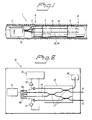
- the probe 1 comprises protective tubing 4, for instance brass tubing or tubing comprised of a fiber-glass composite, which although being rigid is sufficiently flexible to enable the tubing to conform to the same curvature as that of a drill hole into which the probe is inserted.
- the probe has essentially the same diameter as the drill hole, so that the probe will closely follow the curvature of said hole.
- the probe includes a probe body 3 which in the present case is comprised of a flexible, circular-cylindrical rod in the form of a thick-walled pipe whose inner and outer diameters are known.
- the probe body 3 is held concentrically in the protective tubing 4 by means of tubular spacer elements 5.
- the spacer elements 5 may have the form of slide bearings which enable the probe body 3 to rotate relative to the protective tubing 4.
- Optical fibres 31-34 are attached to the cylindrical probe body 3, for instance embedded therein or glued thereto. The fibres are fastened on/in the body 3 in a manner such that the fibres will bend when the body is subjected to strain.
- the fibres 31-34 extend parallel with the bending neutral line of the body, wherein each of the fibres is spaced at a constant distance along its length from the axis of the body 3 (the bending neutral line of the body) along its measuring distance.
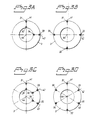
- Fig. 3A can be considered as being a cross-sectional view of the tubular probe body 3 of Fig. 1, and it can be seen from Fig. 3A that the fibres 31 and 32 lie respectively on the inner surface and the outer surface of the body 3 in an axial plane 41 of the body 3 that extends through its neutral bending axis 44.
- the fibres 33 and 34 lie in an axial plane 42 of the body 3, these planes 41, 42 being mutually separated, preferably through an angle of 90°.
- the fibres lie in respective axial planes on the same side of the axis 44.
- fibres 31-34 are connected to a signal processing unit.
- Each of the optical fibres includes a partial reflection means 8a, 8b, 22a, 22b disposed at two predetermined positions A and B respectively along the body 3.
- said partial reflection means may comprise respective fibre gratings 8a and 8b.
- Incoming light 19 is reflected partially by the grating 8a and gives rise to an oppositely directed beam of light 20a, and the other grating 8b gives rise to an oppositely directed beam of light 20b in a similar manner, wherein part of the light is transmitted as indicated at 21.
- partially reflecting mirrors 22a and 22b can be incorporated in the fibres at respective positions A and B, for instance by severing the optical fibre and then applying a layer of, e.g., TiO 2 by vapour deposition on the cut surfaces, and thereafter welding the fibre ends together so that the vapour-deposited layer will establish a partially reflecting mirror.
- a layer of, e.g., TiO 2 by vapour deposition on the cut surfaces, and thereafter welding the fibre ends together so that the vapour-deposited layer will establish a partially reflecting mirror.
- light from the light sources 9a, 9b is conducted through optical fibres 15 to an optical chip 16, where the light is distributed to the sensor fibres 31, 32 through the medium of a plurality of waveguide switches or couplers 17.
- the light 19 returns as signals 20a, 20b which are re-distributed to the detectors 11 by the chip 16 and thereafter amplified in respective amplifier stages 12, as shown in Fig. 4A.
- the resultant signal is finally processed electronically in the processor 13.
- the light sources 9a, 9b are driven with the aid of control electronics 14, which ensure that the wavelength of the laser light source is held constant, with the aid of a reference grating 18.
- the fibre gratings 8a, 8b have a broad spectral characteristic in relation to the light source 9.
- the pair of gratings 8a, 8b will function as a pair of mirrors in the fibre when the wavelength of the light source 9 is chosen close to the central wavelength of the gratings 8a, 8b.
- the two reflection means, the gratings 8a, and the fibre form a so-called Fizeau interferometer.
- the phase position between the two reflected light beams 20a, 20b is linearly dependent on the distance between the gratings 8a, 8b and thereby linearly dependent on strain acting on the optical fibre.
- the phase difference thus reflects the bending of the probe body 3 between the pair of gratings.
- the two reflected light beams 20a, 20b are thus led back to the detector 10, where they are allowed to interfere.
- the length of coherence of the light source will preferably be greater than twice the distance between the gratings 8a, 8b.
- the processor 13 functions to produce a bending measurement value.
- the detected signal is sinusoidally dependent on the phase difference (interference fringes) and the processing of the signals is mainly to count the interference fringes and to check the location of the interference fringes.
- One way is to use two wavelength interferometry. As the name implies, two wavelengths are then required, these wavelengths either being obtained by using two mutually independent light sources 9a, 9b (c.f. Fig. 2) or by using a light source which can be tuned with respect to wavelength, so as to achieve a corresponding function.
- Another method is to use one of the gratings 8a, 8b included in the Fizeau interferometer, and particularly the spectral characteristics of the grating.
- a tunable light source or by using spectroscopic detection, i.e. wavelength-dependent detection, it is possible, for instance, to establish the central wavelength of the grating.
- the central wavelength is thus the strain-dependent wavelength, and an absolute value of fibre bending can be established by measuring this central wavelength.
- this method is not as accurate as the interferometric method, but can be used to provide an approximate starting value.
- the method may be used advantageously in combination with two wavelength interferometry to obtain extremely accurate measurements of the absolute value of the strain in the fibre.
- Fig. 3B can be considered to show that the fibre sections 32 and 34 have been moved parallel to one another in their respective axial planes 41, 42, to the region of the outer surface of the probe body 3. All of the active fibre sections 31-34 will hereby be located at the greatest possible distance from the axis 44, thereby enabling the diameter of the probe body to be minimized.
- a further pair of fibre sections 35, 36 are disposed in an axial plane 43 comprising the axis 44, wherein the fibres 35, 36 lie parallel with and along the generatrices of the body 3.
- the three pairs of fibre sections 31, 32; 33, 34; 35, 36 are disposed in equidistantly spaced planes.
- the additional information obtained by the sensors 35, 36 in the "third" axial plane can be used for compensating any errors that may occur as a result of shear stresses generated when the sensor body is subjected to heavy bending, i.e. is given a relatively small radius of curvature.
- strain sensing optical fibre sections lie in at least two angularly separated axial planes that extend through the bending mutual line of the probe, so as to enable bending/curvature of the probe to be measured in three dimensions.
- An additional fibre section/Fizeau interferometer has been included to provide temperature compensation of the measuring signal.
- the probe body 3 need not necessarily be rotational symmetrical. It may be so that it is known beforehand that the curvature of the channel to be measured will be much greater in one certain plane than in another plane and that the probe body may be constructed accordingly, for instance so that the body can be given an elliptic cross-section.
- the probe body 3 By giving the probe body 3 a well-defined shape and by also giving the fibre sections 31, 34 a well-defined position, bending can be calculated with the aid of known models for bending beam-like objects. However, this does not exclude the possibility of obtaining the ratio between resultant signals and curvature with the aid of a calibration process instead. In certain instances, this may even be a necessary complement to the model calculations.
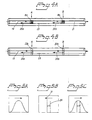
- Figs. 5A-C illustrate light intensity as a function of wavelength for incoming, reflected and transmitted light in a grating.
- the grating 8 is a periodic refractive index variation which has been written into the fibre core 23 by means of interfering UV light.
- a broadband light source i.e. light having a broad spectrum
- Fig. 5B When light emanating from a broadband light source, i.e. light having a broad spectrum (Fig. 5A), falls on the grating 8, only the wavelength 31 which is twice as long as the periodicity of the grating will be reflected back (Fig. 5B).
- the reflective wavelength When the grating 8 is subjected to strain, the reflective wavelength will increase and the change in wavelength 39 of reflected light will constitute a measurement of the strain.
- the phase shift between the reflected light beams or rays thus indicates strain, i.e. bending of the probe body 3. From a measuring technical aspect, such a phase difference can only be established by coherent detection.
- the illustrated embodiment illustrates a measuring process based on reflected light
- the measuring process can equally as well be carried out on the basis of transmitted light.
- the interferometers may, of course, be connected in series if the reflection means are constructed in accordance with known techniques such that said means and their measurement signals can be identified.
- the orientation of the sensor body (3) is not fully determined by establishing its curvature, since the probe body may rotate about its axis as it is moved through the measuring channel (the rock drill hole). Consequently, the apparatus probe will preferably be supplemented with either a gyroscope 51 or a spirit level which will provide information relating to the rotational position of the probe.
- information relating to curvature and possibly to the rotational position of the probe can be registered in the probe or transmitted conventionally over wires or fibres or by radio to a remotely operated receiver, for instance at an accessible end of the channel.
Landscapes
- Physics & Mathematics (AREA)
- General Physics & Mathematics (AREA)
- Mining & Mineral Resources (AREA)
- Life Sciences & Earth Sciences (AREA)
- Engineering & Computer Science (AREA)
- Geology (AREA)
- Fluid Mechanics (AREA)
- Environmental & Geological Engineering (AREA)
- Geophysics (AREA)
- General Life Sciences & Earth Sciences (AREA)
- Geochemistry & Mineralogy (AREA)
- Length Measuring Devices By Optical Means (AREA)
- Earth Drilling (AREA)
- Length Measuring Devices With Unspecified Measuring Means (AREA)
Claims (14)
- Gerät zur Ermittlung der Krümmung in einem langgestreckten Kanal, etwa einem Bohrloch, beispielsweise in Gestein, wobei besagtes Gerät eine flexible Sonde (1) beinhaltet, die dazu vorgesehen ist, die Krümmung des Kanales anzunehmen, wenn sie darin eingesetzt ist, wobei die Sonde (1) ein Mittel (3, 13, 10) aufweist, um die Krümmung der Sonde, und damit die Krümmung des Kanales, zwischen zumindest zwei in Längsrichtung voneinander entfernten Stellen (A, B) an der Sonde (1), zu erkennen, dadurch gekennzeichnet, dass das genannte Mittel einen optischen Faserabschnitt (31) beinhaltet, der mit einem biegbaren Sondenkörper (3) verbunden ist, der in der Sonde (1) angeordnet und mit der genannten Sonde so verbunden ist, dass er die Biegung oder Krümmung der genannten Sonde annimmt, wobei sich der optische Faserabschnitt (31) parallel zu und in einem konstanten Abstand von der neutralen Biegeachse (44) des Sondenkörpers (3) erstreckt, so dass die Verformung des Faserabschnittes ein Maß der Biegung des Sondenkörpers (3) in einer axialen Ebene (41) liefert, welche den Faserabschnitt (31) beinhaltet; dass der optische Faserabschnitt (31) zwei reflektierende Mittel (8a, 8b; 22a, 22b) an den genannten Stellen (A, B) entlang der Sonde aufweist und dass ein Mittel (10) mit dem optischen Faserabschnitt für interferometrische Ermittlung der Änderung des Abstandes zwischen den teilreflektierenden Mitteln in dem Faserabschnitt (31) verbunden ist und ein Mittel (32, 10) vorgesehen ist, um den Einfluß der Temperatur auf die Änderung des Abstandes zwischen den teilreflektierenden Mitteln zu kompensieren.
- Gerät nach Anspruch 1, dadurch gekennzeichnet, dass das den Temperatureinfluß kompensierende Mittel einen weiteren optischen Faserabschnitt (32) beinhaltet, der zusätzlich zu dem ersterwähnten optischen Faserabschnitt (31) vorgesehen ist und sich zu diesem parallel in der gleichen axialen Ebene (41) erstreckt, wobei der genannte weitere Faserabschnitt teilreflektierende Mittel (8a, 8b; 22a, 22b) aufweist, die vorzugsweise ebenfalls an den genannten Stellen (A, B) längs der Sonde angeordnet sind, wodurch der Unterschied der Deformation zwischen den zwei optischen Faserabschnitten (31, 32) einen temperaturunabhängigen Meßwert des Ausmaßes liefert, in dem sich die Sonde in der axialen Ebene biegt.
- Gerät nach Anspruch 1 oder Anspruch 2, dadurch gekennzeichnet, dass der Abstand zwischen den Stellen (A, B) der Sonde zumindest das Zehnfache des Radius des Sondenkörpers (3) bis zum radial am weitesten innenliegenden, Deformation messenden optischen Faserabschnitt (32) beträgt und dass die Querschnittsgröße der Sonde in der Biegeebene weniger als 5 cm und mehr als 0,1 cm beträgt.
- Gerät nach irgendeinem der Ansprüche 1 bis 3, dadurch gekennzeichnet, dass das reflektierende Mittel Fasergitter mit einer Linienbreite von zumindest 0,2 nm aufweist.
- Gerät nach irgendeinem der Ansprüche 1 bis 4, dadurch gekennzeichnet, dass die Achse des Sondenkörpers durch die Schwerezentren der Querschnittsfläche des Sondenkörpers definiert ist und dass betreffende Faserabschnitte zwischen den genannten reflektierenden Mitteln einen genau definierten, vorzugsweise konstanten Abstand von der Sondenachse bis zur Mittellinie des Faserabschnittes aufweisen.
- Gerät nach irgendeinem der Ansprüche 1 bis 5, gekennzeichnet durch zwei Lichtquellen (9a, 9b) unterschiedlicher Wellenlängen zur Ermittlung der Phasendifferenz für Licht, das von betreffenden Paaren reflektierender Mittel über einen größeren dynamischen Bereich als pi reflektiert wird.
- Gerät nach irgendeinem der Ansprüche 1 bis 6, dadurch gekennzeichnet, dass die reflektierenden Mittel (8a, 8b) des optischen Faserabschnittes dazu ausgelegt sind, um die optische Wellenlänge zu ermitteln, die durch eines der Gitter reflektiert wird, und diese Wellenlänge mit einer Eichwellenlänge zu vergleichen, die das Gitter in dem nicht gekrümmten Zustand der Sonde besitzt, um einen ungefähren Absolutwert des interferometrisch erzeugten Meßsignales von dem Gitterpaar (8a, 8b) in dem optischen Faserabschnitt (31) zu ermitteln.
- Gerät nach irgendeinem der Ansprüche 1 bis 7, dadurch gekennzeichnet, dass die Sonde (1) eine optische Faser beinhaltet, die von Beanspruchung frei bleibt, wenn sich die Sonde biegt oder krümmt, und dass diese belastungsfreie Faser ein Gitter (8) mit geeichter Periodizität beinhaltet, das als eine Referenz fungiert, um einen absoluten Biegewert einer Sonde auszuwerten, deren optischer Faserabschnitt (31) reflektierende Mittel in Form von Gittern aufweist.
- Gerät nach irgendeinem der Ansprüche 1 bis 8, dadurch gekennzeichnet, dass die Sonde zumindest zwei biegungssensitive Faserabschnitte beinhaltet, von denen jeder ein Paar teilreflektierender Mittel besitzt, und dass die besagten Abschnitte (31, 33) in in einem Abstand voneinander befindlichen axialen Ebenen (41, 42) liegen, so dass das Biegen des Sondenkörpers dreidimensional ermittelt werden kann.
- Gerät nach Anspruch 9, dadurch gekennzeichnet, dass besagtes Gerät drei optische Faserabschnitte (31, 33, 35) beinhaltet, die in voneinander im Abstand befindlichen axialen Ebenen liegen, um das Biegen des Sondenkörpers in den genannten betreffenden axialen Ebenen zu messen, wobei besagte Ebenen vorzugsweise um gleiche Winkel voneinander entfernt sind.
- Gerät nach irgendeinem der Ansprüche 1 bis 10, dadurch gekennzeichnet, dass der verformungssensitive optische Faserabschnitt mehr als zwei in Längsrichtung getrennte teilreflektierende Mittel aufweist, wobei Veränderungen im Abstand zwischen den teilreflektierenden Mitteln in unterschiedlichen Längsabschnitten des optischen Faserabschnittes mit Hilfe einer Multiplextechnik erkannt werden.
- Gerät nach irgendeinem der Ansprüche 1 bis 11, dadurch gekennzeichnet, dass die Sonde ein Mittel zum Erkennen der Orientierung des Sondenkörpers (3) um seine Achse beinhaltet.
- Gerät nach irgendeinem der Ansprüche 1 bis 12, dadurch gekennzeichnet, dass die Sonde eine Länge besitzt, die kleiner ist als die Länge des Kanales, dessen Krümmung entlang seiner Länge ermittelt werden soll, und dass die Sonde (1) an unterschiedliche Stellen entlang des Kanales bewegt werden kann, um die Krümmung des genannten Kanales an entsprechenden Stellen der Sonde zu ermitteln, und dass das Gerät mit einem Mittel zur Registrierung der Kanalkrümmung an den genannten Stellen der Sonde verbunden werden kann.
- Gerät nach irgendeinem der Ansprüche 1 bis 13, dadurch gekennzeichnet, dass die Sonde (1) eine Meßlänge besitzt, die zumindest gleich lang wie der Kanal ist, und dass die Sonde eine Mehrzahl teilreflektierender Mittel aufweist, die entlang der Länge der Sonde voneinander entfernt sind, um zu ermöglichen, dass Krümmung oder Biegung der Sonde an einer Mehrzahl von voneinander entfernten Stellen längs der Sonde gemessen werden kann, die in dem Kanal angeordnet ist, wodurch das Messen von Krümmung/Erstreckung des Kanales entlang von im wesentlichen seiner gesamten Länge bewirkt werden kann, ohne die Sonde in dem Kanal zu bewegen.
Applications Claiming Priority (3)
| Application Number | Priority Date | Filing Date | Title |
|---|---|---|---|
| SE9500512A SE9500512L (sv) | 1995-02-13 | 1995-02-13 | Apparat för bestämning av krökningen för en långsträckt kanal såsom ett borrhål i berg |
| SE9500512 | 1995-02-13 | ||
| PCT/SE1996/000084 WO1996025584A1 (en) | 1995-02-13 | 1996-02-09 | Apparatus for determining the curvature of an elongated hole, such as a drill hole, in rock for instance |
Publications (2)
| Publication Number | Publication Date |
|---|---|
| EP0808410A1 EP0808410A1 (de) | 1997-11-26 |
| EP0808410B1 true EP0808410B1 (de) | 2001-08-29 |
Family
ID=20397188
Family Applications (1)
| Application Number | Title | Priority Date | Filing Date |
|---|---|---|---|
| EP96903282A Expired - Lifetime EP0808410B1 (de) | 1995-02-13 | 1996-02-09 | Gerät zur bestimmung der krümmung eines langgestreckten loches, insbesondere eines bohrloches, beispielsweise in gestein |
Country Status (10)
| Country | Link |
|---|---|
| US (1) | US5946094A (de) |
| EP (1) | EP0808410B1 (de) |
| JP (1) | JP3466623B2 (de) |
| AT (1) | ATE204949T1 (de) |
| AU (1) | AU690817B2 (de) |
| CA (1) | CA2212749A1 (de) |
| DE (1) | DE69614827T2 (de) |
| PT (1) | PT808410E (de) |
| SE (1) | SE9500512L (de) |
| WO (1) | WO1996025584A1 (de) |
Families Citing this family (21)
| Publication number | Priority date | Publication date | Assignee | Title |
|---|---|---|---|---|
| US6556288B1 (en) * | 1999-12-21 | 2003-04-29 | Lockheed Martin Corporation | Distributed displacement sensor |
| DE60143321D1 (de) * | 2001-03-27 | 2010-12-02 | Council Scient Ind Res | |
| EP1546981A4 (de) * | 2002-09-23 | 2008-01-23 | Columbia Technologies Llc | System, verfahren und computerprogrammprodukt zur unteroberflächenverunreinigungsdetektion und -analyse |
| JP2005172536A (ja) * | 2003-12-10 | 2005-06-30 | Taisei Kiso Sekkei Kk | 折れ角測定装置 |
| US7222534B2 (en) * | 2005-03-31 | 2007-05-29 | Pgs Americas, Inc. | Optical accelerometer, optical inclinometer and seismic sensor system using such accelerometer and inclinometer |
| GB0620944D0 (en) | 2006-10-20 | 2006-11-29 | Insensys Ltd | Curvature measurement moving relative to pipe |
| JP5385516B2 (ja) * | 2007-07-10 | 2014-01-08 | エヌ・ティ・ティ・インフラネット株式会社 | 変形量センサ、変形量測定装置、変形量測定方法 |
| US8065085B2 (en) | 2007-10-02 | 2011-11-22 | Gyrodata, Incorporated | System and method for measuring depth and velocity of instrumentation within a wellbore using a bendable tool |
| US8095317B2 (en) | 2008-10-22 | 2012-01-10 | Gyrodata, Incorporated | Downhole surveying utilizing multiple measurements |
| US8185312B2 (en) | 2008-10-22 | 2012-05-22 | Gyrodata, Incorporated | Downhole surveying utilizing multiple measurements |
| US8065087B2 (en) * | 2009-01-30 | 2011-11-22 | Gyrodata, Incorporated | Reducing error contributions to gyroscopic measurements from a wellbore survey system |
| US20100200743A1 (en) * | 2009-02-09 | 2010-08-12 | Larry Dale Forster | Well collision avoidance using distributed acoustic sensing |
| US10143523B2 (en) * | 2015-03-31 | 2018-12-04 | 7D Surgical Inc. | Systems, methods and devices for tracking and calibration of flexible instruments |
| EP3483579B1 (de) * | 2017-11-08 | 2022-07-27 | NKT HV Cables AB | Verfahren und system zur ermüdungsüberwachung eines unterseekabels in offshore-operationen |
| CN111594142B (zh) * | 2020-05-24 | 2023-03-28 | 中煤科工集团重庆研究院有限公司 | 煤矿井下随钻钻孔轨迹测量系统及方法 |
| CN114353686B (zh) * | 2021-09-10 | 2023-10-20 | 重庆交通大学 | 隧道衬砌的曲率分布智能获取方法及相关装置 |
| CA3225722A1 (en) * | 2021-09-29 | 2023-04-06 | Artyom Nikolaevich FEDOROV | Method of measuring bending of an extended vertically directed channel |
| JP2024536979A (ja) * | 2021-09-29 | 2024-10-10 | ジョイント ストック カンパニー“ロスエネルゴアトム” | 垂直方向に延びる流路の撓みを測定する装置 |
| RU2768260C1 (ru) * | 2021-09-29 | 2022-03-23 | Акционерное Общество "Российский Концерн По Производству Электрической И Тепловой Энергии На Атомных Станциях" (Ао "Концерн Росэнергоатом") | Способ измерения прогиба технологического канала ядерного реактора |
| CN114279365B (zh) * | 2021-12-21 | 2024-02-02 | 浙江贝盛光伏股份有限公司 | 一种光伏组件弯曲测量系统及方法 |
| CN115200473B (zh) * | 2022-07-13 | 2025-06-10 | 天津大学 | 一种激光炮孔三维测量仪及方法 |
Family Cites Families (11)
| Publication number | Priority date | Publication date | Assignee | Title |
|---|---|---|---|---|
| US436419A (en) * | 1890-09-16 | Centrifugal separator | ||
| SE387698B (sv) * | 1973-03-23 | 1976-09-13 | Haglund Mats T | Apparat for bestemning av ett langt borrhals krokning |
| SE373635B (sv) * | 1973-06-01 | 1975-02-10 | J A L Karlsson | Anordning for metning av rakheten hos en langstreckt borrning |
| CA1124384A (en) * | 1979-08-09 | 1982-05-25 | Paolo G. Cielo | Stable fiber-optic hydrophone |
| DE2936682A1 (de) * | 1979-09-11 | 1981-09-10 | Siemens AG, 1000 Berlin und 8000 München | Eingangsstufe fuer eine monolitisch integrierte ladungsverschiebeanordnung |
| US4927232A (en) * | 1985-03-18 | 1990-05-22 | G2 Systems Corporation | Structural monitoring system using fiber optics |
| US4436419A (en) * | 1982-02-16 | 1984-03-13 | United Technologies Corporation | Optical strain gauge |
| US4806012A (en) * | 1984-08-13 | 1989-02-21 | United Technologies Corporation | Distributed, spatially resolving optical fiber strain gauge |
| US4722603A (en) * | 1986-06-27 | 1988-02-02 | Chevron Research Company | Interferometric means and method for accurate determination of fiber-optic well logging cable length |
| US5301001A (en) * | 1992-02-12 | 1994-04-05 | Center For Innovative Technology | Extrinsic fiber optic displacement sensors and displacement sensing systems |
| US5528367A (en) * | 1994-09-09 | 1996-06-18 | The United States Of America As Represented By The Secretary Of The Navy | In-line fiber etalon strain sensor |
-
1995
- 1995-02-13 SE SE9500512A patent/SE9500512L/ not_active IP Right Cessation
-
1996
- 1996-02-09 AU AU47341/96A patent/AU690817B2/en not_active Ceased
- 1996-02-09 EP EP96903282A patent/EP0808410B1/de not_active Expired - Lifetime
- 1996-02-09 CA CA002212749A patent/CA2212749A1/en not_active Abandoned
- 1996-02-09 JP JP52486896A patent/JP3466623B2/ja not_active Expired - Fee Related
- 1996-02-09 WO PCT/SE1996/000084 patent/WO1996025584A1/en not_active Ceased
- 1996-02-09 PT PT96903282T patent/PT808410E/pt unknown
- 1996-02-09 DE DE69614827T patent/DE69614827T2/de not_active Expired - Lifetime
- 1996-02-09 AT AT96903282T patent/ATE204949T1/de not_active IP Right Cessation
- 1996-02-09 US US08/894,126 patent/US5946094A/en not_active Expired - Fee Related
Also Published As
| Publication number | Publication date |
|---|---|
| AU690817B2 (en) | 1998-04-30 |
| DE69614827D1 (de) | 2001-10-04 |
| AU4734196A (en) | 1996-09-04 |
| SE9500512D0 (sv) | 1995-02-13 |
| US5946094A (en) | 1999-08-31 |
| SE503629C2 (sv) | 1996-07-22 |
| EP0808410A1 (de) | 1997-11-26 |
| JP3466623B2 (ja) | 2003-11-17 |
| WO1996025584A1 (en) | 1996-08-22 |
| SE9500512L (sv) | 1996-07-22 |
| CA2212749A1 (en) | 1996-08-22 |
| PT808410E (pt) | 2002-02-28 |
| ATE204949T1 (de) | 2001-09-15 |
| JPH11500195A (ja) | 1999-01-06 |
| DE69614827T2 (de) | 2002-04-11 |
Similar Documents
| Publication | Publication Date | Title |
|---|---|---|
| EP0808410B1 (de) | Gerät zur bestimmung der krümmung eines langgestreckten loches, insbesondere eines bohrloches, beispielsweise in gestein | |
| US8630515B2 (en) | Rotated single or multicore optical fiber | |
| US7245791B2 (en) | Compaction monitoring system | |
| US10370957B2 (en) | Measuring downhole temperature by combining DAS/DTS data | |
| CA2849317C (en) | Monitoring structural shape or deformations with helical-core optical fiber | |
| EP2666001B1 (de) | Belastungssensorvorrichtung und belastungserfassungsverfahren | |
| US20090007652A1 (en) | Optical sensor for measuring downhole ingress of debris | |
| CN110608675B (zh) | 基于光纤光栅传感技术的多点位移测试方法 | |
| US9651435B2 (en) | Distributed strain and temperature sensing system | |
| Kania et al. | Application of distributed fibre optic cables in piles | |
| EP0278143B1 (de) | Faseroptisches Bau-Überwachungssystem | |
| US5750901A (en) | Optical fiber apparatus and method for measuring geological strains | |
| Li et al. | A fibre bragg grating-based inclinometer system for ground movement measurement | |
| KR101698836B1 (ko) | 광섬유를 사용하는 가속도 측정 시스템 | |
| Lenke et al. | Highly sensitive fiber optic inclinometer: easy to transport and easy to install | |
| KK et al. | Applications of Optical Fiber in Dam Safety Monitoring | |
| Eichhorn et al. | Pressure and thermal effects on Rayleigh fibre-optic strain measurement for soil–structure interaction | |
| CN118654588A (zh) | 一种基于fbg传感技术的竖井收敛变形监测方法 | |
| Ismail et al. | ORCID: 0000-0003-2250-3832, Brambilla, G., Rahman, BM ORCID: 0000-0001-6384-0961, Mohamad, H. and Ahmad, H.(2021). Biaxial 3D-Printed Inclinometer Based on Fiber Bragg Grating Technology |
Legal Events
| Date | Code | Title | Description |
|---|---|---|---|
| PUAI | Public reference made under article 153(3) epc to a published international application that has entered the european phase |
Free format text: ORIGINAL CODE: 0009012 |
|
| 17P | Request for examination filed |
Effective date: 19970721 |
|
| AK | Designated contracting states |
Kind code of ref document: A1 Designated state(s): AT BE CH DE DK ES FR GB GR IE IT LI LU MC NL PT SE |
|
| GRAG | Despatch of communication of intention to grant |
Free format text: ORIGINAL CODE: EPIDOS AGRA |
|
| 17Q | First examination report despatched |
Effective date: 20001107 |
|
| GRAG | Despatch of communication of intention to grant |
Free format text: ORIGINAL CODE: EPIDOS AGRA |
|
| GRAH | Despatch of communication of intention to grant a patent |
Free format text: ORIGINAL CODE: EPIDOS IGRA |
|
| GRAH | Despatch of communication of intention to grant a patent |
Free format text: ORIGINAL CODE: EPIDOS IGRA |
|
| GRAA | (expected) grant |
Free format text: ORIGINAL CODE: 0009210 |
|
| AK | Designated contracting states |
Kind code of ref document: B1 Designated state(s): AT BE CH DE DK ES FR GB GR IE IT LI LU MC NL PT SE |
|
| PG25 | Lapsed in a contracting state [announced via postgrant information from national office to epo] |
Ref country code: NL Free format text: LAPSE BECAUSE OF FAILURE TO SUBMIT A TRANSLATION OF THE DESCRIPTION OR TO PAY THE FEE WITHIN THE PRESCRIBED TIME-LIMIT Effective date: 20010829 Ref country code: FR Free format text: LAPSE BECAUSE OF FAILURE TO SUBMIT A TRANSLATION OF THE DESCRIPTION OR TO PAY THE FEE WITHIN THE PRESCRIBED TIME-LIMIT Effective date: 20010829 Ref country code: BE Free format text: LAPSE BECAUSE OF FAILURE TO SUBMIT A TRANSLATION OF THE DESCRIPTION OR TO PAY THE FEE WITHIN THE PRESCRIBED TIME-LIMIT Effective date: 20010829 Ref country code: AT Free format text: LAPSE BECAUSE OF FAILURE TO SUBMIT A TRANSLATION OF THE DESCRIPTION OR TO PAY THE FEE WITHIN THE PRESCRIBED TIME-LIMIT Effective date: 20010829 |
|
| REF | Corresponds to: |
Ref document number: 204949 Country of ref document: AT Date of ref document: 20010915 Kind code of ref document: T |
|
| REG | Reference to a national code |
Ref country code: CH Ref legal event code: EP |
|
| REG | Reference to a national code |
Ref country code: IE Ref legal event code: FG4D |
|
| REF | Corresponds to: |
Ref document number: 69614827 Country of ref document: DE Date of ref document: 20011004 |
|
| REG | Reference to a national code |
Ref country code: CH Ref legal event code: NV Representative=s name: PATENTANWAELTE SCHAAD, BALASS, MENZL & PARTNER AG |
|
| PG25 | Lapsed in a contracting state [announced via postgrant information from national office to epo] |
Ref country code: DK Free format text: LAPSE BECAUSE OF FAILURE TO SUBMIT A TRANSLATION OF THE DESCRIPTION OR TO PAY THE FEE WITHIN THE PRESCRIBED TIME-LIMIT Effective date: 20011129 |
|
| PG25 | Lapsed in a contracting state [announced via postgrant information from national office to epo] |
Ref country code: GR Free format text: LAPSE BECAUSE OF FAILURE TO SUBMIT A TRANSLATION OF THE DESCRIPTION OR TO PAY THE FEE WITHIN THE PRESCRIBED TIME-LIMIT Effective date: 20011130 |
|
| REG | Reference to a national code |
Ref country code: GB Ref legal event code: IF02 |
|
| EN | Fr: translation not filed | ||
| NLV1 | Nl: lapsed or annulled due to failure to fulfill the requirements of art. 29p and 29m of the patents act | ||
| PG25 | Lapsed in a contracting state [announced via postgrant information from national office to epo] |
Ref country code: LU Free format text: LAPSE BECAUSE OF NON-PAYMENT OF DUE FEES Effective date: 20020209 |
|
| PG25 | Lapsed in a contracting state [announced via postgrant information from national office to epo] |
Ref country code: ES Free format text: LAPSE BECAUSE OF FAILURE TO SUBMIT A TRANSLATION OF THE DESCRIPTION OR TO PAY THE FEE WITHIN THE PRESCRIBED TIME-LIMIT Effective date: 20020228 |
|
| REG | Reference to a national code |
Ref country code: PT Ref legal event code: SC4A Free format text: AVAILABILITY OF NATIONAL TRANSLATION Effective date: 20011114 |
|
| PLBE | No opposition filed within time limit |
Free format text: ORIGINAL CODE: 0009261 |
|
| STAA | Information on the status of an ep patent application or granted ep patent |
Free format text: STATUS: NO OPPOSITION FILED WITHIN TIME LIMIT |
|
| 26N | No opposition filed | ||
| PG25 | Lapsed in a contracting state [announced via postgrant information from national office to epo] |
Ref country code: MC Free format text: LAPSE BECAUSE OF NON-PAYMENT OF DUE FEES Effective date: 20020901 |
|
| PGFP | Annual fee paid to national office [announced via postgrant information from national office to epo] |
Ref country code: SE Payment date: 20040130 Year of fee payment: 9 |
|
| PGFP | Annual fee paid to national office [announced via postgrant information from national office to epo] |
Ref country code: IE Payment date: 20040205 Year of fee payment: 9 |
|
| PGFP | Annual fee paid to national office [announced via postgrant information from national office to epo] |
Ref country code: PT Payment date: 20040213 Year of fee payment: 9 |
|
| PGFP | Annual fee paid to national office [announced via postgrant information from national office to epo] |
Ref country code: CH Payment date: 20040226 Year of fee payment: 9 |
|
| PGFP | Annual fee paid to national office [announced via postgrant information from national office to epo] |
Ref country code: GB Payment date: 20040301 Year of fee payment: 9 |
|
| PG25 | Lapsed in a contracting state [announced via postgrant information from national office to epo] |
Ref country code: IT Free format text: LAPSE BECAUSE OF NON-PAYMENT OF DUE FEES Effective date: 20050209 Ref country code: IE Free format text: LAPSE BECAUSE OF NON-PAYMENT OF DUE FEES Effective date: 20050209 Ref country code: GB Free format text: LAPSE BECAUSE OF NON-PAYMENT OF DUE FEES Effective date: 20050209 |
|
| PG25 | Lapsed in a contracting state [announced via postgrant information from national office to epo] |
Ref country code: SE Free format text: LAPSE BECAUSE OF NON-PAYMENT OF DUE FEES Effective date: 20050210 |
|
| PG25 | Lapsed in a contracting state [announced via postgrant information from national office to epo] |
Ref country code: LI Free format text: LAPSE BECAUSE OF NON-PAYMENT OF DUE FEES Effective date: 20050228 Ref country code: CH Free format text: LAPSE BECAUSE OF NON-PAYMENT OF DUE FEES Effective date: 20050228 |
|
| PG25 | Lapsed in a contracting state [announced via postgrant information from national office to epo] |
Ref country code: PT Free format text: LAPSE BECAUSE OF NON-PAYMENT OF DUE FEES Effective date: 20050809 |
|
| GBPC | Gb: european patent ceased through non-payment of renewal fee |
Effective date: 20050206 |
|
| EUG | Se: european patent has lapsed | ||
| REG | Reference to a national code |
Ref country code: CH Ref legal event code: PL |
|
| REG | Reference to a national code |
Ref country code: PT Ref legal event code: MM4A Effective date: 20050809 |
|
| REG | Reference to a national code |
Ref country code: IE Ref legal event code: MM4A |
|
| PGFP | Annual fee paid to national office [announced via postgrant information from national office to epo] |
Ref country code: DE Payment date: 20120131 Year of fee payment: 17 |
|
| REG | Reference to a national code |
Ref country code: DE Ref legal event code: R119 Ref document number: 69614827 Country of ref document: DE Effective date: 20130903 |
|
| PG25 | Lapsed in a contracting state [announced via postgrant information from national office to epo] |
Ref country code: DE Free format text: LAPSE BECAUSE OF NON-PAYMENT OF DUE FEES Effective date: 20130903 |