EP0807988B1 - Kupplungselement für eine Funktelefonantenne - Google Patents
Kupplungselement für eine Funktelefonantenne Download PDFInfo
- Publication number
- EP0807988B1 EP0807988B1 EP97303150A EP97303150A EP0807988B1 EP 0807988 B1 EP0807988 B1 EP 0807988B1 EP 97303150 A EP97303150 A EP 97303150A EP 97303150 A EP97303150 A EP 97303150A EP 0807988 B1 EP0807988 B1 EP 0807988B1
- Authority
- EP
- European Patent Office
- Prior art keywords
- coupling element
- antenna
- coupling
- conductor
- longitudinal
- Prior art date
- Legal status (The legal status is an assumption and is not a legal conclusion. Google has not performed a legal analysis and makes no representation as to the accuracy of the status listed.)
- Expired - Lifetime
Links
- 230000008878 coupling Effects 0.000 title claims description 83
- 238000010168 coupling process Methods 0.000 title claims description 83
- 238000005859 coupling reaction Methods 0.000 title claims description 83
- 239000004020 conductor Substances 0.000 claims description 28
- 238000000576 coating method Methods 0.000 claims description 12
- 230000005672 electromagnetic field Effects 0.000 claims description 11
- 239000011248 coating agent Substances 0.000 claims description 5
- 230000003071 parasitic effect Effects 0.000 claims description 4
- 238000004891 communication Methods 0.000 description 9
- 239000000463 material Substances 0.000 description 8
- 239000000919 ceramic Substances 0.000 description 4
- 238000004519 manufacturing process Methods 0.000 description 3
- 229910052751 metal Inorganic materials 0.000 description 3
- 239000002184 metal Substances 0.000 description 3
- 238000000034 method Methods 0.000 description 3
- 239000012799 electrically-conductive coating Substances 0.000 description 2
- 230000001939 inductive effect Effects 0.000 description 2
- 238000007254 oxidation reaction Methods 0.000 description 2
- 230000005855 radiation Effects 0.000 description 2
- ATJFFYVFTNAWJD-UHFFFAOYSA-N Tin Chemical compound [Sn] ATJFFYVFTNAWJD-UHFFFAOYSA-N 0.000 description 1
- RTAQQCXQSZGOHL-UHFFFAOYSA-N Titanium Chemical compound [Ti] RTAQQCXQSZGOHL-UHFFFAOYSA-N 0.000 description 1
- 239000002390 adhesive tape Substances 0.000 description 1
- MYXYKQJHZKYWNS-UHFFFAOYSA-N barium neodymium Chemical compound [Ba][Nd] MYXYKQJHZKYWNS-UHFFFAOYSA-N 0.000 description 1
- 230000005540 biological transmission Effects 0.000 description 1
- 230000001413 cellular effect Effects 0.000 description 1
- 238000010276 construction Methods 0.000 description 1
- 230000003247 decreasing effect Effects 0.000 description 1
- 239000003989 dielectric material Substances 0.000 description 1
- 238000005516 engineering process Methods 0.000 description 1
- 230000006698 induction Effects 0.000 description 1
- 238000009434 installation Methods 0.000 description 1
- 238000011031 large-scale manufacturing process Methods 0.000 description 1
- 238000005259 measurement Methods 0.000 description 1
- 230000003313 weakening effect Effects 0.000 description 1
- 229910052845 zircon Inorganic materials 0.000 description 1
- GFQYVLUOOAAOGM-UHFFFAOYSA-N zirconium(iv) silicate Chemical compound [Zr+4].[O-][Si]([O-])([O-])[O-] GFQYVLUOOAAOGM-UHFFFAOYSA-N 0.000 description 1
Images
Classifications
-
- H—ELECTRICITY
- H01—ELECTRIC ELEMENTS
- H01Q—ANTENNAS, i.e. RADIO AERIALS
- H01Q1/00—Details of, or arrangements associated with, antennas
- H01Q1/12—Supports; Mounting means
- H01Q1/22—Supports; Mounting means by structural association with other equipment or articles
- H01Q1/24—Supports; Mounting means by structural association with other equipment or articles with receiving set
- H01Q1/241—Supports; Mounting means by structural association with other equipment or articles with receiving set used in mobile communications, e.g. GSM
- H01Q1/242—Supports; Mounting means by structural association with other equipment or articles with receiving set used in mobile communications, e.g. GSM specially adapted for hand-held use
-
- H—ELECTRICITY
- H04—ELECTRIC COMMUNICATION TECHNIQUE
- H04B—TRANSMISSION
- H04B1/00—Details of transmission systems, not covered by a single one of groups H04B3/00 - H04B13/00; Details of transmission systems not characterised by the medium used for transmission
- H04B1/38—Transceivers, i.e. devices in which transmitter and receiver form a structural unit and in which at least one part is used for functions of transmitting and receiving
- H04B1/3827—Portable transceivers
- H04B1/3877—Arrangements for enabling portable transceivers to be used in a fixed position, e.g. cradles or boosters
Definitions
- the invention relates to an arrangement for connecting a radio communication device to an external antenna.
- the invention can be advantageously applied for connecting a mobile phone to a car antenna.
- a common way of improving the car use characteristics of a mobile phone is to install outside the body of the car a so-called car antenna to which the mobile phone is connected via a coaxial conductor and a RF connector at the end of the conductor. Therefore, a prior art mobile phone must include a counterpart for said RF connector. Then the antenna of the mobile phone must be made inoperative either by an automatic switch connected to said counterpart for the RF connector or by the user with a separate switch, lest simultaneous operation of the both antennas cause interference and losses.
- Said RF connector and its counterpart may constitute a standard coaxial interface based on galvanic contact, but such a solution is susceptible to oxidization, dirt and wear.
- a solution is known from Finnish Patent No. 84536 and corresponding EPO application EP-0 399 975, wherein the RF coupling between the mobile phone and the connector part in the car installation set is made capacitively by means of metal plate counterparts. This arrangement avoids said oxidization, dirt and wear problems, but it does not eliminate the need for a separate switch to disconnect the mobile phone antenna for the duration of car use.
- the switching means and the transmission lines connected to the means require space inside the mobile phone.
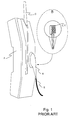
- Patent document GB-2 266 997 discloses a solution according to Figure 1, wherein a connector part B comprising a resonator element C is attached with adhesive tape or the like to the casing of a mobile phone A to be used in a car. By attaching the connector part B to the mobile phone A said resonator element C is brought so close to the mobile phone antenna D that it is electromagnetically coupled to the antenna and starts to resonate, whereby RF power radiated by the mobile phone antenna is coupled to it and that power is further taken via a coaxial conductor E to the car antenna.
- a disadvantage of this arrangement is that the coupling between the mobile phone antenna D and the resonator element C depends on their positions relative to each other.
- An external resonator element also puts an electric load to the mobile phone antenna, thereby decreasing its resonating frequency and weakening the coupling in the uppper part of the frequency band used.
- the publication US 4,220,955 to Frye discloses a coupling device which is meant to be slid over a rubber-insulated helix antenna.
- the coupling device comprises a central insulating sleeve, the outer surface of which comprises a loosely wound helical conductive element.
- the upper end of the helical element is galvanically coupled to the inner conductor of a coaxial connector, and the cylindrical outer conductor of the coaxial connector is coupled to a conductive, hollow cylindrical chamber which is also the outer cover of the coupling element.
- the cavity between the sleeve and the chamber is filled with air.
- the publication WO 95/07556 discloses an inductive loop which is to be placed around the protruding antenna of a radio device with the help of a dielectric support plate. There is an impedance matching circuit that couples the inductive loop to both the inner and outer conductors of a coaxial cable.
- the object of the invention is to provide an arrangement for connecting a radio communication device, advantageously a cellular mobile phone, to an external antenna, partly avoiding and partly reducing the aforementioned disadvantages related to prior art solutions.
- the invention may provide an arrangement with which said connection to an external antenna is done without a separate antenna switch and with small losses.
- the invention may be applied in large scale production and may be durable and easy to use.
- the invention is based on the idea that dielectric material with a high permittivity attracts electromagnetic energy. Therefore a dielectric piece, together with conductors, can be used to direct the electromagnetic field radiated by the antenna of a radio communication device.
- the field can be guided e.g. to the feed cable of a external antenna with relatively small losses.
- a dielectric coupling element is placed near the antenna of a radio communication device so that the electromagnetic waves leaving the antenna refract on the boundary surface in an optimal manner, i.e. so that significant part of the energy radiated by the antenna of the radio communication device is directed to the coupling element.
- the electrical length of the coupling element may be e.g. half or a quarter of the wavelength of the carrier of the radio communication device.
- the coupling element has a port through which the electromagnetic field is taken to a coaxial cable and through this to external antenna. Similarly, the field received by the external antenna is taken via the coaxial cable and the signal port to the coupling element wherefrom it is guided to the antenna of the radio communication device.
- a coupling arrangement for connecting a radio telephone to an external antenna comprising means for contacting said radio telephone detachably to it, a cable for feeding the external antenna, and a coupling element for transferring electromagnetic field between the fixed antenna of radio telephone and said cable.
- the coupling element is wholly beside the fixed antenna and the angle between the longitudinal axis of the coupling element and the axis of the fixed antenna deviates substantially from zero.
- the coupling element has dielectric body with conductive coating on at least two longitudinal surfaces and a coupling hole.
- Said contacting means to the radio telephone have conductive and grounded coating, which is connected to outer of said conductive coatings of the coupling element, the inner of said conductive coatings being arranged for connection to the external antenna.
- Fig. 1 was already explaned in connection with the description of the prior art.
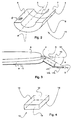
- Fig. 2 is a schematic illustration of a piece 10 in the shape of a cylinder segment having an inner surface 1 in the shape of a cylinder part and an outer surface 2 in the shape of a cylinder part concentric with the aforementioned cylinder part but having a longer radius.
- the drawing also shows the imaginary longitudinal axis 3 of the circular cylinders that include surfaces 1 and 2.
- the cylinder segment determined by the inner and outer surfaces is bounded by a first end surface 4 and a second end surface 5 perpendicular to the axis 3.
- the piece is bounded by plane surfaces 6 and 7 parallel to the axis 3 and intersecting all the above-mentioned surfaces.
- a “longitudinal axis” means in this description and in patent claims above-explaned straight line and also a straight line parallel with a longitudinal edge of dielectric piece shaped in another way.
- “longitudinal” means the direction of the longitudinal axis and at the same time the propagation direction of electromagnetic field.
- the “crosswise direction” means in patent claims a direction perpendicular to the longitudinal axis.
- Suitable materials include zircon tin titanate and barium neodymium titanate which are commonly used as materials for body blocks of so-called ceramic filters. Ceramic filters are radio frequency filters used in mobile phones, for example.
- the inner surface 1 and outer surface 2 are treated with a metal-bearing coating material, said material and its use being known to one skilled in the art as they are applied in the manufacture of the ceramic filters.
- On the inner surface 1 thus is an inner conductor and on the outer surface 2 is an outer conductor.
- the structure constitutes a dielectric resonator the electrical length of which in the direction of the axis 3 is half of the wavelength of the resonating frequency as the end surfaces 4 and 5 are electrically non-conductive. Furthermore, if the inner conductor and outer conductor are short-circuited by forming on the second end surface 5 an electrically conductive coating which is in galvanic contact with the coatings of both the inner surface 1 and outer surface 2, the electrical length of the structure in the direction of the axis 3 will be a quarter of the wavelength of the resonating frequency.
- the electromagnetic field can penetrate into the piece shown in Fig. 2 through open end surfaces 4 and 5 or if end surface 5 is coated, through the open end surface 4.
- the electromagnetic field is fed to the coupling element shown in Fig. 2 through the open end surface 4 (and/or 5 if surface 5 is open).
- the open end surface 4 can also be called a coupling hole.
- the matching between the antenna and the coupling element generally refers to the quality of the electromagnetic coupling between them.
- the antenna is in tune on a particular frequency band.
- the design of the coupling element and possible parasitic elements are chosen such that when the coupling element is brought in the vicinity of the antenna, the coupling element is in tune essentially on the same frequency band as the antenna. Then, the coupling loss between the antenna and the coupling element on the frequency band in question is small, advantageously about -1 to -3 decibels.
- the tuning-in of a dielectric coupling element on a desired frequency band e.g. by changing its design and/or parasitic elements is a technique known to a person skilled in the art.
- Fig. 3 shows an apparatus for connecting a mobile phone to an external antenna, the apparatus including a coupling element according to Fig. 2.
- the drawing shows in schematic format a mobile phone A and its fixed antenna D.
- the coupling element 10 according to the invention is attached to the body 9 which advantageously comprises means for mechanically fastening the mobile phone into it for the duration of a ride, for example.
- the body 9 is advantageously made of plastic and there is connected to it a ground plane 11 which can be a metal plate or an electrically conductive coating section, for example, and which in the embodiment illustrated is located on the bottom surface of the body 9.
- the ground plane 11 intensifies coupling to the frame of the mobile phone and prevents the occurrence of radiation losses in the direction of the ground plane as seen from the antenna D.
- the apparatus also comprises a coaxial cable 12 having a middle conductor 12a and a skin conductor 12b.
- the middle conductor 12a is connected to the inner conductor of the coupling element 10
- the skin conductor 12b is connected to the outer conductor of the coupling element 10 which is in galvanic contact with the ground plane 11, too.
- an external antenna such as a car antenna (not shown).
- the location of the coupling element 10, relative to the mobile phone antenna D is such that the axis D1 of the antenna and the coupling element are on one and the same plane (the paper surface in Fig. 3) but there is between them an angle a .
- the purpose of this is that the electromagnetic field radiated by the antenna D is fed to the coupling element 10 through the open end surface 4 and, upon passing the surface, it is refracted such that, having penetrated into the dielectric body material, it propagates in it in an optimal manner.
- angle a is about 40 degrees.
- angle a It has been chosen empirically by measuring the power of the mobile phone antenna D and the power of the external antenna, calculating the coupling loss between them and changing the angle a such that the least coupling loss is achieved. Since different antenna types have different direction patterns at a distance of a few millimeters from the antenna, the right value for angle a should be determined separately for each antenna type.
- the angle value also depends on the dielectric constant of the body material of the coupling element 10 because the greater the difference between the dielectric constants of two materials, the more an electromagnetic wave refracts at their boundary surface. Furthermore, the value of angle a depends on the amount and shape of conductive patterns formed on the surface of the coupling element. Determining the optimum position for the coupling element empirically is a technique known to a person skilled in the art and requires no special inventional action.
- the coupling element is attached to the body 9 and the mobile phone A is attached to the body always in the same way, the position of the coupling element 10 relative to the mobile phone antenna D is always the same when the user places the mobile phone in the body for the duration of a ride, for example.
- the middle conductor 12a of the coaxial cable is connected to the inner conductor of the coupling element at the second end 5 of the element, and the first end 4 of the element points towards the mobile phone antenna.
- This positioning requires that both end surfaces of the element be uncoated, ie. the element be dimensioned according to half the wavelength. If the second end of coupling element is short-circuited so that the coupling element functions as a quarter-wavelength resonator, the middle conductor 12a of the coaxial cable must be connected to the inner conductor of the coupling element at the first end of the coupling element.
- the cylindrical shape of the coupling element presented above as an example does not restrict the invention to only certain shapes of coupling elements.
- Fig. 4 shows another possible coupling element shape.
- the coupling element 10 is shaped as a rectangular prism which has, referring to the positioning in the drawing, an upper surface 13, a lower surface 14, two end surfaces 15 and two side surfaces 16.
- the names of the surfaces serve illustrative purposes only and do not restrict the positioning of the piece.
- the upper and lower surfaces are coated with conductive layers in the same way as the inner surface 1 and outer surface 2 in the embodiment in Fig. 2.
- the end surfaces 15 are both uncoated, in which case the electrical length of the coupling element is half the wavelength, or one of them is coated, in which case the electrical length of the coupling element is a quarter of the wavelength.
- the dielectric body block of the coupling element can be shaped in many ways. Variations to the illustrative embodiments described above are e.g. different bevellings and groove shapes on the surfaces confining the body block in order to control the electromagnetic field in the body block.
- the arrangement according to the invention may also comprise more coupling elements arranged on different sides of the antenna of the mobile phone attached to the rack, in which case it is possible to further decrease the coupling losses caused by stray radiation.
- the dielectric coupling element causes a smaller coupling loss than prior art solutions.
- it has a very simple construction and includes no fragile parts or parts susceptible to wear or dirt.
- the arrangement for connecting a radio communication device to an external antenna requires no special fastening means or awkward threading movements to attach or unattach a mobile phone, so it is extremely easy to use.
- the invention is well applicable to large-scale series production and its manufacturing costs are reasonable.
- the invention is not limited to be used only in conjunction with a mobile phone or a car antenna but can be applied to any object where one wishes to connect a radio communication device having an antenna of its own to an external auxiliary antenna.
Landscapes
- Engineering & Computer Science (AREA)
- Computer Networks & Wireless Communication (AREA)
- Support Of Aerials (AREA)
Claims (8)
- Anordnung zum Verbinden eines Funktelefons (A) mit ihm fest zugeordneter Antenne (D) mit einer externen Antenne, die einschließtdadurch gekennzeichnet, dassMittel (9) zum Herstellen einer lösbaren Verbindung zwischen Telefon und externer Antenne,ein Anschlußkabel (12) für die externe Antenne,ein Kupplungselement (10) mit einer Längsachse, das dem Übertragen eines elektromagnetischen Feldes zwischen der fest zugeordneten Antenne und dem Kabel dientdas Kupplungselement ein elektrisch nicht leitendes Gehäuse aufweist, das in den Bereichen mindestens zweier Längsflächen mit einer elektrisch leitenden Beschichtung versehen ist und eine Kupplungsöffnung aufweist,das Kupplungselement in seiner Gesanmtheit neben der festen Antenne angeordnet ist und der Winkel (a) der Längsachse des Kupplungselementes und der Achse der festen Antenne wesentlich von Null abweicht, um zwischen fester Antenne und Kupplungselement eine wirksame Kupplung herzustellen unddie Verbindungsmittel (9) zum Funktelefon eine elektrisch leitende und geerdete Beschichtung (11) aufweisen, die galvanisch mit der äußersten der elektrisch leitenden Beschichtungen des Kupplungselementes verbunden ist,die innere der elektrisch leitenden Beschichtungen zum Verbinden mit der externen Antenne angeordnet ist.
- Anordnung nach Anspruch 1, dadurch gekennzeichnet, dass das elektrisch nicht leitende Gehäuse des Kupplungselementes im wesentlichen in einander kreuzenden Richtungen verlaufende erste und zweite Endflächen (4,5) aufweist, in Längsrichtung verlaufende dritte und vierte Flächen (2,1) und in Längsrichtung verlaufende fünfte und sechste Flächen (6,7), wobei die fünfte und die sechste Flächen sowohl erste und zweite Endflächen, als auch dritte und vierte Flächen schneiden unddie erste Endfläche elektrisch offen ist, um eine Kupplungsöffnung für die Zuführung des elektromagnetischen Feldes zu dem elektrisch nichtleitenden Gehäusebereich zu bilden unddie eine der beiden elektrisch leitenden Beschichtungen des elektrisch nichtleitenden Gehäuses ein hautartiger äußerer Leiter auf der dritten Fläche ist und die andere der beiden elektrisch leitenden Beschichtungen des elektrisch nicht leitenden Gehäuses ein hautartiger innerer Leiter auf der dritten Fläche ist.
- Anordnung nach Anspruch 2, bei der das Kabel ein Koaxialkabel ist, dadurch gekennzeichnet, dass der äußere Leiter galvanisch mit dem Hautleiter (12b) des Koaxialkabels und der innere Leiter galvanisch mit dem mittleren Leiter (12a) des Koaxialkabels verbunden ist.
- Kupplungselement nach Anspruch 2, dadurch gekennzeichnet, dass die zweite Endfläche (5) elektrisch offen ist, um einen Halbwellenresonator bestimmter Frequenz zu bilden.
- Kupplungselement nach Anspruch 2, dadurch gekennzeichnet, dass auf der zweiten Endfläche (5) eine elektrisch leitende Schicht gebildet ist, die einen Kurzschlußschaltkreis zwischen innerem und äußerem Leiter bildet und einen Halbwellenresonator bestimmter Frequenz bereitstellt.
- Kupplungselement nach Anspruch 2, dadurch gekennzeichnet, dass es ferner enthält auf zumindest einer von fünfter und sechster Fläche zumindest ein elektrisch leitendes parasitäres Element (8), um die elektrischen Charakteristiken des Kupplungselementes zu beeinflussen.
- Kupplungselement nach Anspruch 2, dadurch gekennzeichnet, dass die dritte Fläche (2) Teil einer ersten Zylinderfläche ist, deren Längssymmetrieachse mit der genannten Längsachse (3) zusammenfällt und die vierte Fläche (1) Teil einer zweiten Zylinderfläche ist, deren Längssymmetrieachse mit der genannten Längsachse (3) zusammenfällt.
- Kupplungselement nach Anspruch 2, dadurch gekennzeichnet, dass sowohl dritte Fläche (14), als auch vierte Fläche (13) ebene Flächen sind.
Applications Claiming Priority (2)
| Application Number | Priority Date | Filing Date | Title |
|---|---|---|---|
| FI962051 | 1996-05-14 | ||
| FI962051A FI100927B (fi) | 1996-05-14 | 1996-05-14 | Kytkentäelementti sähkömagneettisen kytkennän toteuttamiseksi ja laite radiopuhelimen liittämiseksi ulkoiseen antenniin |
Publications (2)
| Publication Number | Publication Date |
|---|---|
| EP0807988A1 EP0807988A1 (de) | 1997-11-19 |
| EP0807988B1 true EP0807988B1 (de) | 2001-11-07 |
Family
ID=8546020
Family Applications (1)
| Application Number | Title | Priority Date | Filing Date |
|---|---|---|---|
| EP97303150A Expired - Lifetime EP0807988B1 (de) | 1996-05-14 | 1997-05-09 | Kupplungselement für eine Funktelefonantenne |
Country Status (4)
| Country | Link |
|---|---|
| EP (1) | EP0807988B1 (de) |
| DE (1) | DE69707970T2 (de) |
| DK (1) | DK0807988T3 (de) |
| FI (1) | FI100927B (de) |
Cited By (20)
| Publication number | Priority date | Publication date | Assignee | Title |
|---|---|---|---|---|
| US8466756B2 (en) | 2007-04-19 | 2013-06-18 | Pulse Finland Oy | Methods and apparatus for matching an antenna |
| US8473017B2 (en) | 2005-10-14 | 2013-06-25 | Pulse Finland Oy | Adjustable antenna and methods |
| US8564485B2 (en) | 2005-07-25 | 2013-10-22 | Pulse Finland Oy | Adjustable multiband antenna and methods |
| US8618990B2 (en) | 2011-04-13 | 2013-12-31 | Pulse Finland Oy | Wideband antenna and methods |
| US8629813B2 (en) | 2007-08-30 | 2014-01-14 | Pusle Finland Oy | Adjustable multi-band antenna and methods |
| US8648752B2 (en) | 2011-02-11 | 2014-02-11 | Pulse Finland Oy | Chassis-excited antenna apparatus and methods |
| US8786499B2 (en) | 2005-10-03 | 2014-07-22 | Pulse Finland Oy | Multiband antenna system and methods |
| US8847833B2 (en) | 2009-12-29 | 2014-09-30 | Pulse Finland Oy | Loop resonator apparatus and methods for enhanced field control |
| US8866689B2 (en) | 2011-07-07 | 2014-10-21 | Pulse Finland Oy | Multi-band antenna and methods for long term evolution wireless system |
| US8988296B2 (en) | 2012-04-04 | 2015-03-24 | Pulse Finland Oy | Compact polarized antenna and methods |
| US9123990B2 (en) | 2011-10-07 | 2015-09-01 | Pulse Finland Oy | Multi-feed antenna apparatus and methods |
| US9203154B2 (en) | 2011-01-25 | 2015-12-01 | Pulse Finland Oy | Multi-resonance antenna, antenna module, radio device and methods |
| US9246210B2 (en) | 2010-02-18 | 2016-01-26 | Pulse Finland Oy | Antenna with cover radiator and methods |
| US9350081B2 (en) | 2014-01-14 | 2016-05-24 | Pulse Finland Oy | Switchable multi-radiator high band antenna apparatus |
| US9406998B2 (en) | 2010-04-21 | 2016-08-02 | Pulse Finland Oy | Distributed multiband antenna and methods |
| US9450291B2 (en) | 2011-07-25 | 2016-09-20 | Pulse Finland Oy | Multiband slot loop antenna apparatus and methods |
| US9461371B2 (en) | 2009-11-27 | 2016-10-04 | Pulse Finland Oy | MIMO antenna and methods |
| US9484619B2 (en) | 2011-12-21 | 2016-11-01 | Pulse Finland Oy | Switchable diversity antenna apparatus and methods |
| US9531058B2 (en) | 2011-12-20 | 2016-12-27 | Pulse Finland Oy | Loosely-coupled radio antenna apparatus and methods |
| US9590308B2 (en) | 2013-12-03 | 2017-03-07 | Pulse Electronics, Inc. | Reduced surface area antenna apparatus and mobile communications devices incorporating the same |
Families Citing this family (13)
| Publication number | Priority date | Publication date | Assignee | Title |
|---|---|---|---|---|
| US6134421A (en) * | 1997-09-10 | 2000-10-17 | Qualcomm Incorporated | RF coupler for wireless telephone cradle |
| FI20096134A0 (fi) | 2009-11-03 | 2009-11-03 | Pulse Finland Oy | Säädettävä antenni |
| US9673507B2 (en) | 2011-02-11 | 2017-06-06 | Pulse Finland Oy | Chassis-excited antenna apparatus and methods |
| US9979078B2 (en) | 2012-10-25 | 2018-05-22 | Pulse Finland Oy | Modular cell antenna apparatus and methods |
| US10069209B2 (en) | 2012-11-06 | 2018-09-04 | Pulse Finland Oy | Capacitively coupled antenna apparatus and methods |
| US9647338B2 (en) | 2013-03-11 | 2017-05-09 | Pulse Finland Oy | Coupled antenna structure and methods |
| US10079428B2 (en) | 2013-03-11 | 2018-09-18 | Pulse Finland Oy | Coupled antenna structure and methods |
| US9634383B2 (en) | 2013-06-26 | 2017-04-25 | Pulse Finland Oy | Galvanically separated non-interacting antenna sector apparatus and methods |
| US9680212B2 (en) | 2013-11-20 | 2017-06-13 | Pulse Finland Oy | Capacitive grounding methods and apparatus for mobile devices |
| US9948002B2 (en) | 2014-08-26 | 2018-04-17 | Pulse Finland Oy | Antenna apparatus with an integrated proximity sensor and methods |
| US9973228B2 (en) | 2014-08-26 | 2018-05-15 | Pulse Finland Oy | Antenna apparatus with an integrated proximity sensor and methods |
| US9722308B2 (en) | 2014-08-28 | 2017-08-01 | Pulse Finland Oy | Low passive intermodulation distributed antenna system for multiple-input multiple-output systems and methods of use |
| US9906260B2 (en) | 2015-07-30 | 2018-02-27 | Pulse Finland Oy | Sensor-based closed loop antenna swapping apparatus and methods |
Family Cites Families (6)
| Publication number | Priority date | Publication date | Assignee | Title |
|---|---|---|---|---|
| US4220955A (en) * | 1979-05-29 | 1980-09-02 | Rockwell International Corporation | RF coupling device for connecting a hand held radio to an external device without removing the antenna |
| DE69220469T2 (de) * | 1991-12-10 | 1997-12-04 | Blaese Herbert R | Hilfsantenne |
| JPH05243830A (ja) * | 1992-02-28 | 1993-09-21 | Marantz Japan Inc | 携帯用無線機の車載用延長アンテナ |
| GB2266997A (en) * | 1992-05-07 | 1993-11-17 | Wallen Manufacturing Limited | Radio antenna. |
| SE9302870L (sv) * | 1993-09-06 | 1994-10-10 | Allgon Ab | Antennkopplingsanordning |
| JP3521019B2 (ja) * | 1995-04-08 | 2004-04-19 | ソニー株式会社 | アンテナ結合装置 |
-
1996
- 1996-05-14 FI FI962051A patent/FI100927B/fi active
-
1997
- 1997-05-09 DE DE69707970T patent/DE69707970T2/de not_active Expired - Fee Related
- 1997-05-09 EP EP97303150A patent/EP0807988B1/de not_active Expired - Lifetime
- 1997-05-09 DK DK97303150T patent/DK0807988T3/da active
Cited By (20)
| Publication number | Priority date | Publication date | Assignee | Title |
|---|---|---|---|---|
| US8564485B2 (en) | 2005-07-25 | 2013-10-22 | Pulse Finland Oy | Adjustable multiband antenna and methods |
| US8786499B2 (en) | 2005-10-03 | 2014-07-22 | Pulse Finland Oy | Multiband antenna system and methods |
| US8473017B2 (en) | 2005-10-14 | 2013-06-25 | Pulse Finland Oy | Adjustable antenna and methods |
| US8466756B2 (en) | 2007-04-19 | 2013-06-18 | Pulse Finland Oy | Methods and apparatus for matching an antenna |
| US8629813B2 (en) | 2007-08-30 | 2014-01-14 | Pusle Finland Oy | Adjustable multi-band antenna and methods |
| US9461371B2 (en) | 2009-11-27 | 2016-10-04 | Pulse Finland Oy | MIMO antenna and methods |
| US8847833B2 (en) | 2009-12-29 | 2014-09-30 | Pulse Finland Oy | Loop resonator apparatus and methods for enhanced field control |
| US9246210B2 (en) | 2010-02-18 | 2016-01-26 | Pulse Finland Oy | Antenna with cover radiator and methods |
| US9406998B2 (en) | 2010-04-21 | 2016-08-02 | Pulse Finland Oy | Distributed multiband antenna and methods |
| US9203154B2 (en) | 2011-01-25 | 2015-12-01 | Pulse Finland Oy | Multi-resonance antenna, antenna module, radio device and methods |
| US8648752B2 (en) | 2011-02-11 | 2014-02-11 | Pulse Finland Oy | Chassis-excited antenna apparatus and methods |
| US8618990B2 (en) | 2011-04-13 | 2013-12-31 | Pulse Finland Oy | Wideband antenna and methods |
| US8866689B2 (en) | 2011-07-07 | 2014-10-21 | Pulse Finland Oy | Multi-band antenna and methods for long term evolution wireless system |
| US9450291B2 (en) | 2011-07-25 | 2016-09-20 | Pulse Finland Oy | Multiband slot loop antenna apparatus and methods |
| US9123990B2 (en) | 2011-10-07 | 2015-09-01 | Pulse Finland Oy | Multi-feed antenna apparatus and methods |
| US9531058B2 (en) | 2011-12-20 | 2016-12-27 | Pulse Finland Oy | Loosely-coupled radio antenna apparatus and methods |
| US9484619B2 (en) | 2011-12-21 | 2016-11-01 | Pulse Finland Oy | Switchable diversity antenna apparatus and methods |
| US8988296B2 (en) | 2012-04-04 | 2015-03-24 | Pulse Finland Oy | Compact polarized antenna and methods |
| US9590308B2 (en) | 2013-12-03 | 2017-03-07 | Pulse Electronics, Inc. | Reduced surface area antenna apparatus and mobile communications devices incorporating the same |
| US9350081B2 (en) | 2014-01-14 | 2016-05-24 | Pulse Finland Oy | Switchable multi-radiator high band antenna apparatus |
Also Published As
| Publication number | Publication date |
|---|---|
| FI962051A0 (fi) | 1996-05-14 |
| DE69707970D1 (de) | 2001-12-13 |
| FI100927B (fi) | 1998-03-13 |
| DK0807988T3 (da) | 2002-02-25 |
| DE69707970T2 (de) | 2002-08-08 |
| FI962051L (fi) | 1997-11-15 |
| EP0807988A1 (de) | 1997-11-19 |
Similar Documents
| Publication | Publication Date | Title |
|---|---|---|
| US6157819A (en) | Coupling element for realizing electromagnetic coupling and apparatus for coupling a radio telephone to an external antenna | |
| EP0807988A1 (de) | Kupplungselement für eine Funktelefonantenne | |
| KR100756810B1 (ko) | 슬롯이 형성된 실린더형 안테나 | |
| EP1109251B1 (de) | Antenneneinheit und Kommunikationsgerät mit einer derartigen Antenne | |
| AU689067B2 (en) | UHF slot coupled antenna | |
| KR100441727B1 (ko) | 필터 내장 유전체 안테나, 듀플렉서 내장 유전체 안테나 및 무선 장치 | |
| US5959582A (en) | Surface mount type antenna and communication apparatus | |
| KR100339788B1 (ko) | 표면 실장형 안테나 및 이를 이용한 통신장치 | |
| US6317083B1 (en) | Antenna having a feed and a shorting post connected between reference plane and planar conductor interacting to form a transmission line | |
| EP1248316B1 (de) | Antenne und Kommunikationsgerät mit dieser Antenne | |
| EP1143558B1 (de) | Oberflächenmontierte Antenne, Verfahren zur Justierung und Einstellung der Zweifrequenzresonanz der Antenne und Kommunikationsgerät mit einer derartigen Antenne | |
| KR20000075673A (ko) | 공명 안테나 | |
| WO2001013460A1 (en) | Microwave filter | |
| AU6941301A (en) | Internal antennas for mobile communication devices | |
| JP2002076757A (ja) | スロットアンテナを用いた無線端末 | |
| JPH04287505A (ja) | 携帯無線機用小型アンテナ | |
| US6911940B2 (en) | Multi-band reconfigurable capacitively loaded magnetic dipole | |
| EP1033774A1 (de) | Resonatorfilter | |
| KR20020015694A (ko) | 평판식 모노폴 안테나 | |
| US6307508B1 (en) | Flat antenna | |
| KR100866978B1 (ko) | Te 모드 유전체 듀플렉서 | |
| EP1253667B1 (de) | Streifenleitungsantenne | |
| JP3574420B2 (ja) | 携帯端末機 | |
| KR19990032317A (ko) | 900㎒ 무선전화기용 내장형 이중 구조를 갖는 마이크로 스트립패치 안테나 | |
| US20020079990A1 (en) | Dielectric filter, dielectric duplexer and communication device |
Legal Events
| Date | Code | Title | Description |
|---|---|---|---|
| PUAI | Public reference made under article 153(3) epc to a published international application that has entered the european phase |
Free format text: ORIGINAL CODE: 0009012 |
|
| AK | Designated contracting states |
Kind code of ref document: A1 Designated state(s): DE DK FR GB SE |
|
| 17P | Request for examination filed |
Effective date: 19980519 |
|
| 17Q | First examination report despatched |
Effective date: 19990408 |
|
| RAP1 | Party data changed (applicant data changed or rights of an application transferred) |
Owner name: FILTRONIC LK OY |
|
| GRAG | Despatch of communication of intention to grant |
Free format text: ORIGINAL CODE: EPIDOS AGRA |
|
| GRAG | Despatch of communication of intention to grant |
Free format text: ORIGINAL CODE: EPIDOS AGRA |
|
| GRAH | Despatch of communication of intention to grant a patent |
Free format text: ORIGINAL CODE: EPIDOS IGRA |
|
| GRAH | Despatch of communication of intention to grant a patent |
Free format text: ORIGINAL CODE: EPIDOS IGRA |
|
| GRAA | (expected) grant |
Free format text: ORIGINAL CODE: 0009210 |
|
| AK | Designated contracting states |
Kind code of ref document: B1 Designated state(s): DE DK FR GB SE |
|
| REF | Corresponds to: |
Ref document number: 69707970 Country of ref document: DE Date of ref document: 20011213 |
|
| REG | Reference to a national code |
Ref country code: GB Ref legal event code: IF02 |
|
| REG | Reference to a national code |
Ref country code: DK Ref legal event code: T3 |
|
| PLBE | No opposition filed within time limit |
Free format text: ORIGINAL CODE: 0009261 |
|
| STAA | Information on the status of an ep patent application or granted ep patent |
Free format text: STATUS: NO OPPOSITION FILED WITHIN TIME LIMIT |
|
| 26N | No opposition filed | ||
| REG | Reference to a national code |
Ref country code: GB Ref legal event code: 732E |
|
| REG | Reference to a national code |
Ref country code: FR Ref legal event code: TP |
|
| REG | Reference to a national code |
Ref country code: FR Ref legal event code: CD |
|
| PGFP | Annual fee paid to national office [announced via postgrant information from national office to epo] |
Ref country code: DK Payment date: 20080515 Year of fee payment: 12 Ref country code: DE Payment date: 20080515 Year of fee payment: 12 |
|
| PGFP | Annual fee paid to national office [announced via postgrant information from national office to epo] |
Ref country code: SE Payment date: 20080509 Year of fee payment: 12 |
|
| PGFP | Annual fee paid to national office [announced via postgrant information from national office to epo] |
Ref country code: GB Payment date: 20080514 Year of fee payment: 12 |
|
| REG | Reference to a national code |
Ref country code: DK Ref legal event code: EBP |
|
| GBPC | Gb: european patent ceased through non-payment of renewal fee |
Effective date: 20090509 |
|
| REG | Reference to a national code |
Ref country code: FR Ref legal event code: ST Effective date: 20100129 |
|
| PG25 | Lapsed in a contracting state [announced via postgrant information from national office to epo] |
Ref country code: FR Free format text: LAPSE BECAUSE OF NON-PAYMENT OF DUE FEES Effective date: 20090602 Ref country code: DK Free format text: LAPSE BECAUSE OF NON-PAYMENT OF DUE FEES Effective date: 20090531 |
|
| PGFP | Annual fee paid to national office [announced via postgrant information from national office to epo] |
Ref country code: FR Payment date: 20080514 Year of fee payment: 12 |
|
| PG25 | Lapsed in a contracting state [announced via postgrant information from national office to epo] |
Ref country code: GB Free format text: LAPSE BECAUSE OF NON-PAYMENT OF DUE FEES Effective date: 20090509 |
|
| PG25 | Lapsed in a contracting state [announced via postgrant information from national office to epo] |
Ref country code: DE Free format text: LAPSE BECAUSE OF NON-PAYMENT OF DUE FEES Effective date: 20091201 |
|
| PG25 | Lapsed in a contracting state [announced via postgrant information from national office to epo] |
Ref country code: SE Free format text: LAPSE BECAUSE OF NON-PAYMENT OF DUE FEES Effective date: 20090510 |