EP0806739B1 - Face recognition using dct-based feature vectors - Google Patents
Face recognition using dct-based feature vectors Download PDFInfo
- Publication number
- EP0806739B1 EP0806739B1 EP97302939A EP97302939A EP0806739B1 EP 0806739 B1 EP0806739 B1 EP 0806739B1 EP 97302939 A EP97302939 A EP 97302939A EP 97302939 A EP97302939 A EP 97302939A EP 0806739 B1 EP0806739 B1 EP 0806739B1
- Authority
- EP
- European Patent Office
- Prior art keywords
- known objects
- codebook
- given object
- training
- vectors
- Prior art date
- Legal status (The legal status is an assumption and is not a legal conclusion. Google has not performed a legal analysis and makes no representation as to the accuracy of the status listed.)
- Expired - Lifetime
Links
Images

Classifications
-
- G—PHYSICS
- G06—COMPUTING OR CALCULATING; COUNTING
- G06T—IMAGE DATA PROCESSING OR GENERATION, IN GENERAL
- G06T9/00—Image coding
- G06T9/007—Transform coding, e.g. discrete cosine transform
-
- G—PHYSICS
- G06—COMPUTING OR CALCULATING; COUNTING
- G06F—ELECTRIC DIGITAL DATA PROCESSING
- G06F18/00—Pattern recognition
- G06F18/20—Analysing
- G06F18/21—Design or setup of recognition systems or techniques; Extraction of features in feature space; Blind source separation
-
- G—PHYSICS
- G06—COMPUTING OR CALCULATING; COUNTING
- G06V—IMAGE OR VIDEO RECOGNITION OR UNDERSTANDING
- G06V10/00—Arrangements for image or video recognition or understanding
- G06V10/70—Arrangements for image or video recognition or understanding using pattern recognition or machine learning
-
- G—PHYSICS
- G06—COMPUTING OR CALCULATING; COUNTING
- G06V—IMAGE OR VIDEO RECOGNITION OR UNDERSTANDING
- G06V40/00—Recognition of biometric, human-related or animal-related patterns in image or video data
- G06V40/10—Human or animal bodies, e.g. vehicle occupants or pedestrians; Body parts, e.g. hands
- G06V40/16—Human faces, e.g. facial parts, sketches or expressions
Definitions
- the present invention relates generally to the field of automated image analysis and in particular to the problem of recognizing and identifying human faces contained therein.
- the face recognition problem can be described generally as follows: Given a still image or a video sequence as input, the required task is to identify one or more persons in the input image(s) based, for example, on the contents of a previously stored database of faces.
- a high quality face recognition system should be able to match an input or test image to the stored database even when there are variations in lighting, background, facial expression, position, scale, or even when there are changes in hairstyles between the input image and the training image(s) upon which the database is based.
- the face identification problem in particular requires that the system perform a one-to-many mapping, determining whether the person in the input image matches the data for any of the individuals contained in the stored database, and, if so, which one.
- the face authentication problem requires that the system perform a one-to-one mapping, determining whether the input image (adequately) matches the data for one particular individual in the database -- typically, the data for the individual whose identity is claimed by the person using the system.
- Face authentication has applications in the security field, while face identification has applications in security as well as in fields such as newspaper reporting where it may be desirable to retrieve images of particular individuals from large multimedia databases.
- a typical face recognition system consists of three parts -- a preprocessing step to segment the data and extract critical areas or features, a feature selection step, and a classification step.
- the preprocessing step may, for example, consist of a rough segmentation of the input image to isolate the face data from the background data, or it may comprise a more detailed segmentation in order to locate facial parts such as the eyes, nose and mouth which may then be used to generate the features.
- the preprocessing step may also extract feature vectors such as the geometrical relationships between the facial parts.
- the area-of-interest i.e., the face
- the remainder of the discussion herein will focus on the feature extraction and classification portions of the face recognition process.
- Techniques which attempt to measure geometric relationships between facial parts such as, for example, the distance between the eyes, the width of the mouth, the distance from an eye to the nose, or the distance from an eye to the mouth, and then attempt to use these parameters as the features against which the data is matched between the input (i.e ., test) image data and the training data (i.e ., the data stored in the database) include, for example, R. Brunelli and T. Poggio, "Face Recognition through Geometrical Features," Proc. Europe. Conf. on Computer Vision, pp. 792-800, 1992.
- each person's face is essentially represented as a vector of weights applied to a predefined set of "eigenfaces.”
- One weakness of this particular approach is that if the input image is not similar to the images which were collected to compute the "eigenfaces" in terms of scale and head position, the recognition rates drop dramatically.
- neural networks have also been used for face recognition.
- the neural network approach typically requires a great deal of training data (e.g., several hundred images for each person in the database), thus making such an approach impractical for a large database.
- a method according to the invention of matching a given object comprised in an input image signal to one of a plurality of known objects, a representation of each of the known objects having been stored in a database and comprising a codebook corresponding thereto, each codebook comprising a plurality of codevectors having been generated based on one or more corresponding training image signals comprising the corresponding known object comprises the steps of: decomposing a portion of the input image signal which includes the given object into a plurality of blocks; generating a plurality of input vectors corresponding to the plurality of blocks, each input vector based on the block corresponding thereto; and matching the given object to one of the known objects based on one or more of the input vectors and on one or more of the codevectors comprised in one or more of the codebooks corresponding to the known objects.
- the step of matching the given object to the one of the known objects may comprise: performing a plurality of encodings of the at least a portion of the input image signal, each encoding comprising coding one or more of the input vectors based on one or more of the codevectors comprised in a corresponding one of the codebooks; determining a plurality of coding errors corresponding to the plurality of encodings; and matching the given object to the one of the known objects based on the plurality of coding errors.
- the coding errors comprise mean squared errors.
- the method may further comprise the step of comparing the plurality of coding errors to determine a smallest coding error, and the step of matching the given object to the one of the known objects may comprise selecting the known object which corresponds to the codebook which produced the smallest coding error when the at least a portion of the input image signal was encoded therewith.
- the step of matching the given object to the one of the known objects may comprise: generating a codebook corresponding to the given object based on one or more of the input vectors; comparing the codebook corresponding to the given object with one or more of the codebooks corresponding to the known objects; and matching the given object to the one of the known objects based on the comparison of the codebook corresponding to the given object with the codebooks corresponding to the known objects.
- the step of comparing the codebook corresponding to the given object with the codebooks corresponding to the known objects may comprise computing a mean squared error for each comparison.
- the method may further comprise the step of determining a minimum mean squared error from the computed mean squared errors, and the step of matching the given object to the one of the known objects may comprise selecting the known object which corresponds to a codebook which, when compared to the codebook corresponding to the given object, resulted in the minimum mean squared error.
- the step of generating the input vectors comprises performing a linear transform such as a Discrete Cosine Transform on the blocks and generating the input vectors based on the transformed blocks.
- a linear transform such as a Discrete Cosine Transform
- the codebooks corresponding to the known objects may comprise vector quantization codebooks.
- the codevectors comprised in the codebooks corresponding to the known objects may have been generated from the one or more corresponding training image signals with use of a k-means clustering technique.
- the method may further comprise the step of identifying the given object as the known object which is matched to the given object.
- the method may further comprise the step of verifying that a claimed identification of the given object comprises the known object which is matched to the given object.
- a method according to the invention of generating a database comprising a plurality of representations of known objects, the database for use in matching a given object comprised in an input image signal to one of the known objects, each of the representations of the known objects comprising a codebook corresponding thereto comprises the steps of: for each of the known objects, decomposing into a plurality of blocks, a portion of each of one or more training image signals, the portion of each training image signal including the known object; for each of the known objects, generating a plurality of training vectors corresponding to the plurality of blocks, each training vector based on the block corresponding thereto; and for each of the known objects, generating the codebook corresponding thereto based on one or more of the training vectors generated from the training image signals which include the known object.
- the step of generating the training vectors comprises performing a linear transform such as a Discrete Cosine Transform on the blocks and generating the training vectors based on the transformed blocks.
- a linear transform such as a Discrete Cosine Transform
- Each of the generated codebooks may comprise a vector quantization codebook.
- Each of the codebooks may be generated from the corresponding training vectors with use of a k-means clustering technique.
- the given object and each of the known objects may comprise a human face.
- a system according to the invention comprises means for carrying out the steps of a method according to the invention.
- the present invention advantageously employs a signal processing approach which takes advantage of general image statistics, without incorporating any a priori knowledge of characteristics specific to facial image data.
- This is in contrast to the prior art "computer vision" approaches described above which are, for the most part, based on heuristics and are, in general, not particularly robust to a wide range of input image variations.
- recognition of objects such as faces in images is achieved using signal compression techniques (i . e ., coding techniques) in which a portion of the image which includes the object to be recognized ( e . g ., the face) is coded, and the resultant coded data is matched against previously coded training data which is stored in a known object database.
- image compression techniques each object (e.g. , person's face) can be advantageously represented by a small set of numbers.
- a portion of an input image which includes an object is decomposed into blocks of pixel data, a (linear) transform such as, for example, a Discrete Cosine Transform (DCT) is performed on the pixel data of each block, and the transformed blocks are "vector quantized" (VQ) to produce a codebook of codevectors for each person.
- DCT Discrete Cosine Transform
- VQ vector quantized
- the transform coefficients representing each block of data in the training set may be used to generate a codebook of codevectors.
- the number of input vectors may be much greater than the number of codevectors stored in the codebook -- thus, the amount of data needed to represent the training data may be advantageously compressed even further.
- Block-based transforms including DCT
- vector quantization VQ
- DCT digital cosine transform
- VQ vector quantization
- Discrete Cosine Transforms are described, for example, in N. Ahmed, T. Natarajan and K. Rao, "Discrete Cosine Transform,” IEEE Trans. Comput., vol 23, pp. 90--93, 1974 and vector quantization is described, for example, in Y. Linde, A. Buzo and R. M. Gray, "An Algorithm for Vector Quantizer Design," IEEE Trans. Commun., COM-28, pp. 84--95, 1990.
- k-means clustering also familiar to those of ordinary skill in the art and described, for example, in S. P. Lloyd, "Least Squares Quantization in PCM,” IEEE Trans. Inform. Theory, IT-28, pp. 127-135, 1982.
- Discrete Cosine Transform "An Algorithm for Vector Quantizer Design” and “Least Squares Quantization in PCM” are each hereby incorporated by reference as if fully set forth herein.
- a given object in an input image signal is matched to one of a plurality of known objects stored in a database, wherein the stored representation of each of the known objects comprises a codebook generated based on training image signals comprising the known object.
- a first illustrative embodiment comprises the steps of decomposing the given object into blocks; performing a plurality of encodings of the given object, each encoding comprising coding the object with use of one of the codebooks; determining a coding error for each encoding; and matching the given object to one of the known objects based on the coding errors.
- a second illustrative embodiment comprises the steps of decomposing the given object into blocks; generating a codebook corresponding to the given object based on the blocks; comparing the codebook corresponding to the given object with the codebooks corresponding to each of the known objects; and matching the given object to one of the known objects based on the comparison of the codebooks.
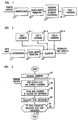
- Fig. 1 shows an overview of a database generation process whereby the data for a known face is constructed in accordance with an illustrative embodiment of the present invention.
- Fig. 2 shows an overview of a face recognition process in accordance with an illustrative embodiment of the present invention.
- Fig. 3 shows a flow diagram of an illustrative codebook generator of the illustrative database generation process of Fig. 1.
- Fig. 4 shows a flow diagram of the classifier of the illustrative face recognition process of Fig. 2 in accordance with a first illustrative embodiment of the present invention.
- Fig. 5 shows a flow diagram of the classifier of the illustrative face recognition process of Fig. 2 in accordance with a second illustrative embodiment of the present invention.
- Fig. 1 shows an overview of a database generation process whereby the data for a known face is constructed in accordance with an illustrative embodiment of the present invention.
- Several different training images each comprising a different "picture" of a known individual's face, may be advantageously provided to the process of Fig. 1, thereby resulting in the generation of a codebook which will more completely reflect images of the given known face under different conditions such as different lighting, background, facial expression, position, scale, etc.
- the process of Fig. 1 is advantageously repeated for each person whose face is to be included in the database -- thus, a different codebook is generated by the process of Fig. 1 for each different person in the training set.
- one or more training images (each containing an image of the face of the i'th person in the training set) are processed, resulting in codebook 23-i which contains a set of codevectors for that one particular person.
- preprocessor 21 extracts the region of interest (i.e., the face) from the input image, and normalizes the scale thereof.
- region of interest i.e., the face
- preprocessor 21 extracts the region of interest (i.e., the face) from the input image, and normalizes the scale thereof.
- all further processing can be advantageously performed on the face (and only on the face), and all faces presented to the system will be of the same scale (i.e ., size).
- the preprocessing performed by preprocessor 21 is conventional and well known to those skilled in the art.
- the extracted portion(s) of the image(s) are decomposed into blocks, and a linear, block-based transform is performed by transform 22 on each block.
- the blocks may, for example, comprise an area of size 8x8 (i.e ., a square of dimension 8 pixels by 8 pixels), or, alternatively, they may be of size 16x16.
- the blocks may be contiguous across the image space or, preferably, they may be overlapping ( e.g ., by 2 pixels in each dimension).
- a linear transform operator By applying a linear transform operator to the original signal, a more efficient representation is obtained wherein the data is statistically independent (or at least uncorrelated).
- a linear transform may also provide substantial energy compaction, a generally desirable property in all signal compression techniques.
- DCT discrete cosine transform
- each of these blocks can be advantageously represented by just a few DCT coefficients.
- transform 22 provides only the (L) coefficients with the greatest signal energy content out of the (BxB) coefficients which result from the transformation of the (BxB) block.
- the DCT coefficients with the greatest signal energy content typically correspond to the low frequency coefficients.
- the (generated and provided) DCT coefficients for each block in the training data are assembled into a corresponding vector, and the resultant set of vectors are then used by codebook generator 25 to design a VQ codebook.
- This codebook will thereby contain the data which represents the face of the given known individual in the database.
- the number of codebook vectors is typically much smaller than the total number of (DCT) vectors from which it is generated. For example, more than a thousand input vectors may be advantageously provided to codebook generator 25, and these may be mapped into a codebook containing less than 100 ( e.g., 64) codebook vectors ( i.e ., codevectors).
- the codebook design performed by codebook generator 25 may, for example, comprise the well known "k-means clustering" technique, or other conventional techniques for designing codebooks from training vector data as are well known in the field of signal compression.
- Fig. 3 shows an illustrative flow diagram of the codebook generation process as may be performed by codebook generator 25 of the illustrative training procedure of Fig. 1.
- the end result of the process of Fig. 1, which is advantageously performed for each person whose face is to be represented in the database, is to generate a codebook for a given person based on one or more training images containing his or her face.
- M may be equal to 64.
- Each codevector consists of L values ( i.e ., DCT coefficients), as described above.
- the blocks may be of size 8x8 and L may be 8.
- the illustrative procedure shown in Fig. 3 comprises an iterative process that generates a codebook by repeatedly matching the training vectors to a sequence of "intermediate" codebooks, C p 0 , C p 1 ,..., C p m ,..., modifying the codebook on each iteration ( i.e ., replacing codebook C p m with improved codebook C p m+1 ), until a terminating criterion is met.
- the codebook which results from the final iteration then advantageously becomes the codebook which is used to represent the particular individual's face in the database.
- step 31 initializes the codebook to be used in the first iteration, C p 0 , to a random set of codevectors.
- These randomly chosen codevectors may, for example, comprise the first M vectors from the training set, or, alternatively, they may be chosen by generating random values therefor.
- step 32 uses the (entire) set of training vectors to form "cluster sets," familiar to those skilled in the art.
- each training vector is assigned to the cluster associated with the codevector in the current codebook to which it is "closest,” as determined by the error function, d(x,y).
- the error function d(x,y) may be any appropriate error metric.
- d(x,y) may be the conventional mean square error (mse) metric, familiar to those of ordinary skill in the art.
- a new codebook, C p m+1 is developed for use in the next iteration based on the cluster sets which resulted from the analysis of step 32.
- the centroid of the set i . e ., an n-dimensional weighted mean of the individual vectors in the set
- D m comprises a measure of accuracy with which codebook C p m is able to code the given set of training vectors.
- decision 35 computes the difference between the computed distortion measure (D m ) and the distortion measure computed for the previous iteration (D m-1 ), in order to measure the degree of improvement in the quality of the codebooks from the previous iteration to the current one. If this difference is less than a predetermined threshold, T D , the iteration may be advantageously terminated, since the improvement in codebook quality which is likely to be gained by performing additional iterations is small.
- FIG. 2 shows an overview of a face recognition process in accordance with an illustrative embodiment of the present invention.
- codebooks 23-1, 23-2, ..., 23-N codebooks 23-1, 23-2, ..., 23-N
- the illustrative embodiment as shown in Fig. 2 may be used to identify (or to verify the identity of) a person's face comprised in an input image signal.
- preprocessor 21 extracts the region of interest (i.e ., the face) from the input image, and normalizes the scale thereof.
- region of interest i.e ., the face
- preprocessor 21 extracts the region of interest (i.e ., the face) from the input image, and normalizes the scale thereof.
- all further processing can be advantageously performed on the face (and only the face), and all faces presented to the system will be of the same scale (i.e ., size).
- the preprocessing performed by preprocessor 21 is conventional and well known to those skilled in the art.
- the extracted portion of the input image is decomposed into blocks, and a linear, block-based transform is performed on each block by transform 22.
- the blocks may, for example, be of size 8x8, or, alternatively, of size 16x16, and they may be contiguous across the image space or, preferably, overlapping.
- the same transform (such as a DCT) as was used in the generation of codebooks 23-1 to 23-N is advantageously used in the face recognition process of Fig. 2 as well.
- the same block size is advantageously used and the same set of (L) coefficients is advantageously provided.
- classifier 24 is used to identify (or in the case of face verification, to verify) the face contained in the input image based on (known) face codebooks 23-1 to 23-N. Specifically, classifier 24 may, for example, determine which of the codebooks provides the best match to the input vectors which have been derived from the input image. In a face identification context, the face associated with the "best matching" codebook may then be identified as the most likely candidate.
- the system may not identify any of the known faces as the face in the input image. Rather, the system may simply determine that the person whose face is in the image is, in fact, none of the people for whom face data has been previously collected and stored in the database.
- the system may verify or reject (i.e ., fail to verify) the claimed identity based on whether the claimed identity matches the known face codebook which is determined to be the best match with the face in the input image.
- the system may verify or reject the claimed identity based on whether the total error metric obtained when the input image is analyzed with respect to the particular codebook associated with the face of the claimed identity is "adequately" small, thereby indicating a sufficiently "good” match between the face in the input image and the face of the claimed identity.
- a determination of which known face codebook provides the best match to the face in the input image can be made in a number of different ways. For example, two illustrative embodiments of the operation of classifier 24 of the illustrative face recognition process of Fig. 2 are shown in Figs. 4 and 5, respectively.
- Fig. 4 shows a flow diagram of the operation of classifier 24 of the illustrative face recognition process of Fig. 2 in accordance with a first illustrative embodiment of the present invention.
- each of the known face codebooks are used to encode the input image vectors, and a total coding error is determined for each such encoding. Then, the encoding which results in the lowest total coding error is determined, and the face corresponding to the codebook used in that encoding is identified as the best match to the face in the input image.
- step 41 which performs a plurality of conventional VQ codebook encodings of the input image vectors, each such encoding performed with use of a different one of the known face codebooks (i.e ., codebooks 23-1 through 23-N).
- each of these encodings consists of selecting one of the codevectors from the given codebook for each of the input image vectors, wherein the selection is made based on an error metric, such as, for example, a mean squared error.
- the selected codevector is the one that provides a "best match" to the input vector -- that is, a codevector is selected for each input vector so as to advantageously minimize the error ( i.e ., the difference) between the input vector and the coding thereof ( i.e ., the selected codevector).
- these total error values represent the overall quality ( i .
- step 44 may alternatively and advantageously be computed during and as part of the encoding process itself, obviating the need for step 44 to be performed as a separate and distinct operation from the encodings performed in step 41.
- step 45 determines the minimum total error value obtained over all of the encodings (i.e ., the value of p for which D p is minimum), and step 46 selects the known face which is represented by the codebook which was used in the encoding which achieved the minimum total error (i.e ., the best encoding).
- the given face from the input image may be advantageously identified as being the known face in the database whose associated codebook results in this "best" encoding of the given face.
- Fig. 5 shows a flow diagram of the operation of classifier 24 of the illustrative face recognition process of Fig. 2 in accordance with a second illustrative embodiment of the present invention.
- This illustrative embodiment provides a computationally simpler technique which results in only slightly lower performance than that of the illustrative procedure of Fig. 4.
- this second illustrative embodiment generates a codebook for the input image, and then compares this codebook to each of the known face codebooks in order to determine the "best match.”
- the lowest total error value is deemed to be indicative of the best match.
- the difference between the illustrative procedures of Figs. 4 and 5 is that in the procedure of Fig.
- step 42 produces a codebook, illustratively containing only M ( e.g ., 64) codevectors, therefrom. Then, this more limited set of vectors ( i . e ., the M codevectors rather than the J input vectors, where, typically, J >> M) are encoded with use of each of the N codebooks (step 43), and the total errors obtained from each of these (simpler) encodings are used (in steps 44-46) to select the known face represented by the codebook having the minimum total error.
- M e.g . 64
- the codebook generation of step 42 may comprise essentially the same procedure as that illustratively used for generating the known face codebooks as shown in Fig. 3.
- the illustrative training procedure of Fig. 3 is applied to the input image data, rather than to training image data. (Note that there is typically only one image from which the input image vectors are obtained, rather than the potentially many images from which training image vectors may be advantageously obtained.)
Landscapes
- Engineering & Computer Science (AREA)
- Theoretical Computer Science (AREA)
- General Physics & Mathematics (AREA)
- Physics & Mathematics (AREA)
- Multimedia (AREA)
- Evolutionary Computation (AREA)
- Computer Vision & Pattern Recognition (AREA)
- General Health & Medical Sciences (AREA)
- Health & Medical Sciences (AREA)
- Data Mining & Analysis (AREA)
- Artificial Intelligence (AREA)
- Bioinformatics & Cheminformatics (AREA)
- Evolutionary Biology (AREA)
- Databases & Information Systems (AREA)
- Software Systems (AREA)
- Life Sciences & Earth Sciences (AREA)
- Medical Informatics (AREA)
- Bioinformatics & Computational Biology (AREA)
- Computing Systems (AREA)
- General Engineering & Computer Science (AREA)
- Discrete Mathematics (AREA)
- Oral & Maxillofacial Surgery (AREA)
- Human Computer Interaction (AREA)
- Collating Specific Patterns (AREA)
- Image Analysis (AREA)
- Image Processing (AREA)
Description
- The present invention relates generally to the field of automated image analysis and in particular to the problem of recognizing and identifying human faces contained therein.
- Recognition of faces from still images or video data, including verification and identification thereof, has a wide range of commercial applications including video indexing of large databases, security access and numerous other multimedia applications. The face recognition problem can be described generally as follows: Given a still image or a video sequence as input, the required task is to identify one or more persons in the input image(s) based, for example, on the contents of a previously stored database of faces. A high quality face recognition system should be able to match an input or test image to the stored database even when there are variations in lighting, background, facial expression, position, scale, or even when there are changes in hairstyles between the input image and the training image(s) upon which the database is based.
- The face identification problem in particular requires that the system perform a one-to-many mapping, determining whether the person in the input image matches the data for any of the individuals contained in the stored database, and, if so, which one. The face authentication problem, on the other hand, requires that the system perform a one-to-one mapping, determining whether the input image (adequately) matches the data for one particular individual in the database -- typically, the data for the individual whose identity is claimed by the person using the system. Face authentication has applications in the security field, while face identification has applications in security as well as in fields such as newspaper reporting where it may be desirable to retrieve images of particular individuals from large multimedia databases.
- A typical face recognition system consists of three parts -- a preprocessing step to segment the data and extract critical areas or features, a feature selection step, and a classification step. The preprocessing step may, for example, consist of a rough segmentation of the input image to isolate the face data from the background data, or it may comprise a more detailed segmentation in order to locate facial parts such as the eyes, nose and mouth which may then be used to generate the features. The preprocessing step may also extract feature vectors such as the geometrical relationships between the facial parts. In any event, once the preprocessing is done, the area-of-interest, i.e., the face, has typically been extracted from the rest of the image and normalized (in size and position). Since such preprocessing is conventional and well known to those of ordinary skill in the art, the remainder of the discussion herein will focus on the feature extraction and classification portions of the face recognition process.
- Several techniques for face recognition have been used and/or proposed which are based on extracting critical facial parts or determining a geometric relationship between particular facial parts, and using these as the identifying features to be matched against a database. Unfortunately, these methods typically depend on the ability to locate the facial parts with very high accuracy. This can become very difficult if the images are not captured in a very controlled environment. Moreover, most of these techniques rely on the accurate detection of edges in the images, a local operation which is not particularly robust to changes in lighting or to poor quality images with a significant amount of noise therein.
- Techniques which attempt to measure geometric relationships between facial parts such as, for example, the distance between the eyes, the width of the mouth, the distance from an eye to the nose, or the distance from an eye to the mouth, and then attempt to use these parameters as the features against which the data is matched between the input (i.e., test) image data and the training data (i.e., the data stored in the database) include, for example, R. Brunelli and T. Poggio, "Face Recognition through Geometrical Features," Proc. Europe. Conf. on Computer Vision, pp. 792-800, 1992.
- Techniques which, on the other hand, do not depend on locating facial parts for the feature selection process include, for example, L. Sirovich and M. Kirby, "Low-Dimensional Procedure for the Characterization of Human Face," J. Opt. Soc. Amer., vol 4, pp. 519-524, 1987, which uses the well known Karhunen-Loeve transform for face recognition, and M. A. Turk and A. P. Pentland, "Face Recognition Using Eigenfaces," Proc. Int. Conf. on Patt. Recog., pp. 586--591, 1991, which defines and uses "eigenfaces" for face detection and recognition. In each of these approaches, each person's face is essentially represented as a vector of weights applied to a predefined set of "eigenfaces." One weakness of this particular approach is that if the input image is not similar to the images which were collected to compute the "eigenfaces" in terms of scale and head position, the recognition rates drop dramatically.
- Finally, neural networks have also been used for face recognition. The neural network approach, however, typically requires a great deal of training data (e.g., several hundred images for each person in the database), thus making such an approach impractical for a large database. Each of the above described prior art approaches as well as others are described in R. Chellappa, C.L. Wilson and S. Sirohey, "Human and Machine Recognition of Faces: A Survey," Proceedings of the IEEE, May 1995.
- A method according to the invention of matching a given object comprised in an input image signal to one of a plurality of known objects, a representation of each of the known objects having been stored in a database and comprising a codebook corresponding thereto, each codebook comprising a plurality of codevectors having been generated based on one or more corresponding training image signals comprising the corresponding known object, comprises the steps of: decomposing a portion of the input image signal which includes the given object into a plurality of blocks; generating a plurality of input vectors corresponding to the plurality of blocks, each input vector based on the block corresponding thereto; and matching the given object to one of the known objects based on one or more of the input vectors and on one or more of the codevectors comprised in one or more of the codebooks corresponding to the known objects.
- The step of matching the given object to the one of the known objects may comprise: performing a plurality of encodings of the at least a portion of the input image signal, each encoding comprising coding one or more of the input vectors based on one or more of the codevectors comprised in a corresponding one of the codebooks; determining a plurality of coding errors corresponding to the plurality of encodings; and matching the given object to the one of the known objects based on the plurality of coding errors. The coding errors comprise mean squared errors. The method may further comprise the step of comparing the plurality of coding errors to determine a smallest coding error, and the step of matching the given object to the one of the known objects may comprise selecting the known object which corresponds to the codebook which produced the smallest coding error when the at least a portion of the input image signal was encoded therewith.
- The step of matching the given object to the one of the known objects may comprise: generating a codebook corresponding to the given object based on one or more of the input vectors; comparing the codebook corresponding to the given object with one or more of the codebooks corresponding to the known objects; and matching the given object to the one of the known objects based on the comparison of the codebook corresponding to the given object with the codebooks corresponding to the known objects. The step of comparing the codebook corresponding to the given object with the codebooks corresponding to the known objects may comprise computing a mean squared error for each comparison. The method may further comprise the step of determining a minimum mean squared error from the computed mean squared errors, and the step of matching the given object to the one of the known objects may comprise selecting the known object which corresponds to a codebook which, when compared to the codebook corresponding to the given object, resulted in the minimum mean squared error.
- The step of generating the input vectors comprises performing a linear transform such as a Discrete Cosine Transform on the blocks and generating the input vectors based on the transformed blocks.
- The codebooks corresponding to the known objects may comprise vector quantization codebooks.
- The codevectors comprised in the codebooks corresponding to the known objects may have been generated from the one or more corresponding training image signals with use of a k-means clustering technique.
- The method may further comprise the step of identifying the given object as the known object which is matched to the given object.
- The method may further comprise the step of verifying that a claimed identification of the given object comprises the known object which is matched to the given object.
- A method according to the invention of generating a database comprising a plurality of representations of known objects, the database for use in matching a given object comprised in an input image signal to one of the known objects, each of the representations of the known objects comprising a codebook corresponding thereto, comprises the steps of: for each of the known objects, decomposing into a plurality of blocks, a portion of each of one or more training image signals, the portion of each training image signal including the known object; for each of the known objects, generating a plurality of training vectors corresponding to the plurality of blocks, each training vector based on the block corresponding thereto; and for each of the known objects, generating the codebook corresponding thereto based on one or more of the training vectors generated from the training image signals which include the known object.
- The step of generating the training vectors comprises performing a linear transform such as a Discrete Cosine Transform on the blocks and generating the training vectors based on the transformed blocks.
- Each of the generated codebooks may comprise a vector quantization codebook.
- Each of the codebooks may be generated from the corresponding training vectors with use of a k-means clustering technique.
- The given object and each of the known objects may comprise a human face.
- A system according to the invention comprises means for carrying out the steps of a method according to the invention.
- The present invention advantageously employs a signal processing approach which takes advantage of general image statistics, without incorporating any a priori knowledge of characteristics specific to facial image data. This, of course, is in contrast to the prior art "computer vision" approaches described above which are, for the most part, based on heuristics and are, in general, not particularly robust to a wide range of input image variations. Specifically, in accordance with the present invention, recognition of objects such as faces in images is achieved using signal compression techniques (i.e., coding techniques) in which a portion of the image which includes the object to be recognized (e.g., the face) is coded, and the resultant coded data is matched against previously coded training data which is stored in a known object database. By using image compression techniques, each object (e.g., person's face) can be advantageously represented by a small set of numbers.
- In accordance with certain illustrative embodiments of the present invention, for example, a portion of an input image which includes an object (e.g., a face) is decomposed into blocks of pixel data, a (linear) transform such as, for example, a Discrete Cosine Transform (DCT) is performed on the pixel data of each block, and the transformed blocks are "vector quantized" (VQ) to produce a codebook of codevectors for each person. (The block-based transform has the effect of advantageously compacting the signal energy of the block into a few significant transform coefficients, which coefficients can then be advantageously used to represent the block. The transform coefficients representing each block of data in the training set may be used to generate a codebook of codevectors.) Generally, the number of input vectors may be much greater than the number of codevectors stored in the codebook -- thus, the amount of data needed to represent the training data may be advantageously compressed even further.
- Block-based transforms (including DCT) and vector quantization (VQ) are both well known techniques commonly used in the field of image coding and fully familiar to those of ordinary skill in the art. Discrete Cosine Transforms are described, for example, in N. Ahmed, T. Natarajan and K. Rao, "Discrete Cosine Transform," IEEE Trans. Comput.,
vol 23, pp. 90--93, 1974 and vector quantization is described, for example, in Y. Linde, A. Buzo and R. M. Gray, "An Algorithm for Vector Quantizer Design," IEEE Trans. Commun., COM-28, pp. 84--95, 1990. One illustrative technique which may be advantageously used to generate the codebook codevectors from the training data is known as "k-means clustering," also familiar to those of ordinary skill in the art and described, for example, in S. P. Lloyd, "Least Squares Quantization in PCM," IEEE Trans. Inform. Theory, IT-28, pp. 127-135, 1982. "Discrete Cosine Transform," "An Algorithm for Vector Quantizer Design" and "Least Squares Quantization in PCM" are each hereby incorporated by reference as if fully set forth herein. - In accordance with certain illustrative embodiments of the present invention, a given object in an input image signal is matched to one of a plurality of known objects stored in a database, wherein the stored representation of each of the known objects comprises a codebook generated based on training image signals comprising the known object. A first illustrative embodiment comprises the steps of decomposing the given object into blocks; performing a plurality of encodings of the given object, each encoding comprising coding the object with use of one of the codebooks; determining a coding error for each encoding; and matching the given object to one of the known objects based on the coding errors. A second illustrative embodiment comprises the steps of decomposing the given object into blocks; generating a codebook corresponding to the given object based on the blocks; comparing the codebook corresponding to the given object with the codebooks corresponding to each of the known objects; and matching the given object to one of the known objects based on the comparison of the codebooks.
- Fig. 1 shows an overview of a database generation process whereby the data for a known face is constructed in accordance with an illustrative embodiment of the present invention.
- Fig. 2 shows an overview of a face recognition process in accordance with an illustrative embodiment of the present invention.
- Fig. 3 shows a flow diagram of an illustrative codebook generator of the illustrative database generation process of Fig. 1.
- Fig. 4 shows a flow diagram of the classifier of the illustrative face recognition process of Fig. 2 in accordance with a first illustrative embodiment of the present invention.
- Fig. 5 shows a flow diagram of the classifier of the illustrative face recognition process of Fig. 2 in accordance with a second illustrative embodiment of the present invention.
- Fig. 1 shows an overview of a database generation process whereby the data for a known face is constructed in accordance with an illustrative embodiment of the present invention. Several different training images, each comprising a different "picture" of a known individual's face, may be advantageously provided to the process of Fig. 1, thereby resulting in the generation of a codebook which will more completely reflect images of the given known face under different conditions such as different lighting, background, facial expression, position, scale, etc. In particular, the process of Fig. 1 is advantageously repeated for each person whose face is to be included in the database -- thus, a different codebook is generated by the process of Fig. 1 for each different person in the training set. As shown in the figure, one or more training images (each containing an image of the face of the i'th person in the training set) are processed, resulting in codebook 23-i which contains a set of codevectors for that one particular person.
- Referring to the figure, first (as described above),
preprocessor 21 extracts the region of interest (i.e., the face) from the input image, and normalizes the scale thereof. Thus, all further processing can be advantageously performed on the face (and only on the face), and all faces presented to the system will be of the same scale (i.e., size). The preprocessing performed bypreprocessor 21 is conventional and well known to those skilled in the art. - After the preprocessing has been completed, the extracted portion(s) of the image(s) are decomposed into blocks, and a linear, block-based transform is performed by
transform 22 on each block. The blocks may, for example, comprise an area of size 8x8 (i.e., a square of dimension 8 pixels by 8 pixels), or, alternatively, they may be of size 16x16. The blocks may be contiguous across the image space or, preferably, they may be overlapping (e.g., by 2 pixels in each dimension). By applying a linear transform operator to the original signal, a more efficient representation is obtained wherein the data is statistically independent (or at least uncorrelated). Moreover, a linear transform may also provide substantial energy compaction, a generally desirable property in all signal compression techniques. One commonly used transform in the field of image data compression is the two-dimensional discrete cosine transform (DCT), well known to those of ordinary skill in the art. The DCT provides each of the above-mentioned advantages, and is currently the building block for all international compression standards for both still images and video. - By performing the transformation of
transform 22 to each of the image blocks, each of these blocks can be advantageously represented by just a few DCT coefficients. In particular, transform 22 provides only the (L) coefficients with the greatest signal energy content out of the (BxB) coefficients which result from the transformation of the (BxB) block. Where the block size is 8x8 (i.e., B=8), for example, L=8 DCT coefficients may be advantageously provided; where the block size is 16x16 (i.e., B=16), for example, L=16 DCT coefficients may be advantageously provided. As is well known to those of ordinary skill in the art, the DCT coefficients with the greatest signal energy content typically correspond to the low frequency coefficients. - The (generated and provided) DCT coefficients for each block in the training data are assembled into a corresponding vector, and the resultant set of vectors are then used by codebook
generator 25 to design a VQ codebook. This codebook will thereby contain the data which represents the face of the given known individual in the database. Note that the number of codebook vectors is typically much smaller than the total number of (DCT) vectors from which it is generated. For example, more than a thousand input vectors may be advantageously provided to codebookgenerator 25, and these may be mapped into a codebook containing less than 100 (e.g., 64) codebook vectors (i.e., codevectors). The codebook design performed by codebookgenerator 25 may, for example, comprise the well known "k-means clustering" technique, or other conventional techniques for designing codebooks from training vector data as are well known in the field of signal compression. - Fig. 3 shows an illustrative flow diagram of the codebook generation process as may be performed by codebook
generator 25 of the illustrative training procedure of Fig. 1. As explained above, the end result of the process of Fig. 1, which is advantageously performed for each person whose face is to be represented in the database, is to generate a codebook for a given person based on one or more training images containing his or her face. Thus, a codebook, Cp, is to be generated for each person, p = 1,2,...,N, where N is the number of people (i.e., faces) in the database. Each codebook consists of a plurality of codevectors, yi, where i = 1,2,...,M, and where M is the size of each codebook (i.e., the number of codevectors contained therein). Illustratively, M may be equal to 64. Each codevector consists of L values (i.e., DCT coefficients), as described above. Illustratively, the blocks may be of size 8x8 and L may be 8. - The illustrative procedure shown in Fig. 3 comprises an iterative process that generates a codebook by repeatedly matching the training vectors to a sequence of "intermediate" codebooks, Cp 0, Cp 1,..., Cp m,..., modifying the codebook on each iteration (i.e., replacing codebook Cp m with improved codebook Cp m+1), until a terminating criterion is met. The codebook which results from the final iteration then advantageously becomes the codebook which is used to represent the particular individual's face in the database.
- Specifically, the illustrative procedure of Fig. 3 begins with step 31 which initializes the codebook to be used in the first iteration, Cp 0, to a random set of codevectors. These randomly chosen codevectors may, for example, comprise the first M vectors from the training set, or, alternatively, they may be chosen by generating random values therefor. Then, in each iteration, m, step 32 uses the (entire) set of training vectors to form "cluster sets," familiar to those skilled in the art. In particular, each training vector, xj, where j = 1,2,...,J, is matched against each codevector yp i, where i = 1,2,...,M, in codebook Cp m, computing an error function, d(xj,yp i), therefor. As a result of this matching, each training vector, xj, may be assigned to a cluster set, Ri, associated with a corresponding one of the codevectors yi, such that
- In
step 33, a new codebook, Cp m+1, is developed for use in the next iteration based on the cluster sets which resulted from the analysis ofstep 32. In particular, for each cluster set, Ri, the centroid of the set (i.e., an n-dimensional weighted mean of the individual vectors in the set) is computed. Then the new codebook (for the next iteration) is constructed so as to comprise the set of computed centroids, cent(Ri), for each i = 1,2,...,M. Note that if the mean squared error is used as the error metric, the centroid reduces to the arithmetic average. That is,for Ri = xj, where j = 1,2,...,∥Ri∥, and where ∥Ri∥ is the cardinality (i.e., the number of elements) of the set Ri.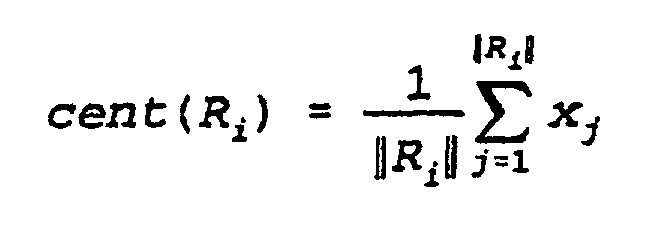
- In step 34, a total distortion measure for the given iteration, Dm, is calculated based on the distance between each of the training vectors and the centroid to which it clusters. That is,
decision 35 computes the difference between the computed distortion measure (Dm) and the distortion measure computed for the previous iteration (Dm-1), in order to measure the degree of improvement in the quality of the codebooks from the previous iteration to the current one. If this difference is less than a predetermined threshold, TD, the iteration may be advantageously terminated, since the improvement in codebook quality which is likely to be gained by performing additional iterations is small. - Once a database of codebooks representing known faces has been generated, face recognition may be performed in accordance with the principles of the present invention based on the set of codebooks contained in the database. Fig. 2 shows an overview of a face recognition process in accordance with an illustrative embodiment of the present invention. Given a database of codebooks (e.g., codebooks 23-1, 23-2, ..., 23-N), as generated, for example, with use of the illustrative procedures of Figs. 1 and 3, the illustrative embodiment as shown in Fig. 2 may be used to identify (or to verify the identity of) a person's face comprised in an input image signal.
- First, in an identical manner to that of the illustrative codebook generation process of Fig. 1,
preprocessor 21 extracts the region of interest (i.e., the face) from the input image, and normalizes the scale thereof. Thus, all further processing can be advantageously performed on the face (and only the face), and all faces presented to the system will be of the same scale (i.e., size). Again, the preprocessing performed bypreprocessor 21 is conventional and well known to those skilled in the art. - After the preprocessing has been completed, and again in an identical manner to that of the illustrative codebook generation process of Fig. 1, the extracted portion of the input image is decomposed into blocks, and a linear, block-based transform is performed on each block by
transform 22. Again, the blocks may, for example, be of size 8x8, or, alternatively, of size 16x16, and they may be contiguous across the image space or, preferably, overlapping. The same transform (such as a DCT) as was used in the generation of codebooks 23-1 to 23-N is advantageously used in the face recognition process of Fig. 2 as well. Moreover, the same block size is advantageously used and the same set of (L) coefficients is advantageously provided. - Once the DCT input vectors have been provided by
transform 22,classifier 24 is used to identify (or in the case of face verification, to verify) the face contained in the input image based on (known) face codebooks 23-1 to 23-N. Specifically,classifier 24 may, for example, determine which of the codebooks provides the best match to the input vectors which have been derived from the input image. In a face identification context, the face associated with the "best matching" codebook may then be identified as the most likely candidate. However, if the error metric upon which the comparisons are based (see, e.g., the discussion below) does not provide an "adequately" small total error value (e.g., below a predetermined threshold) for any of the known face codebooks (thereby indicating that no "sufficiently good" match was found), the system may not identify any of the known faces as the face in the input image. Rather, the system may simply determine that the person whose face is in the image is, in fact, none of the people for whom face data has been previously collected and stored in the database. - In a face verification context, the system may verify or reject (i.e., fail to verify) the claimed identity based on whether the claimed identity matches the known face codebook which is determined to be the best match with the face in the input image. Alternatively, the system may verify or reject the claimed identity based on whether the total error metric obtained when the input image is analyzed with respect to the particular codebook associated with the face of the claimed identity is "adequately" small, thereby indicating a sufficiently "good" match between the face in the input image and the face of the claimed identity.
- In accordance with certain embodiments of the present invention, a determination of which known face codebook provides the best match to the face in the input image can be made in a number of different ways. For example, two illustrative embodiments of the operation of
classifier 24 of the illustrative face recognition process of Fig. 2 are shown in Figs. 4 and 5, respectively. - Fig. 4 shows a flow diagram of the operation of
classifier 24 of the illustrative face recognition process of Fig. 2 in accordance with a first illustrative embodiment of the present invention. In accordance with this embodiment, each of the known face codebooks are used to encode the input image vectors, and a total coding error is determined for each such encoding. Then, the encoding which results in the lowest total coding error is determined, and the face corresponding to the codebook used in that encoding is identified as the best match to the face in the input image. - Specifically, with reference to Fig. 4, the illustrative process begins with
step 41, which performs a plurality of conventional VQ codebook encodings of the input image vectors, each such encoding performed with use of a different one of the known face codebooks (i.e., codebooks 23-1 through 23-N). In particular, and as is well known to those of ordinary skill in the art, each of these encodings consists of selecting one of the codevectors from the given codebook for each of the input image vectors, wherein the selection is made based on an error metric, such as, for example, a mean squared error. The selected codevector is the one that provides a "best match" to the input vector -- that is, a codevector is selected for each input vector so as to advantageously minimize the error (i.e., the difference) between the input vector and the coding thereof (i.e., the selected codevector). Thus, for each codebook, Cp (where p =1,2,...,N), containing codevectors, yp i (where i = 1,2,...,M), each input vector, xj (where j = 1,2,...,J), is compared to each of the codevectors to determine the one which results in a minimum error, given an error function d(x,y). In particular, dp min(xj), representing the minimum error for a coding of input vector xj with use of codebook Cp is determined for each input vector, xj, as follows: - After each of the encodings have been performed, step 44 of the illustrative procedure of Fig. 4 then calculates a total error, Dp, for each of the encodings (i.e., for all p = 1,2,...,N). These total errors are merely the sum of the individual coding errors, computed as follows:
step 44 to be performed as a separate and distinct operation from the encodings performed instep 41.) - Completing the illustrative procedure of Fig. 4,
step 45 determines the minimum total error value obtained over all of the encodings (i.e., the value of p for which Dp is minimum), and step 46 selects the known face which is represented by the codebook which was used in the encoding which achieved the minimum total error (i.e., the best encoding). In this manner, the given face from the input image may be advantageously identified as being the known face in the database whose associated codebook results in this "best" encoding of the given face. - Fig. 5 shows a flow diagram of the operation of
classifier 24 of the illustrative face recognition process of Fig. 2 in accordance with a second illustrative embodiment of the present invention. This illustrative embodiment provides a computationally simpler technique which results in only slightly lower performance than that of the illustrative procedure of Fig. 4. In particular, this second illustrative embodiment generates a codebook for the input image, and then compares this codebook to each of the known face codebooks in order to determine the "best match." Again, as in the illustrative procedure of Fig. 4, the lowest total error value is deemed to be indicative of the best match. However, the difference between the illustrative procedures of Figs. 4 and 5 is that in the procedure of Fig. 5, rather than coding each of the (J) input vectors (which may, for example, require the coding of thousands of vectors),step 42 produces a codebook, illustratively containing only M (e.g., 64) codevectors, therefrom. Then, this more limited set of vectors (i.e., the M codevectors rather than the J input vectors, where, typically, J >> M) are encoded with use of each of the N codebooks (step 43), and the total errors obtained from each of these (simpler) encodings are used (in steps 44-46) to select the known face represented by the codebook having the minimum total error. - Specifically, the codebook generation of
step 42 may comprise essentially the same procedure as that illustratively used for generating the known face codebooks as shown in Fig. 3. In this case, however, the illustrative training procedure of Fig. 3 is applied to the input image data, rather than to training image data. (Note that there is typically only one image from which the input image vectors are obtained, rather than the potentially many images from which training image vectors may be advantageously obtained.) The advantage of the use of the illustrative procedure of Fig. 5 instead of the illustrative procedure of Fig. 4, therefore, is that of having to compare only M (input image derived) codevectors to M (training image derived) codevectors for each of N codebooks, rather than having to compare J (input image derived) vectors to M (training image derived) codevectors for each of the N codebooks. Since, typically, J >> M, this may advantageously result in significant computational savings. Again, the error metric used may be a mean squared error, or it may be any other error metric familiar to those of ordinary skill in the art. - Although a number of specific embodiments of this invention have been shown and described herein, it is to be understood that these embodiments are merely illustrative of the many possible specific arrangements which can be devised in application of the principles of the invention. For example, although the description above has been focused on the recognition of human faces, it will be obvious to those skilled in the art that the techniques of the present invention may be applied to any general image recognition problem, wherein a given object is matched to one of a plurality of known objects, representations of which are stored in a database. In addition, although the embodiments of the present invention described above employ a mean squared error metric for measuring the difference between, for example, input vectors and codevectors, alternative embodiments may use other error metrics, including, for example, perceptual metrics which incorporate perceptual criterion. Such perceptual metrics are familiar to those skilled in the art. Numerous and varied other arrangements can also be devised in accordance with the principles of the present invention by those of ordinary skill in the art without departing from the scope of the invention.
Claims (10)
- A method of matching a given object comprised in an input image signal to one of a plurality of known objects, a representation of each of the known objects having been stored in a database and comprising a codebook corresponding thereto, each codebook comprising a plurality of codevectors having been generated based on one or more corresponding training image signals comprising the corresponding known object, the method comprising the steps of:decomposing a portion of the input image signal which includes the given object into a plurality of blocks;generating (22) a plurality of input vectors corresponding to the plurality of blocks, each input vector based on the block corresponding thereto; andmatching (24) the given object to one of the known objects based on one or more of the input vectors and on one or more of the codevectors comprised in one or more of the codebooks (23-1,...,23-N) corresponding to the known objects.
- The method of claim 1 wherein the step of matching the given object to the one of the known objects comprises:performing a plurality of encodings of the at least a portion of the input image signal, each encoding comprising coding one or more of the input vectors based on one or more of the codevectors comprised in a corresponding one of the codebooks;determining a plurality of coding errors corresponding to the plurality of encodings; andmatching the given object to the one of the known objects based on the plurality of coding errors.
- The method of claim 1 wherein the step of matching the given object to the one of the known objects comprises:generating a codebook corresponding to the given object based on one or more of the input vectors;comparing the codebook corresponding to the given object with one or more of the codebooks corresponding to the known objects; andmatching the given object to the one of the known objects based on the comparison of the codebook corresponding to the given object with the codebooks corresponding to the known objects.
- A method of generating a database comprising a plurality of representations of known objects, the database for use in matching a given object comprised in an input image signal to one of the known objects, each of the representations of the known objects comprising a codebook (23-i) corresponding thereto, the method comprising the steps of:for each of the known objects, decomposing into a plurality of blocks, a portion of each of one or more training image signals, the portion of each training image signal including the known object;for each of the known objects, generating (22) a plurality of training vectors corresponding to the plurality of blocks, each training vector based on the block corresponding thereto; andfor each of the known objects, generating (25) the codebook (23-i) corresponding thereto based on one or more of the training vectors generated from the training image signals which include the known object.
- The method of claim 4 wherein the step of generating the training vectors comprises performing a linear transform on the blocks and generating the training vectors based on the transformed blocks.
- A system for matching a given object comprised in an input image signal to one of a plurality of known objects, a representation of each of the known objects having been stored in a database and comprising a codebook corresponding thereto, each codebook comprising a plurality of codevectors having been generated based on one or more corresponding training image signals comprising the corresponding known object, the system comprising:means for decomposing a portion of the input image signal which includes the given object into a plurality of blocks;means for generating (22) a plurality of input vectors corresponding to the plurality of blocks, each input vector based on the block corresponding thereto; andmeans for matching (24) the given object to one of the known objects based on one or more of the input vectors and on one or more of the codevectors comprised in one or more of the codebooks (23-1,...,23-N) corresponding to the known objects.
- The system of claim 6 wherein the means for matching the given object to the one of the known objects comprises:means for performing a plurality of encodings of the at least a portion of the input image signal, each encoding comprising coding one or more of the input vectors based on one or more of the codevectors comprised in a corresponding one of the codebooks;means for determining a plurality of coding errors corresponding to the plurality of encodings; andmeans for matching the given object to the one of the known objects based on the plurality of coding errors.
- The system of claim 7 wherein the means for matching the given object to the one of the known objects comprises:means for generating a codebook corresponding to the given object based on one or more of the input vectors;a comparator which compares the codebook corresponding to the given object with one or more of the codebooks corresponding to the known objects; andmeans for matching the given object to the one of the known objects based on the comparison of the codebook corresponding to the given object with the codebooks corresponding to the known objects.
- A system for generating a database comprising a plurality of representations of known objects, the database for use in matching a given object comprised in an input image signal to one of the known objects, each of the representations of the known objects comprising a codebook (23-i) corresponding thereto, the system comprising:means, applied for each of the known objects, for decomposing into a plurality of blocks, a portion of each of one or more training image signals, the portion of each training image signal including the known object;means (22), applied for each of the known objects, for generating a plurality of training vectors corresponding to the plurality of blocks, each training vector based on the block corresponding thereto; andmeans (25), applied for each of the known objects, for generating the codebook (23-i) corresponding thereto based on one or more of the training vectors generated from the training image signals which include the known object.
- The system of claim 9 wherein the means for generating the training vectors comprises means for performing a linear transform on the blocks and means for generating the training vectors based on the transformed blocks.
Applications Claiming Priority (2)
| Application Number | Priority Date | Filing Date | Title |
|---|---|---|---|
| US643685 | 1996-05-06 | ||
| US08/643,685 US5802208A (en) | 1996-05-06 | 1996-05-06 | Face recognition using DCT-based feature vectors |
Publications (3)
| Publication Number | Publication Date |
|---|---|
| EP0806739A2 EP0806739A2 (en) | 1997-11-12 |
| EP0806739A3 EP0806739A3 (en) | 1999-01-20 |
| EP0806739B1 true EP0806739B1 (en) | 2003-01-22 |
Family
ID=24581863
Family Applications (1)
| Application Number | Title | Priority Date | Filing Date |
|---|---|---|---|
| EP97302939A Expired - Lifetime EP0806739B1 (en) | 1996-05-06 | 1997-04-30 | Face recognition using dct-based feature vectors |
Country Status (4)
| Country | Link |
|---|---|
| US (1) | US5802208A (en) |
| EP (1) | EP0806739B1 (en) |
| JP (1) | JP3649311B2 (en) |
| DE (1) | DE69718553T2 (en) |
Cited By (1)
| Publication number | Priority date | Publication date | Assignee | Title |
|---|---|---|---|---|
| US7848544B2 (en) | 2002-04-12 | 2010-12-07 | Agency For Science, Technology And Research | Robust face registration via multiple face prototypes synthesis |
Families Citing this family (141)
| Publication number | Priority date | Publication date | Assignee | Title |
|---|---|---|---|---|
| US6850252B1 (en) | 1999-10-05 | 2005-02-01 | Steven M. Hoffberg | Intelligent electronic appliance system and method |
| USRE48056E1 (en) | 1991-12-23 | 2020-06-16 | Blanding Hovenweep, Llc | Ergonomic man-machine interface incorporating adaptive pattern recognition based control system |
| US5903454A (en) | 1991-12-23 | 1999-05-11 | Hoffberg; Linda Irene | Human-factored interface corporating adaptive pattern recognition based controller apparatus |
| USRE47908E1 (en) | 1991-12-23 | 2020-03-17 | Blanding Hovenweep, Llc | Ergonomic man-machine interface incorporating adaptive pattern recognition based control system |
| US10361802B1 (en) | 1999-02-01 | 2019-07-23 | Blanding Hovenweep, Llc | Adaptive pattern recognition based control system and method |
| USRE46310E1 (en) | 1991-12-23 | 2017-02-14 | Blanding Hovenweep, Llc | Ergonomic man-machine interface incorporating adaptive pattern recognition based control system |
| KR970073120A (en) * | 1996-04-15 | 1997-11-07 | 이준 | A method of decoding a vector quantized signal in units of blocks |
| US6819783B2 (en) | 1996-09-04 | 2004-11-16 | Centerframe, Llc | Obtaining person-specific images in a public venue |
| JP2918499B2 (en) * | 1996-09-17 | 1999-07-12 | 株式会社エイ・ティ・アール人間情報通信研究所 | Face image information conversion method and face image information conversion device |
| KR100295225B1 (en) * | 1997-07-31 | 2001-07-12 | 윤종용 | Apparatus and method for checking video information in computer system |
| JPH11250071A (en) * | 1998-02-26 | 1999-09-17 | Minolta Co Ltd | Image database constructing method, image database device and image information storage medium |
| US6332139B1 (en) * | 1998-11-09 | 2001-12-18 | Mega Chips Corporation | Information communication system |
| US20030059124A1 (en) * | 1999-04-16 | 2003-03-27 | Viisage Technology, Inc. | Real-time facial recognition and verification system |
| JP2001014052A (en) * | 1999-06-25 | 2001-01-19 | Toshiba Corp | Personal authentication method for computer system, computer system, and recording medium |
| US6636619B1 (en) | 1999-07-07 | 2003-10-21 | Zhongfei Zhang | Computer based method and apparatus for object recognition |
| US6501857B1 (en) * | 1999-07-20 | 2002-12-31 | Craig Gotsman | Method and system for detecting and classifying objects in an image |
| US20020143862A1 (en) * | 2000-05-19 | 2002-10-03 | Atitania Ltd. | Method and apparatus for transferring information between a source and a destination on a network |
| WO2002019137A1 (en) * | 2000-08-29 | 2002-03-07 | Imageid Ltd. | Indexing, storage & retrieval of digital images |
| EP1360833A1 (en) | 2000-08-31 | 2003-11-12 | Rytec Corporation | Sensor and imaging system |
| US6763148B1 (en) | 2000-11-13 | 2004-07-13 | Visual Key, Inc. | Image recognition methods |
| EP1217574A3 (en) * | 2000-12-19 | 2004-05-19 | Matsushita Electric Industrial Co., Ltd. | A method for lighting- and view-angle-invariant face description with first- and second-order eigenfeatures |
| US6968092B1 (en) * | 2001-08-21 | 2005-11-22 | Cisco Systems Canada Co. | System and method for reduced codebook vector quantization |
| US7113916B1 (en) | 2001-09-07 | 2006-09-26 | Hill Daniel A | Method of facial coding monitoring for the purpose of gauging the impact and appeal of commercially-related stimuli |
| AU2002362085A1 (en) * | 2001-12-07 | 2003-07-09 | Canesta Inc. | User interface for electronic devices |
| US6734798B2 (en) | 2002-01-31 | 2004-05-11 | Ervin M. Smith | Fuel dispenser with a human detection and recognition system |
| AU2003217587A1 (en) * | 2002-02-15 | 2003-09-09 | Canesta, Inc. | Gesture recognition system using depth perceptive sensors |
| US10242255B2 (en) | 2002-02-15 | 2019-03-26 | Microsoft Technology Licensing, Llc | Gesture recognition system using depth perceptive sensors |
| WO2003073359A2 (en) * | 2002-02-26 | 2003-09-04 | Canesta, Inc. | Method and apparatus for recognizing objects |
| US20040052418A1 (en) * | 2002-04-05 | 2004-03-18 | Bruno Delean | Method and apparatus for probabilistic image analysis |
| US7369685B2 (en) * | 2002-04-05 | 2008-05-06 | Identix Corporation | Vision-based operating method and system |
| US7151530B2 (en) | 2002-08-20 | 2006-12-19 | Canesta, Inc. | System and method for determining an input selected by a user through a virtual interface |
| CA2536864C (en) * | 2002-08-29 | 2014-01-28 | Paul Rudolf | Associative memory device and method based on wave propagation |
| WO2004023787A2 (en) | 2002-09-06 | 2004-03-18 | Rytec Corporation | Signal intensity range transformation apparatus and method |
| US7526120B2 (en) * | 2002-09-11 | 2009-04-28 | Canesta, Inc. | System and method for providing intelligent airbag deployment |
| US20040066500A1 (en) * | 2002-10-02 | 2004-04-08 | Gokturk Salih Burak | Occupancy detection and measurement system and method |
| US7269292B2 (en) | 2003-06-26 | 2007-09-11 | Fotonation Vision Limited | Digital image adjustable compression and resolution using face detection information |
| US7574016B2 (en) | 2003-06-26 | 2009-08-11 | Fotonation Vision Limited | Digital image processing using face detection information |
| US7620218B2 (en) | 2006-08-11 | 2009-11-17 | Fotonation Ireland Limited | Real-time face tracking with reference images |
| US8330831B2 (en) | 2003-08-05 | 2012-12-11 | DigitalOptics Corporation Europe Limited | Method of gathering visual meta data using a reference image |
| US7440593B1 (en) * | 2003-06-26 | 2008-10-21 | Fotonation Vision Limited | Method of improving orientation and color balance of digital images using face detection information |
| US8155397B2 (en) | 2007-09-26 | 2012-04-10 | DigitalOptics Corporation Europe Limited | Face tracking in a camera processor |
| US9129381B2 (en) | 2003-06-26 | 2015-09-08 | Fotonation Limited | Modification of post-viewing parameters for digital images using image region or feature information |
| US8553949B2 (en) | 2004-01-22 | 2013-10-08 | DigitalOptics Corporation Europe Limited | Classification and organization of consumer digital images using workflow, and face detection and recognition |
| US8494286B2 (en) | 2008-02-05 | 2013-07-23 | DigitalOptics Corporation Europe Limited | Face detection in mid-shot digital images |
| US8948468B2 (en) | 2003-06-26 | 2015-02-03 | Fotonation Limited | Modification of viewing parameters for digital images using face detection information |
| US8498452B2 (en) | 2003-06-26 | 2013-07-30 | DigitalOptics Corporation Europe Limited | Digital image processing using face detection information |
| US8896725B2 (en) | 2007-06-21 | 2014-11-25 | Fotonation Limited | Image capture device with contemporaneous reference image capture mechanism |
| US8682097B2 (en) | 2006-02-14 | 2014-03-25 | DigitalOptics Corporation Europe Limited | Digital image enhancement with reference images |
| US7471846B2 (en) | 2003-06-26 | 2008-12-30 | Fotonation Vision Limited | Perfecting the effect of flash within an image acquisition devices using face detection |
| US8593542B2 (en) | 2005-12-27 | 2013-11-26 | DigitalOptics Corporation Europe Limited | Foreground/background separation using reference images |
| US7844076B2 (en) | 2003-06-26 | 2010-11-30 | Fotonation Vision Limited | Digital image processing using face detection and skin tone information |
| US7792335B2 (en) * | 2006-02-24 | 2010-09-07 | Fotonation Vision Limited | Method and apparatus for selective disqualification of digital images |
| US7616233B2 (en) | 2003-06-26 | 2009-11-10 | Fotonation Vision Limited | Perfecting of digital image capture parameters within acquisition devices using face detection |
| US8363951B2 (en) | 2007-03-05 | 2013-01-29 | DigitalOptics Corporation Europe Limited | Face recognition training method and apparatus |
| US7792970B2 (en) | 2005-06-17 | 2010-09-07 | Fotonation Vision Limited | Method for establishing a paired connection between media devices |
| US7565030B2 (en) | 2003-06-26 | 2009-07-21 | Fotonation Vision Limited | Detecting orientation of digital images using face detection information |
| US8989453B2 (en) | 2003-06-26 | 2015-03-24 | Fotonation Limited | Digital image processing using face detection information |
| US9692964B2 (en) | 2003-06-26 | 2017-06-27 | Fotonation Limited | Modification of post-viewing parameters for digital images using image region or feature information |
| US7643684B2 (en) * | 2003-07-15 | 2010-01-05 | Samsung Electronics Co., Ltd. | Apparatus for and method of constructing multi-view face database, and apparatus for and method of generating multi-view face descriptor |
| US7439074B2 (en) * | 2003-09-30 | 2008-10-21 | Hoa Duc Nguyen | Method of analysis of alcohol by mass spectrometry |
| JP4294434B2 (en) * | 2003-10-17 | 2009-07-15 | 株式会社日立製作所 | Unique code generation apparatus and method, program, and recording medium |
| US7564994B1 (en) * | 2004-01-22 | 2009-07-21 | Fotonation Vision Limited | Classification system for consumer digital images using automatic workflow and face detection and recognition |
| WO2006014095A1 (en) * | 2004-08-04 | 2006-02-09 | Daulet Kulenov | Method for forming a karhunen-loeve basis for person recognition |
| US8320641B2 (en) | 2004-10-28 | 2012-11-27 | DigitalOptics Corporation Europe Limited | Method and apparatus for red-eye detection using preview or other reference images |
| US7715597B2 (en) | 2004-12-29 | 2010-05-11 | Fotonation Ireland Limited | Method and component for image recognition |
| US8488023B2 (en) * | 2009-05-20 | 2013-07-16 | DigitalOptics Corporation Europe Limited | Identifying facial expressions in acquired digital images |
| US8503800B2 (en) | 2007-03-05 | 2013-08-06 | DigitalOptics Corporation Europe Limited | Illumination detection using classifier chains |
| US7315631B1 (en) | 2006-08-11 | 2008-01-01 | Fotonation Vision Limited | Real-time face tracking in a digital image acquisition device |
| US8009871B2 (en) | 2005-02-08 | 2011-08-30 | Microsoft Corporation | Method and system to segment depth images and to detect shapes in three-dimensionally acquired data |
| US8235725B1 (en) * | 2005-02-20 | 2012-08-07 | Sensory Logic, Inc. | Computerized method of assessing consumer reaction to a business stimulus employing facial coding |
| WO2006091869A2 (en) | 2005-02-25 | 2006-08-31 | Youfinder Intellectual Property Licensing Limited Liability Company | Automated indexing for distributing event photography |
| US20060193520A1 (en) * | 2005-02-28 | 2006-08-31 | Takeshi Mita | Object detection apparatus, learning apparatus, object detection system, object detection method and object detection program |
| EP1907980B1 (en) | 2005-07-18 | 2013-01-02 | Hysterical Sunset Limited | Manually-assisted automated indexing of images using facial recognition |
| KR100714112B1 (en) | 2005-12-09 | 2007-05-02 | 한국전자통신연구원 | Facial recognition authentication method and device |
| US9015740B2 (en) | 2005-12-12 | 2015-04-21 | The Nielsen Company (Us), Llc | Systems and methods to wirelessly meter audio/visual devices |
| US7804983B2 (en) | 2006-02-24 | 2010-09-28 | Fotonation Vision Limited | Digital image acquisition control and correction method and apparatus |
| DE602007012246D1 (en) | 2006-06-12 | 2011-03-10 | Tessera Tech Ireland Ltd | PROGRESS IN EXTENDING THE AAM TECHNIQUES FROM GRAY CALENDAR TO COLOR PICTURES |
| US8467570B2 (en) * | 2006-06-14 | 2013-06-18 | Honeywell International Inc. | Tracking system with fused motion and object detection |
| US7930199B1 (en) | 2006-07-21 | 2011-04-19 | Sensory Logic, Inc. | Method and report assessing consumer reaction to a stimulus by matching eye position with facial coding |
| US7515740B2 (en) | 2006-08-02 | 2009-04-07 | Fotonation Vision Limited | Face recognition with combined PCA-based datasets |
| US7403643B2 (en) | 2006-08-11 | 2008-07-22 | Fotonation Vision Limited | Real-time face tracking in a digital image acquisition device |
| US7916897B2 (en) | 2006-08-11 | 2011-03-29 | Tessera Technologies Ireland Limited | Face tracking for controlling imaging parameters |
| US8315463B2 (en) * | 2006-11-14 | 2012-11-20 | Eastman Kodak Company | User interface for face recognition |
| KR100855631B1 (en) | 2006-12-26 | 2008-09-01 | (주)엔토시스 | Feature vector detection apparatus and method, and face recognition apparatus and method using same |
| US8055067B2 (en) | 2007-01-18 | 2011-11-08 | DigitalOptics Corporation Europe Limited | Color segmentation |
| WO2008104549A2 (en) * | 2007-02-28 | 2008-09-04 | Fotonation Vision Limited | Separating directional lighting variability in statistical face modelling based on texture space decomposition |
| US8649604B2 (en) | 2007-03-05 | 2014-02-11 | DigitalOptics Corporation Europe Limited | Face searching and detection in a digital image acquisition device |
| WO2008109622A1 (en) | 2007-03-05 | 2008-09-12 | Fotonation Vision Limited | Face categorization and annotation of a mobile phone contact list |
| US8484081B2 (en) | 2007-03-29 | 2013-07-09 | The Nielsen Company (Us), Llc | Analysis of marketing and entertainment effectiveness using central nervous system, autonomic nervous system, and effector data |
| GB2447976B (en) * | 2007-03-30 | 2011-04-27 | Sony Uk Ltd | Apparatus and method of image capture |
| US9886981B2 (en) | 2007-05-01 | 2018-02-06 | The Nielsen Company (Us), Llc | Neuro-feedback based stimulus compression device |
| US8392253B2 (en) | 2007-05-16 | 2013-03-05 | The Nielsen Company (Us), Llc | Neuro-physiology and neuro-behavioral based stimulus targeting system |
| JP2008294584A (en) * | 2007-05-22 | 2008-12-04 | Panasonic Corp | Digest playback apparatus and method |
| US7916971B2 (en) | 2007-05-24 | 2011-03-29 | Tessera Technologies Ireland Limited | Image processing method and apparatus |
| US7991199B2 (en) * | 2007-06-29 | 2011-08-02 | Microsoft Corporation | Object identification and verification using transform vector quantization |
| EP2170161B1 (en) | 2007-07-30 | 2018-12-05 | The Nielsen Company (US), LLC. | Neuro-response stimulus and stimulus attribute resonance estimator |
| US20090041311A1 (en) * | 2007-08-09 | 2009-02-12 | Jon Hundley | Facial recognition based content blocking system |
| US8386313B2 (en) | 2007-08-28 | 2013-02-26 | The Nielsen Company (Us), Llc | Stimulus placement system using subject neuro-response measurements |
| US8392255B2 (en) | 2007-08-29 | 2013-03-05 | The Nielsen Company (Us), Llc | Content based selection and meta tagging of advertisement breaks |
| US20090083129A1 (en) | 2007-09-20 | 2009-03-26 | Neurofocus, Inc. | Personalized content delivery using neuro-response priming data |
| US8151292B2 (en) | 2007-10-02 | 2012-04-03 | Emsense Corporation | System for remote access to media, and reaction and survey data from viewers of the media |
| WO2009059246A1 (en) | 2007-10-31 | 2009-05-07 | Emsense Corporation | Systems and methods providing en mass collection and centralized processing of physiological responses from viewers |
| US8064653B2 (en) * | 2007-11-29 | 2011-11-22 | Viewdle, Inc. | Method and system of person identification by facial image |
| US8750578B2 (en) | 2008-01-29 | 2014-06-10 | DigitalOptics Corporation Europe Limited | Detecting facial expressions in digital images |
| US7855737B2 (en) | 2008-03-26 | 2010-12-21 | Fotonation Ireland Limited | Method of making a digital camera image of a scene including the camera user |
| CN102027505A (en) | 2008-07-30 | 2011-04-20 | 泰塞拉技术爱尔兰公司 | Automatic face and skin retouching using face detection |
| WO2010063463A2 (en) | 2008-12-05 | 2010-06-10 | Fotonation Ireland Limited | Face recognition using face tracker classifier data |
| US20100250325A1 (en) | 2009-03-24 | 2010-09-30 | Neurofocus, Inc. | Neurological profiles for market matching and stimulus presentation |
| US8600100B2 (en) * | 2009-04-16 | 2013-12-03 | Sensory Logic, Inc. | Method of assessing people's self-presentation and actions to evaluate personality type, behavioral tendencies, credibility, motivations and other insights through facial muscle activity and expressions |
| US8326002B2 (en) * | 2009-08-13 | 2012-12-04 | Sensory Logic, Inc. | Methods of facial coding scoring for optimally identifying consumers' responses to arrive at effective, incisive, actionable conclusions |
| US10987015B2 (en) | 2009-08-24 | 2021-04-27 | Nielsen Consumer Llc | Dry electrodes for electroencephalography |
| EP2474155A1 (en) | 2009-09-02 | 2012-07-11 | Image Holdings | Method and system for displaying, managing and selling digital images |
| WO2011033386A1 (en) | 2009-09-16 | 2011-03-24 | Image Holdings | Method and system of displaying, managing and selling images in an event photography environment |
| US8379917B2 (en) | 2009-10-02 | 2013-02-19 | DigitalOptics Corporation Europe Limited | Face recognition performance using additional image features |
| US9560984B2 (en) | 2009-10-29 | 2017-02-07 | The Nielsen Company (Us), Llc | Analysis of controlled and automatic attention for introduction of stimulus material |
| US20110106750A1 (en) * | 2009-10-29 | 2011-05-05 | Neurofocus, Inc. | Generating ratings predictions using neuro-response data |
| WO2011133548A2 (en) | 2010-04-19 | 2011-10-27 | Innerscope Research, Inc. | Short imagery task (sit) research method |
| US8655428B2 (en) | 2010-05-12 | 2014-02-18 | The Nielsen Company (Us), Llc | Neuro-response data synchronization |
| KR20120040015A (en) * | 2010-10-18 | 2012-04-26 | 한국전자통신연구원 | Vector classifier and vector classification method thereof |
| US9323980B2 (en) | 2011-05-13 | 2016-04-26 | Microsoft Technology Licensing, Llc | Pose-robust recognition |
| US9251402B2 (en) * | 2011-05-13 | 2016-02-02 | Microsoft Technology Licensing, Llc | Association and prediction in facial recognition |
| US9569986B2 (en) | 2012-02-27 | 2017-02-14 | The Nielsen Company (Us), Llc | System and method for gathering and analyzing biometric user feedback for use in social media and advertising applications |
| CA2819853A1 (en) * | 2012-06-28 | 2013-12-28 | Frederik Hoffmann | Passenger service unit with gesture control |
| US9576175B2 (en) * | 2014-05-16 | 2017-02-21 | Verizon Patent And Licensing Inc. | Generating emoticons based on an image of a face |
| US9936250B2 (en) | 2015-05-19 | 2018-04-03 | The Nielsen Company (Us), Llc | Methods and apparatus to adjust content presented to an individual |
| KR102518243B1 (en) * | 2016-01-05 | 2023-04-06 | 한국전자통신연구원 | Face recognition apparatus and method using physiognomic information |
| US10621581B2 (en) | 2016-06-11 | 2020-04-14 | Apple Inc. | User interface for transactions |
| CN109313759B (en) | 2016-06-11 | 2022-04-26 | 苹果公司 | User interface for transactions |
| US20180068313A1 (en) | 2016-09-06 | 2018-03-08 | Apple Inc. | User interfaces for stored-value accounts |
| US10789550B2 (en) * | 2017-04-13 | 2020-09-29 | Battelle Memorial Institute | System and method for generating test vectors |
| US10304209B2 (en) | 2017-04-19 | 2019-05-28 | The Nielsen Company (Us), Llc | Methods and systems to increase accuracy of eye tracking |
| KR102409769B1 (en) * | 2017-05-16 | 2022-06-16 | 애플 인크. | User interfaces for peer-to-peer transfers |
| US11221744B2 (en) | 2017-05-16 | 2022-01-11 | Apple Inc. | User interfaces for peer-to-peer transfers |
| CN112219203A (en) | 2018-06-03 | 2021-01-12 | 苹果公司 | User interface for transferring accounts |
| US11100498B2 (en) | 2018-06-03 | 2021-08-24 | Apple Inc. | User interfaces for transfer accounts |
| US11328352B2 (en) | 2019-03-24 | 2022-05-10 | Apple Inc. | User interfaces for managing an account |
| US12118562B2 (en) | 2020-05-29 | 2024-10-15 | Apple Inc. | Configuring an account for a second user identity |
| US11983702B2 (en) | 2021-02-01 | 2024-05-14 | Apple Inc. | Displaying a representation of a card with a layered structure |
| US11921992B2 (en) | 2021-05-14 | 2024-03-05 | Apple Inc. | User interfaces related to time |
| US11784956B2 (en) | 2021-09-20 | 2023-10-10 | Apple Inc. | Requests to add assets to an asset account |
| US11900725B2 (en) * | 2021-12-02 | 2024-02-13 | Optum, Inc. | Authentication and facial recognition through analysis of optometric prescription data |
Family Cites Families (6)
| Publication number | Priority date | Publication date | Assignee | Title |
|---|---|---|---|---|
| GB8415996D0 (en) * | 1984-06-22 | 1984-07-25 | Bank Of England | Image model |
| WO1991006051A1 (en) * | 1989-10-13 | 1991-05-02 | Oilfield Systems Limited | System and method for handling data |
| US5313532A (en) * | 1990-01-23 | 1994-05-17 | Massachusetts Institute Of Technology | Recognition of patterns in images |
| JP2710188B2 (en) * | 1991-10-03 | 1998-02-10 | インターナショナル・ビジネス・マシーンズ・コーポレイション | Method and data processing apparatus for generating interaction between data processing system and user |
| FR2693615B1 (en) * | 1992-07-07 | 1994-08-26 | Thomson Csf | Method of identifying objects in an image. |
| ATE207223T1 (en) * | 1994-03-03 | 2001-11-15 | Alexandr Sergeevich Dmitriev | METHOD FOR OBJECT RECOGNITION |
-
1996
- 1996-05-06 US US08/643,685 patent/US5802208A/en not_active Expired - Lifetime
-
1997
- 1997-04-30 EP EP97302939A patent/EP0806739B1/en not_active Expired - Lifetime
- 1997-04-30 DE DE69718553T patent/DE69718553T2/en not_active Expired - Lifetime
- 1997-05-06 JP JP11546197A patent/JP3649311B2/en not_active Expired - Fee Related
Cited By (1)
| Publication number | Priority date | Publication date | Assignee | Title |
|---|---|---|---|---|
| US7848544B2 (en) | 2002-04-12 | 2010-12-07 | Agency For Science, Technology And Research | Robust face registration via multiple face prototypes synthesis |
Also Published As
| Publication number | Publication date |
|---|---|
| JP3649311B2 (en) | 2005-05-18 |
| EP0806739A2 (en) | 1997-11-12 |
| DE69718553D1 (en) | 2003-02-27 |
| US5802208A (en) | 1998-09-01 |
| DE69718553T2 (en) | 2003-08-14 |
| JPH1055444A (en) | 1998-02-24 |
| EP0806739A3 (en) | 1999-01-20 |
Similar Documents
| Publication | Publication Date | Title |
|---|---|---|
| US5802208A (en) | Face recognition using DCT-based feature vectors | |
| US7792332B2 (en) | Method and system of transitive matching for object recognition, in particular for biometric searches | |
| US20050226509A1 (en) | Efficient classification of three dimensional face models for human identification and other applications | |
| CN110378414B (en) | Multi-mode biological characteristic fusion identity recognition method based on evolution strategy | |
| Tjahyadi et al. | Application of the DCT energy histogram for face recognition | |
| CN116543419B (en) | Hotel health personnel wearing detection method and system based on embedded platform | |
| Deshpande et al. | Automatic latent fingerprint identification system using scale and rotation invariant minutiae features | |
| EP1495437A1 (en) | Robust face registration via multiple face prototypes synthesis | |
| CN112257688A (en) | GWO-OSELM-based non-contact palm in-vivo detection method and device | |
| RU2381553C1 (en) | Method and system for recognising faces based on list of people not subject to verification | |
| Yao et al. | Fingerprint quality assessment combining blind image quality, texture and minutiae features | |
| Spies et al. | Face recognition in Fourier space | |
| González-Jiménez et al. | Modeling Gabor coefficients via generalized Gaussian distributions for face recognition | |
| Kotropoulos et al. | Frontal face authentication using variants of dynamic link matching based on mathematical morphology | |
| US7436999B2 (en) | Data analysis device and data recognition device | |
| Ebrahimpour-Komleh et al. | Robustness to expression variations in fractal-based face recognition | |
| Tsapatsoulis et al. | Face extraction from non-uniform background and recognition in compressed domain | |
| JP2004272326A (en) | A probabilistic facial component fusion method for facial depiction and recognition using subspace component features | |
| Tjahyadi et al. | Face recognition via the overlapping energy histogram | |
| Suvorov et al. | Mathematical model of the biometric iris recognition system | |
| Kekre et al. | Iris recognition using discrete cosine transform and Kekre's fast codebook generation algorithm | |
| CN112070023A (en) | A Neighborhood Prior Embedding Cooperative Representation Pattern Recognition Method | |
| Sadeghi et al. | Segmentation of lip pixels for lip tracker initialisation | |
| CN109948519A (en) | A Face Group Recognition Method Based on Regional Sparse and Weighted Residuals | |
| Banerjee et al. | Alpha-wolves and Alpha-mammals: Exploring dictionary attacks on iris recognition systems |
Legal Events
| Date | Code | Title | Description |
|---|---|---|---|
| PUAI | Public reference made under article 153(3) epc to a published international application that has entered the european phase |
Free format text: ORIGINAL CODE: 0009012 |
|
| AK | Designated contracting states |
Kind code of ref document: A2 Designated state(s): DE FR GB |
|
| PUAL | Search report despatched |
Free format text: ORIGINAL CODE: 0009013 |
|
| RHK1 | Main classification (correction) |
Ipc: G06K 9/46 |
|
| AK | Designated contracting states |
Kind code of ref document: A3 Designated state(s): DE FR GB |
|
| 17P | Request for examination filed |
Effective date: 19990709 |
|
| GRAG | Despatch of communication of intention to grant |
Free format text: ORIGINAL CODE: EPIDOS AGRA |
|
| 17Q | First examination report despatched |
Effective date: 20020528 |
|
| GRAG | Despatch of communication of intention to grant |
Free format text: ORIGINAL CODE: EPIDOS AGRA |
|
| GRAH | Despatch of communication of intention to grant a patent |
Free format text: ORIGINAL CODE: EPIDOS IGRA |
|
| GRAH | Despatch of communication of intention to grant a patent |
Free format text: ORIGINAL CODE: EPIDOS IGRA |
|
| GRAA | (expected) grant |
Free format text: ORIGINAL CODE: 0009210 |
|
| AK | Designated contracting states |
Kind code of ref document: B1 Designated state(s): DE FR GB |
|
| REG | Reference to a national code |
Ref country code: GB Ref legal event code: FG4D |
|
| REF | Corresponds to: |
Ref document number: 69718553 Country of ref document: DE Date of ref document: 20030227 Kind code of ref document: P |
|
| ET | Fr: translation filed | ||
| PLBE | No opposition filed within time limit |
Free format text: ORIGINAL CODE: 0009261 |
|
| STAA | Information on the status of an ep patent application or granted ep patent |
Free format text: STATUS: NO OPPOSITION FILED WITHIN TIME LIMIT |
|
| 26N | No opposition filed |
Effective date: 20031023 |
|
| REG | Reference to a national code |
Ref country code: GB Ref legal event code: 732E Free format text: REGISTERED BETWEEN 20131031 AND 20131106 |
|
| REG | Reference to a national code |
Ref country code: FR Ref legal event code: CD Owner name: ALCATEL-LUCENT USA INC. Effective date: 20131122 |
|
| REG | Reference to a national code |
Ref country code: FR Ref legal event code: GC Effective date: 20140410 |
|
| REG | Reference to a national code |
Ref country code: FR Ref legal event code: RG Effective date: 20141015 |
|
| REG | Reference to a national code |
Ref country code: FR Ref legal event code: PLFP Year of fee payment: 19 |
|
| PGFP | Annual fee paid to national office [announced via postgrant information from national office to epo] |
Ref country code: GB Payment date: 20150420 Year of fee payment: 19 Ref country code: DE Payment date: 20150421 Year of fee payment: 19 |
|
| PGFP | Annual fee paid to national office [announced via postgrant information from national office to epo] |
Ref country code: FR Payment date: 20150421 Year of fee payment: 19 |
|
| REG | Reference to a national code |
Ref country code: DE Ref legal event code: R119 Ref document number: 69718553 Country of ref document: DE |
|
| GBPC | Gb: european patent ceased through non-payment of renewal fee |
Effective date: 20160430 |
|
| REG | Reference to a national code |
Ref country code: FR Ref legal event code: ST Effective date: 20161230 |
|
| PG25 | Lapsed in a contracting state [announced via postgrant information from national office to epo] |
Ref country code: DE Free format text: LAPSE BECAUSE OF NON-PAYMENT OF DUE FEES Effective date: 20161101 Ref country code: GB Free format text: LAPSE BECAUSE OF NON-PAYMENT OF DUE FEES Effective date: 20160430 Ref country code: FR Free format text: LAPSE BECAUSE OF NON-PAYMENT OF DUE FEES Effective date: 20160502 |