EP0806674A2 - Current compensated current sensor - Google Patents
Current compensated current sensor Download PDFInfo
- Publication number
- EP0806674A2 EP0806674A2 EP97106546A EP97106546A EP0806674A2 EP 0806674 A2 EP0806674 A2 EP 0806674A2 EP 97106546 A EP97106546 A EP 97106546A EP 97106546 A EP97106546 A EP 97106546A EP 0806674 A2 EP0806674 A2 EP 0806674A2
- Authority
- EP
- European Patent Office
- Prior art keywords
- current
- secondary winding
- magnetic core
- winding
- primary
- Prior art date
- Legal status (The legal status is an assumption and is not a legal conclusion. Google has not performed a legal analysis and makes no representation as to the accuracy of the status listed.)
- Granted
Links
Images

Classifications
-
- H—ELECTRICITY
- H01—ELECTRIC ELEMENTS
- H01F—MAGNETS; INDUCTANCES; TRANSFORMERS; SELECTION OF MATERIALS FOR THEIR MAGNETIC PROPERTIES
- H01F27/00—Details of transformers or inductances, in general
- H01F27/42—Circuits specially adapted for the purpose of modifying, or compensating for, electric characteristics of transformers, reactors, or choke coils
- H01F27/422—Circuits specially adapted for the purpose of modifying, or compensating for, electric characteristics of transformers, reactors, or choke coils for instrument transformers
- H01F27/427—Circuits specially adapted for the purpose of modifying, or compensating for, electric characteristics of transformers, reactors, or choke coils for instrument transformers for current transformers
-
- G—PHYSICS
- G01—MEASURING; TESTING
- G01R—MEASURING ELECTRIC VARIABLES; MEASURING MAGNETIC VARIABLES
- G01R15/00—Details of measuring arrangements of the types provided for in groups G01R17/00 - G01R29/00, G01R33/00 - G01R33/26 or G01R35/00
- G01R15/14—Adaptations providing voltage or current isolation, e.g. for high-voltage or high-current networks
- G01R15/18—Adaptations providing voltage or current isolation, e.g. for high-voltage or high-current networks using inductive devices, e.g. transformers
- G01R15/183—Adaptations providing voltage or current isolation, e.g. for high-voltage or high-current networks using inductive devices, e.g. transformers using transformers with a magnetic core
- G01R15/185—Adaptations providing voltage or current isolation, e.g. for high-voltage or high-current networks using inductive devices, e.g. transformers using transformers with a magnetic core with compensation or feedback windings or interacting coils, e.g. 0-flux sensors
Definitions
- the invention relates to a current sensor with a soft magnetic magnetic core, on which, in addition to a primary winding in which the current to be measured flows, at least one secondary winding is wound, into which an alternating current is fed, which alternately saturates the magnetic core in at least one direction, and with one Evaluation circuit that determines the flux generated by the primary winding in the magnetic core.
- DE 42 29 948 A1 describes a current sensor in which a soft magnetic magnetic core with a primary and a secondary winding is provided.
- An additional current source is connected in series with the secondary winding and sends a magnetizing current through the secondary winding, which alternately controls the soft magnetic magnetic core into positive or negative saturation.
- the soft magnetic magnetic core has an essentially rectangular magnetization characteristic, so that a constant current flows between two saturation states during the remagnetization, since due to the almost perpendicular course of the magnetization characteristic, the inductive resistance approaches infinity.
- This current differs in the positive or negative half-wave from an average value in each case by a value which is given by the hysteresis of the magnetization characteristic.
- the influence of the hysteresis in the magnetization loop can be compensated for by averaging the constant current flowing during the remagnetization with two successive half-waves with different polarity, so that the measurement of the current flowing in the secondary winding during the remagnetization time of the magnetic core results in a current which is directly proportional to the current to be measured in the primary winding.
- the object of the present invention is to provide a particularly sensitive current sensor which is insensitive to hysteresis and temperature influences, based on the compensation principle.
- the magnetic core consists of a material with a flat magnetization curve, that the alternating current flowing through the secondary winding is generated by an essentially sawtooth-shaped alternating voltage, that in an evaluation circuit the positive and negative current peaks through the secondary winding are compared with one another and one Amplifiers are supplied, the output of which can flow a compensation current via a winding which is located on the same magnetic core as the secondary winding.
- a square wave voltage generator 1 which has a series capacitor 2 and the secondary winding 3 is connected to an evaluation circuit 4.
- the secondary winding 3 is wound on a soft magnetic magnetic core 5, on which there is also a compensation winding 6 and a primary winding 7.
- the evaluation circuit 4 is constructed such that it detects the positive or negative current peaks flowing through the secondary winding 3 and supplies the input of the downstream amplifier 8 with a voltage which corresponds to the mean value of the positive and negative current peaks.
- the soft magnetic magnetic core 5 has a flat magnetization characteristic, ie. H. a magnetization characteristic in which the induction increases almost linearly with the field strength over a wide range.
- a magnetization characteristic can be generated in the case of soft magnetic materials, in particular by tempering in the transverse field.
- the square-wave voltage generator 1 now supplies, via the series capacitor 2, a sawtooth-shaped voltage on the secondary winding 3, which generates an alternating current of a relatively high frequency in the secondary winding.
- the circuit is selected so that this current in the secondary winding is sufficient to alternately drive the soft magnetic magnetic core into positive or negative saturation.
- both the positive and the negative current peaks through the secondary winding 3 are of the same size.
- An evaluation circuit 4 now detects with the indicated anti-parallel diodes both the value for the positive and negative peak current and forms an average value therefrom.
- This mean value is essentially proportional to the premagnetization of the magnetic core 5 and thus proportional to the current to be measured in the primary winding 7.
- the output of the evaluation circuit 4 is connected to an amplifier 8, the output of which in turn drives a current through the compensation winding 6, which also occurs the soft magnetic magnetic core 5 is located.
- a resistor 9 is also connected in series with the compensation winding 6 and is connected to ground 10 with its second connection. A voltage drop now occurs across this resistor, which is proportional to the current in the compensation winding 6 and thus also the current in the primary winding 7 of the soft magnetic magnetic core 5. This proportionality arises because the evaluation circuit 4 with the downstream amplifier 8 controls the compensation current in such a way that the mean value of the positive and negative current peaks is equal to zero, so that there is no bias in the magnetic core 5.
- This current sensor has the advantage that even larger currents can be measured without any problems since the magnetic core 5 is not saturated by the primary current. In addition, relatively rapid changes in current can also be detected, since the magnetic core has a flat magnetization characteristic has and so in the event of sudden changes in the primary current - if the compensation current has not yet been adjusted - does not immediately saturate. The thus increasing mean value voltage enables the evaluation circuit 4 to track the compensation current quickly.
- a voltage proportional to the primary current to be measured in the primary winding 7 thus occurs at the resistor 9, but the polarity with respect to ground 10 depends on the direction of the current in the primary winding 7. If you now want to have a reference voltage that is particularly suitable for evaluation in digital display or control devices, it is desirable to have a voltage that has only one polarity (plus or minus) with respect to ground.
- a bridge amplifier arrangement 13 formed of two amplifiers 11 and 12 instead of the amplifier 8, the outputs 14 and 15 of which are connected to the connections of the compensation winding 6 (see FIG. 2). This creates a voltage across the resistor 16, which can be amplified via an additional amplifier 17 and, regardless of the direction of the current to be measured in the primary winding 7, has only a positive or a negative value with respect to ground 10.
- FIG. 3 shows an arrangement in which one does not need the compensation winding 6.
- the arrangement is essentially similar to that of FIG. 1 with the difference that the output of the amplifier 8 via a low pass, z. B. acting as a low-pass inductor 18 is connected to the leading to the square wave generator terminal of the secondary winding 3.
- the compensation current then also flows through the secondary winding 3 and from there via a low pass, for. B. a low-pass filter consisting of inductance and capacitance, and via resistor 9 to ground 10.
- Around the low-frequency compensation current Keep away from the evaluation circuit 4 is a high pass, z. B. between this and the low-pass filter 19, a further capacitor 20, turned on.
Landscapes
- Engineering & Computer Science (AREA)
- Power Engineering (AREA)
- Physics & Mathematics (AREA)
- General Physics & Mathematics (AREA)
- Measuring Instrument Details And Bridges, And Automatic Balancing Devices (AREA)
- Transformers For Measuring Instruments (AREA)
- Measurement Of Current Or Voltage (AREA)
Abstract
Die Erfindung betrifft einen stromkompensierten Stromsensor zur hysterese- und temperaturunabhängigen Messung auch größerer Ströme unterschiedlicher Frequenzen, der einen weichmagnetischen Magnetkern (5) mit flacher Magnetisierungsschleife aufweist und so auch schnelle Änderungen des zu messenden Primärstromes zuläßt.
Description
Die Erfindung betrifft einen Stromsensor mit einem weichmagnetischen Magnetkern, auf dem neben einer Primärwicklung, in der der zu messende Strom fließt, mindestens eine Sekundärwicklung aufgewickelt ist, in die ein Wechselstrom eingespeist ist, der den Magnetkern abwechselnd in mindestens einer Richtung sättigt, und mit einer Auswerteschaltung, die den durch die Primärwicklung erzeugten Fluß in dem Magnetkern bestimmt.The invention relates to a current sensor with a soft magnetic magnetic core, on which, in addition to a primary winding in which the current to be measured flows, at least one secondary winding is wound, into which an alternating current is fed, which alternately saturates the magnetic core in at least one direction, and with one Evaluation circuit that determines the flux generated by the primary winding in the magnetic core.
In DE 42 29 948 A1 ist ein Stromsensor beschrieben, bei dem ein weichmagnetischer Magnetkern mit einer Primär- und einer Sekundärwicklung vorgesehen ist. In Reihe zu der Sekundärwicklung ist eine zusätzliche Stromquelle geschaltet, die durch die Sekundärwicklung einen Magnetisierungsstrom schickt, der den weichmagnetischen Magnetkern abwechselnd in die positive bzw. negative Sättigung steuert. Der weichmagnetische Magnetkern besitzt eine im wesentlichen rechteckförmige Magnetisierungskennlinie, so daß während der Ummagnetisierung zwischen zwei Sättigungszuständen ein jeweils konstanter Strom fließt, da infolge des nahezu senkrechten Verlaufs der Magnetisierungskennlinie der induktive Widerstand gegen unendlich geht. Dieser Strom unterscheidet sich in der positiven bzw. negativen Halbwelle von einem Mittelwert jeweils durch einen Wert, der durch die Hysterese der Magnetisierungskennlinie gegeben ist. Durch Mittelwertbildung des während der Ummagnetisierung fließenden konstanten Stromes bei zwei aufeinanderfolgenden Halbwellen mit unterschiedlicher Polarität läßt sich der Einfluß der Hysterese in der Magnetisierungsschleife kompensieren, so daß die Messung des während der Ummagnetisierungszeit des Magnetkerns fließenden Stromes in der Sekundärwicklung einen Strom ergibt, der direkt proportional dem zu messenden Strom in der Primärwicklung ist.DE 42 29 948 A1 describes a current sensor in which a soft magnetic magnetic core with a primary and a secondary winding is provided. An additional current source is connected in series with the secondary winding and sends a magnetizing current through the secondary winding, which alternately controls the soft magnetic magnetic core into positive or negative saturation. The soft magnetic magnetic core has an essentially rectangular magnetization characteristic, so that a constant current flows between two saturation states during the remagnetization, since due to the almost perpendicular course of the magnetization characteristic, the inductive resistance approaches infinity. This current differs in the positive or negative half-wave from an average value in each case by a value which is given by the hysteresis of the magnetization characteristic. The influence of the hysteresis in the magnetization loop can be compensated for by averaging the constant current flowing during the remagnetization with two successive half-waves with different polarity, so that the measurement of the current flowing in the secondary winding during the remagnetization time of the magnetic core results in a current which is directly proportional to the current to be measured in the primary winding.
Aufgabe der vorliegenden Erfindung ist es, einen besonders empfindlichen und dabei gegen Hysterese- und Temperatureinflüsse unempfindlichen Stromsensor nach dem Kompensationsprinzip zu schaffen.The object of the present invention is to provide a particularly sensitive current sensor which is insensitive to hysteresis and temperature influences, based on the compensation principle.
Diese Aufgabe wird erfindungsgemäß dadurch gelöst, daß der Magnetkern aus einem Material mit flacher Magnetisierungskurve besteht, daß der durch die Sekundärwicklung fließende Wechselstrom durch eine im wesentlichen sägezahnförmige Wechselspannung erzeugt wird, daß in einer Auswerteschaltung die positiven und negativen Stromspitzen durch die Sekundärwicklung miteinander verglichen und einem Verstärker zugeführt werden, dessen Ausgang über eine Wicklung, die sich auf dem gleichen Magnetkern wie die Sekundärwicklung befindet, einen Kompensationsstrom fließen läßt.This object is achieved in that the magnetic core consists of a material with a flat magnetization curve, that the alternating current flowing through the secondary winding is generated by an essentially sawtooth-shaped alternating voltage, that in an evaluation circuit the positive and negative current peaks through the secondary winding are compared with one another and one Amplifiers are supplied, the output of which can flow a compensation current via a winding which is located on the same magnetic core as the secondary winding.
Vorteilhafte Weiterbildungen sind in den Unteransprüchen beschrieben.
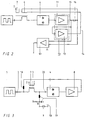
- Fig. 1
- zeigt einen erfindungsgemäßen Stromsensor im Blockschaltbild;
- Fig. 2
- zeigt eine Erweiterung der in Fig. 1 dargestellten Schaltung, um eine nur positive oder nur negative Referenzspannung gegen Masse zu erzeugen;
- Fig. 3
- zeigt ein Ausführungsbeispiel des erfindungsgemäßen Stromsensors, bei dem man mit zwei Wicklungen für den Magnetkern auskommt.
- Fig. 1
- shows a current sensor according to the invention in a block diagram;
- Fig. 2
- shows an extension of the circuit shown in Figure 1 to generate an only positive or only negative reference voltage to ground;
- Fig. 3
- shows an embodiment of the current sensor according to the invention, in which one gets by with two windings for the magnetic core.
In Fig. 1 ist ein Rechteckspannungsgenerator 1 dargestellt, der über einen Reihenkondensator 2 und die Sekundärwicklung 3 an eine Auswerteschaltung 4 angeschlossen ist. Die Sekundärwicklung 3 ist auf einen weichmagnetischen Magnetkern 5 aufgewickelt, auf dem sich außerdem eine Kompensationswicklung 6 und eine Primärwicklung 7 befinden. Die Auswerteschaltung 4 ist so aufgebaut, daß sie die positiven bzw. negativen Stromspitzen, die durch die Sekundärwicklung 3 fließen, erfaßt und dem Eingang des nachgeschalteten Verstärkers 8 eine Spannung liefert, die dem Mittelwert der positiven und negativen Stromspitzen entspricht.In Fig. 1, a square
Der weichmagnetische Magnetkern 5 hat erfindungsgemäß eine flache Magnetisierungskennlinie, d. h. eine Magnetisierungskennlinie, bei der die Induktion über einen weiten Bereich nahezu linear mit der Feldstärke zunimmt. Eine solche Magnetisierungskennlinie kann man bei weichmagnetischen Materialien insbesondere durch Temperung im Querfeld erzeugen.According to the invention, the soft magnetic
Der Rechteckspannungsgenerator 1 liefert nun über den Reihenkondensator 2 eine sägezahnförmige Spannung an der Sekundärwicklung 3, die einen Wechselstrom relativ hoher Frequenz in der Sekundärwicklung erzeugt. Erfindungsgemäß ist die Schaltung so gewählt, daß dieser Strom in der Sekundärwicklung ausreicht, den weichmagnetischen Magnetkern abwechselnd in die positive bzw. negative Sättigung zu treiben.The square-
Wenn durch die anderen Wicklungen auf dem Magnetkern 5 kein Strom fließt, so sind sowohl die positiven als auch die negativen Stromspitzen durch die Sekundärwicklung 3 gleich groß.If no current flows through the other windings on the
Bei fließendem, zu messenden Strom in der Primärwicklung 7 des weichmagnetischen Magnetkerns 5 wird dieser jedoch vormagnetisiert, so daß der entstehende Wechselstrom in der Sekundärwicklung 3 beispielsweise in positiver Richtung den Magnetkern schneller in die Sättigung treibt, als in negativer Richtung. Bei umgekehrter Vormagnetisierung durch einen umgekehrten Strom in der Primärwicklung 7 wird ein positiver Strom in der Sekundärwicklung 3 später und ein negativer früher zur Sättigung des Magnetkerns 5 führen. Hierdurch entstehen in beiden Halbwellen unterschiedliche Stromspitzen in der Sekundärwicklung 3.With flowing current to be measured in the
Eine Auswerteschaltung 4 erfaßt nun mit den angedeuteten antiparallel geschalteten Dioden sowohl den Wert für den positiven als auch negativen Spitzenstrom und bildet daraus einen Mittelwert. Dieser Mittelwert ist im wesentlichen proportional zur Vormagnetisierung des Magnetkerns 5 und damit proportional zum zu messenden Strom in der Primärwicklung 7. Der Ausgang der Auswerteschaltung 4 ist an einen Verstärker 8 angeschlossen, dessen Ausgang wiederum treibt einen Strom durch die Kompensationswicklung 6, die sich ebenfalls auf dem weichmagnetischen Magnetkern 5 befindet. Ferner ist in Reihe zu der Kompensationswicklung 6 noch ein Widerstand 9 eingeschaltet, der mit seinem zweiten Anschluß an Masse 10 liegt. An diesem Widerstand tritt nun ein Spannungsabfall auf, der dem Strom in der Kompensationswicklung 6 und damit auch dem Strom in der Primärwicklung 7 des weichmagnetischen Magnetkerns 5 proportional ist. Diese Proportionalität ergibt sich, da die Auswerteschaltung 4 mit dem nachgeschalteten Verstärker 8 den Kompensationsstrom jeweils so steuert, daß der Mittelwert der positiven und negativen Stromspitzen gleich Null ist, so daß im Magnetkern 5 keine Vormagnetisierung herrscht.An
Dieser Stromsensor hat den Vorteil, daß auch größere Ströme einwandfrei gemessen werden können, da keine Sättigung des Magnetkerns 5 durch den Primärstrom erfolgt. Darüberhinaus können auch relativ schnelle Stromänderungen erfaßt werden, da der Magnetkern eine flache Magnetisierungskennlinie besitzt und so bei plötzlichen Änderungen des Primärstromes - wenn der Kompensationsstrom noch nicht angepaßt ist - nicht gleich in Sättigung geht. Die damit ansteigende Mittelwertspannung setzt die Auswerteschaltung 4 in die Lage, den Kompensationsstrom schnell nachzuführen.This current sensor has the advantage that even larger currents can be measured without any problems since the
Am Widerstand 9 tritt damit eine dem zu messenden Primärstrom in der Primärwicklung 7 proportionale Spannung auf, die allerdings in der Polarität gegenüber Masse 10 von der Richtung des Stromes in der Primärwicklung 7 abhängt. Wenn man nun eine Referenzspannung haben möchte, die zur Auswertung in digitalen Anzeige- oder Regeleinrichtungen besonders geeignet ist, so ist es wünschenswert, eine Spannung zu haben, die nur eine Polarität (plus oder minus) gegenüber Masse aufweist. Hierzu ist es möglich, anstelle des Verstärkers 8 ein aus zwei Verstärkern 11 und 12 gebildete Brückenverstärkeranordnung 13 einzusetzen, deren Ausgänge 14 und 15 an die Anschlüsse der Kompensationswicklung 6 angeschlossen sind (s. Fig. 2). Hierdurch entsteht an dem Widerstand 16 eine Spannung, die über einen zusätzlichen Verstärker 17 verstärkt werden kann und unabhängig von der Richtung des zu messenden Stromes in der Primärwicklung 7 jeweils nur einen positiven oder einen negativen Wert gegenüber Masse 10 aufweist.A voltage proportional to the primary current to be measured in the
In Fig. 3 ist eine Anordnung dargestellt, bei der man ohne die Kompensationswicklung 6 auskommt. Die Anordnung ist im wesentlichen ähnlich derjenigen nach Fig. 1 mit dem Unterschied, daß der Ausgang des Verstärkers 8 über einen Tiefpaß, z. B. als Tiefpaß wirkende Induktivität 18, an den zum Rechteckspannungsgenerator führenden Anschluß der Sekundärwicklung 3 angeschlossen ist. Der Kompensationsstrom fließt dann ebenfalls über die Sekundärwicklung 3 und von dort über einen Tiefpaß, z. B. einen aus Induktivität und Kapazität bestehenden Tiefpaß, und über den Widerstand 9 zur Masse 10. Um den niederfrequenten Kompensationsstrom von der Auswerteschaltung 4 fernzuhalten, ist ein Hochpaß, z. B. zwischen diese und den Tiefpaß 19 ein weiterer Kondensator 20, eingeschaltet.3 shows an arrangement in which one does not need the compensation winding 6. The arrangement is essentially similar to that of FIG. 1 with the difference that the output of the
Claims (4)
Applications Claiming Priority (2)
| Application Number | Priority Date | Filing Date | Title |
|---|---|---|---|
| DE19618114 | 1996-05-06 | ||
| DE19618114A DE19618114A1 (en) | 1996-05-06 | 1996-05-06 | Current compensated current sensor |
Publications (3)
| Publication Number | Publication Date |
|---|---|
| EP0806674A2 true EP0806674A2 (en) | 1997-11-12 |
| EP0806674A3 EP0806674A3 (en) | 1997-11-19 |
| EP0806674B1 EP0806674B1 (en) | 2000-11-08 |
Family
ID=7793457
Family Applications (1)
| Application Number | Title | Priority Date | Filing Date |
|---|---|---|---|
| EP97106546A Expired - Lifetime EP0806674B1 (en) | 1996-05-06 | 1997-04-21 | Current compensated current sensor |
Country Status (4)
| Country | Link |
|---|---|
| US (1) | US6078172A (en) |
| EP (1) | EP0806674B1 (en) |
| JP (1) | JPH1054848A (en) |
| DE (2) | DE19618114A1 (en) |
Cited By (1)
| Publication number | Priority date | Publication date | Assignee | Title |
|---|---|---|---|---|
| CN101923134A (en) * | 2010-03-22 | 2010-12-22 | 许继集团有限公司 | Digital Leakage Current Detection Circuit and Its Detection Method |
Families Citing this family (8)
| Publication number | Priority date | Publication date | Assignee | Title |
|---|---|---|---|---|
| DE19844726B4 (en) * | 1998-09-29 | 2010-06-17 | Vacuumschmelze Gmbh | Current sensor according to the compensation principle |
| DE19919602A1 (en) | 1999-04-29 | 2000-11-30 | Vacuumschmelze Gmbh | Current sensor based on the compensation principle |
| SE525698C2 (en) * | 2003-06-27 | 2005-04-05 | Forskarpatent I Syd Ab | Transformer with protection against direct current magnetization caused by zero sequence current |
| JP4716030B2 (en) * | 2006-10-23 | 2011-07-06 | Tdk株式会社 | Current sensor |
| DE102008051561B4 (en) * | 2008-10-14 | 2013-06-20 | Vacuumschmelze Gmbh & Co. Kg | Method for producing a current detection device |
| US9121885B2 (en) * | 2010-08-16 | 2015-09-01 | Infineon Technologies Ag | Sensor package and method of manufacturing thereof |
| FR2982674B1 (en) * | 2011-11-10 | 2015-01-16 | Renault Sas | METHOD AND SYSTEM FOR MEASURING ELECTRICAL CURRENT |
| WO2015070345A1 (en) * | 2013-11-12 | 2015-05-21 | The University Of Manitoba | Simultaneous measurement technique for line current, geomagnetically induced currents (gic) and transient currents in power systems |
Family Cites Families (14)
| Publication number | Priority date | Publication date | Assignee | Title |
|---|---|---|---|---|
| NL7108311A (en) * | 1971-06-17 | 1972-12-19 | ||
| US4314200A (en) * | 1977-09-01 | 1982-02-02 | Bbc Brown, Boveri & Company Limited | Method and apparatus for detection of magnetization |
| JPS5591810A (en) * | 1978-12-29 | 1980-07-11 | Mitsubishi Electric Corp | Zero phase current transformer |
| US4482862A (en) * | 1982-06-10 | 1984-11-13 | The Charles Stark Draper Laboratory, Inc. | Current sensor |
| DE3443460A1 (en) * | 1984-11-29 | 1986-06-05 | ANT Nachrichtentechnik GmbH, 7150 Backnang | Current-measuring device |
| NL8702471A (en) * | 1987-10-15 | 1989-05-01 | Holec Syst & Componenten | CIRCUIT FOR DETECTING AN ASYMMETRY IN THE MAGNETIZATION CURRENT OF A MAGNETIC MODULATOR. |
| DE4019810C2 (en) * | 1989-06-23 | 1994-04-21 | Fuji Electric Co Ltd | Method for detecting a direct current or alternating current flowing in a conductor |
| JPH03218475A (en) * | 1989-11-06 | 1991-09-26 | Nkk Corp | Current measurement method and device |
| DE4130999A1 (en) * | 1991-09-18 | 1993-03-25 | Vacuumschmelze Gmbh | CURRENT SENSOR ACCORDING TO THE COMPENSATION PRINCIPLE |
| FI90142C (en) * | 1992-04-02 | 1993-12-27 | Abb Stroemberg Drives Oy | ENLIGGED COMPENSATION SPEED FACTORY FOUNDATION FOER STROEM |
| DE4229948A1 (en) * | 1992-09-08 | 1994-03-10 | Vacuumschmelze Gmbh | Hysteresis-free current sensor - has soft magnetic core for coupling prim. and sec. coils, generator for periodically magnetising to positive and negative saturation and sample=and=hold circuit for acquiring sec. current to form average voltage drop |
| US5508606A (en) * | 1994-04-25 | 1996-04-16 | Eaton Corporation | Direct current sensor |
| US5811965A (en) * | 1994-12-28 | 1998-09-22 | Philips Electronics North America Corporation | DC and AC current sensor having a minor-loop operated current transformer |
| DE29507675U1 (en) * | 1995-05-09 | 1995-06-29 | Siemens AG, 80333 München | Compensation current conversion |
-
1996
- 1996-05-06 DE DE19618114A patent/DE19618114A1/en not_active Withdrawn
-
1997
- 1997-04-21 DE DE59702588T patent/DE59702588D1/en not_active Expired - Lifetime
- 1997-04-21 EP EP97106546A patent/EP0806674B1/en not_active Expired - Lifetime
- 1997-04-28 JP JP9122871A patent/JPH1054848A/en active Pending
- 1997-05-06 US US08/851,648 patent/US6078172A/en not_active Expired - Fee Related
Cited By (2)
| Publication number | Priority date | Publication date | Assignee | Title |
|---|---|---|---|---|
| CN101923134A (en) * | 2010-03-22 | 2010-12-22 | 许继集团有限公司 | Digital Leakage Current Detection Circuit and Its Detection Method |
| CN101923134B (en) * | 2010-03-22 | 2013-01-09 | 许继集团有限公司 | Digital leakage current detection circuit and detection method thereof |
Also Published As
| Publication number | Publication date |
|---|---|
| DE59702588D1 (en) | 2000-12-14 |
| JPH1054848A (en) | 1998-02-24 |
| DE19618114A1 (en) | 1997-11-13 |
| EP0806674B1 (en) | 2000-11-08 |
| EP0806674A3 (en) | 1997-11-19 |
| US6078172A (en) | 2000-06-20 |
Similar Documents
| Publication | Publication Date | Title |
|---|---|---|
| DE68924112T2 (en) | Current sensor. | |
| DE69207223T2 (en) | Device for measuring currents | |
| EP0691544B1 (en) | Current sensor using the compensation principle | |
| DE3884554T2 (en) | Circuit for the detection of the magnetizing current asymmetry of a magnetic modulator. | |
| EP0132745B1 (en) | Device for measuring direct currents | |
| EP0510376B1 (en) | Magnetic circuit for current sensor using compensation principle | |
| DE3040316C2 (en) | Method and device for contactless measurement of direct and alternating currents, in particular of instantaneous current values | |
| EP0806674A2 (en) | Current compensated current sensor | |
| EP0960342B1 (en) | Current sensor with self-oscillating generator circuit | |
| DE3715789C2 (en) | ||
| DE29714612U1 (en) | Current measuring device | |
| DE102021104752A1 (en) | CURRENT SENSOR FOR NON-CONTACT CURRENT MEASUREMENT | |
| EP0348747A2 (en) | Circuit arrangement for a differential capacitive sensor | |
| DE3424041C2 (en) | ||
| EP0538578B1 (en) | Compensation principle current sensor | |
| DE3732064C2 (en) | ||
| DE2834499C2 (en) | Circuit arrangement for potential-free measurement of currents or voltages | |
| DE102004056384A1 (en) | Offset elimination method for magnetoresistive sensor, involves separating signal components by high pass filter provided in direct path of signal, and sending signal of differential amplifier to filter | |
| DE2944502C2 (en) | ||
| EP0897542B1 (en) | Current sensor, in particular for low currents | |
| EP3252480B1 (en) | Measuring device and method for measuring current | |
| DE102023116475A1 (en) | CURRENT SENSOR WITH FREQUENCY CONTROL | |
| DE19844729A1 (en) | Current sensor with magnet core with at least one sec. winding besides primary winding for current to be measured and | |
| DD222133A1 (en) | DC MEASURING DEVICE | |
| DE3313777A1 (en) | Magnetic detector circuit |
Legal Events
| Date | Code | Title | Description |
|---|---|---|---|
| PUAI | Public reference made under article 153(3) epc to a published international application that has entered the european phase |
Free format text: ORIGINAL CODE: 0009012 |
|
| PUAL | Search report despatched |
Free format text: ORIGINAL CODE: 0009013 |
|
| AK | Designated contracting states |
Kind code of ref document: A2 Designated state(s): CH DE DK FI FR GB IT LI SE |
|
| AK | Designated contracting states |
Kind code of ref document: A3 Designated state(s): CH DE DK FI FR GB IT LI SE |
|
| 17P | Request for examination filed |
Effective date: 19971218 |
|
| 17Q | First examination report despatched |
Effective date: 19980511 |
|
| GRAG | Despatch of communication of intention to grant |
Free format text: ORIGINAL CODE: EPIDOS AGRA |
|
| GRAG | Despatch of communication of intention to grant |
Free format text: ORIGINAL CODE: EPIDOS AGRA |
|
| GRAH | Despatch of communication of intention to grant a patent |
Free format text: ORIGINAL CODE: EPIDOS IGRA |
|
| GRAH | Despatch of communication of intention to grant a patent |
Free format text: ORIGINAL CODE: EPIDOS IGRA |
|
| GRAA | (expected) grant |
Free format text: ORIGINAL CODE: 0009210 |
|
| AK | Designated contracting states |
Kind code of ref document: B1 Designated state(s): CH DE DK FI FR GB IT LI SE |
|
| PG25 | Lapsed in a contracting state [announced via postgrant information from national office to epo] |
Ref country code: IT Free format text: LAPSE BECAUSE OF FAILURE TO SUBMIT A TRANSLATION OF THE DESCRIPTION OR TO PAY THE FEE WITHIN THE PRESCRIBED TIME-LIMIT;WARNING: LAPSES OF ITALIAN PATENTS WITH EFFECTIVE DATE BEFORE 2007 MAY HAVE OCCURRED AT ANY TIME BEFORE 2007. THE CORRECT EFFECTIVE DATE MAY BE DIFFERENT FROM THE ONE RECORDED. Effective date: 20001108 Ref country code: GB Free format text: LAPSE BECAUSE OF FAILURE TO SUBMIT A TRANSLATION OF THE DESCRIPTION OR TO PAY THE FEE WITHIN THE PRESCRIBED TIME-LIMIT Effective date: 20001108 Ref country code: FR Free format text: LAPSE BECAUSE OF FAILURE TO SUBMIT A TRANSLATION OF THE DESCRIPTION OR TO PAY THE FEE WITHIN THE PRESCRIBED TIME-LIMIT Effective date: 20001108 Ref country code: FI Free format text: LAPSE BECAUSE OF FAILURE TO SUBMIT A TRANSLATION OF THE DESCRIPTION OR TO PAY THE FEE WITHIN THE PRESCRIBED TIME-LIMIT Effective date: 20001108 |
|
| REG | Reference to a national code |
Ref country code: CH Ref legal event code: EP |
|
| REF | Corresponds to: |
Ref document number: 59702588 Country of ref document: DE Date of ref document: 20001214 |
|
| PG25 | Lapsed in a contracting state [announced via postgrant information from national office to epo] |
Ref country code: SE Free format text: LAPSE BECAUSE OF FAILURE TO SUBMIT A TRANSLATION OF THE DESCRIPTION OR TO PAY THE FEE WITHIN THE PRESCRIBED TIME-LIMIT Effective date: 20010208 Ref country code: DK Free format text: LAPSE BECAUSE OF FAILURE TO SUBMIT A TRANSLATION OF THE DESCRIPTION OR TO PAY THE FEE WITHIN THE PRESCRIBED TIME-LIMIT Effective date: 20010208 |
|
| EN | Fr: translation not filed | ||
| GBV | Gb: ep patent (uk) treated as always having been void in accordance with gb section 77(7)/1977 [no translation filed] |
Effective date: 20001108 |
|
| PG25 | Lapsed in a contracting state [announced via postgrant information from national office to epo] |
Ref country code: LI Free format text: LAPSE BECAUSE OF NON-PAYMENT OF DUE FEES Effective date: 20010520 Ref country code: CH Free format text: LAPSE BECAUSE OF NON-PAYMENT OF DUE FEES Effective date: 20010520 |
|
| PLBE | No opposition filed within time limit |
Free format text: ORIGINAL CODE: 0009261 |
|
| STAA | Information on the status of an ep patent application or granted ep patent |
Free format text: STATUS: NO OPPOSITION FILED WITHIN TIME LIMIT |
|
| 26N | No opposition filed | ||
| REG | Reference to a national code |
Ref country code: CH Ref legal event code: PL |
|
| PGFP | Annual fee paid to national office [announced via postgrant information from national office to epo] |
Ref country code: DE Payment date: 20120524 Year of fee payment: 16 |
|
| PG25 | Lapsed in a contracting state [announced via postgrant information from national office to epo] |
Ref country code: DE Free format text: LAPSE BECAUSE OF NON-PAYMENT OF DUE FEES Effective date: 20131101 |
|
| REG | Reference to a national code |
Ref country code: DE Ref legal event code: R119 Ref document number: 59702588 Country of ref document: DE Effective date: 20131101 |