EP0806450A2 - Non-corrosive translucent rtv compositions - Google Patents
Non-corrosive translucent rtv compositions Download PDFInfo
- Publication number
- EP0806450A2 EP0806450A2 EP97303172A EP97303172A EP0806450A2 EP 0806450 A2 EP0806450 A2 EP 0806450A2 EP 97303172 A EP97303172 A EP 97303172A EP 97303172 A EP97303172 A EP 97303172A EP 0806450 A2 EP0806450 A2 EP 0806450A2
- Authority
- EP
- European Patent Office
- Prior art keywords
- carbon atom
- atom monovalent
- hydrocarbon radical
- composition
- room temperature
- Prior art date
- Legal status (The legal status is an assumption and is not a legal conclusion. Google has not performed a legal analysis and makes no representation as to the accuracy of the status listed.)
- Withdrawn
Links
Classifications
-
- C—CHEMISTRY; METALLURGY
- C08—ORGANIC MACROMOLECULAR COMPOUNDS; THEIR PREPARATION OR CHEMICAL WORKING-UP; COMPOSITIONS BASED THEREON
- C08L—COMPOSITIONS OF MACROMOLECULAR COMPOUNDS
- C08L83/00—Compositions of macromolecular compounds obtained by reactions forming in the main chain of the macromolecule a linkage containing silicon with or without sulfur, nitrogen, oxygen or carbon only; Compositions of derivatives of such polymers
- C08L83/04—Polysiloxanes
-
- C—CHEMISTRY; METALLURGY
- C09—DYES; PAINTS; POLISHES; NATURAL RESINS; ADHESIVES; COMPOSITIONS NOT OTHERWISE PROVIDED FOR; APPLICATIONS OF MATERIALS NOT OTHERWISE PROVIDED FOR
- C09K—MATERIALS FOR MISCELLANEOUS APPLICATIONS, NOT PROVIDED FOR ELSEWHERE
- C09K3/00—Materials not provided for elsewhere
- C09K3/10—Materials in mouldable or extrudable form for sealing or packing joints or covers
- C09K3/1006—Materials in mouldable or extrudable form for sealing or packing joints or covers characterised by the chemical nature of one of its constituents
- C09K3/1018—Macromolecular compounds having one or more carbon-to-silicon linkages
-
- C—CHEMISTRY; METALLURGY
- C08—ORGANIC MACROMOLECULAR COMPOUNDS; THEIR PREPARATION OR CHEMICAL WORKING-UP; COMPOSITIONS BASED THEREON
- C08G—MACROMOLECULAR COMPOUNDS OBTAINED OTHERWISE THAN BY REACTIONS ONLY INVOLVING UNSATURATED CARBON-TO-CARBON BONDS
- C08G77/00—Macromolecular compounds obtained by reactions forming a linkage containing silicon with or without sulfur, nitrogen, oxygen or carbon in the main chain of the macromolecule
- C08G77/04—Polysiloxanes
- C08G77/06—Preparatory processes
- C08G77/08—Preparatory processes characterised by the catalysts used
-
- C—CHEMISTRY; METALLURGY
- C08—ORGANIC MACROMOLECULAR COMPOUNDS; THEIR PREPARATION OR CHEMICAL WORKING-UP; COMPOSITIONS BASED THEREON
- C08K—Use of inorganic or non-macromolecular organic substances as compounding ingredients
- C08K5/00—Use of organic ingredients
- C08K5/04—Oxygen-containing compounds
- C08K5/09—Carboxylic acids; Metal salts thereof; Anhydrides thereof
- C08K5/098—Metal salts of carboxylic acids
-
- C—CHEMISTRY; METALLURGY
- C08—ORGANIC MACROMOLECULAR COMPOUNDS; THEIR PREPARATION OR CHEMICAL WORKING-UP; COMPOSITIONS BASED THEREON
- C08K—Use of inorganic or non-macromolecular organic substances as compounding ingredients
- C08K5/00—Use of organic ingredients
- C08K5/16—Nitrogen-containing compounds
- C08K5/29—Compounds containing one or more carbon-to-nitrogen double bonds
-
- C—CHEMISTRY; METALLURGY
- C08—ORGANIC MACROMOLECULAR COMPOUNDS; THEIR PREPARATION OR CHEMICAL WORKING-UP; COMPOSITIONS BASED THEREON
- C08K—Use of inorganic or non-macromolecular organic substances as compounding ingredients
- C08K5/00—Use of organic ingredients
- C08K5/16—Nitrogen-containing compounds
- C08K5/34—Heterocyclic compounds having nitrogen in the ring
- C08K5/3467—Heterocyclic compounds having nitrogen in the ring having more than two nitrogen atoms in the ring
- C08K5/3477—Six-membered rings
- C08K5/3492—Triazines
- C08K5/34924—Triazines containing cyanurate groups; Tautomers thereof
-
- C—CHEMISTRY; METALLURGY
- C08—ORGANIC MACROMOLECULAR COMPOUNDS; THEIR PREPARATION OR CHEMICAL WORKING-UP; COMPOSITIONS BASED THEREON
- C08K—Use of inorganic or non-macromolecular organic substances as compounding ingredients
- C08K5/00—Use of organic ingredients
- C08K5/54—Silicon-containing compounds
- C08K5/541—Silicon-containing compounds containing oxygen
- C08K5/5415—Silicon-containing compounds containing oxygen containing at least one Si—O bond
- C08K5/5419—Silicon-containing compounds containing oxygen containing at least one Si—O bond containing at least one Si—C bond
-
- C—CHEMISTRY; METALLURGY
- C08—ORGANIC MACROMOLECULAR COMPOUNDS; THEIR PREPARATION OR CHEMICAL WORKING-UP; COMPOSITIONS BASED THEREON
- C08L—COMPOSITIONS OF MACROMOLECULAR COMPOUNDS
- C08L83/00—Compositions of macromolecular compounds obtained by reactions forming in the main chain of the macromolecule a linkage containing silicon with or without sulfur, nitrogen, oxygen or carbon only; Compositions of derivatives of such polymers
- C08L83/04—Polysiloxanes
- C08L83/06—Polysiloxanes containing silicon bound to oxygen-containing groups
-
- C—CHEMISTRY; METALLURGY
- C08—ORGANIC MACROMOLECULAR COMPOUNDS; THEIR PREPARATION OR CHEMICAL WORKING-UP; COMPOSITIONS BASED THEREON
- C08G—MACROMOLECULAR COMPOUNDS OBTAINED OTHERWISE THAN BY REACTIONS ONLY INVOLVING UNSATURATED CARBON-TO-CARBON BONDS
- C08G77/00—Macromolecular compounds obtained by reactions forming a linkage containing silicon with or without sulfur, nitrogen, oxygen or carbon in the main chain of the macromolecule
- C08G77/04—Polysiloxanes
- C08G77/14—Polysiloxanes containing silicon bound to oxygen-containing groups
- C08G77/16—Polysiloxanes containing silicon bound to oxygen-containing groups to hydroxy groups
-
- C—CHEMISTRY; METALLURGY
- C08—ORGANIC MACROMOLECULAR COMPOUNDS; THEIR PREPARATION OR CHEMICAL WORKING-UP; COMPOSITIONS BASED THEREON
- C08G—MACROMOLECULAR COMPOUNDS OBTAINED OTHERWISE THAN BY REACTIONS ONLY INVOLVING UNSATURATED CARBON-TO-CARBON BONDS
- C08G77/00—Macromolecular compounds obtained by reactions forming a linkage containing silicon with or without sulfur, nitrogen, oxygen or carbon in the main chain of the macromolecule
- C08G77/04—Polysiloxanes
- C08G77/14—Polysiloxanes containing silicon bound to oxygen-containing groups
- C08G77/18—Polysiloxanes containing silicon bound to oxygen-containing groups to alkoxy or aryloxy groups
-
- C—CHEMISTRY; METALLURGY
- C08—ORGANIC MACROMOLECULAR COMPOUNDS; THEIR PREPARATION OR CHEMICAL WORKING-UP; COMPOSITIONS BASED THEREON
- C08G—MACROMOLECULAR COMPOUNDS OBTAINED OTHERWISE THAN BY REACTIONS ONLY INVOLVING UNSATURATED CARBON-TO-CARBON BONDS
- C08G77/00—Macromolecular compounds obtained by reactions forming a linkage containing silicon with or without sulfur, nitrogen, oxygen or carbon in the main chain of the macromolecule
- C08G77/70—Siloxanes defined by use of the MDTQ nomenclature
-
- C—CHEMISTRY; METALLURGY
- C08—ORGANIC MACROMOLECULAR COMPOUNDS; THEIR PREPARATION OR CHEMICAL WORKING-UP; COMPOSITIONS BASED THEREON
- C08L—COMPOSITIONS OF MACROMOLECULAR COMPOUNDS
- C08L2201/00—Properties
- C08L2201/08—Stabilised against heat, light or radiation or oxydation
-
- C—CHEMISTRY; METALLURGY
- C08—ORGANIC MACROMOLECULAR COMPOUNDS; THEIR PREPARATION OR CHEMICAL WORKING-UP; COMPOSITIONS BASED THEREON
- C08L—COMPOSITIONS OF MACROMOLECULAR COMPOUNDS
- C08L2205/00—Polymer mixtures characterised by other features
- C08L2205/02—Polymer mixtures characterised by other features containing two or more polymers of the same C08L -group
Definitions
- Example 13 was repeated with the exception that the 1, 3, 5-tris(3-methoxysilylpropyl)isocyanurate was deleted from the composition.
- This example demonstrates the loss of thixotropy when the 1, 3, 5-tris(3-methoxysilylpropyl)isocyanurate is absent from the composition, confirming example 4 at different ratios of the filler and scavenger free polymer.
- Example 15 was repeated with the exception that the 1, 3, 5-tris(3-methoxysilylpropyl)isocyanurate was deleted from the composition.
- This example demonstrates the loss of thixotropy when the 1, 3, 5-tris(3-methoxysilylpropyl)isocyanurate is absent from the composition, confirming example 4 at different ratios of the filler and scavenger free polymer.
Landscapes
- Chemical & Material Sciences (AREA)
- Organic Chemistry (AREA)
- Health & Medical Sciences (AREA)
- Chemical Kinetics & Catalysis (AREA)
- Medicinal Chemistry (AREA)
- Polymers & Plastics (AREA)
- Engineering & Computer Science (AREA)
- Materials Engineering (AREA)
- Compositions Of Macromolecular Compounds (AREA)
- Sealing Material Composition (AREA)
- Silicon Polymers (AREA)
Abstract
Description
- The present invention relates to room temperature vulcanizable silicone sealant compositions that are colorless, translucent, and non-corrosive having improved rheological properties.
- The combination of polyalkoxy terminated polydimethylsiloxane (polydimethylsiloxane) polymers, reinforcing fumed silica fillers, polyalkoxysilane crosslinking agents, and condensation cure catalysts can be combined to yield translucent, shelf-stable, fast curing, one and two-part room temperature vulcanizable sealants. The condensation catalysts utilized in these formulations are typically various dialkyl metal chelates, particularly the chelating carboxylic acid salts of those metals. These sealants have the improved property of being less corrosive relative to room temperature vulcanizable silicone compositions that make use of an alkoxy curing mechanism.
- The term stable, in referring to one-part polyalkoxy terminated organopolysiloxane room temperature vulcanizable compositions, has typically been taken to mean a moisture curable mixture capable of remaining substantially unchanged while excluded or protected from atmospheric moisture that cures to a tack free elastomer when exposed to atmospheric moisture. Additionally, the term stable also means that the tack free time exhibited by freshly mixed room temperature vulcanizable sealants will be independent of storage time at ambient conditions. An accelerated shelf stability test measures this property by heating such a composition at 70 °C for 5 days. Compositions that exhibit similar tack free times after being subjected to this accelerated shelf stability test are considered stable.
- The term non-corrosive refers to a particular specification and test protocols designed to qualify room temperature vulcanizable silicone compositions for military specification Mil-A-46146B. Briefly one test involves extruding a known weight of the silicone composition into a test jar, covering the silicone with water and suspending corrosion test coupons of brass steel and aluminum in the water that is in contact with the silicone. The procedure is repeated without the silicone as a control. The jars are maintained at 100 ± 3.6 °F for a period of 168 ± 4 hours (7 days). Silicone samples that discolor or corrode the test coupons are considered to have failed the test. A similar test involves testing copper wire that is encapsulated in the test silicone curing the encapsulated wire for 168 ± 4 hours at 50 ± 5% relative humidity at 23°C and aging the encapsulated wire at 120 ± 2°F in 95-98 % relative humidity for 28 days. Any showing of corrosion relative to a control indicates failure.
- An improved, low odor, substantially non-corrosive one part room temperature vulcanizable composition is disclosed in U. S. patent 4,257,932. The reduction in odor and corrosive properties, relative to one part room temperature vulcanizable silicone compositions that cure by releasing acetic acid, was achieved by utilizing as a crosslinking silane, a less volatile acidic leaving group such as methyl-tris-(2-ethylhexanoxy)silane. The use of methyl-tris-(2-ethylhexanoxy)silane is commonly referred to as an octoate curing system. The octanoic acid released by the curing process in this composition is not volatile, hence the low odor, but it does still corrode metals on contact.
- U. S. patent 3,065,194 discloses a mixture of a hydroxy or alkoxy endstopped polydimethylsiloxane polymer, inert filler, ethylorthosilicate and dibutyl tin dilaurate are curable upon contact with water or moisture. These compositions suffer from an apparent reduced shelf life of only fourteen days.
- Other attempts to develop translucent, fast curing, non-corrosive one-part room temperature vulcanizable silicone sealants involved compositions comprising polyalkoxysilane crosslinking agents with silanol terminated polydimethylsiloxane polymers that utilize titanium chelate catalysts instead of tin catalysts (U. S. patents 3,334,067; 3,542,901; 3,689,454; and 3,779,986).
- The beta-diketonate dialkyl tin compounds have been employed in conjunction with a scavenger free polyalkoxy terminated polydimethylsiloxane polymer and polyalkoxy crosslinking agent to yield colorless, translucent, shell-stable one-part room temperature vulcanizable compositions (U. S. patents 5,166,296 and 4, 863,993). In these compositions, shelf stability is maximized when the tin catalyst is dibutyl tin diacetylacetonate, although the composition is somewhat opaque and slightly yellow. The acetylacetone in the formulation results in the corrosion or discoloration of copper and brass substrates. Compositions that are free of the offending acetylacetone utilizing for example ethylacetoacetate do produce non-corrosive room temperature vulcanizable compositions, however these compositions are not particularly shelf stable and must be used quickly. Tin catalysts that contain substituted acetylacetonate as the chelating agent will undergo ligand exchange in the presence of free methanol, forming tin methoxy complexes that act as polydimethylsiloxane equilibration catalysts. This presents a problem because the catalyzed equilibration results in the formation of dimethyl mono-alkoxy terminated polydimethylsiloxane polymers which do not cure.
- A process for endcapping polydimethylsiloxane to form the polyalkoxy endstopping groups necessary for crosslinking utilizes a Lewis acid in combination with an amine as the endcapping catalyst (U.S. patent 4,515,932). This reaction does not exhibit a particularly high yield. For example, endcapping a silanol endstoppped (endcapped) polydimethylsiloxane using dimethyltetramethoxysilazane in the presence of di-n-hexylamine and various acids yields only about a 21% conversion to the desired methyldimethoxy endcap when the acid is formic acid. While higher molecular weight acids such as acetic acid will yield 100% of the desired methyldimethoxy endcap, the use of hydroxy or methanol scavengers becomes necessary for stability.
- The use of dialkyl tin dicarboxylates as condensation cure catalysts for alkoxy functional one part room temperature vulcanizable silicone compositions is disclosed in several U.S. patents (4,593,085; 4,670,532; 4,755,578; 4,895,918; 4,505,209; 4,563,498; and 4,528,353). However, in order to obtain long term stability of the composition, i.e. shelf stability, the dialkyl tin dicarboxylate catalyzed compositions require the presence of amino silanes or silazanes as in-situ methanol scavengers. These scavengers are not without their own problems. For example, the reaction between methanol and hexamethyldisilazane results in the release of ammonia, which has an unpleasant odor and a corrosive effect, particularly on copper containing alloys such as brass.
- While it is desirable to be able to prepare translucent silicone sealants that are non-corrosive they must also have properties that render them convenient to use prior to cure. Thus uncured silicone sealants must be easy to pump and extrude, i.e. they must have a high application rate, and they must possess good thixotropy. A particularly common method of imparting good thixotropic behavior is to prepare the silicone sealant composition with fairly high levels of a treated or untreated fumed silica filler. However, the high weight percent levels necessary for good thixotropy, e.g. 20 wt. % and greater, typically have a large adverse effect on application rate. When the weight percent silica content is lowered to impart a good application rate, initial thixotropic behavior is usually acceptable. With silica levels below about 20 weight percent in the sealant composition this initially acceptable thixotropic behavior deteriorates upon storage and re-packaging. Pumping and re-packaging of the sealant composition subjects the composition to shearing forces which in many cases reduces the thixotropy of the sealant so significantly that the uncured material flows out of a vertical joint, rendering it useless for its intended purpose. Those 1-part alkoxy compositions that simultaneously possess good application rates and good thixotropic behavior depend on tetravalent tin catalysts and silazane based hydroxy scavengers. The silazane scavengers react liberating ammonia which is corrosive to copper containing alloys. Thus there exists a need for a non-corrosive 1-part silicone sealant composition that has a good application rate of 150 g/min. or more and good thixotropic behavior, i.e. a maximum flow of 0.30 in. (as described in the experimental section).
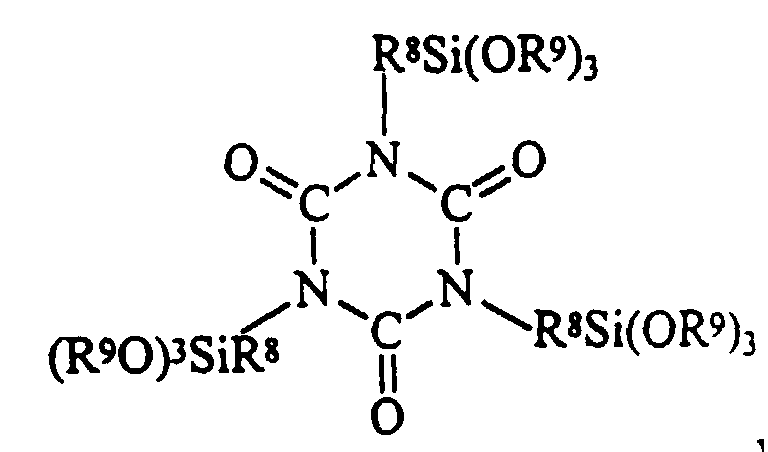
- The present invention provides a non-corrosive room temperature vulcanizable silicone composition comprising a 1,3,5-tris(trialkoxysilylalkyl) isocyanurate having the formula:

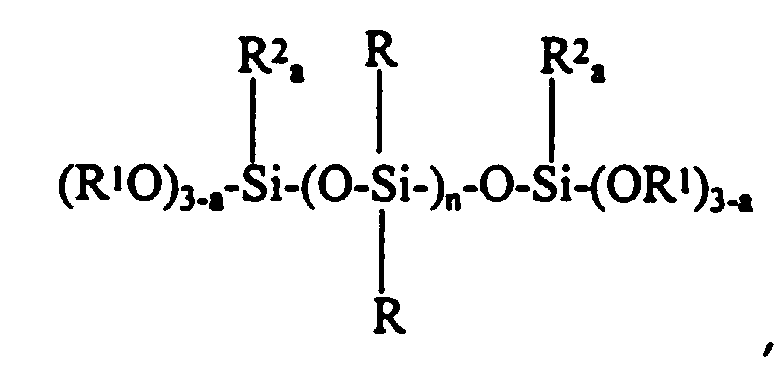
- The room temperature vulcanizable silicone composition optionally further comprises a hydroxy scavenger free polydiorganosiloxane having the formula:
(R5O)4-a-Si-R6 a, where R5 is a one to eight carbon atom monovalent hydrocarbon radical or a seven to thirteen carbon atom monovalent aralkyl radical and R6 is a substituted or unsubstituted one to fifteen carbon atom monovalent hydrocarbon radical;
a titanium condensation cure catalyst having the formula: Ti(OR7)4,
where R7 is a one to ten carbon atom monovalent hydrocarbon radical; and a triorganosilyl endstopped diorganopolysiloxane having the formula: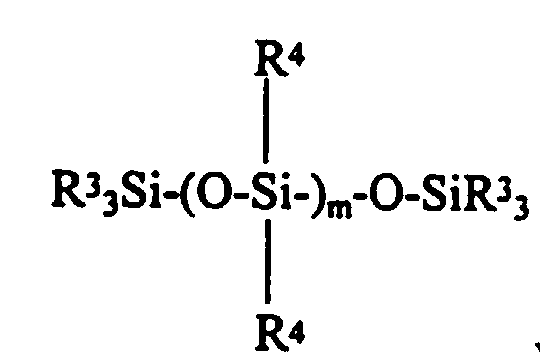
- The present invention further provides for a colorless, translucent, shelf stable, fast curing one-part room temperature vulcanizable silicone composition having good rheological properties consisting essentially of:
- (a) 100 parts by weight of a scavenger free polydiorganosiloxane having the formula:
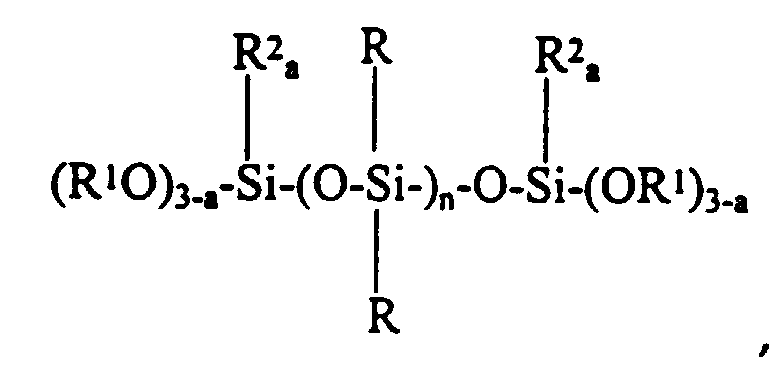
- (b) from about 25 to about 40 parts by weight per hundred parts by weight of polymer (a) of a fumed or pyrogenic silica reinforcing filler;
- (c) from slightly greater than zero to about 50 parts by weight per hundred parts by weight of polymer (a) of a triorganosilyl endstopped diorganopolysiloxane having the formula:

- (d) from slightly greater than zero to about 5 parts by weight per hundred parts by weight of polymer (a) of a polyalkoxysilane crosslinking agent having the formula:
(R5O)4-a-Si-R6 a,
where R5 is selected from the same substituents as R1 and R6 a is selected from the same substituents as R2; - (e) from about 0.10 to about 3.0 parts by weight per hundred parts by weight of polymer (a) of a titanium condensation cure catalyst having the formula: Ti(OR7)4, where R7 is a one to ten carbon atom monovalent hydrocarbon radical;
- (f) from about 0.28 to about 1.50 parts by weight per hundred parts by weight of polymer (a) of a 1,3,5- tris(trialkoxysilylalkyl) isocyanurate having the formula:

- The invention further provides for a method of increasing the application rate of non-corrosive one-part room temperature vulcanizable silicone sealant compositions while maintaining good thixotropy.
- Because metal chelates impart opacity and a yellow color to room temperature vulcanizable silicone compositions, they cannot be used to formulate colorless translucent room temperature vulcanizable compositions. While tetra-alkyl titanates, such as isopropyl titanate and tetra-n-butyl titanate, are excellent condensation cure catalysts for alkoxy room temperature vulcanizable silicone compositions because they are highly miscible in siloxanes, affording colorless sealants, they cannot be used in the same fashion as the dialkyl titanium chelates. Tetra-alkyl titanate compounds tend to preferentially crosslink through the silanols and the titanate. Thus in a reaction scheme where it is desired to catalyze an endcapping reaction between a silanol polymer and methyltrimethoxysilane gelation results. In order to avoid this side reaction when a tetra alkyl titanium catalyst is used, a pre-endcapped polylalkoxy polymer is mandatory.
- I now disclose that use of a pre-endcapped alkyl dialkoxy terminated diorganopolysiloxane, a reinforcing fumed silica filler, a polyalkoxy crosslinking silane, a tetra alkyl titanate condensation cure catalyst and 1, 3, 5-tris(3-methoxysilylpropyl)isocyanurate provides a translucent, shelf stable, non-corrosive sealant having good thixotropy and a high application rate.
- The translucent, non-corrosive sealants of the present invention are comprised of:
- (a) a scavenger free pre-endcapped alkyl polyalkoxy terminated diorganopolysiloxane (as taught in U.S. patents 4,863,992 and 4,515,932) or pre-endcapped polyalkoxy terminated diorganopolysiloxane;
- (b) a reinforcing fumed silica filler;
- (c) a triorganosilyl endstoppped diorganopolysiloxane;
- (d) a polyalkoxysilane crosslinking agent;
- (e) a tetra alkyl titanate condensation cure catalyst; and
- (f) a 1,3,5- tris(trialkoxysilylalkyl) isocyanurate.
- The compositions of the present invention comprise:
- (a) 100 parts by weight of a pre-endcapped alkyl dialkoxy terminated polyorganosiloxane having the formula:

- (b) from about 5 to about 40 parts by weight, preferably from about 27 to 37 parts by weight and most preferably from about 29 to about 35 parts by weight per hundred parts by weight of polymer (a) of a fumed or pyrogenic silica reinforcing filler that is preferably treated;
- (c) from zero to about 50 parts by weight, preferably from about 5 to about 30 parts by weight, and most preferably from about 10 to about 20 parts by weight per hundred parts by weight of polymer (a) of a tri-organosilyl endstopped polymer generally having the formula:

- (d) from slightly greater than zero to about 5 parts by weight, preferably from about 0.5 to about 3.5 parts by weight and most preferably from about 1.0 to about 2.5 parts by weight per hundred parts by weight of polymer (a) of a polyalkoxysilane crosslinking agent having the formula:
(R5O)4-a-Si-R6 a,
where R5 is selected from the same substituents as R1 and R6 a is selected from the same substituents as R2; - (e) from about 0.10 to about 3.0 parts by weight, preferably from about 0.50 to about 2.0 parts by weight and most preferably from 0.8 to about 1.5 parts by weight per hundred parts by weight of polymer (a) of a titanium tetra-alkoxylate (or alternatively, a tetra alkyl titanate) condensation cure catalyst having the formula: Ti(OR7)4, where R7 is a one to ten carbon atom monovalent hydrocarbon radical; and
- (f) from about 0.28 to about 1.50 parts by weight per hundred parts by weight of polymer (a) of a 1,3,5- tris(trialkoxysilylalkyl) isocyanurate having the formula:

- The tris(silylalkyl)isocyanurates have been disclosed and used as an adhesion promoting agent in a wide variety of 1-part alkoxy curing room temperature vulcanizable silicone sealant compositions, e.g. U. S. patents 4,863,992; 4,483,973; 4,499,234; 4,578,492; and 5,420,196. However, the enhancement of adhesion by an adhesion promoter is an effect that is measured after the room temperature vulcanizable composition has cured.
- The composition thus ranges from a composition containing about 105.1 parts by weight to about 200 parts by weight of the components (a) through (f).
- The non-corrosive properties of the compositions of the present invention are not obtained if methanol scavenger compounds are present. Thus the presence of amino silanes or silazane compounds would materially alter the non-corrosive aspects of the composition, because of the chemical reactions previously discussed.
- While polymer (a) is generally an alkyl alkoxy endstopped diorganopolysiloxane there are specific substituents that are either preferred or simply are more convenient to use in preparing the compositions of the present invention. Thus while R1 may be selected from the group of one to eight carbon atom monovalent hydrocarbon radicals that includes alkyl radicals, alkyl ether radicals, alkylketone radicals, alkylcyano radicals and seven to thirteen carbon atom monovalent aralkyl radicals, simple alkyl radicals such as methyl, ethyl, iso-propyl and n-propyl are preferred. Similar considerations obtain for the radicals R and R2, where the one to fifteen carbon atom monovalent hydrocarbon radical may be selected from the group consisting of alkyl radicals, alkyl ether radicals, alkylketone radicals, alkylcyano radicals and seven to thirteen carbon atom monovalent aralkyl radicals which may be unsubstituted or where some of the hydrogen atoms of the radicals are substituted with halogens such as fluorine, chlorine, or bromine, simple alkyl radicals such as methyl, ethyl, iso-propyl and n-propyl are preferred.
- The tri-organosilyl diorganopolysiloxane, component (c), functions as a plasticizer while the formula previously recited is the preferred formula, generally commercial preparations of such plasticizer compounds will be contaminated with low levels of silanol endstopped polymer. Thus there should be no more than about 500 ppm silanol groups present in the compound or mixture of compounds used as plasticizing agents.
- The polyalkoxysilane crosslinking agent, component (d), while conforming to the previously recited formula is preferably selected from the group consisting of methyltrimethoxysilane, vinyltrimethoxysilane, tetramethoxysilane, methyltriethoxysilane, vinyltriethoxysilane, and tetraethoxysilane.
- The tetra-alkyl titanate condensation cure catalyst while conforming to the formula previously recited is preferably selected from the group consisting of tetra-n-butyl titanate, tetra-isopropyl titanate, and tetra-(2-ethylhexyl) titanate.
- It is within the scope of the present invention that while amino silane compounds and silazane compounds must be excluded from the composition in order to obtain the non-corrosive properties sought, additional corrosion inhibiting compounds may be added to the formulation. Preferred corrosion inhibiting compounds are selected from the group consisting of unsubstituted and substituted benzotriazoles.
- Generally the 1,3,5-tris(trialkoxysilylalkyl) isocyanurates may be prepared by the reaction of a chloro-alkyl tri-alkoxy silane with an alkali metal cyanate in a polar non-protic solvent. A preferred compound is prepared by the reaction of chloro-propyl tri-methoxy silane with potassium cyanate in dimethylformamide. The reaction of potassium cyanate with alkyl halides typically produces isocyanates, however, the silane substituted haloalkanes tend to cyclize to the isocyanurate. Thus:


- All United States patents referenced herein are herewith and hereby incorporated by reference.
- Corrosion testing on copper and brass was conducted on the sealant by extruding a known weight of the silicone composition into a test jar, covering the silicone with water and suspending corrosion test coupons of brass and copper in the water that was in contact with the silicone. The procedure was repeated without the silicone as a control. The jars were maintained at 100 ± 3.6 °F for a period of 168 ± 4 hours (7 days). Silicone samples that discolor or corrode the test coupons are considered to have failed the test. A similar test involves testing copper wire that is encapsulated in the test silicone curing the encapsulated wire for 168 ± 4 hours at 50 ± 5 % relative humidity at 23°C and aging the encapsulated wire at 120 ± 2 °F in 95 -98 % relative humidity for 28 days. Any showing of corrosion relative to a control indicates failure.
- The measurement of thixotropy is evaluated by measuring the sag or vertical flow of the uncured sealant in a flow test jig. The flow test jig is stabilized at a temperature of 74 F, varying no more than 4 degrees Fahrenheit, and at a relative humidity of 50 percent, varying no more than 5 percent. The flow test jig possesses a recessed cavity to receive the test sealant, an ace, and a plunger among the elements of its construction. The test, commonly referred to as a Boeing test is a variant of the procedure required by two military specifications MIL-A-46106 and MIL-A-46146.
- The test jig is equipped with a plunger which is used to displace the sealant sample from the recessed cavity. The recessed cavity is filled with the test sealant from a representative sample container. The adhesive-sealant must not be worked with a spatula but should leveled off even with the block containing the recessed cavity. The military specifications stipulate that the manner of leveling the adhesive-sealant sample is done by making two passes with the spatula, each starting at the center and moving towards the sides of the jig. Within 10 seconds of after the adhesive-sealant is leveled the jig is placed on its base and the plunger immediately advanced to the limit of its forward travel. The cylindrical section formed in the test flow jig is allowed to flow under its own weight on a vertical surface. The flow test begins when the plunger is advanced to the limit of its forward travel, and the flow measurement is taken immediately after the expiration of a 3 minute time period or when the flow has ceased. The flow is measured tangently from the lower edge of the plunger surface to the furthest point to which flow has occurred. The measurement taken after the 3 minute interval is considered to be the initial flow of the silicone adhesive-sealant.
- An inert reaction vessel, which may be either glass or stainless steel, was charged with 194 parts by weight of dimethylformamide and 44 parts by weight potassium cyanate. The solution was agitated under a dry nitrogen blanket which was continuously maintained over the system. After degassing with nitrogen was completed, 97 parts by weight of 3-cholorpropyltrimethoxy silane was added to the reaction mixture. The reaction mixture was brought to reflux slowly to avoid flashing and maintained at reflux, 160 - 170°C, for four hours. As reaction progresses, product potassium chloride precipitates out of the reaction solution. Reaction extent may be elctro-analytically followed by potentiometry using either a potassium specific or a chloride specific electrode. The reaction mixture was cooled to 30°C and the potassium salts removed by filtration. The filtrate was stripped under a reduced pressure of 200 mm Hg and then heated slowly to 108°C at which point the pressure was further lowered to 25 mm Hg. These conditions were maintained for one hour. The final product, free of dimethylformamide, is water sensitive and was placed in a moisture proof container.
- The polymer was prepared by mixing under anhydrous conditions:
- 1) 100 parts by weight of a hydroxy terminated polydimethylsiloxane polymer having a viscosity of 25,000 centipoise (cps) at 25°C;
- 2) 2.00 parts by weight methyltrimethoxysilane;
- 3) 0.03 parts by weight di-n-butylamine; and
- 4) 0.01 parts by weight formic acid;
- All sections of a 30 mm Werner-Pfleiderer twin screw extruder were heated to 75 oC. 70.95 parts by weight per hour of the scavenger free polydimethylsiloxane polymer prepared in example 2 were continuously fed to the twin screw extruder. 17 parts by weight per hour of a treated fumed silica which had been treated with octamethylcyclotetrasiloxane and hexamethyldisilazane were continuously added at barrel 1. 10.0 parts by weight per hour of a trimethylsilyl terminated polydimethylsiloxane having a viscosity of 100 cps at 25°C was continuously added at barrel 8. A de-airing vacuum was applied at barrel 11. 0.76 parts by weight per hour, 1.0 parts by weight per hour, and 0.30 parts by weight 1, 3, 5-tris(3-methoxysilylpropyl)isocyanurate were continuously added at barrel 13. The sealant was produced at a rate of 40 pounds per hour. Application rates and Boeing flow were measured and are reported in table 1. This example indicates that the presence of 1, 3, 5-tris(3-methoxysilylpropyl)isocyanurate provides excellent rheology in terms of a high application rate and a low sag or Boeing flow when the 1, 3, 5-tris(3-methoxysilylpropyl)isocyanurate is present.
- Example 3 was repeated with the exception that the 1, 3, 5-tris(3-methoxysilylpropyl)isocyanurate was deleted from the composition. This example demonstrates the loss of thixotropy when the 1, 3, 5-tris(3-methoxysilylpropyl)isocyanurate is absent from the composition.
- Example 3 was repeated using somewhat different proportions of polymer and filler, 18 parts by weight of treated silica filler and 69.95 parts by weight of the scavenger free polymer. This example confirms the excellent rheology observed for example 3.
- Example 5 was repeated with the exception that the 1, 3, 5-tris(3-methoxysilylpropyl)isocyanurate was deleted from the composition. This example demonstrates the loss of thixotropy when the 1, 3, 5-tris(3-methoxysilylpropyl)isocyanurate is absent from the composition, confirming example 4 at different ratios of the filler and scavenger free polymer.
- Example 3 was repeated using 19 parts by weight treated silica filler and 68.95 parts by weight of the scavenger free polymer. The presence of 1, 3, 5-tris(3-methoxysilylpropyl)isocyanurate provided excellent rheology.
- Example 7 was repeated with the exception that the 1, 3, 5-tris(3-methoxysilylpropyl)isocyanurate was deleted from the composition. This example demonstrates the loss of thixotropy when the 1, 3, 5-tris(3-methoxysilylpropyl)isocyanurate is absent from the composition, confirming example 4 at different ratios of the filler and scavenger free polymer.
- Example 3 was repeated using 20 parts by weight treated silica filler and 67.95 parts by weight scavenger free polymer. The presence of 1, 3, 5-tris(3-methoxysilylpropyl)isocyanurate provided excellent rheology.
- Example 9 was repeated with the exception that the 1, 3, 5-tris(3-methoxysilylpropyl)isocyanurate was deleted from the composition. This example demonstrates the loss of thixotropy when the 1, 3, 5-tris(3-methoxysilylpropyl)isocyanurate is absent from the composition, confirming example 4 at different ratios of the filler and scavenger free polymer.
- Example 3 was repeated using 21 parts by weight of treated silica filler and 66.95 parts by weight of scavenger free polymer. The presence of 1, 3, 5-tris(3-methoxysilylpropyl)isocyanurate provided excellent rheology.
- Example 11 was repeated with the exception that the 1, 3, 5-tris(3-methoxysilylpropyl)isocyanurate was deleted from the composition. This example demonstrates the loss of thixotropy when the 1, 3, 5-tris(3-methoxysilylpropyl)isocyanurate is absent from the composition, confirming example 4 at different ratios of the filler and scavenger free polymer.
- Example 3 was repeated using 22 parts by weight of treated silica filler and 65.95 parts by weight of scavenger free polymer. The presence of 1, 3, 5-tris(3-methoxysilylpropyl)isocyanurate provided excellent rheology.
- Example 13 was repeated with the exception that the 1, 3, 5-tris(3-methoxysilylpropyl)isocyanurate was deleted from the composition. This example demonstrates the loss of thixotropy when the 1, 3, 5-tris(3-methoxysilylpropyl)isocyanurate is absent from the composition, confirming example 4 at different ratios of the filler and scavenger free polymer.
- Example 3 was repeated using 23 parts by weight of treated silica filler and 64.95 parts by weight of scavenger free polymer. The presence of 1, 3, 5-tris(3-methoxysilylpropyl)isocyanurate provided excellent rheology.
- Example 15 was repeated with the exception that the 1, 3, 5-tris(3-methoxysilylpropyl)isocyanurate was deleted from the composition. This example demonstrates the loss of thixotropy when the 1, 3, 5-tris(3-methoxysilylpropyl)isocyanurate is absent from the composition, confirming example 4 at different ratios of the filler and scavenger free polymer.
- Example 3 was repeated using 24 parts by weight of treated silica filler and 63.95 parts by weight of scavenger free polymer. The presence of 1, 3, 5-tris(3-methoxysilylpropyl)isocyanurate provided excellent rheology.
- Example 17 was repeated with the exception that the 1, 3, 5-tris(3-methoxysilylpropyl)isocyanurate was deleted from the composition. This example demonstrates the loss of application rate due to the fairly high level of reinforcing silica filler present.
- Example 3 was repeated reducing the level of 1, 3, 5-tris(3-methoxysilylpropyl)isocyanurate from 0.30 parts by weight to 0.20 parts by weight. The presence of 1, 3, 5-tris(3-methoxysilylpropyl)isocyanurate even at a lower level provided excellent rheology.
- Example 3 was repeated reducing the level of 1, 3, 5-tris(3-methoxysilylpropyl)isocyanurate from 0.30 parts by weight to 0.10 parts by weight. This example demonstrates that 0.10 parts by weight of 1, 3, 5-tris(3-methoxysilylpropyl)isocyanurate is not sufficient to impart good thixotropy to the composition.
- Example 3 was repeated increasing the level of 1, 3, 5-tris(3-methoxysilylpropyl)isocyanurate from 0.30 parts by weight to 0.40 parts by weight. This example demonstrates that there is no advantage to increasing the level of 1, 3, 5-tris(3-methoxysilylpropyl)isocyanurate to levels greater than 0.30 parts by weight.
- Example 3 was repeated increasing the level of 1, 3, 5-tris(3-methoxysilylpropyl)isocyanurate from 0.30 parts by weight to 0.50 parts by weight. This example demonstrates that there is no advantage to increasing the level of 1, 3, 5-tris(3-methoxysilylpropyl)isocyanurate to levels greater than 0.30 parts by weight.
Table 1: Rheology Properties of Uncured 1-Part Non-Corrosive RTV Compositions Containing 1,3,5-tris(3-methoxysilylpropyl)isocyanurate Example Thixotrope Filler Polymer App'n Rate Boeing Flow No. Wt. % Wt.% Wt.% gm/min. in. 3 0.3 17 70.95 398 0.35 4 0.0 17 70.95 305 5.50 5 0.3 18 69.95 358 0.25 6 0.0 18 69.95 266 3.70 7 0.3 19 68.95 298 0.15 8 0.0 19 68.95 224 3.20 9 0.3 20 67.95 265 0.15 10 0.0 20 67.95 188 1.50 11 0.3 21 66.95 227 0.10 12 0.0 21 66.95 137 0.75 13 0.3 22 65.95 198 0.05 14 0.0 22 65.95 114 0.55 15 0.3 23 64.95 166 0.03 16 0.0 23 64.95 85 0.40 17 0.3 24 63.95 152 0.01 18 0.0 24 63.95 62 0.25 19 0.2 18 69.95 348 0.30 20 0.1 18 69.95 362 0.50 21 0.4 18 69.95 354 0.05 22 0.5 18 69.95 357 0.05 - Is a repeat of example 1 using 117.5 parts by weight of 3-chloropropyltriethoxysilane in place of the 3-chloropropyldmethoxysilane.
- Is a repeat of example 1 using 73.6 parts by weight of 3-chloropropyltrimethylsilane in place of the 3-chloropropyltrimethoxysilane.
- Is a repeat of example 1 using 182 parts by weight 3-chloropropyl tris(trimethylsiloxy) silane in place of the 3-chloropropyltrimethoxysilane.
- Is a repeat of example 1 using 3-chloropropyl methyldimethoxysilane in place of the 3-chloropropyltrimethoxysilane.
- Is a repeat of example 1 using 70.5 parts by weight 3-chloropropyl dimethylmethoxysilane in place of the 3-chloropropyltrimethoxysilane.
- Is a repeat of example 1 using 87.0 parts by weight chloromethyltriethoxysilane in place of the 3-chloropropyltrimethoxysilane.
- Is a repeat of example 1 using 107.0 parts by weight of 2 chloro ethyl triethoxysilane in place of the 3-chloropropyltrimethoxysilane.
- This is a repeat of example 1 using 79.0 parts by weight of 2-chloroethylmethyldimethoxysilane in place of the 3-chloropropyltrimethoxysilane.
- The silylated isocyanurates of examples 23 through 30 were each added to the composition of example 3 substituting for the 1, 3, 5-tris(3-methoxysilylpropyl)isocyanurate. The data are summarized in Table 2.
Table 2: Rheology Properties of Uncured 1-Part Non-Corrosive RTV Compositions Containing Silylated Isocyanurates Example Thixotrope Filler Polymer App'n Rate Boeing Flow No. Wt. % Wt.% Wt.% gm/min. in. 23 0.3 17 70.95 365 0.15 24 0.3 17 70.95 375 1.85 25 0.3 17 70.95 368 0.05 26 0.3 17 70.95 351 1.25 27 0.3 17 70.95 349 1.25 28 0.3 17 70.95 371 1.50 29 0.3 17 70.95 376 2.50 30 0.3 17 70.95 352 1.75 - It is to be noted that the phrase parts by weight refers to batch preparations and when a continuous preparation is indicated, the parts by weight should be interpreted to mean parts by weight per hour if not so recited.
Claims (10)
- A non-corrosive room temperature vulcanizable silicone composition comprising a 1,3,5- tris(trialkoxysilylalkyl) isocyanurate having the formula:

- The room temperature vulcanizable silicone composition of claim 1 further comprising a hydroxy scavenger free polydiorganosiloxane having the formula:

- The composition of claim 2 further comprising silica.
- The composition of claim 3 further comprising a polyalkoxysilane crosslinking agent having the formula:
(R5O)4-a-Si-R6 a, where R5 is a one to eight carbon atom monovalent hydrocarbon radical or a seven to thirteen carbon atom monovalent aralkyl radical and R6 is a substituted or unsubstituted one to fifteen carbon atom monovalent hydrocarbon radical. - The composition of claim 4 further comprising a titanium condensation cure catalyst having the formula:
Ti(OR7)4,
where R7 is a one to ten carbon atom monovalent hydrocarbon radical. - The composition of claim 5 further comprising a triorganosilyl endstopped diorganopolysiloxane having the formula:
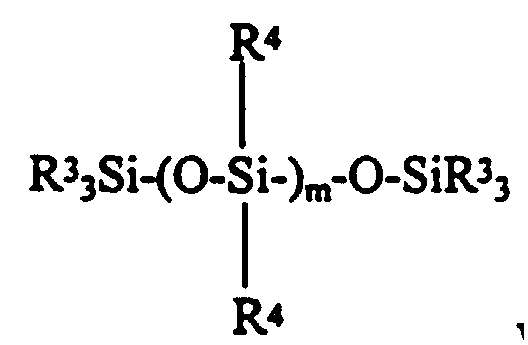
- The composition of claim 2 where R is methyl.
- A method for increasing the application rate of a room temperature vulcanizable silicone composition comprising the steps of:(a) preparing a room temperature vulcanizable silicone composition, and(b) adding thereto an effective amount of a 1,3,5-tris(trialkoxysilylalkyl) isocyanurate having the formula:whereby said room temperature vulcanizable silicone composition has an application rate greater than 150 g/min. prior to curing.
- The method of claim 8 wherein said room temperature vulcanizable silicone composition comprises a hydroxy scavenger free polydiorganosiloxane having the formula:

- A room temperature vulcanizable silicone composition comprising a thixotropic compound having the formula:

Applications Claiming Priority (4)
| Application Number | Priority Date | Filing Date | Title |
|---|---|---|---|
| US644791 | 1996-05-10 | ||
| US08/644,791 US5698653A (en) | 1996-05-10 | 1996-05-10 | Non-corrosive translucent RTV compositions |
| US688593 | 1996-07-30 | ||
| US08/688,593 US5674936A (en) | 1996-05-10 | 1996-07-30 | Non-corrosive translucent RTV compositions having good rheology |
Publications (2)
| Publication Number | Publication Date |
|---|---|
| EP0806450A2 true EP0806450A2 (en) | 1997-11-12 |
| EP0806450A3 EP0806450A3 (en) | 1998-04-08 |
Family
ID=27094555
Family Applications (1)
| Application Number | Title | Priority Date | Filing Date |
|---|---|---|---|
| EP97303172A Withdrawn EP0806450A3 (en) | 1996-05-10 | 1997-05-09 | Non-corrosive translucent rtv compositions |
Country Status (4)
| Country | Link |
|---|---|
| US (1) | US5674936A (en) |
| EP (1) | EP0806450A3 (en) |
| JP (1) | JPH1087993A (en) |
| KR (1) | KR980009389A (en) |
Cited By (5)
| Publication number | Priority date | Publication date | Assignee | Title |
|---|---|---|---|---|
| WO2004048081A1 (en) * | 2002-11-22 | 2004-06-10 | Toppan Printing Co., Ltd. | Gas barrier multilayer film |
| WO2004065649A3 (en) * | 2003-01-21 | 2004-11-11 | Johnson Diversey Inc | Metal coating coupling composition |
| WO2007024838A1 (en) * | 2005-08-25 | 2007-03-01 | E. I. Du Pont De Nemours And Company | Modified nanoparticles |
| US7560168B2 (en) | 2002-11-22 | 2009-07-14 | Toppan Printing Co., Ltd. | Gas barrier laminate film |
| US8502364B2 (en) | 2006-08-22 | 2013-08-06 | Mitsubishi Chemical Corporation | Semiconductor device member, production method of semiconductor-device-member formation liquid and semiconductor device member, and semiconductor-device-member formation liquid, phosphor composition, semiconductor light-emitting device, lighting system and image display system using the same |
Families Citing this family (21)
| Publication number | Priority date | Publication date | Assignee | Title |
|---|---|---|---|---|
| JP3309770B2 (en) * | 1997-06-13 | 2002-07-29 | 信越化学工業株式会社 | Continuous production method of room temperature curable silicone rubber composition |
| US6302209B1 (en) | 1997-09-10 | 2001-10-16 | Bj Services Company | Surfactant compositions and uses therefor |
| US6251990B1 (en) * | 1998-08-24 | 2001-06-26 | Shin-Etsu Chemical Co., Ltd. | Silicone rubber compositions having high-voltage electrical insulation, sealing and repairing compounds for polymeric insulators |
| CA2316209C (en) | 1998-12-07 | 2004-04-27 | Samsung Electronics Co., Ltd. | Device and method for gating transmission in a cdma mobile communication system |
| US6849581B1 (en) | 1999-03-30 | 2005-02-01 | Bj Services Company | Gelled hydrocarbon compositions and methods for use thereof |
| CN1486354A (en) * | 2000-02-28 | 2004-03-31 | Non-aqueous coating composition formed from silane and metal alkoxide | |
| DE10121514A1 (en) * | 2001-05-03 | 2002-11-14 | Wacker Chemie Gmbh | Masses which can be crosslinked by splitting off alcohols from alkoxysilyl end groups to give elastomers |
| US6652977B2 (en) * | 2001-09-10 | 2003-11-25 | Johnson Diversey, Inc. | Primer composition |
| DE10218490B4 (en) * | 2002-04-25 | 2007-09-13 | Wacker Chemie Ag | With elimination of alcohols from alkoxysilyl end groups to elastomers crosslinkable compositions |
| FR2882760B1 (en) * | 2005-03-04 | 2007-04-20 | Rhodia Chimie Sa | ORGANOPOLYSILOXANE COMPOSITIONS CURING IN ELASTOMERS FROM AMBIENT TEMPERATURE IN THE PRESENCE OF MOISTURE |
| JP5446078B2 (en) * | 2006-08-22 | 2014-03-19 | 三菱化学株式会社 | SEMICONDUCTOR DEVICE MEMBER, SEMICONDUCTOR DEVICE MEMBER FORMING METHOD AND SEMICONDUCTOR DEVICE MEMBER MANUFACTURING METHOD, SEMICONDUCTOR LIGHT EMITTING DEVICE USING THE SAME, SEMICONDUCTOR DEVICE MEMBER FORMING SOLUTION, AND PHOSPHOR COMPOSITION |
| KR101249090B1 (en) * | 2006-11-14 | 2013-03-29 | 삼성전자주식회사 | Composition for Preparing Organic Insulator and the Organic Insulator prepared by using the same |
| DE102007037197A1 (en) * | 2007-08-07 | 2009-02-12 | Wacker Chemie Ag | Crosslinkable compositions based on organosilicon compounds |
| JP5258114B2 (en) * | 2009-11-04 | 2013-08-07 | 信越化学工業株式会社 | Isocyanuric ring-containing terminal vinyl polysiloxane |
| JP6039894B2 (en) | 2011-10-20 | 2016-12-07 | 東レ・ダウコーニング株式会社 | Multi-component room temperature curable silicone elastomer composition |
| CN106633953B (en) * | 2016-11-09 | 2019-03-19 | 中国石油化工股份有限公司 | A kind of anti-ultraviolet ageing pitch and preparation method thereof |
| CA3161820A1 (en) | 2019-12-17 | 2021-06-24 | Jiang PENG | Sealant composition |
| JP7444989B2 (en) | 2019-12-17 | 2024-03-06 | ダウ シリコーンズ コーポレーション | sealant composition |
| US12378362B2 (en) | 2019-12-17 | 2025-08-05 | Dow Silicones Corporation | Polydiorganosiloxane preparation |
| KR102520015B1 (en) | 2019-12-23 | 2023-04-11 | 다우 실리콘즈 코포레이션 | sealant composition |
| KR102833940B1 (en) * | 2024-10-22 | 2025-07-14 | 주식회사 이노스팩 | Method for preparing alkoxy group terminally capped polysiloxanes and silicone-based sealant compositions comprising said polysiloxanes |
Family Cites Families (27)
| Publication number | Priority date | Publication date | Assignee | Title |
|---|---|---|---|---|
| US3065194A (en) * | 1959-07-16 | 1962-11-20 | Wacker Chemie Gmbh | Method of preparing silicone rubber compositions |
| US3340067A (en) * | 1964-05-18 | 1967-09-05 | Gen Foods Corp | Flour mix composition and batter prepared therefrom |
| US3542901A (en) * | 1968-06-26 | 1970-11-24 | Midland Silicones Ltd | Organosilicon compositions |
| US3779986A (en) * | 1971-01-06 | 1973-12-18 | Gen Electric | Curable compositions |
| US3689454A (en) * | 1971-01-06 | 1972-09-05 | Gen Electric | Curable compositions |
| US4257932A (en) * | 1978-06-27 | 1981-03-24 | General Electric Company | Curable compositions and process |
| US4483973A (en) * | 1982-02-17 | 1984-11-20 | General Electric Company | Adhesion promoters for one-component RTV silicone compositions |
| US4528353A (en) * | 1982-02-17 | 1985-07-09 | General Electric Company | Adhesion promoters for one-component RTV silicone compositions |
| US4461867A (en) * | 1982-09-27 | 1984-07-24 | General Electric Company | Composition for promoting adhesion of curable silicones to substrates |
| US4515932A (en) * | 1982-09-29 | 1985-05-07 | General Electric Company | End-capping catalysts for forming alkoxy-functional one component RTV compositions |
| US4505209A (en) * | 1982-12-08 | 1985-03-19 | Electrodyne Research Corporation | Unfired drying and sorting apparatus for preparation of solid fuel |
| US4895918A (en) * | 1982-12-13 | 1990-01-23 | General Electric Company | Alkoxy-functional one-component RTV silicone rubber compositions |
| US4593085A (en) * | 1982-12-13 | 1986-06-03 | General Electric Company | Alkoxy-functional one component RTV silicone rubber compositions |
| US4755578A (en) * | 1982-12-13 | 1988-07-05 | General Electric Company | Alkoxy-functional one-component RTV silicone rubber compositions |
| US4670532A (en) * | 1982-12-13 | 1987-06-02 | General Electric Company | Alkoxy-functional one-component RTV silicone rubber compositions |
| US4472551A (en) * | 1983-04-01 | 1984-09-18 | General Electric Company | One package, stable, moisture curable, alkoxy-terminated organopolysiloxane compositions |
| US4578492A (en) * | 1983-10-14 | 1986-03-25 | General Electric Company | Non-corrosive silicone RTV compositions |
| US4499234A (en) * | 1983-10-14 | 1985-02-12 | General Electric Company | Non-corrosive silicone RTV compositions |
| US4585705A (en) * | 1983-11-09 | 1986-04-29 | Dow Corning Corporation | Hard organopolysiloxane release coating |
| US4563498A (en) * | 1984-07-05 | 1986-01-07 | General Electric Company | Curable silicone compositions and processes |
| US4863992A (en) * | 1987-08-27 | 1989-09-05 | General Electric Company | Polyalkoxysilyl-terminated polydiorganosiloxanes, methods for their preparation, and room temperature vulcanizable compositions containing them |
| US4863993A (en) * | 1987-12-09 | 1989-09-05 | Opi Products, Inc. | Surface priming composition for proteinaceous substrates; method of making and using same |
| JPH0786172B2 (en) * | 1988-12-05 | 1995-09-20 | 東芝シリコーン株式会社 | Room temperature curable silicone rubber composition |
| US5213899A (en) * | 1990-12-17 | 1993-05-25 | General Electric Company | Room temperature vulcanizable silicone compositions |
| US5166296A (en) * | 1991-06-25 | 1992-11-24 | General Electric Company | Shelf-stable rtv silicone compositions |
| DE69323960T2 (en) * | 1992-11-25 | 1999-11-11 | General Electric Co., Schenectady | One-component composition vulcanizing at room temperature |
| US5420196A (en) * | 1994-04-15 | 1995-05-30 | General Electric Company | Primerless one component RTV silicone elastomers |
-
1996
- 1996-07-30 US US08/688,593 patent/US5674936A/en not_active Expired - Lifetime
-
1997
- 1997-04-14 KR KR1019970013562A patent/KR980009389A/en not_active Withdrawn
- 1997-05-09 EP EP97303172A patent/EP0806450A3/en not_active Withdrawn
- 1997-05-09 JP JP9118537A patent/JPH1087993A/en not_active Withdrawn
Cited By (7)
| Publication number | Priority date | Publication date | Assignee | Title |
|---|---|---|---|---|
| WO2004048081A1 (en) * | 2002-11-22 | 2004-06-10 | Toppan Printing Co., Ltd. | Gas barrier multilayer film |
| CN100488765C (en) * | 2002-11-22 | 2009-05-20 | 凸版印刷株式会社 | Gas barrier laminate film |
| US7560168B2 (en) | 2002-11-22 | 2009-07-14 | Toppan Printing Co., Ltd. | Gas barrier laminate film |
| WO2004065649A3 (en) * | 2003-01-21 | 2004-11-11 | Johnson Diversey Inc | Metal coating coupling composition |
| US6887308B2 (en) | 2003-01-21 | 2005-05-03 | Johnsondiversey, Inc. | Metal coating coupling composition |
| WO2007024838A1 (en) * | 2005-08-25 | 2007-03-01 | E. I. Du Pont De Nemours And Company | Modified nanoparticles |
| US8502364B2 (en) | 2006-08-22 | 2013-08-06 | Mitsubishi Chemical Corporation | Semiconductor device member, production method of semiconductor-device-member formation liquid and semiconductor device member, and semiconductor-device-member formation liquid, phosphor composition, semiconductor light-emitting device, lighting system and image display system using the same |
Also Published As
| Publication number | Publication date |
|---|---|
| KR980009389A (en) | 1998-04-30 |
| US5674936A (en) | 1997-10-07 |
| JPH1087993A (en) | 1998-04-07 |
| EP0806450A3 (en) | 1998-04-08 |
Similar Documents
| Publication | Publication Date | Title |
|---|---|---|
| US5674936A (en) | Non-corrosive translucent RTV compositions having good rheology | |
| US4546017A (en) | Organopolysiloxane composition curable to an elastomer and use thereof | |
| US4517337A (en) | Room temperature vulcanizable organopolysiloxane compositions and method for making | |
| EP0438157B1 (en) | Preparation of alkoxysilethylene endblocked polydiorganosiloxane | |
| JP3927950B2 (en) | Organopolysiloxane composition, process for its production, crosslinkable material produced from said composition, and molded article produced from said material | |
| EP0493887B1 (en) | Improved room temperature vulcanizable silicone compositions | |
| EP0586240B1 (en) | Alkoxy endblocked polydiorganosiloxane and room temperature vulcanizable silicone elastomers made therefrom | |
| EP0178751B1 (en) | Silicone elastomers with good adhesion | |
| US5481015A (en) | Method for preparation of siloxanyl phosphate | |
| EP0520717B1 (en) | Adhesion promoters for room temperature vulcanizable silicone compositions | |
| JPH0554507B2 (en) | ||
| US4554338A (en) | Room temperature vulcanizable organopolysiloxane compositions and method for making | |
| JP2000169587A (en) | Rtv-1-alkoxy material, its production and its use | |
| EP1197525B1 (en) | Room temperature curable organopolysiloxane compositions | |
| JPH11501073A (en) | Polysiloxane aggregate crosslinked by condensation, method for producing the same, and surface-modified filler | |
| US4667007A (en) | Room temperature vulcanizable organopolysiloxane compositions and method for making | |
| US4554310A (en) | Room temperature vulcanizable organopolysiloxane compositions and method for making | |
| US5698653A (en) | Non-corrosive translucent RTV compositions | |
| KR101365582B1 (en) | Cross-linkable masses based on organosilicon compounds | |
| EP0163439B1 (en) | Elastomer forming compositions | |
| US4944989A (en) | Compositions which crosslink in the presence of moisture at room temperature to form elastomers | |
| EP0905195B1 (en) | Neutral cure one component room temperature vulcanizable silicone compositions | |
| CA1246285A (en) | Room temperature vulcanizable organopolysiloxane compositions and method for making | |
| EP0370643A2 (en) | Organopolysiloxane composition curable to an elastomer and use thereof | |
| JPS6323226B2 (en) |
Legal Events
| Date | Code | Title | Description |
|---|---|---|---|
| PUAI | Public reference made under article 153(3) epc to a published international application that has entered the european phase |
Free format text: ORIGINAL CODE: 0009012 |
|
| AK | Designated contracting states |
Kind code of ref document: A2 Designated state(s): DE FR GB IT |
|
| PUAL | Search report despatched |
Free format text: ORIGINAL CODE: 0009013 |
|
| AK | Designated contracting states |
Kind code of ref document: A3 Designated state(s): DE FR GB IT |
|
| 17P | Request for examination filed |
Effective date: 19981008 |
|
| 17Q | First examination report despatched |
Effective date: 20000503 |
|
| GRAH | Despatch of communication of intention to grant a patent |
Free format text: ORIGINAL CODE: EPIDOS IGRA |
|
| STAA | Information on the status of an ep patent application or granted ep patent |
Free format text: STATUS: THE APPLICATION IS DEEMED TO BE WITHDRAWN |
|
| 18D | Application deemed to be withdrawn |
Effective date: 20021203 |