EP0804435B1 - Novel imidazole derivatives, method for preparing same, novel intermediates thus obtained, medicinal applications of same and pharmaceutical compositions containing same - Google Patents
Novel imidazole derivatives, method for preparing same, novel intermediates thus obtained, medicinal applications of same and pharmaceutical compositions containing same Download PDFInfo
- Publication number
- EP0804435B1 EP0804435B1 EP95927003A EP95927003A EP0804435B1 EP 0804435 B1 EP0804435 B1 EP 0804435B1 EP 95927003 A EP95927003 A EP 95927003A EP 95927003 A EP95927003 A EP 95927003A EP 0804435 B1 EP0804435 B1 EP 0804435B1
- Authority
- EP
- European Patent Office
- Prior art keywords
- radical
- formula
- products
- reaction
- functional group
- Prior art date
- Legal status (The legal status is an assumption and is not a legal conclusion. Google has not performed a legal analysis and makes no representation as to the accuracy of the status listed.)
- Expired - Lifetime
Links
- 0 C*1*(C)=C(C)*=C1I Chemical compound C*1*(C)=C(C)*=C1I 0.000 description 6
- YEAJLFNFLSVSTP-UHFFFAOYSA-N CC(C)=N/C(/[N]#C)=C(/C)\NC Chemical compound CC(C)=N/C(/[N]#C)=C(/C)\NC YEAJLFNFLSVSTP-UHFFFAOYSA-N 0.000 description 1
- ARNMVSIQEBHIGV-ALCCZGGFSA-N CC(C)=N/C=C(/C)\NC Chemical compound CC(C)=N/C=C(/C)\NC ARNMVSIQEBHIGV-ALCCZGGFSA-N 0.000 description 1
- QWUPJYIBVUWACC-UHFFFAOYSA-N CC[n]1c(C)nc(S)c1C Chemical compound CC[n]1c(C)nc(S)c1C QWUPJYIBVUWACC-UHFFFAOYSA-N 0.000 description 1
Classifications
-
- C—CHEMISTRY; METALLURGY
- C07—ORGANIC CHEMISTRY
- C07D—HETEROCYCLIC COMPOUNDS
- C07D405/00—Heterocyclic compounds containing both one or more hetero rings having oxygen atoms as the only ring hetero atoms, and one or more rings having nitrogen as the only ring hetero atom
- C07D405/02—Heterocyclic compounds containing both one or more hetero rings having oxygen atoms as the only ring hetero atoms, and one or more rings having nitrogen as the only ring hetero atom containing two hetero rings
- C07D405/06—Heterocyclic compounds containing both one or more hetero rings having oxygen atoms as the only ring hetero atoms, and one or more rings having nitrogen as the only ring hetero atom containing two hetero rings linked by a carbon chain containing only aliphatic carbon atoms
-
- A—HUMAN NECESSITIES
- A61—MEDICAL OR VETERINARY SCIENCE; HYGIENE
- A61P—SPECIFIC THERAPEUTIC ACTIVITY OF CHEMICAL COMPOUNDS OR MEDICINAL PREPARATIONS
- A61P11/00—Drugs for disorders of the respiratory system
-
- A—HUMAN NECESSITIES
- A61—MEDICAL OR VETERINARY SCIENCE; HYGIENE
- A61P—SPECIFIC THERAPEUTIC ACTIVITY OF CHEMICAL COMPOUNDS OR MEDICINAL PREPARATIONS
- A61P13/00—Drugs for disorders of the urinary system
- A61P13/02—Drugs for disorders of the urinary system of urine or of the urinary tract, e.g. urine acidifiers
-
- A—HUMAN NECESSITIES
- A61—MEDICAL OR VETERINARY SCIENCE; HYGIENE
- A61P—SPECIFIC THERAPEUTIC ACTIVITY OF CHEMICAL COMPOUNDS OR MEDICINAL PREPARATIONS
- A61P15/00—Drugs for genital or sexual disorders; Contraceptives
-
- A—HUMAN NECESSITIES
- A61—MEDICAL OR VETERINARY SCIENCE; HYGIENE
- A61P—SPECIFIC THERAPEUTIC ACTIVITY OF CHEMICAL COMPOUNDS OR MEDICINAL PREPARATIONS
- A61P3/00—Drugs for disorders of the metabolism
- A61P3/02—Nutrients, e.g. vitamins, minerals
-
- A—HUMAN NECESSITIES
- A61—MEDICAL OR VETERINARY SCIENCE; HYGIENE
- A61P—SPECIFIC THERAPEUTIC ACTIVITY OF CHEMICAL COMPOUNDS OR MEDICINAL PREPARATIONS
- A61P43/00—Drugs for specific purposes, not provided for in groups A61P1/00-A61P41/00
-
- A—HUMAN NECESSITIES
- A61—MEDICAL OR VETERINARY SCIENCE; HYGIENE
- A61P—SPECIFIC THERAPEUTIC ACTIVITY OF CHEMICAL COMPOUNDS OR MEDICINAL PREPARATIONS
- A61P9/00—Drugs for disorders of the cardiovascular system
-
- A—HUMAN NECESSITIES
- A61—MEDICAL OR VETERINARY SCIENCE; HYGIENE
- A61P—SPECIFIC THERAPEUTIC ACTIVITY OF CHEMICAL COMPOUNDS OR MEDICINAL PREPARATIONS
- A61P9/00—Drugs for disorders of the cardiovascular system
- A61P9/08—Vasodilators for multiple indications
-
- A—HUMAN NECESSITIES
- A61—MEDICAL OR VETERINARY SCIENCE; HYGIENE
- A61P—SPECIFIC THERAPEUTIC ACTIVITY OF CHEMICAL COMPOUNDS OR MEDICINAL PREPARATIONS
- A61P9/00—Drugs for disorders of the cardiovascular system
- A61P9/10—Drugs for disorders of the cardiovascular system for treating ischaemic or atherosclerotic diseases, e.g. antianginal drugs, coronary vasodilators, drugs for myocardial infarction, retinopathy, cerebrovascula insufficiency, renal arteriosclerosis
-
- C—CHEMISTRY; METALLURGY
- C07—ORGANIC CHEMISTRY
- C07D—HETEROCYCLIC COMPOUNDS
- C07D405/00—Heterocyclic compounds containing both one or more hetero rings having oxygen atoms as the only ring hetero atoms, and one or more rings having nitrogen as the only ring hetero atom
- C07D405/14—Heterocyclic compounds containing both one or more hetero rings having oxygen atoms as the only ring hetero atoms, and one or more rings having nitrogen as the only ring hetero atom containing three or more hetero rings
Definitions
- the present invention relates to new derivatives of imidazole, their preparation process, new intermediates obtained, their application as medicaments and the pharmaceutical compositions containing them.
- WO 94/02474 describes antagonistic derivatives endothelin receptor.
- the carbamoyl and amino radicals that can represent or wear one or more of the possible substituents of the radicals defined in the products of formula (I) and in this which follow, denote radicals in which at the atom of nitrogen are linked two radicals, identical or different, chosen from the hydrogen atom to give the radical amino; alkyl radicals as defined above for give the monoalkyl- or dialkylamino radicals in which linear or branched alkyl radicals contain from 1 to 6 carbon atoms, all these radicals possibly being substituted as indicated above and below.
- the carbocyclic or heterocyclic radicals which can represent R 6 , R 7 , R 8 and R 9 can take the values defined above for these radicals and in particular phenyl, benzyl, phenethyl, naphthyl, indolyl, indolinyl, thienyl, furyl, pyrrolyl , pyridyle, pyrrolidinyle, pi Southerndino, morpholino, pidozensrazinyle, these radicals being able to be substituted by one or more radicals such as defined above like for example in methylpiperazinyl, fluoromethylpiperazinyl, ethylpiperazinyl, propylpiperazinyl, phenylpiperazinyl or benzylpiperazinyl
- the heterocycle that R 6 and R 7 can form on the one hand, R 8 and R 9 on the other hand, respectively with the nitrogen atom to which they are linked preferably represents a saturated heterocycle.
- the carbamoyl or amino radicals are such that the radicals carried by the nitrogen atom are identical or different, can represent aliphatic or cyclized chains or can form with the atom d nitrogen to which they are linked a heterocycle, as has been defined above for R 6 , R 7 , R 8 , R 9 .
- the optionally substituted amino radical thus denotes the amino radical optionally substituted with one or two alkyl radicals chosen from alkyl radicals such as defined above as for example for monoalkylamino in methylamino or ethylamino or isopropylamino or for example for dialkylamino in dimethylamino, diethylamino or even methylethylamino, these alkyl radicals possibly being substituted as indicated above, as by example the methoxymethyl, methoxyethyl, ethoxyethyl radicals.
- optionally substituted carbamoyl radical denotes the carbamoyl radicals optionally substituted on the atom nitrogen with one or two optionally substituted alkyl radicals as defined above, to form in particular an N-monoalkyl carbamoyl group such as N-methylcarbamoyl, N-ethylcarbamoyl or an N, N-dialkyl carbamoyl group, such that N, N-dimethylcarbamoyl, N, N-diethylcarbamoyl; a group N- (hydroxyalkyl carbamoyl, such as N- (hydroxymethyl) carbamoyl, N- (hydroxyethyl) carbamoyl, phenylcarbamoyl; pyridylcarbamoyle ; benzylcarbamoyl; N-methyl N-phenylcarbamoyl ; pyridyl; N-methyl N-phenylcarbamoyl
- substituted alkyl radicals mention may also be made of alkyl radicals substituted by a carbamoyl radical such as defined above, to form a carbamoylalkyl group such than carbamoylmethyl or carbamoylethyl.
- the amino radical can be an alkoxycarbonylamino radical, this radical then preferably being the tert-butyloxycarbonylamino radical or the benzyloxycarbonylamino radical.
- Addition salts with mineral or organic acids products of formula (I) can be, for example, the salts formed with hydrochloric and hydrobromic acids, hydroiodic, nitric, sulfuric, phosphoric, propionic, acetic, formic, benzoic, maleic, fumaric, succinic, tartaric, citric, oxalic, glyoxylic, aspartic, ascorbic, alkylmonosulfonic acids such as by example methanesulfonic acid, ethanesulfonic acid, propanesulfonic acid, alkyl disulfonic acids such as for example methanedisulfonic acid, acid alpha, beta-ethanedisulfonic, arylmonosulfonic acids such as benzenesulfonic acid and aryldisulfonic acids.
- hydrochloric and hydrobromic acids hydroiodic, nitric, sulfuric, phosphoric, propionic, acetic, formic,
- R 2 and R 3 both represent a sulfur group, R 2 and R 3 being identical or different, in the preferred products of the invention, these sulfur groups do not necessarily have the same degree of oxidation.
- the process described above can be carried out as follows.
- the halogen atom preferably represents a bromine atom but can also represent a chlorine or iodine atom.
- the condensation reaction of the imidazoles of formulas as defined above (II), (VIII), (XVI), (XV) and (I 4 ) (in the case of the products of formulas (XV) and (I 4 ) , when W represents P and after deprotection of the nitrogen atom), with the compound of formula (III) as defined above, to respectively obtain the products of formulas (IV 1 ), (IX) when W represents Y ', (I 5 ) and (I') as defined above can be carried out in a solvent such as for example dimethylformamide or alternatively dimethylacetamide, tetrahydrofuran, dimethoxyethane or dimethylsulfoxide at the reflux of the solvent or at room temperature, preferably with stirring; the reaction is preferably carried out in a solvent such as for example dimethylformamide
- the halogenation reaction of the compound of formula (IV 1 ) as defined above into the compound of formula (IV 2 ) as defined above can be carried out under the conditions usual for those skilled in the art and in particular by bromination using NBS in CH 2 Cl 2 or Br 2 in acetic acid.
- Z 1 and Z 2 identical or different, represent an alkyl, alkenyl or aryl radical such that Z 1 -S- and Z 2 -S- represent the corresponding values defined above by R 2 and R 3 in which the any reactive functions are possibly protected by protective groups.
- L 1 and L 1 ' identical or different, represent an alkyl, alkenyl or aryl radical in such a way that R 1 " represents the corresponding values chosen from the values of R 1 as defined above in which the possible reactive functions are possibly protected by protective groups.
- reaction of the compound of formula (IV 2 ) or (XIII) as defined above with the compound of formula (VI a ), (VI b ) or (VI c ), as defined above, to obtain the corresponding compound of respective formula (I 1 ) or (XIV) as defined above can be carried out in an identical manner using EtMgBr as a metallating agent in THF at room temperature.
- reaction of the compounds of formulas (IV 2 ) and (XIII) with the compounds of formula (V a ) or (V b ) can be carried out according to the conditions usual for those skilled in the art, for example in THF at room temperature .
- Reaction of the compound of formula (IX) with the compounds of formulas (X), (X '), (XI), (XII) and (XII') can be performed according to the usual conditions of the skilled person either for example in THF at room temperature.
- the amine function of the compounds of formulas (XV) and (I 4 ) as defined above, protected by P as defined above, can be released under the usual conditions known to those skilled in the art and in particular when P represents the radical -CH 2 -O- (CH 2 ) 2 -Si (CH 3 ) 3 , the hydrogen atom can be released in TFA or in the presence of fluoride ion.
- the saponification reaction can be carried out according to the usual methods known to those skilled in the art, such as than for example in a solvent such as methanol or ethanol, dioxane or dimethoxyethane, in the presence of soda or potash or cesium carbonate.
- a solvent such as methanol or ethanol, dioxane or dimethoxyethane, in the presence of soda or potash or cesium carbonate.
- the products of formulas (I 1 ), (I 2 ), (I 3 ), (I 4 ), (I 5 ), (XIV), (XV) and (I ') constitute or not products of formula (I) and can give products of formula (I), or be transformed into other products of formula (I) by being subjected to one or more of the reactions a) to u) indicated above.
- the products of formula (I) as defined above have antagonistic properties for receptors to endothelin and are thus notably inhibitors of the effects endothelin, including vasoconstrictor effects and endothelin-induced hypertensives.
- endothelin including vasoconstrictor effects and endothelin-induced hypertensives.
- vasoconstrictor effects and endothelin-induced hypertensives.
- the products of formula I are also capable of oppose the stimulating effects of endothelin at the level of all cell types, including muscle cells smooth, neural cells and bone cells.
- the subject of the invention is particularly, as medicaments, the products of formulas (I A ) and (I B ) as defined above, said products of formulas (I A ) and (I B ) being in all forms possible racemic or optically active isomers, as well as addition salts with mineral or organic acids or with pharmaceutically acceptable mineral and organic bases of the said products of formulas (I A ) and (I B ).
- the invention particularly relates to medicaments, the products of formula (I C ) as defined above, said products of formula (I C ) being in all the possible isomeric forms racemic or optically active, as well as addition salts with mineral and organic acids or with pharmaceutically acceptable mineral and organic bases of said products of formula (I).
- a more particular subject of the invention is, as medicaments, the products of formula (I D ) as defined above, said products of formula (I D ) being in all the possible isomeric forms, racemic or optically active, as well as addition salts with mineral and organic acids or with pharmaceutically acceptable mineral and organic bases of said products of formula (I).
- the drugs which are the subject of the invention find, by example, their use in the treatment of all spasms vascular, in the treatment of cerebral post-hemorrhages, in the treatment of coronary spasms, peripheral vascular spasms as well as in treatment kidney failure.
- These drugs can also be used in the treatment of heart attack myocardium, congestive heart failure, in the prevention of post-angioplasty restenosis, in the treatment atherosclerosis and certain forms of hypertension such as pulmonary hypertension, as well as in the treatment of asthma.
- the drugs which are the subject of the invention can also find an application in the treatment of osteoporosis, prostatic hyperplasia and as protectors Neural.
- the invention extends to pharmaceutical compositions containing as active ingredient at least one of the medicinal products as defined above.
- compositions can be administered by mouth, rectally, parenterally or topically applied topically to the skin and mucous membranes or by intravenous or intramuscular injection.
- compositions can be solid or liquid and are commonly present in all pharmaceutical forms used in human medicine like, for example, tablets single or coated, the capsules, the granules, the suppositories, injections, ointments, creams, gels and aerosol preparations; they are prepared according to the usual methods.
- the active ingredient can usually be incorporated into excipients used in these pharmaceutical compositions, such as talc, gum arabic, lactose, starch, stearate magnesium, cocoa butter, aqueous vehicles or not, fatty substances of animal or vegetable origin, derivatives paraffinics, glycols, various wetting agents, dispersants or emulsifiers, preservatives.
- the usual dosage which varies depending on the product used, the subject treated and the affection in question, can be, for example, from 1 to 300 mg per day in adults, orally or from 1 to 100 mg per day intravenously.
- Certain products of formula (XVI) can also be obtained by monohalogenation of the product of formula (II) as defined above in product of formula (P 1 ): in which R ' 1 and P have the meanings indicated above for the product of formula (II), product of formula (P 1 ) which can be reacted, after exchange according to the halogen metal reaction known to man of the profession, with the suitable electrophile, according to the methods known to those skilled in the art and in particular for example according to the same type of reaction described above, for example to pass from the compound of formula (XIII) to the compound of formula (XIV ).
- the starting compounds of formula (VIII) can be commercially available such as 2,4,5-tribromoimidazole at Aldrich or can be prepared according to usual methods known to those skilled in the art.
- the subject of the present invention is finally, as new industrial products, the compounds of formulas (IV 1 ), (IV 2 ), (XIII), (XIV) and (XV) in which Y ′ represents the phenyl radical optionally substituted by one or more radicals chosen from halogen atoms and dioxol radicals, in which the possible reactive functions are optionally protected by protective groups.
- the invention therefore particularly relates to the use products of formula (I) as defined above, for the preparation of pharmaceutical compositions for the treatment of conditions resulting from stimulation abnormal endothelin receptors.
- the invention more particularly relates to the use products of formula (I) as defined above, for the preparation of pharmaceutical compositions for the treatment of hypertension induced by endothelin.
- the invention particularly relates to the use products of formula (I) as defined above, for the preparation of pharmaceutical compositions for the treatment of all vascular spasms and treatment of cerebral hemorrhages and insufficiencies kidney.
- the invention also relates to the use of products of formula (I) as defined above, for the preparation of pharmaceutical compositions intended for treatment of myocardial infarction and prevention of post-angioplasty resteroses.
- reaction medium is finally poured onto 3 1 of water, it is wrung, washed abundantly with water, then successively with 250 ml of ethanol, 250 ml of isopropanol, then finally with 250 ml of isopropyl ether.
- reaction medium is finally poured onto 0.1N sodium hydroxide, after extraction with ethyl acetate, abundant washing with water then drying, a resin is recovered brown which is purified by chromatography on silica with for eluent of methylene chloride 80 / cyclohexane 20 then methylene chloride + 20% ethyl acetate.
- stage 2 of example 1 We proceed as in stage 2 of example 1 starting from 6 g of the product obtained in stage 1 of Example 1 in 300 ml methylene chloride / sulfuric ether mixture (60/240), to which is added dropwise 4.6 ml of ethyl bromide magnesium then keeps stirring for 30 min at room temperature and then introduced into the reaction medium obtained 100 ml of ice water.
- the raw product is purified by rapid passage over silica with methylene chloride as eluent.
- Example 9 500 mg of the product obtained in Example 9 are introduced into the ethanol / tetrahydrofuran mixture (15 ml / 20 ml) and add 15 ml of 2N soda. Agitation is maintained for 48 hours at ambient temperature.
- reaction medium is then acidified by addition 2N hydrochloric acid and after extraction with acetate ethyl, abundant washing with water and drying, we recover 340 mg of a cream residue which is purified by chromatography on silica with ethyl acetate 50 / chloride as eluent methylene 50.
- Example 9 The procedure is as in Example 9 starting from 1 g of the product of example 4 in a chloride mixture methylene / methanol (20 ml / 50 ml) and then successively adds 6 g manganese oxide, 750 mg sodium cyanide and 400 ⁇ l acetic acid. Agitation is then maintained for 48 hours. at room temperature.
- Example 10 The procedure is as in Example 10 from 600 mg of the product of Example 11 in an ethanol / tetrahydrofuran mixture (25 ml / 30 ml) and add 50 ml of sodium hydroxide N.
- Example 2 The procedure is as in Example 2 from 550 mg of hydride 50% sodium in oil in 50 ml of tetrahydrofuran, then add 1.4 ml of 4-methoxy-benzenethiol. agitation is maintained for 15 min at room temperature.
- Example 9 The procedure is as in Example 9 starting from 1 g of the product of Example 13 in the chloride mixture methylene / methanol (20 ml / 100 ml) and then successively add 5 g manganese oxide, 500 mg sodium cyanide and 300 ⁇ l acetic acid.
- Example 10 The procedure is as in Example 10 from 780 mg of the product of Example 14 in an ethanol / tetrahydrofuran mixture 20 ml / 30 ml and add 20 ml of sodium hydroxide N.
- Example 16 The product of Example 16 (600 mg) is obtained during the preparation of Example 13 described above.
- IR CHC13 (cm -1 ) C O 1663 Aromatic + heterocycle 1593-1575-1505-1495-1484-of which S- ⁇ -OCH3
- Example 9 The procedure is as in Example 9 from 470 mg of the product of Example 16 in a chloride mixture methylene / methanol 10 ml / 50 ml and then add successively 2.5 g manganese oxide, 250 mg sodium cyanide and 200 ⁇ l of acetic acid. Agitation is then maintained for 24 h at room temperature.
- Example 10 The procedure is as in Example 10 from 280 mg of the product of Example 17 in an ethanol / tetrahydrofuran mixture 20 ml / 20 ml to which 20 ml of sodium hydroxide are added. Stirring is continued for 5 h at room temperature.
- 0.5 ml of acetic acid is added and then 50 ml of ice water.
- stage 2 of example 1 We proceed as in stage 2 of example 1 starting from 9.5 g of product obtained in stage 1 of Example 1 in a mixture of methylene chloride / sulfuric ether 100ml / 350ml and drop by drop 7.3 ml of ethyl magnesium bromide. Stirring is maintained for 20 min at temperature room.
- Example 2 The procedure is as in Example 2 from a suspension 390 mg of sodium hydride 50% in oil in 50 ml of tetrahydrofuran, to which 1 ml of 4-methoxy-benzenethiol is slowly added. Agitation is maintained for 15 min. at room temperature.
- Example 9 The procedure is as in Example 9 starting from 2.15 g of the product obtained in stage 3 above in 200 ml of methanol, 11 g of manganese oxide are then added successively, 1.1 g of sodium cyanide and 700 ⁇ l of acetic acid.
- Example 10 The procedure is as in Example 10 from 400 mg of the product of Example 23 in an ethanol / tetrahydrofuran mixture 30 ml / 30 ml and add 10 ml of sodium hydroxide.
- Tablets corresponding to the following formula were prepared: Product of Example 10 50 mg Excipient for one tablet finished at 200 mg (detail of excipient: lactose, talc, starch, magnesium stearate).
- a membrane preparation is carried out from posterior cortex plus rat cerebellum.
- pellets are resuspended in a buffer incubation (25 mM Tris, pepstatin A 5 microg / ml, aprotinin 3 microg / ml, PMSF 0.1 mM, EDTA 3 mM, EGTA 1 mM pH 7.4).
- Nonspecific binding is determined by adding 10 -6 M endothelin (in triplicate). Incubate at 25 ° C for 60 minutes, return to a water bath at 0 ° C for 5 minutes, filter under reduced pressure, rinse with Tris 7.4 buffer and count the radioactivity in the presence of the scintillant Triton.
- concentration inhibitor 50% i.e. in concentration of studied product expressed in nM, necessary to move 50% specific radioactivity attached to the studied receptor.
- pellets are resuspended in a buffer incubation (Tris 25mM, perpstatin A 5 microg / ml, aprotinin 3 microg / ml, 0.1 mM PMSF, 3mM EDTA, 1Mm EGTA pH 7.4).
- Nonspecific binding is determined by addition endothelin at 10-6 M (in triplicate). Incubate at 25 ° C for 60 minutes, return to a water bath at 0 ° C, for 5 minutes, filter under reduced pressure, rinse with Tris 7.4 buffer and counts the radioactivity in the presence of the sparkling Triton.
- concentration inhibitor 50% i.e. in concentration of studied product expressed in nM, necessary to move 50% specific radioactivity attached to the studied receptor.
Landscapes
- Health & Medical Sciences (AREA)
- Chemical & Material Sciences (AREA)
- Organic Chemistry (AREA)
- Engineering & Computer Science (AREA)
- Bioinformatics & Cheminformatics (AREA)
- General Health & Medical Sciences (AREA)
- Veterinary Medicine (AREA)
- General Chemical & Material Sciences (AREA)
- Medicinal Chemistry (AREA)
- Nuclear Medicine, Radiotherapy & Molecular Imaging (AREA)
- Chemical Kinetics & Catalysis (AREA)
- Pharmacology & Pharmacy (AREA)
- Life Sciences & Earth Sciences (AREA)
- Animal Behavior & Ethology (AREA)
- Public Health (AREA)
- Cardiology (AREA)
- Heart & Thoracic Surgery (AREA)
- Urology & Nephrology (AREA)
- Hematology (AREA)
- Nutrition Science (AREA)
- Diabetes (AREA)
- Vascular Medicine (AREA)
- Obesity (AREA)
- Endocrinology (AREA)
- Reproductive Health (AREA)
- Pulmonology (AREA)
- Pharmaceuticals Containing Other Organic And Inorganic Compounds (AREA)
- Plural Heterocyclic Compounds (AREA)
Abstract
Description
La présente invention concerne de nouveaux dérivés de l'imidazole, leur procédé de préparation, les nouveaux intermédiaires obtenus, leur application à titre de médicaments et les compositions pharmaceutiques les renfermant.The present invention relates to new derivatives of imidazole, their preparation process, new intermediates obtained, their application as medicaments and the pharmaceutical compositions containing them.
Le document WO 94/02474 décrit des dérivés antagonistes de récepteur de l'endothéline.WO 94/02474 describes antagonistic derivatives endothelin receptor.
La présente invention a pour objet les produits de formule
(I) :
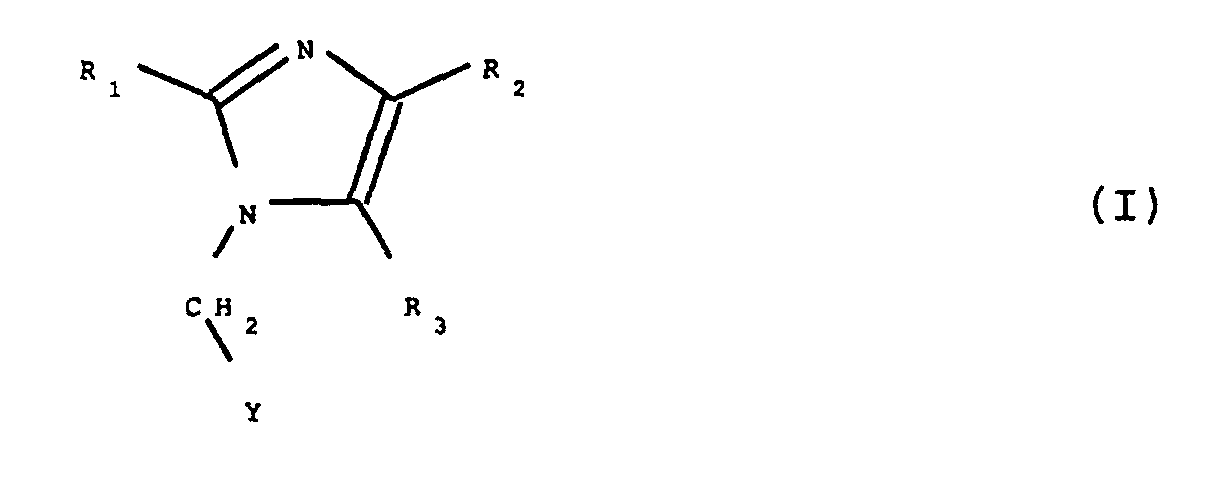
Dans les produits de formule (I) et dans ce qui suit :
- le terme radical alkyle linéaire ou ramifié désigne de préférence les radicaux méthyle, éthyle, propyle, isopropyle, butyle, isobutyle, sec-butyle et tert-butyle mais peut également représenter un radical pentyle ou hexyle et particulièrement isopentyle et isohexyle,
- le terme radical alkényle linéaire ou ramifié désigne de préférence un radical vinyle, allyle, 1-propényle, butényle et particulièrement 1-butényle, ou pentényle,
- le terme radical alkynyle linéaire ou ramifié désigne de préférence un radical éthynyle, propargyle, butynyle ou pentynyle. Parmi les radicaux alkyles interrompus par un ou plusieurs hétéroatomes, on peut citer par exemple les radicaux méthoxyméthyle, méthoxyéthoxyméthyle, propylthiopropyle, propyloxypropyle, propylthioéthyle, méthylthiométhyle,
- le terme atome d'halogène désigne de préférence l'atome de chlore, mais peut aussi représenter un atome de fluor, de brome ou d'iode,
- le terme radical alcoxy linéaire ou ramifié désigne de
préférence les radicaux méthoxy, éthoxy, propoxy ou isopropoxy,
mais peut aussi représenter un radical butoxy linéaire,
secondaire ou tertiaire,
le terme radical acyle désigne de préférence un radical ayant de 1 à 6 atomes de carbone tel que par exemple le radical formyle, acétyle, propionyle, butyryle ou benzoyle, mais également le radical pentanoyle, hexanoyle, acryloyle, crotonoyle ou carbamoyle, - le terme radical acyloxy désigne par exemple un radical dans lequel le radical acyle a les valeurs indiquées ci-dessus et désigne de préférence un radical formyloxy, acétyloxy, propionyloxy, butyryloxy ou benzoyloxy,
- le terme radical cycloalkyle désigne de préférence les radicaux cyclopropyle, cyclobutyle et tout particulièrement les radicaux cyclopentyle et cyclohexyle,
- le terme radical haloalkyle désigne de préférence les radicaux dans lesquels le radical alkyle est tel que défini ci-dessus et est substitué par un ou plusieurs atomes d'halogène tel que défini ci-dessus comme par exemple dans bromoéthyle, trifluorométhyle, trifluoroéthyle ou encore pentafluoroéthyle,
- le terme radical haloalcoxy désigne de préférence les radicaux dans lesquels le radical alcoxy est tel que défini ci-dessus et est substitué par un ou plusieurs atomes d'halogène tel que défini ci-dessus comme par exemple dans bromoéthoxy, trifluorométhoxy, trifluoroéthoxy ou encore pentafluoroéthoxy,
- le terme radical dioxol peut désigner soit un radical carboxycyclique renfermant jusqu'à 6 atomes de carbone et 2 atomes d'oxygène, par exemple le radical 1,3-dioxolan-2-yle ou encore le radical dioxanne, soit un cycle carbocyclique renfermant 2 atomes d'oxygène accolé à un substituant arylique, par exemple le radical 1,3-benzodioxolyle,
- le terme radical alkylthio désigne de préférence les radicaux dans lesquels le radical alkyle est tel que défini ci-dessus comme par exemple dans méthylthio, éthylthio, propylthio, isopropylthio, butylthio, sec-butylthio, tert-butylthio, isopentylthio ou isohexylthio, éventuellement substitué comme par exemple dans hydroxyméthylthio ou aminoéthylthio,
- le terme radical haloalkylthio désigne de préférence les radicaux dans lesquels le radical alkyle est tel que défini ci-dessus et est substitué par un ou plusieurs atomes d'halogène tel que défini ci-dessus comme par exemple dans bromoéthylthio, trifluorométhylthio, trifluoroéthylthio ou encore pentafluoroéthylthio,
- le terme radical arylalkylthio ou alkylthio subtitué par aryle représente par exemple le radical benzylthio ou phénéthylthio.
- the term linear or branched alkyl radical preferably designates the methyl, ethyl, propyl, isopropyl, butyl, isobutyl, sec-butyl and tert-butyl radicals but may also represent a pentyl or hexyl radical and particularly isopentyl and isohexyl,
- the term linear or branched alkenyl radical preferably designates a vinyl, allyl, 1-propenyl, butenyl and particularly 1-butenyl, or pentenyl radical,
- the term linear or branched alkynyl radical preferably designates an ethynyl, propargyl, butynyl or pentynyl radical. Among the alkyl radicals interrupted by one or more heteroatoms, mention may be made, for example, of the methoxymethyl, methoxyethoxymethyl, propylthiopropyl, propyloxypropyl, propylthioethyl, methylthiomethyl radicals,
- the term halogen atom preferably designates the chlorine atom, but can also represent a fluorine, bromine or iodine atom,
- the term linear or branched alkoxy radical preferably designates the methoxy, ethoxy, propoxy or isopropoxy radicals, but may also represent a linear, secondary or tertiary butoxy radical,
the term acyl radical preferably designates a radical having from 1 to 6 carbon atoms such as for example the formyl, acetyl, propionyl, butyryl or benzoyl radical, but also the pentanoyl, hexanoyl, acryloyl, crotonoyl or carbamoyl radical, - the term acyloxy radical denotes for example a radical in which the acyl radical has the values indicated above and preferably denotes a formyloxy, acetyloxy, propionyloxy, butyryloxy or benzoyloxy radical,
- the term cycloalkyl radical preferably designates the cyclopropyl, cyclobutyl radicals and very particularly the cyclopentyl and cyclohexyl radicals,
- the term haloalkyl radical preferably designates the radicals in which the alkyl radical is as defined above and is substituted by one or more halogen atoms as defined above, for example in bromoethyl, trifluoromethyl, trifluoroethyl or even pentafluoroethyl ,
- the term haloalkoxy radical preferably designates the radicals in which the alkoxy radical is as defined above and is substituted by one or more halogen atoms as defined above as for example in bromoethoxy, trifluoromethoxy, trifluoroethoxy or even pentafluoroethoxy ,
- the term dioxol radical can denote either a carboxycyclic radical containing up to 6 carbon atoms and 2 oxygen atoms, for example the 1,3-dioxolan-2-yl radical or the dioxane radical, or a carbocyclic ring containing 2 oxygen atoms attached to an aryl substituent, for example the 1,3-benzodioxolyl radical,
- the term alkylthio radical preferably designates the radicals in which the alkyl radical is as defined above, for example in methylthio, ethylthio, propylthio, isopropylthio, butylthio, sec-butylthio, tert-butylthio, isopentylthio or isohexylthio, optionally substituted as for example in hydroxymethylthio or aminoethylthio,
- the term haloalkylthio radical preferably designates the radicals in which the alkyl radical is as defined above and is substituted by one or more halogen atoms as defined above as for example in bromoethylthio, trifluoromethylthio, trifluoroethylthio or even pentafluoroethylthio ,
- the term arylalkylthio or alkylthio radical substituted by aryl represents for example the benzylthio or phenethylthio radical.
Dans tous les radicaux que peuvent représenter ou porter R1, R2, R3 et R4, tels que définis ci-dessus, les atomes de soufre peuvent ne pas être oxydés comme dans les radicaux alkylthio, arylthio, cycloalkylthio tel que par exemple cyclohexylthio ou au contraire être oxydés pour donner les radicaux alkylsulfinyle, cycloalkylsulfinyle, arylsulfinyle, alkylsulfonyle, cycloalkylsulfonyle ou arylsulfonyle :
- les termes radical alkylsulfinyle et alkylsulfonyle désignent les radicaux alkylthio dans lesquels le radical alkyle linéaire ou ramifié peut représenter, par exemple, les valeurs indiquées ci-dessus pour le radical alkyle et dans lesquels le radical thio est oxydé en radical sulfinyle ou sulfonyle. On peut citer par exemple les radicaux méthylsulfinyle, éthylsulfinyle, méthylsulfonyle ou éthylsulfonyle,
- le terme radical arylsulfinyle et arylsulfonyle désigne les radicaux arylthio, dans lesquels le radical aryle peut représenter, par exemple, les valeurs indiquées ci-dessus pour le ràdical aryle et dans lesquels le radical thio est oxydé en radical sulfinyle ou sulfonyle tel que par exemple dans les radicaux phényl-sulfinyle ou -sulfonyle, pyridyl-sulfinyle ou
- sulfonyle, pyrimidyl-sulfinyle ou -sulfonyle, imidazolylsulfinyle ou -sulfonyle ou N-méthylimidazolyl-sulfinyle ou
- sulfonyle.
- the terms alkylsulfinyl and alkylsulfonyl radical denote the alkylthio radicals in which the linear or branched alkyl radical can represent, for example, the values indicated above for the alkyl radical and in which the thio radical is oxidized to the sulfinyl or sulfonyl radical. Mention may be made, for example, of methylsulfinyl, ethylsulfinyl, methylsulfonyl or ethylsulfonyl radicals,
- the term arylsulfinyl and arylsulfonyl radical denotes arylthio radicals, in which the aryl radical can represent, for example, the values indicated above for the aryl radical and in which the thio radical is oxidized to the sulfinyl or sulfonyl radical such as for example in phenyl-sulfinyl or -sulfonyl, pyridyl-sulfinyl or
- sulfonyl, pyrimidyl-sulfinyl or -sulfonyl, imidazolylsulfinyl or -sulfonyl or N-methylimidazolyl-sulfinyl or
- sulfonyl.
Les radicaux carbamoyle et amino que peuvent représenter ou porter l'un ou plusieurs des éventuels substituants des radicaux définis dans les produits de formule (I) et dans ce qui suit, désignent des radicaux dans lesquels à l'atome d'azote sont liés deux radicaux, identiques ou différents, choisis parmi l'atome d'hydrogène pour donner le radical amino ; les radicaux alkyle tels que définis ci-dessus pour donner les radicaux monoalkyl- ou dialkylamino dans lesquels les radicaux alkyles linéaires ou ramifiés renferment de 1 à 6 atomes de carbone, tous ces radicaux étant éventuellement substitués ainsi qu'il est indiqué ci-dessus et ci-après.The carbamoyl and amino radicals that can represent or wear one or more of the possible substituents of the radicals defined in the products of formula (I) and in this which follow, denote radicals in which at the atom of nitrogen are linked two radicals, identical or different, chosen from the hydrogen atom to give the radical amino; alkyl radicals as defined above for give the monoalkyl- or dialkylamino radicals in which linear or branched alkyl radicals contain from 1 to 6 carbon atoms, all these radicals possibly being substituted as indicated above and below.
Les radicaux carbocycliques ou hétérocycliques que peuvent représenter R6, R7, R8 et R9 peuvent prendre les valeurs définies ci-dessus pour ces radicaux et en particulier phényle, benzyle, phénéthyle, naphtyle, indolyle, indolinyle, thiényle, furyle, pyrrolyle, pyridyle, pyrrolidinyle, pipéridino, morpholino, pipérazinyle, ces radicaux pouvant être substitués par un ou plusieurs radicaux tels que définis ci-dessus comme par exemple dans méthylpipérazinyle, fluorométhylpipérazinyle, éthylpipérazinyle, propylpipérazinyle, phénylpipérazinyle ou benzylpipérazinyle.The carbocyclic or heterocyclic radicals which can represent R 6 , R 7 , R 8 and R 9 can take the values defined above for these radicals and in particular phenyl, benzyl, phenethyl, naphthyl, indolyl, indolinyl, thienyl, furyl, pyrrolyl , pyridyle, pyrrolidinyle, pipéridino, morpholino, pipérazinyle, these radicals being able to be substituted by one or more radicals such as defined above like for example in methylpiperazinyl, fluoromethylpiperazinyl, ethylpiperazinyl, propylpiperazinyl, phenylpiperazinyl or benzylpiperazinyl
Lorsque R6 et R7 d'une part, R8 et R9 d'autre part ou R14 et R15 encore d'autre part, tels que définis ci-dessus, forment ensemble avec l'atome d'azote auquel ils sont liés un hétérocycle, il s'agit, par exemple, d'un cycle pyrrolyle, imidazolyle, indolyle, indolinyle, purinyle, pyrrolidinyle, pipéridino, morpholino, pipérazinyle, imidazolidinyle , pyrazolidinyle, thiomorpholinyle, azépine ; ces radicaux peuvent être éventuellement substitués un ou plusieurs radicaux tels que définis précédemment et en particulier par un ou plusieurs radicaux choisis parmi les atomes de chlore et de fluor,les radicaux méthyle, éthyle, isopropyle, tert-butyle, méthoxy, éthoxy, propoxy, benzoyle, méthoxycarbonyle, éthoxycarbonyle, comme par exemple dans méthylpipérazinyle, fluorométhylpipérazinyle, éthylpipérazinyle, propylpipérazinyle, phénylpipérazinyle ou benzylpipérazinyle : dans ces deux derniers radicaux, les radicaux phényle et benzyle peuvent être substitués comme indiqué précédemment dans les radicaux aryle, arylalkyle et arylalkényle, comme par exemple dans chlorophényle ou trifluorophényle.When R 6 and R 7 on the one hand, R 8 and R 9 on the other hand or R 14 and R 15 still on the other hand, as defined above, form together with the nitrogen atom to which they are linked a heterocycle, it is, for example, a pyrrolyl, imidazolyl, indolyl, indolinyl, purinyl, pyrrolidinyl, piperidino, morpholino, piperazinyl, imidazolidinyl, pyrazolidinyl, thiomorpholinyl, azepine ring; these radicals can be optionally substituted one or more radicals as defined above and in particular by one or more radicals chosen from chlorine and fluorine atoms, methyl, ethyl, isopropyl, tert-butyl, methoxy, ethoxy, propoxy, benzoyl, methoxycarbonyl, ethoxycarbonyl, as for example in methylpiperazinyl, fluoromethylpiperazinyl, ethylpiperazinyl, propylpiperazinyl, phenylpiperazinyl or benzylpiperazinyl: in the latter two radicals, the radicals phenyl and benzyl may be substituted aryl, for instance aryl and benzyl, example in chlorophenyl or trifluorophenyl.
L'hétérocycle que peuvent former R6 et R7 d'une part, R8 et R9 d'autre part, respectivement avec l'atome d'azote auquel ils sont liés représente de préférence un hétérocycle saturé.The heterocycle that R 6 and R 7 can form on the one hand, R 8 and R 9 on the other hand, respectively with the nitrogen atom to which they are linked preferably represents a saturated heterocycle.
De même, dans les produits de formule (I), les radicaux carbamoyle ou amino sont tels que les radicaux portés par l'atome d'azote sont identiques ou différents, peuvent représenter des chaínes aliphatiques ou cyclisées ou peuvent former avec l'atome d'azote auquel ils sont liés un hétérocycle, ainsi qu'il a été défini ci-dessus pour R6, R7, R8, R9.Similarly, in the products of formula (I), the carbamoyl or amino radicals are such that the radicals carried by the nitrogen atom are identical or different, can represent aliphatic or cyclized chains or can form with the atom d nitrogen to which they are linked a heterocycle, as has been defined above for R 6 , R 7 , R 8 , R 9 .
Le radical amino éventuellement substitué désigne ainsi le radical amino éventuellement substitué par un ou deux radicaux alkyle choisis parmi les radicaux alkyle tels que définis ci-dessus comme par exemple pour monoalkylamino dans méthylamino ou éthylamino ou isopropylamino ou par exemple pour dialkylamino dans diméthylamino, diéthylamino ou encore méthyléthylamino, ces radicaux alkyles étant éventuellement substitués ainsi qu'il est indiqué ci-dessus, comme par exemple les radicaux méthoxyméthyle, méthoxyéthyle, éthoxyéthyle.The optionally substituted amino radical thus denotes the amino radical optionally substituted with one or two alkyl radicals chosen from alkyl radicals such as defined above as for example for monoalkylamino in methylamino or ethylamino or isopropylamino or for example for dialkylamino in dimethylamino, diethylamino or even methylethylamino, these alkyl radicals possibly being substituted as indicated above, as by example the methoxymethyl, methoxyethyl, ethoxyethyl radicals.
A titre d'exemple et de façon non exhaustive, lé terme radical carbamoyle éventuellement substitué désigne les radicaux carbamoyle éventuellement substitué sur l'atome d'azote par un ou deux radicaux alkyle éventuellement substitués ainsi qu'il est défini ci-dessus, pour former notamment un groupe N-monoalkyl carbamoyle tel que N-méthylcarbamoyle, N-éthylcarbamoyle ou un groupe N,N-dialkyl carbamoyle, tel que N,N-diméthylcarbamoyle, N,N-diéthylcarbamoyle ; un groupe N-(hydroxyalkyl carbamoyle, tel que N-(hydroxyméthyl) carbamoyle, N-(hydroxyéthyl) carbamoyle, phénylcarbamoyle ; pyridylcarbamoyle ; benzylcarbamoyle ; N-méthyl N-phénylcarbamoyle ; pyridylméthylcarbamoyle. Par ailleurs, parmi les radicaux alkyles substitués, on peut citer également les radicaux alkyles substitués par un radical carbamoyle tel que défini ci-dessus, pour former un groupe carbamoylalkyle tel que carbamoylméthyle ou carbamoyléthyle.By way of example and in a non-exhaustive manner, the term optionally substituted carbamoyl radical denotes the carbamoyl radicals optionally substituted on the atom nitrogen with one or two optionally substituted alkyl radicals as defined above, to form in particular an N-monoalkyl carbamoyl group such as N-methylcarbamoyl, N-ethylcarbamoyl or an N, N-dialkyl carbamoyl group, such that N, N-dimethylcarbamoyl, N, N-diethylcarbamoyl; a group N- (hydroxyalkyl carbamoyl, such as N- (hydroxymethyl) carbamoyl, N- (hydroxyethyl) carbamoyl, phenylcarbamoyl; pyridylcarbamoyle ; benzylcarbamoyl; N-methyl N-phenylcarbamoyl ; pyridylméthylcarbamoyle. Furthermore, among the substituted alkyl radicals, mention may also be made of alkyl radicals substituted by a carbamoyl radical such as defined above, to form a carbamoylalkyl group such than carbamoylmethyl or carbamoylethyl.
Le radical amino peut être un radical alcoxycarbonylamino, ce radical étant alors de préférence le radical tert-butyloxycarbonylamino ou le radical benzyloxycarbonylamino.The amino radical can be an alkoxycarbonylamino radical, this radical then preferably being the tert-butyloxycarbonylamino radical or the benzyloxycarbonylamino radical.
Le ou les radicaux carboxy des produits de formule (I) peuvent être salifiés ou estérifiés par les groupements divers connus de l'homme du métier parmi lesquels on peut citer, par exemple :
- parmi les composés de salification, des bases minérales telles que, par exemple, un équivalent de sodium, de potassium, de lithium, de calcium, de magnésium ou d'ammonium ou des bases organiques telles que, par exemple, la méthylamine, la propylamine, la triméthylamine, la diéthylamine, la tri-éthylamine, la N,N-diméthyléthanolamine, le tris (hydroxyméthyl) amino méthane, l'éthanolamine, la pyridine, la picoline, la dicyclohexylamine, la morpholine, la benzylamine, la procaïne, la lysine, l'arginine, l'histidine, la N-méthylglucamine,
- parmi les composés d'estérification, les radicaux alkyle pour former des groupes alcoxy carbonyle tel que, par exemple, méthoxycarbonyle, éthoxycarbonyle, tert-butoxycarbonyle ou benzyloxycarbonyle, ces radicaux alkyles pouvant être substitués par des radicaux choisis par exemple parmi les atomes d'halogène, les radicaux hydroxyle, alcoxy, acyle, acyloxy, alkylthio, amino ou aryle comme, par exemple, dans les groupements chlorométhyle, hydroxypropyle, méthoxyméthyle, propionyloxyméthyle, méthylthiométhyle, diméthylaminoéthyle, benzyle ou phénéthyle.
- among the salification compounds, mineral bases such as, for example, an equivalent of sodium, potassium, lithium, calcium, magnesium or ammonium or organic bases such as, for example, methylamine, propylamine , trimethylamine, diethylamine, triethylamine, N, N-dimethylethanolamine, tris (hydroxymethyl) amino methane, ethanolamine, pyridine, picoline, dicyclohexylamine, morpholine, benzylamine, procaine, lysine, arginine, histidine, N-methylglucamine,
- among the esterification compounds, the alkyl radicals to form alkoxy carbonyl groups such as, for example, methoxycarbonyl, ethoxycarbonyl, tert-butoxycarbonyl or benzyloxycarbonyl, these alkyl radicals being able to be substituted by radicals chosen for example from halogen atoms , hydroxyl, alkoxy, acyl, acyloxy, alkylthio, amino or aryl radicals, such as, for example, in chloromethyl, hydroxypropyl, methoxymethyl, propionyloxymethyl, methylthiomethyl, dimethylaminoethyl, benzyl or phenethyl groups.
Les sels d'addition avec les acides minéraux ou organiques des produits de formule (I) peuvent être, par exemple, les sels formés avec les acides chlorhydrique, bromhydrique, iodhydrique, nitrique, sulfurique, phosphorique, propionique, acétique, formique, benzoïque, maléique, fumarique, succinique, tartrique, citrique, oxalique, glyoxylique, aspartique, ascorbique, les acides alcoylmonosulfoniques tels que par exemple l'acide méthanesulfonique, l'acide éthanesulfonique, l'acide propanesulfonique, les acides alcoyldisulfoniques tels que par exemple l'acide méthanedisulfonique, l'acide alpha, bêta-éthanedisulfonique, les acides arylmonosulfoniques tels que l'acide benzènesulfonique et les acides aryldisulfoniques.Addition salts with mineral or organic acids products of formula (I) can be, for example, the salts formed with hydrochloric and hydrobromic acids, hydroiodic, nitric, sulfuric, phosphoric, propionic, acetic, formic, benzoic, maleic, fumaric, succinic, tartaric, citric, oxalic, glyoxylic, aspartic, ascorbic, alkylmonosulfonic acids such as by example methanesulfonic acid, ethanesulfonic acid, propanesulfonic acid, alkyl disulfonic acids such as for example methanedisulfonic acid, acid alpha, beta-ethanedisulfonic, arylmonosulfonic acids such as benzenesulfonic acid and aryldisulfonic acids.
Lorsque R2 et R3 représentent tous deux un groupement soufré, R2 et R3 étant identiques ou différents, dans les produits préférés de l'invention, ces groupements soufrés n'ont pas nécessairement le même degré d'oxydation.When R 2 and R 3 both represent a sulfur group, R 2 and R 3 being identical or different, in the preferred products of the invention, these sulfur groups do not necessarily have the same degree of oxidation.
L'invention a tout particulièrement pour objet les produits
de formule (I) telle que définie ci-dessus, dans laquelle
:
Parmi les produits objet de l'invention, peuvent être cités tout particulièrement les produits de formule (I) répondant aux formules suivantes :
- 1-((6-chloro-1,3-benzodioxol-5-yl) méthyl)-4-(((4-méthoxyphényl) méthyl) thio)-2-(phénylthio)-1H-imidazole-5-carboxaldéhyde
- acide 4-bromo-1-((6-chloro-1,3-benzodioxol-5-yl) méthyl)-2-phényl-lH-imidazole-5-carboxylique
- acide 1-((6-chloro-1,3-benzodioxol-5-yl) méthyl)-4-(((4-méthoxyphényl) méthyl) thio)-2-(phénylthio)-1H-imidazole-5-carboxylique
- acide 1-((6-chloro-1,3-benzodioxol-5-yl) méthyl)-4-(4-méthoxyphényl) thio)-2-(phénylthio)-1H-imidazole-5-carboxylique
- acide 1-((6-chloro-1,3-benzodioxol-5-yl) méthyl)-2,4-bis(4-(méthoxyphényl) thio)-1H-imidazole-5-carboxylique
- acide 1-((6-chloro 1,3-benzodioxol-5-yl) méthyl) 4-((3,4-diméthoxyphényl)
thio) 2-(1,3-dioxolan-2-yl) 1H-imidazol 5-carboxylique,
ainsi que leurs sels d'addition avec les acides minéraux ou organiques ou avec les bases minérales ou organiques.
- 1 - ((6-chloro-1,3-benzodioxol-5-yl) methyl) -4 - ((((4-methoxyphenyl) methyl) thio) -2- (phenylthio) -1H-imidazole-5-carboxaldehyde
- 4-bromo-1 - ((6-chloro-1,3-benzodioxol-5-yl) methyl) -2-phenyl-1H-imidazole-5-carboxylic acid
- acid 1 - ((6-chloro-1,3-benzodioxol-5-yl) methyl) -4 - (((4-methoxyphenyl) methyl) thio) -2- (phenylthio) -1H-imidazole-5-carboxylic
- 1 - ((6-chloro-1,3-benzodioxol-5-yl) methyl) -4- (4-methoxyphenyl) thio) -2- (phenylthio) -1H-imidazole-5-carboxylic acid
- 1 - ((6-chloro-1,3-benzodioxol-5-yl) methyl) -2,4-bis (4- (methoxyphenyl) thio) -1H-imidazole-5-carboxylic acid
- acid 1 - ((6-chloro 1,3-benzodioxol-5-yl) methyl) 4 - ((3,4-dimethoxyphenyl) thio) 2- (1,3-dioxolan-2-yl) 1H-imidazol 5- carboxylic acid,
as well as their addition salts with mineral or organic acids or with mineral or organic bases.
L'invention a également pour objet un procédé de préparation
des produits de formule (I), telle que définie ci-dessus,
caractérisé en ce que :

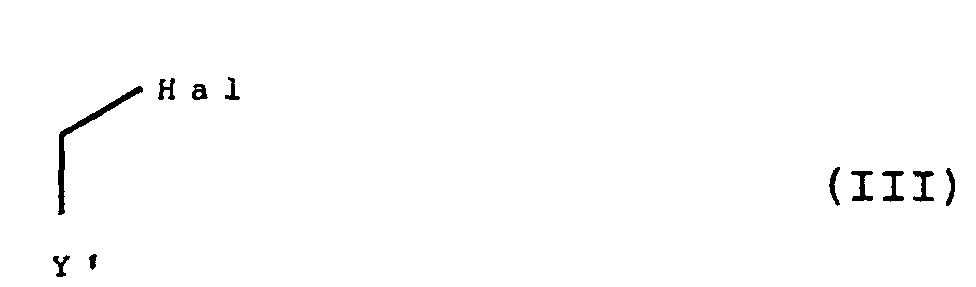
Y' a la signification indiquée ci-dessus pour Y, dans laquelle les éventuelles fonctions réactives sont éventuellement protégées par des groupements protecteurs, pour obtenir le produit de formule (IV1) :


soit l'on soumet un composé de formule (VIII) :
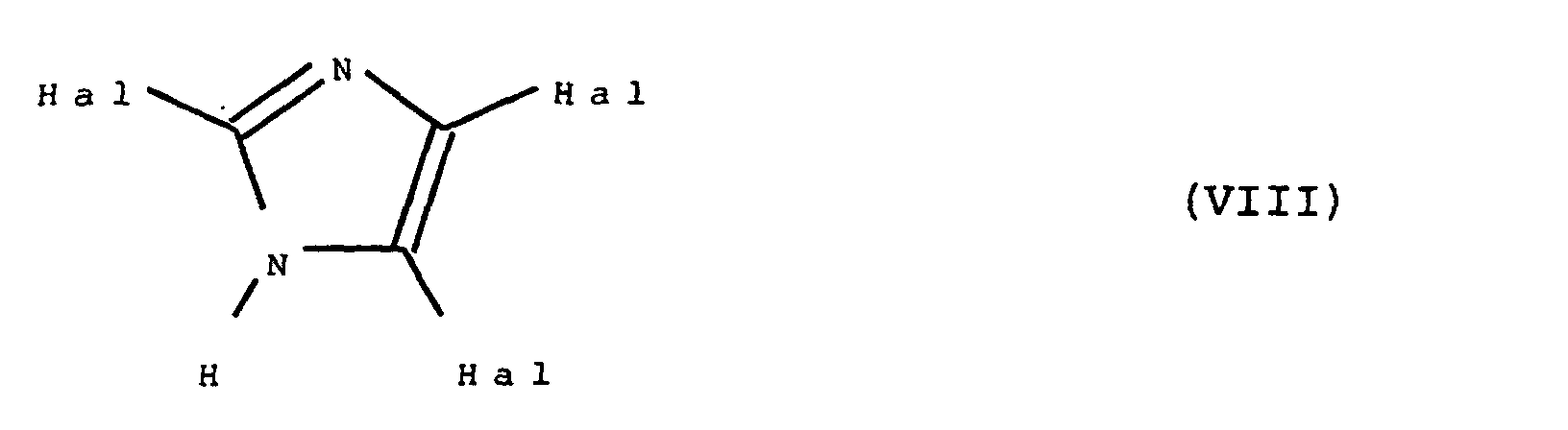
soit à une réaction avec le composé de formule (III) telle que définie ci-dessus, soit à l'action d'un groupement protecteur P, pour obtenir un produit de formule (IX) :


produits de formules (IV2) et (XIII) que l'on peut soumettre à une réaction d'échange halogène-métal sur l'un des atomes d'halogène puis à une réaction avec CO2 ou DMF ou un composé électrophile de formule (Va), (Vb), (VIa), (VIb) ou (VIc) :


pour obtenir respectivement le composé de formule (I1) :

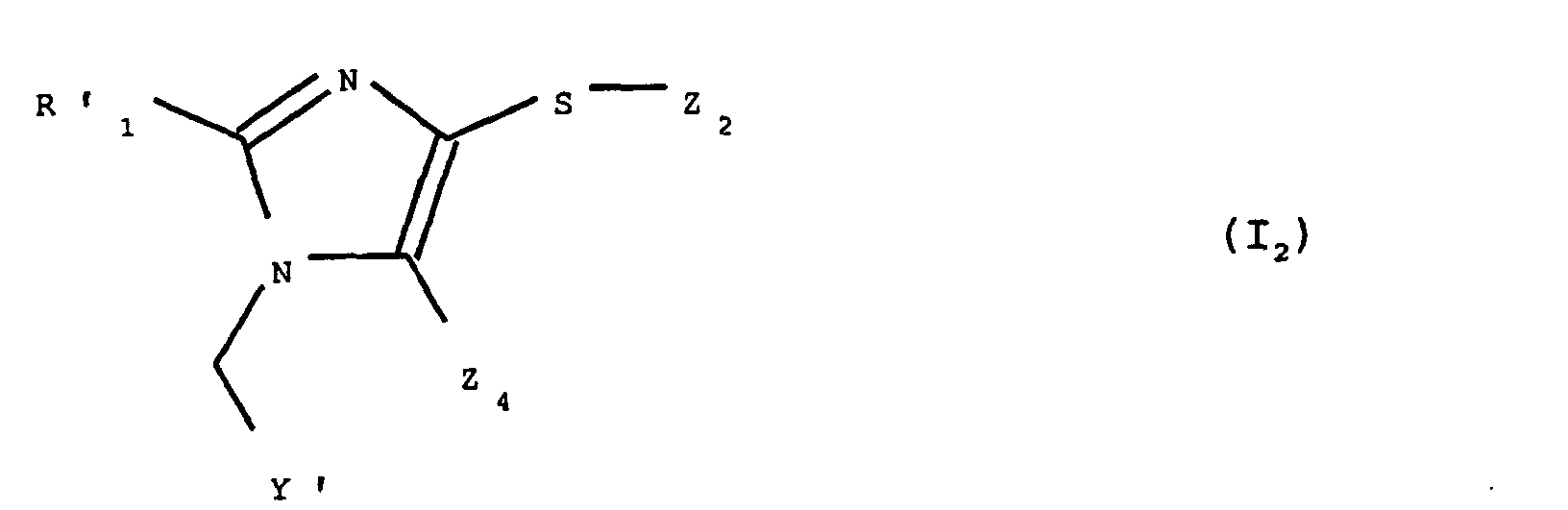

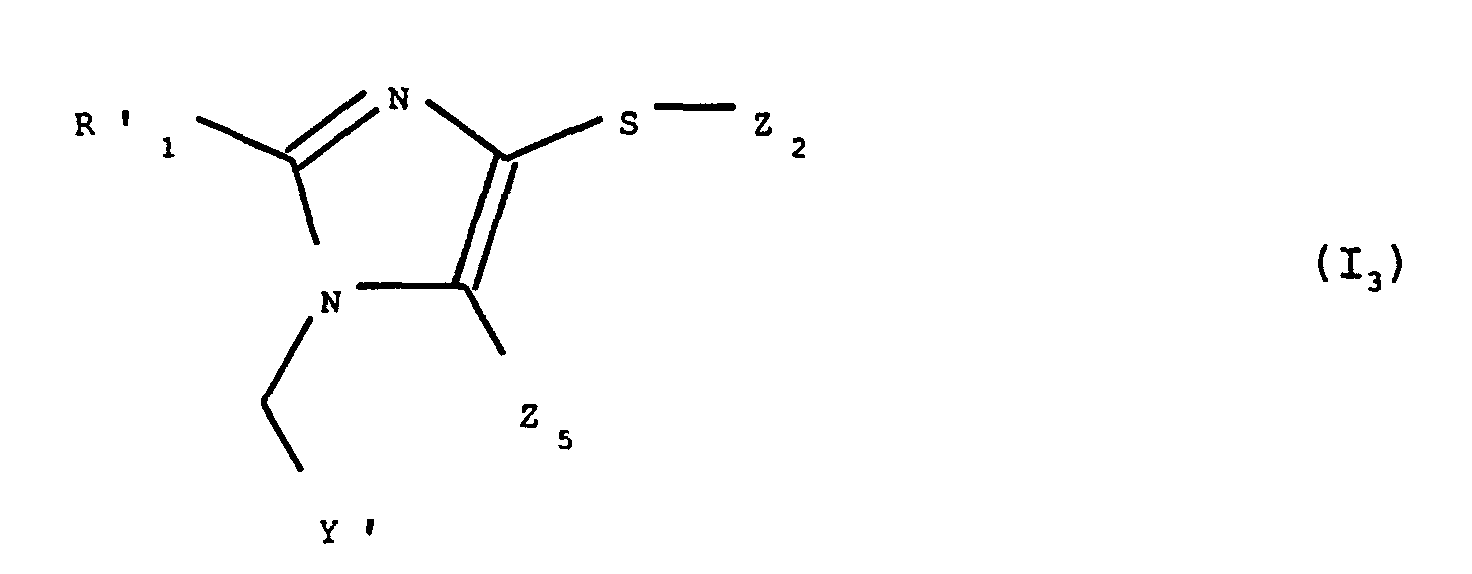


soit l'on soumet un composé de formule (XVI) :
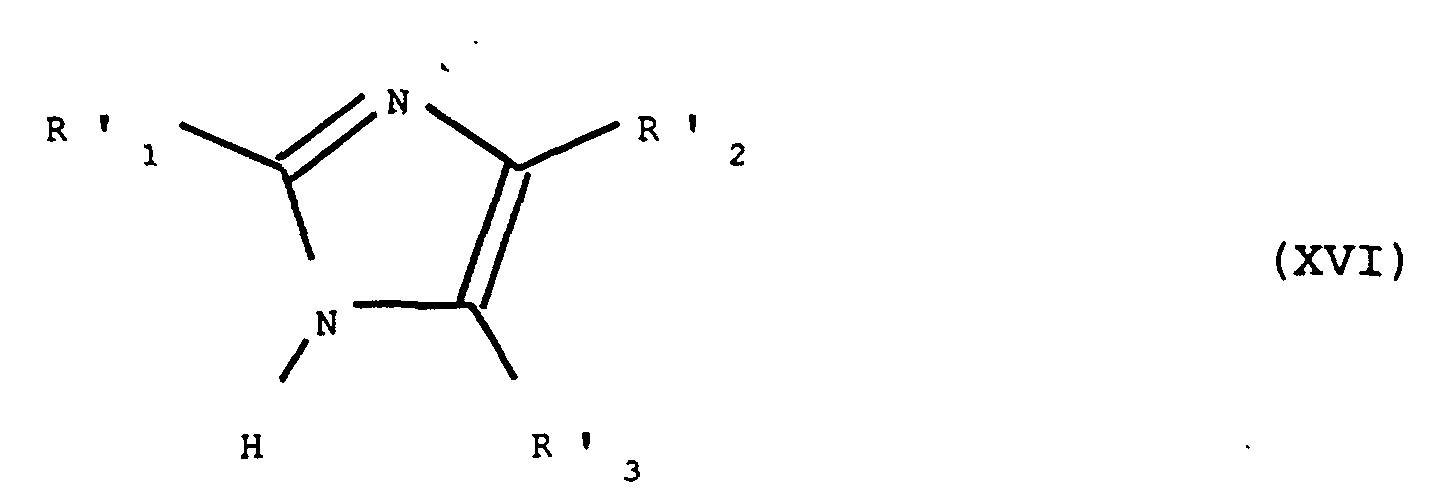

produits de formules (I1), (I2), (I3), (I4), (XIV), (XV), (I5) et (I') qui peuvent être des produits de formule (I) et que, pour obtenir des ou d'autres produits de formule (I), l'on peut soumettre, si désiré et si nécessaire, à l'une ou plusieurs des réactions de transformations suivantes, dans un ordre quelconque :

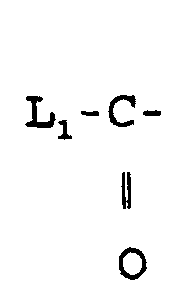
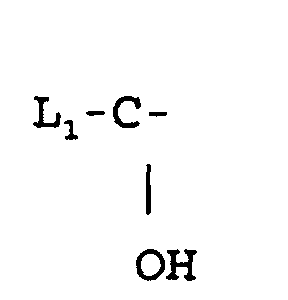

Y 'has the meaning indicated above for Y, in which the possible reactive functions are optionally protected by protective groups, to obtain the product of formula (IV 1 ):
either subject a compound of formula (VIII):
either to a reaction with the compound of formula (III) as defined above, or to the action of a protective group P, to obtain a product of formula (IX):
products of formulas (IV 2 ) and (XIII) which can be subjected to a halogen-metal exchange reaction on one of the halogen atoms then to a reaction with CO 2 or DMF or an electrophilic compound of formula (V a ), (V b ), (VI a ), (VI b ) or (VI c ):
to obtain respectively the compound of formula (I 1 ):
either subject a compound of formula (XVI):
products of formulas (I 1 ), (I 2 ), (I 3 ), (I 4 ), (XIV), (XV), (I 5 ) and (I ') which can be products of formula (I) and that, in order to obtain or other products of formula (I), one can submit, if desired and if necessary, to one or more of the following transformation reactions, in any order:
Dans des conditions préférentielles de mise en oeuvre de l'invention, le procédé décrit ci-dessus peut-être réalisé de la façon suivante. Dans le produit de formule (III), l'atome d'halogène représente de préférence un atome de brome mais peut également représenter un atome de chlore ou d'iode. La réaction de condensation des imidazoles de formules telles que définies ci-dessus (II), (VIII), (XVI), (XV) et (I4) (dans le cas des produits de formules (XV) et (I4), lorsque W représente P et après déprotection de l'atome d'azote), avec le composé de formule (III) telle que définie ci-dessus, pour obtenir respectivement les produits de formules (IV1), (IX) lorsque W représente Y', (I5) et (I') telles que définies ci-dessus peut être réalisée dans un solvant tel que par exemple le diméthylformamide ou encore le diméthylacétamide, le tétrahydrofuranne, le diméthoxyéthane ou le diméthylsulfoxyde au reflux du solvant ou à la température ambiante, de préférence sous agitation ; la réaction est réalisée de préférence en présence d'une base telle que par exemple l'hydrure de sodium ou de potassium ou encore du carbonate de sodium ou de potassium, du méthylate ou éthylate ou tert-butylate de sodium ou de potassium.Under preferential conditions for implementing the invention, the process described above can be carried out as follows. In the product of formula (III), the halogen atom preferably represents a bromine atom but can also represent a chlorine or iodine atom. The condensation reaction of the imidazoles of formulas as defined above (II), (VIII), (XVI), (XV) and (I 4 ) (in the case of the products of formulas (XV) and (I 4 ) , when W represents P and after deprotection of the nitrogen atom), with the compound of formula (III) as defined above, to respectively obtain the products of formulas (IV 1 ), (IX) when W represents Y ', (I 5 ) and (I') as defined above can be carried out in a solvent such as for example dimethylformamide or alternatively dimethylacetamide, tetrahydrofuran, dimethoxyethane or dimethylsulfoxide at the reflux of the solvent or at room temperature, preferably with stirring; the reaction is preferably carried out in the presence of a base such as, for example, sodium or potassium hydride or alternatively sodium or potassium carbonate, sodium or potassium methylate or ethylate or tert-butoxide.
La réaction d'halogénation du composé de formule (IV1) telle que définie ci-dessus en composé de formule (IV2) telle que définie ci-dessus, peut être réalisée dans les conditions usuelles de l'homme du métier et notamment par bromation à l'aide de NBS dans CH2Cl2 ou encore Br2 dans l'acide acétique.The halogenation reaction of the compound of formula (IV 1 ) as defined above into the compound of formula (IV 2 ) as defined above, can be carried out under the conditions usual for those skilled in the art and in particular by bromination using NBS in CH 2 Cl 2 or Br 2 in acetic acid.
Les composés de formules (IV2), (IX) et (XIII) telles que définies ci-dessus peuvent être soumis à une réaction d'échange halogène métal sur l'atome d'halogène par réaction avec un composé organo métallique tel que le nBuli ou EtMgBr dans un solvant tel que le THF à une température d'environ
- 78°C pour le Buli et température ambiante pour EtMgBr.
- 78 ° C for Buli and room temperature for EtMgBr.
Les réactions de carboxylation par CO2 et de formylation par DMF des composés de formules (IV2) et (XIII) respectivement en composés de formules (I1) et (XIV) peuvent être réalisées selon les conditions usuelles de l'homme de métier soit par exemple dans le THF à température ambiante.The carboxylation reactions by CO 2 and the formylation by DMF of the compounds of formulas (IV2) and (XIII) respectively into compounds of formulas (I1) and (XIV) can be carried out according to the conditions usual for those skilled in the art, either by example in THF at room temperature.
Z1 et Z2, identiques ou différents, représentent un radical alkyle, alkényle ou aryle de telle manière que Z1-S-et Z2-S- représentent les valeurs correspondantes définies ci-dessus par R2 et R3 dans lesquelles les éventuelles fonctions réactives sont éventuellement protégées par des groupements protecteurs.Z 1 and Z 2 , identical or different, represent an alkyl, alkenyl or aryl radical such that Z 1 -S- and Z 2 -S- represent the corresponding values defined above by R 2 and R 3 in which the any reactive functions are possibly protected by protective groups.
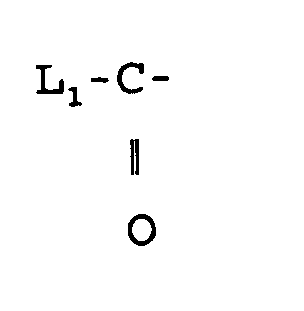
L1 et L1', identiques ou différents, représentent un radical alkyle, alkényle ou aryle de telle manière que R1" représente les valeurs correspondantes choisies parmi les valeurs de R1 telles que définies ci-dessus dans lesquelles les éventuelles fonctions réactives sont éventuellement protégées par des groupements protecteurs.L 1 and L 1 ' , identical or different, represent an alkyl, alkenyl or aryl radical in such a way that R 1 " represents the corresponding values chosen from the values of R 1 as defined above in which the possible reactive functions are possibly protected by protective groups.
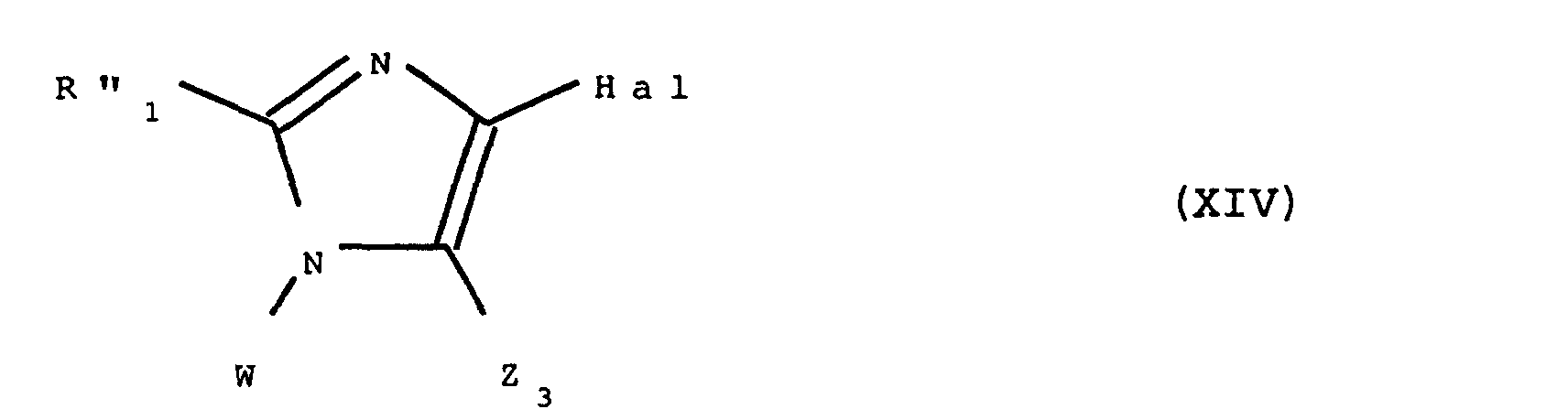
La réaction du composé de formule (IV2) ou (XIII) telles que définies ci-dessus avec le composé de formule (VIa), (VIb) ou (VIc), telles que définies ci-dessus, pour obtenir le composé correspondant de formule respective (I1) ou (XIV) telles que définies ci-dessus peut être réalisée d'une manière identique en utilisant EtMgBr comme agent de métallation dans le THF à température ambiante.The reaction of the compound of formula (IV 2 ) or (XIII) as defined above with the compound of formula (VI a ), (VI b ) or (VI c ), as defined above, to obtain the corresponding compound of respective formula (I 1 ) or (XIV) as defined above can be carried out in an identical manner using EtMgBr as a metallating agent in THF at room temperature.
La réaction des composés de formules (IV2) et (XIII) avec les composés de formule (Va) ou (Vb) peuvent être réalisées selon les conditions usuelles de l'homme du métier soit par exemple dans le THF à température ambiante.The reaction of the compounds of formulas (IV 2 ) and (XIII) with the compounds of formula (V a ) or (V b ) can be carried out according to the conditions usual for those skilled in the art, for example in THF at room temperature .
La réaction du composé de formule (IX) avec les composés de formules (X), (X'), (XI), (XII) et (XII') peut être réalisée selon les conditions usuelles de l'homme de métier soit par exemple dans le THF à température ambiante.Reaction of the compound of formula (IX) with the compounds of formulas (X), (X '), (XI), (XII) and (XII') can be performed according to the usual conditions of the skilled person either for example in THF at room temperature.
La fonction amine des composés de formules (XV) et (I4) telle que définie ci-dessus, protégée par P tel que défini ci-dessus, peut être libérée dans les conditions usuelles connues de l'homme du métier et notamment lorsque P représente le radical -CH2-O-(CH2)2-Si(CH3)3, l'atome d'hydrogène peut être libéré dans du TFA ou encore en présence d'ion fluorure.The amine function of the compounds of formulas (XV) and (I 4 ) as defined above, protected by P as defined above, can be released under the usual conditions known to those skilled in the art and in particular when P represents the radical -CH 2 -O- (CH 2 ) 2 -Si (CH 3 ) 3 , the hydrogen atom can be released in TFA or in the presence of fluoride ion.
La réaction de saponification peut être réalisée selon les méthodes usuelles connues de l'homme du métier, telles que par exemple dans un solvant tel que le méthanol ou l'éthanol, le dioxane ou le diméthoxyéthane, en présence de soude ou de potasse ou encore de carbonate de cesium.The saponification reaction can be carried out according to the usual methods known to those skilled in the art, such as than for example in a solvent such as methanol or ethanol, dioxane or dimethoxyethane, in the presence of soda or potash or cesium carbonate.
Les réactions de réduction ou oxydation des produits de formules (I2) et (XV) respectivement en produits de formules (I3) et (I4) peuvent être réalisées selon les méthodes usuelles connues de l'homme du métier.The reduction or oxidation reactions of the products of formulas (I 2 ) and (XV) respectively into products of formulas (I 3 ) and (I 4 ) can be carried out according to the usual methods known to those skilled in the art.
Selon les valeurs de R'1, R"1, R'2, R"2, R'3, R"3, les produits de formules (I1), (I2), (I3), (I4), (I5), (XIV), (XV) et (I') constituent ou non des produits de formule (I) et peuvent donner des produits de formule (I), ou être transformés en d'autres produits de formule (I) en étant soumis à une ou plusieurs des réactions a) à u) indiquées ci-dessus.According to the values of R ' 1 , R " 1 , R' 2 , R" 2 , R ' 3 , R " 3 , the products of formulas (I 1 ), (I 2 ), (I 3 ), (I 4 ), (I 5 ), (XIV), (XV) and (I ') constitute or not products of formula (I) and can give products of formula (I), or be transformed into other products of formula (I) by being subjected to one or more of the reactions a) to u) indicated above.
Ainsi les diverses fonctions réactives que peuvent porter certains composés des réactions définies ci-dessus peuvent, si nécessaire, être protégées : il s'agit par exemple des radicaux hydroxyle, acyle, carboxy libres ou encore amino et monoalkylamino qui peuvent être protégés par les groupements protecteurs appropriés.Thus the various reactive functions that can carry certain compounds of the reactions defined above can, if necessary, be protected: for example, free hydroxyl, acyl, carboxy radicals or even amino and monoalkylamino which can be protected by appropriate protective groups.
La liste suivante, non exhaustive, d'exemples de protection de fonctions réactives peut être citée :
- les groupements hydroxyle peuvent être protégés par exemple par les radicaux alkyle tels que tert-butyle, triméthylsilyle, tert-butyldiméthylsilyle, méthoxyméthyle, tétrahydropyrannyle, benzyle ou acétyle,
- les groupements amino peuvent être protégés par exemple par les radicaux acétyle, trityle, benzyle, tert-butoxycarbonyle, phtalimido ou d'autres radicaux connus dans la chimie des peptides,
- les groupements acyles tel que le groupement formyle peuvent être protégés par exemple sous forme de cétals ou de thiocétals cycliques ou non cycliques tels que le diméthyl ou diéthylcétal ou l'éthylène dioxycétal, ou le diéthylthiocétal
- les fonctions acide des produits décrits ci-dessus peuvent être, si désiré, amidifiées par une amine primaire ou secondaire par exemple dans du chlorure de méthylène en présence, par exemple, de chlorhydrate de 1-éthyl-3-(diméthylaminopropyl) carbodiimide à la température ambiante :
- les fonctions acide peuvent être protégées par exemple sous forme d'esters formés avec les esters facilement clivables tels que les esters benzyliques ou ter butyliques ou des esters connus dans la chimie des peptides.
- the hydroxyl groups can be protected for example by alkyl radicals such as tert-butyl, trimethylsilyl, tert-butyldimethylsilyl, methoxymethyl, tetrahydropyrannyl, benzyl or acetyl,
- the amino groups can be protected for example by acetyl, trityl, benzyl, tert-butoxycarbonyl, phthalimido or other radicals known in the chemistry of peptides,
- the acyl groups such as the formyl group can be protected, for example, in the form of cyclic or non-cyclic ketals or thiocetals such as dimethyl or diethyl ketal or ethylene dioxyketal, or diethylthioketal
- the acid functions of the products described above can be, if desired, amidified with a primary or secondary amine, for example in methylene chloride in the presence, for example, of 1-ethyl-3- (dimethylaminopropyl) carbodiimide hydrochloride ambient temperature :
- the acid functions can be protected, for example, in the form of esters formed with easily cleavable esters such as benzyl or tert-butyl esters or esters known in the chemistry of peptides.
Les réactions auxquelles les produits de formules (I1),
(I2), (I3), (I4), (I5), (XIV), (XV) et (I'), telles que définies
ci-dessus peuvent être soumis, si désiré ou si nécessaire,
peuvent être réalisées, par exemple, comme indiqué ci-après.
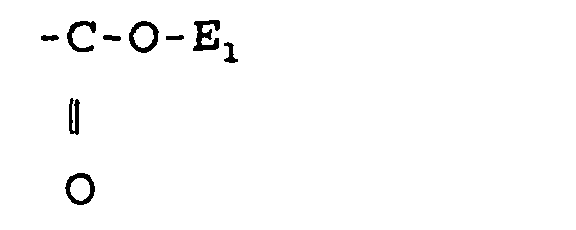
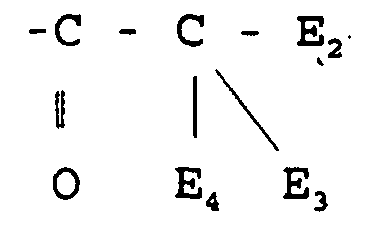


J. Organometallic Chemistry., 33, 337 (1971) KOZIMA S.& coll.
ou arylthio avec un excés du réactif tel que notamment un peracide.
J. Org. Chem., 49, pp. 2282 (1984) AKUTAGAWA K.& coll.

La réaction inverse de transformation de radical


J. Organometallic Chemistry., 33 , 337 (1971) KOZIMA S. & coll.
or arylthio with an excess of the reagent such as in particular a peracid.
J. Org. Chem., 49 , pp. 2282 (1984) AKUTAGAWA K. & al.
The reverse radical transformation reaction
Des illustrations de telles réactions définies ci-dessus sont données dans la préparation des exemples décrits ci-après.Illustrations of such reactions defined above are given in the preparation of the examples described below.
Les composés de formule (I) tels que définis ci-dessus ainsi que leurs sels d'addition avec les acides présentent d'intéressantes propriétés pharmacologiques.The compounds of formula (I) as defined above as well as their addition salts with acids present interesting pharmacological properties.
Les produits de formule (I) tels que définis ci-dessus, sont doués de propriétés antagonistes pour les récepteurs à l'endothéline et sont ainsi notamment inhibiteurs des effets de l'endothéline, notamment des effets vaso-constricteurs et hypertenseurs induits par l'endothéline. On note en particulier un effet antiischémique, l'activité vasoconstrictrice de l'endothéline étant abolie.The products of formula (I) as defined above, have antagonistic properties for receptors to endothelin and are thus notably inhibitors of the effects endothelin, including vasoconstrictor effects and endothelin-induced hypertensives. We note in particular an antiischemic effect, the vasoconstrictive activity of endothelin being abolished.
Les produits de formule I sont également capables de s'opposer aux effets stimulants de l'endothéline au niveau de tous les types cellulaires, notamment les cellules musculaires lisses, les cellules neuronales et les cellules osseuses.The products of formula I are also capable of oppose the stimulating effects of endothelin at the level of all cell types, including muscle cells smooth, neural cells and bone cells.
Ces propriétés justifient leur application en thérapeutique et l'invention a également pour objet à titre de médicaments, les produits tels que définis par la formule (I) ci-dessus, lesdits produits de formule (I) étant sous toutes les formes isoméres possibles racémiques ou optiquement actives, ainsi que les sels d'addition avec les acides minéraux et organiques ou avec les bases minérales et organiques pharmaceutiquement acceptables desdits produits de formule (I).These properties justify their application in therapy and the invention also relates to medicaments, the products as defined by formula (I) above, said products of formula (I) being in all of the possible isomeric forms, racemic or optically active, as well as addition salts with mineral acids and organic or with mineral and organic bases pharmaceutically acceptable of said products of formula (I).
L'invention a particulièrement pour objet à titre de médicaments, les produits de formules (IA) et (IB) telles que définies ci-dessus, lesdits produits de formules (IA) et (IB) étant sous toutes les formes isoméres possibles racémiques ou optiquement actives, ainsi que les sels d'addition avec les acides minéraux ou organiques ou avec les bases minérales et organiques pharmaceutiquement acceptables desdits produits de formules (IA) et (IB).The subject of the invention is particularly, as medicaments, the products of formulas (I A ) and (I B ) as defined above, said products of formulas (I A ) and (I B ) being in all forms possible racemic or optically active isomers, as well as addition salts with mineral or organic acids or with pharmaceutically acceptable mineral and organic bases of the said products of formulas (I A ) and (I B ).
L'invention a tout particulièrement pour objet à titre de médicaments, les produits de formule (IC) telle que définie ci-dessus, lesdits produits de formule (IC) étant sous toutes les formes isoméres possibles racémiques ou optiquement actives, ainsi que les sels d'addition avec les acides minéraux et organiques ou avec les bases minérales et organiques pharmaceutiquement acceptables desdits produits de formule (I).The invention particularly relates to medicaments, the products of formula (I C ) as defined above, said products of formula (I C ) being in all the possible isomeric forms racemic or optically active, as well as addition salts with mineral and organic acids or with pharmaceutically acceptable mineral and organic bases of said products of formula (I).
L'invention a encore plus particulièrement pour objet à titre de médicaments, les produits de formule (ID) telle que définie ci-dessus, lesdits produits de formule (ID) étant sous toutes les formes isoméres possibles racémiques ou optiquement actives, ainsi que les sels d'addition avec les acides minéraux et organiques ou avec les bases minérales et organiques pharmaceutiquement acceptables desdits produits de formule (I).A more particular subject of the invention is, as medicaments, the products of formula (I D ) as defined above, said products of formula (I D ) being in all the possible isomeric forms, racemic or optically active, as well as addition salts with mineral and organic acids or with pharmaceutically acceptable mineral and organic bases of said products of formula (I).
L'invention a plus particulièrement pour objet, à titre de médicaments, les produits décrits ci-aprés dans les exemples et notamment les produits de formule (I) suivants :
- 1-((6-chloro-1,3-benzodioxol-5-yl) méthyl)-4-(((4-méthoxyphényl) méthyl) thio)-2-(phénylthio)-1H-imidazole-5-carboxaldéhyde
- acide 4-bromo-1-((6-chloro-1,3-benzodioxol-5-yl) méthyl)-2-phényl-1H-imidazole-5-carboxylique
- acide 1-((6-chloro-1,3-benzodioxol-5-yl) méthyl)-4-(((4-méthoxyphényl) méthyl) thio)-2-(phénylthio)-1H-imidazole-5-carboxylique
- acide 1-((6-chloro-1,3-benzodioxol-5-yl) méthyl)-4-(4-méthoxyphényl) thio)-2-(phénylthio)-1H-imidazole-5-carboxylique
- acide 1-((6-chloro-1,3-benzodioxol-5-yl) méthyl)-2,4-bis(4-(méthoxyphényl) thio)-1H-imidazole-5-carboxylique
- acide 1-((6-chloro 1,3-benzodioxol-5-yl) méthyl) 4-((3,4-diméthoxyphényl) thio) 2-(1,3-dioxolan-2-yl) 1H-imidazol 5-carboxylique
- 1 - ((6-chloro-1,3-benzodioxol-5-yl) methyl) -4 - ((((4-methoxyphenyl) methyl) thio) -2- (phenylthio) -1H-imidazole-5-carboxaldehyde
- 4-bromo-1 - (((6-chloro-1,3-benzodioxol-5-yl) methyl) -2-phenyl-1H-imidazole-5-carboxylic acid
- acid 1 - ((6-chloro-1,3-benzodioxol-5-yl) methyl) -4 - (((4-methoxyphenyl) methyl) thio) -2- (phenylthio) -1H-imidazole-5-carboxylic
- 1 - ((6-chloro-1,3-benzodioxol-5-yl) methyl) -4- (4-methoxyphenyl) thio) -2- (phenylthio) -1H-imidazole-5-carboxylic acid
- 1 - ((6-chloro-1,3-benzodioxol-5-yl) methyl) -2,4-bis (4- (methoxyphenyl) thio) -1H-imidazole-5-carboxylic acid
- acid 1 - ((6-chloro 1,3-benzodioxol-5-yl) methyl) 4 - ((3,4-dimethoxyphenyl) thio) 2- (1,3-dioxolan-2-yl) 1H-imidazol 5- carboxylic
Les médicaments, objet de l'invention, trouvent, par exemple, leur emploi dans le traitement de tous les spasmes vasculaires, dans le traitement des post-hémorragies cérébrales, dans le traitement des spasmes coronariens, des spasmes vasculaires périphériques ainsi que dans le traitement des insuffisances rénales. Ces médicaments peuvent également être utilisés dans le traitement de l'infarctus du myocarde, de l'insuffisance cardiaque congestive, dans la prévention des resténoses post-angioplastie, dans le traitement de l'athérosclérose et de certaines formes d'hypertension comme notamment l'hypertension pulmonaire, ainsi que dans le traitement de l'asthme.The drugs which are the subject of the invention find, by example, their use in the treatment of all spasms vascular, in the treatment of cerebral post-hemorrhages, in the treatment of coronary spasms, peripheral vascular spasms as well as in treatment kidney failure. These drugs can also be used in the treatment of heart attack myocardium, congestive heart failure, in the prevention of post-angioplasty restenosis, in the treatment atherosclerosis and certain forms of hypertension such as pulmonary hypertension, as well as in the treatment of asthma.
Les médicaments, objet de l'invention, peuvent également trouver une application dans le traitement de l'ostéoporose, de l'hyperplasie prostatique et en tant que protecteurs neuronaux.The drugs which are the subject of the invention can also find an application in the treatment of osteoporosis, prostatic hyperplasia and as protectors Neural.
L'invention s'étend aux compositions pharmaceutiques contenant à titre de principe actif l'un au moins des médicaments tels que définis ci-dessus.The invention extends to pharmaceutical compositions containing as active ingredient at least one of the medicinal products as defined above.
Ces compositions pharmaceutiques peuvent être administrées par voie buccale, rectale, par voie parentérale ou par voie locale en application topique sur la peau et les muqueuses ou par injection par voie intraveineuse ou intramusculaire.These pharmaceutical compositions can be administered by mouth, rectally, parenterally or topically applied topically to the skin and mucous membranes or by intravenous or intramuscular injection.
Ces compositions peuvent être solides ou liquides et se présenter sous toutes les formes pharmaceutiques couramment utilisées en médecine humaine comme, par exemple, les comprimés simples ou dragéifiés, les gélules, les granulés, les suppositoires, les préparations injectables, les pommades, les crèmes, les gels et les préparations en aérosols ; elles sont préparées selon les méthodes usuelles. Le principe actif peut y être incorporé à des excipients habituellement employés dans ces compositions pharmaceutiques, tels que le talc, la gomme arabique, le lactose, l'amidon, le stéarate de magnésium, le beurre de cacao, les véhicules aqueux ou non, les corps gras d'origine animale ou végétale, les dérivés paraffiniques, les glycols, les divers agents mouillants, dispersants ou émulsifiants, les conservateurs.These compositions can be solid or liquid and are commonly present in all pharmaceutical forms used in human medicine like, for example, tablets single or coated, the capsules, the granules, the suppositories, injections, ointments, creams, gels and aerosol preparations; they are prepared according to the usual methods. The active ingredient can usually be incorporated into excipients used in these pharmaceutical compositions, such as talc, gum arabic, lactose, starch, stearate magnesium, cocoa butter, aqueous vehicles or not, fatty substances of animal or vegetable origin, derivatives paraffinics, glycols, various wetting agents, dispersants or emulsifiers, preservatives.
La posologie usuelle, variable selon le produit utilisé, le sujet traité et l'affection en cause, peut être, par exemple, de 1 à 300 mg par jour chez l'adulte, par voie orale ou de 1 à 100 mg par jour par voie intraveineuse.The usual dosage, which varies depending on the product used, the subject treated and the affection in question, can be, for example, from 1 to 300 mg per day in adults, orally or from 1 to 100 mg per day intravenously.
Certains produits de départ de formules (II) et (XVI) sont connus et peuvent être préparés par exemple comme indiqué dans le brevet européen EP 0168950.Certain starting materials of formulas (II) and (XVI) are known and can be prepared for example as indicated in European patent EP 0168950.
D'autres produits de départ de formules (II) et (XVI) peuvent en particulier être préparés comme indiqué dans le brevet européen EP 0465368.Other starting materials of formulas (II) and (XVI) can in particular be prepared as indicated in the European patent EP 0465368.
Certains produits de départ de formules (II) et (XVI) sont commerciaux tels que par exemple le produit de formule (II) suivant :
- le 2-phénylimidazole par Aldrich.
- 2-phenylimidazole by Aldrich.
Des exemples de produits commerciaux de formule (XVI) sont donnés dans les brevets EP 0465368 ou EP 0503162.Examples of commercial products of formula (XVI) are given in patents EP 0465368 or EP 0503162.
On peut encore notamment préparer certains produits de formules (II) et (XVI) à partir de produits de formule (II) par exemple en les soumettant à une ou plusieurs des réactions décrites ci-dessus en a) à u), réalisées dans les conditions également décrites ci-dessus.It is also possible in particular to prepare certain products of formulas (II) and (XVI) from products of formula (II) for example by subjecting them to one or more of the reactions described above in a) to u), carried out in the conditions also described above.
Certains produits de formules (XVI) peuvent également
être obtenus par monohalogénation du produit de formule (II)
tel que défini ci-dessus en produit de formule (P1) :

Les composés de départ de formule (VIII) peuvent être disponibles dans le commerce tel que le 2,4,5-tribromoimidazole chez Aldrich ou peuvent être préparés selon les méthodes usuelles connues de l'homme du métier.The starting compounds of formula (VIII) can be commercially available such as 2,4,5-tribromoimidazole at Aldrich or can be prepared according to usual methods known to those skilled in the art.
Les produits de départ de formules (Va), (Vb), (VIa),
(VIb) et (VIc), sont commerciaux tels que notamment :
- le sec-butyl disulfide
- l'éthyl disulfide
- l'isopropyl disulfide
- le méthyl disulfide
- le benzyl disulfide
- le phényl disulfide
- le propyl disulfide
- le méthyl méthanethiosulfonate
- le phényl benzenethiol sulfonate
- le méthyl chloroformate
- le benzyl chloroformate
- l'isobutyl chloroformate
- l'éthyl chloroformate
- le N-propyl chloroformate
- le diméthyl carbonate
- le diéthyl carbonate
- le di-tert-butyl oxalate
- le diéthyl oxalate
- le diméthyl oxalate
- sec-butyl disulfide
- ethyl disulfide
- isopropyl disulfide
- methyl disulfide
- benzyl disulfide
- phenyl disulfide
- propyl disulfide
- methyl methanethiosulfonate
- phenyl benzenethiol sulfonate
- methyl chloroformate
- benzyl chloroformate
- isobutyl chloroformate
- ethyl chloroformate
- N-propyl chloroformate
- dimethyl carbonate
- diethyl carbonate
- di-tert-butyl oxalate
- diethyl oxalate
- dimethyl oxalate
Les produits de départ de formules (X), (X') et (XII')
sont commerciaux tels que notamment :
- le benzaldehyde ou butanal
- le chlorure de benzoyle ou de buturyle
- le chlorure de mesyle
- le chlorure de tosyle
- benzaldehyde or butanal
- benzoyl or buturyl chloride
- mesyl chloride
- tosyl chloride
Un procédé de préparation de certains produits de formule (III) est notamment décrit dans le brevet européen EP 0465368.A process for the preparation of certain products of formula (III) is notably described in the European patent EP 0465368.
Des exemples de préparation de composés de formule (III) sont également décrits dans la littérature et des exemples en sont donnés notamment dans le brevet US 4,880,804 ou par exemple dans la référence Chemistry and Industry 7 september 1987 HOWARD and COLQUHOUN pp. 612-617.Examples of preparation of compounds of formula (III) are also described in the literature and examples in are given in particular in US patent 4,880,804 or by example in reference Chemistry and Industry 7 september 1987 HOWARD and COLQUHOUN pp. 612-617.
Notamment, le produit de formule (III) qui est le chlorure de 6-chloro pipéronyle est commercial chez Janssen.In particular, the product of formula (III) which is chloride of 6-chloro piperonyl is commercially available from Janssen.
La présente invention a enfin pour objet à titre de produits industriels nouveaux, les composés de formules (IV1), (IV2), (XIII), (XIV) et (XV) dans lesquels Y' représente le radical phényle éventuellement substitué par un ou plusieurs radicaux choisis parmi les atomes d'halogène et les radicaux dioxol, dans laquelle les éventuelles fonctions réactives sont éventuellement protégées par des groupements protecteurs.The subject of the present invention is finally, as new industrial products, the compounds of formulas (IV 1 ), (IV 2 ), (XIII), (XIV) and (XV) in which Y ′ represents the phenyl radical optionally substituted by one or more radicals chosen from halogen atoms and dioxol radicals, in which the possible reactive functions are optionally protected by protective groups.
L'invention a ainsi particulièrement pour objet l'utilisation des produits de formule (I) telle que définie ci-dessus, pour la préparation de compositions pharmaceutiques destinées au traitement d'affections résultant d'une stimulation anormale des récepteurs de l'endothéline.The invention therefore particularly relates to the use products of formula (I) as defined above, for the preparation of pharmaceutical compositions for the treatment of conditions resulting from stimulation abnormal endothelin receptors.
L'invention a plus particulièrement pour objet l'utilisation des produits de formule (I) telle que définie ci-dessus, pour la préparation de compositions pharmaceutiques destinées au traitement de l'hypertension induite par l'endothéline.The invention more particularly relates to the use products of formula (I) as defined above, for the preparation of pharmaceutical compositions for the treatment of hypertension induced by endothelin.
L'invention a tout particulièrement pour objet l'utilisation des produits de formule (I) telle que définie ci-dessus, pour la préparation de compositions pharmaceutiques destinées au traitement de tous les spasmes vasculaires et du traitement des post-hémorragies cérébrales et des insuffisances rénales.The invention particularly relates to the use products of formula (I) as defined above, for the preparation of pharmaceutical compositions for the treatment of all vascular spasms and treatment of cerebral hemorrhages and insufficiencies kidney.
L'invention a également pour objet l'utilisation des produits de formule (I) telle que définie ci-dessus, pour la préparation de compositions pharmaceutiques destinées au traitement de l'infarctus du myocarde et à la prévention des restéroses post-angioplastie.The invention also relates to the use of products of formula (I) as defined above, for the preparation of pharmaceutical compositions intended for treatment of myocardial infarction and prevention of post-angioplasty resteroses.
Les exemples suivants illustrent l'invention sans toutefois la limiter.The following examples illustrate the invention without, however, limit it.
On introduit 25 g de 2,4,5 tribromoimidazole dans 500 ml de diméthylformamide et ajoute 4,3 g d'hydrure de sodium. L'agitation est maintenue 10 mn à température ambiante. On ajoute ensuite au milieu réactionnel 18,4 g de chlorure de 6 chloro pipéronyl, puis 25 g d'iodure de sodium et l'agitation est poursuivie pendant 15 mn à température ambiante.25 g of 2,4,5 tribromoimidazole are introduced into 500 ml of dimethylformamide and added 4.3 g of sodium hydride. Stirring is continued for 10 min at room temperature. We then add to the reaction medium 18.4 g of chloride of 6 chloro piperonyl, then 25 g of sodium iodide and stirring is continued for 15 minutes at room temperature.
Le milieu réactionnel est finalement versé sur 3 1 d'eau, on essore, lave abondamment par de l'eau, puis successivement par 250 ml d'éthanol, 250 ml d'isopropanol, puis finalement par 250 ml d'éther isopropylique.The reaction medium is finally poured onto 3 1 of water, it is wrung, washed abundantly with water, then successively with 250 ml of ethanol, 250 ml of isopropanol, then finally with 250 ml of isopropyl ether.
On sèche et récupère 31.5 g de produit attendu (solide
crème) Pf = 225°C.
IR CHC13 (cm-1)
Absence de =C-NH
Hétérocycle aromatique 1624-1506-1497-1485 Dried and recovered 31.5 g of the expected product (cream solid) Mp = 225 ° C.
IR CHC13 (cm -1 )
Absence of = C-NH
Aromatic heterocycle 1624-1506-1497-1485
On introduit 4,73 g du produit obtenu ci-dessus au stade 1 dans 100 ml de mélange chlorure de méthylène/éther sulfurique (20/80), à laquelle on ajoute goutte à goutte 3,5 ml de bromure d'éthyle magnésium : on maintient sous agitation pendant 30 mn à température ambiante.4.73 g of the product obtained above are introduced at the stage 1 in 100 ml of methylene chloride / sulfuric ether mixture (20/80), to which 3.5 ml of ethyl bromide magnesium: stirred for 30 min at room temperature.
On introduit alors au milieu réactionnel obtenu 2,9 g de phényl benzène thiosulfonate. L'agitation est maintenue pendant 2 h à température ambiante.2.9 g of phenyl benzene thiosulfonate. Agitation is maintained for 2 h at room temperature.
On hydrolyse le milieu par addition d'acide chlorhydrique
dilué, après extraction par de l'acétate d'éthyle,
lavage abondant à l'eau puis séchage, on récupère un solide
crème que l'on purifie par empatage dans 50 ml d'éthanol. On
obtient ainsi 3,35 g du produit attendu Pf 165°C.
IR CHC13 (cm-1)
Hétérocycle + aromatique 1585-1508-1484
Micro analyse
IR CHC13 (cm -1 )
Heterocycle + aromatic 1585-1508-1484
Micro analysis
On introduit 6,4 g du produit obtenu au stade 2 ci-dessus dans 100 ml de tétrahydrofuranne et on ajoute goutte à goutte 9,3 ml de bromure d'éthyle magnésien. On maintient sous agitation pendant 30 mn à température ambiante.6.4 g of the product obtained in stage 2 above are introduced. in 100 ml of tetrahydrofuran and added dropwise drop 9.3 ml of ethyl magnesium bromide. We maintain with stirring for 30 min at room temperature.
On introduit alors au milieu réactionnel obtenu 5 équivalents de diméthyl formamide.5 equivalents are then introduced into the reaction medium obtained. of dimethyl formamide.
L'agitation est maintenue pendant 2 h à température ambiante.Stirring is continued for 2 h at temperature room.
On hydrolyse le milieu par addition d'acide chlorhydrique
dilué, après extraction de l'acétate d'éthyle, lavage
abondant à l'eau puis séchage, on récupère un solide marron
que l'on purifie par chromatographie sur silice avec pour
éluant du chlorure de méthylène. On obtient 5 g de produit
attendu (Pf = 155°C) dont 500 mg sont recristallisés dans
25 ml d'éthanol : après essorage puis séchage on récupère
420 mg de produit attendu (solide blanc) (pf = 155°C).
IR CHC13 (cm-1)
C=0 1669
Aromatique+Hétéroatome 1627-1580-1505-1485
Micro analyse
IR CHC13 (cm -1 )
C = 0 1669
Aromatic + Heteroatom 1627-1580-1505-1485
Micro analysis
On introduit 620 mg d'hydrure de sodium 50 % dans l'huile dans 50 ml de tétrahydrofuranne, à laquelle on ajoute lentement 1,8 ml de 4-méthoxy-benzeneméthanethiol. L'agitation est maintenue pendant 15 mn à température ambiante.620 mg of 50% sodium hydride are introduced into the oil in 50 ml of tetrahydrofuran, to which we add slowly 1.8 ml of 4-methoxy-benzenemethanethiol. agitation is maintained for 15 min at room temperature.
On introduit ensuite au thiolate ainsi formé une solution de 3,8 g du produit de l'exemple 1 dans 25 ml de tétrahydrofuranne. L'agitation est poursuivie dans ces conditions pendant 2 h 30mn.Then introduced into the thiolate thus formed a solution 3.8 g of the product of Example 1 in 25 ml of tetrahydrofuran. Agitation is continued under these conditions for 2 h 30 min.
Le milieu réactionnel est finalement versé sur de la soude 0,1N, après extraction par de l'acétate d'éthyle, lavage abondant à l'eau puis séchage, on récupère une résine brune que l'on purifie par chromatographie sur silice avec pour éluant du chlorure de méthylène 80/cyclohexane 20 puis du chlorure de méthylène + 20 % d'acétate d'éthyle.The reaction medium is finally poured onto 0.1N sodium hydroxide, after extraction with ethyl acetate, abundant washing with water then drying, a resin is recovered brown which is purified by chromatography on silica with for eluent of methylene chloride 80 / cyclohexane 20 then methylene chloride + 20% ethyl acetate.
On recueille 2 fractions 1,97 g du produit attendu
(Pf = 135°C) et 1,98 g d'un second produit qui se forme dans
les mêmes conditions opératoires : le 1-((6-chloro-1,3-benzodioxol-5-yl)méthyl)-2,4-bis(((4-méthoxyphényl)méthyl)
thio)-1H-imidazole-5-carboxaldehyde
CONTROLES POUR A
IR CHC13 (cm-1)
C=O 1660
aromatique + Hétérocycle 1611-1580-1513-1505-1485
Micro analyse
IR CHC13 (cm-1)
absence de S phényl
C=O 1655
aromatique Hétérocycle 1612-1585-1512-1508-14852 fractions are collected 1.97 g of the expected product (mp = 135 ° C.) and 1.98 g of a second product which is formed under the same operating conditions: 1 - ((6-chloro-1,3- benzodioxol-5-yl) methyl) -2,4-bis ((((4-methoxyphenyl) methyl) thio) -1H-imidazole-5-carboxaldehyde
CONTROLS FOR A
IR CHC13 (cm -1 )
C = O 1660
aromatic + heterocycle 1611-1580-1513-1505-1485
Micro analysis
IR CHC13 (cm -1 )
absence of S phenyl
C = O 1655
aromatic Heterocycle 1612-1585-1512-1508-1485
On procède comme au stade 2 de l'exemple 1 à partir de 6 g du produit obtenu au stade 1 de l'exemple 1 dans 300 ml de mélange chlorure de méthylène/éther sulfurique (60/240), à laquelle on ajoute goutte à goutte 4,6 ml de bromure d'éthyle magnésium puis maintient sous agitation pendant 30 mn à température ambiante et introduit alors au milieu réactionnel obtenu 100 ml d'eau glacée.We proceed as in stage 2 of example 1 starting from 6 g of the product obtained in stage 1 of Example 1 in 300 ml methylene chloride / sulfuric ether mixture (60/240), to which is added dropwise 4.6 ml of ethyl bromide magnesium then keeps stirring for 30 min at room temperature and then introduced into the reaction medium obtained 100 ml of ice water.
Après acidification, extraction, lavage puis séchage, on
récupère 3,35 g de produit attendu (solide crème homogène)
(Pf 150°C).
IR CHC13 (cm-1)
Hétérocycle + aromatique 1626-1508-1484After acidification, extraction, washing and drying, 3.35 g of expected product are recovered (homogeneous cream solid) (mp 150 ° C.).
IR CHC13 (cm -1 )
Heterocycle + aromatic 1626-1508-1484
On procède comme au stade 3 de l'exemple 1 à partir de 900 mg de produit obtenu au stade 1 ci-dessus dans 10 ml de tétrahydrofuranne et on ajoute goutte à goutte 1,7 ml de bromure d'éthyle magnésien. On maintient sous agitation pendant 15 mn à température ambiante.We proceed as in stage 3 of Example 1 starting from 900 mg of product obtained in stage 1 above in 10 ml of tetrahydrofuran and 1.7 ml of ethyl magnesium bromide. Keep stirring for 15 min at room temperature.
On introduit alors au milieu réactionnel obtenu 0,9 ml soit 5 équivalents de diméthyl formamide. L'agitation est maintenue pendant 2h à température ambiante.0.9 ml is then introduced into the reaction medium obtained. or 5 equivalents of dimethyl formamide. Agitation is maintained for 2 hours at room temperature.
Après hydrolyse du milieu par addition d'acide chlorhydrique
dilué, extraction, lavage puis séchage, on récupère un
solide crème que l'on purifie par chromatographie sur silice
avec pour éluant du chlorure de méthylène + 5 % d'acétate
d'éthyle. On obtient ainsi 630 mg de produit attendu (Pf =
136°C).
IR CHC13 (cm-1)
C=O 1670
Aromatique + Hétéroatome 1625-1510-1485After hydrolysis of the medium by addition of dilute hydrochloric acid, extraction, washing and drying, a cream solid is recovered which is purified by chromatography on silica with eluent methylene chloride + 5% ethyl acetate. 630 mg of expected product is thus obtained (Mp = 136 ° C).
IR CHC13 (cm -1 )
C = O 1670
Aromatic + Heteroatom 1625-1510-1485
On procède comme à l'exemple 2 à partir de 90 mg d'hydrure de sodium 50 % dans l'huile dans 10 ml de tétrahydrofuranne, à laquelle on ajoute lentement 0,26 ml de 4-méthoxy-benzeneméthanethiol.The procedure is as in Example 2 from 90 mg of hydride 50% sodium in oil in 10 ml of tetrahydrofuran, to which 0.26 ml of 4-methoxy-benzenemethanethiol is added slowly.
Puis on introduit au thiolate ainsi formé une solution
de 580 mg du produit de l'exemple 3 dans 5 ml de tétrahydrofuranne
et l'agitation est poursuivie dans ces conditions
pendant 2h30mn. En procédant comme à l'exemple 2, on récupère
une résine brune que l'on purifie par chromatographie sur
silice avec pour éluant du chlorure de méthylène 95/acétate
d'éthyle 5 et obtient 400 mg de produit purifié par recristallisation
dans 20 ml d'éthanol (Pf = 160°C).
IR CHCl3 (cm-1)
C=O 1664
aromatique + hétérocycle 1610-1584-1513-1506-1483
Micro analyse
IR CHCl3 (cm -1 )
C = O 1664
aromatic + heterocycle 1610-1584-1513-1506-1483 Micro analysis
On dissout 1,44 g de 2-phényl imidazole dans 30 ml de diméthylformamide, on ajoute par petites portions 550 mg d'hydrure de sodium à 50 % dans l'huile, laisse 15 minutes à température ambiante puis ajoute 2,05 g de chlorure de 6 chloro pipéronyle et laisse une nuit à température ambiante. On évapore le diméthylformamide, on ajoute 50 ml de chlorure d'ammonium saturé et on extrait avec 3 fois 70 ml de chlorure de méthylène, sèche, évapore et chromatographie sur silice avec pour éluant l'acétate d'éthyle. On obtient ainsi 2,8 g de produit attendu Pf = 163°C.1.44 g of 2-phenyl imidazole are dissolved in 30 ml of dimethylformamide, 550 mg are added in small portions 50% sodium hydride in oil, leave for 15 minutes at room temperature then add 2.05 g of chloride 6 chloro piperonyl and left overnight at room temperature. The dimethylformamide is evaporated, 50 ml of chloride are added of saturated ammonium and extracted with 3 times 70 ml of chloride of methylene, dries, evaporates and chromatography on silica with ethyl acetate as eluent. 2.8 g are thus obtained. of expected product Mp = 163 ° C.
On dissout 2,8 g du produit obtenu au stade 1 ci-dessus dans 50 ml de chlorure de méthylène puis ajoute 3,6 g de N-Bromo-succinimide par petites portions et laisse une nuit à température ambiante. On lave alors la phase organique avec de la soude N puis une solution saturée de chlorure de sodium, sèche, évapore et on récupère 3,3 g de produit attendu après empatage dans l'éther Pf = 173°C.2.8 g of the product obtained in stage 1 above are dissolved in 50 ml of methylene chloride and then add 3.6 g of N-Bromo-succinimide in small portions and leave overnight ambient temperature. The organic phase is then washed with soda N then a saturated solution of sodium chloride, dry, evaporate and 3.3 g of expected product are recovered after empatage in ether mp = 173 ° C.
A une solution de 706 mg du produit obtenu au stade 2 ci-dessus dans 15 ml de tétrahydrofuranne anhydre, on ajoute goutte à goutte, à température ambiante, 750 µl d'une solution 3M de bromure d'éthyle magnésien dans l'éther, on laisse 30 minutes à température ambiante puis on fait buller dans la solution un excès de CO2 pendant 30 minutes. On hydrolyse avec chlorure d'ammonium saturé puis on acidifie à pH1 avec bromure d'éthyle magnésien 2N et on extrait à l'acétate d'éthyle. On sèche, évapore, recristallise le résidu dans le chlorure de méthylène pour obtenir 310 mg de produit attendu Pf = 215°C.To a solution of 706 mg of the product obtained in stage 2 above in 15 ml of anhydrous tetrahydrofuran, we add dropwise, at room temperature, 750 µl of a solution 3M ethyl magnesium bromide in ether, left 30 minutes at room temperature and then bubbled in the solution excess CO2 for 30 minutes. We hydrolyze with saturated ammonium chloride and then acidified to pH1 with 2N ethyl magnesium bromide and extracted with ethyl acetate. Dry, evaporate, recrystallize the residue in the methylene chloride to obtain 310 mg of expected product Mp = 215 ° C.
A une solution de 3,7 g du produit obtenu au stade 2 de l'exemple 5 dans 80 ml de tétrahydrofuranne anhydre, on ajoute goutte à goutte 5,2 ml de bromure d'éthyle magnésien, 3M dans l'éther, laisse 20 minutes à température ambiante puis ajoute 5 ml de diméthylformamide anhydre et laisse encore 2 heures à température ambiante. On hydrolyse avec chlorure d'ammonium saturé et on extrait à l'acétate d'éthyle. On sèche, évapore, empate le résidu solide à l'éther et obtient 2,5 g de produit attendu Pf = 148°C.To a solution of 3.7 g of the product obtained in stage 2 of Example 5 in 80 ml of anhydrous tetrahydrofuran, drop by drop 5.2 ml of ethyl magnesium bromide, 3M in ether, leaves 20 minutes at room temperature then add 5 ml of anhydrous dimethylformamide and leave another 2 hours at room temperature. We hydrolyze with saturated ammonium chloride and extracted with ethyl acetate. Dry, evaporate, paste the solid residue with ether and obtains 2.5 g of the expected product Mp = 148 ° C.
On procède comme à l'exemple 2 à partir du produit de l'exemple 6.The procedure is as in Example 2 from the product of Example 6.
A une solution de 635 µl de paraméthoxybenzylthiol dans 50 ml de diméthyformamide on ajoute 250 mg de hydrure de sodium à 50 % dans l'huile, laisse 15 minutes à température ambiante et ajoute 1,7 g du produit de l'exemple 6 puis laisse 4 heures à température ambiante et évapore le diméthylformamide. On reprend le résidu dans la soude 1N et extrait au chlorure de méthylène. On sèche la phase organique, évapore et chromatographie sur silice avec pour éluant acétate d'éthyle/cyclohexane 2/8. On obtient 1,31 g de produit attendu Pf = 120°C.To a solution of 635 µl of paramethoxybenzylthiol in 50 ml of dimethylformamide 250 mg of hydride of 50% sodium in oil, leaves for 15 minutes at temperature ambient and add 1.7 g of the product of Example 6 then leaves 4 hours at room temperature and evaporates the dimethylformamide. The residue is taken up in 1N sodium hydroxide and extract with methylene chloride. The organic phase is dried, evaporates and chromatography on silica with as eluent ethyl acetate / cyclohexane 2/8. 1.31 g of product are obtained expected mp = 120 ° C.
On procède comme à l'exemple 9 à partir du produit de l'exemple 7.The procedure is as in Example 9 from the product of Example 7.
A une solution de 600 mg du produit de l'exemple 7 dans le chlorure de méthylène, on ajoute respectivement 30 ml de méthanol, 120 µl d'acide acétique, 2,25 g d'oxyde de manganèse et 300 mg de cyanure de sodium. On laisse agiter à température ambiante 96 heures, filtre, lave à l'acétate d'éthyle et évapore. On obtient 410 mg de produit attendu Pf = 158°C.To a solution of 600 mg of the product of Example 7 in methylene chloride, 30 ml of methanol, 120 µl acetic acid, 2.25 g manganese oxide and 300 mg of sodium cyanide. Leave to agitate at room temperature 96 hours, filter, acetate wash of ethyl and evaporates. 410 mg of expected product is obtained Mp = 158 ° C.
On introduit 970 mg du produit de l'exemple 2 dans un mélange de chlorure de méthylène/méthanol (25 ml/100 ml) et ajoute ensuite successivement 5 g d'oxyde de manganèse, 500 mg de cyanure de sodium et 200 µl d'acide acétique. L'agitation est alors maintenue pendant 72 h à température ambiante.970 mg of the product of Example 2 are introduced into a mixture of methylene chloride / methanol (25 ml / 100 ml) and then successively add 5 g of manganese oxide, 500 mg of sodium cyanide and 200 µl of acetic acid. Stirring is then maintained for 72 h at temperature room.
On essore, lave par du chlorure de méthylène puis concentre sous vide.It is filtered, washed with methylene chloride and then concentrated. under vacuum.
Le produit brut est purifié par passage rapide sur silice avec pour éluant du chlorure de méthylène.The raw product is purified by rapid passage over silica with methylene chloride as eluent.
On obtient 910 mg de produit attendu brut (Pf = 130°C)
que l'on recristallise dans 100 ml d'éthanol. Après essorage
puis séchage, on récupère 815 mg de produit attendu (solide
blanc) (Pf = 130°C).
IR CHC13 (cm-1)
ester 1699 1436
aromatique + hétérocycle 1610-1584-1513-1505-1483
Micro analyse
IR CHC13 (cm -1 ) ester 1699 1436
aromatic + heterocycle 1610-1584-1513-1505-1483
Micro analysis
On introduit 500 mg du produit obtenu à l'exemple 9 dans le mélange éthanol/tétrahydrofuranne (15 ml/20 ml) et ajoute 15 ml de soude 2N. L'agitation est maintenue pendant 48h à température ambiante.500 mg of the product obtained in Example 9 are introduced into the ethanol / tetrahydrofuran mixture (15 ml / 20 ml) and add 15 ml of 2N soda. Agitation is maintained for 48 hours at ambient temperature.
Le milieu réactionnel est alors acidifié par addition d'acide chlorhydrique 2N et après extraction par de l'acétate d'éthyle, lavage abondant à l'eau puis séchage, on récupère 340 mg d'un résidu crème que l'on purifie par chromatographie sur silice avec pour éluant acétate d'éthyle 50/chlorure de méthylène 50.The reaction medium is then acidified by addition 2N hydrochloric acid and after extraction with acetate ethyl, abundant washing with water and drying, we recover 340 mg of a cream residue which is purified by chromatography on silica with ethyl acetate 50 / chloride as eluent methylene 50.
On purifie par recristallisation dans 20 ml d'éthanol et
après essorage puis séchage, on récupère 180 mg de produit
attendu (solide blanc) (Pf = 180°C)
IR CHC13 (cm-1)
-OH 3510
-C=0 1704 1659
Système conjugué 1610-1580-1513-1505-1483
Micro analyse
IR CHC13 (cm -1 )
-OH 3510
-C = 0 1704 1659
Conjugated system 1610-1580-1513-1505-1483
Micro analysis
On procède comme à l'exemple 9 à partir de 1 g du produit de l'exemple 4 dans un mélange chlorure de méthylène/méthanol (20 ml/50 ml) et ajoute ensuite successivement 6 g d'oxyde de manganèse, 750 mg de cyanure de sodium et 400 µl d'acide acétique. L'agitation est alors maintenue pendant 48h à température ambiante.The procedure is as in Example 9 starting from 1 g of the product of example 4 in a chloride mixture methylene / methanol (20 ml / 50 ml) and then successively adds 6 g manganese oxide, 750 mg sodium cyanide and 400 µl acetic acid. Agitation is then maintained for 48 hours. at room temperature.
Procédant comme à l'exemple 9, on obtient 700 mg de
produit attendu Pf = 123°C
IR CHC13 (cm-1)
ester 1700
aromatique + hétérocycle 1611-1580-1513-1505-1483Proceeding as in Example 9, 700 mg of expected product is obtained Mp = 123 ° C.
IR CHC13 (cm -1 )
est 1700
aromatic + heterocycle 1611-1580-1513-1505-1483
On procède comme à l'exemple 10 à partir de 600 mg du produit de l'exemple 11 dans un mélange éthanol/tétrahydrofuranne (25 ml/30 ml) et ajoute 50 ml de soude N.The procedure is as in Example 10 from 600 mg of the product of Example 11 in an ethanol / tetrahydrofuran mixture (25 ml / 30 ml) and add 50 ml of sodium hydroxide N.
L'agitation est maintenue pendant 48h à température ambiante.Stirring is maintained for 48 hours at temperature room.
Procédant comme à l'exemple 10, on obtient ainsi 310 mg
de produit attendu (Pf = 195°C)
IR NUJOL (cm-1)
Absorption générale OH/NH
-C=O 1690
aromatique + hétérocycle 1610-1583-1513-1508-1488
Micro analyse
IR NUJOL (cm -1 )
General absorption OH / NH
-C = O 1690
aromatic + heterocycle 1610-1583-1513-1508-1488
Micro analysis
On procède comme à l'exemple 2 à partir de 550 mg d'hydrure de sodium 50 % dans l'huile dans 50 ml de tétrahydrofuranne, puis ajoute 1,4 ml de 4-méthoxy-benzènethiol. L'agitation est maintenue pendant 15 mn à température ambiante.The procedure is as in Example 2 from 550 mg of hydride 50% sodium in oil in 50 ml of tetrahydrofuran, then add 1.4 ml of 4-methoxy-benzenethiol. agitation is maintained for 15 min at room temperature.
On introduit ensuite au thiolate ainsi formé une solution de 3,7 g du produit de l'exemple 1 dans 50 ml de tétrahydrofuranne. L'agitation est poursuivie dans ces conditions pendant 1h 30mn.Then introduced into the thiolate thus formed a solution 3.7 g of the product of Example 1 in 50 ml of tetrahydrofuran. Agitation is continued under these conditions for 1h 30mn.
Procédant comme à l'exemple 2, on recueille 2 fractions
: 3,02 g du produit attendu et 600 mg du produit de
l'exemple 16.
IR CHC13 (cm-1)
C=O 1663
aromatique + hétérocycle 1593-1580-1570-1505-1494-1484
dont S-Φ-OCH3Proceeding as in Example 2, 2 fractions are collected: 3.02 g of the expected product and 600 mg of the product of Example 16.
IR CHC13 (cm -1 )
C = O 1663
aromatic + heterocycle 1593-1580-1570-1505-1494-1484 including S-Φ-OCH3
On procède comme à l'exemple 9 à partir de 1 g du produit de l'exemple 13 dans le mélange chlorure de méthylène/méthanol (20 ml/100 ml) et ajoute ensuite successivement 5 g d'oxyde de manganèse, 500 mg de cyanure de sodium et 300 µl d'acide acétique.The procedure is as in Example 9 starting from 1 g of the product of Example 13 in the chloride mixture methylene / methanol (20 ml / 100 ml) and then successively add 5 g manganese oxide, 500 mg sodium cyanide and 300 µl acetic acid.
L'agitation est alors maintenue pendant 24h à température ambiante.Stirring is then maintained for 24 hours at temperature room.
En procédant comme à l'exemple 9, on obtient 820 mg de
produit attendu (Pf = 140°C).
IR CHCL3 (cm-1)
ester 1704
aromatique + hétérocycle 1593-1575-1505-1494-1483By proceeding as in Example 9, 820 mg of expected product is obtained (Mp = 140 ° C.).
IR CHCL3 (cm -1 )
est 1704
aromatic + heterocycle 1593-1575-1505-1494-1483
On procède comme à l'exemple 10 à partir de 780 mg du produit de l'exemple 14 dans un mélange éthanol/tétrahydrofuranne 20 ml/ 30 ml et ajoute 20 ml de soude N.The procedure is as in Example 10 from 780 mg of the product of Example 14 in an ethanol / tetrahydrofuran mixture 20 ml / 30 ml and add 20 ml of sodium hydroxide N.
L'agitation est maintenue pendant 4h30mn à température ambiante.Agitation is maintained for 4 h 30 min at temperature room.
Procédant comme à l'exemple 10, on obtient 550 mg de
produit attendu (Pf = 170°C).
IR CHC13 (cm-1)
-OH/NH complexe
C=O 1686
Aromatique + Système conjugué 1592-1573-1503-1493
Micro analyse
IR CHC13 (cm -1 )
-OH / NH complex
C = O 1686
Aromatic + Conjugated system 1592-1573-1503-1493
Micro analysis
Le produit de l'exemple 16 (600 mg) est obtenu lors de
la préparation de l'exemple 13 décrite ci-dessus.
IR CHC13 (cm-1)
C=O 1663
Aromatique + hétérocycle 1593-1575-1505-1495-1484-dont
S-Φ-OCH3The product of Example 16 (600 mg) is obtained during the preparation of Example 13 described above.
IR CHC13 (cm -1 )
C = O 1663
Aromatic + heterocycle 1593-1575-1505-1495-1484-of which S-Φ-OCH3
On procède comme à l'exemple 9 à partir de 470 mg du produit de l'exemple 16 dans un mélange chlorure de méthylène/méthanol 10 ml/50 ml et ajoute ensuite successivement 2,5 g d'oxyde de manganèse, 250 mg de cyanure de sodium et 200 µl d'acide acétique. L'agitation est alors maintenue pendant 24 h à température ambiante.The procedure is as in Example 9 from 470 mg of the product of Example 16 in a chloride mixture methylene / methanol 10 ml / 50 ml and then add successively 2.5 g manganese oxide, 250 mg sodium cyanide and 200 µl of acetic acid. Agitation is then maintained for 24 h at room temperature.
Procédant comme à l'exemple 9, on obtient 315 mg du
produit attendu (Pf = 130°C).
IR CHCL3 (cm-1)
ester 1702
Aromatique + hétérocycle 1593-1575-1505-1494-1483Proceeding as in Example 9, 315 mg of the expected product are obtained (Mp = 130 ° C.).
IR CHCL3 (cm -1 )
est 1702
Aromatic + heterocycle 1593-1575-1505-1494-1483
On procède comme à l'exemple 10 à partir de 280 mg du produit de l'exemple 17 dans un mélange éthanol/tétrahydrofuranne 20 ml/ 20 ml à laquelle on ajoute 20 ml de soude N. L'agitation est maintenue pendant 5h à température ambiante.The procedure is as in Example 10 from 280 mg of the product of Example 17 in an ethanol / tetrahydrofuran mixture 20 ml / 20 ml to which 20 ml of sodium hydroxide are added. Stirring is continued for 5 h at room temperature.
Procédant comme à l'exemple 10, on obtient 240 mg de
produit attendu (Pf = 110°C)
IR NUJOL (cm-1)
-C=O 1648
Aromatique + Hétéroatome 1593-1573-1505-1489
Micro analyse
IR NUJOL (cm -1 )
-C = O 1648
Aromatic + Heteroatom 1593-1573-1505-1489
Micro analysis
On introduit 820 mg du produit de l'exemple 13 dans 50 ml d'éthanol et ajoute 60 mg de borohydrure de sodium.820 mg of the product of Example 13 are introduced into 50 ml of ethanol and add 60 mg of sodium borohydride.
L'agitation est maintenue pendant 30 mn à température ambiante.Stirring is maintained for 30 min at temperature room.
On ajoute 0,5 ml d'acide acétique puis 50 ml d'eau glacée.0.5 ml of acetic acid is added and then 50 ml of ice water.
Après 10 mn d'agitation, on essore lave par de l'eau, sèche et récupère 700 mg de produit brut que l'on purifie par recristallisation dans 20 ml d'isopropanol, essore et lave par 20 ml d'éthanol.After 10 minutes of stirring, it is wrung out with water, dries and recovers 700 mg of crude product which is purified by recrystallization from 20 ml of isopropanol, drain and wash with 20 ml of ethanol.
On obtient 410 mg de produit attendu (Pf = 146°C)
IR CHC13 (cm-1)
-OH 3600 + associé
Système conjugué 1627-1594-1583-1575-1505-1494-1484
Micro analyse
IR CHC13 (cm -1 )
-OH 3600 + partner
Conjugated system 1627-1594-1583-1575-1505-1494-1484 Micro analysis
On procède comme à l'exemple 2 à partir de 4 g du produit de l'exemple 6 en utilisant 640 mg d'hydrure de sodium à 50 % dans l'huile et 1,64 ml de 4-méthoxy thiophénol et obtient ainsi 4,05 g de produit attendu (Pf = 116°C)The procedure is as in Example 2 from 4 g of the product of Example 6 using 640 mg of sodium hydride at 50% in oil and 1.64 ml of 4-methoxy thiophenol and 4.05 g of expected product is thus obtained (mp = 116 ° C.)
On procède comme à l'exemple 9 à partir de 2 g du produit de l'exemple 20 en utilisant 10 g d'oxyde de manganèse, 1 g de cyanure de sodium, 200 ml de méthanol, 40 ml de chlorure de méthylène et 600 µl d'acide acétique, on obtient ainsi 1,64 g de produit attendu (Pf = 161°C)The procedure is as in Example 9 from 2 g of the product of Example 20 using 10 g of manganese oxide, 1 g sodium cyanide, 200 ml methanol, 40 ml chloride of methylene and 600 μl of acetic acid, we obtain thus 1.64 g of expected product (Mp = 161 ° C)
On procède comme à l'exemple 10 à partir de 1 g du produit de l'exemple 21 en utilisant 25 ml de soudelN, 25 ml d'éthanol et 50 ml de tétrahydrofuranne. On obtient ainsi 692 mg de produit attendu (Pf = 190°C)The procedure is as in Example 10 from 1 g of the product of Example 21 using 25 ml of solder N, 25 ml ethanol and 50 ml of tetrahydrofuran. We thus obtain 692 mg of expected product (mp = 190 ° C)
On procède comme au stade 2 de l'exemple 1 à partir de 9,5 g de produit obtenu au stade 1 de l'exemple 1 dans un mélange de chlorure de méthylène/éther sulfurique 100ml/350ml et ajoute goutte à goutte 7,3 ml de bromure d'éthyle magnésium. On maintient sous agitation pendant 20 mn à température ambiante.We proceed as in stage 2 of example 1 starting from 9.5 g of product obtained in stage 1 of Example 1 in a mixture of methylene chloride / sulfuric ether 100ml / 350ml and drop by drop 7.3 ml of ethyl magnesium bromide. Stirring is maintained for 20 min at temperature room.
On introduit alors au milieu réactionnel obtenu 10 ml de benzaldehyde.Then introduced into the reaction medium obtained 10 ml of benzaldehyde.
L'agitation est maintenue pendant 2h à température ambiante.Stirring is maintained for 2 hours at temperature room.
Procédant comme au stade 2 de l'exemple 1, on obtient
5,34 g de produit attendu.
IR CHC13 (cm-1)
-OH 3603 + absorption générale
Aromatique hétéroatome 1627-1603-1505-1484Proceeding as in stage 2 of Example 1, 5.34 g of expected product are obtained.
IR CHC13 (cm -1 )
-OH 3603 + general absorption
Aromatic heteroatom 1627-1603-1505-1484
On procède comme au stade 3 de l'exemple 1 à partir de 5,3 g du produit obtenu au stade 1 ci-dessus dans 100 ml de tétrahydrofuranne et ajoute goutte à goutte 11 ml de bromure d'éthyle magnésien. On maintient sous agitation pendant 15 mn à température ambiante.We proceed as in stage 3 of Example 1 starting from 5.3 g of the product obtained in stage 1 above in 100 ml of tetrahydrofuran and add 11 ml of bromide dropwise ethyl magnesium. Stirring is continued for 15 min. at room temperature.
On introduit alors au milieu réactionnel obtenu 5 ml de diméthylformamide. L'agitation est maintenue pendant 2h à température ambiante.Then introduced into the reaction medium obtained 5 ml of dimethylformamide. Agitation is maintained for 2 hours at ambient temperature.
Procédant comme au stade 3 de l'exemple 1, on obtient
2,067 g de produit attendu.
IR CHC13 (cm-1)
C=O 1674
-OH 3596 complexe
Aromatique + hétérocycle 1628-1602-1505-1485Proceeding as in stage 3 of Example 1, 2.067 g of expected product is obtained.
IR CHC13 (cm -1 )
C = O 1674
-OH 3596 complex
Aromatic + heterocycle 1628-1602-1505-1485
On procède comme à l'exemple 2 à partir d'une suspension de 390 mg d'hydrure de sodium 50 % dans l'huile dans 50 ml de tétrahydrofuranne, à laquelle on ajoute lentement 1 ml de 4-méthoxy-benzenethiol. L'agitation est maintenue pendant 15 mn à température ambiante.The procedure is as in Example 2 from a suspension 390 mg of sodium hydride 50% in oil in 50 ml of tetrahydrofuran, to which 1 ml of 4-methoxy-benzenethiol is slowly added. Agitation is maintained for 15 min. at room temperature.
On ajoute ensuite au thiolate ainsi formé une solution de 2,6 g du produit obtenu au stade 2 ci-dessus dans 25 ml de tétrahydrofuranne. L'agitation est poursuivie dans ces conditions pendant 2h.A solution is then added to the thiolate thus formed. 2.6 g of the product obtained in stage 2 above in 25 ml of tetrahydrofuran. Agitation is continued under these conditions for 2h.
Procédant comme à l'exemple 2, on obtient 2,15 g de
produit attendu.
IR CHC13 (cm-1)
C=O 1667
-OH 3598 associé
aromatique + hétérocycle 1593-1574-1505-1494-1484Proceeding as in Example 2, 2.15 g of expected product is obtained.
IR CHC13 (cm -1 )
C = O 1667
-OH 3598 partner
aromatic + heterocycle 1593-1574-1505-1494-1484
On procède comme à l'exemple 9 à partir de 2,15 g du produit obtenu au stade 3 ci-dessus dans 200 ml de méthanol, on ajoute ensuite successivement 11 g d'oxyde de manganèse, 1,1 g de cyanure de sodium et 700 µl d'acide acétique.The procedure is as in Example 9 starting from 2.15 g of the product obtained in stage 3 above in 200 ml of methanol, 11 g of manganese oxide are then added successively, 1.1 g of sodium cyanide and 700 µl of acetic acid.
L'agitation est alors maintenue pendant 48h à température ambiante.Agitation is then maintained for 48 hours at temperature. room.
Procédant comme à l'exemple 9, on obtient 1,32 g de
produit attendu (Pf = 166°C)
IR CHC13 (cm-1)
Absence d'OH
C=O 1716-1653
Aromatique + hétérocycle 1597-1579-1508-1495Proceeding as in Example 9, 1.32 g of expected product is obtained (Mp = 166 ° C)
IR CHC13 (cm -1 )
Absence of OH
C = O 1716-1653
Aromatic + heterocycle 1597-1579-1508-1495
On procède comme à l'exemple 10 à partir de 400 mg du produit de l'exemple 23 dans un mélange éthanol/tétrahydrofuranne 30 ml/ 30 ml et ajoute 10 ml de soude N.The procedure is as in Example 10 from 400 mg of the product of Example 23 in an ethanol / tetrahydrofuran mixture 30 ml / 30 ml and add 10 ml of sodium hydroxide.
L'agitation est maintenue pendant 48h à température ambiante.Stirring is maintained for 48 hours at temperature room.
Procédant comme à l'exemple 10, on obtient 385 mg de
produit attendu (Pf = 210°C)
IR NUJOL (cm-1)
Absorption générale OH/NH
-C=O 1679-1652
Aromatique + hétérocycle 1590-1572-1503-1485
Micro analyse
IR NUJOL (cm -1 )
General absorption OH / NH
-C = O 1679-1652
Aromatic + heterocycle 1590-1572-1503-1485
Micro analysis
On procède comme à l'exemple 10 à partir du produit de l'exemple 8.The procedure is as in Example 10 from the product of Example 8.
A une solution de 740 mg du produit de l'exemple 8 dans un mélange tétrahydrofuranne/acétate d'éthyle (50 ml/50ml) on ajoute 30 ml de soude 2N et laisse 96 h à température ambiante. On évapore, reprend avec 30 ml d'eau, acidifie avec de l'acide chlorhydrique 1N et filtre.To a solution of 740 mg of the product of Example 8 in a tetrahydrofuran / ethyl acetate mixture (50 ml / 50 ml) is add 30 ml of 2N sodium hydroxide solution and leave for 96 h at room temperature. Evaporate, resume with 30 ml of water, acidify with 1N hydrochloric acid and filter.
On obtient ainsi 440 mg de produit attendu (Pf = 190°C).440 mg of expected product is thus obtained (Mp = 190 ° C).
On a préparé des comprimés répondant à la formule suivante :
stéarate de magnésium).Tablets corresponding to the following formula were prepared:
magnesium stearate).
On effectue une préparation membranaire à partir de cortex postérieur plus cervelet de rat. Le tissu est broyé au POLYTRON dans un tampon Tris 50 mM pH = 7,4.A membrane preparation is carried out from posterior cortex plus rat cerebellum. The fabric is ground POLYTRON in 50 mM Tris buffer pH = 7.4.
Après 30 minutes à 25 °C (B.M.) l'homogénat est centrifugé à 30000 g pendant 15 minutes (2 centrifugations avec reprise intermediaire dans le tampon Tris pH. 7,4).After 30 minutes at 25 ° C (B.M.) the homogenate is centrifuged at 30,000 g for 15 minutes (2 centrifugations with intermediate recovery in the Tris pH buffer. 7.4).
Les culots sont remis en suspension dans un tampon d'incubation (Tris 25 mM, pepstatine A 5 microg/ml, aprotinine 3 microg/ml, PMSF 0,1 mM, EDTA 3mM, EGTA 1mM pH 7,4).The pellets are resuspended in a buffer incubation (25 mM Tris, pepstatin A 5 microg / ml, aprotinin 3 microg / ml, PMSF 0.1 mM, EDTA 3 mM, EGTA 1 mM pH 7.4).
On répartit des aliquotes de 2 ml dans des tubes à hémolyse et ajoute de la 125I Endothéline (environ 50000 dpm/tube) et le produit à étudier. (Le produit est d'abord testé à 3*10-5 M en triple). Lorsque le produit testé déplace de plus de 50 % la radioactivité liée spécifiquement au récepteur, il est testé à nouveau selon une gamme de 7 concentrations afin de déterminer la concentration qui inhibe de 50 % la radioactivité liée spécifiquement au récepteur. On détermine ainsi la concentration inhibitrice 50 %.Aliquots of 2 ml are distributed in hemolysis tubes and 125 I Endothelin (approximately 50,000 dpm / tube) and the product to be studied are added. (The product is first tested at 3 * 10 -5 M in triplicate). When the tested product displaces the radioactivity linked specifically to the receptor by more than 50%, it is tested again according to a range of 7 concentrations in order to determine the concentration which inhibits by 50% the radioactivity linked specifically to the receptor. The inhibitory concentration 50% is thus determined.
La liaison non spécifique est déterminée par addition d'endothéline à 10-6 M (en triple). On incube à 25 °C pendant 60 minutes, remet au bain-marie à 0 °C, pendant 5 minutes, filtre sous pression réduite, rince au tampon Tris 7,4 et compte la radioactivité en présence du scintillant Triton.Nonspecific binding is determined by adding 10 -6 M endothelin (in triplicate). Incubate at 25 ° C for 60 minutes, return to a water bath at 0 ° C for 5 minutes, filter under reduced pressure, rinse with Tris 7.4 buffer and count the radioactivity in the presence of the scintillant Triton.
Le résultat est exprimé directement en concentration inhibitrice 50 % (CI50), c'est-à-dire en concentration de produit étudié exprimée en nM, nécessaire pour déplacer 50 % de la radioactivité spécifique fixée sur le récepteur étudié.The result is expressed directly in concentration inhibitor 50% (IC50), i.e. in concentration of studied product expressed in nM, necessary to move 50% specific radioactivity attached to the studied receptor.
Les CI50 trouvées pour les produits d'exemples sont données dans le tableau I ci-après, en nanomoles.The IC50 found for the example products are given in table I below, in nanomoles.
On effectue une préparation membranaire à partir de coeur (ventricules) de rat. Le tissu est broyé au POLYTRON dans un tampon Tris 50 mM pH = 7,4.A membrane preparation is carried out from rat heart (ventricles). The fabric is ground with POLYTRON in 50 mM Tris buffer pH = 7.4.
Après 30 minutes à 25°C (B.M.) l'homogénat est centrifugé à 30000 g pendant 15 minutes (2 centrifugations avec reprise intermédiaire dans le tampon Tris pH. 7,4). After 30 minutes at 25 ° C (B.M.) the homogenate is centrifuged at 30,000 g for 15 minutes (2 centrifugations with intermediate recovery in the Tris pH buffer. 7.4).
Les culots sont remis en suspension dans un tampon d'incubation (Tris 25mM, perpstatine A 5 microg/ml, aprotinine 3 microg/ml, PMSF 0,1 mM, EDTA 3mM, EGTA 1Mm pH 7,4).The pellets are resuspended in a buffer incubation (Tris 25mM, perpstatin A 5 microg / ml, aprotinin 3 microg / ml, 0.1 mM PMSF, 3mM EDTA, 1Mm EGTA pH 7.4).
On répartit des aliquotes de 2 ml dans des tubes à hémolyse et ajoute de la 125I Endothéline (environ 50000 dpm/tube) et le produit à étudier. (Le produit est d'abord testé à 3*10-5 M en triple). Lorsque le produit testé déplace de plus de 50 % la radioactivité liée spécifiquement au récepteur, il est testé à nouveau selon une gamme de 7 concentrations afin de déterminer la concentration qui inhibe de 50 % la radioactivité liée spécifiquement au récepteur. On détermine ainsi la concentration inhibitrice 50 %.Aliquots of 2 ml are distributed in hemolysis tubes and 125 I Endothelin (approximately 50,000 dpm / tube) and the product to be studied are added. (The product is first tested at 3 * 10 -5 M in triplicate). When the tested product displaces the radioactivity linked specifically to the receptor by more than 50%, it is tested again according to a range of 7 concentrations in order to determine the concentration which inhibits by 50% the radioactivity linked specifically to the receptor. The inhibitory concentration 50% is thus determined.
La liaison non spécifique est déterminée par addition d'endothéline à 10-6 M (en triple). On incube à 25°C pendant 60 minutes, remet au bain-marie à 0°C, pendant 5 minutes, filtre sous pression réduite, rince au tampon Tris 7,4 et compte la radioactivité en présence du scintillant Triton.Nonspecific binding is determined by addition endothelin at 10-6 M (in triplicate). Incubate at 25 ° C for 60 minutes, return to a water bath at 0 ° C, for 5 minutes, filter under reduced pressure, rinse with Tris 7.4 buffer and counts the radioactivity in the presence of the sparkling Triton.
Le résultat est exprimé directement en concentration inhibitrice 50 % (CI50), c'est-à-dire en concentration de produit étudié exprimée en nM, nécessaire pour déplacer 50 % de la radioactivité spécifique fixée sur le récepteur étudié.The result is expressed directly in concentration inhibitor 50% (IC50), i.e. in concentration of studied product expressed in nM, necessary to move 50% specific radioactivity attached to the studied receptor.
Les CI50 trouvées pour les produits d'exemples sont données dans le tableau II ci-après, en nanomoles.The IC50 found for the example products are given in table II below, in nanomoles.
Claims (9)
- Products of formula (I):in which:
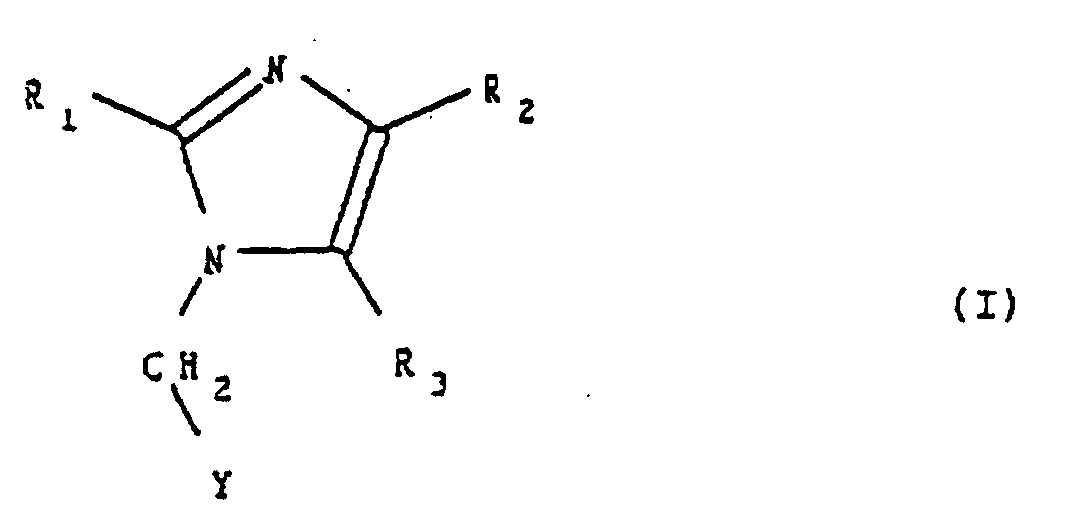 R1 represents the hydrogen atom; the alkoxy, 1,3-dioxolanyl, dioxanyl, phenyl, benzoyl and phenylthio radical in which the phenyl radical is optionally substituted by a hydroxyl radical or by an alkoxy radical including at most 4 carbon atoms,R2 and R3, which are identical or different, are chosen from halogen atoms; the carboxyl radical, which is free, salified or esterified by an alkyl radical including at most 4 carbon atoms; the formyl radical; and tetrazolyl, phenyl, phenylthio, phenylsulphonyl, phenylsulphinyl, alkyl, including at most 4 carbon atoms, alkylthio, alkylsulphonyl and alkylsulphinyl radicals, all these radicals optionally being substituted by one or more radicals chosen from halogen atoms, the hydroxyl radical, the alkoxy radical including at most 4 carbon atoms, the free, salified or esterified carboxyl radical and the phenyl radical, itself optionally substituted by a hydroxyl radical or by an alkoxy radical including at most 4 carbon atoms, and Y represents the 1,3-benzodioxolyl radical, the phenyl part of which is substituted by one or more halogen atoms, it being understood that R1 does.not represent a dioxolanyl or dioxanyl radical when R3 represents a free or esterified carboxyl radical or when R2 and R3 represent a halogen atom, the said products of formula (I) being in all the isomeric forms possible, racemic, enantiomeric and diastereoisomeric, and the addition salts with inorganic and organic acids or with inorganic and organic bases of the said products of formula (I).
 - Products of formula (I) as defined in Claim 1, in which:the said products of formula (I) being in all the isomeric forms possible, racemic, enantiomeric and diastereoisomeric, and the addition salts with inorganic and organic acids or with inorganic and organic bases of the said products of formula (I).R1 represents the hydrogen atom; the 1,3-dioxolanyl, phenyl, benzoyl and phenylthio radical in which the phenyl radical is optionally substituted by a hydroxyl radical or by an alkoxy radical including at most 4 carbon atoms,R2 represents a halogen atom, an alkylthio radical, in which the linear or branched alkyl radical, including at most 4 carbon atoms, is optionally substituted by a phenyl radical itself optionally substituted by an alkoxy radical, and the phenylthio radical, in which the phenyl radical is optionally substituted by an alkoxy radical,R3 represents a formyl radical or a free, esterified, salified or amidated carboxyl radical, andY represents a benzodioxolyl radical substituted by a halogen atom,
- The products of formula (I) corresponding to the following formulae:and their addition salts with inorganic and organic acids or with inorganic and organic bases.1-((6-chloro-1,3-benzodioxol-5-yl)methyl)-4-(((4-methoxyphenyl)methyl)thio)-2-(phenylthio)-1H-imidazole-5-carboxaldehyde4-bromo-1-((6-chloro-1,3-benzodioxol-5-yl)methyl)-2-phenyl-1H-imidazole-5-carboxylic acid1-((6-chloro-1,3-benzodioxol-5-yl)methyl)-4-(((4-methoxyphenyl)methyl)thio)-2-(phenylthio)-lH-imidazole-5-carboxylic acid1-((6-chloro-1,3-benzodioxol-5-yl)methyl)-4-((4-methoxyphenyl)thio)-2-(phenylthio)-1H-imidazole-5-carboxylic acid1-((6-chloro-1,3-benzodioxol-5-yl)methyl)-2,4-bis((4-methoxyphenyl)thio)-1H-imidazole-5-carboxylic acid1-((6-chloro-1,3-benzodioxol-5-yl)methyl)-4-((3,4-dimethoxyphenyl)thio)-2-(1,3-dioxolan-2-yl)-1H-imidazole-5-carboxylic acid,
- Process for the preparation of the products of formula (I) as defined in Claim 1, characterized in that:
either a compound of formula (II):in which R'1 has the meaning indicated in Claim 1 for R1, in which the possible reactive functional groups are optionally protected by protective groups,
is reacted with a compound of formula (III):in which Hal represents a halogen atom and Y' has the meaning indicated in Claim 1 for Y, in which the
possible reactive functional groups are optionally protected by protective groups,
to produce the product of formula (IV1):in which R'1 and Y' have the meanings indicated above, which product of formula (IV1) can be subjected to a halogenation reaction, to produce the product of formula (IV2) : in which R'1, Hal and Y' have the meanings indicated above,
or a compound of formula (VIII):in which Hal has the meaning indicated above,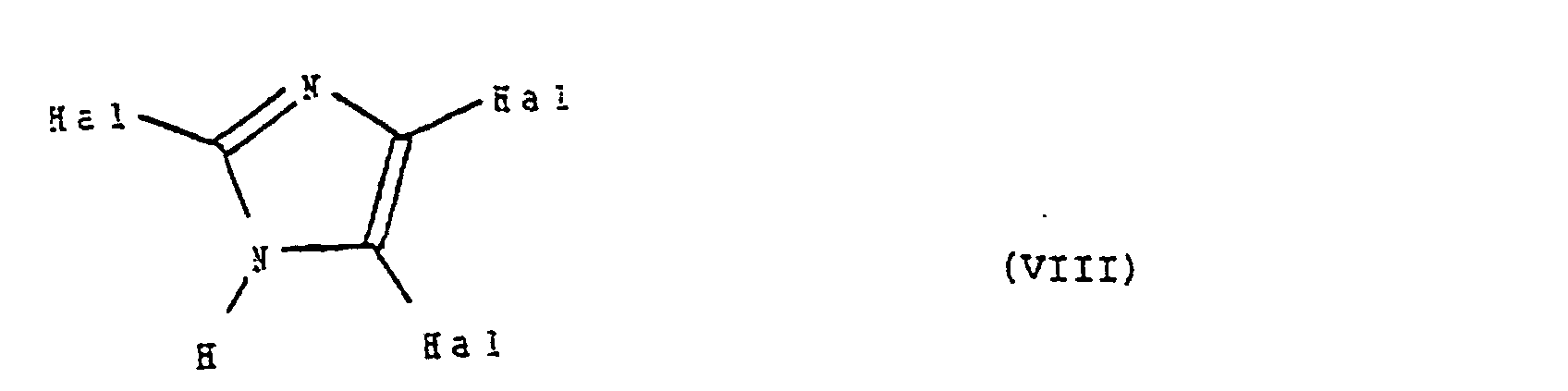
is either reacted with the compound of formula (III) as defined above or is subjected to the action of a protective group P, to produce a product of formula (IX) :in which Hal has the meaning indicated above and W represents either -CH2-Y', with Y' as defined above, or P, which represents a protective group for the nitrogen atom, which product of formula (IX) is subjected to a halogen-metal exchange reaction and is then reacted with an electrophile of formula (X), (X'), (XI), (XII) or (XII') :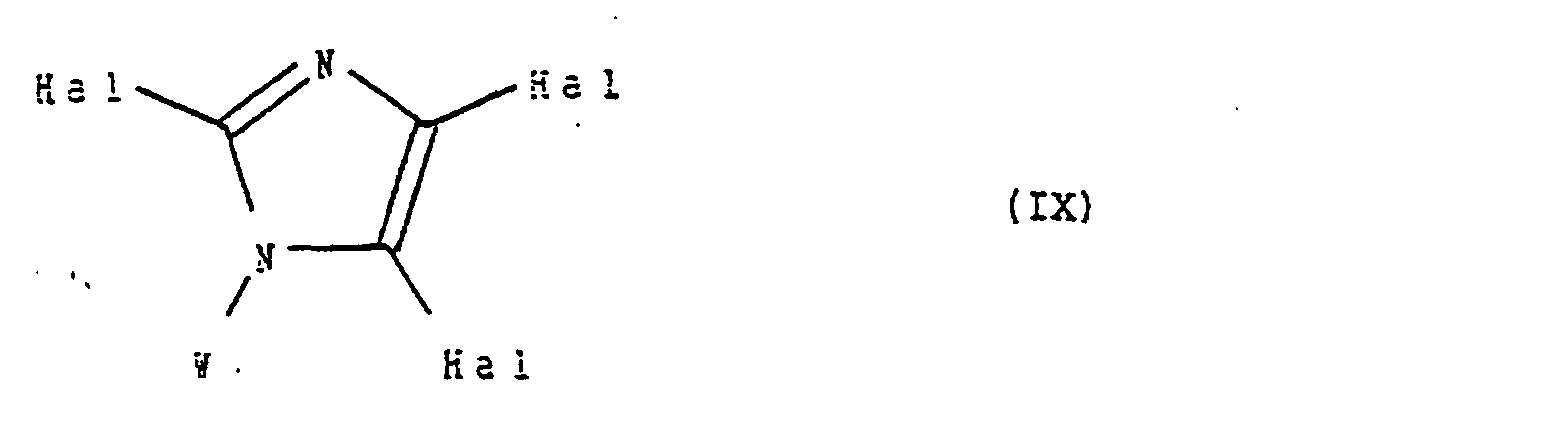 in which Hal and W have the meanings indicated above and R"1 represents an arylcarbonyl, alkylcarbonyl, arylhydroxymethyl, alkylhydroxymethyl or arylthio radical in which the aryl and alkyl radicals have. the meanings indicated above and in which the possible reactive functional groups are optionally protected by protective groups,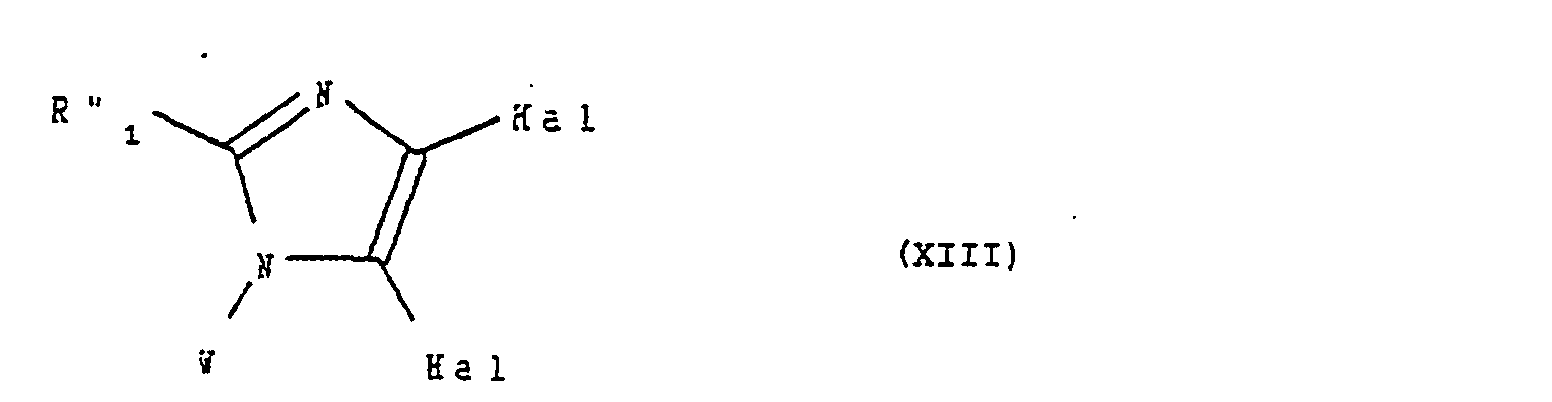
which products of formulae (IV2) and (XIII) can be subjected to a halogen-metal exchange reaction on one of the halogen atoms and can then be reacted with CO2 or DMF or an electrophilic compound of formula (Va), (Vb), (VIa), (VIb) or (VIc) :or in which Z1 represents an optionally substituted alkyl, alkenyl or aryl radical, in which formulae the possible reactive functional groups are optionally protected by protective groups, and alk represents an alkyl radical including at most 4 carbon atoms,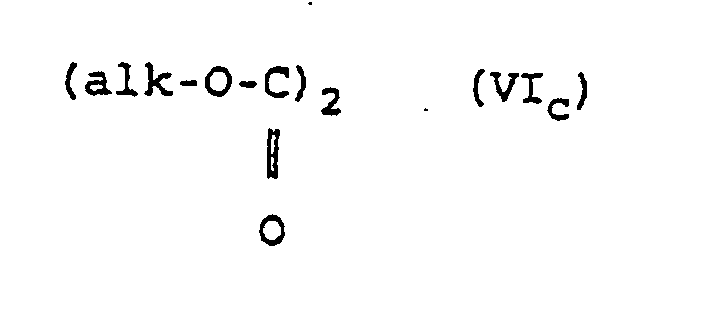
to respectively produce the compound of formula (I1):or the compound of formula (XIV): in which R'1, R"1, Hal, Y' and W have the meanings indicated above and Z3 represents the carboxyl radical, the formyl radical, the S-Z1 radical as defined above or the K-O-alk radical in which K represents the
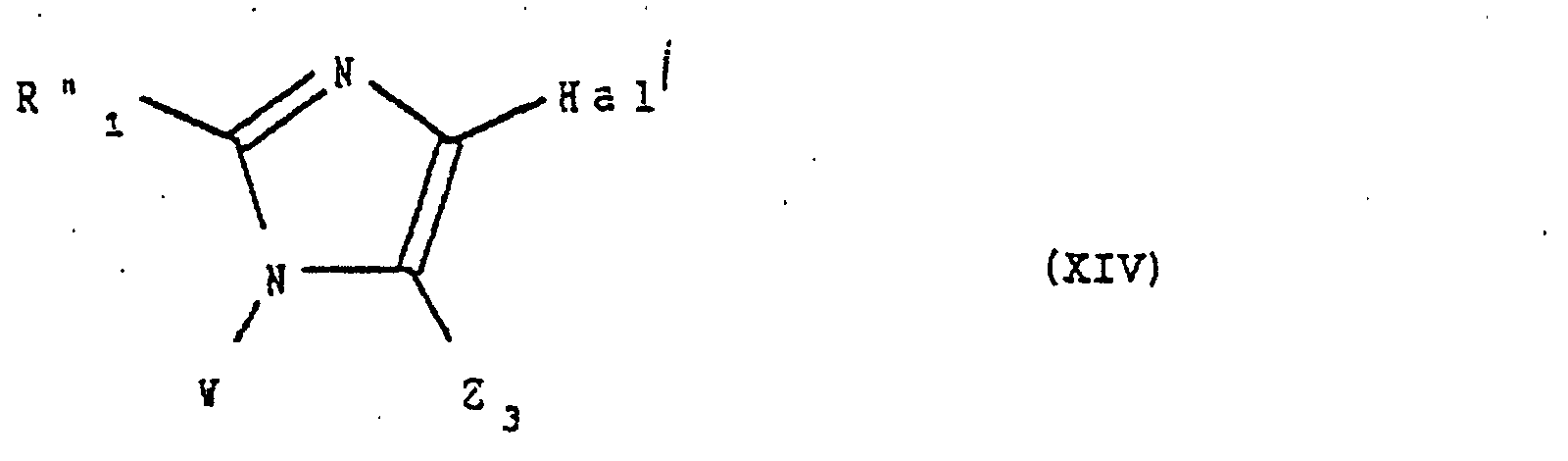 or
or radical and alk has the meaning indicated above, which compounds of formula (I1) or (XIV), when Z3 represents a formyl or esterified carboxyl radical, can be reacted with a compound of formula (VII) :
 or the compound of formula (XV):
 in which R'1, R"1, Y', Z2 and W have the meanings indicated above and Z4 represents the formyl or esterified carboxyl radical, which products of formulae (I2) and (XV), when Z4 represents the formyl radical, can be oxidized or reduced, to respectively produce a product of formula (I3) :
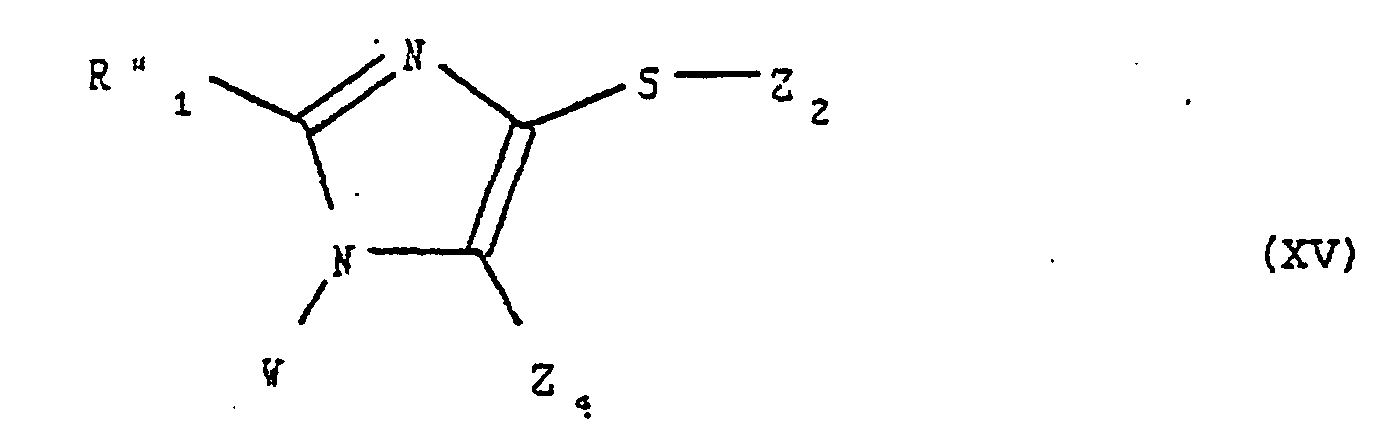 or a product of formula (I4):
 in which R'1, R"1, Z2, Y' and W have the meanings indicated above and Z5 represents the CH2OH radical or the carboxyl radical, free or esterified by a linear or branched alkyl radical including at most 6 carbon atoms, which products of formula (XV) or (I4), in the case where W represents P as defined above and after release of the amine functional group blocked by P as defined above, are reacted with the compound of formula (III) as defined above, to produce a product of formula (I5):
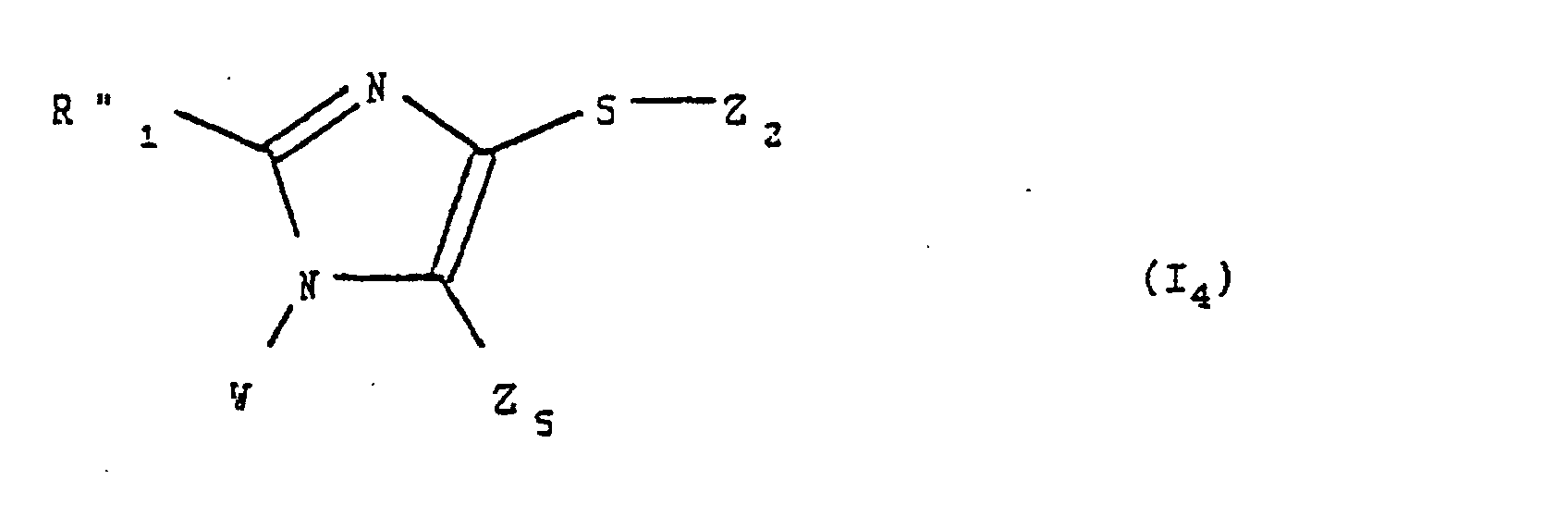 in which R"1 and Y' have the meanings indicated above and R"2 and R"3 represent, without distinction, one Z4 or Z5 as defined above and the other S-Z2 as defined above,
or a compound of formula (XVI) :in which R'1 has the meaning indicated above and R'2 and R'3 have the meanings indicated in Claim 1 respectively for R2 and R3, in which formulae the possible reactive functional groups are optionally protected by protective groups, is reacted with the compound of formula (III) as defined above, to produce a product of formula (I'):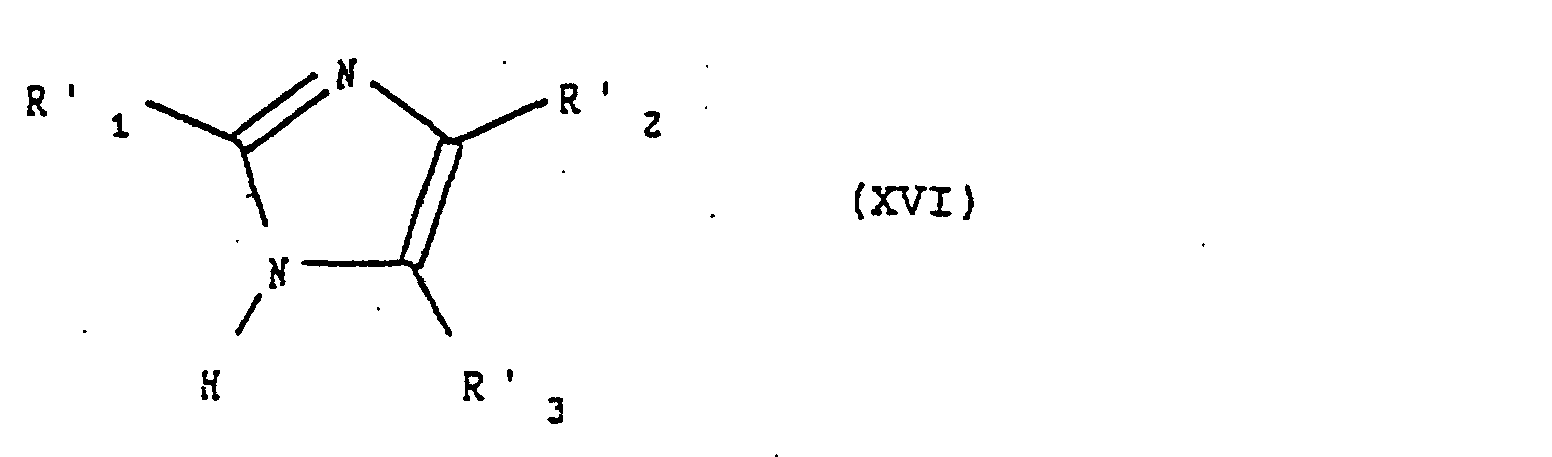 in which R'1, R'2, R'3 and Y' have the definitions indicated above,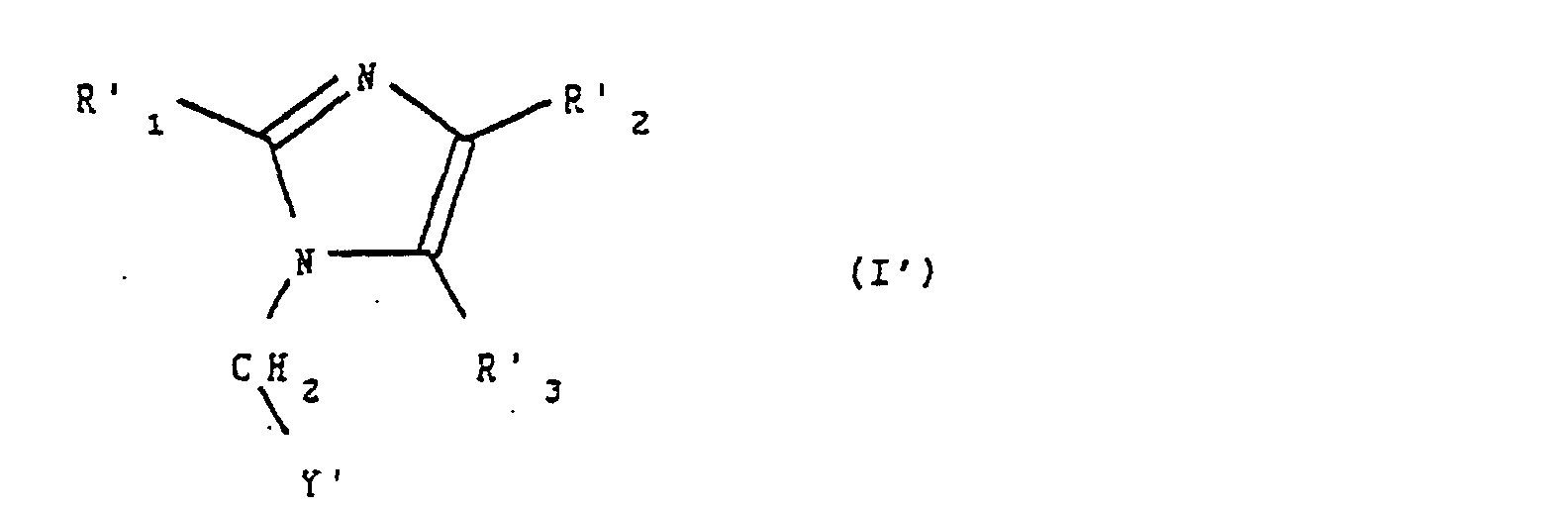
which products of formulae (I1), (I2), (I3), (I4), (XIV), (XV), (I5) and (I') can be products of formula (I) and, to produce products or other products of formula (I), can be subjected, if desired and if necessary, to one or more of the following conversion reactions, in. any order:the said products of formula (I) thus obtained being in all the isomeric forms possible, racemic, enantiomeric and diastereoisomeric.a) a reaction for esterification of an acid functional group,b) a reaction for saponification of an ester functional group to an acid functional group,c) a reaction for conversion of an ester functional group to an acyl functional group,d) a reaction for conversion of the cyano functional group to an acid functional group,e) a reaction for conversion of an acid functional group to an amide functional group and then optionally to a thioamide functional group,f) a reaction for reduction of the carboxyl functional group to an alcohol functional group,g) a reaction for conversion of an alkoxy functional group to a hydroxyl functional group or alternatively of a hydroxyl functional group to an alkoxy functional group,h) a reaction for oxidation of an alcohol functional group to an aldehyde, acid or ketone functional group,i) a reaction for conversion of the formyl radical to a carbamoyl radical,j) a reaction for conversion of the carbamoyl radical to a nitrile radical,k) a reaction for conversion of a nitrile radical to tetrazolyl,l) a reaction for oxidation of an alkylthio or arylthio group to the corresponding sulphoxide or sulphone,m) a reaction for conversion of a sulphide, sulphoxide or sulphone functional group to the corresponding sulphoximine functional group,n) a reaction for conversion of an oxo functional group to a thioxo functional group,o) a reaction for conversion of theradical to an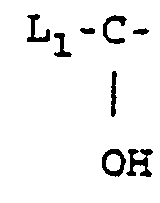 radical and then, if necessary, again to an
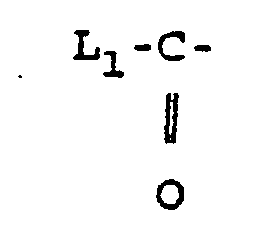 radical with L1 as defined above,
 p) a reaction for conversion of an acid functional group to a functional group
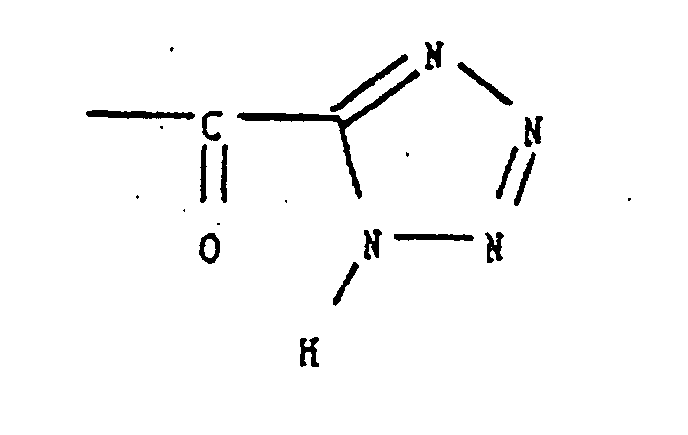 q) a reaction for conversion of the β-ketosulphoxide functional group to an α-ketothioester functional group,r) a reaction for conversion of a carbamate to a urea and in particular of a sulphonylcarbamate to a sulphonylurea,s) a reaction for removal of the protective groups which the protected reactive functional groups can carry,t) a reaction for salification by an inorganic or organic acid or by a base, to produce the corresponding salt,u) a reaction for resolution of the racemic forms to give resolved products,
 - As medicaments, the products as defined by the formula (I) of Claim 1, the said products of formula (I) being in all the isomeric forms possible, racemic, enantiomeric and diastereoisomeric, and the addition salts with pharmaceutically acceptable inorganic and organic acids or with pharmaceutically acceptable inorganic and organic bases of the said products of formula (I).
- As medicaments, the products of formula (I) as defined in Claims 2 and 3, and the addition salts with pharmaceutically acceptable inorganic and organic acids or with pharmaceutically acceptable inorganic and organic bases of the said products of formula (I).
- The pharmaceutical compositions comprising, as active principle, at least one of the medicaments as defined in either one of Claims 5 and 6.
- Use of the products of formula (I) as defined in Claim 1 in the preparation of pharmaceutical compositions intended for the treatment of conditions resulting from abnormal stimulation of endothelin receptors.
- Use of the products of formula (I) as defined in Claim 1 in the preparation of pharmaceutical compositions intended for the treatment of endothelininduced hypertension, of all vascular spasms, of cerebral post-haemorrhage, of renal insufficiency and of myocardial infarction and for the prevention of post-angioplastic restenosis.
Applications Claiming Priority (3)
| Application Number | Priority Date | Filing Date | Title |
|---|---|---|---|
| FR9409565 | 1994-08-02 | ||
| FR9409565A FR2723369B1 (en) | 1994-08-02 | 1994-08-02 | NEW IMIDAZOLE DERIVATIVES, THEIR PREPARATION PROCESS, THE NEW INTERMEDIATES OBTAINED, THEIR APPLICATION AS MEDICAMENTS AND THE PHARMACEUTICAL COMPOSITIONS CONTAINING THEM. |
| PCT/FR1995/001033 WO1996004275A1 (en) | 1994-08-02 | 1995-08-01 | Novel imidazole derivatives, method for preparing same, novel intermediates thus obtained, medicinal applications of same and pharmaceutical compositions containing same |
Publications (2)
| Publication Number | Publication Date |
|---|---|
| EP0804435A1 EP0804435A1 (en) | 1997-11-05 |
| EP0804435B1 true EP0804435B1 (en) | 2004-03-10 |
Family
ID=9465985
Family Applications (1)
| Application Number | Title | Priority Date | Filing Date |
|---|---|---|---|
| EP95927003A Expired - Lifetime EP0804435B1 (en) | 1994-08-02 | 1995-08-01 | Novel imidazole derivatives, method for preparing same, novel intermediates thus obtained, medicinal applications of same and pharmaceutical compositions containing same |
Country Status (18)
| Country | Link |
|---|---|
| US (1) | US5856509A (en) |
| EP (1) | EP0804435B1 (en) |
| JP (1) | JP3950475B2 (en) |
| CN (1) | CN1083838C (en) |
| AT (1) | ATE261442T1 (en) |
| AU (1) | AU703078B2 (en) |
| BR (1) | BR9508482A (en) |
| CA (1) | CA2196219A1 (en) |
| DE (1) | DE69532684T2 (en) |
| ES (1) | ES2214504T3 (en) |
| FI (1) | FI970423L (en) |
| FR (1) | FR2723369B1 (en) |
| HU (1) | HU221463B (en) |
| IL (1) | IL114663A0 (en) |
| MX (1) | MX9700820A (en) |
| RU (1) | RU2171257C2 (en) |
| WO (1) | WO1996004275A1 (en) |
| ZA (1) | ZA956450B (en) |
Families Citing this family (4)
| Publication number | Priority date | Publication date | Assignee | Title |
|---|---|---|---|---|
| FR2740774B1 (en) * | 1995-11-08 | 1997-12-19 | Roussel Uclaf | NOVEL IMIDAZOLE N-BENZYLDIOXOLE DERIVATIVES, PROCESS FOR THEIR PREPARATION, THEIR USE AS MEDICAMENTS, PHARMACEUTICAL COMPOSITIONS AND NEW USE |
| CA2291710A1 (en) * | 1997-05-22 | 1998-11-26 | Tatsuya Tamaoki | Bisaryl compounds and cancer remedies containing the same |
| SE0401653D0 (en) * | 2004-06-24 | 2004-06-24 | Astrazeneca Ab | New compounds |
| EP2095819A1 (en) * | 2008-02-28 | 2009-09-02 | Maastricht University | N-benzyl imidazole derivatives and their use as aldosterone synthase inhibitors |
Family Cites Families (2)
| Publication number | Priority date | Publication date | Assignee | Title |
|---|---|---|---|---|
| DE2862340D1 (en) * | 1978-02-01 | 1983-11-24 | Wellcome Found | Imidazole derivatives and salts thereof, their synthesis, and pharmaceutical formulations thereof |
| EP0650484B1 (en) * | 1992-07-17 | 2000-01-26 | Smithkline Beecham Corporation | Endothelin receptor antagonists |
-
1994
- 1994-08-02 FR FR9409565A patent/FR2723369B1/en not_active Expired - Fee Related
-
1995
- 1995-07-19 IL IL11466395A patent/IL114663A0/en unknown
- 1995-08-01 HU HU9700294A patent/HU221463B/en not_active IP Right Cessation
- 1995-08-01 AT AT95927003T patent/ATE261442T1/en not_active IP Right Cessation
- 1995-08-01 DE DE69532684T patent/DE69532684T2/en not_active Expired - Fee Related
- 1995-08-01 MX MX9700820A patent/MX9700820A/en unknown
- 1995-08-01 WO PCT/FR1995/001033 patent/WO1996004275A1/en not_active Ceased
- 1995-08-01 CA CA002196219A patent/CA2196219A1/en not_active Abandoned
- 1995-08-01 BR BR9508482A patent/BR9508482A/en unknown
- 1995-08-01 CN CN95195444A patent/CN1083838C/en not_active Expired - Fee Related
- 1995-08-01 FI FI970423A patent/FI970423L/en unknown
- 1995-08-01 AU AU31178/95A patent/AU703078B2/en not_active Ceased
- 1995-08-01 RU RU97103195/04A patent/RU2171257C2/en not_active IP Right Cessation
- 1995-08-01 EP EP95927003A patent/EP0804435B1/en not_active Expired - Lifetime
- 1995-08-01 JP JP50626096A patent/JP3950475B2/en not_active Expired - Fee Related
- 1995-08-01 US US08/776,954 patent/US5856509A/en not_active Expired - Fee Related
- 1995-08-01 ES ES95927003T patent/ES2214504T3/en not_active Expired - Lifetime
- 1995-08-02 ZA ZA956450A patent/ZA956450B/en unknown
Also Published As
| Publication number | Publication date |
|---|---|
| AU703078B2 (en) | 1999-03-11 |
| DE69532684T2 (en) | 2004-07-29 |
| ATE261442T1 (en) | 2004-03-15 |
| RU2171257C2 (en) | 2001-07-27 |
| HU221463B (en) | 2002-10-28 |
| JP3950475B2 (en) | 2007-08-01 |
| IL114663A0 (en) | 1995-11-27 |
| US5856509A (en) | 1999-01-05 |
| FI970423A7 (en) | 1997-04-01 |
| FI970423L (en) | 1997-04-01 |
| ZA956450B (en) | 1996-08-05 |
| BR9508482A (en) | 1999-06-01 |
| MX9700820A (en) | 1997-05-31 |
| WO1996004275A1 (en) | 1996-02-15 |
| EP0804435A1 (en) | 1997-11-05 |
| JPH10503512A (en) | 1998-03-31 |
| ES2214504T3 (en) | 2004-09-16 |
| CN1159805A (en) | 1997-09-17 |
| CA2196219A1 (en) | 1996-02-15 |
| AU3117895A (en) | 1996-03-04 |
| FI970423A0 (en) | 1997-01-31 |
| DE69532684D1 (en) | 2004-04-22 |
| HUT76838A (en) | 1997-11-28 |
| FR2723369B1 (en) | 1996-09-13 |
| FR2723369A1 (en) | 1996-02-09 |
| CN1083838C (en) | 2002-05-01 |
Similar Documents
| Publication | Publication Date | Title |
|---|---|---|
| EP0465368B1 (en) | Sulfur derivatives of imidazole, process for their preparation, intermediates, their use as medicaments, and pharmaceutical compositions containing them | |
| EP0461040A1 (en) | Imidazol derivatives, their process for production, intermediates, their application as medicaments and the pharmaceutical compositions containing them | |
| EP0748315A1 (en) | Use of imidazole derivatives for treating disorders involving angiotensin receptors at 1? and at 2?, certain such products, preparation thereof, use thereof as drugs, and pharmaceutical compositions containing same | |
| EP0515265A1 (en) | Pyrimidin derivates, process for their preparation, the obtained intermediates, their use as medicines and the pharmaceutical compositions containing them | |
| EP0748314B1 (en) | Tetrasubstituted imidazole derivatives, method for preparing the same, use thereof as drugs, and pharmaceutical compositions containing the same | |
| FR2724654A1 (en) | NOVEL DERIVATIVES OF GALLIC ACID, PROCESS FOR THE PREPARATION THEREOF, THE NEW INTERMEDIATES OBTAINED, THEIR APPLICATION AS MEDICAMENTS AND THE PHARMACEUTICAL COMPOSITIONS COMPRISING THEM | |
| WO1996012706A1 (en) | Novel acid pyrazole and pyrazolone derivatives for use as endothelin receptor antagonists | |
| EP0644188B1 (en) | Process for the preparation of sulfur derivatives of imidazole and intermediates obtained | |
| EP0648763B1 (en) | Process for the preparation of sulfur derivatives of imidazole and intermediates obtained | |
| EP0861247B1 (en) | Novel imidazole n-benzyldioxol derivatives, method for preparing same, resulting intermediates, pharmaceutical compositions and use of said derivatives as endothelin antagonists | |
| EP0858459B1 (en) | Novel acid pyrazole derivatives, preparation method therefor, use thereof as drugs, novel use therefor, and pharmaceutical compositions containing such derivatives | |
| EP0776325B1 (en) | Novel use and novel derivatives of imidazole, method for preparing same, novel intermediates thus obtained, medicinal applications of same and pharmaceutical compositions containing same | |
| WO1996004275A1 (en) | Novel imidazole derivatives, method for preparing same, novel intermediates thus obtained, medicinal applications of same and pharmaceutical compositions containing same | |
| EP0863896B1 (en) | Novel imidazole derivatives, method for preparing same, pharmaceutical compositions and use of said derivatives as endothelin antagonists | |
| WO1996033190A1 (en) | Quinoline derivatives, process for their preparation, the resultant intermediates, their use as medicaments and the pharmaceutical compositions containing them | |
| EP0638572B1 (en) | Bicyclic derivatives of imidazole, process for their preparation, intermediates; their application as medicaments and pharmaceutical compostions containing them | |
| FR2664271A1 (en) | New sulphur-containing imidazole derivatives, process for their preparation, the new intermediates obtained, their application as medicaments and the pharmaceutical compositions containing them | |
| FR2675503A1 (en) | New sulphur-containing imidazole derivatives, process for their preparation, the new intermediates obtained, their application as medicaments and the pharmaceutical compositions containing them |
Legal Events
| Date | Code | Title | Description |
|---|---|---|---|
| PUAI | Public reference made under article 153(3) epc to a published international application that has entered the european phase |
Free format text: ORIGINAL CODE: 0009012 |
|
| 17P | Request for examination filed |
Effective date: 19970303 |
|
| AK | Designated contracting states |
Kind code of ref document: A1 Designated state(s): AT BE CH DE DK ES FR GB GR IE IT LI LU NL PT SE |
|
| RAP1 | Party data changed (applicant data changed or rights of an application transferred) |
Owner name: HOECHST MARION ROUSSEL |
|
| 17Q | First examination report despatched |
Effective date: 19981109 |
|
| RAP1 | Party data changed (applicant data changed or rights of an application transferred) |
Owner name: AVENTIS PHARMA S.A. |
|
| REG | Reference to a national code |
Ref country code: GB Ref legal event code: FG4D Free format text: NOT ENGLISH |
|
| GRAP | Despatch of communication of intention to grant a patent |
Free format text: ORIGINAL CODE: EPIDOSNIGR1 |
|
| GRAS | Grant fee paid |
Free format text: ORIGINAL CODE: EPIDOSNIGR3 |
|
| GRAA | (expected) grant |
Free format text: ORIGINAL CODE: 0009210 |
|
| AK | Designated contracting states |
Kind code of ref document: B1 Designated state(s): AT BE CH DE DK ES FR GB GR IE IT LI LU NL PT SE |
|
| PG25 | Lapsed in a contracting state [announced via postgrant information from national office to epo] |
Ref country code: NL Free format text: LAPSE BECAUSE OF FAILURE TO SUBMIT A TRANSLATION OF THE DESCRIPTION OR TO PAY THE FEE WITHIN THE PRESCRIBED TIME-LIMIT Effective date: 20040310 Ref country code: IE Free format text: LAPSE BECAUSE OF FAILURE TO SUBMIT A TRANSLATION OF THE DESCRIPTION OR TO PAY THE FEE WITHIN THE PRESCRIBED TIME-LIMIT Effective date: 20040310 Ref country code: AT Free format text: LAPSE BECAUSE OF FAILURE TO SUBMIT A TRANSLATION OF THE DESCRIPTION OR TO PAY THE FEE WITHIN THE PRESCRIBED TIME-LIMIT Effective date: 20040310 |
|
| REG | Reference to a national code |
Ref country code: CH Ref legal event code: EP |
|
| GBT | Gb: translation of ep patent filed (gb section 77(6)(a)/1977) |
Effective date: 20040310 |
|
| REG | Reference to a national code |
Ref country code: IE Ref legal event code: FG4D Free format text: FRENCH |
|
| REF | Corresponds to: |
Ref document number: 69532684 Country of ref document: DE Date of ref document: 20040422 Kind code of ref document: P |
|
| PG25 | Lapsed in a contracting state [announced via postgrant information from national office to epo] |
Ref country code: SE Free format text: LAPSE BECAUSE OF FAILURE TO SUBMIT A TRANSLATION OF THE DESCRIPTION OR TO PAY THE FEE WITHIN THE PRESCRIBED TIME-LIMIT Effective date: 20040610 Ref country code: GR Free format text: LAPSE BECAUSE OF FAILURE TO SUBMIT A TRANSLATION OF THE DESCRIPTION OR TO PAY THE FEE WITHIN THE PRESCRIBED TIME-LIMIT Effective date: 20040610 Ref country code: DK Free format text: LAPSE BECAUSE OF FAILURE TO SUBMIT A TRANSLATION OF THE DESCRIPTION OR TO PAY THE FEE WITHIN THE PRESCRIBED TIME-LIMIT Effective date: 20040610 |
|
| PG25 | Lapsed in a contracting state [announced via postgrant information from national office to epo] |
Ref country code: LU Free format text: LAPSE BECAUSE OF NON-PAYMENT OF DUE FEES Effective date: 20040801 |
|
| PG25 | Lapsed in a contracting state [announced via postgrant information from national office to epo] |
Ref country code: LI Free format text: LAPSE BECAUSE OF NON-PAYMENT OF DUE FEES Effective date: 20040831 Ref country code: CH Free format text: LAPSE BECAUSE OF NON-PAYMENT OF DUE FEES Effective date: 20040831 Ref country code: BE Free format text: LAPSE BECAUSE OF NON-PAYMENT OF DUE FEES Effective date: 20040831 |
|
| NLV1 | Nl: lapsed or annulled due to failure to fulfill the requirements of art. 29p and 29m of the patents act | ||
| REG | Reference to a national code |
Ref country code: ES Ref legal event code: FG2A Ref document number: 2214504 Country of ref document: ES Kind code of ref document: T3 |
|
| REG | Reference to a national code |
Ref country code: IE Ref legal event code: FD4D |
|
| PLBE | No opposition filed within time limit |
Free format text: ORIGINAL CODE: 0009261 |
|
| STAA | Information on the status of an ep patent application or granted ep patent |
Free format text: STATUS: NO OPPOSITION FILED WITHIN TIME LIMIT |
|
| BERE | Be: lapsed |
Owner name: S.A. *AVENTIS PHARMA Effective date: 20040831 |
|
| 26N | No opposition filed |
Effective date: 20041213 |
|
| REG | Reference to a national code |
Ref country code: CH Ref legal event code: PL |
|
| PGFP | Annual fee paid to national office [announced via postgrant information from national office to epo] |
Ref country code: DE Payment date: 20070726 Year of fee payment: 13 |
|
| PGFP | Annual fee paid to national office [announced via postgrant information from national office to epo] |
Ref country code: ES Payment date: 20070926 Year of fee payment: 13 |
|
| BERE | Be: lapsed |
Owner name: S.A. *AVENTIS PHARMA Effective date: 20040831 |
|
| PG25 | Lapsed in a contracting state [announced via postgrant information from national office to epo] |
Ref country code: PT Free format text: LAPSE BECAUSE OF NON-PAYMENT OF DUE FEES Effective date: 20040810 |
|
| PGFP | Annual fee paid to national office [announced via postgrant information from national office to epo] |
Ref country code: GB Payment date: 20070801 Year of fee payment: 13 |
|
| PGFP | Annual fee paid to national office [announced via postgrant information from national office to epo] |
Ref country code: IT Payment date: 20070828 Year of fee payment: 13 |
|
| PGFP | Annual fee paid to national office [announced via postgrant information from national office to epo] |
Ref country code: FR Payment date: 20070808 Year of fee payment: 13 |
|
| GBPC | Gb: european patent ceased through non-payment of renewal fee |
Effective date: 20080801 |
|
| REG | Reference to a national code |
Ref country code: FR Ref legal event code: ST Effective date: 20090430 |
|
| PG25 | Lapsed in a contracting state [announced via postgrant information from national office to epo] |
Ref country code: IT Free format text: LAPSE BECAUSE OF NON-PAYMENT OF DUE FEES Effective date: 20080801 Ref country code: FR Free format text: LAPSE BECAUSE OF NON-PAYMENT OF DUE FEES Effective date: 20080901 Ref country code: DE Free format text: LAPSE BECAUSE OF NON-PAYMENT OF DUE FEES Effective date: 20090303 |
|
| REG | Reference to a national code |
Ref country code: ES Ref legal event code: FD2A Effective date: 20080802 |
|
| PG25 | Lapsed in a contracting state [announced via postgrant information from national office to epo] |
Ref country code: GB Free format text: LAPSE BECAUSE OF NON-PAYMENT OF DUE FEES Effective date: 20080801 |
|
| PG25 | Lapsed in a contracting state [announced via postgrant information from national office to epo] |
Ref country code: ES Free format text: LAPSE BECAUSE OF NON-PAYMENT OF DUE FEES Effective date: 20080802 |