EP0803565B1 - Neue kolloidale Produkte, ihre Herstellung und ihre Verwendung - Google Patents
Neue kolloidale Produkte, ihre Herstellung und ihre Verwendung Download PDFInfo
- Publication number
- EP0803565B1 EP0803565B1 EP97400872A EP97400872A EP0803565B1 EP 0803565 B1 EP0803565 B1 EP 0803565B1 EP 97400872 A EP97400872 A EP 97400872A EP 97400872 A EP97400872 A EP 97400872A EP 0803565 B1 EP0803565 B1 EP 0803565B1
- Authority
- EP
- European Patent Office
- Prior art keywords
- alkaline
- alkane
- dithiophosphoryl
- dihydrocarbyl
- contains hydrocarbon
- Prior art date
- Legal status (The legal status is an assumption and is not a legal conclusion. Google has not performed a legal analysis and makes no representation as to the accuracy of the status listed.)
- Expired - Lifetime
Links
- 238000002360 preparation method Methods 0.000 title claims description 7
- 239000004215 Carbon black (E152) Substances 0.000 claims description 22
- 229930195733 hydrocarbon Natural products 0.000 claims description 22
- 150000002430 hydrocarbons Chemical class 0.000 claims description 20
- 239000002253 acid Substances 0.000 claims description 19
- 150000003839 salts Chemical class 0.000 claims description 17
- 239000002904 solvent Substances 0.000 claims description 16
- XLYOFNOQVPJJNP-UHFFFAOYSA-M hydroxide Chemical compound [OH-] XLYOFNOQVPJJNP-UHFFFAOYSA-M 0.000 claims description 14
- 229910052784 alkaline earth metal Inorganic materials 0.000 claims description 13
- CURLTUGMZLYLDI-UHFFFAOYSA-N Carbon dioxide Chemical compound O=C=O CURLTUGMZLYLDI-UHFFFAOYSA-N 0.000 claims description 12
- KWYUFKZDYYNOTN-UHFFFAOYSA-M Potassium hydroxide Chemical compound [OH-].[K+] KWYUFKZDYYNOTN-UHFFFAOYSA-M 0.000 claims description 12
- 239000004094 surface-active agent Substances 0.000 claims description 10
- OAICVXFJPJFONN-UHFFFAOYSA-N Phosphorus Chemical compound [P] OAICVXFJPJFONN-UHFFFAOYSA-N 0.000 claims description 8
- -1 alkaline-earth metal carbonate Chemical class 0.000 claims description 8
- 238000006243 chemical reaction Methods 0.000 claims description 8
- NINIDFKCEFEMDL-UHFFFAOYSA-N Sulfur Chemical compound [S] NINIDFKCEFEMDL-UHFFFAOYSA-N 0.000 claims description 7
- 125000001931 aliphatic group Chemical group 0.000 claims description 7
- 229910052500 inorganic mineral Inorganic materials 0.000 claims description 7
- 235000010755 mineral Nutrition 0.000 claims description 7
- 239000000203 mixture Substances 0.000 claims description 7
- 239000011574 phosphorus Substances 0.000 claims description 7
- 229910052698 phosphorus Inorganic materials 0.000 claims description 7
- 229910052717 sulfur Inorganic materials 0.000 claims description 7
- 150000001342 alkaline earth metals Chemical class 0.000 claims description 6
- 239000011575 calcium Substances 0.000 claims description 6
- 239000007788 liquid Substances 0.000 claims description 6
- 230000001050 lubricating effect Effects 0.000 claims description 6
- 239000011707 mineral Substances 0.000 claims description 6
- 239000011593 sulfur Substances 0.000 claims description 6
- 239000000725 suspension Substances 0.000 claims description 6
- ZLMJMSJWJFRBEC-UHFFFAOYSA-N Potassium Chemical compound [K] ZLMJMSJWJFRBEC-UHFFFAOYSA-N 0.000 claims description 5
- 150000001875 compounds Chemical class 0.000 claims description 5
- 239000011591 potassium Substances 0.000 claims description 5
- 229910052700 potassium Inorganic materials 0.000 claims description 5
- OYPRJOBELJOOCE-UHFFFAOYSA-N Calcium Chemical compound [Ca] OYPRJOBELJOOCE-UHFFFAOYSA-N 0.000 claims description 4
- 239000000654 additive Substances 0.000 claims description 4
- 229910052791 calcium Inorganic materials 0.000 claims description 4
- 238000010908 decantation Methods 0.000 claims description 4
- 229940072033 potash Drugs 0.000 claims description 3
- BWHMMNNQKKPAPP-UHFFFAOYSA-L potassium carbonate Substances [K+].[K+].[O-]C([O-])=O BWHMMNNQKKPAPP-UHFFFAOYSA-L 0.000 claims description 3
- 235000015320 potassium carbonate Nutrition 0.000 claims description 3
- DGAQECJNVWCQMB-PUAWFVPOSA-M Ilexoside XXIX Chemical compound C[C@@H]1CC[C@@]2(CC[C@@]3(C(=CC[C@H]4[C@]3(CC[C@@H]5[C@@]4(CC[C@@H](C5(C)C)OS(=O)(=O)[O-])C)C)[C@@H]2[C@]1(C)O)C)C(=O)O[C@H]6[C@@H]([C@H]([C@@H]([C@H](O6)CO)O)O)O.[Na+] DGAQECJNVWCQMB-PUAWFVPOSA-M 0.000 claims description 2
- FYYHWMGAXLPEAU-UHFFFAOYSA-N Magnesium Chemical compound [Mg] FYYHWMGAXLPEAU-UHFFFAOYSA-N 0.000 claims description 2
- 229910052788 barium Inorganic materials 0.000 claims description 2
- DSAJWYNOEDNPEQ-UHFFFAOYSA-N barium atom Chemical compound [Ba] DSAJWYNOEDNPEQ-UHFFFAOYSA-N 0.000 claims description 2
- 239000003153 chemical reaction reagent Substances 0.000 claims description 2
- 239000011777 magnesium Substances 0.000 claims description 2
- 229910052749 magnesium Inorganic materials 0.000 claims description 2
- 239000002245 particle Substances 0.000 claims description 2
- 239000011734 sodium Substances 0.000 claims description 2
- 229910052708 sodium Inorganic materials 0.000 claims description 2
- 239000003849 aromatic solvent Substances 0.000 claims 3
- 230000000996 additive effect Effects 0.000 claims 1
- 229960004424 carbon dioxide Drugs 0.000 claims 1
- 235000011089 carbon dioxide Nutrition 0.000 claims 1
- 238000007865 diluting Methods 0.000 claims 1
- 239000000047 product Substances 0.000 description 22
- OKKJLVBELUTLKV-UHFFFAOYSA-N Methanol Chemical compound OC OKKJLVBELUTLKV-UHFFFAOYSA-N 0.000 description 18
- YXFVVABEGXRONW-UHFFFAOYSA-N Toluene Chemical compound CC1=CC=CC=C1 YXFVVABEGXRONW-UHFFFAOYSA-N 0.000 description 15
- 239000003921 oil Substances 0.000 description 11
- WEVYAHXRMPXWCK-UHFFFAOYSA-N Acetonitrile Chemical compound CC#N WEVYAHXRMPXWCK-UHFFFAOYSA-N 0.000 description 9
- 239000003513 alkali Substances 0.000 description 9
- HEDRZPFGACZZDS-UHFFFAOYSA-N Chloroform Chemical compound ClC(Cl)Cl HEDRZPFGACZZDS-UHFFFAOYSA-N 0.000 description 8
- 150000007513 acids Chemical class 0.000 description 7
- 238000001704 evaporation Methods 0.000 description 7
- 230000008020 evaporation Effects 0.000 description 7
- VTYYLEPIZMXCLO-UHFFFAOYSA-L Calcium carbonate Chemical compound [Ca+2].[O-]C([O-])=O VTYYLEPIZMXCLO-UHFFFAOYSA-L 0.000 description 6
- IMNFDUFMRHMDMM-UHFFFAOYSA-N N-Heptane Chemical compound CCCCCCC IMNFDUFMRHMDMM-UHFFFAOYSA-N 0.000 description 6
- 229910000287 alkaline earth metal oxide Inorganic materials 0.000 description 6
- LFQSCWFLJHTTHZ-UHFFFAOYSA-N Ethanol Chemical compound CCO LFQSCWFLJHTTHZ-UHFFFAOYSA-N 0.000 description 5
- 229910052783 alkali metal Inorganic materials 0.000 description 5
- 239000001569 carbon dioxide Substances 0.000 description 5
- 229910002092 carbon dioxide Inorganic materials 0.000 description 5
- 230000007935 neutral effect Effects 0.000 description 5
- 238000010992 reflux Methods 0.000 description 5
- 230000001476 alcoholic effect Effects 0.000 description 4
- 239000003599 detergent Substances 0.000 description 4
- 238000010790 dilution Methods 0.000 description 4
- 239000012895 dilution Substances 0.000 description 4
- 238000000034 method Methods 0.000 description 4
- 229910052760 oxygen Inorganic materials 0.000 description 4
- 150000008053 sultones Chemical class 0.000 description 4
- 229910001854 alkali hydroxide Inorganic materials 0.000 description 3
- 239000002585 base Substances 0.000 description 3
- 229910000019 calcium carbonate Inorganic materials 0.000 description 3
- 125000004432 carbon atom Chemical group C* 0.000 description 3
- 238000001914 filtration Methods 0.000 description 3
- 239000000463 material Substances 0.000 description 3
- 239000002480 mineral oil Substances 0.000 description 3
- 235000010446 mineral oil Nutrition 0.000 description 3
- 239000003960 organic solvent Substances 0.000 description 3
- CYQAYERJWZKYML-UHFFFAOYSA-N phosphorus pentasulfide Chemical compound S1P(S2)(=S)SP3(=S)SP1(=S)SP2(=S)S3 CYQAYERJWZKYML-UHFFFAOYSA-N 0.000 description 3
- 239000003495 polar organic solvent Substances 0.000 description 3
- 239000000243 solution Substances 0.000 description 3
- 238000003756 stirring Methods 0.000 description 3
- 235000008733 Citrus aurantifolia Nutrition 0.000 description 2
- XDTMQSROBMDMFD-UHFFFAOYSA-N Cyclohexane Chemical compound C1CCCCC1 XDTMQSROBMDMFD-UHFFFAOYSA-N 0.000 description 2
- RWSOTUBLDIXVET-UHFFFAOYSA-N Dihydrogen sulfide Chemical class S RWSOTUBLDIXVET-UHFFFAOYSA-N 0.000 description 2
- VEXZGXHMUGYJMC-UHFFFAOYSA-N Hydrochloric acid Chemical compound Cl VEXZGXHMUGYJMC-UHFFFAOYSA-N 0.000 description 2
- ISWSIDIOOBJBQZ-UHFFFAOYSA-N Phenol Chemical compound OC1=CC=CC=C1 ISWSIDIOOBJBQZ-UHFFFAOYSA-N 0.000 description 2
- 235000011941 Tilia x europaea Nutrition 0.000 description 2
- 229910000272 alkali metal oxide Inorganic materials 0.000 description 2
- 150000001340 alkali metals Chemical class 0.000 description 2
- 125000003118 aryl group Chemical group 0.000 description 2
- 125000004429 atom Chemical group 0.000 description 2
- 230000015572 biosynthetic process Effects 0.000 description 2
- 238000000502 dialysis Methods 0.000 description 2
- LQZZUXJYWNFBMV-UHFFFAOYSA-N dodecan-1-ol Chemical compound CCCCCCCCCCCCO LQZZUXJYWNFBMV-UHFFFAOYSA-N 0.000 description 2
- 230000008030 elimination Effects 0.000 description 2
- 238000003379 elimination reaction Methods 0.000 description 2
- 239000012530 fluid Substances 0.000 description 2
- 239000007789 gas Substances 0.000 description 2
- 239000012208 gear oil Substances 0.000 description 2
- 239000004816 latex Substances 0.000 description 2
- 229920000126 latex Polymers 0.000 description 2
- 239000004571 lime Substances 0.000 description 2
- 239000012528 membrane Substances 0.000 description 2
- 238000005555 metalworking Methods 0.000 description 2
- 239000010705 motor oil Substances 0.000 description 2
- MHYFEEDKONKGEB-UHFFFAOYSA-N oxathiane 2,2-dioxide Chemical compound O=S1(=O)CCCCO1 MHYFEEDKONKGEB-UHFFFAOYSA-N 0.000 description 2
- 239000012429 reaction media Substances 0.000 description 2
- 239000007787 solid Substances 0.000 description 2
- BDHFUVZGWQCTTF-UHFFFAOYSA-M sulfonate Chemical compound [O-]S(=O)=O BDHFUVZGWQCTTF-UHFFFAOYSA-M 0.000 description 2
- 238000003786 synthesis reaction Methods 0.000 description 2
- FSSPGSAQUIYDCN-UHFFFAOYSA-N 1,3-Propane sultone Chemical compound O=S1(=O)CCCO1 FSSPGSAQUIYDCN-UHFFFAOYSA-N 0.000 description 1
- LSNNMFCWUKXFEE-UHFFFAOYSA-M Bisulfite Chemical compound OS([O-])=O LSNNMFCWUKXFEE-UHFFFAOYSA-M 0.000 description 1
- BVKZGUZCCUSVTD-UHFFFAOYSA-L Carbonate Chemical compound [O-]C([O-])=O BVKZGUZCCUSVTD-UHFFFAOYSA-L 0.000 description 1
- SNRUBQQJIBEYMU-UHFFFAOYSA-N Dodecane Natural products CCCCCCCCCCCC SNRUBQQJIBEYMU-UHFFFAOYSA-N 0.000 description 1
- 239000005069 Extreme pressure additive Substances 0.000 description 1
- AUALQMFGWLZREY-UHFFFAOYSA-N acetonitrile;methanol Chemical compound OC.CC#N AUALQMFGWLZREY-UHFFFAOYSA-N 0.000 description 1
- 239000004480 active ingredient Substances 0.000 description 1
- 239000011149 active material Substances 0.000 description 1
- 229910001860 alkaline earth metal hydroxide Inorganic materials 0.000 description 1
- 125000000217 alkyl group Chemical group 0.000 description 1
- 239000007866 anti-wear additive Substances 0.000 description 1
- 230000003078 antioxidant effect Effects 0.000 description 1
- 150000004945 aromatic hydrocarbons Chemical class 0.000 description 1
- QDHFHIQKOVNCNC-UHFFFAOYSA-N butane-1-sulfonic acid Chemical compound CCCCS(O)(=O)=O QDHFHIQKOVNCNC-UHFFFAOYSA-N 0.000 description 1
- 150000004649 carbonic acid derivatives Chemical class 0.000 description 1
- 238000012512 characterization method Methods 0.000 description 1
- 239000007795 chemical reaction product Substances 0.000 description 1
- 230000000052 comparative effect Effects 0.000 description 1
- 238000001816 cooling Methods 0.000 description 1
- 125000003438 dodecyl group Chemical group [H]C([H])([H])C([H])([H])C([H])([H])C([H])([H])C([H])([H])C([H])([H])C([H])([H])C([H])([H])C([H])([H])C([H])([H])C([H])([H])C([H])([H])* 0.000 description 1
- 150000002148 esters Chemical class 0.000 description 1
- 238000011156 evaluation Methods 0.000 description 1
- 238000010438 heat treatment Methods 0.000 description 1
- 125000004435 hydrogen atom Chemical group [H]* 0.000 description 1
- 229910000037 hydrogen sulfide Inorganic materials 0.000 description 1
- 150000004679 hydroxides Chemical class 0.000 description 1
- 238000011065 in-situ storage Methods 0.000 description 1
- 239000012263 liquid product Substances 0.000 description 1
- 239000000314 lubricant Substances 0.000 description 1
- 239000010687 lubricating oil Substances 0.000 description 1
- 229910000000 metal hydroxide Inorganic materials 0.000 description 1
- 150000004692 metal hydroxides Chemical class 0.000 description 1
- 239000000693 micelle Substances 0.000 description 1
- 239000010688 mineral lubricating oil Substances 0.000 description 1
- 125000005609 naphthenate group Chemical group 0.000 description 1
- 125000004430 oxygen atom Chemical group O* 0.000 description 1
- UEZVMMHDMIWARA-UHFFFAOYSA-M phosphonate Chemical compound [O-]P(=O)=O UEZVMMHDMIWARA-UHFFFAOYSA-M 0.000 description 1
- 150000003017 phosphorus Chemical class 0.000 description 1
- XAEFZNCEHLXOMS-UHFFFAOYSA-M potassium benzoate Chemical compound [K+].[O-]C(=O)C1=CC=CC=C1 XAEFZNCEHLXOMS-UHFFFAOYSA-M 0.000 description 1
- 238000001556 precipitation Methods 0.000 description 1
- 238000000746 purification Methods 0.000 description 1
- YGSDEFSMJLZEOE-UHFFFAOYSA-M salicylate Chemical compound OC1=CC=CC=C1C([O-])=O YGSDEFSMJLZEOE-UHFFFAOYSA-M 0.000 description 1
- 229960001860 salicylate Drugs 0.000 description 1
- 238000000926 separation method Methods 0.000 description 1
- 150000003457 sulfones Chemical class 0.000 description 1
- 150000003460 sulfonic acids Chemical class 0.000 description 1
- 125000004434 sulfur atom Chemical group 0.000 description 1
- 239000010689 synthetic lubricating oil Substances 0.000 description 1
- 238000003466 welding Methods 0.000 description 1
Classifications
-
- C—CHEMISTRY; METALLURGY
- C10—PETROLEUM, GAS OR COKE INDUSTRIES; TECHNICAL GASES CONTAINING CARBON MONOXIDE; FUELS; LUBRICANTS; PEAT
- C10M—LUBRICATING COMPOSITIONS; USE OF CHEMICAL SUBSTANCES EITHER ALONE OR AS LUBRICATING INGREDIENTS IN A LUBRICATING COMPOSITION
- C10M159/00—Lubricating compositions characterised by the additive being of unknown or incompletely defined constitution
- C10M159/12—Reaction products
- C10M159/20—Reaction mixtures having an excess of neutralising base, e.g. so-called overbasic or highly basic products
- C10M159/24—Reaction mixtures having an excess of neutralising base, e.g. so-called overbasic or highly basic products containing sulfonic radicals
-
- C—CHEMISTRY; METALLURGY
- C07—ORGANIC CHEMISTRY
- C07F—ACYCLIC, CARBOCYCLIC OR HETEROCYCLIC COMPOUNDS CONTAINING ELEMENTS OTHER THAN CARBON, HYDROGEN, HALOGEN, OXYGEN, NITROGEN, SULFUR, SELENIUM OR TELLURIUM
- C07F9/00—Compounds containing elements of Groups 5 or 15 of the Periodic Table
- C07F9/02—Phosphorus compounds
- C07F9/06—Phosphorus compounds without P—C bonds
- C07F9/16—Esters of thiophosphoric acids or thiophosphorous acids
- C07F9/165—Esters of thiophosphoric acids
- C07F9/1651—Esters of thiophosphoric acids with hydroxyalkyl compounds with further substituents on alkyl
-
- C—CHEMISTRY; METALLURGY
- C10—PETROLEUM, GAS OR COKE INDUSTRIES; TECHNICAL GASES CONTAINING CARBON MONOXIDE; FUELS; LUBRICANTS; PEAT
- C10M—LUBRICATING COMPOSITIONS; USE OF CHEMICAL SUBSTANCES EITHER ALONE OR AS LUBRICATING INGREDIENTS IN A LUBRICATING COMPOSITION
- C10M159/00—Lubricating compositions characterised by the additive being of unknown or incompletely defined constitution
- C10M159/12—Reaction products
- C10M159/20—Reaction mixtures having an excess of neutralising base, e.g. so-called overbasic or highly basic products
Definitions
- the invention relates to novel overbased colloidal products, their preparation and their uses.
- overbased colloidal products having detergency properties which can be used in particular as antiwear and extreme pressure additives in lubricating, mineral or synthetics, for example in engine lubricants, gear oils, hydraulic fluids or oils for metalworking.
- detergent additives have been known for a long time. Some of them and their preparation have been described for example in US patents US-A-2 865 956, 3 150 088, 3 537 996, 3 830 739, 3 865 737, 3 953 519, 3,966,621, 4,148,740 and 4,505,830, and in French patent FR-B-2,101,813.
- detergent additives are generally obtained by carbonation, for example by carbon dioxide, an alkali or alkaline earth metal hydroxide, carbonate formed being maintained in colloidal suspension in the hydrocarbon medium by means of a surfactant compound, which is generally chosen from acids oil-soluble sulfones and their salts.
- These compounds can be prepared by reaction between a phosphorothioic acid compound, which can be an acid ester or a salt of phosphorothiolic or phosphorothiolothionic acid.
- a phosphorothioic acid compound which can be an acid ester or a salt of phosphorothiolic or phosphorothiolothionic acid.
- the mercaptans -SH functions can be salified beforehand or in situ by reaction with bases such as hydroxides or alkali or alkaline earth carbonates.
- bases such as hydroxides or alkali or alkaline earth carbonates.
- the neutral salts formed react with the sultone to again give neutral salts which are the end products.
- non-derivative in the micelles of overbased detergents so formed conventional by carbonation of an alkali metal oxide, hydroxide or alcoholate or alkaline earth within a surfactant of sulfonate, naphthenate, salicylate type, alkaline or alkaline earth phosphonate or thiophosphonate.
- the non-metallic derivative of phosphorus is generally a derivative of dihydrocarbyldithiophosphoric acid, which has a certain surfactant character.
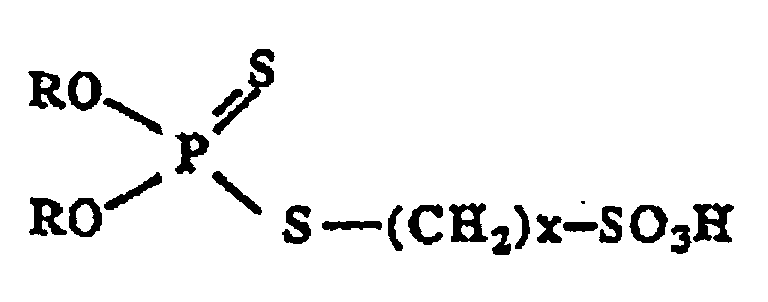
- the overbased colloidal products of the invention may be defined, in general, as comprising, maintained in micellized form within an oily hydrocarbon medium, a core of alkali or alkaline earth metal carbonate surrounded by a crown of '' at least one surfactant compound chosen from dihydrocarbyl-dithiophosphoryl-alkane-sulfonic acids corresponding to the general formula: in which R represents a monovalent hydrocarbon radical of 1 to 30 carbon atoms, which can be aliphatic, cycloaliphatic or aromatic and x has a value of 3 to 6, preferably 3 or 4, and the alkali or alkali metal salts - earth of these acids.
- dihydrocarbyl-dithiophosphoryl-alkane-sulfonic acids usable for preparing the colloidal products of the invention
- the number x is 3: these are the acids dihydrocarbyl-dithiophosphoryl-3-propane-sulfonic; and those in which the number x is equal to 4: these are the dihydrocarbyl-dithiophosphoryl-4-butane-sulfonic acids.
- the preparation of the overbased colloidal products of the invention can be carried out for example by the method described below.
- an oily hydrocarbon medium is introduced, for example in a mineral or synthetic lubricating oil, acid or salt suitable dihydrocarbyl-dithiophosphoryl-alkane-sulfonic acid, at a concentration which can range, for example, from 5 to 100% by mass relative to said medium, thus than an alkali or alkaline earth metal oxide or hydroxide, used for example in a proportion of 20 to 200% by mass relative to said dihydrocarbyldithiophosphoryl-alkane-sulfonic acid or to the said salt.
- At least one aliphatic, cycloaliphatic or aromatic hydrocarbon solvent such as toluene, for example in proportions allowing to operate at a concentration of reagents from 2 to 70% by mass in the reaction medium, and, as promoter, at least one oxygenated organic liquid such as an alcohol, for example methanol, for example at a rate of 5 to 40% by volume relative to said solvent hydrocarbon.
- a second step (b) the carbonation of the alkali or alkaline-earth oxide or hydroxide is carried out, by introducing carbon dioxide CO 2 , at the rate of 2 to 2, into the medium, maintained with stirring. 100% by mole relative to said alkali or alkaline earth oxide or hydroxide.
- This introduction can be done for example at room temperature; it can last for example from 5 minutes to 3 hours. For the duration of the introduction of carbon dioxide, it is preferred to maintain the temperature at a value below about 45 ° C.
- the medium is filtered to remove any solid particles of oxide or hydroxide which would not have not reacted during carbonation and separated from the reaction medium, for example by decantation, the oxygenated organic liquid (for example alcohol) used as promoter.
- the oxygenated organic liquid for example alcohol
- the colloidal product sought after is obtained the form of a clear suspension in the starting oily hydrocarbon medium.
- step (a) it is possible to use as alkali metal oxide or hydroxide or alkaline earth those of sodium, potassium, magnesium, calcium or barium.
- the products of the invention are in the form of stable colloidal suspensions in the medium oily hydrocarbon in which they were formed; they contain proportions of alkali or alkaline earth metal which can range, for example, from 3 to 30% by mass and have a basicity rate (or alkaline reserve), represented by an index base (in English "Base Number", abbreviated to BN) which can range for example from 50 to 550 mg of potash per gram of product, excluding dilution oil. They usually a sulfur content of 2 to 10% by mass and a phosphorus content of 0.3 to 7% en masse. They have very good solubility in lubricating, mineral or synthetic.
- overbased colloidal products with detergent action according to the invention can be used as additives in lubricating, mineral or synthetics, for example in engine lubricants, gear oils, hydraulic fluids or oils for metalworking. They are in generally incorporated in lubricating oils in proportions which can range from example from 0.5 to 20%, and more particularly from 2 to 10% by mass of material active (i.e. dilution oil excluded).
- the products colloidal collars according to the invention have the important advantage of their also confer antioxidant properties, due to the presence in their dihydrocarbyl-dithiophosphoric group molecule.
- Dihydrocarbyl-dithiophosphoryl-alkane-sulfonic acids used as surfactants for preparing the colloidal products of the invention can be prepared according to the methods described below.
- the corresponding dihydrocarbyl-dithiophosphoric acid can be reacted directly with the sultone of general formula: in which the number x takes a value of 3 to 6, preferably 3 or 4, depending on the dihydrocarbyl-dithiophosphoryl-alkane-sulfonic acid which it is desired to synthesize.
- the number x takes a value of 3 to 6, preferably 3 or 4, depending on the dihydrocarbyl-dithiophosphoryl-alkane-sulfonic acid which it is desired to synthesize.
- propane-sultone propane-sultone will be used; and to prepare a dihydrocarbyldithiophosphoryl-4-butane-sulfonic acid, butane-sultone will be used.
- the starting dihydrocarbyl-dithiophosphoric acid may have been prepared by a process known per se, by reaction of an alcohol or a phenol of formula ROH, where R is defined as above, with tetraphosphorus decasulfide P 4 S 10 .
- the synthesis of dihydrocarbyl-dithiophosphoric acids and their salts has already been described in the prior art in numerous documents. Examples include United States patents US-A-2,364,283, 2,364,284, 2,365,938, 2,410,650, 2,438,876 and 3,190,833.
- tetraphosphorus decasulfide can be reacted with an alcohol or a phenol in an organic solvent, for example chlorinated. The mixture is heated at reflux of the solvent until complete elimination of the hydrogen sulfide formed.
- the reaction of dihydrocarbyl-dithiophosphoric acid with sultone can be carried out in at least one polar organic solvent such as acetonitrile, optionally mixed with a minor proportion of methanol, by heating, for example at reflux of the solvent. Cool, then remove the solvent (s) from so as to obtain the desired dihydrocarbyl-dithiophosphoryl-alkane-sulfonic acid.
- polar organic solvent such as acetonitrile
- Dihydrocarbyl-dithiophosphoric acid is neutralized by a hydroxide of alkali metal, for example potash, in an alcoholic medium, and the alcohol is eliminated.
- a hydroxide of alkali metal for example potash
- alcoholic medium a hydroxide of alkali metal, for example potash
- a salt generally of potassium
- the isolated dihydrocarbyl-dithiophosphoric acid salt is returned to solution in a polar organic solvent or a mixture of organic solvents polar.
- acetonitrile can be used, optionally in admixture with a minor proportion of methanol. It is then reacted with the sultone appropriate.
- the alkali or alkaline earth metal salts of dihydrocarbyl-dithiophosphoryl-alkane-sulfonic acids can be prepared from dihydrocarbyl-dithiophosphoryl-alkane-sulfonic acids themselves, as described below.
- Dihydrocarbyl-dithiophosphoryl-alkane-sulfonic acid is reacted with the appropriate metal hydroxide, generally within a hydrocarbon solvent, such as for example that toluene, to which may be added, in a minor proportion, a polar organic solvent, such as for example methanol.
- a hydrocarbon solvent such as for example that toluene
- a polar organic solvent such as for example methanol
- alkali metal salts of dihydrocarbyl-dithiophosphoryl-alkane-sulfonic acids in particular those of potassium, can be obtained intermediate in the preparation of acids themselves.
- Example 1 the preparation of dihydrocarbyl-dithiophosphoryl-alkane-sulfonic acid which will be used in Example 2.
- Example 3 is given as comparison.
- Example 4 the performance of the products of the Examples 2 and 3.
- Example 1 Synthesis of (O, O'-didodecyl-dithiophosphoryl) -4-butanesulfonic acid of formula: (C 12 H 25 -O) 2 -P (S) -S-CH 2 -CH 2 -CH 2 -CH 2 -SO 3 H.
- the temperature is kept below 35 ° C.
- the alcoholic phase is removed by decantation, then 38.0 g of a clear, limpid liquid product are obtained after evaporation of the solvent, the characteristics of which are as follows: Calcium content 15.2% by mass Phosphorus content 1.6% by mass Sulfur content 5.3% by mass Alkaline reserve (BN) 385 mg KOH / g.
- Dialysis of the product in n-heptane through a latex membrane makes it possible to determine the amount of colloidal material (surfactant plus "core" of calcium carbonate), as well as the amount of dilution oil: Colloidal fraction 68% by mass Oil 32% by mass.
- Dialysis of the product in n-heptane through a latex membrane makes it possible to determine the amount of colloidal material (surfactant plus "core" of calcium carbonate), as well as the amount of dilution oil: Colloidal fraction 58% by mass Oil 42% by mass.
- the product of the invention prepared as described in Example 2 above is characterized for its antiwear and extreme pressure properties in a 130 Neutral Solvent mineral oil at a concentration making it possible to adjust the content of active material (colloidal fraction). in oil at 7.5% by mass.
- the characterization is carried out using a 4-ball machine according to the test ASTM D-2783.
- the results are collated in Table 1 below. There are also shown, by way of comparison, the results obtained with the conventional colloidal product of calcium carbonate, obtained as described in Example 3 from a conventional alkyl-aryl-sulfonic acid surfactant free of dialkyldithiophosphoric functions.
Landscapes
- Chemical & Material Sciences (AREA)
- Organic Chemistry (AREA)
- Chemical Kinetics & Catalysis (AREA)
- General Chemical & Material Sciences (AREA)
- Oil, Petroleum & Natural Gas (AREA)
- Health & Medical Sciences (AREA)
- Life Sciences & Earth Sciences (AREA)
- Biochemistry (AREA)
- General Health & Medical Sciences (AREA)
- Molecular Biology (AREA)
- Lubricants (AREA)
Claims (9)
- Kolloidales überbasisches Produkt, dadurch gekennzeichnet, dass es, in mizellisierter Form in einem öligen Kohlenwasserstoffmilieu gehalten, einen Alkali- oder Erdalkalimetallcarbonatkern umringt von einem Kranz wenigstens einer tensioaktiven Verbindung, die unter den Dihydrocarbyl-Dithiophosphoryl-Alkansulfonsäuren gewählt ist, welche der allgemeinen Formel entsprechen:in der R ein monovalentes aliphatisches, cycloaliphatisches, oder aromatisches Kohlenwasserstoffradikal mit 1 bis 30 Kohlenstoffatomen und x einen Wert von 3 bis 6 hat, und deren Alkali- oder Erdalkalimetallsalzen.
- Kolloidales Produkt nach Anspruch 1, dadurch gekennzeichnet, dass es aus der Karbonisierung wenigstens eines Alkali- oder Erdalkalimetalloxids oder -hydroxids kommt, die in einem öligen Kohlenwasserstoffmilieu in Gegenwart der Säure oder des Salzes von Dihydrocarbyl-Dithiophosphoryl-Alkansulfonsäure durchgeführt wird.
- Kolloidales Produkt nach einem der Ansprüche 1 und 2, dadurch gekennzeichnet, dass es durch Ausführen der folgenden Stufen hergestellt wird:a. man führt in ein öliges Kohlenwasserstoffmilieu wenigstens eine Säure und/oder wenigstens ein Salz von Dihydrocarbyl-Dithiophosphoryl-Alkansulfonsäure und wenigstens ein Alkali- oder Erdalkalimetalloxid oder -hydroxid in Gegenwart wenigstens eines aliphatischen, cycloaliphatischen, oder aromatischen Kohlenwasserstofflösungsmittels ein und als Promotor wenigstens eine sauerstoffhaltige organische Flüssigkeit;b. man führt die Karbonisierung durch, indem in das unter Rühren oder Schütteln gehaltene Milieu Kohlensäureanhydrid CO2 eingeführt wird;c. nach dem Reaktionsende filtriert man das Milieu, um die eventuellen Partikel von Alkali- oder Erdalkalimetalloxid oder -hydroxid, die bei der Karbonisierung nicht reagiert hätten, zu entfernen, und man trennt die sauerstoffhaltige organische Flüssigkeit durch Dekantieren; undd. man verdampft das aliphatische, cycloaliphatische, oder aromatische Kohlenwasserstofflösungsmittel derart, dass das gewünschte kolloidale Produkt in Form einer klaren Suspension in dem öligen Kohlenwasserstoffausgangsmilieu erhalten wird.
- Kolloidales Produkt nach einem der Ansprüche 1 bis 3, dadurch gekennzeichnet, dass bei der Herstellung in der Stufe (a) das ölige Kohlenwasserstoffmilieu aus mineralischem oder synthetischem Öl besteht, die Säure oder das Salz von Dihydrocarbyl-Dithiophosphoryl-Alkansulfonsäure in einer Konzentration von 5 bis 100 Masse-% bezüglich des öligen Kohlenwasserstoffmilieus eingesetzt wird, das Alkali- oder Erdalkalimetalloxid oder -hydroxid in einem Anteil von 20 bis 200 Masse-% bezüglich der Säure oder des Salzes von Dihydrocarbyl-Dithiophosphoryl-Alkansulfonsäure eingesetzt wird, das aliphatische, cycloaliphatische, oder aromatische Kohlenwasserstofflösungsmittel in einem Anteil eingesetzt wird, der es ermöglicht, bei einer Reagenzkonzentration von 2 bis 70 Masse-% zu arbeiten, und die als Promotor verwendete sauerstoffhaltige organische Flüssigkeit in einem Verhältnis von 5 bis 40 Vol.-% bezüglich des Kohlenwasserstofflösungsmittels eingesetzt wird; und man in Stufe (b) die Karbonisierung bei einer Temperatur durchführt, die von Umgebungstemperatur bis auf einen Wert von 45°C geht.
- Kolloidales Produkt nach einem der Ansprüche 1 bis 4, dadurch gekennzeichnet, dass bei der Formel der Säure oder des Salzes von Dihydrocarbyl-Dithiophosphoryl-Alkansulfonsäure x einen Wert von 3 oder 4 hat.
- Kolloidales Produkt nach einem der Ansprüche 1 bis 5, dadurch gekennzeichnet, dass in Stufe (a) Natrium-, Kalium-, Magnesium-, Calcium- oder Bariumoxid oder -hydroxid verwendet wird.
- Kolloidales Produkt nach einem der Ansprüche 1 bis 6, dadurch gekennzeichnet, dass es in Form einer im Kohlenwasserstoffmilieu stabilen, kolloidalen Suspension vorliegt, einen Alkali- oder Erdalkalimetallanteil vom 3 bis 30 Masse-% einschließt, einen Basizitätsgrad, der durch einen Baseindex von 50 bis 550 mg Kalium pro Gramm Produkt, ausschließlich Verdünnungsöl, angezeigt ist, einen Schwefelgehalt von 2 bis 10 Masse-% und einen Phosphorgehalt von 0,3 bis 7 Masse-% aufweist.
- Schmiermittelzusammensetzung mit verbesserten Antiverschleiß- und Extremdruckeigenschaften, dadurch gekennzeichnet, dass sie einen überwiegenden Anteil mineralischen oder synthetischen Schmieröls und einen minderen Anteil wenigstens eines Zusatzes umfasst, der in einem kollodidalen Produkt nach einem der Ansprüche 1 bis 7 besteht.
- Schmiermittelzusammensetzung nach Anspruch 8, dadurch gekennzeichnet, dass das kolloidale Produkt in einem Anteil von 0,5 bis 20 Masse-% vorliegt.
Applications Claiming Priority (2)
| Application Number | Priority Date | Filing Date | Title |
|---|---|---|---|
| FR9605403A FR2748030B1 (fr) | 1996-04-25 | 1996-04-25 | Nouveaux produits colloidaux, leur preparation et leurs utilisations |
| FR9605403 | 1996-04-25 |
Publications (2)
| Publication Number | Publication Date |
|---|---|
| EP0803565A1 EP0803565A1 (de) | 1997-10-29 |
| EP0803565B1 true EP0803565B1 (de) | 2002-08-21 |
Family
ID=9491701
Family Applications (1)
| Application Number | Title | Priority Date | Filing Date |
|---|---|---|---|
| EP97400872A Expired - Lifetime EP0803565B1 (de) | 1996-04-25 | 1997-04-18 | Neue kolloidale Produkte, ihre Herstellung und ihre Verwendung |
Country Status (4)
| Country | Link |
|---|---|
| US (1) | US5854184A (de) |
| EP (1) | EP0803565B1 (de) |
| DE (1) | DE69714810D1 (de) |
| FR (1) | FR2748030B1 (de) |
Families Citing this family (1)
| Publication number | Priority date | Publication date | Assignee | Title |
|---|---|---|---|---|
| GB9900035D0 (en) * | 1999-01-04 | 1999-02-24 | Infineum Uk Ltd | Overbased metal detergents |
Family Cites Families (11)
| Publication number | Priority date | Publication date | Assignee | Title |
|---|---|---|---|---|
| US2786029A (en) * | 1950-06-29 | 1957-03-19 | Exxon Research Engineering Co | Lubricating oil composition |
| DE1444807A1 (de) * | 1955-04-27 | 1969-03-20 | Continental Oil Co | Verfahren zur Herstellung einer stabilen Dispersion von Bariumcarbonat in Schmiermitteln |
| US2879283A (en) * | 1955-06-06 | 1959-03-24 | Monsanto Chemicals | Sulfoalkyl phosphorothioates and metal salts thereof |
| US2965665A (en) * | 1956-07-31 | 1960-12-20 | Monsanto Chemicals | Phosphonates |
| GB1308114A (en) * | 1970-07-17 | 1973-02-21 | Continental Oil Co | Preparation of hyperbasic dispersions |
| US3718589A (en) * | 1971-08-31 | 1973-02-27 | Continental Oil Co | Preparation of neutral and highly basic alkylphenates and sulfurized alkylphenates |
| US4541940A (en) * | 1984-03-28 | 1985-09-17 | Phillips Petroleum Company | Stirred vortex tank reactor and method of CO2 addition for producing overbased petroleum sulfonate |
| FR2616441B1 (fr) * | 1987-06-11 | 1990-03-23 | Elf France | Procede de preparation d'additifs surbases et compositions renfermant lesdits additifs |
| US4824584A (en) * | 1987-10-15 | 1989-04-25 | Witco Corporation | One-step process for preparation of thixotropic overbased calcium sulfonate complex thickened compositions |
| FR2656623A1 (fr) * | 1989-12-28 | 1991-07-05 | Elf Aquitaine | Detergents surbases pour huiles lubrifiantes contenant un derive organique du phosphore et compositions lubrifiantes renfermant lesdits detergents. |
| US5449470A (en) * | 1991-04-19 | 1995-09-12 | The Lubrizol Corporation | Overbased alkali salts and methods for making same |
-
1996
- 1996-04-25 FR FR9605403A patent/FR2748030B1/fr not_active Expired - Fee Related
-
1997
- 1997-04-18 DE DE69714810T patent/DE69714810D1/de not_active Expired - Lifetime
- 1997-04-18 EP EP97400872A patent/EP0803565B1/de not_active Expired - Lifetime
- 1997-04-24 US US08/842,326 patent/US5854184A/en not_active Expired - Fee Related
Also Published As
| Publication number | Publication date |
|---|---|
| EP0803565A1 (de) | 1997-10-29 |
| DE69714810D1 (de) | 2002-09-26 |
| US5854184A (en) | 1998-12-29 |
| FR2748030A1 (fr) | 1997-10-31 |
| FR2748030B1 (fr) | 2004-02-13 |
Similar Documents
| Publication | Publication Date | Title |
|---|---|---|
| EP0102255B1 (de) | Verfahren zur Herstellung von sulfurierten Erdalkalimetallalkylphenaten verwendbar als Schmierölzusatz | |
| EP0234149B1 (de) | Kalziumseifen mit hochbasischer Reserve | |
| US4104180A (en) | Production of overbased metal phenates | |
| EP0248697B1 (de) | Schmiermittel und polyfluorierte Verbindungen, verwendbar als Zusätze | |
| EP0536020B1 (de) | Bor, Schwefel und Phosphor enthaltende kolloidale Produkte, ihre Herstellung und ihre Verwendung als Schmieröladditive | |
| FR2698018A1 (fr) | Produits colloïdaux renfermant du bore, et/ou du soufre, et/ou du phosphore, leur préparation et leur utilisation comme additifs pour lubrifiants. | |
| EP0296935B1 (de) | Polyfluorierte Verbindungen, ihre Herstellung und ihre Verwendung als Zusätze für Schmiermittel | |
| FR2588268A1 (fr) | Procede de synthese d'additifs surbases par carbonatation sous pression constante d'anhydride carbonique | |
| EP0308445A1 (de) | Verfahren zur herstellung eines ein anorganisches borderivat enthaltenden überbasischen additivs, danach erhaltene additive und diese enthaltende schmiermittel. | |
| EP0639634B1 (de) | Kalzium und/oder Magnesium auch Schwefel und Stickstoff enthaltende Kolloidale Produkte, ihre Herstellung und ihre Verwendung, insbesondere als Schmieröladditive | |
| EP0562912A1 (de) | Geschaufelte organische Verbindung enthaltende überbasische kolloidale Produkte und ihre Verwendung als Reinigungsmittelzusätze mit Verschleissvermindernder und Extremdruck-Wirkung in Schmieröle | |
| EP0803565A1 (de) | Neue kolloidale Produkte, ihre Herstellung und ihre Verwendung | |
| FR2588269A1 (fr) | Procede de preparation d'additifs surbases tres fluides et a basicite elevee et composition contenant lesdits additifs | |
| EP0438942A1 (de) | Überbasische Detergensmittel für Schmieröle, die ein organisches Derivat von Phosphor enthalten und diese enthaltende Schmierölzusammensetzungen | |
| EP0293299A1 (de) | Verfahren zur Herstellung von polysulfurierten Olefin-Zusammensetzungen mit hohem Schwefel-und sehr niedrigem Chlorgehalt. | |
| EP0296046B1 (de) | Polyfluorierte Aminoalkohole und ihre Ester, deren Herstellung und ihre Verwendung als Additive für Schmiermittel | |
| EP0598645A1 (de) | Kalzium und/oder Magnesium eventuell auch Bor und/oder Phosphor, und/oder Schwevel enthaltende kolloidale Produkte, ihre Herstellung und ihre Verwendung als Schmieröladditive | |
| EP0219382B1 (de) | Gegen Hydrolisierung stabilisierte überalkalisierte Detergens-Dispergierzusätze für Schmieröle und Verfahren zu deren Herstellung | |
| FR2484442A1 (fr) | Procede de preparation de compositions contenant du molybdene utiles pour une meilleure economie du combustible des moteurs a combustion interne | |
| EP0516802B1 (de) | Schwefel enthaltende verbindungen, ihre herstellung und ihre verwendung als schmierölzusätze | |
| FR2504549A1 (fr) | Preparation de sels fortement basiques de metaux alcalino-terreux d'acides organiques et compositions d'huile les contenant | |
| EP0511888A1 (de) | (Poly)sulfurierte Carboxylverbindungen, ihre Herstellung und ihre Verwendung als Zusatzmittel für Schmieröl | |
| FR2616441A1 (fr) | Procede de preparation d'additifs surbases et compositions renfermant lesdits additifs | |
| EP0436422A1 (de) | Phosphor enthaltendes überbasisches Alkali- oder Erdalkalimetallphenolat und dieses enthaltende Schmierölzusammensetzungen | |
| CA2044035A1 (fr) | Phenate alcalin ou alcalino-terreux surbase contenant du phosphore et compositions lubrifiantes renfermant ledit phenate |
Legal Events
| Date | Code | Title | Description |
|---|---|---|---|
| PUAI | Public reference made under article 153(3) epc to a published international application that has entered the european phase |
Free format text: ORIGINAL CODE: 0009012 |
|
| AK | Designated contracting states |
Kind code of ref document: A1 Designated state(s): BE DE ES GB IT NL |
|
| 17P | Request for examination filed |
Effective date: 19980429 |
|
| 17Q | First examination report despatched |
Effective date: 19991229 |
|
| GRAG | Despatch of communication of intention to grant |
Free format text: ORIGINAL CODE: EPIDOS AGRA |
|
| GRAG | Despatch of communication of intention to grant |
Free format text: ORIGINAL CODE: EPIDOS AGRA |
|
| GRAH | Despatch of communication of intention to grant a patent |
Free format text: ORIGINAL CODE: EPIDOS IGRA |
|
| GRAH | Despatch of communication of intention to grant a patent |
Free format text: ORIGINAL CODE: EPIDOS IGRA |
|
| GRAA | (expected) grant |
Free format text: ORIGINAL CODE: 0009210 |
|
| AK | Designated contracting states |
Kind code of ref document: B1 Designated state(s): BE DE ES GB IT NL |
|
| PG25 | Lapsed in a contracting state [announced via postgrant information from national office to epo] |
Ref country code: NL Free format text: LAPSE BECAUSE OF FAILURE TO SUBMIT A TRANSLATION OF THE DESCRIPTION OR TO PAY THE FEE WITHIN THE PRESCRIBED TIME-LIMIT Effective date: 20020821 Ref country code: IT Free format text: LAPSE BECAUSE OF FAILURE TO SUBMIT A TRANSLATION OF THE DESCRIPTION OR TO PAY THE FEE WITHIN THE PRESCRIBED TIME-LIMIT;WARNING: LAPSES OF ITALIAN PATENTS WITH EFFECTIVE DATE BEFORE 2007 MAY HAVE OCCURRED AT ANY TIME BEFORE 2007. THE CORRECT EFFECTIVE DATE MAY BE DIFFERENT FROM THE ONE RECORDED. Effective date: 20020821 Ref country code: GB Free format text: LAPSE BECAUSE OF FAILURE TO SUBMIT A TRANSLATION OF THE DESCRIPTION OR TO PAY THE FEE WITHIN THE PRESCRIBED TIME-LIMIT Effective date: 20020821 |
|
| REG | Reference to a national code |
Ref country code: GB Ref legal event code: FG4D Free format text: NOT ENGLISH |
|
| REF | Corresponds to: |
Ref document number: 69714810 Country of ref document: DE Date of ref document: 20020926 |
|
| PG25 | Lapsed in a contracting state [announced via postgrant information from national office to epo] |
Ref country code: DE Free format text: LAPSE BECAUSE OF FAILURE TO SUBMIT A TRANSLATION OF THE DESCRIPTION OR TO PAY THE FEE WITHIN THE PRESCRIBED TIME-LIMIT Effective date: 20021122 |
|
| NLV1 | Nl: lapsed or annulled due to failure to fulfill the requirements of art. 29p and 29m of the patents act | ||
| GBV | Gb: ep patent (uk) treated as always having been void in accordance with gb section 77(7)/1977 [no translation filed] |
Effective date: 20020821 |
|
| PG25 | Lapsed in a contracting state [announced via postgrant information from national office to epo] |
Ref country code: ES Free format text: LAPSE BECAUSE OF FAILURE TO SUBMIT A TRANSLATION OF THE DESCRIPTION OR TO PAY THE FEE WITHIN THE PRESCRIBED TIME-LIMIT Effective date: 20030228 |
|
| PG25 | Lapsed in a contracting state [announced via postgrant information from national office to epo] |
Ref country code: BE Free format text: LAPSE BECAUSE OF NON-PAYMENT OF DUE FEES Effective date: 20030430 |
|
| PLBE | No opposition filed within time limit |
Free format text: ORIGINAL CODE: 0009261 |
|
| STAA | Information on the status of an ep patent application or granted ep patent |
Free format text: STATUS: NO OPPOSITION FILED WITHIN TIME LIMIT |
|
| 26N | No opposition filed |
Effective date: 20030522 |
|
| BERE | Be: lapsed |
Owner name: INSTITUT FRANCAIS DU *PETROLE Effective date: 20030430 |