EP0802477B1 - Event notification in a computing system having a plurality of storage devices - Google Patents
Event notification in a computing system having a plurality of storage devices Download PDFInfo
- Publication number
- EP0802477B1 EP0802477B1 EP97104952A EP97104952A EP0802477B1 EP 0802477 B1 EP0802477 B1 EP 0802477B1 EP 97104952 A EP97104952 A EP 97104952A EP 97104952 A EP97104952 A EP 97104952A EP 0802477 B1 EP0802477 B1 EP 0802477B1
- Authority
- EP
- European Patent Office
- Prior art keywords
- event
- queue
- application program
- storage device
- event queue
- Prior art date
- Legal status (The legal status is an assumption and is not a legal conclusion. Google has not performed a legal analysis and makes no representation as to the accuracy of the status listed.)
- Expired - Lifetime
Links
Images




Classifications
-
- G—PHYSICS
- G06—COMPUTING OR CALCULATING; COUNTING
- G06F—ELECTRIC DIGITAL DATA PROCESSING
- G06F9/00—Arrangements for program control, e.g. control units
- G06F9/06—Arrangements for program control, e.g. control units using stored programs, i.e. using an internal store of processing equipment to receive or retain programs
- G06F9/46—Multiprogramming arrangements
- G06F9/54—Interprogram communication
- G06F9/542—Event management; Broadcasting; Multicasting; Notifications
-
- G—PHYSICS
- G06—COMPUTING OR CALCULATING; COUNTING
- G06F—ELECTRIC DIGITAL DATA PROCESSING
- G06F13/00—Interconnection of, or transfer of information or other signals between, memories, input/output devices or central processing units
- G06F13/10—Program control for peripheral devices
- G06F13/12—Program control for peripheral devices using hardware independent of the central processor, e.g. channel or peripheral processor
- G06F13/124—Program control for peripheral devices using hardware independent of the central processor, e.g. channel or peripheral processor where hardware is a sequential transfer control unit, e.g. microprocessor, peripheral processor or state-machine
- G06F13/126—Program control for peripheral devices using hardware independent of the central processor, e.g. channel or peripheral processor where hardware is a sequential transfer control unit, e.g. microprocessor, peripheral processor or state-machine and has means for transferring I/O instructions and statuses between control unit and main processor
Definitions
- the present invention relates, in general, to the field of computers and computer storage devices. More particularly, the present invention relates to notifying application programs in a computing system of changes in the state of storage devices or metadevices of the computing system.
- Physical disk drives can fail in numerous ways through, for instance, a disk controller failure, a disk head failure, a disk platter failure, a failure in the cable connecting the disk drive to the computing system, etc. While some of the failures of a disk drive can be recovered from, other failures require that the storage device be removed from the computing system and repaired.
- RAID redundant array of inexpensive disks
- disk arrays including disk mirrors (RAID-1), disk stripes (RAID-0), and RAID-5 arrays, as well as disk sets, concatenated devices, and spare disks can all be used to enhance the reliability of information storage and retrieval in a computing system.
- RAID-1 disk mirrors
- RAID-0 disk stripes
- RAID-5 arrays disk sets, concatenated devices, and spare disks
- a simple disk mirror is comprised of two disks, each disk having the same data stored therein. If one of the disks in the mirror fails, then the other disk is used to satisfy a read or write request.
- the computing system may provide information in real-time regarding the condition of the storage devices. While conventional computing systems may provide a limited amount of disk information to a console connected to the file server, these messages are often directed solely to this console.
- the console is generally located in a machine room housing the file server and is rarely monitored in real-time by a user or a system administrator.
- IBM Technical Disclosure Bulletin, Vol. 36, No. 09B, September 1993, pages 101 - 102 discloses a dynamic operator message management system. This comprises assigning to each message a message category identifier, a message identifier, a removal condition, e.g. a code used to determine how and when a message will be removed from the active message queue, a message display time, and special message display codes, e.g. font information.
- the dynamic message management module internally maintains the active message queue by removing obsolete messages as removal conditions are met.
- EP-A-0,738,976 (Fuji-Xerox Co.) relates generally to the displaying of messages Older, but not pre-published generated by events such as errors or failures in a plurality of computing resources, in particular to highlighting user selected messages or message categories in a message log and expanding message texts for more complete message displays.
- the present invention provides a method and apparatus for notifying an application program of a change of state in a storage device in a computing system having a plurality of storage devices, in accordance with the claims which follow.
- an event queue is created that stores an event generated by the storage devices corresponding to the change of state of the storage devices.
- the event queue is created with a queue header, said queue header containing a queue name identifying the event queue, a maximum queue size, a set of queue flags and pointers, and a process identification that identifies the application program which requested the creation of the event queue.
- the application module is notified that the event queue was successfully created.
- the event Upon an event generated by a storage device, the event is placed in the event queue and passed to the application program if appropriate. Events are reported to the application in two ways. If the application program is waiting for incoming events, then the application program is immediately notified of the new event. Alternatively, the application could remove events from the queue at its own convenience.
- the oldest event stored in the queue is discarded to create space for storing the event, and the application is informed that information has been lost.
- an apparatus for notifying an application program of a change of state in a storage device has an event queue that stores an event generated by the storage device corresponding to the change of state of the storage device.
- a notification module receives the event from the storage device and places it in the event queue. The module then passes the event to the application program in response to a request from the application program to create an event queue.
- the notification module is also adapted to receive application generated events corresponding to the configuration of the storage devices in the computing system.
- the great utility of the present invention is that all state changes of a metadevice or storage device are passed in real-time to the system administrator or system operator, or to an application program, for monitoring and possible immediate corrective action.
- Still another utility of the present invention is to permit application programs to establish queues of information, maintained by the notification module, relating to the state changes of the metadevices or storage devices in a computing system. Since the queues are maintained by the notification module, the application program is relieved of the administrative burden of servicing each change in state of the metadevices in the computing system.
- Still another utility of the present invention is to provide a centralized computing resource for collecting and maintaining all events generated by the metadevices for later use by application programs.
- Still another utility of the present invention is to permit multiple application programs to establish queues for changes in the state of the metadevices in the computing system.
- Still another utility of the present invention is to permit the destruction of a queue after the termination of the application program which requested the creation of the queue, thereby freeing system resources.
- FIG. 1 illustrates a computing system to perform the computer implemented steps in accordance with the invention.
- FIG. 2 illustrates a computing system having a plurality of physical storage devices.
- FIG. 3 is a block diagram of the preferred embodiment of the present invention.
- FIG. 4 illustrates the structure of an event queue in the preferred embodiment of the present invention.
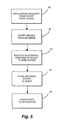
- FIG. 5 illustrates the logical operations performed by the preferred embodiment of the present invention.
- FIG. 6 illustrates the logical operations for creating an event queue according to the preferred embodiment of the present invention.
- FIG. 7 illustrates the logical operations for processing an event according to the preferred embodiment of the present invention.
- FIG. 8 illustrates the logical operations for reporting events contained in the event queue to the application program according to the preferred embodiment of the present invention.
- FIGS. 9A and 9B illustrate the logical operations for deleting an event queue according to the preferred embodiment of the present invention.
- the embodiments of the invention described herein are implemented as logical operations in a computing system.
- the logical operations of the present invention are implemented (1) as a sequence of computer implemented steps running on the computing system and (2) as interconnected machine modules within the computing system.
- the implementation is a matter of choice dependent on the performance requirements of the computing system implementing the invention. Accordingly, the logical operations making up the embodiments of the invention described herein are referred to variously as operations, steps, or modules.
- the operating environment in which the present invention is used, encompasses a standalone computing system as well as the general distributed computing system.
- general purpose computers, workstations, or personal computers are connected via communication links of various types, in a client-server arrangement, wherein programs and data, many in the form of objects, are made available by various members of the system.
- FIG. 1 Some of the elements of a standalone computer or a general purpose workstation computer are shown in FIG. 1, wherein a processor 20 is shown, having an input/output (I/O) section 21, a central processing unit (CPU) 22 and a memory section 23.
- the I/O section 21 is connected to a keyboard 24, a display unit 25, a disk storage unit 26, a network interface 30, and a CD-ROM drive unit 27.
- the CD-ROM unit 27 can read a CD-ROM medium 29 which typically contains programs 28 and data.
- the computer program products containing mechanisms to effectuate the apparatus and methods of the present invention may reside in the memory section 23, or on a disk storage unit 26, or on the CD-ROM 29 of such a system. Examples of such systems include SPARC systems offered by Sun Microsystems, Inc., personal computers offered by IBM Corporation and by other manufacturers of IBM-compatible personal computers, and systems running the UNIX operating system or SolarisTM operating system.
- Disk storage unit 26 of Fig. 1 can be comprised of a plurality of physical disk drives in order to increase the capacity, reliability, and performance of the computing system.
- Fig. 2 shows a plurality of disks 34 connected to processor 20 by disk controller 32. The plurality of disks 34 can be arranged into various metadevices depending on the desired performance.
- a disk mirror is a duplicative set of drives wherein each drive in the mirror contains the same information as other drives in the mirror. When a single drive of the mirror fails, the mirror is still able to satisfy any read or write request to the mirror through the remaining disk.
- a RAID metadevice is an array of disks which contain data and parity information such that data contained on a failed drive can be reconstructed using the remaining drives in the array.
- Hot spares are a set of drives which are available to replace automatically any failed drive of another metadevice in the computing system. For instance, if a hot spare drive is available, it can replace a failed drive in a mirror or RAID disk array.
- a typical computing system for applications using large amounts of data can utilize hundreds of disk drives, sometimes even up to a thousand drives.
- These computing systems can utilize a combination of metadevices including disk mirrors, RAID-5 disk arrays, disk stripes, concatenated disks, and hot spares.
- the plurality of drives 34 (Fig. 2) can be arranged into a variety of metadevices depending upon the desired performance of the storage devices in the computing system.
- Notify module 40 establishes event queues 48 responsive to requests by application program 42 to queue events 46 generated by metadevices 44. Notify module 40 is capable of establishing separate event queues for multiple applications.
- Events 46 can be generated either by metadevices 44 or by a user level program such as a storage device manager graphical user interface (GUI) 50.
- Storage manager 50 could be provided with the ability to affect the configuration of the metadevices (i.e., partition the disks). Therefore, notify module 40 is adapted to receive events generated by storage manager 50 which affect the configuration of metadevices 44. In this manner, notify module 40 can track in real time changes in the state of the metadevices 44 or changes in the configuration of the metadevices made at the application level.
- metadevices 44 can contain mirrors 52, a RAID array 54, hot spare disks 56, disk sets 58, and concatenated/striped disks 59. Metadevice 44 could also contain other forms of storage devices depending on the particular implementation chosen for the computing system.
- Notify module 40 is adapted to place in queue 48 incoming events 46 from either metadevice 44 or an application 50.
- the metadevice 44 or program 50 transmits the event to the notify module 40 for processing therein.
- An event 46 can be broadly defined to include any change of state in the underlying metadevice.
- An event can be as simple as a change in the state of a metadevice.
- a drive failure could constitute an event to be processed by notify module 40.
- Other examples of possible events could include when a metadevice is created or deleted, or when the size of a metadevice is changed, or when a new physical drive (i.e., a hot spare) is used in a metadevice.
- any changes in the configuration of the devices i.e., which drives comprise a metadevice
- An event can be characterized by a set of variables including a tag, a time stamp, a set indicator, a device indicator, an event description, and a user value.
- the tag indicates the type of metadevice in which the event occurred, while the time stamp indicates the time when the event occurred.
- the set indicator could show in which disk set, if any, the event occurred.
- the device indicator shows in which particular metadevice the event occurred, while the event indicator contains the actual occurrence or state change in the metadevice.
- the user field distinguishes between an event generated by an application versus an event generated by a metadevice in the kernel of the computing system.
- the notify module 40 (Fig. 3) maintains event queues 48 for access by application programs 42. Notify module 40 could be polled by application programs 42 for events captured in the queue. Alternatively, notify module 40 can notify the application upon receipt of an event in a manner similar to an interrupt.
- event queue 48 is shown containing a queue header 60 and events 46. While the structure of the queue is a matter of choice dependent upon the particular implementation in the computing system, the preferred embodiment of the present invention utilizes a link list of first-in first-out (FIFO) queues.
- FIFO first-in first-out
- Queue header 60 of queue 48 contains elements which define the characteristics of queue 48, including the name and size (number of items in the queue) of the queue.
- the queue header could also contain a process ID variable corresponding to the process ID of the application program which requested the creation of the particular queue.
- the queue header could also contain a set of flags, condition variables, and queue pointers. In the preferred embodiment of the present invention, flags are maintained to indicate error conditions such as an excessive queue size or a lack of system memory.
- Condition variables can indicate the manner of desired notification to the application program. For instance, if the application program is waiting for the notify module to pass an incoming event, then an appropriate condition variable can so indicate.
- a queue can be created as a permanent queue or a non-permanent queue.
- a permanent queue is a queue maintained persistently regardless of the state of the application program which created the queue.
- a non-permanent queue is a queue which can be deleted upon the termination of the application program which created the queue.
- the preferred embodiment of the present invention utilizes a link list for management of multiple queues maintained by notify module 40.
- Each queue 48 would contain information pointing to the next queue maintained by module 40.
- the link list of queues is appropriately updated.
- a first-in first-out (FIFO) queue offers the benefits of providing the application program with a linear history of events generated by the metadevices.
- the maximum size of the FIFO queue should be established so as to prevent queue 48 from consuming excessive system resources. The maximum queue size can be determined by the expected number of events generated by a catastrophic failure in the particular computing system.
- 512 events may be the expected number of events generated by a failure of two or more of the physical drives of the array.
- the number of expected events will be dependent upon the definition of events for a particular metadevice in the computing system.
- Fig. 5 illustrates the overall flow of operations of the preferred embodiment of the present invention.
- Operation 70 requests the creation of an event queue by an application program in the computing system. Responsive to operation 70, operation 72 creates the queue through the notify module, and operation 74 indicates to the application program the successful creation of the queue. Responsive to an event generated by a metadevice or by an application level program, operation 76 places incoming events in the event queue, and operation 78 passes the event stored in the queue to the application program.
- the details of operations 72-78 are described in greater detail with reference to Figs. 6-8.
- Fig. 6 illustrates the logical operations for creating an event queue responsive to an application program's request.
- Operation 80 determines if the name for the event queue provided by the application program already exists. If the name exists, then operation 82 indicates this error to the application program and the queue is not created. Otherwise, operation 84 proceeds to allocate sufficient memory to create the event queue. The minimum amount of memory required to create the queue is approximately the size of the queue header, since the queue will be initialized to be empty.
- Operation 86 determines if the memory allocation was successful and operation 88 returns an error to the application if the memory allocation was unsuccessful.
- Header initialization operation 90 includes writing the queue name into the header, copying the process ID obtained from the application into the header, and initializing all variables, flags, and pointers maintained in the queue header.
- Operation 92 then places the queue in the link list of queues maintained by the notify module 40, while operation 94 indicates to the application program that the event queue was successfully created.
- Fig. 7 illustrates the logical operations for processing, by the notify module 40 (Fig. 3), of an incoming event 46.
- an event can be generated either by an application such as storage manager 50 (Fig. 3) or by a kernel event caused by a change of state of a metadevice 44 (Fig. 3).
- operation 100 determines if any event queues exist for storing the incoming event. If no event queues have been created, then operation 102 discards the event for lack of an event queue. Otherwise, operation 104 determines if the queue size has exceeded its predetermined maximum size limit.
- operation 106 sets a flag indicating an excessive queue size. Because it is desirable to place the most recent incoming event in the queue for use by the application, operation 108 creates space in the queue by discarding the oldest event in the queue. In this manner, the queue size is not increased, yet the most recent event can be stored in the queue by operation 115, described below.
- operation 110 allocates memory to place the event in the queue. Operation 110 is needed because under the preferred embodiment of the present invention, a FIFO queue is utilized whose size varies based on the number of events stored in the queue.
- Operation 112 determines if there is enough system memory for storage of this event in the queue. If there is insufficient system memory, then operation 114 sets a flag indicating that the computing system has reached its memory capacity, and the event is not placed in the event queue.
- operation 115 writes the event to the queue for subsequent passage to the application program.
- Operation 116 determines if an application is waiting for an event to be received by notify module 40. If an application is waiting, then operation 118 activates that application such that application processes the event now stored in the event queue (Fig. 8).
- operation 120 Upon completion of the logical operations contained in Fig. 7 to process an incoming event, operation 120 effectuates these operations in the next event queue maintained in the link list. In this manner, the same events will be stored in all of the event queues maintained in the link list, subject to the characteristics of each event queue (i.e., queue size), available system memory, and whether the application has fetched any events out of a particular event queue.
- Fig. 8 illustrates the logical operations for passing an event from notify module 40 (Fig. 3) to an application program 42 (Fig. 3).
- Operation 130 requests events from the event queue.
- operation 132 determines if a queue exists. If no event queue exists, operation 134 reports an appropriate error to the application program.
- the notify module indicates such conditions to the application program in the preferred embodiment of the present invention.
- Operation 136 determines if the out of memory flag is set, while operation 140 determines if the excessive queue size flag is set. If either of these flags are set, then operation 138 reports to the application program that events have been lost by the notify module. In other words, the event queues no longer contain an accurate linear history of events of the metadevices.
- operation 142 determines if there are any events in the queue for reporting to the application program. If an event exists in the queue, then operation 144 returns the event to the application. If there are multiple events present in the queue, the application program can fetch each individual event out of the queue, using the operations of Fig. 8, until the event queue is empty.
- operation 146 determines if the application will wait for an event to occur. If so, then at operation 150 the application sleeps until a new event is received. As previously described, operations 116 and 118 of Fig. 7 awake a sleeping process upon the receipt of a new incoming event. Referring to Fig. 8, when the application is revived, control passes to operation 142 so that the event can be returned to the application by operation 144. In this manner, applications are instantaneously notified of the occurrence of events which have occurred in the metadevices of the computing system.
- operation 148 indicates to the application program that the event queue is empty.
- Fig. 9A illustrates the operations for removing a particular event queue from the computing system.
- Operation 160 locates the particular queue to be removed by name.
- Operation 162 empties the contents of the event queue so as to clear the memory locations occupied by the events stored in the queue.
- Operation 164 awakes any processes which were waiting for an event to occur.
- operation 166 releases the queue head so that the memory locations occupies thereby are again available.
- Operations 160-166 can be initiated by the application which initially requested the creation of the particular event queue. Alternatively, a process could be created to monitor the existence of application programs which created particular event queues. If a given application has terminated, then the particular event queue can be deleted from the computing system if the event queue was designated as a non-permanent queue.
- Operation 170 examines a particular event queue to determine if the event queue can be deleted. If the event queue is a non-permanent event queue, then the event queue can be deleted from the computing system if it is no longer in use.
- Operation 172 determines if the application which created the event queue is still active. Using the process ID value stored in the event queue header of the particular queue, operation 172 can query the computing system to determine if this process ID is still active. If the process ID is no longer active, then operation 174 deletes the queue as shown in Fig. 9A.
- operations 170-174 can police and remove event queues which are no longer utilized by any active application program in the computing system. By deleting unneeded event queues, system resources of the computing system are used efficiently.
- the invention has been described with regard to notifying application programs of events, changes of state, in storage devices. It will be apparent to one skilled in the art that the invention is easily incorporated into an operating system and can be responsive to any element in the computing system. Thus, the invention can provide event notification to application programs of changes of state of all devices in the computing system as well as storage devices.
Landscapes
- Engineering & Computer Science (AREA)
- Theoretical Computer Science (AREA)
- Physics & Mathematics (AREA)
- General Engineering & Computer Science (AREA)
- General Physics & Mathematics (AREA)
- Software Systems (AREA)
- Computer Hardware Design (AREA)
- Microelectronics & Electronic Packaging (AREA)
- Multimedia (AREA)
- Debugging And Monitoring (AREA)
- Techniques For Improving Reliability Of Storages (AREA)
Applications Claiming Priority (2)
| Application Number | Priority Date | Filing Date | Title |
|---|---|---|---|
| US08/632,546 US5961651A (en) | 1996-04-15 | 1996-04-15 | Event notification in a computing system having a plurality of storage devices |
| US632546 | 1996-04-15 |
Publications (2)
| Publication Number | Publication Date |
|---|---|
| EP0802477A1 EP0802477A1 (en) | 1997-10-22 |
| EP0802477B1 true EP0802477B1 (en) | 1999-09-15 |
Family
ID=24535938
Family Applications (1)
| Application Number | Title | Priority Date | Filing Date |
|---|---|---|---|
| EP97104952A Expired - Lifetime EP0802477B1 (en) | 1996-04-15 | 1997-03-24 | Event notification in a computing system having a plurality of storage devices |
Country Status (4)
| Country | Link |
|---|---|
| US (1) | US5961651A (ja) |
| EP (1) | EP0802477B1 (ja) |
| JP (1) | JPH1069438A (ja) |
| DE (1) | DE69700512T2 (ja) |
Families Citing this family (38)
| Publication number | Priority date | Publication date | Assignee | Title |
|---|---|---|---|---|
| US7260610B2 (en) * | 1998-02-10 | 2007-08-21 | Gateway Inc. | Convergence events notification system |
| US6146913A (en) * | 1998-08-31 | 2000-11-14 | Lucent Technologies Inc. | Method for making enhanced performance field effect devices |
| US6397350B1 (en) * | 1999-02-19 | 2002-05-28 | International Business Machines Corporation | Method of providing direct data processing access using a queued direct input-output device |
| US6347341B1 (en) * | 1999-02-22 | 2002-02-12 | International Business Machines Corporation | Computer program product used for exchange and transfer of data having a siga vector and utilizing a queued direct input-output device |
| US8281022B1 (en) * | 2000-06-30 | 2012-10-02 | Emc Corporation | Method and apparatus for implementing high-performance, scaleable data processing and storage systems |
| US7111163B1 (en) | 2000-07-10 | 2006-09-19 | Alterwan, Inc. | Wide area network using internet with quality of service |
| US6505307B1 (en) | 2000-09-06 | 2003-01-07 | Unisys Corporation | Method and apparatus for ensuring data integrity |
| JP3909643B2 (ja) * | 2000-09-11 | 2007-04-25 | 横河電機株式会社 | イベント記憶装置及び記憶方法 |
| TW577003B (en) * | 2000-09-29 | 2004-02-21 | Manugistics Inc | System, network, storage device, and method for supply chain management, including collaboration |
| US7069309B1 (en) * | 2000-10-19 | 2006-06-27 | Cisco Technology, Inc. | Apparatus and methods for requesting an event notification over a network |
| WO2002035437A1 (en) | 2000-10-27 | 2002-05-02 | Manugistics, Inc. | System and method for ensuring order fulfillment |
| US8209226B2 (en) | 2001-11-15 | 2012-06-26 | Nintendo Of America Inc. | Non-serialized electronic product registration system and method of operating same |
| US7181489B2 (en) * | 2002-01-10 | 2007-02-20 | International Business Machines Corporation | Method, apparatus, and program for distributing a document object model in a web server cluster |
| WO2003090068A2 (en) * | 2002-04-22 | 2003-10-30 | Thomson Licensing S.A. | Remote key manager |
| JP4535665B2 (ja) * | 2002-05-20 | 2010-09-01 | 日本電気株式会社 | 情報記録装置及びその方法 |
| US6732233B2 (en) * | 2002-05-21 | 2004-05-04 | International Business Machines Corporation | Hot spare reliability for storage arrays and storage networks |
| US20030233485A1 (en) * | 2002-06-13 | 2003-12-18 | Mircrosoft Corporation | Event queue |
| US20040107179A1 (en) * | 2002-08-22 | 2004-06-03 | Mdt, Inc. | Method and system for controlling software execution in an event-driven operating system environment |
| US20040122892A1 (en) * | 2002-12-24 | 2004-06-24 | Brittenham Peter J. | Method, apparatus, and computer-program product for event service declaration, registration, and notification |
| US20050097288A1 (en) * | 2003-10-30 | 2005-05-05 | Richard Holzmann | System and method for monitoring and non-disruptive backup of data in a solid state disk system |
| JP2005165750A (ja) * | 2003-12-03 | 2005-06-23 | Ricoh Co Ltd | Webサーバ機能を有する組み込み機器 |
| US7356625B2 (en) * | 2004-10-29 | 2008-04-08 | International Business Machines Corporation | Moving, resizing, and memory management for producer-consumer queues by consuming and storing any queue entries from an old queue before entries from a new queue |
| US20060241996A1 (en) * | 2005-04-20 | 2006-10-26 | International Business Machines Corporation | Method, system and program product for monitoring work items |
| EP1746503A1 (en) * | 2005-07-12 | 2007-01-24 | Mitel Networks Corporation | Dynamic mailbox size configuraration by self-modification based on historical behavior |
| US7966379B2 (en) * | 2006-05-05 | 2011-06-21 | Standard Microsystems Corporation | In-band event polling |
| US7805630B2 (en) * | 2006-07-27 | 2010-09-28 | Microsoft Corporation | Detection and mitigation of disk failures |
| US20100275146A1 (en) * | 2009-04-24 | 2010-10-28 | Dell Products, Lp | System and method for managing devices in an information handling system |
| US10296916B2 (en) | 2009-09-11 | 2019-05-21 | Maridee Joy Maraz | System and/or method for handling recalled product purchases and/or return/warranty requests |
| US8712856B2 (en) | 2010-04-12 | 2014-04-29 | Nintendo Of America Inc. | Systems and/or methods for determining item serial number structure and intelligence |
| US20120079063A1 (en) * | 2010-09-27 | 2012-03-29 | Research In Motion Limited | Method, apparatus and system for providing event notifications across a plurality of computers |
| US9059898B2 (en) * | 2010-12-07 | 2015-06-16 | General Electric Company | System and method for tracking configuration changes in enterprise product |
| US9110739B2 (en) * | 2011-06-07 | 2015-08-18 | Microsoft Technology Licensing, Llc | Subscribing to multiple resources through a common connection |
| US9996403B2 (en) * | 2011-09-30 | 2018-06-12 | Oracle International Corporation | System and method for providing message queues for multinode applications in a middleware machine environment |
| US8799111B2 (en) | 2012-05-04 | 2014-08-05 | Nintendo Of America Inc. | Systems and/or methods for selling non-inventory items at point-of-sale (POS) locations |
| US9921890B2 (en) * | 2014-11-26 | 2018-03-20 | Rockwell Automation Technologies, Inc. | Event generation management for an industrial controller |
| JP7858264B2 (ja) * | 2021-06-08 | 2026-05-14 | キヤノン株式会社 | 情報処理装置、情報処理装置の制御方法、及びプログラム |
| US12265611B2 (en) * | 2021-12-01 | 2025-04-01 | Dell Products L.P. | System and method for monitoring and detecting of encryption based threats |
| CN116155686B (zh) * | 2023-01-30 | 2024-05-31 | 浪潮云信息技术股份公司 | 一种云环境下判定节点故障的方法 |
Family Cites Families (8)
| Publication number | Priority date | Publication date | Assignee | Title |
|---|---|---|---|---|
| US5708668A (en) * | 1992-05-06 | 1998-01-13 | International Business Machines Corporation | Method and apparatus for operating an array of storage devices |
| US5341476A (en) * | 1992-12-23 | 1994-08-23 | Abbott Laboratories | Dynamic data distribution network with sink and source files for particular data types |
| US5617425A (en) * | 1993-05-26 | 1997-04-01 | Seagate Technology, Inc. | Disc array having array supporting controllers and interface |
| US5581690A (en) * | 1993-06-29 | 1996-12-03 | Digital Equipment Corporation | Method and apparatus for preventing the use of corrupt data in a multiple disk raid organized storage system |
| US5504858A (en) * | 1993-06-29 | 1996-04-02 | Digital Equipment Corporation | Method and apparatus for preserving data integrity in a multiple disk raid organized storage system |
| US5566337A (en) * | 1994-05-13 | 1996-10-15 | Apple Computer, Inc. | Method and apparatus for distributing events in an operating system |
| US5497457A (en) * | 1994-10-17 | 1996-03-05 | International Business Machines Corporation | Redundant arrays of independent libraries of dismountable media with parity logging |
| DE69525144T2 (de) * | 1995-04-19 | 2002-07-18 | Fuji Xerox Co., Ltd. | Anzeige nachgewiesenen Ereignisses für Informationbearbeitungssystem |
-
1996
- 1996-04-15 US US08/632,546 patent/US5961651A/en not_active Expired - Lifetime
-
1997
- 1997-03-24 EP EP97104952A patent/EP0802477B1/en not_active Expired - Lifetime
- 1997-03-24 DE DE69700512T patent/DE69700512T2/de not_active Expired - Fee Related
- 1997-04-15 JP JP9097551A patent/JPH1069438A/ja active Pending
Also Published As
| Publication number | Publication date |
|---|---|
| JPH1069438A (ja) | 1998-03-10 |
| DE69700512D1 (de) | 1999-10-21 |
| EP0802477A1 (en) | 1997-10-22 |
| DE69700512T2 (de) | 2000-03-16 |
| US5961651A (en) | 1999-10-05 |
Similar Documents
| Publication | Publication Date | Title |
|---|---|---|
| US5961651A (en) | Event notification in a computing system having a plurality of storage devices | |
| US5166936A (en) | Automatic hard disk bad sector remapping | |
| US6910098B2 (en) | Method and apparatus for maintaining data coherency | |
| US6543001B2 (en) | Method and apparatus for maintaining data coherency | |
| US5790779A (en) | Method and system for consolidating related error reports in a computer system | |
| US6178520B1 (en) | Software recognition of drive removal or insertion in a storage system | |
| US5696701A (en) | Method and system for monitoring the performance of computers in computer networks using modular extensions | |
| US6526521B1 (en) | Methods and apparatus for providing data storage access | |
| KR100497990B1 (ko) | 중복i/o경로페일오버후의고속큐재시작방법 | |
| KR100517242B1 (ko) | 컴퓨터 구현 모니터링 방법 | |
| US5796633A (en) | Method and system for performance monitoring in computer networks | |
| US5758071A (en) | Method and system for tracking the configuration of a computer coupled to a computer network | |
| US5448719A (en) | Method and apparatus for maintaining and retrieving live data in a posted write cache in case of power failure | |
| US6901582B1 (en) | Monitoring system for monitoring the performance of an application | |
| US6018746A (en) | System and method for managing recovery information in a transaction processing system | |
| EP0335507A2 (en) | Expert system for identifying likely failure points in a digital processing system | |
| US7752500B2 (en) | Method and apparatus for providing updated processor polling information | |
| US6728791B1 (en) | RAID 1 read mirroring method for host adapters | |
| EP0802485A1 (en) | Host-based RAID-5 and NV-RAM integration | |
| US6363457B1 (en) | Method and system for non-disruptive addition and deletion of logical devices | |
| GB2382183A (en) | Automatic system for assigning physical memory or storage units to logical units to reduce contention | |
| CN112416974A (zh) | 一种数据处理方法、装置、设备及可读存储介质 | |
| Schwarz et al. | RAID Organization and Performance. | |
| US20100077255A1 (en) | Catalog recovery through system management facilities reverse transversal | |
| JP3113857B2 (ja) | リソース状態監視方法および情報処理システム |
Legal Events
| Date | Code | Title | Description |
|---|---|---|---|
| PUAI | Public reference made under article 153(3) epc to a published international application that has entered the european phase |
Free format text: ORIGINAL CODE: 0009012 |
|
| AK | Designated contracting states |
Kind code of ref document: A1 Designated state(s): DE FR GB IT SE |
|
| 17P | Request for examination filed |
Effective date: 19971124 |
|
| 17Q | First examination report despatched |
Effective date: 19980305 |
|
| GRAG | Despatch of communication of intention to grant |
Free format text: ORIGINAL CODE: EPIDOS AGRA |
|
| GRAG | Despatch of communication of intention to grant |
Free format text: ORIGINAL CODE: EPIDOS AGRA |
|
| GRAG | Despatch of communication of intention to grant |
Free format text: ORIGINAL CODE: EPIDOS AGRA |
|
| GRAH | Despatch of communication of intention to grant a patent |
Free format text: ORIGINAL CODE: EPIDOS IGRA |
|
| GRAH | Despatch of communication of intention to grant a patent |
Free format text: ORIGINAL CODE: EPIDOS IGRA |
|
| RAP1 | Party data changed (applicant data changed or rights of an application transferred) |
Owner name: SUN MICROSYSTEMS, INC. |
|
| GRAA | (expected) grant |
Free format text: ORIGINAL CODE: 0009210 |
|
| AK | Designated contracting states |
Kind code of ref document: B1 Designated state(s): DE FR GB IT SE |
|
| REF | Corresponds to: |
Ref document number: 69700512 Country of ref document: DE Date of ref document: 19991021 |
|
| ITF | It: translation for a ep patent filed | ||
| ET | Fr: translation filed | ||
| PLBE | No opposition filed within time limit |
Free format text: ORIGINAL CODE: 0009261 |
|
| STAA | Information on the status of an ep patent application or granted ep patent |
Free format text: STATUS: NO OPPOSITION FILED WITHIN TIME LIMIT |
|
| 26N | No opposition filed | ||
| REG | Reference to a national code |
Ref country code: GB Ref legal event code: IF02 |
|
| PGFP | Annual fee paid to national office [announced via postgrant information from national office to epo] |
Ref country code: SE Payment date: 20030306 Year of fee payment: 7 |
|
| PG25 | Lapsed in a contracting state [announced via postgrant information from national office to epo] |
Ref country code: SE Free format text: LAPSE BECAUSE OF NON-PAYMENT OF DUE FEES Effective date: 20040325 |
|
| EUG | Se: european patent has lapsed | ||
| PGFP | Annual fee paid to national office [announced via postgrant information from national office to epo] |
Ref country code: FR Payment date: 20050308 Year of fee payment: 9 |
|
| PGFP | Annual fee paid to national office [announced via postgrant information from national office to epo] |
Ref country code: DE Payment date: 20050317 Year of fee payment: 9 |
|
| PG25 | Lapsed in a contracting state [announced via postgrant information from national office to epo] |
Ref country code: IT Free format text: LAPSE BECAUSE OF NON-PAYMENT OF DUE FEES;WARNING: LAPSES OF ITALIAN PATENTS WITH EFFECTIVE DATE BEFORE 2007 MAY HAVE OCCURRED AT ANY TIME BEFORE 2007. THE CORRECT EFFECTIVE DATE MAY BE DIFFERENT FROM THE ONE RECORDED. Effective date: 20050324 |
|
| PG25 | Lapsed in a contracting state [announced via postgrant information from national office to epo] |
Ref country code: DE Free format text: LAPSE BECAUSE OF NON-PAYMENT OF DUE FEES Effective date: 20061003 |
|
| REG | Reference to a national code |
Ref country code: FR Ref legal event code: ST Effective date: 20061130 |
|
| PGFP | Annual fee paid to national office [announced via postgrant information from national office to epo] |
Ref country code: GB Payment date: 20070321 Year of fee payment: 11 |
|
| PG25 | Lapsed in a contracting state [announced via postgrant information from national office to epo] |
Ref country code: FR Free format text: LAPSE BECAUSE OF NON-PAYMENT OF DUE FEES Effective date: 20060331 |
|
| GBPC | Gb: european patent ceased through non-payment of renewal fee |
Effective date: 20080324 |
|
| PG25 | Lapsed in a contracting state [announced via postgrant information from national office to epo] |
Ref country code: GB Free format text: LAPSE BECAUSE OF NON-PAYMENT OF DUE FEES Effective date: 20080324 |