EP0802068A2 - Informative card made of sheet metal and method for producing the card - Google Patents
Informative card made of sheet metal and method for producing the card Download PDFInfo
- Publication number
- EP0802068A2 EP0802068A2 EP97201063A EP97201063A EP0802068A2 EP 0802068 A2 EP0802068 A2 EP 0802068A2 EP 97201063 A EP97201063 A EP 97201063A EP 97201063 A EP97201063 A EP 97201063A EP 0802068 A2 EP0802068 A2 EP 0802068A2
- Authority
- EP
- European Patent Office
- Prior art keywords
- card
- corners
- informative
- lip
- frame
- Prior art date
- Legal status (The legal status is an assumption and is not a legal conclusion. Google has not performed a legal analysis and makes no representation as to the accuracy of the status listed.)
- Granted
Links
- 239000002184 metal Substances 0.000 title claims abstract description 55
- 238000004519 manufacturing process Methods 0.000 title claims description 6
- 230000002093 peripheral effect Effects 0.000 claims abstract description 9
- 238000005304 joining Methods 0.000 claims abstract description 5
- 238000000034 method Methods 0.000 claims description 8
- 238000005452 bending Methods 0.000 claims description 5
- 238000004049 embossing Methods 0.000 claims description 5
- 238000009432 framing Methods 0.000 claims description 5
- 230000007423 decrease Effects 0.000 claims 1
- 239000000463 material Substances 0.000 description 13
- 239000000123 paper Substances 0.000 description 9
- 239000011111 cardboard Substances 0.000 description 6
- 238000010276 construction Methods 0.000 description 3
- 239000011087 paperboard Substances 0.000 description 3
- 239000000758 substrate Substances 0.000 description 3
- 230000015572 biosynthetic process Effects 0.000 description 2
- 230000000694 effects Effects 0.000 description 2
- 230000013011 mating Effects 0.000 description 2
- 238000012986 modification Methods 0.000 description 2
- 230000004048 modification Effects 0.000 description 2
- 238000005520 cutting process Methods 0.000 description 1
- 238000005034 decoration Methods 0.000 description 1
- 238000006073 displacement reaction Methods 0.000 description 1
- 230000008030 elimination Effects 0.000 description 1
- 238000003379 elimination reaction Methods 0.000 description 1
- 230000000007 visual effect Effects 0.000 description 1
Images




Classifications
-
- B—PERFORMING OPERATIONS; TRANSPORTING
- B42—BOOKBINDING; ALBUMS; FILES; SPECIAL PRINTED MATTER
- B42D—BOOKS; BOOK COVERS; LOOSE LEAVES; PRINTED MATTER CHARACTERISED BY IDENTIFICATION OR SECURITY FEATURES; PRINTED MATTER OF SPECIAL FORMAT OR STYLE NOT OTHERWISE PROVIDED FOR; DEVICES FOR USE THEREWITH AND NOT OTHERWISE PROVIDED FOR; MOVABLE-STRIP WRITING OR READING APPARATUS
- B42D15/00—Printed matter of special format or style not otherwise provided for
- B42D15/02—Postcards; Greeting, menu, business or like cards; Letter cards or letter-sheets
-
- Y—GENERAL TAGGING OF NEW TECHNOLOGICAL DEVELOPMENTS; GENERAL TAGGING OF CROSS-SECTIONAL TECHNOLOGIES SPANNING OVER SEVERAL SECTIONS OF THE IPC; TECHNICAL SUBJECTS COVERED BY FORMER USPC CROSS-REFERENCE ART COLLECTIONS [XRACs] AND DIGESTS
- Y10—TECHNICAL SUBJECTS COVERED BY FORMER USPC
- Y10T—TECHNICAL SUBJECTS COVERED BY FORMER US CLASSIFICATION
- Y10T428/00—Stock material or miscellaneous articles
- Y10T428/12—All metal or with adjacent metals
- Y10T428/12354—Nonplanar, uniform-thickness material having symmetrical channel shape or reverse fold [e.g., making acute angle, etc.]
-
- Y—GENERAL TAGGING OF NEW TECHNOLOGICAL DEVELOPMENTS; GENERAL TAGGING OF CROSS-SECTIONAL TECHNOLOGIES SPANNING OVER SEVERAL SECTIONS OF THE IPC; TECHNICAL SUBJECTS COVERED BY FORMER USPC CROSS-REFERENCE ART COLLECTIONS [XRACs] AND DIGESTS
- Y10—TECHNICAL SUBJECTS COVERED BY FORMER USPC
- Y10T—TECHNICAL SUBJECTS COVERED BY FORMER US CLASSIFICATION
- Y10T428/00—Stock material or miscellaneous articles
- Y10T428/12—All metal or with adjacent metals
- Y10T428/12382—Defined configuration of both thickness and nonthickness surface or angle therebetween [e.g., rounded corners, etc.]
Definitions
- This invention relates generally to informative cards, such as baseball trading cards, and more particularly to informative cards made of sheet metal.
- baseball trading like baseball itself, has been a part of American culture, and baseball cards are treasured collections and valuable commodities of not only many children but many adults alike.
- a baseball trading card typically displays a photograph of a baseball player on the front side, and career statistics or other date of the player are usually printed on the back of the card.
- baseball trading cards are made of paperboard or other paper-like material. The obvious drawback of paper cards is that they do not endure repeated shuffling and handling, and are damaged easily.
- U.S. Patent 5,215,792 discloses such an informative card made of a single sheet of metal.
- the four edge portions of the informative card comprise hems folded on the rear side of the card.
- the front side of the card contains a central display region which is offset slightly towards the rear so as to leave a raised peripheral ledge framing the central display region.
- the resultant card is similar to conventional paperboard baseball cards in thickness but has a more attractive appearance. Because the edges of the card are folded, the metal information card is generally free of sharp edges and sharp points. However, a short length of the raw edge of the sheet metal remains at each corner of the card, and such raw edges, albeit very short, may still cause safety concerns.
- U.S. Patent 5,363,964 to Hexter discloses a baseball trading card having a metal substrate holding a printed cardboard insert in the front. The four edge portions of the metal substrate are rolled towards the printed cardboard such that the metal edges grip the cardboard and hold it in position.
- a significant disadvantage of such a paper/metal trading card is that it is several times thicker than conventional paper baseball cards due to its thick rolled edges.
- the paper/metal trading card does not look like a conventional baseball trading card but, rather, resembles a miniature framed picture.
- the paper/metal trading card also cannot be shuffled like a conventional trading card. Such deviation from the look and feel of conventional baseball trading cards makes the paper/metal trading cards undesirable to many collectors.
- Another disadvantage of such a card is its relatively high cost because each card requires both a printed cardboard element and a formed metal sheet.
- the invention provides an informative card in accordance with claim 1 and a method for producing such a card in accordance with claim 10.
- the invention reduces or substantially eliminates raw edges capable of snagging, so that the metal cards can be handled much like conventional cardboard informative cards.
- the invention provides an informative card made of a single sheet of metal formed in a way which eliminates raw edges and sharp corners without substantially increasing the thickness of the card.
- the card is easy to manufacture and therefore of low production cost.
- the folded lip being unbroken along the periphery of the card, provides a continuous radiused peripheral edge which is intended not to cut the hand of a consumer, or to snag on other cards or other objects.
- the invention has been shown in the drawings as embodied in a baseball trading card. It will be appreciated, however, that other types of images or information can be printed on the card, and, indeed, the card of the present invention may have a size different from that of a conventional baseball trading card, depending on the use of the card.
- FIG. 1 shows, in a perspective view, the front side 21 of a metal informative card 20 embodying the present invention.
- the card 20 is generally flat and has a rectangular shape, with two long edge portions 23 and two short edge portions 24 extending at right angles to the long edge portions.
- a photograph 61 of a baseball player is printed on the front side 21 of the card.
- the rear side 22 of the card is shown in FIG. 2.
- printed materials 62 showing career statistics of the player or other information is printed on the rear side.
- the card 20 has the size of a conventional baseball trading card, with a length of 88,9 mm and a width of 63,5 mm.
- Front and rear elevations of the card 20 with printed material deleted are shown in FIG. 3 and FIG. 5 respectively.
- the card 22 can have embossed regions which cooperate with the printed image, as desired.
- the name of the team can be embossed
- the image of the player can be embossed
- a glove can be embossed, or the like.
- a small section 61A is defined on card 21 in FIG. 3 to represent an embossed area.
- the embossing is accomplished at the time the card blank is cut from a larger sheet of card blanks.
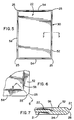
- the informative card 20 which is made of a single sheet of metal, has no sharp corners or exposed raw edges. As shown in FIGS 3-6, all four corners 25 of the card are rounded, and the entire peripheral edge 26 is an unbroken continuous rounded section with no exposed raw edge. As can be best seen in the cross-sectional views of FIGS. 7 and 8, the card is bordered by a frame 27.
- the frame 27 is defined by a lip 50 which, after formation, is folded and pressed against the rear side 22 of the card such that the thickness of the frame 27 is about twice the thickness of the metal sheet forming the card 20.
- the lip 50 includes two long parallel edges 52 and two shorter parallel edges 54 which are perpendicular to the long edges, and four connectors 55 at the rounded corners 25 of the card joining the straight edges of the lip.
- the connectors 55 have a smaller dimension than the straight edges 52 and 54.
- each of the connectors has sufficient material so that the folded lip 50 is continuous and unbroken around the corners 25.
- the card 20 has a radiused peripheral edge 26, as can be best seen in FIGS. 7 and 8, which is unbroken along the entire periphery of the card.
- the combination of an unbroken radiused edge 26 and the rounded corners 25 provides a smooth edge surface that is intended not to cut the hand of a consumer or snag on other cards, clothing or the like.
- the formation of such an edge renders the card substantially safe for handling.
- this construction enhances convenience, and allows the cards to be stacked and handled much like conventional cardboard cards. It will be appreciated that the elimination of sharp corners and raw edges is achieved in the present invention without significantly increasing the thickness of the card.
- the metal card of the illustrated embodiment has the general look and feel of a conventional baseball trading card.
- a rectangular central display panel 28 inboard of the frame 27 is offset rearwardly relative to the frame by about half the thickness of the sheet metal forming the card.
- the rearward displacement of the display panel 28 forms a raised ledge 34 on the front side 21 and a sunken recess 56 on the rear side 22 along the lip 50.
- the inboard portion of the ledge 34 is located along and opposite to the recess 56 on the rear side.
- the raised ledge 34 forms a continuous border attractively framing the central display panel 28. Accordingly, the photograph 61 on the front side 21 is highlighted by the continuous raised ledge 34 to a greater degree than is the case when a border of contrasting color is simply printed on a flat substrate, as is common on paperboard baseball trading cards.
- a further advantage of offsetting the central display panel 28 is that the sunken recess 56 thus created accommodates part of the thickness of the lip 50.
- the lip 50 projects from the rear side 22 of the card by only about half the thickness of the sheet metal. The edges of the lip 50 are therefore not likely to cut fingers.
- the lip 50 also serves as a raised border framing the printed material 62 on the rear side of the card.
- the informative card is formed from a sheet metal blank 20A having a flat body 29A which is generally rectangular with four straight raw edges.
- the blank 20A preferably has a length of about 91,75 mm, a width of 66,35 mm, and a thickness of 0,23 mm.
- the shape of the blank has relieved corners 25 formed in stamping or cutting the sheet, for purposes soon to be described.
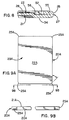
- a large sheet of metal is printed with a large number of repeat images of the card, and the large sheet is then subjected to a blanking operation in which the individual blanks 22A (FIG. 9A) are cut from the large sheet.
- the blanking operation simply uses a complimentary set of dies having mating peripheral sections shaped like the blank exterior of FIG. 9A.
- the blanking operation provides a convenient opportunity for also accomplishing the embossing.
- the blanking dies in addition to forming the periphery of the blank, will also carry the image to be embossed, so that the impact between the mating dies in the blanking operation will also form the embossed image.
- each of the four corners 25A is not a right angle but is cut away so as to slope at about a 45 degree angle with respect to the adjacent raw edges of the blank.
- the angle can be adjusted as required to suit the material thickness and material decoration.
- the width of the angled section, denoted W is important. If the width is too small, significant bunching and crumpling can result at the corners of the formed card 20. On the other hand, if the width is too large, there will not likely be sufficient material left to form the connectors 55 (FIG. 6) at the corners 25, and the resultant card would not have an unbroken radiused peripheral edge 26 around the corners.
- the width of the angled section may generally be in the range of 2,5 mm to 3,5 mm, and in the currently preferred embodiment is about 2,7 mm.
- the blank 20A first is drawn to shape the margins of the blank 20A, thereby forming into an upstanding flange 70A projecting in toward the rear of the card. Drawing is accomplished by the action of implementary dies which force the metal sheet into a female die, forming the upstanding lip between adjacent sections of male and female dies.
- the resultant piece is shown in FIG. 10A, and the flange 70A can be best seen in the end view of FIG. 10B.
- the drawing process works the metal to form rounded corners 25B on the body 29A. In one embodiment, the corners preferably have a radius of curvature of about 1,57 mm.
- the blank 20A has the size of a conventional baseball trading card, approximately 88,9 mm in length and 63,5 mm in width.
- the height of the flange 70A, denoted H, is about 1,98 mm, measured from the front surface 21A of the blank.
- the flange 70A has a generally V-shaped recess at each of the rounded corners 25B, but remains unbroken along the periphery of the drawn blank.
- the generally V-shaped recesses are formed by deforming the 45 degree sections 25A of the blank in the drawing process. It must be appreciated in viewing FIG.
- the V-shaped recesses provide a connector for the rounded corner which has a dimension which is less than the dimension of the lip at the straight sides.
- the height of the flange adjacent the straight edges is on the order of 1,98 mm
- the height of the flange at the corners ranges from about 0,076 mm at the notch of the V approximately intermediate the corner and fairing upward to join the full height flange at the mutually perpendicular sides.
- the reduced dimension in the corner achieved by the basic cut corners 25A of the card and the drawing process provides enough material in the corner to make a continuous frame, when the lip is bent down against the rear of the card, but without so much material as to cause bunching in the corner.
- the dimension W of the basic cut, the depth to which the card is drawn and the thickness of the material which forms the card are all coordinated such that the finished formed card has a neat and continuous frame around the periphery thereof, without bunching or gaps at the corners.
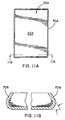
- the flange 70A is overbent to a selected angle with respect to the rear side.
- this bending step bends the flange such that the overbent flange 70B forms an angle of about 60 degrees with the rear side 22A of the body 29A.
- Overbending is accomplished without bending the metal at the corners 25A of the card.
- the overbending step begins to form the curls which will provide the radiused edges of the card, and is particularly significant in the context of the present card where the upstanding lip is continuous after the drawing step.
- the blank is in the shape of a pan having a continuous rim, but in which the height of the rim at the corners is less than the height along the straight edges.
- the edge of the flange is displaced inwardly, so that the tool which is subsequently used to flatten the hem and form the frame is capable of engaging the leading edge of the lip and displacing it in an arcuate fashion downwardly to meet the rear of the card without the possibility of buckling the lip which forms the frame.
- This is particularly significant in the corners where the shape of the relieved section is such as to maintain the continuity the lip right at the edge, but join the metal at the inward part of the frame to form a continuous double thickness section which is filled with metal from the edges in such a way as to substantially eliminate both gaps and bulges.
- the overbent flange 70B is then flattened against the rear side 22A to form the lip 50.
- the processed blank resulting from this step is illustrated in FIGS.12A and 12B.
- the straight edges 52 and 54 of the lip 50 has a width of about 1,57 mm.
- the frame 27, which includes the folded lip 50 and the portion of the body 29A facing the lip, has a thickness of about 0,48 mm. Because the connectors 55 (FIG. 6) have a smaller dimension than the straight edges, any overlapping of metal at the corners 25 caused by folding the flange 70B down is relatively insignificant, and the entire lip, corners included, is readily flattened in this step to a relatively uniform double thickness.
- the front side 21A of the blank remains flat, and the full thickness of the lip 50 remains exposed.
- the blank as processed may be used as an informative card.
- an offsetting step is performed in which the central display panel 28 is pressed rearwardly relative to the frame 27 by a small distance, preferably about half the thickness of the original metal blank.
- the card as completed is illustrated in FIGS. 1-8.
- the card has a double-thickness frame formed of a folded lip, and an unbroken radiused edge along the entire periphery of the card.
- the front and rear sides may be attractively lithographed. Enhanced appearance is achieved by offsetting the central display panel relative to the frame to form a ledge on the front side which defines an uninterrupted border attractively framing the central display panel.
Landscapes
- Credit Cards Or The Like (AREA)
- Devices For Indicating Variable Information By Combining Individual Elements (AREA)
- Toys (AREA)
- Casings For Electric Apparatus (AREA)
Abstract
Description
- This invention relates generally to informative cards, such as baseball trading cards, and more particularly to informative cards made of sheet metal.
- Baseball card trading, like baseball itself, has been a part of American culture, and baseball cards are treasured collections and valuable commodities of not only many children but many adults alike. A baseball trading card typically displays a photograph of a baseball player on the front side, and career statistics or other date of the player are usually printed on the back of the card. Conventionally, baseball trading cards are made of paperboard or other paper-like material. The obvious drawback of paper cards is that they do not endure repeated shuffling and handling, and are damaged easily.
- Recently, baseball trading cards made of sheet metal are becoming increasingly popular. One of the reasons for their popularity is, of course, that they are much more durable than paper cards and therefore are more "permanent". Another reason for their popularity is that the workability of metal allows the metal cards to be shaped, such as by embossing, to create visual effects not easily achievable on paper cards. For example, U.S. Patent 5,215,792 discloses such an informative card made of a single sheet of metal. The four edge portions of the informative card comprise hems folded on the rear side of the card. The front side of the card contains a central display region which is offset slightly towards the rear so as to leave a raised peripheral ledge framing the central display region. The resultant card is similar to conventional paperboard baseball cards in thickness but has a more attractive appearance. Because the edges of the card are folded, the metal information card is generally free of sharp edges and sharp points. However, a short length of the raw edge of the sheet metal remains at each corner of the card, and such raw edges, albeit very short, may still cause safety concerns.
- It has also been proposed to make baseball cards with a combination of metal and paper. For example, U.S. Patent 5,363,964 to Hexter discloses a baseball trading card having a metal substrate holding a printed cardboard insert in the front. The four edge portions of the metal substrate are rolled towards the printed cardboard such that the metal edges grip the cardboard and hold it in position. A significant disadvantage of such a paper/metal trading card is that it is several times thicker than conventional paper baseball cards due to its thick rolled edges. Thus, the paper/metal trading card does not look like a conventional baseball trading card but, rather, resembles a miniature framed picture. The paper/metal trading card also cannot be shuffled like a conventional trading card. Such deviation from the look and feel of conventional baseball trading cards makes the paper/metal trading cards undesirable to many collectors. Another disadvantage of such a card is its relatively high cost because each card requires both a printed cardboard element and a formed metal sheet.
- In view of the foregoing, it is a primary object of the present invention to provide a metal informative card which resembles a conventional baseball trading card but has an enhanced appearance, and has no raw edges or sharp corners so that it is substantially safe to handle.
- It is a related object of the present invention to provide a method for producing a metal informative card.
- In order to achieve these objects, the invention provides an informative card in accordance with claim 1 and a method for producing such a card in accordance with claim 10.
- The invention reduces or substantially eliminates raw edges capable of snagging, so that the metal cards can be handled much like conventional cardboard informative cards.
- The invention provides an informative card made of a single sheet of metal formed in a way which eliminates raw edges and sharp corners without substantially increasing the thickness of the card.
- The card is easy to manufacture and therefore of low production cost.
- The folded lip, being unbroken along the periphery of the card, provides a continuous radiused peripheral edge which is intended not to cut the hand of a consumer, or to snag on other cards or other objects.
- Other features and advantages will become apparent with reference to the following detailed description when taken in conjunction with the drawings in which:
- FIGURE 1 is a front perspective view of a metal informative card constructed according to the present invention and carrying a picture of a baseball player;
- FIG. 2 is a rear perspective view of the metal informative card with printed material on the rear side;
- FIG. 3 is a front elevation of the card with printed material not shown;
- FIG. 4 is an enlarged front view of one corner of the card;
- FIG. 5 is a rear elevation of the card;
- FIG. 6 is an enlarged rear view of one corner of the card;
- FIG. 7 is an enlarged fragmentary cross-sectional view of the card along the line 7-7 in FIG. 5;
- FIG. 8 is an enlarged fragmentary cross-sectional view of the card along the line 8-8 in FIG. 6;
- FIGS. 9A and 9B show, respectively, rear and end views of a sheet metal blank from which the informative card is formed;
- FIGS. 10A and 10B show, respectively, rear and end views of the sheet metal blank after a drawing step in making the card;
- FIG. 10C is a partial elevation detailing the notched lip at the corner prior to bending and folding;
- FIGS. 11A and 11B show, respectively, rear and cross-sectional views of the sheet metal blank after a subsequent bending step; and
- FIGS. 12A and 12B show, respectively, rear and cross-sectional views of the sheet metal blank after a subsequent flattening step.
- While the invention is susceptible of various modifications and alternative constructions, certain illustrated embodiments hereof have been shown in the drawings and will be described below in detail. It should be understood, however, that there is no intention to limit the invention to the specific forms disclosed, but on the contrary, the intention is to cover all modifications, alternative constructions and equivalents falling within the spirit and scope of the invention as defined by the appended claims.
- Turning now to the drawings, for purposes of illustration, the invention has been shown in the drawings as embodied in a baseball trading card. It will be appreciated, however, that other types of images or information can be printed on the card, and, indeed, the card of the present invention may have a size different from that of a conventional baseball trading card, depending on the use of the card.
- FIG. 1 shows, in a perspective view, the
front side 21 of a metalinformative card 20 embodying the present invention. Thecard 20 is generally flat and has a rectangular shape, with twolong edge portions 23 and twoshort edge portions 24 extending at right angles to the long edge portions. Exemplifying the practice of the present invention, aphotograph 61 of a baseball player is printed on thefront side 21 of the card. Therear side 22 of the card is shown in FIG. 2. As is conventional for baseball trading cards, printedmaterials 62 showing career statistics of the player or other information is printed on the rear side. Preferably thecard 20 has the size of a conventional baseball trading card, with a length of 88,9 mm and a width of 63,5 mm. Front and rear elevations of thecard 20 with printed material deleted are shown in FIG. 3 and FIG. 5 respectively. - To provide additional attractive and decorative features, particularly suited to a metal trading card, the
card 22 can have embossed regions which cooperate with the printed image, as desired. For example, the name of the team can be embossed, the image of the player can be embossed, a glove can be embossed, or the like. For purposes of illustration, asmall section 61A is defined oncard 21 in FIG. 3 to represent an embossed area. Preferably the embossing is accomplished at the time the card blank is cut from a larger sheet of card blanks. - It is an important feature of the present invention that the
informative card 20, which is made of a single sheet of metal, has no sharp corners or exposed raw edges. As shown in FIGS 3-6, all fourcorners 25 of the card are rounded, and the entireperipheral edge 26 is an unbroken continuous rounded section with no exposed raw edge. As can be best seen in the cross-sectional views of FIGS. 7 and 8, the card is bordered by aframe 27. Theframe 27 is defined by alip 50 which, after formation, is folded and pressed against therear side 22 of the card such that the thickness of theframe 27 is about twice the thickness of the metal sheet forming thecard 20. Referring now to FIGS. 5 and 6, thelip 50 includes two long parallel edges 52 and two shorter parallel edges 54 which are perpendicular to the long edges, and fourconnectors 55 at therounded corners 25 of the card joining the straight edges of the lip. As shown in FIG. 6 and the enlarged cross-sectional view of FIG. 8, theconnectors 55 have a smaller dimension than thestraight edges lip 50 is continuous and unbroken around thecorners 25. - By virtue of the folded
lip 50, thecard 20 has a radiusedperipheral edge 26, as can be best seen in FIGS. 7 and 8, which is unbroken along the entire periphery of the card. The combination of an unbrokenradiused edge 26 and therounded corners 25 provides a smooth edge surface that is intended not to cut the hand of a consumer or snag on other cards, clothing or the like. The formation of such an edge renders the card substantially safe for handling. Combined with the relative thinness of the card, even considering the double thickness frame, this construction enhances convenience, and allows the cards to be stacked and handled much like conventional cardboard cards. It will be appreciated that the elimination of sharp corners and raw edges is achieved in the present invention without significantly increasing the thickness of the card. Thus, the metal card of the illustrated embodiment has the general look and feel of a conventional baseball trading card. - To further enhance the appearance of the metal card, in the illustrated embodiment in FIG. 1 a rectangular
central display panel 28 inboard of theframe 27 is offset rearwardly relative to the frame by about half the thickness of the sheet metal forming the card. As can be best seen in FIG. 7, the rearward displacement of thedisplay panel 28 forms a raisedledge 34 on thefront side 21 and asunken recess 56 on therear side 22 along thelip 50. The inboard portion of theledge 34 is located along and opposite to therecess 56 on the rear side. As illustrated in FIG. 1, the raisedledge 34 forms a continuous border attractively framing thecentral display panel 28. Accordingly, thephotograph 61 on thefront side 21 is highlighted by the continuous raisedledge 34 to a greater degree than is the case when a border of contrasting color is simply printed on a flat substrate, as is common on paperboard baseball trading cards. - A further advantage of offsetting the
central display panel 28 is that thesunken recess 56 thus created accommodates part of the thickness of thelip 50. As a result, thelip 50 projects from therear side 22 of the card by only about half the thickness of the sheet metal. The edges of thelip 50 are therefore not likely to cut fingers. As illustrated in FIG. 2, thelip 50 also serves as a raised border framing the printedmaterial 62 on the rear side of the card. - The preferred process for forming the metal informative card will now be described. The informative card is formed from a sheet metal blank 20A having a
flat body 29A which is generally rectangular with four straight raw edges. In one embodiment the blank 20A preferably has a length of about 91,75 mm, a width of 66,35 mm, and a thickness of 0,23 mm. The shape of the blank has relievedcorners 25 formed in stamping or cutting the sheet, for purposes soon to be described. - It will be noted that a large sheet of metal is printed with a large number of repeat images of the card, and the large sheet is then subjected to a blanking operation in which the
individual blanks 22A (FIG. 9A) are cut from the large sheet. Typically the blanking operation simply uses a complimentary set of dies having mating peripheral sections shaped like the blank exterior of FIG. 9A. However, in the case where it is also desired to emboss the card, the blanking operation provides a convenient opportunity for also accomplishing the embossing. In the case where embossing is to be provided, the blanking dies, in addition to forming the periphery of the blank, will also carry the image to be embossed, so that the impact between the mating dies in the blanking operation will also form the embossed image. - Returning to the shape of the cards, as illustrated in FIG. 9A, each of the four
corners 25A is not a right angle but is cut away so as to slope at about a 45 degree angle with respect to the adjacent raw edges of the blank. The angle can be adjusted as required to suit the material thickness and material decoration. The width of the angled section, denoted W, is important. If the width is too small, significant bunching and crumpling can result at the corners of the formedcard 20. On the other hand, if the width is too large, there will not likely be sufficient material left to form the connectors 55 (FIG. 6) at thecorners 25, and the resultant card would not have an unbroken radiusedperipheral edge 26 around the corners. With the preferred dimensions of themetal blank 20A, the width of the angled section may generally be in the range of 2,5 mm to 3,5 mm, and in the currently preferred embodiment is about 2,7 mm. - To form the informative card, the blank 20A first is drawn to shape the margins of the blank 20A, thereby forming into an
upstanding flange 70A projecting in toward the rear of the card. Drawing is accomplished by the action of implementary dies which force the metal sheet into a female die, forming the upstanding lip between adjacent sections of male and female dies. The resultant piece is shown in FIG. 10A, and theflange 70A can be best seen in the end view of FIG. 10B. The drawing process works the metal to formrounded corners 25B on thebody 29A. In one embodiment, the corners preferably have a radius of curvature of about 1,57 mm. After the drawing process forms the upstanding lip, the blank 20A has the size of a conventional baseball trading card, approximately 88,9 mm in length and 63,5 mm in width. The height of theflange 70A, denoted H, is about 1,98 mm, measured from thefront surface 21A of the blank. As shown in FIG. 10B, theflange 70A has a generally V-shaped recess at each of therounded corners 25B, but remains unbroken along the periphery of the drawn blank. The generally V-shaped recesses are formed by deforming the 45degree sections 25A of the blank in the drawing process. It must be appreciated in viewing FIG. 10B that the V-shaped groove extends around the corner of the card, joining the mutually perpendicular long and short sides of the lip as is suggested in FIG. 10C. In effect, the V-shaped recesses provide a connector for the rounded corner which has a dimension which is less than the dimension of the lip at the straight sides. In the case where the height of the flange adjacent the straight edges is on the order of 1,98 mm, the height of the flange at the corners ranges from about 0,076 mm at the notch of the V approximately intermediate the corner and fairing upward to join the full height flange at the mutually perpendicular sides. The reduced dimension in the corner, achieved by thebasic cut corners 25A of the card and the drawing process provides enough material in the corner to make a continuous frame, when the lip is bent down against the rear of the card, but without so much material as to cause bunching in the corner. The dimension W of the basic cut, the depth to which the card is drawn and the thickness of the material which forms the card are all coordinated such that the finished formed card has a neat and continuous frame around the periphery thereof, without bunching or gaps at the corners. - To facilitate the folding of the
flange 70A towards therear side 22A of the blank to form thelip 50, theflange 70A is overbent to a selected angle with respect to the rear side. In the illustrated embodiment in FIGS. 11A and 11B, this bending step bends the flange such that theoverbent flange 70B forms an angle of about 60 degrees with therear side 22A of thebody 29A. Overbending is accomplished without bending the metal at thecorners 25A of the card. The overbending step begins to form the curls which will provide the radiused edges of the card, and is particularly significant in the context of the present card where the upstanding lip is continuous after the drawing step. In effect, after the drawing step the blank is in the shape of a pan having a continuous rim, but in which the height of the rim at the corners is less than the height along the straight edges. - By performing the overbending step, the edge of the flange is displaced inwardly, so that the tool which is subsequently used to flatten the hem and form the frame is capable of engaging the leading edge of the lip and displacing it in an arcuate fashion downwardly to meet the rear of the card without the possibility of buckling the lip which forms the frame. This is particularly significant in the corners where the shape of the relieved section is such as to maintain the continuity the lip right at the edge, but join the metal at the inward part of the frame to form a continuous double thickness section which is filled with metal from the edges in such a way as to substantially eliminate both gaps and bulges.
- The
overbent flange 70B is then flattened against therear side 22A to form thelip 50. The processed blank resulting from this step is illustrated in FIGS.12A and 12B. After the flattening step, thestraight edges lip 50 has a width of about 1,57 mm. Theframe 27, which includes the foldedlip 50 and the portion of thebody 29A facing the lip, has a thickness of about 0,48 mm. Because the connectors 55 (FIG. 6) have a smaller dimension than the straight edges, any overlapping of metal at thecorners 25 caused by folding theflange 70B down is relatively insignificant, and the entire lip, corners included, is readily flattened in this step to a relatively uniform double thickness. - As illustrated in the cross-sectional view of FIG. 12B, at this intermediate stage the
front side 21A of the blank remains flat, and the full thickness of thelip 50 remains exposed. If desired, the blank as processed may be used as an informative card. However, as described above, it is preferable to displace the portion of thebody 29A inboard of thelip 50 rearwardly to create the raisedledge 34. To this end, an offsetting step is performed in which thecentral display panel 28 is pressed rearwardly relative to theframe 27 by a small distance, preferably about half the thickness of the original metal blank. The card as completed is illustrated in FIGS. 1-8. - It will be appreciated that what has been provided includes a new and improved metal informative card which is completely free of sharp corners and exposed raw edges, and a method for making such a card. The card has a double-thickness frame formed of a folded lip, and an unbroken radiused edge along the entire periphery of the card. The front and rear sides may be attractively lithographed. Enhanced appearance is achieved by offsetting the central display panel relative to the frame to form a ledge on the front side which defines an uninterrupted border attractively framing the central display panel.
Claims (12)
- An informative card (20) of a rectangular shape made of a substantially flat and generally rectangular thin metal sheet, the informative card (20) having a front side (21), a rear side (22), four rounded corners (25), a double-thickness frame (27) formed of a folded lip (50) pressed against the rear side (22), and indicia (61) on the front side (21) of the card (20), the lip (50) including four straight edges (52, 54) and four rounded connectors (55) joining the straight edges (52, 54) at respective rounded corners (25), the rounded connectors (55) having a smaller dimension than the straight edges (52, 54) to form a frame which is substantially free of gaps or bunching at the corners.
- An informative card (20) according to claim 1, characterized in that a central display panel (28) inboard of the frame (27) is offset rearwardly relative to the frame (27) to form a raised ledge (34) on the front side (21) and a sunken recess (56) on the rear side (22) along the frame (27), the raised ledge (34) defining a continuous border framing the central display panel (28).
- An informative card (20) according to claim 2, characterized in that the card (20) is about 88,9 mm long and about 63,5 mm wide.
- An informative card (20) according to claim 3, characterized in that the thickness of the thin metal sheet is on the order of 0,23 mm.
- An informative card (20) according to claim 4, characterized in that the height of the lip (50) at the four straight edges (52, 54) prior to folding is about 2 mm, and the height of the lip (50) at each corner (25) prior to folding decreases to about 1 mm or less, that after folding the lip (50) joins to form a continuous frame substantially free of gaps or bunching at the corners.
- An informative card (20) according to claim 1, characterized in that the indicia (61) includes an embossed area (61A).
- An informative card (20) according to claim 1, characterized in that the double-thickness frame (27) is formed of an unbroken flange (70A) drawn from margins of the metal sheet and folded onto the rear side (22) and pressed flat to form an unbroken radiused peripheral edge.
- An informative card (20) according to claim 7, characterized in that the indicia (61) is printed.
- An informative card (20) according to claim 7, characterized in that the indicia (61) is embossed.
- A method for producing a metal informative card (20) comprising the steps of:providing a substantially flat and generally rectangular sheet of metal (20A) having front and rear sides (21A, 22A), four straight raw edges and four relieved corners (25A) each having a sloped section forming a 45 degree angle with adjacent straight raw edges;drawing the sheet of metal (20A) to form an unbroken upstanding flange (70A) at the edges of the sheet (20A) projecting rearwardly, the flange (70A) being rounded at the corners of the sheet (20A) and having a height at the rounded corners which is less than the height at the straight sides joining the corners;bending the flange (70A) towards the rear side (22A);flattening the flange (70A) to form a folded lip (50) pressed against the rear side (22A) of the sheet of metal (20A), the folded lip (50) defining a double-thickness frame substantially free of gaps or bunching at the corners, and an unbroken radiused peripheral edge.
- A method according to claim 10, further including the step of offsetting rearwardly a central display panel (28) inboard of the frame (27) to form a continuous raised ledge (34) on the front side (21) surrounding the central display panel (28).
- A method according to claim 11, further including the step of embossing an indicia (61) in the central display panel (28) to form a raised image.
Applications Claiming Priority (2)
| Application Number | Priority Date | Filing Date | Title |
|---|---|---|---|
| US633464 | 1996-04-17 | ||
| US08/633,464 US5834127A (en) | 1996-04-17 | 1996-04-17 | Informative card made of sheet metal |
Publications (3)
| Publication Number | Publication Date |
|---|---|
| EP0802068A2 true EP0802068A2 (en) | 1997-10-22 |
| EP0802068A3 EP0802068A3 (en) | 1998-03-11 |
| EP0802068B1 EP0802068B1 (en) | 2000-07-12 |
Family
ID=24539731
Family Applications (1)
| Application Number | Title | Priority Date | Filing Date |
|---|---|---|---|
| EP97201063A Expired - Lifetime EP0802068B1 (en) | 1996-04-17 | 1997-04-10 | Informative card made of sheet metal and method for producing the card |
Country Status (7)
| Country | Link |
|---|---|
| US (1) | US5834127A (en) |
| EP (1) | EP0802068B1 (en) |
| JP (1) | JPH1035148A (en) |
| AR (1) | AR006987A1 (en) |
| CA (1) | CA2201404C (en) |
| DE (1) | DE69702473T2 (en) |
| ES (1) | ES2148894T3 (en) |
Cited By (2)
| Publication number | Priority date | Publication date | Assignee | Title |
|---|---|---|---|---|
| US12220936B2 (en) | 2020-08-28 | 2025-02-11 | Scanavo A/S | Book or booklet cover and a method of making a book or booklet cover |
| DK182006B1 (en) * | 2023-12-11 | 2025-05-22 | Scanavo As | A metal poster manufactured of a first and a second metal sheet and a method of manufacturing a metal poster |
Families Citing this family (7)
| Publication number | Priority date | Publication date | Assignee | Title |
|---|---|---|---|---|
| KR20050122349A (en) * | 2004-06-24 | 2005-12-29 | 엘지전자 주식회사 | A tub assembly of a dish washer |
| US20060043679A1 (en) * | 2004-08-25 | 2006-03-02 | The Upper Deck Company, Llc | Manufacturing component trading card |
| US8622393B2 (en) * | 2005-01-25 | 2014-01-07 | The Upper Deck Company | Trading card game including trading card having a selectively unexposed section |
| US8016193B2 (en) * | 2007-12-27 | 2011-09-13 | Target Brands, Inc. | Transaction product with storage chamber |
| USD613338S1 (en) * | 2008-07-31 | 2010-04-06 | Chris Marukos | Interchangeable advertising sign |
| USD665851S1 (en) | 2011-07-21 | 2012-08-21 | Crown Packaging Technology, Inc. | Metal card |
| US10589517B2 (en) * | 2017-06-16 | 2020-03-17 | Christian Carter Noterman | Metal photographic plate with carrier and method of use |
Family Cites Families (25)
| Publication number | Priority date | Publication date | Assignee | Title |
|---|---|---|---|---|
| US1790665A (en) * | 1931-02-03 | hubbard | ||
| US1710483A (en) * | 1929-04-23 | Isaac kbaushab | ||
| US625815A (en) * | 1899-05-30 | thawley | ||
| US708628A (en) * | 1900-05-12 | 1902-09-09 | Elliott Co | Stencil-frame. |
| US782199A (en) * | 1904-02-29 | 1905-02-07 | George B Keplinger | Mounting for photographs, medallions, &c. |
| US1117085A (en) * | 1914-06-02 | 1914-11-10 | Gen Advertising Co | Display-card with easel attachment. |
| US1456845A (en) * | 1921-07-16 | 1923-05-29 | J E Mergott Co | Frame making |
| US1548507A (en) * | 1923-04-16 | 1925-08-04 | Chester W Brown | Game apparatus |
| US1575720A (en) * | 1924-06-13 | 1926-03-09 | Scott John Duer | Lantern-slide mounting |
| US1607465A (en) * | 1926-04-24 | 1926-11-16 | Kirk Archibald | Wall-paper-display panel |
| US1749148A (en) * | 1926-10-08 | 1930-03-04 | James A Mcgregor | Process of flanging sheet metal |
| US1700943A (en) * | 1927-11-26 | 1929-02-05 | Fischel P Lesser | Window advertising display |
| US1924429A (en) * | 1932-07-29 | 1933-08-29 | Ohio Art Co | Embossed covered picture and process of making same |
| US2113871A (en) * | 1937-04-21 | 1938-04-12 | Clarence J Bozung | Picture frame |
| US2695470A (en) * | 1952-03-21 | 1954-11-30 | Rosenberg George | Picture frame with permanent inlay |
| US2871600A (en) * | 1958-04-17 | 1959-02-03 | Television Mat Service Corp | Slide mount |
| US3322299A (en) * | 1965-09-02 | 1967-05-30 | Clark Mfg Co J L | Sheet metal container with plastic closure |
| US4309835A (en) * | 1979-08-06 | 1982-01-12 | Naeve Don A | Foldable frame structure |
| US4291798A (en) * | 1980-03-31 | 1981-09-29 | Felix Transport | Display device |
| US4515838A (en) * | 1984-01-12 | 1985-05-07 | Yukio Miyajima | Fancy article for use as a greeting gift such as a greeting card |
| US5215792A (en) * | 1990-11-26 | 1993-06-01 | J. L. Clark, Inc. | Informative card made of sheet metal |
| US5097953A (en) * | 1991-01-23 | 1992-03-24 | Paul Gingras | Card holding device |
| JPH0592682A (en) * | 1991-09-30 | 1993-04-16 | Tanaka Kikinzoku Kogyo Kk | Postcard of precious metal |
| US5538135A (en) * | 1993-09-14 | 1996-07-23 | Cui, Inc. | Dual-medium articles, including hinged articles |
| US5363964A (en) * | 1993-09-14 | 1994-11-15 | Cui, Inc. | Embossed metal trading card and container therefore |
-
1996
- 1996-04-17 US US08/633,464 patent/US5834127A/en not_active Expired - Lifetime
-
1997
- 1997-04-01 CA CA002201404A patent/CA2201404C/en not_active Expired - Fee Related
- 1997-04-10 ES ES97201063T patent/ES2148894T3/en not_active Expired - Lifetime
- 1997-04-10 DE DE69702473T patent/DE69702473T2/en not_active Expired - Fee Related
- 1997-04-10 EP EP97201063A patent/EP0802068B1/en not_active Expired - Lifetime
- 1997-04-16 AR ARP970101527A patent/AR006987A1/en unknown
- 1997-04-17 JP JP9100273A patent/JPH1035148A/en active Pending
Cited By (3)
| Publication number | Priority date | Publication date | Assignee | Title |
|---|---|---|---|---|
| US12220936B2 (en) | 2020-08-28 | 2025-02-11 | Scanavo A/S | Book or booklet cover and a method of making a book or booklet cover |
| DK182006B1 (en) * | 2023-12-11 | 2025-05-22 | Scanavo As | A metal poster manufactured of a first and a second metal sheet and a method of manufacturing a metal poster |
| DK202301194A1 (en) * | 2023-12-11 | 2025-05-22 | Scanavo As | A metal poster manufactured of a first and a second metal sheet and a method of manufacturing a metal poster |
Also Published As
| Publication number | Publication date |
|---|---|
| ES2148894T3 (en) | 2000-10-16 |
| CA2201404C (en) | 2000-06-13 |
| DE69702473T2 (en) | 2001-03-08 |
| CA2201404A1 (en) | 1997-10-17 |
| DE69702473D1 (en) | 2000-08-17 |
| EP0802068A3 (en) | 1998-03-11 |
| JPH1035148A (en) | 1998-02-10 |
| US5834127A (en) | 1998-11-10 |
| MX9702779A (en) | 1997-10-31 |
| AR006987A1 (en) | 1999-10-13 |
| EP0802068B1 (en) | 2000-07-12 |
Similar Documents
| Publication | Publication Date | Title |
|---|---|---|
| AU669996B2 (en) | Embossed metal trading cards and container | |
| EP0719219B1 (en) | Dual-medium articles, including hinged articles | |
| US5215792A (en) | Informative card made of sheet metal | |
| EP0802068B1 (en) | Informative card made of sheet metal and method for producing the card | |
| US20050183300A1 (en) | Moveable animated display device | |
| US5667876A (en) | Informative card made of sheet metal | |
| US7938293B2 (en) | Container lid | |
| US4126333A (en) | Method of preparing a publication with a separable redemption coupon or the like | |
| JP2001322630A (en) | Box for both packaging and displaying | |
| MXPA97002779A (en) | Informative card made of metal sheet | |
| EP0371705A1 (en) | Improvements in and relating to blanks for three dimensional models | |
| JP2022156559A (en) | Popup card | |
| US20200261813A1 (en) | Craft model | |
| JP2540460Y2 (en) | One-sided open box | |
| JP2008168915A (en) | Inclined displaying packaging box | |
| US20050217154A1 (en) | System of forming three-dimensional figures from a laminar material | |
| JP3042424U (en) | Fan stand | |
| JP3034054U (en) | Simple picture frame | |
| JP3424425B2 (en) | Booklet | |
| US20060061087A1 (en) | Book cover, associated book, and method of manufacture | |
| JP3065336U (en) | 3D display | |
| JPH0529072U (en) | 3D display board | |
| JP2586706Y2 (en) | Blank plate for carton | |
| EP1512446A1 (en) | Flat-bottomed steel toy disk | |
| WO2003007280A1 (en) | Metal identification tag |
Legal Events
| Date | Code | Title | Description |
|---|---|---|---|
| PUAI | Public reference made under article 153(3) epc to a published international application that has entered the european phase |
Free format text: ORIGINAL CODE: 0009012 |
|
| AK | Designated contracting states |
Kind code of ref document: A2 Designated state(s): DE ES FR GB IT NL |
|
| PUAL | Search report despatched |
Free format text: ORIGINAL CODE: 0009013 |
|
| AK | Designated contracting states |
Kind code of ref document: A3 Designated state(s): DE ES FR GB IT NL |
|
| 17P | Request for examination filed |
Effective date: 19980618 |
|
| GRAG | Despatch of communication of intention to grant |
Free format text: ORIGINAL CODE: EPIDOS AGRA |
|
| 17Q | First examination report despatched |
Effective date: 19990624 |
|
| GRAG | Despatch of communication of intention to grant |
Free format text: ORIGINAL CODE: EPIDOS AGRA |
|
| GRAG | Despatch of communication of intention to grant |
Free format text: ORIGINAL CODE: EPIDOS AGRA |
|
| GRAH | Despatch of communication of intention to grant a patent |
Free format text: ORIGINAL CODE: EPIDOS IGRA |
|
| GRAH | Despatch of communication of intention to grant a patent |
Free format text: ORIGINAL CODE: EPIDOS IGRA |
|
| GRAA | (expected) grant |
Free format text: ORIGINAL CODE: 0009210 |
|
| AK | Designated contracting states |
Kind code of ref document: B1 Designated state(s): DE ES FR GB IT NL |
|
| PG25 | Lapsed in a contracting state [announced via postgrant information from national office to epo] |
Ref country code: NL Free format text: LAPSE BECAUSE OF FAILURE TO SUBMIT A TRANSLATION OF THE DESCRIPTION OR TO PAY THE FEE WITHIN THE PRESCRIBED TIME-LIMIT Effective date: 20000712 Ref country code: IT Free format text: LAPSE BECAUSE OF FAILURE TO SUBMIT A TRANSLATION OF THE DESCRIPTION OR TO PAY THE FEE WITHIN THE PRESCRIBED TIME-LIMIT;WARNING: LAPSES OF ITALIAN PATENTS WITH EFFECTIVE DATE BEFORE 2007 MAY HAVE OCCURRED AT ANY TIME BEFORE 2007. THE CORRECT EFFECTIVE DATE MAY BE DIFFERENT FROM THE ONE RECORDED. Effective date: 20000712 Ref country code: FR Free format text: LAPSE BECAUSE OF FAILURE TO SUBMIT A TRANSLATION OF THE DESCRIPTION OR TO PAY THE FEE WITHIN THE PRESCRIBED TIME-LIMIT Effective date: 20000712 |
|
| REF | Corresponds to: |
Ref document number: 69702473 Country of ref document: DE Date of ref document: 20000817 |
|
| REG | Reference to a national code |
Ref country code: ES Ref legal event code: FG2A Ref document number: 2148894 Country of ref document: ES Kind code of ref document: T3 |
|
| NLV1 | Nl: lapsed or annulled due to failure to fulfill the requirements of art. 29p and 29m of the patents act | ||
| EN | Fr: translation not filed | ||
| PGFP | Annual fee paid to national office [announced via postgrant information from national office to epo] |
Ref country code: DE Payment date: 20010330 Year of fee payment: 5 |
|
| PGFP | Annual fee paid to national office [announced via postgrant information from national office to epo] |
Ref country code: GB Payment date: 20010404 Year of fee payment: 5 |
|
| PGFP | Annual fee paid to national office [announced via postgrant information from national office to epo] |
Ref country code: ES Payment date: 20010430 Year of fee payment: 5 |
|
| PLBE | No opposition filed within time limit |
Free format text: ORIGINAL CODE: 0009261 |
|
| STAA | Information on the status of an ep patent application or granted ep patent |
Free format text: STATUS: NO OPPOSITION FILED WITHIN TIME LIMIT |
|
| 26N | No opposition filed | ||
| REG | Reference to a national code |
Ref country code: GB Ref legal event code: IF02 |
|
| PG25 | Lapsed in a contracting state [announced via postgrant information from national office to epo] |
Ref country code: GB Free format text: LAPSE BECAUSE OF NON-PAYMENT OF DUE FEES Effective date: 20020410 |
|
| PG25 | Lapsed in a contracting state [announced via postgrant information from national office to epo] |
Ref country code: ES Free format text: LAPSE BECAUSE OF NON-PAYMENT OF DUE FEES Effective date: 20020411 |
|
| PG25 | Lapsed in a contracting state [announced via postgrant information from national office to epo] |
Ref country code: DE Free format text: LAPSE BECAUSE OF NON-PAYMENT OF DUE FEES Effective date: 20021101 |
|
| GBPC | Gb: european patent ceased through non-payment of renewal fee |
Effective date: 20020410 |
|
| REG | Reference to a national code |
Ref country code: ES Ref legal event code: FD2A Effective date: 20030514 |