EP0799279B1 - Moulded Article - Google Patents
Moulded Article Download PDFInfo
- Publication number
- EP0799279B1 EP0799279B1 EP95941957A EP95941957A EP0799279B1 EP 0799279 B1 EP0799279 B1 EP 0799279B1 EP 95941957 A EP95941957 A EP 95941957A EP 95941957 A EP95941957 A EP 95941957A EP 0799279 B1 EP0799279 B1 EP 0799279B1
- Authority
- EP
- European Patent Office
- Prior art keywords
- resin
- moulded article
- moulding
- article according
- group
- Prior art date
- Legal status (The legal status is an assumption and is not a legal conclusion. Google has not performed a legal analysis and makes no representation as to the accuracy of the status listed.)
- Expired - Lifetime
Links
- 239000011342 resin composition Substances 0.000 claims abstract description 43
- 229920002521 macromolecule Polymers 0.000 claims abstract description 39
- 229920005989 resin Polymers 0.000 claims abstract description 36
- 239000011347 resin Substances 0.000 claims abstract description 36
- 229920001187 thermosetting polymer Polymers 0.000 claims abstract description 31
- 239000000463 material Substances 0.000 claims abstract description 18
- 238000000034 method Methods 0.000 claims abstract description 12
- 229920006150 hyperbranched polyester Polymers 0.000 claims description 19
- 239000003795 chemical substances by application Substances 0.000 claims description 15
- 238000000465 moulding Methods 0.000 claims description 11
- 229920006395 saturated elastomer Polymers 0.000 claims description 10
- 125000003342 alkenyl group Chemical group 0.000 claims description 9
- 229910052799 carbon Inorganic materials 0.000 claims description 9
- 229920001971 elastomer Polymers 0.000 claims description 9
- 239000005060 rubber Substances 0.000 claims description 9
- 238000001746 injection moulding Methods 0.000 claims description 8
- 238000012545 processing Methods 0.000 claims description 8
- 229920006305 unsaturated polyester Polymers 0.000 claims description 8
- 239000003365 glass fiber Substances 0.000 claims description 7
- 241000531908 Aramides Species 0.000 claims description 6
- OKTJSMMVPCPJKN-UHFFFAOYSA-N Carbon Chemical compound [C] OKTJSMMVPCPJKN-UHFFFAOYSA-N 0.000 claims description 6
- 150000008064 anhydrides Chemical group 0.000 claims description 6
- 229920003235 aromatic polyamide Polymers 0.000 claims description 6
- 239000003054 catalyst Substances 0.000 claims description 6
- 150000001875 compounds Chemical class 0.000 claims description 6
- 229920001601 polyetherimide Polymers 0.000 claims description 6
- 239000000126 substance Substances 0.000 claims description 6
- -1 -OH Chemical group 0.000 claims description 5
- 239000004697 Polyetherimide Substances 0.000 claims description 5
- 125000003178 carboxy group Chemical group [H]OC(*)=O 0.000 claims description 5
- ISWSIDIOOBJBQZ-UHFFFAOYSA-N phenol group Chemical group C1(=CC=CC=C1)O ISWSIDIOOBJBQZ-UHFFFAOYSA-N 0.000 claims description 5
- 238000005520 cutting process Methods 0.000 claims description 4
- 239000004744 fabric Substances 0.000 claims description 4
- 230000005484 gravity Effects 0.000 claims description 4
- 238000001802 infusion Methods 0.000 claims description 4
- 239000003112 inhibitor Substances 0.000 claims description 4
- 230000002787 reinforcement Effects 0.000 claims description 4
- 239000003381 stabilizer Substances 0.000 claims description 4
- KXGFMDJXCMQABM-UHFFFAOYSA-N 2-methoxy-6-methylphenol Chemical compound [CH]OC1=CC=CC([CH])=C1O KXGFMDJXCMQABM-UHFFFAOYSA-N 0.000 claims description 3
- 229920000877 Melamine resin Polymers 0.000 claims description 3
- 239000004952 Polyamide Substances 0.000 claims description 3
- 239000004642 Polyimide Substances 0.000 claims description 3
- 229920001807 Urea-formaldehyde Polymers 0.000 claims description 3
- GZCGUPFRVQAUEE-SLPGGIOYSA-N aldehydo-D-glucose Chemical compound OC[C@@H](O)[C@@H](O)[C@H](O)[C@@H](O)C=O GZCGUPFRVQAUEE-SLPGGIOYSA-N 0.000 claims description 3
- 229920003180 amino resin Polymers 0.000 claims description 3
- 238000000071 blow moulding Methods 0.000 claims description 3
- 239000001913 cellulose Substances 0.000 claims description 3
- 229920002678 cellulose Polymers 0.000 claims description 3
- 238000007906 compression Methods 0.000 claims description 3
- 230000006835 compression Effects 0.000 claims description 3
- 238000001125 extrusion Methods 0.000 claims description 3
- 125000000524 functional group Chemical group 0.000 claims description 3
- 229920001568 phenolic resin Polymers 0.000 claims description 3
- 230000000704 physical effect Effects 0.000 claims description 3
- 229920002647 polyamide Polymers 0.000 claims description 3
- 229920000768 polyamine Polymers 0.000 claims description 3
- 229920001721 polyimide Polymers 0.000 claims description 3
- 229920002635 polyurethane Polymers 0.000 claims description 3
- 239000004814 polyurethane Substances 0.000 claims description 3
- 238000012546 transfer Methods 0.000 claims description 3
- 238000000748 compression moulding Methods 0.000 claims description 2
- 238000009730 filament winding Methods 0.000 claims description 2
- 238000007654 immersion Methods 0.000 claims description 2
- 238000001721 transfer moulding Methods 0.000 claims description 2
- 229920000647 polyepoxide Polymers 0.000 claims 4
- 125000003700 epoxy group Chemical group 0.000 claims 1
- 239000000945 filler Substances 0.000 claims 1
- 239000000314 lubricant Substances 0.000 claims 1
- 239000000049 pigment Substances 0.000 claims 1
- 125000002924 primary amino group Chemical group [H]N([H])* 0.000 claims 1
- 125000000467 secondary amino group Chemical group [H]N([*:1])[*:2] 0.000 claims 1
- 239000011159 matrix material Substances 0.000 abstract description 25
- 239000002131 composite material Substances 0.000 abstract description 14
- 125000003118 aryl group Chemical group 0.000 abstract description 5
- 238000004519 manufacturing process Methods 0.000 abstract description 5
- 230000008569 process Effects 0.000 abstract description 5
- 229920000642 polymer Polymers 0.000 abstract description 4
- 125000001931 aliphatic group Chemical group 0.000 abstract description 2
- 239000000047 product Substances 0.000 description 58
- 150000002118 epoxides Chemical class 0.000 description 29
- 239000000203 mixture Substances 0.000 description 24
- 239000002245 particle Substances 0.000 description 20
- 238000006243 chemical reaction Methods 0.000 description 19
- IJGRMHOSHXDMSA-UHFFFAOYSA-N Atomic nitrogen Chemical compound N#N IJGRMHOSHXDMSA-UHFFFAOYSA-N 0.000 description 14
- 239000002253 acid Substances 0.000 description 14
- YMWUJEATGCHHMB-UHFFFAOYSA-N Dichloromethane Chemical compound ClCCl YMWUJEATGCHHMB-UHFFFAOYSA-N 0.000 description 12
- 125000002887 hydroxy group Chemical group [H]O* 0.000 description 10
- 239000011541 reaction mixture Substances 0.000 description 10
- XLYOFNOQVPJJNP-UHFFFAOYSA-N water Substances O XLYOFNOQVPJJNP-UHFFFAOYSA-N 0.000 description 10
- PTBDIHRZYDMNKB-UHFFFAOYSA-N 2,2-Bis(hydroxymethyl)propionic acid Chemical compound OCC(C)(CO)C(O)=O PTBDIHRZYDMNKB-UHFFFAOYSA-N 0.000 description 9
- 150000001412 amines Chemical class 0.000 description 8
- 238000009472 formulation Methods 0.000 description 8
- 230000000694 effects Effects 0.000 description 7
- 229910052757 nitrogen Inorganic materials 0.000 description 7
- 229920000728 polyester Polymers 0.000 description 7
- ZWEHNKRNPOVVGH-UHFFFAOYSA-N 2-Butanone Chemical compound CCC(C)=O ZWEHNKRNPOVVGH-UHFFFAOYSA-N 0.000 description 6
- NHQDETIJWKXCTC-UHFFFAOYSA-N 3-chloroperbenzoic acid Chemical compound OOC(=O)C1=CC=CC(Cl)=C1 NHQDETIJWKXCTC-UHFFFAOYSA-N 0.000 description 6
- 125000000304 alkynyl group Chemical group 0.000 description 6
- GYZLOYUZLJXAJU-UHFFFAOYSA-N diglycidyl ether Chemical compound C1OC1COCC1CO1 GYZLOYUZLJXAJU-UHFFFAOYSA-N 0.000 description 6
- 230000032050 esterification Effects 0.000 description 6
- 238000005886 esterification reaction Methods 0.000 description 6
- 238000012360 testing method Methods 0.000 description 6
- BRLQWZUYTZBJKN-UHFFFAOYSA-N Epichlorohydrin Chemical compound ClCC1CO1 BRLQWZUYTZBJKN-UHFFFAOYSA-N 0.000 description 5
- 238000007792 addition Methods 0.000 description 5
- 150000001732 carboxylic acid derivatives Chemical class 0.000 description 5
- 238000002360 preparation method Methods 0.000 description 5
- 239000000243 solution Substances 0.000 description 5
- WRIDQFICGBMAFQ-UHFFFAOYSA-N (E)-8-Octadecenoic acid Natural products CCCCCCCCCC=CCCCCCCC(O)=O WRIDQFICGBMAFQ-UHFFFAOYSA-N 0.000 description 4
- LQJBNNIYVWPHFW-UHFFFAOYSA-N 20:1omega9c fatty acid Natural products CCCCCCCCCCC=CCCCCCCCC(O)=O LQJBNNIYVWPHFW-UHFFFAOYSA-N 0.000 description 4
- QSBYPNXLFMSGKH-UHFFFAOYSA-N 9-Heptadecensaeure Natural products CCCCCCCC=CCCCCCCCC(O)=O QSBYPNXLFMSGKH-UHFFFAOYSA-N 0.000 description 4
- 239000002970 Calcium lactobionate Substances 0.000 description 4
- 239000004593 Epoxy Substances 0.000 description 4
- LFQSCWFLJHTTHZ-UHFFFAOYSA-N Ethanol Chemical compound CCO LFQSCWFLJHTTHZ-UHFFFAOYSA-N 0.000 description 4
- IMNFDUFMRHMDMM-UHFFFAOYSA-N N-Heptane Chemical compound CCCCCCC IMNFDUFMRHMDMM-UHFFFAOYSA-N 0.000 description 4
- 239000005642 Oleic acid Substances 0.000 description 4
- ZQPPMHVWECSIRJ-UHFFFAOYSA-N Oleic acid Natural products CCCCCCCCC=CCCCCCCCC(O)=O ZQPPMHVWECSIRJ-UHFFFAOYSA-N 0.000 description 4
- UIIMBOGNXHQVGW-UHFFFAOYSA-M Sodium bicarbonate Chemical compound [Na+].OC([O-])=O UIIMBOGNXHQVGW-UHFFFAOYSA-M 0.000 description 4
- AWMVMTVKBNGEAK-UHFFFAOYSA-N Styrene oxide Chemical compound C1OC1C1=CC=CC=C1 AWMVMTVKBNGEAK-UHFFFAOYSA-N 0.000 description 4
- QAOWNCQODCNURD-UHFFFAOYSA-N Sulfuric acid Chemical compound OS(O)(=O)=O QAOWNCQODCNURD-UHFFFAOYSA-N 0.000 description 4
- PXKLMJQFEQBVLD-UHFFFAOYSA-N bisphenol F Chemical compound C1=CC(O)=CC=C1CC1=CC=C(O)C=C1 PXKLMJQFEQBVLD-UHFFFAOYSA-N 0.000 description 4
- AXCZMVOFGPJBDE-UHFFFAOYSA-L calcium dihydroxide Chemical compound [OH-].[OH-].[Ca+2] AXCZMVOFGPJBDE-UHFFFAOYSA-L 0.000 description 4
- 239000000920 calcium hydroxide Substances 0.000 description 4
- 229910001861 calcium hydroxide Inorganic materials 0.000 description 4
- 125000004432 carbon atom Chemical group C* 0.000 description 4
- 230000000052 comparative effect Effects 0.000 description 4
- 239000007859 condensation product Substances 0.000 description 4
- 230000032798 delamination Effects 0.000 description 4
- 150000002148 esters Chemical class 0.000 description 4
- QXJSBBXBKPUZAA-UHFFFAOYSA-N isooleic acid Natural products CCCCCCCC=CCCCCCCCCC(O)=O QXJSBBXBKPUZAA-UHFFFAOYSA-N 0.000 description 4
- 239000010410 layer Substances 0.000 description 4
- ZQPPMHVWECSIRJ-KTKRTIGZSA-N oleic acid Chemical compound CCCCCCCC\C=C/CCCCCCCC(O)=O ZQPPMHVWECSIRJ-KTKRTIGZSA-N 0.000 description 4
- 238000005191 phase separation Methods 0.000 description 4
- 239000004033 plastic Substances 0.000 description 4
- 229920003023 plastic Polymers 0.000 description 4
- 229920005862 polyol Polymers 0.000 description 4
- 150000003077 polyols Chemical class 0.000 description 4
- 238000009864 tensile test Methods 0.000 description 4
- 239000012745 toughening agent Substances 0.000 description 4
- 238000009736 wetting Methods 0.000 description 4
- 239000004970 Chain extender Substances 0.000 description 3
- CTQNGGLPUBDAKN-UHFFFAOYSA-N O-Xylene Chemical compound CC1=CC=CC=C1C CTQNGGLPUBDAKN-UHFFFAOYSA-N 0.000 description 3
- 244000137852 Petrea volubilis Species 0.000 description 3
- HEMHJVSKTPXQMS-UHFFFAOYSA-M Sodium hydroxide Chemical compound [OH-].[Na+] HEMHJVSKTPXQMS-UHFFFAOYSA-M 0.000 description 3
- YXFVVABEGXRONW-UHFFFAOYSA-N Toluene Chemical compound CC1=CC=CC=C1 YXFVVABEGXRONW-UHFFFAOYSA-N 0.000 description 3
- 238000005336 cracking Methods 0.000 description 3
- 239000000412 dendrimer Substances 0.000 description 3
- 229920000736 dendritic polymer Polymers 0.000 description 3
- 239000000835 fiber Substances 0.000 description 3
- 239000012467 final product Substances 0.000 description 3
- 238000010438 heat treatment Methods 0.000 description 3
- 238000005470 impregnation Methods 0.000 description 3
- 238000010907 mechanical stirring Methods 0.000 description 3
- 238000002156 mixing Methods 0.000 description 3
- 230000004048 modification Effects 0.000 description 3
- 238000012986 modification Methods 0.000 description 3
- WXZMFSXDPGVJKK-UHFFFAOYSA-N pentaerythritol Chemical compound OCC(CO)(CO)CO WXZMFSXDPGVJKK-UHFFFAOYSA-N 0.000 description 3
- 230000035484 reaction time Effects 0.000 description 3
- 239000002904 solvent Substances 0.000 description 3
- 238000003756 stirring Methods 0.000 description 3
- 239000008096 xylene Substances 0.000 description 3
- FALRKNHUBBKYCC-UHFFFAOYSA-N 2-(chloromethyl)pyridine-3-carbonitrile Chemical compound ClCC1=NC=CC=C1C#N FALRKNHUBBKYCC-UHFFFAOYSA-N 0.000 description 2
- MMEDJBFVJUFIDD-UHFFFAOYSA-N 2-[2-(carboxymethyl)phenyl]acetic acid Chemical compound OC(=O)CC1=CC=CC=C1CC(O)=O MMEDJBFVJUFIDD-UHFFFAOYSA-N 0.000 description 2
- WFUGQJXVXHBTEM-UHFFFAOYSA-N 2-hydroperoxy-2-(2-hydroperoxybutan-2-ylperoxy)butane Chemical compound CCC(C)(OO)OOC(C)(CC)OO WFUGQJXVXHBTEM-UHFFFAOYSA-N 0.000 description 2
- 125000003903 2-propenyl group Chemical group [H]C([*])([H])C([H])=C([H])[H] 0.000 description 2
- RNLHGQLZWXBQNY-UHFFFAOYSA-N 3-(aminomethyl)-3,5,5-trimethylcyclohexan-1-amine Chemical compound CC1(C)CC(N)CC(C)(CN)C1 RNLHGQLZWXBQNY-UHFFFAOYSA-N 0.000 description 2
- 229920003319 Araldite® Polymers 0.000 description 2
- WWZKQHOCKIZLMA-UHFFFAOYSA-N Caprylic acid Natural products CCCCCCCC(O)=O WWZKQHOCKIZLMA-UHFFFAOYSA-N 0.000 description 2
- ZAMOUSCENKQFHK-UHFFFAOYSA-N Chlorine atom Chemical compound [Cl] ZAMOUSCENKQFHK-UHFFFAOYSA-N 0.000 description 2
- IAYPIBMASNFSPL-UHFFFAOYSA-N Ethylene oxide Chemical compound C1CO1 IAYPIBMASNFSPL-UHFFFAOYSA-N 0.000 description 2
- 238000006845 Michael addition reaction Methods 0.000 description 2
- GOOHAUXETOMSMM-UHFFFAOYSA-N Propylene oxide Chemical compound CC1CO1 GOOHAUXETOMSMM-UHFFFAOYSA-N 0.000 description 2
- FAPWRFPIFSIZLT-UHFFFAOYSA-M Sodium chloride Chemical compound [Na+].[Cl-] FAPWRFPIFSIZLT-UHFFFAOYSA-M 0.000 description 2
- WYURNTSHIVDZCO-UHFFFAOYSA-N Tetrahydrofuran Chemical compound C1CCOC1 WYURNTSHIVDZCO-UHFFFAOYSA-N 0.000 description 2
- 230000001070 adhesive effect Effects 0.000 description 2
- 150000001299 aldehydes Chemical class 0.000 description 2
- JQRRFDWXQOQICD-UHFFFAOYSA-N biphenylen-1-ylboronic acid Chemical compound C12=CC=CC=C2C2=C1C=CC=C2B(O)O JQRRFDWXQOQICD-UHFFFAOYSA-N 0.000 description 2
- 239000007795 chemical reaction product Substances 0.000 description 2
- 239000000460 chlorine Substances 0.000 description 2
- 229910052801 chlorine Inorganic materials 0.000 description 2
- 238000001816 cooling Methods 0.000 description 2
- GHVNFZFCNZKVNT-UHFFFAOYSA-N decanoic acid Chemical compound CCCCCCCCCC(O)=O GHVNFZFCNZKVNT-UHFFFAOYSA-N 0.000 description 2
- 230000001419 dependent effect Effects 0.000 description 2
- 238000011156 evaluation Methods 0.000 description 2
- 238000000605 extraction Methods 0.000 description 2
- 239000011521 glass Substances 0.000 description 2
- 230000009477 glass transition Effects 0.000 description 2
- 230000006872 improvement Effects 0.000 description 2
- 150000002576 ketones Chemical class 0.000 description 2
- 230000007246 mechanism Effects 0.000 description 2
- 229910052751 metal Inorganic materials 0.000 description 2
- 239000002184 metal Substances 0.000 description 2
- 239000003607 modifier Substances 0.000 description 2
- 239000012044 organic layer Substances 0.000 description 2
- 239000004848 polyfunctional curative Substances 0.000 description 2
- 238000001556 precipitation Methods 0.000 description 2
- 230000003014 reinforcing effect Effects 0.000 description 2
- 238000005204 segregation Methods 0.000 description 2
- 230000035945 sensitivity Effects 0.000 description 2
- 229910000030 sodium bicarbonate Inorganic materials 0.000 description 2
- AKHNMLFCWUSKQB-UHFFFAOYSA-L sodium thiosulfate Chemical compound [Na+].[Na+].[O-]S([O-])(=O)=S AKHNMLFCWUSKQB-UHFFFAOYSA-L 0.000 description 2
- 125000001424 substituent group Chemical group 0.000 description 2
- 229940014800 succinic anhydride Drugs 0.000 description 2
- 229920001169 thermoplastic Polymers 0.000 description 2
- 239000004416 thermosoftening plastic Substances 0.000 description 2
- 238000007738 vacuum evaporation Methods 0.000 description 2
- RYHBNJHYFVUHQT-UHFFFAOYSA-N 1,4-Dioxane Chemical compound C1COCCO1 RYHBNJHYFVUHQT-UHFFFAOYSA-N 0.000 description 1
- XQUPVDVFXZDTLT-UHFFFAOYSA-N 1-[4-[[4-(2,5-dioxopyrrol-1-yl)phenyl]methyl]phenyl]pyrrole-2,5-dione Chemical compound O=C1C=CC(=O)N1C(C=C1)=CC=C1CC1=CC=C(N2C(C=CC2=O)=O)C=C1 XQUPVDVFXZDTLT-UHFFFAOYSA-N 0.000 description 1
- BDKDHWOPFRTWPP-UHFFFAOYSA-N 2,2-bis(prop-2-enoxymethyl)butan-1-ol Chemical compound C=CCOCC(CO)(CC)COCC=C BDKDHWOPFRTWPP-UHFFFAOYSA-N 0.000 description 1
- WMYINDVYGQKYMI-UHFFFAOYSA-N 2-[2,2-bis(hydroxymethyl)butoxymethyl]-2-ethylpropane-1,3-diol Chemical compound CCC(CO)(CO)COCC(CC)(CO)CO WMYINDVYGQKYMI-UHFFFAOYSA-N 0.000 description 1
- TXBCBTDQIULDIA-UHFFFAOYSA-N 2-[[3-hydroxy-2,2-bis(hydroxymethyl)propoxy]methyl]-2-(hydroxymethyl)propane-1,3-diol Chemical compound OCC(CO)(CO)COCC(CO)(CO)CO TXBCBTDQIULDIA-UHFFFAOYSA-N 0.000 description 1
- PTJWCLYPVFJWMP-UHFFFAOYSA-N 2-[[3-hydroxy-2-[[3-hydroxy-2,2-bis(hydroxymethyl)propoxy]methyl]-2-(hydroxymethyl)propoxy]methyl]-2-(hydroxymethyl)propane-1,3-diol Chemical compound OCC(CO)(CO)COCC(CO)(CO)COCC(CO)(CO)CO PTJWCLYPVFJWMP-UHFFFAOYSA-N 0.000 description 1
- DSKYSDCYIODJPC-UHFFFAOYSA-N 2-butyl-2-ethylpropane-1,3-diol Chemical compound CCCCC(CC)(CO)CO DSKYSDCYIODJPC-UHFFFAOYSA-N 0.000 description 1
- ATVJXMYDOSMEPO-UHFFFAOYSA-N 3-prop-2-enoxyprop-1-ene Chemical class C=CCOCC=C ATVJXMYDOSMEPO-UHFFFAOYSA-N 0.000 description 1
- BGFBWRWYROQISE-UHFFFAOYSA-N 5-ethyl-1,3-dioxane-5-methanol Chemical compound CCC1(CO)COCOC1 BGFBWRWYROQISE-UHFFFAOYSA-N 0.000 description 1
- HOSGXJWQVBHGLT-UHFFFAOYSA-N 6-hydroxy-3,4-dihydro-1h-quinolin-2-one Chemical group N1C(=O)CCC2=CC(O)=CC=C21 HOSGXJWQVBHGLT-UHFFFAOYSA-N 0.000 description 1
- OSDWBNJEKMUWAV-UHFFFAOYSA-N Allyl chloride Chemical compound ClCC=C OSDWBNJEKMUWAV-UHFFFAOYSA-N 0.000 description 1
- OYPRJOBELJOOCE-UHFFFAOYSA-N Calcium Chemical compound [Ca] OYPRJOBELJOOCE-UHFFFAOYSA-N 0.000 description 1
- 239000005632 Capric acid (CAS 334-48-5) Substances 0.000 description 1
- 239000005635 Caprylic acid (CAS 124-07-2) Substances 0.000 description 1
- RYGMFSIKBFXOCR-UHFFFAOYSA-N Copper Chemical compound [Cu] RYGMFSIKBFXOCR-UHFFFAOYSA-N 0.000 description 1
- FBPFZTCFMRRESA-FSIIMWSLSA-N D-Glucitol Natural products OC[C@H](O)[C@H](O)[C@@H](O)[C@H](O)CO FBPFZTCFMRRESA-FSIIMWSLSA-N 0.000 description 1
- FBPFZTCFMRRESA-JGWLITMVSA-N D-glucitol Chemical compound OC[C@H](O)[C@@H](O)[C@H](O)[C@H](O)CO FBPFZTCFMRRESA-JGWLITMVSA-N 0.000 description 1
- JOYRKODLDBILNP-UHFFFAOYSA-N Ethyl urethane Chemical compound CCOC(N)=O JOYRKODLDBILNP-UHFFFAOYSA-N 0.000 description 1
- 241000238367 Mya arenaria Species 0.000 description 1
- 229920000459 Nitrile rubber Polymers 0.000 description 1
- VYPSYNLAJGMNEJ-UHFFFAOYSA-N Silicium dioxide Chemical compound O=[Si]=O VYPSYNLAJGMNEJ-UHFFFAOYSA-N 0.000 description 1
- 229910000831 Steel Inorganic materials 0.000 description 1
- ZJCCRDAZUWHFQH-UHFFFAOYSA-N Trimethylolpropane Chemical compound CCC(CO)(CO)CO ZJCCRDAZUWHFQH-UHFFFAOYSA-N 0.000 description 1
- YIMQCDZDWXUDCA-UHFFFAOYSA-N [4-(hydroxymethyl)cyclohexyl]methanol Chemical compound OCC1CCC(CO)CC1 YIMQCDZDWXUDCA-UHFFFAOYSA-N 0.000 description 1
- ZTISUHQLYYPYFA-UHFFFAOYSA-N [5-(hydroxymethyl)-1,3-dioxan-5-yl]methanol Chemical compound OCC1(CO)COCOC1 ZTISUHQLYYPYFA-UHFFFAOYSA-N 0.000 description 1
- 238000010521 absorption reaction Methods 0.000 description 1
- 150000001298 alcohols Chemical class 0.000 description 1
- BHELZAPQIKSEDF-UHFFFAOYSA-N allyl bromide Chemical compound BrCC=C BHELZAPQIKSEDF-UHFFFAOYSA-N 0.000 description 1
- 238000005937 allylation reaction Methods 0.000 description 1
- 125000003277 amino group Chemical group 0.000 description 1
- 150000001491 aromatic compounds Chemical class 0.000 description 1
- NTXGQCSETZTARF-UHFFFAOYSA-N buta-1,3-diene;prop-2-enenitrile Chemical compound C=CC=C.C=CC#N NTXGQCSETZTARF-UHFFFAOYSA-N 0.000 description 1
- 239000011575 calcium Substances 0.000 description 1
- 229910052791 calcium Inorganic materials 0.000 description 1
- 229940043430 calcium compound Drugs 0.000 description 1
- 150000001674 calcium compounds Chemical class 0.000 description 1
- 229910052802 copper Inorganic materials 0.000 description 1
- 239000010949 copper Substances 0.000 description 1
- 230000003247 decreasing effect Effects 0.000 description 1
- 230000007547 defect Effects 0.000 description 1
- 238000013461 design Methods 0.000 description 1
- 235000014113 dietary fatty acids Nutrition 0.000 description 1
- 238000001035 drying Methods 0.000 description 1
- 229920006351 engineering plastic Polymers 0.000 description 1
- 238000006735 epoxidation reaction Methods 0.000 description 1
- 238000006266 etherification reaction Methods 0.000 description 1
- 230000001747 exhibiting effect Effects 0.000 description 1
- 239000000194 fatty acid Substances 0.000 description 1
- 229930195729 fatty acid Natural products 0.000 description 1
- 150000004665 fatty acids Chemical class 0.000 description 1
- 239000007789 gas Substances 0.000 description 1
- 230000003116 impacting effect Effects 0.000 description 1
- 230000001939 inductive effect Effects 0.000 description 1
- 239000003999 initiator Substances 0.000 description 1
- 238000002347 injection Methods 0.000 description 1
- 239000007924 injection Substances 0.000 description 1
- 239000012948 isocyanate Substances 0.000 description 1
- 150000002513 isocyanates Chemical class 0.000 description 1
- ZFSLODLOARCGLH-UHFFFAOYSA-N isocyanuric acid Chemical class OC1=NC(O)=NC(O)=N1 ZFSLODLOARCGLH-UHFFFAOYSA-N 0.000 description 1
- 239000004816 latex Substances 0.000 description 1
- 229920000126 latex Polymers 0.000 description 1
- 239000007788 liquid Substances 0.000 description 1
- 238000011068 loading method Methods 0.000 description 1
- 238000003754 machining Methods 0.000 description 1
- VZCYOOQTPOCHFL-UPHRSURJSA-N maleic acid Chemical compound OC(=O)\C=C/C(O)=O VZCYOOQTPOCHFL-UPHRSURJSA-N 0.000 description 1
- FPYJFEHAWHCUMM-UHFFFAOYSA-N maleic anhydride Chemical compound O=C1OC(=O)C=C1 FPYJFEHAWHCUMM-UHFFFAOYSA-N 0.000 description 1
- 239000002991 molded plastic Substances 0.000 description 1
- 150000002762 monocarboxylic acid derivatives Chemical class 0.000 description 1
- SLCVBVWXLSEKPL-UHFFFAOYSA-N neopentyl glycol Chemical compound OCC(C)(C)CO SLCVBVWXLSEKPL-UHFFFAOYSA-N 0.000 description 1
- FBUKVWPVBMHYJY-UHFFFAOYSA-N nonanoic acid Chemical compound CCCCCCCCC(O)=O FBUKVWPVBMHYJY-UHFFFAOYSA-N 0.000 description 1
- 230000003287 optical effect Effects 0.000 description 1
- 230000003647 oxidation Effects 0.000 description 1
- 238000007254 oxidation reaction Methods 0.000 description 1
- 230000035515 penetration Effects 0.000 description 1
- 238000005325 percolation Methods 0.000 description 1
- 150000002978 peroxides Chemical class 0.000 description 1
- 239000004014 plasticizer Substances 0.000 description 1
- 229920003192 poly(bis maleimide) Polymers 0.000 description 1
- 229920001296 polysiloxane Polymers 0.000 description 1
- 230000009467 reduction Effects 0.000 description 1
- 230000035939 shock Effects 0.000 description 1
- 239000000344 soap Substances 0.000 description 1
- 239000011780 sodium chloride Substances 0.000 description 1
- 239000000600 sorbitol Substances 0.000 description 1
- 238000005507 spraying Methods 0.000 description 1
- 230000006641 stabilisation Effects 0.000 description 1
- 239000010959 steel Substances 0.000 description 1
- 239000004575 stone Substances 0.000 description 1
- 238000006467 substitution reaction Methods 0.000 description 1
- 230000010512 thermal transition Effects 0.000 description 1
- VZCYOOQTPOCHFL-UHFFFAOYSA-N trans-butenedioic acid Natural products OC(=O)C=CC(O)=O VZCYOOQTPOCHFL-UHFFFAOYSA-N 0.000 description 1
- QXJQHYBHAIHNGG-UHFFFAOYSA-N trimethylolethane Chemical compound OCC(C)(CO)CO QXJQHYBHAIHNGG-UHFFFAOYSA-N 0.000 description 1
- 150000004670 unsaturated fatty acids Chemical class 0.000 description 1
- 235000021122 unsaturated fatty acids Nutrition 0.000 description 1
- 125000000391 vinyl group Chemical group [H]C([*])=C([H])[H] 0.000 description 1
- 229920002554 vinyl polymer Polymers 0.000 description 1
Classifications
-
- C—CHEMISTRY; METALLURGY
- C08—ORGANIC MACROMOLECULAR COMPOUNDS; THEIR PREPARATION OR CHEMICAL WORKING-UP; COMPOSITIONS BASED THEREON
- C08L—COMPOSITIONS OF MACROMOLECULAR COMPOUNDS
- C08L101/00—Compositions of unspecified macromolecular compounds
-
- B—PERFORMING OPERATIONS; TRANSPORTING
- B44—DECORATIVE ARTS
- B44C—PRODUCING DECORATIVE EFFECTS; MOSAICS; TARSIA WORK; PAPERHANGING
- B44C5/00—Processes for producing special ornamental bodies
- B44C5/04—Ornamental plaques, e.g. decorative panels, decorative veneers
- B44C5/0469—Ornamental plaques, e.g. decorative panels, decorative veneers comprising a decorative sheet and a core formed by one or more resin impregnated sheets of paper
-
- C—CHEMISTRY; METALLURGY
- C08—ORGANIC MACROMOLECULAR COMPOUNDS; THEIR PREPARATION OR CHEMICAL WORKING-UP; COMPOSITIONS BASED THEREON
- C08L—COMPOSITIONS OF MACROMOLECULAR COMPOUNDS
- C08L101/00—Compositions of unspecified macromolecular compounds
- C08L101/005—Dendritic macromolecules
-
- C—CHEMISTRY; METALLURGY
- C08—ORGANIC MACROMOLECULAR COMPOUNDS; THEIR PREPARATION OR CHEMICAL WORKING-UP; COMPOSITIONS BASED THEREON
- C08L—COMPOSITIONS OF MACROMOLECULAR COMPOUNDS
- C08L67/00—Compositions of polyesters obtained by reactions forming a carboxylic ester link in the main chain; Compositions of derivatives of such polymers
- C08L67/06—Unsaturated polyesters
-
- H—ELECTRICITY
- H05—ELECTRIC TECHNIQUES NOT OTHERWISE PROVIDED FOR
- H05K—PRINTED CIRCUITS; CASINGS OR CONSTRUCTIONAL DETAILS OF ELECTRIC APPARATUS; MANUFACTURE OF ASSEMBLAGES OF ELECTRICAL COMPONENTS
- H05K1/00—Printed circuits
- H05K1/02—Details
- H05K1/03—Use of materials for the substrate
- H05K1/0313—Organic insulating material
- H05K1/032—Organic insulating material consisting of one material
- H05K1/0326—Organic insulating material consisting of one material containing O
Definitions
- the present invention relates to a moulded article with improved physical properties obtained by moulding and curing or partially curing a resin composition comprising at least two thermosetting resins and optionally in addition thereto at least one curing agent, catalyst, inhibitor or stabiliser.
- the invention relates to the use of an at least partially chain terminated dendritic or hyperbranched polyester macromolecule in such moulded articles.
- Hyperbranched and dendritic macromolecules can generally be described as three dimensional highly branched molecules having a tree-like structure. Dendrimers are highly symmetric, while similar macromolecules designated as hyperbranched may to a certain degree hold an asymmetry, yet maintaining the highly branched tree-like structure. Dendrimers can be said to be monodisperse variations of hyperbranched macromolecules.
- Hyperbranched and dendritic macromolecules normally consist of an initiator or nucleus having one or more reactive sites and a number of branching layers of chain extending molecules and optionally a layer of one or more chain terminating molecules. The layers are usually called generations. Dendritic polyesters and processes to synthesise them are known from WO 93/18079 and 93/17060, respectively.
- Composite materials can be classified in many ways depending on the identified concept. Generally can, however, a composite be classified as a material deriving its properties from two or more components which can be distinguished readily when examined in optical or electron microscopes.
- the strength and toughness of for instance engineering plastics are achieved by combining high strength phases such as various fibres or particles constituting a reinforcement and a ductile phase such as a resin or a resin composition constituting a matrix.
- thermosetting composites are used in a wide variety of applications, each requiring specific properties from included components.
- the versatility of material property design and processing possibilities with thermosetting composite materials have been and will remain a major driving force for the use thereof.
- certain drawbacks still remain.
- the mechanical properties are mainly influenced by the properties, such as the toughness, of the resin matrix.
- the matrix toughness is one of the most important intrinsic properties of a thermosetting material, such as a composite, controlling various observable damages and failure mechanisms. Important mechanical properties and failure mechanisms can be summarised:
- the plastic strain to failure can be increased by reduction of the crosslink density or the use of plasticisers. This, however, will very strongly affect the modulus and thermal properties of the material, only giving a moderate increase in toughness.
- the toughness can effectively be increased by addition of a second phase, such as particles.
- a second phase such as particles.
- the effect of particle toughening will regardless of the particle nature, for instance stiffness and thermal transition temperature, depend on the particle size, interparticle distance and volume fraction.
- Suitable particles for toughening are for instance glass particles, rubber particles and thermoplastic particles having either a rigid core and a soft shell or a soft core and a rigid shell structure. These particles can have different adhesive properties to the surrounding resin matrix affecting their toughening effect and influencing the modulus of the matrix. Toughening systems also include phase separation during curing.
- a dispersed spherical phase is usually created in such a process.
- Today commonly used toughening agents are for example rubber, carboxyl terminated butadiene acrylonitrile (CTBN rubber), latex and short reactive thermoplastic chains such as polyetherimides.
- CTBN rubber is the most effective and most widely used toughening agent. However, it very strongly affects the thermal and mechanical properties of the resin matrix. A combination of CTBN rubber and glass particles reduces the negative effect on the mechanical properties.
- Polyetherimide modifiers are most recently developed systems. These systems do not affect the thermal and mechanical properties of the matrix, but are less effective as toughening agents.
- Processing techniques for reinforced composites often involve a wetting stage of a reinforcing bed.
- the wetting is most often done using a resin in liquid state thus requiring a controlled viscosity.
- the viscosity should be low in order to obtain a good penetration of for instance a fibre bed, a proper wetting of the fibres and a reduced wetting time.
- Modified matrices generally exhibit an increased viscosity and particles are often too large to be able to freely penetrate the reinforcing bed.
- particles will be subject to segregation, percolation or shear field segregation.
- the effect of the toughening agent will therefore strongly be reduced and can even become a source of weak spots if they agglomerate to a large extent.
- This kind of processing include prepreging and/or impregnation techniques, such as infusion, compression transfer, vacuum moulding, transfer moulding, injection moulding, gas assisted injection moulding, structural injection moulding, filament winding, resin immersion or resin infusion. Further processing techniques include die forming such as extrusion, rotary moulding, gravity moulding and blow moulding.
- the quality of the impregnation will decrease and processing times increase and even the quality of the final product may decrease. This is of course very much dependent on the particle size and to a lesser extent the particle volume fraction.
- the toughening effect of smaller particles is not optimal.
- These objects are accomplished by the moulded articles and the use of dendritic or hyperbranched polyester macromolecules in accordance with Claims 1-16 of the present invention.
- the resin matrix is based on conventional thermosetting resins combined with functionalised dendritic or hyperbranched macromolecules of polyester type. As can be seen from Table 1 and the test results of Example 25, the toughening properties of these macromolecules are excellent and most important, toughening can be obtained without impairing the matrix modulus or the thermal properties.
- Dendritic or hyperbranched macromolecules exhibit a spherical structure resembling that of particles. There is, however, no singularity in mechanical properties at the interface of the macromolecules and surrounding matrix as with various particles. Isolated macromolecules have in the case of phase separation, residual miscibility in the matrix, which due to the relatively high molecular weight, the unique molecular structure and large number of reactive sites will increases the toughness of the matrix. Increased matrix toughness is also seen in homogeneous matrices containing dendritic or hyperbranched macromolecules due to impacting forces being effectively distributed within the hyperbranched structure of said macromolecules.
- Dendritic and hyperbranched macromolecules do not or only moderately increase the viscosity and are of a small diameter despite the relatively high molecular weight.
- the macromolecules do not as for instance pre-shaped particles impart the processability of the system.
- the obtained toughening effect in a thermosetting material, such as a composite, will contrary to the interleaf technique be distributed homogeneously in all levels of the material.
- dendritic or hyperbranched macromolecules can be adapted to any resin system to provide appropriate reactive sites and phase separation properties.
- the macromolecules are therefore not as sensitive, to different matrix chemistry as for instance polyetherimide modifiers requiring a modification of the entire matrix chemistry.
- the moulded article according to the present invention includes at least two thermosetting resins or compounds. At least one of these compounds is a chain terminated dendritic or hyperbranched macromolecule of polyester type having at least one reactive site obtained through chain termination and at least one compound is a conventional thermosetting resin or aliphatic, cycloaliphatic or aromatic compound being monomeric or polymeric.
- the dendritic or hyperbranched macromolecule has a chain termination providing at least one primary or secondary reactive site and the conventional resin or compound is selected from the group consisting of:
- thermosetting resins which in addition to said thermosetting resins optionally comprises at least one curing agent, catalyst, inhibitor or stabiliser, is moulded and cured or partially cured to provide the moulded article in accordance with the present invention
- the chain terminated dendritic or hyperbranched macromolecule included in the resin composition is composed of a monomeric or polymeric nucleus having at least one reactive epoxide or hydroxyl group to which 1-100, preferably 1-20, generations of at least one monomeric or polymeric chain extender, whereby at least one generation includes at least one chain extender having at least two reactive hydroxyl groups and at least one reactive carboxyl group, are added.
- the yielded dendritic or hyperbranched macromolecule have substantially hydroxyl groups as terminal functions.
- the macromolecule is wholly or partly chain terminated by addition of at least one monomeric or polymeric chain stopper and/or by means of addition, oxidation, epoxidation, allylation, etherification or substitution, thereby providing the primary or secondary reactive sites.
- the dendritic or hyperbranched macromolecule included in the thermosetting resin composition as well as in the moulded article is in different embodiments through the chain termination provided with at least one primary or secondary epoxide group, alkenyl group, amino group and/or anhydride group.
- the chain termination is preferably performed by means of at least one chain stopper selected from the group consisting of:
- the nucleus of said dendritic or hyperbranched macromolecule is in preferred embodiments of the present invention selected from the group consisting of
- the chain extender used in these preferred embodiments is a dihydroxyfunctional monocarboxylic acid, such as 2,2-dimethylolpropionic acid.
- the conventional resin included in the moulded article is in various embodiments an epoxide of formula wherein R 1 is cycloalkanyl, branched cycloalkanyl, aryl, branched aryl, linear or branched alkanylaryl; R 2 independently is linear or branched alkanyl, alkenyl or alkynyl; and wherein R 3 independently is H or wherein R 4 is CH or C 2 - C 10 linear or branched alkanyl, alkenyl or alkynyl and R 5 is CH 2 or C 2 - C 10 linear or branched alkanyl, alkenyl or alkynyl, whereby at least one substituent R 3 is
- the conventional resin can alternatively be an epoxide of formula R 3 - O - R 2 - R 1 - R 2 - O - R 3 wherein R 1 is cycloalkanyl, branched cycloalkanyl, aryl, branched aryl, linear or branched alkanylaryl; R 2 independently is NH, linear or branched alkanyl, alkenyl or alkynyl and wherein R 3 independently is H or wherein R 4 is CH or C 2 - C 10 linear or branched alkanyl, alkenyl or alkynyl and R 5 is CH 2 or C 2 - C 10 linear or branched alkanyl, alkenyl or alkynyl, whereby at least one substituent R 3 is
- the conventional resin is in preferred embodiments of the invention selected from the group consisting of
- the suitable weight ratio between dendritic or hyperbranched macromolecule provided with primary reactive, dendritic or hyperbranched macromolecule provided with secondary reactive sites and conventional resin is found within the weight ratio of 1:99 to 30:70, preferably 5:95 to 25:75.
- the moulded article is in certain embodiments according to the present invention a decorative or an industrial laminate, which may contain at least one sheet or web of paper or glass fibre as reinforcement and/or base material.
- the surface of moulded article can, in specific applications of embodiments of the present invention, be metal plated or metal clad, such as copper clad laminates for printed circuits and aeronautical parts.
- the moulded article according to the present invention is in preferred embodiments a composite containing fibres in the form of a web, a cloth, a sheet, threads or cut fibres as reinforcement material.
- the fibres are preferably selected among glass fibres, carbon fibres, aramide fibres and organic fibres.
- the moulded article can in further embodiments of the present invention be a so called prepreg in the form of a roll, a sheet, a web or a cloth obtained by impregnation with the thermosetting resin composition, according to the present invention, followed by a partially curing of the resin to a so called B-stage.
- the moulded article according to the invention can advantageously be used in the production of goods and articles within aeronautical, nautical, chemical, automotive, sporting, leisure and commodity as well as for applications within the electric and electronic industry.
- a process for production of a moulded article according to the invention can be characterised in that the article is obtained by moulding a thermosetting resin composition as disclosed above, which resin composition is cured.
- This can in certain embodiments be obtained in that two or more prepregs in the form of a sheet, a web, a cloth, threads or cut fibres of glass fibre, carbon fibre, aramide fibre, organic fibres such as cellulose impregnated with the thermosetting composition and partially cured to a so called B-stage are laminated together under heat and/or pressure.
- Various embodiments of a process for production of a moulded article according to the invention include:
- Table 1 presents results obtained in Examples 18-21 with moulded materials based on resin compositions according to Examples 9-16.
- a hyperbranched polyester of 2 generations was prepared from an ethoxylated pentaerythritol and 2,2-dimethylolpropionic acid.
- the temperature was thereafter during 20 minutes raised to 140°C, giving a transparent solution, whereby a vacuum of 30-50 mm Hg was applied.
- the reaction was, under stirring, allowed to continue for 4 hours, after which time the acid value was determined to be 7.0 mg KOH/g.
- 460.5 g (6.84 moles) of 2,2-dimethylolpropionic acid and 0.7 g (0.007 mole) of H 2 SO 4 (96%-w/w) were now during 15 minutes added to the reaction mixture.
- a vacuum of 30-50 mm Hg was applied when charged 2,2-dimethylolpropionic acid was dissolved.
- the reaction was now allowed to continue for a further 4 hours giving a final acid value of ⁇ 10 mg KOH/g.
- Obtained product exhibited the following properties: Acid value, mg KOH/g 10.2 Hydroxyl value, mg KOH/g 500 Theoretical hydroxyl value, mg KOH/g 511 Molecular weight, g/mole 1824 Theoretical molecular weight, g/mole 1748
- a hyperbranched polyester of 3 generations was prepared by adding a third generation to the product of Example 1.
- Obtained product exhibited the following properties: Acid value, mg KOH/g 10.6 Hydroxyl value, mg KOH/g 493 Theoretical hydroxyl value, mg KOH/g 498 Molecular weight, g/mole 3311 Theoretical molecular weight, g/mole 3608
- a chain stopped hyperbranched polyester was produced from the product of Example 2 and oleic acid.
- Obtained product exhibited the following properties: Theoretical molecular weight, g/mole 11600 Final acid value, mg KOH/g 8.2 Hydroxyl value, mg KOH/g 8.0 Viscosity, 23°C, mPas 3090 Non-volatile content, % 100.0
- a chain stopped hyperbranched polyester was produced from the product of Example 2 and oleic acid.
- An epoxidised (chain terminated) hyperbranched polyester was produced from the product of Example 1 and epichlorohydrin.
- Obtained product exhibited the following properties: Theoretical molecular weight, g/mole 2644 Epoxy equivalent weight (EEW-value), g/equivalent 285 Theoretical EEW-value, g/equivalent 165 Hydrolysable chlorine content, % 0.6 Viscosity, 23°C, mPas 21400 Non-volatile content, % 99 7
- Obtained product exhibited the following properties: Theoretical molecular weight, g/mole 5400 Epoxy equivalent weight (EEW-value), g/equivalent 311 Theoretical EEW-value, g/equivalent 169 Hydrolysable chlorine content, % 0.9
- An epoxidised (chain terminated) hyperbranched polyester with secondary epoxide groups was produced from obtained product according to Example 3 and m -chloroperbenzoic acid.
- Resulting product was thereafter purified by extraction using 3 x 250 ml of 0.1 M aqueous Na 2 S 2 O 3 followed by 3 x 250 ml of saturated aqueous NaHCO 3 . The mixture was allowed to phase separate and the organic layer was removed. The final product was thereafter recovered by removal of solvent under full vacuum at 50°C using a rotary evaporator.
- An epoxidised (chain terminated) hyperbranched polyester with secondary epoxide groups was produced from obtained product according to Example 4 and m -chloroperbenzoic acid.
- Resulting product was thereafter purified by extraction using 3 x 700 ml of 0.1 M aqueous Na 2 S 2 O 3 followed by 2 x 250 ml of saturated aqueous NaHCO 3 . The mixture was allowed to phase separate and the organic layer was removed. The final product was thereafter recovered by removal of solvent under full vacuum at 50°C using a rotary evaporator.
- Obtained product exhibited the following properties: Epoxy equivalent weight (EEW-value), g/equivalent 436 Theoretical EEW-value, g/equivalent 429 Viscosity, 23°C, mPas 30000 Non-volatile content, % 100.0
- thermosetting resin composition was prepared by mixing the product according to Example 5 with a commercial epoxide of bisphenol-F type (Araldite ® , LY 5082, Ciba-Geigy, Switzerland) having a functionality of 2 and a commercial isophorone diamine curing agent (Hardener HY 5083, Ciba-Geigy, Switzerland) having a functionality of 4
- the components were mixed at 23°C using mechanical stirring for 5 minutes.
- the resin was subsequently degassed at 23°C in a vacuum chamber at 0.1 bar for 10 minutes.
- the resin composition had the following formulation and properties: Product according to Example 5, g 25.0 Commercial epoxide, g 75.0 Curing agent, g 21.3 Amine:epoxide (molar ratio) 1:1 Non-volatile content, % 100.0 Viscosity at 25°C, mPas 800
- Example 9 was repeated with the difference that the product according to Example 5 was replaced by the product according to Example 6.
- the resin composition had the following formulation and properties: Product according to Example 6, g 25.0 Commercial epoxide, g 75.0 Curing agent, g 20.6 Amine:epoxide (molar ratio) 1:1 Non-volatile content, % 100.0 Viscosity at 25°C, mPas 900
- Example 9 was repeated with the difference that the product according to Example 5 was replaced by a substantially reduced percentage of the product according to Example 7.
- the resin composition had the following formulation and properties.
- Product according to Example 7 g 1.0 Commercial epoxide, g 99.0 Curing agent, g 22.7 Amine:epoxide (molar ratio) 1:1 Non-volatile content, % 100.0 Viscosity at 25°C, mPas 600
- Example 9 was repeated with the difference that the product according to Example 5 was replaced by a reduced percentage of the product according to Example 7.
- the resin composition had the following formulation and properties: Product according to Example 7, g 5.0 Commercial epoxide, g 95.0 Curing agent, g 22.6 Amine:epoxide (molar ratio) 1:1 Non-volatile content, % 100.0 Viscosity at 25°C, mPas 700
- Example 9 was repeated with the difference that the product according to Example 5 was replaced by the product according to Example 8.
- the resin composition had the following formulation and properties: Product according to Example 8, g 5.0 Commercial epoxide, g 95.0 Curing agent, g 22.3 Amine:epoxide (molar ratio) 1:1 Non-volatile content, % 100.0 Viscosity at 25°C, mPas 600
- Example 9 was repeated with the difference that the product according to Example 5 was replaced by a reduced percentage of the product according to Example 8.
- the resin composition had the following formulation and properties: Product according to Example 8, g 15.0 Commercial epoxide, g 85.0 Curing agent, g 21.0 Amine:epoxide (molar ratio) 1:1 Non-volatile content, % 100.0 Viscosity at 25°C, mPas 1100
- Example 9 was repeated with the difference that the product according to Example 5 was replaced by a combination of the products according to Examples 5 and 8.
- the resin composition had the following formulation and properties: Product according to Example 5, g 25.0 Product according to Example 8, g 5.0 Commercial epoxide, g 70.0 Curing agent, g 20.7 Amine:epoxide (molar ratio) 1:1 Non-volatile content, % 100.0 Viscosity at 25°C, mPas 900
- thermosetting resin composition was prepared by mixing a commercial epoxide of bisphenol-F type (Araldite® LY 5082, Ciba-Geigy, Switzerland) having a functionality of 2 with a commercial isophorone diamine curing agent (Hardener HY 5083, Ciba-Geigy, Switzerland) having a functionality of 4. The components were mixed at 23°C using mechanical stirring for 5 minutes. The resin was subsequently degassed at 23°C in a vacuum chamber at 0.1 bar for 10 minutes.
- the resin composition had the following formulation and properties: Commercial epoxide, g 100.0 Curing agent, g 23.0 Amine:epoxide (molar ratio) 1:1 Non-volatile content, % 100 0 Viscosity at 25°C, mPas 600
- Thermosetting resin compositions according to examples 9-16 were at 23°C poured into steel moulds having the internal dimensions 110 x 27 x 2.5 mm and 27 x 25 x 10 mm, respectively.
- the moulds were pre-treated with a silicone based mould release agent.
- the resin compositions were cured in the moulds, resulting in moulded plastic specimens having dimensions equal to the internal dimensions of the moulds. Curing was performed in an oven with circulating air. Schedule Heating 23 - 80°C, gradient 3°C/minute Curing 80°C during 900 minutes Cooling 80- 23°C, gradient 6°C/minute
- Samples were cut out from the plastic specimens produced from resin compositions of Examples 9-11, 13 and 15-16, which resin compositions were moulded and cured in 110 x 27 x 2.5 mm moulds in accordance with Example 17. Cutting was made by a rotating saw blade and the edges of the samples were polished with a 240 grid sand paper and rinsed with demineralised water. The samples were subsequently dried and aged at 23°C in air for at least 7 days. Chips were using a razor blade prior to testing cut from the samples.
- the Glasstransition Temperatures were recorded by means of a Perkins-Elmer DSC7 (Differential Scanning Colorimeter) apparatus using the following parameters: Average sample weight, mg 20 Temperature range, °C 0 - 130 Heating gradient, °C/minute 10 Cooling gradient, °C/minute 150 Stabilisation time at 0°C, minute 5 Heating gradient, °C/minute 10
- Samples having the dimensions 100 x 12 x 2.5 mm were cut from the plastic specimens produced from the resin compositions of Examples 9-16, which resin compositions were moulded and cured in 110 x 27 x 2.5 mm mould in accordance with Example 17. Cutting was made by a rotating saw blade and the edges of the samples were polished with a 400 grid sand paper.
- the Tensile Modulus (E) were recorded by means of a Zwick Screw tensile testing apparatus equipped with an extensometer.
- a chain stopped hyperbranched polyester was produced from the product of Example 1 and caprylic/capric acid.
- Obtained product exhibited the following properties: Final acid value, mg KOH/g 4.2 Hydroxyl value, mg KOH/g 111 Viscosity, 23°C, mPas 127 Non-volatile content, % 99.3
- a carboxyfunctional chain stopper was prepared from trimethylolpropane diallyl ether and succinic anhydride.
- TMPDE-80 trimethylolpropane diallyl ether
- succinic anhydride 502.2 g (3.20 moles) of trimethylolpropane diallyl ether (TMPDE-80, Perstorp Polyols, Sweden) and 207 g (2.07 moles) of succinic anhydride were charged in a 4-necked reaction flask equipped with a magnetic stirrer, nitrogen inlet and a cooler. The reaction mixture was during 120 minutes heated to 130°C and kept at this temperature for a further 120 minutes. Obtained product was thereafter cooled to room temperature.
- TMPDE-80 trimethylolpropane diallyl ether
- Obtained product exhibited the following properties: Acid value, mg KOH/g 368 Hydroxyl value, mg KOH/g 390 Viscosity, 23°C, mPas 46
- An unsaturated polyester was prepared from the products of Example 22 and Example 23.
- Obtained product exhibited the following properties: Final acid value, mg KOH/g 4.9 Viscosity, 23°C, mPas 13800 Non-volatile content, % 127
- An unsaturated resin composition was prepared by mixing the product according to Example 24 with a commercial unsaturated polyester (Norpol ® 20-00, Jotun A/S, Norway) and adding cobalt octoate and methyl ethyl ketone (MEK) peroxide. The components were mixed at 23°C using mechanical stirring for 5 minutes.
- a commercial unsaturated polyester Naphthalate ® 20-00, Jotun A/S, Norway
- MEK methyl ethyl ketone
- Resin Composition 1 Exampel 24
- Composition 2 Composition 2 (Comparative) Commercial polyester, g 95.0 100.0 Product according to Example 24, g: 5.0 --- Cobalt octoate (12% Co), g: 1.0 1.0 MEK peroxide, g: 1.0 1.0
- compositions 1 and 2 were moulded and cured in 27 x 25 x 10 mm and 110 x 27 x 2.5 mm moulds
- thermosetting compositions according to the invention show that moulded materials obtained by using a thermosetting composition according to the invention (Examples 9-15 and Composition 1 of Example 25) have a very high degree of toughening compared to the unmodified thermosetting composition (Example 16 and Composition 2 of Example 25).
- Materials exhibiting the highest value for the Tensile Modulus (E) together with the highest value for the Critical Stress Intensity Factor (K 1c ) is considered to be the product with the best properties.
- the thermosetting compositions according to Examples 13 and 14 gave for example by far the best result among evaluated epoxides and Composition 1 of Example 25 gave an excellent result.
Landscapes
- Chemical & Material Sciences (AREA)
- Health & Medical Sciences (AREA)
- Chemical Kinetics & Catalysis (AREA)
- Medicinal Chemistry (AREA)
- Polymers & Plastics (AREA)
- Organic Chemistry (AREA)
- Compositions Of Macromolecular Compounds (AREA)
- Reinforced Plastic Materials (AREA)
- Laminated Bodies (AREA)
- Other Resins Obtained By Reactions Not Involving Carbon-To-Carbon Unsaturated Bonds (AREA)
- Glass Compositions (AREA)
- Organic Insulating Materials (AREA)
- Inorganic Insulating Materials (AREA)
- Polyesters Or Polycarbonates (AREA)
- Processing And Handling Of Plastics And Other Materials For Molding In General (AREA)
- Extrusion Moulding Of Plastics Or The Like (AREA)
- Materials For Medical Uses (AREA)
- Telephone Function (AREA)
- Medicines Containing Plant Substances (AREA)
Abstract
Description
- The present invention relates to a moulded article with improved physical properties obtained by moulding and curing or partially curing a resin composition comprising at least two thermosetting resins and optionally in addition thereto at least one curing agent, catalyst, inhibitor or stabiliser. In a further aspect, the invention relates to the use of an at least partially chain terminated dendritic or hyperbranched polyester macromolecule in such moulded articles.
- Hyperbranched and dendritic macromolecules (dendrimers) can generally be described as three dimensional highly branched molecules having a tree-like structure. Dendrimers are highly symmetric, while similar macromolecules designated as hyperbranched may to a certain degree hold an asymmetry, yet maintaining the highly branched tree-like structure. Dendrimers can be said to be monodisperse variations of hyperbranched macromolecules. Hyperbranched and dendritic macromolecules normally consist of an initiator or nucleus having one or more reactive sites and a number of branching layers of chain extending molecules and optionally a layer of one or more chain terminating molecules. The layers are usually called generations. Dendritic polyesters and processes to synthesise them are known from WO 93/18079 and 93/17060, respectively.
- Composite materials can be classified in many ways depending on the identified concept. Generally can, however, a composite be classified as a material deriving its properties from two or more components which can be distinguished readily when examined in optical or electron microscopes. The strength and toughness of for instance engineering plastics are achieved by combining high strength phases such as various fibres or particles constituting a reinforcement and a ductile phase such as a resin or a resin composition constituting a matrix.
- Composites are used in a wide variety of applications, each requiring specific properties from included components. The versatility of material property design and processing possibilities with thermosetting composite materials have been and will remain a major driving force for the use thereof. However, certain drawbacks still remain. Among these are some properties related to the mechanical anisotropy and often relatively high processing costs. The mechanical properties are mainly influenced by the properties, such as the toughness, of the resin matrix. Some important applications areas of thermosetting composites and the main requirements for further mechanical improvements can be listed as in below summary.
TYPE OF PRODUCT PROPERTIES IN NEED OF IMPROVEMENT Aeronautic goods and articles Impact properties, damage tolerance Nautic goods and articles Moisture absorption, impact Chemicals/chemical goods and articles Chemical resistance, notch sensitivity Automotive goods and articles Low velocity impact, fatigue tolerance Sporting goods and articles Fatigue, impact, low velocity impact Leisure/commodity goods and articles Damage tolerance, low velocity impact Electric/electronic goods and articles Thermal shock resistance - The fatigue properties are controlled by the rate of crack growth through the material dependent of the inherent toughness and durability of the matrix and interfaces.
- The impact properties are characterised by the energy absorbed, the damage area and the residual strength after impact. Matrix toughness limits the extent of damage within the matrix thus allowing good residual strength.
- The low velocity impact property is the resistance to small impacts due to mishandling, such as dropping and stone hitting (important in automotive applications). The extent of damage is mainly controlled by the matrix toughness and adhesive properties.
- The damage tolerance and notch sensitivity are related to the presence of defects. These can originate from low velocity impacts, machining or production defaults. The further cracking of a composite material will involve a matrix cracking by traverse cracking (predominantly in 90° oriented plies) and delamination. Toughness is thus a major controlling parameter.
- The plastic strain to failure can be increased by reduction of the crosslink density or the use of plasticisers. This, however, will very strongly affect the modulus and thermal properties of the material, only giving a moderate increase in toughness. The toughness can effectively be increased by addition of a second phase, such as particles. The effect of particle toughening will regardless of the particle nature, for instance stiffness and thermal transition temperature, depend on the particle size, interparticle distance and volume fraction. Suitable particles for toughening are for instance glass particles, rubber particles and thermoplastic particles having either a rigid core and a soft shell or a soft core and a rigid shell structure. These particles can have different adhesive properties to the surrounding resin matrix affecting their toughening effect and influencing the modulus of the matrix. Toughening systems also include phase separation during curing. A dispersed spherical phase is usually created in such a process. Today commonly used toughening agents are for example rubber, carboxyl terminated butadiene acrylonitrile (CTBN rubber), latex and short reactive thermoplastic chains such as polyetherimides. CTBN rubber is the most effective and most widely used toughening agent. However, it very strongly affects the thermal and mechanical properties of the resin matrix. A combination of CTBN rubber and glass particles reduces the negative effect on the mechanical properties. Polyetherimide modifiers are most recently developed systems. These systems do not affect the thermal and mechanical properties of the matrix, but are less effective as toughening agents.
- Processing techniques for reinforced composites often involve a wetting stage of a reinforcing bed. The wetting is most often done using a resin in liquid state thus requiring a controlled viscosity. The viscosity should be low in order to obtain a good penetration of for instance a fibre bed, a proper wetting of the fibres and a reduced wetting time. Modified matrices generally exhibit an increased viscosity and particles are often too large to be able to freely penetrate the reinforcing bed. As a consequence, in processing techniques producing superior quality composites or allowing products having a complex geometry to be produced at high productivity rates, particles will be subject to segregation, percolation or shear field segregation. The effect of the toughening agent will therefore strongly be reduced and can even become a source of weak spots if they agglomerate to a large extent. This kind of processing include prepreging and/or impregnation techniques, such as infusion, compression transfer, vacuum moulding, transfer moulding, injection moulding, gas assisted injection moulding, structural injection moulding, filament winding, resin immersion or resin infusion. Further processing techniques include die forming such as extrusion, rotary moulding, gravity moulding and blow moulding. Thus, the quality of the impregnation will decrease and processing times increase and even the quality of the final product may decrease. This is of course very much dependent on the particle size and to a lesser extent the particle volume fraction. The toughening effect of smaller particles is not optimal. Larger particles can be applied using an interleaf layer between plies of a composite material. This will increase the toughness of the interlamilar region where delamination occurs, but will not increase the toughness within the plies. CTBN rubber strongly increases the resin viscosity thus limiting the volume fraction that can be used.
- It is an object of the present invention to provide a moulded article with improved physical properties, and according to a special aspect having increased toughness properties without, or only slightly affecting processability, thermal and other mechanical properties, as well as the use of dendromers. These objects are accomplished by the moulded articles and the use of dendritic or hyperbranched polyester macromolecules in accordance with Claims 1-16 of the present invention. The resin matrix is based on conventional thermosetting resins combined with functionalised dendritic or hyperbranched macromolecules of polyester type. As can be seen from Table 1 and the test results of Example 25, the toughening properties of these macromolecules are excellent and most important, toughening can be obtained without impairing the matrix modulus or the thermal properties.
- Dendritic or hyperbranched macromolecules exhibit a spherical structure resembling that of particles. There is, however, no singularity in mechanical properties at the interface of the macromolecules and surrounding matrix as with various particles. Isolated macromolecules have in the case of phase separation, residual miscibility in the matrix, which due to the relatively high molecular weight, the unique molecular structure and large number of reactive sites will increases the toughness of the matrix. Increased matrix toughness is also seen in homogeneous matrices containing dendritic or hyperbranched macromolecules due to impacting forces being effectively distributed within the hyperbranched structure of said macromolecules. Dendritic and hyperbranched macromolecules do not or only moderately increase the viscosity and are of a small diameter despite the relatively high molecular weight. The macromolecules do not as for instance pre-shaped particles impart the processability of the system. The obtained toughening effect in a thermosetting material, such as a composite, will contrary to the interleaf technique be distributed homogeneously in all levels of the material.
- The functionality and polarity of dendritic or hyperbranched macromolecules can be adapted to any resin system to provide appropriate reactive sites and phase separation properties. The macromolecules are therefore not as sensitive, to different matrix chemistry as for instance polyetherimide modifiers requiring a modification of the entire matrix chemistry. The relatively high molecular weight of the dendritic or hyperbranched macromolecules, used in accordance with the present invention, makes the control of the phase separation easier.
- The moulded article according to the present invention includes at least two thermosetting resins or compounds. At least one of these compounds is a chain terminated dendritic or hyperbranched macromolecule of polyester type having at least one reactive site obtained through chain termination and at least one compound is a conventional thermosetting resin or aliphatic, cycloaliphatic or aromatic compound being monomeric or polymeric. The dendritic or hyperbranched macromolecule has a chain termination providing at least one primary or secondary reactive site and the conventional resin or compound is selected from the group consisting of:
- i) a monomeric or polymeric epoxide,
- ii) a rubber modified monomeric or polymeric epoxide
- iii) a saturated or unsaturated ester,
- iv) a saturated or unsaturated polyester,
- v) a hydroxyfunctional saturated or unsaturated ester,
- vi) a hydroxyfunctional saturated or unsaturated polyester,
- vii) a polyamine or a polyamide
- viii) a bismaleimide,
- ix) a phenol-formaldehyde resin,
- x) a phenolic amino resin,
- xi) a polyimide or polyetherimide,
- xii) a melamine-formaldehyde resin,
- xiii) a urea-formaldehyde resin,
- xiv) an isocyanate and
- xv) a urethane or a polyurethane having any of the functional groups -OH, -COOH or - NCO,
-
- The resin composition, which in addition to said thermosetting resins optionally comprises at least one curing agent, catalyst, inhibitor or stabiliser, is moulded and cured or partially cured to provide the moulded article in accordance with the present invention
- The chain terminated dendritic or hyperbranched macromolecule included in the resin composition is composed of a monomeric or polymeric nucleus having at least one reactive epoxide or hydroxyl group to which 1-100, preferably 1-20, generations of at least one monomeric or polymeric chain extender, whereby at least one generation includes at least one chain extender having at least two reactive hydroxyl groups and at least one reactive carboxyl group, are added. The yielded dendritic or hyperbranched macromolecule have substantially hydroxyl groups as terminal functions. The macromolecule is wholly or partly chain terminated by addition of at least one monomeric or polymeric chain stopper and/or by means of addition, oxidation, epoxidation, allylation, etherification or substitution, thereby providing the primary or secondary reactive sites.
- The dendritic or hyperbranched macromolecule included in the thermosetting resin composition as well as in the moulded article is in different embodiments through the chain termination provided with at least one primary or secondary epoxide group, alkenyl group, amino group and/or anhydride group. The chain termination is preferably performed by means of at least one chain stopper selected from the group consisting of:
- i) an unsaturated monofunctional carboxylic acid or, where applicable, an anhydride thereof,
- ii) an unsaturated fatty acid,
- iii) a glycidyl ester of a monofunctional carboxylic or fatty acid with 1-24 carbon atoms,
- iv) a glycidyl ether of a monofunctional alcohol with 1-24 carbon atoms,
- v) a carboxyfunctional unsaturated ester of a di, tri or polyfunctional carboxylic acid or, where applicable, an anhydride thereof, and
- vi) an adduct between at least one mono, di, tri or polyhydroxysubstituted allyl ether and at least one mono, di, tri or polyfunctional carboxylic acid, or is performed by means of a compound such as an epihalohydrin, preferably epichlorohydrin, or an allylhalide, preferably allylchloride and/or allylbromide. A primary or secondary anhydride group is obtained by Michael addition of at least one unsaturated anhydride, such as maleic anhydride, to an unsaturation within the macromolecule and/or its chain termination. Michael addition is a base catalysed addition of carbanions to activated unsaturated systems.
-
- The nucleus of said dendritic or hyperbranched macromolecule is in preferred embodiments of the present invention selected from the group consisting of
- i) a mono, di, tri or polyfunctional alcohol, such as 5-ethyl-1,3-dioxane-5-methanol, 1,3-dioxane-5,5-dimethanol, neopentyl glycol, 2-ethyl-2-butyl- 1,3-propanediol, cyclohexane-1,4-dimethanol, trimethylolpropane, trimethylolethane, ditrimethylolpropane, ditrimethylolethane, pentaerythritol, dipentaerythritol, tripentaerythritol, sorbitol or reaction products thereof with ethylene oxide, propylene oxide, butylene oxide and/or phenylethylene oxide (styrene oxide),
- ii) a mono, di, tri or polyfunctional epoxide, such as a glycidyl ester of a monofunctional carboxylic acid with 1-24 carbon atoms or a glycidyl ether of a monofunctional alcohol with 1-24 carbon atoms,
- iii) a mono, di or triglycidyl substituted isocyanurate,
- iv) a glycidyl ether of a condensation product between at least one phenol and at least one aldehyde or ketone or an oligomer of such a condensation product,
- v) a glycidyl ether of a mono, di, tri or polyfunctional alcohol or a glycidyl ether of a reaction product of any of said alcohols and ethylene oxide, propylene oxide, butylene oxide and/or phenylethylene oxide (styrene oxide).
-
- The chain extender used in these preferred embodiments is a dihydroxyfunctional monocarboxylic acid, such as 2,2-dimethylolpropionic acid.
- The conventional resin included in the moulded article is in various embodiments an epoxide of formulawherein
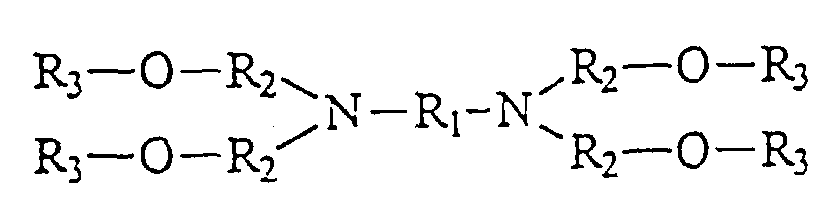
R1 is cycloalkanyl, branched cycloalkanyl, aryl, branched aryl, linear or branched alkanylaryl; R2 independently is linear or branched alkanyl, alkenyl or alkynyl; and wherein R3 independently is H orwherein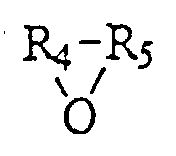
R4 is CH or C2 - C10 linear or branched alkanyl, alkenyl or alkynyl and R5 is CH2 or C2 - C10 linear or branched alkanyl, alkenyl or alkynyl, whereby at least one substituent R3 is
- The conventional resin can alternatively be an epoxide of formula
R1 is cycloalkanyl, branched cycloalkanyl, aryl, branched aryl, linear or branched alkanylaryl; R2 independently is NH, linear or branched alkanyl, alkenyl or alkynyl and wherein R3 independently is H orwherein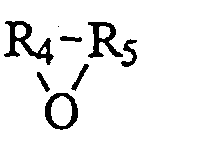
R4 is CH or C2 - C10 linear or branched alkanyl, alkenyl or alkynyl and R5 is CH2 or C2 - C10 linear or branched alkanyl, alkenyl or alkynyl, whereby at least one substituent R3 is
- The conventional resin is in preferred embodiments of the invention selected from the group consisting of
- i) an epoxide, such as a glycidyl ether, of a condensation product between at least one phenol and at least one aldehyde or ketone or an oligomer of such a condensation product or
- ii) an unsaturated ester or polyester having maleate, vinyl and/or allyl unsaturation.
-
- The suitable weight ratio between dendritic or hyperbranched macromolecule provided with primary reactive, dendritic or hyperbranched macromolecule provided with secondary reactive sites and conventional resin is found within the weight ratio of 1:99 to 30:70, preferably 5:95 to 25:75.
- The moulded article is in certain embodiments according to the present invention a decorative or an industrial laminate, which may contain at least one sheet or web of paper or glass fibre as reinforcement and/or base material.
- The surface of moulded article can, in specific applications of embodiments of the present invention, be metal plated or metal clad, such as copper clad laminates for printed circuits and aeronautical parts.
- The moulded article according to the present invention is in preferred embodiments a composite containing fibres in the form of a web, a cloth, a sheet, threads or cut fibres as reinforcement material. The fibres are preferably selected among glass fibres, carbon fibres, aramide fibres and organic fibres.
- The moulded article can in further embodiments of the present invention be a so called prepreg in the form of a roll, a sheet, a web or a cloth obtained by impregnation with the thermosetting resin composition, according to the present invention, followed by a partially curing of the resin to a so called B-stage.
- The moulded article according to the invention can advantageously be used in the production of goods and articles within aeronautical, nautical, chemical, automotive, sporting, leisure and commodity as well as for applications within the electric and electronic industry.
- A process for production of a moulded article according to the invention can be characterised in that the article is obtained by moulding a thermosetting resin composition as disclosed above, which resin composition is cured. This can in certain embodiments be obtained in that two or more prepregs in the form of a sheet, a web, a cloth, threads or cut fibres of glass fibre, carbon fibre, aramide fibre, organic fibres such as cellulose impregnated with the thermosetting composition and partially cured to a so called B-stage are laminated together under heat and/or pressure.
- Various embodiments of a process for production of a moulded article according to the invention include:
- that glass fibres, carbon fibres, aramide fibres, organic fibres, such as cellulose, or the like are pre-shaped to a bed which is then impregnated with a resin composition by infusion, compression transfer, injection or the like, whereupon the resin is cured;
- that a bundle, tow, tape or the like of glass fibres, carbon fibres, aramide fibres, organic fibres or the like is impregnated with a resin composition whereupon said bundle, tow or tape after an optional drying is wound on a core to form a structural part, followed by curing of the resin;
- that glass fibres, carbon fibres, aramide fibres, organic fibres or the like are impregnated with a resin composition which is added to a mould, the mould being rotated to form the moulded article by means of polar gravity force;
- that the moulded article is obtained by spraying a resin composition onto or into a pre-shaped mould whereupon the resin is cured; and
- that a moulded article product is obtained by injection moulding or compression moulding.
- Disclosed and other objects and the attendant advantages will be more fully understood from enclosed embodiment Examples 1-25 and enclosed Table 1, wherein:
- Examples 1 and 2 relate to preparation of hyperbranched macromolecules.
- Examples 3-8, 22 and 24 relate to chain termination of the hyperbranched macromolecules of Examples 1 and 2. The chain termination provides the macromolecules with primary or secondary reactive sites.
- Examples 9-15 relate to preparation of thermosetting resin compositions wherein macromolecules from Examples 3-8 are included.
- Example 16 is a comparative example wherein a thermosetting resin composition outside the scope of the invention is prepared.
- Example 17 relates to preparation of moulded specimens based on the thermosetting compositions of Examples 9-16.
- Examples 18-21 relate to evaluations of moulded specimens prepared in Example 17.
- Example 23 relates to preparation of a polymeric chain stopper used in Example 24 to provide the product of Example 22 with alkenyl groups in form of allyl unsaturation.
- Example 25 relates to preparation and evaluation of an unsaturated resin composition comprising the product of Example 24.
- Table 1 presents results obtained in Examples 18-21 with moulded materials based on resin compositions according to Examples 9-16.
- While particular embodiments of the invention are shown in the embodiment Examples, it will be understood, of course, that the invention is not limited thereto since many modifications may be made, and it is, therefore, contemplated to cover by the appended Claims any such modifications as fall within the scope of the said claims.
- A hyperbranched polyester of 2 generations was prepared from an ethoxylated pentaerythritol and 2,2-dimethylolpropionic acid.
- 308.9 g (0.85 mole) of pentaerythritol pentaethoxylate (Polyol PP 50, Perstorp Polyols, Sweden), 460.5 g (3.42 moles) of 2,2-dimethylolpropionic acid (Bis-MPA, Perstorp Polyols, Sweden) and 0.46 g (0.004 mole) of H2SO4 (96%-w/w) were charged in a 4-necked reaction flask equipped with stirrer, pressure gauge, cooler and receiver. The temperature was raised to 120°C, at which temperature 2,2-dimethylolpropionic acid began to melt and esterification water was formed. The temperature was thereafter during 20 minutes raised to 140°C, giving a transparent solution, whereby a vacuum of 30-50 mm Hg was applied. The reaction was, under stirring, allowed to continue for 4 hours, after which time the acid value was determined to be 7.0 mg KOH/g. 460.5 g (6.84 moles) of 2,2-dimethylolpropionic acid and 0.7 g (0.007 mole) of H2SO4 (96%-w/w) were now during 15 minutes added to the reaction mixture. A vacuum of 30-50 mm Hg was applied when charged 2,2-dimethylolpropionic acid was dissolved. The reaction was now allowed to continue for a further 4 hours giving a final acid value of ≈ 10 mg KOH/g.
- Obtained product exhibited the following properties:
Acid value, mg KOH/g 10.2 Hydroxyl value, mg KOH/g 500 Theoretical hydroxyl value, mg KOH/g 511 Molecular weight, g/mole 1824 Theoretical molecular weight, g/mole 1748 - A hyperbranched polyester of 3 generations was prepared by adding a third generation to the product of Example 1.
- 600.0 g of the hyperbranched polyester according to Example 1, 717.0 g (5.35 moles) of 2,2-dimethylolpropionic acid and 0.7 g (0.007 mole) of H2SO4 (96%-w/w) were charged in a 4-necked reaction flask equipped with stirrer, pressure gauge, cooler and receiver. The temperature was raised to 120°C, at which temperature 2,2-dimethylolpropionic acid began to melt and esterification water was formed. The temperature was thereafter during 20 minutes raised to 140°C, giving a transparent solution, whereby a vacuum of 30-50 mm Hg was applied. The reaction was now under stirring allowed to continue for 5 hours giving a final acid value of ≈ 10 mg KOH/g.
- Obtained product exhibited the following properties:
Acid value, mg KOH/g 10.6 Hydroxyl value, mg KOH/g 493 Theoretical hydroxyl value, mg KOH/g 498 Molecular weight, g/mole 3311 Theoretical molecular weight, g/mole 3608 - A chain stopped hyperbranched polyester was produced from the product of Example 2 and oleic acid.
- 251.2 g of the hyperbranched polyester according to Example 2, 592.3 g of oleic acid, 1.0 g of an inorganic catalyst (Fascat® 4100, Atochem, the Netherlands), 0.5 g of Ca(OH)2 and 55 g of xylene were charged in a 4-necked reaction flask equipped with stirrer, nitrogen inlet, cooler and water trap (Dean-Stark).
The temperature was during 65 minutes raised to 220°C, at which temperature reaction water was formed. The reaction was now allowed to continue until an acid value of < 9 mg KOH/g was reached. The reaction time at 220°C was 420 minutes. The polyester was finally filtered using a small amount of a filter aid (Celite) to remove residual catalysts and formed calcium soaps. - Obtained product exhibited the following properties:
Theoretical molecular weight, g/mole 11600 Final acid value, mg KOH/g 8.2 Hydroxyl value, mg KOH/g 8.0 Viscosity, 23°C, mPas 3090 Non-volatile content, % 100.0 - A chain stopped hyperbranched polyester was produced from the product of Example 2 and oleic acid.
- Example 3 was repeated with the differences:
- that 455.8 g of oleic acid were charged instead of 592.3 g and
- that the reaction at 220°C was allowed to continue until an acid value of < 5 mg KOH/g was reached. The reaction time at 220°C was 300 minutes.
- Obtained product exhibited the following properties.
Theoretical molecular weight, g/mole 9900 Final acid value, mg KOH/g 4.7 Hydroxyl value, mg KOH/g 37.0 Viscosity, 23°C, mPas 7520 Non-volatile content, % 99.8 - An epoxidised (chain terminated) hyperbranched polyester was produced from the product of Example 1 and epichlorohydrin.
- 100.0 g of the hyperbranched polyester according to Example 1 was charged in a 4-necked reaction flask equipped with stirrer, nitrogen inlet, cooler and water-trap (Dean-Stark). The temperature was raised to 130°C at which temperature 0.6 g BF3 etherate was added to the reaction mixture. 195.0 g (2.11 moles) of epichlorohydrin was then during 30 minutes added at a rate sufficiently low to suppress observed exothermic reaction. The reaction was allowed to continue at 130°C for 80 minutes, after which time the temperature was decreased to 100°C and 100 ml of toluene and 100 ml of 1,4-dioxane were added. 38.7 g (0.97 mole) of NaOH was now during 60 minutes added whereupon the solution became opaque and reaction water was formed. The reaction was allowed to continue for a further 120 minutes and the reaction mixture was thereafter cooled and passed through a pressurised filter to remove precipitated NaCl. Remaining solvents and epichlorohydrin were thereafter removed by means of a rotary evaporator.
- Obtained product exhibited the following properties:
Theoretical molecular weight, g/mole 2644 Epoxy equivalent weight (EEW-value), g/equivalent 285 Theoretical EEW-value, g/equivalent 165 Hydrolysable chlorine content, % 0.6 Viscosity, 23°C, mPas 21400 Non-volatile content, % 99 7 - An epoxidised (chain terminated) hyperbranched polyester was produced from the product of Example 2 and epichlorohydrin
- Example 5 was repeated with the differences:
- that 100.0 g of the hyperbranched polyester according to Example 2 were charged instead of the hyperbranched polyester according to Example 1 and
- that the reaction time at 130°C was 120 minutes instead of 80 minutes.
- Obtained product exhibited the following properties:
Theoretical molecular weight, g/mole 5400 Epoxy equivalent weight (EEW-value), g/equivalent 311 Theoretical EEW-value, g/equivalent 169 Hydrolysable chlorine content, % 0.9 - An epoxidised (chain terminated) hyperbranched polyester with secondary epoxide groups was produced from obtained product according to Example 3 and m-chloroperbenzoic acid.
- 26.36 g of m-chloroperbenzoic acid and 750 ml of dichloromethane were at room temperature charged in a 3-necked reaction flask equipped with stirrer, nitrogen inlet and cooler. Obtained solution was cooled to 0°C and 38.86 g of the product according to Example 3 dissolved in 250 ml of dichloromethane were now during 60 minutes instilled. Resulting reaction mixture was at 0°C stirred during 120 minutes followed by precipitation of excess m-chloroperbenzoic acid. The reaction mixture was now allowed to react at room temperature for a further 18 hours. Resulting product was thereafter purified by extraction using 3 x 250 ml of 0.1 M aqueous Na2S2O3 followed by 3 x 250 ml of saturated aqueous NaHCO3. The mixture was allowed to phase separate and the organic layer was removed. The final product was thereafter recovered by removal of solvent under full vacuum at 50°C using a rotary evaporator.
- Obtained product exhibited the following properties
Epoxy equivalent weight (EEW-value), g/equivalent 440 Theoretical EEW-value, g/equivalent 384 Viscosity, 23°C, mPas 7000 Non-volatile content, % 100.0 - An epoxidised (chain terminated) hyperbranched polyester with secondary epoxide groups was produced from obtained product according to Example 4 and m-chloroperbenzoic acid.
- 26.36 g of m-chloroperbenzoic acid and 1500 ml of dichloromethane were at room temperature charged in a 3-necked reaction flask equipped with stirrer, nitrogen inlet and cooler. Obtained solution was cooled to 0°C and 100.0 g of the product according to Example 4 dissolved in 800 ml of dichloromethane were now during 120 minutes instilled. Resulting reaction mixture was at 0° stirred during 120 minutes followed by precipitation of excess m-chloroperbenzoic acid. The reaction mixture was now allowed to react at room temperature for a further 16.5 hours. Resulting product was thereafter purified by extraction using 3 x 700 ml of 0.1 M aqueous Na2S2O3 followed by 2 x 250 ml of saturated aqueous NaHCO3. The mixture was allowed to phase separate and the organic layer was removed. The final product was thereafter recovered by removal of solvent under full vacuum at 50°C using a rotary evaporator.
- Obtained product exhibited the following properties:
Epoxy equivalent weight (EEW-value), g/equivalent 436 Theoretical EEW-value, g/equivalent 429 Viscosity, 23°C, mPas 30000 Non-volatile content, % 100.0 - A thermosetting resin composition was prepared by mixing the product according to Example 5 with a commercial epoxide of bisphenol-F type (Araldite®, LY 5082, Ciba-Geigy, Switzerland) having a functionality of 2 and a commercial isophorone diamine curing agent (Hardener HY 5083, Ciba-Geigy, Switzerland) having a functionality of 4 The components were mixed at 23°C using mechanical stirring for 5 minutes. The resin was subsequently degassed at 23°C in a vacuum chamber at 0.1 bar for 10 minutes.
- The resin composition had the following formulation and properties:
Product according to Example 5, g 25.0 Commercial epoxide, g 75.0 Curing agent, g 21.3 Amine:epoxide (molar ratio) 1:1 Non-volatile content, % 100.0 Viscosity at 25°C, mPas 800 - Example 9 was repeated with the difference that the product according to Example 5 was replaced by the product according to Example 6.
- The resin composition had the following formulation and properties:
Product according to Example 6, g 25.0 Commercial epoxide, g 75.0 Curing agent, g 20.6 Amine:epoxide (molar ratio) 1:1 Non-volatile content, % 100.0 Viscosity at 25°C, mPas 900 - Example 9 was repeated with the difference that the product according to Example 5 was replaced by a substantially reduced percentage of the product according to Example 7.
- The resin composition had the following formulation and properties.
Product according to Example 7, g 1.0 Commercial epoxide, g 99.0 Curing agent, g 22.7 Amine:epoxide (molar ratio) 1:1 Non-volatile content, % 100.0 Viscosity at 25°C, mPas 600 - Example 9 was repeated with the difference that the product according to Example 5 was replaced by a reduced percentage of the product according to Example 7.
- The resin composition had the following formulation and properties:
Product according to Example 7, g 5.0 Commercial epoxide, g 95.0 Curing agent, g 22.6 Amine:epoxide (molar ratio) 1:1 Non-volatile content, % 100.0 Viscosity at 25°C, mPas 700 - Example 9 was repeated with the difference that the product according to Example 5 was replaced by the product according to Example 8.
- The resin composition had the following formulation and properties:
Product according to Example 8, g 5.0 Commercial epoxide, g 95.0 Curing agent, g 22.3 Amine:epoxide (molar ratio) 1:1 Non-volatile content, % 100.0 Viscosity at 25°C, mPas 600 - Example 9 was repeated with the difference that the product according to Example 5 was replaced by a reduced percentage of the product according to Example 8.
- The resin composition had the following formulation and properties:
Product according to Example 8, g 15.0 Commercial epoxide, g 85.0 Curing agent, g 21.0 Amine:epoxide (molar ratio) 1:1 Non-volatile content, % 100.0 Viscosity at 25°C, mPas 1100 - Example 9 was repeated with the difference that the product according to Example 5 was replaced by a combination of the products according to Examples 5 and 8.
- The resin composition had the following formulation and properties:
Product according to Example 5, g 25.0 Product according to Example 8, g 5.0 Commercial epoxide, g 70.0 Curing agent, g 20.7 Amine:epoxide (molar ratio) 1:1 Non-volatile content, % 100.0 Viscosity at 25°C, mPas 900 - A thermosetting resin composition was prepared by mixing a commercial epoxide of bisphenol-F type (Araldite® LY 5082, Ciba-Geigy, Switzerland) having a functionality of 2 with a commercial isophorone diamine curing agent (Hardener HY 5083, Ciba-Geigy, Switzerland) having a functionality of 4. The components were mixed at 23°C using mechanical stirring for 5 minutes. The resin was subsequently degassed at 23°C in a vacuum chamber at 0.1 bar for 10 minutes.
- The resin composition had the following formulation and properties:
Commercial epoxide, g 100.0 Curing agent, g 23.0 Amine:epoxide (molar ratio) 1:1 Non-volatile content, % 100 0 Viscosity at 25°C, mPas 600 - Thermosetting resin compositions according to examples 9-16 were at 23°C poured into steel moulds having the internal dimensions 110 x 27 x 2.5 mm and 27 x 25 x 10 mm, respectively. The moulds were pre-treated with a silicone based mould release agent. The resin compositions were cured in the moulds, resulting in moulded plastic specimens having dimensions equal to the internal dimensions of the moulds. Curing was performed in an oven with circulating air.
Schedule Heating 23 - 80°C, gradient 3°C/minute Curing 80°C during 900 minutes Cooling 80- 23°C, gradient 6°C/minute - Samples were cut out from the plastic specimens produced from resin compositions of Examples 9-11, 13 and 15-16, which resin compositions were moulded and cured in 110 x 27 x 2.5 mm moulds in accordance with Example 17. Cutting was made by a rotating saw blade and the edges of the samples were polished with a 240 grid sand paper and rinsed with demineralised water. The samples were subsequently dried and aged at 23°C in air for at least 7 days. Chips were using a razor blade prior to testing cut from the samples.
- The Glasstransition Temperatures (Tg) were recorded by means of a Perkins-Elmer DSC7 (Differential Scanning Colorimeter) apparatus using the following parameters:
Average sample weight, mg 20 Temperature range, °C 0 - 130 Heating gradient, °C/minute 10 Cooling gradient, °C/minute 150 Stabilisation time at 0°C, minute 5 Heating gradient, °C/minute 10 - Obtained results are given in Table 1.
- Samples having the dimensions 100 x 12 x 2.5 mm were cut from the plastic specimens produced from the resin compositions of Examples 9-16, which resin compositions were moulded and cured in 110 x 27 x 2.5 mm mould in accordance with Example 17. Cutting was made by a rotating saw blade and the edges of the samples were polished with a 400 grid sand paper.
- The Tensile Modulus (E) were recorded by means of a Zwick Screw tensile testing apparatus equipped with an extensometer.
- The following parameters were used:
Extensometer gauge length, mm 35 Length between grips, mm 70 Crosshead rate, mm/minute 2 - Obtained results are given in Table 1.
- Samples were, using a rotary saw blade, cut from the plastic specimens produced from the resin compositions of Examples 9-16, which resin compositions were moulded and cured in 27 x 25 x 10 mm moulds in accordance with Example 17.
- The samples were cut to the exterior dimensions 25 x 25 x 10 mm and machined for Compact Tension tests according to ASTM E399.
- Critical Stress Intensity Factors (K1c) according to ASTM E399 were recorded on a Zwick Screw tensile testing apparatus using a crosshead rate of 0.5 mm/min. Obtained results are given in Table 1.
- The Fracture Energy (G1c) were determined from the results obtained in examples 19 and 20 according to the following equation:wherein

- G1c =
- Fracture Energy (J/m2)
- K1c =
- Critical Stress Intensity Factor (MPa.m½)
- E =
- Tensile Modulus (GPa)
- υ =
- Poisson Ratio
- Obtained results are given in Table 1.
- A chain stopped hyperbranched polyester was produced from the product of Example 1 and caprylic/capric acid.
- 830.0 g of the of the hyperbranched polyester according to Example 1, 677.7 g (4.59 moles) of a mixture of caprylic and capric acid, 2.0 g (0 03 mole) of Ca(OH)2 and 75 g of xylene were charged in a 4-necked reaction flask equipped with stirrer, nitrogen inlet, cooler and water trap (Dean-Stark). The reaction mixture was during 50 minutes heated to 170°C, whereby esterification water began to evaporate. The temperature was now during 120 minutes raised from 170°C to 210°C, giving a temperature gradient of 0 3°C/minute. The esterification was allowed to continue under stirring for 510 minutes until an acid value of < 6 mg KOH/g was obtained. Xylene was thereafter removed by a 20 minutes vacuum evaporation.
- Obtained product exhibited the following properties:
Final acid value, mg KOH/g 4.2 Hydroxyl value, mg KOH/g 111 Viscosity, 23°C, mPas 127 Non-volatile content, % 99.3 - A carboxyfunctional chain stopper was prepared from trimethylolpropane diallyl ether and succinic anhydride.
- 502.2 g (3.20 moles) of trimethylolpropane diallyl ether (TMPDE-80, Perstorp Polyols, Sweden) and 207 g (2.07 moles) of succinic anhydride were charged in a 4-necked reaction flask equipped with a magnetic stirrer, nitrogen inlet and a cooler. The reaction mixture was during 120 minutes heated to 130°C and kept at this temperature for a further 120 minutes. Obtained product was thereafter cooled to room temperature.
- Obtained product exhibited the following properties:
Acid value, mg KOH/g 368 Hydroxyl value, mg KOH/g 390 Viscosity, 23°C, mPas 46 - An unsaturated polyester was prepared from the products of Example 22 and Example 23.
- 400.0 g of the product according to Example 22, 180.0 g of the product according to Example 23, 1.4 g of H2SO4 (96%-w/w) and 48 g of heptane were charged in a 4-necked reaction flask equipped with stirrer, nitrogen inlet, cooler and water trap (Dean-Stark). The reaction mixture was during 30 minutes heated to 120°C, whereby esterification water began to evaporate. The esterification was allowed to continue at 120°C for 390 minutes until an acid value of ≈ 8 mg KOH/g was obtained. The product was now neutralised with 3.0 g of Ca(OH)2. Heptane was removed by a 20 minutes vacuum evaporation and the product was finally filtered to remove excess Ca(OH)2 and formed calcium compounds.
- Obtained product exhibited the following properties:
Final acid value, mg KOH/g 4.9 Viscosity, 23°C, mPas 13800 Non-volatile content, % 127 - An unsaturated resin composition was prepared by mixing the product according to Example 24 with a commercial unsaturated polyester (Norpol® 20-00, Jotun A/S, Norway) and adding cobalt octoate and methyl ethyl ketone (MEK) peroxide. The components were mixed at 23°C using mechanical stirring for 5 minutes.
- The resin composition was compared to said commercial polyester with said addition of cobalt octoate and MEK peroxide.
Resin Compositions Composition 1 (Exampel 24) Composition 2 (Comparative) Commercial polyester, g 95.0 100.0 Product according to Example 24, g: 5.0 --- Cobalt octoate (12% Co), g: 1.0 1.0 MEK peroxide, g: 1.0 1.0 - The resin compositions (Compositions 1 and 2) were moulded and cured in 27 x 25 x 10 mm and 110 x 27 x 2.5 mm moulds
-
- 23°C - 20 minutes
- 80°C - 160 minutes
- i) Samples were, using a rotary saw blade, cut from specimens cured in 27 x 25 x 10 mm moulds. The samples were cut to the exterior dimensions 25 x 25 x 10 mm and machined for Compact Tension tests according to ASTM E399. Critical Stress Intensity Factors (K1c) according to ASTM E399 were recorded on a Zwick Screw tensile testing apparatus using a crosshead rate of 0.5 mm/minutes.
- ii) Samples having the dimensions 100 x 12 x 2.5 mm were cut from the specimens cured in 110 x 27 x 2.5 mm moulds. Cutting was made by a rotating saw blade and sample edges were polished with a 400 grid sand paper. The Tensile Modulus (E) were recorded by means of a Zwick Screw tensile testing apparatus equipped with an extensometer.
-
- The following parameters were used:
Extensometer gauge length, mm 35 Length between grips, mm 70 Crosshead rate, mm/minute 2 Test Result Composition 1 (Example 24) K1c = 0.98 MPa.m½ E = 2.9 GPa Composition 2 (Comparative) K1c = 0.62 MPa.m½ E = 2.5 GPa Results obtained in Examples 18 - 21. Moulded Material Based on Resin from Example 9 10 11 12 13 14 15 Comp. Ex. 16 Tg, °C 64 67 85 85 86 85 68 84 E, GPa 3.1 2.9 3.1 2.9 3.9 2.4 2.8 3.0 K1c, MPa.m½ 0.83 1.37 0.79 1.34 1.47 2.03 1.58 0.63 G1c, J/m2 0.20 0.57 0.18 0.55 0.63 1.52 0.79 0.11 Tg = Glasstransition Temperature E = Tensile Modulus K1c = Critical Stress Intensity Factor G1c = Fracture Energy - Table 1 and the test result of Example 25 show that moulded materials obtained by using a thermosetting composition according to the invention (Examples 9-15 and Composition 1 of Example 25) have a very high degree of toughening compared to the unmodified thermosetting composition (Example 16 and Composition 2 of Example 25). Materials exhibiting the highest value for the Tensile Modulus (E) together with the highest value for the Critical Stress Intensity Factor (K1c) is considered to be the product with the best properties. The thermosetting compositions according to Examples 13 and 14 gave for example by far the best result among evaluated epoxides and Composition 1 of Example 25 gave an excellent result.
Claims (16)
- A moulded article with improved physical properties obtained by moulding and curing or partially curing a resin composition comprising at least two thermosetting resins and optionally in addition thereto at least one curing agent, catalyst, inhibitor or stabiliser, characterised in that at least one of said thermosetting resins is an at least partially chain terminated dendritic or hyperbranched polyester macromolecule having at least one primary or secondary reactive site, that at least one is a conventional thermosetting resin selected from the group consisting of a polyepoxide, a rubber modified polyepoxide, a saturated or unsaturated polyester, a hydroxyfunctional saturated or unsaturated polyester, a polyamine or a polyamide, a phenol-formaldehyde resin, a phenolic amino resin, a polyimide or polyetherimide, a melamine-formaldehyde resin, a urea-formaldehyde resin, a polyurethane having any of the functional groups -OH, -COOH or -NCO, and that said dendritic or hyperbranched macromolecule and said conventional resin is present in a weight ratio of 1:99 to 30:70.
- A moulded article according to claim 1 characterised in that said reactive site is a primary or secondary epoxide group.
- A moulded article according to claim 1 characterised in that said reactive site is a primary or secondary amino group.
- A moulded article according to claim 1 characterised in that said reactive site is a primary or secondary alkenyl group.
- A moulded article according to claim 1 characterised in that said reactive site is a primary or secondary anhydride group.
- A moulded article according to any of the claims 1-5 characterised in that it in addition to said resin composition comprises at least one filler, pigment or lubricant.
- A moulded article according to any of the claims 1-6 characterised in that it comprises fibres as reinforcement material.
- A moulded article according to claim 7 characterised in that said fibres are selected from the group consisting of glass fibres, carbon fibres, aramide fibres and organic fibres, such as cellulose.
- A moulded article according to any of the claims 1-8 characterised in that said article is obtained by a continuous die forming procedure, such as injection moulding, compression moulding, rotary moulding, gravity moulding, blow moulding or extrusion.
- A moulded article according to any of the claims 1-8 characterised in that said article is obtained by means of a processing technique selected from the group consisting of resin immersion or infusion, compression transfer, vacuum moulding, transfer moulding, injection moulding, gas assisted injection moulding, structural injection moulding, filament winding, extrusion, rotary moulding, gravity moulding and blow moulding.
- A moulded article according to any of the claims 1-10 characterised in that said article is a so called prepreg obtained by a partial curing to a so called B-stage of a roll, a sheet, a web, a cloth, threads or cuttings impregnated with the thermosetting resin composition.
- A moulded article according to any of the claims 1-10 characterised in that said article is a decorative or industrial laminate.
- A moulded article according to claim 12 characterised in that said laminate is obtained by curing at least one prepreg.
- A moulded article according to any of the claims 1-10 characterised in that said article is a semifinished or finished product selected from the group consisting of aeronautic goods and articles, nautic goods and articles, chemicals and chemical goods and articles, automotive goods and articles, sporting goods and articles, leisure and commodity goods and articles, and electric and electronic goods and articles.
- The use of an at least partially chain terminated dendritic or hyperbranched polyester macromolecule having at least one primary or secondary reactive site, together with at least one conventional thermosetting resin selected from the group consisting of a polyepoxide, a rubber modified polyepoxide, a saturated or unsaturated polyester, a hydroxyfunctional saturated or unsaturated polyester, a polyamine or a polyamide, a phenol-formaldehyde resin, a phenolic amino resin, a polyimide or polyetherimide, a melamine-formaldehyde resin, a urea-formaldehyde resin, a polyurethane having any of the functional groups, -OH, -COOH or -NCO, whereby the said dendritic or hyperbranched macromolecule and said conventional resin is present in a weight ratio of 1:99 to 30:70, optionally in addition with at least one curing agent, catalyst, inhibitor or stabiliser in a moulded article to improve tenacity and/or critical stress intensity factor.
- The use according to claim 15, wherein the said dendritic or hyperbranched macromolecule and the said conventional resin or compound is present in a weight ratio of 5:95 to 25:75.
Applications Claiming Priority (3)
| Application Number | Priority Date | Filing Date | Title |
|---|---|---|---|
| SE9404440A SE503622C2 (en) | 1994-12-21 | 1994-12-21 | A thermosetting material made of a thermosetting composition comprising a chain terminated dendritic or hyper-branched polyester type macromolexyl |
| SE9404440 | 1994-12-21 | ||
| PCT/SE1995/001491 WO1996019537A1 (en) | 1994-12-21 | 1995-12-12 | A thermosetting material |
Publications (2)
| Publication Number | Publication Date |
|---|---|
| EP0799279A1 EP0799279A1 (en) | 1997-10-08 |
| EP0799279B1 true EP0799279B1 (en) | 2001-03-28 |
Family
ID=20396409
Family Applications (1)
| Application Number | Title | Priority Date | Filing Date |
|---|---|---|---|
| EP95941957A Expired - Lifetime EP0799279B1 (en) | 1994-12-21 | 1995-12-12 | Moulded Article |
Country Status (12)
| Country | Link |
|---|---|
| EP (1) | EP0799279B1 (en) |
| JP (1) | JP3117219B2 (en) |
| KR (1) | KR100420623B1 (en) |
| AT (1) | ATE200098T1 (en) |
| AU (1) | AU4320296A (en) |
| CA (1) | CA2206004C (en) |
| DE (1) | DE69520507T2 (en) |
| DK (1) | DK0799279T3 (en) |
| ES (1) | ES2156956T3 (en) |
| SE (1) | SE503622C2 (en) |
| TW (1) | TW396192B (en) |
| WO (1) | WO1996019537A1 (en) |
Families Citing this family (32)
| Publication number | Priority date | Publication date | Assignee | Title |
|---|---|---|---|---|
| US6114489A (en) * | 1997-03-27 | 2000-09-05 | Herberts Gmbh | Reactive hyperbranched polymers for powder coatings |
| BE1012176A3 (en) * | 1998-09-22 | 2000-06-06 | Ucb Sa | Compositions thermosetting powder coatings for the preparation of low bright. |
| EP0994157A1 (en) * | 1998-10-12 | 2000-04-19 | Dsm N.V. | Molecular reinforced polymeric composition |
| SE514075C2 (en) * | 1999-04-27 | 2000-12-18 | Perstorp Ab | Process for manufacturing an acrylate composition comprising at least one dendritic polyester acrylate oligomer and at least one acrylate monomer |
| EP1263842A2 (en) | 2000-02-09 | 2002-12-11 | Ciba SC Holding AG | Hyperbranched amphiphilic polymeric additives and polymer compositions with increased surface energy |
| US20040106769A1 (en) * | 2000-07-11 | 2004-06-03 | Hatton Kevin Brian | High functional polymers |
| EP1248809B1 (en) | 2000-07-28 | 2010-03-10 | Woodbridge Foam Corporation | Foamed isocyanate-based polymer having improved hardness properties and process for production thereof |
| DK1387862T3 (en) | 2001-05-17 | 2015-01-19 | Basf Se | Polymer WITH IMPROVED permanence AND OVERFLADEAFFINITET |
| DE10163163A1 (en) | 2001-12-20 | 2003-07-03 | Basf Ag | Process for the production of highly functional, hyperbranched polyester by enzymatic esterification |
| AU2003289302A1 (en) * | 2002-12-12 | 2004-06-30 | Caco Chemical Inc. | Plant fiber reinforced plastic formed article |
| DE10348463A1 (en) | 2003-10-14 | 2005-05-25 | Basf Ag | Hyperbranched polyesters with ethylenically unsaturated groups |
| DE102004026904A1 (en) | 2004-06-01 | 2005-12-22 | Basf Ag | Highly functional, highly branched or hyperbranched polyesters and their preparation and use |
| DE102005027549A1 (en) * | 2005-06-14 | 2006-12-21 | Basf Ag | Multi-component moldings with polyester layers |
| SE528588C2 (en) * | 2005-08-11 | 2006-12-27 | Perstorp Specialty Chem Ab | Process for Allylation of Mixed Polyhydroxy Compounds |
| WO2007077739A1 (en) | 2005-12-28 | 2007-07-12 | Matsushita Electric Industrial Co., Ltd. | Transmission device and reception device |
| DE102008002704A1 (en) | 2007-07-02 | 2009-01-08 | Basf Se | Method for manufacturing composite materials, involves submitting solid material, and polyurethane reaction mixture is applied on solid material |
| EP2277934A1 (en) | 2009-07-24 | 2011-01-26 | Basf Se | Use of highly functional, highly branched or hyperbranched polycarbonates |
| WO2011009766A1 (en) | 2009-07-24 | 2011-01-27 | Basf Se | Highly functional, highly or hyper-branched polyester and the production and use thereof |
| WO2011141266A1 (en) | 2010-04-15 | 2011-11-17 | Basf Se | Process for producing flame-proofed polyurethane foams |
| EP2678370B1 (en) | 2011-02-23 | 2016-03-30 | Council of Scientific & Industrial Research | Process for preparing hyperbranched polyesters |
| TW201311478A (en) * | 2011-09-01 | 2013-03-16 | Shui-Yuan Ma | Composite material rim using single longitudinal-weaved carbon fiber and manufacturing method thereof |
| GB2494260B (en) * | 2011-09-02 | 2014-11-26 | Bae Systems Plc | Curable resin adduct powder |
| BR112016003547B1 (en) | 2013-08-22 | 2022-03-22 | Basf Se | METHOD FOR PRODUCTION OF HOLLOW ORGANIC PARTICLES AND USE OF POLYALKYLENE OXIDE, POLYMER PARTICLE IN EMULSION, USE OF POLYMER PARTICLES, AND, PAINT |
| TWI603837B (en) * | 2015-11-13 | 2017-11-01 | Swancor Industrial Co Ltd | Branch composite material and its preparation method |
| RU2754822C2 (en) | 2016-10-07 | 2021-09-07 | Басф Се | Method for obtaining water dispersions |
| US20200332115A1 (en) | 2017-12-21 | 2020-10-22 | Covestro Deutschland Ag | Polycarbonate composition |
| CN109943269A (en) * | 2019-03-22 | 2019-06-28 | 重庆东吴道路工程有限公司 | Solvent-free environment-friendly and high-performance modified epoxy gluing material and preparation method thereof |
| CN110527456B (en) * | 2019-09-12 | 2022-09-30 | 常州斯威克光伏新材料有限公司 | Conductive adhesive film |
| CN111234157B (en) * | 2020-03-09 | 2021-10-19 | 江苏科技大学 | A kind of reactive extrusion preparation method of flame retardant hyperbranched polyamide 6 elastomer |
| CN114656862A (en) * | 2022-05-05 | 2022-06-24 | 重庆市大足区永彩装饰材料有限公司 | Insulating anti-aging thermosetting molding powder and preparation method thereof |
| CN115710348B (en) * | 2022-09-28 | 2023-09-12 | 北京工商大学 | Preparation method and application of microcrystalline cellulose grafted hydroxyl-terminated hyperbranched polyester |
| CN117533001B (en) * | 2023-10-25 | 2024-05-10 | 江门建滔积层板有限公司 | Impact-resistant flame-retardant copper-clad plate and preparation method thereof |
Family Cites Families (2)
| Publication number | Priority date | Publication date | Assignee | Title |
|---|---|---|---|---|
| SE468771B (en) * | 1992-02-26 | 1993-03-15 | Perstorp Ab | DENDRITIC MACROMOLECYLE OF POLYESTER TYPE, PROCEDURES FOR PRODUCING THEREOF AND USING THEREOF |
| NL9200416A (en) * | 1992-03-06 | 1993-10-01 | Dsm Nv | HYPER BRANCHED POLYMERS AND A PROCESS FOR THE PREPARATION OF HYPER BRANCHED POLYMERS. |
-
1994
- 1994-12-21 SE SE9404440A patent/SE503622C2/en not_active IP Right Cessation
-
1995
- 1995-12-12 WO PCT/SE1995/001491 patent/WO1996019537A1/en not_active Ceased
- 1995-12-12 AT AT95941957T patent/ATE200098T1/en not_active IP Right Cessation
- 1995-12-12 ES ES95941957T patent/ES2156956T3/en not_active Expired - Lifetime
- 1995-12-12 KR KR1019970704155A patent/KR100420623B1/en not_active Expired - Fee Related
- 1995-12-12 JP JP08519716A patent/JP3117219B2/en not_active Expired - Fee Related
- 1995-12-12 AU AU43202/96A patent/AU4320296A/en not_active Abandoned
- 1995-12-12 CA CA002206004A patent/CA2206004C/en not_active Expired - Fee Related
- 1995-12-12 DK DK95941957T patent/DK0799279T3/en active
- 1995-12-12 EP EP95941957A patent/EP0799279B1/en not_active Expired - Lifetime
- 1995-12-12 DE DE69520507T patent/DE69520507T2/en not_active Expired - Fee Related
- 1995-12-19 TW TW084113675A patent/TW396192B/en not_active IP Right Cessation
Also Published As
| Publication number | Publication date |
|---|---|
| DK0799279T3 (en) | 2001-05-07 |
| ES2156956T3 (en) | 2001-08-01 |
| JP3117219B2 (en) | 2000-12-11 |
| JPH10500730A (en) | 1998-01-20 |
| ATE200098T1 (en) | 2001-04-15 |
| SE9404440D0 (en) | 1994-12-21 |
| DE69520507T2 (en) | 2001-08-23 |
| KR100420623B1 (en) | 2004-07-27 |
| SE503622C2 (en) | 1996-07-22 |
| AU4320296A (en) | 1996-07-10 |
| WO1996019537A1 (en) | 1996-06-27 |
| CA2206004A1 (en) | 1996-07-27 |
| EP0799279A1 (en) | 1997-10-08 |
| CA2206004C (en) | 2007-06-05 |
| DE69520507D1 (en) | 2001-05-03 |
| HK1003057A1 (en) | 1998-10-09 |
| SE9404440L (en) | 1996-06-22 |
| TW396192B (en) | 2000-07-01 |
Similar Documents
| Publication | Publication Date | Title |
|---|---|---|
| CA2206004C (en) | A thermosetting material | |
| US6093777A (en) | Dendritic polyester macromolecule in thermosetting resin matrix | |
| EP1814948B1 (en) | Amphiphilic block copolymer-toughened epoxy resins and electrical laminates made therefrom | |
| US6887574B2 (en) | Curable flame retardant epoxy compositions | |
| SE509240C2 (en) | Thermoplastic compound consisting of a thermoplastic polymer bonded to a dendritic or hyper-branched macromolecule and composition and product thereof | |
| EP0869983B1 (en) | Branched epoxide functional polyester | |
| AU557131B2 (en) | Epoxy resin composition and process for preparing laminates therefrom | |
| KR20110139255A (en) | Thermosetting Compositions Containing Blends of Amphiphilic Block Copolymers with Polyols and Thermoset Products Therefrom | |
| EP1275682A1 (en) | Lowly heat-expandable laminate | |
| US20190270844A1 (en) | Homogeneous amorphous high heat epoxy blend composite compositions, articles, and uses thereof | |
| HK1003057B (en) | Moulded article | |
| TW201827520A (en) | Fiber-reinforced plastic molding material, method for producing same, and molded product | |
| WO2004052967A1 (en) | Plant fiber reinforced plastic formed article | |
| WO1991001394A1 (en) | Sizing composition for fibres | |
| WO2000018751A1 (en) | Novel primary epoxides | |
| CN117534941A (en) | Epoxy resin composite material for pultrusion process and preparation method thereof | |
| Ghoutia et al. | Structural and mechanical characteristics of silane-modified PIPD/basalt hybrid fiber |
Legal Events
| Date | Code | Title | Description |
|---|---|---|---|
| PUAI | Public reference made under article 153(3) epc to a published international application that has entered the european phase |
Free format text: ORIGINAL CODE: 0009012 |
|
| 17P | Request for examination filed |
Effective date: 19970709 |
|
| AK | Designated contracting states |
Kind code of ref document: A1 Designated state(s): AT BE CH DE DK ES FR GB GR IE IT LI LU MC NL PT SE |
|
| 17Q | First examination report despatched |
Effective date: 19980723 |
|
| RTI1 | Title (correction) |
Free format text: MOULDED ARTICLE |
|
| GRAG | Despatch of communication of intention to grant |
Free format text: ORIGINAL CODE: EPIDOS AGRA |
|
| GRAG | Despatch of communication of intention to grant |
Free format text: ORIGINAL CODE: EPIDOS AGRA |
|
| GRAG | Despatch of communication of intention to grant |
Free format text: ORIGINAL CODE: EPIDOS AGRA |
|
| GRAH | Despatch of communication of intention to grant a patent |
Free format text: ORIGINAL CODE: EPIDOS IGRA |
|
| GRAH | Despatch of communication of intention to grant a patent |
Free format text: ORIGINAL CODE: EPIDOS IGRA |
|
| GRAA | (expected) grant |
Free format text: ORIGINAL CODE: 0009210 |
|
| AK | Designated contracting states |
Kind code of ref document: B1 Designated state(s): AT BE CH DE DK ES FR GB GR IE IT LI LU MC NL PT SE |
|
| REF | Corresponds to: |
Ref document number: 200098 Country of ref document: AT Date of ref document: 20010415 Kind code of ref document: T |
|
| REG | Reference to a national code |
Ref country code: CH Ref legal event code: EP |
|
| REG | Reference to a national code |
Ref country code: IE Ref legal event code: FG4D |
|
| ET | Fr: translation filed | ||
| ITF | It: translation for a ep patent filed | ||
| REF | Corresponds to: |
Ref document number: 69520507 Country of ref document: DE Date of ref document: 20010503 |
|
| REG | Reference to a national code |
Ref country code: DK Ref legal event code: T3 |
|
| REG | Reference to a national code |
Ref country code: CH Ref legal event code: NV Representative=s name: BUECHEL, KAMINSKI & PARTNER PATENTANWAELTE ESTABLI |
|
| PG25 | Lapsed in a contracting state [announced via postgrant information from national office to epo] |
Ref country code: PT Free format text: LAPSE BECAUSE OF FAILURE TO SUBMIT A TRANSLATION OF THE DESCRIPTION OR TO PAY THE FEE WITHIN THE PRESCRIBED TIME-LIMIT Effective date: 20010628 |
|
| PG25 | Lapsed in a contracting state [announced via postgrant information from national office to epo] |
Ref country code: GR Free format text: LAPSE BECAUSE OF FAILURE TO SUBMIT A TRANSLATION OF THE DESCRIPTION OR TO PAY THE FEE WITHIN THE PRESCRIBED TIME-LIMIT Effective date: 20010629 |
|
| REG | Reference to a national code |
Ref country code: ES Ref legal event code: FG2A Ref document number: 2156956 Country of ref document: ES Kind code of ref document: T3 |
|
| PG25 | Lapsed in a contracting state [announced via postgrant information from national office to epo] |
Ref country code: MC Free format text: LAPSE BECAUSE OF NON-PAYMENT OF DUE FEES Effective date: 20011212 |
|
| REG | Reference to a national code |
Ref country code: GB Ref legal event code: IF02 |
|
| PLBE | No opposition filed within time limit |
Free format text: ORIGINAL CODE: 0009261 |
|
| STAA | Information on the status of an ep patent application or granted ep patent |
Free format text: STATUS: NO OPPOSITION FILED WITHIN TIME LIMIT |
|
| 26N | No opposition filed | ||
| PGFP | Annual fee paid to national office [announced via postgrant information from national office to epo] |
Ref country code: IE Payment date: 20061120 Year of fee payment: 12 |
|
| PGFP | Annual fee paid to national office [announced via postgrant information from national office to epo] |
Ref country code: FR Payment date: 20061122 Year of fee payment: 12 |
|
| PGFP | Annual fee paid to national office [announced via postgrant information from national office to epo] |
Ref country code: GB Payment date: 20061127 Year of fee payment: 12 |
|
| PGFP | Annual fee paid to national office [announced via postgrant information from national office to epo] |
Ref country code: BE Payment date: 20061204 Year of fee payment: 12 |
|
| PGFP | Annual fee paid to national office [announced via postgrant information from national office to epo] |
Ref country code: DK Payment date: 20061211 Year of fee payment: 12 |
|
| PGFP | Annual fee paid to national office [announced via postgrant information from national office to epo] |
Ref country code: NL Payment date: 20061215 Year of fee payment: 12 Ref country code: LU Payment date: 20061215 Year of fee payment: 12 |
|
| PGFP | Annual fee paid to national office [announced via postgrant information from national office to epo] |
Ref country code: ES Payment date: 20061218 Year of fee payment: 12 |
|
| PGFP | Annual fee paid to national office [announced via postgrant information from national office to epo] |
Ref country code: DE Payment date: 20061221 Year of fee payment: 12 Ref country code: CH Payment date: 20061221 Year of fee payment: 12 |
|
| PGFP | Annual fee paid to national office [announced via postgrant information from national office to epo] |
Ref country code: AT Payment date: 20061229 Year of fee payment: 12 |
|
| PGFP | Annual fee paid to national office [announced via postgrant information from national office to epo] |
Ref country code: IT Payment date: 20061231 Year of fee payment: 12 |
|
| PGFP | Annual fee paid to national office [announced via postgrant information from national office to epo] |
Ref country code: SE Payment date: 20071029 Year of fee payment: 13 |
|
| BERE | Be: lapsed |
Owner name: *PERSTORP A.B. Effective date: 20071231 |
|
| REG | Reference to a national code |
Ref country code: CH Ref legal event code: PL |
|
| REG | Reference to a national code |
Ref country code: DK Ref legal event code: EBP |
|
| GBPC | Gb: european patent ceased through non-payment of renewal fee |
Effective date: 20071212 |
|
| PG25 | Lapsed in a contracting state [announced via postgrant information from national office to epo] |
Ref country code: AT Free format text: LAPSE BECAUSE OF NON-PAYMENT OF DUE FEES Effective date: 20071212 |
|
| NLV4 | Nl: lapsed or anulled due to non-payment of the annual fee |
Effective date: 20080701 |
|
| REG | Reference to a national code |
Ref country code: IE Ref legal event code: MM4A |
|
| PG25 | Lapsed in a contracting state [announced via postgrant information from national office to epo] |
Ref country code: BE Free format text: LAPSE BECAUSE OF NON-PAYMENT OF DUE FEES Effective date: 20071231 |
|
| PG25 | Lapsed in a contracting state [announced via postgrant information from national office to epo] |
Ref country code: LI Free format text: LAPSE BECAUSE OF NON-PAYMENT OF DUE FEES Effective date: 20071231 Ref country code: IE Free format text: LAPSE BECAUSE OF NON-PAYMENT OF DUE FEES Effective date: 20071212 Ref country code: DE Free format text: LAPSE BECAUSE OF NON-PAYMENT OF DUE FEES Effective date: 20080701 Ref country code: CH Free format text: LAPSE BECAUSE OF NON-PAYMENT OF DUE FEES Effective date: 20071231 |
|
| REG | Reference to a national code |
Ref country code: FR Ref legal event code: ST Effective date: 20081020 |
|
| PG25 | Lapsed in a contracting state [announced via postgrant information from national office to epo] |
Ref country code: NL Free format text: LAPSE BECAUSE OF NON-PAYMENT OF DUE FEES Effective date: 20080701 |
|
| PG25 | Lapsed in a contracting state [announced via postgrant information from national office to epo] |
Ref country code: GB Free format text: LAPSE BECAUSE OF NON-PAYMENT OF DUE FEES Effective date: 20071212 |
|
| PG25 | Lapsed in a contracting state [announced via postgrant information from national office to epo] |
Ref country code: DK Free format text: LAPSE BECAUSE OF NON-PAYMENT OF DUE FEES Effective date: 20080102 |
|
| REG | Reference to a national code |
Ref country code: ES Ref legal event code: FD2A Effective date: 20071213 |
|
| PG25 | Lapsed in a contracting state [announced via postgrant information from national office to epo] |
Ref country code: FR Free format text: LAPSE BECAUSE OF NON-PAYMENT OF DUE FEES Effective date: 20071231 Ref country code: ES Free format text: LAPSE BECAUSE OF NON-PAYMENT OF DUE FEES Effective date: 20071213 |
|
| EUG | Se: european patent has lapsed | ||
| PG25 | Lapsed in a contracting state [announced via postgrant information from national office to epo] |
Ref country code: LU Free format text: LAPSE BECAUSE OF NON-PAYMENT OF DUE FEES Effective date: 20071212 Ref country code: IT Free format text: LAPSE BECAUSE OF NON-PAYMENT OF DUE FEES Effective date: 20071212 |
|
| PG25 | Lapsed in a contracting state [announced via postgrant information from national office to epo] |
Ref country code: SE Free format text: LAPSE BECAUSE OF NON-PAYMENT OF DUE FEES Effective date: 20081213 |