EP0797694B2 - Solvent-spun cellulosic filaments - Google Patents
Solvent-spun cellulosic filaments Download PDFInfo
- Publication number
- EP0797694B2 EP0797694B2 EP95942074A EP95942074A EP0797694B2 EP 0797694 B2 EP0797694 B2 EP 0797694B2 EP 95942074 A EP95942074 A EP 95942074A EP 95942074 A EP95942074 A EP 95942074A EP 0797694 B2 EP0797694 B2 EP 0797694B2
- Authority
- EP
- European Patent Office
- Prior art keywords
- filaments
- tex
- elongation
- solvent
- cellulose
- Prior art date
- Legal status (The legal status is an assumption and is not a legal conclusion. Google has not performed a legal analysis and makes no representation as to the accuracy of the status listed.)
- Expired - Lifetime
Links
- 0 CC(**1)C1C(CCC(C)(*1)C2CCC2)C1C1CC(C)(C)CCC1 Chemical compound CC(**1)C1C(CCC(C)(*1)C2CCC2)C1C1CC(C)(C)CCC1 0.000 description 1
- WFHBGNQCISYBCP-JTQLQIEISA-N CCC[C@H](C)C1(C)CCCC1 Chemical compound CCC[C@H](C)C1(C)CCCC1 WFHBGNQCISYBCP-JTQLQIEISA-N 0.000 description 1
Images


Classifications
-
- C—CHEMISTRY; METALLURGY
- C08—ORGANIC MACROMOLECULAR COMPOUNDS; THEIR PREPARATION OR CHEMICAL WORKING-UP; COMPOSITIONS BASED THEREON
- C08J—WORKING-UP; GENERAL PROCESSES OF COMPOUNDING; AFTER-TREATMENT NOT COVERED BY SUBCLASSES C08B, C08C, C08F, C08G or C08H
- C08J3/00—Processes of treating or compounding macromolecular substances
- C08J3/02—Making solutions, dispersions, lattices or gels by other methods than by solution, emulsion or suspension polymerisation techniques
- C08J3/09—Making solutions, dispersions, lattices or gels by other methods than by solution, emulsion or suspension polymerisation techniques in organic liquids
-
- D—TEXTILES; PAPER
- D01—NATURAL OR MAN-MADE THREADS OR FIBRES; SPINNING
- D01F—CHEMICAL FEATURES IN THE MANUFACTURE OF ARTIFICIAL FILAMENTS, THREADS, FIBRES, BRISTLES OR RIBBONS; APPARATUS SPECIALLY ADAPTED FOR THE MANUFACTURE OF CARBON FILAMENTS
- D01F2/00—Monocomponent artificial filaments or the like of cellulose or cellulose derivatives; Manufacture thereof
-
- C—CHEMISTRY; METALLURGY
- C08—ORGANIC MACROMOLECULAR COMPOUNDS; THEIR PREPARATION OR CHEMICAL WORKING-UP; COMPOSITIONS BASED THEREON
- C08J—WORKING-UP; GENERAL PROCESSES OF COMPOUNDING; AFTER-TREATMENT NOT COVERED BY SUBCLASSES C08B, C08C, C08F, C08G or C08H
- C08J2301/00—Characterised by the use of cellulose, modified cellulose or cellulose derivatives
- C08J2301/02—Cellulose; Modified cellulose
-
- Y—GENERAL TAGGING OF NEW TECHNOLOGICAL DEVELOPMENTS; GENERAL TAGGING OF CROSS-SECTIONAL TECHNOLOGIES SPANNING OVER SEVERAL SECTIONS OF THE IPC; TECHNICAL SUBJECTS COVERED BY FORMER USPC CROSS-REFERENCE ART COLLECTIONS [XRACs] AND DIGESTS
- Y10—TECHNICAL SUBJECTS COVERED BY FORMER USPC
- Y10T—TECHNICAL SUBJECTS COVERED BY FORMER US CLASSIFICATION
- Y10T428/00—Stock material or miscellaneous articles
- Y10T428/29—Coated or structually defined flake, particle, cell, strand, strand portion, rod, filament, macroscopic fiber or mass thereof
- Y10T428/2913—Rod, strand, filament or fiber
-
- Y—GENERAL TAGGING OF NEW TECHNOLOGICAL DEVELOPMENTS; GENERAL TAGGING OF CROSS-SECTIONAL TECHNOLOGIES SPANNING OVER SEVERAL SECTIONS OF THE IPC; TECHNICAL SUBJECTS COVERED BY FORMER USPC CROSS-REFERENCE ART COLLECTIONS [XRACs] AND DIGESTS
- Y10—TECHNICAL SUBJECTS COVERED BY FORMER USPC
- Y10T—TECHNICAL SUBJECTS COVERED BY FORMER US CLASSIFICATION
- Y10T428/00—Stock material or miscellaneous articles
- Y10T428/29—Coated or structually defined flake, particle, cell, strand, strand portion, rod, filament, macroscopic fiber or mass thereof
- Y10T428/2913—Rod, strand, filament or fiber
- Y10T428/2933—Coated or with bond, impregnation or core
- Y10T428/2964—Artificial fiber or filament
- Y10T428/2965—Cellulosic
Definitions
- the invention relates to solvent-spun cellulosic filaments of a solution of cellulose in one tertiary amine N-oxide.
- This object is achieved by solvent-spun cellulosic filaments from a solution of cellulose in a tertiary amine N-oxide and optionally Water with a strength of 52.7 to 66 cN / tex, one Elongation at break of 6 to 13% and a specific breaking time of 300 to 1000 s / tex solved.
- the elongation at break of the filaments can also be 6 to 9.7% or 6 to 9.5% or 6 to 9%.
- Preferred specific break times are 304 to 767 s / tex.
- the cellulose which is dissolved in the tertiary amine N-oxide is preferably a southern pine pulp.
- filaments which have a strength of 33.3 cN / tex and an elongation at break of 16% (DP 600) and 56.7 cN / tex at a breaking extension of 4% (DP 5000 ).
- DP 600 elongation at break
- DP 5000 breaking extension of 4%
- NH 4 Cl filaments were obtained, which have a strength of 60 cN / tex at an elongation at break of 8% (DP 600) and - due to the change in morphology - have a very strong fibrillation.
- filaments also exist, high strength (52.7 to 66 cN / tex) and elongation at break from 6 to 13% and the opposite filaments, with usual Values for strength and elongation for textile applications, none have altered morphology and therefore fibrillation have, as they also have filaments suitable for textile use, or their fibrillation even less than the latter filaments.
- a measure of the fibrillation tendency of the filaments is the specific breaking time in s / tex. The higher the value this size is, the lower the fibrillation of the filament.
- a bundle 1 of 50 filaments which is fixed at one end with a thread clamp 2, by a Thread guide 3 out.
- the bundle 1 is positionally aligned with a Y-piece 4 with respect to an ejector 10.
- the ejector 10 is followed by a yarn guide 5, with which a deflection of the bundle 1 takes place, which at its second end loaded with a weight 6 of 20 grams.
- the distance between Ejektoraustritt and the second yarn guide 5 is about 11 cm.
- the ejector 10 has a length of 22 mm.
- the ejector 10 has an entrance slit 11 with a square cross-section for the bundle 1.
- the width b e and the height h e of the entrance slit 11 are 1 mm.
- the yarn channel 12 extending through the entire ejector 10 has liquid supply passages 14, 14 'lying opposite one another in the two side walls 13, 13'. Through this sosstechnikszuGermankanäle 14, 14 'flows water at a temperature of about 25 ° C at an angle ⁇ of 15 ° relative to the axis of the bundle 1.
- the water flows with a total flow of 45 l / h in the thread channel 12 and occurs on Exit slit 15 from the ejector 10.
- the width b z of the liquid supply channels 14, 14 ' is 0.6 mm and their height h z 1 mm.
- the width b of the thread channel 12 from the mouth of the liquid feed channels 14, 14 'to the outlet gap 15 is 1.2 mm.
- the height h is 1 mm.
- the water is supplied through holes 16, 16 'with a diameter of 4 mm from the bottom of the ejector 10.
- the ejector 10 is closed from above with a lid, not shown, lying flat.
- the filament bundle 1 according to FIG. 1 is inserted into the device parts and with burdened with the weight.
- the water supply in the ejector 10 represents the beginning of the time measurement.
- the time measurement is terminated by the time the weight drops, i. when the bundle breaks through.
- the measured time is related to the filament titer (specific Tear time in s / tex).
- the clamping length was 20 mm and the test speed 20 mm / min starting from a Bias of 1 cN / tex.
- the Fafegraph has pneumatic clamps made of hard rubber / Vulkollan a surface of about 4 mm x 6 mm.
- Solvent-spun cellulosic filaments were prepared by extruding a solution of cellulose in the tertiary amine N-oxide NMMO and water added with propyl gallate as a stabilizer through a spinneret plate having 50 nozzle bores.
- the southern pine pulp Ultranier-J (ITT-Rayonier) with a degree of polymerization (DP) of 1360 was used to prepare the solution.
- Comparative Example 10 which represents filaments known for conventional textile applications, Viscokraft VHV pulp (International Paper Company), a hardwood prehydrolysis kraft pulp having a DP of 1667 was used.
- the filaments were placed in an air gap with a length of 17.5 cm with air, the at a speed of 0.8 m / s at right angles to the filaments, cooled.
- the cellulose was in precipitated 40 mm in an aqueous precipitation bath and passed through a washing section to remove NMMO.
- the After washing washed excess lubricant (2% K 7451 in water, sold by Stockhausen GmbH, Krefeld) was stripped off the filaments in a crimp stage between two rolls. Subsequently the filaments were dried and wound up.
- the thread tension was measured with the tensiomin type Bn 135.205.2 and the probe 100 cN type Bn 125.126.1 (Kurt Honigmann company).
- solvent spun cellulosic filaments were produced with a spinneret, which has only a nozzle bore with a diameter of 130 microns.
- the spinning temperature was 100 ° C.
- the filaments were in the air gap of a length of 15 cm with still air at a temperature of 25 ° C. cooled. Following the coagulation bath maintained at 18 ° C, the filaments were washed, rinsed (1%). Leomin in water, sold by Hoechst AG) and dried. Was between spinneret and winding a draw ratio of 1:13 is set.
- the spinning speed was 48 m / min. To determine the specific Tear time was made from the continuous filament bundles of 50 single filaments.
- Example 11 As for Examples 1 to 9, the pulp Ultranier-J (DP 1360) was used. The solution had a cellulose concentration of 10% by weight. Water and NMMO were 11.5 wt.% And 78.4 wt.%, Respectively. The concentration of gallic acid propyl ester was 0.1% by weight.
- Example 12 Viscokraft 4.3 from International Paper Company with a degree of polymerization of 650 in a concentration of 12.7% by weight was used as the pulp. The water concentration was 9.0% by weight. NMMO was present in an amount of 78.2 wt.% And gallic acid propyl ester at 0.1 wt.%.
- Table II The properties of the filaments prepared according to Example 11 and Comparative Example 12 are shown in Table II.
- example 11 12 Filament / dtex 1.2 1.8 Strength / (cN / tex) 52.8 36.4 Elongation at break /% 13.0 11.7 Spec. Tear time / (s / tex) 1000 250
- the filaments according to Comparative Examples 10 and 12 on have a specific tear time of 257 or 250 s / tex. Their strength of 43.8 and 36.4 cN / tex and their elongation at break of 8.9 and 11.7%, respectively, are in the range of solvent-spun cellulosic filaments for textile applications is common.
- the filaments according to the invention over a high strength at an elongation at break comparable to those of Comparative Examples 10 and 12 is. In particular, they do not show the disadvantage of the aforementioned prior art strong fibrillation.
- the filaments of the invention are economical to produce, and the disadvantages of achieving high strength in the prior art, such as the addition of salts to the cellulose solution, can be advantageously avoided.
- the degree of polymerization of the cellulose used for preparing the solution and its concentration in the solution, as well as the winding speed of the filaments are decisive.
- K DP 0.5 ⁇ C ⁇ w -0.075 calculated
- the pulp used for the solution preparation should be used have the highest possible proportion of ⁇ -cellulose, as used in Examples 1 to 9 and 11 southern pine pulp.
- the pulp used for the solution preparation should be used have the highest possible proportion of ⁇ -cellulose, as used in Examples 1 to 9 and 11 southern pine pulp.
- the production of filaments according to Example 10 could with a pulp with formerly insulated pine pulp does not achieve the desired strength.
- the temperature of the coagulation bath and the thread tension also have at position 23, i. in the drying section 28 an influence on the strength.
- the temperature of the coagulation bath as possible should be low.
- a coagulation bath temperature of 12 ° C a strength of 58.6 cN / tex.
- the elongation at break of the filaments increases by increasing the thread tension at the position 23 off. Furthermore, it has been found that increasing the elongation at break by reducing the thread tension can be reached in the area of the washing line and before application of the finish (position 22). So is the Elongation at break of the filaments according to Example 1 13%, wherein the thread tension at the position 22 12 cN and at the Position 23 was 5 cN. By contrast, in Example 8, an elongation at break of 8.2% resulted. It was the Thread tension at position 22 was only 10 cN, but at position 23 a thread tension of 79 cN was present.
Landscapes
- Chemical & Material Sciences (AREA)
- Chemical Kinetics & Catalysis (AREA)
- Organic Chemistry (AREA)
- Health & Medical Sciences (AREA)
- Medicinal Chemistry (AREA)
- Polymers & Plastics (AREA)
- Dispersion Chemistry (AREA)
- General Chemical & Material Sciences (AREA)
- Engineering & Computer Science (AREA)
- Textile Engineering (AREA)
- Artificial Filaments (AREA)
- Paper (AREA)
- Treatments For Attaching Organic Compounds To Fibrous Goods (AREA)
Abstract
Description
Die Erfindung betrifft lösungsmittelgesponnene cellulosische Filamente aus einer Lösung von Cellulose in einem tertiären Amin-N-oxid.The invention relates to solvent-spun cellulosic filaments of a solution of cellulose in one tertiary amine N-oxide.
Die Publikation "Spinning of Cellulose from N-methyl morpholine-N-oxide in the presence of additives" von H.
Chanzy, M. Paillet und R. Hagège (Polymer, 1990 Vol. 31, March, Seiten 400 bis 405) offenbart derartige Filamente
(Fasern), die aus einer Lösung von Cellulose mit einem Polymerisationsgrad (DP) von 600 bzw. 5000 in dem tertiären
Amin-N-oxid N-Methylmorpholin-N-oxid (NMMO) hergestellt wurden. Ausgehend von der Cellulose mit einem DP von
600 wurden Filamente erhalten, die eine Festigkeit von 0,5 GPa entsprechend 33,3 cN/tex und eine Bruchdehung von
16% aufwiesen. Beim Einsatz von Cellulose mit einem DP von 5000 betrug die Festigkeit 56,7 cN/tex (0,85 GPa) und
die Bruchdehnung 4%.The publication "Spinning of cellulose from N-methyl morpholine N-oxides in the presence of additive" by H.
Chanzy, M. Paillet and R. Hagège (Polymer, 1990 Vol. 31, March, pages 400-405) discloses such filaments
(Fibers) consisting of a solution of cellulose having a degree of polymerization (DP) of 600 and 5000 in the tertiary
Amine N-oxide N-methylmorpholine N-oxide (NMMO). Starting from the cellulose with a DP of
600 filaments were obtained, which has a strength of 0.5 GPa corresponding to 33.3 cN / tex and a breaking elongation of
16%. When using cellulose with a DP of 5000, the strength was 56.7 cN / tex (0.85 GPa) and
the breaking
Indem der Celluloselösung (DP 600) 2% Ammoniumchlorid (NH4Cl) zugesetzt wurde, erhöhte sich die Festigkeit der daraus hergestellten Filamente auf 60 cN/tex (0,9 GPa). Die Bruchdehnung dieser Filamente betrug 8%. Bei Zugabe von Ammoniumchlorid oder Calciumchlorid zu den Lösungen der Cellulose mit einem DP 5000 wurden ebenfalls Filamente mit hoher Festigkeit (bis zu 87 cN/tex) erhalten, deren Bruchdehnung aber unter 5% lag. Die den Lösungen zugesetzten Salze (NH4Gl oder CaCl2) waren in den Filamenten nicht mehr nachweisbar. Dieser Effekt sollte auf die für die Herstellung dieser Filamente typischen Verfahrensschritte: dem Durchlaufen eines wäßrigen Koagulationsbades zur Fällung der Cellulose im Anschluß an die Spinnung in einem Luftspalt und den sich dem Koagulationsbad anschließenden Waschbädern zurückzuführen sein. In diesen Bädern wird das Lösungsmittel NMMO aus den Filamenten entfernt. Im Hinblick auf die Angabe in obengenannter Publikation, daß in den Filamenten die Salze nicht mehr nachweisbar waren, ist davon auszugehen, daß sie bei diesen Behandlungsschritten aus den Filamenten herausgewaschen wurden.By adding 2% ammonium chloride (NH 4 Cl) to the cellulose solution (DP 600), the strength of the filaments made therefrom increased to 60 cN / tex (0.9 GPa). The elongation at break of these filaments was 8%. When ammonium chloride or calcium chloride was added to the solutions of cellulose with a DP 5000, high-strength filaments (up to 87 cN / tex) were also obtained, but their elongation at break was less than 5%. The salts added to the solutions (NH 4 Gl or CaCl 2 ) were no longer detectable in the filaments. This effect should be due to the process steps typical of the preparation of these filaments: passing through an aqueous coagulation bath to precipitate the cellulose following spinning in an air gap and the wash baths following the coagulation bath. In these baths the solvent NMMO is removed from the filaments. In view of the statement in the above-mentioned publication that in the filaments, the salts were no longer detectable, it can be assumed that they were washed out of the filaments in these treatment steps.
Das Lösungsmittelspinnverfahren mit einem tertiären Amin-N-oxid als Lösungsmittel für die Cellulose zeichnet sich durch eine große Umweltfreundlichkeit aus, da das aus den Filamenten ausgewaschene Lösungsmittel praktisch vollständig zurückgewonnen werden kann und wieder zur Lösungsherstellung eingesetzt werden kann. Im Hinblick auf eine ökonomische Prozeßführung ist daher die Zugabe von Salzen zur Spinnlösung nachteilig, da die Rückgewinnung des tertiären Amin-N-oxids, wozu üblicherweise Ionenaustauscher eingesetzt werden, wesentlich schwieriger wird, da die Harze in den Ionenaustauschern mit Ionen der Salze gesättigt werden statt mit den gewünschten Abbauprodukten der Cellulose und des Amin-N-oxids, die neben dem tertiären Amin-N-oxid im Waschwasser vorliegen. Darüber hinaus führen Chloride zu einer Korrosion von Anlageteilen aus Stahl.The solvent spinning process with a tertiary amine N-oxide as a solvent for the cellulose records characterized by a great environmental friendliness, since the leached out of the filaments solvent practically can be completely recovered and used again for solution production. In terms of on an economic process management, therefore, the addition of salts to the spinning solution is disadvantageous since the recovery the tertiary amine N-oxide, which are commonly used ion exchangers, much more difficult because the resins in the ion exchangers become saturated with ions of the salts rather than with the desired degradation products the cellulose and the amine N-oxide, which are present in the washing water in addition to the tertiary amine N-oxide. In addition, chlorides lead to corrosion of steel components.
Neben diesen verfahrenstechnischen Nachteilen der Zugabe von Salzen zu der Celluloselösung weisen aber auch die resultierenden Filamente trotz ihrer hohen Festigkeit erhebliche Nachteile auf. Wie in obengenannter Publikation ausgeführt, hat die Zugabe von Salzen einen großen Einfluß auf die innere Morphologie der Filamente. Dabei wurde nicht nur eine Änderung der inneren Struktur gefunden, sondern es wurde auch eine Abnahme des Querzusammenhangs (lateral cohesion) im Vergleich zu den Filamenten gefunden, die ohne Zugabe von Salzen hergestellt wurden. Aufgrund dieser Tatsache führt jedes Reiben, Biegen oder wiederholtes Handhaben zu einer gravierenden Delaminierung der Filamente mit Freisetzung von mikrofibrillaren Flusen, die auch als Fibrillierung bezeichnet wird. Diese extrem starke Fibrillierung wurde an Filamenten, die ohne Zugabe von Salzen zur Spinnlösung hergestellt wurden, nicht beobachtet. Aufgrund dieser Eigenschaft sind die Filamente, die unter Zugabe von Salzen zu der Spinnlösung hergestellt wurden, für textile Anwendungen in der Regel nicht einsetzbar. In addition to these procedural disadvantages of adding salts to the cellulose solution but also show the resulting filaments, despite their high strength on significant drawbacks. As in the above publication The addition of salts has a great influence on the internal morphology of the filaments. It was not only found a change in internal structure, but it also became a decrease in cross-connection (lateral cohesion) compared to the filaments prepared without the addition of salts. Due to this fact, any rubbing, bending or repeated handling leads to serious delamination the filaments with release of microfibrillar lint, which is also referred to as fibrillation. This extreme Strong fibrillation was not observed on filaments prepared without addition of salts to the spinning solution. Because of this property are the filaments made with the addition of salts to the spinning solution were, for textile applications usually not applicable.
Diese Aufgabe wird durch lösungsmittelgesponnene cellulosische Filamente aus einer Lösung von Cellulose in einem tertiären Amin-N-oxid und gegebenenfalls Wasser mit einer Festigkeit von 52,7 bis 66 cN/tex, einer Bruchdehnung von 6 bis 13% und einer spezifischen Reißzeit von 300 bis 1000 s/tex gelöst.This object is achieved by solvent-spun cellulosic filaments from a solution of cellulose in a tertiary amine N-oxide and optionally Water with a strength of 52.7 to 66 cN / tex, one Elongation at break of 6 to 13% and a specific breaking time of 300 to 1000 s / tex solved.
Die Bruchdehnung der Filamente kann auch 6 bis 9,7% bzw. 6 bis 9,5% oder 6 bis 9% betragen. Bevorzugte spezifische Reißzeiten betragen 304 bis 767 s/tex. Die Cellulose, die in dem tertiären Amin-N-oxid gelöst wird, ist vorzugsweise ein Südkiefer-Zellstoff.The elongation at break of the filaments can also be 6 to 9.7% or 6 to 9.5% or 6 to 9%. Preferred specific break times are 304 to 767 s / tex. The cellulose which is dissolved in the tertiary amine N-oxide is preferably a southern pine pulp.
Gemäß dem Stand der Technik oben erläuterter Publikation sind Filamente bekannt, die eine Festigkeit von 33,3 cN/tex und eine Bruchdehnung von 16% aufweisen (DP 600) bzw. 56,7 cN/tex bei einer Bruchdehnung von 4% (DP 5000). Durch Zugabe von NH4CI wurden Filamente erhalten, die eine Festigkeit von 60 cN/tex bei einer Bruchdehnung von 8% (DP 600) und die - aufgrund der Änderung der Morphologie - eine sehr starke Fibrillierung aufweisen.According to the prior art publication explained above, filaments are known which have a strength of 33.3 cN / tex and an elongation at break of 16% (DP 600) and 56.7 cN / tex at a breaking extension of 4% (DP 5000 ). By addition of NH 4 Cl filaments were obtained, which have a strength of 60 cN / tex at an elongation at break of 8% (DP 600) and - due to the change in morphology - have a very strong fibrillation.
In überraschender Weise wurde nun gefunden, dass auch Filamente existieren, die über eine hohe Festigkeit (52,7 bis 66 cN/tex) und eine Bruchdehnung von 6 bis 13% verfügen und die gegenüber Filamenten, mit üblichen Werten für Festigkeit und Dehnung für textile Anwendungen, keine geänderte Morphologie aufweisen und daher eine Fibrillierung aufweisen, wie sie auch für den textilen Einsatz geeignete Filamente haben, bzw. deren Fibrillierung sogar geringer ist als die letzterer Filamente.Surprisingly, it has now been found that filaments also exist, high strength (52.7 to 66 cN / tex) and elongation at break from 6 to 13% and the opposite filaments, with usual Values for strength and elongation for textile applications, none have altered morphology and therefore fibrillation have, as they also have filaments suitable for textile use, or their fibrillation even less than the latter filaments.
Ein Maß für die Fibrillierungsneigung der Filamente stellt die spezifische Reißzeit in s/tex dar. Je höher der Wert
dieser Größe ist, desto geringer ist die Fibrillierung des Filaments. Zur Messung der Reißzeit wird, wie in Figur 1
dargestellt, ein Bündel 1 aus 50 Filamenten, das an einem Ende mit einer Fadenklemme 2 fixiert ist, durch einen
Fadenführer 3 geführt. Das Bündel 1 wird mit einem Y-Stück 4 in Bezug auf einen Ejektor 10 lagemäßig ausgerichtet.
An den Ejektor 10 schließt sich ein Fadenführer 5 an, mit dem eine Umlenkung des Bündels 1 erfolgt, das an seinem
zweiten Ende mit einem Gewicht 6 von 20 Gramm belastet wird. Der Abstand zwischen dem ersten Fadenführer 3
und dem Y-Stück 4, sowie zwischen dem Y-Stück 4 und dem Ejektoreintritt, beträgt jeweils ca. 3 cm. Der Abstand
zwischen Ejektoraustritt und dem zweiten Fadenführer 5 beträgt etwa 11 cm. Der Ejektor 10 hat eine Länge von 22 mm.A measure of the fibrillation tendency of the filaments is the specific breaking time in s / tex. The higher the value
this size is, the lower the fibrillation of the filament. To measure the tear time, as in FIG. 1
shown, a
Wie in Figur 2 perspektivisch dargestellt, weist der Ejektor 10 einen Eintrittsspalt 11 mit quadratischem Querschnitt
für das Bündel 1 auf. Die Breite be und die Höhe he des Eintrittsspalts 11 betragen 1 mm. Im Abstand le von 8 mm vom
Eintrittsspalt 11 weist der sich durch den gesamten Ejektor 10 erstreckende Fadenkanal 12 in den beiden Seitenwänden
13, 13' sich gegenüberliegende Flüssigkeitszuführkanäle 14, 14' auf. Durch diese Flüssigkeitszuführkanäle 14, 14'
strömt Wasser mit einer Temperatur von etwa 25°C unter einem Winkel α von 15° relativ zur Achse des Bündels 1.
Das Wasser fließt mit einem Volumenstrom von insgesamt 45 l/h in den Fadenkanal 12 und tritt am Austrittsspalt 15
aus dem Ejektor 10 aus. Die Breite bz der Flüssigkeitszuführkanäle 14, 14' beträgt 0,6 mm und ihre Höhe hz 1 mm.
Die Länge Iz der Zuführkanäle 14, 14' beträgt 6 mm. Die Breite b des Fadenkanals 12 von der Einmündung der Flüssigkeitszuführkanäle
14, 14' bis zum Austrittsspalt 15 beträgt 1,2 mm. Die Höhe h beträgt 1 mm. Die Speisung mit
Wasser erfolgt durch Bohrungen 16, 16' mit einem Durchmesser von 4 mm von der Unterseite des Ejektors 10. Der
Ejektor 10 ist von oben mit einem nicht dargestellten, plan aufliegenden Deckel verschlossen.As shown in perspective in FIG. 2, the
Zur Bestimmung der Reißzeit wird das Filamentbündel 1 gemäß Figur 1 in die Vorrichtungsteile eingelegt und mit
dem Gewicht belastet. Die Wasserzuführung in dem Ejektor 10 stellt den Beginn der Zeitmessung dar. Die Zeitmessung
wird zu dem Zeitpunkt beendet, in dem das Gewicht herabfällt, d.h. wenn das Bündel durchreißt. Für jedes Beispiel
wurden 10 Einzelmessungen durchgeführt, und die angegebenen Daten für die Reißzeit stellen jeweils Mittelwerte
aus diesen 10 Messungen dar. Zur Normierung wird die gemessene Zeit auf den Filamenttiter bezogen (spezifische
Reißzeit in s/tex).To determine the breaking time, the
Die Festigkeit und Dehnung wurden anhand des Kraft-Dehnungs-Verhaltens an einzelnen Filamenten unter klimatisierten
Bedingungen (T = (21 +4 / -2)°C, relative Feuchtigkeit (65 ± 5%)) mit dem Prüfgerägt Fafegraph (Firma Textechno)
bestimmt. Die Einspannlänge betrug 20 mm und die Prüfgeschwindigkeit 20 mm/min ausgehend von einer
Vorspannungvon 1 cN/tex. Der Fafegraph verfügt über pneumatische Klemmen aus Hartgummi/Vulkollan einer Fläche
von ca. 4 mm x 6 mm.The strength and elongation were determined by the force-strain behavior on individual filaments under air-conditioned
Conditions (T = (21 + 4 / -2) ° C, relative humidity (65 ± 5%)) with the test Fafegraph (company Textechno)
certainly. The clamping length was 20 mm and the
Unmittelbar vor dem Zugversuch wurde eine Feinheitsmessung mit dem Gerät Vibromat (Firma Textechno) an jedem Filament durchgeführt, so daß den Zugprüfdaten eines Filamentes die Feinheit dieses Filaments zugeordnet wurde. Beim Vibromat betrug die feinheitsbezogene Vorspannung ebenfalls 1 cN/tex.Immediately before the tensile test, a fineness measurement was carried out with the Vibromat device (company Textechno) each filament, so that the Zugprüfdaten a filament assigned the fineness of this filament has been. The fineness bias of the Vibromat was also 1 cN / tex.
Die Erfindung wird im weiteren anhand von Beispielen näher erläutert und beschrieben.The invention will be explained and described in more detail below with reference to examples.
Lösungsmittelgesponnene cellulosische Filamente wurden hergestellt, indem eine Lösung aus Cellulose in dem
tertiären Amin-N-oxid-NMMO und Wasser, der Gallussäurepropylester als Stabilisator zugesetzt war, durch eine Spinndüsenplatte
mit 50 Düsenbohrungen extrudiert wurde.
In den Beispielen 1 bis 9 wurde zur Lösungsherstellung der Südkiefer-Zellstoff Ultranier-J(ITT-Rayonier) mit einem
Polymerisationsgrad (DP) von 1360 eingesetzt. In dem Vergleichsbeispiel 10, das Filamente repräsentiert, wie sie für
übliche textile Anwendungen bekannt sind, wurde der Zellstoff Viscokraft VHV (International Paper Company), einem
Vorhydrolyse-Kraft-Zellstoff aus Harthölzern mit einem DP von 1667 eingesetzt.Solvent-spun cellulosic filaments were prepared by extruding a solution of cellulose in the tertiary amine N-oxide NMMO and water added with propyl gallate as a stabilizer through a spinneret plate having 50 nozzle bores.
In Examples 1 to 9, the southern pine pulp Ultranier-J (ITT-Rayonier) with a degree of polymerization (DP) of 1360 was used to prepare the solution. In Comparative Example 10, which represents filaments known for conventional textile applications, Viscokraft VHV pulp (International Paper Company), a hardwood prehydrolysis kraft pulp having a DP of 1667 was used.
Nach Verlassen der Spinndüse wurden die Filamente in einem Luftspalt mit einer Länge von 17,5 cm mit Luft, die mit einer Geschwindigkeit von 0,8 m/s im rechten Winkel zu den Filamenten strömte, gekühlt. Die Cellulose wurde in einem wäßrigen Fällbad der Tiefe 40 mm gefällt und durch eine Waschstrecke geleitet, um NMMO zu entfernen. Die nach dem Waschen aufgetragene überschüssige Avivage (2% K 7451 in Wasser, vertrieben von Firma Stockhausen GmbH, Krefeld) wurde in einer Quetschstufe zwischen zwei Rollen von den Filamenten abgestreift. Anschließend wurden die Filamente getrocknet und aufgewickelt.After leaving the spinneret, the filaments were placed in an air gap with a length of 17.5 cm with air, the at a speed of 0.8 m / s at right angles to the filaments, cooled. The cellulose was in precipitated 40 mm in an aqueous precipitation bath and passed through a washing section to remove NMMO. The After washing washed excess lubricant (2% K 7451 in water, sold by Stockhausen GmbH, Krefeld) was stripped off the filaments in a crimp stage between two rolls. Subsequently the filaments were dried and wound up.
Nach Austritt der Filamente aus dem Koagulationsbad wurde die Fadenspannung an mehreren Positionen bestimmt. Diese sind in Figur 3 schematisch dargestellt:
- Position 21:
Zwischen dem Koagulationsbad 20 und der Waschstrecke 25 - Position 22: Zwischen der Waschstrecke 25 und dem Auftragen der Avivage 26
- Position 23: Zwischen der Quetschstufe 27 und der Trockenstrecke 28
- Position 24:
Vor der Aufwicklung 29.
- Position 21: Between the
coagulation bath 20 and thewashing line 25 - Position 22: Between the
washing section 25 and the application of thelubricant 26 - Position 23: between the crimping
stage 27 and the dryingsection 28 - Position 24: Before winding 29.
Die Fadenspannung wurde mit dem Meßgerät Tensiomin Typ Bn 135.205.2 und dem Meßfühler 100 cN Typ Bn 125.126.1 (Firma Kurt Honigmann) gemessen.The thread tension was measured with the tensiomin type Bn 135.205.2 and the probe 100 cN type Bn 125.126.1 (Kurt Honigmann company).
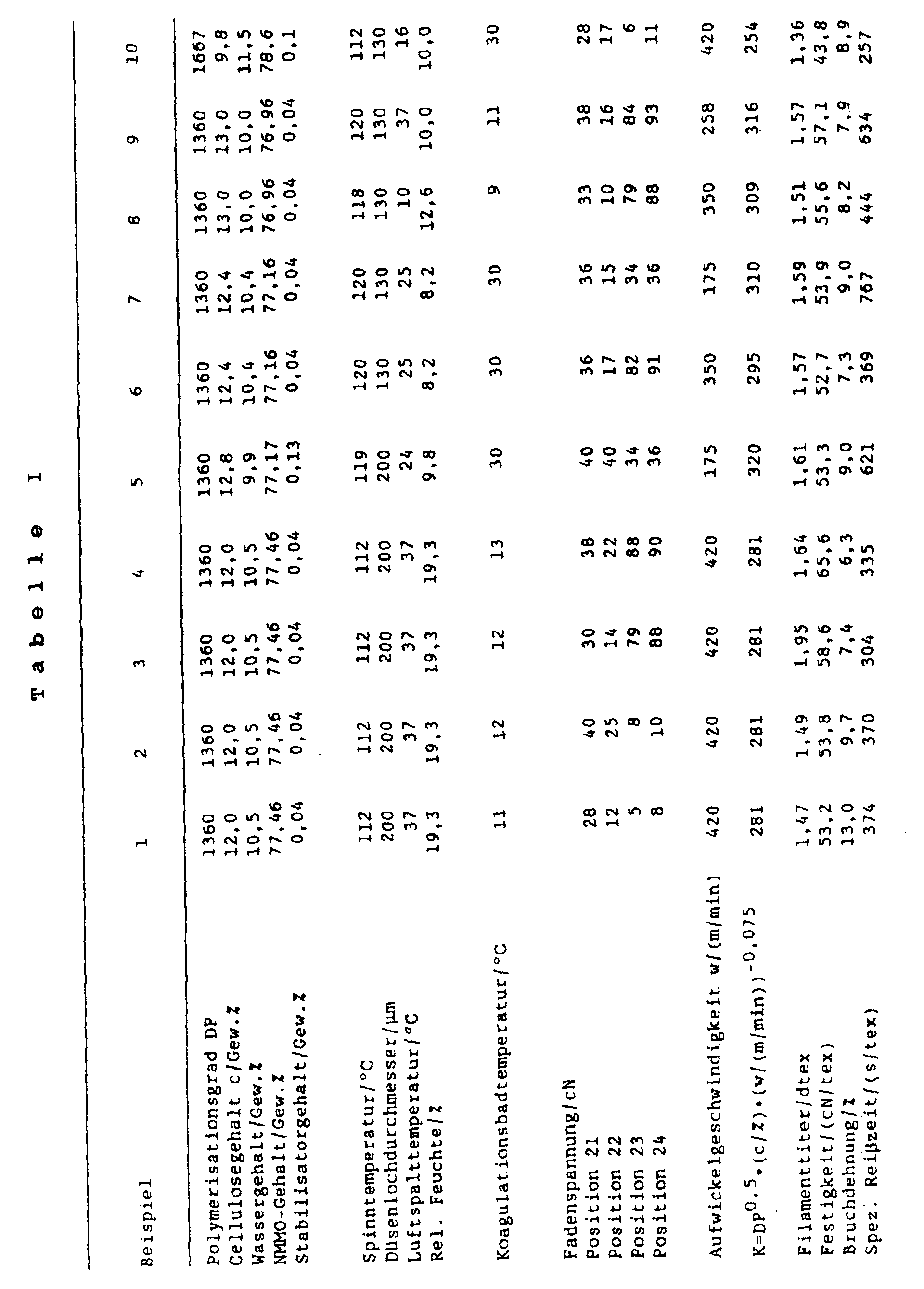
Die weiteren Versuchsbedingungen und Eigenschaften der gemäß den Beispielen 1 bis 9 und dem Vergleichsbeispiel
10 erhaltenen Filamente sind in Tabelle I zusammengestellt.
In zwei weiteren Beispielen wurden lösungsmittelgesponnene cellulosische Filamente mit einer Spinndüse erzeugt, die lediglich über eine Düsenbohrung mit einem Durchmesser von 130 µm verfügt. Die Spinntemperatur betrug 100°C. Die Filamente wurden im Luftspalt einer Länge von 15 cm mit unbewegter Luft einer Temperatur von 25°C gekühlt. Im Anschluß an das auf 18°C gehaltene Koagulationsbad wurden die Filamente gewaschen, aviviert (1% Leomin in Wasser, vertrieben von Firma Hoechst AG) und getrocknet. Zwischen Spinndüse und Aufwicklung wurde ein Verstreckverhältnis von 1 : 13 eingestellt. Die Spinngeschwindigkeit betrug 48 m/min. Zur Bestimmung der spezifischen Reißzeit wurden aus den Endlosfilamenten Bündel aus 50 Einzelfilamenten hergestellt.In two further examples, solvent spun cellulosic filaments were produced with a spinneret, which has only a nozzle bore with a diameter of 130 microns. The spinning temperature was 100 ° C. The filaments were in the air gap of a length of 15 cm with still air at a temperature of 25 ° C. cooled. Following the coagulation bath maintained at 18 ° C, the filaments were washed, rinsed (1%). Leomin in water, sold by Hoechst AG) and dried. Was between spinneret and winding a draw ratio of 1:13 is set. The spinning speed was 48 m / min. To determine the specific Tear time was made from the continuous filament bundles of 50 single filaments.
Für das Beispiel 11 wurde, wie für die Beispiele 1 bis 9, der Zellstoff Ultranier-J (DP 1360) eingesetzt. Die Lösung wies eine Cellulosekonzentration von 10 Gew.% auf. Wasser und NMMO lagen mit 11,5 Gew.% bzw. 78,4 Gew.% vor. Die Konzentration an Gallussäure Propylester betrug 0,1 Gew.%.For Example 11, as for Examples 1 to 9, the pulp Ultranier-J (DP 1360) was used. The solution had a cellulose concentration of 10% by weight. Water and NMMO were 11.5 wt.% And 78.4 wt.%, Respectively. The concentration of gallic acid propyl ester was 0.1% by weight.
Zur Herstellung von Filamenten gemäß Beispiel 12 (Vergleichsbeispiel) wurde als Zellstoff Viscokraft 4.3 der Firma
International Paper Company mit einem Polymerisationsgrad von 650 in einer Konzentration von 12,7 Gew.% eingesetzt.
Die Wasserkonzentration betrug 9,0 Gew.%. NMMO lag in einer Menge von 78,2 Gew.% und Gallussäurepropylester
mit 0,1 Gew.% vor. Die Eigenschaften der gemäß dem Beispiel 11 und dem Vergleichsbeispiel 12 hergestellten
Filamente sind in Tabelle II enthalten.
Anhand der Tabellen I und II wird deutlich, daß die Filamente gemäß den Vergleichsbeispielen 10 und 12 über eine spezifische Reißzeit von 257 bzw. 250 s/tex verfügen. Ihre Festigkeit von 43,8 bzw. 36,4 cN/tex und ihre Bruchdehnung von 8,9 bzw. 11,7% liegen in einem Bereich, wie er für lösungsmittelgesponnene cellulosische Filamente für textile Anwendungen üblich ist. In überraschender Weise verfügen die erfindungsgemäßen Filamente (Beispiel 1 bis 9 und 11) über eine hohe Festigkeit bei einer Bruchdehnung, die mit der der Vergleichsbeispiele 10 und 12 vergleichbar ist. Insbesondere zeigen sie nicht den gemäß dem vorgenannten Stand der Technik vorliegenden Nachteil der sehr starken Fibrillierung. Im Gegenteil ist die Neigung zur Fibrillierung bei den erfindungsgemäßen Filamenten sogar deutlich (bis zu einem Faktor von 4) gegenüber den Filamenten der Vergleichsbeispiele reduziert. Die erfindungsgemäßen Filamente vereinen damit eine für technische Einsatzgebiete gewünschte hohe Festigkeit bei geringer Neigung zur Fibrillierung, wodurch sie auch für textile Einsatzgebiete sehr geeignet sind.From the tables I and II it is clear that the filaments according to Comparative Examples 10 and 12 on have a specific tear time of 257 or 250 s / tex. Their strength of 43.8 and 36.4 cN / tex and their elongation at break of 8.9 and 11.7%, respectively, are in the range of solvent-spun cellulosic filaments for textile applications is common. Surprisingly, the filaments according to the invention (Examples 1 to 9 and 11) over a high strength at an elongation at break comparable to those of Comparative Examples 10 and 12 is. In particular, they do not show the disadvantage of the aforementioned prior art strong fibrillation. On the contrary, the tendency for fibrillation in the filaments according to the invention is even clear (up to a factor of 4) compared to the filaments of Comparative Examples reduced. The invention Filaments thus combine a high strength with low inclination desired for technical applications Fibrillation, making them very suitable for textile applications.
Darüberhinaus sind die erfindungsgemäßen Filamente wirtschaftlich herstellbar, und die Nachteile zum Erreichen
einer hohen Festigkeit im Stand der Technik, wie die Zugabe von Salzen zur Celluloselösung, können in vorteilhafterweise
vermieden werden. Für die Herstellung der erfindungsgemäßen Filamente sind zum einen der Polymerisationsgrad
der zur Lösungsherstellung eingesetzten Cellulose und deren Konzentration in der Lösung, sowie die Aufwickelgeschwindigkeit
der Filamente entscheidend. Um erfindungsgemäße Filamente herzustellen, werden der Polymerisationsgrad
DP, die Cellulosekonzentration c in % und die Aufwickelgeschwindigkeit w in m/min so eingestellt, daß die
Größe K, die von diesen drei Größen abhängig ist und deren Wert sich nach der Gleichung:
Darüberhinaus sind aber zur Herstellung erfindungsgemäßer Filamente auch noch folgende Verfahrensparameter von Bedeutung. Zur Erreichung einer möglichst hohen Festigkeit sollte der zur Lösungsherstellung eingesetzte Zellstoff einen möglichst hohen Anteil an α-Cellulose besitzen, wie der in den Beispielen 1 bis 9 und 11 eingesetzte Südkiefer-Zellstoff. Beispielsweise konnte bei der Herstellung von Filamenten gemäß Beispiel 10 mit einem Zellstoff mit höhrerem DP als der des Südkiefer- Zellstoffs nicht die gewünschte Festigkeit erreicht werden.In addition, however, the following process parameters are also for the production of filaments according to the invention significant. To achieve the highest possible strength, the pulp used for the solution preparation should be used have the highest possible proportion of α-cellulose, as used in Examples 1 to 9 and 11 southern pine pulp. For example, in the production of filaments according to Example 10 could with a pulp with höheem DP as the southern pine pulp does not achieve the desired strength.
Neben diesen Einflußgrößen haben ebenfalls die Temperatur des Koagulationsbades sowie die Fadenspannung
an der Position 23, d.h. in der Trockenstrecke 28 einen Einfluß auf die Festigkeit.In addition to these influencing factors, the temperature of the coagulation bath and the thread tension also have
at
So wurde gefunden, daß zur Erreichnung einer hohen Festigkeit die Temperatur des Koagulationsbades möglichst niedrig sein sollte. Bei den Beispielen 5, 6 und 7, bei denen die Koagulationsbadtemperatur 30 °C betrug, resultierten Festigkeiten in Höhe von 53,3, 52,7 bzw. 53,9 cN/tex. Trotz niedrigerer Cellulosekonzentration resultierte bei Beispiel 3 mit einer Koagulationsbadtemperatur von 12 °C eine Festigkeit von 58,6 cN/tex.Thus, it has been found that to achieve high strength, the temperature of the coagulation bath as possible should be low. Examples 5, 6 and 7, where the coagulation bath temperature was 30 ° C, resulted Strengths of 53.3, 52.7 and 53.9 cN / tex, respectively. Despite lower cellulose concentration resulted in example 3 with a coagulation bath temperature of 12 ° C a strength of 58.6 cN / tex.
Durch Erhöhung der Fadenspannung an der Position 23 läßt sich ebenfalls eine Erhöhung der Festigkeit erreichen.
Wie die Beispiele 2 und 3 zeigen, läßt sich durch Erhöhung der Fadenspannung an der Position 23 bei ansonsten in
etwa vergleichbaren Versuchsbedingungen die Festigkeit der Filamente erhöhen. Hohe Festigkeiten sind auch erreichbar,
wenn eine niedrige Temperatur des Koagulationsbades gewählt wird, und eine hohe Fadenspannung an der Position
23 vorliegt, wie die Beispiele 3, 4 und 9 zeigen. Bei Beispiel 6, bei dem zwar auch eine Fadenspannung in der
Größenordnung der Beispiele 3, 4 und 9 vorlag, bei dem aber eine wesentlich höhere Koagulationsbadtemperatur
vorlag, resultierte demgegenüber eine niedrige Festigkeit der Filamente.By increasing the thread tension at
Die Bruchdehnung der Filamente nimmt demgegenüber durch die Erhöhung der Fadenspannung an der Position
23 ab. Des weiteren wurde gefunden, daß eine Erhöhung der Bruchdehnung durch Verringerung der Fadenspannung
im Bereich der Waschstrecke und vor dem Auftragen der Avivage (Position 22) erreicht werden kann. So beträgt die
Bruchdehnung der Filamente gemäß Beispiel 1 13%, wobei die Fadenspannung an der Position 22 12 cN und an der
Position 23 5 cN betrug. Bei Beispiel 8 resultierte demgegenüber eine Bruchdehnung von 8,2%. Dabei betrug die
Fadenspannung an der Position 22 zwar nur 10 cN, aber an der Position 23 lag eine Fadenspannung von 79 cN vor.In contrast, the elongation at break of the filaments increases by increasing the thread tension at the
Claims (5)
- Solvent-spun cellulose filaments from a solution of cellulose in a tertiary amine N-oxide and if necessary water with a strength of 52,7 to 66 cN/tex, an elongation at break of 6 to 13 % and a specific breaking time that amounts to 300 to 1000 s/tex.
- Solvent-spun cellulose filaments according to claim 1, characterized in that their elongation at break amounts to 6 to 9.7%.
- Solvent-spun cellulose filaments according to claim 1 or 2, characterized in that their elongation at break amounts to 6 to 9.5%.
- Solvent-spun cellulose filaments according to one of claims 1 to 3, characterized in that their elongation at break amounts to 6 to 9%.
- Solvent-spun cellulose filaments according to one of claims 1 to 4, characterized in that the cellulose is a southern pine chemical wood.
Applications Claiming Priority (3)
| Application Number | Priority Date | Filing Date | Title |
|---|---|---|---|
| DE4444140 | 1994-12-12 | ||
| DE4444140A DE4444140A1 (en) | 1994-12-12 | 1994-12-12 | Solvent-spun cellulosic filaments |
| PCT/EP1995/004808 WO1996018760A1 (en) | 1994-12-12 | 1995-12-07 | Solvent-spun cellulosic filaments |
Publications (3)
| Publication Number | Publication Date |
|---|---|
| EP0797694A1 EP0797694A1 (en) | 1997-10-01 |
| EP0797694B1 EP0797694B1 (en) | 1998-08-26 |
| EP0797694B2 true EP0797694B2 (en) | 2005-06-08 |
Family
ID=6535545
Family Applications (1)
| Application Number | Title | Priority Date | Filing Date |
|---|---|---|---|
| EP95942074A Expired - Lifetime EP0797694B2 (en) | 1994-12-12 | 1995-12-07 | Solvent-spun cellulosic filaments |
Country Status (12)
| Country | Link |
|---|---|
| US (1) | US5942327A (en) |
| EP (1) | EP0797694B2 (en) |
| JP (1) | JPH10510333A (en) |
| KR (1) | KR100395278B1 (en) |
| AT (1) | ATE170235T1 (en) |
| AU (1) | AU4340696A (en) |
| CZ (1) | CZ289707B6 (en) |
| DE (2) | DE4444140A1 (en) |
| ES (1) | ES2122710T5 (en) |
| SK (1) | SK281210B6 (en) |
| TW (1) | TW308612B (en) |
| WO (1) | WO1996018760A1 (en) |
Cited By (8)
| Publication number | Priority date | Publication date | Assignee | Title |
|---|---|---|---|---|
| US7309360B2 (en) | 2004-06-15 | 2007-12-18 | Tornier | Set of humeral components for total shoulder prosthesis |
| US7462197B2 (en) | 2004-06-15 | 2008-12-09 | Tornier Sas | Glenoidal component of a shoulder prosthesis, set of elements constituting such a component and total shoulder prosthesis incorporating such a component |
| US7465319B2 (en) | 2003-12-19 | 2008-12-16 | Tornier Sas | Shoulder or hip prosthesis and process for fitting same |
| US7678150B2 (en) | 2004-06-15 | 2010-03-16 | Tornier Sas | Total shoulder prosthesis of an inverted type |
| US8187282B2 (en) | 2003-03-10 | 2012-05-29 | Tornier Sas | Ancillary tool for positioning a glenoid implant |
| US8303665B2 (en) | 2004-06-15 | 2012-11-06 | Tornier Sas | Glenoidal component, set of such components and shoulder prosthesis incorporating such a glenoidal component |
| US9433507B2 (en) | 2006-03-21 | 2016-09-06 | Tornier, Inc. | Non-spherical articulating surfaces in shoulder and hip replacement |
| US9474619B2 (en) | 2006-03-21 | 2016-10-25 | Tornier, Inc. | Glenoid component with improved fixation stability |
Families Citing this family (33)
| Publication number | Priority date | Publication date | Assignee | Title |
|---|---|---|---|---|
| AT404032B (en) * | 1996-03-04 | 1998-07-27 | Chemiefaser Lenzing Ag | METHOD FOR PRODUCING CELLULOSIC FIBERS |
| AT405531B (en) | 1997-06-17 | 1999-09-27 | Chemiefaser Lenzing Ag | METHOD FOR PRODUCING CELLULOSIC FIBERS |
| DE10200406A1 (en) * | 2002-01-08 | 2003-07-24 | Zimmer Ag | Spinning device and process with turbulent cooling blowing |
| DE10200405A1 (en) | 2002-01-08 | 2002-08-01 | Zimmer Ag | Cooling blowing spinning apparatus and process |
| DE10204381A1 (en) * | 2002-01-28 | 2003-08-07 | Zimmer Ag | Ergonomic spinning system |
| DE10206089A1 (en) | 2002-02-13 | 2002-08-14 | Zimmer Ag | bursting |
| DE10213007A1 (en) * | 2002-03-22 | 2003-10-09 | Zimmer Ag | Method and device for controlling the indoor climate in a spinning process |
| DE10223268B4 (en) * | 2002-05-24 | 2006-06-01 | Zimmer Ag | Wetting device and spinning system with wetting device |
| DE10314878A1 (en) * | 2003-04-01 | 2004-10-28 | Zimmer Ag | Method and device for producing post-stretched cellulose filaments |
| US7097344B2 (en) * | 2003-06-30 | 2006-08-29 | Hyosung Corporation | Homogeneous cellulose solution and high tenacity lyocell multifilament using the same |
| JP4234057B2 (en) * | 2003-06-30 | 2009-03-04 | ヒョスング コーポレーション | Cellulose dipcords and tires made from highly homogeneous cellulose solutions |
| KR100511723B1 (en) * | 2003-08-22 | 2005-08-31 | 주식회사 효성 | A cellulose dip cord using a highly homogeneous cellulose solution and tire producted by the same |
| KR100488604B1 (en) * | 2003-07-25 | 2005-05-11 | 주식회사 효성 | Lyocell multi-filament |
| DE102004024028B4 (en) * | 2004-05-13 | 2010-04-08 | Lenzing Ag | Lyocell method and apparatus with press water return |
| DE102004024029A1 (en) * | 2004-05-13 | 2005-12-08 | Zimmer Ag | Lyocell method and apparatus with metal ion content control |
| DE102004024030A1 (en) * | 2004-05-13 | 2005-12-08 | Zimmer Ag | Lyocell process with polymerization-degree-dependent adjustment of the processing time |
| KR100595751B1 (en) * | 2004-11-11 | 2006-07-03 | 주식회사 효성 | Manufacturing method of cellulose multifilament |
| DE202005002863U1 (en) | 2005-02-21 | 2006-06-29 | Cordenka Gmbh | airbag fabrics |
| KR100966111B1 (en) | 2005-03-15 | 2010-06-28 | 주식회사 효성 | Manufacturing method of cellulose multifilament |
| EP1996124B1 (en) | 2006-03-21 | 2019-10-30 | Tornier, Inc. | Femoral and humeral stem components sytem for orthopedic joint reconstruction |
| KR100721443B1 (en) * | 2006-04-27 | 2007-05-23 | 주식회사 효성 | Cellulose Heat Treatment Cord for Rubber Reinforcement |
| KR100674670B1 (en) * | 2006-04-27 | 2007-01-25 | 주식회사 효성 | Cellulose Raw Code for Rubber Reinforcement |
| KR100824980B1 (en) * | 2006-12-28 | 2008-04-28 | 주식회사 효성 | Cellulose Multifilament with Low Cross Section Coefficient |
| PL2268857T3 (en) | 2008-03-27 | 2013-01-31 | Cordenka Gmbh & Co Kg | Cellulosic mouldings |
| TWI632259B (en) * | 2014-11-26 | 2018-08-11 | 聚泰環保材料科技股份有限公司 | Method for preparing moisture-absorbing transfer non-woven fabric by using spunbonding method |
| TWI621743B (en) * | 2014-11-26 | 2018-04-21 | Method for preparing moisture-absorbing transfer non-woven fabric by using short fiber spinning method | |
| TWI621742B (en) * | 2014-11-26 | 2018-04-21 | Method for preparing non-woven fabric with hygroscopic transferability by melt-blown method | |
| DE102015118027B3 (en) | 2015-10-22 | 2016-11-17 | Memminger-Iro Gmbh | Method for controlling the thread delivery of a yarn feeding device and yarn feeding device |
| ES3048882T3 (en) | 2016-02-11 | 2025-12-12 | Technikum Laubholz Gmbh | Process for the preparation of polymer fibers from polymers dissolved in ionic liquids by means of an air gap spinning process |
| PE20210233A1 (en) | 2017-10-06 | 2021-02-09 | Lenzing Aktiengeselleschaft | FLAME RETARDANT LYOCELL FILAMENT |
| EP3467161A1 (en) | 2017-10-06 | 2019-04-10 | Lenzing Aktiengesellschaft | Lyocell type cellulose filament production process |
| PL3511449T3 (en) | 2018-01-15 | 2022-07-18 | Lenzing Aktiengesellschaft | Reuse of lyocell cellulose for lyocell method |
| EP3674454A1 (en) | 2018-12-28 | 2020-07-01 | Lenzing Aktiengesellschaft | Cellulose filament process |
Family Cites Families (7)
| Publication number | Priority date | Publication date | Assignee | Title |
|---|---|---|---|---|
| US4246221A (en) * | 1979-03-02 | 1981-01-20 | Akzona Incorporated | Process for shaped cellulose article prepared from a solution containing cellulose dissolved in a tertiary amine N-oxide solvent |
| FR2578865B1 (en) * | 1985-03-14 | 1987-04-10 | Centre Nat Rech Scient | PROCESS FOR THE PREPARATION OF SOLUTIONS OF A LIGNO-CELLULOSIC MATERIAL AND SOLUTIONS OBTAINED. |
| FR2617511B1 (en) * | 1987-07-01 | 1989-12-15 | Inst Textile De France | PROCESS FOR THE PREPARATION OF A CELLULOSE SPINNING SOLUTION IN THE PRESENCE OF TERTIARY AMINE OXIDE AND ADDITIVE |
| DD271534B5 (en) * | 1988-04-26 | 2002-07-11 | Thueringisches Inst Textil | Process for the spinning of polymer solutions |
| AT395724B (en) * | 1990-12-07 | 1993-02-25 | Chemiefaser Lenzing Ag | METHOD FOR PRODUCING CELLULOSE MOLDED BODIES |
| DE4219658C3 (en) * | 1992-06-16 | 2001-06-13 | Ostthueringische Materialpruef | Process for the production of cellulose fiber filaments and films by the dry-wet extrusion process |
| AT403296B (en) * | 1995-08-11 | 1997-12-29 | Chemiefaser Lenzing Ag | METHOD FOR PRODUCING A CELLULOSE MOLDED BODY |
-
1994
- 1994-12-12 DE DE4444140A patent/DE4444140A1/en not_active Withdrawn
-
1995
- 1995-12-07 AU AU43406/96A patent/AU4340696A/en not_active Abandoned
- 1995-12-07 JP JP8518231A patent/JPH10510333A/en active Pending
- 1995-12-07 WO PCT/EP1995/004808 patent/WO1996018760A1/en not_active Ceased
- 1995-12-07 US US08/849,509 patent/US5942327A/en not_active Expired - Lifetime
- 1995-12-07 CZ CZ19971787A patent/CZ289707B6/en not_active IP Right Cessation
- 1995-12-07 EP EP95942074A patent/EP0797694B2/en not_active Expired - Lifetime
- 1995-12-07 KR KR1019970703924A patent/KR100395278B1/en not_active Ceased
- 1995-12-07 DE DE59503384T patent/DE59503384D1/en not_active Expired - Lifetime
- 1995-12-07 AT AT95942074T patent/ATE170235T1/en active
- 1995-12-07 ES ES95942074T patent/ES2122710T5/en not_active Expired - Lifetime
- 1995-12-07 SK SK752-97A patent/SK281210B6/en not_active IP Right Cessation
-
1996
- 1996-04-10 TW TW085104210A patent/TW308612B/zh not_active IP Right Cessation
Cited By (8)
| Publication number | Priority date | Publication date | Assignee | Title |
|---|---|---|---|---|
| US8187282B2 (en) | 2003-03-10 | 2012-05-29 | Tornier Sas | Ancillary tool for positioning a glenoid implant |
| US7465319B2 (en) | 2003-12-19 | 2008-12-16 | Tornier Sas | Shoulder or hip prosthesis and process for fitting same |
| US7309360B2 (en) | 2004-06-15 | 2007-12-18 | Tornier | Set of humeral components for total shoulder prosthesis |
| US7462197B2 (en) | 2004-06-15 | 2008-12-09 | Tornier Sas | Glenoidal component of a shoulder prosthesis, set of elements constituting such a component and total shoulder prosthesis incorporating such a component |
| US7678150B2 (en) | 2004-06-15 | 2010-03-16 | Tornier Sas | Total shoulder prosthesis of an inverted type |
| US8303665B2 (en) | 2004-06-15 | 2012-11-06 | Tornier Sas | Glenoidal component, set of such components and shoulder prosthesis incorporating such a glenoidal component |
| US9433507B2 (en) | 2006-03-21 | 2016-09-06 | Tornier, Inc. | Non-spherical articulating surfaces in shoulder and hip replacement |
| US9474619B2 (en) | 2006-03-21 | 2016-10-25 | Tornier, Inc. | Glenoid component with improved fixation stability |
Also Published As
| Publication number | Publication date |
|---|---|
| JPH10510333A (en) | 1998-10-06 |
| KR100395278B1 (en) | 2003-11-20 |
| SK75297A3 (en) | 1997-10-08 |
| DE4444140A1 (en) | 1996-06-13 |
| CZ289707B6 (en) | 2002-03-13 |
| ES2122710T5 (en) | 2005-12-01 |
| ES2122710T3 (en) | 1998-12-16 |
| TW308612B (en) | 1997-06-21 |
| CZ178797A3 (en) | 1997-10-15 |
| SK281210B6 (en) | 2001-01-18 |
| DE59503384D1 (en) | 1998-10-01 |
| US5942327A (en) | 1999-08-24 |
| AU4340696A (en) | 1996-07-03 |
| WO1996018760A1 (en) | 1996-06-20 |
| ATE170235T1 (en) | 1998-09-15 |
| EP0797694A1 (en) | 1997-10-01 |
| EP0797694B1 (en) | 1998-08-26 |
Similar Documents
| Publication | Publication Date | Title |
|---|---|---|
| EP0797694B2 (en) | Solvent-spun cellulosic filaments | |
| EP0494852B1 (en) | Process for the production of cellulosic articles | |
| DE4308524C1 (en) | Process for the production of cellulose fibers and filaments by the dry-wet extrusion process | |
| DE69723582T2 (en) | REGENERATED CELLULOSE FIBERS AND METHOD FOR THEIR PRODUCTION | |
| AT401271B (en) | METHOD FOR PRODUCING CELLULOSE FIBERS | |
| EP0853146A2 (en) | Method of producing cellulosic fibres and cellulosic fibres | |
| EP0823945B1 (en) | Process for the manufacture of cellulose fibres | |
| EP0686712B1 (en) | Flexible cellulosic fibers with reduced modulus and NMR-characteristics and process for their production | |
| DE2151345A1 (en) | Process for the production of highly refined, crimped rayon threads and staple fibers | |
| AT507758A1 (en) | YARN AND THREADS FROM BLENDS OF FIBERS AND ARTICLES THEREFROM | |
| EP3771755A1 (en) | Method for the preparation of lyocell staple fibres | |
| EP0918894B1 (en) | Method for producing cellulose fibres | |
| WO2017137285A1 (en) | Method for producing carbon fibres from cellulose fibres treated with sulphonic acid salts | |
| WO1996007779A1 (en) | Process for manufacturing cellulose moulded bodies | |
| DE744891C (en) | Process for the production of rayon, fibers and threads from viscose | |
| DE1234916B (en) | Process for the production of threads, fibers or films made from regenerated cellulose | |
| DE69612703T2 (en) | Spun yarn made from polybenzazole fibers | |
| DE2736302B2 (en) | Process for the production of polypyrrolidone threads | |
| EP0918893B1 (en) | Cellulose microfibre | |
| EP0888467B1 (en) | Process for producing cellulosic fibres with reduced tendency to fibrillate | |
| EP0645479A1 (en) | High strength and high modulus polyacrylonitrile fibers, process for their production and their use | |
| WO2000000681A1 (en) | Elastane fiber and method of production | |
| DE19753190B4 (en) | LYOCELL fibers with reduced tendency to fibrillate | |
| DE916347C (en) | Process for the production of high-strength rayon with not too low elongation from viscose using high-percentage sulfuric acid baths | |
| AT201226B (en) | Process for the production of threads by the viscose spinning process |
Legal Events
| Date | Code | Title | Description |
|---|---|---|---|
| PUAI | Public reference made under article 153(3) epc to a published international application that has entered the european phase |
Free format text: ORIGINAL CODE: 0009012 |
|
| 17P | Request for examination filed |
Effective date: 19970530 |
|
| AK | Designated contracting states |
Kind code of ref document: A1 Designated state(s): AT CH DE ES FR GB IT LI NL |
|
| GRAG | Despatch of communication of intention to grant |
Free format text: ORIGINAL CODE: EPIDOS AGRA |
|
| GRAG | Despatch of communication of intention to grant |
Free format text: ORIGINAL CODE: EPIDOS AGRA |
|
| GRAH | Despatch of communication of intention to grant a patent |
Free format text: ORIGINAL CODE: EPIDOS IGRA |
|
| 17Q | First examination report despatched |
Effective date: 19971211 |
|
| GRAH | Despatch of communication of intention to grant a patent |
Free format text: ORIGINAL CODE: EPIDOS IGRA |
|
| ITF | It: translation for a ep patent filed | ||
| GRAA | (expected) grant |
Free format text: ORIGINAL CODE: 0009210 |
|
| AK | Designated contracting states |
Kind code of ref document: B1 Designated state(s): AT CH DE ES FR GB IT LI NL |
|
| REF | Corresponds to: |
Ref document number: 170235 Country of ref document: AT Date of ref document: 19980915 Kind code of ref document: T |
|
| REG | Reference to a national code |
Ref country code: CH Ref legal event code: EP |
|
| ET | Fr: translation filed | ||
| REF | Corresponds to: |
Ref document number: 59503384 Country of ref document: DE Date of ref document: 19981001 |
|
| REG | Reference to a national code |
Ref country code: ES Ref legal event code: FG2A Ref document number: 2122710 Country of ref document: ES Kind code of ref document: T3 |
|
| GBT | Gb: translation of ep patent filed (gb section 77(6)(a)/1977) |
Effective date: 19981204 |
|
| PLBQ | Unpublished change to opponent data |
Free format text: ORIGINAL CODE: EPIDOS OPPO |
|
| PLBI | Opposition filed |
Free format text: ORIGINAL CODE: 0009260 |
|
| PLBF | Reply of patent proprietor to notice(s) of opposition |
Free format text: ORIGINAL CODE: EPIDOS OBSO |
|
| PLAB | Opposition data, opponent's data or that of the opponent's representative modified |
Free format text: ORIGINAL CODE: 0009299OPPO |
|
| 26 | Opposition filed |
Opponent name: LURGI ZIMMER AKTIENGESELLSCHAFT Effective date: 19990525 |
|
| R26 | Opposition filed (corrected) |
Opponent name: LURGI ZIMMER AG/ALCERU SCHWARZA/THUER.INST.F.TEXTI Effective date: 19990525 |
|
| PLBF | Reply of patent proprietor to notice(s) of opposition |
Free format text: ORIGINAL CODE: EPIDOS OBSO |
|
| PLBF | Reply of patent proprietor to notice(s) of opposition |
Free format text: ORIGINAL CODE: EPIDOS OBSO |
|
| PLBQ | Unpublished change to opponent data |
Free format text: ORIGINAL CODE: EPIDOS OPPO |
|
| PLAB | Opposition data, opponent's data or that of the opponent's representative modified |
Free format text: ORIGINAL CODE: 0009299OPPO |
|
| R26 | Opposition filed (corrected) |
Opponent name: LURGI ZIMMER AG/ALCERU SCHWARZA/THUER.INST.F.TEXTI Effective date: 19990525 |
|
| NLR1 | Nl: opposition has been filed with the epo |
Opponent name: LURGI ZIMMER AG/ALCERU SCHWARZA/THUER.INST.F.TEXTI |
|
| RDAH | Patent revoked |
Free format text: ORIGINAL CODE: EPIDOS REVO |
|
| APAC | Appeal dossier modified |
Free format text: ORIGINAL CODE: EPIDOS NOAPO |
|
| APAE | Appeal reference modified |
Free format text: ORIGINAL CODE: EPIDOS REFNO |
|
| APAC | Appeal dossier modified |
Free format text: ORIGINAL CODE: EPIDOS NOAPO |
|
| PLAB | Opposition data, opponent's data or that of the opponent's representative modified |
Free format text: ORIGINAL CODE: 0009299OPPO |
|
| R26 | Opposition filed (corrected) |
Opponent name: ZIMMER AKTIENGESELLSCHAFT/ ALCERU SCHWARZA GMBH/ T Effective date: 19990525 |
|
| NLR1 | Nl: opposition has been filed with the epo |
Opponent name: ZIMMER AKTIENGESELLSCHAFT/ ALCERU SCHWARZA GMBH/ T |
|
| REG | Reference to a national code |
Ref country code: GB Ref legal event code: IF02 |
|
| REG | Reference to a national code |
Ref country code: CH Ref legal event code: PUE Owner name: CORDENKA GMBH Free format text: ACORDIS INDUSTRIAL FIBERS GMBH#KASINOSTRASSE 19-21#42103 WUPPERTAL (DE) -TRANSFER TO- CORDENKA GMBH#KASINOSTRASSE 19-21#42103 WUPPERTAL (DE) Ref country code: CH Ref legal event code: PUE Owner name: ACORDIS INDUSTRIAL FIBERS GMBH Free format text: AKZO NOBEL N.V.#VELPERWEG 76, POSTBUS 9300#6824 BM ARNHEM (NL) -TRANSFER TO- ACORDIS INDUSTRIAL FIBERS GMBH#KASINOSTRASSE 19-21#42103 WUPPERTAL (DE) Ref country code: CH Ref legal event code: NV Representative=s name: F. HOFFMANN-LA ROCHE AG |
|
| REG | Reference to a national code |
Ref country code: GB Ref legal event code: 732E |
|
| NLS | Nl: assignments of ep-patents |
Owner name: CORDENKA GMBH Owner name: ACORDIS INDUSTRIAL FIBERS GMBH |
|
| REG | Reference to a national code |
Ref country code: FR Ref legal event code: TP |
|
| REG | Reference to a national code |
Ref country code: ES Ref legal event code: PC2A |
|
| APBU | Appeal procedure closed |
Free format text: ORIGINAL CODE: EPIDOSNNOA9O |
|
| PUAH | Patent maintained in amended form |
Free format text: ORIGINAL CODE: 0009272 |
|
| STAA | Information on the status of an ep patent application or granted ep patent |
Free format text: STATUS: PATENT MAINTAINED AS AMENDED |
|
| RAP2 | Party data changed (patent owner data changed or rights of a patent transferred) |
Owner name: CORDENKA GMBH |
|
| 27A | Patent maintained in amended form |
Effective date: 20050608 |
|
| AK | Designated contracting states |
Kind code of ref document: B2 Designated state(s): AT CH DE ES FR GB IT LI NL |
|
| REG | Reference to a national code |
Ref country code: CH Ref legal event code: AEN Free format text: AUFRECHTERHALTUNG DES PATENTES IN GEAENDERTER FORM |
|
| NLT2 | Nl: modifications (of names), taken from the european patent patent bulletin |
Owner name: CORDENKA GMBH |
|
| NLR2 | Nl: decision of opposition |
Effective date: 20050608 |
|
| GBTA | Gb: translation of amended ep patent filed (gb section 77(6)(b)/1977) | ||
| APAH | Appeal reference modified |
Free format text: ORIGINAL CODE: EPIDOSCREFNO |
|
| NLR3 | Nl: receipt of modified translations in the netherlands language after an opposition procedure | ||
| REG | Reference to a national code |
Ref country code: ES Ref legal event code: DC2A Date of ref document: 20050902 Kind code of ref document: T5 |
|
| ET3 | Fr: translation filed ** decision concerning opposition | ||
| REG | Reference to a national code |
Ref country code: CH Ref legal event code: NV Representative=s name: HANS ULRICH SEIFERT SEIFERT & PARTNER |
|
| PGFP | Annual fee paid to national office [announced via postgrant information from national office to epo] |
Ref country code: CH Payment date: 20121224 Year of fee payment: 18 |
|
| PGFP | Annual fee paid to national office [announced via postgrant information from national office to epo] |
Ref country code: IT Payment date: 20121219 Year of fee payment: 18 Ref country code: GB Payment date: 20121227 Year of fee payment: 18 |
|
| PGFP | Annual fee paid to national office [announced via postgrant information from national office to epo] |
Ref country code: FR Payment date: 20130117 Year of fee payment: 18 Ref country code: ES Payment date: 20121226 Year of fee payment: 18 |
|
| PGFP | Annual fee paid to national office [announced via postgrant information from national office to epo] |
Ref country code: NL Payment date: 20121218 Year of fee payment: 18 |
|
| PGFP | Annual fee paid to national office [announced via postgrant information from national office to epo] |
Ref country code: AT Payment date: 20131223 Year of fee payment: 19 Ref country code: DE Payment date: 20131223 Year of fee payment: 19 |
|
| REG | Reference to a national code |
Ref country code: NL Ref legal event code: V1 Effective date: 20140701 |
|
| REG | Reference to a national code |
Ref country code: CH Ref legal event code: PL |
|
| GBPC | Gb: european patent ceased through non-payment of renewal fee |
Effective date: 20131207 |
|
| REG | Reference to a national code |
Ref country code: DE Ref legal event code: R081 Ref document number: 59503384 Country of ref document: DE Owner name: CORDENKA GMBH & CO. KG, DE Free format text: FORMER OWNER: CORDENKA GMBH, 42103 WUPPERTAL, DE Effective date: 20140723 |
|
| REG | Reference to a national code |
Ref country code: DE Ref legal event code: R082 Ref document number: 59503384 Country of ref document: DE Representative=s name: SCHROEDER OBERLEIN PATENTANWALTS UG (HAFTUNGSB, DE |
|
| REG | Reference to a national code |
Ref country code: FR Ref legal event code: ST Effective date: 20140829 |
|
| PG25 | Lapsed in a contracting state [announced via postgrant information from national office to epo] |
Ref country code: LI Free format text: LAPSE BECAUSE OF NON-PAYMENT OF DUE FEES Effective date: 20131231 Ref country code: NL Free format text: LAPSE BECAUSE OF NON-PAYMENT OF DUE FEES Effective date: 20140701 Ref country code: CH Free format text: LAPSE BECAUSE OF NON-PAYMENT OF DUE FEES Effective date: 20131231 |
|
| PG25 | Lapsed in a contracting state [announced via postgrant information from national office to epo] |
Ref country code: GB Free format text: LAPSE BECAUSE OF NON-PAYMENT OF DUE FEES Effective date: 20131207 Ref country code: FR Free format text: LAPSE BECAUSE OF NON-PAYMENT OF DUE FEES Effective date: 20131231 |
|
| REG | Reference to a national code |
Ref country code: ES Ref legal event code: FD2A Effective date: 20150327 |
|
| PG25 | Lapsed in a contracting state [announced via postgrant information from national office to epo] |
Ref country code: ES Free format text: LAPSE BECAUSE OF NON-PAYMENT OF DUE FEES Effective date: 20131208 |
|
| REG | Reference to a national code |
Ref country code: DE Ref legal event code: R119 Ref document number: 59503384 Country of ref document: DE |
|
| REG | Reference to a national code |
Ref country code: AT Ref legal event code: MM01 Ref document number: 170235 Country of ref document: AT Kind code of ref document: T Effective date: 20141207 |
|
| PG25 | Lapsed in a contracting state [announced via postgrant information from national office to epo] |
Ref country code: DE Free format text: LAPSE BECAUSE OF NON-PAYMENT OF DUE FEES Effective date: 20150701 |
|
| PG25 | Lapsed in a contracting state [announced via postgrant information from national office to epo] |
Ref country code: AT Free format text: LAPSE BECAUSE OF NON-PAYMENT OF DUE FEES Effective date: 20141207 |
|
| PG25 | Lapsed in a contracting state [announced via postgrant information from national office to epo] |
Ref country code: IT Free format text: LAPSE BECAUSE OF NON-PAYMENT OF DUE FEES Effective date: 20131207 |