EP0794155A1 - Lithium nickel composite oxide, preparation process therefor and application thereof - Google Patents
Lithium nickel composite oxide, preparation process therefor and application thereof Download PDFInfo
- Publication number
- EP0794155A1 EP0794155A1 EP97301427A EP97301427A EP0794155A1 EP 0794155 A1 EP0794155 A1 EP 0794155A1 EP 97301427 A EP97301427 A EP 97301427A EP 97301427 A EP97301427 A EP 97301427A EP 0794155 A1 EP0794155 A1 EP 0794155A1
- Authority
- EP
- European Patent Office
- Prior art keywords
- nickel
- lithium
- nio
- composite oxide
- electrode
- Prior art date
- Legal status (The legal status is an assumption and is not a legal conclusion. Google has not performed a legal analysis and makes no representation as to the accuracy of the status listed.)
- Granted
Links
- 239000002131 composite material Substances 0.000 title claims abstract description 75
- RSNHXDVSISOZOB-UHFFFAOYSA-N lithium nickel Chemical compound [Li].[Ni] RSNHXDVSISOZOB-UHFFFAOYSA-N 0.000 title claims abstract description 72
- 238000002360 preparation method Methods 0.000 title abstract description 44
- 239000000203 mixture Substances 0.000 claims abstract description 72
- 239000000463 material Substances 0.000 claims abstract description 45
- 239000007774 positive electrode material Substances 0.000 claims abstract description 24
- 229910010708 Li2+xNi1−xO2 Inorganic materials 0.000 claims abstract description 8
- PXHVJJICTQNCMI-UHFFFAOYSA-N nickel Substances [Ni] PXHVJJICTQNCMI-UHFFFAOYSA-N 0.000 claims description 181
- 238000002441 X-ray diffraction Methods 0.000 claims description 88
- 229910052744 lithium Inorganic materials 0.000 claims description 83
- WHXSMMKQMYFTQS-UHFFFAOYSA-N Lithium Chemical compound [Li] WHXSMMKQMYFTQS-UHFFFAOYSA-N 0.000 claims description 79
- 238000000034 method Methods 0.000 claims description 66
- 229910052759 nickel Inorganic materials 0.000 claims description 59
- GNRSAWUEBMWBQH-UHFFFAOYSA-N oxonickel Chemical compound [Ni]=O GNRSAWUEBMWBQH-UHFFFAOYSA-N 0.000 claims description 56
- QVGXLLKOCUKJST-UHFFFAOYSA-N atomic oxygen Chemical compound [O] QVGXLLKOCUKJST-UHFFFAOYSA-N 0.000 claims description 43
- 239000001301 oxygen Substances 0.000 claims description 41
- 229910052760 oxygen Inorganic materials 0.000 claims description 41
- 229910008712 Li2NiO2+y Inorganic materials 0.000 claims description 38
- 229910052751 metal Inorganic materials 0.000 claims description 38
- 239000002184 metal Substances 0.000 claims description 38
- 230000008569 process Effects 0.000 claims description 34
- IJGRMHOSHXDMSA-UHFFFAOYSA-N Atomic nitrogen Chemical compound N#N IJGRMHOSHXDMSA-UHFFFAOYSA-N 0.000 claims description 25
- 239000007789 gas Substances 0.000 claims description 24
- XKRFYHLGVUSROY-UHFFFAOYSA-N Argon Chemical compound [Ar] XKRFYHLGVUSROY-UHFFFAOYSA-N 0.000 claims description 22
- WMFOQBRAJBCJND-UHFFFAOYSA-M Lithium hydroxide Chemical compound [Li+].[OH-] WMFOQBRAJBCJND-UHFFFAOYSA-M 0.000 claims description 22
- -1 nickel pyrophosphate Chemical compound 0.000 claims description 22
- FUJCRWPEOMXPAD-UHFFFAOYSA-N lithium oxide Chemical compound [Li+].[Li+].[O-2] FUJCRWPEOMXPAD-UHFFFAOYSA-N 0.000 claims description 19
- 229910001947 lithium oxide Inorganic materials 0.000 claims description 19
- 239000011261 inert gas Substances 0.000 claims description 18
- 239000007858 starting material Substances 0.000 claims description 18
- 239000003575 carbonaceous material Substances 0.000 claims description 12
- AMXOYNBUYSYVKV-UHFFFAOYSA-M lithium bromide Chemical compound [Li+].[Br-] AMXOYNBUYSYVKV-UHFFFAOYSA-M 0.000 claims description 12
- KWGKDLIKAYFUFQ-UHFFFAOYSA-M lithium chloride Chemical compound [Li+].[Cl-] KWGKDLIKAYFUFQ-UHFFFAOYSA-M 0.000 claims description 12
- PQXKHYXIUOZZFA-UHFFFAOYSA-M lithium fluoride Chemical compound [Li+].[F-] PQXKHYXIUOZZFA-UHFFFAOYSA-M 0.000 claims description 12
- HSZCZNFXUDYRKD-UHFFFAOYSA-M lithium iodide Chemical compound [Li+].[I-] HSZCZNFXUDYRKD-UHFFFAOYSA-M 0.000 claims description 12
- IIPYXGDZVMZOAP-UHFFFAOYSA-N lithium nitrate Chemical compound [Li+].[O-][N+]([O-])=O IIPYXGDZVMZOAP-UHFFFAOYSA-N 0.000 claims description 12
- 229910000159 nickel phosphate Inorganic materials 0.000 claims description 12
- 229910052786 argon Inorganic materials 0.000 claims description 11
- 238000004519 manufacturing process Methods 0.000 claims description 11
- 238000002156 mixing Methods 0.000 claims description 11
- 230000003647 oxidation Effects 0.000 claims description 11
- 238000007254 oxidation reaction Methods 0.000 claims description 11
- 239000001307 helium Substances 0.000 claims description 8
- 229910052734 helium Inorganic materials 0.000 claims description 8
- SWQJXJOGLNCZEY-UHFFFAOYSA-N helium atom Chemical compound [He] SWQJXJOGLNCZEY-UHFFFAOYSA-N 0.000 claims description 8
- 238000001354 calcination Methods 0.000 claims description 7
- 229910052743 krypton Inorganic materials 0.000 claims description 7
- DNNSSWSSYDEUBZ-UHFFFAOYSA-N krypton atom Chemical compound [Kr] DNNSSWSSYDEUBZ-UHFFFAOYSA-N 0.000 claims description 7
- 229910052754 neon Inorganic materials 0.000 claims description 7
- GKAOGPIIYCISHV-UHFFFAOYSA-N neon atom Chemical compound [Ne] GKAOGPIIYCISHV-UHFFFAOYSA-N 0.000 claims description 7
- 229910052757 nitrogen Inorganic materials 0.000 claims description 7
- XRLUJVFOGKUSMQ-ZVGUSBNCSA-L (2r,3r)-2,3-dihydroxybutanedioate;nickel(2+) Chemical compound [Ni+2].[O-]C(=O)[C@H](O)[C@@H](O)C([O-])=O XRLUJVFOGKUSMQ-ZVGUSBNCSA-L 0.000 claims description 6
- UVPKUTPZWFHAHY-UHFFFAOYSA-L 2-ethylhexanoate;nickel(2+) Chemical compound [Ni+2].CCCCC(CC)C([O-])=O.CCCCC(CC)C([O-])=O UVPKUTPZWFHAHY-UHFFFAOYSA-L 0.000 claims description 6
- UPPLJLAHMKABPR-UHFFFAOYSA-H 2-hydroxypropane-1,2,3-tricarboxylate;nickel(2+) Chemical compound [Ni+2].[Ni+2].[Ni+2].[O-]C(=O)CC(O)(CC([O-])=O)C([O-])=O.[O-]C(=O)CC(O)(CC([O-])=O)C([O-])=O UPPLJLAHMKABPR-UHFFFAOYSA-H 0.000 claims description 6
- PURTUPNWTLPILZ-UHFFFAOYSA-N 2-hydroxypropanoic acid;nickel Chemical compound [Ni].CC(O)C(O)=O.CC(O)C(O)=O PURTUPNWTLPILZ-UHFFFAOYSA-N 0.000 claims description 6
- XXSPKSHUSWQAIZ-UHFFFAOYSA-L 36026-88-7 Chemical compound [Ni+2].[O-]P=O.[O-]P=O XXSPKSHUSWQAIZ-UHFFFAOYSA-L 0.000 claims description 6
- 229910021586 Nickel(II) chloride Inorganic materials 0.000 claims description 6
- MQRWBMAEBQOWAF-UHFFFAOYSA-N acetic acid;nickel Chemical compound [Ni].CC(O)=O.CC(O)=O MQRWBMAEBQOWAF-UHFFFAOYSA-N 0.000 claims description 6
- DAPUDVOJPZKTSI-UHFFFAOYSA-L ammonium nickel sulfate Chemical compound [NH4+].[NH4+].[Ni+2].[O-]S([O-])(=O)=O.[O-]S([O-])(=O)=O DAPUDVOJPZKTSI-UHFFFAOYSA-L 0.000 claims description 6
- JCCYXJAEFHYHPP-OLXYHTOASA-L dilithium;(2r,3r)-2,3-dihydroxybutanedioate Chemical compound [Li+].[Li+].[O-]C(=O)[C@H](O)[C@@H](O)C([O-])=O JCCYXJAEFHYHPP-OLXYHTOASA-L 0.000 claims description 6
- YNQRWVCLAIUHHI-UHFFFAOYSA-L dilithium;oxalate Chemical compound [Li+].[Li+].[O-]C(=O)C([O-])=O YNQRWVCLAIUHHI-UHFFFAOYSA-L 0.000 claims description 6
- SVGRICXRWRCNHT-UHFFFAOYSA-L dioxidophosphanium nickel(2+) Chemical compound [Ni+2].[O-][PH2]=O.[O-][PH2]=O SVGRICXRWRCNHT-UHFFFAOYSA-L 0.000 claims description 6
- 150000004687 hexahydrates Chemical class 0.000 claims description 6
- 239000010416 ion conductor Substances 0.000 claims description 6
- XIXADJRWDQXREU-UHFFFAOYSA-M lithium acetate Chemical compound [Li+].CC([O-])=O XIXADJRWDQXREU-UHFFFAOYSA-M 0.000 claims description 6
- 229940071257 lithium acetate Drugs 0.000 claims description 6
- 229940031993 lithium benzoate Drugs 0.000 claims description 6
- XGZVUEUWXADBQD-UHFFFAOYSA-L lithium carbonate Chemical compound [Li+].[Li+].[O-]C([O-])=O XGZVUEUWXADBQD-UHFFFAOYSA-L 0.000 claims description 6
- 229910052808 lithium carbonate Inorganic materials 0.000 claims description 6
- 229940071264 lithium citrate Drugs 0.000 claims description 6
- WJSIUCDMWSDDCE-UHFFFAOYSA-K lithium citrate (anhydrous) Chemical compound [Li+].[Li+].[Li+].[O-]C(=O)CC(O)(CC([O-])=O)C([O-])=O WJSIUCDMWSDDCE-UHFFFAOYSA-K 0.000 claims description 6
- HPGPEWYJWRWDTP-UHFFFAOYSA-N lithium peroxide Chemical compound [Li+].[Li+].[O-][O-] HPGPEWYJWRWDTP-UHFFFAOYSA-N 0.000 claims description 6
- HGPXWXLYXNVULB-UHFFFAOYSA-M lithium stearate Chemical compound [Li+].CCCCCCCCCCCCCCCCCC([O-])=O HGPXWXLYXNVULB-UHFFFAOYSA-M 0.000 claims description 6
- GLNWILHOFOBOFD-UHFFFAOYSA-N lithium sulfide Chemical compound [Li+].[Li+].[S-2] GLNWILHOFOBOFD-UHFFFAOYSA-N 0.000 claims description 6
- GKQWYZBANWAFMQ-UHFFFAOYSA-M lithium;2-hydroxypropanoate Chemical compound [Li+].CC(O)C([O-])=O GKQWYZBANWAFMQ-UHFFFAOYSA-M 0.000 claims description 6
- OFJHGWPRBMPXCX-UHFFFAOYSA-M lithium;2-oxopropanoate Chemical compound [Li+].CC(=O)C([O-])=O OFJHGWPRBMPXCX-UHFFFAOYSA-M 0.000 claims description 6
- LDJNSLOKTFFLSL-UHFFFAOYSA-M lithium;benzoate Chemical compound [Li+].[O-]C(=O)C1=CC=CC=C1 LDJNSLOKTFFLSL-UHFFFAOYSA-M 0.000 claims description 6
- XKPJKVVZOOEMPK-UHFFFAOYSA-M lithium;formate Chemical compound [Li+].[O-]C=O XKPJKVVZOOEMPK-UHFFFAOYSA-M 0.000 claims description 6
- UIEKYBOPAVTZKW-UHFFFAOYSA-L naphthalene-2-carboxylate;nickel(2+) Chemical compound [Ni+2].C1=CC=CC2=CC(C(=O)[O-])=CC=C21.C1=CC=CC2=CC(C(=O)[O-])=CC=C21 UIEKYBOPAVTZKW-UHFFFAOYSA-L 0.000 claims description 6
- 229940078494 nickel acetate Drugs 0.000 claims description 6
- QMMRZOWCJAIUJA-UHFFFAOYSA-L nickel dichloride Chemical compound Cl[Ni]Cl QMMRZOWCJAIUJA-UHFFFAOYSA-L 0.000 claims description 6
- LGQLOGILCSXPEA-UHFFFAOYSA-L nickel sulfate Chemical compound [Ni+2].[O-]S([O-])(=O)=O LGQLOGILCSXPEA-UHFFFAOYSA-L 0.000 claims description 6
- LVBIMKHYBUACBU-CVBJKYQLSA-L nickel(2+);(z)-octadec-9-enoate Chemical compound [Ni+2].CCCCCCCC\C=C/CCCCCCCC([O-])=O.CCCCCCCC\C=C/CCCCCCCC([O-])=O LVBIMKHYBUACBU-CVBJKYQLSA-L 0.000 claims description 6
- GAIQJSWQJOZOMI-UHFFFAOYSA-L nickel(2+);dibenzoate Chemical compound [Ni+2].[O-]C(=O)C1=CC=CC=C1.[O-]C(=O)C1=CC=CC=C1 GAIQJSWQJOZOMI-UHFFFAOYSA-L 0.000 claims description 6
- UQPSGBZICXWIAG-UHFFFAOYSA-L nickel(2+);dibromide;trihydrate Chemical compound O.O.O.Br[Ni]Br UQPSGBZICXWIAG-UHFFFAOYSA-L 0.000 claims description 6
- NLEUXPOVZGDKJI-UHFFFAOYSA-N nickel(2+);dicyanide Chemical compound [Ni+2].N#[C-].N#[C-] NLEUXPOVZGDKJI-UHFFFAOYSA-N 0.000 claims description 6
- HZPNKQREYVVATQ-UHFFFAOYSA-L nickel(2+);diformate Chemical compound [Ni+2].[O-]C=O.[O-]C=O HZPNKQREYVVATQ-UHFFFAOYSA-L 0.000 claims description 6
- ZLQBNKOPBDZKDP-UHFFFAOYSA-L nickel(2+);diperchlorate Chemical compound [Ni+2].[O-]Cl(=O)(=O)=O.[O-]Cl(=O)(=O)=O ZLQBNKOPBDZKDP-UHFFFAOYSA-L 0.000 claims description 6
- KERTUBUCQCSNJU-UHFFFAOYSA-L nickel(2+);disulfamate Chemical compound [Ni+2].NS([O-])(=O)=O.NS([O-])(=O)=O KERTUBUCQCSNJU-UHFFFAOYSA-L 0.000 claims description 6
- JMWUYEFBFUCSAK-UHFFFAOYSA-L nickel(2+);octadecanoate Chemical compound [Ni+2].CCCCCCCCCCCCCCCCCC([O-])=O.CCCCCCCCCCCCCCCCCC([O-])=O JMWUYEFBFUCSAK-UHFFFAOYSA-L 0.000 claims description 6
- DOLZKNFSRCEOFV-UHFFFAOYSA-L nickel(2+);oxalate Chemical compound [Ni+2].[O-]C(=O)C([O-])=O DOLZKNFSRCEOFV-UHFFFAOYSA-L 0.000 claims description 6
- OHPFZXJAABILIK-UHFFFAOYSA-J nickel(2+);phosphonato phosphate Chemical compound [Ni+2].[Ni+2].[O-]P([O-])(=O)OP([O-])([O-])=O OHPFZXJAABILIK-UHFFFAOYSA-J 0.000 claims description 6
- GNMQOUGYKPVJRR-UHFFFAOYSA-N nickel(3+);oxygen(2-) Chemical compound [O-2].[O-2].[O-2].[Ni+3].[Ni+3] GNMQOUGYKPVJRR-UHFFFAOYSA-N 0.000 claims description 6
- JOCJYBPHESYFOK-UHFFFAOYSA-K nickel(3+);phosphate Chemical compound [Ni+3].[O-]P([O-])([O-])=O JOCJYBPHESYFOK-UHFFFAOYSA-K 0.000 claims description 6
- 229910000008 nickel(II) carbonate Inorganic materials 0.000 claims description 6
- 229910000363 nickel(II) sulfate Inorganic materials 0.000 claims description 6
- ZULUUIKRFGGGTL-UHFFFAOYSA-L nickel(ii) carbonate Chemical compound [Ni+2].[O-]C([O-])=O ZULUUIKRFGGGTL-UHFFFAOYSA-L 0.000 claims description 6
- DBJLJFTWODWSOF-UHFFFAOYSA-L nickel(ii) fluoride Chemical compound F[Ni]F DBJLJFTWODWSOF-UHFFFAOYSA-L 0.000 claims description 6
- BFDHFSHZJLFAMC-UHFFFAOYSA-L nickel(ii) hydroxide Chemical compound [OH-].[OH-].[Ni+2] BFDHFSHZJLFAMC-UHFFFAOYSA-L 0.000 claims description 6
- BFSQJYRFLQUZKX-UHFFFAOYSA-L nickel(ii) iodide Chemical compound I[Ni]I BFSQJYRFLQUZKX-UHFFFAOYSA-L 0.000 claims description 6
- KBJMLQFLOWQJNF-UHFFFAOYSA-N nickel(ii) nitrate Chemical compound [Ni+2].[O-][N+]([O-])=O.[O-][N+]([O-])=O KBJMLQFLOWQJNF-UHFFFAOYSA-N 0.000 claims description 6
- WWNBZGLDODTKEM-UHFFFAOYSA-N sulfanylidenenickel Chemical compound [Ni]=S WWNBZGLDODTKEM-UHFFFAOYSA-N 0.000 claims description 6
- 239000002904 solvent Substances 0.000 claims description 4
- 239000007770 graphite material Substances 0.000 claims description 3
- XUCJHNOBJLKZNU-UHFFFAOYSA-M dilithium;hydroxide Chemical compound [Li+].[Li+].[OH-] XUCJHNOBJLKZNU-UHFFFAOYSA-M 0.000 claims description 2
- 229910018553 Ni—O Inorganic materials 0.000 claims 1
- IDBFBDSKYCUNPW-UHFFFAOYSA-N lithium nitride Chemical compound [Li]N([Li])[Li] IDBFBDSKYCUNPW-UHFFFAOYSA-N 0.000 claims 1
- 239000011255 nonaqueous electrolyte Substances 0.000 claims 1
- 230000000153 supplemental effect Effects 0.000 claims 1
- 239000003054 catalyst Substances 0.000 abstract description 4
- 239000003463 adsorbent Substances 0.000 abstract description 2
- 239000003989 dielectric material Substances 0.000 abstract description 2
- 239000000696 magnetic material Substances 0.000 abstract description 2
- 239000000047 product Substances 0.000 description 128
- 238000004458 analytical method Methods 0.000 description 32
- 229910003005 LiNiO2 Inorganic materials 0.000 description 30
- HBBGRARXTFLTSG-UHFFFAOYSA-N Lithium ion Chemical compound [Li+] HBBGRARXTFLTSG-UHFFFAOYSA-N 0.000 description 27
- 229910001416 lithium ion Inorganic materials 0.000 description 27
- 230000008859 change Effects 0.000 description 23
- 230000000052 comparative effect Effects 0.000 description 23
- 239000008188 pellet Substances 0.000 description 22
- 229910008722 Li2NiO2 Inorganic materials 0.000 description 20
- 229920001940 conductive polymer Polymers 0.000 description 18
- 239000003792 electrolyte Substances 0.000 description 18
- VEQPNABPJHWNSG-UHFFFAOYSA-N Nickel(2+) Chemical compound [Ni+2] VEQPNABPJHWNSG-UHFFFAOYSA-N 0.000 description 14
- 239000011230 binding agent Substances 0.000 description 14
- 239000004020 conductor Substances 0.000 description 13
- OKTJSMMVPCPJKN-UHFFFAOYSA-N Carbon Chemical compound [C] OKTJSMMVPCPJKN-UHFFFAOYSA-N 0.000 description 12
- 229910001873 dinitrogen Inorganic materials 0.000 description 11
- 229910001453 nickel ion Inorganic materials 0.000 description 11
- WYURNTSHIVDZCO-UHFFFAOYSA-N Tetrahydrofuran Chemical compound C1CCOC1 WYURNTSHIVDZCO-UHFFFAOYSA-N 0.000 description 10
- 238000012360 testing method Methods 0.000 description 10
- 239000004570 mortar (masonry) Substances 0.000 description 9
- 239000004809 Teflon Substances 0.000 description 8
- 229920006362 Teflon® Polymers 0.000 description 8
- 230000015572 biosynthetic process Effects 0.000 description 8
- 239000011347 resin Substances 0.000 description 8
- 229920005989 resin Polymers 0.000 description 8
- 238000003786 synthesis reaction Methods 0.000 description 8
- MYMOFIZGZYHOMD-UHFFFAOYSA-N Dioxygen Chemical compound O=O MYMOFIZGZYHOMD-UHFFFAOYSA-N 0.000 description 7
- 229910011752 Li2.05Ni0.95O2 Inorganic materials 0.000 description 7
- 229910008716 Li2NiO2.2 Inorganic materials 0.000 description 7
- 229910018496 Ni—Li Inorganic materials 0.000 description 7
- 239000006230 acetylene black Substances 0.000 description 7
- 210000004027 cell Anatomy 0.000 description 7
- 229910001882 dioxygen Inorganic materials 0.000 description 7
- 239000007772 electrode material Substances 0.000 description 7
- 239000007773 negative electrode material Substances 0.000 description 7
- 150000001875 compounds Chemical class 0.000 description 6
- 239000013078 crystal Substances 0.000 description 6
- 239000002002 slurry Substances 0.000 description 6
- 239000000243 solution Substances 0.000 description 6
- 239000011877 solvent mixture Substances 0.000 description 6
- 229910000838 Al alloy Inorganic materials 0.000 description 5
- JFBZPFYRPYOZCQ-UHFFFAOYSA-N [Li].[Al] Chemical compound [Li].[Al] JFBZPFYRPYOZCQ-UHFFFAOYSA-N 0.000 description 5
- 238000009792 diffusion process Methods 0.000 description 5
- 239000008151 electrolyte solution Substances 0.000 description 5
- 239000011521 glass Substances 0.000 description 5
- 229910021382 natural graphite Inorganic materials 0.000 description 5
- RUOJZAUFBMNUDX-UHFFFAOYSA-N propylene carbonate Chemical compound CC1COC(=O)O1 RUOJZAUFBMNUDX-UHFFFAOYSA-N 0.000 description 5
- YLQBMQCUIZJEEH-UHFFFAOYSA-N tetrahydrofuran Natural products C=1C=COC=1 YLQBMQCUIZJEEH-UHFFFAOYSA-N 0.000 description 5
- BHZCMUVGYXEBMY-UHFFFAOYSA-N trilithium;azanide Chemical compound [Li+].[Li+].[Li+].[NH2-] BHZCMUVGYXEBMY-UHFFFAOYSA-N 0.000 description 5
- 229910032387 LiCoO2 Inorganic materials 0.000 description 4
- 229910001290 LiPF6 Inorganic materials 0.000 description 4
- SECXISVLQFMRJM-UHFFFAOYSA-N N-Methylpyrrolidone Chemical compound CN1CCCC1=O SECXISVLQFMRJM-UHFFFAOYSA-N 0.000 description 4
- 239000000919 ceramic Substances 0.000 description 4
- 238000010586 diagram Methods 0.000 description 4
- 229920000642 polymer Polymers 0.000 description 4
- 239000000843 powder Substances 0.000 description 4
- 229910052723 transition metal Inorganic materials 0.000 description 4
- WEVYAHXRMPXWCK-UHFFFAOYSA-N Acetonitrile Chemical compound CC#N WEVYAHXRMPXWCK-UHFFFAOYSA-N 0.000 description 3
- RTZKZFJDLAIYFH-UHFFFAOYSA-N Diethyl ether Chemical compound CCOCC RTZKZFJDLAIYFH-UHFFFAOYSA-N 0.000 description 3
- KMTRUDSVKNLOMY-UHFFFAOYSA-N Ethylene carbonate Chemical compound O=C1OCCO1 KMTRUDSVKNLOMY-UHFFFAOYSA-N 0.000 description 3
- 239000004698 Polyethylene Substances 0.000 description 3
- 239000004743 Polypropylene Substances 0.000 description 3
- FAPWRFPIFSIZLT-UHFFFAOYSA-M Sodium chloride Chemical compound [Na+].[Cl-] FAPWRFPIFSIZLT-UHFFFAOYSA-M 0.000 description 3
- 238000000748 compression moulding Methods 0.000 description 3
- 238000002050 diffraction method Methods 0.000 description 3
- 239000012535 impurity Substances 0.000 description 3
- 150000002500 ions Chemical class 0.000 description 3
- MHCFAGZWMAWTNR-UHFFFAOYSA-M lithium perchlorate Chemical compound [Li+].[O-]Cl(=O)(=O)=O MHCFAGZWMAWTNR-UHFFFAOYSA-M 0.000 description 3
- 229910001486 lithium perchlorate Inorganic materials 0.000 description 3
- 239000003960 organic solvent Substances 0.000 description 3
- 229920000573 polyethylene Polymers 0.000 description 3
- 229920001155 polypropylene Polymers 0.000 description 3
- 239000007787 solid Substances 0.000 description 3
- 238000005303 weighing Methods 0.000 description 3
- DHKHKXVYLBGOIT-UHFFFAOYSA-N 1,1-Diethoxyethane Chemical compound CCOC(C)OCC DHKHKXVYLBGOIT-UHFFFAOYSA-N 0.000 description 2
- YEJRWHAVMIAJKC-UHFFFAOYSA-N 4-Butyrolactone Chemical compound O=C1CCCO1 YEJRWHAVMIAJKC-UHFFFAOYSA-N 0.000 description 2
- OIFBSDVPJOWBCH-UHFFFAOYSA-N Diethyl carbonate Chemical compound CCOC(=O)OCC OIFBSDVPJOWBCH-UHFFFAOYSA-N 0.000 description 2
- IAZDPXIOMUYVGZ-UHFFFAOYSA-N Dimethylsulphoxide Chemical compound CS(C)=O IAZDPXIOMUYVGZ-UHFFFAOYSA-N 0.000 description 2
- 229910000733 Li alloy Inorganic materials 0.000 description 2
- 229920000265 Polyparaphenylene Polymers 0.000 description 2
- 239000011149 active material Substances 0.000 description 2
- 229910001413 alkali metal ion Inorganic materials 0.000 description 2
- HSFWRNGVRCDJHI-UHFFFAOYSA-N alpha-acetylene Natural products C#C HSFWRNGVRCDJHI-UHFFFAOYSA-N 0.000 description 2
- 229910021383 artificial graphite Inorganic materials 0.000 description 2
- 229920002678 cellulose Polymers 0.000 description 2
- 239000012461 cellulose resin Substances 0.000 description 2
- 238000006243 chemical reaction Methods 0.000 description 2
- 229910017052 cobalt Inorganic materials 0.000 description 2
- 239000010941 cobalt Substances 0.000 description 2
- GUTLYIVDDKVIGB-UHFFFAOYSA-N cobalt atom Chemical compound [Co] GUTLYIVDDKVIGB-UHFFFAOYSA-N 0.000 description 2
- 239000000571 coke Substances 0.000 description 2
- 230000003247 decreasing effect Effects 0.000 description 2
- 210000001787 dendrite Anatomy 0.000 description 2
- QXYJCZRRLLQGCR-UHFFFAOYSA-N dioxomolybdenum Chemical compound O=[Mo]=O QXYJCZRRLLQGCR-UHFFFAOYSA-N 0.000 description 2
- 238000001035 drying Methods 0.000 description 2
- 230000001747 exhibiting effect Effects 0.000 description 2
- 239000011888 foil Substances 0.000 description 2
- 229910002804 graphite Inorganic materials 0.000 description 2
- 239000010439 graphite Substances 0.000 description 2
- 230000006872 improvement Effects 0.000 description 2
- 239000001989 lithium alloy Substances 0.000 description 2
- TZIHFWKZFHZASV-UHFFFAOYSA-N methyl formate Chemical compound COC=O TZIHFWKZFHZASV-UHFFFAOYSA-N 0.000 description 2
- 229910021508 nickel(II) hydroxide Inorganic materials 0.000 description 2
- 239000004745 nonwoven fabric Substances 0.000 description 2
- 230000001590 oxidative effect Effects 0.000 description 2
- 238000012856 packing Methods 0.000 description 2
- 239000012071 phase Substances 0.000 description 2
- 239000005011 phenolic resin Substances 0.000 description 2
- 229920001568 phenolic resin Polymers 0.000 description 2
- 230000010287 polarization Effects 0.000 description 2
- 229920001197 polyacetylene Polymers 0.000 description 2
- 229920000123 polythiophene Polymers 0.000 description 2
- 230000005855 radiation Effects 0.000 description 2
- 235000002639 sodium chloride Nutrition 0.000 description 2
- 239000007784 solid electrolyte Substances 0.000 description 2
- 229910052596 spinel Inorganic materials 0.000 description 2
- 239000011029 spinel Substances 0.000 description 2
- ZZXUZKXVROWEIF-UHFFFAOYSA-N 1,2-butylene carbonate Chemical compound CCC1COC(=O)O1 ZZXUZKXVROWEIF-UHFFFAOYSA-N 0.000 description 1
- WNXJIVFYUVYPPR-UHFFFAOYSA-N 1,3-dioxolane Chemical compound C1COCO1 WNXJIVFYUVYPPR-UHFFFAOYSA-N 0.000 description 1
- CAQYAZNFWDDMIT-UHFFFAOYSA-N 1-ethoxy-2-methoxyethane Chemical compound CCOCCOC CAQYAZNFWDDMIT-UHFFFAOYSA-N 0.000 description 1
- JWUJQDFVADABEY-UHFFFAOYSA-N 2-methyltetrahydrofuran Chemical compound CC1CCCO1 JWUJQDFVADABEY-UHFFFAOYSA-N 0.000 description 1
- PPDFQRAASCRJAH-UHFFFAOYSA-N 2-methylthiolane 1,1-dioxide Chemical compound CC1CCCS1(=O)=O PPDFQRAASCRJAH-UHFFFAOYSA-N 0.000 description 1
- XTHFKEDIFFGKHM-UHFFFAOYSA-N Dimethoxyethane Chemical compound COCCOC XTHFKEDIFFGKHM-UHFFFAOYSA-N 0.000 description 1
- 239000002033 PVDF binder Substances 0.000 description 1
- XBDQKXXYIPTUBI-UHFFFAOYSA-M Propionate Chemical compound CCC([O-])=O XBDQKXXYIPTUBI-UHFFFAOYSA-M 0.000 description 1
- 238000003991 Rietveld refinement Methods 0.000 description 1
- QMDYMCDOBQRJFO-UHFFFAOYSA-M [Li+].[F-].F.F.F.F.F.[AsH3] Chemical compound [Li+].[F-].F.F.F.F.F.[AsH3] QMDYMCDOBQRJFO-UHFFFAOYSA-M 0.000 description 1
- KXKVLQRXCPHEJC-UHFFFAOYSA-N acetic acid trimethyl ester Natural products COC(C)=O KXKVLQRXCPHEJC-UHFFFAOYSA-N 0.000 description 1
- 239000013543 active substance Substances 0.000 description 1
- AZDRQVAHHNSJOQ-UHFFFAOYSA-N alumane Chemical class [AlH3] AZDRQVAHHNSJOQ-UHFFFAOYSA-N 0.000 description 1
- OJIJEKBXJYRIBZ-UHFFFAOYSA-N cadmium nickel Chemical compound [Ni].[Cd] OJIJEKBXJYRIBZ-UHFFFAOYSA-N 0.000 description 1
- MYWGVEGHKGKUMM-UHFFFAOYSA-N carbonic acid;ethene Chemical compound C=C.C=C.OC(O)=O MYWGVEGHKGKUMM-UHFFFAOYSA-N 0.000 description 1
- 239000000470 constituent Substances 0.000 description 1
- 230000018044 dehydration Effects 0.000 description 1
- 238000006297 dehydration reaction Methods 0.000 description 1
- 230000002542 deteriorative effect Effects 0.000 description 1
- IEJIGPNLZYLLBP-UHFFFAOYSA-N dimethyl carbonate Chemical compound COC(=O)OC IEJIGPNLZYLLBP-UHFFFAOYSA-N 0.000 description 1
- 238000007599 discharging Methods 0.000 description 1
- 150000002148 esters Chemical class 0.000 description 1
- 150000002170 ethers Chemical class 0.000 description 1
- JBTWLSYIZRCDFO-UHFFFAOYSA-N ethyl methyl carbonate Chemical compound CCOC(=O)OC JBTWLSYIZRCDFO-UHFFFAOYSA-N 0.000 description 1
- 229920002313 fluoropolymer Polymers 0.000 description 1
- 239000004811 fluoropolymer Substances 0.000 description 1
- 238000003780 insertion Methods 0.000 description 1
- 230000037431 insertion Effects 0.000 description 1
- 239000013067 intermediate product Substances 0.000 description 1
- 230000009545 invasion Effects 0.000 description 1
- 229910003002 lithium salt Inorganic materials 0.000 description 1
- 159000000002 lithium salts Chemical class 0.000 description 1
- 229910021437 lithium-transition metal oxide Inorganic materials 0.000 description 1
- MCVFFRWZNYZUIJ-UHFFFAOYSA-M lithium;trifluoromethanesulfonate Chemical compound [Li+].[O-]S(=O)(=O)C(F)(F)F MCVFFRWZNYZUIJ-UHFFFAOYSA-M 0.000 description 1
- 150000002739 metals Chemical class 0.000 description 1
- 229910000652 nickel hydride Inorganic materials 0.000 description 1
- 229940038031 nitrogen 10 % Drugs 0.000 description 1
- 229940038032 nitrogen 20 % Drugs 0.000 description 1
- 229920000098 polyolefin Polymers 0.000 description 1
- 229920001343 polytetrafluoroethylene Polymers 0.000 description 1
- 239000004810 polytetrafluoroethylene Substances 0.000 description 1
- 229920002981 polyvinylidene fluoride Polymers 0.000 description 1
- 230000009257 reactivity Effects 0.000 description 1
- 238000011160 research Methods 0.000 description 1
- 150000003839 salts Chemical class 0.000 description 1
- 239000011780 sodium chloride Substances 0.000 description 1
- 238000003746 solid phase reaction Methods 0.000 description 1
- 238000010532 solid phase synthesis reaction Methods 0.000 description 1
- 238000010671 solid-state reaction Methods 0.000 description 1
- 230000006641 stabilisation Effects 0.000 description 1
- 238000011105 stabilization Methods 0.000 description 1
- 238000012916 structural analysis Methods 0.000 description 1
- 238000000859 sublimation Methods 0.000 description 1
- 230000008022 sublimation Effects 0.000 description 1
- HXJUTPCZVOIRIF-UHFFFAOYSA-N sulfolane Chemical compound O=S1(=O)CCCC1 HXJUTPCZVOIRIF-UHFFFAOYSA-N 0.000 description 1
- 125000003718 tetrahydrofuranyl group Chemical group 0.000 description 1
- 229910000314 transition metal oxide Inorganic materials 0.000 description 1
Images









Classifications
-
- H—ELECTRICITY
- H01—ELECTRIC ELEMENTS
- H01M—PROCESSES OR MEANS, e.g. BATTERIES, FOR THE DIRECT CONVERSION OF CHEMICAL ENERGY INTO ELECTRICAL ENERGY
- H01M4/00—Electrodes
- H01M4/02—Electrodes composed of, or comprising, active material
- H01M4/36—Selection of substances as active materials, active masses, active liquids
- H01M4/48—Selection of substances as active materials, active masses, active liquids of inorganic oxides or hydroxides
- H01M4/52—Selection of substances as active materials, active masses, active liquids of inorganic oxides or hydroxides of nickel, cobalt or iron
- H01M4/525—Selection of substances as active materials, active masses, active liquids of inorganic oxides or hydroxides of nickel, cobalt or iron of mixed oxides or hydroxides containing iron, cobalt or nickel for inserting or intercalating light metals, e.g. LiNiO2, LiCoO2 or LiCoOxFy
-
- C—CHEMISTRY; METALLURGY
- C01—INORGANIC CHEMISTRY
- C01G—COMPOUNDS CONTAINING METALS NOT COVERED BY SUBCLASSES C01D OR C01F
- C01G53/00—Compounds of nickel
- C01G53/40—Complex oxides containing nickel and at least one other metal element
- C01G53/42—Complex oxides containing nickel and at least one other metal element containing alkali metals, e.g. LiNiO2
-
- H—ELECTRICITY
- H01—ELECTRIC ELEMENTS
- H01M—PROCESSES OR MEANS, e.g. BATTERIES, FOR THE DIRECT CONVERSION OF CHEMICAL ENERGY INTO ELECTRICAL ENERGY
- H01M10/00—Secondary cells; Manufacture thereof
- H01M10/05—Accumulators with non-aqueous electrolyte
- H01M10/052—Li-accumulators
- H01M10/0525—Rocking-chair batteries, i.e. batteries with lithium insertion or intercalation in both electrodes; Lithium-ion batteries
-
- C—CHEMISTRY; METALLURGY
- C01—INORGANIC CHEMISTRY
- C01P—INDEXING SCHEME RELATING TO STRUCTURAL AND PHYSICAL ASPECTS OF SOLID INORGANIC COMPOUNDS
- C01P2002/00—Crystal-structural characteristics
- C01P2002/70—Crystal-structural characteristics defined by measured X-ray, neutron or electron diffraction data
- C01P2002/72—Crystal-structural characteristics defined by measured X-ray, neutron or electron diffraction data by d-values or two theta-values, e.g. as X-ray diagram
-
- C—CHEMISTRY; METALLURGY
- C01—INORGANIC CHEMISTRY
- C01P—INDEXING SCHEME RELATING TO STRUCTURAL AND PHYSICAL ASPECTS OF SOLID INORGANIC COMPOUNDS
- C01P2002/00—Crystal-structural characteristics
- C01P2002/70—Crystal-structural characteristics defined by measured X-ray, neutron or electron diffraction data
- C01P2002/74—Crystal-structural characteristics defined by measured X-ray, neutron or electron diffraction data by peak-intensities or a ratio thereof only
-
- C—CHEMISTRY; METALLURGY
- C01—INORGANIC CHEMISTRY
- C01P—INDEXING SCHEME RELATING TO STRUCTURAL AND PHYSICAL ASPECTS OF SOLID INORGANIC COMPOUNDS
- C01P2002/00—Crystal-structural characteristics
- C01P2002/70—Crystal-structural characteristics defined by measured X-ray, neutron or electron diffraction data
- C01P2002/76—Crystal-structural characteristics defined by measured X-ray, neutron or electron diffraction data by a space-group or by other symmetry indications
-
- C—CHEMISTRY; METALLURGY
- C01—INORGANIC CHEMISTRY
- C01P—INDEXING SCHEME RELATING TO STRUCTURAL AND PHYSICAL ASPECTS OF SOLID INORGANIC COMPOUNDS
- C01P2006/00—Physical properties of inorganic compounds
- C01P2006/40—Electric properties
-
- H—ELECTRICITY
- H01—ELECTRIC ELEMENTS
- H01M—PROCESSES OR MEANS, e.g. BATTERIES, FOR THE DIRECT CONVERSION OF CHEMICAL ENERGY INTO ELECTRICAL ENERGY
- H01M4/00—Electrodes
- H01M4/02—Electrodes composed of, or comprising, active material
- H01M4/36—Selection of substances as active materials, active masses, active liquids
- H01M4/58—Selection of substances as active materials, active masses, active liquids of inorganic compounds other than oxides or hydroxides, e.g. sulfides, selenides, tellurides, halogenides or LiCoFy; of polyanionic structures, e.g. phosphates, silicates or borates
- H01M4/583—Carbonaceous material, e.g. graphite-intercalation compounds or CFx
- H01M4/587—Carbonaceous material, e.g. graphite-intercalation compounds or CFx for inserting or intercalating light metals
-
- Y—GENERAL TAGGING OF NEW TECHNOLOGICAL DEVELOPMENTS; GENERAL TAGGING OF CROSS-SECTIONAL TECHNOLOGIES SPANNING OVER SEVERAL SECTIONS OF THE IPC; TECHNICAL SUBJECTS COVERED BY FORMER USPC CROSS-REFERENCE ART COLLECTIONS [XRACs] AND DIGESTS
- Y02—TECHNOLOGIES OR APPLICATIONS FOR MITIGATION OR ADAPTATION AGAINST CLIMATE CHANGE
- Y02E—REDUCTION OF GREENHOUSE GAS [GHG] EMISSIONS, RELATED TO ENERGY GENERATION, TRANSMISSION OR DISTRIBUTION
- Y02E60/00—Enabling technologies; Technologies with a potential or indirect contribution to GHG emissions mitigation
- Y02E60/10—Energy storage using batteries
Definitions
- the present invention relates to a novel lithium nickel composite oxide and a preparation process therefor.
- the lithium nickel composite oxide of the present invention is particularly useful as a positive-electrode active material for a nonaqueous secondary battery, which is capable of charging and discharging at a high capacity and is excellent in the cycle characteristics.
- the lithium nickel composite oxide is expected to be useful as a catalyst, an adsorbent, a dielectric material and a magnetic material besides such a battery material.
- Li 2+x' Ni 1-x' O 2 (0.0 ⁇ x' ⁇ 1/7) is higher than that in LiNiO 2 . Therefore, Li 2+x' Ni 1-x' O 2 (0.0 ⁇ x' ⁇ 1/7) is expected to exhibit large current charge-discharge characteristics.
- Synthesis of the lithium nickel composite oxides of the present invention can be used one or more nickel materials selected from the group consisting of nickel acetate, nickel amidosulfonate, diammonium nickel (II) sulfate (hexahydrate), nickel benzoate, nickel bromide, basic nickel carbonate, nickel carbonyl, nickel chloride, nickel citrate, nickel cyanide, nickel diphosphate, nickel 2-ethylhexanate, nickel fluoride, nickel formate, nickel hydroxide, nickel hypophosphite, nickel iodide, nickel lactate, nickel naphthenate, nickel nitrate, nickel oleate, nickel oxalate, nickel monoxide, dinickel trioxide, nickel perchlorate, nickel phosphate, nickel phosphinate, nickel pyrophosphate, nickel stearate, nickel sulfate, nickel sulfide, nickel tartrate and metal nickel, and one or more lithium materials selected from the group consisting of metal lithium, lithium oxide, lithium per
- a preferable range of the calcing temperature is 100° C to 750° C.
- the oxygen volume fraction should be properly controlled depending on a value y' in Li 2 NiO 2+y' (0.0 ⁇ y' ⁇ 0.3) to be prepared and the calcianating temperature in the latter calcing step. More specifically, the value y' is increased with an increase in the oxygen volume fraction and with an increase in the calcing temperature. If the calcing temperature is low, the synthesis may be carried out in the air. In this preparation process, Li 2 NiO 2+y' (0.0 ⁇ y' ⁇ 0.3) is first synthesized in an atmosphere free from oxygen, and then oxidized.
- the positive-electrode is prepared by compacting the mixture in a collector or by dispersing the mixture in a solvent such as N-methyl-2-pyrrolidone to afford a slurry, applying the slurry onto a collector and drying the slurry.
- a solvent such as N-methyl-2-pyrrolidone
- Usable as the collector are conductive materials such as a metal foil, a metal mesh and a metal nonwoven fabric, but the material and form of the collector are not limited thereto.
- Examples of specific electrolytes include lithium salts such as lithium perchlorate, lithium borofluoride, lithium hexafluorophosphate, arsenic lithium hexafluoride, lithium trifluoromethane sulfonate, lithium halides and lithium chloroaluminate. At lease one selected from these electrolytes may be used.
- lithium salts such as lithium perchlorate, lithium borofluoride, lithium hexafluorophosphate, arsenic lithium hexafluoride, lithium trifluoromethane sulfonate, lithium halides and lithium chloroaluminate. At lease one selected from these electrolytes may be used.
- the preparation process was carried out in substantially the same manner as in Example 1 except that argon gas was employed for the calcing atmosphere.
- the X-ray diffractometry was performed under the same conditions as in Example 1. It was confirmed by the indexing of the X-ray diffraction patterns of the products A3a and A3b that the products A3a and A3b belonged to the Space Group Immm.
- the 99.9% nitrogen gas was supplied at a flow rate of 2 l/min during the temperature raising and maintaining period. After a lapse of a predetermined period, the temperature of the electric furnace was lowered to 100° C, and then a gas mixture containing 80% of nitrogen gas and 20% of oxygen gas was introduced into the furnace. With this state, the resulting intermediate product was further calcinated for oxidation thereof for 12 hours, during which the gas mixture was continuously supplied at a flow rate of 2 l/min. When the temperature of the furnace was thereafter lowered to the room temperature, a product was taken out. The product thus obtained was a black powdery product A10.
- the preparation process was carried out in substantially the same manner as in Example 12 except that the calcing temperature for the oxidation was 800° C. Thus, a product B13 was obtained.
- the X-ray diffractometry was performed under the same conditions as in Example 5. The diffraction pattern of the product B13 indicated that the product B13 was a mixture of LiNiO 2 and Li 2 NiO 2+y .
Landscapes
- Chemical & Material Sciences (AREA)
- Engineering & Computer Science (AREA)
- Chemical Kinetics & Catalysis (AREA)
- Electrochemistry (AREA)
- General Chemical & Material Sciences (AREA)
- Inorganic Chemistry (AREA)
- Organic Chemistry (AREA)
- Materials Engineering (AREA)
- Manufacturing & Machinery (AREA)
- Battery Electrode And Active Subsutance (AREA)
- Secondary Cells (AREA)
Abstract
Li2+xNi1-xO2+y(0.0≦x≦1/7, 0.0≦y<0.3, excluding the case where x=y=0) (I),
a preparation process therefor and applications thereof. Where the lithium nickel composite oxide is used as a positive-electrode active material for a nonaqueous secondary battery, high capacity charge-discharge characteristics can be ensured. The novel lithium nickel composite oxide of the present invention is promising as a catalyst, an adsorbent, a dielectric material, and a magnetic material besides such a battery material.
Description
- The present invention relates to a novel lithium nickel composite oxide and a preparation process therefor. The lithium nickel composite oxide of the present invention is particularly useful as a positive-electrode active material for a nonaqueous secondary battery, which is capable of charging and discharging at a high capacity and is excellent in the cycle characteristics. The lithium nickel composite oxide is expected to be useful as a catalyst, an adsorbent, a dielectric material and a magnetic material besides such a battery material.
- Secondary batteries are widely used as power sources for portable systems because of their cost efficiency and the like. There are many kinds of secondary batteries. Nickel-cadmium batteries are currently the most popular, and nickel-hydride batteries are becoming more and more prevalent. In recent years, lithium secondary batteries utilizing a lithium-based active material have been put in practical use as they can offer a higher output potential and a higher energy density than the aforesaid secondary batteries, and have been under intensive study for further improvement of the performance thereof. One positive-electrode material currently commercially available for the lithium secondary batteries is LiCoO2, but cobalt as a material for LiCoO2 is expensive. On the other hand, a lithium nickel composite oxide prepared by using a nickel-based material which is less expensive than cobalt has the same crystalline structure and exhibits substantially the same electrochemical behavior as LiCoO2. Therefore, the lithium nickel composite oxide is considered to be a next-generation positive-electrode material for the lithium secondary batteries.
- LiNiO2 is the most stable among known lithium nickel composite oxides, and can be relatively easily synthesized. Nickel is present in a state of Ni3+ ions in LiNiO2 crystal. Where LiNiO2 is used for a positive-electrode, lithium ions are electrochemically extracted from the crystal by charging the positive-electrode. At this time, the nickel ions are oxidized from Ni3+ to Ni4+. Since the highest oxidation number of nickel is 4+, Ni4+ ions cannot be oxidized any more. Even if lithium ions are all electrochemically extracted from the crystal by the charging, the electric capacity will not exceed 1 electrochemical equivalent (i.e., a theoretical capacity of 274.6 mAh/g).
- Where a lithium secondary battery utilizing LiNiO2 as a positive-electrode active material thereof is operated, the capacity of the positive-electrode is typically only about one half the theoretical capacity. Although about 70% to about 80% of the theoretical capacity may be electrochemically available, the cycle characteristics of the positive-electrode is drastically deteriorated, making the secondary battery impractical. LiNiO2 is of a so-called layer structure consisting of Li layers and NiO layers. If too many lithium ions are extracted from the lithium layers, the repulsion between the NiO layers is increased, making it impossible to maintain the crystalline structure. In addition, when lithium ions are extracted, nickel ions migrate from the NiO layers to vacant lithium sites in the Li layers so that diffusion of the lithium ions is prevented to reduce the capacity of the positive-electrode.
- Although various attempts have been made to overcome this problem, no fundamental improvement has been made because the problem comes from the basic crystalline structure of LiNiO2. Therefore, a novel positive-electrode active material is desired as an alternative to the prior art lithium nickel composite oxide, which suffers the aforesaid fundamental problem, to afford a lithium secondary battery excellent in the battery characteristics, particularly having a high capacity.
- Known examples of specific negative-electrode materials for the lithium secondary battery include metal lithium, lithium alloys such as lithium aluminum alloys, carbon materials, lithium ion insertable and releasable material including conductive polymers such as polyacetylene, polythiophene and polyparaphenylene, transition metal oxides, transition metal sulfides, transition metal nitrides, lithium transition metal oxides, lithium transition metal sulfides and lithium transition metal nitrides, which may be used either alone or in combination. Metal lithium and lithium aluminum alloys exhibit a high capacity per unit weight to afford a high energy density secondary battery. However, the use of metal lithium or a lithium aluminum alloy entails generation of so-called "dendrite" (branching tree-like crystal) on the surface of the negative-electrode during repeated charge-discharge cycles. The dendrite grows to come into contact with the positive-electrode, resulting in a short circuit within the secondary battery. This may entail a fire in the worst case. Therefore, it is desirable to use negative-electrode materials other than the lithium aluminum alloys and metal lithium, which utilize a lithium ion insertion and release reaction for the secondary battery. Among the aforesaid negative-electrode materials, the carbon materials are considered to be the most promising in consideration of the energy density and cost.
- To overcome the aforesaid problem, the inventors of the present invention conducted researches into a novel material as an alternative to the prior art positive-electrode material of LiNiO2. In an attempt to generate an electrochemical energy from an electrode active material, a greater quantity of lithium ions or alkali metal ions should electrochemically be released from the electrode active material to increase the energy density. If too many constituent ions of the crystal of the active material are released therefrom, however, the original crystalline structure cannot be maintained thereby to collapse. This results in a reduced capacity. The inventors considered that an electrode active material containing a greater quantity of lithium ions or alkali metal ions would be free from the collapse of the crystalline structure thereof which might otherwise be caused by the release of the ions, and that an electrode material utilizing such an electrode active material could exhibit a high energy density thereby to overcome the aforesaid problem.
- As a result of intensive studies on various compounds in view of the aforesaid point, the inventors have found that a novel lithium nickel composite oxide represented by Li2+xNi1-xO2+y (0.0≦x≦1/7, 0.0≦y<0.3, excluding the case where x=y=0) and having a crystalline structure different from LiNiO2 can be synthesized through a solid state reaction and is a promising electrode material. The novel lithium nickel composite oxide has an unprecedented crystalline structure and exhibites a higher capacity than positive-electrode active materials of the prior art.
- In accordance with one aspect of the present invention, there is provided a lithium nickel composite oxide represented by the composition formula (I):
Li2+xNi1-xO2+y (0.0≦x≦1/7, 0.0≦y<0.3, excluding the case where x=y=0) (I)
- In accordance with another aspect of the present invention, there is provided a process for preparing a lithium nickel composite oxide, which comprises mixing one or more lithium materials selected from the group consisting of metal lithium, lithium oxide, lithium peroxide, lithium sulfide, lithium nitride, lithium fluoride, lithium chloride, lithium bromide, lithium iodide, lithium hydroxide, lithium nitrate, lithium carbonate, lithium formate, lithium acetate, lithium benzoate, lithium citrate, lithium lactate, lithium oxalate, lithium pyruvate, lithium stearate and lithium tartrate with one or more nickel materials selected from the group consisting of nickel acetate, nickel amidosulfonate, diammonium nickel (II) sulfate (hexahydrate), nickel benzoate, nickel bromide, basic nickel carbonate, nickel carbonyl, nickel chloride, nickel citrate, nickel cyanide, nickel diphosphate, nickel 2-ethylhexanate, nickel fluoride, nickel formate, nickel hydroxide, nickel hypophosphite, nickel iodide, nickel lactate, nickel naphthenate, nickel nitrate, nickel oleate, nickel oxalate, nickel monoxide, dinickel trioxide, nickel perchlorate, nickel phosphate, nickel phosphinate, nickel pyrophosphate, nickel stearate, nickel sulfate, nickel sulfide, nickel tartrate and metal nickel; and calcing the resulting mixture in an atmosphere of an inert gas, to obtain a lithium nickel composite oxide of the formula(I).
- In accordance with further another aspect of the present invention, there is provided a positive-electrode active material comprising the lithium nickel composite oxide represented by the composition formula (I).
- In accordance with still another aspect of the present invention, there is provided a nonaqueous secondary battery comprising a positive-electrode containing the lithium nickel composite oxide represented by the composition formula (I) as a positive-electrode active material a negative-electrode containing metal lithium or a lithium absorbable and desorbable material and an ion conductor.
-
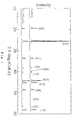
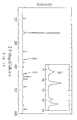
- Fig. 1 is an X-ray diffraction patterns of Li2NiO2 and Li2.14Ni0.86O2 according to the present invention;
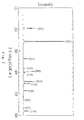
- Fig. 2 is an X-ray diffraction pattern of Li2NiO2+y according to the present invention;
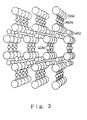
- Fig. 3 is a schematic diagram illustrating the basic crystalline structure of Li2.14Ni0.86O2 according to the present invention;
- Fig. 4 is a schematic diagram illustrating the basic crystalline structure of Li2NiO2+y according to the present invention;
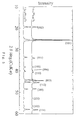
- Fig. 5 is an X-ray diffraction patterns of Li2.05Ni0.95O2 and Li2.14Ni0.86O2 according to the present invention;
- Fig. 6 is an X-ray diffraction pattern of Li2.05Ni0.95O2 (A1a) according to Example 1;
- Fig. 7 is an X-ray diffraction pattern of Li2.14Ni0.86O2 (A2b) according to Example 2;
- Fig. 8 is an X-ray diffraction pattern of a product B1a according to Comparative Example 1;
- Fig. 9 is an X-ray diffraction pattern of a product B3a according to Comparative Example 3;
- Fig. 10 is an X-ray diffraction pattern of a product B4a according to Comparative Example 4;
- Fig. 11 is an X-ray diffraction pattern of a product B4b according to Comparative Example 4;
- Fig. 12 is an X-ray diffraction pattern of Li2NiO2.2 (A5) according to Example 5;
- Fig. 13 is an X-ray diffraction pattern of Li2NiO2.05 (A6) according to Example 6;
- Fig. 14 is an X-ray diffraction pattern of a product B5 according to Comparative Example 5;
- Fig. 15 is an X-ray diffraction pattern of a product B7 according to Comparative Example 7;
- Fig. 16 is X-ray diffraction patterns of products B8a and B8b according to Comparative Example 8;
- Fig. 17 is a schematic diagram illustrating the basic structure of triode batteries fabricated in Examples 15 to 18;
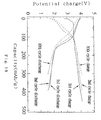
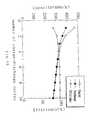
- Fig. 18 is a graphical representation illustrating the potential change of the triode battery (A1a) of Example 15 observed during charge-discharge cycle;
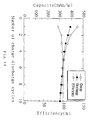
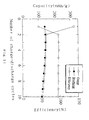
- Fig. 19 is a graphical representation illustrating the capacity change of the triode battery (A1a) of Example 15 with the charge-discharge cycle;
- Fig. 20 is a graphical representation illustrating the potential change of the triode battery (A1a) of Example 15 observed during charge-discharge cycle;
- Fig. 21 is a graphical representation illustrating the capacity change of the triode battery (A1a) of Example 15 with the charge-discharge cycle;
- Fig. 22 is a graphical representation illustrating the potential change of the triode battery (A5) of Example 17 observed during charge-discharge cycle;
- Fig. 23 is a graphical representation illustrating the capacity change of the triode battery (A5) of Example 17 with the charge-discharge cycle;
- Fig. 24 is a graphical representation illustrating the potential change of the triode battery (A5) of Example 17 observed during charge-discharge cycle;
- Fig. 25 is a graphical representation illustrating the capacity change of the triode battery (A5) of Example 17 with the charge-discharge cycle; and
- Fig. 26 is a graphical representation illustrating the basic structure of coin-type batteries fabricated in Examples 19 and 20.
- The lithium nickel composite oxide according to the present invention includes compounds represented by the supplementary formulae (II) and (III):
Li2+x'Ni1-x'O2 (0.0<x'≦1/7) (II)
Li2NiO2+y' (0.0<y'<0.3) (III)
- The lithium nickel composite oxide Li2+x'Ni1-x'O2 (0.0<x'≦1/7) contains lithium ions more than twice as many as nickel ions in its crystalline structure. The average valence of the nickel ions is between 2+ and 4+. Since the nickel ions can have a valence of 2+ to 4+, Li2+x'Ni1-x'O2 (0.0<x'≦1/7) can electrochemically release 1.0 to 2.0 lithium ions. In the case of Li2.14Ni0.86O2 (x'=1/7), for example, the release of one lithium ion per molecule affords a capacity of about 275 mAh/g, and the release of two lithium ions per molecule affords a capacity of about 550 mAh/g. In the case of LiNiO2, complete release of lithium ions affords a capacity of about 275 mAh/g, only about half of which is put in actual use. The lithium nickel composite oxide Li2+x'Ni1-x'O2 (0.0<x'≦1/7) of the present invention exhibits a high capacity, i.e., about 275 mAh/g, even if only half of the lithium ions therein are utilized.
- The lithium nickel composite oxide Li2NiO2+y' (0.0 <y'<0.3) also contains lithium ions twice as many as nickel ions in its crystalline structure. The average valence of the nickel ions is between 2+ and 2.6+. Since the nickel ions can have a valence of 2+ to 4+, Li2NiO2+y' (0.0<y'<0.3) can electrochemically release 1.4 to 2.0 lithium ions per molecule. In the case of Li2NiO2.25 (y'=0.25), for example, the release of one lithium ion per molecule affords a capacity of about 245 mAh/g, and the release of two lithium ions per molecule affords a capacity of about 490 mAh/g. In the case of LiNiO2, complete release of lithium ions affords a capacity of about 275 mAh/g, only about half of which is put in actual use, as described above. The lithium nickel composite oxide Li2NiO2+y' (0.0<y'<0.3) of the present invention exhibits a high capacity, i.e., about 245 mAh/g, even if only half of the lithium ions therein are utilized.
- The known lithium nickel composite oxide Li2NiO2 is similar in the composition to the lithium nickel composite oxides of the present invention. Although it has been reported that Li2NiO2 is obtained by electrochemically inserting lithium ions into LiNiO2 (H. Rieck et.al., Z. Anorg. Allg. Chem., 392 (1972) 193; J. R. Dahn et.al., Solid State Ionic 44 (1990) 87; I. Davidson et.al., Solid State Ionics 46 (1991); I. J. Davidson et.al., Solid State Chem., 105 (1993) 410), the synthesis of Li2NiO2 by a solid phase method has not been reported. The lithium nickel composite oxides of the present invention are similar to but different from Li2NiO2 in the crystalline structure and, therefore, are novel compounds having a Li/Ni ratio different from Li2NiO2 or having a greater number of oxygen than Li2NiO2.
- The lithium nickel composite oxides Li2+x'Ni1-x'O2 (0.0<x'≦1/7) and Li2NiO2+y' (0.0<y'<0.3) according to the present invention each have an X-ray diffraction pattern similar to a reported X-ray pattern of Li2NiO2 (JCPDS card 26-1175). The X-ray patterns of Li2.14Ni0.86O2, Li2NiO2 and Li2NiO2+y' are shown in Figs. 1 and 2, which were determined by the X-ray powder diffractometry utilizing CuK α beam generated by a radiation source of a Cu-targeted enclosure X-ray tube.
- The X-ray diffraction patterns of Li2+x'Ni1-x'O2 (0.0<x'≦1/7) and Li2NiO2+y' (0.0<y'<0.3) each have peaks at 2θ(° )=19.6±0.5, 25.6±0.5, 44.3±0.5, 45.3 ±0.5, 48.5±0.5 and 58.0±0.5 with peak intensities of 20 to 35, 100, 28 to 35, 18 to 22, 10 to 14, and 17 to 20. It is noted that the peak intensities are normalized with the maximum peak intensity at 2 θ (° )=25.6±0.5 being regarded as 100. The indexing of these X-ray diffraction patterns indicates that the lithium nickel composite oxides of the present invention belong to the Space Group Immm.
- The known lithium nickel composite oxide Li2NiO2 also belongs to the Space Group Immm, and has lithium at 4j sites, nickel at 2b sites, and oxygen at 4i sites.
- An assumptive model (Fig. 3) of the lithium nickel composite oxide Li2+x'Ni1-x'O2 (0.0<x'≦1/7) of the present invention in which lithium are located at 4j sites, nickel and lithium at 2b sites and oxygen at 4i sites is consistent with a pattern obtained by the Rietveld's X-ray powder structural analysis performed on the basis of the Space Group.
- The lithium nickel composite oxide Li2NiO2+y' (0.0 <y'<0.3) of the present invention has the same basic crystalline structure as Li2NiO2, in which NiO4 square planer coordination units share their opposite sides to form a linear chain which is located parallel to another linear chain of NiO4 square planer coordination units with their planes facing opposite to each other. The linear chains of NiO4 square planer coordination units form a kind of layer (hereinafter referred to as "NiO4 layer"). Unlike the known lithium nickel composite oxide Li2NiO2, the lithium nickel composite oxide Li2NiO2+y' (0.0<y'<0.3) of the present invention has oxygen corresponding to "y"' at 2a sites, i.e., at sites between the linear chains of NiO4 square planer coordination units. The 2a sites allow the oxygen to be kept in an electrical balance between nickel in the linear chains of NiO4 square planer coordination units, and are stereochemically optimal to accept excess oxygen. The basic crystalline structure of the lithium nickel composite oxide Li2NiO2+y' (0.0<y'<0.3) of the present invention is shown in Fig. 4. When oxygen are inserted into the 2a sites, an NiO4 square planer coordination unit and an oxygen form a pyramid-like NiO5 pentahedral unit with the oxygen located at the apex thereof. Oxygen at apexes of NiO5 pentahedral units along one linear chain of NiO4 square planer coordination units are shared with NiO5 pentahedral units along another linear chain located parallel to the one linear chain, whereby "an oxygen crosslinked structure" is formed. Thus, the linear chains of NiO4 square planer coordination units are linked to each other, so that a boding force between the NiO4 layers is increased. An assumptive model of the lithium nickel composite oxide Li2NiO2+y' (0.0<y'<0.3) of the present invention in which lithium are located at 4j sites, nickel at 2b sites and oxygen at 4i sites and 2a sites is virtually consistent with a result of the Rietveld analysis performed on Li2NiO2+y' (0.0<y'<0.3) which belongs to the Space Group Immm.
- While nickel ions in the known lithium nickel composite oxide Li2NiO2 each have a valence of 2+, nickel ions in the lithium nickel composite oxide Li2NiO2+y' (0.0 <y'<0.3) of the present invention each have a valence of 2+ or greater. Therefore, it is expected that Li2NiO2+y, (0.0<y'<0.3) has a higher electron conductivity than Li2NiO2.
- Lithium are each located between planes of linear chains of NiO4 square planer coordination units, more specifically, at the center of a tetrahedron with four oxygen located at the vertexes thereof. In other words, a layer of LiO4 tetrahedrons is formed. In the case of LiNiO2, lithium are each located between NiO6 layers, and an LiO6 octahedron with six oxygen located at the vertexes thereof is formed. As is apparent from a comparison between tetrahedral sites and octahedral sites in a spinel structure, the tetrahedral sites are more advantageous in terms of lithium diffusion. This means that the Li diffusion rate in Li2NiO2+y' (0.0<y'<0.3) is higher than that in LiNiO2. Therefore, Li2NiO2+y' (0.0 <y'<0.3) is expected to exhibit large current charge-discharge characteristics.
- The basic crystalline structure of the lithium nickel composite oxide Li2+x'Ni1-x'O2 (0.0<x'≦1/7) of the present invention is shown in Fig. 3. The known lithium nickel composite oxide Li2NiO2 which has lithium at 4j sites, nickel alone at 2b sites and oxygen at 4i sites has a crystalline structure different from that of the lithium nickel composite oxide Li2+x'Ni1-x'O2 (0.0<x'≦ 1/7) of the present invention which has lithium ions and nickel at 2b sites.
- The crystalline structure of the lithium nickel composite oxide Li2+x'Ni1-x'O2 (0.0<x'≦1/7) of the present invention is such that NiO4 square planer coordination units or LiO4 square planer coordination units (hereinafter referred to as "(Ni-Li)O4 square planer coordination units") share their opposite sides to form a linear chain which is located parallel to another linear chain of (Ni-Li)O4 square planer coordination units with their planes facing opposite to each other. The linear chains of (Ni-Li)O4 square planer coordination units form a kind of layer (hereinafter referred to as "(Ni-Li)O4 layer". Lithium ions are present between the (Ni-Li)O4 layers.
- Lithium are each located between the (Ni-Li)O4 layers, more specifically, at the center of a tetrahedron with four oxygen located at the vertexes thereof. In other words, a layer of LiO4 tetrahedrons is formed. In the case of LiNiO2, lithium are each located between NiO6 layers, and an LiO6 octahedron with six oxygen located at the vertexes thereof is formed. As is apparent from a comparison between tetrahedral sites and octahedral sites in a spinel structure, the tetrahedral sites are more advantageous in terms of lithium diffusion. This means that the Li diffusion rate in Li2+x'Ni1-x'O2 (0.0 <x'≦1/7) is higher than that in LiNiO2. Therefore, Li2+x'Ni1-x'O2 (0.0<x'≦1/7) is expected to exhibit large current charge-discharge characteristics.
- X-ray diffraction patterns of Li2.05Ni0.95O2 and Li2.14Ni0.86O2 are shown in Fig. 5, which were obtained by the X-ray powder diffractometry employing a Cu-targeted enclosure X-ray tube as a radiation source. A comparison between the X-ray diffraction patterns indicates that the patterns are slightly different from each other in the peak intensities at 2 θ (° )=19.6±0.5, 33.8±0.5 and that some nickel are replaced with lithium.
- Synthesis of the lithium nickel composite oxides of the present invention can be used one or more nickel materials selected from the group consisting of nickel acetate, nickel amidosulfonate, diammonium nickel (II) sulfate (hexahydrate), nickel benzoate, nickel bromide, basic nickel carbonate, nickel carbonyl, nickel chloride, nickel citrate, nickel cyanide, nickel diphosphate, nickel 2-ethylhexanate, nickel fluoride, nickel formate, nickel hydroxide, nickel hypophosphite, nickel iodide, nickel lactate, nickel naphthenate, nickel nitrate, nickel oleate, nickel oxalate, nickel monoxide, dinickel trioxide, nickel perchlorate, nickel phosphate, nickel phosphinate, nickel pyrophosphate, nickel stearate, nickel sulfate, nickel sulfide, nickel tartrate and metal nickel, and one or more lithium materials selected from the group consisting of metal lithium, lithium oxide, lithium peroxide, lithium sulfide, lithium nitride, lithium fluoride, lithium chloride, lithium bromide, lithium iodide, lithium hydroxide, lithium nitrate, lithium carbonate, lithium formate, lithium acetate, lithium benzoate, lithium citrate, lithium lactate, lithium oxalate, lithium pyruvate, lithium stearate and lithium tartrate.
- In the case of Li2+x'Ni1-x'O2 (0.0<x'≦1/7), almost all nickel ions in the crystal thereof are in a state of Ni2+ and, therefore, a nickel material containing Ni2+ is preferably used. More preferably, nickel monoxide (NiO) is used as the nickel material. Preferably used as the lithium material is lithium oxide (Li2O).
- For preparation of the lithium nickel composite oxides of the present invention, the nickel material and the lithium material are mixed in an Li/Ni ratio of 2.0:1.0 to 2.5:1.0, and the resulting mixture is baked.
- Particularly for synthesis of Li2+x'Ni1-x'O2 (0.0 <x'≦1/7), the Li/Ni atomic ratio may be 2.01:0.99 to 2.14:0.86.
- For synthesis of Li2NiO2+y' (0.0<y'<0.3), the stoichiometric Li/Ni ratio is 2.0:1.0. However, the Li/Ni ratio in starting materials is preferably 2.0:1.0 to 2.5:1.0 as the lithium material may vaporize during the calcing process. If the proportion of the lithium material is greater than the aforesaid range, the lithium material (Li2O) remains in the resulting product. If the proportion of the lithium material is less than the aforesaid range, the nickel material (NiO) remains in the resulting product.
- The calcing temperature is preferably 300°C to 2,000°C. If the calcing temperature is too low, the reactivity is reduced, requiring a longer reaction period for obtaining a product that have high quality. If the calcing temperature is too high, the sublimation and vapor of the lithium material are increased and the production cost is raised. A calcing temperature of not higher than 750°C can prevent the stabilization of NiO and, therefore, the calcing temperature is more preferably 400° C to 750° C.
- For the preparation of Li2+x'Ni1-x'O2 (0.0<x'≦1/7), the calcination can be carried out in an atmosphere of an inert gas with a purity of not lower than 99.9%. Used as the inert gas are one or more gases selected from the group consisting of nitrogen, helium, neon, argon and krypton. Even if impurities such as H2O, O2 and CO2 are contained in the inert gas in a concentration of about 0.1%, the atmosphere is not influenced. Since it is desirable that the synthesis of Li2+x'Ni1-x'O2 (0.0<x'≦ 1/7) is carried out with nickel being kept in a state of Ni+2, the partial pressure of oxygen is preferably lower than that of atmospheric oxygen. More preferably, the volume fraction of oxygen is not higher than 0.1%.
- If some of nickel in the lithium nickel composite oxide are replaced with lithium, the number of lithium to be extracted therefrom is increased. Since the nickel of a greater atomic weight are replaced with the lithium of a smaller atomic weight, the weight per unit volume is reduced so that the capacity per unit weight is increased. However, the number of nickel which serve to compensate for electric charge is reduced, so that the capacity is reduced. Further, the replacement of nickel with lithium breaks the linear chain of (Ni-Li)O4 square planer coordination units which serves as an electron conduction path. Therefore, the electron conductivity is reduced, thereby deteriorating the overall performance of the positive-electrode for a lithium secondary battery. If x'> 1/7, the lithium material may remain in the resulting product. Therefore, the limit for the replacement is virtually x'= 1/7. If x'< 0, the nickel material may remain in a certain form in the resulting product. Even with x'< 0 or x'> 1/7, Li2+x'Ni1-x'O2 may be synthesized, but the resulting product is not suitable for an electrode material because the lithium or nickel material remains in a certain form.
- For the preparation of Li2NiO2+y' (0.0<y'<0.3), the calcinationg can be carried out in an atmosphere of a gas mixture containing an inert gas and oxygen. Used as the inert gas are one or more gases selected from the group consisting of nitrogen, helium, neon, argon and krypton. Even if impurities such as H2O and CO2 are contained in the inert gas in a concentration of about 0.1%, the calcinationg atmosphere is not influenced. The volume fraction of oxygen is preferably 0.1% to 5%. If the volume fraction of oxygen is greater than this range, LiNiO2 of rock-salt super-structure or a compound having a crystalline structure similar thereto may be synthesized instead of Li2NiO2+y' (0.0<y'<0.3). Since a high calcing temperature increases the oxidizing power of oxygen, the volume fraction of oxygen should be reduced.
- Another process for preparing the lithium nickel composite oxide Li2NiO2-y' (0.0<y'<0.3) of the present invention comprises the steps of: mixing one or more nickel materials selected from the group consisting of nickel acetate, nickel amidosulfonate, diammonium nickel (II) sulfate (hexahydrate), nickel benzoate, nickel bromide, basic nickel carbonate, nickel carbonyl, nickel chloride, nickel citrate, nickel cyanide, nickel diphosphate, nickel 2-ethylhexanate, nickel fluoride, nickel formate, nickel hydroxide, nickel hypophosphite, nickel iodide, nickel lactate, nickel naphthenate, nickel nitrate, nickel oleate, nickel oxalate, nickel monoxide, dinickel trioxide, nickel perchlorate, nickel phosphate, nickel phosphinate, nickel pyrophosphate, nickel stearate, nickel sulfate, nickel sulfide, nickel tartrate and metal nickel with one or more lithium materials selected from the group consisting of metal lithium, lithium oxide, lithium peroxide, lithium sulfide, lithium nitride, lithium fluoride, lithium chloride, lithium bromide, lithium iodide, lithium hydroxide, lithium nitrate, lithium carbonate, lithium formate, lithium acetate, lithium benzoate, lithium citrate, lithium lactate, lithium oxalate, lithium pyruvate, lithium stearate and lithium tartrate in a Li/Ni atomic ratio of 2.0:1.0 to 2.5:1.0; the resulting mixture at a temperature of 300° C to 2,000° C in an atmosphere of one or more gases selected from the group consisting of nitrogen, helium, neon, argon and krypton; and calcing the resulting product at a temperature of 100° C to 2,000° C in an atmosphere of air or in an atmosphere of one or more inert gases selected from the group consisting of nitrogen, helium, neon, argon and krypton with an oxygen volume fraction of 0.1% to 20.0%. If the calcing temperature in the latter step is too high, LiNiO2 is produced and, therefore, a preferable range of the calcing temperature is 100° C to 750° C. The oxygen volume fraction should be properly controlled depending on a value y' in Li2NiO2+y' (0.0<y'<0.3) to be prepared and the calcianating temperature in the latter calcing step. More specifically, the value y' is increased with an increase in the oxygen volume fraction and with an increase in the calcing temperature. If the calcing temperature is low, the synthesis may be carried out in the air. In this preparation process, Li2NiO2+y' (0.0 <y'<0.3) is first synthesized in an atmosphere free from oxygen, and then oxidized. The process requires an additional step in comparison with the aforesaid preparation process in which the synthesis is carried out in an atmosphere of a gas mixture containing an inert gas and oxygen, but permits the oxidation in the air. Accordingly, the synthesis of the lithium nickel composite oxide Li2NiO2+y' having a desired value y' (0.0 <y'<0.3) can be carried out in the air by properly controlling the calcing temperature without precise control of the oxygen volume fraction. Therefore, the preparation process has a great industrial significance.
- The range of the value y' in Li2NiO2+y' synthesized by either of the preparation processes is 0.0 < y'< 0.3. Even if an attempt is made to synthesize Li2NiO2+y' having a value y' greater than the aforesaid range, LiNiO2 of rock-salt structure is produced.
- For preparation of a positive-electrode for a lithium secondary battery, the lithium nickel composite oxide of the present invention is powdered to be used as a positive-electrode active material, and mixed with a conductive material, a binder and, as required, a solid electrolyte. Examples of the conductive material include carbon materials such as acetylene black and graphite powder, powdery metals and conductive ceramics, but not limited thereto. Examples of the binder include fluoropolymers such as polytetrafluoroethylene and polyvinylidene fluoride, and polyolefin polymers such as polyethylene and polypropylene, but not limited thereto. The mixing ratio is typically 1 part to 50 parts by weight of the conductive material and 1 part to 50 parts by weight of the binder with respect to 100 parts by weight of the lithium nickel composite oxide. If the proportion of the conductive material is less than 1 part by weight, the electrical resistance or polarization of the resulting electrode is increased to reduce the electrode capacity, making it impossible to fabricate a practical lithium secondary battery. If the proportion of the conductive material is greater than 50 parts by weight, the absolute amount of the lithium nickel composite oxide contained in the electrode is reduced, resulting in a reduced electrode capacity. If the proportion of the binder is less than 1 part by weight, the binding ability of the binder is lost so that the intended electrode cannot be prepared. If the proportion of the binder is greater than 50 parts by weight, the electrode capacity is reduced to an impractical level, because the electrical resistance or polarization of the resulting electrode is increased and the absolute amount of the lithium nickel composite oxide contained in the electrode is reduced. The positive-electrode is prepared by compacting the mixture in a collector or by dispersing the mixture in a solvent such as N-methyl-2-pyrrolidone to afford a slurry, applying the slurry onto a collector and drying the slurry. Usable as the collector are conductive materials such as a metal foil, a metal mesh and a metal nonwoven fabric, but the material and form of the collector are not limited thereto.
- Exemplary negative-electrode materials to be used for the nonaqueous secondary battery of the present invention include metal lithium, lithium alloys such as lithium aluminum alloy, lithium-ion insertable and releasable material including conductive polymers such as polyacetylene, polythiophene and polyparaphenylene, pyrolyzed carbon materials, carbon materials pyrolyzed in a gas phase in the presence of a catalyst, carbon materials resulting form calcination of pitch, coke, tar and the like, carbon materials resulting from the calcination of polymers such as cellulose and phenolic resins, graphite materials such as natural graphite, artificial graphite and expansive graphite, and lithium-ion insertable and releasable compounds such as WO2 and MoO2. These materials may be used either alone or as a composite thereof. Among these negative-electrode materials, the pyrolyzed carbon materials, the carbon materials pyrolyzed in a gas phase in the presence of a catalyst, the carbon materials resulting from the calcination of pitch, coke, tar and the like, the carbon materials resulting from the calcination of polymers such as cellulose and phenolic resins, and graphite materials such as natural graphite, artificial graphite and expansive graphite are preferred.
- The negative-electrode is prepared by compacting the negative-electrode material in a collector or by dispersing the negative-electrode material in a solvent such as N-methyl-2-pyrrolidone to afford a slurry, applying the slurry onto a collector and drying the slurry. Usable as the collector are conductive materials such as a metal foil, a metal mesh and a metal nonwoven fabric, but the material and form of the collector are not limited thereto.
- Exemplary ion conductors to be used for the nonaqueous secondary battery of the present invention are organic electrolytic solutions, polymer solid electrolytes, molten salts and the like, among which the organic electrolytic solutions are preferred. The organic electrolytic solution comprises an organic solventant and an electrolyte.
- Examples of specific organic solvents include esters such as propylene carbonate, ethylene carbonate, butylene carbonate, diethyl carbonate, dimethyl carbonate, methylethyl carbonate, γ-butyrolactone, methyl formate and methyl acetate, tetrahydrofuran and substituted hydrofurans such as 2-methyltetrahydrofuran, ethers such as dioxolane, diethyl ether, dimethoxyethane, diethoxyethane and methoxyethoxyethane, dimethylsulfoxide, sulfolane, methylsulfolane and acetonitrile. These organic solvents maybe used either alone or in combination.
- Examples of specific electrolytes include lithium salts such as lithium perchlorate, lithium borofluoride, lithium hexafluorophosphate, arsenic lithium hexafluoride, lithium trifluoromethane sulfonate, lithium halides and lithium chloroaluminate. At lease one selected from these electrolytes may be used.
- The organic solvent and the electrolyte are not limited to those described above. The electrolytic solution is preferably dehydrated by using activated aluminum, metal lithium or the like. The moisture content of the electrolytic solution is preferably not greater than 1,000ppm, more preferably 100ppm. Instead of performing the dehydration process, an electrolyte and/or a solvent preliminarily dehydrated may be used.
- The nonaqueous secondary battery of the present invention is fabricated by respectively bonding the positive-electrode/collector and the negative-electrode/collector to external electrodes and providing the ion conductor between the positive-and negative-electrodes. As required, a separator such as made of porous polyethylene or porous polypropylene may be provided between the positive-and negative-electrodes when the ion conductor is provided. The material and form of the separator are not limited to those described above. Further, it is preferred to provide a packing or hermetic seal such as of polypropylene or polyethylene around the external electrodes respectively connected to the positive-and negative-electrodes to prevent the external electrodes from contacting each other. The aforesaid battery fabrication process is preferably carried out in an atmosphere of an inert gas such as argon or in an atmosphere of extremely dry air to prevent moisture invasion.
- The form of the nonaqueous secondary battery of the present invention is not particularly limited, but may be of a cylindrical form, a button form, a square form, a sheet form or the like.
- As described above, the present invention provides novel lithium nickel composite oxides represented by the following composition formulae:
Li2+x'Ni1-x'O2 (0.0<x'≦1/7)
Li2NiO2+y' (0.0<y'<0.3)
- In one process for preparing a lithium nickel composite oxide according the present invention, the lithium nickel composite oxide Li2+x'Ni1-x'O2 (0.0<x'≦ 1/7) or Li2NiO2+y' (0.0<y'<0.3) of the present invention can be readily prepared by mixing one or more nickel materials selected from the group consisting of nickel acetate, nickel amidosulfonate, diammonium nickel (II) sulfate (hexahydrate), nickel benzoate, nickel bromide, basic nickel carbonate, nickel carbonyl, nickel chloride, nickel citrate, nickel cyanide, nickel diphosphate, nickel 2-ethylhexanate, nickel fluoride, nickel formate, nickel hydroxide, nickel hypophosphite, nickel iodide, nickel lactate, nickel naphthenate, nickel nitrate, nickel oleate, nickel oxalate, nickel monoxide, dinickel trioxide, nickel perchlorate, nickel phosphate, nickel phosphinate, nickel pyrophosphate, nickel stearate, nickel sulfate, nickel sulfide, nickel tartrate and metal nickel with one or more lithium materials selected from the group consisting of metal lithium, lithium oxide, lithium peroxide, lithium sulfide, lithium nitride, lithium fluoride, lithium chloride, lithium bromide, lithium iodide, lithium hydroxide, lithium nitrate, lithium carbonate, lithium formate, lithium acetate, lithium benzoate, lithium citrate, lithium lactate, lithium oxalate, lithium pyruvate, lithium stearate and lithium tartrate in a Li/Ni atomic ratio of 2.0:1.0 to 2.5:1.0; and then calcing the resulting mixture in a stream of an inert gas or a gas mixture containing oxygen and an inert gas.
- In another process for preparing a lithium nickel composite oxide according the present invention, the lithium nickel composite oxide Li2NiO2+y' (0.0<y'<0.3) of the present invention can be readily prepared by mixing one or more lithium materials selected from the group consisting of metal lithium, lithium oxide, lithium peroxide, lithium sulfide, lithium nitride, lithium fluoride, lithium chloride, lithium bromide, lithium iodide, lithium hydroxide, lithium nitrate, lithium carbonate, lithium formate, lithium acetate, lithium benzoate, lithium citrate, lithium lactate, lithium oxalate, lithium pyruvate, lithium stearate and lithium tartrate with one or more nickel materials selected from the group consisting of nickel acetate, nickel amidosulfonate, diammonium nickel (II) sulfate (hexahydrate), nickel benzoate, nickel bromide, basic nickel carbonate, nickel carbonyl, nickel chloride, nickel citrate, nickel cyanide, nickel diphosphate, nickel 2-ethylhexanate, nickel fluoride, nickel formate, nickel hydroxide, nickel hypophosphite, nickel iodide, nickel lactate, nickel naphthenate, nickel nitrate, nickel oleate, nickel oxalate, nickel monoxide, dinickel trioxide, nickel perchlorate, nickel phosphate, nickel phosphinate, nickel pyrophosphate, nickel stearate, nickel sulfate, nickel sulfide, nickel tartrate and metal nickel in a lithium/nickel atomic ratio of 2.0:1.0 to 2.5:1.0; calcing the resulting mixture in an atmosphere of one or more inert gases selected from nitrogen, helium, neon, argon and krypton; and oxidizing the resulting product in an atmosphere of a gas mixture containing an inert gas and oxygen.
- The lithium nickel composite oxides of the present invention each have two or more lithium per nickel. Therefore, even if one lithium is released, at least one lithium per molecule remains to maintain the crystalline structure. That is, if Li2+x'Ni1-x'O2 (0.0<x'≦1/7) turns into Li1+x'Ni1-x'O2 or Li2NiO2+y' (0.0<y'<0.3) turns into LiNiO2+y', only about 50% of all the lithium are released. Therefore, the change in the lattice volume of the lithium nickel composite oxide resulting from the release of lithium is much smaller than in the case of LiCoO2 and the like. Thus, a positive-electrode active material excellent in the cycle characteristics can be provided.
- The lithium nickel composite oxides of the present invention can provide for a positive-electrode active material exhibiting a high capacity, i.e., about 245 mAh/g by the release of one lithium per molecule, and about 490 mAh/g by the release of two lithium per molecule.
- Since the lithium nickel composite oxides of the present invention are each prepared by using a less expensive Ni material, the material cost can be reduced in comparison with the use of a Co material. Therefore, the lithium nickel composite oxides of the present invention provide for a positive-electrode active material and a nonaqueous secondary battery which have great industrial significance.
- The present invention will hereinafter be described by way of examples thereof. It should be noted, however, that the invention is not limited by the examples.
- Positive-electrode active materials were synthesized in the following manner.
- NiO and Li2O were weighed in Li/Ni atomic ratios of 2.05:0.95 (x=1/20) and 2.14:0.86 (x=1/7), and mixed in mortars. The mixtures were each compression-molded into a disk-shaped pellet having a diameter of 8mm and a thickness of 3mm by applying a pressure of 150 kg/cm2 thereto by means of a hydraulic press. The weighing, mixing and compression-molding processes were carried out in dry air at a humidity of not greater than 1%. The pellets were placed on a ceramic boat in an electric furnace, and nitrogen gas was introduced into the furnace. After air in the electric furnace was fully replaced with nitrogen gas, the temperature of the electric furnace was raised from the room temperature to 750° C, which was kept for 12 hours. Nitrogen gas was supplied at a flow rate of 2 l/min during the temperature raising and maintaining period. After a lapse of a predetermined period, the temperature of the electric furnace was lowered. When the temperature was lowered to around the room temperature, the resulting products were taken out. The products thus obtained were dark green powdery products A1a and A1b, which were derived from the starting materialmixtureshavingLi/Niatomicratiosof2.05:0.95 (x=1/20) and 2.14:0.8 6 (x=1/7), respectively. The X-ray diffraction pattern of the powdery product Ala is shown in Fig. 6. The X-ray diffractometry was performed by using CuK α rays generated by a Cu-targeted enclosure X-ray tube with an output of 2kW. The X-ray diffraction patterns of the products A1a and A1b each had peaks at 2 θ (° )=19.6±0.5, 25.6±0.5, 44.3±0.5, 45.3±0.5, 48.5 ±0.5 and 58.0±0.5 with peak intensities of 20 to 35, 100, 28 to 35, 18 to 22, 10 to 14 and 17 to 20, respectively. It is noted that the peak intensities were normalized with the maximum peak intensity at 2 θ (° )=25.6±0.5 being regarded as 100. It was confirmed by the indexing of these X-ray diffraction patterns that the products Ala and Alb belonged to the Space Group Immm. As a result of a nickel valence analysis by the iodometry method and an element analysis by the ICP method, it was confirmed that the products A1a and A1b were Li2.05Ni0.95O2 and Li2.14Ni0.86O2, respectively.
- The preparation process was carried out in substantially the same manner as in Example 1 except that the calcing temperature was 400° C. Thus, dark green powdery products A2a and A2b were obtained, which were derived from the starting material mixtures having Li/Ni atomicratios of 2.05:0.95 (x=1/20) and 2.14:0.86 (x=1/7), respectively. The X-ray diffraction pattern of the powdery product A2a is shown in Fig. 7. The X-ray diffractometry was performed under the same conditions as in Example 1. It was confirmed by the indexing of the X-ray diffraction patterns of the products A2a and A2b that the products A2a and A2b belonged to the Space Group Immm. As a result of a nickel valence analysis by the iodometry method and an element analysis by the ICP method, it was confirmed that the products A2a and A2b were Li2.05Ni0.95O2 and Li2.14Ni0.86O2, respectively.
- The preparation process was carried out in substantially the same manner as in Example 1 except that argon gas was employed for the calcing atmosphere. Thus, dark green powdery products A3a and A3b were obtained, which were derived from the starting material mixtures having Li/Ni atomic ratios of 2.05:0.95 (x=1/20) and 2.14:0.86 (x=1/7), respectively. The X-ray diffractometry was performed under the same conditions as in Example 1. It was confirmed by the indexing of the X-ray diffraction patterns of the products A3a and A3b that the products A3a and A3b belonged to the Space Group Immm. As a result of a nickel valence analysis by the iodometry method and an element analysis by the ICP method, it was confirmed that the products A3a and A3b were Li2.05Ni0.95O2 and Li2.14Ni0.86O2, respectively.
- The preparation process was carried out in substantially the same manner as in Example 1 except that Ni(OH)2 and Li2O were used as the starting materials. Thus, dark green powdery products A4a and A4b were obtained, which were derived from the starting material mixtures having Li/Ni atomic ratios of 2.05:0.95 (x=1/20) and 2.14:0.86 (x=1/7), respectively. It was confirmed by the indexing of the X-ray diffraction patterns of the products A4a and A4b that the products A4a and A4b belonged to the Space Group Immm. As a result of a nickel valence analysis by the iodometry method and an element analysis by the ICP method, it was confirmed that the products A4a and A4b were Li2.05Ni0.95O2 and Li2.14Ni0.86O2, respectively.
- The preparation process was carried out in substantially the same manner as in Example 1 except that the calcing temperature was 350°. Thus, powdery products B1a and B1b were obtained, which were derived from the starting material mixtures having Li/Ni atomic ratios of 2.05:0.95 (x=1/20) and 2.14:0.86 (x=1/7), respectively. The X-ray diffraction pattern of the product B1a is shown in Fig. 8. The X-ray diffractometry was performed under the same conditions as in Example 1. The X-ray diffraction patterns of the products B1a and B1b indicated that the products B1a and B1b were mixtures of Li2O and NiO.
- The preparation process was carried out in substantially the same manner as in Example 1 except that the calcing temperature was 800° C. Thus, powdery products B2a and B2b were obtained, which were derived from the starting material mixtures having Li/Ni atomic ratios of 2.05:0.95 (x=1/20) and 2.14:0.86 (x=1/7), respectively. The X-ray diffractometry was performed under the same conditions as in Example 1. The X-ray diffraction patterns of the products B2a and B2b indicated that the products B2a and B2b were mixtures of Li2O and NiO.
- The preparation process was carried out in substantially the same manner as in Example 1 except that oxygen gas was employed for the calcing atmosphere. Thus, powdery products B3a and B3b were obtained, which were derived from the starting material mixtures having Li/Ni atomic ratios of 2.05:0.95 (x=1/20) and 2.14:0.86 (x=1/7), respectively. The X-ray diffraction pattern of the product B3a is shown in Fig. 9. The X-ray diffractometry was performed under the same conditions as in Example 1. The X-ray diffraction patterns of the products B3a and B3b indicated that the products B3a and B3b were each LiNiO2 of rock-salt structure.
- The preparation process was carried out in substantially the same manner as in Example 1 except that starting material mixtures respectively having Li/Ni atomic ratios of 1.95:1.05 (x=-1/20) and 2.2:0.8 (x=1/5) were used. Thus, powdery products B4a and B4b were obtained, which were derived from the starting material mixtures having Li/Ni atomic ratios of 1.95:1.05 (x=-1/20) and 2.2:0.8 (x=1/5), respectively. The X-ray diffraction patterns of the products B4a and B4b are shown in Figs. 10 and 11, respectively. The X-ray diffractometry was performed under the same conditions as in Example 1. It was confirmed by the indexing of the X-ray diffraction patterns that the products B4a and B4b each contained a compound belonging to the Space Group Immm and a certain impurity. The X-ray diffraction patterns indicated that the products B4a and B4b were a mixture of Li2NiO2 and NiO and a mixture of Li2NiO2 and Li2O, respectively.
- A positive-electrode active material was synthesized in the following manner.
- NiO and Li2O were weighed in an Li/Ni atomic ratio of 2.0:1.0, and mixed in a mortar. The mixture was compression-molded into a disk-shaped pellet having a diameter of 8mm and a thickness of 3mm by applying a pressure of 150 kg/cm2 thereto by means of a hydraulic press. The weighing, mixing and compression-molding processes were carried out in dry air at a humidity of not greater than 1%. The pellet was placed on a ceramic boat in an electric furnace, and a gas mixture containing 99% of nitrogen gas and 1% of oxygen gas was introduced into the furnace. After air in the electric furnace was fully replaced with the gas mixture, the temperature of the electric furnace was raised from the room temperature to 750° C, which was kept for 12 hours. The gas mixture was supplied at a flow rate of 2 l/min during the temperature raising and maintaining period. After a lapse of a predetermined period, the temperature of the electric furnace was lowered. When the temperature was lowered to around the room temperature, the resulting product was taken out. The product thus obtained was a black powdery product A5. The X-ray diffractometry was performed on the powdery product A5 by employing a Cu-targeted enclosure tube as an X-ray source with an output of 2kW. The X-ray diffraction pattern of the powdery product A5 is shown in Fig. 12. The X-ray diffraction pattern of the product A5 had peaks at 2 θ (° )=19.6±0.5, 25.6±0.5, 44.3±0.5, 45.3±0.5, 48.5 ±0.5 and 58.0±0.5 with peak intensities of 20 to 35, 100, 28 to 35, 18 to 22, 10 to 14 and 17 to 20, respectively. It is noted that the peak intensities were normalized with the maximum peak intensity at 2 θ (° )=25.6±0.5 being regarded as 100. It was confirmed by the indexing of the X-ray diffraction pattern that the product A5 belonged to the Space Group Immm. As a result of a nickel valence analysis by the iodometry method and an element analysis by the ICP method, it was confirmed that the product A5 was Li2NiO2.2.
- The preparation process was carried out in substantially the same manner as in Example 5 except that the calcing temperature was 400° C. Thus, a black powdery product A6 was obtained. The X-ray diffractometry was performed under the same conditions as in Example 5. The X-ray diffraction pattern of the powdery product A6 is shown in Fig. 13. It was confirmed by the indexing of the X-ray diffraction pattern that the product A6 belonged to the Space Group Immm. As a result of a nickel valence analysis by the iodometry method and an element analysis by the ICP method, it was confirmed that the product A6 was Li2NiO2.05.
- The preparation process was carried out in substantially the same manner as in Example 5 except that a gas mixture containing 95% of argon gas and 5% of oxygen gas was employed for the calcing atmosphere. Thus, a black powdery product A7 was obtained. The X-ray diffractometry was performed under the same conditions as in Example 5. It was confirmed by the indexing of the X-ray diffraction pattern of the product A7 that the product A7 belonged to the Space Group Immm. As a result of a nickel valence analysis by the iodometry method and an element analysis by the ICP method, it was confirmed that the product A7 was Li2NiO2.28.
- The preparation process was carried out in substantially the same manner as in Example 5 except that Ni(OH)2 and LiO2 were employed as the starting materials. Thus, a black powdery product A8 was obtained. The X-ray diffractometry was performed under the same conditions as in Example 5. It was confirmed by the indexing of the X-ray diffraction pattern of the product A8 that the product A8 belonged to the Space Group Immm. As a result of a nickel valence analysis by the iodometry method and an element analysis by the ICP method, it was confirmed that the products A8 was Li2NiO2.2.
- The preparation process was carried out in substantially the same manner as in Example 5 except that the Li/Ni atomic ratio was 2.5:1.0. Thus, a black powdery product A9 was obtained. The X-ray diffractometry was performed under the same conditions as in Example 5. It was confirmed by the indexing of the X-ray diffraction pattern of the product A9 that the product A9 belonged to the Space Group Immm. As a result of a nickel valence analysis by the iodometry method and an element analysis by the ICP method, it was confirmed that the product A9 was Li2NiO2.2.
- The preparation process was carried out in substantially the same manner as in Example 5 except that the calcing temperature was 350°C. Thus, a powdery product B5 was obtained. The X-ray diffraction pattern of the powdery product B5 is shown in Fig. 14. The X-ray diffractometry was performed under the same conditions as in Example 5. The X-ray diffraction pattern indicated that the product B5 was a mixture of the starting materials Li2O and NiO.
- The preparation process was carried out in substantially the same manner as in Example 5 except that the calcing temperature was 800° C. Thus, a product B6 was obtained. The X-ray diffractometry was performed under the same conditions as in Example 5. The X-ray diffraction pattern of the product B6 indicated that the product B6 was a mixture of NiO an Li2O.
- The preparation process was carried out in substantially the same manner as in Example 5 except that a gas mixture containing 90% of nitrogen gas and 10% of oxygen gas was employed for the calcing atmosphere. Thus, a powdery product B7 was obtained. The X-ray diffraction pattern of the powdery product B7 is shown in Fig. 15. The X-ray diffractometry was performed under the same conditions as in Example 5. The X-ray diffraction pattern indicated that the product B7 was a mixture of LiNiO2 and Li2NiO2+y.
- The preparation process was carried out in substantially the same manner as in Example 5 except that starting material mixtures respectively having Li/Ni atomic ratios 1.0:1.0 and 3.0:1.0 were used. Thus, powdery products B8a and B8b were obtained, which were derived from the starting material mixtures having Li/Ni atomic ratios of 1.0:1.0 and 3.0:1.0, respectively. The X-ray diffraction patterns of the powdery products B8a and B8b are shown in Fig. 16. The X-ray diffractometry was performed under the same conditions as in Example 5. The X-ray diffraction patterns indicated that the products B8a and B8b were a mixture of Li2NiO2+y and NiO and a mixture of Li2NiO2+y and Li2O, respectively.
- The preparation process was carried out in substantially the same manner as in Example 5 except that 100% nitrogen gas was employed for the calcing atmosphere. Thus, a product B9 was obtained. The X-ray diffractometry was performed under the same conditions as in Example 5. It was confirmed by the indexing of the X-ray diffraction pattern of the product B9 that the product B9 belonged to the Space Group Immm. As a result of a nickel valence analysis by the iodometry method and an element analysis by the ICP method, it was confirmed that the product B9 was Li2NiO2 which had no excess oxygen.
- NiO and Li2O were weighed in an Li/Ni atomic ratio of 2.0:1.0, and mixed in a mortar. The mixture was compression-molded into a disk-shaped pellet having a diameter of 8mm and a thickness of 3mm by applying a pressure of 150 kg/cm2 thereto by means of a hydraulic press. The weighing, mixing and compression-molding processes were carried out in dry air at a humidity of not greater than 1%. The pellet was placed on a ceramic boat in an electric furnace, and 99.99% nitrogen gas was introduced into the furnace. After air in the electric furnace was fully replaced with the 99.9% nitrogen gas, the temperature of the electric furnace was raised from the room temperature to 750° C, which was kept for 12 hours. The 99.9% nitrogen gas was supplied at a flow rate of 2 l/min during the temperature raising and maintaining period. After a lapse of a predetermined period, the temperature of the electric furnace was lowered to 100° C, and then a gas mixture containing 80% of nitrogen gas and 20% of oxygen gas was introduced into the furnace. With this state, the resulting intermediate product was further calcinated for oxidation thereof for 12 hours, during which the gas mixture was continuously supplied at a flow rate of 2 l/min. When the temperature of the furnace was thereafter lowered to the room temperature, a product was taken out. The product thus obtained was a black powdery product A10.
- The X-ray powder diffractometry was performed under the same conditions as in Example 5. The X-ray diffraction pattern of the product A10 had peaks at 2 θ (° )=19.6±0.5, 25.6±0.5, 44.3±0.5, 45.3±0.5, 48.5 ±0.5 and 58.0±0.5 with peak intensities of 20 to 35, 100, 28 to 35, 18 to 22, 10 to 14 and 17 to 20, respectively. It is noted that the peak intensities were normalized with the maximum peak intensity at 2 θ (° )=25.6±0.5 being regarded as 100. It was confirmed by the indexing of the X-ray diffraction pattern that the product A10 belonged to the Space Group Immm. As a result of a nickel valence analysis by the iodometry method and an element analysis by the ICP method, it was confirmed that the product A10 was Li2NiO2.05.
- The preparation process was carried out in substantially the same manner as in Example 10 except that helium gas was employed for the calcing atmosphere. Thus, a product A11 was obtained. The X-ray diffractometry was performed under the same conditions as in Example 5. It was confirmed by the indexing of the X-ray diffraction pattern of the product A11 that the product A11 belonged to the Space Group Immm. As a result of a nickel valence analysis by the iodometry method and an element analysis by the ICP method, it was confirmed that the product A11 was Li2NiO2.05.
- The preparation process was carried out in substantially the same manner as in Example 10 except that a gas mixture containing 99% of argon gas and 1% of oxygen gas was employed for the atmosphere for the oxidation and the calcing temperature for the oxidation was 750° C. Thus, a product A12 was obtained. It was confirmed by the indexing of the X-ray diffraction pattern of the product A12 that the product A12 belonged to the Space Group Immm. As a result of a nickel valence analysis by the iodometry method and an element analysis by the ICP method, it was confirmed that the product A12 was Li2NiO2.2.
- The preparation process was carried out in substantially the same manner as in Example 10 except that the calcing temperature was 400° . Thus, a product A13 was obtained. The X-ray diffractometry was performed under the same conditions as in Example 5. It was confirmed by the indexing of the X-ray diffraction pattern of the product A13 that the product A13 belonged to the Space Group Immm. As a result of a nickel valence analysis by the iodometry method and an element analysis by the ICP method, it was confirmed that the product A13 was Li2NiO2.05.
- The preparation process was carried out in substantially the same manner as in Example 10 except that a starting material mixture having an Li/Ni atomic ratio of 2.5:1.0 was used. Thus, a product A14 was obtained. The X-ray diffractometry was performed under the same conditions as in Example 5. It was confirmed by the indexing of the X-ray diffraction pattern of the product A14 that the product A14 belonged to the Space Group Immm. As a result of a nickel valence analysis by the iodometry method and an element analysis by the ICP method, it was confirmed that the product A14 was Li2NiO2.05.
- The preparation process was carried out in substantially the same manner as in Example 10 except that the calcing temperature was 800° C and starting material mixtures respectively having Li/Ni atomic ratios of 2.0:1.0 and 2.5:1.0 were used. Thus, products B10a and B10b were obtained, which were derived from the starting material mixtures having Li/Ni atomic ratios of 2.0:1.0 and 2.5:1.0, respectively. The X-ray diffractometry was performed under the same conditions as in Example 5. The X-ray diffraction patterns of the products B10a and B10b indicated that the products B10a and B10b were mixtures of NiO and Li2O.
- The preparation process was carried out in substantially the same manner as in Example 10 except that the calcing temperature was 350° C. Thus, a product B11 was obtained. The X-ray diffractometry was performed under the same conditions as in Example 5. The X-ray diffraction pattern of the product B11 indicated that the product B11 was a mixture of NiO and Li2O.
- The preparation process was carried out in substantially the same manner as in Example 10 except that a gas mixture containing 75% of nitrogen gas and 25% of oxygen gas was employed for the atmosphere for the oxidation. Thus, a product B12 was obtained. The X-ray diffraction pattern of the product B12 indicated that the product B12 was a mixture of LiNiO2 and Li2NiO2+y.
- The preparation process was carried out in substantially the same manner as in Example 12 except that the calcing temperature for the oxidation was 800° C. Thus, a product B13 was obtained. The X-ray diffractometry was performed under the same conditions as in Example 5. The diffraction pattern of the product B13 indicated that the product B13 was a mixture of LiNiO2 and Li2NiO2+y.
- The preparation process was carried out in substantially the same manner as in Example 12 except that the calcing temperature for the oxidation was 75° C. Thus, a product B14 was obtained. The X-ray diffractometry was performed under the same conditions as in Example 5. It was confirmed by the indexing of the X-ray diffraction pattern of the product B14 that the product B14 belonged to the Space Group Immm. As a result of a nickel valence analysis by the iodometry method and an element analysis by the ICP method, it was confirmed that the product B14 was Li2NiO2 which had no excess oxygen.
- Fig. 17 is a schematic diagram illustrating an exemplary triode battery according to the present invention. In Fig. 17, there are shown a
glass cell 1, alid 2, leads 3a, 3b and 3c, acounter electrode 4, a positive-electrode 5, a negative-electrode 6, and anelectrolyte 7. - The positive-electrode active material Ala was pulverized in a mortar, and mixed with about 10 wt% of acetylene black as a conductive material and then with about 10 wt% of a powdery Teflon resin as a binder. The resulting mixture was molded into a pellet by means of a pelleting machine, and the pellet was crimped with a metal mesh for preparation of the positive-
electrode 5. Lithium sheets each crimped with an Ni mesh were used as the negative-electrode 6 and thecounter electrode 4. Used as theelectrolyte 7 was a solution containing 1 mol/l LiClO4 dissolved in a solvent mixture of 50 vol% of ethylene carbonate and 50 vol% of diethyl carbonate. Thecounter electrode 4, the positive-electrode 5, the negative-electrode 6 and theelectrolyte 7 were incorporated in theglass cell 1. A charge-discharge test was performed on the battery thus fabricated. The fabrication process and the test were carried out in an Ar dry box. - The battery was charged and discharged within a potential range between 1.5V and 4.2V at a constant current. The potential change observed during the charge-discharge processes is shown in Fig. 18. The capacity change with the charge-discharge cycle is shown in Fig. 19 and Table 1. In the first charge-discharge cycle, the battery exhibited very high charge-discharge capacities, that is, a charge capacity of about 450 mAh/g and a discharge capacity of about 390 mAh/g. The first charge-discharge capacities indicated that about 1.8 lithium were deintercalated from Li2NiO2 during the charge process and about 1.6 lithium ions were inserted back during the discharge process. In addition, the charge-discharge efficiency was very high.
Table 1 Cycle Charge mAh/g Discharge mAh/ g Efficiency % 1 452.3 392.1 86.7 2 391.8 372.1 95.0 3 366.9 352.5 96.1 4 348.4 340.8 97.8 5 337.6 332.7 98.6 6 329.5 327.2 99.3 7 323.7 321.8 99.4 8 318.3 316.2 99.3 9 311.8 309.4 99.2 10 306.4 306.6 100.1 - Further, the battery was charged and discharged within a potential range between 2.5V and 4.2V. The potential change observed during the charge-discharge processes is shown in Fig. 20. The capacity change with the charge-discharge cycle is shown in Fig. 21 and Table 2. In the first charge-discharge cycle, the battery exhibited a very high charge capacity, that is, about 320 mAh/g, with a constant potential. The charge capacity indicated that about 1.4 lithium were deintercalated from Li2.14Ni0.86O2. The discharge potential of the battery gradually decreased. The battery exhibited a discharge capacity of about 140 mAh/g with little change during repeated charge-discharge cycles.
Table 2 Cycle Charge mAh/g Discharge mAh/ g Efficiency % 1 317.6 141.6 44.6 2 150.8 145.5 96.5 3 150.2 146.2 97.3 4 149.0 146.1 98.1 5 148.3 146.0 98.5 6 148.3 144.6 97.5 7 146.7 144.5 98.5 8 146.9 144.7 98.5 9 147.1 144.7 98.4 10 147.4 144.4 98.0 - A triode battery as shown in Fig. 17 was fabricated in the following manner. The positive-electrode active material Ala was pulverized in a mortar, and mixed with about 1 wt% of acetylene black as a conductive material and then with about 50 wt% of a powdery Teflon resin as a binder. The resulting mixture was molded into a pellet by means of a pelleting machine, and the pellet was crimped with a metal mesh for preparation of a positive-
electrode 5. Metal lithium sheets each crimped with an Ni mesh were used as a negative-electrode 6 and acounter electrode 4. Used as anelectrolyte 7 was a solution containing 1 mol/l LiPF6 dissolved in a solvent mixture of 50 vol% of propylene carbonate and 50 vol% of tetrahydrofuran. Thecounter electrode 4, the positive-electrode 5, the negative-electrode 6 and theelectrolyte 7 were incorporated in aglass cell 1 in the same manner as in Example 15. A charge-discharge test was performed on the battery thus fabricated. The potential range for the charge-discharge processes was 2.5V to 4.2V. - The potential change observed when the battery was charged and discharged at a constant current is shown in Table 3. The battery of Example 16 had substantially the same characteristics as the battery of Example 15. More specifically, the battery exhibited very high charge-discharge capacities and a high charge-discharge efficiency.
Table 3 Cycle Charge mAh/g Discharge mAh/ g Efficiency % 1 314.4 138.7 43.3 2 149.3 142.6 96.2 3 148.7 143.3 97.2 4 147.5 143.2 97.4 5 146.8 143.1 96.4 6 146.8 141.7 96.0 7 145.2 141.6 95.4 8 145.4 141.8 95.5 9 145.7 141.8 95.5 10 145.9 141.5 94.7 - A triode battery as shown in Fig. 17 was fabricated in the following manner. The positive-electrode active material A5 prepared in Example 5 was pulverized in a mortar, and mixed with about 10 wt% of acetylene black as a conductive material and then with natural graphite and about 10 wt% of a powdery Teflon resin as a binder. The resulting mixture was molded into a pellet by means of a pelleting machine, and the pellet was crimped with a metal mesh for preparation of a positive-
electrode 5. Metal lithium sheets each crimped with an Ni mesh were used as acounter electrode 4 and a negative-electrode 6. Used as anelectrolyte 7 was a solution containing 1 mol/l LiClO4 dissolved in a solvent mixture of 50 vol% of ethylene carbonate and 50 vol% of diethylene carbonate. Thecounter electrode 4, the positive-electrode 5, the negative-electrode 6 and theelectrolyte 7 were incorporated in aglass cell 1. A charge-discharge test was performed on the battery thus fabricated. The fabrication process and the test were carried out in an Ar dry box. - The battery was charged and discharged within a potential range between 1.5V and 4.2V at a constant current. The potential change observed during the charge-discharge processes is shown in Fig. 22. The capacity change with the charge-discharge cycle is shown in Fig. 23 and Table 4. In the first charge-discharge cycle, the battery exhibited very high charge-discharge capacities, that is, a charge capacity of about 460 mAh/g and a discharge capacity of about 400 mAh/g. The first charge-discharge capacities indicated that about 1.9 lithium were deintercalated from Li2NiO2.2 during the charge process and about 1.6 lithium were inserted back during the discharge process. In addition, the charge-discharge efficiency was very high.
Table 4 Cycle Charge mAh/g Discharge mAh/ g Efficiency % 1 469.8 393.9 83.9 2 387.4 361.0 93.2 3 349.3 334.2 95.7 4 330.3 323.9 98.1 5 318.1 312.5 98.2 6 305.5 302.0 98.9 7 296.2 293.5 99.1 8 287.3 284.7 99.1 9 277.9 275.6 99.2 10 267.6 264.7 98.9 - Further, the battery was charged and discharged within a potential range between 2.5V and 4.2V. The potential change observed during the charge-discharge processes is shown in Fig. 24. The capacity change with the charge-discharge cycle is shown in Fig. 25 and Table 5. In the first charge-discharge cycle, the battery exhibited a very high charge capacity, that is, about 350 mAh/g, with a constant potential. The charge capacity indicated that about 1.4 lithium were deintercalated from Li2NiO2.2. The discharge potential of the battery gradually decreased. The battery exhibited a discharge capacity of about 160 mAh/g with little change during repeated charge-discharge cycles.
Table 5 Cycle Charge mAh/g Discharge mAh/ g Efficiency % 1 320.7 134.6 42.0 2 143.4 138.4 96.5 3 142.8 139.0 97.3 4 141.7 138.9 98.1 5 141.0 138.9 98.5 6 141.1 137.5 97.5 7 139.5 137.4 98.5 8 139.7 137.6 98.5 9 139.9 137.6 98.4 10 140.2 137.3 98.0 - A triode battery as shown in Fig. 17 was fabricated in the following manner. The positive-electrode active material A6 prepared in Example 6 was pulverized in a mortar, and mixed with about 1 wt% of acetylene black as a conductive material and then with about 50 wt% of a powdery Teflon resin as a binder. The resulting mixture was molded into a pellet by means of a pelleting machine, and the pellet was crimped with a metal mesh for preparation of a positive-
electrode 5. Metal lithium sheets each crimped with an Ni mesh were used as a negative-electrode 6 and acounter electrode 4. Used as anelectrolyte 7 was a solution containing 1 mol/l LiPF6 dissolved in a solvent mixture of 50 vol% of propylene carbonate and 50 vol% of tetrahydrofuran. Thecounter electrode 4, the positive-electrode 5, the negative-electrode 6 and theelectrolyte 7 were incorporated in aglass cell 1 in the same manner as in Example 17. A charge-discharge test was performed on the battery thus fabricated. - The battery was charged and discharged within a potential range between 2.5V and 4.2V at a constant current. The capacity change with the charge-discharge cycle is shown in Table 6. The battery of Example 18 had substantially the same characteristics as the battery of Example 17. Further, the charge-discharge efficiency was very high.
Table 6 Cycle Charge mAh/g Discharge mAh/ g Efficiency % 1 318.9 144.2 45.2 2 151.4 148.2 98.2 3 150.8 148.9 98.6 4 149.6 148.8 99.0 5 148.9 148.8 100.0 6 148.9 147.3 100.0 7 147.3 147.2 100.0 8 147.4 147.4 100.0 9 147.7 147.4 100.0 10 148.0 147.1 100.0 - Fig. 26 is a graphical representation illustrating an exemplary coin-type battery according to the present invention. In Fig. 26, there are shown a positive-
electrode case 8, a positive-electrode collector 9, a negative-electrode case 10, a negative-electrode collector 11, a packing 12, and a separator 13. - The positive-electrode active material A2a was pulverized in a mortar, and mixed with about 50 wt% of acetylene black as a conductive material and then with about 1 wt% of a powdery Teflon resin as a binder. The resulting mixture was molded into a pellet by means of a pelleting machine, and the pellet was crimped with a metal mesh for preparation of a positive-
electrode 14. For preparation of a negative-electrode 15, graphite powder was mixed with about 1 wt% of a powdery Teflon resin as a binder, then the mixture was molded into a pellet by means of a pelleting machine, and the pellet was crimped with a metal mesh. Used as anelectrolyte 16 was a solution containing 0.5 mol/l LiPF6 dissolved in a solvent mixture of 10 vol% of propylene carbonate and 90 vol% of tetrahydrofuran. The positive-electrode 14, the negative-electrode 15 and theelectrolyte 16 were incorporated in a coin-type cell. A charge-discharge test was performed on the battery thus fabricated. The potential range for the charge-discharge processes was 2.5V to 4.2V. The fabrication process and the test were carried out in an Ar dry box. - The capacity change observed during the charge-discharge processes is shown in Table 7. The battery of Example 19 had substantially the same characteristics as the battery of Example 15. The battery exhibited a high capacity and a high charge-discharge efficiency.
Table 7 Cycle Charge mAh/g Discharge mAh/ g Efficiency % 1 311.3 143.0 44.6 2 147.8 147.0 99.1 3 147.2 147.6 100.1 4 146.0 147.5 100.3 5 145.3 147.5 99.3 6 145.4 146.1 98.9 7 143.8 145.9 98.3 8 143.9 146.2 98.4 9 144.2 146.2 98.4 10 144.4 145.9 97.5 - A triode battery was fabricated in substantially the same manner as in Example 15 except that LiNiO2 was employed for the positive-electrode, and the battery thus fabricated was charged and discharged at a constant current. It is noted that LiNiO2 was prepared by sufficiently mixing LiOH and NiO and the calcing resulting mixture at 750° C in a stream of oxygen for 12 hours. The potential range for the charge-discharge processes was 2.5V to 4.2V. Changes in the charge capacity, the discharge capacity and the charge-discharge efficiency are shown in Table 8. A comparison between Tables 2 and 8 indicates that the battery employing Li2.14Ni0.86O2 exhibited a higher capacity and more excellent cycle characteristics than a prior art battery employing LiNiO2.
Table 8 Cycle Charge mAh/g Discharge mAh/ g Efficiency % 1 204.5 155.9 76.2 2 152.9 152.4 99.7 3 150.3 150.0 99.8 4 149.0 148.1 99.4 5 147.5 146.1 99.1 6 144.4 142.6 98.7 7 140.4 140.1 99.8 8 137.9 137.7 99.9 9 136.4 135.4 99.3 10 133.3 132.5 99.4 - A coin-type battery as shown in Fig. 26 was fabricated in the following manner. The positive-electrode active substance A7 was pulverized in a mortar, and mixed with about 50 wt% of acetylene black as a conductive material and then with natural graphite and about 1 wt% of a powdery Teflon resin as a binder. The resulting mixture was molded into a pellet by means of a pelleting machine, and the pellet was crimped with a metal mesh for preparation of a positive-
electrode 14. For preparation of a negative-electrode 15, natural graphite powder was mixed with about 1 wt% of a powdery Teflon resin as a binder, then the mixture was molded into a pellet by means of a pelleting machine, and the pellet was crimped with a metal mesh. Used as anelectrolyte 16 was a solution containing 0.5 mol/l LiPF6 dissolved in a solvent mixture of 10 vol% of propylene carbonate and 90 vol% of tetrahydrofuran. The positive-electrode 14, the negative-electrode 15 and theelectrolyte 16 were incorporated in a coin-type cell. A charge-discharge test within a potential range between 2.5V and 4.2V was performed on the battery thus fabricated. The fabrication process and the test were carried out in an Ar dry box. - The capacity change observed during the charge-discharge processes are shown in Table 9. The battery of Example 20 had substantially the same characteristics as the battery of Example 17. The battery exhibited a high capacity and a high charge-discharge efficiency.
Table 9 Cycle Charge mAh/g Discharge mAh/ g Efficiency % 1 311.4 138.8 44.6 2 147.9 142.7 96.5 3 147.2 143.3 97.3 4 146.1 143.2 98.1 5 145.4 143.2 98.5 6 145.4 141.8 97.5 7 143.8 141.7 98.5 8 144.0 141.9 98.5 9 144.3 141.9 98.4 10 144.5 141.6 98.0 - A triode battery was fabricated in substantially the same manner as in Example 17 except that LiNiO2 was employed for the positive-electrode, and the battery thus fabricated was charged and discharged at a constant current. It is noted that LiNiO2 was prepared by sufficiently mixing LiOH and NiO and the calcing resulting mixture at 750° C in a stream of oxygen for 12 hours. The potential range for the charge-discharge processes was 2.5V to 4.2V. Changes in the charge capacity, the discharge capacity and the charge-discharge efficiency are shown in Table 10. A comparison between Tables 5 and 10 indicates that the battery employing Li2NiO2+y exhibited a higher capacity than a prior art battery employing LiNiO2.
Table 10 Cycle Charge mAh/g Discharge mAh/ g Efficiency % 1 204.5 155.9 76.2 2 152.9 152.4 99.7 3 150.3 150.0 99.8 4 149.0 148.1 99.4 5 147.5 146.1 99.1 6 144.4 142.6 98.7 7 140.4 140.1 99.8 8 137.9 137.7 99.9 9 136.4 135.4 99.3 10 133.3 132.5 99.4 - In accordance with the present invention, a battery exhibiting a higher capacity can be provided by employing, instead of LiNiO2, as a positive-electrode active material a lithium nickel composite oxide Li2+xNi1-xO2+y (0.0≦x≦1/7, 0.0≦y<0.3, excluding the case where x=y=0) which is prepared from a less expensive nickel material.
Claims (22)
- A lithium nickel composite oxide represented by the composition formula (I):
Li2+xNi1-xO2+y (0.0≦x≦1/7, 0.0≦y<0.3, excluding the case where x=y=0) (I).
- The lithium nickel composite oxide according to claim 1 wherein the composition formula (I) is represented by the supplementary formula (II) or (III):
Li2+x'Ni1-x'O2 (0.0<x'≦1/7) (II)
Li2NiO2+y' (0.0<y'<0.3) (III).
- The lithium nickel composite oxide according to claim 2 wherein the composite oxide of the supplementary formula(I) has a structure such that NiO4 square planer coordination units share their opposite sides to form a linear chain which is located parallel to another linear chain of NiO4 square planer coordination units with their planes facing opposite to each other.
- The lithium nickel composite oxide according to claim 2, wherein the composite oxide of supplemental formula (III) has a structure such that NiO4 square planer coordination units share their opposite sides to form a linear chain, oxygen being inserted into some sites between the linear chains and an NiO4 square planer coordination unit and an oxygen form a pyramid-like NiO5 pentahedral unit with the oxygen located at an apex thereof, thereby forming an interconnected Ni-O two dimensional plane.
- The lithium nickel composite oxide according to claim 1, which belongs to the Space Group Immm.
- The lithium nickel composite oxide according to claim 1, wherein X-ray diffraction patterns of utilizing Cuk α beam each have peaks at 2 θ (° )=19.6 ±0.5, 25.6±0.5, 44.3±0.5, 45.3±0.5, 48.5±0.5 and 58.0±0.5.
- The lithium nickel composite oxide according to claim 1, wherein the X-ray diffraction patterns of utilizing Cuk α beam each have peaks at 2 θ (° )=19.6 ±0.5, 25.6±0.5, 44.3±0.5, 45.3±0.5, 48.5±0.5 and 58.0±0.5 with peak intensities thereof being 20 to 35, 100, 28 to 35, 18 to 22, 10 to 14, and 17 to 20, respectively, when the peak intensities are normalized with the maximum peak intensity at 2 θ (° )=25.6±0.5 being regarded as 100.
- A process for preparing a lithium nickel composite oxide by which comprises : mixing one or more lithium materials selected from the group consisting of metal lithium, lithium oxide, lithium peroxide, lithium sulfide, lithium nitride, lithium fluoride, lithium chloride, lithium bromide, lithium iodide, lithium hydroxide, lithium nitrate, lithium carbonate, lithium formate, lithium acetate, lithium benzoate, lithium citrate, lithium lactate, lithium oxalate, lithium pyruvate, lithium stearate and lithium tartrate
with one or more nickel materials selected from the group consisting of nickel acetate, nickel amidosulfonate, diammonium nickel (II) sulfate (hexahydrate), nickel benzoate, nickel bromide, basic nickel carbonate, nickel carbonyl, nickel chloride, nickel citrate, nickel cyanide, nickel diphosphate, nickel 2-ethylhexanate, nickel fluoride, nickel formate, nickel hydroxide, nickel hypophosphite, nickel iodide, nickel lactate, nickel naphthenate, nickel nitrate, nickel oleate, nickel oxalate, nickel monoxide, dinickel trioxide, nickel perchlorate, nickel phosphate, nickel phosphinate, nickel pyrophosphate, nickel stearate, nickel sulfate, nickel sulfide, nickel tartrate and metal nickel; and calcing the resulting mixture in an atmosphere of an inert gas, to obtain a lithium nickel composite oxide of the formula (I)
Li2+xNi1-xO2+y (0.0≦x≦1/7, 0.0≦y<0.3, excluding the case where x=y-0) (I).
- The process according to claim 8 wherein the composition formula (I) is represented by the supplementary formula (II) or (III):
Li2+x'Ni1-x'O2 (0.0<x'≦1/7) (II)
Li2NiO2+y' (0.0<y'<0.3) (III).
- The process according to claim 8, wherein Li/Ni atomic ratio in starting materials is 2.0:1.0 to 2.5:1.0.
- The process according to claim 8, wherein the nickel material is nickel monoxide (NiO) and the lithium material is lithium oxide (Li2O).
- The process according to claim 8, wherein the atmosphere of an inert gas at the calcination contains one or more gases selected from the group consisting of nitrogen, helium, neon, argon and krypton and an oxygen volume fraction in the atmosphere is 0.0% to 10.0%.
- The process according to claim 8, wherein the calcing temperature is 300° C to 2,000° C.
- The process according to claim 8, wherein the calcing temperature is 400° C to 750° C.
- The process according to claim 8, wherein oxidation is further carried out in an atmosphere of a gas mixture containing an inert gas and oxygen after the calcination.
- The process according to claim 15, wherein the atmosphere at the oxidation contains one or more inert gases selected from the group consisting of nitrogen, helium, neon, argon and krypton, and an oxygen volume fraction in the atmosphere is 0.1% to 20.0%.
- The process according to claim 15, wherein the calcing temperature at the oxidation is 100° C to 750° C.
- A positive-electrode active material comprising a lithium nickel composite oxide represented by the composition formula (I):
Li2+xNi1-xO2+y (0.0≦x≦1/7, 0.0≦y<0.3, excluding the case where x=y=0) (I)
- A nonaqueous secondary battery comprising a positive-electrode containing a lithium nickel composite oxide represented by the composition formula (I) :
Li2+xNi1-xO2+y (0.0≦x≦1/7, 0.0≦y<0.3, excluding the case where x=y=0) (I)
as a positive-electrode active material,a negative-electrode containing metal lithium or a lithium absorbable and desorbable material and an ion conductor. - The nonaqueous secondary battery according to claim 19, wherein the negative-electrode is formed of a graphite material.
- The nonaqueous secondary battery according to claim 19, wherein the negative-electrode is formed of a carbon material.
- The nonaqueous secondary battery according to claim 19, wherein the ion conductor is a nonaqueous electrolyte solvent.
Applications Claiming Priority (6)
| Application Number | Priority Date | Filing Date | Title |
|---|---|---|---|
| JP04733096A JP3403569B2 (en) | 1996-03-05 | 1996-03-05 | Lithium nickel composite oxide, its production method and its use |
| JP4732996 | 1996-03-05 | ||
| JP4733096 | 1996-03-05 | ||
| JP04732996A JP3403568B2 (en) | 1996-03-05 | 1996-03-05 | Lithium nickel composite oxide, its production method and its use |
| JP47330/96 | 1996-03-05 | ||
| JP47329/96 | 1996-03-05 |
Publications (2)
| Publication Number | Publication Date |
|---|---|
| EP0794155A1 true EP0794155A1 (en) | 1997-09-10 |
| EP0794155B1 EP0794155B1 (en) | 2003-06-25 |
Family
ID=26387497
Family Applications (1)
| Application Number | Title | Priority Date | Filing Date |
|---|---|---|---|
| EP97301427A Expired - Lifetime EP0794155B1 (en) | 1996-03-05 | 1997-03-04 | Lithium nickel composite oxide, preparation process therefor and application thereof |
Country Status (3)
| Country | Link |
|---|---|
| US (1) | US5817436A (en) |
| EP (1) | EP0794155B1 (en) |
| DE (1) | DE69722988T2 (en) |
Cited By (19)
| Publication number | Priority date | Publication date | Assignee | Title |
|---|---|---|---|---|
| EP2270901A1 (en) * | 2003-09-26 | 2011-01-05 | LG Chem, Ltd. | Method for regulating terminal voltage of cathode during overdischarge and cathode active matrial for lithium secondary battery |
| EP2648251A4 (en) * | 2010-12-03 | 2014-06-04 | Jx Nippon Mining & Metals Corp | POSITIVE ELECTRODE ACTIVE MATERIAL FOR LITHIUM-ION BATTERY, POSITIVE ELECTRODE FOR LITHIUM-ION BATTERY, AND LITHIUM-ION BATTERY |
| US8835055B2 (en) | 2002-03-22 | 2014-09-16 | Lg Chem, Ltd. | Cathode active material for lithium secondary battery |
| US8993160B2 (en) | 2009-12-18 | 2015-03-31 | Jx Nippon Mining & Metals Corporation | Positive electrode for lithium ion battery, method for producing said positive electrode, and lithium ion battery |
| US9090481B2 (en) | 2010-03-04 | 2015-07-28 | Jx Nippon Mining & Metals Corporation | Positive electrode active material for lithium-ion battery, positive electrode for lithium-ion battery, and lithium-ion battery |
| US9118076B2 (en) | 2010-02-05 | 2015-08-25 | Jx Nippon Mining & Metals Corporation | Positive electrode active material for lithium ion battery, positive electrode for lithium ion battery and lithium ion battery |
| US9214676B2 (en) | 2011-03-31 | 2015-12-15 | Jx Nippon Mining & Metals Corporation | Positive electrode active material for lithium ion batteries, positive electrode for lithium ion batteries, and lithium ion battery |
| US9216913B2 (en) | 2010-03-04 | 2015-12-22 | Jx Nippon Mining & Metals Corporation | Positive electrode active substance for lithium ion batteries, positive electrode for lithium ion batteries, and lithium ion battery |
| US9225020B2 (en) | 2010-03-04 | 2015-12-29 | Jx Nippon Mining & Metals Corporation | Positive electrode active substance for lithium ion batteries, positive electrode for lithium ion batteries, and lithium ion battery |
| US9224514B2 (en) | 2012-01-26 | 2015-12-29 | Jx Nippon Mining & Metals Corporation | Cathode active material for lithium ion battery, cathode for lithium ion battery, and lithium ion battery |
| US9221693B2 (en) | 2011-03-29 | 2015-12-29 | Jx Nippon Mining & Metals Corporation | Method for producing positive electrode active material for lithium ion batteries and positive electrode active material for lithium ion batteries |
| US9224515B2 (en) | 2012-01-26 | 2015-12-29 | Jx Nippon Mining & Metals Coporation | Cathode active material for lithium ion battery, cathode for lithium ion battery, and lithium ion battery |
| US9231249B2 (en) | 2010-02-05 | 2016-01-05 | Jx Nippon Mining & Metals Corporation | Positive electrode active material for lithium ion battery, positive electrode for lithium ion battery, and lithium ion battery |
| US9240594B2 (en) | 2010-03-04 | 2016-01-19 | Jx Nippon Mining & Metals Corporation | Positive electrode active substance for lithium ion batteries, positive electrode for lithium ion batteries, and lithium ion battery |
| US9263732B2 (en) | 2009-12-22 | 2016-02-16 | Jx Nippon Mining & Metals Corporation | Positive electrode active material for lithium-ion battery, positive electrode for a lithium-ion battery, lithium-ion battery using same, and precursor to a positive electrode active material for a lithium-ion battery |
| US9327996B2 (en) | 2011-01-21 | 2016-05-03 | Jx Nippon Mining & Metals Corporation | Method for producing positive electrode active material for lithium ion battery and positive electrode active material for lithium ion battery |
| US9911518B2 (en) | 2012-09-28 | 2018-03-06 | Jx Nippon Mining & Metals Corporation | Cathode active material for lithium-ion battery, cathode for lithium-ion battery and lithium-ion battery |
| EP3604229A4 (en) * | 2017-11-17 | 2020-07-08 | LG Chem, Ltd. | METHOD FOR PRODUCING AN IRREVERSIBLE ADDITIVE CONTAINED IN A POSITIVE ELECTRODE MATERIAL FOR A LITHIUM SECONDARY BATTERY, POSITIVE ELECTRODE MATERIAL, THROUGH PRODUCED IRREVERSIBLE ADMINISTRATIVELY ADMINISTRATIVE |
| EP3678240A4 (en) * | 2017-11-27 | 2020-12-16 | LG Chem, Ltd. | ADDITIVE FOR POSITIVE ELECTRODE, MANUFACTURING PROCESS FOR IT AND POSITIVE ELECTRODE AND LITHIUM SECONDARY BATTERY WITH IT |
Families Citing this family (18)
| Publication number | Priority date | Publication date | Assignee | Title |
|---|---|---|---|---|
| AU3203899A (en) * | 1998-03-24 | 1999-10-18 | Board Of Regents, The University Of Texas System | Low temperature synthesis of Li4Mn5O12 cathodes for lithium batteries |
| US6350543B2 (en) | 1999-12-29 | 2002-02-26 | Kimberly-Clark Worldwide, Inc. | Manganese-rich quaternary metal oxide materials as cathodes for lithium-ion and lithium-ion polymer batteries |
| US7393476B2 (en) * | 2001-11-22 | 2008-07-01 | Gs Yuasa Corporation | Positive electrode active material for lithium secondary cell and lithium secondary cell |
| EP1357616B1 (en) | 2002-03-25 | 2012-11-28 | Sumitomo Chemical Company, Limited | Positive electrode active material for non-aqueous secondary battery |
| US7326494B2 (en) * | 2003-01-30 | 2008-02-05 | T/J Technologies, Inc. | Composite material and electrodes made therefrom |
| US9353434B2 (en) | 2006-10-12 | 2016-05-31 | C3 International, Llc | Methods for providing prophylactic surface treatment for fluid processing systems and components thereof |
| US8623301B1 (en) | 2008-04-09 | 2014-01-07 | C3 International, Llc | Solid oxide fuel cells, electrolyzers, and sensors, and methods of making and using the same |
| WO2011100361A2 (en) | 2010-02-10 | 2011-08-18 | C3 International. Llc | Low temperature electrolytes for solid oxide cells having high ionic conductivity |
| EP2838149A1 (en) * | 2012-04-11 | 2015-02-18 | JX Nippon Oil & Energy Corporation | Organic electrolyte and organic electrolyte storage cell using same |
| WO2013154724A1 (en) | 2012-04-13 | 2013-10-17 | PolyJoule, Inc. | Devices and methods including polyacetylenes |
| US9484569B2 (en) | 2012-06-13 | 2016-11-01 | 24M Technologies, Inc. | Electrochemical slurry compositions and methods for preparing the same |
| EP3022792B1 (en) | 2013-07-15 | 2024-09-11 | Fcet, Inc. | Low temperature solid oxide cells |
| WO2017124098A1 (en) * | 2016-01-15 | 2017-07-20 | 24M Technologies, Inc. | Systems and methods for infusion mixing a slurry-based electrode |
| CA3036352C (en) * | 2016-09-09 | 2020-09-15 | De Nora Permelec Ltd | Method for producing anode for alkaline water electrolysis, and anode for alkaline water electrolysis |
| KR102663794B1 (en) | 2017-11-27 | 2024-05-03 | 주식회사 엘지에너지솔루션 | Additives for cathode, manufacturing method of the same, cathode including the same, lithium recharegable battery including the same |
| US12119490B2 (en) | 2018-07-31 | 2024-10-15 | Panasonic Intellectual Property Management Co., Ltd. | Positive electrode active material and secondary battery |
| KR102658855B1 (en) * | 2018-10-18 | 2024-04-17 | 주식회사 엘지에너지솔루션 | Prepration method of additive for positive electrode of lithium secondary battery, and additive for positive electrode prepared therefrom |
| US12341180B2 (en) | 2019-08-27 | 2025-06-24 | Panasonic Intellectual Property Management Co., Ltd. | Secondary battery with positive electrode additional layer including inert material |
Citations (1)
| Publication number | Priority date | Publication date | Assignee | Title |
|---|---|---|---|---|
| WO1996041385A2 (en) * | 1995-06-05 | 1996-12-19 | Motorola Inc. | Positive electrode materials for rechargeable electrochemical cells and methods of making same |
Family Cites Families (1)
| Publication number | Priority date | Publication date | Assignee | Title |
|---|---|---|---|---|
| US5378560A (en) * | 1993-01-21 | 1995-01-03 | Fuji Photo Film Co., Ltd. | Nonaqueous secondary battery |
-
1997
- 1997-03-03 US US08/810,384 patent/US5817436A/en not_active Expired - Lifetime
- 1997-03-04 EP EP97301427A patent/EP0794155B1/en not_active Expired - Lifetime
- 1997-03-04 DE DE69722988T patent/DE69722988T2/en not_active Expired - Lifetime
Patent Citations (1)
| Publication number | Priority date | Publication date | Assignee | Title |
|---|---|---|---|---|
| WO1996041385A2 (en) * | 1995-06-05 | 1996-12-19 | Motorola Inc. | Positive electrode materials for rechargeable electrochemical cells and methods of making same |
Non-Patent Citations (2)
| Title |
|---|
| DAVIDSON I ET AL: "STRUCTURE OF 1T-LI2NIO2 FROM POWDER NEUTRON DIFFRACTION", SOLID STATE IONICS, vol. 46, no. 3 / 04, 1 July 1991 (1991-07-01), pages 243 - 247, XP000328892 * |
| PICKERING I J ET AL: "A NEUTRON POWDER DIFFRACTION STUDY OF THE ORDERING IN LIXNI1-XO", SOLID STATE IONICS, vol. 53-56, no. PART 01, 1 July 1992 (1992-07-01), pages 405 - 412, XP000399121 * |
Cited By (24)
| Publication number | Priority date | Publication date | Assignee | Title |
|---|---|---|---|---|
| US9023525B2 (en) | 2002-03-22 | 2015-05-05 | Lg Chem, Ltd. | Cathode active material for lithium secondary battery |
| US9236610B2 (en) | 2002-03-22 | 2016-01-12 | Lg Chem, Ltd. | Cathode active material for lithium secondary battery |
| US8835055B2 (en) | 2002-03-22 | 2014-09-16 | Lg Chem, Ltd. | Cathode active material for lithium secondary battery |
| EP2270901A1 (en) * | 2003-09-26 | 2011-01-05 | LG Chem, Ltd. | Method for regulating terminal voltage of cathode during overdischarge and cathode active matrial for lithium secondary battery |
| US8993160B2 (en) | 2009-12-18 | 2015-03-31 | Jx Nippon Mining & Metals Corporation | Positive electrode for lithium ion battery, method for producing said positive electrode, and lithium ion battery |
| US9263732B2 (en) | 2009-12-22 | 2016-02-16 | Jx Nippon Mining & Metals Corporation | Positive electrode active material for lithium-ion battery, positive electrode for a lithium-ion battery, lithium-ion battery using same, and precursor to a positive electrode active material for a lithium-ion battery |
| US9231249B2 (en) | 2010-02-05 | 2016-01-05 | Jx Nippon Mining & Metals Corporation | Positive electrode active material for lithium ion battery, positive electrode for lithium ion battery, and lithium ion battery |
| US9118076B2 (en) | 2010-02-05 | 2015-08-25 | Jx Nippon Mining & Metals Corporation | Positive electrode active material for lithium ion battery, positive electrode for lithium ion battery and lithium ion battery |
| US9090481B2 (en) | 2010-03-04 | 2015-07-28 | Jx Nippon Mining & Metals Corporation | Positive electrode active material for lithium-ion battery, positive electrode for lithium-ion battery, and lithium-ion battery |
| US9216913B2 (en) | 2010-03-04 | 2015-12-22 | Jx Nippon Mining & Metals Corporation | Positive electrode active substance for lithium ion batteries, positive electrode for lithium ion batteries, and lithium ion battery |
| US9225020B2 (en) | 2010-03-04 | 2015-12-29 | Jx Nippon Mining & Metals Corporation | Positive electrode active substance for lithium ion batteries, positive electrode for lithium ion batteries, and lithium ion battery |
| US9240594B2 (en) | 2010-03-04 | 2016-01-19 | Jx Nippon Mining & Metals Corporation | Positive electrode active substance for lithium ion batteries, positive electrode for lithium ion batteries, and lithium ion battery |
| US10122012B2 (en) | 2010-12-03 | 2018-11-06 | Jx Nippon Mining & Metals Corporation | Positive electrode active material for lithium-ion battery, a positive electrode for lithium-ion battery, and lithium-ion battery |
| EP2648251A4 (en) * | 2010-12-03 | 2014-06-04 | Jx Nippon Mining & Metals Corp | POSITIVE ELECTRODE ACTIVE MATERIAL FOR LITHIUM-ION BATTERY, POSITIVE ELECTRODE FOR LITHIUM-ION BATTERY, AND LITHIUM-ION BATTERY |
| US9327996B2 (en) | 2011-01-21 | 2016-05-03 | Jx Nippon Mining & Metals Corporation | Method for producing positive electrode active material for lithium ion battery and positive electrode active material for lithium ion battery |
| US9221693B2 (en) | 2011-03-29 | 2015-12-29 | Jx Nippon Mining & Metals Corporation | Method for producing positive electrode active material for lithium ion batteries and positive electrode active material for lithium ion batteries |
| US9214676B2 (en) | 2011-03-31 | 2015-12-15 | Jx Nippon Mining & Metals Corporation | Positive electrode active material for lithium ion batteries, positive electrode for lithium ion batteries, and lithium ion battery |
| US9224515B2 (en) | 2012-01-26 | 2015-12-29 | Jx Nippon Mining & Metals Coporation | Cathode active material for lithium ion battery, cathode for lithium ion battery, and lithium ion battery |
| US9224514B2 (en) | 2012-01-26 | 2015-12-29 | Jx Nippon Mining & Metals Corporation | Cathode active material for lithium ion battery, cathode for lithium ion battery, and lithium ion battery |
| US9911518B2 (en) | 2012-09-28 | 2018-03-06 | Jx Nippon Mining & Metals Corporation | Cathode active material for lithium-ion battery, cathode for lithium-ion battery and lithium-ion battery |
| EP3604229A4 (en) * | 2017-11-17 | 2020-07-08 | LG Chem, Ltd. | METHOD FOR PRODUCING AN IRREVERSIBLE ADDITIVE CONTAINED IN A POSITIVE ELECTRODE MATERIAL FOR A LITHIUM SECONDARY BATTERY, POSITIVE ELECTRODE MATERIAL, THROUGH PRODUCED IRREVERSIBLE ADMINISTRATIVELY ADMINISTRATIVE |
| US11476466B2 (en) | 2017-11-17 | 2022-10-18 | Lg Energy Solution, Ltd. | Method of preparing irreversible additive included in cathode material for lithium secondary battery, cathode material including irreversible additive prepared by the same, and lithium secondary battery including cathode material |
| EP3678240A4 (en) * | 2017-11-27 | 2020-12-16 | LG Chem, Ltd. | ADDITIVE FOR POSITIVE ELECTRODE, MANUFACTURING PROCESS FOR IT AND POSITIVE ELECTRODE AND LITHIUM SECONDARY BATTERY WITH IT |
| US11404693B2 (en) | 2017-11-27 | 2022-08-02 | Lg Energy Solution, Ltd. | Cathode additive, preparation method thereof, and cathode and lithium secondary battery comprising the same |
Also Published As
| Publication number | Publication date |
|---|---|
| US5817436A (en) | 1998-10-06 |
| DE69722988T2 (en) | 2004-05-19 |
| EP0794155B1 (en) | 2003-06-25 |
| DE69722988D1 (en) | 2003-07-31 |
Similar Documents
| Publication | Publication Date | Title |
|---|---|---|
| EP0794155B1 (en) | Lithium nickel composite oxide, preparation process therefor and application thereof | |
| US11271200B2 (en) | Positive-electrode active material containing lithium composite oxide, and battery including the same | |
| Gao et al. | Novel LiNi1− x Ti x/2Mg x/2 O 2 Compounds as Cathode Materials for Safer Lithium‐Ion Batteries | |
| US5955219A (en) | Lithium nickel copper composite oxide and its production process and use | |
| Tarascon et al. | Li Metal‐Free Rechargeable Batteries Based on Li1+ x Mn2 O 4 Cathodes (0≤ x≤ 1) and Carbon Anodes | |
| US8865349B2 (en) | Method of producing positive electrode active material and nonaqueous electrolyte battery using the same | |
| US5962166A (en) | Ultrahigh voltage mixed valence materials | |
| EP1130663B1 (en) | Positive electrode material for battery and nonaqueous electrolyte secondary battery | |
| US20110200878A1 (en) | Lithium containing transition metal sulfide compounds | |
| US20070111097A1 (en) | Lithium-cobalt composite oxide, process for its production, positive electrode for lithium secondary cell employing it, and lithium secondary cell | |
| EP0713256A1 (en) | Lithium secondary battery and process for preparing negative-electrode active material for use in the same | |
| KR20080099131A (en) | Method for producing positive electrode active material for lithium secondary battery, positive electrode active material for lithium secondary battery manufactured by this method and lithium secondary battery comprising same | |
| EP1132985A2 (en) | Positive electrode material for nonaqueous electrolyte secondary battery and battery using the same | |
| EP3618152A1 (en) | Positive electrode active material and battery | |
| EP3633773A1 (en) | Positive electrode active substance and battery | |
| JP3403569B2 (en) | Lithium nickel composite oxide, its production method and its use | |
| US20120040248A1 (en) | Positive active material and nonaqueous secondary battery equipped with positive electrode including same | |
| KR20040052463A (en) | Positive plate material and cell comprising it | |
| US6908710B2 (en) | Lithiated molybdenum oxide active materials | |
| JP3647758B2 (en) | Non-aqueous battery positive electrode material, method for producing the same, and battery using the same | |
| US20030073003A1 (en) | Molybdenum oxide based cathode active materials | |
| JP3403568B2 (en) | Lithium nickel composite oxide, its production method and its use | |
| KR101981659B1 (en) | Positive electrode active material for rechargable lithium battery and rechargable lithium battery including the same | |
| JP2004220898A (en) | Positive electrode active material for lithium secondary battery, method for producing the same, and lithium secondary battery | |
| KR102296218B1 (en) | A positive electrode active material for lithium secondary battery, method of preparing the positive electrode active material, and lithium secondary battery including the positive electrode active material |
Legal Events
| Date | Code | Title | Description |
|---|---|---|---|
| PUAI | Public reference made under article 153(3) epc to a published international application that has entered the european phase |
Free format text: ORIGINAL CODE: 0009012 |
|
| AK | Designated contracting states |
Kind code of ref document: A1 Designated state(s): DE FR GB |
|
| 17P | Request for examination filed |
Effective date: 19971210 |
|
| 17Q | First examination report despatched |
Effective date: 20010517 |
|
| GRAH | Despatch of communication of intention to grant a patent |
Free format text: ORIGINAL CODE: EPIDOS IGRA |
|
| GRAH | Despatch of communication of intention to grant a patent |
Free format text: ORIGINAL CODE: EPIDOS IGRA |
|
| GRAA | (expected) grant |
Free format text: ORIGINAL CODE: 0009210 |
|
| RAP1 | Party data changed (applicant data changed or rights of an application transferred) |
Owner name: SHARP KABUSHIKI KAISHA |
|
| AK | Designated contracting states |
Designated state(s): DE FR GB |
|
| REG | Reference to a national code |
Ref country code: GB Ref legal event code: FG4D |
|
| REF | Corresponds to: |
Ref document number: 69722988 Country of ref document: DE Date of ref document: 20030731 Kind code of ref document: P |
|
| ET | Fr: translation filed | ||
| PLBE | No opposition filed within time limit |
Free format text: ORIGINAL CODE: 0009261 |
|
| STAA | Information on the status of an ep patent application or granted ep patent |
Free format text: STATUS: NO OPPOSITION FILED WITHIN TIME LIMIT |
|
| 26N | No opposition filed |
Effective date: 20040326 |
|
| PGFP | Annual fee paid to national office [announced via postgrant information from national office to epo] |
Ref country code: FR Payment date: 20140311 Year of fee payment: 18 |
|
| PGFP | Annual fee paid to national office [announced via postgrant information from national office to epo] |
Ref country code: GB Payment date: 20140226 Year of fee payment: 18 |
|
| PGFP | Annual fee paid to national office [announced via postgrant information from national office to epo] |
Ref country code: DE Payment date: 20140417 Year of fee payment: 18 |
|
| REG | Reference to a national code |
Ref country code: DE Ref legal event code: R119 Ref document number: 69722988 Country of ref document: DE |
|
| GBPC | Gb: european patent ceased through non-payment of renewal fee |
Effective date: 20150304 |
|
| REG | Reference to a national code |
Ref country code: FR Ref legal event code: ST Effective date: 20151130 |
|
| PG25 | Lapsed in a contracting state [announced via postgrant information from national office to epo] |
Ref country code: GB Free format text: LAPSE BECAUSE OF NON-PAYMENT OF DUE FEES Effective date: 20150304 Ref country code: DE Free format text: LAPSE BECAUSE OF NON-PAYMENT OF DUE FEES Effective date: 20151001 |
|
| PG25 | Lapsed in a contracting state [announced via postgrant information from national office to epo] |
Ref country code: FR Free format text: LAPSE BECAUSE OF NON-PAYMENT OF DUE FEES Effective date: 20150331 |