EP0793059B1 - Control and monitoring equipment for gas burners - Google Patents
Control and monitoring equipment for gas burners Download PDFInfo
- Publication number
- EP0793059B1 EP0793059B1 EP97107692A EP97107692A EP0793059B1 EP 0793059 B1 EP0793059 B1 EP 0793059B1 EP 97107692 A EP97107692 A EP 97107692A EP 97107692 A EP97107692 A EP 97107692A EP 0793059 B1 EP0793059 B1 EP 0793059B1
- Authority
- EP
- European Patent Office
- Prior art keywords
- relay
- flame
- contact
- equipment
- shutdown
- Prior art date
- Legal status (The legal status is an assumption and is not a legal conclusion. Google has not performed a legal analysis and makes no representation as to the accuracy of the status listed.)
- Expired - Lifetime
Links
Images

Classifications
-
- F—MECHANICAL ENGINEERING; LIGHTING; HEATING; WEAPONS; BLASTING
- F23—COMBUSTION APPARATUS; COMBUSTION PROCESSES
- F23N—REGULATING OR CONTROLLING COMBUSTION
- F23N5/00—Systems for controlling combustion
- F23N5/20—Systems for controlling combustion with a time program acting through electrical means, e.g. using time-delay relays
- F23N5/203—Systems for controlling combustion with a time program acting through electrical means, e.g. using time-delay relays using electronic means
-
- F—MECHANICAL ENGINEERING; LIGHTING; HEATING; WEAPONS; BLASTING
- F23—COMBUSTION APPARATUS; COMBUSTION PROCESSES
- F23N—REGULATING OR CONTROLLING COMBUSTION
- F23N5/00—Systems for controlling combustion
- F23N5/24—Preventing development of abnormal or undesired conditions, i.e. safety arrangements
- F23N5/242—Preventing development of abnormal or undesired conditions, i.e. safety arrangements using electronic means
-
- F—MECHANICAL ENGINEERING; LIGHTING; HEATING; WEAPONS; BLASTING
- F23—COMBUSTION APPARATUS; COMBUSTION PROCESSES
- F23N—REGULATING OR CONTROLLING COMBUSTION
- F23N5/00—Systems for controlling combustion
- F23N5/18—Systems for controlling combustion using detectors sensitive to rate of flow of air or fuel
- F23N2005/181—Systems for controlling combustion using detectors sensitive to rate of flow of air or fuel using detectors sensitive to rate of flow of air
- F23N2005/182—Air flow switch
-
- F—MECHANICAL ENGINEERING; LIGHTING; HEATING; WEAPONS; BLASTING
- F23—COMBUSTION APPARATUS; COMBUSTION PROCESSES
- F23N—REGULATING OR CONTROLLING COMBUSTION
- F23N2223/00—Signal processing; Details thereof
- F23N2223/22—Timing network
- F23N2223/24—Timing network with bimetallic elements
-
- F—MECHANICAL ENGINEERING; LIGHTING; HEATING; WEAPONS; BLASTING
- F23—COMBUSTION APPARATUS; COMBUSTION PROCESSES
- F23N—REGULATING OR CONTROLLING COMBUSTION
- F23N2223/00—Signal processing; Details thereof
- F23N2223/38—Remote control
-
- F—MECHANICAL ENGINEERING; LIGHTING; HEATING; WEAPONS; BLASTING
- F23—COMBUSTION APPARATUS; COMBUSTION PROCESSES
- F23N—REGULATING OR CONTROLLING COMBUSTION
- F23N2225/00—Measuring
- F23N2225/04—Measuring pressure
-
- F—MECHANICAL ENGINEERING; LIGHTING; HEATING; WEAPONS; BLASTING
- F23—COMBUSTION APPARATUS; COMBUSTION PROCESSES
- F23N—REGULATING OR CONTROLLING COMBUSTION
- F23N2225/00—Measuring
- F23N2225/08—Measuring temperature
-
- F—MECHANICAL ENGINEERING; LIGHTING; HEATING; WEAPONS; BLASTING
- F23—COMBUSTION APPARATUS; COMBUSTION PROCESSES
- F23N—REGULATING OR CONTROLLING COMBUSTION
- F23N2227/00—Ignition or checking
- F23N2227/04—Prepurge
-
- F—MECHANICAL ENGINEERING; LIGHTING; HEATING; WEAPONS; BLASTING
- F23—COMBUSTION APPARATUS; COMBUSTION PROCESSES
- F23N—REGULATING OR CONTROLLING COMBUSTION
- F23N2227/00—Ignition or checking
- F23N2227/36—Spark ignition, e.g. by means of a high voltage
-
- F—MECHANICAL ENGINEERING; LIGHTING; HEATING; WEAPONS; BLASTING
- F23—COMBUSTION APPARATUS; COMBUSTION PROCESSES
- F23N—REGULATING OR CONTROLLING COMBUSTION
- F23N2233/00—Ventilators
- F23N2233/06—Ventilators at the air intake
-
- F—MECHANICAL ENGINEERING; LIGHTING; HEATING; WEAPONS; BLASTING
- F23—COMBUSTION APPARATUS; COMBUSTION PROCESSES
- F23N—REGULATING OR CONTROLLING COMBUSTION
- F23N2235/00—Valves, nozzles or pumps
- F23N2235/12—Fuel valves
- F23N2235/14—Fuel valves electromagnetically operated
-
- F—MECHANICAL ENGINEERING; LIGHTING; HEATING; WEAPONS; BLASTING
- F23—COMBUSTION APPARATUS; COMBUSTION PROCESSES
- F23N—REGULATING OR CONTROLLING COMBUSTION
- F23N2235/00—Valves, nozzles or pumps
- F23N2235/12—Fuel valves
- F23N2235/18—Groups of two or more valves
-
- F—MECHANICAL ENGINEERING; LIGHTING; HEATING; WEAPONS; BLASTING
- F23—COMBUSTION APPARATUS; COMBUSTION PROCESSES
- F23N—REGULATING OR CONTROLLING COMBUSTION
- F23N5/00—Systems for controlling combustion
- F23N5/18—Systems for controlling combustion using detectors sensitive to rate of flow of air or fuel
Definitions
- the invention concerns a control and monitoring equipment for a gas burner applied to a heat generator.
- the best known burner control and monitoring equipments are suited to monitor different operation phases, such as the pre-ventilation of the combustion chamber where the burner operates, the ignition of the flame preceded by the opening of the solenoid valves for the inlet of the gas, the holding of said flame and a resting period whenever the reference figure of the physical value pre-set in the heat generator has been reached.
- European safety rules foresee an other safety device which provides a check of sealing of the gas valves. Said check can be provided before the cycle of the burner starts or when the reference figure of the physical pre-set value has been reached.
- the purpose of checking said valves is to verify that at least one valve is sealed. If one of the valves does not seal, the gas equipmet shuts off.
- the first one drawback is that this check system uses expensive devices, expecially for burners of low capacity.
- Another drawback consists in the fact that, when the reference figure of the physical value (i.e. temperature of the water) is reached and the flame of the burner does not stop, said check monitoring devices shut down preventing the burner to work.
- the reference figure of the physical value i.e. temperature of the water
- the purpose of the invention is to overcome the afore said drawbacks.
- the main purpose of the invention is to carry out a control and monitoring equipment for a gas burner which permits the working prefixed of the fan of the burner, if the flame remains after the shut down of the electrovalve which controls the flow of the gas when the prefixed temperature of the water of the heater is reached.
- control and monitoring equipment stops the motor of the fan of the burner after the disappearance of the flame.
- the electric powering of the motor of the electric fan supplying the combustion air keeps on, said powering action being insured by the closing of the contacts placed above the motor of the electric fan of a first relay belonging to the power circuit and excited by the closed position of a normally closed contact.
- Said normally closed contact belongs to a de-energized second relay inserted in the logic part of the equipment and placed in series to a first resistance wound around a bi-metallic element and in parallel with a closed contact belonging to the flame monitoring logic circuit.
- the energization of the motor of the electric fan stops when the flame for the commutation of the contact belonging to the flame monitoring logic circuit disappears.
- Said commutation excluds the short circuit of the aforesaid second relay placed in series to said first resistance and opens the normally closed contact of said second relay so as to interrupt the energization of said first relay and the open contacts of which de-energize the motor of the electric fan.
- the afore-said first resistance wound on a bi-metallic element according to the invention acts as an alternative of the shutdown relay should the flame disappear while the burner is in operation and should the shutdown relay break down.
- a preferred embodiment of the invention also foresees another resistance wound on the same bi-metallic element which allows the equipment to insure the performance of the electric fan even after the water temperature of the boiler has been reached when the equipment sensor has opened its contacts, should the flame sensor continue to detect the flame.
- a preferred embodiment of the invention also foresee another resistance interacting with another bi-metallic element which, with a proper circuit, will insure the shutdown of the equipment if there already is a flame when starting or if, during the pre-ventilation phase, the air necessary for the burner to work is insufficient.
- the T relay is excited and, as a consequence, all the contacts T1, T2, T3 and T4 are closed.
- the B relay also called third relay, is also excited, then the B1 and B2 contacts also close.
- the Motor is energized through the PA contact which is connected with the air pressure sensor, which at this time does not sense the presence of air yet.
- the fan motor M is energized and the pre-ventilation phase begins.
- the air pressure sensor senses the presence of a sufficient pressure and the PA contact commutes, so as to excite the RPA2 relay.
- the fan motor M of the fan presents a secondary winding at the ends of which the VBT low tension is collected, said low tension energizing the entire logical part L for the monitoring of the equipment which, as can be observed in Fig.2 is to be found after the terminals 1, 2.
- the energization of the monitoring circuit entails the energization of the A RF logic circuit and, through the latter the RPA1 relay is also powered.
- the energization of said relay causes the 1RPA1 contact to close.
- the closing of the 1RPA1 contact makes it possible for the fan motor M to continue to be powered, even if in the meantime the PA contact has gone to its resting position from the energization of the motor to the energization of the RPA2 relay.
- the energization of the monitoring circuit of the equipment also entails the energizing of the t1 timer, which starts counting down a period of time, for instance of about 20 ⁇ 70 seconds, this occurring as a function of the RC time constant of the t1 circuit due to the R, R1 resistances placed in series and to the inner capacity of the logic circuit of t1.
- the energization of the t1 circuit closes through the 2RF contacts.
- the circuit of the equipment sends out a signal which opens the gas valves and also energizes a transformer connected with the spark.
- the ignition of the flame- must occur within a maximum time span of 3 seconds from the end of the pre-ventilation.
- a first signal t1 1 is sent out by the logic circuit which excites the RT relay and, as a consequence, its RT1 and RT2 contacts close. These contacts permit a retention current through the BL2 resistance, also called second resistance, through the 2RPA2, RT1, RT2, RTA contacts
- the contacts of said relay namely the 1 RTA and 2RTA contacts, close.
- the closing of the 1RTA contact causes the short circuit of the R resistance and, as a consequence, the variation of the RC time constant of the logic circuit of t1.
- the RC constant of the circuit changes from 20 ⁇ 70 seconds to a max. of 3 seconds.
- the closing of the 2RTA contact with the 3RF contact in its resting position causes the REV relay to be powered through the BLS1 resistance, also called first resistance.
- the feeding of the REV relay entails the closing of the 1REV contact and, therefore, the consequent energization of the REV1 relay placed in series with the RL relay. During this phase the RL relay is not excited.
- the corresponding EVS and EV1 solenoid valves for the gas distribution are open, the EVS valve being the safety valve placed before the two EV1 and EV2 valves.
- the 1REV1 contact also closes and, through the T3 contact and the 2RL contact, which is normally closed, it energizes the transformer energizing the TR spark. Therefore, all the conditions for the ignition of the flame are present, since the TR transformer energizing the spark and the EVS and EV1 solenoid valves for the gas distribution are being powered.
- the safety rules foresee a period of time not exceeding 3 seconds after the end of the pre-ventilation phase within which the flame must ignite. If the flame ignites, as can be observed in the diagram of Fig. 4, the A RF flame sensor senses the ignition and all the contacts 1 RF, 2RF, 3RF and 4RF, the last one being also called first contact, are commuted. By commuting the 2RF contact, the t1 timer stops being powered, so that the count down and any signal output are stopped.
- the RL relay By subsequently commuting the 3RF contact so that, as a consequence the first BLS1 resistance is no longer powered, the RL relay is fed at full voltage, so that the normally closed 2RL contact opens and the igniting spark stops because of the interruption of the energization of the TR transformer.
- the commutation of the 3RF contact causes the t2 timer to start counting, so that for the purpose of counting a signal is sent out such that it will excite the REV2 relay, as can be observed in Fig. 5.
- the EV2 solenoid valve also opens, since at the end of the count down by t2 the REV2 relay is excited and the 1REV2 contact energizes the EV2 solenoid valve. Therefore, during its normal operation, the burner is powered through the EVS safety valve and the EV1 and EV2 valves.
- the operation can be reset by the user by manually commuting the 1BL1 contact.
- the 1RTA and 2RTA contacts are also closed and, through the REV relay, energizes said first BLS1 resistance, which is a resistance wound around a bi-metallic rod, which begins to heat up because of the movement of the bi-metal. After a period varying from 3.1 to 5 seconds this bi-metallic rod on which BLS1 is wound will commute the BLG1 contact.
- This commutation interrupts the energization of the entire logic of the monitoring circuit and, as a consequence, also of the REV1 relay. This causes the opening of the 1REV1 contact which by opening stops the energization of the EVS and EV1 solenoid valves.
- the BLG1 contact the commutation of which has caused the shutdown of the equipment, is protected so that it can not be accessible to the user, but only to specialized personnel, whose intervention becomes necessary, since the commutation of the BLG1 contact has only occurred because of a failure of the BL shutdown relay, so that it becomes important to replace it.
- the M motor for the pre-ventilation begins to be powered.
- the countdown of the logic circuit t1 should also start.
- the presence of a flame which is sensed by the A RF circuit for the monitoring of the flame the 1RF, 2RF, 3RF 4RF contacts are commuted.
- the RC charge circuit of the time constant of the timer t1 is not closed at this point, so that it is not possible for the first impulse t1 1 to be sent out, since the countdown is interrupted.
- the RPA1 relay Since the A RF flame monitoring contact is excited, the RPA1 relay is also excited and, as a consequence, the 2RPA2 contact, also called second contact, is commuted and it permits, also through the closing of said first 4RF contact, the energization of said second BL shutdown relay through the second BL2 resistance, which is also wound around a bi-metallic element, deferring from the one previously described. Thus it occurs that if a flame is ignited at the start up, the equipment foresees the immediate shutdown.
- the T relay when the TL limit thermostat opens, the T relay is de-energized and, as a consequence, all the T1, T2, T3 and T4 contacts open.
- the opening of the T2 contact causes the solenoid valve of the REV2 relay to stop being energized.
- the corresponding EV2 solenoid valve is no longer energized. If no gas leaks out of the EVS safety solenoid valve, EV1 receives no gas, so that the flame goes out. If the flame goes out, the A RF relay commutes again and consequently the fourth E relay, which was kept in short circuit by the 2RF contact, is also excited.
- the corresponding 1E contact also opens and it causes the third B relay to open.
- the de-energizing of the third B relay causes also the opening of the contacts connected with said relay, i.e. the B1 and B2 contacts which cause the M motor to stop: it then occurs that after the contact TL of the limit thermostat has opened, the motor keeps on working only as long as the logic circuit which senses the presence of the flame insures that there is a flame.
- the system foresees that the motor, which supplies the combustion air, keeps supplying an amount of ventilation sufficient for the inlet gas to burn, thereby creating the ideal condition preventing dangerous situations due to the build-up of unburnt gas.
Landscapes
- Engineering & Computer Science (AREA)
- Chemical & Material Sciences (AREA)
- Combustion & Propulsion (AREA)
- Mechanical Engineering (AREA)
- General Engineering & Computer Science (AREA)
- Control Of Combustion (AREA)
- Regulation And Control Of Combustion (AREA)
- Feeding And Controlling Fuel (AREA)
Abstract
Description
- The invention concerns a control and monitoring equipment for a gas burner applied to a heat generator. The best known burner control and monitoring equipments are suited to monitor different operation phases, such as the pre-ventilation of the combustion chamber where the burner operates, the ignition of the flame preceded by the opening of the solenoid valves for the inlet of the gas, the holding of said flame and a resting period whenever the reference figure of the physical value pre-set in the heat generator has been reached.
- European and international safety rules foresee that when the pre-ventilation phase has been completed, the control and monitoring equipment of the gas burner must monitor the appearance of the flame within a period of time set by the rule, which is usually 3-5 seconds from the end of the pre-ventilation phase. If the flame does not appear within such period of time, the burner equipment must shut down with the consequent cut-off of the power supply to the solenoid valves monitoring the gas distribution.
- European safety rules foresee an other safety device which provides a check of sealing of the gas valves. Said check can be provided before the cycle of the burner starts or when the reference figure of the physical pre-set value has been reached. When in the equipment there are two valves of gas in series, the purpose of checking said valves is to verify that at least one valve is sealed. If one of the valves does not seal, the gas equipmet shuts off.
- This kind of check system presents at least two drawbacks.
- The first one drawback is that this check system uses expensive devices, expecially for burners of low capacity.
- Another drawback consists in the fact that, when the reference figure of the physical value (i.e. temperature of the water) is reached and the flame of the burner does not stop, said check monitoring devices shut down preventing the burner to work.
- In this circumstance due to the lack of the right quantity of the combustion air, the flame can stop, but the gas continues to flow; this is a high dangerous situation because the gas unburnt can accumulate in the combustion chamber and can explode.
- The purpose of the invention is to overcome the afore said drawbacks.
- The main purpose of the invention is to carry out a control and monitoring equipment for a gas burner which permits the working prefixed of the fan of the burner, if the flame remains after the shut down of the electrovalve which controls the flow of the gas when the prefixed temperature of the water of the heater is reached.
- In such a way it is ensured the connect amount of the air to support the flame.
- Another purpose to be reached is that the control and monitoring equipment stops the motor of the fan of the burner after the disappearance of the flame.
- These and other purposes which will be better illustrated hereinafter are reached by a control and monitoring equipment for gas burners the main features of which are according to
claim 1. - According to the invention when the temperature of the medium to be monitored has been reached, if the flame keeps on burning in the burner after the interruption of the power to the solenoid valve for the gas safety, the electric powering of the motor of the electric fan supplying the combustion air keeps on, said powering action being insured by the closing of the contacts placed above the motor of the electric fan of a first relay belonging to the power circuit and excited by the closed position of a normally closed contact. Said normally closed contact belongs to a de-energized second relay inserted in the logic part of the equipment and placed in series to a first resistance wound around a bi-metallic element and in parallel with a closed contact belonging to the flame monitoring logic circuit. The energization of the motor of the electric fan stops when the flame for the commutation of the contact belonging to the flame monitoring logic circuit disappears. Said commutation excluds the short circuit of the aforesaid second relay placed in series to said first resistance and opens the normally closed contact of said second relay so as to interrupt the energization of said first relay and the open contacts of which de-energize the motor of the electric fan.
- Advantageously, the afore-said first resistance wound on a bi-metallic element according to the invention, acts as an alternative of the shutdown relay should the flame disappear while the burner is in operation and should the shutdown relay break down.
- A preferred embodiment of the invention also foresees another resistance wound on the same bi-metallic element which allows the equipment to insure the performance of the electric fan even after the water temperature of the boiler has been reached when the equipment sensor has opened its contacts, should the flame sensor continue to detect the flame.
- This fact is particularly important since, should the solenoid valves for the gas distribution break down, so that the gas continues to flow even after the closing command has been given to the solenoid valves, the amount of air sufficient for keeping the burner in operation until the flame goes off will be assured.
- A preferred embodiment of the invention also foresee another resistance interacting with another bi-metallic element which, with a proper circuit, will insure the shutdown of the equipment if there already is a flame when starting or if, during the pre-ventilation phase, the air necessary for the burner to work is insufficient.
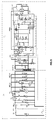
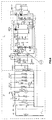
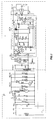
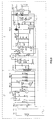
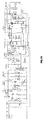
- The control and monitoring equipment for gas burners according to the invention will now be described with reference to a particular wiring diagram given by way of illustration only with the help of the enclosed tables referring to the various temporal phases of the equipment performance, beginning from the moment in which the sensor for the control of the physical value to be monitored gives the start signal to the equipment until the latter performs its operation and then stops. Some intervention procedures of the equipment intervening during operations of the burner which differ from the rules will be also described. The drawings attached to the patent refer to the electronic diagram of the equipment circuit according to the invention, wherein:
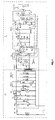
- Fig. 1 represents the equipment according to the invention soon after the thermostat has disconnected;
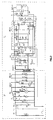
- Fig. 2 shows the diagram of the equipment during the pre-ventilation phase;
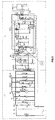
- Fig. 3 shows the diagram of the equipment at the end of the pre-ventilation phase with the solenoid valves for the gas distribution being energized and with the ignition transformer being powered, but before the flame ignites;
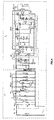
- Fig. 4 shows the diagram of the equipment in case of normal operation before the second regulating solenoid valve begins to be energized;
- Fig. 5 shows the diagram of the equipment during the normal operation of the burner;
- Fig. 6 shows the diagram of the equipment in case of shutdown at the end of the safety period of time;
- Fig. 7 is the diagram showing the condition of the equipment if the flame ignites during the pre-ventilation phase;
- Fig. 8 shows the diagram of the equipment when the pressure sensor senses the lack of air at the start;
- Fig. 9 shows the diagram of the equipment, should the flame disappear while the burner is working;
- Fig. 10 shows the diagram of the equipment should the combustion continue after the thermostat has come on again.
- As soon as the thermostat marked with TL in the diagram of Fig. 1 closes, for instance because the lower limit temperature of the room or the lower limit temperature of the water has been reached, the T relay is excited and, as a consequence, all the contacts T1, T2, T3 and T4 are closed. Through the 1E contact, which is normally closed the B relay, also called third relay, is also excited, then the B1 and B2 contacts also close. The Motor is energized through the PA contact which is connected with the air pressure sensor, which at this time does not sense the presence of air yet. Thus the fan motor M is energized and the pre-ventilation phase begins.
- With reference to Fig. 2 and to the power part of the equipment, as soon as the fan motor M starts operating, the air pressure sensor senses the presence of a sufficient pressure and the PA contact commutes, so as to excite the RPA2 relay.
- The fan motor M of the fan presents a secondary winding at the ends of which the VBT low tension is collected, said low tension energizing the entire logical part L for the monitoring of the equipment which, as can be observed in Fig.2 is to be found after the
terminals - The energization of said relay causes the 1RPA1 contact to close. The closing of the 1RPA1 contact makes it possible for the fan motor M to continue to be powered, even if in the meantime the PA contact has gone to its resting position from the energization of the motor to the energization of the RPA2 relay. The energization of the monitoring circuit of the equipment also entails the energizing of the t1 timer, which starts counting down a period of time, for instance of about 20÷70 seconds, this occurring as a function of the RC time constant of the t1 circuit due to the R, R1 resistances placed in series and to the inner capacity of the logic circuit of t1.
- As can be observed, the energization of the t1 circuit closes through the 2RF contacts.
- At the end of the pre-ventilation phase, the circuit of the equipment sends out a signal which opens the gas valves and also energizes a transformer connected with the spark.
- According to the safety rules the ignition of the flame- must occur within a maximum time span of 3 seconds from the end of the pre-ventilation.
- For this reason, with reference to Fig. 3, when the electronic timer t1 has finished the pre-ventilation phase and has therefore finished the count down of the time pre set for the pre-ventilation, a first signal t11 is sent out by the logic circuit which excites the RT relay and, as a consequence, its RT1 and RT2 contacts close. These contacts permit a retention current through the BL2 resistance, also called second resistance, through the 2RPA2, RT1, RT2, RTA contacts
- Said retention current suffices to excite the first RTA relay. As a consequence the contacts of said relay, namely the 1 RTA and 2RTA contacts, close. The closing of the 1RTA contact causes the short circuit of the R resistance and, as a consequence, the variation of the RC time constant of the logic circuit of t1. Thus the RC constant of the circuit changes from 20 ÷ 70 seconds to a max. of 3 seconds. The closing of the 2RTA contact with the 3RF contact in its resting position causes the REV relay to be powered through the BLS1 resistance, also called first resistance. The feeding of the REV relay entails the closing of the 1REV contact and, therefore, the consequent energization of the REV1 relay placed in series with the RL relay. During this phase the RL relay is not excited.
- During the time interval corresponding to the 3-second count down it occurs that, since the REV and REV1 relays are excited, the corresponding EVS and EV1 solenoid valves for the gas distribution are open, the EVS valve being the safety valve placed before the two EV1 and EV2 valves. When the REV1 relay is excited, the 1REV1 contact also closes and, through the T3 contact and the 2RL contact, which is normally closed, it energizes the transformer energizing the TR spark. Therefore, all the conditions for the ignition of the flame are present, since the TR transformer energizing the spark and the EVS and EV1 solenoid valves for the gas distribution are being powered.
- As has previously been said, the safety rules foresee a period of time not exceeding 3 seconds after the end of the pre-ventilation phase within which the flame must ignite. If the flame ignites, as can be observed in the diagram of Fig. 4, the A RF flame sensor senses the ignition and all the
contacts 1 RF, 2RF, 3RF and 4RF, the last one being also called first contact, are commuted. By commuting the 2RF contact, the t1 timer stops being powered, so that the count down and any signal output are stopped. By subsequently commuting the 3RF contact so that, as a consequence the first BLS1 resistance is no longer powered, the RL relay is fed at full voltage, so that the normally closed 2RL contact opens and the igniting spark stops because of the interruption of the energization of the TR transformer. The commutation of the 3RF contact causes the t2 timer to start counting, so that for the purpose of counting a signal is sent out such that it will excite the REV2 relay, as can be observed in Fig. 5. - During the normal operation of the burner with the regular presence of the flame it occurs that the EV2 solenoid valve also opens, since at the end of the count down by t2 the REV2 relay is excited and the 1REV2 contact energizes the EV2 solenoid valve. Therefore, during its normal operation, the burner is powered through the EVS safety valve and the EV1 and EV2 valves.
- Within a maximum of three seconds from the end of the pre-ventilation it has been said that the rules require for the flame to ignite. With reference to Fig. 6, if the flame sensor does not sense the flame within this period of time, a few fractions of a second before the three seconds have elapsed, the logic of t1 is such, that a t12 second impulse, much stronger than the t11, which would send the RT relay into conduction, is sent out by the logic circuit of t1. In this situation the second BL relay also enters into conduction. The conduction of the second BL relay entails the closing of the 1BL1 contact and, therefore, the opening of the circuit energizing the part of power relating to the burner, thus sending the burner into a shutdown.
- The operation can be reset by the user by manually commuting the 1BL1 contact.
- Always with reference to Fig. 6, should the logic circuit t1 interrupt the countdown, or should a breakdown occur, thus causing the second impulse t12 to be sent out by the logic circuit t1 so that the shutdown relay BL is activated, or should said second shutdown relay BL, because of working failure, not start working, so that the power circuit does not stop, it happens that the gas continues to flow through the EVS and EV1 solenoid valves, without the flame igniting, even though the TR ignition transformer is activated.
- In this case, since the first RTA relay is excited, the 1RTA and 2RTA contacts are also closed and, through the REV relay, energizes said first BLS1 resistance, which is a resistance wound around a bi-metallic rod, which begins to heat up because of the movement of the bi-metal. After a period varying from 3.1 to 5 seconds this bi-metallic rod on which BLS1 is wound will commute the BLG1 contact. This commutation interrupts the energization of the entire logic of the monitoring circuit and, as a consequence, also of the REV1 relay. This causes the opening of the 1REV1 contact which by opening stops the energization of the EVS and EV1 solenoid valves. Thus one more safety feature is obtained, besides the traditional shutdown which occurs within the 3 seconds. This safety feature intervenes regardless of the operation of the electronic logic, since said safety feature depends on the electro-mechanic operation of a bi-metallic rod commuting the contacts after a very brief heating-up period.
- The BLG1 contact, the commutation of which has caused the shutdown of the equipment, is protected so that it can not be accessible to the user, but only to specialized personnel, whose intervention becomes necessary, since the commutation of the BLG1 contact has only occurred because of a failure of the BL shutdown relay, so that it becomes important to replace it.
- When the contacts of the thermostat, i.e. the T1, T2, T3 and T4 contacts, close, according to the diagram represented in Fig. 7, the M motor for the pre-ventilation begins to be powered. At the same time the countdown of the logic circuit t1 should also start. The presence of a flame which is sensed by the A RF circuit for the monitoring of the flame, the 1RF, 2RF, 3RF 4RF contacts are commuted. As can be observed in Fig. 7, because of the position of the 2RF contact, the RC charge circuit of the time constant of the timer t1 is not closed at this point, so that it is not possible for the first impulse t11 to be sent out, since the countdown is interrupted. Since the A RF flame monitoring contact is excited, the RPA1 relay is also excited and, as a consequence, the 2RPA2 contact, also called second contact, is commuted and it permits, also through the closing of said first 4RF contact, the energization of said second BL shutdown relay through the second BL2 resistance, which is also wound around a bi-metallic element, deferring from the one previously described. Thus it occurs that if a flame is ignited at the start up, the equipment foresees the immediate shutdown.
- With reference to Fig. 9, during the normal operation of the burner the EVS, EV1, EV2 solenoid valves for the gas distribution are open. When the flame goes out the A RF system resumes its resting state, during which all the 1 RF, 2RF, 3RF and 4RF contacts re-open. By commuting the 1RF contact, said second BL relay is powered through the second BL2 resistance, so that an immediate shutdown occurs, because the 1BL1 contact connected with said second BL relay opens.
- If, however, for any reason, said second BL relay is not excited, the interruption of the 3RF contact due to the disappearance of the flame entails the energization of the first BLS1 resistance which, as has been said, is wound around a bi-metallic element and, therefore, after a period of time slightly exceeding 3 seconds, the bi-metal closes the BLG1 contact and the system shuts down irreversibly.
- With reference to Fig. 10, when the TL limit thermostat opens, the T relay is de-energized and, as a consequence, all the T1, T2, T3 and T4 contacts open. When the T3 contact opens the EVS safety solenoid valve is no longer energized. In the same way, the opening of the T2 contact causes the solenoid valve of the REV2 relay to stop being energized. As a consequence, the corresponding EV2 solenoid valve is no longer energized. If no gas leaks out of the EVS safety solenoid valve, EV1 receives no gas, so that the flame goes out. If the flame goes out, the A RF relay commutes again and consequently the fourth E relay, which was kept in short circuit by the 2RF contact, is also excited. Consequently the corresponding 1E contact also opens and it causes the third B relay to open. The de-energizing of the third B relay causes also the opening of the contacts connected with said relay, i.e. the B1 and B2 contacts which cause the M motor to stop: it then occurs that after the contact TL of the limit thermostat has opened, the motor keeps on working only as long as the logic circuit which senses the presence of the flame insures that there is a flame.
- On the other hand, should the flame continue to burn, because, for instance, some gas still leaks out of the EVS safety solenoid valve, although it has been de-energized, since the RF flame circuit is excited, the 2RF contact feeds, as can be observed in Fig. 10, a third BLG resistance wound around the same bi-metallic element, around which the first BLS1 resistance is wound. Said bi-metallic element permits, after a certain pre-determined period of time, to close the irreversible BLG1 contact. When BLG1 goes into commutation, the feeding of the REV1 relay stops, because the circuit does not give enough voltage to feed said relay. As a consequence the EV1 solenoid valve is no longer fed. If the closing of the EV1 solenoid valve suffices to put out the flame, the 2RF contact goes into commutation, since it depends on the A RF circuit and said circuit no longer senses the flame. Consequently said fourth E relay is fed and the corresponding 1E contact opens. With the opening of the 1E contact the third B relay is de-energized. As a consequence the B1 and B2 contacts open and the M motor is no longer fed. In this situation the pre-combustion ventilation stops.
- If, on the other hand, the flame keeps on burning after the EVS and EV1 solenoid valves have closed, it occurs that, because the 2RF contact remains in the position described and represented in Fig. 10, it continues to keep said fourth E relay de-energized. Consequently the 1E contact remains closed, so as to insure the exciting of the third B relay which, as a consequence keeps the B1 and B2 contacts closed, so that the feeding of the M motor continues.
- Therefore, should the flame continue to burn in spite of all the controls of the gas solenoid valve being closed, the system foresees that the motor, which supplies the combustion air, keeps supplying an amount of ventilation sufficient for the inlet gas to burn, thereby creating the ideal condition preventing dangerous situations due to the build-up of unburnt gas.
Claims (8)
- A control and monitoring equipment for gas burners suited to control and monitor the following steps: pre-ventilation of the burner chamber. ignition of the flame, holding of said flame, extinguishing said flame when a reference temperature of a medium to be heated has been reached, comprising:A) A power part (P) including and powering over a supply line:and further including:the electric motor (M) of at least one electric fan supplying the air necessary for the combustion;at least one safety solenoid valve (EVS) placed upstream of at least one solenoid valve (EV1) for the distribution of the gas;a device (TR) for the gas ignition;a sensor (TL) of the temperature of said medium to be monitored and a sensor of the air pressure (PA) in the burner having respective electrical contacts (TL, PA) connected to said equipment;B) a logic part (L) consisting of:a logic circuit (A RF) for the monitoring of the flame;a logic circuit (t1) for the count down of the pre-ventilation time and of an ignition interval within which a flame shall be detected, said logic circuit sending out a first impulse (t11) at the end of the pre-ventilation step such that it causes the solenoid valves (EVS, EV1) of the gas distribution to open, and a second impulse (t12) terminating the ignition interval and having such an intensity as to set a first shutdown relay (BL) of the equipment into conduction, should the flame not be detected, characterized in that when the temperature of said medium to be monitored has been reached, if the flame keeps on burning in the burner after the interruption of the power to the solenoid valve (EVS) for the gas safety, the energization of the motor (M) of the electric fan supplying the combustion air is maintained said energization being insured by the closed contacts (B1, B2) in the circuit powering the motor (M) of the electric fan of a first relay (B) in and excited by the closed position of a normally closed contact (1E) of a de-energized second relay (E) in the logic part of the equipment, said second relay (E) being placed in series with a first resistance (BLG) wound around a bi-metallic element and in parallel with a contact (2RF) controlled by the flame monitoring logic circuit (A RF) to be closed when a flame is detected, the energization of the fan motor (M) stopping when no flame is detected and as a result thereof said contact (2RF) being controlled by the flame monitoring logic circuit (A RF) commutates, said commutation terminating the short circuit of said second relay (E) placed in series with said first resistance (BLG) and opening the normally closed contact (1E) of said second relay (E) so as to interrupt the energization of said first relay (B), the open contacts (B1, B2) of which de-energize the motor (M) of the electric fan (Fig. 10).
- An equipment according to claim 1, characterized in that, when the monitored temperature has reached a set value and in case a flame is detected, the commutation of a contact (BLG1) interacting with the bi-metallic element around which said first resistance (BLG) is wound, causes de-energization of a relay (REV1) to open a contact (1REV1) in the circuit powering the still open solenoid valve (EV1) for the distribution of the gas and thereby close said valve.
- An equipment according to claim 1, characterized in that said first impulse (t11) sent out by the logic circuit (t1) at the end of the pre-ventilation step, energize a further relay (RTA) in the logic part of the equipment, the contacts (1RTA, 2RTA) of which close a circuit energizing a second shutdown relay (REV) through a second resistance (BLS1) wound around a bi-metallic element interacting with a commutable contact (BLG1), said connection causing the equipment to shut down either through the intervention of the first shutdown relay (BL) which opens a contact (1BL1) in the power part supply line feeding the equipment or, in case of operating failure of said first shutdown relay (BL), through the commutation of said commutable contact (BLG1) interacting with the bi-metallic element coupled with said second resistance (BLS1) (Fig. 6).
- An equipment according to claim 3, characterized in that said second resistance (BLS1) wound around said bi-metallic element is dimensioned in such a way, that the commutation of the contact (BLG1) interacting with said bi-metallic element occurs after the output of the second impulse (t12) of said count down logic circuit (t1) if the flame is absent and if said shutdown relay (BL) of the equipment fails to intervene (Fig. 6).
- An equipment according to claim 1, characterized in that the absence of the flame while the burner is in operation without the opening of the contact (TL) connected with the sensor measuring said medium temperature, causes the energization of said shutdown relay (BL) and a second resistance (BLS1) wound around a bi-metallic element provided to commutate a contact (BLG1) through the opening of further contacts (1RF, 3RF) controlled by the flame monitoring logic circuit (A RF), said further contacts causing the shutdown of the equipment by de-energization of said first shutdown relay (BL) which opens a contact (1BL1) in the power supply line to the equipment or, should said shutdown relay (BL) fail to operate, through the commutation of the contact (BLG1) connected with the bi-metallic element interacting with said second resistance (BLS1) and having a commutation period of time which is longer than the time of intervention of said shutdown relay (Fig. 9).
- An equipment according to claim 1, characterized in that, at the beginning of the operation and if the flame is present, the flame monitoring logic circuit (A RF) commutates a first contact (4RF) which, together with a second contact (2RPA2) commutated by a relay (RPA1) excited by said flame monitoring logic circuit, energizes said first shutdown relay (BL) through a further resistance (BL2) wound around another bi-metallic element, said connection causing the shutdown of the equipment through the intervention of said second shutdown relay (REV) which opens the contact (1BL1) feeding the equipment (Fig. 7).
- An equipment according to claim 1, characterized in that, when the sensor (PA) of the air pressure during the pre-ventilation step senses a lack of air, the contacts (1RPA2, 2RPA2) of a relay (RPA2) connected with said sensor (PA) feed said first shutdown relay (BL) through a further resistance (BL2) wound around a bi-metallic element, said connection causing the shutdown of the equipment through the intervention of said first shutdown relay (BL) which opens a contact (1BL1) in the power supply line to the equipment (Fig. 8).
- An equipment according to the claims 1 or 3, or 6, characterized in that said first and second resistances (BLS1, BLG) which intervene respectively after the end of the combustion if the flame is present and in case of breakdown of the timer logic at the end of the pre-ventilation step, are wound around the same bi-metallic element activating the same contact (BLG1).
Applications Claiming Priority (3)
| Application Number | Priority Date | Filing Date | Title |
|---|---|---|---|
| ITVI920148A IT1259837B (en) | 1992-10-07 | 1992-10-07 | CONTROL AND CONTROL EQUIPMENT FOR GAS BURNERS |
| ITVI920148 | 1992-10-07 | ||
| EP93116050A EP0591910B1 (en) | 1992-10-07 | 1993-10-05 | Control and monitoring equipment for gas burners |
Related Parent Applications (2)
| Application Number | Title | Priority Date | Filing Date |
|---|---|---|---|
| EP93116050A Division EP0591910B1 (en) | 1992-10-07 | 1993-10-05 | Control and monitoring equipment for gas burners |
| EP93116050.1 Division | 1993-10-05 |
Publications (3)
| Publication Number | Publication Date |
|---|---|
| EP0793059A2 EP0793059A2 (en) | 1997-09-03 |
| EP0793059A3 EP0793059A3 (en) | 1997-10-01 |
| EP0793059B1 true EP0793059B1 (en) | 2000-02-02 |
Family
ID=11425013
Family Applications (2)
| Application Number | Title | Priority Date | Filing Date |
|---|---|---|---|
| EP93116050A Expired - Lifetime EP0591910B1 (en) | 1992-10-07 | 1993-10-05 | Control and monitoring equipment for gas burners |
| EP97107692A Expired - Lifetime EP0793059B1 (en) | 1992-10-07 | 1993-10-05 | Control and monitoring equipment for gas burners |
Family Applications Before (1)
| Application Number | Title | Priority Date | Filing Date |
|---|---|---|---|
| EP93116050A Expired - Lifetime EP0591910B1 (en) | 1992-10-07 | 1993-10-05 | Control and monitoring equipment for gas burners |
Country Status (4)
| Country | Link |
|---|---|
| EP (2) | EP0591910B1 (en) |
| AT (1) | ATE165434T1 (en) |
| DE (2) | DE69318092D1 (en) |
| IT (1) | IT1259837B (en) |
Family Cites Families (8)
| Publication number | Priority date | Publication date | Assignee | Title |
|---|---|---|---|---|
| US3488131A (en) * | 1964-10-26 | 1970-01-06 | Whirlpool Co | Electronic spark ignitor control for fuel burner |
| US3524717A (en) * | 1968-06-17 | 1970-08-18 | Electronics Corp America | Combustion supervision system |
| US3574495A (en) * | 1969-12-11 | 1971-04-13 | Honeywell Inc | Burner control system |
| CA1096464A (en) * | 1977-03-07 | 1981-02-24 | Russell B. Matthews | Fuel ignition system having interlock protection and electronic valve leak detection |
| US4243372A (en) * | 1979-02-05 | 1981-01-06 | Electronics Corporation Of America | Burner control system |
| US4482312A (en) * | 1979-06-20 | 1984-11-13 | Electronics Corporation Of America | Burner control system |
| DE3022635C2 (en) * | 1980-06-18 | 1984-11-22 | Danfoss A/S, Nordborg | Control circuit for a combustion system |
| US4976459A (en) * | 1990-02-09 | 1990-12-11 | Inter-City Products Corporation (Usa) | Warmup method for a two stage furnace |
-
1992
- 1992-10-07 IT ITVI920148A patent/IT1259837B/en active IP Right Grant
-
1993
- 1993-10-05 EP EP93116050A patent/EP0591910B1/en not_active Expired - Lifetime
- 1993-10-05 AT AT93116050T patent/ATE165434T1/en not_active IP Right Cessation
- 1993-10-05 EP EP97107692A patent/EP0793059B1/en not_active Expired - Lifetime
- 1993-10-05 DE DE69318092T patent/DE69318092D1/en not_active Expired - Lifetime
- 1993-10-05 DE DE69327811T patent/DE69327811D1/en not_active Expired - Lifetime
Also Published As
| Publication number | Publication date |
|---|---|
| ITVI920148A0 (en) | 1992-10-07 |
| EP0591910A1 (en) | 1994-04-13 |
| EP0793059A3 (en) | 1997-10-01 |
| IT1259837B (en) | 1996-03-28 |
| EP0591910B1 (en) | 1998-04-22 |
| DE69327811D1 (en) | 2000-03-09 |
| ITVI920148A1 (en) | 1994-04-07 |
| ATE165434T1 (en) | 1998-05-15 |
| EP0793059A2 (en) | 1997-09-03 |
| DE69318092D1 (en) | 1998-05-28 |
Similar Documents
| Publication | Publication Date | Title |
|---|---|---|
| EP0385910B1 (en) | Fuel burner control system with hot surface ignition | |
| CA1166719A (en) | Self-checking safety switch control circuit | |
| CA1116720A (en) | Fail-safe gas feed and ignition sequence control apparatus and method for a gas-fired appliance | |
| US3277949A (en) | Apparatus for hydrocarbon ignition and monitoring | |
| US3488131A (en) | Electronic spark ignitor control for fuel burner | |
| US3086583A (en) | Burner control apparatus | |
| US5169301A (en) | Control system for gas fired heating apparatus using radiant heat sense | |
| US4077762A (en) | Fuel ignition system having contact interlock protection | |
| US4106889A (en) | Burner ignition system | |
| US4850852A (en) | Gas valve shut off method and apparatus | |
| US3484177A (en) | Igniter and control means | |
| EP0793059B1 (en) | Control and monitoring equipment for gas burners | |
| US4147496A (en) | Safety ignition means for burner installations | |
| US3059693A (en) | Control system | |
| US3443752A (en) | Control system for gas-fired heating apparatus | |
| US3432246A (en) | Electrical flame ignition and supervising apparatus | |
| US3245456A (en) | Control system for fluid fuel burners | |
| KR930006171B1 (en) | Combustion control device | |
| US4078878A (en) | Fuel burner control device providing safely ignited burner | |
| US4168141A (en) | Safety ignition means for burner installations | |
| JPH08145355A (en) | Combustion control device | |
| JPS6027898B2 (en) | Combustion control device | |
| JPH08147051A (en) | Power source controller | |
| US3320998A (en) | Electric control of fuel-burning devices | |
| JP2768635B2 (en) | Combustion equipment |
Legal Events
| Date | Code | Title | Description |
|---|---|---|---|
| PUAI | Public reference made under article 153(3) epc to a published international application that has entered the european phase |
Free format text: ORIGINAL CODE: 0009012 |
|
| PUAL | Search report despatched |
Free format text: ORIGINAL CODE: 0009013 |
|
| AC | Divisional application: reference to earlier application |
Ref document number: 591910 Country of ref document: EP |
|
| AK | Designated contracting states |
Kind code of ref document: A2 Designated state(s): CH DE FR GB IT LI |
|
| RIN1 | Information on inventor provided before grant (corrected) |
Inventor name: TAGLIAFERRO, BRUNO Inventor name: FERRARI, ALBERTO Inventor name: BORELLI, LUIGI |
|
| AK | Designated contracting states |
Kind code of ref document: A3 Designated state(s): CH DE FR GB IT LI |
|
| 17P | Request for examination filed |
Effective date: 19971106 |
|
| 17Q | First examination report despatched |
Effective date: 19981210 |
|
| GRAG | Despatch of communication of intention to grant |
Free format text: ORIGINAL CODE: EPIDOS AGRA |
|
| GRAG | Despatch of communication of intention to grant |
Free format text: ORIGINAL CODE: EPIDOS AGRA |
|
| GRAH | Despatch of communication of intention to grant a patent |
Free format text: ORIGINAL CODE: EPIDOS IGRA |
|
| GRAH | Despatch of communication of intention to grant a patent |
Free format text: ORIGINAL CODE: EPIDOS IGRA |
|
| GRAA | (expected) grant |
Free format text: ORIGINAL CODE: 0009210 |
|
| AC | Divisional application: reference to earlier application |
Ref document number: 591910 Country of ref document: EP |
|
| AK | Designated contracting states |
Kind code of ref document: B1 Designated state(s): CH DE FR GB IT LI |
|
| PG25 | Lapsed in a contracting state [announced via postgrant information from national office to epo] |
Ref country code: LI Free format text: LAPSE BECAUSE OF FAILURE TO SUBMIT A TRANSLATION OF THE DESCRIPTION OR TO PAY THE FEE WITHIN THE PRESCRIBED TIME-LIMIT Effective date: 20000202 Ref country code: IT Free format text: LAPSE BECAUSE OF FAILURE TO SUBMIT A TRANSLATION OF THE DESCRIPTION OR TO PAY THE FEE WITHIN THE PRE;WARNING: LAPSES OF ITALIAN PATENTS WITH EFFECTIVE DATE BEFORE 2007 MAY HAVE OCCURRED AT ANY TIME BEFORE 2007. THE CORRECT EFFECTIVE DATE MAY BE DIFFERENT FROM THE ONE RECORDED.SCRIBED TIME-LIMIT Effective date: 20000202 Ref country code: FR Free format text: LAPSE BECAUSE OF FAILURE TO SUBMIT A TRANSLATION OF THE DESCRIPTION OR TO PAY THE FEE WITHIN THE PRESCRIBED TIME-LIMIT Effective date: 20000202 Ref country code: CH Free format text: LAPSE BECAUSE OF FAILURE TO SUBMIT A TRANSLATION OF THE DESCRIPTION OR TO PAY THE FEE WITHIN THE PRESCRIBED TIME-LIMIT Effective date: 20000202 |
|
| REG | Reference to a national code |
Ref country code: CH Ref legal event code: EP |
|
| REF | Corresponds to: |
Ref document number: 69327811 Country of ref document: DE Date of ref document: 20000309 |
|
| PG25 | Lapsed in a contracting state [announced via postgrant information from national office to epo] |
Ref country code: DE Free format text: LAPSE BECAUSE OF FAILURE TO SUBMIT A TRANSLATION OF THE DESCRIPTION OR TO PAY THE FEE WITHIN THE PRESCRIBED TIME-LIMIT Effective date: 20000503 |
|
| EN | Fr: translation not filed | ||
| PG25 | Lapsed in a contracting state [announced via postgrant information from national office to epo] |
Ref country code: GB Free format text: LAPSE BECAUSE OF NON-PAYMENT OF DUE FEES Effective date: 20001005 |
|
| PLBE | No opposition filed within time limit |
Free format text: ORIGINAL CODE: 0009261 |
|
| STAA | Information on the status of an ep patent application or granted ep patent |
Free format text: STATUS: NO OPPOSITION FILED WITHIN TIME LIMIT |
|
| 26N | No opposition filed | ||
| GBPC | Gb: european patent ceased through non-payment of renewal fee |
Effective date: 20001005 |