EP0792897A1 - Aromatic polycarbodiimide and films thereof - Google Patents
Aromatic polycarbodiimide and films thereof Download PDFInfo
- Publication number
- EP0792897A1 EP0792897A1 EP97101139A EP97101139A EP0792897A1 EP 0792897 A1 EP0792897 A1 EP 0792897A1 EP 97101139 A EP97101139 A EP 97101139A EP 97101139 A EP97101139 A EP 97101139A EP 0792897 A1 EP0792897 A1 EP 0792897A1
- Authority
- EP
- European Patent Office
- Prior art keywords
- film
- polycarbodiimide
- reaction
- temperature
- heat
- Prior art date
- Legal status (The legal status is an assumption and is not a legal conclusion. Google has not performed a legal analysis and makes no representation as to the accuracy of the status listed.)
- Granted
Links
- 125000003118 aryl group Chemical group 0.000 title claims abstract description 18
- 229910052731 fluorine Inorganic materials 0.000 claims description 7
- 125000001153 fluoro group Chemical group F* 0.000 claims description 7
- 125000004435 hydrogen atom Chemical group [H]* 0.000 claims description 6
- 239000003960 organic solvent Substances 0.000 claims description 6
- 125000001997 phenyl group Chemical group [H]C1=C([H])C([H])=C(*)C([H])=C1[H] 0.000 claims description 6
- 125000000962 organic group Chemical group 0.000 claims description 2
- 238000004519 manufacturing process Methods 0.000 abstract description 24
- 239000000463 material Substances 0.000 abstract description 5
- 238000000465 moulding Methods 0.000 abstract description 5
- 239000000853 adhesive Substances 0.000 abstract description 3
- 230000001070 adhesive effect Effects 0.000 abstract description 3
- 239000010408 film Substances 0.000 description 96
- 238000006243 chemical reaction Methods 0.000 description 38
- 239000002904 solvent Substances 0.000 description 32
- 239000000203 mixture Substances 0.000 description 31
- WYURNTSHIVDZCO-UHFFFAOYSA-N Tetrahydrofuran Chemical compound C1CCOC1 WYURNTSHIVDZCO-UHFFFAOYSA-N 0.000 description 30
- ZMANZCXQSJIPKH-UHFFFAOYSA-N Triethylamine Chemical compound CCN(CC)CC ZMANZCXQSJIPKH-UHFFFAOYSA-N 0.000 description 27
- YXFVVABEGXRONW-UHFFFAOYSA-N Toluene Chemical compound CC1=CC=CC=C1 YXFVVABEGXRONW-UHFFFAOYSA-N 0.000 description 26
- 238000000034 method Methods 0.000 description 22
- -1 moldings Substances 0.000 description 20
- 229920000642 polymer Polymers 0.000 description 20
- YMWUJEATGCHHMB-UHFFFAOYSA-N Dichloromethane Chemical compound ClCCl YMWUJEATGCHHMB-UHFFFAOYSA-N 0.000 description 18
- JOYRKODLDBILNP-UHFFFAOYSA-N Ethyl urethane Chemical compound CCOC(N)=O JOYRKODLDBILNP-UHFFFAOYSA-N 0.000 description 18
- 239000000178 monomer Substances 0.000 description 16
- 239000003054 catalyst Substances 0.000 description 15
- YLQBMQCUIZJEEH-UHFFFAOYSA-N tetrahydrofuran Natural products C=1C=COC=1 YLQBMQCUIZJEEH-UHFFFAOYSA-N 0.000 description 15
- 238000005266 casting Methods 0.000 description 14
- IJOOHPMOJXWVHK-UHFFFAOYSA-N chlorotrimethylsilane Chemical compound C[Si](C)(C)Cl IJOOHPMOJXWVHK-UHFFFAOYSA-N 0.000 description 14
- 238000010438 heat treatment Methods 0.000 description 14
- HEDRZPFGACZZDS-UHFFFAOYSA-N Chloroform Chemical compound ClC(Cl)Cl HEDRZPFGACZZDS-UHFFFAOYSA-N 0.000 description 12
- 238000013007 heat curing Methods 0.000 description 11
- 239000011347 resin Substances 0.000 description 11
- 229920005989 resin Polymers 0.000 description 11
- 239000012948 isocyanate Substances 0.000 description 10
- 150000002513 isocyanates Chemical class 0.000 description 10
- 239000002966 varnish Substances 0.000 description 10
- CSCPPACGZOOCGX-UHFFFAOYSA-N Acetone Chemical compound CC(C)=O CSCPPACGZOOCGX-UHFFFAOYSA-N 0.000 description 9
- 239000005046 Chlorosilane Substances 0.000 description 9
- KOPOQZFJUQMUML-UHFFFAOYSA-N chlorosilane Chemical compound Cl[SiH3] KOPOQZFJUQMUML-UHFFFAOYSA-N 0.000 description 9
- 150000001875 compounds Chemical class 0.000 description 9
- 239000011521 glass Substances 0.000 description 9
- VLKZOEOYAKHREP-UHFFFAOYSA-N n-Hexane Chemical compound CCCCCC VLKZOEOYAKHREP-UHFFFAOYSA-N 0.000 description 9
- AHWALFGBDFAJAI-UHFFFAOYSA-N phenyl carbonochloridate Chemical compound ClC(=O)OC1=CC=CC=C1 AHWALFGBDFAJAI-UHFFFAOYSA-N 0.000 description 9
- 238000006116 polymerization reaction Methods 0.000 description 9
- 238000002329 infrared spectrum Methods 0.000 description 8
- 238000001819 mass spectrum Methods 0.000 description 8
- 238000011084 recovery Methods 0.000 description 8
- 239000007787 solid Substances 0.000 description 8
- 235000002597 Solanum melongena Nutrition 0.000 description 7
- 244000061458 Solanum melongena Species 0.000 description 7
- 238000007796 conventional method Methods 0.000 description 7
- 239000002243 precursor Substances 0.000 description 7
- 150000003839 salts Chemical class 0.000 description 7
- 239000005051 trimethylchlorosilane Substances 0.000 description 7
- ZWEHNKRNPOVVGH-UHFFFAOYSA-N 2-Butanone Chemical compound CCC(C)=O ZWEHNKRNPOVVGH-UHFFFAOYSA-N 0.000 description 6
- XEKOWRVHYACXOJ-UHFFFAOYSA-N Ethyl acetate Chemical compound CCOC(C)=O XEKOWRVHYACXOJ-UHFFFAOYSA-N 0.000 description 6
- MVPPADPHJFYWMZ-UHFFFAOYSA-N chlorobenzene Chemical compound ClC1=CC=CC=C1 MVPPADPHJFYWMZ-UHFFFAOYSA-N 0.000 description 6
- 125000005442 diisocyanate group Chemical group 0.000 description 6
- 239000011541 reaction mixture Substances 0.000 description 6
- UPMLOUAZCHDJJD-UHFFFAOYSA-N 4,4'-Diphenylmethane Diisocyanate Chemical compound C1=CC(N=C=O)=CC=C1CC1=CC=C(N=C=O)C=C1 UPMLOUAZCHDJJD-UHFFFAOYSA-N 0.000 description 5
- RTZKZFJDLAIYFH-UHFFFAOYSA-N Diethyl ether Chemical compound CCOCC RTZKZFJDLAIYFH-UHFFFAOYSA-N 0.000 description 5
- 238000000862 absorption spectrum Methods 0.000 description 5
- 230000015572 biosynthetic process Effects 0.000 description 5
- ZDQWVKDDJDIVAL-UHFFFAOYSA-N catecholborane Chemical compound C1=CC=C2O[B]OC2=C1 ZDQWVKDDJDIVAL-UHFFFAOYSA-N 0.000 description 5
- 239000000047 product Substances 0.000 description 5
- QPFMBZIOSGYJDE-UHFFFAOYSA-N 1,1,2,2-tetrachloroethane Chemical compound ClC(Cl)C(Cl)Cl QPFMBZIOSGYJDE-UHFFFAOYSA-N 0.000 description 4
- KLDBYAAXDJSDFR-UHFFFAOYSA-N 1-[1,1,1,3,3,3-hexafluoro-2-[4-(4-isocyanatophenoxy)phenyl]propan-2-yl]-4-(4-isocyanatophenoxy)benzene Chemical compound C=1C=C(OC=2C=CC(=CC=2)N=C=O)C=CC=1C(C(F)(F)F)(C(F)(F)F)C(C=C1)=CC=C1OC1=CC=C(N=C=O)C=C1 KLDBYAAXDJSDFR-UHFFFAOYSA-N 0.000 description 4
- YKBLVFLOPUUNQI-UHFFFAOYSA-N 4-isocyanato-1-(4-isocyanato-2-methylphenyl)-2-methylbenzene Chemical group CC1=CC(N=C=O)=CC=C1C1=CC=C(N=C=O)C=C1C YKBLVFLOPUUNQI-UHFFFAOYSA-N 0.000 description 4
- GAQVRYAUXJRQSE-UHFFFAOYSA-N 4-isocyanato-1-[4-isocyanato-2-(trifluoromethyl)phenyl]-2-(trifluoromethyl)benzene Chemical group FC(F)(F)C1=CC(N=C=O)=CC=C1C1=CC=C(N=C=O)C=C1C(F)(F)F GAQVRYAUXJRQSE-UHFFFAOYSA-N 0.000 description 4
- 238000010521 absorption reaction Methods 0.000 description 4
- 238000009835 boiling Methods 0.000 description 4
- 125000002915 carbonyl group Chemical group [*:2]C([*:1])=O 0.000 description 4
- 150000001793 charged compounds Chemical class 0.000 description 4
- 239000011248 coating agent Substances 0.000 description 4
- 238000000576 coating method Methods 0.000 description 4
- 238000001723 curing Methods 0.000 description 4
- 238000001035 drying Methods 0.000 description 4
- 238000001914 filtration Methods 0.000 description 4
- 238000005259 measurement Methods 0.000 description 4
- 238000002844 melting Methods 0.000 description 4
- 230000008018 melting Effects 0.000 description 4
- 125000003944 tolyl group Chemical group 0.000 description 4
- NXLNNXIXOYSCMB-UHFFFAOYSA-N (4-nitrophenyl) carbonochloridate Chemical compound [O-][N+](=O)C1=CC=C(OC(Cl)=O)C=C1 NXLNNXIXOYSCMB-UHFFFAOYSA-N 0.000 description 3
- ZTASCEXPRIMSJO-UHFFFAOYSA-N 1,3-bis(4-isocyanatophenoxy)benzene Chemical compound C1=CC(N=C=O)=CC=C1OC1=CC=CC(OC=2C=CC(=CC=2)N=C=O)=C1 ZTASCEXPRIMSJO-UHFFFAOYSA-N 0.000 description 3
- YWMDVXGHNXBWRX-UHFFFAOYSA-N 1-isocyanato-4-[4-[2-[4-(4-isocyanatophenoxy)phenyl]propan-2-yl]phenoxy]benzene Chemical compound C=1C=C(OC=2C=CC(=CC=2)N=C=O)C=CC=1C(C)(C)C(C=C1)=CC=C1OC1=CC=C(N=C=O)C=C1 YWMDVXGHNXBWRX-UHFFFAOYSA-N 0.000 description 3
- UHOVQNZJYSORNB-UHFFFAOYSA-N Benzene Chemical compound C1=CC=CC=C1 UHOVQNZJYSORNB-UHFFFAOYSA-N 0.000 description 3
- LFQSCWFLJHTTHZ-UHFFFAOYSA-N Ethanol Chemical compound CCO LFQSCWFLJHTTHZ-UHFFFAOYSA-N 0.000 description 3
- VEXZGXHMUGYJMC-UHFFFAOYSA-N Hydrochloric acid Chemical compound Cl VEXZGXHMUGYJMC-UHFFFAOYSA-N 0.000 description 3
- CSNNHWWHGAXBCP-UHFFFAOYSA-L Magnesium sulfate Chemical compound [Mg+2].[O-][S+2]([O-])([O-])[O-] CSNNHWWHGAXBCP-UHFFFAOYSA-L 0.000 description 3
- OKKJLVBELUTLKV-UHFFFAOYSA-N Methanol Chemical compound OC OKKJLVBELUTLKV-UHFFFAOYSA-N 0.000 description 3
- YGYAWVDWMABLBF-UHFFFAOYSA-N Phosgene Chemical compound ClC(Cl)=O YGYAWVDWMABLBF-UHFFFAOYSA-N 0.000 description 3
- HEMHJVSKTPXQMS-UHFFFAOYSA-M Sodium hydroxide Chemical compound [OH-].[Na+] HEMHJVSKTPXQMS-UHFFFAOYSA-M 0.000 description 3
- 150000004945 aromatic hydrocarbons Chemical class 0.000 description 3
- 230000000694 effects Effects 0.000 description 3
- IXCSERBJSXMMFS-UHFFFAOYSA-N hydrogen chloride Substances Cl.Cl IXCSERBJSXMMFS-UHFFFAOYSA-N 0.000 description 3
- 229910000041 hydrogen chloride Inorganic materials 0.000 description 3
- 239000012044 organic layer Substances 0.000 description 3
- 239000002244 precipitate Substances 0.000 description 3
- 238000003756 stirring Methods 0.000 description 3
- 238000003786 synthesis reaction Methods 0.000 description 3
- DVKJHBMWWAPEIU-UHFFFAOYSA-N toluene 2,4-diisocyanate Chemical compound CC1=CC=C(N=C=O)C=C1N=C=O DVKJHBMWWAPEIU-UHFFFAOYSA-N 0.000 description 3
- XLYOFNOQVPJJNP-UHFFFAOYSA-N water Substances O XLYOFNOQVPJJNP-UHFFFAOYSA-N 0.000 description 3
- RYHBNJHYFVUHQT-UHFFFAOYSA-N 1,4-Dioxane Chemical compound C1COCCO1 RYHBNJHYFVUHQT-UHFFFAOYSA-N 0.000 description 2
- ABUJJNMWUJEMTQ-UHFFFAOYSA-N 1,4-bis(4-isocyanatophenoxy)benzene Chemical compound C1=CC(N=C=O)=CC=C1OC(C=C1)=CC=C1OC1=CC=C(N=C=O)C=C1 ABUJJNMWUJEMTQ-UHFFFAOYSA-N 0.000 description 2
- CPPGZWWUPFWALU-UHFFFAOYSA-N 1-isocyanato-3-methylbenzene Chemical compound CC1=CC=CC(N=C=O)=C1 CPPGZWWUPFWALU-UHFFFAOYSA-N 0.000 description 2
- AZYGEWXDKHFOKB-UHFFFAOYSA-N 2-chloro-1,3,2-benzodioxaborole Chemical compound C1=CC=C2OB(Cl)OC2=C1 AZYGEWXDKHFOKB-UHFFFAOYSA-N 0.000 description 2
- HHLMWQDRYZAENA-UHFFFAOYSA-N 4-[4-[2-[4-(4-aminophenoxy)phenyl]-1,1,1,3,3,3-hexafluoropropan-2-yl]phenoxy]aniline Chemical compound C1=CC(N)=CC=C1OC1=CC=C(C(C=2C=CC(OC=3C=CC(N)=CC=3)=CC=2)(C(F)(F)F)C(F)(F)F)C=C1 HHLMWQDRYZAENA-UHFFFAOYSA-N 0.000 description 2
- KMKWGXGSGPYISJ-UHFFFAOYSA-N 4-[4-[2-[4-(4-aminophenoxy)phenyl]propan-2-yl]phenoxy]aniline Chemical compound C=1C=C(OC=2C=CC(N)=CC=2)C=CC=1C(C)(C)C(C=C1)=CC=C1OC1=CC=C(N)C=C1 KMKWGXGSGPYISJ-UHFFFAOYSA-N 0.000 description 2
- NVKGJHAQGWCWDI-UHFFFAOYSA-N 4-[4-amino-2-(trifluoromethyl)phenyl]-3-(trifluoromethyl)aniline Chemical group FC(F)(F)C1=CC(N)=CC=C1C1=CC=C(N)C=C1C(F)(F)F NVKGJHAQGWCWDI-UHFFFAOYSA-N 0.000 description 2
- XDTMQSROBMDMFD-UHFFFAOYSA-N Cyclohexane Chemical compound C1CCCCC1 XDTMQSROBMDMFD-UHFFFAOYSA-N 0.000 description 2
- OFOBLEOULBTSOW-UHFFFAOYSA-N Malonic acid Chemical compound OC(=O)CC(O)=O OFOBLEOULBTSOW-UHFFFAOYSA-N 0.000 description 2
- CTQNGGLPUBDAKN-UHFFFAOYSA-N O-Xylene Chemical compound CC1=CC=CC=C1C CTQNGGLPUBDAKN-UHFFFAOYSA-N 0.000 description 2
- ATUOYWHBWRKTHZ-UHFFFAOYSA-N Propane Chemical compound CCC ATUOYWHBWRKTHZ-UHFFFAOYSA-N 0.000 description 2
- JUJWROOIHBZHMG-UHFFFAOYSA-N Pyridine Chemical compound C1=CC=NC=C1 JUJWROOIHBZHMG-UHFFFAOYSA-N 0.000 description 2
- 239000007795 chemical reaction product Substances 0.000 description 2
- DCFKHNIGBAHNSS-UHFFFAOYSA-N chloro(triethyl)silane Chemical compound CC[Si](Cl)(CC)CC DCFKHNIGBAHNSS-UHFFFAOYSA-N 0.000 description 2
- 230000000052 comparative effect Effects 0.000 description 2
- 239000013078 crystal Substances 0.000 description 2
- JHIVVAPYMSGYDF-UHFFFAOYSA-N cyclohexanone Chemical compound O=C1CCCCC1 JHIVVAPYMSGYDF-UHFFFAOYSA-N 0.000 description 2
- 150000004985 diamines Chemical class 0.000 description 2
- 150000002170 ethers Chemical class 0.000 description 2
- LBKPGNUOUPTQKA-UHFFFAOYSA-N ethyl n-phenylcarbamate Chemical compound CCOC(=O)NC1=CC=CC=C1 LBKPGNUOUPTQKA-UHFFFAOYSA-N 0.000 description 2
- 150000008282 halocarbons Chemical class 0.000 description 2
- 230000000379 polymerizing effect Effects 0.000 description 2
- 239000002994 raw material Substances 0.000 description 2
- 238000001953 recrystallisation Methods 0.000 description 2
- 238000007086 side reaction Methods 0.000 description 2
- 239000008096 xylene Substances 0.000 description 2
- SCYULBFZEHDVBN-UHFFFAOYSA-N 1,1-Dichloroethane Chemical compound CC(Cl)Cl SCYULBFZEHDVBN-UHFFFAOYSA-N 0.000 description 1
- WSLDOOZREJYCGB-UHFFFAOYSA-N 1,2-Dichloroethane Chemical compound ClCCCl WSLDOOZREJYCGB-UHFFFAOYSA-N 0.000 description 1
- ICZKZOUCJNVQHM-UHFFFAOYSA-N 1,5-diisocyanato-5-methylcyclohexa-1,3-diene Chemical compound O=C=NC1(C)CC(N=C=O)=CC=C1 ICZKZOUCJNVQHM-UHFFFAOYSA-N 0.000 description 1
- IOSIDVPNBKUUFA-UHFFFAOYSA-N 1-ethyl-2,3-dihydro-1$l^{5}-phosphole 1-oxide Chemical compound CCP1(=O)CCC=C1 IOSIDVPNBKUUFA-UHFFFAOYSA-N 0.000 description 1
- GFNKTLQTQSALEJ-UHFFFAOYSA-N 1-isocyanato-4-nitrobenzene Chemical compound [O-][N+](=O)C1=CC=C(N=C=O)C=C1 GFNKTLQTQSALEJ-UHFFFAOYSA-N 0.000 description 1
- YUQUHJGNZFFDAA-UHFFFAOYSA-N 1-phenyl-2,3-dihydro-1$l^{5}-phosphole 1-oxide Chemical compound C=1C=CC=CC=1P1(=O)CCC=C1 YUQUHJGNZFFDAA-UHFFFAOYSA-N 0.000 description 1
- JXGNHEUFHNJWDY-UHFFFAOYSA-N 2,5-dihydro-1h-phosphole Chemical class C1PCC=C1 JXGNHEUFHNJWDY-UHFFFAOYSA-N 0.000 description 1
- QYIMZXITLDTULQ-UHFFFAOYSA-N 4-(4-amino-2-methylphenyl)-3-methylaniline Chemical group CC1=CC(N)=CC=C1C1=CC=C(N)C=C1C QYIMZXITLDTULQ-UHFFFAOYSA-N 0.000 description 1
- WUPRYUDHUFLKFL-UHFFFAOYSA-N 4-[3-(4-aminophenoxy)phenoxy]aniline Chemical compound C1=CC(N)=CC=C1OC1=CC=CC(OC=2C=CC(N)=CC=2)=C1 WUPRYUDHUFLKFL-UHFFFAOYSA-N 0.000 description 1
- JCRRFJIVUPSNTA-UHFFFAOYSA-N 4-[4-(4-aminophenoxy)phenoxy]aniline Chemical compound C1=CC(N)=CC=C1OC(C=C1)=CC=C1OC1=CC=C(N)C=C1 JCRRFJIVUPSNTA-UHFFFAOYSA-N 0.000 description 1
- KCFPZAMGTQIKQB-UHFFFAOYSA-N 4-[4-[2-[4-(4-carboxyphenoxy)phenyl]-1,1,1,3,3,3-hexafluoropropan-2-yl]phenoxy]benzoic acid Chemical compound C1=CC(C(=O)O)=CC=C1OC1=CC=C(C(C=2C=CC(OC=3C=CC(=CC=3)C(O)=O)=CC=2)(C(F)(F)F)C(F)(F)F)C=C1 KCFPZAMGTQIKQB-UHFFFAOYSA-N 0.000 description 1
- PUINVXGYZJXMMX-UHFFFAOYSA-N 4-isocyanatobenzaldehyde Chemical compound O=CC1=CC=C(N=C=O)C=C1 PUINVXGYZJXMMX-UHFFFAOYSA-N 0.000 description 1
- MGYGFNQQGAQEON-UHFFFAOYSA-N 4-tolyl isocyanate Chemical compound CC1=CC=C(N=C=O)C=C1 MGYGFNQQGAQEON-UHFFFAOYSA-N 0.000 description 1
- SERCPQYXEUPQHB-UHFFFAOYSA-N 5,6-diisocyanato-5-methylcyclohexa-1,3-diene Chemical compound O=C=NC1(C)C=CC=CC1N=C=O SERCPQYXEUPQHB-UHFFFAOYSA-N 0.000 description 1
- STUPVELWKGXMQS-UHFFFAOYSA-N CC1=CP(=O)CC1 Chemical compound CC1=CP(=O)CC1 STUPVELWKGXMQS-UHFFFAOYSA-N 0.000 description 1
- 229920006257 Heat-shrinkable film Polymers 0.000 description 1
- NTIZESTWPVYFNL-UHFFFAOYSA-N Methyl isobutyl ketone Chemical compound CC(C)CC(C)=O NTIZESTWPVYFNL-UHFFFAOYSA-N 0.000 description 1
- UIHCLUNTQKBZGK-UHFFFAOYSA-N Methyl isobutyl ketone Natural products CCC(C)C(C)=O UIHCLUNTQKBZGK-UHFFFAOYSA-N 0.000 description 1
- ZBVOEVQTNYNNMY-UHFFFAOYSA-N O=P1=CCCC1 Chemical class O=P1=CCCC1 ZBVOEVQTNYNNMY-UHFFFAOYSA-N 0.000 description 1
- 102220479333 Pantetheinase_M80A_mutation Human genes 0.000 description 1
- OAICVXFJPJFONN-UHFFFAOYSA-N Phosphorus Chemical compound [P] OAICVXFJPJFONN-UHFFFAOYSA-N 0.000 description 1
- 239000002313 adhesive film Substances 0.000 description 1
- 238000004873 anchoring Methods 0.000 description 1
- PFKFTWBEEFSNDU-UHFFFAOYSA-N carbonyldiimidazole Chemical compound C1=CN=CN1C(=O)N1C=CN=C1 PFKFTWBEEFSNDU-UHFFFAOYSA-N 0.000 description 1
- 239000000919 ceramic Substances 0.000 description 1
- 239000012295 chemical reaction liquid Substances 0.000 description 1
- CBVJWBYNOWIOFJ-UHFFFAOYSA-N chloro(trimethoxy)silane Chemical compound CO[Si](Cl)(OC)OC CBVJWBYNOWIOFJ-UHFFFAOYSA-N 0.000 description 1
- 238000004440 column chromatography Methods 0.000 description 1
- 238000009833 condensation Methods 0.000 description 1
- 230000005494 condensation Effects 0.000 description 1
- 239000013039 cover film Substances 0.000 description 1
- 238000004132 cross linking Methods 0.000 description 1
- 230000001186 cumulative effect Effects 0.000 description 1
- 150000004292 cyclic ethers Chemical class 0.000 description 1
- 238000000354 decomposition reaction Methods 0.000 description 1
- 230000003247 decreasing effect Effects 0.000 description 1
- 238000000151 deposition Methods 0.000 description 1
- ROORDVPLFPIABK-UHFFFAOYSA-N diphenyl carbonate Chemical compound C=1C=CC=CC=1OC(=O)OC1=CC=CC=C1 ROORDVPLFPIABK-UHFFFAOYSA-N 0.000 description 1
- USIUVYZYUHIAEV-UHFFFAOYSA-N diphenyl ether Natural products C=1C=CC=CC=1OC1=CC=CC=C1 USIUVYZYUHIAEV-UHFFFAOYSA-N 0.000 description 1
- 238000004821 distillation Methods 0.000 description 1
- 239000004210 ether based solvent Substances 0.000 description 1
- RIFGWPKJUGCATF-UHFFFAOYSA-N ethyl chloroformate Chemical compound CCOC(Cl)=O RIFGWPKJUGCATF-UHFFFAOYSA-N 0.000 description 1
- 230000009970 fire resistant effect Effects 0.000 description 1
- 239000007789 gas Substances 0.000 description 1
- 239000011810 insulating material Substances 0.000 description 1
- 238000011835 investigation Methods 0.000 description 1
- 239000005453 ketone based solvent Substances 0.000 description 1
- 229910052751 metal Inorganic materials 0.000 description 1
- 239000002184 metal Substances 0.000 description 1
- 150000002739 metals Chemical class 0.000 description 1
- XMJHPCRAQCTCFT-UHFFFAOYSA-N methyl chloroformate Chemical compound COC(Cl)=O XMJHPCRAQCTCFT-UHFFFAOYSA-N 0.000 description 1
- 238000012986 modification Methods 0.000 description 1
- 230000004048 modification Effects 0.000 description 1
- 239000003208 petroleum Substances 0.000 description 1
- DGTNSSLYPYDJGL-UHFFFAOYSA-N phenyl isocyanate Chemical compound O=C=NC1=CC=CC=C1 DGTNSSLYPYDJGL-UHFFFAOYSA-N 0.000 description 1
- 239000011574 phosphorus Substances 0.000 description 1
- 229910052698 phosphorus Inorganic materials 0.000 description 1
- 238000011417 postcuring Methods 0.000 description 1
- 239000001294 propane Substances 0.000 description 1
- 238000000746 purification Methods 0.000 description 1
- UMJSCPRVCHMLSP-UHFFFAOYSA-N pyridine Natural products COC1=CC=CN=C1 UMJSCPRVCHMLSP-UHFFFAOYSA-N 0.000 description 1
- 230000035484 reaction time Effects 0.000 description 1
- 238000010992 reflux Methods 0.000 description 1
- 230000035939 shock Effects 0.000 description 1
- FDNAPBUWERUEDA-UHFFFAOYSA-N silicon tetrachloride Chemical compound Cl[Si](Cl)(Cl)Cl FDNAPBUWERUEDA-UHFFFAOYSA-N 0.000 description 1
- 238000005476 soldering Methods 0.000 description 1
- 238000004528 spin coating Methods 0.000 description 1
- 238000003860 storage Methods 0.000 description 1
- 238000005979 thermal decomposition reaction Methods 0.000 description 1
- RUELTTOHQODFPA-UHFFFAOYSA-N toluene 2,6-diisocyanate Chemical compound CC1=C(N=C=O)C=CC=C1N=C=O RUELTTOHQODFPA-UHFFFAOYSA-N 0.000 description 1
- 239000013638 trimer Substances 0.000 description 1
- 150000003673 urethanes Chemical class 0.000 description 1
- 238000005292 vacuum distillation Methods 0.000 description 1
Images


Classifications
-
- C—CHEMISTRY; METALLURGY
- C08—ORGANIC MACROMOLECULAR COMPOUNDS; THEIR PREPARATION OR CHEMICAL WORKING-UP; COMPOSITIONS BASED THEREON
- C08J—WORKING-UP; GENERAL PROCESSES OF COMPOUNDING; AFTER-TREATMENT NOT COVERED BY SUBCLASSES C08B, C08C, C08F, C08G or C08H
- C08J5/00—Manufacture of articles or shaped materials containing macromolecular substances
- C08J5/18—Manufacture of films or sheets
-
- C—CHEMISTRY; METALLURGY
- C07—ORGANIC CHEMISTRY
- C07C—ACYCLIC OR CARBOCYCLIC COMPOUNDS
- C07C267/00—Carbodiimides
-
- C—CHEMISTRY; METALLURGY
- C08—ORGANIC MACROMOLECULAR COMPOUNDS; THEIR PREPARATION OR CHEMICAL WORKING-UP; COMPOSITIONS BASED THEREON
- C08G—MACROMOLECULAR COMPOUNDS OBTAINED OTHERWISE THAN BY REACTIONS ONLY INVOLVING UNSATURATED CARBON-TO-CARBON BONDS
- C08G18/00—Polymeric products of isocyanates or isothiocyanates
- C08G18/02—Polymeric products of isocyanates or isothiocyanates of isocyanates or isothiocyanates only
- C08G18/025—Polymeric products of isocyanates or isothiocyanates of isocyanates or isothiocyanates only the polymeric products containing carbodiimide groups
-
- C—CHEMISTRY; METALLURGY
- C08—ORGANIC MACROMOLECULAR COMPOUNDS; THEIR PREPARATION OR CHEMICAL WORKING-UP; COMPOSITIONS BASED THEREON
- C08G—MACROMOLECULAR COMPOUNDS OBTAINED OTHERWISE THAN BY REACTIONS ONLY INVOLVING UNSATURATED CARBON-TO-CARBON BONDS
- C08G18/00—Polymeric products of isocyanates or isothiocyanates
- C08G18/06—Polymeric products of isocyanates or isothiocyanates with compounds having active hydrogen
- C08G18/70—Polymeric products of isocyanates or isothiocyanates with compounds having active hydrogen characterised by the isocyanates or isothiocyanates used
- C08G18/72—Polyisocyanates or polyisothiocyanates
- C08G18/77—Polyisocyanates or polyisothiocyanates having heteroatoms in addition to the isocyanate or isothiocyanate nitrogen and oxygen or sulfur
- C08G18/771—Polyisocyanates or polyisothiocyanates having heteroatoms in addition to the isocyanate or isothiocyanate nitrogen and oxygen or sulfur oxygen
-
- C—CHEMISTRY; METALLURGY
- C08—ORGANIC MACROMOLECULAR COMPOUNDS; THEIR PREPARATION OR CHEMICAL WORKING-UP; COMPOSITIONS BASED THEREON
- C08G—MACROMOLECULAR COMPOUNDS OBTAINED OTHERWISE THAN BY REACTIONS ONLY INVOLVING UNSATURATED CARBON-TO-CARBON BONDS
- C08G18/00—Polymeric products of isocyanates or isothiocyanates
- C08G18/06—Polymeric products of isocyanates or isothiocyanates with compounds having active hydrogen
- C08G18/70—Polymeric products of isocyanates or isothiocyanates with compounds having active hydrogen characterised by the isocyanates or isothiocyanates used
- C08G18/72—Polyisocyanates or polyisothiocyanates
- C08G18/77—Polyisocyanates or polyisothiocyanates having heteroatoms in addition to the isocyanate or isothiocyanate nitrogen and oxygen or sulfur
- C08G18/773—Polyisocyanates or polyisothiocyanates having heteroatoms in addition to the isocyanate or isothiocyanate nitrogen and oxygen or sulfur halogens
-
- C—CHEMISTRY; METALLURGY
- C08—ORGANIC MACROMOLECULAR COMPOUNDS; THEIR PREPARATION OR CHEMICAL WORKING-UP; COMPOSITIONS BASED THEREON
- C08J—WORKING-UP; GENERAL PROCESSES OF COMPOUNDING; AFTER-TREATMENT NOT COVERED BY SUBCLASSES C08B, C08C, C08F, C08G or C08H
- C08J2379/00—Characterised by the use of macromolecular compounds obtained by reactions forming in the main chain of the macromolecule a linkage containing nitrogen with or without oxygen, or carbon only, not provided for in groups C08J2361/00 - C08J2377/00
-
- H—ELECTRICITY
- H05—ELECTRIC TECHNIQUES NOT OTHERWISE PROVIDED FOR
- H05K—PRINTED CIRCUITS; CASINGS OR CONSTRUCTIONAL DETAILS OF ELECTRIC APPARATUS; MANUFACTURE OF ASSEMBLAGES OF ELECTRICAL COMPONENTS
- H05K3/00—Apparatus or processes for manufacturing printed circuits
- H05K3/22—Secondary treatment of printed circuits
- H05K3/28—Applying non-metallic protective coatings
- H05K3/285—Permanent coating compositions
Definitions
- a film of a conventionally known aromatic polycarbodiimide has a heat resistance in the point that even when the film is exposed to high temperature of higher than 400°C, the film does not form a volatile gas and decomposed monomers.
- the film when the film is subjected to a heat treatment at a temperature of higher than 200°C, the film loses the self-retention property and becomes brittle, thereby the film cannot endure the practical use. Further, the film has a low moisture resistance at high temperature and high pressure.
- the organic solvent which is used in the synthesis of the polycarbodiimide and for the polycarbodiimide solution may be conventional solvents.
- the organic solvent are halogenated hydrocarbons such as tetrachloroethane, 1,2-dichloroethane, chloroform, etc.; ketone solvents such as acetone, methyl ethyl ketone, methyl isobutyl ketone, cyclohexanone, etc.; cyclic ether solvents such as tetrahydrofuran, dioxane, etc.; and aromatic hydrocarbon solvents such as toluene, xylene, etc. Those may be used alone or as mixtures of two or more thereof.
- the polycarbodiimide resin solution is formed into a film form by a conventional method such as casting, spin coating, and roll coating.
- the film coated may be usually dried at a temperature necessary for removing the solvent.
- the film can be dried at a temperature of from 50 to 200°C.
- the form of the stretched film of the polycarbodiimide may be a tube form, a sleeve form, or other various forms.
- 2,2-bis[4-(4-isocyanatophenoxy)phenyl]propane is obtained by the conventional production method such as a method of reacting 2,2-bis[4-(4-aminophenoxy)phenyl]propane with phosgene in chlorobenzene and extracting the reaction mixture obtained with petroleum ether as described in, for example, U.S. Patent 4,017,459.
- any solvents capable of dissolving the diamine may be used as the solvent for use in these reaction.
- the solvent are ether compounds such as tetrahydrofuran (THF), dioxane, diethyl ether, etc.; aromatic hydrocarbon compounds such as toluene, xylene, benzene, etc.; ketone compounds such as acetone, methyl ethyl ketone, etc.; and ester compounds such as ethyl acetate, etc.
- THF tetrahydrofuran
- dioxane diethyl ether
- aromatic hydrocarbon compounds such as toluene, xylene, benzene, etc.
- ketone compounds such as acetone, methyl ethyl ketone, etc.
- ester compounds such as ethyl acetate, etc.
- the solvent used may be any solvents so long as it can dissolve or suspend urethane.
- the solvent are halogenated hydrocarbon compounds such as dichloromethane, chloroform, dichloroethane, tetrachloroethane, etc., besides the ether compounds, the aromatic hydrocarbon compounds, the ketone compounds, and the ester compounds as described above.
- reaction temperature may be changed by replacing a part or the whole of the solvent which has lower boiling point with other solvent which has higher boiling point.
- the reaction temperature is from 0°C to the boiling point of the solvent used, and preferably from room temperature from the boiling point. If the reaction temperature is too low, the reaction may not proceed. On the other hand, if the reaction temperature is too high or the system is superheated for a long time, the reaction product may decompose. Thus, it is preferred that while tracing the reaction by IR, or the like, the temperature is gradually raised to proceed the reaction.
- a base such as triethylamine may be similarly used.
- the solvent which is used for the reaction may be the same solvents used in forming the isocyanate using the chlorosilane as described above.
- the isocyanate monomer thus obtained can be purified by removing the solvent therefrom and applying a flash column, a recrystallization, or a vacuum distillation.
- the melting point of the compound obtained was 188°C.
- the measurement apparatus for the mass spectrum and the IR spectrum were the same as those in Production Example 1.
- the measurement apparatuses of the mass spectrum and the IR spectrum were the same as those used in Production Example 1.
- the film obtained by casting as described above was heated to 100°C and monoaxially stretched twice.
- the heat recovery force of the stretched film measured was 80 kg/cm 2 .
- the heat recovered film was subjected to a heat treatment at 250°C for 1 hour, the film had sufficient flexibility.
- the varnish obtained was reprecipitated with 300 ml of hexane and dried under a reduced pressure to obtain a white powdery polycarbodiimide.
- the polycarbodiimide could be redissolved in THF, cyclohexane, toluene, acetone, chloroform, etc.
- a 15% solution of the polycarbodiimide could be stored in a refrigerator for 1 month.
- 1,4-Bis(4-isocyanatophenoxy)benzene was obtained using the same method as in Production Example 2.
- the same polymerization as in Example 4 was conducted except that the diisocyanate thus obtained was used, to obtain a solution of a polycarbodiimide having a molecular weight Mn of 9,500.
- the varnish thus obtained was coated on a glass plate by casting and dried at 90°C for 30 minutes to obtain a film having a thickness of 20 ⁇ m.
- the heat-curing temperature of the film was 370°C, and when the film was subjected to a heat treatment at 250°C for 1 hour, the film had flexibility.
- the film obtained by casting as above was heated to 80°C and monoaxially stretched twice.
- the heat recovery force measured was 55 kg/cm -2 and the ratio of heat recovery was 100%.
- Example 6 The same polymerization as in Example 6 was conducted except that 2,2'-bis(trifluoromethyl)-4,4'-diisocyanatobiphenyl obtained in Production Example 3 was used, to obtain a solution of a polycarbodiimide having a molecular weight Mn of 4,000.
- the varnish thus obtained was coated on a glass plate by casting and dried at 90°C for 30 minutes to obtain a film having a thickness of 18 ⁇ m.
- the heat-curing temperature of the film was 330°C. When the film was subjected to a heat treatment at 200°C for 1 hour, the film had flexibility and the linear expansion coefficient was 5.2 ⁇ 10 -5 K -1 .
- the varnish thus obtained was coated on a glass plate by casting and dried at 90°C for 30 minutes to obtain a film having a thickness of 20 ⁇ m.
- the heat-curing temperature of the film was higher than 400°C, and when the film was subjected to a heat treatment at 250°C for 1 hour, the film had flexibility.
- the film obtained above was heated to 100°C and monoaxially stretched 1.5 times.
- the heat recovery force of the film was 60 kg/cm 2 .
- the heat recovered film was subjected to a heat treatment at 250°C for 1 hour, the film had sufficient flexibility.
- Example 2 The same polymerization as in Example 1 was conducted using MDI as the monomer, to obtain a solution of a polycarbodiimide having a molecular weight Mn of 10,000 using THF as a solvent.
- the varnish thus obtained was coated on a glass plate by casting and dried at 90°C for 30 minutes to obtain a film having a thickness of 50 ⁇ m.
- the heat-curing temperature of the film was 350°C.
- the film was subjected to a heat treatment at 200°C for 1 hour, the film was discolored and lost flexibility and self-retention property.
- the linear expansion coefficient was 7.5 ⁇ 10 -5 K -1 .
Landscapes
- Chemical & Material Sciences (AREA)
- Organic Chemistry (AREA)
- Health & Medical Sciences (AREA)
- Chemical Kinetics & Catalysis (AREA)
- Medicinal Chemistry (AREA)
- Polymers & Plastics (AREA)
- Engineering & Computer Science (AREA)
- Manufacturing & Machinery (AREA)
- Materials Engineering (AREA)
- Emergency Medicine (AREA)
- Polyurethanes Or Polyureas (AREA)
Abstract
Description
- The present invention relates to a novel aromatic polycarbodiimide and a film thereof. The aromatic polycarbodiimide of the present invention gives films, moldings, and adhesives each having various excellent characteristics such as high heat resistance, and high dimensional stability.
- Conventionally, polymerized products of an aromatic diisocyanate such as diphenylmethane diisocyanate (MDI), tolylene diisocyanate (TDI), etc., have been known as an aromatic polycarbodiimide. Such an aromatic polycarbodiimide has been used as flame and fire resistant films and heat resistant adhesives due to its excellent heat resistance.
- A film of a conventionally known aromatic polycarbodiimide has a heat resistance in the point that even when the film is exposed to high temperature of higher than 400°C, the film does not form a volatile gas and decomposed monomers. However, when the film is subjected to a heat treatment at a temperature of higher than 200°C, the film loses the self-retention property and becomes brittle, thereby the film cannot endure the practical use. Further, the film has a low moisture resistance at high temperature and high pressure.
- A conventional polymer induced from a known aromatic diisocyanate has the disadvantages that since the polymer has a high melting point, a melt-molding thereof is difficult, and film forming from the polymer solution is difficult because they have low solubility to organic solvents. Further, it may be difficult to generally produce a polymer having a high degree of polymerization for the conventional aromatic diisocyanate. Also, to obtain the mechanical characteristics of the polymer suitable for films and moldings, a divalent aromatic residue in the polymer skeleton must be a p-substituted bond, but such a polymer skeleton has a rigidity and is poor in flexibility.
- As a result of various investigations to overcome the disadvantages of conventional aromatic polycarbodiimides and to obtain an aromatic polymer capable of giving high-efficient films and moldings excellent in heat resistance as well as moldability and flexibility, it has been succeeded to obtain a novel polymer of the present invention.
- According to the present invention, there is provided an aromatic polycarbodiimide having a structural unit represented by the following formula (A)
(̵R-N=C=N)̵n (A)
wherein R represents a divalent organic group represented by the following formula (1), (2), or (3) and n represents an integer;


- As a related information where R in the above formula (A) is represented by the above formula (1), an aromatic diisocyanate represented by the following formula (4) is disclosed in Example 12 of U.S. Patent 4,017,459;

- However, there is no description in the above U.S. patent about the production of a polycarbodiimide by polymerizing the aromatic diisocyanate. Furthermore, about the formula (1) in the formula (A) described above, wherein X is a fluorine atom, neither polymers nor monomers are reported.
-
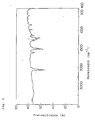
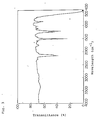
- Fig. 1 is a graph showing the infrared absorption spectrum of the polymer obtained in Example 1,
- Fig. 2 is a graph showing the infrared absorption spectrum of the polymer obtained in Example 4,
- Fig. 3 is a graph showing the infrared absorption spectrum of the polymer obtained in Example 5,
- Fig. 4 is a graph showing the infrared absorption spectrum of the polymer obtained in Example 6, and
- Fig. 5 is a graph showing the infrared absorption spectrum of the polymer obtained in Example 7.
- The polymers of the present invention are represented by the formula (A) described above, wherein n is an integer, preferably an integer of from 2 to 200, and more preferably from 8 to 40. The films obtained from these polymers have very high heat resistance and moisture resistance. Also, after heat treatment, the films have a high flexibility. Furthermore, the aromatic polycarbodiimide of the present invention has an excellent dimensional stability as compared with conventional polycarbodiimides.
- The polycarbodiimide of the present invention is obtained by polymerizing diisocyanates corresponding to the following formulae (5), (6), and (7), respectively, as the monomers alone or as mixtures thereof by the conventional method in the presence of a phosphorus catalyst.


- The monomers which are used for the polymerization may be only the monomers described above, but the monomers may be copolymerized with other organic diisocyanate such as 4,4-diphenylmethane diisocyanate, 2,6-tolylene diisocyanate, 2,4-tolylenediisocyanate, 1-methoxyphenyl-2,4-diisocyanate, 3,3'-dimethoxy-4,4'-diphenylmethane diisocyanate, 4,4'-diphenyl ether diisocyanate, 3,3'-dimethyl-4,4'-diphenyl ether diisocyanate, and o-tolylene diisocyanate within a range (for example, about 30 wt% or less) which does not lose the inherent properties of the monomers.
- The reaction temperature at the polymerization is preferably from 40 to 100°C, and more preferably from 50 to 90°C. If the reaction temperature is lower than 40°C, the reaction time becomes too long, which is unsuitable for practical use, while if the reaction temperature is over 100°C, the selection of a suitable solvent becomes difficult.
- The concentration of the isocyanate monomer in the synthesis of the polycarbodiimide is from 2 to 50% by weight (hereinafter referred to as simply "%"), preferably from 5 to 45%, and more preferably from 15 to 40%. If the concentration of the isocyanate monomer is lower than 2%, carbodiimidation may not proceed. If the concentration is over 50%, there is a possibility that the control of the reaction becomes difficult.
- The organic solvent which is used in the synthesis of the polycarbodiimide and for the polycarbodiimide solution may be conventional solvents. Examples of the organic solvent are halogenated hydrocarbons such as tetrachloroethane, 1,2-dichloroethane, chloroform, etc.; ketone solvents such as acetone, methyl ethyl ketone, methyl isobutyl ketone, cyclohexanone, etc.; cyclic ether solvents such as tetrahydrofuran, dioxane, etc.; and aromatic hydrocarbon solvents such as toluene, xylene, etc. Those may be used alone or as mixtures of two or more thereof.
- Examples of the catalyst which can be used for the carbodiimidation are phospholene oxides such as 1-phenyl-2-phospholene-oxide, 3-methyl-2-phospholene-1-oxide, 1-ethyl-2-phospholene-1-oxide, 3-methyl-1-phenylphopsholene-1-oxide, or 3-phospholene isomers thereof.
- At the end, the middle, or the beginning of the polymerization reaction or over the whole polymerization reaction process, an end-capping treatment may be applied by adding a monoisocyanate. Examples of the monoisocyanate which can be used are phenyl isocyanate, p-nitrophenyl isocyanate, p-or m-tolyl isocyanate, p-formylphenyl isocyanate, etc. The polycarbodiimide solution thus obtained is excellent in the storage stability of the solution.
- The molecular weight of the polycarbodiimide of the present invention is from 1,000 to 100,000, and preferably from 4,000 to 20,000 as a number average molecular weight. If the molecular weight is too high, the polycarbodiimide is easily gelled within from several minutes to several hours even when the polymer is allowed to stand at normal temperature, which is undesirable for practical use. Also, if the molecular weight thereof is too low, the film formed from the polymer is undesirably lacking in the reliability.
- After completion of the reaction, the reaction liquid is added to a poor solvent such as methanol, ethanol, hexane, etc., to deposit the polycarbodiimide as precipitates, and unreacted monomers and the catalyst may be removed. By conducting such an operation, the solution stability of the polycarbodiimide can be improved. After depositing the polycarbodiimide as the precipitates, the precipitates are washed by a definite procedure, and dried. By dissolving again the polycarbodiimide in an organic solvent, a polycarbodiimide solution can be obtained.
- The polycarbodiimide resin obtained by the polymerization reaction can be formed into a film having an appropriate thickness by the conventional method. The coating temperature for forming the film from the polycarbodiimide solution is from 20 to 150°C, preferably from 50 to 120°C, and more preferably from 70 to 100°C. If the coating temperature is lower than 20°C, the solvent sometimes remains in the film. Also, if the coating temperature is over 150°C, heat curing of the film sometimes proceeds. If required and necessary, post-curing may be carried out.
- The stretched film of the polycarbodiimide is produced, for example, as follows using the polycarbodiimide resin prepared by the production method described above.
- The polycarbodiimide resin solution is formed into a film form by a conventional method such as casting, spin coating, and roll coating. The film coated may be usually dried at a temperature necessary for removing the solvent. For example, the film can be dried at a temperature of from 50 to 200°C. In particular, for drying the coated film without excessively proceeding the curing reaction of the polycarbodiimide resin, it is desirable to dry the film at a temperature of from 60 to 150°C. If the drying temperature is too low, the solvent undesirably remains in the film. Also, if the drying temperature is too high, crosslinking of the polycarbodiimide proceeds, whereby the inconveniences such as breaking and poor stretching of the film are undesirably liable to occur at the stretching process of the film. The form of the stretched film of the polycarbodiimide may be a tube form, a sleeve form, or other various forms.
- The film of the polycarbodiimide, for example, the film thereof formed by the casting method is stretched in one direction (the principal axis direction) at from 1.2 to 10 times, and preferably from 2 to 6 times, under a definite condition. Furthermore, if desired, the film can be further stretched in the direction rectangular to the above-described stretched direction (principal axis direction) in the range of from 1 to 5 times, and preferably from 1.1 to 1.6 times. In the order of stretching, the film may be first stretched to either direction.
- By stretching the film to the principal axis direction and the direction rectangular to the principal axis direction, the shock resistance of the stretched film obtained is improved and the property of being liable to be teared in one direction is relaxed. If the stretching times to the direction rectangular to the above-described stretched direction (principal axis direction) are over 5 times, the heat shrinkage to the direction rectangular to the principal axis direction becomes too large, so that in covering an article with the film by a heat shrinking treatment, the finished cover film is undulated and becomes ununiform.
- The stretching temperature is preferably from 40 to 200°C such that drying of the film is performed without proceeding too much the curing reaction of the polycarbodiimide resin. If the stretching temperature is lower than 40°C, a sufficient stretching ratio is not obtained and the film is liable to break. Also, if the stretching temperature is over 200°C, the curing reaction of the polycarbodiimide resin partially proceeds, whereby there is a tendency to decrease the heat recovering property.
- There is no particular restriction on the stretching method of the film and the conventional method such as a roll stretching method, a long gap stretching method, a tenter stretching method, and a tubular stretching method may be employed.
- The film of the polycarbodiimide thus formed can be used as heat-resistant insulating materials for electronic and electric parts and as adhesive films. Also, the film subjected to the stretching treatment is used as, for example, heat-resistant covering materials for various articles.
- For covering an article using the stretched film, for example, after covering an article to be protected with the heat shrinkable film mainly comprising the polycarbodiimide resin, the covered article is subjected to a heat treatment to cure the film. By the heat treatment, the curing reaction of the polycarbodiimide proceeds, the polycarbodiimide resin flows into the uneven portion of the surface of the article to be covered to give an anchoring effect, and simultaneously an action such as a chemical reaction of polar groups on the surface of the article to be covered and cumulative multiple bonds of the polycarbodiimide resin occurs. As a result, the polycarbodiimide resin is chemically and physically adhered to the article.
- There is no particular restriction on the article to be covered. Examples thereof are sheets, tabular materials, and tubular materials, which are made of glasses, metals, resins, and ceramics. Representative articles are electric wires such as cables for electric power, glass-made bottles, and electronic parts.
- The diisocyanate monomer which is the raw material for the aromatic polycarbodiimide of the present invention is explained below.
- In the monomers represented by the formula (5) described above, 2,2-bis[4-(4-isocyanatophenoxy)phenyl]propane is obtained by the conventional production method such as a method of reacting 2,2-bis[4-(4-aminophenoxy)phenyl]propane with phosgene in chlorobenzene and extracting the reaction mixture obtained with petroleum ether as described in, for example, U.S. Patent 4,017,459.
- 2,2-Bis(4-(4-diisocyanatophenoxy)phenyl]hexafluoropropane is a novel aromatic diisocyanate and can be synthesized by isocyanating a precursor of a diisocyanate compound by the conventional method. Examples of the precursor are diamine compounds such as 2,2-bis[4-(4-aminophenoxy)phenyl]hexafluoropropane (BAPF) and alkyl- or halogen-substituted products thereof (e.g., HFBAPP, trade name, made by Wakayama Seika Kogyo K.K. and BIS-AF-A, trade name, made by Central Glass Co., Ltd.).
- 1,3- or 1,4-Bis(4-isocyanatophenoxy)benzene, which is the monomer represented by the formula (6) described above, is also a novel aromatic diisocyanate and can be synthesized by isocyanating a precursor of a diisocyanate compound by the conventional method. Examples of the precursor which can be used are 1,3- or 1,4-bis(4-aminophenoxy)benzene. Commercially available products of such a diamine compound are, for example, TPE-R and TPE-Q (trade name, made by Wakayama Seika Kogyo K.K.).
- 2,2'-Dimethyl or 2,2'-bis(trifluoromethyl)-4,4'-diisocyanatobiphenyl, which is the monomer represented by the formula (7) described above, is a novel aromatic diisocyanate and can be synthesized by isocyanating a precursor of a diisccyanate compound by the conventional method. Examples of the precursor are diamine compounds such as 2,2-dimethyl or 2,2'-bis(trifluoromethyl)-4,4'-diaminobiphenyl.
- The method of isocyanating such a diamine compound includes a method of reacting the diamine compound with phosgene, diphenyl carbonate or carbonyl diimidazole. Also, an urethane intermediate is formed from the diamine compound using a halogenated alkyl formate and the isocyanate may be formed from the intermediate in the presence of a catalyst such as a chlorosilane or catecholborane. Another method is a method of using a dicarboxylic acid such as 2,2-bis[4-(4-carboxyphenoxy)phenyl]hexafluoropropane, as a precursor of the diisocyanate and isocyanating the dicarboxylic acid by a Curtius decomposition.
- In these production methods, the method of forming a urethane intermediate from the diamine compound using a halogenated alkyl formate and isocyanating the intermediate using a chlorosilane as the catalyst, described in G. Greber, et al., Angew. Chem., Int. Ed., Vol. 17, No. 12, 941(1968) and the method of using catecholborane as the catalyst, described in V.L.K. Valli, et al., J. Org. Chem., Vol. 60, 257(1995) are preferred in the points of the yield and the safety. These methods are explained below.
- An urethane intermediate is synthesized by reacting the corresponding diamine compound with a halogenated alkyl formate such as methyl chloroformate, ethyl chloroformate, phenyl chloroformate, or p-nitrophenyl chloroformate. In these halogenated alkyl formates, phenyl chloroformate or p-nitrophenyl chloroformate is preferred for smoothly proceeding the formation of the isocyanate. However, since p-nitrophenyl chloroformate has a high activity and has a possibility of causing a side reaction, phenyl chloroformate is most preferred.
- Any solvents capable of dissolving the diamine may be used as the solvent for use in these reaction. Examples of the solvent are ether compounds such as tetrahydrofuran (THF), dioxane, diethyl ether, etc.; aromatic hydrocarbon compounds such as toluene, xylene, benzene, etc.; ketone compounds such as acetone, methyl ethyl ketone, etc.; and ester compounds such as ethyl acetate, etc. These solvents may be used alone or as a mixture of 2 or more thereof.
- The reaction temperature is from -40 to 70°C, preferably from -20 to 50°C, and more preferably from 0 to 30°C. If the reaction temperature is lower than -40°C, the reaction is difficult to proceed, while if the reaction temperature is over 70°C, there is a possibility of causing a side reaction such as a condensation, etc.
- A base for trapping hydrogen chloride formed by the reaction may be any base so long as it is dissolved in a solvent used and does not hinder the reaction. Examples of the base are triethylamine, pyridine, and sodium hydroxide. The amount of the base used is preferably from 2.0 to 3.4 times the mol number of the diamine used.
- The conventional known method such as a recrystallization, a column chromatography, etc., can be used as the purification method of the urethane intermediate obtained. If necessary, distillation may be carried out.
- For isocyanating the urethane intermediate using a chlorosilane, the urethane intermediate is thermally decomposed using a chlorosilane as a catalyst in an amount of from 2.0 to 4.6 times the molar amount of urethane. Examples of such chlorosilanes are trimethylchlorosilane, triethylchlorosilane, trimethoxychlorosilane, and tetrachlorosilane. Trimethylchlorosilane is preferred from the points of ease of handling and the cost.
- The solvent used may be any solvents so long as it can dissolve or suspend urethane. Examples of the solvent are halogenated hydrocarbon compounds such as dichloromethane, chloroform, dichloroethane, tetrachloroethane, etc., besides the ether compounds, the aromatic hydrocarbon compounds, the ketone compounds, and the ester compounds as described above.
- These solvents may be used alone or as a mixture of 2 or more kinds of them. If required and necessary, the reaction temperature may be changed by replacing a part or the whole of the solvent which has lower boiling point with other solvent which has higher boiling point.
- The reaction temperature is from 0°C to the boiling point of the solvent used, and preferably from room temperature from the boiling point. If the reaction temperature is too low, the reaction may not proceed. On the other hand, if the reaction temperature is too high or the system is superheated for a long time, the reaction product may decompose. Thus, it is preferred that while tracing the reaction by IR, or the like, the temperature is gradually raised to proceed the reaction.
- For trapping hydrogen chloride formed at the reaction, a base such as triethylamine may be similarly used.
- For isocyanating the urethane intermediate, a method of using a halogenated catecholborane as the catalyst in place of the above-described chlorosilane may be employed. Examples of the halogenated catecholborane are chlorocatecholborane, bromocatecholborane, etc. Chlorocatecholborane is preferred from the points of the cost and the handling property. Since catecholboranes have an activity higher than chlorosilanes to the thermal decomposition, urethanes other than phenylurethane can be used as the urethane used.
- The solvent which is used for the reaction may be the same solvents used in forming the isocyanate using the chlorosilane as described above.
- When phenylurethane is used, the reaction temperature is generally from -50°C to 80°C, preferably from 20 to 60°C, and more preferably from 0 to 40°C, and it is better to change the reaction temperature according to the kind of the urethane used. If the reaction temperature is outside the above range or the system is superheated, the reaction may not proceed or the reaction product may decompose. Therefore, it is better that while tracing the reaction by IR, or the like, the temperature is gradually raised to proceed the reaction.
- The base for trapping hydrogen chloride formed at the reaction may be the same bases as described above.
- After completion of the reaction, the isocyanate monomer thus obtained can be purified by removing the solvent therefrom and applying a flash column, a recrystallization, or a vacuum distillation.
- The polycarbodiimide of the present invention has excellent heat resistance and moisture resistance, and the film thereof shows an excellent dimensional stability and is useful as heat-resistant covering materials in, for example, a soldering process at the production of electronic parts. Also, the film of the polycarbodiimide subjected to a stretching treatment has a heat recovery property and can be used as a heat shrinking film. Further, the polycarbodiimide has excellent solubility in solvents.
- The present invention is described in more detail by reference to the following examples, but it should be understood that the invention is not construed as being limited thereto.
- Heat curing temperature of a polycarbodiimide obtained was measured using DSC-200 (trade name, manufactured by SHIMADZU CORPORATION), and the exothermic peak at the formation of a trimer was defined as the heat curing temperature.
- In a one-liter 3-necked flask equipped with a dropping funnel were placed 20 g (0.039 mol) of 2,2-bis[4-(4-aminophenoxy)phenyl]hexafluoropropane (BAPF), 200 ml of THF, and 9.6 g (0.095 mol) of triethylamine. 14.5 g (0.093 mol) of phenyl chloroformate was placed in the dropping funnel and the reaction vessel was cooled to 0°C with an ice bath. Phenyl chloroformate was added dropwise to the mixture over a period of 15 minutes, and while returning the temperature to room temperature, the mixture was stirred for 30 minutes. The salt formed was hydrolyzed with 100 ml of water and extracted with chloroform. The organic layer formed was collected and dried using anhydrous magnesium sulfate. The solvent was distilled off from the reaction mixture and the residue was recrystallized with toluene to obtain 22.2 g (yield 75%) of an urethane intermediate as white solids.
- 20 g (0.026 mol) of the urethane intermediate obtained as the white solids was placed in a one-liter 3-necked flask equipped with a dropping funnel together with 170 ml of methylene chloride and 8.0 g (0.079 mol) of triethylamine. 5.7 g (0.052 mol) of trimethylchlorosilane was placed in the dropping funnel, trimethylchlorosilane was added dropwise to the mixture at room temperature over a period of 5 minutes, the solvent was replaced with toluene, and while gradually raising the temperature to 120°C, the resulting mixture was stirred for 4 hours. The mixture was then further stirred at 120°C for 2 hours. Salts formed were removed by filtration and the solution formed was concentrated by an evaporator. The reaction mixture was purified by a flash column to obtain 7.3 g (yield 49%) of white solids.
- The melting point of the compound obtained was 137°C. Molecular ion peak of M+ = 570 was observed by mass spectrum, and absorption of the carbonyl group of isocyanate was observed at 2260 cm-1 by the IR spectrum. For measuring the mass spectrum, Hitachi M80A (trade name, manufactured by Hitachi, Ltd.) was used, and for the measurement of the IR spectrum, IR-810 (trade name, manufactured by Nippon Bunko Kogyo K.K.) was used.
- It was confirmed that the compound obtained was 2,2-bis[4-(4-isocyanatophenoxy)phenyl]hexafluoropropane (BAPF-NCO).
- In a 500 ml 3-necked flask equipped with a dropping funnel were placed 10 g (0.034 mol) of 1,3-bis(4-aminophenoxy)benzene, 100 ml of THF, and 7.6 g (0.075 mol) of triethylamine. 11.7 g (0.075 mol) of phenyl chloroformate was placed in the dropping funnel, and the reaction vessel was cooled to 0°C with an ice-bath. Phenyl chloroformate was added dropwise to the mixture over a period of 15 minutes, and while returning the temperature to room temperature, the resulting mixture was stirred for 2 hours. The salt formed was hydrolyzed with 100 ml of water and extracted with chloroform. The organic layer thus formed was collected and dried using anhydrous magnesium sulfate. The solvent was distilled off and the residue was recrystallized with toluene to obtain 11.7 g (yield 65%) of an urethane intermediate as white solids.
- 1.1 g (2.1 mmol) of the urethane intermediate obtained as white solids was placed in a 3-necked flask (50 ml) equipped with a dropping funnel together with 10 ml of methylene chloride and 0.58 g (5.7 mmol) of triethylamine. 0.69 g (6.3 mmol) of trimethylchlorosilane was placed in the dropping funnel, and was added dropwise to the mixture at room temperature over a period of 5 minutes, the solvent was replaced with toluene, and while gradually raising the temperature to 120°C, the resulting mixture was stirred for 4 hours. The mixture was then further stirred at 120°C for 1 hour. Salts formed was removed by filtration and the solution formed was concentrated by an evaporator. By purifying the reaction mixture by a flash column, 0.5 g (yield 69%) of white solids were obtained.
- The melting point of the compound obtained was 188°C. Molecular ion peak of M+ = 344 was observed by the mass spectrum, and absorption of the carbonyl group of isocyanate was observed at 2270 cm-1 by the IR spectrum. The measurement apparatus for the mass spectrum and the IR spectrum were the same as those in Production Example 1.
- It was confirmed that the compound obtained was 1,3-bis(4-isocyanatophenoxy)benzene.
- In a 500 ml 3-necked flask equipped with a condenser and a dropping funnel were placed 20 g (0.062 mol) of 2,2'-bis(trifluoromethyl)-4,4'-diaminobiphenyl (BTFB), 200 ml of ethyl acetate, and 13.9 g (0.14 mol) of triethylamine. 20.7 g (0.13 mol) of phenyl chloroformate was placed in the dropping funnel, and the reaction vessel was cooled to 0°C by an ice-bath. Phenyl chloroformate was added dropwise to the mixture over a period of 20 minutes, and while returning the temperature to room temperature, the resulting mixture was stirred for 1 hour. The salt formed was hydrolyzed with 100 ml of water and extracted with chloroform. The organic layer formed was collected and dried using anhydrous magnesium sulfate. When the solvent was distilled off, light-brown solids were almost quantitatively obtained.
- In a 2-necked flask (50 ml) equipped with a condenser and a dropping funnel were placed 1.0 g (1.8 mmol) of the urethane intermediate obtained above, 10 ml of methylene chloride, and 0.73 g (7.2 mmol) of triethylamine. 1.2 g (11.0 mmol) of trimethylchlorosilane was added dropwise to the mixture from the dropping funnel at room temperature, and the resulting mixture was stirred for 15 minuets. The solvent was replaced with toluene, and while gradually raising the temperature to 100°C, the mixture was stirred for 2 hours. Salts formed were removed by filtration and the solution formed was concentrated by an evaporator. The reaction mixture was purified by a flash column to obtain 0.08 g (yield 12%) of white solids.
- About the compound obtained, the molecular ion peak of M+ = 372 was observed by the mass spectrum and the absorption of the carbonyl group of isocyanate was observed at 2250 cm-1 by the IR spectrum. The measurement apparatuses of the mass spectrum and the IR spectrum were the same as those used in Production Example 1.
- It was confirmed that the compound obtained was 2,2'-bis(trifluoromethyl)-4,4'-diisocyanatobiphenyl.
- In a 3-necked flask (200 ml) were placed 8.0 g (0.018 mol) of the urethane intermediate of 2,2'-dimethyl-4,4'-diaminobiphenyl produced as in Production Example 3, 80 ml of methylene chloride, and 5.3 g (0.052 mol) of triethylamine. 6.4 g (0.059 mol) of trimethylchlorosilane was added dropwise to the mixture from the dropping funnel of the flask at room temperature over a period of 5 minutes. The solvent was replaced with toluene, and while gradually raising the temperature to 120°C, the resulting mixture was stirred for 6 hours. Salts formed were removed by filtration, and the solution formed as concentrated and purified by flash column using methylene chloride as the developing solvent to obtain 3.4 g (yield 72%) of white oily product.
- About the compound obtained, the molecular ion peak of M+ = 264 was observed by the mass spectrum and the absorption of the carbonyl group of isocyanate was observed at 2250 cm-1 by the IR spectrum. The measurement apparatuses of the mass spectrum and the IR spectrum were the same as those used in Production Example 1.
- It was confirmed that the compound obtained was 2,2'-dimethyl-4,4'-diisocyanatobiphenyl.
- In a 100 ml egg-plant type flask were placed 5.0 g (8.7 mmol) of 2,2-bis[4-(4-isocyanatophenoxy)phenyl]hexafluoropropane, 25 ml of THF, and 0.0135 g (0.070 mmol) of a carbodiimidation catalyst (3-methyl-1-phenylsulfolene-1-oxide). When the mixture was stirred at 60°C for 6.5 hours, a solution of a polycarbodiimide having a molecular weight Mn of 8,300 was obtained. The varnish obtained was coated on a glass plate by casting and dried at 90°C for 30 minutes to obtain a film having a thickness of 40 µm. The heat-curing temperature of the film was higher than 400°C, and when a heat treatment was applied to the film at 250°C for 1 hour, the film had flexibility.
- The film obtained by casting as described above was heated to 100°C and monoaxially stretched twice. The heat recovery force of the stretched film measured was 80 kg/cm2. When the heat recovered film was subjected to a heat treatment at 250°C for 1 hour, the film had sufficient flexibility.
- In a 30 ml egg-plant type flask were placed 1.1 g (2.4 mmol) of 2,2-bis[4-(4-isocyanatophenoxy)phenyl]propane, 5.5 ml of THF, and 0.0035 g (0.018 mmol) of a carbodiimidation catalyst (1-phenyl-3-methylsulfolene oxide). When the mixture was stirred at 60°C for 10 hours, a solution of a polycarbodiimide having a molecular weight Mn of 5.000 was obtained. The varnish obtained was coated on a glass plate by casting and dried at 90°C for 30 minutes to obtain a film having a thickness of 10 µm. The heat-curing temperature of the film was higher than 370°C, and when the film was subjected to heat treatment at 250°C for 1 hour, the film had flexibility.
- 2,2-Bis[4-(4-isocyanatatophenoxy)phenyl]propane,which was the raw material, was produced as follows.
- 2,2-Bis[4-(4-aminophenoxy)phenyl]propane dissolved in chlorobenzene was added dropwise to a chlorobenzene solution of phosgene at 10°C. After refluxing the mixture to proceed the reaction, the reaction mixture was cooled to deposit crystals. The crystals were collected and dried to obtain 2,2-bis[4-(4-isocyanatophenoxy)phenyl]propane having a melting point of from 68 to 69°C.
- In a 100 ml of egg-plant type flask were placed 3.04 g (5.3 mmol) of 2,2-bis[4-(4-isocyanatophenoxy)phenyl]hexafluoropropane, 30 ml of THF, and 0.033 g (0.17 mmol) of a carbodiimidation catalyst (1-phenyl-3-methylsulfolene oxide). After stirring the mixture at 60°C for 2 hours, 0.41 g (3.1 mmol) of m-tolyl isocyanate was added followed by stirring for further 2 hours to obtain a solution of a polycarbodiimide having a molecular weight Mn of 8,000. The varnish obtained was reprecipitated with 300 ml of hexane and dried under a reduced pressure to obtain a white powdery polycarbodiimide. The polycarbodiimide could be redissolved in THF, cyclohexane, toluene, acetone, chloroform, etc. A 15% solution of the polycarbodiimide could be stored in a refrigerator for 1 month.
- In a 100 ml of egg-plant type flask were placed 0.6 g (1.7 mmol) of 1,3-bis(4-isocyanatophenoxy)benzene, 4 ml of THF, and 0.0068 g (0.035 mmol) of a carbodiimidation catalyst (1-phenyl-3-methylsulfolene oxide). When the mixture was stirred at 60°C for 3.5 hours, a solution of a polycarbodiimide having a molecular weight Mn of 9,500 was obtained. The varnish obtained was coated on a glass plate by casting and dried at 90°C for 30 minutes to obtain a film having a thickness of 22 µm. The heat-curing temperature of the film was 360°C, and when the film was subjected to a heat treatment at 200°C for 1 hour, the film had flexibility.
- The film obtained by casting as above was heated at 80°C and monoaxially stretched. The heat recovery force of the stretched film measured was 77 kg/cm-2 and the ratio of heat recovery (R) defined below was 100%.

- 1,4-Bis(4-isocyanatophenoxy)benzene was obtained using the same method as in Production Example 2. The same polymerization as in Example 4 was conducted except that the diisocyanate thus obtained was used, to obtain a solution of a polycarbodiimide having a molecular weight Mn of 9,500.
- The varnish thus obtained was coated on a glass plate by casting and dried at 90°C for 30 minutes to obtain a film having a thickness of 20 µm. The heat-curing temperature of the film was 370°C, and when the film was subjected to a heat treatment at 250°C for 1 hour, the film had flexibility.
- In a 100 ml egg-plant type flask were placed 3.4 g (0.013 mol) of 2,2'-dimethyl-4,4'-diisocyanatobiphenyl (m-TB-NCO) obtained in Production Example 4, 20 ml of THF, and 0.020 g (0.20 mmol) of a carbodiimidation catalyst (3-phenyl-1-phenylsulfolene-1-oxide). When the mixture was stirred at 60°C for 3.5 hours, a solution of a polycarbodiimide having a molecular weight Mn of 3,000 was obtained. The varnish thus obtained was coated on a glass plate by casting and dried at 90°C for 30 minutes to obtain a film having a thickness of 16 µm. The heat-curing temperature of the film was 400°C. When the film was subjected to a heat treatment at 200°C for 1 hour, the film had flexibility and the linear expansion coefficient thereof was 4.6 × 10⁻⁵K-1.
- The film obtained by casting as above was heated to 80°C and monoaxially stretched twice. The heat recovery force measured was 55 kg/cm-2 and the ratio of heat recovery was 100%.
- The same polymerization as in Example 6 was conducted except that 2,2'-bis(trifluoromethyl)-4,4'-diisocyanatobiphenyl obtained in Production Example 3 was used, to obtain a solution of a polycarbodiimide having a molecular weight Mn of 4,000. The varnish thus obtained was coated on a glass plate by casting and dried at 90°C for 30 minutes to obtain a film having a thickness of 18 µm. The heat-curing temperature of the film was 330°C. When the film was subjected to a heat treatment at 200°C for 1 hour, the film had flexibility and the linear expansion coefficient was 5.2 × 10⁻⁵K-1.
- In a 100 ml egg-plant type flask were placed 2.0 g (3.5 mmol) of 2,2-bis[4-(4-isocyanatophenoxy)phenyl]hexafluoropropane obtained in Production Example 1, 0.92 g (3.5 mmol) of 2,2'-dimethyl-4,4'-diisocyanatobiphenyl obtained in Production Example 4, 30 ml of THF, and 9.4 mg (0.049 mmol) of a carbodiimidation catalyst (1-phenyl-3-methylsulfoleneoxide). When the mixture was stirred at 60°C for 9 hours, a solution of a polycarbodiimide having a molecular weight Mn of 10,000 was obtained. The varnish thus obtained was coated on a glass plate by casting and dried at 90°C for 30 minutes to obtain a film having a thickness of 20 µm. The heat-curing temperature of the film was higher than 400°C, and when the film was subjected to a heat treatment at 250°C for 1 hour, the film had flexibility.
- The film obtained above was heated to 100°C and monoaxially stretched 1.5 times. The heat recovery force of the film was 60 kg/cm2. When the heat recovered film was subjected to a heat treatment at 250°C for 1 hour, the film had sufficient flexibility.
- The same polymerization as in Example 1 was conducted using MDI as the monomer, to obtain a solution of a polycarbodiimide having a molecular weight Mn of 10,000 using THF as a solvent. The varnish thus obtained was coated on a glass plate by casting and dried at 90°C for 30 minutes to obtain a film having a thickness of 50 µm. The heat-curing temperature of the film was 350°C. When the film was subjected to a heat treatment at 200°C for 1 hour, the film was discolored and lost flexibility and self-retention property. When the film was heat treated at 150°C, the linear expansion coefficient was 7.5 × 10⁻⁵K-1.
- The film obtained by casting as above was heated to 90°C and monoaxially stretched twice. The heat recovery force of the stretched film measured was 100 kg/cm2. When the heat recovered film was heat treated at 250°C for 1 hour, the flexibility of the film was greatly decreased.
- In a 100 ml egg-plant type flask were placed 4 g (0.016 mol) of MDI, 20 ml of THF, and 0.015 g (0.078 mmol) of a carbodiimidation catalyst (1-phenyl-3-methylsulfolene oxide). After stirring the mixture at 60°C for 5 hours, 0.28 g (2.1 mmol) of m-tolylene isocyanate was added to the mixture, and the resulting mixture was further stirred for 2 hours to obtain a solution of a polycarbodiimide haying a molecular weight Mn of 8,000. The varnish was reprecipitated with 300 ml of hexane and dried under reduced pressure to obtain a white powdery polycarbodiimide. The product was not, however, dissolved in organic solvents such as THF, cyclohexane, toluene, acetone, etc.
- This shows that the polymer skeleton of the polycarbodiimide produced from MDI has a rigidity and is poor in solubility.
- While the invention has been described in detail and with reference to specific embodiments thereof, it will be apparent to one skilled in the art that various changes and modifications can be made therein without departing from the spirit and scope thereof.
Claims (5)
- An aromatic polycarbodiimide having a structural unit represented by the following formula (A)
(̵R-N=C=N)̵n (A)
wherein R represents a divalent organic group represented by any one of following formulae (1), (2), and (3) and n represents an integer;wherein X represents a fluorine atom or a hydrogen atom, wherein substituting positions of the 2 phenoxy groups bonding to the central benzene ring are 1,3-bonds or 1,4-bonds,
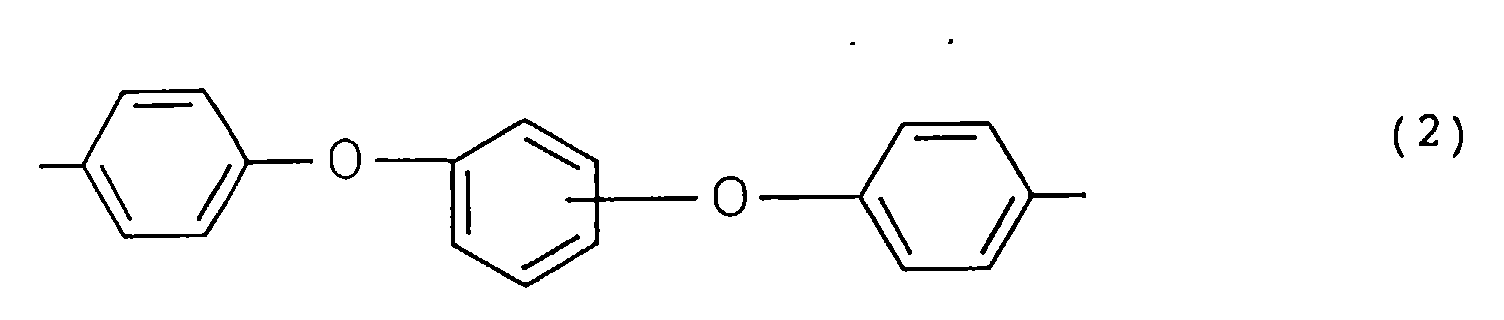 wherein X represents a fluorine atom or a hydrogen atom.
- The aromatic polycarbodiimide of claim 1, wherein n in the formula (A) is an integer of from 2 to 200.
- A polycarbodiimide solution formed by dissolving the aromatic polycarbodiimide of claim 1 in an organic solvent.
- A polycarbodiimide film formed by forming the aromatic polycarbodiimide of claim 1 into a film.
- The polycarbodiimide film of claim 4, wherein said film is stretched in at least monoaxial direction.
Applications Claiming Priority (6)
| Application Number | Priority Date | Filing Date | Title |
|---|---|---|---|
| JP69197/96 | 1996-02-28 | ||
| JP8069197A JPH09235341A (en) | 1996-02-28 | 1996-02-28 | Aromatic polycarbodiimide and film therefrom |
| JP6919796 | 1996-02-28 | ||
| JP11035196 | 1996-04-05 | ||
| JP110351/96 | 1996-04-05 | ||
| JP11035196 | 1996-04-05 |
Publications (2)
| Publication Number | Publication Date |
|---|---|
| EP0792897A1 true EP0792897A1 (en) | 1997-09-03 |
| EP0792897B1 EP0792897B1 (en) | 2003-08-13 |
Family
ID=26410397
Family Applications (1)
| Application Number | Title | Priority Date | Filing Date |
|---|---|---|---|
| EP19970101139 Expired - Lifetime EP0792897B1 (en) | 1996-02-28 | 1997-01-24 | Aromatic polycarbodiimide and films thereof |
Country Status (2)
| Country | Link |
|---|---|
| EP (1) | EP0792897B1 (en) |
| DE (1) | DE69724020T2 (en) |
Cited By (2)
| Publication number | Priority date | Publication date | Assignee | Title |
|---|---|---|---|---|
| EP0915109A1 (en) * | 1997-11-11 | 1999-05-12 | Nitto Denko Corporation | Aromatic polycarbodiimide and film thereof |
| EP0911876A3 (en) * | 1997-10-21 | 2000-05-10 | Nitto Denko Corporation | Low thermal expansion circuit board and multilayer wiring circuit board |
Citations (1)
| Publication number | Priority date | Publication date | Assignee | Title |
|---|---|---|---|---|
| US2941966A (en) * | 1956-08-27 | 1960-06-21 | Du Pont | Carbodiimide polymers |
-
1997
- 1997-01-24 DE DE1997624020 patent/DE69724020T2/en not_active Expired - Lifetime
- 1997-01-24 EP EP19970101139 patent/EP0792897B1/en not_active Expired - Lifetime
Patent Citations (1)
| Publication number | Priority date | Publication date | Assignee | Title |
|---|---|---|---|---|
| US2941966A (en) * | 1956-08-27 | 1960-06-21 | Du Pont | Carbodiimide polymers |
Cited By (5)
| Publication number | Priority date | Publication date | Assignee | Title |
|---|---|---|---|---|
| EP0911876A3 (en) * | 1997-10-21 | 2000-05-10 | Nitto Denko Corporation | Low thermal expansion circuit board and multilayer wiring circuit board |
| US6180261B1 (en) | 1997-10-21 | 2001-01-30 | Nitto Denko Corporation | Low thermal expansion circuit board and multilayer wiring circuit board |
| US6420018B1 (en) | 1997-10-21 | 2002-07-16 | Nitto Denko Corporation | Low thermal expansion circuit board and multilayer wiring circuit board |
| EP0915109A1 (en) * | 1997-11-11 | 1999-05-12 | Nitto Denko Corporation | Aromatic polycarbodiimide and film thereof |
| US6001951A (en) * | 1997-11-11 | 1999-12-14 | Nitto Denko Corporation | Aromatic polycarbodiimide and film thereof |
Also Published As
| Publication number | Publication date |
|---|---|
| DE69724020D1 (en) | 2003-09-18 |
| DE69724020T2 (en) | 2004-02-19 |
| EP0792897B1 (en) | 2003-08-13 |
Similar Documents
| Publication | Publication Date | Title |
|---|---|---|
| US6008311A (en) | Aromatic polycarbodiimide and film thereof | |
| EP0995739B9 (en) | Aromatic polycarbodiimide and polycarbodiimide sheet | |
| US6228972B1 (en) | Aromatic polycarbodiimide and water repellent sheet made therefrom | |
| EP0792897B1 (en) | Aromatic polycarbodiimide and films thereof | |
| US6313258B1 (en) | Aromatic polycarbodiimide and films thereof | |
| JP3914294B2 (en) | Aromatic polycarbodiimide | |
| KR100304475B1 (en) | Aromatic polycarbodiimide and films made therefrom | |
| JP3892595B2 (en) | Aromatic polycarbodiimide and sheet thereof | |
| JP3892597B2 (en) | Aromatic polycarbodiimide and sheet thereof | |
| US6001951A (en) | Aromatic polycarbodiimide and film thereof | |
| JP3855350B2 (en) | Aromatic polycarbodiimide and film thereof | |
| JP3180652B2 (en) | Aromatic polycarbodiimide and its film | |
| JPH09235341A (en) | Aromatic polycarbodiimide and film therefrom | |
| JP3163532B2 (en) | Aromatic diisocyanate | |
| JP3223781B2 (en) | Aromatic diisocyanate | |
| KR100505906B1 (en) | Aromatic polycarbodiimide, and films, solutions and adhesive sheets thereof | |
| JP3211704B2 (en) | Aromatic polycarbodiimide and film | |
| JP3892601B2 (en) | Aromatic polycarbodiimide and sheet thereof | |
| JP3823419B2 (en) | Aromatic polycarbodiimide and film thereof | |
| JP4068264B2 (en) | Aromatic polycarbodiimide and sheet thereof | |
| JP3892602B2 (en) | Aromatic polycarbodiimide and sheet thereof | |
| JP3892585B2 (en) | Aromatic polycarbodiimide and film thereof | |
| JP3892598B2 (en) | Aromatic polycarbodiimide and sheet thereof | |
| JP4132411B2 (en) | Aromatic polycarbodiimide and sheet thereof | |
| JP2000344849A (en) | Aromatic polycarbodiimide and sheet thereof |
Legal Events
| Date | Code | Title | Description |
|---|---|---|---|
| PUAI | Public reference made under article 153(3) epc to a published international application that has entered the european phase |
Free format text: ORIGINAL CODE: 0009012 |
|
| AK | Designated contracting states |
Kind code of ref document: A1 Designated state(s): BE DE FR GB IT NL |
|
| 17P | Request for examination filed |
Effective date: 19971125 |
|
| 17Q | First examination report despatched |
Effective date: 20020726 |
|
| GRAH | Despatch of communication of intention to grant a patent |
Free format text: ORIGINAL CODE: EPIDOS IGRA |
|
| GRAH | Despatch of communication of intention to grant a patent |
Free format text: ORIGINAL CODE: EPIDOS IGRA |
|
| GRAA | (expected) grant |
Free format text: ORIGINAL CODE: 0009210 |
|
| AK | Designated contracting states |
Designated state(s): BE DE FR GB IT NL |
|
| PG25 | Lapsed in a contracting state [announced via postgrant information from national office to epo] |
Ref country code: NL Free format text: LAPSE BECAUSE OF FAILURE TO SUBMIT A TRANSLATION OF THE DESCRIPTION OR TO PAY THE FEE WITHIN THE PRESCRIBED TIME-LIMIT Effective date: 20030813 Ref country code: IT Free format text: LAPSE BECAUSE OF FAILURE TO SUBMIT A TRANSLATION OF THE DESCRIPTION OR TO PAY THE FEE WITHIN THE PRESCRIBED TIME-LIMIT;WARNING: LAPSES OF ITALIAN PATENTS WITH EFFECTIVE DATE BEFORE 2007 MAY HAVE OCCURRED AT ANY TIME BEFORE 2007. THE CORRECT EFFECTIVE DATE MAY BE DIFFERENT FROM THE ONE RECORDED. Effective date: 20030813 Ref country code: BE Free format text: LAPSE BECAUSE OF FAILURE TO SUBMIT A TRANSLATION OF THE DESCRIPTION OR TO PAY THE FEE WITHIN THE PRESCRIBED TIME-LIMIT Effective date: 20030813 |
|
| REG | Reference to a national code |
Ref country code: GB Ref legal event code: FG4D |
|
| REF | Corresponds to: |
Ref document number: 69724020 Country of ref document: DE Date of ref document: 20030918 Kind code of ref document: P |
|
| NLV1 | Nl: lapsed or annulled due to failure to fulfill the requirements of art. 29p and 29m of the patents act | ||
| ET | Fr: translation filed | ||
| PLBE | No opposition filed within time limit |
Free format text: ORIGINAL CODE: 0009261 |
|
| STAA | Information on the status of an ep patent application or granted ep patent |
Free format text: STATUS: NO OPPOSITION FILED WITHIN TIME LIMIT |
|
| 26N | No opposition filed |
Effective date: 20040514 |
|
| PGFP | Annual fee paid to national office [announced via postgrant information from national office to epo] |
Ref country code: FR Payment date: 20120202 Year of fee payment: 16 |
|
| PGFP | Annual fee paid to national office [announced via postgrant information from national office to epo] |
Ref country code: DE Payment date: 20120118 Year of fee payment: 16 |
|
| PGFP | Annual fee paid to national office [announced via postgrant information from national office to epo] |
Ref country code: GB Payment date: 20120118 Year of fee payment: 16 |
|
| GBPC | Gb: european patent ceased through non-payment of renewal fee |
Effective date: 20130124 |
|
| REG | Reference to a national code |
Ref country code: FR Ref legal event code: ST Effective date: 20130930 |
|
| PG25 | Lapsed in a contracting state [announced via postgrant information from national office to epo] |
Ref country code: DE Free format text: LAPSE BECAUSE OF NON-PAYMENT OF DUE FEES Effective date: 20130801 |
|
| REG | Reference to a national code |
Ref country code: DE Ref legal event code: R119 Ref document number: 69724020 Country of ref document: DE Effective date: 20130801 |
|
| PG25 | Lapsed in a contracting state [announced via postgrant information from national office to epo] |
Ref country code: GB Free format text: LAPSE BECAUSE OF NON-PAYMENT OF DUE FEES Effective date: 20130124 Ref country code: FR Free format text: LAPSE BECAUSE OF NON-PAYMENT OF DUE FEES Effective date: 20130131 |