EP0790286B1 - Surface treating process and device - Google Patents
Surface treating process and device Download PDFInfo
- Publication number
- EP0790286B1 EP0790286B1 EP96203637A EP96203637A EP0790286B1 EP 0790286 B1 EP0790286 B1 EP 0790286B1 EP 96203637 A EP96203637 A EP 96203637A EP 96203637 A EP96203637 A EP 96203637A EP 0790286 B1 EP0790286 B1 EP 0790286B1
- Authority
- EP
- European Patent Office
- Prior art keywords
- weight
- product
- cleaning
- floor
- liquid repair
- Prior art date
- Legal status (The legal status is an assumption and is not a legal conclusion. Google has not performed a legal analysis and makes no representation as to the accuracy of the status listed.)
- Expired - Lifetime
Links
- 238000000034 method Methods 0.000 title claims description 30
- 238000004140 cleaning Methods 0.000 claims description 25
- 229920006254 polymer film Polymers 0.000 claims description 17
- 239000007788 liquid Substances 0.000 claims description 16
- 239000006185 dispersion Substances 0.000 claims description 6
- XLYOFNOQVPJJNP-UHFFFAOYSA-N water Substances O XLYOFNOQVPJJNP-UHFFFAOYSA-N 0.000 claims description 5
- YEJRWHAVMIAJKC-UHFFFAOYSA-N 4-Butyrolactone Chemical compound O=C1CCCO1 YEJRWHAVMIAJKC-UHFFFAOYSA-N 0.000 claims description 4
- AVXURJPOCDRRFD-UHFFFAOYSA-N Hydroxylamine Chemical compound ON AVXURJPOCDRRFD-UHFFFAOYSA-N 0.000 claims description 4
- 238000001035 drying Methods 0.000 claims description 4
- 239000011347 resin Substances 0.000 claims description 4
- 229920005989 resin Polymers 0.000 claims description 4
- 238000005507 spraying Methods 0.000 claims description 4
- 239000004815 dispersion polymer Substances 0.000 claims description 3
- 239000000203 mixture Substances 0.000 claims description 3
- 239000004014 plasticizer Substances 0.000 claims description 3
- 239000002904 solvent Substances 0.000 claims description 3
- 229910019142 PO4 Inorganic materials 0.000 claims description 2
- 235000011037 adipic acid Nutrition 0.000 claims description 2
- 150000001279 adipic acids Chemical class 0.000 claims description 2
- 239000003945 anionic surfactant Substances 0.000 claims description 2
- 150000001860 citric acid derivatives Chemical class 0.000 claims description 2
- 150000005690 diesters Chemical class 0.000 claims description 2
- 150000002311 glutaric acids Chemical class 0.000 claims description 2
- 235000021317 phosphate Nutrition 0.000 claims description 2
- 150000003013 phosphoric acid derivatives Chemical class 0.000 claims description 2
- 239000011877 solvent mixture Substances 0.000 claims description 2
- 235000011044 succinic acid Nutrition 0.000 claims description 2
- 150000003444 succinic acids Chemical class 0.000 claims description 2
- 238000012423 maintenance Methods 0.000 description 6
- 229920000642 polymer Polymers 0.000 description 5
- 239000007921 spray Substances 0.000 description 3
- KFZMGEQAYNKOFK-UHFFFAOYSA-N Isopropanol Chemical compound CC(C)O KFZMGEQAYNKOFK-UHFFFAOYSA-N 0.000 description 2
- 238000011010 flushing procedure Methods 0.000 description 2
- 238000005498 polishing Methods 0.000 description 2
- RSWGJHLUYNHPMX-UHFFFAOYSA-N Abietic-Saeure Natural products C12CCC(C(C)C)=CC2=CCC2C1(C)CCCC2(C)C(O)=O RSWGJHLUYNHPMX-UHFFFAOYSA-N 0.000 description 1
- LFQSCWFLJHTTHZ-UHFFFAOYSA-N Ethanol Chemical compound CCO LFQSCWFLJHTTHZ-UHFFFAOYSA-N 0.000 description 1
- KHPCPRHQVVSZAH-HUOMCSJISA-N Rosin Natural products O(C/C=C/c1ccccc1)[C@H]1[C@H](O)[C@@H](O)[C@@H](O)[C@@H](CO)O1 KHPCPRHQVVSZAH-HUOMCSJISA-N 0.000 description 1
- NIXOWILDQLNWCW-UHFFFAOYSA-N acrylic acid group Chemical group C(C=C)(=O)O NIXOWILDQLNWCW-UHFFFAOYSA-N 0.000 description 1
- 239000000470 constituent Substances 0.000 description 1
- 230000007613 environmental effect Effects 0.000 description 1
- LYCAIKOWRPUZTN-UHFFFAOYSA-N ethylene glycol Natural products OCCO LYCAIKOWRPUZTN-UHFFFAOYSA-N 0.000 description 1
- 230000002349 favourable effect Effects 0.000 description 1
- -1 glycol ethers Chemical class 0.000 description 1
- WGCNASOHLSPBMP-UHFFFAOYSA-N hydroxyacetaldehyde Natural products OCC=O WGCNASOHLSPBMP-UHFFFAOYSA-N 0.000 description 1
- 239000000463 material Substances 0.000 description 1
- 229920000058 polyacrylate Polymers 0.000 description 1
- 229920003009 polyurethane dispersion Polymers 0.000 description 1
- 238000005086 pumping Methods 0.000 description 1
- 239000000344 soap Substances 0.000 description 1
- 239000004094 surface-active agent Substances 0.000 description 1
- KHPCPRHQVVSZAH-UHFFFAOYSA-N trans-cinnamyl beta-D-glucopyranoside Natural products OC1C(O)C(O)C(CO)OC1OCC=CC1=CC=CC=C1 KHPCPRHQVVSZAH-UHFFFAOYSA-N 0.000 description 1
Images
Classifications
-
- C—CHEMISTRY; METALLURGY
- C11—ANIMAL OR VEGETABLE OILS, FATS, FATTY SUBSTANCES OR WAXES; FATTY ACIDS THEREFROM; DETERGENTS; CANDLES
- C11D—DETERGENT COMPOSITIONS; USE OF SINGLE SUBSTANCES AS DETERGENTS; SOAP OR SOAP-MAKING; RESIN SOAPS; RECOVERY OF GLYCEROL
- C11D17/00—Detergent materials or soaps characterised by their shape or physical properties
- C11D17/0043—For use with aerosol devices
-
- A—HUMAN NECESSITIES
- A47—FURNITURE; DOMESTIC ARTICLES OR APPLIANCES; COFFEE MILLS; SPICE MILLS; SUCTION CLEANERS IN GENERAL
- A47L—DOMESTIC WASHING OR CLEANING; SUCTION CLEANERS IN GENERAL
- A47L13/00—Implements for cleaning floors, carpets, furniture, walls, or wall coverings
- A47L13/10—Scrubbing; Scouring; Cleaning; Polishing
- A47L13/20—Mops
- A47L13/22—Mops with liquid-feeding devices
-
- A—HUMAN NECESSITIES
- A47—FURNITURE; DOMESTIC ARTICLES OR APPLIANCES; COFFEE MILLS; SPICE MILLS; SUCTION CLEANERS IN GENERAL
- A47L—DOMESTIC WASHING OR CLEANING; SUCTION CLEANERS IN GENERAL
- A47L13/00—Implements for cleaning floors, carpets, furniture, walls, or wall coverings
- A47L13/10—Scrubbing; Scouring; Cleaning; Polishing
- A47L13/26—Other cleaning devices with liquid supply arrangements
-
- A—HUMAN NECESSITIES
- A47—FURNITURE; DOMESTIC ARTICLES OR APPLIANCES; COFFEE MILLS; SPICE MILLS; SUCTION CLEANERS IN GENERAL
- A47L—DOMESTIC WASHING OR CLEANING; SUCTION CLEANERS IN GENERAL
- A47L13/00—Implements for cleaning floors, carpets, furniture, walls, or wall coverings
- A47L13/10—Scrubbing; Scouring; Cleaning; Polishing
- A47L13/28—Polishing implements
- A47L13/294—Polishing implements having invertible head, one side being used for dispensing polishing material and the reverse side for shining
-
- A—HUMAN NECESSITIES
- A47—FURNITURE; DOMESTIC ARTICLES OR APPLIANCES; COFFEE MILLS; SPICE MILLS; SUCTION CLEANERS IN GENERAL
- A47L—DOMESTIC WASHING OR CLEANING; SUCTION CLEANERS IN GENERAL
- A47L13/00—Implements for cleaning floors, carpets, furniture, walls, or wall coverings
- A47L13/10—Scrubbing; Scouring; Cleaning; Polishing
- A47L13/28—Polishing implements
- A47L13/30—Implements for polishing and waxing or oiling, with dispensers for wax or oil
- A47L13/314—Implements for polishing and waxing or oiling, with dispensers for wax or oil having invertible head, one side being used for dispensing wax or oil and the reverse side for shining
- A47L13/316—Implements for polishing and waxing or oiling, with dispensers for wax or oil having invertible head, one side being used for dispensing wax or oil and the reverse side for shining supplied with liquid wax or oil
-
- C—CHEMISTRY; METALLURGY
- C09—DYES; PAINTS; POLISHES; NATURAL RESINS; ADHESIVES; COMPOSITIONS NOT OTHERWISE PROVIDED FOR; APPLICATIONS OF MATERIALS NOT OTHERWISE PROVIDED FOR
- C09G—POLISHING COMPOSITIONS; SKI WAXES
- C09G1/00—Polishing compositions
- C09G1/06—Other polishing compositions
- C09G1/08—Other polishing compositions based on wax
- C09G1/10—Other polishing compositions based on wax based on mixtures of wax and natural or synthetic resin
-
- C—CHEMISTRY; METALLURGY
- C11—ANIMAL OR VEGETABLE OILS, FATS, FATTY SUBSTANCES OR WAXES; FATTY ACIDS THEREFROM; DETERGENTS; CANDLES
- C11D—DETERGENT COMPOSITIONS; USE OF SINGLE SUBSTANCES AS DETERGENTS; SOAP OR SOAP-MAKING; RESIN SOAPS; RECOVERY OF GLYCEROL
- C11D1/00—Detergent compositions based essentially on surface-active compounds; Use of these compounds as a detergent
- C11D1/66—Non-ionic compounds
- C11D1/75—Amino oxides
-
- C—CHEMISTRY; METALLURGY
- C11—ANIMAL OR VEGETABLE OILS, FATS, FATTY SUBSTANCES OR WAXES; FATTY ACIDS THEREFROM; DETERGENTS; CANDLES
- C11D—DETERGENT COMPOSITIONS; USE OF SINGLE SUBSTANCES AS DETERGENTS; SOAP OR SOAP-MAKING; RESIN SOAPS; RECOVERY OF GLYCEROL
- C11D3/00—Other compounding ingredients of detergent compositions covered in group C11D1/00
- C11D3/16—Organic compounds
- C11D3/20—Organic compounds containing oxygen
- C11D3/2093—Esters; Carbonates
-
- C—CHEMISTRY; METALLURGY
- C11—ANIMAL OR VEGETABLE OILS, FATS, FATTY SUBSTANCES OR WAXES; FATTY ACIDS THEREFROM; DETERGENTS; CANDLES
- C11D—DETERGENT COMPOSITIONS; USE OF SINGLE SUBSTANCES AS DETERGENTS; SOAP OR SOAP-MAKING; RESIN SOAPS; RECOVERY OF GLYCEROL
- C11D3/00—Other compounding ingredients of detergent compositions covered in group C11D1/00
- C11D3/43—Solvents
-
- C—CHEMISTRY; METALLURGY
- C11—ANIMAL OR VEGETABLE OILS, FATS, FATTY SUBSTANCES OR WAXES; FATTY ACIDS THEREFROM; DETERGENTS; CANDLES
- C11D—DETERGENT COMPOSITIONS; USE OF SINGLE SUBSTANCES AS DETERGENTS; SOAP OR SOAP-MAKING; RESIN SOAPS; RECOVERY OF GLYCEROL
- C11D2111/00—Cleaning compositions characterised by the objects to be cleaned; Cleaning compositions characterised by non-standard cleaning or washing processes
- C11D2111/10—Objects to be cleaned
- C11D2111/14—Hard surfaces
Definitions
- the present invention relates to a process for treating and repairing hard surfaces, preferably floor surfaces, particularly floor surfaces consisting of a polymer film.
- the invention also relates to a device specially adapted for use in the process of the invention.
- Floor cleaning processes are well-known in the art. Some floor surfaces additionally need protection in order to facilitate the cleaning thereof, to avoid or diminish wear, and for aesthetical reasons. Such protection can be obtained by applying to said floor surfaces soap-based products, wax-based products or polymer-based products.
- Polymer-based products which generally offer the best protection, are usually polymer dispersions comprising polymer, wax, alkaline soluble resin, plasticizer and water.
- Polymer dispersions are applied onto a floor surface in the form of a thin polymer film, for instance a thin acrylate polymer film.
- This type of film is usually hard, transparent, and resistant to wear.
- durable polymer films are susceptable to attrition. Therefore, several products are commercially available for the maintenance of polymer films. Since the main constituent of these maintenance products is wax, the floor surface obtains the properties of the wax after treatment with such a maintenance product. In other words, the floor surface becomes less hard, less transparent and more resistant to wear, after this type of maintenance.
- a floor polishing machine For the treatment of a floor surface with a waxy maintenance product of the prior art, a floor polishing machine is usually applied containing one round pad or brush and a spray-bottle. Using this machine, wax is sprayed onto the floor surface and, subsequently, said wax is polished with the brush or pad. This process is rather inefficient since a considerable amount of maintenance product disappears into the polishing brush or pad. Furthermore, wear of the polymer film is not significantly reduced by applying this method, and replacement of the polymer film will be needed after a certain period of use.
- Another object of the invention to find a method by which, preferably in a simple way, the quality of the polymer film can be improved so as to avoid replacement thereof.
- the invention provides a process for treating and repairing a hard surface consisting of a polymer film, such as a floor surface, according to claim 1.
- the properties of the liquid repair product used in this process -after drying thereof- which are similar to those of the polymer film are wear resistance, gloss, transparency, hardness, removability, water-resistance, slip-resistance.
- a manually operated floor treating device comprising a grip (1), a shaft (2), two start/stop buttons (3,4), two tanks (5,6) filled with cleaning product respectively liquid repair product and situated on opposite sides of the shaft, both of which tanks being connected to a spraying nozzle (7,8) operable by way of an electric pump, and a turnable member (9) connected to the bottom side of the shaft by way of a hinge (10).
- the process of the invention is very suitable for repairing, in a simple way, local wear of a floor surface consisting of a polymer film while maintaining the excellent properties of the film.
- the process of the invention includes a cleaning step, a repair step and a drying step.
- the properties of the repair product applied during the repair step are similar to those of the polymer film to be treated and repaired: after application onto said film, the repair product exhibits similar hardness, wear resistance, slip-resistance, water resistance, gloss, removability and transparency as the original polymer film.
- a good attachment of the repair product to the original polymer film is essential. Therefore, a cleaning step is required.
- an aqueous cleaning product comprising 1-5% by weight of an aminoxide, as a surfactant, a solvent mixture including 1-20% by weight of gamma butyrolactone and 1-20% by weight of a methylic diester of glutaric, succinic and adipic acids, and 1-10% by weight of a builder selected from citrates, phosphates and mixtures thereof, all percentages being based on the cleaning product, is fully compatible with the repair product.
- Such cleaning products are used in the process of the invention since the mentioned flushing step is not needed when applying these products which simplifies the floor treatment process significantly.
- the most suitable type of aminoxide for use in this type of cleaning product is cocodimethylaminoxide.
- Suitable liquid repair product used in the process of the invention are those comprising 1-40% by weight of a polymer dispersion, 0.5-40% by weight of a wax dispersion, 0.5-30% by weight of a solvent and up to 100% by weight of water.
- said liquid repair product comprises additionally 0.1-10% by weight of a plasticizer, up to 20% by weight of an alkaline soluble resin, such as rosin-based resin, and up to 5% by weight of an anionic surfactant.
- the wax dispersion is effectively a polyethylenewax dipersion, and the polymer dispersion is desirably a mixture of an acrylic dispersion and a polyurethane dispersion.
- said product contains preferably also up to 30% by weight of an alcohol, particularly isopropanol.
- the process of the invention is carried out in a simple way so as to enable quick treatment of the floor surface to be repaired.
- the manually operated floor treating device of the invention has been developed.
- the floor treating device of the invention contains everything needed for quick and effective repair of the floor surface. No additional materials are needed.
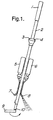
- Figure 1 shows a schematic cross-sectional view of the floor treating device according to the invention.
- the floor treating device shown in Figure 1 is manually operable by way of grip (1) which is situated at the top side of shaft (2).
- the two start/stop buttons (3,4) are present at the shaft not far from the grip.
- button (3) When button (3) is activated, liquid cleaning product is pumped out of tank (5) and sprayed by way of nozzle (7) onto the floor surface to be treated.
- button (4) when button (4) is activated, liquid repair product present in tank (6) is pumped out of said tank to spray nozzle (8) and sprayed by said spray nozzle onto the floor surface.
- the pumping action is achieved using electric pumps (not shown).
- the liquid cleaning product is first sprayed on to the floor surface by way of nozzle (8).
- the cleaning product is subsequently distributed with a turnable member (9) which is connected to the bottom side of the shaft (2) by way of a hinge (10).
- the floor cleaning machine is lifted and turned over an angle of about 180° such that the two tanks (5,6) change position.
- the liquid repair product is sprayed onto the floor surface by way of spray nozzle (7), and distributed using turnable member (9).
- the treated and repaired floor surface is allowed to dry for at least 10 minutes.
Landscapes
- Chemical & Material Sciences (AREA)
- Organic Chemistry (AREA)
- Oil, Petroleum & Natural Gas (AREA)
- Life Sciences & Earth Sciences (AREA)
- Engineering & Computer Science (AREA)
- Chemical Kinetics & Catalysis (AREA)
- Wood Science & Technology (AREA)
- Health & Medical Sciences (AREA)
- Emergency Medicine (AREA)
- Application Of Or Painting With Fluid Materials (AREA)
- Detergent Compositions (AREA)
- Cleaning By Liquid Or Steam (AREA)
Description
- The present invention relates to a process for treating and repairing hard surfaces, preferably floor surfaces, particularly floor surfaces consisting of a polymer film. The invention also relates to a device specially adapted for use in the process of the invention.
- Floor cleaning processes are well-known in the art.
Some floor surfaces additionally need protection in order to facilitate the cleaning thereof, to avoid or diminish wear, and for aesthetical reasons. Such protection can be obtained by applying to said floor surfaces soap-based products, wax-based products or polymer-based products. Polymer-based products which generally offer the best protection, are usually polymer dispersions comprising polymer, wax, alkaline soluble resin, plasticizer and water. - Polymer dispersions are applied onto a floor surface in the form of a thin polymer film, for instance a thin acrylate polymer film. This type of film is usually hard, transparent, and resistant to wear. However, even durable polymer films are susceptable to attrition. Therefore, several products are commercially available for the maintenance of polymer films. Since the main constituent of these maintenance products is wax, the floor surface obtains the properties of the wax after treatment with such a maintenance product. In other words, the floor surface becomes less hard, less transparent and more resistant to wear, after this type of maintenance.
- For the treatment of a floor surface with a waxy maintenance product of the prior art, a floor polishing machine is usually applied containing one round pad or brush and a spray-bottle. Using this machine, wax is sprayed onto the floor surface and, subsequently, said wax is polished with the brush or pad. This process is rather inefficient since a considerable amount of maintenance product disappears into the polishing brush or pad. Furthermore, wear of the polymer film is not significantly reduced by applying this method, and replacement of the polymer film will be needed after a certain period of use.
- It is an object of the present invention to provide a process for treating floor surfaces consisting of a polymer film, which process does not suffer from the above-discussed problems.
- At present, replacement of polymer films on floor surfaces is considered to be more and more problematic for environmental and safety reasons. Reason is that highly alkaline products and/or environmentally less desirable solvents, such as glycol ethers, are needed for said replacement.
- It is, therefore, another object of the invention to find a method by which, preferably in a simple way, the quality of the polymer film can be improved so as to avoid replacement thereof.
- It was surprisingly found that these and other objects can be achieved when applying the process according to the present invention. It was also found that said process can be effectively carried out using the device according to the present invention.
- Accordingly, in one aspect the invention provides a process for treating and repairing a hard surface consisting of a polymer film, such as a floor surface, according to claim 1.
- The properties of the liquid repair product used in this process -after drying thereof- which are similar to those of the polymer film are wear resistance, gloss, transparency, hardness, removability, water-resistance, slip-resistance.
- Desirably, a manually operated floor treating device is used in the process of the invention, said device comprising a grip (1), a shaft (2), two start/stop buttons (3,4), two tanks (5,6) filled with cleaning product respectively liquid repair product and situated on opposite sides of the shaft, both of which tanks being connected to a spraying nozzle (7,8) operable by way of an electric pump, and a turnable member (9) connected to the bottom side of the shaft by way of a hinge (10).
- The process of the invention is very suitable for repairing, in a simple way, local wear of a floor surface consisting of a polymer film while maintaining the excellent properties of the film.
- The process of the invention includes a cleaning step, a repair step and a drying step. The properties of the repair product applied during the repair step, are similar to those of the polymer film to be treated and repaired: after application onto said film, the repair product exhibits similar hardness, wear resistance, slip-resistance, water resistance, gloss, removability and transparency as the original polymer film. However, for these properties to be obtainable, a good attachment of the repair product to the original polymer film is essential. Therefore, a cleaning step is required.
- It is known that various of the known floor cleaning products interfere with the floor repair products according to the invention, resulting in less than optimal adhesion, gloss and transparancy of the repair product. In those cases, flushing of the floor surface with clean water before treatment with the repair product is desirable for obtaining favourable results.
- It has now been found that an aqueous cleaning product comprising 1-5% by weight of an aminoxide, as a surfactant, a solvent mixture including 1-20% by weight of gamma butyrolactone and 1-20% by weight of a methylic diester of glutaric, succinic and adipic acids, and 1-10% by weight of a builder selected from citrates, phosphates and mixtures thereof, all percentages being based on the cleaning product, is fully compatible with the repair product. Such cleaning products are used in the process of the invention since the mentioned flushing step is not needed when applying these products which simplifies the floor treatment process significantly.
- The most suitable type of aminoxide for use in this type of cleaning product is cocodimethylaminoxide.
- Suitable liquid repair product used in the process of the invention are those comprising 1-40% by weight of a polymer dispersion, 0.5-40% by weight of a wax dispersion, 0.5-30% by weight of a solvent and up to 100% by weight of water.
- More preferably, said liquid repair product comprises additionally 0.1-10% by weight of a plasticizer, up to 20% by weight of an alkaline soluble resin, such as rosin-based resin, and up to 5% by weight of an anionic surfactant.
- The wax dispersion is effectively a polyethylenewax dipersion, and the polymer dispersion is desirably a mixture of an acrylic dispersion and a polyurethane dispersion. For improving the adhesion, cleaning and (fast-)drying properties of the liquid repair product, said product contains preferably also up to 30% by weight of an alcohol, particularly isopropanol.
- It is desirable that the process of the invention is carried out in a simple way so as to enable quick treatment of the floor surface to be repaired. In order to enable such quick and simple treatment of floor surfaces, the manually operated floor treating device of the invention has been developed.
- When applying this device in the process of the invention, it only needs to be lifted and turned over an angle of 180° for treatment with liquid repair product of the cleaned floor surface. Furthermore, the floor treating device of the invention contains everything needed for quick and effective repair of the floor surface. No additional materials are needed.
- These characteristics allow quick and simple treatment of the floor surface.
- The invention is further illustrated by Figure 1 which shows a schematic cross-sectional view of the floor treating device according to the invention.
- The floor treating device shown in Figure 1, is manually operable by way of grip (1) which is situated at the top side of shaft (2). The two start/stop buttons (3,4) are present at the shaft not far from the grip. When button (3) is activated, liquid cleaning product is pumped out of tank (5) and sprayed by way of nozzle (7) onto the floor surface to be treated. On the other hand, when button (4) is activated, liquid repair product present in tank (6) is pumped out of said tank to spray nozzle (8) and sprayed by said spray nozzle onto the floor surface. The pumping action is achieved using electric pumps (not shown).
- When using the device shown in Figure 1, the liquid cleaning product is first sprayed on to the floor surface by way of nozzle (8). The cleaning product is subsequently distributed with a turnable member (9) which is connected to the bottom side of the shaft (2) by way of a hinge (10). In the next step, the floor cleaning machine is lifted and turned over an angle of about 180° such that the two tanks (5,6) change position. Thereafter, the liquid repair product is sprayed onto the floor surface by way of spray nozzle (7), and distributed using turnable member (9). As a last step of this treating process, the treated and repaired floor surface is allowed to dry for at least 10 minutes.
Claims (5)
- Process for treating and repairing a hard surface consisting of a polymer film, such as a floor surface, said process comprising the steps of:(i) cleaning said surface with an aqueous cleaning product comprising(a) 1-5% by weight of an aminoxide;(b) a solvent mixture including 1-20% by weight of gamma butyrolactone and 1-20% by weight of a methylic diester of glutaric, succinic and adipic acids;(c) 1-10% by weight of a builder selected from citrates, phosphates and mixtures,
all percentages being based on the cleaning product,(ii) applying to the cleaned surface a liquid repair product, the properties of said liquid repair product, after drying thereof, being similar to those of the polymer film, said properties being wear resistance, gloss, transparancy, hardness, removability, water-resistance, and slip-resistance; and(iii) allowing the thus-treated surface to dry for at least 5 minutes. - Process according to claim 1, wherein the aminoxide is cocodimethylaminoxide.
- Process according to claim 1 or claim 2, wherein the liquid repair product comprises 1-40% by weight of a polymer dispersion, 0.5-40% by weight of a wax dispersion, 0.5-30% by weight of a solvent and up to 100% by weight of water.
- Process according to claim 3, wherein the liquid repair product additionally comprises 0.1-10% by weight of a plasticizer, up to 20% by weight of an alkaline soluble resin, and up to 5% by weight of an anionic surfactant.
- Process according to any of claims 1-4, wherein a manually operated floor cleaning device is used, said device comprising a grip (1), a shaft (2), two start/stop buttons (3,4), two tanks (5,6) filled with cleaning product respectively liquid repair product and situated on opposite sides of the shaft, both of which tanks being connected to a spraying nozzle (7,8) operable by way of an electric pump, and a turnable member (9) connected to the bottom side of the shaft by way of a hinge (10), said process comprising the steps of:(i) cleaning the floor surface by spraying the cleaning product onto the floor by way of nozzle (8);(ii) distributing said cleaning product using member (9);(ii) turning the floor cleaning device over an angle of about 180° such that the two tanks (5,6) change position;(iv) spraying and distributing the liquid repair product using the method mentioned above for the cleaning product;and (v) allowing the thus treated floor to dry for at least 5 minutes.
Priority Applications (1)
| Application Number | Priority Date | Filing Date | Title |
|---|---|---|---|
| EP96203637A EP0790286B1 (en) | 1996-02-13 | 1996-12-19 | Surface treating process and device |
Applications Claiming Priority (3)
| Application Number | Priority Date | Filing Date | Title |
|---|---|---|---|
| EP96200333 | 1996-02-13 | ||
| EP96200333 | 1996-02-13 | ||
| EP96203637A EP0790286B1 (en) | 1996-02-13 | 1996-12-19 | Surface treating process and device |
Publications (2)
| Publication Number | Publication Date |
|---|---|
| EP0790286A1 EP0790286A1 (en) | 1997-08-20 |
| EP0790286B1 true EP0790286B1 (en) | 2003-07-16 |
Family
ID=26142491
Family Applications (1)
| Application Number | Title | Priority Date | Filing Date |
|---|---|---|---|
| EP96203637A Expired - Lifetime EP0790286B1 (en) | 1996-02-13 | 1996-12-19 | Surface treating process and device |
Country Status (1)
| Country | Link |
|---|---|
| EP (1) | EP0790286B1 (en) |
Families Citing this family (1)
| Publication number | Priority date | Publication date | Assignee | Title |
|---|---|---|---|---|
| US20070212157A1 (en) * | 2006-03-13 | 2007-09-13 | Hoadley David A | Fringeless cleaning or dusting pad |
Family Cites Families (5)
| Publication number | Priority date | Publication date | Assignee | Title |
|---|---|---|---|---|
| US3028615A (en) * | 1959-12-01 | 1962-04-10 | Hoover Co | Combined polisher and shampooer |
| GB1063758A (en) * | 1963-07-29 | 1967-03-30 | Colgate Palmolive Co | Polishes and method of preparing them |
| US4690779A (en) * | 1983-06-16 | 1987-09-01 | The Clorox Company | Hard surface cleaning composition |
| DE3533531A1 (en) * | 1985-09-20 | 1987-04-02 | Henkel Kgaa | CLEANER FOR HARD SURFACES |
| CN1065906C (en) * | 1993-03-30 | 2001-05-16 | 美国3M公司 | Multi-surface cleaning compositions and methods of use thereof |
-
1996
- 1996-12-19 EP EP96203637A patent/EP0790286B1/en not_active Expired - Lifetime
Also Published As
| Publication number | Publication date |
|---|---|
| EP0790286A1 (en) | 1997-08-20 |
Similar Documents
| Publication | Publication Date | Title |
|---|---|---|
| US5782991A (en) | Surface treating process | |
| US20100041772A1 (en) | Sprayable liquid emulsion polymer coating compositions | |
| JPH0329632A (en) | Wiper for polishing and washing | |
| US20120199249A1 (en) | Floor treatment | |
| US4738876A (en) | Stone surface treating methods and compositions | |
| US6444134B1 (en) | Wood floor refinishing process and product | |
| US20050159325A1 (en) | Headlight cleaner, restorer, and methods for the manufacture and use thereof | |
| EP0790286A1 (en) | Surface treating process and device | |
| MXPA06015005A (en) | Methods and systems for coating articles having a plastic substrate. | |
| WO2009082537A1 (en) | Easily removable concrete curing compound | |
| US3297456A (en) | Surface coating and preserving composition | |
| CN112354828A (en) | Coating method for automobile body covering part | |
| US20050049159A1 (en) | Combination cleaning and waxing composition and method | |
| EP0207307B1 (en) | Stone surface treating methods and compositions | |
| US5073407A (en) | Method of treating a surface | |
| US5834054A (en) | Method for restoring an automotive paint finish | |
| CN209257190U (en) | A kind of production system of door-plate antique-imitation | |
| JPS6169686A (en) | Method of glazing handrail for man conveyor | |
| US5248443A (en) | Seam cleaning composition | |
| US7316993B2 (en) | Combination cleaning and waxing composition and method | |
| CN1289209C (en) | Clean paint coating method for removing automobile hack | |
| JP3517050B2 (en) | Floor gloss recovery agent | |
| GB2285054A (en) | A composition for cleaning and polishing surfaces | |
| US2231233A (en) | Process of finishing materials | |
| KR20050116578A (en) | Rapid-painting technology for removing a scar on trim of automobile |
Legal Events
| Date | Code | Title | Description |
|---|---|---|---|
| PUAI | Public reference made under article 153(3) epc to a published international application that has entered the european phase |
Free format text: ORIGINAL CODE: 0009012 |
|
| AK | Designated contracting states |
Kind code of ref document: A1 Designated state(s): CH DE ES FR GB IT LI NL SE |
|
| 17P | Request for examination filed |
Effective date: 19970619 |
|
| 17Q | First examination report despatched |
Effective date: 20010806 |
|
| RAP1 | Party data changed (applicant data changed or rights of an application transferred) |
Owner name: JOHNSONDIVERSEY, INC. |
|
| GRAH | Despatch of communication of intention to grant a patent |
Free format text: ORIGINAL CODE: EPIDOS IGRA |
|
| GRAH | Despatch of communication of intention to grant a patent |
Free format text: ORIGINAL CODE: EPIDOS IGRA |
|
| GRAA | (expected) grant |
Free format text: ORIGINAL CODE: 0009210 |
|
| AK | Designated contracting states |
Designated state(s): CH DE ES FR GB IT LI NL SE |
|
| REG | Reference to a national code |
Ref country code: GB Ref legal event code: FG4D |
|
| REG | Reference to a national code |
Ref country code: CH Ref legal event code: EP |
|
| REG | Reference to a national code |
Ref country code: CH Ref legal event code: NV Representative=s name: DR. LUSUARDI AG |
|
| REF | Corresponds to: |
Ref document number: 69629101 Country of ref document: DE Date of ref document: 20030821 Kind code of ref document: P |
|
| PG25 | Lapsed in a contracting state [announced via postgrant information from national office to epo] |
Ref country code: SE Free format text: LAPSE BECAUSE OF FAILURE TO SUBMIT A TRANSLATION OF THE DESCRIPTION OR TO PAY THE FEE WITHIN THE PRESCRIBED TIME-LIMIT Effective date: 20031016 |
|
| REG | Reference to a national code |
Ref country code: ES Ref legal event code: FG2A Ref document number: 2202412 Country of ref document: ES Kind code of ref document: T3 |
|
| ET | Fr: translation filed | ||
| PLBE | No opposition filed within time limit |
Free format text: ORIGINAL CODE: 0009261 |
|
| STAA | Information on the status of an ep patent application or granted ep patent |
Free format text: STATUS: NO OPPOSITION FILED WITHIN TIME LIMIT |
|
| 26N | No opposition filed |
Effective date: 20040419 |
|
| REG | Reference to a national code |
Ref country code: CH Ref legal event code: PFA Owner name: JOHNSONDIVERSEY, INC. Free format text: JOHNSONDIVERSEY, INC.#8310 16TH STREET#STURTEVANT, WISCONSIN 53177-0902 (US) -TRANSFER TO- JOHNSONDIVERSEY, INC.#8310 16TH STREET#STURTEVANT, WISCONSIN 53177-0902 (US) |
|
| REG | Reference to a national code |
Ref country code: CH Ref legal event code: PFA Owner name: DIVERSEY, INC. Free format text: JOHNSONDIVERSEY, INC.#8310 16TH STREET#STURTEVANT, WISCONSIN 53177-0902 (US) -TRANSFER TO- DIVERSEY, INC.#8310 16TH STREET - M/S 509#STURTEVANT, WI 53177-0902 (US) |
|
| REG | Reference to a national code |
Ref country code: NL Ref legal event code: TD Effective date: 20101013 |
|
| REG | Reference to a national code |
Ref country code: FR Ref legal event code: CD |
|
| REG | Reference to a national code |
Ref country code: ES Ref legal event code: PC2A Owner name: DIVERSEY, INC. Effective date: 20110429 |
|
| REG | Reference to a national code |
Ref country code: NL Ref legal event code: PLEX Effective date: 20120724 |
|
| PGFP | Annual fee paid to national office [announced via postgrant information from national office to epo] |
Ref country code: GB Payment date: 20131227 Year of fee payment: 18 Ref country code: DE Payment date: 20131230 Year of fee payment: 18 Ref country code: CH Payment date: 20131230 Year of fee payment: 18 |
|
| PGFP | Annual fee paid to national office [announced via postgrant information from national office to epo] |
Ref country code: ES Payment date: 20131226 Year of fee payment: 18 Ref country code: FR Payment date: 20131217 Year of fee payment: 18 Ref country code: IT Payment date: 20131224 Year of fee payment: 18 Ref country code: NL Payment date: 20131226 Year of fee payment: 18 |
|
| REG | Reference to a national code |
Ref country code: DE Ref legal event code: R119 Ref document number: 69629101 Country of ref document: DE |
|
| REG | Reference to a national code |
Ref country code: NL Ref legal event code: V1 Effective date: 20150701 |
|
| REG | Reference to a national code |
Ref country code: NL Ref legal event code: V1 Effective date: 20150701 |
|
| REG | Reference to a national code |
Ref country code: CH Ref legal event code: PL |
|
| GBPC | Gb: european patent ceased through non-payment of renewal fee |
Effective date: 20141219 |
|
| REG | Reference to a national code |
Ref country code: FR Ref legal event code: ST Effective date: 20150831 |
|
| PG25 | Lapsed in a contracting state [announced via postgrant information from national office to epo] |
Ref country code: NL Free format text: LAPSE BECAUSE OF NON-PAYMENT OF DUE FEES Effective date: 20150701 |
|
| PG25 | Lapsed in a contracting state [announced via postgrant information from national office to epo] |
Ref country code: DE Free format text: LAPSE BECAUSE OF NON-PAYMENT OF DUE FEES Effective date: 20150701 Ref country code: GB Free format text: LAPSE BECAUSE OF NON-PAYMENT OF DUE FEES Effective date: 20141219 Ref country code: CH Free format text: LAPSE BECAUSE OF NON-PAYMENT OF DUE FEES Effective date: 20141231 Ref country code: LI Free format text: LAPSE BECAUSE OF NON-PAYMENT OF DUE FEES Effective date: 20141231 |
|
| PG25 | Lapsed in a contracting state [announced via postgrant information from national office to epo] |
Ref country code: FR Free format text: LAPSE BECAUSE OF NON-PAYMENT OF DUE FEES Effective date: 20141231 |
|
| PG25 | Lapsed in a contracting state [announced via postgrant information from national office to epo] |
Ref country code: IT Free format text: LAPSE BECAUSE OF NON-PAYMENT OF DUE FEES Effective date: 20141219 |
|
| REG | Reference to a national code |
Ref country code: ES Ref legal event code: FD2A Effective date: 20160127 |
|
| PG25 | Lapsed in a contracting state [announced via postgrant information from national office to epo] |
Ref country code: ES Free format text: LAPSE BECAUSE OF NON-PAYMENT OF DUE FEES Effective date: 20141220 |