EP0789324B1 - Änderung der Grösse eines Bildes in einem Parallelprozessor - Google Patents
Änderung der Grösse eines Bildes in einem Parallelprozessor Download PDFInfo
- Publication number
- EP0789324B1 EP0789324B1 EP96308540A EP96308540A EP0789324B1 EP 0789324 B1 EP0789324 B1 EP 0789324B1 EP 96308540 A EP96308540 A EP 96308540A EP 96308540 A EP96308540 A EP 96308540A EP 0789324 B1 EP0789324 B1 EP 0789324B1
- Authority
- EP
- European Patent Office
- Prior art keywords
- computer readable
- readable code
- word components
- code configured
- word
- Prior art date
- Legal status (The legal status is an assumption and is not a legal conclusion. Google has not performed a legal analysis and makes no representation as to the accuracy of the status listed.)
- Expired - Lifetime
Links
Images


Classifications
-
- G—PHYSICS
- G06—COMPUTING OR CALCULATING; COUNTING
- G06T—IMAGE DATA PROCESSING OR GENERATION, IN GENERAL
- G06T3/00—Geometric image transformations in the plane of the image
- G06T3/40—Scaling of whole images or parts thereof, e.g. expanding or contracting
Definitions
- the present invention is related to image rescaling and, more particularly, to image rescaling using a parallel processor.
- a digital image is an image where the pixels are expressed in digital values. These images may be generated from any number of sources including scanners, medical equipment, graphics programs, and the like. Additionally, a digital image may be generated from an analog image. Typically, a digital image is composed of rows and columns of pixels. In the simplest gray-scale images, each pixel is represented by a luminance (or intensity) value. For example, each pixel may be represented by a single unsigned byte with a range of 0-255, where 0 specifies the darkest pixel, 255 specifies the brightest pixel and the other values specify an intermediate luminance.
- each pixel may be represented by four bands corresponding to R, G, B, and ⁇ .
- the increase in the number of bands has a proportional impact on the number of operations necessary to manipulate each pixel, and therefore the image.
- image rescaling the scale of values that represent each pixel are adjusted.
- a simple example of image rescaling is when a user requests that an image be inverted (i.e., create a negative image).
- image rescaling is when a user requests that an image be inverted (i.e., create a negative image).
- each pixel may be rescaled by multiplying the pixel by -1 and adding 255.
- image rescaling is where the image does not provide enough contrast and a higher contrast image would be desirable.
- a gray-scale image with each pixel being represented by an unsigned byte is analyzed but it is found that 95% of the pixel values are in the 0-12 range (e.g., an underexposed photo).
- Such an image when displayed or printed may appear to be little more than an all black image.
- image rescaling may be utilized to increase the apparent contrast in the image.
- the pixels in the range of 0-12 may be proportionally spread out over the entire 0-255 range.
- the few pixels that, after rescaling, are above 255 may be "clipped" (or "packed") to fall within the acceptable 0-255 range.
- the rescaled image is displayed or printed, the user is able to see the contrast of the image.
- Other uses for rescaling of images are well-known.
- a known equation for rescaling the pixels of an image is as follows: A * pixel + B where pixel is the pixel value, A is a scale value and B is an offset value.
- rescaling may involve one multiplication step and one addition step for each pixel.
- the result of this equation may put the pixel value outside the acceptable range for the pixel.
- a third operation may be required to "clip" the pixel to fall within the acceptable range.
- the clipping is performed by setting the pixel value to the minimum pixel value if it is below this minimum and setting the pixel value to the maximum pixel value if it is above this maximum.
- clipping may involve a couple of comparisons and an assignment operation.
- the present invention fulfills this and other needs.
- the present invention provides innovative systems and methods of rescaling digital images.
- the present invention utilizes two levels of concurrency to increase the efficiency of image rescaling. At a first level, machine instructions that are able to process multiple data values in parallel are utilized. At another level, the machine instructions are performed within the processor concurrently.
- the present invention provides substantial performance increases in image rescaling technology.
- an image rescaling method of the present invention operates in a computer system having a processor and image buffer and includes the steps of loading multiple word components into the processor in one machine instruction, each word component associated with a pixel of an image; rescaling the multiple word components in parallel; and packing the rescaled multiple word components into the image buffer in one machine instruction. Additionally, a second set of multiple word components may be processed concurrently (or overlapping) with the processing of a first set of multiple word components.
- Pixel (picture element) - a small section or spot in an image where the image is on a computer screen, paper, film, memory, or the like.
- Byte - a unit of information having 8 bits.
- Word - a unit of information that is typically a 16, 32 or 64-bit quantity.
- Machine instructions or code
- code binary sequences that are loaded and executed by a microprocessor.
- the UltraSPARC-I is a highly integrated superscalar 64-bit processor and includes the ability to perform multiple partitioned integer arithmetic operations concurrently.
- the UltraSPARC-I microprocessor and Visual Instruction Set instructions will be described below but are also described in US-A-5 938 756 by Van Hook et al, filed April 29, 1994, entitled "A Central Processing Unit with Integrated Graphics Functions,".
- the present invention is not limited to any particular computer architecture or operating system. Therefore, the description the embodiments that follow is for purposes of illustration and not limitation.
- Fig. 1 illustrates an example of a computer system used to execute the software of the present invention.
- Fig. 1 shows a computer system 1 which includes a monitor 3, screen 5, cabinet 7, keyboard 9, and mouse 11.
- Mouse 11 may have one or more buttons such as mouse buttons 13.
- Cabinet 7 houses a CD-ROM drive 15 or a hard drive (not shown) which may be utilized to store and retrieve software programs incorporating the present invention, digital images for use with the present invention, and the like.
- a CD-ROM 17 is shown as the removable media, other removable tangible media including floppy disks, tape, and flash memory may be utilized.
- Cabinet 7 also houses familiar computer components (not shown) such as a processor, memory, and the like.
- Fig. 2 shows a system block diagram of computer system 1 used to execute the software of the present invention.
- computer system 1 includes monitor 3 and keyboard 9.
- Computer system 1 further includes subsystems such as a central processor 102, system memory 104, I/O controller 106, display adapter 108, removable disk 112, fixed disk 116, network interface 118, and speaker 120.
- Other computer systems suitable for use with the present invention may include additional or fewer subsystems.
- another computer system could include more than one processor 102 (i.e., a multi-processor system) or a cache memory.
- Arrows such as 122 represent the system bus architecture of computer system 1. However, these arrows are illustrative of any interconnection scheme serving to link the subsystems. For example, a local bus could be utilized to connect the central processor to the system memory and display adapter.
- Computer system 1 shown in Fig. 2 is but an example of a computer system suitable for user with the present invention. Other configurations of subsystems suitable for use with the present invention will be readily apparent to one of ordinary skill in the art.
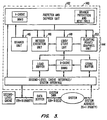
- Fig. 3 is a block diagram of the major functional units in the UltraSPARC-I microprocessor which is an exemplary processor that may be utilized to implement the present invention.
- a microprocessor 140 includes a front end Prefetch and Dispatch Unit (PDU) 142.
- the PDU prefetches instructions based upon a dynamic branch prediction mechanism and a next field address which allows single cycle branch following. Typically, branch prediction is better than 90% accurate which allows the PDU to supply four instructions per cycle to a core execution block 144.
- the core execution block includes a Branch Unit 145, an Integer Execution Unit (IEU) 146, a Load/Store Unit (LSU) 148, and a Floating Point/Graphics Unit (FGU) 150.
- the units that make up the core execution block may operate in parallel (up to four instructions per cycle) which substantially enhances the throughput of the microprocessor.
- the IEU performs the integer arithmetic or logical operations.
- the LSU executes the instructions that transfer data between the memory hierarchy and register files in the IEU and FGU.
- the FGU performs floating point and graphics operations.
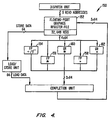
- FIG. 4 shows a block diagram of the Floating Point/Graphics Unit.
- FGU 150 includes a Register File 152 and five functional units which may operate in parallel.
- the Register File incorporates 32 64-bit registers.
- Three of the functional units are a floating point divider 154, a floating point multiplier 156, and a floating point adder 158.
- the floating point units perform all the floating point operations.
- the remaining two functional units are a graphics multiplier (GRM) 160 and a graphics adder (GRA) 162.
- the graphical units perform all the graphics operations of the Visual Instruction Set (VIS) instructions.
- the VIS instructions are machine code extensions that allow for enhanced graphics capabilities.
- the VIS instructions typically operate on partitioned data formats.
- 32 and 64-bit words include multiple word components.
- a 32-bit word may be composed of four unsigned bytes and each byte may represent a pixel intensity value of an image.
- a 64-bit word may be composed of four signed 16-bit words and each 16-bit word may represent the result of a partitioned multiplication.
- the VIS instructions allow the microprocessor to operate on multiple pixels or bands in parallel.
- the GRA performs single cycle partitioned add and subtract, data alignment, merge, expand and logical operations.
- the GRM performs three cycle partitioned multiplication, compare, pack and pixel distance operations. The following is a description of some these operations that may be utilized with the present invention.
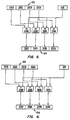
- FIG. 5 is a flow diagram of a partitioned multiply instruction.
- a register 202 is partitioned into a number of word components 202A-D. Each word component is multiplied by a scale value in a register 204.
- Each of word components 202A-D is coupled to an input of a respective one of processing sub-units 206A-D. Processing sub-units 206A-D are included in a the FGU of the microprocessor.
- Register 204 is coupled to a respective input of each of processing sub-units 206A-D, which operate in a multiplication mode simultaneously and in parallel to multiply data stored in register 204 by data stored in word components 202A-D, respectively, of register 202 in a partitioned multiplication operation.
- register 202 may be a 32-bit word including four unsigned bytes with each byte corresponding to the intensity of a pixel.
- the scale value may be a 16-bit word that is multiplied by each of the unsigned bytes in register 202 to produce a 64-bit result in register 208.
- Register 208 would then include four 16-bit word components, each corresponding to a product of an unsigned byte multiplied by the scale value.
- the partitioned multiplication instruction is capable of multiplying four pixel values by a scale value in one machine instruction if the number of bands for each pixel is one. If the number of bands for each pixel is two, two pixels may be manipulated in one machine instruction. If the number of bands for each pixel is four, one pixel may be manipulated in one machine instruction.
- the partitioned multiplication instruction produces a four-fold increase in pixel manipulation.
- register 202 stores the pixel values for four pixels.
- each of the pixels may be multiplied by a 16-bit scale value in register 204 to produce a 64-bit word in register 208.
- register 208 includes four 16-bit products.
- FIG. 6 is a flow diagram of a partitioned add instruction.
- a register 202 is partitioned into a number of word components 202A-D.
- An offset value in a register 304 is added to each word component.
- Each of word components 202A-D is coupled to an input of a respective one of processing sub-units 306A-D.
- Processing sub-units 306A-D are included in a the FGU of the microprocessor.
- Register 304 is coupled to a respective input of each of processing sub-units 306A-D, which operate in an addition mode simultaneously and in parallel to add data stored in register 304 to data stored in word components 202A-D, respectively, of register 202 in a partitioned addition operation.
- register 202 may be a 32-bit word including four unsigned bytes with each byte corresponding to the intensity of a pixel.
- the offset value may be a 16-bit word that is added to each of the unsigned bytes in register 202 to produce a 64-bit result in register 208.
- Register 208 would then include four 16-bit word components, each corresponding to a sum of an unsigned byte added to the scale value.
- the partitioned addition instruction is capable of adding four pixel values to an offset value in one machine instruction if the number of bands for each pixel is one. If the number of bands for each pixel is two, two pixels may be manipulated in one machine instruction. If the number of bands for each pixel is four, one pixel may be manipulated in one machine instruction.
- the partitioned addition instruction produces a four-fold increase in pixel manipulation.
- each of the bands may have a 16-bit offset value in register 204 added to produce a 64-bit word in register 208.
- register 208 includes four 16-bit sums.
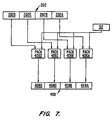
- Fig. 7 is a flow diagram of a partitioned pack instruction.
- a register 202 is partitioned into a number of word components 202A-D. The word components in register 202 are left shifted by the number of bits in a register 52.
- Each of word components 202A-D is coupled to an input of a respective one of processing sub-units 406A-D. Processing sub-units 406A-D are included in a the FGU of the microprocessor.
- Register 52 is coupled to a respective input of each of processing sub-units 406A-D, which operate in a shift mode simultaneously and in parallel to left shift each of word components 202A-D the number of times specified by register 52.
- Sub-units 406A-D then place the bits 7-14 of the left shifted word components 202A-D in respective word components 406A-D of a register 408, which are coupled to outputs of processing sub-units 406A-D, respectively.
- register 202 may be a 32-bit word including four unsigned bytes with each byte corresponding to the intensity of a pixel.
- word component 202A is the following byte: 0010 1000 If register 52 specify that word components 202A-D are to be left shifted five times, word component 202A will be left shifted by sub-unit 406A to produce the following 16-bit word: 0000 0101 0000 0000 Sub-unit 406A then places bits 7-14 of the left shifted word (where the 0 bit is the right-most bit) in word component 408A. Thus, sub-unit 406A places or packs the following byte into word component 408A: 0000 1010 As shown, the pack operation allows the microprocessor to truncate lower bits off four word components in parallel.
- Fig. 8 shows a high level flowchart of a process of rescaling an image.
- the process of rescaling an image will be described as if each pixel is only represented by one band. However, if each pixel is represented by more than one band, the process is the same as shown in Fig. 8 and described below except that the system then rescales sets of bands in parallel, not pixels.
- the system determines if a round operation is requested. If a round operation is requested, a rounding value is added to the offset value at step 502.
- the offset value is B in the equation "A * pixel + B" discussed previously.
- the pack operation truncates bits, it may be desirable to add the binary equivalent of 0.5 to the rescaled pixels before they are truncated. Although this addition step could be performed within the loops shown in Fig. 8, it is beneficial to move this addition step outside the loops to increase the efficiency of the process.
- the system aligns an address for a row in memory. Images are stored conceptually in rows and columns of pixels. The system first sets an address to access a row of an image in memory (or image buffer). Although the present invention is described as processing pixels in a column major order, the pixels may be processed in a row major order if stored appropriately.
- the system loads a set of pixels from memory at step 506.
- the system may load up to four pixels into a partitioned register in one machine instruction.
- the pixels will be stored in word components of the partitioned register.
- the pixels are accessed utilizing the row address calculated in step 504.
- the system multiplies the set of pixels by a scale value in parallel.
- the scale value is A in the equation "A * pixel + B" discussed previously.
- the system utilizes the partitioned multiply instruction to multiply the scale value by each of the word components of the set of pixels.
- the partitioned multiply instruction allows up to four pixels to be manipulated in parallel.
- the system then adds the offset value to the set of pixels at step 510.
- the offset value will include a rounding value if rounding was requested at step 500.
- the system utilizes the partitioned add instruction to add the offset value to each of the word components of the set of pixels.
- the partitioned add instruction allows up to four pixels to be manipulated in parallel. Although Fig. 8 shows the multiply step performed before the add step, these steps may also be performed in the reverse order.
- the system packs the rescaled pixels into an image buffer in one machine instruction.
- the image buffer may be a register or memory location.
- the system may pack the rescaled pixels back into the memory location from which they were loaded at step 506.
- the pack instruction effectively clips the rescaled pixels to an acceptable range.
- the system masks out the pixels specified by a binary mask.
- the masking step is optional, it provides the system with the capability to rescale only selected pixels specified by the user.
- the system determines if it has reached the end of a row of the image at step 516. If not, the system proceeds to process the next set of pixels.
- the system processes two sets of four pixels at the same time. This is because a pixel may is represented by one byte so it takes two sets of four pixels to fill a 64-bit word.
- the system determines if it has reached the height of the image. If the system has not reached the height of the image, there is still another row to be processed so the system proceeds to step 504. Otherwise, the image has been rescaled and the process is complete.
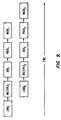
- Fig. 9 illustrates a possible timing diagram of the microprocessor instructions produced by the flowchart of Fig. 8.
- the top of Fig. 9 shows the main flow of Fig. 3 with respect to a first set of pixels (subscript 1).
- a second set of pixels may be processed concurrently with the first set as shown.
- partitioned Multiply 1 is performed by FGM and parallel Load 2 is performed by LSU, they may be executed at the same time.
- partitioned Add 1 is performed by FGA and partitioned Multiply 2 is performed by FGM, they may be executed at the same time.
- there are two levels of concurrency at the machine instruction level pixels may be manipulated in parallel and machine instructions may process two sets of pixels at the same time.
Landscapes
- Physics & Mathematics (AREA)
- General Physics & Mathematics (AREA)
- Engineering & Computer Science (AREA)
- Theoretical Computer Science (AREA)
- Image Processing (AREA)
- Record Information Processing For Printing (AREA)
- Controls And Circuits For Display Device (AREA)
Claims (16)
- Verfahren zur Neuskalierung von Abbildungen in einem Computersystem, das einen Prozessor und einen Bildpufferspeicher aufweist, umfassend die Schritte des Ladens (506) einer ersten Vielzahl von Wortbestandteilen (202 A-D) in einem Maschinenbefehl in einen Prozessor (150), wobei jeder Wortbestandteil einem Pixel einer Abbildung zugeordnet ist; des Neuskalierens (508) der ersten Vielzahl von Wortbestandteilen in Parallelschaltung; und des Komprimierens (512) der neuskalierten ersten Vielzahl von Wortbestandteilen in einem Maschinenbefehl in den Bildpufferspeicher; gekennzeichnet durch den Schritt des Verarbeitens einer zweiten Vielzahl von Wortbestandteilen (202 A-D) gleichzeitig mit dem Verarbeiten der ersten Vielzahl von Wortbestandteilen (202 A-D).
- Verfahren nach Anspruch 1, wobei der Schritt des Neuskalierens (508) die Schritte des Multiplizierens der ersten Vielzahl von Wortbestandteilen (202 A-D) mit einem Maßstabswert (A) in Parallelschaltung; und des Addierens eines Abweichungswerts (B) zur ersten Vielzahl von Wortbestandteilen in Parallelschaltung umfaßt.
- Verfahren nach Anspruch 1, wobei der Schritt des Komprimierens (512) den Schritt des Abschneidens der neuskalierten ersten Vielzahl von Wortbestandteilen umfaßt, um über zumindest einen Minimalwert und höchstens einen Maximalwert zu verfügen.
- Verfahren nach Anspruch 1, ferner umfassend den Schritt des Ausblendens (514) eines Teils der ersten Vielzahl von Wortbestandteilen (202 A-D).
- Verfahren der Erzeugung eines computerlesbaren Codes zur Neuskalierung von Abbildungen in einem Computersystem, das einen Prozessor und einen Bildpufferspeicher aufweist, umfassend die Schritte des Erzeugens eines computerlesbaren Codes, der dazu ausgerichtet ist, eine erste Vielzahl von Wortbestandteilen (202 A-D) in einem Maschinenbefehl in den Prozessor zu laden (506), wobei jeder Wortbestandteil einem Pixel einer Abbildung zugeordnet ist; des Erzeugens eines computerlesbaren Codes, der dazu ausgerichtet ist, die erste Vielzahl von Wortbestandteilen in Parallelschaltung neu zu skalieren (508); und des Erzeugens eines computerlesbaren Codes, der dazu ausgerichtet ist, die neuskalierte erste Vielzahl von Wortbestandteilen in einem Maschinenbefehl in den Bildpufferspeicher zu komprimieren (512); gekennzeichnet durch den Schritt des Erzeugens eines computerlesbaren Codes, der dazu ausgerichtet ist, gleichzeitig mit der Verarbeitung der ersten Vielzahl von Wortbestandteilen (202 A-D) eine zweite Vielzahl von Wortbestandteilen (202 A-D) zu verarbeiten.
- Verfahren nach Anspruch 5, wobei der Schritt des Erzeugens eines computerlesbaren Codes, der zur Neuskalierung (508) ausgerichtet ist, die Schritte des Erzeugens eines computerlesbaren Codes, der dazu ausgerichtet ist, die erste Vielzahl von Wortbestandteilen in Parallelschaltung mit einem Maßstabswert (A) zu multiplizieren; und des Erzeugens eines computerlesbaren Codes, der dazu ausgerichtet ist, in Parallelschaltung einen Abweichungswert (B) zur ersten Vielzahl von Wortbestandteilen zu addieren, umfaßt.
- Verfahren nach Anspruch 5, wobei der Schritt des Erzeugens eines computerlesbaren Codes zum Komprimieren (512) den Schritt des Erzeugens eines computerlesbaren Codes, der dazu ausgerichtet ist, die neuskalierte erste Vielzahl von Wortbestandteilen abzuschneiden, um über zumindest einen Minimalwert und höchstens einen Maximalwert zu verfügen, umfaßt.
- Verfahren nach Anspruch 5, ferner umfassend den Schritt des Erzeugens eines computerlesbaren Codes, der dazu ausgerichtet ist, einen Teil der ersten Vielzahl von Wortbestandteilen (202 A-D) auszublenden (514).
- Computerprogrammerzeugnis, umfassend ein mit dem Computer benutzbares Medium, das in sich einen computerlesbaren Code zur Neuskalierung von Abbildungen aufnimmt, umfassend einen computerlesbaren Code, der dazu ausgerichtet ist, eine erste Vielzahl von Wortbestandteilen (202 A-D) in einem Maschinenbefehl in einen Prozessor (150) zu laden (506), wobei jeder Wortbestandteil einem Pixel einer Abbildung zugeordnet ist; einen computerlesbaren Code, der dazu ausgerichtet ist, die erste Vielzahl von Wortbestandteilen in Parallelschaltung neu zu skalieren (508); und einen computerlesbaren Code, der dazu ausgerichtet ist, die neuskalierte erste Vielzahl von Wortbestandteilen in einem Maschinenbefehl in den Bildpufferspeicher zu komprimieren (512); gekennzeichnet durch einen computerlesbaren Code, der dazu ausgerichtet ist, gleichzeitig mit der Verarbeitung der ersten Vielzahl von Wortbestandteilen (202 A-D) eine zweite Vielzahl von Wortbestandteilen (202 A-D) zu verarbeiten.
- Erzeugnis nach Anspruch 9, wobei der computerlesbare Code, der zur Neuskalierung (508) ausgerichtet ist, umfaßt: einen computerlesbaren Code, der dazu ausgerichtet ist, die erste Vielzahl von Wortbestandteilen in Parallelschaltung mit einem Maßstabswert (A) zu multiplizieren; und einen computerlesbaren Code, der dazu ausgerichtet ist, in Parallelschaltung einen Abweichungswert (B) zur ersten Vielzahl von Wortbestandteilen zu addieren.
- Erzeugnis nach Anspruch 9, wobei der computerlesbare Code, der zum Komprimieren (512) ausgerichtet ist, einen computerlesbaren Code umfaßt, der dazu ausgerichtet ist, die neuskalierte erste Vielzahl von Wortbestandteilen abzuschneiden, um über zumindest einen Minimalwert und höchstens einen Maximalwert zu verfügen.
- Erzeugnis nach Anspruch 9, ferner umfassend einen computerlesbaren Code, der dazu ausgerichtet ist, einen Teil der ersten Vielzahl von Wortbestandteilen auszublenden (514).
- Computersystem, umfassend einen Prozessor und eine mit dem Prozessor gekoppelte Speichervorrichtung, die in sich einen computerlesbaren Code zur Neuskalierung von Abbildungen aufnimmt, umfassend einen computerlesbaren Code, der dazu ausgerichtet ist, eine erste Vielzahl von Wortbestandteilen (202 A-D) in einem Maschinenbefehl in einen Prozessor (150) zu laden (506), wobei jeder Wortbestandteil einem Pixel einer Abbildung zugeordnet ist; einen computerlesbaren Code, der dazu ausgerichtet ist, die erste Vielzahl von Wortbestandteilen in Parallelschaltung neu zu skalieren (508); und einen computerlesbaren Code, der dazu ausgerichtet ist, die neuskalierte erste Vielzahl von Wortbestandteilen in einem Maschinenbefehl in den Bildpufferspeicher zu komprimieren (512); gekennzeichnet durch einen computerlesbaren Code, der dazu ausgerichtet ist, gleichzeitig mit der Verarbeitung der ersten Vielzahl von Wortbestandteilen (202 A-D) eine zweite Vielzahl von Wortbestandteilen (202 A-D) zu verarbeiten.
- System nach Anspruch 13, wobei der computerlesbare Code, der zur Neuskalierung (508) ausgerichtet ist, umfaßt: einen computerlesbaren Code, der dazu ausgerichtet ist, die erste Vielzahl von Wortbestandteilen in Parallelschaltung mit einem Maßstabswert (A) zu multiplizieren; und einen computerlesbaren Code, der dazu ausgerichtet ist, in Parallelschaltung einen Abweichungswert (B) zur ersten Vielzahl von Wortbestandteilen zu addieren.
- System nach Anspruch 13, wobei der computerlesbare Code, der zum Komprimieren (512) ausgerichtet ist, einen computerlesbaren Code umfaßt, der dazu ausgerichtet ist, die neuskalierte erste Vielzahl von Wortbestandteilen abzuschneiden, um über zumindest einen Minimalwert und höchstens einen Maximalwert zu verfügen.
- System nach Anspruch 13, ferner umfassend einen computerlesbaren Code, der dazu ausgerichtet ist, einen Teil der ersten Vielzahl von Wortbestandteilen auszublenden (514).
Applications Claiming Priority (2)
| Application Number | Priority Date | Filing Date | Title |
|---|---|---|---|
| US562878 | 1995-11-27 | ||
| US08/562,878 US5815164A (en) | 1995-11-27 | 1995-11-27 | Image rescaling in a parallel processor |
Publications (3)
| Publication Number | Publication Date |
|---|---|
| EP0789324A2 EP0789324A2 (de) | 1997-08-13 |
| EP0789324A3 EP0789324A3 (de) | 1998-02-25 |
| EP0789324B1 true EP0789324B1 (de) | 2003-03-19 |
Family
ID=24248180
Family Applications (1)
| Application Number | Title | Priority Date | Filing Date |
|---|---|---|---|
| EP96308540A Expired - Lifetime EP0789324B1 (de) | 1995-11-27 | 1996-11-26 | Änderung der Grösse eines Bildes in einem Parallelprozessor |
Country Status (3)
| Country | Link |
|---|---|
| US (1) | US5815164A (de) |
| EP (1) | EP0789324B1 (de) |
| JP (1) | JPH09293137A (de) |
Families Citing this family (6)
| Publication number | Priority date | Publication date | Assignee | Title |
|---|---|---|---|---|
| US5956047A (en) | 1997-04-30 | 1999-09-21 | Hewlett-Packard Co. | ROM-based control units in a geometry accelerator for a computer graphics system |
| US6184902B1 (en) * | 1997-04-30 | 2001-02-06 | Hewlett-Packard Company | Centralized branch intelligence system and method for a geometry accelerator |
| US7548586B1 (en) | 2002-02-04 | 2009-06-16 | Mimar Tibet | Audio and video processing apparatus |
| US7958177B2 (en) * | 2006-11-29 | 2011-06-07 | Arcsoft, Inc. | Method of parallelly filtering input data words to obtain final output data words containing packed half-pel pixels |
| JP2012063440A (ja) * | 2010-09-14 | 2012-03-29 | Iix Inc | 表示装置 |
| US12067499B2 (en) * | 2020-11-02 | 2024-08-20 | Adobe Inc. | Increasing efficiency of inferencing digital videos utilizing machine-learning models |
Family Cites Families (1)
| Publication number | Priority date | Publication date | Assignee | Title |
|---|---|---|---|---|
| US5001662A (en) * | 1989-04-28 | 1991-03-19 | Apple Computer, Inc. | Method and apparatus for multi-gauge computation |
-
1995
- 1995-11-27 US US08/562,878 patent/US5815164A/en not_active Expired - Fee Related
-
1996
- 1996-11-26 EP EP96308540A patent/EP0789324B1/de not_active Expired - Lifetime
- 1996-11-27 JP JP8330230A patent/JPH09293137A/ja active Pending
Also Published As
| Publication number | Publication date |
|---|---|
| US5815164A (en) | 1998-09-29 |
| JPH09293137A (ja) | 1997-11-11 |
| EP0789324A2 (de) | 1997-08-13 |
| EP0789324A3 (de) | 1998-02-25 |
Similar Documents
| Publication | Publication Date | Title |
|---|---|---|
| US11403069B2 (en) | Accelerated mathematical engine | |
| JP3023685B2 (ja) | 画像表示データ処理装置 | |
| US6577316B2 (en) | Wide instruction word graphics processor | |
| US7376286B2 (en) | Block-based rotation of arbitrary-shaped images | |
| US6784888B2 (en) | Method and apparatus for executing a predefined instruction set | |
| US20120331028A1 (en) | Processor for performing multiply-add operations on packed data | |
| EP0817003B1 (de) | Formatumwandlung von Datenwörtern graphischer Bilder | |
| US20030084082A1 (en) | Apparatus and method for efficient filtering and convolution of content data | |
| US20020062331A1 (en) | A method and apparatus for computing a packed sum of absolute differences | |
| EP0790581B1 (de) | Alphamischungsverfahren mit Hilfe einer Gruppe von visuellen Instruktionen | |
| JPH02300983A (ja) | 中央処理装置における高速演算処理の方法 | |
| US5896307A (en) | Method for handling an underflow condition in a processor | |
| JPH09231380A (ja) | グラフィカル・イメージ処理のための累算バッファの方法および装置 | |
| US6243728B1 (en) | Partitioned shift right logic circuit having rounding support | |
| US5815164A (en) | Image rescaling in a parallel processor | |
| US6067099A (en) | High-performance band combine function | |
| US7095906B2 (en) | Apparatus and method for alpha blending of digital images | |
| US7012717B1 (en) | Multi-level dither screening on a split arithmetic logic unit processor | |
| US5627966A (en) | Method for simulating the parallel processing of video data | |
| US5801719A (en) | Microprocessor with graphics capability for masking, aligning and expanding pixel bands | |
| US5968165A (en) | System and method for minimizing the size of operands | |
| US6781717B1 (en) | Threshold screening using range reduction | |
| EP0485833A2 (de) | Verfahren zur Ausführung von graphischen, arithmetischen Instruktionen zur Farbensättigung in einem Datenverarbeitungsgerät | |
| EP0775970A2 (de) | Faltung eines grafischen Bildes | |
| EP0485776A2 (de) | Verfahren zur Ausführung von graphischen Pixelpackungsinstruktionen in einem Datenverarbeitungsgerät |
Legal Events
| Date | Code | Title | Description |
|---|---|---|---|
| PUAI | Public reference made under article 153(3) epc to a published international application that has entered the european phase |
Free format text: ORIGINAL CODE: 0009012 |
|
| AK | Designated contracting states |
Kind code of ref document: A2 Designated state(s): GB NL |
|
| PUAL | Search report despatched |
Free format text: ORIGINAL CODE: 0009013 |
|
| RHK1 | Main classification (correction) |
Ipc: G06F 9/38 |
|
| AK | Designated contracting states |
Kind code of ref document: A3 Designated state(s): GB NL |
|
| 17P | Request for examination filed |
Effective date: 19980807 |
|
| 17Q | First examination report despatched |
Effective date: 20010926 |
|
| GRAH | Despatch of communication of intention to grant a patent |
Free format text: ORIGINAL CODE: EPIDOS IGRA |
|
| GRAH | Despatch of communication of intention to grant a patent |
Free format text: ORIGINAL CODE: EPIDOS IGRA |
|
| GRAA | (expected) grant |
Free format text: ORIGINAL CODE: 0009210 |
|
| AK | Designated contracting states |
Designated state(s): GB NL |
|
| REG | Reference to a national code |
Ref country code: GB Ref legal event code: FG4D |
|
| RAP2 | Party data changed (patent owner data changed or rights of a patent transferred) |
Owner name: SUN MICROSYSTEMS, INC. |
|
| NLT2 | Nl: modifications (of names), taken from the european patent patent bulletin |
Owner name: SUN MICROSYSTEMS, INC. |
|
| PLBE | No opposition filed within time limit |
Free format text: ORIGINAL CODE: 0009261 |
|
| STAA | Information on the status of an ep patent application or granted ep patent |
Free format text: STATUS: NO OPPOSITION FILED WITHIN TIME LIMIT |
|
| 26N | No opposition filed |
Effective date: 20031222 |
|
| PG25 | Lapsed in a contracting state [announced via postgrant information from national office to epo] |
Ref country code: NL Free format text: LAPSE BECAUSE OF NON-PAYMENT OF DUE FEES Effective date: 20040601 |
|
| NLV4 | Nl: lapsed or anulled due to non-payment of the annual fee |
Effective date: 20040601 |
|
| PGFP | Annual fee paid to national office [announced via postgrant information from national office to epo] |
Ref country code: GB Payment date: 20051123 Year of fee payment: 10 |
|
| GBPC | Gb: european patent ceased through non-payment of renewal fee |
Effective date: 20061126 |
|
| PG25 | Lapsed in a contracting state [announced via postgrant information from national office to epo] |
Ref country code: GB Free format text: LAPSE BECAUSE OF NON-PAYMENT OF DUE FEES Effective date: 20061126 |