EP0775970A2 - Faltung eines grafischen Bildes - Google Patents
Faltung eines grafischen Bildes Download PDFInfo
- Publication number
- EP0775970A2 EP0775970A2 EP96308518A EP96308518A EP0775970A2 EP 0775970 A2 EP0775970 A2 EP 0775970A2 EP 96308518 A EP96308518 A EP 96308518A EP 96308518 A EP96308518 A EP 96308518A EP 0775970 A2 EP0775970 A2 EP 0775970A2
- Authority
- EP
- European Patent Office
- Prior art keywords
- partitioned
- pixel data
- range
- convolution
- pixels
- Prior art date
- Legal status (The legal status is an assumption and is not a legal conclusion. Google has not performed a legal analysis and makes no representation as to the accuracy of the status listed.)
- Granted
Links
Images




Classifications
-
- G—PHYSICS
- G06—COMPUTING OR CALCULATING; COUNTING
- G06T—IMAGE DATA PROCESSING OR GENERATION, IN GENERAL
- G06T1/00—General purpose image data processing
- G06T1/20—Processor architectures; Processor configuration, e.g. pipelining
-
- G—PHYSICS
- G06—COMPUTING OR CALCULATING; COUNTING
- G06T—IMAGE DATA PROCESSING OR GENERATION, IN GENERAL
- G06T5/00—Image enhancement or restoration
- G06T5/20—Image enhancement or restoration using local operators
Definitions
- the present invention relates to graphical image processing in a computer system.
- the present invention relates to a particularly efficient convolution mechanism implemented in a computer having a processor capable of performing multiple arithmetic operations simultaneously and in parallel.
- Convolution is a type of image processing and is used, for example, to blur or sharpen graphical images or to enhance edges in a graphical image. Convolution is well-known but is described briefly for completeness. Generally, a source image is convolved to produce a resulting image. Each pixel ofthe resulting image is a weighted combination of a corresponding pixel of the source image and pixels in proximity to the corresponding pixel of the source image.
- each ofthe pixels ofthe matrix is multiplied by a corresponding scalar coefficient of a convolution matrix having three rows by three columns of coefficients and the resulting products are summed to produce a pixel in the resulting image.
- the particular coefficients of the convolution matrix determine the particular effect on the source image of the convolution. For example, if coefficients near the center of the convolution matrix are relatively small and coefficients far from the center of the convolution matrix are relatively large, the source image is blurred in the resulting image. If the coefficient at the center of the convolution matrix is relatively large and coefficients near but not at the center are relatively small and negative, the source image is sharpened.
- Convolution of a graphical image requires substantial resources. For example, even using a relatively small convolution matrix which has only three rows and three columns of scalar coefficients requires nine (9) multiplication operations and eight (8) addition operations for each pixel. In addition, nine (9) read operations are required to obtain a three-row by three-column matrix of pixels from the source image.
- Graphical images typically include a rectangular grid of pixels and can be as large as one thousand or more columns of one thousand or more rows of pixels. Thus, source images having as many as one million or more pixels are convolved.
- pixels of color graphical images typically have three (3) components, namely, red, green, and blue. To convolve a color image, each component of the color image must be convolved.
- convolution of a large color source image can involve as many as 27 million read operations, 27 million multiplication operations, 24 million addition operations, and 27 million store operations. Accordingly, some conventional convolution systems require as many as 105 million instruction cycles to convolve a color graphical image having one million pixels using a colvolution matrix having three columna and three rows. Convolution involving larger convolution matrices, e.g., matrices which have five rows and five columns of scalar coefficients or matrices which have seven rows and seven columns of scalar coefficients, require considerably more processing.
- a processor which is capable of performing partitioned multiplication and partitioned addition operations convolves multiple pixels in parallel.
- the processor includes a load and store pipeline of a load and store unit which retrieves data from and stores data to memory and one or more arithmetic processing pipelines of an arithmetic processing unit which aligns data and performs partitioned multiplication and partitioned addition operations.
- a nukmber of pixels from a source image, which collectively are a patch of pixels are convolved substantially simultaneously in the arithmetic processing pipeline of the processor by execution of the partitioned multiplication and partitioned addition operations.
- a subsequent patch of pixels from the source image are read by the load and store unit of the processor.
- the source image is a graphical image prior to convolution of the graphical image.
- a patch is generally a rectangular grid of spatially contiguous pixels of the source image. Convolution of the source image requires convolution of number of patches of the source image in sequence.
- a subsequent patch is a patch which is convolved substantially immediate subsequent to the most recently convolved patch of the source image.
- the subsequent patch of the source image is a patch which is aligned with respect to a secondary index and is incremented along a primary index to avoid excessive cache misses when retrieving pixel data for convolution.
- incrementing along the primary index rather than along-the secondary index results in redundant reading and alignment of pixel data.
- reading of pixel data is performed in the load and store pipeline of the processor while the arithmetic processing pipeline substantially simultaneously performs partitioned arithmetic operations on the pixel data to thereby convolve the pixel data.
- redundant reading of data does not slow the convolution of pixel data while cache misses are substantially reduced over conventional convolution mechanisms.
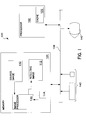
- FIG. 1 is a block diagram of a computer system which includes an image processor in accordance with the present invention.
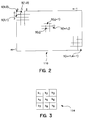
- Figure 2 is a diagram of the source image of Figure 1 in greater detail.
- Figure 3 is a diagram of the convolution matrix of Figure 1 in greater detail.
- Figure 4 is a diagram illustrating a patch of pixel data retrieved from the source image of Figures 1 and 2.
- Figures 5A and 5B are diagrams of a sixteen-byte stream of pixel data and illustrate the alignment of pixel data with an eight-byte boundary.
- Figure 6 is a diagram showing the relation to the source image of Figures 1 and 2 of the patch of Figure 4 and a subsequently retrieved patch of pixel data.
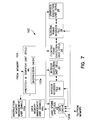
- Figure 7 is a block diagram showing in greater detail the processor of Figure 1.
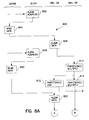
- Figures 8A and 8B are a logic flow diagram illustrating the convolution of source image pixel data by various pipelines of the processor of Figures 1 and 7 in accordance with the present invention.
- Figure 9 is a logic flow diagram illustrating the convolution of the source image of Figures 1 and 2 in accordance with the present invention.
- a computer system 100 within which source image 110 is convolved is generally of the structure shown.
- Computer system 100 includes a processor 102 which is coupled to a memory 104 through a bus 106.
- Processor 102 is described in greater detail below and (i) fetches from memory 104 and executes computer instructions and (ii) reads data from and writes data to memory 104 in accordance with the fetched and executed instructions.
- Processor 102 includes a cache memory 120 in which data and/or instructions previously retrieved from memory 104 are stored. Accessing data in memory 104 requires approximately 20 cycles of the clock signal of processor 102, and accessing data in cache memory 120 requires approximately 2 to 3 cycles of the clock signal of processor 102. Therefore, to retrieve data from memory 104, processor 102 first determines whether a copy of the data is stored in cache memory 120 and, if so, retrieves the data from cache memory 120 rather than from memory 104. Retrieving data from cache memory 120 rather than from memory 104 is generally called a cache hit. Determining that no copy of the data is stored in cache memory 120 and retrieving the data from memory 104 is generally called a cache miss.
- Memory 104 can include generally any type of memory, including without limitation randomly accessible memory (RAM), read-only memory (ROM), and secondary storage including storage media such as magnetic and optical storage devices.
- RAM random accessible memory
- ROM read-only memory
- secondary storage including storage media such as magnetic and optical storage devices.
- source image 110 Stored within memory 104 are (i) source image 110, (ii) resulting image 112, and (iii) a convolution matrix 114.
- an image processor 130 is a computer process which executes within processor 102 from memory 104. Image processor 130, in a manner described more completely below, (i) reads pixel data from source image 110, (ii) convolves the pixel data using convolution matrix 114 to produce new pixel data, and (iii) stores the new pixel data in resulting image 112.
- processor 102 receives from one or more input devices 140 command signals generated by a user and sends to computer display device 142 display data and control signals.
- input devices 140 can be any computer input device, including without limitation a keyboard, a keypad, or a pointing device such as a trackball, an electronic mouse, thumbwheels, a lightpen, or a digitizing tablet.
- Computer display device 142 can include any type of computer display device, including without limitation a cathode ray tube (CRT), a light-emitting diode (LED) display, or a liquid crystal display (LCD).
- CTR cathode ray tube
- LED light-emitting diode
- LCD liquid crystal display
- Image processor 130 sometimes prompt a user to select particular characteristics or individual coefficients of convolution matrix 114 and establishes specific values of the coefficients of convolution matrix 114 in response to control signals received through processor 102 from input devices 140.
- Image process 102 after convolving source image 110 to produce resulting image 112, displays resulting image 112 in computer display device 142 to display to the user resulting image 112.
- Source image 110 is shown in greater detail in Figure 2.
- Source image 110 is a rasterized image, i.e., is generally a rectangular grid of pixel data. Each pixel of source image 110 is represented by a single instance of pixel data which represent pixels of source image 110 and which are logically organized as a rectangular grid as shown. In one embodiment, each pixel is represented by a single byte.
- Source image 110 can be an entire greyscale graphical image or can be a component, i.e., red, green, or blue, of a color graphical image. While source image 110 is shown as a rectangular grid of pixel data, source image 110 is stored sequentially. Specifically, source image 110 has a primary index and a secondary index.
- source image 110 has a primary index which is used to specify the horizontal component of the location of a particular pixel, and a secondary index which is used to specify the vertical component of the location of the pixel.
- a particular pixel in source image 110 is referred to as s(i,j) in which i refers to a particular value of the primary index and j refers to a particular value of the secondary index.
- s(i,j) can refer to a pixel of source image 110 at the i th column and the j th row.
- a rectangular block of pixels of source image 110 having minimum and maximum primary index values of a and b, respectivley, and minimum and maximum secondary index value of c and d, respectively, is sometimes represented herein as s(a..b,c..d).
- a particular pixel in resulting image 112 is referred to as r(i,j) in which i refers to a particular value of the primary index and j refers to a particular value of the secondary index.
- r(a.,b,c..d) A rectangular block of pixels of resulting image 112 having minimum and maximum primary index values of a and b, respectivley, and minimum and maximum secondary index value of and d, respectively, is sometimes represented herein as r(a.,b,c..d).
- Source image 110 is stored as a sequence of pixel data corresponding to the following locations in the following order: s(0,0), s(1,0), s(2,0), ... s(i-1,0), s(i,0), s(i+1,0) s(n-1,0), s(0,1), s(1,1), ... s(n-1,1), s(0,j+1), ... s(n-1,m-1).
- the entirety of source image 110 is alternatively represented by the notation s(0..n-1,0...m-1).
- the number of pixels along the direction of the primary index, e.g., the number of columns, of source image 110 is n
- the number of pixels along the direction of the secondary index, e.g., the number of rows, of source image 110 is m.
- a pixel s(i+1,j) is stored in memory 104 at a location which immediately follows the location of pixel s(i,j).
- a pixel s(0,j+1) is stored in memory 104 at a location which follows the location of pixel s(n-1,j) relatively closely and can immediately follow the location of pixel s(n-1,j).
- a few bytes of"pad" data are inserted between pixel s(n-1,j) and pixel s(0,j+1) to enhance performance, e.g., to ensure that pixel s(0,j+1) is aligned with an eight-byte boundary.
- pad data is usually short in length relative to the length of a line of pixel data corresponding to a particular value of the secondary index, i.e., is substantially less than n bytes in length.
- a pixel s(i,j+1) is stored in memory 104 at a location which is generally n memory locations, plus any memory locations occupied by pad data, following the location of pixel s(i,j).
- each horizontal line of source image 110 is stored as a contiguous sequence of pixel data and the contiguous horizontal lines are stored substantially contiguously end-to-end such that the last pixel of a horizontal line is followed substantially immediately by the first pixel of the next horizontal line.
- Resulting image 112 ( Figure 1) is directly analogous to source image 110 and is therefore equally accurately represented by Figure 2.
- Convolution matrix 114 ( Figure 1) is shown in greater detail in Figure 3.
- Convolution matrix 114 has three rows and three columns of scalar coefficients k 1 , k 2 k 3 , k 4 , k 5 , k 6 , k 7 , k 8 , and k 9 .
- processor 102 performs partitioned arithmetic operations, e.g., (i) a partitioned multiplication operation in which a sixteen-bit fixed-point operand of a partitioned lower or upper half of a 32-bit word is multiplied by four (4) partitioned eight-bit integer operands of a 32-bit word simultaneously and in parallel to produce four (4) partitioned sixteen-bit fixed-point products and (ii) a partitioned addition operation in which four partitioned sixteen-bit fixed-point operands of a 64-bit word are added to four (4) respective partitioned sixteen-bit fixed-point operands of a second 64-bit word.
- partitioned arithmetic operations e.g., (i) a partitioned multiplication operation in which a sixteen-bit fixed-point operand of a partitioned lower or upper half of a 32-bit word is multiplied by four (4) partitioned eight-bit integer operands of a 32-bit word simultaneously and in parallel to
- image processor 130 convolves eight (8) pixels of source image 110 are convolved simultaneously.
- image processor 130 reads a patch 110P ( Figure 4) often (10) pixels by three (3) pixels to produce eight (8) pixels in resulting image 112.
- the dimensions of patch 110P are determined by the number of pixels to be convolved at once and the size of convolution matrix 114.
- the size of patch 110P is one less than the sum of the number of pixels to be convolved at once and the width of convolution matrix 1 14 in the direction of the primary index and the height of convolution matrix 114 in the direction of the secondary index. For example, if sixteen pixels are to be convolved at once using a convolution matrix which has five columns and five rows, patch 110P would include a rectangular area of pixels having 20 pixels in the direction of the primary index and five pixels in the direction of the secondary index.
- r(i..i+7,j) are convolved from patch 110P, i.e., pixels s(i-1..i+8,j-1..j+1) according to the following equations.
- r(i,j) k 1 ⁇ s(i-1,j-1) + k 2 ⁇ s(i,j-1) + k 3 ⁇ s(i+1,j-1)+ k 4 ⁇ s(i-1,j) + k 5 ⁇ s(i,j) + k 6 ⁇ s(i+1,j) + k 7 ⁇ s(i-1,j+1)+ k 8 ⁇ s(i,j+1) + k 9 ⁇ s(i+1,j+1)
- r(i+1,j) k 1 ⁇ s(i,j-1) + k 2 ⁇ s(i+1,j-1) + k 3 ⁇ s(i+2,j-1) + k 4 ⁇ s(
- each coefficient of convolution matrix 114 is multiplied by eight pixels.
- coefficient k 3 is multiplied by pixels s(i+1,j-1), s(i+2,j-1), s(i+3,j-1), s(i+4,j-1), s(i+5,j-1), s(i+6,j-1), s(i+7,j-1), and s(i+8,j-1).
- Image processor 130 multiplies each coefficient by eight pixels of patch 110P in two partitioned multiplication operations performed by processor 102, each of which multiplies a coefficient by four pixels of patch 110P simultaneously and in parallel. Prior to performing the partitioned multiplication operations, image processor 102 must generally read from memory 104 and align eight pixels.
- processor 102 retrieves sixteen (16) contiguous pixels, e.g., sixteen pixel stream 500 ( Figure 5A) from source image 110 ( Figure 2) which are aligned with an eight-byte boundary, e.g., eight-byte boundary 502.
- An eight-byte boundary is an address of memory 104 which is an integer multiple of eight.
- Pixel s(i+1..i+8,j-1) are offset from eight-byte boundary 502 by two bytes.
- Image processor 130 aligns sixteen pixel stream 500 by shifting sixteen pixel stream 500 to the left by two bytes to produce a sixteen pixel stream 500B ( Figure 5B) in which the eight pixels s(i+1:i+8,j-1) are aligned with eight-byte boundary 502.
- image processor 130 performs partitioned multiplication and partitioned addition operations within processor 102 in accordance with equations (1) as described more completely below to produce eight pixels of resulting image 112 simultaneously and in parallel.
- Convolution of a patch of pixels s(i-1..i+8,j..j+2) produces pixels r(i..i+7j+1) whereas convolution of patch 110P of pixels s(i-1..i+8,j-1..j+1 ) produces pixels r(i..i-7,j).
- pixel data stored within source image 110 at a location having a secondary index of j or j+1 have already been read and aligned by the processor.
- redundant reading and alignment of pixel data is obviated by such a conventional convolution implementation using a parallel processor.
- image processor 130 retrieves a patch 110P2 ( Figure 6) of pixel data from source image 110 which is offset from patch 110P by one increment in the direction of the primary index of source image 110.
- patch 110P2 includes pixels s(i..i+9J-1..j+1).
- Image processor 130 convolves pixel data in patch 110P2 to produce pixels r(i+1..i+8,j). By incrementing the primary index of patch 110P to select subsequent patch 110P2, pixel data corresponding to patch 110P2 can frequently be found in cache memory 120 ( Figure 1) and can therefore be retrieved by processor 102 by a cache hit rather than a cache miss.
- patch 110P2 includes s(i..i+9,j) and, in particular, includes s(i+9,j) which is not included in patch 110P. Since patch 110P2 is offset by one increment in the primary index, s(i+9,j) is adjacent to s(i+8,j) in memory 104.
- cache memory 120 in response to a cache miss, retrieves from memory 104 and stores 64 contiguous bytes of data, which is generally referred to as a cache line. Therefore, s(i+9j) will frequently be found in cache memory 120 and result in a cache hit when retrieved.
- convolving source image 110 retrieval of pixel data results in a cache miss approximately once on average during convolution of each 64 pixels of source image 110.
- source image 110 is a rectangular image
- the primary index is horizontal and increases from left to right
- the secondary index is vertical and increases from top to bottom.
- each horizontal line of source image 110 is stored as a contiguous sequence of pixel data and the contiguous horizontal lines are stored substantially contiguously end-to-end such that the last pixel of a horizontal line is substantially immediately followed by the first pixel of the next horizontal line with perhaps only a few bytes of pad data between.
- the first pixel in the next line of pixels is frequently retrieved from cache memory 120 in a cache hit.
- Processor 102 includes a prefetch and dispatch unit (PDU) 46, an instruction cache 40, an integer execution unit (IEU) 30, an integer register file 36, a floating point unit (FPU) 26, a floating point register file 38, and a graphics execution unit (GRU) 28, coupled to each other as shown.
- PDU prefetch and dispatch unit
- IEU integer execution unit
- FPU floating point unit
- GRU graphics execution unit
- processor 102 includes two memory management units (IMMU & DMMU) 44a-44b, and a load and store unit (LSU) 48, which in turn includes data cache 120B, coupled to each other and the previously described elements as shown.
- IMMU & DMMU memory management units
- LSU load and store unit
- PDU 46 fetches instructions from memory 104 ( Figure 1) and dispatches the instructions to IEU 30 ( Figure 7), FPU 26, GRU 28, and LSU 48 accordingly.
- Prefetched instructions are stored in instruction cache 120A.
- Instruction cache 120A and data cache 120B are collectively cache memory 120 ( Figure 1).
- IEU 30 ( Figure 7), FPU 26, and GRU 28 perform integer, floating point, and graphics operations, respectively.
- the integer operands/results are stored in integer register file 36, whereas the floating point and graphics operands/results are stored in floating point register file 38.
- IEU 30 also performs a number of graphics operations, and appends address space identifiers (ASI) to addresses of load/store instructions for LSU 48, identifying the address spaces being accessed.
- LSU 48 generates addresses for all load and store operations.
- the LSU 48 also supports a number of load and store operations, specifically designed for graphics data. Memory references are made in virtual addresses.
- MMUs 44a-44b map virtual addresses to physical addresses.
- PDU 46, IEU 30, FPU 26, integer and floating point register files 36 and 38, MMUs 44a-44b, and LSU 48 can be coupled to one another in any of a number of configurations as described more completely in the '572 application.
- GRU 28 is an arithmetic processing unit and performs a partitioned multiplication operation and a partitioned addition operation.
- Performance of the partitioned multiplication operation multiplies each of four partitioned eight-bit unsigned integers in a 32-bit word by an upper or lower partitioned sixteen-bit fixed-point number of a 32-bit word to produce four partitioned sixteen-bit fixed-point products in a 64-bit word.
- Performance of the partitioned addition operation adds respective partitioned 16-bit fixed-point numbers oftwo 64-bit words to produce four respective partitioned 16-bit fixed-point sums in a 64-bit word.
- processor 102 includes four (4) separate processing units, i.e., LSU 48, IEU 30, FPU 26, and GRU 28. Each of these processing units is described more completely in the '572 application. These processing units operate in parallel and can each execute a respective computer instruction while others of the processing units execute different computer instructions.
- GRU 28 executes the partitioned multiplication and partitioned addition operations described above. As described in the '572 application, GRU 28 has two separate execution paths and can execute two instructions simultaneously. GRU 28 can execute a partitioned addition operation while simultaneously executing a partitioned multiplication operation.
- GRU 28 ( Figure 7) cannot execute more than one partitioned multiplication operation or more than one partitioned addition operation at a time but can perform one partitioned multiplication operation and one partitioned addition operation substantially simultaneously.
- processor 102 is more completely used and convolution of source image 110 is performed more efficiently.
- Table A shows computer instructions of image processor 130 pipelined so as to achieve the level of parallelism in processor 102 described above.
- processor 102 ( Figure 1), in response to computer instructions fetched from image processor 130 and executed, retrieves from source image 110 a patch of pixels, e.g., patch 110P ( Figure 4), of the dimensions ten (10) pixels in the direction ofthe primary index and three (3) pixels in the direction of the secondary index. Further in Table A, processor 102 ( Figure 1) convolves those pixels to produce pixels r(i:i+7,j) of resulting image 112.
- IEU 30 ( Figure 7) aligns an address within source image 110 ( Figure 1) ) of pixels s(i-1..i+6,j-1) to produce an address of a sixteen-byte stream which is aligned on an eight-byte boundary and which includes pixels s(i-1..i+6j-1).
- LSU 48 ( Figure 7) reads the first and second eight bytes, respectively, of the sixteen-byte stream at the address produced in instruction cycle 1.
- GRU 28 aligns pixels s(i-1..i+6j-1) by shifting the sixteen-byte stream until pixel s(i-1,j-1) is represented by the first byte of the sixteen-byte stream, thereby causing the first eight bytes of the sixteen-byte stream to represent pixels s(i-1..i+6, j-1).
- IEU 30 aligns an address within source image 110 ( Figure 1) of pixels s(i-1..i+6,j) which are the next pixels to be processed by GRU 28.
- processor 102 reads a second series of pixel data for eight pixels while simultaneously performing arithmetic operations on the previously read series of pixel data for eight pixels.
- GRU 28 of processor 102 performs a partitioned mutliplication operation on four bytes of data representing pixels s(i-1..i+2j-1) by coefficient k 1 of convolution matrix 114 ( Figure 3) to produce a 64-bit word of four (4) partitioned sixteen-bit fixed-point products.
- the partitioned products are equal to k 1 . s(i-1,j-1), k 1 . s(i,j-1), k 1 . s(i+1,j-1), and k 1 .
- Coefficient k 1 is stored within processor 102 as a sixteen-bit fixed-point number.
- GRU 28 performs a partitioned multiplication operation on four bytes of data representing pixels s(i+3..i+6,j-1) by coefficient k 1 of convolution matrix 114 ( Figure 1) to produce the partitioned products k 1 . s(i+3,j-1), k 1 . s(i+4,j-1), k 1 . s(i+5,j-1), and k 1 . s(i+6,j-1), which are the first components of equations (5)-(8), respectively.
- GRU 28 adds the partitioned products produced in instruction cycle 7 to the second part of the partitioned running total.
- GRU 28 multiplies each of eight bytes by coefficient k 1 to produce the first component of equations (1)-(8) and adds the first components of equations (1)-(8) to a partitioned running total.
- LSU 48 reads the sixteen-byte stream of pixel data at the aligned address determined in instruction cycle 5.
- the sixteen-byte stream of pixel data is aligned by GRU 28 such that the first byte of the sixteen-byte stream represents pixel s(i-1,j).
- GRU 28 processes the first eight bytes ofthe sixteen-byte stream in a manner that is directly analogous to the processing of GRU 28 in instructions cycles 6, 7, and 10 as described above.
- the result of processing by GRU 28 in instruction cycles 10, 11, and 14 includes partitioned products of coefficient k 4 and each of the bytes of the aligned sixteen-byte stream, i.e., the fourth components of equations (1)-(8) above, and addition ofthe partitioned products to the partitioned running total.
- logic flow diagram 800 For added clarity, processing by image processor 130 in processor 102 according to Table A is represented in logic flow diagram 800 ( Figures 8A and 8B). Each column of logic flow diagram 800 represents a pipeline of processor 102 and steps in logic flow diagram 800 which are aligned horizontally are performed substantially simultaneously.
- IEU 30 aligns an address of eight bytes of pixel data with the last preceding eight-byte boundary.
- processing transfers to step 804 in which LSU 48 reads a sixteen-byte stream of pixel data as described above.
- step 806 to which processing transfers from step 804, GRU 28 aligns the pixel data as described above. Processing transfers from step 806 to step 810 in which GRU 28 performs partitioned multiplication involving the first four bytes of the aligned data.
- steps 812 and 814 which are performed substantially simultaneously and in which respectively GRU 28 performs, in one pipeline, partitioned addition involving the first four bytes of the aligned data and, in another pipeline, partitioned multiplication involving the second four bytes of the aligned data.
- processing of the first four bytes of the data aligned in step 806 terminates.
- IEU 30 aligns an address of a second collection of eight bytes of pixel data in step 818.
- step 820 which is performed substantially simultaneously with step 810, LSU 48 reads a sixteen-byte stream of pixels data at the address aligned in step 818 in the manner described above.
- GRU 28 aligns the pixel data in step 822 in the manner described above. From step 822, processing transfers to steps 824 ( Figure 8B), 826, 828, and 830 in which GRU 28 performs partitioned multiplication and partitioned addition operations involving the first eight bytes of the data aligned in step 822 in the manner described above with respect to steps 810 ( Figure 8A), 812, 814, and 816.
- Step 824 is performed by GRU 28 in one pipeline substantially simultaneously with step 816 described above which is performed in the other pipeline of GRU 28.
- IEU 30 Prior to step 824 ( Figure 8B), IEU 30 aligns a third address in the manner described above.
- processor 102 Figure 1 reads and aligns data substantially simultaneously with arithmetic processing of previously read and aligned data.
- Convolution of the entirety of source image 110 ( Figure 1) by image processor 130 is shown in logic flow diagram 900 ( Figure 9).
- Processing begins with loop step 902 which, in conjunction with next step 916, defines a loop in which image processor 130 convolves each line of pixels of source image 110 ( Figure 1) along the direction of the primary index for each increment of the secondary index of source image 110. For example, if source image 110 has m horizontal lines and the secondary index specifies a particular horizontal line, the loop defined by loop step 902 and next step 916 is performed once for each ofthe m horizontal lines of source image 110. For each of the lines along the direction of the primary index, processing transfers from loop step 902 to loop step 904.
- the particular line processed is referred to as the seconary index line.
- Loop step 904 in conjunction with next step 914, defines a loop in which processor 102 convolves each contiguous collection of eight pixels of the secondary index line of source image 110 ( Figure 1). For example, if source image 110 has n pixels in the secondary index line, the loop defined by loop step 904 and next step 914 is performed once for each contiguous collection of eight pixels of the n pixels. For each such contiguous collection of eight pixels, processing transfers from loop step 904 to step 906. During each iteration of the loop defined by loop step 904 and next step 914, the particular eight pixels processed are referred to as the subject eight pixels.
- image processor 130 determines the starting addresses of patch 110 which must be read from memory 104 to convolve the subject eight pixels. Processing transfers to step 908 ( Figure 9) in which image processor 130 initializes each partitioned sixteen-bit fixed-point number of the partitioned running total which includes eight such partitioned numbers as described above. In one embodiment, each partitioned number of the partitioned running total is initialized to zero. In an alternative embodiment, each partitioned number of the partitioned running total is initialized to 0.5 to round off, rather than truncate, each partitioned running total prior to scaling and packing each partitioned into an eight-bit unsigned integer to form a corresponding pixel of resulting image 112.
- step 910 image processor 130 ( Figure 1) convolves the eight subject pixels of source image 110 to produce eight convolved pixels of resulting image 112 in accordance with the processing shown in Table A as described above and as shown in part in logic flow diagram 800 ( Figures 8A and 8B).
- image processor 130 Figure 1
- FIG. 8A and 8B logic flow diagram 800
- each of the eight (8) sixteen-bit fixed-point numbers of the partitioned running total contains data representing the solution of equations (1)-(8) above.
- step 912 image processor 130 ( Figure 1) clips and packs each of the eight (8) partitioned sixteen-bit fixed-point numbers of the running total into a respective byte of resulting image 112 which corresponds to a respective one of the subject eight bytes.
- clipping and packing includes execution of a partitioned pack instruction by GRU 28 such that such clipping and packing of four of the partitioned sixteen-bit fixed-point numbers are packed in each of two successive instruction cycles.
- processing according to logic flow diagram 900 terminates and resulting image 112 ( Figure 1) contains the resulting pixel data from convolution of the pixel data of source image 110.
Landscapes
- Physics & Mathematics (AREA)
- General Physics & Mathematics (AREA)
- Engineering & Computer Science (AREA)
- Theoretical Computer Science (AREA)
- Image Processing (AREA)
- Complex Calculations (AREA)
- Apparatus For Radiation Diagnosis (AREA)
Applications Claiming Priority (2)
| Application Number | Priority Date | Filing Date | Title |
|---|---|---|---|
| US08/563,085 US5912673A (en) | 1995-11-27 | 1995-11-27 | Graphical image convolution using multiple pipelines |
| US563085 | 1995-11-27 |
Publications (3)
| Publication Number | Publication Date |
|---|---|
| EP0775970A2 true EP0775970A2 (de) | 1997-05-28 |
| EP0775970A3 EP0775970A3 (de) | 1998-01-28 |
| EP0775970B1 EP0775970B1 (de) | 2004-03-03 |
Family
ID=24249052
Family Applications (1)
| Application Number | Title | Priority Date | Filing Date |
|---|---|---|---|
| EP96308518A Expired - Lifetime EP0775970B1 (de) | 1995-11-27 | 1996-11-26 | Faltung eines grafischen Bildes |
Country Status (5)
| Country | Link |
|---|---|
| US (1) | US5912673A (de) |
| EP (1) | EP0775970B1 (de) |
| JP (1) | JPH09288727A (de) |
| CA (1) | CA2191298A1 (de) |
| DE (1) | DE69631734D1 (de) |
Families Citing this family (4)
| Publication number | Priority date | Publication date | Assignee | Title |
|---|---|---|---|---|
| US6094203A (en) * | 1997-09-17 | 2000-07-25 | Hewlett-Packard Company | Architecture for a graphics processing unit using main memory |
| KR19990063174A (ko) * | 1997-12-22 | 1999-07-26 | 시마 마사히로 | 화상작성장치 및 화상작성방법 |
| EP2302929B1 (de) * | 2001-11-27 | 2015-03-25 | Samsung Electronics Co., Ltd. | Kodierung und Dekodierung eines Bitstroms mit Koordinateninterpolator |
| CN115185482A (zh) * | 2021-04-02 | 2022-10-14 | 嘉楠明芯(北京)科技有限公司 | 一种基于神经网络的运算方法以及装置 |
Family Cites Families (5)
| Publication number | Priority date | Publication date | Assignee | Title |
|---|---|---|---|---|
| JPS62274471A (ja) * | 1986-05-23 | 1987-11-28 | Fanuc Ltd | 画像処理装置 |
| US5765010A (en) * | 1989-10-13 | 1998-06-09 | Texas Instruments Incorporated | Timing and control circuit and method for a synchronous vector processor |
| US5228126A (en) * | 1991-01-08 | 1993-07-13 | Radius Inc. | Image data accelerated processing apparatus and method |
| US5604819A (en) * | 1993-03-15 | 1997-02-18 | Schlumberger Technologies Inc. | Determining offset between images of an IC |
| US5872729A (en) * | 1995-11-27 | 1999-02-16 | Sun Microsystems, Inc. | Accumulation buffer method and apparatus for graphical image processing |
-
1995
- 1995-11-27 US US08/563,085 patent/US5912673A/en not_active Expired - Lifetime
-
1996
- 1996-11-25 JP JP8328025A patent/JPH09288727A/ja active Pending
- 1996-11-26 DE DE69631734T patent/DE69631734D1/de not_active Expired - Lifetime
- 1996-11-26 EP EP96308518A patent/EP0775970B1/de not_active Expired - Lifetime
- 1996-11-26 CA CA002191298A patent/CA2191298A1/en not_active Abandoned
Also Published As
| Publication number | Publication date |
|---|---|
| EP0775970A3 (de) | 1998-01-28 |
| EP0775970B1 (de) | 2004-03-03 |
| JPH09288727A (ja) | 1997-11-04 |
| DE69631734D1 (de) | 2004-04-08 |
| CA2191298A1 (en) | 1997-05-28 |
| US5912673A (en) | 1999-06-15 |
Similar Documents
| Publication | Publication Date | Title |
|---|---|---|
| US5867145A (en) | Graphical image recasting | |
| US6948087B2 (en) | Wide instruction word graphics processor | |
| JP3983857B2 (ja) | ベクトルレジスタの複数バンクを用いた単一命令複数データ処理 | |
| US6275920B1 (en) | Mesh connected computed | |
| US7680873B2 (en) | Methods and apparatus for efficient complex long multiplication and covariance matrix implementation | |
| EP0165539B1 (de) | Virtuelle Vektorregister für Vektorverarbeitungssystem | |
| US5917740A (en) | Apparatus for reducing a computational result to the range boundaries of a signed 16-bit integer in case of overflow | |
| EP0775979B1 (de) | Akkumulierungspuffer-Verfahren und -Vorrichtung zur Verarbeitung graphischer Bilder | |
| CN1365463A (zh) | 用于2维数组处理的寄存器 | |
| EP0775970B1 (de) | Faltung eines grafischen Bildes | |
| US5887181A (en) | Method and apparatus for reducing a computational result to the range boundaries of an unsigned 8-bit integer in case of overflow | |
| US6067099A (en) | High-performance band combine function | |
| US7573481B2 (en) | Method and apparatus for management of bit plane resources | |
| US6397236B1 (en) | Hybrid technique for performing a column modification operation in a sparse symmetric direct matrix solver | |
| CN119836622A (zh) | 多外积指令 | |
| US8135229B1 (en) | Image processing method and device | |
| WO2002035473A1 (en) | High speed image processing apparatus using a cascade of elongated filters programmed in a computer | |
| EP1162545A2 (de) | Schnelle fouriertransformation architektur | |
| EP0817160A2 (de) | Speicherformatkonvertierung von Computergraphiken | |
| US5943040A (en) | Graphical image reformatting | |
| EP0992917B1 (de) | Linearvektorrechnung | |
| US20080147760A1 (en) | System and method for performing accelerated finite impulse response filtering operations in a microprocessor | |
| GB2356718A (en) | Data processing | |
| US5901306A (en) | Method and apparatus for reducing a computational result to the range boundaries of a signed 8-bit integer in case of overflow | |
| Karadayi et al. | Evaluation of Texas Instruments TMS320C64x mediaprocessor architecture and performance in image and video computing |
Legal Events
| Date | Code | Title | Description |
|---|---|---|---|
| PUAI | Public reference made under article 153(3) epc to a published international application that has entered the european phase |
Free format text: ORIGINAL CODE: 0009012 |
|
| AK | Designated contracting states |
Kind code of ref document: A2 Designated state(s): DE GB IT |
|
| PUAL | Search report despatched |
Free format text: ORIGINAL CODE: 0009013 |
|
| RHK1 | Main classification (correction) |
Ipc: G06F 17/15 |
|
| AK | Designated contracting states |
Kind code of ref document: A3 Designated state(s): DE GB IT |
|
| 17P | Request for examination filed |
Effective date: 19980721 |
|
| 17Q | First examination report despatched |
Effective date: 20021211 |
|
| GRAP | Despatch of communication of intention to grant a patent |
Free format text: ORIGINAL CODE: EPIDOSNIGR1 |
|
| GRAS | Grant fee paid |
Free format text: ORIGINAL CODE: EPIDOSNIGR3 |
|
| GRAA | (expected) grant |
Free format text: ORIGINAL CODE: 0009210 |
|
| AK | Designated contracting states |
Kind code of ref document: B1 Designated state(s): DE GB IT |
|
| PG25 | Lapsed in a contracting state [announced via postgrant information from national office to epo] |
Ref country code: IT Free format text: LAPSE BECAUSE OF FAILURE TO SUBMIT A TRANSLATION OF THE DESCRIPTION OR TO PAY THE FEE WITHIN THE PRESCRIBED TIME-LIMIT;WARNING: LAPSES OF ITALIAN PATENTS WITH EFFECTIVE DATE BEFORE 2007 MAY HAVE OCCURRED AT ANY TIME BEFORE 2007. THE CORRECT EFFECTIVE DATE MAY BE DIFFERENT FROM THE ONE RECORDED. Effective date: 20040303 |
|
| REG | Reference to a national code |
Ref country code: GB Ref legal event code: FG4D |
|
| REF | Corresponds to: |
Ref document number: 69631734 Country of ref document: DE Date of ref document: 20040408 Kind code of ref document: P |
|
| PG25 | Lapsed in a contracting state [announced via postgrant information from national office to epo] |
Ref country code: DE Free format text: LAPSE BECAUSE OF FAILURE TO SUBMIT A TRANSLATION OF THE DESCRIPTION OR TO PAY THE FEE WITHIN THE PRESCRIBED TIME-LIMIT Effective date: 20040604 |
|
| PG25 | Lapsed in a contracting state [announced via postgrant information from national office to epo] |
Ref country code: GB Free format text: LAPSE BECAUSE OF NON-PAYMENT OF DUE FEES Effective date: 20041126 |
|
| PLBE | No opposition filed within time limit |
Free format text: ORIGINAL CODE: 0009261 |
|
| STAA | Information on the status of an ep patent application or granted ep patent |
Free format text: STATUS: NO OPPOSITION FILED WITHIN TIME LIMIT |
|
| 26N | No opposition filed |
Effective date: 20041206 |
|
| GBPC | Gb: european patent ceased through non-payment of renewal fee |
Effective date: 20041126 |