EP0788524B1 - Hyperbranched macromolecule of polyester type - Google Patents
Hyperbranched macromolecule of polyester type Download PDFInfo
- Publication number
- EP0788524B1 EP0788524B1 EP95936149A EP95936149A EP0788524B1 EP 0788524 B1 EP0788524 B1 EP 0788524B1 EP 95936149 A EP95936149 A EP 95936149A EP 95936149 A EP95936149 A EP 95936149A EP 0788524 B1 EP0788524 B1 EP 0788524B1
- Authority
- EP
- European Patent Office
- Prior art keywords
- acid
- saturated
- unsaturated
- hyperbranched macromolecule
- chain extender
- Prior art date
- Legal status (The legal status is an assumption and is not a legal conclusion. Google has not performed a legal analysis and makes no representation as to the accuracy of the status listed.)
- Expired - Lifetime
Links
- 229920002521 macromolecule Polymers 0.000 title claims abstract description 97
- 229920000728 polyester Polymers 0.000 title claims abstract description 33
- 239000004970 Chain extender Substances 0.000 claims abstract description 51
- 125000002887 hydroxy group Chemical group [H]O* 0.000 claims abstract description 33
- -1 epoxide compound Chemical class 0.000 claims abstract description 16
- 125000003178 carboxy group Chemical group [H]OC(*)=O 0.000 claims abstract description 11
- 125000002768 hydroxyalkyl group Chemical group 0.000 claims abstract description 10
- 238000006243 chemical reaction Methods 0.000 claims description 52
- 229920006395 saturated elastomer Polymers 0.000 claims description 39
- 239000002253 acid Substances 0.000 claims description 38
- 235000014113 dietary fatty acids Nutrition 0.000 claims description 30
- 239000000194 fatty acid Substances 0.000 claims description 30
- 229930195729 fatty acid Natural products 0.000 claims description 30
- 150000004665 fatty acids Chemical class 0.000 claims description 30
- 150000001732 carboxylic acid derivatives Chemical class 0.000 claims description 27
- 229920000180 alkyd Polymers 0.000 claims description 22
- LFQSCWFLJHTTHZ-UHFFFAOYSA-N Ethanol Chemical compound CCO LFQSCWFLJHTTHZ-UHFFFAOYSA-N 0.000 claims description 20
- 150000002118 epoxides Chemical group 0.000 claims description 20
- 125000001931 aliphatic group Chemical group 0.000 claims description 18
- 125000003118 aryl group Chemical group 0.000 claims description 18
- 125000004432 carbon atom Chemical group C* 0.000 claims description 18
- 238000000034 method Methods 0.000 claims description 18
- 229920000642 polymer Polymers 0.000 claims description 15
- 239000003054 catalyst Substances 0.000 claims description 14
- PTBDIHRZYDMNKB-UHFFFAOYSA-N 2,2-Bis(hydroxymethyl)propionic acid Chemical group OCC(C)(CO)C(O)=O PTBDIHRZYDMNKB-UHFFFAOYSA-N 0.000 claims description 12
- GYZLOYUZLJXAJU-UHFFFAOYSA-N diglycidyl ether Chemical compound C1OC1COCC1CO1 GYZLOYUZLJXAJU-UHFFFAOYSA-N 0.000 claims description 12
- 239000000047 product Substances 0.000 claims description 12
- XLYOFNOQVPJJNP-UHFFFAOYSA-N water Substances O XLYOFNOQVPJJNP-UHFFFAOYSA-N 0.000 claims description 12
- QAOWNCQODCNURD-UHFFFAOYSA-N Sulfuric acid Chemical compound OS(O)(=O)=O QAOWNCQODCNURD-UHFFFAOYSA-N 0.000 claims description 10
- 150000001875 compounds Chemical class 0.000 claims description 10
- ISWSIDIOOBJBQZ-UHFFFAOYSA-N Phenol Chemical compound OC1=CC=CC=C1 ISWSIDIOOBJBQZ-UHFFFAOYSA-N 0.000 claims description 9
- 150000008064 anhydrides Chemical class 0.000 claims description 9
- 150000001735 carboxylic acids Chemical class 0.000 claims description 9
- 239000003784 tall oil Substances 0.000 claims description 9
- WPYMKLBDIGXBTP-UHFFFAOYSA-N benzoic acid Chemical compound OC(=O)C1=CC=CC=C1 WPYMKLBDIGXBTP-UHFFFAOYSA-N 0.000 claims description 7
- KRKNYBCHXYNGOX-UHFFFAOYSA-N citric acid Chemical compound OC(=O)CC(O)(C(O)=O)CC(O)=O KRKNYBCHXYNGOX-UHFFFAOYSA-N 0.000 claims description 6
- GHVNFZFCNZKVNT-UHFFFAOYSA-N decanoic acid Chemical compound CCCCCCCCCC(O)=O GHVNFZFCNZKVNT-UHFFFAOYSA-N 0.000 claims description 6
- 229910052744 lithium Inorganic materials 0.000 claims description 6
- WWZKQHOCKIZLMA-UHFFFAOYSA-N octanoic acid Chemical compound CCCCCCCC(O)=O WWZKQHOCKIZLMA-UHFFFAOYSA-N 0.000 claims description 6
- RIOQSEWOXXDEQQ-UHFFFAOYSA-N triphenylphosphine Chemical compound C1=CC=CC=C1P(C=1C=CC=CC=1)C1=CC=CC=C1 RIOQSEWOXXDEQQ-UHFFFAOYSA-N 0.000 claims description 6
- LCFVJGUPQDGYKZ-UHFFFAOYSA-N Bisphenol A diglycidyl ether Chemical compound C=1C=C(OCC2OC2)C=CC=1C(C)(C)C(C=C1)=CC=C1OCC1CO1 LCFVJGUPQDGYKZ-UHFFFAOYSA-N 0.000 claims description 5
- WHXSMMKQMYFTQS-UHFFFAOYSA-N Lithium Chemical compound [Li] WHXSMMKQMYFTQS-UHFFFAOYSA-N 0.000 claims description 5
- 239000011230 binding agent Substances 0.000 claims description 5
- 239000007795 chemical reaction product Substances 0.000 claims description 5
- 150000002148 esters Chemical class 0.000 claims description 5
- 229920006305 unsaturated polyester Polymers 0.000 claims description 5
- 125000003903 2-propenyl group Chemical group [H]C([*])([H])C([H])=C([H])[H] 0.000 claims description 4
- UYEMGAFJOZZIFP-UHFFFAOYSA-N 3,5-dihydroxybenzoic acid Chemical compound OC(=O)C1=CC(O)=CC(O)=C1 UYEMGAFJOZZIFP-UHFFFAOYSA-N 0.000 claims description 4
- OZJPLYNZGCXSJM-UHFFFAOYSA-N 5-valerolactone Chemical compound O=C1CCCCO1 OZJPLYNZGCXSJM-UHFFFAOYSA-N 0.000 claims description 4
- OKTJSMMVPCPJKN-UHFFFAOYSA-N Carbon Chemical compound [C] OKTJSMMVPCPJKN-UHFFFAOYSA-N 0.000 claims description 4
- FEWJPZIEWOKRBE-JCYAYHJZSA-N Dextrotartaric acid Chemical compound OC(=O)[C@H](O)[C@@H](O)C(O)=O FEWJPZIEWOKRBE-JCYAYHJZSA-N 0.000 claims description 4
- NBIIXXVUZAFLBC-UHFFFAOYSA-N Phosphoric acid Chemical compound OP(O)(O)=O NBIIXXVUZAFLBC-UHFFFAOYSA-N 0.000 claims description 4
- DTQVDTLACAAQTR-UHFFFAOYSA-N Trifluoroacetic acid Chemical compound OC(=O)C(F)(F)F DTQVDTLACAAQTR-UHFFFAOYSA-N 0.000 claims description 4
- 229910052799 carbon Inorganic materials 0.000 claims description 4
- 238000000576 coating method Methods 0.000 claims description 4
- XBDQKXXYIPTUBI-UHFFFAOYSA-N dimethylselenoniopropionate Natural products CCC(O)=O XBDQKXXYIPTUBI-UHFFFAOYSA-N 0.000 claims description 4
- POULHZVOKOAJMA-UHFFFAOYSA-N dodecanoic acid ester group Chemical group C(CCCCCCCCCCC)(=O)O POULHZVOKOAJMA-UHFFFAOYSA-N 0.000 claims description 4
- 239000011521 glass Substances 0.000 claims description 4
- 229920001568 phenolic resin Polymers 0.000 claims description 4
- NQPDZGIKBAWPEJ-UHFFFAOYSA-N valeric acid Chemical compound CCCCC(O)=O NQPDZGIKBAWPEJ-UHFFFAOYSA-N 0.000 claims description 4
- BBBUAWSVILPJLL-UHFFFAOYSA-N 2-(2-ethylhexoxymethyl)oxirane Chemical compound CCCCC(CC)COCC1CO1 BBBUAWSVILPJLL-UHFFFAOYSA-N 0.000 claims description 3
- 239000005632 Capric acid (CAS 334-48-5) Substances 0.000 claims description 3
- 239000005635 Caprylic acid (CAS 124-07-2) Substances 0.000 claims description 3
- 239000004593 Epoxy Substances 0.000 claims description 3
- 244000068988 Glycine max Species 0.000 claims description 3
- 235000010469 Glycine max Nutrition 0.000 claims description 3
- 239000002841 Lewis acid Substances 0.000 claims description 3
- 229920000877 Melamine resin Polymers 0.000 claims description 3
- ZJCCRDAZUWHFQH-UHFFFAOYSA-N Trimethylolpropane Chemical compound CCC(CO)(CO)CO ZJCCRDAZUWHFQH-UHFFFAOYSA-N 0.000 claims description 3
- JQRRFDWXQOQICD-UHFFFAOYSA-N biphenylen-1-ylboronic acid Chemical compound C12=CC=CC=C2C2=C1C=CC=C2B(O)O JQRRFDWXQOQICD-UHFFFAOYSA-N 0.000 claims description 3
- 239000007859 condensation product Substances 0.000 claims description 3
- LDHQCZJRKDOVOX-NSCUHMNNSA-N crotonic acid Chemical compound C\C=C\C(O)=O LDHQCZJRKDOVOX-NSCUHMNNSA-N 0.000 claims description 3
- 125000005442 diisocyanate group Chemical group 0.000 claims description 3
- 239000003822 epoxy resin Substances 0.000 claims description 3
- NIMLQBUJDJZYEJ-UHFFFAOYSA-N isophorone diisocyanate Chemical compound CC1(C)CC(N=C=O)CC(C)(CN=C=O)C1 NIMLQBUJDJZYEJ-UHFFFAOYSA-N 0.000 claims description 3
- 150000007517 lewis acids Chemical class 0.000 claims description 3
- 229960002446 octanoic acid Drugs 0.000 claims description 3
- WXZMFSXDPGVJKK-UHFFFAOYSA-N pentaerythritol Chemical compound OCC(CO)(CO)CO WXZMFSXDPGVJKK-UHFFFAOYSA-N 0.000 claims description 3
- 229920000647 polyepoxide Polymers 0.000 claims description 3
- JOXIMZWYDAKGHI-UHFFFAOYSA-N toluene-4-sulfonic acid Chemical compound CC1=CC=C(S(O)(=O)=O)C=C1 JOXIMZWYDAKGHI-UHFFFAOYSA-N 0.000 claims description 3
- LDHQCZJRKDOVOX-UHFFFAOYSA-N trans-crotonic acid Natural products CC=CC(O)=O LDHQCZJRKDOVOX-UHFFFAOYSA-N 0.000 claims description 3
- 235000021122 unsaturated fatty acids Nutrition 0.000 claims description 3
- 150000004670 unsaturated fatty acids Chemical class 0.000 claims description 3
- 229940005605 valeric acid Drugs 0.000 claims description 3
- XZDDZTGNCUMJHI-UHFFFAOYSA-N (5-methyl-1,3-dioxan-5-yl)methanol Chemical compound OCC1(C)COCOC1 XZDDZTGNCUMJHI-UHFFFAOYSA-N 0.000 claims description 2
- RKDVKSZUMVYZHH-UHFFFAOYSA-N 1,4-dioxane-2,5-dione Chemical compound O=C1COC(=O)CO1 RKDVKSZUMVYZHH-UHFFFAOYSA-N 0.000 claims description 2
- PNJJKWLRMWJONM-UHFFFAOYSA-N 2,2,3-trihydroxybutanedioic acid Chemical compound OC(=O)C(O)C(O)(O)C(O)=O PNJJKWLRMWJONM-UHFFFAOYSA-N 0.000 claims description 2
- KWMLJOLKUYYJFJ-UHFFFAOYSA-N 2,3,4,5,6,7-Hexahydroxyheptanoic acid Chemical compound OCC(O)C(O)C(O)C(O)C(O)C(O)=O KWMLJOLKUYYJFJ-UHFFFAOYSA-N 0.000 claims description 2
- VUSYFNXNYLAECV-UHFFFAOYSA-N 2,3-bis(chloromethyl)oxirane Chemical compound ClCC1OC1CCl VUSYFNXNYLAECV-UHFFFAOYSA-N 0.000 claims description 2
- SMZOUWXMTYCWNB-UHFFFAOYSA-N 2-(2-methoxy-5-methylphenyl)ethanamine Chemical compound COC1=CC=C(C)C=C1CCN SMZOUWXMTYCWNB-UHFFFAOYSA-N 0.000 claims description 2
- NIXOWILDQLNWCW-UHFFFAOYSA-N 2-Propenoic acid Natural products OC(=O)C=C NIXOWILDQLNWCW-UHFFFAOYSA-N 0.000 claims description 2
- SMNNDVUKAKPGDD-UHFFFAOYSA-N 2-butylbenzoic acid Chemical compound CCCCC1=CC=CC=C1C(O)=O SMNNDVUKAKPGDD-UHFFFAOYSA-N 0.000 claims description 2
- JRHWHSJDIILJAT-UHFFFAOYSA-N 2-hydroxypentanoic acid Chemical group CCCC(O)C(O)=O JRHWHSJDIILJAT-UHFFFAOYSA-N 0.000 claims description 2
- RDFQSFOGKVZWKF-UHFFFAOYSA-N 3-hydroxy-2,2-dimethylpropanoic acid Chemical compound OCC(C)(C)C(O)=O RDFQSFOGKVZWKF-UHFFFAOYSA-N 0.000 claims description 2
- ALRHLSYJTWAHJZ-UHFFFAOYSA-N 3-hydroxypropionic acid Chemical compound OCCC(O)=O ALRHLSYJTWAHJZ-UHFFFAOYSA-N 0.000 claims description 2
- FYRWKWGEFZTOQI-UHFFFAOYSA-N 3-prop-2-enoxy-2,2-bis(prop-2-enoxymethyl)propan-1-ol Chemical compound C=CCOCC(CO)(COCC=C)COCC=C FYRWKWGEFZTOQI-UHFFFAOYSA-N 0.000 claims description 2
- BTXXTMOWISPQSJ-UHFFFAOYSA-N 4,4,4-trifluorobutan-2-one Chemical compound CC(=O)CC(F)(F)F BTXXTMOWISPQSJ-UHFFFAOYSA-N 0.000 claims description 2
- BGFBWRWYROQISE-UHFFFAOYSA-N 5-ethyl-1,3-dioxane-5-methanol Chemical compound CCC1(CO)COCOC1 BGFBWRWYROQISE-UHFFFAOYSA-N 0.000 claims description 2
- BQACOLQNOUYJCE-FYZZASKESA-N Abietic acid Natural products CC(C)C1=CC2=CC[C@]3(C)[C@](C)(CCC[C@@]3(C)C(=O)O)[C@H]2CC1 BQACOLQNOUYJCE-FYZZASKESA-N 0.000 claims description 2
- RSWGJHLUYNHPMX-UHFFFAOYSA-N Abietic-Saeure Natural products C12CCC(C(C)C)=CC2=CCC2C1(C)CCCC2(C)C(O)=O RSWGJHLUYNHPMX-UHFFFAOYSA-N 0.000 claims description 2
- OSDWBNJEKMUWAV-UHFFFAOYSA-N Allyl chloride Chemical group ClCC=C OSDWBNJEKMUWAV-UHFFFAOYSA-N 0.000 claims description 2
- 241000531908 Aramides Species 0.000 claims description 2
- 239000005711 Benzoic acid Substances 0.000 claims description 2
- 239000007848 Bronsted acid Substances 0.000 claims description 2
- RGHNJXZEOKUKBD-SQOUGZDYSA-N D-gluconic acid Chemical compound OC[C@@H](O)[C@@H](O)[C@H](O)[C@@H](O)C(O)=O RGHNJXZEOKUKBD-SQOUGZDYSA-N 0.000 claims description 2
- RGHNJXZEOKUKBD-UHFFFAOYSA-N D-gluconic acid Natural products OCC(O)C(O)C(O)C(O)C(O)=O RGHNJXZEOKUKBD-UHFFFAOYSA-N 0.000 claims description 2
- BRLQWZUYTZBJKN-UHFFFAOYSA-N Epichlorohydrin Chemical compound ClCC1CO1 BRLQWZUYTZBJKN-UHFFFAOYSA-N 0.000 claims description 2
- 239000005057 Hexamethylene diisocyanate Substances 0.000 claims description 2
- 239000005058 Isophorone diisocyanate Substances 0.000 claims description 2
- 239000005639 Lauric acid Substances 0.000 claims description 2
- 240000006240 Linum usitatissimum Species 0.000 claims description 2
- 235000004431 Linum usitatissimum Nutrition 0.000 claims description 2
- CERQOIWHTDAKMF-UHFFFAOYSA-N Methacrylic acid Chemical compound CC(=C)C(O)=O CERQOIWHTDAKMF-UHFFFAOYSA-N 0.000 claims description 2
- AFVFQIVMOAPDHO-UHFFFAOYSA-N Methanesulfonic acid Chemical compound CS(O)(=O)=O AFVFQIVMOAPDHO-UHFFFAOYSA-N 0.000 claims description 2
- 239000004721 Polyphenylene oxide Substances 0.000 claims description 2
- 229920005830 Polyurethane Foam Polymers 0.000 claims description 2
- 235000004443 Ricinus communis Nutrition 0.000 claims description 2
- ATJFFYVFTNAWJD-UHFFFAOYSA-N Tin Chemical compound [Sn] ATJFFYVFTNAWJD-UHFFFAOYSA-N 0.000 claims description 2
- 229910021627 Tin(IV) chloride Inorganic materials 0.000 claims description 2
- RTAQQCXQSZGOHL-UHFFFAOYSA-N Titanium Chemical compound [Ti] RTAQQCXQSZGOHL-UHFFFAOYSA-N 0.000 claims description 2
- 229920001807 Urea-formaldehyde Polymers 0.000 claims description 2
- HCHKCACWOHOZIP-UHFFFAOYSA-N Zinc Chemical compound [Zn] HCHKCACWOHOZIP-UHFFFAOYSA-N 0.000 claims description 2
- HVVWZTWDBSEWIH-UHFFFAOYSA-N [2-(hydroxymethyl)-3-prop-2-enoyloxy-2-(prop-2-enoyloxymethyl)propyl] prop-2-enoate Chemical compound C=CC(=O)OCC(CO)(COC(=O)C=C)COC(=O)C=C HVVWZTWDBSEWIH-UHFFFAOYSA-N 0.000 claims description 2
- 239000000853 adhesive Substances 0.000 claims description 2
- 230000001070 adhesive effect Effects 0.000 claims description 2
- 150000001299 aldehydes Chemical class 0.000 claims description 2
- BHELZAPQIKSEDF-UHFFFAOYSA-N allyl bromide Chemical compound BrCC=C BHELZAPQIKSEDF-UHFFFAOYSA-N 0.000 claims description 2
- 238000005937 allylation reaction Methods 0.000 claims description 2
- 229910000147 aluminium phosphate Inorganic materials 0.000 claims description 2
- 229920003180 amino resin Polymers 0.000 claims description 2
- 229920003235 aromatic polyamide Polymers 0.000 claims description 2
- 238000010533 azeotropic distillation Methods 0.000 claims description 2
- 235000010233 benzoic acid Nutrition 0.000 claims description 2
- VEZXCJBBBCKRPI-UHFFFAOYSA-N beta-propiolactone Chemical compound O=C1CCO1 VEZXCJBBBCKRPI-UHFFFAOYSA-N 0.000 claims description 2
- NEPKLUNSRVEBIX-UHFFFAOYSA-N bis(oxiran-2-ylmethyl) benzene-1,4-dicarboxylate Chemical compound C=1C=C(C(=O)OCC2OC2)C=CC=1C(=O)OCC1CO1 NEPKLUNSRVEBIX-UHFFFAOYSA-N 0.000 claims description 2
- WTEOIRVLGSZEPR-UHFFFAOYSA-N boron trifluoride Chemical compound FB(F)F WTEOIRVLGSZEPR-UHFFFAOYSA-N 0.000 claims description 2
- YHWCPXVTRSHPNY-UHFFFAOYSA-N butan-1-olate;titanium(4+) Chemical compound [Ti+4].CCCC[O-].CCCC[O-].CCCC[O-].CCCC[O-] YHWCPXVTRSHPNY-UHFFFAOYSA-N 0.000 claims description 2
- 125000000484 butyl group Chemical group [H]C([*])([H])C([H])([H])C([H])([H])C([H])([H])[H] 0.000 claims description 2
- 239000002131 composite material Substances 0.000 claims description 2
- 239000005548 dental material Substances 0.000 claims description 2
- 239000000806 elastomer Substances 0.000 claims description 2
- 239000000839 emulsion Substances 0.000 claims description 2
- 238000006735 epoxidation reaction Methods 0.000 claims description 2
- 125000001495 ethyl group Chemical group [H]C([H])([H])C([H])([H])* 0.000 claims description 2
- 235000004426 flaxseed Nutrition 0.000 claims description 2
- 229950006191 gluconic acid Drugs 0.000 claims description 2
- 235000012208 gluconic acid Nutrition 0.000 claims description 2
- 229910002804 graphite Inorganic materials 0.000 claims description 2
- 239000010439 graphite Substances 0.000 claims description 2
- RRAMGCGOFNQTLD-UHFFFAOYSA-N hexamethylene diisocyanate Chemical compound O=C=NCCCCCCN=C=O RRAMGCGOFNQTLD-UHFFFAOYSA-N 0.000 claims description 2
- 239000011261 inert gas Substances 0.000 claims description 2
- ZFSLODLOARCGLH-UHFFFAOYSA-N isocyanuric acid Chemical class OC1=NC(O)=NC(O)=N1 ZFSLODLOARCGLH-UHFFFAOYSA-N 0.000 claims description 2
- 150000002596 lactones Chemical class 0.000 claims description 2
- 150000002642 lithium compounds Chemical class 0.000 claims description 2
- 239000000314 lubricant Substances 0.000 claims description 2
- VZCYOOQTPOCHFL-UPHRSURJSA-N maleic acid Chemical compound OC(=O)\C=C/C(O)=O VZCYOOQTPOCHFL-UPHRSURJSA-N 0.000 claims description 2
- 238000004519 manufacturing process Methods 0.000 claims description 2
- 239000000206 moulding compound Substances 0.000 claims description 2
- PSZYNBSKGUBXEH-UHFFFAOYSA-N naphthalene-1-sulfonic acid Chemical group C1=CC=C2C(S(=O)(=O)O)=CC=CC2=C1 PSZYNBSKGUBXEH-UHFFFAOYSA-N 0.000 claims description 2
- 239000005011 phenolic resin Substances 0.000 claims description 2
- 229920000570 polyether Polymers 0.000 claims description 2
- 229920003225 polyurethane elastomer Polymers 0.000 claims description 2
- 229920005749 polyurethane resin Polymers 0.000 claims description 2
- 239000000843 powder Substances 0.000 claims description 2
- 229960000380 propiolactone Drugs 0.000 claims description 2
- 235000019260 propionic acid Nutrition 0.000 claims description 2
- 125000001436 propyl group Chemical group [H]C([*])([H])C([H])([H])C([H])([H])[H] 0.000 claims description 2
- IUVKMZGDUIUOCP-BTNSXGMBSA-N quinbolone Chemical compound O([C@H]1CC[C@H]2[C@H]3[C@@H]([C@]4(C=CC(=O)C=C4CC3)C)CC[C@@]21C)C1=CCCC1 IUVKMZGDUIUOCP-BTNSXGMBSA-N 0.000 claims description 2
- 238000003847 radiation curing Methods 0.000 claims description 2
- 150000004671 saturated fatty acids Chemical class 0.000 claims description 2
- 239000001117 sulphuric acid Substances 0.000 claims description 2
- 235000011149 sulphuric acid Nutrition 0.000 claims description 2
- 150000003606 tin compounds Chemical class 0.000 claims description 2
- HPGGPRDJHPYFRM-UHFFFAOYSA-J tin(iv) chloride Chemical compound Cl[Sn](Cl)(Cl)Cl HPGGPRDJHPYFRM-UHFFFAOYSA-J 0.000 claims description 2
- DVKJHBMWWAPEIU-UHFFFAOYSA-N toluene 2,4-diisocyanate Chemical compound CC1=CC=C(N=C=O)C=C1N=C=O DVKJHBMWWAPEIU-UHFFFAOYSA-N 0.000 claims description 2
- RUELTTOHQODFPA-UHFFFAOYSA-N toluene 2,6-diisocyanate Chemical compound CC1=C(N=C=O)C=CC=C1N=C=O RUELTTOHQODFPA-UHFFFAOYSA-N 0.000 claims description 2
- VZCYOOQTPOCHFL-UHFFFAOYSA-N trans-butenedioic acid Natural products OC(=O)C=CC(O)=O VZCYOOQTPOCHFL-UHFFFAOYSA-N 0.000 claims description 2
- ITMCEJHCFYSIIV-UHFFFAOYSA-N triflic acid Chemical compound OS(=O)(=O)C(F)(F)F ITMCEJHCFYSIIV-UHFFFAOYSA-N 0.000 claims description 2
- UFTFJSFQGQCHQW-UHFFFAOYSA-N triformin Chemical compound O=COCC(OC=O)COC=O UFTFJSFQGQCHQW-UHFFFAOYSA-N 0.000 claims description 2
- 238000005292 vacuum distillation Methods 0.000 claims description 2
- 229910052725 zinc Inorganic materials 0.000 claims description 2
- 239000011701 zinc Substances 0.000 claims description 2
- 150000003752 zinc compounds Chemical class 0.000 claims description 2
- PAPBSGBWRJIAAV-UHFFFAOYSA-N ε-Caprolactone Chemical compound O=C1CCCCCO1 PAPBSGBWRJIAAV-UHFFFAOYSA-N 0.000 claims description 2
- KXGFMDJXCMQABM-UHFFFAOYSA-N 2-methoxy-6-methylphenol Chemical compound [CH]OC1=CC=CC([CH])=C1O KXGFMDJXCMQABM-UHFFFAOYSA-N 0.000 claims 2
- 239000011248 coating agent Substances 0.000 claims 2
- ATVJXMYDOSMEPO-UHFFFAOYSA-N 3-prop-2-enoxyprop-1-ene Chemical compound C=CCOCC=C ATVJXMYDOSMEPO-UHFFFAOYSA-N 0.000 claims 1
- 229920001730 Moisture cure polyurethane Polymers 0.000 claims 1
- GZCGUPFRVQAUEE-SLPGGIOYSA-N aldehydo-D-glucose Chemical compound OC[C@@H](O)[C@@H](O)[C@H](O)[C@@H](O)C=O GZCGUPFRVQAUEE-SLPGGIOYSA-N 0.000 claims 1
- BEFDCLMNVWHSGT-UHFFFAOYSA-N ethenylcyclopentane Chemical compound C=CC1CCCC1 BEFDCLMNVWHSGT-UHFFFAOYSA-N 0.000 claims 1
- 239000006260 foam Substances 0.000 claims 1
- 239000002994 raw material Substances 0.000 claims 1
- 239000004334 sorbic acid Substances 0.000 claims 1
- 235000010199 sorbic acid Nutrition 0.000 claims 1
- 229940075582 sorbic acid Drugs 0.000 claims 1
- 125000003700 epoxy group Chemical group 0.000 abstract 3
- IJGRMHOSHXDMSA-UHFFFAOYSA-N Atomic nitrogen Chemical compound N#N IJGRMHOSHXDMSA-UHFFFAOYSA-N 0.000 description 14
- 238000002360 preparation method Methods 0.000 description 13
- 239000008096 xylene Substances 0.000 description 11
- CTQNGGLPUBDAKN-UHFFFAOYSA-N O-Xylene Chemical compound CC1=CC=CC=C1C CTQNGGLPUBDAKN-UHFFFAOYSA-N 0.000 description 10
- 150000002762 monocarboxylic acid derivatives Chemical class 0.000 description 9
- 239000000243 solution Substances 0.000 description 9
- 239000000203 mixture Substances 0.000 description 8
- 238000003756 stirring Methods 0.000 description 8
- 238000007605 air drying Methods 0.000 description 7
- 239000003999 initiator Substances 0.000 description 7
- 229910052757 nitrogen Inorganic materials 0.000 description 7
- UHOVQNZJYSORNB-UHFFFAOYSA-N Benzene Chemical compound C1=CC=CC=C1 UHOVQNZJYSORNB-UHFFFAOYSA-N 0.000 description 6
- YMWUJEATGCHHMB-UHFFFAOYSA-N Dichloromethane Chemical compound ClCCl YMWUJEATGCHHMB-UHFFFAOYSA-N 0.000 description 6
- HEMHJVSKTPXQMS-UHFFFAOYSA-M Sodium hydroxide Chemical compound [OH-].[Na+] HEMHJVSKTPXQMS-UHFFFAOYSA-M 0.000 description 6
- 239000011541 reaction mixture Substances 0.000 description 6
- 125000000217 alkyl group Chemical group 0.000 description 5
- 238000001035 drying Methods 0.000 description 5
- 230000032050 esterification Effects 0.000 description 5
- 238000005886 esterification reaction Methods 0.000 description 5
- 239000002904 solvent Substances 0.000 description 5
- OUPZKGBUJRBPGC-UHFFFAOYSA-N 1,3,5-tris(oxiran-2-ylmethyl)-1,3,5-triazinane-2,4,6-trione Chemical class O=C1N(CC2OC2)C(=O)N(CC2OC2)C(=O)N1CC1CO1 OUPZKGBUJRBPGC-UHFFFAOYSA-N 0.000 description 4
- LSWYGACWGAICNM-UHFFFAOYSA-N 2-(prop-2-enoxymethyl)oxirane Chemical compound C=CCOCC1CO1 LSWYGACWGAICNM-UHFFFAOYSA-N 0.000 description 4
- IISBACLAFKSPIT-UHFFFAOYSA-N bisphenol A Chemical compound C=1C=C(O)C=CC=1C(C)(C)C1=CC=C(O)C=C1 IISBACLAFKSPIT-UHFFFAOYSA-N 0.000 description 4
- 230000000875 corresponding effect Effects 0.000 description 4
- 230000003247 decreasing effect Effects 0.000 description 4
- 239000000412 dendrimer Substances 0.000 description 4
- 229920000736 dendritic polymer Polymers 0.000 description 4
- 125000003055 glycidyl group Chemical group C(C1CO1)* 0.000 description 4
- 239000004922 lacquer Substances 0.000 description 4
- 239000007787 solid Substances 0.000 description 4
- 239000000126 substance Substances 0.000 description 4
- WRIDQFICGBMAFQ-UHFFFAOYSA-N (E)-8-Octadecenoic acid Natural products CCCCCCCCCC=CCCCCCCC(O)=O WRIDQFICGBMAFQ-UHFFFAOYSA-N 0.000 description 3
- LQJBNNIYVWPHFW-UHFFFAOYSA-N 20:1omega9c fatty acid Natural products CCCCCCCCCCC=CCCCCCCCC(O)=O LQJBNNIYVWPHFW-UHFFFAOYSA-N 0.000 description 3
- QSBYPNXLFMSGKH-UHFFFAOYSA-N 9-Heptadecensaeure Natural products CCCCCCCC=CCCCCCCCC(O)=O QSBYPNXLFMSGKH-UHFFFAOYSA-N 0.000 description 3
- QTBSBXVTEAMEQO-UHFFFAOYSA-N Acetic acid Chemical compound CC(O)=O QTBSBXVTEAMEQO-UHFFFAOYSA-N 0.000 description 3
- 239000005642 Oleic acid Substances 0.000 description 3
- ZQPPMHVWECSIRJ-UHFFFAOYSA-N Oleic acid Natural products CCCCCCCCC=CCCCCCCCC(O)=O ZQPPMHVWECSIRJ-UHFFFAOYSA-N 0.000 description 3
- 150000001298 alcohols Chemical class 0.000 description 3
- 229940050390 benzoate Drugs 0.000 description 3
- RUZYUOTYCVRMRZ-UHFFFAOYSA-N doxazosin Chemical class C1OC2=CC=CC=C2OC1C(=O)N(CC1)CCN1C1=NC(N)=C(C=C(C(OC)=C2)OC)C2=N1 RUZYUOTYCVRMRZ-UHFFFAOYSA-N 0.000 description 3
- 150000002170 ethers Chemical class 0.000 description 3
- 238000011156 evaluation Methods 0.000 description 3
- QXJSBBXBKPUZAA-UHFFFAOYSA-N isooleic acid Natural products CCCCCCCC=CCCCCCCCCC(O)=O QXJSBBXBKPUZAA-UHFFFAOYSA-N 0.000 description 3
- 239000010410 layer Substances 0.000 description 3
- ZQPPMHVWECSIRJ-KTKRTIGZSA-N oleic acid Chemical compound CCCCCCCC\C=C/CCCCCCCC(O)=O ZQPPMHVWECSIRJ-KTKRTIGZSA-N 0.000 description 3
- 238000010998 test method Methods 0.000 description 3
- XDOFQFKRPWOURC-UHFFFAOYSA-N 16-methylheptadecanoic acid Chemical compound CC(C)CCCCCCCCCCCCCCC(O)=O XDOFQFKRPWOURC-UHFFFAOYSA-N 0.000 description 2
- NHQDETIJWKXCTC-UHFFFAOYSA-N 3-chloroperbenzoic acid Chemical compound OOC(=O)C1=CC=CC(Cl)=C1 NHQDETIJWKXCTC-UHFFFAOYSA-N 0.000 description 2
- FERIUCNNQQJTOY-UHFFFAOYSA-N Butyric acid Chemical compound CCCC(O)=O FERIUCNNQQJTOY-UHFFFAOYSA-N 0.000 description 2
- QIGBRXMKCJKVMJ-UHFFFAOYSA-N Hydroquinone Chemical compound OC1=CC=C(O)C=C1 QIGBRXMKCJKVMJ-UHFFFAOYSA-N 0.000 description 2
- BAPJBEWLBFYGME-UHFFFAOYSA-N Methyl acrylate Chemical compound COC(=O)C=C BAPJBEWLBFYGME-UHFFFAOYSA-N 0.000 description 2
- FQYUMYWMJTYZTK-UHFFFAOYSA-N Phenyl glycidyl ether Chemical compound C1OC1COC1=CC=CC=C1 FQYUMYWMJTYZTK-UHFFFAOYSA-N 0.000 description 2
- UIIMBOGNXHQVGW-UHFFFAOYSA-M Sodium bicarbonate Chemical compound [Na+].OC([O-])=O UIIMBOGNXHQVGW-UHFFFAOYSA-M 0.000 description 2
- 125000002877 alkyl aryl group Chemical group 0.000 description 2
- VSCWAEJMTAWNJL-UHFFFAOYSA-K aluminium trichloride Chemical compound Cl[Al](Cl)Cl VSCWAEJMTAWNJL-UHFFFAOYSA-K 0.000 description 2
- 230000000052 comparative effect Effects 0.000 description 2
- 238000001723 curing Methods 0.000 description 2
- UKMSUNONTOPOIO-UHFFFAOYSA-N docosanoic acid Chemical compound CCCCCCCCCCCCCCCCCCCCCC(O)=O UKMSUNONTOPOIO-UHFFFAOYSA-N 0.000 description 2
- 238000010894 electron beam technology Methods 0.000 description 2
- 238000009472 formulation Methods 0.000 description 2
- LNEPOXFFQSENCJ-UHFFFAOYSA-N haloperidol Chemical compound C1CC(O)(C=2C=CC(Cl)=CC=2)CCN1CCCC(=O)C1=CC=C(F)C=C1 LNEPOXFFQSENCJ-UHFFFAOYSA-N 0.000 description 2
- XMHIUKTWLZUKEX-UHFFFAOYSA-N hexacosanoic acid Chemical compound CCCCCCCCCCCCCCCCCCCCCCCCCC(O)=O XMHIUKTWLZUKEX-UHFFFAOYSA-N 0.000 description 2
- IPCSVZSSVZVIGE-UHFFFAOYSA-N hexadecanoic acid Chemical compound CCCCCCCCCCCCCCCC(O)=O IPCSVZSSVZVIGE-UHFFFAOYSA-N 0.000 description 2
- FUZZWVXGSFPDMH-UHFFFAOYSA-N hexanoic acid Chemical compound CCCCCC(O)=O FUZZWVXGSFPDMH-UHFFFAOYSA-N 0.000 description 2
- 125000004029 hydroxymethyl group Chemical group [H]OC([H])([H])* 0.000 description 2
- KQNPFQTWMSNSAP-UHFFFAOYSA-N isobutyric acid Chemical compound CC(C)C(O)=O KQNPFQTWMSNSAP-UHFFFAOYSA-N 0.000 description 2
- 229940031993 lithium benzoate Drugs 0.000 description 2
- LDJNSLOKTFFLSL-UHFFFAOYSA-M lithium;benzoate Chemical compound [Li+].[O-]C(=O)C1=CC=CC=C1 LDJNSLOKTFFLSL-UHFFFAOYSA-M 0.000 description 2
- 230000004048 modification Effects 0.000 description 2
- 238000012986 modification Methods 0.000 description 2
- FBUKVWPVBMHYJY-UHFFFAOYSA-N nonanoic acid Chemical compound CCCCCCCCC(O)=O FBUKVWPVBMHYJY-UHFFFAOYSA-N 0.000 description 2
- OBETXYAYXDNJHR-SSDOTTSWSA-M (2r)-2-ethylhexanoate Chemical compound CCCC[C@@H](CC)C([O-])=O OBETXYAYXDNJHR-SSDOTTSWSA-M 0.000 description 1
- OYHQOLUKZRVURQ-NTGFUMLPSA-N (9Z,12Z)-9,10,12,13-tetratritiooctadeca-9,12-dienoic acid Chemical compound C(CCCCCCC\C(=C(/C\C(=C(/CCCCC)\[3H])\[3H])\[3H])\[3H])(=O)O OYHQOLUKZRVURQ-NTGFUMLPSA-N 0.000 description 1
- ALQLPWJFHRMHIU-UHFFFAOYSA-N 1,4-diisocyanatobenzene Chemical compound O=C=NC1=CC=C(N=C=O)C=C1 ALQLPWJFHRMHIU-UHFFFAOYSA-N 0.000 description 1
- SBJCUZQNHOLYMD-UHFFFAOYSA-N 1,5-Naphthalene diisocyanate Chemical compound C1=CC=C2C(N=C=O)=CC=CC2=C1N=C=O SBJCUZQNHOLYMD-UHFFFAOYSA-N 0.000 description 1
- ZDQNWDNMNKSMHI-UHFFFAOYSA-N 1-[2-(2-prop-2-enoyloxypropoxy)propoxy]propan-2-yl prop-2-enoate Chemical compound C=CC(=O)OC(C)COC(C)COCC(C)OC(=O)C=C ZDQNWDNMNKSMHI-UHFFFAOYSA-N 0.000 description 1
- MMEDJBFVJUFIDD-UHFFFAOYSA-N 2-[2-(carboxymethyl)phenyl]acetic acid Chemical compound OC(=O)CC1=CC=CC=C1CC(O)=O MMEDJBFVJUFIDD-UHFFFAOYSA-N 0.000 description 1
- TXBCBTDQIULDIA-UHFFFAOYSA-N 2-[[3-hydroxy-2,2-bis(hydroxymethyl)propoxy]methyl]-2-(hydroxymethyl)propane-1,3-diol Chemical compound OCC(CO)(CO)COCC(CO)(CO)CO TXBCBTDQIULDIA-UHFFFAOYSA-N 0.000 description 1
- OMIGHNLMNHATMP-UHFFFAOYSA-N 2-hydroxyethyl prop-2-enoate Chemical compound OCCOC(=O)C=C OMIGHNLMNHATMP-UHFFFAOYSA-N 0.000 description 1
- LCOOMOSZMKFHOC-UHFFFAOYSA-N 3,3,5,5-tetrakis(hydroxymethyl)oxan-4-ol Chemical compound OCC1(CO)COCC(CO)(CO)C1O LCOOMOSZMKFHOC-UHFFFAOYSA-N 0.000 description 1
- QZPSOSOOLFHYRR-UHFFFAOYSA-N 3-hydroxypropyl prop-2-enoate Chemical compound OCCCOC(=O)C=C QZPSOSOOLFHYRR-UHFFFAOYSA-N 0.000 description 1
- UPMLOUAZCHDJJD-UHFFFAOYSA-N 4,4'-Diphenylmethane Diisocyanate Chemical compound C1=CC(N=C=O)=CC=C1CC1=CC=C(N=C=O)C=C1 UPMLOUAZCHDJJD-UHFFFAOYSA-N 0.000 description 1
- AWQSAIIDOMEEOD-UHFFFAOYSA-N 5,5-Dimethyl-4-(3-oxobutyl)dihydro-2(3H)-furanone Chemical compound CC(=O)CCC1CC(=O)OC1(C)C AWQSAIIDOMEEOD-UHFFFAOYSA-N 0.000 description 1
- XZOYHFBNQHPJRQ-UHFFFAOYSA-N 7-methyloctanoic acid Chemical compound CC(C)CCCCCC(O)=O XZOYHFBNQHPJRQ-UHFFFAOYSA-N 0.000 description 1
- YXALYBMHAYZKAP-UHFFFAOYSA-N 7-oxabicyclo[4.1.0]heptan-4-ylmethyl 7-oxabicyclo[4.1.0]heptane-4-carboxylate Chemical compound C1CC2OC2CC1C(=O)OCC1CC2OC2CC1 YXALYBMHAYZKAP-UHFFFAOYSA-N 0.000 description 1
- OAOABCKPVCUNKO-UHFFFAOYSA-N 8-methyl Nonanoic acid Chemical compound CC(C)CCCCCCC(O)=O OAOABCKPVCUNKO-UHFFFAOYSA-N 0.000 description 1
- 235000021357 Behenic acid Nutrition 0.000 description 1
- DPUOLQHDNGRHBS-UHFFFAOYSA-N Brassidinsaeure Natural products CCCCCCCCC=CCCCCCCCCCCCC(O)=O DPUOLQHDNGRHBS-UHFFFAOYSA-N 0.000 description 1
- 235000003255 Carthamus tinctorius Nutrition 0.000 description 1
- 244000020518 Carthamus tinctorius Species 0.000 description 1
- XDTMQSROBMDMFD-UHFFFAOYSA-N Cyclohexane Chemical compound C1CCCCC1 XDTMQSROBMDMFD-UHFFFAOYSA-N 0.000 description 1
- FBPFZTCFMRRESA-FSIIMWSLSA-N D-Glucitol Natural products OC[C@H](O)[C@H](O)[C@@H](O)[C@H](O)CO FBPFZTCFMRRESA-FSIIMWSLSA-N 0.000 description 1
- FBPFZTCFMRRESA-KVTDHHQDSA-N D-Mannitol Chemical compound OC[C@@H](O)[C@@H](O)[C@H](O)[C@H](O)CO FBPFZTCFMRRESA-KVTDHHQDSA-N 0.000 description 1
- FBPFZTCFMRRESA-JGWLITMVSA-N D-glucitol Chemical compound OC[C@H](O)[C@@H](O)[C@H](O)[C@H](O)CO FBPFZTCFMRRESA-JGWLITMVSA-N 0.000 description 1
- URXZXNYJPAJJOQ-UHFFFAOYSA-N Erucic acid Natural products CCCCCCC=CCCCCCCCCCCCC(O)=O URXZXNYJPAJJOQ-UHFFFAOYSA-N 0.000 description 1
- PIICEJLVQHRZGT-UHFFFAOYSA-N Ethylenediamine Chemical compound NCCN PIICEJLVQHRZGT-UHFFFAOYSA-N 0.000 description 1
- 239000004606 Fillers/Extenders Substances 0.000 description 1
- 244000020551 Helianthus annuus Species 0.000 description 1
- 235000003222 Helianthus annuus Nutrition 0.000 description 1
- DJOWTWWHMWQATC-KYHIUUMWSA-N Karpoxanthin Natural products CC(=C/C=C/C=C(C)/C=C/C=C(C)/C=C/C1(O)C(C)(C)CC(O)CC1(C)O)C=CC=C(/C)C=CC2=C(C)CC(O)CC2(C)C DJOWTWWHMWQATC-KYHIUUMWSA-N 0.000 description 1
- 235000021353 Lignoceric acid Nutrition 0.000 description 1
- CQXMAMUUWHYSIY-UHFFFAOYSA-N Lignoceric acid Natural products CCCCCCCCCCCCCCCCCCCCCCCC(=O)OCCC1=CC=C(O)C=C1 CQXMAMUUWHYSIY-UHFFFAOYSA-N 0.000 description 1
- 229930195725 Mannitol Natural products 0.000 description 1
- 239000004640 Melamine resin Substances 0.000 description 1
- 235000021314 Palmitic acid Nutrition 0.000 description 1
- 239000005643 Pelargonic acid Substances 0.000 description 1
- 239000004952 Polyamide Substances 0.000 description 1
- 239000004372 Polyvinyl alcohol Substances 0.000 description 1
- 235000021355 Stearic acid Nutrition 0.000 description 1
- XSTXAVWGXDQKEL-UHFFFAOYSA-N Trichloroethylene Chemical compound ClC=C(Cl)Cl XSTXAVWGXDQKEL-UHFFFAOYSA-N 0.000 description 1
- 238000003848 UV Light-Curing Methods 0.000 description 1
- CQHKDHVZYZUZMJ-UHFFFAOYSA-N [2,2-bis(hydroxymethyl)-3-prop-2-enoyloxypropyl] prop-2-enoate Chemical compound C=CC(=O)OCC(CO)(CO)COC(=O)C=C CQHKDHVZYZUZMJ-UHFFFAOYSA-N 0.000 description 1
- TUOBEAZXHLTYLF-UHFFFAOYSA-N [2-(hydroxymethyl)-2-(prop-2-enoyloxymethyl)butyl] prop-2-enoate Chemical compound C=CC(=O)OCC(CO)(CC)COC(=O)C=C TUOBEAZXHLTYLF-UHFFFAOYSA-N 0.000 description 1
- 150000007513 acids Chemical class 0.000 description 1
- 150000001252 acrylic acid derivatives Chemical class 0.000 description 1
- OBETXYAYXDNJHR-UHFFFAOYSA-N alpha-ethylcaproic acid Natural products CCCCC(CC)C(O)=O OBETXYAYXDNJHR-UHFFFAOYSA-N 0.000 description 1
- DTOSIQBPPRVQHS-PDBXOOCHSA-N alpha-linolenic acid Chemical compound CC\C=C/C\C=C/C\C=C/CCCCCCCC(O)=O DTOSIQBPPRVQHS-PDBXOOCHSA-N 0.000 description 1
- 235000020661 alpha-linolenic acid Nutrition 0.000 description 1
- 150000001412 amines Chemical class 0.000 description 1
- QVGXLLKOCUKJST-UHFFFAOYSA-N atomic oxygen Chemical compound [O] QVGXLLKOCUKJST-UHFFFAOYSA-N 0.000 description 1
- 229940116226 behenic acid Drugs 0.000 description 1
- 230000015572 biosynthetic process Effects 0.000 description 1
- 229940072282 cardura Drugs 0.000 description 1
- 239000003795 chemical substances by application Substances 0.000 description 1
- 238000004132 cross linking Methods 0.000 description 1
- 125000000753 cycloalkyl group Chemical group 0.000 description 1
- 230000007613 environmental effect Effects 0.000 description 1
- DPUOLQHDNGRHBS-KTKRTIGZSA-N erucic acid Chemical compound CCCCCCCC\C=C/CCCCCCCCCCCC(O)=O DPUOLQHDNGRHBS-KTKRTIGZSA-N 0.000 description 1
- FARYTWBWLZAXNK-WAYWQWQTSA-N ethyl (z)-3-(methylamino)but-2-enoate Chemical compound CCOC(=O)\C=C(\C)NC FARYTWBWLZAXNK-WAYWQWQTSA-N 0.000 description 1
- 238000000605 extraction Methods 0.000 description 1
- 239000012467 final product Substances 0.000 description 1
- 210000003811 finger Anatomy 0.000 description 1
- 239000001257 hydrogen Substances 0.000 description 1
- 229910052739 hydrogen Inorganic materials 0.000 description 1
- 125000004435 hydrogen atom Chemical group [H]* 0.000 description 1
- 229960004488 linolenic acid Drugs 0.000 description 1
- KQQKGWQCNNTQJW-UHFFFAOYSA-N linolenic acid Natural products CC=CCCC=CCC=CCCCCCCCC(O)=O KQQKGWQCNNTQJW-UHFFFAOYSA-N 0.000 description 1
- 239000000594 mannitol Substances 0.000 description 1
- 235000010355 mannitol Nutrition 0.000 description 1
- QSHDDOUJBYECFT-UHFFFAOYSA-N mercury Chemical compound [Hg] QSHDDOUJBYECFT-UHFFFAOYSA-N 0.000 description 1
- 229910052753 mercury Inorganic materials 0.000 description 1
- 229910052751 metal Inorganic materials 0.000 description 1
- 239000002184 metal Substances 0.000 description 1
- HOVAGTYPODGVJG-ZFYZTMLRSA-N methyl alpha-D-glucopyranoside Chemical compound CO[C@H]1O[C@H](CO)[C@@H](O)[C@H](O)[C@H]1O HOVAGTYPODGVJG-ZFYZTMLRSA-N 0.000 description 1
- WQEPLUUGTLDZJY-UHFFFAOYSA-N n-Pentadecanoic acid Natural products CCCCCCCCCCCCCCC(O)=O WQEPLUUGTLDZJY-UHFFFAOYSA-N 0.000 description 1
- QIQXTHQIDYTFRH-UHFFFAOYSA-N octadecanoic acid Chemical compound CCCCCCCCCCCCCCCCCC(O)=O QIQXTHQIDYTFRH-UHFFFAOYSA-N 0.000 description 1
- OQCDKBAXFALNLD-UHFFFAOYSA-N octadecanoic acid Natural products CCCCCCCC(C)CCCCCCCCC(O)=O OQCDKBAXFALNLD-UHFFFAOYSA-N 0.000 description 1
- 229960002969 oleic acid Drugs 0.000 description 1
- 239000012044 organic layer Substances 0.000 description 1
- 239000001301 oxygen Substances 0.000 description 1
- 229910052760 oxygen Inorganic materials 0.000 description 1
- 239000003973 paint Substances 0.000 description 1
- 125000001997 phenyl group Chemical group [H]C1=C([H])C([H])=C(*)C([H])=C1[H] 0.000 description 1
- IUGYQRQAERSCNH-UHFFFAOYSA-N pivalic acid Chemical compound CC(C)(C)C(O)=O IUGYQRQAERSCNH-UHFFFAOYSA-N 0.000 description 1
- 229920002647 polyamide Polymers 0.000 description 1
- 239000011496 polyurethane foam Substances 0.000 description 1
- 235000019422 polyvinyl alcohol Nutrition 0.000 description 1
- 229920002451 polyvinyl alcohol Polymers 0.000 description 1
- 238000001556 precipitation Methods 0.000 description 1
- 239000010453 quartz Substances 0.000 description 1
- WBHHMMIMDMUBKC-XLNAKTSKSA-N ricinelaidic acid Chemical compound CCCCCC[C@@H](O)C\C=C\CCCCCCCC(O)=O WBHHMMIMDMUBKC-XLNAKTSKSA-N 0.000 description 1
- 229960003656 ricinoleic acid Drugs 0.000 description 1
- FEUQNCSVHBHROZ-UHFFFAOYSA-N ricinoleic acid Natural products CCCCCCC(O[Si](C)(C)C)CC=CCCCCCCCC(=O)OC FEUQNCSVHBHROZ-UHFFFAOYSA-N 0.000 description 1
- VYPSYNLAJGMNEJ-UHFFFAOYSA-N silicon dioxide Inorganic materials O=[Si]=O VYPSYNLAJGMNEJ-UHFFFAOYSA-N 0.000 description 1
- 229910000030 sodium bicarbonate Inorganic materials 0.000 description 1
- AKHNMLFCWUSKQB-UHFFFAOYSA-L sodium thiosulfate Chemical compound [Na+].[Na+].[O-]S([O-])(=O)=S AKHNMLFCWUSKQB-UHFFFAOYSA-L 0.000 description 1
- 239000000600 sorbitol Substances 0.000 description 1
- 239000008117 stearic acid Substances 0.000 description 1
- 150000005846 sugar alcohols Chemical class 0.000 description 1
- TUNFSRHWOTWDNC-HKGQFRNVSA-N tetradecanoic acid Chemical compound CCCCCCCCCCCCC[14C](O)=O TUNFSRHWOTWDNC-HKGQFRNVSA-N 0.000 description 1
- YLQBMQCUIZJEEH-UHFFFAOYSA-N tetrahydrofuran Natural products C=1C=COC=1 YLQBMQCUIZJEEH-UHFFFAOYSA-N 0.000 description 1
- 210000003813 thumb Anatomy 0.000 description 1
- YFNKIDBQEZZDLK-UHFFFAOYSA-N triglyme Chemical compound COCCOCCOCCOC YFNKIDBQEZZDLK-UHFFFAOYSA-N 0.000 description 1
- 239000002383 tung oil Substances 0.000 description 1
- 229910052726 zirconium Inorganic materials 0.000 description 1
Classifications
-
- C—CHEMISTRY; METALLURGY
- C08—ORGANIC MACROMOLECULAR COMPOUNDS; THEIR PREPARATION OR CHEMICAL WORKING-UP; COMPOSITIONS BASED THEREON
- C08G—MACROMOLECULAR COMPOUNDS OBTAINED OTHERWISE THAN BY REACTIONS ONLY INVOLVING UNSATURATED CARBON-TO-CARBON BONDS
- C08G83/00—Macromolecular compounds not provided for in groups C08G2/00 - C08G81/00
- C08G83/002—Dendritic macromolecules
- C08G83/005—Hyperbranched macromolecules
-
- C—CHEMISTRY; METALLURGY
- C08—ORGANIC MACROMOLECULAR COMPOUNDS; THEIR PREPARATION OR CHEMICAL WORKING-UP; COMPOSITIONS BASED THEREON
- C08G—MACROMOLECULAR COMPOUNDS OBTAINED OTHERWISE THAN BY REACTIONS ONLY INVOLVING UNSATURATED CARBON-TO-CARBON BONDS
- C08G63/00—Macromolecular compounds obtained by reactions forming a carboxylic ester link in the main chain of the macromolecule
- C08G63/02—Polyesters derived from hydroxycarboxylic acids or from polycarboxylic acids and polyhydroxy compounds
- C08G63/12—Polyesters derived from hydroxycarboxylic acids or from polycarboxylic acids and polyhydroxy compounds derived from polycarboxylic acids and polyhydroxy compounds
- C08G63/16—Dicarboxylic acids and dihydroxy compounds
- C08G63/20—Polyesters having been prepared in the presence of compounds having one reactive group or more than two reactive groups
-
- C—CHEMISTRY; METALLURGY
- C08—ORGANIC MACROMOLECULAR COMPOUNDS; THEIR PREPARATION OR CHEMICAL WORKING-UP; COMPOSITIONS BASED THEREON
- C08G—MACROMOLECULAR COMPOUNDS OBTAINED OTHERWISE THAN BY REACTIONS ONLY INVOLVING UNSATURATED CARBON-TO-CARBON BONDS
- C08G63/00—Macromolecular compounds obtained by reactions forming a carboxylic ester link in the main chain of the macromolecule
- C08G63/02—Polyesters derived from hydroxycarboxylic acids or from polycarboxylic acids and polyhydroxy compounds
- C08G63/12—Polyesters derived from hydroxycarboxylic acids or from polycarboxylic acids and polyhydroxy compounds derived from polycarboxylic acids and polyhydroxy compounds
- C08G63/40—Polyesters derived from ester-forming derivatives of polycarboxylic acids or of polyhydroxy compounds, other than from esters thereof
- C08G63/42—Cyclic ethers; Cyclic carbonates; Cyclic sulfites; Cyclic orthoesters
-
- C—CHEMISTRY; METALLURGY
- C08—ORGANIC MACROMOLECULAR COMPOUNDS; THEIR PREPARATION OR CHEMICAL WORKING-UP; COMPOSITIONS BASED THEREON
- C08G—MACROMOLECULAR COMPOUNDS OBTAINED OTHERWISE THAN BY REACTIONS ONLY INVOLVING UNSATURATED CARBON-TO-CARBON BONDS
- C08G63/00—Macromolecular compounds obtained by reactions forming a carboxylic ester link in the main chain of the macromolecule
- C08G63/02—Polyesters derived from hydroxycarboxylic acids or from polycarboxylic acids and polyhydroxy compounds
- C08G63/12—Polyesters derived from hydroxycarboxylic acids or from polycarboxylic acids and polyhydroxy compounds derived from polycarboxylic acids and polyhydroxy compounds
- C08G63/46—Polyesters chemically modified by esterification
- C08G63/48—Polyesters chemically modified by esterification by unsaturated higher fatty oils or their acids; by resin acids
-
- Y—GENERAL TAGGING OF NEW TECHNOLOGICAL DEVELOPMENTS; GENERAL TAGGING OF CROSS-SECTIONAL TECHNOLOGIES SPANNING OVER SEVERAL SECTIONS OF THE IPC; TECHNICAL SUBJECTS COVERED BY FORMER USPC CROSS-REFERENCE ART COLLECTIONS [XRACs] AND DIGESTS
- Y10—TECHNICAL SUBJECTS COVERED BY FORMER USPC
- Y10S—TECHNICAL SUBJECTS COVERED BY FORMER USPC CROSS-REFERENCE ART COLLECTIONS [XRACs] AND DIGESTS
- Y10S424/00—Drug, bio-affecting and body treating compositions
- Y10S424/16—Dendrimers and dendritic polymers
Definitions
- the present invention relates to a hyperbranched macromolecule of polyester type, having a dendritic or near dendritic structure.
- the macromolecule comprises a central epoxide nucleus from which chain extenders form a branched structure corresponding to at least one generation (as defined below).
- the macromolecule is, furthermore, optionally terminated by means of at least one chain stopper.
- the present invention also comprises a process of preparing said macromolecule.
- Hyperbranched and dendritic macromolecules can generally be described as three dimensional highly branched molecules having a tree-like structure. Dendrimers are highly symmetric, while similar macromolecules designated as hyperbranched may to a certain degree hold an asymmetry, yet maintaining the highly branched tree-like structure. Dendrimers can be said to be monodisperse variations of hyperbranched macromolecules. Hyperbranched and dendritic macromolecules normally consist of an initiator or nucleus having one or more reactive sites and a number of surrounding branching layers and optionally a layer of chain terminating molecules. The layers are usually called generations, a designation hereinafter used.
- composition of hyperbranched dendritic or near dendritic macromolecules having three generations can be illustrated by below Formulas (I) and (II): wherein X and Y are an initiator or nucleus having four and two reactive sites, respectively, and A, B, C and D are chain extenders having three (A and B) and four (C and D) reactive sites, each extender forming one generation in the macromolecule.
- T is a terminating chain stopper forming the third and last generation.
- T may either be monofunctional or give a suitable terminal functionality, consisting for instance of hydroxyl, carboxyl or epoxide groups, to the macromolecule.
- T may also be a moiety of a saturated or unsaturated compound, such as an air drying fatty acid or a derivative thereof.
- Hyperbranched macromolecules of the polyester type give, due to the symmetrical or near symmetrical highly branched structure, in comparison to ordinary polyesters great advantages. Hyperbranched macromolecules exhibit especially in comparison to branched, but also linear, polyesters a low polydispersity. A hyperbranched macromolecule can, due to the structure, be formulated to give a very high molecular weight and yet exhibit a very low viscosity, thus being suitable as component in compositions such as coatings and the like in order to increase the solid content.
- Alkyds are typical examples of ordinary polyesters and have a very large commercial significance as for instance paint binders.
- the structural composition of an alkyd can be illustrated by below Formula (III): wherein
- Alkyd is a high molecular and contrary to the hyperbranched macromolecules a randomly branched compound with a broad polydispersity not illustrated by the simplified Formula (III). Alkyds exhibits due to this normally a very high viscosity and substantial amounts of solvents must thus be added to obtain so low a viscosity that they can be utilised.
- polyesters are saturated polyesters. They are in principal composed similar to Formula (III), but with the difference that R 1 is the alkyl moiety of a saturated monofunctional acid and that they contain unreacted hydroxyl groups. Curing is performed by crosslinking between the unreacted hydroxyl groups and for instance a melamine resin. The demand for viscosity reducing solvents is in this case also high.
- Polyesters including alkyds, having a high-molecular weight and a high degree of branching, which are necessary to give good performance characteristics, as well as having so low a viscosity that they can be used solventless or with only a very small addition of solvents, can be obtained if polyesters are formulated as hyperbranched macromolecules. It is thus obvious that macromolecules such as according to the present invention give great advantages from an environmental point of view.
- Dendritic macromolecules different from the macromolecules of the present invention are disclosed in said references.
- Tomalia et al discloses the preparation of polyamide amines of the dendrimer type. NH 3 is used as initiator molecule and methyl acrylate and ethylene diamine as chain extenders. The yielded macromolecules are NH 2 terminated. Chain stoppers are not used.
- WO 93/17060 discloses a dendritic macromolecule of the polyester type, which macromolecule is composed of a central initiator molecule or initiator polymer having one or more reactive groups (A), which groups (A) under formation of an initial tree structure are bonded to reactive groups (B) of a monomeric chain extender holding the two reactive groups (A) and (B).
- the tree structure is optionally extended and further branched from the initiator molecule or initiator polymer by the addition of further molecules of a monomeric chain extender by means of bonding between the reactive groups (A) and (B) thereof and is possibly further extended by a reaction with a chain stopper.
- the reactive groups consist of hydroxyl groups (A) and carboxyl groups (B), respectively, and the chain extender holds at least one carboxyl group (B) and at least two hydroxyl groups (A) or hydroxy alkyl substituted hydroxyl groups (A).
- Preferred examples for the nucleus involve
- the macromolecule according to the present invention enhances film properties quite different from corresponding properties obtained by above discussed hyperbranched macromolecules as well as different from conventional molecules of polyester type. Surface properties, such as drying time, hardness and scratch resistance are for instance markedly increased.
- the present invention refers to a dendritic or near dendritic hyperbranched macromolecule of the polyester type, having a central monomeric or polymeric nucleus consisting of an epoxide compound as defined in claim 1 with at least one reactive epoxide group.
- At least one generation of the macromolecule consists of a branching monomeric or polymeric chain extender having at least three reactive sites, of which at least one is a hydroxyl group or a hydroxyalkyl substituted hydroxyl group and at least one is a carboxyl group or a terminal epoxide group.
- the macromolecule can optionally comprise at least one generation consisting of a spacing monomeric or polymeric chain extender having two reactive sites, being one hydroxyl group or hydroxyalkyl substituted hydroxyl group and one carboxyl group or terminal epoxide group.
- the macromolecule may furthermore be terminated by means of at least one monomeric or polymeric chain stopper.
- the central monomeric or polymeric nucleus included in the hyperbranched macromolecule according to the present invention is suitably selected from the group consisting of:
- glycidyl ethers such as 1,2-epoxy-3-allyloxypropane, 1-allyloxy-2,3-epoxypropane, 1,2-epoxy-3-phenoxypropane, 1-glycidyloxy-2-ethylhexane and glycidyl esters such as the Cardura® compounds, which compounds are glycidyl esters of a highly branched saturated synthetic monocarboxylic acid called Versatic® acid (Cardura and Versatic acid are trademarks of Shell Chemicals).
- Cardura® compounds which compounds are glycidyl esters of a highly branched saturated synthetic monocarboxylic acid called Versatic® acid (Cardura and Versatic acid are trademarks of Shell Chemicals).
- Glycidyl esters and ethers can be characterised by the general formulas (IV) and (V) for esters and ethers, respectively: wherein R 1 normally is hydrogen, straight or branched alkyl, cycloalkyl, aryl or alkylaryl.
- a suitable nucleus examples include diglycidyl ether of bisphenol A and reaction products thereof, diglycidyl terephthalate, epoxidized polyvinylalcohol, epoxidized polyvinylacrylates and epoxy resins such as 3,4-epoxy-cyclohexyl methyl 3,4-epoxy cyclohexane carboxylate.
- a suitable polymeric nucleus is also to be found among reaction products between epoxide esters or ethers and carboxylic acids with different number of reactive sites with regard to epoxide groups and carboxyl groups, such as a reaction product of a diepoxide and a monocarboxylic acid, whereby a product being epoxide functional is yielded.
- the hydroxyalkyl substituted hydroxyl groups in a branching or spacing chain extender has preferably the general formula - (R 1 - O) n - H wherein R 1 is ethyl, propyl, butyl or mixtures thereof and n is an integer between 1 and 100, preferably between 1 and 30.
- R 1 is ethyl, propyl, butyl or mixtures thereof and n is an integer between 1 and 100, preferably between 1 and 30.
- One or more alkyl moieties can in certain cases be replaced by equivalent numbers of alkylaryl moieties, such as ethylphenyl.
- a branching chain extender used according to the invention is suitably selected from the group consisting of:
- the branching chain extender is in preferred embodiments 2,2-dimethylolpropionic acid, ⁇ , ⁇ -bis(hydroxymethyl)-butyric acid, ⁇ , ⁇ , ⁇ -tris(hydroxymethyl)-acetic acid, ⁇ , ⁇ -bis(hydroxymethyl)-valeric acid, ⁇ , ⁇ -bis(hydroxymethyl)-propionic acid, ⁇ , ⁇ --dihydroxypropionic acid, heptonic acid, citric acid, d- or l-tartaric acid, dihydroxymaloic acid, d-gluconic acid or an ⁇ -phenylcarboxylic acid having at least two hydroxyl groups directly pendant to the phenyl ring (phenolic hydroxyl groups) such as 3,5-dihydroxybenzoic acid.
- the branching chain extender is 2,2-dimethylolpropionic acid.
- the hyperbranched macromolecule comprises in certain embodiments of the present invention at least one generation consisting of at least one spacing monomeric or polymeric chain extender.
- said chain extender is suitably selected from the group consisting of:
- the spacing chain extender is, in preferred embodiments of the present invention, hydroxyvaleric acid, hydroxypropionic acid, hydroxypivalic acid, glycolide, ⁇ -valerolactone, ⁇ -propiolactone or ⁇ -caprolactone.
- Hydroxyfunctional carboxylic acids wherein one or more hydroxyl groups are hydroxyalkyl substituted in accordance with Formula (VI) are, depending on the number of reactive sites, suitable as either spacing or branching chain extenders.
- Unreacted functional sites in the nucleus or in a chain extender constituting the last or terminal extending generation of a macromolecule according to the present invention can of course to a larger or smaller extent be reacted with one or more monomeric or polymeric chain stoppers.
- Important aspects on the use and choice of chain stoppers are for instance the desired final properties of the prepared macromolecule and type and number of unreacted functional sites in the chain extender.
- a chain stopper can also provide a suitable terminal functionality consisting of for instance hydroxyl, carboxyl and/or epoxide groups.
- a chain stopper is advantageously selected from the group consisting of:
- a chain stopper selected among saturated or unsaturated monofunctional carboxylic acids or fatty acids can be linear or branched and can be employed as acid or, where applicable, as anhydride. Examples are acetic acid, propionic acid, butyric acid, valeric acid, isobutyric acid, trimethylacetic acid, caproic acid, caprylic acid, capric acid, heptanoic acid, crotonic acid, acrylic acid, methacrylic acid, benzoic acid, para-tert.butylbenzoic acid, pelargonic acid, lauric acid, myristic acid, palmitic acid, stearic acid, behenic acid, lignoceric acid, cerotic acid, montanoic acid, isostearic acid, isononanoic acid, abietic acid, sorbinic acid, 2-ethylhexanoic acid, oleic acid, ricinoleic acid, linoleic acid, linolenic acid, er
- Diisocyanates can be exemplified by toluene-2,4-diisocyanate, toluene-2,6-diisocyanate, diphenylmethane diisocyanate, hexamethylene diisocyanate, isophorone diisocyanate, 4,4-diisocyanato-dicyclohexylmethane, 1,5-diisocyanato-naphthaline, 1,4-phenylene diisocyanate, tetramethyl xylene diisocyanate, 1-isocyanato-3,3,5-trimethyl-5-isocyanatomethyl cyclohexane, 1,4-diisocyanate cyclohexane, 1,3-diisocyanate benzene and 1,4-diisocyanate benzene.
- Adducts of carboxylic acids and alcohols can, furthermore, be used as chain stoppers.
- chain stoppers are for instance adducts of hydroxyethyl acrylate and hydroxypropyl acrylate, trimethylolpropane diacrylate, pentaerythritol diacrylate, pentaerythritol triacrylate, acrylates of alkoxylated trimethylolpropane and pentaerythritol.
- Further examples are adducts of hydroxysubstituted allyl ethers such as trimethylolpropane diallyl ether maleate.
- Epihalohydrins such as 1-chloro-2,3-epoxypropane and 1,4-dichloro-2,3-epoxy butane, is a further group of suitable chain stoppers, yielding epoxide functional hyperbranched macromolecules.
- Epoxide functional macromolecules can, also, be prepared through epoxidation of unsaturation within the macromolecules.
- Monofunctional alcohols are most suitably aliphatic or cycloaliphatic and can be exemplified by 5-methyl-1,3-dioxane-5-methanol, 5-ethyl-1,3-dioxane-5-methanol, trimethylolpropane diallyl ether and pentaerythritol triallyl ether.
- Glycidyl esters of monofunctional carboxylic or fatty acids can be used as chain stoppers, such compounds include the well-known Cardura® esters (Shell Chemicals).
- Glycidyl ethers of monofunctional alcohols are suitably exemplified by 1,2-epoxy-3-allyloxypropane, 1-allyloxy-2,3-epoxypropane, 1,2-epoxy-3-phenoxypropane and 1-glycidyloxy-2-ethylhexane. It is also possible to use adducts of such compounds as glycidyl ethers of bisphenol A and oligomers thereof.
- a hyperbranched macromolecule according to the present invention can in certain embodiments comprise at least one generation consisting of at least one compound of the same type as the nucleus. Such a generation is always preceded by a generation consisting of at least one branching or spacing chain extender and is optionally further extended or terminated by addition of at least one generation of at least one branching or spacing chain extender or of at least one chain stopper.
- An embodiment such as this implies a great flexibility in the formulation of the hyperbranched macromolecule according to the present invention.
- Macromolecules tailor-made for various application areas or specific uses can through the choice of chain extender easily be formulated.
- a macromolecule wherein the first generation consists of a branching chain extender, the second of a spacing chain extender, the third of a molecule of the nucleus type etc. and other macromolecules having such a variety in their structure are possible to formulate.
- Suitable number of branching, spacing and/or terminating generations, i.e. generations consisting of branching chain extenders, spacing chain extenders or terminating chain stoppers, added to the monomeric or polymeric nucleus is within the range of 1-100, preferably 1-20, whereby at least one generation is a branching generation.
- Allyl functional hyperbranched macromolecules are further embodiments of the present invention.
- the allyl functionality is in such embodiments obtained through allylation of the macromolecule by means of an allylhalide, such as allyl chloride or allyl bromide.
- the present invention also comprises a process for preparing a hyperbranched macromolecule, which process includes the steps of:
- the process can alternatively include the steps of:
- At least a part of one generation can involve a chain extension by means of addition of at least one compound of the same type as a nucleus.
- the generation including such a compound is preceded, according to step (b) or (e) by at least one generation consisting of at least one chain extender and can optionally be further extended or terminated by a generation consisting of at least one branching or spacing chain extender or of at least one chain stopper.
- Suitable methods are for instance inlet of inert gas into the reaction vessel, vacuum distillation, azeotropic distillation and/or the like.
- a catalyst is, however, preferred and used in many cases and is then suitably selected from the group consisting of:
- the catalyst is in preferred embodiments selected from the group consisting of the following Br ⁇ nsted acids naphthalene sulphonic acid, p -toluene sulphonic acid, methane sulphonic acid, trifluoromethane sulphonic acid, trifluoroacetic acid, sulphuric acid or phosphoric acid or of the following Lewis acids BF 3 , AlCl 3 or SnCl 4 .
- Suitable catalysts are also tetrabutyl titanate, triphenylphosphine and lithium anhydride benzoate.
- a catalyst can be used as sole catalyst or in combinations including two or more catalysts.
- the macromolecule according to the present invention can be used in many areas including in the preparation of products constituting or being part of alkyds, alkyd emulsions, saturated polyesters, unsaturated polyesters, epoxy resins, phenolic resins, polyurethane resins, polyurethane foams and elastomers, binders for radiation curing systems such as systems cured with ultraviolet (UV) and infrared (IR) light or electron-beams (EB), dental materials, adhesives, synthetic lubricants, microlithographic coatings and resists, binders for powder systems, amino resins, composites reinforced with glass,aramide or carbon/graphite fibres and moulding compounds based on urea-formaldehyde resins, melamine-formaldehyde resins or phenol-formaldehyde resins.
- UV ultraviolet
- IR infrared
- EB electron-beams
- binders for powder systems amino resins, composites reinforced with glass,aramide or carbon/graph
- Obtained hyperbranched macromolecule of polyester type exhibited the following properties: Acid value, mg KOH/g 6.8 Hydroxyl value, mg KOH/g 490 (theor. value: 505) Molecular weight, g/mole 2700 (theor. value: 2000)
- Obtained hyperbranched macromolecule of polyester type exhibited the following properties: Acid value, mg KOH/g 9.3 Hydroxyl value, mg KOH/g 485 (theor. value: 495) Molecular weight, g/mole 3797 (theor. value: 3857)
- Obtained hyperbranched alkyd exhibited the following properties: Final acid value, mg KOH/g 12.4 Hydroxyl value, mg KOH/g 8.3 Theoretical molecular weight, g/mole 5800 Viscosity at 23°C, mPas 3640 Nonvolatile content, % 99.6
- Obtained hyperbranched alkyd exhibited the following properties: Final acid value, mg KOH/g 9.2 Hydroxyl value, mg KOH/g 7.9 Theoretical molecular weight, g/mole 11971 Viscosity at 23°C, mPas 5600 Nonvolatile content, % 100.0
- Obtained conventional high solid alkyd exhibited the following properties: Final acid value, mg KOH/g 9.0 Hydroxyl value, mg KOH/g 15 Theoretical molecular weight, g/mole 4200 Viscosity at 23°C, mPas 7050 Nonvolatile content, % 100.0
- An antiskin agent (Exkin® 2, Servo B.V., The Netherlands) was, furthermore, added in an amount of 0.30%.
- the thus prepared lacquers were free of solvents and coated on glass panels at a filmthickness of 50 ⁇ 5 ⁇ m (dry).
- the drying time and hardness were measured as through dry by means of the Finger (thumb) Touch Method, pendulum hardness according to König after 7 days of drying and pencil hardness (scratch resistance) after 7 days of drying. All evaluations were carried at 23 ⁇ 2°C and 50 ⁇ 5% relative humidity.
- hyperbranched alkyds exhibit substantially faster through dry and a substantially improved pencil hardness (scratch resistance) compared to conventional alkyds. Both types of alkyds can be regarded as so called high solids.
- UV curing lacquer based on the unsaturated polyester according to Example 6, having the following formulation was prepared: Unsaturated polyester acc. to Example 6 50.0 g Tripropylene glycol diacrylate 25.0 g Trimethylolpropane triethoxylate triacrylate 25.0 g Photoinitiator (Darocur® 173, Firma E.Merck, Germany) 4.0 g
- the viscosity of obtained lacquer was 610 mPas at 25°C.
- the lacquer was coated on glass panels at a filmthickness of 30 ⁇ 5 ⁇ m (dry) and was UV cured immediately after application. UV curing was performed using a Labcure® Unit LC 9 from Wallace Knight, UK, having a belt speed of 20 m/min and an irradiation source consisting of medium pressure quartz mercury lamps of 80 Watts/cm.
- Hardness was measured at 23 ⁇ 2°C and 50 ⁇ 5% relative humidity as pendulum hardness according to König.
- Obtained hyperbranched macromolecule of polyester type exhibited the following properties: Acid value, mg KOH/g 9.4 Hydroxyl value, mg KOH/g 432 Average molecular weight, g/mole 3023 (theor value 2800)
- Obtained hyperbranched macromolecule of polyester type exhibited the following properties: Acid value, mg KOH/g 2.9 Hydroxyl value, mg KOH/g 504 (theor. value: 505) Average molecular weight, g/mole 6200 (theor. value 5600)
- Obtained hyperbranched alkyd exhibited the following properties: Final acid value, mg KOH/g 10.3 Hydroxyl value, mg KOH/g 124 Theoretical molecular weight, g/mole 5200 Viscosity at 23°C, mPas 12400 Nonvolatile content, % 99.6
- Obtained hyperbranched alkyd exhibited the following properties: Final acid value, mg KOH/g 9.9 Hydroxyl value, mg KOH/g 15 Theoretical molecular weight, g/mole 17700 Viscosity at 23°C, mPas 10700 Nonvolatile content, % 99.8
- Resulting product was thereafter purified by extraction using 3 x 250 ml of 0.1 M aqueous Na 2 S 2 O 3 followed by 3 x 250 ml of saturated aqueous NaHCO 3 . The mixture was allowed to phase separate and the organic layer was removed. The final product was thereafter recovered by removal of solvent under full vacuum at 50°C using a rotary evaporator.
- Obtained product exhibited the following properties: Epoxy equivalent weight (EEW-value), g/equivalent 445 (theor. value 441) Viscosity, 23°C, mPas 12000 Nonvolatile content, % 100.0
Landscapes
- Chemical & Material Sciences (AREA)
- Health & Medical Sciences (AREA)
- Chemical Kinetics & Catalysis (AREA)
- Medicinal Chemistry (AREA)
- Polymers & Plastics (AREA)
- Organic Chemistry (AREA)
- Oil, Petroleum & Natural Gas (AREA)
- General Chemical & Material Sciences (AREA)
- Polyesters Or Polycarbonates (AREA)
- Epoxy Resins (AREA)
- Macromonomer-Based Addition Polymer (AREA)
- Dental Preparations (AREA)
- Lubricants (AREA)
- Compositions Of Macromolecular Compounds (AREA)
- Polyurethanes Or Polyureas (AREA)
Abstract
Description
- The present invention relates to a hyperbranched macromolecule of polyester type, having a dendritic or near dendritic structure. The macromolecule comprises a central epoxide nucleus from which chain extenders form a branched structure corresponding to at least one generation (as defined below). The macromolecule is, furthermore, optionally terminated by means of at least one chain stopper. The present invention also comprises a process of preparing said macromolecule.
- Hyperbranched and dendritic macromolecules (dendrimers) can generally be described as three dimensional highly branched molecules having a tree-like structure. Dendrimers are highly symmetric, while similar macromolecules designated as hyperbranched may to a certain degree hold an asymmetry, yet maintaining the highly branched tree-like structure. Dendrimers can be said to be monodisperse variations of hyperbranched macromolecules. Hyperbranched and dendritic macromolecules normally consist of an initiator or nucleus having one or more reactive sites and a number of surrounding branching layers and optionally a layer of chain terminating molecules. The layers are usually called generations, a designation hereinafter used.
- The composition of hyperbranched dendritic or near dendritic macromolecules having three generations can be illustrated by below Formulas (I) and (II):wherein

X and Y are an initiator or nucleus having four and two reactive sites, respectively, and A, B, C and D are chain extenders having three (A and B) and four (C and D) reactive sites, each extender forming one generation in the macromolecule. - T is a terminating chain stopper forming the third and last generation. T may either be monofunctional or give a suitable terminal functionality, consisting for instance of hydroxyl, carboxyl or epoxide groups, to the macromolecule. T may also be a moiety of a saturated or unsaturated compound, such as an air drying fatty acid or a derivative thereof.
- Hyperbranched macromolecules of the polyester type give, due to the symmetrical or near symmetrical highly branched structure, in comparison to ordinary polyesters great advantages. Hyperbranched macromolecules exhibit especially in comparison to branched, but also linear, polyesters a low polydispersity. A hyperbranched macromolecule can, due to the structure, be formulated to give a very high molecular weight and yet exhibit a very low viscosity, thus being suitable as component in compositions such as coatings and the like in order to increase the solid content.
- Alkyds are typical examples of ordinary polyesters and have a very large commercial significance as for instance paint binders. The structural composition of an alkyd can be illustrated by below Formula (III):wherein
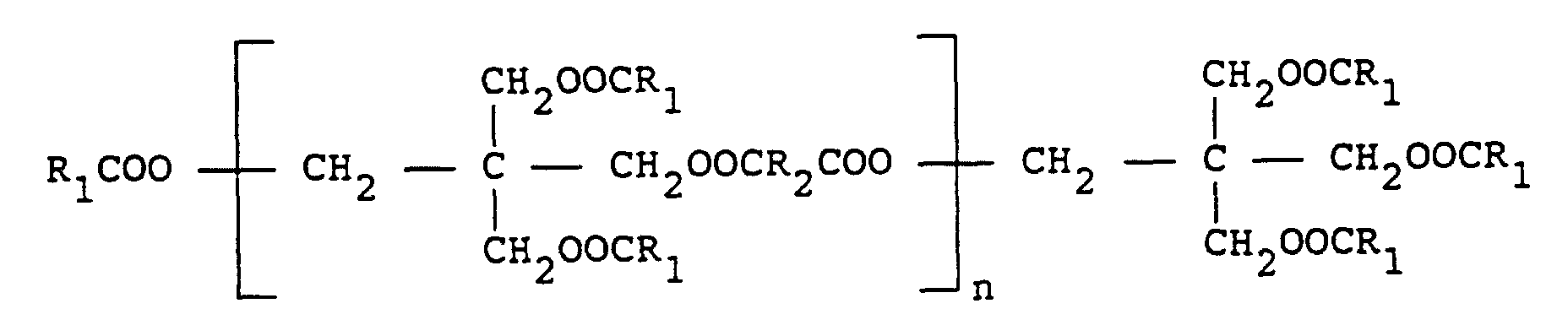
- R1
- is the alkyl moiety of an unsaturated fatty acid reactive to air oxygen thereby providing the polyester with air drying properties;
- R2
- is the alkyl or aryl moiety of a difunctional carboxylic acid;
- n
- is the average degree of polymerisation.
- An alkyd is a high molecular and contrary to the hyperbranched macromolecules a randomly branched compound with a broad polydispersity not illustrated by the simplified Formula (III). Alkyds exhibits due to this normally a very high viscosity and substantial amounts of solvents must thus be added to obtain so low a viscosity that they can be utilised.
- Further examples of ordinary polyesters are saturated polyesters. They are in principal composed similar to Formula (III), but with the difference that R1 is the alkyl moiety of a saturated monofunctional acid and that they contain unreacted hydroxyl groups. Curing is performed by crosslinking between the unreacted hydroxyl groups and for instance a melamine resin. The demand for viscosity reducing solvents is in this case also high.
- Polyesters, including alkyds, having a high-molecular weight and a high degree of branching, which are necessary to give good performance characteristics, as well as having so low a viscosity that they can be used solventless or with only a very small addition of solvents, can be obtained if polyesters are formulated as hyperbranched macromolecules. It is thus obvious that macromolecules such as according to the present invention give great advantages from an environmental point of view.
- Various dendritic macromolecules are i.a. described by Tomalia et al in Angew. Chem. Int. Ed. Engl. 29 pages 138-175 (1990) and in WO 93/17060.
- Dendritic macromolecules different from the macromolecules of the present invention are disclosed in said references. Tomalia et al discloses the preparation of polyamide amines of the dendrimer type. NH3 is used as initiator molecule and methyl acrylate and ethylene diamine as chain extenders. The yielded macromolecules are NH2 terminated. Chain stoppers are not used.
- WO 93/17060 discloses a dendritic macromolecule of the polyester type, which macromolecule is composed of a central initiator molecule or initiator polymer having one or more reactive groups (A), which groups (A) under formation of an initial tree structure are bonded to reactive groups (B) of a monomeric chain extender holding the two reactive groups (A) and (B). The tree structure is optionally extended and further branched from the initiator molecule or initiator polymer by the addition of further molecules of a monomeric chain extender by means of bonding between the reactive groups (A) and (B) thereof and is possibly further extended by a reaction with a chain stopper. The reactive groups consist of hydroxyl groups (A) and carboxyl groups (B), respectively, and the chain extender holds at least one carboxyl group (B) and at least two hydroxyl groups (A) or hydroxy alkyl substituted hydroxyl groups (A). Preferred examples for the nucleus involve
- a) an aliphatic, a cycloalophatic or an aromatic diol
- b) a triol
- c) a tetrol
- d) a sugar alcohol such as sorbitol and mannitol
- e) anhydroennea-heptitol or dipentaerythritol
- f) an α-alkylglucoside such as α-methylglucoside
- g) a monofunctional alcohol
- h) an alkoxylate polymer.
-
- The macromolecule according to the present invention enhances film properties quite different from corresponding properties obtained by above discussed hyperbranched macromolecules as well as different from conventional molecules of polyester type. Surface properties, such as drying time, hardness and scratch resistance are for instance markedly increased.
- The present invention refers to a dendritic or near dendritic hyperbranched macromolecule of the polyester type, having a central monomeric or polymeric nucleus consisting of an epoxide compound as defined in claim 1 with at least one reactive epoxide group. At least one generation of the macromolecule consists of a branching monomeric or polymeric chain extender having at least three reactive sites, of which at least one is a hydroxyl group or a hydroxyalkyl substituted hydroxyl group and at least one is a carboxyl group or a terminal epoxide group. The macromolecule can optionally comprise at least one generation consisting of a spacing monomeric or polymeric chain extender having two reactive sites, being one hydroxyl group or hydroxyalkyl substituted hydroxyl group and one carboxyl group or terminal epoxide group. The macromolecule may furthermore be terminated by means of at least one monomeric or polymeric chain stopper.
- The central monomeric or polymeric nucleus included in the hyperbranched macromolecule according to the present invention, is suitably selected from the group consisting of:
- i) a glycidyl ester of a saturated monofunctional carboxylic or fatty acid with
1-24 carbon atoms;
a glycidyl ester of an unsaturated monofunctional carboxylic or fatty acid with 3-24 carbon atoms; or
a glycidyl ester of a saturated or unsaturated di, tri or polyfunctional carboxylic acid with 3-24 carbon atoms; - ii) a glycidyl ether of a saturated monofunctional alcohol with 1-24 carbon
atoms;
a glycidyl ether of an unsaturated monofunctional alcohol with 2-24 carbon atoms;
a glycidyl ether of a saturated or unsaturated di, tri or polyfunctional alcohol with 3-24 carbon atoms;
a glycidyl ether of a phenol or a reaction product thereof; or
a glycidyl ether of a condensation product between at least one phenol and at least one aldehyde or an oligomer of such a condensation product; - iii) a mono, di or triglycidyl substituted isocyanurate; or
- iv) an aliphatic, cycloaliphatic or aromatic epoxy polymer.
-
- Above compounds can be exemplified by glycidyl ethers such as 1,2-epoxy-3-allyloxypropane, 1-allyloxy-2,3-epoxypropane, 1,2-epoxy-3-phenoxypropane, 1-glycidyloxy-2-ethylhexane and glycidyl esters such as the Cardura® compounds, which compounds are glycidyl esters of a highly branched saturated synthetic monocarboxylic acid called Versatic® acid (Cardura and Versatic acid are trademarks of Shell Chemicals).
- Glycidyl esters and ethers can be characterised by the general formulas (IV) and (V) for esters and ethers, respectively:
 wherein R1 normally is hydrogen, straight or branched alkyl, cycloalkyl, aryl or alkylaryl.
- Other examples of a suitable nucleus are diglycidyl ether of bisphenol A and reaction products thereof, diglycidyl terephthalate, epoxidized polyvinylalcohol, epoxidized polyvinylacrylates and epoxy resins such as 3,4-epoxy-cyclohexyl methyl 3,4-epoxy cyclohexane carboxylate.
- A suitable polymeric nucleus is also to be found among reaction products between epoxide esters or ethers and carboxylic acids with different number of reactive sites with regard to epoxide groups and carboxyl groups, such as a reaction product of a diepoxide and a monocarboxylic acid, whereby a product being epoxide functional is yielded.
- The hydroxyalkyl substituted hydroxyl groups in a branching or spacing chain extender, as used according to the present invention, has preferably the general formula
- A branching chain extender used according to the invention is suitably selected from the group consisting of:
- i) an aliphatic di, tri or polyhydroxyfunctional saturated or unsaturated monocarboxylic acid;
- ii) a cycloaliphatic di, tri or polyhydroxyfunctional saturated or unsaturated monocarboxylic acid;
- iii) an aromatic di, tri or polyhydroxyfunctional monocarboxylic acid;
- iv) an aliphatic monohydroxyfunctional saturated or unsaturated di, tri or polycarboxylic acid;
- v) a cycloaliphatic monohydroxyfunctional saturated or unsaturated di, tri or polycarboxylic acid;
- vi) an aromatic monohydroxyfunctional di, tri or polycarboxylic acid; and
- vii) an ester comprising two or more of the hydroxyfunctional carboxylic acids of i) through vi).
-
- The branching chain extender is in preferred embodiments 2,2-dimethylolpropionic acid, α,α-bis(hydroxymethyl)-butyric acid, α,α,α-tris(hydroxymethyl)-acetic acid, α,α-bis(hydroxymethyl)-valeric acid, α,α-bis(hydroxymethyl)-propionic acid, α,β--dihydroxypropionic acid, heptonic acid, citric acid, d- or l-tartaric acid, dihydroxymaloic acid, d-gluconic acid or an α-phenylcarboxylic acid having at least two hydroxyl groups directly pendant to the phenyl ring (phenolic hydroxyl groups) such as 3,5-dihydroxybenzoic acid. In an especially preferred embodiment, the branching chain extender is 2,2-dimethylolpropionic acid.
- The hyperbranched macromolecule comprises in certain embodiments of the present invention at least one generation consisting of at least one spacing monomeric or polymeric chain extender. In such embodiments, said chain extender is suitably selected from the group consisting of:
- i) an aliphatic monohydroxyfunctional saturated or unsaturated monocarboxylic acid;
- ii) a cycloaliphatic monohydroxyfunctional saturated or unsaturated monocarboxylic acid;
- iii) an aromatic monohydroxyfunctional monocarboxylic acid;
- iv) an ester comprising two or more of the hydroxyfunctional carboxylic acids of i) through iii);
- v) a lactone; and
- vi) a linear polyester or polyether.
-
- The spacing chain extender is, in preferred embodiments of the present invention, hydroxyvaleric acid, hydroxypropionic acid, hydroxypivalic acid, glycolide, δ-valerolactone, β-propiolactone or ε-caprolactone.
- Hydroxyfunctional carboxylic acids wherein one or more hydroxyl groups are hydroxyalkyl substituted in accordance with Formula (VI) are, depending on the number of reactive sites, suitable as either spacing or branching chain extenders.
- Unreacted functional sites in the nucleus or in a chain extender constituting the last or terminal extending generation of a macromolecule according to the present invention, can of course to a larger or smaller extent be reacted with one or more monomeric or polymeric chain stoppers. Important aspects on the use and choice of chain stoppers are for instance the desired final properties of the prepared macromolecule and type and number of unreacted functional sites in the chain extender. A chain stopper can also provide a suitable terminal functionality consisting of for instance hydroxyl, carboxyl and/or epoxide groups.
- In embodiments of the present invention, wherein the macromolecule is chain terminated, a chain stopper is advantageously selected from the group consisting of:
- i) an aliphatic or cycloaliphatic saturated or unsaturated monofunctional carboxylic acid or, where applicable, an anhydride thereof;
- ii) a saturated or unsaturated fatty acid;
- iii) an aromatic monofunctional carboxylic acid;
- iv) a diisocyanate, an oligomer or an adduct thereof;
- v) an epihalohydrin;
- vi) a glycidyl ester of a monofunctional carboxylic or fatty acid with 1-24 carbon atoms;
- vii) a glycidyl ether of a monofunctional alcohol with 1-24 carbon atoms;
- viii) an adduct of an aliphatic or cycloaliphatic saturated or unsaturated mono, di, tri or polyfunctional carboxylic acid or, where applicable, an anhydride thereof;
- ix) an adduct of an aromatic mono, di, tri or polyfunctional carboxylic acid or, where applicable, an anhydride thereof;
- x) an epoxide of an unsaturated monocarboxylic acid or fatty acid or corresponding triglyceride, which acid has 3-24 carbon atoms;
- xi) an aliphatic or cycloaliphatic saturated or unsaturated monofunctional alcohol;
- xii) an aromatic monofunctional alcohol;
- xiii) an adduct of an aliphatic or cycloaliphatic saturated or unsaturated mono, di, tri or polyfunctional alcohol; and
- xiv) an adduct of an aromatic mono, di, tri or polyfunctional alcohol.
-
- A chain stopper selected among saturated or unsaturated monofunctional carboxylic acids or fatty acids can be linear or branched and can be employed as acid or, where applicable, as anhydride. Examples are acetic acid, propionic acid, butyric acid, valeric acid, isobutyric acid, trimethylacetic acid, caproic acid, caprylic acid, capric acid, heptanoic acid, crotonic acid, acrylic acid, methacrylic acid, benzoic acid, para-tert.butylbenzoic acid, pelargonic acid, lauric acid, myristic acid, palmitic acid, stearic acid, behenic acid, lignoceric acid, cerotic acid, montanoic acid, isostearic acid, isononanoic acid, abietic acid, sorbinic acid, 2-ethylhexanoic acid, oleic acid, ricinoleic acid, linoleic acid, linolenic acid, erucic acid, soybean fatty acid, linseed fatty acid, dehydrated castor fatty acid, tall oil fatty acid, tung oil fatty acid, sunflower fatty acid and/or safflower fatty acid.
- Diisocyanates can be exemplified by toluene-2,4-diisocyanate, toluene-2,6-diisocyanate, diphenylmethane diisocyanate, hexamethylene diisocyanate, isophorone diisocyanate, 4,4-diisocyanato-dicyclohexylmethane, 1,5-diisocyanato-naphthaline, 1,4-phenylene diisocyanate, tetramethyl xylene diisocyanate, 1-isocyanato-3,3,5-trimethyl-5-isocyanatomethyl cyclohexane, 1,4-diisocyanate cyclohexane, 1,3-diisocyanate benzene and 1,4-diisocyanate benzene.
- Adducts of carboxylic acids and alcohols can, furthermore, be used as chain stoppers. Such chain stoppers are for instance adducts of hydroxyethyl acrylate and hydroxypropyl acrylate, trimethylolpropane diacrylate, pentaerythritol diacrylate, pentaerythritol triacrylate, acrylates of alkoxylated trimethylolpropane and pentaerythritol. Further examples are adducts of hydroxysubstituted allyl ethers such as trimethylolpropane diallyl ether maleate.
- Epihalohydrins such as 1-chloro-2,3-epoxypropane and 1,4-dichloro-2,3-epoxy butane, is a further group of suitable chain stoppers, yielding epoxide functional hyperbranched macromolecules. Epoxide functional macromolecules can, also, be prepared through epoxidation of unsaturation within the macromolecules.
- Monofunctional alcohols are most suitably aliphatic or cycloaliphatic and can be exemplified by 5-methyl-1,3-dioxane-5-methanol, 5-ethyl-1,3-dioxane-5-methanol, trimethylolpropane diallyl ether and pentaerythritol triallyl ether.
- Glycidyl esters of monofunctional carboxylic or fatty acids can be used as chain stoppers, such compounds include the well-known Cardura® esters (Shell Chemicals). Glycidyl ethers of monofunctional alcohols are suitably exemplified by 1,2-epoxy-3-allyloxypropane, 1-allyloxy-2,3-epoxypropane, 1,2-epoxy-3-phenoxypropane and 1-glycidyloxy-2-ethylhexane. It is also possible to use adducts of such compounds as glycidyl ethers of bisphenol A and oligomers thereof.
- A hyperbranched macromolecule according to the present invention can in certain embodiments comprise at least one generation consisting of at least one compound of the same type as the nucleus. Such a generation is always preceded by a generation consisting of at least one branching or spacing chain extender and is optionally further extended or terminated by addition of at least one generation of at least one branching or spacing chain extender or of at least one chain stopper. An embodiment such as this implies a great flexibility in the formulation of the hyperbranched macromolecule according to the present invention. Macromolecules tailor-made for various application areas or specific uses can through the choice of chain extender easily be formulated. A macromolecule wherein the first generation consists of a branching chain extender, the second of a spacing chain extender, the third of a molecule of the nucleus type etc. and other macromolecules having such a variety in their structure are possible to formulate.
- Suitable number of branching, spacing and/or terminating generations, i.e. generations consisting of branching chain extenders, spacing chain extenders or terminating chain stoppers, added to the monomeric or polymeric nucleus is within the range of 1-100, preferably 1-20, whereby at least one generation is a branching generation.
- Allyl functional hyperbranched macromolecules are further embodiments of the present invention. The allyl functionality is in such embodiments obtained through allylation of the macromolecule by means of an allylhalide, such as allyl chloride or allyl bromide.
- The present invention also comprises a process for preparing a hyperbranched macromolecule, which process includes the steps of:
- a) reacting a branching chain extender with further molecules of the same chain extender and/or with further molecules of at least one other branching chain extender, which chain extender molecules have three reactive sites, at a temperature of 0-300°C, preferably 50-250°C, and in an amount corresponding to more than one chain extending generation, whereby a chain extending prepolymer having more than three reactive sites is yielded; and
- b) reaction between at least one prepolymer according to step (a) and a monomeric or polymeric nucleus having at least one reactive epoxide group, the reaction being carried out at a temperature of 0-300°C, preferably 50-250°C, whereby a hyperbranched macromolecule having more than one chain extending generation is obtained; which macromolecule
- c) optionally is further extended, at a reaction temperature of 0-300°C, preferably 50-250°C, by addition of further branching or spacing chain extender molecules, the addition being performed in a number of steps at least equal to requested number of generations; and/or
- d) optionally, in one or more steps, is chain terminated at a reaction temperature of 0-300°C, preferably 50-250°C, by addition of at least one monomeric or polymeric chain stopper forming a terminal generation.
-
- The process can alternatively include the steps of:
- e) reaction between a monomeric or polymeric nucleus having at least one reactive epoxide group and at least one monomeric or polymeric branching chain extender having at least three reactive sites to form a first or part of a first generation of a hyperbranched macromolecule, the reaction being performed at a temperature of 0-300°C, preferably 50-250°C; after which reaction the first generation
- f) optionally is further extended, at a reaction temperature of 0-300°C, preferably 50-250°C, by addition of further branching or spacing chain extender molecules, the addition being performed in a number of steps at least equal to requested number of generations; and/or
- g) optionally, in one or more steps, is chain terminated at a reaction temperature of 0-300°C, preferably 50-250°C, by addition of at least one monomeric or polymeric chain stopper forming a terminal generation.
-
- Furthermore, at least a part of one generation can involve a chain extension by means of addition of at least one compound of the same type as a nucleus. The generation including such a compound is preceded, according to step (b) or (e) by at least one generation consisting of at least one chain extender and can optionally be further extended or terminated by a generation consisting of at least one branching or spacing chain extender or of at least one chain stopper.
- It is advisable to continuously remove water formed during one or more steps of the process according to the present invention. Suitable methods are for instance inlet of inert gas into the reaction vessel, vacuum distillation, azeotropic distillation and/or the like.
- The reactions can be carried out without using any catalyst. A catalyst is, however, preferred and used in many cases and is then suitably selected from the group consisting of:
- i) a Brønsted acid;
- ii) a Lewis acid;
- iii) a titanate;
- iv) metallic zinc or an organic or inorganic zinc compound;
- v) metallic tin or an organic or inorganic tin compound;
- vi) metallic lithium or an organic or inorganic lithium compound; and
- vii) triphenylphosphine or a derivative thereof.
-
- The catalyst is in preferred embodiments selected from the group consisting of the following Brønsted acids naphthalene sulphonic acid, p-toluene sulphonic acid, methane sulphonic acid, trifluoromethane sulphonic acid, trifluoroacetic acid, sulphuric acid or phosphoric acid or of the following Lewis acids BF3, AlCl3 or SnCl4. Suitable catalysts are also tetrabutyl titanate, triphenylphosphine and lithium anhydride benzoate. A catalyst can be used as sole catalyst or in combinations including two or more catalysts.
- The macromolecule according to the present invention can be used in many areas including in the preparation of products constituting or being part of alkyds, alkyd emulsions, saturated polyesters, unsaturated polyesters, epoxy resins, phenolic resins, polyurethane resins, polyurethane foams and elastomers, binders for radiation curing systems such as systems cured with ultraviolet (UV) and infrared (IR) light or electron-beams (EB), dental materials, adhesives, synthetic lubricants, microlithographic coatings and resists, binders for powder systems, amino resins, composites reinforced with glass,aramide or carbon/graphite fibres and moulding compounds based on urea-formaldehyde resins, melamine-formaldehyde resins or phenol-formaldehyde resins.
- These and other objects and the attendant advantages will be more fully understood from the following detailed disclosure, given in conjunction with Examples 1-13 wherein:
- Example 1:
- Preparation of a three generations hyperbranched macromolecule of the polyester type, having a bisphenol A-diglycidylether based nucleus.
- Example 2:
- Preparation of a four generations hyperbranched macromolecule of the polyester type, having a bisphenol A-diglycidylether based nucleus.
- Example 3:
- Preparation of an air drying tall oil fatty acid alkyd based on the hyperbranched macromolecule of Example 1.
- Example 4:
- Preparation of an air drying tall oil fatty acid alkyd based on the hyperbranched macromolecule of Example 2.
- Example 5:
- Comparative example - Preparation of a conventional air drying high solid alkyd.
- Example 6:
- Preparation of an unsaturated polyester based on the hyperbranched macromolecule of Example 1.
- Example 7:
- Evaluation of products according to Examples 3-5.
- Example 8:
- Evaluation of products according to Example 6.
- Example 9:
- Preparation of a three generations hyperbranched macromolecule of the polyester type, having a triglycidyl isocyanurate nucleus.
- Example 10:
- Preparation of a four generations hyperbranched macromolecule of the polyester type, having a triglycidyl isocyanurate nucleus.
- Example 11:
- Preparation of an air drying oleic acid alkyd based on the hyperbranched macromolecule of Example 1.
- Example 12:
- Preparation of an air drying tall oil fatty acid alkyd based on the hyperbranched macromolecule of Example 10.
- Example 13:
- Preparation of an epoxidized hyperbranched macromolecule based on the product of Example 11.
- While particular embodiments of the invention will be shown, it will be understood, of course, that the invention is not limited thereto since many modifications may be made, and it is, therefore, contemplated to cover by the appended claims modifications falling within the true spirit and scope of the invention.
- 600.0 g (4.47 moles) of 2,2-dimethylolpropionic acid, 60.0 g of triethylene glycol dimethyl ether and 0.6 g (0.006 mole) of sulfuric acid (96% by weight) were charged in a 4-necked reaction flask equipped with stirrer, pressure gauge, cooler and receiver. The temperature was raised from room temperature to 140°C in 35 minutes, during which time all 2,2-dimethylolpropionic acid melted, thus giving a clear solution. A vacuum of 30-50 mm Hg was applied and the reaction was, under stirring, allowed to continue for 65 minutes until an acid value of 64.6 mg KOH/g was reached. 0.5 g (0.012 mole) of sodium hydoxide, 119.5 g (≈ 0.32 mole) of Epikote® 880 (a bisphenol A-diglycidyl ether based epoxide compound, Shell Chemicals, The Netherlands) and 0.7 g of lithium anhydride benzoate were now added to the reaction mixture. The temperature was raised to 150°C, giving a clear solution and a strong exothermic reaction. When the exotherm declined, a vacuum of 200 mm Hg was applied and the reaction was allowed to continue for 65 minutes until an acid value of 8.6 mg KOH/g was reached. The temperature was thereafter raised to 170°C and the pressure was further reduced to 50 mm Hg and the reaction was allowed to continue for an additional 30 minutes giving a final acid value of 6.8 mg KOH/g.
- Obtained hyperbranched macromolecule of polyester type exhibited the following properties:
Acid value, mg KOH/g 6.8 Hydroxyl value, mg KOH/g 490 (theor. value: 505) Molecular weight, g/mole 2700 (theor. value: 2000) - 600.0 g (4.47 moles) of 2,2-dimethylolpropionic acid, 0.6 g (0.006 mole) of sulfuric acid (96% by weight) and 60.0 g of water were charged in a 4-necked reaction flask equipped with stirrer, pressure gauge, cooler and receiver. The temperature was raised from room temperature to 140°C in 50 minutes, during which time all 2,2-dimethylolpropionic acid melted, thus giving a clear solution. A vacuum of 30-50 mm Hg was applied and the reaction was, under stirring, allowed to continue for 115 minutes until an acid value of 33.8 mg KOH/g was reached. 1.1 g (0.012 mole) of sodium hydroxide (46% aq.), 58.0 g (≈ 0.16 mole) of Epikote® 880 (a bisphenol A-diglycidyl ether based epoxide compound, Shell Chemicals, The Netherlands) and 0.7 g of lithium anhydride benzoate were now added to the reaction mixture. The temperature was raised to 155°C, giving a clear solution and a strong exothermic reaction. When the exotherm declined, a vacuum of 200 mm Hg was applied and the reaction was allowed to continue for an additional 60 minutes until an acid value of 9.3 mg KOH/g was reached.
- Obtained hyperbranched macromolecule of polyester type exhibited the following properties:
Acid value, mg KOH/g 9.3 Hydroxyl value, mg KOH/g 485 (theor. value: 495) Molecular weight, g/mole 3797 (theor. value: 3857) - 250.0 g of the polyester type hyperbranched macromolecule of Example 1, 562.1 g (1.97 moles) of tall oil fatty acid, 0.4 g of an esterification catalyst (Fascat® 4100, Atochem, The Netherlands) and 30 g of xylene were charged in a 4-necked reaction flask equipped with stirrer, nitrogen inlet, cooler and water trap (Dean-Stark). The temperature was during 45 minutes raised to 210°C and the reaction was, under stirring, allowed to continue for 110 minutes. The temperature was thereafter raised to 220°C and kept constant for 120 minutes after which time it was raised to 230°C. The reaction was now allowed to continue for a further 225 minutes until an acid value of 11.3 mg KOH/g was reached. The temperature was thereafter decreased to 200°C and full vacuum was applied to remove residual xylene.
- Obtained hyperbranched alkyd exhibited the following properties:
Final acid value, mg KOH/g 12.4 Hydroxyl value, mg KOH/g 8.3 Theoretical molecular weight, g/mole 5800 Viscosity at 23°C, mPas 3640 Nonvolatile content, % 99.6 - 250.0 g of the polyester type hyperbranched macromolecule of Example 2, 585.1 g (2.05 moles) of tall oil fatty acid, 0.5 g of an esterification catalyst (Fascat® 4100, Atochem, The Netherlands) and 30 g of xylene were charged in a 4-necked reaction flask equipped with stirrer, nitrogen inlet, cooler and water trap (Dean-Stark). The temperature was during 50 minutes raised to 220°C and the reaction was, under stirring, allowed to continue for 230 minutes after which additional 0.4 g of Fascat® 4100 was added. The reaction was thereafter allowed to continue for a further 120 minutes and thereafter raised to 230°C. The reaction was now allowed to continue for an additional 120 minutes until an acid value of 9.2 mg KOH/g was reached. The temperature was then decreased to 200°C and full vacuum was applied to remove residual xylene.
- Obtained hyperbranched alkyd exhibited the following properties:
Final acid value, mg KOH/g 9.2 Hydroxyl value, mg KOH/g 7.9 Theoretical molecular weight, g/mole 11971 Viscosity at 23°C, mPas 5600 Nonvolatile content, % 100.0 - 71.8 g of tall oil fatty acid, 17.5 g of o-phthalic anhydride, 17.0 g of pentaerythritol and 4% by weight of xylene were charged in a 4-necked reaction flask equipped with stirrer, nitrogen inlet, cooler and water trap (Dean-Stark). The temperature was raised to 160°C and kept at this temperature for 10 minutes, after which time the temperature was raised by 0.5°C/minute until 240°C was reached. An acid value of 9.0 mg KOH/g was obtained after 10 hours of esterification. The temperature was then reduced to 200°C and full vacuum was applied to remove residual xylene.
- Obtained conventional high solid alkyd exhibited the following properties:
Final acid value, mg KOH/g 9.0 Hydroxyl value, mg KOH/g 15 Theoretical molecular weight, g/mole 4200 Viscosity at 23°C, mPas 7050 Nonvolatile content, % 100.0 - 200.0 g of the polyester type hyperbranched macromolecule of Example 1, 81.8 g (0.95 mole) of crotonic acid, 93.1 g (0.63 mole) of a mixture of capric and caprylic acid, 0.15 g of hydroquinone (10% by weight in ethanol) and 0.5 g of an esterification catalyst (Fascat® 4100, Atochem, The Netherlands) were charged in a 4-necked reaction flask equipped with stirrer, nitrogen inlet, cooler and water trap (Dean-Stark). The temperature was during 50 minutes raised to 170°C. The reaction was allowed to continue for 120 minutes, after which time the temperature was raised to 210°C. An acid value of 12.9 mg KOH/g was finally reached after a further 260 minutes at 210°C.
- The following driers were mixed with products according to Examples 3, 4 and 5:
Zirconium octoate 0.25% Cobalt octoate 0.03% - Above percentages were calculated as 100% metal on the nonvolatile content of the products.
- An antiskin agent (Exkin® 2, Servo B.V., The Netherlands) was, furthermore, added in an amount of 0.30%.
- The thus prepared lacquers were free of solvents and coated on glass panels at a filmthickness of 50 ± 5 µm (dry).
- The drying time and hardness were measured as through dry by means of the Finger (thumb) Touch Method, pendulum hardness according to König after 7 days of drying and pencil hardness (scratch resistance) after 7 days of drying. All evaluations were carried at 23 ± 2°C and 50 ± 5% relative humidity.
-
- Finger Touch Method - U.S. Federal Test Method Standard 141, Method 4061.
- Pendulum hardness - SS 184286 (identical to ISO 1522-1973).
- Pencil Hardness - ASTM 3363-74 (1989)
-
- The result is given below.
Example no. 3 4 5 Drying time to through dry, hours: 8-9 8-9 26 Hardness after 7 days, König seconds: 17 17 15 Pencil hardness after 7 days: H-2H H-2H 4B - As can be seem from above result, hyperbranched alkyds exhibit substantially faster through dry and a substantially improved pencil hardness (scratch resistance) compared to conventional alkyds. Both types of alkyds can be regarded as so called high solids.
- An ultraviolet (UV) curing lacquer, based on the unsaturated polyester according to Example 6, having the following formulation was prepared:
Unsaturated polyester acc. to Example 6 50.0 g Tripropylene glycol diacrylate 25.0 g Trimethylolpropane triethoxylate triacrylate 25.0 g Photoinitiator (Darocur® 173, Firma E.Merck, Germany) 4.0 g - The viscosity of obtained lacquer was 610 mPas at 25°C.
- The lacquer was coated on glass panels at a filmthickness of 30 ± 5 µm (dry) and was UV cured immediately after application. UV curing was performed using a Labcure® Unit LC 9 from Wallace Knight, UK, having a belt speed of 20 m/min and an irradiation source consisting of medium pressure quartz mercury lamps of 80 Watts/cm.
- Hardness was measured at 23 ± 2°C and 50 ± 5% relative humidity as pendulum hardness according to König.
- Test Method: Pendulum hardness - SS 184286 (identical to ISO 1522-1973).
- The result is given below.
Number of passages under UV lamp Pendulum Hardness 1 passage 25 König seconds 2 passages 25 König seconds 4 passages 28 König seconds 8 passages 45 köning secons 16 passages 63 König seconds - 1000.0 g (7.46 moles) of 2,2-dimethylolpropionic acid, 100.0 g of water and 1.0 g (0.01 mole) of sulfuric acid (96% by weight) were charged in a 4-necked reaction flask equipped with stirrer, pressure gauge, cooler and receiver. The temperature was raised from room temperature to 140°C in 90 minutes, during which time all 2,2-dimethylolpropionic acid melted, thus giving a clear solution. A vacuum of 30-50 mm Hg was applied and the reaction was, under stirring, allowed to continue for 85 minutes until an acid value of 74 mg KOH/g was reached. 2.0 g of sodium hydoxide, 111.0 g (≈ 0.36 mole) of triglycidyl isocyanurate (Ciba-Geigy, Switzerland) and 1.1 g of lithium benzoate were now added to the reaction mixture. The temperature was raised to 150°C, giving a clear solution and a strong exothermic reaction. When the exotherm declined, a vacuum of 200 mm Hg was applied and the reaction was allowed to continue for 105 minutes until an acid value of 9.4 mg KOH/g was reached.
- Obtained hyperbranched macromolecule of polyester type exhibited the following properties:
Acid value, mg KOH/g 9.4 Hydroxyl value, mg KOH/g 432 Average molecular weight, g/mole 3023 (theor value 2800) - 1000.0 g (7.46 moles) of 2,2-dimethylolpropionic acid, 20.0 g of water and 1.0 g (0.01 mole) of sulfuric acid (96% by weight) were charged in a 4-necked reaction flask equipped with stirrer, pressure gauge, cooler and receiver. The temperature was raised from room temperature to 140°C in 90 minutes, during which time all 2,2-dimethylolpropionic acid melted, thus giving a clear solution. A vacuum of 30-50 mm Hg was applied and the reaction was, under stirring, allowed to continue for 140 minutes until an acid value of 30 mg KOH/g was reached. 2.0 g of sodium hydoxide, 52.0 g (≈ 0.17 mole) of triglycidyl isocyanurate (Ciba-Geigy, Switzerland) and 1.0 g of lithium benzoate were now added to the reaction mixture. The temperature was raised to 150°C, giving a clear solution and a sligthly exothermic reaction. When the exotherm declined, a vacuum of 200 mm Hg was applied and the reaction was allowed to continue for 105 minutes until an acid value of 2.9 mg KOH/g was reached.
- Obtained hyperbranched macromolecule of polyester type exhibited the following properties:
Acid value, mg KOH/g 2.9 Hydroxyl value, mg KOH/g 504 (theor. value: 505) Average molecular weight, g/mole 6200 (theor. value 5600) - 48.4 g of the polyester type hyperbranched macromolecule of Example 1, 435.9 g (1.54 moles) of oleic acid, 0.5 g of p-toluene sulphonic acid and 68 g of xylene were charged in a 4-necked reaction flask equipped with stirrer, nitrogen inlet, cooler and water trap (Dean-Stark). The temperature was during 55 minutes raised to 180°C and the reaction was, under stirring, allowed to continue for 60 minutes. The temperature was thereafter raised to 200°C and kept constant for 480 minutes until an acid value of 10.3 mg KOH/g was reached. The temperature was thereafter decreased to 200°C and full vacuum was applied to remove residual xylene.
- Obtained hyperbranched alkyd exhibited the following properties:
Final acid value, mg KOH/g 10.3 Hydroxyl value, mg KOH/g 124 Theoretical molecular weight, g/mole 5200 Viscosity at 23°C, mPas 12400 Nonvolatile content, % 99.6 - 256.0 g of the polyester type hyperbranched macromolecule of Example 10, 594.9 g (2.09 moles) of tall oil fatty acid, 0.2 g of an esterification catalyst (Fascat® 4100, Atochem, The Netherlands) and 55 g of xylene were charged in a 4-necked reaction flask equipped with stirrer, nitrogen inlet, cooler and water trap (Dean-Stark). The temperature was during 70 minutes raised to 200°C and the reaction was, under stirring, allowed to continue for 12 hours until an acid value of 10 mg KOH/g was reached. The temperature was then decreased to 200°C and full vacuum was applied to remove residual xylene.
- Obtained hyperbranched alkyd exhibited the following properties:
Final acid value, mg KOH/g 9.9 Hydroxyl value, mg KOH/g 15 Theoretical molecular weight, g/mole 17700 Viscosity at 23°C, mPas 10700 Nonvolatile content, % 99.8 - 26.36 g of m-chloroperbenzoic acid and 750 ml of dichloromethane were at room temperature charged in a 3-necked reaction flask equipped with stirrer, nitrogen inlet and cooler. Obtained solution was cooled to 0°C and 38.86 g of the product according to Example 11 dissolved in 250 ml of dichloromethane were now during 60 minutes instilled. Resulting reaction mixture was at 0°C stirred during 120 minutes followed by precipitation of excess m-chloroperbenzoic acid. The reaction mixture was now allowed to react at room temperature for a further 18 hours. Resulting product was thereafter purified by extraction using 3 x 250 ml of 0.1 M aqueous Na2S2O3 followed by 3 x 250 ml of saturated aqueous NaHCO3. The mixture was allowed to phase separate and the organic layer was removed. The final product was thereafter recovered by removal of solvent under full vacuum at 50°C using a rotary evaporator.
- Obtained product exhibited the following properties:
Epoxy equivalent weight (EEW-value), g/equivalent 445 (theor. value 441) Viscosity, 23°C, mPas 12000 Nonvolatile content, % 100.0
Claims (21)
- A hyperbranched macromolecule of polyester type built up from a nucleus reacted with at least one generation of a monomeric or polymeric branching chain extender and optionally at least one generation of a monomeric or polymeric spacing chain extender, which macromolecule subsequently optionally is terminated by reaction with at least one chain stopper
characterised in,a) that said nucleus before reaction has at least one reactive epoxide group and is selected from the group consisting ofi) a glycidyl ester ofa saturated monofunctional carboxylic acid or fatty acid having 1-24 carbon atoms,an unsaturated monofunctional carboxylic acid or fatty acid having 3-24 carbon atoms, ora saturated or unsaturated di, tri or polyfunctional carboxylic acid having 3-24 carbon atoms,ii) a glycidyl ether ofa saturated monofunctional alcohol having 1-24 carbon atoms,an unsaturated monofunctional alcohol having 2-24 carbon atoms,a saturated or unsaturated di, tri or polyfunctional alcohol having 3-24 carbon atoms,a phenol or a reaction product thereof, ora condensation product between at least one phenol and at least one aldehyde or an oligomer of such a product,iii) a mono, di or triglycidyl substituted isocyanurate, andiv) an aliphatic, cycloaliphatic or aromatic epoxy polymer,b) that said branching chain extender has at least three reactive sites being at least one hydroxyl group or hydroxyalkyl substituted hydroxyl group and at least one carboxyl group or terminal epoxide group, andc) that said optional spacing chain extender has two reactive sites being one hydroxyl group or hydroxyalkyl substituted hydroxyl group and one carboxyl group or terminal epoxide group. - A hyperbranched macromolecule according to Claim 1
characterised in that said nucleus is 1-glycidyloxy-2-ethylhexane, bisphenol-A-diglycidyl ether or diglycidylterephthalate. - A hyperbranched macromolecule according to Claim 1
characterised in that said hydroxyalkyl substituted hydroxyl group in the branching or spacing chain extender are of general formula - A hyperbranched macromolecule according to Claim 1 or 3
characterised in that said branching chain extender is selected from the group consisting ofi) an aliphatic di, tri or polyhydroxyfunctional saturated or unsaturated monofunctional carboxylic acid,ii) a cycloaliphatic di, tri or polyhydroxyfunctional saturated or unsaturated monofunctional carboxylic acid,iii) an aromatic di, tri or polyhydroxyfunctional monofunctional carboxylic acid,iv) an aliphatic monohydroxyfunctional saturated or unsaturated di, tri or polyfunctional carboxylic acid,v) a cycloaliphatic monohydroxyfunctional saturated or unsaturated di, tri or polyfunctional carboxylic acid,vi) an aromatic monohydroxyfunctional saturated or unsaturated di, tri or polyfunctional carboxylic acid, andvii) an ester formed by two or more hydroxyfunctional carboxylic acids of (i) through (vi). - A hyperbranched macromolecule according to Claim 1, 3 or 4
characterised in that said branching chain extender is 2,2-dimethylolpropionic acid, α,α-bis(hydroxymethyl)buryric acid, α,α,α-tris(hydroxymethyl)acetic acid, α,α-bis(hydroxymethyl)valeric acid, α,α-bis(hydroxy)propionic acid, 3,5-dihydroxybenzoic acid, α,β-dihydroxypropionic acid, heptonic acid, citric acid, d- or l-tartaric acid, dihydroxymaloic acid or d-gluconic acid. - A hyperbranched macromolecule according to Claim 1
characterised in that said hyperbranched macromolecule comprises at least one generation consisting of at least one spacing monomeric or polymeric chain extender selected from the group consisting ofi) an aliphatic monohydroxyfunctional saturated or unsaturated monofunctional carboxylic acid,ii) a cycloaliphatic monohydroxyfunctional saturated or unsaturated monofunctional carboxylic acid,iii) an aromatic monohydroxyfunctional monofunctional carboxylic acid,iv) an ester formed by two or more hydroxyfunctional carboxylic acids of (i) through iii),v) a lactone, andvi) a linear polyester or polyether. - A hyperbranched macromolecule according to Claim 6
characterised in that said spacing chain extender is hydroxyvaleric acid, hydroxypropionic acid, hydroxypivalic acid, glycolide, δ-valerolactone, β-propiolactone or ε-caprolactone. - A hyperbranched macromolecule according to any of the Claim 1-7
characterised in that said hyperbranched macromolecule is terminated by at least one monomeric or polymeric chain stopper selected from the group consisting ofi) an aliphatic or cycloaliphatic saturated or unsaturated monofunctional carboxylic acid or, where applicable, an anhydride thereof,ii) a saturated or unsaturated fatty acid,iii) an aromatic monofunctional carboxylic acid,iv) a diisocyanate or an oligomer or adduct thereof,v) an epihalohydrin,vi) a glycidyl ester of a monofunctional carboxylic acid or fatty acid having 1-24 carbon atoms,vii) a glycidyl ether of a monofunctional alcohol having 1-24 carbon atoms,viii) an adduct of an aliphatic or cycloaliphatic saturated or unsaturated mono, di, tri or polyfunctional carboxylic acid or, where applicable, an anhydride thereof,ix) an adduct of an aromatic mono, di, tri or polyfunctional carboxylic acid or, where applicable, an anhydride thereof,x) an epoxide of an unsaturated monofunctional carboxylic acid, fatty acid or corresponding triglyceride, said acid having 2-24 carbon atoms,xi) an aliphatic or cycloaliphatic saturated or unsaturated monofunctional alcohol,xii) an aromatic monofunctional alcohol,xiii) an adduct of an aliphatic or cycloaliphatic saturated or unsaturated mono, di, tri or polyfunctional alcohol, andxiv) an adduct of an aromatic mono, di, tri or polyfunctional alcohol. - A hyperbranched macromolecule according to Claim 8
characterised in that said chain stopper is lauric acid, linseed fatty acid, soybean fatty acid, tall oil fatty acid, dehydrated castor fatty acid, crotonic acid, capric acid, caprylic acid, acrylic acid, methacrylic acid, benzoic acid, para-tert.butylbenzoic acid, abietic acid, sorbic acid, 1-chloro-2,3-epoxypropane, 1,4-dichloro-2,3-epoxybutane, epoxidised soybean fatty acid, trimethylolpropane diallylether maleate, 5-methyl-1,3-dioxane-5-methanol, 5-ethyl-1,3-dioxane-5-methanol, trimethylolpropan diallyl ether, pentaerythritol triallyl ether, pentaerythritol triacrylate, pentaerythritol triethoxylate triacrylate, toluene-2,4-diisocyanate, toluene-2,6-diisocyanate, hexamethylene diisocyanate or isophorone diisocyanate. - A hyperbranched macromolecule according to any of the Claim 1-9
characterised in that said hyperbranched macromolecule comprises 1-100, preferably 1-20, branching, spacing and/or terminating generations, whereby at least one generation is a branching generation. - A hyperbranched macromolecule according to any of the Claim 1-10
characterised in that said hyperbranched macromolecule is epoxide functional and that said epoxide functionality is obtained through epoxidation of unsaturation in the hyperbranched macromolecule. - A hyperbranched macromolecule according to any of the Claim 1-11
characterised in that said hyperbranched macromolecule is allyl functional and that said allyl functionality is obtained through allylation using an allylhalide. - A hyperbranched macromolecule according to the Claim 1-7
characterised in that said allylhalide is allylchloride and/or allylbromide. - A hyperbranched macromolecule according to any of the Claim 1-13
characterised in that said hyperbranched macromolecule a raw material in manufacture of products constituting or being part ofi) an alkyd,ii) an alkyd emulsion,iii) a saturated polyester or an unsaturated polyester,iv) an epoxy resin,v) a phenolic resin,vi) an amino resin,vii) a polyurethane resin, foam or elastomer,viii) a binder for radiation curing systems,ix) a binder for powder coating systems,x) an adhesive,xi) a synthetic lubricant,xii) a microlithographic coating or resist,xiii) a composite reinforced with glass, aramide or carbon/graphite fibres,xiv) a moulding compound based on urea-formaldehyde resin, melamine-formaldehyde resin and/or phenol-formaldehyde resin, orxv) a dental material. - A process in two or more steps of preparing a hyperbranched macromolecule according to any of the claims 1-14
characterised in that said process comprises the steps ofa) reacting a branching chain extender with further molecules of the same chain extender and/or with further molecules of at least one other branching chain extender, which chain extender molecules have three reactive sites, at a temperature of 0-300°C, preferably 50-250°C, and in an amount corresponding to more than one chain extending generation, whereby a chain extending pre-polymer having more than three reactive sites is yielded; andb) reaction between at least one prepolymer according to step (a) and a monomeric or polymeric nucleus having at least one reactive epoxide group, the reaction being carried out at a temperature of 0-300°C, preferably 50-250°C, whereby a hyperbranched macromolecule having more than one chain extending generation is obtained; which macromolecule,c) optionally further extension, at a reaction temperature of 0-300°C, preferably 50-250°C, by addition of further branching or spacing chain extender molecules, the addition being performed in a number of steps at least equal to requested number of generations; and/ord) optionally, in one or more steps, chain termination at a reaction temperature of 0-300°C, preferably 50-250°C, by addition of at least one monomeric or polymeric chain stopper forming a terminal generation. - A process according to claim 15
characterised in that at least one chain extending generation formed according to step (c) at least partly comprises at least one chain extending compound being equal to a nucleus, said generation optionally being further extended or terminated by at least one generation consisting of at least one chain extender or chain stopper. - A process according to claim 15 or 16
characterised in that reaction water formed during one or more steps of the process is removed by inlet of an inert gas, azeotropic distillation or vacuum distillation. - A process according to claim 17
characterised in that said reaction water is removed continuously. - A process according to any of the claims 15 - 18
characterised in that at least one catalyst is present during at least one step of said process. - A process according to claim 19
characterised in that said catalyst is selected from the group consisting of:i) a Brønsted acid,ii) a Lewis acid,iii) a titanate,iv) metallic zinc or an organic or inorganic zinc compound,v) metallic tin or an organic or inorganic tin compound,vi) metallic lithium or an organic or inorganic lithium compound, andvii) triphenylphosphine or a derivative thereof. - A process according to claim 19 or 20
characterised in that said catalyst is naphthalene sulphonic acid, p-toluene sulphonic acid, methane sulphonic acid, trifluoromethane sulphonic acid, trifluoroacetic acid, sulphuric acid, phosphoric acid, BF3, AlCl4, SnCl4, tetrabutyl titanate and/or lithium anhydride benzoate.
Applications Claiming Priority (4)
| Application Number | Priority Date | Filing Date | Title |
|---|---|---|---|
| SE9403619A SE503342C2 (en) | 1994-10-24 | 1994-10-24 | Polyester-type hyperbranched macromolecule and process for its preparation |
| SE9403619 | 1994-10-24 | ||
| PCT/SE1995/001205 WO1996012754A1 (en) | 1994-10-24 | 1995-10-17 | Hyperbranched macromolecule of polyester type |
| US08/547,447 US5663247A (en) | 1994-10-24 | 1995-10-24 | Hyperbranched macromolecule from epoxide nucleus and hydroxy-functional carboxylic acid chain extenders |
Publications (2)
| Publication Number | Publication Date |
|---|---|
| EP0788524A1 EP0788524A1 (en) | 1997-08-13 |
| EP0788524B1 true EP0788524B1 (en) | 2003-02-05 |
Family
ID=26662157
Family Applications (1)
| Application Number | Title | Priority Date | Filing Date |
|---|---|---|---|
| EP95936149A Expired - Lifetime EP0788524B1 (en) | 1994-10-24 | 1995-10-17 | Hyperbranched macromolecule of polyester type |
Country Status (14)
| Country | Link |
|---|---|
| US (1) | US5663247A (en) |
| EP (1) | EP0788524B1 (en) |
| JP (1) | JP3438895B2 (en) |
| CN (1) | CN1073584C (en) |
| AT (1) | ATE232218T1 (en) |
| AU (1) | AU3819195A (en) |
| CA (1) | CA2202874C (en) |
| DE (1) | DE69529574T2 (en) |
| DK (1) | DK0788524T3 (en) |
| ES (1) | ES2191715T3 (en) |
| FI (1) | FI971726L (en) |
| NO (1) | NO311135B1 (en) |
| SE (1) | SE503342C2 (en) |
| WO (1) | WO1996012754A1 (en) |
Families Citing this family (155)
| Publication number | Priority date | Publication date | Assignee | Title |
|---|---|---|---|---|
| US6093777A (en) * | 1994-12-21 | 2000-07-25 | Perstorp Ab | Dendritic polyester macromolecule in thermosetting resin matrix |
| SE9504652D0 (en) * | 1995-12-22 | 1995-12-22 | Perstorp Ab | Polyester compound |
| US6114489A (en) * | 1997-03-27 | 2000-09-05 | Herberts Gmbh | Reactive hyperbranched polymers for powder coatings |
| FR2761691B1 (en) | 1997-04-03 | 1999-05-14 | Oreal | THIOL TERMINAL FUNCTION POLYMERS |
| FR2763852B1 (en) | 1997-05-28 | 1999-07-09 | Oreal | COMPOSITION COMPRISING A CINNAMIC ACID DERIVATIVE AND A POLYAMINE POLYMER |
| FR2763851B1 (en) | 1997-05-28 | 1999-07-09 | Oreal | COMPOSITIONS COMPRISING A DIBENZOYLMETHANE DERIVATIVE AND A POLYAMINE POLYMER |
| SE510128C2 (en) * | 1997-06-26 | 1999-04-19 | Perstorp Ab | Process for the preparation of dendritic polyol |
| SE510088C2 (en) * | 1997-06-26 | 1999-04-19 | Perstorp Ab | Synthesis of a dendritic polyalcohol |
| US5952452A (en) * | 1997-07-16 | 1999-09-14 | E. I. Du Pont De Nemours And Company | Hydroxy-functional oligomers for high solids coatings |
| DE19736665A1 (en) * | 1997-08-22 | 1999-02-25 | Espe Dental Ag | Vulcanizable silicone composition useful in dentistry |
| DE19840605A1 (en) | 1998-09-05 | 2000-03-09 | Basf Coatings Ag | Hyperbranched compounds with a tetrafunctional central group and their use |
| US6114458A (en) * | 1998-09-23 | 2000-09-05 | International Business Machines Corporation | Highly branched radial block copolymers |
| SE515019C2 (en) * | 1998-09-28 | 2001-05-28 | Perstorp Ab | New primary epoxides |
| DE19850243A1 (en) | 1998-10-31 | 2000-05-11 | Basf Coatings Ag | Liquid mixtures and (co) polymers, processes for their preparation and their use for the production of reactive multicomponent mixtures |
| SE524569C2 (en) * | 1998-11-20 | 2004-08-31 | Perstorp Ab | Process for the preparation of an allyloxycarboxylic acid, use of the allyoxycarboxylic acid prepared according to the process as component of oligomeric and polymeric binders, and 6-allyloxyhexanoic acid prepared according to the process |
| US20020078838A1 (en) * | 1998-11-30 | 2002-06-27 | Oberski Michael V. | Lithographic printing plate conditioner and method for lithographic printing |
| DE19904330A1 (en) | 1999-01-28 | 2000-08-10 | Basf Coatings Ag | Aqueous coating material and module system for its production |
| DE19908018A1 (en) | 1999-02-25 | 2000-08-31 | Basf Coatings Ag | Powder slurry curable thermally and with actinic radiation, process for their preparation and their use |
| FR2790405B1 (en) * | 1999-03-02 | 2001-04-20 | Oreal | NANOCAPSULES BASED ON DENDRITIC POLYMERS |
| DE19920141C1 (en) | 1999-05-03 | 2001-01-25 | Basf Coatings Ag | Low-yellowing aqueous powder clearcoat dispersions, process for the production of multi-layer coatings and use of polyvalents, inorganic acids and / or oxalic acid here |
| DE19920799A1 (en) | 1999-05-06 | 2000-11-16 | Basf Coatings Ag | Coating material curable thermally and with actinic radiation and its use |
| DE19921457B4 (en) | 1999-05-08 | 2006-05-04 | Basf Coatings Ag | Modular system for the production of aqueous coating materials, process for their preparation and use and coatings produced therewith |
| DE19932497A1 (en) | 1999-07-12 | 2001-01-18 | Basf Coatings Ag | Aqueous coating material, process for its preparation and its use |
| EP1070748A1 (en) * | 1999-07-20 | 2001-01-24 | E.I. Du Pont De Nemours And Company | Powder coating compositions, their preparation and use |
| DE19940855A1 (en) | 1999-08-27 | 2001-03-01 | Basf Coatings Ag | Solventborne coating material and its use |
| GB9920770D0 (en) * | 1999-09-02 | 1999-11-03 | Unilever Plc | Hydroxl-functionalised dendritic macromolecules in topical cosmetic and personal care compositions |
| US6569956B1 (en) | 1999-12-22 | 2003-05-27 | Basf Corporation | Hyperbranched polyol macromolecule, method of making same, and coating composition including same |
| DE10004487A1 (en) | 2000-02-02 | 2001-08-16 | Basf Coatings Ag | Physically-, thermally- and/or light-curable, aqueous coating, adhesive or sealant composition, e.g. water-borne basecoat, contains a polyalkylene ether-terminated, aromatic bis-urethane-urea as rheology additive |
| DE10004494A1 (en) | 2000-02-02 | 2001-08-16 | Basf Coatings Ag | Aqueous coating material curable physically, thermally or thermally and with actinic radiation and its use |
| EP1263842A2 (en) | 2000-02-09 | 2002-12-11 | Ciba SC Holding AG | Hyperbranched amphiphilic polymeric additives and polymer compositions with increased surface energy |
| US6414084B1 (en) | 2000-04-13 | 2002-07-02 | General Electric Company | High flow polyphenylene ether formulations with dendritic polymers |
| US20040106769A1 (en) * | 2000-07-11 | 2004-06-03 | Hatton Kevin Brian | High functional polymers |
| EP1248809B1 (en) * | 2000-07-28 | 2010-03-10 | Woodbridge Foam Corporation | Foamed isocyanate-based polymer having improved hardness properties and process for production thereof |
| JP2004509982A (en) * | 2000-07-28 | 2004-04-02 | ペルストルプ アーベー | Dendritic polymers with improved polyether polyol solubility and methods for their production |
| US6448301B1 (en) * | 2000-09-08 | 2002-09-10 | 3M Innovative Properties Company | Crosslinkable polymeric compositions and use thereof |
| CA2422897A1 (en) * | 2000-10-26 | 2002-05-02 | Kevin Brian Hatton | High functional polymers |
| US6353082B1 (en) | 2000-10-26 | 2002-03-05 | Eastman Kodak Company | Highly branched polyesters through one-step polymerization process |
| ES2236491T3 (en) * | 2001-01-19 | 2005-07-16 | Efka Additives B.V. | DISPERSANT AGENT. |
| US6347867B1 (en) * | 2001-01-26 | 2002-02-19 | Eastman Kodak Company | Ink jet printing method |
| SE518592C2 (en) * | 2001-02-16 | 2002-10-29 | Perstorp Specialty Chem Ab | Process for preparing a carboxyl terminated dendritic polyester, powder coating composition prepared according to the method, and its use |
| EP1238995A1 (en) * | 2001-03-06 | 2002-09-11 | Vantico AG | High functional polymers |
| DK1387862T3 (en) * | 2001-05-17 | 2015-01-19 | Basf Se | Polymer WITH IMPROVED permanence AND OVERFLADEAFFINITET |
| DE10129899A1 (en) | 2001-06-21 | 2003-01-09 | Basf Coatings Ag | Aqueous coating material curable physically, thermally or thermally and with actinic radiation and its use |
| US6541599B1 (en) | 2001-07-31 | 2003-04-01 | Eastman Kodak Company | Process for manufacture of soluble highly branched polyamides, and at least partially aliphatic highly branched polyamides obtained therefrom |
| US6525170B1 (en) | 2001-07-31 | 2003-02-25 | Eastman Kodak Company | Highly branched polyesters through one-step polymerization process |
| US6541600B1 (en) | 2001-07-31 | 2003-04-01 | Eastman Kodak Company | Water soluble and dispersible highly branched polyamides |
| FR2831534B1 (en) | 2001-10-29 | 2004-01-30 | Oreal | PHOTOACTIVABLE COMPOSITION AND USES |
| US6685534B2 (en) * | 2001-10-31 | 2004-02-03 | Sara Lee Corporation | Adjustable circular knit bra with stabilizing areas and methods of making the same |
| US6927271B2 (en) * | 2002-01-10 | 2005-08-09 | Basf Corporation | Hydroxyl and carbamate functional resins |
| CA2417542A1 (en) * | 2002-01-28 | 2003-07-28 | Jeffrey D. Van Heumen | Foamed isocynate-based polymer having improved toughness and process for production thereof |
| US20030236315A1 (en) * | 2002-01-28 | 2003-12-25 | Woodbridge Foam Corporation | Foamed isocyanate-based polymer having improved hardness properties and process for production thereof |
| DE10206225C1 (en) * | 2002-02-15 | 2003-09-18 | Basf Coatings Ag | Process for producing multicoat color and / or effect paint systems |
| TW200303340A (en) * | 2002-02-20 | 2003-09-01 | Du Pont | Two component coating compositions containing highly branched copolyester polyol |
| JP2005517794A (en) * | 2002-02-20 | 2005-06-16 | イー・アイ・デュポン・ドウ・ヌムール・アンド・カンパニー | Lacquer containing highly branched copolyester polyols |
| US6794450B2 (en) | 2002-03-06 | 2004-09-21 | General Electric Company | High flow compositions of compatibilized poly(arylene ether) polyamide blends |
| WO2003087186A1 (en) * | 2002-03-29 | 2003-10-23 | Taiyo Ink Manufacturing Co., Ltd. | Unsaturated polybranched compounds, curable compositions containing the same and cured articles thereof |
| US6818695B2 (en) | 2002-05-20 | 2004-11-16 | 3M Innovative Properties Company | Extrudable thermoplastic compositions |
| EP1367080A1 (en) | 2002-05-29 | 2003-12-03 | Hycail B.V. | Hyperbranched poly(hydroxycarboxylic acid) polymers |
| DE60331893D1 (en) | 2003-05-09 | 2010-05-12 | 3M Espe Ag | Curable silicone impression compounds with high tear strength and low consistency |
| DE102004014080A1 (en) * | 2004-03-23 | 2005-10-13 | Peter Dr. Wilharm | Nucleating agent based on hyperbranched polymer, used in paraffinic oil or biofuel to reduce cold filter plugging point, has long-chain linear alkyl-terminated ester, carbonate, (thio)ether, amide, urethane, urea or aminopropionyl groups |
| US7189456B2 (en) * | 2004-03-04 | 2007-03-13 | Transitions Optical, Inc. | Photochromic optical article |
| US20050215730A1 (en) * | 2004-03-24 | 2005-09-29 | Rainer Schoenfeld | Polycarboxy-functionalized prepolymers |
| EP1727515B1 (en) * | 2004-03-25 | 2014-04-30 | DSM IP Assets B.V. | Uv absorbing chromophores covalently bonded to hyperbranched polymers |
| US7985424B2 (en) | 2004-04-20 | 2011-07-26 | Dendritic Nanotechnologies Inc. | Dendritic polymers with enhanced amplification and interior functionality |
| BRPI0510093B8 (en) | 2004-04-20 | 2022-12-27 | Dendritic Nanotechnologies Inc | dendritic polymers |
| EP1812119B2 (en) † | 2004-08-17 | 2013-12-18 | Unilever PLC | Method of treating hair with a composition comprising a dendritic macromolecule |
| FR2874311B1 (en) | 2004-08-20 | 2006-11-17 | Oreal | MAKEUP OR NAIL CARE KIT |
| US20060058415A1 (en) * | 2004-09-14 | 2006-03-16 | Arthur Samuel D | Materials leading to improved dental composites and dental composites made therefrom |
| EP1877103A4 (en) * | 2005-04-20 | 2010-11-03 | Dendritic Nanotechnologies Inc | DENDRITIC POLYMERS WITH ENHANCED INNER FUNCTIONALITY AND AMPLIFICATION |
| DE102005018451B4 (en) * | 2005-04-20 | 2008-07-24 | Heraeus Kulzer Gmbh | Use of dendritic compounds in dental materials |
| WO2006119020A2 (en) * | 2005-04-29 | 2006-11-09 | Michigan State University | Hyperbranched polymer modified biopolymers, their biobased materials and process for the preparation thereof |
| WO2007024652A2 (en) * | 2005-08-19 | 2007-03-01 | Premier Dental Products Company | Dental compositions based on nanofiber reinforcement |
| US7666331B2 (en) * | 2005-08-31 | 2010-02-23 | Transitions Optical, Inc. | Photochromic article |
| US7258437B2 (en) * | 2005-09-07 | 2007-08-21 | Transitions Optical, Inc. | Photochromic multifocal optical article |
| JP5264492B2 (en) | 2005-10-25 | 2013-08-14 | エボニック デグサ ゲーエムベーハー | Preparations containing hyperbranched polymers |
| DE102005051342A1 (en) * | 2005-10-25 | 2007-04-26 | Goldschmidt Gmbh | Encapsulation and controlled release of biologically active drugs with enzymatically degradable hyperbranched carrier polymers |
| JP2007246483A (en) * | 2006-03-17 | 2007-09-27 | Hakuto Co Ltd | Polymerizable dendrimer and photocurable resin composition |
| JPWO2007119714A1 (en) * | 2006-04-12 | 2009-08-27 | 東洋紡績株式会社 | Actinic radiation curable hyperbranched polymer |
| JP5300218B2 (en) * | 2006-06-23 | 2013-09-25 | キヤノン株式会社 | MICROSTRUCTURE, ITS MANUFACTURING METHOD, AND LIQUID DISCHARGE HEAD |
| CN1935895B (en) * | 2006-09-06 | 2010-05-12 | 中国科学院广州化学研究所 | Modified furfurylidene acetone system epoxy resin grouting material and its preparing method |
| FR2910301B1 (en) | 2006-12-20 | 2009-04-03 | Oreal | PROCESS FOR TREATING CAPILLARY FIBERS WITH COMPOSITIONS CONTAINING REACTIVE SILICONES |
| FR2910298A1 (en) | 2006-12-20 | 2008-06-27 | Oreal | TINCTORIAL COMPOSITION CONTAINING REACTIVE SILICONE, OPTICAL FLUORESCENT OR AZURANT COLORANT, COLORING PROCESS USING THE COMPOSITION |
| FR2910312A1 (en) | 2006-12-20 | 2008-06-27 | Oreal | Treating hair, to form shampoo-resistant sheaths in situ on the hair, by applying silicone-based components reacting by hydrosilylation |
| US20080153982A1 (en) * | 2006-12-20 | 2008-06-26 | John Ta-Yuan Lai | Vinyl-Thiocarbonate and Polyol Containing Block Copolymers |
| FR2910286B1 (en) | 2006-12-20 | 2009-04-17 | Oreal | COMPOSITION COMPRISING ENCAPSULATED SILICONE COMPOUNDS |
| FR2910311B1 (en) | 2006-12-20 | 2009-02-13 | Oreal | COMPOSITION COMPRISING A SILICONE COMPOUND AND A PARTICULAR ORGANOSILANE |
| FR2910314B1 (en) | 2006-12-20 | 2009-05-08 | Oreal | TREATMENT OF CAPILLARY FIBERS FROM A COMPOSITION COMPRISING REACTIVE SILICONE COMPOUNDS BEFORE OR AFTER A COLORING PROCESS |
| FR2910303A1 (en) | 2006-12-20 | 2008-06-27 | Oreal | COMPOSITION COMPRISING AN X COMPOUND AND A Y COMPOUND WHICH IS AT LEAST ONE OF SILICONE AND A DIRECT HYDROPHOBIC COLOR |
| FR2910299A1 (en) | 2006-12-20 | 2008-06-27 | Oreal | Hair treatment, especially coloring, comprises applying a composition comprising a pigment and two silicones that react together by hydrosilylation, condensation or crosslinking |
| FR2910345A1 (en) | 2006-12-20 | 2008-06-27 | Oreal | HEART / SKIN PARTICLES BASED ON SILICONE COMPOUNDS |
| FR2910313A1 (en) | 2006-12-20 | 2008-06-27 | Oreal | Treating human keratinic fibers to obtain a structured hairstyle comprises applying a composition comprising two silicones that react together by hydrosilylation, condensation or crosslinking |
| US8076389B2 (en) * | 2006-12-28 | 2011-12-13 | 3M Innovative Properties Company | Adhesive composition for hard tissue |
| US7906214B2 (en) * | 2007-01-26 | 2011-03-15 | Transitions Optical, Inc. | Optical elements comprising compatiblizing coatings and methods of making the same |
| WO2008103564A1 (en) * | 2007-02-22 | 2008-08-28 | M-I L.L.C. | Hydroxy polyesters and uses as demulsifiers |
| EP2139940B1 (en) * | 2007-03-22 | 2014-07-30 | Basf Se | Hyperbranched polyesters |
| EP1982698A1 (en) * | 2007-04-18 | 2008-10-22 | Evonik Degussa GmbH | Preparations for controlled release of natural bioactive materials |
| DE102007026722A1 (en) * | 2007-06-06 | 2008-12-11 | Basf Coatings Japan Ltd., Yokohama | Clearcoat compositions comprising hyperbranched, dendritic hydroxy-functional polyesters |
| DE102007026724A1 (en) * | 2007-06-06 | 2008-12-11 | Basf Coatings Japan Ltd., Yokohama | High OH binder and clearcoat compositions containing it with good optical properties and good scratch and chemical resistance |
| FR2918296B1 (en) | 2007-07-05 | 2009-09-18 | Oreal | CORE / BARK TYPE CAPSULES AND PROCESS FOR PREPARING THE SAME |
| FR2921256B1 (en) | 2007-09-24 | 2009-12-04 | Oreal | COMPOSITION FOR COLORING KERATINIC FIBERS COMPRISING AT LEAST ONE DIRECT DYE WITH DISULFURE / THIOL FUNCTION AND AT LEAST ONE THIOL-FUNCTIONAL POLYMER AND PROCESS USING THE COMPOSITION |
| US7666567B2 (en) * | 2007-10-23 | 2010-02-23 | E. I. Du Pont De Nemours And Company | Negative imaging method for providing a patterned metal layer having high conductivity |
| US7666568B2 (en) * | 2007-10-23 | 2010-02-23 | E. I. Du Pont De Nemours And Company | Composition and method for providing a patterned metal layer having high conductivity |
| CN101450899B (en) * | 2007-12-01 | 2012-01-04 | 西北师范大学 | Pentaerythrite tetra(2-methyl-1,2-dibromoacrylate) and preparation method thereof |
| FR2933614B1 (en) | 2008-07-10 | 2010-09-10 | Oreal | SOLAR PROTECTION KIT. |
| US20100059452A1 (en) * | 2008-09-11 | 2010-03-11 | Lanxess, Inc. | Method of purifying block copolymers |
| FR2939657B1 (en) | 2008-12-15 | 2011-02-11 | Oreal | COSMETIC COMPOSITION COMPRISING A POLYAMINE CARRYING DIAZIRIN GROUPS AND USE FOR THE PHOTO-GRAFTING OF A NON-SACCHARIDE POLYMER DIFFERENT FROM POLYAMINE POLYMERS |
| WO2010076489A2 (en) | 2008-12-15 | 2010-07-08 | L'oreal | Cosmetic composition containing a polyamine having diazirine groups and use thereof for photo-grafting pigments and/or micro- or nanoparticles |
| WO2010102891A2 (en) | 2009-03-10 | 2010-09-16 | Unilever Plc | Composition |
| BR112012024084A2 (en) | 2010-03-26 | 2016-08-23 | Unilever Nv | shampoo composition method of manufacturing a shampoo composition |
| FR2973236B1 (en) | 2011-03-31 | 2013-12-13 | Oreal | USE OF A DEVICE FOR TRANSFERRING AN ANTI-TRANSPIRANT COSMETIC FILM APPLIED TO THE SKIN |
| FR2973244B1 (en) | 2011-03-31 | 2014-01-24 | Oreal | A METHOD COMPRISING THE APPLICATION OF ANTI-TRANSPIRANT MATERIAL CONTAINING AT LEAST TWO ZONES OF DIFFERENT POLYMERS |
| US9546126B2 (en) * | 2012-07-24 | 2017-01-17 | Afi Licensing Llc | Natural based branched compositions |
| US9308616B2 (en) | 2013-01-21 | 2016-04-12 | Innovative Finishes LLC | Refurbished component, electronic device including the same, and method of refurbishing a component of an electronic device |
| US10947347B2 (en) * | 2014-10-10 | 2021-03-16 | Momentive Performance Materials Gmbh | Hyrophilic ethylene oxide free emulsifier comprising dendrimeric polyhydroxylated ester moieties |
| SG10201407131YA (en) * | 2014-10-31 | 2016-05-30 | Nipsea Technologies Pte Ltd | Water Dispersible Hyperbranched Polymer Composition |
| WO2016148652A1 (en) * | 2015-03-17 | 2016-09-22 | Nipsea Technologies Pte Ltd | A polymer composition and coatings prepared from the same |
| EP3394189A1 (en) * | 2015-12-23 | 2018-10-31 | Diania Technologies Limited | Thermoformed polymeric articles containing an additive |
| US9988404B2 (en) | 2016-04-07 | 2018-06-05 | Momentive Performance Materials Inc. | Ester-modified organosilicon-based surfactants, methods of making same and applications containing the same |
| KR102124780B1 (en) * | 2016-05-31 | 2020-06-19 | 쇼와 덴코 가부시키가이샤 | Manufacturing method of polyurethane and epoxy carboxylate composition, polyurethane and polyurethane resin composition |
| CN106519253A (en) * | 2016-10-26 | 2017-03-22 | 江南大学 | Preparation method of chain segment type hyperbranched polyether |
| CN110088167B (en) * | 2016-12-22 | 2022-02-08 | 索尔维公司 | Glycolic acid polymers |
| CN107033324B (en) * | 2017-04-25 | 2020-02-18 | 华南理工大学 | A wide temperature range polyurethane elastomer damping material based on network structure design and its method and application |
| CN108047416A (en) * | 2018-01-19 | 2018-05-18 | 长春师范大学 | A kind of modified polyurethane material and preparation method thereof |
| CN108383975B (en) * | 2018-02-27 | 2020-02-18 | 华南理工大学 | A kind of preparation method of antibacterial polypeptide modified polyurethane nano film |
| US12247098B2 (en) | 2018-04-21 | 2025-03-11 | Natural Fiber Welding, Inc. | Curative |
| US10882951B2 (en) | 2018-04-21 | 2021-01-05 | Natural Fiber Welding, Inc. | Curative and method |
| US11396578B2 (en) | 2018-04-21 | 2022-07-26 | Natural Fiber Wielding, Inc. | Curative |
| US11760836B2 (en) | 2018-04-21 | 2023-09-19 | Natural Fiber Welding, Inc. | Curative |
| MX2020011086A (en) | 2018-04-21 | 2022-09-19 | Natural Fiber Welding Inc | Curative. |
| CN111978506B (en) * | 2019-05-23 | 2022-08-09 | 珠海瑞杰包装制品有限公司 | Preparation method of aqueous hyperbranched polyurethane acrylate emulsion, UV (ultraviolet) curing coating and preparation method and application thereof |
| CN110054762B (en) * | 2019-05-29 | 2021-09-07 | 南京大学 | A kind of technological method of catalyzing lactide ring-opening polymerization |
| FR3109313B1 (en) | 2020-04-15 | 2022-11-25 | Oreal | METHOD FOR THE TREATMENT OF KERATIN MATERIALS USING AN ACRYLIC POLYMER OF ANHYDRIDE IN OILY DISPERSION AND A HYDROXYL AND/OR THIOLE COMPOUND |
| CN111944120B (en) * | 2020-08-25 | 2021-12-07 | 江南大学 | Preparation method and application of low-viscosity polyether type hyperbranched epoxy resin |
| FR3117849B1 (en) | 2020-12-17 | 2024-11-01 | Oreal | Process for coloring keratin fibers using two distinct compounds capable of forming covalent bonds together as well as a particular metal salt. |
| FR3117851A1 (en) | 2020-12-17 | 2022-06-24 | L'oreal | Process for dyeing keratin fibers using two distinct compounds capable of forming covalent bonds together as well as a particular organometallic compound |
| WO2022128901A1 (en) | 2020-12-17 | 2022-06-23 | L'oreal | Process for dyeing keratin fibres using two different compounds that are capable of forming covalent bonds together and also a particular metal salt or a salt of a metal belonging to the rare-earth metal group or a particular organometallic compound |
| FR3117850A1 (en) | 2020-12-17 | 2022-06-24 | L'oreal | Process for dyeing keratin fibers using two distinct compounds capable of forming covalent bonds together and a metal salt belonging to the rare earth group |
| FR3117794B1 (en) | 2020-12-23 | 2023-07-28 | Oreal | Aqueous dispersion of a specific copolymer and its cosmetic applications |
| WO2022136110A1 (en) | 2020-12-23 | 2022-06-30 | L'oreal | Cosmetic composition comprising polymer particles based on acetoacetate functions |
| FR3117852B1 (en) | 2020-12-23 | 2023-06-23 | Oreal | Cosmetic composition comprising a copolymer based on acetoacetate functions |
| FR3117854B1 (en) | 2020-12-23 | 2024-03-15 | Oreal | Cosmetic composition comprising polymeric particles based on acetoacetate functions |
| WO2022136114A1 (en) | 2020-12-23 | 2022-06-30 | L'oreal | Aqueous dispersion of a specific copolymer, and cosmetic uses thereof |
| WO2022136104A1 (en) | 2020-12-23 | 2022-06-30 | L'oreal | Cosmetic composition comprising a copolymer based on acetoacetate functions |
| FR3117856B1 (en) | 2020-12-23 | 2024-05-10 | Oreal | Cosmetic composition comprising a block copolymer based on acetoacetate functions |
| CN113773817B (en) * | 2021-09-23 | 2022-12-27 | 荆州嘉华科技有限公司 | Oil-based drilling fluid emulsifier with low-temperature fluidity |
| CN118284660B (en) | 2021-11-22 | 2025-10-21 | 3M创新有限公司 | Synergist for hyperbranched polyol polymer processing additives |
| FR3129596A1 (en) | 2021-12-01 | 2023-06-02 | L'oreal | Process for dyeing keratinous fibers using a compound bearing a reactive chemical function, an alkoxysilane, a coloring agent and optionally a compound chosen from metal salts, metal compounds belonging to the group of rare earths and metal alkoxides |
| FR3129597A1 (en) | 2021-12-01 | 2023-06-02 | L'oreal | Process for treating keratin fibers using an acrylate functionalized polymer and an alkoxysilane |
| FR3130559B1 (en) | 2021-12-17 | 2024-08-30 | Oreal | Process for coloring keratin fibers using a (co)polymer based on acetoacetate functions, a crosslinking agent, a coloring agent and a metallic compound |
| FR3130574B1 (en) | 2021-12-17 | 2024-08-30 | Oreal | Process for coloring keratin fibers using a copolymer based on acetoacetate functions, a crosslinking agent, a coloring agent and a metallic compound |
| FR3130611A1 (en) | 2021-12-20 | 2023-06-23 | L'oreal | Polyhydroxyalkanoate copolymer with acetoacetate group, composition containing it and its use in cosmetics |
| FR3131205B1 (en) | 2021-12-23 | 2024-09-27 | Oreal | Cosmetic composition comprising a polyhydroxyalkanoate copolymer with an (un)saturated hydrocarbon chain, and a silicone polymer |
| CN114702926B (en) * | 2022-04-08 | 2023-08-04 | 巨石集团有限公司 | Powder binder and preparation method and application thereof |
| EP4569029A1 (en) | 2022-08-12 | 2025-06-18 | 3M Innovative Properties Company | Compositions with hyperbranched polyester polyol polymer processing additives |
| CN121039213A (en) | 2023-05-04 | 2025-11-28 | 3M创新有限公司 | Melt-processable compositions containing polymer processing additives and light stabilizers |
Family Cites Families (5)
| Publication number | Priority date | Publication date | Assignee | Title |
|---|---|---|---|---|
| US5527524A (en) * | 1986-08-18 | 1996-06-18 | The Dow Chemical Company | Dense star polymer conjugates |
| US5041516A (en) * | 1989-06-21 | 1991-08-20 | Cornell Research Foundation, Inc. | Dendritic molecules and method of production |
| US5196502A (en) * | 1991-11-05 | 1993-03-23 | Eastman Kodak Company | Method for the preparation of multiply-branched aromatic polyesters |
| SE468771B (en) * | 1992-02-26 | 1993-03-15 | Perstorp Ab | DENDRITIC MACROMOLECYLE OF POLYESTER TYPE, PROCEDURES FOR PRODUCING THEREOF AND USING THEREOF |
| NL9200416A (en) * | 1992-03-06 | 1993-10-01 | Dsm Nv | HYPER BRANCHED POLYMERS AND A PROCESS FOR THE PREPARATION OF HYPER BRANCHED POLYMERS. |
-
1994
- 1994-10-24 SE SE9403619A patent/SE503342C2/en not_active IP Right Cessation
-
1995
- 1995-10-17 AU AU38191/95A patent/AU3819195A/en not_active Abandoned
- 1995-10-17 CN CN95196388A patent/CN1073584C/en not_active Expired - Fee Related
- 1995-10-17 ES ES95936149T patent/ES2191715T3/en not_active Expired - Lifetime
- 1995-10-17 DK DK95936149T patent/DK0788524T3/en active
- 1995-10-17 FI FI971726A patent/FI971726L/en unknown
- 1995-10-17 JP JP51381996A patent/JP3438895B2/en not_active Expired - Lifetime
- 1995-10-17 CA CA002202874A patent/CA2202874C/en not_active Expired - Fee Related
- 1995-10-17 EP EP95936149A patent/EP0788524B1/en not_active Expired - Lifetime
- 1995-10-17 WO PCT/SE1995/001205 patent/WO1996012754A1/en not_active Ceased
- 1995-10-17 DE DE69529574T patent/DE69529574T2/en not_active Expired - Lifetime
- 1995-10-17 AT AT95936149T patent/ATE232218T1/en not_active IP Right Cessation
- 1995-10-24 US US08/547,447 patent/US5663247A/en not_active Expired - Lifetime
-
1997
- 1997-04-23 NO NO19971877A patent/NO311135B1/en unknown
Also Published As
| Publication number | Publication date |
|---|---|
| SE503342C2 (en) | 1996-05-28 |
| SE9403619L (en) | 1996-04-25 |
| JPH10508052A (en) | 1998-08-04 |
| SE9403619D0 (en) | 1994-10-24 |
| ATE232218T1 (en) | 2003-02-15 |
| AU3819195A (en) | 1996-05-15 |
| NO971877D0 (en) | 1997-04-23 |
| NO971877L (en) | 1997-06-24 |
| CN1164249A (en) | 1997-11-05 |
| WO1996012754A1 (en) | 1996-05-02 |
| FI971726A7 (en) | 1997-04-23 |
| DE69529574T2 (en) | 2003-08-21 |
| CA2202874C (en) | 2007-01-23 |
| DE69529574D1 (en) | 2003-03-13 |
| NO311135B1 (en) | 2001-10-15 |
| FI971726A0 (en) | 1997-04-23 |
| HK1002766A1 (en) | 1998-09-18 |
| DK0788524T3 (en) | 2003-05-05 |
| CA2202874A1 (en) | 1996-05-02 |
| CN1073584C (en) | 2001-10-24 |
| US5663247A (en) | 1997-09-02 |
| ES2191715T3 (en) | 2003-09-16 |
| FI971726L (en) | 1997-04-23 |
| JP3438895B2 (en) | 2003-08-18 |
| EP0788524A1 (en) | 1997-08-13 |
Similar Documents
| Publication | Publication Date | Title |
|---|---|---|
| US5663247A (en) | Hyperbranched macromolecule from epoxide nucleus and hydroxy-functional carboxylic acid chain extenders | |
| EP0630389B1 (en) | Dendritic macromolecule, process for preparation thereof and use thereof | |
| US7091308B2 (en) | Chain extended dendritic polyether | |
| US6114458A (en) | Highly branched radial block copolymers | |
| EP1305358B1 (en) | Dendritic macromolecule with improved polyether polyol solubility and process for production thereof | |
| US4935488A (en) | Trimethylolheptanes and use thereof | |
| EP1549695B1 (en) | Dicapped unsaturated polyester laminating polyester resins with reduced emission levels of voc's | |
| KR100384246B1 (en) | Branched polymer of polyester type | |
| HK1002766B (en) | Hyperbranched macromolecule of polyester type | |
| WO1996013558A1 (en) | Unsaturated binder composition | |
| US3499855A (en) | Water-soluble polyester coatings | |
| EP0410964A1 (en) | Vinyl ether terminated ester oligomers. | |
| HK1005487B (en) | Dendritic macromolecule, process for preparation thereof and use thereof | |
| SE515019C2 (en) | New primary epoxides | |
| HK1070667B (en) | Chain extended dendritic polyether |
Legal Events
| Date | Code | Title | Description |
|---|---|---|---|
| PUAI | Public reference made under article 153(3) epc to a published international application that has entered the european phase |
Free format text: ORIGINAL CODE: 0009012 |
|
| 17P | Request for examination filed |
Effective date: 19970416 |
|
| AK | Designated contracting states |
Kind code of ref document: A1 Designated state(s): AT BE CH DE DK ES FR GB GR IE IT LI LU MC NL PT SE |
|
| 17Q | First examination report despatched |
Effective date: 20001006 |
|
| GRAG | Despatch of communication of intention to grant |
Free format text: ORIGINAL CODE: EPIDOS AGRA |
|
| GRAG | Despatch of communication of intention to grant |
Free format text: ORIGINAL CODE: EPIDOS AGRA |
|
| GRAG | Despatch of communication of intention to grant |
Free format text: ORIGINAL CODE: EPIDOS AGRA |
|
| GRAH | Despatch of communication of intention to grant a patent |
Free format text: ORIGINAL CODE: EPIDOS IGRA |
|
| GRAH | Despatch of communication of intention to grant a patent |
Free format text: ORIGINAL CODE: EPIDOS IGRA |
|
| GRAA | (expected) grant |
Free format text: ORIGINAL CODE: 0009210 |
|
| AK | Designated contracting states |
Designated state(s): AT BE CH DE DK ES FR GB GR IE IT LI LU MC NL PT SE |
|
| PG25 | Lapsed in a contracting state [announced via postgrant information from national office to epo] |
Ref country code: GR Free format text: LAPSE BECAUSE OF FAILURE TO SUBMIT A TRANSLATION OF THE DESCRIPTION OR TO PAY THE FEE WITHIN THE PRESCRIBED TIME-LIMIT Effective date: 20030205 |
|
| REG | Reference to a national code |
Ref country code: GB Ref legal event code: FG4D |
|
| REG | Reference to a national code |
Ref country code: CH Ref legal event code: NV Representative=s name: NOVAGRAAF INTERNATIONAL SA Ref country code: CH Ref legal event code: EP |
|
| REG | Reference to a national code |
Ref country code: IE Ref legal event code: FG4D |
|
| REF | Corresponds to: |
Ref document number: 69529574 Country of ref document: DE Date of ref document: 20030313 Kind code of ref document: P |
|
| PG25 | Lapsed in a contracting state [announced via postgrant information from national office to epo] |
Ref country code: SE Free format text: LAPSE BECAUSE OF FAILURE TO SUBMIT A TRANSLATION OF THE DESCRIPTION OR TO PAY THE FEE WITHIN THE PRESCRIBED TIME-LIMIT Effective date: 20030505 Ref country code: PT Free format text: LAPSE BECAUSE OF FAILURE TO SUBMIT A TRANSLATION OF THE DESCRIPTION OR TO PAY THE FEE WITHIN THE PRESCRIBED TIME-LIMIT Effective date: 20030505 |
|
| REG | Reference to a national code |
Ref country code: DK Ref legal event code: T3 |
|
| ET | Fr: translation filed | ||
| REG | Reference to a national code |
Ref country code: ES Ref legal event code: FG2A Ref document number: 2191715 Country of ref document: ES Kind code of ref document: T3 |
|
| PG25 | Lapsed in a contracting state [announced via postgrant information from national office to epo] |
Ref country code: LU Free format text: LAPSE BECAUSE OF NON-PAYMENT OF DUE FEES Effective date: 20031017 Ref country code: IE Free format text: LAPSE BECAUSE OF NON-PAYMENT OF DUE FEES Effective date: 20031017 |
|
| PG25 | Lapsed in a contracting state [announced via postgrant information from national office to epo] |
Ref country code: MC Free format text: LAPSE BECAUSE OF NON-PAYMENT OF DUE FEES Effective date: 20031031 |
|
| PLBE | No opposition filed within time limit |
Free format text: ORIGINAL CODE: 0009261 |
|
| STAA | Information on the status of an ep patent application or granted ep patent |
Free format text: STATUS: NO OPPOSITION FILED WITHIN TIME LIMIT |
|
| 26N | No opposition filed |
Effective date: 20031106 |
|
| REG | Reference to a national code |
Ref country code: IE Ref legal event code: MM4A |
|
| PGFP | Annual fee paid to national office [announced via postgrant information from national office to epo] |
Ref country code: DK Payment date: 20081008 Year of fee payment: 14 |
|
| PGFP | Annual fee paid to national office [announced via postgrant information from national office to epo] |
Ref country code: AT Payment date: 20081031 Year of fee payment: 14 |
|
| REG | Reference to a national code |
Ref country code: CH Ref legal event code: PCAR Free format text: NOVAGRAAF INTERNATIONAL SA;25, AVENUE DU PAILLY;1220 LES AVANCHETS (CH) |
|
| PGFP | Annual fee paid to national office [announced via postgrant information from national office to epo] |
Ref country code: ES Payment date: 20091022 Year of fee payment: 15 Ref country code: DE Payment date: 20091027 Year of fee payment: 15 Ref country code: CH Payment date: 20091014 Year of fee payment: 15 |
|
| PGFP | Annual fee paid to national office [announced via postgrant information from national office to epo] |
Ref country code: NL Payment date: 20091029 Year of fee payment: 15 |
|
| PGFP | Annual fee paid to national office [announced via postgrant information from national office to epo] |
Ref country code: IT Payment date: 20091022 Year of fee payment: 15 Ref country code: GB Payment date: 20091027 Year of fee payment: 15 Ref country code: FR Payment date: 20091110 Year of fee payment: 15 |
|
| PGFP | Annual fee paid to national office [announced via postgrant information from national office to epo] |
Ref country code: BE Payment date: 20091023 Year of fee payment: 15 |
|
| REG | Reference to a national code |
Ref country code: DK Ref legal event code: EBP |
|
| PG25 | Lapsed in a contracting state [announced via postgrant information from national office to epo] |
Ref country code: AT Free format text: LAPSE BECAUSE OF NON-PAYMENT OF DUE FEES Effective date: 20091017 |
|
| PG25 | Lapsed in a contracting state [announced via postgrant information from national office to epo] |
Ref country code: DK Free format text: LAPSE BECAUSE OF NON-PAYMENT OF DUE FEES Effective date: 20091031 |
|
| BERE | Be: lapsed |
Owner name: *PERSTORP A.B. Effective date: 20101031 |
|
| REG | Reference to a national code |
Ref country code: NL Ref legal event code: V1 Effective date: 20110501 |
|
| REG | Reference to a national code |
Ref country code: CH Ref legal event code: PL |
|
| GBPC | Gb: european patent ceased through non-payment of renewal fee |
Effective date: 20101017 |
|
| PG25 | Lapsed in a contracting state [announced via postgrant information from national office to epo] |
Ref country code: CH Free format text: LAPSE BECAUSE OF NON-PAYMENT OF DUE FEES Effective date: 20101031 Ref country code: FR Free format text: LAPSE BECAUSE OF NON-PAYMENT OF DUE FEES Effective date: 20101102 Ref country code: LI Free format text: LAPSE BECAUSE OF NON-PAYMENT OF DUE FEES Effective date: 20101031 |
|
| REG | Reference to a national code |
Ref country code: FR Ref legal event code: ST Effective date: 20110630 |
|
| REG | Reference to a national code |
Ref country code: DE Ref legal event code: R119 Ref document number: 69529574 Country of ref document: DE Effective date: 20110502 |
|
| PG25 | Lapsed in a contracting state [announced via postgrant information from national office to epo] |
Ref country code: GB Free format text: LAPSE BECAUSE OF NON-PAYMENT OF DUE FEES Effective date: 20101017 Ref country code: NL Free format text: LAPSE BECAUSE OF NON-PAYMENT OF DUE FEES Effective date: 20110501 Ref country code: BE Free format text: LAPSE BECAUSE OF NON-PAYMENT OF DUE FEES Effective date: 20101031 |
|
| REG | Reference to a national code |
Ref country code: ES Ref legal event code: FD2A Effective date: 20111118 |
|
| PG25 | Lapsed in a contracting state [announced via postgrant information from national office to epo] |
Ref country code: IT Free format text: LAPSE BECAUSE OF NON-PAYMENT OF DUE FEES Effective date: 20101017 |
|
| PG25 | Lapsed in a contracting state [announced via postgrant information from national office to epo] |
Ref country code: ES Free format text: LAPSE BECAUSE OF NON-PAYMENT OF DUE FEES Effective date: 20101018 |
|
| PG25 | Lapsed in a contracting state [announced via postgrant information from national office to epo] |
Ref country code: DE Free format text: LAPSE BECAUSE OF NON-PAYMENT OF DUE FEES Effective date: 20110502 |