EP0787752A2 - Niedrigviskose Polyisocyanatmischung - Google Patents
Niedrigviskose Polyisocyanatmischung Download PDFInfo
- Publication number
- EP0787752A2 EP0787752A2 EP97100855A EP97100855A EP0787752A2 EP 0787752 A2 EP0787752 A2 EP 0787752A2 EP 97100855 A EP97100855 A EP 97100855A EP 97100855 A EP97100855 A EP 97100855A EP 0787752 A2 EP0787752 A2 EP 0787752A2
- Authority
- EP
- European Patent Office
- Prior art keywords
- component
- polyisocyanate
- viscosity
- mixtures
- mixture
- Prior art date
- Legal status (The legal status is an assumption and is not a legal conclusion. Google has not performed a legal analysis and makes no representation as to the accuracy of the status listed.)
- Granted
Links
- 229920001228 polyisocyanate Polymers 0.000 title claims abstract description 69
- 239000005056 polyisocyanate Substances 0.000 title claims abstract description 65
- 239000000203 mixture Substances 0.000 title claims abstract description 47
- 125000001931 aliphatic group Chemical group 0.000 claims abstract description 8
- 239000005057 Hexamethylene diisocyanate Substances 0.000 claims description 19
- RRAMGCGOFNQTLD-UHFFFAOYSA-N hexamethylene diisocyanate Chemical compound O=C=NCCCCCCN=C=O RRAMGCGOFNQTLD-UHFFFAOYSA-N 0.000 claims description 19
- ZFSLODLOARCGLH-UHFFFAOYSA-N isocyanuric acid Chemical compound OC1=NC(O)=NC(O)=N1 ZFSLODLOARCGLH-UHFFFAOYSA-N 0.000 claims description 13
- 239000013638 trimer Substances 0.000 claims description 9
- AVWRKZWQTYIKIY-UHFFFAOYSA-N urea-1-carboxylic acid Chemical compound NC(=O)NC(O)=O AVWRKZWQTYIKIY-UHFFFAOYSA-N 0.000 claims description 9
- 150000001875 compounds Chemical class 0.000 claims description 8
- 239000003973 paint Substances 0.000 claims description 8
- 238000004519 manufacturing process Methods 0.000 claims description 6
- 125000000217 alkyl group Chemical group 0.000 claims description 4
- 239000011248 coating agent Substances 0.000 claims description 4
- JOYRKODLDBILNP-UHFFFAOYSA-N Ethyl urethane Chemical compound CCOC(N)=O JOYRKODLDBILNP-UHFFFAOYSA-N 0.000 claims description 3
- OHJMTUPIZMNBFR-UHFFFAOYSA-N biuret Chemical compound NC(=O)NC(N)=O OHJMTUPIZMNBFR-UHFFFAOYSA-N 0.000 claims description 3
- 239000004814 polyurethane Substances 0.000 claims description 3
- 229920002635 polyurethane Polymers 0.000 claims description 3
- 125000003837 (C1-C20) alkyl group Chemical group 0.000 claims description 2
- 125000000753 cycloalkyl group Chemical group 0.000 claims description 2
- 125000005842 heteroatom Chemical group 0.000 claims description 2
- IQPQWNKOIGAROB-UHFFFAOYSA-N isocyanate group Chemical group [N-]=C=O IQPQWNKOIGAROB-UHFFFAOYSA-N 0.000 claims description 2
- 239000004033 plastic Substances 0.000 claims description 2
- 229920003023 plastic Polymers 0.000 claims description 2
- 125000003367 polycyclic group Chemical group 0.000 claims description 2
- 125000001424 substituent group Chemical group 0.000 claims description 2
- 239000000853 adhesive Substances 0.000 claims 1
- 230000001070 adhesive effect Effects 0.000 claims 1
- 239000012948 isocyanate Substances 0.000 abstract description 7
- 239000000047 product Substances 0.000 description 14
- 238000000034 method Methods 0.000 description 11
- 239000003085 diluting agent Substances 0.000 description 9
- LRHPLDYGYMQRHN-UHFFFAOYSA-N N-Butanol Chemical compound CCCCO LRHPLDYGYMQRHN-UHFFFAOYSA-N 0.000 description 8
- 125000005442 diisocyanate group Chemical group 0.000 description 8
- 101000623895 Bos taurus Mucin-15 Proteins 0.000 description 6
- 238000006243 chemical reaction Methods 0.000 description 6
- 238000000576 coating method Methods 0.000 description 6
- 230000000052 comparative effect Effects 0.000 description 6
- 238000004821 distillation Methods 0.000 description 6
- 150000002513 isocyanates Chemical class 0.000 description 6
- 239000002904 solvent Substances 0.000 description 6
- KCZQSKKNAGZQSZ-UHFFFAOYSA-N 1,3,5-tris(6-isocyanatohexyl)-1,3,5-triazin-2,4,6-trione Chemical compound O=C=NCCCCCCN1C(=O)N(CCCCCCN=C=O)C(=O)N(CCCCCCN=C=O)C1=O KCZQSKKNAGZQSZ-UHFFFAOYSA-N 0.000 description 5
- 238000009835 boiling Methods 0.000 description 5
- 238000005829 trimerization reaction Methods 0.000 description 5
- PCHXZXKMYCGVFA-UHFFFAOYSA-N 1,3-diazetidine-2,4-dione Chemical group O=C1NC(=O)N1 PCHXZXKMYCGVFA-UHFFFAOYSA-N 0.000 description 4
- 239000004922 lacquer Substances 0.000 description 4
- 238000005259 measurement Methods 0.000 description 4
- 230000009467 reduction Effects 0.000 description 4
- 239000000126 substance Substances 0.000 description 4
- 239000012855 volatile organic compound Substances 0.000 description 4
- XEKOWRVHYACXOJ-UHFFFAOYSA-N Ethyl acetate Chemical compound CCOC(C)=O XEKOWRVHYACXOJ-UHFFFAOYSA-N 0.000 description 3
- YXFVVABEGXRONW-UHFFFAOYSA-N Toluene Chemical compound CC1=CC=CC=C1 YXFVVABEGXRONW-UHFFFAOYSA-N 0.000 description 3
- 150000001298 alcohols Chemical class 0.000 description 3
- 230000015572 biosynthetic process Effects 0.000 description 3
- 238000010790 dilution Methods 0.000 description 3
- 239000012895 dilution Substances 0.000 description 3
- 238000002156 mixing Methods 0.000 description 3
- 239000004848 polyfunctional curative Substances 0.000 description 3
- 239000011347 resin Substances 0.000 description 3
- 229920005989 resin Polymers 0.000 description 3
- 239000007787 solid Substances 0.000 description 3
- CCTFMNIEFHGTDU-UHFFFAOYSA-N 3-methoxypropyl acetate Chemical compound COCCCOC(C)=O CCTFMNIEFHGTDU-UHFFFAOYSA-N 0.000 description 2
- CSCPPACGZOOCGX-UHFFFAOYSA-N Acetone Chemical compound CC(C)=O CSCPPACGZOOCGX-UHFFFAOYSA-N 0.000 description 2
- CTQNGGLPUBDAKN-UHFFFAOYSA-N O-Xylene Chemical compound CC1=CC=CC=C1C CTQNGGLPUBDAKN-UHFFFAOYSA-N 0.000 description 2
- ATJFFYVFTNAWJD-UHFFFAOYSA-N Tin Chemical compound [Sn] ATJFFYVFTNAWJD-UHFFFAOYSA-N 0.000 description 2
- 239000002253 acid Substances 0.000 description 2
- 150000001335 aliphatic alkanes Chemical class 0.000 description 2
- 239000003795 chemical substances by application Substances 0.000 description 2
- 150000001805 chlorine compounds Chemical class 0.000 description 2
- MVPPADPHJFYWMZ-UHFFFAOYSA-N chlorobenzene Chemical compound ClC1=CC=CC=C1 MVPPADPHJFYWMZ-UHFFFAOYSA-N 0.000 description 2
- 239000008199 coating composition Substances 0.000 description 2
- 238000001704 evaporation Methods 0.000 description 2
- 230000008020 evaporation Effects 0.000 description 2
- 238000000605 extraction Methods 0.000 description 2
- -1 for example Substances 0.000 description 2
- 238000009472 formulation Methods 0.000 description 2
- NIMLQBUJDJZYEJ-UHFFFAOYSA-N isophorone diisocyanate Chemical compound CC1(C)CC(N=C=O)CC(C)(CN=C=O)C1 NIMLQBUJDJZYEJ-UHFFFAOYSA-N 0.000 description 2
- 239000007788 liquid Substances 0.000 description 2
- 239000000178 monomer Substances 0.000 description 2
- 239000002994 raw material Substances 0.000 description 2
- 239000008096 xylene Substances 0.000 description 2
- 238000004383 yellowing Methods 0.000 description 2
- YXRKNIZYMIXSAD-UHFFFAOYSA-N 1,6-diisocyanatohexane Chemical compound O=C=NCCCCCCN=C=O.O=C=NCCCCCCN=C=O.O=C=NCCCCCCN=C=O YXRKNIZYMIXSAD-UHFFFAOYSA-N 0.000 description 1
- AZUYLZMQTIKGSC-UHFFFAOYSA-N 1-[6-[4-(5-chloro-6-methyl-1H-indazol-4-yl)-5-methyl-3-(1-methylindazol-5-yl)pyrazol-1-yl]-2-azaspiro[3.3]heptan-2-yl]prop-2-en-1-one Chemical compound ClC=1C(=C2C=NNC2=CC=1C)C=1C(=NN(C=1C)C1CC2(CN(C2)C(C=C)=O)C1)C=1C=C2C=NN(C2=CC=1)C AZUYLZMQTIKGSC-UHFFFAOYSA-N 0.000 description 1
- PAUHLEIGHAUFAK-UHFFFAOYSA-N 1-isocyanato-1-[(1-isocyanatocyclohexyl)methyl]cyclohexane Chemical compound C1CCCCC1(N=C=O)CC1(N=C=O)CCCCC1 PAUHLEIGHAUFAK-UHFFFAOYSA-N 0.000 description 1
- SVONRAPFKPVNKG-UHFFFAOYSA-N 2-ethoxyethyl acetate Chemical compound CCOCCOC(C)=O SVONRAPFKPVNKG-UHFFFAOYSA-N 0.000 description 1
- DKPFZGUDAPQIHT-UHFFFAOYSA-N Butyl acetate Natural products CCCCOC(C)=O DKPFZGUDAPQIHT-UHFFFAOYSA-N 0.000 description 1
- KXDHJXZQYSOELW-UHFFFAOYSA-M Carbamate Chemical compound NC([O-])=O KXDHJXZQYSOELW-UHFFFAOYSA-M 0.000 description 1
- XDTMQSROBMDMFD-UHFFFAOYSA-N Cyclohexane Chemical compound C1CCCCC1 XDTMQSROBMDMFD-UHFFFAOYSA-N 0.000 description 1
- LFQSCWFLJHTTHZ-UHFFFAOYSA-N Ethanol Chemical compound CCO LFQSCWFLJHTTHZ-UHFFFAOYSA-N 0.000 description 1
- VEXZGXHMUGYJMC-UHFFFAOYSA-N Hydrochloric acid Chemical compound Cl VEXZGXHMUGYJMC-UHFFFAOYSA-N 0.000 description 1
- 239000007983 Tris buffer Substances 0.000 description 1
- 239000006096 absorbing agent Substances 0.000 description 1
- 239000000654 additive Substances 0.000 description 1
- 238000004458 analytical method Methods 0.000 description 1
- 239000002518 antifoaming agent Substances 0.000 description 1
- 239000007795 chemical reaction product Substances 0.000 description 1
- 238000011109 contamination Methods 0.000 description 1
- 238000001035 drying Methods 0.000 description 1
- 239000000975 dye Substances 0.000 description 1
- 238000005516 engineering process Methods 0.000 description 1
- 238000013213 extrapolation Methods 0.000 description 1
- 239000010408 film Substances 0.000 description 1
- 230000005484 gravity Effects 0.000 description 1
- 238000010438 heat treatment Methods 0.000 description 1
- FUZZWVXGSFPDMH-UHFFFAOYSA-M hexanoate Chemical compound CCCCCC([O-])=O FUZZWVXGSFPDMH-UHFFFAOYSA-M 0.000 description 1
- 239000000463 material Substances 0.000 description 1
- 239000006224 matting agent Substances 0.000 description 1
- 125000001434 methanylylidene group Chemical group [H]C#[*] 0.000 description 1
- 125000001570 methylene group Chemical group [H]C([H])([*:1])[*:2] 0.000 description 1
- 230000009965 odorless effect Effects 0.000 description 1
- 239000003921 oil Substances 0.000 description 1
- 230000001590 oxidative effect Effects 0.000 description 1
- 239000000049 pigment Substances 0.000 description 1
- 239000000843 powder Substances 0.000 description 1
- 238000002360 preparation method Methods 0.000 description 1
- 239000000376 reactant Substances 0.000 description 1
- 238000000926 separation method Methods 0.000 description 1
- 239000011877 solvent mixture Substances 0.000 description 1
- 239000003381 stabilizer Substances 0.000 description 1
- 239000010409 thin film Substances 0.000 description 1
- LENZDBCJOHFCAS-UHFFFAOYSA-N tris Chemical compound OCC(N)(CO)CO LENZDBCJOHFCAS-UHFFFAOYSA-N 0.000 description 1
- 238000011144 upstream manufacturing Methods 0.000 description 1
- 238000009834 vaporization Methods 0.000 description 1
- 230000008016 vaporization Effects 0.000 description 1
- 239000000080 wetting agent Substances 0.000 description 1
- 238000010626 work up procedure Methods 0.000 description 1
Images

Classifications
-
- C—CHEMISTRY; METALLURGY
- C08—ORGANIC MACROMOLECULAR COMPOUNDS; THEIR PREPARATION OR CHEMICAL WORKING-UP; COMPOSITIONS BASED THEREON
- C08G—MACROMOLECULAR COMPOUNDS OBTAINED OTHERWISE THAN BY REACTIONS ONLY INVOLVING UNSATURATED CARBON-TO-CARBON BONDS
- C08G18/00—Polymeric products of isocyanates or isothiocyanates
- C08G18/06—Polymeric products of isocyanates or isothiocyanates with compounds having active hydrogen
- C08G18/70—Polymeric products of isocyanates or isothiocyanates with compounds having active hydrogen characterised by the isocyanates or isothiocyanates used
- C08G18/72—Polyisocyanates or polyisothiocyanates
-
- C—CHEMISTRY; METALLURGY
- C07—ORGANIC CHEMISTRY
- C07D—HETEROCYCLIC COMPOUNDS
- C07D251/00—Heterocyclic compounds containing 1,3,5-triazine rings
- C07D251/02—Heterocyclic compounds containing 1,3,5-triazine rings not condensed with other rings
- C07D251/12—Heterocyclic compounds containing 1,3,5-triazine rings not condensed with other rings having three double bonds between ring members or between ring members and non-ring members
- C07D251/26—Heterocyclic compounds containing 1,3,5-triazine rings not condensed with other rings having three double bonds between ring members or between ring members and non-ring members with only hetero atoms directly attached to ring carbon atoms
- C07D251/30—Only oxygen atoms
- C07D251/34—Cyanuric or isocyanuric esters
-
- C—CHEMISTRY; METALLURGY
- C08—ORGANIC MACROMOLECULAR COMPOUNDS; THEIR PREPARATION OR CHEMICAL WORKING-UP; COMPOSITIONS BASED THEREON
- C08G—MACROMOLECULAR COMPOUNDS OBTAINED OTHERWISE THAN BY REACTIONS ONLY INVOLVING UNSATURATED CARBON-TO-CARBON BONDS
- C08G18/00—Polymeric products of isocyanates or isothiocyanates
- C08G18/06—Polymeric products of isocyanates or isothiocyanates with compounds having active hydrogen
- C08G18/70—Polymeric products of isocyanates or isothiocyanates with compounds having active hydrogen characterised by the isocyanates or isothiocyanates used
- C08G18/72—Polyisocyanates or polyisothiocyanates
- C08G18/721—Two or more polyisocyanates not provided for in one single group C08G18/73 - C08G18/80
-
- C—CHEMISTRY; METALLURGY
- C08—ORGANIC MACROMOLECULAR COMPOUNDS; THEIR PREPARATION OR CHEMICAL WORKING-UP; COMPOSITIONS BASED THEREON
- C08G—MACROMOLECULAR COMPOUNDS OBTAINED OTHERWISE THAN BY REACTIONS ONLY INVOLVING UNSATURATED CARBON-TO-CARBON BONDS
- C08G18/00—Polymeric products of isocyanates or isothiocyanates
- C08G18/06—Polymeric products of isocyanates or isothiocyanates with compounds having active hydrogen
- C08G18/70—Polymeric products of isocyanates or isothiocyanates with compounds having active hydrogen characterised by the isocyanates or isothiocyanates used
- C08G18/72—Polyisocyanates or polyisothiocyanates
- C08G18/721—Two or more polyisocyanates not provided for in one single group C08G18/73 - C08G18/80
- C08G18/725—Combination of polyisocyanates of C08G18/78 with other polyisocyanates
-
- C—CHEMISTRY; METALLURGY
- C08—ORGANIC MACROMOLECULAR COMPOUNDS; THEIR PREPARATION OR CHEMICAL WORKING-UP; COMPOSITIONS BASED THEREON
- C08G—MACROMOLECULAR COMPOUNDS OBTAINED OTHERWISE THAN BY REACTIONS ONLY INVOLVING UNSATURATED CARBON-TO-CARBON BONDS
- C08G18/00—Polymeric products of isocyanates or isothiocyanates
- C08G18/06—Polymeric products of isocyanates or isothiocyanates with compounds having active hydrogen
- C08G18/70—Polymeric products of isocyanates or isothiocyanates with compounds having active hydrogen characterised by the isocyanates or isothiocyanates used
- C08G18/72—Polyisocyanates or polyisothiocyanates
- C08G18/77—Polyisocyanates or polyisothiocyanates having heteroatoms in addition to the isocyanate or isothiocyanate nitrogen and oxygen or sulfur
- C08G18/78—Nitrogen
- C08G18/79—Nitrogen characterised by the polyisocyanates used, these having groups formed by oligomerisation of isocyanates or isothiocyanates
-
- C—CHEMISTRY; METALLURGY
- C09—DYES; PAINTS; POLISHES; NATURAL RESINS; ADHESIVES; COMPOSITIONS NOT OTHERWISE PROVIDED FOR; APPLICATIONS OF MATERIALS NOT OTHERWISE PROVIDED FOR
- C09D—COATING COMPOSITIONS, e.g. PAINTS, VARNISHES OR LACQUERS; FILLING PASTES; CHEMICAL PAINT OR INK REMOVERS; INKS; CORRECTING FLUIDS; WOODSTAINS; PASTES OR SOLIDS FOR COLOURING OR PRINTING; USE OF MATERIALS THEREFOR
- C09D175/00—Coating compositions based on polyureas or polyurethanes; Coating compositions based on derivatives of such polymers
Definitions
- the invention relates to low-viscosity (poly) isocyanate mixtures.
- Polyisocyanates i.e. Isocyanates with at least two NCO groups in the molecule are of great economic importance in the production of plastics, paints and coating materials based on polyurethane. Because of their low tendency to yellowing under the influence of light, representatives who contain exclusively (cyclo) aliphatic bound NCO groups are of particular importance in the production of high-quality paint raw materials and coating compositions.
- Low molecular weight aliphatic diisocyanates such as B. hexamethylene diisocyanate (HDI) or isophorone diisocyanate (IPDI) are only NCO difunctional and because of their high vapor pressure as such are not included in the above for reasons of occupational hygiene. Applications can be used. Therefore, one uses various methods for modifying these diisocyanates, such as. B. the proportional reaction with dihydric and higher alcohols (prepolymerization), biuretization and trimerization with the formation of isocyanurate structures.
- B. the proportional reaction with dihydric and higher alcohols (prepolymerization), biuretization and trimerization with the formation of isocyanurate structures An overview of these prior art processes can be found in: H. J. Laas, R. Halpaap and J. Pedain, J. Prakt. Chem. 1994, 336, 185-200.
- a disadvantage that adheres to all systems of the prior art that meet the above requirements is the sometimes very high viscosity, the use of solvents such as. B. solvent naphtha, xylene, methoxypropylacetate etc. for their dilution to processable viscosities. These solvents escape when the paint or coating hardens and, if not disposed of, e.g. B. be burned as volatile organic compounds (VOC) pollute the environment.
- solvents such as. B. solvent naphtha, xylene, methoxypropylacetate etc.
- the viscosity of pure tris (6-isocyanatohexyl) isocyanurate must of course always be used in the HDI trimer system - reactive diluent (approx. 700 mPas at 23 ° C, see Example 3 and DE- A 3 810 908; WO-A 93/07 183). This can be obtained at very low conversion rates during the trimerization of HDI as the main product or can also be achieved by extractive or distillative workup of oligomer mixtures of corresponding products which have a higher conversion rate are produced from monomeric HDI, separated.
- low-viscosity aliphatic polyisocyanates with optimal functionality can also be obtained through alternative build-up reactions, e.g. B. by reacting silylated alcohols with isocyanatoalkanoic acid chlorides (Ch. Zwiener, L. Schmalumble, M. Stanford, K. demokamp, and J. Pedain, Aid und Lack, 1991, 1052 - 1057 and literature cited therein).
- isocyanatoalkanoic acid chlorides are not technically available and can be problematic in their handling. The process could only be implemented with a high level of technical complexity, which is not offset by the expected advantages of the products, essentially the low viscosity of the polyisocyanates.
- the object of the present invention was to provide a polyisocyanate mixture which, in addition to the proven properties of the products of the prior art, in particular the isocyanurate polyisocyanates, has a significantly reduced viscosity.
- the NCO functionality of the polyisocyanates according to the invention should be in the range of the proven, high-quality products of the prior art, but in any case should be above 3.
- the present invention relates to polyisocyanate mixtures consisting of 50 to 98% by mass of a conventional polyisocyanate with a dynamic viscosity in the range of 0.7 to 15 Pa ⁇ s at 23 ° C and 2 to 50% by mass of a (cyclo) aliphatic triisocyanate with a molar mass in the range of 200 to 600 g / mol and a dynamic viscosity below 200 mPa ⁇ s at 23 ° C, characterized in that the polyisocyanate mixtures already have half the viscosity of the higher-viscosity polyisocyanate component at less than 30% by mass, preferably less than 20 mass%, proportion of the lower-viscosity component from the group of the triisocyanates mentioned.
- Another object of the invention is the use of the isocyanate mixtures, optionally in blocked form, for the production of lacquers and coatings.
- the invention is based on the surprising observation that the viscosity of polyisocyanate (mixture) s can be drastically reduced even by adding very small amounts of triisocyanato (cyclo) alkanes in the molecular weight range from 200 to 600 g / mol, whereas the admixture of known reactive diluents from the prior art technology, which also have a very low intrinsic viscosity ( ⁇ 200 mPa ⁇ s at 23 ° C), results in only a very slow decrease in viscosity with increasing dilution of the higher-viscosity polyisocyanate component with the reactive diluent.
- the known reactive diluents of the prior art are less than NCO-trifunctional and their blends with higher-functional polyisocyanates, the functionality of which at viscosities between 0.7 and 15 Pa ⁇ s is in the range from 3 to about 4.5, in which Rule has already reached or fallen below the functionality value 3 when the viscosity of the respective - in some cases from the literature - ideal, trifunctional component of the polyisocyanate in question was achieved (Comparative Examples 1 to 3).
- the admixture of aliphatic triisocyanates of the molecular weight range from 200 to 600 g / mol with only small proportions of these compounds in the polyisocyanate mixture can achieve drastic viscosity reductions with only an insignificantly reduced functionality of the polyisocyanate mixture.
- the polyisocyanate mixtures according to the invention are distinguished both by their low viscosity and by a low vapor pressure, which is not yet achieved by the triisocyanate component in the molecular weight range from 200 to 600 g / mol, which hinders their sole use as an NCO hardener component from a work hygiene point of view could stand (see Fig. 1).
- the monomeric compound (s) used to produce the higher-viscosity polyisocyanate component usually a diisocyanate or a diisocyanate mixture
- the boiling point or the evaporation enthalpy of the low-viscosity triisocyanato (cyclo) alkanes with a molecular weight in the range from 200 to 500 g / mol may be of advantage to mix the latter before the first-mentioned monomer is removed by distillation from a crude oligomerizate mixture, as occurs, for example, in the case of partial trimerization or also biuretization of monomeric diisocyanates.
- the low-viscosity polyisocyanate mixtures according to the invention can also be used in a mixture with other substances, such as e.g. the above-mentioned reactive thinners of the prior art, although this is not preferred, and lacquer solvents or lacquer solvent mixtures such as, for example, toluene, xylene, cyclohexane, chlorobenzene, butyl acetate, ethyl acetate, ethyl glycol acetate, methoxypropylacetate, acetone, white spirit, more highly substituted aromatics (solvent naphtha® ®, Shellsol®, Isopar®, Nappar®, Diasol®).
- solvents or lacquer solvent mixtures such as, for example, toluene, xylene, cyclohexane, chlorobenzene, butyl acetate, ethyl acetate, ethyl glycol acetate, methoxypropyla
- Auxiliaries and additives can also be used, e.g. Wetting agents, leveling agents, anti-skinning agents, anti-foaming agents, matting agents, viscosity regulators, pigments, dyes, UV absorbers and stabilizers against thermal and oxidative influences.
- Suitable components for providing the low-viscosity polyisocyanate mixture according to the invention are, on the one hand (as a higher-viscosity component), in principle, all polyisocyanates of the prior art, e.g. B. those based on urethane ("prepolymer”), biuret and trimer (isocyanurates), but also more highly viscous products of the allophanate type, as used, for example, in the allophanatization of aliphatic diisocyanates with dihydric and higher alcohols, e.g. B. according to the teaching of DE-A 2 729 990, can be obtained.
- prepolymer urethane
- trimer isocyanurates
- ⁇ 3 should not be significantly undercut.
- Species of the above Structure types based on cycloaliphatic diisocyanates such as isophorone diisocyanate (IPDI) or bis (isocyanatocyclohexyl) methane (Desmodur® W) are generally solid or highly viscous oils ⁇ 100 Pas at room temperature.
- Y can be any trivalent radical such as.
- triisocyanates can be obtained from the triamines on which they are based, if necessary after converting them into a more easily accessible derivative such as phosgenation.
- B. a (Tris) hydrochloride, carbamate or the like, by a phosgenation process of the prior art, for. B. according to the teaching of DE-A 3 109 276 C 1, win.
- they can also be synthesized in a phosgene-free manner, for example as in: M. Ojunga-Andrew, H.P. Higginbottom and L.W. Hill, Waterborne, Higher Solids and Powdor Coatings Symposium, Feb. 22-24, 1995, New La, pp. 200-210, and cited therein.
- Literature is described. They are obtained as high-boiling, almost odorless liquids with an NCO content between 63 and 21% by mass.
- vapor pressures of the polyisocyanate mixtures according to the invention and the comparative products were determined by extrapolation using the Antoine equation to a temperature of 20 ° C. using the method specified in EC Directive 92/69 / EEC, Appendix A4.
- the product purified in this way has a dynamic viscosity of 700 ⁇ 10 mPa ⁇ s at 23 ° C and, after demonstrating combined analytical methods (IR, NMR, GPC, MS), consists of more than 98% of the ideal isocyanurate trimers of hexamethylene diisocyanate ( 1,3,5-tris (6-isocyanatohexyl) isocyanurate).
- TIN triisocyanatononane
- NCO functionality 3
- dynamic viscosity at 23 ° C ⁇ 200 mPa ⁇ s, equivalent weight 84 g / val
Landscapes
- Chemical & Material Sciences (AREA)
- Organic Chemistry (AREA)
- Health & Medical Sciences (AREA)
- Chemical Kinetics & Catalysis (AREA)
- Medicinal Chemistry (AREA)
- Polymers & Plastics (AREA)
- Materials Engineering (AREA)
- Engineering & Computer Science (AREA)
- Life Sciences & Earth Sciences (AREA)
- Wood Science & Technology (AREA)
- Polyurethanes Or Polyureas (AREA)
- Paints Or Removers (AREA)
- Compositions Of Macromolecular Compounds (AREA)
- Medicines Containing Antibodies Or Antigens For Use As Internal Diagnostic Agents (AREA)
- Acyclic And Carbocyclic Compounds In Medicinal Compositions (AREA)
- Solid-Sorbent Or Filter-Aiding Compositions (AREA)
Abstract
Description
- Die Erfindung betrifft niedrigviskose (Poly)Isocyanatmischungen.
- Polyisocyanate, d.h. Isocyanate mit mindestens zwei NCO-Gruppen im Molekül, haben bei der Herstellung von Kunststoffen, Lacken und Beschichtungsmitteln auf Polyurethanbasis eine große wirtschaftliche Bedeutung. Wegen ihrer geringen Vergilbungsneigung unter Lichteinfluß kommt insbesondere den Vertretern, die ausschließlich (cyclo)aliphatisch gebundene NCO-Gruppen enthalten, eine hervorragende Bedeutung bei der Herstellung qualitativ hochwertiger Lackrohstoffe und Beschichtungsmittel zu.
- Niedermolekulare aliphatische Diisocyanate wie z. B. Hexamethylendiisocyanat (HDI) oder Isophorondiisocyanat (IPDI) sind nur NCO-difunktionell und wegen ihres hohen Dampfdruckes aus arbeitshygienischen Gründen als solche nicht in den o.g. Anwendungen einsetzbar. Deshalb bedient man sich verschiedener Verfahren zur Modifizierung dieser Diisocyanate, wie z. B. der anteiligen Umsetzung mit zwei- und höherwertigen Alkoholen (Prepolymerisierung), der Biuretisierung sowie der Trimerisierung unter Ausbildung von Isocyanuratstrukturen. Eine Übersicht dieser Verfahren des Standes der Technik findet sich in: H. J. Laas, R. Halpaap und J. Pedain, J. Prakt. Chem. 1994, 336, 185 - 200.
- Hierbei zeigte sich, daß für optimale Eigenschaften der aus diesen Polyisocyanaten hergestellten Lackrohstoffe und Beschichtungsmittel eine mittlere NCO-Funktionalität der Isocyanathärterkomponente im Bereich von 3 bis 4 nötig ist. Höherfunktionelle Produkte liefern keine wesentliche Verbesserung der mechanischen und chemischen Beständigkeiten mehr, wahrend bei Funktionalitäten die deutlich unter 3 liegen sehr häufig Einbußen in der Qualität der Endprodukte, wie z. B. mangelhafte Lösungsmittelbeständigkeiten, hingenommen werden müssen.
- Ein Nachteil, der allen Systemen des Standes der Technik anhaftet, die den o.g. Ansprüchen gerecht werden, ist die mitunter sehr hohe Viskosität, die den Einsatz von Lösungsmitteln wie z. B. Solventnaphtha, Xylol, Methoxypropylacetat usw. zu ihrer Verdünnung auf gut verarbeitbare Viskositäten nötig macht. Diese Lösungsmittel entweichen beim Aushärten des Lackes oder der Beschichtung und können, sofern sie nicht entsorgt, z. B. verbrannt werden, als leichtflüchtige organische Verbindungen (engl.: volatile organic compounds, VOC) die Umwelt belasten.
- Aus diesem Grunde sind eine Reihe von Stoffen und Verfahren vorgeschlagen worden, die zur Viskositätserniedrigung von (Lack)polyisocyanat(mischung)en beitragen sollen, ohne die angesprochene VOC-Problematik zu verursachen. Zum einen sind dies sogenannte Reaktivverdünner, d.h. Stoffe, die eine niedrige Eigenviskosität, üblicherweise unter 200 mPa·s bei 23 °C, besitzen und gegenüber Reaktionspartnern der Polyisocyanate, z. B. Polyhydroxylverbindungen, reaktionsfähige Gruppen besitzen. Hierfür haben sich insbesondere Polyisocyanate aliphatischer Diisocyanate, wie z. B. HDI, mit Uretdionstruktur (sog. "Dimerisate") und Allophanatstruktur bewährt (H. J. Laas, R. Halpaap und J. Pedain, J. Prakt. Chem. 1994, 336, 196 - 198).
- Dabei ist es für die Viskosität der Polyisocyanatmischung meist unerheblich, ob sie simultan durch gleichzeitige Bildung der höherviskosen, z. B. Isocyanurat- und niedrigerviskosen, z. B. Allophanat-Strukturanteile hergestellt wurde, oder ob separat hergestellte Produkte, die z. B. im wesentlichen aus reinen Isocyanurat-Polyisocyanaten und reinen Allophanat-Polyisocyanaten bestehen, im nachhinein gemischt werden.
- Sowohl Uretdiongruppen enthaltende, als auch Allophanat-Polyisocyanate, sofern sie auf der Basis difunktioneller Ausgangsisocyanate durch Umsetzung mit Monoalkoholen erhalten wurden, sind streng NCO-difunktionell. Allophanate auf Basis höherwertiger Alkoholmischungen hingegen weisen keine Viskositätsvorteile gegenüber Biuret- bzw. Isocyanurat-Polyisocyanaten auf (DE-A 2 729 990). Daraus resultiert zwangsläufig, daß die Funktionalität einer Polyisocyanatmischung durch eine wie auch immer geartete Kontaminierung mit o.g. Spezies erniedrigt wird. Wie die Vergleichsbeispiele 1 und 2 zeigen, sind für eine signifikante Viskositätserniedrigung bei HDI-Polyisocyanaten bereits derartig hohe Konzentrationen an difunktionellen Reaktivverdünnern nötig, daß die Funktionalität der resultierenden Mischung bereits deutlich unter 3 liegt.
- Als Maß für eine signifikante Viskositätserniedrigung muß im System HDI-Trimerisat - Reaktivverdünner natürlich immer die literaturbekannte Viskosität des reinen Tris(6-isocyanatohexyl)isocyanurats verwendet werden (ca. 700 m·Pas bei 23 °C, vgl. Bsp. 3 sowie DE-A 3 810 908; WO-A 93/07 183). Dieses läßt sich bei sehr niedrigen Umsatzungsraten während der Trimerisierung von HDI als Hauptprodukt erhalten bzw. kann auch durch extraktive oder destillative Aufarbeitung von Oligomerenmischungen entsprechender Produkte, die mit einer höheren Umsetzungsrate aus monomerem HDI hergestellt werden, abgetrennt werden. Weder das eine noch das andere Verfahren ist jedoch unter wirtschaftlichen Aspekten von Vorteil, da einerseits die niedrige Umsetzungsrate einen enormen Verlust in der Harzausbeute und einen großen Energieaufwand, hauptsächlich verursacht durch die im Anschluß an die Trimerisierung nötige Monomerabtrennung nach sich zieht und andererseits Extraktions- bzw. Destillationsverfahren, neben den Mehrkosten des Verfahrens, den Zwangsanfall höherviskoser Fraktionen verursachen.
- Entsprechendes gilt für Produkte, die aus anderen Diisocyanaten als HDI bzw. nach anderen Verfahren, als der Trimerisierung (Isocyanuratbildung) gewonnen werden. Beispielhaft genannt seien Urethan-Polyisocyanate ("Prepolymere"), Biurete oder Allophanate.
- Andererseits lassen sich niedrigviskose aliphatische Polyisocyanate mit optimaler Funktionalität auch durch alternative Aufbaureaktionen, z. B. durch Umsetzung silylierter Alkohole mit Isocyanatoalkansäurechloriden herstellen (Ch. Zwiener, L. Schmalstieg, M. Sonntag, K. Nachtkamp, und J. Pedain, Farbe und Lack, 1991, 1052 - 1057 und darin zit. Literatur). Nachteilig hierbei ist, daß Isocyanatoalkansäurechloride technisch nicht zur Verfügung stehen und in ihrer Handhabung problematisch sein können. Das Verfahren ließe sich nur mit einem hohen technischen Aufwand realisieren, der durch die erwarteten Vorteile der Produkte, im wesentlichen die niedrige Viskosität der Polyisocyanate, nicht aufgewogen wird.
- Aufgabe der vorliegenden Erfindung war es, eine Polyisocyanatmischung zur Verfügung zu stellen, die neben den bewährten Eigenschaften der Produkte des Standes der Technik, insbesondere der Isocyanurat-Polyisocyanate, eine deutlich verringerte Viskosität aufweisen. Dabei sollte die NCO-Funktionalität der erfindungsgemäßen Polyisocyanate im Bereich der bewährten, qualitativ hochwertigen Produkte des Standes der Technik, in jedem Fall jedoch über 3 liegen.
- Diese Aufgabe konnte durch Mischung eines höherviskosen (η > 1000 mPa·s bei 23°C) Polyisocyanates, beispielsweise auf Isocyanuratbasis ("Trimerisat"), mit einem NCO-trifunktionellen (cyclo)aliphatischen Polyisocyanat des Molekulargewichtsbereichs von 200 bis 600 g/mol gelöst werden. Derartige (cyclo)aliphatische Triisocyanate sind beispielsweise nach der Lehre der DE-A 3109276 C 1 durch Phosgenierung der entsprechenden Triamine zugänglich und lassen sich, obwohl sie sehr hochsiedend sind, auf destillativem Wege reinigen. Ihrem alleinigen Einsatz, beispielsweise als Härterkomponente in Polyurethanlacken stehen allerdings ihr hoher NCO-Gehalt der zwangsläufig in einer nur marginalen Reduzierung des VOC-Wertes der Lackformulierung resultiert, der noch nicht niedrig genug liegende Dampfdruck sowie eine Reihe von Nachteilen entgegen, die sich bei der Formulierung der gebrauchsfertigen Lackmischung offenbaren, z. B. kurzes Potlife, nicht optimale Trocknung, stärkere Vergilbung der erhaltenen Lackfilme etc. (vgl. M. Ojunga-Andrew, H.P. Higginbottom und L.W. Hill, Waterborne, Higher Solids and Powder Coatings Symposium, Febr. 22-24, 1995, New Orleans, S. 200-210).
- Gegenstand der vorliegenden Erfindung sind Polyisocyanatmischungen, bestehend aus 50 bis 98 Masse-% eines konventionellen Polyisocyanates mit einer dynamischen Viskosität im Bereich von 0,7 bis 15 Pa·s bei 23 °C und 2 bis 50 Masse-% eines (cyclo)aliphatischen Triisocyanates mit einer Molmasse im Bereich von 200 bis 600 g/mol und einer dynamischen Viskosität unter 200 mPa·s bei 23°C, dadurch gekennzeichnet, daß die Polyisocyanatmischungen die halbe Viskosität der höherviskosen Polyisocyanatkomponente bereits bei weniger als 30 Masse-%, vorzugsweise weniger als 20 Masse-%, Anteil der niedrigerviskosen Komponente aus der Gruppe der genannten Triisocyanate aufweist.
- Ein weiterer Gegenstand der Erfindung ist die Verwendung der Isocyanatmischungen ggf. in blockierter Form, zur Herstellung von Lacken und Beschichtungen.
- Der Erfindung liegt die überraschende Beobachtung zugrunde, daß sich die Viskosität von Polyisocyanat(mischung)en bereits durch Zusatz sehr geringer Mengen an Triisocyanato(cyclo)alkanen des Molekulargewichtsbereiches von 200 bis 600 g/mol drastisch reduzieren läßt, wohingegen die Beimengung bekannter Reaktivverdünner des Standes der Technik, die ebenfalls eine sehr niedrige Eigenviskosität (≤ 200 mPa·s bei 23 °C) aufweisen, in einer nur sehr langsamen Abnahme der Viskosität bei zunehmender Verdünnung der höherviskosen Polyisocyanatkomponente mit dem Reaktivverdünner resultiert. Hinzu kommt, daß die bekannten Reaktivverdünner des Standes der Technik weniger als NCO-trifunktionell sind und ihre Abmischungen mit höherfunktionellen Polyisocyanaten, deren Funktionalität bei Viskositäten zwischen 0,7 und 15 Pa·s im Bereich von 3 bis etwa 4,5 liegt, in der Regel bereits dann den Funktionalitätswert 3 erreicht bzw. unterschritten haben, wenn erst die Viskosität der jeweiligen - in einigen Fällen aus der Literatur bekannten - idealen, trifunktionellen Komponente des betreffenden Polyisocyanates erreicht wurde (Vergleichsbeispiele 1 bis 3).
- Demgegenüber lassen sich durch die erfindungsgemäße Beimischung aliphatischer Triisocyanate des Molekulargewichtsbereiches von 200 bis 600 g/mol mit nur geringen Anteilen dieser Verbindungen im Polyisocyanatgemisch bereits drastische Viskositätserniedrigungen bei nur unwesentlich verringerter Funktionalität der Polyisocyanatmischung erzielen.
- Die erfindungsgemäßen Polyisocyanatmischungen zeichnen sich sowohl durch ihre geringe Viskosität als auch durch einen niedrigen Dampfdruck aus, der von der Triisocyanatkomponente des Molekulargewichtsbereiches von 200 bis 600 g/mol allein noch nicht erreicht wird, was deren alleinigem Einsatz als NCO-Härterkomponente aus arbeitshygienischer Sicht im Wege stehen könnte (vgl. Abb. 1).
- Zur Bereitstellung der erfindungsgemäßen Polyisocyanatmischungen ist es dabei belanglos, ob die Abmischung der höher- und der niedrigviskoseren Komponenten als letzter Verfahrensschritt erfolgt, oder ob die Vermischung in einem vorgeschalteten Schritt, beispielsweise bei der Herstellung der höherviskosen Komponente, erfolgt. So kann es bei genügender Siedepunkts- bzw. Verdampfungsenthalpiedifferenz zwischen der, zur Herstellung der höherviskosen Polyisocyanatkomponente eingesetzten, monomeren Verbindung(en) (in der Regel einem Diisocyanat bzw. einer Diisocyanatmischung), und dem Siedepunkt bzw. der Verdampfungsenthalpie des niedrigviskosen Triisocyanato(cyclo)alkans des Molgewichtsbereiches von 200 bis 500 g/mol durchaus von Vorteil sein, letztere vor einer destillativen Abtrennung des erstgenannten Monomers aus einer rohen Oligomerisatmischung, wie sie beispielsweise bei der anteiligen Trimerisierung oder auch Biuretisierung monomerer Diisocyanate anfallen, beizumischen. Hierdurch gelingt es beispielsweise, an sich sehr hochviskose Harze, beispielsweise auf Basis cycloaliphatischer Diisocyanate, bei so niedrigen Temperaturen destillativ von anhaftendem monomeren Diisocyanat zu befreien, wie es der Siedepunkt bzw. die Verdampfungsenthalpie dieser Verbindung gerade gestatten und nicht, wie es bei einigen Systemen des Standes der Technik der Fall ist, an bestimmte Mindesttemperaturen durch die (Schmelz)viskosität des resultierenden Harzes gebunden zu sein.
- Selbstverständlich können die erfindungsgemäßen niedrigviskosen Polyisocyanatmischungen auch in Abmischung mit weiteren Stoffen verwendet werden, wie z.B. den weiter oben genannten Reaktivverdünner des Standes der Technik, obwohl dies nicht bevorzugt ist, sowie Lacklösungsmitteln oder Lacklösungsmittelgemischen wie beispielsweise Toluol, Xylol, Cyclohexan, Chlorbenzol, Butylacetat, Ethylacetat, Ethylglykolacetat, Methoxypropylacetat, Aceton, Testbenzin, höher substituierte Aromaten (Solventnaphtha®, Solvesso®, Shellsol®, Isopar®, Nappar®, Diasol®). Weiterhin können auch Hilfs- und Zusatzmittel verwendet werden, wie z.B. Benetzungsmittel, Verlaufsmittel, Hautverhinderungsmittel, Antischaummittel, Mattierungsmittel, viskositätsregulierende Stoffe, Pigmente, Farbstoffe, UV-Absorber und Stabilisatoren gegen thermische und oxidative Einflüsse.
- Als Komponenten zur Bereitstellung der erfindungsgemäßen niedrigviskosen Polyisocyanatmischung eignen sich einerseits (als höherviskose Komponente) prinzipiell alle Polyisocyanate des Standes der Technik, z. B. solche auf Urethan-("Prepolymer"), Biuret- sowie Trimerisatbasis (Isocyanurate), aber auch höherviskose Produkte vom Allophanattyp, wie sie beispielsweise bei der Allophanatisierung aliphatischer Diisocyanate mit zwei- und höherwertigen Alkoholen, z. B. nach der Lehre der DE-A 2 729 990, erhalten werden können. Basieren diese Verbindungen auf Hexamethylendiisocyanat (HDI), ist eine Viskosität von ca. 700 mPa·s bei 23°C und einer NCO-Funktionalität ≥ 3 nicht wesentlich zu unterschreiten. Spezies der o.g. Strukturtypen auf Basis cycloaliphatischer Diisocyanate wie Isophorondiisocyanat (IPDI) oder Bis(isocyanatocyclohexyl)methan (Desmodur® W) sind bei Zimmertemperatur in der Regel fest oder hochviskose Öle ≥ 100 Pas).
- Als niedrigviskose Triisocyanatkomponente des Molekulargewichtsbereiches von ca 200 bis 600 g/mol eignen sich prinzipiell alle Spezies der Formel (I)

-CR2-(R = H und/oder C1-C12-Alkyl), -O-, -S-, -N(R)-(R = C1-C20-Alkyl), -S(O)-,
-S(O)2-,
-O-S(O)2-, O-S-(O)2-O-
sowie zweiwertige, vier- bis zwölfgliedrige, bevorzugt sechsgliedrige, ggf. polycyclische cycloaliphatische Reste, die ggf. weitere Substituenten wie z. B. Isocyanatgruppen, C1-C20-Alkylgruppen sowie deren heteroatom (O, N, S) substituierte Analoga tragen können, Y ein beliebiger dreiwertiger Rest wie z. B. CH; N; C4-C20-(ggf. Poly)cycloalkyl ist und m, n sowie o für gleiche oder verschiedene ganze Zahlen aber auch Null stehen können, wobei die Summe dieser drei Zahlen 6 bis 20 betragen kann. - Bevorzugt werden Verbindungen eingesetzt, in denen X, X' und X'' für Methylengruppen, CH2, stehen, Y eine Methinverknüpfung, CH, darstellt und die Summe aus m, n und o zwischen 8 und 12 liegen kann.
- Diese Triisocyanate lassen sich aus den ihnen zugrundeliegenden Triaminen, ggf. nach deren Überführung in ein leichter der Phosgenierung zugängliches Derivat wie z. B. ein (Tris)hydrochlorid, -Carbaminat o.ä., durch ein Phosgenierverfahren des Standes der Technik, z. B. nach der Lehre der DE-A 3 109 276 C 1, gewinnen. Sie können aber auch auf phosgenfreiem Wege synthetisiert werden, beispielsweise wie in: M. Ojunga-Andrew, H.P. Higginbottom und L.W. Hill, Waterborne, Higher Solids and Powdor Coatings Symposium, Febr. 22-24, 1995, New Orleans, S. 200-210, sowie darin zit. Literatur beschrieben wird. Sie fallen dabei als hochsiedende, nahezu geruchlose Flüssigkeiten mit einem NCO-Gehalt zwischen 63 und 21 Masse-% an.
- In den nachstehend aufgeführten Beispielen beziehen sich alle Prozentangaben, wenn nicht anders vermerkt, auf die Masse. Die dynamischen Viskositäten wurden bei 23 °C mit einem Rotationsviskometer "Rheomat 115" der Fa. Contraves aufgenommen. Durch Messungen bei unterschiedlichen Schwergeschwindigkeiten wurde sichergestellt, daß das Fließverhalten der beschriebenen erfindungsgemäßen Polyisocyanatmischungen wie auch das der Vergleichsprodukte dem idealer Newtonscher Flüssigkeiten entspricht. Die Angabe der Schergeschwindigkeit kann deshalb entfallen.
- Die Bestimmung der Dampfdrucke der erfindungsgemäßen Polyisocyanatmischungen und der Vergleichsprodukte erfolgte durch Extrapolation mit Hilfe der Antoine-Gleichung auf eine Temperatur von 20 °C nach der in der EG-Richtlinie 92/69/EWG, Anhang A4 festgelegten Methode.
- In allen Beispielen werden die erfindungswesentlichen Messungen und Beobachtungen exemplarisch am Beispiel von HDI-Polyisocyanaten vom Isocyanurattyp ("Trimerisate") als höherviskose Komponente und Triisocyanatononan (4-Isocyanatomethyl-1,8-oktandiisocyanat, "TIN") als der niedrigerviskosen Komponente dargestellt. Dies erfolgt nur aus Gründen der besseren Vergleichbarkeit der erhaltenen Ergebnisse und bedeutet keine Beschränkung der Erfindung auf diese Produkte. Entsprechendes gilt für Mischungen auf Basis anderer (Poly)isocyanate und/oder anderer Strukturtypen, als der Isocyanurat-Polyisocyanate ("Trimerisate").
- Ein HDI-Isocyanurat-Polyisocyanat mit einer mittleren NCO-Funktionalität von 3,2, einer dynamischen Viskosität bei 23 °C von 1455 ± 10 mPa·s sowie einem Equivalentgewicht von 187 g/val (Komponente I) wird mit genau eingewogenen Mengen eines niedrigviskosen Reaktivverdünners der
- a) im wesentlichen aus einem HDI-Uretdion-Polyisocyanat mit einer mittleren NCO-Funktionalität von 2,5 (durch anteilig enthaltenes Trimerisat), einer dynamischen Viskosität bei 23 °C von ≤ 200 mPa·s sowie einem Equivalentgewicht von 187 g/val (Komponente II)
oder - b) im wesentlichen aus einem HDI-Allophanat-Polyisocyanat (Allophanatbasis = n-Butanol) mit einer mittleren NCO-Funktionalität von 2,0, einer dynamischen Viskosität bei 23 °C von ≤ 200 mPa·s sowie einem Equivalentgewicht von 264 g/val (Komponente III) besteht
- Die Herstellung der vorstehend genannten Reaktivverdünner ist in der DE-OS 1 670 720 (Uretdione) bzw. DE-A 2 729 990 (Allophanate) vorbeschrieben.
- Ein HDI-Isocyanurat-Polyisocyanat mit einer mittleren NCO-Funktionalität von 3,5, einer dynamischen Viskosität bei 23 °C von 3720 ± 100 mPa·s sowie einem Equivalentgewicht von 195 g/val (Komponente IV) wird mit genau eingewogenen Mengen eines niedrigviskosen Reaktivverdünners der
- a) im wesentlichen aus einem HDI-Uretdion - Polyisocyanat mit einer mittleren NCO-Funktionalität von 2,5 (durch anteilig enthaltenes Trimerisat), einer dynamischen Viskosität bei 23 °C von ≤ 200 mPa·s sowie einem Equivalentgewicht von 187 g/val (Komponente II)
oder - b) im wesentlichen aus einem HDI-Allophanat-Polyisocyanat (Allophanatbasis = n-Butanol) mit einer mittleren NCO-Funktionalität von 2,0, einer dynamischen Viskosität bei 23 °C von ≤ 200 mPa·s sowie einem Equivalentgewicht von 264 g/val (Komponente III) besteht
- Wie den in Tabelle 1 bis 4 dargestellten Meßergebnissen zu entnehmen ist, erfolgt bei sukzessiver Verdünnung der höherviskosen Polyisocyanatkomponenten I bzw. IV mit den Reaktivverdünnerkomponenten II bzw. III eine relativ langsame Viskositätsabnahme der Mischungen. Um die Viskosität der idealen Isocyanurat-Trimerisatverbindung des HDI's zu erreichen (700 mPa·s, vgl. Beispiel 3), muß man in jedem Falle mindestens 30 % Reaktivverdünner zusetzen. Bei einer Viskosität von 700 mPa·s der nach Beispiel 1 bzw. 2 erhaltenen Mischungen liegt die NCO-Funktionalität der Produkte bei maximal 2,95 (Beispiel 1a) und fällt bis auf 2,58 ab (Beispiel 2b).
- Wie im folgenden Beispiel gezeigt wird, ist diese Viskosität mit dem nahezu reinen HDI-Trimeren, Funktionalität n = 3, auch erreichbar, stellt mithin keinen Fortschritt gegenüber bestehenden Verfahren bzw. Systemen des Standes der Technik dar.
- 1500 g der Komponente I aus Beispiel 1 werden bei einem Druck von 0,05 mbar bei einer Temperatur des Heizmediums von 220 °C der Dünnschichtdestillation in einem Kurzwegverdampfer unterworfen. Dabei gehen 267 g Destillat über, das anschließend bei 120°C / 0,05 mbar von monomerem HDI durch Dünnschichtdestillation befreit sind. Das so gereinigte Produkt weist eine dynamische Viskosität von 700 ± 10 mPa·s bei 23 °C auf und besteht nach Ausweis kombinierter analytischer Methoden (IR, NMR, GPC, MS) zu mehr als 98 % aus dem idealen Isocyanurat-Trimeren des Hexamethylendiisocyanates (1,3,5-Tris(6-isocyanatohexyl)isocyanurat).
- Diese Messsungen stehen völlig im Übereinklang mit literaturbekannten Daten (vgl. WO-A 93/07 183, die in den dort angegebenen Beispielen zitierten Viskositäten wurden bei 25 °C an weniger reinen "Ideal-Isocyanurat"-Fraktionen gemessen).
- Ein HDI-Isocyanurat-Polyisocyanat mit einer mittleren NCO-Funktionalität von 3,2, einer dynamischen Viskosität bei 23 °C von 1455 ± 10 mPa·s sowie einem Equivalentgewicht von 187 g/val (Komponente I) wird mit genau eingewogenen Mengen an Triisocyanatononan ("TIN", 4-Isocyanatomethyl-1,8-oktandiisocyanat, NCO-Funktionalität = 3, dynamische Viskosität bei 23°C < 200 mPa·s, Equivalentgewicht = 84 g/val) abgemischt. Anschließend wird die Viskosität der homogenen, klaren Polyisocyanatmischungen gemessen (Tabelle 5).
Tabelle 5 Nr. Anteil Komponente I Anteil TIN η23 1 100 - 1446 ± 10 2 89,24 10,76 678 3 79,77 20,23 379 4 70,45 29,55 219 - Ein HDI-Isocyanurat-Polyisocyanat mit einer mittleren NCO-Funktionalität von 3,5, einer dynamischen Viskosität bei 23°C von 3720 ± 100 mPa·s sowie einem Equivalentgewicht von 195 g/val (Komponente IV) wird mit genau eingewogenen Mengen an Triisocyanatononan ("TIN", 4-Isocyanatomethyl-1,8-oktandiisocyanat, NCO-Funktionalität = 3, dynamische Viskosität bei 23°C < 200 mPa·s, Equivalentgewicht = 84 g/val) abgemischt. Anschließend wird die Viskosität der homogenen, klaren Polyisocyanatmischungen gemessen (Tabelle 6).
- Wie sofort ersichtlich ist, bedarf es zur Erniedrigung der Mischungsviskosität der erfindungsgemäßen Polyisocyanatmischungen nur eines Bruchteils an TIN im Vergleich zu den in Beispiel 1 und 2 aufgeführten Reaktivverdünnern des Standes der Technik.
Tabelle 6 Nr. Anteil Komponente I Anteil Komponente II η23 1 100 - 3680 ± 20 2 90,01 9,99 1845 3 79,98 20,02 695 4 69,61 30,39 339
| Nr. | Anteil Komponente I | Anteil Komponente II | η23 |
| 1 | 100 | - | 1446 |
| 2 | 90 | 10,0 | 1185 |
| 3 | 80,14 | 19,86 | 898 |
| 4 | 60,05 | 39,95 | 599 |
| 5 | 40,04 | 59,96 | 399 |
| Nr. | Anteil Komponente I | Anteil Komponente III | η23 |
| 1 | 100 | - | 1465 |
| 2 | 94,99 | 5,01 | 1346 |
| 3 | 89,96 | 10,04 | 1217 |
| 4 | 84,99 | 15,01 | 1097 |
| 5 | 80,01 | 19,99 | 937 |
| 6 | 70,2 | 29,98 | 818 |
| 7 | 60,02 | 39,98 | 658 |
| 8 | 50,07 | 49,93 | 539 |
| 9 | 19,98 | 80,02 | 300 |
| Nr. | Anteil Komponente IV | Anteil Komponente II | η23 |
| 1 | 100 | - | 3720 |
| 2 | 90 | 10 | 2175 |
| 3 | 80,07 | 19,93 | 1915 |
| 4 | 58,87 | 41,13 | 998 |
| 5 | 50,07 | 49,93 | 758 |
| 6 | 20,02 | 79,98 | 319 |
| Nr. | Anteil Komponente I | Anteil Komponente II | η23 |
| 1 | 100 | - | 3640 |
| 2 | 94,97 | 5,03 | 3112 |
| 3 | 90,05 | 9,95 | 2534 |
| 4 | 84,91 | 15,09 | 2294 |
| 5 | 79,87 | 20,13 | 1845 |
| 6 | 69,98 | 30,02 | 1456 |
| 7 | 60,13 | 39,87 | 1077 |
| 8 | 50,25 | 49,75 | 798 |
| 9 | 19,86 | 80,14 | 350 |
Claims (4)
- Polyisocyanatmischungen aus 50 bis 98 Masse-% eines Polyisocyanat(gemisch)es mit einer dynamischen Viskosität im Bereich von 0,7 bis 15 Pas bei 23°C (Komponente A) und 2 bis 50 Masse-% eines (cyclo)aliphatischen Triisocyanat(gemisch)es mit einer Molmasse im Bereich von 200 bis 600 g/mol und einer dynamischen Viskosität unter 200 mPa·s bei 23 °C (Komponente B), dadurch gekennzeichnet, daß die Polyisocyanatmischungen aus A und B bereits bei weniger als 30 Masse-% Anteil der Komponente B die halbe Viskosität der Polyisocyanatkomponente A aufweisen.
- Polyisocyanatmischungen gemäß Anspruch 1, dadurch gekennzeichnet, daß als Komponente A Produkte auf der Basis von Hexamethylendiisocyanat-Folgeprodukten wie z. B. Urethan-(Prepolymer-), Biuret-, Isocyanurat-(Trimerisat-) und/oder Allophanat- Polyisocyanate verwendet werden.
- Polyisocyanatmischung gemäß Anspruch 1, dadurch gekennzeichnet, daß als Komponente B reine Verbindungen oder beliebige Mischungen von Spezies des Molekulargewichtsbereiches von ca. 200 bis 600 g/mol der Formel (I)
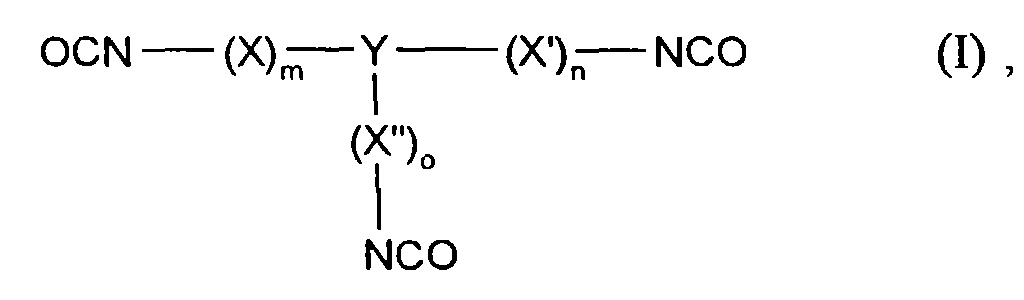
-CR2-(R = H und/oder C1-C12-Alkyl), -O-, -S-, -N(R)-(R = C1-C20-Alkyl), - S(O)-, -S(O)2-, -O-S(O)2-, -O-S-(O)2-O- sowie zweiwertige, vier- bis zwölfgliedrige, ggf. polycyclische cycloaliphatische Reste, die ggf. weitere Substituenten, wie z. B. Isocyanatgruppen, C1-C20-Alkylgruppen sowie deren heteroatom (O, N, S) substituierte Analoga tragen können, Y ein beliebiger dreiwertiger Rest wie z. B. CH; N; C4-C20-(ggf. Poly)cycloalkyl ist, stehen und m, n sowie o für gleiche oder verschiedene ganze Zahlen aber auch Null stehen können, wobei die Summe dieser drei Zahlen 6 bis 20 betragen kann. - Die Verwendung der Polyisocyanatmischungen nach Anspruch 1 zur Herstellung von ggf. geschäumten, Polyurethankunst- sowie Klebstoffen, Lacken und Beschichtungsmitteln, wobei die NCO-Gruppen ggf. in blockierter Form vorliegen können.
Applications Claiming Priority (2)
| Application Number | Priority Date | Filing Date | Title |
|---|---|---|---|
| DE19603736A DE19603736A1 (de) | 1996-02-02 | 1996-02-02 | Niedrigviskose Polyisocyanatmischung |
| DE19603736 | 1996-02-02 |
Publications (3)
| Publication Number | Publication Date |
|---|---|
| EP0787752A2 true EP0787752A2 (de) | 1997-08-06 |
| EP0787752A3 EP0787752A3 (de) | 1998-05-13 |
| EP0787752B1 EP0787752B1 (de) | 2003-04-09 |
Family
ID=7784326
Family Applications (1)
| Application Number | Title | Priority Date | Filing Date |
|---|---|---|---|
| EP97100855A Expired - Lifetime EP0787752B1 (de) | 1996-02-02 | 1997-01-21 | Niedrigviskose Polyisocyanatmischung |
Country Status (9)
| Country | Link |
|---|---|
| EP (1) | EP0787752B1 (de) |
| JP (1) | JPH09216930A (de) |
| KR (1) | KR100465270B1 (de) |
| AT (1) | ATE236942T1 (de) |
| BR (1) | BR9700840A (de) |
| CA (1) | CA2196148C (de) |
| DE (2) | DE19603736A1 (de) |
| ES (1) | ES2196200T3 (de) |
| MX (1) | MX9700823A (de) |
Cited By (2)
| Publication number | Priority date | Publication date | Assignee | Title |
|---|---|---|---|---|
| DE19828935A1 (de) * | 1998-06-29 | 1999-12-30 | Basf Ag | Hochviskose Polyisocyanate enthaltende Zusammensetzungen |
| EP1347004A4 (de) * | 2000-11-27 | 2004-05-06 | Asahi Chemical Ind | Feststoffreiche beschichtungszusammensetzung |
Families Citing this family (6)
| Publication number | Priority date | Publication date | Assignee | Title |
|---|---|---|---|---|
| DE19611849A1 (de) * | 1996-03-26 | 1997-10-02 | Bayer Ag | Neue Isocyanattrimerisate und Isocyanattrimerisatmischungen, deren Herstellung und Verwendung |
| EP1445271B1 (de) | 2001-09-20 | 2008-11-12 | Asahi Kasei Chemicals Corporation | Polyisocyanatzusammensetzung mit allophanatgruppe und feststoffreiche beschichtungsmasse |
| JP4974343B2 (ja) * | 2006-06-13 | 2012-07-11 | 旭化成ケミカルズ株式会社 | 水系ポリイソシアネート組成物及びそれを含有する水系塗料組成物 |
| JP6153293B2 (ja) * | 2012-05-11 | 2017-06-28 | 旭化成株式会社 | ブロックポリイソシアネート組成物 |
| US11248084B2 (en) | 2016-10-14 | 2022-02-15 | Asahi Kasei Kabushiki Kaisha | Polyisocyanate mixture, coating composition, and coating film |
| JP2019014777A (ja) * | 2017-07-04 | 2019-01-31 | 旭化成株式会社 | ポリイソシアネート組成物、ポリイソシアネート組成物の希釈溶液、塗料組成物及び塗膜 |
Citations (5)
| Publication number | Priority date | Publication date | Assignee | Title |
|---|---|---|---|---|
| DE1670720A1 (de) | 1966-07-21 | 1971-01-14 | Bayer Ag | Verfahren zur Herstellung von aliphatisch substituierten Uretdionen |
| DE2729990A1 (de) | 1977-07-02 | 1979-01-18 | Bayer Ag | Verfahren zur herstellung von isocyanatgruppen aufweisenden allophanaten |
| DE3109276A1 (de) | 1980-03-11 | 1982-03-04 | Asahi Kasei Kogyo K.K., Osaka | Neues aliphatisches triisocyanat, verfahren zu seiner herstellung und seine verwendung |
| DE3810908A1 (de) | 1987-04-03 | 1988-10-13 | Asahi Chemical Ind | Isocyanurat-polyisocyanat und dessen verwendung als haertungsmittel fuer eine zweikomponenten-polyurethanmasse |
| WO1993007183A1 (en) | 1991-09-30 | 1993-04-15 | Olin Corporation | Process for producing low viscosity isocyanate trimers |
Family Cites Families (3)
| Publication number | Priority date | Publication date | Assignee | Title |
|---|---|---|---|---|
| GB1483957A (en) * | 1975-05-19 | 1977-08-24 | Ici Ltd | Diphenylmethane diisocyanate compositions |
| DE4029809A1 (de) * | 1990-09-20 | 1992-03-26 | Bayer Ag | Polyisocyanatgemisch, ein verfahren zu seiner herstellung und seine verwendung in polyurethanlacken |
| DE4426131A1 (de) * | 1994-07-22 | 1996-01-25 | Bayer Ag | Lichtechte, lösemittelfreie Polyurethan-Beschichtungsmittel und ihre Verwendung |
-
1996
- 1996-02-02 DE DE19603736A patent/DE19603736A1/de not_active Withdrawn
-
1997
- 1997-01-21 EP EP97100855A patent/EP0787752B1/de not_active Expired - Lifetime
- 1997-01-21 DE DE59709731T patent/DE59709731D1/de not_active Expired - Lifetime
- 1997-01-21 AT AT97100855T patent/ATE236942T1/de not_active IP Right Cessation
- 1997-01-21 ES ES97100855T patent/ES2196200T3/es not_active Expired - Lifetime
- 1997-01-28 CA CA002196148A patent/CA2196148C/en not_active Expired - Fee Related
- 1997-01-29 JP JP9028339A patent/JPH09216930A/ja active Pending
- 1997-01-31 BR BR9700840A patent/BR9700840A/pt unknown
- 1997-01-31 MX MX9700823A patent/MX9700823A/es not_active IP Right Cessation
- 1997-02-01 KR KR1019970003195A patent/KR100465270B1/ko not_active Expired - Fee Related
Patent Citations (5)
| Publication number | Priority date | Publication date | Assignee | Title |
|---|---|---|---|---|
| DE1670720A1 (de) | 1966-07-21 | 1971-01-14 | Bayer Ag | Verfahren zur Herstellung von aliphatisch substituierten Uretdionen |
| DE2729990A1 (de) | 1977-07-02 | 1979-01-18 | Bayer Ag | Verfahren zur herstellung von isocyanatgruppen aufweisenden allophanaten |
| DE3109276A1 (de) | 1980-03-11 | 1982-03-04 | Asahi Kasei Kogyo K.K., Osaka | Neues aliphatisches triisocyanat, verfahren zu seiner herstellung und seine verwendung |
| DE3810908A1 (de) | 1987-04-03 | 1988-10-13 | Asahi Chemical Ind | Isocyanurat-polyisocyanat und dessen verwendung als haertungsmittel fuer eine zweikomponenten-polyurethanmasse |
| WO1993007183A1 (en) | 1991-09-30 | 1993-04-15 | Olin Corporation | Process for producing low viscosity isocyanate trimers |
Non-Patent Citations (3)
| Title |
|---|
| H.J. LAAS, R. HALPAAP, J. PEDAIN, J. PRAKT. CHEM., vol. 336, 1994, pages 185 - 200 |
| M. OJUNGA-ANDRES, H.P. HIGGINBOTTOM, L.W. HILL, WATERBORNE, HIGHER SOLIDS AND POWDER COATINGS SYMPOSIUM, 22 January 1995 (1995-01-22), NEW ORLEANS, pages 200 - 210 |
| M. SONNTAG, K. NACHTKAMP, J. PEDAIN, FARBE UND LACK, 1991, pages 1052 - 1057 |
Cited By (2)
| Publication number | Priority date | Publication date | Assignee | Title |
|---|---|---|---|---|
| DE19828935A1 (de) * | 1998-06-29 | 1999-12-30 | Basf Ag | Hochviskose Polyisocyanate enthaltende Zusammensetzungen |
| EP1347004A4 (de) * | 2000-11-27 | 2004-05-06 | Asahi Chemical Ind | Feststoffreiche beschichtungszusammensetzung |
Also Published As
| Publication number | Publication date |
|---|---|
| EP0787752A3 (de) | 1998-05-13 |
| MX9700823A (es) | 1997-08-30 |
| BR9700840A (pt) | 1998-09-01 |
| JPH09216930A (ja) | 1997-08-19 |
| DE19603736A1 (de) | 1997-08-07 |
| EP0787752B1 (de) | 2003-04-09 |
| DE59709731D1 (de) | 2003-05-15 |
| KR970061929A (ko) | 1997-09-12 |
| CA2196148C (en) | 2006-08-15 |
| KR100465270B1 (ko) | 2005-09-26 |
| ATE236942T1 (de) | 2003-04-15 |
| CA2196148A1 (en) | 1997-08-03 |
| ES2196200T3 (es) | 2003-12-16 |
Similar Documents
| Publication | Publication Date | Title |
|---|---|---|
| EP0712840B1 (de) | Allophanatgruppen aufweisende Polyisocyanate | |
| EP0336205B1 (de) | Verfahren zur Herstellung von Isocyanuratpolyisocyanaten, die nach diesem Verfahren erhaltenen Verbindungen und ihre Verwendung | |
| EP0013880A1 (de) | Neue Isocyanato-isocyanurate, ein Verfahren zu ihrer Herstellung sowie ihre Verwendung als Isocyanatkomponente in Polyurethan-Lacken | |
| EP0478990A1 (de) | Polyisocyanatgemisch, ein Verfahren zu seiner Herstellung und seine Verwendung in Polyurethanlacken | |
| EP0010248B1 (de) | Isocyanatgemisch und seine Verwendung als Bindemittel in Einkomponenten-Lacken | |
| EP1375551B1 (de) | Neue Blockierungsmittel für nichtwässrige Polyisocyanate auf Basis von Aralkylaminen | |
| EP0787752B1 (de) | Niedrigviskose Polyisocyanatmischung | |
| EP0611752B1 (de) | Urethangruppen enthaltende, olefinisch ungesättigte Isocyanate und ihre Verwendung als Bindemittel in Beschichtungsmaterialien | |
| EP0868463B1 (de) | Verbindungen mit isocyanatgruppen und verkappten gegenüber isocyanaten reaktiven gruppen | |
| EP0741157A1 (de) | Blockierte Polyisocyanate und ihre Verwendung | |
| EP0026448B1 (de) | Einkomponenten-Einbrennlacke | |
| EP1404737A1 (de) | Cyclische ketone als blockierungsmittel | |
| EP0406604B1 (de) | Verfahren zur Herstellung eines Beschichtungsmittels | |
| DE4021659A1 (de) | Bisoxazolane, im wesentlichen aus diesen bestehende oxazolangemische, ein verfahren zu deren herstellung und ihre verwendung als haerter fuer isocyanatgruppen aufweisende kunststoffvorlaeufer | |
| EP0623591B1 (de) | Olefinisch ungesättigte Isocyanate und ihre Verwendung als Bindemittel in Beschichtungsmaterialien | |
| EP1122272B1 (de) | Lagerstabile Polyisocyante | |
| EP0849268B1 (de) | Polycyclische Iminooxadiazindione aus (cyclo)aliphatischen 1,4-Diisocyanaten | |
| EP1641859B1 (de) | Blockierte polyisocyanate | |
| EP0919581A2 (de) | 2K-PUR-Beschichtungszusammensetzung | |
| DE602005004582T2 (de) | Biuretisierte Polyisocyanate und blockierte, biuretisierte Polyisocyanate | |
| EP1375581A1 (de) | Zusammensetzung enthaltend ein blockiertes Polyisocyanat | |
| EP0727453B1 (de) | Isocyanurat-Polyisocyanate auf Basis von 1,3-Diisocyanatocycloalkanen | |
| DE3502265A1 (de) | Urethangruppen aufweisende diisocyanate, ein verfahren zu ihrer herstellung und ihre verwendung als bindemittel bzw. bindemittelkomponente in polyurethanlacken | |
| DE69823056T2 (de) | Polyurethanzusammensetzung für eine gleichzeitig oder nacheinander stattfindende Applikation | |
| EP0039864A1 (de) | Neue Isocyanato-isocyanurate, ein Verfahren zu ihrer Herstellung, sowie ihre Verwendung als Isocyanat-Komponente in Polyurethan-Lacken |
Legal Events
| Date | Code | Title | Description |
|---|---|---|---|
| PUAI | Public reference made under article 153(3) epc to a published international application that has entered the european phase |
Free format text: ORIGINAL CODE: 0009012 |
|
| AK | Designated contracting states |
Kind code of ref document: A2 Designated state(s): AT BE CH DE ES FR GB IT LI NL SE |
|
| PUAL | Search report despatched |
Free format text: ORIGINAL CODE: 0009013 |
|
| AK | Designated contracting states |
Kind code of ref document: A3 Designated state(s): AT BE CH DE ES FR GB IT LI NL SE |
|
| 17P | Request for examination filed |
Effective date: 19981113 |
|
| GRAH | Despatch of communication of intention to grant a patent |
Free format text: ORIGINAL CODE: EPIDOS IGRA |
|
| GRAH | Despatch of communication of intention to grant a patent |
Free format text: ORIGINAL CODE: EPIDOS IGRA |
|
| GRAA | (expected) grant |
Free format text: ORIGINAL CODE: 0009210 |
|
| AK | Designated contracting states |
Designated state(s): AT BE CH DE ES FR GB IT LI NL SE |
|
| PG25 | Lapsed in a contracting state [announced via postgrant information from national office to epo] |
Ref country code: NL Free format text: LAPSE BECAUSE OF FAILURE TO SUBMIT A TRANSLATION OF THE DESCRIPTION OR TO PAY THE FEE WITHIN THE PRESCRIBED TIME-LIMIT Effective date: 20030409 |
|
| REG | Reference to a national code |
Ref country code: GB Ref legal event code: FG4D Free format text: NOT ENGLISH |
|
| REG | Reference to a national code |
Ref country code: CH Ref legal event code: EP |
|
| GBT | Gb: translation of ep patent filed (gb section 77(6)(a)/1977) |
Effective date: 20030516 |
|
| PG25 | Lapsed in a contracting state [announced via postgrant information from national office to epo] |
Ref country code: SE Free format text: LAPSE BECAUSE OF FAILURE TO SUBMIT A TRANSLATION OF THE DESCRIPTION OR TO PAY THE FEE WITHIN THE PRESCRIBED TIME-LIMIT Effective date: 20030709 |
|
| NLV1 | Nl: lapsed or annulled due to failure to fulfill the requirements of art. 29p and 29m of the patents act | ||
| REG | Reference to a national code |
Ref country code: ES Ref legal event code: FG2A Ref document number: 2196200 Country of ref document: ES Kind code of ref document: T3 |
|
| PG25 | Lapsed in a contracting state [announced via postgrant information from national office to epo] |
Ref country code: AT Free format text: LAPSE BECAUSE OF NON-PAYMENT OF DUE FEES Effective date: 20040121 |
|
| ET | Fr: translation filed | ||
| PG25 | Lapsed in a contracting state [announced via postgrant information from national office to epo] |
Ref country code: LI Free format text: LAPSE BECAUSE OF NON-PAYMENT OF DUE FEES Effective date: 20040131 Ref country code: CH Free format text: LAPSE BECAUSE OF NON-PAYMENT OF DUE FEES Effective date: 20040131 Ref country code: BE Free format text: LAPSE BECAUSE OF NON-PAYMENT OF DUE FEES Effective date: 20040131 |
|
| PLBE | No opposition filed within time limit |
Free format text: ORIGINAL CODE: 0009261 |
|
| STAA | Information on the status of an ep patent application or granted ep patent |
Free format text: STATUS: NO OPPOSITION FILED WITHIN TIME LIMIT |
|
| 26N | No opposition filed |
Effective date: 20040112 |
|
| BERE | Be: lapsed |
Owner name: *BAYER A.G. Effective date: 20040131 |
|
| REG | Reference to a national code |
Ref country code: CH Ref legal event code: PL |
|
| PGFP | Annual fee paid to national office [announced via postgrant information from national office to epo] |
Ref country code: ES Payment date: 20080218 Year of fee payment: 12 |
|
| PGFP | Annual fee paid to national office [announced via postgrant information from national office to epo] |
Ref country code: IT Payment date: 20080130 Year of fee payment: 12 Ref country code: GB Payment date: 20080116 Year of fee payment: 12 |
|
| PGFP | Annual fee paid to national office [announced via postgrant information from national office to epo] |
Ref country code: FR Payment date: 20080108 Year of fee payment: 12 |
|
| GBPC | Gb: european patent ceased through non-payment of renewal fee |
Effective date: 20090121 |
|
| REG | Reference to a national code |
Ref country code: FR Ref legal event code: ST Effective date: 20091030 |
|
| PG25 | Lapsed in a contracting state [announced via postgrant information from national office to epo] |
Ref country code: GB Free format text: LAPSE BECAUSE OF NON-PAYMENT OF DUE FEES Effective date: 20090121 |
|
| REG | Reference to a national code |
Ref country code: ES Ref legal event code: FD2A Effective date: 20090122 |
|
| PG25 | Lapsed in a contracting state [announced via postgrant information from national office to epo] |
Ref country code: FR Free format text: LAPSE BECAUSE OF NON-PAYMENT OF DUE FEES Effective date: 20090202 Ref country code: ES Free format text: LAPSE BECAUSE OF NON-PAYMENT OF DUE FEES Effective date: 20090122 |
|
| PGFP | Annual fee paid to national office [announced via postgrant information from national office to epo] |
Ref country code: DE Payment date: 20091224 Year of fee payment: 14 |
|
| PG25 | Lapsed in a contracting state [announced via postgrant information from national office to epo] |
Ref country code: IT Free format text: LAPSE BECAUSE OF NON-PAYMENT OF DUE FEES Effective date: 20090121 |
|
| REG | Reference to a national code |
Ref country code: DE Ref legal event code: R119 Ref document number: 59709731 Country of ref document: DE Effective date: 20110802 |
|
| PG25 | Lapsed in a contracting state [announced via postgrant information from national office to epo] |
Ref country code: DE Free format text: LAPSE BECAUSE OF NON-PAYMENT OF DUE FEES Effective date: 20110802 |