EP0782041A2 - Silver halide photographic light-sensitive material - Google Patents
Silver halide photographic light-sensitive material Download PDFInfo
- Publication number
- EP0782041A2 EP0782041A2 EP96120908A EP96120908A EP0782041A2 EP 0782041 A2 EP0782041 A2 EP 0782041A2 EP 96120908 A EP96120908 A EP 96120908A EP 96120908 A EP96120908 A EP 96120908A EP 0782041 A2 EP0782041 A2 EP 0782041A2
- Authority
- EP
- European Patent Office
- Prior art keywords
- group
- compound
- acid
- formula
- mol
- Prior art date
- Legal status (The legal status is an assumption and is not a legal conclusion. Google has not performed a legal analysis and makes no representation as to the accuracy of the status listed.)
- Granted
Links
- -1 Silver halide Chemical class 0.000 title claims abstract description 243
- 229910052709 silver Inorganic materials 0.000 title claims abstract description 85
- 239000004332 silver Substances 0.000 title claims abstract description 85
- 239000000463 material Substances 0.000 title claims abstract description 71
- 150000001875 compounds Chemical class 0.000 claims abstract description 162
- 125000001424 substituent group Chemical group 0.000 claims description 46
- 125000003118 aryl group Chemical group 0.000 claims description 20
- 125000005647 linker group Chemical group 0.000 claims description 17
- 125000004435 hydrogen atom Chemical group [H]* 0.000 claims description 16
- 125000001153 fluoro group Chemical group F* 0.000 claims description 8
- 125000001997 phenyl group Chemical group [H]C1=C([H])C([H])=C(*)C([H])=C1[H] 0.000 claims description 8
- 125000000472 sulfonyl group Chemical group *S(*)(=O)=O 0.000 claims description 8
- 125000001028 difluoromethyl group Chemical group [H]C(F)(F)* 0.000 claims description 7
- 125000002023 trifluoromethyl group Chemical group FC(F)(F)* 0.000 claims description 7
- 125000000732 arylene group Chemical group 0.000 claims description 6
- 125000002915 carbonyl group Chemical group [*:2]C([*:1])=O 0.000 claims description 6
- 125000000547 substituted alkyl group Chemical group 0.000 claims description 5
- 125000003452 oxalyl group Chemical group *C(=O)C(*)=O 0.000 claims description 3
- 239000000243 solution Substances 0.000 description 98
- WEVYAHXRMPXWCK-UHFFFAOYSA-N Acetonitrile Chemical compound CC#N WEVYAHXRMPXWCK-UHFFFAOYSA-N 0.000 description 93
- XEKOWRVHYACXOJ-UHFFFAOYSA-N Ethyl acetate Chemical compound CCOC(C)=O XEKOWRVHYACXOJ-UHFFFAOYSA-N 0.000 description 78
- 239000000839 emulsion Substances 0.000 description 72
- XLYOFNOQVPJJNP-UHFFFAOYSA-N water Substances O XLYOFNOQVPJJNP-UHFFFAOYSA-N 0.000 description 72
- 230000015572 biosynthetic process Effects 0.000 description 58
- 229910001868 water Inorganic materials 0.000 description 56
- 238000000034 method Methods 0.000 description 52
- 238000003786 synthesis reaction Methods 0.000 description 52
- 239000010410 layer Substances 0.000 description 50
- 125000004432 carbon atom Chemical group C* 0.000 description 40
- 238000012545 processing Methods 0.000 description 40
- 239000000203 mixture Substances 0.000 description 39
- 239000002667 nucleating agent Substances 0.000 description 39
- ZMANZCXQSJIPKH-UHFFFAOYSA-N Triethylamine Chemical compound CCN(CC)CC ZMANZCXQSJIPKH-UHFFFAOYSA-N 0.000 description 36
- 108010010803 Gelatin Proteins 0.000 description 35
- 239000003795 chemical substances by application Substances 0.000 description 35
- 239000008273 gelatin Substances 0.000 description 35
- 229920000159 gelatin Polymers 0.000 description 35
- 235000019322 gelatine Nutrition 0.000 description 35
- 235000011852 gelatine desserts Nutrition 0.000 description 35
- 239000000047 product Substances 0.000 description 32
- 239000000975 dye Substances 0.000 description 31
- QTBSBXVTEAMEQO-UHFFFAOYSA-N Acetic acid Chemical compound CC(O)=O QTBSBXVTEAMEQO-UHFFFAOYSA-N 0.000 description 28
- 230000000052 comparative effect Effects 0.000 description 28
- 206010070834 Sensitisation Diseases 0.000 description 27
- 230000008313 sensitization Effects 0.000 description 27
- VEXZGXHMUGYJMC-UHFFFAOYSA-N Hydrochloric acid Chemical compound Cl VEXZGXHMUGYJMC-UHFFFAOYSA-N 0.000 description 26
- OKKJLVBELUTLKV-UHFFFAOYSA-N Methanol Chemical compound OC OKKJLVBELUTLKV-UHFFFAOYSA-N 0.000 description 24
- OAKJQQAXSVQMHS-UHFFFAOYSA-N hydrazine Substances NN OAKJQQAXSVQMHS-UHFFFAOYSA-N 0.000 description 24
- 238000005406 washing Methods 0.000 description 22
- 238000011161 development Methods 0.000 description 21
- 230000018109 developmental process Effects 0.000 description 21
- 125000000623 heterocyclic group Chemical group 0.000 description 21
- 150000003839 salts Chemical class 0.000 description 20
- 125000000217 alkyl group Chemical group 0.000 description 19
- 238000001035 drying Methods 0.000 description 19
- 230000035945 sensitivity Effects 0.000 description 19
- KFZMGEQAYNKOFK-UHFFFAOYSA-N Isopropanol Chemical compound CC(C)O KFZMGEQAYNKOFK-UHFFFAOYSA-N 0.000 description 18
- HEMHJVSKTPXQMS-UHFFFAOYSA-M Sodium hydroxide Chemical compound [OH-].[Na+] HEMHJVSKTPXQMS-UHFFFAOYSA-M 0.000 description 18
- 230000032683 aging Effects 0.000 description 18
- 239000000460 chlorine Substances 0.000 description 18
- 239000007962 solid dispersion Substances 0.000 description 18
- 239000002253 acid Substances 0.000 description 17
- 238000000576 coating method Methods 0.000 description 17
- 238000002360 preparation method Methods 0.000 description 17
- 239000004094 surface-active agent Substances 0.000 description 17
- FXHOOIRPVKKKFG-UHFFFAOYSA-N N,N-Dimethylacetamide Chemical compound CN(C)C(C)=O FXHOOIRPVKKKFG-UHFFFAOYSA-N 0.000 description 15
- 125000003277 amino group Chemical group 0.000 description 15
- 239000011248 coating agent Substances 0.000 description 15
- 239000006185 dispersion Substances 0.000 description 15
- 229910052717 sulfur Inorganic materials 0.000 description 15
- 125000003545 alkoxy group Chemical group 0.000 description 14
- 239000003446 ligand Substances 0.000 description 14
- 230000001235 sensitizing effect Effects 0.000 description 14
- QIGBRXMKCJKVMJ-UHFFFAOYSA-N Hydroquinone Chemical compound OC1=CC=C(O)C=C1 QIGBRXMKCJKVMJ-UHFFFAOYSA-N 0.000 description 13
- JUJWROOIHBZHMG-UHFFFAOYSA-N Pyridine Chemical group C1=CC=NC=C1 JUJWROOIHBZHMG-UHFFFAOYSA-N 0.000 description 13
- 238000001914 filtration Methods 0.000 description 13
- 239000002245 particle Substances 0.000 description 13
- ZMXDDKWLCZADIW-UHFFFAOYSA-N N,N-Dimethylformamide Chemical compound CN(C)C=O ZMXDDKWLCZADIW-UHFFFAOYSA-N 0.000 description 12
- KWYUFKZDYYNOTN-UHFFFAOYSA-M Potassium hydroxide Chemical compound [OH-].[K+] KWYUFKZDYYNOTN-UHFFFAOYSA-M 0.000 description 12
- VYPSYNLAJGMNEJ-UHFFFAOYSA-N Silicium dioxide Chemical compound O=[Si]=O VYPSYNLAJGMNEJ-UHFFFAOYSA-N 0.000 description 12
- FAPWRFPIFSIZLT-UHFFFAOYSA-M Sodium chloride Chemical compound [Na+].[Cl-] FAPWRFPIFSIZLT-UHFFFAOYSA-M 0.000 description 12
- 125000004104 aryloxy group Chemical group 0.000 description 12
- KRKNYBCHXYNGOX-UHFFFAOYSA-N citric acid Chemical compound OC(=O)CC(O)(C(O)=O)CC(O)=O KRKNYBCHXYNGOX-UHFFFAOYSA-N 0.000 description 12
- 230000006911 nucleation Effects 0.000 description 12
- 238000010899 nucleation Methods 0.000 description 12
- 125000000843 phenylene group Chemical group C1(=C(C=CC=C1)*)* 0.000 description 11
- 239000007787 solid Substances 0.000 description 11
- 238000003756 stirring Methods 0.000 description 11
- PLIKAWJENQZMHA-UHFFFAOYSA-N 4-aminophenol Chemical compound NC1=CC=C(O)C=C1 PLIKAWJENQZMHA-UHFFFAOYSA-N 0.000 description 10
- CIWBSHSKHKDKBQ-JLAZNSOCSA-N Ascorbic acid Chemical compound OC[C@H](O)[C@H]1OC(=O)C(O)=C1O CIWBSHSKHKDKBQ-JLAZNSOCSA-N 0.000 description 10
- LSNNMFCWUKXFEE-UHFFFAOYSA-N Sulfurous acid Chemical compound OS(O)=O LSNNMFCWUKXFEE-UHFFFAOYSA-N 0.000 description 10
- 229960000583 acetic acid Drugs 0.000 description 10
- 239000000084 colloidal system Substances 0.000 description 10
- 239000011259 mixed solution Substances 0.000 description 10
- 125000004433 nitrogen atom Chemical group N* 0.000 description 10
- IOLCXVTUBQKXJR-UHFFFAOYSA-M potassium bromide Chemical compound [K+].[Br-] IOLCXVTUBQKXJR-UHFFFAOYSA-M 0.000 description 10
- 238000010898 silica gel chromatography Methods 0.000 description 10
- 239000002904 solvent Substances 0.000 description 10
- 239000000126 substance Substances 0.000 description 10
- YMWUJEATGCHHMB-UHFFFAOYSA-N Dichloromethane Chemical compound ClCCl YMWUJEATGCHHMB-UHFFFAOYSA-N 0.000 description 9
- 150000000996 L-ascorbic acids Chemical class 0.000 description 9
- 125000004442 acylamino group Chemical group 0.000 description 9
- 239000002585 base Substances 0.000 description 9
- 125000001951 carbamoylamino group Chemical group C(N)(=O)N* 0.000 description 9
- 238000011156 evaluation Methods 0.000 description 9
- 229910052757 nitrogen Inorganic materials 0.000 description 9
- 239000010948 rhodium Substances 0.000 description 9
- 125000005420 sulfonamido group Chemical group S(=O)(=O)(N*)* 0.000 description 9
- NLXLAEXVIDQMFP-UHFFFAOYSA-N Ammonia chloride Chemical compound [NH4+].[Cl-] NLXLAEXVIDQMFP-UHFFFAOYSA-N 0.000 description 8
- XEEYBQQBJWHFJM-UHFFFAOYSA-N Iron Chemical compound [Fe] XEEYBQQBJWHFJM-UHFFFAOYSA-N 0.000 description 8
- BUGBHKTXTAQXES-UHFFFAOYSA-N Selenium Chemical compound [Se] BUGBHKTXTAQXES-UHFFFAOYSA-N 0.000 description 8
- 229910021607 Silver chloride Inorganic materials 0.000 description 8
- NINIDFKCEFEMDL-UHFFFAOYSA-N Sulfur Chemical compound [S] NINIDFKCEFEMDL-UHFFFAOYSA-N 0.000 description 8
- 235000011054 acetic acid Nutrition 0.000 description 8
- 125000002252 acyl group Chemical group 0.000 description 8
- 125000003342 alkenyl group Chemical group 0.000 description 8
- 125000000304 alkynyl group Chemical group 0.000 description 8
- 125000004397 aminosulfonyl group Chemical group NS(=O)(=O)* 0.000 description 8
- 125000003917 carbamoyl group Chemical group [H]N([H])C(*)=O 0.000 description 8
- 239000002738 chelating agent Substances 0.000 description 8
- 229910052736 halogen Inorganic materials 0.000 description 8
- 125000005843 halogen group Chemical group 0.000 description 8
- 125000005842 heteroatom Chemical group 0.000 description 8
- XTEGVFVZDVNBPF-UHFFFAOYSA-N naphthalene-1,5-disulfonic acid Chemical compound C1=CC=C2C(S(=O)(=O)O)=CC=CC2=C1S(O)(=O)=O XTEGVFVZDVNBPF-UHFFFAOYSA-N 0.000 description 8
- 239000003755 preservative agent Substances 0.000 description 8
- 230000002335 preservative effect Effects 0.000 description 8
- 229910052711 selenium Inorganic materials 0.000 description 8
- 239000011669 selenium Substances 0.000 description 8
- HKZLPVFGJNLROG-UHFFFAOYSA-M silver monochloride Chemical compound [Cl-].[Ag+] HKZLPVFGJNLROG-UHFFFAOYSA-M 0.000 description 8
- SQGYOTSLMSWVJD-UHFFFAOYSA-N silver(1+) nitrate Chemical compound [Ag+].[O-]N(=O)=O SQGYOTSLMSWVJD-UHFFFAOYSA-N 0.000 description 8
- 230000006641 stabilisation Effects 0.000 description 8
- 238000011105 stabilization Methods 0.000 description 8
- 239000011593 sulfur Substances 0.000 description 8
- LFQSCWFLJHTTHZ-UHFFFAOYSA-N Ethanol Chemical compound CCO LFQSCWFLJHTTHZ-UHFFFAOYSA-N 0.000 description 7
- MUBZPKHOEPUJKR-UHFFFAOYSA-N Oxalic acid Chemical compound OC(=O)C(O)=O MUBZPKHOEPUJKR-UHFFFAOYSA-N 0.000 description 7
- 229910052799 carbon Inorganic materials 0.000 description 7
- 230000008859 change Effects 0.000 description 7
- 239000013078 crystal Substances 0.000 description 7
- PCHJSUWPFVWCPO-UHFFFAOYSA-N gold Chemical compound [Au] PCHJSUWPFVWCPO-UHFFFAOYSA-N 0.000 description 7
- 229910052737 gold Inorganic materials 0.000 description 7
- 239000010931 gold Substances 0.000 description 7
- 150000002367 halogens Chemical class 0.000 description 7
- 125000000717 hydrazino group Chemical group [H]N([*])N([H])[H] 0.000 description 7
- 239000012299 nitrogen atmosphere Substances 0.000 description 7
- 125000004430 oxygen atom Chemical group O* 0.000 description 7
- 150000003284 rhodium compounds Chemical class 0.000 description 7
- AKHNMLFCWUSKQB-UHFFFAOYSA-L sodium thiosulfate Chemical compound [Na+].[Na+].[O-]S([O-])(=O)=S AKHNMLFCWUSKQB-UHFFFAOYSA-L 0.000 description 7
- 235000019345 sodium thiosulphate Nutrition 0.000 description 7
- 125000004434 sulfur atom Chemical group 0.000 description 7
- VIMMECPCYZXUCI-MIMFYIINSA-N (4s,6r)-6-[(1e)-4,4-bis(4-fluorophenyl)-3-(1-methyltetrazol-5-yl)buta-1,3-dienyl]-4-hydroxyoxan-2-one Chemical compound CN1N=NN=C1C(\C=C\[C@@H]1OC(=O)C[C@@H](O)C1)=C(C=1C=CC(F)=CC=1)C1=CC=C(F)C=C1 VIMMECPCYZXUCI-MIMFYIINSA-N 0.000 description 6
- ZWEHNKRNPOVVGH-UHFFFAOYSA-N 2-Butanone Chemical compound CCC(C)=O ZWEHNKRNPOVVGH-UHFFFAOYSA-N 0.000 description 6
- CSCPPACGZOOCGX-UHFFFAOYSA-N Acetone Chemical compound CC(C)=O CSCPPACGZOOCGX-UHFFFAOYSA-N 0.000 description 6
- XKRFYHLGVUSROY-UHFFFAOYSA-N Argon Chemical compound [Ar] XKRFYHLGVUSROY-UHFFFAOYSA-N 0.000 description 6
- WCUXLLCKKVVCTQ-UHFFFAOYSA-M Potassium chloride Chemical compound [Cl-].[K+] WCUXLLCKKVVCTQ-UHFFFAOYSA-M 0.000 description 6
- 229940125907 SJ995973 Drugs 0.000 description 6
- BQCADISMDOOEFD-UHFFFAOYSA-N Silver Chemical compound [Ag] BQCADISMDOOEFD-UHFFFAOYSA-N 0.000 description 6
- 125000004450 alkenylene group Chemical group 0.000 description 6
- 125000002947 alkylene group Chemical group 0.000 description 6
- 125000004419 alkynylene group Chemical group 0.000 description 6
- 239000007864 aqueous solution Substances 0.000 description 6
- 229940125782 compound 2 Drugs 0.000 description 6
- 229940126214 compound 3 Drugs 0.000 description 6
- 238000001816 cooling Methods 0.000 description 6
- 125000002993 cycloalkylene group Chemical group 0.000 description 6
- MTHSVFCYNBDYFN-UHFFFAOYSA-N diethylene glycol Chemical compound OCCOCCO MTHSVFCYNBDYFN-UHFFFAOYSA-N 0.000 description 6
- 230000000694 effects Effects 0.000 description 6
- 229910052731 fluorine Inorganic materials 0.000 description 6
- JIJNOXGGMCEUMF-UHFFFAOYSA-N n-(4-aminoanilino)formamide Chemical compound NC1=CC=C(NNC=O)C=C1 JIJNOXGGMCEUMF-UHFFFAOYSA-N 0.000 description 6
- XZMHJYWMCRQSSI-UHFFFAOYSA-N n-[5-[2-(3-acetylanilino)-1,3-thiazol-4-yl]-4-methyl-1,3-thiazol-2-yl]benzamide Chemical compound CC(=O)C1=CC=CC(NC=2SC=C(N=2)C2=C(N=C(NC(=O)C=3C=CC=CC=3)S2)C)=C1 XZMHJYWMCRQSSI-UHFFFAOYSA-N 0.000 description 6
- CMCWWLVWPDLCRM-UHFFFAOYSA-N phenidone Chemical compound N1C(=O)CCN1C1=CC=CC=C1 CMCWWLVWPDLCRM-UHFFFAOYSA-N 0.000 description 6
- BWHMMNNQKKPAPP-UHFFFAOYSA-L potassium carbonate Chemical compound [K+].[K+].[O-]C([O-])=O BWHMMNNQKKPAPP-UHFFFAOYSA-L 0.000 description 6
- 239000000843 powder Substances 0.000 description 6
- UMJSCPRVCHMLSP-UHFFFAOYSA-N pyridine Natural products COC1=CC=CN=C1 UMJSCPRVCHMLSP-UHFFFAOYSA-N 0.000 description 6
- 238000011160 research Methods 0.000 description 6
- 229910052703 rhodium Inorganic materials 0.000 description 6
- 239000011780 sodium chloride Substances 0.000 description 6
- GEHJYWRUCIMESM-UHFFFAOYSA-L sodium sulfite Chemical compound [Na+].[Na+].[O-]S([O-])=O GEHJYWRUCIMESM-UHFFFAOYSA-L 0.000 description 6
- 238000001179 sorption measurement Methods 0.000 description 6
- UMGDCJDMYOKAJW-UHFFFAOYSA-N thiourea group Chemical group NC(=S)N UMGDCJDMYOKAJW-UHFFFAOYSA-N 0.000 description 6
- FEWJPZIEWOKRBE-JCYAYHJZSA-N Dextrotartaric acid Chemical compound OC(=O)[C@H](O)[C@@H](O)C(O)=O FEWJPZIEWOKRBE-JCYAYHJZSA-N 0.000 description 5
- QAOWNCQODCNURD-UHFFFAOYSA-N Sulfuric acid Chemical compound OS(O)(=O)=O QAOWNCQODCNURD-UHFFFAOYSA-N 0.000 description 5
- FEWJPZIEWOKRBE-UHFFFAOYSA-N Tartaric acid Natural products [H+].[H+].[O-]C(=O)C(O)C(O)C([O-])=O FEWJPZIEWOKRBE-UHFFFAOYSA-N 0.000 description 5
- 235000010724 Wisteria floribunda Nutrition 0.000 description 5
- SJOOOZPMQAWAOP-UHFFFAOYSA-N [Ag].BrCl Chemical compound [Ag].BrCl SJOOOZPMQAWAOP-UHFFFAOYSA-N 0.000 description 5
- 150000001298 alcohols Chemical class 0.000 description 5
- 229910052783 alkali metal Inorganic materials 0.000 description 5
- 125000004453 alkoxycarbonyl group Chemical group 0.000 description 5
- 125000003282 alkyl amino group Chemical group 0.000 description 5
- 125000004414 alkyl thio group Chemical group 0.000 description 5
- XYXNTHIYBIDHGM-UHFFFAOYSA-N ammonium thiosulfate Chemical compound [NH4+].[NH4+].[O-]S([O-])(=O)=S XYXNTHIYBIDHGM-UHFFFAOYSA-N 0.000 description 5
- 125000005161 aryl oxy carbonyl group Chemical group 0.000 description 5
- KGBXLFKZBHKPEV-UHFFFAOYSA-N boric acid Chemical compound OB(O)O KGBXLFKZBHKPEV-UHFFFAOYSA-N 0.000 description 5
- 239000004327 boric acid Substances 0.000 description 5
- 235000010338 boric acid Nutrition 0.000 description 5
- 150000001721 carbon Chemical group 0.000 description 5
- 229940125904 compound 1 Drugs 0.000 description 5
- 239000003112 inhibitor Substances 0.000 description 5
- AIIQGLWWSULJPM-UHFFFAOYSA-N n'-(4-aminophenyl)-2,2-difluoroacetohydrazide Chemical compound NC1=CC=C(NNC(=O)C(F)F)C=C1 AIIQGLWWSULJPM-UHFFFAOYSA-N 0.000 description 5
- XAEFZNCEHLXOMS-UHFFFAOYSA-M potassium benzoate Chemical compound [K+].[O-]C(=O)C1=CC=CC=C1 XAEFZNCEHLXOMS-UHFFFAOYSA-M 0.000 description 5
- 230000001681 protective effect Effects 0.000 description 5
- 238000010992 reflux Methods 0.000 description 5
- RWWYLEGWBNMMLJ-YSOARWBDSA-N remdesivir Chemical compound NC1=NC=NN2C1=CC=C2[C@]1([C@@H]([C@@H]([C@H](O1)CO[P@](=O)(OC1=CC=CC=C1)N[C@H](C(=O)OCC(CC)CC)C)O)O)C#N RWWYLEGWBNMMLJ-YSOARWBDSA-N 0.000 description 5
- MHOVAHRLVXNVSD-UHFFFAOYSA-N rhodium atom Chemical compound [Rh] MHOVAHRLVXNVSD-UHFFFAOYSA-N 0.000 description 5
- JHJUUEHSAZXEEO-UHFFFAOYSA-M sodium;4-dodecylbenzenesulfonate Chemical compound [Na+].CCCCCCCCCCCCC1=CC=C(S([O-])(=O)=O)C=C1 JHJUUEHSAZXEEO-UHFFFAOYSA-M 0.000 description 5
- 239000011975 tartaric acid Substances 0.000 description 5
- 235000002906 tartaric acid Nutrition 0.000 description 5
- 229910052714 tellurium Inorganic materials 0.000 description 5
- PORWMNRCUJJQNO-UHFFFAOYSA-N tellurium atom Chemical compound [Te] PORWMNRCUJJQNO-UHFFFAOYSA-N 0.000 description 5
- QGKMIGUHVLGJBR-UHFFFAOYSA-M (4z)-1-(3-methylbutyl)-4-[[1-(3-methylbutyl)quinolin-1-ium-4-yl]methylidene]quinoline;iodide Chemical compound [I-].C12=CC=CC=C2N(CCC(C)C)C=CC1=CC1=CC=[N+](CCC(C)C)C2=CC=CC=C12 QGKMIGUHVLGJBR-UHFFFAOYSA-M 0.000 description 4
- RXNPEQZHMGFNAY-GEALJGNFSA-N (5R)-4-[(1S,6R)-5-[(2S)-2-(4-chlorophenyl)-3-(propan-2-ylamino)propanoyl]-2,5-diazabicyclo[4.1.0]heptan-2-yl]-5-methyl-6,8-dihydro-5H-pyrido[2,3-d]pyrimidin-7-one Chemical compound C[C@@H]1CC(=O)NC2=C1C(=NC=N2)N3CCN([C@H]4[C@@H]3C4)C(=O)[C@H](CNC(C)C)C5=CC=C(C=C5)Cl RXNPEQZHMGFNAY-GEALJGNFSA-N 0.000 description 4
- WZCQRUWWHSTZEM-UHFFFAOYSA-N 1,3-phenylenediamine Chemical compound NC1=CC=CC(N)=C1 WZCQRUWWHSTZEM-UHFFFAOYSA-N 0.000 description 4
- VOZKAJLKRJDJLL-UHFFFAOYSA-N 2,4-diaminotoluene Chemical compound CC1=CC=C(N)C=C1N VOZKAJLKRJDJLL-UHFFFAOYSA-N 0.000 description 4
- JXRGUPLJCCDGKG-UHFFFAOYSA-N 4-nitrobenzenesulfonyl chloride Chemical compound [O-][N+](=O)C1=CC=C(S(Cl)(=O)=O)C=C1 JXRGUPLJCCDGKG-UHFFFAOYSA-N 0.000 description 4
- KUZSBKJSGSKPJH-VXGBXAGGSA-N 5-[(9R)-6-[(3R)-3-methylmorpholin-4-yl]-11-oxa-1,3,5-triazatricyclo[7.4.0.02,7]trideca-2,4,6-trien-4-yl]pyrazin-2-amine Chemical compound C[C@@H]1COCCN1c1nc(nc2N3CCOC[C@H]3Cc12)-c1cnc(N)cn1 KUZSBKJSGSKPJH-VXGBXAGGSA-N 0.000 description 4
- FCBOUJYKAGWYQM-DEOSSOPVSA-N 6-[[(2s)-1-hydroxy-3-phenylpropan-2-yl]amino]-n-(2-phenoxyethyl)-2-(3,4,5-trimethoxyphenyl)pyridine-3-carboxamide Chemical compound COC1=C(OC)C(OC)=CC(C=2C(=CC=C(N[C@H](CO)CC=3C=CC=CC=3)N=2)C(=O)NCCOC=2C=CC=CC=2)=C1 FCBOUJYKAGWYQM-DEOSSOPVSA-N 0.000 description 4
- MITGKKFYIJJQGL-UHFFFAOYSA-N 9-(4-chlorobenzoyl)-6-methylsulfonyl-2,3-dihydro-1H-carbazol-4-one Chemical compound ClC1=CC=C(C(=O)N2C3=CC=C(C=C3C=3C(CCCC2=3)=O)S(=O)(=O)C)C=C1 MITGKKFYIJJQGL-UHFFFAOYSA-N 0.000 description 4
- QGZKDVFQNNGYKY-UHFFFAOYSA-N Ammonia Chemical compound N QGZKDVFQNNGYKY-UHFFFAOYSA-N 0.000 description 4
- IAZDPXIOMUYVGZ-UHFFFAOYSA-N Dimethylsulphoxide Chemical compound CS(C)=O IAZDPXIOMUYVGZ-UHFFFAOYSA-N 0.000 description 4
- OFOBLEOULBTSOW-UHFFFAOYSA-N Malonic acid Chemical compound OC(=O)CC(O)=O OFOBLEOULBTSOW-UHFFFAOYSA-N 0.000 description 4
- QPCDCPDFJACHGM-UHFFFAOYSA-N N,N-bis{2-[bis(carboxymethyl)amino]ethyl}glycine Chemical compound OC(=O)CN(CC(O)=O)CCN(CC(=O)O)CCN(CC(O)=O)CC(O)=O QPCDCPDFJACHGM-UHFFFAOYSA-N 0.000 description 4
- CDBYLPFSWZWCQE-UHFFFAOYSA-L Sodium Carbonate Chemical compound [Na+].[Na+].[O-]C([O-])=O CDBYLPFSWZWCQE-UHFFFAOYSA-L 0.000 description 4
- XSQUKJJJFZCRTK-UHFFFAOYSA-N Urea Natural products NC(N)=O XSQUKJJJFZCRTK-UHFFFAOYSA-N 0.000 description 4
- WNLRTRBMVRJNCN-UHFFFAOYSA-N adipic acid Chemical compound OC(=O)CCCCC(O)=O WNLRTRBMVRJNCN-UHFFFAOYSA-N 0.000 description 4
- 239000003513 alkali Substances 0.000 description 4
- 125000004466 alkoxycarbonylamino group Chemical group 0.000 description 4
- 150000001412 amines Chemical class 0.000 description 4
- 235000019270 ammonium chloride Nutrition 0.000 description 4
- 125000003710 aryl alkyl group Chemical group 0.000 description 4
- 235000010323 ascorbic acid Nutrition 0.000 description 4
- 229960005070 ascorbic acid Drugs 0.000 description 4
- 239000011668 ascorbic acid Substances 0.000 description 4
- 150000001555 benzenes Chemical group 0.000 description 4
- 235000015165 citric acid Nutrition 0.000 description 4
- JHIVVAPYMSGYDF-UHFFFAOYSA-N cyclohexanone Chemical compound O=C1CCCCC1 JHIVVAPYMSGYDF-UHFFFAOYSA-N 0.000 description 4
- DOIRQSBPFJWKBE-UHFFFAOYSA-N dibutyl phthalate Chemical compound CCCCOC(=O)C1=CC=CC=C1C(=O)OCCCC DOIRQSBPFJWKBE-UHFFFAOYSA-N 0.000 description 4
- FLKPEMZONWLCSK-UHFFFAOYSA-N diethyl phthalate Chemical compound CCOC(=O)C1=CC=CC=C1C(=O)OCC FLKPEMZONWLCSK-UHFFFAOYSA-N 0.000 description 4
- ZUOUZKKEUPVFJK-UHFFFAOYSA-N diphenyl Chemical compound C1=CC=CC=C1C1=CC=CC=C1 ZUOUZKKEUPVFJK-UHFFFAOYSA-N 0.000 description 4
- USIUVYZYUHIAEV-UHFFFAOYSA-N diphenyl ether Chemical compound C=1C=CC=CC=1OC1=CC=CC=C1 USIUVYZYUHIAEV-UHFFFAOYSA-N 0.000 description 4
- KZTYYGOKRVBIMI-UHFFFAOYSA-N diphenyl sulfone Chemical compound C=1C=CC=CC=1S(=O)(=O)C1=CC=CC=C1 KZTYYGOKRVBIMI-UHFFFAOYSA-N 0.000 description 4
- 239000010419 fine particle Substances 0.000 description 4
- CPBQJMYROZQQJC-UHFFFAOYSA-N helium neon Chemical compound [He].[Ne] CPBQJMYROZQQJC-UHFFFAOYSA-N 0.000 description 4
- 125000002887 hydroxy group Chemical group [H]O* 0.000 description 4
- 239000006224 matting agent Substances 0.000 description 4
- 239000006174 pH buffer Substances 0.000 description 4
- 229960003330 pentetic acid Drugs 0.000 description 4
- ZJAOAACCNHFJAH-UHFFFAOYSA-N phosphonoformic acid Chemical compound OC(=O)P(O)(O)=O ZJAOAACCNHFJAH-UHFFFAOYSA-N 0.000 description 4
- LVTJOONKWUXEFR-FZRMHRINSA-N protoneodioscin Natural products O(C[C@@H](CC[C@]1(O)[C@H](C)[C@@H]2[C@]3(C)[C@H]([C@H]4[C@@H]([C@]5(C)C(=CC4)C[C@@H](O[C@@H]4[C@H](O[C@H]6[C@@H](O)[C@@H](O)[C@@H](O)[C@H](C)O6)[C@@H](O)[C@H](O[C@H]6[C@@H](O)[C@@H](O)[C@@H](O)[C@H](C)O6)[C@H](CO)O4)CC5)CC3)C[C@@H]2O1)C)[C@H]1[C@H](O)[C@H](O)[C@H](O)[C@@H](CO)O1 LVTJOONKWUXEFR-FZRMHRINSA-N 0.000 description 4
- 230000002829 reductive effect Effects 0.000 description 4
- 229920006395 saturated elastomer Polymers 0.000 description 4
- 239000004065 semiconductor Substances 0.000 description 4
- 229910001961 silver nitrate Inorganic materials 0.000 description 4
- JHJLBTNAGRQEKS-UHFFFAOYSA-M sodium bromide Chemical compound [Na+].[Br-] JHJLBTNAGRQEKS-UHFFFAOYSA-M 0.000 description 4
- 159000000000 sodium salts Chemical class 0.000 description 4
- 230000003595 spectral effect Effects 0.000 description 4
- 239000000725 suspension Substances 0.000 description 4
- FYSNRJHAOHDILO-UHFFFAOYSA-N thionyl chloride Chemical compound ClS(Cl)=O FYSNRJHAOHDILO-UHFFFAOYSA-N 0.000 description 4
- URAYPUMNDPQOKB-UHFFFAOYSA-N triacetin Chemical compound CC(=O)OCC(OC(C)=O)COC(C)=O URAYPUMNDPQOKB-UHFFFAOYSA-N 0.000 description 4
- 229910052724 xenon Inorganic materials 0.000 description 4
- FHNFHKCVQCLJFQ-UHFFFAOYSA-N xenon atom Chemical compound [Xe] FHNFHKCVQCLJFQ-UHFFFAOYSA-N 0.000 description 4
- AEVBPXDFDKBGLT-YOUFYPILSA-N (2s,3s,4r,5r)-n-[2-[4-(diethoxyphosphorylmethyl)anilino]-2-oxoethyl]-5-(2,4-dioxopyrimidin-1-yl)-3,4-dihydroxyoxolane-2-carboxamide Chemical compound C1=CC(CP(=O)(OCC)OCC)=CC=C1NC(=O)CNC(=O)[C@@H]1[C@@H](O)[C@@H](O)[C@H](N2C(NC(=O)C=C2)=O)O1 AEVBPXDFDKBGLT-YOUFYPILSA-N 0.000 description 3
- PNHBRYIAJCYNDA-VQCQRNETSA-N (4r)-6-[2-[2-ethyl-4-(4-fluorophenyl)-6-phenylpyridin-3-yl]ethyl]-4-hydroxyoxan-2-one Chemical compound C([C@H](O)C1)C(=O)OC1CCC=1C(CC)=NC(C=2C=CC=CC=2)=CC=1C1=CC=C(F)C=C1 PNHBRYIAJCYNDA-VQCQRNETSA-N 0.000 description 3
- ZFIQGRISGKSVAG-UHFFFAOYSA-N 4-methylaminophenol Chemical compound CNC1=CC=C(O)C=C1 ZFIQGRISGKSVAG-UHFFFAOYSA-N 0.000 description 3
- LRUDIIUSNGCQKF-UHFFFAOYSA-N 5-methyl-1H-benzotriazole Chemical compound C1=C(C)C=CC2=NNN=C21 LRUDIIUSNGCQKF-UHFFFAOYSA-N 0.000 description 3
- KCXVZYZYPLLWCC-UHFFFAOYSA-N EDTA Chemical compound OC(=O)CN(CC(O)=O)CCN(CC(O)=O)CC(O)=O KCXVZYZYPLLWCC-UHFFFAOYSA-N 0.000 description 3
- LYCAIKOWRPUZTN-UHFFFAOYSA-N Ethylene glycol Chemical compound OCCO LYCAIKOWRPUZTN-UHFFFAOYSA-N 0.000 description 3
- ZLMJMSJWJFRBEC-UHFFFAOYSA-N Potassium Chemical compound [K] ZLMJMSJWJFRBEC-UHFFFAOYSA-N 0.000 description 3
- XCFIVNQHHFZRNR-UHFFFAOYSA-N [Ag].Cl[IH]Br Chemical compound [Ag].Cl[IH]Br XCFIVNQHHFZRNR-UHFFFAOYSA-N 0.000 description 3
- 125000004423 acyloxy group Chemical group 0.000 description 3
- 239000000654 additive Substances 0.000 description 3
- 125000005138 alkoxysulfonyl group Chemical group 0.000 description 3
- DIZPMCHEQGEION-UHFFFAOYSA-H aluminium sulfate (anhydrous) Chemical compound [Al+3].[Al+3].[O-]S([O-])(=O)=O.[O-]S([O-])(=O)=O.[O-]S([O-])(=O)=O DIZPMCHEQGEION-UHFFFAOYSA-H 0.000 description 3
- 125000002490 anilino group Chemical group [H]N(*)C1=C([H])C([H])=C([H])C([H])=C1[H] 0.000 description 3
- 125000000129 anionic group Chemical group 0.000 description 3
- 230000002421 anti-septic effect Effects 0.000 description 3
- 239000002518 antifoaming agent Substances 0.000 description 3
- 229910052786 argon Inorganic materials 0.000 description 3
- 125000001769 aryl amino group Chemical group 0.000 description 3
- 125000005162 aryl oxy carbonyl amino group Chemical group 0.000 description 3
- 125000005142 aryl oxy sulfonyl group Chemical group 0.000 description 3
- 125000005110 aryl thio group Chemical group 0.000 description 3
- 125000003178 carboxy group Chemical group [H]OC(*)=O 0.000 description 3
- 150000001732 carboxylic acid derivatives Chemical class 0.000 description 3
- 229940125872 compound 4d Drugs 0.000 description 3
- 229940125898 compound 5 Drugs 0.000 description 3
- 230000000875 corresponding effect Effects 0.000 description 3
- 125000004093 cyano group Chemical group *C#N 0.000 description 3
- 125000002534 ethynyl group Chemical group [H]C#C* 0.000 description 3
- 239000000706 filtrate Substances 0.000 description 3
- 238000009472 formulation Methods 0.000 description 3
- 150000002429 hydrazines Chemical class 0.000 description 3
- RAXXELZNTBOGNW-UHFFFAOYSA-N imidazole Natural products C1=CNC=N1 RAXXELZNTBOGNW-UHFFFAOYSA-N 0.000 description 3
- 230000006872 improvement Effects 0.000 description 3
- 239000004816 latex Substances 0.000 description 3
- 229920000126 latex Polymers 0.000 description 3
- 239000007788 liquid Substances 0.000 description 3
- 238000004020 luminiscence type Methods 0.000 description 3
- 125000001570 methylene group Chemical group [H]C([H])([*:1])[*:2] 0.000 description 3
- 239000003960 organic solvent Substances 0.000 description 3
- 125000001820 oxy group Chemical group [*:1]O[*:2] 0.000 description 3
- 230000036961 partial effect Effects 0.000 description 3
- 229910052700 potassium Inorganic materials 0.000 description 3
- 239000011591 potassium Substances 0.000 description 3
- 229910000027 potassium carbonate Inorganic materials 0.000 description 3
- 239000002994 raw material Substances 0.000 description 3
- 230000005070 ripening Effects 0.000 description 3
- CXMXRPHRNRROMY-UHFFFAOYSA-N sebacic acid Chemical compound OC(=O)CCCCCCCCC(O)=O CXMXRPHRNRROMY-UHFFFAOYSA-N 0.000 description 3
- 229940065287 selenium compound Drugs 0.000 description 3
- 150000003343 selenium compounds Chemical class 0.000 description 3
- ADZWSOLPGZMUMY-UHFFFAOYSA-M silver bromide Chemical compound [Ag]Br ADZWSOLPGZMUMY-UHFFFAOYSA-M 0.000 description 3
- 239000011734 sodium Substances 0.000 description 3
- 239000004320 sodium erythorbate Substances 0.000 description 3
- 235000010352 sodium erythorbate Nutrition 0.000 description 3
- 235000010265 sodium sulphite Nutrition 0.000 description 3
- RBWSWDPRDBEWCR-RKJRWTFHSA-N sodium;(2r)-2-[(2r)-3,4-dihydroxy-5-oxo-2h-furan-2-yl]-2-hydroxyethanolate Chemical compound [Na+].[O-]C[C@@H](O)[C@H]1OC(=O)C(O)=C1O RBWSWDPRDBEWCR-RKJRWTFHSA-N 0.000 description 3
- 238000003860 storage Methods 0.000 description 3
- 125000000475 sulfinyl group Chemical group [*:2]S([*:1])=O 0.000 description 3
- 125000000020 sulfo group Chemical group O=S(=O)([*])O[H] 0.000 description 3
- 150000003464 sulfur compounds Chemical class 0.000 description 3
- 125000004149 thio group Chemical group *S* 0.000 description 3
- 150000003585 thioureas Chemical class 0.000 description 3
- 229910052723 transition metal Inorganic materials 0.000 description 3
- 150000003624 transition metals Chemical class 0.000 description 3
- 125000000391 vinyl group Chemical group [H]C([*])=C([H])[H] 0.000 description 3
- BJEPYKJPYRNKOW-REOHCLBHSA-N (S)-malic acid Chemical compound OC(=O)[C@@H](O)CC(O)=O BJEPYKJPYRNKOW-REOHCLBHSA-N 0.000 description 2
- FYHIXFCITOCVKH-UHFFFAOYSA-N 1,3-dimethylimidazolidine-2-thione Chemical compound CN1CCN(C)C1=S FYHIXFCITOCVKH-UHFFFAOYSA-N 0.000 description 2
- YUCTUWYCFFUCOR-UHFFFAOYSA-N 1,4-dihexoxy-1,4-dioxobutane-2-sulfonic acid;sodium Chemical compound [Na].CCCCCCOC(=O)CC(S(O)(=O)=O)C(=O)OCCCCCC YUCTUWYCFFUCOR-UHFFFAOYSA-N 0.000 description 2
- ARNKHYQYAZLEEP-UHFFFAOYSA-N 1-naphthalen-1-yloxynaphthalene Chemical compound C1=CC=C2C(OC=3C4=CC=CC=C4C=CC=3)=CC=CC2=C1 ARNKHYQYAZLEEP-UHFFFAOYSA-N 0.000 description 2
- 125000005978 1-naphthyloxy group Chemical group 0.000 description 2
- AFBBKYQYNPNMAT-UHFFFAOYSA-N 1h-1,2,4-triazol-1-ium-3-thiolate Chemical compound SC=1N=CNN=1 AFBBKYQYNPNMAT-UHFFFAOYSA-N 0.000 description 2
- JAAIPIWKKXCNOC-UHFFFAOYSA-N 1h-tetrazol-1-ium-5-thiolate Chemical compound SC1=NN=NN1 JAAIPIWKKXCNOC-UHFFFAOYSA-N 0.000 description 2
- YUDUFRYTKFGQCL-UHFFFAOYSA-N 2,2,3,3-tetrafluorobutanedioic acid Chemical compound OC(=O)C(F)(F)C(F)(F)C(O)=O YUDUFRYTKFGQCL-UHFFFAOYSA-N 0.000 description 2
- LQYWQGUWPVGIQW-UHFFFAOYSA-N 2,2-difluoro-n'-(4-nitrophenyl)acetohydrazide Chemical compound [O-][N+](=O)C1=CC=C(NNC(=O)C(F)F)C=C1 LQYWQGUWPVGIQW-UHFFFAOYSA-N 0.000 description 2
- AEQDJSLRWYMAQI-UHFFFAOYSA-N 2,3,9,10-tetramethoxy-6,8,13,13a-tetrahydro-5H-isoquinolino[2,1-b]isoquinoline Chemical compound C1CN2CC(C(=C(OC)C=C3)OC)=C3CC2C2=C1C=C(OC)C(OC)=C2 AEQDJSLRWYMAQI-UHFFFAOYSA-N 0.000 description 2
- FJMQJSUOOGOWBD-UHFFFAOYSA-N 2-(2-chlorophenyl)-3-(4-chlorophenyl)-7-(2,2-difluoropropyl)-5,6-dihydropyrazolo[3,4-f][1,4]oxazepin-8-one Chemical compound O=C1N(CC(F)(F)C)CCOC=2C1=NN(C=1C(=CC=CC=1)Cl)C=2C1=CC=C(Cl)C=C1 FJMQJSUOOGOWBD-UHFFFAOYSA-N 0.000 description 2
- XNWFRZJHXBZDAG-UHFFFAOYSA-N 2-METHOXYETHANOL Chemical compound COCCO XNWFRZJHXBZDAG-UHFFFAOYSA-N 0.000 description 2
- JKFYKCYQEWQPTM-UHFFFAOYSA-N 2-azaniumyl-2-(4-fluorophenyl)acetate Chemical compound OC(=O)C(N)C1=CC=C(F)C=C1 JKFYKCYQEWQPTM-UHFFFAOYSA-N 0.000 description 2
- 125000006290 2-hydroxybenzyl group Chemical group [H]OC1=C(C([H])=C([H])C([H])=C1[H])C([H])([H])* 0.000 description 2
- XWEBTVZIZWEJOO-UHFFFAOYSA-N 3-chlorosulfonylbenzoyl chloride Chemical compound ClC(=O)C1=CC=CC(S(Cl)(=O)=O)=C1 XWEBTVZIZWEJOO-UHFFFAOYSA-N 0.000 description 2
- RUBRCWOFANAOTP-UHFFFAOYSA-N 3h-1,3,4-oxadiazole-2-thione Chemical compound S=C1NN=CO1 RUBRCWOFANAOTP-UHFFFAOYSA-N 0.000 description 2
- JLAMDELLBBZOOX-UHFFFAOYSA-N 3h-1,3,4-thiadiazole-2-thione Chemical compound SC1=NN=CS1 JLAMDELLBBZOOX-UHFFFAOYSA-N 0.000 description 2
- DSVIHYOAKPVFEH-UHFFFAOYSA-N 4-(hydroxymethyl)-4-methyl-1-phenylpyrazolidin-3-one Chemical compound N1C(=O)C(C)(CO)CN1C1=CC=CC=C1 DSVIHYOAKPVFEH-UHFFFAOYSA-N 0.000 description 2
- 125000004801 4-cyanophenyl group Chemical group [H]C1=C([H])C(C#N)=C([H])C([H])=C1* 0.000 description 2
- 125000000339 4-pyridyl group Chemical group N1=C([H])C([H])=C([*])C([H])=C1[H] 0.000 description 2
- YCPXWRQRBFJBPZ-UHFFFAOYSA-N 5-sulfosalicylic acid Chemical compound OC(=O)C1=CC(S(O)(=O)=O)=CC=C1O YCPXWRQRBFJBPZ-UHFFFAOYSA-N 0.000 description 2
- 229930185605 Bisphenol Natural products 0.000 description 2
- WKBOTKDWSSQWDR-UHFFFAOYSA-N Bromine atom Chemical group [Br] WKBOTKDWSSQWDR-UHFFFAOYSA-N 0.000 description 2
- OKTJSMMVPCPJKN-UHFFFAOYSA-N Carbon Chemical compound [C] OKTJSMMVPCPJKN-UHFFFAOYSA-N 0.000 description 2
- CURLTUGMZLYLDI-UHFFFAOYSA-N Carbon dioxide Chemical compound O=C=O CURLTUGMZLYLDI-UHFFFAOYSA-N 0.000 description 2
- BVKZGUZCCUSVTD-UHFFFAOYSA-L Carbonate Chemical compound [O-]C([O-])=O BVKZGUZCCUSVTD-UHFFFAOYSA-L 0.000 description 2
- XTEGARKTQYYJKE-UHFFFAOYSA-M Chlorate Chemical compound [O-]Cl(=O)=O XTEGARKTQYYJKE-UHFFFAOYSA-M 0.000 description 2
- CIWBSHSKHKDKBQ-DUZGATOHSA-N D-araboascorbic acid Natural products OC[C@@H](O)[C@H]1OC(=O)C(O)=C1O CIWBSHSKHKDKBQ-DUZGATOHSA-N 0.000 description 2
- RGHNJXZEOKUKBD-SQOUGZDYSA-N D-gluconic acid Chemical compound OC[C@@H](O)[C@@H](O)[C@H](O)[C@@H](O)C(O)=O RGHNJXZEOKUKBD-SQOUGZDYSA-N 0.000 description 2
- QOSSAOTZNIDXMA-UHFFFAOYSA-N Dicylcohexylcarbodiimide Chemical compound C1CCCCC1N=C=NC1CCCCC1 QOSSAOTZNIDXMA-UHFFFAOYSA-N 0.000 description 2
- KRHYYFGTRYWZRS-UHFFFAOYSA-N Fluorane Chemical compound F KRHYYFGTRYWZRS-UHFFFAOYSA-N 0.000 description 2
- YCKRFDGAMUMZLT-UHFFFAOYSA-N Fluorine atom Chemical compound [F] YCKRFDGAMUMZLT-UHFFFAOYSA-N 0.000 description 2
- AEMRFAOFKBGASW-UHFFFAOYSA-N Glycolic acid Chemical compound OCC(O)=O AEMRFAOFKBGASW-UHFFFAOYSA-N 0.000 description 2
- MHAJPDPJQMAIIY-UHFFFAOYSA-N Hydrogen peroxide Chemical compound OO MHAJPDPJQMAIIY-UHFFFAOYSA-N 0.000 description 2
- DGAQECJNVWCQMB-PUAWFVPOSA-M Ilexoside XXIX Chemical compound C[C@@H]1CC[C@@]2(CC[C@@]3(C(=CC[C@H]4[C@]3(CC[C@@H]5[C@@]4(CC[C@@H](C5(C)C)OS(=O)(=O)[O-])C)C)[C@@H]2[C@]1(C)O)C)C(=O)O[C@H]6[C@@H]([C@H]([C@@H]([C@H](O6)CO)O)O)O.[Na+] DGAQECJNVWCQMB-PUAWFVPOSA-M 0.000 description 2
- BAPJBEWLBFYGME-UHFFFAOYSA-N Methyl acrylate Chemical compound COC(=O)C=C BAPJBEWLBFYGME-UHFFFAOYSA-N 0.000 description 2
- 229910019142 PO4 Inorganic materials 0.000 description 2
- KDLHZDBZIXYQEI-UHFFFAOYSA-N Palladium Chemical compound [Pd] KDLHZDBZIXYQEI-UHFFFAOYSA-N 0.000 description 2
- ISWSIDIOOBJBQZ-UHFFFAOYSA-N Phenol Chemical compound OC1=CC=CC=C1 ISWSIDIOOBJBQZ-UHFFFAOYSA-N 0.000 description 2
- ABLZXFCXXLZCGV-UHFFFAOYSA-N Phosphorous acid Chemical compound OP(O)=O ABLZXFCXXLZCGV-UHFFFAOYSA-N 0.000 description 2
- 244000203593 Piper nigrum Species 0.000 description 2
- 235000008184 Piper nigrum Nutrition 0.000 description 2
- 229910021612 Silver iodide Inorganic materials 0.000 description 2
- VMHLLURERBWHNL-UHFFFAOYSA-M Sodium acetate Chemical compound [Na+].CC([O-])=O VMHLLURERBWHNL-UHFFFAOYSA-M 0.000 description 2
- PJANXHGTPQOBST-VAWYXSNFSA-N Stilbene Natural products C=1C=CC=CC=1/C=C/C1=CC=CC=C1 PJANXHGTPQOBST-VAWYXSNFSA-N 0.000 description 2
- KDYFGRWQOYBRFD-UHFFFAOYSA-N Succinic acid Natural products OC(=O)CCC(O)=O KDYFGRWQOYBRFD-UHFFFAOYSA-N 0.000 description 2
- YSMRWXYRXBRSND-UHFFFAOYSA-N TOTP Chemical compound CC1=CC=CC=C1OP(=O)(OC=1C(=CC=CC=1)C)OC1=CC=CC=C1C YSMRWXYRXBRSND-UHFFFAOYSA-N 0.000 description 2
- VEUQLUPXQJDUJB-UHFFFAOYSA-N [2-(hydroxymethyl)-3,6-dimethylphenyl]methanol Chemical compound CC1=CC=C(C)C(CO)=C1CO VEUQLUPXQJDUJB-UHFFFAOYSA-N 0.000 description 2
- YRXWPCFZBSHSAU-UHFFFAOYSA-N [Ag].[Ag].[Te] Chemical compound [Ag].[Ag].[Te] YRXWPCFZBSHSAU-UHFFFAOYSA-N 0.000 description 2
- YDONNITUKPKTIG-UHFFFAOYSA-N [Nitrilotris(methylene)]trisphosphonic acid Chemical compound OP(O)(=O)CN(CP(O)(O)=O)CP(O)(O)=O YDONNITUKPKTIG-UHFFFAOYSA-N 0.000 description 2
- 125000005571 adamantylene group Chemical group 0.000 description 2
- 239000001361 adipic acid Substances 0.000 description 2
- 235000011037 adipic acid Nutrition 0.000 description 2
- 230000000274 adsorptive effect Effects 0.000 description 2
- BJEPYKJPYRNKOW-UHFFFAOYSA-N alpha-hydroxysuccinic acid Natural products OC(=O)C(O)CC(O)=O BJEPYKJPYRNKOW-UHFFFAOYSA-N 0.000 description 2
- AZDRQVAHHNSJOQ-UHFFFAOYSA-N alumane Chemical class [AlH3] AZDRQVAHHNSJOQ-UHFFFAOYSA-N 0.000 description 2
- 229910052782 aluminium Inorganic materials 0.000 description 2
- VSCWAEJMTAWNJL-UHFFFAOYSA-K aluminium trichloride Chemical compound Cl[Al](Cl)Cl VSCWAEJMTAWNJL-UHFFFAOYSA-K 0.000 description 2
- 229910021529 ammonia Inorganic materials 0.000 description 2
- 150000003863 ammonium salts Chemical class 0.000 description 2
- PYKYMHQGRFAEBM-UHFFFAOYSA-N anthraquinone Natural products CCC(=O)c1c(O)c2C(=O)C3C(C=CC=C3O)C(=O)c2cc1CC(=O)OC PYKYMHQGRFAEBM-UHFFFAOYSA-N 0.000 description 2
- 150000004056 anthraquinones Chemical class 0.000 description 2
- 230000004888 barrier function Effects 0.000 description 2
- 239000011324 bead Substances 0.000 description 2
- JEHKKBHWRAXMCH-UHFFFAOYSA-N benzenesulfinic acid Chemical compound O[S@@](=O)C1=CC=CC=C1 JEHKKBHWRAXMCH-UHFFFAOYSA-N 0.000 description 2
- DMSMPAJRVJJAGA-UHFFFAOYSA-N benzo[d]isothiazol-3-one Chemical compound C1=CC=C2C(=O)NSC2=C1 DMSMPAJRVJJAGA-UHFFFAOYSA-N 0.000 description 2
- RWCCWEUUXYIKHB-UHFFFAOYSA-N benzophenone Chemical compound C=1C=CC=CC=1C(=O)C1=CC=CC=C1 RWCCWEUUXYIKHB-UHFFFAOYSA-N 0.000 description 2
- 239000012965 benzophenone Substances 0.000 description 2
- QRUDEWIWKLJBPS-UHFFFAOYSA-N benzotriazole Chemical compound C1=CC=C2N[N][N]C2=C1 QRUDEWIWKLJBPS-UHFFFAOYSA-N 0.000 description 2
- 239000012964 benzotriazole Substances 0.000 description 2
- ZDZHCHYQNPQSGG-UHFFFAOYSA-N binaphthyl group Chemical group C1(=CC=CC2=CC=CC=C12)C1=CC=CC2=CC=CC=C12 ZDZHCHYQNPQSGG-UHFFFAOYSA-N 0.000 description 2
- 239000011230 binding agent Substances 0.000 description 2
- 235000010290 biphenyl Nutrition 0.000 description 2
- 239000004305 biphenyl Substances 0.000 description 2
- IISBACLAFKSPIT-UHFFFAOYSA-N bisphenol A Chemical compound C=1C=C(O)C=CC=1C(C)(C)C1=CC=C(O)C=C1 IISBACLAFKSPIT-UHFFFAOYSA-N 0.000 description 2
- 235000013614 black pepper Nutrition 0.000 description 2
- 239000000872 buffer Substances 0.000 description 2
- KDYFGRWQOYBRFD-NUQCWPJISA-N butanedioic acid Chemical compound O[14C](=O)CC[14C](O)=O KDYFGRWQOYBRFD-NUQCWPJISA-N 0.000 description 2
- IRXBNHGNHKNOJI-UHFFFAOYSA-N butanedioyl dichloride Chemical compound ClC(=O)CCC(Cl)=O IRXBNHGNHKNOJI-UHFFFAOYSA-N 0.000 description 2
- ZUIVNYGZFPOXFW-UHFFFAOYSA-N chembl1717603 Chemical compound N1=C(C)C=C(O)N2N=CN=C21 ZUIVNYGZFPOXFW-UHFFFAOYSA-N 0.000 description 2
- 229910052801 chlorine Inorganic materials 0.000 description 2
- 239000011651 chromium Substances 0.000 description 2
- 239000008119 colloidal silica Substances 0.000 description 2
- JNGZXGGOCLZBFB-IVCQMTBJSA-N compound E Chemical compound N([C@@H](C)C(=O)N[C@@H]1C(N(C)C2=CC=CC=C2C(C=2C=CC=CC=2)=N1)=O)C(=O)CC1=CC(F)=CC(F)=C1 JNGZXGGOCLZBFB-IVCQMTBJSA-N 0.000 description 2
- 230000001143 conditioned effect Effects 0.000 description 2
- 125000004956 cyclohexylene group Chemical group 0.000 description 2
- 125000005755 decalin-2,6-ylene group Chemical group [H]C1([H])C([H])([H])C2([H])C([H])([H])C([H])([*:2])C([H])([H])C([H])([H])C2([H])C([H])([H])C1([H])[*:1] 0.000 description 2
- ZBCBWPMODOFKDW-UHFFFAOYSA-N diethanolamine Chemical compound OCCNCCO ZBCBWPMODOFKDW-UHFFFAOYSA-N 0.000 description 2
- 125000002147 dimethylamino group Chemical group [H]C([H])([H])N(*)C([H])([H])[H] 0.000 description 2
- LTYMSROWYAPPGB-UHFFFAOYSA-N diphenyl sulfide Chemical compound C=1C=CC=CC=1SC1=CC=CC=C1 LTYMSROWYAPPGB-UHFFFAOYSA-N 0.000 description 2
- DMBHHRLKUKUOEG-UHFFFAOYSA-N diphenylamine Chemical compound C=1C=CC=CC=1NC1=CC=CC=C1 DMBHHRLKUKUOEG-UHFFFAOYSA-N 0.000 description 2
- CZZYITDELCSZES-UHFFFAOYSA-N diphenylmethane Chemical compound C=1C=CC=CC=1CC1=CC=CC=C1 CZZYITDELCSZES-UHFFFAOYSA-N 0.000 description 2
- 150000002019 disulfides Chemical class 0.000 description 2
- GVGUFUZHNYFZLC-UHFFFAOYSA-N dodecyl benzenesulfonate;sodium Chemical compound [Na].CCCCCCCCCCCCOS(=O)(=O)C1=CC=CC=C1 GVGUFUZHNYFZLC-UHFFFAOYSA-N 0.000 description 2
- 230000007613 environmental effect Effects 0.000 description 2
- 235000010350 erythorbic acid Nutrition 0.000 description 2
- 239000004318 erythorbic acid Substances 0.000 description 2
- 125000005678 ethenylene group Chemical group [H]C([*:1])=C([H])[*:2] 0.000 description 2
- 125000005677 ethinylene group Chemical group [*:2]C#C[*:1] 0.000 description 2
- AEOCXXJPGCBFJA-UHFFFAOYSA-N ethionamide Chemical compound CCC1=CC(C(N)=S)=CC=N1 AEOCXXJPGCBFJA-UHFFFAOYSA-N 0.000 description 2
- 125000000816 ethylene group Chemical group [H]C([H])([*:1])C([H])([H])[*:2] 0.000 description 2
- 238000001704 evaporation Methods 0.000 description 2
- 230000008020 evaporation Effects 0.000 description 2
- 230000001747 exhibiting effect Effects 0.000 description 2
- 238000005189 flocculation Methods 0.000 description 2
- 230000016615 flocculation Effects 0.000 description 2
- YLQWCDOCJODRMT-UHFFFAOYSA-N fluoren-9-one Chemical compound C1=CC=C2C(=O)C3=CC=CC=C3C2=C1 YLQWCDOCJODRMT-UHFFFAOYSA-N 0.000 description 2
- 239000011737 fluorine Substances 0.000 description 2
- 229960005102 foscarnet Drugs 0.000 description 2
- 239000012362 glacial acetic acid Substances 0.000 description 2
- 239000001087 glyceryl triacetate Substances 0.000 description 2
- 235000013773 glyceryl triacetate Nutrition 0.000 description 2
- 150000004820 halides Chemical class 0.000 description 2
- HCDGVLDPFQMKDK-UHFFFAOYSA-N hexafluoropropylene Chemical group FC(F)=C(F)C(F)(F)F HCDGVLDPFQMKDK-UHFFFAOYSA-N 0.000 description 2
- 229920001903 high density polyethylene Polymers 0.000 description 2
- 239000004700 high-density polyethylene Substances 0.000 description 2
- ZMZDMBWJUHKJPS-UHFFFAOYSA-N hydrogen thiocyanate Natural products SC#N ZMZDMBWJUHKJPS-UHFFFAOYSA-N 0.000 description 2
- NBZBKCUXIYYUSX-UHFFFAOYSA-N iminodiacetic acid Chemical compound OC(=O)CNCC(O)=O NBZBKCUXIYYUSX-UHFFFAOYSA-N 0.000 description 2
- 238000009434 installation Methods 0.000 description 2
- QWXYZCJEXYQNEI-OSZHWHEXSA-N intermediate I Chemical compound COC(=O)[C@@]1(C=O)[C@H]2CC=[N+](C\C2=C\C)CCc2c1[nH]c1ccccc21 QWXYZCJEXYQNEI-OSZHWHEXSA-N 0.000 description 2
- 229910052741 iridium Inorganic materials 0.000 description 2
- 229910052742 iron Inorganic materials 0.000 description 2
- 229940026239 isoascorbic acid Drugs 0.000 description 2
- 150000002576 ketones Chemical class 0.000 description 2
- VZCYOOQTPOCHFL-UPHRSURJSA-N maleic acid Chemical compound OC(=O)\C=C/C(O)=O VZCYOOQTPOCHFL-UPHRSURJSA-N 0.000 description 2
- 239000011976 maleic acid Substances 0.000 description 2
- 239000001630 malic acid Substances 0.000 description 2
- 235000011090 malic acid Nutrition 0.000 description 2
- DZVCFNFOPIZQKX-LTHRDKTGSA-M merocyanine Chemical compound [Na+].O=C1N(CCCC)C(=O)N(CCCC)C(=O)C1=C\C=C\C=C/1N(CCCS([O-])(=O)=O)C2=CC=CC=C2O\1 DZVCFNFOPIZQKX-LTHRDKTGSA-M 0.000 description 2
- 125000000956 methoxy group Chemical group [H]C([H])([H])O* 0.000 description 2
- 125000002496 methyl group Chemical group [H]C([H])([H])* 0.000 description 2
- 238000002156 mixing Methods 0.000 description 2
- 125000002950 monocyclic group Chemical group 0.000 description 2
- BODLESUVCQEUII-UHFFFAOYSA-N n-[4-[2-(hydroxyamino)-2-oxoethyl]piperidin-4-yl]-4-[(2-methylquinolin-4-yl)methoxy]benzamide Chemical compound C=12C=CC=CC2=NC(C)=CC=1COC(C=C1)=CC=C1C(=O)NC1(CC(=O)NO)CCNCC1 BODLESUVCQEUII-UHFFFAOYSA-N 0.000 description 2
- 125000004957 naphthylene group Chemical group 0.000 description 2
- MGFYIUFZLHCRTH-UHFFFAOYSA-N nitrilotriacetic acid Chemical compound OC(=O)CN(CC(O)=O)CC(O)=O MGFYIUFZLHCRTH-UHFFFAOYSA-N 0.000 description 2
- 229910000510 noble metal Inorganic materials 0.000 description 2
- BDJRBEYXGGNYIS-UHFFFAOYSA-N nonanedioic acid Chemical compound OC(=O)CCCCCCCC(O)=O BDJRBEYXGGNYIS-UHFFFAOYSA-N 0.000 description 2
- 125000005574 norbornylene group Chemical group 0.000 description 2
- 235000006408 oxalic acid Nutrition 0.000 description 2
- 125000001096 oxamoylamino group Chemical group C(C(=O)N)(=O)N* 0.000 description 2
- 239000007800 oxidant agent Substances 0.000 description 2
- 230000003647 oxidation Effects 0.000 description 2
- 238000007254 oxidation reaction Methods 0.000 description 2
- 239000003002 pH adjusting agent Substances 0.000 description 2
- 239000005022 packaging material Substances 0.000 description 2
- 125000000951 phenoxy group Chemical group [H]C1=C([H])C([H])=C(O*)C([H])=C1[H] 0.000 description 2
- 239000010452 phosphate Substances 0.000 description 2
- PTMHPRAIXMAOOB-UHFFFAOYSA-N phosphoramidic acid Chemical compound NP(O)(O)=O PTMHPRAIXMAOOB-UHFFFAOYSA-N 0.000 description 2
- WLJVNTCWHIRURA-UHFFFAOYSA-N pimelic acid Chemical compound OC(=O)CCCCCC(O)=O WLJVNTCWHIRURA-UHFFFAOYSA-N 0.000 description 2
- BASFCYQUMIYNBI-UHFFFAOYSA-N platinum Chemical compound [Pt] BASFCYQUMIYNBI-UHFFFAOYSA-N 0.000 description 2
- 229920003229 poly(methyl methacrylate) Polymers 0.000 description 2
- 229920000120 polyethyl acrylate Polymers 0.000 description 2
- 239000005020 polyethylene terephthalate Substances 0.000 description 2
- 229920000139 polyethylene terephthalate Polymers 0.000 description 2
- 229920000642 polymer Polymers 0.000 description 2
- 239000004926 polymethyl methacrylate Substances 0.000 description 2
- 230000008569 process Effects 0.000 description 2
- BDERNNFJNOPAEC-UHFFFAOYSA-N propan-1-ol Chemical compound CCCO BDERNNFJNOPAEC-UHFFFAOYSA-N 0.000 description 2
- 125000002572 propoxy group Chemical group [*]OC([H])([H])C(C([H])([H])[H])([H])[H] 0.000 description 2
- 125000006308 propyl amino group Chemical group 0.000 description 2
- 125000004805 propylene group Chemical group [H]C([H])([H])C([H])([*:1])C([H])([H])[*:2] 0.000 description 2
- 239000011241 protective layer Substances 0.000 description 2
- 230000009467 reduction Effects 0.000 description 2
- 239000004576 sand Substances 0.000 description 2
- ZUNKMNLKJXRCDM-UHFFFAOYSA-N silver bromoiodide Chemical compound [Ag].IBr ZUNKMNLKJXRCDM-UHFFFAOYSA-N 0.000 description 2
- 229940045105 silver iodide Drugs 0.000 description 2
- 239000002002 slurry Substances 0.000 description 2
- 229910052708 sodium Inorganic materials 0.000 description 2
- 239000001632 sodium acetate Substances 0.000 description 2
- 235000017281 sodium acetate Nutrition 0.000 description 2
- 229910000029 sodium carbonate Inorganic materials 0.000 description 2
- HRZFUMHJMZEROT-UHFFFAOYSA-L sodium disulfite Chemical compound [Na+].[Na+].[O-]S(=O)S([O-])(=O)=O HRZFUMHJMZEROT-UHFFFAOYSA-L 0.000 description 2
- 229940080264 sodium dodecylbenzenesulfonate Drugs 0.000 description 2
- 239000000176 sodium gluconate Substances 0.000 description 2
- 235000012207 sodium gluconate Nutrition 0.000 description 2
- 229940005574 sodium gluconate Drugs 0.000 description 2
- 229940001584 sodium metabisulfite Drugs 0.000 description 2
- 235000010262 sodium metabisulphite Nutrition 0.000 description 2
- AUPJTDWZPFFCCP-GMFCBQQYSA-M sodium;2-[methyl-[(z)-octadec-9-enyl]amino]ethanesulfonate Chemical compound [Na+].CCCCCCCC\C=C/CCCCCCCCN(C)CCS([O-])(=O)=O AUPJTDWZPFFCCP-GMFCBQQYSA-M 0.000 description 2
- 239000003381 stabilizer Substances 0.000 description 2
- 230000000087 stabilizing effect Effects 0.000 description 2
- PJANXHGTPQOBST-UHFFFAOYSA-N stilbene Chemical compound C=1C=CC=CC=1C=CC1=CC=CC=C1 PJANXHGTPQOBST-UHFFFAOYSA-N 0.000 description 2
- 235000021286 stilbenes Nutrition 0.000 description 2
- 125000005504 styryl group Chemical group 0.000 description 2
- 230000008961 swelling Effects 0.000 description 2
- 125000001391 thioamide group Chemical group 0.000 description 2
- 150000003568 thioethers Chemical class 0.000 description 2
- XOLBLPGZBRYERU-UHFFFAOYSA-N tin dioxide Chemical compound O=[Sn]=O XOLBLPGZBRYERU-UHFFFAOYSA-N 0.000 description 2
- CNHDIAIOKMXOLK-UHFFFAOYSA-N toluquinol Chemical compound CC1=CC(O)=CC=C1O CNHDIAIOKMXOLK-UHFFFAOYSA-N 0.000 description 2
- VZCYOOQTPOCHFL-UHFFFAOYSA-N trans-butenedioic acid Natural products OC(=O)C=CC(O)=O VZCYOOQTPOCHFL-UHFFFAOYSA-N 0.000 description 2
- 229960002622 triacetin Drugs 0.000 description 2
- 150000003852 triazoles Chemical group 0.000 description 2
- QAEDZJGFFMLHHQ-UHFFFAOYSA-N trifluoroacetic anhydride Chemical compound FC(F)(F)C(=O)OC(=O)C(F)(F)F QAEDZJGFFMLHHQ-UHFFFAOYSA-N 0.000 description 2
- ODHXBMXNKOYIBV-UHFFFAOYSA-N triphenylamine Chemical compound C1=CC=CC=C1N(C=1C=CC=CC=1)C1=CC=CC=C1 ODHXBMXNKOYIBV-UHFFFAOYSA-N 0.000 description 2
- AAAQKTZKLRYKHR-UHFFFAOYSA-N triphenylmethane Chemical compound C1=CC=CC=C1C(C=1C=CC=CC=1)C1=CC=CC=C1 AAAQKTZKLRYKHR-UHFFFAOYSA-N 0.000 description 2
- WFKWXMTUELFFGS-UHFFFAOYSA-N tungsten Chemical compound [W] WFKWXMTUELFFGS-UHFFFAOYSA-N 0.000 description 2
- 229910052721 tungsten Inorganic materials 0.000 description 2
- 239000010937 tungsten Substances 0.000 description 2
- 239000000080 wetting agent Substances 0.000 description 2
- KWMLJOLKUYYJFJ-GASJEMHNSA-N (2xi)-D-gluco-heptonic acid Chemical compound OC[C@@H](O)[C@@H](O)[C@H](O)[C@@H](O)C(O)C(O)=O KWMLJOLKUYYJFJ-GASJEMHNSA-N 0.000 description 1
- SOBDFTUDYRPGJY-UHFFFAOYSA-N 1,3-bis(ethenylsulfonyl)propan-2-ol Chemical compound C=CS(=O)(=O)CC(O)CS(=O)(=O)C=C SOBDFTUDYRPGJY-UHFFFAOYSA-N 0.000 description 1
- YIWGJFPJRAEKMK-UHFFFAOYSA-N 1-(2H-benzotriazol-5-yl)-3-methyl-8-[2-[[3-(trifluoromethoxy)phenyl]methylamino]pyrimidine-5-carbonyl]-1,3,8-triazaspiro[4.5]decane-2,4-dione Chemical compound CN1C(=O)N(c2ccc3n[nH]nc3c2)C2(CCN(CC2)C(=O)c2cnc(NCc3cccc(OC(F)(F)F)c3)nc2)C1=O YIWGJFPJRAEKMK-UHFFFAOYSA-N 0.000 description 1
- GGZHVNZHFYCSEV-UHFFFAOYSA-N 1-Phenyl-5-mercaptotetrazole Chemical compound SC1=NN=NN1C1=CC=CC=C1 GGZHVNZHFYCSEV-UHFFFAOYSA-N 0.000 description 1
- 125000004972 1-butynyl group Chemical group [H]C([H])([H])C([H])([H])C#C* 0.000 description 1
- 125000006039 1-hexenyl group Chemical group 0.000 description 1
- JHPMRMBDPINHAV-UHFFFAOYSA-N 1-methyl-5-nitroindazole Chemical compound [O-][N+](=O)C1=CC=C2N(C)N=CC2=C1 JHPMRMBDPINHAV-UHFFFAOYSA-N 0.000 description 1
- RTBFRGCFXZNCOE-UHFFFAOYSA-N 1-methylsulfonylpiperidin-4-one Chemical compound CS(=O)(=O)N1CCC(=O)CC1 RTBFRGCFXZNCOE-UHFFFAOYSA-N 0.000 description 1
- 125000006017 1-propenyl group Chemical group 0.000 description 1
- IKQCSJBQLWJEPU-UHFFFAOYSA-N 2,5-dihydroxybenzenesulfonic acid Chemical compound OC1=CC=C(O)C(S(O)(=O)=O)=C1 IKQCSJBQLWJEPU-UHFFFAOYSA-N 0.000 description 1
- YKUDHBLDJYZZQS-UHFFFAOYSA-N 2,6-dichloro-1h-1,3,5-triazin-4-one Chemical compound OC1=NC(Cl)=NC(Cl)=N1 YKUDHBLDJYZZQS-UHFFFAOYSA-N 0.000 description 1
- VZSRBBMJRBPUNF-UHFFFAOYSA-N 2-(2,3-dihydro-1H-inden-2-ylamino)-N-[3-oxo-3-(2,4,6,7-tetrahydrotriazolo[4,5-c]pyridin-5-yl)propyl]pyrimidine-5-carboxamide Chemical compound C1C(CC2=CC=CC=C12)NC1=NC=C(C=N1)C(=O)NCCC(N1CC2=C(CC1)NN=N2)=O VZSRBBMJRBPUNF-UHFFFAOYSA-N 0.000 description 1
- SMZOUWXMTYCWNB-UHFFFAOYSA-N 2-(2-methoxy-5-methylphenyl)ethanamine Chemical compound COC1=CC=C(C)C=C1CCN SMZOUWXMTYCWNB-UHFFFAOYSA-N 0.000 description 1
- IBDVWXAVKPRHCU-UHFFFAOYSA-N 2-(2-methylprop-2-enoyloxy)ethyl 3-oxobutanoate Chemical compound CC(=O)CC(=O)OCCOC(=O)C(C)=C IBDVWXAVKPRHCU-UHFFFAOYSA-N 0.000 description 1
- JAHNSTQSQJOJLO-UHFFFAOYSA-N 2-(3-fluorophenyl)-1h-imidazole Chemical compound FC1=CC=CC(C=2NC=CN=2)=C1 JAHNSTQSQJOJLO-UHFFFAOYSA-N 0.000 description 1
- OEPOKWHJYJXUGD-UHFFFAOYSA-N 2-(3-phenylmethoxyphenyl)-1,3-thiazole-4-carbaldehyde Chemical compound O=CC1=CSC(C=2C=C(OCC=3C=CC=CC=3)C=CC=2)=N1 OEPOKWHJYJXUGD-UHFFFAOYSA-N 0.000 description 1
- HIGSPBFIOSHWQG-UHFFFAOYSA-N 2-Isopropyl-1,4-benzenediol Chemical compound CC(C)C1=CC(O)=CC=C1O HIGSPBFIOSHWQG-UHFFFAOYSA-N 0.000 description 1
- NIXOWILDQLNWCW-UHFFFAOYSA-N 2-Propenoic acid Natural products OC(=O)C=C NIXOWILDQLNWCW-UHFFFAOYSA-N 0.000 description 1
- XNCSCQSQSGDGES-UHFFFAOYSA-N 2-[2-[bis(carboxymethyl)amino]propyl-(carboxymethyl)amino]acetic acid Chemical compound OC(=O)CN(CC(O)=O)C(C)CN(CC(O)=O)CC(O)=O XNCSCQSQSGDGES-UHFFFAOYSA-N 0.000 description 1
- HCUZVMHXDRSBKX-UHFFFAOYSA-N 2-decylpropanedioic acid Chemical compound CCCCCCCCCCC(C(O)=O)C(O)=O HCUZVMHXDRSBKX-UHFFFAOYSA-N 0.000 description 1
- 125000002941 2-furyl group Chemical group O1C([*])=C([H])C([H])=C1[H] 0.000 description 1
- QJGNSTCICFBACB-UHFFFAOYSA-N 2-octylpropanedioic acid Chemical compound CCCCCCCCC(C(O)=O)C(O)=O QJGNSTCICFBACB-UHFFFAOYSA-N 0.000 description 1
- QCDWFXQBSFUVSP-UHFFFAOYSA-N 2-phenoxyethanol Chemical compound OCCOC1=CC=CC=C1 QCDWFXQBSFUVSP-UHFFFAOYSA-N 0.000 description 1
- 125000004105 2-pyridyl group Chemical group N1=C([*])C([H])=C([H])C([H])=C1[H] 0.000 description 1
- FPEANFVVZUKNFU-UHFFFAOYSA-N 2-sulfanylbenzotriazole Chemical compound C1=CC=CC2=NN(S)N=C21 FPEANFVVZUKNFU-UHFFFAOYSA-N 0.000 description 1
- 125000000175 2-thienyl group Chemical group S1C([*])=C([H])C([H])=C1[H] 0.000 description 1
- ZLVLNNCBGQYRAB-UHFFFAOYSA-N 3,3,4,4-tetrafluorooxolane-2,5-dione Chemical compound FC1(F)C(=O)OC(=O)C1(F)F ZLVLNNCBGQYRAB-UHFFFAOYSA-N 0.000 description 1
- YLZOPXRUQYQQID-UHFFFAOYSA-N 3-(2,4,6,7-tetrahydrotriazolo[4,5-c]pyridin-5-yl)-1-[4-[2-[[3-(trifluoromethoxy)phenyl]methylamino]pyrimidin-5-yl]piperazin-1-yl]propan-1-one Chemical compound N1N=NC=2CN(CCC=21)CCC(=O)N1CCN(CC1)C=1C=NC(=NC=1)NCC1=CC(=CC=C1)OC(F)(F)F YLZOPXRUQYQQID-UHFFFAOYSA-N 0.000 description 1
- TXPKUUXHNFRBPS-UHFFFAOYSA-N 3-(2-carboxyethylamino)propanoic acid Chemical compound OC(=O)CCNCCC(O)=O TXPKUUXHNFRBPS-UHFFFAOYSA-N 0.000 description 1
- QBWKPGNFQQJGFY-QLFBSQMISA-N 3-[(1r)-1-[(2r,6s)-2,6-dimethylmorpholin-4-yl]ethyl]-n-[6-methyl-3-(1h-pyrazol-4-yl)imidazo[1,2-a]pyrazin-8-yl]-1,2-thiazol-5-amine Chemical compound N1([C@H](C)C2=NSC(NC=3C4=NC=C(N4C=C(C)N=3)C3=CNN=C3)=C2)C[C@H](C)O[C@H](C)C1 QBWKPGNFQQJGFY-QLFBSQMISA-N 0.000 description 1
- ZMCQQCBOZIGNRV-UHFFFAOYSA-N 3-[4-(aminomethyl)-6-(trifluoromethyl)pyridin-2-yl]oxy-N-[2-(1,2,4-triazol-1-yl)ethyl]benzamide Chemical compound NCC1=CC(OC2=CC=CC(=C2)C(=O)NCCN2C=NC=N2)=NC(=C1)C(F)(F)F ZMCQQCBOZIGNRV-UHFFFAOYSA-N 0.000 description 1
- IWTIBPIVCKUAHK-UHFFFAOYSA-N 3-[bis(2-carboxyethyl)amino]propanoic acid Chemical compound OC(=O)CCN(CCC(O)=O)CCC(O)=O IWTIBPIVCKUAHK-UHFFFAOYSA-N 0.000 description 1
- ZGDNJFXKELMVLS-UHFFFAOYSA-N 3-methyl-5-nitro-2h-indazole Chemical compound C1=CC([N+]([O-])=O)=CC2=C(C)NN=C21 ZGDNJFXKELMVLS-UHFFFAOYSA-N 0.000 description 1
- NYYSPVRERVXMLJ-UHFFFAOYSA-N 4,4-difluorocyclohexan-1-one Chemical compound FC1(F)CCC(=O)CC1 NYYSPVRERVXMLJ-UHFFFAOYSA-N 0.000 description 1
- SJSJAWHHGDPBOC-UHFFFAOYSA-N 4,4-dimethyl-1-phenylpyrazolidin-3-one Chemical compound N1C(=O)C(C)(C)CN1C1=CC=CC=C1 SJSJAWHHGDPBOC-UHFFFAOYSA-N 0.000 description 1
- SOVXTYUYJRFSOG-UHFFFAOYSA-N 4-(2-hydroxyethylamino)phenol Chemical compound OCCNC1=CC=C(O)C=C1 SOVXTYUYJRFSOG-UHFFFAOYSA-N 0.000 description 1
- JYJUMAFOXPQPAU-UHFFFAOYSA-N 4-chlorosulfonylbenzoyl chloride Chemical compound ClC(=O)C1=CC=C(S(Cl)(=O)=O)C=C1 JYJUMAFOXPQPAU-UHFFFAOYSA-N 0.000 description 1
- 125000004172 4-methoxyphenyl group Chemical group [H]C1=C([H])C(OC([H])([H])[H])=C([H])C([H])=C1* 0.000 description 1
- CMGDVUCDZOBDNL-UHFFFAOYSA-N 4-methyl-2h-benzotriazole Chemical compound CC1=CC=CC2=NNN=C12 CMGDVUCDZOBDNL-UHFFFAOYSA-N 0.000 description 1
- 125000002373 5 membered heterocyclic group Chemical group 0.000 description 1
- GDGIVSREGUOIJZ-UHFFFAOYSA-N 5-amino-3h-1,3,4-thiadiazole-2-thione Chemical compound NC1=NN=C(S)S1 GDGIVSREGUOIJZ-UHFFFAOYSA-N 0.000 description 1
- INVVMIXYILXINW-UHFFFAOYSA-N 5-methyl-1h-[1,2,4]triazolo[1,5-a]pyrimidin-7-one Chemical compound CC1=CC(=O)N2NC=NC2=N1 INVVMIXYILXINW-UHFFFAOYSA-N 0.000 description 1
- WSGURAYTCUVDQL-UHFFFAOYSA-N 5-nitro-1h-indazole Chemical compound [O-][N+](=O)C1=CC=C2NN=CC2=C1 WSGURAYTCUVDQL-UHFFFAOYSA-N 0.000 description 1
- AOCDQWRMYHJTMY-UHFFFAOYSA-N 5-nitro-2h-benzotriazole Chemical compound C1=C([N+](=O)[O-])C=CC2=NNN=C21 AOCDQWRMYHJTMY-UHFFFAOYSA-N 0.000 description 1
- 125000004070 6 membered heterocyclic group Chemical group 0.000 description 1
- XPAZGLFMMUODDK-UHFFFAOYSA-N 6-nitro-1h-benzimidazole Chemical compound [O-][N+](=O)C1=CC=C2N=CNC2=C1 XPAZGLFMMUODDK-UHFFFAOYSA-N 0.000 description 1
- ORZRMRUXSPNQQL-UHFFFAOYSA-N 6-nitro-1h-indazole Chemical compound [O-][N+](=O)C1=CC=C2C=NNC2=C1 ORZRMRUXSPNQQL-UHFFFAOYSA-N 0.000 description 1
- HPTQXZVPWMFRBA-UHFFFAOYSA-N 6-nitro-2-propan-2-yl-1h-benzimidazole Chemical compound C1=C([N+]([O-])=O)C=C2NC(C(C)C)=NC2=C1 HPTQXZVPWMFRBA-UHFFFAOYSA-N 0.000 description 1
- ZCYVEMRRCGMTRW-UHFFFAOYSA-N 7553-56-2 Chemical compound [I] ZCYVEMRRCGMTRW-UHFFFAOYSA-N 0.000 description 1
- QGZKDVFQNNGYKY-UHFFFAOYSA-O Ammonium Chemical compound [NH4+] QGZKDVFQNNGYKY-UHFFFAOYSA-O 0.000 description 1
- WVDDGKGOMKODPV-UHFFFAOYSA-N Benzyl alcohol Chemical class OCC1=CC=CC=C1 WVDDGKGOMKODPV-UHFFFAOYSA-N 0.000 description 1
- LSNNMFCWUKXFEE-UHFFFAOYSA-M Bisulfite Chemical compound OS([O-])=O LSNNMFCWUKXFEE-UHFFFAOYSA-M 0.000 description 1
- ZAMOUSCENKQFHK-UHFFFAOYSA-N Chlorine atom Chemical compound [Cl] ZAMOUSCENKQFHK-UHFFFAOYSA-N 0.000 description 1
- 229940126062 Compound A Drugs 0.000 description 1
- XFXPMWWXUTWYJX-UHFFFAOYSA-N Cyanide Chemical compound N#[C-] XFXPMWWXUTWYJX-UHFFFAOYSA-N 0.000 description 1
- RGHNJXZEOKUKBD-UHFFFAOYSA-N D-gluconic acid Natural products OCC(O)C(O)C(O)C(O)C(O)=O RGHNJXZEOKUKBD-UHFFFAOYSA-N 0.000 description 1
- PQUCIEFHOVEZAU-UHFFFAOYSA-N Diammonium sulfite Chemical compound [NH4+].[NH4+].[O-]S([O-])=O PQUCIEFHOVEZAU-UHFFFAOYSA-N 0.000 description 1
- OVBJJZOQPCKUOR-UHFFFAOYSA-L EDTA disodium salt dihydrate Chemical compound O.O.[Na+].[Na+].[O-]C(=O)C[NH+](CC([O-])=O)CC[NH+](CC([O-])=O)CC([O-])=O OVBJJZOQPCKUOR-UHFFFAOYSA-L 0.000 description 1
- 229940120146 EDTMP Drugs 0.000 description 1
- JIGUQPWFLRLWPJ-UHFFFAOYSA-N Ethyl acrylate Chemical compound CCOC(=O)C=C JIGUQPWFLRLWPJ-UHFFFAOYSA-N 0.000 description 1
- IAYPIBMASNFSPL-UHFFFAOYSA-N Ethylene oxide Chemical group C1CO1 IAYPIBMASNFSPL-UHFFFAOYSA-N 0.000 description 1
- NLDMNSXOCDLTTB-UHFFFAOYSA-N Heterophylliin A Natural products O1C2COC(=O)C3=CC(O)=C(O)C(O)=C3C3=C(O)C(O)=C(O)C=C3C(=O)OC2C(OC(=O)C=2C=C(O)C(O)=C(O)C=2)C(O)C1OC(=O)C1=CC(O)=C(O)C(O)=C1 NLDMNSXOCDLTTB-UHFFFAOYSA-N 0.000 description 1
- WRUZLCLJULHLEY-UHFFFAOYSA-N N-(p-hydroxyphenyl)glycine Chemical compound OC(=O)CNC1=CC=C(O)C=C1 WRUZLCLJULHLEY-UHFFFAOYSA-N 0.000 description 1
- MKYBYDHXWVHEJW-UHFFFAOYSA-N N-[1-oxo-1-(2,4,6,7-tetrahydrotriazolo[4,5-c]pyridin-5-yl)propan-2-yl]-2-[[3-(trifluoromethoxy)phenyl]methylamino]pyrimidine-5-carboxamide Chemical compound O=C(C(C)NC(=O)C=1C=NC(=NC=1)NCC1=CC(=CC=C1)OC(F)(F)F)N1CC2=C(CC1)NN=N2 MKYBYDHXWVHEJW-UHFFFAOYSA-N 0.000 description 1
- NIPNSKYNPDTRPC-UHFFFAOYSA-N N-[2-oxo-2-(2,4,6,7-tetrahydrotriazolo[4,5-c]pyridin-5-yl)ethyl]-2-[[3-(trifluoromethoxy)phenyl]methylamino]pyrimidine-5-carboxamide Chemical compound O=C(CNC(=O)C=1C=NC(=NC=1)NCC1=CC(=CC=C1)OC(F)(F)F)N1CC2=C(CC1)NN=N2 NIPNSKYNPDTRPC-UHFFFAOYSA-N 0.000 description 1
- AFCARXCZXQIEQB-UHFFFAOYSA-N N-[3-oxo-3-(2,4,6,7-tetrahydrotriazolo[4,5-c]pyridin-5-yl)propyl]-2-[[3-(trifluoromethoxy)phenyl]methylamino]pyrimidine-5-carboxamide Chemical compound O=C(CCNC(=O)C=1C=NC(=NC=1)NCC1=CC(=CC=C1)OC(F)(F)F)N1CC2=C(CC1)NN=N2 AFCARXCZXQIEQB-UHFFFAOYSA-N 0.000 description 1
- MWUXSHHQAYIFBG-UHFFFAOYSA-N Nitric oxide Chemical group O=[N] MWUXSHHQAYIFBG-UHFFFAOYSA-N 0.000 description 1
- CBENFWSGALASAD-UHFFFAOYSA-N Ozone Chemical compound [O-][O+]=O CBENFWSGALASAD-UHFFFAOYSA-N 0.000 description 1
- JPYHHZQJCSQRJY-UHFFFAOYSA-N Phloroglucinol Natural products CCC=CCC=CCC=CCC=CCCCCC(=O)C1=C(O)C=C(O)C=C1O JPYHHZQJCSQRJY-UHFFFAOYSA-N 0.000 description 1
- 239000004793 Polystyrene Substances 0.000 description 1
- 229910021604 Rhodium(III) chloride Inorganic materials 0.000 description 1
- 229910006145 SO3Li Inorganic materials 0.000 description 1
- PMZURENOXWZQFD-UHFFFAOYSA-L Sodium Sulfate Chemical compound [Na+].[Na+].[O-]S([O-])(=O)=O PMZURENOXWZQFD-UHFFFAOYSA-L 0.000 description 1
- DWAQJAXMDSEUJJ-UHFFFAOYSA-M Sodium bisulfite Chemical compound [Na+].OS([O-])=O DWAQJAXMDSEUJJ-UHFFFAOYSA-M 0.000 description 1
- MNOILHPDHOHILI-UHFFFAOYSA-N Tetramethylthiourea Chemical compound CN(C)C(=S)N(C)C MNOILHPDHOHILI-UHFFFAOYSA-N 0.000 description 1
- ZMZDMBWJUHKJPS-UHFFFAOYSA-M Thiocyanate anion Chemical compound [S-]C#N ZMZDMBWJUHKJPS-UHFFFAOYSA-M 0.000 description 1
- GSEJCLTVZPLZKY-UHFFFAOYSA-N Triethanolamine Chemical compound OCCN(CCO)CCO GSEJCLTVZPLZKY-UHFFFAOYSA-N 0.000 description 1
- JAWMENYCRQKKJY-UHFFFAOYSA-N [3-(2,4,6,7-tetrahydrotriazolo[4,5-c]pyridin-5-ylmethyl)-1-oxa-2,8-diazaspiro[4.5]dec-2-en-8-yl]-[2-[[3-(trifluoromethoxy)phenyl]methylamino]pyrimidin-5-yl]methanone Chemical compound N1N=NC=2CN(CCC=21)CC1=NOC2(C1)CCN(CC2)C(=O)C=1C=NC(=NC=1)NCC1=CC(=CC=C1)OC(F)(F)F JAWMENYCRQKKJY-UHFFFAOYSA-N 0.000 description 1
- YIMQCDZDWXUDCA-UHFFFAOYSA-N [4-(hydroxymethyl)cyclohexyl]methanol Chemical compound OCC1CCC(CO)CC1 YIMQCDZDWXUDCA-UHFFFAOYSA-N 0.000 description 1
- XEIPQVVAVOUIOP-UHFFFAOYSA-N [Au]=S Chemical compound [Au]=S XEIPQVVAVOUIOP-UHFFFAOYSA-N 0.000 description 1
- XJUCCGJZENLZSA-UHFFFAOYSA-M [Rh]Cl Chemical compound [Rh]Cl XJUCCGJZENLZSA-UHFFFAOYSA-M 0.000 description 1
- 238000010521 absorption reaction Methods 0.000 description 1
- 125000000738 acetamido group Chemical group [H]C([H])([H])C(=O)N([H])[*] 0.000 description 1
- PXAJQJMDEXJWFB-UHFFFAOYSA-N acetone oxime Chemical compound CC(C)=NO PXAJQJMDEXJWFB-UHFFFAOYSA-N 0.000 description 1
- 125000002777 acetyl group Chemical group [H]C([H])([H])C(*)=O 0.000 description 1
- 230000002378 acidificating effect Effects 0.000 description 1
- FOLJMFFBEKONJP-UHFFFAOYSA-N adamantane-1,3-diamine Chemical compound C1C(C2)CC3CC1(N)CC2(N)C3 FOLJMFFBEKONJP-UHFFFAOYSA-N 0.000 description 1
- 239000003463 adsorbent Substances 0.000 description 1
- HSFWRNGVRCDJHI-UHFFFAOYSA-N alpha-acetylene Natural products C#C HSFWRNGVRCDJHI-UHFFFAOYSA-N 0.000 description 1
- 235000011126 aluminium potassium sulphate Nutrition 0.000 description 1
- 150000003868 ammonium compounds Chemical class 0.000 description 1
- 229910021486 amorphous silicon dioxide Inorganic materials 0.000 description 1
- JFCQEDHGNNZCLN-UHFFFAOYSA-N anhydrous glutaric acid Natural products OC(=O)CCCC(O)=O JFCQEDHGNNZCLN-UHFFFAOYSA-N 0.000 description 1
- 230000000844 anti-bacterial effect Effects 0.000 description 1
- 229940064004 antiseptic throat preparations Drugs 0.000 description 1
- XRWSZZJLZRKHHD-WVWIJVSJSA-N asunaprevir Chemical compound O=C([C@@H]1C[C@H](CN1C(=O)[C@@H](NC(=O)OC(C)(C)C)C(C)(C)C)OC1=NC=C(C2=CC=C(Cl)C=C21)OC)N[C@]1(C(=O)NS(=O)(=O)C2CC2)C[C@H]1C=C XRWSZZJLZRKHHD-WVWIJVSJSA-N 0.000 description 1
- QVGXLLKOCUKJST-UHFFFAOYSA-N atomic oxygen Chemical compound [O] QVGXLLKOCUKJST-UHFFFAOYSA-N 0.000 description 1
- 125000000656 azaniumyl group Chemical group [H][N+]([H])([H])[*] 0.000 description 1
- ANUAIBBBDSEVKN-UHFFFAOYSA-N benzene-1,2,4,5-tetramine Chemical compound NC1=CC(N)=C(N)C=C1N ANUAIBBBDSEVKN-UHFFFAOYSA-N 0.000 description 1
- 229940077388 benzenesulfonate Drugs 0.000 description 1
- 125000003236 benzoyl group Chemical group [H]C1=C([H])C([H])=C(C([H])=C1[H])C(*)=O 0.000 description 1
- 125000001797 benzyl group Chemical group [H]C1=C([H])C([H])=C(C([H])=C1[H])C([H])([H])* 0.000 description 1
- 125000001584 benzyloxycarbonyl group Chemical group C(=O)(OCC1=CC=CC=C1)* 0.000 description 1
- 125000002619 bicyclic group Chemical group 0.000 description 1
- 229910052797 bismuth Inorganic materials 0.000 description 1
- 238000007664 blowing Methods 0.000 description 1
- 150000001639 boron compounds Chemical class 0.000 description 1
- 238000005282 brightening Methods 0.000 description 1
- SXDBWCPKPHAZSM-UHFFFAOYSA-N bromic acid Chemical compound OBr(=O)=O SXDBWCPKPHAZSM-UHFFFAOYSA-N 0.000 description 1
- GDTBXPJZTBHREO-UHFFFAOYSA-N bromine Substances BrBr GDTBXPJZTBHREO-UHFFFAOYSA-N 0.000 description 1
- 229910052794 bromium Inorganic materials 0.000 description 1
- 230000005587 bubbling Effects 0.000 description 1
- 150000001661 cadmium Chemical class 0.000 description 1
- 150000001720 carbohydrates Chemical class 0.000 description 1
- 239000001569 carbon dioxide Substances 0.000 description 1
- 229910002092 carbon dioxide Inorganic materials 0.000 description 1
- 125000002091 cationic group Chemical group 0.000 description 1
- 238000006243 chemical reaction Methods 0.000 description 1
- 125000001309 chloro group Chemical group Cl* 0.000 description 1
- 125000004775 chlorodifluoromethyl group Chemical group FC(F)(Cl)* 0.000 description 1
- AJPXTSMULZANCB-UHFFFAOYSA-N chlorohydroquinone Chemical compound OC1=CC=C(O)C(Cl)=C1 AJPXTSMULZANCB-UHFFFAOYSA-N 0.000 description 1
- 229910052804 chromium Inorganic materials 0.000 description 1
- 150000001844 chromium Chemical class 0.000 description 1
- CTQMJYWDVABFRZ-UHFFFAOYSA-N cloxiquine Chemical compound C1=CN=C2C(O)=CC=C(Cl)C2=C1 CTQMJYWDVABFRZ-UHFFFAOYSA-N 0.000 description 1
- 229940125773 compound 10 Drugs 0.000 description 1
- 229940125961 compound 24 Drugs 0.000 description 1
- 229940125846 compound 25 Drugs 0.000 description 1
- ONCCWDRMOZMNSM-FBCQKBJTSA-N compound Z Chemical compound N1=C2C(=O)NC(N)=NC2=NC=C1C(=O)[C@H]1OP(O)(=O)OC[C@H]1O ONCCWDRMOZMNSM-FBCQKBJTSA-N 0.000 description 1
- 239000012141 concentrate Substances 0.000 description 1
- 230000003750 conditioning effect Effects 0.000 description 1
- 230000001276 controlling effect Effects 0.000 description 1
- 229920001577 copolymer Polymers 0.000 description 1
- 239000011258 core-shell material Substances 0.000 description 1
- 230000002596 correlated effect Effects 0.000 description 1
- XLJMAIOERFSOGZ-UHFFFAOYSA-M cyanate Chemical compound [O-]C#N XLJMAIOERFSOGZ-UHFFFAOYSA-M 0.000 description 1
- 125000006165 cyclic alkyl group Chemical group 0.000 description 1
- 125000001511 cyclopentyl group Chemical group [H]C1([H])C([H])([H])C([H])([H])C([H])(*)C1([H])[H] 0.000 description 1
- 230000007423 decrease Effects 0.000 description 1
- 230000002950 deficient Effects 0.000 description 1
- 239000008367 deionised water Substances 0.000 description 1
- 229910021641 deionized water Inorganic materials 0.000 description 1
- UOPIRNHVGHLLDZ-UHFFFAOYSA-L dichlororhodium Chemical compound Cl[Rh]Cl UOPIRNHVGHLLDZ-UHFFFAOYSA-L 0.000 description 1
- PBWZKZYHONABLN-UHFFFAOYSA-N difluoroacetic acid Chemical compound OC(=O)C(F)F PBWZKZYHONABLN-UHFFFAOYSA-N 0.000 description 1
- BBLSYMNDKUHQAG-UHFFFAOYSA-L dilithium;sulfite Chemical compound [Li+].[Li+].[O-]S([O-])=O BBLSYMNDKUHQAG-UHFFFAOYSA-L 0.000 description 1
- 239000000986 disperse dye Substances 0.000 description 1
- 239000002270 dispersing agent Substances 0.000 description 1
- 238000010494 dissociation reaction Methods 0.000 description 1
- 230000005593 dissociations Effects 0.000 description 1
- 238000004090 dissolution Methods 0.000 description 1
- 238000009826 distribution Methods 0.000 description 1
- NFDRPXJGHKJRLJ-UHFFFAOYSA-N edtmp Chemical compound OP(O)(=O)CN(CP(O)(O)=O)CCN(CP(O)(O)=O)CP(O)(O)=O NFDRPXJGHKJRLJ-UHFFFAOYSA-N 0.000 description 1
- 125000006575 electron-withdrawing group Chemical group 0.000 description 1
- 238000010828 elution Methods 0.000 description 1
- DEFVIWRASFVYLL-UHFFFAOYSA-N ethylene glycol bis(2-aminoethyl)tetraacetic acid Chemical compound OC(=O)CN(CC(O)=O)CCOCCOCCN(CC(O)=O)CC(O)=O DEFVIWRASFVYLL-UHFFFAOYSA-N 0.000 description 1
- 238000011049 filling Methods 0.000 description 1
- 239000011521 glass Substances 0.000 description 1
- 239000000174 gluconic acid Substances 0.000 description 1
- 235000012208 gluconic acid Nutrition 0.000 description 1
- 125000006343 heptafluoro propyl group Chemical group 0.000 description 1
- 239000001257 hydrogen Substances 0.000 description 1
- 229910052739 hydrogen Inorganic materials 0.000 description 1
- NWVVVBRKAWDGAB-UHFFFAOYSA-N hydroquinone methyl ether Natural products COC1=CC=C(O)C=C1 NWVVVBRKAWDGAB-UHFFFAOYSA-N 0.000 description 1
- 125000004029 hydroxymethyl group Chemical group [H]OC([H])([H])* 0.000 description 1
- 230000000977 initiatory effect Effects 0.000 description 1
- 229910052740 iodine Inorganic materials 0.000 description 1
- 239000011630 iodine Substances 0.000 description 1
- GKOZUEZYRPOHIO-UHFFFAOYSA-N iridium atom Chemical compound [Ir] GKOZUEZYRPOHIO-UHFFFAOYSA-N 0.000 description 1
- 125000001449 isopropyl group Chemical group [H]C([H])([H])C([H])(*)C([H])([H])[H] 0.000 description 1
- ZLVXBBHTMQJRSX-VMGNSXQWSA-N jdtic Chemical compound C1([C@]2(C)CCN(C[C@@H]2C)C[C@H](C(C)C)NC(=O)[C@@H]2NCC3=CC(O)=CC=C3C2)=CC=CC(O)=C1 ZLVXBBHTMQJRSX-VMGNSXQWSA-N 0.000 description 1
- NLYAJNPCOHFWQQ-UHFFFAOYSA-N kaolin Chemical compound O.O.O=[Al]O[Si](=O)O[Si](=O)O[Al]=O NLYAJNPCOHFWQQ-UHFFFAOYSA-N 0.000 description 1
- 229940057995 liquid paraffin Drugs 0.000 description 1
- 239000007791 liquid phase Substances 0.000 description 1
- 238000004519 manufacturing process Methods 0.000 description 1
- 229910052751 metal Inorganic materials 0.000 description 1
- 239000002184 metal Substances 0.000 description 1
- 150000002736 metal compounds Chemical class 0.000 description 1
- 125000005948 methanesulfonyloxy group Chemical group 0.000 description 1
- 125000001160 methoxycarbonyl group Chemical group [H]C([H])([H])OC(*)=O 0.000 description 1
- 125000006626 methoxycarbonylamino group Chemical group 0.000 description 1
- 229920000609 methyl cellulose Polymers 0.000 description 1
- 239000001923 methylcellulose Substances 0.000 description 1
- 235000010981 methylcellulose Nutrition 0.000 description 1
- LVHBHZANLOWSRM-UHFFFAOYSA-N methylenebutanedioic acid Natural products OC(=O)CC(=C)C(O)=O LVHBHZANLOWSRM-UHFFFAOYSA-N 0.000 description 1
- 125000002816 methylsulfanyl group Chemical group [H]C([H])([H])S[*] 0.000 description 1
- 125000004170 methylsulfonyl group Chemical group [H]C([H])([H])S(*)(=O)=O 0.000 description 1
- 238000012986 modification Methods 0.000 description 1
- 230000004048 modification Effects 0.000 description 1
- FYZYDBMOAUJUCG-UHFFFAOYSA-N n-(1h-indazol-5-yl)-4-nitrobenzamide Chemical compound C1=CC([N+](=O)[O-])=CC=C1C(=O)NC1=CC=C(NN=C2)C2=C1 FYZYDBMOAUJUCG-UHFFFAOYSA-N 0.000 description 1
- 125000001624 naphthyl group Chemical group 0.000 description 1
- 150000007524 organic acids Chemical class 0.000 description 1
- 229910052762 osmium Inorganic materials 0.000 description 1
- 150000002923 oximes Chemical class 0.000 description 1
- 229910052760 oxygen Inorganic materials 0.000 description 1
- 239000001301 oxygen Substances 0.000 description 1
- 238000012856 packing Methods 0.000 description 1
- 229910052763 palladium Inorganic materials 0.000 description 1
- 239000008188 pellet Substances 0.000 description 1
- 125000006340 pentafluoro ethyl group Chemical group FC(F)(F)C(F)(F)* 0.000 description 1
- PNJWIWWMYCMZRO-UHFFFAOYSA-N pent‐4‐en‐2‐one Natural products CC(=O)CC=C PNJWIWWMYCMZRO-UHFFFAOYSA-N 0.000 description 1
- 230000035699 permeability Effects 0.000 description 1
- 125000006678 phenoxycarbonyl group Chemical group 0.000 description 1
- 229960005323 phenoxyethanol Drugs 0.000 description 1
- 125000000286 phenylethyl group Chemical group [H]C1=C([H])C([H])=C(C([H])=C1[H])C([H])([H])C([H])([H])* 0.000 description 1
- UYWQUFXKFGHYNT-UHFFFAOYSA-N phenylmethyl ester of formic acid Natural products O=COCC1=CC=CC=C1 UYWQUFXKFGHYNT-UHFFFAOYSA-N 0.000 description 1
- 125000003356 phenylsulfanyl group Chemical group [*]SC1=C([H])C([H])=C([H])C([H])=C1[H] 0.000 description 1
- 125000003170 phenylsulfonyl group Chemical group C1(=CC=CC=C1)S(=O)(=O)* 0.000 description 1
- QCDYQQDYXPDABM-UHFFFAOYSA-N phloroglucinol Chemical compound OC1=CC(O)=CC(O)=C1 QCDYQQDYXPDABM-UHFFFAOYSA-N 0.000 description 1
- 229960001553 phloroglucinol Drugs 0.000 description 1
- NBIIXXVUZAFLBC-UHFFFAOYSA-K phosphate Chemical compound [O-]P([O-])([O-])=O NBIIXXVUZAFLBC-UHFFFAOYSA-K 0.000 description 1
- 125000002467 phosphate group Chemical group [H]OP(=O)(O[H])O[*] 0.000 description 1
- 239000004014 plasticizer Substances 0.000 description 1
- 229910052697 platinum Inorganic materials 0.000 description 1
- 229920003991 poly(N-tert-butyl acrylamide) Polymers 0.000 description 1
- 229920001467 poly(styrenesulfonates) Polymers 0.000 description 1
- 229920002401 polyacrylamide Polymers 0.000 description 1
- 229920002223 polystyrene Polymers 0.000 description 1
- 229940050271 potassium alum Drugs 0.000 description 1
- GNHOJBNSNUXZQA-UHFFFAOYSA-J potassium aluminium sulfate dodecahydrate Chemical compound O.O.O.O.O.O.O.O.O.O.O.O.[Al+3].[K+].[O-]S([O-])(=O)=O.[O-]S([O-])(=O)=O GNHOJBNSNUXZQA-UHFFFAOYSA-J 0.000 description 1
- VKJKEPKFPUWCAS-UHFFFAOYSA-M potassium chlorate Chemical compound [K+].[O-]Cl(=O)=O VKJKEPKFPUWCAS-UHFFFAOYSA-M 0.000 description 1
- RWPGFSMJFRPDDP-UHFFFAOYSA-L potassium metabisulfite Chemical compound [K+].[K+].[O-]S(=O)S([O-])(=O)=O RWPGFSMJFRPDDP-UHFFFAOYSA-L 0.000 description 1
- 229940043349 potassium metabisulfite Drugs 0.000 description 1
- 235000010263 potassium metabisulphite Nutrition 0.000 description 1
- BHZRJJOHZFYXTO-UHFFFAOYSA-L potassium sulfite Chemical compound [K+].[K+].[O-]S([O-])=O BHZRJJOHZFYXTO-UHFFFAOYSA-L 0.000 description 1
- 235000019252 potassium sulphite Nutrition 0.000 description 1
- 238000003672 processing method Methods 0.000 description 1
- 238000010298 pulverizing process Methods 0.000 description 1
- 150000003254 radicals Chemical class 0.000 description 1
- 230000002441 reversible effect Effects 0.000 description 1
- 229910052702 rhenium Inorganic materials 0.000 description 1
- 150000003283 rhodium Chemical class 0.000 description 1
- PZSJYEAHAINDJI-UHFFFAOYSA-N rhodium(3+) Chemical compound [Rh+3] PZSJYEAHAINDJI-UHFFFAOYSA-N 0.000 description 1
- SONJTKJMTWTJCT-UHFFFAOYSA-K rhodium(iii) chloride Chemical compound [Cl-].[Cl-].[Cl-].[Rh+3] SONJTKJMTWTJCT-UHFFFAOYSA-K 0.000 description 1
- 229910052707 ruthenium Inorganic materials 0.000 description 1
- 239000012266 salt solution Substances 0.000 description 1
- CRDYSYOERSZTHZ-UHFFFAOYSA-M selenocyanate Chemical compound [Se-]C#N CRDYSYOERSZTHZ-UHFFFAOYSA-M 0.000 description 1
- 125000001824 selenocyanato group Chemical group *[Se]C#N 0.000 description 1
- 150000004756 silanes Chemical class 0.000 description 1
- 239000000377 silicon dioxide Substances 0.000 description 1
- 229920002545 silicone oil Polymers 0.000 description 1
- GCLGEJMYGQKIIW-UHFFFAOYSA-H sodium hexametaphosphate Chemical compound [Na]OP1(=O)OP(=O)(O[Na])OP(=O)(O[Na])OP(=O)(O[Na])OP(=O)(O[Na])OP(=O)(O[Na])O1 GCLGEJMYGQKIIW-UHFFFAOYSA-H 0.000 description 1
- 235000019982 sodium hexametaphosphate Nutrition 0.000 description 1
- 235000010267 sodium hydrogen sulphite Nutrition 0.000 description 1
- 229940006186 sodium polystyrene sulfonate Drugs 0.000 description 1
- 229910052938 sodium sulfate Inorganic materials 0.000 description 1
- 235000011152 sodium sulphate Nutrition 0.000 description 1
- PODWXQQNRWNDGD-UHFFFAOYSA-L sodium thiosulfate pentahydrate Chemical compound O.O.O.O.O.[Na+].[Na+].[O-]S([S-])(=O)=O PODWXQQNRWNDGD-UHFFFAOYSA-L 0.000 description 1
- WVFDILODTFJAPA-UHFFFAOYSA-M sodium;1,4-dihexoxy-1,4-dioxobutane-2-sulfonate Chemical compound [Na+].CCCCCCOC(=O)CC(S([O-])(=O)=O)C(=O)OCCCCCC WVFDILODTFJAPA-UHFFFAOYSA-M 0.000 description 1
- FWFUWXVFYKCSQA-UHFFFAOYSA-M sodium;2-methyl-2-(prop-2-enoylamino)propane-1-sulfonate Chemical compound [Na+].[O-]S(=O)(=O)CC(C)(C)NC(=O)C=C FWFUWXVFYKCSQA-UHFFFAOYSA-M 0.000 description 1
- AMZPPWFHMNMIEI-UHFFFAOYSA-M sodium;2-sulfanylidene-1,3-dihydrobenzimidazole-5-sulfonate Chemical compound [Na+].[O-]S(=O)(=O)C1=CC=C2NC(=S)NC2=C1 AMZPPWFHMNMIEI-UHFFFAOYSA-M 0.000 description 1
- GGRBDFIKUKYKLY-UHFFFAOYSA-M sodium;3-(5-sulfanylidene-2h-tetrazol-1-yl)benzenesulfonate Chemical compound [Na+].[O-]S(=O)(=O)C1=CC=CC(N2C(N=NN2)=S)=C1 GGRBDFIKUKYKLY-UHFFFAOYSA-M 0.000 description 1
- BNBDBRVRZUQKNM-UHFFFAOYSA-M sodium;4-[(2-sulfanyl-3h-1,3,4-thiadiazol-2-yl)sulfanyl]butane-1-sulfonate Chemical compound [Na+].[O-]S(=O)(=O)CCCCSC1(S)NN=CS1 BNBDBRVRZUQKNM-UHFFFAOYSA-M 0.000 description 1
- GGCZERPQGJTIQP-UHFFFAOYSA-N sodium;9,10-dioxoanthracene-2-sulfonic acid Chemical compound [Na+].C1=CC=C2C(=O)C3=CC(S(=O)(=O)O)=CC=C3C(=O)C2=C1 GGCZERPQGJTIQP-UHFFFAOYSA-N 0.000 description 1
- UOULCEYHQNCFFH-UHFFFAOYSA-M sodium;hydroxymethanesulfonate Chemical compound [Na+].OCS([O-])(=O)=O UOULCEYHQNCFFH-UHFFFAOYSA-M 0.000 description 1
- BZHOWMPPNDKQSQ-UHFFFAOYSA-M sodium;sulfidosulfonylbenzene Chemical compound [Na+].[O-]S(=O)(=S)C1=CC=CC=C1 BZHOWMPPNDKQSQ-UHFFFAOYSA-M 0.000 description 1
- 230000001954 sterilising effect Effects 0.000 description 1
- 238000004659 sterilization and disinfection Methods 0.000 description 1
- 238000006467 substitution reaction Methods 0.000 description 1
- 229920001059 synthetic polymer Polymers 0.000 description 1
- 239000008399 tap water Substances 0.000 description 1
- 235000020679 tap water Nutrition 0.000 description 1
- 150000003498 tellurium compounds Chemical class 0.000 description 1
- 125000000999 tert-butyl group Chemical group [H]C([H])([H])C(*)(C([H])([H])[H])C([H])([H])[H] 0.000 description 1
- 239000001577 tetrasodium phosphonato phosphate Substances 0.000 description 1
- 150000003475 thallium Chemical class 0.000 description 1
- 150000003557 thiazoles Chemical class 0.000 description 1
- 230000008719 thickening Effects 0.000 description 1
- 239000002562 thickening agent Substances 0.000 description 1
- DHCDFWKWKRSZHF-UHFFFAOYSA-L thiosulfate(2-) Chemical compound [O-]S([S-])(=O)=O DHCDFWKWKRSZHF-UHFFFAOYSA-L 0.000 description 1
- 150000004764 thiosulfuric acid derivatives Chemical class 0.000 description 1
- ZIBGPFATKBEMQZ-UHFFFAOYSA-N triethylene glycol Chemical compound OCCOCCOCCO ZIBGPFATKBEMQZ-UHFFFAOYSA-N 0.000 description 1
- FNZBSNUICNVAAM-UHFFFAOYSA-N trimethyl-[methyl-[methyl-(methyl-phenyl-trimethylsilyloxysilyl)oxy-phenylsilyl]oxy-phenylsilyl]oxysilane Chemical compound C=1C=CC=CC=1[Si](C)(O[Si](C)(C)C)O[Si](C)(C=1C=CC=CC=1)O[Si](C)(O[Si](C)(C)C)C1=CC=CC=C1 FNZBSNUICNVAAM-UHFFFAOYSA-N 0.000 description 1
- WBPYTXDJUQJLPQ-LLMNDNAOSA-N tylosin Chemical compound O=CCC1CC(C)C(=O)\C=C\C(\C)=C\C(COC2C(C(OC)C(O)C(C)O2)OC)C(CC)OC(=O)CC(O)C(C)C1OC(C(C1N(C)C)O)OC(C)C1OC1CC(C)(O)C(O)C(C)O1 WBPYTXDJUQJLPQ-LLMNDNAOSA-N 0.000 description 1
- 229920002554 vinyl polymer Polymers 0.000 description 1
- 238000004804 winding Methods 0.000 description 1
Classifications
-
- G—PHYSICS
- G03—PHOTOGRAPHY; CINEMATOGRAPHY; ANALOGOUS TECHNIQUES USING WAVES OTHER THAN OPTICAL WAVES; ELECTROGRAPHY; HOLOGRAPHY
- G03C—PHOTOSENSITIVE MATERIALS FOR PHOTOGRAPHIC PURPOSES; PHOTOGRAPHIC PROCESSES, e.g. CINE, X-RAY, COLOUR, STEREO-PHOTOGRAPHIC PROCESSES; AUXILIARY PROCESSES IN PHOTOGRAPHY
- G03C1/00—Photosensitive materials
- G03C1/005—Silver halide emulsions; Preparation thereof; Physical treatment thereof; Incorporation of additives therein
- G03C1/06—Silver halide emulsions; Preparation thereof; Physical treatment thereof; Incorporation of additives therein with non-macromolecular additives
- G03C1/061—Hydrazine compounds
-
- C—CHEMISTRY; METALLURGY
- C07—ORGANIC CHEMISTRY
- C07C—ACYCLIC OR CARBOCYCLIC COMPOUNDS
- C07C311/00—Amides of sulfonic acids, i.e. compounds having singly-bound oxygen atoms of sulfo groups replaced by nitrogen atoms, not being part of nitro or nitroso groups
- C07C311/15—Sulfonamides having sulfur atoms of sulfonamide groups bound to carbon atoms of six-membered aromatic rings
- C07C311/21—Sulfonamides having sulfur atoms of sulfonamide groups bound to carbon atoms of six-membered aromatic rings having the nitrogen atom of at least one of the sulfonamide groups bound to a carbon atom of a six-membered aromatic ring
-
- C—CHEMISTRY; METALLURGY
- C07—ORGANIC CHEMISTRY
- C07C—ACYCLIC OR CARBOCYCLIC COMPOUNDS
- C07C311/00—Amides of sulfonic acids, i.e. compounds having singly-bound oxygen atoms of sulfo groups replaced by nitrogen atoms, not being part of nitro or nitroso groups
- C07C311/22—Sulfonamides, the carbon skeleton of the acid part being further substituted by singly-bound oxygen atoms
- C07C311/29—Sulfonamides, the carbon skeleton of the acid part being further substituted by singly-bound oxygen atoms having the sulfur atom of at least one of the sulfonamide groups bound to a carbon atom of a six-membered aromatic ring
-
- C—CHEMISTRY; METALLURGY
- C07—ORGANIC CHEMISTRY
- C07C—ACYCLIC OR CARBOCYCLIC COMPOUNDS
- C07C311/00—Amides of sulfonic acids, i.e. compounds having singly-bound oxygen atoms of sulfo groups replaced by nitrogen atoms, not being part of nitro or nitroso groups
- C07C311/30—Sulfonamides, the carbon skeleton of the acid part being further substituted by singly-bound nitrogen atoms, not being part of nitro or nitroso groups
- C07C311/45—Sulfonamides, the carbon skeleton of the acid part being further substituted by singly-bound nitrogen atoms, not being part of nitro or nitroso groups at least one of the singly-bound nitrogen atoms being part of any of the groups, X being a hetero atom, Y being any atom, e.g. N-acylaminosulfonamides
- C07C311/46—Y being a hydrogen or a carbon atom
-
- C—CHEMISTRY; METALLURGY
- C07—ORGANIC CHEMISTRY
- C07C—ACYCLIC OR CARBOCYCLIC COMPOUNDS
- C07C311/00—Amides of sulfonic acids, i.e. compounds having singly-bound oxygen atoms of sulfo groups replaced by nitrogen atoms, not being part of nitro or nitroso groups
- C07C311/30—Sulfonamides, the carbon skeleton of the acid part being further substituted by singly-bound nitrogen atoms, not being part of nitro or nitroso groups
- C07C311/45—Sulfonamides, the carbon skeleton of the acid part being further substituted by singly-bound nitrogen atoms, not being part of nitro or nitroso groups at least one of the singly-bound nitrogen atoms being part of any of the groups, X being a hetero atom, Y being any atom, e.g. N-acylaminosulfonamides
- C07C311/47—Y being a hetero atom
-
- C—CHEMISTRY; METALLURGY
- C07—ORGANIC CHEMISTRY
- C07C—ACYCLIC OR CARBOCYCLIC COMPOUNDS
- C07C323/00—Thiols, sulfides, hydropolysulfides or polysulfides substituted by halogen, oxygen or nitrogen atoms, or by sulfur atoms not being part of thio groups
- C07C323/50—Thiols, sulfides, hydropolysulfides or polysulfides substituted by halogen, oxygen or nitrogen atoms, or by sulfur atoms not being part of thio groups containing thio groups and carboxyl groups bound to the same carbon skeleton
- C07C323/51—Thiols, sulfides, hydropolysulfides or polysulfides substituted by halogen, oxygen or nitrogen atoms, or by sulfur atoms not being part of thio groups containing thio groups and carboxyl groups bound to the same carbon skeleton having the sulfur atoms of the thio groups bound to acyclic carbon atoms of the carbon skeleton
- C07C323/60—Thiols, sulfides, hydropolysulfides or polysulfides substituted by halogen, oxygen or nitrogen atoms, or by sulfur atoms not being part of thio groups containing thio groups and carboxyl groups bound to the same carbon skeleton having the sulfur atoms of the thio groups bound to acyclic carbon atoms of the carbon skeleton with the carbon atom of at least one of the carboxyl groups bound to nitrogen atoms
-
- C—CHEMISTRY; METALLURGY
- C07—ORGANIC CHEMISTRY
- C07C—ACYCLIC OR CARBOCYCLIC COMPOUNDS
- C07C335/00—Thioureas, i.e. compounds containing any of the groups, the nitrogen atoms not being part of nitro or nitroso groups
- C07C335/04—Derivatives of thiourea
- C07C335/06—Derivatives of thiourea having nitrogen atoms of thiourea groups bound to acyclic carbon atoms
- C07C335/08—Derivatives of thiourea having nitrogen atoms of thiourea groups bound to acyclic carbon atoms of a saturated carbon skeleton
Definitions
- the present invention relates to a silver halide photographic light-sensitive material containing a hydrazide compound having a specific structure.
- a system for forming an ultrahigh contrast negative image having a ⁇ value exceeding 10 by processing a surface latent image-type silver halide photographic light-sensitive material having incorporated therein a specific acylhydrazine compound with a developer containing 0.15 mol/l or more of a sulfite preservative and having a pH of 11.0 to 12.3 has been proposed as described in U.S. Patents 4,166,742, 4,168,977, 4,221,857, 4,224,401, 4,243,739, 4,272,606 and 4,311,781.
- This new image formation system is characterized in that silver iodobromide or silver chloroiodobromide can be used, though only silver chlorobromide having a high silver chloride content can be used in conventional ultrahigh contrast image formation methods.
- This system is also characterized in that although conventional lith developers can contain a very small amount of sulfite preservative, the developer can contain a large amount of sulfite preservative, and therefore has relatively good storage stability. However, if the developer has a pH of 11 or more, it is readily air oxidized and unstable and cannot withstand storage or use for a long period of time.
- JP-A-1-179939 discloses a method for processing a light-sensitive material which contains a nucleation development accelerator having an adsorptive group to a silver halide emulsion grain and a nucleating agent having the same adsorptive group, with a developer having a pH of 11.0 or less.
- the emulsion used in these inventions is a silver bromide or silver iodobromide emulsion
- change in the development progressiveness or in the photographic capabilities due to change in the composition of processing solutions is large and the stability thereof is inadequate.
- U.S. Patents 4,998,604, 4,994,365 and 4,975,354 disclose a hydrazine compound having an ethylene oxide repeating unit or a hydrazine compound having a pyridinium group.
- the contrast is inadequate and it is difficult in these inventions to achieve high contrast and required Dmax under practical development conditions.
- the nucleation contrast light-sensitive material using a hydrazine derivative undergoes large change in the photographic properties accompanying the change in the pH of the developer.
- the pH of the developer greatly changes, more specifically, the pH increases due to oxidation of the developer by air or due to thickening resulting from evaporation of water, or decreases due to absorption of carbon dioxide in air. Accordingly, attempts have been made to reduce dependency of the photographic capabilities upon the pH of the developer.
- dot-to-dot work light-sensitive materials capable of handling in a bright room are predominating as one of light-sensitive materials for plate-making processing and, in this field, high letter image quality is required so that lean chinese letters of Mincho style can be reproduced. Accordingly, development of nucleating agents having higher activity has been demanded. Particularly, in light-sensitive materials for the bright room which has low sensitivity so as to be handled even in a bright room, the contrast-enhancing effect of the nucleating agents is unwilling to be caused. Therefore, nucleating agents having higher activity have been demanded.
- JP-A-6-148828, JP-A-6-180477 and JP-A-6-194774 disclose highly active hydrazine-base nucleating agents.
- the nucleating agent having a substituted alkyl group substituted by at least one electron withdrawing group as an acyl group is particularly excellent because extremely high contrast photographic property can be obtained even with a developer having a pH of 11 or less and because change in the photographic capabilities due to fatigue of the developer is small. However, in some cases, the nucleating agent itself is readily oxidized and the storability is in need of much improvement.
- JP-A-64-86134, JP-A-6-16938 and JP-A-5-197091 disclose compounds having two hydrazino groups incorporated into the molecule.
- JP-A-5-197091 discloses some compounds superior in the contrasting capability to conventional acylhydrazine compounds having the same acyl group.
- these are still insufficient in terms of the contrast obtained with a developer having a pH of 11 or less, the stability against fluctuation factor of the processing solutions, and the storability. Accordingly, improvements thereof are needed.
- Patents 2,456,953, 2,497,875, 2,497,876, 2,588,982, 2,592,250, 2,675,318, 3,227,552 and 3,317,322, British Patents 1,011,062, 1,151,363, 1,269,640 and 2,011,391, JP-B-43-29405 (the term "JP-B" as used herein means an "examined Japanese patent publication"), JP-B-49-38164, JP-A-53-16623, JP-A-53-137133, JP-A-54-37732, JP-A-54-40629, JP-A-54-74536, JP-A-54-74729, JP-A-55-52055 and JP-A-55-90940.
- a nucleating agent may be added to the developer, however, a method of adding the nucleating agent to the photographic emulsion layer or other appropriate layer of the light-sensitive material is more commonly used.
- hydrazine compounds are most well known and specific examples thereof include those described in Research Disclosure , No. 23510 (November, 1953), ibid. , No. 15162, Vol. 151 (November, 1976), ibid. , No. 17626, Vol. 176 (December, 1978).
- the hydrazine-base nucleating agent provides large difference between the maximum density (Dmax) and the minimum density (Dmin) and is excellent in the point of discrimination, however, it is deficient in that a high pH (11 or more) is required in the processing, and still in need of improvement in this point.
- U.S. Patent 5,252,426 discloses hydrazide compounds having a difluoroacetyl group or monofluoroacetyl group as an acyl group. However, these compounds do not have sufficient properties in terms of nucleation contrasting capability.
- Japanese Patent 3-125134 discloses hydrazide compounds having a difluoroacetyl group. However, these compounds do not exhibit sufficient nucleating capability.
- a first object of the present invention is to provide a silver halide photographic light-sensitive material capable of achieving extremely high contrast photographic property having a ⁇ value exceeding 10 using a stable developer.
- a second object of the present invention is to provide a silver halide photographic light-sensitive material for plate making, which has high processing stability and excellent storability.
- a third object of the present invention is to provide a direct positive light-sensitive material capable of exhibiting sufficiently high reversibility even with a developer having a low pH and a small addition amount of a hydrazide compound.
- a fourth object of the present invention is to provide a hydrazide compound having a specific structure useful in achieving these objects.
- the present invention relates to a silver halide photographic light-sensitive material containing a hydrazide compound represented by the following formula (I) or (II): A 1 -(B)b 1 (I) L 0 - ⁇ A 2 -(B)b 2 ⁇ m 1 (II) wherein A 1 represents a substituted or unsubstituted benzene ring, A 2 represents an arylene group, B represents a group represented by the following formula (III), b 1 represents an integer of from 3 to 6, L 0 represents a di-, tri-, tetra-, penta- or hexavalent linking group, b 2 represents an integer of from 1 to 5, and m 1 represents an integer of from 2 to 6, provided that when b 2 is 1, m 1 represents an integer of from 3 to 6: -L 1 -Ar 1 -NHNH-G 1 -R 1 (III) wherein G 1 represents a carbonyl group, an oxalyl group
- the present invention relates to a hydrazide compound represented by the following formula (I') or (II') and a silver halide photographic light-sensitive material containing the same: wherein A 1 ' represents a substituted or unsubstituted benzene ring, L 1 ', L 2 ' and L 3 ' each represents a divalent linking group, X 1 ', X 2 ' and Y 2 ' each represents a substituent, m 1 ', m 2 ' and m 3 ' each represents an integer of from 0 to 4, R 1 ' and R 2 ' each represents a hydrogen atom or a block group, provided that at least one of two R 1 ' groups in formula (I') and at least one of two R 2 ' groups in formula (II') each represents a substituted alkyl group substituted by one or more fluorine atoms.
- a 1 ' represents a substituted or unsubstituted benzene ring
- At least one of two L 1 ' groups in formula (I') and at least one of two L 2 ' groups in formula (II') each is an -SO 2 NH group.
- At least one of two R 1 ' groups in formula (I') and at least one of two R 2 ' groups in formula (II') each is a trifluoromethyl group or a difluoromethyl group.
- substituted means a halogen atom or a substituent bonded to the ring or main chain through a carbon atom, an oxygen atom, a nitrogen atom or a sulfur atom.
- substituent bonded through a carbon atom include an alkyl group, an alkenyl group, an alkynyl group, an aryl group, a carbamoyl group, an alkoxycarbonyl group, an aryloxycarbonyl group, an acyl group, an acylcarbamoyl group, a sulfonylcarbamoyl group, a carboxyl group and a salt thereof, a cyano group and a heterocyclic group.
- Examples of the substituent bonded through an oxygen atom include a hydroxy group, an alkoxy group, an aryloxy group, a heterocyclic oxy group, an acyloxy group, a carbamoyloxy group and a sulfonyloxy group.
- Examples of the substituent bonded through a nitrogen atom include an acylamino group, an amino group, an alkylamino group, an arylamino group, a heterocyclic amino group, a ureido group, a sulfamoylamino group, an alkoxycarbonylamino group, an aryloxycarbonylamino group, a sulfonamido group, an imido group and a heterocyclic group.
- Examples of the substituent bonded through a sulfur atom include an alkylthio group, an arylthio group, a heterocyclic thio group, a sulfamoyl group, an acylsulfamoyl group, an alkoxysulfonyl group, an aryloxysulfonyl group, a sulfonyl group, a sulfo group and a salt thereof, and a sulfinyl group. These substituents each may further be substituted.
- the substituent is described in more detail below.
- Examples of the halogen atom include a fluorine atom, a chlorine atom and a bromine atom.
- the alkyl group is a linear, branched or cyclic alkyl group having from 1 to 16, preferably from 1 to 10 carbon atoms and examples thereof include methyl ethyl, isopropyl, t-butyl, benzyl and cyclopentyl.
- the alkenyl group is an alkenyl group having from 2 to 16 carbon atoms and examples thereof include vinyl, 1-propenyl, 1-hexenyl and styryl.
- the alkynyl group is an alkynyl group having from 2 to 16 carbon atoms and examples thereof include ethynyl, 1-butynyl, 1-dodecenyl and phenylethyl.
- the aryl group is an aryl group having from 6 to 24 carbon atoms and examples thereof include phenyl, naphthyl and p-methoxyphenyl.
- the carbamoyl group is a carbamoyl group having from 1 to 18 carbon atoms and examples thereof include carbamoyl, N-ethylcarbamoyl, N-octylcarbamoyl and N-phenylcarbamoyl.
- the alkoxycarbonyl group is an alkoxycarbonyl group having from 2 to 18 carbon atoms and examples thereof include methoxycarbonyl and benzyloxycarbonyl.
- the aryloxycarbonyl group is an aryloxycarbonyl group having from 7 to 18 carbon atoms and examples thereof include phenoxycarbonyl.
- the acyl group is an acyl group having from 1 to 18 carbon atoms and examples thereof include acetyl and benzoyl.
- the heterocyclic group bonded through a carbon atom on a ring is a 5- or 6-membered, saturated or unsaturated heterocyclic ring having from 1 to 5 carbon atoms and containing one or more hetero atoms selected from an oxygen atom, a nitrogen atom and sulfur atom, in which the number and the kind of the element of the hetero atoms constituting the ring may be one or in plurality, and examples thereof include 2-furyl, 2-thienyl, 2-pyridyl and 2-imidazolyl.
- the acylcarbamoyl group is an acylcarbamoyl group having from 1 to 18 carbon atoms and examples thereof include N-acetylcarbmoyl and N-benzoylcarbamoyl.
- the sulfonylcarbamoyl group is a sulfonylcarbamoyl group having from 1 to 18 carbon atoms and examples thereof include N-methanesulfonylcarbamoyl and N-benzenesulfonylcarbamoyl.
- the alkoxy group is an alkoxy group having from 1 to 16, preferably from 1 to 10 carbon atoms and examples thereof include methoxy, 2-methoxyethoxy and 2-methanesulfonylethoxy.
- the aryloxy group is an aryloxy group having from 6 to 24 carbon atoms and examples thereof include phenoxy, p-methoxyphenoxy, m-(3-hydroxypropionamido)phenoxy.
- the heterocyclic oxy group is a 5- or 6-membered, saturated or unsaturated heterocyclic oxy group having from 1 to 5 carbon atoms and containing one or more hetero atoms selected from an oxygen atom, a nitrogen atoms and a sulfur atom, in which the number and the kind of the element of the hetero atoms constituting the ring may be one or in plurality, and examples thereof include 1-phenyltetrazolyl-5-oxy, 2-tetrahydropyranyloxy and 2-pyridyloxy.
- the acyloxy group is an acyloxy group having from 1 to 16, preferably from 1 to 10 carbon atoms and examples thereof include acetoxy, benzoyloxy and 4-hydroxybutanoyloxy.
- the carbamoyloxy group is a carbamoyloxy group having from 1 to 16, preferably from 1 to 10 carbon atoms and examples thereof include N,N-dimethylcarbamoyloxy, N-hexylcarbamoyloxy and N-phenylcarbamoyloxy.
- the sulfonyloxy group is a sulfonyloxy group having from 1 to 16 carbon atoms and examples thereof include methanesulfonyloxy and benzenesulfonyloxy.
- the acylamino group is an acylamino group having from 1 to 16, preferably from 1 to 10 carbon atoms and examples thereof include acetamido and p-chlorobenzoylamido.
- the alkylamino group is an alkylamino group having from 1 to 16, preferably from 1 to 10 carbon atoms and examples thereof include N,N-dimethylamino and N-(2-hydroxyethyl)amino.
- the arylamino group is an arylamino group having from 6 to 24 carbon atoms and examples thereof include anilino and N-methylanilino.
- the heterocyclic amino group is a 5- or 6-membered, saturated or unsaturated heterocyclic amino group having from 1 to 5 carbon atoms and containing one or more hetero atoms selected from an oxygen atom, a nitrogen atom and a sulfur atom, in which the number and the kind of the element of the hetero atoms constituting the ring may be one or in plurality, and examples thereof include 2-oxazolylamino, 2-tetrahydropyranylamino and 4-pyridylamino.
- the ureido group is a ureido group having from 1 to 16, preferably from 1 to 10 carbon atoms and examples thereof include ureido, methylureido, N,N-diethylureido and 2-methanesulfonamidoethylureido.
- the sulfamoylamino group is a sulfamoylamino group having from 0 to 16, preferably from 0 to 10 carbon atoms and examples thereof include methylsulfamoylamino and 2-methoxyethylsulfamoylamino.
- the alkoxycrbonylamino group is an alkoxycarbonylamino group having from 2 to 16, preferably from 2 to 10 carbon atoms and examples thereof include methoxycarbonylamino.
- the aryloxycarbonylamino group is an aryloxycarbonylamino group having from 7 to 24 carbon atoms and examples thereof include phenoxycarbonylamino and 2,6-dimethoxyphenoxycarbonylamino.
- the sulfonamido group is a sulfonamido group having from 1 to 16, preferably from 1 to 10 carbon atoms and examples thereof include methanesulfonamido and p-toluenesulfonamido.
- the imido group is an imido group having from 4 to 16 carbon atoms and examples thereof include N-succinimido and N-phthalimido.
- the oxamoylamino group is an oxamoylamino group having from 2 to 16, preferably from 2 to 10 carbon atoms and examples thereof include N-ethyloxamoylamino.
- the heterocyclic group bonded through a nitrogen atom on a ring is a 5- or 6-membered heterocyclic ring consisting of a nitrogen atom and at least one of carbon atom, oxygen atom and sulfur atom and examples thereof include pyrrolidino, morpholino and imidazolino.
- the alkylthio group is an alkylthio group having from 1 to 16, preferably from 1 to 10 carbon atoms and examples thereof include methylthio and 2-phenoxyethylthio.
- the arylthio group is an arylthio group having from 6 to 24 carbon atoms and examples thereof include phenylthio and 2-carboxyphenylthio.
- the heterocyclic thio group is a 5- or 6-membered, saturated or unsaturated heterocyclic thio group having from 1 to 5 carbon atoms and containing one or more hetero atoms selected from an oxygen atom, a nitrogen atom and a sulfur atom, in which the number and the kind of the element of the hetero atoms constituting the ring may be one or in plurality, and examples thereof include 2-benzothiazolylthio and 2-pyridylthio.
- the sulfamoyl group is a sulfamoyl group having from 0 to 16, preferably from 0 to 10 carbon atoms and examples thereof include sulfamoyl, methylsulfamoyl and phenylsulfamoyl.
- the alkoxysulfonyl group is an alkoxysulfonyl group having from 1 to 16, preferably from 1 to 10 carbon atoms and examples thereof include methoxysulfonyl.
- the aryloxysulfonyl group is an aryloxysulfonyl group having from 6 to 24, preferably from 6 to 12 carbon atoms and examples thereof include phenoxysulfonyl.
- the sulfonyl group is a sulfonyl group having from 1 to 16, preferably from 1 to 10 carbon atoms and examples thereof include methanesulfonyl and benzenesulfonyl.
- the sulfinyl group is a sulfinyl group having from 1 to 16, preferably from 1 to 10 carbon atoms and examples thereof include methanesulfinyl and benzenesulfinyl.
- the acylsulfamoyl group is an acylsulfamoyl group having from 1 to 18, preferably from 1 to 16 carbon atoms and examples thereof include N-acetylsulfamoyl and N-benzoylsulfamoyl.
- a 1 represents a substituted or unsubstituted benzene ring.
- the substituent of the benzene ring represented by A 1 is preferably a hydroxy group, a halogen atom, an alkyl group, an aryl group, a carbamoyl group, an alkoxycarbonyl group, an aryloxycarbonyl group, an acyl group, a cyano group, an alkoxy group, an aryloxy group, a carbamoyloxy group, an acylamino group, a ureido group, a sulfamoylamino group, an alkoxycarbonylamino group, a sulfonamido group, a sulfamoyl group or a sulfonyl group, more preferably a halogen atom, an alkyl group, an aryl group, a carbamoyl group, an alkoxy group, an aryloxy group, more
- the compound represented by formula (I) may have an adsorption accelerator to silver halide as a substituent.
- Examples of the adsorption accelerator to silver halide include those described in U.S. Patents 4,385,108 and 4,459,347, JP-A-59-195233, JP-A-59-200231, JP-A-59-201045, JP-A-59-201046, JP-A-59-201047, JP-A-59-201048, J-A-59-201049, JP-A-61-170733, JP-A-61-270744, JP-A-62-948, JP-A-63-234244, JP-A-63-234245 and JP-A-63-234246, such as a thiourea group, a heterocyclic thioamide group, a mercapto heterocyclic group and a triazole group.
- a thiourea group such as a thiourea group, a heterocyclic thioamide group, a mercapto heterocyclic group and a triazole group.
- preferred adsorption accelerators to silver halide include thioureido, thioamide, thiourethane, 5-mercaptotetrazole, 3-mercapto-1,2,4-triazole, 2-mercapto-1,3,4-thiadiazole, 2-mercapto-1,3,4-oxadiazole, alkylmercapto, arylmercapto and benzotriazole.
- a 2 represents an arylene group.
- the arylene group is a monocyclic or condensed ring arylene group and specific examples thereof include a substituted or unsubstituted phenylene group and a naphthylene group.
- the substituent include those described as the substituent of A 1 in formula (I) and the preferred examples thereof are also the same.
- a 2 is preferably a substituted or unsubstituted phenylene group.
- the alkylene group is a linear or branched, substituted or unsubstituted alkylene group and specific examples thereof include a methylene group, an ethylene group, a propylene group, a hexafluoropropylene group and an ⁇ -ethylmethylene group.
- the cycloalkylene group is a mono-, bi- or tricyclic, substituted or unsubstituted cycloalkylene group and specific examples thereof include a cyclohexylene group, a bicyclohexylene group, an adamantylene group, a norbornylene group and a decalin-2,6-diyl group.
- the alkenylene group is a substituted or unsubstituted alkenylene group and specific examples thereof include a vinylene group, a 1,3-butadien-1,4-diyl group and a tetrafluorovinylene group.
- the alkynylene group is a substituted or unsubstituted alkynylene group and specific examples thereof include an ethynylene group.
- the phenylene group is a substituted or unsubstituted phenylene group.
- the compound represented by formula (I) or (II) does not contain a partial structure of biphenyl, diphenylmethane (including bisphenol), triphenylmethane, benzophenone, triphenylamine, diphenylether, diphenylsulfide, diphenylsulfone, stilbene, fluorenone, anthraquinone, binaphthyl or dinaphthylether.
- a diphenylamino group when the group represented by B in formula (I) or (II) is not linked directly or indirectly to the nitrogen atom, the compound does not have a partial structure of a diphenylamino group.
- the substituent includes those described as the substituent of A 1 in formula (I) and the preferred examples thereof are also the same.
- Specific examples of the group consisting of the combination include -CON(R N )-, -SO 2 N(R N )-, -COO-, -N(R N )CON(R N )-, -N(R N )CSN(R N )-, -N(R N )SO 2 N(R N )-, -SO 2 N(R N )CO-, -SO 2 N(R N )CON(R N )-, -N(R N )COCON(R N )- and -CON(R N )CO-.
- These groups each may be bonded from either the left site or the right site thereof.
- L 1 when the linking group represented by L 1 contains a tri- or more valent group, L 1 may link two or more groups represented by -Ar 1 -NHNH-G 1 -R 1 in formula (III). In this case, the tri- or more valent linking group contained in L 1 specifically includes an amino group.
- L 1 is preferably -SO 2 NH-, -NHCONH-, -O-, -S- or -N(R N )-, more preferably -SO 2 NH-.
- the aromatic group represented by Ar 1 is a monocyclic or bicyclic arylene group and specific examples thereof include a substituted or unsubstituted phenylene and naphthylene groups.
- Ar 1 is preferably a phenylene group.
- the group represented by Ar 1 may have a substituent and the substituent includes those described as the substituent of A 1 in formula (I).
- Preferred examples of the substituent on the group represented by Ar 1 include a carboxyl group, a sulfo group, an alkyl group, an amino group, an alkylamino group, a hydroxy group, an alkoxy group, a halogen atom, an acylamino group, a sulfonamido group and a ureido group, and these groups each preferably has a total carbon number of from 1 to 12, more preferably from 1 to 8.
- Ar 1 is preferably an unsubstituted phenylene group.
- G 1 represents a carbonyl group, an oxaryl group, a sulfonyl group or a phosphoryl group, preferably a carbonyl group or an oxaryl group, still more preferably a carbonyl group.
- R 1 represents a hydrogen atom or a block group.
- the block group include an alkyl group, an aralkyl group, an alkenyl group, an alkynyl group, an aryl group, a heterocyclic group, an alkoxy group, an aryloxy group, an amino group and a hydrazino group, and these groups exclusive of the hydrogen atom each may be substituted.
- Examples of the alkyl group include a methyl group, a trifluoromethyl group, a difluoromethyl group, a 2-carboxytetrafluoroethyl group, a methoxyethyl group, a phenoxymethyl group, a pyridiniomethyl group, a 3-hydroxypropyl group, a 3-methanesulfonamidopropyl group and a phenylsulfonylmethyl group.
- Examples of the aralkyl group include an o-hydroxybenzyl group and an o-aminobenzyl group.
- Examples of the alkenyl group include a vinyl group and a 2-ethoxycarbonylvinyl group.
- alkynyl group examples include an ethynyl group and 2-methoxycarbonylethynyl group.
- aryl group examples include a 3,5-dichlorophenyl group, a 2-hydroxymethylphenyl group, a 2-carbamoylphenyl group, a 3,5-dichloro-2-hydroxymethylphenyl group, a 2-methanesulfonamidophenyl group, a 4-cyanophenyl group and a 3,4-dinitrophenyl group.
- heterocyclic group examples include a 4-pyridyl group, a benzotriazol-5-yl group, a 3-(2-mercaptotetrazolyl)phenyl group and an N-methyl-4-pyridinio group.
- alkoxy group examples include a methoxy group, a propoxy group and a 2-hydroxyethoxy group.
- aryloxy group examples include a phenoxy group and a 1-naphthyloxy group.
- amino group examples include an amino group, a propylamino group, a dimethylamino group, a 2,2,6,6-tetramethylpiperidin-4-yl group, an anilino group, a 2-hydroxyanilino group, a 5-benzotriazolylamino group and a 1-benzyl-3-pyridinioamino group.
- hydrazino group examples include a hydrazino group, a 2-phenylhydrazino group and a 4-benzenesulfonamidophenylhydrazino group.
- the substituent include those described as the substituent of A 1 in formula (I), however, the total number of carbon atoms of the substituents is preferably from 0 to 12, more preferably from 0 to 8.
- R 1 is preferably a hydrogen atom, an alkyl group, an alkenyl group, an alkynyl group, on aryl group or a heterocyclic group, more preferably a hydrogen atom, an alkyl group or an aryl group, most preferably an alkyl group.
- R 1 is preferably an alkoxy group, an aryloxy group or an amino group, more preferably an amino group.
- the substituent represented by X 1 is the same as the substituent on the group represented by Ar 1 in formula (III) and the preferred examples thereof are also the same.
- m 11 represents an integer of from 0 to 4, and m 11 is preferably 0 or 1, more preferably 0.
- b 1 represents an integer of from 3 to 6, and b 1 is preferably 3 or 4, more preferably 3.
- b 2 represents an integer of from 1 to 5, and b 2 is preferably 1 or 2, more preferably 1.
- m 1 represents an integer of from 2 to 6, provided that when b 2 is 1, m 1 represents an integer of from 3 to 6, preferably 3 or 4, and when b 2 is 2, m 1 is preferably 2.
- formula (I) from three to six B groups may be the same or different.
- formula (II) from two to six ⁇ A 2 -(B)b 2 ⁇ groups may be the same or different and from one to five B groups may also be the same or different.
- Compound 4c was synthesized thoroughly in the same manner as Compound 4a except for using N-p-aminophenyl-N'-difluoroacetylhydrazine in place of N-p-aminophenyl-N'-formylhydrazine in the synthesis of Compound 4a.
- X 1 ', X 2 ' and Y 2 ' each represents a substituent capable of substitution on the benzene ring.
- Preferred examples of the substituent represented by X 1 ', X 2 ' or Y 2 ' include a carboxyl group, a sulfo group, an alkyl group, an amino group, an alkylamino group, a hydroxy group, an alkoxy group, a halogen atom, an acylamino group, a sulfonamido group and a ureido group, and these groups each preferably has a total carbon number of from 1 to 12, more preferably from 1 to 8.
- m 1 ', m 2 ' and m 3 ' each represents an integer of from 0 to 4.
- m 1 ', m 2 ' and m 3 ' each is preferably 0 or 1, more preferably 0.
- R 1 ' and R 2 ' each represents a hydrogen atom or a block group.
- block group examples include an alkyl group, an aralkyl group, an alkenyl group, an alkynyl group, an aryl group, a heterocyclic group, an alkoxy group, an aryloxy group, an amino group and a hydrazino group, and these groups exclusive of the hydrogen atom each may be substituted.
- Examples of the alkyl group include a methyl group, a trifluoromethyl group, a difluoromethyl group, a 2-carboxytetrafluoroethyl group, a methoxyethyl group, a phenoxymethyl group, a pyridiniomethyl group, a 3-hydroxypropyl group, a 3-methanesulfonamidopropyl group and a phenylsulfonylmethyl group.
- Examples of the aralkyl group include an o-hydroxybenzyl group and an o-aminobenzyl group.
- Examples of the alkenyl group include a vinyl group and a 2-ethoxycarbonylvinyl group.
- alkynyl group examples include an ethynyl group and 2-methoxycarbonylethynyl group.
- aryl group examples include a 3,5-dichlorophenyl group, a 2-hydroxymethylphenyl group, a 2-carbamoylphenyl group, a 3,5-dichloro-2-hydroxymethylphenyl group, a 2-methanesulfonamidophenyl group, a 4-cyanophenyl group and a 3,4-dinitrophenyl group.
- heterocyclic group examples include a 4-pyridyl group, a benzotriazol-5-yl group, a 3-(2-mercaptotetrazolyl)phenyl group and an N-methyl-4-pyridinio group.
- alkoxy group examples include a methoxy group, a propoxy group and a 2-hydroxyethoxy group.
- aryloxy group examples include a phenoxy group and a 1-naphthyloxy group.
- amino group examples include an amino group, a propylamino group, a dimethylamino group, a 2,2,6,6-tetramethylpiperidin-4-yl group, an anilino group, a 2-hydroxyanilino group, a 5-benzotriazolylamino group and a 1-benzyl-3-pyridinioamino group.
- hydrazino group examples include a hydrazino group, a 2-phenylhydrazino group and a 4-benzenesulfonamidophenylhydrazino group.
- the substituent include those described as the substituent of A 1 ' in formula (I'), however, the total carbon atom number of the substituent is preferably from 0 to 12, more preferably from 0 to 8.
- At least one of two R 1 ' groups in formula (I') and at least one of two R 2 ' groups in formula (II') each represents a fluorine-substituted alkyl group substituted by one or more fluorine atoms.
- the fluorine-substituted alkyl group is a branched or linear substituted alkyl group having from 1 to 18 carbon atoms, substituted only by a fluorine atom or by a fluorine atom and a substituent other than fluorine atom.
- Specific examples thereof include a trifluoromethyl group, a difluoromethyl group, a monofluoromethyl group, a 2-carboxytetrafluoroethyl group, a chlorodifluoromethyl group, a methoxydifluoromethyl group, a methylthiodifluoromethyl group, a phenylthiodifluoromethyl group, a pentafluoroethyl group, a heptafluoropropyl group, a 4-carboxyhexafluoropropyl group and a 2-methoxycarbonyl-1,1-difluoroethyl group.
- the group represented by R 1 ' or R 2 ' is preferably a fluorine-substituted alkyl group having a total number of carbon atoms of from 1 to 8, more preferably a trifluoromethyl group, a difluoromethyl group or a 2-carboxytetrafluoromethyl group, and most preferably a trifluoromethyl group or a difluoromethyl group.
- two units of the group which is represented by one of the following formulae and is linked to A 1 ' or L 3 ' may be the same or different, more specifically two R 1 ' groups, two R 2 ' groups, two or more X 1 ' groups, two or more X 2 ' groups, two or more Y 2 ' groups, two L 1 ' groups, and two L 2 ' groups may be the same or different, respectively.
- a 1 ' represents a substituted or unsubstituted benzene ring.
- the substituent includes those described as the substituent on the substituent represented by X 1 ', X 2 ' or Y 2 ' in formula (I') or (II').
- the substituent of A 1 ' is preferably a halogen atom, an alkyl group, an aryl group, a carbamoyl group, an alkoxycarbonyl group, an aryloxycarbonyl group, an acyl group, a cyano group, an alkoxy group, an aryloxy group, a carbamoyloxy group, an acylamino group, a ureido group, a sulfamoylamino group, an alkoxycarbonylamino group, a sulfonamido group, a sulfamoyl group or a sulfonyl group, more preferably a halogen atom, an alkyl group, an aryl group, a carbamoyl group, an alkoxy group, an aryloxy group, an acylamino group, a ureido group, a sulfonamido group or a sulfamo
- the compound represented by formula (I') may have an adsorption accelerator to silver halide as a substituent.
- Examples of the adsorption accelerator to silver halide include those described in U.S. Patents 4,385,108 and 4,459,347, JP-A-59-195233, JP-A-59-200231, JP-A-59-201045, JP-A-59-201046, JP-A-59-201047, JP-A-59-201048, J-A-59-201049, JP-A-61-170733, JP-A-61-270744, JP-A-62-948, JP-A-63-234244, JP-A-63-234245 and JP-A-63-234246, such as a thiourea group, a heterocyclic thioamide group, a mercapto heterocyclic group and a triazole group.
- a thiourea group such as a thiourea group, a heterocyclic thioamide group, a mercapto heterocyclic group and a triazole group.
- preferred adsorption accelerators to silver halide include thioureido, thioamide, thiourethane, 5-mercaptotetrazole, 3-mercapto-1,2,4-triazole, 2-mercapto-1,3,4-thiadiazole, 2-mercapto-1,3,4-oxadiazole, alkylmercapto, arylmercapto and benzotriazole.
- the alkylene group is a linear or branched, substituted or unsubstituted alkylene group, and specific examples thereof include a methylene group, an ethylene group, a propylene group, a hexafluoropropylene group and an ⁇ -ethylmethylene group.
- the cycloalkylene group is a mono-, bi- or tricyclic, substituted or unsubstituted cycloalkylene group, and specific examples thereof include a cyclohexylene group, a bicyclohexylene group, an adamantylene group, a norbornylene group and a decalin-2,6-diyl group.
- the alkenylene group is a substituted or unsubstituted alkenylene group, and specific examples thereof include a vinylene group, a 1,3-butadien-1,4-diyl group and a tetrafluorovinylene group.
- the alkynylene group is a substituted or unsubstituted alkynylene group, and specific examples thereof include an ethynylene group.
- the phenylene group is a substituted or unsubstituted phenylene group.
- the group represented by L 3 ' in formula (II') does not contain a partial structure of biphenyl, diphenylmethane (including bisphenol), triphenylmethane, benzophenone, diphenylamine, triphenylamine, diphenylether, diphenylsulfide, diphenylsulfone, stilbene, fluorenone, anthraquinone, binaphthyl or dinaphthylether.
- L 3 ' does not contain a quaternary nitrogen atom such as an ammonio group and a pyridinio group.
- the group represented by L 3 ' in formula (II') preferably does not contain a cationic group.
- the substituent includes those described as the substituent of A 1 ' in formula (I'), and the preferred examples thereof are also the same.
- the group consisting of the combination include -CON(R N )-, -SO 2 N(R N )-, -COO-, -N(R N )CON(R N )-, -N(R N )CSN(R N )-, N(R N )SO 2 N(R N )-, -SO 2 N(R N )CO-, -SO 2 N(R N )CON(R N )-, -N(R N )COCON(R N )-, -CON(R N )CO- and -N(R N )N(R N )CON(R N )-.
- These groups each may be bonded from either the left site or the right site thereof.
- L 1 ' and L 2 ' each is preferably -SO 2 NH-, -NHCONH-, -CONH-, -O-, -S- or -N(R N )-, more preferably -SO 2 NH-.
- At least one of two L 1 ' groups in formula (I') and at least one of two L 2 ' groups in formula (II') each is more preferably an -SO 2 NH- group.
- the hydrazide compound for use in the present invention may be dissolved in an appropriate water-miscible organic solvent prior to use.
- the solvent include alcohols (e.g., methanol, ethanol, propanol, fluorinated alcohol), ketones (e.g., acetone, methyl ethyl ketone), dimethylformamide, dimethylsulfoxide and methyl cellosolve.
- the hydrazide compound may be used in the form of an emulsion dispersion product obtained by dissolving the compound according to a well known emulsion dispersion method using an oil such as dibutyl phthalate, tricresyl phosphate, glyceryl triacetate or diethylphthalate, or an auxiliary solvent such as ethyl acetate or cyclohexanone, and mechanically forming it into an emulsion dispersion product.
- powder of the hydrazine derivative may be dispersed in water according to a method known as a solid dispersion method by means of a ball mill, a colloid mill or ultrasonic waves and then used.
- the hydrazine-base nucleating agent for use in the present invention is preferably used as a fine dispersion (fine crystal grain) solid dispersion.
- the fine (crystal) grain solid dispersion of the hydrazine-base nucleating agent can be mechanically prepared, if desired, using an appropriate solvent (e.g., water, alcohol) in the presence of a dispersant by a pulverisation means (e.g., ball mill, vibration ball mill, planetary ball mill, sand mill, colloid mill, jet mill, roller mill).
- the hydrazine-base nucleating agent fine (crystal) grain may be prepared using a method of dissolving a hydrazine-base nucleating agent in an appropriate solvent using a surface active agent for dispersion and then adding the solution to a bad solvent of the hydrazine-base nucleating agent to deposit fine crystal, or a method of first dissolving a hydrazine-base nucleating agent by controlling the pH and then finely crystallizing the solution by varying the pH.
- the thus-obtained hydrazine-base nucleating agent fine (crystal) grains are dispersed in an appropriate binder to prepare a solid dispersion of almost uniform grains, and the solid dispersion is coated on a desired support to provide a layer containing the hydrazine-base nucleating agent fine powder.
- the layer may be provided by a method of coating a hydrazine-base nucleating agent in the dissociation state as a salt form and overcoating thereon acidic gelatin to achieve dispersion fixation at the time of coating.
- the above-described binder may be a polymer having an active methylene group, which is described above, or a hydrophilic colloid or synthetic polymer which can be used in a light-sensitive emulsion layer or a light-insensitive layer.
- the hydrophilic colloid is not particularly limited, however, gelatin is usually preferred.
- the surface active agent for dispersion may be a known surface active agent and it is preferably an anionic, nonionic or amphoteric surface active agent, more preferably an anionic and/or nonionic surface active agent.
- the hydrazine-base nucleating agent fine grain in the solid dispersion has an average grain size of from 0.005 to 10 ⁇ m, preferably from 0.01 to 1 ⁇ m, more preferably from 0.01 to 0.5 ⁇ m.
- the hydrazine nucleating agent of the present invention may be added to any of silver halide emulsion layers and other hydrophilic colloid layers on the silver halide emulsion layer side of the support, however, it is preferably added to the silver halide emulsion layer or a hydrophilic colloid layer adjacent thereto.
- the nucleating agent of the present invention is preferably added in an amount of from 1 ⁇ 10 -6 to 1 ⁇ 10 -2 mol, more preferably from 1 ⁇ 10 -5 to 1 ⁇ 10 -3 mol, most preferably from 5 ⁇ 10 -5 to 1 ⁇ 10 -3 mol, per mol of silver halide.
- the silver halide photographic light-sensitive material particularly preferably contains a nucleation contrasting accelerator such as an amine derivative, an onium salt, a disulfide derivative or a benzyl alcohol derivative, in a silver halide emulsion layer or other hydrophilic colloid layer.
- a nucleation contrasting accelerator such as an amine derivative, an onium salt, a disulfide derivative or a benzyl alcohol derivative, in a silver halide emulsion layer or other hydrophilic colloid layer.
- Examples of the nucleation accelerator for use in the present invention include amine derivatives, onium salts, disulfide derivatives and hydroxymethyl derivatives. Examples thereof include: compounds described in JP-A-7-77783, page 48, lines 2 to 37, specifically, Compounds A-1) to A-73) described at pages 49 to 58; compounds represented by (Chem. 21), (Chem. 22) and (Chem. 23) of JP-A-7-84331, specifically, compounds described in pages 6 to 8; and compounds represented by formulae [Na] and [Nb] of JP-A-7-104426, specifically, Compounds Na-1 to Na-22 and Compounds Nb-1 to Nb-12 described at pages 16 to 20.
- the nucleation accelerator for use in the present invention may be dissolved in an appropriate water-miscible organic solvent such as alcohols (e.g., methanol, ethanol, propanol, fluorinated alcohol), ketones (e.g., acetone, methyl ethyl ketone), dimethylformamide, dimethylsulfoxide and methyl cellosolve, prior to use.
- alcohols e.g., methanol, ethanol, propanol, fluorinated alcohol
- ketones e.g., acetone, methyl ethyl ketone
- dimethylformamide dimethylsulfoxide and methyl cellosolve
- the nucleation accelerator may be used in the form of an emulsion dispersion product obtained by dissolving the compound according to a well known emulsion dispersion method using an oil such as dibutyl phthalate, tricresyl phosphate, glyceryl triacetate or diethylphthalate, or an auxiliary solvent such as ethyl acetate or cyclohexanone, and mechanically forming it into an emulsion dispersion product.
- powder of the nucleation accelerator may be dispersed in water according to a method known as a solid dispersion method by means of a ball mill, a colloid mill or ultrasonic waves and then used.
- the nucleation accelerator for use in the present invention may be added to any of silver halide emulsion layers and other hydrophilic colloid layers on the silver halide emulsion layer side of the support, however, it is preferably added to the silver halide emulsion layer or a hydrophilic colloid layer adjacent thereto.
- the nucleation accelerator of the present invention is preferably added in an amount of from 1 ⁇ 10 -6 to 2 ⁇ 10 -2 mol, more preferably from 1 ⁇ 10 -5 to 2 ⁇ 10 -2 mol, most preferably from 2 ⁇ 10 -5 to 1 ⁇ 10 -2 mol, per mol of silver halide.
- the halogen composition of the silver halide emulsion for use in the present invention is not particularly limited, however, in view of achieving the objects of the present invention more effectively, silver chloride, silver chlorobromide or silver chloroiodobromide having a silver chloride content of 50 mol% or more is preferred.
- the silver iodide content is preferably less than 5 mol%, more preferably less than 2 mol%.
- a light-sensitive material suitable for high illuminance exposure such as scanner exposure or a light-sensitive material for photographing line original contains a rhodium compound so as to achieve high contrast and low fog.
- the rhodium compound for use in the present invention may be a water-soluble rhodium compound.
- rhodium(III) halogenide compounds and rhodium complex salts having a halogen, an amine or an oxalate as a ligand such as hexachlororhodium(III) complex salt, hexabromorhodium(III) complex salt, hexaminerhodium(III) complex salt and trisalaterhodium(III) complex salt.
- the rhodium compound is dissolved in water or an appropriate solvent prior to use and a method commonly used for stabilizing the rhodium compound solution, namely, a method of adding an aqueous solution of hydrogen halogenide (e.g., hydrochloric acid, bromic acid, hydrofluoric acid) or an alkali halide (e.g., KCl, NaCl, KBr, NaBr), may be used.
- hydrogen halogenide e.g., hydrochloric acid, bromic acid, hydrofluoric acid
- an alkali halide e.g., KCl, NaCl, KBr, NaBr
- separate silver halide grains which are previously doped with rhodium may be added and dissolved at the time of preparation of silver halide.
- the addition amount of the rhodium compound is from 1 ⁇ 10 -8 to 5 ⁇ 10 -6 mol, preferably from 5 ⁇ 10 -8 to 1 ⁇ 10 -6 mol, per mol of silver of the silver halide emulsion.
- the rhodium compound may be added during production of silver halide emulsion grains or at any appropriate stage before coating of the emulsion, however, it is preferably added at the time of formation of the emulsion to incorporate it into a silver halide grain.
- the photographic emulsion for use in the present invention can be prepared using a method described in P. Glafkides, Chimie et Physique Photographique , Paul Montel (1967); G.F. Duffin, Photographic Emulsion Chemistry , The Focal Press (1966); and V.L. Zelikman et al, Making and Coating Photographic Emulsion , The Focal Press (1964).
- a soluble silver salt may be reacted with a soluble halogen salt by any of a single jet method, a double jet method and a combination thereof.
- a method of forming grains in the presence of excessive silver ions may also be used.
- a method of maintaining the pAg constant in the liquid phase where silver halide is produced namely, a so-called controlled double jet method may be used.
- a so-called silver halide solvent such as ammonia, thioether or tetra-substituted thiourea, more preferably using a tetra-substituted thiourea compound, and this is described in JP-A-53-82408 and JP-A-55-77737.
- Preferred examples of the thiourea compound include tetramethyl thiourea and 1,3-dimethyl-2-imidazolidinethione.
- a silver halide emulsion comprising regular crystal form grains and having a narrow grain size distribution can be easily prepared, and these methods are a useful means for preparing the silver halide emulsion for use in the present invention.
- the emulsion of the present invention is preferably a monodisperse emulsion having a coefficient of variation of 20% or less, more preferably 15% or less.
- the grains in the monodisperse silver halide emulsion have an average grain size of 0.5 ⁇ m or less, more preferably from 0.1 to 0.4 ⁇ m.
- the silver halide emulsion of the present invention is preferably subjected to chemical sensitization.
- the chemical sensitization may be performed using a known method such as sulfur sensitization, selenium sensitization, tellurium sensitization or noble metal sensitization, and these sensitization methods may be used individually or in combination.
- these sensitization methods are used in combination, a combination of sulfur sensitization and gold sensitization, a combination of sulfur sensitization, selenium sensitization and gold sensitization, and a combination of sulfur sensitization, tellurium sensitization and gold sensitization are preferred.
- the sulfur sensitization for use in the present invention is usually performed by adding a sulfur sensitizer and stirring the emulsion at a high temperature of 40°C or higher for a predetermined time.
- the sulfur sensitizer may be a known compound and examples thereof include, in addition to the sulfur compound contained in gelatin, various sulfur compounds such as thiosulfates, thioureas, thiazoles and rhodanines.
- Preferred sulfur compounds are a thiosulfate and a thiourea compound.
- the addition amount of the sulfur sensitizer varies depending upon various conditions such as the pH and the temperature at the time of chemical ripening and the size of silver halide grains, however, it is usually from 10 -7 to 10 -2 mol, preferably from 10 -5 to 10 -3 mol, per mol of silver halide.
- the selenium sensitizer for use in the present invention may be a known selenium compound.
- the selenium sensitization is usually performed by adding a labile and/or non-labile selenium compound and stirring the emulsion at a high temperature of 40°C or higher for a predetermined time.
- the labile selenium compound include the compounds described in JP-B-44-15748, JP-B-43-13489, JP-A-4-25832, JP-A-4-109240 and JP-A-4-324855, and among these, particularly preferred are the compounds represented by formulae (VIII) and (IX) of JP-A-4-324855.
- the tellurium sensitizer for use in the present invention is a compound which generates silver telluride presumed to be a sensitization nuleus, on the surface or in the inside of a silver halide grain.
- the generating rate of silver telluride in a silver halide emulsion can be examined according to a method described in JP-A-5-313284.
- tellurium sensitizer examples include the compounds described in U.S. Patents 1,623,499, 3,320,069 and 3,772,031, British Patents 235,211, 1,121,496, 1,295,462 and 1,396,696, Canadian Patent 800,958, JP-A-4-204640, JP-A-4-271341, JP-A-4-333043, JP-A-5-303157, J. Chem. Soc. Chem. Commun. , 635 (1980), ibid. , 1102 (1979), ibid. , 645 (1979), J. Chem. Soc. Perkin. Trans. , 1, 2191 (1980), S.
- the use amount of the selenium sensitizer or the tellurium sensitizer for use in the present invention varies depending upon silver halide grains used or chemical ripening conditions, however, it is usually approximately from 10 -8 to 10 -2 mol, preferably approximately from 10 -7 to 10 -3 mol, per mol of silver halide.
- the conditions for chemical sensitization in the present invention are not particularly limited, however, the pH is generally from 5 to 8, the pAg is generally from 6 to 11, preferably from 7 to 10, and the temperature is from 40 to 95°C, preferably from 45 to 85°C.
- noble metal sensitizer for use in the present invention examples include gold, platinum, palladium and iridium, and gold sensitization is particularly preferred.
- Specific examples of the gold sensitizer for use in the present invention include chloroauric acid, potassium chlorate, potassium aurithiocyanate and gold sulfide, and the gold sensitizer is used in an amount of approximately from 10 -7 to 10 -2 mol per mol of silver halide.
- a cadmium salt, a sulfite, a lead salt or a thallium salt may be present together during formation or physical ripening of silver halide grains.
- reduction sensitization may be used.
- the reduction sensitizer which can be used include stannous salt, amines, formamidinesulfinic acid and silane compounds.
- a thiosulfonic acid compound may be added according to the method described in European Unexamined Patent Publication EP-A-293917.
- one kind of silver halide emulsion may be used or two or more kinds of silver halide emulsions (for example, those having different average grain sizes, different halogen compositions, different crystal habits, or different chemical sensitization conditions) may be used in combination.
- the silver halide emulsion particularly suitable as a light-sensitive material for dot-to-dot work comprises silver halide having a silver chloride content of 90 mol% or more, preferably 95 mol% or more, more specifically, silver chlorobromide or silver chloroiodobromide containing from 0 to 10 mol% of silver bromide. If the proportion of silver bromide or silver iodide increases, the safelight safety in a bright room may be worsened or the ⁇ value is disadvantageously lowered.
- the silver halide emulsion for use in the dot-to-dot work light-sensitive material of the present invention preferably contains a transition metal complex, and examples of the transition metal include Rh, Ru, Re, Os, Ir and Cr.
- the ligand examples include a nitrosyl bridging ligand, a thionitrosyl bridging ligand, a halogen ligand (e.g., fluorine, chlorine, bromine, iodine), a cyanide ligand, a cyanate ligand, a thiocyanate ligand, a selenocyanate ligand, a tellurocyanate ligand, an acid ligand and an aquo ligand.
- aquo ligand When an aquo ligand is present, it preferably occupies one or more of the ligands.
- the rhodium atom may be incorporated by forming it into a metal salt in any form, such as a single salt or a complex salt, and adding the salt at the time of preparation of grains.
- rhodium salt examples include rhodium monochloride, rhodium dichloride, rhodium trichloride and ammonium hexachlororhodate, and preferred are a halogen complex compound of water-soluble trivalent rhodium, such as hexachlororhodium(III) acid and a salt thereof (e.g., ammonium salt, sodium salt, potassium salt).
- a halogen complex compound of water-soluble trivalent rhodium such as hexachlororhodium(III) acid and a salt thereof (e.g., ammonium salt, sodium salt, potassium salt).
- the addition amount of the water-soluble rhodate is from 1.0 ⁇ 10 -6 to 1.0 ⁇ 10 -3 , preferably from 1.0 ⁇ 10 -5 to 1.0 ⁇ 10 -3 , more preferably from 5.0 ⁇ 10 -5 to 5.0 ⁇ 10 -4 mol, per mol of silver halide.
- transition metal complexes are also preferred.
- the spectral sensitizing dye for use in the present invention is not particularly limited.
- the addition amount of the sensitizing dye for use in the present invention varies depending upon the shape or size of silver halide grains, however, it is usually from 4 ⁇ 10 -6 to 8 ⁇ 10 -3 mol per mol of silver halide.
- the addition amount is preferably from 2 ⁇ 10 -7 to 3.5 ⁇ 10 -6 mol, more preferably from 6.5 ⁇ 10 -7 to 2.0 ⁇ 10 -6 mol, per 1 m 2 of the surface area of silver halide grains.
- the light-sensitive silver halide emulsion for use in the present invention may be spectrally sensitized to blue light, green light, red light or infrared light, each having a relatively long wavelength, by a sensitizing dye.
- a sensitizing dye which can be used include a cyanine dye, a merocyanine dye, a complex cyanine dye, a complex merocyanine dye, a holopolar cyanine dye, a styryl dye, a hemicyanine dye, an oxonol dye and a hemioxonol dye.
- sensitizing dyes for use in the present invention are described, for example, in Research Disclosure , Item 17643, IV-A, page 23 (December, 1978), ibid. , Item 18431X, page 437 (March, 1979), and publications cited therein.
- sensitizing dyes having spectral sensitivity suitable for spectral characteristics of various scanner light sources can be advantageously selected to use.
- A) for an argon laser light source simple merocyanines described in JP-A-60-162247, JP-A-2-48653, U.S. Patent 2,161,331, West German Patent 936,071 and JP-A-5-11389
- B) for a helium-neon laser light source trinuclear cyanine dyes described in JP-A-50-62425, JP-A-54-18726 and JP-A-59-102229
- C) for an LED light source and a red semiconductor laser thiacarbocyanines described in JP-B-48-42172, JP-B-51-9609, JP-B-55-39818, JP-A-62-284343 and JP-A-2-105135
- D) for an infrared semiconductor laser light source tricarbocyanines described in JP-A-59-191032 and JP-A-60-80841, and dicarbocyanines containing a 4-quinoline
- sensitizing dyes may be used individually or in combination, and the combination of sensitizing dyes is often used for the purpose of supersensitization.
- a dye which itself has no spectral sensitization effect or a material which absorbs substantially no visible light, but exhibits supersensitization may be incorporated into the emulsion.
- Dyes 1 to 20 described in JP-B-55-39818, Compounds I-1 to I-37 described in JP-A-62-284343, and Compounds I-1 to I-34 described in JP-A-7-287338 are advantageously used.
- Compounds I-1 to I-12 described in JP-A-59-191032 Compounds I-1 to I-22 described in JP-A-60-80841, Compounds I-1 to I-29 described in JP-A-4-335342, and Compounds I-1 to I-18 described in JP-A-59-192242 are advantageously used.
- the developer for use in developing the light-sensitive material of the present invention may contain additives (e.g., developing agent, alkali agent, pH buffer, preservative, chelating agent) which are commonly used.
- additives e.g., developing agent, alkali agent, pH buffer, preservative, chelating agent
- the development of the present invention may be performed by any of known methods, and a known development processing solution may be used.
- the developing agent for use in the developer for the present invention is not particularly limited, however, it preferably contains a dihydroxybenzene or an ascorbic acid derivative, and in view of developing capability, a combination of a dihydroxybenzene with a 1-phenyl-3-pyrazolidone, a combination of a dihydroxybenzene with a p-aminophenol, a combination of an ascorbic acid derivative with a 1-phenyl-3-pyrazolidone and a combination of an ascorbic acid derivative and a p-aminophenol are preferred.
- Examples of the ascorbic acid derivative developing agent for use in the present invention include an ascorbic acid, an erythorbic acid as a stereoisomer thereof and an alkali metal salt (e.g., sodium salt, potassium salt) thereof.
- an alkali metal salt e.g., sodium salt, potassium salt
- Examples of the 1-phenyl-3-pyrazolidone or a derivative thereof as the developing agent for use in the present invention include 1-phenyl-3-pyrazolidone, 1-phenyl-4,4-dimethyl-3-pyrazolidone and 1-phenyl-4-methyl-4-hydroxymethyl-3-pyrazolidone.
- Examples of the p-aminophenol-base developing agent for use in the present invention include N-methyl-p-aminophenol, p-aminophenol, N-( ⁇ -hydroxyethyl)-p-aminophenol and N-(4-hydroxyphenyl)glycine, with N-methyl-p-aminophenol being particularly preferred.
- the dihydroxybenzene-base developing agent is usually preferably used in an amount of from 0.05 to 0.8 mol/l, more preferably from 0.2 to 0.6 mol/l.
- the former is preferably used in an amount of from 0.05 to 0.6 mol/l, more preferably from 0.2 to 0.5 mol/l, and the latter is preferably used in an amount of 0.06 mol/l or less, more preferably 0.03 mol/l or less.
- the ascorbic acid derivative developing agent is usually preferably used in an amount of from 0.05 to 0.8 mol/l, more preferably from 0.2 to 0.6 mol/l.
- the former is preferably used in an amount of from 0.05 to 0.6 mol/l, more preferably from 0.2 to 0.5 mol/l, and the latter is preferably used in an amount of 0.06 mol/l or less, more preferably 0.03 mol/l or less.
- Examples of the preservative for use in the present invention include sodium sulfite, potassium sulfite, lithium sulfite, ammonium sulfite, sodium bisulfite, potassium metabisulfite and sodium formaldehyde bisulfite.
- the sulfite is used in an amount of 0.20 mol/l or more, preferably 0.3 mol/l or more, however, if it is added in excess, silver stains are caused in the developer, and therefore, the upper limit of the use amount is preferably 1.2 mol/l.
- the sulfite is used more preferably in an amount of from 0.35 to 0.7 mol/l.
- an ascorbic acid derivative may be used in combination with the sulfite.
- the ascorbic acid derivative includes an ascorbic acid, an erythorbic acid as a stereoisomer thereof, and an alkali metal salt thereof (e.g., sodium salt, potassium salt), and sodium erythorbate is preferred in view of the cost for materials.
- the addition amount thereof is, in terms of molar ratio to the dihydroxybenzene-base developing agent, preferably from 0.03 to 0.12, more preferably from 0.05 to 0.10.
- the developer preferably contains no boron compound.
- the alkali agent used for adjusting the pH may be a normal water-soluble inorganic alkali metal salt (e.g., sodium hydroxide, potassium hydroxide, sodium carbonate, potassium carbonate).
- the developer preferably has a pH of from 9.0 to 12.0. More preferably, by adjusting the pH to from 9.0 to 11.0, a stable processing system can be established.
- additives other than those described above include a development inhibitor such as sodium bromide and potassium bromide; an organic solvent such as ethylene glycol, diethylene glycol, triethylene glycol and dimethylformamide; a development accelerator such as alkanolamine (e.g., diethanolamine, triethanolamine), imidazole and a derivative thereof; and an antifoggant or a black pepper inhibitor such as a mercapto-base compound, an imidazole-base compound, a benzotriazole-base compound and a benzimidazole-base compound.
- a development inhibitor such as sodium bromide and potassium bromide
- an organic solvent such as ethylene glycol, diethylene glycol, triethylene glycol and dimethylformamide
- a development accelerator such as alkanolamine (e.g., diethanolamine, triethanolamine), imidazole and a derivative thereof
- an antifoggant or a black pepper inhibitor such as a mercapto-base compound, an imidazole-base compound
- 5-nitroindazole 5-p-nitrobenzoylaminoindazole, 1-methyl-5-nitroindazole, 6-nitroindazole, 3-methyl-5-nitroindazole, 5-nitrobenzimidazole, 2-isopropyl-5-nitrobenzimidazole, 5-nitrobenzotriazole, sodium 4-[(2-mercapto-1,3,4-thiadiazol-2-yl)thio]butanesulfonate, 5-amino-1,3,4-thiadiazole-2-thiol, methylbenzotriazole, 5-methylbenzotriazole and 2-mercaptobenzotriazole.
- the antifoggant is usually used in an amount of from 0.01 to 10 mmol, preferably from 0.1 to 2 mmol, per l of the developer.
- the developer of the present invention can further contain various organic or inorganic chelating agent in combination.
- the inorganic chelating agent include sodium tetrapolyphosphate and sodium hexametaphosphate.
- organic chelating agent examples include an organic carboxylic acid, an aminopolycarboxylic acid, an organic phosphonic acid, an aminophosphonic acid and an organic phosphonocarboxylic acid.
- organic carboxylic acid examples include an acrylic acid, an oxalic acid, a malonic acid, a succinic acid, a glutaric acid, an adipic acid, a pimelic acid, an azelaic acid, a sebacic acid, a nonanedicarboxylic acid, a decanedicarboxylic acid, an undecanedicarboxylic acid, a maleic acid, an itaconic acid, a malic acid, a citric acid and a tartaric acid, however, the organic carboxylic acid is not limited thereto.
- aminopolycarboxylic acid examples include iminodiacetic acid, nitrilotriacetic acid, nitrilotripropionic acid, ethylenediaminemonohydroxyethyltriacetic acid, ethylenediaminetetraacetic acid, glycolethertetraacetic acid, 1,2-diaminopropanetetraacetic acid, diethylenetriaminepentaacetic acid, triethylenetetraminehexaacetic acid, 1,3-diamino-2-propanoltetraacetic acid, glycoletherdiaminetetraacetic acid, and the compounds described in JP-A-52-25632, JP-A-55-67747, JP-A-57-102624 and JP-B-53-40900.
- organic phosphonic acid examples include hydroxyalkylidenediphosphonic acid described in U.S. Patents 3,214,454 and 3,794,591 and German Patent Application (OLS) No. 2,227,639, and the compounds described in Research Disclosure , Vol. 181, Item 18170 ( May, 1979).
- aminophosphonic acid examples include aminotris(methylenephosphonic acid), ethylenediaminetetramethylenephosphonic acid, aminotrimethylenephosphonic acid, and the compounds described in Research Disclosure (supra), No. 18170, JP-A-57-208554, JP-A-54-61125, JP-A-55-29883 and JP-A-56-97347.
- organic phosphonocarboxylic acid examples include the compounds described in JP-A-52-102726, JP-A-53-42730, JP-A-54-121127, JP-A-55-4024, JP-A-55-4025, JP-A-55-126241, JP-A-55-65955, JP-A-55-65956 and Research Disclosure (supra), No. 18170.
- chelating agents each may be used in the form of an alkali metal salt or an ammonium salt.
- the chelating agent is preferably added in an amount of from 1 ⁇ 10 -4 to 1 ⁇ 10 -1 mol, more preferably from 1 ⁇ 10 -3 to 1 ⁇ 10 -2 mol, per l of the developer.
- the developer may contain the compound described in JP-A-56-24347, JP-B-56-46585, JP-B-62-2849 or JP-A-4-362942 as a silver stain inhibitor.
- the developer may contain the compound described in JP-A-62-212651 as a development unevenness inhibitor, and the compound described in JP-A-61-267759 as a dissolution aid.
- the developer may contain a color toner, a surface active agent, a defoaming agent or a hardening agent, if desired.
- the developer for use in the present invention may contain as a buffer, a carbonate, a boric acid described in JP-A-62-186259, a saccharide (e.g., succarose) described in JP-A-60-93433, an oxime (e.g., acetoxime), a phenol (e.g., 5-sulfosalicylic acid) or a tertiary phosphate (e.g., sodium salt, potassium salt).
- a carbonate and a boric acid are preferably used.
- the development processing temperature and the development processing time are correlated with each other and they are determined taking account of the entire processing time, however, the development temperature is generally from about 20°C to about 50°C, preferably from 25 to 45°C, and the development time is generally from 5 seconds to 2 minutes, preferably from 7 seconds to 1.5 minutes.
- the replenisher of the developer is supplied in an amount of 500 ml or less, preferably 400 ml or less, per 1 m 2 of the silver halide light-sensitive material.
- the processing solution are preferably concentrated and diluted on use.
- it is effective to process the salt components contained in the developer into a potassium salt form.
- the fixing solution for use in the fixing step of the present invention is an aqueous solution containing sodium thiosulfate or ammonium thiosulfate and if desired, tartaric acid, citric acid, gluconic acid, boric acid, iminodiacetic acid, 5-sulfosalicylic acid, glucoheptanoic acid, tylon, ethylenediaminetetraacetic acid, diethylenetriaminepentaacetic acid, nitrilotriacetic acid or a salt thereof.
- the fixing solution preferably contains no boric acid.
- the fixing agent in the fixing solution for use in the present invention includes sodium thiosulfate and ammonium thiosulfate, and in view of the fixing rate, ammonium thiosulfate is preferred. However, when taken account of environmental consideration in recent years, sodium thiosulfate may be used.
- the use amount of these known fixing agents may be varied appropriately, however, it is generally from about 0.1 to about 2 mol/l, preferably from 0.2 to 1.5 mol/l.
- the fixing solution may contain, if desired, a hardening agent (e.g., water-soluble aluminum compound), a preservative (e.g., sulfite, bisulfite), a pH buffer (e.g., acetic acid), a pH adjusting agent (e.g., ammonia, sulfuric acid), a chelating agent, a surface active agent, a wetting agent or a fixing accelerator.
- a hardening agent e.g., water-soluble aluminum compound
- a preservative e.g., sulfite, bisulfite
- a pH buffer e.g., acetic acid
- a pH adjusting agent e.g., ammonia, sulfuric acid
- Examples of the surface active agent include an anionic surface active agent such as sulfated product and sulfonated product, a polyethylene-base surface active agent, and an amphoteric surface active agent described in JP-A-57-6740. A known defoaming agent may also be added.
- Examples of the wetting agent include alkanolamines and alkylene glycols.
- Examples of the fixing accelerator include thiourea derivatives described in JP-B-45-35754, JP-B-58-122535 and JP-B-58-122536, alcohols having a triple bond within a molecule, thioether compounds described in U.S. Patent 4,126,459, meso-ionic compounds described in JP-A-4-229860, and the compounds described in JP-A-2-44355.
- the pH buffer examples include an organic acid such as acetic acid, malic acid, succinic acid, tartaric acid, citric acid, oxalic acid, maleic acid, glycolic acid and adipic acid, and an inorganic buffer such as boric acid, phosphate and sulfite.
- organic acid such as acetic acid, malic acid, succinic acid, tartaric acid, citric acid, oxalic acid, maleic acid, glycolic acid and adipic acid
- an inorganic buffer such as boric acid, phosphate and sulfite.
- acetic acid, tartaric acid and sulfite preferred are preferred are acetic acid, tartaric acid and sulfite.
- the pH buffer is used here to prevent an increase of the pH value of the fixing agent due to carrying over of the developer, and it is used in an amount of from 0.01 to 1.0 mol/l, preferably approximately from 0.02 to 0.6 mol/l.
- the fixing solution may also contain the compound described in JP-A-64-4739 as a dye elution accelerator.
- Examples of the hardening agent in the fixing solution of the present invention include a water-soluble aluminum salt and a chromium salt.
- a water-soluble aluminum salt is preferred and examples thereof include aluminum chloride, aluminum sulfate and potassium alum.
- the addition amount thereof is preferably from 0.01 to 0.2 mol/l, more preferably from 0.03 to 0.08 mol/l.
- the fixing temperature is generally from about 20°C to about 50°C, preferably from 25 to 45°C, and the fixing time is generally from 5 seconds to 1 minute, preferably from 7 to 50 seconds.
- the replenishing amount of the fixing solution is generally 600 ml/m 2 or less, preferably 500 ml/m 2 or less, based on the light-sensitive material processed.
- the light-sensitive material processed through development and fixing is then subjected to water washing or stabilization.
- the water washing or stabilization is usually performed using water in an amount of 20 l or less per m 2 of the silver halide light-sensitive material and they may be performed at a replenishing amount of 3 l or less (including 0, namely, standing water washing). More specifically, the processing can not only be performed with saved water but also dispense with piping for installation of an automatic developing machine.
- a multi-stage countercurrent system for example, two stages or three stages
- the light-sensitive material after fixing is processed gradually toward the correct direction, namely, while coming into contact in sequence with processing solutions unstained with the fixing solution, and as a result, water washing can be performed more efficiently.
- a rinsing tank such as squeeze roller or cross-over roller described in JP-A-63-18350 and JP-A-62-28725 is preferably provided.
- a rinsing tank such as squeeze roller or cross-over roller described in JP-A-63-18350 and JP-A-62-28725 is preferably provided.
- addition of various oxidizing agents or filter filtration may be combined so as to reduce the pollution load which is a problem to be caused in water washing with a small amount of water.
- the over-flow solution from the water washing or stabilization bath which is generated as a result of replenishing water with an antimold means to the water washing or stabilization bath by the method of the present invention, may be partially or wholly used in the processing solution having fixing ability as the previous processing step thereof as described in JP-A-60-235133.
- a water-soluble surface active agent or a defoaming agent may be added so as to prevent uneven processing due to bubbling which is liable to occur at the time of water washing with a small amount of water, and/or to prevent a processing agent component adhering to the squeeze roller from transferring onto the processed film.
- a dye adsorbent described in JP-A-63-163456 may be provided in the water washing tank so as to prevent stain due to a dye dissolved out from the light-sensitive material.
- stabilization may be performed following the above-described water washing, and an example thereof is the bath containing the compound described in JP-A-2-201357, JP-A-2-132435, JP-A-1-102553 or JP-A-46-44446 used as a final bath of the light-sensitive material.
- the stabilizing bath may also contain, if desired, an ammonium compound, a metal compound such as Bi and Al, a fluorescent brightening agent, various chelating agents, a film pH adjusting agent, a hardening agent, a sterilizer, an antimold, an alkanolamine or a surface active agent.
- Water for use in the water washing or stabilization step may be tap water, but deionized water or water subjected to sterilization with a halogen or ultraviolet bactericidal lamp or various oxidizing agents (e.g., ozone, hydrogen peroxide, chlorate) is preferably used. Further, washing water containing the compound described in JP-A-4-39652 or JP-A-5-241309 may also be used.
- the temperature and the time in water washing or stabilization are preferably from 0 to 50°C and from 5 seconds to 2 minutes, respectively.
- the processing solution for use in the present invention is preferably stored in a packaging material having a low oxygen permeability described in JP-A-61-73147.
- the processing solution for use in the present invention may be formed into powder or a solid.
- the methods described in JP-A-61-259921, JP-A-4-85533 and JP-A-4-16841 are preferably used.
- the method described in JP-A-61-259921 is preferred.
- the contact area of the processing tank with air is preferably made small so as to prevent evaporation or air oxidation of the solution.
- the roller transportation-type automatic developing machine is described in U.S. Patents 3,025,779 and 3,545,971.
- the developing machine of this type is simply referred to as a roller transportation-type processor.
- the roller transportation-type processor generally composed of four processing steps of development, fixing, water washing and drying. It is most preferred that this four-step system is followed also in the present invention, though use of other steps (for example, stopping) is not excluded. In the four-step system, water washing may be replaced by stabilization.
- the hydrazine nucleating agent for use in the present invention may also be used in the method for obtaining a direct positive image by surface developing an internal latent image-type silver halide photographic emulsion in the presence of a nucleating agent, or in the photographic emulsion or the light-sensitive material used in such a method (as those described, for examples, in U.S.
- the nucleating agent may be added to the developer, however, it is more commonly added to a photographic emulsion layer or other appropriate layer of a light-sensitive material.
- Item Pertinent Portion 1 Surface active agent JP-A-2-12236, page 9, from right upper column, line 7 to right lower column, line 7, and JP-A-2-18542, from page 2, left lower column, line 13 to page 4, right lower column, line 18 2) Antifoggant JP-A-2-103536, from page 17, right lower column, line 19 to page 18, right upper column, line 4 and page 18, right lower column, lines 1 to 5, and thiosulfinic acid compounds described in JP-A-1-237538 3) Polymer latex JP-A-2-103536, page 18, left lower column, lines 12 to 20 4) Compound having acid radical JP-A-2-103536, from page 18, right lower column, line 6 to page 19, left upper column, line 1 5) Matting agent, slipping agent and plasticizer JP-A-2-103536, from page 19, left
- Patent 4,956,257 and JP-A-1-118832 Redox compound compounds represented by formula (I) of JP-A-2-301743 (particularly, Compounds 1 to 50), compounds represented by formulae (R-1), (R-2) and (R-3) and Compounds 1 to 75 of JP-A-3-174143, pages 3 to 20, and compounds described in JP-A-5-257239 11)
- Monomethine compound compounds represented by formula (II) of JP-A-2-287532 (particularly Compounds II-1 to II-26) 12) Dihydroxybenzenes compounds described in JP-A-3-39948, from page 11, left upper column to page 12, left lower column, and EP-A-452772 Redox compound compounds represented by formula (I) of JP-A-2-301743 (particularly, Compounds 1 to 50), compounds represented by formulae (R-1), (R-2) and (R-3) and Compounds 1 to 75 of JP-A-3-174143, pages 3 to 20, and compounds described in JP-A-5-2572
- a 25% aqueous solution of Demol SNB (produced by Kao Corporation) was prepared. Then, to 0.5 g of a hydrazide compound shown in Table 6, 0.6 g of the Demol SNB aqueous solution prepared above and 59 g of water were added to prepare a slurry. The resulting slurry was charged in a dispersing machine (1/16 gallon, Sand Grinder Mill (manufactured by Aimex K.K.)) and dispersed for 15 hours using, as the media, 170 g of glass beads having a diameter of from 0.8 to 1.2 mm.
- a dispersing machine (1/16 gallon, Sand Grinder Mill (manufactured by Aimex K.K.)
- the grains were washed with water by flocculation according to a usual method, 40 g/mol-Ag of gelatin was added thereto, then 7 mg/mol-Ag of sodium benzenethiosulfonate and 2 mg/mol-Ag of benzenesulfinic acid were further added, and the pH and the pAg were adjusted to 6.0 and 7.5, respectively. Thereto, 2 mg/mol-Ag of sodium thiosulfate and 4 mg/mol-Al of chloroauric acid were added, and the mixture was subjected to chemical sensitization to have an optimal sensitivity at 60°C.
- the resulting grains were silver chlorobromide cubic grains having an average grain size of 0.25 ⁇ m and a silver chloride content of 70 mol% (coefficient of variation: 10%).
- a UL layer, an EM layer, a PC layer and an OC layer were coated in this order from the support side to prepare a sample.
- a dispersion of polyethyl acrylate was added in an amount of 30 wt% based on the gelatin and the mixture was coated to have a gelatin coverage of 0.5 g/m 2 .
- hydrazide compound prepared in Example 1 was added as shown in Table 7 in an amount of 5 ⁇ 10 -4 mol/mol-Ag in terms of the hydrazide compound.
- a dispersion of ethyl acrylate was added in an amount of 50 wt% based on the gelatin.
- Surface Active Agent (w) shown below and 1,5-dihydroxy-2-benzaldoxime were added to give a coated amount of 5 mg/m 2 and 10 mg/m 2 , respectively.
- the resulting mixture was coated to give a gelatin coverage of 0.5 g/m 2 .
- the layer was provided by coating the mixture of 0.5 g/m 2 of gelatin, 40 mg/m 2 of an amorphous SiO 2 matting agent having an average particle size of about 3.5 ⁇ m, 0.1 g/m 2 of methanol silica, 100 mg/m 2 of polyacrylamide, 20 mg/m 2 of silicone oil, and as coating aids, 5 mg/m 2 of a fluorine surface active agent shown by the following structural formula (e) and 100 mg/m 2 of sodium dodecylbenzenesulfonate.
- a fluorine surface active agent shown by the following structural formula (e) and 100 mg/m 2 of sodium dodecylbenzenesulfonate.
- the thus-obtained coated samples each had a back layer and a back protective layer having the following compositions.
- Developer B and Developer C were prepared by adding an acetic acid to Developer A to adjust the pH to 9.4 and adding sodium hydroxide to Developer A to adjust the pH to 10.0, respectively.
- the thus-prepared samples each was exposed to a xenon flash light using a step wedge through an interference filter having a peak at 488 nm for a luminescence time of 10 -5 sec and then developed with Developer A, Developer B or Developer C in an automatic developing machine FG-680AG manufactured by Fuji Photo Film Co., Ltd., at 35°C for 20 seconds, followed by fixing, water washing and drying.
- the developer and the fixing solution were replenished in an amount of 100 ml and 150 ml, respectively, per 1 m 2 of the sample.
- Fixing Solution A having the following formulation was used as the fixing solution.
- the sensitivity was expressed by a reciprocal of the exposure amount necessary for giving a density of 1.5 and the sensitivity of each sample was calculated as a relative value to the sensitivity of a comparative sample taken as 100. The larger the value, the higher the sensitivity.
- Emulsion B was prepared as follows.
- Emulsion B was prepared in the same manner as Emulsion A except for adding 1 mg/mol-Ag of a selenium sensitizer having the following structural formula, 1 mg/mol-Ag of sodium thiosulfate and 4 mg/mol-Ag of chloroauric acid and performing chemical sensitization to have optimal sensitivity at 60°C.
- a selenium sensitizer having the following structural formula, 1 mg/mol-Ag of sodium thiosulfate and 4 mg/mol-Ag of chloroauric acid and performing chemical sensitization to have optimal sensitivity at 60°C.
- Samples were prepared in the same manner as in Example 2 except for adding 2.1 ⁇ 10 -4 mol/mol-Ag of Compound (S-3) shown below in place of the sensitizing dye used in EM Layer of Example 2 and for using Emulsion B as the emulsion in EM Layer.
- samples each was exposed to a xenon flash light using a step wedge through an interference filter having a peak at 633 nm for a luminescence time of 10 -6 sec. Then, samples each was developed with Developer A described in Example 2 in an automatic developing machine FG-680AG manufactured by Fuji Photo Film Co., Ltd., at 35°C for 20 seconds, and subjected to fixing (same as in Example 2), water washing and drying. In the processing, the developer and the fixing solution each was replenished in an amount of 100 ml per 1 m 2 of the sample.
- Example 2 only when the hydrazide compound of the present invention was used as a nucleating agent, a light-sensitive material for helium-neon laser scanner, which provides ultrahigh contrast and exhibits high processing stability with a developer having a low pH and also exhibits excellent aging stability could be obtained.
- Samples were prepared in the same manner as in Example 2 except for using Compound (S-4) shown below in place of the sensitizing dye used in EM Layer of Example 2.
- samples each was exposed to a xenon flash light using a step wedge through an interference filter having a peak at 780 nm for a luminescence time of 10 -6 sec. Then, samples each was developed with Developer A described in Example 2 in an automatic developing machine FG-680AG manufactured by Fuji Photo Film Co., Ltd., at 35°C for 20 seconds, and subjected to fixing (same as in Example 2), water washing and drying. In the processing, the developer and the fixing solution each was replenished in an amount of 100 ml per 1 m 2 of the sample.
- Example 2 only when the hydrazide compound of the present invention was used as a nucleating agent, a light-sensitive material for semiconductor laser scanner, which provides ultrahigh contrast and exhibits high processing stability with a developer having a low pH and also exhibits excellent aging stability could be obtained.
- Samples were prepared in the same manner as in Example 2 except for using Compound (S-5) shown below in place of the sensitizing dye used in EM Layer in Example 2.
- samples each was exposed to a tungsten light of 3,200°K through a step wedge. Then, samples each was developed with Developer A described in Example 2 in an automatic developing machine FG-680AG manufactured by Fuji Photo Film Co., Ltd., at 35°C for 20 seconds, and subjected to fixing (same as in Example 2), water washing and drying. In the processing, the developer and the fixing solution each was replenished in an amount of 100 ml per 1 m 2 of the sample.
- Example 2 only when the hydrazide compound of the present invention was used as a nucleating agent, a light-sensitive material for photographing, which provides ultrahigh contrast and exhibits high processing stability with a developer having a low pH and also exhibits excellent aging stability could be obtained.
- an aqueous silver nitrate solution and an aqueous sodium chloride solution containing 5 ⁇ 10 -5 mol/mol-Ag of K 2 Ru(NO)Cl 5 were added simultaneously in an amount of half the silver amount of the final grain by a double jet method at an electric potential of 95 mV over 3 minutes and 30 seconds to prepare core grains having a size of 0.12 ⁇ m.
- an aqueous silver nitrate solution and an aqueous sodium chloride solution containing 5 ⁇ 10 -5 mol/mol-Ag of K 2 Ru(NO)Cl 5 were added in the same manner as above over 7 minutes to prepare silver chloride cubic grains having an average grain size of 0.13 ⁇ m (coefficient of variation: 12%).
- the emulsion was washed with water by a flocculation method well known in the art to remove soluble salts, then gelatin was added, Compound F and phenoxyethanol as antiseptics were added each in an amount of 60 mg/mol-Ag, the pH and the pAg were adjusted to 5.5 and 7.5, respectively, further 4 ⁇ 10 -5 mol/mol-Ag of chloroauric acid, 1 ⁇ 10 -5 mol/mol-Ag of the above-described selenium sensitizer and 1 ⁇ 10 -5 mol/mol-Ag of sodium thiosulfate were added, the mixture was heated at 60°C for 60 minutes to perform chemical sensitization, and then 1 ⁇ 10 -3 mol/mol-Ag of 4-hydroxy-6-methyl-1,3,3a,7-tetrazaindene as a stabilizer was added (the final grain was silver chloride having a pH of 5.7 and a pAg of 7.5 and containing 5 ⁇ 10 -5 mol/mol-A
- Emulsion C To Emulsion C, the following compounds were added, and the mixture was coated on a support having an undercoat layer, which will be described later, to provide a silver halide emulsion layer having a gelatin coated amount of 0.9 g/m 2 and a coated silver amount of 2.75 g/m 2 on the support.
- N-Oleyl-N-methyltaurine sodium salt 19 mg/m 2 Solid dispersion of hydrazide compound prepared in Example 1, shown in Table 9 15 mg/m 2 (as hydrazide compound) Nucleation Accelerator Z 20 mg/m 2 Sodium 3-(5-mercaptotetrazole)-benzenesulfonate 11 mg/m 2 Compound A 13 mg/m 2 Ascorbic acid 1 mg/m 2 Compound B 15 mg/m 2 Compound C 70 mg/m 2 Acetic acid in an amount of giving the layer surface pH of from 5.2 to 6.0 Compound D 950 mg/m 2 Compound E (hardening agent) in an amount of giving a swelling rate with water of 80%
- an electrically conductive layer and a back layer described below were coated simultaneously.
- Core-shell Type Vinylidene Chloride Copolymer (1) 15 g 2,4-Dichloro-6-hydroxy-s-triazine 0.25 g Polystyrene fine particle (average particle size: 3 ⁇ m) 0.05 g Compound M 0.20 g Colloidal silica (Snowtex ZL, produced by Nissan Chemical KK, particle size: 70 to 100 ⁇ m) 0.12 g Water to make 100 g
- the coating solution was adjusted to have a pH of 6 by adding 10 wt% of KOH and coated to have a dry thickness of 0.9 ⁇ m at a drying temperature of 180°C for 2 minutes.
- the thus-obtained coating solution was coated to have a dry thickness of 0.1 ⁇ m at a drying temperature of 170°C for 2 minutes.
- a support having undercoat layers was prepared.
- the coating method and the drying conditions were as follows.
- an emulsion layer, an emulsion protective lower layer and an emulsion protective upper layer were simultaneously coated on one another in this sequence from the side nearer to the support while keeping at 35°C and while adding a hardening agent solution by a slide hopper method, and the coated sample was passed through a cold blast set zone (5°C).
- an electrically conductive layer and a back layer were simultaneously coated on one another in this sequence from the side nearer to the support similarly while adding a hardening agent solution by the slide hopper method, and the coated sample was passed through a cold blast set zone (5°C).
- the coating solution exhibited satisfactory setting property. Subsequently, both surfaces were simultaneously dried in a drying zone under the following conditions. After coating on the back surface side until winding up, the coated sample was transported without coming into contact with a roller and others at all. At this time, the coating rate was 120 m/min.
- the coated sample was dried by a drying air at 30°C to give a weight ratio of water/gelatin of 800% and then by drying air at 35°C and 30% to give the ratio of from 200 to 800%.
- the blowing of air was continued and 30 seconds after the time when the surface temperature reached 34°C (regarded as completion of drying), the coated sample was dried by air at 48°C and 2% for one minute.
- the drying time of from the initiation of drying until the water/gelatin ratio reached 800% was 50 seconds
- the drying time until the ratio reached from 200 to 800% was 35 seconds
- the drying time of from the ratio of 200% until completion of the drying was 5 seconds.
- the thus-obtained light-sensitive material was wound up at 23°C and 40%, cut under the same environment, subjected to humidity conditioning at 40°C and 10% for 8 hours in a barrier bag of which humidity was conditioned for 6 hours, and then sealed together with a cardboard of which humidity was conditioned at 23°C and 40% for 2 hours, to prepare a sample.
- the humidity in the barrier bag was measured and found to be 40%.
- the above-described samples each was exposed through a step wedge in a printer P-627FM manufactured by Dainippon Screen Mfg. Co., Ltd. Then, the samples each was developed with Developer A described in Example 2 in an automatic developing machine FG-680AG manufactured by Fuji Photo Film Co., Ltd, at 35°C for 20 seconds, and subjected to fixing (same as in Example 2), water washing and drying. In the processing, the developer and the fixing solution were replenished each in an amount of 100 ml per m 2 of the sample.
- a solid developer as a storing shape was formed into a use solution by adding water to make 10 l.
- the solid developer was produced by a method where developer components in the form of solid, corresponding to 10 l portion as a use solution, were packed in a container (average wall thickness: 500 ⁇ m, partially: from 200 to 1,000 ⁇ m) made of a high density polyethylene. The respective components were mixed prior to the filling in the container.
- composition of the developer as a 10 l use solution and the forms of raw materials are shown in Table 7.
- the raw powder was a general industrial product used as it was and the beads and the pellets of alkali metal salt were commercially available products.
- the raw materials in the shape of a briquet each was compressed under pressure using a briquetting machine to have an undefined rugby ball form having a length of approximately from 4 to 6 mm, and the briquet was crushed and used. With respect to components of small amount, respective components were blended and then briquetted.
- the following solid agent and liquid agent were formed into a use solution by adding water to make 10 l.
- the fixing solution used was obtained by packing the following formulation, including both the solid agent part and the liquid agent part, in a container (average wall thickness: 500 ⁇ m, width: from 200 to 1,000 ⁇ m) made of a high density polyethylene. After dissolving, the amount of solution was 10 l and the pH was 4.85.
- Solid agent part Ammonium thiosulfate 1,200 g Sodium thiosulfate 150 g Sodium acetate 400 g Sodium metabisulfite 200 g
- Liquid agent part Aluminum sulfate (27%) 300 g Sulfuric acid (75%) 30 g Sodium gluconate 20 g EDTA 0.3 g Citric acid 40 g
- the solid agent part was packed after mixing.
- a light-sensitive material was prepared in the same manner as in Example 2 except that the hydrazide compound powder shown in Table 12 was dissolved in methanol and then added to the coating solution.
- the samples each was developed in the same manner as in Example 2 and evaluated in terms of the contrast and the dependency of sensitivity on pH of the developer.
- Example 2 only when the hydrazide compound of the present invention was used as a nucleating agent, a light-sensitive material which provides ultrahigh contrast and exhibits high processing stability with a developer having a low pH could be obtained.
- a homogenizer manufactured by Nippon Seiki Manufacturing Co., Ltd.
- Example 3 A photographic lihgt-sensitive material was prepared in the same manner as in Example 3, except for using the thus obtained solid dispersion of hydrazine nucleating agent.
- the photographic characteristics of the photographic light-sensitive material was evaluated in the same manner as in Example 3. As a result, only when the hydrazide compound of the present invention was used as a nucleating agent, a light-sensitive material for helium-neon laser scanner which provides ultrahigh contrast and exhibits high processing stability with a developer having a low pH and also exhibits excellent aging stability could be obtained.
Landscapes
- Chemical & Material Sciences (AREA)
- Organic Chemistry (AREA)
- Physics & Mathematics (AREA)
- Spectroscopy & Molecular Physics (AREA)
- Chemical Kinetics & Catalysis (AREA)
- Engineering & Computer Science (AREA)
- Materials Engineering (AREA)
- General Physics & Mathematics (AREA)
- Organic Low-Molecular-Weight Compounds And Preparation Thereof (AREA)
- Silver Salt Photography Or Processing Solution Therefor (AREA)
- Hydrogenated Pyridines (AREA)
Abstract
A1-(B)b1 (I)
L0-{A2-(B)b2}m1 (II)
Description
- The present invention relates to a silver halide photographic light-sensitive material containing a hydrazide compound having a specific structure.
- In the field of graphic art, in order to obtain good reproduction of a halftone image in continuous gradation or of a line work, an image formation system exhibiting an ultrahigh contrast (particularly having a γ value of 10 or more) photographic property is required. An image formation system of performing development with a processing solution having good storage stability and providing an ultrahigh contrast photographic property is demanded. To cope with it, a system for forming an ultrahigh contrast negative image having a γ value exceeding 10 by processing a surface latent image-type silver halide photographic light-sensitive material having incorporated therein a specific acylhydrazine compound with a developer containing 0.15 mol/ℓ or more of a sulfite preservative and having a pH of 11.0 to 12.3 has been proposed as described in U.S. Patents 4,166,742, 4,168,977, 4,221,857, 4,224,401, 4,243,739, 4,272,606 and 4,311,781. This new image formation system is characterized in that silver iodobromide or silver chloroiodobromide can be used, though only silver chlorobromide having a high silver chloride content can be used in conventional ultrahigh contrast image formation methods. This system is also characterized in that although conventional lith developers can contain a very small amount of sulfite preservative, the developer can contain a large amount of sulfite preservative, and therefore has relatively good storage stability. However, if the developer has a pH of 11 or more, it is readily air oxidized and unstable and cannot withstand storage or use for a long period of time. Accordingly, attempts have been made to develop a silver halide light-sensitive material containing a hydrazine compound with a developer having a lower pH to form a high contrast image. JP-A-1-179939 (the term "JP-A" as used herein means an "unexamined published Japanese patent application") and JP-A-1-179940 disclose a method for processing a light-sensitive material which contains a nucleation development accelerator having an adsorptive group to a silver halide emulsion grain and a nucleating agent having the same adsorptive group, with a developer having a pH of 11.0 or less. However, since the emulsion used in these inventions is a silver bromide or silver iodobromide emulsion, change in the development progressiveness or in the photographic capabilities due to change in the composition of processing solutions is large and the stability thereof is inadequate.
- U.S. Patents 4,998,604, 4,994,365 and 4,975,354 disclose a hydrazine compound having an ethylene oxide repeating unit or a hydrazine compound having a pyridinium group. However, in the Examples, the contrast is inadequate and it is difficult in these inventions to achieve high contrast and required Dmax under practical development conditions. Further, the nucleation contrast light-sensitive material using a hydrazine derivative undergoes large change in the photographic properties accompanying the change in the pH of the developer. The pH of the developer greatly changes, more specifically, the pH increases due to oxidation of the developer by air or due to thickening resulting from evaporation of water, or decreases due to absorption of carbon dioxide in air. Accordingly, attempts have been made to reduce dependency of the photographic capabilities upon the pH of the developer.
- In general, dot-to-dot work light-sensitive materials capable of handling in a bright room are predominating as one of light-sensitive materials for plate-making processing and, in this field, high letter image quality is required so that lean chinese letters of Mincho style can be reproduced. Accordingly, development of nucleating agents having higher activity has been demanded. Particularly, in light-sensitive materials for the bright room which has low sensitivity so as to be handled even in a bright room, the contrast-enhancing effect of the nucleating agents is unwilling to be caused. Therefore, nucleating agents having higher activity have been demanded.
- To achieve these objects, for example, JP-A-6-148828, JP-A-6-180477 and JP-A-6-194774 disclose highly active hydrazine-base nucleating agents.
- The nucleating agent having a substituted alkyl group substituted by at least one electron withdrawing group as an acyl group is particularly excellent because extremely high contrast photographic property can be obtained even with a developer having a pH of 11 or less and because change in the photographic capabilities due to fatigue of the developer is small. However, in some cases, the nucleating agent itself is readily oxidized and the storability is in need of much improvement.
- JP-A-64-86134, JP-A-6-16938 and JP-A-5-197091 disclose compounds having two hydrazino groups incorporated into the molecule. In particular, JP-A-5-197091 discloses some compounds superior in the contrasting capability to conventional acylhydrazine compounds having the same acyl group. However, these are still insufficient in terms of the contrast obtained with a developer having a pH of 11 or less, the stability against fluctuation factor of the processing solutions, and the storability. Accordingly, improvements thereof are needed.
- On the other hand, a method for obtaining a direct positive image by surface developing an internal latent image-type silver halide photographic emulsion in the presence of a nucleating agent, and a photographic emulsion or light-sensitive material for use in the method are known, for example, in U.S. Patents 2,456,953, 2,497,875, 2,497,876, 2,588,982, 2,592,250, 2,675,318, 3,227,552 and 3,317,322, British Patents 1,011,062, 1,151,363, 1,269,640 and 2,011,391, JP-B-43-29405 (the term "JP-B" as used herein means an "examined Japanese patent publication"), JP-B-49-38164, JP-A-53-16623, JP-A-53-137133, JP-A-54-37732, JP-A-54-40629, JP-A-54-74536, JP-A-54-74729, JP-A-55-52055 and JP-A-55-90940.
- In the above-described method for obtaining a direct positive image, a nucleating agent may be added to the developer, however, a method of adding the nucleating agent to the photographic emulsion layer or other appropriate layer of the light-sensitive material is more commonly used.
- As the nucleating agent added to the direct positive silver halide light-sensitive material, hydrazine compounds are most well known and specific examples thereof include those described in Research Disclosure, No. 23510 (November, 1953), ibid., No. 15162, Vol. 151 (November, 1976), ibid., No. 17626, Vol. 176 (December, 1978). In general, the hydrazine-base nucleating agent provides large difference between the maximum density (Dmax) and the minimum density (Dmin) and is excellent in the point of discrimination, however, it is deficient in that a high pH (11 or more) is required in the processing, and still in need of improvement in this point.
- U.S. Patent 5,252,426 discloses hydrazide compounds having a difluoroacetyl group or monofluoroacetyl group as an acyl group. However, these compounds do not have sufficient properties in terms of nucleation contrasting capability.
- On the other hand, Japanese Patent 3-125134 discloses hydrazide compounds having a difluoroacetyl group. However, these compounds do not exhibit sufficient nucleating capability.
- Accordingly, a first object of the present invention is to provide a silver halide photographic light-sensitive material capable of achieving extremely high contrast photographic property having a γ value exceeding 10 using a stable developer.
- A second object of the present invention is to provide a silver halide photographic light-sensitive material for plate making, which has high processing stability and excellent storability.
- A third object of the present invention is to provide a direct positive light-sensitive material capable of exhibiting sufficiently high reversibility even with a developer having a low pH and a small addition amount of a hydrazide compound.
- A fourth object of the present invention is to provide a hydrazide compound having a specific structure useful in achieving these objects.
- Other objects and effects of the present invention will be apparent from the following description.
- In a first embodiment, the present invention relates to a silver halide photographic light-sensitive material containing a hydrazide compound represented by the following formula (I) or (II):
A1-(B)b1 (I)
L0-{A2-(B)b2}m1 (II)
wherein A1 represents a substituted or unsubstituted benzene ring, A2 represents an arylene group, B represents a group represented by the following formula (III), b1 represents an integer of from 3 to 6, L0 represents a di-, tri-, tetra-, penta- or hexavalent linking group, b2 represents an integer of from 1 to 5, and m1 represents an integer of from 2 to 6, provided that when b2 is 1, m1 represents an integer of from 3 to 6:
-L1-Ar1-NHNH-G1-R1 (III)
wherein G1 represents a carbonyl group, an oxalyl group, a sulfonyl group or a phosphoryl group, R1 represents a hydrogen atom or a block group, Ar1 represents an aromatic group and L1 represents a linking group. - In a second embodiment, the present invention relates to a hydrazide compound represented by the following formula (I') or (II') and a silver halide photographic light-sensitive material containing the same:

- In a preferred embodiment, at least one of two L1' groups in formula (I') and at least one of two L2' groups in formula (II') each is an -SO2NH group.
- In another preferred embodiment, at least one of two R1' groups in formula (I') and at least one of two R2' groups in formula (II') each is a trifluoromethyl group or a difluoromethyl group.
- The term "substituent" as used in the present invention means a halogen atom or a substituent bonded to the ring or main chain through a carbon atom, an oxygen atom, a nitrogen atom or a sulfur atom. Examples of the substituent bonded through a carbon atom include an alkyl group, an alkenyl group, an alkynyl group, an aryl group, a carbamoyl group, an alkoxycarbonyl group, an aryloxycarbonyl group, an acyl group, an acylcarbamoyl group, a sulfonylcarbamoyl group, a carboxyl group and a salt thereof, a cyano group and a heterocyclic group. Examples of the substituent bonded through an oxygen atom include a hydroxy group, an alkoxy group, an aryloxy group, a heterocyclic oxy group, an acyloxy group, a carbamoyloxy group and a sulfonyloxy group. Examples of the substituent bonded through a nitrogen atom include an acylamino group, an amino group, an alkylamino group, an arylamino group, a heterocyclic amino group, a ureido group, a sulfamoylamino group, an alkoxycarbonylamino group, an aryloxycarbonylamino group, a sulfonamido group, an imido group and a heterocyclic group. Examples of the substituent bonded through a sulfur atom include an alkylthio group, an arylthio group, a heterocyclic thio group, a sulfamoyl group, an acylsulfamoyl group, an alkoxysulfonyl group, an aryloxysulfonyl group, a sulfonyl group, a sulfo group and a salt thereof, and a sulfinyl group. These substituents each may further be substituted.
- The substituent is described in more detail below. Examples of the halogen atom include a fluorine atom, a chlorine atom and a bromine atom. The alkyl group is a linear, branched or cyclic alkyl group having from 1 to 16, preferably from 1 to 10 carbon atoms and examples thereof include methyl ethyl, isopropyl, t-butyl, benzyl and cyclopentyl. The alkenyl group is an alkenyl group having from 2 to 16 carbon atoms and examples thereof include vinyl, 1-propenyl, 1-hexenyl and styryl. The alkynyl group is an alkynyl group having from 2 to 16 carbon atoms and examples thereof include ethynyl, 1-butynyl, 1-dodecenyl and phenylethyl. The aryl group is an aryl group having from 6 to 24 carbon atoms and examples thereof include phenyl, naphthyl and p-methoxyphenyl.
- The carbamoyl group is a carbamoyl group having from 1 to 18 carbon atoms and examples thereof include carbamoyl, N-ethylcarbamoyl, N-octylcarbamoyl and N-phenylcarbamoyl. The alkoxycarbonyl group is an alkoxycarbonyl group having from 2 to 18 carbon atoms and examples thereof include methoxycarbonyl and benzyloxycarbonyl. The aryloxycarbonyl group is an aryloxycarbonyl group having from 7 to 18 carbon atoms and examples thereof include phenoxycarbonyl. The acyl group is an acyl group having from 1 to 18 carbon atoms and examples thereof include acetyl and benzoyl. The heterocyclic group bonded through a carbon atom on a ring is a 5- or 6-membered, saturated or unsaturated heterocyclic ring having from 1 to 5 carbon atoms and containing one or more hetero atoms selected from an oxygen atom, a nitrogen atom and sulfur atom, in which the number and the kind of the element of the hetero atoms constituting the ring may be one or in plurality, and examples thereof include 2-furyl, 2-thienyl, 2-pyridyl and 2-imidazolyl. The acylcarbamoyl group is an acylcarbamoyl group having from 1 to 18 carbon atoms and examples thereof include N-acetylcarbmoyl and N-benzoylcarbamoyl. The sulfonylcarbamoyl group is a sulfonylcarbamoyl group having from 1 to 18 carbon atoms and examples thereof include N-methanesulfonylcarbamoyl and N-benzenesulfonylcarbamoyl.
- The alkoxy group is an alkoxy group having from 1 to 16, preferably from 1 to 10 carbon atoms and examples thereof include methoxy, 2-methoxyethoxy and 2-methanesulfonylethoxy. The aryloxy group is an aryloxy group having from 6 to 24 carbon atoms and examples thereof include phenoxy, p-methoxyphenoxy, m-(3-hydroxypropionamido)phenoxy. The heterocyclic oxy group is a 5- or 6-membered, saturated or unsaturated heterocyclic oxy group having from 1 to 5 carbon atoms and containing one or more hetero atoms selected from an oxygen atom, a nitrogen atoms and a sulfur atom, in which the number and the kind of the element of the hetero atoms constituting the ring may be one or in plurality, and examples thereof include 1-phenyltetrazolyl-5-oxy, 2-tetrahydropyranyloxy and 2-pyridyloxy. The acyloxy group is an acyloxy group having from 1 to 16, preferably from 1 to 10 carbon atoms and examples thereof include acetoxy, benzoyloxy and 4-hydroxybutanoyloxy. The carbamoyloxy group is a carbamoyloxy group having from 1 to 16, preferably from 1 to 10 carbon atoms and examples thereof include N,N-dimethylcarbamoyloxy, N-hexylcarbamoyloxy and N-phenylcarbamoyloxy. The sulfonyloxy group is a sulfonyloxy group having from 1 to 16 carbon atoms and examples thereof include methanesulfonyloxy and benzenesulfonyloxy.
- The acylamino group is an acylamino group having from 1 to 16, preferably from 1 to 10 carbon atoms and examples thereof include acetamido and p-chlorobenzoylamido. The alkylamino group is an alkylamino group having from 1 to 16, preferably from 1 to 10 carbon atoms and examples thereof include N,N-dimethylamino and N-(2-hydroxyethyl)amino. The arylamino group is an arylamino group having from 6 to 24 carbon atoms and examples thereof include anilino and N-methylanilino. The heterocyclic amino group is a 5- or 6-membered, saturated or unsaturated heterocyclic amino group having from 1 to 5 carbon atoms and containing one or more hetero atoms selected from an oxygen atom, a nitrogen atom and a sulfur atom, in which the number and the kind of the element of the hetero atoms constituting the ring may be one or in plurality, and examples thereof include 2-oxazolylamino, 2-tetrahydropyranylamino and 4-pyridylamino. The ureido group is a ureido group having from 1 to 16, preferably from 1 to 10 carbon atoms and examples thereof include ureido, methylureido, N,N-diethylureido and 2-methanesulfonamidoethylureido.
- The sulfamoylamino group is a sulfamoylamino group having from 0 to 16, preferably from 0 to 10 carbon atoms and examples thereof include methylsulfamoylamino and 2-methoxyethylsulfamoylamino. The alkoxycrbonylamino group is an alkoxycarbonylamino group having from 2 to 16, preferably from 2 to 10 carbon atoms and examples thereof include methoxycarbonylamino. The aryloxycarbonylamino group is an aryloxycarbonylamino group having from 7 to 24 carbon atoms and examples thereof include phenoxycarbonylamino and 2,6-dimethoxyphenoxycarbonylamino. The sulfonamido group is a sulfonamido group having from 1 to 16, preferably from 1 to 10 carbon atoms and examples thereof include methanesulfonamido and p-toluenesulfonamido. The imido group is an imido group having from 4 to 16 carbon atoms and examples thereof include N-succinimido and N-phthalimido. The oxamoylamino group is an oxamoylamino group having from 2 to 16, preferably from 2 to 10 carbon atoms and examples thereof include N-ethyloxamoylamino. The heterocyclic group bonded through a nitrogen atom on a ring is a 5- or 6-membered heterocyclic ring consisting of a nitrogen atom and at least one of carbon atom, oxygen atom and sulfur atom and examples thereof include pyrrolidino, morpholino and imidazolino.
- The alkylthio group is an alkylthio group having from 1 to 16, preferably from 1 to 10 carbon atoms and examples thereof include methylthio and 2-phenoxyethylthio. The arylthio group is an arylthio group having from 6 to 24 carbon atoms and examples thereof include phenylthio and 2-carboxyphenylthio. The heterocyclic thio group is a 5- or 6-membered, saturated or unsaturated heterocyclic thio group having from 1 to 5 carbon atoms and containing one or more hetero atoms selected from an oxygen atom, a nitrogen atom and a sulfur atom, in which the number and the kind of the element of the hetero atoms constituting the ring may be one or in plurality, and examples thereof include 2-benzothiazolylthio and 2-pyridylthio.
- The sulfamoyl group is a sulfamoyl group having from 0 to 16, preferably from 0 to 10 carbon atoms and examples thereof include sulfamoyl, methylsulfamoyl and phenylsulfamoyl. The alkoxysulfonyl group is an alkoxysulfonyl group having from 1 to 16, preferably from 1 to 10 carbon atoms and examples thereof include methoxysulfonyl. The aryloxysulfonyl group is an aryloxysulfonyl group having from 6 to 24, preferably from 6 to 12 carbon atoms and examples thereof include phenoxysulfonyl. The sulfonyl group is a sulfonyl group having from 1 to 16, preferably from 1 to 10 carbon atoms and examples thereof include methanesulfonyl and benzenesulfonyl. The sulfinyl group is a sulfinyl group having from 1 to 16, preferably from 1 to 10 carbon atoms and examples thereof include methanesulfinyl and benzenesulfinyl. The acylsulfamoyl group is an acylsulfamoyl group having from 1 to 18, preferably from 1 to 16 carbon atoms and examples thereof include N-acetylsulfamoyl and N-benzoylsulfamoyl.
- First, the hydrazide compound for use in the silver halide photographic light-sensitive material according to the first embodiment of the present invention are described in detail below.
- In formula (I), A1 represents a substituted or unsubstituted benzene ring. The substituent of the benzene ring represented by A1 is preferably a hydroxy group, a halogen atom, an alkyl group, an aryl group, a carbamoyl group, an alkoxycarbonyl group, an aryloxycarbonyl group, an acyl group, a cyano group, an alkoxy group, an aryloxy group, a carbamoyloxy group, an acylamino group, a ureido group, a sulfamoylamino group, an alkoxycarbonylamino group, a sulfonamido group, a sulfamoyl group or a sulfonyl group, more preferably a halogen atom, an alkyl group, an aryl group, a carbamoyl group, an alkoxy group, an aryloxy group, an acylamino group, a ureido group, a sulfonamido group or a sulfamoyl group.
- The compound represented by formula (I) may have an adsorption accelerator to silver halide as a substituent.
- Examples of the adsorption accelerator to silver halide include those described in U.S. Patents 4,385,108 and 4,459,347, JP-A-59-195233, JP-A-59-200231, JP-A-59-201045, JP-A-59-201046, JP-A-59-201047, JP-A-59-201048, J-A-59-201049, JP-A-61-170733, JP-A-61-270744, JP-A-62-948, JP-A-63-234244, JP-A-63-234245 and JP-A-63-234246, such as a thiourea group, a heterocyclic thioamide group, a mercapto heterocyclic group and a triazole group.
- Specific examples of preferred adsorption accelerators to silver halide include thioureido, thioamide, thiourethane, 5-mercaptotetrazole, 3-mercapto-1,2,4-triazole, 2-mercapto-1,3,4-thiadiazole, 2-mercapto-1,3,4-oxadiazole, alkylmercapto, arylmercapto and benzotriazole.
- In formula (II), A2 represents an arylene group.
- The arylene group is a monocyclic or condensed ring arylene group and specific examples thereof include a substituted or unsubstituted phenylene group and a naphthylene group.
- When A2 has a substituent, the substituent include those described as the substituent of A1 in formula (I) and the preferred examples thereof are also the same.
- In formula (II), A2 is preferably a substituted or unsubstituted phenylene group.
- In formula (II), the di-, tri-, tetra-, hepta- or hexavalent linking group represented by L0 is a di-, tri-, tetra-, hepta- or hexavalent group consisting of a combination of groups selected from an alkylene group, a cycloalkylene group, an alkenylene group, an alkynylene group, a phenylene group, -O-, -S-, -N(RN)- (wherein RN represents a single bond, a hydrogen atom, an alkyl group or an aryl group), -CO-, -C(=S)-, -C(=N-RN)-, -SO2-, -SO-, -P(=O)- and -N(RN)N(RN)-.
- The alkylene group is a linear or branched, substituted or unsubstituted alkylene group and specific examples thereof include a methylene group, an ethylene group, a propylene group, a hexafluoropropylene group and an α-ethylmethylene group. The cycloalkylene group is a mono-, bi- or tricyclic, substituted or unsubstituted cycloalkylene group and specific examples thereof include a cyclohexylene group, a bicyclohexylene group, an adamantylene group, a norbornylene group and a decalin-2,6-diyl group. The alkenylene group is a substituted or unsubstituted alkenylene group and specific examples thereof include a vinylene group, a 1,3-butadien-1,4-diyl group and a tetrafluorovinylene group. The alkynylene group is a substituted or unsubstituted alkynylene group and specific examples thereof include an ethynylene group. The phenylene group is a substituted or unsubstituted phenylene group.
- However, the compound represented by formula (I) or (II) does not contain a partial structure of biphenyl, diphenylmethane (including bisphenol), triphenylmethane, benzophenone, triphenylamine, diphenylether, diphenylsulfide, diphenylsulfone, stilbene, fluorenone, anthraquinone, binaphthyl or dinaphthylether. Further, in the case of a diphenylamino group, when the group represented by B in formula (I) or (II) is not linked directly or indirectly to the nitrogen atom, the compound does not have a partial structure of a diphenylamino group.
- When the group represented by L0 has a substituent, the substituent includes those described as the substituent of A1 in formula (I) and the preferred examples thereof are also the same.
- Specific examples of the di- to hexa-valent linking groups represented by L0 in formula (II) are set forth below.
- Examples of the divalent linking group:

- Examples of the trivalent linking group:
(bonded at the site of * to {A2-(B)b1})
- In formula (III), the linking group represented by L1 is a group consisting of a combination of groups selected from -O-, -S-, -N(RN)- (wherein RN represents a hydrogen atom, an alkyl group or an aryl group), -CO-, -C(=S)-, -SO2-, -SO- and -P(=O)-.
- Specific examples of the group consisting of the combination include -CON(RN)-, -SO2N(RN)-, -COO-, -N(RN)CON(RN)-, -N(RN)CSN(RN)-, -N(RN)SO2N(RN)-, -SO2N(RN)CO-, -SO2N(RN)CON(RN)-, -N(RN)COCON(RN)- and -CON(RN)CO-.
- These groups each may be bonded from either the left site or the right site thereof.
- In formula (III), when the linking group represented by L1 contains a tri- or more valent group, L1 may link two or more groups represented by -Ar1-NHNH-G1-R1 in formula (III). In this case, the tri- or more valent linking group contained in L1 specifically includes an amino group.
- In formula (III), L1 is preferably -SO2NH-, -NHCONH-, -O-, -S- or -N(RN)-, more preferably -SO2NH-.
- In formula (III), the aromatic group represented by Ar1 is a monocyclic or bicyclic arylene group and specific examples thereof include a substituted or unsubstituted phenylene and naphthylene groups.
- In formula (III), Ar1 is preferably a phenylene group.
- The group represented by Ar1 may have a substituent and the substituent includes those described as the substituent of A1 in formula (I).
- Preferred examples of the substituent on the group represented by Ar1 include a carboxyl group, a sulfo group, an alkyl group, an amino group, an alkylamino group, a hydroxy group, an alkoxy group, a halogen atom, an acylamino group, a sulfonamido group and a ureido group, and these groups each preferably has a total carbon number of from 1 to 12, more preferably from 1 to 8.
- In formula (III), Ar1 is preferably an unsubstituted phenylene group.
- In formula (III), G1 represents a carbonyl group, an oxaryl group, a sulfonyl group or a phosphoryl group, preferably a carbonyl group or an oxaryl group, still more preferably a carbonyl group.
- In formula (III), R1 represents a hydrogen atom or a block group. Specific examples of the block group include an alkyl group, an aralkyl group, an alkenyl group, an alkynyl group, an aryl group, a heterocyclic group, an alkoxy group, an aryloxy group, an amino group and a hydrazino group, and these groups exclusive of the hydrogen atom each may be substituted.
- Examples of the alkyl group include a methyl group, a trifluoromethyl group, a difluoromethyl group, a 2-carboxytetrafluoroethyl group, a methoxyethyl group, a phenoxymethyl group, a pyridiniomethyl group, a 3-hydroxypropyl group, a 3-methanesulfonamidopropyl group and a phenylsulfonylmethyl group. Examples of the aralkyl group include an o-hydroxybenzyl group and an o-aminobenzyl group. Examples of the alkenyl group include a vinyl group and a 2-ethoxycarbonylvinyl group. Examples of the alkynyl group include an ethynyl group and 2-methoxycarbonylethynyl group. Examples of the aryl group include a 3,5-dichlorophenyl group, a 2-hydroxymethylphenyl group, a 2-carbamoylphenyl group, a 3,5-dichloro-2-hydroxymethylphenyl group, a 2-methanesulfonamidophenyl group, a 4-cyanophenyl group and a 3,4-dinitrophenyl group. Examples of the heterocyclic group include a 4-pyridyl group, a benzotriazol-5-yl group, a 3-(2-mercaptotetrazolyl)phenyl group and an N-methyl-4-pyridinio group. Examples of the alkoxy group include a methoxy group, a propoxy group and a 2-hydroxyethoxy group. Examples of the aryloxy group include a phenoxy group and a 1-naphthyloxy group. Examples of the amino group include an amino group, a propylamino group, a dimethylamino group, a 2,2,6,6-tetramethylpiperidin-4-yl group, an anilino group, a 2-hydroxyanilino group, a 5-benzotriazolylamino group and a 1-benzyl-3-pyridinioamino group. Examples of the hydrazino group include a hydrazino group, a 2-phenylhydrazino group and a 4-benzenesulfonamidophenylhydrazino group.
- When these groups each has a substituent, the substituent include those described as the substituent of A1 in formula (I), however, the total number of carbon atoms of the substituents is preferably from 0 to 12, more preferably from 0 to 8.
- In formula (III), when G1 represents a carbonyl group, R1 is preferably a hydrogen atom, an alkyl group, an alkenyl group, an alkynyl group, on aryl group or a heterocyclic group, more preferably a hydrogen atom, an alkyl group or an aryl group, most preferably an alkyl group.
- In formula (III), when G1 represents an oxalyl group, R1 is preferably an alkoxy group, an aryloxy group or an amino group, more preferably an amino group.
- Among the compounds represented by formula (III), more preferred are those represented by the following formula (IV):

- In formula (IV), the substituent represented by X1 is the same as the substituent on the group represented by Ar1 in formula (III) and the preferred examples thereof are also the same. m11 represents an integer of from 0 to 4, and m11 is preferably 0 or 1, more preferably 0.
- In formula (I) or (II), b1 represents an integer of from 3 to 6, and b1 is preferably 3 or 4, more preferably 3. In formula (II), b2 represents an integer of from 1 to 5, and b2 is preferably 1 or 2, more preferably 1. m1 represents an integer of from 2 to 6, provided that when b2 is 1, m1 represents an integer of from 3 to 6, preferably 3 or 4, and when b2 is 2, m1 is preferably 2.
- In formula (I), from three to six B groups may be the same or different. In formula (II), from two to six {A2-(B)b2} groups may be the same or different and from one to five B groups may also be the same or different.
- Examples of the compounds of the present invention are set forth below, however, the present invention is by no means limited thereto.


- Compound 19c was synthesized according to Scheme 1.

- To 100 ml of an acetonitrile solution containing 1.4 g of phloroglucinol, 9.3 ml of triethylamine was added and ice cooled, and thereto 80 ml of an acetonitrile solution containing 16.1 g of p-chlorosulfonylbenzoyl chloride was added dropwise. After stirring the mixture at room temperature for one hour, ethyl acetate and diluted hydrochloric acid were added and the product was extracted, dried and concentrated to obtain 12.6 g of Intermediate A.
- To 80 ml of an isopropyl alcohol solution containing 10.3 g of N-p-aminophenyl-N'-difluoroacetylhydrazine obtained by iron reducing N-p-nitrophenyl-N'-difluoroacetylhydrazine, 4.1 ml of pyridine was added, and 50 ml of an acetonitrile/dimethylacetamide mixed solution containing 12.6 g of Intermediate A was added and stirred for one hour. Ethyl acetate and diluted hydrochloric acid were added and the product was extracted, dried, concentrated and subjected to silica gel column chromatography to obtain 15.5 g of Compound 19c.
- Compounds 19a and 19d were synthesized according to Scheme 2.

- To 40 ml of a dimethylacetamide solution containing 4.5 g of N-p-aminophenyl-N'-formylhydrazine, 2.4 ml of pyridine and 7.31 g of Intermediate A were gradually added in a nitrogen atmosphere under ice cooling. After stirring for 2 hours, ethyl acetate and diluted hydrochloric acid were added and the product was extracted, dried and concentrated. Dimethylacetamide was added thereto and dissolved, diluted hydrochloric acid was added, and the product was crystallized to obtain 7.71 g of Compound 19a.
- A methanol and acetonitrile mixed suspension (100 ml) containing 7.71 g of Compound 19a and 3.8 g of 1,5-naphthalenedisulfonic acid was stirred at 50°C for 2 hours. Insoluble matters were recovered by filtration to obtain 9.37 g of Intermediate B.
- An acetonitrile/dimethylacetamide mixed solution (100 ml) containing 9.37 g of Intermediate B was ice cooled in a nitrogen atmosphere, and thereto 2.7 ml of triethylamine and 3.4 g of tetrafluorosuccinic acid anhydride were added. After stirring the mixture at room temperature for one hour, ethyl acetate and diluted hydrochloric acid were added and the product was extracted, dried, concentrated and subjected to silica gel column chromatography to obtain 4.32 g of Compound 19d.
- Compound 20c was synthesized according to Scheme 3.

- To 50 ml of an acetonitrile solution containing 3.5 g of 1,2,4,5-benzenetetramine, 14 ml of triethylamine was added and ice cooled, and then 80 ml of an acetonitrile solution containing 24 g of phenyl p-nitrochlorofumarate was added to act thereon. The mixture was stirred at room temperature for one hour, insoluble matters were separated by filtration, ethyl acetate and diluted hydrochloric acid were added and the product was extracted, dried and concentrated to obtain 21.6 g of Intermediate C.
- To 100 ml of an isopropyl alcohol solution containing 20 g of Intermediate D prepared from p-nitrobenzenesulfonylchloride and N-p-aminophenyl-N'-difluoroacetylhydrazine, 1 g of ammonium chloride and 10 ml of water were added and heated under reflux, then thereto iron powder was added and the mixture was stirred for one hour. Insoluble matters were removed by Celite filtration, 4.0 ml of pyridine was added to the resulting filtrate, 30 ml of an acetonitrile/dimethylacetamide mixed solution containing 12 g of Intermediate C was added, and the mixture was stirred for one hour. Then, thereto ethyl acetate and diluted hydrochloric acid were added and the product was extracted, dried, concentrated and subjected to silica gel column chromatography to obtain 11.3 g of Compound 20c.
- Compound 12a was synthesized according to Scheme 4.

- To 70 ml of an acetonitrile solution containing 6.22 g of succinic acid dichloride, 50 ml of an acetonitrile solution containing 11 ml of triethylamine and 8.4 g of iminodipropionic acid was added dropwise under ice cooling. After stirring the mixture at room temperature for one hour, ethyl acetate and diluted hydrochloric acid were added, and the product was extracted, dried and concentrated to obtain 12.4 g of Intermediate E.
- To 50 ml of a methylene chloride solution containing 12.4 g of Intermediate E, 1 ml of dimethylformamide was added, and then thereto 30 ml of thionyl chloride was added dropwise at room temperature. The reaction solution was heated under reflux for 2 hours and excessive thionyl chloride was distilled off under reduced pressure to obtain 4.1 g of Intermediate F.
- To 100 ml of an isopropyl alcohol solution containing 16.7 g of Intermediate G prepared from p-nitrobenzenesulfonyl chloride and N-p-aminophenyl-N'-formylhydrazine, 1 g of ammonium chloride and 10 ml of water were added and heated under reflux, then thereto iron powder was added, and the mixture was stirred for one hour. Insoluble matters were removed by Celite filtration, 4 ml of pyridine was added to the resulting filtrate, 30 ml of an acetonitrile/dimethylacetamide mixed solution containing 4.1 g of Intermediate F was added, and the mixture was stirred for one hour. Thereto, ethyl acetate and diluted hydrochloric acid were added and the product was extracted, dried, concentrated and subjected to silica gel column chromatography to obtain 8.6 g of Compound 12a.
- Compound 12b was synthesized according to Scheme 5.
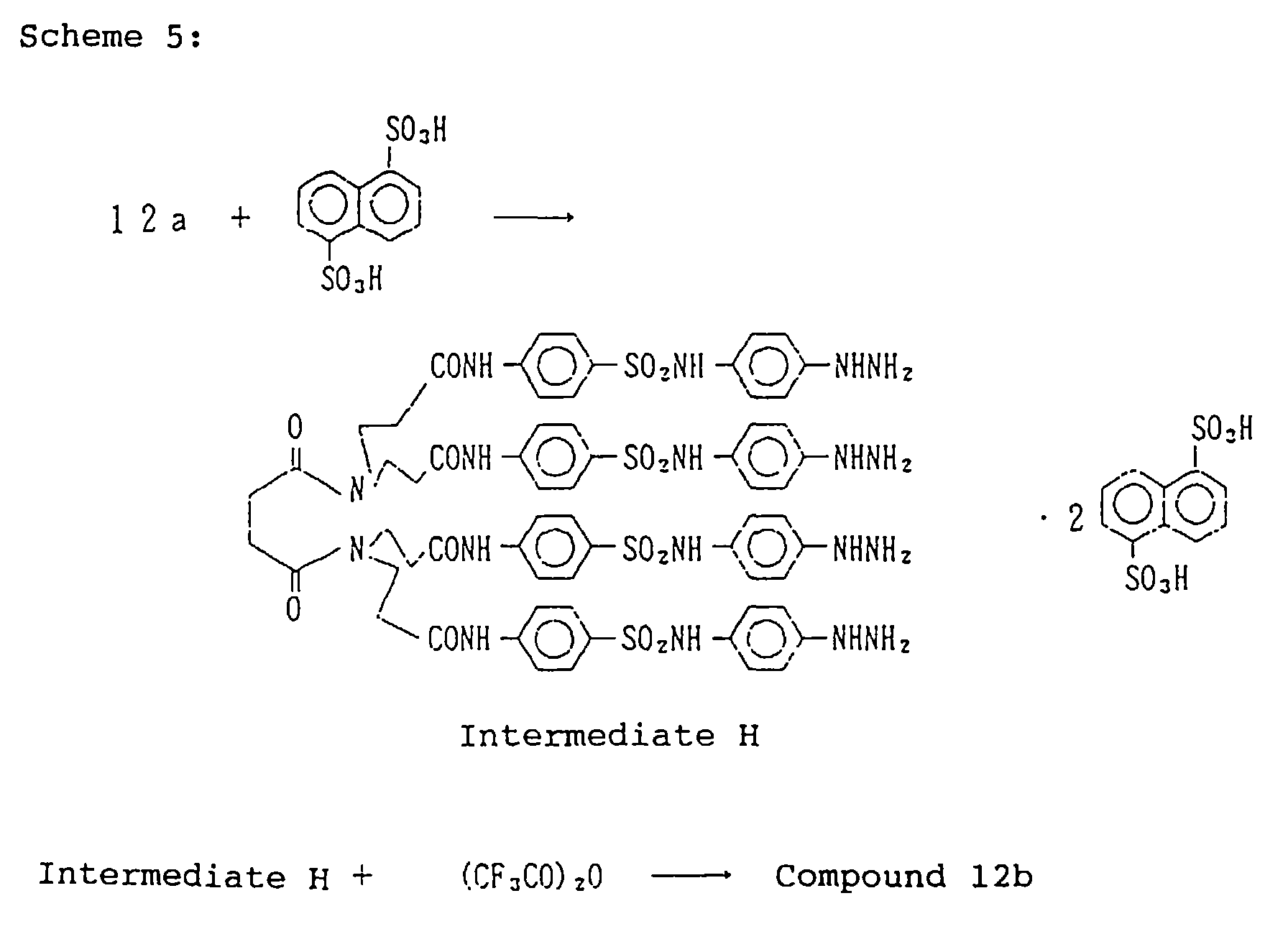
- A methanol and acetonitrile mixed suspension (100 ml) containing 5.84 g of Compound 12a and 6.0 g of 1,5-naphthalenedisulfonic acid was stirred at 50°C for 2 hours. Insoluble matters were recovered by filtration to obtain 11.66 g of Intermediate H.
- An acetonitrile/dimethylacetamide mixed solution (100 ml) containing 4.74 g of Intermediate H was ice cooled in a nitrogen atmosphere, and thereto 3 ml of triethylamine and 3.3 g of trifluoroacetic anhydride were added. The mixture was stirred at room temperature for one hour, then thereto ethyl acetate and diluted hydrochloric acid were added, and the product was extracted, dried, concentrated and subjected to silica gel column chromatography to obtain 5.68 g of Compound 12b.
- Compound 12b was synthesized according to Scheme 6. Scheme 6:

- To 60 ml of an acetonitrile solution containing 7.44 g of Intermediate H and 3 g of difluoroacetic acid, 4.6 ml of triethylamine was added, and thereto 20 ml of an acetonitrile solution containing 6.2 g of dicyclohexylcarbodiimide was added dropwise under ice cooling. The mixture was stirred at room temperature for 2 hours, insoluble matters were separated by filtration, ethyl acetate and diluted hydrochloric acid were added, and the product was extracted, dried, concentrated and subjected to silica gel column chromatography to obtain 6.3 g of Compound 12c.
- Compound 4a was synthesized according to Scheme 7.

- To 80 ml of an acetonitrile solution containing 6.22 g of succinic acid chloride, 60 ml of an acetonitrile solution containing 15 ml of triethylamine and 8.4 g of diethanolamine was added dropwise under ice cooling. The mixture was stirred at room temperature for one hour, then thereto ethyl acetate and diluted hydrochloric acid were added, and the product was extracted, dried and concentrated to obtain 13.7 g of Intermediate I.
- To 100 ml of an acetonitrile solution containing 3.4 g of Intermediate I, 7 ml of triethylamine was added and ice cooled, and thereto 40 ml of an acetonitrile solution containing 11 g of m-chlorosulfonylbenzoyl chloride was added to act thereon. The mixture was stirred at room temperature for one hour, then thereto ethyl acetate and diluted hydrochloric acid were added, and the product was extracted, dried and concentrated to obtain 10.6 g of Intermediate J.
- To 40 ml of a dimethylacetamide solution containing 6 g of N-p-aminophenyl-N'-formylhydrazine, 10.6 g of Intermediate J was gradually added in a nitrogen atmosphere under ice cooling. The mixture was stirred for 2 hours, then thereto ethyl acetate and diluted hydrochloric acid were added, and the product was extracted, dried and concentrated. Thereto, dimethylacetamide was added and dissolved, then diluted hydrochloric acid was added, and the product was crystallized to obtain 12.1 g of Compound 4a.
- Compound 4c was synthesized thoroughly in the same manner as Compound 4a except for using N-p-aminophenyl-N'-difluoroacetylhydrazine in place of N-p-aminophenyl-N'-formylhydrazine in the synthesis of Compound 4a.
- Compound 4d was synthesized according to Scheme 8.

- A methanol and acetonitrile mixed suspension (100 ml) containing 12.7 g of Compound 4a and 6 g of 1,5-naphthalenedisulfonic acid was stirred at 50°C for 2 hours. Insoluble matters were recovered by filtration to obtain 15.1 g of Intermediate K.
- An acetonitrile/dimethylacetamide mixed solution (100 ml) containing 5.44 g of Intermediate K was ice cooled in a nitrogen atmosphere, and thereto 1.5 ml of triethylamine and then 1.8 g of tetrafluorosuccinic anhydride were added. The mixture was stirred at room temperature for one hour, then thereto ethyl acetate and diluted hydrochloric acid were added, and the product was extracted, dried, concentrated and subjected to silica gel chromatography to obtain 6.23 g of Compound 4d.
- Next, the hydrazide compound for use in the silver halide photographic light-sensitive material according to the second embodiment of the present invention are described in detail below.
- In formulae (I') and (II'), X1', X2' and Y2' each represents a substituent capable of substitution on the benzene ring. Preferred examples of the substituent represented by X1', X2' or Y2' include a carboxyl group, a sulfo group, an alkyl group, an amino group, an alkylamino group, a hydroxy group, an alkoxy group, a halogen atom, an acylamino group, a sulfonamido group and a ureido group, and these groups each preferably has a total carbon number of from 1 to 12, more preferably from 1 to 8.
- In formula (I') or (II'), m1', m2' and m3' each represents an integer of from 0 to 4. m1', m2' and m3' each is preferably 0 or 1, more preferably 0.
- In formula (I') or (II'), R1' and R2' each represents a hydrogen atom or a block group.
- Specific examples of the block group include an alkyl group, an aralkyl group, an alkenyl group, an alkynyl group, an aryl group, a heterocyclic group, an alkoxy group, an aryloxy group, an amino group and a hydrazino group, and these groups exclusive of the hydrogen atom each may be substituted.
- Examples of the alkyl group include a methyl group, a trifluoromethyl group, a difluoromethyl group, a 2-carboxytetrafluoroethyl group, a methoxyethyl group, a phenoxymethyl group, a pyridiniomethyl group, a 3-hydroxypropyl group, a 3-methanesulfonamidopropyl group and a phenylsulfonylmethyl group. Examples of the aralkyl group include an o-hydroxybenzyl group and an o-aminobenzyl group. Examples of the alkenyl group include a vinyl group and a 2-ethoxycarbonylvinyl group. Examples of the alkynyl group include an ethynyl group and 2-methoxycarbonylethynyl group. Examples of the aryl group include a 3,5-dichlorophenyl group, a 2-hydroxymethylphenyl group, a 2-carbamoylphenyl group, a 3,5-dichloro-2-hydroxymethylphenyl group, a 2-methanesulfonamidophenyl group, a 4-cyanophenyl group and a 3,4-dinitrophenyl group. Examples of the heterocyclic group include a 4-pyridyl group, a benzotriazol-5-yl group, a 3-(2-mercaptotetrazolyl)phenyl group and an N-methyl-4-pyridinio group. Examples of the alkoxy group include a methoxy group, a propoxy group and a 2-hydroxyethoxy group. Examples of the aryloxy group include a phenoxy group and a 1-naphthyloxy group. Examples of the amino group include an amino group, a propylamino group, a dimethylamino group, a 2,2,6,6-tetramethylpiperidin-4-yl group, an anilino group, a 2-hydroxyanilino group, a 5-benzotriazolylamino group and a 1-benzyl-3-pyridinioamino group. Examples of the hydrazino group include a hydrazino group, a 2-phenylhydrazino group and a 4-benzenesulfonamidophenylhydrazino group.
- When these groups each has a substituent, the substituent include those described as the substituent of A1' in formula (I'), however, the total carbon atom number of the substituent is preferably from 0 to 12, more preferably from 0 to 8.
- At least one of two R1' groups in formula (I') and at least one of two R2' groups in formula (II') each represents a fluorine-substituted alkyl group substituted by one or more fluorine atoms.
- The fluorine-substituted alkyl group is a branched or linear substituted alkyl group having from 1 to 18 carbon atoms, substituted only by a fluorine atom or by a fluorine atom and a substituent other than fluorine atom. Specific examples thereof include a trifluoromethyl group, a difluoromethyl group, a monofluoromethyl group, a 2-carboxytetrafluoroethyl group, a chlorodifluoromethyl group, a methoxydifluoromethyl group, a methylthiodifluoromethyl group, a phenylthiodifluoromethyl group, a pentafluoroethyl group, a heptafluoropropyl group, a 4-carboxyhexafluoropropyl group and a 2-methoxycarbonyl-1,1-difluoroethyl group.
- In formula (I') or (II'), the group represented by R1' or R2' is preferably a fluorine-substituted alkyl group having a total number of carbon atoms of from 1 to 8, more preferably a trifluoromethyl group, a difluoromethyl group or a 2-carboxytetrafluoromethyl group, and most preferably a trifluoromethyl group or a difluoromethyl group.
- In formula (I') or (II'), two units of the group which is represented by one of the following formulae and is linked to A1' or L3' may be the same or different, more specifically two R1' groups, two R2' groups, two or more X1' groups, two or more X2' groups, two or more Y2' groups, two L1' groups, and two L2' groups may be the same or different, respectively.

- In formula (I'), A1' represents a substituted or unsubstituted benzene ring. When the ring has a substituent, the substituent includes those described as the substituent on the substituent represented by X1', X2' or Y2' in formula (I') or (II').
- The substituent of A1' is preferably a halogen atom, an alkyl group, an aryl group, a carbamoyl group, an alkoxycarbonyl group, an aryloxycarbonyl group, an acyl group, a cyano group, an alkoxy group, an aryloxy group, a carbamoyloxy group, an acylamino group, a ureido group, a sulfamoylamino group, an alkoxycarbonylamino group, a sulfonamido group, a sulfamoyl group or a sulfonyl group, more preferably a halogen atom, an alkyl group, an aryl group, a carbamoyl group, an alkoxy group, an aryloxy group, an acylamino group, a ureido group, a sulfonamido group or a sulfamoyl group.
- The compound represented by formula (I') may have an adsorption accelerator to silver halide as a substituent.
- Examples of the adsorption accelerator to silver halide include those described in U.S. Patents 4,385,108 and 4,459,347, JP-A-59-195233, JP-A-59-200231, JP-A-59-201045, JP-A-59-201046, JP-A-59-201047, JP-A-59-201048, J-A-59-201049, JP-A-61-170733, JP-A-61-270744, JP-A-62-948, JP-A-63-234244, JP-A-63-234245 and JP-A-63-234246, such as a thiourea group, a heterocyclic thioamide group, a mercapto heterocyclic group and a triazole group.
- Specific examples of preferred adsorption accelerators to silver halide include thioureido, thioamide, thiourethane, 5-mercaptotetrazole, 3-mercapto-1,2,4-triazole, 2-mercapto-1,3,4-thiadiazole, 2-mercapto-1,3,4-oxadiazole, alkylmercapto, arylmercapto and benzotriazole.
- In formula (II'), the divalent linking group represented by L3' is a group consisting of a combination of groups selected from an alkylene group, a cycloalkylene group, an alkenylene group, an alkynylene group, a phenylene group, -O-, -S-, -N(RN)- (wherein RN represents a single bond, a hydrogen atom, an alkyl group or an aryl group), -CO-, -C(=S)-, -C(=N-RN)-, -SO2-, -SO- and -P(=O)-.
- The alkylene group is a linear or branched, substituted or unsubstituted alkylene group, and specific examples thereof include a methylene group, an ethylene group, a propylene group, a hexafluoropropylene group and an α-ethylmethylene group. The cycloalkylene group is a mono-, bi- or tricyclic, substituted or unsubstituted cycloalkylene group, and specific examples thereof include a cyclohexylene group, a bicyclohexylene group, an adamantylene group, a norbornylene group and a decalin-2,6-diyl group. The alkenylene group is a substituted or unsubstituted alkenylene group, and specific examples thereof include a vinylene group, a 1,3-butadien-1,4-diyl group and a tetrafluorovinylene group. The alkynylene group is a substituted or unsubstituted alkynylene group, and specific examples thereof include an ethynylene group. The phenylene group is a substituted or unsubstituted phenylene group.
- The group represented by L3' in formula (II') does not contain a partial structure of biphenyl, diphenylmethane (including bisphenol), triphenylmethane, benzophenone, diphenylamine, triphenylamine, diphenylether, diphenylsulfide, diphenylsulfone, stilbene, fluorenone, anthraquinone, binaphthyl or dinaphthylether.
- Further, L3' does not contain a quaternary nitrogen atom such as an ammonio group and a pyridinio group.
- The group represented by L3' in formula (II') preferably does not contain a cationic group.
- Specific examples of the divalent linking group represented by L3' in formula (II') are set forth below.

- When the group represented by L3' has a substituent, the substituent includes those described as the substituent of A1' in formula (I'), and the preferred examples thereof are also the same.
- In formula (I') or (II'), the divalent linking group represented by L1' or L2' is a group consisting of a combination of groups selected from -O-, -S-, -N(RN)-(wherein RN represents a hydrogen atom, an alkyl group or an aryl group), -CO-, -C(=S)-, -SO2-, -SO- and -P(=O)-.
- Specific examples of the group consisting of the combination include -CON(RN)-, -SO2N(RN)-, -COO-, -N(RN)CON(RN)-, -N(RN)CSN(RN)-, N(RN)SO2N(RN)-, -SO2N(RN)CO-, -SO2N(RN)CON(RN)-, -N(RN)COCON(RN)-, -CON(RN)CO- and -N(RN)N(RN)CON(RN)-. These groups each may be bonded from either the left site or the right site thereof.
- In formula (I') or (II'), L1' and L2' each is preferably -SO2NH-, -NHCONH-, -CONH-, -O-, -S- or -N(RN)-, more preferably -SO2NH-.
- At least one of two L1' groups in formula (I') and at least one of two L2' groups in formula (II') each is more preferably an -SO2NH- group.
- Examples of the compounds of the present invention are set forth below, however, the present invention is by no means limited thereto.


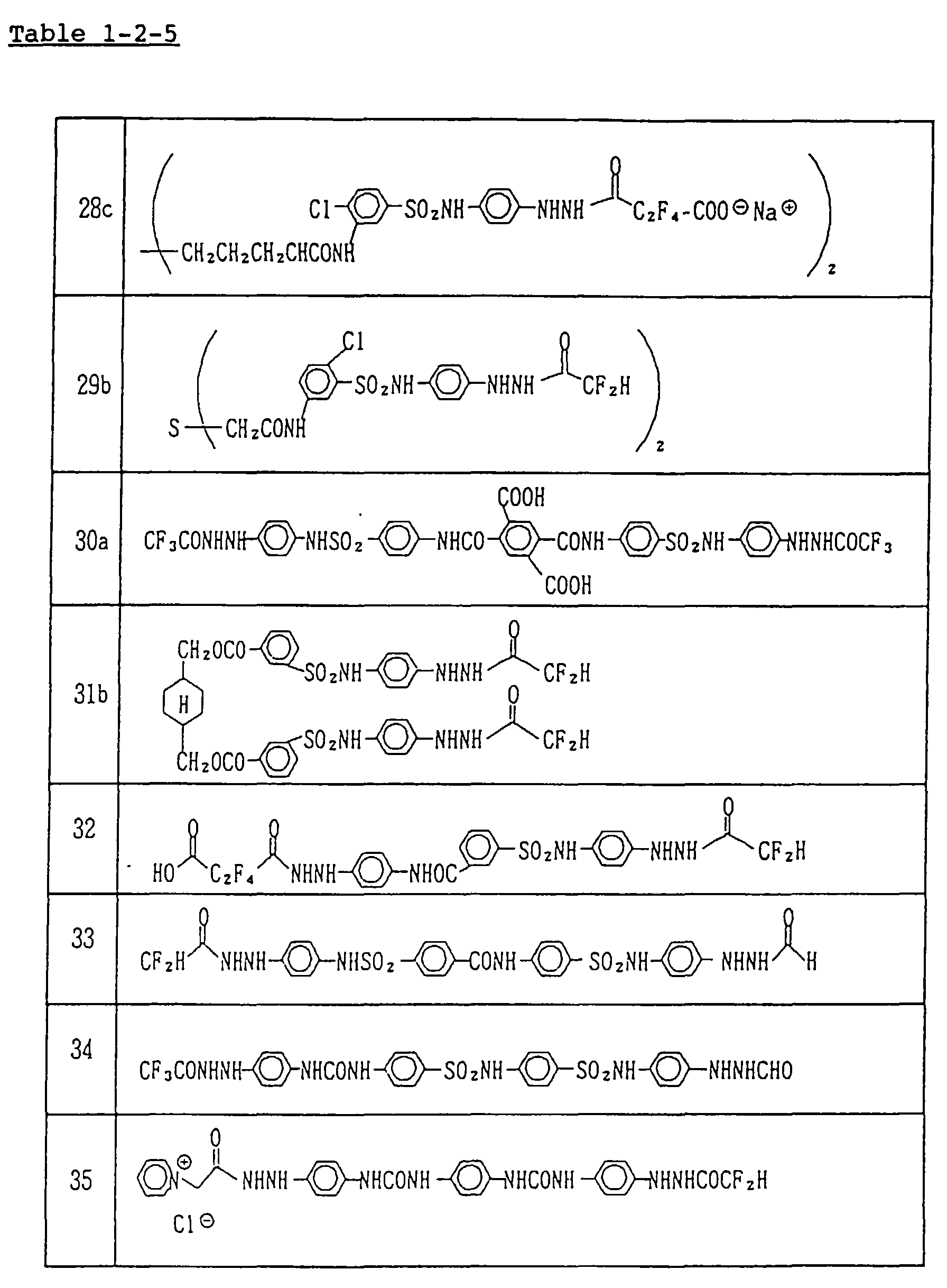
- Compound 4b' was synthesized according to Scheme 1'.

- To 100 ml of an acetonitrile solution containing 1.4 g of p-xylenedimethanol, 0.8 ml of triethylamine was added and ice cooled, and 40 ml of an acetonitrile solution containing 4.84 g of m-chlorosulfonylbenzoyl chloride was added to act thereon. After stirring the mixture at room temperature for one hour, ethyl acetate and diluted hydrochloric acid were added and the product was extracted, dried and concentrated to obtain 5.01 g of Intermediate A'.
- To 60 ml of an isopropyl alcohol solution containing 3.7 g of N-p-aminophenyl-N'-difluoroacetylhydrazine obtained by iron reducing N-p-nitrophenyl-N'-difluoroacetylhydrazine, 1.5 ml of pyridine was added, and 20 ml of an acetonitrile/dimethylacetamide mixed solution containing 5.0 g of Intermediate A' was added and stirred for one hour. Ethyl acetate and diluted hydrochloric acid were added and the product was extracted, dried, concentrated and subjected to silica gel column chromatography to obtain 4.13 g of Compound 4b' (mp: 150-153°C).
- Compound 4c' was synthesized according to Scheme 2'.

- To 40 ml of a dimethylacetamide solution containing 3.73 g of N-p-aminophenyl-N'-formylhydrazine, 6.70 g of Intermediate A' was gradually added in a nitrogen atmosphere under ice cooling. After stirring for 2 hours, ethyl acetate and diluted hydrochloric acid were added and the product was extracted, dried and concentrated. Dimethylacetamide was added thereto and dissolved, diluted hydrochloric acid was added, and the product was crystallized to obtain 4.86 g of Intermediate B'.
- A methanol/acetonitrile mixed suspension (100 ml) containing 4.86 g of Intermediate B' and 2.47 g of 1,5-naphthalenedisulfonic acid was stirred at 50°C for 2 hours. Insoluble matters were recovered by filtration to obtain 6.11 g of Intermediate C'.
- An acetonitrile/dimethylacetamide mixed solution (100 ml) containing 6.11 g of Intermediate C' was ice cooled in a nitrogen atmosphere, and thereto 4.6 ml of triethylamine and 2.4 g of tetrafluorosuccinic acid anhydride were added. After stirring the mixture at room temperature for one hour, ethyl acetate and diluted hydrochloric acid were added and the product was extracted, dried, concentrated and subjected to silica gel column chromatography to obtain 6.64 g of Compound 4c' (amorphous).
- Compound 31b' (amorphous) was synthesized thoroughly in the same manner as in the synthesis of Compound 4b' except for using 1,4-cyclohexanedimethanol in place of p-xylenedimethanol.
- Compound 18c' was synthesized according to Scheme 3'.

- To 100 ml of an isopropyl alcohol solution containing 17.3 g of Intermediate D' prepared from p-nitrobenzenesulfonylchloride and N-p-aminophenyl-N'-formylhydrazine, 1 g of ammonium chloride and 10 ml of water were added and heated under reflux, then thereto iron powder was added and the mixture was stirred for one hour. Insoluble matters were removed by Celite filtration, the solvent was distilled off and the residue was recrystallized from methylene chloride to obtain 12.6 g of Intermediate E'.
- To 70 ml of an acetonitrile solution containing 3.75 g of cis-5-norbornene-endo-2,3-dicarboxylic acid, 80 ml of an acetonitrile solution containing 12.6 g of Intermediate E' was added dropwise in the presence of 8.5 g of dicyclohexylcarbodiimide, and the mixture was stirred for one hour. The solid deposited was separated by filtration, ethyl acetate and diluted hydrochloric acid were added, and the product was extracted, dried, concentrated and recrystallized from an ethyl acetate/methylene chloride mixed solution to obtain 11.7 g of Intermediate F'.
- Compound 18c' (amorphous) was synthesized thoroughly in the same manner as in the synthesis of Compound 4c' except for using Intermediate F' in place of Intermediate B'.
- Compound 22b' was synthesized according to Scheme 4'.

- To 100 ml of an acetonitrile solution containing 7.13 g of 1,3-adamantanediamine, 12 ml of triethylamine was added and ice cooled, and then 80 ml of an acetonitrile solution containing 20.5 g of phenyl p-nitrochlorofumarate was added to act thereon. After stirring the mixture at room temperature for one hour, insoluble matters were separated by filtration, ethyl acetate and diluted hydrochloric acid were added, and the product was extracted, dried and concentrated to obtain 21.6 g of Intermediate G'.
- To 100 ml of an isopropyl alcohol solution containing 13.5 g of Intermediate H' prepared from p-nitrobenzenesulfonyl chloride and N-p-aminophenyl-N'-difluoroacetylhydrazine, 1 g of ammonium chloride and 10 ml of water were added and heated under reflux, then thereto iron powder was added, and the mixture was stirred for one hour. Insoluble matters were removed by celite filtration, 3.0 ml of pyridine was added to the resulting filtrate, 30 ml of an acetonitrile/dimethylacetamide mixed solution containing 10 g of Intermediate G' was added, and the mixture was stirred for one hour. Thereto, ethyl acetate and diluted hydrochloric acid were added and the product was extracted, dried, concentrated and subjected to silica gel column chromatography to obtain 15.2 g of Compound 22b' (amorphous).
- The hydrazide compound for use in the present invention (hereinafter occasionally referred to as a "hydrazine-base nucleating agent") may be dissolved in an appropriate water-miscible organic solvent prior to use. Examples of the solvent include alcohols (e.g., methanol, ethanol, propanol, fluorinated alcohol), ketones (e.g., acetone, methyl ethyl ketone), dimethylformamide, dimethylsulfoxide and methyl cellosolve.
- Alternatively, the hydrazide compound may be used in the form of an emulsion dispersion product obtained by dissolving the compound according to a well known emulsion dispersion method using an oil such as dibutyl phthalate, tricresyl phosphate, glyceryl triacetate or diethylphthalate, or an auxiliary solvent such as ethyl acetate or cyclohexanone, and mechanically forming it into an emulsion dispersion product. Further, powder of the hydrazine derivative may be dispersed in water according to a method known as a solid dispersion method by means of a ball mill, a colloid mill or ultrasonic waves and then used.
- The hydrazine-base nucleating agent for use in the present invention is preferably used as a fine dispersion (fine crystal grain) solid dispersion. The fine (crystal) grain solid dispersion of the hydrazine-base nucleating agent can be mechanically prepared, if desired, using an appropriate solvent (e.g., water, alcohol) in the presence of a dispersant by a pulverisation means (e.g., ball mill, vibration ball mill, planetary ball mill, sand mill, colloid mill, jet mill, roller mill). Also, the hydrazine-base nucleating agent fine (crystal) grain may be prepared using a method of dissolving a hydrazine-base nucleating agent in an appropriate solvent using a surface active agent for dispersion and then adding the solution to a bad solvent of the hydrazine-base nucleating agent to deposit fine crystal, or a method of first dissolving a hydrazine-base nucleating agent by controlling the pH and then finely crystallizing the solution by varying the pH. The thus-obtained hydrazine-base nucleating agent fine (crystal) grains are dispersed in an appropriate binder to prepare a solid dispersion of almost uniform grains, and the solid dispersion is coated on a desired support to provide a layer containing the hydrazine-base nucleating agent fine powder. Alternatively, the layer may be provided by a method of coating a hydrazine-base nucleating agent in the dissociation state as a salt form and overcoating thereon acidic gelatin to achieve dispersion fixation at the time of coating.
- The above-described binder may be a polymer having an active methylene group, which is described above, or a hydrophilic colloid or synthetic polymer which can be used in a light-sensitive emulsion layer or a light-insensitive layer. The hydrophilic colloid is not particularly limited, however, gelatin is usually preferred.
- The surface active agent for dispersion may be a known surface active agent and it is preferably an anionic, nonionic or amphoteric surface active agent, more preferably an anionic and/or nonionic surface active agent.
- The hydrazine-base nucleating agent fine grain in the solid dispersion has an average grain size of from 0.005 to 10 µm, preferably from 0.01 to 1 µm, more preferably from 0.01 to 0.5 µm.
- The hydrazine nucleating agent of the present invention may be added to any of silver halide emulsion layers and other hydrophilic colloid layers on the silver halide emulsion layer side of the support, however, it is preferably added to the silver halide emulsion layer or a hydrophilic colloid layer adjacent thereto.
- The nucleating agent of the present invention is preferably added in an amount of from 1×10⁻⁶ to 1×10⁻² mol, more preferably from 1×10⁻⁵ to 1×10⁻³ mol, most preferably from 5×10⁻⁵ to 1×10⁻³ mol, per mol of silver halide.
- In the case of processing with the developer having a pH of less than 11 of the present invention, the silver halide photographic light-sensitive material particularly preferably contains a nucleation contrasting accelerator such as an amine derivative, an onium salt, a disulfide derivative or a benzyl alcohol derivative, in a silver halide emulsion layer or other hydrophilic colloid layer.
- Examples of the nucleation accelerator for use in the present invention include amine derivatives, onium salts, disulfide derivatives and hydroxymethyl derivatives. Examples thereof include: compounds described in JP-A-7-77783, page 48, lines 2 to 37, specifically, Compounds A-1) to A-73) described at pages 49 to 58; compounds represented by (Chem. 21), (Chem. 22) and (Chem. 23) of JP-A-7-84331, specifically, compounds described in pages 6 to 8; and compounds represented by formulae [Na] and [Nb] of JP-A-7-104426, specifically, Compounds Na-1 to Na-22 and Compounds Nb-1 to Nb-12 described at pages 16 to 20.
- The nucleation accelerator for use in the present invention may be dissolved in an appropriate water-miscible organic solvent such as alcohols (e.g., methanol, ethanol, propanol, fluorinated alcohol), ketones (e.g., acetone, methyl ethyl ketone), dimethylformamide, dimethylsulfoxide and methyl cellosolve, prior to use.
- Alternatively, the nucleation accelerator may be used in the form of an emulsion dispersion product obtained by dissolving the compound according to a well known emulsion dispersion method using an oil such as dibutyl phthalate, tricresyl phosphate, glyceryl triacetate or diethylphthalate, or an auxiliary solvent such as ethyl acetate or cyclohexanone, and mechanically forming it into an emulsion dispersion product. Further, powder of the nucleation accelerator may be dispersed in water according to a method known as a solid dispersion method by means of a ball mill, a colloid mill or ultrasonic waves and then used.
- The nucleation accelerator for use in the present invention may be added to any of silver halide emulsion layers and other hydrophilic colloid layers on the silver halide emulsion layer side of the support, however, it is preferably added to the silver halide emulsion layer or a hydrophilic colloid layer adjacent thereto.
- The nucleation accelerator of the present invention is preferably added in an amount of from 1×10⁻⁶ to 2×10⁻² mol, more preferably from 1×10⁻⁵ to 2×10⁻² mol, most preferably from 2×10⁻⁵ to 1×10⁻² mol, per mol of silver halide.
- The halogen composition of the silver halide emulsion for use in the present invention is not particularly limited, however, in view of achieving the objects of the present invention more effectively, silver chloride, silver chlorobromide or silver chloroiodobromide having a silver chloride content of 50 mol% or more is preferred. The silver iodide content is preferably less than 5 mol%, more preferably less than 2 mol%.
- In the present invention, a light-sensitive material suitable for high illuminance exposure such as scanner exposure or a light-sensitive material for photographing line original contains a rhodium compound so as to achieve high contrast and low fog.
- The rhodium compound for use in the present invention may be a water-soluble rhodium compound. Examples thereof include rhodium(III) halogenide compounds and rhodium complex salts having a halogen, an amine or an oxalate as a ligand, such as hexachlororhodium(III) complex salt, hexabromorhodium(III) complex salt, hexaminerhodium(III) complex salt and trisalaterhodium(III) complex salt. The rhodium compound is dissolved in water or an appropriate solvent prior to use and a method commonly used for stabilizing the rhodium compound solution, namely, a method of adding an aqueous solution of hydrogen halogenide (e.g., hydrochloric acid, bromic acid, hydrofluoric acid) or an alkali halide (e.g., KCl, NaCl, KBr, NaBr), may be used. In place of using a water-soluble rhodium, separate silver halide grains which are previously doped with rhodium may be added and dissolved at the time of preparation of silver halide.
- The addition amount of the rhodium compound is from 1×10⁻⁸ to 5×10⁻⁶ mol, preferably from 5×10⁻⁸ to 1×10⁻⁶ mol, per mol of silver of the silver halide emulsion.
- The rhodium compound may be added during production of silver halide emulsion grains or at any appropriate stage before coating of the emulsion, however, it is preferably added at the time of formation of the emulsion to incorporate it into a silver halide grain.
- The photographic emulsion for use in the present invention can be prepared using a method described in P. Glafkides, Chimie et Physique Photographique, Paul Montel (1967); G.F. Duffin, Photographic Emulsion Chemistry, The Focal Press (1966); and V.L. Zelikman et al, Making and Coating Photographic Emulsion, The Focal Press (1964).
- A soluble silver salt may be reacted with a soluble halogen salt by any of a single jet method, a double jet method and a combination thereof.
- A method of forming grains in the presence of excessive silver ions (so-called reverse mixing process) may also be used. As one of the double jet method, a method of maintaining the pAg constant in the liquid phase where silver halide is produced, namely, a so-called controlled double jet method may be used. Further, it is preferred to form grains using a so-called silver halide solvent such as ammonia, thioether or tetra-substituted thiourea, more preferably using a tetra-substituted thiourea compound, and this is described in JP-A-53-82408 and JP-A-55-77737. Preferred examples of the thiourea compound include tetramethyl thiourea and 1,3-dimethyl-2-imidazolidinethione.
- According to the controlled double jet method or the method of forming grains using a silver halide solvent, a silver halide emulsion comprising regular crystal form grains and having a narrow grain size distribution can be easily prepared, and these methods are a useful means for preparing the silver halide emulsion for use in the present invention.
- In order to achieve a uniform grain size, it is preferred to rapidly grow grains within the range of not exceeding the critical saturation degree, using a method of changing the addition rate of silver nitrate or alkali halide according to the grain growth rate as described in British Patent 1,535,016, JP-B-48-36890 and JP-B-52-16364, or a method of changing the concentration of the aqueous solution as described in British Patent 4,242,445 and JP-A-55-158124.
- The emulsion of the present invention is preferably a monodisperse emulsion having a coefficient of variation of 20% or less, more preferably 15% or less.
- The grains in the monodisperse silver halide emulsion have an average grain size of 0.5 µm or less, more preferably from 0.1 to 0.4 µm.
- The silver halide emulsion of the present invention is preferably subjected to chemical sensitization. The chemical sensitization may be performed using a known method such as sulfur sensitization, selenium sensitization, tellurium sensitization or noble metal sensitization, and these sensitization methods may be used individually or in combination. When these sensitization methods are used in combination, a combination of sulfur sensitization and gold sensitization, a combination of sulfur sensitization, selenium sensitization and gold sensitization, and a combination of sulfur sensitization, tellurium sensitization and gold sensitization are preferred.
- The sulfur sensitization for use in the present invention is usually performed by adding a sulfur sensitizer and stirring the emulsion at a high temperature of 40°C or higher for a predetermined time. The sulfur sensitizer may be a known compound and examples thereof include, in addition to the sulfur compound contained in gelatin, various sulfur compounds such as thiosulfates, thioureas, thiazoles and rhodanines. Preferred sulfur compounds are a thiosulfate and a thiourea compound. The addition amount of the sulfur sensitizer varies depending upon various conditions such as the pH and the temperature at the time of chemical ripening and the size of silver halide grains, however, it is usually from 10-7 to 10-2 mol, preferably from 10-5 to 10-3 mol, per mol of silver halide.
- The selenium sensitizer for use in the present invention may be a known selenium compound. The selenium sensitization is usually performed by adding a labile and/or non-labile selenium compound and stirring the emulsion at a high temperature of 40°C or higher for a predetermined time. Examples of the labile selenium compound include the compounds described in JP-B-44-15748, JP-B-43-13489, JP-A-4-25832, JP-A-4-109240 and JP-A-4-324855, and among these, particularly preferred are the compounds represented by formulae (VIII) and (IX) of JP-A-4-324855.
- The tellurium sensitizer for use in the present invention is a compound which generates silver telluride presumed to be a sensitization nuleus, on the surface or in the inside of a silver halide grain. The generating rate of silver telluride in a silver halide emulsion can be examined according to a method described in JP-A-5-313284.
- Specific examples of the tellurium sensitizer include the compounds described in U.S. Patents 1,623,499, 3,320,069 and 3,772,031, British Patents 235,211, 1,121,496, 1,295,462 and 1,396,696, Canadian Patent 800,958, JP-A-4-204640, JP-A-4-271341, JP-A-4-333043, JP-A-5-303157, J. Chem. Soc. Chem. Commun., 635 (1980), ibid., 1102 (1979), ibid., 645 (1979), J. Chem. Soc. Perkin. Trans., 1, 2191 (1980), S. Patai (compiler), The Chemistry of Organic Selenium and Tellurium Compounds, Vol. 1 (1986), and ibid., Vol. 2 (1987). The compounds represented by formulae (II), (III) and (IV) of JP-A-5-313284 are particularly preferred.
- The use amount of the selenium sensitizer or the tellurium sensitizer for use in the present invention varies depending upon silver halide grains used or chemical ripening conditions, however, it is usually approximately from 10-8 to 10-2 mol, preferably approximately from 10-7 to 10-3 mol, per mol of silver halide. The conditions for chemical sensitization in the present invention are not particularly limited, however, the pH is generally from 5 to 8, the pAg is generally from 6 to 11, preferably from 7 to 10, and the temperature is from 40 to 95°C, preferably from 45 to 85°C.
- Examples of the noble metal sensitizer for use in the present invention include gold, platinum, palladium and iridium, and gold sensitization is particularly preferred. Specific examples of the gold sensitizer for use in the present invention include chloroauric acid, potassium chlorate, potassium aurithiocyanate and gold sulfide, and the gold sensitizer is used in an amount of approximately from 10-7 to 10-2 mol per mol of silver halide.
- In the silver halide emulsion for use in the present invention, a cadmium salt, a sulfite, a lead salt or a thallium salt may be present together during formation or physical ripening of silver halide grains.
- In the present invention, reduction sensitization may be used. Examples of the reduction sensitizer which can be used include stannous salt, amines, formamidinesulfinic acid and silane compounds.
- To the silver halide emulsion of the present invention, a thiosulfonic acid compound may be added according to the method described in European Unexamined Patent Publication EP-A-293917.
- In the light-sensitive material for use in the present invention, one kind of silver halide emulsion may be used or two or more kinds of silver halide emulsions (for example, those having different average grain sizes, different halogen compositions, different crystal habits, or different chemical sensitization conditions) may be used in combination.
- In the present invention, the silver halide emulsion particularly suitable as a light-sensitive material for dot-to-dot work comprises silver halide having a silver chloride content of 90 mol% or more, preferably 95 mol% or more, more specifically, silver chlorobromide or silver chloroiodobromide containing from 0 to 10 mol% of silver bromide. If the proportion of silver bromide or silver iodide increases, the safelight safety in a bright room may be worsened or the γ value is disadvantageously lowered.
- The silver halide emulsion for use in the dot-to-dot work light-sensitive material of the present invention preferably contains a transition metal complex, and examples of the transition metal include Rh, Ru, Re, Os, Ir and Cr.
- Examples of the ligand include a nitrosyl bridging ligand, a thionitrosyl bridging ligand, a halogen ligand (e.g., fluorine, chlorine, bromine, iodine), a cyanide ligand, a cyanate ligand, a thiocyanate ligand, a selenocyanate ligand, a tellurocyanate ligand, an acid ligand and an aquo ligand. When an aquo ligand is present, it preferably occupies one or more of the ligands.
- More specifically, the rhodium atom may be incorporated by forming it into a metal salt in any form, such as a single salt or a complex salt, and adding the salt at the time of preparation of grains.
- Examples of the rhodium salt include rhodium monochloride, rhodium dichloride, rhodium trichloride and ammonium hexachlororhodate, and preferred are a halogen complex compound of water-soluble trivalent rhodium, such as hexachlororhodium(III) acid and a salt thereof (e.g., ammonium salt, sodium salt, potassium salt).
- The addition amount of the water-soluble rhodate is from 1.0×10⁻⁶ to 1.0×10⁻³, preferably from 1.0×10⁻⁵ to 1.0×10⁻³, more preferably from 5.0×10⁻⁵ to 5.0×10⁻⁴ mol, per mol of silver halide.
- The following transition metal complexes are also preferred.
- 1. [Ru(NO)Cl5]-2
- 2. [Ru(NO)2Cl4]-1
- 3. [Ru(NO)(H2O)Cl4]-1
- 4. [Rh(NO)Cl5]-2
- 5. [Re(NO)CN5]-2
- 6. (Re(NO)ClCN4]-2
- 7. [Rh(NO)2Cl4]-1
- 8. [Rh(NO)(H2O)Cl4]-1
- 9. [Ru(NO)CN5]-2
- 10. [Ru(NO)Br5]-2
- 11. [Ru(NS)Cl5]-2
- 12. [Os(NO)Cl5]-2
- 13. [Cr(NO)Cl5]-3
- 14. [Re(NO)Cl5]-1
- 15. [Os(NS)Cl4(TeCN)]-2
- 16. [Ru(NS)I5]-2
- 17. [Re(NS)Cl4(SeCN)]-2
- 18. [Os(NS)Cl(SCN)4]-2
- 19. [Ir(NO)Cl5]-2
- The spectral sensitizing dye for use in the present invention is not particularly limited.
- The addition amount of the sensitizing dye for use in the present invention varies depending upon the shape or size of silver halide grains, however, it is usually from 4×10⁻⁶ to 8×10⁻³ mol per mol of silver halide. For example, when the silver halide grain size is from 0.2 to 1.3 µm, the addition amount is preferably from 2×10⁻⁷ to 3.5×10⁻⁶ mol, more preferably from 6.5×10⁻⁷ to 2.0×10⁻⁶ mol, per 1 m2 of the surface area of silver halide grains.
- The light-sensitive silver halide emulsion for use in the present invention may be spectrally sensitized to blue light, green light, red light or infrared light, each having a relatively long wavelength, by a sensitizing dye. Examples of the sensitizing dye which can be used include a cyanine dye, a merocyanine dye, a complex cyanine dye, a complex merocyanine dye, a holopolar cyanine dye, a styryl dye, a hemicyanine dye, an oxonol dye and a hemioxonol dye.
- Useful sensitizing dyes for use in the present invention are described, for example, in Research Disclosure, Item 17643, IV-A, page 23 (December, 1978), ibid., Item 18431X, page 437 (August, 1979), and publications cited therein. In particular, sensitizing dyes having spectral sensitivity suitable for spectral characteristics of various scanner light sources can be advantageously selected to use.
- For example, A) for an argon laser light source, simple merocyanines described in JP-A-60-162247, JP-A-2-48653, U.S. Patent 2,161,331, West German Patent 936,071 and JP-A-5-11389, B) for a helium-neon laser light source, trinuclear cyanine dyes described in JP-A-50-62425, JP-A-54-18726 and JP-A-59-102229, C) for an LED light source and a red semiconductor laser, thiacarbocyanines described in JP-B-48-42172, JP-B-51-9609, JP-B-55-39818, JP-A-62-284343 and JP-A-2-105135, and D) for an infrared semiconductor laser light source, tricarbocyanines described in JP-A-59-191032 and JP-A-60-80841, and dicarbocyanines containing a 4-quinoline nucleus described in JP-A-59-192242 and JP-A-3-67242, formulae (IIIa) and (IIIb), may be advantageously selected to use.
- These sensitizing dyes may be used individually or in combination, and the combination of sensitizing dyes is often used for the purpose of supersensitization. In combination with the sensitizing dye, a dye which itself has no spectral sensitization effect or a material which absorbs substantially no visible light, but exhibits supersensitization may be incorporated into the emulsion.
- Useful sensitizing dyes, combinations of dyes which exhibit supersensitization, and materials which show supersensitization are described in Research Disclosure, Vol. 176, 17643, page 23, Item IV-J (December, 1978).
- For the argon laser light source, specifically, Compounds (I)-1 to (I)-8 described in JP-A-60-162247, Compounds I-1 to I-28 described in JP-A-2-48653, Compounds I-1 to I-13 described in JP-A-4-330434, compounds in Examples 1 to 14 of U.S. Patent 2,161,331, and Compounds 1 to 7 described in West German Patent 936,071 are advantageously used.
- For the helium-neon light source, Compounds I-1 to I-38 described in JP-A-54-18726, Compounds I-1 to I-35 described in JP-A-6-75322, and Compounds I-1 to I-34 described in JP-A-7-287338 are advantageously used.
- For the LED light source, Dyes 1 to 20 described in JP-B-55-39818, Compounds I-1 to I-37 described in JP-A-62-284343, and Compounds I-1 to I-34 described in JP-A-7-287338 are advantageously used.
- For the semiconductor laser light source, Compounds I-1 to I-12 described in JP-A-59-191032, Compounds I-1 to I-22 described in JP-A-60-80841, Compounds I-1 to I-29 described in JP-A-4-335342, and Compounds I-1 to I-18 described in JP-A-59-192242 are advantageously used.
- For the tungsten and xenon light source in camera work, Compounds (1) to (19) represented by general formula (I) described in JP-A-55-45015, and Compounds 4-A to 4-S, 5-A to 5-Q, and 6-A to 6-T described in JP-A-6-242547 are advantageously used.
- The developer for use in developing the light-sensitive material of the present invention may contain additives (e.g., developing agent, alkali agent, pH buffer, preservative, chelating agent) which are commonly used. The development of the present invention may be performed by any of known methods, and a known development processing solution may be used.
- The developing agent for use in the developer for the present invention is not particularly limited, however, it preferably contains a dihydroxybenzene or an ascorbic acid derivative, and in view of developing capability, a combination of a dihydroxybenzene with a 1-phenyl-3-pyrazolidone, a combination of a dihydroxybenzene with a p-aminophenol, a combination of an ascorbic acid derivative with a 1-phenyl-3-pyrazolidone and a combination of an ascorbic acid derivative and a p-aminophenol are preferred.
- Examples of the dihydroxybenzene developing agent for use in the present invention include hydroquinone, chlorohydroquinone, isopropylhydroquinone, methylhydroquinone and hydroquinone monosulfonate, with hydroquinone being particularly preferred.
- Examples of the ascorbic acid derivative developing agent for use in the present invention include an ascorbic acid, an erythorbic acid as a stereoisomer thereof and an alkali metal salt (e.g., sodium salt, potassium salt) thereof.
- Examples of the 1-phenyl-3-pyrazolidone or a derivative thereof as the developing agent for use in the present invention include 1-phenyl-3-pyrazolidone, 1-phenyl-4,4-dimethyl-3-pyrazolidone and 1-phenyl-4-methyl-4-hydroxymethyl-3-pyrazolidone.
- Examples of the p-aminophenol-base developing agent for use in the present invention include N-methyl-p-aminophenol, p-aminophenol, N-(β-hydroxyethyl)-p-aminophenol and N-(4-hydroxyphenyl)glycine, with N-methyl-p-aminophenol being particularly preferred.
- The dihydroxybenzene-base developing agent is usually preferably used in an amount of from 0.05 to 0.8 mol/ℓ, more preferably from 0.2 to 0.6 mol/ℓ. In the case when a dihydroxybenzene and a 1-phenyl-3-pyrazolidone or a p-aminophenol are used in combination, the former is preferably used in an amount of from 0.05 to 0.6 mol/ℓ, more preferably from 0.2 to 0.5 mol/ℓ, and the latter is preferably used in an amount of 0.06 mol/ℓ or less, more preferably 0.03 mol/ℓ or less.
- The ascorbic acid derivative developing agent is usually preferably used in an amount of from 0.05 to 0.8 mol/ℓ, more preferably from 0.2 to 0.6 mol/ℓ. In the case when an ascorbic acid derivative and a 1-phenyl-3-pyrazolidone or a p-aminophenol are used in combination, the former is preferably used in an amount of from 0.05 to 0.6 mol/ℓ, more preferably from 0.2 to 0.5 mol/ℓ, and the latter is preferably used in an amount of 0.06 mol/ℓ or less, more preferably 0.03 mol/ℓ or less.
- Examples of the preservative for use in the present invention include sodium sulfite, potassium sulfite, lithium sulfite, ammonium sulfite, sodium bisulfite, potassium metabisulfite and sodium formaldehyde bisulfite. The sulfite is used in an amount of 0.20 mol/ℓ or more, preferably 0.3 mol/ℓ or more, however, if it is added in excess, silver stains are caused in the developer, and therefore, the upper limit of the use amount is preferably 1.2 mol/ℓ. The sulfite is used more preferably in an amount of from 0.35 to 0.7 mol/ℓ.
- As the preservative of the dihydroxybenzene-base developing agent, a small amount of an ascorbic acid derivative may be used in combination with the sulfite. The ascorbic acid derivative includes an ascorbic acid, an erythorbic acid as a stereoisomer thereof, and an alkali metal salt thereof (e.g., sodium salt, potassium salt), and sodium erythorbate is preferred in view of the cost for materials. The addition amount thereof is, in terms of molar ratio to the dihydroxybenzene-base developing agent, preferably from 0.03 to 0.12, more preferably from 0.05 to 0.10. In the case where an ascorbic acid derivative is used as the preservative, the developer preferably contains no boron compound.
- The alkali agent used for adjusting the pH may be a normal water-soluble inorganic alkali metal salt (e.g., sodium hydroxide, potassium hydroxide, sodium carbonate, potassium carbonate). The developer preferably has a pH of from 9.0 to 12.0. More preferably, by adjusting the pH to from 9.0 to 11.0, a stable processing system can be established.
- Examples of additives other than those described above include a development inhibitor such as sodium bromide and potassium bromide; an organic solvent such as ethylene glycol, diethylene glycol, triethylene glycol and dimethylformamide; a development accelerator such as alkanolamine (e.g., diethanolamine, triethanolamine), imidazole and a derivative thereof; and an antifoggant or a black pepper inhibitor such as a mercapto-base compound, an imidazole-base compound, a benzotriazole-base compound and a benzimidazole-base compound. Specific examples thereof include 5-nitroindazole, 5-p-nitrobenzoylaminoindazole, 1-methyl-5-nitroindazole, 6-nitroindazole, 3-methyl-5-nitroindazole, 5-nitrobenzimidazole, 2-isopropyl-5-nitrobenzimidazole, 5-nitrobenzotriazole, sodium 4-[(2-mercapto-1,3,4-thiadiazol-2-yl)thio]butanesulfonate, 5-amino-1,3,4-thiadiazole-2-thiol, methylbenzotriazole, 5-methylbenzotriazole and 2-mercaptobenzotriazole. The antifoggant is usually used in an amount of from 0.01 to 10 mmol, preferably from 0.1 to 2 mmol, per ℓ of the developer.
- The developer of the present invention can further contain various organic or inorganic chelating agent in combination. Examples of the inorganic chelating agent include sodium tetrapolyphosphate and sodium hexametaphosphate.
- Examples of the organic chelating agent which can be predominantly used, include an organic carboxylic acid, an aminopolycarboxylic acid, an organic phosphonic acid, an aminophosphonic acid and an organic phosphonocarboxylic acid.
- Examples of the organic carboxylic acid include an acrylic acid, an oxalic acid, a malonic acid, a succinic acid, a glutaric acid, an adipic acid, a pimelic acid, an azelaic acid, a sebacic acid, a nonanedicarboxylic acid, a decanedicarboxylic acid, an undecanedicarboxylic acid, a maleic acid, an itaconic acid, a malic acid, a citric acid and a tartaric acid, however, the organic carboxylic acid is not limited thereto.
- Examples of the aminopolycarboxylic acid include iminodiacetic acid, nitrilotriacetic acid, nitrilotripropionic acid, ethylenediaminemonohydroxyethyltriacetic acid, ethylenediaminetetraacetic acid, glycolethertetraacetic acid, 1,2-diaminopropanetetraacetic acid, diethylenetriaminepentaacetic acid, triethylenetetraminehexaacetic acid, 1,3-diamino-2-propanoltetraacetic acid, glycoletherdiaminetetraacetic acid, and the compounds described in JP-A-52-25632, JP-A-55-67747, JP-A-57-102624 and JP-B-53-40900.
- Examples of the organic phosphonic acid include hydroxyalkylidenediphosphonic acid described in U.S. Patents 3,214,454 and 3,794,591 and German Patent Application (OLS) No. 2,227,639, and the compounds described in Research Disclosure, Vol. 181, Item 18170 (May, 1979).
- Examples of the aminophosphonic acid include aminotris(methylenephosphonic acid), ethylenediaminetetramethylenephosphonic acid, aminotrimethylenephosphonic acid, and the compounds described in Research Disclosure (supra), No. 18170, JP-A-57-208554, JP-A-54-61125, JP-A-55-29883 and JP-A-56-97347.
- Examples of the organic phosphonocarboxylic acid include the compounds described in JP-A-52-102726, JP-A-53-42730, JP-A-54-121127, JP-A-55-4024, JP-A-55-4025, JP-A-55-126241, JP-A-55-65955, JP-A-55-65956 and Research Disclosure (supra), No. 18170.
- These chelating agents each may be used in the form of an alkali metal salt or an ammonium salt. The chelating agent is preferably added in an amount of from 1×10⁻⁴ to 1×10⁻¹ mol, more preferably from 1×10⁻³ to 1×10⁻² mol, per ℓ of the developer.
- The developer may contain the compound described in JP-A-56-24347, JP-B-56-46585, JP-B-62-2849 or JP-A-4-362942 as a silver stain inhibitor.
- Further, the developer may contain the compound described in JP-A-62-212651 as a development unevenness inhibitor, and the compound described in JP-A-61-267759 as a dissolution aid.
- Furthermore, the developer may contain a color toner, a surface active agent, a defoaming agent or a hardening agent, if desired.
- The developer for use in the present invention may contain as a buffer, a carbonate, a boric acid described in JP-A-62-186259, a saccharide (e.g., succarose) described in JP-A-60-93433, an oxime (e.g., acetoxime), a phenol (e.g., 5-sulfosalicylic acid) or a tertiary phosphate (e.g., sodium salt, potassium salt). Of these, a carbonate and a boric acid are preferably used.
- The development processing temperature and the development processing time are correlated with each other and they are determined taking account of the entire processing time, however, the development temperature is generally from about 20°C to about 50°C, preferably from 25 to 45°C, and the development time is generally from 5 seconds to 2 minutes, preferably from 7 seconds to 1.5 minutes.
- When a silver halide black-and-white photographic light-sensitive material according to the present invention is processed, the replenisher of the developer is supplied in an amount of 500 ml or less, preferably 400 ml or less, per 1 m2 of the silver halide light-sensitive material.
- For saving the cost for transportation of processing solutions, the cost for packaging materials or the space for installation, the processing solution are preferably concentrated and diluted on use. In order to concentrate the developer, it is effective to process the salt components contained in the developer into a potassium salt form.
- The fixing solution for use in the fixing step of the present invention is an aqueous solution containing sodium thiosulfate or ammonium thiosulfate and if desired, tartaric acid, citric acid, gluconic acid, boric acid, iminodiacetic acid, 5-sulfosalicylic acid, glucoheptanoic acid, tylon, ethylenediaminetetraacetic acid, diethylenetriaminepentaacetic acid, nitrilotriacetic acid or a salt thereof. In view of environmental consideration in recent years, the fixing solution preferably contains no boric acid.
- The fixing agent in the fixing solution for use in the present invention includes sodium thiosulfate and ammonium thiosulfate, and in view of the fixing rate, ammonium thiosulfate is preferred. However, when taken account of environmental consideration in recent years, sodium thiosulfate may be used. The use amount of these known fixing agents may be varied appropriately, however, it is generally from about 0.1 to about 2 mol/ℓ, preferably from 0.2 to 1.5 mol/ℓ.
- The fixing solution may contain, if desired, a hardening agent (e.g., water-soluble aluminum compound), a preservative (e.g., sulfite, bisulfite), a pH buffer (e.g., acetic acid), a pH adjusting agent (e.g., ammonia, sulfuric acid), a chelating agent, a surface active agent, a wetting agent or a fixing accelerator.
- Examples of the surface active agent include an anionic surface active agent such as sulfated product and sulfonated product, a polyethylene-base surface active agent, and an amphoteric surface active agent described in JP-A-57-6740. A known defoaming agent may also be added. Examples of the wetting agent include alkanolamines and alkylene glycols. Examples of the fixing accelerator include thiourea derivatives described in JP-B-45-35754, JP-B-58-122535 and JP-B-58-122536, alcohols having a triple bond within a molecule, thioether compounds described in U.S. Patent 4,126,459, meso-ionic compounds described in JP-A-4-229860, and the compounds described in JP-A-2-44355.
- Examples of the pH buffer include an organic acid such as acetic acid, malic acid, succinic acid, tartaric acid, citric acid, oxalic acid, maleic acid, glycolic acid and adipic acid, and an inorganic buffer such as boric acid, phosphate and sulfite. Among these, preferred are acetic acid, tartaric acid and sulfite.
- The pH buffer is used here to prevent an increase of the pH value of the fixing agent due to carrying over of the developer, and it is used in an amount of from 0.01 to 1.0 mol/ℓ, preferably approximately from 0.02 to 0.6 mol/ℓ.
- The fixing solution may also contain the compound described in JP-A-64-4739 as a dye elution accelerator.
- Examples of the hardening agent in the fixing solution of the present invention include a water-soluble aluminum salt and a chromium salt. Of these, a water-soluble aluminum salt is preferred and examples thereof include aluminum chloride, aluminum sulfate and potassium alum. The addition amount thereof is preferably from 0.01 to 0.2 mol/ℓ, more preferably from 0.03 to 0.08 mol/ℓ.
- The fixing temperature is generally from about 20°C to about 50°C, preferably from 25 to 45°C, and the fixing time is generally from 5 seconds to 1 minute, preferably from 7 to 50 seconds.
- The replenishing amount of the fixing solution is generally 600 ml/m2 or less, preferably 500 ml/m2 or less, based on the light-sensitive material processed.
- The light-sensitive material processed through development and fixing is then subjected to water washing or stabilization.
- The water washing or stabilization is usually performed using water in an amount of 20 ℓ or less per m2 of the silver halide light-sensitive material and they may be performed at a replenishing amount of 3 ℓ or less (including 0, namely, standing water washing). More specifically, the processing can not only be performed with saved water but also dispense with piping for installation of an automatic developing machine.
- As a method for reducing the replenishing amount of washing water, a multi-stage countercurrent system (for example, two stages or three stages) has been known. When the multi-stage countercurrent system is applied to the present invention, the light-sensitive material after fixing is processed gradually toward the correct direction, namely, while coming into contact in sequence with processing solutions unstained with the fixing solution, and as a result, water washing can be performed more efficiently.
- When water washing is performed with a small amount of water, a rinsing tank such as squeeze roller or cross-over roller described in JP-A-63-18350 and JP-A-62-28725 is preferably provided. Alternatively, addition of various oxidizing agents or filter filtration may be combined so as to reduce the pollution load which is a problem to be caused in water washing with a small amount of water.
- The over-flow solution from the water washing or stabilization bath, which is generated as a result of replenishing water with an antimold means to the water washing or stabilization bath by the method of the present invention, may be partially or wholly used in the processing solution having fixing ability as the previous processing step thereof as described in JP-A-60-235133.
- Also, a water-soluble surface active agent or a defoaming agent may be added so as to prevent uneven processing due to bubbling which is liable to occur at the time of water washing with a small amount of water, and/or to prevent a processing agent component adhering to the squeeze roller from transferring onto the processed film.
- Further, a dye adsorbent described in JP-A-63-163456 may be provided in the water washing tank so as to prevent stain due to a dye dissolved out from the light-sensitive material.
- In some cases, stabilization may be performed following the above-described water washing, and an example thereof is the bath containing the compound described in JP-A-2-201357, JP-A-2-132435, JP-A-1-102553 or JP-A-46-44446 used as a final bath of the light-sensitive material.
- The stabilizing bath may also contain, if desired, an ammonium compound, a metal compound such as Bi and Al, a fluorescent brightening agent, various chelating agents, a film pH adjusting agent, a hardening agent, a sterilizer, an antimold, an alkanolamine or a surface active agent. Water for use in the water washing or stabilization step may be tap water, but deionized water or water subjected to sterilization with a halogen or ultraviolet bactericidal lamp or various oxidizing agents (e.g., ozone, hydrogen peroxide, chlorate) is preferably used. Further, washing water containing the compound described in JP-A-4-39652 or JP-A-5-241309 may also be used.
- The temperature and the time in water washing or stabilization are preferably from 0 to 50°C and from 5 seconds to 2 minutes, respectively.
- The processing solution for use in the present invention is preferably stored in a packaging material having a low oxygen permeability described in JP-A-61-73147.
- The processing solution for use in the present invention may be formed into powder or a solid. To this effect, the methods described in JP-A-61-259921, JP-A-4-85533 and JP-A-4-16841 are preferably used. In particular, the method described in JP-A-61-259921 is preferred.
- When the replenishing amount is reduced, the contact area of the processing tank with air is preferably made small so as to prevent evaporation or air oxidation of the solution. The roller transportation-type automatic developing machine is described in U.S. Patents 3,025,779 and 3,545,971. In the present invention, the developing machine of this type is simply referred to as a roller transportation-type processor. The roller transportation-type processor generally composed of four processing steps of development, fixing, water washing and drying. It is most preferred that this four-step system is followed also in the present invention, though use of other steps (for example, stopping) is not excluded. In the four-step system, water washing may be replaced by stabilization.
- The hydrazine nucleating agent for use in the present invention may also be used in the method for obtaining a direct positive image by surface developing an internal latent image-type silver halide photographic emulsion in the presence of a nucleating agent, or in the photographic emulsion or the light-sensitive material used in such a method (as those described, for examples, in U.S. Patents 2,456,953, 2,497,875, 2,497,876, 2,588,982, 2,592,250, 2,675,318, 3,227,552 and 3,317,322, British Patents 1,011,062, 1,151,363, 1,269,640 and 2,011,391, JP-B-43-29405, JP-B-49-38164, JP-A-53-16623, JP-A-53-137133, JP-A-54-37732, JP-A-54-40629, JP-A-54-74536, JP-A-54-74729, JP-A-55-52055 and JP-A-55-90940).
- In the above-described method for obtaining a direct positive image, the nucleating agent may be added to the developer, however, it is more commonly added to a photographic emulsion layer or other appropriate layer of a light-sensitive material.
- Various additives for use in the light-sensitive material of the present invention and the development processing method are not particularly limited, and for example, those described in the following portions may be preferably used.
Item Pertinent Portion 1) Surface active agent JP-A-2-12236, page 9, from right upper column, line 7 to right lower column, line 7, and JP-A-2-18542, from page 2, left lower column, line 13 to page 4, right lower column, line 18 2) Antifoggant JP-A-2-103536, from page 17, right lower column, line 19 to page 18, right upper column, line 4 and page 18, right lower column, lines 1 to 5, and thiosulfinic acid compounds described in JP-A-1-237538 3) Polymer latex JP-A-2-103536, page 18, left lower column, lines 12 to 20 4) Compound having acid radical JP-A-2-103536, from page 18, right lower column, line 6 to page 19, left upper column, line 1 5) Matting agent, slipping agent and plasticizer JP-A-2-103536, from page 19, left upper column, line 15 to right upper column, line 15 6) Hardening agent JP-A-2-103536, page 18, right upper column, lines 5 to 17 7) Dye dyes described in JP-A-2-103536, page 17, right lower column, lines 1 to 18, and solid dyes described in JP-A-2-294638 and JP-A-5-11382 8) Binder JP-A-2-18542, page 3, right lower column, lines 1 to 20 9) Black pepper inhibitor compounds described in U.S. Patent 4,956,257 and JP-A-1-118832 10) Redox compound compounds represented by formula (I) of JP-A-2-301743 (particularly, Compounds 1 to 50), compounds represented by formulae (R-1), (R-2) and (R-3) and Compounds 1 to 75 of JP-A-3-174143, pages 3 to 20, and compounds described in JP-A-5-257239 11) Monomethine compound compounds represented by formula (II) of JP-A-2-287532 (particularly Compounds II-1 to II-26) 12) Dihydroxybenzenes compounds described in JP-A-3-39948, from page 11, left upper column to page 12, left lower column, and EP-A-452772 - The present invention is described in more detail below with reference to the following Examples, but the invention should not be construed as being limited thereto.
- A 25% aqueous solution of Demol SNB (produced by Kao Corporation) was prepared. Then, to 0.5 g of a hydrazide compound shown in Table 6, 0.6 g of the Demol SNB aqueous solution prepared above and 59 g of water were added to prepare a slurry. The resulting slurry was charged in a dispersing machine (1/16 gallon, Sand Grinder Mill (manufactured by Aimex K.K.)) and dispersed for 15 hours using, as the media, 170 g of glass beads having a diameter of from 0.8 to 1.2 mm. Thereafter, an aqueous gelatin solution was added and mixed to obtain a hydrazide compound concentration of 0.5% and a gelatin concentration of 5%, and then proxel as an antiseptic was added in an amount of 2,000 ppm based on the gelatin. Finally, an ascorbic acid was added to adjust the pH to 5.0. An average particle size of each solid dispersion of hydrazide compound is shown in Tables 2-1 and 2-2.
- For comparison with the hydrazide compound of the present invention, the following hydrazide compounds were used.
-
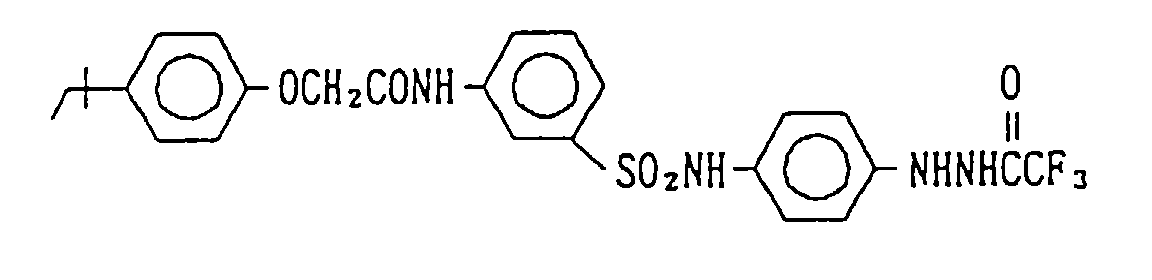
-

-

-

-

-

-

-
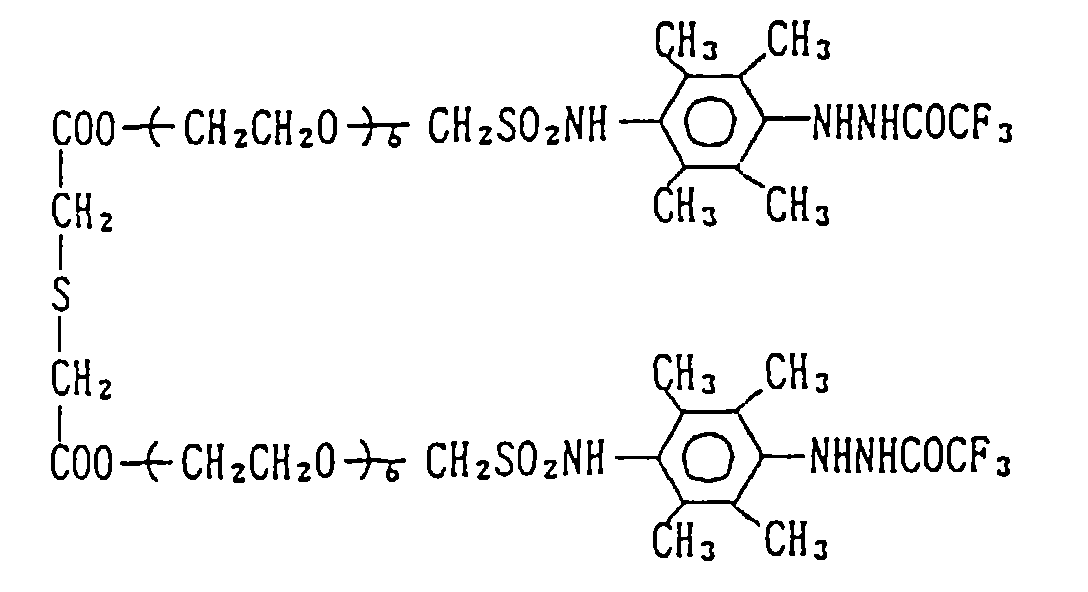
-

-
TABLE 2-1 Solid Dispersion No. Hydrazide Compound Average Particle Size (µm) K-1 Comparative Compound 1 0.21 K-2 Comparative Compound 2 0.39 K-3 Comparative Compound 3 0.41 K-4 Comparative Compound 4 0.41 K-5 1c 0.50 K-6 3c 0.49 K-7 4c 0.39 K-8 5c 0.40 K-9 6c 0.40 K-10 10c 0.45 K-11 11c 0.35 K-12 12c 0.38 K-13 16c 0.41 K-14 19c 0.42 K-15 34 0.41 K-16 1d 0.39 K-17 3d 0.48 K-18 4d 0.47 K-19 5d 0.39 K-20 6d 0.40 K-21 10d 0.50 K-22 11d 0.50 K-23 12d 0.38 K-24 16d 0.39 K-25 19d 0.43 TABLE 2-2 Solid Dispersion No. Hydrazide Compound Average Particle Size (µm) K-1' Comparative Compound 1' 0.21 K-2' Comparative Compound 2' 0.50 K-3' Comparative Compound 3' 0.45 K-4' Comparative Compound 4' 0.41 K-5' Comparative Compound 5' 0.37 K-6' 1a' 0.49 K-7' 2a' 0.36 K-8' 3a' 0.39 K-9' 4a' 0.40 K-10' 5a' 0.48 K-11' 6a' 0.47 K-12' 7a' 0.45 K-13' 8a' 0.41 K-14' 9a' 0.43 K-15' 10a' 0.50 K-16' 12a' 0.37 K-17' 13a' 0.35 K-18' 14a' 0.40 K-19' 1b' 0.39 K-20' 2b' 0.44 K-21' 3b' 0.45 K-22' 4b' 0.49 K-23' 5b' 0.48 K-24' 6b' 0.48 K-25' 7b' 0.48 K-26' 8b' 0.38 K-27' 9b' 0.47 K-28' 10b' 0.49 K-29' 12b' 0.49 K-30' 13b' 0.39 K-31' 14b' 0.40 K-32' 32' 0.45 - An aqueous silver nitrate solution and an aqueous halogen salt solution containing potassium bromide, sodium chloride, K3IrCl6 corresponding to 3.5×10⁻⁷ mol/mol-Ag and K2Rh(H2O)Cl5 corresponding to 2.0×10⁻⁷ mol/mol-Ag, were added to an aqueous gelatin solution containing sodium chloride and 1,3-dimethyl-2-imidazolidinethione, while stirring by a double jet method to prepare silver chlorobromide grains having an average grain size of 0.25 µm and a silver chloride content of 70 mol%.
- Thereafter, the grains were washed with water by flocculation according to a usual method, 40 g/mol-Ag of gelatin was added thereto, then 7 mg/mol-Ag of sodium benzenethiosulfonate and 2 mg/mol-Ag of benzenesulfinic acid were further added, and the pH and the pAg were adjusted to 6.0 and 7.5, respectively. Thereto, 2 mg/mol-Ag of sodium thiosulfate and 4 mg/mol-Al of chloroauric acid were added, and the mixture was subjected to chemical sensitization to have an optimal sensitivity at 60°C. Then, 150 mg of 4-hydroxy-6-methyl-1,3,3a,7-tetraazaindene as a stabilizer and 100 mg of proxel as an antiseptic were added. The resulting grains were silver chlorobromide cubic grains having an average grain size of 0.25 µm and a silver chloride content of 70 mol% (coefficient of variation: 10%).
- On a polyethylene terephthalate film support undercoated by a moisture-proofing layer containing vinylidene chloride, a UL layer, an EM layer, a PC layer and an OC layer were coated in this order from the support side to prepare a sample.
- The preparation method and the coating amount of each layer are described below.
- To an aqueous gelatin solution, a dispersion of polyethyl acrylate was added in an amount of 30 wt% based on the gelatin and the mixture was coated to have a gelatin coverage of 0.5 g/m2.
- To Emulsion A prepared above, 5×10⁻⁴ mol/mol-Ag of Compound (S-1) shown below and 5×10⁻⁴ mol/mol-Ag of Compound (S-2) shown below were added as sensitizing dyes, and further 3×10⁻⁴ mol/mol-Ag of a mercapto compound shown below as Compound (a), 4×10⁻⁴ mol/mol-Ag of a mercapto compound shown below as Compound (b), 4×10⁻⁴ mol/mol-Ag of a triazine compound shown below as Compound (c), 2×10⁻³ mol/mol-Ag of 5-chloro-8-hydroxyquinoline, 5×10⁻⁴ mol/mol-Ag of a nucleation accelerator shown below as Compound (A) and 5×10⁻⁴ mol/mol-Ag of a surface active agent shown below as Compound (p) were added. Furthermore, hydroquinone and N-oleyl-N-methyltaurine sodium salt were added to give a coated amount of 100 mg/m2 and 30 mg/m2, respectively. Then, a solid dispersion of hydrazide compound prepared in Example 1 as a nucleating agent was added as shown in Table 7 in an amount of 5×10⁻⁴ mol/mol-Ag in terms of the hydrazide compound. Further, 200 mg/m2 of a water-soluble latex shown below as Compound (d), 200 mg/m2 of a polyethyl acrylate dispersion, 200 mg/m2 a latex copolymer of methyl acrylate, 2-acrylamido-2-methylpropanesulfonic acid sodium salt and 2-acetoacetoxyethyl methacrylate (weight ratio: 88:5:7), 200 mg/m2 of colloidal silica having an average particle size of 0.02 µm, 200 mg/m2 of 1,3-divinylsulfonyl-2-propanol as a hardening agent and 30 mg/m2 of sodium polystyrenesulfonate as a thickener were added. The resulting solution was adjusted to have a pH of 5.65 using an acetic acid. Then, the solution was coated to have a coated silver amount of 2.8 g/m2.
- To an aqueous gelatin solution, a dispersion of ethyl acrylate was added in an amount of 50 wt% based on the gelatin. Thereto, Surface Active Agent (w) shown below and 1,5-dihydroxy-2-benzaldoxime were added to give a coated amount of 5 mg/m2 and 10 mg/m2, respectively. The resulting mixture was coated to give a gelatin coverage of 0.5 g/m2.
- The layer was provided by coating the mixture of 0.5 g/m2 of gelatin, 40 mg/m2 of an amorphous SiO2 matting agent having an average particle size of about 3.5 µm, 0.1 g/m2 of methanol silica, 100 mg/m2 of polyacrylamide, 20 mg/m2 of silicone oil, and as coating aids, 5 mg/m2 of a fluorine surface active agent shown by the following structural formula (e) and 100 mg/m2 of sodium dodecylbenzenesulfonate.

- The thus-obtained coated samples each had a back layer and a back protective layer having the following compositions.
-


-
Gelatin 0.8 mg/m2 Polymethyl methacrylate fine particles (average particle size: 4.5 µm) 30 mg/m2 Dihexyl-α-sulfosuccinate sodium salt 15 mg/m2 Sodium p-dodecylbenzenesulfonate 15 mg/m2 Sodium acetate 40 mg/m2 - Samples shown in Tables 3-1 and 3-2 were prepared as described above.
TABLE 3-1 Sample No. Solid Dispersion of Hydrazide Compound Remarks 1-1 K-1 Comparison 1-2 K-2 Comparison 1-3 K-3 Comparison 1-4 K-4 Comparison 1-5 K-16 Invention 1-6 K-17 Invention 1-7 K-18 Invention 1-8 K-19 Invention 1-9 K-20 Invention 1-10 K-21 Invention 1-11 K-22 Invention 1-12 K-23 Invention 1-13 K-24 Invention 1-14 K-25 Invention TABLE 3-2 Sample No. Solid Dispersion of Hydrazide Compound Remarks 1-1' K-1' Comparison 1-2' K-2' Comparison 1-3' K-3' Comparison 1-4' K-4' Comparison 1-5' K-5' Comparison 1-6' K-6' Invention 1-7' K-7' Invention 1-8' K-8' Invention 1-9' K-9' Invention 1-10' K-10' Invention 1-11' K-11' Invention 1-12' K-12' Invention 1-13' K-13' Invention 1-14' K-14' Invention 1-15' K-15' Invention 1-16' K-16' Invention 1-17' K-17' Invention 1-18' K-18' Invention - Developer A having the following composition was prepared.
-
Sodium hydroxide 1.71 g Diethylenetriaminepentaacetic acid 4 g Potassium carbonate 27.5 g Sodium carbonate 25.5 g Sodium erythorbate 30 g N-Methyl-p-aminophenol 7.5 g KBr 2 g 5-Methylbenzotriazole 0.1 g 1-Phenyl-5-mercaptotetrazole 0.02 g Sodium sulfite 5 g Glacial acetic acid 9 g Water was added to make 1 ℓ and pH was adjusted to 9.7. - Developer B and Developer C were prepared by adding an acetic acid to Developer A to adjust the pH to 9.4 and adding sodium hydroxide to Developer A to adjust the pH to 10.0, respectively.
- The thus-prepared samples each was exposed to a xenon flash light using a step wedge through an interference filter having a peak at 488 nm for a luminescence time of 10-5 sec and then developed with Developer A, Developer B or Developer C in an automatic developing machine FG-680AG manufactured by Fuji Photo Film Co., Ltd., at 35°C for 20 seconds, followed by fixing, water washing and drying. In the processing, the developer and the fixing solution were replenished in an amount of 100 ml and 150 ml, respectively, per 1 m2 of the sample.
- Fixing Solution A having the following formulation was used as the fixing solution.
-
Ammonium thiosulfate 119.7 g Disodium ethylenediaminetetraacetate dihydrate 0.03 g Sodium thiosulfate pentahydrate 10.9 g Sodium sulfite 25.0 g NaOH (as purity) 12.4 g Glacial acetic acid 29.1 g Tartaric acid 2.92 g Sodium gluconate 1.74 g Aluminum sulfate 8.4 g pH (adjusted by sulfuric acid or sodium hydroxide) 4.8 Water to make 1 ℓ - Contrast obtained upon development with Developer A was expressed as follows. With respect to the index (γ) for showing the contrast of an image, a point giving (fog + density of 0.1) in a characteristic curve and a point giving (fog + density of 3.0) were connected by a straight line and the gradient of the straight line was shown as the γ value. In other words,

- The sensitivity was expressed by a reciprocal of the exposure amount necessary for giving a density of 1.5 and the sensitivity of each sample was calculated as a relative value to the sensitivity of a comparative sample taken as 100. The larger the value, the higher the sensitivity.
- Using the sensitivity values obtained on development with Developer B and with Developer C, dependency of the sensitivity on the pH of the developer was calculated.

- The smaller the value, the smaller the dependency on pH of the developer, that is, the higher the processing stability.
- Samples stored at a temperature of 60°C and a humidity of 65% for 3 days each was developed with Developer A according to the above-described method, and the sensitivity was measured. Change in the photographic property between the sample obtained above and the sample stored at room temperature and normal humidity for 3 days was determined according to the following formula.

- The closer to 0 the value, the higher the aging stability of the light-sensitive material.
- The results obtained are shown in Tables 4-1 and 4-2.
TABLE 4-1 Sample No. γ Dependency on pH of Developer (ΔS1.5) Aging Stability of Light-Sensitive Material (ΔS1.5) Remarks 1-1 13 0.21 -0.02 Comparison 1-2 11 0.25 -0.04 Comparison 1-3 15 0.16 -0.09 Comparison 1-4 11 0.15 -0.06 Comparison 1-5 19 0.04 0 Invention 1-6 20 0.04 -0.01 Invention 1-7 21 0.03 0 Invention 1-8 19 0.06 0 Invention 1-9 19 0.05 0 Invention 1-10 21 0.03 -0.01 Invention 1-11 22 0.04 -0.01 Invention 1-12 22 0.04 -0.01 Invention 1-13 21 0.05 0 Invention 1-14 19 0.03 -0.01 Invention TABLE 4-2 Sample No. γ Dependency on pH of Developer (ΔS1.5) Aging Stability of Light-Sensitive Material (ΔS1.5) Remarks 1-1' 13 0.21 -0.02 Comparison 1-2' 12 0.22 -0.03 Comparison 1-3' 15 0.15 -0.07 Comparison 1-4' 15 0.16 -0.09 Comparison 1-5' 14 0.14 -0.06 Comparison 1-6' 25 0.02 -0.01 Invention 1-7' 25 0.04 -0.02 Invention 1-8' 24 0.03 -0.02 Invention 1-9' 22 0.02 -0.02 Invention 1-10' 23 0.02 -0.01 Invention 1-11' 23 0.02 -0.02 Invention 1-12' 24 0.03 -0.02 Invention 1-13' 25 0.02 -0.01 Invention 1-14' 23 0.04 -0.01 Invention 1-15' 23 0.03 -0.01 Invention 1-16' 24 0.04 -0.01 Invention 1-17' 25 0.02 -0.01 Invention 1-18' 25 0.03 -0.02 Invention - Only when the hydrazide compound of the present invention was used as a nucleating agent, a light-sensitive material for argon laser scanner, which provides ultrahigh contrast and exhibits high processing stability with a developer having a low pH and also exhibits excellent aging stability could be obtained.
- Emulsion B was prepared as follows.
- Emulsion B was prepared in the same manner as Emulsion A except for adding 1 mg/mol-Ag of a selenium sensitizer having the following structural formula, 1 mg/mol-Ag of sodium thiosulfate and 4 mg/mol-Ag of chloroauric acid and performing chemical sensitization to have optimal sensitivity at 60°C.

- Samples were prepared in the same manner as in Example 2 except for adding 2.1×10⁻⁴ mol/mol-Ag of Compound (S-3) shown below in place of the sensitizing dye used in EM Layer of Example 2 and for using Emulsion B as the emulsion in EM Layer.
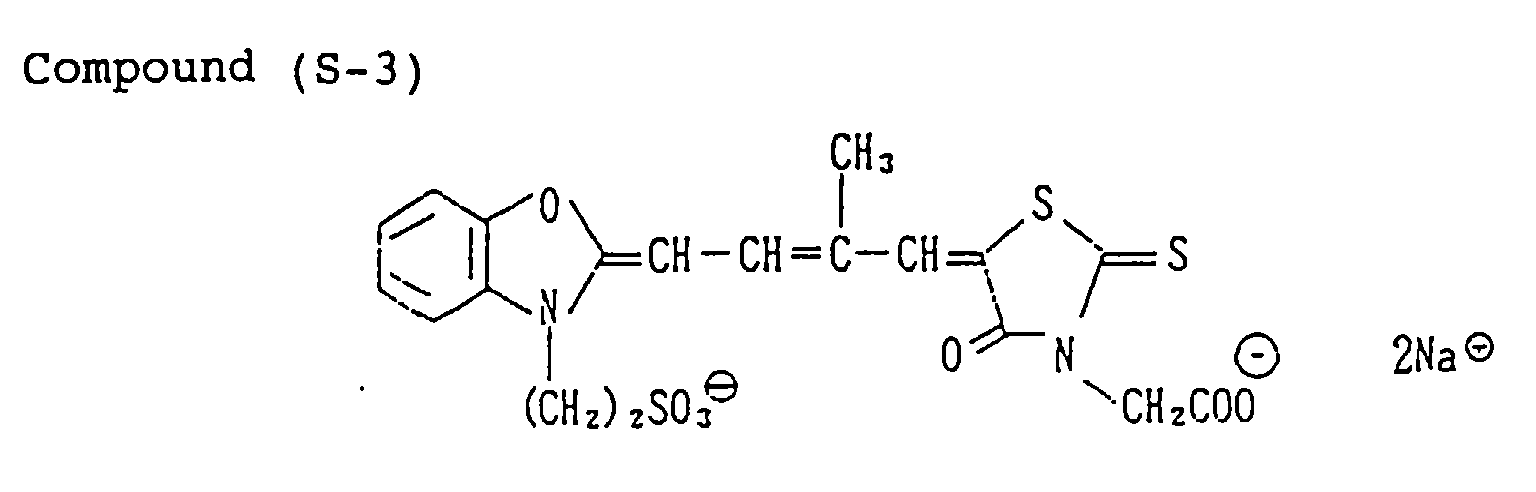
- The thus-prepared samples each was exposed to a xenon flash light using a step wedge through an interference filter having a peak at 633 nm for a luminescence time of 10-6 sec. Then, samples each was developed with Developer A described in Example 2 in an automatic developing machine FG-680AG manufactured by Fuji Photo Film Co., Ltd., at 35°C for 20 seconds, and subjected to fixing (same as in Example 2), water washing and drying. In the processing, the developer and the fixing solution each was replenished in an amount of 100 ml per 1 m2 of the sample.
- Evaluation of the contrast, the dependency of sensitivity on pH of the developer and the aging stability of the light-sensitive material was performed in the same manner as in Example 2.
- Similarly to Example 2, only when the hydrazide compound of the present invention was used as a nucleating agent, a light-sensitive material for helium-neon laser scanner, which provides ultrahigh contrast and exhibits high processing stability with a developer having a low pH and also exhibits excellent aging stability could be obtained.
- Samples were prepared in the same manner as in Example 2 except for using Compound (S-4) shown below in place of the sensitizing dye used in EM Layer of Example 2.

- The thus-prepared samples each was exposed to a xenon flash light using a step wedge through an interference filter having a peak at 780 nm for a luminescence time of 10-6 sec. Then, samples each was developed with Developer A described in Example 2 in an automatic developing machine FG-680AG manufactured by Fuji Photo Film Co., Ltd., at 35°C for 20 seconds, and subjected to fixing (same as in Example 2), water washing and drying. In the processing, the developer and the fixing solution each was replenished in an amount of 100 ml per 1 m2 of the sample.
- Evaluation of the contrast, the dependency of sensitivity on pH of the developer and the aging stability of the light-sensitive material was performed in the same manner as in Example 2.
- Similarly to Example 2, only when the hydrazide compound of the present invention was used as a nucleating agent, a light-sensitive material for semiconductor laser scanner, which provides ultrahigh contrast and exhibits high processing stability with a developer having a low pH and also exhibits excellent aging stability could be obtained.
- Samples were prepared in the same manner as in Example 2 except for using Compound (S-5) shown below in place of the sensitizing dye used in EM Layer in Example 2.

- The thus-prepared samples each was exposed to a tungsten light of 3,200°K through a step wedge. Then, samples each was developed with Developer A described in Example 2 in an automatic developing machine FG-680AG manufactured by Fuji Photo Film Co., Ltd., at 35°C for 20 seconds, and subjected to fixing (same as in Example 2), water washing and drying. In the processing, the developer and the fixing solution each was replenished in an amount of 100 ml per 1 m2 of the sample.
- Evaluation of the contrast, the dependency of sensitivity on pH of the developer and the aging stability of the light-sensitive material was performed in the same manner as in Example 2.
- Similarly to Example 2, only when the hydrazide compound of the present invention was used as a nucleating agent, a light-sensitive material for photographing, which provides ultrahigh contrast and exhibits high processing stability with a developer having a low pH and also exhibits excellent aging stability could be obtained.
- To a 1.5% aqueous gelatin solution kept at 38°C, containing sodium chloride, 3×10⁻⁵ mol/mol-Ag of Compound Z shown below and 5×10⁻³ mol/mol-Ag of 4-hydroxy-6-methyl-1,3,3a,7-tetrazaindene and having a pH of 2.0, an aqueous silver nitrate solution and an aqueous sodium chloride solution containing 5×10⁻⁵ mol/mol-Ag of K2Ru(NO)Cl5 were added simultaneously in an amount of half the silver amount of the final grain by a double jet method at an electric potential of 95 mV over 3 minutes and 30 seconds to prepare core grains having a size of 0.12 µm. Thereafter, an aqueous silver nitrate solution and an aqueous sodium chloride solution containing 5×10⁻⁵ mol/mol-Ag of K2Ru(NO)Cl5 were added in the same manner as above over 7 minutes to prepare silver chloride cubic grains having an average grain size of 0.13 µm (coefficient of variation: 12%).
- Thereafter, the emulsion was washed with water by a flocculation method well known in the art to remove soluble salts, then gelatin was added, Compound F and phenoxyethanol as antiseptics were added each in an amount of 60 mg/mol-Ag, the pH and the pAg were adjusted to 5.5 and 7.5, respectively, further 4×10⁻⁵ mol/mol-Ag of chloroauric acid, 1×10⁻⁵ mol/mol-Ag of the above-described selenium sensitizer and 1×10⁻⁵ mol/mol-Ag of sodium thiosulfate were added, the mixture was heated at 60°C for 60 minutes to perform chemical sensitization, and then 1×10⁻³ mol/mol-Ag of 4-hydroxy-6-methyl-1,3,3a,7-tetrazaindene as a stabilizer was added (the final grain was silver chloride having a pH of 5.7 and a pAg of 7.5 and containing 5×10⁻⁵ mol/mol-Ag of Ru).

- To Emulsion C, the following compounds were added, and the mixture was coated on a support having an undercoat layer, which will be described later, to provide a silver halide emulsion layer having a gelatin coated amount of 0.9 g/m2 and a coated silver amount of 2.75 g/m2 on the support.
N-Oleyl-N-methyltaurine sodium salt 19 mg/m2 Solid dispersion of hydrazide compound prepared in Example 1, shown in Table 9 15 mg/m2 (as hydrazide compound) Nucleation Accelerator Z 20 mg/m2 Sodium 3-(5-mercaptotetrazole)-benzenesulfonate 11 mg/m2 Compound A 13 mg/m2 Ascorbic acid 1 mg/m2 Compound B 15 mg/m2 Compound C 70 mg/m2 Acetic acid in an amount of giving the layer surface pH of from 5.2 to 6.0 Compound D 950 mg/m2 Compound E (hardening agent) in an amount of giving a swelling rate with water of 80% - On the thus-provided emulsion layer, emulsion protective lower and upper layers were coated.
- To an aqueous gelatin solution, the following compounds were added and the solution was coated to give a gelatin coated amount of 0.8 g/m2.
Gelatin (Ca++ content: 2,700 ppm) 0.8 g/m2 Compound F 1 mg/m2 1,5-Dihydroxy-2-benzaldoxime 14 mg/m2 C2H5SO2SNa 3 mg/m2 Compound C 3 mg/m2 Sodium p-dodecylbenzenesulfonate 7 mg/m2 Water-soluble Dye Y 25 mg/m2 - To an aqueous gelatin solution, the following compounds were added, and the solution was coated to give a gelatin coated amount of 0.45 g/m2.
Gelatin (Ca++ content: 2,700 ppm) 0.45 g/m2 Amorphous silica matting agent (average particle size: 4.4 µm) 40 mg/m2 Amorphous silica matting agent (average particle size: 3.6 µm) 10 mg/m2 Compound F 1 mg/m2 Compound C 8 mg/m2 Solid Disperse Dye G1 68 mg/m2 Liquid paraffin 21 mg/m2 Potassium N-perfluoroctanesulfonyl-N-propylglycine 5 mg/m2 Sodium p-dodecylbenzenesulfonate 29 mg/m2 - Then, on the opposite surface of the support, an electrically conductive layer and a back layer described below were coated simultaneously.
- To an aqueous gelatin solution, the following compounds were added, and the solution was coated to give a gelatin coated amount of 0.06 g/m2.
SnO2/Sb (9/1 by weight, average particle size: 0.25 µm) 186 mg/m2 Gelatin (Ca++ content: 2,700 ppm) 0.06 mg/m2 Sodium p-dodecylbenzenesulfonate 13 mg/m2 Sodium dihexyl-α-sulfosuccinate 12 mg/m2 Compound C 12 mg/m2 Compound F 1 mg/m2 - To an aqueous gelatin solution, the following compounds were added, and the solution was coated to give a gelatin coated amount of 1.94 g/m2.
Gelatin (Ca++ content: 30 ppm) 1.94 g/m2 Polymethyl methacrylate fine particle (average particle size: 4.7 µm) 7 mg/m2 Compound H 233 mg/m2 Compound I 21 mg/m2 Compound G 146 mg/m2 Compound F 3 mg/m2 Sodium p-dodecylbenzenesulfonate 68 mg/m2 Sodium dihexyl-α-sulfosuccinate 21 mg/m2 C8F17SO3Li 4 mg/m2 Potassium N-perfluoroctanesulfonyl-N-propylglycine 6 mg/m2 Sodium sulfate 177 mg/m2 Compound E (hardening agent) in an amount of giving a swelling rate with water of 90% - On both surfaces of a biaxially stretched polyethylene terephthalate support (thickness: 100 µm), undercoat first and second layers having the following compositions were coated.
-
Core-shell Type Vinylidene Chloride Copolymer (1) 15 g 2,4-Dichloro-6-hydroxy-s-triazine 0.25 g Polystyrene fine particle (average particle size: 3 µm) 0.05 g Compound M 0.20 g Colloidal silica (Snowtex ZL, produced by Nissan Chemical KK, particle size: 70 to 100 µm) 0.12 g Water to make 100 g - Further, the coating solution was adjusted to have a pH of 6 by adding 10 wt% of KOH and coated to have a dry thickness of 0.9 µm at a drying temperature of 180°C for 2 minutes.
-
Gelatin 1 g Methyl cellulose 0.05 g Compound J 0.02 g C12H25O(CH2CH2O)10H 0.03 g Compound F 3.5×10⁻³ g Acetic acid 0.2 g Water to make 100 g - The thus-obtained coating solution was coated to have a dry thickness of 0.1 µm at a drying temperature of 170°C for 2 minutes. Thus, a support having undercoat layers was prepared.


- The coating method and the drying conditions were as follows.
- On the emulsion surface side of the support having undercoat layers prepared above, an emulsion layer, an emulsion protective lower layer and an emulsion protective upper layer were simultaneously coated on one another in this sequence from the side nearer to the support while keeping at 35°C and while adding a hardening agent solution by a slide hopper method, and the coated sample was passed through a cold blast set zone (5°C). Thereafter, on the side opposite to the emulsion surface, an electrically conductive layer and a back layer were simultaneously coated on one another in this sequence from the side nearer to the support similarly while adding a hardening agent solution by the slide hopper method, and the coated sample was passed through a cold blast set zone (5°C). At the time of passing respective set zones, the coating solution exhibited satisfactory setting property. Subsequently, both surfaces were simultaneously dried in a drying zone under the following conditions. After coating on the back surface side until winding up, the coated sample was transported without coming into contact with a roller and others at all. At this time, the coating rate was 120 m/min.
- After setting, the coated sample was dried by a drying air at 30°C to give a weight ratio of water/gelatin of 800% and then by drying air at 35°C and 30% to give the ratio of from 200 to 800%. The blowing of air was continued and 30 seconds after the time when the surface temperature reached 34°C (regarded as completion of drying), the coated sample was dried by air at 48°C and 2% for one minute. At this time, the drying time of from the initiation of drying until the water/gelatin ratio reached 800% was 50 seconds, the drying time until the ratio reached from 200 to 800% was 35 seconds and the drying time of from the ratio of 200% until completion of the drying was 5 seconds.
- The thus-obtained light-sensitive material was wound up at 23°C and 40%, cut under the same environment, subjected to humidity conditioning at 40°C and 10% for 8 hours in a barrier bag of which humidity was conditioned for 6 hours, and then sealed together with a cardboard of which humidity was conditioned at 23°C and 40% for 2 hours, to prepare a sample.
- The humidity in the barrier bag was measured and found to be 40%.
- Samples shown in Tables 5-1 and 5-2 were prepared as described above.
TABLE 5-1 Sample No. Solid Dispersion of Hydrazide Compound Remarks 2-1 K-1 Comparison 2-2 K-2 Comparison 2-3 K-3 Comparison 2-4 K-4 Comparison 2-5 K-5 Invention 2-6 K-6 Invention 2-7 K-7 Invention 2-8 K-8 Invention 2-9 K-9 Invention 2-10 K-10 Invention 2-11 K-11 Invention 2-12 K-12 Invention 2-13 K-13 Invention 2-14 K-14 Invention 2-15 K-15 Invention TABLE 5-2 Sample No. Solid Dispersion of Hydrazide Compound Remarks 2-1' K-1' Comparison 2-2' K-2' Comparison 2-3' K-3' Comparison 2-4' K-4' Comparison 2-5' K-5' Comparison 2-6' K-19' Invention 2-7' K-20' Invention 2-8' K-21' Invention 2-9' K-22' Invention 2-10' K-23' Invention 2-11' K-24' Invention 2-12' K-25' Invention 2-13' K-26' Invention 2-14' K-27' Invention 2-15' K-28' Invention 2-16' K-29' Invention 2-17' K-30' Invention 2-18' K-31' Invention 2-19' K-32' Invention - The above-described samples each was exposed through a step wedge in a printer P-627FM manufactured by Dainippon Screen Mfg. Co., Ltd. Then, the samples each was developed with Developer A described in Example 2 in an automatic developing machine FG-680AG manufactured by Fuji Photo Film Co., Ltd, at 35°C for 20 seconds, and subjected to fixing (same as in Example 2), water washing and drying. In the processing, the developer and the fixing solution were replenished each in an amount of 100 ml per m2 of the sample.
- Evaluation of the contrast, the dependency of sensitivity on pH of the developer and the aging stability of the light-sensitive material was performed in the same manner as in Example 2.
- The results obtained are shown in Tables 6-1 and 6-2.
TABLE 6-1 Sample No. γ Dependency on pH of Developer (ΔS1.5) Aging Stability of Light-Sensitive Material (ΔS1.5) Remarks 2-1 9 0.11 -0.01 Comparison 2-2 10 0.20 -0.07 Comparison 2-3 13 0.16 -0.06 Comparison 2-4 10 0.21 -0.06 Comparison 2-5 18 0.06 0 Invention 2-6 18 0.09 -0.01 Invention 2-7 19 0.09 -0.01 Invention 2-8 21 0.07 0 Invention 2-9 21 0.06 0 Invention 2-10 20 0.08 -0.01 Invention 2-11 21 0.06 0 Invention 2-12 19 0.06 -0.01 Invention 2-13 18 0.07 -0.01 Invention 2-14 18 0.06 0 Invention 2-15 20 0.08 0 Invention TABLE 6-2 Sample No. γ Dependency on pH of Developer (ΔS1.5) Aging Stability of Light-Sensitive Material (ΔS1.5) Remarks 2-1' 9 0.11 -0.01 Comparison 2-2' 11 0.28 -0.10 Comparison 2-3' 13 0.15 -0.08 Comparison 2-4' 13 0.16 -0.06 Comparison 2-5' 13 0.18 -0.08 Comparison 2-6' 21 0.04 -0.01 Invention 2-7' 21 0.06 -0.02 Invention 2-8' 22 0.05 -0.01 Invention 2-9' 24 0.05 -0.01 Invention 2-10' 23 0.03 -0.01 Invention 2-11' 24 0.04 -0.01 Invention 2-12' 24 0.06 -0.02 Invention 2-13' 21 0.04 -0.02 Invention 2-14' 22 0.03 -0.01 Invention 2-15' 22 0.03 -0.02 Invention 2-16' 23 0.05 -0.02 Invention 2-17' 24 0.04 -0.02 Invention 2-18' 24 0.04 -0.01 Invention 2-19' 21 0.06 -0.01 Invention - Only when the hydrazide compound of the present invention was used as a nucleating agent, a light-sensitive material for dot-to-dot work in a bright room, which provides ultrahigh contrast and exhibits high processing stability with a developer having a low pH and also exhibits excellent aging stability could be obtained.
- In Examples 2, 3, 4, 5 and 6, even when Developer D or Developer E having the following composition was used in place of Developer A and Fixing Solution B having the following composition was used in place of Fixing Solution A, similarly to Examples 2, 3, 4, 5 and 6, only when the hydrazide compound of the present invention was used as a nucleating agent, a light-sensitive material which provides ultrahigh contrast and exhibits high processing stability with a developer having a low pH and also exhibits excellent aging stability could be obtained. In examining the dependency of the photographic property on pH of the developer, each developer reduced in the pH by 0.3 with acetic acid or increased in the pH by 0.3 with sodium hydroxide was used.
-
Potassium hydroxide 40.0 g Diethylenetriaminepentaacetic acid 2.0 g Potassium carbonate 60.0 g Sodium metabisulfite 70.0 g Potassium bromide 7.0 g Hydroquinone 40.0 g 5-Methylbenzotriazole 0.35 g 4-Hydroxymethyl-4-methyl-1-phenyl-3-pyrazolidone 1.50 g Sodium 2-mercaptobenzimidazole-5-sulfonate 0.30 Sodium 3-(5-mercaptotetrazol-1-yl)benzenesulfonate 0.10 g Sodium erythorbate 60 g Diethylene glycol 5.0 g Water to make 1 ℓ pH was adjusted by adding potassium hydroxide to 10.65. - A solid developer as a storing shape was formed into a use solution by adding water to make 10 ℓ.
- The solid developer was produced by a method where developer components in the form of solid, corresponding to 10 ℓ portion as a use solution, were packed in a container (average wall thickness: 500 µm, partially: from 200 to 1,000 µm) made of a high density polyethylene. The respective components were mixed prior to the filling in the container.
- The composition of the developer as a 10 ℓ use solution and the forms of raw materials are shown in Table 7.

- With respect to the shape of raw materials, the raw powder was a general industrial product used as it was and the beads and the pellets of alkali metal salt were commercially available products.
- The raw materials in the shape of a briquet each was compressed under pressure using a briquetting machine to have an undefined Rugby ball form having a length of approximately from 4 to 6 mm, and the briquet was crushed and used. With respect to components of small amount, respective components were blended and then briquetted.
- The following solid agent and liquid agent were formed into a use solution by adding water to make 10 ℓ. The fixing solution used was obtained by packing the following formulation, including both the solid agent part and the liquid agent part, in a container (average wall thickness: 500 µm, width: from 200 to 1,000 µm) made of a high density polyethylene. After dissolving, the amount of solution was 10 ℓ and the pH was 4.85.
Solid agent part: Ammonium thiosulfate 1,200 g Sodium thiosulfate 150 g Sodium acetate 400 g Sodium metabisulfite 200 g Liquid agent part: Aluminum sulfate (27%) 300 g Sulfuric acid (75%) 30 g Sodium gluconate 20 g EDTA 0.3 g Citric acid 40 g - The solid agent part was packed after mixing.
- A light-sensitive material was prepared in the same manner as in Example 2 except that the hydrazide compound powder shown in Table 12 was dissolved in methanol and then added to the coating solution. The samples each was developed in the same manner as in Example 2 and evaluated in terms of the contrast and the dependency of sensitivity on pH of the developer.
- The results obtained are shown in Tables 8-1 and 8-2.
TABLE 8-1 Sample No. Hydrazide Compound γ Dependency on pH of Developer (ΔS1.5) Remarks 3-1 Comparative Compound 1 14 0.22 Comparison 3-2 Comparative Compound 2 12 0.26 Comparison 3-3 Comparative Compound 3 17 0.17 Comparison 3-4 Comparative Compound 4 13 0.15 Comparison 3-5 1d 21 0.02 Invention 3-6 3d 22 0.02 Invention 3-7 4d 23 0.02 Invention 3-8 5d 22 0.04 Invention 3-9 6d 20 0.03 Invention 3-10 10d 23 0.02 Invention 3-11 11d 23 0.02 Invention 3-12 12d 24 0.03 Invention 3-13 16d 22 0.03 Invention 3-14 19d 20 0.02 Invention TABLE 8-2 Sample No. Hydrazide Compound γ Dependency on pH of Developer (ΔS1.5) Remarks 3-1' Comparative Compound 1' 14 0.22 Comparison 3-2' Comparative Compound 2' 13 0.23 Comparison 3-3' Comparative Compound 3' 16 0.14 Comparison 3-4' Comparative Compound 4' 17 0.17 Comparison 3-5' Comparative Compound 5' 15 0.14 Comparison 3-6' 1b' 26 0.01 Invention 3-7' 2b' 27 0.02 Invention 3-8' 3b' 25 0.01 Invention 3-9' 4b' 24 0.01 Invention 3-10' 5b' 25 0.01 Invention 3-11' 6b' 24 0.01 Invention 3-12' 7a' 26 0.02 Invention 3-13' 8a' 27 0.01 Invention 3-14' 9a' 25 0.02 Invention 3-15' 10a' 24 0.02 Invention 3-16' 12a' 26 0.02 Invention 3-17' 13a' 27 0.01 Invention 3-18' 14a' 28 0.01 Invention - Similarly to Example 2, only when the hydrazide compound of the present invention was used as a nucleating agent, a light-sensitive material which provides ultrahigh contrast and exhibits high processing stability with a developer having a low pH could be obtained.
- A solution composed of 1.0 g of the respective hydrazine nucleating agent which was used in Example 1 and shown in Table 2-2, 6.0 g of poly(N-tert-butylacrylamide) and 50 ml of ethyl acetate was heated to 60°C to dissolve the compounds completely. Thereafter, the solution was added to 120 ml of an aqueous solution containing 12 g of gelatin and 0.7 g of sodium dodecylbenzenesulfonate, and stirred with a homogenizer (manufactured by Nippon Seiki Manufacturing Co., Ltd.) at a high rotational speed to obtain an emulsion dispersion of fine particles having an average particle diameter of about 0.2 µm. Then, the emulsion dispersion was heated and distilled under reduced pressure to remove ethyl acetate. A photographic lihgt-sensitive material was prepared in the same manner as in Example 3, except for using the thus obtained solid dispersion of hydrazine nucleating agent. The photographic characteristics of the photographic light-sensitive material was evaluated in the same manner as in Example 3. As a result, only when the hydrazide compound of the present invention was used as a nucleating agent, a light-sensitive material for helium-neon laser scanner which provides ultrahigh contrast and exhibits high processing stability with a developer having a low pH and also exhibits excellent aging stability could be obtained.
- While the invention has been described in detail and with reference to specific examples thereof, it will be apparent to one skilled in the art that various changes and modifications can be made therein without departing from the spirit and scope thereof.
Claims (4)
- A silver halide photographic light-sensitive material containing a hydrazide compound represented by the following formula (I), (II), (I') or (II'):
A1-(B)b1 (I)
L0-{A2-(B)b2}m1 (II)
wherein A1 represents a substituted or unsubstituted benzene ring, A2 represents an arylene group, B represents a group represented by the following formula (III), b1 represents an integer of from 3 to 6, L0 represents a di-, tri-, tetra-, penta- or hexavalent linking group, b2 represents an integer of from 1 to 5, and m1 represents an integer of from 2 to 6, provided that when b2 is 1, m1 represents an integer of from 3 to 6:
-L1-Ar1-NHNH-G1-R1 (III)
wherein G1 represents a carbonyl group, an oxalyl group, a sulfonyl group or a phosphoryl group, R1 represents a hydrogen atom or a block group, Ar1 represents an aromatic group and L1 represents a linking group;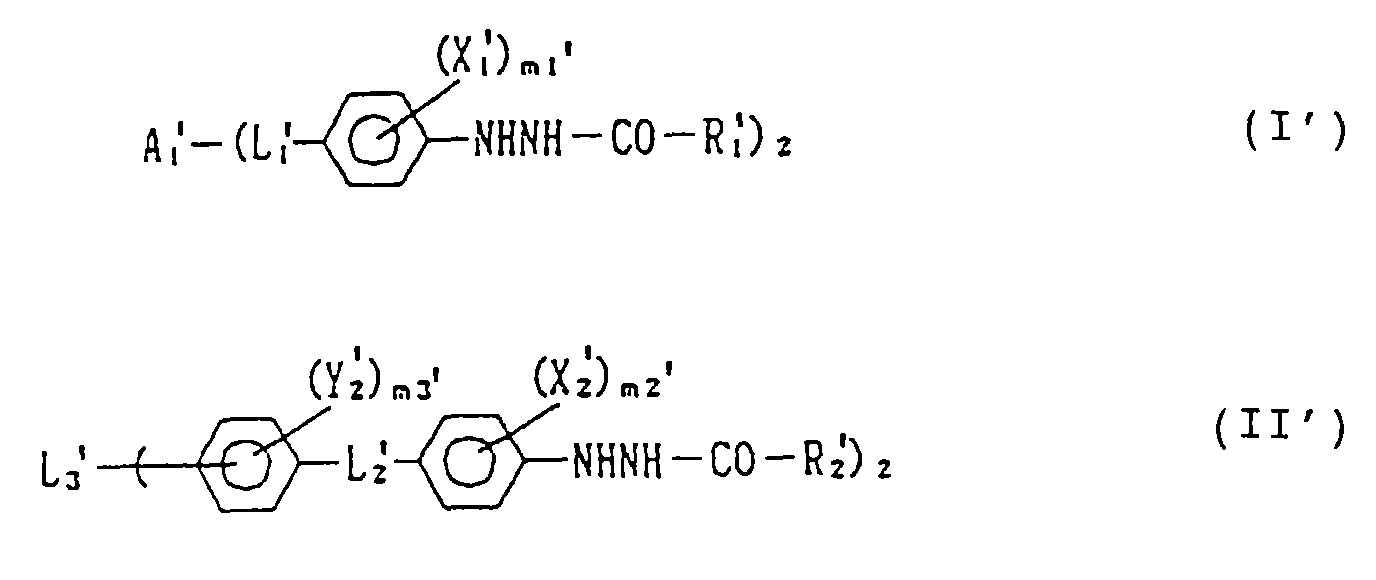
- The silver halide photographic light-sensitive material of claim 1, wherein said hydrazide compound is represented by formula (I') or (II') and at least one of two L1' groups in formula (I') and at least one of two L2' groups in formula (II') each is an -SO2NH group.
- The silver halide photographic light-sensitive material of claim 2, wherein at least one R1' group in formula (I') and at least one R2' group in formula (II') each is a trifluoromethyl group or a difluoromethyl group.
- A hydrazide compound represented by the following formula (I') or (II'):

Applications Claiming Priority (9)
| Application Number | Priority Date | Filing Date | Title |
|---|---|---|---|
| JP351287/95 | 1995-12-27 | ||
| JP351279/95 | 1995-12-27 | ||
| JP35127995A JP3339666B2 (en) | 1995-12-27 | 1995-12-27 | Silver halide photographic material |
| JP35128795 | 1995-12-27 | ||
| JP35128795 | 1995-12-27 | ||
| JP35127995 | 1995-12-27 | ||
| JP299877/96 | 1996-10-25 | ||
| JP29987796 | 1996-10-25 | ||
| JP29987796A JP3844820B2 (en) | 1995-12-27 | 1996-10-25 | Hydrazide compound and silver halide photographic light-sensitive material containing the same |
Publications (3)
| Publication Number | Publication Date |
|---|---|
| EP0782041A2 true EP0782041A2 (en) | 1997-07-02 |
| EP0782041A3 EP0782041A3 (en) | 1997-08-06 |
| EP0782041B1 EP0782041B1 (en) | 1999-11-17 |
Family
ID=27338336
Family Applications (1)
| Application Number | Title | Priority Date | Filing Date |
|---|---|---|---|
| EP96120908A Expired - Lifetime EP0782041B1 (en) | 1995-12-27 | 1996-12-27 | Silver halide photographic light-sensitive material |
Country Status (3)
| Country | Link |
|---|---|
| US (1) | US5770344A (en) |
| EP (1) | EP0782041B1 (en) |
| DE (1) | DE69605174T2 (en) |
Cited By (1)
| Publication number | Priority date | Publication date | Assignee | Title |
|---|---|---|---|---|
| EP0928987A3 (en) * | 1997-12-09 | 1999-07-21 | Eastman Kodak Company | Photographic silver halide material |
Families Citing this family (3)
| Publication number | Priority date | Publication date | Assignee | Title |
|---|---|---|---|---|
| US6017674A (en) * | 1996-01-19 | 2000-01-25 | Fuji Photo Film Co., Ltd. | Silver halide photographic material and processing process thereof |
| US5882841A (en) * | 1996-12-26 | 1999-03-16 | Fuji Photo Film Co., Ltd. | Silver halide photographic light-sensitive material and method for processing thereof |
| AU736264B2 (en) * | 1997-02-07 | 2001-07-26 | Scripps Research Institute, The | Convergent synthesis of combinatorial library |
Citations (39)
| Publication number | Priority date | Publication date | Assignee | Title |
|---|---|---|---|---|
| US2456953A (en) | 1942-02-09 | 1948-12-21 | Eastman Kodak Co | Photographic reversal processes |
| US2497875A (en) | 1947-10-17 | 1950-02-21 | Eastman Kodak Co | Direct positive photographs using aerial fogging developer |
| US2497876A (en) | 1947-05-22 | 1950-02-21 | Eastman Kodak Co | Method of producing direct positive photographic images |
| US2588982A (en) | 1950-10-26 | 1952-03-11 | Eastman Kodak Co | Direct positive photographs using hydrazine in the emulsion |
| US2592250A (en) | 1947-05-13 | 1952-04-08 | Eastman Kodak Co | Photographic silver bromide emulsion containing some silver iodide |
| US2675318A (en) | 1951-06-27 | 1954-04-13 | Eastman Kodak Co | Hydroquinone monosulfonate in direct positive photographic developers |
| GB1011062A (en) | 1961-05-15 | 1965-11-24 | Eastman Kodak Co | Photographic silver halide emulsions in which the silver halide grains have a chemically sensitised core |
| US3227552A (en) | 1960-05-13 | 1966-01-04 | Eastman Kodak Co | Preparation of photographic direct positive color images |
| US3317322A (en) | 1965-08-27 | 1967-05-02 | Eastman Kodak Co | Photographic emulsions having high internal sensitivity |
| GB1151363A (en) | 1965-04-30 | 1969-05-07 | Agfa Gevaert Nv | A Method of Producing Photographic Images |
| GB1269640A (en) | 1968-07-18 | 1972-04-06 | Kodak Ltd | Method for obtaining photographic direct-positive images |
| JPS4938164B1 (en) | 1969-04-28 | 1974-10-16 | ||
| JPS5316623A (en) | 1976-06-07 | 1978-02-15 | Fuji Photo Film Co Ltd | Silver halide photographic emulsion |
| JPS53137133A (en) | 1977-05-06 | 1978-11-30 | Fuji Photo Film Co Ltd | Formation of hard photographic image |
| JPS5437732A (en) | 1977-08-30 | 1979-03-20 | Fuji Photo Film Co Ltd | Developing method of silver halide photographic material |
| JPS5440629A (en) | 1977-09-06 | 1979-03-30 | Fuji Photo Film Co Ltd | Formation of hard photographic image |
| JPS5474536A (en) | 1977-11-25 | 1979-06-14 | Aichi Steel Works Ltd | Electric heater using 33phase transformer |
| JPS5474729A (en) | 1977-11-28 | 1979-06-15 | Fuji Photo Film Co Ltd | Direct positive silver halide photosensitive material |
| GB2011391A (en) | 1977-12-15 | 1979-07-11 | Kodak Ltd | Hydrazide nucleating agents, methods employing them and photographic materials containing them |
| US4166742A (en) | 1976-10-18 | 1979-09-04 | Fuji Photo Film Co., Ltd. | Contrasty light-sensitive silver halide material containing a hydrazine derivative and a heterocyclic mercaptan |
| US4168977A (en) | 1976-08-11 | 1979-09-25 | Fuji Photo Film Co., Ltd. | Silver halide photographic emulsion |
| JPS5552055A (en) | 1978-10-02 | 1980-04-16 | Eastman Kodak Co | Photograph element containing substituted 11 phenyll33pyrozolidinone electron transmitting agent |
| JPS5590940A (en) | 1978-12-28 | 1980-07-10 | Fuji Photo Film Co Ltd | Silver halide photographic material |
| US4224401A (en) | 1976-06-07 | 1980-09-23 | Fuji Photo Film Co., Ltd. | Silver halide photographic emulsions and image forming process |
| US4243739A (en) | 1978-10-12 | 1981-01-06 | Fuji Photo Film Co., Ltd. | Silver halide photographic light-sensitive material |
| US4272606A (en) | 1978-05-05 | 1981-06-09 | Fuji Photo Film Co., Ltd. | Method of forming a high-contrast photographic image |
| US4311781A (en) | 1976-12-30 | 1982-01-19 | Fuji Photo Film Co., Ltd. | Highly-sensitive high-contrast photographic materials |
| JPS6486134A (en) | 1987-05-20 | 1989-03-30 | Konishiroku Photo Ind | Silver halide photographic sensitive material providing high contrast picture image |
| JPH01179940A (en) | 1988-01-11 | 1989-07-18 | Fuji Photo Film Co Ltd | Method for forming ultrahigh contrast negative image |
| JPH01179939A (en) | 1988-01-11 | 1989-07-18 | Fuji Photo Film Co Ltd | Method for forming ultrahigh contrast negative image |
| US4975354A (en) | 1988-10-11 | 1990-12-04 | Eastman Kodak Company | Photographic element comprising an ethyleneoxy-substituted amino compound and process adapted to provide high constrast development |
| US4994365A (en) | 1990-05-24 | 1991-02-19 | Eastman Kodak Company | High contrast photographic element including an aryl sulfonamidophenyl hydrazide containing an alkyl pyridinium group |
| US4998604A (en) | 1990-02-12 | 1991-03-12 | General Motors Corporation | Variable capacity control apparatus for an automotive torque converter clutch |
| JPH05197091A (en) | 1992-01-23 | 1993-08-06 | Mitsubishi Paper Mills Ltd | Image forming method |
| US5252426A (en) | 1991-07-29 | 1993-10-12 | E. I. Du Pont De Nemours And Company | Mono- and difluoroacetylphenyl hydrazine compounds as silver halide adjuvants |
| JPH0616938A (en) | 1992-06-30 | 1994-01-25 | Shin Etsu Chem Co Ltd | Oil-bleedable silicone rubber composition, method for producing the same, and cured product thereof |
| JPH06148828A (en) | 1992-11-02 | 1994-05-27 | Fuji Photo Film Co Ltd | Image forming method |
| JPH06180477A (en) | 1992-12-15 | 1994-06-28 | Fuji Photo Film Co Ltd | Silver halide photographic sensitive material and image forming method using same |
| JPH06194774A (en) | 1992-12-25 | 1994-07-15 | Fuji Photo Film Co Ltd | Silver halide photographic material and image forming method using it |
Family Cites Families (7)
| Publication number | Priority date | Publication date | Assignee | Title |
|---|---|---|---|---|
| US5212045A (en) * | 1990-05-09 | 1993-05-18 | Mitsubishi Paper Mills Limited | Method for image formation |
| JPH0416938A (en) * | 1990-05-11 | 1992-01-21 | Mitsubishi Paper Mills Ltd | Image forming method |
| JP3041736B2 (en) * | 1991-11-01 | 2000-05-15 | コニカ株式会社 | Silver halide photographic material |
| JPH05142688A (en) * | 1991-11-22 | 1993-06-11 | Konica Corp | Silver halide photographic sensitive material |
| JP2775560B2 (en) * | 1992-11-12 | 1998-07-16 | 富士写真フイルム株式会社 | Silver halide photographic material |
| WO1995032453A1 (en) * | 1994-05-24 | 1995-11-30 | Ilford Ag | Novel dihydrazides as dot-promoting agents in photographic image systems |
| EP0736798A1 (en) * | 1995-04-06 | 1996-10-09 | Fuji Photo Film Co., Ltd. | Silver halide photographic material |
-
1996
- 1996-12-27 EP EP96120908A patent/EP0782041B1/en not_active Expired - Lifetime
- 1996-12-27 DE DE69605174T patent/DE69605174T2/en not_active Expired - Lifetime
- 1996-12-27 US US08/774,227 patent/US5770344A/en not_active Expired - Lifetime
Patent Citations (40)
| Publication number | Priority date | Publication date | Assignee | Title |
|---|---|---|---|---|
| US2456953A (en) | 1942-02-09 | 1948-12-21 | Eastman Kodak Co | Photographic reversal processes |
| US2592250A (en) | 1947-05-13 | 1952-04-08 | Eastman Kodak Co | Photographic silver bromide emulsion containing some silver iodide |
| US2497876A (en) | 1947-05-22 | 1950-02-21 | Eastman Kodak Co | Method of producing direct positive photographic images |
| US2497875A (en) | 1947-10-17 | 1950-02-21 | Eastman Kodak Co | Direct positive photographs using aerial fogging developer |
| US2588982A (en) | 1950-10-26 | 1952-03-11 | Eastman Kodak Co | Direct positive photographs using hydrazine in the emulsion |
| US2675318A (en) | 1951-06-27 | 1954-04-13 | Eastman Kodak Co | Hydroquinone monosulfonate in direct positive photographic developers |
| US3227552A (en) | 1960-05-13 | 1966-01-04 | Eastman Kodak Co | Preparation of photographic direct positive color images |
| GB1011062A (en) | 1961-05-15 | 1965-11-24 | Eastman Kodak Co | Photographic silver halide emulsions in which the silver halide grains have a chemically sensitised core |
| GB1151363A (en) | 1965-04-30 | 1969-05-07 | Agfa Gevaert Nv | A Method of Producing Photographic Images |
| US3317322A (en) | 1965-08-27 | 1967-05-02 | Eastman Kodak Co | Photographic emulsions having high internal sensitivity |
| GB1269640A (en) | 1968-07-18 | 1972-04-06 | Kodak Ltd | Method for obtaining photographic direct-positive images |
| JPS4938164B1 (en) | 1969-04-28 | 1974-10-16 | ||
| JPS5316623A (en) | 1976-06-07 | 1978-02-15 | Fuji Photo Film Co Ltd | Silver halide photographic emulsion |
| US4224401A (en) | 1976-06-07 | 1980-09-23 | Fuji Photo Film Co., Ltd. | Silver halide photographic emulsions and image forming process |
| US4168977A (en) | 1976-08-11 | 1979-09-25 | Fuji Photo Film Co., Ltd. | Silver halide photographic emulsion |
| US4166742A (en) | 1976-10-18 | 1979-09-04 | Fuji Photo Film Co., Ltd. | Contrasty light-sensitive silver halide material containing a hydrazine derivative and a heterocyclic mercaptan |
| US4311781A (en) | 1976-12-30 | 1982-01-19 | Fuji Photo Film Co., Ltd. | Highly-sensitive high-contrast photographic materials |
| JPS53137133A (en) | 1977-05-06 | 1978-11-30 | Fuji Photo Film Co Ltd | Formation of hard photographic image |
| JPS5437732A (en) | 1977-08-30 | 1979-03-20 | Fuji Photo Film Co Ltd | Developing method of silver halide photographic material |
| US4221857A (en) | 1977-08-30 | 1980-09-09 | Fuji Photo Film Co., Ltd. | Process for producing a high contrast photographic image |
| JPS5440629A (en) | 1977-09-06 | 1979-03-30 | Fuji Photo Film Co Ltd | Formation of hard photographic image |
| JPS5474536A (en) | 1977-11-25 | 1979-06-14 | Aichi Steel Works Ltd | Electric heater using 33phase transformer |
| JPS5474729A (en) | 1977-11-28 | 1979-06-15 | Fuji Photo Film Co Ltd | Direct positive silver halide photosensitive material |
| GB2011391A (en) | 1977-12-15 | 1979-07-11 | Kodak Ltd | Hydrazide nucleating agents, methods employing them and photographic materials containing them |
| US4272606A (en) | 1978-05-05 | 1981-06-09 | Fuji Photo Film Co., Ltd. | Method of forming a high-contrast photographic image |
| JPS5552055A (en) | 1978-10-02 | 1980-04-16 | Eastman Kodak Co | Photograph element containing substituted 11 phenyll33pyrozolidinone electron transmitting agent |
| US4243739A (en) | 1978-10-12 | 1981-01-06 | Fuji Photo Film Co., Ltd. | Silver halide photographic light-sensitive material |
| JPS5590940A (en) | 1978-12-28 | 1980-07-10 | Fuji Photo Film Co Ltd | Silver halide photographic material |
| JPS6486134A (en) | 1987-05-20 | 1989-03-30 | Konishiroku Photo Ind | Silver halide photographic sensitive material providing high contrast picture image |
| JPH01179940A (en) | 1988-01-11 | 1989-07-18 | Fuji Photo Film Co Ltd | Method for forming ultrahigh contrast negative image |
| JPH01179939A (en) | 1988-01-11 | 1989-07-18 | Fuji Photo Film Co Ltd | Method for forming ultrahigh contrast negative image |
| US4975354A (en) | 1988-10-11 | 1990-12-04 | Eastman Kodak Company | Photographic element comprising an ethyleneoxy-substituted amino compound and process adapted to provide high constrast development |
| US4998604A (en) | 1990-02-12 | 1991-03-12 | General Motors Corporation | Variable capacity control apparatus for an automotive torque converter clutch |
| US4994365A (en) | 1990-05-24 | 1991-02-19 | Eastman Kodak Company | High contrast photographic element including an aryl sulfonamidophenyl hydrazide containing an alkyl pyridinium group |
| US5252426A (en) | 1991-07-29 | 1993-10-12 | E. I. Du Pont De Nemours And Company | Mono- and difluoroacetylphenyl hydrazine compounds as silver halide adjuvants |
| JPH05197091A (en) | 1992-01-23 | 1993-08-06 | Mitsubishi Paper Mills Ltd | Image forming method |
| JPH0616938A (en) | 1992-06-30 | 1994-01-25 | Shin Etsu Chem Co Ltd | Oil-bleedable silicone rubber composition, method for producing the same, and cured product thereof |
| JPH06148828A (en) | 1992-11-02 | 1994-05-27 | Fuji Photo Film Co Ltd | Image forming method |
| JPH06180477A (en) | 1992-12-15 | 1994-06-28 | Fuji Photo Film Co Ltd | Silver halide photographic sensitive material and image forming method using same |
| JPH06194774A (en) | 1992-12-25 | 1994-07-15 | Fuji Photo Film Co Ltd | Silver halide photographic material and image forming method using it |
Non-Patent Citations (1)
| Title |
|---|
| "Application contains still more references" |
Cited By (1)
| Publication number | Priority date | Publication date | Assignee | Title |
|---|---|---|---|---|
| EP0928987A3 (en) * | 1997-12-09 | 1999-07-21 | Eastman Kodak Company | Photographic silver halide material |
Also Published As
| Publication number | Publication date |
|---|---|
| EP0782041B1 (en) | 1999-11-17 |
| DE69605174D1 (en) | 1999-12-23 |
| US5770344A (en) | 1998-06-23 |
| EP0782041A3 (en) | 1997-08-06 |
| DE69605174T2 (en) | 2000-04-20 |
Similar Documents
| Publication | Publication Date | Title |
|---|---|---|
| US5888694A (en) | Silver halide photographic material and image formation using the same | |
| EP0793140B1 (en) | Processing composition for silver halide photographic light-sensitive material, developer and processing method using the same | |
| EP0782041B1 (en) | Silver halide photographic light-sensitive material | |
| EP0782042B1 (en) | Hydrazine compound and silver halide photographic photosensitive material comprising the same | |
| US5691108A (en) | Method for developing silver halide photographic light-sensitive material | |
| US5667936A (en) | Silver halide photographic material | |
| US6074799A (en) | Silver halide photographic material and processing process thereof | |
| US5981138A (en) | Hydrazine compound and silver halide photographic light-sensitive material using the same | |
| US5688630A (en) | Silver halide photographic material | |
| JP3339666B2 (en) | Silver halide photographic material | |
| US5798204A (en) | Development processing method of ultrahigh-contrast black-and-white silver halide photographic material | |
| US5759758A (en) | Silver halide photographic material | |
| US5695909A (en) | Silver halide photographic material | |
| US5989773A (en) | Development processing method of silver halide photographic material and image forming method | |
| JP3844805B2 (en) | Hydrazide compound and silver halide photographic light-sensitive material containing the same | |
| US5858610A (en) | Method of developing a hydrazine-containing light-sensitive material to form an image | |
| JP3844819B2 (en) | Hydrazide compound and silver halide photographic light-sensitive material containing the same | |
| JP3844821B2 (en) | Hydrazide compound and silver halide photographic light-sensitive material containing the same | |
| JP3836910B2 (en) | Silver halide photographic light-sensitive material and processing method thereof | |
| JP3844820B2 (en) | Hydrazide compound and silver halide photographic light-sensitive material containing the same | |
| JP3543035B2 (en) | Development processing method | |
| JP3418648B2 (en) | Silver halide photographic materials | |
| JP3406116B2 (en) | Silver halide photographic materials | |
| JPH09211767A (en) | Silver halide photographic sensitive material and its processing method | |
| JPH09319019A (en) | Silver halide photographic sensitive material |
Legal Events
| Date | Code | Title | Description |
|---|---|---|---|
| PUAI | Public reference made under article 153(3) epc to a published international application that has entered the european phase |
Free format text: ORIGINAL CODE: 0009012 |
|
| PUAL | Search report despatched |
Free format text: ORIGINAL CODE: 0009013 |
|
| AK | Designated contracting states |
Kind code of ref document: A2 Designated state(s): DE FR GB |
|
| AK | Designated contracting states |
Kind code of ref document: A3 Designated state(s): DE FR GB |
|
| 17P | Request for examination filed |
Effective date: 19971113 |
|
| 17Q | First examination report despatched |
Effective date: 19980325 |
|
| GRAG | Despatch of communication of intention to grant |
Free format text: ORIGINAL CODE: EPIDOS AGRA |
|
| GRAG | Despatch of communication of intention to grant |
Free format text: ORIGINAL CODE: EPIDOS AGRA |
|
| GRAH | Despatch of communication of intention to grant a patent |
Free format text: ORIGINAL CODE: EPIDOS IGRA |
|
| GRAH | Despatch of communication of intention to grant a patent |
Free format text: ORIGINAL CODE: EPIDOS IGRA |
|
| GRAA | (expected) grant |
Free format text: ORIGINAL CODE: 0009210 |
|
| AK | Designated contracting states |
Kind code of ref document: B1 Designated state(s): DE FR GB |
|
| PG25 | Lapsed in a contracting state [announced via postgrant information from national office to epo] |
Ref country code: FR Free format text: LAPSE BECAUSE OF FAILURE TO SUBMIT A TRANSLATION OF THE DESCRIPTION OR TO PAY THE FEE WITHIN THE PRESCRIBED TIME-LIMIT Effective date: 19991117 |
|
| REF | Corresponds to: |
Ref document number: 69605174 Country of ref document: DE Date of ref document: 19991223 |
|
| EN | Fr: translation not filed | ||
| PLBE | No opposition filed within time limit |
Free format text: ORIGINAL CODE: 0009261 |
|
| STAA | Information on the status of an ep patent application or granted ep patent |
Free format text: STATUS: NO OPPOSITION FILED WITHIN TIME LIMIT |
|
| 26N | No opposition filed | ||
| PG25 | Lapsed in a contracting state [announced via postgrant information from national office to epo] |
Ref country code: GB Free format text: LAPSE BECAUSE OF NON-PAYMENT OF DUE FEES Effective date: 20001227 |
|
| GBPC | Gb: european patent ceased through non-payment of renewal fee |
Effective date: 20001227 |
|
| PGFP | Annual fee paid to national office [announced via postgrant information from national office to epo] |
Ref country code: DE Payment date: 20101130 Year of fee payment: 15 |
|
| REG | Reference to a national code |
Ref country code: DE Ref legal event code: R119 Ref document number: 69605174 Country of ref document: DE Effective date: 20120703 |
|
| PG25 | Lapsed in a contracting state [announced via postgrant information from national office to epo] |
Ref country code: DE Free format text: LAPSE BECAUSE OF NON-PAYMENT OF DUE FEES Effective date: 20120703 |