EP0779609A2 - Sprachadaptionssystem und Spracherkenner - Google Patents
Sprachadaptionssystem und Spracherkenner Download PDFInfo
- Publication number
- EP0779609A2 EP0779609A2 EP96119973A EP96119973A EP0779609A2 EP 0779609 A2 EP0779609 A2 EP 0779609A2 EP 96119973 A EP96119973 A EP 96119973A EP 96119973 A EP96119973 A EP 96119973A EP 0779609 A2 EP0779609 A2 EP 0779609A2
- Authority
- EP
- European Patent Office
- Prior art keywords
- speech
- unit
- reference patterns
- speaker
- acoustical
- Prior art date
- Legal status (The legal status is an assumption and is not a legal conclusion. Google has not performed a legal analysis and makes no representation as to the accuracy of the status listed.)
- Granted
Links
Images




Classifications
-
- G—PHYSICS
- G10—MUSICAL INSTRUMENTS; ACOUSTICS
- G10L—SPEECH ANALYSIS TECHNIQUES OR SPEECH SYNTHESIS; SPEECH RECOGNITION; SPEECH OR VOICE PROCESSING TECHNIQUES; SPEECH OR AUDIO CODING OR DECODING
- G10L15/00—Speech recognition
- G10L15/06—Creation of reference templates; Training of speech recognition systems, e.g. adaptation to the characteristics of the speaker's voice
- G10L15/065—Adaptation
- G10L15/07—Adaptation to the speaker
-
- G—PHYSICS
- G10—MUSICAL INSTRUMENTS; ACOUSTICS
- G10L—SPEECH ANALYSIS TECHNIQUES OR SPEECH SYNTHESIS; SPEECH RECOGNITION; SPEECH OR VOICE PROCESSING TECHNIQUES; SPEECH OR AUDIO CODING OR DECODING
- G10L15/00—Speech recognition
- G10L15/20—Speech recognition techniques specially adapted for robustness in adverse environments, e.g. in noise, of stress induced speech
Definitions
- the present invention relates to a speech recognition based on an adaptation techniques in speech recognition and, more particularly, to techniques of improving the recognition performance by effecting adaptation of the difference between an input speech and a speech reference pattern.
- the recognition efficiency of a speech is reduced due to the character differences between the speech and the speech reference pattern.
- these differences particularly those which are significant speech recognition efficiency reduction causes are largely classified into two types.
- the causes are attributable to the environments in which the speech is produced by the speaker.
- the causes are attributable to the speech of the speaker himself or herself.
- the environmental causes are further classified into two categories.
- One of these categories is predicated in background noises or like additive noises which are introduced simultaneously with the speaker's speech and additively affecting the speech spectrum.
- the other cause category is predicated in line distortions such as microphone or telephone line transmission characteristics distortions which distort the spectrum itself.
- Various adaptation methods have been proposed to cope with the character differences which are attributable to the speech environments.
- One such adaptation method aims at coping with the two environmental cause categories, i.e., the additive noises and the line distortions, to prevent the environmental speech recognition efficiency reduction.
- a speech adaptation system used for the speech recognition system is disclosed in Takagi, Hattori and Watanabe, "Speech Recognition with Environmental Adaptation Function Based on Spectral Copy Images", Spring Proceedings of the Acoustics Engineer's Association, 2-P-8, pp. 173-174, March 1994 (hereinafter referred to as Reference No. 1).
- Fig. 4 shows the speech adaptation system noted above.
- An input speech which has been distorted by additive noises and transmission line distortions, is converted in an analyzing unit 41 into a time series of feature vectors.
- a reference pattern storing unit 43 stores as a word reference pattern time series data of each recognition subject word which is obtained by analyzing a training speech in the same manner as in the analyzing unit 41.
- Each word reference pattern is given beforehand labels discriminating a speech section and a noise section.
- a matching unit 42 matches the time series of feature vectors of the input speech and the time series of word reference patterns in the reference pattern, and selects a first order word reference pattern. It also obtains the correlation between the input speech and the word reference patterns thereof with respect to the time axis.
- an environment adapting unit 44 calculates the mean vectors of the speech and noise sections of the input speech and each word reference pattern.
- the speech and noise section mean vectors of the input speech are denoted by S V and N V
- the speech and noise section mean vectors of the word reference patterns are denoted by S W and N W .
- the environment adapting unit 44 performs the adaptation of the reference patterns by using the four mean vectors based on Equation 1 given below.
- the adapted reference patterns are stored in an adapted reference pattern storing unit 45.
- W'(k) ⁇ (S v -N v )/(S v -N v ) ⁇ (W(k)-N v )+N v
- W(k) represents the reference patterns before the adaptation (k being an index of all the reference patterns)
- W'(k) represents the adapted reference patterns.
- FIG. 5 shows an example of the speech adaptation system employed in this technique.
- an analyzing unit 51 converts an input speech collected from the speaker having a different character from the reference speaker into a time series of feature vectors.
- a reference pattern storing unit 53 stores as respective reference patterns which is obtained by analyzing a training speech of the reference speaker in the same manner as in the analyzing unit 51, and has time series multiplification procedures of recognition subject words.
- a matching unit 52 matches the input speech feature vector time series and each word reference pattern time series stored in the reference pattern storing unit 53, and selects the first order word reference patterns. It also obtains the correlation between the input speech and the word reference patterns with respect to the time axis.
- the matching unit 52 selects the first order word reference patterns by itself (speaker adaptation without trainer), in the case of giving the first word reference patterns beforehand (speaker adaptation with trainer), the matching unit 52 may be constructed such that it obtains only the correlation between the input speech and the word reference patterns thereof with respect to the time axis.
- a speaker adapting unit 54 performs the following adaptation for each acoustical unit (or distribution according to Reference No. 2) on the basis of the correlation between the first order word reference patterns obtained in the matching unit 52 and the input speech feature vectors.
- the adapted vector ⁇ j for each distribution is obtained as shown below by using the mean value ⁇ j of reference pattern distribution j stored in the reference pattern storing unit 53 and the mean value ⁇ j ' with respect to the input correlated to the distribution j.
- ⁇ j ⁇ j '- ⁇ j
- the adaptation is performed by using so-called spectrum insertion on the basis of the following Equation 2 which is described in the Reference No. 2.
- ⁇ i ⁇ j W ij ⁇ j
- j represents the category of the reference pattern, in which the acoustical category is present in the input speech.
- the adapted reference patterns are outputted from the speaker adapting unit 54 and stored in an adapted reference pattern storing unit 55.
- the prior art speech adaptation system using the environmental adaptation as shown in Fig. 4 aims at the sole adaptation of mean environmental differences appearing in the speech as a whole, and is incapable of performing highly accurate adaptation for each acoustical unit such as the speaker adaptation. Theoretically, therefore, the system can not perform sufficient adaptation with respect to the speech, which is free from environmental differences and involves speaker differences alone.
- the prior art speech adaptation system using the speaker adaptation as shown in Fig. 5 performs adaptation of differences appearing in the speech as a whole (mainly environmental causes) as well.
- the result of the adaptation thus retains both speaker differences and environmental differences.
- a satisfactory result of adaptation can not be obtained due to the differences stemming from the environmental differences.
- a satisfactory result of adaptation also can not be obtained due to the environmental differences in the case where the speech to be adapted and those collected in various different environments are coexistent.
- the present invention seeks to solve the problems discussed above, and its object is to provide a speech adaptation system, which can effect highly accurate adaptation by extracting only environment-independent speaker differences with high accuracy irrespective of the environment, in which the speech to be adapted is collected.
- adaptation with respect to the speaker is performed after environmental differences have been removed from the input speech to be adapted by using environmental adaptation. It is thus possible to provide a highly accurate speech adaptation system, which is not affected by the speech environment of the input speech and solve problems which could not have been solved with the sole prior art speaker adaptation or environmental adaptation.
- a speech adaptation system comprising: a reference pattern storing unit for storing a time series of feature vectors of a reference speaker's speech collected from a reference speaker in a reference speech environment, the time series being obtained by converting the reference speaker's speech in a predetermined manner; an analyzing unit for converting an input speech collected from an input speaker in an input environment into a time series of feature vectors of the input speech in the predetermined manner; a matching unit for time axis correlating the input speech feature vector time series and the reference patterns to one another and outputting the result of matching thus obtained; an environmental adapting unit for adapting the reference patterns according to the result of matching into a state, in which differences concerning the speech environment between the input speech feature vector time series and the reference patterns are adapted, and outputting the environmentally adapted reference patterns thus obtained; and a speaker adapting unit for adapting the environmentally adapted reference patterns into a state, in which differences concerning the speaker between the environmentally adapted reference patterns and the input speech feature vector time series, and out
- the feature vectors include cepstrum or spectrum
- the environmental adapting unit environmentally adapts the reference patterns by using a difference concerning the cepstrum or logarithmic spectrum between the speech section mean spectra of the input speech and the reference patterns correlated to one another.
- the environmental adapting unit environmentally adapts the reference patterns by converting the spectrum W(k) of reference patterns k into ⁇ (S V -N V )(W(k)-N W ) ⁇ /(S W -N W )+N V
- S V is the speech section mean spectrum of the input speech
- S W is the speech section mean spectrum of the reference patterns
- N V is the noise section mean spectrum of the input speech
- N W is the noise section mean spectrum of the reference patterns
- the speaker adapting unit adapts the environmentally adapted reference patterns for each acoustical unit constituting a part of a word in the reference patterns by using, for an acoustical unit with a correlation or at least a predetermined number of correlations involved, an adapted vector as the difference or ratio between the mean feature vectors of the acoustical unit and correlated input speech and, for an acoustical unit with no correlation or correlations less in number than a predetermined number involved, an adapted vector, which is obtained through calculation of an weighted sum of the adapted vectors of the acoustical units with a correlation involved by using weights corresponding to the distances of the acoustical unit from the acoustical units with a correlation involved.
- the speech adaptation system further comprises a tree structure reference pattern storing unit, in which acoustical units mutually spaced apart by small distances in the reference patterns are arranged in a tree structure array with hierarchical nodes, the nodes having nodes or acoustical units as children, the lowermost ones of the nodes having acoustical units as children, the nodes each having a storage of a typical adapted vector as the mean adapted vector of all the acoustical units with a correlation involved and the sum of the numbers of correlations involved in all the lower acoustical units, the speaker adapting unit adapts the environmentally adapted reference patterns for each acoustical unit constituting a part of a word in the reference patterns by using, for an acoustical unit with a correlation or at least a predetermined number of correlations involved, an adapted vector as the difference or ratio between the mean feature vectors of the acoustical unit and correlated input speech and, for an acoustical unit with no
- the speech recognition system comprising the speech adaptation system according to the above, and a recognizing unit for selecting a speaker adapted reference pattern most resembling the input speech and outputting the category to which the selected reference pattern belongs as a result of recognition.
- a speech adaptation system comprising: an analyzing unit for converting an input speech into a feature vector time series; a reference pattern storing unit for converting a reference speaker's speech into a feature vector tine series in the same manner as in the analyzing unit and storing the feature vector time series thus obtained; a matching unit for time axis correlating the input speech feature vector time series and the reference patterns to one another; an environmental adapting unit for making environmental adaptation between the input speech feature vector time series and the reference patterns according to the result of matching in the matching unit; and a speaker adapting unit for making adaptation concerning the speaker between the environmentally adapted reference patterns from the environmental adapting unit and the input speech feature vector time series.
- This speech adaptation system uses the technique shown in Reference No. 1 as the environmental adapting unit 4 and the technique shown in Reference No. 2 as the speaker adapting unit 6. However, it is possible to use other techniques as well so long as the environmental adaptation and the speaker adaptation are made.
- the analyzing unit 1 converts a noise-containing input speech into a feature vector time series.
- Various extensively adapted feature vector examples are described in, for instance, Furui, "Digital Speech Processing", published by Tohkai University, pp. 154-160, 1985 (hereinafter referred to as Reference No. 3).
- Reference No. 3 a case of using spectra obtainable by the LPC analysis, the FFT analysis, etc.
- the matching unit 2 correlates the input speech feature vector time series X(t) and the reference patterns to one another.
- the environmental adapting unit 4 outputs the mean vectors of the input speech and the reference patterns in the speech and noise sections thereof.
- the mean vectors of the speech and noise sections of the input speech are denoted by S V and N V
- the mean vectors of the speech and noise sections of the reference patterns in the reference pattern storing unit 3 are denoted by S W and N W .
- the environmental adapting unit 4 adapts the reference patterns by using the four mean vectors and also using Equation 3 below.
- the environmentally adapted reference patterns are stored in the environmentally adapted reference pattern storing unit 5.
- W(t) ⁇ (Sv-Nv)/(Sw-Nw) ⁇ (W(t)-Nw)+Nv
- W(t) represents the reference patterns before the adaptation
- W'(t) represents the adapted reference patterns.
- the speaker adapting unit 6 compensates the differences between the reference patterns having been environmentally adapted and the input speech feature vector time series X(t) for each acoustical unit.
- the acoustical unit is a distribution, and the following adaptation is performed for each distribution.
- the adaptation is performed by a process called spectrum insertion represented by Equation 4 shown below as described in Reference No. 2.
- ⁇ i ⁇ j W ij ⁇ j
- j represents the category of the reference patterns, in which an acoustical category is present in the input speech.
- the speaker adapted reference patterns are outputted from the speaker adapting unit 6 and stored in the speaker adapted reference pattern storing unit 7. It will be seen that the speaker adapting unit 6 takes the differences for each acoustical unit, which could have not been removed by the environmental adaptation, as differences attributable to the speaker and effects highly accurate adaptation for each acoustical unit.
- the speaker adaptation is performed after the environmental adaptation, it is possible to provide a speech adaptation system, which permits highly accurate speaker adaptation without being adversely affected by the environments of the input speech. That is, it is possible to obtain effects which can not be obtained with the sole prior art speech adaptation system.
- This speech adaptation system comprises the analyzer 1, which converts the input speech which is collected from the input speech speaker in the input speech environment in a predetermined manner to an input speech feature vector time series.
- the reference pattern storing unit 3 a reference speaker's speech feature vector time series, which has been obtained from the conversion of the reference speaker's speech collected from the reference speaker in a reference speech environment in the same predetermined manner as in the analyzing unit 1, as reference patterns.
- the matching unit 2 matches the input speech feature vector time series and the reference patterns by correlating the two with respect to the time axis, and outputs the result of matching.
- the environmental adapting unit 4 adapts the reference patterns according to the result of matching to a state, in which the differences concerning the speech environment between the input speech feature vector time series and the reference patterns have been adapted.
- the environmentally adapted reference patterns are stored in the environmentally adapted reference pattern storing unit 5.
- the speaker adapting unit 6 adapts the environmentally adapted reference patterns to a state, in which the differences concerning the speaker between the environmentally adapted reference patterns and the input speech feature vector time series have been adapted.
- the speaker adapted reference patterns are outputted and stored in the speaker adapted reference pattern storing unit 7.
- the analyzing unit 1 converts the input speech, which is collected from an unknown person and contains noise, into a feature vector time series for matching. Conceivable as feature vectors which are extensively applied, are power data, changes in power data, cepstrum, linear regression coefficients of cepstrum, etc. It is also possible to combine them into feature vectors. As further alternatives, it is possible to use the spectrum itself or the logarithmic spectrum.
- the input speech usually contains non-speech portions in which only ambient noise is present.
- the reference pattern storing unit 3 stores the reference speaker's speech as reference patterns through analysis made in the same manner as in the analyzing unit 1.
- the reference patterns may be those using HMM (Hidden Marokov Model) as described in Reference No. 3, pp.
- the matching unit 2 correlates the reference patterns and the input speech feature vector time series to one another. For this correlation, the time axis normalization matching may be made as DP matching or HMM process.
- the environmental adapting unit 4 performs the adaptation concerning the environment by using the correlation obtained in the matching unit 2.
- CMN Cosmetic Mean Normalization
- ICSLP 94 Speech adaptation system
- Reference No. 4 cepstrum is used as feature vectors, and only speech parts of the input speech are adapted.
- the adaptation is performed as y t ⁇ y t -(y'-y(tr)')
- y t ⁇ y t -(y'-y(tr)'
- the cepstrum of the speech parts of the input speech is substituted for by using the mean cepstrum difference between the input speech and the reference pattern speech parts. It is of course possible to substitute for y t (tr) on the side of the reference patterns for normalization as y t (tr) ⁇ y t (tr)+(y'-y(tr)')
- the environmental adapting unit 4 performs the adaptation as in, for instance, Reference No. 1. Denoting the mean spectra in the speech and noise sections of the input speech by S V and N V and the mean spectra in the speech and noise sections in the reference patterns by S W and N W , the environmental adapting unit 4 adapts the reference patterns after, for instance, Equation 5 given below.
- W(t)' ⁇ (S v -N v )/(S w -N w ) ⁇ (W(t)-N w )+N v
- W(t) represents the reference patterns (t being the index of all the reference patterns) before the adaptation
- W'(t) represents the adapted reference patterns.
- the reference patterns are adapted, it is also possible to process the input speech in the same manner. While the adaptation is performed on the spectrum, where the feature vectors are the cepstrum, it can be readily realized by providing a cepstrum/spectrum converter. In this case, the mean vectors may be obtained on the cepstrum or after conversion into the spectrum.
- the speaker adapting unit 6 performs the speaker adaptation using the environmentally adapted reference patterns from the environmentally adapting unit 4.
- various speaker adaptation techniques have been proposed.
- a commonly termed spectrum insertion technique (Reference No. 2) will be described as a fourth embodiment of the speech adaptation system according to the present invention. It is possible to apply other speaker adaptation techniques similarly to the speaker adapting unit 6.
- Fig. 2 is a block diagram showing a fifth embodiment of the speech adaptation system according to the present invention.
- This speech adaptation system comprises a tree structure reference pattern storing unit 28 in addition to the speech adaptation system shown in Fig. 1.
- acoustical units that are mutually spaced apart by small distances in the reference patterns, are arranged in a tree structure array with hierarchical nodes.
- the nodes have nodes or acoustical units as their children.
- the lowermost nodes have acoustical units as their children.
- each node a typical adapted vector as the mean adapted vector of all the acoustical units with a correlation involved and the sum of the numbers of correlations involved in all the lower acoustical units are stored.
- the speaker adapting unit 6 performs adaptation of the reference patterns for each acoustical unit (such as a sound element, a syllable, a distribution, etc.) constituting a part of a word. For an acoustical unit with a correlation or at least a predetermined number of correlations involved, the unit 6 performs adaptation by using the difference or ratio between the mean feature vectors of that acoustical unit and the input speech correlated thereto.
- the unit 6 For an acoustical unit with no correlation or correlations less in number than a predetermined number involved, the unit 6 performs the adaptation by using, as the adapted vector of that acoustical unit, a typical adapted vector of the lowest nodes among the nodes, of which the sum of the numbers of correlations taking place in all the lower acoustical units is greater than a predetermined number.
- the speaker adapting unit 6 uses the tree structure reference pattern storing unit 28 for the adaptation.
- all the distributions of the reference patterns stored in the reference pattern storing unit 3 are arranged beforehand in a tree structure array using a method described in Shinoda and Watanabe, "Speaker Adaptation Using Probability Distributions in a Tree Structure Array", Spring Proceedings of the Acoustical Engineer's Association, 2-5-10, pp. 49-50, March 1995 (hereinafter referred to as Reference No. 5).
- Reference No. 5 In the array, resembling distributions belong to the same nodes.
- the adaptation is performed in a method as described in Reference No. 5.
- the environmentally adapted reference patterns are adapted by making examination of the tree structure upward from the reef (i.e., lowermost) nodes, and using the typical adapted vector of the nodes with at least a predetermined number of correlations involved as the adapted vectors of these distributions j.
- the speaker adapted reference patterns are stored in the speaker adapted reference pattern storing unit 7.
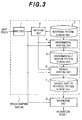
- Fig. 3 is a block diagram showing a speech recognition system according to the present invention, which is constructed by using the first embodiment of the speech adaptation system according to the present invention.
- a recognizing unit 8 performs matching like the usual speech recognition between the reference patterns in the speaker adapted reference pattern storing unit 7 and the input speech and outputs a first order result as the recognition result.
- the speech adaptation system performs the speaker adaptation after removal of the environmental differences by the environmental adaptation. It is thus possible to obtain highly accurate adaptation which could not have been obtained as the sole environmental adaptation in the prior art. Besides, in the speaker adaptation only the environment-independent speaker differences can be extracted with high accuracy, so that it is possible to realize highly accurate adaptation.
- the environmental adaptation can be obtained with the sole cepstral differences. It is thus possible to provide a system, which is less subject to calculation and memory amount increases and is more inexpensive.
- the acoustical units with no correlation involved also be highly accurately adapted. It is thus possible to realize highly accurate speaker adaptation with less data and provide a more accurate speech adaptation system.
Landscapes
- Engineering & Computer Science (AREA)
- Computational Linguistics (AREA)
- Health & Medical Sciences (AREA)
- Audiology, Speech & Language Pathology (AREA)
- Human Computer Interaction (AREA)
- Physics & Mathematics (AREA)
- Acoustics & Sound (AREA)
- Multimedia (AREA)
- Artificial Intelligence (AREA)
- Compression, Expansion, Code Conversion, And Decoders (AREA)
Applications Claiming Priority (3)
| Application Number | Priority Date | Filing Date | Title |
|---|---|---|---|
| JP324305/95 | 1995-12-13 | ||
| JP32430595 | 1995-12-13 | ||
| JP7324305A JP3001037B2 (ja) | 1995-12-13 | 1995-12-13 | 音声認識装置 |
Publications (3)
| Publication Number | Publication Date |
|---|---|
| EP0779609A2 true EP0779609A2 (de) | 1997-06-18 |
| EP0779609A3 EP0779609A3 (de) | 1997-10-22 |
| EP0779609B1 EP0779609B1 (de) | 2001-08-01 |
Family
ID=18164328
Family Applications (1)
| Application Number | Title | Priority Date | Filing Date |
|---|---|---|---|
| EP96119973A Expired - Lifetime EP0779609B1 (de) | 1995-12-13 | 1996-12-12 | Sprachadaptionssystem und Spracherkenner |
Country Status (4)
| Country | Link |
|---|---|
| US (1) | US5890113A (de) |
| EP (1) | EP0779609B1 (de) |
| JP (1) | JP3001037B2 (de) |
| DE (1) | DE69614233T2 (de) |
Cited By (6)
| Publication number | Priority date | Publication date | Assignee | Title |
|---|---|---|---|---|
| DE19806941A1 (de) * | 1998-02-19 | 1999-08-26 | Univ Ilmenau Tech | Verfahren zur Sprecheradaption von Merkmalsreferenzen |
| WO2002065453A3 (en) * | 2001-01-31 | 2002-10-24 | Qualcomm Inc | Distributed voice recognition system using acoustic feature vector modification |
| EP1400952A1 (de) * | 2002-09-18 | 2004-03-24 | Pioneer Corporation | Umgebungs- und sprecheradaptierte Spracherkennung |
| EP1262953A3 (de) * | 2001-05-24 | 2004-04-07 | Matsushita Electric Industrial Co., Ltd. | Sprecher- und Umgebungsanpassung auf der Basis linearer Trennung von Variabilitätsquellen |
| GB2422237A (en) * | 2004-12-21 | 2006-07-19 | Fluency Voice Technology Ltd | Dynamic coefficients determined from temporally adjacent speech frames |
| CN108537466A (zh) * | 2018-04-25 | 2018-09-14 | 北京腾云天下科技有限公司 | 一种统计应用运营指标的方法及计算设备 |
Families Citing this family (17)
| Publication number | Priority date | Publication date | Assignee | Title |
|---|---|---|---|---|
| US6980952B1 (en) * | 1998-08-15 | 2005-12-27 | Texas Instruments Incorporated | Source normalization training for HMM modeling of speech |
| US20010047516A1 (en) * | 2000-02-01 | 2001-11-29 | Compaq Computer Corporation | System for time shifting live streamed video-audio distributed via the internet |
| EP1185976B1 (de) | 2000-02-25 | 2006-08-16 | Philips Electronics N.V. | Vorrichtung zur spracherkennung mit referenztransformationsmitteln |
| JP4169921B2 (ja) * | 2000-09-29 | 2008-10-22 | パイオニア株式会社 | 音声認識システム |
| US7457750B2 (en) * | 2000-10-13 | 2008-11-25 | At&T Corp. | Systems and methods for dynamic re-configurable speech recognition |
| JP2002123285A (ja) * | 2000-10-13 | 2002-04-26 | Sony Corp | 話者適応装置および話者適応方法、記録媒体、並びに音声認識装置 |
| JP4244514B2 (ja) * | 2000-10-23 | 2009-03-25 | セイコーエプソン株式会社 | 音声認識方法および音声認識装置 |
| US7209880B1 (en) * | 2001-03-20 | 2007-04-24 | At&T Corp. | Systems and methods for dynamic re-configurable speech recognition |
| JP2004212641A (ja) * | 2002-12-27 | 2004-07-29 | Toshiba Corp | 音声入力システム及び音声入力システムを備えた端末装置 |
| US10223934B2 (en) | 2004-09-16 | 2019-03-05 | Lena Foundation | Systems and methods for expressive language, developmental disorder, and emotion assessment, and contextual feedback |
| US9355651B2 (en) * | 2004-09-16 | 2016-05-31 | Lena Foundation | System and method for expressive language, developmental disorder, and emotion assessment |
| US9240188B2 (en) | 2004-09-16 | 2016-01-19 | Lena Foundation | System and method for expressive language, developmental disorder, and emotion assessment |
| US20070219801A1 (en) * | 2006-03-14 | 2007-09-20 | Prabha Sundaram | System, method and computer program product for updating a biometric model based on changes in a biometric feature of a user |
| US8468019B2 (en) * | 2008-01-31 | 2013-06-18 | Qnx Software Systems Limited | Adaptive noise modeling speech recognition system |
| US20140095161A1 (en) * | 2012-09-28 | 2014-04-03 | At&T Intellectual Property I, L.P. | System and method for channel equalization using characteristics of an unknown signal |
| KR102413282B1 (ko) * | 2017-08-14 | 2022-06-27 | 삼성전자주식회사 | 개인화된 음성 인식 방법 및 이를 수행하는 사용자 단말 및 서버 |
| WO2019113477A1 (en) | 2017-12-07 | 2019-06-13 | Lena Foundation | Systems and methods for automatic determination of infant cry and discrimination of cry from fussiness |
Family Cites Families (3)
| Publication number | Priority date | Publication date | Assignee | Title |
|---|---|---|---|---|
| US4720802A (en) * | 1983-07-26 | 1988-01-19 | Lear Siegler | Noise compensation arrangement |
| US5450522A (en) * | 1991-08-19 | 1995-09-12 | U S West Advanced Technologies, Inc. | Auditory model for parametrization of speech |
| JP3008799B2 (ja) * | 1995-01-26 | 2000-02-14 | 日本電気株式会社 | 音声適応化装置,単語音声認識装置,連続音声認識装置およびワードスポッティング装置 |
-
1995
- 1995-12-13 JP JP7324305A patent/JP3001037B2/ja not_active Expired - Fee Related
-
1996
- 1996-12-12 EP EP96119973A patent/EP0779609B1/de not_active Expired - Lifetime
- 1996-12-12 DE DE69614233T patent/DE69614233T2/de not_active Expired - Fee Related
- 1996-12-13 US US08/766,779 patent/US5890113A/en not_active Expired - Fee Related
Cited By (11)
| Publication number | Priority date | Publication date | Assignee | Title |
|---|---|---|---|---|
| DE19806941A1 (de) * | 1998-02-19 | 1999-08-26 | Univ Ilmenau Tech | Verfahren zur Sprecheradaption von Merkmalsreferenzen |
| WO2002065453A3 (en) * | 2001-01-31 | 2002-10-24 | Qualcomm Inc | Distributed voice recognition system using acoustic feature vector modification |
| US7024359B2 (en) | 2001-01-31 | 2006-04-04 | Qualcomm Incorporated | Distributed voice recognition system using acoustic feature vector modification |
| KR100879410B1 (ko) * | 2001-01-31 | 2009-01-19 | 콸콤 인코포레이티드 | 음향 특징 벡터 수정을 사용하는 분산형 음성 인식 시스템 |
| EP1262953A3 (de) * | 2001-05-24 | 2004-04-07 | Matsushita Electric Industrial Co., Ltd. | Sprecher- und Umgebungsanpassung auf der Basis linearer Trennung von Variabilitätsquellen |
| US6915259B2 (en) | 2001-05-24 | 2005-07-05 | Matsushita Electric Industrial Co., Ltd. | Speaker and environment adaptation based on linear separation of variability sources |
| EP1400952A1 (de) * | 2002-09-18 | 2004-03-24 | Pioneer Corporation | Umgebungs- und sprecheradaptierte Spracherkennung |
| US7257532B2 (en) | 2002-09-18 | 2007-08-14 | Pioneer Corporation | Apparatus and method for speech recognition |
| GB2422237A (en) * | 2004-12-21 | 2006-07-19 | Fluency Voice Technology Ltd | Dynamic coefficients determined from temporally adjacent speech frames |
| CN108537466A (zh) * | 2018-04-25 | 2018-09-14 | 北京腾云天下科技有限公司 | 一种统计应用运营指标的方法及计算设备 |
| CN108537466B (zh) * | 2018-04-25 | 2020-09-15 | 北京腾云天下科技有限公司 | 一种统计应用运营指标的方法及计算设备 |
Also Published As
| Publication number | Publication date |
|---|---|
| JP3001037B2 (ja) | 2000-01-17 |
| JPH09160584A (ja) | 1997-06-20 |
| DE69614233T2 (de) | 2002-05-08 |
| US5890113A (en) | 1999-03-30 |
| DE69614233D1 (de) | 2001-09-06 |
| EP0779609A3 (de) | 1997-10-22 |
| EP0779609B1 (de) | 2001-08-01 |
Similar Documents
| Publication | Publication Date | Title |
|---|---|---|
| EP0779609B1 (de) | Sprachadaptionssystem und Spracherkenner | |
| EP0619911B1 (de) | Sprachtrainingshilfe für kinder. | |
| US6278970B1 (en) | Speech transformation using log energy and orthogonal matrix | |
| EP0387791B1 (de) | Verfahren und Einrichtung zur Erkennung von Signalzeitfolgen mit von Signalvariationen unabhängigem Lernen | |
| JP3810608B2 (ja) | 音声レコグナイザーのためのトレーニング方法 | |
| EP0686965B1 (de) | Spracherkennung mit Sprecheradaptierung mittels Berechnung von Mittelwerten akustischer Kategorien | |
| EP0755046B1 (de) | Ein hierarchisch strukturiertes Wörterbuch verwendender Spracherkenner | |
| US5459815A (en) | Speech recognition method using time-frequency masking mechanism | |
| US5692097A (en) | Voice recognition method for recognizing a word in speech | |
| EP0388067A2 (de) | Spracherkennungssystem | |
| Junqua | Robust speech recognition in embedded systems and PC applications | |
| US8417522B2 (en) | Speech recognition method | |
| JPH05216490A (ja) | 音声コード化装置及び方法並びに音声認識装置及び方法 | |
| EP0453649B1 (de) | Verfahren und Einrichtung zur Wortmodellierung mittels zusammengesetzten Markov-Modellen | |
| JP2000099080A (ja) | 信頼性尺度の評価を用いる音声認識方法 | |
| EP0724251B1 (de) | Sprachanpassungsgerät | |
| US6934681B1 (en) | Speaker's voice recognition system, method and recording medium using two dimensional frequency expansion coefficients | |
| EP0475759B1 (de) | Methode zur Phonemunterscheidung | |
| Sanches | Noise-compensated hidden Markov models | |
| US7003465B2 (en) | Method for speech recognition, apparatus for the same, and voice controller | |
| CA2203649A1 (en) | Decision tree classifier designed using hidden markov models | |
| US20050192806A1 (en) | Probability density function compensation method for hidden markov model and speech recognition method and apparatus using the same | |
| EP0435336A2 (de) | System zur Erzeugung von Referenzmustern | |
| JP2000259198A (ja) | パターン認識装置および方法、並びに提供媒体 | |
| JP2734828B2 (ja) | 確率演算装置及び確率演算方法 |
Legal Events
| Date | Code | Title | Description |
|---|---|---|---|
| PUAI | Public reference made under article 153(3) epc to a published international application that has entered the european phase |
Free format text: ORIGINAL CODE: 0009012 |
|
| AK | Designated contracting states |
Kind code of ref document: A2 Designated state(s): BE DE FR GB |
|
| PUAL | Search report despatched |
Free format text: ORIGINAL CODE: 0009013 |
|
| AK | Designated contracting states |
Kind code of ref document: A3 Designated state(s): BE DE FR GB |
|
| 17P | Request for examination filed |
Effective date: 19980205 |
|
| 17Q | First examination report despatched |
Effective date: 19990909 |
|
| RIC1 | Information provided on ipc code assigned before grant |
Free format text: 7G 10L 15/06 A, 7G 10L 15/20 B |
|
| RIC1 | Information provided on ipc code assigned before grant |
Free format text: 7G 10L 15/06 A, 7G 10L 15/20 B |
|
| GRAG | Despatch of communication of intention to grant |
Free format text: ORIGINAL CODE: EPIDOS AGRA |
|
| RIC1 | Information provided on ipc code assigned before grant |
Free format text: 7G 10L 15/06 A, 7G 10L 15/20 B |
|
| GRAG | Despatch of communication of intention to grant |
Free format text: ORIGINAL CODE: EPIDOS AGRA |
|
| GRAH | Despatch of communication of intention to grant a patent |
Free format text: ORIGINAL CODE: EPIDOS IGRA |
|
| GRAH | Despatch of communication of intention to grant a patent |
Free format text: ORIGINAL CODE: EPIDOS IGRA |
|
| GRAA | (expected) grant |
Free format text: ORIGINAL CODE: 0009210 |
|
| AK | Designated contracting states |
Kind code of ref document: B1 Designated state(s): BE DE FR GB |
|
| REF | Corresponds to: |
Ref document number: 69614233 Country of ref document: DE Date of ref document: 20010906 |
|
| ET | Fr: translation filed | ||
| REG | Reference to a national code |
Ref country code: GB Ref legal event code: IF02 |
|
| PLBE | No opposition filed within time limit |
Free format text: ORIGINAL CODE: 0009261 |
|
| STAA | Information on the status of an ep patent application or granted ep patent |
Free format text: STATUS: NO OPPOSITION FILED WITHIN TIME LIMIT |
|
| 26N | No opposition filed | ||
| PGFP | Annual fee paid to national office [announced via postgrant information from national office to epo] |
Ref country code: FR Payment date: 20041208 Year of fee payment: 9 |
|
| PG25 | Lapsed in a contracting state [announced via postgrant information from national office to epo] |
Ref country code: FR Free format text: LAPSE BECAUSE OF NON-PAYMENT OF DUE FEES Effective date: 20060831 |
|
| REG | Reference to a national code |
Ref country code: FR Ref legal event code: ST Effective date: 20060831 |
|
| PGFP | Annual fee paid to national office [announced via postgrant information from national office to epo] |
Ref country code: BE Payment date: 20081017 Year of fee payment: 13 |
|
| PGFP | Annual fee paid to national office [announced via postgrant information from national office to epo] |
Ref country code: DE Payment date: 20081205 Year of fee payment: 13 |
|
| PGFP | Annual fee paid to national office [announced via postgrant information from national office to epo] |
Ref country code: GB Payment date: 20081210 Year of fee payment: 13 |
|
| BERE | Be: lapsed |
Owner name: *NEC CORP. Effective date: 20091231 |
|
| GBPC | Gb: european patent ceased through non-payment of renewal fee |
Effective date: 20091212 |
|
| PG25 | Lapsed in a contracting state [announced via postgrant information from national office to epo] |
Ref country code: BE Free format text: LAPSE BECAUSE OF NON-PAYMENT OF DUE FEES Effective date: 20091231 |
|
| PG25 | Lapsed in a contracting state [announced via postgrant information from national office to epo] |
Ref country code: DE Free format text: LAPSE BECAUSE OF NON-PAYMENT OF DUE FEES Effective date: 20100701 |
|
| PG25 | Lapsed in a contracting state [announced via postgrant information from national office to epo] |
Ref country code: GB Free format text: LAPSE BECAUSE OF NON-PAYMENT OF DUE FEES Effective date: 20091212 |