EP0776650B1 - Dentaladhäsive - Google Patents
Dentaladhäsive Download PDFInfo
- Publication number
- EP0776650B1 EP0776650B1 EP96115507A EP96115507A EP0776650B1 EP 0776650 B1 EP0776650 B1 EP 0776650B1 EP 96115507 A EP96115507 A EP 96115507A EP 96115507 A EP96115507 A EP 96115507A EP 0776650 B1 EP0776650 B1 EP 0776650B1
- Authority
- EP
- European Patent Office
- Prior art keywords
- weight
- meth
- water
- acid
- stabilizers
- Prior art date
- Legal status (The legal status is an assumption and is not a legal conclusion. Google has not performed a legal analysis and makes no representation as to the accuracy of the status listed.)
- Expired - Lifetime
Links
- 239000003479 dental cement Substances 0.000 title description 4
- 238000002360 preparation method Methods 0.000 claims description 22
- 239000000945 filler Substances 0.000 claims description 10
- 239000000203 mixture Substances 0.000 claims description 8
- 239000002904 solvent Substances 0.000 claims description 8
- 239000000654 additive Substances 0.000 claims description 6
- NIXOWILDQLNWCW-UHFFFAOYSA-M Acrylate Chemical compound [O-]C(=O)C=C NIXOWILDQLNWCW-UHFFFAOYSA-M 0.000 claims description 5
- VYPSYNLAJGMNEJ-UHFFFAOYSA-N Silicium dioxide Chemical compound O=[Si]=O VYPSYNLAJGMNEJ-UHFFFAOYSA-N 0.000 claims description 5
- 239000000853 adhesive Substances 0.000 claims description 5
- 230000001070 adhesive effect Effects 0.000 claims description 5
- 238000009472 formulation Methods 0.000 claims description 5
- 239000003112 inhibitor Substances 0.000 claims description 4
- 239000004611 light stabiliser Substances 0.000 claims description 4
- 239000003381 stabilizer Substances 0.000 claims description 4
- 239000000126 substance Substances 0.000 claims description 4
- 238000000034 method Methods 0.000 claims description 2
- 239000002245 particle Substances 0.000 claims description 2
- 125000003976 glyceryl group Chemical group [H]C([*])([H])C(O[H])([H])C(O[H])([H])[H] 0.000 claims 2
- 239000008119 colloidal silica Substances 0.000 claims 1
- PEDCQBHIVMGVHV-UHFFFAOYSA-N Glycerine Chemical compound OCC(O)CO PEDCQBHIVMGVHV-UHFFFAOYSA-N 0.000 description 20
- 210000004268 dentin Anatomy 0.000 description 13
- 210000003298 dental enamel Anatomy 0.000 description 12
- 239000000463 material Substances 0.000 description 11
- XLYOFNOQVPJJNP-UHFFFAOYSA-N water Chemical compound O XLYOFNOQVPJJNP-UHFFFAOYSA-N 0.000 description 11
- CSCPPACGZOOCGX-UHFFFAOYSA-N Acetone Chemical compound CC(C)=O CSCPPACGZOOCGX-UHFFFAOYSA-N 0.000 description 8
- 230000003750 conditioning effect Effects 0.000 description 8
- NBIIXXVUZAFLBC-UHFFFAOYSA-N Phosphoric acid Chemical compound OP(O)(O)=O NBIIXXVUZAFLBC-UHFFFAOYSA-N 0.000 description 7
- 238000011049 filling Methods 0.000 description 7
- 239000007788 liquid Substances 0.000 description 6
- 239000004033 plastic Substances 0.000 description 6
- 229920003023 plastic Polymers 0.000 description 6
- LFQSCWFLJHTTHZ-UHFFFAOYSA-N Ethanol Chemical compound CCO LFQSCWFLJHTTHZ-UHFFFAOYSA-N 0.000 description 5
- 239000002253 acid Substances 0.000 description 4
- 150000001252 acrylic acid derivatives Chemical class 0.000 description 4
- 239000003795 chemical substances by application Substances 0.000 description 4
- 150000001875 compounds Chemical class 0.000 description 4
- 238000002156 mixing Methods 0.000 description 4
- 239000000178 monomer Substances 0.000 description 4
- 235000011007 phosphoric acid Nutrition 0.000 description 4
- 238000012360 testing method Methods 0.000 description 4
- VNQXSTWCDUXYEZ-UHFFFAOYSA-N 1,7,7-trimethylbicyclo[2.2.1]heptane-2,3-dione Chemical compound C1CC2(C)C(=O)C(=O)C1C2(C)C VNQXSTWCDUXYEZ-UHFFFAOYSA-N 0.000 description 3
- QTBSBXVTEAMEQO-UHFFFAOYSA-N Acetic acid Chemical compound CC(O)=O QTBSBXVTEAMEQO-UHFFFAOYSA-N 0.000 description 3
- -1 Aliphatic alcohols Chemical class 0.000 description 3
- MUBZPKHOEPUJKR-UHFFFAOYSA-N Oxalic acid Chemical compound OC(=O)C(O)=O MUBZPKHOEPUJKR-UHFFFAOYSA-N 0.000 description 3
- 239000004809 Teflon Substances 0.000 description 3
- 229920006362 Teflon® Polymers 0.000 description 3
- 229910000147 aluminium phosphate Inorganic materials 0.000 description 3
- 229930006711 bornane-2,3-dione Natural products 0.000 description 3
- KRKNYBCHXYNGOX-UHFFFAOYSA-N citric acid Chemical compound OC(=O)CC(O)(C(O)=O)CC(O)=O KRKNYBCHXYNGOX-UHFFFAOYSA-N 0.000 description 3
- 235000019441 ethanol Nutrition 0.000 description 3
- 239000004615 ingredient Substances 0.000 description 3
- JXCDTORYGUGXIJ-UHFFFAOYSA-N 2-hydroxyethyl 2-methylprop-2-enoate;pentanedial Chemical compound O=CCCCC=O.CC(=C)C(=O)OCCO JXCDTORYGUGXIJ-UHFFFAOYSA-N 0.000 description 2
- 241000428456 Gluma Species 0.000 description 2
- UFHFLCQGNIYNRP-UHFFFAOYSA-N Hydrogen Chemical compound [H][H] UFHFLCQGNIYNRP-UHFFFAOYSA-N 0.000 description 2
- CERQOIWHTDAKMF-UHFFFAOYSA-N Methacrylic acid Chemical compound CC(=C)C(O)=O CERQOIWHTDAKMF-UHFFFAOYSA-N 0.000 description 2
- LCTONWCANYUPML-UHFFFAOYSA-N Pyruvic acid Chemical compound CC(=O)C(O)=O LCTONWCANYUPML-UHFFFAOYSA-N 0.000 description 2
- WYURNTSHIVDZCO-UHFFFAOYSA-N Tetrahydrofuran Chemical compound C1CCOC1 WYURNTSHIVDZCO-UHFFFAOYSA-N 0.000 description 2
- UKMBKKFLJMFCSA-UHFFFAOYSA-N [3-hydroxy-2-(2-methylprop-2-enoyloxy)propyl] 2-methylprop-2-enoate Chemical compound CC(=C)C(=O)OCC(CO)OC(=O)C(C)=C UKMBKKFLJMFCSA-UHFFFAOYSA-N 0.000 description 2
- 150000007513 acids Chemical class 0.000 description 2
- ISAOCJYIOMOJEB-UHFFFAOYSA-N benzoin Chemical compound C=1C=CC=CC=1C(O)C(=O)C1=CC=CC=C1 ISAOCJYIOMOJEB-UHFFFAOYSA-N 0.000 description 2
- 238000004140 cleaning Methods 0.000 description 2
- 230000001143 conditioned effect Effects 0.000 description 2
- 239000008367 deionised water Substances 0.000 description 2
- 229910021641 deionized water Inorganic materials 0.000 description 2
- 125000004989 dicarbonyl group Chemical group 0.000 description 2
- 239000002270 dispersing agent Substances 0.000 description 2
- 238000001035 drying Methods 0.000 description 2
- 239000003822 epoxy resin Substances 0.000 description 2
- 239000003999 initiator Substances 0.000 description 2
- 229910052751 metal Inorganic materials 0.000 description 2
- 239000002184 metal Substances 0.000 description 2
- RZXMPPFPUUCRFN-UHFFFAOYSA-N p-toluidine Chemical compound CC1=CC=C(N)C=C1 RZXMPPFPUUCRFN-UHFFFAOYSA-N 0.000 description 2
- TZMFJUDUGYTVRY-UHFFFAOYSA-N pentane-2,3-dione Chemical compound CCC(=O)C(C)=O TZMFJUDUGYTVRY-UHFFFAOYSA-N 0.000 description 2
- 229920000647 polyepoxide Polymers 0.000 description 2
- 238000006116 polymerization reaction Methods 0.000 description 2
- 238000010526 radical polymerization reaction Methods 0.000 description 2
- 230000008439 repair process Effects 0.000 description 2
- BJEPYKJPYRNKOW-REOHCLBHSA-N (S)-malic acid Chemical compound OC(=O)[C@@H](O)CC(O)=O BJEPYKJPYRNKOW-REOHCLBHSA-N 0.000 description 1
- RYHBNJHYFVUHQT-UHFFFAOYSA-N 1,4-Dioxane Chemical compound C1COCCO1 RYHBNJHYFVUHQT-UHFFFAOYSA-N 0.000 description 1
- SMZOUWXMTYCWNB-UHFFFAOYSA-N 2-(2-methoxy-5-methylphenyl)ethanamine Chemical compound COC1=CC=C(C)C=C1CCN SMZOUWXMTYCWNB-UHFFFAOYSA-N 0.000 description 1
- PSYGHMBJXWRQFD-UHFFFAOYSA-N 2-(2-sulfanylacetyl)oxyethyl 2-sulfanylacetate Chemical compound SCC(=O)OCCOC(=O)CS PSYGHMBJXWRQFD-UHFFFAOYSA-N 0.000 description 1
- KJNYEWTXPWPZKE-UHFFFAOYSA-N 2-(dimethylamino)benzenesulfonamide Chemical class CN(C)C1=CC=CC=C1S(N)(=O)=O KJNYEWTXPWPZKE-UHFFFAOYSA-N 0.000 description 1
- NIXOWILDQLNWCW-UHFFFAOYSA-N 2-Propenoic acid Natural products OC(=O)C=C NIXOWILDQLNWCW-UHFFFAOYSA-N 0.000 description 1
- BQZJOQXSCSZQPS-UHFFFAOYSA-N 2-methoxy-1,2-diphenylethanone Chemical compound C=1C=CC=CC=1C(OC)C(=O)C1=CC=CC=C1 BQZJOQXSCSZQPS-UHFFFAOYSA-N 0.000 description 1
- XDLMVUHYZWKMMD-UHFFFAOYSA-N 3-trimethoxysilylpropyl 2-methylprop-2-enoate Chemical group CO[Si](OC)(OC)CCCOC(=O)C(C)=C XDLMVUHYZWKMMD-UHFFFAOYSA-N 0.000 description 1
- YYVYAPXYZVYDHN-UHFFFAOYSA-N 9,10-phenanthroquinone Chemical compound C1=CC=C2C(=O)C(=O)C3=CC=CC=C3C2=C1 YYVYAPXYZVYDHN-UHFFFAOYSA-N 0.000 description 1
- QDHHCQZDFGDHMP-UHFFFAOYSA-N Chloramine Chemical compound ClN QDHHCQZDFGDHMP-UHFFFAOYSA-N 0.000 description 1
- 102000008186 Collagen Human genes 0.000 description 1
- 108010035532 Collagen Proteins 0.000 description 1
- 229920000742 Cotton Polymers 0.000 description 1
- FEWJPZIEWOKRBE-JCYAYHJZSA-N Dextrotartaric acid Chemical compound OC(=O)[C@H](O)[C@@H](O)C(O)=O FEWJPZIEWOKRBE-JCYAYHJZSA-N 0.000 description 1
- QSJXEFYPDANLFS-UHFFFAOYSA-N Diacetyl Chemical group CC(=O)C(C)=O QSJXEFYPDANLFS-UHFFFAOYSA-N 0.000 description 1
- KCXVZYZYPLLWCC-UHFFFAOYSA-N EDTA Chemical compound OC(=O)CN(CC(O)=O)CCN(CC(O)=O)CC(O)=O KCXVZYZYPLLWCC-UHFFFAOYSA-N 0.000 description 1
- CERQOIWHTDAKMF-UHFFFAOYSA-M Methacrylate Chemical compound CC(=C)C([O-])=O CERQOIWHTDAKMF-UHFFFAOYSA-M 0.000 description 1
- AFBPFSWMIHJQDM-UHFFFAOYSA-N N-methyl-N-phenylamine Natural products CNC1=CC=CC=C1 AFBPFSWMIHJQDM-UHFFFAOYSA-N 0.000 description 1
- 229930192627 Naphthoquinone Natural products 0.000 description 1
- GRYLNZFGIOXLOG-UHFFFAOYSA-N Nitric acid Chemical compound O[N+]([O-])=O GRYLNZFGIOXLOG-UHFFFAOYSA-N 0.000 description 1
- 244000028419 Styrax benzoin Species 0.000 description 1
- 235000000126 Styrax benzoin Nutrition 0.000 description 1
- 235000008411 Sumatra benzointree Nutrition 0.000 description 1
- FEWJPZIEWOKRBE-UHFFFAOYSA-N Tartaric acid Natural products [H+].[H+].[O-]C(=O)C(O)C(O)C([O-])=O FEWJPZIEWOKRBE-UHFFFAOYSA-N 0.000 description 1
- 235000011054 acetic acid Nutrition 0.000 description 1
- 239000012190 activator Substances 0.000 description 1
- 150000001299 aldehydes Chemical class 0.000 description 1
- BJEPYKJPYRNKOW-UHFFFAOYSA-N alpha-hydroxysuccinic acid Natural products OC(=O)C(O)CC(O)=O BJEPYKJPYRNKOW-UHFFFAOYSA-N 0.000 description 1
- 150000001412 amines Chemical class 0.000 description 1
- HNYOPLTXPVRDBG-UHFFFAOYSA-N barbituric acid Chemical compound O=C1CC(=O)NC(=O)N1 HNYOPLTXPVRDBG-UHFFFAOYSA-N 0.000 description 1
- 150000007656 barbituric acids Chemical class 0.000 description 1
- 150000001555 benzenes Chemical class 0.000 description 1
- WURBFLDFSFBTLW-UHFFFAOYSA-N benzil Chemical compound C=1C=CC=CC=1C(=O)C(=O)C1=CC=CC=C1 WURBFLDFSFBTLW-UHFFFAOYSA-N 0.000 description 1
- 229960002130 benzoin Drugs 0.000 description 1
- RWCCWEUUXYIKHB-UHFFFAOYSA-N benzophenone Chemical compound C=1C=CC=CC=1C(=O)C1=CC=CC=C1 RWCCWEUUXYIKHB-UHFFFAOYSA-N 0.000 description 1
- 239000012965 benzophenone Substances 0.000 description 1
- 230000015572 biosynthetic process Effects 0.000 description 1
- 125000004432 carbon atom Chemical group C* 0.000 description 1
- 125000002915 carbonyl group Chemical group [*:2]C([*:1])=O 0.000 description 1
- 239000001913 cellulose Substances 0.000 description 1
- 229920002678 cellulose Polymers 0.000 description 1
- 239000011248 coating agent Substances 0.000 description 1
- 238000000576 coating method Methods 0.000 description 1
- 229920001436 collagen Polymers 0.000 description 1
- SWXVUIWOUIDPGS-UHFFFAOYSA-N diacetone alcohol Natural products CC(=O)CC(C)(C)O SWXVUIWOUIDPGS-UHFFFAOYSA-N 0.000 description 1
- 150000005690 diesters Chemical class 0.000 description 1
- 238000000605 extraction Methods 0.000 description 1
- 239000002241 glass-ceramic Substances 0.000 description 1
- 235000019382 gum benzoic Nutrition 0.000 description 1
- 229910052739 hydrogen Inorganic materials 0.000 description 1
- 239000001257 hydrogen Substances 0.000 description 1
- 230000007062 hydrolysis Effects 0.000 description 1
- 238000006460 hydrolysis reaction Methods 0.000 description 1
- 239000001630 malic acid Substances 0.000 description 1
- 235000011090 malic acid Nutrition 0.000 description 1
- WPBNNNQJVZRUHP-UHFFFAOYSA-L manganese(2+);methyl n-[[2-(methoxycarbonylcarbamothioylamino)phenyl]carbamothioyl]carbamate;n-[2-(sulfidocarbothioylamino)ethyl]carbamodithioate Chemical compound [Mn+2].[S-]C(=S)NCCNC([S-])=S.COC(=O)NC(=S)NC1=CC=CC=C1NC(=S)NC(=O)OC WPBNNNQJVZRUHP-UHFFFAOYSA-L 0.000 description 1
- 150000002734 metacrylic acid derivatives Chemical class 0.000 description 1
- 229910000000 metal hydroxide Inorganic materials 0.000 description 1
- 150000004692 metal hydroxides Chemical class 0.000 description 1
- GYVGXEWAOAAJEU-UHFFFAOYSA-N n,n,4-trimethylaniline Chemical compound CN(C)C1=CC=C(C)C=C1 GYVGXEWAOAAJEU-UHFFFAOYSA-N 0.000 description 1
- DIAIBWNEUYXDNL-UHFFFAOYSA-N n,n-dihexylhexan-1-amine Chemical compound CCCCCCN(CCCCCC)CCCCCC DIAIBWNEUYXDNL-UHFFFAOYSA-N 0.000 description 1
- 150000002791 naphthoquinones Chemical class 0.000 description 1
- 229910017604 nitric acid Inorganic materials 0.000 description 1
- 150000003961 organosilicon compounds Chemical class 0.000 description 1
- 235000006408 oxalic acid Nutrition 0.000 description 1
- TWNQGVIAIRXVLR-UHFFFAOYSA-N oxo(oxoalumanyloxy)alumane Chemical compound O=[Al]O[Al]=O TWNQGVIAIRXVLR-UHFFFAOYSA-N 0.000 description 1
- 239000008188 pellet Substances 0.000 description 1
- 230000002093 peripheral effect Effects 0.000 description 1
- 239000002504 physiological saline solution Substances 0.000 description 1
- 229920000768 polyamine Polymers 0.000 description 1
- 229920001223 polyethylene glycol Polymers 0.000 description 1
- 239000004848 polyfunctional curative Substances 0.000 description 1
- 150000007519 polyprotic acids Polymers 0.000 description 1
- 229940107700 pyruvic acid Drugs 0.000 description 1
- 150000004053 quinones Chemical class 0.000 description 1
- 239000011034 rock crystal Substances 0.000 description 1
- 150000003839 salts Chemical class 0.000 description 1
- 239000000565 sealant Substances 0.000 description 1
- 239000000377 silicon dioxide Substances 0.000 description 1
- 239000000243 solution Substances 0.000 description 1
- 239000011975 tartaric acid Substances 0.000 description 1
- 235000002906 tartaric acid Nutrition 0.000 description 1
- YLQBMQCUIZJEEH-UHFFFAOYSA-N tetrahydrofuran Natural products C=1C=COC=1 YLQBMQCUIZJEEH-UHFFFAOYSA-N 0.000 description 1
- 239000002562 thickening agent Substances 0.000 description 1
- 125000005270 trialkylamine group Chemical group 0.000 description 1
- 238000001238 wet grinding Methods 0.000 description 1
Classifications
-
- A—HUMAN NECESSITIES
- A61—MEDICAL OR VETERINARY SCIENCE; HYGIENE
- A61K—PREPARATIONS FOR MEDICAL, DENTAL OR TOILETRY PURPOSES
- A61K6/00—Preparations for dentistry
- A61K6/70—Preparations for dentistry comprising inorganic additives
- A61K6/71—Fillers
- A61K6/76—Fillers comprising silicon-containing compounds
-
- A—HUMAN NECESSITIES
- A61—MEDICAL OR VETERINARY SCIENCE; HYGIENE
- A61K—PREPARATIONS FOR MEDICAL, DENTAL OR TOILETRY PURPOSES
- A61K6/00—Preparations for dentistry
- A61K6/15—Compositions characterised by their physical properties
- A61K6/17—Particle size
-
- A—HUMAN NECESSITIES
- A61—MEDICAL OR VETERINARY SCIENCE; HYGIENE
- A61K—PREPARATIONS FOR MEDICAL, DENTAL OR TOILETRY PURPOSES
- A61K6/00—Preparations for dentistry
- A61K6/30—Compositions for temporarily or permanently fixing teeth or palates, e.g. primers for dental adhesives
-
- A—HUMAN NECESSITIES
- A61—MEDICAL OR VETERINARY SCIENCE; HYGIENE
- A61K—PREPARATIONS FOR MEDICAL, DENTAL OR TOILETRY PURPOSES
- A61K6/00—Preparations for dentistry
- A61K6/70—Preparations for dentistry comprising inorganic additives
- A61K6/71—Fillers
- A61K6/77—Glass
-
- C—CHEMISTRY; METALLURGY
- C08—ORGANIC MACROMOLECULAR COMPOUNDS; THEIR PREPARATION OR CHEMICAL WORKING-UP; COMPOSITIONS BASED THEREON
- C08L—COMPOSITIONS OF MACROMOLECULAR COMPOUNDS
- C08L33/00—Compositions of homopolymers or copolymers of compounds having one or more unsaturated aliphatic radicals, each having only one carbon-to-carbon double bond, and only one being terminated by only one carboxyl radical, or of salts, anhydrides, esters, amides, imides or nitriles thereof; Compositions of derivatives of such polymers
- C08L33/04—Homopolymers or copolymers of esters
- C08L33/06—Homopolymers or copolymers of esters of esters containing only carbon, hydrogen and oxygen, which oxygen atoms are present only as part of the carboxyl radical
- C08L33/10—Homopolymers or copolymers of methacrylic acid esters
Definitions
- the invention relates to a preparation for use as an adhesive component for the treatment the tooth structure.
- a particularly serious problem in conservative dentistry is that of permanent, gap-free bonding of plastic filling materials to the hard tooth substance (Dentin and enamel).
- curable materials are used as filling materials used in tooth repairs.
- curable materials Filling materials based on acrylate preferred, which hardened by radical polymerization become.
- a disadvantage of these materials is that they cure during curing shrink and thus contribute to the formation of marginal gaps.
- the plastic fillings have the additional one Disadvantage that they adhere poorly to the dentin.
- EP 206 074 A discloses compositions with new, cycloaliphatic methacrylates.
- the compounds may be used together with fillers as dental filling materials and sealants, but do not contain solvents. They can be redox, UV or light cured.
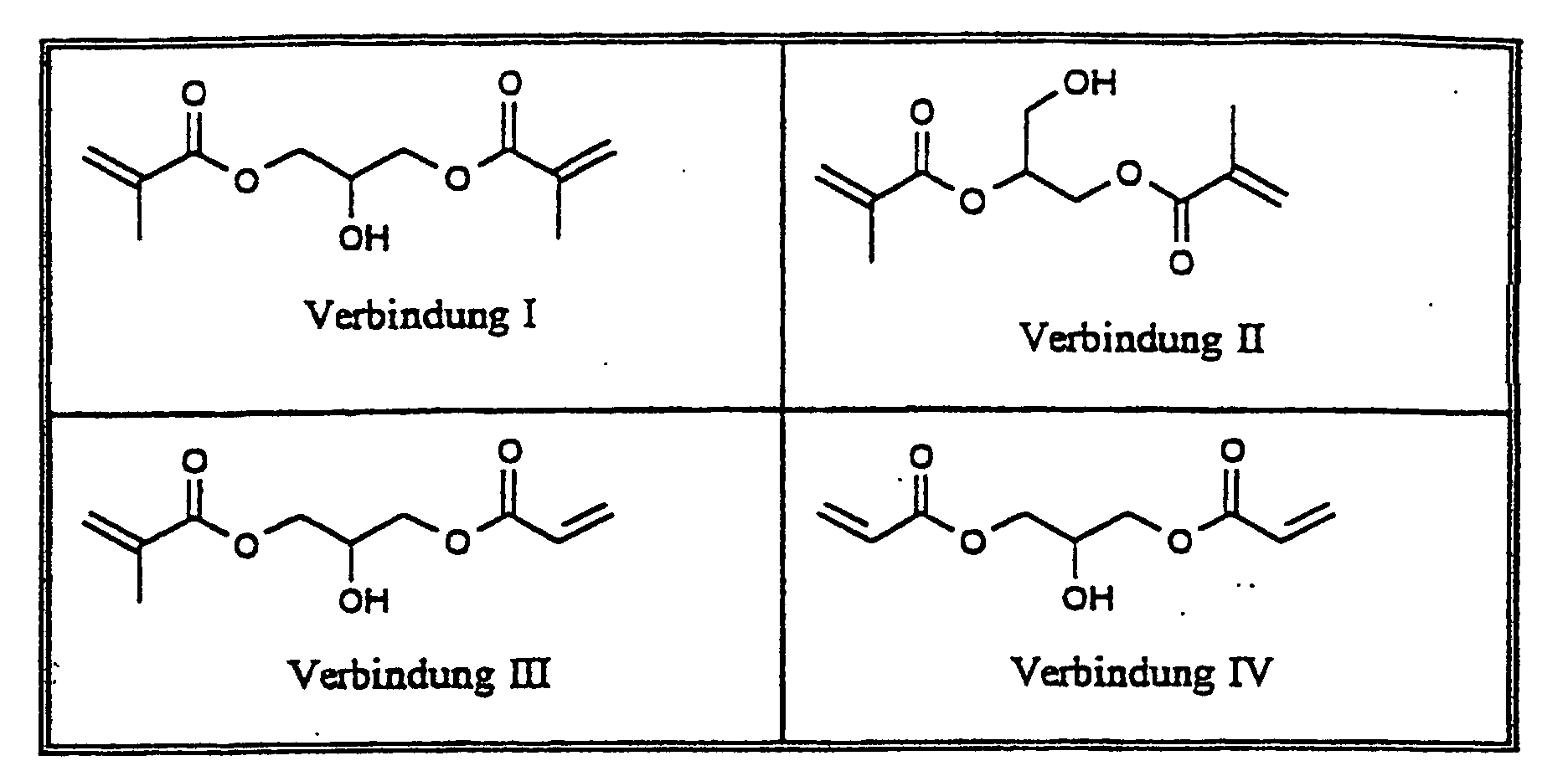
- Glycerol di (meth) acrylates in the context of the present invention are the diesters of glycerol with acrylic acid and methacrylic acid.
- the following compounds are given as examples.
- Volatile, water-miscible solvents are primarily those with a vapor pressure of at least 100 torr at room temperature.
- Photoactivators or initiators in the context of the present invention are radical formers, that under the influence of light, for example UV light, visible light or Laser light to trigger radical polymerization.
- photopolymerization initiators are known per se from the literature.
- acts it is mono- or dicarbonyl compounds such as benzophenone, benzoin and the like
- Derivatives in particular benzoin methyl ether, benzil and benzene derivatives and other dicarbonyl compounds, such as diacetyl, 2,3-pentanedione and a-diketo derivatives of norbomane and substituted Norbomanes, metal carbonyls such as pentacarbonyl manganese, or quinones such as 9,10-phenanthrenequinone and naphthoquinone.
- Camphorquinone is particularly preferred.
- the preparation according to the invention generally contains 0.01 to 2.5% by weight, preferably 0.1 up to 0.5% by weight of the photoactivator, based on the preparation according to the invention.
- accelerators are, for example, amines, such as p-toluidine, dimethyl-p-toluidine, trialkylamines, such as trihexylamine, polyamines such as N, N, N ', N'-tetraalkylalkylenediamines, Barbituric acid and dialkyl barbituric acids.
- amines such as p-toluidine, dimethyl-p-toluidine
- trialkylamines such as trihexylamine
- polyamines such as N, N, N ', N'-tetraalkylalkylenediamines
- Barbituric acid and dialkyl barbituric acids are particularly preferred Dimethylaminobenzenesulfonamides according to DE-A-31 35 113.
- the coactivators are generally used in an amount of 0.02 to 4% by weight, preferably 0.2 up to 1% by weight, based on the preparation according to the invention.
- Suitable fillers include rock crystal, Kristobalite, quartz glass, highly disperse silicas, aluminum oxide and glass ceramics.
- the average particle size of the fillers is generally in the range from 10 to 2000 nm, preferably in the range of 10-100 nm.
- Particularly well-suited fillers are highly disperse Silicas, which can be obtained, for example, by flame hydrolysis.
- the fillers are preferably pretreated, for example with silanizing agents Organosilicon compounds (Progress in Organic Coatings 11, 297-308 (1983).
- a preferred Silanizing agent is 3-methacryloyloxypropyl trimethoxysilane.
- the preparation according to the invention can be done in a simple manner by mixing the individual Components are manufactured. It is used as an adhesive component for the treatment of hard tooth substance used.
- the tooth structure is conditioned before the treatment with the preparation according to the invention with a conditioning liquid, the one Has pH in the range of 0.1 to 3.5.
- This conditioning liquid generally contains Acids with a pKa value less than 5 and optionally an amphoteric amino compound with a pKs value in the range of 9.0 to 10.6 and a pKb value in the range from 11.5 to 12.5.
- the following acids can e.g. B. contained in the conditioning liquid be: phosphoric acid, nitric acid, pyruvic acid, citric acid, oxalic acid, ethylenediaminetetraacetic acid, Acetic acid, tartaric acid, malic acid.
- the conditioning liquid Contain substances from the group of polyethylene glycols and metal hydroxides.
- the polybasic acids listed above can also be used as partial metal salts as long as free acid functions remain.
- Treatment with is preferred aqueous phosphoric acid. Suitable concentrations of phosphoric acid are 10-60% by weight, preferably 20-40% by weight.
- the conditioning liquid can be used to set a suitable one Consistency thickeners, e.g. B. contain silica.
- the preparation according to the invention can be used, for example, as follows become:
- a tooth repair is done after mechanical cleaning of the tooth surface the conditioning liquid first, leaves a short time (for example 60 seconds) act, rinses the tooth surface with water and dries it. Then you wear the invention Preparation, for example with a small brush, in one or more thin layers, dries in an air stream and irradiated with a commercially available polymerization lamp. Then you fill in the actual filling material, for example in the dental field usual plastic filling material.
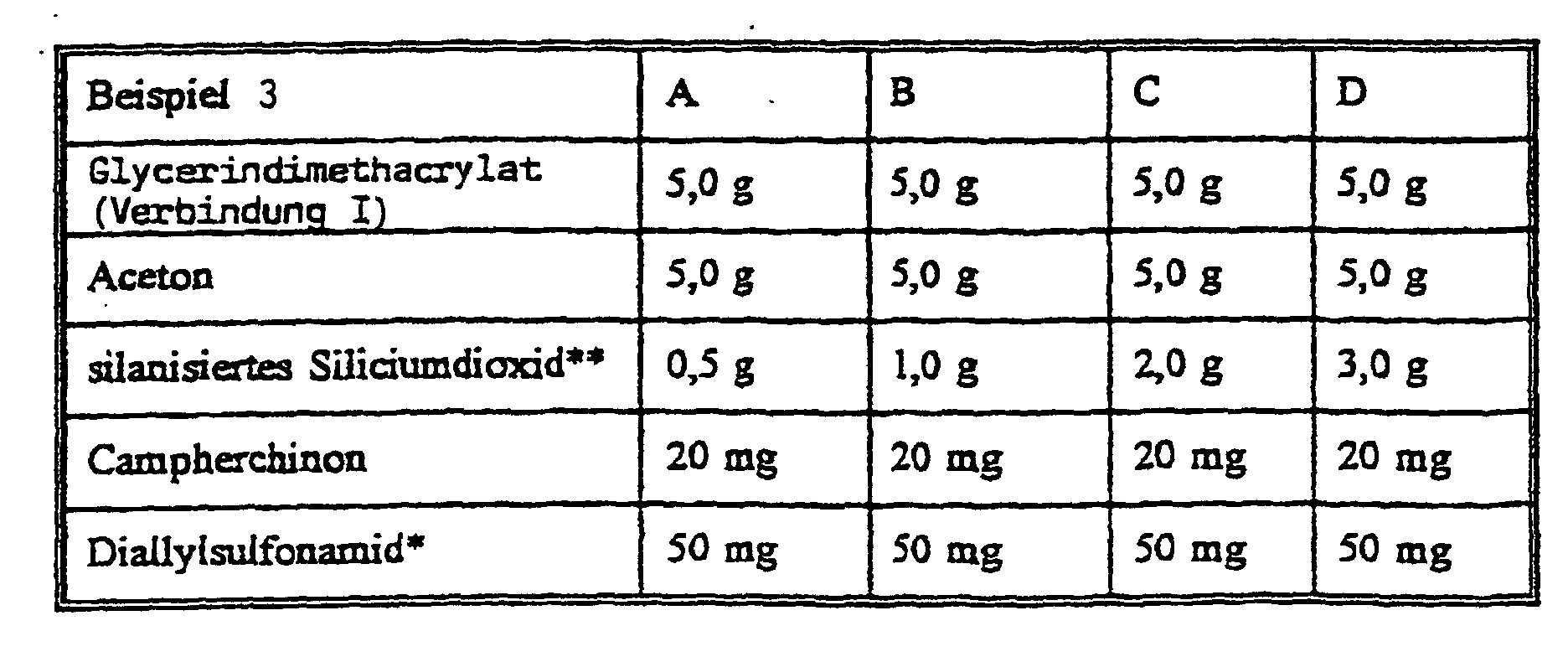
- Example 2 Glycerol dimethacrylate (Compound I) 5.0 g ethanol 5.0 g camphorquinone 20 mg Diallylsulfonamid * 50 mg
- the effectiveness of the preparations described in Examples 1-3 as dentin adhesives is checked by determining the shear bond strength on dentin. They become human Teeth used for max. stored in 1% chloramine solution three months after extraction were. Before being used in the bonding test, the teeth are cleaned after careful cleaning under running water for at least three and at most ten days in physiological Saline solution stored. The day before the teeth are used in the binding test individually lying on an approximal side with epoxy resin (Lekutherm® X20, hardener T3) in cylindrical Rubber molds with a diameter of 25 mm and a height of 12 mm are embedded.
- epoxy resin Lekutherm® X20, hardener T3
- the teeth are by wet grinding with SiC papers of grain 240, 320, 400 and finally 600 ground so far that a sufficiently large dentine surface close to the enamel for connection a plastic cylinder with a diameter of 3.5 mm is exposed.
- the conditioning agent Gluma® for 30 seconds CPS Gel (20% H3PO4, Bayer) applied with a cotton pellet while rubbing, rinsed carefully with water and dabbed with water on the surface of cellulose free (wet technique).
- the preparations are spread out on the conditioned dentin surface Examples 1-3 applied with a brush in three layers, dried in a stream of compressed air and irradiated for 20 seconds with the TRANSLUX® CL (Kulzer) light device.
- the one so pretreated Sample is then placed under a two-part cylindrical by means of a clamping device Teflon mold (3.5 mm diameter, 1 mm height) clamped.
- Teflon mold 3.5 mm diameter, 1 mm height
- the Teflon shape is removed and the cylindrical one
- the sample is stored in warm water at 37 ° C for 24 hours until the shear stress is initiated.
- the cylindrical sample is placed in a universal testing machine using a pressure stamp parallel to and close to the ground tooth surface at a speed of 1 mm / minute until the cylinder is separated from the tooth.
- the shear bond strength is the quotient of breaking strength and binding area and is determined on 5 samples and as their mean is given in the table.
Landscapes
- Health & Medical Sciences (AREA)
- Oral & Maxillofacial Surgery (AREA)
- Epidemiology (AREA)
- Life Sciences & Earth Sciences (AREA)
- Animal Behavior & Ethology (AREA)
- General Health & Medical Sciences (AREA)
- Public Health (AREA)
- Veterinary Medicine (AREA)
- Chemical & Material Sciences (AREA)
- Inorganic Chemistry (AREA)
- Dental Preparations (AREA)
- Chemical Kinetics & Catalysis (AREA)
- Medicinal Chemistry (AREA)
- Polymers & Plastics (AREA)
- Organic Chemistry (AREA)
- Adhesives Or Adhesive Processes (AREA)
- Paints Or Removers (AREA)
Description
| Beispiel 1 | |
| Glycerindimedimethacrylat (Verbindung I) | 5,0 g |
| Aceton | 5,0 g |
| Campherchinon | 20 mg |
| Diallylsulfonamid* | 50 mg |
| Beispiel 2 | |
| Glycerindimethacrylat (Verbindung I) | 5,0 g |
| Ethanol | 5,0 g |
| Campherchinon | 20 mg |
| Diallylsulfonamid* | 50 mg |

| Zubereitung | Scherbindungsfestigkeit an Dentin | Scherbindungsfestigkeit an Schmelz |
| Beispiel 1 | 14,5 MPa | 34,7±1,7 MPa |
| Beispiel 2 | 18,6 MPa | 32,5±5,4 MPa |
| Beispiel 3A | 14,7 MPa | 33,6±4,6 MPa |
| Beispiel 3B | 19,0 MPa | 29,5±3,3 MPa |
| Beispiel 3C | 14,5 MPa | 34,0±2,9 MPa |
| Beispiel 3D | 11,0 MPa | 17,9±4,1 MPa |
Claims (4)
- Zubereitung zur Verwendung als Adhäsivkomponente für die Behandlung der Zahnhartsubstanz, dadurch gekennzeichnet, dass sie ausmit dem Vorbehalt, daß die Summe der Gewichtsanteile 100% ergibt.a) 30 - 70 Gew.-% Glycerindi(meth)acrylat,b) 70 - 30 Gew.-% eines flüchtigen, mit Wasser mischbaren Lösungsmittels,c) 0,01 - 2,5 Gew.-% Fotoaktivator und gegebenenfallsd) 0 - 40 Gew.-% an sich bekannter Zusätze aus der Gruppe der Coaktivatoren, Füllstoffe, Stabilisatoren, Inhibitoren, Lichtschutzmittel besteht,
- Zubereitung nach Anspruch 1, dadurch gekennzeichnet, dass sie ausbesteht, mit dem Vorbehalt, daß die Summe der Gewichtsanteile 100% ergibt.a) 30 - 70 Gew.-% Glycerindi(meth)acrylat,b) 70 - 30 Gew.-% eines flüchtigen, mit Wasser mischbaren Lösungsmittels,c) 0,01 - 2,5 Gew.-% Fotoaktivator,d1) 5 - 20 Gew.-% Füllstoff und gegebenenfallsd2) 0 - 25 Gew.-% an sich bekannter Zusätze aus der Gruppe der Coaktivatoren, Stabilisatoren, Inhibitoren, Lichtschutzmittel
- Zubereitung nach Anspruch 2, dadurch gekennzeichnet, dass als Füllstoff hochdisperse Kieselsäure mit einer mittleren Teilchengröße von 5 - 2000 nm, vorzugsweise von 10 - 50 nm, eingesetzt wird.
- Verfahren zur Herstellung der Zubereitung nach einem der Ansprüche 1 bis 3, dadurch gekennzeichnet, dass die Komponenten a) bis d) miteinander vermischt werden.
Applications Claiming Priority (2)
| Application Number | Priority Date | Filing Date | Title |
|---|---|---|---|
| DE19544673A DE19544673C2 (de) | 1995-11-30 | 1995-11-30 | Dentaladhäsive |
| DE19544673 | 1995-11-30 |
Publications (3)
| Publication Number | Publication Date |
|---|---|
| EP0776650A2 EP0776650A2 (de) | 1997-06-04 |
| EP0776650A3 EP0776650A3 (de) | 2000-05-03 |
| EP0776650B1 true EP0776650B1 (de) | 2003-07-09 |
Family
ID=7778829
Family Applications (1)
| Application Number | Title | Priority Date | Filing Date |
|---|---|---|---|
| EP96115507A Expired - Lifetime EP0776650B1 (de) | 1995-11-30 | 1996-09-27 | Dentaladhäsive |
Country Status (4)
| Country | Link |
|---|---|
| US (1) | US5921779A (de) |
| EP (1) | EP0776650B1 (de) |
| JP (1) | JP3668916B2 (de) |
| DE (2) | DE19544673C2 (de) |
Families Citing this family (9)
| Publication number | Priority date | Publication date | Assignee | Title |
|---|---|---|---|---|
| JP4451501B2 (ja) † | 1997-10-03 | 2010-04-14 | デンツプライ インターナショナル インコーポレーテッド | ナノスケールの充填剤を含む歯科材料 |
| JP2004359843A (ja) * | 2003-06-05 | 2004-12-24 | Nippon Shokubai Co Ltd | 活性エネルギー線硬化用組成物 |
| EP1799180B8 (de) * | 2004-10-14 | 2010-01-06 | Dentsply International, Inc. | Aus nur einer komponente bestehendes selbstätzendes haftmittel |
| JP2006257044A (ja) * | 2005-03-18 | 2006-09-28 | Nippon Shokubai Co Ltd | グリセリンジエステルの製造方法 |
| JP2007028995A (ja) * | 2005-07-27 | 2007-02-08 | Nippon Steel Chem Co Ltd | (メタ)アクリル酸ヒドロキシエステルの製造方法 |
| DE102006034240A1 (de) * | 2006-07-25 | 2008-01-31 | Clariant International Limited | Mit polymerisierbarem Coating modifizierte Pigmente, deren Herstellung und Anwendung |
| US20120329790A1 (en) * | 2009-11-23 | 2012-12-27 | University Of Medicine And Dentistry Of New Jersey | Dentinal Drug Delivery Composition |
| WO2015190037A1 (en) | 2014-06-10 | 2015-12-17 | Ricoh Company, Ltd. | Ink, ink cartridge, inkjet recording apparatus, printed matter, photopolymerizable compound, photocurable composition, three-dimensional object formation material, and three-dimensional object |
| JP6648371B2 (ja) | 2014-06-10 | 2020-02-14 | 株式会社リコー | インク、印刷物 |
Family Cites Families (18)
| Publication number | Priority date | Publication date | Assignee | Title |
|---|---|---|---|---|
| US4204383A (en) * | 1978-06-29 | 1980-05-27 | Allis-Chalmers Corporation | Automatic height control for gathering reel for agricultural combine |
| DE2931925A1 (de) * | 1979-08-07 | 1981-02-26 | Bayer Ag | (meth)acrylsaeureester von ethergruppen enthaltenden tricyclischen decandiolen |
| DE3135113A1 (de) * | 1981-09-04 | 1983-03-24 | Bayer Ag, 5090 Leverkusen | Photopolymerisierbare massen, deren verwendung fuer zahnaerztliche zwecke, sowie verfahren zur herstellung von zahnersatzteilen, zahnfuellungen und ueberzuegen |
| DE3522005A1 (de) * | 1985-06-20 | 1987-01-02 | Bayer Ag | (meth)-acrylsaeureester und ihre verwendung |
| DE3703080A1 (de) * | 1986-07-25 | 1988-01-28 | Bayer Ag | (meth)-acrylsaeureester |
| DE3703120A1 (de) * | 1986-07-25 | 1988-01-28 | Bayer Ag | Urethangruppen enthaltende (meth)-acrylsaeurederivate von tricyclo (5.2.1.0(pfeil hoch)2(pfeil hoch)(pfeil hoch).(pfeil hoch)(pfeil hoch)6(pfeil hoch))decanen |
| DE3703130A1 (de) * | 1986-07-25 | 1988-01-28 | Bayer Ag | Urethangruppen enthaltende (meth)-acrylsaeurederivate |
| CA1323949C (en) * | 1987-04-02 | 1993-11-02 | Michael C. Palazzotto | Ternary photoinitiator system for addition polymerization |
| US4880660A (en) * | 1987-08-28 | 1989-11-14 | Minnesota Mining And Manufacturing Company | Method for priming hard tissue |
| DE3828170A1 (de) * | 1988-08-19 | 1990-02-22 | Bayer Ag | Beschichtungsmittel fuer kollagenhaltige materialien |
| JPH03232809A (ja) * | 1989-12-11 | 1991-10-16 | Jishi Toushi Kogyo Kk | 歯科陶材用練和液 |
| US5204383A (en) * | 1990-03-28 | 1993-04-20 | Kuraray Co., Ltd. | Dental adhesives |
| DE4105550A1 (de) * | 1991-02-22 | 1992-08-27 | Bayer Ag | Adhaesivkomponente zur behandlung der zahnhartsubstanz |
| DE4137076A1 (de) * | 1991-11-12 | 1993-05-13 | Ivoclar Ag | Dentalklebstoff |
| PL172401B1 (en) * | 1991-12-31 | 1997-09-30 | Minnesota Mining & Mfg | Composition for bonding or coating hard tissue |
| US5367002A (en) * | 1992-02-06 | 1994-11-22 | Dentsply Research & Development Corp. | Dental composition and method |
| US5362769A (en) * | 1992-05-07 | 1994-11-08 | Ormco Corporation | Orthodontic adhesives |
| JP3465753B2 (ja) * | 1993-12-28 | 2003-11-10 | 株式会社トクヤマ | 歯科用組成物 |
-
1995
- 1995-11-30 DE DE19544673A patent/DE19544673C2/de not_active Expired - Fee Related
-
1996
- 1996-09-27 DE DE59610587T patent/DE59610587D1/de not_active Expired - Fee Related
- 1996-09-27 EP EP96115507A patent/EP0776650B1/de not_active Expired - Lifetime
- 1996-11-05 JP JP29264196A patent/JP3668916B2/ja not_active Expired - Fee Related
- 1996-11-13 US US08/747,580 patent/US5921779A/en not_active Expired - Fee Related
Also Published As
| Publication number | Publication date |
|---|---|
| EP0776650A3 (de) | 2000-05-03 |
| DE19544673C2 (de) | 2001-03-29 |
| DE59610587D1 (de) | 2003-08-14 |
| DE19544673A1 (de) | 1997-06-05 |
| EP0776650A2 (de) | 1997-06-04 |
| US5921779A (en) | 1999-07-13 |
| JP3668916B2 (ja) | 2005-07-06 |
| JPH09227324A (ja) | 1997-09-02 |
Similar Documents
| Publication | Publication Date | Title |
|---|---|---|
| EP0787477B1 (de) | Adhäsive | |
| DE60026089T2 (de) | Klebemassen für den Dentalbereich | |
| DE3851736T2 (de) | Verfahren zum Grundieren von Hartgewebe. | |
| DE3750993T3 (de) | Verfahren zum Grundieren von Hartgewebe. | |
| EP0499923B1 (de) | Dentaladhäsive | |
| DE69629178T2 (de) | Dentale haftmittelzusammensetzung und polymerisationskatalysator | |
| DE202006020483U1 (de) | Kit zur Infiltration von Zahnschmelz | |
| EP2226061B1 (de) | Infiltrant für die Dentalapplikation | |
| EP0897297B1 (de) | Dentaladhäsive | |
| DE19544673C2 (de) | Dentaladhäsive | |
| DE4137076C2 (de) | ||
| EP0531802B1 (de) | Adhäsivkomponente zur Restaurierung der Zahnhartsubstanz | |
| EP2136765B1 (de) | Kit zum befestigen eines dentalen restaurationsmaterials an einer zahnsubstanz | |
| EP0486774A1 (de) | Befestigungszement | |
| EP0878183B1 (de) | Adhäsivsystem für dentale Zwecke | |
| DE102024105594B4 (de) | Polymerisierbare Co-Initiatoren | |
| DE19544670C2 (de) | Verfahren zur Herstellung oligomerer Kondensationsprodukte aromatischer Tricarbonsäuren und Epoxy(meth)acrylaten | |
| EP0361033A2 (de) | Beschichtungsmittel für kollagenhaltige Materialien | |
| EP0441187A2 (de) | Carbonsäure-(meth)acryloylaminoalkylester in Adhäsivkomponenten zur Behandlung kollagenhaltiger Materialien | |
| DE102021108477A1 (de) | Selbstadhäsiver Fissurenversiegler | |
| WO2004050042A1 (de) | Dentales restaurationsmaterial |
Legal Events
| Date | Code | Title | Description |
|---|---|---|---|
| PUAI | Public reference made under article 153(3) epc to a published international application that has entered the european phase |
Free format text: ORIGINAL CODE: 0009012 |
|
| 17P | Request for examination filed |
Effective date: 19961008 |
|
| AK | Designated contracting states |
Kind code of ref document: A2 Designated state(s): CH DE GB LI |
|
| RAP1 | Party data changed (applicant data changed or rights of an application transferred) |
Owner name: HERAEUS KULZER GMBH & CO.KG |
|
| PUAL | Search report despatched |
Free format text: ORIGINAL CODE: 0009013 |
|
| AK | Designated contracting states |
Kind code of ref document: A3 Designated state(s): CH DE GB LI |
|
| 17Q | First examination report despatched |
Effective date: 20010227 |
|
| GRAH | Despatch of communication of intention to grant a patent |
Free format text: ORIGINAL CODE: EPIDOS IGRA |
|
| GRAH | Despatch of communication of intention to grant a patent |
Free format text: ORIGINAL CODE: EPIDOS IGRA |
|
| GRAA | (expected) grant |
Free format text: ORIGINAL CODE: 0009210 |
|
| AK | Designated contracting states |
Designated state(s): CH DE GB LI |
|
| REG | Reference to a national code |
Ref country code: GB Ref legal event code: FG4D Free format text: NOT ENGLISH |
|
| REG | Reference to a national code |
Ref country code: CH Ref legal event code: EP |
|
| REG | Reference to a national code |
Ref country code: CH Ref legal event code: NV Representative=s name: KELLER & PARTNER PATENTANWAELTE AG |
|
| REF | Corresponds to: |
Ref document number: 59610587 Country of ref document: DE Date of ref document: 20030814 Kind code of ref document: P |
|
| GBT | Gb: translation of ep patent filed (gb section 77(6)(a)/1977) |
Effective date: 20031008 |
|
| PLBE | No opposition filed within time limit |
Free format text: ORIGINAL CODE: 0009261 |
|
| STAA | Information on the status of an ep patent application or granted ep patent |
Free format text: STATUS: NO OPPOSITION FILED WITHIN TIME LIMIT |
|
| 26N | No opposition filed |
Effective date: 20040414 |
|
| PGFP | Annual fee paid to national office [announced via postgrant information from national office to epo] |
Ref country code: DE Payment date: 20050912 Year of fee payment: 10 |
|
| PGFP | Annual fee paid to national office [announced via postgrant information from national office to epo] |
Ref country code: CH Payment date: 20050915 Year of fee payment: 10 |
|
| PGFP | Annual fee paid to national office [announced via postgrant information from national office to epo] |
Ref country code: GB Payment date: 20050919 Year of fee payment: 10 |
|
| PG25 | Lapsed in a contracting state [announced via postgrant information from national office to epo] |
Ref country code: LI Free format text: LAPSE BECAUSE OF NON-PAYMENT OF DUE FEES Effective date: 20060930 Ref country code: CH Free format text: LAPSE BECAUSE OF NON-PAYMENT OF DUE FEES Effective date: 20060930 |
|
| PG25 | Lapsed in a contracting state [announced via postgrant information from national office to epo] |
Ref country code: DE Free format text: LAPSE BECAUSE OF NON-PAYMENT OF DUE FEES Effective date: 20070403 |
|
| REG | Reference to a national code |
Ref country code: CH Ref legal event code: PL |
|
| GBPC | Gb: european patent ceased through non-payment of renewal fee |
Effective date: 20060927 |
|
| PG25 | Lapsed in a contracting state [announced via postgrant information from national office to epo] |
Ref country code: GB Free format text: LAPSE BECAUSE OF NON-PAYMENT OF DUE FEES Effective date: 20060927 |