EP0776397B1 - Verfahren zur erhöhung der festigkeit von papier - Google Patents
Verfahren zur erhöhung der festigkeit von papier Download PDFInfo
- Publication number
- EP0776397B1 EP0776397B1 EP95927902A EP95927902A EP0776397B1 EP 0776397 B1 EP0776397 B1 EP 0776397B1 EP 95927902 A EP95927902 A EP 95927902A EP 95927902 A EP95927902 A EP 95927902A EP 0776397 B1 EP0776397 B1 EP 0776397B1
- Authority
- EP
- European Patent Office
- Prior art keywords
- starch
- amount
- cationic polymer
- slurry
- paper
- Prior art date
- Legal status (The legal status is an assumption and is not a legal conclusion. Google has not performed a legal analysis and makes no representation as to the accuracy of the status listed.)
- Expired - Lifetime
Links
Images



Classifications
-
- D—TEXTILES; PAPER
- D21—PAPER-MAKING; PRODUCTION OF CELLULOSE
- D21H—PULP COMPOSITIONS; PREPARATION THEREOF NOT COVERED BY SUBCLASSES D21C OR D21D; IMPREGNATING OR COATING OF PAPER; TREATMENT OF FINISHED PAPER NOT COVERED BY CLASS B31 OR SUBCLASS D21G; PAPER NOT OTHERWISE PROVIDED FOR
- D21H23/00—Processes or apparatus for adding material to the pulp or to the paper
- D21H23/76—Processes or apparatus for adding material to the pulp or to the paper characterised by choice of auxiliary compounds which are added separately from at least one other compound, e.g. to improve the incorporation of the latter or to obtain an enhanced combined effect
-
- D—TEXTILES; PAPER
- D21—PAPER-MAKING; PRODUCTION OF CELLULOSE
- D21H—PULP COMPOSITIONS; PREPARATION THEREOF NOT COVERED BY SUBCLASSES D21C OR D21D; IMPREGNATING OR COATING OF PAPER; TREATMENT OF FINISHED PAPER NOT COVERED BY CLASS B31 OR SUBCLASS D21G; PAPER NOT OTHERWISE PROVIDED FOR
- D21H17/00—Non-fibrous material added to the pulp, characterised by its constitution; Paper-impregnating material characterised by its constitution
- D21H17/20—Macromolecular organic compounds
- D21H17/33—Synthetic macromolecular compounds
- D21H17/34—Synthetic macromolecular compounds obtained by reactions only involving carbon-to-carbon unsaturated bonds
- D21H17/37—Polymers of unsaturated acids or derivatives thereof, e.g. polyacrylates
- D21H17/375—Poly(meth)acrylamide
-
- D—TEXTILES; PAPER
- D21—PAPER-MAKING; PRODUCTION OF CELLULOSE
- D21H—PULP COMPOSITIONS; PREPARATION THEREOF NOT COVERED BY SUBCLASSES D21C OR D21D; IMPREGNATING OR COATING OF PAPER; TREATMENT OF FINISHED PAPER NOT COVERED BY CLASS B31 OR SUBCLASS D21G; PAPER NOT OTHERWISE PROVIDED FOR
- D21H17/00—Non-fibrous material added to the pulp, characterised by its constitution; Paper-impregnating material characterised by its constitution
- D21H17/20—Macromolecular organic compounds
- D21H17/21—Macromolecular organic compounds of natural origin; Derivatives thereof
- D21H17/24—Polysaccharides
- D21H17/28—Starch
-
- D—TEXTILES; PAPER
- D21—PAPER-MAKING; PRODUCTION OF CELLULOSE
- D21H—PULP COMPOSITIONS; PREPARATION THEREOF NOT COVERED BY SUBCLASSES D21C OR D21D; IMPREGNATING OR COATING OF PAPER; TREATMENT OF FINISHED PAPER NOT COVERED BY CLASS B31 OR SUBCLASS D21G; PAPER NOT OTHERWISE PROVIDED FOR
- D21H17/00—Non-fibrous material added to the pulp, characterised by its constitution; Paper-impregnating material characterised by its constitution
- D21H17/20—Macromolecular organic compounds
- D21H17/33—Synthetic macromolecular compounds
- D21H17/34—Synthetic macromolecular compounds obtained by reactions only involving carbon-to-carbon unsaturated bonds
- D21H17/41—Synthetic macromolecular compounds obtained by reactions only involving carbon-to-carbon unsaturated bonds containing ionic groups
- D21H17/42—Synthetic macromolecular compounds obtained by reactions only involving carbon-to-carbon unsaturated bonds containing ionic groups anionic
-
- D—TEXTILES; PAPER
- D21—PAPER-MAKING; PRODUCTION OF CELLULOSE
- D21H—PULP COMPOSITIONS; PREPARATION THEREOF NOT COVERED BY SUBCLASSES D21C OR D21D; IMPREGNATING OR COATING OF PAPER; TREATMENT OF FINISHED PAPER NOT COVERED BY CLASS B31 OR SUBCLASS D21G; PAPER NOT OTHERWISE PROVIDED FOR
- D21H17/00—Non-fibrous material added to the pulp, characterised by its constitution; Paper-impregnating material characterised by its constitution
- D21H17/20—Macromolecular organic compounds
- D21H17/33—Synthetic macromolecular compounds
- D21H17/34—Synthetic macromolecular compounds obtained by reactions only involving carbon-to-carbon unsaturated bonds
- D21H17/41—Synthetic macromolecular compounds obtained by reactions only involving carbon-to-carbon unsaturated bonds containing ionic groups
- D21H17/44—Synthetic macromolecular compounds obtained by reactions only involving carbon-to-carbon unsaturated bonds containing ionic groups cationic
- D21H17/45—Nitrogen-containing groups
- D21H17/455—Nitrogen-containing groups comprising tertiary amine or being at least partially quaternised
-
- D—TEXTILES; PAPER
- D21—PAPER-MAKING; PRODUCTION OF CELLULOSE
- D21H—PULP COMPOSITIONS; PREPARATION THEREOF NOT COVERED BY SUBCLASSES D21C OR D21D; IMPREGNATING OR COATING OF PAPER; TREATMENT OF FINISHED PAPER NOT COVERED BY CLASS B31 OR SUBCLASS D21G; PAPER NOT OTHERWISE PROVIDED FOR
- D21H23/00—Processes or apparatus for adding material to the pulp or to the paper
- D21H23/02—Processes or apparatus for adding material to the pulp or to the paper characterised by the manner in which substances are added
- D21H23/04—Addition to the pulp; After-treatment of added substances in the pulp
- D21H23/06—Controlling the addition
- D21H23/08—Controlling the addition by measuring pulp properties, e.g. zeta potential, pH
- D21H23/10—Controlling the addition by measuring pulp properties, e.g. zeta potential, pH at least two kinds of compounds being added
Definitions
- the present invention concerns a process for adding material to paper during production thereof to increase the strength of the paper so produced.
- a substrate In the preparation of various substrates, techniques have been developed to increase the strength of the substrate by insolubilizing materials onto the substrate to reinforce the substrate.
- a substrate is paper.
- cellulose has been pulped in a slurry, and the slurry applied to a screen to orient the fibers and drain away liquids.
- the paper is then squeezed between rollers to further reduce the water to produce a sheet of paper after suitable drying.
- the strength of the paper produced is dependent upon the nature of the pulp. For example, Virgin pulp of a given quality typically produces a much stronger paper than pulp from repulped paper of the same quality. Also, the strength achievable from the pulp decreases with each recycling evolution.
- One disadvantage and limitation heretofore on the recycling of paper was the inability to achieve the desired strength of paper made in whole or in part from recycled pulp.
- the difficulties in achieving sufficient strength will become magnified as it is attempted to recycle paper which has already been recycled one or more times. Indeed in Europe where recycling is more intensive than in the United States it has become commonplace practice to make certain grades of paper entirely from recycled fibre especially in the boxboard grades.
- wet end additions i.e. chemicals that are applied in the pulp slurry
- wet end additives i.e. chemicals that are applied in the pulp slurry
- wet end additives to achieve strength e.g. cationic starch, polyvinyl alcohol, xanthan gum etc.
- tramp materials usually referred to as "anionic trash” that inhibit the performance of these additives such that the strength improvements achieved (if any) are not economically viable.
- the paper maker has resorted to size press technology to gain large increases in strength as the uptake is quantitative based upon saturation of the finished sheet with a known strength solution of reinforcing agent.
- the results obtained by this technology are recognised by the industry as superior to wet end addition especially in the area of the promotion of stiffness, a much valued property in many grades and especially so in boxboard.
- EP-A-0 227 465 relates to the treatment of papermaking fibres and fillers with polymers of opposite charge.
- US-A-5 126 014 discloses a papermaking process in which a cationic polymer, cationic starch and an anionic flocculant are added sequentially to the furnish.
- the advantages of the present invention include: (a) ability to increase strength substantially over prior methods, (b) the elimination of sizing equipment, (c) the reduction of refining, (d) the ability to select reactants, reaction conditions to achieve desired strength increases or other desirable properties in relation to characteristics of the pulp being utilized and (e) improved drainage equivalent to or greater than generally accepted micro particle technologies.
- the process of the present invention would have application in the following area: Reinforcement of paper to provide higher strength properties and possibly sizing by addition at the wet end of the paper machine.
- the strength characteristics of paper are evaluated in many different ways. There is strength to be measured in the machine direction, cross machine direction or thickness direction. Various types of strength measurements are burst, tear, tensile, stiffness, taber stiffness, ring crush, fold endurance, concorra medium test (CMT) and STIFI. These physical properties (amongst others) can be measured using standards of the Technical Association of Paper Processing Industry (TAPPI).
- TAPPI Technical Association of Paper Processing Industry
- the present invention relates to a process of improving the strength of paper as described in claims 1, 12 comprising the addition of a cationic polymer capable of insolubilizing a starch which is added to the slurry containing the pulp in an amount equal to or less than the amount needed to neutralize the anionic charge of the slurry components.
- the method also involves adding to the slurry a predetermined amount of starch such that the amount of starch added to the amount of cationic polymer added is equal to 75% to 125% the reaction ratio between the starch and cationic polymer or in an amount exceeding the reaction ratio.
- the reactive mixture will need an appropriate degree of shear to break up the flocculation that is observed.
- the flocculation can be very substantial and need the input of a shear value equivalent to light refining or alternatively in the weakest cases a gentle shear as may be observed in the cleaners of the pre-headbox system.
- the cationic polymer is added to the slurry containing the substrate and thoroughly admixed therewith prior to the addition of the starch component.
- the cationic polymer useful in the invention is a polyhydroxide polymer or an acrylamide polymer having a molecular weight above 150,000.
- the cationic polymers Preferably have a molecular weight of one million or more.
- Other polymers which are useful are polymers known to be flocculating agents which have a molecular weight above 150,000 and preferably of one million or more.
- the present invention relates to the addition of sufficient cationic polymer to neutralize 10% or more of the charge of the slurry and less than or equal to the amount necessary to completely neutralize the charge of the slurry. Also added to the slurry bath is a predetermined amount of starch followed by suitable shear.
- the present method may be used with a substrate which has a charged character.
- the substrate may be charged either positively or negatively.
- the substrate is the paper pulp and slurried pulp at the wet end of the process carries an anionic charge.
- the process of the present invention will be described with reference to the substrate carrying an anionic charge, but the principals of the invention apply when the charges of the various components are reversed.
- the present invention is a process for insolubilizing a starch onto a substrate having an cationic polymer associated therewith.
- a substrate having an cationic polymer associated therewith.
- the properties of the final paper product can be varied as desired.
- a charge monitor particle charge analyzer
- the slurry will be dirty in that it will also contain charged particles of non-substrate material which the cationic polymer will neutralize.
- the amount of cationic polymer needed to neutralize the charge of the substrate can vary because of other material present in the slurry.
- the amount of cationic polymer added is an amount sufficient to neutralize 10% or more of the charge in the substrate slurry and equal to or less than the amount needed to completely neutralize the charge.
- a starch is added to the substrate slurry and preferably sufficient shear is applied to break up the flocculation that will take place.
- the starch is added in amounts sufficient to insolubilize into the substrate and associated polymer.
- Preferably the starch is added in an amount less than 125% of the reaction ratio amount.
- the reaction ratio amount of starch is that amount of starch per unit weight of polymer at which the amount of starch to polymer is equal to the reaction ratio. For example, if the starch:polymer reaction ratio is 4:1 then 4 grams of starch per 1 gram of polymer is the reaction ratio amount. Thus, in this example, 125% of the reaction amount would be 5 grams of starch.
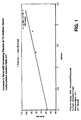
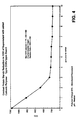
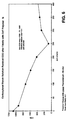
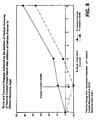
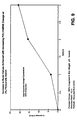
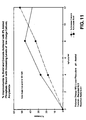
- the reaction ratio can be determined by placing the starch in a aqueous solution and then adding polymer incrementally to precipitate the starch. After the addition of each increment of polymer and after settling for several minutes the COD level is measured (chemical oxygen demand) A one ppm reduction in COD is equal to a one ppm insolubilization of starch. At the point where further addition of polymer does not further reduce the COD one has achieved the maximum COD reduction. The reaction ratio is determined by taking the back COD reduction and dividing it by the ppm of polymer added. It had been discovered that if one continues to add polymer that eventually one will begin to resolubilize the starch, as shown in Graphs 4, 4A, 5, 6 and 7.
- Graph 4 represents the reduction in COD when cooked potato starch was precipitated using a cationic polymer sold under the trade designation FLOEGER 4698. Addition of four parts per million polymer resulted in a maximum COD reduction of approximately 955. Each part per million COD reduction is equal to the precipitation of one ppm starch. Thus, the reaction ratio was 955/4 or 238.
- Graph 5 shows experimental determination of precipitation reaction for a phosphate starch Retabond AP, a cold water soluble phosphate starch supplied by Avebe starches.
- the maximum COD drop in parts per million was 800, was accomplished by adding 150 ppm polymer giving a reaction ratio of 5.3.
- Graph 6 shows determination of the reaction ratio of a carboxylated starch Quicksolan CMS by Avebe Starches with a cationic polymer FLOEGER F04550BPM. For these two components, maximum COD drop was 1,005 achieved by using 250 ppm in the polymer giving a reaction ratio of 4:1.
- Graph 7 shows determination of the reaction ratio for an oxidized cook-up potato starch Avebe Perfectamil A2177 with the cationic polymer F04550BPM.
- the Graph shows that maximum COD reduction of ppm was 580 achieved by additional 175 ppm polymer given a reaction ratio of 3.3.
- Graphs 5 to 7 demonstrate that additions of starch greatly in excess of the reaction ratio amount will not result in appreciable additional insolubilization. The less starch in the reaction ratio amount can be used. This specific amount of starch added depends upon the type of strength to be improved.
- the specific amounts of cationic polymer, and starch will depend upon the amount of the starch desired to be added, the fixation ratios of the starch and polymer. By judicious selection of the polymer and the starch, one can provide a great variety of possible combinations through the selection of a particular combination will depend on such items as cost, desired end properties, and processing limitations.
- the machine operated at a speed of 115 metres per minute and additions made were 2% carboxymethylated starch and 0.5% of 60% charged density acrylamide previously described.
- the cationic polymer is preferably added to the substrate prior to the addition of anionic starch.
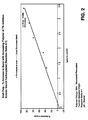
- the cationic polymer associates with the substrate and provides locations where the starch can affix itself to the substrate and cationic polymer. It has been determined that the insolubilization of the anionic starch is approximately linear as shown by the increase in strength in Graph 2. This relationship holds true as long as the cationic polymer concentration is equal to or below that concentration needed to neutralize the anionic charge on the pulp.
- the amount of cationic polymer needed to neutralize the anionic charge on the pulp can be determined theoretically or more conveniently, experimentally. Experimentally, a known weight of pulp is placed in an aqueous solution and the selected cationic polymer is added while monitoring the charge of the solution. The charge of the solution may be easily monitored with an instrument such as a conventional particle charge analyzer. Once this value has been determined, then the starch to be utilized can be determined by picking a starch with an appropriate fixation ratio to the selected polymer because the weight of starch which can be deposited can be approximated by the weight of the cationic polymer utilized times the fixation ratio of the starch to polymer.
- the amount of polymer used for a particular substrate to be insolubilized could be increased by selecting a cationic polymer having a lower charge density.
- the charge density is taken from manufacturers specifications.
- the amount of starch added can be increased if the reactor ratio between the starch and cationic polymer with a lower charge density has the same reaction ratio as a polymer with a higher charge density.
- the ten percent charge density polymer could be used in amounts up to six times greater than a polymer with a sixty percent charge density cationic polymer.
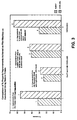
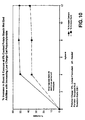
- the Kraft pulp was prepared and the cationic polymer, FLOEGER CW711, was added which had ten percent charge density to the samples. Thereafter, a starch, Retabond AP was added and the samples gave the following increase in burst strength over paper made with the untreated pulp.
- Cationic polymers are useful in the invention and include branch-chain cationic polyacrylamide polymers, linear acrylamide homo and copolymers.
- the molecular weight should be 150,000 or greater, and preferably 1,000,000 or greater.
- Starches which have been found useful in the invention include any anionic functional starch of sufficient molecular weight to be insolubilized.
- the present invention relates to the use of an anionic starch which has been functionalized by cationic flocculent materials.
- starch which possesses the capability of producing a large degree of hydrogen bonding to cellulose or other substrates of a similar nature, is reacted utilizing suitable technology eg; by reaction, a pendant strongly ionizable group, such as sulphonate, carboxylate, phosphate, may be incorporated in said polymer.
- a pendant strongly ionizable group such as sulphonate, carboxylate, phosphate
- the molecular weight should be 120,000 or above.
- a cationic flocculent is utilized in the form of polymer carrying sufficient permanent cationic charge.
- a polyacrylamide cationic polymer as commonly used in water treatment in the paper industry, but each is not limited in structure to pure polyacrylamide so that potentially other useful moieties such as copolymerized acrylamide/diallyldimethyl ammonium chloride or mannich acrylamides or other such relatively high molecular weight cationic polymer or copolymer which carried permanently quaternized nitrogen, may be used, including cationic starch, polyvinyl alcohol or other such moiety.
- the invention is the addition to the wet end of a paper making process 0.5% or more by weight of a flocculent and 2% or more by weight of an anionic starch to the pulp substrate slurry (percentages based on weight of the pulp substrate).
- This product has been made by the use of alkaline sodium monochloracetate reacting with a native starch, a commonly used industrial process for the manufacturer of anionic starch or cellulose.
- Tests were conducted using a spectrophotometer to measure the increase in turbidity by the addition of flocculent to test solution of starch.
- the maximum insolubilization appears to be at a ratio of approximately 4 parts starch to 1 part of flocculent. This will vary with the individual starch and flocculent.
- Tests have been conducted on the preparation of handsheets using both virgin and recycled paper including fillers in the sheet, and in all cases strength improvements were observed. It does not matter as to the order of addition of the reagents except in so much as this affects the formation of the sheet.
- raw starch may be anionized simply and cheaply either at a producer works or locally in the paper mill and be readily applied as a liquid product to the paper machine as the crude reaction product.
- a very low cost strength additive can be utilized that no only confers strength but by suitable modification of the backbone could produce sizing or any other property that may be achieved by the addition of modified starches eg; pick resistance, oil resistance, scuff resistance etc.
- the product may be dried and sold as a cold water soluble starch or as a cookable starch to prepare on site.
- the present invention relates to a method to increase the strength of paper by adding components to the wet end of the paper making process.
- a cationic starche is added at a level below the neutralisation point of the substrate slurry.
- an anionic starch which is a swollen, but not cooked, is added.
- Swollen starch refers to starch which has not been solubilized by the cooking. For example, a naturalised potato starch will swell by accepting th water when heated at below about 65°C allowing the starch to solubilize.
- Addition of the swollen starch is preferable over addition of a cooked anionic starch because as the slurry passes over the wire to form the wet paper, the starch will not be as sticky as if cooked starch had been used. Then when the wet paper reaches the finishing rollers, which drive out excess water with heat and pressure, the paper will not stick to the rollers. The pressure and heat of the rollers will cause the swollen starch to cook and burst, thereby strengthening the paper without becoming sticky so as to adhere to the rollers.
- the swollen starch added should have some degree of anionicity.
- the starch added should have a Pka which is greater than the pH of the substrate slurry.
- a cationic polymer as described above is added in an amount needed to neutralise the anionicity of the substrate slurry. This will then cause the previously added starch to flocculate upon the substrate slurry in greater amounts than heretofore known.
- the amount of cationic polymer added should be in an amount necessary to neutralise 0% of the charge of the slurry and equal to or less than an amount which neutralises the charge of the slurry.
Landscapes
- Chemical & Material Sciences (AREA)
- Chemical Kinetics & Catalysis (AREA)
- Paper (AREA)
- Materials For Medical Uses (AREA)
- Paints Or Removers (AREA)
- Laminated Bodies (AREA)
- Macromolecular Compounds Obtained By Forming Nitrogen-Containing Linkages In General (AREA)
- Machines For Manufacturing Corrugated Board In Mechanical Paper-Making Processes (AREA)
- Finishing Walls (AREA)
Claims (12)
- Verfahren zur Erhöhung der Festigkeit von in einer Papiermaschine hergestelltem Papier, bei dem zu der eine Aufschlämmung von Papiermasse enthaltenden nassen Partie eines derartigen Papierherstellungsverfahrens eine anionische Stärke und ein kationisches polymeres Flockungsmittel zugegeben werden, wobei die Stärke auf dem Papier während dessen Herstellung unlöslich gemacht wird,
dadurch gekennzeichnet, daß das kationische Polymer in einer zur Neutralisation von mindestens 10 % der Ladung der Aufschlämmung ausreichenden Menge und höchstens so großen Menge zugegeben wird wie die Menge, die zur vollständigen Neutralisation der Ladung der Aufschlämmung erforderlich ist. - Verfahren nach Anspruch 1, dadurch gekennzeichnet, daß eine vorbestimmte Stärkemenge zu der Aufschlämmung zugegeben wird, wobei das Verhältnis der Menge der zugegebenen Stärke zur Menge von zugegebenem kationischem Polymer mindestens so groß ist wie das Reaktionsverhältnis zwischen der Stärke und dem kationischen Polymer.
- Verfahren nach Anspruch 1 oder 2, bei dem das kationische Polymer zu der Aufschlämmung zugegeben wird und vor der Zugabe der anionischen Stärke damit gründlich vermischt wird.
- Verfahren nach Anspruch 1, 2 oder 3, dadurch gekennzeichnet, daß das kationische polymere Flockungsmittel ein kationisches Polyacrylamid-Polymer, copolymerisiertes Acrylamid/Diallyldimethylammoniumchlorid oder Mannich-Acrylamid oder ein anderes hochmolekulares kationisches Polymer oder Copolymer mit permanentem quaternisiertem Stickstoff, einschließlich kationischer Stärke oder Polyvinylalkohol, ist.
- Verfahren nach Anspruch 4, dadurch gekennzeichnet, daß das verwendete kationische Polymer ein Polyhydroxy-Polymer oder ein Acrylamid-Polymer ist.
- Verfahren nach einem der vorstehenden Ansprüche, dadurch gekennzeichnet, daß das kationische Polymer ein Molekulargewicht von mehr als 150.000, vorzugsweise von 1.000.000 oder mehr, aufweist.
- Verfahren nach einem der vorstehenden Ansprüche, dadurch gekennzeichnet, daß die anionische Stärke in einer Menge von weniger als 125 % der Reaktionsverhältnismenge zugegeben wird, wobei die Reaktionsverhältnismenge die Stärkemenge pro Polymergewichtseinheit ist, bei dem das Verhältnis der Stärkemenge zur Polymermenge genauso groß wie das Reaktionsverhältnis ist.
- Verfahren nach einem der vorstehenden Ansprüche, dadurch gekennzeichnet, daß die anionische Stärke oxidierte Stärke, Phosphatstärke oder carboxymethylierte Stärke ist.
- Verfahren nach einem der vorstehenden Ansprüche, dadurch gekennzeichnet, daß mindestens 0,5 kg kationisches polymeres Flockungsmittel pro 1000 kg Papiersubstrat zusammen mit mindestens 2 kg anionischer Stärke pro 1000 kg des Papiersubstrats zu der Aufschlämmung des Papiersubstrats zugegeben werden.
- Verfahren nach Anspruch 9, dadurch gekennzeichnet, daß die anionische Stärke nach dem kationischen Polymer zugegeben wird.
- Verfahren nach einem der vorstehenden Ansprüche, dadurch gekennzeichnet, daß kationische polymere Flockungsmittel mit einem Molekulargewicht von mindestens 150.000 zu der Aufschlämmung in einer zur Neutralisation von mindestens 10 % der Ladung der Aufschlämmung ausreichenden Menge zugegeben wird, jedoch nicht in einer Menge, die die zur Neutralisation der Ladung der Aufschlämmung erforderliche Menge übersteigt, und daß danach eine anionische Stärke zu der Aufschlämmung in einer Menge von 75 % bis 125 % der Reaktionsverhältnismenge zugegeben wird.
- Verfahren zur Erhöhung der Festigkeit von aus einer Aufschlämmung hergestelltem Papier, umfassend:(a) Herstellen einer Aufschlämmung eines Papiersubstrats;(b) Zugeben eines kationischen Polymers in einer Menge, die geringer ist als zur Neutralisation der Ladung der Aufschlämmung erforderlich ist;(c) Zugeben einer gequollenen kationischen Stärke;(d) Zugeben einer anionischen Stärke in einer Menge von 1 bis 20 kg pro Tonne, um Ausflockung zu erreichen;(e) Vorzugsweise Zugeben eines kationischen Polymers; und(f) Vorzugsweise Ausüben einer Scherkraft auf die Aufschlämmung, die ausreicht, um die resultierende Ausflockung zu brechen.
Applications Claiming Priority (5)
| Application Number | Priority Date | Filing Date | Title |
|---|---|---|---|
| GB9416520A GB9416520D0 (en) | 1994-08-16 | 1994-08-16 | Improvements in or relating to application of material to a substrate |
| GB9416520 | 1994-08-16 | ||
| GB9419323A GB9419323D0 (en) | 1994-09-24 | 1994-09-24 | Improvements in or relating to insolubilisation of material |
| GB9419323 | 1994-09-24 | ||
| PCT/GB1995/001935 WO1996005373A1 (en) | 1994-08-16 | 1995-08-16 | Improvements in or relating to application of material to a substrate |
Publications (2)
| Publication Number | Publication Date |
|---|---|
| EP0776397A1 EP0776397A1 (de) | 1997-06-04 |
| EP0776397B1 true EP0776397B1 (de) | 2000-10-25 |
Family
ID=26305459
Family Applications (1)
| Application Number | Title | Priority Date | Filing Date |
|---|---|---|---|
| EP95927902A Expired - Lifetime EP0776397B1 (de) | 1994-08-16 | 1995-08-16 | Verfahren zur erhöhung der festigkeit von papier |
Country Status (12)
| Country | Link |
|---|---|
| US (1) | US5942086A (de) |
| EP (1) | EP0776397B1 (de) |
| JP (1) | JPH10504859A (de) |
| KR (1) | KR970705673A (de) |
| AT (1) | ATE197178T1 (de) |
| AU (1) | AU703763B2 (de) |
| CA (1) | CA2197349A1 (de) |
| DE (1) | DE69519231T2 (de) |
| ES (1) | ES2152417T3 (de) |
| FI (1) | FI970607A0 (de) |
| GB (1) | GB2292394B (de) |
| WO (1) | WO1996005373A1 (de) |
Families Citing this family (23)
| Publication number | Priority date | Publication date | Assignee | Title |
|---|---|---|---|---|
| EP0776397B1 (de) * | 1994-08-16 | 2000-10-25 | Chemisolv Limited | Verfahren zur erhöhung der festigkeit von papier |
| DE19701523A1 (de) * | 1997-01-17 | 1998-07-23 | Basf Ag | Polymermodifizierte anionische Stärke, Verfahren zu ihrer Herstellung und ihre Verwendung |
| GB9719472D0 (en) * | 1997-09-12 | 1997-11-12 | Allied Colloids Ltd | Process of making paper |
| US6179962B1 (en) * | 1997-12-31 | 2001-01-30 | Hercules Incorporated | Paper having improved strength characteristics and process for making same |
| MXPA00012086A (es) * | 1998-06-10 | 2003-04-22 | Avebe Coop Verkoop Prod | Proceso para la elaboracion de papel. |
| US6287423B1 (en) * | 1999-04-06 | 2001-09-11 | Minerals Technologies Inc. | Paper composition for improved sheet properties |
| US6090242A (en) * | 1999-04-06 | 2000-07-18 | Minerals Technologies Inc. | Method of improvement strength of papers |
| US20020179106A1 (en) * | 2001-03-28 | 2002-12-05 | Zawadzki Michael A. | Reduced ignition propensity smoking article with a polysaccharide treated wrapper |
| FI115149B (fi) * | 2001-08-03 | 2005-03-15 | Corenso United Oy Ltd | Menetelmä ja laitteisto sideaineen annostelemiseksi |
| US6723204B2 (en) * | 2002-04-08 | 2004-04-20 | Hercules Incorporated | Process for increasing the dry strength of paper |
| CN1294234C (zh) * | 2003-12-18 | 2007-01-10 | 中国科学院沈阳应用生态研究所 | 一种能促进土壤氧化甲烷能力的调节剂及制备方法和应用 |
| US20060213630A1 (en) * | 2005-03-22 | 2006-09-28 | Bunker Daniel T | Method for making a low density multi-ply paperboard with high internal bond strength |
| US20070036881A1 (en) * | 2005-08-12 | 2007-02-15 | Mpc Inc. | Electrocoagulation and polymeric suspended solids reduction |
| US20070154510A1 (en) * | 2005-12-30 | 2007-07-05 | Wilcher Steve A | Adsorbent-Containing Hemostatic Devices |
| US20070215301A1 (en) * | 2006-03-17 | 2007-09-20 | Weyerhaeuser Co. | Method for making a low density multi-ply paperboard with high internal bond strength |
| EP1889972A1 (de) * | 2006-06-26 | 2008-02-20 | Biltube India Limited | Kernkarton |
| US20100081740A1 (en) * | 2008-09-29 | 2010-04-01 | Christian Jackson | Aqueous inkjet ink comprising self-dispersing pigment |
| EP2199462A1 (de) | 2008-12-18 | 2010-06-23 | Coöperatie Avebe U.A. | Verfahren zur Herstellung von Papier |
| US20100311846A1 (en) * | 2009-06-08 | 2010-12-09 | Matthew Bendiner | Methods for controlling water amount in a polymer composition or substrate |
| JP2012172284A (ja) * | 2011-02-23 | 2012-09-10 | Daiken Corp | 木質繊維板の強化方法 |
| CN105829606B (zh) | 2013-12-19 | 2020-03-20 | 3M创新有限公司 | 使用可再循环的废水来制备适用于污染控制设备或挡火物中的非织造纤维材料 |
| CN106734857A (zh) * | 2016-12-16 | 2017-05-31 | 池州恒和精密机械有限公司 | 一种砂型铸造用型砂添加剂 |
| US10611986B1 (en) | 2018-03-15 | 2020-04-07 | Earthcare Labs, Llc | Cleaning composition comprising a cationic/nonionic mixture |
Family Cites Families (24)
| Publication number | Priority date | Publication date | Assignee | Title |
|---|---|---|---|---|
| US2993041A (en) * | 1957-01-31 | 1961-07-18 | Int Minerals & Chem Corp | Alkali-metal phosphate-modified starches |
| US3180787A (en) * | 1959-05-20 | 1965-04-27 | American Can Co | Process for making high flexural strength paper |
| US3264174A (en) * | 1964-01-29 | 1966-08-02 | Nalco Chemical Co | Alkali metal aluminate modified starch and process of preparing paper therewith |
| NL134024C (de) * | 1965-11-17 | 1900-01-01 | ||
| FI771938A7 (de) * | 1976-06-23 | 1977-12-24 | English Clays Lovering Pochin | |
| JPS5459416A (en) * | 1977-10-17 | 1979-05-14 | Japan Carlit Co Ltd | Production of high strength paper or cardboard |
| GB2016498B (en) * | 1978-01-18 | 1982-08-11 | Blue Circle Ind Ltd | Compositions for use with paper-making fillers |
| AU546999B2 (en) * | 1980-05-28 | 1985-10-03 | Eka A.B. | Adding binder to paper making stock |
| US4501641A (en) * | 1981-02-18 | 1985-02-26 | Teijin Limited | Process for producing paper or non-woven fabric |
| SE8107078L (sv) * | 1981-11-27 | 1983-05-28 | Eka Ab | Forfarande for papperstillverkning |
| SE8403062L (sv) * | 1984-06-07 | 1985-12-08 | Eka Ab | Forfarande vid papperstillverkning |
| GB8531558D0 (en) * | 1985-12-21 | 1986-02-05 | Wiggins Teape Group Ltd | Loaded paper |
| US4643801A (en) * | 1986-02-24 | 1987-02-17 | Nalco Chemical Company | Papermaking aid |
| DE3636790C1 (de) * | 1986-10-29 | 1988-06-01 | Schoeller F Jun Gmbh Co Kg | Wasserfester fotografischer Papiertraeger |
| US5250153A (en) * | 1987-01-12 | 1993-10-05 | Usg Interiors, Inc. | Method for manufacturing a mineral wool panel |
| FR2612213B1 (fr) * | 1987-03-13 | 1989-06-30 | Roquette Freres | Procede de fabrication du papier |
| DE3731737A1 (de) * | 1987-09-21 | 1989-03-30 | Heubach Hans Dr Gmbh Co Kg | Korrosionsschutzpigmente auf der basis von erdalkalihydrogenphosphaten |
| US5104487A (en) * | 1988-09-02 | 1992-04-14 | Betz Paper Chem., Inc. | Papermaking using cationic starch and naturally anionic polysacchride gums |
| US5338406A (en) * | 1988-10-03 | 1994-08-16 | Hercules Incorporated | Dry strength additive for paper |
| US5098520A (en) * | 1991-01-25 | 1992-03-24 | Nalco Chemcial Company | Papermaking process with improved retention and drainage |
| US5126014A (en) * | 1991-07-16 | 1992-06-30 | Nalco Chemical Company | Retention and drainage aid for alkaline fine papermaking process |
| US5318669A (en) * | 1991-12-23 | 1994-06-07 | Hercules Incorporated | Enhancement of paper dry strength by anionic and cationic polymer combination |
| EP0776397B1 (de) * | 1994-08-16 | 2000-10-25 | Chemisolv Limited | Verfahren zur erhöhung der festigkeit von papier |
| US5792317A (en) * | 1996-02-07 | 1998-08-11 | Gl&V-Paper Machine Group, Inc. | Wet end starch application |
-
1995
- 1995-08-16 EP EP95927902A patent/EP0776397B1/de not_active Expired - Lifetime
- 1995-08-16 GB GB9516802A patent/GB2292394B/en not_active Expired - Fee Related
- 1995-08-16 AU AU31886/95A patent/AU703763B2/en not_active Ceased
- 1995-08-16 JP JP8507138A patent/JPH10504859A/ja active Pending
- 1995-08-16 CA CA002197349A patent/CA2197349A1/en not_active Abandoned
- 1995-08-16 US US08/750,937 patent/US5942086A/en not_active Expired - Fee Related
- 1995-08-16 DE DE69519231T patent/DE69519231T2/de not_active Expired - Fee Related
- 1995-08-16 FI FI970607A patent/FI970607A0/fi unknown
- 1995-08-16 ES ES95927902T patent/ES2152417T3/es not_active Expired - Lifetime
- 1995-08-16 AT AT95927902T patent/ATE197178T1/de active
- 1995-08-16 WO PCT/GB1995/001935 patent/WO1996005373A1/en not_active Ceased
- 1995-08-16 KR KR1019970701083A patent/KR970705673A/ko not_active Withdrawn
Also Published As
| Publication number | Publication date |
|---|---|
| AU3188695A (en) | 1996-03-07 |
| DE69519231D1 (de) | 2000-11-30 |
| US5942086A (en) | 1999-08-24 |
| EP0776397A1 (de) | 1997-06-04 |
| JPH10504859A (ja) | 1998-05-12 |
| FI970607A7 (fi) | 1997-02-13 |
| KR970705673A (ko) | 1997-10-09 |
| FI970607L (fi) | 1997-02-13 |
| CA2197349A1 (en) | 1996-02-22 |
| DE69519231T2 (de) | 2001-05-17 |
| WO1996005373A1 (en) | 1996-02-22 |
| FI970607A0 (fi) | 1997-02-13 |
| AU703763B2 (en) | 1999-04-01 |
| ATE197178T1 (de) | 2000-11-15 |
| GB9516802D0 (en) | 1995-10-18 |
| ES2152417T3 (es) | 2001-02-01 |
| GB2292394A (en) | 1996-02-21 |
| GB2292394B (en) | 1999-03-03 |
Similar Documents
| Publication | Publication Date | Title |
|---|---|---|
| US5942086A (en) | Application of material to a substrate | |
| EP0723047B1 (de) | Verbesserung der Festigkeit von aus tensiden Carboxylverbindung enthaltendem Zellstoff hergestelltem Papier | |
| US6710175B2 (en) | Compositions suitable as additives in the paper industry, preparation; use; and, paper comprising such | |
| KR100460683B1 (ko) | 충전된종이의제조방법및이에사용하기위한조성물 | |
| CA2155906C (en) | Enzymes in combination with polyelectrolytes for enhancing the freeness of clarified sludge in papermaking | |
| AU2018285755B2 (en) | Method for increasing the strength properties of a paper or board product | |
| CN114174591B (zh) | 制造纸或纸板的方法和获自该方法的纸或纸板及阳离子乳液聚合物在纸或纸板制造中的用途 | |
| CN109983177B (zh) | 聚合物在制造纸或纸板的过程中用于控制沉积物形成的用途 | |
| AU735965B2 (en) | Dendrimeric polymers for the production of paper and board | |
| WO2006068964A2 (en) | Reactive cationic resins for use as dry and wet strength agents in sulfite ion-containing papermaking systems | |
| WO2024145469A1 (en) | Water soluble amphoteric emulsion terpolymers, methods of making, and methods of use as retention and dewatering aids | |
| CA1325303C (en) | Dry strength resin of amino/aldehyde acid colloid with acrylamide polymer, process for the production thereof and paper produced therefrom | |
| US4880498A (en) | Dry strength resin of amino/aldehyde acid colloid with acrylamide polymer, process for the production thereof and paper produced therefrom | |
| CN118541522A (zh) | 在akd施胶乳液中作为促进剂的高阳离子淀粉 | |
| WO1993010305A1 (en) | A method for reducing the level of interference chemicals in the water circulation of wood-based fibre suspension processes | |
| CN1161724A (zh) | 将材料施加到一种基材上的改进方法 | |
| WO2025006743A2 (en) | Use of amphoteric emulsion polymers with strength resins as retention and drainage aids | |
| CN122013588A (zh) | 一种造纸填料处理方法及由该方法获得的纸制品 | |
| WO2025255232A1 (en) | High molecular weigh gpam compositions and methods of use as strength and drainage aids | |
| EP0414496A1 (de) | Verfahren und Zellstoff für die Verbesserung der Retention von Papierpulvern und -füllstoffen | |
| KR20240145021A (ko) | 고분자량 gpam과 음이온성 중합체 촉진제 | |
| WO2000056775A1 (en) | A process of applying starch to a substrate | |
| CN118922601A (zh) | 含阴离子聚合物促进剂的高分子量gpam | |
| AU744781B2 (en) | Use of blends of dispersion polymers and coagulants for coated broke treatment | |
| WO1995003450A1 (en) | Retention aids for papermaking |
Legal Events
| Date | Code | Title | Description |
|---|---|---|---|
| PUAI | Public reference made under article 153(3) epc to a published international application that has entered the european phase |
Free format text: ORIGINAL CODE: 0009012 |
|
| 17P | Request for examination filed |
Effective date: 19970211 |
|
| AK | Designated contracting states |
Kind code of ref document: A1 Designated state(s): AT DE ES FR IT NL SE |
|
| 17Q | First examination report despatched |
Effective date: 19970731 |
|
| GRAG | Despatch of communication of intention to grant |
Free format text: ORIGINAL CODE: EPIDOS AGRA |
|
| RTI1 | Title (correction) |
Free format text: PROCESS OF IMPROVING PAPER STRENGTH |
|
| GRAG | Despatch of communication of intention to grant |
Free format text: ORIGINAL CODE: EPIDOS AGRA |
|
| GRAH | Despatch of communication of intention to grant a patent |
Free format text: ORIGINAL CODE: EPIDOS IGRA |
|
| RBV | Designated contracting states (corrected) |
Designated state(s): AT DE ES FR IT NL SE |
|
| GRAH | Despatch of communication of intention to grant a patent |
Free format text: ORIGINAL CODE: EPIDOS IGRA |
|
| GRAA | (expected) grant |
Free format text: ORIGINAL CODE: 0009210 |
|
| AK | Designated contracting states |
Kind code of ref document: B1 Designated state(s): AT DE ES FR IT NL SE |
|
| REF | Corresponds to: |
Ref document number: 197178 Country of ref document: AT Date of ref document: 20001115 Kind code of ref document: T |
|
| REF | Corresponds to: |
Ref document number: 69519231 Country of ref document: DE Date of ref document: 20001130 |
|
| ITF | It: translation for a ep patent filed | ||
| ET | Fr: translation filed | ||
| REG | Reference to a national code |
Ref country code: ES Ref legal event code: FG2A Ref document number: 2152417 Country of ref document: ES Kind code of ref document: T3 |
|
| PG25 | Lapsed in a contracting state [announced via postgrant information from national office to epo] |
Ref country code: AT Free format text: LAPSE BECAUSE OF NON-PAYMENT OF DUE FEES Effective date: 20010816 |
|
| PG25 | Lapsed in a contracting state [announced via postgrant information from national office to epo] |
Ref country code: SE Free format text: LAPSE BECAUSE OF NON-PAYMENT OF DUE FEES Effective date: 20010817 Ref country code: ES Free format text: LAPSE BECAUSE OF NON-PAYMENT OF DUE FEES Effective date: 20010817 |
|
| PLBE | No opposition filed within time limit |
Free format text: ORIGINAL CODE: 0009261 |
|
| STAA | Information on the status of an ep patent application or granted ep patent |
Free format text: STATUS: NO OPPOSITION FILED WITHIN TIME LIMIT |
|
| 26N | No opposition filed | ||
| PG25 | Lapsed in a contracting state [announced via postgrant information from national office to epo] |
Ref country code: NL Free format text: LAPSE BECAUSE OF NON-PAYMENT OF DUE FEES Effective date: 20020301 |
|
| EUG | Se: european patent has lapsed |
Ref document number: 95927902.7 |
|
| PG25 | Lapsed in a contracting state [announced via postgrant information from national office to epo] |
Ref country code: FR Free format text: LAPSE BECAUSE OF NON-PAYMENT OF DUE FEES Effective date: 20020430 |
|
| NLV4 | Nl: lapsed or anulled due to non-payment of the annual fee |
Effective date: 20020301 |
|
| PG25 | Lapsed in a contracting state [announced via postgrant information from national office to epo] |
Ref country code: DE Free format text: LAPSE BECAUSE OF NON-PAYMENT OF DUE FEES Effective date: 20020501 |
|
| REG | Reference to a national code |
Ref country code: FR Ref legal event code: ST |
|
| REG | Reference to a national code |
Ref country code: ES Ref legal event code: FD2A Effective date: 20020911 |
|
| PG25 | Lapsed in a contracting state [announced via postgrant information from national office to epo] |
Ref country code: IT Free format text: LAPSE BECAUSE OF NON-PAYMENT OF DUE FEES Effective date: 20050816 |